



FROM INDIVIDUAL MEMORY TO COLLECTIVE MEMORY:
A COGNITIVE INVESTIGATION OF COLLECTIVE
MEMORIES AND COLLECTIVE FUTURE THOUGHTS USING
BEHAVIORAL AND NATURAL LANGUAGE PROCESSING
METHODS
CHAPTER 1
Autobiographical memory
Cognitive and functional approaches
1. Long term memory
It is widely accepted that there are two types of long-term declarative
memory: episodic memory and semantic memory (Squire et al., 1993; Tulving,
1972). Semantic memory stores knowledge about the world, facts, ideas, and rules
devoid of contextual details about the learning experience. For instance, one might
know that Brussels is the capital of Belgium without remembering the details of
when, where, or how one acquired that information. These memories are context-
free, as opposed to episodic memories. In contrast, episodic memory includes
memories of personal events and experiences anchored in a context. One can
experience that memory through what Tulving (1985) named “autonoetic
awareness” – which allows one to mentally travel across time (in the past, present,
or the future). For example, someone can remember their last birthday party,
including the clothes they wore, where it was, the people invited, the cake they ate,
and their thoughts and feelings while blowing out the candles. These memories
recalled by mentally traveling back in time, involve episodic details associated with
1

the context of the experience, and reveal the importance of phenomenology in
episodic memory (Klein, 2015; Wheeler et al., 1997).
While these types of memory have been explored separately,
autobiographical memory involves both episodic and semantic components.
Autobiographical memory refers to memories of experiences and events that
happened in one’s life relying on episodic details and semantic knowledge about
the self (Conway, 2005; Conway & Pleydell-Pearce, 2000).
This manuscript presents two complementary approaches to investigate
autobiographical memory. First, we explore the cognitive mechanisms underlying
the encoding and retrieval of personal memories through the cognitive approach of
autobiographical memory. Subsequently, through the functional approach of
memory, we delve into why personal events are remembered. We then examine
the influence of two important variables influencing memory: aging and emotions.
These factors, among others, are known to influence how events are encoded in
memory and how they are retrieved from memory. For instance, emotions can
enhance memory processes (Kensinger & Kark, 2018), whereas healthy aging is
associated with episodic memory decline (Balota et al., 2000).
2. The cognitive approach of autobiographical memory
In this section, we present the cognitive approach of autobiographical memory
to answer the question “How do we remember personal memories?”. This approach
focuses mainly on the creation and retrieval of personal memories in terms of
quantity and content (Roediger et al., 2007). To start, we explore the organization of
autobiographical memories, providing information on their hierarchical structure
through the exploration of the most popular model of autobiographical memory.
Finally, we discuss psychological phenomena in autobiographical memory.
2

2.1 The Self Memory System
The cognitive structure of autobiographical memory has mostly been
investigated by Martin Conway and colleagues and is represented through Figures
1, 2, and 3 (Conway, 2005; Conway et al., 2019; Conway & PleydellPearce, 2000). In
this model, known as the Self Memory System model of autobiographical memory,
three fundamental processes underscore the construction of personal memories.
The first process posits that memories are not fixed representations but transitional
constructed ones relying on a hierarchical structure. The second process
emphasizes the role of cues in activating memories. Lastly, central control processes
enhance and regulate the activated memories. These three processes are strongly
associated with the self (Conway, 2005; Conway & Pleydell-Pearce, 2000).
Furthermore, the model combines two distinct types of memory at
different levels. Episodic details, associated with specific events, are stored at the
‘episodic memory level’ (see the lower part of Figure 1). The ‘autobiographical
knowledge’ base includes notably semantic information about oneself (see the
upper part of Figure 1). The autobiographical knowledge component is structured
in three levels, each representing more or less abstract knowledge: general events,
lifetime periods, and the life story schema. Finally, the self component includes two
sub-components: the working self which encompasses goals, values, and self-
images, and the conceptual self which includes personality traits, and physical
characteristics.
A recent revision of the model involves a second temporal dimension in
autobiographical representations, the future, that shares the same structure as the
past temporal counterpart (Conway et al., 2019) (see right side of Figure 2). In this
section, we focus on the construction of personal memories relying on the
hierarchical structure of the Self Memory System model. How personal memories
and future thinking are associated is a question investigated in section 2.2 of this
chapter.
3
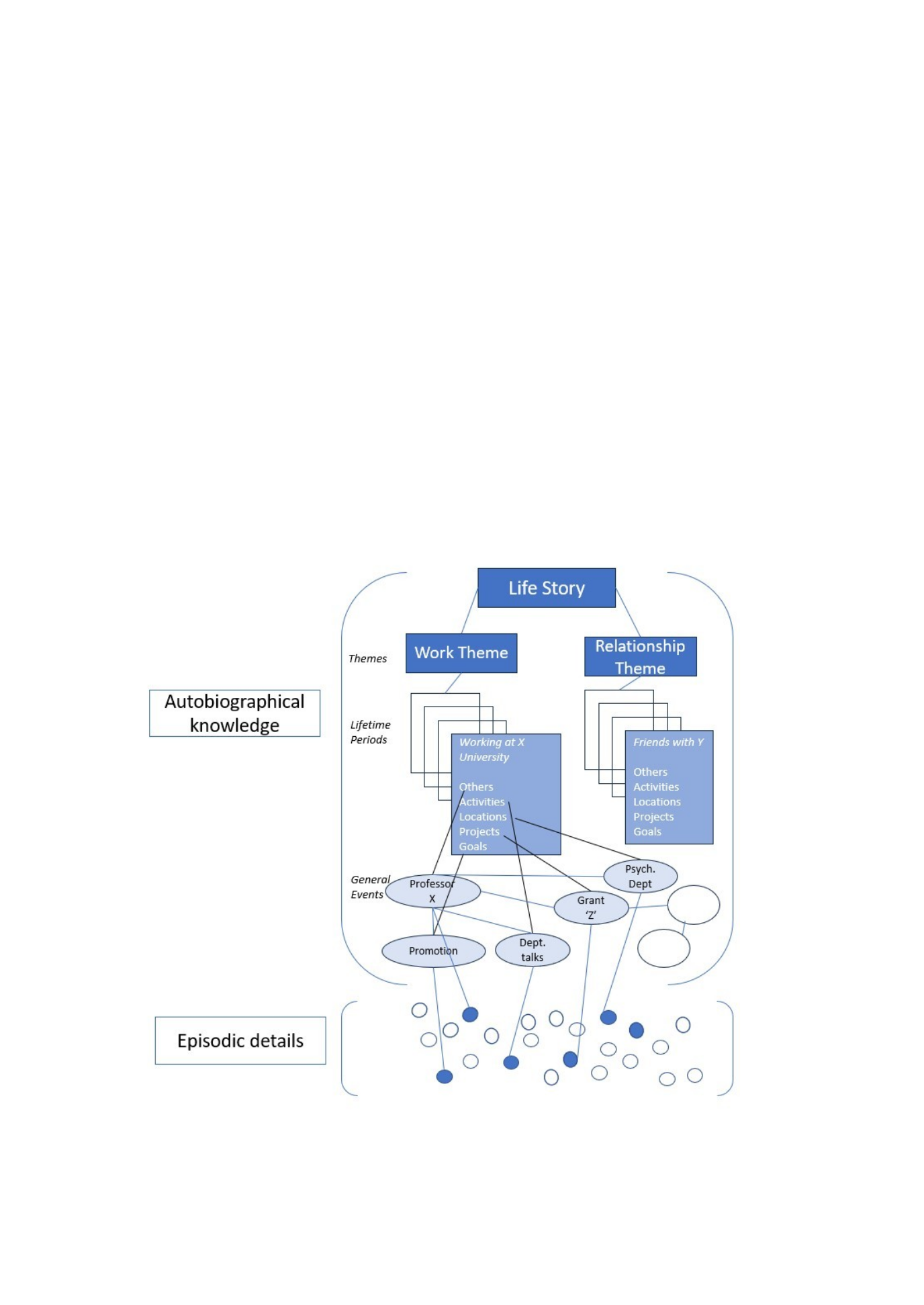
Figure 1
The Self Memory System (Conway, 2005)
4

2.1.1 The self component
The Self Memory System model of autobiographical memory is centered on
a bi-directional relationship between memories and the self (Conway, 2005;
Conway et al., 2019; Conway & Pleydell-Pearce, 2000) (see Figure 2). According to
this model, memories are not isolated entities but are influenced by personal goals,
self-images, and knowledge integrated within the self (Conway, 2005; Conway &
Pleydell-Pearce, 2000). In turn, identity influences the memories stored and
retrieved in autobiographical memory (Conway et al., 2019). Memories are linked
to identity through aspects of personality (McAdams, 1982; McAdams, 2016), goals,
and emotions (Stein et al., 1999). As mentioned earlier, the self component
encompasses the conceptual self and the working self.
The conceptual self includes semantic information related to
autobiographical memories, such as personality traits, characteristics, and expected
roles about the self from the past, the present, and the future (see Figure 2).
The working self component is a dynamic structure that comprises a goal
hierarchy, values, and self-images (see Figure 3). It facilitates the encoding and the
reconstruction of memories from autobiographical knowledge components and
episodic memories (Conway & Pleydell-Pearce, 2000) (see Figure 3). The goal
hierarchy of the working self serves as a control process, facilitating the encoding
and maintenance of memories in the long-term. Recent memories follow a natural
forgetting trajectory unless evaluated as important to goals and values (Conway,
2005; Conway et al., 2019). Over time memories are recalled in more general
5

representations and focus more on significant personal events (see section 2.2).
Moreover, the working self is underlined by two principles. First, the coherence
principle suggests that personal memories are encoded and reconstructed in
coherence with our goals and beliefs (i.e., our identity). The correspondence
principle implies that autobiographical memories are in line with our perception of
reality (Conway, 2001; Conway, 2005; Conway et al., 2004).
Figure 2
The Self Memory System includes the conceptual self and the future dimension
6

2.1.2 The autobiographical knowledge
The autobiographical knowledge component of the model operates at three
different levels of specificity. Each level is associated with levels above and below in
the hierarchy. It also encompasses conceptual personal knowledge and
representations about the personal future (Conway, 2005; Conway et al., 2019).
The most abstract level is the life story schema. It includes knowledge about
the self over an entire life including the future (Bluck & Habermans, 2000; Conway
et al., 2019; McAdams, 2001). These schemas are available for different dimensions
of our life such as life stories about friendships, relationships, or professional stories
for the past and future. The narrative self (our story) is rooted in life story schemas.
Life story schemas evolve around lifetime periods, which constitute a more
specific level. These periods incorporate characteristics of a specific period
including knowledge about locations, people, goals, emotions, and thoughts, as
illustrated in Figure 1 (Brown, 2016; Conway et al., 2019; Thomsen, 2015). For
example, one lifetime period could be when I was a PhD student at Liege University.
Different life periods can sometimes overlap with each other. The content of these
periods includes thematic knowledge and temporal knowledge. Thematic
knowledge refers to the fact that life periods are linked to higher representations of
themes such as work or family. The temporal knowledge can be seen through
transitions between these periods which are marked by personal events creating a
cut and a shift from one period to another. These transitions are events that create
a permanent change in our daily lives (Brown, 2016; Brown et al., 2009). For
example, one transition could be when I move out from my parents’ house to my
place. These transitional events structure and organize autobiographical memory.
General events are shorter periods than lifetime periods and are included in
lifetime periods (level above). It is also the level directly linked to specific events
and episodic details. It includes repeated events (e.g., movie night on Fridays), and
7

extended events (e.g., one-week holiday in Spain). This level allows the generation
of cues to activate episodic details associated with the event.
2.1.3 Episodic memory level
The richness of personal memories is derived from the episodic details
retrieved from the most specific level of the model. It includes various details of
personal experiences contributing to the vividness of memories. These details can
be related to sounds, smells, thoughts, feelings, visual details, and so on (Conway
et al., 2004). Over time, episodic details are naturally expected to fade and be
forgotten unless they are associated with and relevant to personal goals and values
(Conway, 2009; Conway & Pleydell-Pearce, 2000). The episodic details are further
discussed in section 2.2.
2.1.4 Process of activation and retrieval
An important feature of the model is that personal events are not stored in
autobiographical memory as an exact recording of how they were experienced (see
the specific case of flashbulb memories in Chapter 3). Instead, memories of
personal events are constructed by cues activating higher levels in the
autobiographical knowledge component, leading to a chain reaction activating the
lowest other levels and connecting with other items/information from personal
knowledge (Collins & Loftus, 1975). Finally, central control processes, associated
with the goals, access the items activated by cues in autobiographical knowledge
and assess the relevance of this activation (Anderson & Conway, 1993; Conway et
al., 2004; Conway & Pleydell-Pearce,
2000). Beyond that assessment, it can refine the activated cues allowing them to
activate other knowledge. Following this process, a memory description is available
(Norman & Bobrow, 1979) and activates other autobiographical memories (Mace &
Clevinger, 2013). Most of these processes are unconscious. However, some can be
voluntarily activated. For instance, cues can be voluntarily activated such as in
8

studies using the cue-word method (see Box 1) (Conway, 2001; Conway et al., 2019)
(see Figure 3).
Figure 3
Retrieval of personal memories
Box 1. Methods of investigation of autobiographical memory retrieval: the cue-
word method & the autobiographical interview
One way to examine the retrieval of personal memories is by using the cueword
method. Researchers provide cue words to participants. Participants are asked to
recall a specific personal memory associated with the presented word. For
9

example, when presented with the word “university” someone might think of the
day they graduated. Then, they are asked to date these events and verbalize
everything they think about while doing so. See for example Brown et al., (2016),
and study 3 in this thesis.
The autobiographical interview, developed by Levine et al. (2002) is a method
that quantifies the amount of episodic and semantic information related to
personal memories. It is also used to assess the imagination of future personal
events. Memories and imagined events are examined in terms of internal or
external details. Internal details are details describing the unfolding of the event
and its context and are considered episodic information. Thus, internal details
provide information about the event, time, place, perceptual, thoughts, and
emotions. External details are not related directly to the specific event and
describe general events, other events related to the central episode, semantic
information, or metacognitive appraisal, and are considered semantic (or non-
episodic) information (Levine et al., 2002). This assessment aims to evaluate the
specificity of memories with internal details associated with a more
phenomenological perspective of memories, and external details associated with a
semantic perspective of memory. For instance, one memory could include internal
details such as “The car accident happened in 2020. I was in my house, with my
family when I got the call.” And external details associated with that memory
could be added such as “… I remember it very well”. This method has been used
through studies 1, 3, and 4 in this thesis.
2.2 Psychological phenomena
It is important to highlight that the quantity and quality of autobiographical
memories can be influenced by multiple variables. We will only consider here two
of them. First, time has a natural influence on memories and their organization.
This will be explained in subsection 2.2.1 through several theories and phenomena.
We also discuss future thinking as a second temporal dimension in memory
(subsection 2.2.2). Then, we examine individual variables that can also influence
personal memories, focusing on aging and emotions (subsection 2.2.3).
10

2.2.1 Time related modifications of memories
The influence of the passage of time on memories is a well-known
phenomenon. As time progresses, most memories naturally tend to fade and be
forgotten (Gluck & Bluck, 2007; Schuman & Corning, 2014). The consolidation
theories show that memory traces are strengthened through rehearsal which helps
to consolidate memories in long-term memory (Duday et al., 2015; Squire et al.,
2015). For example, the decay theory suggests that memories fade over time if not
reinforced by rehearsal (see Sadeh et al., 2014 for a review). Rehearsal can happen
through strategic (indirect) or associative (direct) retrieval that activates memories,
which leads to reinforcing the memory trace. Strategic retrieval involves a conscious
effort to search memory for components that will reconstruct a specific event.
Associative retrieval corresponds to memories that spontaneously resurface in
response to a cue, such as a visual cue for the environment. Both strategic and
associative rehearsals reactivate a memory trace that is therefore strengthened
(Moscovitch & Winocur, 2002). Therefore, old memories are more likely to be
rehearsed than recent ones, making them more likely to be held in long-term
memory than recent memories.
More specifically, the trace transformation theory posits that with time the
original experience is recalled with less detail and less specificity, and in a more
general way to recall the gist (Moscovitch et al., 2016). Indeed, studies revealed
that participants recall more the gist (i.e., key elements of the story) and fewer
details about a story as time elapses (Conway et al., 1991; Furman et al., 2012).
Memories are remembered with central elements important to the coherence of
the event (Rumelhart & Orthony, 1977; Thorndyke, 1977). The loss of episodic
details over time can be seen through studies examining the recall of the plot and
the recall of episodic details. Furman and his team (2007, 2012) conducted several
studies in which participants were asked to watch a short documentary film and
then answered questions about it. They found that questions related to the plot
11

remained accurate over time, while the recall of contextual details based on a cued
recall declined over the following weeks. Additionally, Sekeres et al. (2016)
examined the time effect on memories of naturalistic events through film clips by
asking young adults to recall them over 7 days. The results reveal that the
peripheral details underwent a significant loss, whereas central elements (the gist)
were less significantly affected by time. Similar results were also found when
participants were asked to read a narrative and recall it (Bahrick, 1984; Conway et
al., 1991).
From another perspective on time's influence on memories, the life span
retrieval curve identifies three main periods: childhood amnesia (from birth to 5
years old), the reminiscence bump (from 10 to 30 years old), and the recency
period (from now to the reminiscence bump) (Rubin et al., 1986). The widely
demonstrated reminiscence bump corresponds to the fact that events that were
lived between the ages of 10 to 30 years old are usually remembered more
frequently than memories from other periods (for a review see Munawar et al.,
2018). Studies show a bump at that period in the reminiscence of personal
memories in participants older than 40 years old.
Three main explanations for the reminiscence bump are discussed in the literature.
The first is associated directly with the formation of identity with memories of that
period being more self-defining memories (Rathbone et al., 2008). Self-defining
memories represent memories highly relevant to identity (Conway, 2005). These
memories are specific due to their vividness, emotional intensity, and frequency of
rehearsal (Blaglov & Singer, 2004; Singer et al., 2007). Building on these results, the
self-image hypothesis suggests that memory is enhanced for events that happened
during the period around adolescence and early adulthood, when identity is
constructed (Rathbone et al., 2008). The second hypothesis suggests that this
period is associated with several new experiences associated with a novelty effect
that enhances the encoding of these events (Demiray et al., 2009; Pillemer, 2001;
Wolf & Zimprich, 2020). Finally, the third hypothesis delves into the content of
12

memories within this bump, noting that they predominantly include positive
personal experiences rather than negative ones. This observation prompts an
exploration into the influence of cultural life scripts. These scripts or schemas are
semantic knowledge representing societal norms and expected events associated
with specific life periods. Building on a collective influence, researchers have
proposed that cultural life scripts may play a pivotal role in shaping the
reminiscence bump of positive memories. These scripts can help organize
autobiographical memory, influencing the recall of events fitting cultural
expectations and favoring positive events (Berntsen & Rubin, 2002; Dickson et al.,
2011; Rubin & Berntsen, 2003). Personal events that align with a cultural life script
are more easily remembered (Glück & Bluck, 2007). Since memories retrieved
during the reminiscence bump are mostly of positive valence, Berntsen & Rubin
(2002) suggested that these scripts might act as guides when retrieving memories.
As previously discussed, the cognitive structure of autobiographical memory
includes several life periods such as “When I lived with my parents” or “When I
worked at Liege University” (Brown, 2016; Conway et al., 2005). Boundaries
between life periods are called transitions. Transitions are created by events that
have enough intensity to change the fabric of daily life (Brown, 2021). These
transitions can in turn be used as a temporal landmark when recalling one’s life
(Brown, 2016). Transitions encompass several dimensions. First, the normativity
dimension refers to the fact that transitions can be life script consistent or not.
Some transitions are expected in our society such as getting married, having
children, and so on, whereas other events do not fit into expected life patterns
(Brown, 2023; Gu et al., 2017). Secondly, the scope dimension encompasses the
idea that transitions can be seen on a continuum from personal such as moving to a
new place, to collective such as wars and natural disasters (Brown, 2023; Gu et al.,
2017) (see Chapter 2). Thirdly, the impact dimension relates to the impact and
consequences of the transitional events in someone's life (Brown, 2023; Gu et al.,
13

2017; Shi & Brown, 2021). Overall, this phenomenon offers tangible evidence of
how personal events significantly influence memory organization.
2.2.2 Future thinking
Having explored the phenomena anchoring autobiographical memory in the
past temporal dimension, we now pivot to examine its counterpart: the future
dimension (see Figure 3). This shift allows us to discover the intricate interplay
between past experiences and future thoughts.
Episodic future thinking corresponds to the ability to imagine experiences
that could occur in one’s future (Atance & O’neill, 2001; Schacter & Addis, 2007;
Schacter et al., 2017; Szpunar et al., 2007). Research on that topic has increased
significantly over the last decade. The underlying cognitive mechanisms of future
thinking are mainly discussed in the literature through the constructive episodic
simulation theory (Schacter & Addis, 2007). This theory includes autobiographical
memories and suggests that to imagine future events, one relies on past personal
memories and knowledge. These elements that make up individual memories are
reassembled to simulate scenarios for possible future events. More precisely, when
constructing personal future events we rely first on general personal knowledge to
which we add specific episodic details (D’Argembeau & Mathy, 2011; Schacter et al.,
2007; Szpunar et al., 2007). The semantic memory acts as the architecture for
constructing scenarios (also known as the semantic scaffolding hypothesis; Schacter
et al., 2007; Szpunar et al., 2007).
Related to that theory, numerous studies in psychology and cognitive
neuroscience showed similar patterns between the past and future dimensions of
autobiographical representations (D’Argembeau et al., 2015; Schacter & Addis,
2007; Schacter et al., 2012; Szpunar & McDermott, 2008). Here, we will discuss
some of them. On the one hand, fMRI studies have shown that a core network of
brain regions including the medial temporal lobe, the retrosplenial cortex, the
14

medial prefrontal cortex, the lateral temporal and parietal regions are activated
both when recalling past events and imagining future events (Benoit & Schacter,
2015; Stawarczyk & D’Argembeau, 2015). These regions are usually known as the
default network (Raichle, 2015). Moreover, several studies have demonstrated an
expanded activation of brain regions during future thinking compared to memory
recall, implying reliance on schema-based processes in imagining future events
(Addis et al., 2008; Szpunar et al., 2007). Behavioral studies, particularly through
autobiographical interviews prompting participants to recall and imagine personal
events, showed how they were similar in terms of internal and external details
(Levine et al., 2002) (see Box 1). Given the involvement of internal details in both
temporal dimensions, researchers posit that episodic memory plays a shared role
across past and future temporal perspectives.
2.2.3 Variables influencing autobiographical memory
While several factors can influence memory, our discussion now narrows its
focus to two significant variables: emotions and aging.
2.2.3.1 Effects of emotions on autobiographical memory
Emotions play an important role in autobiographical memory influencing the
encoding and retrieval processes (Luminet, 2022). Under the scope of “effects of
emotions on autobiographical memory” we can find two different levels of
emotions’ examination.
First, emotions can be examined at the memory level, through the valence of
the memories and the events. For example, a wedding is usually a positive memory,
whereas a death is usually a negative and sad memory. Building on that first
examination level, the positivity bias in memory suggests that personal memories
tend to be recalled with positive valence (Walker et al., 2003), shaping and
maintaining a positive self-image (Walker & Skowronski, 2009). This emotional
influence extends also to future thoughts with studies revealing that imagined
15

personal events tend to be positive events, an effect also called optimism bias
(Berntsen & Bohn, 2010; D'Argembeau & Van der Linden, 2004; Deng et al., 2022).
Secondly, emotions can be examined at the individual level through the
emotions felt during the event or when recalling memories. The emotion
enhancement memory effect posits that emotional events are usually remembered
more vividly, more frequently and with greater accuracy than neutral events (for a
review see Kensinger & Ford, 2020). On the other hand, emotions felt when
recalling memories can influence how these memories are recalled. For instance,
psychological well-being was also associated with autobiographical memory
(Conway & Pleydell-Pearce, 2000). In more pathological contexts, anxiety and
depression have been associated with a negative bias in memories and future
thinking (see Dalgleish & Werner-Seideler, 2014 for a review). There is a specific
case where these emotions are too intense and can lead to a modification of
memories, to experience intrusive thoughts, flashbacks of the traumatic event, and
to suffer from memory difficulties, as evidenced in individuals with post-traumatic
stress disorder (PTSD) (Park et al., 2012; Samuelson et al., 2022).
2.2.3.2 Age effects
Aging is associated with a natural decline in memory, particularly affecting
certain aspects of episodic memory and personal memories (Balota et al., 2000;
Drag & Bieliauskas, 2010). Older adults face difficulties recalling specific episodic
details associated with an event and the context related to the event (Balota et al.,
2000). In autobiographical memory, age-related differences in recalling specific
episodic memories have been demonstrated with a method that examines internal
and external details included in memory descriptions. Studies show age differences
in these categories, where older adults recall more external details and fewer
internal details compared to young adults (Levine et al., 2002; Mair et al., 2017;
Mair et al., 2019). Older adults forget specific information (Greene & Naveh-
Benjamin, 2020). In that line, studies showed that, when recalling memories, older
16

adults tend to be more off-topic, which is characterized by a lack of coherence in
their speech (Arbuckle & Gold, 1993; Pushkar et al., 2000; Trunk & Abrahams, 2009;
Wills et al., 2012), especially by sharing personal opinions and memories (Barber &
Mather, 2014; Bluck et al., 2016; Brandao & Parente, 2009). In cognitive psychology,
this phenomenon is linked to the inhibitory deficit hypothesis (for a review see
Hasher & Zacks, 1988; Zacks & Hasher, 1994), which posits that older adults have
difficulties inhibiting irrelevant information, making them more likely to share it.
While episodic memory declines with age, semantic memory seems to stay
stable (Craik & Jennings, 1992). Older adults can therefore rely on autobiographical
knowledge to retrieve personal memories. Indeed, some researchers suggest that
older adults rely more on the gist (the schemas) than the episodic details of these
events compared to young adults (Flores et al., 2017; Grilli & Sheldon, 2022).
Memories can be subject to bias (see Schacter et al., 2023 for a recent review).
For instance, studies show that memories' emotional content changes with aging.
In aging, the positivity effect represents how older adults tend to recall more
positive memories than their younger counterparts (Carstensen, 1993; Carstensen,
2006; Charles et al., 2003; Mather & Carstensen, 2005) and reinterpret negative
memories through a more positive lens compared to younger adults (Charles et al.,
2003; Comblain et al., 2005; Mather & Carstensen, 2005). This positivity effect is
explained through the socioemotional selectivity theory. This theory highlights how
the limited time horizon with aging influences goals and emotional regulation
toward well-being (Carstensen, 2021). Therefore, this positivity effect appears to
stem from increased attention to emotion management with aging, which is seen
by cognitive mechanisms enhancing positive and diminishing negative information
(Mather & Carstensen, 2005). This positive reappraisal is also considered a coping
strategy for stressful events.
Regarding future thinking, research highlights that older adults retain the ability
to project themselves in the future, using the same neural network to recall past
17

experiences (autobiographical memories) and imagine future events (Viard et al.,
2011). However, older adults tend to use less episodic details for future events than
younger participants (Addis et al., 2008). For example, several studies showed that
healthy older adults provide fewer episodic details (internal) and more external
details compared to younger adults for future imagined personal events (Anelli et
al., 2016; Terrett & al., 2016). In line with these findings, age effects in episodic
future thinking were associated with cognitive decline including working memory,
executive functions, and episodic memory (Abram et al., 2014).
3. The functional approach of autobiographical memory
Several decades ago, Baddeley (1988) asked a ground-breaking question in the
field of memory in his paper entitled “But what the hell is it for?”. This question led
to a new approach in memory studies forcing psychologists to shift the focus from
“what” information is stored and “how” they are remembered to “why” we store
and remember personal memories (Baddeley, 1988; Mahr & Csibra, 2018; Pillemer,
1992). Since then, researchers never stopped conducting studies aimed at
identifying and assessing the various functions of personal memory (Baddeley,
1988; Bluck et al., 2005; Bluck & Alea, 2011; Bruce 1991; Hyman & Faries, 1992;
Nairne et al., 2007; Neisser, 1978; Schacter, 2022; Webster, 1993).
Before the widely accepted tripartite model highlighting the main functions of
autobiographical memory, which we present below (see Table 1), the first studies
revealed a multitude of functions (see Table 2). Hyman and Faries (1992) asked
participants to recall a memory and when it happened. Then, they were asked to
estimate how often they talked about it and describe when and why they talked
about it. Based on the results, the authors extracted 10 functions of memory. For
instance, some memories are used to solve problems (problem discussion
category), while others are used to entertain (entertainment category).
Concurrently, Webster (1993) developed a scale encompassing fortythree possible
18

reasons for recalling memories by asking participants to share two reasons why
they recalled memories and two reasons why other people recalled memories. The
forty-three functions were then condensed into eight functions. These results are
encapsulated in the Reminiscence Function Scale (Webster, 1993) (see Table 2). At
the same time, Pillemer (1992) was the first to narrow the number of functions to
three: the self function, the communicative function, and the directive function
(Pillemer, 1992). Later, Bluck and her team (2005) created the TALE questionnaire
(Thinking About Life Experiences), which has since become the foundation for
numerous studies investigating memory functions (see Table 3). The shortest
version of the questionnaire includes five items for each of the three psycho-social
functions: the self function, the social function, and the directive function (see
Table 1 for a general definition of each function).
Table 1
Definitions of the three main functions of autobiographical memory
Functions Definitions
Self To use memories to bear on one’s identity
Social To use memories to create or enhance relationships with
others
Directive To use memories to solve present issues or to imagine future
events
The three functions highlighted in the tripartite model of memory have
been demonstrated among several cultures such as the USA (Bluck et al., 2005;
Bluck & Alea, 2011), Japan (Maki et al., 2015), Denmark (Rassmussen &
Habermas, 2011), Croatia (Vranic et al., 2018) and France (Fritsch et al., 2021). The
three functions were also found to be associated with well-being. Specifically,
higher well-being was observed when memories were used more to fulfill these
functions (Waters et al., 2014). Studies also stressed age effects and the influence
of emotions on the use of memories for each function (Bluck & Alea, 2008;
Rasmussen & Berntsen, 2009). In the following subsections, each function is
defined and linked to age and emotional effects.
19
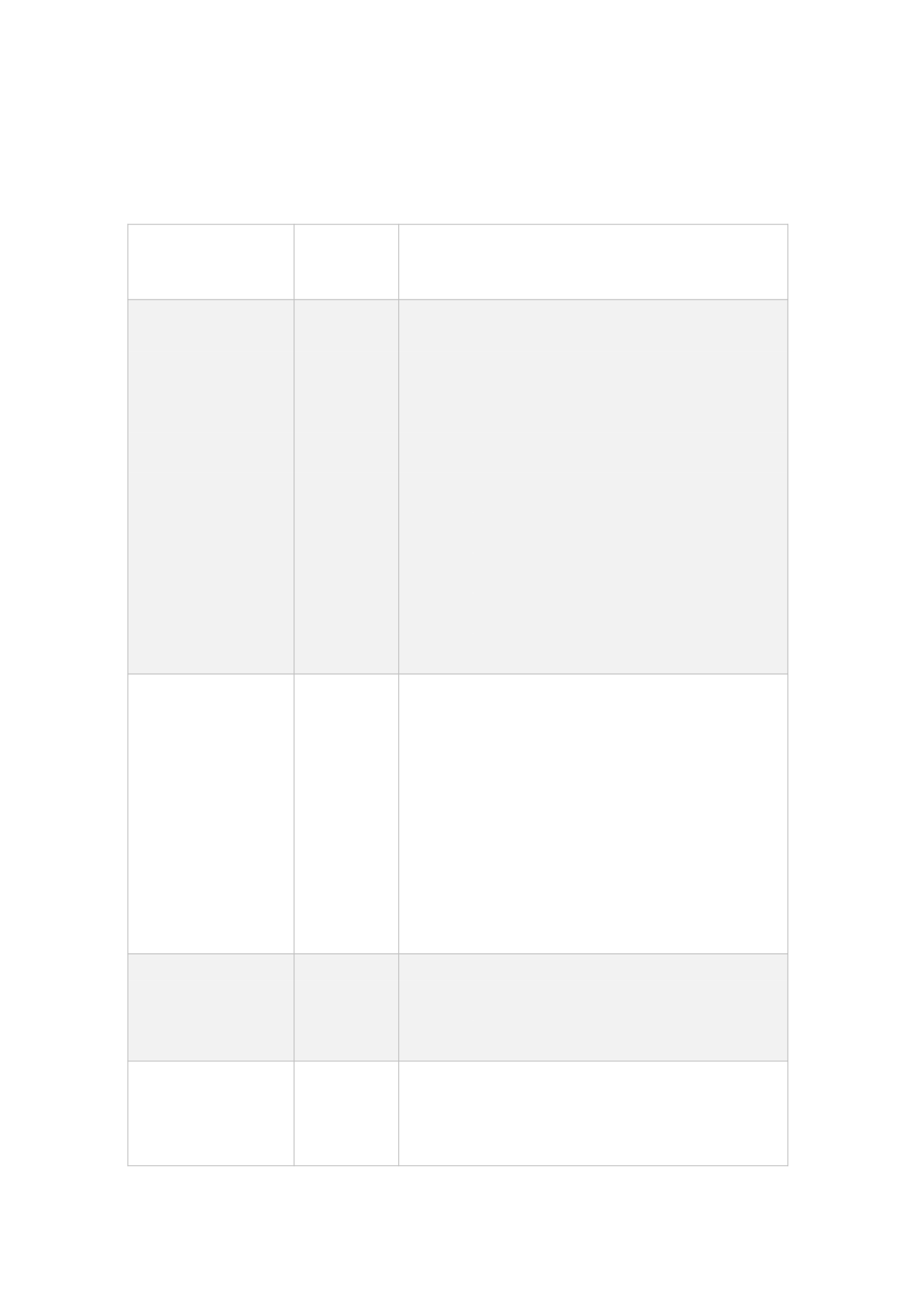
Table 2
Number of functions and functions by authors and scales
Authors and/or
scale
Number of
functions
Category/ functions
Hyman & Faries
(1992)
10 -
-
What’s up
My experience with X
- Reminiscing
- Testifying
- Self-description
- Other description
- Entertainment
- Problem discussion
- Point illustration/advice
- Daydreaming/associative thought
Webster (1993)
Reminiscence
Function Scale
8 -
-
-
Boredom reduction
Bitterness revival
Death preparation
- Intimacy
- Identity
- Problem-solving
- Conversation
- Teach/inform
Pillemer (1992) 3 - The self
- The communicative
- The directive function
Bluck et al.,
(2005) The
TALE
questionnaire
3 -
-
-
The self
The social
The directive
20
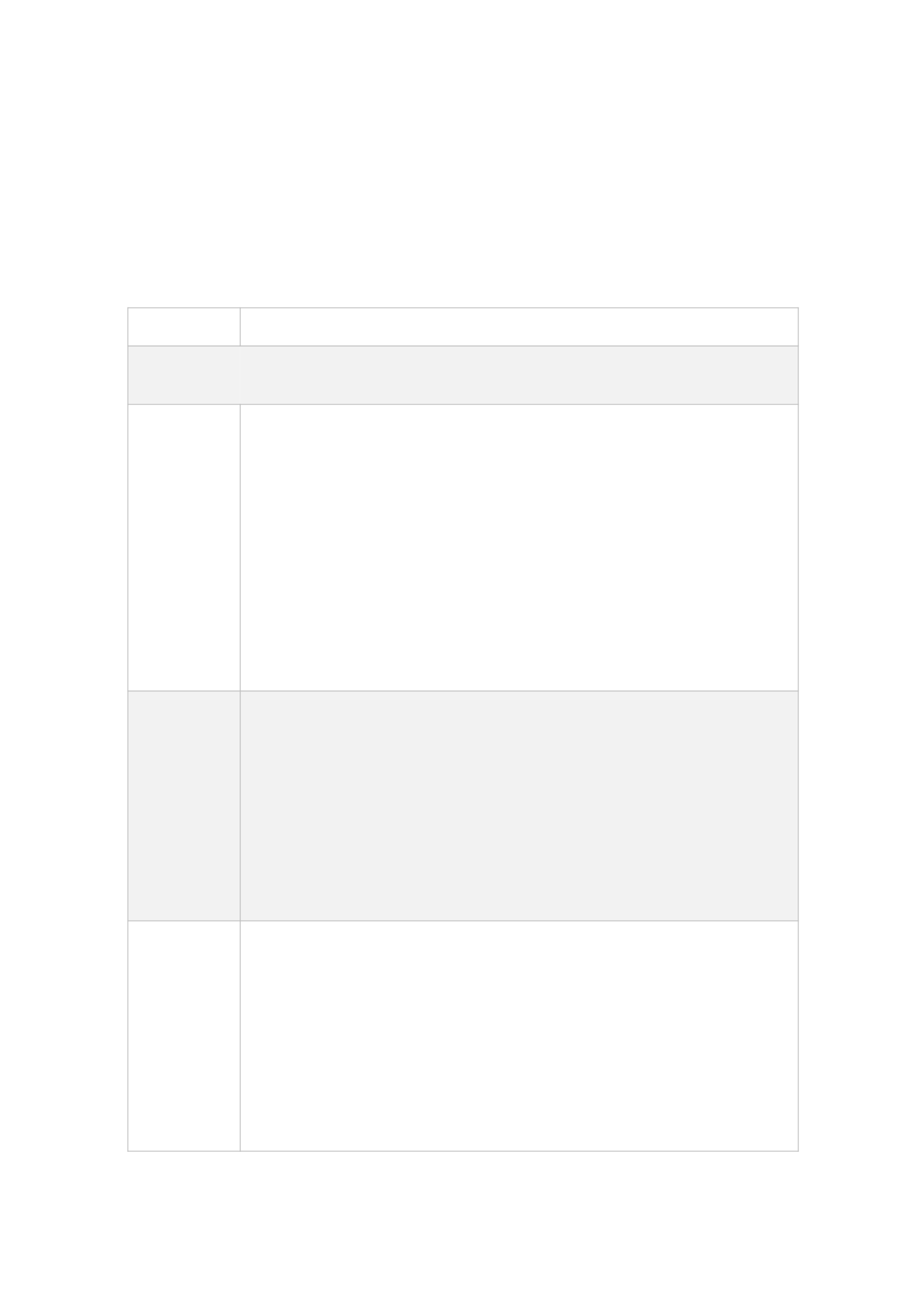
Table 3
The TALE questionnaire 15 items (Bluck et al., 2005)
Functions Items
I think back over or talk about my life or certain periods of my life…
Self 1. When I want to feel that I am the same person that I was
before
2. When I am concerned about whether I am still the same
type of person that I was earlier
3. When I am concerned about whether my values have
changed over time
4. When I am concerned about whether my beliefs have
changed over time
5. When I want to understand how I have changed from who I
was before
Social 6. When I hope to also find out what another person is like
7. When I want to develop more intimacy in a relationship
8. When I want to develop a closer relationship with someone
9. When I want to maintain a friendship by sharing memories
with friends
10. When I hope to also learn more about another person's
life
Directive 11. When I want to remember something that someone else
said or did that might help me now
12. When I believe that thinking about the past can help guide
my future
13. When I want to try to learn from my past mistakes
14. When I need to make a life choice and I am uncertain which
path to take
15. When I want to remember a lesson I learned in the past
21

3.1 The self function
The self function of autobiographical memory is tied to the process of
recalling personal events and experiences to bear on one’s identity and allow a
sense of continuity in the self (Bluck & Alea, 2011). Of note, this idea is also central
in the Self Memory System, presented previously, as self-defining memories are
highly associated with identity processes (Blagov & Singer, 2004). Autobiographical
memory stores information related to the self which serves to create a stable
representation of ourselves as time passes. Indeed, identity is formed through life
(Kaufman, 1986; Orona, 1990), but the feeling of being the same person remains
continuous (Bluck & Alea, 2008; Conway, 2003). This stable identity is underlined by
autobiographical narratives, starting in the teenage days (Habermas & Bluck, 2000)
and through the life span (Waters et al., 2014). This function allows self-continuity,
and coherence (Bluck & Alea, 2002; Habermas & Bluck, 2000).
Building on that, the self function has been associated with the concept of
self-clarity (Bluck & Alea, 2008; Campbell et al., 1996; Jiang et al., 2020). Individuals
with a less precise representation of their selves (i.e., less selfclarity) experience a
lower feeling of self-continuity (Jiang et al., 2020) and are more likely to engage in
the process of using memories to reinforce this sense of coherence (i.e., self
function) (Bluck & Alea, 2008; Campbell et al., 1996). From a cognitive perspective,
Walters and colleagues (2014) asked participants to recall memories of specific
events, repeated events, and extended periods. Narratives were then coded for
memory functions (as seen in Table 1). Results show that specific memories
referred more to self function, compared to memories about repeated events and
extended periods which serve self and social functions of memory. Additionally, a
recent review revealed that memories remembered to foster a sense of continuity
are more precise and include more episodic details compared to memories used for
social bonding and directive functions (Sow et al., 2023).
22

Emotions play a role in the self function. Positive memories are more likely
to be used to fulfill the self function than negative memories (Rasmussen &
Berntsen, 2009). Yet, some negative emotional events can also make it to our long-
term autobiographical memory and become part of our identity. For example,
traumatic events can influence one’s identity (Berntsen & Rubin, 2006).
Furthermore, memories are prone to bias and can be positively exaggerated to
ensure a positive self-image (Walker & Skowronski, 2009).
Some authors suggest that cognitive aging might influence the use of
memories to help self-continuity feeling (Bluck & Alea, 2009). Studies relying on the
TALE questionnaire revealed mixed results. For instance, Vranic et al. (2018) did not
find differences between young and older adults regarding the use of personal
memories related to the self function. However, Bluck & Alea (2009) showed that
young adults use more personal memories to bear on their sense of self-continuity
compared to older adults. The inconsistent findings could be explained to some
extent by age differences in studies. While both studies examined young adults,
Vranic et al., (2018) examined memory function in young adults aged around 28
years old, while Bluck & Alea (2009) focused on young adults around 19 years old.
Thus, teenagers who have a less clear concept are more likely to use memories for
self-continuity purposes (Bluck & Alea, 2008). Moreover, it was found that
memories recalled by older adults to serve the self function were more positive
than the ones recalled by younger adults, highlighting a link with the positivity bias
in aging (Alea et al., 2013).
3.2 The social function
The second function of autobiographical memory is the social function
where personal memories play a role in the creation of new relationships or in
nurturing old relationships (Bluck & Alea, 2008; Pasupathi, 2003; Sow et al., 2023).
23

Studies showed that 62% of recorded events in a diary by participants were told to
someone else by the end of the day (Pasupathi et al., 2009). In a relationship,
sharing personal memories fosters a sense of intimacy and connection with
partners (Alea & Bluck, 2007; Alea & Vick, 2010; Pasupathi, 2003), as well as a
feeling of closeness with friends or strangers (Beike et al., 2016). Moreover, a recent
review demonstrated that personal memories shared with others for social bonding
goals tend to be more general and contain less episodic details than memories
associated with the self function (Sow et al., 2023).
Emotions also play a role in the social function. Positive memories are more
likely than negative memories to be shared with others to enhance relationships
(Alea et al., 2013; Rasmussen & Berntsen, 2009). Sharing positive memories
contributes to a positive atmosphere in relationships, enhancing a sense of
connection and social bonds, mainly achieved by discussion, and sharing narratives
(see Boxes 2 and 3 for links between social function and communication processes).
Regarding the impact of aging on the social bonding process, empirical
studies present inconsistent findings. Some findings suggest that young adults
remember more personal events to share them with others, compared to older
adults (Vranic et al., 2018). However, another research did not find significant
differences between young and older adults regarding the use of personal
memories shared to connect with others (Bluck & Alea, 2008). For both studies,
results are based on the TALE 15-items questionnaire with ratings on a Likert scale
from rarely (1) to frequently (5) (see Table 2) (e.g., I think or talk about my life, or
period of my life when I want to know another person and what they are like)
completed by young and older adults. One study found that older adults recalled
more positive memories to fulfill the social function compared to younger adults,
which is in line with the socio-emotional theory and the positivity bias discussed
previously.
24

Box 2. Communication as the main tool for social function: a sociocognitive
perspective of communication
The social function of memory is mainly achieved through communication.
Sharing memories with others relies on sociocognitive systems (Bietti, 2010;
Harris et al., 2014). The sociocognitive theories suggest that social and cognitive
factors are involved and influence the memory process through factors such as
social context, social norms (Bietti, 2010), the dynamics and roles between
people engaging in a conversation (Hirst & Manier, 1996), or even cultural and
age differences (Adams et al., 2002). As Welzer (2008) suggests, this
phenomenon is characterized by interactive and interpersonal features.
Box 3. Sharing memories through narratives
When sharing a story, elements are recalled following a specific template (in
chronological order) starting with the beginning and finishing with an end
(Bruner, 1990; Teigen et al., 2017).
Wertsch (2008) distinguished two types of narrative templates. First, the specific
narratives involve many specific details related to the characters, the unfolding of
the event, and the date of a specific event, which rely heavily on episodic
memory (e.g., the lockdown of the COVID-19 pandemic in 2020 was announced
on the 17th of March in Belgium. It was announced by Sophie Wilmès. She was
wearing a white dress.) Second, schematic narrative templates are abstract forms
of narrative representations which can be used to narrate several events,
independently of their unique actors or settings.
Schemas are believed to be common knowledge (Schank & Abelson, 1975),
relying more on semantic memory. In this case, schemas are about the sequence
of events (e.g., the context, the causes, and the consequences of an event). As
such, they can be considered as basic building blocks of narrative (Wertsch,
2004), above which the specific narrative can be grafted.
3.3 The directive function
The third function of autobiographical memory is grounded on the idea that
past experiences are stored in memory to be used to solve a current issue or to
plan for future actions, often achieved through the mental simulation of similar
future events (Bluck & Alea, 2005; Pillemer, 2003; Sow et al., 2023; Schacter, 2012;
Vranic et al., 2018). As previously mentioned, the process of using past personal
25

memories to imagine the personal future is discussed through the episodic
constructive simulation theory (Schacter et al., 2017). Additionally, a link has been
made between the ability to mentally travel to past experiences and solve
problems, as individuals with limited capability to travel mentally to past
experiences have more difficulties in using personal memories to solve issues
(Kuwabara & Pillemer, 2010).
As for the two other functions, emotions are also associated with the
directive function of autobiographical memory. Studies found that negative
memories are more likely to be remembered to serve the directive function than
positive memories (Alea et al., 2013; Lind et al., 2019; Rasmussen & Berntsen,
2009) and that traumatic events can also fulfill adaptative functions (Pillemer,
2003). One explanation is that negative memories are more likely to be associated
with learning from past mistakes than positive memories (Lind et al., 2019).
As opposed to the other two functions, research shares consistent findings
about the age effects on the directive function, revealing that young adults use
more personal memories to solve a current issue or plan for the future compared to
older adults (Bluck & Alea, 2008; Vranic et al., 2018). These findings can be
explained as young adults are less experienced in life’s challenges than older adults,
making them likely to seek guidance from past experiences. Moreover, the future
ahead is longer and uncertain for younger adults, leading them to be more likely to
rely on past experiences to adapt to future situations (Bluck & Alea, 2009; Vranic et
al, 2018). As for the other functions, older adults recall more positive memories
than younger adults to fulfill the directive function of memory (Alea et al., 2013).
26

27

C 1: Summary
C 1
:
functional appr .
T cognitive a f on two points:
) A model of autobiogr memory discussing the impor
the self and a hier str .
) P
time, emotions, and age eff .
T functional appr suggests thr main functions of autobiogr
.
) T self- : per memories bear on the per identity
) T :
relati with other
) T :
e
F e function, aging and emotions eff on memories were in .
T chapter l t found f the theore hy of this thesis (see
C 4) a describes variables assessed t the diff s .
28

CHAPTER 2
29

CHAPTER 2
CHAPTER 2
Collective memory
T second chapt on collectiv memory. I begins with a
. T ,
collectiv memories are pr . F , the
appro , collective memory functions ar described.
T
(C 3)
conte of coll memory resear (C 4).
30

CHAPTER 2
1. Introduction to collective memory
Collective memory has been a subject of extensive research across various
disciplines including sociology, anthropology, philosophy, history, and psychology
(Hirst et al., 2018; Olick et al., 2011; Wertsch, 2002). Halbwachs (1950), a pioneer,
emphasized the intrinsic connection between memory and social frames (i.e., the
social context). Through his statement “It is the individual, as a group member, who
remembers” (Halbwachs, 1950, p.46), he included the individuals within a group
and linked personal memories with collective memories (Halbwachs, 1925).
The multidisciplinary interest in collective memory has led to several
definitions of the concept (Heux et al., 2022; Orianne & Eustache, 2023; Roediger,
2021). In 1995, Assmann and Czaplicka introduced a crucial distinction within
collective memory by distinguishing communicative memory and cultural memory.
Communicative memory is shared between individuals through everyday
interactions with friends and family (Baek et al., 2017; Cordonnier et al., 2021),
while cultural memory refers to long-lasting and publicly available memories
preserved in various forms such as objects, museums, and memorials (Assmann,
1995; Hirst & Echterhoff, 2012; Olick, 1999) (see Table 4).
Building on this social perspective of memory, cognitive and social
psychologists have taken the lead in investigating collective memory within
psychology. From a psychological perspective, collective memories are individual
memories shared by members of a community shaping the community’s identity
(Coman et al., 2009; Hirst & Manier, 2008; Roediger & Abel, 2015; Wertsch &
Roediger, 2008). Therefore, collective memory is not the same as history (Roediger
& Abel, 2015; Roediger, 2021), but refers to “individual systems of consciousness”
(Orianne & Eustache, 2023).
Additionally, Hirst and Manier (2008) distinguished collective memories
from shared memories, regarding their links with collective identity. If the
memories bear on the collective identity, these memories can be labeled as
31

CHAPTER 2
collective memories. If not, the memories shared with others are referred to as
shared memories (Hirst & Manier, 2008; Merck, 2020). All collective memories are
shared memories, but not all shared memories become collective memories (see
Table 4). Also, a specific type of shared memories are vicarious memories, where
individuals remember events that happened to others, influencing their identity
without directly experiencing these events (Hirst & Merck, 2022; Pillemer et al.,
2015).
Two main types of processes lead to shared memories. Firstly, they can be
formed passively simply by learning about or experiencing the same public event.
This process mainly relies on media. For example, people all over the world share
memories about the events of the 9/11 attacks because they learned about them
through the media (Paèz, 2015). Secondly, shared memories can be actively formed
through communication processes, referring to communicative memory (Assman &
Czaplicka, 1995). Communicative memory can be observed in groups of strangers,
friends, and within families (i.e., intergenerational transmission of memories).
Another distinction is made between lived collective memories and distant
collective memories (Hirst & Manier, 2002; Manier & Hirst, 2008). Lived collective
memories represent memories held by individuals about an event that occurred
during their lifetime (Hirst & Manier, 2002). Distant collective memories are events
that occurred in the past when individuals were not born yet. For all of us, the
COVID-19 pandemic can be considered as lived collective memories, whereas
distant collective memories could be memories of World War I, for instance. Unlike
distant memories, lived collective memories are recalled as more specific events,
whereas distant memories are remembered in a more general representation
(Zaromb et al., 2014). Additionally, lived collective memories are recalled with more
personal memories associated with the event than distant collective memories
(Muller et al., 2016; Muller et al., 2018). Finally, lived collective memories seem to
be more emotionally intense compared to distant collective memories (Muller et
32

CHAPTER 2
al., 2018). These results align with the temporal construal theory, a social
psychology theory, that posits that representations are more abstract when the
psychological distance to the object is important (Liberman & Trop, 1998; Manier &
Hirst, 2008).
In the following sections, we delve into collective memory through the cognitive
and functional approaches, followed by an exploration of the psychological
processes underlying collective memory.
Table 4
Definitions of the main concept of collective memory
Concept Definitions
Collective
memories
“Widely held memories of community members that bear on
the collective identity of the community” (Hirst & Manier,
2008, p. 184)
Shared memories Memories shared across a community that does not
necessarily inform community identity (Hirst & Manier,
2008)
Communicative
memory
Memories that are based on and transmitted through
everyday communications (Assmann & Czaplicka, 1995; Muller
et al., 2018)
Cultural memory Long-term and stable memories that are maintained through
cultural formations and that inform cultural identity (Assmann,
1995)
2. The three facets of collective memory
Roediger (2021) described three facets of collective memory: collective
memory as the body of common knowledge, collective memory as an attribute of a
group of people, and collective memory as a process.
Collective memory as a body of common knowledge corresponds to the
semantic knowledge shared in a community. This knowledge is not static and can be
33

CHAPTER 2
influenced by generational effects. For instance, Desoto & Roediger (2019)
conducted a study where young and older participants from three generations
(Baby Boomers, Generation X, and Millennials), were asked to recall the names of
US presidents, which is supposed to be a body of semantic knowledge shared by
Americans. They were asked to recall them in the correct chronological order if
possible. The results revealed primacy and recency effects across different
generations, indicating that collective memory shares the same phenomenon as
seen for the recall of a list of words, following a serial curve. The results also
showed that all participants shared knowledge about it confirming that collective
memory encompasses a body of knowledge (see Fu et al., 2016 and Neath & Saint-
Aubin, 2011 for other examples). For instance, different generations of participants
recalled better the more ancient US Presidents but also significantly recalled Lincoln
as a President (DeSoto & Roediger, 2019). The findings also underscored that
different generations may forget certain aspects of this body of knowledge, through
forgetting curves as seen for presidents from Truman to Ford, raising questions
about collective forgetting. Related to this forgetting in collective memory, studies
have shown that not all collective events are remembered. It seems that collective
events that make it to our long-term memory are events that are commemorated
such as wars, and attacks whereas natural disasters are not widely remembered (Liu
et al., 2005). This idea of commemoration as a driver of long-lasting collective
memories relates closely to the concept of cultural memory.
Collective memory as an attribute of a group of people, represents the
image reflected by the group within the society (“Who we are”). It relies therefore
on narratives of the group’s origin, which answers the following question: “How did
my group start?” (Yamashiro et al., 2022). As seen previously in Chapter 1,
memories can rely on schematic narrative templates, a structure upon which a
story is built. In the case of the groups, these stories often highlight the heroic and
mythic elements (Wertsch, 2002), contributing to the maintenance of a positive
social identity (Roediger et al., 2019).
34

CHAPTER 2
The third facet is collective memory as a process, specifically through
collective remembering. Memories are not static, but are actively reconstructed,
shaping and reshaping the past (Bartlett, 1932; Roediger, 2021; Roediger & Abel,
2015). Building on that reconstructive nature of memory, several phenomena
influencing collective memories are described in more detail in section 3 such as
the time influence on memory, age effects, and emotions effects.
3. The cognitive approach of collective memory
In this section, we describe two approaches to study collective memory
(i.e., top-down, and bottom-up). Then, we present several psychological
phenomena in collective memory, like those underlying autobiographical memory.
We also examine emotions and age effects in collective memory, as we did for
personal memory in Chapter 1.
3.1 Different approaches to examine collective memory
The bottom-up approach in psychology delves into the processes through
which individual memories contribute to the formation of memories shared within
a group. This approach initiates its investigation from a dynamic individual
perspective, aiming to understand the trajectory through which individual
experiences evolve into shared memories within a community (Cordonnier et al.,
2022; Hirst et al., 2018; Hirst & Merck, 2022). Social psychologists mainly lead
research into the bottom-up approach, often examining the verbal exchanges
35

CHAPTER 2
between pairs of individuals. Dyadic exchanges can be extended to a broader
network of individuals and are representations of what can happen at a higher level
of communication (Hirst et al., 2018). For instance, studies examined how
memories are shared or forgotten across networks (Coman et al., 2009; Coman et
al., 2016; Sozer et al., 2023; Stone et al., 2022).
The top-down approach in psychology directs its attention to external
factors and their influence on collective memory formation. This approach focuses
on how specific collective memories are shaped within a community (Hirst &
Merck, 2022). The strategy underlying the top-down approach involves recognizing
collective memories, discerning which aspects have been retained, and then
examining the cognitive principles and processes behind the encoding and long-
lasting nature of these memories (Hirst et al., 2018). The top-down approach is
used in studies examining memories at national levels, such as studies examining
memories of the 9/11 attacks in 3,000 Americans over time (Hirst et al., 2015). In
that study, researchers found that memories about the event, and the memories of
the reception context (e.g., where one was when hearing the news) were
associated with loss of details up to one year after the event. Then, memories tend
to stabilize. Moreover, 10 years after the attacks, the authors examined the
influence of factors such as media and the amount of discussion and found that
these variables influenced the accuracy of memories of the event, but not personal
memories.
Unlike the bottom-up approach that starts with the individual
representations, the top-down approach focuses on broader processes that impact
the collective memory (Cordonnier et al., 2022; Hirst & Merck, 2022). This thesis
integrates both bottom-up and top-down approaches to investigate collective
memory.
36

CHAPTER 2
3.2 Psychological phenomena in collective memory
In this section, we describe the influence of time on collective memory through
studies revealing several similar phenomena as seen in autobiographical memory in
Chapter 1. Then, we present aging and emotions as variables also influencing the
creation of collective memories.
3.2.1 Time-related modifications of memories
Building on the time-related modification of personal memories explored in
Chapter 1, this section highlights how shared memories are similarly influenced by
time. We describe here three types of influence of time on shared memories: the
recency effect, the reminiscing bump, and the Living-in-History effect.
As seen previously through the recall of the US Presidents (Roediger &
DeSoto, 2014), retrieval of shared memories shows a recency effect. Accordingly,
recent personal memories and recent shared memories are more likely to be
recalled than remote ones (Conway & Holmes, 2004; DeSoto & Roediger, 2019; Fu
et al., 2016; Roediger & DeSoto, 2014). The recency effect in collective memory has
also been seen in Chinese Leaders, songs, and biographies (Candia et al., 2017; Fu
et al., 2016). DeSoto and Roediger (2019) also found a primacy effect on the recall
of US Presidents, revealed through several generations.
Similarly to personal memories, adults older than 40 years old remember
more public events that happened when they were teenagers and young adults,
known as the “critical period” or “critical years” (for a review, see Koppel, 2013;
Meier, 2021; Schuman & Corning, 2012). This phenomenon is observed not only in
the recall of historical events but also in other domains such as music (Schuman et
al., 1997) and sports (Janssen et al., 2012).
Another phenomenon is grounded in the Transition Theory (Brown, 2016,
2023), revealing that public events such as wars and natural disasters can elicit
collective transitions (Brown, 2016; Bohn & Habermas, 2016; Brown & Lee, 2010).
37

CHAPTER 2
Collective transitions, like personal ones, create boundaries between different
lifetime periods (Brown et al., 2012; Brown et al., 2016). These lifetime periods are
also referred to as Historically Defined Autobiographical Periods (HDAPs). Building
on these collective transitions, the Living-in-History effect posits that important
collective events can be used as temporal landmarks and influence the temporal
organization of autobiographical memory. For instance, one study found the 1999
earthquake in Turkey (Izmit) was used as a temporal landmark to date personal
memories (Brown et al., 2009).
3.2.2 Collective future thinking
A few years ago, research ventured into exploring the future-oriented
dimension of collective thinking, revealing that collective representations are not
confined to past events but also encompass future collective events (Szpunar &
Szpunar, 2016; Topçu & Hirst, 2020). Collective future thinking defined as “the act
of imagining an event that has yet to transpire on behalf of, or by, a group”
(Szpunar & Szpunar, 2016, p.378), offers a glimpse into how groups envision
upcoming events. For example, each of us can imagine how a nation would navigate
a future pandemic a decade from now.
Drawing on autobiographical memory research, researchers have proposed
an interconnectedness between collective past and collective future
representations (de Saint-Laurent, 2018; Merck et al., 2016). This proposition aligns
with the notion that personal future thinking relies on personal memories (see the
constructive episodic simulation theory in Chapter 1) (Schacter et al., 2017). For
example, in terms of content, research showed that past and future collective
representations in memory share the same topics (Öner & Golgüz, 2020; Topçu &
Hirst, 2020). Öner & Gugloz (2020) asked participants to retrieve collective events
that happened in the past and imagine future collective events. They found that the
38

CHAPTER 2
themes imagined were similar to the collective events that were recalled such as
Presidential elections, economic crises, and coup. Additionally, in two studies by
Topçu and Hirst (2020), American participants were asked to recall and imagine
events related to the United States. They were also asked to assess factors such as
emotional valence (on a Likert scale from negative (-3) to positive (+3)) and
emotional intensity (scale going from not intense (1) to very intense (7)),
phenomenology via the Memory Characteristics Questionnaire (Johnson et al.,
1988), and perceived agency through several questions. It appeared that past and
future collective representations correlated in terms of phenomenology, valence,
and perceived agency.
Additionally, memories and projections were examined through the content and
the specificity. The categories included violence, environment, finances, politics,
war, human rights, sports, culture, science, health, and energy. Results revealed
that memories referred more to violence and terrorism than projections. Future
projections referred more to financial, human rights, sciences, and health
compared to memories. The specificity was coded through three different levels
from the least specific to the most specific. Level 1 refers to events that are
continuous or recurring, lacking a clear start or end. Level 2 encompasses events
whose duration was longer than 24 hours. Level 3 (specific) comprises events that
have a precise time and place, occurring within a 24-hour time frame. Results
reveal that future representations were less specific than memories. Building on the
specificity of future thoughts, the remembering-imagining system highlights that
the specificity of future thoughts depends on the time interval (Conway et al.,
2016). Consequently, the more the time interval to imagine an event is further, the
more likely these representations will be general and with fewer episodic details
(Conway et al., 2016).
39

CHAPTER 2
3.2.3 Variables influencing collective memory
3.2.3.1 Effects of emotions on collective memory As for
personal memories, the assessment of emotions' influence on memories can be
done through two levels. The first is through the emotional valence of the events,
and the second is through the emotions felt at an individual level that can be
triggered by belonging to a group.
Emotional valence. As presented in Chapter 1, both personal memories and
future thoughts are subject to a positivity bias, as personal memories are usually
recalled positively (positive bias), and personal future events are imagined
positively (optimism bias) (Berntsen & Bohn, 2010; D'Argembeau &
Van der Linden, 2004; Deng et al., 2022; Salgado & Berntsen, 2020). In cognitive
psychology, studies examining the emotional valence of collective memories and
future thinking generated inconsistent results regarding collective future thoughts,
revealing either a negative bias, no bias, or a positive bias (Deng et al., 2022: Mert
et al., 2023; Shrikanth et al., 2018; Topçu & Hirst, 2020). Indeed, Topçu & Hirst
found that future representations were more positive than memories. The authors
explain, to some extent, this positive bias through the higher scores of perceived
collective agency for future events compared to past events. Moreover, several
studies have shown a negative bias where participants recalled more negative
national memories (Liu & Szpunar, 2023). A recent study revealed how this bias
could be influenced by the culture as found with the Chinese population who
imagine more positive collective events about their country than Americans and
Turkish (Mert et al., 2023).
Group-based emotions. In the context of collective memory, groupbased
emotions play a pivotal role, representing a crucial component in social psychology.
These emotions emerge among individuals who share a social identity associated
with a particular group. The elicitation of these emotions is often linked to the
behaviors or values exhibited by the group (Figueiredo et al., 2016; Klein et al.,
40

CHAPTER 2
2011). For instance, individuals who strongly identify with a specific group may
experience group-based emotions in response to the actions and values of that
group. A pertinent example from social psychology involves the emotions of guilt
and pride experienced by Belgians concerning their nation’s historical involvement
in the colonization of Congo (Klein et al., 2011). This emotional response is
intricately tied to the shared identity and historical context of the group. Moreover,
it’s noteworthy how these group-based emotions can vary across generations.
Research indicates that younger generations in Belgium might feel more guilt
regarding their country’s historical actions compared to older generations (Licata &
Klein, 2010).
3.2.3.2 Aging effects on collective memory
Despite a long line of research highlighting the natural cognitive decline
that is associated with aging, up to this day little is known about age's effects on
collective memory from a cognitive perspective. Some studies examined age
differences in the emotional valence of collective memories, and the amount and
specificity of collective memories retrieved.
Regarding the emotional valence of collective memories, a recent study
showed that older adults focused more on the positive aspects of the first moments
of the COVID-19 pandemic than younger adults, but no differences were seen in
reporting negative aspects of the pandemic (Ford et al., 2021). It seems that the
positivity effect in aging may also extend to experiences related to collective events
(Comblain et al., 2005; Ford et al., 2021).
Regarding the amount of memories recalled, findings are inconsistent.
While some studies found no age-related differences in shared memories of public
events, the 9/11 attacks, in terms of the number of details recalled (Wolters &
Goudsmith, 2005), other studies revealed that younger adults recalled more details
compared to older adults (memories of the pandemic, Mustapha et al., 2021).
41

CHAPTER 2
Additionally, Zaromb et al. (2014) asked younger and older Americans to recall ten
events that happened during three wars: the Civil War, World War II, and the Iraq
War. The results revealed that younger and older adults recalled the same amount
of public events such as the attack on Pearl Harbor, the D-Day, and the atomic
bombs dropped during World War II. However, the emotional assessment of these
events was different. Young adults tended to evaluate it negatively and older adults
more positively. This can be explained by the fact that generations differ in their
interpretations of the event. While older adults saw the bombing as a way of
ending the war, the younger generation interpreted it as a tool leading to the death
of innocent civilians. Moreover, this study showed that older adults recalled
collective events with less specific details and more generally, suggesting the use of
schematic narrative templates (Umanath & Marsh, 2014; Zaromb et al., 2014).
Regarding collective future thinking, one recent study examined it
throughout the adult lifespan (Burnett et al., 2023). Young, middle-aged, and older
adults were asked to recall personal and collective past events that happened in
2019 and to imagine personal and future events that could happen in 2021.
Participants were seen in 2020 during the COVID-19 pandemic, considering that
period as a threat that shortened the time horizon. The results were consistent with
the literature showing a collective negativity bias across all groups.
In this thesis, we developed a new method to examine the extent to which
memories are similar within a group (see Box 4). This method brings a
complementary perspective to the classical methods that assess the amount of
episodic memories retrieved. Our method allows us to analyze the quantity of
similar details between each participant and the other members of her/his group.
Instead of simply reporting the number of details recalled among a group, this
method allows us to appreciate to what extent the memories are similar within a
group. In the case of aging, our method could bring a new perspective than the one
considering a decline in episodic memory in older adults based on the amount of
retrieved memories.
42

CHAPTER 2
Box 4. Inter-subjects similarity measures
The computation of how similar the memories of participants from a group are,
was inspired by works in cognitive neurosciences. In the field of visual perception,
fMRI studies have shown an inter-individual similarity in the neural patterns of
brain activity when participants view the same visual stimuli (e.g., movies),
suggesting that individuals who experience the same event create similar
perceptual representations (Chen et al., 2017). In these studies, young
participants watched a film or short videos and then recalled the content of these
sequences. Both the visualization and the recall took place in the MRI scanner.
The analysis of the similarity of patterns of brain activity between individuals
during the recall of the same video or the same part of the film highlighted a
similarity of neural representations within the Default Mode Network (DMN).
Intriguingly, in the study of Chen and colleagues, the brain similarity across
individuals during recall was greater than the similarity between the brain pattern
associated with recall and the pattern associated with encoding within the same
individual. The authors interpreted this finding as evidence that memories of the
experienced events were systematically transformed into high-level abstract and
conceptual representations, a way that promotes the similarity of representations
between individuals.
From a functional perspective, this pattern of findings suggests that individuals
remembering the same events can have a common/shared memory
representation, which has been suggested to facilitate exchanges and
communications between interlocutors (Mahr & Csibra, 2018). However, these
studies did not assess to what extent the recalled content was similar across
participants from a behavioral point of view.
Building on the similarity concept, we created a new method to examine
intersubjects similarity. Our goal is to examine the similarity between the
memories of participants by coding the presence or absence of predefined items
such as details related to the spatial and temporal context, or the consequences
of the events. Then, each participant is compared to every other participant in
their group. Each comparison is based on the number of common details recalled
by two participants. This number is divided by the total number of details
recalled by at least one of the two individuals. For instance, two participants are
asked to recall memories of the RussianUkrainian war. Participant 1 recalls 15
events, while participant 2 recalls only 10. 8 events related to the war are
recalled by the two participants. The similarity of memories about that event for
this duo is 53% (8 similar events / 15 total memories recalled).
43

CHAPTER 2
This method has been used in studies 3, 4, and 5 of this thesis.
4. The functional approach of collective memory
The functional approach of collective memory examines the following
question: “Why do individuals remember collective memories?”. It has been
suggested that collective memory shares the same three functions as
autobiographical memory (Burnell et al., 2023; Heux et al., 2022; Liu & Hilton,
2005). In this section, the three main functions described in Chapter 1, namely self,
directive, and social functions, will be examined from a collective perspective (see
Table 5).
4.1 The self function: social identity function
As seen previously through the autobiographical memory model, identity,
and memory influence each other (Conway, 2005). Similarly, the definition of
collective memory entails the idea that one principal function of collective
memories is to bear on the group identity (Hirst & Manier, 2008; Wertsch, 2002).
Moreover, research in collective memory highlighted the importance of historical
events in identity creation (Assman & Czaplicka, 1995; Hirst et al., 2018, Wertsch &
Roediger, 2008).
Whereas the psychological definition of collective memory refers to
“collective identity” (or group/community’s identity), the literature mainly
examined it through the concept of “social identity”. Social identity refers to “those
aspects of an individual’s self-image that derive from the social categories to which
they perceive themselves belonging” (Tajfel & Turner, 1979, p.40).
In cognitive psychology, social identity and its link with collective memories
has been studied through the concept of flashbulb (see Chapter 3) (Hirst & Phelps,
2016; Kopp et al., 2020). These studies revealed that the likelihood of forming a
44

CHAPTER 2
flashbulb memory is influenced by group membership such as nationality (Curci &
Luminet, 2009), religious groups (Tinti et al., 2009), or sports groups (Merck et al.,
2020; Zaromb et al., 2014). Other studies revealed that shared memories and social
identity influence each other (Merck et al., 2020). For instance, several studies
highlighted a national narcissism effect (Roediger et al., 2019; Zaromb et al., 2018).
This national narcissism describes the behavior of participants that tend to
overestimate their group contribution to a historical event (e.g., World War II, U.S,
or world history), which allows them to keep a positive view of the group (Roediger
et al., 2019; Sahdra & Ross, 2007). This effect is especially true for individuals who
highly identify with their group (Sahdra & Ross, 2007). Additionally, as seen through
the reminiscence bump for collective memories, some studies showed that the
memories retrieved during the reminiscence bump period encompass more public
events that are important for the collective memory of the group (Tekcan et al.,
2017). Therefore, collective memories can also be influenced by ingroup bias.
4.2 The social function: intergroup relation
Sharing memories helps to maintain cohesion in the group (Wertsch,
2002), and enhances bonds across members of a community (Burnell et al., 2023;
Wang, 2008), but also with other groups (Burnell et al., 2023).
It has been found that even if collective events were not lived (but formed
through vicarious memory), they can be used to fulfill each memory function of
collective memory (Lind & Thomsen, 2018; Pillemer et al., 2015). In families, for
example, grandparents who survived the war shared memories of that experience
with their children and grandchildren. Cordonnier et al. (2021) have examined how
memories of the war, including personal stories, fade through new generations.
45

CHAPTER 2
Box 5. Schematic narratives templates
The narratives we share are usually coherent and follow a schema (Bartlett, 1932).
Schematic narrative templates are also considered cultural tools for remembering
the past (Wertsch, 2008). Consequently, these templates can be culturally
dependent (Bartlett, 1932; Wertsch, 2008) and bear specificities as a function of
nationality (Wertsch, 2008) or other group memberships (Rimé et al., 2015).
4.3. The directive function: the means of actions or a political decision-
making tool
The directive function of collective memory has been discussed by several
researchers (Burnell et al., 2023; Heux et al., 2022; Liu & Szpunar, 2023; Wang,
2008). Some authors focused on the directive function of collective memory
through its implication in means of action or as a political decisionmaking tool
(Heux et al., 2022). The directive function at a collective level is also in line with the
episodic constructive memory, which posits links between the past and the future.
From an adaptative perspective, remembering past experiences and historical
events could serve as lessons to guide future choices and actions allowing us to
avoid making the same mistakes if a similar situation were to happen again. For
example, recalling the COVID-19 pandemic could trigger an immediate response
among the community to avoid making the same mistakes (see for instance the
9/11 case, Gigerenzer, 2004).
Table 5
Definitions of the three functions of collective memory
46

CHAPTER 2
Functions Definitions
Identity To use collective memories to bear on the collective
identity
Social To share collective memories to maintain cohesion
Directive To use collective memories to solve present issues or
remember them as a lesson to adapt to future similar
situations.
4.4 Autobiographical and collective memory: similar but not identical
While several research highlight the similarities in terms of the function of
collective and personal memories, Burnell et al. (2023) argue that care must be
taken when relying on autobiographical memory to understand collective memory.
First, collective memories, as opposed to personal ones, are more prone to be
influenced by social and political perspectives. Secondly, collective memory
functions are less frequently used than autobiographical memory functions (Burnell
et al., 2023). Indeed, most collective memories are memories of events that were
not lived by individuals (i.e., distant collective memories) such as World War II.
Therefore, the feeling of reliving these events cannot be as intense as the feeling of
reliving personal memories, and collective memories usually include fewer episodic
details. The authors mentioned preliminary results suggesting that the only
collective event lived by the participants (9/11 attacks) had a higher score for the
directive and identity functions compared to the other collective events presented.
We argue that the extent to which collective memories are used to fulfill one of the
three functions might vary depending on the nature of these events. For instance, it
seems that lived historical events and collective events shared through vicarious
memory might not be used with the same frequency. Moreover, building on the
temporal construal theory previously described, we argue that distant collective
memories might be less used to fulfill the self-function of collective memory
because they are recalled in less detail (Liberman & Trop, 1998; Schacter & Madore,
2016; Zaromb et al., 2014).
47

CHAPTER 2
Box 6. The COVID-19 pandemic as a collective event
The COVID-19 pandemic, a global health crisis of unprecedented magnitude, has
unfolded as a complex collective event. While individuals have faced the
challenges of the pandemic on a personal level, leading to personal memories,
the shared experiences and conversations about this extraordinary worldwide
event contribute to the formation of shared memories. Therefore, the memories
created through individual experiences and those actively and passively shared
with others are the perfect research object to understand how collective
memories are created, evolve, and are used to adapt to future events.
C 2 : Summary
I ,
and functional . Beyond the functions facets of
,
. F ,
the influence of emotions, and aging, on collectiv memory.
I the next section, w presen the specific case of flashbulb memori .
48

CHAPTER 3
CHAPTER 3
Flashbulb Memories
C 3 ,
,
(
) and sha memories.
T 4 . T
. T
underlying the forma .
T . F ,
section li the Self Memory Sys model and flashbulb memories.
1. Conceptual framework
Memories of collective events, particularly public events, encompass
personal and shared memories allowing them to be studied through two lenses.
First, they can be examined from an individual perspective since people individually
learn and encode the news of the public event. People can remember the personal
memories associated with the context of learning the news, referred to as reception
memories, and in specific cases flashbulb memories (see below) (Merck et al.,
2020). In addition to individual memories associated with the reception context
(i.e., reception memories), people also encode memories about the events, the
49

CHAPTER 3
facts of what happened independently of the reception context (i.e., event
memories) (Curci, 2017; Finkenauer et al., 1998). Secondly, memories of collective
events (i.e., event memories) can be examined through a collective lens. By
rehearsing event memories through different means such as media and discussions
with others, people can form shared representations around the event, referred to
as shared memories (Hirst & Phelps, 2016; Merck, 2020). For instance, regarding the
9/11 attacks, shared memories could encompass recalling that planes collapsed into
buildings, on the 11th of September. Figure 4 visually represents shared memories
within the continuum of autobiographical memory to collective memory.
Figure 4
A continuum from autobiographical memory to collective memory
Table 6
Definitions of the main concepts associated with shared memory
Concept Definitions
Reception memories Memories for the context of encoding (Merck, 2020)
Flashbulb memories Vivid and long-lasting memories of the personal
circumstances in which one heard the news about an event
(Brown & Kulik, 1977)
Event memories Memory for the facts about the event (Merck, 2020)
50

CHAPTER 3
Shared memories Memories shared across a community that does not
necessarily inform community identity
In the following section, we will discuss flashbulb memories of public events
as a specific case that encompasses both personal and shared memories by relying
on the concepts previously defined in Table 6.
Flashbulb memories, a subset of specific autobiographical memories, are
vivid, detailed, long-lasting memories of the reception context when learning
emotionally charged news, and are recalled with high confidence (Brown & Kulik,
1977; Luminet & Curci, 2017; Merck, 2020). Flashbulb memories can be induced by
personal events (Pillemer, 2009) but are mainly studied in the context of public
events. Initially, Brown & Kulik named these memories “flashbulb memories” to
highlight the fact that these memories are very visual, where people have the
impression of taking a snapshot of the situation when learning the news (Brown &
Kulik, 1977; Muzzulini et al., 2022). Compared to reception memories, an important
characteristic of flashbulb memories is their long-lasting and vivid characteristics
(see Table 6).
Flashbulb memories were initially characterized by several canonical
features of the reception context such as places, time, ongoing activity, informant,
presence of others, personal reaction including own affects and thoughts, and the
aftermath (see Box 7) (Brown & Kulik, 1977; Kizilöz & Tekcan, 2013). Studies typically
examine the creation of flashbulb memories by assessing five canonical variables
including time, place, informant, other people's presence, and ongoing activity
(Brown & Kulik, 1977; Luminet & Curci, 2009). The most common example in the
literature, due to the worldwide impact of the events, is associated with the 9/11
attacks in New York (Conway et al., 2009; Hirst et al., 2015; Luminet & Curci, 2009;
Pezdek, 2003; Wolter & Goudsmit, 2005). The recollection of where one was, what
one was doing, and what one thought when learning the news of the attacks of
51

CHAPTER 3
September 11 might constitute signs of flashbulb memory creation. Studies also
examined natural disasters such as earthquakes (Er, 2003) or political events such as
the O.J. Simpson verdict (Schmolck et al., 2000). Regarding that political event,
results revealed that 80% of participants remember the personal reception context
32 months after the event (Schmolck et al., 2000).
Box 7. Flashbulb memories: examples of the canonical features assessment
Places: “Where were you when you heard about the events?”
Time: “What time of the day did you hear about the events?”
Ongoing activity: “What were you doing when you heard about the events?”
Informant: “Who told you about the news?”
Presence of others: “Who was with you when you heard about the event, or
were you alone?”
Personal reaction (affect and thoughts): “What did you felt when hearing the
news about the event?” “What did you think about when hearing the news about
the event?”
Aftermath: “What happened during the aftermath of the event?”
2. Cognitive processes associated with flashbulb memories
In the earlier days of flashbulb memory studies, it was suggested that these
specific memories relied on a separate memory system. However, according to
other research, it seems that flashbulb memories are a specific case of
autobiographical memories, different from other autobiographical memories by
some characteristics rather than a separate memory system (Conway et al., 1994;
Hirst & Phelps, 2016; Kvavilashvili et al., 2003; Luminet & Curci, 2017; Tinti et al.,
2014). Flashbulb memories share similar features as other autobiographical
memories. For example, Hirst & Phelps (2016) showed that flashbulb memories and
other autobiographical memories are similar in terms of consistency and forgetting
rate. However, they differ in terms of vividness, confidence, accuracy, and social
identity-related aspects. Flashbulb memories are more vivid, held with more
confidence, accuracy and socially related than autobiographical memories (Conway,
52

CHAPTER 3
1995; Curci et al., 2001; Curci et al., 2015; Curci & Luminet, 2009; Kvavilashvili et al.,
2003; Hirst & Phelps, 2016; Pillemer, 2009; Talarico & Rubin, 2007, 2017).
Several variables can influence the likelihood of creating a flashbulb
memory and remembering the event. The following subsection presents the main
variables known to enhance flashbulb memory creation: emotions,
consequentiality, social identity, and rehearsal. For a comprehensive overview of the
variables assessed in flashbulb memories studies see Luminet & Curci (2017).
2.1 Encoding
As previously stated in Chapter 1, emotions play a crucial role in memory by
enhancing the encoding of memories (Kensinger & Ford, 2020; McGaugh, 2018). In
the case of flashbulb memories, emotions enhance the memorization of the
reception context associated with the shocking event (Finkenauer et al., 1998).
Flashbulb memories are usually studied in the context of negative public events
such as natural disasters (Luminet & Curci, 2017), or terrorist attacks (Hirst et al.,
2015), but positive events, such as winning a football game, can also trigger
flashbulb memories (Bohn & Berntsen, 2007; Stone & Jay, 2017; Tinti et al., 2014). A
long line of research linked specifically the emotion of surprise, through the
appraisal of novelty associated with flashbulb memory creation (Coluccia et al.,
2010; Conway et al., 1994; Pillemer, 1984) (see section 3).
Consequentiality, reflecting the personal and collective impact of an event,
is another important component in flashbulb memory creation (Brown & Kulik,
1977; Rice et al., 2017; Talarico & Rubin, 2017). This has been assessed in two ways.
First, consequentiality, investigated through the physical distance to the events
shows incongruent results on flashbulb memory formation (Conway et al., 1994;
Curci & Luminet, 2006; Pezdek, 2003), but seems to enhance the vividness of the
53

CHAPTER 3
memories (Kvavilashvili et al., 2003). Second, appraisal theories suggest that to
develop a strong emotion associated with an event, that event should be assessed
as personally important (Lazarus & Smith, 1988). Building on these theories,
consequentiality was investigated through the personal consequences and personal
significance of the events and the link with flashbulb memories (Bohannon &
Symons, 1992; Brown & Kulik, 1977; Conway et al., 1994; Kizilöz & Tekcan, 2013;
Rice et al., 2017; Tinti et al., 2014). Yet, these results are incongruent in the
literature with several research highlighting that a low appraisal of personal
consequence or low personal significance related to the public event does not
prevent the creation of the reception context memories (Davidson & Glisky, 2002;
Kvavilashvili et al., 2003; Otani et al., 2005).
Due to the collective nature of the public event, social identity seems to also
influence the creation of flashbulb memories. Associated with the consequentiality
variable in the formation of flashbulb memories, researchers examined the
consequences at a collective level suggesting that the more one or one’s community
is impacted by the event, the more are the chances to form a flashbulb memory
(Brown & Kulik, 1977; Hirst & Phelps, 2016). As seen previously, social identity is
defined as “those aspects of an individual’s selfimage that derive from the social
categories to which they perceive themselves belonging” (Tajfel & Turner, 1979,
p.40). It is usually assessed through group membership (Brown & Kulik, 1977; Stone
et al., 2013) and was associated with flashbulb memory formation, accuracy, and
vividness (Berntsen & Thomsen, 2005; Brown & Kulik, 1977; Tinti et al., 2009).
Flashbulb memories were also examined in the context of aging. A recent meta-
analysis found that aging was associated with a small to moderate decline in the
formation of flashbulb memories (Kopp et al., 2020). For example, older adults
formed less flashbulb memories about Prime Minister Thatcher's resignation
compared to younger adults (Cohen et al., 1994). It is worth noting that other
studies did not find age differences in flashbulb memories creation (Otani et al.,
54

CHAPTER 3
2005), such as in the formation of flashbulb memories related to the 9/11 attacks
(Davidson et al., 2006; Wolters & Goudsmith, 2005)
2.2 Post-encoding variables
Rehearsal, an important process to maintain memories (Dark & Loftus,
1976), occurs at individual and societal levels. Rehearsal fosters flashbulb memories
after encoding (Curci & Conway, 2013). Three main means of rehearsal are
discussed in the literature: rumination, communication, and media exposure. At the
personal level, rehearsal involves thinking about the events (also referred to as
covert rehearsal). However, due to the usual negative nature of the events, it can
also be referred to as ruminations– a cognitive process where people engage in
recalling memories focusing on the negative aspects of the memories (Curci et al.,
2001; Luminet et al., 2004; Tinti et al., 2014). Societal level of rehearsal involves
sharing these memories with others through verbal communication (Cordonnier &
Luminet, 2021; Gandolphe & El Haj, 2017) or by hearing/seeing the information
related to these memories, assessed through media frequency (also known as overt
rehearsal) (Hirst & Meksin, 2017; Koppel et al., 2013; Luminet, 2017; Paèz, 2015).
Therefore, rehearsing the facts about the event helps to consolidates shared
memories about the event (Tinti et al., 2014). As stated by Luminet (2017), how
rehearsal influences flashbulb memories and event memory is a complex question.
This complexity can be seen as different models of flashbulb memory agree on its
implication, but the link between rehearsal and other variables is different
depending on the model (Luminet, 2017). In the following section, we focus on the
direct and indirect pathways to create flashbulb memories, including rehearsal.
55

CHAPTER 3
3. The emotional integrative model of flashbulb memories
Finkenauer, Luminet & Gisle (1998) presented the emotional integrative
model of flashbulb memory formation, which was later revised by Luminet & Curci
(2009) (see Figure 5) (see Luminet, 2017 for a review). They relied on surprise,
consequentiality, affective attitudes, and rehearsal as variables influencing flashbulb
memory creation. The model posits two pathways to form flashbulb memories. The
direct pathway represents the direct link between emotions and memory. This path
leads to flashbulb memories creation through the activation of novelty and surprise.
The second pathway represents the indirect effects of emotions. Flashbulb
memories are created through the assessment of personal importance and
consequences that lead to emotions. The intensity of emotions influences rehearsal,
which as seen in Chapter 1 helps to consolidate the memories. Collective rehearsal
enhances event memories, whereas personal rehearsal (thinking and talking)
influences the reception context (Luminet, 2017). Finally, previous knowledge
influences consequentiality, emotionality, and rehearsal.
56
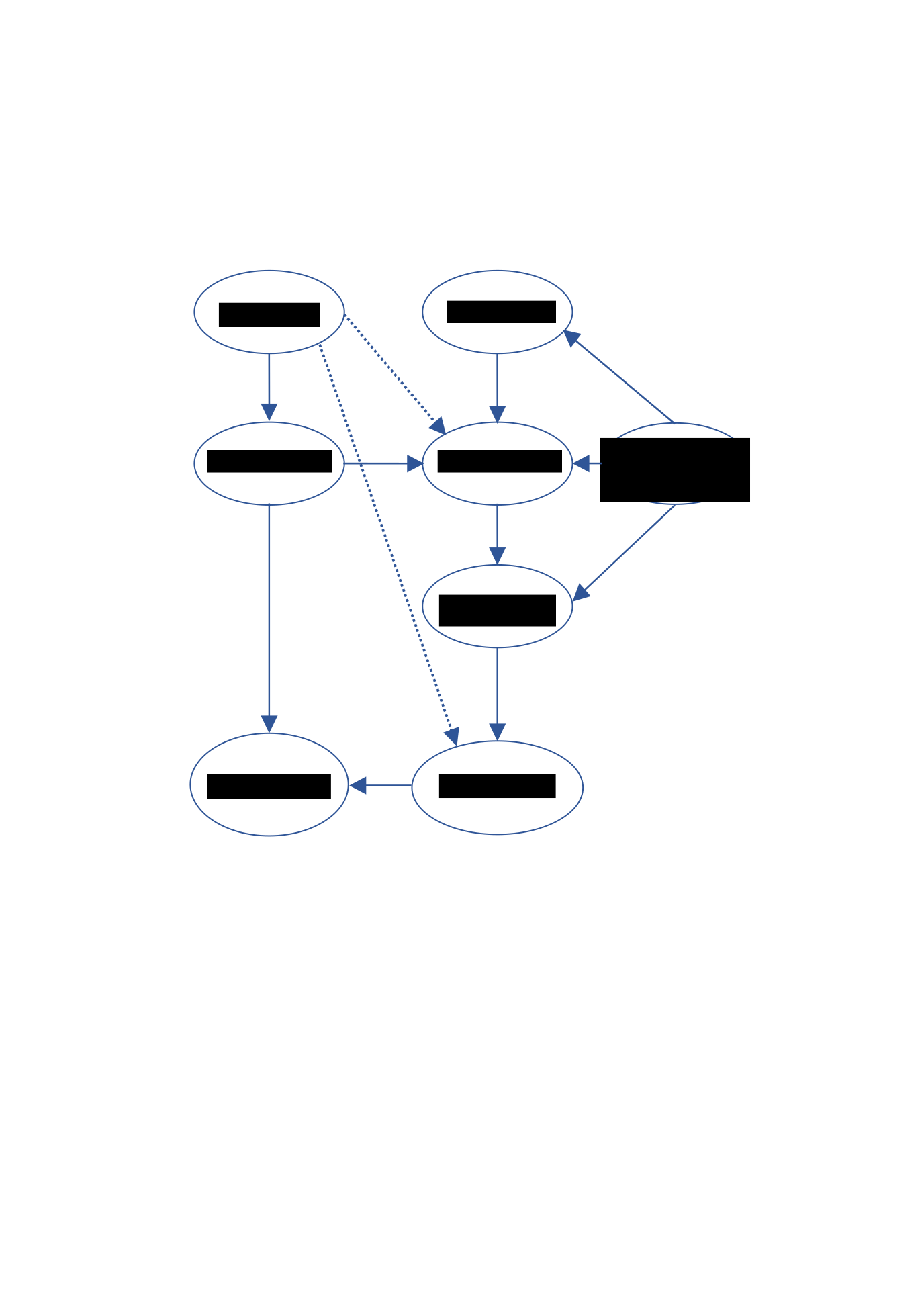
CHAPTER 3
Figure 5
Emotional integrative model adapted from Finkenauer et al., 1998, updated by
Luminet & Curci, 2009. Retrieved and adapted from Luminet & Curci, 2017.
4. Self Memory System model and flashbulb memories
Flashbulb memories, a specific type of autobiographical memories, can be
linked to the Self Memory System model of autobiographical memory through two
temporal dimensions.
57
Surprise
Novelty Importance
Emotionality
Rehearsal
Attitudes/Knowledge
Event memory FBM

CHAPTER 3
First, regarding the past, flashbulb memories – and their vividness - rely on
episodic details, which are encompassed in the most specific level of the model
(Conway, 2005; Curci, 2017; Tinti et al., 2014) (see Figure 1 Chapter 1).
Then, the links between flashbulb memories and the new dimension of the
model, future thinking, are an avenue for further exploration. Up to this day, the
relationships between the past and the future in the examination of flashbulb
memories are quite rare. One study revealed that the creation of flashbulb
memories could potentially mark a historical memory, that will be remembered by
future generations (Luminet & Spijkerman, 2017). Except for this paper proposing a
tentative link between flashbulb memories of public events and the future, to the
best of our knowledge, no other study has examined this link.
As discussed in Chapter 1, personal memories can play a role in imagining
future events through the directive function of memory. From an adaptative
perspective, due to their distinctive characteristics, one might argue that these
memories are recalled more vividly than other personal memories to help in
adapting to future similar situations. Future thinking might be linked to the creation
of flashbulb memories. Flashbulb memories are associated with several variables
that could be influenced by the anticipation of the future. To fill that current gap in
the examination of flashbulb memories and future thinking, we hypothesize that
the way individuals imagine that event in the future – whether it will be
remembered, should be remembered, or is deemed important to remember for
adapting to future similar situations- might influence the creation of flashbulb
memories. Additionally, emotions related to the group and the future, such as
anxiety that this event will happen again in the future, could also influence the
formation of flashbulb memories. We aim to examine these links between flashbulb
memories and future thinking through Study 5 of this thesis.
58

CHAPTER 3
C 3: Summary
T
memory.
T second chapt dev collective memory thr shared of
eve .
T (
) individual event ( )
the concept of flashbulb memor .
59

CHAPTER 4
60

CHAPTER 4
Chapter 4
Thesis overview
61

CHAPTER 4
1. Aims and studies
As seen in Chapter 1, autobiographical memory includes memories of personal
events and representations of future personal events (Conway et al., 2019). While
existing literature has extensively explored the functions of autobiographical
memory (Bluck et al., 2005) and its cognitive structure (Conway, 2005; Conway &
Pleydell-Pearce, 2000; Conway et al., 2019), a critical gap persists in understanding
the functions and the cognitive structure of collective memory. As seen in Chapter
2, collective memory represents individual memories shared by members of a
community that bears on the community’s identity (Hirst & Manier, 2008).
This thesis aims to bridge the gap between autobiographical and collective
memory, by pioneering an exploration into the cognitive structure of collective
memory and the psychological variables influencing collective memory,
representing a new perspective in memory studies. More specifically, our work
addresses two crucial questions in the domain of collective memory. First, “How
shared memories and future thoughts are formed?”. This research question is
grounded in the examination of two dimensions of memory, and the interaction of
these dimensions (see Figure 6). The type of memories is examined through the
interplay between personal and shared memories. The temporal dimension is
examined through memories and future representations. These two dimensions are
examined in relation to public events. Second, we examine the following question
“What variables influence shared memories?” (see part A of Figure 6).
To address these two questions, we investigate collective memory from a
multidimensional perspective. Firstly, by examining the cognitive structure and the
psycho-social variables influencing the creation of shared memories. Then, by
combining a qualitative and quantitative approach to memory. Finally, by combining
the assessment of the amount of memories and the similarity of these
representations in memory, using the inter-subjects similarity method (see Box 4 in
Chapter 1).
62
CHAPTER 4
The two following subsections refer to each of the main research questions
cited above, which are linked to the studies presented in the empirical part of this
thesis.
Figure 6
Representations of the different studies on the two memory dimensions examined
Collective
Personal
2. Collective memory’s cognitive structure
The first part of this thesis is dedicated to the cognitive structure of collective
memory and answers the following question: ‘How shared memories and collective
future thoughts are formed?’. In Chapters 1 to 3, we delved into the intricate
interplay between autobiographical memories and collective memories,
highlighting their interconnectedness and reliance on similar psychological
63
Past Future
Studies 1 to : 5 Study 1
A B
C D
Study 1 Study 1

CHAPTER 4
processes. This theoretical groundwork lays the foundation for the central
hypothesis of the project suggesting that autobiographical memory and collective
memory share the same cognitive architecture, which is illustrated in Figure 7. We
extend the theoretical framework of the Self Memory System model of
autobiographical memory to understanding the cognitive structure of collective
memory. The dimension related to the type of memories is illustrated through the
similar hierarchical cognitive structure of autobiographical and collective memory
(A and B in Figure 7). The hierarchical structure of collective memory can be seen
through the three main components (collective identity, shared knowledge, and
episodic details), and within the shared knowledge component three different
levels are presented. The second dimension (past and future representations) is
presented within the shared knowledge component. Beyond the links between the
different components within each type of memory, links between the two types of
memories can also be highlighted.
This theoretical hypothesis implies that collective memories, like
autobiographical memories, should be influenced by time, aging, and identity.
Study 1 aims to examine how shared memories evolve over time and are influenced
by the personal importance of the event through a quantitative method. Regarding
future thinking, this study examines the links between past and future
representations and should provide information related to the directive function of
memory. Studies 1 took the COVID-19 pandemic as a target event because its
recency allows us to observe the initial step of the creation of personal and
collective memories about the events. The pandemic case is compared to a political
event that took place at the same time, but which impacted participants’ life to a
lesser extent.
Following the examination of the cognitive structure of personal and collective
memory, Study 2 assesses the extent to which the COVID-19 pandemic can act as a
transition, through the Living-in-History effect. As seen in Chapter 2, collective
events can be used as temporal landmarks when recalling personal memories, and
64

CHAPTER 4
therefore acting as transitional events that organize and structure memories
(Brown, 2021; Brown et al., 2016). However, little is known about the impact and
the consequences of such events on one’s life can influence the degree to which
these collective events are used as temporal landmarks. Our study investigates how
the collective events of the pandemic influenced memory organization in three
groups of young Belgian adults that differ in the impact of the pandemic in their life
(psychological and daily life impacts).
Figure 7
Autobiographical and collective memory model
65
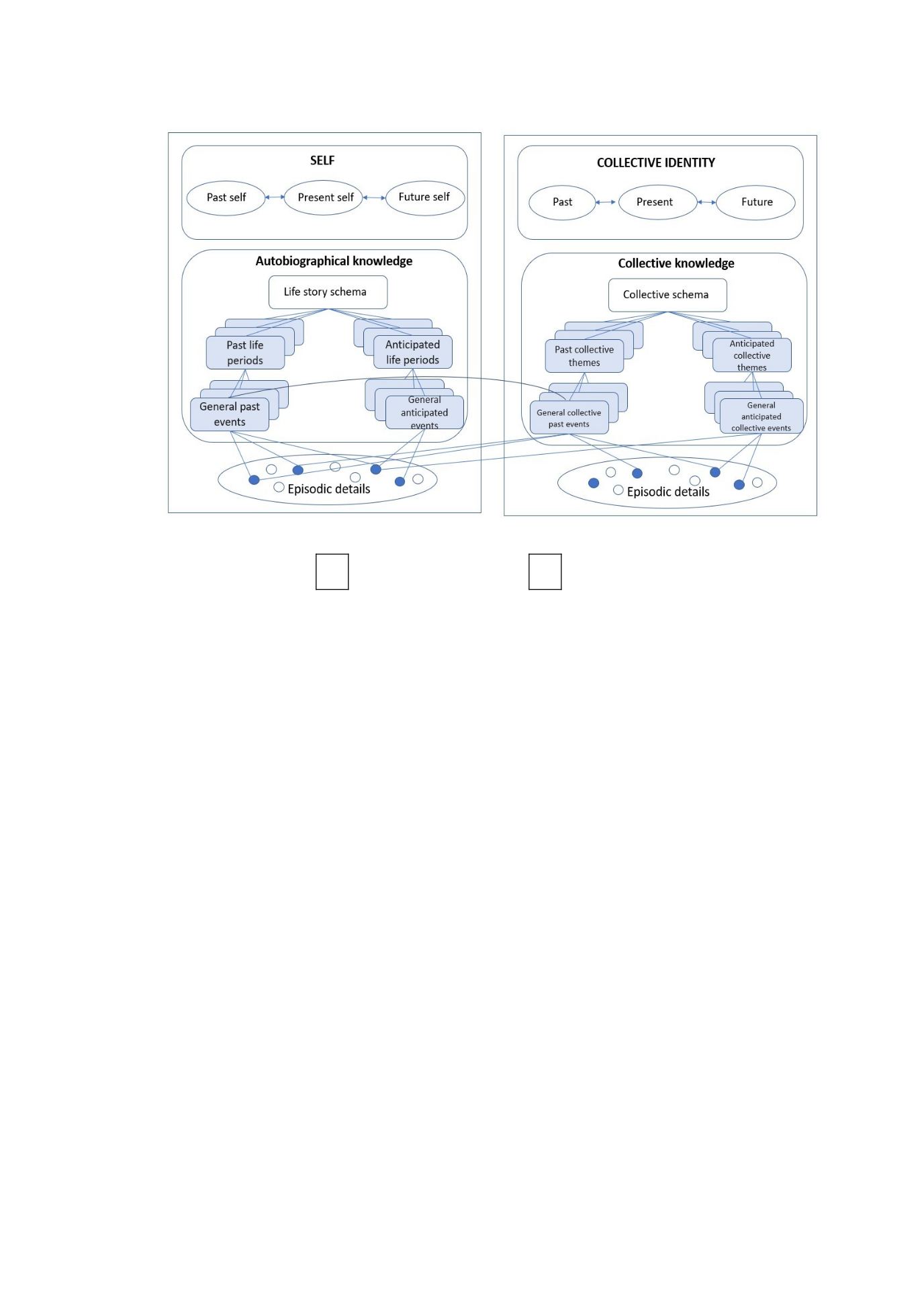
CHAPTER 4
A B
Notes.
Left side: Representation of the Self Memory System in autobiographical memory.
Right side: Representation of the Self Memory System adapted to collective
memory. The level of “collective knowledge” includes three different levels: general
events, past collective themes, and collective schema. The collective identity
component encompasses goals and values held by the group. The episodic details
level is similar to the one in autobiographical memory, encompassing episodic
details associated with public events.
3. Variables influencing shared memories
The second focus of the thesis is on variables influencing collective memory,
and the social and identity functions of memory. The following studies examined
the effect of age (Studies 3 and 4), the effect of social identity (Study 5), and
66

CHAPTER 4
communication processes in collective memory (Study 4). Given the surprising and
emotional nature of the public events examined in this thesis, we also assessed the
creation of flashbulb memories (Studies 1, 3, 4).
3.1 Age effects on shared memories
While it is well-known that aging is associated with cognitive decline (Balota
et al., 2000), little is known about how aging impacts collective memory. Moreover,
up to this day, age effects in memory have been mainly examined through a
traditional view of the number of details retrieved in a group of older adults
compared to the one retrieved in a group of young adults. In this project, we
propose to complete this view with a new perspective examining memories and
future thoughts using an inter-subjects similarity method.
Study 3 aims to examine age effects on shared memories about a public
event (the collapse of the Morandi bridge in Italy). Shared memories are examined
in terms of the quantity of details recalled and in terms of intersubjects similarity.
Shared memories are also investigated through the concept of flashbulb memories.
Study 4. Usually, studies focus on the content of shared memories without
considering the social influence of the context associated with communication
processes on memory. This study aims to examine how the context might influence
shared memories through communication processes in aging. This study examines
memories about a fictional event shared by young and older adults to a young and
older listener (audience effect).
3.2 Identity effects on shared memories
Study 5. In Study 3, we examined the memories of young and older Belgian
adults about an event that happened in Italy. One question emerged regarding the
possible influence of social identity. Would the results be different if participants
were Italians and recalled memories about the bridge collapse that happened in
Italy? As seen previously, memory can be influenced by identity (Berntsen, 2017;
67

CHAPTER 4
Conway, 2005). At a collective level, collective identity and collective memories also
influence each other (Merck et al., 2020). Therefore, we conducted another study
examining the effects of social identity on shared memories and flashbulb
memories through a young population of Belgians and Americans about a public
event that happened in Washington (the Capitol riots). Beyond examining the effect
of social identity on shared memories, this study also examined the links between
social identity, flashbulb memory, and collective future thinking.
68

EMPIRICAL PART
69

EMPIRICAL PART
EMPIRICAL PART
70

EMPIRICAL PART
71

STUDY 1
STUDY 1
The Effects of Time and Personal Importance on Lived Collective
Memories and Collective Future Thinking
Nawël Cheriet1,2,1*, Arnaud D’Argembeau1,2,3 & Christine Bastin1,2,3
1GIGA-CRC In Vivo Imaging, University of Liège, Belgium
2Psychology and Neuroscience of Cognition Research Unit, University of Liège,
Belgium
1 F.R.S.-Fonds National de la Recherche Scientifique, Belgium
Study 1 examines the effects of time and the personal importance on
lived collective memories and collective future thinking.
72

STUDY 1
The Effects of Time and Personal Importance on Lived Collective
Memories and Collective Future Thinking
Nawël Cheriet1,2,3*, Arnaud D’Argembeau1,2,3 & Christine Bastin1,2,3
1GIGA-CRC In Vivo Imaging, University of Liège, Belgium
2Psychology and Neuroscience of Cognition Research Unit, University of Liège,
Belgium
3F.R.S.-Fonds National de la Recherche Scientifique, Belgium
Correspondence
Nawel Cheriet, GIGA-Cyclotron Research Centre-in vivo imaging, University of
Liège, Allée du 6 Août, 8, B30, 4000 Liège, Belgium, Telephone: +32 4 366 23 16,
Fax: +32 4 366 23 16, Email: nawel.cherie[email protected]
Orcid : 0000-0002-7795-4676
Conflict of interest
The authors declare no conflict of interest.
Acknowledgements
CB is a Senior Research Associate at the F.R.S.-FNRS and AD is a Research Director at
the F.R.S.-FNRS. NC was supported by a FRESH grant from F.R.S.FNRS. We thank the
students who helped with data collection, especially AL.
73

STUDY 1
1. Abstract
This study examined the influence of the passage of time and personal
importance on memories of recent lived public events. Participants recalled their
memories of both the COVID-19 pandemic and a political event at two different
time points (in 2021 and 2022). To capture a spectrum of memory characteristics,
from the most episodic to general themes, we measured: (1) the extent to which
the representations of lived collective events are episodic; (2) the type of
information that people remember (personal vs collective); (3) what most
participants talked about (i.e., common themes) and which words were used to
describe the event (lexical content analyses). Moreover, in 2021, participants were
asked to imagine a future pandemic and a future political event (the dissolution of
the EU) to assess to what extent the collective future relies on the collective past.
The results provide evidence that personal importance influences the creation of
lived collective memories over time. In fact, two years after the event, participants
recalled as much personal information as collective information about the
pandemic, whereas over time the political events were recalled with more
collective information than personal information. Moreover, participants’ narratives
were overall shorter in 2022 than in 2021, but the sentences they contained were
proportionally richer in detail; this effect of the passage of time was observed for
the pandemic but not for the political memories. This might reflect a reorganization
of the pandemic memories in the sense of denser but still rich representations of
the events. Regarding future thinking, results revealed more episodicity when
imagining a future pandemic than a future political event, and more collective than
personal thoughts about future events. Additionally, themes related to a future
pandemic were similar to the ones recalled about the past pandemic. Overall, these
results emphasize the constructive nature of lived collective memories and
collective future thinking.
74

STUDY 1
2. Introduction
Personal memories are negatively influenced by the passage of time, notably in
terms of their quantity and episodic details (Conway & PleydellPearce, 2000). It is
also well known that personal events associated with our goals and values are
better remembered, as personal memories are influenced by the self (Conway,
2005). While these effects of the passage of time and personal importance are well
documented in autobiographical memory, they have been rarely studied in
collective memory (Hirst et al., 2018). Moreover, because of the intricacies between
personal and collective memories of lived public events (Hirst & Manier, 2008), the
investigation of the trajectory of collective memories, especially in tandem with
personal memories, is essential but generally overlooked (Migueles Seco &
Aizpurua Sanz, 2024). Similarly, while the role of personal past experiences and
knowledge when imagining future personal events is increasingly well understood
(D’Argembeau, 2020; Schacter et al., 2017), relatively little is known about collective
future thinking (Öner & Gülgöz, 2020; Szpunar & Szpunar, 2016; Topçu & Hirst,
2020).
2.1 The influence of the passage of time on memory
Studies on collective memories often focus on distant collective events
(e.g., historical events such as World War II or the Civil War; Zaromb et al., 2014).
The fact that distant collective memories, memories of events for which people
were not alive during their happening, are recalled even many years after they
happened is a sign that they entered collective memory (Hirst & Manier, 2008; Hirst
& Merck, 2022; Liu et al., 2022; Manier & Hirst, 2008; Roediger & DeSoto, 2014;
Zaromb et al., 2014). On the other hand, studies have shown that lived collective
events, memories of public events that happened during one’s lifetime, are usually
remembered with more personal information and more causal statements than
distant collective memories (Hirst & Manier, 2002; Manier & Hirst, 2008; Muller et
al., 2016; Muller et al., 2018). Currently, little is known about the parallel evolution
75

STUDY 1
over time of personal and shared memories about lived collective events. The effect
of the passage of time has only been considered in the context of flashbulb
memories, with data suggesting a loss of memories for the event and associated
personal memories over time (Hirst et al., 2015). Analyzing personal and shared
memories in tandem would provide insights into the construction and evolution of
lived collective memories.
The episodic nature of personal memories has been well studied (Conway &
Pleydell-Pearce, 2000) and it has been shown that individuals forget episodic details
unless these details are important for personal goals and values (Conway, 2009;
Levine et al., 2002). By contrast, the level of detail of shared memories for a lived
public event and its evolution with the passage of time are poorly understood. In
addition, one can also wonder what people talk about when recalling collective
events and how this evolves with time. One way to apprehend the content of
collective memories is by analyzing the linguistic features of narratives, which
provide information about emotional states, psychological distance, and cognitive
processes (Pennebaker et al., 2003). Emotional words, pronouns, and verbs convey
information about emotional states, social identification, and cognitive styles
(Pennebaker et al., 2003). Words referring to cognitive processes, or mental activity,
were found to reflect the cognitive elaboration of the event recalled by participants
via words related to insight, causation, discrepancy, tentativeness, certainty, and
differentiation (e.g., decision-making) (Boals & Klein, 2005; Kleim et al., 2018;
Kvavilashvili & Fisher, 2007; Pennebaker et al., 1997; Pennebaker et al., 2015).
Building on the collective coping theory (Pennebaker & Harber, 1993), emotions
should be highly mentioned close to the event, whereas cognitive processes should
increase over time. Another way to study collective memories is through the
examination of topics, which points to themes that most individuals remember
about a given event and represent the core of the story (Blei et al., 2003; Srinivasa –
Desikan, 2018; Rouhani et al., 2023).
76

STUDY 1
2.2 The influence of the personal importance of events on shared
memories
Lived collective memories typically encompass personal and collective
information (Muller et al., 2016). Importantly, the degree of personal involvement
in events varies, with some people being actors (e.g., a person’s house is devasted
by flooding) and other people being spectators (e.g., a person watching the event
on the news), and it is likely that the degree of impact affects how we remember
collective events. Some studies examining memories of public events and historical
events revealed that physical distance plays a role in shaping long-lasting memories,
with greater physical involvement leading to better memories than hearing about it
in the media or from others (Gold, 1992; Pezdek, 2003). In the case of flashbulb
memories, it seems that the personal and collective consequences of the event on
oneself or a community’s life contribute to the shaping of memories of public
events (Rice et al., 2017). While these findings seem consistent with the self-
reference effect, whereby memories are better recalled if encoded with links to the
self (Klein, 2012), little is known about the influence of personal importance on the
episodic details (episodicity), the content, and themes of memories for public
events, and whether this changes with the passage of time.
2.3 Collective Future Thinking
Collective future thinking refers to “the act of imagining an event that has
yet to transpire on behalf of, or by, a group” (Szpunar & Szpunar, 2016, p.378). The
psychological process of planning for the personal and collective future has been
associated with the directive functions of memory (Bluck et al., 2005; Burnell et al.,
2023). Studies have shown that the cognitive and neural mechanisms associated
with remembering the past and imagining the future demonstrate striking
similarities (for review, see Schacter et al., 2017). Drawing on these findings, it has
been suggested that individuals rely on memories and knowledge of past events
stored in memory to imagine future events (D’Argembeau, 2020; Hassabis &
77

STUDY 1
Maguire, 2007; Schacter & Addis, 2007; Szpunar, 2010). While this view has been
well examined at the personal level, there is a notable gap in understanding the
links between past and future representations at the collective level (de Saint-
Laurent, 2018; Merck et al., 2016; Szpunar & Szpunar, 2016). Few studies reported
that past topics can be recalled when imagining the future (Öner et al., 2023) and
that collective memory and collective future thinking show some similarities in
terms of phenomenology (Öner et al., 2023; Öner & Gülgöz, 2020; Topçu & Hirst,
2020). Other studies also highlighted differences in the emotional valence of
personal and future thoughts, which translates into the personal future being
imagined more positively than the collective future (Shrikanth et al., 2018;
Shrikanth & Szpunar, 2021). However, the characteristics of the memory details
used to imagine future collective events are not fully understood.
2.4 The case of the COVID-19 pandemic
The COVID-19 pandemic is an ideal situation to study the nature of personal
and collective memories and their evolution with time because it is a recent global
event that impacted everyone, and that entailed a rich variety of events that were
lived by individuals (e.g., the way a person’s work was affected) as well as by the
community (e.g., everyone had to deal with closed shops). Several studies
examined how memory was influenced by the COVID-19 pandemic context
(Fridman & Gensburger, 2023). It was found that the COVID19 pandemic context
influenced the content and the organization of autobiographical memory, which
was usually linked to its impact on personal life in daily routines or emotional states
(Brown, 2021; Folville et al., 2023; Muir & Brown, 2024; Rouhani et al., 2023). More
specifically, one study examined how collective events shape personal memory.
Participants either took part in the autobiographical memory task and were asked
to recall personal memories of 2020 or 2021 (Rouhani et al., 2023) or took part in
the collective memory task where they had to assess two different collective events
that happened during each month of the year 2020 (e.g., How strongly do you
78

STUDY 1
remember the death of Kobe Bryant?). Results revealed a bump in personal
memories for March 2020, which corresponds to the onset of the pandemic and
the start of the lockdown. This bump was still seen one year after the first
interview. In the collective memory task, participants remembered more the
pandemic news than other news, revealing a personal importance effect (Rouhani
et al., 2023).
Few studies focused on the memory of the pandemic itself. One study
found that the COVID-19 pandemic was a collective event that was frequently
recalled when participants were questioned close to its happening (i.e., memories
were collected during the second wave of the COVID-19 pandemic in Malaysia)
(Mustafa et al., 2021). Öner et al. (2023) examined whether the COVID19 context
influenced the nature of collective memories that people recalled, as well as
collective future thinking. From April to June 2020, they asked participants to recall
three remarkable events that happened in the world and three that happened in
their countries since the disease appeared in China. Then, participants were asked
to write three remarkable events that they expect to occur in the world and three
events expected in their country. Öner et al. (2023) found that for memories, the
lockdown and the infections were the most recalled themes; participants also
recalled significant political and health systems impacts of the pandemic. Rouhani
et al. (2023) found that topics such as COVID-19, social events and contacts,
occupation, and elections were recalled regarding the year 2020. In particular, the
topic of COVID-19 was the most mentioned in February, March, and April, which
correspond to the period of the onset and first lockdown. To the best of our
knowledge, no studies evaluated how time influences the characteristics of
memories of the pandemic in terms of their level of episodic details, content, and
themes altogether.
Regarding future thinking associated with the COVID-19 pandemic, Öner et
al. (2023) found that topics such as the economy, lockdown, and a second wave of
COVID-19 infections were topics mostly imagined by participants during the first
79

STUDY 1
semester following the COVID-19 pandemic onset. These results are interesting
because they capture the fact that collective future thinking taking place during
ongoing collective events involves the use of actual experiences for imagining
future events, as expected in a constructive view of future thinking (Öner et al.,
2023). Other studies examined how the COVID-19 context influenced future
thinking. Results revealed that it was easier to retrieve memories of the pandemic
than to imagine future events related to the pandemic (Lalla & Sheldon, 2021).
Another study also found differences between memories and future thoughts
related to the pandemic mainly in terms of phenomenology and emotional valence.
The sense of (re)-experiencing the thought and sensory details (i.e., the sense of
reliving assessed by the AMQ; Rubin et al., 2003) was higher for the past than for
future thoughts, with a strong negative view of future events related to the
pandemic (Niziurski & Schaper, 2023). Regarding the content of narratives, one
study reported that, in the COVID-19 pandemic context, participants imagined
more personal than collective future thoughts (Migueles Seco & Aizpurua Sanz,
2024).
2.4 Aims and Hypotheses
Given the lack of knowledge about the level of episodic details (episodicity),
content, and themes of memories for recent lived public events and how this is
influenced by the passage of time, the current study aimed to conduct a
longitudinal assessment of memories for events related to the COVID-19 pandemic
(interviews were conducted in 2021 and 2022). Memories of these pandemic-
related events were compared to memories associated with a public event that
happened in the same period but had comparatively less personal impact (i.e., a
political event). To capture a spectrum of memory characteristics from the most
specific to more general levels of representations, we measured three aspects of
memories: (1) the extent to which representations include episodic details (i.e.,
contains details about space, time, perceptual and emotional details); (2) the type
80

STUDY 1
of information that people remember (personal vs collective); (3) what most
participants talked about (i.e., common themes) and with which kind of words
(lexical content analyses).
The longitudinal design of the study allowed us to test the following
hypotheses. First, we expected memories of the pandemic to include less
information in general, fewer episodic details, and a loss of personal information
over time (Conway & Pleydell-Pearce, 2000). Second, we hypothesized that topics
that most participants mentioned about the pandemic would stay stable over time,
including general themes such as lockdowns and infections (Öner et al., 2023).
Finally, building on the collective coping theory that suggests that the thoughts and
memories of an emotional event depend on the time that passed since the event
(Pennebaker & Harber, 1993), we hypothesized a decrease in words related to
emotions, social situations, COVID-19, and health in the second interview
compared to the first interview (Cohn et al., 2004), and increased reference to
cognitive processes over time (Pennebaker & Harber, 1993).
As the pandemic had an impact on every participant’s personal life as well
as on the community’s life (Er, 2003; Klein, 2012; Pezdek, 2003), we expected
memories of the pandemic to contain more specific details and more personal and
collective information than memories about the political event. We also
hypothesized that there would be more words related to emotions, cognitive
processes, social situations, COVID-19, and health for the pandemic events
compared to the political events. Additionally, we assessed individual differences in
the personal importance of the event using questionnaires about the impact of
COVID-19 on individuals' lives to consider the fact that each individual experienced
the pandemic differently. Exploratory correlation analyses were conducted to
investigate whether the individual level of impact of the pandemic was related to
characteristics of memories in terms of episodic details and content.
Finally, participants were also asked to imagine a future pandemic (and a
future political event, as a control condition), and the characteristics of their
81

STUDY 1
representations were assessed following the same criteria outlined for memories
above. In line with the view that memories and knowledge of the past play a key
role in future thinking (Schacter & Addis, 2007), we hypothesized that participants
would share more episodic details when imagining a future pandemic than a future
political event. Moreover, we expected that topics used to recall the past pandemic
would be used to imagine a future pandemic (Öner et al., 2023).
82

STUDY 1
3. Method
3.1 Transparency and Openness
We share all the measures that were collected, as well as the computation
to determine our sample size. Anonymized information and resources are available
at https://osf.io/rt2mw/
3.2 Participants
We determined the sample size using a power analysis with G*Power (Faul
et al., 2007). To test the main hypothesis of an interaction effect between time and
personal importance in a 2 (interviews: 2021 and 2022) x 2 (event type: pandemic
vs political) ANOVA, with a power of .80, an alpha of .05 and a medium effect size f
= .25, the estimated sample size was at least 158 participants in total. We also
considered the dropout rate in longitudinal studies, which is around 20% when the
participants are over a large age range (Young et al., 2006). Thus, the estimated
sample size needed for the first interview (in 2021) was at least N = 190 to reach at
least N = 158 at the second interview (in 2022). In 2022, we also included a control
group (N = 66) to control for test-retest effects.
Participants were aged between 18 and 80 years old. They were Belgian
French speakers who lived in Belgium during the pandemic. Participants did not
suffer from any neurological or psychiatric history nor were diagnosed with
cognitive impairment. The announcement of this study was shared directly with
staff members of the university; posts on social media (e.g., Facebook, official
university account, LinkedIn); through the press (e.g., le 15ème jour, the University
newspaper); flyers were posted in hospitals; two hospitals sent newsletters
including this study to their staff. Ethical approval was obtained from the Ethics
Committee of the Psychology Faculty at Liege University.
Participants provided written and verbal informed consent at both interviews.
83

STUDY 1
From February 2021 to June 2021, 258 Belgian citizens took part in the first
interview. One participant was excluded because of non-residency in Belgium in
2020, and 8 participants were excluded due to low audio recording quality. The
remaining sample consisted of 249 participants in 2021 aged from 18 to 79 years
old (M = 46.7, SD = 4.95, 178 women).
From February 2022 to June 2022, participants were invited to take part in a
second interview. 64 participants from the original sample did not participate in the
second interview. 66 additional participants were recruited to only take part in the
second interview (control group2). Twelve participants were excluded from the
analysis due to issues with questionnaires or audio recordings. In total, 246
participants (including the control group) took part in the second interview.
Participants were aged between 18 to 80 years old (M =
47.9; SD = 4.96, 174 women).
Participants took part in two interviews about their memories and future
thinking (see section 3.3). For each event included in the memory task (pandemic
vs political event), they rated the personal importance of the events using the
Centrality of Event Scale (Berntsen & Rubin, 2006). Participants were interviewed
individually via videoconference or exceptionally in a testing room (~ 4%) as the first
interview was conducted at a time when in-presence meetings were still not
recommended as part of the COVID-crisis management. The first interview took
place in 2021 and participants were questioned about two types of events (i.e.,
pandemic and political) for two time periods (i.e., past and future). Only the past
events (memories) were assessed in the second interview in 2022. At each
interview, participants completed a questionnaire. The researcher could reply to
clarify some points of the questionnaire if needed. The questionnaire
2 The group control was significantly younger than the original group (t = -2.66, p = .009). All
statistical analyses were computed with and without the control group and results were not different.
Therefore, the results in the manuscript include the control group.
84

STUDY 1
included: demographic information, a self-report of the symptoms of COVID-19
disease, an evaluation of the proximity to COVID-19 contact, an evaluation of
flashbulb memories, an evaluation of the personal impact of the COVID-19
pandemic and the attitudes related to lockdown and governmental rules, questions
about the vaccines, an assessment of collective identity to Belgium and Wallonia,
and a mental health assessment (specific or not to COVID-19) (see section 3.4). The
interviews were audio-recorded and later transcribed for coding. The conditions
(type of events x time period) were randomized across participants. During the
memory task, participants could speak freely for as long as they wished. Interviews
lasted from 1.5 hours to 4 hours.
3.3 Interviews about events
3.3.1 Memories
Participants interviewed in 2021 and 2022 were asked to recall as many
memories as possible that happened regarding the COVID-19 pandemic during the
year 2020. In 2020, the unfolding of events spanned from the time when the news
mentioned the first coronavirus cases in Belgium to the news about the vaccine in
December 2020. After describing all their memories, participants were invited to
report in chronological order the events related to the COVID-19 pandemic in 2020
(these data are not reported here). For the political event, participants had to select
one of the political events that happened in the world in 2020, among the following
events: the American presidential elections (68.67% in 2021 and 67.47% in 20223),
the Black Lives Matter movement in the United States (22.08% in 2021 and 22.76%
in 2022), or the formation of the
Belgian government (9.23% in 2021 and 9.75% in 2022). As for the pandemic,
3 Percentage in 2022 include the choices of the control group
85

STUDY 1
they were then asked to recall as many memories as possible in relation to that
event.
3.3.2 Future thinking
Participants were asked to imagine future scenarios for two types of events
(i.e., pandemic and political events). For the future pandemic, participants were
asked to imagine what could happen if a future pandemic similar to the COVID-19
pandemic happened in ten years from that time. The delay of 10 years was chosen
so that people should have returned to a normal life, free from current pandemic-
related constraints. For the political event, participants were asked to imagine what
could happen if the European Union dissolved in ten years from that time. This
scenario represents an event of similar severity and consequences for Belgian
citizens as the COVID-19 pandemic, for which they also have previous knowledge
and collective representations. Moreover, this event was selected so that the two
control events (past and future) involved political events. It was specified that both
imagined events (pandemic and political) were unrelated.
3.4 Questionnaires
3.4.1 General questionnaires
The Centrality of Event Scale. This scale assesses the extent to which an
event influences one’s identity (Berntsen & Rubin, 2006). Participants answered the
short version of the scale with 7 items rated on a Likert scale from 1 (totally
disagree) to 5 (totally agree) (Berntsen & Rubin, 2006). This scale was presented
when participants finished recalling their memories of the pandemic, their
memories of the political event, their imagining of the future pandemic, and their
imagining of the future EU dissolution. The items were grammatically adapted for
future representations. The mean and standard error by interview time can be
found in Table 1 in the supplemental material. Results revealed that participants
considered the pandemic (M = 3.3, SE = 0.06) to influence more their identity than
the political event (M = 2.09, SE = 0.07), Yt = 13, p <.001. Results were similar in the
86

STUDY 1
second interview (Yt = 12.7, p <.001). No difference was found between the future
pandemic and future political events (Yt = 0.25, p = .81).
Demographical information. Participants reported demographical
information including gender, age, occupation, education, neurological history,
psychological history, current medication, and number of children.
Proximity to COVID-19 contact. Several questions probed the physical
contact with someone positive for COVID-19 in four different social circles (i.e., in
their family, friends, professional contact, and due to their occupation, with their
distant acquaintances); other questions assessed whether participants knew
someone who had contracted COVID-19 (in their family, friends, professional
contact, with their distant acquaintances); another question asked if they knew
someone who passed away due to COVID-19. A mean score was computed based
on the 3 questions for the family, friends, and acquaintances. For the professional
circle, the mean score was computed based on 4 questions since two questions,
rather than one, were asked for physical contact with COVID-19-positive people
because of their occupation separating colleagues from customers/patients.
Personal impact of the COVID-19 pandemic. The following part of the
survey used VAS from not at all (0) to a lot (100) where people had to judge to what
extent the COVID-19 crisis impacted their life on several variables: daily routine,
leisure, work, social life, familial life, mood, and life satisfaction feeling.
Attitudes related to lockdown/governmental rules. Participants assessed
their attitudes towards the COVID-19 situation on a scale from “not at all” (0) to “a
lot” (100) including: agreement with government decisions during the 1st
lockdown, respect of the 1st lockdown, respect of health rules during the 1st
lockdown, agreement with government decisions during the 1st end of lockdown,
compliance with post-1st lockdown instructions, agreement with government
decisions during the 2nd lockdown, respect of the 2nd lockdown, respect of health
rules during the 2nd lockdown, agreement with government decisions during the 2nd
87

STUDY 1
end of lockdown, respect of post-2nd lockdown instructions, being at risk of
contracting COVID-19, and feeling of confusion about the pandemic (political and
health discourse).
Vaccines information. Two questions related to the vaccines. They were
asked if they got vaccinated. If yes, they were asked to provide the date of the
vaccination. If they didn’t get vaccinated, they were asked if they intended to get it.
Collective Identity. Participants were asked to complete five items related
to collective identity (Stone et al., 2020). The items were presented first to assess
Belgium's collective identity and a second time to assess Wallonia's collective
identity. In the analyses, Belgium identification is referred to as Belgium ID, and
Wallonia identification is referred to as Wallonia ID. For example, Belgium identity
items were: “I feel attached to Belgium”; “My destiny is linked to the one of other
Belgians”; “I feel solidarity with all the other Belgians”; “I am proud to say to others
I am Belgian”; “I identify closely to Belgium”. These items are rated on a Likert scale
ranging from 1 (strongly disagree) to 7 (strongly agree). A mean score of the ratings
of the five items was computed.
3.4.2 Mental health and cognitive assessment
COVID-19-related mental health assessment. Several questionnaires aimed
to assess the anxiety, fear, and trauma associated with the coronavirus through the
fear of COVID-19 scale (Ahorsu et al.,2020), the coronavirus anxiety scale (Lee et al.,
2020), and the IES- COVID-19 (Vanaken et al., 2020).
Clinical assessment unrelated to COVID-19. Loneliness was assessed by the
loneliness scale (De Grâce & Joshi, 1990). Depression was assessed by the BDI 13
items (Collet & Cottraux, 1986). Anxiety was assessed by the short version of the
STAI (Marteau & Bekker, 1992). Since this test necessitates being read by the
experimenter, it was the last questionnaire proposed and was not on the online
questionnaire.
88

STUDY 1
Cognitive assessment. Participants aged more than 60 years old were
assessed by MMSE (Kalafat et al., 2003) to exclude participants with global
cognitive impairment. No participant was excluded based on their score at the
MMSE.
3.5 Data analysis
After transcribing 4 the audio recording, data were analyzed using 3
complementary methods for both memories and future thinking. First, we assessed
the extent to which the representations (past and future) are episodic in nature
through the examination of episodic details (internal, external, and episodicity
scores). Second, we analyzed what type of information dominated memories and
future thoughts through the coding of personal vs collective information. Finally, we
examined the lexical content through the use of Linguistic Inquiry Word Count
software (LIWC; Pennebaker et al., 2007), which highlights a specific examination of
how people talk about collective events. Moreover, to examine how memories are
used to imagine future collective events, we computed topic modeling analyses
using the Latent Dirichlet Allocation model (LDA; Jelodar et al., 2019).
3.5.1 Episodic details
According to Levine et al. (2002), the internal and external detail scoring
system separates episodic details from the semantic aspects of memories by
classifying each significant piece of recalled information as either internal (directly
associated with the event and describing the context and specific details of the
event) or external (not directly related to the event, including general repeated
events and semantic knowledge). Automated scripts, adapted for French narratives,
4 A robust ANOVA (2 interviews) x (2 time) x 2 (event type) was conducted on the word count. Results
revealed a significant effect of the interview time (p <.001), the event type (p <.001), and the time
(past vs future) (p <.001). We did not include the word count differences as a covariable since analyses
are based on proportion/percentages or consider the amount of memories and therefore control for
the word count.
89

STUDY 1
were used to compute internal and external scores (van Genugten & Schacter,
2024). The model identifies the amount of internal and external content per
sentence, and then sums these numbers to estimate the internal and external
content of narratives. This model has been compared to the manual coding of
memories in previous studies (van Genugten & Schacter, 2024) and was found to
perform well across several datasets. Additionally, we computed an episodicity
score by dividing internal scores by the sum of internal and external scores.
Moreover, we computed internal and external indices that corresponded to the
internal and external raw scores obtained by the automatized analyses that were
divided by the sum of personal and collective information recalled (obtained by the
coding presented in 3.5.2). These indices should reflect the degree of episodicity
versus “externality” of each segment of meaningful information.
3.5.2 Coding for personal vs. collective information
We performed manual coding of the memories and future thoughts for
both interviews5. Each narrative was segmented into sentences. If the sentences
were too long (usually because of the use of coordinating or subordinating
conjunctions) they were segmented into significant pieces of information (see
sentences 4 and 5 in Table 1). Segments were coded as personal information if they
related to the participant’s personal life and involved his/her nearest context such
as family, friend, work, or neighbor. Information was coded as collective if it
involved a community larger than family, friends, and professional groups, such as a
society, city, or country (see Table 1 for a coding example) (see Migueles Seco &
Aizpurua Sanz, 2024 for a similar coding). The total number of each type of memory
(personal and collective) was computed (for memories and future thinking). To
5 Narratives from the interviews were coded by NC and AL. Intra-class correlation (ICC) analyses were
computed to test the reliability. ICC for personal memories was .97 and .99 for shared memories
revealing excellent reliability.
90
STUDY 1
account for the word count differences between narratives, we also computed
proportion scores taking each score divided by the sum of personal and collective
memories.
Table 1
Example of coding memories as personal or collective information related to the
past pandemic narratives.
Personal
information
Collective
information
Other Already
mentioned
1. I remember that very
well!
0 0 1 0
2. I made some
pastries during
lockdown
1 0 0 0
3. Everyone was stuck at
home
0 1 0 0
4. We had to wear masks
outside…
0 1 0 0
5. … but I did not wear it 1 0 0 0
6. Only one person from
the family could go
grocery shopping
0 1 0 0
7. I did it for my family 1 0 0 0
8. I want to insist that I 0 0 1
did not wear the
mask
Total 3 3 1 1
Participant’s memories of the pandemic: “I remember it very well! During lockdown,
I made some pastries. Everyone was stuck at home. Then, we all had to wear a mask
outside, but I did not wear it. One important rule was that one person from the
family could go grocery shopping. I did it for my family. I want to insist that I did not
wear the mask.”
3.5.3 Linguistic content analyses
91
Proportion 0.50 0.50

STUDY 1
Lexical content analyses were computed using Linguistic Inquiry Word
Count (LIWC; Pennebaker et al., 2007). LIWC is a software computing the
percentage of words in a text that fit into a grammatical or psychological category.
Analyses were done using the French dictionary (Piolat et al., 2011). Overall, 5
categories were examined. The pronoun category includes the use of the first
singular and the first plural pronouns. The emotions category includes words
referring to positive emotions, and negative emotions, more specifically anxiety and
anger. The social category includes family and friend references. The cognitive
processes category includes 6 types of processes (i.e., insight, causation,
discrepancy, tentativeness, certainty, and differentiation) which refer to mental
activity (e.g., decision-making) (Pennebaker et al., 2015). The COVID-19-related
words were based on a customized COVID-19 dictionary created by the researchers.
This COVID-19 dictionary included words related to the COVID-19 pandemic in
French (e.g., coronavirus, COVID, COVID-19, vaccines, lockdown, online meetings,
AstraZeneca, Pfizer…) (see Table 2 in supplemental material). These categories were
chosen as related to the emotional, social, personal, and collective characteristics of
the COVID-19 pandemic. LIWC outputs scores are percentages of total words for
each category within a text.
3.5.4 Natural Language Processing
We computed topic modeling analyses from natural language processing to
reveal topics shared by individuals based on the narratives of 249 participants (1st
interview) and 246 participants (2nd interview). Analyses were done separately for
narratives of the past pandemic in 2021 and 2022, and the future pandemic
imagined in 2021. Based on natural language processing, topic modeling analyses
gather all the data and generate topics based on the cooccurrence of the words in
the data set (Blei et al., 2003; Srinivasa – Desikan, 2018). A Python code was
created for topic modeling analyses, using the package Spacy (Honnibal & Montani,
92

STUDY 1
2017), and Gensim (Rehurek & Sojka, 2011). First, all data encompassed on
different docx files were read. The stop words and punctuations were deleted from
the corpus. Data were lemmatized and tokenized into a dictionary. Tokens were
filtered based on their frequency in the corpus, excluding tokens whose frequency
was less than 5% and more than 95%. The number of extracted topics was set at 7
topics. Results were visualized using the PyLDAvis library (Sievert & Shirley, 2014).
The results were visually accessible including words that co-occurred in the same
topic and their frequency through topics. We named each topic after the gist
emerging from the combination of these words.
3.6 Statistical analysis of memories and future thoughts
Because the normality assumption was violated for most of the variables,
robust statistical analyses were conducted (Mair & Wilcox, 2019).
For memories, a robust 2 interview time (2021 and 2022) x 2 event types
(pandemic and political) x 2 types of information (personal and collective) ANOVA
was conducted on the amount of memories recalled. Robust ANOVAs 2 interview
time (2021 and 2022) x 2 event types (pandemic and political) were conducted on
the proportion of collective 6 information recalled, episodicity scores (internal,
external, and specificity), and episodicity indexes (internal and external).
Regarding future thinking, a robust 2 (event type: pandemic vs political) x 2
(type of information: personal vs collective) ANOVA on the amount of future
thoughts was performed. Then, robust t-tests were conducted to test the difference
between the 2 types of events (pandemic and political) on the proportion of
collective information, and episodicity scores (internal, external, and specificity),
and episodicity index (internal and external index).
6 Information related to the whole society, groups and community, beyond his/her closest context
(family, friends, colleagues, neighbors).
93

STUDY 1
All robust ANOVAs and robust post-hoc tests (comparisons) were conducted
using a trimmed means method, and the trimmed value was set at 20% (Wilcox,
2013). Robust ANOVAs were conducted in R studio version 2.1
(Rstudio Team, 2023), using the WRS2 package (Mair & Wilcox, 2020)
4. Results
4.1 Memories: A comparison of memory for the pandemic and a political
event as a function of interview time
4.1.1 How much collective vs personal information do participants
recall?
Table 2 presents the number of personal and collective information
contained in the memories recalled by participants for each type of event, as well
as the proportion of collective information recalled.
94

STUDY 1
Table 2
Mean number and proportion of collective vs personal details contained in
memories and future thoughts for the pandemic and the political event as a
function of interview time.
Interview Event type Time Type of
memory
representation
Quantity
Perso and
collective
Proportion
of collective
memories
1
Pandemic Past
Personal Shared 41.20 (2.37)
39.32 (1.99)
0.47 (0.02)
Future Personal Shared 1.23 (0.22)
21.4 (1)
0.95 (0.009)
Political Past Personal Shared 3.51 (0.29)
22.9 (0.98)
0.86 (0.01)
Future Personal Shared 0.78 (0.13)
19.9 (0.87)
0.97 (0.005)
2
Pandemic Past Personal Shared 20.45 (1.38)
23 (1.51)
0.49 (0.02)
Political Past Personal Shared 1.11 (0.17)
14.7 (0.66)
0.93 (0.01)
Note. Standard errors are in parentheses.
Number of personal and collective information. A robust 2 event type
(pandemic vs political) x 2 types of information (personal vs collective) x 2 interview
time (2021 and 2022) ANOVA revealed a main effect of the event type (Q = 442.47,
p <.001), showing that more information was recalled for the pandemic (M = 30.34,
SE = 0.93) than the political event (M = 8.80, SE = 0.44). A significant main effect of
the interview time (Q = 150.62, p <.001) revealed that more information was
recalled in 2021 (M = 23.9, SE = 0.93) than 2022 (M = 13.2, SE = 0.55). A significant
main effect of the type of memories (Q = 74.86, p =.001) indicated that participants
globally recalled more collective information (M =
23.4, SE = 0.69) than personal information (M = 11.2, SE = 0.71).
95

STUDY 1
A significant interaction was found between the interview time and the
event type (Q = 46.80, p = .001), showing a higher loss of information over time for
the pandemic than for the political event (see Figure 1). A significant interaction
was also found between the event type and the type of memories (Q = 69.4, p
= .001). Post hoc tests revealed that participants recalled more personal and
collective memories related to the pandemic than to the political event, but there
was a higher difference between pandemic and political events for personal
information (psi-hat = 27.8, p <.001, 95% CI [25, 30.5]), compared to collective
information (psi-hat = 12.2, p <.001, 95% CI [9.36, 15]). There was also a triple
interaction (Q = 6.79, p = .01). This was due to a differential effect of the interview
time on both types of information for the pandemic and the political event. For the
political event, the number of information decreased with time, but the decrease
was similar for personal and collective information, with the latter always
dominating. In contrast, for the pandemic, in the first interview, participants
recalled more personal than collective information; with time, both decreased, but
more so for the personal information, which was recalled to the same extent as
collective information in the second interview (Yt = 1.23, p = .22, 95% CI [-6.52,
1.51], ξ = .08).
Figure 1
Representation of the amount of memories as a function of interview time, by type
of information, and by event type.
96
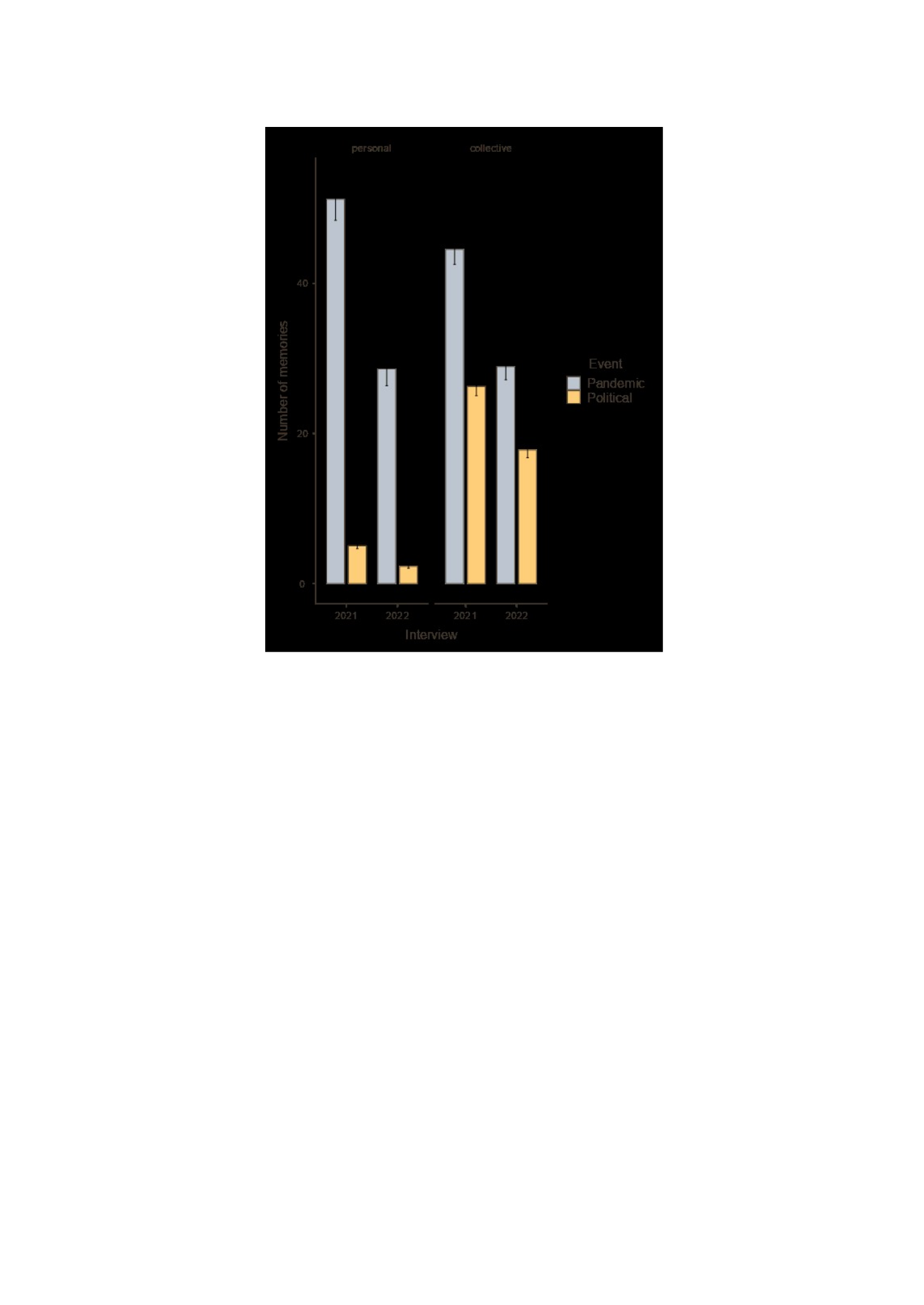
STUDY 1
Proportion of collective information: What type of information
dominates?
A robust 2 (interview time) x 2 (event type: pandemic vs political) ANOVA
on the proportion of collective information contained in memories revealed a main
effect of the interview time (Q = 12.51, p = .001) with a greater ratio of collective
information in 2022 (M = 0.74, SE = 0.02) than in 2021 (M = 0.67, SE = 0.02). A main
effect of the event type was also found (Q = 734.12, p = .001), revealing that
memories of the political event contained a greater proportion of collective
information (M = 0.90, SE = 0.008) than the pandemic event (M = 0.49,
SE = 0.01). The means indicated that, whereas memories of the political event were
mostly collective in nature, those of the pandemic comprised an equal proportion
of personal and collective information. We did not find a significant interaction
between the interview time and the event type (Q = 2.60, p = .11).
97

STUDY 1
4.1.2 To what extent are the content of memories episodic in
nature?
We computed 2 (interview time: 2021 and 2022) x 2 (event type:
pandemic vs. political) ANOVAs on the raw number of internal and external details
provided by the automated analysis, as well as a ratio reflecting the relative
episodicity of memories. Given that the first analyses on the number of information
indicated that narratives varied in length as a function of interview time and type of
event, we additionally computed internal and external indices by dividing the raw
numbers by the total number of information recalled by participants (see method
section). These indices should reflect the degree of episodicity versus “externality”
of each segment of meaningful information.
4.1.2.1 Episodic details scores (raw data)
Internal details. A main effect of the interview time was found (Q = 146.3, p
= .001), revealing significantly more internal details for memories recalled in 2021
(M = 436.84, SE = 20.07) compared to the ones recalled in 2022
(M = 229.56, SE = 20.20). There was also a main effect of the event type (Q =
294.3, p =.001), with more internal details for the pandemic memories (M = 523.58,
SE =21.10) compared to the political memories (M = 192.84, SE = 7.42). There was a
significant interaction between interview time and event type (Q = 41.1.6, p = .001),
revealing more internal details lost over time for the pandemic memories (psi-hat =
366, p <.001 95% CI [293, 440]) than for the political memories (psi-hat = 113, p
<.001, 95% CI [86.8, 139]).
External details. A main effect of the interview time was found (Q =
170.6, p = .001), revealing significantly more external details for memories recalled
in 2021 (M = 304.24, SE = 13.59) compared to the ones recalled in 2022 (M =
139.15, SE = 6.11). There was also a main effect of the event type (Q = 222.6, p
=.001), with more external details for the pandemic memories (M = 332, SE = 14.86)
compared to the political memories (M = 133.08, SE = 5.58). A significant
98

STUDY 1
interaction between interview time and event type (Q = 38, p = .001) showed that
there were more external details lost over time for the pandemic memories than
the political memories.
Episodicity scores. A significant main effect of the interview time was found
(Q = 42.6, p = .001), revealing greater episodicity for memories recalled in 2022 (M
= 0.63, SE = 0) compared to the ones recalled in 2021 (M = 0.59, SE = 0.004). There
was also a main effect of the event type (Q = 7.14, p =.008), with greater episodicity
for the pandemic memories (M = 0.62, SE = 0) compared to the political memories
(M = 0.60, SE = 0). There was also a significant interaction between interview time
and event type (Q = 6.92, p = .009), which was due to a significant difference in
episodicity at the first interview between pandemic and political memories (psi-hat
= 0.03, p <.001, 95% CI [0.02, 0.05]), but no difference in the second interview (psi-
hat = 0, p = .98, 95% CI [-0.02, 0.02]).
4.1.2.2 Episodic details index
Internal index. A robust 2 (interview time: 2021 and 2022) x 2 (event type:
pandemic vs. political) ANOVA showed a main effect of the interview time (Q =
38.8, p = .001), revealing a greater amount of internal details per segment for
memories recalled in 2022 (M = 11.01, SE = 0.41) compared to the ones recalled in
2021 (M = 8.84, SE = 0.12). There was also a main effect of the event type (Q = 36.6,
p =.001), with a greater amount of internal details per segment for the pandemic
memories (M = 10.76, SE = 0.42) compared to the political memories (M = 8.94, SE
= 0.14). A significant interaction was revealed between interview time and event
type (Q = 48.6, p = .001), which is characterized by a greater amount of internal
details per segment for the pandemic memories when recalled in 2022 than in 2021
(psi-hat = -9.43, p <.001, 95% CI [-12.2, -6.66]), but no significant difference for the
political memories between 2021 and 2022 (psihat = 0.53, p = .06, 95% CI [-0.03,
1.10]).
99

STUDY 1
External index. A main effect of the interview time was found (Q = 23.5, p
= .001) revealing a greater amount of external details per segment for memories
recalled in 2022 (M = 6.94, SE = 0.28) compared to the ones recalled in 2021 (M =
6.19, SE = 0.13). There was also a main effect of the event type (Q = 30.5, p = .001),
with a greater amount of external details per segment for the pandemic memories
(M = 7.06, SE = 0.26) compared to the political memories (M = 6.08, SE = 0.14). A
significant interaction was observed between interview time and event type (Q =
82.3, p = .001) revealing an increase in the amount of external details per segment
at the second interview for the pandemic memories, but a loss in the amount of
external details per segment for the political memories at the second interview.
4.1.3 Lexical content analyses of memories: What do participants
talk about?
The percentage of words in different lexical categories (see Table 3) was
submitted to robust 2 (event type: pandemic or the political event) x 2 (interview
time: 2021 and 2022) ANOVAs. The results are presented below by type of effect
(effect of event type, interview time, and interaction) to indicate which lexical
categories were sensitive to the same variables.
Main effect of the event type: There were more words for the pandemic
memories compared to political memories for the following categories: the use of
pronouns: first singular pronoun (Q = 93.90, p = .001) and first plural pronoun (Q =
273.21, p = .001), the social category including references to family (Q = 274.07, p
<.001) and friends (Q = 237.09, p = .001), positive emotions (Q = 57.73, p = .001)
and anxiety (Q = 126.53, p = .001), cognitive processes (Q = 22.37, p = .001), and
finally, as expected, for the COVID-19 category, COVID-19-related words (Q =
804.99, p = .001), and health (Q = 134, p = .001). By contrast, more words related to
anger were found for the political memories than the pandemic memories (Q =
43.6, p = .001). The main effect of the event type was not found for negative
emotions (Q = 1.02, p = .32).
100

STUDY 1
Main effect of interview time: There were more words used during the first
interview (2021) compared to the second interview (2022) in the following
categories: the first plural pronoun (we) (Q = 5.90, p = .02), family (Q = 4.70, p = .03)
positive emotions (Q = 29.59, p = .001), anxiety (Q = 7.22, p =.008), and cognitive
processes (Q = 115.06, p = .001). In contrast, more COVID-19-related words were
used in the second interview (2022) than in the first interview (2021) (Q = 8.69, p
=.004). No differences were found for the first singular pronoun (Q = 0, p = .95),
friends (Q = 2.06, p = .15), negative emotions (Q = 0.04, p = .85), anger (Q = 1.66, p
= .20), and health (Q = 0.54, p =.46).
Interactions event type × interview time: There was an interaction for the
count of negative emotions (Q = 7.01, p = .009). Words related to negative
emotions were more referred to in the narratives of political memories (in 2022)
compared to the pandemic memories in the second interview (psi-hat = -0.19, p
= .02, 95% CI [-0.36, -0.03]), but not in 2021 (psi-hat = 0.09, p = .17, 95% CI [-
0.04, 0.21]).
The interaction was also significant for words related to Covid (Q = 16.73, p
=.001), revealing more references to COVID-19 in the second interview than the
first for the pandemic memories, (psi-hat = -0.29, p <.001, 95% CI [-0.43, -
0.16]), but not for the political event (psi-hat = 0.05, p = .30, 95% CI [-0.04, 0.14].
Other interaction effects were not significant (ps >.05).
Table 3
Mean scores and standard error for the percentage of words fitting each linguistic
category were found significant effect on the interview time for memories.
Interview 1 Interview 2
Pandemic Political Total Pandemic Political Total
101
STUDY 1
I 5.45
(0.15)
3.83
(0.15)
4.67
(0.11)
5.34
(0.16)
3.96
(0.17)
4.70
(0.12)
We 0.48
(0.03)
0.09
(0.02)
0.27
(0.02)
0.42
(0.03)
0.03
(0.01)
0.19
(0.02)
Family 0.34
(0.02)
0.04
(0.01)
0.18
(0.02)
0.30
(0.03)
0
(0)
0.12
(0.02)
Friends 0.21
(0.01)
0.009
(0.06)
0.10
(0.01)
0.18
(0.02)
0
(0)
0.07
(0.01)
Positive
emotions
2.43
(0.05)
2.27
(0.04)
2.19
(0.06)
1.66
(0.07)
1.95
(0.05)
Negative
emotions
1.42
(0.04)
1.33
(0.05)
1.38
(0.03)
1.27
(0.05)
1.47
(0.07)
1.36
(0.04)
Anxiety 0.32
(0.02)
0.08
(0.02)
0.19
(0.02)
0.25
(0.02)
0.05
(0.02)
0.14
(0.02)
Anger 0.28
(0.02)
0.42
(0.03)
0.34
(0.02)
0.18
(0.02)
0.44
(0.05)
0.27
(0.02)
Cognitive 17.06
(0.12)
16.14
(0.14)
16.6
(0.10)
15.17
(0.14)
14.71
(0.17)
14.95
(0.11)
Covid 1.33
(0.04)
0.3
(0.03)
0.81
(0.04)
1.63
(0.06)
0.25
(0.04)
0.91
(0.06)
Health 0.36
(0.02)
0.05
(0.01)
0.64
(0.02)
0.82
(0.04)
0.37
(0.04)
0.6
(0.03)
4.2 Characteristics of future thoughts as a function of event type
4.2.1 Personal versus collective information provided in future
thoughts
Firstly, we conducted analyses on the amount of personal and collective
information provided in the future thoughts imagined by participants for a future
pandemic and the EU dissolution. Then, we analyzed the proportion of collective
102

STUDY 1
future thoughts imagined by participants, to assess the relative part of each type of
information in the imagination of a future pandemic and the EU dissolution.
Mean and SE are available in Table 2.
The number of personal and collective future thoughts. A robust 2 (event
type: pandemic vs political) x 2 (type of information: personal vs collective) ANOVA
revealed a significant effect of the type of information (Q = 857.28, p = .001), with
participants reporting more collective information (M = 20.60, SE = 0.65) than
personal information (M = 0.91, SE = 0.12), no matter the type of event. No main
effect of the event type was found (Q = 1.99, p =.59), nor significant interaction (Q =
0.56, p = .45).
Proportion of collective information: What type of information
dominates? A robust t-tests did not reveal any difference between the future
pandemic and the future political event (Yt = 1.16, p = .25, 95% CI [-0.03, 0.008], ξ =
0.09).
4.3.2 Internal vs external details: To what extent are the content of
future thoughts episodic in nature?
Firstly, robust t-tests comparing the type of event were run on the raw
number of internal and external details, as well as the episodicity score. Then, we
analyzed the indices where the raw number of internal and external details are
divided by the total number of meaningful information to assess the degree of
specificity of each segment of information contained in future thoughts.
Number of internal and external details, and episodicity score. For internal
details, there was a significant difference between the type of event (Yt = 3.33, p
< .001, 95% CI [16.91, 65.66], ξ = 0.22) with more internal details for the pandemic
(M = 206.08, SE = 9.51) than the political event (M = 164.79, SE = 8.05). There was
no significant difference in the number of external details (Yt = 1.42, p = 0.16, 95%
CI [-5.60, 34.54], ξ = 0.10). An effect of event type appeared for the episodicity
scores (Yt = 2.24, p = .03, 95% CI [0.003, 0.04], ξ = 0.16), with future thoughts
103

STUDY 1
containing a greater proportion of internal details for the pandemic (M = 0.59, SE =
0.007) than the political (M = 0.57, SE = 0.008).
Internal and external details indices. For the internal index, results
revealed a significant difference between the type of event (Yt = 3.26, p = .001, 95%
CI [0.43, 1.74], ξ = 0.24) with a greater number of internal details per segment
when imagining a future pandemic (M = 8.17, SE = 0.14) than the political event (M
= 7.08, SE = 0.31). There was no significant difference for the external index (Yt =
1.15, p = 0.25, 95% CI [-0.22, 0.84], ξ = 0.08).
4.2.3 Topic analyses of past and future: Do participants mention common
themes in memories and future thoughts relative to the pandemic?
To test the hypothesis that information constituting memories is used to
simulate future events, we assessed the thematic content of memories and future
thoughts about the pandemic with topic modeling analyses. We report here a
description of the most common topics in each set of narratives (see Table 4). The
past representations of the COVID-19 pandemic in 2020 that were collected in 2021
reveal several distinct topics related to politics, the contact and lack of contact with
family and friends, hospitals and consequences for the medical staff, restrictions,
the virus, professional and school impacts (e.g., homeworking), and also include a
topic related to the temporality of the events (e.g., clear references to specific
months). Regarding the representations of a similar future pandemic that would
happen in 10 years (collected in 2021), results reveal different topics. The most
frequent is that participants share the need to learn from the past. Then, they share
common representations related to management and actions, and distinctly a topic
refers to medical management. Daily-life impacts are also imagined as well as a
crisis in the population. Finally, a topic relates specifically to adaptation behaviors.
The economic, geographical, and political levels are also mentioned.
In 2022, topics of the past COVID-19 pandemic referred to daily life impacts,
hospitals, and medical consequences of the virus. School and professional impacts
104

STUDY 1
are still shared one year after the first interview. The virus evolution and political
restrictions are referred to in the same topic. Participants recall the memories of
the pandemic as follows “If we were into lockdown in September 2020, that means
that the virus cases were high at that time”, bridging two topics from 2021 in one
topic revealing a more comprehensive view of the past and reconstructive
processes of memories. Finally, whereas it was not mentioned for the memories
collected in 2021, in 2022 participants shared memories related to the geo-political
considerations of the COVID-19 pandemic. The geo-political level includes mentions
of relationships with other countries such as China, the USA, and Russia in the
context of the pandemic, but also politics within Belgium between the three
regions (Wallonia, Flanders, and Brussels).
Table 4
Summary of the topic extracted for the memories of the pandemic event (collected
in 2021 and 2022), and the future pandemic in 10 years.
Past representations of the
COVID-19 pandemic
(in 2021)
Future representations
of a similar pandemic in ten
years (in 2021)
Past representations of the
COVID-19 pandemic
(in 2022)
105

STUDY 1
1. Politics
2. Contact and lack of
contact with family and
friends
3. Hospital & consequences
for medical staff
4. Restrictions
5. The virus
6. Professional and school
impacts
7. Temporality of the events
1. Learn from the past
2. Management and
actions
3. Medical management
4. Crisis in population
5. Daily life impacts
6. Adaptation
7. Economy geo-
political level
1. Daily life impact
2. Hospital
3. Medical consequences
(death)
4. Virus evolution &
political restrictions
5. School & professional
impacts
6. Geo-political level
4.3 Additional analyses
4.3.1 Exploratory factorial analysis: impact of the COVID-19
pandemic on individuals’ life
Whereas the comparison of memories of the pandemic versus a
political event captures the influence of being directly concerned or not by the
event (or having personally lived or not the event), it is noteworthy that individuals
did not experience the COVID-19 pandemic similarly. While some were strongly
impacted in their everyday life and/or presented with anxiety and depression,
others were minimally impacted, or may even have enjoyed the situation. To
capture such individual variability, the following analysis assessed whether the
specific influence of the COVID-19 pandemic on people’s lives indexed by the series
of questionnaires administered was related to variation in the characteristics of
memories for the pandemic.
First, to reduce data dimensionality, we conducted exploratory factorial
analyses using IBM SPSS Statistics on fifteen variables with orthogonal rotation
(Normalized varimax), using minimum eigenvalue = 1, and principal component
analysis. The fifteen variables included in the analyses are the following and can be
found in section 3.4: mean score related to the proximity to COVID-19 for each of
106

STUDY 1
the four circles (family, friends, professional, and acquaintances); mean score of the
11 VAS assessing the impact of the pandemic on participants’ life; mean score of
the 7 VAS assessing the extent to which they followed and agreed with
governmental restrictions; score regarding the extent to which they considered
themselves at risk of contracting the COVID-19 virus; score assessing the extent to
which they were confused during the pandemic; mean score of the fear of COVID-
19 scale (Ahorsu et al., 2020); mean score of the coronavirus anxiety scale (Lee et
al., 2020); mean score of the IES-COVID (trauma related to COVID-19) (Vanaken et
al., 2020); depression scores at the BDI scale (Collet & Cottraux, 1986) ; anxiety
score at the STAI scale (Marteau & Bekker, 1992); score at the Loneliness scale (De
Grâce & Joshi, 1990); and a mean score at the Centrality of Event Scale for the
pandemic in 2020 (Berntsen & Rubin, 2006).
The results revealed the presence of four independent factors (see Tables 2 and 3 in
the supplemental material). Of note, analyses were computed for each interview
time separately. For both analyses, Bartlett’s test was p <.001. Each factor was then
used in robust correlation analyses. The four factors extracted for the first interview
and the second are mostly similar. Factor 1 relates to the impact on one’s life (daily
life and psychological impact -depression and anxiety-, including loneliness for the
second interview). High scores on Factor 1 correspond to high pandemic and
psychological impact. Factor 2 relates to the contact with COVID-19-affected
people. High scores on Factor 2 correspond to a high degree of contact with COVID-
19-positive persons. Factor 3 relates to the psychological impact specific to the
COVID-19 pandemic (including being at risk of contracting the disease for the first
interview). High scores on Factor 3 correspond to a high psychological impact of the
pandemic. The fourth factor relates to the agreement with the governmental
restrictions (including being at risk for the second interview). High scores on Factor
4 correspond to high agreement with and respect for the rules during the COVID-19
pandemic. Their feeling of confusion did not load on any factor in both interviews.
107

STUDY 1
Next, correlations were computed between the four factors and memory
measures, using robust statistical analyses equivalent to Pearson’s correlations
using percentage bend correlations (Mair & Wilcox, 2019). Robust correlations were
conducted using beta = 0.2 and bootstrapping set at 2000. Robust correlations were
conducted in R studio version 2.1 (Rstudio Team, 2023), using the WRS2 package
(Mair & Wilcox, 2020). Robust correlations were computed on the amount of
personal and collective information recalled, on the type and quantity of memories
and future thoughts (4.3.2), the proportion of collective information (4.3.3), the
internal and external details and index (4.3.4), the episodicity score (4.3.4), the
lexical content of memories (4.3.5).
4.3.2 Type and quantity of memories and future thoughts:
correlational analyses
We computed correlational analyses including the four factors extracted
from the exploratory factorial analyses, with the number of collective information
recalled and imagined (Table 5) and the number of personal information recalled
and imagined (Table 6) (by interview time, and time). Results reveal no significant
correlations after multiple comparison corrections, except a significant (but small)
negative correlation between Factor 1 with the amount of collective future
thoughts about a future pandemic. This result suggests that the more people were
in contact with COVID-19-positive people in 2020, the less they imagined collective
future events related to a future pandemic.
Table 5
Correlations between factors on the amount of collective information recalled and
imagined for the pandemic event by interview time
Interview Time
Factor 1
Factors
Factor 3
Factor 4 Factor 2
1 (2021) Past ppb = -0.03
p = .32
ppb = -0.04
p = .13
ppb = -0.07
p = .01
ppb = 0.06
p = .02
108

STUDY 1
Future ppb = -0.12
p = .007
ppb = 0.02
p = .73
ppb = 0.04
p = .38
ppb = 0.11
p = .02
2 (2022) Past ppb = -0.03
p = .33
ppb = 0.04
p = .14
ppb = -0.07
p = .01
ppb =0.06
p = .02
Table 6
Correlations between factors on the amount of personal information recalled (past)
and imagined (future) for the pandemic event by interview time
Interview Time
Factor 1
Factors
Factor 3
Factor 4 Factor 2
1 (2021)
Past ppb = 0.01 p
= .82
ppb = -0.05 p
= .04
ppb = 0.04 p
= .14
ppb = 0.01 p
= .65
2 (2022)
Future ppb = 0.01
p = .78
ppb = -0.05
p = .25
ppb = 0.08 p
= .07
ppb = 0.05 p
= .26
Past ppb = 0.01
p = .82
ppb = 0.05 p
= .04
ppb = 0.04 p
= .14
ppb = 0.02
p = .66
4.3.3. Proportion of collective information: What type of
information dominates?
Additionally, we computed correlational analyses including the four factors
extracted from the exploratory factorial analyses with the proportion of collective
information recalled and imagined (by type of event, interview time, and time).
Results are available in Table 7 and reveal no significant correlation after multiple
comparisons correction.
Table 7
Correlations between factors on the proportion of shared memories
Interview Event Time Factors
109

STUDY 1
Factor 2
Factor 3
Factor 4
type
Factor 1
1 (2021)
Pandemic Past ppb = 0.08 p
= .21
ppb = 0.02 p
= .71
ppb = -0.09 p
= .15
ppb = 0.05 p
= .46
2 (2022)
Future ppb = -0.08
p = .20
ppb = 0.02 p
= .81
ppb = -0.07 p
= .31
ppb = -0.08 p
= .22
Pandemic Past ppb = -0.07 p
= .34
ppb = 0.01 p
= .88
ppb = -0.11 p
= .15
ppb = -0.16 p
= .04
4.3.4 Episodic details scores and index
Episodic details scores. Correlational analyses including the four factors
with the episodicity scores (by interview time and event type) were computed and
can be found in Table 8. Results reveal only one significant correlation after multiple
comparisons correction, between Factor 4 and the episodicity scores for the
political memories at the first interview (p = .007), revealing that the more
participants followed the restrictions and agreed with the governmental restrictions
the higher their score of episodicity was for their memories of the political event in
2020 when interviewed in 2021. Of note, we did not hypothesize significant
correlations between factors and memory indicators for political events. However,
correlations were computed between factors and memory indicators for political
events as a control measure.
Table 8
Robust correlations of episodicity scores (raw) with factors
Interview 1 Pandemic ppb = 0.01 p = .94 ppb = -0.03 p
=.61
ppb = -0.07
p = .33
ppb = 0.05
p = .47
Political ppb = -0.07 ppb = -0.01 p ppb = 0.04 ppb = 0.18 p
110
Interview Event type Factor s
Factor 1 Factor 2 Factor 3 Factor 4

STUDY 1
p = .32
=.86
p = .54
= .007*
Interview 2 Pandemic ppb = 0.07 p = .48 ppb = 0.07
p =.31
ppb = 0.03
p = .69
ppb = 0.05
p = .48
Political ppb = 0.05
p = .47
ppb = 0.06
p =.37
ppb = -0.03
p = .69
ppb = 0.02
p = .82
Episodic details index. Correlational analyses including the four factors with the
internal and external details index (by interview time and event type) were
computed and no significant correlation was found. Results are available in Table 5
and Table 6 in the supplemental material.
4.3.5 Lexical content analyses of memories: correlational analyses
We computed robust correlations between the four factors extracted from
the exploratory factorial analyses and the lexical content of the pandemic
memories and future thinking of the pandemic. For the first interview (in 2021),
Factor 1 (i.e., impact on one’s daily life and psychologically) correlates positively
with the use of words related to negative emotions (ppb = 0.26, p <.001), anxiety (ppb =
0.22, p <.001), and anger (ppb = 0.17, p = .008). Factor 2 (i.e., COVID-19 contact)
correlates negatively with the use of first plural pronoun (ppb = - 0.13, p =.04), words
related to anxiety (ppb = -0.17, p =.01) and negative emotions (ppb = 0.17, p =.01).
Factor 3 (i.e., psychological impact related to COVID-19) correlates negatively with
the use of words related to anger (ppb = -0.13, p =.03). Factor 4 (i.e., political rules
and loneliness) correlates negatively with the references to positive emotions (ppb = -
0.17, p =.01).
For the second interview (in 2022), Factor 2 (i.e., COVID-19 contact) correlates
positively with the use of the first singular pronoun (ppb = .14, p = .04). Factor 3 (i.e.,
psychological impact related to COVID-19) correlates positively with negative
emotions (ppb = .15, p =.03). Other correlations were not significant (ps > .05).
111

STUDY 1
112

STUDY 1
4.5 Summary of results
Table 9
Memories: A comparison of memory for the pandemic and a political event as a
function of interview time
Scores Event type Interview time Interaction
Number of
personal vs
collective
information:
Nature of
memories
Pandemic >
political
2021 > 2022 Pandemic: personal >
collective in 2021, but
personal = collective in
2022
Political: collective >
personal both in 2021
and 2022
Proportion of
collective: what
type of info
dominates
Political (90%)
> pandemic
(49%)
2022 > 2021
Internal details:
raw number
across the
narrative
Pandemic >
political
2021 > 2022 Pandemic: 2021 >> 2022
Political: 2021 > 2022
External details:
raw number
across the
narrative
Pandemic >
political
2021 > 2022 Pandemic: 2021 >> 2022
Political: 2021 > 2022
Episodicity across the
narrative
Pandemic >
political
2022 > 2021 2021: Pandemic >
political
2022: pandemic =
political
Internal index:
Amount in each
segment
Pandemic >
political
2022 > 2021 Pandemic: 2022 > 2021
Political: 2022 = 2021
External index:
Amount in each
segment
Pandemic >
political
2022 > 2021 Pandemic: 2022 > 2021
Political: 2022 < 2021
LIWC: what do
people talk about?
Pandemic >
political:
I
We
Family
Friends
Positive
2021 > 2022:
We
Family
Positive
emotions
Anxiety
Cognitive
Negative emotions:
2021: pandemic =
political
2022: political >
pandemic
113

STUDY 1
emotions processes Covid:
Pandemic: 2022 > 2021
Anxiety Political: 2022 = 2021
Cognitive 2022 > 2021: processes covid
Covid
Health
Political >
pandemic: anger
Table 10
Characteristics of future thoughts as a function of event type
Scores Event type Type of details (if applicable)
Number of personal vs
collective information:
Nature of future thoughts
Pandemic = EU Collective > personal
Proportion of collective:
what type of info
dominates
Pandemic = EU
Internal details: raw
number across the
narrative
Pandemic > EU
External details: raw
number across the
narrative
Pandemic = EU
Episodicity across the
narrative
Pandemic > EU
Internal index: Amount in
each segment
Pandemic > EU
External index: Amount in
each segment
Pandemic = EU
114

STUDY 1
5. Discussion
This study examined the influence of the passage of time and personal
importance on lived collective memories. To do so, we explored 3 different aspects
of memories: 1) the extent to which the representations in memory of lived
collective events are episodic; (2) the type of information that people remember
about a lived collective event (personal vs collective); (3) the themes most
participants talked about and with which kind of words, as assessed by the lexical
content analyses. We conducted a longitudinal assessment of memories of events
related to the COVID-19 pandemic (events that all participants experienced as
actors) compared to a political event that participants heard about in the media but
did not live personally. Moreover, participants had to imagine a future pandemic
and we investigated to what extent the collective future relies on the collective
past.
5.1 Influence of personal importance in a collective context
As expected, because the pandemic had an impact on every participant’s
personal life as well as on the community’s life (Er, 2003; Klein, 2012; Pezdek, 2003),
it was rated as more important (as measured by the Centrality of Event Scale) than
the control (political) event. We then found that memories of these two events
differed in the amount and type of information recalled: memories of the pandemic
contained more episodic details, and more personal and collective information than
memories about the political event. Our results are in line with the self-reference
effect in memory, stating that the more individuals are personally involved in the
event, the more they hold personal memories and share episodic and semantic
details about these events (Er, 2003; Klein, 2012; Sui & Humphreys, 2015). Also,
greater physical involvement in an event leads to better memories than hearing
about it in the media or from others (Gold, 1992; Pezdek, 2003). This study thus
provides evidence that personal importance influences the creation of lived
collective memories. Interestingly, this appears as an enduring effect as, in 2022
115

STUDY 1
(i.e., 2 years after the event), participants recalled as many personal memories as
collective memories about the pandemic, whereas participants over time kept
recalling political events with more collective information. Additionally, results
highlight differences between memories of the pandemic and the political event
mainly in terms of personal information. The personal importance associated with a
lived collective event could influence the creation of strong links between personal
and collective information related to that event.
The impacts of the collective event at individual and collective levels also
drove specific characteristics regarding the words used in their narratives. Because
of the stronger socioemotional nature of the COVID-19 pandemic for Belgians, as
opposed to the political event, we found that memories of the pandemic
encompassed more words related to emotions, cognitive processes, social
situations, COVID-19, and health for the pandemic events compared to the political
events (Haleem et al., 2020; Hiscott et al., 2020; Tarkar et al., 2020; Wollast et al.,
2023).
5.2 Influence of the passage of time in collective memory: What do people
talk about regarding lived collective events and what remains over time?
We hypothesized that with the passage of time the pandemic memories
would include a smaller number of information, fewer episodic details, and a
greater proportion of collective information over time (Conway & PleydellPearce,
2000; Trope & Liberman, 2010). The results only partly supported these predictions.
We found that, as time passed, participants recalled globally fewer information, as
seen in the general loss of episodic and semantic details in the narratives, but
overall narratives were more episodic over time. In other words, participants’
narratives in 2022 were shorter, but the sentences were proportionally richer in
detail. This was only true for the pandemic but not for the political memories. This
might reflect a reorganization of the memories of the pandemic in the sense of a
denser but still rich representation of the events. With time, participants needed
116

STUDY 1
fewer sentences to describe events related to the pandemic during the year 2020
and could provide all details with fewer words.
Over time Belgians mentioned similar topics about the pandemic. These
themes include general themes such as the virus, political restrictions, professional
and school impacts, hospitals, and medical consequences. Our results recall those
of a recent work on the COVID-19 pandemic revealing themes of lockdowns and
infections (Öner et al., 2023) and social interactions and events (Rouhani et al.,
2023). Moreover, we found that some topics were not recalled as such over time,
like the specific lack of contact with family and friends but were encompassed in a
new general theme about daily life impacts. While the restrictions and the virus
were considered as two different themes one year after the pandemic, two years
after the pandemic Belgian citizens shared a common memory of the evolution of
the virus based on the restrictions imposed by politics. Interestingly, the
geopolitical relationships between different countries and within Belgium appeared
in the narratives only two years after the event. Altogether, two years after the
events participants shared a more comprehensive view of the pandemic, possibly
suggesting a reappraisal at a more general level when leaving the acute phase of
the crisis. From a cognitive lens, the stabilization of themes, the evolution of
specific themes into more general ones, and the emergence of new themes
highlight the reconstructive nature of memory (Bartlett, 1932; Conway et al., 2004;
Roediger & Abel, 2015).
Finally, the memories collected in 2022 referred more to the COVID-19
pandemic itself than the memories collected in 2021. This reveals more pandemic-
oriented representations of memories with time and is consistent with the loss of
personal memories with time. Interestingly, cognitive processes were found to be
less used two years after the event, which might indicate that in 2021 individuals’
narratives reflected a high degree of complexity of language and thoughts (Van
Swol et al., 2016; Van Swol et al., 2021), and organized thoughts (Cohn et al., 2004).
This result is consistent with other research revealing less use of cognitive
117

STUDY 1
processes over time after the surprising events of the 9/11 attacks (Cohn et al.,
2004), but inconsistent with other findings bearing on the collective coping theory
that found differences in the use of cognitive processes three months to ten
months after traumatic events such as flood, earthquake, or terrorist attacks
(Pennebaker & Harber, 1993; Freitag et al., 2011). In this study, because higher
scores for the cognitive processes category reflect organized thoughts (Cohn et al.,
2004), this can also be linked with the temporal organization when recalling their
memories of the pandemic in 2021 by referring to the months of the year to
organize their thoughts (topic 7, Table 3), but not in 2022.
5.3 Links between past and future
In line with the constructive episodic simulation hypothesis (Schacter &
Addis, 2007), we hypothesized that participants would share more episodic details
when imagining a future pandemic than a future political event because they can
rely on recent memories including episodic details and general knowledge about a
pandemic (Conway et al., 2019). Consistent with our hypothesis, we found that
future thoughts about a pandemic were more episodic than future political
thoughts. This could indicate that participants used information about specific
events to simulate what could happen in the future if a pandemic occurred again.
Additionally, we found more collective than personal thoughts about future events,
indicating that projections included more the community’s actions than their own.
These results differ from previous studies examining the personal or collective
content of future thoughts related to the COVID-19 pandemic situation which
showed that more personal than collective thoughts were produced and recalled
(Migueles Seco & Aizpurua Sanz, 2024). This difference might stem from the fact
that we examined a future pandemic in 10 years, while Migueles Seco & Aizpurua
Sanz (2024) examined the type of future thoughts (personal vs collective) related to
the context of the pandemic during the pandemic.
118

STUDY 1
We predicted that general topics used to recall the past pandemic would be
used to imagine a future one (Öner et al., 2023). Consistently, thoughts about the
future pandemic were influenced by past experiences, with topics reflecting the
desire to learn from the past for better adaptation, specifically in medical
management, economy, and political relationships all over the world. Collective
future thoughts and their link with collective memories are still in the early stages
of research. Congruent with our results, a few studies revealed that similar themes
were shared about past and future public events (Öner et al., 2023; Öner & Gülgöz,
2020; Topçu & Hirst, 2020).
Finally, we acknowledge some limitations of this study and suggest future
perspectives. Given that participants were free to recall personal and collective
memories and imagine personal and collective events related to public events, the
analyses of the episodicity and theme levels were run on their narratives without
distinguishing personal and collective information. Future analyses could focus on
the recall or future thinking of personal events related to public events separately
from collective events related to public events, to ensure a specific examination of
episodic details and themes of personal and collective events independently.
Secondly, this study assessed memories of events over a period of one year (the
year 2020) so that narratives mention many different events related to the
pandemic. To avoid this, future studies should examine the cognitive structure of
collective events that happened during a shorter time with less different events
possible (such as the 9/11 attacks).
6. Supplemental material
Table 1
Mean and standard error for scores at the centrality scales at both interviews
interview all
Centrality scale related to the COVID-19
pandemic in 2020
1 2 3.36 (0.07)
3.08 (0.07)
119

STUDY 1
Centrality scale related to the political event
in 2020
1 2 2.09 (0.07) 1.80
(0.07)
Centrality scale related to the future
pandemic in 10 years
1 3.11 (0.07)
Centrality scale related to the future UE
dissolution in 10 years
1 3.09 (0.08)
Table 2
COVID-19 dictionary created in LIWC
apocalypse Rooms’
ventilation
antibody
Messenger RNA
asymptomatic
Social bubble
contact case
negative case
positive case chaos
cluster collective
non-essential businesses
lockdown (FR) physical
contact coronavirus online
classes curfew covid
covid safe ticket covid-19
health crisis
CST
infection nurses
respiratory failure
isolation lockdown
(EN) Nursing
home sick disease
mask FFP2 doctors
media drugs
microbe migraine
dead pandemic
vaccination pass
person at risk loss
of appetite loss of
taste fear
quarantine
120

STUDY 1
End of lockdown
screening disinfectant
social distancing distance
doctor loss of smell dose
of vaccine epidemic
epidemiologists essential
businesses flu-like
symptoms remote exams
source of contamination
hydroalcoholic gel barrier
gestures hospitals
hygiene immunity
rules
restrictions
sanction
intensive care
symptomatic
symptoms
homeworking
PCR test tests
tracing
transmission
vaccine
vaccination
wave
virus video
121

STUDY 1
Table
3
Exploratory factorial analyses computed based on the data collected at the first
interview
Factor 1 Factor 2 Factor 3 Factor 4
Centrality scale past
COVID
0.567 -0.12 0.10 0.38
Family contact 0.113 0.69 0.04 -0.02
Friends contact -0.157 0.74 0.17 0.10
Professional contact -0.16 0.56 -0.17 0.20
Acquaintances contact 0.026 0.59 -0.13 -0.31
Impact on one’s life 0.651 -0.26 0.17 0.11
Government rules -0.24 -0.001 0.24 0.79
At risk -0.132 -0.08 0.57 0.15
Confusion about the
pandemic
0.48 -0.08 0.16 -0.18
Fear of covid 0.33 0.004 0.72 0.15
Trauma of covid 0.49 -0.04 0.57 -0.07
COVID-19 anxiety 0.24 0.06 0.78 -0.05
Loneliness 0.46 0.13 -0.08 0.55
Depression 0.77 0.05 -0.03 -0.09
Anxiety 0.66 0.08 0.17 -0.02
Expl. Var 2.78 1.8 2.01 1.33
Prp. Totl 0.18 0.12 0.14 0.09
Note.
Factor Loadings (Varimax normalized)
Extraction: Principal components
Marked loadings are >.500000
4
Exploratory factorial analyses computed based on the data collected at the
second interview
Factor 1 Factor 2 Factor 3 Factor 4
Centrality scale past
COVID
0.61 -0.07 0.23 0.20
Family contact 0.04 0.59 -0.01 -0.07
Friends contact -0.01 0.78 -0.03 -0.03
Professional contact -0.15 0.59 -0.15 0.20
122

STUDY 1
Table
Acquaintances contact -0.09 0.73 0.14 0.02
Impact on one’s life 0.66 -0.10 0.24 0.25
Government rules 0.02 0.15 -0.13 0.82
At risk -0.008 -0.11 0.28 0.70
Confusion about the
pandemic
0.43 0.05 0.23 -0.03
Fear of covid 0.27 0.03 0.76 0.18
Trauma of covid 0.40 -0.01 0.63 -0.05
COVID-19 anxiety -0.04 -0.04 0.85 0.01
Loneliness 0.62 -0.14 -0.23 0.12
Depression 0.76 -0.05 0.001 -0.29
Anxiety 0.62 -0.01 0.14 -0.14
Expl. Var 2.59 1.90 2.06 1.44
Prp. Totl 0.17 0.13 0.14 0.10
Note.
Factor Loadings (Varimax normalized)
Extraction: Principal components Marked
loadings are >.500000
5
Correlations between the four factors from EFA and the internal details index
Interview Event type Time Factor 1 Factor 2 Factor 3 Factor 4
Interview 1 Pandemic Past ppb = 0.021
p = .97
ppb =0.04
p =.58
ppb = -0.004
p = .95
ppb =0.01
p = .83
123

STUDY 1
Table
Political Past ppb = 0.07
p = .27
ppb = 0.05
p =.41
ppb = -0.07
p = .27
ppb = 0.07 p
= .29
Interview 2 Pandemic Past ppb =0.027
p = .81
ppb = 0.04
p =.11
ppb = 0.04
p = .60
ppb = 0.07
p = .29
Political Past ppb = 0.07
p = .32
ppb = 0.03
p =.69
ppb = 0.05
p = .43
ppb = -0.05
p = .43
Table 6
Correlations between the four factors from EFA and the external details index
Interview Event type Time Factor 1 Factor 2 Factor 3 Factor 4
Interview 1 Pandemic Past ppb = 0.01 p
= .98
ppb = 0
p =.99
ppb = 0.02 p
= .78
ppb = -0.03
p = .67
Political Past ppb = 0.09 p
= .17
ppb = 0.05 p
=.44
ppb = -
0.05 p
= .49
ppb = -0.07 p
= .26
Interview 2 Pandemic Past ppb = 0.02
p = .72
ppb = -0.15
p =.02
ppb = -0.07
p = .32
ppb = 0.06
p = .36
Political Past ppb = -0.06
p = .45
ppb = -0.08
p =.21
ppb = 0.07
p = .29
ppb = -0.03
p = .63
124

STUDY 2
125

STUDY 2
STUDY 2
STUDY 2
Does the COVID-19 Pandemic Act as a Transition in the
Recall of the Temporal Context of Autobiographical
Memories?
Nawël Cheriet1,2,3*, Arnaud D’Argembeau2,3 & Christine Bastin1,2,3
Paper submitted to Applied Cognitive Psychology
1GIGA-CRC In Vivo Imaging, University of Liège, Belgium
2Psychology and Neuroscience of Cognition Research Unit, University of Liège,
Belgium
3F.R.S.-Fonds National de la Recherche Scientifique, Belgium
Study 2 examines the extent to which the COVID-19 pandemic act as a
transitional event that helps to structure and organize memory.
126

127

STUDY 2
STUDY 2
Does the COVID-19 Pandemic Act as a Transition in the
Recall of the Temporal Context of
Autobiographical Memories?
Nawël Cheriet1,2,3*, Arnaud D’Argembeau2,3 & Christine Bastin1,2,3
1GIGA-CRC In Vivo Imaging, University of Liège, Belgium
2Psychology and Neuroscience of Cognition Research Unit, University of Liège,
Belgium
3F.R.S.-Fonds National de la Recherche Scientifique, Belgium
Authors’ note
Nawël Cheriet https://orcid.org/0000 - 0002 - 7795 - 4676
Christine Bastin https://orcid.org/0000 - 0002 - 4556 - 9490
Arnaud D’Argembeau https://orcid.org/0000 - 0003 - 3618 - 9768
Correspondence concerning this article should be addressed to Nawel Cheriet,
GIGA-Cyclotron Research Center-in vivo imaging, University of Liège, Allée du 6
Août, B30, 4000 Liège, Belgium, Telephone: +32 4 366 23 16, Fax: +32 4 366 2515,
Email: nawel.[email protected]
Running title: COVID-19 and transition theory
Conflict of interest
The authors declare no conflict of interest.
128

STUDY 2
Data Availability Statement
Data are openly available in OSF at https://osf.io/a2q4v/
Acknowledgments
CB is a Senior Research Associate at the F.R.S.-FNRS and AD is a Research
Director at the F.R.S.-FNRS. NC was supported by a FRESH grant from F.R.S.FNRS.
We thank MD for her help in the scoring of data. The authors would like to thank
the students who helped with collecting the data.
1. Abstract
The Living-in-History effect suggests that important collective events are
used as temporal landmarks that influence the temporal organization of
autobiographical memory. In this study, we assessed whether the COVID-19
pandemic has such an influence on memory organization. We asked 170 young
129

STUDY 2
Belgian participants to recall and date autobiographical events. We examined the
type of information used as temporal landmarks and references to the COVID-19
pandemic. We hypothesized that participants who were more impacted by the
pandemic would refer more to this collective event when recalling personal
memories. The 170 participants were divided into three clusters based on their
degree of contact with COVID-19-positive persons and the impact of the pandemic
on their life. Results show that young Belgian adults rarely rely on this collective
event to date past experiences, regardless of the impact of the pandemic had on
their life. Instead, they refer more to personal transitions as temporal landmarks.
Keywords : Transition Theory; Autobiographical Memory; Collective Memory;
COVID-19 Pandemic
2. Introduction
Because of its major consequences in various areas of life, the COVID19
pandemic will certainly remain in our memory. However, the extent to which this
global event influences memory organization is not known. According to Conway et
al.’s autobiographical memory model, of the multitude of events we experience
every day only some events are retained in long-term autobiographical memory, in
which they are organized hierarchically (Conway, 2005; Conway & Pleydell-Pearce,
2000). Details of everyday experiences are stored at the level of specific episodic
memories, but these details are lost over time unless they pertain to long-term
goals and are linked to a higher level of autobiographical memory (i.e., general
representations of life events and periods). Lifetime periods (e.g., when I was
working at University of Liège) involve period-specific knowledge that includes
representations of typical places, objects, activities, and people characterizing a
broad period of life (Brown, 2023; Thomsen, 2015). A shift from one lifetime period
130

STUDY 2
to another usually involves a major event that produces significant changes in one’s
life (e.g., moving to another city). These major events are also called transitions
(Brown, 2016).
According to Brown’s Transition Theory (Brown, 2016, 2023), transitions are
events that produce significant changes in life circumstances (Brown, 2021; Gu et
al., 2017; Uzer & Brown, 2015). They are “changes in the fabric of daily life” in terms
of our relationships, habitual activities, and the places we frequent (Brown, 2016,
2023). These events can then be used as temporal landmarks, which help to
structure the temporal organization of autobiographical memory (Berntsen &
Rubin, 2004; Brown, 2016; Svob et al., 2014). Transitions have several dimensions.
First, being grounded in autobiographical memory, transitions can be life script
consistent or not (i.e., normativity dimension). Some transitions are expected in our
society (e.g., getting married, having children, and so on), whereas others do not fit
into known life patterns (Brown, 2023; Gu et al., 2017). Secondly, transitions can be
seen on a continuum from personal (e.g., moving to a new place) to collective (e.g.,
wars) (i.e., scope dimension) (Brown, 2023; Brown et al., 2016; Gu et al., 2017). A
third dimension relates to the impact of the transitional events in someone's life
(i.e., impact dimension) (Brown, 2023; Gu et al., 2017; Shi & Brown, 2021).
Public events, such as wars and natural disasters, can elicit collective
transitions (Bohn & Habermas, 2016; Brown & Lee, 2010). Collective transitions, like
personal transitions, create boundaries between different lifetime periods (Brown
et al., 2012; Brown et al., 2016). These lifetime periods are also referred to as
Historically Defined Autobiographical Periods (H-DAPs). The Living-inHistory effect
(LiH) suggests that H-DAPs are used as temporal landmarks to date personal events
(Bohn & Habermas, 2016; Brown et al., 2016, 2021; Zebian & Brown, 2014).
Additionally, the LiH effect is generally more pronounced for people whose daily life
was more impacted by the transitional event. Indeed, we recall more personal
memories that happened around transitions (Enz et al., 2016; Pillemer et al., 1988)
and unstable periods (e.g., wars) (Brown et al., 2016; Gu et al., 2017). Expanding on
131

STUDY 2
the impact dimension of transitions, several studies showed that personal
involvement in collective events, such as the 9/11 attacks, led to better memories
(Er, 2003; Neisser, 1996; Pezdek, 2003). Additionally, the emotional impact of
events can influence the sharing of memories, which in turn enhances their
consolidation in long-term memory and increases their likelihood of being recalled
(Neisser, 1996; Tekcan & Peynircioglu, 2002).
The COVID-19 pandemic in 2020 formed a set of events that settled
important modifications in daily life (Heanoy et al., 2021). As such, the pandemic,
or at least the lockdown, could act as a transition because the changes produced by
this event created a before and after in the fabric of daily life (Brown, 2021).
Typically, changes associated with transitions consist of old habits being replaced
with new life elements (e.g., a new job) (Heanoy et al., 2022). In the case of the
COVID-19 pandemic, the balance between old habits and new life elements mainly
took the form of the disappearance of old habits (i.e., the lack of usual activities,
contacts, and outside life during the lockdown) (Brown, 2021; Heanoy et al., 2021;
Heanoy et al., 2022). Therefore, as opposed to classic transitions, such as starting a
new job, the pandemic can be considered a “transition-by-omission” (Brown, 2021;
Heanoy et al., 2022). Moreover, the modifications induced by the pandemic were
usually not longlasting, as most people resumed with their lives when vaccination
against the virus generalized. Nevertheless, beyond long-lasting modifications (e.g.,
change of job), the pandemic had an affective impact. A recent study examined
links between the transitional impact of the COVID-19 pandemic and its mental
health consequences during the early stages of the pandemic, showing that the
more participants were affected mentally by the COVID-19 events (depression,
anxiety, and stress), the more they reported these events as transitional (Heanoy et
al., 2021). However, the extent to which the pandemic acts as a temporal landmark
in the organization of autobiographical memory is unknown.
The present study aimed to examine this question in the framework of the
Transition Theory (Brown, 2016, 2021, 2023; Brown et al., 2012). We assessed to
132

STUDY 2
what extent the COVID-19 pandemic and related events such as the lockdown,
vaccines, travel restrictions, and so on, functioned as a transition that is used as a
temporal landmark for organizing memories for personal events. Participants took
part in the study two years after the start of the pandemic and were asked to recall
and date a series of personal events from the past five years. If the pandemic acts
as a transition in people’s life, participants should refer more to this collective event
as a temporal landmark to date personal events. More specifically, we examined
the impact dimension of transitional events. We hypothesized that participants
who were more impacted by the COVID-19 pandemic at a personal level (e.g.,
through personal contact with a COVID-19-positive person, mental health
consequences, and daily life consequences) should refer more to the pandemic as a
temporal landmark compared to people who were less impacted by the pandemic.
Alternatively, it could be that participants do not use COVID-19-related events as a
temporal landmark because of the lack of clear-cut “before-after” of the pandemic.
In Belgium, the onset of the pandemic occurred with the first reported cases on
February 1, 2020. Subsequently, on March 10, authorities announced the
prohibition of visits to nursing homes, and by March 16, schools were closed. The
official lockdown started on March 18 and extended until May 4, accompanied by
measures such as mandatory masks in public transportation. Following a period of
fewer restrictions during the summer, new measures were implemented on
October 19, including a curfew that persisted into 2021. In 2021, the end of the
lockdown and easing of restrictions was not clearly defined but occurred gradually
through various phases, progressively lifting the restrictions, and granting more
freedom. Given these variations in the measures that were taken by the
government, the COVID-19 period involved more diffuse changes over time than
other transitional events (e.g., a natural disaster), and could therefore be less used
as a time reference in memory.
133

STUDY 2
3. Method
We report how we determined our sample size, all data exclusions, all
manipulations, and all measures in the study. This study was not preregistered.
Participants
An a priori power analysis carried out using the G*power software (Faul et
al., 2007) suggested recruiting at least 146 participants to reach a statistical power
of 0.85 to detect an interaction effect between clusters and categories (see below),
with an alpha of .05 and a medium effect size (Cohen’s f = .25).
From February 2022 to April 2022, 181 participants took part in the study.
Eleven participants were excluded from the analysis for the following reasons: six
participants because of a diagnosed psychiatric or psychological disorder or due to
a score equal to or higher than 16 on the French version of the Beck Depression
Inventory (BDI-13, Collet & Cottraux, 1986), and five other participants because
they were under medication for neurological or psychiatric diseases. The final
sample included 170 participants (95 women) aged between 18 and 40 years old
(M = 21.8, SD = 3.95). All were Belgian and French-speaking and did not suffer from
neurological, psychiatric history, or cognitive impairment. Ethical approval was
obtained from the ethics committee of the psychology faculty at University of Liège.
Participants provided written informed consent.
Memory Task
All participants took part in an autobiographical memory task. The task was
similar to the one used by Brown et al. (2009) to assess the Living-In-History effect
in a cross-national study with public events such as wars or natural disasters.
Participants were given one word at a time and were asked to retrieve a specific
personal memory related to that word. The event had to have lasted less than 24
hours and have occurred from five years to one week before the interview. The
period between the onset of the pandemic and the study was two and a half years
(2019-2022). Thus, the period of five years was chosen so that the period from
134

STUDY 2
which participants would sample memories would be equivalent (two and a half
years) before and after the pandemic. Furthermore, this ensured that the pandemic
was included in a sufficiently long timeframe, five years, to be potentially used as a
temporal landmark.
Then, participants were asked to write down a sentence that defined the
memory retrieved for each word. In total, 20 words (from Brown et al., 2009) were
presented randomly. The first two words were training items and thus were not
analyzed. After writing down the 20 sentences, the experimenter asked the
participants to recall the date (month and year) of each event and to report verbally
everything they were thinking about when dating the event. This part was audio
recorded and later transcribed.
Questionnaires
COVID-19-related questionnaires. Participants completed a questionnaire
assessing several variables related to the pandemic. First, we assessed their COVID-
19 proximity in their family, friends, professionals, and acquaintances circles since
2020. For each circle (family, friends, professionals, and acquaintances), they were
asked to answer yes or no if they knew someone who contracted the COVID-19
disease, if they were in physical contact with someone positive, and if they knew
someone who passed away due to COVID-19. A mean score based on each answer
was computed for each circle (family, friends, professionals, and acquaintances).
Then, participants completed 7 visual analogic scales (VAS) from “not at all” (0) to
“a lot” (100) assessing the impact of the pandemic in their lives: on their daily
routine, leisure, work, social life, familial life, mood, and life satisfaction. A mean
score was computed based on the results of these 7 VAS and is referred to as the
impact on one’s life. Additionally, 11 VAS from not at all” (0) to “a lot” (100)
assessed their compliance with the governmental restrictions. This part included
the agreement with government decisions during the first lockdown, the respect of
the first lockdown, the respect of health rules during the first lockdown, the
agreement with government decisions during the first end of lockdown, the
135

STUDY 2
compliance with post-first lockdown instructions, the agreement with government
decisions during the second lockdown, the respect of the second lockdown, the
respect of health rules during the second lockdown, the agreement with
government decisions during the second end of lockdown, the respect of post-
second lockdown instructions, and the feeling of confusion about the pandemic
(political and health discourse). Loneliness was assessed by the loneliness scale (De
Grâce & Joshi, 1990). The fear of COVID-19 scale (Ahorsu et al., 2020), the anxiety
of COVID-19 scale (Lee et al., 2020), and the IES-COVID-19 scale (Vanaken, 2020)
were also completed.
Questionnaires unrelated to the COVID-19. Participants completed the
depression scale BDI-13 (Collet & Cottraux, 1986). Finally, participants completed
the STAI 6-item scale which was the only questionnaire in which the questions were
verbally presented to the participants (Marteau & Bekker, 1992).
Questionnaires and clustering analysis. As we hypothesized an effect of the
impact of the pandemic for participants on the use of the COVID-19 pandemic as a
transitional event when dating memories, clusters of participants were computed
exclusively based on COVID-19-related measures. In total, 10 measures were used
to compute the clusters: four mean scores of the proximity to COVID-19-positive
people, one for each of the four circles (family, friends, professionals, and
acquaintances); a mean score based on the 7 VAS on the impact in daily life; a mean
score based on the 11 VAS on compliance with governmental restrictions; and the
scores of the IES-scale (Vanaken, 2020), loneliness scale (De Grâce & Joshi, 1990),
the fear of COVID-19 scale (Ahorsu et al., 2020), and the anxiety of COVID-19 scale
(Lee et al., 2020).
The clustering analysis categorized the 170 participants into three clusters.
This analysis was performed using Jamovi version 2.2 (The Jamovi project, 2021)
and the snow cluster packages (Seol, 2022). Principal Component Analysis (PCA)
revealed the existence of two dimensions (see Figure 1). The first dimension is
136

STUDY 2
related to contact with COVID-19-affected persons. The second dimension
encompassed anxiety, fear, and trauma associated with COVID-19, feelings of
loneliness, the impact of COVID-19 on one’s life, and agreement with governmental
restrictions. Cluster 1 demonstrated a high score in dimension 1 but an average
score in dimension 2. This cluster strongly correlated with proximity to COVID-19-
affected persons but exhibited average scores with psychological impacts, life
impacts, and agreement with governmental restrictions. Cluster 2 was associated
with low scores in both dimensions. This cluster showed a negative correlation with
contact with COVID-19-affected persons, psychological impacts, life impacts, and
agreement with restrictions. As the least affected, this cluster should be less likely
to refer to the COVID-19 pandemic as a temporal landmark. Cluster 3 displayed high
scores in both dimensions. This cluster had a strong positive correlation with
contacts with COVID-19-affected persons and with psychological impacts, impact on
one’s life, and agreement with governmental restrictions, making it the most
affected cluster. We hypothesized that Cluster 3 would refer more than Cluster 2
and Cluster 1 to the COVID-19 pandemic when dating personal memories and that
Cluster 1 would refer more to the pandemic as a temporal landmark than Cluster 2.
Figure 1 represents the clusters on the two dimensions previously described.
Figure 1
Visual representation of each participant grouped in the three clusters on two
dimensions
137
STUDY 2
Note.
Dim 1: Corresponds to the first dimension generated by the PCA. It relates to the
proximity with COVID-19-affected persons (family, professionals, friends, and
acquaintance circles). This dimension explains 23.5% of the variance in the dataset.
Dim 2: Corresponds to the second dimension generated by the PCA. It relates to the
psychological impact of the COVID-19 pandemic (anxiety, fear, and trauma
associated with COVID-19, feelings of loneliness), the impact of COVID-19 on one’s
life (mean score of the 7 VAS), and the agreement with governmental restrictions
(mean score of the 11 VAS). See section Questionnaires for more information. This
dimension explains 20.1% of the variance in the dataset.
Table 1 outlines the characteristics of participants (age and emotional
assessment unrelated to the COVID-19 pandemic) within the three clusters. Using
ANOVAs no main effects of the clusters were found for age (F(2,76) = 0.60, p = .55)
and anxiety scores (F(2, 82) = 3.09, p = .05). The ANOVA on the depression scores
revealed a significant main effect of the clusters, F(2, 74.9) = 11.59, p <.001. Post
hoc Tukey test showed a significant difference between
138

STUDY 2
Cluster 1 and Cluster 2, t = 3.63, p = .001, and Cluster 1 and 3 (t = 4.20, p <.001). No
significant differences were found between Cluster 2 and Cluster 3 (t = -0.27, p
= .96) (see Table 1).
Table 1
Mean (standard deviation) of participant characteristics by clusters
Characteristics Cluster 1 Cluster 2 Cluster 3
N 84 29 57
Age 22.8 (4.88) 21.2 (2.98) 21.5 (3.72)
Anxiety scores 9.17 (2.30) 8.37 (1.92) 10.7 (3.72)
Depression scores 6.85 (3.95) 4 (3.79) 4.23 (3.02)
Data Coding
Data were analyzed using two complementary methods. First, we analyzed
the type of events participants referred to spontaneously when providing a date for
their memories and classified it as public, personal, or none7 (Type of temporal
landmarks) (for similar analyses see Brown et al., 2009). Public temporal landmarks
are collective events spontaneously referred to when dating personal memories. It
includes collective dates or periods known by the population (e.g., Christmas, 18th
March 2020 (start of the lockdown in Belgium)).
Personal temporal landmarks are personal events spontaneously referred to date
personal memories (e.g., birthdays, weddings, moving, break-ups, injuries). The
third category (none) includes memories that were dated by using a date without
providing a temporal justification (e.g., It was the 9th of January 2020).
Second, we counted references to the COVID-19 pandemic when dating
their memories (COVID-19 references8). For each memory, if a word was related to
7 Of note, the analyses were blindly coded by CB and NC. Inter-rater reliability was assessed by
Cohen’s kappa, k = 0.69 which suggests a substantial agreement.
8 The analyses were blindly coded by NC and MD. Inter-rater reliability was assessed by
Cohen’s kappa, k = 0.87 which suggests an excellent agreement. COVID-19 references encompass
139

STUDY 2
the pandemic it was counted as 1, and 0 if not. Examples of stimuli and their coding
are provided in Table 1 in supplemental material.
4. Results
Statistical analyses were computed using Jamovi version 2.2 (The Jamovi
Project, 2021). Bayesian analyses were computed using the R package Jsq in Jamovi
(Morey & Rouder, 2018).
Type of Temporal Landmarks
Table 2 displays the number of responses classified as references to
personal, collective, or no temporal landmarks as a function of the cluster to which
words related to health associated with the COVID-19 symptoms, vaccinations (e.g., vaccines, Pfizer,
Astrazena, first shot, second shot), COVID-19 infection, and related measures such as lockdown,
masks, homeworking, travel restrictions,…
140

STUDY 2
participants belonged. A 3 (clusters) x 2 (type of temporal landmarks: public,
personal 9 ) ANOVA was conducted on the number of landmarks mentioned when
dating the recalled memories. Results indicated no main effect of the clusters, F(2,
334) = 0.82, p = .44, ƞ2p= .01. However, a significant main effect of the type of
temporal landmarks was observed, F(2, 334) = 166.47, p <.001, ƞ2p= .33, indicating
that personal events were more frequently used than public events to date
memories. The interaction between clusters and landmarks was not significant, F(2,
334) = 2.44, p = .09, ƞ2p= .01. To quantify the extent to which the data about the
clusters' effect were in favor of the null hypothesis (i.e., the absence of clusters’
effect on the use of personal and public temporal landmarks), Bayes factors were
computed. The results suggest moderate evidence that the data were more likely
under the null hypothesis than under the alternative hypothesis (i.e., the presence
of the effect of the clusters) for both personal temporal landmarks (BF10 = 0.11) and
public temporal landmarks (BF10 = 0.29).
Reference to the COVID-19 Pandemic
Table 2 shows how frequently participants mentioned the pandemic when
dating memories, as a function of clusters. As can be seen, mention of the
pandemic was rare. A one-way ANOVA10 (clusters) on the amount of pandemic
references showed no significant effect of clusters, F(2, 167) = 0.63, p = .53, ƞ2p
=.007 (BF10 = 0.10). Additionally, only 6.4% of the memories referred to the COVID-
19 pandemic.
9 For most memories, participants did not use a temporal landmark to date the recalled
event (see the “none” category in Table 2). Since we were interested in the use of temporal
landmarks, we only included the personal and public categories in the analyses.
10 Since depression scores differed significantly between clusters, we also ran an ANCOVA to
test the effect of the clusters on the amount of pandemic references with depression scores as
covariates. The results were similar to those obtained with the ANOVA.
141

STUDY 2
Table 2
Mean (standard deviation) of COVID-19 references and the type of temporal
landmarks as a function of clusters
Cluster 1 Cluster 2 Cluster 3
COVID-19 references
1.29 (1.47)
0.98 (1.28)
1.19 (1.54)
Type of temporal
landmarks
Public 2.83 (1.99) 2.44 (1.77) 2.50 (1.75)
Personal 5.96 (3.57) 6.91 (3.89) 7.28 (3.71)
None 8.87 (3.74) 8.69 (3.72) 8.28 (3.83)
5. Discussion
The aim of this study was to assess whether the COVID-19 pandemic
contributes to autobiographical memory organization through the Living-InHistory
effect. Pandemic-related events should be used as temporal landmarks when
recalling personal memories if they involve sufficient changes in life circumstances
to influence the structure of memory organization (Brown, 2021; Heanoy et al.,
2021). In this context, a stronger impact of COVID-19 on one’s life should increase
the use of references to pandemic-related events when recalling memories (Brown
et al., 2016). The alternative hypothesis was that individuals do not use the
pandemic as a transition in their autobiographical memory because the changes it
involved were somewhat diffuse and it was not officially finished when we assessed
the memories of young Belgian adults in 2022 (two years after the start of the
pandemic). The results showed that the COVID-19 pandemic did not induce a
Living-in-History effect. Young Belgian adults often did not use any event to date
their personal memories and, when they did, they referred to a greater extent to
personal than public past events, and they rarely mentioned the COVID-19
pandemic.
Collective events can trigger collective transitions and influence memory
organization through the concept of H-DAPs and the Living-in-History effect (Bohn
142

STUDY 2
& Habermas, 2016). In this study, young Belgian adults did not often use public
transitions, such as those induced by the COVID-19 pandemic and associated
measures taken by the government, to date their memories. Indeed, in this study,
participants referred to the COVID-19 pandemic for 6.4% of the memories. This is
not an isolated result as some previous studies showed that some major historical
events such as the Collapse of the Former Soviet Union were not used as temporal
landmarks (Nourkova & Brown, 2015). Brown emphasized that collective transitions
appear when a public event triggers irreversible changes in one’s life (Brown, 2016;
Opris et al., 2022). In this respect, the COVID-19 pandemic can be considered a
peculiar type of transition (Brown, 2021). Firstly, two years after the pandemic,
most aspects of people's lives were back to normal, and the forbidden activities
during lockdown were allowed again. As there were no irreversible changes in one’s
life, the two life periods delimited by the pandemic (i.e., ‘before’ and ‘after’ COVID-
19 life periods) are not much different. Consequently, the COVID-19 pandemic may
not have led to sufficiently lasting changes in people’s life to be considered a
transitional event. Secondly, the beginning of the pandemic was clear for the
Belgian population via the lockdown announcement but its end is much fuzzier (i.e.,
no specific date marked the end of the pandemic, and different types of restrictions
ended at different times in Belgium). Therefore, since the period is less clearly
defined, one might not easily use the COVID-19 pandemic as a significant temporal
landmark to organize memories. Finally, the effects of the pandemic at a personal
level were different in intensity and duration compared to the collective levels (i.e.,
economic, social, and political), which also makes it a less clear-cut transitional
event. An additional explanation for the limited use of the COVID-19 pandemic as a
temporal landmark could be that it is still too recent. Indeed, lifetime periods,
including H-DAPs, cover large periods that may be more effective for temporally
positioning events when they are more distant in time. Hence, it remains possible
that the COVID-19 pandemic will become a transition that helps to date events
when more time has passed.
143

STUDY 2
When participants used events to date their personal memories, they
referred more to personal than public events. This is coherent with other studies
(Brown et al., 2009; Brown et al., 2016; Friedman, 1993). However, the absence of
evidence for the LiH effect in the present study should be put in perspective with
the fact that previous studies investigating the LiH effect usually investigated older
populations (Bohn & Habermas, 2016; Islam & Haque, 2021; Opris et al., 2022) or
middle-aged adults (Camia et al., 2019). In the present study, participants were
young adults and the number of collective events that could lead to H-DAPS within
five years is relatively low compared to personal events that could lead to personal
transitions at that age (e.g., high school graduation, driving license, moving out).
One study assessing the LiH effect in ten samples of young adults from different
countries showed the presence of the LiH effect in only two samples out of the ten
young groups (Brown et al., 2009). In brief, the studies showing the presence of the
LiH effect emphasize the life-changing characteristics of the events, considered as
epoch-defining memories more than emotionally charged events (Brown et al.,
2009).
Finally, we would like to acknowledge some limitations of the present study
and propose future perspectives for investigating the LiH effect. Firstly, this study
was conducted two years after the onset of the pandemic, which might be too
short for these events to serve as transitions and organize memory. Secondly,
studies examining the LiH effect used the Transitional Impact Scale (TIS-12, Svob et
al., 2014) that evaluates life changes (material and psychological changes) following
a specific event. While this study assessed the daily life impact of the pandemic
through various scales, incorporating the TIS12 could provide additional insights
and facilitate comparisons with other studies. Additionally, we acknowledge that
the clustering method could benefit from more precise personal information
regarding health status, employment changes, and personal experiences during the
COVID-19 pandemic.
144

STUDY 2
In summary, this study did not provide evidence that changes in life circumstances
associated with the COVID-19 pandemic led young adults to use this event as a
landmark for organizing their autobiographical memories. Since this study focused
on a recent collective event, these results should be considered with caution. A
longitudinal study would help to understand when recent collective events - that
will lead to a transitional event- start to be referred to as a transition and when they
start to influence the temporal organization of autobiographical memory.
6. Supplemental material
Table 1
Coding example for the type of event and COVID-19-related words.
Word Memories Date Event COVID-
19
related
words
Car
When my car
broke down
the
police helped
me.
I remember that it
was during the
lockdown. So it
should be around
March 2020. My car
broke down. I had
to call the garage,
but they were not
working. So, I
waited two hours
outside until the
police helped me.
Public X Personal None
Yes
Dog When my
mum gifted
me our dog.
It was a couple of
days after I broke
my arm. I broke my
arm in December
2018 skiing. I
always wanted a
dog and my mum
brought a dog to
help me feel better.
It has been 4 years
that we have him.
X No
145

STUDY 2
Piano When I
played piano in
front of the
whole school
It was in July 2019. X No
146

STUDY 3
STUDY 3
Shared event-memory for a public event in young and
older adults
Nawël Cheriet1,2*, Adrien Folville1,2,4 & Christine Bastin1,2,4
Publish in Applied Cognitive Psychology in 2021
1GIGA-CRC In Vivo Imaging, University of Liège, Liège, Belgium
2 Psychology and Neuroscience of Cognition Research Unit, University of
Liège, Liège, Belgium
3 F.R.S.-Fonds National de la Recherche Scientifique, Brussels, Belgium
Study 3 investigates age effects on event memory through the amount
of details recalled and the inter-subjects similarity.
147

STUDY 3
1. Abstract
This study examined the extent to which individuals can share similar memory
representations of a public event and potential age-related differences in memory
similarity. Fifty-three young and fifty-nine older Belgian participants completed an
online survey, where they recalled the deadly collapse of a bridge in a neighboring
country 7 months ago. Results showed no age-related differences in the number of
details remembered or the amount of overlap of details within an age group.
However, older participants mentioned the consequences of the incident more
frequently than younger participants. These findings suggest that individuals who
remember the same event can share common memory details and that across-
participants memory similarity for a public event remains spared in normal aging.
Keywords: shared memory; collective memory; flashbulb memories; similarity;
aging
2. Introduction
Collective and shared event memory
Although autobiographical memory accounts have mainly focused on
memories proper to each individual, how these memories – particularly for public
or historical events - are shared between individuals attracts research attention
(Hirst & Manier, 2008; Hirst et al., 2018). Motivation to examine this question has
arisen from the understanding that autobiographical and collective memory share
similar theoretical assumptions. For instance, current models about
autobiographical memory emphasize how memories about our personal
experiences shape our identity (Conway, 2009). Similarly, collective memories can
be considered an important part of the identity of a community (Coman et al.,
2009; Öner & Gülgöz, 2000). Furthermore, like autobiographical memory, collective
memories are organized hierarchically and contain specific details and general
148

STUDY 3
conceptual knowledge about the unfolding of an event (Abel et al., 2019; Conway,
2009).
In collective memory psychology, attention has been paid to the shared
nature of memories for public events, and a few studies have compared retrieved
memory details across participants. In these studies, participants were asked to
remember events about historical periods (e.g., World War II;
Zaromb et al., 2014) or sports championships (e.g., baseball; Merck et al., 2020).
The results showed that many participants remembered the same events occurring
during these periods (e.g., when remembering the unfolding of World War II, the
participants mentioned the Pearl Harbor attack, Hitler’s suicide, German surrender,
etc.). Some events (e.g., the Pearl Harbor attack) were mentioned by almost 90
percent of the study sample (Merck et al., 2020; Zaromb et al., 2014). These
findings emphasize that individuals separately remembering the occurrence of
historical events show similarities in the content of what they remember. In the
above-mentioned studies, researchers compared the recall of memory content
across participants by examining the percentage of participants who recalled one
detail or happening. This provided an indication of the recall frequency of some
aspects of an event in a community. Alternatively, it would be of interest to
examine the similarity between the recall details of one participant and the
remaining participants of their group (i.e., inter-subjects similarity). This would
provide insight into whether memory for specific details about events’ unfolding
(e.g., the attack happened in the morning, 3000 people died, etc.) are similar across
participants and provide a picture of how much the narrative of an event is shared.
The main aim of the current study was therefore to introduce a measure of shared
memory via inter-subjects similarity matrices. The rationale of this measure relies
on the principles of Representational Similarity Analyses (RSA) (Kriegeskorte et al.,
2008) that assess neural similarity across subjects for specific contents. Here, the
method consists of rating the similarity of narratives for each pair of participants.
149

STUDY 3
In cognitive psychology, memory for public events has also been examined
through the study of flashbulb memories. These memories refer to very vivid and
long-lasting memories of the circumstances in which one learned about a shocking
public event (Luminet & Curci, 2009). They are remembered more clearly and
vividly than events from everyday life (Brown & Kulik, 1977). These studies usually
focus on negative events that have social importance such as assassinations,
political crisis, or national disasters (Luminet & Curci, 2017). Given that they relate
to public events that are known by most members of a community and also trigger
strong memory for personal context in which the events are learned, flashbulb
memories are at the intersection of autobiographical and collective memory
(Berntsen, 2018; Conway, 1996; Neisser, 1982; Pillemer, 2009; Zaromb et al., 2014).
A few decades ago, Neisser suggested that flashbulb memories were at the junction
where one aligns their life with the source of history (Neisser, 1982). The formation
of these specific memories depends on multiple factors such as emotional content,
social relevance, personal importance, and rehearsal (Davidson et al., 2006; Kopp et
al., 2020; Wolters & Goudsmit, 2005). Emotions are strongly linked with the
formation of flashbulb memories (Brown & Kulik, 1977; Finkenauer et al., 1998) as
they may act as cement to boost memory for the details regarding the unfolding
and the encoding context of a flashbulb memory event. Additionally, Merck et al.
(2020) stated that social identity had some impact on the formation of flashbulb
and collective memories. Together, these studies suggest that the formation of
flashbulb and collective memories are both related to social factors such as the
personal importance of the event. Examining individual flashbulb memories
characteristics and investigating whether – and to which extent- they relate to the
formation of collective memory representations is a secondary objective of the
current study.
150

STUDY 3
Age-related changes in memory
It is widely accepted that the ability to accurately remember details of past
events that were personally experienced decreases with age (Drag et al., 2009).
Specifically, when remembering autobiographical events, older adults recall a lower
number of episodic details (Levine et al., 2002; Robin & Moscovitch, 2017) and they
report a greater amount of general and semantic – external - elements (Balota et
al., 2000; Levine et al., 2002). Regarding agerelated differences in the creation of
flashbulb memories, past studies have yielded inconsistent findings. Some studies
did not report any difference in flashbulb memories’ characteristics between young
and older adults (Otani et al., 2005). For instance, they showed no age difference in
the remembering of the context surrounding the 9/11 terrorists attacks (Davidson
et al., 2006; Wolters & Goudsmit, 2005). In contrast, one study reported an age-
related decline in the memory of the resignation of Prime Minister Thatcher (Cohen
et al., 1994). Interestingly, a recent meta-analysis has revealed that aging was
associated with a small to moderate decrease in the amount of flashbulb memories
characteristic features (Kopp et al., 2020). The lack of consistency between above-
mentioned studies might be explained by factors related to the nature of the
remembered episode that would influence the encoding and the retrieval of
flashbulb memories to a different extent in young and older adults: emotional
content, social identity, personal relevance, and rehearsal (Davidson et al., 2006;
Kopp et al., 2020; Merck et al., 2020; Wolters & Goudsmit, 2005).
Regarding collective memory, little is known about potential age-related
differences of shared memory representations and inter-subjects similarity of
memory content. One study considering differences between young and older
adults examined the collective memory for historical events. This study showed that
when asked to retrieve events from long-lasting historical events (e.g., World War
II), young and older adults commonly recalled a small set of events but the nature
of recalled events differed between young and older adults (Zaromb et al., 2014).
Critically, events recalled by older adults were less specific, more extended, and
151

STUDY 3
more summarized than those recalled by young adults (Zaromb et al., 2014). This
may suggest that older participants relied more on their semantic and schematic
knowledge of historical events unfolding when remembering them. A recent study
examined age-related differences in acrossparticipants similarity of the content of
memory for pictures (Folville et al., 2021). It revealed that the quantity of
remembered episodic details across task trials was similar between older
participants and that the magnitude of this similarity was comparable to what was
observed in young adults (Folville et al., 2021). One caveat with the across-
participants similarity measure used in that study is that it compared the quantity
rather than the quality of remembered details between participants. In other
words, based on that similarity measure, it could be determined whether two
participants remembering the same picture both recollected five memory details
but it did not examine whether recollected details were – qualitatively- the same.
It is unclear as to whether two older adults who remember the same event
will share the same memory details about the unfolding of the event and whether
it will be the case to a similar extent in young adults. The second main aim of the
study was to examine this question. We conducted a study where young and older
Belgian citizens recalled the unfolding of a recent event that happened 7 months
before the current study started and that was reported widely in public media (i.e.,
the collapse of the Morandi Bridge, Italy on August 2018). This public event was
chosen because, at the time of the study, it was the only recent public event that
stood out in the news because of its unique and attention-catching characteristics.
So, it was likely that Belgians would have heard about it and remember the event
and key details about it. Several updates were frequently made in Belgian media
(paper press, television, etc.) on the day of the disaster and the days following the
event. Thus, it constituted a good example of an event to investigate inter-subjects
similarity and the age effect on shared memory for a public event.
The details recalled by participants were coded using a pre-defined grid
containing the main details about the unfolding of the event (e.g., vehicles fell into
152

STUDY 3
the chasm; many people died; the collapse was due to a lack of maintenance, etc.).
In addition to age-related differences in the number of details recalled by each
participant taken individually, we also assessed whether young and older
participants produced similar narratives compared to their counterparts by means
of inter-subjects similarity matrices. Finally, we examined the flashbulb
characteristics of memories between age groups and we explored the links
between flashbulb memories characteristics and intersubjects similarity.
3. Method
Participants
Between March 13th, 2019 and August 12th, 2019, 375 Belgian citizens
answered an online anonymous survey, which was widely distributed via different
media: intranet announcement to all university members (students and staff);
advertisement to the volunteers of our Center database; and posts on social media
(such as Facebook). Some participants were excluded from the analyses because of
the following reasons: they didn’t remember the event (n = 50); they didn’t answer
all the questions of the survey (n = 81); or they failed to provide the correct answer
to one of the control questions (n = 66). Additionally, 66 participants aged between
31 and 56 years old were not included in the analyses, because the current study
only focused on young and older participants. The final sample consisted of 112
participants: 53 young adults (48 women) aged between 18 and 30 years (M =
22.58, SD = 3.11) and 59 older adults (28 women) aged between 60 and 80 years
(M = 68.81, SD = 5.20). Older adults had attained a higher level of education (from 1
= primary school to 6 = PhD) than young adults (young: M = 3.8, SD = 0.9; older, M =
4.5, SD = 0.9, t(110) = -3.67, p < .001).
153

STUDY 3
Survey
First, participants had to provide demographic information (age, gender,
diploma, occupation, and nationality). Next, they were asked whether they
remembered the collapse of a bridge in Italy (no further details were provided). If
they answered “no”, the survey ended. If they responded “yes”, further questions
were provided. First, they were asked to remember the event with as many details
as possible and to write a description of what they remembered about it. There was
no space limit for the written report. Second, they were asked to specify how they
heard about the bridge collapse: 6 options were listed (radio, television, written
press, internet press, online social media, and hearing of the occurrence of the
event from someone) and they could select several answers. Participants were then
asked to rate the frequency with which they followed the event in the media on a
scale (from 1 “never” to 5 “several times per day”) and the number of people with
whom they spoke about the bridge collapse on a scale going from 0 to more than
10. Next, participants were invited to answer questions that could characterize the
flashbulb dimension of their recollection. They could answer “yes” or “no” to the
following items: “Do you remember where you were when you heard about the
event?”; “Do you remember at what time of the day you heard about the event?”,
“Do you remember who you were with or whether you were alone when you heard
about the event?”; “Do you remember what you were doing when you heard about
the event?”; “Do you remember how you felt or what you thought when you heard
about the occurrence of the event?”. The number of “yes” answer to these 5
questions was summed. Finally, using a visual analog scale ranging from 0 to 100,
participants were asked to assess how emotionally affected they were by the bridge
collapse. We added three control questions to the survey. For two of them,
participants were instructed to choose a precise response on the Likert scale. The
third one was the last question of the survey. Participants were asked to type
“orange juice” in a dedicated place. This allowed us to ensure that participants
154

STUDY 3
carefully read instructions throughout the completion of the survey. It took
approximately 15 minutes to complete the survey.
Text analyses
To analyze the content of participants’ memory descriptions, we used a
template narrative that described the unfolding of the event (i.e., the bridge
collapse), its causes, and consequences. This template narrative was based on
television news and social media information gathered before conducting the study.
Elements of the narrative were segmented as independent details. Then, the
memory description from each participant was compared to the segmented
template narrative (see Figure 1 top for an illustration of narrative coding). Of note,
the coding protocol included items mainly related to the facts and details that were
not considered by the questions of the survey (e.g., memory about the context of
hearing the news was captured by the questions of flashbulb characteristics). Five
young and 4 older adults reported one detail that was incorrect or not related to
the event (e.g., “there was a thunderstorm” or nonspecific information, such as “I
don't know if it's correct but I think the bridge was quite high”). As the rates of such
intrusions were very low, they were not analyzed.
Description of the event by Participant 1
I was sad when I heard the news (emotional response participant), I remember it
happened in August (date). A bridge in Genoa (place) felt. It caused a lot of damage
because it was an important communication road axis (communication road axis). I
still can see the image of the cars (images) on the bridge after it felt. Vehicles felt
from the bridge (vehicles). People were helping (help). It had disastrous
consequences for Italian economy (economy) and measures were taken in Belgium
(Political Belgian) to prevent the same kind of disaster to happen.
Description of the event by Participant 2
This event took place on August (date), in Genoa (place). One bridge felt and it
caused damage because a lot of people used the road and it was communication
155
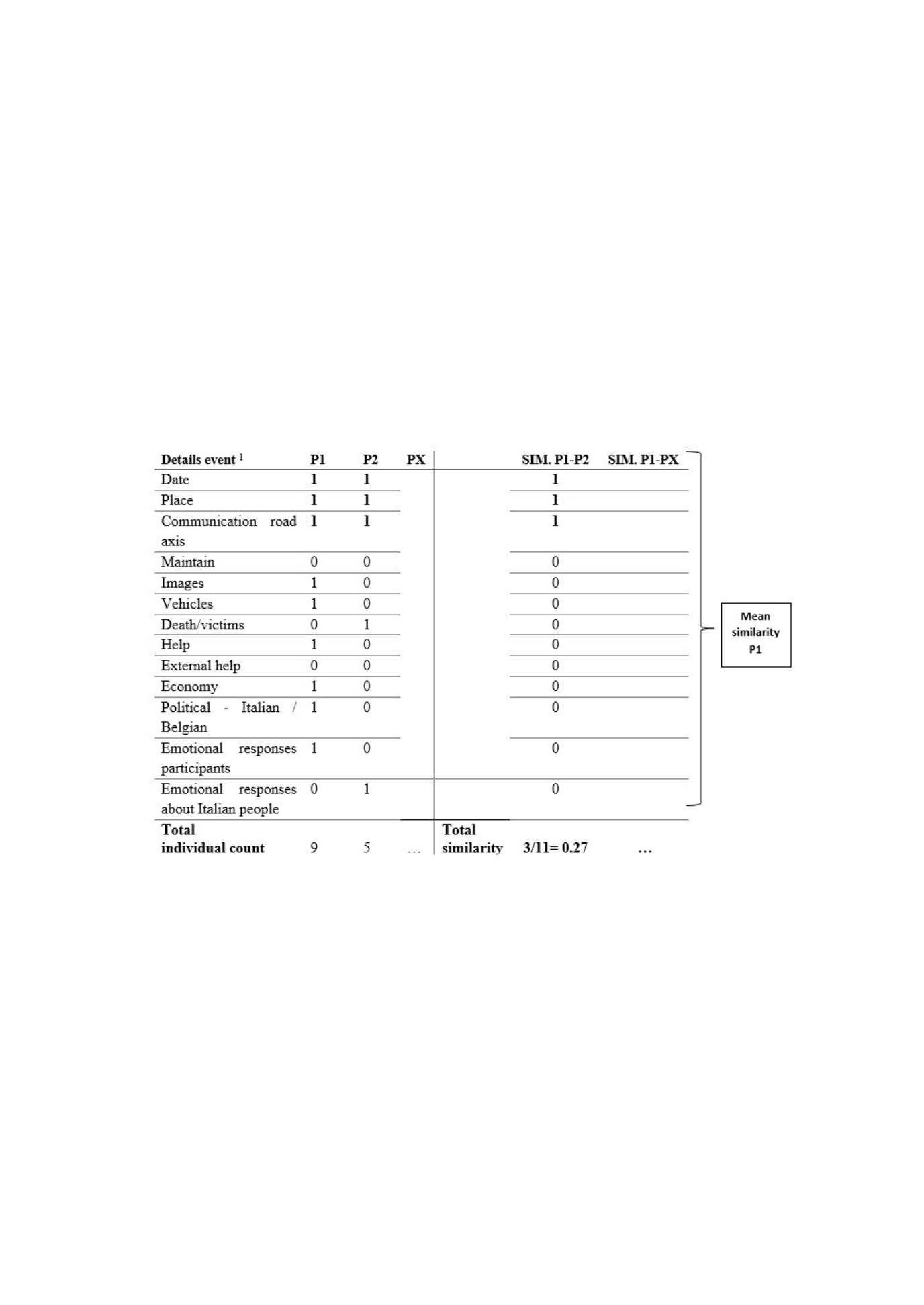
STUDY 3
road axis (communication road axis). I remember that medias gave information
about the people who tragically died (death/victims) because of the bridge collapse.
I couldn’t stop thinking about the poor Italian people (emotional responses about
Italian people).
Figure 1
Coding protocol (illustration)
Note.
Top: Sample of narratives with coding of details
Bottom, Left: Count of recalled details for each participant taken individually
Bottom, Right: inter-subjects similarity scoring
To assess the number of recalled pieces of information, we computed the
total number of details recalled by each participant taken individually (left side of
bottom Figure 1). This was done by counting the presence/absence of each detail
from the template narrative. Each detail was assigned a score of 0 (not mentioned
156

STUDY 3
by the participant) or 1 (mentioned by the participant). All narratives were blindly
coded by the first author. The inter-rater reliability measure for the coding was
based on the analyses of 20% of the recall data by a second author. Analyses
suggest very good reliability between raters with standardized Cronbach’s α =. 94.
The measure of inter-subjects similarity was based on the same principles
as Representational Similarity Analyses used in fMRI research and each task trial of
each subject is used multiple times to compute the similarity between each pair of
participants (Kriegeskorte et al., 2008; Nguyen et al., 2019). When used to assess
neural similarity across participants (Chen et al., 2017; Oedekoven et al., 2017),
commonalities between a participant’ neural activation pattern and activation
pattern of the remaining participants of their group are computed and the averaged
inter-subjects brain similarity measure for each participant is used in analyses for
group comparisons.
Following the same idea, inter-subjects similarity of the descriptions was
computed as follows: a given participant was compared with each other participant
of their age group. Of note, even if each participant’s narrative was used multiple
times, the variable of interest relied on a similarity score which is unique to each
pair of participants. For each comparison, the number of common details recalled
by the two participants was computed (right side of bottom Figure 1). This number
was then divided by the total number of details that were mentioned at least once
by one of the two participants. This ensured that the similarity value between two
participants was independent of the absolute number of memory details recalled
by the two participants (otherwise, two participants that recalled more details
would be more likely to have higher similarity values than two participants recalling
few details). In Figure 1, participant 1 and 2 shared 27% of the details that they
each remembered. This number was stored in a matrix and the participant of
interest was compared with the remaining participants of his/her age group. Then,
the scores from each comparison were averaged and the resulting value was taken
as the similarity value for that participant.
157

STUDY 3
4. Results
Statistical analyses
The normality assumption was violated for the majority of the dependent
variables, therefore we conducted robust statistical analyses (Mair & Wilcox, 2019).
Robust statistical methods perform well in terms of Type I error control and
statistical power, even when the normality assumption is violated, and thus they
increase the likelihood of discovering genuine differences between groups and
associations among variables (Wilcox, 2012). Dependent variables were compared
between young and older adults using a robust equivalent of the Student t-test
(Mair & Wilcox, 2019). Effect sizes for these analyses were estimated using the
explanatory measure of effect size ξ. Values of 0.10, 0.30, and 0.50 correspond to
small, medium, and large effect sizes, respectively (Mair & Wilcox, 2019). The
association between dependent variables was assessed using percentage bend
correlations that are robust equivalents of Pearson’s correlation coefficient (Mair &
Wilcox, 2019). All descriptive statistics refer to the 20% trimmed means (TM) and
their 95% confidence intervals (CIs) calculated using the percentile bootstrap
method (with 2,000 bootstrap samples; Wilcox, 2012).
Primary results
Recall of the event
First, we conducted a robust Student t test for independent samples to
examine potential age-group differences in the amount of remembered details. This
analysis did not reveal any group-difference in the number of remembered details,
Yt = -1.27, p = .19, 95% CI [-1.19, 0.24], ξ= 0.20 (young: TM= 4.84; 95% CI [4.33,
5.42]; older: TM = 5.32; 95% CI [4.92, 5.81]).
158

STUDY 3
Inter-subjects memory similarity
Then, adopting a classical measure in collective memory studies, we
calculated the percentage of young and older participants who recalled each of the
most commonly reported details (see Merck et al., 2020 and Zaromb et al., 2014 for
a similar approach). Event details recalled by most of young participants (more than
50%) and that could be considered as part of collective memory (Merck et al., 2020)
were the fact that people died and the fact that the bridge collapse was later
attributed to a lack of maintenance. In older adults, the only detail recalled by more
than 50% of older adults was the location of the bridge (see Table 1). Some details
(e.g., destroyed dwellings below the bridge and fallen vehicles) were recalled by a
greater proportion of older than young adults.
Table 1
The 7 most commonly remembered details about the bridge collapse and the
associated percentage for each age-group.
Event detail % Young adults % Older
adults
Two-tailed %
comparison
Death of people 58 48
p = .28
Location of the Bridge 43 59 p = .09
Bridge maintenance 53 38 p = .11
Destroyed dwellings 28 48 p = .02
Fallen vehicles 19 41 p = .01
Communication axis 25 24 p = .90
Images of the bridge
collapse 25 26
p = .90
Note: Significant differences between groups are marked in bold.
Next, we analyzed whether the inter-subjects similarity in the recall of
details, operationalized using our similarity measure, differed between agegroups.
159

STUDY 3
Results revealed that inter-subjects similarity values did not differ significantly
between groups, Yt = 1.57, p = .12, 95% CI [-0.05, 0.043], ξ= 0.23 (young: TM = 0.47;
95% CI [0.45, 0.49]; older: TM = 0.45; 95% CI [0.44, 0.47]). Young and older adults
thus shared 47 and 45 % of their remembered memory details about the bridge
collapse with other members of their groups, respectively.
Memory rehearsal
We next examined whether young and older participants differed in their
degree of rehearsal of the remembered event. A robust Student t test revealed a
significant difference between age-groups in media frequency, Yt = -4.65, p < .001,
95% CI [-2.09, -0.84], ξ= 0.53. This indicated that older adults (TM = 3.83; 95% CI
[3.58, 4.00]) reported that they heard about the event in the media more often
than young adults (TM = 2.36; 95% CI [1.81, 2.93]) since August 2018. Agegroups
differed neither in the number of sources from which they heard about the event,
Yt = -0.91, p = .34, 95% CI [-0.73, 0.27], ξ= 0.13 (young: TM = 1.60; 95% CI [1.30,
1.97]; older: TM = 1.83; 95% CI [1.59, 2.13]), nor in the number of person whom
they talked about the event with, Yt = -0.42, p = .66, 95% CI [-0.95, 0.61], ξ= 0.05
(young: TM = 2.90; 95% CI [2.42, 3.36]; older: TM = 3.08; 95% CI [2.37,
3.83]).
Additional results
Flashbulb characteristics
Then, we compared age-groups for the total of contextual details that
participants could remember relative to their hearing of the news, which can be
taken as an index of how much memory for the bridge collapse has characteristics
of a flashbulb memory. The analysis revealed that the score did not differ between
age-groups, Yt = -1.48, p = .14, 95% CI [-1.60, 0.23], ξ= 0.20 (young: TM = 2.87; 95%
CI [2.21, 3.57]; older: TM = 3.57; 95% CI [2.92, 4.13])11. However, older adults (TM =
11 Previous studies that investigated age-related changes in the frequency of flashbulb memories
examined the percentage of young and older participants for whom the remembering of the context
160

STUDY 3
60.13; 95% CI [52.89, 65.73]) reported higher ratings than young adults (TM =
39.48; 95% CI [30.33, 48.84]) when judging the extent to which they were
emotionally affected by the occurrence of the event, Yt = -3.16, p = .002, 95% CI [-
33.08, -8.21], ξ= 0.47.
Relationship between event memory and rehearsal
Last, we examined, in the whole sample, the relationship between the
number of sources, the media frequency, the number of persons with whom
participants talked about the event, the score reflecting flashbulb characteristics,
the extent to which they were emotionally affected by the event on the one hand
and the number of remembered details and the inter-subjects similarity values on
the other hand.
Percentage bend correlations revealed that the amount of remembered details
correlated with the frequency with which participants heard about the event in the
medias (see Table 2, Bonferroni’s correction applied: significance threshold set at p
< .01). No significant correlation was found between the number of remembered
details and the number of sources, the number of people with who participants
talked, the emotion associated with the flashbulb memory or the flashbulb
characteristics.
Robust correlations revealed that the values of inter-subjects similarity did not
correlate with any of the variables (Table 2).
of encoding of the event of interest could be labelled as a flashbulb memory (Cohen et al., 1994;
Wolters & Goudsmit, 1995). For instance, Wolters and Goudsmit determined that participants’
remembrance could be considered as a flashbulb memory if participants gave a positive response to at
least 4 of the 5 questions examining the remembering of the encoding context. Using the same
approach in the current study, we found that 47 % and 52 % of the young and older participants’
memories could be considered as flashbulb.
161

STUDY 3
Table 2
Robust correlation coefficients linking flashbulb and memory rehearsal variables
with rates of memory recall and values of inter-subjects similarity.
Recall Similarity
Media frequency ppb = 0.27, t = 2.92, p = 0.004 ppb = -0.11, t = -1.22, p = 0.22
Number of sources ppb = 0.06, t = 0.63, p = 0.52, ppb = 0.06, t = 0.64, p = 0.52
Number of people
who they talked to
ppb = 0.19, t = 2.03, p = 0.04 ppb = -0.02, t = -0.23, p = 0.82
Emotion ppb = 0.17, t = 1.89, p = 0.06 ppb = -0.17, t = -1.79, p = 0.70
Flashbulb
characteristics
ppb = 0.13, t = 1.37, p = 0.17 ppb = -0.13, t = -1.38, p = 0.17
5. Discussion
The current study had two major aims. First, we examined inter-subjects
similarity of retrieved details when recollecting a public event, and secondly, we
tested whether there are age-related differences in such inter-subjects memory
similarity. The main findings are that young and older adults recalled a comparable
number of details about the bridge collapse and that both young and older adults
recalled event details that were similar across participants of their groups without
any age-related differences. However, some details were mentioned more often by
older compared to younger participants. Due to the dramatic nature of the public
event, we investigated additional factors influencing flashbulb memories creation
162

STUDY 3
and related these characteristics to the number of remembered episodic details
and inter-subjects similarity values. It revealed that older adults more often
reported hearing about the event in the media since its occurrence and that media
frequency, but not flashbulb characteristics, correlated with the number of
remembered details.
The observation that young and older adults recalled, on average, the same
number of details regarding the collapse of the Morandi bridge can seem surprising
given the widely reported age-related decline in episodic memory (Drag et al.,
2009) and when considering that public events recalled by older adults are less
specific compared to those reported by younger adults (Zaromb et al., 2014).
However, these results corroborate the findings of a previous study that found no
age-related difference in remembering the unfolding of a shocking negative public
event (the 9/11 terrorist attacks) (Wolters & Goudsmit, 2005). One way to explain
age-invariance in memory in the current study relates to rehearsal. Previous studies
showed that the richness of memory encoding of detailed and vivid memories
depended on the rehearsal frequency in older adults (Cohen & Faulkner, 1988;
Cohen et al., 1994). Besides, previous reports that showed no age difference for
recollections of the 9/11 attacks revealed a greater media exposure relative to the
event (Davidson et al., 2006) or a higher rehearsal of the event (Wolters &
Goudsmit, 2005) in older compared to younger adults. In this study, older adults
followed the news about the target event in the media more often than young
adults, and the number of details remembered about the event significantly
correlated with the degree of exposure to the media. Therefore, older adults who
have rehearsed the event more often than young adults might have had the
opportunity to gather ample information about the bridge collapse, leading to
being able to recall as many memory details as young adults.
A recent behavioral study revealed that some specific memory details about
media events (e.g., the unfolding of a baseball championship) were shared by a
large percentage of the study sample. This suggests that individuals can have a
163

STUDY 3
common memory for specific details of the past (Merck et al., 2020). Here, using a
similar approach to previous studies (Merck et al., 2020; see also Zaromb et al.,
2014 and Abel et al., 2019), we showed that some memory details about the bridge
collapse were remembered and recalled by the majority (more than 50%) of young
participants, suggesting that some details were central and qualified as collective
memory for young participants (Merck et al., 2020). By mean of the inter-subjects
values of similarity, we extended these observations and we further showed that,
on average, 47% of the details remembered by two young participants were the
same, which suggests that young adults shared half of the reminisced specific event
features with their counterparts. Collective memories (e.g., memory for the bridge
collapse) might be constructed in the same hierarchical way as autobiographical
memories so that they contain both specific episodic details (e.g., a truck stopped a
few meters before the chasm) and general conceptual knowledge (e.g., people
died) about past events’ unfolding (Conway, 1990). In autobiographical memory,
most of the specific details of daily experiences are destined to be forgotten, unless
they support our long-term goals, while the general conceptual knowledge related
to the event would remain available. Drawing on this account, the finding of inter-
subjects similarity of memory details among young adults might reflect the fact that
they have commonly extracted and integrated event details about the bridge
collapse into a conceptual representation of the event’s unfolding containing the
core information about the target event (e.g., the main happening = a bridge
collapsed in Genoa in Italy, cause = it appeared that the collapse was caused by a
lack of maintenance of the bridge, general consequence = people died). In other
words, young participants likely have built a common schematic narrative template
of the event (Bartlett, 1932; Wertsch, 2002). These schematic narrative templates
refer to knowledge structures supporting the remembering process and that
include typically different kinds of information about an event, such as dates,
happenings, or characters (Wertsch, 2002; Zaromb et al., 2014).
164

STUDY 3
A main finding of the current study is the fact that young and older participants
who remember the same event show similar rates of inter-subjects similarity in the
remembered details. Results revealed that inter-subjects values of similarity
differed from zero (based on the 95% bootstrap confidence intervals on mean
values). Thus, like in young adults, half of the details remembered by two older
adults were the same. It has been previously shown that older adults tend to rely
much more on their schemas when remembering (Umanath & Marsch, 2014) and
that they hold collective schematized memory representations of public events
(Zaromb et al., 2014). However, it might be that the content of the schematic
narrative template slightly differs between young and older participants. Indeed,
the frequency of recall differed between the agegroups for two types of details.
While 48% and 41% of older adults respectively recalled the destroyed dwellings
and the fall of vehicles, there were only 28% and 19% of young participants who
recalled these details. Thus, older adults more frequently recalled elements relative
to the dramatic consequences of the accident for human beings (e.g., destroyed
dwelling expanded the number of victims beyond the number of people who died
from the collapse; the fact that vehicles fell with the bridge is a shocking detail
conveying the notion of individual drama). We can only speculate about the
reasons for this age-group difference in the frequency of recall of these details.
First, older adults were found to be more emotionally affected by the Morandi
bridge collapse than young adults. This might be related to remembering the
human consequences of the event more easily. Nevertheless, the correlation
between memory recall and emotional reaction did not reach significance in the
current study, so caution should be taken when drawing a conclusion. Second, it has
been suggested that the perspective of reduced longevity induces a shift towards
socioemotional goals in older people (Carstensen, 2006). This appears to promote
emotional empathy and prosocial behavior (Beadle et al., 2015). One could
therefore hypothesize that the possible consequences of a catastrophe for the lives
165

STUDY 3
of other people becomes integrated into older adults’ schematic template narrative
for public negative events because of this increased emotional empathy.
Finally, we should acknowledge some limitations of the current research.
First, we did not include any control – neutral – event in the memory task so that it
remains unknown whether the presented pattern of findings extends to non-
emotional public events. Future studies should include and compare emotional and
neutral events matched in terms of temporal distance between young and older
adults (see for instance Kensinger et al., 2005). Second, because the current study
was conducted online, no detailed cognitive and/or psychological assessment could
be completed with young and older participants. Thus, we cannot rule out the
possibility that older participants in this study were particularly high functioning.
Replication of the current findings is needed before strong conclusions can be
drawn. Third, it should be noted that 13% of the participants who filled-in the
survey did not remember at all – or did not heard about- the event, and only half of
the participants had a memory experience that could be qualified as a flashbulb
memory, which suggests that the event may not be as important as other events
studied within the flashbulb memories literature such as the 9/11 terrorist attacks
(Davidson et al., 2006; Luminet et al., 2004; Wolters & Goudsmit, 2005). Factors
such as emotional (feelings or appraisal regarding the event) or social (degree of
sharing the news in daily-life conversations) importance influence the extent to
which the event context of encoding is remembered and can thus be considered as
a flashbulb memory (Luminet et al., 2004). In the current study, the low percentage
of reported flashbulb memories might be because the remembered event
happened in Italy, so it may not be of great personal importance for Belgian
citizens. Previous work showed that social identity is an important factor in
determining the formation of collective memories and flashbulb memories (Merck
et al., 2020). Similarly, it has been suggested that the creation of a flashbulb
memory within a community was intrinsically related to whether the occurrence of
the event had consequences for that community (Conway et al., 1994; Curci et al.,
166

STUDY 3
2001; Hirst & Phelps, 2016). Flashbulb memories may help a community to give
meaning to traumatic events that affected them via widespread sharing of these
memories (Hirst, Cyr, & Merck, 2020). In addition, the lack of knowledge about the
event in 13% of the participants could relate to rehearsal through the media. One
should note that this event was covered in Belgium intensively for a few days
following its happening, but was not mentioned again in the following weeks.
Italian media likely covered the event in a more systematic way and over a longer
period, which may have supported the formation of a collective representation of
the event in that population to a greater extent than in Belgium. The lack of a
relationship between media coverage and inter-subjects memory similarity in the
current study may stem from the fact that less attention was paid to the event in
the media in the weeks following its occurrence. Future studies should replicate the
current findings while using an event that happened in the participants’ country
(e.g., Brussels terrorist attack for Belgian participants). Indeed, inter-subjects
similarity for a closer and more traumatic event could be higher than in the current
study owing to recent evidence showing that social identity is an important factor
regarding the formation of collective memories (Merck et al., 2020). An alternative
possibility would be to compare directly concerned and indirectly concerned
participants about a target event. This investigation would be motivated by
previous evidence that examined the occurrence of flashbulb memories in
populations that are different in their degree of closeness to the event (personal
importance) and revealed important insights about how flashbulb memories arise
and are retained across time (Curci et al., 2001; Luminet et al., 2004; Otani et al.,
2005).
In summary, the present study provides new evidence that individuals who
remember the same event recall details that are similar from one participant to
another, and this highlights the collective dimension of remembering. Critically,
older adults recalled the same number of details as young adults, and the
magnitude of the similarity of these details across participants was comparable to
167

STUDY 3
the one observed in young adults. Interestingly, the type of event details
remembered by young and older adults seem to be slightly different, but further
research should explore possible reasons for this difference. More broadly, future
studies should aim at determining how the shared/collective aspect of
remembering is affected by emotional and social variables and whether these
factors exert a similar influence on young and older adults’ collective reminiscence
of the past. Understanding the cognitive bases of shared memories of young and
older adults may be of interest to feed theoretical models of collective memory
with respect to existing accounts on individual autobiographical memory processes.
168

STUDY 4
STUDY 4
Age effects in story recall: Comparing the narrative
similarities of a fictional story
Nawël Cheriet1,2,3 & Christine Bastin1,2,3
Manuscript submitted to Psychology and Aging
1 GIGA-CRC-IVI, University of Liège, Belgium
2 Psychology and Cognitive Neuroscience, University of Liège, Belgium
3 F.R.S.-Fonds National de la Recherche Scientifique, Bruxelles, Belgium
Study 4 examines the age effects on representations in memory for a
fictional story. These memories were examined in the context of
communication by examining age effects at the speaker and
listener levels
169

STUDY 4
Age effects in story recall: Comparing the narrative similarities
of a fictional story
Nawël Cheriet1,2,3 & Christine Bastin1,2,3
Manuscript submitted to Psychology and Aging
1 GIGA-CRC-IVI, University of Liège, Belgium
2 Psychology and Cognitive Neuroscience, University of Liège, Belgium
3 F.R.S.-Fonds National de la Recherche Scientifique, Bruxelles, Belgium
Author note
Nawel Cheriet https://orcid.org/0000 - 0002 - 7795 - 4676
Christine Bastin https://orcid.org/0000 - 0002 - 4556 - 9490
The authors would like to thank the students who helped with collecting
the data. This work was supported by a FRESH grant from the F.R.S.-FNRS and a
Fondation Léon Fredericq grant (Nawël Cheriet). Christine Bastin is a senior
research associate of the F.R.S.-FNRS.
The authors declare no conflict of interest.
Correspondence concerning this article should be addressed to Nawel
Cheriet, GIGA-Cyclotron Research Center-in vivo imaging, University of Liège,
Allée du 6 Août, B30, 4000 Liège, Belgium, Telephone: +32 4 366 23 16, Fax: +32 4
366 2515, Email: naw[email protected]
170

STUDY 4
171

STUDY 4
1. Abstract
This study examines the age effects on representations in memory for a
fictional story. We compared the narratives of young and older participants about a
TV series episode when recalled to a young (condition 1) or older (condition 2)
listener. In condition 1, 35 older and 37 young adults recalled the episode to a
young adult. In condition 2, 40 older and 37 young participants recalled it to an
older adult. Memories were analyzed based on inter-subjects similarity (ISS)
analyses and the amount of recalled episodic details. Recalled details were analyzed
using a schematic narrative template with three categories (i.e., initial context,
events, and resolution). ISS analyses showed that for each of the categories, young
adults shared more similar representations of the story among them than older
adults. Additionally, participants had more similar representations in memory when
recalling the story to an old listener. All participants shared more similar
representations of the fictional story for the initial context and the resolution
compared to the middle of the story. As expected, young adults recalled more
episodic details than older participants. The lexical content analyses showed that
regardless of the conditions, young adults used more words related to negative
emotions and anger compared to older adults who used more words related to
positive emotions. These results highlight the necessity to consider the context and
social variables in memory studies, notably in aging, since it seems to influence
memories creation and retrieval.
Keywords: audience effect, aging, communication, episodic memory, intersubjects
similarity
172

STUDY 4
2. Introduction
It is now well-established that aging is associated with episodic memory
decline (Cansino, 2009; Glisky, 2007). Nowadays, the evaluation of memory in aging
has evolved towards a more ecological practice departing from the assessment
based on a list of words (Park et al., 1989), but the main variables influencing daily
life remembering are still often not considered in most memory research. In
everyday life, we use our memory to discuss with others and share memories
(Dessalles, 2007; Hirst & Echterhoff, 2012), but we rarely memorize a list of words.
This observation led to investigate memory as framed into a social and naturalistic
context. Currently, there is a growing interest in the effects of social context on
remembering (Adams et al., 2002), especially in the case of aging that is subject to
stereotypes (Adam et al., 2013; Fiske et al., 2002; Levy et al., 2003). In the present
study, we investigate the effects of the social context on remembering and how
these effects are subject to age-related changes.
Communication as a social function of episodic memory
Besides remembering per se, episodic memory has a social function mainly
achieved through communication (Bluck, 2003; Mahr & Csibra, 2018). From a
sociocognitive perspective (Bietti, 2010), the transmission of information is
influenced by the social context (Blank, 2009; Horton & Spieler, 2007). Therefore,
communication is characterized by interactive and interpersonal features (Welzer,
2008) and varies depending on the social context (Blanchard- Fields & Chen, 1996;
Horton & Spieler, 2007) which includes several variables such as the dynamics
between persons engaging in a conversation (Marsh & Tversky, 2004), the
characteristics of the listeners such as age (Adams et al., 2002) or gender (Pasupathi
& Oldroyd, 2015), and the amount of attention allocated to the speaker (Pasupathi
et al., 1998; Pasupathi & Hoyt, 2010; Pasupathi & Oldroyd, 2015). Indeed, the
communication accommodation theory suggests that when communicating,
individuals make behavioral changes to adapt to others (Giles & Ogay, 2007; see
173

STUDY 4
also research on audience tunning; Echterhoff et al., 2005; or audience effect;
Horton & Spieler, 2007).
Moreover, communication processes can be influenced by the different
goals of the conversation. It can be used to inform or obtain information (McCann
& Higgins, 1988), to develop and maintain social relationships, to create a feeling of
closeness (McCann & Higgins, 1988), to influence the listener’s mental state (Mahr
& Csibra, 2018) and manipulate others (McCann & Higgins, 1988). In this line,
researchers compared the recall of past experiences with social (i.e., entertaining
goal) or non-social (i.e., to be accurate) goals and found that individuals recall less
accurately past experiences in the social context (Dudukovic et al., 2004).
Other studies focusing specifically on the listener effect found that when we
believe that the interlocutor does not hold much information, we tend to give more
information when recalling a story (Adams et al., 2002) or when explaining a
situation (Vandierendonck & Damme, 1988). For example, Adams et al. (2002)
asked young and old women to recall a story to a child or the experimenter and
found that both young and old women used more elaborative narratives, more
repetitions and simplified the story they had to recall to a child compared to the
experimenter. Years ago, another study showed that young adults recall more
details of a daily event (such as a trip to the doctor) when asked to recall it to a
Martian (i.e., non-expert) compared to when recalling it to a human (i.e., expert)
(Vandierendonck & Damme, 1988).
Age effects on communication processes
All the studies mentioned above revealed that the social context (and more
specifically the listener’s characteristics) modulates how people remember and
share memories. However, it is unclear how these modulations influence episodic
memory in young and older adults.
At the speaker level, age differences can be seen in “how” individuals share
information (i.e., form and lexical content). Based on language analysis studies, it
174

STUDY 4
seems that older adults use more simplified structures and more fragmented
sentences (Kemper & Anagnopoulos, 1989). They also use more extensive
discourse, which was associated with social desire (Giles et al., 1992; James et al.,
1998).
Additionally, age differences can be seen in “why” individuals share
information. Communication goals are influenced by personal values that evolve
with aging. In aging, communication maintains a sense of identity (Lubinski &
Welland, 1997) and becomes more oriented toward meaningful sharing (Giles &
Coupland, 1991; James et al., 1998). This might be explained through the lens of
the selective socioemotional theory that suggests that with aging social aims
change due to limited time perspective. Older adults focus more on family and
friends than new relationships (Carstensen, 1993, 1995; Coudin & Lima, 2011).
Regarding the influence of age at the listener level, it is important to
consider that interactions between younger and older adults are modulated by
ageism stereotypes (Adam et al., 2013), which can strongly influence how
memories are shared. In fact, young adults tend to use a patronizing and simple
style called “elderspeak” when discussing with older adults (Kemper et al., 1998;
Ryan et al., 1986). This attitude shift is due to the hold of ageism stereotypes such
as aging being associated with hearing impairment and cognitive decline (Adam et
al., 2013) and older people being warm but less competent (Fiske et al., 2002).
Kemper et al. (1998) asked young adults to describe a route on a map so that the
listener (an old adult) could trace it on their map. Results indicated that young
adults in pairs with older adults simulating dementia symptoms adapt their speech
content (i.e., more repetition and longer speech) compared to when young adults
had to share information with an older adult who appeared cognitively healthy.
Overall, these results suggest that age effects on communication are
influenced by social and cognitive changes related to aging.
175

STUDY 4
The specific case of aging in (social) episodic memory
According to Mahr & Csibra (2018), episodic memory entails a mechanism
allowing the regulation of past event communication to convince the interlocutors
that we remember. Therefore, when talking with someone, the quantity of details
recalled (i.e., rich and detailed descriptions) is a cue to others and oneself that the
memories are well remembered (Bell & Loftus, 1988). As aging is associated with
episodic memory decline (Craik, 1994; Glisky, 2007), one expects that such episodic
memory decline impacts communication processes.
The episodic memory decline with aging is characterized by a decrease in
the number of recalled episodic details (Balota et al., 2000), but older adults recall
more external episodic details compared to younger adults (i.e., details not directly
related to the episodic event recalled) (Levine et al., 2002). Recent aging studies
investigating memory decline have used more ecological materials, such as
autobiographical memories (Grilli & Sheldon, 2022; Wank et al., 2020), fictional
events (Delarazan et al., 2023), public and historical events such as wars (Zaromb et
al., 2014) and natural disaster (Cheriet et al., 2021). They also showed that older
adults recalled less accurate details of personally experienced events compared to
young adults (Drag & Bieliauskas, 2009). This might be explained by the fact that
older adults rely more on the gist than the specific details of these events than
young adults (Flores et al., 2017; Grilli & Sheldon, 2022). Regarding historical
events, Zaromb et al. (2014) asked young and older adults to recall memories of
long-lasting historical events. The results suggested no difference in the amount of
events recalled but the content of the memories was different. Compared to young
adults, older adults recalled fewer specific memories and summarized more of the
memories. Considering natural disaster events, one study showed no differences
between young and older participants for the number of recalled details of such
public events (Cheriet et al., 2021). Yet, when analyzed based on a schematic
narrative template (Bartlett, 1932), older participants recalled significantly more the
consequences of the event compared to younger participants.
176

STUDY 4
Additionally, new investigations examine memories from a similarity
perspective. This method assesses to what extent the details recalled are common
between participants and therefore the extent to which the representations of an
event in memory are similar between participants of the same group defined by
age (Cheriet et al., 2021) or social identity (Cheriet et al., 2023). Using this method,
a study reported no differences between young and older Belgian adults in the
similarity of the memory representations of the bridge collapse in Italy in 2018
(Cheriet et al., 2021). However, the similarity assessment in this study was first
based on the overall details shared in each group and did not rely on a narrative
template which is known to improve memory recollection (Lang, 1989). Memory
schemas are the underlying scripts of stereotypical situations and could influence
memories (Bartlett, 1932; Ghosh & Gilboa, 2014). They shape causal and temporal
relations between several events (Bartlett, 1932; Radvansky & Zacks, 2017). For
example, creating messages in chronological order seems to enhance memory
(Lang, 1989).
Although more ecological paradigms and new analyses are increasingly used, the
nature of the interactions between participants, and most notably between
participants of different ages, is often overlooked. In the current study, based on
stereotypes theories and age decline on episodic memory, we were interested in
how the speaker and listener’s age characteristics might influence the memories
shared with another person. Therefore, young and older adults took part in a
memory task where they were asked to watch an episode of a TV series and recall it
to either a young or older listener. Taking into account age effects on the complex
links between memory and communication processes, we used 3 complementary
methods to analyze the data. First, we focused on the decline of episodic memory
by assessing the amount of recalled episodic (or internal) and external details
(Levine et al., 2002). Then, we focused on shared memories using inter-subjects
similarity analyses relying on narrative schemas (Cheriet et al., 2021). Third,
focusing on the form (i.e., “how” memories were shared) we analyzed the content
177

STUDY 4
of memories via lexical content analyses (e.g., emotional words, personal
pronouns…) (Barber & Mather, 2014).
First, we predicted age differences in the number of episodic details
recalled: older participants should recall significantly fewer episodic details about
the event than younger participants (Glisky, 2007). Since they might rely more on
the gist of the story, older participants would recall more external details than
younger participants (Levine et al., 2002). Second, we hypothesized age differences
in inter-subjects similarity especially for the part of the narrative that relates to the
consequences of the event: older people would similarly convey within their group
the details of the consequences of the event more than younger adults (Cheriet et
al., 2021). We hypothesized the presence of a listener effect so that young and
older participants would share more similar representations when they recalled the
events to peers of their age than the other listener if there is an own-age bias which
consists in favoring within-group over out-group in various cognitive situations (for
a review on own-age bias see Wiese et al., 2013). Alternatively, one may expect that
all participants adopt a more simple and similarly structured narrative when talking
to older compared to young listener because of ageism stereotypes (for a review of
stereotypes threat in aging see Lamont et al., 2015). We hypothesized that aging
would also impact the lexical content of memories. Older adults would show a
positivity bias in general (Carstensen & DeLiema, 2018).
3. Method
Transparency and Openness
We report how we determined our sample size using G*Power software
(Faul et al., 2007), and describe all manipulations and measures that were
collected. Deidentified data and materials can be found here: https://osf.io/xmzas/.
Data were analyzed using Jamovi, version 2.2 (The Jamovi
178

STUDY 4
Project, 2021) and the package GAMLj (Gallucci, 2019) and Walrus (Love et al.,
2022). The study design and its analysis were not pre-registered.
Participants
By using G*power software (Faul et al., 2007), using F test for a
betweensubject design, the a priori estimation is to include in total at least 68
participants (17 participants in each group and condition) to have 90% statistical
power to detect an effect size of 0.4 (Cohen’s f large effect size), with an alpha
of .05 for an interaction effect between groups (young vs old) and the listener’s
conditions (young vs old). Additionally, to ensure the detection of the principal
effects of the group and the conditions, the a priori estimation is at least 34
participants per group to have 95% statistical power to detect an effect size of 0.9
(Cohen’s d large effect size), with an alpha of .05. Therefore, we recruited at least
68 young adults and 68 older adults.
In this study, 161 participants aged between 18 to 30 years old (n = 79) and
60 to 75 years old (n = 82) were recruited. Each participant gave their informed
consent to participate in the study. The study was conducted by the Declaration of
Helsinki. All participants were Belgian and spoke French. The study was conducted
from January 2022 to December 2022 in Liege area (Belgium).
To participate, young and old participants should have not suffered from a
cognitive, neurological, or psychiatric disease. From this sample, 12 participants
were excluded: seven older participants were excluded from the analyses: two due
to the use of medication for neurological disease; three had diagnosed cognitive
impairment or a score < 23 at the MoCA (Nasreddine et al., 2005); two due to bad
audio recording. Five young participants were excluded from the analyses because:
one had already watched the series in the past; two due to a lack of standardization
during the testing (e.g., noise in the background and help of other people in the
room); two due to >16 points at the BDI 13 items corresponding to a severe state of
depression (Collet & Cottraux, 1986).
179

STUDY 4
The final sample 12 consisted of 149 participants which included 74 young
adults (M = 22.2, SD = 2.86) and 75 older adults (M = 68.1, SD = 5.07). Thirty-seven
young adults and 35 older adults were included in the young listener condition. The
old listener condition included 37 young and 40 older adults. Ethical approval was
obtained from the ethics committee of the psychology faculty at Liege University.
Demographic information
Robust ANOVA 2 (groups: young and old participants) x 2 (conditions:
young and old listener) were conducted on clinical and demographical variables
(see Table 1). No main effect of the group was found for the years of education (Q =
0.41, p = 0.53) and the anxiety scores (Q = 0.43, p = 0.51). No main effect of the
condition was found for the years of education (Q = 0.68, p = 0.41) and the anxiety
scores (Q = 0.07, p = 0.79). No significant interactions were found for the years of
education (Q = 0.75, p = 0.39) and the anxiety scores (Q = 0.03, p = 0.87).
A significant effect of the group was found for the score on the depression scale
(Q = 4.59, p = .04). Young adults hold higher scores than older adults (see Table
1).
Verbal performance was assessed using fNART (French National Adult
Reading Test; Mackinnon &Mulligan, 2005). For the verbal IQ estimation, only a
main effect of the group was found, Q = 5.38, p = .02, suggesting that older
participants had higher scores than young adults in both conditions.
Table 1
Mean (standard deviation) for the demographic and clinical variables of the final
sample analyzed by groups and conditions.
N Age Years of
education
Depression
*
Anxiety fNART
verbal
performance
12 Between older adults in condition 1 and 2 no difference was found regarding the score at the MoCA
(t(41.8) = 1.61, p = .12).
180
STUDY 4
Groups Young 74 22.2
(+/-
2
.86)
(+/-
5.07)
(+/- 23)
13.96 (+/-
2.76)
4.38
(+/- 3.10)
9.24
(+/-
2.79)
106 (+/-
8.07)
Old 75 13.96 (+/-
2.31)
3.53
(+/- 2.80)
8.69
(+/-
2.14)
110
(+/- 8)
Conditions Young
listen
er
72 13.5 (+/-
2.30)
3.64
(+/- 2.53)
8.93
(+/-
2.40)
107 (+/-
9.69)
Old
listen
er
77 46.2
(+/-
23.9)
13.8 (+/-
2.78)
4.25
(3.32)
9
(+/-
2.59)
109 (+/-
6.93)
Memory task
Encoding task
All participants were invited to carefully watch an episode of a TV series.
They were informed that they would have to recall the episode with as many details
as possible to “Marie”, who has never seen this series. They were told that she
would join the participant remotely through an online video call in the second part
of the study. They were instructed that after hearing their recall, Marie should be
able to pretend that she saw this episode. These instructions aimed at improving
encoding since people learn better when they anticipate opportunities to share
with others (Lieberman, 2012) but no additional information about Marie was
given.
The episode was 2x03 “Stranger on a train” from the “Modern Love” series
(Prime Video) in French. It lasted 36 minutes. Briefly, it describes the love story of
Paula and Mickael who met for the first time before the two first weeks of the
lockdown due to the COVID-19 pandemic on the 20th of March 2020. They ended up
falling in love on the train and wished to meet after the two-week lockdown at the
same spot. They did not exchange numbers or any way to reach one another. The
episode shows their respective lives until the date they had set for their reunion. At
181

STUDY 4
that date, the pandemic was getting worse, and several restrictions appeared. Thus,
they were not allowed to meet at this spot. Mickael remembered some important
information and was able to get near Paula’s house. The episode ends here.
Recall task
After a 5-minute retention interval where participants completed one
questionnaire (fNART) and demographic information, they were told that
unfortunately, Marie could not attend the meeting remotely, but she suggested that
the participant audio record the recall of the episode so that she would listen to the
story later. They were asked to recall it with as many details as possible so that after
hearing the audio Marie could pretend that she had seen it. Then, participants were
told that Marie was either a young adult (condition 1: young listener) or an old lady
(condition 2: old listener). In both conditions, they were presented with a picture of
Marie according to the age of the listener condition. Participants could then recall
the episode without a time limit. A significant effect of the group was found for the
word count (i.e., amount of words used at the free recall task) (Q = 6.60, p = .01).
Young adults (M = 930, SD = 700) had higher scores than older adults (M = 689, SD =
561).
Questionnaires and additional measures
During the retention interval, participants completed the demographic
information questionnaire (e.g., age, years of education, profession, gender) and
the fNART (Mackinnon, & Mulligan, 2005) as a measure of crystallized intelligence
and verbal abilities in French speakers.
Following the free recall task, participants completed several
questionnaires. First, they assessed on a Likert scale from 1 (I do not agree at all) to
7 (I totally agree) the emotional valence of their feeling towards the TV episode
through 6 questions; “I was emotionally touched by the story”, “I felt sadness”, “I
felt joy”, “I felt anxiety/stress”, “I felt fear” and “I appreciated the story”. Then, they
182

STUDY 4
completed a social cognition assessment through the Interpersonal Reactivity Index
(Davis, 1983). They completed the Beck Depression Inventory (BDI 13 items) (Collet
& Cottraux, 1986) to ensure that no participant suffer from a depressive disorder.
Elderly participants were administered the MoCa (Nasreddine et al., 2005) to
ensure that no elderly participant suffered from cognitive impairment. They also
completed a short version of the Metamemory In Adulthood which assesses
metamemory and internalized stereotypes about memory abilities (Boucheron,
1995). In the old listener condition only, they also completed the Fraboni scale
evaluating aging stereotypes (Boudjemad & Gana, 2009). Then there was a
debriefing explaining the purpose of the study and explaining that Marie was a
fictional character who was never supposed to join in an online videocall.
Finally, they answered several control questions regarding the study and
could answer either yes, no, or I didn’t think about it. 1. “Before watching the
episode, did you doubt that the person you should recall the episode to would be a
young/old adult?” 2. “Before the researcher told you that Marie could not be
present, did you think that she would not come to the second part of the
interview?” 3. “Throughout the study, did you believe that Marie was a real
person?” 4. “Did the fact that you were indicated that Marie would not be present
changed how you recalled the episode?” 5. “Before this study, had you ever seen
this series? If yes, have you watched this episode?”.
All the audio recordings were transcribed manually by the researchers.
Recall analyses
For this study, we analyzed the memories by using three complementary
methods to investigate how aging at the speaker and listener levels influences
shared memories.
183

STUDY 4
Inter-subjects similarity analyses
The first analysis assesses the similarity of the representations in memory in
each group via inter-subjects similarity analyses (Cheriet et al., 2021, 2023 for a
more detailed description of the method). The scores of inter-subjects similarity
give information about the extent to which representations of memories are similar
between one participant compared to every other participant in their group. The
first step is to create a grid containing all the principal actions and details of the
event. In this case, the grid contained 98 details12 that were listed chronologically
based on the story and separated into three main categories: initial context, events,
and resolution. The initial context includes details about the setup including main
characters and spatiotemporal information of the beginning of the story (i.e., the
initial situation). The events category involves the events following the first
interaction between the two main characters (i.e., disturbing elements and
adventures). The resolution category starts with the last action where they are
supposed to meet again (i.e., the outcome and final situation of the story). For each
participant, an element was coded 1 if the item was recalled or 0 if it was not
recalled by the participant. Then a score of similarity is computed as the sum of all
the common items between two participants divided by the amount of details
recalled by at least one of them. After a comparison of each participant with every
other participant in the group, a mean score of similarity is computed (see Figure
1).
184

STUDY 4
12 5 independent researchers blind to the hypotheses of this study were asked to list each meaningful
action and details of the story. The final items in the grid were selected if at least 3/5 researchers listed
the item. The initial context category contained 23 items. The events category contained 54 items. The
resolution category contained 21 items.
Figure 1
An example of the coding protocol used for measuring inter-subjects similarity
across participants.
P1 P2 PX
SIM
P2
P1- SIM
PX
P1-
Initial Context
Train
13th March 2020
Paula
1
0
1
1
1
1
1
0
1
…
…
…
Events
Mickael and Paula talk
Paula is a medievalist
student
Mickael works in IT
1
0
0
1
1
1
1
0
0
…
…
…
Resolution
Additional restrictions of
lockdown
Mickael and Paula try to
meet
Mickael went to her
street
0
0
0
1
1
0
0
0
0
…
…
…
Total recall 3 8 Total similarity 3/8
0.375
=
Note.
Participant 1’s recall: “It’s the story of two people that met on the train. The woman
is called Paula. On the train, Mickael -the man- and Paula discuss with each other.
Participant 2’s recall: “On the 13th of March 2020 two people met on the train.
Paula is the main character. After a few minutes, she met Mickael. They talked
throughout the trip. She is a medievalist student. That means that she studies
medieval times. Mickael is different. He works in IT. When they arrived at the
destination, they didn’t exchange phone numbers but agreed to meet again at the
same spot in two weeks. However, after two weeks the lockdown restrictions were
185

STUDY 4
extended. Therefore, they can’t meet. Mickael and Paula still tried to get to the
train station anyway but were stopped by police officers.”
Episodic details
The number of episodic details. For each category, the number of details
recalled was divided by the number of expected details for each category based on
the grid in Figure 1.
Internal and external details. The internal and external scoring dissociates
the episodic details retrieved from the semantic elements (Levine et al., 2002) by
categorizing each meaningful piece of recalled information as internal or external
details depending on whether they are directly associated with the event or not.
Internal and external assessment was done using automated scripts (van Genugten
& Schacter, 2022).
Episodicity score. The episodicity score of the recall was assessed as
internal scores divided by the sum of internal and external scores.
Lexical Content Analysis
The last method is a lexical content analysis using LIWC (Linguistic Inquiry
and Word Count) (Pennebaker et al., 2007) to assess the total number of words, the
use of emotional words, and self-references.
4. Results
Statistical analyses
The data were normally distributed as confirmed by Akaike’s and Bayesian
Information Criterion lower for Gamma (AIC = 2857.96; BIC = 2866.162) than for
normal distribution (AIC = 2971.21; BIC = 2979.42) obtained by using the package
fitdistrplus on R studio (Delignette-Muller & Dutang, 2015). Therefore, we
conducted a generalized linear model (GLM) with a Gamma distribution and log link
identity (Delignette-Muller & Dutang, 2015). The GLM used 2 (groups: young and
old participants) x 2 (conditions: young and old listeners) as between-subject
186

STUDY 4
factors x 3 (categories: initial context, events, and resolution) as within-subject
factor design, and the dependent variables were similarity scores and amount of
episodic details recalled. For internal and external scores, we conducted separate
generalized linear models with 2 groups (young and old participants) x 2 conditions
(young and old listeners) on the scores. Regarding the lexical content, we
conducted a generalized linear model with 2 (groups: young and old participants) x
2 (conditions: young and old listeners) on each of the dependent variables.
The GLM included depression scores and word counts as covariables to
control for the observed group differences between younger and older adults.
When needed we conducted post-hoc tests based on pairwise comparisons and
used Bonferroni correction. The GLM were conducted using Jamovi based on R
using the GAMLj module (Gallucci, 2019).
Inter-subjects similarity analyses
Table 2 presents the mean and standard deviation of similarity scores for
each similarity category (initial context, events, and resolution) by conditions and
groups.
The GLM analyses yielded a significant main effect of the group, X² = 19.92,
p <.001, with younger participants sharing more similar representations of the
episode as compared to older participants. There was also a significant main effect
of the conditions, X² = 89.49, p < .001, revealing that when recalling the episode to
an old adult (old listener condition) participants shared more similar
representations compared to when recalling to a young listener.
187

STUDY 4
Results showed a significant main effect of the categories, X² = 260, p <.001,
suggesting that participants shared less similar representations for the middle of
the story (events category) than the context and resolution categories. Pairwise
comparisons showed significant differences between the initial context and events
categories (z = 12.90, p <.001), and between the events and the resolution
categories (z = -14.75, p <.001).
There was also a significant two-way interaction between group and categories, X² =
6.56, p = .036. This interaction revealed no significant differences between the
young and old participants for the initial context category (z = -1.72, p = 1) and for
the events category (z = - 1.22, p = 1). For the resolution category, it revealed
significant differences between young and old participants (z = -4.66, p <.001), with
higher similarity in young adults’ memories than in older adults’ memories.
No other interactions were significant, ps > .08. The model did not reveal a
significant effect of the depression scores, X² = 0.33, p = .57, but revealed a
significant effect of the word count, X² = 60.84, p <.001, on similarity scores.
Table 2
Mean (standard deviation) for each similarity category by conditions and groups
Conditions Groups Initial Context
similarity
Events similarity Resolution
similarity
Young
listener
Young 0.40 (0.08) 0.29 (0.06) 0.46 (0.12)
Old 0.36 (0.08) 0.25 (0.08) 0.41 (0.11)
Old listener Young 0.49 (0.05) 0.33 (0.06) 0.50 (0.10)
Old 0.45 (0.08) 0.31 (0.06) 0.44 (0.09)
188

STUDY 4
Recall of episodic details
Amount of episodic details
The analyses on the number of episodic details yielded significant main
effects of groups, X² = 27.57, p <.001, categories, X² = 141.2, p <.001, and
conditions, X² = 8.71, p = .003. Overall, younger participants recalled more details
about the episode (M = 0.44, SD = 0.22) compared to older adults (M = 0.33, SD =
0.20), and participants recalled more details to a younger listener (M = 0.39, SD =
0.23) compared to the old listener (M = 0.38, SD = 0.20). Participants recalled less
details for the middle of the story (events category) than the initial context and
resolution categories. Post hoc pairwise comparison revealed significant differences
between initial context and events categories (z = 8.10, p <.001), between initial
context and resolution (z = -3.47, p = .002), and between events and resolution (z =
-11.52, p < .001).
No significant interaction effect was found between categories and group (X² = 0.66,
p = .72), or between categories and conditions (X² = 1.45, p = .48), and conditions
and groups (X² = 0.38, p = .54). No significant interact effect was found between
conditions, groups, and categories (X² = 0.24, p = .88).
The model revealed significant effects of the two covariates, depression scores, X² =
13.30, p <.001, and word count, X² = 165.11, p <.001.
Details information about mean and standard deviation can be found in Table 3.
Table 3
Mean (standard deviation) for each recall category by conditions and groups
Conditions Groups Initial
context
Events Resolution
Young
listener
Young 0.46 (0.22) 0.34 (0.20) 0.54 (0.23)
Old 0.35 (0.20) 0.21 (0.13) 0.43 (0.23)
Old listener Young 0.47 (0.19) 0.30 (0.15) 0.53 (0.21)
189

STUDY 4
Old 0.38 (0.17) 0.20 (0.13) 0.41 (0.17)
Internal and external details
For internal details, there was no significant main effect of the group, (X² =
3.47, p = .06). No significant effect of the condition (X² = 0.10, p = .75) nor
interaction (X² = 0.05, p = .82) were found.
For external details, the analyses revealed no significant main effect of the
group, (X² = 0.75, p = .39). No significant effect of the condition (X² = 4.29, p = .06)
nor interaction (X² = 0.49, p = .76) were found.
For the episodicity score, there was no significant main effect of the group,
(X² = 1.41, p = .24). No significant effect for the condition (X² = 2.33, p = .13) nor
interaction (X² = 2.34, p = .13) were found.
The model indicated a significant effect of the word count for internal details (X² =
79.87, p <.001) and external details (X² = 69.47, p <.001).
Table 4
Mean (standard deviation) for episodic details categorized as internal, external, and
episodic specificity by conditions and groups.
Conditions Groups Internal External Episodic
specificity
Young
listener
Young 653 (503) 309 (267) 0.69 (0.06)
Old 490 (367) 266 (222) 0.65 (0.06)
Old listener Young 507 (345) 312 (228) 0.64 (0.1)
Old 361 (254) 214 (168) 0.65 (0.1)
190

STUDY 4
Lexical content analysis
We conducted a generalized linear model with 2 (groups: young and old
participants) x 2 (conditions: young and old listeners) as between-subject factors on
each of the dependent variables, including depression scores and word counts as
covariables. All means and standard deviation can be found in Table 5 by groups
and by conditions.
Personal pronoun
There was a main effect of the group for the use of ‘I’ (X² = 5.83, p =.02).
This indicated that older adults used the pronoun “I” when recalling the events
more than young adults did (z = 2.38, p = .02). However, no main effect of condition
(X² = 2.11, p = .15) and no significant interaction between group and condition (X² =
0.54, p =.46) were found. The generalized linear model suggested a main effect of
the word count, X² = 9.67, p = .002.
Negation
The analyses showed a main effect of the group, X² = 5.05, p =.02. Older
participants used more negation words (e.g., do not, can not, ...) than young adults
(z = 2.21, p = .03). No significant effect of the conditions (X² = 0.01, p = .94) and no
significant interaction (X² = 0.01, p = .92) were found.
Emotional content
There was only a main effect of the group on the use of negative emotions
(X² = 13.66, p <.001) revealing that young adults used more negative emotions
words when recalling the events than older participants. More specifically, the main
effect of the group was seen for the use of anger words (X² = 24.15, p < .001) which
were more used in the young group than older adults. There was also a main effect
of the group (X² = 4.77 p = .03) regarding the use of words related to positive
emotions. Older participants used more words conveying positive emotions in their
191
STUDY 4
recall. A main effect of the conditions was revealed (X² = 12.34, p < .001) indicating
that participants used more positive emotions when recalling to a young adult (M =
2.38, SD = 0.95) compared to recalling the episode to an old adult (M = 1.87, SD =
0.80).
Table 5
Mean (standard deviation) of main effects by conditions and groups
Conditions Groups ‘I’ Negation Positive
emotions
Negative
emotions
Anger
Young
listener
Young 2.86
(1.02)
3.13
(0.81)
2.18
(0.84)
1.05
(0.49)
0.57
(0.43)
Old 3.54
(1.30)
3.50
(1.15)
2.59
(1.03)
0.66
(0.37)
0.24
(0.20)
Old listener Young 2.81
(1.27)
3.09
(1)
1.75
(0.73)
1
(0.49)
0.55
(0.41)
Old 3.46
(1.45)
2.05
(0.92)
0.71
(0.63)
0.25
(0.36)
Additional results
Then we analyzed the questionnaires completed by participants which
included cognitive measures and an evaluation of the material. Since the normality
assumption was violated for the majority of the variables and did not fit Gaussian,
gamma, or fish distribution, we conducted robust statistical analyses (Mair &
Wilcox, 2019). Robust ANOVAs were conducted with groups (2: young and old
participants) x conditions (2: young and old listeners) betweensubject factors on
each of the dependent variables. Robust ANOVAs were conducted in Jamovi version
2.2 (The Jamovi Project, 2021) using the Walrus package (Love et al., 2022). All
ANOVAs were conducted using a trimmed means method, and the trimmed value
was set at .02.
192

STUDY 4
Cognitive measures
Social cognition. The robust ANOVA showed no significant effect of the
group (Q= 1.55, p = .22), no significant effect of the condition (Q = 0.06, p = 81), and
no significant interaction (Q = 0.40, p = .53) for the interpersonal reactivity index.
Metamemory. There was a significant effect of the group (Q = 8.04, p
= .006) revealing that young adults (M = 82.7, SD = 8.33) had higher scores than
older adults (M = 77.6, SD = 8.82) which suggests better knowledge and more
positive attitudes about their memory abilities in the young group. No main effect
of the condition (Q = 0.05, p = .83) or interaction effect (Q = 0.08, p = .78) were
found on the scores of the Metamemory in Adulthood questionnaire.
Ageism stereotypes. This score is only available for the old listener
condition. The ANOVA 13 showed significant differences between young and older
participants, t(39) = 2.73, p = .009, revealing that older adults hold more
negative stereotypes towards aging (M = 53, SD = 5.81) than young adults (M =
51.4, SD = 6.78) at the Fraboni scale (Boudjemad & Gana, 2009).
TV show evaluation
For the emotional measures related to the series, we conducted robust
ANOVAs with 2 (groups: young and old participants) x 2 (conditions: young and old
listener) between-subject factors on each main variable.
Emotionally touched. There was a main effect of the group, Q = 8.30, p
= .006. Older adults were more emotionally touched by the episode (M = 5.24, SD =
1.47) than young adults (M = 4.57, SD = 1.66). No significant effect of the condition
(Q = 1.23, p = .27) or interaction effect between the group and condition (Q = 1.09,
p = .3) were found.
13 Of note, results at the Fraboni scale evaluating ageism stereotypes did not yield any significant
correlations with the similarity scores and the amount of details recalled.
193

STUDY 4
Sadness. The analysis showed no main effect of the group, Q = 1.15, p = .29,
no significant effect of the condition (Q = 1.82, p = .18) nor interaction effect
between the group and condition (Q = 0.46, p = .5).
Joy. There was a main effect of the condition, Q = 4.60, p = .04 indicating
that people who recalled to a younger adult felt more joy watching the episode (M
= 4.51, SD = 1.61) than when recalling to an older adult (M = 3.86, SD = 1.84). No
effect of the group (Q = 0.49, p = .49) or interaction effect between the group and
condition (Q = 1.46, p = .23) were found.
Stress/Anxiety. The ANOVA revealed no main effect of the group, Q = 0.18,
p = .67, no effect of the condition (Q = 1.41, p = .24) nor interaction effect between
the group and condition (Q = 0.44, p = .51).
Fear. There was no main effect of the group (Q = 0.06, p = .82), no effect of
the condition (Q = 0.06, p = .82) nor interaction effect between the group and
condition (Q = 0.44, p = .21).
Appreciate the story. The analysis showed no main effect of the group (Q =
1.83, p = .18), no effect of the condition (Q = 0.10, p = .75) nor interaction effect
between the group and condition (Q = 0.44, p = .51).
Method-related questions
For the answers to the method questions (no (1), I didn’t think about it (2),
yes (3)) (see method section) we conducted Mann-Whitney tests to compare young
and old adults.
Regarding the question “Before watching the episode, did you doubt that
the person you should recall the episode to would be a young/old adult?”, there was
no significant difference (U = 2585, p = 0.53) between young (M = 1.92, SD =
0.89) and old adults (M = 1.82, SD = 0.85).
Regarding the presence of the listener assessed by the following question
“Did you think that she would not come to the second part of the interview? ”, there
194

STUDY 4
was a significant difference between young and old adults, U = 2084, p =. 008.
Young adults (M = 2.05, SD = 0.95) believed more often that the listener would not
attend the meeting or did not think about it compared to older adults (M = 1.64, SD
= 0.86).
Regarding the question, “Throughout the study, did you believe that Marie
was a real person?”, no significant differences were found, U = 2084, p = .05,
between young (M = 2.16, SD = 0.81) and old adults (M = 2.45, SD = 0.91).
We also assessed if the fact that the listener did not attend the interview
influenced the way they recalled the episode (“Did the fact that you were indicated
that Marie would not attend the interview change how you recalled the episode
seen?”). A significant difference between young and old participants was found, U =
2395, p = .04, indicating that the fact that the listener did not attend the interview
influenced more how young adults (M = 1.38, SD = 0.75) recalled the episode than
older adults (M = 1.15, SD = 0.48). Of note, of 149 participants, only 16 participants
answered yes to this question.
5. Discussion
In memory studies, it is well-known that aging is associated with episodic
memory decline (Balota et al., 2000). However, these studies generally do not
include contextual variables that could contribute to better understand such
decline. Therefore, with this study, we aimed to assess whether the recall
performance could be different depending on the age of the participant (young vs.
old) and the age of the listener (young vs. old adult). We analyzed recall data based
on three complementary methods: the number of episodic details, the inter-
subjects similarity of the recall, and the lexical content analyses. In this study, at the
speaker level, age differences were found for the inter-subjects similarity, for words
related to negative emotions, and for the amount of episodic details recalled, all in
favor of young adults. At the listener level, the representations in memory were
195

STUDY 4
more similar when recalling the events to an old listener and the listener’s age
influenced the number of details recalled.
The communication accommodation theory suggests that interpersonal
interactions are influenced by the characteristics of the speaker and the listener,
which also include the goals of communication (Dragojevic et al., 2015; Pitts &
Harwood, 2015). This theory has been investigated in cognitive psychology but to
our knowledge, no study investigated age effects on shared memories and the
influence of the listener’s age. We will now discuss some key points that could
explain age differences at the speaker and listener levels.
At the speaker level, the results of this study revealed that the
representations in memory of the episode (beginning, middle, and end) are more
similar for young adults compared to older adults, independently of the age of the
listener. Also, young adults recalled more episodic details about the event.
In a previous study using the same method on the recall of a public event (e.g., a
bridge collapse in Italy), we found no differences in similarity representations in
memory nor the amount of episodic details recalled between young and old Belgian
adults (Cheriet et al., 2021). Here characteristics of a modern fictional event might
have influenced age differences in similarity and the amount of episodic details in
favor of young adults. First, it could be related to the content of the story which
involves young adults as main characters. In the light of the self-reference effect in
memory, young adults could have identified more easily with the story which
therefore could have helped them to encode and recall information (Gutchess et
al., 2007; Symons & Johnson, 1997). Second, the materials used (a modern love
story with young adults) might fit more young adults’ prior knowledge (i.e.,
schemas) (Alba & Hasher, 1983) compared to older adults. It is known that prior
knowledge can improve memory (Anderson, 1981). This could explain to some
extent why young adults share more similar representations in memory and several
details since it is more congruent to their prior knowledge. In aging, even if there is
196

STUDY 4
an episodic memory decline, it has been shown that older adults can rely on prior
knowledge and that it facilitates memory performance (Reyna & Mills, 2007;
Umanath & Marsh, 2014). Therefore, one would expect that inter-subjects
similarity would increase in older participants if the story fit better their prior
knowledge.
Moreover, regarding the amount of details recalled, the results are congruent with
previous evidence of a decrease with aging in the recall of episodic details (Balota
et al., 2000). However, opposite to autobiographical memories studies that show
age differences for episodic and external details (Levine et al., 2002), we did not
find any age effect on internal vs. external details for a fictional event. In this study,
the material consisted of a fictive story with a beginning, a middle, and an end;
three parts of the episode separated by narrative boundaries. The structure could
have helped participants to organize their memories and enhance the amount of
details recalled since the structure is already helpful for young children (Kleinknecht
& Beike, 2004). A recent study on age differences in story recall focused specifically
on the use of boundaries (i.e., elements that structure the narratives) and showed
no difference between young and old adults who both recalled more information
elicited by the events than the boundaries. This suggests that both groups used
boundaries to segment the events and encode them in long-term memory (David &
Campbell, 2023). Overall, our results suggest that using material relying on a more
general schema narrative does not influence episodic memory decline with aging.
Age effects can also be seen at the listener level. Indeed, it appears that
young and old participants first hold more similar representations of the episode
when they recall it to an older adult compared to recalling it to a young adult, and
second share more episodic details with a young listener than an old listener. In this
study, older adults hold more negative stereotypes about aging compared to young
adults but both groups held aging stereotypes (i.e., scores of each group above the
mean score of the Fraboni Scale). For example, specifically in this study, young and
old participants might have thought that the older listener was not used to seeing
197

STUDY 4
modern fictional series, did not hear well, and had less cognitive abilities (Adam et
al., 2013). These activated stereotypes could lead to sharing basic, simple, and key
elements of the story (i.e., the gist) understandable by old listeners which in turn
leads to more similar representations in both groups when talking to an older adult.
Additionally, the goals of communication could be very different with aging, where
older adults tend to seek emotional and social meaning in relationships
(Carstensen, 1993). Therefore, communication can be used to create a shared
reality between two persons (Echterhoff et al., 2008) and can be influenced by
ageism (Ory et al., 2003).
The analyses also showed differences in the lexical content. In this study, older
participants recalled more words related to positive emotions compared to young
adults. This result could be related to the positivity bias globally found with aging
(Mather & Carstensen, 2005). Also here, the results suggested that the opposite
bias can be seen with young adults who recalled the story with more use of
negative emotions and anger (Reed et al., 2014 for a review). Additionally, older
adults felt more emotionally touched by the episode than younger adults. However,
even if emotional valence influences memory (Kensinger et al., 2008), both
similarity scores and the amount of details were higher in the young group than in
the older group, suggesting no benefit due to emotion in older participants’
memory.
As previously stated, this study, to the extent of our knowledge, is the first
one to investigate age effects on shared memories at a speaker and listener level.
However, some limits should be highlighted. First, the results should be replicated
with another fictive event. Notably, one should replicate the results by using series
that are more familiar to older adults (older series) and more familiar to younger
adults (as used in this study) to control for prior knowledge (schemas). Second, in
this study, the speaker believed that the listener would be joining online for the
recall part. It was then acted that the listener could not make it online and asked
the speaker to record the recall. We only showed a picture of the listener. Future
198

STUDY 4
studies should adapt interviews with a real listener who attends the meeting (Adam
et al., 2002). Of note, some studies did show significant listener effects with an
absent and fictive listener (e.g., recall to a Martian, Vandierendonck & Damme,
1988).
In conclusion, this study showed the importance of taking into account the
social context in memory to better apprehend how we recall events in daily life. In
this study, we showed that aging impacted the similarity of representations in
memory for a fictional event. We also showed that the age of the listener can
influence this similarity in memory and the quantity of recalled information.
Memory investigation should consider variables such as age, listener’s
characteristics, emotions, and expectations and also investigate how prior
knowledge (schemas) can influence memories’ construction.
199

STUDY 5
STUDY 5
A day that America will remember: Flashbulb memory,
collective memory, and future thinking for the Capitol riots
Published in Memory in 2023
Nawël Cheriet1,2*, Meymune Topçu3*, William Hirst3, Christine Bastin1,2,4
& Adrien Folville1,2,4
Following the study 3, study 5 investigates the effects of group identity
on flashbulb memories, shared event memories and future thinking.
200

STUDY 5
1. Abstract
This study explores the topics of flashbulb memory, collective identity, future
thinking, and shared representations for a public event. We assessed the memories
for the Capitol Riots, which happened in Washington DC, on January 6th, 2021.
Seventy Belgian and seventy-nine American citizens participated in an online study,
in which they freely recalled the unfolding of Capitol Riots and answered questions
regarding their memory. Inter-subjects similarity of recalled details was analyzed
using a schematic narrative template (i.e., the event, the causes and the
consequences). Results revealed that representations of the event, and its causes
were more similar among Belgians compared to Americans, whereas Americans’
representations of the consequences showed more similarity than Belgians’. Also,
as expected, Americans reported more flashbulb memories (FBMs) than Belgians.
The analysis underlined the importance of rehearsal through media and
communication in FBM formation. This research revealed a novel relation between
FBM and future representations. Regardless of national identity, participants who
formed an FBM were more likely to think that the event would be remembered in
the future, that the government should memorialize the event, and that a similar
attack on the Capitol could happen in the future compared to participants who did
not form FBM.
Key words: collective memory, flashbulb memories, inter-subjects similarity, social
identity, future thinking, cultural memory.
2. Introduction
On January 6th, 2021, an angry mob of rioters entered the Capitol building in
Washington, DC. They were objecting the results of the 2020 presidential elections
and demanded a reassessment in favor of Donald Trump. The rioters quickly spread
across the building, trying to find Vice President Mike Pence and House Speaker
201

STUDY 5
Nancy Pelosi. Rioters assaulted officers, occupied the complex, and destroyed
property. Lawmakers and the staff were immediately evacuated.
Five people died and over a hundred people were injured during the riots.
The news of the Capitol riots spread around the world, so that not just
Americans, but many others started to form collective representations of the event.
The Capitol riots constituted a historical event that possesses many characteristics
favoring the formation of a flashbulb memory. Moreover, details concerning the
event itself are likely to be remembered in the future, given its uniqueness and
consequentiality. In the present research, we explore the formation of flashbulb
memories and collective memories around the Capitol Riots among American and
Belgian citizens. We also examine how such memory formation influences future
thinking associated with the events with a focus on the following questions: How
do these personal and collective representations relate? Will they be associated in
some way or remain distinctive representations that do not bear on each other?
From individual to collective memory
Memories of the Capitol Riots, as memories for other important public
events, allow us to investigate an individual to collective memory continuum (Figure
1). First, these public event memories could be studied through an individual lens
since people individually learn and encode the news about the Capitol Riots. As a
result, they can form event memories, which encompass the details and factual
information about the event (Finkenauer et al., 1998; Merck, 2020). Moreover, the
distinct characteristics of the event could lead to the formation of flashbulb
memories (FBMs), that is, memories for the context of reception event (Merck et
al., 2020). Thus, people could remember not only the event itself but also the
personal circumstances in which they learned about the event (Brown & Kulik,
1977). The reception memories for the Capitol Riots correspond to the most
detailed level in Conway’s model of autobiographical memories (i.e., where one
202

STUDY 5
was, what one was doing at that time, with whom one was…) (Conway, 2005; Tinti
et al., 2014).
Additionally, by rehearsing event memories through various means such as
media and conversations, people can form shared representations around the
event (shared memories). If these shared representations bear on the identity of
the community in question, in this case Americans, they can be considered
collective memories (Burnell et al., 2023; Hirst & Manier, 2008). Thus, the
experience of a public event such as the Capitol riots could initiate the creation of
memories at different levels of the continuum between individual and collective
memory (Berntsen, 2017; Neisser, 1982) (see Table 1). Memories on this continuum
can share common psychological principles (Hirst & al., 2018). For instance, both
autobiographical and collective memories are important to build a sense of,
respectively, a personal and collective identity (Conway, 2009; Hirst & Stone, 2016;
Öner & Gülgöz, 2020). Furthermore, people can form future representations
around whether the event should be individually or collectively imagined in the
future. These future representations could bear on the more long-term cultural
memory of the event (Assmann, 1995).
We will now turn to a more detailed discussion of these different realms of
memory and how they might interact with each other.
Figure 1
Memory continuum: from individual to collective memory
203

STUDY 5
Table 1
Definitions of concepts related to memory representations
Concept Definitions
Autobiographical
memory
“Memories for the events of one’s life” (Conway & Rubin, 1993)
Reception memories Memories for the context of encoding (Merck, 2020)
Flashbulb memories Vivid and long-lasting memories of the personal
circumstances in which one heard the news about an event
(Brown & Kulik, 1977)
Event memories The facts about the event (Merck, 2020)
Shared memories Memories shared across a community that does not necessarily
inform community identity
Collective memories “Widely held memories of community members that bear on
the collective identity of the community” (Hirst & Manier,
2008, p. 184)
Future remembrance The degree to which people think the event would and should
be remembered and memorialized in the future
Communicative
memory
Memories that are based on and transmitted through everyday
communications (Assmann & Czaplicka, 1995; Muller et al.,
2018)
Cultural memory Long-term and stable memories that are maintained through
cultural formations and that inform cultural identity
(Assmann, 1995)
Flashbulb memory
Flashbulb memories (FBMs) are vivid and long-lasting memories of the
personal circumstances in which one heard the news about an event, such as when,
where, and what one was doing when one heard the news, what might be referred
to as the reception event (Brown & Kulik, 1977).
In earlier work, Brown & Kulik (1977) suggested that FBMs rely on a
separate memory system distinct from autobiographical memory. According to
subsequent research, however, FBMs exhibit similar characteristics as everyday
204

STUDY 5
autobiographical memories, especially in terms of their consistency and the rate of
forgetting (Hirst & Phelps, 2016, for a review). What differentiates FBMs is probably
not the memory system involved but characteristics of the FBM other than accuracy
and rate of forgetting. Several are worth emphasizing. First, as indicated, they are
more confidently held and more vivid over the long-term than most
autobiographical memories (Talarico & Rubin, 2003, 2007). In addition, they are
more likely to be associated with members of the affected community, e.g., French
citizens are more likely to form memories of learning of the death of French
President Mitterrand than are French-speaking Belgians (Curci et al., 2001). In this
regard, the degree of identification with that community is also important.
Memories of the reception event that team-specific baseball fans formed were
more likely to have the characteristics associated with FBMs, that is, vividness and
confidence, than were the reception memories of generic baseball fans (Merck et
al., 2020). Whether one can refer to a reception memory without these
characteristics as a FBM is a matter of definition. What is clear, however, is that one
can have a reception memory with the characteristics of FBM without being a
member of an affected community (Cheriet et al., 2021), but community
membership and social identification make these characteristics more likely to
emerge.
Finally, FBMs are widely held within the affected community. It is not simply
that FBMs of the death of Mitterrand are more likely to be formed by French
citizens than French-speaking Belgians, but it is also the case that most French
citizens form such an FBM. Because FBMs are associated with the affected
community and are widely held within the affected community, they can serve as a
marker of membership within the community (Hirst et al., 2020). A French citizen
who does not have a FBM of Mitterrand’s death would be considered to only
weakly identify with France (Cyr et al., in prep; Merck & Hirst, 2022).
Several factors are often viewed as initiating conditions or maintenance
factors for the formation and retention of FBMs. At the time of encoding, emotions
205

STUDY 5
such as surprise, consequentiality and, as noted, social identity seem to influence
the creation of FBMs (Curci & Conway, 2013; Kopp et al., 2020; Finkenauer et al.,
1998; Hirst & Phelps, 2016; Tinti et al., 2009; Stone et al., 2019; Wolters &
Goudsmit, 2005). Rehearsal, on the other hand, fosters FBMs after encoding (Curci
& Conway, 2013; Hirst & Phelps, 2016).
Emotion has been extensively studied in the FBM literature. It enhances the
memory for the context of shocking events (Finkenauer et al., 1998). Most studied
FBMs involve negative events associated with strong emotional content, such as
assassination of presidents (Pillemer, 1984) or natural disasters (Luminet & Curci,
2017). However, positive events can also trigger FBMs (Bohn & Berntsen, 2007; see
Stone & Jay, 2017). One specific emotion often associated with the occurrence of
FBMs is the surprise felt when hearing the news.
Brown and Kulik (1977) had, early on, described consequentiality as a
critical component in FBM formation. At first, discussions on consequentiality
focused on the personal impact of a public event through the lens of appraisal
theories (Lazarus & Smith, 1988). Based on these theories, one should assess an
event as personally important to develop a strong emotion, and as a result form
FBM (Conway et al., 1994; Lazarus & smith, 1988; Tinti et al., 2014). Several studies,
however, showed that low personal impact of a public event does not necessarily
prevent the formation of FBM (Curci & Luminet, 2006; Kvavilashvili et al., 2003).
Consequentiality also refers to the consequences of a public event for one’s
community. In this way, it can bear on social identity. Consequentiality can thus
operate both at the personal and the collective level (Hirst & Phelps, 2016; Tinti et
al., 2009; see Rice et al., 2017 for a review on the taxonomy of consequentiality).
Rehearsal has been studied as a post-encoding variable, which can also
entail an individual and a collective focus (Conway et al., 1994; Tinti et al., 2014). At
the collective level, people can be exposed repeatedly to the facts about the event
(event memories) through media. People can also rehearse both event and
206

STUDY 5
reception memories through communication with others. Some studies focused on
these two types of (more collective) rehearsal: media frequency and verbal
communication (Cordonnier & Luminet, 2021; Curci et al., 2015; Gandolphe & El
Haj, 2017). At the individual level, one can also rehearse event and reception
memories by recalling personal details associated with hearing the news and event
details through rumination (Curci et al., 2001; Luminet et al., 2004; Tinti et al.,
2009; Tinti et al., 2014). There are, then, three major means of rehearsal: media
exposure, communication, and rumination. Rehearsal either generates FBMs
directly (Conway et al., 1994) or its effect on FBM is considered as being mediated
by event memory (Tinti et al., 2009).
The emotional-integrative model suggests two routes for FBM formation
(Finkenauer et al., 1998, for a review see Luminet, 2017). The direct route is
through activation of novelty and surprise. The indirect route begins with the
evaluation of event importance leading to emotional response, which in turn
increases rehearsal and finally FBM formation. The choice of the indirect or direct
path seems to depend, to some extent, on social identity activation (Cordonnier &
Luminet, 2021; Luminet & Curci, 2009). Social identity is defined as “those aspects
of an individual’s self-image that derives from the social categories to which they
perceive themselves belonging” (Tajfel & Turner, 1979, p.40). In psychology, social
identity is typically measured via group membership, whether, for instance, it is
based on religion (Tinti et al., 2009) or nationality (Berntsen, 2009; Curci & Luminet,
2006). For example, Luminet and Curci (2009) compared FBMs of the 9/11 attacks
for American and non-American participants. Results showed that regarding this
model, the direct path was significant only for the American participants, whereas
the non-direct path was significant only for the other group. In the present study,
then, surprise might play a more important role in FBM formation for Americans,
whereas rehearsal might play a more important role for Belgians. Other studies also
showed more subtle links between social identity and FBM. For example,
Coordonnier & Luminet (2021) showed that social identification to Brussels and
207

STUDY 5
Europe (for Belgian participants) correlated with measures of FBM formed for the
Brussels bombings in 2016, whereas it was not the case for identification to
Belgium.
Collective memory and shared representations
How about the memory for the public event itself? Our interest here is
whether the FBM-eliciting events, which are by definition public, become shared
across the public and hence potentially become incorporated into the collective
memory of the affected community. A growing number of studies have investigated
the cognitive mechanisms underlying the formation and retention of collective
memories (see Manier & Hirst, 2008; Hirst et al., 2018; Hirst & Merck, 2022 for
reviews). Some studies investigated collective memories for historical events, such
as WWII, that happened before the birth of participants (e.g., Zaromb et al., 2014).
Other studies investigated lived collective memories, which encompass memories
formed around public events that happen during one’s lifetime (Choi et al., 2021;
Hirst & Meksin, 2008; Liu & al., 2021), such as terrorist attacks (Hirst et al., 2009),
governmental terrorism (Muller et al., 2016) or, at a more mundane level, sports
events such as baseball game (Merck et al., 2020) or football games (Kopietz &
Echterhoff, 2014; Tinti et al., 2014; see Manier & Hirst, 2008 for a discussion of lived
collective memories).
We treat collective memories here as individual memories shared across a
community that bear on member’s social identity (Hirst & Manier, 2008). According
to this definition, a critical step in the formation of a collective memory is for
individual memories to become shared across the community. The relation
between social identity and collective memory is interactive: the formation of
collective memory may affect social identity, but social identity can in turn shape
the creation of collective memories. For example, Merck et al. (2020) examined
collective representations of championship sporting events among sports fans and
found that fans of a particular team recalled more details about events associated
208

STUDY 5
with that team and formed more shared memories compared with sports fans in
general.
There are a variety of reasons to expect that people are more likely to form
shared memories of an FBM-eliciting event if they are members of the affected
community. For instance, inasmuch as FBMs are associated with members in the
affected community and news coverage may be more likely in the affected
community than in unaffected communities, there might be greater opportunity for
rehearsal across the affected community for details about the event itself (see Hirst
et al., 2009, 2015). Along the same lines, those in the affected community may be
more likely to talk to others about the event. This may occur because the event may
be more emotionally evocative to them or more consequential for their community,
both of which should lead to more conversational sharing (Rimé, 2009). The
affected community could thus share similar emotions (collective emotions) in
response to the event (Goldenberg et al., 2020). Collective emotions are usually
triggered through social identity (Tajfel, 1982). Finally, people have greater
mnemonic access to memories of events that affect their community rather than a
community to which they do not belong, suggesting that they may be more likely to
form memories of events important to their community (Sahdra & Ross, 2007).
On the other hand, the formation of FBM seems to involve different
mechanisms than the formation of collective memories. The extent of media
coverage is not always an important variable for the formation of FBMs, but it is for
formation of memories for the event itself (e.g., Hirst et al., 2009, 2015). Moreover,
the international nature of much of media coverage, especially when the event
involved the United States, makes it likely that those outside the affected
community may be as exposed –or at least substantially exposed– to the relevant
news as those in the US. Finally, given the hegemonic place of the US in the world,
events such as the Capitol Riots may be viewed as consequential and emotionally
evocative for both Americans and nonAmericans. Whether or not FBMs of the
209

STUDY 5
Capitol insurrection will be associated with the formation of shared memories is an
empirical question worth exploring.
A variety of methods have been used to measure the level of convergence
in people’s representations of public events. One method for quantifying
convergence in memories is to compute how many individuals in a group report a
given detail about the event (Merck et al., 2020; Zaromb et al., 2014). Additionally,
one can measure similarity in collective memory representations by computing how
many details contained in the memory of one participant are also present in the
memories of other participants from the same group (Cheriet et al., 2021). This
method is called inter-subjects similarity analysis. Compared to frequency of recall
of specific details, this method has the advantage of considering the narrative as a
whole and to identify commonalities in the retelling of the unfolding of events. It,
thus, allows researchers to identify distinct items in a narrative that corresponds to
the elements in a narrative template (i.e., abstract forms of narrative
representations used to narrate events (Wertsch, 2008)) such as causes, details
about unfolding events, and consequences. In the present research, we will explore
similarities in narratives across participants. To our knowledge, the influence of
social identity on collective memory representations has not been studied using
such a similarity measure. We aim to see if similarity levels change as a matter of
identity. Tracking these convergences in memory and exploring its relation to
identity is important because, as noted, the critical step in forming collective
memories is the formation of shared representations (Hirst & Manier, 2008).
From memory to collective future thinking
Collective future thinking refers to “the act of imagining an event that has
yet to transpire on behalf of, or by, a group” (Szpunar & Szpunar, 2016, p. 378;
Merck et al. 2016; for a review of the extant psychological literature, see Topçu &
Hirst, 2022). The extant research reveals two major findings. Firstly, as in episodic
mental time travel (Schacter & Addis, 2007) there is a strong correspondence
210

STUDY 5
between collective memory and collective future thinking in terms of the specificity,
phenomenal characteristics, content, and valence of events (Öner & Gülgöz, 2020;
Topçu & Hirst, 2020). Moreover, when people use certain schematic narrative
templates to remember the collective past, they are likely to rely on them when
imagining the collective future (Topçu, 2021). These findings indicate that people’s
representations of the collective past can inform their representations of the
collective future. The second finding reveals a valence-based dissociation between
personal and collective future thinking: people exhibit a positivity bias when
imagining the personal future while they exhibit a negativity bias when imagining
the collective future (Deng et al., 2022; Shrikanth et al., 2018).
In the aforementioned studies, participants are usually asked to remember
and imagine collective events. Studies to date have not asked about whether
people expect to remember specific public events in the future. Can people agree
on whether a specific public event will be remembered in the near or the far
future? Do they think that the memory of the event would be transmitted to future
generations and would be crystallized in cultural formations like history books? Do
they believe that the government should make an effort to memorialize the event?
These questions are important because they tap into the formation of cultural
memories (Assmann & Czaplicka, 1995) by measuring people’s prospections for the
future remembrance of a public event. In Assmann’s conceptualization,
communicative memory relies on everyday communications and its temporal
horizon is very limited, whereas cultural memory refers to more stable and long-
term memories that inform cultural identity. Communicative memory transforms
into cultural memory when memories are crystallized in cultural formations that
reflect the community’s self-image (Assmann & Czaplicka, 1995). In the present
research, we are interested in whether people think Capitol Riots would transform
into collective memory in the future with a focus on the effects of social identity
and memory characteristics.
211

STUDY 5
As we were with collective memories, we are also interested in the relation
between flashbulb memory formation and collective future thinking involving the
Capitol Riots. As noted above, flashbulb memories can serve as markers of
membership within the affected community, with the stronger one identifies with
the affected community, the more likely the formation of an FBM (Hirst et al.,
2020). Because of these characteristics, someone with an FBM may not only expect
that the event itself will be remembered over the long term, but also that the
emotionally charged event associated with the FBM should be memorialized. So,
the question is: Does the existence of FBMs influence people’s projections of future
remembrance? Will its presence also influence people’s projections for similar
future attacks? These explorations will constitute a first step to study the
intersection of personal and cultural memory through the examination of future
thinking.
Present research
In the present study of FBMs, shared memories, and future prospections
concerning the Capitol insurrection, we will contrast the representations of
Americans with those of Belgians. We chose these two nations because of our
concern about community membership and social identification. The affected
community, at least in a narrow sense, was clearly the United States, since the
insurrection was an assault on the government of the United States. Although
Belgium has many connections to the United States, it can reasonably be viewed as
an “unaffected community”. Employing samples from these two communities will
allow us to assess the main concerns of the present paper.
Our main prediction for FBM formation is that Americans will provide more
reception details than Belgians, thereby suggesting that Americans are more likely
to form FBMs of the Capitol insurrection than are Belgians. Based on the extant
FBM literature, we also expect Americans to be more confident in the accuracy of
their reception memories, to be more emotionally touched by the events, to
212

STUDY 5
rehearse the event more through media and communications, and to view the
event to be more consequential compared to Belgians. We will also explore the
relation between reception memories and these associated variables such as
confidence, emotionality, rehearsal, etc.
Collective memory for the event will be assessed via inter-subjects similarity
analyses, which measures the degree of sharedness in memory. We will examine
whether Americans have more similar memory with other Americans compared to
the similarity Belgians have with other Belgians. We make this prediction based on
the claim that the proximity of the place where the event took place, along with the
sense of national identity, favors a more coherent collective representation (Merck
et al., 2020). Memories will be analyzed using a narrative structure distinguishing
event details, causes and consequences in order to identify what aspect of
narratives shows potential differences as a function of nationality (Cheriet et al.,
2021). As for the shared memories association with FBMs, we will explore the
relation between intersubjects similarity and FBM formation and memory
characteristics.
As for future representations, we include three main constructs: future
remembrance, governmental effort, and future attack. We are interested in
participants’ evaluations for the degree to which the event will be remembered in
the future, the degree to which the government should make efforts to
memorialize the event, and the possibility of a similar attack in the future. We will
investigate whether national identity, FBM formation, memory characteristics, and
collective memory have any effect on people’s ratings of future remembrance,
governmental effort, and future attack.
213

STUDY 5
3. Method
Participants
A priori power analyses using G*Power 3.1 (Faul et al., 2007) based on a t
test for independent groups (to test the group differences on collective memory
measures) for a medium effect size d = 0.5, with alpha = 0.05 and a power = 0.80
recommended a minimum of 64 participants per group.
One hundred and five American (US) and 83 Belgian (BE) citizens answered
an online survey anonymously from May 14 to June 21, 2021. The survey took
approximately 15 to 20 minutes to complete. Both American and Belgian
participants were remunerated 2.50$ using the Prolific database. Belgian
participants were also recruited through social media due to the small number of
French-speaking Belgian citizens in the Prolific database 14 . Participants took part in
the study on average 134 days after the event occurred (SD = 9.76). Americans
completed the survey in English, whereas Belgian participants completed the same
survey translated in French.
Several participants were excluded from the analyses because of the
following reasons: they did not remember the event (American n = 1, Belgian n = 8);
they did not answer all the questions of the survey (American n =1; Belgian n
= 1); they failed to provide the correct answer to one of the control questions
(Belgian n = 1). Additionally, 24 American and 4 Belgian participants were excluded
from the analyses because they reported to be under medication for a diagnosed
psychiatric disorder or neurological disease (such as bipolarity, depression, anxiety
disorder…). The final sample consisted of 79 American adults (30 women) aged
between 20 and 40 years (M = 28.90, SD = 5.86) and 70
14 Analyses revealed no significant differences between Belgian participants recruited through Prolific
and social network for memory scores. Also, no significant differences were found for age, education
and gender between Belgian subgroups.
214

STUDY 5
Belgian adults (32 women) aged between 20 and 40 years (M = 26.1, SD = 4.34).
Americans were older than Belgian participants, t(147) = -3.278, p = .001, 95% CI [-
4.49, -1.11], d = -0.54. Belgian participants attained a higher educational level (from
1 = primary school to 6 = PhD) than American adults (MUS = 3.84; MBE = 4.17) (W =
3367.5, p = .015)15.
Regarding political identification, 53% of American participants described
themselves as Democrat, 8% as Republican, 30% as Independent, and 10% as
“other”. 60% of Belgian participants indicated that they would be Democrat if they
were Americans, 7% Republicans, 20% Independent, 7% did not want to answer,
and 6% answered “other”. In terms of their voting behavior in the 2020 presidential
elections, 65% of Americans indicated that they voted for J. Biden, 18% that they
did not vote, 8% that they voted for D. Trump, 4% that they voted for another
candidate, and 4% did not wish to answer. Belgians reported that they would have
voted for J. Biden mostly (73%), followed by no vote (18%), D. Trump (8%), and no
wish to answer (4%).
Materials
The representations for the Capitol riots in Washington that happened on
the 6th of January 2021 are investigated in the survey, which consisted of three
sections. The first section included questions on the memory of the event and
FBMs. The second section consisted of questions addressing future representations
about the event. In the final section, participants answered questions on political
identity and demographics.
Before starting the survey, participants were asked whether they
remembered the Capitol riots in Washington DC, USA (no further details were
provided). If they answered “no”, they had to click on an exit button and the
15 Correlational analyses revealed that these variables did not correlate with the variables of interest.
215

STUDY 5
survey ended. If they answered “yes”, they moved on to the other questions. All
participants viewed the questions in the order they are presented below. The
methodology was inspired by several studies on FBMs which led us to assess event
memory and several factors related to FBM formation (Finkenauer et al., 1998).
Such as surprise (see Brown & Kulik, 1977; Luminet & Curci, 2017), consequentiality
(Brown & Kulik, 1977; Curci et al., 2001; Tinti et al., 2009), emotions and rehearsal
(Brown & Kulik, 1977; Curci et al., 2001; Tinti et al., 2009).
Event Memory
Participants were asked to remember the event with as many details as
possible and to write a description of what they remembered about the Capitol
riots. There was no space limit. We also did not specify any time range for the
event, so participants could mention the build-up and aftermath of the event. After
that, they were asked to indicate how confident they were with the accuracy of
their response on a 7-point scale (“not confident at all” to “very confident”).
Flashbulb memory
Participants answered 5 questions that address reception memories (Brown
& Kulik, 1977; Davidson et al., 2006; Wolters & Goudsmit, 2005). They could answer
“yes” or “no” to each of the following questions: “Do you remember where you
were when you heard about the event?” (place); “Do you remember at what time
of the day you heard about the event?” (time), “Do you remember who you were
with or whether you were alone when you heard about the event?” (presence of
other); “Do you remember what you were doing when you heard about the event?”
(ongoing activities); “Do you remember how you felt or what you thought when you
heard about the occurrence of the event?” (own affect and thoughts). For each of
these questions, they were also asked to make a confidence judgment as explained
previously.
Associated variables
Rehearsal. To measure the degree to which they were exposed to the news
relating the event they were asked 3 questions. First, they specified how they heard
216

STUDY 5
about the Capitol riots. The list contained 6 options: radio, television, written press,
internet press, heard by someone else, social networks. They were asked to specify
the social networks. This question was exploratory and is not included in the
analysis. Second, they rated how often they followed the event on media on a
visual analog scale (VAS, 0 to 100) from “never” to “very often” (media frequency).
Finally, they indicated approximately how many people they talked to about the
event (number of persons they talked to). No time range was specified.
Emotion. The third page of the questionnaire concerned the intensity of
emotions felt about the Capitol Riots. On a VAS scale of 0 to 100 that goes from
“not at all” to “very much”, they judged how emotionally touched they were by the
event16. Using the same scale, participants also indicated how surprised they were
by the events.
Consequentiality. Participants answered the following questions on
consequentiality using a VAS scale (0 – 100) going from “not at all” to “extremely”:
“How important are the Capitol riots in Washington DC to you” (personal
importance), “How do the Capitol riots in Washington DC affect your life” (personal
impact), “How much do you feel concerned about the Capitol riots in Washington
DC” (concern), “The extent to which the Capitol riots in Washington DC impact the
society” (societal impact).
These four questions were entered into a principal component factor
analysis, separately for American and Belgian participants. Details of theses
analyses are reported in the supplemental material (see Supplemental Table 1). For
both samples, the analysis yielded a single factor that included all four items.
16 We also asked participants questions about their level of anger, anxiety/fear, guilt, interest, pride,
and boredom. These questions were included for exploratory purposes and therefore are not
analyzed. In the memory section we also included a measure for identification with the US for
exploratory purposes. Its analysis did not yield any noteworthy results and therefore it is not included
in the paper.
217

STUDY 5
Cronbach’s alpha in both the US (α = .85) and Belgium (α = .76) samples
exceeded .70. We computed a composite score for consequentiality by getting an
average of participants’ responses to these questions.
Future Representations
The second part of the survey addressed projections for the future. For all
questions, participants used a VAS scale (0 – 100) from “definitely not” to
“definitely yes” to respond.
Future Remembrance. The first set of questions addressed “future
remembrance”, and involved participants’ expectations of how widely the Capitol
Riots will be remembered in the future: “Do you think the Capitol riots would be
widely remembered in the future?” “Do you think the Capitol riots would be widely
remembered in 1 year, in 10 years, in 25 years, in 50 years, and in 100 years?” “Do
you think the Capitol riots would enter US history books as an important national
event?” “Do you think future generations will remember the Capitol riots?” “Do you
think the Capitol riots would have a long-lasting effect on American politics?”
To create a composite score for “future remembrance” we conducted
principal component factor analyses with all nine questions measuring future
remembrance with orthogonal rotation (Varimax), separately for the American and
the Belgian sample. In both samples all nine items for “future remembrance”
loaded on the same factor. Details of these analyses are reported in the
supplemental material. We created a composite variable for future remembrance
by taking the average of the scores for the nine items (α = .93 in both samples).
Governmental Effort. Participants answered the following question to
address the degree to which they think the government should memorialize this
event: “Do you think the government should make efforts to remember this
event?”. This question was adapted for Belgian participants as the following: “Do
you think the American government should make efforts to remember this event?”.
218

STUDY 5
Future Attack. Finally, participants indicated the likelihood of a similar
attack in the future by answering the question: “Do you think there could be a
similar attack on the Capitol in the future”.17
Political Identity and Demographics
Following the section on future projections, participants answered
questions about their political identity. American participants answered the
following questions. “Generally speaking, do you usually think yourself as a
Republican, a Democrat, an Independent, or something else?”. Responses included:
Republican, Democrat, Independent, I prefer not to answer, Something else (please
specify). We also asked them for whom they voted for the 2020 elections and if
they voted through mails or at the office.18 These items were adapted for Belgian
citizens: “If you were American, would you think yourself as Republican, Democrat,
Independent, I prefer not to answer, Something else (please specify). For whom
they would have voted in 2020 (Trump, Biden, other), how they would have voted
(offices, mail …). Participants also indicated the extent to which they approved the
attack on the Capitol on a
VAS scale of 0 to 100. Finally, participants provided demographic information (age,
gender, education, occupation, State/city, origin/ethnicity, and
medical/psychological history).
17 Two more questions were asked in this section about whether the Capitol Riots and its
aftermath represent what America stands for. The analysis of these two questions is included in the
supplemental material. There was also an exploratory open-ended question that asked participants to
describe the details of how a similar incident in the future would unfold.
18 There was also a question that measured political identity on a scale form very
conservative to very liberal. Since this data was only collected for American participants, we did not
include it in the paper.
219

STUDY 5
Text analysis and inter-subjects similarity measure
We will now describe how we computed the degree of convergence in participants’
responses for the event memory question. The instructions to the participant
mentioned only the Capitol Riots, without specifying any time landmarks.
Memories provided by participants clearly extended beyond the moment rioters
were on the site of the Capitol and included some causes and previous events such
as the mob gathering in Washington, DC after Trump’s speech as well as some
events that happened a few days after the incident. This corresponds to classical
narrative templates involving causes, event unfolding, and consequences (i.e.,
abstract forms of narrative representations used to narrate events). Therefore, we
analyze inter-subjects similarity using this narrative template that encompass
details involving the build-up, the event, and the aftermath of the Capitol Riots
(Werstch, 2008). These narrative templates are considered as cultural tools for
remembering the collective past and therefore they can be culturally dependent
and bear specificities as a function of nationality or other group memberships
(Rimé et al., 2015; Wertsch, 2008), such as age (Cheriet et al., 2021).
The texts participants provided in response to the event memory in
question were analyzed through a method used in a previous study (Cheriet et al.,
2021) which allowed us to compute inter-subjects similarity values. First, we
created a grid which contained several details related to the unfolding of the event.
Based on this grid, the description about the event written by each participant was
analyzed: Each piece of information was segmented and compared to each item in
the grid (see Table 2). If the participant mentioned an item, it was scored as 1, and
if it was not mentioned by the participant, it was scored 0 in the grid. Table 1
illustrates the scoring grid for two narratives as examples.
All narratives were coded by the first author. The inter-rater reliability
measure was based on the coding of 20% of the data by another author (AF). Inter-
rater reliability across both groups was very good with standardized Cronbach’s α
=.84 (US α =.95, BE α =. 99).
220

STUDY 5
Of note, only 2 Belgian participants and 2 American participants reported
one item of information that was classified as false memories (e.g., “they attacked
the White House”). Since the rate of false memories was very low and similar in
both groups, this category was not analyzed. Finally, the length of the descriptions
was measured using the Linguistic Inquiry and Word Count (LIWC) (Pennebaker et
al., 2007) and there was no significant difference for the word count between
groups, t(147) = 0.86, p = .29, 95% CI [-10.13, 25.76], d = .14.
After the coding of each text, we computed inter-subjects similarity values
(Cheriet et al., 2021). In each group (Americans & Belgians), each participant’s
narrative was compared to the narrative of every other participant from the group.
For each pair of participants, we computed the number of common details recalled
by the two participants, divided by the total number of details mentioned by at
least one participant of the pair. For example, in Table 2, participants 1 and 2 share
36% of details in their memories in total. For the current analyses, we computed a
similarity value for each narrative category: event, causes, and consequences. Then,
the similarity scores obtained for each participant by comparing him or her to the
others were averaged to provide summary similarity values for each participant,
which was then used in the statistical analyses.
Data are available on https://osf.io/un7dt/.
Table 2
An example of the coding protocol used for measuring inter-subjects similarity across
participants
Similarity Analyses
Major Details P 1 P 2 P X
SIM.
P1–P2
SIM
P1PX
Events Date
1
0
0
…
Capitol 1 1 1 …
Riots/attack 1 1 1 …
Place / City 1 0 0 …
221
STUDY 5
Causes
Votes/elections
1
0
0
…
Pro-Trump attackers 1 1 1 …
Trump’s message 1 0
0 …
Consequences Death
1
0
0
…
Injured 1 1 1 …
Trump trial 0 0 0 …
Trump actions 1 0 0 …
Politicians resigned 0 1 0 …
… Total
similarity
4/11 =
0.36
Note.
Participant 1’s recall: “It was in January; pro-Trump attacked the Capitol in
Washington. This started because Trump had a meeting before and was saying that they
cheated when counting the votes. People died during this attack and several other
persons were injured. Even if Trump supposedly asked them after a few hours to stop, it
was too late.”
Participant 2’s recall: “Pro-Trump attacked the Capitol. Some people got severely hurt
and politicians were so afraid that they finally resigned.”
4. Results
Statistical analyses
We conducted robust statistical analyses since the normality assumption
was violated for almost all the variables (Mair & Wilcox, 2019). Dependent variables
were compared between American and Belgian participants (groups) using a robust
statistic test equivalent to the Student t test (Wilcox, 2012). For robust Student t
test, the effect sizes were calculated using ξ. Small, medium, and large effect sizes
correspond respectively to the values of .10, .30, and .50 (Mair & Wilcox, 2019). We
also computed robust statistic test equivalent to ANOVA for the inter-subjects
similarity analyses. Note that no effect size is available for the equivalent of ANOVA
in robust statistics. Associations between reception memory and inter-subjects
similarity measures on the one hand and variables such as emotion intensity,
rehearsal, consequentiality and future thinking measures on the other hand were
222

STUDY 5
assessed with correlations. Pearson’s correlations were replaced with their
equivalent in robust statistical analyses using percentage bend correlations (Mair &
Wilcox, 2019).
As indicated in the participants section, the distribution to political parties
was very imbalanced (only 8% of Americans and 7% of Belgians were Republican
while 53% of Americans and 60% of Belgians were Democrat). Therefore, we did
not include political identification as a co-factor in our analyses. We do, however,
report comparisons for political identity categories in supplemental material Table
4. We used approval for the Capitol Riots as an additional measure of political views
and entered it into correlational analyses with all variables of interest. There was
only one significant correlation for governmental effort in the Belgian sample (ppb =
-0.31, p = .008).
Flashbulb Memory
Memory formation
Reception memories associated with the formation of FBMs related to the
news of the Capitol Riots were indexed by the total number of yes responses to the
five questions regarding major features of reception memories in FBMs. A robust
Student t test revealed a significant difference between groups, Yt = 4.24, p < .001,
95% CI [0.75, 2.01], ξ = .52. Americans reported significantly more reception
features (M = 4.06, SD = 1.25) than Belgian citizens (M = 3, SD = 1.47). We also
created a categorical variable for the existence of FBMs. Those who responded with
yes to at least three out of five reception memory questions were categorized as
having formed an FBM for the Capitol Riots. According to this categorization, 87% of
Americans and 64% of Belgians formed FBMs. As expected, American participants
(M = 6.44, SD = 0.73) were also more confident in their responses to the reception
memory questions than Belgian participants (M = 5.97, SD = 0.90) (Yt = 3.78, p
223

STUDY 5
< .001, 95% CI [0.25, 0.77], ξ = .42), indicating that their reception memories were
more characteristically FBM than Belgians’.
Associated variables
Rehearsal. Americans (M = 73.89, SD = 23.33) followed significantly more
the news than Belgian citizens (M = 52.25, SD = 26.87) (Yt = 5.32, p < .001, CI [15.52,
33.34], ξ = .58) and they talked to more people about the events (M = 7.46, SD =
6.75) compared to Belgians (M = 5.30, SD = 5.79), Yt = 3.26, p < .001, 95% CI [0.13,
0.53], ξ = .34.
Emotionality. Robust Student t tests revealed that Americans were
significantly more emotionally touched (M = 59.23, SD = 29.77) than Belgian
citizens (M = 41.90, SD = 29.59), Yt = 3.19, p = .004, CI [8.22, 34.41], ξ = .39.
For the surprise felt about the event, the analysis showed no significant
differences between groups (US, BE), Yt = 1.23, p = .20, 95% CI [-2.40 – 11.50], ξ
= .15, (MUS = 69.09, SDUS = 27.73; MBE = 65.7, SDBE = 24.48).
Consequentiality. Americans (M = 58.28, SD = 22.15) thought that the event
was more consequential compared to Belgians (M = 38.53, SD = 18.81), Yt = 6.16, p
< .001, 95% CI [14.74, 28.96], ξ = .63.
Overall, these results indicate that American participants attended the
media more, were more emotionally touched, and viewed the event as more
consequential than Belgian participants.
FBM and associated variables. How does reception memories relate to
memory features (media frequency, number of people talked to, emotionality, and
consequentiality)? To address this question, we correlated FBM scores with these
variables separately for each group. In the US sample, FBM scores correlated with
media frequency (ppb = 0.46, p <.001), the number of people that they talked to (ppb
= 0.33, p = .003), and emotionality (ppb = 0.28, p = .01). In the Belgian sample, FBM
224

STUDY 5
only correlated with media frequency (ppb = 0.30, p = .01) and the number of people
they talked to (ppb = 0.29, p = .02).
Collective memory
Confidence in event memory
Robust Student t test showed that Americans (M = 6.30; SD = 1.24) were
significantly more confident in their recall than Belgians (M = 5.67, SD = 1.14), Yt =
4.187, p < .001, 95% CI [0.40, 1.19], ξ = .44. We next correlated confidence in event
memory with FBM score and there was a significant relation in the US sample (ppb =
0.33, p = .003) but not in the Belgian sample (ppb = 0.14, p = .23). This result
indicates that an increase in Americans’ confidence in their event memory was
associated with an increase in the number of reception details they remembered.
Inter-subjects similarity
We conducted a 3 (category: event, causes and consequences) x 2 (group:
Americans and Belgians) robust ANOVA on the similarity values, with categories as
within-subjects measure and group as a between-subjects measure (Figure 2).
There was a main effect of group, F (1, 86) = 9.245, p = .003, revealing that inter-
subjects similarity was in general higher in Belgian (M = 0.28, SD = 0.11) than
American (M = 0.22, SD = 0.08) participants, Yt = 3.70, p <.001, 95% CI [-0.09, -0.03],
ξ = .39. Results also showed a significant main effect of the categories, F (2, 83) =
221.02, p < .001. Post hoc Tukey tests showed that participants had significantly
more similar representations about the event (M = .30, SD = .13) and the causes (M
= .32, SD = .20) rather than the consequences (M = .07, SD = .08), ps <.001.
These main effects were informed by an interaction between the category
and group, F (2, 83) = 14.964, p < .001. To explore this interaction, we conducted
robust Student t tests to assess the difference between American and Belgian
participants for the inter-subjects similarity for each category. We found significant
differences in inter-subjects similarity between Americans and Belgians for all
categories. Compared to American participants, the intersubjects similarity in
225

STUDY 5
memory representations was higher in Belgian participants for the event category
(MUS = .28, SDUS = .11, maxUS 19= .44; MBE= .33, SDBE = .14, maxBE = .5), Yt = -3.049, p
= .003, 95% CI [-.10, .02], ξ = .36, and for the causes
(MUS = .27, SDUS = .18, maxUS = .44; MBE = .38, SDBE = .19, maxBE = .54), Yt = -3.30, p
= .002, 95% CI [-.21, .05], ξ = .37. In contrast, Americans (M = .09, SD = .05, max BE
= .22) recalled significantly more similar details about the consequences of the
event than Belgians (M = .04, SD = .05, max = .14), Yt = -2.92, p = .002, 95% CI
[.02, .09], ξ = .42 (Figure 2).
Figure 2
Inter-subjects similarity values as a function of recall categories and group
Next, we correlated inter-subjects similarities with confidence in event memory,
FBM score, and event features (media frequency, number of people talked to,
emotionality, surprise, and consequentiality) separately for Americans and Belgians.
In the US sample, inter-subjects similarities for consequences correlated with media
19 For each group and each category the minimum scores were equal to 0.
226
0
0 05,
1,0
,150
0 2,
,250
3,0
,0 35
40,
Event Causes Consequences
BELGIUM USA

STUDY 5
frequency (ppb = .30, p = .007) and the number of people they talked to (ppb = .23, p =
.04). In the Belgian sample, the only significant correlation was between the inter-
subjects similarities for event and consequentiality (composite score), (ppb = .24, p
= .049).
Future Representations
For all future variables we conducted a 2 (FBM: Yes vs. No) x 2 (Group: US
vs. BE) between-subjects ANOVA. In these analyses, we used the categorical
variable for FBM, which indicates whether participants were able to remember
three or more reception details or not. To explore the relation between memory
constructs and future representations we correlated each future variable with FBM
score and memory features (confidence in event memory & FBM, media frequency,
number of people talked to, emotionality, and consequentiality), separately for US
and Belgian samples (Table 3). We also correlated future variables with inter-
subjects similarity measures. These analyses are presented separately for future
remembrance, governmental effort, and future attack.
Future remembrance
The 2 x 2 ANOVA only yielded a main effect for FBM (F (1, 17) = 24.40, p
< .001). Robust Student t-test revealed that people who formed reception
memories that are indicative of the formation of FBM thought that the Capitol Riots
will be remembered more in the future (M = 65.03, SD = 21.22) than those who did
not form a FBM (M = 42.29, SD = 17.74), Yt = - 6.83, p <.001, 95% CI [-
32.2, -17.5], ξ = .75.
The correlational analyses of future remembrance with FBM and memory
characteristics indicated that in the US sample, future remembrance correlated
with confidence in event memory, FBM score, confidence in FBM, media frequency,
number of people talked to, emotionality, surprise, and consequentiality. In the
Belgian sample, on the other hand, future remembrance only correlated with FBM
score and surprise (Table 3). These results indicate that the formation of FBM and
227

STUDY 5
the feeling of surprise is related to the belief that the events will be remembered
more by society in the future, regardless of national group. Additionally, in the US
sample, the more people are confident in their event memory and FBM, the more
they think that the event is emotional and consequential, and the more they
rehearse the event through media and communication the more they believe that it
will be remembered in the future.
The correlational analyses with inter-subjects similarity measures did not reveal
significant effects, see Table 5 Supplemental (Event: ppb = -.07, p = .39;
Causes: ppb = -.05, p = .96; Consequences: ppb = .14, p = .09)
Governmental effort
The 2 x 2 ANOVA yielded only a main effect for FBM (F (1, 22) = 12.14, p
= .002). People with an FBM for the event (M = 71.21, SD = 29.47) thought that the
government should make an effort to remember this event in the future more than
those who did not form an FBM (M = 53.43, SD = 30.13), Yt = 3.46, p = .002, 95% CI
[-36, -9.29], ξ = .44.
The correlational analyses with FBM and memory characteristics indicated
that governmental effort correlated with media frequency, emotionality, and
consequentiality in both samples. In the US sample there was an additional
correlation with surprise (see Table 3). These results indicate that the more
Americans and Belgians attended to media, felt emotionally touched, and thought
that the event was consequential, the more they thought the government should
memorialize the Capitol Riots.
The correlational analyses with inter-subjects similarity measures did not
reveal significant effects see Table 5 in supplemental.
Future attack
Again, the 2 x 2 ANOVA only revealed a significant effect for FBM. The
expectation of a similar attack in the future was higher for people who formed an
228
STUDY 5
FBM (M = 67.99, SD = 25.01) than those who did not (M = 55.09, SD = 29.83), Yt =
2.41, p = .02, 95% CI [-24.8, -2.04], ξ = .35.
The correlational analyses with FBM and memory characteristics revealed a
significant relation with confidence in event memory, media frequency, and
consequentiality in the US sample and with confidence in event memory, FBM
score, number of people talked to, and emotionality in the Belgian sample (Table 3).
This result indicates that the more Americans were confident in their event
memory, followed the event via media, and thought the event was consequential,
the more they expected a similar attack to happen in the future. For Belgians, on
the other hand, confidence in event memory, the formation of FBMs, rehearsal
through communication, and emotionality were associated with a belief that similar
event could happen in the future. The divergence between the BE and US samples
in terms of variables that correlate with future attack is noteworthy.
The correlational analyses with inter-subjects similarity measures only revealed a
significant correlation between future attack and similarity for consequences (ppb
= .22, p = .008) in the US sample see Table 5 in supplemental.
Table 3. Robust Correlations between Future Variables and FBM, Media
Frequency, Emotionality, and Consequentiality
Future
Remembrance
Governmenta
l Effort
Future Attack
US BE US BE US BE
Confidence in event
memory
.39** .18 .09 .12 .26* .25*
FBM score .42** .29* .20 .14 .18 .26*
Confidence in FBM .29** -.06 .07 .02 .18 -.14
Media frequency .41** .15 .49** .25* .49** .17
Nr. of people talked to .27** -.03 -.009 .002 .06 .31**
Emotionality .49** .21 .46** .34*
*
.16 .38**
229

STUDY 5
Surprise .35** .26* .19 -.02 .06 -.18
Consequentiality .38** .17 .56** .52*
*
.34** .13
Note. * < .05, ** < .01.
5. Discussion
The Capitol riots that happened in Washington DC on January 6th, 2021
constitutes a distinctive case to study the individual to collective memory
continuum. In the present research, we aimed to explore different realms of
memory through the examination of reception memories in the context of FBM,
shared memories in the context of collective memory, and future representations in
the context of cultural memory. In these explorations, we focused on the
comparison of American and Belgian participants to examine the effect of physical
and psychological proximity to the event. Our analyses revealed novel patterns. We
will first discuss the implications of these findings for FBM and collective memory,
and then we will move on to the discussion of future thinking.
Flashbulb memory
As expected, American citizens formed more reception memories about the
Capitol riots than Belgian citizens (Curci et al., 2001; Luminet & Curci, 2017). Not
only did American participants report more features typical of FBMs than Belgian
participants, but they were also more confident in their memory for the
circumstances in which they learned about the event. According to Echterhoff and
Hirst (2006), such high confidence when one is close to a shocking public event
(either physically or psychologically) could be generated by normative beliefs
related to a “duty to remember”. A large proportion of American participants
reported that they remembered three or more contextual elements relative to their
hearing of the news about the riots (87%), whereas presence of FBMs was less
frequent among Belgians (64%). These results are consistent with previous findings
230

STUDY 5
showing an influence of social identity on FBM (Brown & Kulik, 1977; Cordonnier &
Luminet, 2021).
Research on FBM have considered variables that promote their creation
(see Luminet & Curci, 2017 for a review). Here, groups differed on all examined
variables, except the surprise felt when hearing the news. To be more specific,
Americans attended the media more, they communicated with more people about
the event, they were more emotionally touched by the events, and they viewed the
events to be more consequential compared to Belgian participants. In this study, we
considered individual emotions. Future work might assess the association between
collective emotions and FBMs. The lack of difference in surprise is not in line with
some studies (Christianson, 1989) but it is in line with others. A study investigating
FBMs of a nuclear accident in Japan, for instance, showed no difference for the
surprise among participants who formed FBMs and those who did not (Otani et al.,
2005).
Here, Belgians and Americans were equally highly surprised by the
occurrence of the event, which might be due to the unprecedented nature of the
event in US history. Surprise also did not correlate with the creation of flashbulb
memories in either group. In the US sample, FBMs did correlate with media
frequency, the number of people talked to, emotionality attached to the events,
and confidence in event memory. In the Belgian sample, FBM correlated with media
frequency and number of people talked to. These results suggest that the
formation of flashbulb memories for the Capitol Riots did not rely exclusively on a
direct path through the activation of surprise, but rather on an indirect path
through media attendance, communication, emotionality, and event memory
confidence in the US sample, and through media attendance and communication in
the Belgian sample (Finkenauer et al., 1998).
231

STUDY 5
Collective Memory
The collective representations formed about the Capitol riots was examined
via inter-subjects similarity measures of representations in memory of the event
across the cause, event and consequences categories of the schematic narrative
structure. Previous work revealed that being a member of a community closely
interested in a topic would favor memory for events about this topic (Merck et al.,
2020). Therefore, we predicted that Americans should share more similar memory
representations of the riots that happened in their country compared to Belgians.
The findings did not fully support this prediction. Overall, the reverse pattern is
observed with more similarity in memories among Belgians than among Americans.
However, the group by category interaction suggested a more subtle pattern of
results. Americans indeed had more similar collective representations than Belgians
but only concerning the details relative to the consequences of the riots (e.g.,
several people died, rioters were arrested…), whereas Belgians had more similar
representations for the causes and the unfolding of the events.
The degree of similarity between Americans’ representations for the
consequences of the event correlated with the frequency of media exposure and
the number of persons they talked to. The link with media frequency could suggest
a role of cultural artefacts in the collective representations of the aftermath of the
riots. Indeed, media in the USA covered this event days and even weeks after it
happened, thus elaborating a lot on the consequences of the event. Media
coverage in Belgium, however, was intense during the first day of the riots and
decreased rapidly afterwards, which could explain the relative dissimilarity of their
representations for the consequences of the event.
In contrast, the memories Belgians reported about the event were more
similar for details about the causes (e.g. Trump’s message, Trump’s meeting, Pro-
Trump individuals attacked) and the event specifics (e.g., people entered the
building, offices were vandalized, rioters were angry...). Conversely, Americans were
232

STUDY 5
more dissimilar to each other in terms of the details they recalled for the causes
and the unfolding of the event. This finding might be explained by how media
presented the news in Belgium as opposed to the USA. The coverage of the event in
Europe leaned towards a more Democratic angle and thus portrayed former
president D. Trump in a more negative way (SintesOlivella et al., 2021), suggesting
that the riots were largely related to his contestation of the election results. In
contrast, the coverage in US media outlets reflected the polarized public opinion on
the events. Although some media outlets emphasized Trump’s role in inciting the
events, others downplayed his involvement.
The type of information provided by the media may also have influenced
the type of details regarding the event that individuals were informed of. A more
varied way of presenting the events in the USA would contrast with a more uniform
discourse in Belgian media. In other words, Americans had more opportunity for
diversity in their representations of the riots compared to Belgians, thus leading to
more dissimilar collective representations for the causes and the event unfolding.
Also, one should note that Belgians claimed more often than Americans that this
event reflected what America stands for (see Supplementary Table 3). So, a
stereotypical vision of America could have influenced the representations of the
event in memory. Indeed, it is well known that collective memories are biased by
stereotypes. Generally, one recalls more positive memories for one’s ingroup (i.e.,
the group to which one identifies), whereas one recalls more negative memories for
the outgroup (Baumeister & Hasting, 1997; Shahdra & Ross, 2007; Winiewski &
Bulska, 2019). Altogether these interpretations echo with the notion that collective
memories for public events are strongly shaped by cultural artefacts such as
television and press documentaries (Assmann & Czaplicka, 1995).
It is also important to note that the data for the present study was collected
only four months after the event, which might not have been enough for shared
memories to emerge. In Assmann’s (1995) conceptualization, representations first
exist at the communicative memory stage, which is characterized by “thematic
233

STUDY 5
instability and disorganization” (p. 126). Cultural formations are needed to
transform communicative memories into more stable and organized
representations in cultural memory, and such transformation takes time. In future
studies, one can explore whether the level of inter-subjects similarities increase as a
function of time through longitudinal designs.
Interestingly, we did not find a relation between FBM formation and
collective memory formation, at least in terms of the present measurements. As we
noted, the dynamics underlying these two types of memories are complex. Media
coverage, conversational interactions, and social identity played a role in both the
formation of FBMs and collective memories, suggesting that there should be an
association. However, these seeming similarities may mask telling differences. As
noted, media coverage is not always an important variable for the formation of
FBMs (e.g., Hirst et al., 2009, 2015). Moreover, as we just outlined, the news
coverage is substantially different, making the way it might shape FBM formation
distinctive. Clearly, more research needs to be done about the relation between the
two.
Future representations
The present research also involves a novel exploration of future
representations in the context of FBM and collective memory. There were three
constructs that addressed future representations: future remembrance,
governmental effort, and future attack. The first two constructs were included in
the study to address the more long-term representations of the event, which would
let us investigate whether and how people think the Capitol Riots would become
part of cultural memory (Assmann & Czaplicka, 1995). With the “future attack”
construct we wanted to measure the degree to which people think a similar attack
on the Capitol is probable. In examining these constructs, we focused on the
differences between Americans and Belgians, and the differences between
participants who formed and did not form an FBM. The latter point is especially
234

STUDY 5
important because, so far, research that examines collective future thinking, either
focused exclusively on the collective domain (Topcu & Hirst, 2020; Öner & Gülgöz,
2020) or on the differences between the personal and collective domains
(Shrikanth et al., 2018; Deng et al., 2022), without exploring the relation between
these two domains.
Findings revealed an association between the formation of FBMs and future
representations. Participants who formed an FBM for the Capitol Riots believed
that the event will be remembered more in the future, that the government should
make more efforts to remember the event in the future, and that there could be a
similar attack on the Capitol in the future. We should note that national identity did
not interact with these patterns, and more importantly there were no overall
differences between Americans and Belgians.
What can account for the relation between FBM and future thinking?
Flashbulb memories involve a link between personal and collective memory as they
consist of personal memories about the circumstances in which an individual
learned of a public event (Brown & Kulik, 1977). When people form flashbulb
memories of a collective event, they create a more personalized link between their
own experiences and the collective event itself (Hirst & Meksin, 2008). This
increased personal relevance might explain why people who form FBMs are more
likely to think that the event will be remembered more in the future and that the
government should engage in more effort to memorialize the event. Similarly, an
increased personal relevance might also lead to an increased belief that there could
be a similar attack in the future.
A more indirect explanation could be that the same factors that affect the
formation of FBM might also influence people’s future representations. We tested
this possibility through a series of correlational analyses between future
representations and memory features. Here, we will focus on the correlations that
are common for both FBM and future representations. In the US sample, future
235

STUDY 5
remembrance correlated with media frequency, number of people talked to,
emotionality, and confidence in event memory. The same variables were also
associated with FBM formation, which indicates that these shared factors might
underlie the relation between FBM and future remembrance. In the Belgian
sample, there were no common variables that correlated with both FBM score and
future remembrance. This might indicate that the relation between FBM and future
remembrance is more direct in the case of a non-US sample.
Governmental effort, on the other hand, correlated with media attendance
and emotionality in both the US and Belgian samples, which were also related to
FBM formation. This result indicates that similar processes might be at work in
these groups when it comes to the relation between FBM formation and
governmental effort: the more they attend to media and feel emotionally touched
the more they think that the government should memorialize the event. Finally in
the case of future attack, the common factors that correlated with both FBM and
future attack were confidence in event memory and media frequency in the US
sample; and number of people talked to in the Belgian sample.
In these discussions, rehearsal, especially through media attendance,
emerges as an important factor to consider when exploring FBM formation and
future representations, and the relation between the two. The present study
contributes to the research on collective future thinking by revealing a possible
connection between flashbulb memories and future representations involving a
collective event, which can shed light on the interplay between personal and
collective memory. Additional studies with more fine-grained analysis are, of
course, needed to explore the dynamics of the relation between FBM and future
representations. Future studies can, for instance, focus on more group-based
variables such as collective emotions (Goldenberg et al., 2020; Páez et al., 2015),
collective angst (Wohl et al., 2012), and identity fusion (Swann Jr. & Buhrmester,
2015) and explore how they might interact with FBM and collective future thinking.
236

STUDY 5
Limitations and Conclusion
We would like to acknowledge some limitations of this study. First,
regarding the evaluation of FBMs, references to FBMs in the current study involved
only the number of reception memories as we did not assess consistency over time,
accuracy or the vividness of representations which are key characteristics of FBMs.
In the present research, our focus was on group differences and the relation
between memory realms. Future studies on FBMs should use a multi-component
approach, which includes longitudinal designs that explore consistency, accuracy,
and vividness (see Luminet, 2022). Such an approach could shed light on how these
factors might influence the relation between FBM, collective memory, and future
thinking. Additionally, the questions assessing FBMs are based on classical
questions assessing FBMs (Brown & Kulik, 1977; Davidson et al., 2006; Wolters &
Goudsmit, 2005). However, future studies could rely on more recent literature and
assess additional canonical categories.
Second, we did not measure the presence and nature of cultural
stereotypes. We suggested that stereotypes could have biased the creation of
collective memories, but we could not formally confirm this hypothesis. Third, the
media coverage in Belgium and in the US were different. Whereas it only lasted a
few days in Belgium, media in the US covered the event weeks and months after its
happening. To control for the differences in media coverage, a study could
investigate collective memories right after the incidence happens (Cordonnier &
Luminet, 2021). Additionally, one should note that the sample used in this study
mostly consisted of liberals/democrats, which might make it difficult to explore
differences in memory and future representations between different political
groups. We also did not observe the changes between intersubjects similarity for
collective representations over time. As discussed before, it would be interesting to
investigate how collective memories evolve in time. We could hypothesize that,
237

STUDY 5
with time, memories of a public event will become more schematized and less
specific, as in the case of autobiographical memories (Conway, 2009).
In summary, the current study indicated that nationality affects the creation
of flashbulb memories for a surprising public event as well as the similarity of
memory representations among citizens of a country. Whereas findings are
consistent with past research in showing that people tend to form more flashbulb
memories for events that happened in their country and concerned them, results
were unexpected for collective representations. Although hypothetical, results
indicate that the influence of nationality on the similarity of memories might be
driven by media attendance, which could also provide an explanation for the
differences in future representations. Finally, the present research unravels novel
patterns for the relation between FBM and future representations, which can
inform the discussions on the intersection of personal and cultural memory.
6. Supplemental material
Principal axis factor analyses for consequentiality variables
The four items measuring consequentiality were entered into a principal axis factor
analysis, separately for American and Belgian participants. The KaiserMeyer-Olkin
238

STUDY 5
measure verified the sampling adequacy for the analyses in both samples (KMOUS
= .80; KMOBE = .71) and the KMO values for each item exceeded .64. Correlations
between items were sufficiently large for the principal axis factor analyses for both
samples (For the US, χ²(6) = 125.95, p < .001; for BE, χ²(6) = 71.38, p < .001). The
analyses yielded a single factor that had eigenvalues that exceeded Kaiser’s
criterion of 1 and explained 69% and 58% of the variation for the US and BE (Table 1
presents the factor loadings for each item).
Table 1. Summary of exploratory factor analysis results for the consequentiality
questions separately for the US and BE
Factor Loadings
Item US BE
How important are the Capitol riots in Washington DC to
you? (personal importance)
.78 .68
How do the Capitol riots in Washington DC affect your life?
(personal impact)
.73 .50
How much do you feel concerned about the Capitol riots
in Washington DC? (concern)
.76 .90
The extent to which the Capitol riots in Washington DC
impact the society? (societal impact)
.79 .57
Eigenvalues 2.75 2.32
% of variance 68.8% 57.9%
Note. Factor loadings over .30 are in bold
Principal axis factor analyses for future thinking variables
We conducted principal axis factor analyses with all 11 questions for future
representations with orthogonal rotation (Varimax), separately for the American
and the Belgian sample. For both samples the Kaiser-Meyer-Olkin measure verified
the sampling adequacy for the analyses (KMOUS = .83; KMOBE = .80) and all KMO
values for individual items were larger than .68 except the future attack question
for BE sample (.23). For both samples, correlations between items were sufficiently
large for the principal axis factor analyses (For the US, χ²(55) =
704.02, p < .001; for BE, χ²(55) = 706.62, p < .001). For the US two factors and for BE
three factors had eigenvalues over Kaiser’s criterion of 1 and in combination
explained 67% and 76% of variation for the US and BE (Table 4 includes the factor
loadings after rotation). Since in both samples the first factor explained the majority
of the variance (55% for both samples), we decided to use the first factor to
compute an aggregate score for “future remembrance”. For the US sample, all nine
items that measure “future remembrance” had factor loadings above the critical
239
STUDY 5
value of .3 after rotation (Field, 2013). In the BE sample only the item “Do you think
the Capitol riots would be widely remembered in 1 year” had a factor loading
below .3 after rotation (Table 2).
Table 2. Summary of exploratory factor analysis results for the future thinking
questions separately for the US and BE
Rotated Factor Loadings
Factor 1 Factor 2 Factor 3
Item US BE US BE BE
Do you think the Capitol Riots would be
widely remembered in the future?
.60 .51 .44 .35 .61
Do you think the Capitol Riots would be
widely remembered in 1 year?
.63 .20 .01 .86 .17
Do you think the Capitol Riots would be
widely remembered in 10 years?
.97 .59 .18 .75 .05
Do you think the Capitol Riots would be
widely remembered in 25 years?
.83 .81 .44 .49 .08
Do you think the Capitol Riots would be
widely remembered in 50 years?
.61 .95 .56 .29 -.01
Do you think the Capitol Riots would be
widely remembered in 100 years?
.60 .86 .63 .17 .06
Do you think the Capitol Riots would
enter US history books as an important
national event?
.59 .46 .49 .42 .49
Do you think future generations will
remember the Capitol Riots?
.52 .73 .57 .15 .50
Do you think the Capitol Riots would
have a long-lasting effect on American
politics?
.40 .38 .60 .14 .49
Do you think the government should
make efforts to remember this event?
.17 .10 .57 .36 .60
Do you think there could be a similar
attack on the Capitol in the future?
-.02 -.04 .35 -.03 .14
Eigenvalues 6.07 6.02 1.25 1.30 1.02
% of variance 55.21 54.72 11.38 11.83 9.23
Note. Factor loadings over .30 are in bold
240
STUDY 5
FUTURE t p CI Effect size Mean USA Mean BE
Do you think the Capitol Riots would be widely
remembered in the future?
3.613 < .001 7.92 – 27.05 0.47 79.089 61.275
in 1 year 3.157 .002 3.75 -16.54 0.37 88.506 77.203
in 10 Years 3.337 .002 6.62 – 23.78 0.44 75.418 60.652
in 25 years 3.495 .001 9.36 -32.23 0.43 65.316 46.145
in 50 years 3.303 .003 9.23 – 35.36 0.41 54.430 34.797
in 100 years 3.264 .001 9.39 – 34.70 0.39 45.797 28.071
Do you think the Capitol Riots would enter US history
books as an important national event?
1.510 .131 -2.63 – 19.09 0.18 68.494 63.754
Do you think future generations will remember the
Capitol Riots?
2.997 .002 6.25 -28.16 0.36 64.165 49.377
Do you think the Capitol Riots would have a longlasting
effect on American politics?
3.882 < .001 11.13 -31.73 0.44 60.329 41.314
Do you think the government should make efforts to
remember this event?
1.339 .168 -3.98 – 20.49 0.16 69.430 64.174
Do you think the Capitol Riots reflect what America
stands for?
-5.600 < .001 -51.33 – (-24.33) 0.60 32.177 60.420
Do you think the aftermath of the riots -the responses
from various groups in the society- reflect what
America stands for?
-2.413 .011 -24.42 – (-3.41) 0.30
47.532 61.186
Do you think there could be a similar attack on the
Capitol in the future?
1.226 .20 -2.72 – 13.59 0.16 66.810 62.871
Future attack confidence judgment 2.754 .006 0.18 – 1.05 0.34 5.810 5.214
How confident are you with your future projection? 2.887 .004 0.21 – 1.09 0.36 70.5 58.5
Table 3. Additional analyses on future part of the questionnaire
279
STUDY 5
Table 4. Robust ANOVAs of the comparison of three political groups for
collective memory measures, and future representations
F P Mean
Democrat
Mean
Republican
Mean
Independent
Event Similarity 6.31 .009* 0.302 0.399 0.266
Causes Similarity 0.08 .93 0.330 0.317 0.313
Consequences
Similarity
0.87 .44 0.07 0.05 0.08
FBM scores 0.79 .47 3.68 3.91 3.27
Consequentiality 2.22 .14 53.1 44.3 42.6
Emotionality 3.70 .05 57.1 48 40.32
Future
Remembrance
2.20 .15 64.1 60.4 53.3
Future government 3.31 0.07 73 49.5 59.6
Future attack 0.51 0.61 66.2 56.8 61.6
Note. We should note, however, that the existence or nonexistence of significant effects
regarding political identification should be interpreted with caution since our sample
consisted of people who overwhelmingly identified as Democrats as opposed to
Republicans. Regarding, event similarity, post hoc tests revealed that Republicans (M =
57.06, SD = 28.50) share more similar representations of the events than Independents (M =
40.32, SD = 31.60), = -0.13 p = .01, 95% CI [-0.22, -0.03], and democrats = -0.10, p = .02,
95% CI [-0.18, -0.009].
Table 5. Robust Correlations between Future variables and
inter-subjects similarity categories
Future
Remembrance
Government
al Effort
Future Attack
US BE BOTH US BE BOTH US BE BOTH
Event -.11 .11 -.07 -.32 .04 -.15 .05 -.01 -.03
Causes .04 .18 -.05 -.02 .03 -.03 .003 .01 -.04
Consequen
ces
-.04 .09 .14 .11 -.06 .09 .25* .02 .22*
*p < .05
243

GENERAL DISCUSSION
GENERAL DISCUSSION
244

245

GENERAL DISCUSSION
1. Summary of the thesis
This thesis investigated collective memory from a sociocognitive perspective by
examining both the temporal (past and future) and the information type (personal
and collective) dimensions. We adopted an integrated approach to investigate
collective memory by drawing on knowledge about autobiographical memory, with
the assumption that similar psychological processes underlie collective memory
(see Abel & Berntsen, 2021; Hirst et al., 2018 for a similar approach). With Studies 1
and 2, we proposed research anchored in the cognitive structure of collective
memory (aim 1), by extending the Self Memory System model of autobiographical
memory to understand the cognitive structure of collective memory (see Figure 1).
Then, Studies 1, 3, 4 and 5 focused on the effects of personal importance, aging,
and social identity as variables influencing the creation of collective memories (aim
2).
In this section, a summary of each study is presented, highlighting the main
results that will be discussed in the following sections. Table 1 provides a summary
of the studies, and the sections discussing these results.
Study 1 examined the influence of the passage of time and personal
importance on lived collective memories. Participants recalled their memories of
the COVID-19 pandemic and a political event at two-time points (in 2021 and 2022).
In 2021, participants imagined a future pandemic and a future political event to
assess to what extent the collective future relies on the collective past. Results were
influenced by the proximity to the event as participants recalled more personal and
collective information related to the pandemic than to the political event, but there
was a greater difference between pandemic and political events for personal
information, compared to collective information. Results proved that the passage of
time influenced the type of information retrieved about lived collective memories,
as more personal and collective information was recalled in 2021 than in 2022. For
the political event, the number of information decreased with time, but the
246

GENERAL DISCUSSION
decrease was similar for personal and collective information, with the latter always
dominating. In contrast, for the pandemic, in the first interview, participants
recalled more personal than collective information; with time, both decreased, but
more so for the personal information, which was recalled to the same extent as
collective information in the second interview. Moreover, participants’ narratives
were overall shorter in 2022 than in 2021, but the sentences they contained were
proportionally richer in detail. This effect of the passage of time was observed for
the pandemic but not for the political memories. This might reflect a reorganization
of the memories of the pandemic in the sense of denser but still rich
representations of the events. Additional findings revealed the absence of age
effects on episodic details recalled but we found age-related differences in the
formation of flashbulb memories about the lockdown announcement.
Regarding future thinking, there were three main results. We found more episodic
richness when imagining a future pandemic than a future political event, more
collective than personal thoughts about future events, and themes related to a
future pandemic were similar to the ones recalled about the past pandemic.
Study 2 examined whether the COVID-19 pandemic influenced
autobiographical memory organization. Building on the Living-In-History effect, we
hypothesized that participants who were more impacted by the pandemic would
refer more to this collective event when recalling personal memories. The results
showed that the COVID-19 pandemic did not induce a Living-in-History effect, as
young Belgian adults rarely relied on this collective event to date past experiences,
whatever the impact of the pandemic had on their lives.
The following studies aimed to examine social variables influencing the
creation of memory, focusing on age and social identity effects. Classically, the
examination was based on the amount of memories recalled. More originally, we
provide a new perspective in memory examination through the inter-subjects
247

GENERAL DISCUSSION
similarity analyses based on a schematic narrative template including three blocks
of information (e.g., the context, the causes, and the consequences).
Study 3 assessed the extent to which individuals can share similar memory
representations of a public event and the potential age-related differences in
memory similarity. Younger and older Belgian adults recalled their memories of the
deadly bridge collapse that happened in Italy a few months earlier. Results showed
no age-related differences in the number of details remembered. We also found
that both young and older adults recalled event details that were similar across
participants of their group without any agerelated differences. However, older
participants mentioned the consequences of the incident more frequently than
younger participants. These findings suggest that individuals who remember the
same event can share common memory details and that across-participants
memory similarity for a public event remains spared in normal aging. We did not
find age differences in the creation of flashbulb memories for the bridge collapse.
Following Study 3 examining age effects on lived collective memories, Study
4 assessed the influence of age effects on memories for a fictional story. Moreover,
to test the influence of the current context through the audience effect, we
compared the narratives of young and older participants about a TV series episode
when recalled to a younger or older listener. Recalled details were analyzed using a
schematic narrative template with three blocks of information (the context, the
events, and the resolution). Results showed that for each block, young adults
shared more similar representations of the story among them than older adults.
Additionally, participants had more similar representations in memory when
recalling the story to an old listener. All participants shared more similar
representations of the fictional story for the initial context and the resolution
compared to the middle of the story. As expected, young adults recalled more
episodic details than older participants. The lexical content analyses showed that
regardless of the conditions, young adults used more words related to negative
248

GENERAL DISCUSSION
emotions and anger compared to older adults who used more words related to
positive emotions. These results highlight the necessity to consider the context and
social variables in memory studies, notably in aging, since it seems to influence
memory creation and retrieval.
Study 5, the last study, explored flashbulb memory, collective identity,
future thinking, and lived collective memories of a public event. Belgians and
Americans recalled the unfolding of the Capitol riots (Washington DC, January
2021). Consistent with the previous studies, inter-subjects similarity of recalled
details was analyzed using a schematic narrative template (the event, the causes,
and the consequences). Results revealed that Belgians had more similar
representations of the event and its causes compared to Americans, whereas
Americans’ representations of the consequences were more similar than Belgians’.
As expected, Americans reported more flashbulb memories than Belgians. The
analyses underlined the importance of rehearsal through media and
communication in flashbulb memory formation. This research revealed a new
relationship between flashbulb memories and future thinking. Regardless of
national identity, participants who formed flashbulb memories were more likely to
think that the event would be remembered in the future, that the government
should memorize the event, and that a similar attack on the Capitol could happen in
the future compared to participants who did not form flashbulb memories.
Overall, the studies conducted in this thesis allow a better understanding of
the cognitive architecture of collective memory and its constructive nature,
especially through the results of Studies 1 and 2. Concerning the second aim of this
thesis, we highlight in section 3 how aging, personal importance, and social identity
influence collective memory, by confronting the results from all studies. After
discussing our results, we emphasize some limitations of the current work and
249

GENERAL DISCUSSION
mention important variables to consider in future examinations of collective
memory, as emotions and media influence collective memories (section 3). Then,
we encompass these elements in one model that brings a new perspective to
investigate collective memory (section 4). In the end, because we rely on
autobiographical memory, we propose a general discussion on how
autobiographical and collective memory are similar but still distinct types of
memory (section 5).
250

GENERAL DISCUSSION
Table 1
Summary of the effects studied regarding the two aims, temporal dimensions, and section in the discussion.
Studies Short title Effects Aims Temporal Measures Discussion studied dimension
1 COVID-19
pandemic
Time
1 – Cognitive
structure:
episodic
details level &
collective
knowledge
Past and future 1.
2.
3.
4.
Episodicity
Information type: personal vs
collective
Themes
Flashbulb memories
Section 2 – The
cognitive architecture
(and construction
processes)
1 COVID-19 Personal 2 – Variables Past 1. Episodicity Section 3 – Variables pandemic importance influencing 2. Information type:
personal influencing collective
collective vs collective memory memory
2 COVID-19
Transition
Collective
transition
1 – Cognitive
structure:
collective
knowledge
Past 1. Dating of memories Section 2 – The
cognitive architecture
3 Aging on 2 - Variables Past 1. Amount of details recalled Section 3 – Variables
lived influencing 2. Inter-subjects similarity influencing collective
Bridge collective collective 3. Flashbulb memories memory collapse events memory
289
GENERAL DISCUSSION
4 Fictional -
Modern
Love
Aging &
communica
tion
2 - Variables
influencing
collective
memory
Past 1.
2.
Amount of details recalled
Inter-subjects similarity Section 3 – Variables
influencing collective
memory
5 Capitol Social 2 - Variables Past and 1. Inter-subjects similarity Section 3 – Variables riots identity
influencing future 2. Flashbulb memories influencing collective
collective memory memory

290
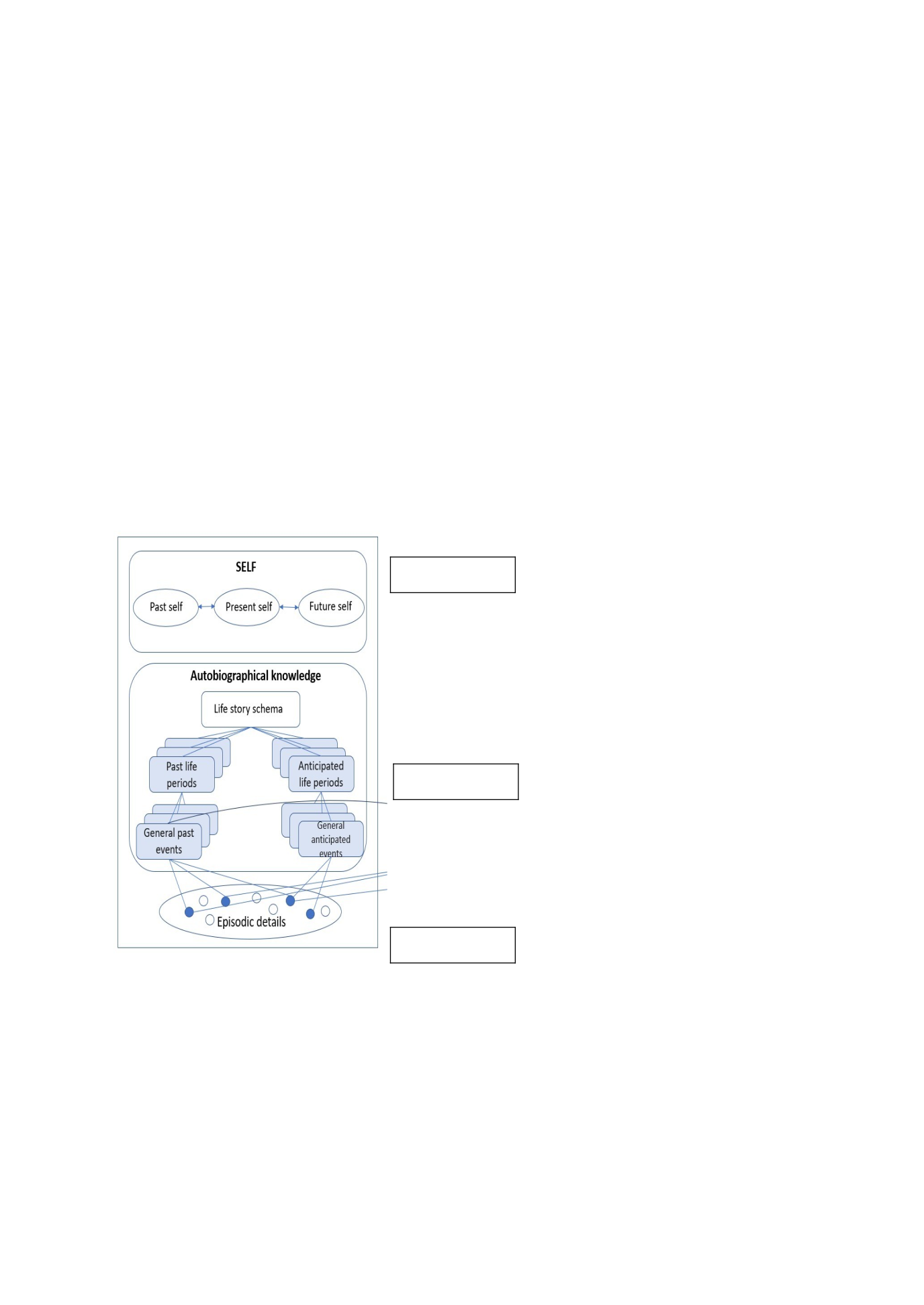
2. The cognitive architecture of collective memory
Results from Studies 1 and 2 gave some insight into the episodic details and
higher-order knowledge levels of the cognitive architecture of collective memory, as
illustrated in Figure 1. We primarily focus on the influence of the passage of time on
lived collective memories, revealing the constructive processes that underlie
collective memory. Results provided by our first study also link the past and the
future, which allows the discussion of collective future thinking (section 2.3).
Figure 1
Collective memory cognitive architecture model
Studies 1 & 4
Studies 1 & 2
Study 1
2.1 The episodic details level
In Study 1, we found that lived collective memories were associated with a
general loss of episodic and semantic details in the narratives with the passage of
time. This loss was more important for the pandemic memories than the political
memories. While we found a general loss of details, our results also suggest that,
overall, narratives were proportionally richer in detail. In other words, as

participants’ narratives in 2022 were shorter, participants needed fewer sentences
to describe events related to the pandemic during the year 2020 and could provide
all details with fewer words. This was only true for the pandemic but not for the
political memories. Our results suggest a reorganization of the memories of the
pandemic in the sense of a denser but still rich representation of the events.
Moreover, the lexical content analyses conducted on the narratives about the
pandemic in 2020 also bear on that interpretation, as we found more references to
COVID-19 in 2022 than in 2021.
Building on episodic memory studies, our results align to some extent with
the well-known progressive loss of episodic details associated with a memory
(Tulving, 1972). More particularly, the remembering–imagining system reveals that
fewer episodic details are recalled and with more general representation of older
memories compared to recent memories (Conway et al., 2016), as they rely on high-
level schema due to increased temporal distance from the past (Trope & Liberman,
2010). Contrary to personal memories, in the context of collective memory studies
little is known about the specificity of memories. Up to this day, to the best of our
knowledge, there are no studies that examined the episodicity of personal and
collective information retrieved about the same public event. The closest analysis to
ours is from a study revealing that personal memories tend to be more specific, in
the sense of referring to unique events that occurred within 24 hours, than public
event memories (Abel &
Bernsten, 2021). Therefore, Study 1 provides some original insights into the
specificity of lived collective memories. However, we also acknowledge that further
analyses of Study 1 will provide information about the episodicity of personal and
collective memories related to lived collective events. Indeed, we reported only the
degree of details of the narrative as a whole.
More work needs to be conducted to test the hypothetical cognitive model
of collective memory and the constructive processes underlying that structure. For
instance, future research should focus on the influence of cues in the activation of

representation in memory of collective events, such as studies in autobiographical
memory (Robin & Moscovitch, 2014). This could shed light on how collective
memories are reconstructed by building on episodic details and higher-order
knowledge levels (Conway et al., 2019). Additionally, we propose that examining the
episodic details level should be done on lived collective memories, and not distant
collective memories, as it allows us to examine memories from their initial creation
and first moments of consolidation, as opposed to distant collective memories.
Finally, the novelty effect known to enhance episodic memory (Fenker et al., 2008;
Tulving & Kroll, 1995) might provide some insights into the differences we observed
between the pandemic and the political events. Contrary to the political events that
are expected (e.g., every four years for the Presidential elections), the COVID-19
pandemic appeared as a unique and novel event. We suggest that future studies
should also consider that dimension.
2.2 The collective knowledge level
2.2.1 General memories
In our first study, we found that the passage of time influenced the type of
information retrieved about lived collective memories, as more personal and
collective information was recalled in 2021 than in 2022. However, the decrease in
personal and collective information was also influenced by the personal importance
of the event (examined through the event type). In 2021, memories of the
pandemic were recalled with more personal than collective information. With time
both decreased but more so for the personal information, which was recalled to the

same extent as collective information in the second interview. Regarding political
memories, the number of information decreased with time, but the decrease was
similar for personal and collective information, with the latter dominating in 2021
and 2022. The influence of the passage of time on lived collective memories
(personal and collective information) is consistent with general theories in episodic
memory such as the decay theory that suggests that memories naturally fade over
time, leading to a progressive global decrease in the amount of recalled information
(for a review, see Hardt et al., 2013; Sadeh et al., 2014).
Up to this day, the distinction between personal and collective information
related to collective events has been made through the distinction between lived
and distant collective memories. Results have shown that lived collective memories
are recalled with more personal memories associated with the events compared to
distant collective memories (Merck, 2020; Muller et al., 2018). By examining both
personal and collective information related to a lived public event in 2021 and 2022,
our findings provide a new perspective on the construction of lived collective
memories. More precisely, we found that with time memories of the pandemic
evolved towards a more collective representation, whereas memories of politics
were always recalled from a collective perspective. Therefore, it seems that lived
collective memories are influenced by the self, but more importantly tend to be
remembered in a collective perspective, fitting the nature of these events (collective
event).
Overall, we found differences in terms of episodic details, and
personal/collective information between the pandemic memories and the political
memories. The Self-Memory system posits that memories and episodic details are
usually forgotten unless they are important for personal goals and values (Conway &
Pleydell-Pearce, 2000; Loveday & Conway, 2011). This highlights the influence of the
self on autobiographical memory. The influence of the self, through personal
importance, is discussed in more detail in section 3.

2.2.2 Collective transitions
Study 2 was built on the Living-in-History effect suggesting that collective events
with sufficient effect on daily lives can influence memory organization by
constituting temporal landmarks that may be useful for recalling past personal
memories (Bohn & Habermas, 2016; Gu et al., 2017; Zebian & Brown, 2014). These
transitional events separate different lifetime periods (Bohn & Habermas, 2016;
Brown, 2021, 2023). In our second study, we examined the extent to which the
COVID-19 pandemic could be used as a temporal landmark when recalling personal
memories, which would provide evidence that the COVID-19 pandemic constitutes a
transitional event. At the time when Study 2 was conducted, we hypothesized that
the COVID-19 pandemic had strongly affected our lives as we were still affected to
some extent by the pandemic. Thus, these events could be used as temporal
landmarks that help to organize autobiographical memory. However, Study 2 failed
to provide sufficient evidence that the COVID-19 pandemic acts as a collective
transitional event (Brown, 2021), contrary to a recent study revealing that the
COVID-19 pandemic served as a temporal landmark for personal memories related -
or not- to the pandemic (Ekinci & Brown, 2024). However, our study focused on
participants aged between 18 to 40 years, while Ekinci & Brown (2024) focused on
two groups of first-year university students, who graduated high school during the
pandemic, which is also known to be an important personal event (Thomsen, 2009),
making them more likely to use the pandemic as a temporal landmark. Moreover,
that study asked participants to recall memories of personal events for periods that
happened between September 2019 and December 2020 or from January 2020 to
April 2021, depending on their groups, while in our study the period from which
participants could retrieve memories was 5 years. The difference in time windows
and age of participants between studies could explain to some extent the different
results.
While our study did not confirm the hypothesis of the pandemic influencing
the organization of personal memory, it opened valuable perspectives. Notably, it

highlighted the importance of considering the period when examining collective
events as transitional events, as seen with the inconsistent findings on collective
memory transitions in the case of the pandemic. Some results revealed that older
adults are more likely to choose personal events as transitional events, due to a
longer lifespan perspective (Bluck et al., 2016; Luchetti & Sutin, 2018). Based on that
we assume that the time perspective influences the use of collective events as
transitional events. Therefore, examining this effect from a longitudinal perspective
(at different time points) would help to understand the creation of collective
transitions. Initially, we hypothesized that young adults might need more time to
situate collective events as transitional events in a broader context - a lifespan
perspective-. Yet recent results are not congruent with this hypothesis, as they
revealed that young Americans referred to the COVID-19 pandemic as a transitional
event, but it seems to be explicable if the collective event happened around
personal events such as graduation (Ekinci & Brown, 2024). Additionally, our results
stress that future research should explore how collective transitions influence not
only autobiographical memory organization but also collective memory
organization. More precisely, how would groups refer to a collective event in the
story of their group? For instance, could the death of George Floyd in the USA
constitute a transitional event in the long period of racism against black Americans?
(e.g., My community, Afro-American, lived with highly racist behaviors in daily life
until there was the death of George Floyd which led to the rebirth of the Black Lives
Matter movement). We propose that examining how collective transitions influence
collective memory organization would provide more evidence at the collective
knowledge level.
2.2.3 General and underlying schemas
In this thesis, we did not investigate the existence of collective schemas/scripts
known to act as expected events that help to organize memory from a lifespan
perspective (Berntsen & Rubin, 2004; Shanahan & Busseri, 2016) (see Figure 1

autobiographical knowledge component). However, we examined the use of
schemas using schematic narrative templates, which are considered to act as prior
knowledge that helps to organize how memories are recalled (Bartlett, 1932;
Wertsch, 2002). We examined memories as narratives built on three blocks of
information: the context, the causes, and the consequences (Studies 3 and 5), or the
context, the events, and the resolution (Study 4).
By using this method, we found subtle effects on memory. In Study 3, our
results revealed that older adults recalled more the consequences of a real public
event than younger adults. Similarly, this method allowed us to find in Study 4, that
younger adults share more similar representations for each block of information
compared to older adults. Additionally, using that narrative template gave us insight
into the presence of a serial position curve in collective memory in terms of
similarity and not the number of details recalled. Indeed, results from our Study 4
showed that participants had more similar memories about the beginning (the
context) and the end (the resolution) of the story than the middle (the events) (Abel
& Berntsen, 2021). Accordingly, we also found subtle effects of social identity on
lived collective memories. In Study 5, we observed that Americans recalled the
consequences of the Capitol riots more similarly than Belgians, and Belgians
recalled more similarly the context and the causes compared to Americans.
While the specific effects of aging and social identity are discussed in section 3,
we highlight here the originality of a micro-level examination. These specific
findings would not have been possible if the memories were examined through the
classical method of investigation based on the sum of details recalled (Sekeres et al.,
2016). To some extent, the classical method of investigation neglects that the
narrative schemas, acting as prior general knowledge, play a crucial role in memory
organization, which can influence the recall of past experiences (Bartlett, 1932;
Wertsch, 2002, 2008). In our studies, examining memories as information built on
narrative schemas allowed us to combine an examination at a general level (total of
details recalled) and a deeper level (details recalled by building blocks).

2.3 Collective future thinking
In Study 1, we examined collective future thinking by asking participants to
imagine a future pandemic in ten years and the future EU dissolution in ten years.
Results revealed three findings: more episodicity when imagining a future pandemic
than a future political event (1), more collective than personal thoughts about
future events (2), and the themes related to a future pandemic were similar to the
ones recalled about the past pandemic (3).
The higher episodicity for the future pandemic compared to the future
political event corresponds to the fact that future thoughts about a pandemic were
more episodic than thoughts about the future EU dissolution. This result is
important as it brings evidence that participants might have used information about
specific events to simulate what could happen in the future if a pandemic occurred
again in 10 years. Moreover, our results highlighted that thoughts about a future
pandemic were influenced by past experiences, which were characterized by direct
reference to the past through topics reflecting the desire to “learn from the past”,
and more generally by imagining themes that were similar to the one recalled about
the past pandemic, such as daily life impacts, hospital and medical management,
and politics. This finding is consistent with other studies revealing similarities
between themes recalled and imagined at the collective level (Michaelian & Sutton,
2017; Öner et al., 2023; Öner & Gulgoz, 2020; Topçu & Hirst, 2020). Overall, our
results indicate that future thoughts draw from memories, tapping into both
episodic and semantic collective memory, which is consistent with theories
highlighting links between the past and the future such as the remembering-
imagining system and the constructive episodic simulation theory (Conway et al.,
2016; Conway et al., 2019; Hirst & Manier, 2008; Schacter & Addis, 2007).
Surprisingly, some topics imagined in 2021 about a future pandemic were topics
recalled for the memories of the pandemic in 2022 and not when they recalled it in

2021, such as the importance of political relationships with other countries. While
we found evidence of how the collective future relies on the collective past, this
specific result highlights the reconstructive and adaptative nature of collective
memory (Mahr & Csibra, 2018).
More precisely, regarding the adaptative nature of collective memory, topics
reflected the desire to learn from the past for better adaptation. This directly refers
to the directive function of memory (Bluck et al., 2005; Burnell et al., 2023; Heux et
al., 2022). Moreover, this is consistent with the notion that shared memories are
used to help societies to avoid making the same mistakes (Gensburger & Lefranc,
2020). Heux et al. (2022) discuss this function as the political function of collective
memory. They argue that the collective past of violent events such as war can be
promoted for peace and tolerance at a societal level, but the same memories can be
used to trigger hate and intolerance. Here we share the same interpretation of the
function, but contrary to the current theories that drive their interpretation in a
political context, we argue that it is a societal function beyond the political context.
Furthermore, people’s predictions about future public events were more
group-based than individual, which is characterized by more collective information
than personal information for future events. This is important considering that
during the task participants were not asked specifically to imagine collective events
related to these future public events. Our results highlight more concerns about the
community’s actions than individual actions. Building on the tendency to imagine
future public events with a collective view, we propose that future research should
focus on the influence of collective identity both in the examination of collective
memories and the examination of collective future thoughts. In our model, we
hypothesize that collective identity influences collective memory (see Figure 1).
However, based on the results of Study 5, it seems that it is not the collective
identity (nationality) that influences collective future thinking, but there rather
might be an underlying link involving variables enhancing the creation of flashbulb
memory and collective future thinking. More precisely, in Study 5, participants who

formed flashbulb memories for the Capitol riots believed that the event would be
remembered more in the future, that the government should make more efforts to
remember the event in the future, and that there could be a similar attack on the
Capitol in the future. National identity did not interact with these patterns, and
more importantly, there were no overall differences between Americans and
Belgians.
The influence of social identity is discussed in more detail in section 3.
2.4 Influence of the current context on collective memory
Memory, known for its dynamic nature especially in reconstructing past
social and political events, can be heavily influenced by the social context, governed
by cultural and social norms (Bartlett, 1932; Bietti, 2010; Halbwachs, 1950; Roediger
& Abel, 2015). Collective memory studies usually examine public events. These
events encompass societal and emotional influences that vary with time. Therefore,
the current societal context during memory recall may differ from the context in
which events were initially experienced. Yet, surprisingly, the influence of the social
context on the construction of memories and future thoughts is often overlooked.
2.4.1 Influence of the societal context on collective memory
In this thesis, we discuss the influence of the current context at a societal
level through the results of Studies 1 and 2. In Study 1, participants were asked to
recall the COVID-19 pandemic that happened in 2020 at two time points. It would
be reckless to not consider how the Belgian social context has evolved during the
year 2020 with several lockdowns, one of which continued during the year 2021
(first interview), while no other lockdowns were imposed in 2022 (second
interview). In fact, around mid-2021, restrictions related to the pandemic were
mostly abandoned by the Belgian government. More importantly, the news of the

vaccines was already out, and the first vaccines were administrated, which
alleviated the anxiety associated with the pandemic giving some hope to people
(Metzler et al., 2023; Monselise et al., 2021). For sure, remembering the pandemic
in an anxious context is different from remembering the pandemic when the
consequences of the event are reduced, such as in Study 1 two years after the
event. At the individual level, the influence of the current situation on memory
retrieval is well documented, as evidenced for instance by studies priming emotions
in laboratory settings (Hansen & Shantz, 1995; Kensinger & Schacter, 2008). At the
collective level, research provides robust evidence that the current societal context
significantly influences the creation of shared memories (Cole et al., 2023; Lanciano
et al., 2024; Niziurski & Schaper, 2023; Öner et al., 2023). For instance, the strength
of governmental measures during the pandemic impacted memories of that period
(Öner et al., 2023). In a recent study, Öner and colleagues (2023) found that
participants residing in countries where the severity of governmental measures was
high during the pandemic recalled more events about politics and infections,
whereas participants from countries with low severity of governmental measures
reported more events related to travel, culture, lockdown and health. Moreover,
people from countries with high severity governmental rules reported up to 9 times
less events related to death compared to participants from low and medium
severity. To some extent, that might have influenced the type of words used to
recall the event in Study 1, as we found more words related to anxiety in memories
of the pandemic in 2021 compared to 2022.
In the same logic, imagining a future pandemic similar to the one we lived
one year before in a context that still encompasses the consequences of such
events, is different from imagining a future pandemic years after it happened.
Similarly, for instance, imagining a future war in the context of a current war is
different than imagining a future war while our country is at peace, and never went
under extreme conflicts (Tabaszewska, 2023).

2.4.2 Influence of social interactions on memory
Study 4 provides evidence of the influence of the social context on memory.
Because all the previous studies relied on individual interviews, without considering
the interview characteristics, we conducted a new study to first control the
rehearsal variables through the unique view of a TV series episode. Then, building
on the communication accommodation theory, we aimed to test and control the
audience effect by recalling memories either to a young adult or an older adult
(Giles & Ogay, 2007; Horton & Spieler, 2007). The originality of the study is to
consider age effects on memory similarity rather than only the amount of details
recalled as a traditional assessment. Our results indicated that participants had
more similar representations in memory when recalling the story to an old listener
compared to a younger listener (Adams et al., 2002). These results seem to suggest
that all individuals (younger and older adults) align their memories of the fictional
event to share a similar story to an older adult, which might be explained by the
influence of ageism stereotypes activated in the social context (Adam et al., 2013).
In other words, the social context, activating ageism stereotypes such as older
adults having bad memory, might have modulated the similarity of the memory
they would like to share with older adults (Adam et al., 2013). This similarity might
reflect the selection of key story elements by all participants.
In this thesis, we did not thoroughly examine social interaction's influence
on collective memory. From a functional approach to memory, it is important to
highlight that sharing memories in communities helps to create or strengthen
relationships within the group, or with other groups (Burnell et al., 2023).
Additionally, storytelling through narratives helps to create and transmit collective
memories (Bruner, 1990). From a cognitive perspective, this recall also reinforces
this information in individual memory (Roediger et al., 2009). Participants in Studies
3 and 5 were asked to report how many times they discussed the events with other

people. In Study 3, we found that the more participants talked with other people
about the bridge collapse, the more they recalled details about that public event.
On the other hand, it did not influence the creation of similar representations in
memory. In Study 5, we found that the more people talked about the Capitol riots
the more likely they were to form flashbulb memories related to that event,
independently of their nationality. Contrary to Study 3, we found that the number
of people Americans talked with influenced the similarity of representation of the
consequences of the Capitol riots. More precisely, the more Americans discussed
these events with others, the more similar were their representations of the
consequences. While we provide some evidence of the social context and
interaction influence on collective memory, it is worth noting that several other
processes are in play like shared attention, social contagion, conversations, shared
reality, subjective state, and expertise (Heux et al., 2022; Roediger & Abel, 2015).
3. Variables influencing collective memory construction
Through several studies, we aimed to unravel the influence of aging,
personal importance, and social identity in shaping collective memories. The
following section discusses previous results and offers nuanced interpretations of
the age effects on collective memory. The exploration of personal importance is
discussed drawing on the outcomes of Study 1, underscoring the imperative for a
more cautious examination of this variable. Crucially, the role of social identity is
presented as a linchpin in our understanding of collective memory dynamics. While
the realm of emotions and media remain globally uncharted territories within this
thesis, we suggest that some results could be interpreted by considering their
influence on collective memory. This strategic inclusion enhances the
comprehensiveness of our research and reflects our commitment to a holistic
exploration of the multifaceted nature of collective memory (see Figure 2). We

believe this comprehensive approach contributes to the robustness of our findings,
encouraging readers to appreciate the depth and intricacy of collective memory.
3.1 Age effects on collective memory
Studies 3 and 4 aimed to examine age effects on collective memory. Age
effects are discussed in terms of episodic details, and more originally by employing
the inter-subjects similarity method we created. The discussion extends to novel
perspectives on age effects concerning future thinking and flashbulb memories.
3.1.1 Aging: the amount of information, similarity, and narratives
Despite the well-known episodic memory decline with aging revealing that
older adults recall less episodic details and more the gist of the memory compared
to younger adults (Balota et al., 2000; Brainerd & Reyna, 2002; Levine et al., 2002;
Piolino et al., 2002), our studies revealed that age differences in episodic details and
the amount of information in memory varied as a function of the nature of the
event to remember. In Study 3, there were no significant differences between
younger and older adults in terms of the amount of details recalled about the bridge
collapse in Italy. Conversely, findings from Study 4 aligned with the typical pattern,
as younger adults recalled more episodic details for a fictional story (i.e., the video
of a TV series episode) than older adults (Balota et al., 2000). Moreover, we provide
another perspective to apprehend age effects on memory through the examination
of inter-subjects similarity. As a reminder, the method shows the extent to which
representations in memory are similar within a group, compared to another group.
Our results from Study 3 indicated that aging does not influence the similarity of the
representations in memory for a public event. We found that older adults recalled
as similarly the memories of the bridge collapse in Italy, as younger adults. Contrary
to results from Study 3, in Study 4 we demonstrated that young adults share more
similar representations of a fictional story than older adults.

Overall, we hypothesize that the differences in event nature (real or
fictional), the recall timeframes that were different between studies (5 minutes or
months after the events), and the length of memories recalled (one year of
pandemic, or 1 hour of a TV show) may contribute to the differences in episodic
memory decline.
As seen previously, a specific investigation of memory based on narrative
schemas is important as it can reveal specific effects that might not be seen through
the classical method of investigation. In line with the notion that memories are
constructed coherently, based on narrative schemas, results from Study 3 revealed
that older adults emphasized the consequences of the bridge collapse more than
younger adults, while the total of information recalled did not provide evidence of
age effects on memory. This result is crucial as it highlights how recalling memories
can be influenced by socio-emotional effects in aging. More precisely, the socio-
emotional theory of aging considers that older adults, perceiving a shorter time
horizon, reappraised a situation with a more positive and social perspective
(Carstensen, 2021), which seems to enhance emotional empathy and prosocial
behaviors (Beadle et al., 2015). Therefore, we can assume that because of this
enhanced emotional empathy, older adults recalled more the consequences of
catastrophic public events that impacted other people's lives. Additionally, we also
found that older adults used more positive words when recalling the fictional event
in Study 4 compared to younger adults, revealing a more positive interpretation of
the TV episode. This is also consistent in our additional results from Study 1 where
older adults mentioned more positive emotions than younger adults, but younger
adults mentioned more anger than older adults about their memories of the
pandemic and the political event of 202020.
20 Main effects of age were found for the emotion category for positive emotions (Q = 15.32,
p =.001), anger (Q = 21.32, p =.001), and anxiety (Q = 11.84, p = .004). Post hoc tests revealed that
older adults (M = 2.27, SE = 0.05) mentioned significantly more positive emotions compared to young
adults (M =1.98, SE = 0.05), psihat = 0.29, p <.001, 95% CI [0.12, 0.46]. Post hoc tests found that
younger adults used more anger-related words (M = 0.40; SE = 0.03) than older adults (M = 0.24; SE =
0.02), psi-hat = -0.16, p <.001, 95% CI -0.24, -0.07].

While our results focus on the content of memories, it is worth noting that
there also exist phenomenological differences with aging, as the sense of
reexperiencing events diminishes in older adults compared to younger adults
(Comblain et al., 2005; Rubin & Berntsen, 2009), whereas the vividness of memories
is rated higher for older adults compared to younger adults (Folville et al., 2020). To
the best of our knowledge, this aspect of age-related differences has not been
explored in the context of collective memory and should be assessed in future
studies (see Topçu & Hirst, 2020 for the examination of collective memory
phenomenology).
3.1.2 Aging and flashbulb memories
Age effects on flashbulb memories were examined in Studies 3 and 5. In
Study 3, we did not find evidence of age differences in flashbulb memory creation
for the bridge collapse in Italy. This means that younger Belgians did not remember
more than older Belgians, for instance, what they were doing, where they were, and
what they were thinking about when they learned the news about the bridge
collapse that happened in Italy. However, in Study 121, additional
Age effects analyses were computed based on three age groups (young, middle-aged, and older
adults).
results revealed that younger Belgian adults formed more flashbulb memories
about the lockdown announcement than their older counterparts. In other words,
this means that younger adults remembered more than older adults, where they
were, what they were doing, with whom they were, and what they thought when
they heard the news about the lockdown. Considering flashbulb memory creation
21 Results show a significant effect of the groups on the formation of reception memories
(RC) and flashbulb memories for the lockdown (FBMs)(Q = 6.68, p =.04). Robust post hoc tests
revealed that older adults formed significantly less flashbulb memories than younger adults (psi-hat =
0.26, p = .02, 95% CI [-0.52, 0.005]). No significant differences were found between middle-aged and
older adults (psi-hat = 0.13, p = .41, 95% CI [-0.25, 0.52]), or between middle-aged and younger adults
(psi-hat = -0.13, p = .30, 95% CI [-0.42, 0.17]).

as a potential marker for future historical events (Luminet & Spijkermans, 2017), we
propose a link between the time perspective (shorter for older adults) and flashbulb
memories. Building on an adaptative comprehension of this phenomenon we
suggest that young adults, with a longer lifespan in front of them and therefore
more likely to see an event become historical, are more inclined to form flashbulb
memories.
3.1.3 Aging and future thinking
Based on the influence of time horizon on memory with aging, a pertinent
question arises: How does the limited future time perspective influence the creation
of personal and collective future thoughts about public events? Interestingly,
additional analyses conducted in Study 1 22 did not find age differences in the
content of future thinking (episodic details and proportion of collective
information). However, our findings from this study align with a nuanced age-
related pattern in emotional expression about future events, where young adults
expressed more negative emotions (anger) and more positive emotions than older
adults23. This divergence resonates with existing studies revealing inconsistent
findings about age effects on future thoughts. In
line with our results, one study found that the narrative of neutral future events
encompassed more anxiety-related words in narratives from younger adults
compared to older adults (Steinbicker et al., 2018). Another study found that aging
influences the emotional valence of memories, but not future thoughts (Oner &
Watson, 2022). This divergence in emotional expression for imagined events could
22 Results did reveal a significant effect of age groups for internal details (Q = 2.91, p = .24),
external details (Q = .85, p =.09), episodicity (Q = 0.39, p= .83). Regarding the proportion of collective
information, no significant of age groups was found (Q = 3.86, p =.15)
23 Main effects of age were found for positive emotions (Q = 6.97, p = .03), and negative
emotions (Q = 6.63, p = .04). Post hoc test revealed that younger adults referred significantly more
than older adults to positive emotions (psi-hat = -0.40, p = .04), and negative emotions (psi-hat = -
0.25, p = .03).

be explained using different methods and analyses and needs further exploration as
there is a limited exploration of future thinking in aging.
In summary, the combined results and hypotheses offer a fresh perspective
on age-related decline in memory. It underscores the importance of adopting a
multi-analytical approach (considering episodic details, type of information, and the
similarity of memories), accounting for event nature (real or fictional), and
acknowledging the influence of psycho-social variables. This holistic approach might
reveal the impact of a more social and positive reappraisal of memories and future
thinking at a collective level, in the aging process, as still little investigation is
available on age effects and collective memory.
3.2 The personal importance effect of collective memory
This thesis explored personal importance in Study 1 at two levels,
investigating the impact of two collective events with varying societal implications
for Belgians: the pandemic and a political (American) event (collective level), and
examining the influence of the pandemic on daily life, psychological well-being, and
so on (individual level). As seen in section 2, the findings revealed that the personal
importance at the collective level shaped the type of information recalled
(personal/collective) as we found more personal and collective information recalled
for the pandemic than the political events. Additionally, it influenced the episodicity
of memories over time, as memories of the pandemic were richer in episodic
details, which was not the case for political memories. On the other hand, the
impact at the individual level was associated with memory content through the
words used in recalling memories in 2021, as we found correlations between daily
life impacts and COVID-19 contact with the use of words related to negative
emotions and anxiety, while the psychological impact related to the COVID-19 virus
and the COVID-19 contact correlated with words related to anger.

Although initially labeled as “personal importance”, we acknowledge that
this term may not fully capture the variability in the influence of public events on
collective memory. For instance, in Study 3, we examined the emotional impact of
the bridge collapse in Italy. Focusing solely on the event’s occurrence in Italy
overlooked certain aspects of personal importance. Indeed, some Belgians might
have been personally impacted by the events happening in Italy because they had
family and friends there or were used to traveling in that country. This led us to
explore the influence of social identity on collective memory in Study 5, revealing
the impact of nationality and geographical distance on lived collective memories
and flashbulb memories. Both studies highlight how the concept of “personal
importance” can include different dimensions at individual and collective levels.
Therefore, this concept should be examined carefully, by encompassing the impacts
of the collective event at both personal and collective levels. This new approach has
been adopted by recent research examining the global and personal importance of
collective events during the COVID-19 pandemic (Cole et al., 2023). This dual
perspective allows for a comprehensive understanding, acknowledging the
complexity of influences on memory.
Considering the impacts of collective events, we emphasize the importance
of two distances: psychological and physical. Physical distance, referring to the fact
that events were lived or heard about, leads to different memory patterns (Gold,
1992; Pezdek, 2003). In this thesis the physical distance was examined through the
type of event (pandemic vs political memories) in Study 1, and through the
nationality in Study 5 (which is discussed specifically in section 3.3). In Study 1,
Belgian participants mainly chose to recall an American political event (the
presidential campaign in 2020). Therefore, the political event has a greater physical
distance than the pandemic in 2020 for Belgian citizens. We found greater
episodicity for the pandemic than the political memories. We also found more
personal and collective information recalled about the pandemic than political
memories. Moreover, we found specific differences in the type of words people

used to talk about the pandemic memories compared to political memories, with
the recall of the pandemic being associated with more use of first singular and
plural pronouns, references to family and friends, positive emotions and anxiety,
cognitive processes, and finally, as expected, for references to the COVID-19
pandemic. All these findings are consistent with previous results highlighting that
direct involvement results in more memories, rather than not being involved and
hearing about it from the media (Er, 2003; Larsen & Plunkett, 1977; Neisser et al.,
1996; Pezdek, 2003). For example, New Yorkers remember more accurate details
about the events related to the 9/11 attacks compared to participants from the East
Coast and Hawaii (Pezdek, 2003).
This distance to the event can also be viewed as a continuum, allowing for a
nuanced understanding rather than a dichotomous perspective. The distance
continuum accounts for various psycho-social processes that influence proximity.
For instance, Neisser (1996) found that participants who knew family members who
experienced a public event remembered it better than participants who had no
connection to it. Therefore, while psychological distance often aligns with physical
distance, it is crucial to acknowledge that in our interconnected world, psychological
proximity can override the influence of physical proximity (Hoskins, 2011). In Study
1, we found that the impact at the individual level was associated with memory
content through the words used in recalling memories in 2021, as we found
correlations between daily life impacts and the use of words related to negative
emotions and anxiety, while the psychological impact related to the COVID-19 virus
correlated with words related to anger. Additionally, links between memory and the
collective importance have been made by Tekcan et al. (2017) in a study that
showed that memories retrieved during the reminiscence bump period encompass
more public events that are important for the collective memory of the group. In
tandem with the extensive research on flashbulb memories, the examination of
collective memory must include an exploration of the concept of consequentiality
(see Rice et al., 2017 for a review). In Study 5, we found a link between

consequentiality and similarity of memory of the context in Belgians. As
demonstrated in Study 5, we advocate for consistently examining the consequences
of collective events at both individual and collective levels. This approach ensures a
comprehensive understanding of how the perceived importance and impact of the
events influence memory processes, which can also be associated with the group
identity to some extent.
3.3 Identity effects on collective memory
This thesis sheds light on the influence of collective identity on collective
memory, revealing a significant impact of national identity in shaping lived collective
memories. This link is built on two main findings from Study 5. First, we found that
nationality influenced the similarity in recalling the consequences of the event, with
Americans exhibiting greater inter-subjects similarity in recalling the consequences
of the Capitol riots compared to Belgians and Belgians reporting more similar
memories regarding the causes and events compared to Americans. Then, our
results, consistent with other studies, found more flashbulb memories reported by
Americans than by Belgians (see Berntsen, 2017). Additionally, our results from
Study 1 highlight that collective events and memories might influence personal
identity. This is evidenced by results from the centrality of event scales completed
after recalling or imagining a pandemic or a political event, by which participants
reported a significant integration of pandemic events into their identity, whereas it
was not the case for the political event.
In other words, expanding on studies demonstrating how social identity
influences vivid memories of the context of learning about public events (Luminet &
Curci, 2017), our results suggest that collective identity plays a pivotal role in
shaping collective memory, akin to how personal identity (the self) influences
individual memories (Conway, 2005). This association can be extended to how
collective memory influences group representation across time (the past, the
present, and the future) (Liu & Hilton, 2005). Simultaneously, collective memories

contribute to a sense of continuity in the community and sustain the group identity
(Heux et al., 2022; Reese & Whitehouse, 2021).
Related to collective identity and the future, in the case of the COVID-19
pandemic, some researchers hypothesized that the COVID-19 pandemic might not
be remembered in the future as a historical event since it does not bear on the
collective identity (Hirst, 2020). In Study 1, we found that two years after the events
Belgians recalled fewer memories about the pandemic than one year after the
event, but still recalled personal and collective memories about the pandemic (more
than for the political event). More precisely, two years after the events Belgians still
recall memories of the pandemic in detail and reconstruct a more collective
representation of these events. Additionally, most participants formed flashbulb
memories of the lockdown announcement. As some research suggests, the creation
of flashbulb memory could be a marker of future historical events (Luminet &
Spijkerman, 2017). Our study provides evidence that the COVID-19 pandemic might
constitute a historical event and bear on the group’s identity, confronting Hirst’s
hypothesis. Yet, we do not exclude that a longer longitudinal approach (e.g., in ten
years) might bear on Hirst’s hypothesis.
In summary, this thesis suggests a link between collective memory and
collective identity, and collective memory and personal identity.
3.4 Emotions in collective memory
Due to the emotional characteristics (negative) associated with public
events examined in this thesis, participants were asked to assess how they felt
about the event they were asked to recall. Several emotions were examined such as
surprise (strongly associated with flashbulb memory formation), joy, pride, and so
on. Therefore, emotions were examined at the individual level. We did not find
correlations between emotions and the similarity of lived collective memories of the
bridge collapse in Italy (Study 3) nor between emotions and the similarity of

representations of the Capitol riots (Study 5). However, we found a correlation
between emotions and collective future thinking for both Belgians and Americans
(Study 5). We also explored emotions through the lexical content and found age
differences in Studies 1 and 3, as previously discussed. Exploring the influence of
emotions on collective memory is a crucial variable, necessitating consideration of
several dimensions. Firstly, emotions can be examined at the memory level,
evaluating the positive and negative valence of memories. Secondly, the
examination of emotions can be done at the individual level by examining
individual-focused or group-based emotions, considering the collective emotional
experience of a group (Sullivan, 2015).
3.4.1 Emotion valence of memories and future thoughts
The influence of constructive processes on memory is also evident through
emotional biases at personal and collective levels, impacting both memories and
future thinking (D’Argembeau et al., 2011; Shrikanth & Szpunar, 2021; Topçu & Hirst,
2020). Recently, Adler & Pansky (2020) reviewed the positivity bias in memory, a
well-known phenomenon revealing that individuals typically have a more positive
perception of the past for personal memories, remembering more good than bad
experiences. This positivity bias in memory extends to future personal thoughts -
called optimism bias-, which are imagined more positively than negatively
(D’Argembeau et al., 2011). At the collective level, collective memories recalled are
usually more negative than positive events, while studies on the collective future
still yield inconsistent findings (Migueles Seco & Aizpurua Sanz, 2024; Niziurski &
Schaper, 2023; Shrikanth & Szpunar, 2021; Topcu & Hirst, 2020). Of note, this
negativity bias in collective memories is not surprising considering that generally,
public events that we most often talk about are negative in valence (Soroka &
McAdams, 2015). Regarding the emotional bias in collective future thinking,
researchers suggest the influence of other variables such as agency, and culture to
understand the inconsistent findings (Liu & Szpunar, 2023; Topçu & Hirst, 2020). This

new perspective pinpoints the need to develop a multi-dimensional analysis of
collective memory.
3.4.2 Individual vs group-based emotions
The emotion enhancement memory effect refers to the influence of
emotion enhancing memory processes (Kensinger & Ford, 2020). In Studies 3 and 5,
our results did not reveal a link between the emotions felt about a public event and
the similarity of representations in memory for the bridge collapse in Italy and the
Capitol riots. While we examined emotions at an individual level in our studies, we
believe that there is a necessity to examine both individual and group-based
emotions in the context of collective memories. While much exploration of
emotions' impact on collective memory has focused on flashbulb memories (see
Luminet & Curci, 2017 for a review), there remains a gap in understanding how
individually and collectively felt emotions influence the creation of collective
memories.
At the collective level, emotions can be triggered by one’s identification with
a group. Group-based emotions are individual emotions such as anger, guilt, shame,
and pride associated with ingroup behaviors (Doosje et al., 1998; Figueiredo et al.,
2016). For instance, studies show that the more one identifies with ones’ group, the
less one feels guilty about the wrongdoing of the group (Doosje et al., 1998). Social
psychologists have been interested in examining how social identity influences
group-based emotions, whereas cognitive psychologists examine collective
emotions through individual emotions in a group (Goldenberg et al., 2020). The
combination of both perspectives could provide a comprehensive understanding of
the intricate interplay between emotions, identity, and collective memory
processes.

3.5 Cultural artifacts: media
In this thesis, the COVID-19 pandemic, the presidential American election,
the Black Lives Matter movement, the Morandi bridge collapse in Italy, and the
Capitol riots in the USA were all public events shared worldwide by the media.
Studies 1, 3, and 5 examined media frequency. Findings from Study 3 revealed that
the media frequency correlated with the amount of details recalled. In Study 5, we
found that the more Americans watched the media, the more similar their
representations about the consequences of the Capitol riots were. We also found
that media frequency was associated with the formation of flashbulb memories
about the Capitol riots in both Belgian and American groups. Overall, it underlines
the significant influence of media on collective memory and autobiographical
memory.
Public events, whether historical or recent, are often framed and discussed
through cultural artifacts, with media playing a pivotal role in shaping collective
memory. Mass media serves as a powerful tool in creating shared realities across
groups, societies, and nations (Neiger, 2007). In contemporary society, mass media,
distinguished by its visual and dynamic aspects, has become a primary means
through which individuals make sense of the past (Kitch, 2006). The constant
richness of visual and dynamic elements in mass media influences significantly the
construction of collective memories (Matei & Ball-Rokeach, 2005).
While we already discussed media influence on lived collective memories,
Study 5 also provided evidence on links between media frequency and collective
future thinking. Indeed, the more participants checked the media for news about
the Capitol riots the more they thought that that event will be remembered in the
future, that the government should make an effort to remember the event in the
future, that there will be a similar attack in the future. Therefore, it seems that the
media’s impact extends to temporality, engaging with both the past and the future
(Gülüm, 2024). This duality is reflected in the reverse temporal process (Gibson &

Jones, 2012), and prospective memory (Tenenboim – Weinblatt, 2013), as it allows
us to envisage future events building on past and present events (Gülüm, 2024).
Rehearsal, a fundamental cognitive process, plays a crucial role in the
formation of collective memories. In cognitive psychology, media is studied as a
variable that enhances memorization through rehearsal, particularly in flashbulb
memory studies (Hirst & Meksin, 2017). Furthermore, interaction on social media
platforms has been shown to influence memory (see Marsh & Rajaram, 2019).
Media consumption influences collective memory through social digital
remembering, modulating the formation of collective memory (Barnier & Sutton,
2008; Erll, 2011; Greeley et al., 2022; Hirst & Echterhoff, 2012; Öner et al., 2023;
Wertsch & Roediger, 2008). For instance, research demonstrated that only 6% of the
news headlines were remembered by participants when they were asked to recall
them the same evening (Neuman,
1976). The ability to remember news has been related to motivation and the ability
to process single news items (Eveland, 2001), highlighting links with the self.
New media, according to Wang (2008), has the potential to influence the
narratives held by groups about the present and the past, thereby impacting
collective identity. How these narratives are shared through media is also subject to
the influence of nations and cultures (Hagström & Gustafsson, 2019). Wertsch
(2021) recently discussed how different governments lead to different collective
memories. Additionally, media can be a source of misinformation and fake news
(Lim et al., 2024), underlying the importance of culture in collective memory
(Rajaram, 2022; Wang, 2021). For instance, it is well known that American news TV
channels are politically oriented which is seen through the narratives relating a TV
news (Cassino, 2016; Dunaway & Graber, 2022). Understanding the intricate
interplay between media, culture, and memory is essential to understanding how
collective memories are constructed, shared, and perpetuated in contemporary
societies.
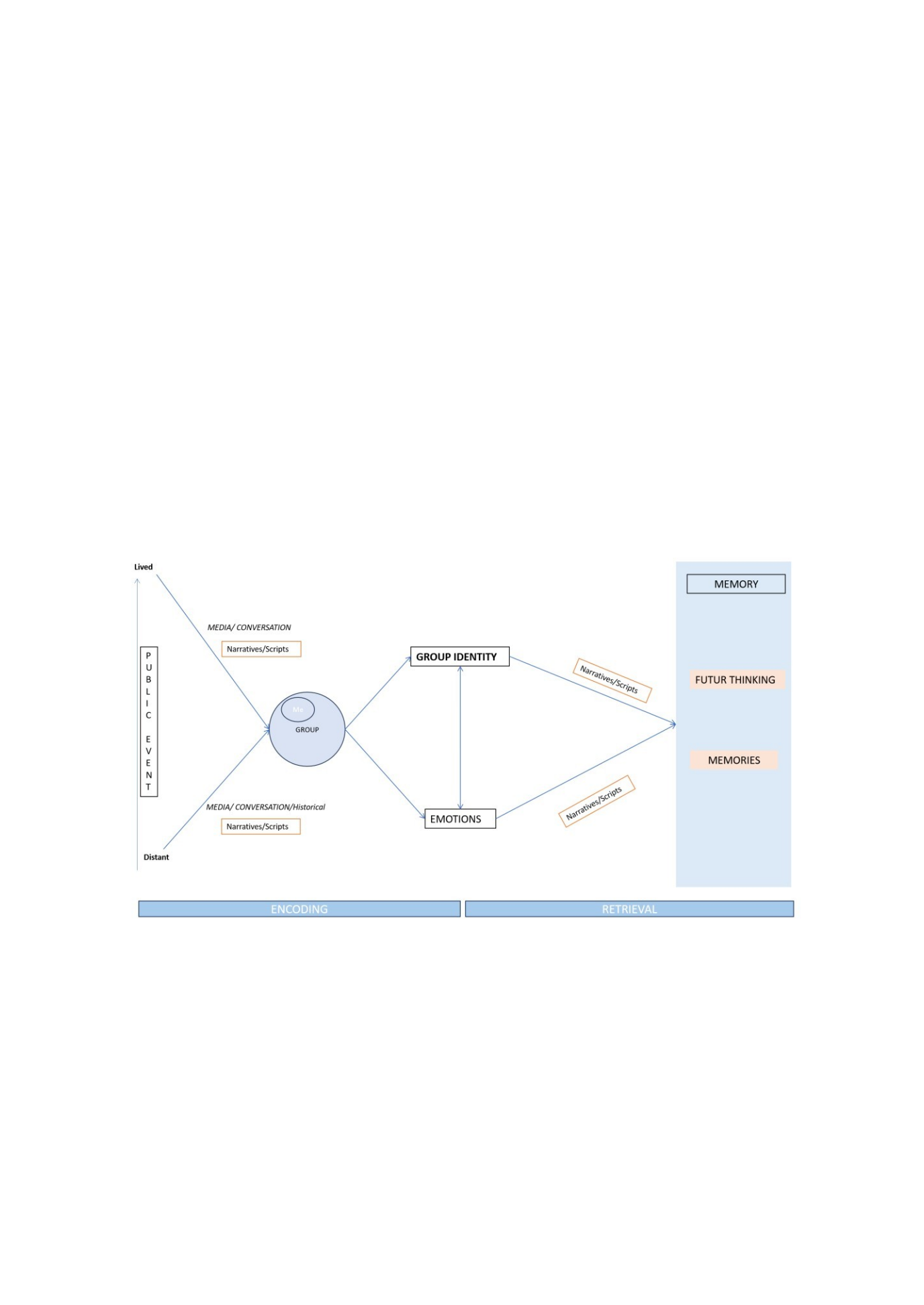
4. Future perspectives
Collective memory gained interest in psychology over the past two decades,
with teams all over the world focusing on understanding cognitive processes,
cognitive architecture, and functions associated with collective memory. Integrating
cognition and ecological perspectives has resulted in a comprehensive approach to
memory. In this section, various ideas related to the theoretical framework and
methods are presented and linked to a new model presented in Figure 2.
Figure 2
Key variables to consider in the investigation of collective memory
Definitions. A general remark is linked to the necessity to use consistent
definitions for the same concepts – avoiding umbrella terms- addressing the
potential interchangeability of terms like event memories, shared memories, and
collective memories (Roediger, 2021). The distinction between collective identity
and social identity, often used interchangeably, requires attention as well.

Memory processes. Regarding memory processes, we emphasize the need
to examine how people encode events. As proposed in the model (see Figure 2), a
specific examination of variables influencing encoding and postencoding steps of
memorization is needed, as it has been done for flashbulb memory creation (see
Luminet & Curci, 2017). We suggest focusing on media as influencing both encoding
and retrieval processes in memory. This could help to understand why some
memories of public events make it to long-term memory, while others do not.
Nature of collective events. Future research should distinguish lived and
distant collective memory, as it underlines a crucial distinction between
communicative memory and cultural memory (Assman & Czaplicka, 1995). Within
lived collective memories, a distinction needs to be made between public events
that people personally experienced or heard about. Studies also need to consider
that the physical proximity to the event does not encompass personal importance,
as a geographically distant collective event can still be considered important or have
an impact on one’s life. Examining the nature of events is also essential as
differences between memories of fictional events such as TV series or real collective
events were found in Studies 3 and 4. Overall, these distinctions are also associated
with the memory processes including differences in rehearsal and maintenance.
Emotions. Emotions in collective memory must be examined more
cautiously. Usually, studies examine the emotions felt at an individual level about a
collective event and compute a mean score through the participants as seen in
Study 5. Collective emotions are examined as the sum of individual emotions. We
propose that the next studies examine how both individual and group-based
emotions influence several memory indicators of collective memory. For instance,
emotions examined as individual “I feel sad about the Capitol riots.” might influence
memories and future thoughts differently than group-based emotions. For instance,
results from the following assessment “As an American, I feel sad about the Capitol
riots” or “As Americans, we feel sad about the Capitol riots” could lead to different
collective memory representations. Additionally, a multi-level method must be

applied when examining emotions in memory studies, examining several aspects of
emotions such as vividness and arousal (Luminet, 2022).
Group identification. Group identification is an essential variable in
collective memory, as seen in the model in Figure 1. Whether it is the group
identification with one’s family, sports club, political group, or religious group, it
must be examined beyond the categorical/dichotomic features (e.g., belonging or
not to a group). For instance, studying sports fan groups should go beyond labeling
them as fans or non-fans. Group identification is influenced by the social context
and timeline (past, present, and future), which should be considered as a variable
that varies in degree and depending on the social context (Hirst & Merck, 2020;
Merck, 2020; Merck et al., 2020). As seen previously, it influences collective memory
(Merck, 2020).
In this model, we hypothesize a strong influence of group identification,
mediated by individual and collective emotions, on various facets of collective
memory, encompassing content, phenomenology, and temporal dimensions (past
and future). This hypothesis serves as a foundational framework for exploring the
intricate dynamics of collective memory formation and retention.
Collective memory representations. The examination of collective memory
should focus on the temporal dimension, examining both the past and the future.
Moreover, future studies should focus on the emotional valence bias of the
collective future thinking that yields inconsistent findings. Finally, in this thesis, we
focused on the content of narratives using several methods of analysis, overlooking
the phenomenology of mental representations. Therefore, a combination of both
examinations of the content and the phenomenology in collective memory might
provide additional results (Abel & Berntsen, 2021; Topçu & Hirst, 2020).
As a concrete perspective, my future work will examine how bearing on
different national identities (such as the French-Algerian population) influences
collective memory (past and future thinking). Group identification will not be based

on their nationality as they bear on both citizenships. However, participants will be
asked to evaluate the degree to which they identify to Algeria (on a scale from 0 to
100), and to France (on a scale from 0 to 100). This allows for a more precise
examination of group identification that varies in degree. Regarding the memory
task, to examine both past and future collective thinking, participants will recall
memories of the Algerian War and discuss how they imagine a future relationship
between France and Algeria. For both the past and the future, participants will be
asked to assess the emotions associated with their memories and future thoughts at
the individual and collective levels. For instance, “As an Algerian, I feel sad about the
War (collective level)” or “I feel sad about the war.”
Regarding media influence on collective memory, one future study will
examine how different American media that are politically oriented influence the
similarity of memories about the same event. Two groups of participants
(democrats and republicans) will hear the news from two different media
(democrats and republicans oriented). This method allows us to investigate the
influence of media values consistent -or not- with individual values, on memories of
public events.
In summary, a strong call is made through this discussion for research to
examine collective memory from a meta-perspective. Additionally, because of its
complexity, collective memory needs to be examined through several dimensions,
as presented in Figure 2. This model includes the nature of the collective event by
distinguishing between lived and distant collective memories, real and fictional
events, and lived or heard-about events. It also distinguishes between encoding and
retrieval memory processes. It focuses on the examination of collective memory
temporal dimension (past and future), examining their content and
phenomenology. On the left side of the figure, it highlights the links between the
self -within a group- and the collective identity in every variable of interest
(emotions, group identification, and memory). In brief, as stated previously,

collective memory should be examined from a multilevel, multi-component, and
multi-method perspective.
5. Autobiographical memory and collective memory: similar but not the
same?
This research on collective memory relies on the knowledge of autobiographical
memory, presenting several similarities. Thus, it can be easily argued that these
types of memory are one unique type of memory (Abel & Berntsen, 2021; Burnell et
al., 2023). If they share the same psychological processes, the same cognitive
structure, and the same functions, then how are they different types of memory?
Several scholars emphasize the necessity to be cautious when drawing on
autobiographical memory to understand collective memory (Burnell et al., 2023;
Hirst & Manier, 2008; Wertsch, 2002). In this section, we argue that the two types of
memory are different by discussing the nature of the events, their formation and
maintenance in memory, the cognitive structure and characteristics, their functions,
and age effects.
The nature of the memory retrieved is different. Per definition, personal
memories are memories of directly experienced events, while collective memory
includes memories of public events that we lived or heard about. Therefore, while
we experience some collective events, it is not always the case, contrary to personal
events. Moreover, collective memories are not just the sum of individual memories.
They are the alignment of an individual’s memories across the group, that can bear
on the group identity. Personal memories do not need to be shared with others to
influence one’s identity, contrary to collective memories. While personal memories
need to be aligned with one’s values and goals, collective memories must align with
both personal and the group’s goals and values, which depend on social identity and
different group levels (family, friends, society, work…). This leads to an important
influence of the self component in both types of memory.

Collective memory as autobiographical memory is influenced by rehearsal,
which helps to consolidate memory (Roediger et al., 2009). Contrary to personal
memories that are rehearsed only mentally and through communication processes,
collective memories can also be rehearsed by media consumption, adding constant
visual information that is less available for personal memories (e.g., a few
photographs about a personal event).
While we found evidence that they might share a similar structure, still
more work needs to be done to examine precise processes underlying collective
memory. Therefore, the overall cognitive structure might be the same, but memory
characteristics can be different, as studies show differences in terms of content and
phenomenology. For instance, Abel & Berntsen (2021) found that public events
memories were assessed as more negative, less specific, less vivid, and with less
feeling of reliving the event than personal memories.
Both memory types serve the same functions but at different levels. At a
collective level, memories have broader implications, such as in politics (Heux et al.,
2022). Abel & Berntsen (2021) found that public events memories arose less
deliberately and spontaneously than personal memories, which could influence the
frequency of use of collective memories to fulfill each function (Burnell et al., 2023).
Up to this day, we have evidence that personal memories fulfill more the self
function and the directive function than collective memories (Abel & Berntsen,
2021; Conway, 2005; Conway et al., 2019) and that collective memories fulfill the
social function (Abel & Berntsen, 2021).
Additionally, aging seems to influence personal and collective memories
differently. Memories of public events seem to not be influenced negatively by
healthy aging.
In summary, despite apparent similarities, autobiographical and collective
memory exhibit nuanced differences across various dimensions, emphasizing the

importance of a comprehensive understanding of their individual and
interconnected roles.

