


Defining Indigeneity
Before discussing indigenous constitutional representation in Latin America, it is
important to discuss what indigeneity means. This dissertation focuses on the political status of
indigenous citizens vis-à-vis non-indigenous citizens. The following sections define indigeneity
as employed in this work. In broad strokes, most importantly indigenous groups must retain at
least some or all their own institutions. These institutions often conflict with terms of citizenship
defined by state entities. In addition, indigenous populations pre-date colonial occupation, and
recognize their own communities as distinct.
Per international law, the term indigenous serves to distinguish one group from others.
Simply, indigenous citizens are those have different origins than non-indigenous ones.
Indigeneity itself was not considered a status until it was created by the United Nations (UN)
after World War II (Merlan 2009). With the creation of the term, the UN outlined qualifications to
meet its definition. Populations that meet these qualities are internationally recognized as an
indigenous.
First, and most crucially, indigenous communities must retain all or at least some of their
own institutions (UN ILO 169). Indigenous peoples in Latin America have passed down their own
language, culture, and legal practices, for example. States have come to recognize these institutions
as legitimate to varying degrees in constitutional law over time. Another example of an indigenous
institution that has received a lot of spotlight in recent political discourse is the right to communal
land ownership. Simply put, land rights belong to everyone in the community equally. These norms
directly conflict with existing democratic laws that protect private property rights of the individual
and private corporations. The critical point is that indigenous populations have retained unique
practices and have their own way of life that is separate from the rest of the nation.

Next, communities are defined as descended from populations that pre-date colonial
invasion and occupation. Peoples that lived in and developed state territory prior to outside
intervention have valid legal and moral claims against state entities. Native citizens have historical
claim to land, resources, and political autonomy. They also have cultural, spiritual, and economic
ties to state territories (Kenrick and Lewis 2004; Merlan 2009; UN ILO 169). Simply, they rely on
their land and culture to survive as a nation. Colonialism led to a history of native political
dispossession, which these communities are now rising against.
Finally, the original nations recognize themselves as culturally distinct. Selfidentification
is evident in different social, cultural, and economic conditions that are distinct from other citizens
(Merlan 2009; UN ILO 169). Recognition by other groups is also typically a requirement for
indigenous status at both the international and national level (Kenrick and Lewis 2004). Indigenous
peoples cannot properly petition for rights that protect their way of life unless their status is
recognized by both international and national entities.
Why Latin America?
There are countless indigenous peoples that fit these definitions, and they can be found
across the world. This work focuses on the current political status of native populations in the
Latin American region. Case selection is limited to this region to best compare rights outcomes.
The scope of this research is limited to Latin America because its native populations
suffered from a similar past of political dispossession. The region was occupied by Spanish and
Portuguese colonizers beginning in the 14th century. The result of this occupation was the
elimination and marginalization of the indigenous peoples that developed the region prior to
invasion. The history of native political marginalization continued when Latin American countries
declared independence from the crown in the 17th century. The region’s original peoples were
absent from all state constitutions until the 1930’s. The shared historical foundations of exclusion
of native populations in the region thus serves as a starting point for this work. Since the state-
building era, indigenous constitutional rights have evolved. Noncitizenship from the colonial era
continues in some countries, while others have created constitutional rights that are broad and
powerful.
From the start of native constitutional recognition in the 1930’s, rights for these
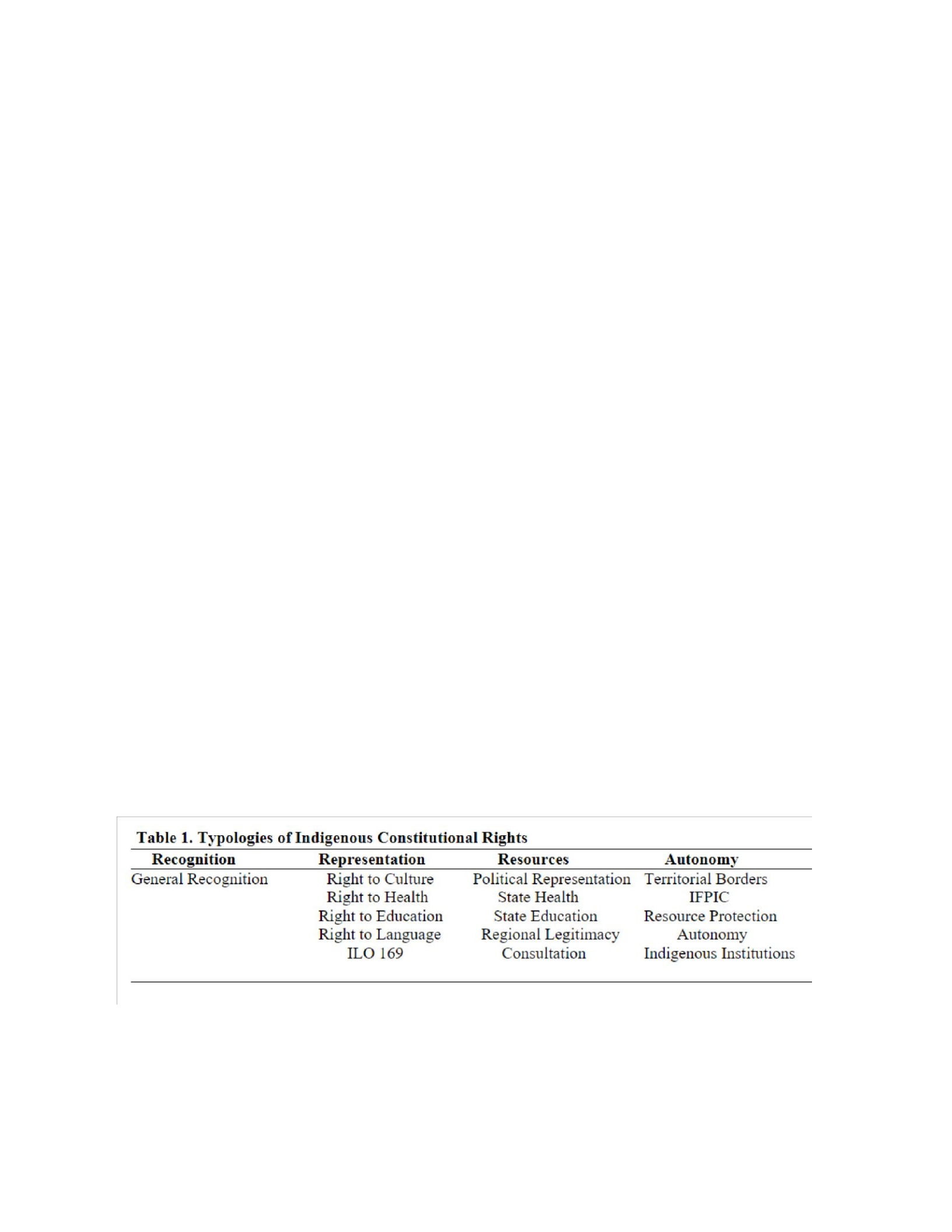
populations have taken four categorical forms. The first step in the political legitimization of
native populations in Latin American countries results in recognition in the constitution. Next,
comes representation rights. These provisions provide indigenous communities with the
recognition of their cultures and practices. Next is resource rights that include constitutional
articles that outline thresholds for representation and state funding for original populations.
Finally, the rarest form of indigenous constitutional protection takes form in autonomy rights.
These establish laws for indigenous self-governance and create new institutions that align with
their practices and customs. Table 1 shows a breakdown of this categorization. A thorough
discussion of indigenous constitutional rights in Latin America is in chapter 3 of this work.
1. ILO 169 is a mention of the UN convention on human rights under the same name. Constitutions can note the convention,
but not create the institutions suggested in the convention itself.
2. State Education and State Health are funded by the government, as opposed to general rights to health and education. The
latter do not guarantee that the state will deliver these services.
3.Consultation is not as powerful as Consent, which is a requirement of IFPIC laws presented in constitutional rights that provide
Indigenous autonomy.

Theoretical Overview
First, I argue that the substantive content of indigenous rights adoptions in national
constitutions has implications for the likelihood of their adoption. Adopted rights renegotiate the
status quo arrangements for access to political goods. Recognition rights are just that, they
recognize indigenous populations as legitimate political participants. These adoptions are the most
minimal constitutional protection afforded to original populations. Representation rights are a
natural extension of terms of equal democratic rights. They include equalizing indigenous access
to health, education, and culture. Resource rights are targeted at correcting social and economic
inequalities that are historically related to indigenous status. These adoptions include proportional
representation for indigenous communities, state funded indigenous health and education services,
and legitimize indigenous land claims. Finally, autonomy rights define multiple nations inside state
territory, draw new borders, and create new institutions. These provisions are considered divisive
to a unitary national political identity. Simply, I argue that not all indigenous rights are uniform in
their access to political goods.
Second, key domestic factors are expected to impact the rights adoption process. But their
impact will vary depending on the indigenous provisions to be adopted into constitutional law.
Democracy is expected to motivate the adoption of indigenous rights that establish equal access.
For those rights that create specialized access to political resources based on indigenous status, or
those that create indigenous autonomies, democracy is expected to have no impact. Indigenous
movement strength motivates the adoption of resource and autonomy rights and will bring
lawmakers to the negotiating table where it otherwise may not have. Similarly, indigenous
political representation in government is expected to positively impact the adoption of resource
and autonomy rights. The state’s reliance on resource rents and its capacity to extract valuable

assets from its territory negatively impact the adoption of resource and autonomy rights that
establish specialized indigenous provisions and create sovereignties.
Third, I theorize that indigenous rights adoption expands incrementally. From
constitutional exclusion, the first step toward constitutional inclusion is to recognize indigenous
populations as legitimate actors. From here, rights naturally expand to establish equal political
rights in the constitution for original populations. Once equal rights are established in the
constitution, attention is turned toward correcting social and economic inequalities faced by
indigenous peoples. Finally, autonomy rights, as the most extreme alteration to the political status
quo, come last. These rights should only be achieved where all others are previously adopted.
Research Design
The research design used to discuss the adoption of indigenous rights in Latin America is
mixed methods in nature. Combining quantitative analysis with qualitative case studies provides
an overall more robust analysis of outcomes. Lieberman’s (2005) nested analysis recommends that
quantitative results be used to identify case sections for an in-depth analysis of causal mechanisms.
These focused comparisons strengthen arguments of casual inference where cases show support
for statistical patterns. Stronger evidence among both statistical and case study results additionally
increases the accuracy and confidence of the findings of the research. Where case study evidence
differs from statistical results, new hypotheses and causal mechanisms, or competing explanations
(Lieberman 2005; Evertsson 2017).
As the first step in this nested analysis, quantitative models are used to discern patterns
of rights adoption across the entire region. For a regional bird’s eye view of indigenous
constitutional rights adoption, I test theories and hypotheses using two different statistical models.

Survival models are used to test theories of indigenous rights adoption for recognition,
representation, and resource rights adoption. The fourth DV, autonomy rights adoption is tested
via firth logit modelling and is discussed in the section below. Survival models are also used to
test for the sequential order of resource rights adoption in chapter 3. The strength of this approach
is that it considers the timing of rights adoption and can test covariates that impact the process.
Hazard ratios are calculated to assess whether inputs increase or decrease the likelihood of an
outcome. These models are used where terminal events, or transitional events are the outcome of
interest (Hutchison 1988). For example, the survival of political leaders engaged in warfare
(Bueno de Mesquita and Siverson 1995). Here, survival models and hazard ratios are used to
predict the occurrence of indigenous rights adoption, given certain domestic contexts. Broadly,
results show how key domestic factors impact the likelihood of future indigenous rights adoption.
For the adoption and timing of indigenous autonomy rights, I use firth logit modelling.
These statistical models are useful for rare events with limited observations. Other logistical
regression models that do not correct estimators for rare observations largely underestimate the
actual probability of rare event occurrence (Firth 1993; King and Zeng 2001). Firth logit models
are commonly used in political science to assess the likelihood of the onset of events like civil
war (Brandt and Schrodt 2014; Cook 2020; Hegre et. Al 2014). These models penalize the log
likelihood of outcomes, and more accurately estimate the base line risk for rare events (Firth 1993;
Cook 2020). In this work, indigenous autonomy adoption into constitutional law is a rare
occurrence. In models that predict the likelihood of indigenous autonomy rights implementation,
firth logistical regression is used to estimate effects.
Finally, indigenous rights outcome patterns inform the case selection of later chapters.
Case studies consist of countries that represent a high, medium, and low level of indigenous rights

adoption. These case studies more closely examine causal mechanisms of rights adoption by
engaging in process tracing. Qualitative examination of causal mechanisms provides leverage to
the findings of this dissertation where quantitative efforts may have gaps (Collier 2011). In this
work, this is done by examining, in detail, how indigenous rights are adopted at the country level
over time, and the impact of domestic inputs on these changes. Overviews of case studies are
briefly outlined below.
Bolivia is the case of high level indigenous constitutional rights adoption. As the country
with the most representation for its indigenous populations, including multiple rights to indigenous
autonomy, there is an extensive scholarship available on the Bolivian case. It is a case that clearly
demonstrates successful indigenous rights adoption that expanded to include the most extensive
constitutional protections in the region. Democratization is associated with the adoption of
indigenous recognition and representation in Bolivia, along with strong indigenous mobilization
and the highest levels of indigenous government representatives. High investment in resource rents
and high state involvement in indigenous regions has not hindered the adoption of resource and
autonomy rights, however. But recent evidence shows that constitutional reforms benefit solely
large indigenous populations, and smaller nations continue to be underrepresented and have their
land encroached upon by state and private enterprises.
Brazil represents a medium level case of indigenous rights. With only one instance of
adoption, rights include indigenous representation and recognition, but have not yet evolved to
include resource or autonomy provisions. This supports the perspective that rights evolve and
become more expansive over time. Public opinion leans toward the preference for equalized
constitutional rights rather than those that address indigenous grievances in particular. Here,
democracy also preceded the adoption of indigenous rights provisions in new constitutional

amendments, and mid-level mobilization has led to mid-level indigenous constitutional
representation overall. Continued underrepresentation in national government means that
indigenous populations have little ability to represent their own policy positions at the national
level, and provisions that serve their communities specifically have yet to be adopted in Brazil.
Finally, rent dependence and high capacity have blocked access to indigenous resource and
autonomy rights.
Last, Chile is one of two countries to have yet to adopt indigenous rights into its national
constitution. The framework presented here argues that incremental access to constitutional rights
is observed in successful cases in the Latin American region. Recent attempts to revise the
constitution in Chile led to a draft with expansive indigenous provisions that forewent incremental
adoption. These revisions failed to pass national referendum, partly due to the indigenous rights
presented in the draft. Recent repressive authoritarianism desecrated indigenous rights,
mobilization, and political representation in Chile, all of which are associated with a decreased
likelihood of indigenous constitutional rights adoption. Evidence in this case also signals a high
investment in state resource rents and a high capacity to extract them from indigenous territories.
These interests continue to work against indigenous interests to protect their lands, resources, and
regional autonomy.
Road Map
Chapter 1 provides a review of current scholarship that discusses the evolution of
minority rights. The constitutional rights of native populations in Latin America are
understudied. But recent scholarly work provides some foundational findings on the expansion of

rights to minority populations. First, some authors argue that rights adoption is the result of
international norm diffusion (Finnemore and Sikkink 1989; Kopstein and Reilly 2000; Bromley
2014). Second, social mobilization leads to increased representation and institutional change
(Clement 2015; Klug 2015; Yashar 1998). Third, theories of ethnic conflict explain the
grievances and motivations of marginalized communities (Doyle and Sambanis 2006; Fearon
and Laitin 2003; Gurr 1970). Yet, none of these perspectives explain the variation in
indigenous provisions in modern constitutional law.
After a review of the scholarship, chapter 1 develops and offers several hypotheses that
explain the likelihood of indigenous rights adoption. I theorize that domestic factors make rights
acquisition more or less likely. Indigenous peoples begin as political non-actors. Once they gain
political citizenship, rights take many different forms. Domestic factors will impact the likelihood
of adoption, but dependent on the content of the provision. Simply, domestic factors will motivate
or inhibit adoption, dependent on the category of rights being adopted. For example, democracy
makes the adoption of native recognition and representation rights more likely. These rights
promote ideals of democratic equality and are non-divisive. But democracy will not positively
predict the adoption of either resource or autonomy rights since these rights recognize indigenous
difference. The theories developed in this chapter are tested in the quantitative chapters of this
dissertation.
Chapter 2 outlines the dependent variable of interest- indigenous constitutional rights. This
work employs an original dataset that compares the constitutional outcomes for indigenous citizens
in Latin America. The period of interest is 1960-2016. The year 1960 is the starting point of this
analysis because it precedes the regional spread of indigenous recognition in state law and is a date

from which much of the quantitative data used in this work’s quantitative chapters becomes
available.
Content analysis of regional texts reveals key findings. All rights are not created equal.
Indigenous provisions in the constitution vary in terms of political access and resource
redistribution. Moreover, some protections are compatible with modern democratic institutions
of citizenship, while others are not. The most basic form of constitutional protection for native
citizens is recognition. These articles legitimize indigenous political citizenship at the base level.
Next comes representation. These rights recognize indigenous culture and increase their political
representation. Both recognition and representation for native populations in the constitution
promote ideals of equal citizenship. Resource rights are even more specific about the political
power of native communities. These rights allocate funding toward indigenous education,
health, and representation. They also create minimum thresholds for native representation in
political office. These rights are the first to be considered to elevate indigenous citizens based
on their ethnic status. As such, they are more controversial than the prior two categories. But the
rarest and most contested rights are autonomy rights. These establish self-governance for
indigenous nations, create new institutions that protect their interests, and legitimize separate
national identities. Therefore, rights not only vary in terms of political access for marginalized
native citizens, but also in their national divisiveness. Below is a table of the regional distribution
of each type of legal provision adopted into law in Latin American countries by the year 2016.

*Recognition is the minimum threshold of indigenous representation in Latin American constitutions. Recognition is
coded as a 0 or 1 once native populations are legally considered state citizens.
After chapter 2 discusses the DV, chapter 3 outlines the data and methodology used in
subsequent quantitative and qualitative chapters. This includes a description of all independent
variables that are expected to impact the rights acquisition process. Independent variables are
derived from relevant literature and include: democracy scores, indigenous movement strength,
indigenous population proportion, ethnic fractionalization, judicial strength, resource rent
dependence, state capacity, indigenous political representation, and neighborhood diffusion.
My hypotheses are tested in chapter 3 with survival and firth logit models. Survival
models take the timing of varied IV scores and the likelihood of future rights adoption. The
likelihood of indigenous rights adoption is tested with survival models for recognition,
representation, and resource rights. The adoption of autonomy rights is tested with firth logit
modelling for rare events. This is because provisions from this category occur in only a handful

of cases. Firth logit models are penalized logistic models that account for the rare occurrence of
an outcome and allow for proper statistical analysis (Firth 1993). Results from these models are
summarized and discussed before moving to the next quantitative analysis.
Chapter 4 uses the data from the previous chapter to quantitatively test the sequence of
rights adoption. Simply, I theorize that citizenship expands incrementally. Recognition of native
citizens as legitimate political actors is the minimum threshold of representation in national law.
From here, native populations can leverage for political rights that provide more political access.
After recognition, indigenous representation rights are more likely to be adopted. These rights
provide equal political rights, but they do not correct inequalities. Representation rights precede
resource rights. Resource provisions address ethnic inequalities are adopted after equal access is
put into constitutional law. Finally, only after native populations acquire resource rights can they
leverage for autonomy rights. These rights go beyond correcting social inequalities and elevating
indigenous status and legalize indigenous national aspirations. These assumptions are tested again
with survival models.
Chapter 5 outlines the legal status of indigenous populations in Bolivia. Bolivia includes
the most expansive rights for native populations, including the most instances of autonomy rights
adoption in the region. Brazil’s indigenous citizens are discussed in chapter 6. This country case
is a middle of the road case, where native peoples are recognized and have political
representation, but there is a reluctance to adopt resource and autonomy provisions into the
constitution. Finally, Chapter 7 is a case study of the ongoing indigenous issues in Chile. Chile
remains one of the regions holdouts, with no constitutional recognition of its original populations
and represents a country with “low” indigenous constitutional rights.

The final chapter, chapter 8, summarizes the findings presented in this dissertation and
makes conclusions about the status of indigenous constitutional rights in Latin America. This
discussion notes the main takeaways from this work, along with improvements that can be made
to the research presented here.

Chapter I: Theories of Indigenous Rights Expansion
“Throughout history, Indigenous peoples have
demonstrated a profound capacity for qualified
resistance. I call it qualified resistance to underscore
the contrast with a passive situation where your
rights are continuously violated, and no action is
taken. On the contrary, indigenous peoples, through
their leadership and their own organizations, have
created instruments during various historical
situations to confront these attacks that in large part
come from the State, which should be defending the
interests of these original peoples.”- Eloy Terena,
Indigenous Rights
Activist (Brazao et al. 2021)
Latin America’s indigenous populations were subject to violent and repressive colonial
occupation under Spanish and Portuguese conquest from 1494. Both kingdoms destroyed
countless native populations, and those that remained were subject to slavery, repression, and
poverty. They were afforded no political rights and excluded from the political institutions of
colonial forces. During the state-building process, indigenous peoples remained excluded from

national law, including state constitutions. Indigenous nations across the region were uniformly
excluded from constitutional representation. Effectively, indigenous peoples were forced into
the periphery of state politics and remained ignored until the last few decades.
Over the past forty years, governments in Latin America have chosen to include
indigenous citizens in national constitutional law to varying degrees. Some countries adopted
extensive rights that protect indigenous lands, resources, and right to self-government. Others
only include provisions in the constitution that recognize indigenous peoples as political
participants with a right to their own culture. Two countries (Chile and Uruguay) have not yet
adopted any recognition for its native populations and leaves the status of their indigenous
nations unchanged since colonial occupation.
What leads to the varied outcome of indigenous constitutional protection for Latin
America’s original populations? Why do some states adopt far reaching constitutional citizenship
for these communities, while others do not? Previous literature discusses the relative success of
indigenous groups in Latin America in their pursuit of broad political representation. These studies
identify key variables that are expected to impact the likelihood of minority representation in
national law. These factors include democratization, grass roots mobilization, and the relative
capacity of both minority and state forces (Bromley 2014; Jung 2003; Kopstein and Reilly 2000;
Yashar 1998; Klug 2000; Doyle and Sambanis 2006; Fearon and Laitin 2003; Gurr 1970).
Not only are these theories insufficiently tested, they are often limited to case study
analysis, and non-Latin American based studies. Research in the field of indigenous politics is
understudied as a whole- little is known about the comparative political rights of the original
populations in Latin America. Scholars are only recently able to measure indigenous populations
levels, mobilization, and political grievances. This work fills these gaps in knowledge first by

using quantitative methods to take a bird's eye view of indigenous rights revolutions in the region.
Regional patterns are then examined in the context of three distinct case studies with
varied levels of constitutional protections for their original populations.
Second, current work fails to account for the content of adopted constitutional provisions.
I argue that not all constitutional negotiations are created equal, and the content of indigenous
rights impacts the likelihood of their adoption. Some rights recognize minority populations as
political citizens and legitimize their participation. Others protect ethnic cultures, languages,
health, and education. There are also rights that allocate government funding for indigenous
programs, facilitate proportional representation, or even allow for indigenous self-government.
Some of these constitutional provisions are adopted in countries in the region, while others are not.
This has important theoretical implications for Latin America’s indigenous citizens.
Different indigenous constitutional adoptions have different political implications. In broad
strokes, indigenous populations go from being non-political actors to those that are afforded some
degree of political resources. Indigenous recognition rights are the least disruptive change to the
political status quo. These adoptions simply recognize indigenous populations as legitimate
citizens, and legally allow their political participation in the state apparatus.
Representation rights take this a step further and facilitate terms of equal access to state political
goods for indigenous populations. Next, are resource rights that mobilize the state to correct
societal and economic imbalances that impact indigenous populations. These are the first type of
rights that target the original populations specifically. Finally, autonomy rights create new
institutions to protect indigenous interests. These include the creation of regional borders,
plurinational courts, and sovereign rights. These rights are considered most divisive to a unitary
national identity. These categorizations of indigenous rights provisions vary in terms of their
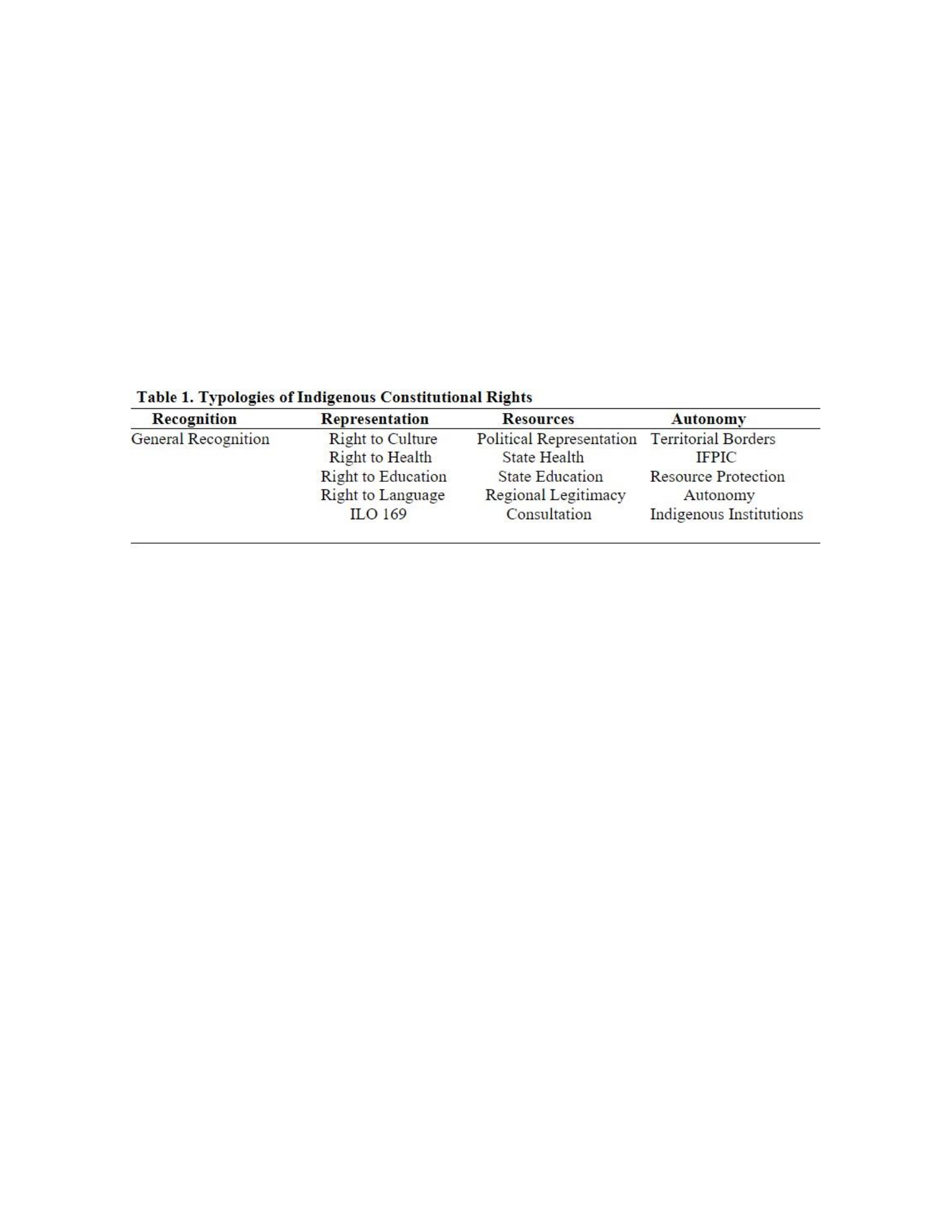
reallocation of political goods to original populations. Recognition is very minimal, and
representation facilitates equal access. Then, there are resource rights that serve indigenous
populations, but within the framework of existing political institutions. Last, the most drastic
reorientation of political access is autonomy rights. The implications of adopted rights provisions
must be considered when looking at regional trends of adoption. Typologies of indigenous
constitutional protection in Latin America are summarized on Table 1.
1. ILO 169 is a mention of the UN convention on human rights under the same name. Constitutions can note the convention,
but not create the institutions suggested in the convention itself.
2. State Education and State Health are funded by the government, as opposed to general rights to health and education. The
latter do not guarantee that the state will deliver these services.
3.Consultation is not as powerful as Consent, which is a requirement of IFPIC laws presented in constitutional rights that provide
Indigenous autonomy.
This chapter begins by reviewing current scholarship on the status of indigenous rights in
Latin America. Existing literature is situated among discussions of democratic norms, ethnic
mobilization, and relative capacity (Bromley 2014; Jung 2003; Kopstein and Reilly 2000;
Weyland 2006; Yashar 1998; Yashar 2007; Klug 2000; Doyle and Sambanis 2006; Fearon and
Laitin 2003; Gurr 1970). I then move to offer my own hypotheses which argue that the content of
indigenous constitutional provisions impacts the adoption process. Constitutional rights
renegotiate citizenship and access to state resources, but in different ways. Some only recognize
previously excluded ethnic minorities as legitimate political citizens. Others provide state
funding, resources, or even define autonomies for original populations. The degree to which the

political status quo is restructured during the adoption of these rights varies, dependent on the
content of the provision. Domestic factors identified in recent scholarship impact the likelihood
of rights adoption but depends on the stage of the adoption process.
Minority Rights: An Overview of the Literature Democracy
and Domestic Minority Rights
Democracy is long associated with the expansion of citizenship to previously excluded
minority populations (Jung 2003; Marshall 1950). The gradual expansion of suffrage and
citizenship rights from women, formerly enslaved Black citizens, and other minority groups has
been a global trend under democracy. The enfranchisement of previously excluded populations
increases democratic integrity and representation of the state’s citizens.
Latin American countries experienced its most recent and strongest democratic wave
during the late 1980’s. Turns toward democracy accelerated with the collapse of the Soviet Union
and its influence in the region, and leaders increasingly looked to Washington and its various
monetary organizations to fill the gap (Cignarella and Pasquarello 1985; Hafner-Burton et al.
2008; Hathaway 2007; Tsuitsui and Wotipka 2008). In addition to international factors, military
regimes and authoritarians slowly lost legitimacy in the region. Domestic pressures for change
and outcries against authoritarian human rights abuses also motivated a democratic shift in Latin
America (O'Donnell 1993; O’Donnell, Schmitter and Whitehead 2013; Whitehead 1992).
Shifts in indigenous constitutional representation largely occurred during this last wave
of democratization. Evidence from the literature argues that democratizing states are likely to
adopt and follow international norms and it is these norms that change domestic laws on the
ground (Bromley 2014; Jung 2003; Weyland 2006). For example, democratizing regimes will
adopt international human rights norms conventions to gain legitimacy in the international

community, appeal to Western democracies that they are economically dependent on, and to
appease international financial institutions. The likelihood that states adopt democratic norms
increases as neighbors adopt similar provisions. Neighborhood effects create norm cascades and
lead entire regions to adopt democratic norms and laws (Finnemore and Sikkink 1998; Keck and
Sikkink 99; Kopstein and Reilly 2000).
This perspective is consistent with the situation in Latin America during the late 80’s. The
regional shift toward democracy, and the following widespread economic crises, increased the
region’s reliance on the West and its financial institutions. The Latin American democratic turn
led to the adoption of international laws that represent previously neglected indigenous
populations. The United Nation’s (UN) International Labor Organization (ILO 169) is the
primary international treaty that guarantees Indigenous rights and recognition. After
democratization, the provision was adopted throughout the region since the late 1980’s. ILO 169
instituted the first international human rights standards for indigenous communities. The
convention prescribes that states adopt the convention to implement domestic laws that protect
their indigenous populations. Below is an excerpt from the international agreement on
indigenous nations:
Governments shall have the responsibility for developing, with the participation of the
peoples concerned, co-ordinated and systematic action to protect the rights of these peoples and
to guarantee respect for their integrity.
2. Such action shall include measures for:
(a) ensuring that members of these peoples benefit on an equal footing from the rights
and opportunities which national laws and regulations grant to other members of the population;

(b) promoting the full realisation of the social, economic and cultural rights of these
peoples with respect for their social and cultural identity, their customs and traditions and their
institutions;
(c) assisting the members of the peoples concerned to eliminate socio-economic gaps
that may exist between indigenous and other members of the national community, in a manner
compatible with their aspirations and ways of life. -Article 2, ILO 169, UN
The article above prescribes national governments to adopt domestic rights that provide
equal political representation for indigenous peoples vis-à-vis other citizens. It also includes the
protection of cultural identities, and the elimination of socio-economic gaps. The convention also
includes more aspirational rights, such as those discussed in the article below.
In applying the provisions of this Convention, governments shall:
(a) consult the peoples concerned, through appropriate procedures and in particular
through their representative institutions, whenever consideration is being given to legislative or
administrative measures which may affect them directly;
(b) establish means by which these peoples can freely participate, to at least the
same extent as other sectors of the population, at all levels of decision-making in elective
institutions and administrative and other bodies responsible for policies and programmes which
concern
them;
(c) establish means for the full development of these peoples' own institutions and
initiatives, and in appropriate cases provide the resources necessary for this purpose.-Article 6,
ILO 169, UN

Article 6 of ILO 169 asks that, with the adoption of the convention, governments
facilitate indigenous representation at all levels of national government. It also states that their
communities must be given input on policy that will impact them directly.
While IL0 169 offers a powerful framework, international adoption of indigenous
provisions has not translated to domestic protection. As of 2023, all but two countries (Panama
and Uruguay) adopted the UN’s international convention on indigenous rights. But ILO 169’s
provisions were not uniformly adopted into domestic constitutional law by its adoptees. Only
three countries in the region acknowledge the UN’s convention in their state constitution. These
states are Bolivia, Brazil, and Ecuador. Even so, they did not uniformly adopt the indigenous
protections mandated by ILO 169. In fact, each country has a varied outcome for indigenous
citizenship rights in their constitutional laws. Even in countries where most of the convention’s
norms are constitutionally embedded, they were not adopted all at once, nor did they occur as a
direct result of the ILO’s adoption. Therefore, while democratization facilitated the widespread
adoption of international rights norms for indigenous citizens, they have not predictably led to
indigenous rights adoption in Latin America.
Table 3 UN ILO 169 Adoption by Country Country Year of ILO 169 Adoption
Argentina 2000
Bolivia 1991
Brazil 2002
Chile
2008
Colombia
1991
Ecuador
1998
Guatemala
1996
Honduras
1995
Mexico
1990
Nicaragua
2010
Paraguay
1993
Peru
1994

Venezuela
2002
In sum, democratization facilitates the expansion of minority representation, and the
adherence to international norms for indigenous protection. But, while widespread adoption if the
UN’s ILO 169 occurred alongside democratization and strengthened relationships with the West,
international norms have not been translated into domestic protection for most communities in
the region. These explanations do not sufficiently explain the variance in domestic indigenous
protections in the national constitution, given the recent changes in democracy. International
norm adoption and democratic norms for ethnic minorities are widespread, but most have not
translated these protections into their domestic democratic law or have done so to varying degree.
While previous work has demonstrated that democracy leads to the adoption of international
provisions that are recommended to be put into national law, this work will directly measure how
democratic shifts impact domestic indigenous policy.
Indigenous Mobilization
Another line of scholarship argues that grass roots social movements force unresponsive
state governments to transform adopted international norms into domestic law (Kim 2013). Strong
social movements pressured state governments to adopt expansive child protection laws in France,
Japan, Pakistan, the UK, and the US in recent decades. Htun and Weldon (2012) similarly found
that social movements had an enduring impact on Violence Against Women (VAW) policy
implementation at the constitutional level. Finally, grass roots activism led to numerous “human
rights revolutions” and rights advancements for indigenous nations in Canada (Clement 2011).

Research in this area consists of multiple case studies that focus on the origins and relative
ability of social movements to gain concessions from the state (Jung 2003; Seider 2002;
Yashar 1998; Yashar 2007). Comparative studies stress the importance of social movements in
South Africa (Klug 2015), India (Hertel 2015), and the United States (Markoff 1996) in acquiring
constitutional changes that restructure access to political power and representation for excluded
minority populations. Grassroots social movements were key in achieving broad constitutional
reforms that guarantee health (Hertel 2015; Klug 2015), political participation (Becker 2011),
plurinationalism (Ruiz 2008), resource rights (Nelson 2015), and protection from discrimination
(Almeida and Cordero 2015; Htun and Weldon 2012; Markoff 1996) to previously unrepresented
groups.
Scholars also find evidence that indigenous communities are increasingly mobilizing to
correct grievances via constitutional representation. Indigenous social movements in Latin
America call for protection at the national level, often as a reaction to intrusive neoliberal
policies (Yashar 1998; Yashar 2007). Mobilization against these policies have opened the
discussion of ethnic politics in Ecuador (De la Cadena 2010), Panama (Fisher 2014), Mexico
(Jung 2003), Bolivia (Postero 2017), and Chile (Wolff 2020). In the Bolivian case in particular,
Becker (2011) finds that indigenous movements were necessary to create a constituent revolution
that forced the document to include Indigenous demands. Overall, qualitative work in the region
finds that indigenous mobilization emerged to contest for constitutional rights, with varying
strength in their mobilization efforts. Yashar (1998) shows that indigenous movements are more
likely to originate where there are pre-existing communication networks that support them. These
cases do well in establishing how and why Indigenous communities mobilize, but they do
not discuss the relative outcomes of these efforts.

Mobilization literature in the region contains a limited number of case studies that are not
examined under a wider comparative lens. Cases typically include those states where there has
been relative success in rights acquisition for the local original populations (e.g., Bolivia, Ecuador,
Guatemala, Mexico) (Yashar 1998; Yashar 2007). These country case studies describe the origin
of some movements and their relative success. But current work does not discuss the wider regional
patterns of indigenous mobilization and constitutional outcomes. The literature also does not
consider that indigenous mobilization is more successful during certain stages of the rights
adoption process and motivates only the adoption of some indigenous rights. Finally, we do not
know how social movements interact with other domestic political processes during the rights
adoption process.
Ethnic Conflict and Minority Rights
The ethnic conflict literature argues that where citizenship rights are defined along ethnic
lines, violent conflicts are likely to occur. This is especially true where one ethnic group is highly
deprived of political and economic resources (Doyle and Sambanis 2006; Fearon and Laitin 2003;
Gurr 1970). Politically excluded populations that are ethnically, culturally, and territorially distinct
are considered especially dangerous to those who have a monopoly on state political resources.
Excluded indigenous populations are both physically excluded from state power, as they are
concentrated in rural regions of Latin America, and they are politically distant from the state where
they have no legal representation at the national level. Linguistic, cultural, or religious distance
between indigenous and non-indigenous citizens distinguish access to political representation.
These divides, paired with a history of coercive repression by state powers against native
populations predict conflict between state and non-state represented populations throughout the
region (McEvoy and O’Leary 2013). But the ability for conflict literature to explain indigenous

rights outcomes in the Latin American context is weak. Despite similar grievances, escalated
violence is largely absent from indigenous groups and does not predict the adoption of indigenous
rights that renegotiate the political status quo.
According to this vein of literature, political, cultural, and physical divides drive ethnic
conflict against state entities with a monopoly on political resources. Since the colonial period,
ethnicity has defined access to political resources and representation. Indigenous peoples
throughout the region were further dispossessed during the state building process, and new
polities served only the interest of the ruling European elites in newly formed Latin American
states (Satvenhagen 1992). National laws constructed during independence left indigenous
communities as non-citizens, with no right to political participation at the national level. This
exclusion from national law continued until only recently.
Indigenous communities were not only excluded politically from state governments, but
economically as well. Many indigenous citizens were considered custodians of the state under the
laws of newly independent states. This meant they had no right to own property or assets, and state
entities took charge of the political interests of indigenous populations. Though some laws have
changed in the region in the past decades, economic divisions remain. In 2020, the UN found that
45.5% of indigenous people in Latin America are living on less than $5.50 a day in purchasing
power parity prices (GDP/PPP) and 7.1% are living on less than $1.90 a day. Most indigenous
populations still live under extreme poverty in the Latin American region. These percentages are
double those of non-indigenous citizens, on average (Davis-Castro 2020).
This framework posits that ethnically defined political and economic disadvantages
incentivize marginalized groups to violently contest against the state apparatus (Fearon and
Laitin 2003; Gurr 1993). Indigenous grievances with current status quo are thought to drive

mobilization and violent action. Marginalized communities mobilize to renegotiate the
unfavorable state structure that leaves their interests unprotected. State actors will respond to
demands according to their own capacity to maintain a grip on current political arrangements.
Additional conditions that make marginalized ethnic groups more likely to engage in violence
against the state include a large, non-fractionalized population (Fearon 2003; Horowitz 1985),
resource rich land to sustain rebellion efforts (Collier and Hoeffler 2000), regional population
concentration (Weidmann 2009), and economic inequality (Gurr 1970). Of these factors,
fractionalization among ethnic groups in the region varies, but most native communities live in
resource rich regions that are much more likely to be poor and underdeveloped. While these
theories have proven useful in the context of Africa and the Middle East, the same levels of
conflict are not observed between indigenous and state entities in the Latin American region.
Some minor conflict between indigenous peoples and state actors is evident, particularly
in the last 30 years as constitutional rights have been expanded. In Bolivia, wealthy white
citizens mobilized to oppose the presidency of Evo Morales, who ran on a campaign of
correcting issues of inequality and is himself of indigenous ethnicity. In Colombia, recent
indigenous uprisings resulted in violent backlash. Five community leaders were killed, along
with more than 700 community organizers murdered between 2016 and 2019 (Tharoor 2019). In
1993, Peru’s constitution changed to affirm its plurinational foundations in recognition of its
indigenous foundation. But this same amendment process revoked the inalienability of original
nations’ lands and reasserted state control over resource ownership (Constitución de Peru de
1994). Although state entities made some efforts to recognize ancestral territories in its 2005
iteration of the constitution, it consistently refused indigenous control of original lands, and
encroaches upon fishing industries in the region (Stocks 2005). In sum, some states adopt

indigenous provisions into constitutional law to appease mobilized groups. But largely, violence
in the region is disproportionally initiated by state entities, not by aggrieved indigenous
populations.
Recent indigenous mobilization is motivated by political and economic grievances that
extend from the colonial era into modern times. But ethnic conflict theories fail to explain the
absence of violent conflict between state and indigenous groups in recent years, given strong
political, economic, and territorial divides. Latin America’s indigenous populations live under
conditions that are highly conducive for violent political conflict proposed by this line of
literature. But large-scale indigenous revolt against state entities is absent in the region.
Indigenous populations, which are politically, economically, and territorially marginalized in
Latin America, fit theoretical descriptions that predict political violence. But in many cases,
domestic rights evolved to include these populations to dampen possible violent conflict. As it
stands, current literature fails to account for why ethnic violence in Latin America remains
relatively low compared to other regions, and how constitutional law can negotiate peace among
aggrieved populations.
Conclusions from the Literature
The scholarship identifies democracy, ethnic mobilization, and the relative capacity of
native populations to extract political resources as important for indigenous representation in
constitutional law. But the scholarship does not consider first that the degree of indigenous
protections in constitutional law vary. Constitutional amendments that protect native populations
in Latin America vary in scope and political implications. Democratic theory posits that
democratization leads to the expansion of citizenship, the adoption of laws that protect human
rights and minority populations, and adherence to international norms of political behavior.

Widespread democratization and norm adoption occurred in Latin America in the 1980’s, but
domestic indigenous rights are much more varied in the region’s adopted constitutional provisions
over the last half century. As it stands, it is unclear how democracy impacts the adoption of
domestic protection for indigenous populations in the constitution. Social movements are also
identified as important in the adoption of more indigenous protection in domestic contexts. But
again, these theories do not explain wider patterns of successful indigenous mobilization while
considering the rights that are adopted into national constitutions. When are indigenous movements
most successful in negotiating the adoption, and what do these rights look like? These questions
are left unanswered in recent work. Finally, conflict literature describes the motivations of state
and non-state entities in the negotiation of increased minority representation. But these theories do
not account for the lack of violence between indigenous groups and the state and the constitutional
negotiations that its place.
The following sections seek to fill in these gaps, and account for the domestic impacts of
key variables on the adoption of indigenous constitutional protections. I argue that the content of
indigenous provisions adopted into Latin American constitutions influences the adoption process.
First, I discuss the uniform political marginalization of indigenous populations in the region of
Latin America. The region’s original nations were subjected to historical violence, suppression,
and non-citizenship at the hands of colonizing forces. From uniform noncitizenship, indigenous
populations have been recognized by state entities in Latin America to varying degrees through
constitutional negotiations. I briefly define four different types of indigenous rights: recognition,
representation, resources, and autonomy. These rights have different political implications once
adopted into the constitution. Democracy, indigenous mobilization, and state capacity and
motivations impact the likelihood of rights adoption. But their importance varies based on the

current stage of the rights adoption process. This temporal component of rights adoption for
indigenous populations is also theoretically absent in current work.
Theories of Constitutional Rights Variation for Indigenous Peoples in Latin America
To understand the modern political status and struggle of indigenous peoples in Latin
America, we must first understand how the region’s institutional structures originated. The
following discussion provides a historical background of the indigenous political representation
in the Latin American region, stressing the importance of colonial legacies and the
marginalization of indigenous peoples. Colonial legacies and structural inequalities persist in
states throughout the region.
Legacies of Exclusion: Indigenous Non-Citizenship Under Colonization
Latin America was under Spanish and Portuguese colonial occupation from the 1500s,
with colonies gaining independence at various points early in the 19th century. European colonial
forces were not initially aware how many indigenous nations lived on the continent, but upon
their arrival, colonizers seized land for resource extraction. Under the justification of terra
nullius, or ‘no man’s land’, the continent was declared uninhabited despite the presence of
hundreds of advanced indigenous civilizations. The European settler populations were the
minority amongst thriving native communities. It is estimated that at the time of first European
contact, over 57 million indigenous peoples lived in the region, eclipsing the number of settler
populations (UN ECLAC).
Despite their numerical disadvantage vis-à-vis massive native populations, settlers were
backed by the military might of the Spanish and Portuguese crown. The support of the monarchy
allowed regional colonial elites to expropriate wealth and resources from the land. In response the

Indigenous threat that stood in the way of this venture, colonial powers pursued the extermination
of the countless indigenous nations. Campaigns of genocide against native populations took place
throughout the entire Latin American region during colonial occupation. Genocide, war, forced
labor, and disease are estimated to have caused the total indigenous population to fall by 80%
within only the first 50 years of contact with Europeans (Satvenhagen 1992). Remaining
indigenous populations were employed as a cheap labor force that were forced to mine for
resources alongside millions of enslaved Africans.
The economic structure established in settler colonies was organized to rely on high labor
populations, and indigenous peoples were restricted politically and considered non-citizens in the
polity (Acemoglu, Johnson, and Robinson 2001; Gott 2007; Irigoin 2016). The wealth found in
Latin America under the hyper extractivist system was astronomical. Many colonies enjoyed per
capita incomes that were on par or greater than the wealth of Western Europe (Coatsworth 2005).
Most extracted resource wealth was sent back to Europe as private treasure and wealth owned by
European elites (Irigoin 2016). To optimize resource extraction, colonizers set up monarchical,
absolutist states that concentrated rights in the hands of the Crown and its regime. The power of
political elites in these colonies had few restraints and allowed the effective control over
indigenous populations and lands. The elite class secured a high European standard of living, while
the original populations had no political rights, and were subjected to slavery and poverty (Gott
2007).
In broad strokes, colonial settlers established political institutions that purposefully excluded
native populations from the political process. This exclusion permeated all levels of the state.
Settler colonies ensured that the original nations lacked political representation and access to legal
mechanisms such as property rights, or the right to a decent standard of living. Furthermore,

institutions from Spain and Portugal were based on laws compiled from royal cedulas, rigid law
codes decreed directly by the Crown (Lynch 1992). Legal institutions in the colonies adhered to
these strict law codes and archives that only served to grant the European class protections and
shied away from creating new protections for its indigenous citizens after they were established.
State Building Post-Independence
During independence and subsequent state building process, however, indigenous
populations remained excluded. Elite populations that benefited from colonial inequalities
strengthened them in newly forming nations. In fact, some regional European elites vehemently
protested the crown’s past requests to ‘whiten’, or racially mix with the remaining indigenous
populations. These policies were aimed at long term assimilation of indigenous populations into
broader society. In Brazil, these would have required white men to marry indigenous females to
slowly mix their bloodlines. White settlers in Venezuela also rejected proposals to integrate its
indigenous populations. Progressive programs were sent from Madrid that aimed to improve the
living conditions of its indigenous populations. But they were unanimously rejected by
Venezuelan political elites and indigenous populations remained politically excluded (Gott 2007).
Independence came to Latin American colonies early in the 19th century amid European
political chaos. In 1810, the Spanish crown’s power was severely limited under the conditions of
the Napoleonic invasion. At the same time, a new constitution, the Cardiz constitution, relaxed
imperial control to protect the colonies from chaos at home. In short, this constitution further
concentrated political power into the hands of the ruling elite class in Latin American colonies
(Kurzman 1998). When King Ferdinand VII of Spain regained control of the country and pushed
to reinstitute his absolutist control over the colonies, local authorities decided that they preferred
their new-found independence. They took advantage of the weakened monarchy and captured

control the region. Soon after, regional political elites adopted more legal mechanisms that
monopolized their control over resource wealth (Acemoglu, Johnson, and Robinson 2001).
Between 1808 and 1830, a total of fifteen future nations in Latin America drafted 46
constitutions (Irirgoin 2016). The final versions of these documents continued the legacy of
indigenous political exclusion and further entrenched colonial institutions. Indigenous populations
were not recognized as citizens in constitutional documents until the 1930’s onward. The rulers of
these previous colonial empires formed legal frameworks that concentrated state citizenship and
political power along ethnic lines. Additionally, new state constitutions were modelled off the US
constitution, which favored private, individual rights instead of the collective laws favored by
Latin America’s original populations. Restriction of indigenous political rights ensured that the
status quo would persist and the balance of power between groups would remain intact.
By 1825, Latin American states adopted a republican form of government with millions of
unrecognized indigenous peoples. State formation would precede the establishment of democratic
civil societies in Latin America. This means that pre-existing powerful political elites formed the
state and its legal structures in a way that would benefit European-descended populations. Many
regional leaders believed that indigenous peoples would hold back the development of Latin
American nations, leaving them unable to join the other ‘civilized’ nations of the world (Irigoin
2016; Petruccelli 2015). The consolidation of new nation states in Latin America further
entrenched the dispossession of indigenous peoples in political institutions.
During state building, Latin American elites used the American constitution as a model,
and indigenous social, religious, and political institutions were excluded from the laws of national
governance (Satvenhagen 1992). Political exclusion of the original populations was an attempt to
solve this “problema indigena”, or the states’ obstacle to development and wealth. This

dissertation’s work finds that the terms indigena or nativo cannot be found in any constitution in
the region until 1933. These communities were effectively legally absent from state national laws
and identities until this point. Today, the status of indigenous constitutional citizenship varies
across the region. Some states adopted extensive rights that recognize indigenous autonomies,
while others offer little or no legal protection. But political elites remain heirs to restrictive
colonial institutional legacies that have only recently begun to change.
In sum, colonization of the continent under Spanish and Portuguese forces destroyed and
enslaved countless indigenous peoples. Colonial laws excluded the original nations from political
citizenship, representation, the right to own property, and to make their own legal decisions. This
exclusion continued into the state-building era, when constitutional documents modeled after the
American laws favored private rights and did not recognize communal rights and properties.
Native populations were effectively excluded as national citizens. Since the colonial era, policies
of indigenous exclusion have had long lasting effects. Across the colonial and post-colonial period
in the region, there is exclusion and denial of rights. Some Latin American countries did experience
democratic periods in the early 20th century, such as Brazil and Colombia, and although those
episodes were short-lived, indigenous inclusion did not occur. Political exclusion of these
populations remained in stasis, and indigenous peoples have only recently been recognized as
political citizens in Latin American states.
Constitutional Negotiations as Conflict Avoidance
Beginning in the 1970’s, Latin American indigenous communities and their allies
accelerated campaigns for political recognition and constitutional rights that protect their
communities (Fisher 2014; Jung 2003; O’Faircheallaigh 2012; Sieder 2002; Yashar 1998;

Yashar 2007). The demands of indigenous peoples in the region were broad and far reaching.
Demands included constitutional rights to self-determination, nondiscrimination, bilingual
education, cultural protection, and control over project developments in ancestral territories.
Indigenous populations were in a unique position, since some demanded greater inclusion in the
state political process, but others sought native autonomy from the state apparatus.
Constitutions themselves serve many crucial functions, especially for threatened
communities such as the indigenous nations of Latin America, but the role of constitutional
negotiations to prevent conflict with marginalized ethnic populations is understudied. While
conflict scholars note that ethnically defined access to political resources is a recipe for conflict,
inclusionary power structures can help to avoid it. Specifically, where state actors promote
minority rights and constitutional provisions to appease a dissatisfied ethnic group (Wimmer
2012).
A constitution negotiates more inclusive political power structures in important ways.
First, a constitution is a credible commitment device on behalf of the state to its citizens. Laws
outlined in this document provide a legal framework for indigenous communities to protect their
cultures, identities, and well-being. Historical indigenous exclusion in state power structures also
motivate native peoples to push for the incorporation of special laws that will preserve their way
of life (McEvoy and O’Leary 2013). These laws are used by communities to protect their land
from state and private encroachment. A constitution can also define sets of goals or aspirations
the state wishes to achieve. In some cases, constitutional protections delineate specific criteria
and decision-making procedures aimed to accomplish future goals. Simply, a constitution is an
effective communication device between the state and its citizens about resource and power
distributions.

Constitutional scholars have argued that peace may be negotiated between state actors and
unsatisfied ethnic groups through different strategies. Horowitz (1985; 1993) argues that
integration of minority populations through electoral incentives and representation will erode
divisions between groups over time. Lijphart (1991) disagrees and instead argues that each ethnic
group has veto power over executive decision making to best protect their interests. The central
debate over constitutions as negotiation devices is in their relative ability to foster long lasting
peace between groups. It is the consensus that constitutions that adopt minority rights based on
different status are most dangerous and divisive (Kuperman 2015; Horowitz 1985; 1993).
Constitutional laws that reinforce ethnic divides and foster separate national identities requires the
central state to share power with multiple nations and are the most difficult to implement.
Latin American constitutions vary in their inclusion of equal recognition and rights that
support separate ethnic identities at the national level. Some countries continue to exclude
indigenous populations from national constitutional representation. Others provide rights that are
non-controversial, and non-divisive. There are also a few countries in the region that adopt
nationally divisive rights that elevate indigenous populations based on their ethnic status or
identify autonomous groups and territories. Overall, the strategies embraced by states in the region
vary. Some have negotiated indigenous constitutional protections that are much more far reaching.
Importantly, the inclusion of legal protections, in any form, allows marginalized
communities access to legitimate political participation. For example, the South African
apartheid state provides evidence that initial political recognition in state constitutions
legitimizes the political claims of ethnic minorities in the future. Access to constitutional
recognition was key in the future adoption of territorial claims for endangered communities in

this case (Klug 2015). Legal citizenship, at a minimum, provides political resources and
legitimate avenues to pursue justiciable rights in the future.
Original nations in Latin America have employed similar legal strategies. In the case of
Brazil, indigenous peoples were first recognized by the state in 1988 and a marco temporal,
(temporal mark) that defines the current terms of constitutional citizenship. The law recognizes
indigenous settlements that were occupied by populations as of October 5th, 1988, the year of
indigenous constitutional recognition. The Articulação dos Povos Indígenas do Brasil (Brazilian
Indigenous peoples Association) is currently petitioning for more representative land rights, with
the slogan “Nossa História Não Começa em 88” (Our History Didn’t Begin in ’88). Three cases
were brought to the Supreme Court to that challenge the temporal thesis of Brazil’s current
constitutional law. These cases have not yet resulted in the change of the marco temporal in
Brazil’s constitution, but the Brazilian state has publicly acknowledged that the rights of
indigenous peoples are original and did not begin in 1988 and need to be re-examined (Brazao, et
al. 2021).
Legal advisors are employed to leverage existing constitutional provisions and expand
them to better protect native peoples, and debates over the content of these texts persist. Where
vulnerable communities have legal rights that protect their interest, legal cases are effectively
brought to court and indigenous legal claims are legitimized. Ecuador and Colombia saw an
increase in indigenous lawsuits opened against the state and private companies alike to protect
such constitutional rights. Constitutional law is used by communities to protect against oil
extraction in Ecuador, and highway construction in Colombia, which endangered the survival of
indigenous populations in these regions (ELLA).

To summarize, constitutions serve important functions. I argue that these documents are
important communication devices that define access to citizenship and political resources. But
these adoptions are more than symbolic. They represent negotiations between previously
marginalized groups and state entities. When new constitutional rules are renegotiated, there is a
shift in access to political resources and the relative political representation of the state’s
populations. Native peoples in Latin America were historically considered non-political citizens,
and the inclusion of these peoples in national law is a new and ongoing phenomenon. State actors
in the region can choose to continue to exclude minority populations from national law or
recognize them in any number of ways. Broadly, rights frameworks can either ignore, seek to
integrate, or establish different national populations in constitutional law. Indigenous aspirations
have included both rights that create equal political citizenship and access vis a vis nonindigenous
citizens. But they also pursue some rights that serve their political identities and practices. This
chapter now moves to discuss the factors that drive the adoption of indigenous rights, as advised
from recent scholarship in the field. Importantly, the degree to which constitutions renegotiate
access to political citizenship and resource is key in the adoption process. Constitutional
provisional content interacts with domestic factors on the ground and impacts the likelihood of
the adoption of indigenous rights in the national constitution.
Indigenous Constitutional Outcomes: A Theoretical Framework
Thus far, I have established that the region’s first state constitutions were rooted in
colonizing precepts. Indigenous peoples and civilizations were reduced to dependent, politically
marginalized minority groups. Citizenship and access to political power was strictly defined along
ethnic lines and historically favored non-indigenous citizens of European descent. Since the
colonial era, some Latin American states have continued this political exclusion, while others have

renegotiated arrangements with its Indigenous peoples. Since political power remains concentrated
in the hands of non-indigenous state actors, I expect these actors to be reluctant to renegotiate
political power in favor of ‘ethnic others’. Governments must be sufficiently motivated to
renegotiate the current terms of political resources in the constitution. Amendments and overhauls
represent new cultural compromises and reorganize the political interaction of Indigenous and non-
Indigenous citizens.
While various scholarly perspectives identify key variables that impact indigenous
political representation, they ignore that compromises between state and indigenous actors
manifest in state constitutions in several ways. Rights are not expected to be equal in their access
to, or redistribution of, political power and resources. The way in which minority protections are
codified into constitutional law will have implications for the likelihood of adoption by state actors.
Additionally, theories of ethnic conflict inform us that rights that create more divisive identities
are dangerous to political stability in the long run. However, states may implement rights that
promote both integrative and divisive rights into domestic law.
Broadly, I argue that some rights provide indigenous peoples with more resources than
others while creating either ethnically divisive or inclusive arrangements. Simply, some
constitutional adoptions promote rights that create equally defined access for underrepresented
indigenous populations. Others are considered more divisive and define political access along
lines of ethnic difference. Domestic factors impact the likelihood of their adoption, but their
importance varies according to the current state of rights adoption for indigenous populations in
the country. Below, I briefly discuss the categorization of indigenous rights that are present in
national law in Latin America.

Indigenous Rights in Constitutional Law: An Overview of Agreements and Implications
Indigenous constitutional rights in Latin America have been evolving since 1933, when the
Peru first recognized its original nations as political citizens. From this point, adoptions spread
across the regions that included indigenous representation in constitutional law. But not all
countries adopt the same provisions. The substantive content of indigenous constitutional
protection varies between country cases in the region. Some rights are symbolic in nature or offer
terms of equal democratic citizenship. Others create special terms of indigenous representation,
access to funding, and presence in existing state institutions. Finally, there are those rights that
define the existence of multiple sovereign nations and mechanize indigenous autonomies and self-
governance. A brief discussion of these categories follows, and a full discussion of indigenous
rights variation in Latin America is the topic of Chapter 2.
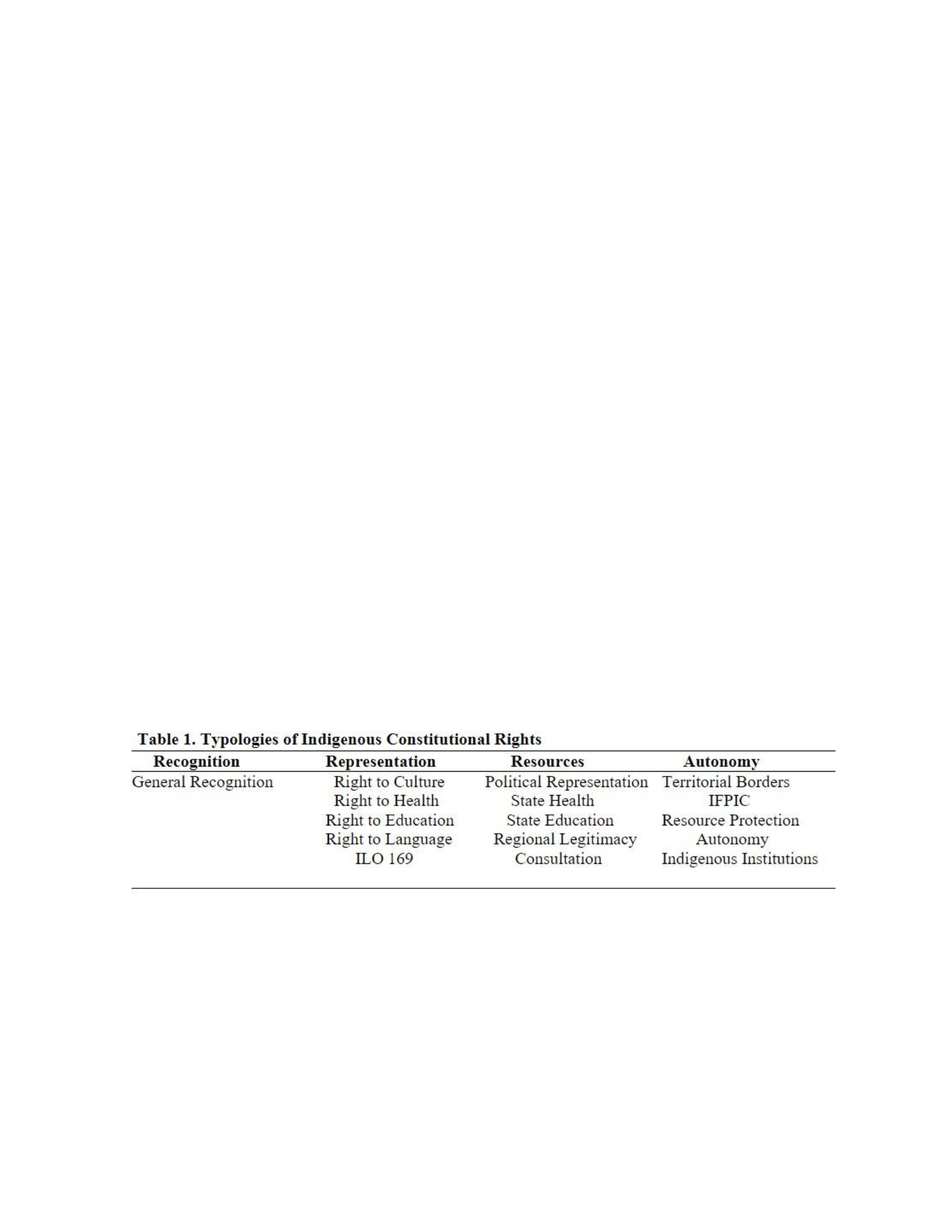
First, rights that offer recognition are the least disruptive to the current political status quo.
These rights recognize indigenous peoples as legitimate political participants. This is the minimum
recognition afforded to native populations in the region. The second category of adopted
indigenous provisions are categorized as representation. These rights are more tangible than the
former category. They define the protection of indigenous culture, language, education, and way
of life. Minority rights are enshrined under state sponsored institutions and integrate them into the
current state apparatus. The next category of rights discusses the allocation of state resources and
corrects disadvantages based on ethnicity or other minority status. State compliance can be
measured through government funding and representation, making these more finite commitments.
These rights are often framed as elevating native status vis a vis other national citizens. Simply,
state resources are allocated to correct past inequalities that are based on ethnic discrimination of
original populations. The mobilization of state resources for specific minority grievances is
considered divisive to a unitary national identity as they “elevate the indigenous few” (Stocks
2005). Finally, the last category of indigenous constitutional rights is defined as autonomy. These
rights are highly mechanized rights and create new political institutions. For example, autonomy
rights ensure native populations regional self-governance, territorial delineation, and the right to
prior consent of impactful resource projects. Such institutions could prove dangerous for unitary
national cohesion in the future, according to their critics. Simply, recognition represents the
minimum threshold of indigenous political recognition at the national level. From this point, rights
can evolve in several different ways. Some states employ representation rights in the constitutions,
and protect indigenous cultures, languages, and way of life. Others may go on to adopt laws that
use state resources to correct inequalities based on indigenous status. Finally, autonomy rights
define indigenous national borders, create new representative institutions, and allow for
community input into resource projects led by the state or private enterprises. Table 1 summarizes
indigenous rights categories adopted into Latin American constitutional law over the past half
century. Chapter 2 discusses the distribution and implications of these categories in detail.
1. ILO 169 is a mention of the UN convention on human rights under the same name. Constitutions can note the convention,
but not create the institutions suggested in the convention itself.
2. State Education and State Health are funded by the government, as opposed to general rights to health and education. The
latter do not guarantee that the state will deliver these services.
3.Consultation is not as powerful as Consent, which is a requirement of IFPIC laws presented in constitutional rights that provide
Indigenous autonomy.
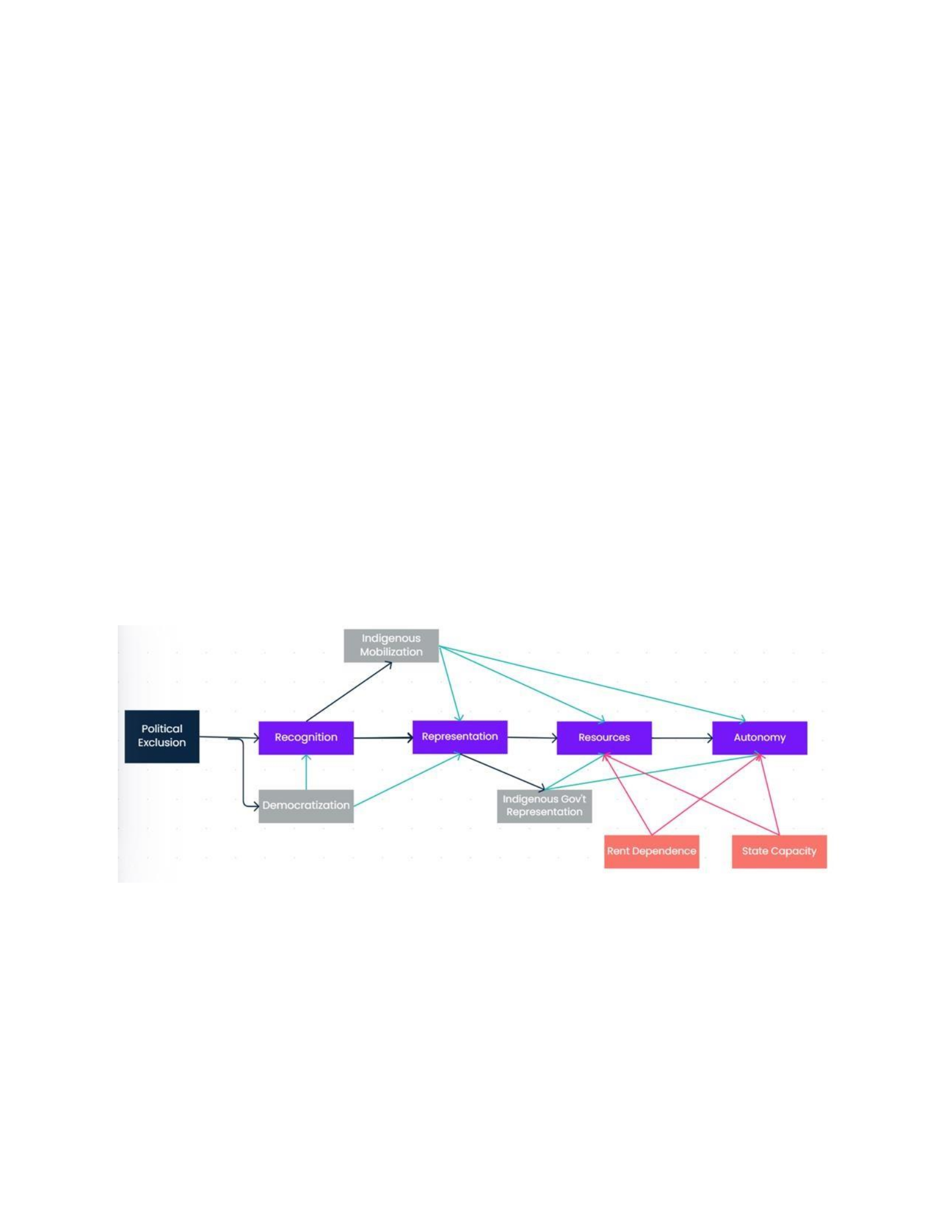
Theory and Hypotheses of Indigenous Rights Adoption in Latin American Constitutions
Not all indigenous constitutional provisions are created equal. Some simply legitimized
their populations as recognized political citizens, which vaguely define the legal right of
indigenous populations to be represented in national government. Others provide the opportunity
for equal rights vis a vis non-indigenous citizens. Still, there are more constitutional protections
for indigenous peoples that allocate state resources, proportional representation, or even
indigenous self-governmental autonomies. Depending on the content of indigenous constitutional
provisions, domestic factors motivate or work against the likelihood of their adoption. Below is a
summary chart of domestic impacts on rights acquisition, followed by a discussion before moving
to offer this work’s hypotheses.
Figure I: Theory of Indigenous Rights Adoption in Latin America
This work argues that from uniform political exclusion in national constitutional law,
citizenship expands incrementally to indigenous populations. I assume that indigenous
populations in Latin America start from a point of uniform political exclusion in newly established
free states in constitutional law post colonization. Since this point, countries adopted different

provisions in their constitutions that protect indigenous interests. But laws vary in content, scope,
and political implications. This section will first outline the rights adoption process that Latin
American countries experience and highlight the factors that impact rights adoption.
Positive Predictors of Indigenous Rights Adoption
Democratization
The Latin American region went through many regime transitions post-independence, the
last of which occurred in the mid 70’s and 80’s (Cardoso and Helwege 1992; Huntington 1991).
Regional spikes in democracy coincided with a wave of new constitutions that included indigenous
constitutional protection. Democracy was solidified as the dominantly legitimate political regime
type after the Cold War, and Latin American states embraced democratic rhetoric promising the
expansion of citizenship, free and fair elections, and the adherence to international human rights
norms (Jung 2003). I expect that from uniform the point of political exclusion, democratization
encourages state entities to extend citizenship to formerly excluded groups.
But democratizing regimes are expected to embrace only democratic ideals of expanded
citizenship. Democracy creates the conditions for indigenous communities to gain political
recognition and representation under democratic institutions. States that wish to show goodwill,
and appeal toward an international audience will also choose to establish original populations as
legitimate political participants in newly democratic regimes (Weyland 2006). But some
indigenous aspirations and rights are considered incompatible with ideals of modern democratic
citizenship. Original terms of national citizenship in Latin America were framed on the US’s
constitutional model. These documents stressed citizenship under ideals of liberty and equality
for the individual citizen, under one unified national identity. Constitutional rights are meant to

create equal citizens with equal access to state resources under this framework. This model is
embraced in the interest of a growing solidified national identity. Rights that prioritize capitalist
private property laws are created in this image (Marshall 1950).
Non-indigenous citizens may consider some indigenous protections as an effort to
“elevate the indigenous few”, and any form of collective representation presents itself as divisive
to a national identity (Ferguson 2016; Yashar 1998). Democracy promotes rights of equal political
access, but when it comes to correcting ethnic imbalances, or establishing separate national
identities, increases in democracy do not encourage the adoption of rights. Resource and autonomy
rights are considered nationally divisive and define special access to political resources for
formerly excluded indigenous groups. Specifically, indigenous traditional laws rely on notions of
communal land and resource ownership, collective decision making, and communal rule of law.
These laws are difficult to adopt where state institutions are constructed to protect private property
rights of the individual, as well as those of private business investment (O’faircheallaigh 2012;
Ferguson 2016; Stocks 2005).
Simply, democratization promotes equal access to political representation and establishes
the first legitimate access to constitutional representation for the original nations in Latin America.
Indigenous recognition and representation are compatible with democracy, and stress that
indigenous populations be legitimized as political actors and are owed similar societal protections
as non-indigenous state populations. But when laws allocate resources and autonomies based on
racial classifications, democratic ideals do not promote rights adoption.
H1: Democracy will have a positive impact on rights adoption for those rights that are compatible
with democratic recognition and representation in national constitutions.

Indigenous Mobilization
Once the state adopts indigenous political recognition into law through democratization,
indigenous political claims are legitimized, and their mobilization is legalized. After the adoption
of indigenous political recognition in the constitution, communities mobilize to pressure the state
for more political access and resources. After indigenous communities are defined as political
actors in national law, they have the right to petition the government for resources, and increasingly
mobilize to do so under a less repressive regime.
Indigenous mobilization first coalesces on rights that establish equal political access, or
recognition rights that are compatible with modern democratic values. These rights establish the
indigenous right to culture, education, health, and political representation. Indigenous movements
rely on state law to motivate state entities to recognize their demands.
After indigenous groups obtain constitutional rights that promote equal access, movements
focus on the negotiation of rights that correct past inequalities, such as economic marginalization.
Mobilization literature argues that grass roots movements are needed to pressure unresponsive
states to adopt international agreements into law (Jung 2003; Seider 2002; Klug 2015). Strong
movements in Bolivia, Ecuador, and Mexico were successful in negotiation of some provisions
from the UN’s ILO 169 convention on indigenous rights (Almeida and Cordero 2015; Fisher 2014;
Webber 2007; Yashar 1998). These rights, which include land and resource protection for
indigenous communities, were previously neglected by these governments despite
their adoption of the international convention.

Many indigenous movements focus on the acquisition of rights that define political
protection beyond the recognition of indigenous peoples as national citizens. Instead, indigenous
movements have claims to the sovereignty and regional autonomy of their nations. Strong
mobilization can pressure governments to adopt autonomy rights for their native populations.
Autonomy rights include the demarcation of indigenous territories, the recognition of the state as
plurinational, or input in extractive projects in their land. For example, a major focus of
indigenous mobilization is to acquire Indigenous Free Prior Informed Consent (IFPIC) on
projects that involve their ancestral territory (O’faircheallaigh 2012; Fontana and Grugel 2016).
FPIC requires the government to consult with original populations before undertaking large
development projects or legal reforms that involve their ancestral territory, with the option to
withhold their authorization for such projects (ELI 2004; United Nations Department of
Economics and Social Affairs ENDESA 2004). The Guarani of Bolivia have defined multiple self-
governed indigenous territories through constitutional reforms adopted in 2009 (Constitution of
Bolivia 2009, Art. 353). These communities now hold land titles to over 800,000 hectares of land.
The titles give communities the power to negotiate with oil and gas companies that historically
extract resources from these regions (Postero 2017). Similarly, native mobilization is associated
with the establishment of FPIC in Panama, which allowed these populations to suspend projects
that threatened their land (Almeida and Cordero 2015; ELLA).
Overall, after indigenous political participation is legitimized in state constitutions,
indigenous mobilization motivates the adoption of more constitutional representation for these
groups. Strong mobilization is expected to positively motivate state entities to adopt all future
categories of indigenous rights, which include representation, resources, and ultimately
autonomy.

H2: Indigenous mobilization is positively associated with indigenous rights expansion in state
constitutions after initial recognition.
Indigenous Political Representation
After indigenous populations are recognized as political participants in the constitution,
along with constitutional political representation, indigenous political parties and leadership in
national government can be established. The presence of indigenous representation in the
national government increases the salience of the existing political grievances of native
communities. Increased national representation of indigenous populations means that the
government is more likely to hear of indigenous issue topics that would otherwise not be brought
to the floor.
According to this logic, once indigenous recognition laws in the constitution promote
their representation in state governments, increased representation motivates the adoption of
future provisions. The most famous case of indigenous national representation is the presidency
of Evo Morales, an indigenous citizen of Bolivia who was recently removed after 14 years of
presidency in 2019. Although he did not fulfill all his promises, Morales ran on a campaign of
constitutionalizing the interests of the country’s indigenous populations.
I similarly expect that indigenous political representation in national government motivates
the adoption of rights that correct past inequalities. Representation increases the salience of issues
that are unique to the original nations, such as legacies of poverty, land theft, and non-recognition
of their communal legal practices. The representation of these issue topics in national branches of

government increases the likelihood that rights provisions that outline indigenous access to
political resources, and autonomy are adopted into constitutional law.
H3: Indigenous representation in national government (legislative, executive, judicial) increases
the likelihood of the adoption of indigenous resource and autonomy rights in the constitution.
Negative Predictors of Rights Adoption
Resource Rent Dependence
Where there is significant indigenous mobilization around constitutional protections that
lay claims to land and resources, there is a risk of severe backlash against their claims. States with
a high dependence on resource rents from extractive economic policies will resist the adoption of
rights that give indigenous populations legal claims to their land and its resources. These types of
constitutional rights are found in the resource and autonomy categories of
indigenous rights.
Supporters of extractive neoliberal policies argue that state land and natural resources
belong to all state citizens. Thus, export-oriented growth is the most effective way to redistribute
wealth to all citizens and develop rural areas. Repealing these neo-liberal policies is highly opposed
by numerous regional elites, who see them as necessary for a strong state economy (Postero 2017).
Recently, there has been a resurgence of neoliberal pursuits despite native appeals for protection.
In Peru, for example, mineral exports increased from 1,477 million to
4,554 million from 1990 to 2003 (De la Cadena 2010), demonstrating the state’s motivation to
pursue state led development projects in the territories of original nations.
Rent dependent state entities also argue that indigenous organizations have “excessive”
expectations and do not collaborate with existing state structures (Fontana and Grugel 2016). Equal

rights and access are stressed in these cases. Politicians take the position that some indigenous
rights are, “too much for too few” when it comes to land rights and regional autonomies. For
example, Colombia is home to around 500,000 indigenous peoples, constituting 2% of the nation's
population. These communities inhabit and lay claim to roughly 27% of the land (Stocks 2005). In
Peru, on the other hand, Aymara make up 47% of the nation, and occupy 50% of the national land
(Cott 2002). The argument against the expansion of land rights in Colombia is that they give the
original nations disproportionate access to state resources. In Peru, where natives make up a larger
portion of the population, this argument is not as easily made.
But globalization has accelerated resource extraction in recent years and rights that protect lands
and resources of the original nations are a point of contention.
In sum, rent dependent states do not find issue in adopting rights that recognize
indigenous citizens on equal political terms. But when it comes to the adoption of defined
resources and autonomy, rent dependent states will work against the adoption of these rights.
H4: Resource rent dependence as a proportion of the nation’s economy negatively impacts
the adoption of indigenous resources and autonomy in the constitution.
State Capacity
State capacity represents the government’s ability to not only exert physical monopoly on
violence in its territorial borders, but also the ability to extract wealth and taxes from all its citizens.
The higher the state capacity, the more effective the government control over its territory.
Furthermore, they exercise extractive control over the state’s resources and citizens.
Like rent dependence, a high state capacity does not block indigenous representation in
the constitution that defines access to equal political rights (recognition and representation). But

when indigenous nations make claims for special status, territorial recognition, and autonomy, for
example, strong states are unlikely to cede control to previous political outsiders of these regions.
High state capacity signals increased government reach and entrenchment in rural territories
where indigenous peoples have legal claims to land. Where indigenous efforts meet a weak state,
on the other hand, there is less government involvement in rural, native territories that are far
from the reach of the central state apparatus. In these situations, state entities are more likely to
cede land and resource rights to indigenous nations where they have less reach.
H5: State capacity is negatively related to the adoption of indigenous resource and autonomy rights
in the national constitution.
Research Design
To test these hypotheses, I use a mixed methods approach. First, I employ an original
dataset that I constructed to record indigenous rights adoptions in Latin America from 1933-2022
to capture regional trends of indigenous rights adoption over time. I use survival models for the
adoption of indigenous recognition, representation, and resource rights in constitutional law. These
models consider changes in domestic inputs and how they impact the future likelihood of rights
adoption. Autonomy rights, which are a rare occurrence, are tested via firth logit statistical
modelling. These models construct a penalized log likelihood for rights adoption and are especially
useful for the quantitative analysis of rare events (Hutchison 1988; Firth 1993; King and Zeng
2001; Lieberman 2005; Evertsson 2017).
While quantitative models can help draw regional patterns of indigenous rights adoption in
Latin America, the use of multiple case studies are more illustrative of the specific mechanisms at
play. I derive three case studies that are illustrative of indigenous rights outcomes in Latin America.
First, Bolivia represents a country with a high level of indigenous provisions in its national

constitution. These include multiple indigenous resource rights, and definitions of regional self-
government. Second, Brazil is a medium level case of indigenous rights. Its government has only
had one constitutional revolution that led to recognition and various representation rights creation.
Last is Chile, a country that has yet to adopt any indigenous recognition in its constitution. This
case is especially informative of what has not worked, and why indigenous provisions are absent
in this context.
Conclusions
The following chapter moves to discuss the variance of this work’s DV, indigenous rights
outcomes in national constitutions. This includes a thorough discussion of rights categorization,
and their adoption over time in the Latin American region. Then, in chapter three I test the theories
presented in this chapter in survival and firth logit modelling. Together, these results lead to a
selection of three qualitative case studies detailed in chapters 5, 6, and 7 of this work.

Chapter II: Indigenous Constitutional Outcomes in Latin America
“Our expectation is that we will be able to put an end
to this relationship of domination between the
Chilean State and the Aymara people. We are seeking
guarantees of an equal and intercultural relationship
that recognizes us as peoples with the right to self-
determination. The State must recognize us as
subjects with political rights, the right to govern
ourselves and the right to participate in decision-
making at the municipal and regional levels, in
Congress and in the courts,” - Luis Jiménez Cáceres,
Constitutional Assembly Member for the Aymara
people (BBC 2021)

What forms do indigenous rights take in Latin America’s constitutions? Colonial
occupation led to the uniform political exclusion of the region’s original populations. This
exclusion remained in stasis until the early 1930’s. From this point, indigenous rights have been
adopted throughout the region, although in different forms. This chapter discusses the outcome of
interest in this dissertation- indigenous rights in Latin American constitutions. This includes a
discussion of the distinction between different types of rights and their political implications for
indigenous and non-indigenous actors after their implementation.
Over the past few decades in particular, indigenous rights have evolved in the region. But
it is unclear how minority protections manifest at the national level on a comparative basis, and
most constitutional outcomes for native citizens are yet to be measured. Though indigenous
political representation has increased in the past few decades, little is known of how these rights
have evolved. Scholarship that discusses the institutional arrangements made in new constitutional
agreements is understudied.
Indigenous Rights Adoption: Divergent Outcomes
First, it is clear in the observation of indigenous constitutional protection over time, not all
countries create the same rights. In Guatemala, indigenous populations are currently appealing to
international human rights standards against state aggressions in their ancestral territory. These
communities demand prior consent and consultation prior to resource projects in their ancestral
lands, and that these provisions be adopted into the constitution. These outcries for protection come
after increased state encroachment on ancestral territories (Farand 2022). Yet the fate of this
ongoing plight is uncertain. Guatemalan ancestral lands and resources are yet to be protected under
the current constitution and the Q’eqchi’ have little legal ground to stand on to defend their
communities (Constitución de Guatemala de 1993).

Guatemala was one the first countries in Latin America to formally recognize its indigenous
peoples at the national level. Since recognition of native populations in the state constitution was
adopted in 1945, rights were again revolutionized in 1985, further protecting the interests of these
endangered communities. The 1985 amendments included provisions that protect aspects of
indigenous culture, such as language, and an increase minority political representation (Article 66,
68, and 76: Constitución de Guatemala de 1985). Subsequent revisions to the constitution in 1993,
however, made no further advancements in the rights for
indigenous populations.
In neighboring Ecuador, where original populations were initially recognized as citizens in
the same year, indigenous constitutional protections have expanded to include a wide range of
legal articles. The breadth of minority protections included in Ecuador’s constitution makes it one
of most ethnically inclusive in the region. Since 2008, Ecuador’s laws have been revised to include
specified native territorial regions, constitutional councils, and the collective rights of original
nations (Constitución de Ecuador de 2008).
As demonstrated in the comparative cases of Guatemala and Ecuador, states embrace
native populations in different ways. Ecuador went on to extend far more protectional articles in
its national constitution. Despite a similar starting point, minority provisions did not extend nearly
as far in Guatemala.
National law in Latin America was amended in various “mini-revolutions” to state
constitutions over the past forty years. I am particularly interested in those constitutional
revolutions that provide political resources and protection to indigenous populations. Prior to this
work, there was no comparative dataset that aggregates all typologies of indigenous
constitutional outcomes according to their political implications. Ideally, this framework can

expand to discussions of indigenous outcomes in other regions of the world, where peoples are
also historically excluded from political institutions and representation. The dataset can also be
updated yearly to account for changes, such as the current constitutional revolution in Chile,
where revisions to national law are being led by indigenous communities and not yet complete.
First, this chapter examines the historical variation in rights outcomes for native peoples in
Latin American Constitutions from 1960-2016. I capture the longitudinal trends of the amount of
inclusion for indigenous populations adopted over the past half century to discuss patterns over
time. Then, I will move to define the different types of indigenous rights adopted into Latin
American constitutions. Different types of rights renegotiate the political status quo between the
state and previously non-represented citizens in different ways. Some indigenous rights simply
recognize these populations as legitimate citizens. Indigenous recognition represents the starting
point of citizenship and political inclusion for marginalized original populations. From this point,
indigenous inclusion can encourage the further adoption of indigenous recognition rights that
extend equal democratic recognition. Both recognition and representation of indigenous peoples
in the national constitution include rights that are compatible with modern ideals of equal
democratic citizenship. Next come resource rights that correct economic and racial inequalities
and define resource access along racial lines. These are considered rights that begin to define
indigenous populations as separate, with specialized access to state resources. Finally, autonomy
rights are the most nationally divisive, and include the definition of multiple nations, and sovereign
territories.
The Constitutional Rights of Indigenous Peoples in Latin America
Latin America is experiencing a new era of indigenous political inclusion and affirmative
action. State actors are increasingly called upon to renegotiate the institutional arrangements

that native communities live under. Between October and December 2019, indigenous
activists participated in mass protests across the region in states such as Bolivia,
Chile, Colombia, and Ecuador. This social explosion has been coined, “the Latin Spring,” and
resulted in numerous constitutional reforms, contested elections, allegations of electoral fraud, and
the resignation of President Evo Morales, who failed to uphold his promises to minority
constituents (Bromley 2014; Tharoor 2019; Wolff 2020).
In 2019, Ecuador’s government faced indigenous mobilization it had not seen since the
anti-neoliberal protests of the 1990’s. Nearby in Chile, despite the ongoing COVID-19 pandemic,
millions of Chileans voted in favor of scrapping the country’s constitution that dated back to the
authoritarian Pinochet regime. The country’s current constitutional committee will contain 155
members that will draft the new national laws. These laws are set to include specified protections
for native peoples residing in state territory. Seventeen seats on the committee are reserved for
indigenous national representatives and make up 12% of the total population of the state (BBC
2020; Wolff 2020). Native communities are increasingly taking up seats on constitutional
commissions such as the current one in Chile and employ constitutional lawyers to ensure that
their rights are implemented and protected at the state level (Postero 2017).
Original nations in the region articulate their demands in forms that relate to problems
their populations face under current political institutions. The dominant strategy communities
pursue is to promote structural changes from within the state, through increased representation
and recognition at the national level (UN ECLAC (United Nations Economic Center for Latin
American and the Caribbean)). Constitutional aspirations are far reaching. Native peoples
petition for representation and protection across several rights categories. First, they seek to
negotiate the protection of their culture, and language, which have been under threat of extinction

for many peoples in the past. Social disparities mobilize indigenous activists around issues of
education and health funding to correct high levels of inequalities between indigenous and non-
indigenous citizens. Political representation at the state level is also a negotiation topic.
Finally, conflict over rights to land and regional control are hot button issues between
indigenous and non-indigenous state entities. The preservation of these territories, along with
many of the natural resources that reside in them, are integral to the survival of the original nations
in Latin America. Some native-led organizations, such as those in Mexico, Guatemala, and Peru,
demand that their lands be restored through agrarian reform laws in the constitution. Similarly, in
Panama and Brazil, natives argue for territorial border demarcation and recognition to better
protect their resources, and peoples in Argentina, Chile, and Costa Rica seek specified land titling
(Satvenhagen 1992). These are the most aspirational indigenous rights and have the purpose of
establishing autonomy and self-determination for the original nations. Selfdetermination includes
the right to self-government within designated ancestral territories. To be recognized
constitutionally, ancestral lands must both be demarcated, and self-government allowed.
Autonomy allows native communities to employ traditional political institutions and alternative
judicial systems within their ancestral territories.
Numerous constitutional "mini-revolutions" led by indigenous groups have come to
fruition in the past few decades. Many peoples have laid claim to rights such as cultural
protection and the right to negotiate policy with state and private enterprises when it concerns
native lands and resources. There has been some improved access to state social services for
native populations, and poverty reduction in these communities has been recorded in Peru,
Bolivia, Brazil, Chile, and Ecuador over the past few decades. Education gaps between
indigenous children and non-indigenous children have also been closed in Mexico, Nicaragua,

and Ecuador (Wellenstein 2022). Indigenous populations in Brazil made similar progress after a
constitutional reform in 1988 granted them the right to bilingual education in native languages,
fair prices for their products in globalized markets, and demarcation and recognition of their
territories (Constitución de Brazil de 1988). In 1996, Law 1715 presented legal framework that
allowed Indigenous communities to claim tierras comunitarias de origen (TCOs) in lowland
Bolivia, which has provided them a legal mechanism to protect their lands from both state and
private projects (Constitución de Bolivia de 1996). But massive gaps remain.
Constitutional law in Latin America engages with its indigenous populations in very
diverse ways. Uruguay and Chile remain the region’s holdouts, with no constitutional mention of
its original peoples. The latter is set to negotiate rights with an indigenous-led constitutional
council later this year. Guatemala, in contrast, recognized its indigenous peoples early on in 1945
(Constitución de le Republica de Guatemala de 1945) but has failed to expand minority rights
beyond broad cultural protection. Bolivia and Colombia have much more generous constitutions,
offering original nations specified territorial and legal recognition (Constitution of the State of
Bolivia 2009; Constitution of Ecuador 2009). These constitutions are plurinational in nature, which
is a historic goal for marginalized communities around the globe. Other states, like Peru, made
some efforts to recognize ancestral territories but do not include mechanisms to ensure its
protection from state encroachment (Constitutions of Peru 1993). Indigenous protections over land
in this case are vague, and the state has consistently refused the community’s input or control over
projects in these regions. There is also evidence that state extraction continues to

encroach upon vital fishing industries in these areas, putting entire native communities at risk
(Stocks 2005). Depending on the extent of indigenous protectional provisions in the constitution,
these communities in Latin America are currently living under varied forms of citizenship in
nationally defined laws.
Some indigenous aspirations push back against current institutional arrangements and
traditional forms of state authority more so than others. It has been argued that aspirations toward
indigenous autonomy and regional authority challenge the hegemonic concept of Latin American
nation-states (Satvenagen 1992). These demands, along with those that protect indigenous nations
with more specific legal mechanism are often seen as “excessive” by state actors in the region. The
redistribution of valuable state resources to minority populations is often to the detriment of those
that benefit from current arrangements. Similarly, collective property rights and other aspects of
traditional indigenous political institutions conflict with those currently in place (Ferguson 2016;
Yashar 1998). Yet, some Latin American states adopt even the most extensive indigenous rights
that create new political institutions oriented toward their interests and reaffirm indigenous
national aspirations.

Current Regional Distributions of Indigenous Rights
Drawing on a unique database of Latin American Constitutions, it is possible to map the
variance in indigenous constitutional provisions across the region. First, by examining the number
of provisions afforded to these peoples over time. To construct this dataset, constitutional
documents and amendments were gathered to cover the entirety of the observation period (1960-
2016). This discussion of indigenous constitutional rights is constructed from a simple count of
every constitutional rights provision that mentions or addresses indigenous interests. This includes
any constitutional article or amendment that discusses indigenous communities, cultures, lands,
laws, or institutions in their text. These rights must also have the intention of protecting indigenous
interests to be counted in the total number of rights provisions.
Heat map images detail regional distribution of indigenous constitutional rights over the
past 60 years. A higher total represents more constitutional protection of native populations in
the state. To be counted in this total, rights must discuss Indigenous issues and interests, and issue
topics cannot be repeated in the total count.
Figure II: Indigenous Rights Heat Map 1960
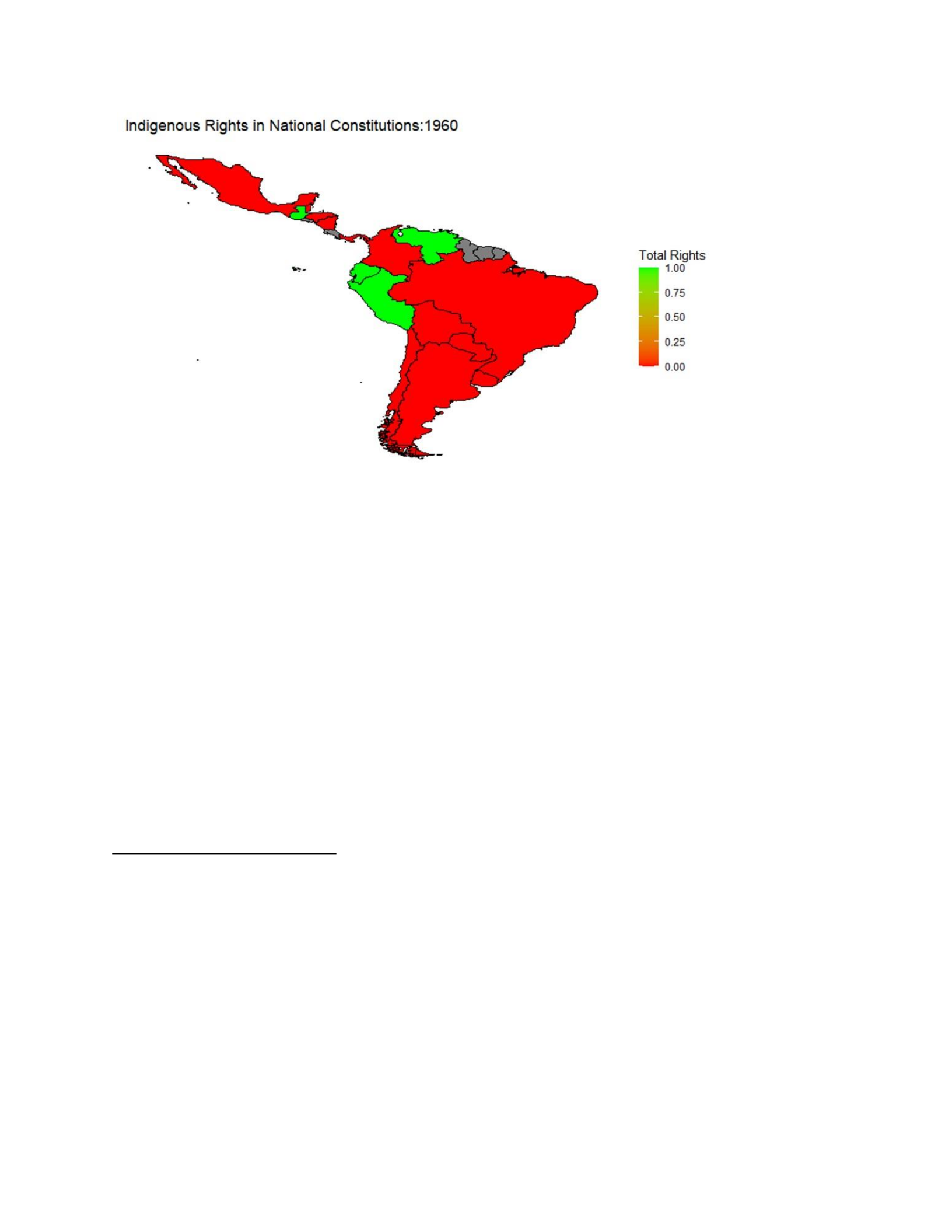
Figure I shows a snapshot of indigenous rights at the beginning of the observation period.
In 1960, native peoples were either recognized in state constitutions as legitimate political actors,
or not. The regions can be coded as a 0 or 1 for indigenous constitutional rights at start of
observation. The few countries that possessed provisions for native populations at this time only
included general provisions that legitimized the existence of these communities as political actors.
This is the case in Peru’s 1933 constitution, for example. This iteration of the document
persisted until the 1960’s without additional renegotiations on the behalf of indigenous
communities. By 1960, Costa Rica, Ecuador, Guatemala, Peru, and Venezuela had recognized its
original nations to a similar extent. These rights are highly non-specific and simply note indigenous
peoples as legal citizens, such as the following article from Peru’s 1933 constitution.
Artículo 207.- Las comunidades indígenas tienen existencia legal y personería jurídica.-
Constitucion de Peru de 1933

The above article is a simple, one sentence statement that allows native populations legal
recognition and existence. Importantly, this article does not make guarantees that are precisely
directed at indigenous nations, nor does it make promises to create new institutions that support
indigenous national aspirations. But these laws afford marginalized communities national
recognition and legitimacy on the state level that they did not have prior. An amendment to
recognize indigenous peoples, although the minimum threshold of representation in the region,
represents a change in the negotiated structure of state citizenship. Adoptions of these types of
articles are the first step in expanded indigenous rights in the region.
Figure III: Indigenous Rights Heat Map 1980
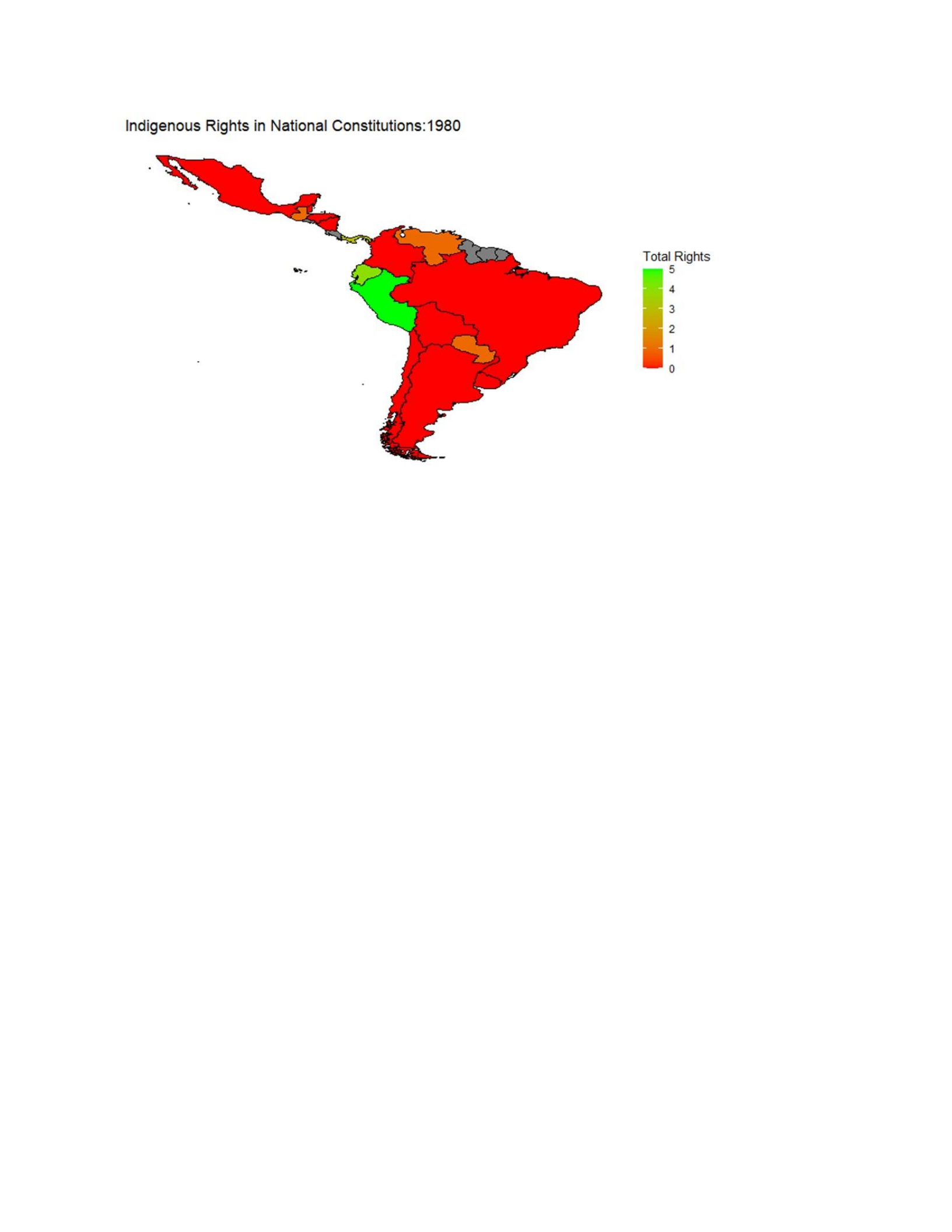
Twenty years later, only Panama and Paraguay added themselves to the list of those
countries that had included indigenous rights in their constitutions. Ecuador and Peru made efforts
to expand the number of provisions protecting these communities and have the most rights during
this period. In these cases, constitutional law notes indigenous nations, the protection of their
languages and cultures, and the right for them to carry out native cultural practices. These rights
are consistent with the expansion of democratic citizenship based on equal rights and access,
according to democratic constitutional law. Most countries in the region still had not
acknowledged Indigenous communities at the national level, even at the base recognition level
by 1980.
If we fast forward by 20 years again, the distribution changes drastically after the region’s
period of democratization.

Figure IV: Indigenous Rights Heat Map 2000
Red countries on this map are the states that had yet to recognize original populations in
the constitution by the year 2000. By this time, many states had renegotiated the constitution in
favor of indigenous nations. Chile and Uruguay had not, and still do not, include any indigenous
rights provisions in their national constitutions. Guatemala, Paraguay, and Venezuela included the
most indigenous provisions in their state constitutions. Colombia, Ecuador, and Nicaragua were
close behind. Most other countries had provided 3-5 constitutional protections for native
communities by this time. In the year 2000, native citizens and cultures were represented in most
Latin American countries, although to varying degrees, depending on the country. It is by this time
that some countries adopted constitutional laws that are based on ethnic difference and serve to
correct economic and political inequalities based on race. These are defined as resource rights in
the subsequent discussion of rights categorization. At this point, democracy no longer motivates
the adoption of indigenous provisions that define access to representation based on indigeneity.
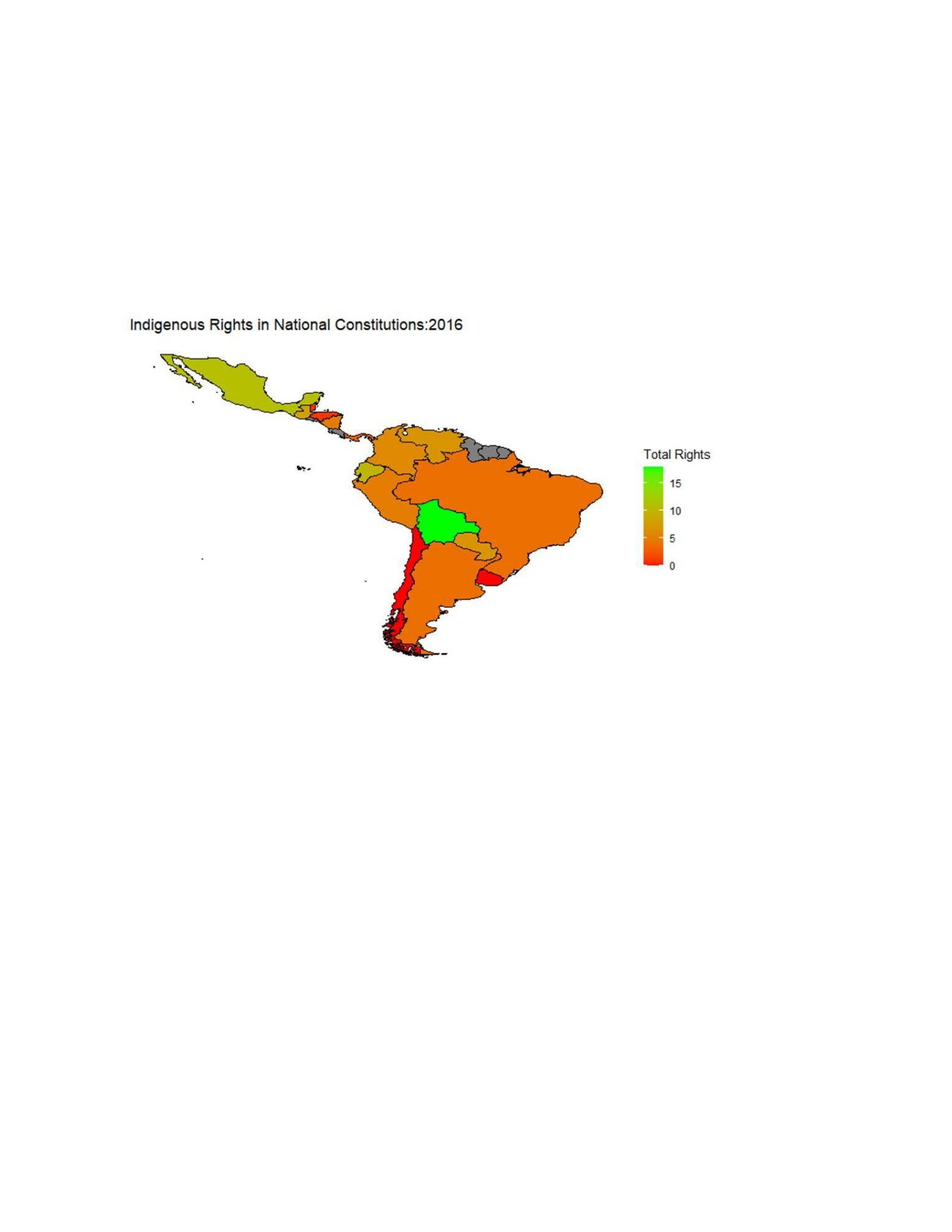
Significant indigenous mobilization and political representation is needed to facilitate the adoption
of rights that correct indigenous inequalities and define autonomy.
Figure V: Indigenous Rights Heat Map 2016
Finally, this last heat map of constitutional rights of indigenous populations in 2016 reveals
some key findings. First, it is evident that the expansion of indigenous constitutional rights slowed
or stopped in many country cases after the year 2000. For example, Brazil, Colombia, Guatemala,
and Peru did not make efforts to renegotiate constitutional rights with their original populations at
any point between 2000-2016. In contrast, Bolivia and Mexico made substantial changes to their
national constitutions during this same period. Bolivia went from a total of three protective
constitutional provisions in 2000 to 18 by 2016. Mexico’s leap was less drastic; from 3 to 11 native
protections, but the change was still substantial, nonetheless. Ecuador made leaps on par with
Mexico’s, and its constitution currently includes 10 different provisions for original nations that

live in state territory. Bolivia, on the other hand, extended the most farreaching indigenous
provisions to its populations. These include defined autonomies and the creation of a plurinational
judicial system (Constitucion de Bolivia de 2009).
But even by 2016 there are six countries with underrepresented native populations
(possessing 1 Indigenous rights provision, or less). These countries include either no protection
for these populations, or only the general recognition of these groups as legal citizens. The
countries in Latin America that currently fit this definition of underrepresentation are Costa Rica,
El Salvador, Honduras, Chile, and Uruguay.Rights totals circa 2016 are presented on the table
below and discussed along with a summary of comparative outcomes for indigenous peoples in
Latin America.
Table 4. Regional Distribution of Indigenous Constitutional Protections: Total Rights in 2016
Country
Number of
Provisions

Argentina
Bolivia
4 19
Brazil
4
Chile
0
Colombia
3
Costa Rica
1
Ecuador
10
El Salvador
1
Guatemala
9
Honduras
1
Mexico
11
Nicaragua
5
Panama
3
Paraguay
7
Peru
5
Uruguay
0
Venezuela
7
Regional Total 93

Figure VI: Indigenous Rights Totals By Year: 1960-2016
Overall, the total observed indigenous rights provisions present across country cases
shows one side of the evolution of minority rights and reveals some key findings. Bolivia, after
its plurinational constitutional reforms of 2009 created a national document with the most
indigenous provisions and legally recognized freedoms. Mexico comes in second for the total
number of protective rights, with 11 in its most current constitution. This is followed by
Ecuador’s state constitution, with a total of 10 provisions. Chile and Uruguay, as of 2016, have no
protections in their constitutions that support indigenous interests and aspirations. Many states
offer very little protection, with the inclusion of only 1 to 3 provisions (Costa Rica, Ecuador, El
Salvador, Honduras, Panama). The average number of indigenous rights present in state
constitutions is 5, but this reduced to 4 total rights provisions on average when the Bolivian case
is removed from the sample.
While the number of indigenous protections is useful in a cross-comparative analysis of
outcomes, this measurement does not consider the substantive content of indigenous rights
provisions. The observations in 1960 tell us that indigenous rights during this time were limited

in the region. From this point, rights were renegotiated to various degrees over the next few
decades. Furthermore, rights provisions present in the 1960’s typically take the form of general
recognition of indigenous peoples as citizens (see the Peru example above). By the 1980’s,
constitutional recognition expanded, and more specific terms of legal citizenship are present.
Therefore, not only the amount of protection is key, but the substantive content of those
protections must be taken into consideration. In these next sections, I explore the DV and
establish a typology for indigenous constitutional provisions. This typology presents an
argument that indigenous protections in national law take form under four different dimensions,
depending on their purpose and specification.
Indigenous Constitutional Rights: An Argument for Differentiation
Not all constitutional rights are created equal. The first observations of indigenous
recognition at the state level includes only the legitimization of natives as legal citizens. Some
later indigenous protections are brief, and often only take up a sentence or two in an entire
constitutional document. These rights minimally recognize the culture and needs of the original
nations of Latin America. The provisions do offer generalized recognition of native peoples as
citizens, and of their languages, customs, and cultures. More specified rights that come later in
most cases delineate specific mandates on native representation, access to public resources, and
national program spending. Yet another set of rights are highly detailed and delineate the creation
of new political institutions that reinforce indigenous perspectives of nationhood
autonomy.
What these observations tell us is that while taking stock of the total number of rights
afforded to marginalized peoples is helpful for comparison, the way in which these rights
manifest has implications for their potential adoption. A thorough analysis of the content of these

amendments in national documents is necessary to explain observed variation in rights outcomes
in the region.
Rights can grant recognition, representation, resources, or autonomy to its original peoples.
Broadly, representation is just that; the recognition of the communities’ right to exist as political
actors in the state. Representation allows for more specific legal rights to marginalized populations
and notes specific cultural practices, languages, and customs. Both recognition and representation
rights are consistent with democratic ideals of equal citizenship and access to political resources.
Resource rights provide even more detailed provisions that extend state political and economic
resources to support native communities, negotiated through pre-existing political institutions.
These rights also define government funds, institutional support, and representation that corrects
past economic and political inequalities. Finally, rights that define autonomy represent the most
extreme redistribution of political resources and divide state defined national identity. Articles that
define these rights are highly specified and constitute pages of text in some cases. Domestic
conditions must motivate the adoption of these more divisive indigenous rights. Since legal
protections for minority populations can, and do, take many forms, this work now defines the
distinct categories of indigenous rights as observed in the region’s legal texts from 1960-2016.
Indigenous Constitutional Rights: Recognition
Recognition of indigenous peoples takes the form seen in Peru’s constitution earlier in
this chapter. To recall, the provision granted native peoples the right to legal state citizenship in
1933 (Constitución de Peru de 1933). Peru was among the first nations in the region to recognize
indigenous peoples as citizens.

Recognitions is the most frequently observed type of constitutional representation
afforded to indigenous citizens in Latin America. Even in states where constitutions eventually
take a plurinational form and provide original nations highly accommodating rights and
representation, general recognitions are typically adopted first and earlier on in the observation
period. Bolivia, for example, first recognized its native peoples as citizens in 1994, but did not
specify rights to administration of land, self-government, or the creation of representative
indigenous institutions until subsequent constitutional revolutions in 2002 and 2009
(Constitución de Bolivia de 1960;1994;2002; y 2009).
“El Estado reconoce la personalidad jurídica de las comunidades indígenas y
campesinas y de las asociaciones y sindicatos campesinos.”Articulo 171 no.2, Constitucion de
Bolivia de 1994.
The above decree is sampled from Bolivia’s constitution in 1994 and defines indigenous
peoples as legal citizens. This article, like the one from Peru, is non-specific, and does not set out
clear goals to pursue indigenous interests or access to state resources.
Rights in this recognition category reorient native peoples as citizens of the state. They
mention indigenous political legitimacy, but in non-specific ways that do not restructure political
power arrangements or access to state resources. There is no discussion of what political
participation looks like for native communities, nor is there mention of indigenous practices,
wants, or needs. Recognition simply legitimizes the existence of indigenous peoples within state
borders.
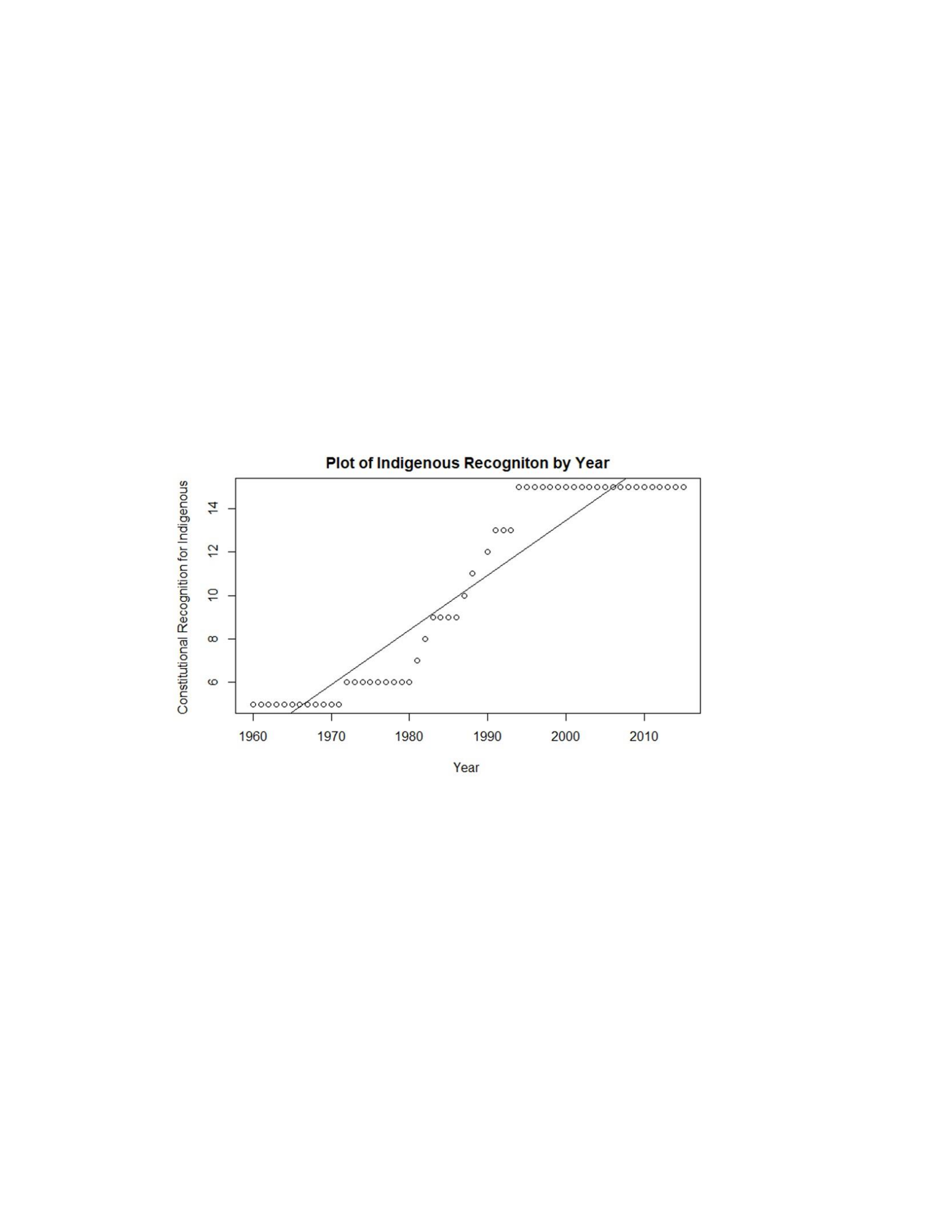
Nonetheless, recognition as political participants represents a shift in national political
discourse. State entities show motivation to expand citizenship to previously unincluded
indigenous groups. Below, figure charts the adoption of indigenous recognition in constitutions.
Recognition of indigenous populations begins in the 1930’s, but spikes along with the turn
toward democracy during the 1980’s. Overall, recognition is the most minimal and most widely
adopted indigenous constitutional representation in the region.
Figure VII. Indigenous Constitutional Recognition by Year: 1960-2016
Indigenous Constitutional Rights: Representation
The second category of indigenous constitutional protection is representation. These
rights go a step beyond recognizing the existence of original peoples living in state territory, and
mention the protection of native culture, education, language, and legal practices.
“Se fijarán mínimos para la enseñanza fundamental de manera que se asegure la
formación básica común y el respeto a los valores culturales y artísticos, nacionales y

regionales.........La enseñanza fundamental regular será impartida en lengua portuguesa y se
asegurará, también, a las comunidades indígenas el uso de sus lenguas maternas y métodos
propios de aprendizaje,” Art. 210 de Constitución Política de la Republica Federativa del Brasil
1988
This article, from Brazil’s 1988 document, makes broad promises to respect regional
cultures and nations, and officially legalizes the use of native languages alongside Portuguese, the
state’s official language since colonization (Political Constitution of Brazil 1988). This article does
not provide political legitimacy for native citizens beyond cultural recognition but does broadly
allow for the use of their traditional practices and customs. A distinguishing feature of the
provisions in this category is that they are an expansion of equal democratic citizenship. They state
that indigenous communities have a right to their own culture, education, and traditional practices.
Representation makes indigenous issues more salient, but they do not correct historical economic
and representative imbalances. They also do not specify state funding of indigenous education and
medicine. Representation rights in the constitution define indigenous peoples as equal citizens with
equal rights. Access to political resources is not defined according to indigenous status.
Although the excerpt from the constitutional text above argues the right to indigenous
education, there is no guarantee that the state will provide funding to support this right. The
burden then, may fall to indigenous communities to provide access to cultural education to its
peoples under the context of this law. Constitutions similarly discuss the minority right to
political representation or political office. But proportional access or corrective state monetary
support is not included.
Representation rights that are compatible with modern democratic definitions of private
citizenship were adopted in many constitutional texts in Latin America. Below, figure 8 plots the
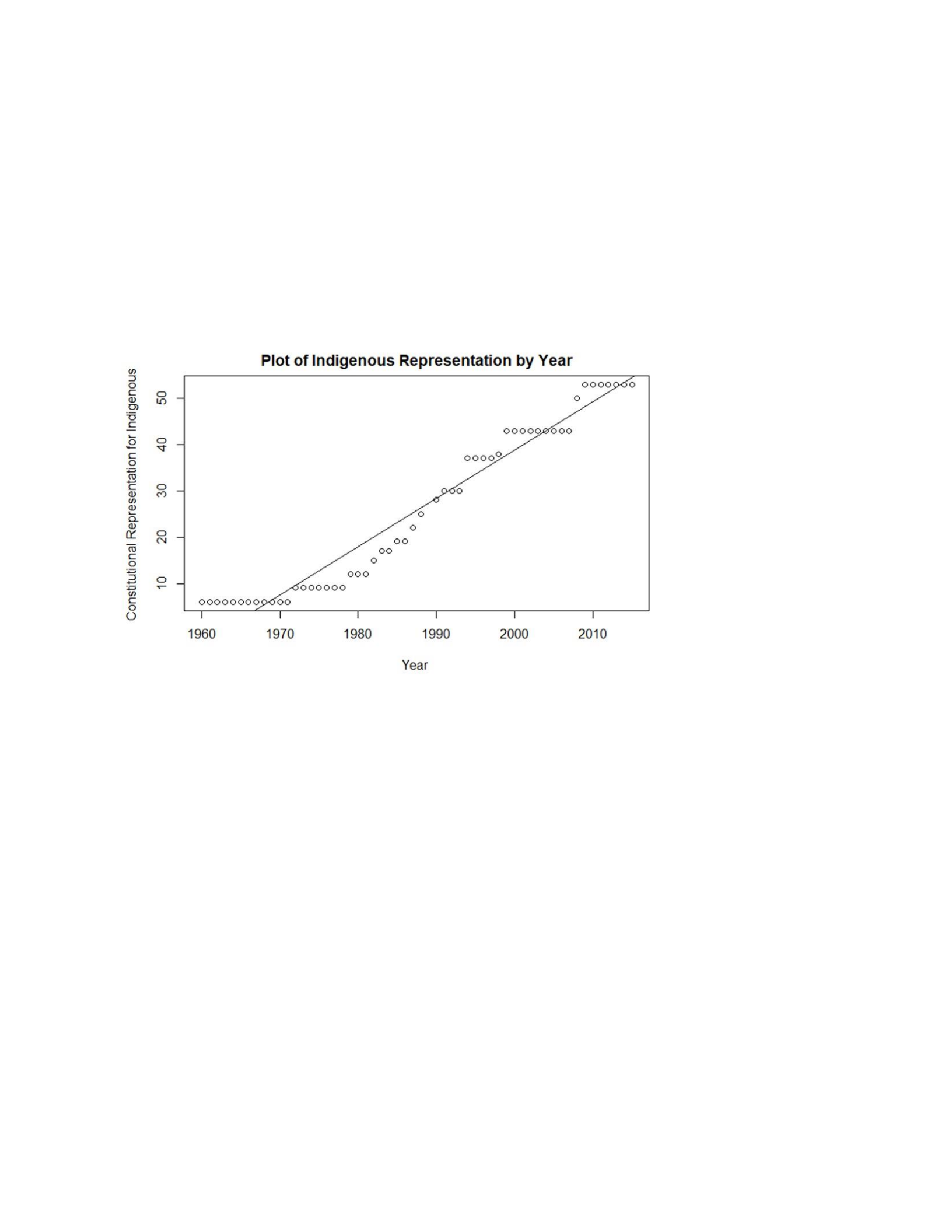
adoption of indigenous representation by year. Again, indigenous representation coincides with
the third wave of democracy to take hold in the region. It is not surprising, then, that rights that
include the expansion of equal citizenship coincides with heightened democracy.
Figure VIII: Indigenous Representation by Year: 1960-2016
Indigenous Constitutional Rights: Resources
From recognition rights that establish equal indigenous state citizenship, resource rights
are based on the correction of historic economic, political, and social exclusion. This includes the
adoption of proportional political representation for Latin America’s indigenous populations, along
with the allocation of state funding toward representative programs. Resource rights define state
action that addresses indigenous grievances and marginalization. Importantly, these rights allow
political access and resources based on indigenous status. Resource rights for indigenous peoples

are defined in terms of funding for indigenous education, healthcare, and proportional
representation in national government. representative office. Resource rights can also create new
branches that represent indigenous communities within existing state institutions.
Resource rights are fully compatible with existing state institutions and do not create new
institutions. Resource rights do not delineate indigenous sovereignties or aspirations toward
nationhood, nor do they allow these communities to block state agency over land and resource
projects. However, resource rights allocate economic and political access to indigenous
communities to correct historic imbalances. Such rights can be controversial, as they define access
along ethnic lines and are considered to elevate indigenous status vis a vis other citizens. Articles
containing resource rights often legitimize proportional indigenous access to political office, for
example. Indigenous representation at the national level increases the future salience of indigenous
issues at the state level, as in Article 171 of Colombia’s 1991 constitution. This provision
guarantees two indigenous senators in the current council of 100:
“El Senado de la República estará integrado por cien miembros elegidos en
circunscripción nacional. Habrá un número adicional de dos senadores elegidos en
circunscripción nacional especial por comunidades indígenas,” Art. 171 de Constitucion
Politica de Colombia de 1991.
Instituted officially in 1991, this provision renegotiates political resources in favor of
native communities. These peoples are now guaranteed representation in the state senate, where
before these representative thresholds did not exist. It is also obvious if the state, for any number
of possible reasons, does not allow native representatives to occupy the reserved positions in the
senate. These rights are valuable for indigenous populations because they are more clearly defined

and when the state reneges on its promises it is clear. But these new laws are created within existing
state political structures and are subject to their oversight.
In sum, resource rights restructure political power and resource arrangements on behalf
of native populations and outline methods to reach goals of political inclusion. Other examples
of these rights include state funded education and healthcare, targeted policies that benefit
ancestral territories, and the creation of specialized representative branches in pre-existing
political institutions.
Although less common than the constitutional protections recorded in the previous
categories, resource rights are commonly found in state constitutional texts in the region. Figure
8 depicts trends of resource right adoption in the region. Resource adoptions steadily increase in
frequency in national laws starting in the mid 1980’s. This development demonstrates that many
states are willing to allow indigenous peoples political resources within the configuration of its
own existing state institutions. State actors, overall, are more willing to renegotiate terms of
citizenship under this framework, as opposed to the next form of indigenous constitutional
protection, which is much more rare.
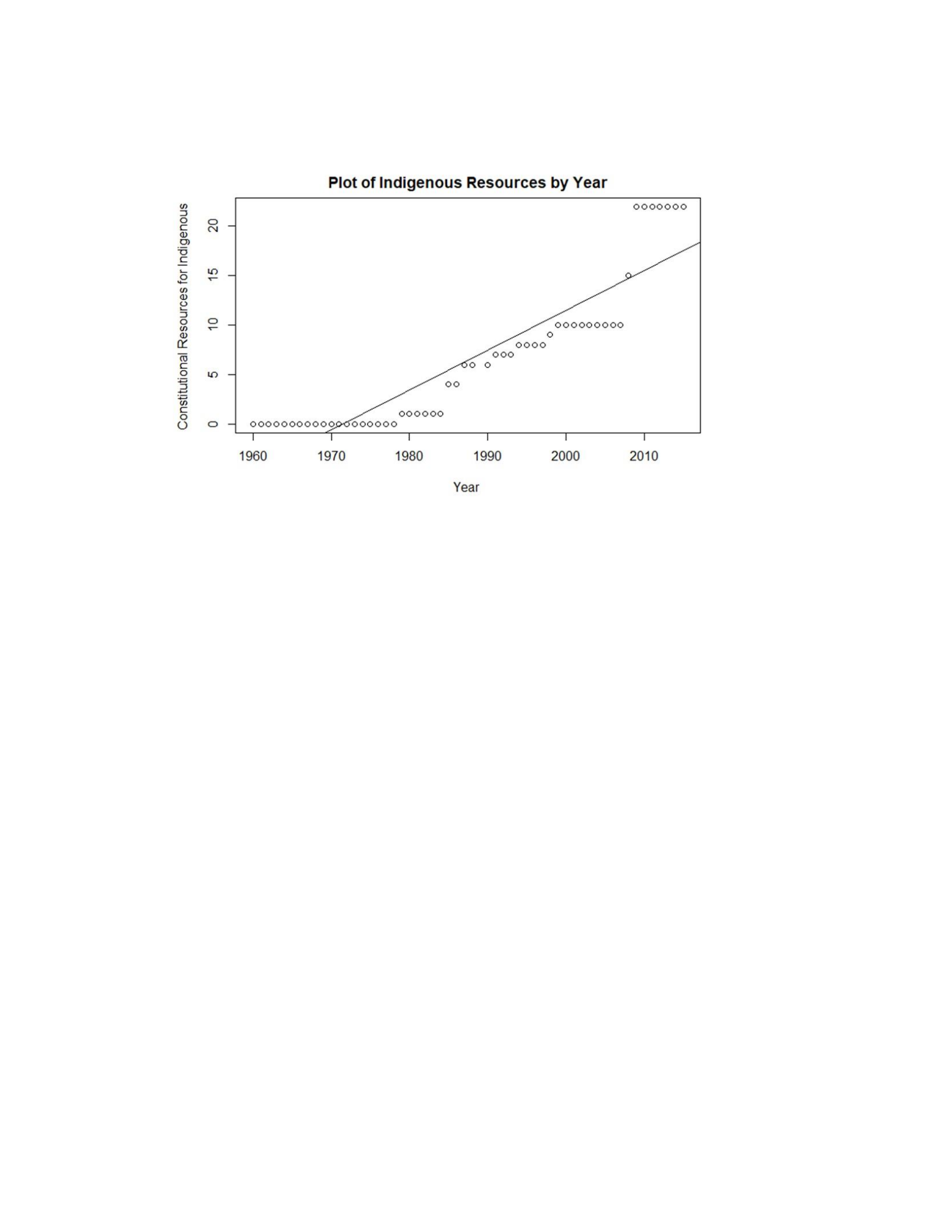
Figure IX: Indigenous Resources by Year: 1960-2016
Indigenous Constitutional Rights: Autonomy
Indigenous constitutional rights in the autonomy category represent the most far-reaching
restructuring of national representation. These indigenous protections are also the rarest in state
constitutions in Latin America.
Autonomous rights invoke aspirations of native sovereignty and the recognition of their
nationhood. These laws also demarcate indigenous territorial control and legalize national borders
for the original nations living within state territory. Other forms of autonomy rights elevate
traditional political institutions to equal footing with the national ones. Autonomy laws also serve
the purpose of negotiating conflict resolution between state and indigenous entities. For example,
by creating plurinational judicial systems that consider the position of all existing nations that
live in state territory, or with mechanisms like IFPIC that protects native lands and resources.
Specification of these laws or institutional arrangements that support native sovereignty are

typically discussed at length, across multiple constitutional articles. For the sake of brevity,
excerpts from these articles are limited.
Artículo 403. I. Se reconoce la integralidad del territorio indígena originario campesino,
que incluye el derecho a la tierra, al uso y aprovechamiento exclusivo de los recursos naturales
renovables en las condiciones determinadas por la ley; a la consulta previa e informada y a la
participación en los beneficios por la explotación de los recursos naturales no renovables que se
encuentran en sus territorios; la facultad de aplicar sus normas propias, administrados por sus
estructuras de representación y la definición de su desarrollo de acuerdo a sus criterios culturales
y principios de convivencia armónica con la naturaleza. Los territorios indígena originario
campesinos podrán estar compuestos por comunidades. II. El territorio indígena originario
campesino comprende áreas de producción, áreas de aprovechamiento y conservación de los
recursos naturales y espacios de reproducción social, espiritual y cultural.
La ley establecerá el procedimiento para el reconocimiento de estos derechos.”-Constitución
Política del Estado (CPE) - Bolivia de 2009
Article 403 of the Bolivian constitution adopted in 2009 outlines the indigenous right to
ancestral lands and makes promises to provide prior and informed consent over natural resource
projects that take place in them. In broad strokes, this provision allows for certain regional
autonomies (Constitución Política del Estado (CPE) - Bolivia de 2009). The terms of these laws
are discussed at length and include specific mechanisms that original nations use to make claims
against encroachment on their sovereignties. These protections also invoke international human
rights norms like indigenous Free Prior and Informed Consent (IFPIC) in their wording.
In addition to including indigenous nations in resource project negotiations, autonomy
laws create new political institutions. New political institutions are established in constitutional

law to safeguard the original nations, like the special constitutional courts found in Ecuador and
Bolivia. In some cases, native representative institutions are put on equal footing with preexisting
state institutions (See also (CPE) - Bolivia, Art No.394).
“En el caso de un territorio indígena que comprenda el territorio de dos o más
departamentos, su administración se hará por los consejos indígenas en coordinación con los
gobernadores de los respectivos departamentos. En caso de que este territorio decida
constituirse como entidad territorial, se hará con el cumplimiento de los requisitos establecidos
en el inciso primero de este artículo.” - Articulo 329 de la Constitución de Ecuador de 2008
This excerpt from Ecuador’s 2008 constitutional reforms discusses methods for conflict
resolution over territorial claims. If a territorial dispute between an indigenous community and
another party occurs, a formal negotiation must be made between representatives of both parties.
Additionally, indigenous nations are allowed to apply for special autonomy status that establish
autonomous zones of community self-government (see Articulo 329 de la Constitución de
Ecuador de 2008). This constitutional reformation afforded marginalized peoples in Ecuador
access to a wide array of new political resources that better defend their interests.
In sum, indigenous autonomy rights define regional self-governments, and create new
political institutions to better protect populations from state and private encroachment. These
rights are often considered nationally divisive, as they define the existence of multiple legitimate
nations in state territory. These provisions go beyond the allocation of access to state political
goods and representation- they establish mechanisms that are considered contrary to state
interests. Specifically, constitutional autonomy rights allow indigenous nations to effectively
challenge state policy and exercise regional self-government.

Provisions of autonomy like those discussed above are, unsurprisingly, the least common
type of indigenous protection found in the region. This research finds that legal autonomy only
occurs in 8 observed instances before 2016. Since this point, no further constitutional amendments
were adopted that protect indigenous citizens. Most autonomy rights adoptions over the
observation period are driven by Bolivia’s constitutional revolution in 2009. This constitution
created a plurinational state and created far-reaching sovereign rights for the country’s native
populations. Bolivia includes a total of 6 autonomies in the national constitution. Colombia and
Ecuador each have one inclusion of indigenous autonomy in their state documents. This evidence
shows that state actors are especially reluctant to negotiate rights for original nations that allow for
sovereignty, self-government, and the creation of indigenous institutions in national law.
Figure X. Indigenous Autonomy by Year: 1960-2016
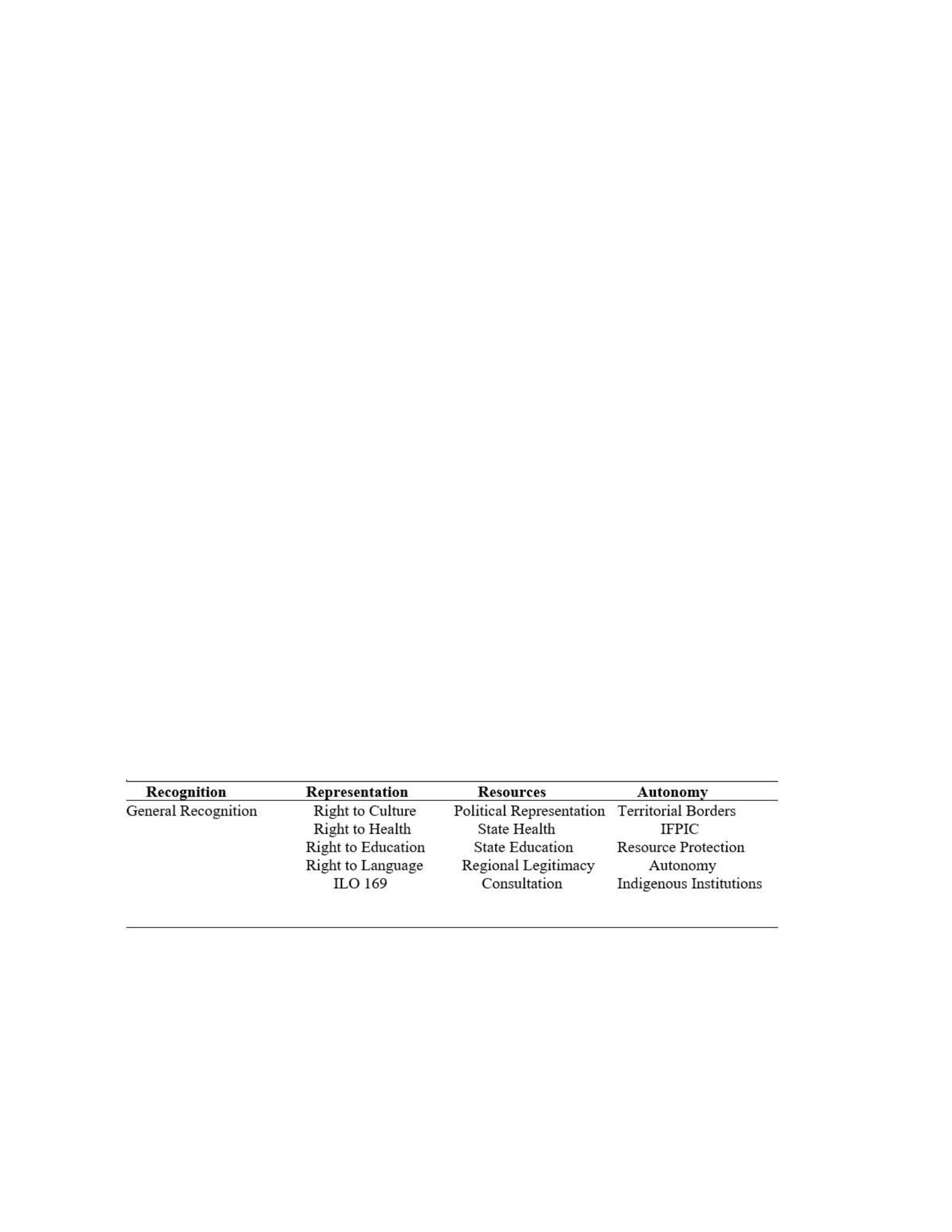
Indigenous Rights: Conclusions and Trends in Constitutional Protections
A general comparison of constitutional rights typologies reveals valuable information.
Recognition of indigenous citizens in constitutional law tends to be adopted earlier in the
observation period, followed by recognition rights. Both types of provisions are compatible with
democratic ideals of access to political representation and resources and are steadily adopted in
the region over the observation period. Resource rights define access to political resources based
on indigenous identity and are rarer than the latter two categories of rights. Resource rights are
adopted at later points of the observation period, and by only a few countries (Bolivia, Ecuador,
Colombia). Finally, autonomy rights that define indigenous national rights to self-government
and create new political institutions to ensure the representation of these communities are the
rarest type of constitutional protection. Autonomy rights are found in only 8 different iterations in
only Bolivia and Ecuador, as of 2023. These typologies are outlined on the table below and is
followed by another table that summarizes adoption trends in the region over time.
Table 1. Typologies of Indigenous Constitutional Rights
1. ILO 169 is a mention of the UN convention on human rights under the same name. Constitutions may make note of the
convention, but this is typically to note its adoption rather than create the institutions suggested in the convention itself. This is a general
form of recognition that only Bolivia, Brazil, Ecuador, and Costa Rica have mentioned in their constitutions, despite the convention being
widely adopted throughout the region (by all but two countries).
2. State Education and State Health are guaranteed to be funded by the government, as opposed to general rights to health and
education. The latter do not guarantee that the state will deliver these services to marginalized Indigenous populations.
3.Consultation is not as powerful as Consent, which is a requirement of IFPIC laws presented in constitutional rights that provide Indigenous
accommodations.
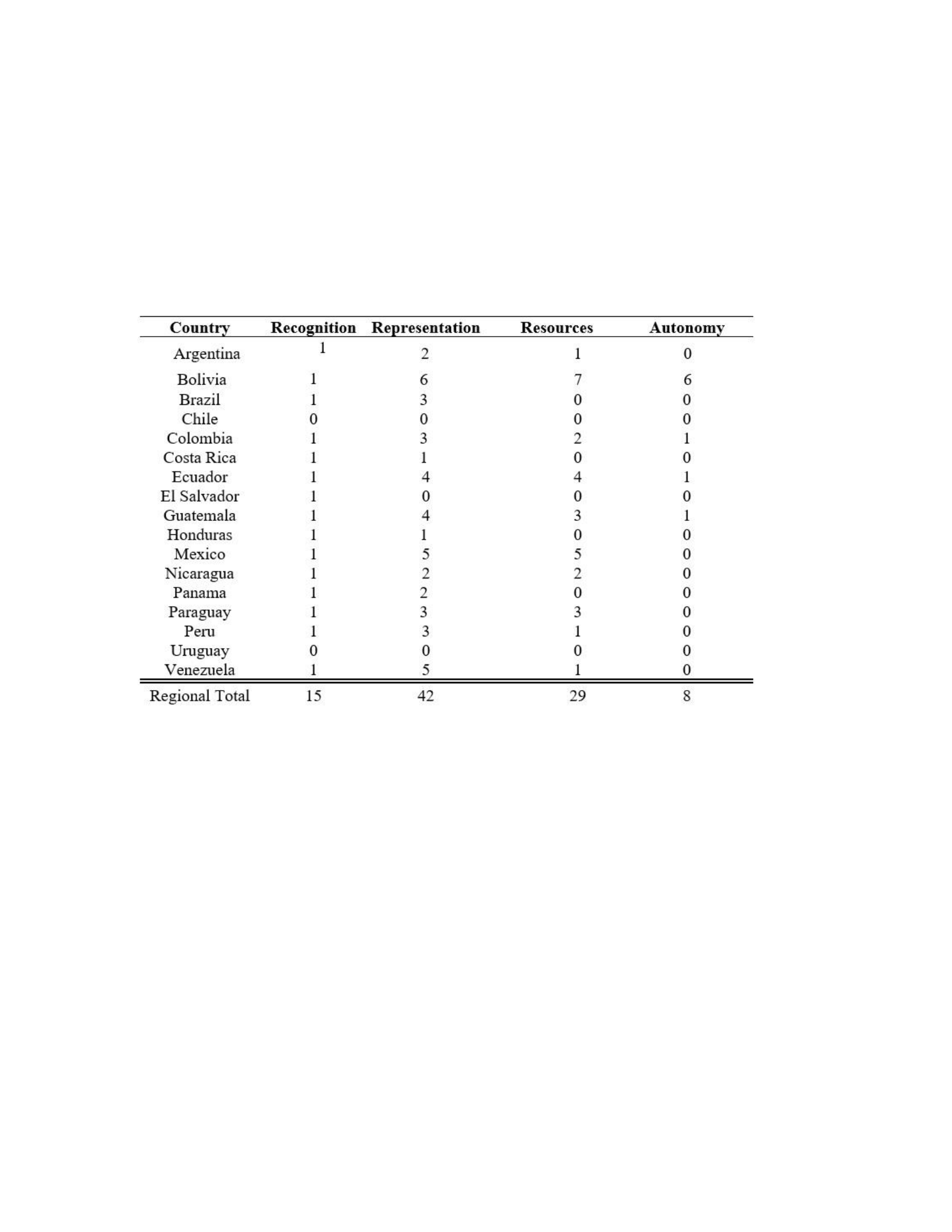
4. General autonomy grants legitimacy to the regional self-determination of Indigenous communities. However, general autonomy rights
do not specify what “autonomy” means under existing political structures. This means that while granted some legitimacy, these claims are
easily encroached upon by state actors in the future if they are not clearly defined. Specified autonomy rights, on the other hand, solve this
problem. They specify what Indigenous “autonomy” means and what it will look like. Communities with these rights have much more
leverage in protecting their interests.
Table 4. Regional Distribution of Indigenous Constitutional Protections: Distribution of Type, 2016
Unsurprisingly, Bolivia which has the most indigenous rights adopted in the constitution
also the most indigenous protections of every typology in its current document. Chile and Uruguay
are outliers on the opposite end, with no constitutional protections adopted for their native
populations. Most states are willing to adopt indigenous recognition at the minimum, along with
rights that extend provisions of equal citizenship to previously neglected original populations.
Recognition and representation occur early in some cases, and their adoption peak from the 1980’s
onward. Resource rights that are defined to correct inequalities and allocate representation and
resources based on indigenous status are rarer and more adopted later on in the observation period.

Finally, autonomy rights occur with the least frequency at later stages of observation and are
adopted by only Bolivia and Ecuador.
Overview of Chapter
This chapter discussed the DV of interest of this dissertation: Indigenous Constitutional
Outcomes. First, patterns of rights were examined by their total recorded observations. Some states
such as Bolivia, Mexico, and Ecuador employ constitutions that include several Indigenous
protections. On average, states tend to include 4-5 protections for native populations in national
constitutions. But there are many cases where these populations face state powers that refuse to
renegotiate constitutional law and are left with little to no political representation. But simply
taking a measure of the number of protections is not enough to explain a difference in indigenous
rights outcomes in the region.
I argue that the substantive content of these rights will have implications for their adoption.
Some rights recognize indigenous citizens as political participants where they were previously
excluded from participation. Other states extend these rights to the equal recognition of indigenous
participation, culture, languages, education, and other practices. A small number of governments
have constitutions that define resource rights that direct government funding and representation
specifically to indigenous nations. Finally, there are autonomy rights in both Bolivia and Ecuador
that define indigenous nations and self-government in national law.
This chapter’s observations also inform us that these indigenous constitutional rights
become less frequent in domestic law as they move beyond establishing terms of equal
democratic citizenship. Recognition of native peoples is the most common, followed equal
recognition of their cultures, practices, and political participation. Once constitutional

amendments allocate representation based on indigenous status and define indigenous national
differences, rights adoption is less frequent.
The next chapter moves to test these arguments in quantitative models. The content and
implications of indigenous rights provisions impact the likelihood of their adoption, in
conjunction with key country features. But the impact of state variables on indigenous rights
adoption depends on the current stage of indigenous constitutional citizenship.
Chapter III: Determinants of Indigenous Rights Adoption in Latin America
1960-2016

“Indigenous territories guarantee water, food, [and]
clean air. If they are destroyed, the future of humanity
on this planet is also put at risk…… Now we have
reached the point of no return, we’ve run out of
options. Either we defend our territory, or we’ll
disappear,” – Jose Greforio Diaz Mirabel.
Coordinator of Indigenous Organizations of the
Amazon Basin. (Coorginadora de las
Organizaciones Indigenas de la Cuenca Amazonica
– COICA).
What explains the variance in indigenous constitutional provisions across the Americas?
This chapter examines the extent to which key domestic political considerations matter. I take a
bird's eye view of regional constitution-making to identify the determinants of indigenous rights
adoption across four distinct types of indigenous rights.
I begin by discussing the measurement of constitutional rights outcomes of Latin
America’s original populations. This is the DV of interest of this dissertation. Chapter 2 argued
that the substantive content of indigenous provisions in national constitutions must be considered
when interpreting the expansion of indigenous citizenship. Indigenous constitutional rights are
categorized according to the extent that they restructure the country’s political institutions.
Categories of indigenous constitutional rights outlined in chapter 2 take the form of recognition,
representation, resources, and autonomy.

Next, I discuss the measurement independent variables. These are domestic factors that
are expected to influence the rights acquisition process for marginalized native populations.
These factors are democracy, indigenous mobilization, indigenous population representation in
government, resource rent dependence, and state capacity. These domestic inputs will either
positively or negatively motivate rights adoption, depending on which rights are up for adoption.
I also summarize the measurement of important control variables, like judicial strength,
neighborhood effects, and the relative size and fractionalization of indigenous populations.
This chapter then moves to test chapter 1’s hypotheses in both survival and firth logit
modelling. Survival models account for the timing of rights adoption, and firth logit models are
used to test for rare occurrences. The results of these tests shows that the impact of domestic
variables on the likelihood of indigenous rights adoption changes, depending on the content of
the negotiated constitutional provisions. Against expectations, democracy is not positively related
to any form of indigenous constitutional rights implementation. Results suggest that countries
with low democracy scores are highly likely to adopt indigenous recognition. Democracy is also
negatively related to the adoption of resource rights that correct inequalities that are historically
due to indigenous status. Indigenous social movements are only positively related to the
adoption of autonomy rights in the constitution, suggesting that strong mobilization is more
impactful later in the adoption process. Indigenous political representation in national
government positively predicts the adoption of protectional provisions early on and throughout
the entirety of the process. Representation of these populations in national government is
positively associated with the creation of rights from all categories. When it comes to the state
apparatus itself, resource rent dependence is negatively related to the adoption of indigenous
autonomy rights, and signals that states heavily invested in resources are unlikely to recognize

regional national sovereignties. Finally, state capacity is unrelated to the adoption of indigenous
rights across all categories. These results are presented and discussed, alongside important
control variables, like judicial strength, neighborhood effects, and indigenous population
proportion.
Now, this chapter presents the dependent and independent variables and data used in its
statistical modes. Then, I present and discuss statistical results. Last, I summarize the findings of
this chapter before moving to test the sequential nature of the rights adoption process in chapter
4.
Dependent Variable: Indigenous Constitutional Outcomes
Indigenous peoples have lived on the political periphery of state citizenship for most of
the region’s recent history. Only in the past few decades have constitutional rights and
protections been extended to indigenous communities. The previous chapter details the evolution
of constitutional negotiations for indigenous provisions over the last 7 decades. This chapter
concludes that America’s indigenous peoples have lived under different rights regimes in recent
history.
To accurately measure the evolution of indigenous constitutional rights in Latin America,
I constructed an original dataset that tracks minority rights under constitutional laws throughout
the region. Observation begins in 1933, when native populations were first established as citizens
in constitutional law in Peru1(Constitución de Peru de 1933). This point marks the beginning of
the dataset, and the observation period concludes in 2016. Since then, only Chile has drafted
constitutional revisions for its original populations. But a recent referendum in 2022 rejected the
current draft, and these laws are not yet in place. There are plans to update this dataset in the
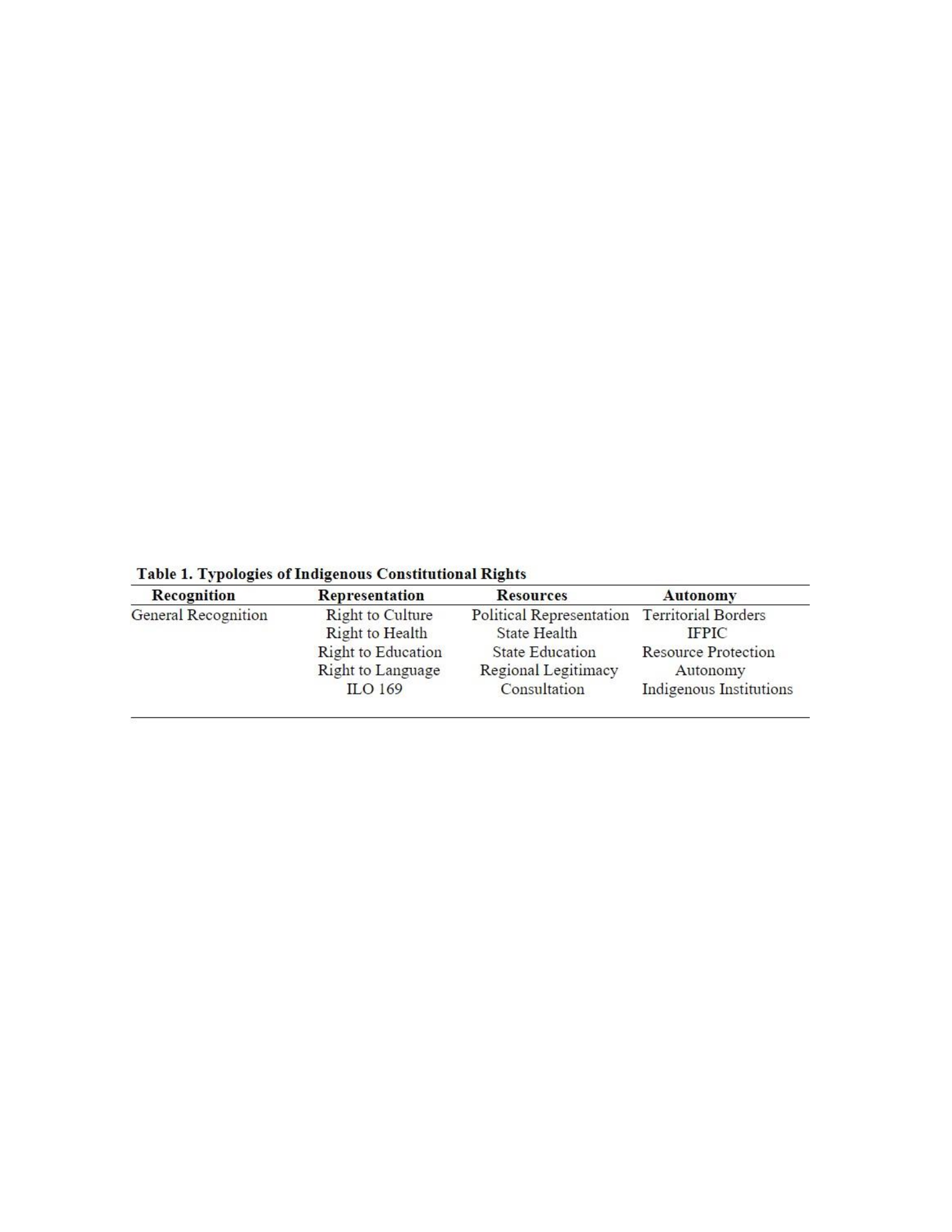
future to account for advancements in the law.
Constitutional law can be changed through several different processes. There are
constitutional overhauls, or revolutions, which completely restructure the document. There may
be a constitutional “mini” revolution where large parts are changed in the original constitution,
but the overall structure of the preceding document remains intact. Parts of the law can also be
changed via executive or judicial decree. Any process that results in a constitutional revision on
the national level was analyzed in the creation of the dataset. When negotiations result in rights
for the original peoples and nations of Latin America, they are recorded as an observation. Below
is a summary of rights categories and their measured frequency in Latin American constitutions.
Measurement of Indigenous Rights in Constitutional Law
1. ILO 169 is a mention of the UN convention on human rights under the same name. Constitutions may make
note of the convention, but this is typically to note its adoption rather than create the institutions suggested in the
convention itself. This is a general form of recognition that only Bolivia, Brazil, Ecuador, and Costa Rica have
mentioned in their constitutions, despite the convention being widely adopted throughout the region (by all but two
countries).
2. State Education and State Health are guaranteed to be funded by the government, as opposed to general rights
to health and education. The latter do not guarantee that the state will deliver these services to marginalized Indigenous
populations.
3.Consultation is not as powerful as Consent, which is a requirement of FPIC laws presented in constitutional rights
that provide Indigenous accommodations.
4. General autonomy grants legitimacy to the regional self-determination of Indigenous communities. However,
general autonomy rights do not specify what “autonomy” means under existing political structures. This means that
while granted some legitimacy, these claims are easily encroached upon by state actors in the future if they are not
clearly defined. Specified autonomy rights, on the other hand, solve this problem. They specify what Indigenous
“autonomy” means and what it will look like. Communities with these rights have much more leverage in protecting
their interests.

Indigenous constitutional rights take four main forms per measurement. First, there are
rights that recognize indigenous peoples as national citizens. These are termed recognition rights.
These rights, as observed in the previous chapter, are recorded earlier in the observation period,
and for many cases they represent the entry point of constitutional recognition for indigenous
groups. Recognition is coded as a 0 or a 1 for every year from 1933-2016. Either general
recognition of indigenous peoples is present in these provisions, or it is not. Recognition in the
constitution is the minimum constitutional protection adopted for marginalized groups. There is
no case where recognition occurs AFTER the acquisition of more specific rights.
All but two countries (Chile and Uruguay) adopted the general recognition of its native
peoples at the state level by the 2016, meaning that fifteen of seventeen countries in the region
are scored as a 1 for general indigenous recognition. However, recognition occurs at various
times across the period observed (see chapter 2).
The second category of rights are similarly recorded by country, and totals are updated
every year. Representation rights have a range of 0-5 and have a mean of 2.47 by 2016. This is
the second most common right type afforded to minorities in the region, after indigenous
recognition. To reiterate, these protections legitimize native cultures, languages, practices, and
political participation rights as equal to those of other citizens. But these rights do not serve to
correct inequalities historically defined along ethnic lines.
These rights are observed either after or alongside recognition of indigenous populations
in constitutional law. To be coded into this category, a constitutional article must specify the
indigenous right to cultural practices, education, religion, health, or political representation. But
these rights do NOT guarantee state funding, institutional support, or guaranteed representation in
government or other state institutions for indigenous interests.

The third recorded category of indigenous constitutional rights are the first that promise
guaranteed state resources and political representation at the national level for their communities.
Resource rights provide the promise of state funded education, health, and other support. They also
establish guaranteed thresholds of indigenous representation in existing state institutions. For these
reasons, these rights are more hotly debated since they are defined only to benefit one population
and not another.
Values for resource rights in state constitutional documents range from 0-7 across the
region, with a mean value of 1.7 by 2016. These rights are less common than the latter two
categories of indigenous protections but became more common in the later years of the
observation period.
The last indigenous rights category observed in the region’s constitutions are autonomy
rights. Autonomy amendments must discuss terms of indigenous sovereignty or create new
institutions that serve indigenous interests to be coded in this category. New indigenous institutions
create mechanisms for conflict negotiation between indigenous and state entities. For example,
such legal mechanisms exist in the plurinational courts created in Bolivia and Ecuador
(Constitución de Bolivia de 2009; Constitución de Ecuador de 2008).
Values of autonomy rights range from 0 to 6, but only two countries currently provide
autonomous rights in national constitutions. This makes the presence of autonomy rights for
indigenous nations a rare occurrence. To account for the low rate of adoption of these provisions,
the presence of autonomous rights in state law is coded as a 0 or 1 across country cases.
Measurement on a binary level allows for statistical testing for these occurrences in the firth logit
models presented in chapter 4.

In sum, I measure the dependent variable, indigenous constitutional rights outcomes in
Latin American law from 1933-2016. Indigenous rights are measured according to their type of
provision: recognition, representation, resources, and autonomy. Rights totals for every category
are recorded on a country-case basis and are updated every year to account for constitutional
amendments, revisions, overhauls, and executive orders.
Measurement of Independent Variables: Domestic Inputs on the Rights Adoption Process
Though the very first changes in indigenous constitutional protections began in 1933,
datasets and sources used to measure the domestic factors that motivate or inhibit adoption do
not exist until the 1960’s. For this reason, quantitative modelling output represents rights
adoption from 1960 onward. At this point, only a few states recognized their indigenous
populations as legitimate political participants. This is the lowest threshold of indigenous
constitutional recognition and is present in only 3 cases at the start of 1960.
Below, I summarize measurements and regional summary data for the independent
variables of interest. These domestic inputs include democracy, indigenous mobilization,
indigenous political representation, resource rent dependence, and state capacity. I also discuss
the measurement for controls identified from recent literature before moving to present this
chapter’s quantitative models.
Democracy
The first factor that plays a role in constitutional change and rights expansion is democracy.
Democracy creates legitimate avenues to indigenous political recognition and representation in
state constitutions. But ideological incompatibilities will mean that democracy has no impact on
resource or autonomous rights for ethnic minorities. Broadly, democracy will expand rights that

embrace democratic ideals of citizenship. The adoption of laws that go beyond equal access to
state resources will not be motivated by increases in democracy.
Country level observations for democracy are gathered from the Varieties of Democracy
(VDem) dataset from the mid 1960’s onward. Data is not available before this period. VDem’s
democracy score contains an aggregate value based on hundreds of indicators and country expert
consultation.2 Aggregate indicators of democracy include but are not limited to measurements of
suffrage, elections, transition of power, legislatures, courts, and political parties.
Values for democracy range from 0 to 1. The closer to 1, the more democratic the country,
according to its aggregate score of indicators. Countries in Latin America have a range score of
.07 to .935 over the observation period. The mean score across this period is right in the middle,
at .5. The following plots exemplify the variation in democracy scores on a country case basis.3
Democracy levels in the region spiked during the late 1980’s. This upward trend coincides
with a turn towards Washington post-Soviet Collapse after the conclusion of the Cold
War. However, the region’s experience with democracy has not always been stable and remains
volatile. In recent years, there is a return toward illiberal democratic tendencies, as is the case in
the neighboring United States, and other European democracies. This is especially true of
downward democratic trends in Nicaragua and Venezuela. These changes in democratic
commitments over time are expected to influence the rights adoption process for marginalized
ethnic populations such as Latin America’s indigenous peoples.
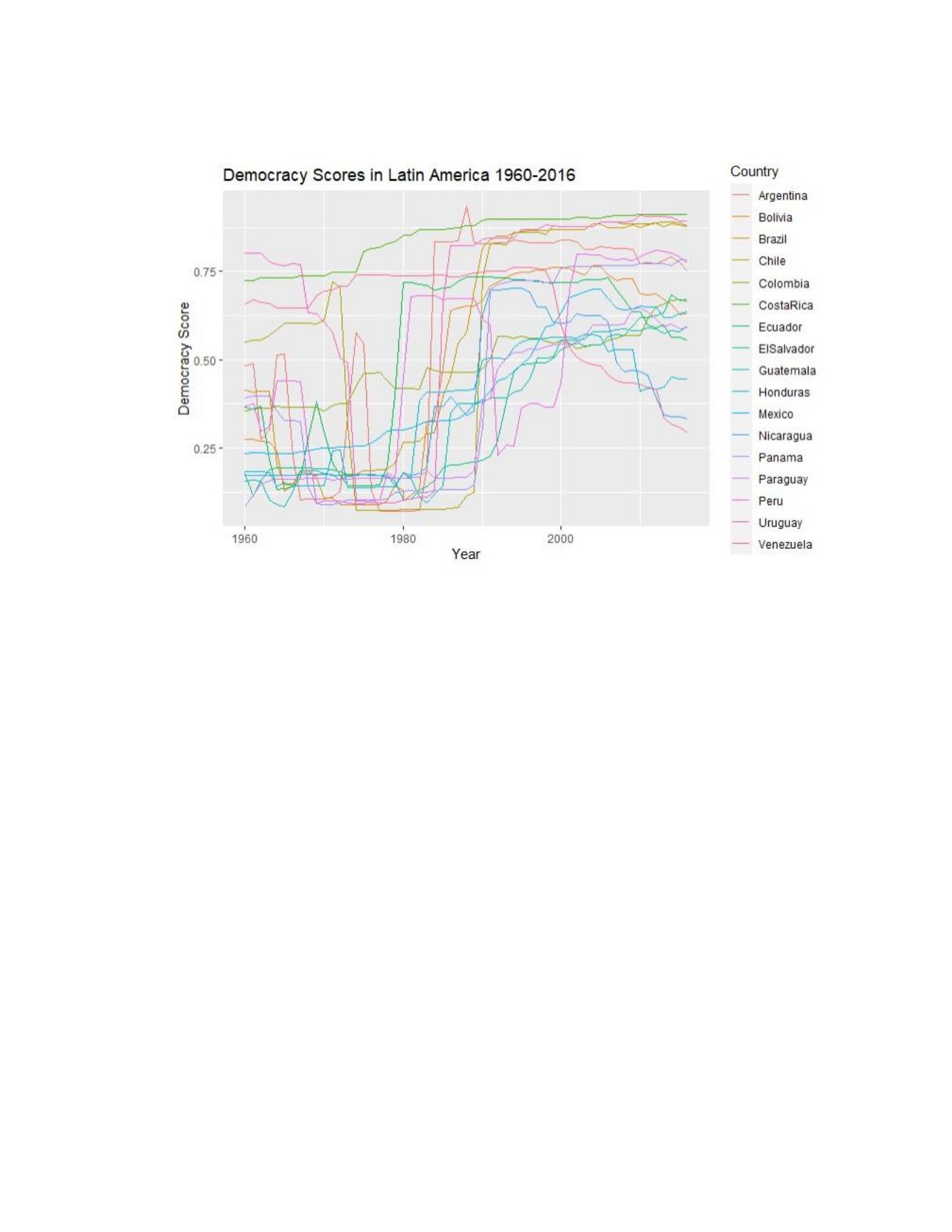
Figure XI: Democracy in Latin America: 1960-2016
Indigenous Mobilization
Indigenous mobilization is theorized to be positively associated with rights adoption in
after indigenous constitutional recognition is adopted. But mobilization is particularly important
for rights that specify resource and autonomy rights. Once original populations are legitimized as
political participants on the national level, groups will mobilize to appeal for further representation.
Drawing on current literature, strong group mobilization can also bring state entities to negotiate
the adoption of rights provisions they would otherwise ignore.
The comparative mobilization strength of indigenous groups in Latin America is not
currently directly measured in data. This presents a bit of a challenge for quantitative testing of the
effectiveness of indigenous mobilization efforts. Scholars have only recently begun to attempt to
measure ethnic based mobilization in Latin America. Many of the most recent informative works
include only case study analysis of indigenous mobilization, and do not

expand comparisons of activity on a regional level.
To capture a quantitative measurement for indigenous mobilization capacity, I employ the
Harvard database’s record of social organization presence around the world. Particularly, I use the
establishment and presence of social movement headquarters organizations as a proxy for
mobilization strength. The database records where and when these headquarters were established,
along with their political aspirations. To be counted toward a score of indigenous movement
strength, mobilization headquarters must be committed to indigenous issues, or environmental and
class pursuits that specifically note indigenous solidarity in their mission statement. A total count
of movement headquarters is carried out on a country case basis for every year of the observation
period. Country cases across this time period have a recorded 0-6 established indigenous
mobilization headquarters. Below is a summary of observations in the region as of 2016.
Table 5: Indigenous Mobilization in Latin America 2016 Country Mobilization
Headquarters (2016)
Argentina
1
Bolivia
6
Brazil
3

Chile
0
Colombia
2
Costa Rica
6
Ecuador
6
El Salvador
0
Guatemala
0
Honduras
2
Mexico
6
Nicaragua
2
Panama
0
Paraguay
3
Peru
5
Uruguay
2
Venezuela
4
Data is sourced from Harvard Transnational Movement Organization Dataset
Bolivia tops the list as a country with one of the most brick-and-mortar headquarters for
indigenous focused social movements with a total of six physical establishments. Chapter 2’s
analysis of indigenous constitutional provisions shows that Bolivia also adopted the most
farreaching provisions for these populations.
But some countries that adopted less indigenous protections than Bolivia, like Mexico, have
an equal amount of indigenous mobilization establishments. Moreso, Costa Rica only recognizes
its native populations to the most minimal level in the state constitution4 (See chapter 2) but score
just as high as the plurinational state of Bolivia when it comes to the presence of social mobilization
capacity.
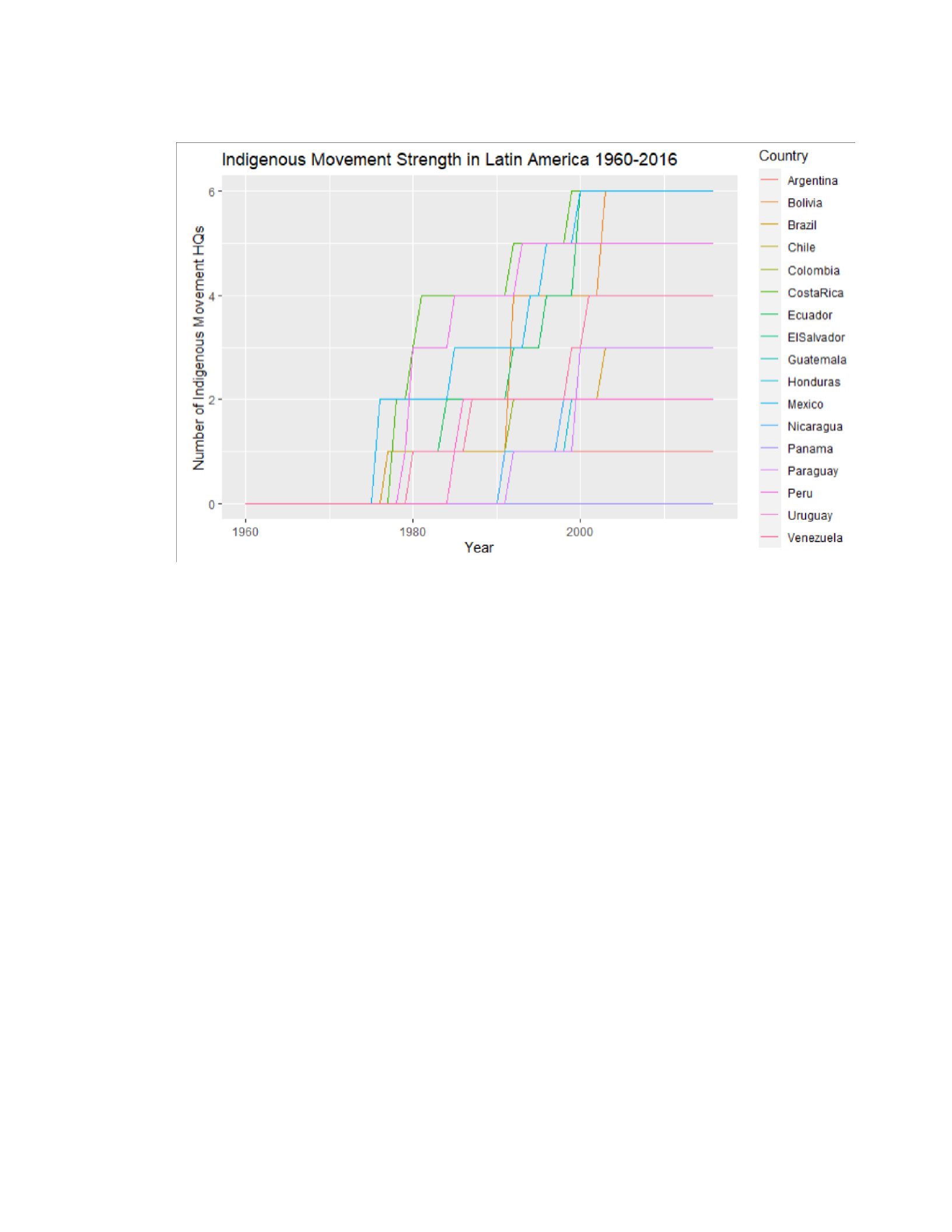
Figure XII: Indigenous Mobilization in Latin America: 1960-2016
The average social mobilization headquarters per state is 1.15, and some countries do not
have any establishments currently within their borders (Chile, El Salvador, Guatemala, and
Panama). 5 This is an imperfect measure of indigenous mobilization strength and underrepresents
the true grassroots activity on the ground. Subsequent chapters attempt to remedy these
shortcomings through thorough qualitative case analysis of historical mobilization presence. But
the presence and investment in these political outlets does signal a relative ability of peoples to
mobilize for political representation. International organizations and NGOs lend their resources to
these established networks and increase indigenous mobilization momentum and focus.
Indigenous Government Representation
I theorize that increased legitimized indigenous mobilization will increase the political
representation of their communities in political office. Once representatives from original

populations are elected to national representative office, they increase the salience of issue areas
that would otherwise go unnoticed by the central government.
I include a measurement for indigenous leadership in high political office (legislative and
executive branches). The measurement for this variable is a simple count of seats reserved for the
election of indigenous community representatives in the legislature and judiciary in national law,
and of the total years an indigenous politician held executive office. As of 2023, there are no
provisions that guarantee indigenous representation in national judicial branches.6 Therefore,
observations are limited to indigenous positions held in the legislative and executive branch.
This is a strict measurement of indigenous political representation on the national level and
representation is only observed in three cases in the region. Only one indigenous candidate,
Evo Morales of Bolivia, held a presidential position in Latin America. He held power from
20062019. Theoretically, states that required representation or allow representation in executive
office have already legitimized indigenous political participation at the national level. This is
consistent with the theoretical positions of this work.
Indigenous political representation is measured every year during the observation period.
When legislative seats are saved for these communities, the total number of seats are added to a
running count. Another observation is added to the total score during the years that an indigenous
leader occupies the presidency7. The results of these regional totals are summarized below.
Table 6: Indigenous Representation in National Government
Country
Adoption into
Constitution
Legislative
Representation
Executive
Representation

Bolivia
2009
7 seats in congress
Evo Morales
(20062019)
Colombia
1991
2 seats in the senate
1 in the lower chamber
N/A
Venezuela
1999
3 seats in congress
N/A
Data is sourced from constitutional texts for each country case, along with widely publicized electoral data for the
region.
Only three countries adopted an order that required indigenous representation in the
national legislative body. Colombia was first to do so, in 1991 and required a total of three
representative seats – two in the upper house and one in the lower. Next, Venezuela adopted a
similar law into its constitution, and mandated that three seats be saved for community leaders in
congress. Interestingly, Morales became president in Bolivia in 2006, before constitutional changes
in 2009 required a total of 7 indigenous reserved seats in the national congress. An indigenous
executive leader may have resulted in better terms of indigenous representation in the legislative
body in this case.
Resource Rent Dependence
Resource rent dependence is expected to negatively impact the rights adoption of
indigenous amendments that go beyond equal political citizenship that promotes private property
rights. The more dependent a state is on natural resource rents as a total proportion of its GDP, the
more state entities will resist adopting constitutional rights that promote indigenous territorial
legitimacy and resource rights. Resource and autonomy rights are framed as serving the
“indigenous few” at the cost of the state’s economic productivity and growth. This rhetoric
harkens back to colonialism when Spanish occupiers justified seizing land because the original
populations were not “productive” enough with what they had.

The measure for resource rent dependence was gathered from a World Bank (WB) database
from 1970 onward records estimates of the total natural resource rents as a percentage of the
national gross domestic product (GDP). This percentage is weighted average of the sum of oil
rents, natural gas rents, coal rents, mineral rents, and forest rents, all of which are relevant to
the resource industries found in Latin America. These percentages are updated annually.
As expected, resource rent dependence is highly volatile in the region.8 Natural resources
are bound to the mercy of the global market, and prone to boom-and-bust cycles that fluctuate the
natural resource’s market value. There is a range of .19% of total GDP that is dependent on
resource revenues to 38.1% of the total. Levels in Peru have been historically near 15% and are
comparably high vis-à-vis other countries in Latin America. The resource dependence of
Venezuela is the most erratic, rising and falling from anywhere from 10% to 38% during the
observation period. Resource rent dependence in Brazil, Guatemala, and Uruguay are relatively
low, and in Bolivia and Ecuador, they are on a modest increase. On average, 6% of a country’s
GDP on the region is reliant on natural resource rents from 1960-2012.
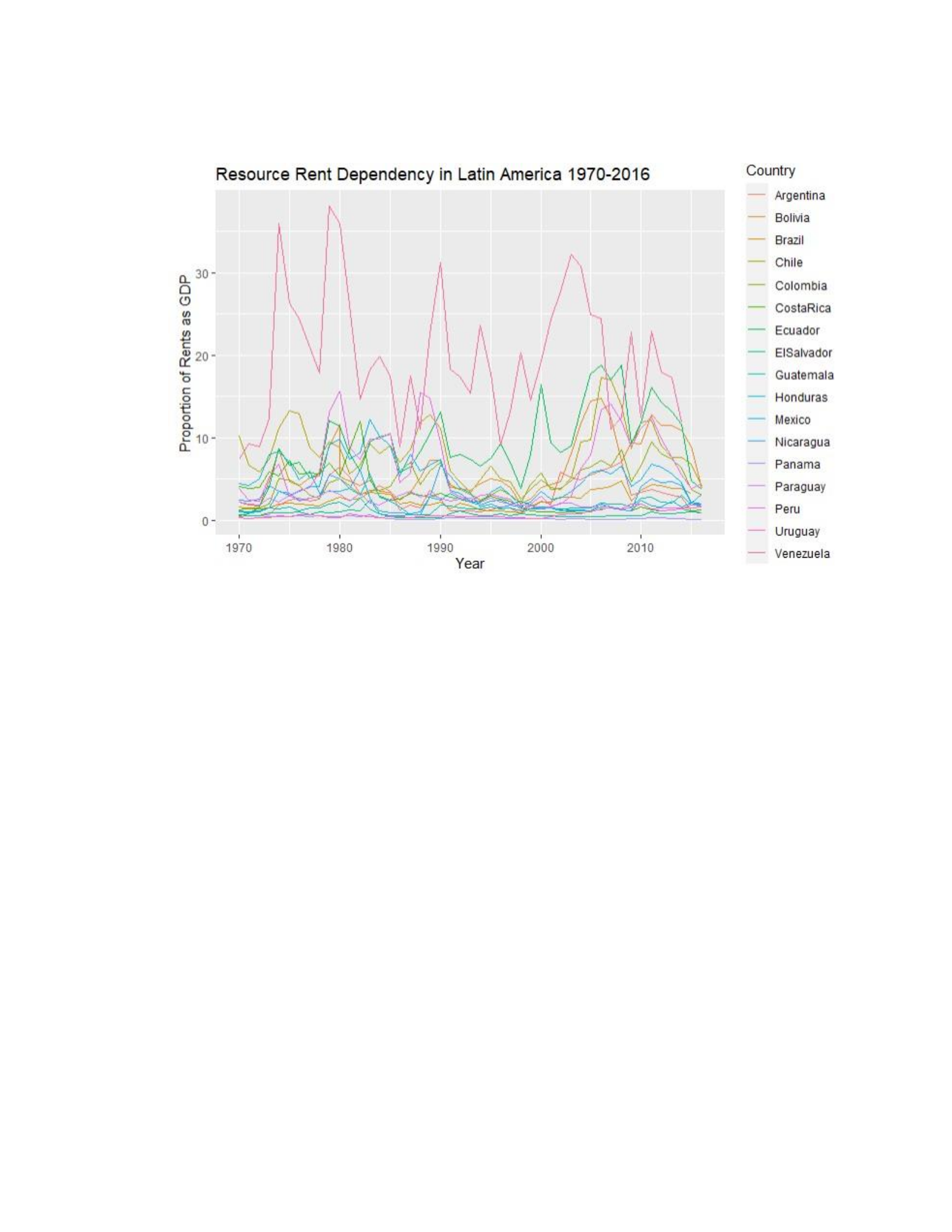
Figure XIII: Resource Rents in Latin America: 1970-2016
State Capacity
State capacity is the second factor predicted to inhibit the constitutional adoption of
indigenous resources and autonomy. Stronger states that have a higher degree of physical control
over its borders are unlikely to cede territorial legitimacy and control to ethnic minorities.
Strongs states also have a higher ability to extract wealth through either taxes or other wealth
extraction. A high state capacity signals that a state not only has more territorial reach, but also
the capability to extract wealth from these regions and their populations.
State capacity is an aggregate score of indicators from Hanson and Sigman's measurement,
“Leviathan’s Latent Dimensions: Measuring State Capacity for Comparative

Political Research,” (2020). The comparative database gathers an aggregate score of indicators to
measure state capacity on three dimensions. First, is the state’s extractive capacity, or its ability to
extract revenue and assets from its populations. Second, the coercive capacity of the state.
This is the state’s military capacity measured via the log value of military expenditure per million
citizens and the number of personnel per thousand in the population. This measure includes the
degree to which the state also has a monopoly on violence within its borders. Finally, the third
dimension includes the VDem measurement for coercive capacity, which is the percentage of state
territory under physical control of state actors (Hanson and Sigman 2020). The score across these
three dimensions is combined into one score per country on a yearly basis
through the observation period.
State capacity values on the plots below are captured between values of -2 and 2. Values
in the region vary widely. Higher scores indicate a stronger state capacity. Overall, state capacity
is on the rise in the region over the last few decades. But values vary widely and are anywhere
from -1.45 to 1.5. Chile has seen the greatest increase in state capacity since the 1980s according
to these observations.9 Nicaragua also saw gains in its relative ability to extract assets and
maintain territorial control over the observation period.
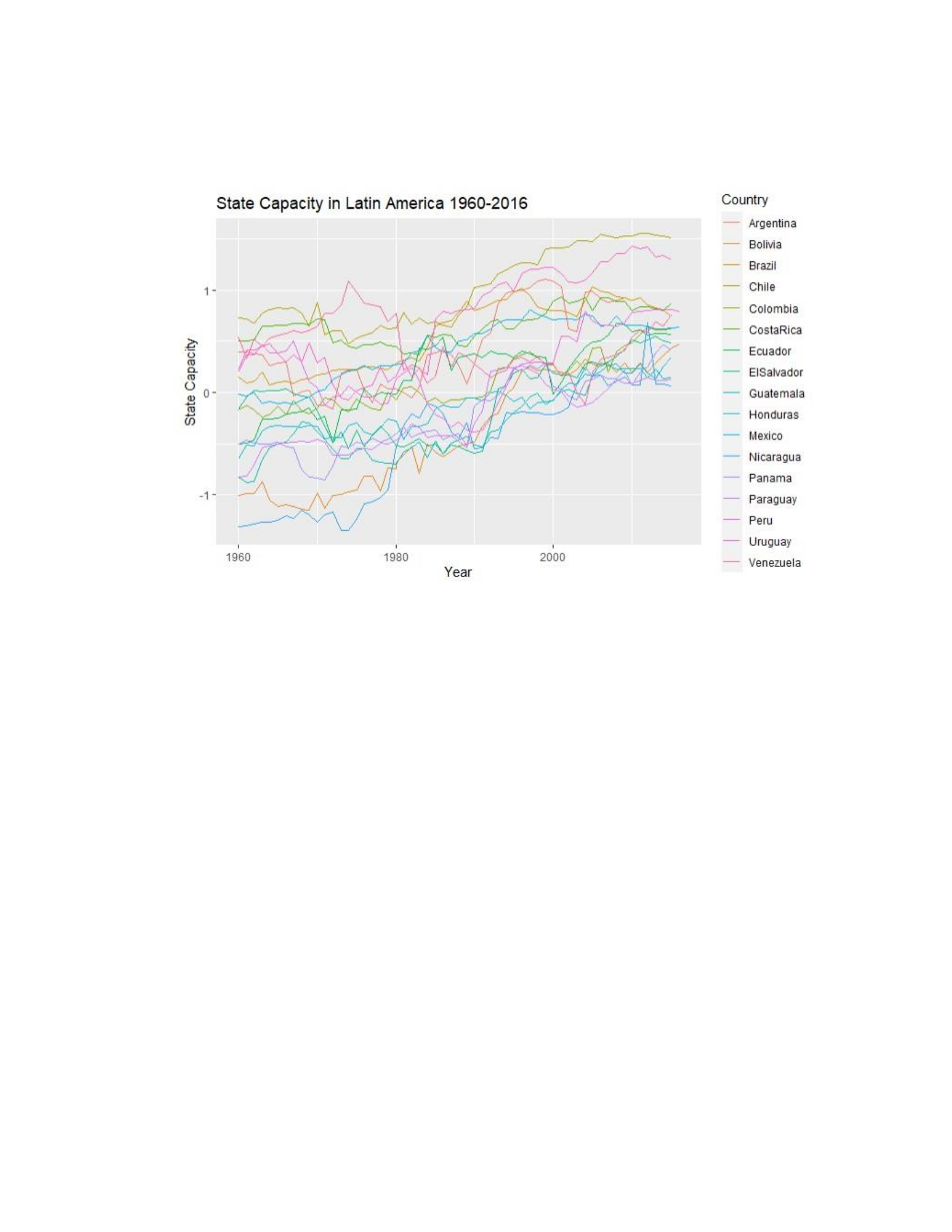
Figure XIV: State Capacity in Latin America: 1960-2016
Controls
The following variables, while not the main variables of interest in the theory presented
here, should be included in the analysis according to current theoretical works. Strong judiciaries
that are the result of a turn toward democracy are associated with higher protection of minority
rights and can independently facilitate legal revisions (Apodaca 2003; Powell and Staton 2009).
Democratic norms have also been observed to happen as a cascade- once so many countries adopt
human rights norms, others follow (Finnemore and Sikkink 1998; Keck and Sikkink 1999). The
same logic applies to domestic adoptions into constitutional law, and I test for a neighborhood
effect of indigenous constitutional adoptions. Finally, indigenous population proportion and
fractionalization, according to conflict literature, impact the leverage that ethnic minorities have
when making political demands from the state apparatus (Doyle and Sambanis 2006; Fearon and

Laitin 2003; Gurr 1970). I briefly discuss these control variables before summarizing the content
of this chapter.
Judicial Strength
Judicial strength, often an outcome of democracy, implements more successful
constitutional revolutions (Feinrider 1980; Sandoval-Rojas and Brinks 2020). Judicial branches
that effectively exercise power create constitutional change that is consistent with democratic
norms and international human rights law. Simply, a stronger judicial branch acts more
independently and is less subject to oversight from other political branches. It is easier to create
progressive laws that protect minority populations where there are strong judiciaries.
H6: Countries with strong judiciaries are more likely to adopt indigenous provisions into the
constitution.
As strong judiciaries are thought to more easily adopt progressive laws independent of
oversight and other constraints (Powell and Staton 2009), I account for the potential effects of the
judicial branch. Particularly, a strong judicial branch vis-à-vis the executive indicates increased
judicial independence and implementation of progressive laws. I expect strong judicial branches
to positively impact the likelihood of indigenous rights adoption for these reasons.
The measurement for judicial strength is taken from VDem data that scores the
independence of the branch. Specifically, it assigns each country a score for judicial
independence from other branches of government and its ability to constrain the executive
branch’s decisions. Scores range from 0 to 1. The closer to 1, the more independent the judicial
branch is in its actions.

Since strong judicial branches are an indicator of democratic strength, democracy levels
and the independence of the judicial branch of government are related to one another. The sample
estimate for correlation between these two variables is .76. This score indicates a strong positive
correlation between democracy levels and the strength of the judicial branch. As such, survival
and firth logit models test democracy and judicial measures separately. Below is a plot of the
relationship between democracy and judicial strength, followed by plots of judicial strength by
country case.
Figure XV: Relationship Between Democratization and Judicial Strength
Correlation Plot: Democracy and Judicial Strength
Interestingly, the strength of the judicial branch in Bolivia appears to have increased, but
only to a level that is around the mean of .54. This low score is despite that fact that indigenous
populations are most constitutionally protected in that state. On the other hand, Brazil’s court is
strong, but does not afford the same rights to its ethnic minorities. Since the authoritarian
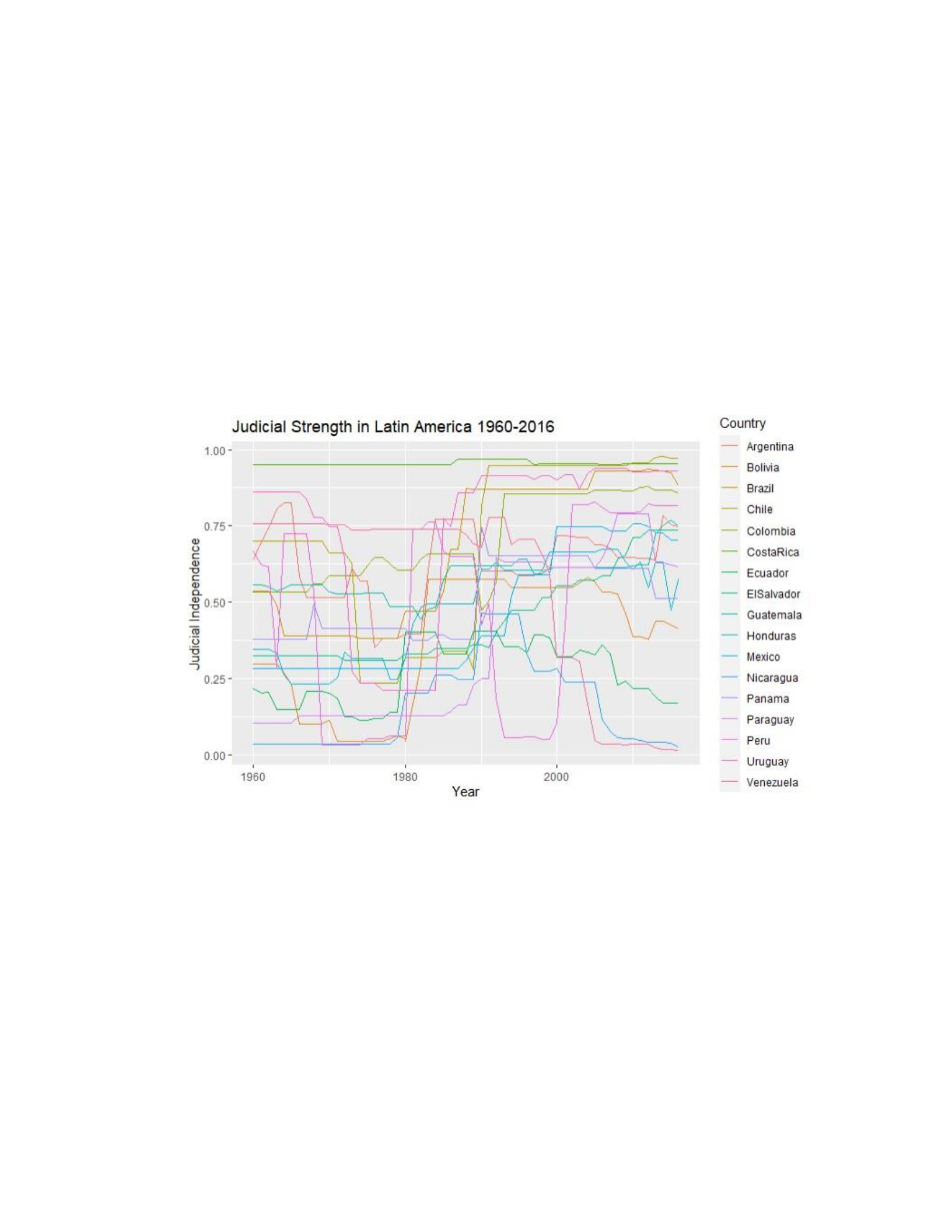
Pinochet era in 1980’s Chile, the court has become extraordinarily strong, which is a factor in the
current constitutional revolution that will replace the dictator’s old rules of the game. Similarly,
Mexico’s judiciary has steadily gained independence over time. The strength of the courts in Peru
has waxed and waned over time but is most recently on the stronger side (about a .75 out of
1). Uruguay’s judicial branch is strong, and Venezuela’s has lost all its power in recent decades.
Summary plots are presented below.
Figure XVI: Judicial Strength in Latin America: 1960-2016
Neighborhood Effects
Other perspectives note that international human rights norms, like those that protect
indigenous minorities, are adopted through norm cascades (Finnemore and Sikkink 1998).
Simply, the more countries adopt protective laws, the more likely it is that others will follow.
This logic applies to the adoption of domestic minority protections into constitutional law as
well. As more neighboring countries adopt indigenous constitutional provisions into domestic
law, the more likely a country is to do the same.

H7: Neighborhood effects positively impact the likelihood of indigenous rights adoption in the
national constitution.
Democratic norm literature posits that human rights norms, including the adoption of
minority protections into national law, are caused by norm cascades (Finnemore and Sikkink
1998). Simply, the more regional neighbors or allies acknowledge a policy position as legitimate,
the more likely a state is to follow suit and engage in the same behavior. As more country neighbors
adopt indigenous provisions, the more likely its government is to do the same. This perspective
argues that there are regional and international pressures to undertake certain political behaviors.
To calculate a neighborhood effect, I measured a total proportion of border-sharing
neighbors for each country in the region that includes indigenous recognition, representation,
resources, and autonomy in their national constitutions. This means that neighborhood effects are
separately calculated for each category of indigenous provision. Values range from 0 to 1. For
example, as more border sharing neighbors adopt indigenous recognition in their constitution, a
state becomes more likely to do the same. This logic follows for every category of indigenous
provision.
Between the years of 1960-2016 an average country shares 66% of its borders with
countries that adopted indigenous recognition into their national constitutions. When it comes to
indigenous representation rights, the average percentage of shared borders drops to 38%. The
average neighborhood effects of indigenous resource rights adoption over the observation period
is similar, at an average of 37%. Finally, the average effects of indigenous autonomy rights in
border sharing neighbors is 6%. Neighborhood effects for autonomy, then, are likely to be very
low.

Below, I show plots that measure the neighborhood effects of indigenous recognition in
constitutional law in each country in the region. For the sake of brevity, I do not include plots
that measure the effects of representation, resource, and autonomy adoptions.
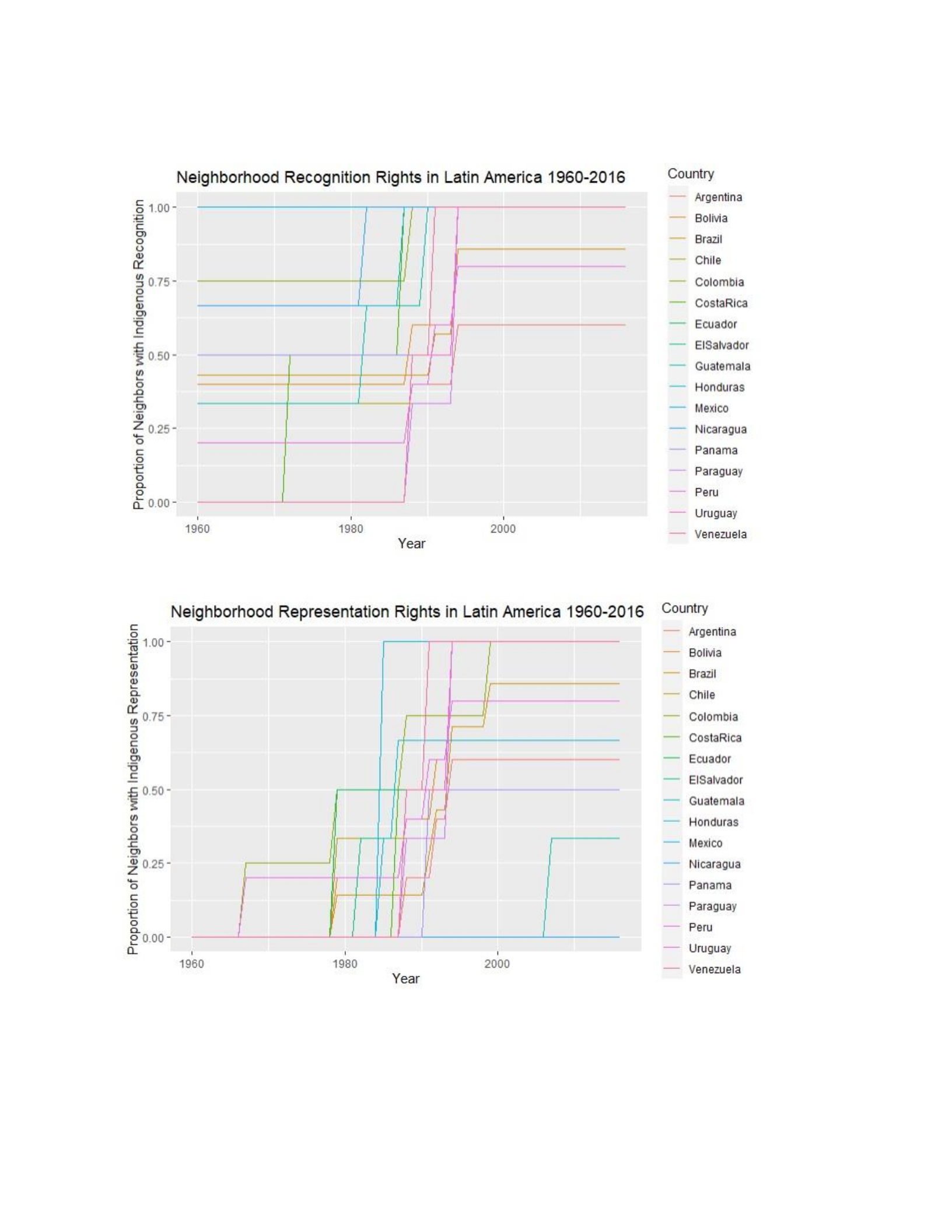
Figure XVII: Neighborhood Recognition Rights in Latin America
Figure XVIII: Neighborhood Representation Rights in Latin America
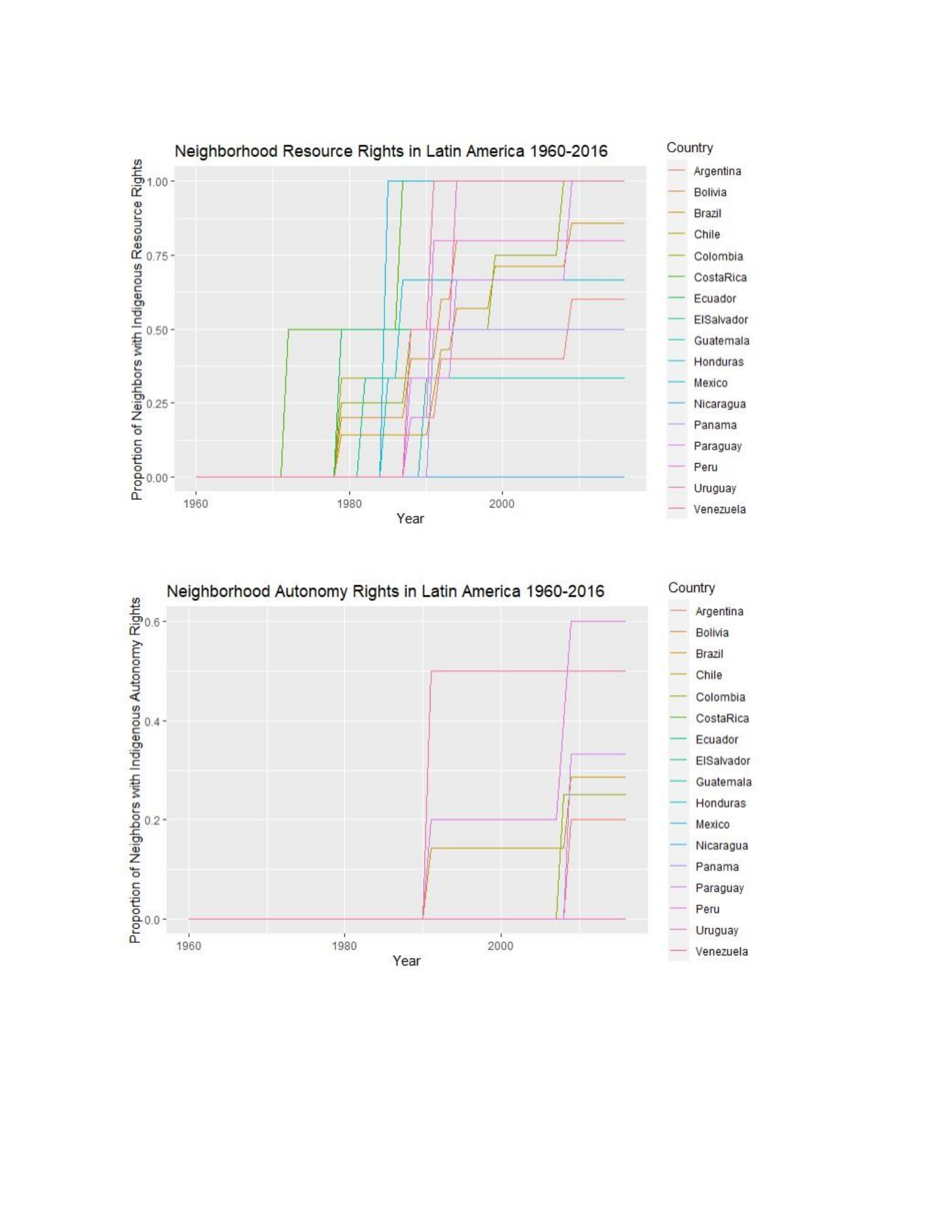
Figure XIX: Neighborhood Resource Rights in Latin America
Figure XX: Neighborhood Autonomy Rights in Latin America
Indigenous Population Proportion
Indigenous populations vary in their size vis a vis non-indigenous citizen. Conflict theory
predicts that larger marginalized populations more credibly threaten the political status quo (Doyle

and Sambanis 2006; Esteban and Ray 2008; Fearon and Laitin 2003; Gurr 1993; Montavlo and
Reynal-Querol 2005). States actors are more likely to engage in power sharing through
constitutional reforms where indigenous peoples constitute a larger share of the state’s total
population. Large minority populations have higher mobilization potential and can create social
and political unrest when these populations are dissatisfied with state power arrangements.
H8: Indigenous communities with a high share of the total population will be more likely to
obtain more constitutional rights.
Larger minority populations have a higher likelihood of extracting political goods from the
state apparatus and are more likely to have high mobilization capability. Continued
nonrepresentation of large, marginalized populations is untenable, and is more of a threat to
national political stability. In these cases, original populations are more likely to negotiate
constitutional protections.
As a historically politically marginalized peoples, indigenous representation in state data
is lacking. Not only are census data in the region highly irregular, but some states do not include
indicators for indigeneity. Furthermore, racial discrimination in the region discourages honest
racial representation on state censuses, so minority status is often concealed. A study of ethnic
classifications in the census of 19th century Latin American countries reveals that indigenous
peoples and other minorities are underreported, and the populations of homogenous, white
populations are exaggerated (Munck and Luna 2022, ch.2). This practice coincides with the
marginalization of certain ethnic identities from the story of nationhood. In Brazil, racial
classification has only been included since the 1980s, and was only offered to a sample of the
population until 2000. Furthermore, the racial classifications until 2010 eliminated many
indigenous identities altogether and forced groups into a choice of brown vs black and creates

further inaccuracies (Petruccelli 2015). The census has increased its representativeness and
outreach since 2010, but actual population levels are far from accurate.
To address this issue, regional experts increasingly rely on data that measures indigenous
descent through language use. This measure is more able to accurately capture the population size
of ethnic minorities, since ancestral languages are passed down through the community, and are
not a direct admission of heritage. From a linguistic perspective, indigenous populations and their
evolution and changes are best based on the languages spoken by the various indigenous
communities (Barbary 2015). Therefore, I choose to not use state census data for the population
size of these ethnic minorities, and I instead rely on the percentage of peoples that speak an
ancestral language to serve as a stand in. Latinobarometro, a private NGO based in Santiago,
Chile, conducts extensive face to face public opinion surveys, and has created a thorough record
of languages spoken in the region.10 The resulting measurement is a percentage-based calculation
of the proportion of the population that indicated that they speak an original language.
There is quite a range of estimated population sizes of native peoples in the region. These
values land anywhere from close to 0%, as in Costa Rica (.01%), Venezuela (.11%), and Chile
(.3%). Bolivia has a measured 31.9% of the population that is identified as native, and in Paraguay
an astonishing 49% of respondents indicated that they spoke an indigenous language.11 Overall,
the average across the region is a 7.6% indigenous population, but there is quite the variation across
country cases. The relative size of these populations will also play a part in which rights minority
populations will eventually obtain. Larger populations have a higher mobilization capacity and
potential to cause political instability, and should therefore, all else equal, be more successful in
obtaining constitutional protections.

Importantly, this is an imperfect measurement of indigenous populations in Latin America.
Efforts have only recently been made to record the number of citizens that identify as either
indigenous or mestizo. Regional data that surveys mother languages to identify original
communities still undercounts the total proportion of their populations. Indigenous population
proportions are summarized on the table below
Table 7: Indigenous Population Proportion Estimates in Latin America (2016) Country
Indigenous Population Proportion
Argentina
1.3%
Bolivia
31.9%
Brazil
3.4%
Chile
.3%
Colombia
1.3%
Costa Rica
.01%
Ecuador
2.5%
El Salvador
.01%
Guatemala
19.3%
Honduras
1.1%
Mexico
4.7%
Nicaragua
.5%
Panama
3.6%
Paraguay
49%
Peru
10.3%
Uruguay
.1%
Venezuela
.11%
Data is sourced from Latinobarometro, with a minimum threshold of .01% of the total population size.
Ethnic Fractionalization
Informed by similarly positioned conflict literature (Wegenast and Bosedau 2014;
Cederman and Girardin 2007), the fractionalization level of minority populations is also
accounted for when calculating the potential to exert political pressure and create instability.

Fractionalization is the degree to which minority populations are split into distinguishable
subgroups. Native peoples may constitute most of the population, for example, but be broken
down into hundreds of different original nations. These peoples often speak different languages
and have unique customs and perspectives. The cooperative capability between hundreds of
nations is lower than those that have fewer nations and more homogenous interests. When the
interests of indigenous peoples across many different groups, they are also more easily exploited
by state entities against each other. In simple terms, the more fractionalized these populations are,
the more of a collective action problem these groups have. Fractionalization negatively impacts
both mobilization capacity and negotiating power of native peoples.
In the following table I outline estimates of indigenous fractionalization among different
national identities. The more fragmented the original peoples are into unique, distinguishable
groups, the less they can coordinate political efforts across groups. Limited evidence presented by
Munck and Luna (2022, ch.6) shows that indigenous political pursuits were divided between
nations and led to limited rights compared to much more united women’s rights efforts. Differences
between groups limit their mobilization capacity and hinder the adoption of representation in the
constitution.
Indigenous ethnic fractionalization is a simple count of different indigenous nations that
are in state territory. Data for this variable was gathered from Minority Rights Group
International’s “World Directory of Minority and Indigenous Peoples,” (2017). Various native
communities and are distinguished by their spoken language. Different original nations speak
different languages and is used as the indicator of separate indigenous groups. Simply, a different
mother tongue represents a different ethnic group.12 This measure accounts the number of different
native groups within each country in the region through the entirety of the observation period.

Table 8: Indigenous Fractionalization Estimates (2017) Country Indigenous
Fractionalization
Argentina
35
Bolivia
36
Brazil
305
Chile
10
Colombia
115
Costa Rica
8
Ecuador
14
El Salvador
9
Guatemala
22
Honduras
7
Mexico
68
Nicaragua
7
Panama
7
Paraguay
17
Peru
51
Uruguay
4
Venezuela
51
Data is sourced from Minority Rights Group International (2017). Fractionalization is a measurement of how many
different native languages are spoken in each country in the region.
The fractionalization data reveals some key findings. Brazil has the highest levels of
native fractionalization with 305 different recorded groups. This is followed by Colombia, with
115, and then Mexico is next with 58 native populations. Uruguay has the least fractionalization
with only 4 different native groups observed in this dataset.13 The average fractionalization level
of these populations is 45. This implies that there are often many competing interests between
different nations and peoples in the push for political inclusion in Latin America.14
Though fractionalization is expected to have some degree of impact on the mobilization
capacity of indigenous groups, its measurement is imperfect and remains static over the time
period. The inclusion of two unchanging variables in statistical models destabilizes their output,

fractionalization will not be included in statistical models used to predict indigenous rights
adoption. However, fractionalization is still discussed in following case study chapters to
ascertain its impact on the adoption process.
Table 9: Indigenous Population Proportion and Fractionalization in Latin America
Country
Population
Fractionalization
Argentina
1.3%
35
Bolivia
31.9%
36
Brazil
3.4%
305
Chile
.3%
10
Colombia
1.3%
115
Costa Rica
.01%
8
Ecuador
2.5%
14
El Salvador
.01%
9
Guatemala
19.3%
22
Honduras
1.1%
7
Mexico
4.7%
68
Nicaragua
.5%
7
Panama
3.6%
7
Paraguay
49%
17
Peru
10.3%
51
Uruguay
.1%
4
Venezuela
.11%
51
Data is sourced from Minority Rights Group International (2017). Fractionalization is a measurement of how many
different native languages are spoken in each country in the region.
Examining both population data and fractionalization of ethnic groups side by side is more
telling. For example, in Bolivia where there is a large native population, there is also a
fractionalization level that is below the average. This suggests an increased mobilization capacity
for these groups, and more coordinated efforts in creating constitutional negotiations that favor
them. But the same may be said about Paraguay, which has much less favorable outcomes for

indigenous populations, but still lands itself in the middle of the road with some more
representative policies and 7 protective provisions total (see chapter 2). Brazil has the highest

