


INTRODUCTION Chauncy Fields tells Fox
"I believe what the Bible says [about marriage], so I came out here to support Chickfil-
A and the movement," Chauncy Fields tells Fox News as he devours a hot tasty Chickfil-A
chicken biscuit (Roberts 2012). Another Chick-fil-A consumer echoes a similar sentiment
but with a touch of exasperation, "He [Dan Cathy, the COO of Chick-fi-A] said the exact
same thing that President Obama said, and he gets negativity and Obama gets positivity!"
(2012). These two individuals, along with millions of evangelicals, conservatives and
others flocked to Chick-fil-A on August 1, 2012, to consume chicken and publicly express
their political and social positions by showing support for a company who shared those
positions. These two men participated in a growing form of political expression: political
consumerism. This particular movement happened for a reason and represented an area of
religion and politics research that, until this dissertation, has been left derelict.
The Pew Research Group carried out the following thought experiment. If the United
States only had one hundred people what would be the religious makeup of that group?
There would be twenty-one Catholics, fifteen mainline Protestants, twenty-three
unaffiliated, six Black Protestants and a handful of Mormons, Jews, Muslims, Hindus,
Buddhists, other Christians, and other faiths. The group I am leaving out, of course, is
evangelical Protestants. They hold the top position with twenty-five (Alper and Sandstrom
2016).
While it is true that religiously unaffiliated “nones” are a growing number in America
today, it would be fallacious to assume that evangelicalism is dead and of little
consequence. Religion and politics scholars have studied the counterintuitive (Durkheim
and Lukes 2014; Parsons 1949; Weber 1978;) vibrancy of the evangelical population in

America (Hunter 1992; Smith et al.1998), and have attempted to understand who they are,
what they believe and how they operate within politics (Emerson and Smith 2000; Guth
1996; Jelen 1993b; Jelen and Wilcox 2003; Moen 1989; 1992; 1994; 1996; Oldfield 1996;
Streensland et al. 2000; Wilcox 1986; 1989; 1990; 1996; 1991; Wilcox and Jelen 1990;
Wilcox and Robinson 2010; Wuthnow 1988; 2014). Countless scholars show the influential
importance of religion on various forms of political behavior along with the development
of civic skills (Brady, Schlozman, and Verba 1999; Calhoun-Brown 1998; Campbell 2004;
Chaves 2004; Djupe and Gilbert 2006; Djupe, Neiheisal, and Sokhey
2017; Gilbert 1993; Green 1999; Green, Guth, Smidt, Kellstedt 1996; Harris 1999;
Huckfeldt, Plutzer, Sprague 1993; Jelen 1991; 2001; Jennings 2005; Kellstedt and Green
1993; Kellstedt 1994; Kohut, Green, Keeter, Toth 2000; McKenzie 2004; Olson and
Crawford 2001; Olson and Green 2006; Verba, Schlozman, and Brady 1995; Wald 2003;
Wald, Owen, and Hill 1988). Thus, there is little argument that religion is not important to
people’s political beliefs and behaviors.
Religion and politics scholars analyze religion’s influence on different forms of political
mobilization such as voting, civic engagement, and racial empowerment
(Calhoun-Brown 1996; 1998; Campbell 2004; Djupe and Gilbert 2006; Djupe and Grant
2001; Wilcox 1990). Scholars initially looked at the one-dimensional relationship between
religion and political participation and asked the question: does religious participation
stimulate political participation or does it suppress political participation? Calhoun-Brown
(1998) contends that religion’s impact on political participation cannot be stripped down to
the simplistic relationship of stimulating or suppressing; instead, different dimensions of
religion should be considered. Verba, Schlozman, and Brady (1995) show how religious

behavior in a religious institution develops civic skills and acts as a substitute for education.
Other research shows how religious beliefs, clergy, church organizational structures, church
community environment, available resources, and a well-developed group identity
positively impact the political mobilization of religious groups. Sometimes these differing
religious variables act as opiates to political action, while in other cases they positively
influence individuals in ways that lead to political action (see Calhoun-Brown 1996).
Others find that the environmental context also influences political engagement (Djupe and
Gilbert 2006; Djupe and Grant 2001; Olson 2000).
This research provides insight into the multi-dimensional and nuanced world of religion
and political mobilization. However—though scholars such as Jasper (1997; 2008) in
modern social movement theory have acknowledged it—only a few scholars in religion
and political literature have realized that while rational behavior, resources, beliefs, group
identity, organization and environmental context are all central to understanding the
mobilization (or lack thereof) of the religious community, emotions cannot be ignored.
Early social movement theorists argued that a feeling of marginalization and alienation was
all that was needed to motivate a group into collective action (Arendt 1951; Buechler 1993;
1995; Kornhauser 1959). This simplistic view of collective action was soon replaced by a
more sophisticated understanding of the specific mechanisms needed to stimulate and
organize collective action (McCarthy and Zald 1977) but the importance of emotion to
collective action should never be lost in the array of new, sophisticated variables. Social
movement scholars such as Jasper (1998; 2011) and Benford and Snow (2000) realized the
importance of emotion and framing to collective action and therefore introduced a new
theory, the theory of social constructionism. This theory maintains the rationality and

practicality promoted by the resource mobilization model, but also accounts for the impact
of emotion. Specifically, social constructionism contends that emotions are socially
constructed by movement elites in order to stir up desired political behavior. Therefore, in
this dissertation, I contend that emotion cannot be lost in the study of religion and political
behavior.
What emotions brewing in the evangelical community might we, as scholars, be
missing? Specifically, are evangelicals feeling a sense of marginalization by a changing
society? Evangelicals have held a dominant position in society, and yet recent research
shows that they are showing signs of perceived marginalization. What does it take for a
dominant group in society to feel as though they are oppressed rather than the oppressors?
Given the importance of marginalization to mobilization, if evangelicals are indeed feeling
marginalized, are they responding with mobilization? Further, what kinds of mobilization
are they willing to engage in as a result of these feelings?
Wong (2018a) finds that white evangelicals are struggling with demographic changes
within their ranks. She shows that the proportion of Black, Latinx and Asian evangelicals
have grown while the proportion of white evangelicals has decreased. She finds, however,
that despite these demographic changes within the evangelical community, white
evangelicals "appear to be supporting a political agenda that goes against the tide of
demographic change in the United States" (88). These findings coincide with those of
Sides, Tesler, and Vavrek (2016; 2017; 2018) who show that white Americans are
displaying signs of anxiety and even perceived marginalization because of demographic
changes in society. Sides, Tesler, and Vavrek (2017) call this anxiety the “white identity”
crisis and point out the uniqueness of a “white identity” crisis in a country that is primarily

white. They attribute the recent surge of a “white identity” rhetoric in politics to the racial
strain amongst whites in response to having an African American president coupled with
Donald Trump’s use of “us” versus “them” rhetoric during his presidential campaign.
The demographic changes occurring within the evangelical population are a microcosm
of what is happening in America at large. Further, there is a unique difference between
white evangelicals and evangelicals of a minority race/ethnicity (Wong 2018a). However,
it is important to note that social strain in the white evangelical population is likely
connected to this broader sense of anxiety present amongst white Americans as they
struggle with their looming “status loss” in society and loss of power in the political realm
as a result of shifting societal demographics (Sides, Tesler, and Vavreck 2017; 2018; Tesler
and Sides 2016; Tesler 2016; Wong 2018a; 2018b). This literature finds that ethnic and
racial identities played a tremendous role in the election of Donald Trump. Sides, Tesler,
and Vavreck (2016; 2017; 2018) and Tesler (2016) found that divisions tied to race,
immigration and religion were exacerbated due to the “us” versus “them” rhetoric used in
the Trump campaign. Hence, Donald Trump’s election sheds light on an area of social and
status anxiety simmering in the ranks of white America.
Thus, current literature shows that in the general white population there is social strain
brewing, a strain that Trump was able to use to his advantage (Sides, Tesler, and Vavreck
2016; 2017; 2018; Wong 2018a). Wong (2018a) points out that this strain is not associated
with economics—as many assumed—but rather to issues of race. White evangelicals are
experiencing an even more substantial demographic shift in their community than whites
in general. Their support for President Trump was substantially higher (80%) than that of
their non-evangelical white counterparts (31%), indicating an even stronger emotional

impetus for political mobilization (Wong 2018b). Wong (2018a; 2018b) explains that
evangelicals are feeling a sense of marginalization based on racial prejudice and societal
strain as their "us" versus "them" mentality is constructed and reconstructed for the benefit
of Republican elites. This does not mean that evangelical marginalization is based solely
on a "white identity" crisis but that it is a crucial factor that cannot be ignored.
Many other factors are likely also contributing to feelings of marginalization. I will
touch on these other possible influential factors throughout this dissertation. However, the
purpose of this dissertation is not to uncover and assess why evangelicals are feeling
marginalized but rather to look at how they are expressing themselves through
unconventional forms of political mobilization as a result of this emotional impetus.
Both social movement theory and theories of political behavior acknowledge the
importance of expression as a form of political mobilization (Jasper 1998; 2011; Theocharis
2015). Rojas and Puig-I-Abril (2009) explain that expression is the way that individuals
can publicly express their political orientations; thus, it is an essential part of the
mobilization process. Further, Charles Tilly (1978) calls this kind of expression "identity
claiming." It is the simple act of expressing one's identity, one's collective "we" to the
world. It is not an attempt to change the world as much as it is a form of expressing that
one's perspectives, values, and identity still exist and "constitute a unified force to be
reckoned with" (Tilly 1978, 184).
Evangelicals make up a sizable portion of the population and, as the Christian Right
Movement taught political scientists, should not be underestimated or understudied (Moen
1992). Elites construct a “marginalized” collective identity to stimulate evangelicals into
political participation. Given the latent civic skills (Campbell 2004) in the evangelical

community, evangelical churches are ripe with powerful and skilled individuals who, on a
moment’s notice, have the organizational capacity, civic skills, and resources to mobilize—
they just need to emotional stimuli to push them over the edge.
While emotion is an understudied causal variable in the “religion” and “political
behavior” relationship, there are some understudied forms of political behavior as well. The
Donald Trump presidential election showed that evangelicals are willing to mobilize
conventionally; however, conventional mobilization is not the only form of mobilization
available to groups who feel aggrieved. Throughout history, marginalized groups have
turned to extra-institutional forms of mobilization such as protests, marches, rallies, and
boycotting. Might we find evangelicals utilizing such forms of mobilization as they adopt
the marginalized label for themselves?
Expression is a form of mobilization. Are evangelicals motivated to express themselves
using unconventional, extra-institutional forms of political mobilization? What other ways
might evangelicals be expressing their feelings about society and politics? While voting
behavior, lobbying, political donations, founding and funding pressure groups, writing
members of Congress and any other form of conventional political participation are
essential to understanding the mobilization of the evangelicals, there are other forms of
expressive political mobilization that may be used to tell us more about the emotional
context driving these individuals to engage in conventional political participation.
Evangelicals are still highly involved in forms of conventional political participation
and continue to have an impact on the American political landscape (Wilcox and Robinson
2010). The Donald Trump presidential election is perhaps one of the most recent examples
of evangelical political participation and influence. In this dissertation, I do not argue that

forms of conventional political participation are irrelevant, nor do I contend that
evangelicals are disengaged from these forms of participation. In fact, I argue the opposite.
Evangelicals are quite willing to engage in conventional forms of political participation
when they feel the need (Fowler et al. 2013; Smith 1998). Religion and politics scholars
are keenly aware of this and the importance of understanding the ways that religion
influences and informs such participation. However, there is scant research that studies how
and why evangelicals engage in unconventional expressive forms of political participation
such as marches and protests, boycotting, or online media expression. While these
unconventional forms of political participation are by no means the only forms of
participation, nor are they even the most important, they are and have played an essential
role in many social movements in American history. Further, these forms of political
mobilization are highly expressive and usually indicate the specific issues of social strain
present in the aggrieved group.
Tilly (1978) discusses the “repertoire” of activities that aggrieved groups use to express
themselves and their desires. The repertoire changes with the times. Forms of expressive
mobilization are indicative of social strain and studying them provides a unique picture of
evangelical social strain or lack thereof. We can better understand some of the issues and
concerns present in the evangelical population by studying what kinds of issues they
express themselves for or against. Thus, studying unconventional political participation
informs our understanding of conventional participation.
I also believe the research in this dissertation can lead to more research and greater
insight into the political polarization literature and the presumed culture war (Layman
2001; Layman and Carsey 1998; Layman and Green 2005). Presumably, the more society

embraces socially liberal norms, the more socially conservative norms will stand out. This
is common sense, and would work in the opposite direction as well. The key here is the fact
that these norms must be publicly expressed as still existent for them to "stand out."
Evangelical expressive mobilization makes these views stand out.
There are only a select few groups left in the US who still hold certain "black or white"
positions on social issues. Abortion, homosexuality, and sexuality are all highly divisive
and invoke strong feelings (Hunter 1992). However, most groups, including evangelicals
have become more open and accepting of forms of sexuality or homosexuality present in
society (Pew Research Group 2016; 2017). A subset of "traditional values still persists"
(Inglehart and Baker 2000). Thus, the idea that evangelical/conservative views on issues of
sexuality are outdated swells until some form of outdated social expression reminds people
that this view still exists. Hence, "there's still more work to do."
For example, the North Carolina school system recently removed the children’s book
“Jacob Wears a Dress” because of parental opposition. The authors of the book,
disappointed by the reaction, said “Our hope, when we wrote this book, was that someday
it would be considered quaint. We imagined future generations saying, ‘What was the fuss
about?’ Clearly, there’s more work to do.” (Mele 2017). “Clearly, there’s more work to do”
implies that since socially conservative perspectives on human sexuality still exist, these
authors’ job is not complete. This means that statements and expressions in favor of socially
conservative norms likely stimulate progressives to fight harder for their end goals. I
believe that this dynamic feedback loop between social perspectives is overlooked in
polarization literature. Therefore, my dissertation's analysis of evangelical expression
provides a critical missing piece for this otherwise complex puzzle of polarization.

Why should we care then about how evangelicals are expressively mobilizing in
support of their values and identity? Numerous scholars already agree that religion's impact
on political behavior cannot be overstated; thus, understanding the impact of emotions on
the expressive mobilization of one of the most significant religious populations in the
United States is essential to understanding political behavior in the United States. If we
choose not to care, we may yet again be blindsided by future election results or befuddled
when evangelicals engage politically in something we never saw coming.
These expressive forms of mobilization act as proxies for what is going on in the hearts
and minds of evangelicals and provide insight into their feelings of social marginalization.
I theorize that the higher their feelings of social strain, the more they will engage in these
forms of expressive mobilization. This allows them to, at the very least, express their
thoughts and feelings on issues they about which they feel strongly. Studying why and how
they maintain their religious vitality, or what kinds of evangelicals are out there, or even
studying the Christian Right's political participation, will never allow us to fully understand
the dynamics and nuance of the evangelical population and what levels, if any, of
marginalization they may be feeling. Further, it misses how this marginalization is affecting
their behavior now and may affect their behavior in future or current elections.
Summary
This dissertation is about perceived social marginalization and subsequent expressive
mobilization of evangelicals in America. Do evangelicals, regardless of ideology, race, age
or political persuasion, feel marginalized by society and/or government? Given the Donald
Trump presidential administration, is it possible for them to feel a sense of political efficacy

while still possessing a sense of marginalization? Sides, Tesler, and Vavreck (2017) show
that social strain was and is present among the ranks of white Americans surrounding issues
of race, immigration, and religion. Thus, if evangelicals do feel marginalized how does this
perceived marginalization cause them to express themselves through unconventional
political participation? The Donald Trump election is evidence they are willing to engage
in conventional political participation; but, in what ways have they attempted to relieve
their perceived social strain through alternative forms of political mobilization? Does an
increase in feelings of marginalization cause them to mobilize expressively? I argue that
evangelicals when they do mobilize, are counter-mobilizing since mobilization is the
attempt to change the societal status-quo and counter-mobilization is the attempt to stall or
maintain the challenged status-quo.
Evangelicals are just one of many groups in the United States fighting to make their
voices heard. All groups are important to the political and social process of any democratic
country, and every group uniquely influences society and politics. Evangelicals' zero-sum
understanding of morality is another reason I am interested in evangelicals in the USA.
They are one of only a few groups left in the United States that adamantly claim that their
way (belief system) is the only way, while the societal zeitgeist is that everybody’s way is
the right way. Given this current societal trend, I believe that it is important to understand
how evangelicals are feeling in response to societal change and if they are mobilizing in
kind.
Evangelicals are not a homogeneous unit. This means there is likely not one universally
shared feeling. African American evangelicals may be responding and/or mobilizing
differently than white evangelicals. Younger evangelicals may have different feelings in

than older evangelicals. These are differences that I intend to unravel and better understand
while writing this dissertation. Unfortunately, due to data limitations, I cannot unravel the
answers to all these intricacies, but I can begin shedding light on them.
I expect to find that evangelicals are becoming increasingly frustrated with the direction
of the country and thus perceive themselves to be socially marginalized. Ergo, in this
dissertation, I theorize that, based on social movement theory, one-way evangelicals will
express their displeasure with the feeling of marginalization is by expressively mobilizing.
Assuming evangelicals believe they have lost some of their political and social influence,
I posit that they will use different forms of expression as their form of mobilization. I use
political consumerism and social media venting as indicators of this expression. These are
not the only two forms of unconventional political participation. Other forms of political
participation include protests, marches, picketing, violence, and rioting. I focus primarily
on political consumerism and social media venting for two reasons: political consumerism
is now one of the most frequently used forms of political participation (Michelleti 2003);
social media venting is a growing forum for political participation (Theocharis 2015).
In Chapter 2, I review the relevant literature. I spend most of the chapter summarizing
the literature on evangelicals, their history, their philosophy and beliefs, their place in
society, and their relationship with marginalized groups such as African Americans and
those in the LGBTQ community. Much of the chapter is spent unraveling the many different
interpretations and definitions of "evangelical." I also use a good portion of this chapter to
review social movement theory and political efficacy.
I set up my theory and establish the assumptions for my theory of social marginalization
and subsequent mobilization in the third chapter. Broadly, my theory can be applied to all

groups who feel a sense of marginalization. However, since I am looking specifically at
evangelicals, I narrow my theory to fit some of their idiosyncrasies. I use the final portion
of Chapter 3 to spell out my hypotheses and the implications of my theory that I intend to
analyze in this dissertation.
Chapter 4 is the first of my empirical chapters. It is an exploratory chapter and focuses
primarily on the "marginalization" portion of my theory. I analyze findings from qualitative
field research. I discuss findings from interviews with different evangelical pastors from
three different states. These interviews provide much-needed insight into the individual
thoughts and reactions that evangelical clergy are experiencing in response to changes in
society. I can confirm my original assumption that evangelicals are indeed feeling
marginalized, while also uncovering some of the differing reasons for this feeling of
marginalization, across race, age, region, and denomination. The findings presented in this
chapter are insightful, while also, at times, surprising. I find that evangelical pastors, for
the most part, even though they displayed a high sense of societal marginalization, are not
expressively mobilizing individually or collectively.
In Chapter 5 I perform a case study analysis of collective evangelical mobilization
through political consumerism. Though evangelical elites and some evangelical
organizations have been very loud in recent history, there are limited instances of collective
evangelical political consumerism that do not stem from these organizations. I use this
chapter to analyze one organized boycott and one organized buycott. I use the rest of the
chapter to focus on what moving parts are sufficient to motivate evangelicals who are not
part of these organizations into collective action.

In Chapter 6, I analyze individual evangelical mobilization via Twitter. Twitter is a
handy source of individual public expression. I analyze the differences in how evangelicals
mobilize by looking at a little over 17,000 evangelical Twitter users and the proportion of
tweets that are political versus mundane or spiritual. Further, I analyze the sentiment of the
tweets and compare them to the sentiments expressed by a control dataset of randomly
selected Twitter users.
In Chapter 7, I conclude and establish this dissertation's place in the literature and
discuss plans for future research. This dissertation is just the starting point of a wealth of
further research that explores corporate politics, polarization and public opinion, and a
more in-depth analysis of evangelical marginalization and mobilization.
CHAPTER 2
REVIEW OF THE LITERATURE: EVANGELICAL WHO?

"If ideological leaders warn darkly of the dangers of the forces of liberalism, and stir
up hatred towards gays and lesbians, feminists, secularists, and others with whom they do
not agree, the movement will constitute a divisive force in America that threatens the
lifestyles of many citizens" (Wilcox 1996, 150). Wilcox, a prominent religion and politics
scholar, warns of the dangers of a healthy and unified Christian Right. Many religion and
politics scholars have studied the motivations and movements of the Christian Right
(Leinesch 1982). They delved into the psyche of its members and tried to understand the
motivations and reasoning behind their beliefs and political actions. However, most religion
and politics scholars who study evangelicalism focus almost exclusively on the Christian
Right.
While there is much to learn and understand about the Christian Right, there is also
much missed by focusing exclusively on this extreme ideological portion of evangelicals.
Evangelicals, in total, are much more nuanced and diverse than this ideological branch of
the Christian Right. Evangelicalism, at its core, is not a race, it is not a political ideology,
nor is it a political persuasion, it is a set of Biblical, theological beliefs. I am interested in
the perceived marginalization and expressive mobilization of evangelicals whether they be
conservative or liberal, black or white, young or old, southern or northern, rich or poor,
educated or uneducated. However, it behooves my research to briefly overview the
previous research, debates, definitions and findings on the Christian Right, or in rare cases,
all evangelicals.
Firstly, I am interested in understanding the inter-workings of one specific group; the
evangelical Christian base in America. They are an unconventional crowd, mainly because
of the division and disagreement amongst their members. Evangelicals tend to be content

not conforming to the social zeitgeist and many have been reticent to engage in overtly
political behavior (Calhoun-Brown 1996; Campbell 2004; Djupe, Neiheisel, Sokhey 2017;
Green 1999; Green, Guth, and Wilcox 1998; Green, Rozell, and Wilcox 2000; Olson 2000)
even though they have chosen to engage in political behavior under specific circumstances
(Green 1999; Green, Guth, and Hill 1993; Green, Rozell, and Wilcox 2000; 2003; Jelen
1991; Leinesch 1982; Wald 1989; Wilcox and Robinson 2010). Evangelicals are steadfast
and devout in their adherence to their doctrines and beliefs regardless of the way society
may or may not be trending. Further, evangelicals baffle the minds of scientists who argue
that modernization should and usually does result in the extinction of religion.
There is quite an abundance of literature that says that religion and modernization
cannot and do not coexist. This is the secularization/modernization hypothesis. Emile
Durkheim and Steven Lukes (2014), Max Weber (1978) and Talcott Parsons (1949)
formulated the theory of modernization. Modernization posits that advances in technology,
education, communication and urban growth enlighten the human mind. These advances
convert society from beliefs in the spiritual to beliefs in science. This conversion is the
direct result of science answering previously unanswered life questions that were once
answered by spirituality.
Karl Marx and Friedrich Engels (1964; 2011) introduced a similar theory with their
class conflict model. They argued that members of society in power used religion to dumb
down the minds of the oppressed. They postulated that religion appeased minds and
provided an explanation for oppression and an escape from oppression. Thus, once
communism/socialism and modernization brought about an equal and fair society, religion
became unnecessary and irrelevant.

The modernization of European countries has affirmed these theories; however, the
United States, one of the leading industrialized and modernized societies, has not followed
suit. As one political scientist states, “American religion, like Mark Twain, has obstinately
refused to comply with reports of demise” (Wald and Calhoun-Brown 2018, 8). Further
literature has shown that not only is religion still present, it is highly influential on political
behavior (Calhoun-Brown 1996; 1998; Djupe and Olson 2007; Djupe and Gilbert 2008;
2006; Djupe and Grant 2001; Guth 2001; Guth, Kellstedt, Green, and Smidt 2002;
McKenzie 2004; Smidt 2016).
Against standing theory then, religion, and specifically American Christianity, is
relevant, both socially and politically. Despite Christianity’s persistent relevance, scholars
agree that the study of religion and its followers, in the context of politics, suffers from a
lack of scholarly attention (Vitz 1985). While there is a small niche within political science
that devotes attention to religion and politics, the niche is not a completed collection and
still has room for exploration.
Evangelical Vitality
There is a subset of religion and politics research that focuses exclusively on religious
vitality in America, specifically, evangelical vitality in America since evangelicalism has
maintained its vitality against the odds (Hunter 1981; 1992; Smith et al. 1998). There are
two primary schools of thought that attempt to unpack this evangelical anomaly. James
Davidson Hunter (1981; 1992) introduced the idea of a "culture war." He claimed that the
resurgence of conservative religion during the 1960s through the 1980s was a defensive
maneuver in response to the increasing forces of modernity. He states that religion has two
choices when faced with modernity: resistance or accommodation. He finds that

evangelicals have chosen to resist. They distance themselves from the “evil devices” of
modernity by creating social boundaries for themselves. This intentional distancing
preserves and strengthens their vitality (Hunter 1981; 1992). He concludes that evangelical
vitality is due to their geographic and social distance from modernity (Hill 2004).
However, years later, scholars began to reject the idea that modernity and secularism
were the leading causes of evangelical vitality and resurgence. One scholar, Smith et al.
(1998), posited the subcultural identity theory, which gives a different reason for religious
vitality. He found that self-described evangelicals were more highly educated than all their
religious and non-religious counterparts, save for mainline Protestants. Further, the
evangelical's average yearly income was higher than most every other form of Christianity,
and they were also less likely to live in rural America than other Christian persuasions.
Hunter's assertion that evangelical vitality is due to their geographic and social distance
from modernity is less plausible given Smith et al.'s (1998) findings about evangelicalism.
Smith offers his answer for continued religious vitality. He says that modernity, instead of
threatening to evangelicals, is stimulating to them. That is, secularism/modernity helps to
re-establish an in-group, out-group mentality for evangelicals (see Jelen 1991). This
mentality stimulates and re-invigorates them religiously. Thus, interaction with and
proximity to out-groups renews the groups’ distinction from other groups. He defines
subcultural identity: “In a pluralistic society, those religious groups will be relatively
stronger which better possess and employ the cultural tools needed to create both clear
distinction from and significant engagement and tension with other relevant outgroups,
short of becoming genuinely countercultural” (Smith et al. 1998, 118-119).

These two analyses on evangelical vitality agree on very little. However, one aspect is
similar between them; both studies use either the basic doctrinal definition of evangelical
or self-identification to select their evangelical subgroups. This is unique since much
research on evangelicals focuses on the Christian Right or the conservative aspect of
evangelicals. However, these two scholars only analyze how and what stimulates religious
vitality. That is secularism either drives evangelicals to create more boundaries to shut
themselves off from the world, or pushes them to a greater in-group homogeneity and
outgroup alienation. With this dissertation, I research the flip side of this. What stimulates
doctrinal evangelicals to interact and express themselves and their perspectives to the
world? Many scholars have answered this question, but few have addressed how emotion
affects unconventional expressive mobilization (see Christian Smith 2014).
The gap I intend to fill concerns all evangelicals and not just members of the Christian
Right. I endeavor to uncover truths about evangelical feelings and how those feelings
manifest in forms of expression. How do evangelicals feel about the trajectory of society?
Have these feelings affected their political and social involvement? How do the recent
trends in society towards secularization, especially in sexuality, cause evangelicals to feel?
Are evangelicals feeling a sense of marginalization, and if so, is this causing members to
engage in politics and society differently? Do they feel that they are experiencing a societal
attack on their convictions or are they more concerned with the possibility of a loss of social
status and power position in government (Sides, Tesler, and Vavreck 2018)? Based on
prominent research on mobilization and counter-mobilization, evangelicals, equipped with
a unique set of civic skills (Verba, Schlozman, and Brady 1995; Campbell 2004), if they

are indeed feeling marginalized, are likely to respond both conventionally and
unconventionally.
Is there a shared feeling of marginalization between African American evangelicals and
white evangelicals or is the marginalization felt by white evangelicals exclusive to white
evangelicals? According to the literature on race and religion, African Americans and
evangelicalism have a complicated past and present relationship (Day 2012; Harris 1999;
Lincoln and Mamiya 1990). The African American religious community has a unique set
of experiences that set them apart politically from white evangelicals (CalhounBrown
1996; 1998; Emerson and Smith 2000; Harris 1996; Lincoln and Mamiya 1990); however,
Black and white evangelicals share the same perspectives on many social and doctrinal
issues. Are there any feelings of marginalization that are tied explicitly to the perceived
marginalization of religious values and if so, does this form of marginalization cross racial
lines? If these feelings of marginalization do cross race lines, does it invoke similar forms
of mobilization or varied forms of mobilization?
Evangelical Who?
According to the Pew Research Group, Evangelical Christians make up 25.4% of the
Christian population in American while Mainline Protestants make up 14.7% of the
Christian population in America (2015a). Evangelical denominations usually include the
Southern Baptists, Independent Baptists, Assembly of God, Church of God, and some
Presbyterians (Brint and Abrutyn 2010; Goren and Chapp 2017).
While the research of religion and politics is a small niche in political science, there has
been a good deal of research done on Mainline Protestantism, Catholicism, the evangelical
Christian Right and their respective relationships to politics. However, most scholars’
struggle defining and identifying evangelical. Hence, one of the most researched and

debated topics in religion and politics research centers around what evangelical means.
There is no easy answer to this question, and there is no scholarly consensus or agreement
on precisely what evangelicalism is (Burge and Lewis 2018; Ethridge and Feagin 1979;
Hackett and Lindsay 2008; Hunter 1981; Streensland et al. 2000; Warner 1979). At their
core, evangelicals are a subset of Protestants who believe in the need to proselytize or
evangelize. The word evangelical is a derivative of the Greek word euangelion, which
means "gospel." Evangelicals are keenly concerned with spreading the "good news" of the
Christian gospel message. Further, it is reasonably safe to say that since evangelicalism is
a Protestant phenomenon, Catholics and Jews are automatically excluded (Hunter 1981).
Scholars agree that beliefs in the divinity of Christ and personal faith for salvation are also
vital to evangelicalism (Ammerman 1982). Beyond that, however, evangelicalism is poorly
defined (Hunter 1981).
Another, perhaps less agreed upon indicator of evangelicalism is biblical inerrancy.
While most scholars agree that biblical inerrancy is key to evangelicalism (Gorsuch and
McFarland 1972; Maranell 1974), others (Ammerman 1982; Quebedeaux 1974) question
its place within the operationalization of evangelicalism. Ammerman points out that the
inerrancy of the Bible (at least in the early 1980s) became a topic of contention within
evangelicals ranks. Biblical inerrancy, she explains, is where fundamentalism and
evangelicalism split. Fundamentalists have a unified belief in the inerrancy of the Bible
while evangelicals do not.
However, for this dissertation, I consider Biblical inerrancy central to my definition of
evangelical for two reasons. First, evangelicals tend to use inerrancy as a descriptor for
themselves when explaining why they are evangelical; second, the prevailing scholarly

opinion is that Biblical inerrancy is a crucial part of what makes someone evangelical
versus any other kind of Christian persuasion (Emerson and Smith 2000; Hunter 1981;
Wilcox 1996; Wilcox and Robinson 2010).
Scholars also disagree on the parameters used to define evangelicalism. Hackett and
Lindsay (2008) identify three distinct ways of defining evangelicalism: denominational
affiliation, identity, and beliefs. Using all three forms of evangelical measures, the total
population of evangelicals is scaled down from over 40% of the US population to 2% of
the population (2008). The benefit of using self-identification is that political scientists can
capture political movement adherents as well as doctrinal or denominational evangelicals
(2008). Some survey respondents may identify themselves with an "evangelical
movement" even if they would not fit into the doctrinal or denominational standards of
evangelicalism. However, I am not interested in individuals who identify with a movement
but rather individuals who theologically fall in line with evangelicalism (Smith et al.
1998).
Denominational categorization, when utilized correctly, simplifies the categorization
process. However, Ammerman cautions that in categorizing by denomination “we must be
extremely careful not to repeat past mistakes by trying to assume individual behavior or
attitudes from association with a larger structure” (1982, 171). Moen (1989) categorizes
fundamentalists, Pentecostals and charismatics separately, highlighting their slight
differences. Scholars provide no consensus whether to categorize fundamentalists,
Pentecostals and charismatics as mere versions of evangelicalism or as separate entities.
While Moen tends to conceptualize evangelicals, fundamentalists, Pentecostals and
charismatics as distinct from one another, other scholars conceptualize fundamentalists,

Pentecostals and charismatics as mere subsets of the “evangelical” Christian Right
(Wilcox and Robinson 2010). Hence, much of the difficulty inherent in defining
evangelicals is the lack of coherency in the group itself.
Burge and Lewis (2018), in a recent analysis of evangelicals and their support of Donald
Trump, find that self-identification and denominational identification end up identifying
approximately the same number of evangelicals. This means that these two measures may
not be as distinct from one another as previously assumed.
Wilcox (1991) addresses some of these conceptual issues inherent in defining
evangelicals. He divides evangelicals into three different categories: doctrinal evangelicals;
denominational evangelicals and denominational/doctrinal evangelicals. In his book God’s
Warriors, he researches the detailed intricacies that differentiate the three types of
evangelicals. Generally, he finds that doctrinal evangelicals are more religiously committed
and more politically conservative than denominational evangelicals. However,
denominational and doctrinal evangelicals are more nuanced. In some cases, these hybrid
evangelicals were more religiously committed and more conservative, while in other cases
they were not. The concluding assumption, then, is that doctrinal evangelicals are more
fervently committed than denominational evangelicals.
Hunter uses the doctrinal approach when analyzing evangelicals. His qualifications turn
up one of the lowest rates of evangelicalism available (Hackett and Lindsay 2008).
Hunter encapsulates the concept of evangelicalism with three conceptual requirements.
First, an individual must believe in the inerrancy of the Bible.3 Second, the individual must
believe in the divinity of Jesus Christ, and finally, he or she must believe that salvation is

only through faith in Jesus Christ and not of works. Doctrinal evangelicals are highly
focused on individual salvation and otherworldly concerns (Hunter 1981; 1992).
When possible, I use these doctrinal qualifications for my research data. Doctrinal, not
ideological, qualifications are essential to my research since I am not interested in studying
the Christian Right but rather doctrinal evangelicals. By using only theological and
doctrinal qualifications to define evangelicals, I can more clearly analyze the evangelical
base with all its diversity or lack thereof. I do not use any political or ideological
qualifications to select my evangelical base. Instead, I attempt to analyze how politically
engaged the evangelical base is by avoiding any political identifiers in my qualification
process.
These doctrinal evangelical groups all share the fundamental belief of the inerrancy and
supremacy of the Bible and profess a “born again experience”; yet, they still disagree about
additional details. These disagreements have led to significant divisions among professing
evangelicals. Fundamentalists and Pentecostals, specifically, have a unique relationship
within evangelicalism, one that is riddled with disagreement (Smidt 1988; 1989; Wilcox
and Robinson 2010). Beliefs in pre-millennialism and post-millennialism are at the at the
root of the disagreement. Pre-millennialists (primarily fundamentalists; their belief in
premillennialism is essential to the formation of fundamentalism and has a notable impact
on their identity) believe that the world is supposed to worsen socially and politically
before
Jesus comes back to take all the “born again” Christians home to heaven (Sandeen 1970).
This is in stark contrast to post-millennialism. Those who believe in post-millennialism
believe that Jesus will not come until a thousand years of peace on earth have passed.

These diverging beliefs have significant political consequences. If Christ cannot come
until after a thousand years of perfect peace, Christians have a meaningful and critical role
in politics to bring about perfect peace. Therefore, post-millennials possess a considerable
internal and spiritual motivation to involve themselves in politics to bring about peace on
earth. Pre-millennials do not own this same urgency since they believe the world is
supposed to perish and be in darkness before Jesus returns. In this case, the Christian's
calling is only to save as many, spiritually, as they can. Human and political involvement
is temporary and futile (Wilcox and Robinson 2010).
In sum, who evangelicals are and how they have maintained their vitality are areas of
research that are fraught with debate. I utilize different portions of Hunter's theory and
Smith et al.'s theory to build my theory about doctrinal evangelicals and their expressive
engagement. My concern is less how these evangelicals are still thriving; instead, what are
they doing with themselves since they are thriving?
The Historical Context of Evangelicals and Conservatism
Religious mobilization spans the centuries (Smith 2014) with every religion mobilizing
at different times and for different reasons. Fowler et al. (2013, 1) say "It would be very
difficult to understand American politics today without knowing something about
American religion." Since the inception of the country, religion has played an influential
role in American politics and society. Puritanism was central in shaping American civic
institutions and gave the United States a "sense of national mission" (2010, 2). Initially,
most colonies installed state churches that eventually devolved, but the tendency to include
religion in government persisted. Although the United States is growing in religious

diversity, with a growing percentage of Muslims and Jews, America remains decidedly
Christian, with one in four Americans identifying as such (2010).
There are four dominant forms of Christianity in the United States: Catholicism,
evangelicalism, mainline and African American Protestantism (2010). Mainline Protestant
clergy “have argued that Christians must address the world’s injustices not merely by
individual charity but by collective efforts to change societal structures” (2010, 37). This
“theological liberalism” has influenced Mainline Protestant clergy and parishioners
towards liberal political activism. During the mid-1900s, Mainline Protestant churches
were the dominant force in American religion and were “well entrenched” (2010). Mainline
Protestant clergy participated in and promoted many of the social movements during the
1960s and embraced issues such as poverty, racism, sexism, and oppression (2010). They
lent their voices, their money, and their activism in support of righting these “unjust
structures” (2010, 38).
In recent decades Mainline Protestantism has faced a steep decline in membership.
Fowler et al. (2013) contend that despite this decline in numbers, "mainline churches still
possess a wealth of inherited capital in the form of buildings, institutions and endowments,
as well as the loyalty of lay members. Local churches continue to operate a host of food
banks, meal programs, homeless shelters, clothing closets, and day care centers, and
national organizations operate large hospitals, charitable agencies, and highly respected
international development organizations" (39). In short, Mainline Protestants have been
and still are publicly involved with "the world." They are willing to engage in conventional
and unconventional political participation and tend to do so in support of "theologically
liberal" issues.

Catholicism is also closely connected to politics. Throughout world history,
Catholicism has played a pivotal role in many governments, particularly in Europe where
the church was “deeply enmeshed in statecraft”(Fowler et al. 2013, 41). However, some
Americans tended to look at the Catholic church with suspicion. In time, the Catholic
church evolved into a bridge of sorts between evangelical Protestantism and mainline
Protestantism because of its uniquely liberal and conservative positions on critical political
issues in the United States (Fowler et al. 2013).
Evangelical Protestants' relationship with government and public activity is different
from both mainline Protestants and Catholics, and, as I address in another section of the
dissertation, African American Protestants. While Catholics and Mainline Protestants are
happy to engage in political participation and public action, evangelicals' otherworldly
orientation and concern for individual salvation have made subsets of evangelicals
politically and socially reticent (Calhoun-Brown 1996; Djupe, Neiheisel, and Sokhey 2017,
Campbell 2004; Green 1999; Green, Guth, and Wilcox 1998; Green, Roxell, and Wilcox
2000, 2003; Olson 2000; but see Jelen 1991; Chaves 2004). However, portions of the
hitherto politically inactive coalition of evangelicals have mobilized (Burge and Guth
1996; Green, Guth, Smidt, and Kellstedt 1996; Green, Guth, and Wilcox 1998; Moen
1989; Oldfield 1996; Steensland et al. 2000; Wilcox 1991; Wilcox and Robinson 2010;
Wuthnow 1988).
Evangelicals have entered the world of politics on some occasions. The "crusade against
slavery" was one of the most notable religiously motivated movements in American history
(Fowler et al. 2013). Religious revivals in the North awakened the Christian consciousness
against slavery while white southern evangelicals came to the defense of slavery, their

institutions, and their way of life (2010). Hence, the Bible becomes both a beacon of hope
for slaves and a justification for slavery (Noll 2010).
It was not until the prohibition era that evangelicals again mobilized on a national scale.
Fowler et al. (2013) explain that the Temperance movement “provides some important
practical lessons for religious partisans today” (14). The Anti-Saloon League, founded in
1895 by Rev. Howard Hyde Russell, was a compilation of various protestant clergy from
different denominations. The league was incredibly effective as it used education, lobbying,
and electioneering to establish its message. The ability of the league to pull together
religious groups across varying denominations and to appeal to a variety of people through
messaging rather than pure political pressure sets the Temperance movement apart from
other religiously motivated movements (2010). Those involved in the movement began
their campaign in states and slowly moved their way through each state. Fowler et al.
(2013) say that “Prohibition represented the high water mark of the popularity and political
clout of evangelical Protestantism” (15).
The Temperance movement engineers were effective and strategic. They constructed
and pulled on the emotions of Americans throughout the country. Too many times men had
come home drunk or never came home at all. People lost their jobs, their money, their
homes because of drunkenness. These experiences primed the public for the voice of
change that the evangelical elites presented through the Anti-Saloon League. However,
despite initial success, the Temperance movement failed as the country came to grips with
the reality that law cannot mandate morality. Evangelicals withdrew from public politics
for the better part of the 20th century until the late 1970s when new issues arose that seemed
to call for their activation (Fowler et al. 2013).

In the late 19th century, Mainstream Protestants began shifting their understanding of
faith in relation to the "outside world" in response to the modern scientific and social ideas
(Wilcox and Robinson 2010). With this change, Protestant churches started preaching a
new "social gospel," one that put more focus on outward changes in behavior to alleviate
social ills (2010). Fundamentalism was the direct reaction to the new "social gospel." Those
who held more conservative religious beliefs felt the new "social gospel" threatened the
Christian's fundamental focus of simply "saving souls" (2010). In the earlier 20th century,
the fundamentalists were moderately active in politics as they engaged in anticommunist
crusades. In the 1950s these crusades devolve and were followed by the charismatic
movement, prevalent amongst Mainline Protestant churches and Catholic churches. It was
not until the late 1970s that a new fundamentalist movement began.
The fundamentalists began showing signs of potential politicization during the 1970s
since they mobilized in response to local political issues and in support of "born-again"
presidential candidate Jimmy Carter (2010). It was because of this mobilization that
evangelical and political elites realized that evangelicals could be mobilized. It was not
until the late 1970s and the early 1980s that latent evangelicals began to fully engage in
political mobilization through the emergence of the Christian Right (Fowler et al. 2013).
Guth (1996) states that “Few political movements have enjoyed as much notoriety in recent
years as the ‘New Christian Right’” (7).
Wilcox and Robinson (2010) explain that portions of the Christian Right movement
were aimed solely at returning America to "a sound moral footing" (46). Green (1999) finds
that during the rise of the Christian Right, their moralism began to transition from concern
about general societal moral decay to specific policy goals such as restrictions on abortions

and gay rights. The Christian Right movement showed that religion could generate strong
collective identities that can serve as a basis for political action (1999). These collective
identities, as Smith's subcultural identity theory explains, are strengthened by outgroups.
Jelen (1991) contends that antagonism toward cultural minorities—namely, atheists,
Blacks, homosexuals, feminists, liberals, and religious minorities---fueled the Christian
Right. Individual congregations were sources of religious and political cues used to mold
the political and religious identity of the Religious Right (Djupe and Gilbert 2008; Jelen
1991).
The Christian Right movement started for a variety of reasons. Moen (1992) attributes
much of the fervor to moral outrage. He even condemns scholars for pigeonholing members
of the Christian Right into a specific framework. He says, “The concerns of Christian Right
supporters were explained as the by-product of authoritarian personalities or symbolic
crusades, rather than taken at face value. One unfortunate result of pigeonholing the
Christian Right was that scholars circumscribed their research agendas” (349). Secular
trends during the late 1970s, such as the removal of religion from schools, abortion, and
the sexual revolution all contributed to a growing unease in the evangelical population
(Moen 1992). Therefore, it is crucial, in any research of evangelicals to acknowledge the
religious versus secular paradigm in the country and its effect on evangelicals.
However, many others scholars have found that evangelical unease also stems from an
embedded antagonism for outgroups (Jelen 1991; Sides, Tesler, and Vavrek 2016; 2017;
2018; Wong 2018a; 2018b). As Smith et al. (1998) assert with their subcultural identity
theory, these outgroups help to stimulate and cultivate a tighter, more exclusive "in-group"
amongst the evangelicals. This is particularly prevalent amongst white evangelicals. While

white evangelicals tend to share some socially conservative views with minority
evangelicals, white evangelicals more are highly conservative in all other issues in
comparison to minority evangelicals. This difference in political perspectives speaks to an
underlying racial component influencing the politics of white evangelicals (Wong 2018a).
Thus, the Christian Right movement was both a reaction to a secularizing society and a
pushback against demographic changes in society.
Motivated for a number of reasons, the newly activated evangelical political force in
the late 1970s birthed several organized and politically influential groups starting with the
Moral Majority. Jerry Falwell, the pastor of Thomas Road Baptist Church in Lynchburg,
Virginia, started the Moral Majority in 1979 (Hunter 1992; Leonard 1987; Moen 1992;
Post 1992; Wilcox and Robinson 2010; Wilcox 1986; 1989). Other evangelical
conservative Christian groups such as the Religious Roundtable, The Christian Voice, and
the Christian Coalition followed the Moral Majority. Some scholars posit that these
groups greatly influenced politics and society at the time---some even called the political
activation of the evangelical base waking a sleeping giant (Moen 1989; 1992).5 Others
find that the Christian Right Movement’s influence was limited when compared to other
major social movements such as the Civil Rights Movement or the Feminist Movement
(Rozell
1997; Wilcox and Robinson 2010; Wilcox and Wolpert 2000)
The Christian Right of the 1970s was “shaped by the nature of its evangelical
constituency” (Oldfield 1996, 28). While evangelicalism and its adherents
(fundamentalists, neo-evangelists, and Pentecostals) grew, Liberal Protestant
denominations stopped growing (Oldfield 1996, 28-29). At this time, evangelical

Christians began to align with the GOP (Brint and Abrutyn 2010; Green and Guth 1988;
Green, Guth, Smidt, and Kellstedt 1996; Green, Guth, and Wilcox 1998; Lambert 2010;
Moen 1996). The alignment of evangelicals with the GOP produced the sustained
alignment of evangelicals with conservatism and the GOP, while secular members of
society began aligning with liberalism and with the Democratic Party (Brint and Abrutyn
2010; Moen 1996; Lambert 2010).
politics because they saw it as dirty, corrupt business...by convincing these people that political involvement
was a God-given responsibility” (Zwier 1982, 9-10).
5 Not all scholars agree. Some scholars contend that in fact, the Christian Right had little impact on
government or policy (Wilcox and Robinson 2010). In fact, some argue that the political mobilization of the
Christian Right may have instigated and caused a change in the opposite direction of their desired change
(Jelen 1993a; Fetner 2008).
Before these alignments, evangelicals were not automatically assumed to be
conservative. However, in time, partisan politics adopted vital religious components, with
the GOP becoming known as the party of the evangelicals and Democratic Party becoming
the party of secular society. Scholars predict that the more evangelicals use the GOP as
their vehicle for access, the more the GOP will be identified with traditional values and
religion and Democrats with secularism. It is from this that “sharper partisan conflict will
ensue” (Green and Guth 1988, 162).
Brint and Abrutyn (2010) show that adherence to traditional moral standards is the
crucial link between religiosity and conservativism across a broad range of issues (345).
Traditional moral standards are the pivotal link between religion and conservatives rather
than traditionally conservative issues such as government assistance and/or environmental
policies (1988). “In this respect, commentators have frequently overstated the support of
religious people for the broader conservative movement. They have failed to see how

narrowly focused this support has been on issues like abortion, gay rights, and end-of-life
care” (Green and Guth 1988, 345). Further research shows that the Republican Party started
appealing to the evangelical base by stressing the importance of traditional moral values
and that this began to draw evangelicals to the Republican base. The GOP found a reliable
voting base in evangelicals because of moral issues and took advantage of the base by
intentionally exaggerating these issues (Wilcox 1990). Thus, intentional elite framing is
highly responsible for the marriage of religion and republicanism. This elite framing is a
form of social constructionism, a theory I explain later in this chapter. Based on social
constructionism, the GOP engaged in a sophisticated form of collective identity framing
with the use of emotionalism to garner evangelical followers.
The politically active evangelical conservatives became known as the Christian Right
and were uniquely evangelical and distinct from mainline Catholics and Protestants (Moen
1992; Wilcox 1991). In interviews with these Evangelical Christian Right activists,
Oldfield found that members knew they were “objects of ridicule in the broader society,”
but were more concerned about the values and culture being ridiculed (Oldfield 1996, 39;
Moen 1992). Thus, evangelical "values" are critical to an evangelical's identity and key to
my theory.
Evangelicals adopted a group consciousness during the rise of the Moral Majority under
this Republican collective identity umbrella (Jelen 1991; Wilcox 1990). This development
is significant because individuals feel marginalized if they feel the group they identify with
is marginalized; for this to happen, individuals must have a conscious awareness of the
group in which they associate. Research shows that denominational affiliation has an
independent effect on partisanship and political attitudes (Kellstedt and Green 1993; Olson

2000; Putnam and Campbell 2010; Wilcox 1990, 28) as does religious doctrine (Wilcox
and Jelen 1990). Both affiliations create a group consciousness, one that significantly
influences individuals’ political perceptions, values and beliefs (Conover 1984; Conover
and Feldman 1984; Goren and Chapp 2017; Wilcox 1990, 29).
Wilcox says that scholars have developed a consensus that “group consciousness is an
important part of group mobilization, and that group identification is an important
prerequisite for group consciousness” (1990, 29). This group consciousness has developed
over time for evangelicals. Televangelists, pastors and political elites attempted to mobilize
the evangelical voting base intentionally by stoking and constructing this group
consciousness (Wilcox 1990). The idea of a "group consciousness" or an awareness of one's
personal identity and the group of people they are then associated with, is called "collective
identity" by social movement theory scholars. A "collective identity," we will find moving
forward, is an important condition for evangelical collective action.
Evangelicals and the Influence of the Christian Right
Generally, scholars disagree on how influential the Christian Right was at its peak.
Moen (1989) argues that the Christian Right was relatively successful at influencing policy,
especially at the congressional level. However, Wilcox and Robinson (2010) argue that
while the Christian Right had some influence, it was not unified enough or large enough to
win most political battles. In fact, Wilcox and Robinson detail the many political and
judicial losses that the Christian Right suffered over the recent decades. They agree that, at
times, the Christian Right can influence elections but rarely does their candidate ever enact
the desires of the Christian Right since their policy preferences are usually too radical for
the candidate implement once in office (2010).

This finding supports Prothero’s (2016a) theory that liberals win all culture wars.
Prothero (2016a) details the different societal and political wins that liberals secured over
American history He concludes that conservatives push an agenda for a period before it is
eventually phased out by the liberal agenda which eventually becomes the American
agenda. Given that the Christian Right is a subset of the right, Wilcox and Robinson’s
conclusion about the Christian Right is reinforced. Evangelical influence can and has only
gone so far and is not likely to go much further anytime soon.
Jelen (1993a) details why he believes the Christian Right movement of the 1980s failed.
After interviewing evangelical clergy, he finds three prominent reasons for the failure of
the Christian Right to fully mobilize. The first reason he notes is that evangelicals are
individualistic. He is not the only scholar to find that evangelicals are highly focused on
individual salvation and otherworldly issues (Calhoun-Brown 1996; Campbell 2004;
Djupe, Neiheisel, Sokhey 2017; Green 1999; Green, Guth and Wilcox 1998; Green, Rozell
and Wilcox 2000; Olson 2000). Salvation (which was the most important thing to the
evangelical clergy interviewed, not policy change) is an individual experience and
relationship that exists only between the individual and God. Jelen (1993a) says:
The evangelical pastors simply would not accept systematic explanations for
adverse political developments, nor would they integrate macro level accounts into
their own theological thinking. Such matters as homosexuality, abortion, and drug
use were regarded as evidence of individual moral railings, which could be handled
by individual conversions. Even communism (which had been prominently
featured in the demonology of the Christian Right) is simply a bad idea, rather than
a manifestation of evil on earth...The idea that either sin or salvation can be
collective matters represents a cast of thought alien to Evangelical Clergy. A
political response to matters of individual piety would involve an enormous
perceptual shift for a majority of the evangelical clergy (132).
He found that the mindset of the evangelical clergy is micro, not macro. Thus, the
macromobilization of the Christian Right to combat a problem that they consider to be an

individual issue between God and man is not enough to stimulate sustained political action.
Further, he says that the emphasis that evangelicals have on individual conversion limits
the scope of their impact on political agenda. Policies, regarding religion, beyond the scope
of individual morality, were considered irrelevant to the evangelical clergy.
Second, since evangelicals are highly concerned with doctrine, unity amongst different
sects of evangelicals becomes more difficult. This lack of unity is yet another inhibiting
factor. Doctrinal differences tend to be highly divisive and are even prevalent within
sharing theological families (Jelen 1993a). Without being cohesive and somewhat unified,
evangelicals were never able to create a legitimate force for long-term change.
Finally, he argues that political participation itself may play a role in undercutting the
Christian Right’s movement. “It may be that the aggregating characteristics of a political
party, which is not identified with a particular theological tradition, make the assertion of
specific religious doctrines inappropriate” (134). He concludes by saying that a strong
enough move of secular humanism and a strong enough feeling of threat could be enough
to mobilize evangelicals, at least for a short time (Jelen 1993a).
These findings do not mean, however, that evangelicals have not and do not have any
influence. The Temperance movement alone is sufficient enough evidence that
evangelicals have been active and can have significant influence. Evangelical influence has
waxed and waned over the decades, with its arena of influence also shifting. Many times,
the disagreements amongst evangelicals themselves that has been the biggest roadblock to
continued evangelical success (Jelen 1993a). Recall that a growing sense of "collective
identity," predicated upon an "us" versus "them" mentality, contributes to evangelical
influence. Sides, Tesler, and Vavreck (2017) assert that Donald Trump's "us" versus "them"

rhetoric stimulated a "white identity" crises in America. Given that evangelicals supported
Trump at a much higher rate than their non-evangelical white citizens, this rhetoric appears
to be resonating with them and is likely stirring up a missing sense of "collective identity."
Evangelicals and Race
Evangelicals are not a homogeneous unit doctrinally nor are they a homogeneous unit
demographically. While a significant portion of doctrinal/denominational evangelicals are
white, a sizable number are African American and Latino. However, scant research has
been done on the experiences and concerns of white evangelicals in contrast to the
experiences and concerns of African American or Latino evangelicals. Most research,
except for a few works (Calhoun-Brown 1996; 1998; Emerson and Smith 2000; Fowler et
al. 2013; Harris 1999; Lincoln and Mamiya 1990; Wadsworth 2012) detailing religion and
race have focused on "religion" and race rather than "evangelicals" and race.
Statistics and research show that African American Protestants are generally socially
conservative even though they overwhelming vote Democrat (Fowler et al. 2013; Harris
1999; Lincoln and Mamiya 1990; Wadsworth 2012). Black Protestants and white
evangelicals share similar theological belief systems. Jones and Francis (2012) show that
measures of religious belief and practice, across five standard measures (salience of
religion, biblical literalism, a certainty of God's existence, and frequency of prayer and
church attendance), were almost entirely identical and markedly different from the rest of
the public. However, while white evangelicals tend to vote Republican overwhelmingly,
Black Protestants vote Democrat (Jones and Francis 2012).
Wong (2018a) studies some of these racial differences in political perspectives and
attributes the difference to racial anxiety among white evangelicals. She finds that white

evangelicals are significantly more conservative on immigration than their black, Latinx
and Asian counterparts. Latinx and Asian evangelicals are the only sources of growth
occurring in the evangelical community in 2018 (2018b). Despite growing racial diversity,
Wong finds that white evangelicals are growing more Republican (2018a). Thus, Wong
believes that the growing demographic changes in the evangelical community have
triggered racial and religious anxieties (2018b). She explains that “white evangelical
conservatism strongly correlates with their perceptions of anti-white discrimination”
(Wong 2018b).
Harris (1999) looks at the differences between white evangelical mobilization and black
evangelical mobilization. He contends that there is a fundamental difference between how
black churches approach their political engagement and how white evangelical churches
approach their engagement with politics. Historically, black Protestants remained
politically aloof, for both theological and social reasons (Fowler et al. 2013; Harris 1999).
African Americans and have a unique relationship with evangelical Protestantism (Harris
1994; Lincoln and Mamiya 1990; Noll 2010). Harris (1994; 1999) studies white and black
religion and mobilization and finds that religion, though at times used as an opiate for the
masses (particularly during slavery), now acts as a mobilizer for most African Americans
(also see Calhoun-Brown 1996). Verba, Schlozman, and Brady (1995) and Harris (1994)
show that religion can be a tremendous political resource. Harris (1994) shows that the
three political resources that religion provides are motivation, organization, and social
interaction. In some ways, religious motivation acts as an opiate because of theological
passivism; however, moral issues are likely to stimulate action (1994). Harris posits,
"Organizational participation as a political resource provides individuals not only with
communication networks and opportunities to interact with others with shared goals but

with organizational skills that can be nurtured through involvement, thus promoting
political action” (1994, 53).
Harris contends that these three political resources have different effects on political
mobilization based on demographic and SES factors (1994). He finds that church
attendance has a more significant impact on political participation than education for Black
and white Protestants (also see Verba, Schlozman, and Brady 1995). Church attendance has
a more significant impact on white mobilization than black mobilization. He finds that civic
attitudes are important to white mobilization while group identity and consciousness are
essential to black mobilization (1994). Church activism has a more significant influence on
black voter participation than on white voter participation. Overall, as Lincoln and Mamiya
(1990) also show, churches are essential communal, political institutions for all races but
particularly for blacks.
Thus, the literature that does exist on black and white evangelicals is still growing.
There is very little research available on other evangelical racial minorities. Wong's (2018a;
2018b) research has opened a door for a deeper understanding of black, Latinx and Asian
evangelicals but is only the beginning of research on evangelicalism in the Latinx and Asian
communities. The literature on race and evangelicalism presents a puzzle for religious
scholars and this dissertation. Thus far, the literature has not profoundly engaged with the
religious and doctrinal beliefs that blacks and whites share or do not share. Instead, the
historical backdrop, assumptions, and findings all point to the conclusion that blacks and
whites who share the same religious and doctrinal beliefs are politically divergent. This
disparity is attributable to racial resentment within the ranks of white evangelicalism, but
there is still room for more exploration on this topic. Is there a theological difference,

perhaps even an interpretation, that scholars have missed? Do white evangelicals possess a
stronger or weaker sense of antagonism towards Asian and Latinx than they do black
evangelicals? These are a few areas that still need fine-tuning.
A few scholars investigate evangelical perceptions of issues of race and racism.
Emerson and Smith’s (2000) book is perhaps the seminal work in religion and politics
research investigating evangelical racial relations. They examine the diverging perspectives
on race between white evangelicals and evangelicals of other races. The white evangelicals
interviewed possessed a limited knowledge and acknowledgment of race and racial
problems. Intuitively, the Native American and African American individuals interviewed
felt racial issues were alive and thriving. White evangelicals focused more on the individual
(as Harris (1994) would predict) by claiming that prejudiced individuals (not institutions)
are the leading cause of racism. They conjecture that the United States does not have a race
problem, per se, but rather individuals in society have race relation problems (2000, 74). In
fact, the focus on individuals was so severe that some respondents would not even answer
the race questions because the questions seemed to be about groups rather than individuals.
These findings re-establish Jelen’s (1993a) findings that evangelicals focus almost
exclusively on salvation at the individual level.
Emerson and Smith investigated these findings more deeply. Contemporary white
American evangelicalism is one of the primary carriers of the accountable
freewillindividualist tradition (Emerson and Smith 2000, 77). Under this belief set,
individuals are accountable for their actions regardless of the structures and institutions
surrounding them. This belief starkly contrasts the progressive view of individuality and
free-will. The progressive conception of freewill posits that social structures and

institutions prevent humans, who by nature are good, from acting out their free-will. This
difference in beliefs is key to understanding evangelicals and their individualistic view of
humans and human nature.
Emerson and Smith (2000) explain that the difference between progressive freewill and
freewill-individualism is an important factor explaining why white evangelicals and Black
evangelicals (and even white evangelicals who have more interracial connections) have
highly diverging perspectives of the "race problem." Black evangelicals, possessing a more
progressive freewill perspective (likely because of their experiences with institutional
racism) are quick to acknowledge the race problem and quick to give examples. White
evangelicals (perhaps avoiding the acknowledgment of their responsibility in the
institutional racism), typically free-will individualists, may acknowledge the problem but
only at an individualistic level and are hard-pressed to provide any specific examples of
racism. This disparity in perspective, Emerson and Smith say, is the result of racism itself.
Even if the white evangelical community is not intentionally being racist, they are part of
its perpetuation by not acknowledging its real and prevalent existence beyond
individualism (Emerson and Smith 2000).
Key to understanding evangelicals and race relations is this: “The white evangelicals we
interviewed do not want a race problem. They want to see people get along, and want
people to have equal opportunity. They see these as essential to living out their faith. In
short, they yearn for color-blind people” (2000, 89). White evangelicals are not distinctly
racist; in fact, Emerson and Smith find that many of them seem to be particularly opposed
to racism. However, by refusing to acknowledge or understand the characteristics of racism
itself, evangelicals contribute to the racial divide (2000). This unique disparity in racial

acknowledgment between African American evangelicals and white evangelicals is
essential to my study. Emerson and Smith's findings enlarge our understanding of the
evangelical experience and open the door for more research on these diverging perspectives
and the feelings and actions they produce.
Historically, evangelicals and racism have been connected, especially in the South (Cross
2014; Calfano and Paolino 2010; Noll 2001). Some research shows that fervent
evangelicals tend to be less racist than their other Christian counterparts (Jelen, Kellstedt,
and Wilcox 1990). In fact, Wilcox and Jelen (1990) find that evangelicals are typically
intolerant of both ideological extremes. Calfano and Paulino 2010 found that ideology was
more important than race to white evangelicals when voting between Black and white
candidates. In other words, research has shown that evangelicals are intolerant of fascists,
racists, communists, homosexuals and other belief systems. The irony of this, of course, is
that many consider the evangelical belief system itself to be extreme. However, these
findings do not negate the research on Christian Right activism and racial prejudice (Jelen
1991; Sides, Tesler, and Vavrek 2018; Wong 2018a; 2018b) nor does it mean that racial
anxiety is not relevant to the feelings of marginalization of white evangelicals in 2018
(Sides, Tesler, and Vavreck 2018). African Americans and other racial minorities may be
fulfilling the sub-cultural identity theory by acting as "out-groups" to white evangelicals.
Evangelicals and The LGBTQ Community
A scant few scholars have researched homosexuality and evangelicalism. Sherkat et al.
(2011) find that, over the past thirty years, Americans have substantially increased their
support and acceptance of LGBTQ Americans and LGBTQ rights. Evangelicals and
Protestants alike have also begun to accept homosexuality and LGBTQ rights over the past

thirty years (Bernstein and Jakobsen 2010; Olson, Cage, and Harrison 2006; Pew Research
Group 2016; 2017). Recent data show a dramatic shift in perceptions among young white
evangelicals. In 2017, the Pew Research Group published that young evangelicals (those
born after 1964) went from 29% favoring same-sex marriage in March of 2016 to 47%
favoring same-sex marriage in June of 2017. This is a marked increase and demonstrates
some of the dramatic changes happening in the evangelical community.
Even with these changes, evangelicals are still one of the few groups left in America to
overwhelmingly disapprove of same-sex relations (Pew Research Group 2016; 2017). The
LGBTQ community and evangelicals have operated at odds for decades; conservative
evangelicals have been one of the gay community’s staunchest opponents (Jelen 1991;
Lewis 2005; Lewis and Gossett 2008; Olson, Cadge, and Harrison 2006; Fetner 2008).
Olson et al. (2006) find that religion, even above race, is the primary influencing variable
shaping attitudes towards same-sex marriage. Citizens who listed values as one of their top
two priorities were also more likely to oppose gay marriage (2006). Further, during the
presidential election in 2004, Republicans found gay marriage and moral values to be key
mobilization variables in the election (2006).
The relationship between evangelicals and the LGBTQ community is much more
fraught with tension than the relationship between mainline Protestants and the LGBTQ
community. Olson and Cadge (2002) interviewed 62 mainline Protestant pastors and found
that none of them took a hard and fast stance against homosexuality. While I do not
explicitly ask the pastors that I interviewed their opinions on homosexuality, you will find
that these evangelical pastors were much more willing to take a stand against
homosexuality than the mainline protestants Olson and Cadge interviewed.

Other research shows that conservative and Republican elites have found the perfect
framing device to stir up against and frustration amongst evangelicals and thereby increase
mobilization (Jelen 1991; Miceli 2005; Olson, Cadge, and Harrison 2006). Stokes and
Schewe (2017) posit that “the Religious Right often builds upon societal homophobia that
places LGBTQ people as the societal scapegoat, and, especially with rhetoric combatting
AIDS, the Religious Right further stigmatizes LGBTQ individuals by comparing them to
a deadly plague” (63, see also Barton 2012; Diamond 1989; Tranby and Zulkowski 2012).
Evangelical elites frame a subcultural in-group, out-group identity for their evangelical
constituents/church members because evangelicals need a reason to feel attacked and
marginalized to keep them active and involved (Stokes and Schewe 2017).
The subcultural identity theory (Smith et al. 1998) posits that "conservative religious
groups, thrive, rather than dwindle, amidst secular society by constructing a strong
community identity that can be activated to motivate political action" (Stokes and Schewe
2017, 61). Smith et al. posit three essential components of the subcultural identity theory.
First, there must be a defined conflict with an out-group. This out-group must be perceived
as a threat to the religious norms of the community. With this threat comes an increased
sense of group identification and attachment to the in-group. Elites use the culmination of
these symbolic and ideological boundaries to "mobilize movements, resources and
membership" (Wellman 1999, 187). The essence of Smith's theory is identity maintenance
through boundaries and distinctions from the "hostile" out-group (Stokes and Schewe
2017). Thus, the LGBTQ community has become the perfect "out-group" for the
evangelical elite to frame in the current zeitgeist.

Fetner (2008) contends that for the past thirty years the religious right and the LGBTQ
community have “flowed in concert with each other, the actions of one affecting the choices
and repertoire of the other” (119). She analyzes how the gay community has responded to
Christian Right activism and claims that the Christian Right’s fight against homosexuality
mobilized the gay community in ways it would never have mobilized without the Christian
Right. Theoretically, groups feed off each other. When one group mobilizes, the other
counter-mobilizes (Zald and Useem 1983). In some cases, a movement can generate a
counter-movement and shape the tactics and structure of the counter movement (Zald and
Useem 1983). Then these two groups enter a “loosely coupled tango of mobilization and
demobilization” (1). The LGBTQ movement is part of the current cultural zeitgeist of
acceptance, tolerance and sexual freedom and has won many cultural and political battles
recently (Wilcox and Robinson 2010), causing evangelicals to feel defensive. Therefore,
the "loosely coupled tango" theory and the subcultural identity theory are vital to
understanding how evangelicals are acting and reacting today and essential to my theory.
Tanya Erzen (2006) found that the relationship between religion and the homosexual
identity is fluid and ever-changing. Through extensive field research in the evangelical
“exgay” community, she finds that evangelicals use the message of “real change” in the
gay community through conversion to Christianity as their weapon against the gay identity
(2006). However, she posits that her findings demonstrate that this evangelical argument
falls flat in the face of reality.
Again, most of the research detailed above looks primarily at conservative evangelicals,
or the Christian Right, or mainline Protestants; it does not look at evangelicalism from its
core doctrinal principles. Jonathan Hill, in his Masters' thesis from the University of Notre

Dame, tests the real-world application of Smith's subcultural identity theory. He postulates
that evangelicals should display higher levels of religious fervor as they become
"geographically and subjectively ‘nearer' relevant outgroups" (2004, 21); however, he finds
this is not the case. Smith's subcultural identity theory that evangelical interaction with
outgroups strengthens and increases the fervency of the in-group could not be empirically
supported. However, Hill's research was still preliminary and only draws attention to an
area of research that needs more analysis.
Changes in Society
There are other reasons, outside of growing anxiety about societal or racial
displacement, for evangelicals to feel a sense of marginalization. Social liberalism plays a
significant role in today’s current cultural context. Examples include liberal political
changes such as Obamacare, the legalization of same-sex marriage, increasing transgender
rights, and other social moves towards increasing tolerance and acceptance (e.g., illegal
immigrants) (Hunter 1992; 2007; Moen 1992; Wilcox and Robinson 2010). Recent data
from both the Pew Research Group and Gallup polls show that Democrats and Republicans
are increasingly adopting new liberal social norms. In 2015, 42% of Republicans identified
as socially and economically conservative (Jones 2016a; 2016b). This is the lowest number
of social conservatives in the Republican Party ever recorded in Gallup history. The
increase in social liberalism is likely correlated with the rapid growth in the number of
Americans who claim no religious affiliation, otherwise identified as "nones." Since 2007,
this group of Americans has increased from roughly 19 million to 56 million as of 2014
(Lipka 2015).

Studies show that since 2008, the entirety of the United States electorate has shifted in
the liberal direction on every social issue (Jones 2016a). Further, many of the citizens
shifting to the left on the social dimension are religious conservatives (Jones 2016a). Some
evangelicals (for example, the influential California evangelical Rev. Rick Warren) are
embracing a slightly more socially progressive set of values. In conjunction, the Christian
share of the U.S. population has been declining.
One reason for the dramatic increase in “no religion” is that political moderates and
liberals were driven away from religion when they saw organized religion attach itself to a
conservative social agenda (Hout and Fischer 2002). This finding is unique given that one
of the theories regarding religion’s persistence in the United States is that up until recently,
it did not attach itself to any political party. Much of the decline in religion can be attributed
to a rejection of politicized religion rather than a complete rejection of all things spiritual
(Hout and Fischer 2002). The more that religion attaches itself to a conservative or
Republican agenda, the more society assumes that being religious means being
conservative or Republican. This attachment causes those who are religious but are not
conservative or Republican to reject or throw off their religious identity to avoid identifying
with a mistaken political identity (2002). Hout and Fischer conclude, "If the identification
of religious affiliation with political conservatism strengthens, then liberals' alienation from
organized religion may become, as it has in many other nations, fully
institutionalized" (189).
The modern cultural context is merely an outgrowth of movements and trends that
started years ago and that spurred evangelicals into political action. It was the political
awakening of the Christian Right in the 1970s and 1980s that propelled social scientists to

theorize about a "culture war" or a "war of values" (Hunter 1992). Inglehart (1977) claimed
that a modernized society cares more about non-materialist items than materialist items. He
theorized that Americans were transitioning from economic and security concerns to
concerns about the quality of life (1977) such as the environment, democracy, and human
rights. Broadly, Americans, in the post-WWII era, care more about value issues than other
issues (e.g., economics, industry, international affairs). According to Inglehart,
postmaterialist concerns only exist in an economy that is doing well. A society that is
struggling to survive economically has no time to devote to issues of morality and values;
however, a society that is economically stable is more likely to begin to fracture on value-
oriented issues (1977). Hence, Inglehart's theory gave credence to the idea of a "culture
war" emerging over values in America in the 1980s.
Prothero (2016a; 2016b) examines what he claims are centuries of culture wars between
conservatives and liberals. He argues that conservatives always begin the war, direct the
war and eventually lose the war. In fact, liberals are hardly even a part of the war. What he
finds most surprising is that conservatives do not usually start these culture wars until the
cause they are fighting over is virtually lost (Prothero 2016a, 17). He says, “the fight is
fiercest when the cause at hand is already well on its way to being lost” (17). For example,
conservatives only attack same-sex marriage when attitudes toward homosexuality have
gravitated toward acceptance (2016a). He claims that, essentially, conservatives “choose
for their rallying cries causes that are already on the verge of being lost” (2016a).
I present a different interpretation of this "lost cause" anomaly. It is possible for cultural
norms to shift but not enough for a group to feel the need to become outspoken against the
change. However, as the change increases and permeates society, those who are not fond

of the change are more and more likely to react publicly. Prothero's argument that liberals
never really "do" anything in these culture wars does not make sense when compared with
social movement theory of a "loosely coupled conflict" (Zald and Useem 1983). The theory
of loosely coupled conflict contends that all sides of the ideological spectrum are engaged
in a political and social dance, affecting change and action in each other. Therefore, in the
case of Prothero’s conservative “lost cause” anomaly, it could be that as society accepts
some new liberal social norms, conservatives and evangelicals are reacting to the change,
not starting a last ditch “culture war” over a lost cause.
Prothero’s reasoning, of course, is about conservatives, not evangelicals. However,
given that many evangelical values are conservative values, are evangelicals feeling that
their cause is a “lost cause”? The Christian share of the U.S. population has been declining.
The Pew Research Group found that the percentage of Americans who claim to have a
religious affiliation dropped eight percent from 2007-2014 (2015a). However, the number
of Americans who affiliate with a religion other than Christianity has increased over the
past seven years.
The Christian share of the population is declining and the religiously unaffiliated
share is growing in all four major geographic regions of the country. Religious
“nones” now constitute 19% of the adult population in the South (up from 13% in
2007), 22% of the population in the Midwest (up from 16%), 25% of the population
in the Northeast (up from 16%) and 28% of the population in the West (up from
21%). In the West, the religiously unaffiliated are more numerous than Catholics
(23%), evangelicals (22%) and every other religious group (Pew Research Center
2015a; Hout and Fischer 2002).
This dramatic change in the religious distribution of the U.S. population is nationwide and
follows the general trend of secularization. However, while the Christian share of the
population is declining in many respects, the one group increasing in proportion to the rest
of the Christian population is evangelical Protestants.

While the mainline Protestant share of the population is significantly smaller today
than it was in 2007, the evangelical Protestant share of the population has remained
comparatively stable (ticking downward slightly from 26.3% to 25.4% of the
population). As a result, evangelicals now constitute a clear majority (55%) of all
U.S. Protestants. In 2007, roughly half of Protestants (51%) identified with
evangelical churches (Pew Research Center 2015a).
Hence, the religious vitality that Hunter (1981) and Smith et al. (1998) both grappled with
is still a present and relevant trend.
A growing portion of evangelicals are joining the rest of society and inching leftward
in their socio-moral views. This is evidence that the progressive position is winning in the
aggregate, much as Prothero (2016a; 2016b) predicts. This does not mean, however, that
the evangelical population is “dead” or no longer influential. While the U.S. may not be as
overwhelmingly Christian as it once was (either culturally or numerically), it still houses a
substantial number of Christians than any other nation (Pew Research Group 2015a).
Further, the evangelical population is growing relative to the rest of the Christian
population. Religious actors might not have as much political or social clout as they once
did, but we cannot fully understand the inter-workings of American politics and collective
action today without understanding the views and reactions of the evangelical base.
If evangelicals believe they have lost some of their national political and social
influence and the Christian population en masse has diminished, might we find a tighter,
more homogeneous evangelical base today? Smith et al. (1998) would argue this would be
the case. That is to say, the more the evangelical population interacts with and encounters
threatening out-groups—be it racial minorities or gender minorities—the more cohesive
and unified the “in-group” becomes.
However, what Smith et al., do not research is what evangelicals are doing about these
out-groups and the perceived threats. Evangelicals are politically involved in the traditional

sense but there is limited research on evangelicals’ use of expressive mobilization. Are
modern evangelicals sticking to their tried and true forms of political and social
participation or are they also inserting themselves into the political and social conversation
through expressive mobilization? Any feelings of evangelical social strain are most likely
being engineered and exploited by elite entrepreneurs who want to mobilize evangelicals
by stirring up feelings of marginalization. Tilly (2006) posits that incremental “changes in
the dispersion of power, the openness of political institutions, the instability of political
arrangements, the availability of allies and supporters, and regime repressiveness” lead to
incremental changes in the repertoires of influence that a group uses (2006, 45). Guth
(1996) argues that the Christian Right began to respond defensively in the 1970s because
of the cultural changes that ultimately triggered the rise of the Moral Majority and the
broader political engagement of the Christian Right. I conceptualize the rise of the Christian
Right in the 1970s as an offensive movement because the Christian Right used public and
political platforms to try and force a change in government. However, their tactics backfired
to an extent with the subsequent rise of the “nones” (Hout and Fischer 2002; Putnam and
Campbell 2012) and evangelicals today have a different world in which to operate.
Social Movement Theory
Social movement theory, though more prevalent in comparative and international
politics, can still inform us about social and political mobilization in the United States.
Social movement theory stems from theories of "collective behavior." Research of
collective behavior flow from theories of mobilization. These theories are helpful to
understanding the political and social action or inaction of the evangelical community,
whether their mobilization is collective or individual.

Several theories attempt to explain the how and why of collective action. The mass
society theory is one of the first and oldest theories of collective action. The mass society
theory is rooted in psychological reasoning and sees social conflict and collective action as
an irrational and emotional reaction to the feeling of social destabilization or threats to
entrenched social identity (Aslandis 2015). Frequently, these social movements occur
because of strains from dramatic changes in society such as industrialization. This theory
reasons that individuals are driven to participate in a social movement because of feelings
of marginalization and alienation; thus, marginalized individuals are the primary actors in
social protest. Arendt (1951), Buechler (1993; 1995), Kornhauser (1959) McAdam (1982)
all contribute to this literature.
Around the same time, other scholars (Turner and Killian 1957; Smelser 1962)
developed and introduced the theory of collective behavior. They recognized the
importance of the psychological motivations stressed in the mass society theory but
conciliated them with specific social conditions. In other words, marginalization and
alienation are key to collective action but only under a set of specific social circumstances
that trigger these emotional and irrational reactions. Smelser (1962) contends that societal
upheaval is frequently to blame. He posits four “determinants” of collective behavior:
structural conduciveness, structural strain, growth and spread of a generalized belief and
precipitating factors (1962, 15-16).
The theory of relative deprivation is another seminal yet obsolete theory of collective
action that originated around the same time as mass society theory and the theory of
collective behavior. Gurr (1970) was the primary scholar to spearhead this theoretical
contribution to the literature. With his theory, he attempts to explain the counter-intuitive

reality that social unrest and action tends to emerge from affluent individuals rather than
from the impoverished ranks. Relative deprivation asserts that these affluent individuals
who are acquainted with success are hastier to activate collectively than their impoverished
neighbors. Hence, discontent is still the ultimate reason for collective action but the reasons
behind this discontent are given more thought than previous theories cared to admit
(Aslanidis 2015).
Aslanidis (2015) explains the problematic issues facing these collective behavior
theories. He explains that within these theories “strategy and deliberate, organized action
never grew to become part of their rationale: collective action was almost exclusively a
quasi-metaphysical, grassroots, spontaneous phenomenon which came and went in
automatic outburst and equally rapid declines” (4). The collective action theories saw social
movements and collective action as therapeutic for those involved but they never
considered collective action a political operation (McAdam 1982; Aslanidis 2015).
These collective action theories were soon considered jejune and a new set of scholars
(Jenkins and Perrow 1977; Jenkins 1983; Kerbo 1982; McCarthy and Zald 1973; 1977;
Olson 1965; Oberschall 1973), experiencing a new social paradigm during the 60s and 70s,
introduced the resource mobilization theory. Using Olson’s theory of collective action and
conceptualization of individuals as rational beings able to make decisions based on a
costbenefit analysis, scholars introduced the resource mobilization theory. Proponents of
this theory emphasized the need for resource availability and mobilization as well as
organization and networks (McCarthy and Zald 1977; Oberschall 1973). Aslandis (2012)
describes the theory: "Protest, they claimed, is not an automatic response to social and
psychological strain: it requires an organization mindset which can facilitate the successful

allocation of resources required for mobilization" (6). These scholars accepted that citizens
feel marginalized, alienated and frustrated and in fact, they consented that societal
grievances are pervasive. Given this then, why is society not in a constant state of
mobilization (Aslanidis 2015)?
Resource mobilization theory stresses the importance of resources. Resources include
but are not limited to money, time, labor, social networks, friends and connections in
government and the media, and members themselves (2015). One of the most critical
resources needed to translate shared feelings into action is a mastermind to lead, organize
and mold the movement efficiently and responsibly (McCarthy and Zald 1977). Thus,
marginalization and alienation are not sufficient for collective action and must be paired
with the appropriate resources to bring about collective action.
The theories described so far work as building blocks to my theory. Grievance with
society and government is important but can only go so far in mobilizing a group of
individuals into collective action. For this to happen, rational actors must utilize available
resources and organize accordingly. However, these theories lacked an acknowledgment of
politics, which a new set of scholars have claimed play a central role in collective action.
McAdam (1982) and Meyer (1999) contend that the resource mobilization model
overemphasizes the importance of resources and the power of elites to manipulate and
shape mobilization while completely missing the political context surrounding the
grievances, resources, and opportunities (Aslanidis 2015). Therefore, a new group of
scholars introduced the political process theory and the political opportunity structure.
This theory conceptualizes mobilization as an expression of politics, binding together the

hitherto divided concepts of politics and mobilization (Oliver, Cadena-Roa, and Strawn
2003; Meyer 2004; Useem 1998; Jenkins 1983; Tarrow 1998; Tilly 1978; Giugni 2011).
Aslanidis explains: “Movements are not irrational mobs, but they are not the mere outcome
of entrepreneurial calculation of resources, either. They provide yet another link between
the people and political institutions (McAdam, McCarthy and Zald 1996) – they are
politics” (2015, 7, emphasis by the author). These theories emphasized opportunity as the
key to successful collective action. The key explanatory variables being a political
opportunity and the "nature of the institutionalized political systems" (Aslanidis 2015, 8).
McAdam, McCarthy and Zald (1996) introduced the idea of "mobilizing structures" in
which individuals engage in rational political action mediated by the appropriate
opportunities, resources and networks (Aslanidis 2015). However, empirical findings do
not support the emphasis that this political process theory put on political opportunity
(Meyer 2004; Jasper and Goodwin 1999; Useem 1998).
These theories mentioned above came full circle in recent years with the realization that
social psychology and the way individuals feel is and must be part of the structure and
theory of collective action. Though rationality and organization are indeed important to
social movements and collective action, they should not be considered at the exclusion of
emotion and culture (Morris 2000). The macro-approach of some of the theories lost the
importance of the individual and his or her feelings about whatever issue is being protested
or acted against (Klandermans 1984; Aslanidis 2015). Further, many of these theories did
not account for religious motivations, which are not always pushing for institutional change
but instead personal change (Jenkins 1983). Identity, culture, emotions, and framing are all
essential to this new theory.

Thus, the theory of social constructionism was born. This theory is foundational to my
approach and theory in that, scholars (Oliver, Cadena-Roa, and Strawn 2003; Jasper 1998;
2011; Gamson 1995) of this persuasion argue that “grievances need to be skillfully
constructed in such a way to bring about action” and further, these grievances need only to
be perceived, not reality (Aslanidis 2015, 13). Hence, the construction of perceived
marginalization can lead to social movements.
Emotions are a vital element to the theory of social constructionism. They are useful if
framed appropriately and coupled with collective identities (Jasper 1998; 2011). They can
be used by “social movement entrepreneurs who know how to construct them, bring them
to the surface and manipulate them” (Aslanidis 2015, 13). Part of this manipulation is
through framing. Snow and Benford (1992, 137) define a frame as:
An interpretive schemata that simplifies and condenses the “world out there” by
selectively punctuating and encoding objects, situations, events, experiences, and
sequences of actions within one’s present and past environment.
Snow and Benford (1988) construct a three-step process of mobilization through the
framing lens. First, entrepreneurs engage in diagnostic framing, which is the interpretation
and creation of a problem and a culprit to blame. Following this, the entrepreneurs suggest
a remedy for the existing problem. This is called prognostic framing. Finally, the
entrepreneurs engage in motivational framing, in which they provide a rationale for action
to stimulate constituent mobilization by explaining why collective action is indeed going
to help solve the perceived problem. Thus, a feeling of “strain” or “marginalization” or
“grievance” plays an essential role in collective action, even if, left to itself, it is not enough
to stimulate collective action. Smelser (1962) said, “Some form of strain must be present
if an episode of collective behavior is to occur (48).

The other theoretical elements of identity and culture are straightforward. For collective
action to occur, and emotions and framing to matter, the group of interest must possess a
sense of “we-ness” or attachment to an in-group, usually strengthened by the construction
of an “out-group” (Friedman and McAdam 1992). This collective identity helps to convince
members that their individual involvement will make a difference. Hence,
“injustice and identity have to be framed in ways that lead to actual mobilization”
(Aslanidis 2015).
Culture is also important. Ann Swidler (1986) posits that within every culture is a
"toolkit" that social movement entrepreneurs can utilize as they construct their social
movement frames and collective identities. It consists of "symbols, icons, traditions,
narratives, habits, styles, social norms or even heroic figures and events" (Aslanidis 2015).
All framing, collective identities and emotions function within this cultural context. This
cultural context then, limits or expands the "strategies of action" available (Swidler 1986,
276). Hence, Aslanidis explains that a successful strategy and repertoire of action in the
United States cannot be "just copied and pasted into the French context and be expected to
work out of the box" (17). Thus, every strategy, slogan, or repertoire utilized within a
specific cultural context must be in line with the accepted societal norms of the recipient
group (Meyer 1999; Aslanidis 2015).
To conclude this section on collective action literature, it is important to note that
theories on collective action and mobilization are ever changing and ever-adapting. The
influx of social media and the internet have fundamentally altered mobilization and
collective action. I argue that collective action is not the only form of mobilization; instead,
individuals can also mobilize. Multiple individuals mobilizing creates a type and form of

collective action. In the proceeding chapters, I utilize the theory of social constructionism
as the foundation for my theory as it applies to evangelicals.
One final note regarding religion and social action: Svensson (2007), in his studies of
conflict in various countries, found that conflicts involving a religious group fighting a non-
religious group over attempts to separate religion and government are far less likely to
reach a compromise than conflicts between two non-religious or even two religious groups.
Members of a religious community are fighting for spiritual and sacred intangible values
that cannot be appeased materially or economically (Svensson 2007). This scenario creates
a far more volatile and impassioned conflict than a conflict where compromise is easily
reached. Thus, in the context of the U.S., any sort of cultural disagreement involving a
religious group, whose members are fighting for spiritual and sacred intangibles, is also
likely to be more volatile and impassioned---which accounts for the introduction of various
social and political theories about the supposed raging culture war in the United States.
Indeed, research shows that moralized attitudes lead citizens to oppose compromises,
punish compromising politicians and even forsake material gains (Ryan 2017).
Political Efficacy
Political efficacy is also relevant to my theory. External political efficacy exists when
someone feels they can impact politics and government; further, they also feel government
officials are responsive to their desires. Internal political efficacy is the belief that one is
personally politically competent. Therefore, an individual can have a high level of internal
political efficacy and a shallow level of external political efficacy. An individual may
believe that he/she is politically competent and educated and at the same time believe
he/she has little to no influence on the government and political system at large. Internal

efficacy influences voting but is not an effect of voting while external efficacy both causes
voting and is an effect of voting (Finkel 1985, 903). Research shows that political
participation has a positive effect on external political efficacy (Finkel 1985). There is a
strong relationship between external political efficacy and political turnout, explaining the
recent declines in feelings of external political efficacy (Finkel 1985).
However, as Weissberg (1975) accurately points out, efficaciousness is not always
based on reality. Someone can feel highly efficacious while their influence on government
policy is virtually nonexistent and someone can feel highly inefficacious when in fact they
do have more influence and access than some other people. Therefore, the reality of one's
efficaciousness is not the issue; rather their belief in their efficaciousness is the issue. If
one's feelings of efficaciousness are low then they are less likely to want to try influencing
government and participating in politics.
There are a variety of different influences on one’s internal political efficacy. Being
involved in a politically active community, learning the smaller skills of political action,
engaging in political discourse, and inclusion in collaborative pluralist contexts are all
shown to increase feelings of internal political efficacy (Beaumont 2011). However, feeling
like one is capable and knowledgeable enough to participate in politics (internal efficacy)
does not mean that they feel like those is politics will listen (external efficacy). The
evangelical community provides some of the variables necessary for high internal
efficaciousness. A community of believers who share political beliefs provides a ripe
environment for internal efficacy and is known to be a very influential and powerful form
of political community (Campbell 2004; Calhoun-Brown 1998; Lincoln and Mamiya 1990;
Verba, Schlozman, and Brady 1995; Wald, Owen, and Hill 1988). Internal efficaciousness

is vital to understanding the mobilization of the evangelical community because they armed
with a comprehensive set of civic skills which enable them to, on a moment's notice,
quickly and powerfully organize (Campbell 2004).
It is of little consequence whether evangelicals have access and influence on
government; what matters is whether they feel like they have access and influence. As
Weissberg says, one’s perception of efficacy is not always aligned with the reality of their
potential efficacy (1975). I theorize that evangelicals, given the Donald Trump presidential
administration, possess heightened levels of political efficacy. However, increases in
political efficacy are not the same as alleviated social strain. Evangelicals feel strongly
enough about the issues they care about and feel threatened enough by society and standing
law, to be moved to action, but the kind of action is likely mediated by the level of external
efficacy they feel.
I believe that evangelicals still possess moderately high levels of both external and
internal efficacy. This does not mean that they are not feeling marginalized. A group can
feel marginalized, socially and even politically, while still feeling somewhat efficacious.
Evangelicals may feel that they have access to government officials, and may even feel that
their votes count but still feel marginalized by the policy outputs of government. Select
scholars conclude that though evangelicals can sometimes impact the election process, their
influence does not go much further because of the extremity of their policy preferences
(Wilcox and Robinson 2010). Thus, evangelicals likely believe they have political
influence and access while at the same time feeling incredibly unhappy with the policy
outcomes of the government.

Further, evangelicals can feel marginalized by society while still feeling like they have
access to government officials. I explain this paradox in more detail in the next chapter, but
it is important to understand that society and government are not the same things. If societal
norms change in a way that upsets evangelicals, they are likely to feel socially
marginalized. Further, elites manipulate and use media coverage to paint a dire image of
society for evangelicals, tying social changes to possible political changes, motivating them
to more passionately go to the polls and vote for a candidate whom they feel is not caving
to the new upsetting societal trends. This understanding of evangelical strain and
mobilization falls more in line with some of the older social movement theories that keep
politics, and social movements separated. I explore this in more detail in Chapter Three.
Conclusion
In this literature review, I explored and explained two very distinct fields of literature:
religion and politics literature, specifically on the Evangelical Christian Right; and social
movement theory literature. Both fields are fraught with conceptual and theoretical
disagreements as they attempt to explain empirical and real-life anomalies. However, until
now there has been little cross-over between the two fields of research. Religion and
politics scholars tend to stick with their basic understandings of political behavior and focus
most of their research on the make-up and motivations of the Christian Right, sometimes
exploring the reasons for political activism during the years of the Moral Majority. These
scholars also show great interest in the reasons behind evangelical vitality in such a
modernized society. They also show an interest in understanding the connection between
religion and politics. What skills does the church institution instill? What ways do religious
belief systems affect political behavior? How do the church's surrounding communities

affect their political mobilization? There is also a burgeoning field within religion and
politics literature detailing the relationship and interactions between the religious
community and the LGBTQ community. However, there is still scant literature analyzing
race and evangelicalism.
The social movement theory portion of the literature suffers from similar omissions.
Social movement theory still provides limited research on evangelicalism and collective
action. Social movement theorists tend to forget religiously motivated collective action and
have been critiqued for such oversights. Little has been done to remedy these gaps in the
literature (but see Smith 2014 and Wald, Silvermank and Fridy 2005).
I intend to begin filling these gaps by first acknowledging them. Evangelicals are not a
homogeneous block of conservative white southerners whom all adhere to the Christian
Right stance and attitude. Further, while it is empirically and theoretically interesting to
study the reasons for evangelical vitality, perhaps scholars should move on from this line
of research. Given there is vitality and this vitality is in some way shaped by feelings of
marginalization or threat (Hunter 1992; Smith et al. 1998), how are evangelicals, not the
Christian Right, expressing these feelings? Additionally, what emotions are needed to
stimulate the evangelical population to collective action and mobilization? Also, given the
Donald Trump presidency and evangelical political access, what kind of marginalization is
being felt and acted upon? Are evangelicals merely feeling marginalized because of a
perceived loss of status and power as a result of changing demographics? In other words,
are evangelicals simply displaying a stronger version of the racial anxieties that scholars
have found simmering in white Trump supporters (Sides, Tesler, and Vavreck 2016; 2017;
2018) or is there more to the story? With this dissertation, I am going to analyze one of the

few occasions of evangelical collective action in the past few decades as well as analyze
social media to see if any mobilization is happening in this forum.
CHAPTER 3
THEORETICAL CONSIDERATIONS: TO MOBILIZE OR NOT TO MOBILIZE?

Using social constructionism's theoretical assumption of collective action, I build my
theory of mobilization with a few addendums. I believe that groups can feel they have
political access while also feeling a sense of social and political marginalization and that
this marginalization, coupled with social constructionism's theoretical requirements, is
enough to stimulate expressive mobilization. Theoretically, if a group feels politically
accepted, and possesses a high sense of internal and external efficacy, they are less likely
to use expressive mobilization (e.g., marches, boycotts/buycotts, social media expression)
and more likely to stick with conventional forms of political action (e.g., voting, writing
Congressmen, attending town hall meetings).
However, I argue that, since groups can feel they have political access while also feeling
a sense of social marginalization, this marginalization stimulates expressive mobilization
through "identity claims" (Tilly 2006). I do not argue that this form of mobilization happens
at the exclusion of conventional political participation even though, throughout history,
many groups who engaged in unconventional "expressive"
mobilization lacked access to conventional participation. That these groups usually lacked
direct access does not mean that all groups who engage in expressive mobilization and
conventional participation lack access. The LGBTQ movement has been highly expressive
even though members of the LGBTQ community can vote. Social movement entrepreneurs
have had to learn how to make groups who do have direct access feel like they do not have
access. Emotions and elite manipulation are vital to this type of social construction and are
even more essential to analyze and understand when looking at a group who possesses
conventional political access and yet still engages in expressive mobilization.

Expressive mobilization is key to understanding the modern day political and social
dynamics occurring in America today. Feelings of social marginalization affect political
mobilization. Therefore, if we are to understand better why specific groups mobilize
politically, we must understand the story behind the expressive forms of mobilization and
their indication of social strain that no doubt speaks to future and past political
mobilization.
In this dissertation, I analyze one group within the United States who fits my theoretical
dynamic. They have political access but also seem to possess a sense of social, and to a
degree, political marginalization. I perform both qualitative and quantitative analyses to see
if there are indeed indicators of social strain manifesting through alternative forms of
individual and collective mobilization. I find that these alternative forms of mobilization
are dependent on catalyst events that stimulate emotional reactions.
Theoretical Foundations
Theorists, starting as far back as Aristotle to Dahl have all wrestled with the concept of
political participation in a democracy. They all agree that political participation is necessary
for the maintenance of a democracy. Active political involvement by the citizenry is not
only essential to the democracy but also to the citizens abiding in the democracy. It is
imperative, then, to know and understand what makes a citizen, and subsequently, a group
of citizens, express themselves politically and socially.
Scholars have found that, in America, a decrease in political participation correlates with
a decrease in mobilization activities (Rosenstone and Hansen 1993). The more that the
public is involved and mobilized the more individuals will want to participate in the
political process. Hansen (2015) and Rosenstone and Hansen (1993) focus much of their

work on elite mobilizers. They argue that to mobilize the masses politically, the masses
need stimulation from political candidates, political parties, campaigns, interest groups or
social movements. Mobilization acts as a political stimulant. This means that since political
participation is essential to democracy and political mobilization is vital to political
participation, political mobilization is important to democracy. Therefore, understanding
how and why different groups mobilize is important to understanding political participation
and democracy.
I detail various social movement theories in the previous chapter. Tilly (1978) explains that
most of these theories originate from Millian (2002), Durkheimian (2014), Weberian
(1978), Marxian (2018) and Tillian (1978; 2006) theories of political participation and
democratic theory. Both Weber and Durkheim posit that widespread social change is a
crucial stimulator for collective action while Mill conceptualizes collective action as an
intentional pursuit of individual interest. Tilly (1978) focuses on the resources that are
available to groups as they mobilize. He defines mobilization as the “acquisition of
collective control over resources, rather than the simple accretion of resources” (78).
Mobilization is costly (Tilly 1978). Collective action by any group requires collective
resource. This means that groups must be highly motivated to assume the effort and cost
that it takes to mobilize. Further, he breaks social movements into three forms of
"claimmaking." The first form he describes is called "identity claiming" which is when a
group attempts to establish their continued existence in society (Tilly 2006). They are not
necessarily calling for changes in society as much as expressing an identity’s continued
existence and relevance. They are still a force with which to be reckoned.

These few descriptions exemplify how these foundational theories paved the way for
theories like the theory of social constructionism or collective behavior. Most of these
theories provide different ways to uncover how groups mobilize while a few theories,
namely rational choice theory, begin to uncover the why of mobilization (Aslanidis 2015).
A portion of social movement theory is dedicated to counter-movements. Zald and
Useem (1983) posit that movements of any kind with moderate visibility and impact create
the condition for the mobilization of counter-movements. Movements and
countermovements adapt and update their tactics to account for changes in their interactions
with the opposing movement. Zald and Useem say,
Central to M/CM [movement/countermovement] analysis is a description of the
strategies and tactics and forms of conflict, how and where they interact. A wide
range of forms of battles exists, from direct confrontation, to 1obbying authorities,
to speaking to disparate audiences, to debating the shadows of previous
generations. Moreover, they have a wide range of strategic goals and tactics. They
attempt to inhibit each other's mobilization, as well as persuade authorities and
bystanders.
(10)
Movements must employ a variety of strategies and techniques to both combat the opposing
movement and to persuade others (government or society at large) to side with their
position.
A movement is conceptually not the same as a counter-movement. Mottl (1980) defines
a countermovement as a “particular kind of protest movement which is a response to the
social change advocated by the initial movement” (620). A social movement is “a
conscious, collective, organized attempt” to bring about social change while a
countermovement attempts to stop this social change from happening (Mottl 1980, 620).
Hence, social movements are centered around social change; however, many of these social
movement groups fight for political as well as social change.

The critical difference in a movement and a counter-movement is their perception of
the status quo. When a group is upset or unhappy with the current status quo they are more
likely to mobilize to change the standing status quo. Scholars call this a social movement
(Wilson 1973; Mottl 1980). A counter-movement is a movement of individuals who are
happy with the status quo and are resisting change (Mottl 1980). “Countermovement
participants develop strategies (institutional resistance, non-violent direct action, violence)
for the overall conduct of the movement in reaction to the successes of the initial movement
and to the amount of social control exerted against them” (Mottl 1980, 624; see Snyder and
Tilly 1972; Turner and Killian 1972; Wilson 1977). Counter-movements use specific tactics
(lobbying, letter-writing, sit-ins, boycotts) to promote their cause (Mottl 1980). Counter-
movements are mobilized into different forms of political engagement to defend and uphold
the status quo.
I include this philosophical difference because I am more interested in how groups that
want to maintain a status quo are mobilizing. I am not analyzing what causes a fully
developed counter-movement per se. Instead, I am interested in analyzing the signals of
social strain that manifest through individual mobilization and instances of collective action
as a group attempts to maintain or protect their preferred status quo.
Moving forward then, my theory rests on a few assumptions. First, it assumes that feeling
marginalized is important to mobilization. This has been confirmed by multiple different
social movement theories (Arendt 1951; Buechler 1993; Gurr 1970; Kornhauser
1959; Jasper 1998; Jenkins 1983; McAdam 1982; Morris 2000; Smelser 1962; Snow and
Benford 1992; Tilly 1978). Further, I assume that groups can feel social marginalization
while still possessing a high level of external and internal political efficacy. I call this high

sense of political efficacy, political access. These feelings of social marginalization, while
mediated by their feelings of political access, will manifest themselves via expressive
mobilization as "identity claiming." I am interested in groups who, theoretically, want to
maintain the standing societal status quo through expressive mobilization. Moving forward
then, anytime I refer to mobilization or collective action, I mean counter-mobilization, or
only that the mobilization being referred to is attempting to stop change and preserve the
status quo rather than promote change and replace the status quo.
Identity
Oliver et al. (2003) split the social constructionist milieu into four distinct areas:
emotions, framing, collective identity, and culture. The social constructionist theory
contends that for individuals to act collectively, they must possess a shared identity. Tilly
(1978) defines it as “a population which has some common structure and shared belief”
(8). Identity influences individual action and collective action (Campbell et al. 1960).
Kauffman (1990, 67) said that identity politics is “the belief that identity itself—its
elaboration, expression, or affirmation—is and should be a fundamental focus of political
work." Identity politics politicizes areas of life such as “sexuality, interpersonal relations,
lifestyle and culture” (67). If an individual identifies herself with a group that she believes
to be on the margins of society or government, she behaves differently than if she identifies
with a group she believes to hold a pre-eminent role in society and government. Brown
(1995) argues that “marginalization forms the basis for the culture of identity politics”
(Bernstein 2005, 50).
Taylor and Whittier (1998) argue that "to understand a politicized identity community
it is necessary to analyze the social and political struggle that created the identity" (352).

Throughout history, identity has shaped and influenced social movements. Before the
1960s and 1970s, most identity politics were seen as economic rather than social. In other
words, one's economic status defined them and was the reason for their unrest and protest.
However, with the onset of the Civil Rights and Women's movements in the 1960s and
1970s, scholars were forced to step back and reassess their conception of identity. Scholars
promoting the New Social Movement (NSM) literature explain that there is a difference
between some social movements and others. For instance,
Touraine (1998) makes an ontological distinction between identity politics and
NSMs. He does not regard movements such as the women's and lesbian movements
as identity politics because they have radical and inclusive tendencies and have
themselves criticized identity politics. In contrast, he does consider conservative
social movements as identity politics because they respond to economic
globalization and the decline of a national culture (Touraine 1998, p. 131) by
forming movements based in ethnicity, religion, or nationalism, such as political
Islamism or Serbian nationalism. (Bernstein 2005, 55).
This distinction between conservative movements based in identity and exclusion versus
liberal movements based on inclusion and rejecting identity shows the importance of
identity to social movements and collective action. In both cases, identity was central but
is essential to note the difference between those motivated by including identities and
excluding identities. This is particularly important to note in the current political
environment where identities, such as the "white identity," are formed as a result of more
diversity in the United States and a need to exclude these new identities (Sides, Tesler, and
Vavrek 2017).
Individual identities are not the same as collective identities (Pollenta and Jasper 2001).
Individual and collective identities do regularly interact, but collective identities are not
merely the aggregation of individual identities (2001). Rather, collective identities are
"imagined as well as concrete communities" and they involve "an act of perception and

construction as well as discovery of preexisting bonds, interest and boundaries" (298).
Collective identities are fluid and relational and create the lens through which individuals
can make sense of the world (2001).
Alberto Melucci (1988) contends that developing a well-constructed collective identity
is one of the most pivotal tasks for agents of mobilization. He says that the construction of
collective identity is “a process in which the actors produce the common cognitive
frameworks that enable them to assess the environment and to calculate the cost and
benefits of the action" (343). There are two dimensions of collective identity. Individuals
who ascribe to a certain collective identity participate either to help the group achieve some
goal or because they simply enjoy feeling a part of the collective group (Gamson 1992).
The social constructivist theory contends that politically relevant identities are the only
identities that can lead to social movement. This is problematic since many significant
identities are not necessarily political (Aslanidis 2015). Klandermans (1984; 2001)
contends that even more important than a political identity is the existence of an "outgroup"
that allows the "in-group" to develop and gives the "in-group" a "they" to fight against.
Bernstein (1997) defines the concept of identity as it relates to social movements by
breaking it into three levels. First, for any social movement to mobilize, there must be a
shared collective identity. Second, “expressions of identity can be deployed at the collective
level as a political strategy, which can be aimed at what are traditionally thought of as
cultural and/or political goals” (59). Third, identity can itself be a goal of social movement
activism, “either gaining acceptance for a hitherto stigmatized identity or deconstructed
categories of identities such as “man,” “woman,” “gay,” “straight,” “black,” or white” (59).
The activists within each group must formulate strategies (Hartsock 1983; Collins 1998;

Haraway 1988) to combat the power structures and establish or promote their identities.
When enough people share a similar identity and feel the need to make their voices heard,
the collection of these various individuals takes on an identity of its own. This shared
identity can lead groups to mobilize when trying to promote or defend this identity.
Theoretically then, a group must possess a solid sense of identity for them to feel
marginalized enough to act. Perceived societal marginalization of an individual's identity
or the values with which they identify leads to a sense of social strain. Further, scholars
stress the importance of collective identity to stimulate mobilization. Without an "us"
versus "them" mentality, individuals are less likely to mobilize. Thus, a strong sense of
individual identity and a sense of collective identity is essential to my theory of
mobilization.
Marginalization Conceptualized
While I do not directly examine what makes a group feel marginalized, I do believe it
is important to conceptualize marginalization and present some theoretical assumptions
about what causes it. The basic Merriam-Webster definition of "marginalize" is "to relegate
to an unimportant or powerless position within a society or group.” Another more specific
form of marginalization is alienation. Political alienation can be categorized into four
categories: political powerlessness; political meaninglessness; political normlessness and
political isolation (Finifter 1970). Extrapolating from the concept of alienation, some
individual feels marginalized when they feel that they and their opinions, knowledge,
expertise, experiences or anything unique to that individual or group are pushed to the
periphery of society and/or politics and considered unimportant or unnecessary. This is
what I mean by marginalized.

To reiterate, the only thing that matters is that the group perceives or feels marginalized
(not if they are). The creators of the social constructionism approach introduce and support
the idea that what matters is not the reality of marginalization but somewhat the
construction and perception of marginalization (Gamson 1995; Jasper 1998; 2011; Zurcher
and Snow 1981; Benford 1997). For the group, what they perceive about themselves, about
society, and about how society views them, is the reality. Thus, the group operates and
interacts with society from the viewpoint of that reality.
What makes individuals or a group of individuals feel such a way? Emotions play an
important role in social constructionism's theory of mobilization and are therefore
important to discuss. Feeling marginalized and aggrieved by some societal or political ill
is nothing new to society (Jasper 1997). In fact, these feelings are so common that many
social movement scholars began to abandon their importance altogether. However, Jasper
(1997) contends that the emotional context of a movement is relevant and should be
addressed. Marginalization is most commonly felt by demographic minorities, whether the
minority is based on gender, race or religion. The systemic oppression of women over the
course of human history is perhaps one significant aberration in that women make up half
of the human population. In short, marginalization is the feeling, usually sensed by these
minorities, that they are on the margins of society and lack influence and access to
government (1997).
However, it is pertinent for this dissertation not only to acknowledge the
marginalization of demographic minorities, but the perceived marginalization of those who
marginalize the demographic minorities. Recent research shows that shifting power
structures and demographic shifts cause those who hold power, both socially and politically,

to feel threatened and anxious (Sides, Tesler, and Vavrek 2016; 2017; 2018; Tesler 2016;
Wong 2018a). This feeling of threat and anxiety creates a feeling of marginalization that
can and does lead to mobilization. Scholars such as Sides, Tesler, and Vavrek (2018) find
that these feelings of threat and anxiety, stimulated by racial and demographic changes,
were essential in mobilizing white Americans to vote for Donald Trump. Thus, it is essential
to understand that feelings of marginalization can stem from systemic, societal or
governmental oppression or from feeling that the power to oppress is in jeopardy. In other
words, it is possible for the oppressed and oppressors to both feel marginalized.
The marginalization of the oppressed (or oppressors) sometimes stems from a perceived
stigma about one’s culture. For instance, societal expectations likely caused LGBTQ
individuals to feel marginalized. Standing laws in government that stipulated that marriage
is only between a man and woman influenced them to feel that their perspectives and their
voices were marginal and unimportant to society at large. Perhaps a macro-level, they
sensed that the unspoken but understood prevailing Judeo-Christian values of American
culture were against them. In fact, the LGBTQ movement had a very interactive
relationship with the Christian Right, one that spurred the LGBTQ community into forms
of action that they may never have tapped into absent the stimulation of an opposing group
(Fetner 2008). Broadly, the accepted or understood morality of the culture did not line up
with their understanding of values and morality. Thus, feeling or perceiving this friction of
values is likely another reason for feeling marginalized. Ultimately, the creation of an “us”
versus “them” mentality worked simultaneously with a feeling of marginalization about
their culture and values to stimulate and mobilize the LGBTQ community in ways it had
never mobilized before.

As I mentioned earlier, a key component of marginalization is the feeling of alienation.
Olsen (1965) explains that "External social conditions are extremely important in
producing these feelings, but alienation occurs only when a person consciously experiences
discomfort or discontent in his social relationships. Because of inadequate or undesirable
ties with his social world, the alienated person feels cut off or separated from society" (202).
Hannon (2011) explains that feelings of alienation tend to be higher amongst conservatives
because they are more likely to feel that their values are being ignored or under attack
(Weakliem and Borch 2006). Alienation tends to increase support for expressive forms of
political participation such as demonstrations or boycotts (Southwell 1985; Opp 1990;
Weakliem and Borch 2006).
The social construction of these negative emotions is perhaps the leading cause of
feelings of marginalization. Jasper (1998; 2011) calls emotional manipulation motivational
framing and frame alignment. In other words, elite entrepreneurs construct and manipulate
these emotions to bring them to the surface. While the emotions may not be constructed
from scratch, as all the previous examples demonstrate, "a certain amplification procedure
is nonetheless employed in most cases" (Aslanidis 2015).
Moving forward, I refer to a group that perceives itself to be on the margins of society,
who feel a sense of societal strain or emotion-laden injustice, as marginalized. I will not
always say perceived marginalization because reality does not matter if a group feels
themselves to be marginalized, they are marginalized. My theory and social
constructionism are predicated on the assumption that all that matters is the feeling or
construction of marginalization, not the reality of marginalization.

Social and Political Marginalization
Building off the social constructionist theory, I theorize that there are two dimensions
of emotional marginalization: political marginalization and social marginalization. This
inevitably leads to the following question: can a group feel politically marginalized but
socially accepted, or vice versa, politically accepted while feeling socially marginalized?
In short, can oppressors feel marginalized? I contend that, confirmed by current research,
individuals and groups with power and access can feel marginalized.
I conceptualize political marginalization as having low levels of political efficacy and
low political access. As I discussed in the literature review, when someone has low levels
of external political efficacy they feel they cannot influence government (Finkel 1985).
This feeling may stem from seeing few people in power who share their ideological
convictions, racial or gender identity, or even their economic status. These emotions can
stem from real life experiences, but they are most likely framed and socially constructed
(Aslanidis 2015). The essence of what I conceptualize as political marginalization is
feeling like one cannot influence government or government institutions for or against
something they care about. Groups that feel that they are on the margins of government are
groups that feel themselves to be politically marginalized.
Craig (1980) posits that a poor sense of external efficacy is the strongest determinant
of “popular mobilization” in democratic settings (191). This is directly related to my theory
as I argue that individuals who possess a high sense of external efficacy can still be
motivated to mobilize expressively because of perceived societal marginalization.
Social marginalization is distinct for a few reasons. Both the oppressed and the
oppressors can feel a sense of social marginalization. To feel social marginalization, a group

might believe that society does not accept them or that accepted social norms do not align
with the group’s social norms. Ultimately, society misunderstands them. A socially
marginalized group may feel that portions of the mainstream media are against them and
that many people on social media do not understand them. They may feel that institutions
are predisposed to be against them. They believe that society looks down on them, their
way of life, their culture. They may believe they experience institutional discrimination.
They may feel that their way of life, their status in society, and their ability to access
government or power is being jeopardized by changes in society.
They may also feel that society stereotypes them wrongly and judges them for this
stereotyped existence. For example, “rednecks” in the South may feel that society at large
thinks of them as stupid, poor, uneducated, inbred and worthless, based upon the way elites
and the media have portrayed them. These types of experiences lead someone to believe
that society is somehow against them, or wrongly judging them—which leads to perceived
social marginalization. Social entrepreneurs then take and exploit these feelings and
experiences for their benefit and to stimulate collective action (Snow and Bedford 1992).
To build upon the feeling of threat, social marginalization can come from feelings of
racial anxiety or status loss (Conover 1983; Crawford 1980; Lorentzen 1980; Wald 1989).
When individuals feel their lifestyle or their power status in society is being threatened,
they may begin to feel a sense of social marginalization. Their identity, their values, their
perspectives are all being threatened by new values, identities, and perspectives. Whites
during the Civil Rights Era may not have had any reason to feel marginalized except that
they felt their power in society was threatened by allowing African Americans equal footing

in society. In other words, innate prejudices against an out-group stimulate feelings of angst
and anxiety when perceived “out-groups” appear to be gaining power.
Sometimes, if a group identifies with a set of beliefs, and they feel that these beliefs are
becoming taboo in society, they will start feeling socially marginalized. In this instance, the
feelings of marginalization are not about some tangible aspect of the individual as much as
the feelings about the individuals’ belief system. Individuals who practice polygamy
believe in the usefulness and virtue of having more than one wife. However, if they feel
that society at large does not agree with this way of living and this belief system, they likely
will feel marginalized by society. They feel that they cannot have a voice in society; they
cannot influence or cause society to view them differently or more favorably because
society has already put them in their predetermined and judged position. Mainly, they feel
they have no power or influence in society to be popularly accepted by society.
This feeling of social marginalization is inextricably tied to politics, however.
Polygamists, for instance, may feel that societal acceptance will give their perspective more
of a voice to speak into and influence government policies about their lifestyle. If the
government did make marriage to more than one person legal but society still shunned
polygamy, the polygamists would still feel a sense of societal marginalization even if their
political access and representation had been rectified (see Jasper 1997). These feelings of
societal martyrdom are just affirmed and re-affirmed by the community, news, and social
media with which each group surrounds itself. Individuals in groups that feel this kind of
societal marginalization feed off each other’s experiences and stories that affirm the
perception of societal marginalization. This is part of the “cultural” context requirement
mentioned in the social constructionist theory.

The Two Levels of Marginalization
Political and societal marginalization are intricately connected. In this next section, I
set up a full generalized image of reality to paint a picture. My broad over-generalized
assumptions do not mean that in all circumstances they are what happens but rather that in
many circumstances they have happened and may continue to happen.
Historically speaking, sometimes societal acceptance is a necessary condition to bring
about political acceptance. In other words, members of society must come to a point where
they feel the need to change their judgment or stance on a particular group of people, and
in doing so pressure government also to change its institutions and laws to treat the
individuals better. The LGBTQ movement is an example of societal acceptance that
eventually led to political acceptance.
Social movement entrepreneurs advanced and framed the LGBTQ movement in a way
that caused a shift in social mores and understandings that caused society to take the first
jump. These entrepreneurs used value framing to shape collective opinion about gay rights
(Brewer 2003). Scholars agree that individuals use their core values to inform their political
positions (Feldman 1988; McClosky and Zaller 1984; Rokeach 1973). Value framing
entrepreneurs found that equality and traditional morality were the two most effective
frames by which to frame LGBTQ issues (Brewer 2003). These values are an important
part of public opinion more broadly, not just about LGBTQ rights (Wilcox and Wolpert
1996; 2000). Using the pro-gay right’s equality frame, entrepreneurs slowly shifted public
opinion of gay rights in their favor (Brewer 2003). Eventually, government policy caught
up with public opinion, most notably with the Obergefell v. Hodges (2015) ruling. I do not
assume causation here, but I do assume correlation.

Sometimes, the government must act first (usually through pressure from members of
the group advocating for political and societal acceptance). Government policy sometimes
affects societal acceptance. The Civil Rights movement is an example of this kind of
change. The government, in response to social and political activism, made legal changes
to accept African Americans; however, large portions of society did not want to capitulate.
Almost every law was contested socially and politically. Eventually, society did capitulate
and, at least in the areas mandated by government, moved past a portion of their social and
institutional prejudice.
These are just two examples. I use them to paint a picture. These two dimensions are
correlated. Thus, if members of society shift their position on a specific group, it is likely
that portions of government are soon to follow; and, if government shifts its position
towards a certain group, members of society are more likely to follow.
The Oppressors
What happens when those in power begin to feel threatened, feeling like they may lose
this power and status? Sides, Tesler, and Vavreck (2017) argue that unexpected waves of
political participation such as in the election of Donald Trump in 2016 are the result of
pent-up racial and status anxiety over the potential loss of power. Snow and Oliver (1995)
find that “individuals who were accustomed to a stable increase of their wellbeing are the
first to take to the streets when deprivation kicks in, not the ones who have nothing to lose”
(Aslanidis 2015).
Naturally, society and government cannot change positions towards specific groups
without also shifting their positions on other groups (Zald and Useem 1987; Tilly 1978).
For instance, while the Civil Rights Era brought about great advancements and positive

changes for African Americans, it completely shifted the autonomy of business owners and
school boards. Business owners, in this case, the oppressors, were no longer allowed to
discriminate by race in whom they hired, whom they fired, whom they served, how they
served and so on. Regardless of the rightness or wrongness of the situation, it is necessary
to understand that a change in the social and political position of one group resulted in a
change in the social and political position of another. This is true in all countries and
circumstances. Zald and Useem (1983) call this "loosely coupled conflict." In other words,
actions and positions by one group stimulate and effect actions and positions of another
group.
Sometimes these losses are merely perceived moral losses. For instance, while there
was a practical change for business owners during and after the Civil Rights Era, the moral
loss was likely what many racist whites felt after the change. Racist whites felt a figurative
sense of loss and marginalization. Society at large no longer accepted their racist views and
perspectives, nor were they condoned or promoted by the government anymore. They
experienced a perceived moral loss.
Do those in power react to feelings of marginalization differently than the oppressed?
Presumably, the oppressors engage in politicking and social advocacy in a particular way,
a way that they had come to accept, appreciate, and believe worked. In other words, they
cultivated and built a repertoire of useful and effective tactics to maintain and promote their
accepted position in society and government (Tilly 2006). These tactics likely included
lobbying politicians, campaigning and promoting candidates sympathetic to their cause,
voter suppression and discrimination, and in some cases violence and intimidation.

Theoretically, a group that does not feel marginalized and feels a strong sense of
political efficacy and social dominance does not feel the need to engage in peripheral and
expressive forms of political and social activism (Mottl 1980). In other words, they may
not feel the need to march on Washington or in the streets of their town. These are forms
of political and social activism that marginalized groups engage in since they feel that they
do not have the same clout or access as the accepted group (Jasper 1997; Mottl 1980).
Oppressors are not going to feel the need to make symbolic stands for their position,
nor are they going to feel the need to promote or convince the public of the virtue of their
position; they believe society already accepts their position. For example, people who
believe that alcohol should be legal have nothing to grandstand about; Society already
accepts the consumption of alcohol and the government has also accepted it.
However, what is true for all groups is that they must shift and adapt with the times,
with the current and prevailing zeitgeist. What once worked for one group, may no longer
work. This is especially true for those groups who hold a position of dominance in society
but are now feeling threatened or marginalized. For instance, consider what people may do
if, for some reason, they began to feel that legal alcohol consumption was being threatened.
Even if there was no way that alcohol would be made illegal or hindered, for some reason
alcohol retailers began feeling like the social zeitgeist was turning against them, how would
they respond? It is the threat or perceived threat that would spur a once dormant or settled
group into action. Hence, this is an example of a counter-movement. A group who
previously held the status quo attempts to defend themselves against movements attempting
to change the status quo.

The dominant group, who feels that their dominance is being threatened, will likely turn
to unconventional forms of mobilization to express their concern. They feel the need to use
the unconventional forms of mobilization that the oppressed groups have used throughout
the centuries. This does not mean the dominant group does not still use all of their
conventional institutional access, but if a once-dominant group begins to engage in
unconventional mobilization, this is a sign that this group is feeling threatened and
concerned that their station in society is in jeopardy.
Social movement entrepreneurs have to rush to figure out ways to frame and activate a
collective identity for a dominant group that has not had to rely on such things before. This
is what Donald Trump's campaign did. They promoted and constructed a "white identity"
and stirred up feelings of marginalization in the dominant group in society. They used the
"us" versus "them" mentality to help strengthen a collective identity and feeling of threat.
Sides, Tesler, and Vavrek (2017) quote the philosopher Charles Mills as they attempt to
explain the uniqueness of "white identity." Mills says, "The fish does not see the water, and
whites do not see the racial nature of a white polity because it is natural to them, the element
in which they move" (1997, 76). Sides, Tesler, and Vavrek (2017) explain that since whites
have always had the numerical majority in the United States, and have been afforded a
disproportionate share of the political, economic and social resources, their
“white identity” has been hampered.
What then are the mechanisms that cause dominant groups to mobilize using
unconventional forms of expression? The social constructionist theory contends that a
collective identity, an effective frame, a ripe cultural context, and emotional strain are all
necessary to produce collective mobilization. I contend that these are true but that the

emotional strain need only be social. In some countries, groups who fit this model have
resorted to violence to be heard; other groups have formed coups to try and use force to
change the government; others have gone to the streets peacefully and violently (Mottl
1980). In this dissertation, I look at the mechanisms that produce expressive mobilization
in one “dominant” group.
Expressive Mobilization Defined in Modern Society
Accepted scholarly conceptualizations of mobilization define mobilization as the
“deliberate activation of social networks as a method of diffusing awareness about a social
or political problem or of exerting social and/or political pressure for its resolution”
(Theocharis 2015, 5; see also Rosenstone and Hansen 1993; Hansen 2015; and Brady
1999). There are different manifestations and forms of mobilization (Craig 1980;
Rosenstone and Hansen 1993; Hansen 2015). Mobilization can be conventional (voting,
lobbying, writing Congresspeople) or unconventional (boycotting, sit-ins, marches,
rallies). Understanding the ways that a group engages in conventional mobilization is
relevant to political science because it informs us about how and why citizens directly
influence the political system.
However, unconventional "expressive" political mobilization is also relevant for many
reasons. First, expressive mobilization disseminates a message and/or an identity to the
broader public. It draws attention to an issue. By doing so, it can place the issue and/or
identity on to the political agenda. This form of manifestation allows for the person or group
of people to raise awareness about a social or political problem and/or exert social and
political pressure to solve this problem. Without such forms of expression, underprivileged
members of society such as women, racial minorities, LGBTQ people, and people with

disabilities, may not have had the opportunity to be heard by elites or their identities
socially validated/accepted.
Expressive mobilization also indicates for society and government that the group
engaging in such mobilization feels aggrieved, and indicates what issues are perceived
problematic for this group. It also indicates for society and government the potential for
conventional political action. In other words, expressive mobilization acts as a clue to the
broader public that there are areas of concern within the ranks of some collective group
that, if ignored by state and federal governments, could potentially result in a backlash at
the polls.
While expression may not fit the formal definition of conventional political
in the age of digital participation (Theocharis 2015). “Digitally networked participatory acts are thus often
inseparable from a conventional understanding of participation --- even by the standards of the narrowest
definitions” (Theocharis 2015, 5).
mobilization, it is important to the political process. Scholars argue that expression is a
crucial part of political mobilization (Theocharis 2015; Rojas and Puig-I-Abril 2009).
Expression is the way that individuals can publicly express their political orientations
(Rojas and Puig-I-Abril 2009); thus, it is an essential part of the mobilization process. How
they express themselves can vary, but when an individual or a group of individuals
mobilizes, it is with the intent of expression. Since expression is mobilization, then how
expression manifests itself is irrelevant.
Since this dissertation focuses primarily on extra-institutional means of political action,
it is essential to discuss some historical context of such protests. Jasper (1997) explains that
moral protests present themselves in different ways. The commonly used styles of protest
today include massive public rallies, marches, occupations at specifically targeted sites,

"provocative verbal and visual rhetoric," and mainstream lobbying and electioneering
(Jasper 1997, 7). Boycotting, mass petitions and urban rebellions began around the time of
the French Revolution. These forms of mobilization were used primarily by groups who
were not afforded full human rights such as political participation or economic protections.
Jasper explains, "They were movements demanding full inclusion for these collectivities,
including industrial workers, women, and later ethnic and racial minorities" (1997, 7). He
calls social movements motivated to gain basic human rights, citizenship movements. Only
in the 19th century did “post-citizenship” social movements begin to spread across the
United States and other countries. Post-citizenship social movements consist of groups who
already integrated into the political, economic and educational systems, but desire to see
injustices done to other groups or entities (animals, the environment, lifestyle protections)
rectified (Jasper 1997).
American social movements have consisted primarily of "post-citizenship"
mobilization except for a few key movements such as the Women's Suffrage movement
and the Civil Rights movement. In the 19th century, “the United States was filled with post-
citizenship movements concerned with drinking and other sins, health foods, the
environment, spirituality, and other ‘lifestyle’ issues sometimes pursued by today’s
postindustrial movements” (Jasper 1997, 8).
Thus, social movements are not always aimed at merely gaining legal or institutional
rights. Many movements also attempt to "rework cultural meanings and tolerance for
diverse lifestyles" (Jasper 1997, 8-9). For example, women or LGBTQ people may now be
afforded certain legal rights but are still fighting to change cultural stigmas or disadvantages
they face in the private sphere due to cultural norms and attitudes (1997). Therefore, those

engaging in expressive mobilization through extra-institutional methods are not always
attempting to change government policy but also to reframe cultural norms they perceive
as damaging to their group and/or society.
Jasper (1997) admits that most social movement literature is not equipped to explain all
forms of social movements and collective actions. Specifically, the literature is not
equipped to explain movements of privileged groups compared to oppressed groups.
Theoretically, I do not attempt to fully explain this difference either; instead, I start to shed
light on the mechanisms and emotions necessary for one privileged group to engage in
forms of extra-institutional mobilization.
Jasper (1997) explains that every group attempts to come up with new, innovative spins
on traditional forms of extra-institutional protest. He gives the example of the “kiss-ins”
that gay and lesbian activists have begun to use in response to entities that oppress them.
Animal rights activists have broken into research laboratories to “liberate” the animals
(Jasper 1997). Anti-abortion supporters have bombed abortion clinics or picketed outside
them. Women in the Temperance movement came together and knelt outside a saloon in
protest of alcohol consumption (A Nation of Scofflaws: Prohibition--A Film by Ken Burns
and Lynn Novick). Recently, anti-gun activist students from the Marjory Stoneman Douglas
High School in Parkland, Florida, the site of a recent school shooting, promoted a "Die-in"
at the local Publix grocery store to protest the funds the company donated to a politician
who backed the National Rifle Association. The method of expression varies, but all of
these forms of expression are done outside the institutions of government and are therefore
not conventional forms of political participation. They draw attention to an issue or identity
that is causing unrest in some portion of the population and therefore should not be

dismissed. If unrest is happening, this unrest may eventually influence the aggrieved to
conventionally participate in more politically impactful ways.
There is now a growing debate regarding what counts as political
participation/mobilization— precisely because of the inception of technology, the internet,
and social media. Traditional forms of political participation and mobilization are now
being joined by an entirely new array of political engagement and expression. Political
participation must now be categorized as either offline participation or online participation.
Does political engagement on social media platforms (online participation) count as
political participation? Is expression via online forums a form of political mobilization?
The scholarly consensus is that political engagement on social media platforms has
developed into its own form of political mobilization (Feezell 2016; Oser, Hooghe, and
Marien 2013; McCosker 2015; Sormanen and Dutton 2015; Theocharis 2015). Theocharis
(2015) says that "the act of (digital) communication as a form of mobilization …[is]…
understood as integral to political participation" (6). This mobilization is a form of
selfexpression and identity (Theocharis 2015). Some argue that digitally networked
participation is merely an expressive form of engagement that has no real impact on social
change (Morozov 2009). Social media engagement creates the illusion of participation and
influence, but it has little real-world implications (Morozov 2009).
However, scholars have found this negative interpretation of social media political
involvement to be untrue. Social networking and engagement on digital networks can and
has had a critical impact on social movements, mobilization and collective action (Bennett
and Segerberg 2012; 2013; Castells 2007; 2012; Diani 2003; Earl and Kimport 2011). The
overwhelming evidence seems to be that online political engagement is its own form of

independent engagement; it is relevant, and it can have an impact on the political process
and mobilization (Gibson and Cantijoch 2013). Theocharis (2015) provides perhaps the
most succinct definition of online political mobilization: it is “a networked media-based
personalized action that is carried out by individual citizens with the intent to display their
own mobilization and activate their social networks in order to raise awareness about, or
exert social and political pressures for the solution of, a social or political problem” (6).
Political and social expression, therefore, is a form of political mobilization and has become
an essential part of the political and social process. Thus, I would expect to see a group,
feeling socially marginalized, to utilize such forms of self-expression and mobilization. I
conceptualize mobilization that is expressive, with the intent of drawing attention to a
problem or to one's identity, expressive mobilization as distinct from conventional
mobilization, which generally means voting, lobbying, writing letters to members of
Congress and using all the conventional forms of political participation available.
As I mentioned earlier, there have been different social movements throughout history
that have used these forms of expressive mobilization. The Civil Rights movement, the
Women’s Suffrage movement, and the LGBTQ movement are all examples of movements
that engaged in unconventional expressive forms of mobilization in an attempt to make
their identity known and their voices heard (Freeman and Johnson 1999). The Christian
Right movement was also a part of many of the mid-to-late 20th-century movements
sweeping the United States. These movements used different forms of protest, namely,
marches, boycotts, books/articles, interest groups, and sit-ins. Most recently the Black
Lives Matters movement, and the #MeToo movement have begun to utilize new forms of
expressive mobilization such as kneeling during the national anthem and Twitter hashtags

and other forms of online media expression. The #MeToo movement spread primarily as
an online phenomenon, indicating the present day importance of online media expression.
There are a variety of ways that groups can expressively mobilize. In this dissertation,
I chose to look at political consumerism (boycotting and buycotting) and Twitter expression
as indicators of social marginalization. Both forms of expression are highly relevant in
today’s society, with political consumerism being one of the most commonly used forms
of political mobilization and online media expression growing exponentially over the past
decade.
Evangelicals
I am interested in understanding evangelicals in America as they are an ideal test group
for my theory. Globally, evangelicals are a small but significant portion of the population.
Evangelicals in the United States have enjoyed a rather comfy level of perceived societal
and governmental acceptance throughout American history (McLoughlin 1968; Coleman
1980; Smidt 1988). In fact, evangelicalism permeated American culture and values so much
so that it can be said that “the story of American evangelicalism is the story of
America itself in the year 1800 to 1900” (McLoughlin 1968, 1). In short, evangelical
Protestantism has enjoyed a dominant position in both political and social life throughout
most of American history (Wong 2018a, 94).
Evangelical Christians have enjoyed an accepted and pre-eminent position in American
society and government (Oldfield 1996). Feminists argue that patriarchy is a highly
JudeoChristian value, and patriarchy has been and continues to be a staple in American
society (Foucault 1990; 1995). Nominal evangelicals have been in some of the top
positions of political power and have also had a monopoly on societal definitions of virtue

and morality (Marsden 2006). Further, there is new evidence of a growing and well-
connected evangelical elite who hold pre-eminent positions in government, corporations,
academia, Hollywood and more (Lindsay 2008). Wong (2018a) says that the white
evangelical voting block today “is buttressed by several structures that reinforce its
advantages, enabling it to resist the challenges to its strength posed by demographic
changes” (89). These are examples of past social and present political acceptance afforded
to evangelicals in the United States.
Two scholars, Hunter (1981; 1992) and Smith (1998) were aware of this dynamic. Each
claim that societal changes and/or the identification of villainous out-groups play an essential
role in bolstering evangelical vitality. In other words, the more evangelicals feel threatened
either by modernity or out-groups, the more they thrive. Where these scholars differ is in the
ways that evangelicals maintain this vitality. Hunter (1981) argues that retreat, boundaries
and social distance from modernity have kept evangelicalism alive while Smith et al. (1998)
contend that direct interaction with opposing groups stimulates evangelical vitality. Social
movement research shows that direct interaction with opposing groups should also instigate
mobilization. It creates an environment of collective identity by establishing an “us” versus
“them” mentality.
Jelen (1991) affirms these findings when he shows that members of the Christian Right
were motivated primarily by antagonism for minority groups. These "out-group" versus
"in-group" emotions have become more evident in recent history for many hypothesized
reasons, most specifically the advent of an African American president being elected. Sides,
Tesler, and Vavreck (2016) find racial and status anxieties were more influential on support
for President Trump than education or income. Where evangelicals fit in the overall

emotional reaction to changing demographics and power structures is not completely clear;
however, what is clear is that their support for Donald Trump was high and the reason for
such staunch support is strongly associated with racial and partisan attachments.
The question concerning evangelicals then is what emotions might they be feeling?
Jasper (1997) and his fellow social movement scholars admit that there is no shortage of
grievances for groups to feel. Given that "white" evangelicals are and have been a dominant
force in American society for most of American history (Fowler et al. 2013), what methods
are elites using to stir up anxiety and a feeling of marginalization in a group that holds
political access and power (especially in the Trump era)? As my theory explains, there are
two dimensions to marginalization, social and political. These dimensions are connected,
but social movement entrepreneurs are more likely to find success in motivating
evangelicals on social and political grounds than simply political grounds. They need to
stir up a moral "outrage" in the community (Jasper 1997).
White evangelicals are a part of a broader paradigm shift happening in the ranks of
white Americans. Sides, Tesler, and Vavreck (2017; 2018) explain the phenomenon as
"white identity politics." "Trump showed that appeals to white grievance have the power
to resonate in a multicultural America where whites increasingly feel like an aggrieved
minority” (22). They claim that this is part of a broader global phenomenon. Perceptions
of discrimination against whites were strong predictors of support for Brexit (2016). Tesler
(2016) argues that Barack Obama’s presidency may have inflamed this white identity
phenomenon by intensifying by drawing attention to the relationship between race and
politics. Hence, white Americans’ growing feeling of being an “aggrieved minority” is
likely connected to increased feelings of marginalization amongst white evangelicals.

White evangelicals, in particular, are displaying signs of social strain and threat (Jardina
2014; Wong 2018a). Wong (2018a) attributes this feeling to diversifying demographics
within the evangelical population. Looking at white, Black, Asian and Latinx evangelicals,
Wong found that they all demonstrated more conservative perspectives on moral issues
such as abortion and gay marriage. However, on issues such as immigration, reparations
for slavery, support for Black Lives Matter, and welfare, white evangelicals are
dramatically different from their racial minority counterparts (Wong
2018a; 2018b). Generally speaking, white evangelicals are far more conservative on issues
than are Asian, Black, or Latinx evangelicals. Wong (2018b) shows that 50% of white
evangelicals believe immigrants hurt the economy, and she articulates that the difference
shown between white and non-white evangelical policy preferences is in how they define
"us" versus "them" (Wong 2018a). She explains:
Stemming from dominant perceptions among white evangelicals about community
boundaries and ‘who we are’ may be feelings of anxiety and a sense of peril about
external threats to those boundaries and the identities they maintain. I show in this
book that part of what underlies white evangelicals’ more conservative policy
attitudes compared with the attitudes of nonwhites is the belief that whites face as
much discrimination as outgroups, such as Muslims, or even more (95).
She found that at least half of white evangelical respondents felt discriminated against,
which paints a clear picture of “white embattlement against a changing world” (2018, 95).
Thus, racial and demographic changes are likely a principal source of marginalization in
the white evangelical community. They are feeling displaced and feeling like they are
losing their grasp on social norms and political policies that benefit them as a result of
demographic changes. Elites have been able to manipulate and use this growing unease to
their advantage as they emphasize the “us” versus “them” rhetoric. As Smith et al. (1998)

find, this sub-cultural identity unique to evangelicals makes white evangelicals the perfect
target for amplified marginalization.
With this status, power, racial and identity dynamic as a backdrop, another point I intend
to drive home in the succeeding section is the importance of social and religious values to
evangelicals. Moen (1994) says of scholars during the Christian Right’s era that “The
concerns of Christian Right supporters were explained as the by-product of authoritarian
personalities or symbolic crusades, rather than taken at face value. One unfortunate result
of pigeonholing the Christian Right was that scholars circumscribed their research agendas.
They neglected fruitful lines of inquiry…” (347-348). It is important to look at evangelicals
from an open perspective and acknowledge that many possess a strong sincerity for their
belief system. Racial prejudice, white identity politics, and status anxiety may all be a part
of why evangelicals are feeling increasing marginalization, but these feelings are all shared
by the white population more broadly (Sides, Tesler, and Vavreck 2017; 2018). When
analyzing white evangelicals as a part of this phenomenon, it is important not to miss the
theological and religious aspects unique to evangelicals that may also be affecting their
perceptions of social marginalization.
The social mores, norms, and Biblical values are unique for evangelicals because these
values are not just what evangelicals believe but quite literally represent who they are
(Keeter 2007; Moen 1992; Wilcox and Robinson 2010). Thus, any aspersions cast on these
values is digested as disrespect directed to them. This makes the situation simple. All it
would take for evangelicals to begin to feel an increase in social marginalization would be
for society to appear to embrace values that are opposite the traditional evangelical or
Judeo-Christian values. In this situation, evangelicals would feel that they are the ones

being rejected. However, as Oldfield notes, they might not even be concerned with feeling
rejected as much as they are concerned with their values being rejected for their value’s
sake (1996).
Of course, the caveat to this “value-oriented” understanding of evangelicals is that
white evangelicals and Black evangelicals who share similar “values” engage in politics
differently (Harris 1996). This is not true for all Black and white evangelicals but for the
majority of them, and historically speaking, Black and white evangelicals share theological
beliefs but not political beliefs. In fact, for much of American history, white evangelicals
have used their faith to justify their suppression of Blacks while Blacks used their faith to
justify their right to freedom and every other “God-given” right (Noll 2010). The
complicated relationship between evangelicalism and race informs our understanding of
the political disparity between white and Black evangelicals now. Racial angst and
resentment within the ranks of white evangelicals may be one of the key differences
between the two groups.
Every group is unique; this is true of the evangelicals. One critical area of theological
uniqueness specific to evangelicals and one that I believe is relevant to this dissertation is
the evangelical's understanding of human nature grounded in their view of biblical
teaching, which colors his or her reaction to changes in culture and society. Evangelicals
believe in the inerrancy of the Bible, and the Bible states explicitly that men’s hearts are
deceitful and desperately wicked, above all things (Jeremiah 17:9). Based on the Biblical
understanding of the fall of human-kind by Adam and Eve after having eaten the fruit of
the tree of the knowledge of good and evil, all humans are fallen. This is not the only time
the Bible states that man’s heart is darkened by sin and has no good in it. In fact, the entire

message of the Bible and of a Savior revolves around the need for a Savior. Specifically,
because man is wicked and without hope, man needs a Savior to change the wicked nature.
The Bible says that there is none good, no not one (Romans 3:10), and given that
evangelicals believe in the inerrant truth of the Bible, they believe this statement to be true.
Thus, all worldviews, political systems, or anything else, that are based on the premise of
human goodness hold no merit for evangelicals.
Given that evangelicals believe in the wickedness of the human heart, it comes as no
surprise to them when they see changes in society that do not align with their Biblical
worldview. According to their beliefs, man is already corrupt, and an increase in corruption
is and should be expected. It is likely customary to hear evangelicals say that they believe
society is “getting worse” but that they are not necessarily rattled or shocked by this;
instead, it only confirms their Biblical understanding of human nature, which is that it is
tarnished and darkened by sin. As time passes, more of this fallen nature begins to fester
and grow and manifest itself in new and various ways.
Thus, for the average evangelical, changes in societal moral norms (such as abortion or
gay marriage) that, according to them, do not align with Biblical principles are not all that
shocking. In fact, many evangelicals would likely expect these changes. Other issues, such
as growing racial tension or sexual harassment issues, are just further evidence to support
their understanding of a Biblically fallen and decaying world. However, a lack of shock to
the changes in society is not the same as a lack of discomfort or displeasure with the
changes in society. Hunter (1981; 1992) and Smith et al. (1998) both acknowledge and
utilize the assumption that current societal changes are real and antithetical to evangelical
values, thereby disrupting their comfort level.

The formation of an “out-group” identity is essential then to evangelical collective
identity (Smith et al. 1998). Groups antithetical to evangelicals are groups whose values do
not align with evangelical “values” and are therefore the ideal villain needed to create a
coherent evangelical collective identity. One outgroup to form recently is the LGBTQ
community. Fetner (2008, 120) researches the "loosely coupled" political game played
between the LGBTQ community and the Christian Right. She attributes the rise and success
of the LGBTQ movement to the Christian Right. Hence, the Christian Right served as the
necessary "out-group" for the LGBTQ community's collective identity.
Fetner (2008) explains that the size and scope of the Christian Right movement was much
bigger than the LGBTQ movement. Members of the LGBTQ community perceived
themselves as marginalized by society and government. The homosexual community
experienced a great deal of oppression and discrimination during the McCarthy era because
of claims that they were communist perverts and a threat to the country (D’Emelio 1983, 41-
43). This claim led the federal government to fire and dishonorably discharge hundreds of
homosexuals from their government positions (D’Emelio 1983, 44-45). This is just an
example of the different manifestations of marginalization that the LGBTQ community
experienced.
The Christian Right movement was far more powerful than some of their opponents,
specifically the LGBTQ community (Fetner 2008). With radio, TV, film and print media
outlets, along with a much heavier purse and substantial access to and influence within the
Republican Party, the Christian Right was a “movement of size and strength that dwarfs
the resources, access, and constituent base of the lesbian and gay community” (Fetner

2008, 120). However, Fetner’s (2008) research shows that even with the difference in
access and influence, the gay and lesbian community made notable gains in both society
and politics. Many of their gains were a direct result of pressure from the Christian Right
that mobilized the LGBTQ community into political and social action (2008).
The LGBTQ community has won many important social and political battles recently.
Wilcox and Robinson (2010) explain that the speed with which the LGBTQ social
movement swept across the nation was nothing short of astounding. They won a major
battle when the Supreme Court legalized gay marriage. Further, they are making gains
socially. Members of the society are far more favorable toward gay marriage today than
ever before (Pew Research Group 2016; 2017). Ninety-two percent of homosexuals say
society has become more accepting of them in the past decade (Pew Research Group 2013).
However, evangelicals are one of the few groups in the United States that still disapproves
of homosexuality.
Evangelicals, coming from a Biblical perspective, struggle with the societal and
political acceptance of homosexual norms. In other words, society's acceptance of values
as opposed to their conception of Biblical values is a loss for them and causes them to feel
socially marginalized. Thus, in terms of homosexuality, evangelicals perceive that their
position in society has shifted from accepted to marginalized which causes them to feel
socially marginalized as a group. Scholars explain that evangelical elites use the LGBTQ
community to create an in-group/out-group mindset amongst evangelicals and to stir up
feelings of societal marginalization (Barton 2012; Diamond 1989; Miceli 2005; Olson,
Cadge, and Harrison 2006; Stokes and Schewe 2017; Tranby and Zulkowski 2012).

The LGBTQ movement is just one example of a broader change in society, or as Hunter
calls it modernization, that stimulates the ideal environment for the creation of Smith’s
theorized subcultural identity. The shifting societal and political positions of racial and
religious minorities and the resurgence of white identity politics is likely a result of elites
stoking the fires of marginalization for evangelicals (Sides, Tesler, and Vavrek 2017).
However, my theory goes a step beyond Smith's theory of societal "out-groups." I assume
that social marginalization also increases the more that society embraces certain activities
or lifestyles that evangelicals find opposed to Biblical principles. The perception that
society is disrespecting Biblical principles is troubling at the individual level. As this
perception of disrespect grows and is propagated by elites, the more evangelicals
personally—and as a group—feel marginalization and strain. They feel that their values
and value sets are being marginalized and therefore believe that they are being
marginalized. They feel that society looks down on them, considers their way of life, their
standards of morality and their understanding of right and wrong to be out of date and not
in line with the current trends and zeitgeist in society. I say this with the acknowledgment
that there is a difference between the "moral" concerns of white evangelicals and African
American evangelicals (Noll 2010). While I cannot speak directly to this difference in this
dissertation, it is something to be noted and studied in the future.
Over time, and as a result of a variety of social movements and expressive mobilization,
society has progressed to new levels of acceptance to which the evangelical message does
not conform. In fact, evangelicalism, as I have defined it here, is highly exclusive in that it
proclaims that there is only one truth, that there is only one way to God, that there is only
one God, and that there are concrete rights and concrete wrongs. There is no compromise

in the evangelical message regarding eternal and Biblical truths. This very premise is
anathema to secular and even mainline orthodox Christian society.
Thus, in a society that is now embracing different kinds of truths, different types of
rights and wrongs, different kinds of religions and gods (or lack thereof), I contend
evangelicals are feeling increasing social marginalization for saying otherwise. They
perceive that their position is progressively seen as the outlying position or the position that
is hindering the current progress being made by society to be more accepting and open and
equal. The headline in an opinion piece written for the Huffington Post declared,
“White evangelical Christians are America can’t have nice things” (Tannehill June 13,
2017). The recent victory by the LGBTQ community is just another notch in a belt of
acceptance and justice that has been slowly getting longer with time. These are some of the
reasons I believe that evangelicals are feeling social marginalization.
Based on Inglehart’s (1977) theory of post-materialism, and Hunter’s (1992; 2007)
conception of a "culture war of the body," I can safely assume that, at least in the past few
decades, social issues have taken precedence over economic issues for most individuals.
The interpretation of these statistics is contingent upon one’s conception of morality when
answering the question. According to Hunter, liberals and conservatives build their
conceptions of morality from two different worldviews. This means that what a
conservative might consider immoral, a liberal might consider moral. The evangelical
message is exclusive and not tolerant of actions the Bible calls sin. Liberals would find this
exclusivity to be part of the problem with society. Issues like abortion, gay marriage, and
prayer in schools are more important to many evangelicals than justice, tolerance and civil
rights (Moen 1989; 1992; 1996; Hunter 1992). Ergo, the more society embraces the left’s

moral values, the more society rejects the moral values of the evangelicals and vice versa.
While evangelicals may not feel they have a powerful influence on social and political
norms, Wuthnow (1988) points out that government has an impact on evangelicals. He
posits that almost every new policy or judicial ruling impacts religion in the United States.
Rarely have new governmental policies or legal decisions been neutral concerning
American religion. Therefore, evangelicals (and/or their values) are consistently being
affected with almost every new law or new court ruling. The effect that government has on
religion plays a vital role in shaping evangelical perceptions of marginalization.
The media is also sending evangelicals signals about their place in society. Newspaper
articles, internet reports, TV news segments and more decry the Christian Right and predict
its eventual extinction (Beaty 2017; Gobry 2017; Kivisto 1994; Posner 2016; Rubin 2016
Tannehill 2015). With titles like “This is the last spastic breath from the Religious Right
before its overdue death” (Hansen 2016), members of the media argue that the United
States is progressing, so ideas like “homosexuality is sin” are outdated and people who
refuse to move away from such ideas will have to change or die off.
Media coverage of the “culture war” has shifted over the past fifteen years toward a
new assumption— the left has won the culture war. News stories such as "The Left Won
the Culture War. Will they Be Merciful?" (Swaim 2016), “White Christian America is
Dying” (Sides 2016), “They’ll Always Lose the Culture Wars: The Right Loves Fighting
Lost Causes—But Liberals Keep Winning” (Prothero 2016b), “Is this the End of the
Religious Right?” (Posner 2016), “Evangelicals and Politics: The Religious Right (Born
1979, Died 2000)” (Forster 2012), and “The Religious Right: A Eulogy” (Dreher 2016) are
examples of some opinion leader’s belief that the culture war is indeed ending, or at least

that the Christian Right is breathing its last breaths. The Christian Right may indeed be
dead, but that is not the focus of this study. Evangelicals are not dead and still make up a
solid voting bloc in elections. As Oldfield said, people who say that the evangelicalism is
“declining, ultimately doomed, anti-modern movement” need to recognize that, if this
group is doomed to extinction, “they show no inclination to accept their assigned fate”
(1996, 41).
There has been an increase in religious “nones” over the past few decades. Religious
“nones” are individuals who answer “no religion” on the religious preferences
questionnaire. Putnam and Campbell (2012) posit that following the cementing of the
alliance between religious conservatives and the Republican Party, society experienced a
new aftershock of Americans (primarily young people) turning away from religion (2012).
This new group of secular individuals is commonly referred to as the "nones" (Hout and
Fisher 2002). The "nones" have continued to grow while many of the Christian Right
organizations of the 1980s and 1990s have become obsolete. The Moral Majority ceased
operation in 1987. It was immediately followed by the Christian Coalition and the
presidential run of an evangelical Christian, Pat Robertson. However, Pat Robertson never
got elected, and the Christian Coalition eventually faded into irrelevance (Vaughan 2009).
These are all reasons that evangelicals may have begun to feel a sense of loss and
marginalization. Data from the from a survey done by the Public Religion Research
Institute in 2017 show that white evangelical Protestants in America are the only Christian
group to feel that they are more discriminated against than Muslims in America.
Additionally, the Pew Research Group reported an increasing number of evangelical
Protestants who say it has become more difficult to identify as an evangelical protestant in

America, increasing from 34% in 2014 to 41% in 2016 (Lipka 2016). This report contrasts
the 31% of “nones” who say that having no religion has become easier in the past decade
(Lipka 2015).
A global survey of evangelical Protestant leaders show that members who live in the
Global South (71%) expect that the state of evangelicalism in their countries will be better
in five years, while evangelical Protestant leaders in the Global North (primarily
secularizing nations) believe the state of evangelicalism in their countries will either stay
the same (21%) or get worse (33%) over the next five years (Pew Research Group 2011).
Further, a majority (66%) of evangelical leaders in the Global North feel that evangelicals
are losing influence in their societies (Pew Research Group 2011). In the United States, this
number is much higher, with 82% saying evangelicals are losing influence in society.
To add to evangelicals’ downbeat outlook and perception of threat, a recent report
showed that Christians are the most persecuted religious group in the world—according to
a study done by the Centre for the Study of Global Christianity (Chiaramonte 2017).
Around 90,000 Christians were killed for their faith in 2016, amounting to one every six
minutes and 900,000 over the past ten years. This is a staggering number. While Christians
are not killed for their faith in the United States, these numbers do not likely inspire
confidence in evangelicals. Perhaps evangelicals see the current secular social and political
trends in the United States and, rational or not, fear that the persecution they see outside of
the country may start manifesting inside the country.
There are other religion-related reasons why evangelicals may feel social
marginalization. Theoretically, when fighting a war with no apparent winner, both sides
stand their ground. Only when one side begins to gain an advantage do members of the

losing side start surrendering to avoid worse consequences. In other words, a war has been
effectively won when members from one opposing side begin to surrender and assimilate
with the opposition, or wars have been won when members of the losing side begin to use
desperate and risky techniques as a "last ditch" effort to fight for the cause. Current data
show that this surrender is happening in the United States. In the past few decades, social
liberalism has increased. Gallup polls on "key moral issues" reveal that along with every
social dimension, the American population has shifted to the left in the aggregate (Newport
2016). This includes a sizable portion of religious conservatives (presumably not as many
evangelicals). Data averaging from 2005-2016 reveal that 61% of Protestants believe
divorce to be morally acceptable (up from 53% in 2001), 50% found premarital sex morally
acceptable and 41% found same-sex relationships morally acceptable (Newport 2016).
While this data does not show that evangelicals are transforming at the same rate or in the
same way, it is still substantively important to acknowledge the change in Protestants at
large.
I discuss different causes for feelings of marginalization, but I do not measure these
causes. Thus, based on the social constructionist theory of collective action, elite
entrepreneurs are using everything I just described above as ammunition to increase
emotional marginalization in the evangelical population. Research shows that elites, the
media, campaigns and other organized interests, use different methods to coerce citizens to
mobilize (Hansen 2015). These various entities attempt to convince citizens that their
situation is so dire that the cost of mobilizing is lower than the cost of not mobilizing
(Hansen 2015; Rosenstone and Hansen 1993). Not only are elites trying to stoke the fires
of societal marginalization but also frame issues in a way that creates more strain and

feeling of threat. Further, they identify certain outgroups to evangelicals to stimulate and
develop a collective identity. Hence, much of the marginalization that evangelicals are
feeling is likely due to elite coercion and framing.
However, I am interested in the intervening variable in the relationship between elite
framing and mass mobilization. Hansen and Rosenstone (1993) and Hansen (2015) argue
that elites trigger mobilization by influencing how people feel, whether that is by
spotlighting opposition, inflaming polarization or by drawing attention to the poor
treatment of one's personal identity group. The purpose is to manipulate people's feelings
in a way that mobilizes them into action. If someone feels strongly enough about
something, (whether it is simply anger at the opposing party or worry for the future of their
children or job), they are willing to pay the cost of mobilization. This is an accurate
simplification of the social constructionist theory of mobilization.
I am interested in these feelings of social marginalization. These feelings of social
marginalization may be a result of elite manipulation, or fed by the media, campaigns, and
interest groups; however, that does not change the fact that feelings of marginalization still
exist and that these feelings are key to motivating evangelicals into action. How and why
evangelicals feel marginalized is not central to my question. Evangelicals may feel
marginalized from personal experiences that have left them feeling like they cannot speak
about their beliefs or they may feel marginalized because they are avid Fox News followers
and the storyline on Fox News is that of persecuted evangelicals. Regardless, if they feel
marginalized, I hypothesize that one way they will respond is by engaging in expressive
forms of mobilization.

I argue that groups can feel socially marginalized while still feeling that they have a
level of political acceptance. Wilcox and Robinson (2010) conclude that while evangelicals
have had an influence on elections, their influence all but disappears after elections because
of the impracticality of their policy preferences. Therefore, evangelicals never see their
policy preferences enacted once their preferred candidates are elected (2010). Wilcox and
Robinson (2010) argue that to predict the influence of the Christian Right in the future,
scholars must consider their successes or failures in the past. “On some of its core issues,
the Christian Right has experienced significant defeats” (191). Prothero (2016a)
corroborates these assertions when he submits that conservatives always end up losing the
major social and political battles. Theoretically then, it is possible for a group to feel they
have access to members of government, and yet still feel that their views and preferences
are marginalized in policy and in society.
A group can feel that they have political access and possess high external political
efficacy and yet feel marginalized by society and the policies that are currently in place.
For example, during the Obama administration, African Americans may have felt that they
had more access in the federal government while at the same time feeling increasingly
socially marginalized.
I assume that the two spheres, social and political, work in tandem; thus, feelings of
social marginalization may lead to feelings of political marginalization. I expect that
evangelicals will express feelings of social marginalization but maintain a relatively high
sense of external political efficacy. However, I also expect to find low expectations
regarding their place in government and politics in the future.

Evangelical Response
Given that I theorize evangelicals are socially marginalized, I predict that one form of
responsive mobilization will revolve around social issues and issues of morality in society
rather than government. I expect that they will demonstrate some frustrations with
government, specifically with standing policies such as abortion, gay marriage, and no
prayer in schools. However, their frustration is not necessarily with the current government
but instead with the policies that are indicative of the problems they perceive in society. By
this I mean, evangelicals are aware that abortion would never have been legalized had
members of society not put it on the agenda, and the same goes for gay marriage and prayer
in schools.
Evangelicals’ feelings of social marginalization manifest less in mainstream political
participation and more in peripheral forms of expressive participation that are socially
visible. I theorize that the method of mobilization is contingent on the sphere of
marginalization. If a group feels marginalized by society, they will rely more on social
avenues to express their displeasure with society and the reasons they feel marginalized.
Therefore, because I argue that evangelicals are feeling socially marginalized, I expect to
find increased expressive mobilization. Direct implications could include social media
expressions, boycotting companies that support social values they are against, and/or public
demonstrations (marches or rallies).
Evangelicals, feeling socially marginalized will not only mobilize conventionally but
will also engage in different forms of political and social expression, voicing their
frustrations and attempting to maintain and protect their valued status quos. Social
constructionist theory posits that if a group possesses a sense of marginalization, a

collective identity—coupled with the appropriate framing for the target culture—they will
collectively mobilize. I am not testing all aspects of this theory, but rather a simplified
version. I am more interested in forms of expression rather than social movements. The
participation of evangelicals in traditional forms of mobilization and expression—voting,
donating to campaigns, and so forth—in the 2016 elections underscores the fact that
expressive mobilization is but one of many forms of engagement.
Based on the previous theory then, I hypothesize that evangelicals, when they have a
clearly constructed collective identity with constructed emotional strain framed
appropriately for their cultural norms, should be engaging in collective action and
individual mobilization.
H1: If evangelical clergy exhibit a feeling of social marginalization and strain, they will
also engage in various forms of expressive mobilization.
H2: Feelings of social marginalization in the evangelical community stimulate
individual “identity claims” through expressive mobilization.
H3: Feelings of social marginalization, conditional upon collective identity, elite
framing, and cultural context, will stimulate political consumerism, a form of
expressive mobilization.
H4: Feelings of social marginalization lead to expressive individual mobilization.
These are broad and extensive hypotheses that I break down into specific testable
hypotheses as they relate to evangelicals in each distinct chapter. The indicators I use to
test the broad hypotheses speak to an aspect of each hypothesis and my theory more
broadly.
Conclusion
Evangelical Christians are my group of interest. Evangelical social marginalization and
mobilization are what I analyze. I theorize that if evangelicals, as a group, are feeling

socially marginalized, one way that this feeling of marginalization will manifest is through
expressive extra-institutional mobilization. Forms of political expression and mobilization
have evolved over time and are now categorized as either offline participation or online
participation. Therefore, a valid study of political mobilization analyzes both forms of
expression. My hypotheses are direct implications of my theory. The independent variable
in my study is marginalization, and the dependent variable is mobilization. The more
evangelicals feel marginalized, the more likely they are to engage in expressive
mobilization; thus, specific catalyst events and framing are more likely to instigate
mobilization. I intend to draw a line connecting these feelings of social marginalization for
evangelicals and their subsequent activities of mobilization.

CHAPTER 4
THE PERCEIVED MARGINALIZATION AND EXPRESSIVE MOBILIZATION OF
EVANGELICAL CLERGY
“One of the most extraordinary things about our current politics—really, one of the most
extraordinary developments of recent political history—is the loyal adherence of religious
conservatives to Donald Trump. The president won four-fifths of the votes of white
evangelical Christians. This was a higher level of support than either Ronald Reagan or
George W. Bush, an outspoken evangelical himself, ever received."
- Michael Gerson The Atlantic
Perhaps the first question to answer at the outset of this chapter is, why clergy? There
is a sizable and continually growing number of works that study clergy and their importance
as political elites (Beatty and Walter 1989; Cavendish 2001; Crawford and Olson 2001;
Djupe and Gilbert 2002; 2003; 2008; Djupe and Grant 2001; Djupe, Olson, and Gilbert
2005; Guth et al. 1997; Olson 2000; Olson and Crawford 2001; Smidt 2016). Scholars
agree that clergy have played and continue to play an important role both in religion and

politics (Jelen 1993a). Guth et al. (1997) find that evangelical clergy are much more willing
to engage in political leadership and activity than previously found. They split their findings
into a two-party system of conservative and liberally minded pastors—where the
fundamental division is not ideological but rather theological (1997). Other scholars find
that this ideological division is usually split between clergy who are concerned with social
justice and clergy who are concerned with evangelicalism (Wuthnow 1988). Beatty and
Walter (1989) find that conservative clergy have the potential to mobilize but usually only
mobilize around the narrow area of moral issues.
Djupe and Gilbert (2008) measure how clergy "have multiple venues through which
they can engage members' political interests, although their efforts to influence members'
decision making can create tensions within the congregation" (7). When a pastor discusses
a political topic with his congregation, he is able to stimulate interest and action (2008).
Further, the topics that clergy discuss publicly with their members can shape the political
agendas of their members. Djupe and Gilbert (2008) show that in these particular ways,
clergy are incredibly influential on the political activities and civic abilities of their
members. However, not all clergy are equal. Evangelical clergy have a different level of
influence and authority than mainstream Protestant clergy, who also possess a different
level of influence compared to Catholic Priests and Bishops.
Therefore, perhaps most relevant to my dissertation and to the research done in this
chapter is the consistent finding that evangelical pastors, in particular, hold the most
influence over their parishioners (Jelen 1993a; 2001). While mainline Protestant pastors
struggle to find a theological basis for claiming authority as religious or political leaders,
evangelical Protestant pastors have many sources from which to pull to establish their

position of authority and influence in the congregation (Jelen 1993a). The steadfast belief
in Biblical inerrancy serves as a basis for evangelical clergy to proclaim unambiguous
political messages (1993a). However, Jelen (2001) explains that the “otherworldly”
orientation of evangelical clergy and their narrow focus on individual salvation have
usually served to undercut their ability to influence and mobilize politically. Not all scholars
agree, however; Guth et al. (1997) found that in recent years evangelical clergy have begun
to embrace the legitimacy of political activism (2001).
Evangelical clergy are “opinion leaders” influencing evangelical parishioners (Katz and
Lazarfeld 1955). They are not the only opinion leaders influencing evangelical action,
however. Political elites who espouse "evangelical" messages, such as Ted Cruz or Jimmy
Carter, and evangelical public figures, such as Jerry Falwell or Pat Robertson, influence
evangelical action. As I addressed before, elites must construct a narrative by which to
stimulate action from their target base. This is no different for evangelical elites outside of
local clergy except that their voices must contend with the voices of the local clergy. Given
the effect these outside opinion leaders can have on evangelical parishioner action, these
outside voices may be a plausible explanation for why parishioners of evangelical churches
would be more politically mobilized than their congregational minister. In fact, Moen
(1992) contends that it was the religious parishioners rather than the religious institutions
that were key to the success of the Christian Right movement. Hence, evangelical churches
were the place to recruit movement activists, but the churches themselves were not the
organizational block (Moen 1992). This shows that opinion leaders outside of clergy can
also have a dramatic effect on evangelical political action.

Harris (1994) postulates that, while religion has been used as an opiate for the masses,
it can also be used as a mobilizing force. It provides the needed community and resources
for mobilization (1994). Djupe and Gilbert (2008) lay out the many ways that the church
structure, including small groups, informal contacts and the link between the clergy and the
congregants, play an important role in the politicization (or lack thereof) of the church.
The leadership of the church then is pivotal. If a pastor treats the church as a political
resource, then it will be a political resource, but if a pastor believes that the church and
politics should be separate, it will be separate. Thus, it is empirically enlightening to speak
directly with evangelical clergy. What do they think about today's society, the church's role
in society and what their own Christian identity is? I am able to learn about current
perspectives on evangelicalism, from evangelical clergy themselves, while also learning
about how they feel about society and how they think society feels about them. I am able
to dig a bit more into the convoluted realm of race and religion. I cannot generalize the
findings in this chapter, but the findings provide an original and unique glimpse into an
area of research that needs more careful evaluation.
As I discuss in the literature review, evangelicalism and race is still an understudied
area in religion and politics; however, scholars have found that Black and white
evangelicals share similar spiritual beliefs while holding differing political perspectives
(Harris 1994, 1999; Lincoln and Mamiya 1990; Fowler et al. 2013). In this dissertation, I
look for implications of evangelical perceptions of marginalization and the use of
expressive mobilization as a reaction to this perceived marginalization. However, I am
aware that white and Black personal and religious experience and history are unique from
each other and may lead to differing forms of mobilization and differing reasons for

perceived marginalization. When analyzing political consumerism and Twitter, I am unable
to uncover many of the racial differences present; however, I am able to uncover some
racial differences and similarities in this chapter by interviewing both white and Black
evangelical pastors. I am interviewing Black and white evangelicals, based on theological
convictions alone; thus, I am interviewing theological evangelicals, I am not interviewing
Black Protestants and white evangelicals.
I expect to find the following differences between white and Black pastors: white
evangelicals will focus more on individual salvation while Black evangelicals will focus
on community; white evangelicals will demonstrate concern for moral issues of sexuality
and express a sense of social marginalization regarding these issues while Black
evangelicals will show less concern for moral issues of sexuality but give more attention to
issues of social justice; finally, I expect white evangelicals to demonstrate a stronger sense
of political efficacy than Black evangelicals.
In this dissertation, I theorize that if 21st-century evangelicals feel socially
marginalized, this feeling of social marginalization---coupled with a clear collective
identity and powerful elite framing---leads evangelicals towards expressive collective
mobilization. However, I also contend that evangelicals will individually mobilize in
response to a feeling of social marginalization. Thus, to better understand the feelings and
thoughts of individual evangelicals and to assess how or in what ways their leaders might
be mobilizing them, I conducted interviews with evangelical clergy in three different states.
The fundamental question I intend to answer is this chapter is, how are Black and white
evangelical clergy feeling and responding to the social changes in American today? Are
they feeling socially marginalized? If so, are they responding to this marginalization with

expressive mobilization? Specifically, this chapter is designed to uncover some unique and
original data regarding the difference between how white evangelicals feel and respond to
social changes and how African American evangelicals feel and respond to social changes.
Data Collection
I conducted in-depth, semi-structured interviews with evangelical pastors in three
different states. I selected evangelical pastors from three cities in different parts of the
country: Columbia SC; Winston Salem NC; and Rochester NY. I chose these cities because
they have a similar population size. Columbia has 133,114 residents, Winston Salem has
244,605 residents, and Rochester has 208,046 residents (US Census Bureau). The locations
of these cities provide regional variation. The religious makeup of the cities also vary.
Fifty-four percent of Winston-Salem residents affiliate with a religion. The largest
religious group in Winston-Salem are the Baptists with 16% of the total religious
population. City-data.com shows that evangelical Protestants are the largest religious group
in Winston Salem, followed by mainline Protestants and a small portion of Catholics and
Black Protestants. Religious "nones" make up the majority. Evangelical Protestants hold
the top spot as well in Columbia, South Carolina; however, there are fewer evangelical
Protestants in Columbia than in Winston Salem. In Columbia, mainline and Black
Protestants hold the second and third spots, respectively, followed by Catholics. Making up
48.8% of the population, the majority of Columbia residents are not affiliated with any
religion making. Evangelical Protestants and religious "nones" have both grown in numbers
since 2000 in both cities (city-data.com).
Rochester's religious makeup differs from the other two cities because of its Catholic
population. Catholics are the largest religious group at 25.7%, followed next by evangelical

Protestants and mainline Protestants at a distant second and third. The religious "nones"
make up the bulk of the population with 53.6% of the total population. Interestingly the
Catholic population has decreased since 2000 while the evangelical population has grown.
Unsurprisingly, the "nones" have also grown dramatically (city-data.com).
I base the partisan makeup of each city on the 2016 presidential election results.
Winston-Salem reported that 53% of the population voted for Clinton, and 43% voted for
Trump. Columbia reported that 64% of the population voted for Clinton while 31% voted
for Trump. Finally, 54% of the population of Rochester voted for Clinton while 39% voted
for Trump. All three cities lean Democratic.
After selecting the cities, I went through a Yellow Page search of churches in each city
and selected every 10th church. I then compiled a list of these randomly selected churches
from each city and narrowed down the list to churches that fit the general definition of
evangelical. I did this by analyzing the statements of faith on the websites of the churches
or relied on denominational cues. Some churches only had Facebook pages, that did not
contain much information, while other churches did not have a website at all. In cases such
as these, for churches in South, if the church was Baptist or Pentecostal, I automatically
assumed it was evangelical. However, for churches in Rochester, I did not include the
church unless the information I gathered from websites fit the definition of evangelical. We
cannot assume Baptist churches in the North are all evangelical; the American Baptist
Churches, U.S.A. denomination is affiliated with mainline as opposed to evangelical
Protestantism. After identifying and discarding the non-evangelical churches, I randomly
selected churches by selecting every third church in Rochester, every fourth church in

Columbia, and every fifth church in Winston Salem. This left me with a total sample of
forty-three churches.
I then sent each church a formal letter requesting an interview with their pastor. I heard
back from the first few pastors within a week. I followed up with all the pastors the next
week by phone, calling each church to speak directly with the pastor. A sizeable number of
churches were closed or no longer in the location provided in the Yellow Pages. However,
I did connect with over twenty pastors, and successfully interviewed a portion of them.
Unfortunately, some of the pastors agreed to the interview, but I could never get in touch
with them after the initial interaction. I recall three pastors saying no, while around half of
the 43 churches were simply unreachable. In total, I interviewed 16 pastors, three of which
were pilot interviews with pastors not originally on my list. I formally interviewed 13
pastors. Six of the pastors lived in Columbia, four lived in Winston Salem, and three lived
in Rochester. Three of the thirteen pastors I interviewed were African American pastors.
One African American pastor from each different city responded. The average age of the
pastors was fifty-three, with the youngest being thirty-six and the oldest being sixty-seven.
I interviewed the four North Carolina pastors in person. I conducted the other interviews
via Skype and phone: four via Skype and the rest on the phone. I recorded each interview
with the pastor's acknowledgment and permission. I asked each pastor a series of thirteen
questions. I never asked them directly whether they feel marginalized; rather, I asked them
questions about how they feel about society and the direction they perceive it is heading. I
also asked about how they feel society views them and people like them. The answers to
these questions provide plenty of insight into their feelings about society and about their
place in society. Further, I asked them about what they and their church are doing politically
and socially and then asked them directly whether they boycott or use Twitter to engage

politically and socially. I also asked a question about President Trump and whether his
election has changed anything for them.
Almost all the pastors seemed excited about participating in the interviews. Many of
them, prior to agreeing to the interview, after hearing about my own Christian persuasion,
were even more excited and open. A few pastors did not know about my religious
convictions until partway through the interview, but I did inform them all. This knowledge
seemed to lead many to be more conversational and curious about me and my project and
studies. I was open to answering questions regarding me personally but kept information
about the project minimal so as not to bias their answers. The pastors were friendly and
easy to converse with. Many offered me coffee or tea as we talked. The ones I talked to on
the phone or over Skype were equally friendly. They all appeared quite interested in the
project by the time the interview was finished. Many of them seemed reinvigorated about
life and their ministry at the end of the interview and talked about how the questions I asked
were challenging and caused them to think about things in ways they had not had to
previously. Apparently, they enjoyed the challenge.
Most of the clergy I interviewed expressed interest in reading my dissertation once it is
finished. Many of the ones I interviewed on the phone or Skype expressed a desire to meet
in person if I was ever in their area. One pastor from South Carolina contacted me months
later to ask how I was. While a few of them seemed a little skeptical at the start of the
interview, all of them seemed open and trusting by the end of the interview. More times
than not, after the interview ended, our conversation continued for fifteen minutes to an
hour.

Those I interviewed in person were eager to show me around their church after the
interview and introduce me to people. I think the excitement stemmed from being
interviewed by an academic who shared their religious beliefs--- to whom they could finally
express their frank opinions on controversial issues. Further, they all showed a keen interest
in the subjects discussed. They wanted to continue to discuss more things after the close of
the interview; they especially wanted to hear more from me.
I first asked them to tell me about themselves and their ministry. Sometimes their
answers to the question lasted thirty minutes. I would usually ask for more information or
clarification on things as they would give me their life story but forget to tell me anything
about their current ministry, or vice versa. Most of the information provided by this
question is not relevant to the research and theory of this dissertation, but it was a good
icebreaking first question.
Part 1: Marginalization
Evangelical Identity
I use Hunter’s definition of “evangelical” since his conception is purely doctrinal. It
includes the following: the inerrancy of the Bible, the divinity of Jesus Christ and personal
conversion or being “born again” through faith in Jesus Christ, not of works. As I step
through the answers to this question of evangelical identity, this definition should be used
as a comparison or baseline.
As a follow up to my opening question, I asked, “Do you consider yourself to be an
evangelical?” and “Do you believe this term can also be applied to your congregation?”.
I asked these questions for several reasons. Primarily, I wanted to know whether the pastors
adopt or internalize an evangelical identity. How they identify themselves helps me to

understand better if evangelicals who do identify as such might be more likely to feel social
marginalization than those who do not identify as such. I also asked this question because
I want to see how evangelical pastors understand and interpret the term evangelical. If they
do identify as such, how and why is this the case? Are there commonalities or differences
among the pastors’ different conceptions of the term evangelical?
Five of the thirteen pastors interviewed gave me some sort of dictionary definition of
the word, evangelical. Specifically, most of these five pastors referenced the Greek word
“euangelion” and its meaning. Beyond the specific definition, many of the pastors
discussed the historical context and meaning of the word evangelical. Almost every pastor
gave some sort of explanation or description of the way they wanted me to perceive them
in the context of the term evangelical. Most of them balked a bit at the term as if it had a
negative connotation. Many felt the need to shed some perceived or assumed negative
connotation and teach me the “correct” definition of evangelical, after which they were
willing to adopt the identity. All but two listed their expected doctrinal standards of
evangelicalism as their understanding of evangelical, even if they used different words or
phrases to explain.
I do…Labels change over time. What is considered to be defined one way in one
period of history it suddenly starts taking on new names…it’s become fairly broad.
I think originally evangelical would be a way to describe someone who believes
the Biblical gospel and the need to be born again, and saved by the Lord in order to
be forgiven of your sin…to be justified…There would be groups that would call
themselves evangelicals that…we would not be a part of. We believe in the Biblical
gospel and the need to proclaim the Biblical gospel and that it is the only way for
people to be saved from their sins, then yes, we are evangelical.
This pastor shows a strong grasp of the basic tenets of evangelicalism but also wants to
clarify that not everyone who claims to be evangelical is what he would define as

evangelical. He concludes by saying that yes, he and his congregation are evangelical if
what is meant by evangelical is what he defined. He was uncomfortable giving a clear yes
or no answer without defining for me what he meant by yes or no. This defensiveness was
mild compared to some of the other answers, however. If you notice, the pastor quoted
above does immediately give an affirmative response and then proceeds to define and
clarify.
Not all of the pastors were so quick to take on the evangelical label. This pastor, a thirty-
eight-year-old African American pastor in South Carolina who pastored another
independent, non-denominational church, says:
Um, I heard about thirty different definitions of that. By basic definition,
evangelical is just of or pertaining to, you know, the teaching of the Gospel which
we take very seriously. Sharing the Gospel with different people is something we
take very seriously. For me, the Bible says that we should be fishers of men and a
fisherman goes where the fish are, they’re intentional about going where the fish
are biting.
He describes and explains his idea of evangelicalism definitionally and talks a great deal
about what it means to reach out to the community and be a “fisher of men”; however, he
never officially says, yes, he is an evangelical. He seemed almost afraid to associate himself
with the term. He proceeds and says:
Go into the nations. It wasn’t about the geographical nations which change every
one hundred to two hundred years…that word is pertaining to the different people
groups, and so that we should go to white people, and go to Black people, and go
to Hispanic people and to go Asian people, with the emphasis being on going to
them. Many people we deal with…you know…church has put a bad taste in their
mouth, we try to prove that differently…are we lining up with scripture, are we
truly going? Scripture says [to go] despite the fact that 85-89% of all churches are
90-95% one ethnicity. Even Dr. King referred to the church as being the most
segregated time of the week, Sunday morning. Are we going to the nations? Not
just people who look like you?

It was finally at this point that I asked this pastor if he considered his congregation to be
evangelical. He said:
I would say yes…doing what the Bible says. By definition, evangelical is just about
of or pertaining to the teaching of the gospel. Are we doing that? I would say we
are. Church growth, as well as the diversity, is … proof that we're not only doing it
but doing it according to scripture.
At this point, he does accept the term evangelical for his congregation but based solely on
his definition. Earlier in the conversation, I asked him whether he was uncomfortable with
or wanted to avoid other interpretations since he seemed so adamant about clarifying his
own definition. He said no, and that it is not about avoiding interpretations. He then
proceeded to talk about how many of the people he ministers to have a bad taste in their
mouth from other churches about what “evangelicalism” means. Ergo, he does seem to
want to establish himself and his ministry as unique from other ministries. It was also clear
that he was keenly aware and concerned about ministering to all people out of a perception
that not all churches do that. He believes that the Bible is clear about evangelizing all
nations, meaning all ethnicities. This is something I would expect a pastor representing a
racially mixed congregation to be sensitive about.
Another pastor from South Carolina, a white sixty-seven-year-old pastor of a small
Pentecostal church, says: "Yes, depending on the definition exactly. We definitely would
consider ourselves evangelical in the sense that we believe in the Bible; all of the doctrine
comes solely from the Bible…". As we were talking, he brought up the definition of
evangelical on his computer and then proceeded to say: "… ‘emphasize the authority of the
Bible,' ‘personal conversions,' yes, ‘doctrine of atonement’...may have a
different interpretation of what salvation doctrine really is.” His understanding of salvation
is based more on what he called a "fuller faith system"; however, this difference was one

of doctrine and did not change his acceptance of the evangelical label. He also gave a
conditional “yes”: he is evangelical if the doctrinal definition [that he looked up online] is
in line with his doctrinal standards.
A sixty-four-year-old white pastor from Rochester, New York, pastor of a
nondenominational church, gave one of the most unusual answers. His first response was,
“Ha.
That is a huge loaded question. I don’t ever use that term anymore. I did forty years ago,
but evangelical meant something different. Now it’s a political term and uh especially what
we saw the Judge Roy Moore and the whole explosion of evangelicals…”. He shows a keen
awareness of the political connotations associated with the term. He proceeded to tell me a
story about how his daughter, in her twenties at the time, came to him asking if they were
a “born again church.” She had been challenged by someone that if she was not “born
again” she was not Christian. Being unfamiliar with the term but believing herself to be
Christian, she asked her father for clarification. He told her:
…yes, we are a born-again church but we don't use that term a lot because it is
jargon, it's an insider term and when people say ‘yeah, I've been born again' now
they have this entire loaded view that all comes cascading in that it's a certain view
of scripture, a certain view of inerrancy blah blah blah…the problem is the
Christian life is not as simple as that…we're not a catchphrase church.
He proceeded to say: “We would be in the line of evangelical with personal conversion, a
foundation of knowledge that scripture is the Word of God, it is reliable for the course of
our daily lives and as a source of truth without error.” Thus, he lays out the three
fundamental tenets of evangelicalism.
However, his entire discussion of this concept was colored with shadows of disdain, as
if it pained him to take on the label “evangelical” even though in some sense of the word

he did seem to believe that he and his congregation were evangelical. He discussed issues
of biblical inerrancy and said that the problem with that doctrine is that it only applies to
original manuscripts, so, inerrancy is great in theory but not always in reality. He said,
passionately, of being called evangelical, "…it's a catchphrase. So, what happens then is,
‘I know exactly what you believe because you use this term,' you know, you have no idea
what I believe, it all depends on what you mean by evangelical".
He then proceeded to reference the “euangelion” root of the word and ended by saying
that based on that Greek definition, “...I’m evangelical yeah, I don’t use the term, no I’m
not.” His entire discussion regarding this term was contradictory. I followed that up by
asking whether his congregation was evangelical and he said yes since they follow him,
and he's been their pastor for forty years (again identifying as an evangelical). He then said
that a good number of people in his church would say that they were evangelical.
Two other pastors from Rochester demonstrated a similar hesitance to identify with the
evangelical label. One, a fifty-one-year-old African American pastor of a
nondenominational church, said:
Uh, I would consider myself to be an evangelical, yes. You know, I’m always afraid
of terms and labels because other people might consider themselves to be
evangelical that I might not what to be uh [associated with them] …so I’m always
reluctant when I hear those terms…I’m always leery of using those terms because
I think people immediately then in their minds assume that you are…they check off
certain boxes. Certainly, in terms of evangelical belief, those would be my
convictions, reformed evangelical I guess…[I] hold that salvation is by faith alone
through Christ’s finished work, the scriptures are the inspired Word of God, in their
original writings they’re infallible. That the scriptures are our guide for faith and
practice and those things. Certainly, an imminent return of Christ, I am still a
pretribulation believer.
Again, he is cautious when taking on the name evangelical even though he was relatively
quick to say yes and then explain himself. The third pastor from Rochester demonstrated a

similar hesitance to say he was evangelical. He, a thirty-six-year-old white male and pastor
of an independent “Bible” church, said: “Define evangelical, and I'll tell you." When I
would not define it for him, he proceeded to say the following.
Let’s start with history ok. Evangelical has been around for hundreds of years. And
I’m pretty sure that the term started in Scotland and the evangelicals were people
who had an unwavering belief in the foundations of our faith, the authority of God’s
Word, the exclusivity of the Gospel of Jesus Christ, the cost of discipleship, that we
are not just Christians by name, but we are followers of Jesus Christ…belief in a
miraculous faith, that Jesus Christ literally raised from the dead, that Jesus Christ
was virgin born, that Jesus Christ did heal the sick, that Jesus Christ was a literal
human being and not some kind of figurative teacher, that He did come from God
and went back to God…so all these foundational beliefs is what the beginning of
evangelicalism was. That got rolled into fundamentalism back in the early
1900s…as…a defense against liberal Christianity.
Thus, he sets the stage, explaining the historical context and whom he believes evangelicals
used to be. The point of this explanation, of course, is to make sure I understand the
definition he wants to be defined by versus the one he wants to avoid. He continues and
says:
Then fundamentalists became Bob Jones University, right? Like Blacks and whites
are separated, and you've gotta walk on different sidewalks for boys and girls, and
all that garbage, KJV-only stuff became what fundamentalism is, like NO, at that
point NO, I’m not a fundamentalist. Now, an evangelical is anywhere from Benny
Hen to Donald Trump, and when I hear about the evangelical voting block I just
say, what the heck is that? So, I’m trying to defend myself before I even answer
the question. So, from a historical perspective I would call myself a historical
evangelical, uh from a contemporary political perspective I would say no to that
question because I don’t know what the person asking thinks is an evangelical and
I want to make sure we’re going to define our terms. Fundamentals of faith---yes,
a political voting block—no. (emphasis added)
This pastor demonstrates obvious defensiveness even though I made it apparent to the
pastors that I considered myself to be Christian as well. This grounding should have created
a solid foundation for them to feel free to answer my questions honestly. Perhaps the
connection he had with me on a human level allowed him to express defensiveness more

freely. Perhaps he was feeling attacked by society and the stereotypes and social
marginalization he felt and finally had an avenue of expression? Further, I do not believe
that he or the other pastors demonstrated as much defensiveness about themselves
personally as they did about their values and a desire to keep them undiluted with politics.
A forty-two-year-old white pastor in South Carolina demonstrated a similar hesitance
to adopt the evangelical label. He said,
You know that's a good question these days, isn't it? That's kind of a hot topic. You
know, in the way I would define it I would say yes. That's such a loaded word these
days…whenever I think of evangelical, I think of someone who views the Bible as
authoritative, who would argue that the only way to heaven is to trust Jesus as your
Savior, those sorts of things.
So, in those terms, you know, the word ‘euangelion’ that’s a Biblical word, evangel
is good news, so gospel. So that’s where that word comes from, so in the gospel
sense of the word, absolutely I’m an evangelical; but, that question was on the
survey too and, you know, as far as me filling out the little boxes, I didn’t check
the box though. I was going back and forth on whether or not I wanted to check
the box cuz in our context that word is so politically loaded where it's, uh, people
will tend to think ok that means you must be an old white Republican and, you
know, if you think about our context, it's been hijacked for political purposes, and
I hate that. Really, I need to do some more thinking whether or not this term is one
worth fighting for and redeeming…
This pastor demonstrated a similar level of defensiveness in that he would not even select
“evangelical” on my survey because of the stereotypes and assumptions associated with
that term. While he admitted to being evangelical Biblically, he clearly felt a need to
distance himself from the label politically.
Some of the pastors were more readily willing to label themselves as evangelical. A
Columbia pastor of an independent non-denominational church said, “Evangelical? Yes, of
course.” After which, as all but one of the pastors did, he defined what he meant.
Yeah, evangelical in the sense that we want to be as understandably close to
apostolic era church doctrine. The gospel as given by the Lord, by the Holy Spirit

to the apostle Paul and others by revelation and was delivered to the saints once and
for all. We don't want to stray from the original intent of the Holy Spirit for the
redeeming plan, the plan of redemption for man. If we mess up on that, if we dilute
that in any way, we're not gonna have the desired effects for our church, and for the
community and for the culture, as a matter of fact, as we'd like to and that is very,
very important.
He proceeded to give more details by what he meant but never demonstrated fear of being
wrongly identified nor did he show that he understood or was troubled by political
implications of “evangelical” in the way that some of the other pastors did.
One pastor's answer was simply, "Yes. Yes. It's pretty straightforward for me I guess,"
and that was all. This pastor, a pastor of a Southern Baptist church affiliated with a national
denomination, was also from South Carolina and relatively young at age forty-five. He was
the only pastor who simply said yes and did not feel the need to explain.
Another pastor, from North Carolina, also a Southern Baptist, was also more willing to
adopt the identity of evangelical. He said,
I do. Yeah, I consider myself, and I've actually turned myself old fashioned. Very
evangelical. Our church is very, very mission oriented. I'm a firm believer in where
the Lord said that you know, we're to reach our Jerusalem, Judea and Samaria and
the utter parts of the world. And I take that in a literal fashion.
This pastor, in answering this question, at first came across as somewhat unaware of the
political connotations and stigma associated with the term evangelical. However, later in
the interview, he seemed to demonstrate a clear understanding of this stigma. His
interpretation of evangelical was very mission-and outreach-oriented. When I asked
whether he was evangelical, he did not seem to identify with the term politically or even
socially but based on the word’s theological meaning. “Is he evangelical?” Of course, he
is, his church's mission is to be evangelical.

Later, when I asked a question about what society thinks of people like him, he showed
a clear internalization of the “evangelical” identity evincing both a sense of pride in his
religious commitment and a rather clear sense of social marginalization. He was one of a
handful of pastors who did not seem preoccupied with the political implications associated
with the word evangelical; they simply understood it as a definition of outward mission
work. A Reformed Presbyterian pastor from South Carolina said, “Yes. And I would qualify
that. The word evangelical is built on the word from the work in the Greek euangelion, the
good news, the good news is it’s all about Jesus…”. He does qualify what he means by
evangelical but does not seem to balk at the idea that he would be called an evangelical.
Two pastors did not say they were evangelicals. One was the pastor of a Moravian
church in North Carolina. This comes as no surprise to me. He said, “I consider myself to
be a mainline Protestant. If you had to identify Moravians, we are a mainline Protestant
church”. He went on the explain what a Moravian is and their ecumenical relations with
other mainline churches. Later he explained that in terms of outreach, his church is
evangelical, but, it is not so in terms of a "political persuasion, or a certain identifiable
cultural context or being white or being Anglo-Saxon. Moravians have always been
mission-minded, so in that sense they were evangelical.” While he did eventually get
around to finding a way to be evangelical, I believe the first response is the most telling.
He immediately said no, and that he was a mainline Protestant.
A fifty-year-old, Winston Salem African American pastor of a non-denominational
church also said no. He said:
Not really. I choose to stay away from that. I consider myself as nondenominational
or basically as someone who loves God and someone who understands that God
will meet anyone where they are. I think nowadays many people sometimes
associate evangelicals with party affiliations or certain affiliation towards certain

beliefs and I don’t pertain to that. I don’t believe that God is neither Democrat or
Republican. I believe He supports what is best for humanity. If you are an
evangelical and you’re Republican what if God’s telling you to vote Democrat
…you could miss God because of you not being open to the voice of the Holy Spirit
because God knows what’s best for the nation and what’s best for the country and
even for the world nowadays...everything’s connected … so that’s the reason I
don’t, per se, connect myself to one group because a stigma comes with that.
‘Political stigma’ yeah, political and even some of the other issues, my belief is that
He will meet people where they are I don’t believe that uh everything is always
Black and white in some situations.
He has some similar reasons for not identifying as evangelical as the previous pastors; he
was one of two to immediately answer negatively to the question.
These answers can be categorized in three ways: rejection of the term overall;
rejection of the political implications of the term but acceptance of the theological
implications; and complete acceptance of the term. The majority of the pastors (8)
rejected the political label evangelical but accepted the theological label evangelical. Two
pastors rejected the label completely, and three pastors adopted the term completely
regardless of any political or theological implications they associated with it or perceived
others to associate with it.
Social Perceptions of Evangelicals
One aim of my project is to learn about the way these pastors feel society views them,
and more broadly how they feel society views evangelicals. For this reason, I ask the
following question: “How do you feel society views you or people like you?”. I do not
define what I mean by “people like you,” but rather allowed them to interpret the idea for
themselves and respond accordingly.
Each pastor had a different take on what this question meant and subsequently how to
respond. Many of them did interpret the question as “how society views evangelicals,” but

quite a few gave other varying answers. Almost all of them demonstrated a sense of
marginalization, at least in terms of being stereotyped. They each had different experiences
regarding stereotyping, but all seemed to be trying to avoid or refute some stereotype. For
some of them, the stereotype was less about their Christian identity and more about their
racial identity; however, even for the African American pastors, race was not the only
identity they internalized since it was wrapped up in their evangelical identity. For instance,
the African American pastor from South Carolina said,
…as far as being a pastor, I would say that pastors have, you know, gotten a bad
rap and there's a negative connotation right now. You have people who are involved
in scandals, and you know, you see the stuff on the news...I would say that there's
a negative connotation right now.
I would also say a very close second to that, being a young Black man also carries
a negative connotation and I'm working against that as well. Most people, when
they think about a young, Black man, integrity is not what comes to mind… A lot
of young Black men by the way that they carry themselves and their life pursuits,
they have earned a reputation that's not positive…I would say of pastors, that
reputation hasn't been earned, you're talking about a few who are deciding the
image of many, and most pastors I know are great men whether they be Black or
white, I would say that that image… shouldn't be earned…
The first thing to notice about this pastor’s response is that he immediately took my
question to mean “how does society view pastors?” In other words, the identity that first
came to mind for him, perhaps because of the nature of the interview, was his position as a
pastor. Thus, he did not lead with a sense of being evangelical. He more profoundly
internalizes being a pastor and the stereotypes he feels because of that, while also
identifying himself as being a Black man; both identities are clearly important to him and
essential to his worldview. However, he does not seem to display a strong sense of societal
marginalization regarding either his religious identity or his race. Both identities seemed
like a part of life to him, and the stereotypes and hardships involved are just something to

work through and hopefully prevail against. He told me that on multiple occasions he had
been harassed by police officers for no apparent reason. He attributed this to his race;
however, even in discussing these clearly disturbing run-ins with police officers, he never
showed a sense of anger or frustration, but rather an acceptance of it being the way life is
(see Gaventa 1980 for an explanation of this sentiment that he calls “quiescence”)
Instead, his focus seemed to be on reaching out into the community and helping other
Black men, specifically, overcome challenges they face. He indicates that he’s “…trying to
show young Black kids, hey, …you can carry yourself intelligently and, you know, you
don't have to look like and act like what you see on TV, you can stand tall and be proud of
who you are and... intelligence is sexy anyway”. He goes on to talk about how he wants to
show other young Black men that it is possible to only be with one woman and have kids
with one woman because he has done that. He said that most young Black men, even in the
church setting, are floored when they hear that about him. He hopes he can provide a
tangible alternative for them so that they can prove the social stereotypes wrong. Here we
see an African American pastor balancing his evangelical and Black identities by reaching
out into the community to help people one individual at a time. This is how he tries change
culture, and his focus on individuals embedded within culture is profoundly evangelical.
The Reformed Presbyterian pastor also answered my question from the perspective of
a "pastor." He internalized his identity as a pastor and discussed how society sees him and
other pastors. He says,
That’s easy. It’s the last thing I ever tell people that I’m a pastor, ok. It really is.
Because I’ve grown to expect that people will not trust me if they knew I was a
pastor. Because they're a lot of charlatans, there are a lot of people who call
themselves ministers of the gospel and are some of the biggest hypocrites…I'm a

broken, sinful man, I need Jesus just as much as anybody probably more so it's
troubled me when that title, that title evokes a sense of awe…
He identifies the same stereotype the South Carolina African American pastor identified:
one of a hypocritical, false pastor. He shows a sense of humility and an unwillingness to
fully embrace the label “pastor” because of stereotypes.
Two pastors responded by identifying society as their immediate community. They
detailed the positive image they have developed for themselves and their churches in the
community. For instance, one pastor in Rochester said, “Around town [his church name]
and [name] kids is very very highly regarded…”. Another pastor in South Carolina said
something similar: “… we're well accepted and well viewed here in our community, yes
we are...we, we've helped so many people." Both pastors therefore identified with their
"evangelical" identity but identified society as their immediate surrounding. However, both
did talk of how society, in general, viewed them and their churches. In fact, the Rochester
pastor gave one of the clearest examples of a feeling of social marginalization in my
interviews.
The African American pastor from Rochester did not once mention his race throughout
the course of answering my question. He started by saying he had never really thought
about this question before. He then proceeded to give a vulnerable and deeply personal
answer. He says,
I think society, and wrongly so, I think society believes…been lead to believe, that
Christians hate people who are not like them. That because, say, for instance, the
position I would have with regards to abortion or homosexuality or even for that
matter, drug use, that because we would take a particular position toward these
things, that that, in turn, means that we hate the people who do these things and
nothing could be further from the truth....you know, starting from the back forward,
I don't hate drug addicts, I was a drug addict, and I just want to see people who are
on drugs liberated from that because I recognize the bondage that drugs bring into
people lives…

He continues by giving detailed examples about each group of people he mentions: drug
addicts, women who have had abortions, and homosexuals. He explains how he does not
hate these people but rather cares for them and desires to help them. He states that the view
society might have of him or people like him is inaccurate.
Such attempts to rectify false conceptions of evangelicalism seem to stem from a few
sources. Pastors and evangelicals feel they represent something bigger than themselves,
namely God. Thus, the way that society sees them is how they see God, and representing
God truthfully is perhaps the evangelical’s greatest concern. Thus, it seems part of the
exasperation demonstrated by these pastors comes from this concern.
The challenge of representing God was a common theme throughout all the interviews.
Most of the interviewees spent a great deal of time disputing some societal perspective of
them that they had internalized. Many felt the need to either defend or distance themselves
from a certain meaning of evangelical. Whatever societal marginalization they had
internalized was so real to them that when given the chance to defend themselves to
someone who was willing to listen, they did so readily. I do not believe that they were
always defending themselves or even their personal identity per se, but more so, their faith.
They were attempting to rectify a false image of who God is.
One pastor from Rochester gave a personal example of an interaction that displayed
one societal perspective of him and his beliefs that he had internalized. He said,
A couple months ago I was in a coffee shop, and I was doing some work, and this
guy started talking to me and asked me what I do. I told him I was a pastor, kinda
rolled his eyes, and we started talking about the Bible and he starts bringing up all
sorts of scientific questions that he thinks that God's Word does not answer or that
he thinks that is contrary to the Bible and as best as I could to tell him, no, you're
coming with assumptions that I don't have, you're assuming a lot of things about
me and about my faith that aren't true, you're closing yourself off from an actual

conversation. So, I guess I dunno, I guess people come to the table thinking that
we're dumb, that we haven't thought things through, that faith is opposed to reason,
and that faith is opposed to science and it kind of starts our conversations from a
bottom rung of a ladder rather than at an equal spot.
It is these sorts of experiences and interactions that contribute to an internalized feeling of
social marginalization as expressed by this pastor. Such internalizations create a feeling of
isolation and inability to connect or explain oneself to others, as well as a helpless feeling
that one has no recourse or way to shed incorrect stereotypes.
Another Rochester pastor (we will call him Pastor Rob for the purposes of this example)
shared a similar experience about interacting with some auto mechanics. In conversation,
one of the mechanics mentioned knowing a friend of Pastor Rob. This friend also happened
to be a pastor. Pastor Rob says he asked why the mechanic liked this other pastor so much,
to which the mechanic responded, “…he was not a Bible thumper, he never thumped his
Bible in my face.” Pastor Rob said of this answer, “That was his first statement. I said,
‘that's an interesting description of this guy, I don't know why you say it that way". The
mechanic replied, "I've met those Bible thumpers before, and they're always trying to hit
you over the head with the Bible…” At that point, Pastor Rob says he informed the
mechanic that he is a pastor as well and received the following response: "You're not one
of them, are you? You're a pastor. You're kidding! Do you thump people with your Bible?".
Pastor Rob, clearly miffed by this type of stereotype describes for me how he felt about this
whole experience:
That was the only thing he wanted to talk about…The other two guys were very
silent, but they were very much in agreement. I think in terms of a prejudicial view
when they don't actually know anybody…the view is basically negative. Here in
the Northeast, the view of people in the Bible belt where you live is there's Bible
thumpers on every street, and all the churches are after everybody to save their souls
and get them into heaven. That's not really true, but it's a view based on a
prejudgment…that allows them to sit comfortably and evaluate the world in terms

they understand…I never wack people over the head with that stuff even though I
know it, I took a very different approach. I would say when people actually know
me the regard is very high, if they have a prejudice, it’s probably pretty low.
This is an excellent example of an individual experience, likely not the only one, that led
to feelings of social marginalization. Nothing speaks as powerfully to or influences as much
as the direct interactions that feed feelings of marginalization. Thus, the two experiences
described above are likely indicative of experiences other evangelicals have had. Therefore,
it is presumptuous to assume that all feelings of social marginalization within the
evangelical community stem from elite and media frames. We cannot discount personal
experiences and their influence as well.
While the pastors from the North did show a heightened sense of social
marginalization, some in the South did as well. The intensity with which they expressed
feelings of marginalization varied but was apparent in almost every case (this is not entirely
true for the two pastors who did not identify as evangelical). The South Carolina Southern
Baptist pastor said:
You know, in the mainstream culture that you would see on television news, on an
average show I guess, most Bible-believing Christians are probably thought of as a
little bit behind the times, or a little bit less than intellectual. I guess I'll leave it at
that. I guess that's how we are portrayed in the mainstream culture. Most Christians,
Bible-believing Christians, are portrayed like that, a little bit dumb, insecure, a little
bit backwards.
This pastor was the least interactive of them all, but he still gives a clear indication of the
stereotypes he perceives in his daily life. Take note that he uses collective identity language
when describing the way he think he or people like him are viewed. He says, “that’s how
we are portrayed." While he does demonstrate some sense of marginalization, the North
Carolina Southern Baptist pastor takes this perspective to the next level, saying:

I think that I'll just say the past 15 years, I think the way society views evangelical
Christianity has taken a downward turn…it seems like, to me, like the most
persecuted bunch in the United States today are the Christian people. If Christianity
says something like homosexuality is bad, and yet what they've done, they've kinda
turned that around to say that all Christians hate the homosexual community which
is not true. I have sat down and had face to face talks with those in the homosexual
community and pointed these things out and said you know you've come in very
militant, you know, in wanting to try to squash me like a bug and you say I hate you
and the thing about it is I don’t hate you, I don't agree with your lifestyle because
of ... what the Bible says about it.
So, if we take the Bible and we believe in the Bible we have a world and a society
that doesn't want that because it puts restrictions on them, you know, we're in a
society that doesn’t want any authority over them…I think that society in and of
itself no longer views church and Christianity with the same value and respect that
it did even as much as it did 10-15 years ago.
This pastor demonstrates a strong sense of marginalization verging on martyrdom. He says
that he believes “Christian people” are the most persecuted people in the United States and
proceeds to vehemently defend that claim. He talks of the society’s refusal to accept the
“Christian” perspective that homosexuality is Biblically wrong and then couches this
challenge in a deeper problem he sees in society. Society does not want authority or
restrictions, and because “Christianity” is predicated on authority, society rejects it and has
lost respect for it. According to this pastor, this change has been happening over the past
ten or fifteen years. This perspective is not an anomaly either. One Rochester pastor says:
So, faith in our culture is very much to the point where you can think what you
want to think and it's supposed to be accepted; and I think a lot of times that is true
for everything but Christians. Where, if we stand up for what we believe God's
Word says, we're going to get persecuted for it. Let's just take, for example, the
Christian baker in Colorado…what happened? You had a Christian saying, this is
against my beliefs, and I can't support it, I love you, and I would love to have a
relationship with you, but I don't want to participate in what you are doing because
I think it is wrong…
Another pastor in North Carolina echoed a similar sentiment regarding authority, he says:
What you're really talking about is the issue of authority. That is the issue, at the
end of the day, is the issue of authority. What is somebody's authority for what they

believe and why they believe it? I believe the Bible is completely true, inspired by
God and without error, everything we believe and practice and do is based on the
scripture. That might lump me in, in their minds, with some groups that I probably
wouldn’t want to be associated with…
This idea of being persecuted or an anomaly for standing on an unyielding authority became
a familiar refrain during the interviews. The prevailing logic is that American society does
not want anything restricting freedoms or desires. According to many of the pastors, the
more society moves in relativist direction, the more obsolete or outdated the idea that there
are set boundaries and a final authority outside of oneself becomes. This thought process is
one of the major reasons for the feelings of marginalization and displacement cited by the
pastors. Most of the pastors echoed the sentiment that they felt they and other evangelicals
were viewed as behind the times, or an oddity. Earlier in our conversation, the pastor from
North Carolina said:
…well I would believe each day that goes by we’re viewed more and more as an
oddity, out of step with the culture, out of step with the times. If they find out what
we really believe (they may think we’re just a social organization), I think they
would probably call us narrow, unloving. What else would they wrongly think
about us? Maybe even a cult?
Notice the language here. He says, “what else would they think wrong about us?” The first
thing to note is his assertion that the beliefs he thinks society has about him and his church
are wrong. Secondly, he clearly identifies with an "us." The way this pastor answered my
questions and presented himself leads me to believe that by "us," he does not mean
evangelicals as a whole, but is more specifically referring to himself and his church. He
demonstrated one of the most individualistic worldviews I encountered among the pastors
and thus, I do not believe he has adopted a broader "collective identity" outside of his own
church identity.

One pastor from Rochester, humorously, but to make a point, says of the Christian
bakers, who are the plaintiff’s in the high-profile Supreme Court case, Masterpiece
Cakeshop v. Colorado Civil Rights Commission (2018), and of evangelicals in general,
…and obviously, there's an uproar in society saying that those people are bigoted,
that those people are nasty, that those people are unloving and unkind and behind
the times and… they're dinosaurs; you know what I mean? That they're on the
wrong side of history, and I think that is, for the most part, the way that our society
would see me and my church.
The tone in which he said this was as impactful. He is dripping with sarcasm as he lists the
various stereotypes and sweeping assumptions made about evangelicals, as if to insinuate,
naturally, evangelicals are seen in this way, because it is just how things are.
These pastors all seem to be internalizing a societal perspective of themselves that they
are "dinosaurs," behind the times, or prejudiced and hateful. These are stereotypes they
disagree with and refute. Yet, peculiarly, at the same time, they seem to agree that there is
some group of evangelicals out there that fit this stereotype. Hence, they want to make clear
that they are not part of those people. In other words, many of the pastors believe there is
some amorphous group of evangelicals out there that is bigoted, prejudiced, and hateful,
but they are not those people. On numerous occasions, the pastors say in various ways that
they are lumped into “this group” of people simply because they agree with and espouse
some of the same religious beliefs.
The pastors also made clear that the stereotypes stem from their unwillingness to
compromise on Biblical truths, sin, and right and wrong. Thus, there is an implicit
suggestion of a radical group of “evangelicals” out there misrepresenting real evangelicals,
but also a resignation to the fact that their perspectives, as they are, are going to be
considered hateful, bigoted and behind the times. Further, the pastors show a resignation to

the assumption that this perspective of them is set no matter what they contend otherwise.
They do not, however, necessarily treat this situation as a problem. They have come to
expect, both from experience and what the Bible says, that society will treat them as
outcasts. One pastor from South Carolina, a self-proclaimed optimist, says;
…a hotbed topic would be same-sex marriage if you look at our church's website
and our church's statement of faith, you'd see that we believe marriage is for one
man and one woman. Up until the past thirty years that's been…not all that
controversial of a statement. The speed in which the conversation is changing on
that, and particularly if I was to say I hold marriage to be one man and one woman,
if I was to say that in a different context there's the chance I could be looked at as
kinda like, uh, almost akin to the Civil Rights movement, almost as someone who’s
prejudice or discriminatory and that’s definitely not our church’s heart, not my
heart, but then again it could be viewed that way.
He knows his views are considered prejudiced and bigoted even though he contends his
church is not that way. Almost all the pastors acknowledge that there are evangelicals out
there with whom they do not want to be associated. They also acknowledge that their
Biblical beliefs are the main reason society calls them hateful or bigoted and prejudiced.
This specific pastor goes on to say that in his context, in Lexington, South Carolina, he and
his church do not experience the kind of stereotyping he talks about; however, he says that
if it does get that way for them personally, “then so be it."
Three of the pastors, at some point in the conversation, mentioned the Masterpiece
Cakeshop bakers in Colorado. Though the pastors were not directly experiencing what the
bakers are experiencing, as parties to a high profile court case, they seemed to identify with
the bakers and use them as a symbol. For the pastors, the bakers’ situation symbolizes
something sinister happening in society that somehow underlines the pastors’ feelings of
social marginalization. The bakers’ situation provides a concrete example the pastors could
utilize to support their argument that society is no longer embracing evangelicals but rather

castigating them for living by their religiously based worldview, as illustrated by the bakers’
refusal to create a wedding cake for a gay couple.
The two pastors who did not identify as evangelical had a slightly different take on how
society views them or people like them. Both pastors identified with their church’s identity
or denomination more than anything else. The African American pastor from North
Carolina said,
I wish sometimes people would judge ministries not by their names but by the
content of their character as well, just go visit the church, see what’s it’s like, just
because it’s a Baptist church doesn’t mean that they’re all the same, just because
it’s a Pentecostal church doesn’t mean that they’re all the same, you can go down
the line….sometimes people think all Black churches are the same, I don’t like
saying the word church because I believe there’s one church but different
congregations. The body of Christ is one church, but we have different
congregation…
Here he shows a sense of marginalization and of being stereotyped but by other churches.
His own community struggles with stereotyping each other’s denominations. This makes
sense, given that he is pastor of an African American church and likely experiences negative
or wrong assumptions about the way his church operates because outside observers fail to
appreciate the diversity inherent in African American Protestantism. He tells me that just
because his church is primarily Black does not mean they sing all the same songs people
might assume they sing and then lists the various types of music they play there.
The Moravian pastor also answered from a denominational approach. He talked about how
other more contemporary churches or today's society might think his church is a bit too
traditional or old-fashioned. He said,
I think society at large would view mainline churches as being an acronym as being
somewhat out of touch with reality, no praiseathon, but I think we see that because
since the 1960s mainline churches have gone down so …. You’re not getting it,
you’re out of touch with reality or want to have a monumental light show. We’re
kinda more the liturgy.

His form of Christianity then might be considered out of date since Moravians are not
engaging in contemporary ways of practicing Christianity. He identifies as a Moravian and
a mainline Protestant; thus, his answer stems from how society views mainline Protestants.
His answer was markedly different than answers of the pastors who did identify as
evangelicals, as he makes no mention of Biblical standards, authority, or values. Rather, he
talks about society's perspective on his style of church.
Where Is Society Headed?
While the point of my dissertation is not to uncover why evangelicals are feeling
marginalized, the interviews do provide insight on this front. I asked the pastors: “What do
you think about the direction society is headed in both socially and politically and how
does it make you feel?” I asked this question specifically to find out whether these clergy
are feeling socially marginalized which is relevant to my project because I assume social
marginalization. As I have shown above, the answers to the first few questions set a tone
of social marginalization; however, this question gets at these feelings more directly and
also, to a degree, uncovers why the pastors feel the way they do.
Across the board (save for the two pastors who did not identify as evangelical), all the
pastors said that society is headed in a bad direction. One pastor says, “…the culture will
constantly find more ways to express their hatred of God and hatred of truth, and so we get
better and better at expressing our depravity…" while another says, "It breaks my heart. As
a society, we're broken people, and we need God to change our hearts." Each pastor had his
own understanding of why society is heading in the wrong direction, but most of the
explanations all boiled down to one central problem with one central solution: the problem

is sin, and the solution is Christ. The ails of society are just the outward manifestations of
individual inward darkness.
Some of the pastors expressed concern about the future, especially for their own children.
One pastor’s concern was centered around safety. He bemoans his perception that society
has become far less safe. He talked about how his wife does not feel she can do the same
things that she could do thirty-forty years ago because of how dangerous the world is. He
believes things have changed due to the moral breakdown in society, and specifically a lack
of moral boundaries. In his view, American society began demanding more moral liberties
to do whatever they wanted but in doing so brought upon themselves more dangers. He
says,
…our society has granted people the loss of moral fiber, the failure to hold up, ‘No,
this is wrong, we don’t do that, that’s not ok, that’s not how you treat women, that’s
not how you treat men, which seems terribly limiting and all that, but you know
what? It’s like the fence around the playground; yes, it’s limiting but doggone
there’s tremendous freedom when you don’t have to worry about kids running into
the street to chase a ball. So, God’s Word is very limiting, but it's freeing! Stay
inside the fence; you'll be fine. Yeah, you're gonna miss a whole lot but thank God
for that.
Breakdown of moral boundaries was a common theme throughout the interviews. The
pastors all expressed a sense of societal moral degradation that all of them attributed to sin
and felt the solution was individual and personal salvation. The North Carolina Southern
Baptist pastor communicated a similar sentiment when he said,
I think that socially and politically our country is going in a wrong direction. For
me, as an evangelical Christian...I think they're going away from Biblical principles
on both a social level as well as a political level. Our society today doesn't want
any absolutes, because if there are absolutes, then that will make somebody wrong.
If you look at things socially, the uptick, (and I'm just taking some of the social
things that we have seen on the forefront) homosexuality, that's one of those things,
transgenderism...

He sees a trend in the wrong direction both socially and politically. He then draws the issues
of “homosexuality” and “transgenderism” back to what he believes is the root cause of the
problems he perceives, a rejection of absolutes.
The use of words like "boundaries" and "authority" and "absolutes" set the tone for
what the pastors believe sets evangelicals apart from society. As I have argued above,
evangelicals may feel social marginalization because of their unwillingness to compromise
on matters of theology in a society that no longer values the idea of one single "truth."
These pastors acknowledge this societal shift by claiming that society no longer has moral
boundaries or respect for values and authority due to the root problem of sin.
Another pastor, one from Rochester, expressed concern regarding the future of his family
and his safety as a pastor and evangelical. “…so, I don't like the way society is heading. I
wonder what it's gonna look like for my kids. I look at the secularization of Europe and
how ostracized Christians are becoming in Europe, and that's the way that we're going to
go so you know I don't like the trajectory." He proceeds to say that he is praying for
religious revival and for people to have a face-to-face encounter with Jesus and be changed
by Him; however, he does expect that circumstances could get bad for him and his family.
He says, "I've believed for a long time that I'm probably gonna spend some time in jail at
some point for preaching the truth of God's Word. I've wondered if that's going to happen
if that's going to affect my family. I would hope that it doesn't, but that's the trajectory that
I see in our culture." He is representative of most of the pastors in this viewpoint that
emerged in response to my question about where society is headed.
Societal division and divisiveness was another common theme. The same pastor
referenced above says, “Our culture is becoming one where if you are not extremely on one

side then you are extremely on the other, and we can't have conversations." He proceeds to
give examples of this phenomenon. He says if he claims to understand, empathize with and
appreciate the conversations being started because of NFL quarterback Colin Kaepernick’s
protest action of kneeling during the National Anthem, then suddenly he is seen as hating
police, veterans, and America itself. However, if he says he thinks
Kaepernick should not kneel then suddenly he is considered racist without a heart of
compassion for the African American community. I ask him to clarify this as he had used
this for an example of something he experiences spiritually. He explains by connecting this
example to how he, as an evangelical, feels in today’s divisive culture.
When that comes to the way that we talk about different societal and cultural issues
whether it's gay marriage or it's abortion, we just can't have a conversation anymore,
and I just think that's a terrible loss. The exclusivity of the gospel is a big deal if we
say to somebody that Jesus Christ is the way, the truth, the life, I instantly hate all
Muslims and … I think all Muslims are terrorists. I do believe that there's one way,
and I do believe that Muslims are wrong, but I want to have a compassionate
conversation to be able to say, ‘This is what is I believe the truth is'; but if I say that
I'm instantly ostracized as a hater and as closeminded and bigoted and an
Islamophobe, and you know, why can't I just keep my own beliefs to myself?
The frustration this pastor feels is rooted in his perception that society is so divided that no
one can empathize with the opposing perspective. If anyone says they support or understand
one political or ideological perspective, they automatically are lumped in with all the
extremes associated with that perspective.
What causes this division? One pastor says that the division in society is the work of
the devil, society itself, and the media. He says, “…society is inciting division. I can say
that it's like our society wants us divided …or at least the media does, because of what's
promoted.” He (an African American pastor living in South Carolina) expressed frustration
with how the media seemed to be intentionally inciting division as if their goal was to create

anger and frustration across races. He says, “…it’s almost as if everyone's not going to be
happy until we've gone forty years back in time and schools are again Black or white and
restaurants are too, and it's like maybe then everybody will be happy, it's like they just want
to be in their corners...”.
This frustration with polarization shows up in many of the interviews. The reasons and
causes for the perceived divisions vary, but the pastors were similar in their overwhelming
sense that the country is painfully divided and their sense that they are on the losing side
of cultural change.
Further, there seemed to be an assumption, primarily among the African American
pastors, that polarization was intentional and in some way conjured up by elites. The
African American pastor from Rochester says, “…socially it seems that society is
becoming increasingly divided and I think that's intended. I think that there's great political
advantage in dividing people and the society has followed suit, it has embraced that. We
see a lot of divide going on in society”. He goes on to say that society is not as divided as
the “world” would have us believe, but that there are only two types of people in the world:
those on the narrow path to heaven and those on the broad path to destruction. He truly
believes that division in society, especially racial divisions, are somehow being
intentionally conjured up and promoted. He reiterated this belief multiple times in the
conversation. The African American pastor from South Carolina echoed the same
sentiment.
Many of the pastors shared the belief that the politics of our times is just a reflection of
society. In their view, the worse society gets, the worse the political realm gets. This finding
supports my understanding of political marginalization and social marginalization. These

pastors seemed more concerned with society than with government. They saw problems
with government as simply a symptom of greater problems originating from the collection
of individuals that make up American society. One African American pastor said,
"politically I think that's a reflection of what we see in society, I think that the political
divide is becoming greater." He believes divisions in government are simply a reflection of
the divisions in society, rather than society reflecting and being shaped by elites in
government. Another pastor echoes this sentiment and gives a more detailed explanation:
…moral issues etc. that I think are very wrong and have progressed in a wrong direction
uh, and politically likewise. Politically, …I think is just a lot of times … reflecting what is
happening socially. People that get elected have to please their constituents, have to identify
with their ideals, so I think politics a lot of times is just a reflection of what's happening
socially.
Yet another pastor, the North Carolina Southern Baptist, said the same thing in his own
words, "society is actually dictating polity…that's kinda scary as well because essentially
it appears that society is dictating the politics of our generation." He said that if he had to
put a one-word title on how all of this makes him feel, he says it would be "overwhelmed."
This finding speaks directly to my assumption that evangelicals are feeling socially
marginalized and concerned about society. I ask about the direction of both society and
politics; however, most of the pastors focused on the “society” part more than the “politics”
part.
Political Efficacy
I found that the pastors’ feelings of marginalization do not seem to be associated with
any lack of political efficacy or access to government. I ask the pastors this question. “Do

you, as an individual and as a congregation, feel that you have or can have, an impact on
the political process?” Surprisingly, or perhaps unsurprisingly given the current
presidential administration, almost every pastor responded with an immediate yes. They
demonstrated a strong sense of efficacy and trust in the system. Many of them talked about
how they encouraged their congregations to vote or felt they could write their member of
Congress if they needed to express their concerns about something.
I use one pastor from North Carolina as an example of the other pastors. This pastor
said: “We encourage our people to stand for the truth and contact your representatives
contact your senators for any law that's coming up…be a good citizen and be a good
Christian stand for the truth…let's hold our leaders accountable…". He and many others
said they pray for their leaders, vote, and are happy with their level of political participation.
“Our approach is to encourage Christians as individuals to get involved…” This pastor felt
that an evangelical who has impact on the political process was the same as one who has
an impact on any other social section. Someone can try to impact the institution they work
for by urging it to operate with integrity and Biblical values, but any change they might
effect is temporary. Thus, the impact he is more concerned about is glorifying God.
Towards the end of the interview, the same pastor says of impacting government: “I’m
not under illusion of thinking that what we’re trying to do is create a Christian nation with
a Christian government…no I don’t believe that’s what we’re called to do… That’s not
what the government was founded upon...but I think we can glorify God by being salt and
light”. He concludes by saying he thinks Christians can have a “Measured temporary
impact in the political process and it will never be more than that … I think that’s
scripture…”.

This answer is representative of many of the others. Many pastors' answers were shorter
than his, but almost all demonstrated a similar refrain. Some pastors felt that they can have
an impact. Others felt less so, but they all demonstrated a solid sense of external political
efficacy. Their priority was teaching their congregants to love, to be good citizens, to vote
their conscience, and train their children up "in a Godly way." If people do these things,
according to the pastors, they can have an impact. Moreover, their focus tended to be on
the individual. Most of the pastors made it clear they were not interested in holding rallies
or protests, but instead wish to encourage individual congregants to live quiet Godly lives,
love their neighbors, vote and passionately pursue whatever career (government or not)
they are interested in pursuing.
The answers to my question about political efficacy show that it is possible for someone
to feel highly efficacious while also demonstrating a strong sense of marginalization. These
two feelings seem contradictory. How can someone possess a high level of political efficacy
and yet also feel marginalized? I theorize that there are two dimensions of marginalization
at play here: social marginalization and political marginalization. Individuals may feel as
though they have access to government and that they can impact it through their votes and
other forms of participation, yet at the same time feel shunned and marginalized by society.
This is exactly the dynamic these pastors demonstrated.
Some of the pastors articulated a feeling of political displacement. One pastor says, "I
feel like there's really nowhere to go in terms of a side when it comes to being a Christian."
This statement concludes a small rant about how he feel he cannot say he is a conservative
Republican because people will assume he does not have compassion for the poor.
Likewise, he thinks that if he says he is a liberal Democrat, he cannot hold to the exclusivity

of his faith because he would be expected to have compassion for everyone. At this point,
he exasperatedly says, "So, as a whole, politics is a joke. I think it's broken. I don't think
anything is going to change our society but the power of Jesus Christ, so as long as we can
preach I could care less who’s in power and that’s about it”. This pastor clearly
demonstrates a frustration with politics, as if he wishes he could participate more; however,
he feels that, as an evangelical, he does not fit in on either side. Neither side allows him to
fully live out who he is. Also, note that he said he could care less what government officials
are in power “as long as we can preach”; thereby insinuating, if something threatens or
appears to threaten his ability to preach he would care about who is in power. This is
something to keep in mind moving forward.
Notice also that this pastor says he thinks politics is broken and a joke and immediately
transitions to saying he does not think anything can fix society but Jesus Christ. A logical
upshot of his thought here would be that the only thing that can fix or change politics is
Jesus Christ since it was politics that he just stated was broken. This means that he was
thinking in terms of politics being the answer to the ails of society. Many want to look to
government and politicians for a remedy for ails in society. However, this pastor and many
others say that politics and government is not that answer and cannot do anything for
society; therefore, he cares little about politics. There is nothing that politicians can offer
as a cure for what ails society; only Jesus Christ has that cure.
The pastors’ perceptions of marginalization did not necessarily originate from their
identity, but rather from their values: a particular set of Biblical values, or what they
consider “traditional” values. Many of the pastors, when discussing the direction society is

headed, bemoaned a move away from their own Biblical social values or, as one pastor put
it, mores. One pastor from North Carolina said,
Through the centuries…what happens is, the world stays out here and does its thing,
and it comes up with rules and laws and regulations…but through the centuries the
world has started, and the government has started, encroaching into more and more
of the things that the Bible addresses...the more that it starts saying things that are
the opposite of what the Bible says the more Christians are gonna get
concerned…you’re dabbling now in moral things that the Bible addresses and
speaks strongly about and we cannot remain silent…we must stand against things
and preach the truth.
His language sounds more activist than he says he is. He uses the phrase, "stand against
things," but he does not mean through corporate or public displays. He made that point very
clearly later in the conversation. I believe he is referring to a position of standing against
things as an evangelical pastor whose job it is to preach the Gospel.
Most of the pastors do not seem surprised by the downward trend they see in society;
Many of them expect this trend because of the worldview that human nature is depraved
and sinful. However, this belief does not equate to any lack of frustration, sadness, or in
some cases, fear. One pastor says, “My perception is that our society in America is probably
moving, you know, further and further away from Christian beliefs, um, you know that
makes me sad. At the same time, you know, Biblically, I think that we are kinda told that
things will get worse." Another pastor claims that society is moving away from Biblical
principles, while others claim society does not want boundaries, society no longer has any
morals, and society hates authority and absolutes as the North Carolina Southern Baptist
pastor says, “Our society today doesn't want any absolutes, because if there are absolutes,
then that will make somebody wrong… I think that's why people are so adamantly against
the Bible is because there are absolutes”.

Some pastors say that the way they see society going makes them feel more
evangelically missional. They have a job to do and seeing the depravity of society only
stimulates them to more missional activity. One pastor says, “…there's a weight of
responsibility that you feel to help society or to stop that downward flow or just reach any
individual that you possibly can to bring them to a point of salvation from all that." The
sense of mobilization expressed here and by most of the pastors was religious in nature
rather than political. This is somewhat counterintuitive to my expectation that evangelicals,
feeling socially marginalized, are mobilizing politically to express themselves and defend
their values. Even though these pastors are feeling marginalized, the increased
marginalization and concern for society instead makes them feel more spiritually missional.
This standpoint, unsurprisingly, originates from a belief that the only thing that can change
humanity and subsequently society is individual conversion; therefore, no amount of
change in government would be able to cure the root problem.
While all the pastors express a gloomy outlook on society, their faith has built into them
an innate expectation of moral and societal decay. Therefore, they all give a similar
response when discussing how they feel about the way society is trending. One pastor
explains, "I'm not shocked and dismayed when I hear reports of somebody doing this or
that. I don't expect anything to be different because we live in a fallen world and sin is a
terrible thing, and sin devastates people's lives, and if people don't know Christ there's no
telling what they'll do". Others echo a similar sentiment by saying that the Bible says to
follow Christ without fear. The most recently quoted pastor later says, “My hope is not in
this world, so I don't feel fear over all…now I'm not gonna lie to you and not say there's
never an anxious moment. I'm still in my fallen body…so, of course, I have those moments

where I'm tempted to be anxious and fearful, but I've come to a place where those
movements are few and far between." Another pastor more confidently says, "… Jesus is
on the throne, so I don't have any fear, I don't have any anxiety".
Given that pastors are admitting reasons for fear, what is going on in the evangelical
community at large? Presumably, average evangelicals who are not pastors deal with these
emotions and probably do not handle them the same way---which paints the picture of an
unsettled, fearful, stereotyped, repressed, and marginalized group of individuals.
Therefore, if these pastors’ answers are in any way representative of the general population,
it supports my belief that evangelicals are indeed feeling socially marginalized.
Part II: Mobilization?
For the past thirty pages, I presented answers to questions intended to illustrate, albeit
in a small sample, how the evangelical community is feeling. The answers paint a picture
of social marginalization. The descriptions vary, but the overall feeling that emerged from
all the interviewees was one of marginalization and trepidation about the future. The
feelings of marginalization manifested in the following ways: an overall hesitance (in some
cases a disdain) to ascribe to the evangelical label; a feeling of being stereotyped; feelings
a martyrdom and prejudice because of their “old or outdated” values; a defensive need to
explain or defend oneself; expectations of eventual persecution; personal experiences of
prejudice; and finally, an overall gloomy outlook for the future of the society and
Christianity in society. They also displayed a sense of repressed frustration with society
and the way they feel their values have been stereotyped. They universally expressed
concern and frustration with government, but usually in the broader context of society. In

other words, they seemed to believe that the problems they see in government are just a
reflection and result of corruption in society.
The social constructionist approach to collective mobilization posits that emotion is an
important variable needed for collective mobilization (Jasper 1998; 2011; Snow and
Benford 1988; 1992; see also Goodwin, Polletta, and Jasper 2001). Mobilization is “the
deliberate activation of social networks as a method of diffusing awareness about a social
or political problem or of exerting social and/or political pressure for its resolution”
(Theocharis 2015, 5). Based on this definition, and based on the theory that marginalization
is an important pre-condition for mobilization, I expect to find these pastors mobilizing, at
least to some extent, to combat the social problems they see in society. Further, I would
expect to find their congregations mobilizing, as mobilization is the deliberate activation
of social networks (Harris 1994). A pastor’s most immediate social network is his
congregation, which sometimes reflects and participates in the political or social activities
a clergyperson promotes (Crawford and Olson 2001; Djupe and Gilbert 2008). I also expect
to see individual mobilization among clergy; specifically, individual public expressions
against the social values they feel are unrepresentative of their faith. Many pastors said
things like, "we must take a stand," implying some kind of individual or collective
expression.
There is a story to tell here. I interviewed a group of people who, for the most part, all
shared a sense of social marginalization because of their beliefs and values. How strongly
this marginalization was felt varied; however, even across states, regions, and races, social
marginalization was present. I detail how they respond to this feeling in this next section.

I attempt to answer the “mobilization” portion of my theory with the second half of my
interview questions. I devote this next section to answering this question: how, if at all, are
the pastors responding individually and/or collectively with their congregation to these
feelings of social marginalization.
A comment one pastor made about mobilization works to tie together many of the
pastors’ attitudes about political activity, social activity, and feelings about Donald Trump.
This pastor, who is from South Carolina, said of all these external actions and activities,
“You know, those things amount to nothing more than rearranging the deck chairs on the
Titanic." The message here is clear: American society and government are the Titanic,
headed towards imminent destruction. Sure, being politically or socially active may help a
few temporal things, but in the end, those activities amount to nothing more than putting
Band-Aids on a lethal gash. They may slow the bleeding, but they cannot prevent the death.
The pastors’ recurrent concerns were much more “eternal” than temporal; therefore, doing
something individually to see people come to know Christ one at a time was far more
beneficial and effective than any external political or social activity.
Donald Trump
How important is politics and government to these evangelical pastors? I asked a
question about Donald Trump to get a clearer picture of the evangelical sentiment and
thoughts about Donald Trump. This is relevant for a few reasons. First, 81% of white
bornagain/evangelical Christians voted for Trump (Smith and Martinez 2016). This is a
staggering percentage and one that scholars are still struggling to fully grasp and begin to
understand. It is also important because the pastors' satisfaction with this administration
sheds light on feelings of political efficacy. Also, this question helps shed light on how

important these pastors think government and government officials are. Are these pastors'
worldviews in any way shaped or affected by who is in political office? Finally, it is
important because it can help us understand more clearly what the draw to Donald Trump
was. As certain pieces of literature say, Donald Trump's "us" versus "them" rhetoric
appeared to strike a chord with white evangelicals, given the demographic changes
happening within evangelicals themselves (Wong 2018a; 2018b).
My interview question is: Has Donald Trump’s election or his presidency so far had
any effect on your answers to my previous questions? The answers varied, but most of the
pastors said no. Indeed, many of the pastors seemed almost eerily aloof toward the specifics
of American electoral politics. The attitudes towards Donald Trump and other political
officeholders was one of willingness to pray for whoever is in office, but disengagement
from – almost disinterest in – who actually is in office.
One pastor says, "I don't think anything is going to change our society but the gospel
of Jesus Christ, so long as we can preach that, I could care less who is in power and that is
about it." Another pastor, the African American from South Carolina, said, “whether you
like the guy or not, whether he believes what you believe or not, our response should be
the same, we should just pray for them…". Another pastor said, "I vote and certainly have
a desire that a certain kind of person be elected, but if they aren't in any given election I
don't lose sleep… if Hillary Clinton had won the election, I would have answered those
questions the same way". Most of the other pastors answered in a similar fashion, with a
similar reasoning. Candidates, elected officials, and Supreme Court Justices are far less
important than eternal issues.

Earlier in the interview, the African American pastor from South Carolina talked about
how important it is for him and for all Christians to always wave their Christian banner
higher than all other banners. He says everyone has multiple banners; he personally has
banners for basketball, for being Black, for being a Democrat, and for being a believer in
Christ. Without knowing it, he is listing elements of his social identities. He stresses that
no single component of identity, or in his words, no banner, should ever be waved higher
than the banner of Christ. He expressed frustration with believers he has seen who wave
their political or racial banners higher than that of Christ. He says:
...You know there's nothing wrong with being a Democrat or Republican. It doesn't
matter whether you like Obama or you like Trump, that’s fine, but like, none of that
is more important than your relationship with Christ and that you represent more
avidly that than you represent anything else. I've even caught slack about not
waving my Black banner high enough but I'm not gonna alienate other people ...
the only banner that I have that I want you to look at and be jealous because you
may not believe what I believe is that of Christ, and if you look at my Black banner
and you're not Black you can't be Black. I’ve just condemned you for no reason or
made you feel condemned for no reason, but if you look at my Christian banner and
you feel Godly sorrow and think, man, I don't know the Lord, and I see how he
does, and I want to know the Lord, then that's great, then let's talk about it in love
and I can introduce you to Him! To wave anything higher than that, I’m not gonna
do that.
These pastors identify with their evangelical Christianity decidedly and completely. It is
not just a way of life or a list of rules or principles to follow; it is who they are. This hearkens
back to my claim that an attack on evangelical Christian values is perceived by evangelicals
as an attack on them personally because of how strongly they identify with their religious
identity. This Black pastor knows and understands the significance of his race and even
admits that he has been accused of not prioritizing his race above other banners yet his race
is not what he claims is most important for him to promote about himself. His answer
illustrates just how unconcerned some of these pastors really are with politics, especially

since racial identity is so politically charged in American culture. They say they acquiesce
to whoever is in office because eternally, politics is not the answer to the problems they
perceive in society. All that truly matters is that individuals meet Christ. A few pastors
seemed to find a silver lining in the Trump presidency. One pastor says:
[My] hope would be just to stay off the downward motion of these moral issues...be
it deterioration of the original traditional definition of the family … a stronger voice
in the White House against (abortion)… just there would be more of a traditionally
wholesome environment along the lines of morality... you see America going down
the tubes, slouching towards Sodom...you then would see a conservative president
who would veto certain legislation that might tolerate more, you just see that as
more hopeful than someone in the White house who purposefully wants everything
to go in a downward... a more liberal direction... so I think that's the hope... America
could remain as a good wholesome family culture than what seems to be trending at
this point.
Some religion and politics scholars (Hunter 1992; Jelen 1993a; 1993b; Smith et al. 1998;
Wilcox and Robinson 2010) would expect to hear an answer more along these lines from a
traditionally religious white evangelical. However, this pastor still did not put much stock
in Donald Trump’s victory. Perhaps it provides a reprieve of sorts from political liberalism,
but it is still temporal. The result of the 2016 presidential election is still a chair on the deck
of the Titanic. This same pastor said,
Yes, it has. I think that one of the biggest things that he actually said on the
campaign trail…he said that…evangelical Christians are the most persecuted group
of people in the United States right now. That tells me that he has seen that based
on what is taking place and what is going on.
This pastor, like many evangelical Trump supporters, appreciated being recognized having
someone in power who he sees as being on his side. He went on to say he is not sure where
Trump stands spiritually but perhaps that does not matter because society, in his view, has
become blatantly anti-Christian that even non-Christians notice. He proceeded to discuss
some of the specific policy priorities he appreciates from the Trump administration as well

as his sense that Trump has kept his word and is trying to make good on enacting his
campaign promises. He criticized Trump for the way he says things and explains that he
wishes Trump would express himself differently. However, he still appreciates what he says
even if he has a problem with how he says it.
Unsurprisingly, one of the African American pastors, the one who does not identify as
evangelical, was one of the few to say Trump’s election and presidency have affected his
answers to my previous questions in a negative way. He said,
Yes, it has. His mannerisms, misunderstanding that as a leader you have the power
to influence…the things that he says and does, whether he’s aware of it or not,
influences others to walk in light or to walk in darkness…darkness is racism,
sexism, any injustice…it’s denial of things that are not as they really are.
After this comment, he said little more about Trump or his presidency; however, he did talk
more about the “darkness” he used in reference to Trump’s presidency and what it means
to him. It is interesting that the two African American pastors who did identify as
evangelical said the Trump election had no or little influence on their previous answers,
while the one African American pastor who did not identify as an evangelical did say the
Trump election affected his answers. The African American pastor from Rochester said,
No, he's just another president. No, not at all. No, he hasn't had any effect on any
of those answers. If our worldview is shaped by the world, then every change that
comes about in the world, our views change, but if our views are shaped by
scripture…the way I look at the world doesn't change. Every leader is actually put
in place by God for His own purpose. God put them in place for His own purpose.
I just bow to His sovereignty. Whoever's in charge I obey the governing authority.
I don't bad mouth them. I pray for them because that's what the Bible says we're
supposed to do. So, my view doesn't change because the Bible doesn't change. If
my worldview came from CNN or Fox News, then my view would be constantly
changing.
The African American pastor from South Carolina said he thinks the political and social
division in the U.S. have gotten worse since Trump’s election. He believes some of the

things Trump has said have instigated more division. However, this pastor moderated his
response with the following statement: "…so I would say it has affected some of these
things that we've talked about today, but those things were already happening." He seems
to be saying Trump’s presidency has not helped anything and in some cases, has
exacerbated the problems and issues that were already there.
Answers to the Trump question were more varied than many of the other answers though
most pastors seemed unaffected by the Trump presidency. My sample is admittedly small
and may not be representative of the evangelical population at large. Further, since I only
interviewed clergy, it is possible that evangelicals in the pews think and feel differently
about Donald Trump.
Marginalization to Mobilization?
Thus far, we have seen that many of the evangelical pastors demonstrated indifference to
the Trump election, and we know they possess a sense of social marginalization; however,
what I have yet to show is their response to this perceived social marginalization. Are they
responding with action, and if so in what ways? Have they changed their political tactics at
all over the past few years because of this perceived social marginalization? Are they
mobilizing in any way?
The short answer to all of these questions is no. They are not responding socially or
politically nor have they changed their political tactics in recent years (primarily because
most of them admittedly have no political tactics). Save for one evangelical pastor, the
North Carolina Southern Baptist pastor, the only two pastors who indicated they were
politically active were the two pastors who did not identify as evangelical.

A few quotations summarize this narrative about mobilization. One pastor says, “We
express ourselves politically only through voting and as a congregation, you know, praying
and living our lives in light of the truth that we believe…”. Another says, “I would say
probably we are as engaged in the quiet side of society as best we can… some people go to
town board meetings or school board meetings and voice their opinion…”. In the words of
another, “We don’t. We don’t. We’re very, very intentional not to ever bring that into the
picture”. With the metaphor of the chairs on the Titanic still in place, another analogy from
the African American pastor from South Carolina is instructive. He says,
The Bible talks about…the fiery darts of the enemy…in those days, …the thought
was that you had the arrow…you shoot it, and there's this little point that's on fire,
and the thought was that this little small point that is on fire would hit the target and
it would only hit a very small space on the target but …the idea was to catch the
whole thing on fire through hitting a point... the goal wasn't to catch that point on
fire it's to catch the whole thing on fire...and so we believe as far as acting politically
and those things... what we're doing in regards to promoting Christ and drawing
people to God and encouraging community… getting people to have a responsible
relationship with God …we believe if we are accurate and are able to, through the
Holy Spirit, hit that, well, then, the change that that would incite would, like a fire,
spread to politics... does that make sense? …So we want to, it's not that we don’t
care about politics, but it's our method, we're not trying to hit politics, you
know?...and so we just have a different method as far as causing the change.
For him, as with many other pastors, politics is not the priority. Changing politics is not a
bad thing. Though many of pastors would like to see government operate in a certain way,
it is only temporal. The eternal things are what matter. So, if the church can create change
in individual lives, this change eventually will spread and affect things across sectors,
including politics and government. Another African American pastor says, “Politically I
mean we vote. We don't make any tremendous effort to be political, you know, we're called
to be Biblical." Earlier in the conversation, he spoke about why he and his congregation are
not concerned about political or social involvement. Much of what he says is just a different

version of the fiery darts analogy. His quote is key to understanding the perspective
presented by these pastors. It is an excellent proxy for how many of the pastors regard
political and, to an extent, social involvement. He says,
The scripture is very clear that the gospel is offensive to man...and we have to accept
that. …The message we bring is offensive because the message we bring tells man of
his complete inability to save himself, it tells him of his desperate self, it tells him that
there's nothing he can do in himself to repair that condition and that his only hope is in
the mercy and grace of God to save him through the sacrifice of another and that's an
offensive message to the pride of man. But if the church tries to mask the message with
social activism or getting involved too much in political things and those types of
things, then we lose the one thing that the world truly needs…no one else has the
gospel. Only the church has the gospel...there are tons of agencies that can provide food
for people...clothing...shelter…but nobody else can do what the church can do; the
church can bring the gospel of Jesus Christ to the world which is the only remedy for
man's condition.
This is what the pastors believe sets them apart. Spreading the Gospel is their primary
mission. Though political and social change might be nice, it simply amounts to rearranging
chairs on the deck of the Titanic. Further, by preaching the Gospel and reaching people
individually, it is plausible that these individual changes may indeed spread.
Social and Political Mobilization
With this “not of this world” point of departure worldview as a backdrop, let us now
consider, “How, if at all, do you and your congregation express yourselves politically and
socially?” One pastor says, “…Just being the, um I guess you could use the word ‘best’
Christian you can be...to be the nicest, kindest, most forgiving grace-filled person out in
the community doing ministry and to have an impact on the world primarily that way".
Another says, "So politically none, I have no interest in that. Again, we're a young church;
we want Rochester to be different because we're here. So socially, not marching in a rally

but socially filling needs that need to be met, we want to do that, so that's how we're gonna
make a difference in that sense.”
A pastor from South Carolina says, “Well, again, by voting…by encouraging one
another...we do discuss political things...bolster and encourage one another, anyway that
could trickle down to other family members, friends…”. He proceeds to say that one of the
ways his church is politically and socially involved is through social media. Specifically,
he says, “Social media, that comes to mind, expressing ideas on social media... um, just
things like that, sharing about who you are with anybody you can by whatever means...”.
While only he and one other pastor mentioned social media before I later asked about
Twitter, this form of expression is the exact form I have predicted evangelicals would use.
It is a highly individualistic form of expression and one that scholars (Theocharis 2015)
have begun to consider a viable form of mobilization.
As I explain the answers to my interview questions about Twitter and boycotting, it will
become clear that neither avenue is something the pastors commonly use. However, a few
of them do mention that their congregations use social media and that they sometimes must
confront congregants for engaging in visceral political conversations on social media.
While pastors and religious leaders may not be highly active on Twitter (or at least active
around political topics) their congregants, not being held to the same standards, are more
willing to engage on Twitter.
The pastors answered the mobilization questions by focusing primarily on the role of
the individual. Ergo, these pastors were not interested in getting the church involved in
anything collectively as a congregation but were fine with individual members choosing to
be as active or inactive socially and politically as they chose to be. These answers are not

surprising given other scholars' similar findings (Emerson and Smith 2000; Jelen 1993a;
Smith et al. 1998).
The pastors who did not identify as evangelical had similar responses. They were
neither highly active themselves, nor did they promote collective action. The pastor of the
Moravian church said, "Well we are a voting place. Right here where we're sitting now, so
we support the political process…is to be supportive of the process but not come to the
point where we say we're going to shoot you if you are of a different political persuasion.”
The African American pastor who also did not identify with evangelicalism said, “we bring
people in from all spectrums...you choose…go by what you feel. We don’t let them get in
the pulpit…we feel that if you let someone who has a certain affiliation get in the pulpit
what you’re saying is this is what I endorse…”. These two pastors demonstrate a similar
refrain. They utilized traditional political participation as their means of mobilization, and
feel that politics and the church should be kept separate.
One evangelical, the North Carolina Southern Baptist pastor, did say he was mobilizing
in response to his sense of social marginalization. He also organizes congregational
mobilization. Most of the mobilization he is involved in is traditional, like voting for a bill
or a member of Congress as opposed to boycotting or Twitter venting, however. He said:
“I am not the guy who necessarily wants to preach a political agenda from the pulpit
because that’s where the gospel is to be preached.” However, he proceeded to say that he
led his congregation to support and promote North Carolina’s well-known Amendment
One, which defined marriage as being between one man and one woman. He said, "as a
pastor, I did lead us getting behind approval of Amendment One. We put signs out. We went
on record as saying we are supportive of Amendment One." He was the most politically

active pastor I interviewed. He did, however, stress the importance of not treating the pulpit
as a place for politicking but rather a place for preaching the Gospel and allowing the Holy
Spirit to direct how the spiritual turns into the political. His answer was an aberration from
the other evangelical answers and fell more in line with how the two mainline Protestant
(non-evangelicals) responded. His activism is the only real aberration from the
individuality espoused by the rest of the pastors.
Earlier in the interview, during his answer to the question “how does this [direction he
sees society and politics going] make you feel?" the North Carolina Southern Baptist pastor
explained that he was less concerned about causing actual change as much as simply
expressing his opinion and the opinions of the religious community to his local town
council. He gave this example after explaining that he believes no real change in society
can come until a majority speak up, but that does not stop him from still trying to
individually mobilize even if it does not always make a difference. He said:
I’m just gonna give you an example. In this particular community, there was a vote
here recently about whether or not to allow businesses to serve liquor two hours
earlier, and essentially, I wrote, … to not make that change, and I know people are
going to do what they’re going to do…but I said you know what, it’s a good tip of
the hat to say, ‘you know we still respect Christianity and we still respect religion
in our community not to make that change.' And I said we’re only talking about a
two-hour difference, but to take a stand and say that we’re gonna at least
acknowledge our community of religion…just give us the honor of leaving it like
it is to say that this is something that is still important. And once again it fell on
deaf ears, but nonetheless, I still did what I felt like I had to do…I also felt like I
would be doing a discredit and a disservice to my God to not at least express my
opinion in regard to that. …It didn't turn me against any of the town council, and
we still have a great relationship to this day, and my thing was I simply expressed
my opinion based on my beliefs on that regard.
This observation perfectly exemplifies the social marginalization I expected to observe
among evangelical pastors: the desire for society to still “respect” and give “honor” to

religious values and traditions. In his own words, this pastor wants government to at least
give a “tip of the hat” to Christianity. Many evangelicals have felt betrayed by social change
since at least the 1960s (Wilcox and Robinson 2010). The language he uses here originates
from a feeling that society and government no longer respects or values his religion.
Further, the importance of mere expression is confirmed in this example. All this pastor
hoped to do was, at the very least, express his opinion, even if he knew it was not popularly
accepted anymore. Further, his expression was less about any particular issue as it was
about the respect and honor of Christianity he felt was missing.
Quite a few of the pastors espoused the “vote your conscience” message. They were
not in favor of collective congregational politicking even though they were all in favor of
being good citizens. They were happy to vote, write members of Congress if or when
necessary, or hand out political pamphlets; however, they would not want any of these
activities to be turned into a congregational activity. They would rarely, if ever, even
suggest that the congregation should all vote for a particular candidate (of course, doing so
could cost their church its tax-exempt status) or participate in a church protest. One pastor
said, “what I tell them to do is vote according to their conscience and their world view…and
we have also created the climate here, do not judge somebody else because they have
concluded that they need to vote a certain way based on certain issues."
Many of the pastors supported and promoted social activity as a congregation. Social
outreach, in the form of benevolence to people who struggle, is a part of the church’s calling
even if it only temporal. Evangelicals believe God calls the church to meet temporal needs
as a means of spreading the Gospel.

Political Tactics
The next question I asked was “How have you changed your political tactics over the
past few years?” I asked this question to see whether the pastors might be increasing or
changing their political tactics because of my theory of social marginalization. As I explain
in my theory, extra-institutional forms of political participation can tell us a whole lot about
if and how evangelicals are feeling aggrieved. However, most answers went something like
this: “Well I don’t really have any tactics…so no. I’ve gone from nothing to nothing”.
Many of the pastors had no tactics, or if they did, they had gotten less active in their tactics.
One pastor says that he has not changed his tactics and that he has felt “this” way for a long
time. I asked him to clarify what he meant by this, and he said, “…that the answer, the
solution is not politically” changing things. Again, we see the focus on spiritual conversion
at the individual level as the pastors’ top priority.
The African American pastor from Rochester chuckled and said, "I don't have any
political tactics. Again, for me, it's business as usual. God raises up one, and he sets down
another." He then mentioned Nero and the persecution Nero wrought on Christians in the
Roman Empire during the Apostle Paul’s time of ministry. Yet, Paul still encouraged
Christians to submit, honor and pray for those in authority. Further, this pastor argues that
Paul’s views were not shaped by who was in power but by the throne of God, so "it's
important for me to maintain that as well."
There was one evangelical pastor from South Carolina who expressed excitement about
politics, especially with growth of political activities at the state and local level. He was
not hopeful about the federal government but was excited about political opportunities
locally. In context, he had changed his tactics. He had gone from being cynical about

politics to perceiving strategic openings at the local level. Here he clarifies that his church
does not engage in politics congregationally, but he personally has developed enthusiasm
recently because of some matters he was privy to at the local political level. He says, "I see
things like that [a member of his church running for local government office] I get
excited… in that sense, I've become more involved in the process … again we don't have
signs…". He explains he has increased his political involvement at the local level, but he
clarifies that is not involved in alternative forms of political expression such as boycotting
or Twitter venting.
The African American pastor from South Carolina said that he has changed his tactics
since becoming a pastor. He used another analogy to describe this circumstance. He says,
“There’s a certain way that you drive when you’re by yourself…You drive differently when
there’s people behind you…much more deliberate, much more methodical”. He said that
his activity has neither increased nor changed, but that he puts a lot more thought into what
he does say politically and how he votes because he now has a congregation to shepherd
and lead.
Another pastor from South Carolina said that he has not changed nor has his
congregation; instead, where he sees change is in the Democratic Party. He says,
The Democratic party has changed. At one time, they were a good party especially
down South here...they really were for the blue collar they were for the
worker...They wanted to look out for the little guy…but now the national Democrat
party...the past 30 years maybe has been on decline because they have been hijacked
by special interest groups that are the elite of our society…any party that promotes
abortion on demand and promotes homosexual marriage, I can't stand behind that,
it's not good for society.
I asked this pastor whether he has changed his political tactics recently and he explained
how the Democratic Party has changed their tactics. This tells me little about his tactics,

but it does give me an idea of his political opinions and indicates clearly where he stands
in the context of polarized American politics.
Another, the pastor of a Pentecostal church, said something I found particularly
noteworthy. He said that neither he nor his congregation have not made any changes other
than becoming more involved in social media. He says, “I can’t say I’ve changed unless it
would be just the new use of social media…I think that's another outlet or it’s another
means of expressing your view or sharing ideas, many of which could be political...I think
that might help get beyond your little sphere”. As I suggest above, he was the only pastor
to mention social media as a form of activism. This fits my theoretical expectation that
social media provides an ideal avenue for individual expression. It is an avenue that
previously did not exist, but now provides an outlet for evangelicals to mobilize without
having to physically “rally” or “protest” collectively.
The African American pastor in North Carolina who did not identify as evangelical was
very politically engaged. He described his time politically campaigning for President
Obama,
I get involved…I definitely get involved. I go to voter registration handouts…I did
it years ago when a certain individual was running for office… he was Republican.
I recently did it with President Obama…it was a voter’s registration volunteering
center, where people came and you…I thought he was gonna bring some change…I
felt that he was competent and capable. I felt that it was time for American possibly
to have someone of color in that position…it was fun. Everybody was excited, and
it was fun…there was no Black no white…it was a sense of the human race having
one objective...It’s [his political tactics] changed a little bit. It’s not like it was…
you know, with the family.
He mobilized during the Obama campaign, as well as for other campaigns in the past. This
is noteworthy because the pastors who identified as evangelical did not report being active
at all, other than voting.
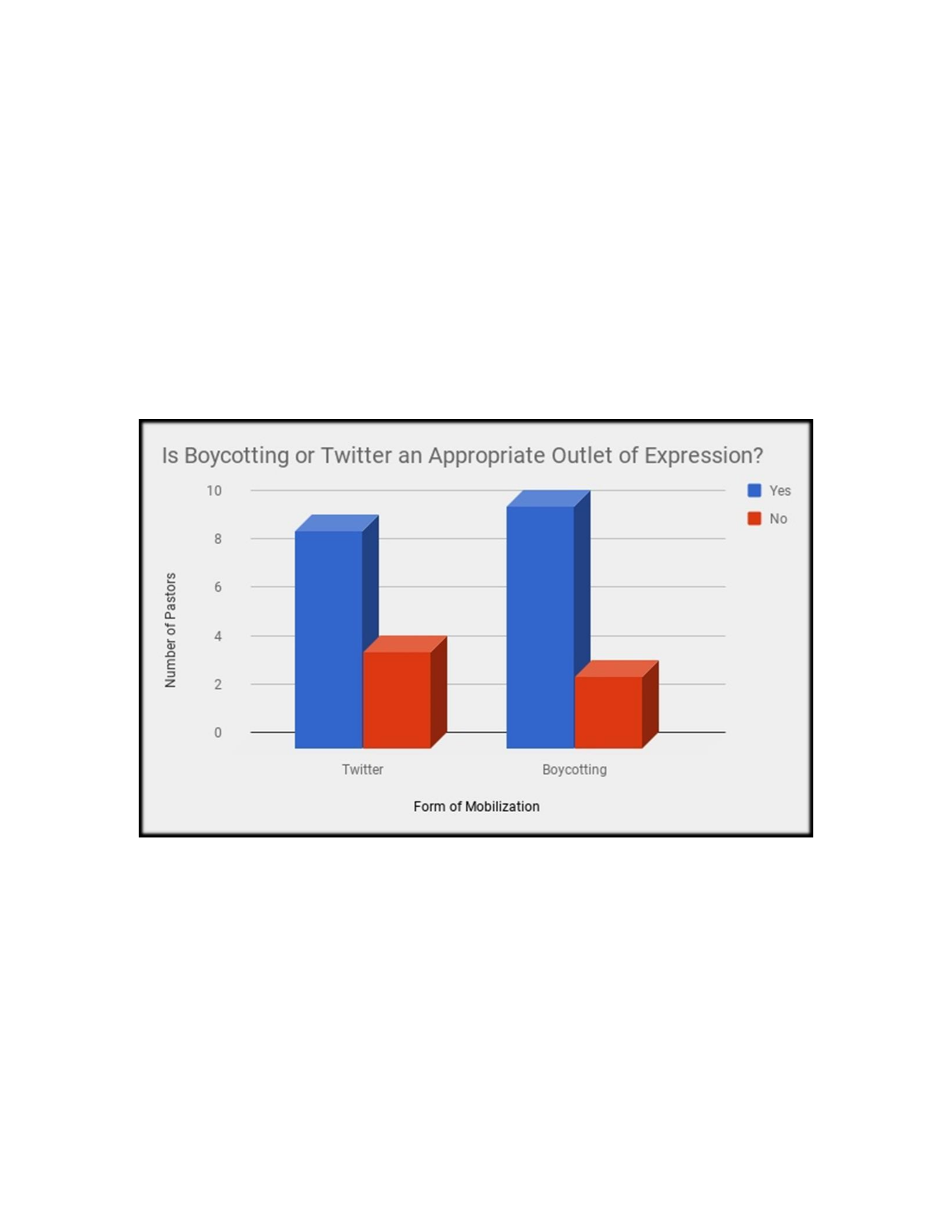
Boycotting
After hearing broadly how each pastor acts politically and socially, I asked each pastor
specifically what they think about using boycotting and Twitter as a means of social or
political expression. The questions were worded as such: “Do you see boycotting (Twitter)
as an appropriate outlet for establishing political positions and/or expressing your feelings
about today’s society?” In sum, ten pastors said yes, boycotting can be useful, while three
said it cannot. Nine pastors said yes to the use of Twitter while four said no.
Figure 4.1 Is Boycotting or Twitter an Appropriate Form of Expression?
Each pastor offered different reasons for their answers. Most of them were not personally
engaged in either activity but spoke more generally about whether these activities were
useful ways to express frustrations with the current social or political environment.
The North Carolina Southern Baptist pastor said that boycotting can be useful
sometimes and in specific circumstances. He stressed the importance of being consistent

with oneself choosing to boycott. He gave an example, “I’m not a proponent of drinking, I
think that hurts your testimony but yet I still go to the grocery store and buy groceries, so
does that mean that if I buy a roast up at Lowes grocery store that I am supporting their
cause of selling alcohol?” He then said, “I’ve never actually stood up [in the pulpit] and
said we should boycott this.” He seemed fine with the idea of someone choosing on their
own to boycott but, he explains, they must be careful that they are consistent and not
hypocritical in their actions. He explains that many companies support or sell things that
someone may not appreciate or be against; the question then is, are they going to boycott
them all? He says that people must be careful in what they choose to make an issue and
boycott. He says, “You have to take each instance along the way and determine whether
that cause is really going to bring about an incredible amount of change to start with and I
think that if hypocrisy comes into play, then it's defeated…society will see right through
this." He ends by establishing that he has never done anything collectively in terms of
boycotting; however, he feels that if he sees a situation is bad enough or blatant enough, he
might consider it.
A North Carolina pastor gives a different explanation for individual boycotts versus
collective boycotts. He believes that boycotting is appropriate if it is used at the individual
level. He proceeds to explain a passage in the Bible from Romans 14. He explains how
Romans 14 defines the conscience, as well as the importance of individuals not violating
their personal conscience. He says,
…if you, before God, believe that it is offensive to you to use a certain cell phone
company because that cell phone company uses some of their money to support
Planned Parenthood then if that violates your conscience then I think you should
not violate your conscience.

If an individual feels their conscience is violated by patronizing a company with values
they dislike, then he believes avoiding that company is essential. However, he did not seem
to interpret this question with a political slant. If someone wants to boycott because they
cannot in good conscience spend money at some company, then so be it; however, this has
nothing to do with making a political statement or expressing oneself politically. He later
says of collective boycotting,
Would we as a church ever do some sort of corporate public…encourage our people
to boycott some sort of company? I'm not going to say never...I won't say never.
We might get backed into a corner, the way our culture is going, we might get
backed into a corner where it is so clear and so obvious, ‘listen guys we have got
to altogether make a stand here.' I think we would. I don't know of one …. A
corporate boycott maybe? Kinda where we are politically, the way that the world is
going I'm not gonna say that it would never come to a point that we believe as
pastors should not get up and say something publicly.
This specific pastor was perhaps one of the most individually oriented, least politically
concerned, most spiritually-minded of the pastors I interviewed. He could not care less who
holds political office and feels that all social and political activities are only important or
relevant in the temporal context.
Earlier in the interviews when we were talking about what his church does politically
and socially, he repeatedly expressed the importance of not taking collective action and
making sure instead that the church maintains respect for people who share or hold different
political positions or opinions. At one point he said, “…what we don’t do as a church is
take corporate stands or corporate actions like protests or things like that…we do not see
that as the role of the church to do…we don’t get involved as a church in trying to lobby
government.” He also invoked the importance of respecting individual’s conscience
and reason for voting the way they do.

However, in response to my question about boycotting, he admits there may come a
time when he would feel the need to do something corporately as a church to stand against
something blatant, something with which they so blatantly disagree that it must be publicly
addressed. Again, take note that he is still not evoking a political stance but rather a spiritual
and almost collective conscience. He uses more than once the phrase “the way our culture
is going” as the reason that he feels a collective response may eventually be evoked. This
idea of an eroding culture alludes to the idea that, while actions like boycotting are only
temporal and not really the focus of many evangelical congregations, expressive
mobilization such as boycotting and Twitter venting may one day be seen as necessary.
This means he believes society is getting so depraved that there may come a point when
even he would feel the need to take a public stand against it. This is key to my theory. Can
these spiritually minded evangelical pastors be pushed far enough that they eventually snap
into action, or were they ones that did snap into action during the 1980s and 1990s with the
emergence of the Religious Right? Portions of the evangelical population have become
politically active in response to certain events in society such as prohibition, abortion, and
prayer in schools; however, rarely does the literature speak to the percentage of the
evangelical base that was activated. Are these pastors part of the population that was
mobilized or are they still maintaining a sense of “separation” from society and politics?
If this pastor says, he may be willing to make a collective congregational stance on a
social or political matter, after demonstrating high levels of perceived marginalization,
what then might this mean for the average evangelical churchgoer? Presumably, it would
take more to push a pastor of his mindset to mobilize than it would to push an average
evangelical churchgoer into public action. Therefore, if an average evangelical churchgoer

feels the social marginalization these pastors display, the churchgoer is might be more
likely to have already been pushed to their limit (see Djupe and Gilbert 2002, 2003 and
2008 for more on the relationship between clergy and parishioners).
One of the Rochester pastors says that my boycotting question cannot be answered with
either a yes or a no. He then gives personal examples of boycotting companies as a younger
man. He boycotted because of clear racism and prejudice demonstrated by the companies.
However, he said he would never organize a boycott of Target (as some evangelicals have
done as a result of the transgender bathroom policy). He says of that type of boycott,
Ok, you can do that if you want, that, to me, is an irrelevant way of dealing with
that particular issue. But that doesn’t mean that boycotting of itself is the wrong
thing to do … so the answer? I think under certain circumstances that [boycotting]
would be appropriate. Are there places I don’t shop or won’t invest because of their
policies? Sure, but it’s a boycott of one.
Here he demonstrates a striking contradiction. Earlier in the conversation he talks of
boycotting companies that were clearly racist and seems to argue that this type of
boycotting is useful and the kind he would support. However, he would not organize a
corporate boycott against Target because he feels it would be an irrelevant means of dealing
with the issue. He ends by saying that boycotting is fine, individually, but it cannot do a
whole lot when it is a boycott of one. This is curious. On one hand, he says that his personal
boycotts at a young age were relevant to the issue, but does not see the relevance of
organizing a collective boycott. Yet, he ends by criticizing individual boycotting because it
is not effective. I interpret this progression of thought as his way of saying the same thing
the pastor above said: individuals can boycott because of personal conviction, but it really
has little ability to influence or promote change.
The African American pastor from Rochester said boycotting was not a useful tactic.

He says, “I am certain as a Christian that I have far more influence on my knees than I do
in boycotting." At first, he did not seem to be strongly against boycotting but rather saw it
as something trivial in the larger scheme of things. However, the more he talked about it,
the more he seemed to dislike it. He said,
You know that I don't know that I would want to...there are people that work there and
those people are counting on a paycheck at the end of the week to feed their families...if
I'm hurting that company at some point I'm gonna be hurting those people because that
company's gonna start laying people off...people are gonna start losing their jobs...I'm
not really interested in hurting people...so I'd rather pray and ask God to affect those
changes.
He believes that if all he is trying to do is make a political point or social statement by
boycotting a business, his actions could affect the people who work there and who have
nothing to do with the political or social stances the company has taken. Therefore, in his
mind, he would rather leave these changes to God and not get involved. His reasoning has
little to do with politics or mobilization or marginalization. His convictions and concern
for people’s wellbeing simply are more important to him than any political or social
statement. He did not seem to think about some of the angles other pastors had mentioned
such as violating one’s conscience by buying from a company due to questionable moral
stances. His mind was focused on the individual people around him whom his actions
would affect, and that was all that really seemed to matter to him.
Further, this Rochester African American pastor did not seem to think much about or even
consider the role that boycotting played for African Americans during the Civil Rights
movement. The African American pastors in South and North Carolina showed a clear
appreciation for the use of boycotts. Perhaps then, this lack of acknowledgment is simply
due to the fact that he lives in the North. Or perhaps his worldview is so shaped and molded
by his faith that he only sees two types of people in the world (as he said during our

conversation), those going down the broad path to destruction and those on the narrow path
to eternal life.
This particular Black pastor did not really conform to the generally accepted
understanding of what a Black Protestant should be like. Unsurprisingly, he possessed a
strong understanding of the tenets of evangelicalism, but surprisingly he demonstrated
feelings of marginalization similar to what the white evangelicals demonstrated. On his
survey, this pastor identified himself as Republican. Research would stipulate that this
pastor is simply an aberration.
Harris (1994) and Fowler et al. (2013) admit that there was a sizable portion of Black
pastors during the Civil Rights Era who did not want to involve themselves in political or
social activism. In fact, there were some pastors, such as Rev. Joseph H. Jackson, who
opposed the social action of the Civil Rights Era (Fowler et al. 2013). In fact, Day (2012),
explains that the majority of Black churches did not support the social and political
involvement of the church during the Civil Rights Era. These churches opposed such action
for both theological and social reasons. Day points out that theological beliefs of churches
such as the Church of God in Christ “interpreted justice issues as issues that would
ultimately be resolved by God in the coming eschaton” (2012, 8). Hence, there has been
similar theological motivations for political indifference between some white and Black
evangelical churches. This is not to say that the Black churches who stayed out of the social
and political realm because of social, political, institutional threat are similar to white
churches. Rather, it is simply important to note that where the theologies between the two
churches lined up, their political and social actions did as well.

Which leads to the question. Are there African American pastors who, like this pastor
from Rochester, still ascribe to the theological convictions of the latent Black churches
during the Civil Rights Era? If so, how can we uncover who these pastors and members
are? Thus far, the literature has predominately accepted the notion that Black Protestants
and white evangelicals should be categorized in two separate groups, and yet I contend that
there may be a small, yet important, overlap in the middle somewhere. I cannot, of course,
draw any conclusions from the data provided in this dissertation that could speak to or
answer this question but I am able to bring light to a new area of research.
In short, I found that the two African American pastors that demonstrated the closest
theological convictions to the white pastors also shared many of their political and social
convictions as well. Are there theological beliefs that transcend the historical and racial
components that have shaped religion for both Blacks and whites? In other words, are
issues of social justice, that seem to be missing from the list of concerns for most white
evangelical pastors, also affected by differing theological beliefs and not just racial
experience? If so, does this mean that Black Protestants who happen to share these
theological beliefs are somehow less concerned about social justice as well, despite their
racial experience? Or are white evangelicals simply harboring racial prejudice, which keeps
them from supporting policies that Blacks tend to support?
Previous research has convincingly shown that race and religion cannot be
distinguished from each other (Emerson and Smith 2000; Lincoln and Mamiya 1990). If
this were unequivocally true, I should have found evangelical Black pastors who
demonstrated a very different understanding of the church’s political and social
involvement, and strong sense of community within their own church and their own race.

Instead, I found the opposite of most of these expectations. The one African American
pastor who did not identify as evangelical, fulfilled my predicted answers and yet his beliefs
aligned more clearly with the beliefs of the one mainstream Protestant in my interviews.
Hence, the differences appeared to stem less from race and more from the fundamentals of
faith. These interviews show that evangelical African American pastors and white pastors
shared many similar concerns, specifically that of individual conversion and personal
outreach. Future research is required to better understand all the nuances that exist in the
evangelical population, specifically regarding race. Though some work has been done on
evangelicals and race, I believe this area of research nonetheless merits more attention and
care.
Twitter
Social media activity has evolved into a new form of political expression. Scholars now
agree that social media activism is indeed political activity (Oser, Hooghe, and Marien
2013; Feezell 2016; McCosker 2015; Theocharis 2015; Sormanen and Dutton 2015). If an
individual chooses to go online and express themselves—their feelings and thoughts about
a political/social issue in a public forum—they establish themselves as uniquely different
from someone who does not put the same time and effort into expressing those feelings or
thoughts publicly. Social media activity is a form of mobilization (Theocharis 2015) and
therefore should be treated as such. I choose Twitter to analyze evangelical political
expression because it is both a form of political mobilization and a highly individualistic
activity. Given evangelicals’ individualistic tendencies (Emerson and Smith 2000), Twitter
is an ideal form for political expression.

Of the thirteen pastors interviewed, four felt Twitter was not an appropriate means for
expressing one’s thoughts and feelings about society and politics. The other nine offered
various reasons for feeling Twitter was appropriate. Only the African American pastor in
North Carolina who did not identify as evangelical, explicitly said he had a personal Twitter
account.
In response to the question about Twitter, one pastor said, "Sure yeah…I think it's a
great way to make your thoughts known… Twitter's not really meant for conversations it's
meant for statements. I think as a pastor I wouldn't have a problem posting something
politically, but I can't remember the last time I have, just because I just want to stay out of
the mess.” The “mess” he references, is the stereotyping that often occurs when making a
simple statement online. He expresses his frustration with the division and polarization he
personally experiences. It is for this reason he does not engage in politicking on Twitter.
If I say “Wow, look, Trump did something I really like!” … all the sudden, where’s
your MAGA hat? If I say "Man, Trump, you're a bonehead cuz you did this!"…all
the sudden I'm a flaming liberal. You just can't even have opinions. It's frustrating.
It's an appropriate way to express things; I just wish I was more witty and snarky
so I could have better opinions.
This pastor demonstrated a longing or desire to be able to express things via Twitter.
However, because of the vitriol, he perceives in society and the stereotypes he expects, he
avoids the situation altogether.
The African American pastor who did not identify as evangelical said, “Oh yeah. It’s
part of the culture we live in today. I believe if Jesus was living today, and Peter and Paul,
they’d be on Twitter. I’m on Twitter…I’m on Facebook”. The African American pastor
from South Carolina felt Twitter was fine to use but had never used it himself. He says, “I
mean, social media gives you a voice, a public voice, and so anytime you have a public

voice it can be used for good, but a lot of bad can come from it too." Another pastor agrees
with this same sentiment. He does not use Twitter himself but feels it can be used for good
or for bad. He says,
Twitter is a tremendous social network tool to send out a message…You have
multiple tens of millions of people on that list. Yeah, you can influence a lot of
things...Again, a car is good. But if you're gonna run over people, then that's no way
to use a car...Twitter is the same way...it's a good tool…
Many of the pastors who said Twitter can be a useful way to express thoughts politically
and socially expressed similar sentiments to those presented above. They did not have
personal Twitter accounts but felt that because of the large number of people who could be
reached, it could be a useful tool. However, it could also be a dangerous and harmful tool.
One pastor, the pastor who had already mentioned using social media a few times during
our conversation, seemed to appreciate Twitter more than most of the other pastors. Again,
he did not personally have an account, but he said, "I think it could be a format for sharing
to the world with whatever is on your mind, political, social…I think it's great; it does give
people a means of expression."
The pastors who were not keen on the use of Twitter shared similar reasons for not
appreciating it. They feel Twitter has taken away personal face-to-face interactions. One
pastor says, "No, no I do not. No, I don't…Communication is a challenge at best. So, the
further we get away from face to face conversations the more likelihood for
misunderstanding and misinterpretation…I don't think it's appropriate at all." Another
pastor says he does not find Twitter an effective means of expression for him personally,
but would not tell others not to use it. He reasons, “I don’t think it’s effective. I think that
sort of thing probably emboldens and encourages people to agree with you and antagonizes
people who disagree with you. You have to be really clever to change somebody’s opinion

or crack their armor through a tweet or something like that.” Both pastors agree that this
platform is simply not the platform use when engaging in sensitive conversations. Most
of the pastors had a limited knowledge of Twitter but enough knowledge to have a general
opinion of it and the benefits and downfalls associated with it. I entered these interviews
believing that Twitter would be a principal avenue of mobilization for evangelicals who
feel marginalized. However, this was not the case among the pastors.
While Twitter seemed fine in theory for some of them, only one (who did not claim to be
evangelical), had his own Twitter account. Apparently, the marginalization they feel has
not led them to use Twitter as a means of expression.
This does not mean, however, that no evangelicals are mobilized on Twitter. A few
pastors did mention that their congregants can be quite active on Twitter and other social
media platforms. Some of these pastors said they have challenged congregants because of
the poor “testimony” they thought their social media activity displayed. One pastor says,
"I'm not opposed to the use of technology whenever it comes to exercising your opinions I
just think you gotta do it in a decent way." At this point, he proceeds to say that his
congregants have been and can be very active on Twitter, but that he must keep an eye on
their online presence.
This tells me that although the pastors may refrain from tweeting for various reasons,
the perceived social marginalization apparent in their answers may be felt even more
strongly by their congregants. This leads me to believe that these congregants,
unconstrained by some of the existential pressures facing pastors (Crawford and Olson
2001), are more likely to publicly express themselves and mobilize for political action.
Since social media has become a significant avenue for this type of expression and

mobilization, we should expect to see more and more evangelicals using it in the years
ahead.
Conclusion
Although I was only able to interview a small selection of pastors, several key finding
emerge. Perhaps the most striking finding is that African American clergy have some
similar fears, concerns, and feelings of marginalization as white evangelicals. As much of
the previous literature confirms, they do not have to share political convictions with white
evangelicals to share their spiritual convictions. However, I also found that theological
differences, rather than racial differences, appeared more integral to each pastor's approach
to collective political involvement. Though the data is too limited in allowing me to
generalize these findings, I do believe that there is more work to be done in this area of race
and religion. Scholars, notably Emerson and Smith (2000), Harris (1999), Jones and Francis
(2012) and Lincoln and Mamiya (1990), show that race is unequivocally yoked with
religion. While I do not dispute these findings, I do contend that my research shows there
may be a yet unstudied "middle-ground." What of the racially mixed evangelical churches?
Are there vital theological differences between white and Black evangelicals that contribute
to their different political and social actions or, as most research shows, is race the only
variable causing a difference?
Again, as I said during a lengthy discussion of this very topic earlier in the chapter, I
was only able to interview three Black pastors. It is possible that these pastors are an
aberration from the norm. Alternatively, there may be an understudied and unrepresented
group of Black evangelicals in the United States, who perhaps go to racially heterogenous
congregations. Wadsworth (2012) noted the growing trend within the evangelical

population to engage in congregational racial blending. What contributes to this willingness
to attend these racially diverse congregations? Wadsworth notes various differing
motivations. One motivation she did not address was theological agreement. Some African
American evangelicals may feel that their theological beliefs are better represented in a
church that is not racially homogeneous. Would I find that these Black evangelicals
demonstrate similar feelings of marginalization and concern for society? They may not fit
what the media and society portray as evangelical (white, southern, poor, Republican), but
they also may not fit in with the typical African American Protestant (Black, Democratic).
I say this with the acknowledgment that these are mere musings that require much further
research to speak to with any authority.
My findings also provide support for my theoretical assumption that evangelicals today
are feeling socially marginalized. Most of the pastors I interviewed articulated such
feelings. Many of them seemed keenly concerned about the social stereotypes and
assumptions applied to them because of their religious beliefs. Many of the pastors
expressed concern about society because they see values and norms being changed. Most
of them conveyed consternation about the direction society is headed and the future. They
all pointedly drew the conversation back to their commitment to sharing the Gospel as their
central calling.
While I found that most of the pastors feel marginalized, I did not find evidence that
these feelings have led to any kind of sustained social or political action apart from voting.
All the pastors were happy to engage in the political process using conventional methods
of participation, such as voting or writing a representative. This finding is intriguing given
the perceived social marginalization I found; however, it also makes sense. These pastors

displayed relatively high levels of both internal and external efficacy. They believe
conventional political participation is useful since they believe such participation can have
an impact.
This finding provides support for my theory that evangelicals are feeling socially
marginalized while still possessing a sense of political efficacy and access. I believe this
perceived social marginalization is affecting them, and I believe it played a part in Donald
Trump’s election. They may feel that their last hope is a King Cyrus of sorts, an ungodly,
immoral individual whom God uses to protect His people. This "Cyrus" is being personified
in Trump (Gordon 2017). Few of the pastors seemed enamored with Donald Trump
personally, and none of them held him in high regard, but a few of them did express
thankfulness for some room to breathe socially and politically. Others felt they finally had
someone in office who could speak on their behalf, something that evangelicals have felt
about previous presidents such as Carter, George Bush, George W. Bush and to an extent,
Reagan.
I did not find evidence that these pastors are feeling marginalized because of racial or
demographic concerns. However, given the taboo nature of such feelings, feelings of this
nature are less likely to manifest in this form of research. I did not find as much difference
between white and Black pastors, however, which was unexpected. I did find that white
pastors were less likely to address race or racial issues as a significant concern in
comparison to Black pastors.
I think one of the most important takeaways from these interviews is this: if these pastors
are feeling marginalized, worried, and out of place, their congregants may well be feeling
similarly, and perhaps with a higher intensity. Quite a few pastors alluded to this possibility

as well. Scholars should be alert in the years to come for evangelicals mobilizing using new
tactics, especially social media and boycotting, despite the twin emphasis evangelical
theology places on individual salvation and skepticism of all things temporal. While there
is still much to be uncovered and discovered, these interviews provide some useful insights
into the mind of evangelical clergy in 2017/2018. The media’s portrayal of an “evangelical”
is not necessarily representative of all evangelicals. Instead, evangelicals are diverse in
many ways, as we should expect of a group that comprises at least a quarter of the U.S.
population (Pew Research Center 2015a; 2015b). Further, not all evangelicals are white.
There are Black evangelicals who share some of the same concerns about society as white
evangelicals. What does this mean moving forward? As a few of the pastors said, if they
think things get bad enough, which they emphasized was highly possible given the
direction they see society heading, they may be forced to take a collective, public stand.
Notwithstanding the still-existent Religious Right, there are many evangelicals who have
never mobilized publicly. The question then is this: what happens when the quiet, reticent
portion of the evangelical population begins to mobilize?

CHAPTER 5
POLITICAL CONSUMERISM: THE NEW OLD TACTIC?
"[T]he market is turned into a powerful discursive terrain where commodities not only
embody but also mediate religious ideals and qualities."
--- Echchaibi, 2012, p. 33
When you hear the word “chicken” what do you think of? You probably think of a lot of
things: chicken wings, football, food, a bird, animal rights, KFC, Chick-fil-A, or an easy
dinner. You probably do not think of marginalization, evangelicals, LGBTQ rights, and
mobilization. Yet, chicken, or any other neutral commodity, can symbolize these concepts
and more. Research shows a growing trend of individuals expressing their values and
ideologies through what they consume (Hannon 2013; Holzer 2006; Michelleti 2003;
Michelleti, Follesdal, and Stolle 2008; Neilson 2012). In this chapter, I analyze how
“chicken” became a symbol of hate and discrimination, or alternatively a symbol of free
speech and Biblical values, and how this case represents an unstudied segment of
evangelical collective action. I also analyze the way that a popular supermarket became
involved in a war of values.
Political consumerism is the intentional buying of a product or the intentional rejection
of a product for political or social reasons. In layman’s terms, political consumerism is

boycotting or buycotting a company. Anyone can engage in political consumerism.
Boycotting is not, in and of itself, a collective act, even though it has been used as a form
of collective action. Individuals can engage in a boycott of one. This makes political
consumerism one of the most individualistic, and yet potentially collective, forms of
political participation available to citizens (Newman and Bartels 2011).
Micheletti (2003) creates an entirely new concept to categorize political consumerism:
individualized collective action. Micheletti challenges the long-standing assumption in
political science that political participation is group-oriented behavior. She distinguishes
between individualized collective action and "our more common notion of political
participation, here called collectivist collective action" (2003, 1). Scholars find that citizens
of Western societies are shifting away from the traditional forms of political involvement
to more “flexible, network-oriented, and applied” forms of political engagement (2003, 6).
Micheletti coins the term individualized collective action to capture these new forms of
political and collective, yet individualized, action. She defines it as “the practice of
responsibility-taking through the creation of everyday settings on the part of citizens alone
or together with others to deal with problems which they believe are affecting what they
identify as the good life” (2003, 7).
Political consumerism, then, is one form of individualized collective action. Micheletti
defines political consumerism as “actions by people who make choices among producers
and products with the goal of changing objectionable institutional or market practices”
(2003, 2). Political consumerism provides a way for citizens to express their dislike of
policy issues or societal issues without having to use conventional political participation.

Consumption as a Political Act
Political consumerism, as defined by one of the leading scholars in this field, is merely
the "use of the market as an arena for politics" (Micheletti and Stolle 2008, 750). Micheletti
and Stolle (2008) contend that "shopping is now an established part of social justice
activism" (749). When people use the market to express their political concerns either
through boycotts or “buycotts” they are engaging in political consumerism (Micheletti
2003; 2010; Michelleti, Follesdal, and Stolle 2008; Stolle, Hooghe, and Micheletti 2005).
There has been some debate among academics about whether political consumerism is
truly a form of political participation. Micheletti (2003; 2010) argues that it is, and
Newman and Bartels (2011) find that political consumerism is an “individualistic” and
“high-initiative” form of political participation. Micheletti (2003) claims that this type--
political consumerism---of political mobilization is the result of increasing micro-level
politics and is a distinct form of political participation, or, as she calls it, individualized
collective action (2003).
Scholars agree that many countries are experiencing an increase in political
consumerism (Copeland 2014; Neilson 2012; Neilson and Paxton 2010; Friedman 1985;
Strømsnes 2009). Zukin et al. (2006) find that political consumerism is the most commonly
used form of political participation second only to voting. Inglehart’s (1977; 2015) theory
of post-materialism is cited as one leading explanation for the increase in alternative forms
of political participation (Copeland 2014). In a post-materialist society, citizens are more
concerned about promoting non-material, value-oriented issues, which generally fall within
the political spectrum (2014).

The three primary forms of political consumerism are boycott and buycott and
discursive consumerism. Hitherto, boycotting has been the primary form of political
consumerism and is the oldest form of political consumerism (Friedman 1999; Michelleti
2003; 2008). Boycotting is the deliberate rejection of a product for social or political
reasons. It is “an attempt by one or more parties to achieve certain objectives by urging
individual consumers to refrain from making selected purchases in the marketplace” or “the
intentional buying or abstention from buying specific products for political, social, or
ethical purposes” (Newman and Bartels 2011). Consumer boycotting has frequently been
used in the United States and other countries as a form of political activism and has been
“very important for people marginalized in conventional politics” (Micheletti 2008, 751).
Activists who organize and stimulate these boycotts find boycotts incredibly difficult to
frame and organize (Friedman 2003; Micheletti 2008). The financial impact of boycotts is
debatable (Micheletti 2008, see also Koku and Springer 1997; Smith 2003; Vogel 2005).
Political consumerism can only affect change if it is done collectively (Hannon 2013).
Individuals can engage in political consumerism but rarely if ever is their individual choice
to consume or abstain going to cause corporate change. Since boycotts are most successful
when done collectively, the media plays a crucial role in organizing and involving
individuals by making individuals feel like they are part of something bigger (Hannon
2013). Media helps frame an individual choice "as collective action, potentially motivating
participation either because boycotters would interpret the participation of others as
normative behavior, or because the participation of others would provide reassurance of a
boycott’s efficacy" (Neilson 2012, 216).

Buycotting is the intentional buying of a product for social and political reasons.
Hannon argues that buycotting is moving from the periphery to the forefront as a form of
activism. It is less contentious than boycotting and easier to mobilize (Hannon 2013;
Michelleti 2008). Proponents of buycotting say that it is a constructive way to show support
for an issue by allowing consumers to “consume and support causes at the same time”
(Micheletti 2008, 752). Also, buycotts are not as beholden to the media for collective
stimulation and action as boycotts. They can be organized through word of mouth, social
media and local networks (Hannon 2013).
Boycotting and buycotting are the same action with a different motivation. In other
words, in most cases, they are both the result of an individual purchase transference from
one place to another (Hannon 2013). Hence, boycotting a place means, by default,
buycotting another place (2013). "The key nuance is, therefore, going to reside in the intent
of the action: is an individual seeking to punish a company or reward it?" (62-63).
The third form of political consumerism is "discursive political consumerism"
(Micheletti 2008). This form of consumerism focuses on other vulnerable aspects of
business such as their brand name, reputation, and logo (2008). It uses a "variety of
noneconomic tools to convince the public and/or business leaders that social responsibility
is good for the corporate world" (2008, 753). I do not test this form of political consumerism
in this dissertation, though it could provide some interesting insight for future research.
These forms of political consumerism do more than push for corporate change or
justice; they also create an avenue of expression for individuals who want to make a
statement about themselves through consumption. Thus, consumption is as much an
extension of one’s identity as political action (Hannon 2013). Some argue that individuals

are consuming the label rather than the product (2013). However, "[the] bulk of mundane
consumption is normally outside the area for reflective choice" (Jacobsen and Dulsrud
2007, 478).
While Jacobsen and Dulsrud’s statement is true, Hannon counters: "a reflexive choice
is still being made to purchase one item over another. Even without reflection, one is
choosing to participate in consumption rather than to abstain and to consume product X
over product Y. Agency is being exercised, and in some cases, consumption can be moved
to inhabiting a reflective space" (Hannaon 2013, 58). Consumption, whether it is
intentional or not, makes a statement about who an individual is: an ice cream person or a
cake person, an Apple person or a Samsung person (2013). Political consumerism,
therefore, is just a step above mundane consumerism. It is the active choice between
products, not because of price or aesthetic appeal, but because of one’s political leanings
and their desire to affect change and express their identity through the consumption of one
product and abstention from another (Hannon 2013).
Thus, consumption has turned into a way for individuals to express themselves and
connect themselves to a public identity. “Consumption is … an external marker of internal
beliefs. What and how an individual consumes not only builds an image of who they are,
but how others should interact with them” (2013, 48). Where an individual consumes
creates an identity for who they are and places them in a pre-conceptualized community
while also serving as an “external declaration of belief” (48). Hence, political consumerism
provides the perfect environment of expression for those who possess a collective identity
and desire to express their connection to that collective identity through consumption.

Scholars find that a consumer’s religion is an important variable influencing individuals
to engage in political consumerism (Delener 1994; Lorentzen 1980; Hirschman 1991;
1982; Sheth 1981; Swimberghe, Flurry, and Parker 2011; Vitell 2009; Vitell, Paolillo, and
Singh 2006; Vitell, Singh, and Paolillo 2007; Wilkes, Burnett and Howell 1986).
“Consumption, therefore, provides the venue through which religious individuals can
outwardly declare their beliefs” (Hannon 2013, 48). Market goods have begun to take on a
religious meaning (Echchaibi 2012; Hannon 2013). Hannon distinguishes between goods
that are expressly religious, such as Veggie Tales or the Passion of the Christ, and those
goods that made for secular consumption but somehow imbued with religious qualities
(2013, 52). For example, Chick-fil-A, an organization founded and run by Christians, is an
emblem of traditional Christian values. Thus, individuals can make a public statement
about their values, their religious convictions, and identity, both collective and individual,
simply by eating a chicken sandwich. The assumption of religious value, bolstered by
media narrative, means consuming a product somewhere is now imbued with “reverent
quality and transform[s] a trivial act of consumption into a committed act of faith”
(Echchaibi 2012, 32). “Consumption, therefore, provides the venue through which
religious individuals can outwardly declare their beliefs” (Hannon 2013, 48).
Hannon (2013) posits that “consumption is a generative space in which individuals can
express religious belief within modernity” (1). She performs a case study of the Chick-filA
controversy with special attention given to Facebook posts regarding the controversy. She
argues that consumers make individual and communal identity construction through what
they choose to consume. Consumers express their values and identity through what they
consume.

The literature provides conclusive support that political consumerism is indeed a form
of political mobilization. Also, research shows that alienation, a key component of
marginalization, increases support for nontraditional forms of political participation such
as demonstrations or boycotts (Southwell 1985; Opp 1990; Weakliem and Borch 2006). I
chose political consumerism as an indicator for my theory because of its unique position in
politics and society. It is both political and social, collective and individual, expressive and
impactful. Since I am interested in expressive extra-institutional forms of political
mobilization in response to social marginalization, political consumerism is the ideal
indicator of marginalization because of social strain over politically charged social issues.
Political consumerism is not a conventional form of political participation (hence the
scholarly debate about its place in politics), which makes it an alternative form of
participation and a valid implication of my theoretical argument. Further, it provides the
ideal set of circumstances to test social constructionism's necessary conditions for
collective action. It is also a form of expression, and I am interested in evangelicals'
expressive mobilization as a form of identity claiming. Finally, I chose political
consumerism as an indicator for my theory because it allows me to examine whether
specific mechanisms are sufficient to stimulate evangelicals into collective action.
Data and Methods
How does an unpleasant feeling translate into social and political collective action?
What causal mechanisms are crucial to this transition? I contend that for evangelicals, a
catalyst event must present itself. This event acts as a catalyst for evangelical response.
However, without the appropriate elite framing within the cultural context to stir up a sense
of collective identity around a constructed emotion, evangelicals would merely grumble

and mobilize individually rather than mobilize collectively. There are, of course, more
moving parts here than a single case or a small number of cases will allow me to examine.
So the results that follow are suggestive at best of a causal chain.
What is a catalyst event? It is an event that stirs up emotions and reactions and draws
media attention, critique and support. The event can be purely political such as a Supreme
Court case or a new political policy. However, it can also be social—Starbucks hires or
fires a gay President. A corporation can publish a politically or socially charged
commercial, pull a product or introduce a product for political and social reasons, or make
a public statement for those very same reasons. These events can cause a reaction,
depending on how much of a reaction the media and elites want. Of course, in today’s social
media context, sometimes grassroots reactions on social media force elite and media
attention.
A catalyst event provides an avenue for response. Since evangelicals generally support
the status quo, incidents that threaten their preferred status quo (and perhaps their historical
social and cultural dominance) cause evangelicals to feel the need to mobilize. However,
just because an event occurs does not mean that evangelicals will automatically engage in
collective mobilization. Only under specific circumstances will evangelicals engage in
collective mobilization. Using the four elements of social constructionism, and Snow and
Benford’s (1988) three-step process to collective action, I set up the following chain: A
group feels socially marginalized and alienated Catalyst event Increasing
feelings of marginalization Social entrepreneurs frame the event, and the relevant
out-group Social entrepreneurs stir up emotional strain using cultural symbols,
phrases, etc. Entrepreneurs suggest a viable solution to the problem and

encourage participation and mobilization Group engages in collective action in
response to elite mobilization.
I propose five different hypotheses which I test using two cases studies. I derive these
hypotheses from the social constructionist theory of social movements and the literature on
political consumerism.
HI: A catalyst event is a necessary condition for evangelical collective mobilization.
A catalyst event can be anything from a Supreme Court Case to a corporate statement—
the key attribute being the event draws attention to some social or political issue relevant
to evangelicals. The social or political issue need not be new, although it may be.
Regardless, the catalyst event, by drawing attention to the issue provides evangelicals with
the option of responding or remaining neutral and silent.
H2: Elite mobilization and framing according to the cultural milieu is a necessary
condition for evangelical collective mobilization.
Elite mobilization is a little easier to define. Elites are individuals who hold a position of
power in whatever domain in which they exist. This position provides them with a platform
to speak and influence, and resources to draw upon when needed. Lindsay (2008)
conducted an in-depth field research study of evangelical elites. He claims that elites
“provide critical resources, produce cultural goods, and facilitate the legitimation of a given
movement to external audiences” (64, see also McCarthy and Zald 1997; Peterson and
Berger 1975; Tilly 2006). Elites are respected by the community they speak for and
represent; therefore, their word means something. Elites can be individuals and/or
organizations that speak on behalf of evangelicals.
H3: A coherent collective identity, predicated upon an in-group/out-group frame, is
a necessary condition for evangelical mobilization.

A coherent collective identity provides members with a common goal and common
cognitive framework (Melucci 1988). Individuals feel a connection to and desire to be a
part of this collective membership. I add “predicated upon an in-group/out-group frame”
because of the difficulty of identifying a feeling of "collective identity" by assessing
boycotts. Thus, based on Smith's subcultural identity theory and his assertion that
evangelicals' collective identity grows stronger because of a clearly defined "they," the
presence of a clear "out-group" is a proxy for evangelical collective identity. If there is no
clear out-group in any example, I consider a coherent collective identity absent.
H4: Social marginalization is a necessary condition needed for collective action.
I am most interested in the presence and absence of this variable. Social marginalization is
a feeling of social threat and strain, coupled with frustration and feelings of societal
rejection. This is not predicated upon a feeling of low political efficacy or feeling like one
has no access to or influence on government policy; instead, it stems from the societal
marginalization of valued norms and issues. Though I cannot access the minds and psyche
of evangelicals to show indisputable evidence of these feelings, I am able to gain insight
into the motivations of their actions by assessing the frames and rhetoric used by elites (and
in a few circumstances the evangelicals themselves) to motivate the evangelicals into
action. If they utilize certain phrases and words, invoking any assumed social strain, this is
evidence of assumed societal strain in their culture. Further, I infer from events and the
societal trends at the time of the boycott the probable level of strain that evangelicals are
feeling at the time. Presumably, the higher the feeling of strain the more likely they are to
mobilize. I believe that collective political consumerism itself is evidence of feelings of
social strain/marginalization and am not alone in this assumption.

H5: All four hypotheses combined are sufficient for evangelical collective
mobilization.
This final hypothesis is simple and does not need to be defined since it is the combination
of the four previous concepts that I just defined. If the four previous variables are satisfied,
then I expect that evangelicals will indeed engage in political consumerism. My analysis
tests the veracity of these hypotheses based on real-world occurrences. Perhaps
evangelicals have collectively boycotted/buycotted in the absence of one or two of these
hypotheses; hopefully, my analysis can uncover such circumstances. Either way, this
analysis sheds new light on evangelical mobilization.
Data and Methods
Most research on political consumerism has been theoretical, qualitative and/or relies
heavily on survey data. Because of the lack of extensive empirical data, I rely on a variety
of different data sources that allow causal process tracing to test my hypotheses. Using the
General Social Survey (GSS) codebook, I first provide a descriptive snapshot analysis of
evangelical boycotting trends during the two years that GSS asked questions about
boycotting—2004 and 2014.
There are only a few cases of evangelical collective political consumerism available to
analyze, which, in and of itself says something. Most collective evangelical boycotts were
started, promoted and carried out by the same set of evangelical elites: The Southern Baptist
Convention and the American Family Association (AFA). I use process tracing to analyze
the mechanisms surrounding boycotts, in addition to more deeply analyzing the one
evangelical buycott launched in recent American history. These boycotting and buycotting
examples provide support for my theory of evangelical social marginalization and
mobilization while leaving the door open for future research and new questions. Using

process tracing, as well as an in-depth analysis of the cases through the lens of the
hypotheses, I can analyze the moving parts of the theory.
ANES and GSS Data
I believe, based on other scholar’s previous findings and on Micheletti’s conception of
individualistic collective action, that evangelicals are involved in political consumerism
primarily at the individual level (Shamir and Ben-Porat, 2007; Swimberghe, Flurry, and
Parker 2011; Lorentzen 1980; Sheth 1981; Vitell 2009; Vitell, Paollilo, and Singh 2006;
Vitell, Singh, and Paolillo 2007).
An ANES survey recently included two questions about political consumerism in a
2016 Pilot Study. The study asked 1200 people “In the last 12 months, have you bought a
certain product or service because of the social or political values of the company that
provides it, or have you not done that in the past 12 months?” followed by the same question
about boycotting. The unique aspect of this question is that it touches on values rather than
pure partisanship or political reasons. A recent study on political consumerism used this
dataset, in conjunction with two original datasets, to pinpoint the variables with the most
influence on one's propensity to engage in political consumerism. Endres and
Panagopoulos (2017) find that Democrats are more likely to engage in political
consumerism than Republicans and find that political knowledge, political interest, and
ideological intensity are all positively related to political consumerism. They did not,
however, include a variable for religion.
Using their same dataset but adding in a variable for religion, I assess some descriptive
characteristics of evangelicals and political consumerism. I use a question about being
"born again" as my proxy for evangelicalism. If the respondent answered yes to being born
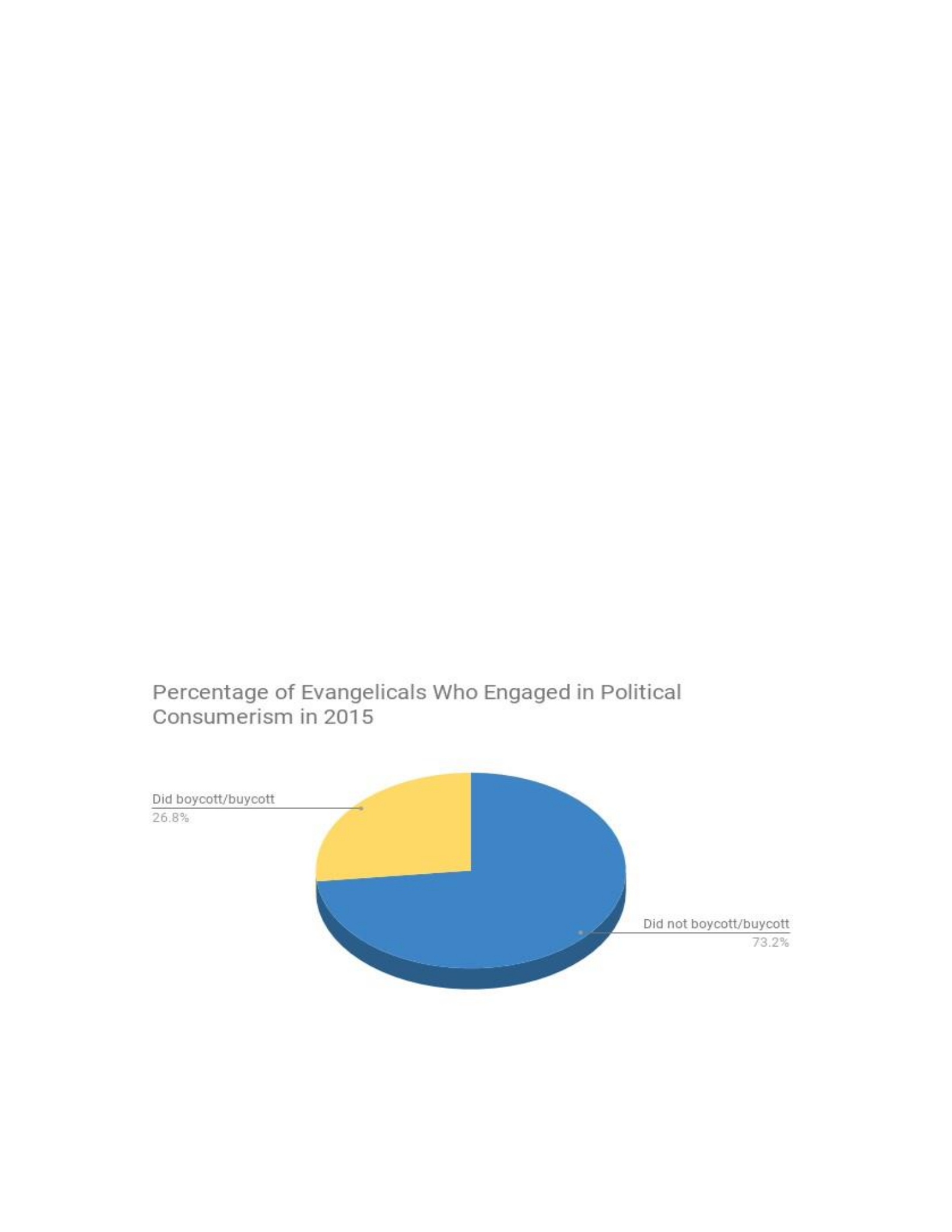
again, they are considered evangelical, and if they answered no they are not considered
evangelical. The percentage of evangelicals in the whole group who also answered yes to
either boycotting or buycotting in the past 12 months is 10.8%. A total of 26.8% of the
evangelical respondents engaged in political consumerism, which is over 10% less than the
overall total percentage of participants at 39%. Evangelicals also made up 27% of the total
number of respondents who did engage in political consumerism.
There are some demographic differences in the boycotting evangelical population. As
the chart shows, whites make up the most considerable portion of the 10% of evangelicals
who did engage in political consumerism, followed by Blacks, Hispanics, and others.
However, proportionally Black evangelicals and white evangelicals engaged in political
consumerism at the same rate. For white and Black evangelicals, 37% of them engaged in
political consumerism, while members who identified as other were the most active at 41%.
Figure 5.1 Percentage of Evangelicals Who Engaged in Political Consumerism in 2015
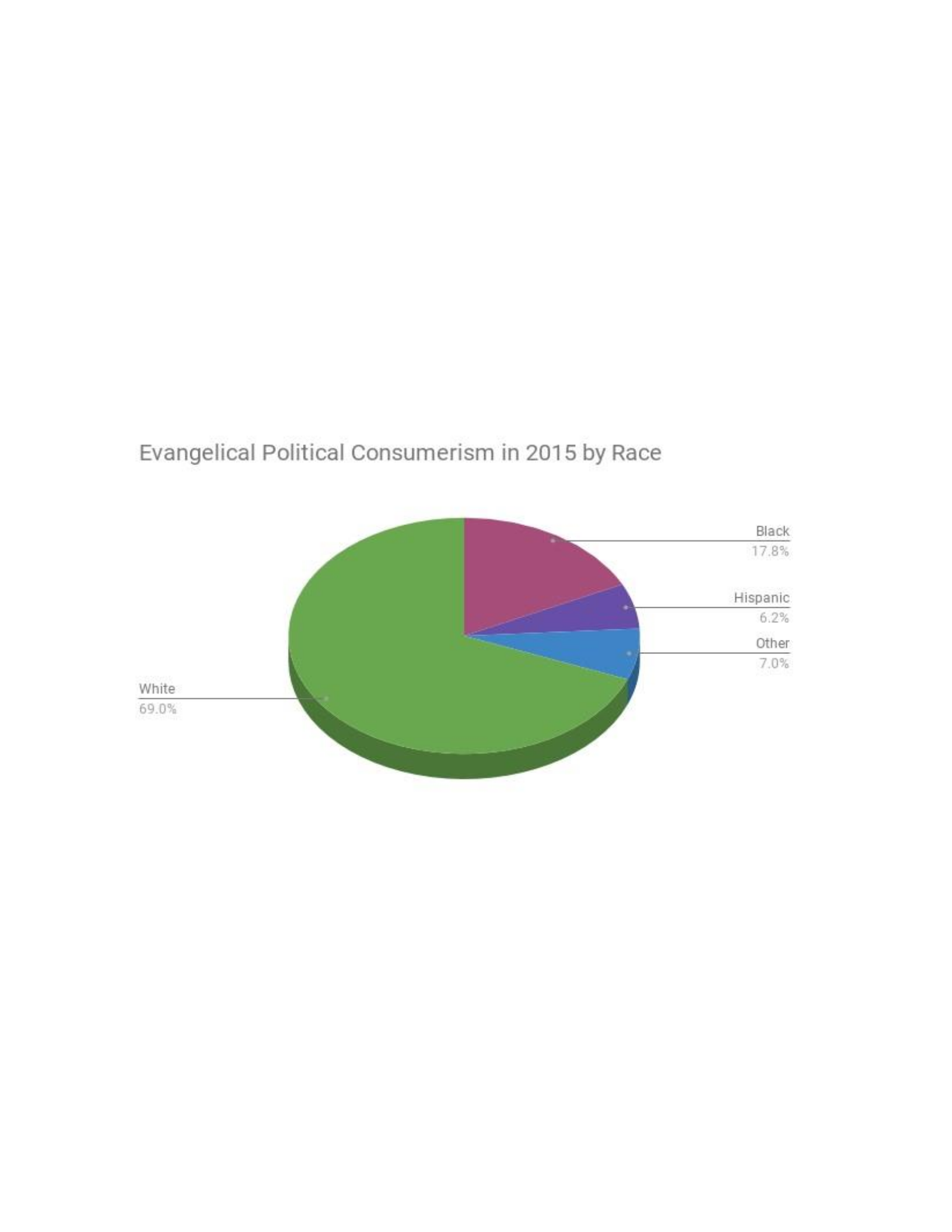
Hispanic evangelicals were the least active with only 30% of them engaging in political
consumerism. After running a basic probit model with race and evangelicalism as the two
independent variables and political consumerism as the independent variable, the only
variable that showed any statistical significance was the "other" category in race. Thus, at
least for 2016, evangelicalism seems to have little statistical effect on the probability of an
individual engaging in political consumerism.
Figure 5.2 Evangelical Political Consumerism in 2015 by Race
The information provided in the figures is limited and supplies a mere snapshot of
evangelical involvement. Ergo, this chapter is not designed to analyze individual
expression but rather collective expression. I believe that evangelicals are willing to
mobilize collectively, given a specific set of circumstances; however, because of their focus
on the individual, occasions of evangelical collective action are few and far between. When

a group feels unappreciated and marginalized, they respond; however, this response is
contingent upon elite framing and elite manipulation (Dicsh 2011; Goffman 1974). Elites
are the glue that connect feelings of marginalization to mobilization.
Political Consumerism: Boycotts
Evangelicals have launched a few boycotts over the past few decades. I analyze a
boycott launched and carried out by the American Family Association (AFA). I analyze
boycott cases by the AFA because it is one of the only evangelical organizations to boycott
with media coverage consistently. I cannot analyze boycotts that did not receive notable
media coverage.
Using the Lexus Nexis (now called Lexis Uni) All News search, I searched for
keywords and phrases such as "boycott," "evangelical" and "political consumerism" to
assess the frequency of news articles discussing evangelical boycotts. Combing through
the articles, I discovered that there have been a few, though not an abundant, number of
evangelical boycotts. Launching a successful boycott is a strenuous and challenging
process for elites, given the amount of framing and stimulation needed to fully involve
enough people. I also learned that most of the evangelical boycotts launched in recent
history have been launched by the same few evangelical organizations. Namely, the AFA
and the Southern Baptist Convention. Neither of these organizations is explicitly political
but because of their stances on social (politically charged social) issues, have waded into
political waters through this form of expressive mobilization. These are not the only two
evangelical organizations in America, but they are the two that seemed most adamantly
involved in political boycotting instead of focusing exclusively on individual mission-
oriented evangelical work. That is not to say that these are the only two evangelical

organizations engaged in politics or political action; instead, these are the primary
organizations engaging in the expressive form of political mobilization that I am interested
in testing.
After further research, I found that the single Southern Baptist Convention boycott was
initially launched by the AFA. Thus, it became apparent that most of the nationally known
and media covered evangelical boycotts in recent history are and have been sponsored by
the AFA. In my analysis then, I overlay one AFA sponsored boycott against the social
constructionist theory to identify the necessary and sufficient conditions of evangelical
mobilization better. I select the only current boycott, which also happens to be their most
successful boycott ever. Unfortunately, due to data limitations, I am confined to the one
current boycott.
The American Family Association (AFA)
The American Family Association is a non-profit 501(c)(3) organization, created in
1977 by Donald E. Wildmon, pastor of First United Methodist Church in South Haven,
Mississippi. It is not a political organization and promotes no overt political agenda but
does have a clear evangelical set of doctrinal values. The organization is engaged in various
kinds of activities. The AFA has its own radio show and online coffee shop that sells ground
coffee. The ad on the front of coffee shop webpage says, “When you purchase American
Family Coffee, you are supporting our parent organization, American Family Association
whose goal is to restore a strong sense of biblical values to American public life”
(Americanfamilycoffee.net). Hence, this otherwise mundane item is imbued with a sense
of morality and family values. I am not sure how purchasing this coffee accomplishes their
stated goals, but this is the sentiment presented nonetheless.

The AFA also has an online store, a journal and a studio. They started two tangential
organizations called One Million Moms and One Million Dads whose goal is to activate
and connect evangelical dads and moms across the country to speak out against "trash on
TV." The first lines used in the One Million Moms "who we are" page is telling. “Mom, are
you fed up with the filth many segments of our society, especially the entertainment media,
are throwing at our children? Are you tired of all the negative influences our children are
forced to contend with? If so, we urge you to become a member of
OneMillionMoms.com” (OneMillionMoms.com). The language is indicative of the
framing and emotional manipulation prevalent in the language assessed below.
Evangelicals, holding a historically dominant social and political position in society must
feel that their position is being threatened.
According to the parent organization (AFA.net):
The mission of the American Family Association is to inform, equip, and activate
individuals to strengthen the moral foundations of American culture, and give aid
to the church here and abroad in its task of fulfilling the Great Commission.
Their philosophical statement gives more insight into their motivations and focus:
The American Family Association believes that God has communicated absolute
truth to mankind and that all people are subject to the authority of God's Word at
all times. Therefore AFA believes that a culture based on biblical truth best serves
the well-being of our nation and our families, in accordance with the vision of our
founding documents; and that personal transformation through the Gospel of Jesus
Christ is the greatest agent of biblical change in any culture.
Note the culturally appropriated language used. The AFA stresses the importance of
personal transformation through the gospel and that this is the greatest agent of Biblical
change. The irony, of course, is that the AFA is not an organization engaged exclusively in
individual mission oriented evangelicalism. Thus, even though the AFA is dependent on
collective involvement and action, they cater to this mindset focused on individual

salvation by using keywords and phrases that assuage any skepticism of intent that their
individualist readers and potential members might have.
The AFA professes to use activism to preserve: "Marriage and the Family," "Decency
and Morality," "Sanctity of Human Life," "Stewardship" and "Media Integrity" (AFA.net).
This focus on evangelical moral doctrine rather than overtly conservative ideology is
important for my theory since I am interested in evangelical mobilization, not just Christian
Right mobilization. Further, they state that they intend to:
1. Restrain evil by exposing the works of darkness
2. Promote virtue by upholding in culture that which is right, true and good according
to Scripture
3. Convince individuals of sin and challenge them to seek Christ’s grace and
forgiveness
4. Motivate people to take a stand on cultural and moral issues at the local, state and
national levels
5. Encourage Christians to bear witness to the love of Jesus Christ as they live their
lives before the world (AFA.net)
Again, line three draws the attention back to the individual and personal conversion. This
continued focus on the individual is further evidence of the AFA’s evangelical persuasion
and of their keen knowledge of their base. Most of these goals are painted in a positive light
and with the attempt to instill hope and direction in an otherwise, potentially frustrated and
marginalized, population.
AFA activism, therefore, is done with the intent of trying to preserve (and promote)
what they perceive to be the status quo of marriage and family, decency and morality, the
sanctity of human life, stewardship and media integrity. They cannot preserve something
they believe does not already exist in some capacity. Hence, they feel they are preserving
the status quo from cultural and societal changes. The website explains why they engage
in activism.

We believe in holding accountable companies that sponsor programs attacking
traditional family values. We also believe in commending those companies that
act responsibly regarding the programs they support.
It is AFA’s goal to be a champion of Christian activism. If you are alarmed by the
increasing ungodliness and depravity assaulting our nation, tired of cursing the
darkness, and ready to light a bonfire, please join us. Do it for your children and
grandchildren. (AFA.net)
The AFA uses culturally specific language here. First, they call attention to their preferred
form of activism: political consumerism. They then frame their call to action by first
promoting the positive image of Christianity and then drawing upon assumed feelings of
social strain amongst their target population. Key phrases like "alarmed by increasing
ungodliness" or "depravity assaulting our nation" paint the picture of an embattled
evangelical population with nowhere to turn. They draw a broad picture of the problems
facing our country here. They then say, "tired of cursing the darkness" and "ready to light
a bonfire." This imagery is powerful, especially for their target population. They play upon
assumed feelings of frustration and angst that their constituency is feeling stuck as if their
only form of release for their frustration is to curse the darkness. They then answer the
problem with a solution of "lighting the bonfire" by joining their organization. Finally, they
end with perhaps the most powerful call to action, act for your children and your
grandchildren! Evangelicals, the ones I interviewed at least, express concern for the future,
specifically for their children and grandchildren. If indeed they feel a growing sense of
social strain, utilizing fear of the future to motivate evangelicals into action is a brilliant
move by the AFA social entrepreneurs.
The AFA also tries to alleviate any worries for the portion of their Christian base who feel
that boycotting is unbiblical. Their Vice-President, Mr. Vitagliano, writes a piece called

“objections answered” to assuage some of these concerns. He starts out by saying the
following:
Since it began in 1977, AFA has been known for its boycotts. However, some Christians
believe such a tactic is, well, not very Christian.
First, let me put forth a simple definition of what I mean by the word boycott. In
its simplest form, a boycott involves the intentional withholding of money from a
business of which you disapprove. It is usually used as an instrument of protest,
persuasion, or even economic coercion (Vitagliano).
This definition is helpful for my research in that the AFA defines boycotts in the same way
that I define boycotts. They are a form of expression and protest and potential means for
change. Mr. Vitagliano proceeds to explain why the AFA participates in boycotts. He, again,
invokes the individualistic mindset of personal evangelism so prevalent in his culture.
Christians are called to warn unbelievers that “the wrath of God comes upon the
sons of disobedience” (Eph. 5:6). Is there something wrong with indicating to
sinners what exactly constitutes their disobedience?
There are many ways for the church to carry out this assignment. AFA believes
boycotts are one of those ways. For example, when AFA initiated a boycott of
Movie Gallery more than a decade ago, it was triggered by the company’s practice
of renting and selling hardcore pornographic videos.
In any case, AFA merely asks companies to remain neutral on controversial cultural
issues. We aren’t asking them to side with us on abortion, for example, but we are
asking companies not to fund Planned Parenthood. We aren’t asking businesses to
uphold the biblical model of natural marriage, but we are asking companies not to
give money to gay activist groups that call Christians bigots.
Hence, the AFA sees their actions as "evangelical" in some way. They are helping point out
sin in people's lives, and therefore promoting the gospel by boycotting. They establish that
they are not trying to force corporations to support Christian values but rather to remain
neutral. Further, they add that they do not want companies giving money to the "outgroup,"

the gay activist groups, who are involved with calling Christian bigots. Hence, they are
protecting evangelicals from what they see as further social marginalization.
Mr. Vitagliano also defines what the AFA considers a successful boycott.
The fact is AFA does not primarily call for a boycott in order to hurt a company’s
pocketbook. This is why AFA goes out of its way to target huge corporations, not
the mom and pop grocery store on the corner. Disney. Pepsi. Ford. Home Depot.
Such behemoths are often impervious to financial damage from boycotts – and AFA
knows it.
This differentiation is essential. I spoke with the head of the activism division of the AFA,
and he was rather confused that I had found a decent number of AFA boycotts online. In
fact, he could only list a few of which he was aware. He warned me that many news reports
call a lot of AFA activism boycotting, when in fact there was no boycott. The AFA
frequently petitions its members to speak out or contact businesses with objectionable value
stances; however, it rarely calls on its members to intentionally boycott, and when it does,
it is only for those businesses that are big enough to remain relatively financially unaffected
by the boycott. Hence, there are only a few boycotts that the AFA has sponsored. This AFA
executive went on to inform me that when the AFA does sponsor a boycott, they try to do
so organically. In other words, they simply call on their members to boycott and let their
members disseminate or spread the message to others. They do not advertise the boycott or
promote the boycott outside of their member base. Thus, any involvement by non-members
in an AFA boycott is grassroots and stimulated by person-to-person contact. Mr. Vitagliano
proceeds to explain what a successful boycott is for the AFA.
We have had some tremendous successes with the use of boycotts, as the current
effort against Target demonstrates. Some of our boycotts were actually settled
behind the scenes and thus could not be publicly touted as victories. And some of
AFA’s boycotts met with far less success on the financial level.

Then why call the boycott? AFA uses the pocketbook to accomplish two things: (1)
Get the attention of the offending company in order to start a dialogue with the
decision makers; and (2) get the attention of the public in order to begin a dialogue
with our neighbors in the community over the main issue of contention.
The final paragraph explains that the AFA wants to start a dialogue to draw attention to
some problem by placing it under public scrutiny. Thus, the boycotts are motivated not only
by a desire to cause change but also to draw attention to an issue that evangelicals are
expressing concern about.
Since the central focus of this dissertation is not the way that evangelical organizations
collect members, but rather how and why evangelicals mobilize, specifically through
political consumerism, I am going to transition to the actual analysis. The information
above provides a clear context for the boycotts under analysis.
Boycotts
Every year, the AFA publishes a Christmas Naughty or Nice list. The list rates American
retailers as either nice, marginal or naughty based on how “Christmas-Friendly” their
advertisements are (AFA.com). This promotes the AFA as a good source for private and
individual level boycotting. Further, their members are encouraged and mobilized to
directly contact and appeal for corporate change when the need arises. The number of
small-scale protests and/or appeals that the AFA and their tangential organizations are
involved in is numerous; however, appealing for change is not the focus of this study
although it may be interesting to analyze at a future date. For the purposes of this
dissertation and this analysis, I only analyze the actual boycotts that garnered national
attention and generated notable collective involvement.
While I would like to provide a case study analysis of all the major corporate boycotts,
there is little to no information on the AFA’s website about any of those boycotts. Further,

the head of the activist department had nowhere to point me to on the website and no helpful
past documents or previous statements to provide. To accurately test my hypotheses, it is
imperative I have language written by the elites who framed and mobilized the boycott.
Therefore, I am confined to a case study of one, given that there is only one current AFA
boycott. The AFA introduced the Target boycott in 2016 because of Target’s bathroom
policy (AFA.net). I use The Associated Press and The Washington Post,
Breitbart, and the AFA’s official website as the primary sources for my data and
information.
The Target boycott is one of the most successful boycotts the AFA has ever sponsored
in terms of individuals involved. As of April 18th, 2018, the online boycott pledge has
1,527,832 signatures. The boycott was initially launched on April 20th, 2016. By May 2nd,
2016, the boycott had already received the bulk of its signatures with 1,137,000 (Riehl
2016). That means that within days a significant portion of AFA members and many
nonmembers (membership is not required to pledge) had already signed the petition.
Perhaps even more telling are the stock and profit losses that Target has experienced since
the boycott launched. The Washington Post reported that Target’s popularity dropped 4%
after their bathroom policy was first announced (Andrews 2016). The AFA reported that
Target’s stock fell 43% and their stock prices hit a two-year low after the start of the boycott
(Vitagliano 2017). This indicates that the individuals who first signed the pledge are indeed
holding up their end of the bargain.
Target Boycott
On April 19th, 2016, Target released a statement that they would allow transgendered
people to use the bathroom of their choice. In their own words, “In our stores, we

demonstrate our commitment to an inclusive experience in many ways. Most relevant for
the conversations currently underway, we welcome transgender team members and guests
to use the restroom or fitting room facility that corresponds with their gender identity.”
(corporate.target.com). This statement satisfies the “catalyst” requirement of Hypothesis
One in that it drew attention to an issue that evangelicals feel strongly about.
Following this, the AFA called their members into action—asking members and
nonmembers alike to sign a pledge. By signing this pledge, individuals promised to take
their business elsewhere because of Target’s bathroom policy. The pledge says, "Until
Target makes the safety of women and children a priority, I will shop elsewhere." Then the
AFA specifically asked their members to share the Target pledge with others, their friends
and family and church members and to "politely" voice their concerns on social media. The
AFA "call to action page" also includes a list of links to stories about harassments that have
happened in Target bathrooms and changing rooms. This, of course, is supposed to instigate
evangelical concern and consternation. The page has a picture of a young girl looking
scared and alone with the words, “Men don’t belong in women’s restrooms and changing
areas. #BoycottTarget” inscribed on the picture. The AFA website says the
following:
This [Target bathroom policy] means a man can simply say he "feels like a woman
today" and enter the women's restroom...even if young girls or women are already
in there. Target's policy is exactly how sexual predators get access to their victims.
And with Target publicly boasting that men can enter women's bathrooms, where
do you think predators are going to go?
Clearly, Target's dangerous new policy poses a danger to wives and daughters. Over
1 million people agree with us and pledged to boycott Target stores until protecting
women and children is a priority.
One solution is a common-sense approach and a reasonable solution to the issue of
transgendered customers: a unisex bathroom. Target should keep separate facilities

for men and women, but for the trans community and for those who simply like
using the bathroom alone, a single occupancy unisex option should be provided
(https://www.afa.net/activism/action-alerts/2016/04/sign-the-boycott-
targetpledge/)
There is obvious framing here, as well as a clear invoking of an out-group, namely sexual
predators, who want to prey on women and young children. The unidentified but implied
outgroup is the LGBTQ community. This boycott is based upon the in-group/out-group
premise. As the literature on gays and evangelicals posits, the homosexual community acts
as the perfect villainous “they” in these boycotts (Olson, Cadge, and Harrison 2006).
Hence, the homosexual community provides the threatening out-group for evangelicals to
respond to and coalesce against; this in-group/out-group dynamic, based on Smith’s (1998)
subcultural identity theory, strengthens and develops evangelical collective identity. The
existence of an out-group provides support for my third hypothesis that stipulates there
must be a collective identity to stimulate collective mobilization.
The language invoked here focuses less on values and marginalization and more on
issues of safety. The AFA assumes that their members share their traditional Biblical values
and already have a problem with the premise behind “open” bathrooms. Thus, it invokes a
direct sense of threat. The AFA uses words like "dangerous" and "danger" to invoke a sense
of fear. Elites organized and framed the issue. They first drew attention to the problem and
the out-group, presented a solution, and convinced their members that participation is
essential to the cause. This is evidence of the requirements needed to fulfill Hypothesis
Two.
The fourth hypothesis is the final hypothesis that needs to be satisfied. Do members feel
social marginalization? This is perhaps the most difficult hypotheses to assess given that I
am trying to extrapolate individual feelings from collective action; however, there are a few

key indicators that provide support for social marginalization. The first indicator, of course,
is that these individuals chose to be a part of the AFA and given the language used by the
AFA to inspire membership, these individuals were feeling enough strain to join. However,
this is not enough to satisfy hypothesis four.
The Target transgender bathroom policy is a product of the times. In other words, the
social zeitgeist that I spoke at length about in my theory in veering towards norms and
policies with which evangelicals are not as comfortable. This change creates an
environment or a feeling of social marginalization, if not of the individual themselves, then
of the values they hold in high regard. The social marginalization of their values then plays
an important role in stimulating them to action. They are not OK with something that goes
against their Biblical moral standards. Protecting and promoting Biblical values is why they
joined the AFA in the first place; therefore, any policy or event that threatens or
marginalizes those values must be spoken out against. Consequently, the very existence of
this out-group and the policies and values they represent engenders the social strain and
feeling of threat that Smith's subcultural theory posits. The issue frame then paints an even
more threatening picture and one that likely stirs up more strain. The framing likely intends
to make evangelicals respond with the following sentiment: “The homosexual agenda is
not only threatening our values but now also our personal safely!”
Beyond this, the fact that the Target boycott is one of the largest in the AFA's history is
telling. Many of the previous boycotts and appeals were in response to the same
"homosexual agenda." However, in 2016, the social zeitgeist had become increasingly
liberal socially and therefore, much more socially marginalizing. Thus, it is no surprise that
the Target boycott received the most support. This does not mean, however, that the framing

of the issue, as well as the other variables, did not also play an important role in the sizable
turnout. It is worth considering why this is that the largest response to a boycott and what
about today's social zeitgeist likely played a part.48
However, I cannot definitively show support for the social marginalization hypothesis
in the way that I can for the other three hypotheses. I can only analyze the context, language,
and reason for the boycott, along with the mission statement of the AFA, to get a sense of
the emotions behind the boycott. Most every boycott that the AFA has launched has been
in response to some new "homosexual agenda"; therefore, the Target boycott is no different
except that it is in response to a different aspect of the "homosexual agenda." Further, I can
assume, that with the presence of the homosexual "out-group," based on
Smith's theory, evangelicals are feeling threatened by the perceived out-group and feel the
need respond. Thus, I believe social marginalization was a necessary condition for
evangelical collective mobilization.
Political Consumerism: Buycotts
The Chick-fil-A buycott is a unique and so far, “one-of-a-kind” occurrence. A close
analysis of the moving parts of this event helps us better understand evangelical
mobilization moving forward. Buycotts are uniquely different from boycotts in that they
are predicated on supporting and rewarding a business rather than punishing a business.
Hence, buycotts require more active involvement since those involved must intentionally
go to the business and buy to express their support. Boycotting is the absence of activity
(or transference) while buycotting is activity.
Since there is only one example of an evangelical buycott in recent history, I spend
extensive time delving into the specific details surrounding the event. This event is not only

unique because of its singularity but also because it was not organized and promoted by an
organization with an already established following; instead, it was promoted by a few
evangelical elites via social media, allowing for all evangelicals, whether socially or
politically engaged or not, to mobilize.
Setting and Context
As of 2012, many major companies had begun to take a public stand on sexual politics.
Major brands like Google, Starbucks, Nike, General Mills, Apple, Goldman Sachs, Boeing,
amongst many others, took a public stance on the issue of gay marriage (Phillip 2012). The
first line of Phillip’s article says, "Gay marriage advocates have a new and powerful ally in
corporate America." She goes on to note that 48 companies signed a brief arguing that the
Defense of Marriage Act negatively affected their business. In 2011, 25 executives of major
corporations including Goldman Sachs, Viacom and Alcoa lobbied New York legislators to
approve same-sex marriage. Another 2012 news article proclaimed that “the last five years
have seen a significant increase in the number of companies deciding to embrace the reward
rather than the risk of voicing support of LGBT rights” (McPherson and Clise 2012). Many
companies, such as Apple, JC Penney, Macy's, Kraft Foods, and Oreo, started embracing
LGBTQ rights by using gay couples and imagery in their advertising. This uptick in
corporate support and promotion of LGBTQ norms coincides with the societal embrace of
LGBTQ norms. Gallup polls show that, in 2012, 63% of Americans thought gay marriage
should be legal while 54% thought it was morally acceptable. Though these are not
overwhelming numbers, they are high when compared to what they were ten or even five
years prior.

“Traditional marriage” has, for the most part, always been the socially-accepted status quo
and the norm in American society. Therefore, it is novel and noteworthy for a company to
run a commercial showing a boy with two dads, or to include a same-sex couple emoji on
an iPhone. The companies that are making these changes are moving away from the status
quo and starting to embrace and promote new norms. Still, even with this burgeoning
change in society and in corporate America, it is important to note that most commercials
and advertisements still conform to heterosexual norms while the commercial or
advertisement that does not is the aberration. The increase and promotion of these new
norms are distinctive given their scarcity.
These new norms are part of what stirs up a feeling of social marginalization. This
feeling of marginalization/alienation is made up of a mixture of feelings—including, but
not limited to: feelings of concern, fear for the future, feeling disrespected and feeling
frustrated and agitated. These are all the feelings that the evangelical community begins to
feel in response to the changes they see in society. Seeing outward evidence of what they
call "sin" only bolsters and increases their already negative perspective on society. Their
worldview dictates that man is innately sinful and evil and that everything slowly decays
and dies. Given this worldview, they already feel that society is naturally going to go in the
wrong direction; however, this does not make the practical ways they see this happening
less painful to them. This is the picture. Evangelicals are coming off long and hard-fought
social and political battles during the 1970s through the 1990s. They formed the Moral
Majority, the Christian Coalition, supported Pat Buchanan, fought against Roe vs. Wade,
and fought to keep prayer in schools. In the end, they lost most of these battles politically.

Entering the twenty-first century, from the perspective of the evangelical community,
things in society are not looking too promising. Church attendance has fallen to new lows,
religious "nones" continue to grow, Protestant churches are closing their doors in droves
and abortion is still legal (Lipka 2013; 2015). A few years into the twenty-first century, the
LGBTQ movement begins gaining traction socially and politically. As society begins to
embrace the LGBTQ cause, corporations respond and do the same. Soon, the LGBTQ
movement is a fully developed social movement calling for societal acceptance and
governmental validation via the Supreme Court. Some are starting to consider evangelicals
to be bigoted and hateful for continuing to hold to the pastime belief that homosexuality is,
in some way, wrong or sinful. I cannot say definitively that evangelicals are feeling socially
marginalized because of this context, but the chances are high that they are.
Chick-fil-A
As of 2012, many corporations had started to establish their support of same-sex marriage
publicly. No company had come out speaking against same-sex marriage. It is much easier
to advertise one's brand for something rather than against something. However, as the
Chick-fil-A example will show, saying you are for something implies that you might be
against something. The implication, in some cases, is enough.
On June 16, 2012, Dan Cathy, the president of Chick-fil-A, said on “The Ken Coleman
Show” that:
"I think we are inviting God's judgment on our nation when we shake our fist at
him and say, ‘We know better than you as to what constitutes marriage.' I pray
God's mercy on our generation that has such a prideful, arrogant attitude to think
that we have the audacity to define what marriage is about" (McGregor 2012).

There was little acknowledgment or coverage of this interview at first. Then in the July 7th
issue of the Biblical Recorder, Dan Cathy responded to the claim that some are critical of
his company's support of the traditional family by saying, "Well, guilty as charged." Then
he explained to a reporter for The Christian Post:
“We are very much supportive of the family—the biblical definition of the family
unit. We own a family business, a family led business, and we are married to our
first wives. We give God thanks for that … We want to do anything we possibly
can to strengthen families. We are very much committed to that.” (Collier 2012).
On July 2nd, Equality Matters released a study showing Chick-fil-A’s financial
contributions based on a 2010 tax return. In it, they found secondary donations to “antigay”
organizations. Not long after this, the Baptist Press published the Biblical Recorder
interview with a few minor grammatical changes (Hannon 2013). The next day, Advocate
published an article entitled, “It’s Official: Chick-fil-A COO Dan Cathy Comes Out as
Anti-Gay” (Garcia 2012). A slew of articles began to pop up all over the internet with
similar titles. Soon, the June 16th interview on “The Ken Coleman Show” is publicized and
thrust into the conversation, as are the findings about the Chick-fil-A donations. These new
reports sparked a social media firestorm. Hannon (2013) points out that prior to the July
16th article, the interview was entirely uncommented upon in social media (2013)
The reporter who wrote the initial story and conducted the interview for the Biblical
Recorder said that the interview with Mr. Cathy was “very positive” and unlike how the
rest of the media was portraying it (Hendricks 2012).
After BP re-posted the story, related articles soon surfaced in the Huffington Post,
Associated Press, USA Today, Los Angeles Times, Fox News, and other news agencies
– many of which ran articles with “anti-gay” in the headline.

Many of those reports “turned [the original story] into a negative,” said Blume,
adding the term “anti-gay” never came up in the June interview while Cathy was
speaking in the Raleigh area.
“He was not saying ‘guilty as charged anti-gay,’” Blume added. “[Cathy] never even
brought up that subject. Everything he stated was on the positive side … He never
stated anything negative” (Hendricks 2012).
For some, this is a clear example of media framing, framing that spurred many into action
and triggered a firestorm of reactions and condemnations by celebrities and politicians on
social media and eventually spurred politicians to speak out against Chick-fil-A and to
declare the organization unwelcome in their cities. The framing that the media and LGBTQ
community engaged in is a clear example of social constructionism. This framing, however,
ended up working against them as the critiques and anger towards Chick-fil-A just
solidified this LGBTQ community's out-group status for evangelicals and increased the
feeling of threat for evangelicals.
Quite a few major politicians took public stances against Chick-fil-A after news of Dan
Cathy’s comments hit the web. The mayor of Boston, Thomas Memino, told Chick-fil-A
that there was "no place for your company" in his city and stated that he would not allow
Chick-fil-A to open franchises in his city. Not long after, Chicago city officials declared
that Chick-fil-A’s values were not representative of Chicago’s values, after which,
Alderman Moreno stated his intentions to block any new Chick-fil-A stores from opening
in Chicago. A DC councilman tweeted that he does not support “hate chicken” (Bingham
2012). CNN reported that a city councilman in Philadelphia, James F. Kenney, said to
Chick-fil-A "Take a hike and take your intolerance with you." San Francisco Mayor Edwin
M. Lee tweeted: "Closest #ChickFilA to San Francisco is 40 miles away & I strongly
recommend that they not try to come any closer." (Gilgoff 2012). Twitter also broke out in

a firestorm because of the comments made by Dan Cathy. Ed Helms, the actor most known
for his role in The Office, tweeted, “Chick-fil-A doesn’t like gay people? So lame. Hate to
think what they do to gay chickens! Lost a loyal fan.” Eventually, Chick-fil-A posted a
Facebook statement saying that they strive to treat all people with respect, honor, and
dignity and intend to stay out of the political and social debate.
Not much later, Carly McGehee, a lesbian political activist in Dallas, introduced the
idea of protesting Chick-fil-A by holding a “kiss-in” at Chick-fil-A on a specific day (Walsh
2012). She called this day “National Same-Sex Kiss Day @ Chick-fil-A." She is quoted
saying, “I hope the visibility of the kiss-in helps LGBT youth who feel isolated and are
victims of bullying” (Walsh 2012; Laird 2012).
Without any elite framing, mobilization or organization, the frenzy of reactions would
likely die down, and people move on with their lives. Evangelicals may feel connected to
Chick-fil-A more than before and begin eating there more often, but little else changes.
Their feelings of marginalization and alienation slowly die down but remain raw and easily
stoked.
However, evangelical elites did respond. Leith Anderson, the president of the National
Association of Evangelicals, said, “Individuals have the right to decide whether or not to
‘eat mor chikin.’ But no government leader should restrict a business or organization from
expanding to their district based on the personal or political views of the owners” (Gilgoff
2012b). Evangelicals expressed exasperation with the politicians and leaders who began to
politically shun the franchise because of Dan Cathy’s comments. Anderson said, “Such
evident discrimination and attempts to marginalize those with religious convictions have
no place in American democracy” (Gilgoff 2012b).
Mike Huckabee, a well-known Baptist pastor, and politician, posted on Facebook and

Twitter a call for an organized counter-protest. He says:
I ask you to join me in speaking out on Wednesday, August 1 "Chick-Fil-A
Appreciation Day." No one is being asked to make signs, speeches, or openly
demonstrate. The goal is simple: Let's affirm a business that operates on Christian
principles and whose executives are willing to take a stand for the Godly values we
espouse by simply showing up and eating at Chick-Fil-A on Wednesday, August 1.
Too often, those on the left make corporate statements to show support for same-
sex marriage, abortion, or profanity, but if Christians affirm traditional values, we're
considered homophobic, fundamentalists, hate-mongers, and intolerant. This effort
is not being launched by the Chick-fil-A company, and no one from the company
or family is involved in proposing or promoting it.
This Facebook post satisfies Hypothesis Two and to an extent Hypothesis Three. Huckabee
first provides evangelicals with an organized and individualistic collective way to respond
to the criticisms of Chick-fil-A. He then uses culturally specific language to target and stir
up the evangelical population. He says, “willing to take a stand for the Godly values we
espouse." First, he frames the situation appropriately for evangelicals by stressing the
importance of "Godly values." He then uses the word "we" invoking a sense of the
"collective" we, as if he represents and is part of a bigger collective unit of people whom
all agree on what these "Godly values" are.
The media painted the picture that eating at Chick-fil-A is a statement to the world of
being a devout evangelical (Hannon 2013). “Once Chick-fil-A Appreciation Day was
established, it became the "in" thing for conservative politicians and pundits. It became,
briefly, a litmus test for if someone was really conservative and if they really supported
Biblical values or just gave them lip service. In this way, participation became a badge of
membership” (Hannon 2013, 46). There is a clear out-group and sense of a collective
“we”—even if evangelicals are still maintaining their individuality by showing up
individually for their own personal reasons. Hypothesis Three is therefore satisfied.

Huckabee went on to give a specific time and date for evangelical mobilization and
catered to their individuality by emphasizing that it is not a political act as much as it is just
a simple act of support and solidarity that can be carried out individually. He invoked this
same sentiment earlier in his post when he says, "no one is being asked to make signs,
speeches or openly demonstrate." He used these phrases intentionally. Evangelicals who
are not involved in much else than their church and personal outreach are likely not thrilled
(like the pastors I interviewed) about engaging publicly in protests. However, showing up
to support Godly values by eating food, along with other evangelicals who are also
supporting the same values, provides an excellent opportunity for evangelicals to mobilize.
The final portion of his post invokes those feelings of frustration, and social marginalization
that he assumes are already simmering in the evangelical population. He said, "Too often,
those on the left make corporate statements to show support for same-sex marriage,
abortion, or profanity, but if Christians affirm traditional values, we're considered
homophobic, fundamentalists, hate-mongers, and intolerant." He paints a picture of the
stereotypes evangelicals fall under and the frustrations they must have with those
stereotypes. Further, he lists all the negative attributes (same-sex marriage, abortion,
profanity) of the outgroup that are stimulating the feelings of social marginalization.
With this Facebook post, Huckabee attempted to stimulate and stir up already present
feelings of frustrations within the evangelical population. He paints a picture of a
marginalized, pitiful and unrepresented group that needs to come out and re-establish their
marginalized position. Without this feeling of social marginalization to stir up, he would
possess far less ammunition to stimulate the evangelical public into action.

I remind you of how the pastors I interviewed responded. They seemed so eager to
explain and justify their positions, their identity and what they stand. In the same way,
evangelicals, when given a chance participate in collective claim making (Tilly 2006) by
eating a chicken sandwich, seemed eager to do so. One New York Times article described
the Chick-fil-A controversy in this way, “For many, it comes down to this: Eating at
Chickfil-A supports heterosexual marriage and religious freedom. Refusing to eat there
supports same-sex marriage and equality" (Severson and Brown 2012). An article in The
Atlantic said that Chick-fil-A Appreciation Day was a sort of anti-boycott in response to
calls for an actual boycott (Martin 2012). Hence, I can safely say that, given the evidence
presented, Hypothesis Four, social marginalization, is satisfied.
This is also an obvious form of counter-mobilization in that evangelicals are countering
first moves made by the LGBTQ community. However, the primary reason I conceptualize
it as a counter-mobilization is because evangelicals are supporting and holding up what
they consider to the be status quo of marriage values.
Evangelical Response
After Huckabee, an elite, framed the embattled, marginalized storyline to the evangelical
community, how did the evangelical community respond? An article from The Huffington
Post reported the following quote from Steve Robinson, a Chick-fil-A executive of
marketing, “While we don’t release exact sales numbers, we can confirm reports that it was
a record-setting day” (Fox News 2012). Fox News called the turnout on Chick-fil-A
appreciation day unprecedented, with some reports saying that restaurants were running
out of chicken because of the overwhelming business. Huckabee told Fox

News that the turnout for Chick-fil-A had “gone beyond anything I could have imagined”
(Bingham 2012). CNN reported that the lines in multiple locations across the country were
tremendous and that Facebook was flooded with images of people holding up their
Chickfil-A bags in support of the movement. One Forbes writer who also attended the
Chick-filA Appreciation Day wrote of his experience:
I live in LA so, I was not expecting much in way of support but, I was not just
surprised, I was blown away. The Chick-fil-A in Northridge, California, had a line
that twisted throughout the parking lot. It was almost 100 degrees but, that didn't
seem to deter anyone. They were peaceful, and the demographic was wide-ranging.
Blacks, whites, teenagers, kids, Latinos and all other categories you could imagine. At
this location, there were no anti-Chick-fil-A protesters. (Broes 2012)
News reports say that lines snaked around the buildings at some stores, with people waiting
hours to get their chicken. There was a tremendous turnout and record sales. There is no
way to know the religious or political identity of those that did turn out; however,
Huckabee's call to action was a direct plea to Christians, most notably evangelicals. He
said, "Let's affirm a business that operates on Christian principles and whose executives
are willing to take a stand for the Godly values we espouse…”.
Who are the people who mobilized in this case? Are they really evangelicals? While it
is unclear how many of those who participated in Chick-fil-A Appreciation Day were
evangelical, the news painted the movement as an evangelical movement, and the call for
action was directed at evangelicals. There is no way to defend against the ecological fallacy
statistically; however, common sense dictates that this turnout was highly evangelical and
based upon the defense of typical conservative evangelical values.
The result is clear, evangelicals (and many others) collectively mobilized in support of
Chick-fil-A. All four necessary conditions were met, and therefore, collective mobilization
occurred. They would not have mobilized without the instigation and planning of Mike

Huckabee, who was aided in disseminating the message through conservative media outlets
and social media platforms. They would not have mobilized to the same extent without
feeling marginalized and alienated. They would not have mobilized without the “collective
identity” and desire to express that identity and their values through consumerism. In
conclusion, then, all four hypotheses were satisfied and thus suggest a potential sufficient
condition for evangelical collective mobilization.
News Reports and Interviews
In this section, I provide a few quotes from different individuals who were involved in
the buycott. This gives a more in-depth understanding of the individual motivations for
collective action, although I cannot say based on this evidence that it is representative of
the population of participants. Individuals within the evangelical community, as well as
individuals not associated with the evangelical community, mobilized for various reasons.
Some mobilized simply because they wanted to support “free speech” while others
countermobilized for religious reasons. CNN reports one person saying, “It’s really hard to
find people or leaders that stand for something good and stay firm” (Staff 2012). Another
man was reported saying “I think it is ironic that the so-called forces of tolerance and
inclusion are calling for the exclusion of Chick-fil-A from cities simply because of the
beliefs of their chairman... People that disagree with me have a right to their opinion, and I
have a right to mine," he said. Another posted on Facebook the following statement: “Good
job supporters for coming out in force. This company is going to make more money today
than any other day of the year. That's what happens when you put Jesus first." Another
person is quoted saying, “A lot of us I think, we believe that our country has made a lot of

poor choices and it's nice just to support someone who supports the same things that we do”
(CNN.com)
CNN published a comments article displaying a swath of comments made by different
readers weighing in on the Chick-fil-A debate (see “Overheard on CNN.com: Readers
Defend Chick-fil-A’s Stance on Marriage”). One commenter says,
Mr. C. is not trying to force you to do anything. He is merely stating his moral
standards in public, standards which you refuse to accept. That is not hate. That is
not discrimination. That is intolerance, but it's intolerance of evil behavior, and
that's laudable. If you are offended by that, then that's your fault. Admit it and stop
spewing hate.
Others were more concerned about the issue of free speech. One commenter said,
“Someone asked him his opinion. What, is he locked into only chicken-related discussion
because he runs a chicken place?”. A homosexual man is quoted as saying, "I'm gay. I don't
care. If I ceased buying products from companies that did things I didn't like, then I'd be
Amish…".
Many different organizations joined to support of Chick-fil-a, including Project 21, a
Black conservative activist organization. Fox News reported one of its members, Demetrios
Minor, explaining why their organization supports Chick-fil-A. He says, “I think liberals
are missing a vital point in their blind hatred of Chick-fil-A. Being against gay marriage is
not being anti-gay” (Roberts 2012).
There were at least two primary types of supporters, those who supported the specific
religious cause and those that supported free speech (Hannon 2013). Hannon (2013) also
found that amongst the evangelical population there was a debate on what real Christianity
is. Some argued that Christianity is about love and tolerance and that Dan Cathy was not
representing true Christianity while others disagreed.

Who Mobilized? The Individual or the Church?
Individuals mobilized in response to elite prompting, but did churches and
congregations also respond corporately? "Religious leaders make connections between
faith and political goals by impressing members with a sense that they should participate
in politics as part of the criteria of living 'like a Christian'" (Greenberg 2000, 381). Pastors
can use the community of the church to impress upon their members the importance of
supporting their Christian values by supporting Chick-fil-A. However, there is little
evidence available, that I can find, to show that this is how pastors or churches responded
in this instance.
While churches act as a network of association with opinion leaders generating and
stimulating discourse, as my interviews show, not all churches engage in corporate
behavior. In fact, based on my findings, very few churches engage in this behavior. This
leads me to believe that only a small number of evangelical pastors are responsible for
making most of the noise coming from the evangelical population. Perhaps most
evangelical churches keep their heads down and do not get involved? This does not mean
that many of the evangelicals attending church were not activated to participate in the
Chick-fil-A buycott, but it does mean that many of those participating were not likely
participating because of a church-wide movement instigated by the pastor.
However, some evangelical pastors and evangelical leaders feel the need to get involved
in political and social issues even if others, seemingly the majority, do not. Larry
Taunton, a prominent author and Christian activist, also the founder of Fixed Point
Foundation, a Christian think tank in Alabama, wrote an article about his experiences
regarding the Chick-fil-A controversy. Taunton used the article, published on a Fox News

Opinion page, to criticize pastors who do not get involved, claiming that they are simply
wimps. He says, "This event [Chick-fil-A Appreciation Day] marked the first time I could
remember Christians fighting back rather than meekly submitting to the media and special
interest bullies" (2017). He argued against the stance a fellow evangelical, John Piper, took
on the Chick-fil-A controversy. Piper discouraged evangelicals from participating in the
buycott and said that he would not be participating in the Chick-fil-A buycott. His reasoning
is as follows:
Convictions, especially political ones, will divide people. That is inevitable but not
desirable. The separation of believers and unbelievers, when it happens, must be a
last resort or an unavoidable result. Actions to the contrary, those that clearly
promote an ‘us versus them’ mentality, are most often unhelpful. There is a time
for Christians to engage in boycotting, such as when a business deals in obviously
immoral areas or is clearly unethical in its methods. But for a mass of Christians
to descend upon Chick-fil-A restaurants across the country tomorrow to support the
leadership’s view on this issue is, I believe, a bold mistake.
Taunton, miffed by this stance, writes in response, “…brother, if you can’t be relied on to
show up and order a combo meal in support of a company under attack for its commitment
to Christian principles, when exactly can we count on you?”. Taunton proceeds to lay out
what he believes a Christian’s duty is. He says it is not to be likable. Rather, Christians
should "push back against culture" and, in turn, be perceived as "divisive," "unloving,"
"bigoted" and "intolerant" for standing for what is right and moral. He draws his argument
to a conclusion when he says, "I fully believe that if they [evangelical Christians] were to
find their voices, their courage, and were to dispense of the candy-assed Christianity, that
we would see a Great Awakening in America. Indeed, we would see American become truly
great rather than superficially so. But it will, as I say, require courage because the forces
opposing us seem determined to burn this country to the ground" (2017).

There is a clear spiritual disagreement within the evangelical community about their
place in society and politics. I believe that the Chick-fil-A controversy draws attention to
this disagreement. Further, I presume that the Chick-fil-A case was one of the few occasions
that the hitherto latent evangelicals were willing to participate. Their involvement was not
part of a church-wide protest. It did not require a political stance or require becoming
deeply involved in a debate, nor did it require a well-oiled organization with millions of
members. Instead, all that was required was simply buying a chicken sandwich. In doing
so, however, they could make a statement about their individual values and establish
themselves as part of a certain community (Hannon 2013).
The pastors that I interviewed almost all seemed to fall into the “stay out of the politics”
camp. They did not mind forms of traditional political participation like voting. In fact,
they encouraged and supported traditional participation; but they would rarely ever
organize a church-wide protest or boycott or tell their congregants to vote for someone.
The focus on the individual was ever-present in their mindset. Every individual in the
congregation was entitled to their own opinion, conscience and political position. The
church was not interested in forcing its members to support a corporate position that the
member may not support. Each pastor seemed fine with the idea of individual members
engaging in whatever form of political mobilization they wanted, whether it be expressing
on Twitter on avoiding a certain company because of their position on some moral issue,
but corporate activity was avoided. Thus, it is fundamental to this chapter that the readers
understand the uniqueness of this Chick-fil-A buycott.

The “Kiss-In” and Homosexual Response
Two days after Chick-fil-A Appreciation Day, the LGBTQ community launched their
own protest, this time against Chick-fil-A. They held a “Kiss-In” in which gay members of
the community came to Chick-fil-A to kiss in public at the restaurant. The turnout was
surprisingly muted. News reports claim that there was a much smaller than expected turnout
for the “kiss-in” protest (NBCDFW 2012; Williams, Vives, and Xia 2012). Local TV
stations reported little to no turnout in some places.
This muted turnout in support of the homosexual community seems a little surprising.
At the time, LGBTQ rights were central in the cultural zeitgeist. In 2012, 3.5% of the
United States population identified as LGBTQ (Gates 2017). This is not a very large
number of people in the U.S., although if all 8.3 million turned out to kiss at Chick-fil-A,
there could have been a notable turnout. The LGBTQ population is smaller than the
evangelical population, which could be one explanation for lower turnout. However, they
had been very active socially and politically during 2012, and social and political activism
is not against the LGBTQ movement or worldview.
The LGBTQ population has been a marginalized population for centuries (Plummer
1996). “The significance of homosexuality in our society context within which the
homosexual can find has been minimized and obscured by the force acceptance as
homosexual and collective support of social taboo” (1996). However, clearly, an important
variable was missing in this instance of attempted LGBTQ mobilization. A hypothesis was
left unsatisfied.
Carly McGehee, a lesbian political activist, based in Dallas, Texas, posted a Facebook
post calling the LGBTQ community to action after Cathy's remarks. She said later in an

interview, “We live in a time where hate isn't acceptable anymore" (Murray 2012). Her
Facebook post received 15,000 likes. How elite and respected is Carly McGehee? It is hard
to say, and research shows little about what kind of activist she is. She does not represent
Gay, Lesbian Alliance Against Defamation (GLAAD) a powerful and prominent gay rights
organization. Her "Kiss-In" did receive a sizeable amount of media coverage, and she was
interviewed by GLAAD about the boycott prior to the planned day of action. However, the
satisfaction of Hypothesis Two, elite framing, and mobilization, is hard to establish. The
framing was weak and the elite status questionable.
There is a clear sense of "collective identity" in this community, and the presence of the
evangelical "out-group" confirms this, which means Hypothesis Three is satisfied. Dan
Cathy's statements act as a clear catalyst event, satisfying Hypothesis One. A clear sense of
social marginalization brought on by Dan Cathy's comments is harder to support, however,
even if it appears supported at face value. The LGBTQ community has been marginalized
on many occasions; however, in this circumstance, the swath of media voices, political
voices, and social reactions supporting the LGBTQ community after the Dan Cathy
statements likely vindicated some of these feelings.
Further, Chick-fil-A made no public statement regarding its stance on homosexuality.
Dan Cathy spoke of his marriage values, but he did not say that he opposes gay marriage
or that members of the LGBTQ community are not welcome in his restaurant. Perhaps the
discovery of Chick-fil-A donations to “anti-gay” organizations is a stronger motivator; but
even that does not change the fact that many politicians and talking heads rallied in support
of the gay community, assuaging much of their social marginalization. For the feelings of
marginalization to matter, members must feel like society is not on their side and that they

are on the margins of society. The slew of reactions for the LGBTQ cause goes against this
marginalized premise then, making collective action harder to stimulate. There is no need
to make an “identity claim” or express a marginalized perspective when---as I showed in
the description of the backlash against Chick-fil-a---most of society is rallying in favor of
that perspective and identity. Hence, I cannot safely say that Hypothesis Four is satisfied.
This means that Hypothesis Five is not satisfied and is the likely explanation for such a low
turnout on the designated “kiss-in” day.
Conclusion
These case studies show that the combination of four necessary conditions potentially
creates the ideal sufficient condition for evangelical mobilization. Further, the unsuccessful
LGBTQ “Kiss-in” suggests the importance of a prominent elite voice, a powerful frame
and vibrant feelings of social marginalization.
There is much work to be done moving forward. This is not an exhaustive study, and there
are other cases to study. The two cases I have tested provide support for my theory that
perceived social marginalization, kindled by opinion leaders, may be a necessary condition
for mobilization. Further, they provide a clearer picture of evangelical motivations and
stimulation. They respond to language promoting Biblical values and family values;
further, they may feel threatened by the homosexual “out-group” and therefore respond to
language invoking this threat.
The findings presented in this dissertation are unique within political science and religion
and politics. Groups that feel marginalized and alienated are supposed to mobilize using
alternative methods of political and social involvement. However, I am finding that, for
evangelicals, they are for the most part content using mainstream forms of participation

such as voting and writing their congressman. A small subset certainly engages in deeper
ways as opinion leaders, media figures, and campaign donors. Further, many seem to be
entirely individualistic in their worldview. Therefore, it takes a unique set of conditions to
mobilize evangelicals. In other words, evangelicals do mobilize because of feeling
marginalized but only under a specific set of circumstances. This chapter shows that
collective mobilization is hard to come by for evangelicals and may only occur when the
stars align.
CHAPTER 6
TWITTER: THE NEW, NEW TACTIC
“The gospel doesn’t need gimmicks it stands on its own truth. Marketing ploys in the church
as if Jesus is a product is an insult to the cross & the redemptive power of God.
Implementing secular things or preaching a ‘desirable’ gospel other than the bible to win
souls is a no.”
Nefertari—@Rumbizlee, posted on Twitter April 1, 2018, at 1:42 pm

“The church cannot be both prophet and lobbyist. We must decide to whom are we
allegiant? In whom do we place our trust? If it is man, then we should lobby as if our lives
depended on it. But if our hope is in God, then we should speak truth. To power.
Regardless of consequence.”
Mark Charles---@wirelesshogan, posted on Twitter February 2, 2018, at 10:13 pm
“Federal lawsuit in Colorado against a Christian baker why not against a Muslim baker?
Double standards?”
Harry Hattigh---@HarryHattigh, posted April 5, 2018, at 8:50 am
“I don't spend a single moment fearing Muslims. White Republican Evangelicals, on the
other hand... now, they terrify me daily. #LoveAMuslim” John Pavlovitz---
@johnpavlovitz, posted April 3, 2018, at 4:00 pm
“YES. They frighten me too. Crazy. They actually believe in doing whatever they deem
necessary to bring on the apocalypse and therefore the second coming. Dangerous
Fools.”
NerdQueen---@Scarletthirty2, post on April 4, 2018, at 4:19 pm in response to
Pavolovitz's tweet.
The prominent author and blogger, Lauren Leto, said this of Twitter: “Twitter provides us
with a wonderful platform to discuss/confront societal problems. We trend Justin Bieber
instead” (Farfan 2017). She brings attention to the irony of Twitter. Twitter provides an
open forum for public political discussion and news in a way that has never been seen
before. Yet, most people tweet about nonsense or mundane topics. Research shows that
liberals tweet more about politics than conservatives and that their tweets are also more
negative (Preotiuc-Pietro et al. 2017); therefore, there is variation in Twitter usage, and this
variation allows us to garner some useful and interesting information about different groups
in America.
I use Twitter as a proxy for evangelical mobilization at the individual level. Twitter
provides a public forum for evangelicals to express themselves and their values; the
question is, do they? Rigorous analysis of the emotional makeup of the tweets requires a
level of statistical sophistication that even some highly skilled computer programmers

struggle to carry out. Therefore, I am unable to provide conclusive evidence about the levels
of perceived marginalization, or the lack thereof, expressed in evangelical tweets. However,
I do create a completely original dataset of evangelical Twitter users and a control dataset
of randomly selected Twitter users that allows me to compare the use of political language
by evangelicals and the general US population on Twitter. Further, I assess the basic
negative and positive sentiment displayed in evangelical tweets versus the control dataset.
I am also able to assess political Twitter use between the two groups regionally. This
analysis provides a narrow but enlightening and original starting point for religion and
politics scholars to understand how evangelicals are mobilizing online.
Twitter
Twitter has changed our world. It has become a new forum for public statements, a
new source of political and social activism, and a primary news source for many people
(Cresci 2016). As of January 1, 2018, there were 330 million monthly active Twitter users
producing about 500 million tweets a day (Aslom 2018). Seventy-nine percent of Twitter
users are based outside of the United States (2018). Demographically, 37% of Twitter users
are between the ages of 18-29, while 25% are between the ages of 30-49. Fifty-percent of
Twitter users make $50,000 or more a year. Twenty-nine percent of Twitter users have a
college degree or higher, while 25% have some college. Only 20% have a high-school
degree or less. Twitter is therefore more popular among the highly educated. Men and
women use Twitter at about the same rate. Twenty-four percent of all internet-using
Americans (68%) use Twitter (Greenwood, Perrin, and Duggan 2016; Smith and Anderson
2018).

Twitter has truly revolutionized the way the world works. However, as Lauren Leto
aptly stated, much of the discussion on Twitter has little to do with political or social issues.
In fact, Preotiuc-Pietro et al. (2017) find that most of the political discussion on Twitter
comes from a small number of ideologically extreme members while most moderate
members use the site for immaterial conversations, comments, arguments, celebrity
following, and discussion. Demographically, Twitter does skew young, and users tend to
make more money than the world average; therefore, I realize that an analysis of Twitter is
not representative of everyone. However, because Twitter over-represents the educated and
wealthy it provides a key source of analysis to look at some of the more vocal members of
the population (Smith and Anderson 2018).
Twitter acts as an ideal proxy for individual-level mobilization. Are evangelicals
stimulated to express their “identity claims” (Tilly 2006) online after a politically or
socially relevant event stirs up feelings of social marginalization? The results of my case
studies in Chapter 5 show that without the necessary conditions of elite framing, collective
identity, a catalyst event, and a feeling of social marginalization, evangelicals are unlikely
to mobilize collectively.
However, in this chapter, I assume some evangelicals are mobilizing individually by
expressing their thoughts and positions on social media forums. Thus, all the variables
previously mentioned are not necessarily relevant. I believe each variable might at some
point influence online expression, but the combination of all the variables for sufficiency
is not required for individual expression on social media. I contend that the key influencing
factor for political expression on Twitter, for evangelicals, is a feeling of social
marginalization. In other words, if the counter-factual could be tested, we would find that

members who are politically expressive on Twitter would not have expressed in this way
were they not feeling social marginalization.
Expression is a fundamental part of political mobilization (Theocharis 2015; Rojas and
Puig-I-Abril 2009). Mobilization or counter-mobilization is simply an individual or a group
of individuals expressing themselves publicly. Citizens desire that their voices, for
whatever cause, be heard. Charles Tilly calls it "identity claims." Evangelicals simply want
to express their identity and their position on an issue without becoming overly involved in
the political or social process. Twitter allows for this kind of engagement.
While there is some debate about whether social media activity can be considered
political activity, scholars now agree that social media activism is indeed political activity
(Oser, Hooghe, and Marien 2013; Feezell 2016; McCosker 2015; Theocharis 2015;
Sormanen and Dutton 2015). Someone who chooses to go online and express their feelings
and thoughts about a political/social issue in a public forum is uniquely different from
someone who does not put the same time and effort into expressing those feelings or
thoughts publicly. While it is impossible to know whether the person who does not use
social media politically has the same feelings as the one who does, we can know that there
are some intangible variables pushing one person into online mobilization instead of
another.
The intangible mobilizing variable may be as simple as age. An elderly person may
have strong feelings and thoughts about political and social issues, but they are not inclined
or even capable of using social media to express those sentiments. Also, research shows
that certain personality types, such as extroversion and openness to new experiences, lend
themselves to increased social media usage, specifically for political reasons (Correa,

Hinsley, and Zúñiga 2013). Other psychological factors such as anxiety and emotional
instability also lend themselves to increased social media usage (Correa, Hinsley, and
Zúñiga 2013). While I cannot analyze the variables that differentiate Twitter users from
non-Twitter users, I can analyze the nuances differentiating Twitter users who express
themselves politically from those users who do not.
Some research has been done on the differences between conservative and liberal
Twitter users. Preotiuc-Pietro et al. (2017) find that there are fewer very conservative
Twitter users than very liberal Twitter users. Very conservative Twitter users use more
religious language and demonstrate more positive emotion than very liberal Twitter users.
Liberal Twitter users’ language reflects more anxiety. Preotiuc-Pietro et al.’s analysis shows
that “…conservatives on Twitter [tend] to identify [with] like-minded individuals, as
extreme conservatives are a minority on the platform. Liberals, by contrast, use the platform
to discuss and popularize their causes” (734).
Their research shows then that liberals are far more likely to use Twitter for political
expression than conservatives, which means that any amount of political expression by
evangelicals is that much more unique. Preotiuc-Pietro et al. (2017) also find that
ideologically extreme Twitter users tweet about political issues much more frequently than
ideologically moderate users. Further, the overall sentiment of ideologically extreme
Twitter users is more negative. Ergo, the use of political terms in tweets is almost always
correlated with the ideological extreme groups. Given then that evangelicals usually hold
ideologically extreme views, they should be politically active on Twitter. However, as
Burge (2018) shows in his assessment of evangelical elites on Twitter; very few of them
used the platform for political expression. I believe that these pastors are restrained by more

pressures and expectations than average evangelicals, and therefore I expect to find a higher
rate of evangelical political expression on Twitter by non-clergy evangelicals.
Operationalization
The research for this chapter is two-fold. First, are evangelicals mobilizing? The
literature has established that social media political expression is a form of activism.
Therefore, the first question to answer is are they actually mobilizing. After I uncover the
answer to this question, I assess the negative or positive sentiment displayed in the tweets.
Given that mobilization is “the deliberate activation of social networks as a method of
diffusing awareness about a social or political problem or of exerting social and/or political
pressure for its resolution” (Theocharis 2015, 5) and that expression is a key means of
carrying this out, I choose to analyze Twitter. Due to data and coding limitations, I simply
analyze the number of tweets that contain political words. Using an extensive list of 240
political words or phrases such as "Trump," "Parkland," "Gun Control," "Gay," "Abortion"
and many others, I am able to identify political tweets. To achieve a more nuanced
assessment of political tweets, I divided the set of 240 words into social-political words
and non-social political words. Social-political words consist of words that deal with social

