


Introduction A Mixed Method Investigation
On Saturday, August 9, 2014, a White police officer shot and killed an unarmed
Black teenager in Ferguson, Missouri, just after noon. The St. Louis Post Dispatch broke
the story online early Saturday afternoon. The following day, protesters filled the streets
at the scene of the shooting, near the Canfield Apartments, in Ferguson, and along West
Florissant Road (McLaughlin, 2014). The events that unfolded over the next several
weeks exploded on social media and flooded national, and sometimes even international,
news sources.
The Michael Brown shooting, the reaction of the Black community in Ferguson
and beyond, and the response of the authorities started a national conversation about race,
local policing, local governance, inequality, civil rights, the First Amendment, and the
militarization of law enforcement in America. Why did this particular police shooting
capture the attention and outrage of millions of Americans? What were the circumstances
in Ferguson that sparked protests? According to a scathing U.S. Justice Department
Report released in March of 2015, “the Ferguson Police Department and the city's
municipal court engaged in a ‘pattern and practice’ of discrimination against African-
Americans, targeting them disproportionately for traffic stops, use of force, and jail
sentences” (Perez, 2015, para. 1). In great detail, the report described systemic injustices
by police, courts, and local government over many years.
While this dissertation was not a study of the Mike Brown shooting, the climate
that precipitated it, or the events that transpired in the days and months that followed it,
cannot be separated from how young people in the area perceived their experiences.
While countless studies and scholarly articles may emerge from the issues that

Ferguson laid bare, this study sought to uncover the political attitudes of young people
in this community, as well as their expectation to engage in political action as
adolescents or adults. My goal was to determine to what extent young people consider
whether they were willing, now or in the future, to act as political agents in their
communities to in order to make positive change.
In The Unheavenly Chorus, Scholzman, Verba, and Brady (2012) declared that,
“Among the requirements for a functioning democracy are mechanisms for the free
expression of political voice.” (p. 2). The authors also stated that “citizens in American
democracy who wish to have an impact on politics have a variety of options for
exercising political voice by acting on their own, with others, or in formal organizations”
(p. 2). I planned to investigate the political attitudes of young people in the
FergusonFlorissant community to determine whether they would be willing to engage in
the political process. While this study focused on young people who were not yet in a
position to be politically active in electoral politics, their intentions to be involved as
adults were relevant to issues central to a sustaining American democratic institutions.
The following overarching questions provided a philosophical framework for the work.
Were all Americans utilizing their political voices equally? Did all people have the equal
perception that they could have participated in the political system to enact change or
have their needs and concerns met? Did all citizens believe that the political system
worked for them and people like them? To what extent did all people engage in the
political process, or to ask in the reverse, which citizens were opting out, leaving a power
structure in place that was not representative of all constituencies? What was the

response of citizens when they experienced injustice? In times of strife, how did they use
political action to attempt to have their voices heard?
This study investigated one group of citizens, eighth grade students in the
Ferguson-Florissant School District, to determine what factors may have contributed to
their political attitudes and views about civic engagement. Just four years from voting
age, these adolescents were the future political actors, choosing to opt in or to opt out of
the political process. How they responded to the questions posed here may well
determine the road ahead for Ferguson and other similar communities.
Purpose of the Dissertation
The purpose of this study was to investigate the possible relationship between the
political efficacy and expected civic engagement and factors including demographics,
reading ability, and parental attitudes of middle school students in a suburban school
district in Missouri. This study generated information regarding students’ attitudes on
topics such as citizenship, trust in institutions, opportunities, political efficacy, school
efficacy, and political action, as measured by a questionnaire combining sections from the
International Association for the Evaluation of Educational Achievement Civic
Education (AIE CIVED) Student Questionnaire (Amadeo, Torney-Purta, Lehmann,
Husfeldt, & Nikolova, 2002) and the International Civics and Citizenship Education
Study (ICCS) (Schulz, Ainley, Fraillon, Kerr, & Losito, 2010). The study also compared
parent/guardian responses on an abbreviated questionnaire, with the purpose of
determining whether parental attitudes were a factor influencing the attitudes of the
adolescents. I conducted focus groups with a representative sample of students and
parents/guardians to identify possible common themes related to political efficacy and

civic engagement. In addition, I conducted interviews with community leaders and
community activists as an additional indicator of the political attitudes and actions of
young people in the Ferguson-Florissant School District. This study was different from
the AIE CIVED in the following ways: that study analyzed the relationship between civic
knowledge and political attitudes and expected civic engagement, compared the
responses of 14-year-olds and 18-year-olds within countries, and compared students’
responses across countries and regions. This study was different from the ICCS Study
because that study compared students’ responses within countries to responses in the
earlier CIVED Study, to compared students’ responses across countries and regions, and
investigated the role of instruction of civics in schools on students’ responses. Neither of
those previous studies included a qualitative component with focus groups or interviews
conducted in person with students.
Rationale
Political efficacy, defined by Morrell (2003) as the “sense of powerfulness (or
powerlessness) in the political realm” (p. 589) has been studied extensively since it was
first discussed by Campbell, Gurin, and Miller in 1954. Researchers have shown that
high levels of political efficacy, which included internal efficacy, or a person’s confidence
in their own ability to navigate the political system, and external efficacy, the perceived
responsiveness the political system, can drive higher levels of political participation, even
in the face of inequality (Sohl, 2014).
Studies, including the IAE CIVED Study and others using secondary data from
that 2001 study, which generated information on 90,000 students in 28 countries, have
examined political efficacy and expected civic engagement of adolescents to determine

what factors contributed to higher or lower levels of those constructs (Amadeo et al.,
2002; Schulz, 2005; Sohl, 2014). Researchers have studied the development of political
efficacy and civic engagement of young people more generally, without differentiating
between different groups (Amna, Ekstrom, Kerr, & Stattin, 2009; Beaumont, 2010;
Condon & Holleque, 2013; Levy, 2011b). In addition, there was a great body of
knowledge on the impact of inequality, including the relationships that existed between
race, socioeconomic status, and inadequate educational opportunities, on political
efficacy and political participation (Beaumont, 2011; Hankins & Becker, 2014;
Schlozman et al., 2012). That work primarily focused on adults, rather than adolescents.
This study used a previously validated instrument to investigate the political attitudes of a
previously un-tested population. The Ferguson-Florissant School District served over
11,000 K-12th grade students, 80% of whom were African-American and 75% of whom
were eligible for free and reduced lunch (Missouri Department of Elementary and
Secondary Education, 2014, pp. 1-2). This community had also been the site of civil
unrest in recent months. The circumstances that precipitated unrest included low levels
to trust in political institutions, notably local government and police, and lack of
conventional civic engagement, which resulted in unequal representation in local
government (Fausset, 2014; Fund, 2014; Schaffner, Van Erve. & LaRaja,
2014). Communities in Ferguson and surrounding areas had been plagued by inequality,
endemic of deep seated problems in the greater St. Louis metropolitan area (Where we
stand, 2014). An extensive study of the political attitudes of this group of adolescents
offered a unique perspective on one group of citizens who were old enough to have

developed political attitudes, but not yet old enough to engage fully in conventional
politics.
The new information generated by this study could be used to identify specific
areas of strength and deficit in political efficacy and expected civic engagement that
could be generalized to similar populations. School districts can use the findings from
this study to guide the development of civic curricula and educational/extracurricular
programs outside of school that might increase positive political attitudes and political
action of adolescents and young adults. Community leaders and policy makers, likewise,
could use this information to inform decisions as to how to involve young people and
encourage them to become more politically engaged. This study was significant because
information about the political attitudes and expected civic engagement of these
adolescents could lead to programs and policies to promote higher levels of political
participation, necessary to the functioning of our democracy (Dewey, 1937), and
ultimately combat racial and socioeconomic inequality.
Hypotheses and Research Questions
The null hypotheses for this mixed-methods study are as follows:
H1: There is a difference between the results of Ferguson-Florissant student participants
on the survey and the results of American students who took participated in the AIE
CIVED Study.
H2: One’s perception of political efficacy is dependent of gender.
H3: One’s perception of political efficacy is dependent of race.
H4: One’s perception of political efficacy is dependent of socioeconomic status (SES).
H5: One’s perception of political efficacy is dependent of literacy level.

H6: One’s perception of political efficacy is dependent of location within the district.
H7: One’s perception of political efficacy is dependent of parental attitudes.
The research questions for this study are as follows:
RQ1: What are adolescents’ perceptions of their own political efficacy, including trust in
institutions, attitudes about political systems, and equality of opportunities?
RQ2: What are adolescents’ perceptions of citizenship and civic participation?
RQ3: What are adolescents’ perceptions of their own school efficacy?
RQ4: What is the extent of adolescents’ expected political participation?
RQ5: What aspects of student personal and social background, such as gender, race,
socioeconomic background, and literacy level, are related to adolescents’ political
efficacy?
RQ6: How do parental attitudes about political efficacy/civic engagement impact
students’ perceptions of their own political efficacy?
Limitations
There were a number of limitations to this study. I will discuss several of these in
Chapter Four as I describe findings from the quantitative and qualitative data collection.
The reader must be cognizant that the analysis of data based on the factor of race raised
potential problems. The Ferguson-Florissant School District served a predominantly
Black population, however this is not to say that findings from the data should be
generalized to conclude that student participants responded the way they did because they
were Black. Students of diverse racial backgrounds completed the questionnaire.
Although there were different ways to categorize racial groups, I relied on the categories
used by the Missouri Department of Secondary and Elementary Education, which was

how the Ferguson-Florissant School District maintained student records: Asian, Black,
Hispanic, Mixed Race, and White students. Students from each racial group also
participated in focus groups. I caution the reader from drawing general conclusions about
student responses based on race, with the exception of the hypothesis I tested specifically
pertaining to differences in questionnaire responses between Black students and students
who were not Black.
The method for determining socioeconomic status (SES) posed challenges. The
AIE studies relied on the parent/guardian educational level and the approximate number
of books in the home. This was part of their original student questionnaire. Schlozman et
al. (2012) contended that this method was flawed because it did not include income. I
elected not to use it at all. My intention was to ascertain SES though the parent
questionnaire: parents were given income ranges and asked to state the family income.
Identifying income quintiles was a better indication of SES (Schlozman et al, 2012), but
the information gained through the parent responses was limited by the number of parents
who participated. In the end, I could only report the free and reduced lunch (FRL)
percentage for the district, which gave context to the sample, but did not allow for
analysis of SES of participants as a factor that contributed to student responses.
The choice of the Ferguson-Florissant School District presented another
limitation, namely, that political events in the year of the study could have affected
results. Students’ own experiences during the 2014-15 school year and two weeks prior
to the start of school could have made them more politically aware or more politically
active. Likewise, trust in institutions or external political efficacy, could have been lower
than would have otherwise been the case. Reactions to events in Ferguson were not

confined to that region and the incident that initiated the events that unfolded was,
unfortunately, not uncommon. A study that compared students within the
FergusonFlorissant School District with a similar population in a different city would
address that limitation, but that was outside the scope of this study. This study did seek,
however, to determine whether location within the Ferguson-Florissant School District
was a significant factor contributing to political attitudes of participants. Students’
proximity to the two areas in Ferguson that were the sites of the most significant protest
activity was analyzed when disaggregating data.
The instrument was another limitation. I developed the student questionnaire by
combining the AIE CIVED questionnaire with the AIE ICCS questionnaire. These
instruments were used in those studies with 90,000 and 38,000 students, respectively.
That does not mean that they were not without flaws. Measurement of political efficacy
has been contested among political scientists, with little consistency across studies.
Measurement of expected civic engagement was also problematic. Perhaps the most
effective means of determining the validity of that portion of the instrument was to wait
four years and have the same students respond to the questionnaire again. This type of
longitudinal approach was not possible in the IAE CIVED and ICCS Studies and was not
possible in this study. The data collection period for this study was one year. Finally, my
methods of sampling and the administration of the questionnaire did not replicate those
employed in the CIVED Study. This created a limitation in my ability to make a direct
comparison between the Ferguson-Florissant students and the adolescents who completed
the questionnaire in that study.

Definition of Terms
Civic engagement – “knowledge, values, attitudes and behaviors related to
involvement in local community and broader society” (Guillaume, Jagers, & RivasDrake,
2015, p. 321).
Collective efficacy – the perception of connectedness for a community and the
confidence within the group that members would be willing to intervene for one another
(Ansari, 2013; Smith, Osgood, Caldwell, Hynes, & Perkins, 2013).
External Efficacy - beliefs about the responsiveness of governmental authorities
and institutions to citizen demands (Neimi, Craig, & Mattei, 1991).
Internal efficacy - beliefs about one’s own competence to understand, and to
participate, effectively in politics (Niemi et al., 1991).
International Association for the Evaluation of Education Achievement Civic
Education (IAE CIVED) Study – an investigation into civic knowledge, attitudes, and
engagement of 90,000 14-year-olds in 28 countries; 2,811 students in the United States
participated in this study (Amadeo et al., 2002, p. 13).
International Civics and Citizenship Education Study (ICCS) – a 2009 study
built on the IAE CIVED Study conducted in 38 countries to generate information to
improve civics education worldwide; data was gathered from 140,000 students with an
average age of 13.5 (Schulz et al., 2010, p. 9).
Political efficacy - “Citizens’ perceptions of powerfulness (or powerlessness) in
the political realm” (Morrell, 2003, p. 589).
Political participation – In this dissertation, political participation and political
engagement are used interchangeably. Political participation is an “activity that has the

intent or effect of influencing government action - either by affecting the making of
implementation of public policy or indirectly by influencing the selection of people those
policies” (Brady, Verba & Schlozman, 1995, p. 38).
Political socialization - the process by which citizens develop the knowledge,
skills, and will to participate in political activities.
Reading level - for the purpose of this study, reading level was determined by
performance on a STAR Reading benchmark exam developed by Renaissance
Learning. The “Grade Level Equivalent” (GLE) was used; quintiles were identified
among participants to compare political efficacy and expected civic engagement with
reading levels (The Research Foundation for STAR Assessments, 2014).
Self-efficacy – “The ability to define a goal, persevere, and see oneself as
capable” (National Association of School Psychologists, 2010, p. 1).
School efficacy - the perception that one can make a difference in one’s school
through political action
Social capital – “A community stock of trust . . . embedded in social networks
that facilitates collective actions” (Ansari, 2013, p. 76)
Socioeconomic status - used in the literature “Interchangeably with social class
and identified by its abbreviation, SES. . . [social class] invariably refers to one position
in the social and economic hierarchy. The measure of socioeconomic status . . . [is] a
combination of the respondent’s level of educational attainment and family income”
(Scholzman et al., 2012, p. 7)
Youth activism - “Behavior performed by adolescents and young adults with a
political intent” (Hart & Gullan, 2010, p. 67).

Summary
The purpose of this study was to investigate the possible relationship between the
political efficacy and expected civic engagement and factors including demographics,
reading ability, and parental attitudes of middle school students in the FergusonFlorissant
School District in Missouri. This study generated information regarding students’
attitudes on topics such as citizenship, trust in institutions, opportunities, political
efficacy, and political action. The data collected on the political efficacy and expected
civic engagement of these adolescents shed light on the views of a group of citizens that
had not been considered in other studies. The following chapter contains a review of
relevant literature.

Chapter Two: The Literature Review
Introduction to the Literature Review
A study of political efficacy and political engagement of adolescents must be
placed in the context of academic literature rooted in the fields of Political Science,
Psychology, Sociology, and Education. Political efficacy, including internal political
efficacy, external political efficacy, trust, and other components of involvement of adults
and young people in the political realm were areas studied primarily by political
scientists. School efficacy and self-efficacy were often studied by psychologists and
sociologists.
Other literature discussed in this chapter explained the research on cultural and
social capital and community factors, which impacted which groups of people were most
likely to be politically engaged and to effectively use collective voices to advocate for
their community’s concerns. Finally, the academic work in the areas of political
socialization and expected civic engagement of adolescents was reviewed. The purpose
of this study was not related to the political socialization of the students in the sample.
The results of the study, however, shed light on their political attitudes and expected civic
engagement at the time of their participation. These were indications of the extent of the
political development of these young people. More importantly, the results of this study
lent valuable insight into how educators and community leaders could take steps in the
future to build upon the political socialization of young people through a number of
recommendations that arose from the qualitative data gathered and analyzed. For this
reason, the literature on civic engagement and political socialization concluded the
chapter.

Part One: Political Efficacy
In 1954, Campbell, Gurin and Miller originally defined political efficacy as
follows:
The feeling that individual political action does have, or can have, an impact upon
the political process, i.e., that it is worthwhile to perform one’s civic duties. It is
the feeling that political and social change is possible, and that the individual
citizen can play a part in bringing about this change. (p. 187)
Since then, political efficacy has been a constant in the discussion of political attitudes
and political participation. Morrell (2003), in his argument for more standardized
measures of political efficacy, defined it simply as “citizens’ perceptions of powerfulness
(or powerlessness) in the political realm (p. 589). Sohl (2014) contended that researchers
have agreed on the value of strong political efficacy as a resource for the citizen that is
“one of the driving forces in political participation” even in the face of inequality (p.
13).
Internal efficacy, external efficacy, and political trust. Political efficacy was a
psychological construct in two parts: internal political efficacy and external political
efficacy. Campbell et al. (1954) introduced the concept of both parts by describing a
person’s competence to act in the political sphere, as well as that person’s determination
of how responsive the political system was likely to be. Someone who had a strong sense
of internal efficacy believed he or she understood how to take part in politics and was not
intimidated by the political arena. Someone who had a strong sense of external efficacy
believed that political system was open and responsive, and would react when citizens put
pressure on it (Valentino, Gregorowicz, & Groendyk, 2009).

Internal efficacy was defined as “beliefs about one’s own competence to
understand, and to participate, effectively in politics” (Niemi et al., 1991, p. 407).
Goodman and Cocca (2013) explained this political self-confidence: when citizens felt
they could impact change, the likelihood that they would actively participate in politics
increased. In 1977, Bandura suggested that internal efficacy was positively influenced by
“the experience of mastery arising from an effective experience” (p. 191). He noted that
citizens who were more confident in their ability were more likely to participate and the
act of participating would reinforce confidence. Research has supported that theory, as
scholars continued to find that internal efficacy positively was related to political
engagement (Valentino et al., 2009; Vecchione, Caprara, Caprara, Alessandri, Tabernero,
& Gonzalez-Castro, 2014).
Internal efficacy could be impacted by citizens’ experiences. For example,
emotions, specifically anger, could play a role in increasing internal efficacy, which
resulted in greater probability of participation in the future (Valentino et al., 2009).
Likewise, internal efficacy could be boosted by political deliberation, or the ability to
discuss and make decisions about politics (Morrell, 2005), as well as civic education
(Beaumont, 2011; Sherrod, Torney-Purta, & Flanagan, 2010; Sohl, 2014). It followed
that political participation could be positively affected by efforts to raise the internal
efficacy of citizens, particularly those groups of citizens who were less likely to have
political self-confidence.
External efficacy was defined as “beliefs about the responsiveness of
governmental authorities and institutions to citizen demands” (Neimi et al.,

1991). People with strong external efficacy are convinced that the political system reacts
when citizens make demands of it (Valentino et al., 2009). External efficacy was often
influenced by experiences, suggesting that perceptions of government responsiveness was
changeable, while internal efficacy was more stable (Schulz, 2005). This was evidenced by
decreases in external efficacy among citizens in response to political environment or events.
Denemark and Niemi (2012) explained that a decrease in external efficacy was linked to
decreased political engagement, including voter turnout, accessing political information,
participating in campaign activities, and belonging to political parties. Suggesting that this
pattern was not limited to small segments of the population, Chamberlain (2012) noted a
decline in the perception that the government listens, responds, and enacts policies that
benefit citizens that was consistent across different groups and cultures.
The research on trust in political systems or government institutions was extensive
and experts commonly related it to external efficacy (Niemi et al.,
1991). Political trust was defined as an evaluation of the government’s responsiveness to
citizen’s expectations (Southwell, 2012). Distrust of government institutions has resulted
in widespread external inefficacy and increasing cynicism due to negative perception of
the government responsiveness and tied to a decline in political participation (Denemark
& Niemi, 2012). Although greater trust was associated with greater participation, high
levels of political efficacy could be found to lessen the negative impact of distrust on
political involvement (Hooghe & Marien, 2013).
There were several variables that impacted trust in political systems and different
groups of Americans demonstrated divergent levels of trust. Those citizens who were

highly educated and reported partisanship, or association with a political party, were more
trusting in government institutions and political leaders (Southwell,
2012). According to Denemark and Niemi (2012), young people were more apathetic
about the political process, which was clear from a lower level of participation in
electoral politics. Bynner and Ashford (1994) suggested that poor education and low
family income resulted in greater political cynicism of young people, which included
disinterest in politics and the intention not to vote. The trust/participation connection was
corroborated by an analysis of data from the 2009 ICCS study of eighth graders in 22
countries: there was a positive correlation between political trust and participation in
organizations. The study revealed that political trust of the adolescents who participated
in the study was not impacted by gender, parents’ educational level, or parents’
occupation status, suggesting the variables of gender and socioeconomic status did not
factor into attitudes about government institutions or people in general (Siisiäinen &
Kankainen, 2015), which contradicted the previous study.
Denemark and Niemi (2012) worried that the legitimacy and stability of
government systems were at risk due to declining trust, low political efficacy, and a lack
of participation. Mierina (2014) called this a vicious cycle, because without participation,
it was unlikely that the quality political systems would improve or government
institutions become more effective. A 2013 Gallop poll of 1,500 Americans confirmed
fears about declining trust: trust in both politicians and American citizens to make
political judgments through the political system was below or near the lowest since the
organization had begun measuring political trust in 1972 (Jones, 2013). The relationship
between decreasing political trust and low political engagement, particularly among

young people, is cause for alarm, given that democracy depends on citizens’ participation
in the political process.
Measuring Political Efficacy
Measurement of political efficacy using surveys has been contested since the
construct of political efficacy was introduced. Researchers concerned with valid and
reliable measures of political efficacy agreed that there are a number of problems in
historical measurement of the political efficacy (Caprara, Vecchione, Capanna, &
Mebane, 2009; Chamberlain, 2012; Morrell, 2003; Niemi et al., 1991; ). A variety of
question items have been used over time, with the earliest measures of political efficacy
combining questions related to confidence in one’s self to partake in politics (internal
efficacy) and perception of government responsiveness (external efficacy), which were
two different dimensions.
Morell (2003) reviewed the history of measuring political efficacy and argued for
a consistent approach that distinguished between internal and external efficacy. His
research supported the work of Niemi et al. (1991) who advocated for the use of four
items (I consider myself well-qualified to participate in politics, I would do as good of a
job in public office as others, I have a good understanding of political issues, and I am
well-informed about politics) to measure internal efficacy in surveys. Two other items
commonly used (people like me don’t have a say in government and public officials don’t
care) measured external efficacy (Morrell, 2003; Niemi et al., 1991). Caprara et al.
(2009) recommended a measurement tool that connected internal efficacy with
selfefficacy (Bandura, 1997), calling the concept “perceived political self-efficacy,”
although they acknowledged limitations to their study and called for more research on the

relationship between Bandura’s social cognitive theory and political efficacy. Bouche
(2010) advanced an identity-based political efficacy and argued that identity negated
previous measures. Unfortunately, measurement of internal efficacy was inconsistent
across different studies (Caprara et al., 2009; Morrell 2003), which created a problem for
comparison.
Just as there were challenges with measuring internal efficacy, the same was true
with the measurement of external efficacy. Wood and Bishop (2009) noted the
differences in results depending on the ordering of the questions in the survey, the
inclusion of an additional question that many researchers chose to omit, or methods used
in interviewing respondents. He found, however, that trust in government and education
to be the greatest stable predictors of external efficacy, which supported earlier research
(Niemi et al., 1991). Chamberlain (2012) tested whether perceptions of government
responsiveness (external efficacy), as measured by “No Say” and “Don’t Care,” was
impacted by government performance or political climate over time, and found that it was
not, which seemed to be counter-intuitive and needed to be addressed in future studies.
Political Efficacy and Demographic Factors: Gender, Race, SES, education
Gender and political efficacy. Demographic factors affected political efficacy of
citizens. In the body of literature on gender and political efficacy, there was consensus
that women had lower political self-confidence and demonstrated lower levels of political
participation than men, even when resources and qualifications were equal to men.
Women were significantly less interested in politics (Preece, 2016), demonstrated lower
political knowledge (Barabas, Jerit, Pollock, & Rainey 2014; Ondercin, Garand, &

Crapenazano, 2011), or tended to underestimate their own political knowledge (Marshall,
Thomas, & Gidengil, 2007). Because women often experienced negative reactions from
others during political discussions, they enjoyed participating in political deliberation less
than men. This was particularly true of minority women, who were met with dismissiveness
and low affirmation of their contributions to discussion (Mendelberg, Karpowitz, &
Oliphant, 2014). Women were also less likely to run for political office due to lower levels
of confidence that they had the skills or traits to be a successful candidate or the ability to
run a campaign (Fox & Lawless, 2011). In addition, there were fewer female candidates in
a political campaign because of lack of recruitment in both major political parties, but
particularly among Republicans (Fox & Lawless, 2010).
The research on the political efficacy and gender extended to young women and
girls. Schulz (2005) looked at demographic factors when he analyzed the 1999 AIE
CIVED study of 14-year-olds, and found that internal and external efficacy were
considerably lower in girls. From data collected 15 years later, Fox and Lawless (2014)
also found a difference between adolescent and college-aged women and men and found
that 35% of young women had considered running for political office, compared to 48%
of men, with the gap more significant for female respondents in college than those in high
school (p. 9). In a 2014 Girl Scout Research Institute study of over 1,000 girls between
the ages of 11-17, 37% of girls were interested in being a politician, which echoed the
results of the Fox and Lawless study (p. 1). Furthermore, only a third of girls believed
that society encouraged women to enter politics and nearly three-quarters thought that
they would have to work harder than men if they pursued a political career. On a positive
note, the Girl Scouts’ study revealed some indications of political self-confidence that

contradicted other research about women’s efficacy: 67% of girls were interested in
politics and 93% indicated that they were civically engaged in some sort of political or
leadership activities inside or outside of school (p. 2). Admittedly, the sample was taken
from young women already active in the Girl Scouts organization, which actively
promoted leadership activities and did not reflect the attitudes and experiences of all
middle school and high school female students.
A number of scholars found that interventions could mitigate the factors that led
to decreased political efficacy in women. Ondercin et al. (2011) demonstrated that the
American presidential campaign significantly reduced the gender gap in political
knowledge. Also, positive feedback during political discussions resulted in an increase of
women’s interest in politics, which positively impacted political efficacy (Preece, 2016).
Additionally, Mendleberg et al. (2014) discovered that women were positively impacted
with greater representation of women in the group engaged in political deliberation, or
when there was an expectation of consensus even in groups with a smaller number of
women. Mendelberg et al. (2014) and Barabas et al. (2014) agreed that the discrepancies
in political knowledge between men and women were reduced or erased on question
items that were relevant to women, suggesting that measures of political knowledge
should be more inclusive. Finally, Marshall et al. (2007) found that exposure to political
activity in childhood or adolescence positively impacted political self-confidence of
women.
American women have experienced a relentless cycle: lower political
selfconfidence and the perception that the political system is unresponsive to the needs of
women has resulted in significantly fewer women entering politics (Marshall et al.,

2007). Consequently, it seemed likely that the gender gap in political participation would
perpetuate the lack of equal gender representation in political life, and the continued
shortage of women contributing to laws and public policy (Fox & Lawless, 2010, 2011,
2014). Therefore, it was reasonable to conclude that the historical patterns of gender
inequality and marginalization of women in the United States would be extended until the
trends produced by the gender gap in political efficacy and participation were closed.
Race and political efficacy. The research on political efficacy and race has
contributed mixed results, with some studies showing that African-Americans showing
higher levels of internal efficacy than white citizens, and others indicating the opposite
was true. A 1996 study from Mobile, Alabama, did not find a significant difference of
political participation among blacks and whites, but determined that black participants
had higher levels of political efficacy, trust, and involvement in the community (Emig,
Hesse, & Fisher, 1996). Williamson and Scicchitano (2015) found race to be a factor in
political efficacy levels, with African-Americans more likely to attend public meetings
and to report higher political efficacy than Whites. A different study revealed that whites
had higher efficacy levels than black respondents on three indicators that measured both
internal and external efficacy, and noted a negative difference particularly when trust was
a factor (Merolla, Sellers, & Fowler, 2013). Nunnally (2012) also described trust as an
issue for political attitudes of African-Americans and referenced scholarship about the
potential of increased political efficacy and descriptive representation to positively impact
participation and government policies to improve outcomes for this group of citizens.
Descriptive representation occurs when a political candidate for public office
matches the gender, race, geographical area of birth, or other characteristics of the voter.

It was found to boost political efficacy in some groups of people. African-Americans
who were represented by members of their own race in local and national politics
demonstrated greater knowledge, trust, and positive perceptions of government leaders,
which was corroborated by results following the election of Barack Obama in 2008
(Merolla et al., 2013). In fact, that presidential election resulted in higher internal
efficacy of African-Americans and Latinos, who were strong supporters of the winning
candidate (Southwell, 2012). In the research of Sanchez and Sanchez-Youngman (2012),
descriptive representation of Latinos boosted external political efficacy and resulted in
higher approval ratings of Congressional representatives. Because of the strong link
between political efficacy and political participation, it followed that descriptive
representation was a factor in voter turnout, as groups of people experienced higher levels
of political empowerment when a candidate was a member of their race. This was true of
African-Americans and White voters in city council elections, although a variety of
factors contributed to those findings (Vanderleeuw & Sowers, 2007). The literature on
descriptive representation suggested that it could positively affect political efficacy and
participation of citizens from different racial groups.
Socioeconomic status (SES) and political efficacy. Socioeconomic status was
another factor that impacted political efficacy. Higher political efficacy was tied to higher
levels of income, education, and social status (Merolla et al., 2013). Beaumont (2011)
noted that low socioeconomic status and lack of civic resources resulted in civic
disempowerment. However, Sohl (2014) argued that political efficacy was less rigid than
socioeconomic status, and measures could be taken to positively impact political efficacy,
despite economic inequality. This was supported by Valentino et al. (2009), who found

that while initial participation in politics was linked to the resources of
parents/grandparents, the habit of participation was impacted by experiences of early
political activity.
For youth, however, the relationship between socioeconomic status of families
and political efficacy was questionable. Schulz (2005), analyzing the CIVED study of
eighth graders from ten countries, found that educational and cultural background of
parents did not affect external or school efficacy, and the effect on internal efficacy was
weak. In addition, neither the average socioeconomic status of students in schools, nor
the expected educational attainment of students, impacted either internal or external
efficacy, according to Schulz. While Sohl (2014) did find that students from less
advantaged households who attended vocational schools were less likely to be politically
efficacious than adolescents from advantaged homes who attended academic programs,
she suggested that schools could close that gap. Beaumont’s (2011) work also supported
the idea that early political learning could boost political efficacy, despite economic
disadvantages. Because lower political efficacy was linked to lower political
participation, at least for adults, promoting political efficacy among youth who lacked
resources could positively impact equality through political engagement later in life.
Education and political efficacy. There was a body of research on the relationship
between level of education, which was an indicator for socioeconomic status, and
political efficacy and engagement. Certainly, well-educated citizens were more
politically active (Schlozman et al., 2012). In the past, this link was assumed to be causal
(high levels of education caused people to be more politically efficacious), however, more
recent studies suggested that other factors connected to education played a part, such as

family socioeconomic status, cognitive ability, social networks, or public policy resulting
in disenfranchisement (Berinksy & Lenz, 2011; Campbell, 2009; Chevalier & Doyle,
2012). Education was consistently found to be the greatest indicator of political
knowledge, as education can be used to promote interest in politics, cognitive ability, and
mastery of specific political content (Barabas et al., 2014). Political knowledge was a
component of political efficacy, which affected political engagement.
Literacy level and educational attainment were related, but not one and the same.
When investigating the political efficacy and expected civic engagement of adolescents,
the level of education (no high school diploma, high school diploma, some college,
college degree, post-graduate education, or terminal degree) was not a meaningful
comparison. The quality of K-12 education, a topic in Section Two of this literature
review, and the effectiveness of schools to ensure that students enrolled in schools were
literate could impact political efficacy and participation. While literacy level of adults
had relevance in studies of political efficacy, I did not uncover studies that delved into
how youth literacy levels impacted political attitudes.
Researchers on adult literacy and political efficacy did discover a link between
poor literacy and reduced political efficacy. An extensive study by the Literacy Trust
(Dugdale & Clark, 2008) found that adults with low literacy skills were much more likely
to report not being interested in politics at all and were more likely to be cynical about
politics. Interest in politics is an indicator of internal efficacy, while political cynicism is
related to external efficacy. The Organisation for Economic Co-operation and
Development (OECD) Skills Outlook directly studied literacy levels and social outcomes

(trust, political efficacy, volunteering, and health) and found that adults with the lowest
literacy skills had the lowest social outcomes; specifically, they were more than twice as
like to report lower political efficacy (OECD, 2013). Political efficacy was affected by
the interconnected factors of socioeconomic status, educational attainment, and quality
educational outcomes as reflected by literacy levels.
Political efficacy of young people. The research on political efficacy was not
limited to adults. Political efficacy of youth was also studied in depth. Scholars in this
field have concluded that political efficacy was developed early in life and was a strong
predictor of political behavior (Beaumont, 2011; Brady, Verba & Scholzman, 1995;
Caprara et al., 2009; Sohl, 2014). There have been some questions as to the stability of
political efficacy (Schulz, 2005), with some evidence that efficacy could be influenced by
outside factors, such as exposure to political behavior at home and at school (Beaumont,
2011; Sohl, 2014). Political efficacy of young people was tied to self-efficacy (Bandura,
1977, 1997), trust (Denemark & Niemi, 2012), and political socialization (Beaumont,
2010, 2011).
Researchers have suggested that political attitudes, including internal efficacy,
external efficacy, and trust, were formed in childhood and early adolescence (TorneyPurta
& Amadeo, 2011) or late adolescence and early adulthood (Denmark & Niemi, 2012;
Niemi & Klinger, 2012). In fact, Bandura (1986) contended that political attitudes of
young people were stable and well established by fourteen years of age. For example,
Hooghe and Wilkenfield (2008) found a strong correlation between the political attitudes,
specifically trust in government institutions, of young people at 14-years-old, 18-yearsold
and young adults. In their study, however there was a disconnect between the intention to

vote and actual voting behavior, which supported the view that factors within the
formative years of adolescence and early adulthood could impact the decision to become
politically active (Hooghe & Wilkenfield, 2008). Parents, schools, and the media were all
factors that influenced political efficacy and expected political engagement.
There were decades of research on the impact of parents in the development of
political attitudes or the political socialization of young people. Analyzing data from a
1965 survey of over 1,600 high school seniors and their parents, Jennings & Niemi
(1974) found a strong relationship between the political attitudes of young people and
their parents, usually despite a lack of direct effort to focus on political learning in the
home. Another study determined that parental conflict impacted the political efficacy of
adolescents, showing that home experiences that were not political in nature could still
contribute to political development (Šerek, Lacinová, & Macek, 2012). In these studies,
parental influence did not appear to be deliberate, yet exposure at home still impacted the
political efficacy of young people.
Exposure to politics at home did result in increased political efficacy, which was
strongly correlated to future civic engagement. Beaumont (2011) found that the baseline
political efficacy was strongly influenced by a politically active home environment.
Intentions to be politically active, including increased political ambitions, were fostered
by family upbringing and environment. Participants in one study were over 40
percentage points more likely to be interested in running for office if they were
encouraged by family members than young people who were not encouraged (Fox &
Lawless, 2014, p. 22). This was corroborated by Sohl (2014), who found that parental
encouragement contributed to political efficacy of adolescents.

Other studies supported the role of parents to impact political development of
young people, although there was disagreement as to whether the views of young people
in political active household would match or deviate from their parents’ views. A 2005
Gallop poll supported the view that the political attitudes of young people were strongly
influenced by parents: seven in ten adolescents indicated that their political ideology
matched those of their parents, but this poll did not address the confidence of teenagers in
the political realm or intention to be political active as adults (Lyons, 2005). Another
perspective came from the work of Dinas (2013), who conceded that young people raised
in households in which politics was important to the parents were more likely to be
politically socialized from an earlier age. However, his research revealed they were also
more likely to stray from their parents’ political leanings as they grew older and had their
own political experiences. This suggested that the influence of parents to develop
political views might not have extended to sharing the same views, but it did impact the
confidence of their children to seek out their own political path of engagement.
Some studies demonstrated efforts to increase youth political efficacy through
schools and extracurricular activities in order to prepare young citizens to be politically
active as adults. Schools could play an important role the development of political
efficacy for young people, and had a responsibility to in support low-income students,
who were less likely to engage in political activity as adults (Sohl, 2014). Levy (2011a)
reported that completing civic advocacy projects in a high school civics course boosted
students’ political efficacy by facilitating the development of political knowledge and
skills and encountering challenges in a safe setting. Gordon (2011) pointed to promising
practices at an urban charter school that made a commitment to intentionally promoting

democratic citizenship through school-wide culture and activities. Hooghe and
Wilkenfield (2008) contended that efforts to impact political attitudes through civic
education was insufficient and advocated for exposure to real-life political experiences in
schools that may actually change future political behaviors. There was also some
evidence that political efficacy of youth could be increased through a school and home
connection. In a study of 361 high school students in four New Jersey schools, Vercellotti
and Matto (2009) described how the practice of reading and discussing political articles
both at home with parents and in social studies classes at school increased internal
political efficacy. This was not true of the students who only read and discussed the
articles at school or who did not participate in these activities at all (Vercellotti & Matto,
2009). The consistent message in this brief review of the research on the role of schools
on political efficacy was that exposure to political activities as a means of promoting
civic learning and increased efficacy and participation was worthwhile in the classroom
and school environment.
In addition to the role of parents and schools, exposure to various media,
including campaign messaging, internet resources and the creation of digital media
positively impacted youth political efficacy. Young people generally reported lower
levels of political knowledge, but could increase political information efficacy through
how they responded to campaign messages, which was different from how older citizens
were affected by the same information (Lee Kaid, McKinney & Tedesco, 2007).
Accessing political information online boosted internal efficacy more than reading about
politics in the newspaper, partly because of the chance for young citizens to share and
discuss political information (Moeller, de Vreese, Esser, & Kunz, 2014). Goodman and

Cocca (2013) considered how to use new technologies to boost efficacy among young
people when they analyzed the Educational Video Center (EVC) to teach low-income
youth in New York City to make documentaries on the stop and frisk police tactics
utilized by the NYPD. According to the authors, the goal of increasing political efficacy
among these young people was successful, as evidenced by the students’ appraisal of their
ability to make a difference through their work. All three studies found that youth
political engagement was positively influenced by efforts to boost political efficacy
through exposure to media and activities related to technology.
Self-efficacy. Self-efficacy was defined by the National Association of School
Psychologists (2010) as “an ability to set a goal, persevere through challenges to attaining
it, and ultimately view oneself as capable” (p. 1). The concept of self-efficacy was
credited to Bandura (1977), who posited that people tended to participate in activities
when they see themselves as capable of carrying them out and avoided situations in
which they felt less confident. Twenty years later, Bandura linked his theory of
selfefficacy to politics (Bandura, 1997), however the relationship between self-confidence
and political efficacy dates back to Lane (1959). He suggested that a person’s general
feelings of control and mastery reinforced by society could be generalized into a
perception of political effectiveness (Lane, 1959). The idea that self-efficacy could
overcome any number of disadvantages was supported by research on political efficacy
and political participation (Bandura, 1997; Condon & Hollesque, 2010; Valentino, et al.,
2009). This suggested that people with higher self-efficacy were more likely to engage in
political activities they may have otherwise avoided due to a lack of exposure.

School efficacy. School efficacy, defined here as the perception that one can make
a difference in one’s school through political action, was linked to political efficacy of
young people. Some schools committed to developing democratic processes in an effort
to build students’ beliefs that they could have influenced school matters. In these schools,
students participated in voting in school elections, running for office in student
government, or a host of other political activities. Bandura (1997) linked political
selfefficacy to school efficacy and noted that students’ efficacy in the political sphere may
have been influenced by their involvement in activities to impact decisions made in
schools. Schulz (2005) pointed out that future political participation might have been
affected by students’ sense of whether political action in the school setting was
worthwhile. The meaning of the phrase “school efficacy” seems to have changed in the
research, with many scholars using it more recently to refer to principals’, teachers’, or
adults’ confidence in schools, rather than students’ perception that they could make a
difference in their schools. Nevertheless, the idea that students’ political self-confidence
can be positively associated with participation in school-related political activities was
evident.
Part Two: Community Factors Related to Political Efficacy and Engagement
Political efficacy, as discussed in Part One of this chapter, focused on the
individual. While many factors could influence a person’s sense of confidence in the
political realm or the extent to which he or she felt it was worthwhile to participate in
politics, the role of efficacy of a community was a different topic. Part Two considers the
role of communities and the circumstances that impacted how members of groups do or
do not engage in politics. This begins with descriptions of social capital and collective

efficacy. It then delves into the factors of race and socioeconomic status in terms of
access and outcomes of political participation. This includes a discussion of inequality in
the American political system with specific focus on the St. Louis metropolitan area.
Finally, I discuss how community ties related to religion, race, and media can impact
collective efficacy and political participation of groups and members of groups.
Social capital, collective efficacy, and community engagement. Bourdieu
(1986) described social capital in terms of a social structure determined in large part by
distribution of resources, so that some groups were at an advantage due to social, cultural,
or economic conditions that would increase the potential to achieve desired outcomes.
Two years later, Coleman (1988) agreed with the social structure component of
Bourdieu’s theory, but argued that motivated people could tap into the collective
resources of a group of people who built relationships and worked together for the public
good. Putnam (1993) defined social capital as “features of social organizations, such as
networks, norms and trust that facilitate action and cooperation for mutual benefit” (p.
35) and suggested that social capital was inherently tied to political involvement, thus a
necessary component of a functioning democracy. Tzanakis described numerous
theories, but regardless of the strength of the definitions, it seemed that social capital
could be both a cause and a result of systems of inequality (Tzanakis, 2013).
More recently, scholars have defined social capital as informal norms or rules in a
group that allows it to cooperate for the common good (Anderson, 2010; Ansari, 2013;
Greene, 2013). Social capital was a concept that crossed over many fields, but had
significance in political science. Communities with a high social capital had certain
advantages to ensure effectiveness of collective action in the forms of networks, ties, and

institutions built up to protect their interests (Ansari, 2013). Social capital was
potentially valuable in creating a sense of empowerment for communities and members
of communities (Greene, 2013). This empowerment could compensate for other factors
that served to inhibit political participation for some groups of people.
In the literature, there was a relationship between social capital and collective
efficacy (Ansari, 2013). Collective efficacy was the perception of connectedness for a
community and the confidence within the group that members would be willing to
intervene for one another (Ansari, 2013; Smith et al., 2013). Collective efficacy was tied
to political efficacy and could be increased through participation in community
organizations, which resulted in an increased sense of belonging. Anderson (2010)
explained that individuals with a low sense of community felt unimportant or isolated,
which negatively impacted efficacy and trust, whereas a greater sense of community had
positive effects on internal and external efficacy.
Families and communities impacted youth development, and could serve to instill
a sense of collective efficacy of young people from different racial and socioeconomic
backgrounds (Smith et al., 2013). In a study of African-American parents in a low-
income neighborhood, Greene (2013) found that parents could positively impact the
development of their children through providing support, building self-esteem and
resilience, advocating for them, and instilling a sense of hope, even when disadvantaged
by a relative lack of assets. Likewise, positive youth development and collective efficacy
of young people could be increased through after-school opportunities (Smith et al.,
2013).

The idea of the role of families, communities, and particularly schools to promote
democracy through participation is not new. In 1937, Dewey highlighted the importance
of social institutions to foster cooperation and collective action, but expressed concern
that “incapacity to assume the responsibilities involved in having a voice in shaping
policies is bred and increased by conditions in which that responsibility is denied” (p.
267). Citizens who lacked certain resources to engage in politics, which Schlozman et al.
(2012) defined as time to take part in political activities, money to contribute to causes,
and civic skills, were less likely to be politically engaged. Often, these citizens were also
hindered because they were not motivated or empowered to become politically active, nor
did they have the social networks that would spur them into action (Verba, Schlozman &
Brady, 1995). In conclusion, community factors, such as social capital, collective
efficacy, and resources of members within groups served to facilitate or inhibit political
participation.
Community factors impacting political participation. As discussed above,
social capital, collective efficacy, and community engagement were group factors that
contributed to how, or whether, people engaged in politics. The internal efficacy, external
efficacy, and trust of individual members of groups contributed to the likelihood that
those people would be political active. However, not all groups participated in the
political system at equal levels. Those citizens who regularly exercised political voice
were heard by politicians. Those groups who were the least likely to participate were also
the least likely to reap the benefits of a political process that best served older,
welleducated wealthy Americans who successfully used the resources at their disposal to
influence public policy. Some of the factors that influenced political participation were

socioeconomic status, level of education, and racial segregation. These group factors
were mutually reinforcing and were both cause and consequence of systems of inequality
that threatened the stability of American democracy.
Politics of participation: Socioeconomic status. “Democracy rests on the notion
of the equal worth of each citizen. The needs and preferences of no individual should
rank higher than those of any other” (Brady et al., 1995, p. 10). According to a
comprehensive report by the American Political Science Association (ASPA) Task Force
on Inequality and American Democracy in 2004, the American political system was
characterized by unequal voices, evidenced by the fact that the economically privileged
participated more and made more demands of government, resulting in the fact that
political leaders were more responsive to the wealthy than average or less privileged
citizens. As a result, poor and lower-income voices were lost. Growing disparities
between economically advantaged and disadvantaged Americans had resulted in
significant income gaps and the concentration of wealth in the hands of a few.
Consequently, patterns of government responsiveness emerged in which the politicians
were incentivized to pay attention to the concerns of those able to make campaign
contributions, as well as special interest groups (American Political Science
Association [APSA], 2004). This became an ongoing cycle that perpetuated inequality.
In their 2012 book, The Unheavenly Chorus: Unequal Political Voice and the
Broken Promise of American Democracy, Schlozman et al. (2012) outlined the
fundamental threat to equality in the United States: the economically privileged
participated more and made demands of government, government leaders were more
responsive to wealthy citizens than to those with average or low incomes, therefore the

least advantaged Americans’ voices were lost. People with money and status were heard
by politicians (APSA, 2004; Weeks, 2014,). The income gap between the poor and
wealthy in America expanded due to policy decisions enacted by politicians who
promoted the needs of the wealthy at the expense of the poor (Bartels, 1999; Schlozman
et al., 2012). American public policy exacerbated income inequality and disparities in
socioeconomic status, especially compared to other industrialized nations (APSA, 2004).
Significant disparities in wealth and income resulted in a legislative agenda that served to
perpetuate a pattern that benefited some citizens at the expense of others. Goodman and
Cocca (2013) stated that income inequality resulted in widening gap of political
participation - those who feel shut out by the political system were less likely to engage in
it. A sense of hopelessness that political participation would have a positive impact had
left poor citizens behind.
Fulwood (2014) agreed with the link between hope and participation. He declared
that “voting is an expression of hope, a belief that a citizens’ input into the system will
yield social dividends” (Fulwood, 2014, para. 6). He noted that affluent citizens who had
experienced the benefits of a political system that worked for them were more likely to
vote. This was not true for disadvantaged citizens. Additionally, lowincome and
minority Americans faced obstacles to voting, including long waits, voter identification
laws, and reduced access to absentee ballots designed to discourage participation (Logan,
Darrah, & Oh, 2012). Voting was one form of political participation that was curtailed by
income inequality. Low-income Americans were less likely to make political
contributions, join a political party, or participate in political discussions (Southwell,

2012). This was supported by the data on percentages of people who were political active
among high and low income groups in Table 1.
Table 1
Percentage Active in Various Activities: High and Low Income Groups
Political Activity $75,000 and over Under $15,000
Voting (presidential elections) 86% 52%
Campaign Work 17% 4%
Campaign Contributions 56% 6%
Contact 50% 25%
Protest 7% 3%
Informal Community Activity 38% 13%
Board Membership 6% 1%
Affiliated with Political Organization 73% 29%
Note. (Verba, Schlozman, Brady, 1995, p. 190).
Politics of participation: Education. In Democracy and Education, Dewey (1922)
said, “a government resting upon popular suffrage cannot be successful unless those who
elect and who obey their governors are educated” (p. 101) and further explained that
democracy was a way of life necessary for the general welfare and the development of
humans as individuals. In 1965, Milbrath noted that a poorly educated person was less
likely to feel compelled to engage in political activity, and that environmental influences
were not likely to bolster participation (as cited in Condon & Holleque, 2013). Likewise,
poor quality of education could affect reading ability. Dugdale and Clark (2008) showed
that low literacy skills, along with negatively impacting political efficacy, also led to
decreased political participation, since reading was a prerequisite skill for attaining
political knowledge, filling out forms, researching candidates, and voting.
Fundamentally, education provided the motivation and skills necessary to engage in the
political process and benefit from it.

Political participation and its benefits had often been based on resources: those
citizens who were well educated and wealthy were more politically active and informed,
and in turn, were better represented. The relationship between political participation and
education was well documented (APSA, 2004; Berinsky & Lenz, 2011; Patterson, 2012;
Southwell, 2012). Brady et al. (1995) claimed that education increased participation and
helped people learn the skills needed to communicate with political leaders. While
Patterson (2012) argued that those with higher levels of education felt obligated to engage
in political activities, Berinsky and Lenz (2011) disagreed that education was a cause of
political participation, finding that the type of people who were motivated to be
politically active were also well-educated. To illustrate this point, Fulwood (2014)
pointed out a 2014 Pew Research Study in which nearly twice the percentage of midterm
election voters had completed some college, with fewer than 40% of those who had not
attended college likely to vote. Higher education levels positively correlated to higher
voter turnout.
People were influenced by their parents’ level of education. Parental education
was the highest predictor for political participation, due to the fact that well-educated
parents of high socioeconomic status passed on resources to their children that facilitated
involvement (Flanagan & Levine, 2010). When parents were in the highest quintile of
level of education, 70% of offspring were politically active, whereas only 44% of
offspring of parents in the lowest quintile engaged in two or more types of political acts.
Exposure to politics at home also affected the political participation of offspring at
nearly the same percentages (Schlozman et al., 2012, p. 185). Education, whether the

cause or effect of greater wealth and resources, was inexorably linked to political
participation.
Politics of participation: Race and segregation.
Four decades after the crowning legislative achievements of the rights revolution,
racial and gender inequalities continue to hamper educational attainment,
employment prospects, income, and other factors critical to the distribution of the
skills and resources that generate political participation. (ASPA, 2004, p. 18)
Race and socioeconomic status in the United States were often linked, with Black
Americans more likely than White Americans to be economically disadvantaged.
According to the American Political Science Association (ASPA) Task Force, the median
White household earned 62% more income and held 12 times more wealth than the
median Black household. Another metric with clear discrepancies along racial lines was
financial assets: almost two-thirds of Black households and half of Hispanic household
had no financial assets, compared to a quarter of White households. Even among dual
income families, Black couples had 80% less net worth than White couples (ASPA, 2004,
p. 3). These differences in income and wealth extended to children: almost 40% of Black
children lived below the poverty line, which was more than three times higher than the
percentage of White children living in poverty, at 12% (Hankins & Becker, 2014, p. 11).
Lower socioeconomic status impacted equal housing opportunities. The ASPA
Task Force (2004) reported that 62.3% of Black households spent more than 30% of their
income on rent, while 45.6% of White household spent that much (p. 4). Home
ownership rates were also significantly different. Among White men, 77.6% owned their
home, whereas the homeownership rate for Black men was 42.8% (p. 4). There was also

a disparity in the value of homes. The median value of homes (in dollars) owned by
Black households was $93,800 and the median value of homes owned by white
households was $164,300 (ASPA, 2004, p. 4). Lack of access to affordable housing in
economically viable neighborhoods led to unequal access to high quality schools and job
opportunities (Hankins & Becker, 2014).
School segregation was another factor that perpetuated inequality. The landmark
Supreme Court decision, Brown v. Board of Education, may have resulted in physical
desegregation of schools in some areas, but often failed to do even that. Certainly,
distributive justice in the allocation of equal educational opportunities and resources was
not achieved (Hughes & Snauwaert, 2010). A 2013 report by the Leadership Conference
Education Fund about the impact of race and poverty on the right to education for
American children and adolescents declared that school segregation in the 21st Century
was a product of the legacies of slavery and institutionalized racism, and has resulted in
lower outcomes for students. In the report, the authors used the term
“supermajorityminority” to describe schools with high percentages of high poverty and
minority students, also called “double segregation.” (Still Segregated, 2013, p. 7) These
schools often had lower levels of funding, lower teacher quality, higher dropout rates, and
a less demanding curriculum. In all but one state, schools were financed through local
funding, which stripped schools in low-income areas of the same level of per pupil
expenditure of those in affluent communities. Policies for funding public education made
it difficult to remedy these obstacles to high quality education for black children who live
in poverty and attend segregated schools.

Due to the relationship between poverty and race, many students from
lowincome families attended under-funded, racially segregated schools, which Hankins
and Becker (2014) insisted has led to an education system in the United States that was
both separate and unequal. In 2010, students were as racially isolated as they were at the
time of the Civil Rights Movement, with 74.1% of Black students attending majority-
minority schools, only a two percentage point decrease since 1968 (Still Segregated,
2013, p. 6). The educational outcomes for low-income and minority students in the
United States were significantly and consistently worse than for more affluent or white
students. Economically disadvantaged Black and Hispanic students had higher dropout
rates, lower graduation rates, lower achievement on standardized tests, lower literacy
rates in reading and vocabulary acquisition, lower college attendance and completion
rates, and higher unemployment rates as adults (Still Segregated, 2013).
Despite these disparities, the United States government did not effectively respond
through new policies or appropriate enforcement of existing policies to address the issues
of school segregation and school funding (Still Segregated, 2013). The consequence of
inequality was a lack of interest or participation of disadvantaged and minority youth in
the political system. These young people had fewer resources that would serve to
facilitate political action (Condon & Holleque, 2013). Goodman and Cocca (2013)
described low-income young people of color to be disengaged from political discourse or
activity. Because social status, civic resources, and political socialization influenced the
political development and behavior of youth, some groups of youth were less likely to
have the resources necessary for engagement.

Case study: Inequality in the St. Louis Metropolitan Area. The impact of systems
of inequality on political participation has been well documented over several decades.
National trends related to race, socioeconomic status, and the role of segregation to
perpetuate inequality were discussed in previous sections of this chapter. Data
specifically related to the state of affairs in the St. Louis Metropolitan Area in 2014
supported the broader consensus of research on inequality. It also provided a valuable
lens into the circumstances under which many of the adolescents in this study might have
framed their own political attitudes, particularly in the areas of access to opportunities,
trust, and external efficacy.
In the St. Louis area, patterns of racial inequality mirrored those of the rest of the
nation. A quarterly publication called “Where We Stand” (WWS) tracked and
disseminated data on racial disparity and segregation in the St. Louis region relative to 34
other Metropolitan Statistical Areas (MSAs). In the September 2014 update to the sixth
edition, the publication noted that St. Louis was the sixth most segregated compared to
other regions in the United States and had a wider gap between Black and White residents
on a range of indicators. According to the report, minorities in segregated communities
in the St. Louis area tended to live in communities with unequal opportunities that were
more likely to have underperforming schools, limited access to basic services, and
environmental problems (Where We Stand, 2014). This was confirmed by the Fair
Housing Equity Assessment (Metropolitan St. Louis Equal Housing and Opportunity
Council, 2013) which found that Black people in the St. Louis region were “significantly
more likely to live in high poverty and high unemployment neighborhoods and to live in
underperforming school districts” (p. 6). The authors of the WWS (2014) report stated

that, in 2012, Black people were three and a half times more likely to live in poverty than
White people in the region, with almost one third of Black families living below the
poverty line. Likewise, unemployment of the Black labor force was also three and a half
times higher than the White labor force, at 12.7%, a rate higher than the national average
for black unemployment, which was 9.9% (Where We Stand,
2014, p. 1). Some of these disparities are shown in Table 2.
Table 2
Racial Disparity, St. Louis Region, 2012
Indicator Whites Blacks
Poverty Rate 9.2%
30.6%
Unemployment Rate 5.1%
12.7%
Percent Adults without High School Diploma 8.4%
17.3%
Infant Mortality Rate (per 1,000 live births) 4.3%
15.8%
Pay more than 30% of Income of Housing 27.2%
46.3%
Note. (“Where We Stand,” 2014, p. 1).
Finally, among St. Louis residents in the labor force, there were substantial
differences in median income, with the income gap increasing since 2000. In 2012, the
gap between the median income of Whites and Blacks was $28,562, with White workers
earning nearly double the income of Black workers (WWS, 2014, p. 9). This is shown in
Table 3.
Table 3
Income Inequality, St. Louis Region, 2012
Year
White Median Income
Black Median Income
Difference
1990
$57,786
$32,274
$25,513
2000
$63,884
$36,731
$27,153
2012
$59,041
$30,479
$28,562
Note. (“Where We Stand,” 2014, p. 9).

Politics of participation: Power of group dynamics to promote political
participation. In this section, I have discussed factors that have historically contributed to
increased or decreased political participation. Of these, low socioeconomic status was the
greatest indicator for depressed political participation in electoral politics and other types
of political activity. While well-educated, wealthy White Americans were more likely to
be politically active and have their concerns addressed by politicians, membership in a
group, which promoted collective efficacy and community engagement could mitigate the
negative effects of socioeconomic or racial inequalities on political engagement.
Membership in a religious organization, political empowerment of minorities through
descriptive representation, and connectedness through internet usage and social media
could diminish the negative impacts of poverty and inequality on political participation.
Membership in other groups could also have similar effects.
Religion played a role in civic engagement among adults. According to the
American Political Science Association Task Force (2004), religious organizations were
good for democracy for two reasons: participation developed the skills and habits
necessary for political participation and could offset bias within a political system that
often rewarded wealthy citizens. The authors found that church related community
engagement acted as a bridge to other political involvement and that those who attended
religious services were more likely to vote. Also, political confidence was increased by
the social contacts, political discussion, and sense of moral obligation woven into
participation in religious organizations (Marshall et al., 2007).
One reason for the relationship between religion and political participation was
the role of clergy in leading political discussions that increased political efficacy and

engagement. Brown (2011) determined that encouragement from church leaders had
greater effect on Black and Latino congregations, and did not motivate White people to
be more politically engaged. Writing about Christian churches in the United States,
Speers and Norris (2015) noted that the inherent political nature of the role of politics in
religious organizations perpetuated deep partisan divides, particularly among far-right
conservatives, but also among those people with beliefs associated with the far-left.
Regardless of race or political leaning, membership in a church increased political
efficacy and participation.
Another way in which membership in a group positively impacted political
participation was related to race. While the relationship between race and low
socioeconomic status resulted in decreased political participation for many disadvantaged
minorities, once education and income levels were accounted for, there was virtually no
statistical difference between the likelihood of White, Black, and Hispanic citizens to be
politically active (Scholzman et al., 2012). In fact, increased Black political participation
was sometimes the result of political empowerment associated with voting for a Black
candidate or belonging to a religious organization (Harris, 1994; Logan, Darrah, & Oh,
2012). Descriptive representation, discussed in Section One in this chapter as a factor in
increasing political efficacy of individuals, also increased political engagement of groups.
It was consistently true that descriptive representation increased voter turnout for African-
Americans, and sometimes evident for Hispanics (Uhlander & Scola, 2016). Spence and
McClerking (2010) agreed in the power of collective efficacy when they found that Black
residents of predominantly Black cities with Black mayors had higher levels of
participation.

Descriptive representation also positively impacted voter turnout in the 2008
presidential election between Barack Obama and Mitt Romney: 65.3% of eligible
African-Americans voted, an increase of almost five percentage points from the previous
election. White voter turnout that year was 66.1%, which was less than three percentage
points higher than Black turnout (Merolla et al., 2013). When McDonald, an expert in
voter turnout, excluded people who did not respond to the 2000 census, he discovered that
the Black turnout rate in 2008 was 76.6%, compared to 73.6% for White eligible voters.
He expected similar results for the 2012 when the corresponding census data came out,
and pointed out that the dip in overall participation that year did not extend to Black
voters (as cited in Weiner, 2013, para. 3). According to data released by the
Brookings Institute (Frey, 2013, para. 10), the Black voter turn-out was higher than the
White voter turn-out for the first time in American history in the 2012 presidential
election, with 66.2% of eligible Black citizens voting (not adjusted for census reporting).
Weeks (2014) reported that people in the lowest two quintiles for household income voted
at rates of about 50% (under $30,000) and just over 60% ($30,000 to $49,999) in the 2012
election (para. 15). Given the documented relationship between race and socioeconomic
status, with a higher percentage of Black Americans living in poverty, it was notable that
the Black voting rate in the 2008 and 2012 elections was so high. This may have been the
result of community factors that propelled greater participation.
Exposure to media, particularly in the age of increased access to internet
resources, played a part in the political participation of citizens. Internet usage could be
considered an individual act, as in the case of reading about politics, or a community act,
as in the case of connecting with others via social media. Some scholars argued that the

internet promoted democratic participation, however political information was
disproportionately accessed by wealthy, well-educated white citizens, which served to
widen disparities, rather than close the political participation gap (ASPA, 2004).
Corrigall-Brown and Wilkes (2014) attested to the role of the media to impact voting
behavior because it increased political knowledge, but found that the relationship between
the media and protest activity was primarily tied to perceptions of government
responsiveness. This contradicted the research of the New York University's Social
Media and Political Participation (SMaPP) laboratory, citing the integral role of social
media in protest activity from Ukraine to Turkey to Ferguson. They contended that social
media was essential to organizing and executing protests because it facilitated collective
action by providing timely access to information and motivating groups
(Tucker, 2014). Denemark and Niemi (2012) suggested that social media platforms like
Facebook and Twitter served to promote democratic participation. The role of media,
especially through internet access and social media, was ever-changing and the potential
to increase activism, if not conventional political activity, was evident. This was
particularly true when internet usage contributed to connectedness within a virtual or
actual community. In conclusion, connections made through belonging to groups, even if
those relationships are forged in a virtual world, positively impacted political
participation.
Part Three: Youth Engagement and the Habits of Participation
In this review of the literature, I have discussed political efficacy and the
community factors that impacted political participation. In the final section, I address
youth political engagement and the habits of participation. The field of study on political

socialization was so vast that I could not do it justice here. My study on the political
efficacy and expected civic engagement of adolescents stopped short of considering the
role of civic education and political socialization of youth, although that would be a
logical next step for investigation. This section addresses types of political engagement,
pathways for youth civic engagement, ways in which young people were politically
engaged, and the role of adults in helping youth develop habits of political participation.
Types of political engagement. Political engagement took many forms from the
conventional to the unconventional, legal to illegal. Noted multiple times in this chapter,
the survival of a political system rooted in democracy depended on an active, engaged
citizenry (Hinchey, 2010; Sherrod et al., 2010). Despite the constitutionally protected
right to voice assent and dissent, the freedom to participate in the political process in this
country was not always awarded to all Americans. Additionally, political participation in
a democracy is a right and responsibility of citizens, but not an obligation. As McIntosh
and Youniss (2010) noted, Americans were not compelled to become politically engaged
until they were convinced that it was relevant and worth the effort, due to the inherently
voluntary nature of political participation in this country.
Often when people thought about political engagement, they referred to electoral
politics. Electoral politics was comprised of voting, researching candidates, joining a
political party, participating in a campaign, raising or contributing money to a campaign,
running for public office, or otherwise engaging in activities directly related to the
election of government representatives (Schulz, 2005). Participation of citizens in a
representative democracy through the electoral process was essential to the health of any
democratic country. Most citizens 18 and older had the right to vote. The United States

Constitution sets age limits for running for public office, as do states. Although children and
adolescents were restricted from these political activities, they had the ability to participate
in other forms of electoral politics prior to meeting those age requirements.
The survey used in this study used to measure political attitudes and expected
civic engagement divided political engagement activities into two categories: expected
adult engagement and youth engagement (Amadeo et al., 2002; Schulz, 2005). Ways that
adults could take part in political life were primarily related to electoral politics: vote in
local elections, vote in national elections, get information about candidates before voting
in an election, help a candidate or party during an election campaign, join a political
party, join a union, or be a candidate in local elections. The questionnaire contained 14
political actions that a young person could take. These were divided into Social
Movement Activities (volunteer time to help people in the community, collect money to
support a cause, collect signatures for a petition, or participate in a peaceful protest or
rally), Protest Behavior (spray-paint protest slogans on walls, block traffic as a form of
protest, or occupy public buildings as a form of protest), Political Activities (writing to a
newspaper about a political issue, wearing a badge or t-shirt expressing your opinion,
contacting an elected representative, choosing not to buy certain products, talk to others
about your views on political issues, join an organization for a political cause, or
contribute to an online discussion forum about political issues). These types of political
engagement included a variety of conventional and unconventional political activities,
some of which were not expressly related to governmental function. While the list of
ways adults and youth participated in political life cited in the survey seemed extensive, it
is not exhaustive.

Pathways to political engagement. Political socialization is the process by which
citizens developed the knowledge, skills, and will to participate in political activities.
Sherrod et al. (2010), who published a nearly 800 page volume entitled the Handbook of
Research on Civic Engagement, summarized the academic work on political development
of youth from a variety of disciplines, including political science, education, psychology,
and sociology. As Schulz (2005) noted, the development of political efficacy was
essential to the process of political socialization of children and adolescents. I will
narrow my focus to the development of youth political efficacy and discuss the work of a
few prominent scholars on this topic.
One prominent perspective of political socialization was the life-span or lifecourse
theory which suggested that political development grows and changes over the course of
a lifetime, and may take a variety of developmental paths for different people (Sherrod et
al., 2010). Much of this work began in the 1970s. This work was useful for considering
youth as a developmental period for political socialization. Some researchers noted that
early adolescence was an essential period for the development of civic engagement
(Guillaume et al., 2015; Torney-Purta & Amadeo, 2011), while others have said that late
adolescence and early adulthood were formative periods for the development of political
attitudes and habits of political participation (Denemark & Niemi, 2012; Niemi &
Klinger, 2012). Both perspectives were valid.
The link between political efficacy and political engagement, coupled with the
idea that adolescence and young adulthood were periods in which political attitudes and
behaviors were formed, necessitated investigation into how young people became
politically efficacious and, therefore, more likely to become politically engaged.

Beaumont (2010) described four pathways to a sense of political efficacy. Studying
college students, Beaumont determined that young people became skilled and confident
through participating in political experiences. Their development depended on
observation and interaction with role models who were politically engaged. Additionally,
young people benefited from encouragement and connectedness to political communities.
Finally, young people needed to feel empowered and believe that they could make a
difference, leading to a positive outlook about political action. Beaumont’s work
supported the earlier research of Bandura (1977, 1997) and his work on the relationship
between self-efficacy and political confidence. Amna and Zetterberg (2010) authored a
study that found that Nordic 14-year-olds reported a low expectation of political
participation, yet the actual political participation of adults in those countries was
relatively high. The authors surmised that 18-year-olds were actively encouraged to
become engaged, thus the perception of being needed motivated them to act. This
suggested that citizens who were not expressly asked to engage would remain withdrawn
from political life.
Another approach to the development of youth engagement was the Positive
Youth Development (PYD) framework, which came from research in the 1990s that
argued that political development was promoted by internal and external assets, or
strengths of youth to participate in the political realm, that was influenced by families,
schools, or communities (Sherrod et al., 2010). In this approach, efficacy and
participation were mutually reinforcing components of political development on the road
to civic engagement. McIntosh and Youniss (2010) contended that participation in
political discussion and other political cooperative activities were effective means of

political socialization. The authors proposed a theory of political socialization for school-
aged adolescents that included situated learning with three components: students learned
by doing, adults supported or scaffolded the learning, and students engaged in
perspective-taking of diverse viewpoints.
Political engagement of adolescents. The following researchers have concluded
that adolescents were engaged in a variety of political activities. Much of that
scholarship was consistent with the Positive Youth Development (PYD) approach and
supported the contention that political behavior could influence political efficacy and
promote habits of participation. The impact of early exposure to political activity in
childhood or adolescence significantly impacted political self-confidence (Marshall et al.,
2007). Investigating the link between political attitudes and political behavior, Quintelier
and van Deth (2014) found that political behavior of young people had a greater effect on
political efficacy, interest, and ideas about citizenship than these attitudes had on political
participation. The act of participating, according to the authors, increased efficacy,
resulting in the formation of the habit of participation (Condon & Holleque, 2013;
Valentino et al., 2009). In one study that reinforced this theory, Fox and Lawless (2014)
showed that college students who regularly visited political websites were two times
more likely to have political ambitions. Also, running for student government or
participating on the debate team increased a student’s interest in running for office.
According to this theory, lack of participation of young people could be a result of
political apathy, but could also be contributing it. Researchers frequently expressed
concern over political apathy of youth, citing a decline in newspaper readership, voter
registration, voting, or participation in political organizations (Denemark & Niemi, 2012,

McVicker, 2014). The Pew Research Center (2012) found that fewer young people were
registered to vote or interested in following the 2012 presidential campaign, and of those
who were registered to vote, fewer young expressed an intention to vote.
However, youth apathy could be countered by different models of youth political
action. Youth activism was defined as “behavior performed by adolescents and young
adults with a political intent” (Hart & Gullan, 2010, p. 67). McVicker (2014) noted that
young people were redefining what political engagement would look like, which she
called “political subjectivity.” Evidence of youth activism included advocacy related to
climate change, LGBTQ rights, gay marriage, global social justice initiatives, internet
freedom, privacy rights, and the Occupy movement. Despite signs of hope for youth
engagement and activism, the threat of apathy and political cynicism continued to be
significant.
Role of adults in youth political development. In this section, I have outlined a
number of ways in which young citizens became politically engaged. In some situations,
young people took the lead in creating spaces to express their political voices. Most of
the time, political engagement was supported by the actions of adults, either through
inadvertent adult modeling of political behavior or through deliberate exposure at home,
at school, and or in the community. Some of these efforts were addressed in the
discussion on the impact of parents and schools on political efficacy of young people in
the first part of this chapter.
Civic education was one way to teach young people how to develop the
knowledge and skills associated with citizenship. Civic education, which normally took
place in schools, but was not limited to formal educational institutions, often focused on

civic knowledge. Traditional instructional strategies for teaching civics and government
mirrored traditional strategies for teaching a range of other subject area content in middle
and high schools, where the emphasis was on attainment of content knowledge, possibly
with the culmination of study coming in the form of a test. Another approach for civic
education was participatory in nature, consistent with the Positive Youth Development
(YDP) framework that suggested that political engagement, ideally authentic, resulted in
habits of political participation. In other words, schools could promote participation
through civic education that exposed young people to the types of political activities they
would likely encounter outside of school as youth, or in adulthood.
The 1999 CIVED study included the perspectives of 14-year-olds on their
experiences of civic education in their schools. The National Center for Education
Statistics published the results from the surveys of 2,811 American participants. These
respondents believed that students who worked together could promote positive change in
their schools, which was school efficacy (Baldi, Perie, Skidmore, Greenberg & Hahn,
2001). They indicated that their schools did not place much emphasis on the importance
of voting. One fourth of the American students felt encouraged to voice their opinions
about political topics, but one fourth said this rarely or never happened. American
students in the study performed better on the civics skills portion of the test and similarly
to the international average on the civic content portion. In terms of instructional
strategies in civic education, close to 90% of American students reported reading from a
textbook or filling out worksheets, and fewer that 50% of them reported participating in
authentic civic learning like debates (45%), role play/mock trials (40%), visits from
leaders (31%), or writing opinion letters (27%) (Baldi et al., 2001, p. 33). This study was

15- years-old at the time of this writing, and there was not a more recent comprehensive
study of American students’ experiences of civic education in schools.
In 2013, Martens and Gainous described the effect of four teaching approaches to
civics education and building democratic capacity, which combined political knowledge,
efficacy, and the intention to vote. They found that fostering an open classroom
environment by encouraging student input, when combined with traditional teaching,
active teaching, or video teaching, was most effective. However, they discovered that the
combination of methods that positively impacted political efficacy were not the same as
those that increased knowledge. Similarly, a study of Belgian adolescents revealed that
classroom instruction in civics and active learning (student council or group projects)
were positively related to political attitudes and behavior, whereas an open classroom
climate was positively correlated to political trust (Dassonneville, Quintelier, Hooghe &
Claes, 2012). Helfenbein and Shudak (2009) recommended that schools incorporate
participatory approaches to promoting political socialization through civic education and
cited democratic education as a promising approach. There was no indication that a
single method for civic education was optimal, active approaches that encouraged
participation and an open climate appeared to yield positive results.
Some scholars in the field of civic education identified middle school as an ideal
period for the development of civic attitudes and behaviors. Torney-Purta and Amadeo
(2011), both of whom authored the original AIE CIVED Study in 1999, introduced a
framework entitled “emergent participatory citizenship” in their research on civic
engagement of middle and high school students. In the absence of the ability to vote,
young people could participate in civic actions and foster attitudes that benefited others as

a means of acquiring the skills and dispositions to be politically active as adults. Schools,
as well as other community organizations, could contribute to this process by exposing
students to the type of participatory and deliberative environments that would encourage
civic behavior. Using this framework, Guillaume et al. (2015) found that positive school
climate, participation in decision-making, perceptions of democratic culture, and safety in
schools, impacted connectedness to school and civic behavior in school and community
settings. The growing body of research in this area of civic education showed promise
for identifying the role of schools and other settings in promoting civic engagement in
youth.
Summary
Political efficacy, a citizen’s level of confidence to participate in politics and
perception that participation was worthwhile, was best measured when the construct was
divided into internal and external political efficacy. Demographic factors, including
gender, race, socioeconomic status, and age, impacted an individual’s political efficacy.
Political efficacy was a strong predictor for political participation, therefore efforts to
increase efficacy levels could result in increases in political involvement. Adolescence
was a critical time for the development of political efficacy and attitudes, and exposure to
politics at home, at school, in the community, or through media, could boost political
efficacy of young people and positively impact the likelihood that they would be
politically active as adults.
Community factors played a role in promoting or hindering the political efficacy
or political participation of members of groups. Social capital, which was often tied to
greater access to resources, could perpetuate systems of inequality, because groups of

people with high levels of social capital could effectively advocate for their interests,
sometimes at the expense of others. Collective efficacy, the perception of connectedness
within a community, was tied to political efficacy and could be increased through
participation in community organizations, which resulted in an increased sense of
belonging. Some community factors impacted the level of political participation of
different groups of citizens, resulting in a political system in which the needs of some
groups of Americans did not have equal voice in representation or policies than impacted
them. Lower socioeconomic status, educational attainment, literacy levels, and racial
segregation negatively affected political participation. There were some circumstances
that could improve collective efficacy, notably belonging to a religious organization,
descriptive representation or empowerment of minority groups, or technology that
promoted connections to a real or virtual community.
As the topic of this study is specifically related to the political efficacy and
expected civic engagement of young people, this review of literature included some of
the research on political socialization, of the development of the knowledge, skills and
will in participated in politics. Beyond electoral politics, which were primarily reserved
for adults, young people could engage in a variety of political activities. There were
different pathways to political socialization, but most involved exposure and participation
in political activities, or learning by doing. To this end, adults played an essential role in
facilitating and supporting young people to engage in politics through high quality civic
education. This would serve to increase political efficacy of youth and encourage future
political participation.

Chapter Three: Methodology
Introduction
The purpose of this study was to investigate the possible relationship between the
political efficacy and expected civic engagement and factors including demographics,
reading ability, and parental attitudes of middle school students in a suburban school
district in Missouri. This study generated information regarding a student’s attitude on
topics such as citizenship, trust in institutions, opportunities, political efficacy, school
efficacy, and political action. In this chapter, the site of the study, participants, methods,
research instruments, and data collection and analysis are discussed.
The Research Site
The Ferguson-Florissant School District (FFSD) served 11,206 K-12th grade
students in the 2014-15 academic year. The “economic deprivation” percentage of
students during that year was 75%, based on the formula used by the Missouri
Department of Secondary and Elementary Education (2014). Due to the high number of
students living in poverty, 100% of students in the school district received free breakfast
and lunch. In the district, 80.7% of students were Black, 12.0% were White, and there
were fewer than 5% of any other race reported for the district, according to the Missouri
Department of Elementary and Secondary Education (2014, pp. 1-2). At the time the
study was conducted, I was a teacher at Ferguson Middle School in FFSD for the
duration of this study. I informed the students that participation was voluntary; there
were no consequences for choosing not to participate. I obtained permission from FFSD
to conduct this study in the fall of 2014 (Appendix E).

Recruitment and Instruments
Students (questionnaire): Social Studies teachers in each of three middle schools
in FFSD offered eighth grade students the opportunity to participate in the study.
Teachers briefly explained the purpose of the study and passed out consent forms.
Consent forms, written in clear language, outlined the purpose of the study, possible risks,
and potential benefits to society. Parents were notified that a paper copy of the student
questionnaire was available upon request. The district reviewed consent forms before
distribution.
Parents (questionnaire): Students also brought home parent consent forms
inviting parents/guardians to participate in the study. Teachers collected all forms over
the course of one week.
Students (focus group): Students who completed the questionnaire received
consent forms for voluntary participation in focus groups on the same topic.
Parents/guardians signed consent forms outlining the topics, purpose, procedures, risk,
and benefits of this component of the study.
Parents (focus group): I invited parents/guardians who completed the adult
version of the questionnaire, through email or phone call, to participate in a parent focus
group at a school site on a Saturday morning.
Community leaders, community activists, educators (interview): I contacted a
diverse group of 15 community leaders and invited them to participate in interviews
related to political attitudes and civic engagement of young people they had encountered
in their work. My goal was to interview six to eight people for this study.

Student Questionnaire
The Student Questionnaire was adapted, with permission from the International
Association for the Evaluation of Educational Achievement (AIE) and the authors, from
selected sections from the Civic Education Study (CIVED) Student Questionnaire and the
International Civics and Citizenship Education Study (ICCS) Student Questionnaire (see
Appendix E.) The [CIVED] assessment covered three core content domains. These were
democracy (including views on rights and citizenship), national identity and loyalty, and
social cohesiveness and diversity. There were five types of items in the student
instruments:
• Civic content items (Type 1) assessed knowledge of key civic principles and
pivotal ideas (e.g., key features of democracies) measured by multiple-choice
items.
• Civic skills items (Type 2) assessed skills in using civic-related knowledge
through multiple-choice items (e.g., understanding a brief political article or a
political cartoon).
• Survey items measured students’ concepts of democracy, citizenship, and
government (Type 3); attitudes toward civic issues (Type 4); and expected
political participation (Type 5) (Baldi et al., 2001, p. 6).
The instrument used in the ICCS Study was similar to the CIVED Study, but not
identical. In the assessment framework, there were four domains of student perceptions
pertaining to civics and citizenship. There were value beliefs, attitudes, behavioral
intentions, and behaviors.
• Value beliefs: these relate to fundamental beliefs about democracy and
citizenship; they are more constant over time, more deeply rooted, and
broader than attitudes.
• Attitudes: these include self-cognitions related to civics and citizenship,
attitudes toward the rights and responsibilities of groups in society, and
attitudes toward institutions.
• Behavioral intentions: these refer to expectations of future civic action, and
they include constructs such as preparedness to participate in forms of civic
protest, anticipated future political participation as adults, and anticipated
future participation in citizenship activities.
Behaviors: these refer to present or past participation in civic-related activities
at school or in the wider community (Schulz et al., 2010, p. 18).
Parent Questionnaire
The Parent/Guardian Questionnaire was an abbreviated form of the Student
Questionnaire, and focused on political efficacy, perceptions of citizenship, civic
engagement, trust in institutions, and role of religion. Some sections of the student
questionnaire were not included in the adult version. In addition, there was a question in
“Part A: Demographic Information” that asked for annual household income that was not
on the Student Questionnaire.
Focus Group Questions
I wrote the focus group questions, and did not refer to any published source.
These questions were inspired by the sections in the questionnaires (adapted from the AIE
studies). The focus group questions served to lend perspective to the quantitative data
acquired through the questionnaire responses. The focus group questions also allowed

me to confirm the validity of the questionnaire, through comparison with the results of
the quantitative component of the study.
Interview Questions
I wrote the interview questions, and did not refer to any published source. I
designed the interview questions to mirror the sections in the Student Questionnaire, to
the extent appropriate, with far less detail. Questions included topics such as adult
participants’ perceptions of young people’s outside of school activities, internal efficacy,
external efficacy, views on opportunities, trust in groups and institutions, youth
engagement, and expected political engagement. I also asked interview participants to
consider whether young people’s political attitudes and engagement depended on age and
whether they had noticed changes in young people’s political attitudes and engagement in
the time since August of 2014, the month of Michael Brown’s death and subsequent civil
unrest.
Data Collection and Analysis Procedures
I compared data collected from the student questionnaire to the American student
responses from the 1999 AIE CIVED study. An additional phase of the AIE CIVIC study,
the ICCS study, conducted in 2009, did not include American students in the data
collection, therefore I did not use the results from the more recent study.
In the United States, 2,811 students participated in the IAE CIVED study. Ninth
grade students enrolled at 124 public and private schools nationwide completed the
comprehensive civics education assessment and student questionnaire of political
attitudes in October of 1999. CIVED conducted the study with ninth grade participants,
because most American ninth grade students were 14-years-old at the time of the

assessment. “The assessment was not designed to measure knowledge of a particular
country's government but instead was developed through expert consensus to measure
knowledge and understanding of key civic principles that are universal across
democracies” (Baldi et al., 2001, p. XV). I conducted this study with eighth grade
participants, because most students enrolled at Ferguson-Florissant middle schools were
14-years-old at the time teachers administered the questionnaire in May of 2015.
In addition to comparing the entire group of FFSD student responses to the
CIVED results, I linked individual student responses on the questionnaire to student
demographic data: gender, race, reading ability, and location within the district. Students
identified their gender and race on the Student Information portion of the Student
Questionnaire. I crosschecked this information, when necessary, with the district’s
student information system, with permission from the school district. Students also
identified the elementary school they attended, which gave reasonable indication as to
their location within the school district, as each elementary school has a specific
attendance area. Some participants who attended eighth grade at one of three middle
schools within the district marked “Other elementary school.” In those cases, I accessed
student addresses using the district’s student information system in order to identify the
elementary school they would have attended. With this information, I could determine
which students lived within the attendance areas of the elementary schools in the
southeast portion of the school district, near the two primary protest areas. Once I linked
student responses to location inside or outside the protest area, I de-identified the data.
In order to analyze whether there was a relationship between political attitudes
and civic engagement and student reading ability, I accessed information about students’

reading levels. For the purpose of this study, reading ability was determined by
performance on a STAR Reading benchmark exam developed by Renaissance Learning.
(The Research Foundation for STAR Assessments, 2014). I divided the Grade
Equivalent (GE) scores from the May of 2015 administration of the STAR Reading
Benchmark into two groups: at or above reading level (8.0 and above) and below reading
level (7.9 and below). The school district granted access to STAR Reading scores. Once
I linked reading scores to individual students, I de-identified the data.
Student participants completed the questionnaire using desktop computers in
computer labs or laptops in classrooms at each of the three school sites. Selected Social
Studies teachers facilitated the process of administering the questionnaire according to
clear directions for administration. All students elected to complete the questionnaire
online, although teachers had paper questionnaires available for students who preferred to
not to take it online. Once I had collected all consent forms, I gave teachers
administering the questionnaire a random identification number for each participant.
Students entered this number into the appropriate field in the Student Information section
of the Student Questionnaire after they opened the secure link. After I linked all
demographic information analyzed in the hypotheses of this study, as described above, I
removed student names on my spreadsheet, leaving only the identification numbers for
disaggregation of data.
Parent/guardian participants completed the abbreviated adult questionnaire at
home. Most parent/guardian participants elected to complete the questionnaire online. In
those cases, I emailed them a secure link to the questionnaire, along with an identification
number that matched the identification number of their child. Some parent/guardian

participants requested a paper questionnaire, sent to them by mail. They returned
completed questionnaires in pre-addressed envelopes. I linked the responses of adult
participants to their children through identification numbers.
I held focus groups of student participants outside of school hours, with the
cooperation of administrators and the permission of the school district. In the original
design of the study, I intended to hold a focus group at each of the three middle schools.
Due to a lack of interest and scheduling conflicts, I was only able to hold focus groups at
one school site, however, there were enough students who volunteered to participate to
hold three focus groups. As I did not plan to compare quantitative or qualitative results
between the three sites, this did not pose a significant problem. Demographically, the
students who participated in the focus groups were representative of the sample of the
questionnaire participants. I had intended to hold focus groups of parent/guardian
participants, however, there were not enough parent volunteers. I conducted interviews
of community leaders, community activists, and educators in person at mutually agreed
upon locations.
Student and parent participants completed questionnaires in May of 2015,
following standardized testing, as per the agreement with the school district. I held focus
groups the week after teachers administered the questionnaire. I conducted interviews
with community leaders, community activists, and educators in the summer and fall of
2015. Transcripts of the student focus groups did not contain participants’ names or
identifying information. I substituted aliases for interview participants’ names on the
transcripts and in the text of this dissertation. Individual results of this study remained
confidential and anonymous.

Protecting Participants, Benefits/Risks, Dissemination of Results
Students, parents, and other adult participants had no direct benefit from
participating in the study, other than the knowledge that they had used their political
voices to express their views about pertinent topics that affected their communities. I
provided adult participants information regarding the results of the study when it was
completed. Teachers shared some general results of the student questionnaires with
students prior to the end of the 2015-16 school year.
There were some potential benefits to society. The new information generated by
this study could have been used to identify specific areas of strength and deficit in
political efficacy and expected civic engagement. School districts could have used
findings from this study to guide the development of civics curricula and
educational/extracurricular programs to increase positive political attitudes and political
action of adolescents and young adults. Community leaders and policy makers, likewise,
could have used this information to inform decisions as to how to involve young people
and encourage them to become more politically engaged. This study was significant
because information about the political attitudes and expected civic engagement of these
adolescents could lead to programs and policies to promote higher levels of political
participation. Ultimately, greater political participation of all groups of citizens could
serve to combat racial and socioeconomic inequality in the United States.
Students may have received credit or extra credit from their teachers for
participation in the student questionnaire. In addition, they may have been awarded

“Comet Cash” or other school-based currency that could have been used to purchase an
item from the snack bar (at the discretion of each site leader). Snacks and drinks were
available to participants of the focus groups.
Student or adult participants may have felt uncomfortable responding to certain
questions related to political attitudes, trust in institutions, views about access to
opportunities, or civic engagement. Although neither the questionnaire, nor the focus
group or interview questions, specifically referred to events in Ferguson or factors
precipitating conditions there, participants could have made their own connections to
their experiences, causing stress or discomfort. I collected data related to potentially
sensitive topics: information about political attitudes, possible participation in political
protest, involvement in a religious group, and income (adults only). Consent forms
clearly stated that participation was voluntary and students and adults could withdraw at
any time. Likewise, participants could have skipped questions on the questionnaire or
refrained from responding to questions in focus groups or interviews.
I took measures to protect participants’ confidentiality, explained in the
“Statistical Procedures” section of this chapter. In summary, I assigned a unique
identification number to each student participant who completed the questionnaire.
Parent/guardian participants used the same identification number, so that I could link
their responses to their children. After I verified student demographic information and
entered STAR Reading scores, I removed student names from the spreadsheet containing
the questionnaire data results. I stored the document with the names and identification
numbers, as well as all consent forms, in a separate location. I kept names of participants
in focus groups and interviews separate from the data gathered from those sessions. I

stored research notes and other non-electronic documents in a locked file cabinet off
district property. Electronic data was password protected on a personal computer.
I made results of the research available to Dr. Farhad Jadali, Assistant
Superintendent of Research and Evaluation, who approved the study on behalf of the
Ferguson-Florissant School District, prior to the publication of the dissertation. I also
informed Dr. Paulina Koršňáková, Director of the IAE Secretariat, Dr. Wolfram Schulz,
Civics Education researcher and an author of the ICCS Student Questionnaire, and Dr.
Judith Punta-Torney, Civics Education researcher and an author of the IAE CIVED Study
Student Questionnaire of the completion of the study. I provided these people with an
abbreviated description of purpose and results. I sent an email to interview participants
with the same information.
Null Hypotheses and Research Questions:
H 0 1: There is no difference between the results of Ferguson-Florissant student
participants on the survey and the results of American students who participated in the
AIE CIVED Study.
H 0 2: One’s perception of political efficacy is independent of gender.
H 0 3: One’s perception of political efficacy is independent of race.
H 0 4: One’s perception of political efficacy is independent of socioeconomic status
(SES).
H 0 5: One’s perception of political efficacy is independent of literacy level.
H 0 6: One’s perception of political efficacy is independent of location within the district.
H 0 7: One’s perception of political efficacy is independent of parental attitudes.

RQ1: What are adolescents’ perceptions of their own political efficacy, including trust in
institutions, attitudes about political systems, and equality of opportunities?
RQ2: What are adolescents’ perceptions of citizenship and civic participation?
RQ3: What are adolescents’ perceptions of their own school efficacy?
RQ4: What is the extent of adolescents’ expected political participation?
RQ5: What aspects of student personal and social background, such as gender, race,
socioeconomic background, and literacy level, are related to adolescents’ political
efficacy?
RQ6: How do parental attitudes about political efficacy/civic engagement impact
students’ perceptions of their own political efficacy?
Statistical Procedures: Mixed-Methods Approach
I employed an explanatory mixed-methods approach, thus I used the qualitative
data collected through focus groups and personal interviews to explain the quantitative
results from the student questionnaire. I ran a series of statistical tests to determine
differences between groups of students, in fulfillment of answering the hypotheses
outlined in this chapter. The qualitative methods in the design of the study were not
intended to influence the results of the quantitative portion, but to support or refute data
gleaned through those processes, as well as investigate some of the underlying themes
that influenced student responses (Fraenkel, Wallen & Hynn, 2011). In Chapter Five, I
triangulated the results of the different components of the research design and expounded
upon possible implications of this work.

Quantitative methods. I performed a series of parametric and non-parametric
tests to determine if there was a difference in responses and means. To compare the
Ferguson-Florissant School District (FFSD) participants’ responses to those of the
CIVED Study participants, I used the z-Test of Proportions and chi-square Goodness of
Fit Test. The z-Tests of Proportions revealed whether the proportions, or percentages, of
respondents with positive responses were the same between the two groups. The
Goodness of Fit contingency table tests considered the entire range of responses (i.e.
‘Strongly disagree,’ ‘Disagree,’ ‘Agree,’ or ‘Strongly agree’) of the FFSD students
(observed values) to determine whether responses were a “good fit” with the CIVED
participants (expected values) for each question.
In order to test whether or not one’s perception of political efficacy was
independent of student demographic variables (gender, race, literacy level, and location in
relation to the protest areas), I ran a series of z-Tests of Proportions and chi-square
Tests of Independence. I elected to run both tests for each question to elicit richer results.
The z-Tests of Proportions allowed me to see if the proportions of those answering
questions in the affirmative was the same between the two groups that I was comparing.
The chi-square Tests of Independence offered additional information by also taking into
account the intensity of responses for each question. Together, these two series of tests
offered a comprehensive picture of the differences between the demographic groups in
student responses to the questions.
Finally, to determine whether one’s perception of political efficacy is independent
of parental attitudes, I used Goodman and Kruskal’s Gamma Statistic, which allowed me

to find correlations of ordinal data between students and their parents. More detailed
explanations of each statistical procedure are found below.
Test of proportions. In preparing the data to run the z-Tests of Proportions, I
combined the different levels of positive responses for each group I was comparing to
come up with a count for each. For instance, in the question “People should have the
right to express opinions,” I grouped responses of ‘Agree’ and ‘Strongly agree’ together
to get an overall count of those who answered the question positively. Doing this for both
groups allowed me to calculate a percentage of each that answered positively, and these
were the proportions that I tested using the z-Test of Proportions.
Test of independence. To run the chi-squared Tests of Independence, I used the
whole spectrum of data, keeping the different levels of responses distinct. For instance,
most of the questions had four levels of responses: Strongly Agree, Agree, Disagree, and
Strongly Disagree. I ran the Tests of Independence using contingency tables with
columns for each of those four responses. This allowed me to investigate whether or not
there were differences in the levels of responses between the two groups I was
comparing, rather than whether or not they both answered positively to the questions.
Goodness of fit test. I used the chi-square Goodness of Fit test to determine how
well the responses of FFSD students on the CIVED student questionnaire matched those
of the 2,811 American students who participated in the original CIVED Study. Again, I
used the whole spectrum of the data, including the various levels of responses. The
Goodness of Fit test uses the distribution of responses in a sample and compares it to an
expected distribution – in this case, the historical responses of the CIVED. The

differences between these distributions are calculated and the test allowed me to
determine whether or not the two distributions were statistically different.
Gamma statistic. In order to determine how well the students’ views on political
attitudes matched those of their parents, I needed a test that would allow me to analyze
ordinal data for such a correlation, and so the Pearson Product Moment Correlation was
inadequate. I chose to use the Gamma statistic, which Goodman and Kruskal developed
to accommodate non-parametric data. This test computes the degree to which the
responses of two subjects – in my case, a student and his or her parent – are in line with
each other. It does so by utilizing a cross-tabulation of the responses and calculating the
number of agreements and inversions among the responses. These sums fold into the
Gamma statistic, which ranges from -1 (perfect inverse correlation) to 1 (perfect
correlation).
Qualitative methods. I chose to use a mixed methods approach to this study
because I hoped to validate and further explain the quantitative results from the student
questionnaire. The qualitative component of this work included student focus groups and
adult interviews.
Focus groups – Students. Students volunteered to participate in focus groups,
therefore, the sampling was self-selective. The 16 focus group participants were
representative of the demographic breakdown of the questionnaire participants, which is
to say the racial and gender make-up of the groups were similar. Focus group participants
also represented varying reading levels and locations within the district relative to the
protest areas in Ferguson. Some students who returned consent forms could not
participate due to scheduling conflicts.

The focus group questions were open-ended and the process of conducting the
focus groups was semi-structured. After I asked the first question, student discussion
guided the order of questions and follow-up questions, with each group of students
touching upon every component of the research questions. Each focus group completed
the discussion of topics in approximately one hour. Eight students participated in the first
focus group and four students participated in each of the two focus groups that followed.
I held focus groups the week following completion of the questionnaire on three separate
days during school hours.
I recorded the discussions using an audio recording device and a scribe took notes.
I transcribed the recordings of the focus groups, categorized data into analytic files or
themes, synthesized the information to answer the research questions, and coded the
results. Once I divided the research material into themes, I pulled out relevant quotations
and short exchanges that offered meaning to students’ attitudes and perceptions. Finally,
I interpreted the focus group results within the broader scope of the study (Glesne &
Peshkin, 1992).
The results of the focus groups served, in large part, to validate the student
questionnaire I used in this study. AIE researchers had previously employed this
instrument in more extensive studies with far more participants, and I had no reason to
believe it was not a valid and reliable assessment. My primary purpose in including
focus groups in the design was the collection of data that provide insight into the point of
views of young people that I could not obtain in great depth through a questionnaire. As
an additional benefit of the focus groups, I was able to determine the extent to which

student responses in discussion with one another aligned to the responses of the entire
sample of 180 students who participated in the questionnaire.
Interviews – Adults. I contacted community leaders, community activists, and
educators with direct experience working with young people in North St. Louis County
and St. Louis City. Six of these adults agreed to participate in the study. This purposive
sample served to confirm results from the student questionnaire and student focus groups.
In instances in which adults shared assumptions about students’ attitudes and perspectives
did not align to student responses on the questionnaire or focus groups, I pointed out
these inconsistencies in my analysis. Adult participants did provide unique perspectives
pertaining to differences between young people in different age ranges, as well as
changes they had observed over time.
Participants. There were 180 students, 20 parents, and six community leaders
included in the sample. Sixteen of the 180 questionnaire respondents also participated in
the focus groups. Student participants were eighth grade students at one of the three
middle schools in the Ferguson-Florissant School District: Ferguson Middle School,
Berkeley Middle School, and Cross Keys Middle School. All data collection involving
students took place at Ferguson Middle School, Berkeley Middle School, and Cross Keys
Middle School in the Ferguson-Florissant School District. I conducted interviews with
adults at various locations in the St. Louis area.
Summary
This was a mixed-methods study of the political attitudes and expected civic
engagement of eighth grade students in the Ferguson-Florissant School District. Students
in three middle schools, most of them 14-years-old, completed a questionnaire that had

been previously utilized in the AIE CIVED study (1999). Results from this study were
compared to results from the original CIVED study to determine similarities and
differences between the two groups. I also disaggregated data to test whether gender,
race, reading ability, location within the district, or parental attitudes impacted
participants’ responses to the questionnaire. In order to support or refute data gleaned
through the statistical tests, as well as investigate some of the underlying themes that
influenced student responses, I held focus groups with students who participated in the
questionnaire and interviewed adults who worked closely with youth in the area. The
following chapter contains the descriptions and analyses of all of the data compiled from
these sources.

Chapter Four: Results
Introduction
This mixed-methods study was designed to investigate the possible relationship
between the political efficacy, expected civic engagement, and factors including
demographics, reading ability, and parental attitudes of eighth graders in the
FergusonFlorissant School District. For the quantitative component of the study, students
completed a questionnaire originally used in the AIE CIVED Study (1999). I employed a
series of parametric and non-parametric statistical tests to determine the similarities and
differences on political topics of the 180 students in this study with 2,811 American
students who participated in the CIVED Study. I also tested demographic differences,
including gender, race, literacy, and location within the district, between the students in
the study. Additionally, I compared political attitudes of 20 students with their parents, to
test the impact of parental views on their adolescent children. Data tables from the
quantitative results of the study that demonstrate statistical differences may be found in
this chapter in the relevant sections, based on the hypotheses. Comprehensive data tables
from the statistical analyses may be found in Appendices A, B, and C. For descriptive
data on the responses of student responses on the questionnaire, see Appendix D.
The qualitative component of this study was designed to support or refute the
quantitative results on the same topics. Sixteen participants, all of whom had completed
the questionnaire, participated in three separate focus groups and responded to a series of
questions about political attitudes and expected civic engagement. Also, I interviewed six
adults, including educators and community leaders with insight into the perceptions of
adolescents in the area where this study was conducted. The results from the student

focus groups and adult interviews may be found in the relevant sections of this chapter,
based on the research questions.
Student Characteristics: Ferguson-Florissant School District Participants
Table 4 shows the demographic characteristics of the Ferguson-Florissant students
who participated in this study.
Table 4
Ferguson-Florissant Student Characteristics
Total number of students
180
1.000
Gender
Female
110
0.611
Male
70
0.389
Race*
Asian
4
0.022
Black
147
0.817
Hispanic
6
0.033
Mixed Race
7
0.039
White
16
0.089
Literacy
Below grade level
107
0.594
On/above grade
level
63
0.35
No reading data
10
0.056
Location
Inside protest area 49 0.272
Outside protest area 131 0.728
*Note: FFSD demographic categories based on Missouri’s designations
Quantitative Findings: Comparison to the AIE CIVED Study (1999)
Null H01: There is no difference between the results of Ferguson-Florissant student
participants on the survey and the results of American students who took participated in
the AIE CIVED Study.

Table 5 shows the demographic characteristics of the American students who
participated in the CIVED Study in 1999.
Table 5
CIVED Student Characteristics
Total number of students
Gender
2,811
1.000
Female
1,400
0.498
Male
Race
1,406
0.500
American Indian/Alaska Native
130
0.046
Asian
147
0.055
Black
518
0.184
Hawaii/Pacific Islander
85
0.030
White
Ethnicity
1,811
0.644
Hispanic 430 0.153
*Note: CIVED demographic information does not match FFSD categories
Explanation of Test of Two Proportions and Goodness of Fit Test
In this analysis of the comparison of CIVED and Ferguson-Florissant School
District (FFSD) students, I will report z-scores and chi-squared scores to the 100th place,
consistent with analysis throughout this text. I will report p-values to the 10,000ths
place, as they appear in the tables, rather than to the 1,000ths place, which is standard and
used in other sections. Of the 50 questions that both FFSD and CIVED students
answered, there were significant differences between the two groups on 26 questions
according to the results of the Test of Two Proportions, and significant differences
between the two groups on 42 questions according to the results of the Goodness of Fit
Test. Due to statistical differences on most questions between the two CIVED and FFSD
groups that were evident on both the Test of Proportions and Test of Independence, I

rejected the null hypothesis. Because the differences were often so significant, many of
them p < 0.0001, I think it best to be as specific as possible in reporting results.
The CIVED Study measured civic knowledge, as well as political attitudes on an
extensive range of topics. I did not use all of the sections of the participant questionnaire
for this study. In addition, the procedures for sampling and administration were not the
same. The sections of the questionnaire Ferguson-Florissant School District were limited
to the topics relevant to the hypotheses of this study. The data described below include
students’ responses to questions related to citizenship, opportunities, internal efficacy,
external efficacy, trust, youth engagement, and expected adult engagement (see Appendix
A for data tables that show the distribution of responses from the Goodness of Fit tests.)
CIVED comparison: Citizenship. I analyzed FFSD and CIVED student
responses using the z-Test of Two Proportions, which compared positive responses. For
example, in the section about Behaviors for Being a Good Adult Citizen, the FFSD and
CIVED participants responded to whether they believed that voting was ‘Very important’
or ‘Quite important’ as an indicator of good citizenship. The percentage of FFSD
students who responded positively was 88.3%, compared to 83.0% of CIVED participants
(z = -1.85, p = 0.065), which falls above the confidence level (a = 0.05). This was not a
statistically significant difference. It was however, close enough to the confidence level
to deserve mention, as are two other questions: obeying the law (z = -
1.89, p = 0.059) and violating anti-human rights laws (z = 1.87, p = 0.062).
Of the 14 questions in this section, two results on the Test of Two Proportions
indicated a difference between the FFSD and CIVED groups that fell below the

confidence level (a = 0.05). As to whether good citizens know their nation’s history,
88.0% of FFSD and 73.0% of CIVED students answered positively (z = 4.378, p <
0.0001). In addition, 78.2% of FFSD students answered ‘Very important’ or ‘Quite
important’ to whether good citizens follow politics, compared to 64.5% of CIVED
students (z = 3.84, p = 0.0002).
The Goodness of Fit revealed a greater number of differences between the two
groups on the Citizenship section. This test compares the distribution of responses on all
four answer choices, in this case, ‘Very important,’ ‘Quite important,’ ‘Not very
important,’ or ‘Not at all important.’ On the question as to whether good citizens protect
the environment, the percentages of the observed group (FFSD students) who marked
each of the four answer choices were similar to the percentages of the expected results
(CIVED students); χ2(3, N = 180) = 5.69, p = .1277. This indicated a ‘good fit’ between
the groups on this question because the result of the test did not fall below the confidence
level (a = 0.05). The only other question in this section in which the distribution of
responses of the FFSD and CIVED participants were not significantly different on the
Goodness of Fit test was whether good citizens work hard, although the results nearly fell
below the confidence level; χ2(3, N = 178) = 7.20, p = .0657. Slightly more that 72% of
FFSD students said that working hard was ‘Very important,’ compared to 67.1% of
CIVED students.
This series of tests indicated distributions were different on 12 of 14 questions on
attitudes about citizens. I will describe details and trends on some of the pertinent
questions here. To summarize results of the Goodness of Fit test in this study, more
FFSD students answered in the extreme positive (‘Very important’) and fewer answered

in the extreme negative (‘Not at all important’) on the following questions about
behaviors of good citizens: votes, knows nation’s history, follows politics, and
participates in peaceful protests. The results of the Goodness of Fit test, like the Test of
Two Proportions, revealed differences on the questions about voting and following
politics. Results of the questionnaire showed that 1.1% of FFSD students answered this
way on the history question, compared to 10.8% of CIVED participants; χ2(3, N = 179) =
23.12, p < 0.0001. Additionally, 2.8% of FFSD eighth graders responded in the extreme
negative as to whether good citizens follow politics, while 13.5% of CIVED participants
marked ‘Not at all important’; χ2(3, N = 179) = 22.33, p = 0.0001.
Only 0.6% of FFSD students said voting was ‘Not at all important’ and 47.2% of
them said it was ‘Very important,’ whereas 8.0% of CIVED participant claimed voting
was ‘Not at all important’ and 38.0% thought it was ‘Very important’; χ2(3, N = 180) =
18.16, p = 0.0004. The percentage of ‘Very important’ responses were nearly identical
for whether good citizens join a political party, but 3.9% of FFSD students considered it
to be ‘Not at all important,’ compared to 22.9% of CIVED respondents; χ2(3, N = 178) =
55.94, p < 0.0001. The percentage of FFSD students who responded that it was ‘Very
important’ for good adult citizens to participate in peaceful protest was only 5.7 points
higher than CIVED students. The percentage of FFSD students who indicated peaceful
protest was ‘Not at all important,’ however, was 3.3%, compared to 10.3% of CIVED
students; χ2(3, N = 180) = 12.8, p = 0.0051.
A different pattern emerged on the following questions in the Citizenship section:
good adult citizens show respect, obey laws, and are patriotic. None of these questions
revealed a difference on the Test of Two Proportions, as the percentage of positive (‘Very

important’ or ‘Quite important’) were similar. The Goodness of Fit test indicated that the
distribution of responses was different on those questions: fewer FFSD students answered
‘Very important’ and fewer FFSD students answered ‘Not at all important’ On the
statement, ‘shows respect,’ 27.5% of FFSD and 39.1% of CIVED participants responded
it was ‘Very important,’ and 1.7% or FFSD and 7.4% of CIVED participants responded it
was ‘Not at all important’; χ2(3, N = 178) = 23.91, p < 0.0001. Similarly, while 92% of
FFSD students and 95.2% of CIVED participants answered positively to whether good
citizens obey laws, the percentages of ‘Very important’ responses were different between
the two groups. For example, among FFSD students, 64.6% considered it very important
to obey laws, whereas 86.8% CIVED participants marked this response; χ2(3, N = 175) =
56.91, p < 0.0001. Fewer than 5% of students in either group considered obeying laws
‘Not at all important’, with only 1.7% FFSD group answering this way. The results of the
z-Test of Two Proportions and Goodness of Fit tests are shown in Table 6.
Table 6
Behaviors for Being a Good Adult Citizen: FFSD/CIVED Comparison
Z Test of Two Proportions Chi-Square Goodness of Fit Test
FFSD CIVED z-score p-value d.f. n. χ2 p-value
Votes
0.883
0.830
-1.849
0.0645
3
180
18.159
0.0004
Joins political party
0.461
0.474
-0.336
0.7370
3
178
55.938
< 0.0001
Knows history
0.880
0.730
4.378
< 0.0001
3
179
23.121
< 0.0001
Follows politics
0.782
0.645
3.840
0.0002
3
179
22.331
0.0001
Shows respect
0.809
0.795
0.449
0.6537
3
178
23.912
< 0.0001
Political discussions
0.559
0.581
-0.576
0.5643
3
179
19.933
0.0002
Peaceful protests
0.778
0.722
1.626
0.1039
3
180
12.803
0.0051
Community service
0.836
0.881
-1.772
0.0764
3
177
10.548
0.0144
Promotes human rights
0.860
0.831
-1.004
0.3153
3
178
9.527
0.0230
Protects environment
0.872
0.832
1.365
0.1724
3
180
5.690
0.1277
Works Hard
0.944
0.912
1.477
0.1397
3
178
7.202
0.0657
Obeys laws
0.920
0.952
-1.885
0.0594
3
175
56.907
< 0.0001

Patriotic
0.836
0.852
-0.578
0.5633
3
177
17.345
0.0006
Violates anti-HR law
0.682
0.611
1.866
0.0621
3
176
13.012
0.0046
Note. α = 0.05.
CIVED comparison: Opportunities, internal efficacy, external efficacy. There
were a series of questions that measured participants’ views about access to
opportunities, internal efficacy, and external efficacy. As with each section, I used the
zTest of Two Proportions and the chi-squared Goodness of Fit test to compare the
responses of Ferguson-Florissant eighth graders and students of the same age who
participated in the CIVED Study. The Test of Two Proportions compared positive
responses (‘Strongly agree’ or ‘Agree’) between the two groups. The Goodness of Fit
test measured how closely the distributions of all four response choices were similar. It
was possible for the percentage of positive responses to a question to be the same, but for
there to be a different distribution of responses. This occurred on the first statement, ‘All
racial groups should have an equal chance to get good jobs in the United States.’ Just
over 91% of FFSD students and 90.3% of CIVED participants agreed or strongly agreed
with this statement. The Goodness of Fit test, however revealed a significant difference:
71.1% of FFSD respondents answered ‘Strongly agree’ and 1.1% answered ‘Strongly
disagree,’ whereas 54.4% of CIVED respondents answered ‘Strongly agree’ and 4.1% of
them answered ‘Strongly disagree’; χ2(3, N = 179) = 28.28, p < 0.0001.
The Test of Two Proportions and the Goodness of Fit test indicated a significant
statistical difference on all the other questions in the Opportunities section. In all cases,
more FFSD students answered positively to the questions. Notably, the FFSD students
had dramatically different perceptions about the access to opportunities for some groups

of people in this country to get a good education or good jobs when they are adults. To
the question ‘Children who are members of certain racial groups have fewer chances than
other children to get a good high school education in the United States,’ 54.7% of FFSD
answered positively, compared to just 33.3% of CIVED participants; z = 5.81, p <
0.0001. More FFSD students indicated that ‘Children from poor families have fewer
chances than others to get a good high school education in the United States’ (58.1%)
than CIVED participants (37.7%); z = 5.41, p < 0.0001. In addition, 54.2% of FFSD
believed that ‘Adults from certain racial groups have fewer chances than others to get
good jobs in this country,’ while 41.5% of CIVED participants agreed or strongly agreed
with this statement; z = 3.30, p < 0.0001. With differences this great between the positive
responses and negative responses to these questions, it followed that the distributions of
all answer choices are also significantly different. For every question in the
‘Opportunities’ section, the results of the Goodness of Fit test were essentially zero (p <
0.0001). In all cases, FFSD students responded, ‘Strongly agree’ more than their CIVED
counterparts and ‘Strongly disagree’ less than the CIVED group. Extended results of the
Goodness of Fit test may be found in the appendix.
The section of the questionnaire that measured internal efficacy yielded different
results. On two of the four questions, the FFSD and CIVED participants had the same
levels of internal efficacy: ‘When political issues or problems are being discussed, I
usually have something to say’ and ‘I am interested in politics.’ On the two questions in
which positive responses were statistically different, the FFSD students had higher levels
of internal political efficacy. As to whether students ‘know more about politics than most
people my age,’ 41.9% of FFSD students answered ‘Agree’ or ‘Strongly agree,’ while

29.7% of CIVED participants gave positive responses; z = 3.41, p = 0.0007. They also
considered the question, ‘I am able to understand most political issues easily,’ with
71.9% of FFSD and 59.9% of CIVED participants answering positively; z = 3.16; p =
0.0016. On the same two questions, the Goodness of Fit test also resulted in significant
differences.
The results of the questions measuring external efficacy were mixed, in that the
FFSD and CIVED participants had similar responses when I ran the Test of Two
Proportions on all but one question, but statistically different responses on five out of six
questions when I ran the Goodness of Fit Test. Both groups responded at rates below
50% that they believe that the ‘government cares a lot about what all of us think about
new laws’ or the ‘government is doing its best to find out what people want.’ On those
two questions, the Goodness of Fit test also revealed a significant difference. On the
‘government cares’ question, 21.7% of FFSD students ‘Strongly disagree(d)’ compared to
14.9% of CIVED participants; χ2(3, N = 177) = 8.94, p = .0300. FFSD students answered
‘Strongly disagree’ to the ‘government is doing its best’ at a rate of 20%, while 12.3% of
CIVED participants responded in the extreme negative; χ2(3, N = 178) = 11.38, p =
.0099.
On one question, ‘In this country a few individuals have a lot of political power
while the rest of the people have very little power,’ there was a significant difference
between the FFSD and CIVED participants on both the Test of Two Proportions and the
Goodness of Fit test. Sixty-eight percent of FFSD students and 58.5% of CIVED
participants answered positively; z = 2.48, p = 0.013. Additionally, the results of the
Goodness of Fit test indicated a difference in the distribution of responses, with more

students from FFSD (20%) agreeing strongly with the statement; χ2(3, N = 178) = 12.46,
p = .0060.
FFSD and CIVED students were in agreement over whether politician quickly
forget the needs of the voters who elected them on the Test of Two Proportions, and the
distribution of responses were also the same. On the question ‘When people get together
to demand change, the leaders in government listen,’ 52.8% of FFSD and 52.4% of
CIVED students answered positively. The Goodness of Fit test revealed a difference,
however, that was unusual. There were more FFSD students that strongly disagreed with
this statement (14.4% compared to 10.0% of CIVED participants), but also more FFSD
students who strongly agreed that leaders listen (12.8% compared to 6.7% of CIVED
participants); χ2(3, N = 178) = 16.39, p = .0009.
Table 7
Opportunities, Internal Efficacy, External Efficacy: FFSD/CIVED Comparison
Chi-Square Goodness of Fit
Z Test of Two Proportions Test
FFSD CIVED z-score p-value d.f. n. χ2 p-value
Opportunities
All racial groups equal chances
(jobs) 0.911
Schools should teach respect
0.903
0.350
0.7262
3
179
28.282
< 0.0001
of all racial groups 0.922
All racial groups should be
0.842
2.874
0.0041
3
179
26.008
< 0.0001
encouraged to run for office 0.887
Some racial groups have fewer
0.818
2.318
0.0205
3
176
22.519
0.0001
chances (education) 0.547
Poor children have fewer
0.333
5.806
< 0.0000
3
179
48.525
< 0.0001
chances (education) 0.581
Some racial groups have fewer
0.377
5.410
< 0.0000
3
179
59.119
< 0.0001
chances (jobs) 0.542
0.415
3.302
0.0010
3
177
72.202
< 0.0001
Internal Efficacy
I know more about politics than

others my age
0.419
0.297
3.410
0.0007
3
179
15.897
0.0012
I take part in political discussions
0.587
0.585
0.055
0.9582
3
179
0.848
0.8381
I understand most political issues
0.719
0.599
3.161
0.0016
3
178
11.613
0.0088
I am interested in politics
0.436
0.387
1.294
0.1956
3
179
1.934
0.5862
External Efficacy
Gov't cares a lot what we think
Gov't doing its best to find out what
0.412
0.459
-1.210
0.2263
3
177
8.944
0.0300
people want
Gov't leaders care very little about
0.410
0.484
-1.903
0.0571
3
178
11.376
0.0099
people's opinions
Few individuals have a lot of
0.571
0.530
0.052
0.2927
3
177
23.112
< 0.0001
political power
0.680
0.585
2.479
0.0132
3
178
12.461
0.0060
Politicians forget voters' needs
Leaders listen when people get
0.655
0.641
0.374
0.7083
3
177
0.166
0.9829
together to demand change
0.528
0.524
0.103
0.9182
3
178
16.385
0.0009
Note. α = 0.05.
The positive responses to the question, ‘The powerful leaders in government care
very little about the opinions of people,’ was similar between the two groups of 14-
yearolds, however the Goodness of Fit test revealed a difference, with 22.8% of FFSD
students who ‘Strongly agree(d)’ and 13.8% of CIVED participants making that selection.
The results of the z-Test of Two Proportions and Goodness of Fit tests for these sections
are shown in Table 7.
CIVED comparison: Trust. The results of the z-Test of Two Proportions, which
compared positive responses (“Completely” or “Quite a lot”) as to whether FFSD and
CIVED questionnaire participants trusted various groups or institutions, revealed that
FFSD students’ levels of trust were significantly lower in seven out of nine groups. Trust
in political parties was nearly identical, just over one third, of the two groups, and trust in
the media (television, Internet, newspapers, and radio combined) was also statistically the
same. Trust of FFSD students in the national government was 18.5 percentage points
lower (z = -4.94, p < 0.0001) and trust in schools was 25.3 percentage points lower (z =
7.12, p < 0.0001). The most significant differences were trust in the court system (z = -

8.11, p < 0.0001), police (z = -9.24, p < 0.0001), and local government (z = -10.27, p <
0.0001). Fewer than half of FFSD students indicated they trusted any of the eight
institutions or groups, including people in general who live in America. Notably, the
FFSD trusted people in general more than the CIVED participants, which reverses the
trend of a lower lack of trust in the other groups; z = 2.69, p = 0.0072.
The Goodness of Fit test also revealed differences in trust between the FFSD and
CIVED participants for seven of nine of the institutions and groups. Just as there was no
difference in trust in political parties on the Test of Two Proportions, there was no
difference in the distribution of responses. Likewise, there was not a significant
difference in the distribution of responses between both sets of respondents on trust in
people in general, though more FFSD students answered positively. The results of the
Goodness of Fit tests, like those of the Test of Proportions, indicated that the greatest
difference in trust levels were in the court system (χ2(3, N = 180) = 73.94, p < 0.0001),
police (χ2(3, N = 180) = 132.49, p < 0.0001), and local government (χ2(3, N = 179) =
125.29, p < 0.0001). With double-digit differences in positive responses, it followed that
the distribution of all answer choices would be different. In the three instances, the
percentage of FFSD students who did not trust those institutions or groups at all was
higher and the percentage of students who trusted them completely was lower. The
results for trust in the police illustrated this point: 36.7% of FFSD students trusted police
‘Not at all,’ while 8.9% of CIVED participants answered that way. The results of the
zTest of Two Proportions and Goodness of Fit tests for these sections are shown in Table
8.
Table 8

Trust in Groups or Institutions: FFSD/CIVED Comparison
Z Test of Two Proportions Chi-Square Goodness of Fit Test
FFSD CIVED z-score p-value d.f. n. χ2 p-value
National government
0.461
0.646
-4.943
< 0.0001
3
178
30.230
< 0.0001
Local government
0.341
0.710
-10.270
< 0.0001
3
179
125.287
< 0.0001
Court system
0.400
0.693
-8.108
< 0.0001
3
180
73.940
< 0.0001
Police
0.294
0.640
-9.244
< 0.0001
3
180
132.487
< 0.0001
Political parties
0.369
0.363
0.131
0.8721
3
179
0.366
0.9473
Congress
0.458
0.662
-5.511
< 0.0001
3
179
35.231
< 0.0001
The media*
0.494
0.533
-1.004
0.3154
3
178
31.104
< 0.0001
Schools
0.458
0.711
-7.116
< 0.0001
3
178
12.243
0.0066
People in general
0.458
0.358
2.686
0.0072
3
178
4.543
0.2084
Note. α = 0.05.
*The media = television, Internet, newspapers, radio
CIVED comparison: Expected adult engagement and youth engagement. The
final section of the questionnaire that both FFSD and CIVED participants answered
measured attitudes about their own political engagement. There were two parts: the
extent to which they expected to be politically active as adults and the political activities
in which they planned to be engaged in the next few years. On the four questions that
measured expected adult engagement, there were two questions that FFSD and CIVED
students answered similarly. These were students’ expectations to vote in a national
election (84.7% of FFSD, 83.4% of CIVED) and expectations to research political
candidates (81.6% of FFSD, 78.5% of CIVED). When I conducted the Goodness of Fit
test on these questions, however, there was a difference. In both cases, more FFSD
students answered in the extreme positive and fewer answered in the extreme negative.
For example, more FFSD students indicated they would definitely vote in a national
election (52.3%) than CIVED students (38.6%); χ2(3, N = 178) = 12.46, p = .0060.

On the other two questions, the Test of Two Proportions resulted in p-values of
essentially zero. FFSD participants were significantly more likely to join a political party
(54.9%) than CIVED participants (28.6%); z = 7.29, p < 0.0001. Likewise, 45.7% of
FFSD answered ‘I will probably do this’ or ‘I will definitely do this’ to whether they
would be a candidate in a local election; z = 8.15, p < 0.0001. The results of the
Goodness of Fit test also indicated a significant difference on both of those questions.
There were seven questions about youth engagement. According to results from
the Test of Two Proportions, there were statistically significant differences on all seven
questions. There were double-digit percentage differences on the number of FFSD and
CIVED students who answered positively on these questions: collect money to support a
cause (z = 4.96, p < 0.0001), participate in a peaceful protest (z = 7.56, p < 0.0001), spray-
paint protest slogans (z = 4.77, p < 0.0001), and occupy public buildings (z = 6.61, p <
0.0001). FFSD students were also more likely to volunteer in the community, collect
signatures for a petition, and block traffic (Table 9).
The Goodness of Fit test yielded similar results, with more FFSD students
answering ‘I will definitely do this’ and fewer FFSD students answering ‘I will definitely
not do this’ than their CIVED counterparts, on six of eight questions. Even though 27.5%
of FFSD students said they would definitely volunteer their time to help people in the
community, compared to 20.6% of CIVED students, the distribution of responses of both
groups did not constitute a significant difference. On the other seven questions, there was
a difference according to the Goodness of Fit test. On two questions about
unconventional political activities, spray-paint protest slogans on walls and block traffic
as a form of protest, the distributions of responses were different, but the percentage of

students who said they would definitely engage in those activities were the same. Just
over 6% of FFSD and 6.7% of CIVED students answered in the extreme positive on
spray-painting protest slogans. Likewise, 5.6% of both FFSD and CIVED students would
definitely block traffic as a form of protest. The results of the z-Test of Two
Proportions and Goodness of Fit tests for these sections are shown in Table 9.
Table 9
Expected Adult Engagement, Youth Engagement: FFSD/CIVED Comparison
Z Test of Two Proportions Chi-Square Goodness of Fit Test FFSD CIVED z-score
p-value d.f. n. χ2 p-value
Expected Adult Engagement
Vote in a national election
0.847
0.834
0.449
0.6535
3
176
19.605
0.0002
Get information about candidates
0.816
0.785
0.965
0.3344
3
174
9.233
0.0264
Join a political party
0.549
0.286
7.286
< 0.0001
3
175
62.822
< 0.0001
Be a candidate in local elections
0.457
0.195
8.147
< 0.0001
3
175
77.931
< 0.0001
Youth Engagement
Volunteer in the community
0.764
0.717
1.348
0.0178
3
178
6.21
0.1018
Collect money for cause
0.782
0.594
4.962
< 0.0001
3
179
38.961
< 0.0001
Collect signatures for a petition
0.582
0.499
2.127
0.0340
3
177
19.601
0.0002
Participate in a peaceful protest
0.693
0.401
7.555
< 0.0001
3
176
70.392
< 0.0001
Spray-paint protest slogans
0.294
0.156
4.768
< 0.0001
3
177
49.618
< 0.0001
Block traffic
0.235
0.147
3.657
0.0003
3
179
23.849
< 0.0001
Occupy public buildings
0.335
0.147
6.608
< 0.0001
3
179
54.066
< 0.0001
Note. α = 0.05.
Quantitative Findings: Student Variables
In order to test whether or not one’s perception of political efficacy is independent
of student demographic variables, including gender, race, literacy level, and location in
relation to the protest areas, I ran a series of z-Tests of Proportions and chi-square Tests of
Independence. I elected to run both tests for each question to elicit richer results. The z-

Tests of Proportions allowed me to see if the proportions of those answering questions in
the affirmative is the same between genders. The chi-square tests offered additional
information by also taking into account the intensity of responses for each question.
Together, these two series of tests offered a rich picture of the differences between the
genders as they relate to these questions (see Appendix B for comprehensive data tables
for both tests of student variables).
Student variables: Gender. Null H02: One’s perception of political efficacy is
independent of gender.
To test this null hypothesis, I used the z-Test of Proportions and the chi-squared
Test of Independence for each question. The full results of the z-Test of Two Proportions
and Test of Independence are found on the tables titled Student Variables: Gender in
Appendix B. Due to statistical differences on some questions between the two groups
that were evident on both the Test of Proportions and Test of Independence, I rejected the
null hypothesis and determined that elements of one’s political efficacy were dependent
on gender.
Test of proportions. To prepare the data to run the z-Tests of proportions, I
combined the different levels of positive responses for each gender to come up with a
count for each. For instance, in the question ‘People should have the right to express
opinions,’ I grouped responses of ‘Agree’ and ‘Strongly agree’ together to get an overall
count of those who answered the question positively. Doing this for both genders
allowed me to calculate a percentage of each with affirmative responses to each question,
and these were the proportions that I tested using the z-Test.

The results of the z-Test of two Proportions may be found on the tables titled
Student Variables: Gender in Appendix B. In the tables, it is possible to see all
proportions for females and males for each question. In Table 10, only the differences
between the two groups are shown. For instance, on the first question in the Activities
Outside of School section, 43.8% of females talked to their parents about politics,
compared to 29.9% of males. While a difference of nearly 13 percentage points may
seem to be noteworthy, it was not statistically significant, because the p-value (z = 1.83, p
= 0.068) fell above the 95% confidence level (a = 0.05).
When I tested whether political efficacy and political attitudes were independent
of gender, there were four instances out of 100 questions in which the z-Test of Two
Proportions produced significantly different results. More female respondents (37.1%)
participated in a church youth group outside of school than males (21.7%); z = 2.15, p =
0.032. In the section on Views on Society, males had significantly higher positive
responses (44.3%) than females (28.2%) to the statement ‘The police should have the
right to hold people suspected of threatening national security in jail without trial’; z =
2.22, p = 0.027.
There were two questions in the section of the survey about expected political
engagement. In the subsection titled Youth Engagement, 81.7% of females would
definitely or probably volunteer in the community during the next few years, compared to
68.1% of males; z = 2.08, p = 0.034. Females also answered positively to the expectation
to talk to others about politics (females - 77.8%, males - 61.4%); z = 2.36, p = 0.018.
Test of independence. To run the chi-squared Tests of Independence, I used the
whole spectrum of data, keeping the different levels of responses distinct. For instance,

most of the questions had four levels of responses: strongly agree, agree, disagree, and
strongly disagree. I ran the Tests of Independence using contingency tables with columns
for each of those four responses. This allowed me to investigate whether or not there
were differences in the distribution of responses between the genders, rather than whether
or not they both answered positively to the questions.
In most cases, the analyses revealed that the responses to the questions were
independent of gender. However, responses were dependent on gender on three
questions. In the section about Views on Society, 92.7% of females and 94.3% of males
responded that people should have the right to express political opinions, which is
statistically the same. The distribution of responses (Strongly disagree, Disagree, Agree,
Strongly agree) were statistically different; χ2(3, N = 180) = 8.75, p = .033. For example,
66.4% of females answered ‘Strongly agree’ that people should have the right to express
their opinion, while 50% of males responded in the extreme positive.
For the question involving the effectiveness of peaceful protests, including rallies,
marches, and demonstrations, there was no statistical difference in positive answers:
69.7% of females and 67.1% of males suggested that these protests were effective.
However, according to the Test for Independence, there was a significant difference in the
distribution of response; χ2(3, N = 179) = 8.73, p = .033. In this case, 41.3% of female
students strongly agreed that peaceful protests were effective, while only 21.4% of males
strongly agreed.
The Citizenship section contained one question in which both the z-Test of Two
Proportions and the chi-squared Test for Independence revealed a statistical difference.

Males responded that good citizens learn our nation’s history at a rate of 97.1%, whereas
82.1% of females responded positively; z = -2.98, p = 0.003. The Test for Independence
demonstrated a difference in distribution of responses, as well: χ2(3, N = 175) = 14.45, p
= .002. The results of the z-Test of Two Proportions and contingency tests for gender are
shown in Table 10.
Table 10
Student Variables – Gender Statistical Differences
Learns nation's history 0.821 0.971 -2.984 0.0028 3 175 14.453 0.0023
Youth Engagement
Note α = 0.05
Right to express opinions
0.927
0.943
-0.420
0.6748
3
180
8.752
0.0328
Police should be able to hold
suspects (national security)
0.282
0.443
-2.216
0.0267
3
180
5.272
0.1530
Citizenship
Talk to others about politics
0.778
0.614
2.364
0.0181
3
178
6.408
0.0934
Volunteer in the community
0.817
0.681
2.082
0.0373
3
178
4.343
0.2267
Effectiveness of Political Action
Marches, rallies, demonstrations
0.697
0.671
0.366
0.7143
3
179
8.731
0.0331
Z Test of Two Proportions
Chi
-
Square Contingency
Test
female
Male
z
-
score
p
-
value
d.f.
n.
χ
2
p
-
value
Activi
ti
es Outside of School
Participating in a church youth
group
0.371
0.217
2.148
0.0317
3
174
5.286
0.152
0
Views on Society

Figure 1 illustrates the distribution of student responses on questions in which there were
statistical differences according to the chi-squared Contingency tests.
Figure 1. Chi-square contingency test results: Gender statistical differences.
Student variables: Race. To test this null hypothesis, I used the z-Test of
Proportions and the chi-squared Test of Independence for each question.
Null H03: One’s perception of political efficacy is independent of race.
In order to test whether or not one’s perception of political efficacy is independent
of race, I ran a series of z-Tests of Proportions and chi-square Tests of Independence. I
would have preferred to compare each race, however there were not enough participants
who were not Black to be able run tests for White, Hispanic, and Mixed Race participants
separately. One limitation of this was that most of the Mixed Race students had a parent
who was Black. In this study, I had to include Mixed Race students in the ‘not Black’
category, despite the fact that their political attitudes may have been influenced by family
experiences. This may be problematic for researchers who are interested in the
Question
Distribution of Responses
People should have right
to express opinions
Good citizens learn about
our country’s history
Effectiveness of peaceful
protests
(
marches, rallies
)
0
%
20
%
40
%
60
%
80
%
100
%
male
female
male
female
male
female
Most negative
Negative
Positive
Most positive

differences between White respondents and Black respondents or White respondents and
students of color. Again, it was not possible to run those tests. On the issues in which
responses were actually dependent on race, and the null hypothesis is rejected, it meant
that there was a significant statistical difference with a confidence level above 0.95 (a=
0.05) between Black students as one group and White, Hispanic, and Mixed Race as
another group. Researchers on the topic of race and political efficacy and expected civic
engagement may find that compelling, despite the limitations.
I elected to run both tests for each question to elicit richer results. The z-Tests of
Proportions allowed me to see if the percentage of those answering questions in the
affirmative was the same between Black students and students who were not Black. The
chi-square Tests of Independence offered additional information by also taking into
account the range of responses for each question. Together, these two series of tests
offered a thorough picture of the differences by race on these questions. The full results
of the z-Test of Two Proportions may be found on the tables titled Student Variables:
Race in Appendix B. Those tables show all proportions for Black students and other
students (not Black) for each question. Due to statistical differences on some questions
between the two groups that were evident on both the Test of Proportions and Test of
Independence, I rejected the null hypothesis and determined that elements of one’s
political efficacy were dependent on race.
Test of proportions. When I tested whether political efficacy and topic related to
political attitudes were independent of race, there were eight instances out of 100
questions in which the z-test of two proportions produced significantly significant results.
Table 11, at the end of this section, shows only the results in which there was a statistical

difference. Outside of school, Black respondents participated in a church youth group
(34.5%), whereas respondents of other races did so at a significantly lower rate (15.6%); z
= 2.88, p = 0.034. Likewise, Black students were more likely to expect that they would
wear a badge or t-shirt expressing their opinion (78.1%) than other students (57.6%); z =
2.43, p = 0.015. Student responses on the effectiveness of political action were
statistically similar, with the exception of participants’ perceptions of the effectiveness of
working in a local action group. Black students did not consider that to be effective
(58.9%) as students who were not Black (78.8%); z = -2.13, p = 0.033.
In the section about Trust in Groups or Institutions, Black students had
significantly lower positive responses to whether they trusted the police (25.9%) than
students who were not Black (45.5%); z = -2.23, p = 0.026. Trust in local government
and trust in the court systems did not meet the threshold for a statistical difference (a =
0.05), however the results of the z-Test of Proportions very nearly yielded that responses
to those questions were dependent on race. For example, 43.4% of Black students
indicated they trusted local government, compared to 57.6% of students of other races; z
= -1.94, p = 0.053. Similarly, 36.7% of Black students trusted the court system, whereas
54.5% of students who were not Black answered in the affirmative; z = -1.89, p = 0.059.
While it is not customary to share results that do not meet the threshold of a .95
confidence interval, I have pointed them out because of the limitation of grouping Mixed
Race students with students who were not Black. If even one of the seven students who
were Mixed Race identified with Black family members on these particular questions of
trust in the court system or local government, the results would likely have yield p-values
equal to or below 0.05.

There were four questions in the section about Opportunities, Internal Efficacy,
and External Efficacy, with three of the four related to external efficacy, in which student
responses were dependent on race. In the Opportunities subsection, 58.2% of Black
participants ‘Agreed’ or ‘Strongly agreed’ that ‘Children who are members of certain
racial groups have fewer chances than other children to get a good high school education
in the United States’ compared to 39.4% of students of other races; z = 1.96, p = 0.05.
The questions related to external efficacy highlighted the greatest statistical differences
when testing the student variable of race. The results showed that Black students had
significantly lower positive responses to the questions, ‘The government cares a lot about
what all of us think about new laws’ (z = -2.12, p = 0.034) and ‘The government is doing
its best to find out what people want’ (z = -2.53, p = 0.011). Results were very similar
between Black students and other students for whether government cares very little about
people’s opinions (Black - 57.2%; not Black - 56.3%) and leaders listen when people get
together to demand change (Black - 53.1%; not Black - 51.5%).
Another indicator of external efficacy was the question, ‘In this country a few
individuals have a lot of political power while the rest of the people have very little
power.’ Tests indicated that the responses to this question was dependent on race, but in
this case, students who were not Black had significantly higher positive responses, with a
proportion of 84.% compared to 64.1% of Black participants (z = 2.30, p = 0.021). Also,
78.8% of students of other races ‘Agree(d)’ or ‘Strongly agree(d)’ that politicians quickly
forget the needs of the voters who elected them, compared to 64.1%, a difference of over
14% percentage points, but not statistically significant when a = 0.05 (z = 1.77, p =
0.076).

Political attitudes related to views on society, behaviors of adult citizens, internal
efficacy, expected adult political engagement, and views on religion were independent of
race. All proportions can be seen in the table, however I will point out some of the
questions in which at least 85% of students of all racial backgrounds agreed or strongly
agreed. In the Views on Society section, over 85% of both groups (Black, not Black)
believed that people should have the right to express their opinions, all people should
have their rights respected, people should be free to speak up against the government,
people should be able to elect their leaders freely, people should be able to protest an
unfair law, people should be able to stand up for their rights, and political protests should
never be violent. At least 85% of students, regardless of race, indicated that voting,
learning their nation’s history, protecting the environment, working hard, and obeying
laws were behaviors of good adult citizens. A vast majority (over 85%) of Black students
and students from other races said that all racial groups should have equal chances to get
a good education, should be encouraged to run for public office, and should have equal
rights and responsibilities. Students from both groups also ‘Agree(d)’ or ‘Strongly
agree(d)’ at a rate of over 90% that schools should teach students to respect members of
all racial groups, with 100% of students who were not Black responding positively to this
question. Finally, in the section about Expected Adult Engagement, most students from
all racial backgrounds intended to vote as adults, with 85.4% of Black students planning
to vote in both local and national elections. Among students of other races, 87.5%
expected to vote in local elections, and 81.3% expected to vote in national elections.
Test of independence. To run the chi-squared Tests of Independence, I used the
whole spectrum of data, keeping the different levels of responses distinct. For instance,

the questions had four levels of responses. The response choices depended on the
section. For example, in most sections, the range of responses ran from ‘Strongly
disagree’ to ‘Strongly agree,’ however, in the Trust section, the range of responses were
‘Not at All’ to ‘Completely.’ I ran the chi-squared Tests of Independence using
contingency tables with columns for each of the four responses that ranged from the most
negative response to the most positive response. This allowed me to investigate whether
or not there were differences in the distribution of responses between the races, rather
than whether or not they both answered positively to the questions. Of the 100 questions,
analysis of the Test for Independence indicated there were ten responses that were
dependent on race.
In the section ‘Outside of School,’ the two questions related to participating in
youth groups outside of school. The response choice on this section were ‘Never or
hardly ever,’ ‘Monthly,’ ‘Weekly,’ or ‘Daily or almost daily.’ There was a statistical
difference in participation of students who were Black and those who were not Black
who participated in a youth group (such as boy scouts or girl scouts, YMCA, Rec Center,
or a club); χ2(3, N = 172) = 8.19, p = .042. The percentage of positive responses were the
same, with 34.3% of Black students and 31.3% of students of other races participated in
youth groups that were not related to churches. However, of that 34.3%, 16.4% of Black
students indicated that they participated ‘Daily or almost daily,’ as compared to zero
students who were not Black. Participation in church related youth groups was
statistically different in proportions of students with positive responses, according to the
z-Test for Two Proportions, and the difference in distribution of responses was also
significant; χ2(3, N = 174) = 8.12, p = .044. Results showed that 75% of students who

were not Black ‘Never or hardly ever’ participated in church youth groups and only 3.1%
of these students participated ‘Daily or almost daily.’ Among Black students, 49.3% did
not participate in church youth groups at all, but 18.3% claimed participation at the most
active level.
Views on Society were similar among students who were Black and those who
were not in terms of positive responses, however there was one question in which the
distribution of responses was significantly different: ‘The police should have the right to
hold people suspected of threatening national security in jail without trial’; χ2(3, N = 180)
= 9.86, p = .020. This difference was because 38.1% of Black students ‘Strongly
disagree(d),’ compared to 12.1% of other students.
The Test for Independence revealed differences on participant responses on three
questions about trust and external efficacy, which are related constructs, to whether
government is doing its best to find out what people want. The z-Test of Proportions also
indicated a difference dependent on race on that question, with the rate of students of
other races responding positively 24 percentage points higher than the proportion of
Black students. The difference in the number of students who responded they ‘Strongly
disagree(d)’ that government was doing its best also contributed to the difference in
distribution: 22.8% of Black students and 9.1% of students who were not Black
responded in the extreme negative; χ2(3, N = 178) = 8.54, p = .036.
There was also a difference between Black students and students of other racial
backgrounds on the questions about trust in the police and trust in the armed forces.
Trust in police (also a significant difference in the Test of Proportions) yielded a
response that rounded to a p-value of zero in terms of the distribution of responses, χ2(3,

N = 178) = 18.11, p = .000. Black students answered that they trusted police ‘Not at all’
at the rate of 40.1% and only 4.8% of them trusted police ‘Completely.’ This was
dramatically different from students of other races, 21.2% of whom did not trust the
police at all, but 27.3% of them completely trusted the police. Distribution of responses
to the question about trust in the armed forces was also different between Black students
and other students; χ2(3, N = 180) = 7.869, p = .049. Nearly twice the percentage of
students who were not Black (45.5%) completely trusted the armed forces, including the
National Guard.
There were two differences in the area of Expected Youth Engagement and one
significant difference in Effectiveness of Political Action. The Test for Independence
revealed a difference in whether the two groups of students expected to volunteer in the
community, though there was not a difference on the Test of Two Proportions; χ2(3, N =
178) = 9.329, p = 0.025. Student responses regarding their expectation to spray-paint
protest slogans also indicated a difference on the Test for Independence; χ2(3, N = 177) =
11.35, p = .010. On this question, 27.1% of Black students answered that they would
probably do this and 4.2% said they would definitely do this. Among students of other
races, only 6.1% of students would probably spray-paint protest slogans, but 15.2% said
they would definitely do so.
Table 11

Student Variables – Race Statistical Differences group
Views on Society
Finally, the difference in the distribution of student responses on whether students
considered working in a local action group to be effective was depended on race. There
Police should be able to hold
suspects (national security)
0.327
0.424
1.060
0.2893
3
180
9.861
0.0198
Opportunities
Some racial groups fewer chances
(education)
0.582
0.94
1.960
0.0500
3
179
4.928
0.1772
External Efficacy
Gov't doing its best to find out
what people want
0.366
0.606
-2.530
0.0114
3
178
8.535
0.0363
Few individuals have a lot of
political power
Trust in Groups or Institutions
0.641
0.848
-2.300
0.0214
3
178
6.378
0.0946
Police
0.259
0.455
-2.232
0.0256
3
180
18.11
0.0004
Armed Forces
0.585
0.667
-0.869
0.3849
3
180
7.869
0.0488
Youth Engagement
Volunteer in the community
0.789
0.667
1.453
0.1462
3
178
9.329
0.0252
Spray-paint protest slogans
0.313
0.212
1.149
0.2506
3
177
11.35
0.0100
Wear a badge or t-shirt
Effectiveness of Political Action
0.781
0.576
2.434
0.0149
3
179
6.715
0.0816
Working in local action groups
0.589
0.788
-2.133
0.0329
3
179
10.957
0.0120
Note. α = 0.05.
Z Test of Two Proportions
Chi
-
Square Contingency
Test
B
lack
not
B
lack
z
-
score
p
-
value
d.f.
n.
χ
2
p
-
value
Activities Outside of School
Participating in a youth group
0.343
0.313
0.324
0.746
0
3
172
8.191
0.0422
Participating in a church youth
0.345
0.156
2.088
0.0368
3
174
8.118
0.0436
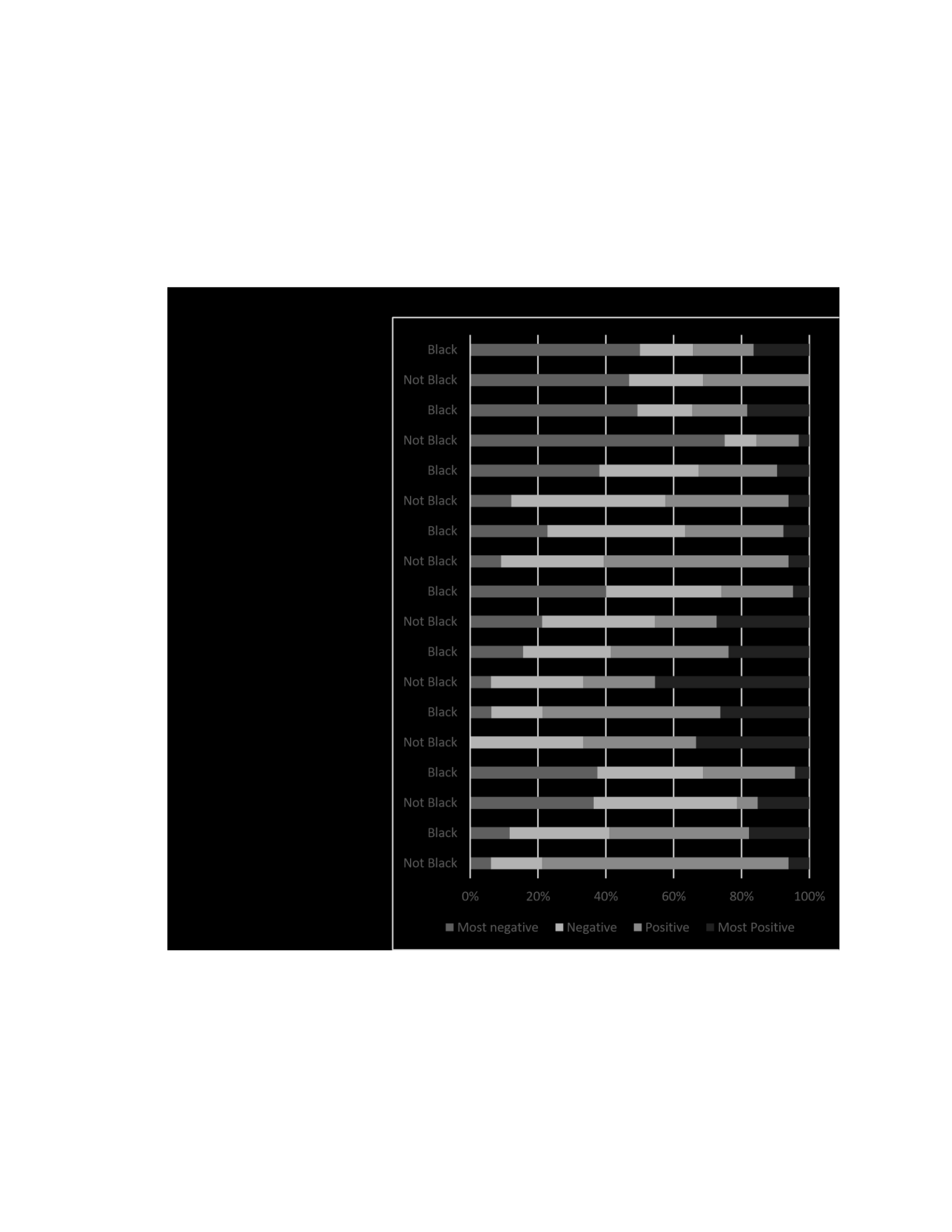
was also a difference on the z-Test of Two Proportions. Table 11 shows the results of the
z-Test of Two Proportions and the Contingency tests.
Figure 2 illustrates the distribution of student responses on questions in which
there were statistical differences according to the chi-squared Contingency tests.
Figure 2. Chi-square contingency test results: Race statistical differences.
Student variables: Socioeconomic status. Null H04: One’s perception of
political efficacy is independent of socioeconomic status (SES).

The original design of this study included socio-economic status as a variable to
consider when investigating student perceptions of political efficacy and expected civic
engagement. The district was no longer obligated to collect income information as a
means of determining free and reduced lunch eligibility for students. Because the state
had determined that a high enough percentage of students would qualify, 100% of
students received free lunch and breakfast. This prevented access to specific
socioeconomic data on students.
Another possible method of obtaining income information was to ask parents for
income information on the parent questionnaire. Although 75 parents signed the consent
form for participation in the study, only 20 completed the questionnaire. This number of
respondents was sufficient for a direct comparison of student and parent responses on
political attitudes, but was not sufficient as a means of drawing conclusions about how
socioeconomic status affected student perceptions.
Student variables: Literacy. Null H05: One’s perception of political efficacy is
independent of literacy level.
Another variable I tested was the literacy level of survey participants. To do this,
I used the reading level of each student who participated in the survey on a STAR
Reading Assessment administered in May of 2015. This test assigned a grade equivalent
(GE) for reading ability. Students who scored 8.0 or higher were considered to be
reading ‘at or above grade level’ and students who scored below 8.0 were placed in the
‘below grade level’ group. The z-Test of Proportions was used to measure differences in
positive responses between students who could read at grade level and those who could not.
The chi-squared Test of Independence compared the entire range of responses on the

questions. The full results of the z-Test of Two Proportions and Test of Independence may
be found in the tables titled Student Variables: Literacy in Appendix B. Due to statistical
differences on some questions between the two groups that were evident on both the Test of
Proportions and Test of Independence, I rejected the null hypothesis and determined that
elements of one’s political efficacy were dependent on literacy level.
Test of proportions. According to the z-Test of Two Proportions, there were no
statistical differences in positive responses in the Outside of School or Views on Society
sections. In the section titled Behaviors of Being a Good Adult Citizen, more students in
the higher reading group responded that willingness to violate a law that violated human
rights was a quality of a good citizen (on grade level – 77.0%, below grade level –
61.9%); z = 2.00, p = 0.045. Although the following behaviors did not meet the degree of
confidence, more students reading at or above grade level responded that good citizens
follow politics (z = 1.84, p = 0.066) and obey the law (z = 1.90, p = 0.058). Students,
regardless of literacy level, gave responses that were nearly identical (within two
percentage points) on these characteristics of good citizens: voting (on level – 87.3%,
below – 88.8%), participating in peaceful protests (on level - 76.2%, below – 77.6%),
promoting human rights (on level – 83.9%, below – 85.8%), working hard (on level -
95.2%, below – 93.4%), and patriotism (on level – 82%, below – 84%).
There were two significant differences in the responses of students in the two
literacy groups in the subsection measuring internal efficacy, a person’s confidence to
participate in the political realm. Students who were reading below grade level were less
likely to respond ‘Agree’ or ‘Strongly agree’ to the statement ‘I know more about politics
than others my age (36.4%) than students who were reading at or above grade level’

(52.4%); z = 2.04, p = 0.041. Also, fewer students in the lower literacy group responded
that they had a good understanding of issues facing this country (64.8%), while 79.4% of
students in the higher literacy level felt they understood political issues in America; z =
2.00, p = 0.045. There was a 10 percentage point difference on the statement ‘I have
political opinions worth listening to’ (on – 66.1%, below – 55.7%), but this was not
statistically significant. There were no differences in external efficacy, views about
opportunities, or trust in groups or institutions.
There were also two statistically significant differences in the subsection titled
Expected Adult Engagement. While students in both literacy groups expected that they
would probably or definitely vote in local elections at essentially the same rate (on –
88.7%, below – 85.6%), students who were reading below grade had lower expectations
to vote in national elections (79.8%) than students who were reading at or above grade
level (91.9%); z = 2.08, p = 0.038. Similarly, participants in the lower literacy group
were less likely to expect to get information about candidates running for office as adults
(76.7%) than those in the higher literacy group (90.2%); z = 2.16, p = 0.031. Responses
in the Expected Youth Engagement section were statistically similar.
When I ran the z-Test of Proportions for all student variables (gender, race,
location inside or outside the protest area, and literacy) on 100 individual question items,
the greatest difference between any two demographic groups was found between the two
literacy groups on student responses to two statements. In the section Effectiveness of
Political Action, positive responses to the effectiveness of peaceful marches, rallies, and
demonstrations were statistically the same (on – 69.4%, below – 66.4%), there was a
24.5% percentage point difference in positive responses to the effectiveness of illegal

protest activity; z = 3.22, p = .001. More students in the lower reading group (43.9%)
considered illegal protest activity to be effective. Another very significant difference,
with a p-value less than 0.01, had to do with students’ views on religion. Only 10.9% of
students at or above the eighth grade reading level agreed or strongly agreed that religion
should no longer matter in the modern world, while 35.5% of students in the lower
literacy group believed this was true; z = 2.742, p = .006.
Test for independence. To run the chi-squared Tests of Independence, I used the
whole spectrum of data, keeping the different levels of responses distinct. Of the 100
questions, analysis of the Test for Independence indicated responses on three questions
were dependent on literacy level. In the section about Views on Society, 93.4% of
students reading below grade level and 96.8% of students reading at or above grade level
‘Agree(d)’ or ‘Strongly agree(d)’ that ‘All people should have their social and political
rights respected,’ which is statistically the same. The distributions, according to the Test
for Independence, demonstrated a significant difference; χ2(3, N = 167) = 8.563, p =
0.036. The test revealed that 65.1% of students in the higher literacy group ‘Strongly
agree(d)’ with this statement, compared to 48.1% of students reading below grade level.
Students’ responses concerning the effectiveness of illegal protest activity, which resulted
in a difference on the z-Test of Two Proportions, was also significant on this test. Among
students in the higher literacy group, 53.3% believed that illegal protests were ‘Not at all
effective’ and 8.3% considered this activity to be ‘Very effective.’ In the lower literacy
group, fewer students responded in the extreme negative (39.3%) and more students
answered in the extreme positive (15.9%); χ2(3, N = 167) = 9.87, p = 0.020. Finally,
students from both literacy groups considered whether they believed religion should or

should not matter in the modern world. On this question, which was also statistically
different on the z-Test of Two Proportions, 13.1% of lower level readers
‘Strongly agree(d)’ that religion should not matter, but no student on reading level
answered that way; χ2(3, N = 170) = 9.00, p = 0.029. Table 12 shows the results of the z-
Test of Two Proportions and the Contingency tests.
Table 12
Student Variables – Literacy Statistical Differences
country
Expected Adult Engagement
Vote in national elections
0.798
0.919
-2.075
0.0308
3
166
5.08
0.166
Get information about candidates
0.767
0.902
-2.161
0.0307
3
164
5.199
0.1578
Effectiveness of Political Action
Illegal protest activity
0.439
0.194
3.22
0.0013
3
167
9.866
0.0197
Views on Religion
Religion should not matter Note.
α = 0.05.
0.355
0.109
2.742
0.0061
3
170
8.996
0.0293
Z Test of Two Proportions
Chi
-
Square
Contingency
Test
below
level
on
level
z
-
score
p
-
value
d.f.
n.
χ
2
p
-
value
Views on Society
All people should have rights
respected
0.934
0.968
-
0.952
0.3412
3
167
8.563
0.0357
Citizenship
Violates anti
-
human rights laws
0.619
0.77
-
2.002
0.0453
3
166
4.296
0.2312
Internal Efficacy
I know more about politics than
others my age
0.364
0.524
-
2.039
0.0414
3
170
4.459
0.2159
I understand issues facing our
0.648
0.794
-
2.004
0.0451
3
168
7.171
0.0666

Figure 3 illustrates the distribution of student responses on questions in which
there were statistical differences according to the chi-squared Contingency tests.
Figure 3. Chi-square contingency test results: Literacy statistical differences.
Student variables: Location. H06: One’s perception of political efficacy is
independent of location within the district.
There were two locations in which most protest action took place: West Florissant
Road, near the Canfield Apartments where Michael Brown was shot, and South Florissant
Road in front of the Ferguson Police Station. These were both in the southeast section of
the school district, bordering the Riverview Gardens and Jennings School Districts. In
order to determine if there was a difference in political attitudes between students who
lived inside the protest area and those who lived in other parts of the district, I asked
students to identify the elementary school they attended. The attendance areas of six
elementary schools fall inside the protest area. If students indicated that they attended an
Question
Distribution of Responses
All people’s rights
should be respected
Effectiveness of illegal
protests
Religion should not
matter
–
modern world
0.0
%
20.0
%
40.0
%
60.0
%
80.0
%
On level
Below
On level
Below
On level
Below
Most negative
Nagative
Positive
Most positive

elementary school outside the district, I checked addresses in the student information
system before de-identifying the data to find which elementary school they would have
attended if they lived in the district in sixth grade. Some students lived within the
Riverview Gardens district boundaries but had transferred to FergusonFlorissant School
District. They were considered to live inside the protest area due to proximity to the
Canfield Apartments. I verified addresses of students whenever location of residence was
in question.
In order to test whether or not one’s perception of political efficacy is independent
of where students lived in the district, I ran a series of z-Tests of Proportions and
chisquare Tests of Independence. On the issues in which responses were dependent on
whether students lived inside or outside the protest area, and the null hypothesis was
rejected, it meant that there was a significant statistical difference with a confidence level
above 0.95 (a= 0.05) between the two groups. Researchers studying the impact of youth
proximity and exposure to protest activity, including peaceful and violent protest, may
find this comparison useful. The z-Test of Proportions was used to measure differences in
positive responses between students who lived within the protest areas and those who
lived elsewhere in the district. The chi-squared Test of Independence compared the entire
range of responses on the questions. The full results of the z-Test of Two Proportions and
Test of Independence may be found in the tables titled Student Variables: Location in
Appendix B. Due to statistical differences on some questions between the two groups
that were evident on both the Test of Proportions and Test of
Independence, I rejected the null hypothesis and determined that elements of one’s
political efficacy were dependent on location within the school district.

Test of proportions. According to the z-Test of Two Proportions, there were three
questions in which there was a significant difference of proportions between students who
lived inside the protest area and those who lived outside it. Significantly fewer
participants who lived inside the protest area believed that patriotism was an important
behavior for being a good adult citizen (73.5%), compared to students who lived in other
parts of the district (87.5%); z = -2.25, p = 0.024. In the subsection, Opportunities,
students inside the protest area ‘Agree(d)’ or ‘Strongly agree(d)’ that poor children have
fewer chances to get a good high school education in this country (inside - 71.4%; outside
- 53.1%); z = -2.21, p = 0.027. In the subsection, Internal Efficacy, there was a 22.4
percentage point difference between the two groups on responses to this statement: ‘I take
part in political discussions,’ 75.5% of students who lived inside the protest area
answered positively, compared to 53.1% of students who lived outside that area; z =
2.213, p = .007.
In the subsection about Youth Engagement, students considered which political
actions they expected to participate in the next few years. While there were not any
actions that met the 0.95 confidence interval (a = 0.05), two political activities were very
close to the threshold for significance. For example, 70.2% of students inside the protest
area expected to collect signatures for a petition, while 53.8% answered that they would
probably or definitely do that; z = 1.95, p = 0.051. As to whether participants expected
that they would block traffic, 19.8% of students outside the protest area considered
participating in this activity do, whereas 33.3% of those who lived inside the protest area
responded positively; z = 1.89, p = 0.059.

Test for independence. To run the chi-squared Tests of Independence, I used the
whole spectrum of data, keeping the different levels of responses distinct. Of the 100
questions, analysis of the Test for Independence indicated responses on three questions
were dependent on literacy level. Of the 100 questions, analysis of the Test for
Independence indicated there were six responses that were dependent on whether or not
students lived inside the protest area. In the first section of the questionnaire, Activities
Outside of School, students responded to how often they talked with friends about
political issues or issues in society. The results revealed a significant difference in
distributions. Only 12.5% of students living inside the protest area answered ‘Never or
hardly ever,’ however 39.0% of students who lived in other parts of the district answered
in the extreme negative; χ2(3, N = 171) = 11.47, p = 0.009. In response to the statement
‘Political protests should never be violent,’ more students inside the protest area agreed
(though not a statistically significant amount on the z-Test for Two Proportions), but the
percentages of students who ‘Strongly agree(d)’ were different; χ2(3, N = 174) = 8.34, p =
0.040. Over half of students (51.2%) who lived outside the protest area ‘Strongly
agree(d)’ that protests should never be violent, whereas 38.3% of students inside the
protest area answered this way. Also in the section measuring internal efficacy, there was
a difference in distribution of responses on the statement, ‘When political issues or
problems are being discussed, I usually have something to say’; χ2(3, N = 179) = 8.891, p
= 0.031. The proportions of positive responses, as measured by the z-Test of Proportions,
on this statement also revealed a difference between students inside and outside the
protest areas. Student responses on the Youth Engagement activity of collecting
signatures to support a cause, which nearly resulted in a difference on the z-Test of

Proportions, did yield a significant difference on the z-Test for Independence; χ2(3, N =
177) = 8.21, p = 0.042.
There were two additional differences in this series of tests. Positive responses
were nearly identical (inside - 91.8%, outside - 92.3%) in their responses on the question
about whether schools should teach students to respect members of all racial groups,
although more students (66.9%) living outside the protest area responded ‘Strongly
agree’; χ2(3, N = 179) = 8.22, p = 0.042. In comparison, 49.0% of students who lived
inside the protest area answered in the extreme positive. Finally, there was a significant
difference on the statement ‘Religious leaders should have more power in society’;χ2(3, N
= 177) = 9.87, p = 0.020.
Table 13
Student Variables – Location Statistical Differences
never be violent Citizenship
0.936
0.843
1.608
0.1078
3
174
8.339
0.0395
Patriotic
0.735
0.875
-2.252
0.0243
3
177
5.851
0.1191
Opportunities
Schools should teach
respect of all racial groups
0.918
0.923
0.111
0.9115
3
179
8.223
0.0416
Poor children have fewer
chances (education)
0.714
0.531
2.213
0.0269
3
179
5.637
0.1307
Internal Efficacy
Z Test of Two Proportions
Chi
-
Square Contingency Test
inside
outside
z
-
score
p
-
value
d.f.
n.
χ
2
p
-
value
Activities Outside of School
Talking with friends about
politics
0.458
0.333
1.523
0.1278
3
171
11.468
0.0094
Views on Society

Political protests should
Religious leaders should
0.429 0.508 0.941 0.3468 3 177 8.619 0.0348
have more power
Note. α = 0.05.
Table 13 shows the results of the z-Test of Two Proportions and the Contingency
tests.
Figure 4 illustrates the distribution of student responses on questions in which
there were statistical differences according to the chi-squared Contingency tests.
I take part in political
discussions
0.755
0.531
2.719
0.0065
3
179
8.891
0.0308
I understand most political
issues
Youth Engagement
0.837
0.674
2.161
0.0307
3
178
5.312
0.1503
Collect signatures for a
petitions
0.702
0.538
1.954
0.0508
3
177
8.206
0.0419
Views on Religion
Question
Distribution of Responses
Talking to friends about
political issues
Political protests should
never be violent
Schools should teach
respect of all races
Collect signatures
Religious leaders more
power
%
0
%
20
40
%
60
%
80
%
100
%
Outside
Inside
Outside
Inside
Outside
Inside
Outside
Inside
Outside
Inside
Most negative
Negative
Positive
Most positive

Figure 4. Chi-square contingency test results: Location statistical differences.
Quantitative Findings: Parental Attitudes
Null H07: One’s perception of political efficacy is independent of parental attitudes.
In order to determine how well the student’s views on political attitudes matched
those of their parents, I needed a test that would allow me to analyze ordinal data for such
a correlation, and so the Pearson Product Moment Correlation was inadequate. I chose
instead to use the Gamma statistic, which Goodman and Kruskal developed to
accommodate non-parametric data. This test computes the degree to which the responses
of two subjects – in my case, a student and his or her parent – were in line with each
other. The test utilizes a cross-tabulation of the responses and calculates the number of
agreements and inversions among the responses. These sums fold into the Gamma
statistic, which ranges from -1 (perfect inverse correlation) to 1 (perfect correlation).
Table 18 shows the results of the Gamma tests of parent and student responses for all the
questions. Tables for the Gamma test results for each section of the questionnaire can be
found in Appendix C.
Table 14
All Survey Questions: Parent and Student Responses
Correlation of Rankings
Parent/Student Pairs
G
p-value
Pair 1
0.094
0.7325
Pair 2
0.602
0.0009
Pair 3
0.335
0.1393
Pair 4
0.609
0.0007
Pair 5
0.000
1.0000

Pair 6
0.552
0.0113
Pair 7
0.534
0.0091
Pair 8
0.514
0.0136
Pair 9
0.227
0.3161
Pair 10
0.234
0.3083
Pair 11
0.505
0.0273
Pair 12
0.502
0.0094
Pair 13
0.272
0.2012
Pair 14
0.287
0.1855
Pair 15
0.465
0.0291
Pair 16
0.616
0.0013
Pair 17
0.276
0.1997
Pair 18
0.557
0.0014
Pair 19
0.555
0.0058
Pair 20
0.765
< 0.0001
Note. α = 0.05.
Parents completed a questionnaire with nine sections that contained 78 of the 100
questions included on the student questionnaire. Some sections, including those related
to youth expected youth and adult political engagement, were not represented on the
parent questionnaire. When I ran the gamma test on 20 parent and student responses on
the questionnaire, there were 12 significant correlations and one inverse relationship out
of 20 student-parent pairs. Due to statistical similarities for 60% of the parent-student
pairs, I rejected the null hypothesis and determined that for an adolescent in this study,
one’s political efficacy was dependent on parental attitudes.
Data tables for each section of the questionnaire can be found in the Appendix.

Results for the sections are summarized here. The first section, ‘Activities Related to
Politics Outside of School,’ posed questions related to how often and in what ways
participants accessed information about political issues. In addition, participants
answered how often they talked to friends about political issues or issues in society.
Students answered how often they talked to their parents and parents answered how often
they talked to their children about political issues or issues in society. This last question
was the only instance in which the wording was different on the student and parent
surveys. On these five questions, of the 20 student-parent pairs, 14 pairs were strongly
correlated (p < 0.05), two demonstrated an inverse relationship (p = 1.00), and one pair
had insufficient responses to calculate a relationship.
All questions on the student questionnaire were identical to the parent
questionnaire on the remaining sections. In the section, ‘Views on Society Related to
Politics,’ parents and students answered 13 questions. All pairs had complete participant
responses. Ten parent-student pairs demonstrated significant correlation (p < 0.05) and
three demonstrated an inverse relationship (p = 1.00). The section, ‘Views on Rights,
Opportunities, and Responsibilities,’ contained eight questions. Of the 20 parent-student
pairs, there was a significant correlation (p < 0.05) on 16 pairs and an inverse relationship
on one pair (p = 1.00). In the ‘Views on Religion in Society,’ 11 out of 20 pairs were
significantly correlated (p < 0.05), with no inverse relationships. Fewer parent-student
pairs were strongly correlated on the ‘Behaviors for Being a Good Adult Citizen’ section,
which contained 14 questions. Five parent-student pairs were significantly correlated
correlation (p < 0.05) and one demonstrated an inverse relationship (p = 1.00), leaving 14
pairs with no statistical relationship.

There were four sections in the student and parent questionnaires related to
political efficacy. On the ‘Internal Efficacy’ section (seven questions), 12 parent-student
pairs demonstrated a strong correlation (p < 0.05), with two pairs that were inversely
related (p = 1.00). Ten parent-student pairs were significantly correlated on the “External
Efficacy” section of six questions (p < 0.05), and two pairs were inversely related (p =
1.00). Trust is an indicator of external efficacy. On the ‘Trust’ section of 11 questions,
there were 12 parent-student pairs with significant correlations (p < 0.05), one pair with
an inverse relationship (p = 1.00), and one pair with incomplete responses. Participant
responses about the effectiveness of political action is also an indicator of external
efficacy. In the section ‘Effectiveness of Political Action to Influence Decisions in
Society,’ which contained eight questions, there were 12 parent-student pairs that were
significantly correlated (p < 0.05), one pair with an inverse relationship (p = 1.0), and one
pair with incomplete data. Table 15 summarizes the results of the Gamma tests for each
section of the questionnaire.
Table 15
Student-Parent Gamma Correlations by Questionnaire Section
Not
Number of Significant Inverse Not enough Total questions Correlation
relationship correlated data pairs
Outside of School 5 14 2 3 1 20
Views on Society 13 10 3 7 0 20
Citizenship 14 5 1 14 0 20
Opportunities 8 16 1 5 0 20
Internal Efficacy 7 12 2 6 0 20
External Efficacy 6 10 2 8 0 20

Trust 11 12 1 6 1 20
Effectiveness 8 12 1 6 1 20
Views on Religion 6 11 0 9 0 20
Qualitative Findings: Focus Group Characteristics
Sixteen students from Ferguson Middle School participated in focus groups. All
of these students completed the student questionnaire the previous week. Students
participated voluntarily during the school day, and each focus group discussion took
approximately one hour. I developed the focus group questions to correspond with the
sections of the questionnaire. The focus group questions served to lend perspective to the
quantitative data acquired through the questionnaire responses. The focus group
questions also allowed me to determine the validity of the questionnaire by confirming or
contradicting the results.
When I originally designed the study, I intended to hold a student focus group at
each of the three middle schools. Not enough students at Berkeley Middle School or
Cross Keys Middle School volunteered to participate, despite the efforts of staff at those
schools. I planned to hold three focus groups of four to eight students per group.
Because 16 students at Ferguson Middle School volunteered to participate, it was still
possible to hold three separate focus groups at that site and identify trends across the
three groups. Due to challenges with scheduling, the groups were not even. Eight
students participated in the first focus group and four students participated in each of the
other two groups. Each group included both male and female participants. Each group
included students of varying reading levels. Each group included students that lived
inside or outside the protest area.

The focus groups also included students from difference racial backgrounds,
though not every group was diverse. The first group included five Black students, two
Hispanic students, and one White student. The second group contained four Black
students. The third group comprised of three Black students and one White student.
Although this study did not consider the role of teachers in student attitudes, students who
participated did represent different teams of teachers within the school. I did not make an
effort to achieve representative samples within the groups; students participated at the
times they were available based on their schedules. Table 16 shows the demographic
characteristics of participants of the three focus groups.
Table 16
Student Focus Group Participant Characteristics
Variable
Gender 12 Female 4 Male
Race 12 Black 4 Other than Black*
Literacy** 11 Below grade level 5 On grade level
Location 9 Inside protest area 8 Outside protest area
Note. * 2 Hispanic, 2 White
** 1 student did not have reading data
Overall, students in the focus groups agreed with one another on most issues. Not
every student responded to every question, but when I encouraged students who were
quiet to speak up, it was common for these participants to explain that they agreed with
what a previous speaker had just said. Students in all three focus groups treated one
another with respect and took turns speaking. Students actively engaged in conversation.
In all three groups, students’ attention span waned at the 50-minute mark, but the
participants remained focused and thoughtful for the final questions.

Participants in all three focus groups raised the topic of race many times, although
I did not ask any questions that explicitly mentioned race. Students participated in
discussions related to the shooting of Michael Brown, their experiences protesting,
government response to non-violent and violent protests, trust in law enforcement and
government leaders, the effectiveness of political action, and their hopes for change in the
future. Although students expressed passionate views about the experiences and opinions
they shared on racially charged topics, neither students’ words nor body language
indicated discomfort. The two White students and two Hispanic students participated in
discussions actively.
Research Question One: Political Efficacy, Trust, Opportunities (Focus Groups)
RQ1: What are adolescents’ perceptions of their own political efficacy, including trust in
institutions, attitudes about political systems, and equality of opportunities?
This research question involved several components, which were addressed in
student focus groups. I have broken the question into the following sections: internal
efficacy, external efficacy, effectiveness of political action, trust in institutions or groups,
and opportunities.
Internal efficacy. Confidence in one’s ability to make a difference through
political action is a key component of internal efficacy. The student questionnaire
measured internal efficacy through questions about students’ perceptions about whether
they were interested in politics, understood political issues facing our country, usually had
something to say when political issues were discussed, and knew more about politics than
other people their age. In addition, the student questionnaire asked students to consider
whether they thought they would be able to participate in politics when they are adults.

Students sometimes indicated various levels of internal efficacy when they responded to
questions about other topics in the focus groups.
Students responded with mixed feelings when asked the question, ‘Are you
interested in politics?’ In two of the three focus groups, students asked for clarification of
the word ‘politics.’ In all groups, only two students expressed significant interest in
politics, one of whom commented that her parents, especially her father, loved politics.
In Focus Group One, seven students answered positively. However, in the other groups,
the most common response was ‘kind of.’ In Focus Group Two, two students noted that
people around them did not talk about political issues. One student referred to having the
news on at home or adults having conversations about political issues, but said that young
people were not involved. One student said, ‘I have my mind on other stuff other than
politics.’
Despite a lack of clarity of the meaning of politics and mixed levels of interest,
five students in the focus groups indicated that they had a good understanding of the
issues that face our country and no students answered negatively. Further evidence
showed that students did, in fact, have a good understanding of American political issues
by participant responses to an open-ended question on the topic. When asked, ‘What
kinds of issues related to politics are facing our country,’ students volunteered the
following responses: debt, taxes, terrorism, wars, other countries, crime and violence,
race, and stereotypes. One student described social status as an important issue: ‘Say
somebody’s richer, for example, then they get treated like they’re better.’
The participants in Focus Group Three all agreed that our country faces race as a
political issue. Students mentioned both Michael Brown and George Zimmerman. This

group also referred to gender inequality, with both male and female students agreeing that
some ‘men try to be more powerful than women,’ and referenced women in politics,
specifically Hillary Clinton. This group mentioned these additional issues facing their
community: damage to the area from riots in August and November of 2014 and how
students felt that money was not being used on things ‘that we need in our area.’
Unprompted, all three focus groups initiated extensive discussions of problems
with police when asked about political issues facing our country. Directly or indirectly,
students referred to racism, use of excessive force, abuse of power, excessive ticketing,
lack of representative police forces, militarization of police, and police training. The
following exchange was representative of conversations in all three groups that
organically arose among multiple students in response to the question about issues facing
our country:
Student: Race? Is it like race?
Researcher: Race could be one.
Student: Yeah.
Researcher: So tell me more about that.
Student: Stereotypes.
Student: Well, could I use an example? I don’t know about the Mike Brown
situation but I’m gonna use an example on this, so people is saying that Darren
Wilson he…
Student: Was racist.
Student: Like killed him, yeah. And he was a racist cop and all that and he shot
Mike Brown cause of that…

Student: There are some racist cops but I won’t say they’re all racist. ‘Cause some
cops are nice. I live by a whole building full of cops. So, when the riots happened
I was pretty much right next to it.
This conversation suggested that students’ experiences surrounding events in
Ferguson prompted political discussion and that students did, in fact, have something to
say when privy to political discussions. Students did not specifically address the issue of
whether they knew more about politics than most people their age; I did not ask the
students to respond to that in the focus group. Students did indicate that they would be
able to participate in politics when they are adults. I discuss this in greater depth in the
section on expected political engagement later in this chapter.
External efficacy. Before I asked any questions related to external efficacy, or
perception of government responsiveness and whether political participation is
worthwhile, students made passing reference to the topic. One student said, ‘When it
comes to government, I want to know what is he [the president] doing for our country?
What is he doing to help us?’ In the context of a discussion of events in both Ferguson
and Baltimore, another student volunteered, ‘Sometimes it doesn’t feel like they really
care about the communities . . . because it keeps going on and it’s not changing.’
Later in the interview, participants answered specific questions about external
political efficacy. In response to the question ‘How do you know a political leader is
doing a good job?’ students in the three focus groups suggested that government
responsiveness was the most important indicator. Apart from helping people, students
mentioned no other indicators. Comments included: ‘changes are happening,’ ‘they pay
attention,’ they ‘listen to what their community has to say,’ and ‘if you call and tell them

what they need to change and then they fix it.’ Focus group participants listed several
responsibilities of government leaders, including ‘make fair laws,’ ‘protect us,’ ‘pay
attention to us,’ ‘make our country and community a better place to be,’ ‘make sure public
places are taken care of,’ and know ‘what’s happening in the community.’ When
asked how well government leaders listened to regular people in the community made
laws that regular people wanted, responses ranged from neutral to negative. Some
responses included ‘sometimes,’ ‘depends on the situation,’ or ‘not that much.’ One said,
‘I think they try to listen to us . . . but it’s hard because there’s so many people and they
have to please a lot of people’ and another student agreed. In response to whether
government leaders are interested in making positive changes to benefit them or their
community, one student said, ‘A lot, I think? That’s what they say, they say they want to
make things better.’ Some students made references to meetings that had been held in
Ferguson throughout the year. Students considered whether things were improving in
their community. One student said, ‘I don’t see nothing happening, so no.’ Another
student agreed, saying, ‘I think they’re interested, but I think actions speak louder than
words, so I don’t know until I see it.’
Some students responded more cynically. One student said, ‘I think they’re
interested in benefit their selves (sic). As far as us? No.’ Another student said, ‘I mean
they hear, they want to listen to us when they want to be elected or something, but when
they get elected . . .’ Another student finished the sentiment, ‘They don’t do what they
were elected for.’
Effectiveness of political action. An element of external political efficacy is
whether citizens believe that political action is worthwhile. In this study, a section in the

student questionnaire, as well as questions for the focus groups, focused on the
effectiveness of different types of political action. When asked about the effectiveness of
peaceful political protests, there were mixed responses. Students in the focus groups had
a strong awareness of peaceful and violent protests from their own experiences. Because
of this, students could not separate the effectiveness of political action from their
experiences and knowledge of civil action and civic unrest in Ferguson. While student
discussion on this topic was extensive, the topic of young people’s experiences of events
in Ferguson is outside the scope of this study. For that reason, responses about the
effectiveness of political action as an indicator of political efficacy are summarized here
and expounded upon in future work.
In the focus groups, the students had mixed responses to the potential of peaceful
protests to have an impact in general, but mainly negative responses of effectiveness of
peaceful protests in Ferguson. Specifically, in reference to a peaceful protest in
Ferguson, one student said, ‘it was really nice, it was really peaceful, but I don’t know if
they were really listening. They were just riding by and they weren’t saying anything to us.’
In one group, four students agreed that riots got more attention. When asked to explain, a
student said,
I’m just saying that’s what got their attention most of all. When we were peaceful
protesting they weren’t listening (sic). It’s just like we weren’t being heard. So, I
guess they [some protesters] felt like they needed to be heard and they started
rioting.
All three groups agreed that riots were both ineffective and had catastrophic
consequences to the community:

With the Mike Brown thing they thought burning down things and looting was
gonna get the person, Darren, in jail, but then when they found out that didn’t get
him in jail and they thought they (government leaders) were listening but they
weren’t. And they found out he wasn’t in jail and they thought that ‘Aw, we’re
gonna do it again, if we do it louder than they’re probably gonna hear us’, so they
burned down more buildings and it wasn’t [effective], but caused more damage.
Focus Group One briefly discussed the effectiveness of other types of protests.
One student simply said, ‘I don’t know.’ Two people offered boycotts and one mentioned
strikes as other types of protest. When I asked students in this group about the
effectiveness of writing to political representatives, one responded positively: ‘I mean
I’m gonna do it.’ However, five responded negatively. These included, ‘I doubt if they’ll
see it,’ ‘I doubt they’ll listen,’ ‘Half of them just gets to their assistants’ and,
‘They’ll read it and then throw it, it just gets passed on.’ When students considered the
option of contacting a representative directly, four people responded negatively. One
student said, ‘I think they’ll act like they (sic) listening to you talking, ‘we should fix that
right away’, but yet nothing is done.’
Trust in institutions or groups. Within the first two minutes of the time spent
with Focus Group One, the students introduced the topic of trust, not within the context
of the question on trust in groups and institution. When I asked about whether or not they
were interested in politics, a student commented that she wanted to know what the
president was doing to help the community. This exchange followed:
Researcher: What about other leaders? Are you curious about other people in
govern -

Student (interrupting): Yes, the Police.
Student: Yes.
Student: I don’t like them. I don’t trust them.
Student: Me either.
Researcher: Okay, if you don’t trust the Police, tell me who you do trust.
Student: I trust my mom.
Student: I don’t trust nobody.
Student: I don’t trust nobody.
Student: You can’t trust nobody…
As the discussion moved to trust in other groups and institutions, including national, state,
and local government, the police, the military, school, and church, students in this group
demonstrated a lack of trust in all institutions. They slightly differentiated between
degrees of trust of various groups, but overall, trust was low. Some students were more
vocal on this topic than others, who were more engaged in later questions.
In all three groups, students connected their trust in several institutions with their
experiences following the police shooting of Michael Brown and the subsequent
response. As previously explained, rather than delve into a comprehensive investigation
on the impact of young people’s experiences in Ferguson on their trust in groups and
institutions, I will summarize results from the focus groups related to trust as one of the
indicators of political efficacy.
In the three focus groups, most students indicated a strong lack of trust in the
police, although some students were uncertain, rather than completely negative, saying

‘Kind of,’ ‘Sometimes,’ or ‘I don't know.’ All students in Focus Group One said they had
a more positive view of police prior to the police shooting, but then indicated it was just
never this bad. Students did not seem to be aware of officer-involved shootings in the St.
Louis area or the rest of the country, saying that they had never heard of anything that
‘happened that made national news.’
In reference to the Michael Brown shooting, students in two focus groups
referenced the use of excessive force in the police shooting. A student said, ‘They didn’t
have to shoot him 14 times to kill him.’ In the second focus group, following similar
comments, a student said, ‘Some police are not that good, but some are just bad, but then
if you shoot a person in general you shouldn't just go away free. I think you should have
some consequences.’
A student in the first focus group, despite expressing strong views of distrust
initially, softened her stance, indicating that some people will develop a ‘stereotype’ of all
police officers based on an incident, but an event involving one officer did not necessarily
impact her trust in all police. She said, ‘I don’t trust [the police], ‘cause something
happened with them, but I wouldn’t say I don’t trust all of them. I wouldn’t say that.’
In addition to students’ perceptions of the shooting, students referred to
experiences with law enforcement that occurred separately from the police shooting.
Several students referenced the curfew in place following civil unrest, as well as their
impressions of a pattern of excessive ticketing. One student described both of these in
the same comment:
Like certain police officers when they blocked off the streets to get to my house
through the Ferguson thing, they wouldn’t let my dad through even though he

said he lived on my street. They almost tried to arrest him ‘cause they said he
was getting an attitude. And they tried to arrest my grandpa, I’m like how you
gonna arrest a man on a cane? I don’t think they have my best interest in mind
‘cause you stop these people for no reason and you give them tickets for a
thousand dollars knowing that they might not be able to pay it back.
Another theme in the conversations with students about trust in police was abuse
of power. In Focus Group Two, a student said, ‘I think police officers think they can do
whatever they want to do and like, no one really tells them they shouldn't be doing that.’
Another student followed with this comment: ‘Well, it's not all the cops, but like crooked
cops, they're making it bad for all the other cops.’
Students in the three focus groups showed less passion in their views on local
government. Responses included ‘kind of” and ‘they got a little trust, not a lot.’ They
tied perceptions of the state government to the governor’s response to events in Ferguson
in the summer and fall of 2014. At first, students did not have a clear understanding of
who was responsible for making decisions regarding the National Guard. Students in
Focus Group Two said that they trusted the state government leaders to make decisions
that were good for their community, but upon realizing that it was the governor of
Missouri who called up the National Guard in the weeks prior to the Grand Jury
announcement, the responses changed. One student said:
Okay then I switch to national, ‘yes,’ the state, ‘no,’ because they [were] sending
out more trucks . . . You all have guns, these people just trying to go home, y’all
have power but y’all act like you need the same amount of [National Guard] to
control [protesters].

Several students expressed a lack of trust based on the government response to
events in Ferguson, and specifically referenced the night of the announcement that Darren
Wilson would not be indicted. Students believed that the decision not to activate the
National Guard that night resulted in the destruction on W. Florissant Rd. In each focus
group, students expressed confusion as to whether the president or the governor was
responsible for making this decision. A student asked, ‘Who was the guy who didn’t
bring in the National Guard that was supposed to?’ In another group, a student said,
‘State, basically [I don’t trust them] at all . . . Because our governor made a lot of bad
decisions in times when he need to make good ones.’ His comment elicited general
agreement from the group.
Although students were not explicitly asked about their levels of trust in the
media, students in Focus Group Two brought up the topic. There were several references
to negative news coverage about their community. One student pointed out that the
television would ‘spend this entire news hour about what happened in Ferguson that’s
bad, then the good thing that happened they spend like five minutes and gloss over.’
Another student in the group said, ‘I think the news is making it worse.’ In addition,
another said, ‘They’re kind of like instigating’ and two more agreed.
Students displayed higher trust in the national government than in the state
government, and they believed that President Obama’s presence in Ferguson would have
had a positive effect, and may have negated the need to send the National Guard.
Separate from participants’ views regarding the national response or lack of response to
events in Ferguson, a few commented regarding trust in the national government. A
student in Focus Group Two said, ‘I guess I kind of trust them a little bit. I don't know. I

just I don't know if they're always telling the truth. Sometimes they just kind of keep
stuff from us.’
The students responded with mixed levels of trust in the military. Most responded
negatively or doubtfully in Focus Group One. One student, however, said that she trusted
the military because we would need them in case of invasion. Another student expressed
concern regarding her perception of a high rate of mental illness among members of the
military. A student shared that she was considering joining the armed forces at some
point, but said, ‘I don’t know yet, even though I want to do it. I really do not know if I
trust them or not.’
In keeping with the theme of an overall lack of trust in institutions, students
described their levels of trust in school. On the topic of school, the students based a lack
of trust in concerns over privacy, not over whether adults associated with the school were
looking out for their best interests. When Focus Group One responded to the question of
whether they trusted the adults in the school, answers were mixed. Students mentioned
teachers, counselors, and administrators in terms of a general fear of ‘confidential’ things
being openly discussed among adults. In two of the focus groups, when students
answered the question, ‘Are you comfortable going to your teachers’ the response was
mixed, but not very positive, with responses that included ‘no,’ ‘sometimes,’ and ‘it
depends.’ Further investigation of students’ perceptions of their schools are found in the
‘School Efficacy’ section.
A discussion of trust in the School Resource Officer (SRO) and school security
guard was generally positive. The SRO was an employee of the local police force
stationed in the schools and worked in the community when school is out of session. The

security guard was employed by the school district. In Focus Group One, two students
responded very positively to the question of whether they trusted the SRO and two
students were less sure. One student said, ‘I completely trust [the SRO]. I’ve known him
since I was three’ and another student agreed. In another group, a student’s relationship
with the SRO also impacted trust: ‘I trust [the SRO] because I’ve seen him ever since like
fifth grade. I mean, he’s the one that encouraged me to be in FYI (Ferguson Youth
Initiative).’
In reference to both the SRO and security guard, a student said she trusted both of
them ‘somewhat, I guess. I mean, they’re here in our school so if someone comes in
they’re the ones that protect us.’ All students in the second focus groups said they trusted
the SRO and school security officer, however one said, ‘I trust officers more than security
people,’ based on the impression that a police officer was more equipped to handle
dangerous situations. Regarding the level of trust in the SRO and security guard to
protect them, one student said, ‘I think it just depends on the situation, because if a group
of people came in with loaded guns surrounding them, how much do you think they
would back up?’
Students in the first focus group returned to the theme of confidentiality, alluding
to the fact that adults associated with the school, including the SRO, are mandated
reporters, which means that they are legally required to report incidents of child abuse,
neglect, or endangerment. A student shared a fear of telling a teacher or counselor about
something personal or something harmful. She would have to tell the police and what if
‘we didn’t have any other resources or anybody else to go to tell them, we just had people
at the school? There wouldn’t be any trust.’

Another student expressed the fear of staff telling the SRO about incidents, because you
‘might have to go to the court or deal with the…’ A student finished this sentence:
‘Social services.’ More concerns about trust and social services followed. A student said,
I wouldn’t tell nobody my business because they can go back and tell social
services and then my momma have to deal with it. And then they can take me
away from my family. I could be in foster care. I don’t want that.
Another agreed, saying, ‘Well, we had to deal with that a lot.’
In conclusion, with few exceptions, students in all three focus groups indicated
low levels of trust in most groups and institutions. Trust, or lack thereof, stemmed
directly from student experiences. Some of these experiences were connected to a need
to protect privacy, and some experiences came from negative impressions of members of
these groups. A student in the second focus group summed up the discussion of trust in
groups and institutions well: ‘I want to trust them but I can't because of their actions and
stuff that they do.’
Opportunities. Students responded to whether they thought all people in this
country had equal opportunities to get a good education or to get good jobs when they are
adults. In all three focus groups, the answers were consistently negative. Two themes
emerged related to discrimination and socioeconomic status. Focus Group One indicated
that ‘people get judged a lot.’ Students in that group suggested discrimination could be
based on race, grades, disabilities, ‘where you’re from, or where you moved from,’ or
‘how you look, or how you talk.’ Two commented about gender discrimination: men get
better jobs than women, and ‘we [women] don’t get paid as much as the men do.’
At first, the students in Focus Group Three indicated that race was not a major factor in

getting a good education or getting a good job, with two students saying no, and two
students saying ‘very rarely.’ However, they proceeded to give examples of the
challenges for Black people interviewing for positions. Focus Group Two made reference
to racial discrimination in hiring, but also to ‘the way they dress or even their religion.’
One student suggested that race is less of a factor than some people think it is.
Class surfaced as the other significant theme regarding unequal access to
opportunities. All students in Focus Group Two agreed that people with more money had
better opportunities. Students in the third focus group reiterated this sentiment in greater
detail. Three of four students said that opportunities were not equal, one of whom said,
‘Cause some people that’s [sic] rich, they have better school options.’ A student
commented on the role of a college education in gaining access to employment, saying,
‘It depends on what kind of schools you can afford because if you can’t afford college
then you don’t get as good job opportunities.’
Students in two focus groups agreed that it was the responsibility of government
leaders to make sure that all people have equal opportunities, however students did not
have the perception that government leaders were putting in enough effort to make a
difference. A student said, ‘They’re trying, but they're not succeeding as much as we
would want them to.’ At first, there were mixed responses in Focus Group One and some
confusion about the question, as though students had not considered who was responsible
for ensuring equal opportunities. Eventually, a student commented that if the government
‘tells them they have to give everybody equal opportunities, then (potential employers)
will listen.’

Students in all three focus groups felt that the government should provide more
activities for young people, which would be generally good for communities as well as
increase opportunities. Students in two focus groups wanted chances to express their
voices. Specific ideas included ‘more opportunities to talk and to voice opinions,’ to
‘keep us involved in things that’s (sic) happening around our communities,’ and that
leaders ‘don’t just leave us out just because we’re young.’ One student said that leaders
should make an effort to ‘talk to [kids], like groups like this. Or have activities, like
afterschool activities, just to talk to them and see what their mindset is.’ Another student
expressed that leaders should ‘go to the community and reach out to the kids because kids
are basically our future.’
Research Question Two: Citizenship (Focus Groups)
RQ2: What are adolescents’ perceptions of citizenship and civic participation?
Students in the three focus groups identified multiple qualities of a good adult
citizen. Focus group participants described behaviors of good adult citizens in four
categories: good character, participating in activities to benefit people in the local
community, obeying the law, and voting. The qualities of good citizens that indicate good
character included integrity, loyalty, honesty, trust, and responsibility. In the first focus
group, three students suggested that trust was a behavior of a good citizen, despite having
just described the lack of trust they had in various institutions and groups.
The greatest number of responses in all three focus groups were related to
community service: they ‘work for groups, they try to help people, they give people
stuff,’ ‘Help out the communities that are in need. They help the homeless,’ do

‘volunteer work,’ and ‘donate to the Salvation Army.’ A student said, ‘They give. Not
just wait for somebody to give to them to give’ and five participants agreed. One of those
said, ‘it’s better to give than receive,’ which is a religious reference. One student
referenced ‘participating in clean-up or an event that gives back to people who need that.’
This was consistent with discussions related to cleaning up the areas affected by rioting in
Ferguson.
Students in all three groups also mentioned following the law and voting. A
student in the third focus group listed four interconnected qualities: ‘Someone who obeys
the law, pays their taxes, doesn’t get arrested a lot, doesn’t cause a lot of commotions.’ In
each focus group, students suggested that good citizens vote, and that they learn about the
candidates so that they can make appropriate decisions, ‘cause it’s showing that they
care.’ When one group was asked whether citizens have a responsibly to vote, four
students said yes, however one said, ‘some people might feel uncomfortable voting for
somebody just because of the simple fact of what they (sic) race is, or who they is, or
what they look like to some other people that’s voting.’ Despite this acknowledgement of
hesitant voters, students in this group seemed to have the perception that voting matters if
enough people do it and that they suffer negative consequences when the wrong people
are office. In addition, they indicated that those who do not vote are responsible for the
wrong people getting elected.
I asked the students if the adults they knew were good citizens. All of the
participants in the second focus group agreed that their parents were hard working and
this was evidence of the students’ impressions that their parents were good citizens.
Some students in Focus Group One also indicated that their parents and other family

members voted, another indicator of good citizenship, according to students. However all
four students in Focus Group Three said that ‘some’ of the adults they knew were good
citizens, because they were ‘participating instead of stopping it or protesting it’ in
Ferguson riots, ‘And some was letting their kids go out while they just sit at home,’ and
‘Some take it too far, or they’re not doing enough.’ In another reference to voting, a
student in the third focus group said, ‘Or they don’t vote or contribute to who’s the better
person that you want to represent you.’
Focus Groups One and Three were asked, ‘Do you think that good citizens are
politically active?’ Several students in both groups indicated they did not understand
what ‘politically active’ meant. Once I explained, they had mixed responses. Some
students thought one could be a good citizen without being active in government and
politics. One student suggested that if an adult paid the bills and did not break the law,
then that would be enough to be considered a good citizen.
Research Question Three: School Efficacy (Focus Groups)
RQ3: What are adolescents’ perceptions of their own school efficacy?
School efficacy was a student’s confidence in his or her ability to make positive
change in a school, as well as the perception that trying to do so would be worthwhile.
When asked, ‘Do you think that you can make a difference in making your school
better?’ they responded hesitantly in Focus Group Three. One student thought that
treating other students well might improve the school. Another mentioned that paying
attention in class might help the school with test scores. A student in the second focus
group said:

Yeah, I think so . . . Just making petitions, talking to the principal or, not to go too
far, but asking the school district to improve more on the school instead of just
telling us they're going to do it but they're just not going to do.
Students in that group indicated that they did not know how to go about taking part in
action that would make the school better, or that the idea seemed overwhelming.
Students discussed whether they were comfortable going to school personnel to
let them know about changes they might want to make in the school. At least one student
responded positively, however another student predicted a lack of follow-through, saying,
‘Instead of saying they're going to improve something, they should like actively, literally
go and do it instead of saying they're going to do it and then put it off or forget about it
and not do it.’ In Focus Group One, the responses to this questions were mixed. One
person was more comfortable going to principals ‘Instead of teachers for school changes
‘cause they’ll probably listen more than the teachers.’ The students’ reactions to how
comfortable they were going to principals to make changes were mostly negative,
primarily because they did not think principals had time to listen to students’ ideas or
concerns. One student said, ‘It's not that I don't want to talk to the principals, it's just
that, if you try to talk to them, it’s like they got to go do something else or go handle
another student’ even though the administrator really wants to help. Research Question
Four: Expected Political Participation (Focus Groups)
RQ4: What is the extent of adolescents’ expected political participation?
The discussion in all three focus groups about expected political participation
primarily focused on electoral politics. In all three focus groups, students responded
positively to the question of whether they intended to vote when they turned 18. In Focus

Group One, all but one student was strongly positive. A student in this group said, ‘I
want my voice to be heard.’ Three students expressed a negative perception of people
who as one student said, ‘complain, but they sit at home and when you can go out there
and vote. I want to vote, but I can’t.’ All students in this group were very positive about
the desire for a ‘teenager group’ in local government, because ‘there’s teenagers that [are]
smart for their age’ that have opinions and want change.
All four students in Focus Group Two also expressed that they expected to vote as
adults. They also described some of the things they intend to advocate for as adults,
which included helping the needy and fighting for more jobs to combat unemployment.
Students in this group discussed the need to purchase better equipment for schools and to
build new schools. When asked, one student explained the need to prioritize the schools,
because ‘if they (students) get a better education they can go somewhere and have a good
job and they . . . won’t have to keep borrowing from people and we could use taxes to pay
off the debt.’
Students in the three focus groups had differing views on the topic of running for
public office. Students in Focus Group Three said, ‘Our community needs a lot of help”
and that the community needed “to change the things that go on.’ When asked if the
students could make a difference through holding an elected office, three out of four
people in this group said yes. One of these said, ‘Because the people that are in office
now are not really doing anything. So if I went in office I think I’d like to change a lot of
things that are happening now from happening in the future.’ Responses were less
positive in this group about their chances of being elected, with all four saying ‘it

depends.’ The theme of discrimination, which students discussed on the topic of equal
opportunities, resurfaced. One student stated:
I also think it’s kind of based on race. Because I know there’s a lot of racist
people in the world and so say if like one of us, ‘cause we’re Black women, what
if some men out there think men are more superior than women so they’ll
probably not vote for you ‘cause you’re a woman. Or, if some that are racist from
Black or White, they probably wouldn’t vote for you ‘cause you’re Black. A
different student returned to the theme of socioeconomic status as a factor in getting
elected to public office: ‘Even wealth plays into politics because the richer you are the
more you can afford’ in paying for a campaign.
In the first and second focus groups, the idea of running for public office elicited
mostly negative responses. Both groups generally agreed that running for office and
serving in office was overwhelming and stressful. In Focus Group Two, students
identified the following challenges: people asking you for favors, being constantly
criticized, always worrying about other people and getting votes, not being able to focus
on your family, and that serving in public office changes your character. A student said:
It seems like a lot of hard work and you have to please a lot of people and it’s just
a lot to do just to get to that spot and you don’t know what’s going to happen
when you do get elected.
A student in Focus Group Two had the perception that people can be politically
involved in other ways, saying, ‘I don’t really want to be a senator or a governor or
anything like that but I still want to be politically involved.’ In the third focus group, a
student responded to the question ‘Would you be a good leader?’ this way: ‘I think I

would be good, but is that the job for me? No.’ One student said that if things were not
going well, she might consider running for public office because ‘if you want change then
you gotta make a step.’
Research Question Five: Student Demographic Variables (Focus Groups) RQ5:
What aspects of student personal and social background, such as gender, race,
socioeconomic background, and literacy level, are related to adolescents’ political
efficacy?
The response to this research question is divided into the following sections:
gender, literacy, race, and location inside or outside the protest area. If the student
participants were representative of school district, most of them would have lived below
the poverty line, however, there was no way to distinguish between those students who
were poor and those who would not met the threshold for poverty. The other
demographic factors are discussed below.
Gender. In all three focus groups, both male and female students were
represented. In the first focus group, there were two male students and six female
students. In each of the second and third focus groups, there was one male and three
female students. Student responses in the focus group transcriptions were not separated
by gender. In the notes, however, responses made references to gender on some topics.
No responses indicated any difference in female or male viewpoints in the focus group
notes.
Female students brought up the topic of gender in two of the three focus groups. I
asked the students if all people in this country have equal opportunities to get a good
education or good job. A student in Focus Group One said, ‘I think men get better jobs

than women. We get the good jobs but we don’t get paid as much as the men do.’ The
third focus group had a longer discussion of gender. Three female students considered
issues related to gender, including men who are ‘putting down women a lot,’ and ‘feel
like they’re over women’ or ‘think they (sic) more powerful.’ A male student in the group
said, ‘Yeah, some guys do that, but like I said it depends on the person.’ Two female
students referenced the 2016 presidential race and indicated support for Hillary Clinton.
The male student said he would vote for a woman to be president ‘If they had the right
thinking.’
Literacy. The recording transcriber did not associate specific student names to
voices. Notes taken during the interviews indicated that certain students were particularly
outspoken, or seemed to have a notable grasp on the context of the events the students
were discussing. No data from the focus groups suggested that literacy level had an
impact on how outspoken a student was during the sessions.
The first focus group was the largest (eight students) and the most diverse. The
range of grade equivalent literacy levels was 5.1 to 9.3. The average reading level was
7.5. In this group, the student who was the quickest to respond to questions and most
exuberant in her responses was over two years below reading level for the eighth grade.
Another female student who often volunteered responses was nearly three reading levels
below grade level. She lived within the protest area, and participated in protests. Her
experiential knowledge of many of the topics discussed outweighed her level of expertise
in how government functions. There were three students in this group who were reading
at or above reading level. Two of them tended to be reserved; one of them, who read at a
ninth grade level, participated actively. Of the two students who were within two months

of reading at an eighth grade level, one was reserved, and the other one, who was the
sister of the most outspoken participant, tended to be very verbal. Students’ personalities
and their comfort level in the focus group experience was a greater indicator of active
level of participation.
In the second focus group, two students read at or above reading level, and two
did not. This group had the highest average reading level: 8.9. The student with a
posthigh school reading level (13) was the most outspoken member of this group. He had
a strong sense of the role of education in improving opportunity, he noted that
socioeconomic status may be even more important than race as an indicator of
opportunities, and he was especially aware of the role of media and the possible longterm
implications of events in Ferguson.
In the third focus group, the average reading level of four students was 6.7. One
student was reading on grade level and three were below level, two of whom read at the
fifth grade level. The four students participated virtually equally. Students in this group
had a strong grasp of issues related to politics, though the average reading level was the
lowest of the three groups. The students volunteered and discussed some of the topics
with a significant level of confidence, including race as a political issue facing our
country, a need for police reform, discrimination in hiring, negative impact and
ineffectiveness of violent protest on the community, and the role of socioeconomic status
and gender, in addition to race, as indicators of a lack of opportunities.
Race. Student responses across the three focus groups were consistent on most
issues, regardless of the racial or ethnic background of the students. Three out of eight
students (37.5%) in the first focus group were not Black: two Hispanic participants and

one White participant. In the second focus group, all four students were Black. In Focus
Group Three, one out of four students (25%) were not Black. In this group, there were
three Black participants and one White participant.
The students gave no indication that their comfort level was considerably
impacted by race, especially after a few minutes of adjusting to the focus group
experience. All students in all three groups participated. In the first focus group, both
Hispanic students were quiet and reserved, but they did participate, especially when
specifically asked about their points of view on certain topics. One White student
participated in each of the first and third focus groups. The students, both male, were
actively engaged in the conversations. I occasionally addressed individual students about
their perceptions on specific topics, but this happened with students of all racial
backgrounds. The person scribing Focus Group One noted that ‘body language continues
to be relaxed. Students are being respectful of one another. Taking turns talking.’ This
was the norm in all three focus groups.
When I asked students in the first focus group what good citizens do, one
Hispanic student said that good citizens follow the law. The other Hispanic student said
good citizens give their time and resources, which was in keeping with two Black
students who said good citizens help the homeless and clean up the community. All four
students in the third focus group said that ‘some’ of the adults they knew were good
citizens. Two Black students made connections between citizenship and protests in
Ferguson. Two Black students noted that when there were ‘riots, and some of those was
participating instead of stopping it or protesting it’ and another Black student followed
up, saying, ‘And some was letting their kids go out while they just sit at home.’ A White

student completed this exchange: ‘Some take it too far, like take the [protesting] too far,
or they’re not doing enough.’ The White student followed up with another reason only
some of the adults were good citizens, pointing out, ‘Or they don’t vote or contribute to
who’s the better person that you want to represent you.’ Two Black students agreed,
giving their own explanations of why making good voting decisions was important.
Members of the third focus group were asked if they trusted the police to look out
for their best interests. Two Black students said, ‘I don’t,’ followed by a White student,
who said, ‘Depends on the situation.’ A Black student agreed with this assessment: ‘Well,
yeah, like he said, it depends. Because I have some family members that are officers and
I can tell them something and they’re not going to go arrest me or report me.’
In the same group, after several comments from Black students about police
discrimination based on race, a White student pointed out that wealthy people were less
likely to be prosecuted for a crime. He said treatment by police could depend on wealth:
Maybe the police will let [you] go because they’re afraid that they’re not going to
be able to prosecute you because you’re rich and you can get better lawyer than
everybody else and you can get off no matter what they do.
The four members of this group agreed that some issues were related to race, some to
class, and some were inter-related.
In the first focus group, the White student indicated he trusted the SRO, saying, ‘I
completely trust Officer H. I’ve known him since I was three.’ A Hispanic student
agreed. The Black students were less supportive, but did not indicate they did not trust
the SRO and security officer. In the third focus group, it was a Black student who said, ‘I
trust [the SRO] because I’ve seen him ever since like fifth grade . . . I mean, he’s the one

that encouraged me to be in FYI (Ferguson Youth Initiative).’ In the focus groups,
concern about privacy was a recurring theme among Black students. Some Black
students expressed fears about sharing personal information with school personnel, which
might lead to referrals to social services and the courts:
I wouldn’t tell nobody my business because they can go back and tell social
services and then my momma have to deal with it. And then they can take me
away from my family. I could be in foster care. I don’t want that.
Students in Focus Group One responded to a question as to whether government
leaders listen to regular people. When one Hispanic student said that government leaders
are only interested in listening to people when they are campaigning for election, a
majority of students agreed. When students in the third focus group were asked if they
trusted state government leaders to look out for their best interests, the White student was
the first to respond: ‘State, basically not at all. Federal it depends.’ He continued,
‘Because our governor made a lot of bad decisions in times when he needed to make
good ones.’ The three Black students agreed.
An exchange between students in the third focus group did highlight a slight
difference in viewpoints between Black students and a White student, although all four
students thought that there should have been an attempt to put out fires on West Florissant
Road. The White student tried to consider the rationale of the official decision not to
send firemen to the scene of fires on the night of the Grand Jury announcement. (This
perception that fire engines were never dispatched was not accurate.) This student said, ‘I
think what the people in charge of that were thinking was that they didn’t want the fire-
fighters to get hurt because [rioters] were throwing things at police officers.’

In the third focus group, all four students, including the White student, agreed that
race was an issue facing our country. The White student in the third group was well
informed about the background of Ferguson-related issues, including the role of the
National Guard. When students were asked if leaders in government listened to regular
people, the three Black students answered negatively. The White student said,
‘Sometimes, not always.’ After that, two Black students amended their responses. One
of them said, ‘Depends on the situation, depends on who it is.’
When students in Focus Group One were asked if there was a need to improve
race relations in Ferguson, every student answered in the affirmative. Black students
were particularly adamant. A Hispanic student volunteered one way that race relations in
the community could be improved: ‘Parents not to judge other kids ‘cause they might
think that kids from this school are bad so they send them to another school.’ Several
students, including the other Hispanic student, the White student, and Black students
agreed that this sometimes happened. Two students indicated that it would be hard to
change parents’ attitudes about this.
Students in the third focus group shared their opinions on some changes that
would make the community better. Black students made several references to the police,
including, ‘Get some better Police Officers to come in and protect us and not try to harm
us.’ Another Black student said, ‘People I see say that there’s a lot of White males in the
police force, so if some African Americans joined it’ll probably even the playing
field.’ The third Black student agreed:
Where we live are mostly Black people, so it’s kind of weird that you don’t see
people of your color, like not enforcing authority and you see mostly White

people and they think they can be over you ‘cause they’re a different color than
you.
The White student also recommended careful hiring practices for the police department,
so that someone ‘who is bad . . . doesn’t get into the Police department and represent our
community.’
At the end of the first focus group session, students considered whether they felt
that positive changes were coming to their communities. Student responses were mixed,
ranging from ‘I’m hopeful’ to ‘no.’ One Black student said she did not have a lot of hope.
She explained, ‘There are a lot of things happening and you shouldn’t get your hopes up
for something that you’ve been dreaming on and waiting on. And someone says it might
happen but it just doesn’t end up happening.’ Another Black student talked about
negative people who ‘don’t really want things to get better for everyone.’ Then she said,
‘But I mean, I guess my hopes are kind of high because anything could happen.’ A White
student and two Hispanic students did not respond until they were specifically asked. All
three students said they were ‘somewhat’ hopeful.
Location inside or outside protest area. As earlier noted, transcripts of the three
focus groups did not include student names matched with individual student voices. I did
record anything in the notes from the focus groups that differentiated between students
who lived inside or outside the protest area. Several students indicated that they
participated in protests. At least one student specifically mentioned that he lived near the
fire department, but did not actually say that where he lived affected his political
attitudes. I had no way to track to what extent location within the district impacted
students’ perceptions about political issues based on focus group interviews.

Students who lived inside the protest area were represented in all three focus
groups. In the first focus groups, four of eight students lived inside the protest area. One
student was Black and indicated that she had participated in the protests with her mother.
The two Hispanic and one White student all lived inside the protest area. Four Black
students lived outside the protest area. In the second focus group, one student lived
inside the protest area and three did not. In the third focus group, three out of four
students lived inside the protest area, one of whom was White and two were Black. The
student who lived outside the protest area was Black.
Throughout all three sessions, students shared personal experiences that informed
their political attitudes. One student who lived inside the protest area described how she
participated in peaceful protests with her mother:
We made posters we got our shirts made and then we went to Quick Trip. But
when it first happened we all went to the apartment complex and we listened to
what his mom [Leslie McFadden, the mother of Michael Brown] had to say on
the whole situation.
Two students in the first focus group explained that they were critical of the police
response to protests. Two students described what they saw. One student explained,
‘Okay, when I was there it was a peaceful protest. We was doing our peaceful thing and
then all of a sudden the officers start shooting, telling us to get off the street.’ A different
student continued, ‘That’s what made everybody escalate to a whole ‘nother level.’
A few students commented that they lived close to the protest area near the police
and fire station or the area closer to West Florissant Road, which was the area that saw the

greatest damage in the riots. A student from the third focus group described what
happened to her neighborhood on the night of the Grand Jury announcement:
Yeah, in our area the one night when they had all the buildings burning down, it’s
like you’re letting us do it. You know, it’s hard to explain, like when they were
just burning down you know the fire department is like down the street, they
could have came running, but after everything was burning to charcoal they
decide to come. Like when all this stuff was burning they waited ‘til after and
you could have come during and all our building would have been still standing.
Could have been, but the whole city, like where we live has to get repaired ‘cause
you guys waited ‘til everything was gone.
Some of these personal experiences, especially those related to the curfew put into
effect in the area near West Florissant Road during the State of Emergency, can likely
give a clue as to a student’s location inside the protest area. One student in the third focus
group was critical of the curfew, sharing, ‘Because there was one time my mom she did
overtime and they almost arrested her because she had to drive through there to get to our
house.’ Another student in Focus Group Three had mixed feelings as to whether she
trusted the police to look out for her best interests, even though she had some family
members who were officers. She said police officers police restricted her father and
grandfather from coming home after curfew hours in two separate incidents, and
threatened to arrest them.
Research Question Six: Parental Attitudes (Focus Groups)
RQ6: How do parental attitudes about political efficacy/civic engagement impact
students’ perceptions of their own political efficacy?

Students’ parents impacted the students’ interest in politics, as well as their
exposure to political conversations. One female student expressed that she was interested
in politics, explaining, ‘This is my dad, my dad and mom. My dad loves politics. He
does.’ Other students in the same group were noncommittal. When pressed as to why the
other students did not have a strong interest in politics, a student said, ‘No one talks about
that’ or that family members may talk about ‘stuff that comes on the news,’ but that only
adults were involved in the conversation.
In response to the question about whether the adults they knew were good
citizens, students in the second focus group all agreed their parents were good citizens,
with two students indicating that good citizens work hard. One student said, ‘They've
both got jobs and stuff’ and another student said, ‘Yeah, my parents they work, and then
they do the right things.’ To the questions of whether the adults they know usually vote,
four students in Focus Group One said ‘yes,’ two of them specifically mentioning their
mothers.
Students in the first focus group were overwhelmingly negative when they
discussed trust in institutions. Three people said they did not trust anybody, though two
students said ‘I trust my mom.’ The pattern of a lack of trust extended to students’
hesitation to share personal things with adults at school. Students indicated a fear of
having family situations referred to social services. One student cited the possibility of
being taken away from his mother and put in foster care.
Students’ attitudes were also impacted by things parents discussed at home or the
students witnessed when they were with their parents. A student in the third focus group
gave an example of how people can be treated with suspicion because of their race:

Certain people, I guess take offense to, ‘cause we’re a different race than them
and they get like scared or offended. Like my dad walking to a store, it was cold;
it was like 30 degrees outside he was wearing a leather jacket. And this lady she
like hid her purse, and grabbed real close to her husband ‘cause she thought my
dad was gonna rob her. ‘Cause what he was wearing, and that he was a Black
man, I was like, ‘that’s not right’. And it really made me angry, I was like ‘what
are you scared?’ he’s with two kids, a wife, and him, so I’m like why’s he gonna
rob you and he’s standing right there next to me?
Students described experiences that impacted their levels of trust in police and
other government institutions. A student described a perception of excessive ticketing of
African-Americans by police, explaining, ‘They gave my mom a ticket and didn’t tell her
why she got the ticket and she had to pay almost $500.00 for it.’ A participant shared that
‘we did the peaceful march, me and my momma, and then they [police] started throwing
smoke.’ Two students in Focus Group Three talked about incidents related to the curfew
in August of 2014. Both students lived within the curfew area near West Florissant Road
and said that officers threatened to arrest family members. Referring to a night that her
mother worked overtime, one student said, ‘my mom was like ‘you cannot arrest me
because I’m trying got get home and I was at work.’ So I was like, that’s wrong.’
A conversation in the first focus group provided evidence of the impact of parents’
attitudes on their children, particularly on the topic of hope or hopelessness that things
were going to get better. This was what students said:
Student: A little bit . . . Because sometimes change doesn’t happen, so, and my
mom tells me not to expect things. (several students agreed)

Student: Yeah, don’t get your hopes up.
Student: My mom be like ‘watch your back ‘cause everybody ain’t real’.
Student: Ain’t nobody real, it’s every man for themselves.
Other Findings: Hope in Positive Change (Focus Groups)
In Focus Group One, I asked students whether they were more hopeful or
hopeless that positive change was going to happen in their community. They had mixed
responses, as though students were not able to commit yet. After some discussion, most
students agreed they were ‘somewhat hopeful.’ This exchange occurred between four
students:
Student: A little bit . . . Because sometimes change doesn’t happen, so, and my
mom tells me not to expect things. (several students agreed)
Student: Don’t have a lot of hope . . . there are a lot of things happening and you
shouldn’t get your hopes up for something that you’ve been dreaming on and
waiting on. And someone says it might happen but it just end up doesn’t
happening. So, after that your hopes go down for change.
Student: Kind of so-so because there’s like a lot of negative people and stuff that
don’t really want change and like they’re just selfish and they don’t really want
things to get better for everyone. And they’re just really negative and stuff like
that. But I mean, I guess my hopes are kind of high because anything could
happen so, yeah.
On the same question about whether students were more hopeful or hopeless
about whether things were going to get better in their community, one student in Focus
Group Two, said:

I’m in the middle . . . they have been making progress, but at the same time you
know Baltimore just had a problem, they (local rioters) just broke into a gas
station and so I was like why would you break into a gas station because
Baltimore just went through something?
Two students said they hoped that things would get better, though one was unsure,
and said, ‘I think they, well I don’t know ‘cause I don’t know what’s gonna happen in the
future. I hope things get better.’ One girl chose a more positive approach:
‘Well, me personally, my hopes are always high. I think things can change for the better .
. . I just think they should just do something to bring everyone together.’
Qualitative Findings: Interview Participant Characteristics
The purpose of the interviews with community leaders, community activists, and
educators were to provide an additional lens into the political attitudes of adolescents,
based on their encounters with young people in the context of their work. Interview
participants may have interacted with participants in this study, though more likely
interacted with other young people (11-years-old through early 20s) in the communities
served by the Ferguson-Florissant school district or broader St. Louis area. Each
interview participant had engaged in conversation with young people in different contexts
over the course of the 18 months following the Michael Brown shooting. As a result,
participants were in a unique position to witness young people express themselves in
political or apolitical ways. All of the participants had worked with young people prior to
August 9, 2014, and were able to lend insight into how adolescent attitudes had changed,
if indeed they had, and in what ways.

The six interview participants described their roles working with young people.
The primary focus of this study was students in the eighth grade, most of whom were 14-
years-old at the time of the study. In the context of the interviews, the definition of
‘young people’ was broader. Participants responded to questions in terms of the young
people they had encountered, whether middle school aged (11-14), high school aged
(1418), or young adult (18-25). All of these ages are approximate, as young people
develop in maturity, voice, and civic engagement at different rates and through different
experiences. Interview participants had opportunities to differentiate between the three
age groups, considering ways in which young people within the range of 11-25 may
demonstrate different perspectives.
The interview participants interacted with young people in different ways. A
middle school teacher had more experience talking with middle school students; a high
school teacher had more experience talking with high school students. A community
activist who played a role in active protest interacted most regularly with young adults.
The purpose of interviewing people with diverse experiences was to gain a more
complete understanding of political attitudes and actions. Comparing the interview
participants’ perceptions of young people of varying ages allowed insight into a bigger
picture of political socialization.
Mark, who also works in the community when he is not stationed in elementary or
secondary schools, detailed his role working with young people in the school setting:
I’m a resource officer . . . and there I serve as a counselor, keep the school safe,
and handle all police situations that involve the school. I think, with having a police
officer in the schools we show them a positive role model. Jeremiah had multiple roles

in which he interacted or acted on behalf of young people. When asked to what extent
he considered his work to be about engaging or empowering young people, he
responded, ‘Very much . . . It’s about generational impact
and racial equity for young people, for our region, but that begins with young people.’
Two educators said that they considered their roles to be entirely about engaging
or empowering young people. Eileen said:
Almost a-hundred percent . . . Do I feel I do it a hundred percent? I always feel
that I might be lacking. Because every time a child says something to me,
especially after what we went through in Ferguson, I realize where I might have
been missing the heart of their concern.
Sheila referenced both her work in education and her involvement in the community,
saying, ‘I think 100% of my work is about engaging and empowering young people.’
Omarr described his world-view as a community activist: ‘I believe in the power
of demos and everyday people to change history.’ He asked for clarification of ‘young
people’ and he chose to focus on young adults in their:
Early twenties, who are the very reasons we’re even having this conversation.
And I think it terms of engaging them, it’s the other way around and that’s what
makes Ferguson unique. They engaged us, they created the political space for a
political discourse that (…) that many adults were unwilling to have.
Research Question One: Political Efficacy (Interviews)
RQ1: What are adolescents’ perceptions of their own political efficacy, including trust in
institutions, attitudes about political systems, and equality of opportunities?

This research question involved several components, which were addressed in
adult interviews. I have broken the question into the following sections: internal efficacy,
external efficacy, effectiveness of political action, trust in institutions or groups, and
opportunities.
Internal efficacy. Some interview participants volunteered the opinion that many
young people lack awareness of how they can make a difference through political
engagement. Sheila said, ‘I don’t think that our children really understand how they fit
into the larger scope of things. And how they really can make a difference.’ Derrick
differentiated between conventional and unconventional political action. He noted that
families introduced young people to electoral politics through participation, however:
I don’t think they’re aware of unconventional. These protests that we saw in the
past year was the first time that a lot of people were engaged in any level of civic
action that they have to even understand that it’s permissible.
Mark noticed that young people lack knowledge about government and the role of
government in their lives. He said:
I don’t think they realize how much part the government plays in their education
either be it the state or the federal . . . And I think that’s something that we need to
probably address more, especially [the role of] the state.
Sheila also described a lack of understanding of political and social issues, citing a
deemphasis of Social Studies in schools, the importance of community service, and the
potential role of education to address the deficits.

Participants considered the difference between middle school, high school, and
young adults in the level of confidence young people to make a difference through
political engagement. Jeremiah said:
I think part of what I’m seeing is almost a domino effect. I see college students,
or college aged young people giving confidence to high school students and
perhaps then by extension, middle school students. . . . modeling for them new
strategies.
Derrick had more experience watching the development of high school students and
young adults, saying, ‘by the time they hit their early twenties, they are more vocal.’
Interview participants responded to the question of whether they had noticed a difference
in the confidence of young people to make a difference through political action since the
initial protests following the Michael Brown shooting. At the middle school level, Mark
and Eileen also described the desire of students to express their voices in the context of
student walk-outs. Mark remembered, ‘We’ve had the walk-outs at the high schools,
well, then the middle school [students] decided they wanted to get involved also.’ Eileen
noticed that:
students were tentative, but wanted to walkout last year. I felt that was healthy. I
think all teachers felt that that was their voice, you know, somewhat being heard.
But not all the students really knew why they were speaking out.
Four interview participants, however, encountered young people for whom there
was more clarity in the purpose of expressing voice. Participants used words like

‘engaged,’ ‘mobilized,’ ‘quickened,’ ‘resolved,’ ‘ambitious,’ and ‘charged’ to engage in
actions to make a difference. Jeremiah referred to an increased expectation for
government leaders to listen and act when he said:
I think young people in the last sixteen months have gotten bolder. I think even if
they don’t necessarily believe, and I actually do think that some of them believe,
that elected officials are more responsive to them, . . . [young people] believe that
they should be.
Sheila said, ‘I see the attitudes of the kids understanding that they do have a voice, and I
don’t think that they felt that they had a voice before.’
Several interview participants discussed the various ways they witnessed young
people questioning adults or holding adults more accountable than they had previously
and raising ‘critical questions, particularly of those of us who are older and holding us
accountable to our failures as folks who have been engaging in this work,’ as Omarr
described. Mark described young people asking questions of the adults, including police
and local government leaders at meetings in the community. Eileen also saw a significant
change in the disposition of students, even 14-year-olds, to demand answers of adults.
She said, ‘There is a big switch … I guess you could call it an awakening.’
Jeremiah and Omarr both used the word ‘courage’ to characterize young people
who were engaged in demanding change. Jeremiah summarized the change he witnessed:
‘I think that deep conviction, courage, and capacity to move is present in young people
today in a manner that perhaps has not been in the past.’ Omarr said:

I don’t even have words for the level of courage that they have . . . a lack of
confidence can be overcome by more courage, so you may not know if you can
do it, if you can pull it off, [you have] all kinds of self-doubt.
He marveled, ‘Somehow and some way these young people have bent history to their will
because of their courage.’
External efficacy. External efficacy related to the perception of how well
government leaders respond to the needs of the people and whether political engagement
was worthwhile. Interview participants answered the following questions: ‘How would
you characterize what young people believe about how the government responds to them
and the needs of their community?’ and ‘Do they think that government officials are
looking out for their best interest?’ Participants’ responses to these questions shed light
on the government responsiveness piece of external efficacy of young people. Often,
through discussion of these two questions, as well as the questions about youth
engagement and expected adult engagement, participants addressed the piece of whether
political engagement is worthwhile.
Omarr observed, ‘I think the reality for many young people is that the government has been
a dismal failure.’ Jeremiah offered an example of the lack of government responsiveness
when a group of young people engaged in the process of breaking down the Ferguson
Commission’s report and prioritizing issues they felt would have the most significant
outcomes for African-Americans. They chose to focus on school suspension, which
disproportionately affects African-American males and is the nexus of the school to prison
pipeline. Young people invited school superintendents and government leaders, including

the mayor and county executive, as well as high-ranking law enforcement officers. Nearly
all declined to attend the conference, or failed to come at the last minute. Jeremiah said,
This is the example and the model we’ve given to our young people about what
we have centered as the most important issues for our region over the course of a
generation. And that were validated in a report from a governmentally appointed
commission (emphasis). This is how we responded to young people: we didn’t
show up for them.
Mark, a law enforcement officer, conceded ‘some of the things that have gone on
here locally with situations in Ferguson, they don’t always think that the government is
doing the right thing for them.’ Derrick’s observations were stronger when he noted,
‘The young people I deal with are disillusioned, unaware, cynical, and tentative about
dealing with the status quo, the powers that be.’ Eileen described the letters her students
wrote to President Obama in the fall of 2014:
They felt betrayed by the government, they felt betrayed by the police, they truly
went right to the President as he knew that he was supposed to have been there,
and so they vividly described how bullets were going past their homes, their
windows. They were on the floor. And they felt that, wasn’t their government
supposed to be there to protect them?
As to whether young people believe that political engagement is worthwhile, both
Omarr and Derrick referred specifically to voting. Omarr said, ‘There is a suspicion of
electoral politics . . . when people say young people not engaged politically they typically
mean that they are not engaged in terms of electoral process and electoral politics.’ He

pointed out that political thought plays out in youth music, culture, and conversations.
He said, ‘They are politically conscious, they just don’t trust politicians.’
Trust in groups or institutions. In response to a general question about the level
of trust young people have in government institutions, Omarr simply said, ‘little to none.’
He gave an example of stories of arrests of children, and noted ‘as the state continues to
overreach we’re gonna continue to see this level of distrust of government agency.’
Jeremiah asserted a ‘low level of trust,’ and pointed out, ‘the calls for accountability are
so high among young adults that I take that as an indication of a distrust.’
Interview participants considered which institutions young people trusted or
distrusted. Three participants employed in schools considered to what extent youth trust
schools. Sheila said:
I would say schools are probably the ones that they would trust the most. Because
they genuinely believe that schools are considered a safe haven . . . they
understand for the most part most of their teachers and educators have their best
interest at heart.
Omarr and Jeremiah differentiated between teachers and schools or school districts when
discussing trust. Omarr said, ‘I would suspect that they don’t trust school as an
institution, but they trust teachers.’ Eileen explained that students wanted a relationship
with teachers that extended past discipline and the curriculum. In her experience,
however, ‘it’s difficult to get that connection with every single student. And it hurts as a
teacher to realize that, that is when they begin trusting you.’
All of the six interview participants discussed lack of trust in the police. Derrick
recognized the difference between trust in schools and trust in the police. ‘I think people

trust schools too much. Versus police, especially now, nobody trusts the police. Until we
need them. That’s how it works, but it’s just hyper-sensitive now more than ever.’ Sheila
said, ‘I hate to say that the children have been taught to mistrust the police, but their
experiences are what they’ve seen in their own lives and their family’s lives.’
Mark highlighted how building relationships with young people impacted trust.
He explained that middle school students completed a survey a few years before this
study that investigated, among other things, the difference between students’ perceptions
of the police in the community and School Resource Officers. Student participants
indicated that they saw the ‘police as not always being their friends and not always
supporting them where they see the SRO as a friend to them someone that they could
trust and go to.’
Jeremiah suggested that the negative experiences with police was correlated to
trust or distrust of other government institutions. He explained ‘that young people’s
disparate contact with police has a lot to do with their confidence level in government,’
which accounts for why they have more hope in changes as the federal level and less trust
in local government. Omarr reiterated the impact of negative contact with local
government, referencing young people’s experiences with ‘family courts in terms of the
high level of targeting of Black parents, particularly Black single mothers.’
Two interview participants considered the levels of trust young people had in the
military. Eileen and Derrick commented that young people from their schools had
relatives in the armed forces. In terms of trust in the military, Derrick argued that there
are various points of view to consider. He said that beyond family connections, there
were students and young adults who see the military as a ‘way out.’ In addition, there

were those who thought the military ‘is an arm of the government who basically uses us
and our lives to impose a will that has nothing to do with this altruistic sense of enforcing
good and courage and all these American values.’
Interview participants considered whether there was a difference in levels of trust
or distrust between young people of different age groups. Jeremiah and Omarr spoke to
that difference. Omarr said, ‘I probably would want to note that there’s probably at times
some youthful innocence, right? Like you go to the police when you’re in trouble - that
they’re safe people. And I think that erodes over time.’ Jeremiah illustrated the influence
of adults on the political attitudes of young people. He acknowledged there was: Distrust
among adults that probably carries over to teenagers. I think middle schoolers are
probably still more trusting of settings of government than the teenagers and
young adults. I think there’s a little distance there. I think they’re still learning,
they’re still very close to civics.
As Omarr said, ‘we’re consistently seeing younger and younger folks struggling to make
sense of what the democratic promise is.’
Opportunities. Opinions varied as to whether young people had the perception
that there were equal opportunities to receive a high quality education. Mark said,
‘Seeing them in the hall and how they react to teachers, I think they feel that they’re
getting support and getting a good education.’ Other participants did not support this
point of view. Jeremiah noted that negative public perceptions of some schools relate to
how students define their access to opportunities. He said, ‘I believe that a student that
goes to S________ or B_________ knows what the community thinks of their school and
so that connects with the opportunity that they would have had at another school.’ Omarr

also noted that educational opportunities were not the same for everyone, and young
people were aware of this. He said, ‘I think it varies when you say young people, like if
we’re talking about Black poor youth? Oh, it’s terrible. There’s only one way to describe
it.’
Jeremiah spoke specifically about a magnet school program in St. Louis City for
students identified as gifted and talented. He described a family who had ‘navigated and
benefited from that track within the magnet school, within the public schools, had unique
opportunities for development.’ These young people had a different set of experiences
and exposures than other students in his church who attended typical public schools in the
city that set them up for greater success. He said, ‘Clearly we know how to create the
environment, but we don’t create it for everyone, and of course we also note that that
track of schools is a much more [racially and socioeconomically] diverse track than the
average public school.’
Opportunities for college or employment. The issue of equal opportunities led to a
discussion of college. Derrick said that for many young people he knew, college was
‘Unrealistic. Because we sell them the idea of college without selling them the idea that
they have to pay for it.’ Sheila shared an experience she had talking to a class of
elementary students in which almost the whole group wanted to go to college, but only a
few planned to go to college. She said ‘their vision is much different than other people in
the world because they don’t see [college] as a possibility.’ Eileen saw a difference,
however, in terms of the perception that college is a possibility for young people at parent
teacher conferences in the fall of 2015, ‘Parents came and they were talking about

college, and yeah, it’s just an eighth grade . . . These were parents were looking into the
future.’
Four African American interview participants responded to whether young people
had the perception that there are equal opportunities for all people to get a good education
or job in this country. Omarr did not mince words when he said, ‘Oh, they know that’s
some bullshit.’ Even among young people who do attend college, Jeremiah said: The
good job piece is blown. These college students will be the most educated and the most
equipped from a technological stand point of any generation that has come, of Americans,
and they will not do as well as their parents.
Derrick and Jeremiah also referred to racial inequality. Derrick said:
[Young people] give me the impression that Black people have to work twice as
hard to get the same thing that a White person has. And more importantly we have
issues even within our own community that preclude us from actually moving
forward.
Sheila was more concerned with young people’s perception that they could not take
advantage of opportunities because they did not realize they had options. She said,
‘Everybody has the opportunity, but does everybody see the opportunity? If they can’t
recognize and see it, then the opportunity is not there.’
Opportunities to participate in activities outside of school. Jeremiah referenced a
number of activities that some young people participated in outside of school, including
‘Youth groups at church definitely, [Herbert Hoover] Boys and Girls clubs, Rec centers in
that way. Youth development groups that are related to fraternities and sororities . . . and
sports teams.’ He said that afterschool programs are ‘not ubiquitous enough, I mean

there’s just not care for that continuum or support for young people outside school time.’
Continuing that theme, Derrick said, ‘but there are a lot of kids that aren’t involved in any
of that because they’re like, ‘I gotta work,’ or ‘I gotta go home.’ He proceeded to explain
why more high school students were not actively involved in activities outside of school.
He said:
I would say what they’re involved in is, in terms of the population I deal with, the
hands-on maintenance and management of their family affairs. Watching younger
brothers and sisters, working a job in order to sustain their own livelihood,
dealing with parental issues . . . a lot of that has to do with their economic
standing, their level of stability, as far as how and where they can extend
themselves.
Mark felt that there was limited access to after school activities. He said, ‘I think
probably one of the biggest reasons is the funding,’ although he was a strong proponent of
ensuring opportunities for students after school hours. He did note a decline in youth
interest and gave several examples of trips, dances, and parties that community
organizations, the middle school, and DARE provided for students that were
underattended. Sheila and Eileen agreed that access to opportunities outside of school
was limited, although they had seen an increase in programs in 2015-16 school year.
Sheila stated:
When it comes to after school activities, up until this last year with the Mike
Brown situation, there were not a lot of after school activities . . . Our children in
urban districts have not had that opportunity [to participate in activities]. They
hang out on the street because there’s nothing to do.

Research Question Two: Citizenship (Interviews)
RQ2: What are adolescents’ perceptions of citizenship and civic participation?
Interview participants did not respond to any questions that were specifically about
citizenship. They also did not volunteer information that would be related to adolescents’
perceptions about the meaning of citizenship, what good citizens do, or what good
citizens do not do, at least not explicitly. Interview participants did discuss students’
perceptions of civic and political engagement at length, found in the section entitled
‘Expected Political Participation.’
Research Question Three: School Efficacy (Interviews)
RQ3: What are adolescents’ perceptions of their own school efficacy?
On the topic of school efficacy, interview participants did not answer specific
questions, however, several of them referenced students exercising their political voices
in the school setting. Mark gave an example dating back to when the Board of Education
placed the school superintendent on administrative leave in 2013. He said that students
wrote letters and some staged walkouts. Mark recalled that the students were supportive
of the superintendent because ‘they felt that that person was a strong supporter for them
so they were going to support him.’
Students’ response in schools throughout the region in the fall of 2014 indicated
dissatisfaction with broader community issues, however, Jeremiah gave an example of
school-related protests that were inspired by the protest movement in Ferguson. Students
at a north St. Louis City high school organized walkouts over leadership and building
administration turnover a month after protests in the streets of Ferguson. He said that
students ‘saw that was getting a response. It was getting people to pay attention. It was

getting systems to pay attention. And they decided perhaps we could use this action as
well.’
Derrick relayed the most comprehensive example of students demonstrating
school efficacy. He described the actions taken by high school students to address
problems they identified with their school environment:
People have come together in a way that I have not seen . . . We’re having more
pep rallies; we’re having more interactions that help to build people up. And now
the kids are feeling heard, like ‘Hey, we said we wanted to do this’ and now we’re
doing this. So, starting [change] on a social level and hopefully you can
transcend into other things.
Research Question Four: Expected Political Participation (Interviews)
RQ4: What is the extent of adolescents’ expected political participation?
All six of the interview participants discussed various ways in with students
engaged in political action, illustrated in the table above. Many participants referenced
the same methods of engagement, despite having encountered different groups of students
in the region covering a span of ages, from middle school through early twenties. Table
17 shows the ways that young people were politically engaged that were mentioned in the
interviews. Each number at the top of the table represents one of the six interview
participants.
Table 17
Methods of Engagement of Young People
Method of engagement 1
2
3
4
5
6
Church-related political engagement
X
X
X
Community rallies, marches X
X
X

Community service
X
X
Conferences/sessions/forums
X
Ferguson Youth Initiative
X
Go to government buildings
X
High school walk-outs
X
X
X
X
Make documentaries
X
Meet with community leaders/elected officials
X
X
X
X
MS walk-out/assembly
X
Programs/activities - school district
X
X
X
Protest signs – children X
Questioning school curriculum
X
X
Street protest/direct action X
X
X
Use of Social Media
X
X
Voice opinions to teachers, principals
X
X
X
Vote*
X
Work polls, learn about candidates
X
Write essays, poetry
X
Write letters to elected officials, newspaper
X
X
Note: Parentheses indicate interview participant(s) who referenced each method of engagement
*negative view of young people’s interest in engaging in electoral politics (1, 3)
Relationship between exposure to political action and likely political
engagement. Three interview participants discussed the relationship between exposure to
political engagement, usually through adult guidance, to how likely young people were to
be political active. Derrick spoke to the importance of young people finding and
expressing their voices through a variety of activities inside and outside of school. He
noted that young people’s confidence to engage politically ‘varies based upon their
previous engagement with change and civil action.’ Exposure could be as simple as
writing a letter to an elected official like letters written to President Obama. Eileen
explained how students reacted when they received a reply in May of 2015. Although

students questioned if it was really from the president, ‘His signature was on there so the
students took pictures of that letter. They showed it to other people in the school. They
[told] their parents that ‘we wrote the White House and the White House wrote back!’
Jeremiah described the ways that young people were exposed to political action
through their activist church: ‘We were able to work with our youth leaders to create
settings, a number of sessions where the young people from the church actually . . . had
opportunity to have a direct agency with these lists of demands’ from Don’t Shoot
coalition and Hands Up United. Young people (students) were not engaged in direct
action through the church, although some of them attended a rally for Ferguson October.
Jeremiah also connected exposure to political action to the likelihood of young
people to engage willingly through politics. He said, ‘That’s what our church does. Our
church protests. So there’s a way in which they’re indirectly being taught that and they
use some of that language about holding people accountable.’ When youth from the
church participated in a four-day conference to prioritize recommendations from the
Ferguson Commission report, the officials invited to attend (including the mayor, county
executive, the Chief of Police, and school district superintendents) declined to participate
or did not show up after having said they would be there. This is how the young people
reacted:
So, [young people] were a part of the group that went to the mayor’s office the
next day to say, ‘Okay, you can’t make it when we set a date. You set a date.
We’ll do it when you want to do it’. What they see is a lack of response, but what
they also see is the need to continue to show up outside of the lines, to draw
outside of the lines a bit in order to get them to respond.

Participation in electoral politics. Early in his interview, Omarr astutely pointed
out that ‘when people say young people (are) not engaged politically, they typically mean
that they are not engaged in terms of electoral process and electoral politics.’ Derrick
mentioned voting twice, once in the context of exposure to the practice of voting at home
and once in terms of descriptive representation. In a conversation about conventional
politics, he argued that ‘practice depends on family and what the families do as far as
voting.’ He also noted that young Black people do not see registering to vote or voting as
a priority when they are not seeing candidates they think would represent their needs,
particularly when there is a lack of qualified Black candidates running for office. Eileen
did mention former students she saw at the polls who credited their Social Studies
teachers with igniting a desire to vote.
When interview participants answered a question about the political involvement
or likely future political involvement of young people, four of them focused on whether
young people were likely to run for political office, although they had all discussed other
forms of political engagement at other points in the interviews. Mark said, ‘There’s
probably a small amount that want to get involved as politicians, I think more of them are
wanting to be career oriented,’ not, as Sheila noted, ‘thinking about going into politics to
change the world or make a difference.’ Derrick noticed the same thing, but attributed it
to the immediacy of some young people’s need to work their way out of poverty. He
said, ‘Being able to create a level of economic stability is what I constantly hear about.’
Jeremiah seemed surprised to realize he only knew one young person interested in
running for office one day, despite the political nature of the work he did with young

people. He described a young woman that Senator Claire McCaskill tried to recruit into
politics to no avail. Jeremiah referred back to the young man he called ‘in risk’ earlier in
the interview:
He’s talked about getting involved and maybe running for office one day. He’s
the only student, I mean literally, I’ve been working with young people directly in
my church and our youth group for 15 years, he’s the only one.
Three interview participants agreed they had noticed a difference of young people
in the likely political involvement or future political involvement as adults since August
of 2014. Sheila thought this was possible because ‘now some of the kids are starting to
understand their rights,’ which she attributed to a ‘Ferguson Effect.’ Jeremiah agreed that
he had witnessed a difference in young people’s involvement and attributed that to
increased exposure to political action. He said,
I don’t know if elected office would be a significant change, but I do think the
capacity or the orientation to organize and advocate is definitely different. I think
people have had learning opportunities as relates to that. Direct engagement in it
through things like the commission or things that people have set up, forums that
people have set up just to hear young people’s voices.
Research Question Five: Student Characteristics (Interviews)
RQ5: What aspects of student personal and social background, such as gender, race,
socioeconomic background, and literacy level, are related to adolescents’ political
efficacy?
The six interview participants were all actively involved with young people in and
around Ferguson and the greater St. Louis metropolitan area from August of 2014

through at least August 2015. Omarr, who was involved in the protest movement on the
ground in Ferguson and St. Louis and participated in a variety of forms of political
engagement alongside young people, asked for clarification: ‘I mean, depends on what
you mean by young people. I mean in terms of the young people who were in the streets
in Ferguson, their ages range from 14 to mostly 20-somethings.’ Omarr also asked a
question to clarify the race and socioeconomic status of young people when he was asked
about the attitudes about opportunities of the young people he had encountered. He said,
‘I think it varies when you say young people, like if we’re talking about Black poor
youth.’
Jeremiah described encounters with young people though direct political protest,
his work though a non-profit organization, and his church. In these cases, his contact was
also with Black youth, many of whom lived in poverty. Discussing some high school and
middle school students, he called some situations ‘tragic.’ He described one young man
from his church as ‘troubled in the sense that he’s in risk, but he’s not at risk. He’s doing
well, he’s in a community service youth group, he’s going, doing leadership development
work, but he lives in risk.’ Other interview participants referenced young people working
to overcome issues related to unstable family situations.
Four of the interview participants worked in middle or high schools. The
percentage of Black students in those schools ranged from 87.1% and 94.4% (Missouri
Departments of Elementary and Secondary Education, 2014. In those schools, the
‘economic deprivation’ percentage of students during the 2014-15 school year was
considered to be 100%, based on the formula used by the Missouri Department of
Secondary and Elementary Education. All four participants also described encounters

they had with former students and other young people outside of the school building
where they worked. These four adults had direct contact with at least some young people
who had participated in protests in Ferguson. In some cases, these encounters occurred at
the site of protest activity.
None of the six participants explicitly identified gender or literacy levels as
indicators that would affect political attitudes of young people. All of the participants
discussed education and access to high quality educational opportunities. Interview
participants on that topic did not explicitly respond to whether young people with better
educational opportunities have different political perceptions than those who attend
failing schools.
Research Question Six: Parental Attitudes (Interviews)
RQ6: How do parental attitudes about political efficacy/civic engagement impact
students’ perceptions of their own political efficacy?
Five of the six interview participants described the role of parents and family in
the overall experiences and attitudes of young people. Some of the comments from the
people who participated in interviews discussed the difficult realities of young people and
their families in the communities the participants served. Mark’s description of many of
the young people he encountered gives a telling view of challenges families faced. He
often spoke to male middle school, and sometimes high school students, many of whom
lived in single-family homes and asked them to step up to be leaders in their families. He
explained:
Parents are divorced, the father may be deceased, or in jail, or whatever the
situation is, so we talk about mom’s being a male and a female for you, but you

gotta remember Mom’s working hard, a lot of moms are working two jobs to
support their family.
On the topic of trust in institutions and groups, Sheila shared, ‘I hate to say that
the children have been taught to mistrust the police, but their experiences are what
they’ve seen in their own lives and their family’s lives.’ Omarr mentioned a lack of trust
of courts that occurred as a result of negative experiences: ‘And the other engagement is
with the family courts in terms of the high level of targeting of Black parents, particularly
Black single mothers.’
Sheila, an African-American mother herself, argued that some African-American
parents encourage their children to protect themselves from authority, often the police, at
the expense of using voice. She described the challenges some African-American parents
face in communities that face discrimination. She asserted that African-American
parents:
Know that when your kids leave the house you have to teach them how to come
home alive. You have to teach them how to make sure that whether you’re right or
wrong you don’t say anything, you don’t do anything.
She said rather let parents address the issue later, if at all, for the safety of the young
people. ‘So we teach our kids to make sure that you understand that we’re your voice,’
she said.
The effect of parents’ attitudes about access to opportunities starts early, according
to Sheila. She related a conversation she had with a class of elementary students who
said they wanted to go to college and ‘had the desire to want to do better and the desire to

move themselves forward, but it had not been instilled that it was a possibility for them.’
She asked them why they felt this way:
Their response was, ‘I’m not going to be able to go to college because I’m not
smart enough.’ [They said] ‘I’m not going to be able to go to college because my
mom said nobody else in our family went to the college so why would I be
going?’; ‘I’m not going to college because I don’t have any money to go to
college, my mom said we will never have enough money for me to go to college.’
Eileen discussed the role of parents in impacting the political attitudes of young
people as they got older, saying:
The children reflect their parents in the middle school. I still believe it carries on
into high school. There’s a lot of questioning going on in the high school level,
but they’re still reflecting what they’re hearing from their parents.
She also noted, ‘They believe what the parents say, they listen to what the teachers say,
they don’t necessarily believe what we say.’
Derrick said that awareness and practice of various methods of civic engagement
practice depends what young people witness in their families, particularly in terms of
voting and other conventional forms of political action. Eileen indicated that she had
seen a change in internal efficacy in the previous eighteen months as a result of exposure
to civic engagement because of their parents. She said this was partly because ‘parents
are bringing their children and letting their children have a voice in these (community)
meetings.’ According to Omarr, this was not a new phenomenon. He pointed out that
there was a tradition of African American parents exposing their children to political

engagement, referencing political action following the shooting of Trayvon Martin. He
noted that:
Lots of mothers bring their young sons [to marches] and it’s in part to
communicate to them that they are part of a historical struggle . . . you see
strollers and young kids at the protests, some very famous pictures of babies
holding protests signs.
Other Findings (Interviews)
Three additional themes emerged in the adult interviews. First, adults mentioned
the role of religion and church organizations to promote political engagement. In
addition, all of the adult participants discussed the role of adults in political socialization
of young people, which was a key finding in the study. Finally, adults considered the
extent to which young people had hope in positive change in their communities.
Role of religion and church organizations. Four interview participants referred
to the role of church organizations in the lives of the young people they encountered.
Eileen remembered throughout her career teaching elementary and middle school,
students consistently invited her to attend events at their churches and said that affiliation
with church was ‘very key to who they are as individuals.’ Jeremiah and Eileen
connected the involvement of young people with a church to their exposure to political
attitudes. Jeremiah described how young people had developed an increased expectation
that government leaders should listen to them based on their experiences engaging in
political action through their religious community. He said, ‘I’ve seen that play out with
young people at the church. So I see a greater confidence in that regard and a belief that
elected officials should be more responsive.’

Role of adults in political socialization. All six of the interview participants
referenced the role of adults in encouraging youth voice. Sometimes these comments
related to supporting young people in navigating their worlds to achieve positive
outcomes. Sometimes the comments related to changes that adults need to make in
educational and governmental systems to positively impact students. Sometimes the
comments were explicitly about exposure to political engagement as a means of
facilitating the development of young people as political actors advocating for
themselves.
Some participants referred to the role of education in encouraging youth voice.
Sheila said:
The more we educate young people, the more opportunity they have to understand
what impact will actually work. Where it’s not violent, it’s not aggressive, it’s
that they truly do have a voice. It’s that they just have to understand how to
utilize that voice.
In reference to political engagement inspired by events in Ferguson, Eileen agreed that
teachers have to use the educational system to address events in the real world, because
‘our kids are asking to be heard and they just want to be part of it.’
Eileen and Derrick discussed the role of teachers to inspire young people to be
politically involved. Eileen worked the polls in North County and encountered former
students who credited some Social Studies teachers or high school classes they took with
their civic attitudes. Derrick, a high school teacher, described his role as an educator to
push students to fight systems of inequality. He said he engaged students in
conversations about how they can be part of change:

I shock them into understanding their point and their place in history . . .that you
have to get an understanding that it’s more than just a behavior or an event. This
is a systemic thing that basically spans the nature and the course of this country.
Some adults guided young people in navigating through their current reality and
others pushed young people to challenge it. Mark, a SRO, gave students advice about
how to handle conflict with police officers on the street, acknowledging some of the
problems with law enforcement in the community. He asked students, ‘Is the officer right
for coming to you the way they came to you? No, but you have to deal with the situation
as a responsible, strong, educated person.’ However, he saw that changes were coming to
the department. He said the police department was ‘changing a lot of our practices and
procedures on how we handle situations. We’re gonna get additional training, and
sensitivity training and racial profiling training.’ These changes, as well as others, might
be attributed to the protest movement that grew out of events in Ferguson. Omarr
mentioned the ‘long term organizing in political education of which some of their elders
have provided,’ but suggested that young people in their 20s had built upon the
foundation established by the previous generation and demanded more.
The person who was most explicit about the role of adults to arm young people
with the tools to express their political voices was Jeremiah. He described his
organization’s mission:
We believe that one of the most critical inputs for a child’s wellbeing is the lifting
up of youth voice. . . It is exclusively about child wellbeing as an indicator of the
health of the region. . . . investing in the establishment and amplification of youth
(voices).

Hope in positive change. Interview participants responded to the question of
whether young people were more hopeful or hopeless that political action could lead to
positive changes in the community or country. I have reported several responses here, as
the concept of hope is central to how young people envision the future and their role in
shaping it. Omarr, speaking about the young African-Americans he had encountered,
pointed out that it is ‘part of tradition of Black people in America is to be hopeful in the
face against hopelessness.’ When explicitly asked, ‘Are young people more hopeful or
hopeless?’ he answered, ‘Jury’s out. I think more hopeful in terms of their own capacity,
perhaps hopeless in terms of their political realities.’
Two of the educators, Derrick and Sheila, referred to the development of young
people when they considered the questions of hope. Derrick focused on the recurring
theme of voice, saying:
I think for those who are on the path of shaping and forming their voice, I think
that they feel way more hopeful in terms of creating change. . . Versus those who
are hopeless, that just kind of requires seeing-is-believing type approach.
Jeremiah summed up this concept that young people were neither hopeful or
hopeless as they watch how things play out in the local community and wider city, state,
and national contexts:
I really don’t know whether people are more hopeful; I don’t believe they’re more
hopeless. I think they are waiting to see how it works out. I don’t think they’ve
seen the big wins they want to get more hopeful. But I do think they see people
responding to them, so they’re not hopeless either. I just think they are smart
enough not to yet make that determination.

Summary
This mixed-methods study on the political attitudes and expected civic
engagement of adolescents in the Ferguson-Florissant School District (FFSD) yielded
extensive data that contributed to the current body of research on the topics discussed
here. The comparison of FFSD students and the American students who participated in
the 2001 AIE CIVED Study revealed significant differences between the two groups
nearly every section of the student questionnaire. The investigation into demographic
factors (gender, race, literacy, and location within the district) also illuminated
differences, however, student responses on the questionnaire were more similar than
different overall. Parent and student responses were closely correlated on most sections
of the abbreviated survey. The student focus group and adult interview findings were
well aligned to each other and corroborated the questionnaire results with few exceptions.
The results of this study provided a comprehensive analysis of the political efficacy,
political views, youth engagements, and intentions to participate in politics of the young
people who participated.
Chapter Five: Discussion and Reflection
The purpose of this study was to uncover the political efficacy and attitudes of
young people in the Ferguson-Florissant School District, as well as students’ expectations
to engage in political action as adolescents or adults. My goal was to determine to what
extent young people were willing, now or in the future, to act as political agents in their
communities to in order to effect positive change. To accomplish this, I collected and
analyzed quantitative and qualitative data. In three middle schools, 180 students
completed a questionnaire that was adapted from two International Association for the
Evaluation of Education Achievement (AIE) studies (Amadeo et al., 2002; Schulz et al.,

2010). In order to determine whether students’ political attitudes were impacted by their
parents, I also compared the results of the student questionnaire with results taken from a
parent questionnaire. This was completed by 20 parents. Finally, I gathered qualitative
data from student focus groups and adult interviews. This dissertation represents a
comprehensive view of the political attitudes and expected civic engagement of eighth
grade students in the Ferguson-Florissant School District at the time the study was
conducted, in spring of 2015.
Triangulation of Results
The organization of this chapter was based on triangulation of results when
appropriate. The first hypothesis stood alone, because the comparison of
FergusonFlorissant School District data on political efficacy and expected civic
engagement and the CIVED findings was strictly quantitative. The remaining hypotheses
pertained to student demographic characteristics (gender, race, socioeconomic status,
location relative to the protest areas in Ferguson, and literacy level) and the impact of
parental attitudes on adolescents in this study. These were related to the research
questions. Therefore, I discussed each hypothesis in order and specified which research
questions were also addressed through analysis of qualitative data in those sections. This
approach to this chapter allowed for a more thorough consideration of all the available
data. H 0 1: There is no difference between the results of Ferguson-Florissant student
participants on the survey and the results of American students who participated in
the AIE CIVED Study.

In 1999, the International Association for the Evaluation of Educational
Achievement Civic Education (IAE CIVED) Study was conducted in 28 counties to
examine a number of factors related to civic knowledge and political attitudes. Over
90,000 adolescents from a wide range of backgrounds participated in this study. In the
United States, the IAE CIVED Questionnaire was administered to 2,811 students across
124 public and private schools nationwide at the beginning of ninth grade, the grade in
which most 14-year-olds were enrolled at the time of the assessment in October of 1999
(Amadeo et al., 2002). Ten years later, the International Civics and Citizenship
Education Study (ICCS) was conducted using the same questionnaire with some changes
(Schulz et al., 2010). American students did not participate in the ICCS Study, therefore,
I did not use those results in this study.
In May of 2015, 180 eighth grade students from the Ferguson-Florissant School
District (FFSD) in North St. Louis County completed a questionnaire that was developed
by combining the AIE CIVED questionnaire with the AIE ICCS questionnaire. As with
the CIVED and ICCS studies, most participants were 14-years-old at the time of
administration. This study generated information regarding students’ attitudes on topics
such as citizenship, trust in institutions, opportunities, political efficacy, and political
engagement.
There were 50 out of 100 questions in the FFSD questionnaire that were directly
linked to the questionnaire American students completed in the CIVED Study. There
were significant differences in the length and breadth of the original CIVED
questionnaire to the adapted version I used. There were differences in sampling and
administration, as well, that were discussed in Chapter Three. In addition, there was a

lapse of over 15 years between this study and the CIVED Study, which presented another
limitation.
Student demographic variables were important in this study, and were evident in
the extensive quantitative and qualitative data I presented in Chapter Four. There were
hypotheses and research questions that considered the impact of student variables,
including gender, race, socioeconomic status, literacy, and location within the district, on
political attitudes and engagement. The first hypothesis, which solely compared the
CIVED American student sample with the FFSD sample, did not consider student
variables. The reader is aware by this point that over 80% of students served by the
FFSD were Black and over 75% of them met eligibility requirements for ‘economic
deprivation’ in the 2014-15 school year. The reader is also aware that the community of
Ferguson, Missouri, and the entire St. Louis area, witnessed civic unrest following the
police shooting of Michael Brown on August 14, 2014. The reader may draw some
conclusions based on this information. As the researcher, it would have been
irresponsible for me to do so. In Chapter Four and the paragraphs that follow, I have
described the similarities and differences between the students’ views from my study and
the CIVED Study. I did not attempt to suggest causes for the differences that emerged.
I used two statistical tests to compare the participants’ responses from the CIVED
and FFSD student groups: the z-Test of Proportions and the chi-Square Goodness of Fit
test. The Test of Proportions allowed me to compare positive responses, usually
‘Strongly agree’ or ‘Agree,’ on each question of the questionnaire. I used the Goodness
of Fit test to compare the range of possible responses, usually ‘Strongly disagree,’
‘Disagree,’ ‘Agree,’ or ‘Strongly agree.’ The CIVED range of responses represented the

‘expected value’ for each question; the FFSD range of responses represented the
‘observed value.’ A ‘good fit’ suggested that the number of students from FFSD who
answered in each of the four response choices was statistically similar to the number of
CIVED participants who answered the same way.
Both tests revealed significant differences between the two groups of students,
based on a degree of confidence of 95% (alpha ≤ 0.05). On the Test of Proportions, the
positive responses were statistically different on 26 of 50 questions. The Goodness of Fit
test resulted in 42 differences out of 50 questions. Chapter Four contains a detailed
discussion of differences. In this chapter, I have focused on trends that emerged from
analyzing the sections of the questionnaire, which represented components of political
attitudes and political engagement.
Comparison of the FFSD and CIVED students revealed a pattern of differences
between the groups that could be analyzed in the sections in the questionnaire. Students’
views on the Behaviors of Good Adult Citizens and External Efficacy, or perception of
government responsiveness, were similar across both groups. The results on the
questions in the Internal Efficacy and Expected Adult Engagement sections were mixed.
In both sections, the responses were similar between the two groups on half of the
questions. In the other half of the questions, the FFSD students demonstrated higher
internal efficacy and greater expectation to engage in politics as adults. FFSD students
demonstrated significantly lower levels of trust in groups and institutions and decreased
perception about access to opportunities for all racial groups and poor people in this
country. The area in which FFSD students consistently showed considerably higher

positive responses was on youth engagement: in both conventional and non-conventional
forms of political engagement, FFSD students were more likely to be politically engaged.
FFSD and CIVED students had similar responses according to the Test of
Proportions on the Citizenship and External Efficacy sections of the questionnaire,
however, the distribution of responses, measured by the Goodness of Fit test, were mostly
different. In the Citizenship section, responses on 12 of 14 questions were statistically
similar between the two groups. On the two questions that revealed a difference, more
FFSD students indicated that knowing your nation’s history and following politics are
‘Quite important’ or ‘Very important’ behaviors of good adult citizens. The distribution
of responses, from ‘Not at all important’ to ‘Very important,’ were different on 12 out of
14 questions about citizenship. Two trends emerged. More FFSD students answered in
the extreme positive (‘Very important’) and fewer answered in the extreme negative (‘Not
at all important’) on the following questions about behaviors of good citizens: votes,
knows nation’s history, follows politics, and participates in peaceful protests. A different
pattern was evident on the following questions in the Citizenship section: good adult
citizens show respect, obey laws, and are patriotic. Fewer FFSD students answered ‘Very
important’ and fewer FFSD students answered ‘Not at all important,’ with most
responses in the middle.
In the section measuring external efficacy, students responded similarly on five of
six questions, but the question that elicited a different response had to do with
concentration of political power in the hands of a few people. More FFSD students
(68%) asserted that ‘in this country, a few individuals have a lot of political power while
the rest of the people have very little power.’ Overall, the external efficacy results

indicated a low opinion of government responsiveness. In both groups, fewer than 50%
of participants indicated that government cares what regular people think about new laws
or government is doing its best to find out what people want. Over 50% of both FFSD
and CIVED participants ‘Agreed’ or ‘Strongly agreed’ that leaders care very little about
people’s opinions or that leaders listen when people get together to demand change. Over
60% of both groups believed that politicians quickly forget the needs of the voters who
elect them. This is a dismal view of young people’s external political efficacy. It should
be noted, however, the extent to which young people in this study did not believe that
government was responsive or that political participation was worthwhile was not worse
than the attitudes of their CIVED American counterparts in 1999. The consistency of
positive responses across two very different samples of students 15 years apart should be
alarming to government leaders.
There were two sections of the questionnaire in which the FFSD positive student
responses were consistently lower than the CIVED group: Trust and Opportunities. Of
all of the sections in the questionnaire, the Trust section revealed the greatest variance in
responses between the two groups of students. About half of FFSD and CIVED students
trusted the media and they shared a similar distrust of political parties, with close to 36%
of both groups responding positively to that question. Otherwise, the FFSD students
trusted governmental groups and institutions at levels far lower than the CIVED
participants. CIVED students’ trust in national government, local government, court
system, Congress, and schools ranged from 64.5% to 71.1%, while the range for FFSD
students’ trust in the same institutions ranged from a low of 34.1% of students reporting
trust in local government to about 46% who trusted the national government, Congress,

and schools. The greatest difference (34 percentage points) in positive responses was
trust in police: 71.1% of CIVED students trusted the police, while only 29.4% of FFSD
students answered positively. Nearly 37% of FFSD students indicated they did not trust
police at all. There was one area in which the FFSD students demonstrated higher levels
of trust than the CIVED students. Despite comparatively low levels of trust in
governmental groups and institutions, 45.8% of FFSD students trusted people in general
who live in America, yet only 35.8% of CIVED participants responded the same way.
In the Opportunities section, there were significant differences on five out of six
questions. The distribution on responses was different on all questions. The percentage
of students in both groups that answered ‘Agree’ or ‘Strongly agree’ that all racial groups
should have equal chances to get a good job was the same, at around 90%. The
percentage of FFSD students who agreed strongly with that statement was 71%, while
just over half of CIVED students felt as passionately. More students from FFSD believed
that schools should teach respect of all racial groups and that members of all racial groups
should be encouraged to run for political office. Fewer FFSD students believed that
children from certain racial groups and poor children had equal chances to get a good
education and that adults from certain racial groups had equal chances to get a good
job.
The results on the Internal Efficacy and Expected Adult Engagement sections
were mixed, with differences between the two groups on half of the questions when
comparing positive responses. On the questions that measured internal efficacy, or
confidence in one’s ability to make a difference through political action, more FFSD
students asserted that they knew more about politics than most people their age and that

they understood most political issues. There were no statistical differences between the
two groups as to whether they took part in political discussions or were interested in
politics, suggesting that the internal efficacy of FFSD students was similar to or higher
than that of the CIVED counterparts.
While the Expected Adult Engagement responses were also mixed, with two
questions that were the same and two questions that were higher for FFSD students, the
results indicated higher levels of students’ intentions to be politically engaged as adults.
The questions in this section centered on electoral politics: voting, getting information
about candidates, joining a political party, and being a candidate in a local election. The
percentage of positive responses for FFSD and CIVED students on their expectation to
vote in a national election (both about 84%) and research candidates (both close to 80%)
was the same, however more FFSD students answered that they would ‘Definitely’ take
part in these activities. In fact, over 50% of FFSD students said that they would
definitely vote. On the other two questions, enthusiasm was lower, yet more FFSD
students answered that they would join a political party and be a candidate in a local
election than the CIVED students.
Finally, the responses on the ‘Youth Engagement’ section were different on every
question; the FFSD students consistently more willing to engage in political activities in
the near future. FFSD students were significantly more likely to be willing to volunteer
in the community, collect money for a cause, or collect signatures for a petition. As to
whether they would participate in a peaceful protest, nearly 70% of FFSD students
answered positively, compared to 40% of CIVED students. The FFSD students also had
higher positive responses to unconventional or illegal types of political engagement, with

about a quarter to a third of students willing to consider spray-painting protest signs,
blocking traffic, or occupying public buildings, compared to about 15% of CIVED
students who said they would participate in those activities.
Hypotheses of Student Variables and RQ 5: What aspects of student personal and
social background, such as gender, race, socioeconomic background, and literacy
level are related to adolescents’ political efficacy?
In this section, I address Hypotheses H 0 2 through H 0 6, comparative analyses of
the student questionnaire data by gender, race, socioeconomic status, literacy level, and
location within the district. I used to parametric and non-parametric statistical tests to
determine whether the questionnaire participants’ political attitudes were independent of
student demographic variables of gender, race, literacy level, location within the district
relative to the protest areas. I also intended to test for whether political attitudes were
independent of socioeconomic status, but I was not able to gather enough data on family
income. I used the z-Test of Proportions and the chi-square Test for Independence to test
the variables. The z-Test of Proportions compared the positive responses of the two
groups. The Test for Independence considered the entire range of responses, i.e.
‘Strongly disagree,’ ‘Disagree,’ ‘Agree,’ ‘Strongly agree.’ In the following analysis of
results, I have discussed the major findings of both tests, as well as any pertinent
qualitative data from the focus groups and adult interviews. Therefore, Research
Question Five has been addressed in this section, as well: What aspects of student
personal and social background, such as gender, race, socioeconomic background, and
literacy level, are related to adolescents’ political efficacy?
H 0 2: One’s perception of political efficacy is independent of gender.

Of the student demographic variables I considered in this study, gender was the
one with the fewest statistical differences. Overall, on both the z-Test of Proportions,
which compared positive responses, and the Test for Independence, which compared the
entire range of possible responses, girls and boys responded similarly. In fact, there were
no differences between boys and girls in the sections about access to opportunities,
internal efficacy, external efficacy, and trust on either test.
Out of 100 questions, there were five statistical differences in positive responses,
according to the z-Test of Proportions, and there were three statistical differences in the
range of responses, according to the Test of Independence. Girls were more likely to
participate in a church youth group, with 37.1% of girls and 21.7% of boys responding
that they were engaged in this activity outside of school. In the section, ‘Youth
Engagement,’ more girls reported that they would talk to others about politics (77.8% of
girls compared to 61.4% of boys) and volunteer in the community (81.7% of girls
compared to 68.1% of boys). Despite these differences, girls and boys placed similar
value on the activities of engaging in political discussion and community service as
behaviors of good citizens in the Citizenship section of the questionnaire. Furthermore,
although the percentages of positive responses were not different, the range of responses
on the effectiveness of peaceful protests like marches, rallies, and demonstrations was
different between boys and girls. Nearly twice as many girls (41.1%) responded that
those political activities were ‘Very effective’ than boys (21.1%). The range of responses
on whether all people should have the right to express their opinions was also different,
with more girls responding ‘Strongly agree’ than boys. These are all social activities or
activities that emphasize communication.

There were two areas in which boys had significantly higher positive responses.
More boys responded that police should be about to hold suspects accused of threatening
national security without a trial (44.3% of boys compared to 28.2% of girls). Also, boys
were more likely to consider learning about our nation’s history to be a behavior of good
adult citizens (97.1% of boys compared to 82.1% of girls). My research on political
attitudes and gender did not uncover any explanations for these differences. Data
from the focus groups did not support or refute any of the findings related to the specific
differences between girls and boys revealed in the statistical tests. Girls in the focus
groups did express concerns about gender equality in employment, both in terms of equal
access to good jobs and equal pay. They also mentioned that men put women down or
‘feel like they’re over women.’ A male student corroborated this to be true of some men,
but not all. Some girls expressed excitement over the possibility of a female presidential
candidate, and the boy said he was open to voting for a woman ‘if they had the right
thinking.’ Interview subjects did not discuss differences in political attitudes between
girls and boys.
When comparing the responses of boys and girls on the student questionnaire, the
findings did not support research on political efficacy and gender discussed in Chapter
Two. According to scholars, there was a gender gap in political efficacy and political
participation between women and men. Women were less interested in politics, had less
political knowledge, and tended to underestimate their political knowledge (Barabas et
al., 2014; Marshall et al., 2007; Ondercin et al., 2011; Preece, 2016). Also, women were
less likely to enjoy participating in political discussion and less likely to consider running
for political office (Fox & Lawless, 2010, 2011; Mendelberg et al., 2014). Studies of

adolescent girls supported these results (Fox & Lawless, 2014; Schulz, 2005). This study,
however, suggested that there was not a gender gap in political efficacy, youth political
participation, or expected adult participation for the eighth grade students in the
Ferguson-Florissant School District. In fact, female respondents were more likely to talk
to others about politics and more of them participated in a church youth group outside of
school or were willing to volunteer in the community than male respondents in this study.
In all other areas measuring efficacy and participation, girls and boys had statistically
similar responses, including their interest in politics, confidence in their knowledge about
politics, and their willingness to run for public office. There was no indication of a
gender gap in the focus group discussions, either. These are encouraging results for those
who study gender differences in political efficacy and participation.
H 0 3: One’s perception of political efficacy is independent of race. In
this study, I wanted to investigate whether political efficacy and expected political
engagement were dependent on race. I used the z-Test of Proportions and the chi-
squared Test of Independence, as I did to test the other demographic variables of
gender, literacy, and location relative to the protest areas. I would have liked to be
able to test each racial group (Asian, Black, Hispanic, Mixed Race, and White) as
separate entities, but there were not enough participants from each of those groups to
run those statistical tests. Of 180 students who completed the questionnaire, 147
students were Black (81.7%) and 33 (18.3%) self-identified as one of the other racial
groups. For this reason, I compared Black students to students who were not Black.
This was not ideal, as there were certainly differences between the experiences of
each group. Moreover, I was concerned about including Mixed Race students in the

‘not Black’ group, as most of them had one Black parent. This was a limitation of this
study that I noted in Chapters One and Three.
Despite this challenge, there were more statistical differences based on race than
any other variable I tested. On 12 of the 100 questions, responses of the two groups were
different on one or both of the tests I ran, and there were other questions in which the
results were very close to meeting the level of significance (alpha ≤ 0.05), which were
discussed in Chapter Four. In the Activities Outside of School section, Black students
were more than twice as likely to participate in a church youth group, and the range of
responses was different for participation in a youth group not affiliated with a church,
with more Black students answering that they participated in a youth group outside of
school ‘Daily or almost daily.’ A larger percentage of Black students (58.2%) believed
that children from some racial groups have fewer chances to get a good education in this
country than students who were not Black (39.4%).
The following differences between the two racial groups pertained to issues of
external efficacy and trust in groups and institutions. More Black students ‘Strongly
disagree(d)’ that police should be able to hold suspects without a trial, which is a question
in the Views on Society section, but indicated a lack of trust in police to perform their
jobs appropriately without due process protections in place. Twenty-five percent fewer
Black students believed that government was doing its best to find out what people want,
but 20% more students who were not Black indicated that political power in our country
rests in the hands of a few individuals. This suggested that negative views of government
responsiveness and power structures are not inherently tied to being Black, but that the
two racial groups demonstrated their lack of faith in government manifesting in different

ways. Lower trust in institutions was, however, tied to being Black. More students who
were not Black ‘Completely trusted’ the Armed Forces than Black students, although
general trust in the military was similar. Though not quite meeting the significance level
(a ≤ 0.05), the results showed that Black students were less trusting of local government
and courts. The most significant difference in trust levels, not surprisingly, was trust in
the police: 45.5% of students who were not Black trusted the police, compared to only
25.9% of Black students, with fewer than 5% of Black students indicating they trust
police ‘Completely’ and 40.1% of them responding ‘Not at all.’ There were also
differences related to political engagement. Black students were not as likely to believe
that working in a local action group was an effective method of political action, which
could be another indicator of low external efficacy. Black students were, however, more
likely to be willing to volunteer in the community or to wear a badge or t-shirt with a
political slogan. On the other questions in the Youth Engagement section, the responses
were similar between the two groups. This indicated a willingness of Black students to
engage politically, despite low trust levels in government institutions.
While the quantitative data revealed significant differences between Black
students and the students who were in the other racial group, made up of Asian, Hispanic,
Mixed Race, and White students, there were more questions in which responses were
similar. Student responses on the questions that measured internal efficacy and expected
adult engagement were the same between the two groups. The overall picture that
emerged was one in which Black adolescents held similar attitudes as students from the
group consisting of students from other races on these topics: the role of government in
society, citizenship, their own confidence to engage politically, their willingness to

engage in political activities as youth, their expectations to participate politically as
adults, and the effectiveness of most political actions. Black students were markedly
different in their trust in government institutions, which surfaced in their responses to
questions in the Trust, Views of Society, and External Efficacy sections. Black students
also participated in youth groups outside of school with more regularity and were more
likely to participate in volunteer activities, showing engagement at the community level.
In terms of electoral politics, a high percentage (85.4%) of Black students intended to
vote as adults. This was approximately 20 percentage points higher than the voter turn-
out of African-Americans in the 2008 (63%) and 2012 (66%) presidential elections. The
voting rates between Black and White citizens were with a few percentage points from
one another in those elections (Frey, 2013; Merolla et al., 2013). The primary difference
between intention to vote and actual voter turn-out, then, was evident in age, but not by
race. A lack of faith in government institutions of Black youth, however, could be a
precursor to sinking external efficacy, which may negatively impact adult participation,
despite high intentions as adolescents to be civically engaged as adults.
Qualitative results supported quantitative data pertaining to race as a factor that
impacted political attitudes and engagement. There was representation of students from
different races in two of the three focus groups, and race did not seem to affect students’
comfort levels. The responses to questions were very similar regardless of race. There
were no instances in which students actively disagreed with one another, although some
students chose to remain quiet on a given question or to express views that indicated
nuanced differences. Students from all racial backgrounds expressed overwhelmingly
positive views of voting and high intentions to vote as adults. Students from different

races also indicated a lack of faith in government to listen to regular people, an indicator
of external efficacy. Black students were notably different in terms of their trust in police
and their concerns about privacy. Black students specifically expressed a fear that if they
shared personal information with school personnel, they might be referred to social
services. Some Black students were particularly adamant that there was a need to
improve race relations in their community.
The interview participants consistently responded to questions as though the
students they were discussing were poor Black youth, therefore, they did not distinguish
between Black adolescents and adolescents from other races in their answers. The
themes of lack of faith in police and government institutions and concerns over social
services/family courts were confirmed in interview discussions. Adult responses also
supported the view that race relations need to be addressed in order to bring about
positive changes in the community. Most adult interview subjects’ responses did not
support the students’ positive perceptions about voting as adults. Adults also tended to
suggest that students had higher levels of trust in schools, or at least in teachers, than
surfaced in the focus groups or the questionnaire data. Several adults mentioned specific
groups outside of school in which adolescents participated, both those affiliated with
churches and secular youth groups. Both students and adults articulated the need for
increased opportunities for more young people to engage in activities outside of school.
The research on political efficacy and race, discussed in Chapter Two, contributed
mixed results, with some studies showing that African-Americans showing higher levels
of internal efficacy than White citizens (Emig et al., 1996; Williamson & Scicchitano,
2015), and others indicating the opposite was true (Merolla et al., 2013). Levels of trust,

which was tied to external efficacy, appeared to be lower for African-Americans
(Nunnally, 2012), which was supported by the results of this study. Also corroborating
past studies, Black students were more engaged in church youth groups outside of school
and more willing to volunteer, which indicated greater engagement at the community
level. Intentions to vote among Black student in the study were similar to intentions of
other students, which was in line with Black voter turn-out in the 2008 and 2012 elections
(Frey, 2013; Merolla at al., 2013,). As scholars noted, descriptive representation and
membership within a religious organization were factors that could boost political
efficacy (Brown, 2011; Harris, 1994; Logan et al., 2012; Uhlander & Scola, 2016;
Vanderleeuw & Sowers; 2007).
The relationship between race and socioeconomic status was discussed in Chapter
Two. While the relationship between race and low socioeconomic status resulted in
decreased political participation for many disadvantaged minorities, once education and
income levels were accounted for, there was virtually no statistical difference between the
likelihood of White, Black, and Hispanic citizens to be politically active (Schlozman et
al., 2012). This study, conducted in the Ferguson-Florissant School District demonstrated
the views of students attending ‘super-majority’ schools, those with high percentages of
high poverty and minority students. The term ‘double segregation’ was also used to
describe similar schools. The toll of racial segregation and low socioeconomic status for
75% of more of the students in the school district was evident in student responses.
Black students indicated that children from some racial groups had fewer chances to get a
good education in the questionnaire. The theme of reduced access to educational and
employment opportunities because of education, race, or socioeconomic status continued

in the focus groups and interviews. Students’ views represented an affirmation of the
extensive evidence in research on race, segregation, and income inequality, and indicated
that young people in this study were fully aware of the realities of circumstances
surrounding them.
H 0 4: One’s perception of political efficacy is independent of socioeconomic
status (SES).
As discussed in Chapter Two, a body of scholarly work exists to investigate the
impact of inequality, including the relationships that existed between race, socioeconomic
status (SES), and inadequate educational opportunities on political efficacy and political
participation (Beaumont, 2011; Hankins & Becker, 2014; Schlozman et al., 2012). Most
of these researchers had studied adults, rather than adolescents. In this study, I hoped to
widen the lens of available information to include young people. There were some
limitations to this, and I did not gather the individual quantitative data that would have
allowed me to draw a comparison of political attitudes and political engagements between
students at a higher income level and those living in poverty. My intention was to
ascertain SES though the parent questionnaire: parents were given income ranges and
asked to state the family income. Unfortunately, the information gained through the
parent responses was limited by the number of parents who participated. Since 20
parents completed the survey, this was inadequate for running statistical analyses of this
data. In the end, I could only report the free and reduced lunch percentage for the district,
which gave context to the sample, but did not allow for analysis of SES of participants as
a factor that may have contributed to student attitudes. The Ferguson-Florissant School
District served over 11,000 K-12th grade students, 75% of whom were eligible for free

and reduced lunch (Missouri Department of Elementary and Secondary Education, 2014,
pp. 1-2). Even this information is questionable, as the previous year’s total was 85% of
students eligible for FRL, and the method of gathering this information has changed over
the last three years. There were over 900 eighth graders enrolled in the 2014-15 school
year, and more than 20% of those students completed the survey. It is reasonable to
expect that approximately three-quarters of the students or more who participated in the
study met the federal definition for poverty.
Although I did not have individual student data on the impact of SES on political
efficacy and political participation, I was able to gather qualitative data of students’ and
adults’ perceptions of the impact of poverty on political attitudes. This addressed the part
of Research Question Five related to socioeconomic states. I did not ask any questions in
the focus groups or interviews explicitly pertaining to SES, yet student and adult
participants brought up the topic, especially in responses regarding equal access to
opportunities. Student focus groups were acutely aware of SES as a factor in access to
getting a good education or a good job in this country. Several students shared the
perception that private schools were better than public schools, and that wealthy people
had greater access to a good education. This was supported by responses by
questionnaire participants, 58.1% of whom responded that poor children have fewer
chances to get a good education in this country. The theme that wealth positively
impacted opportunities continued in a discussion about candidates who ran for elected
office, as one student noted that ‘even wealth plays into politics, because the richer you
are the more you can afford’ in paying for a campaign.

Students also had a sense that treatment by the police or likelihood of prosecution
might be related to class, as well as race, noting that the police might let a wealthy person
go ‘because you’re rich and you can get better lawyer than everybody else and you can
get off no matter what you do.’ Participants in different focus groups agreed that some
issues of discrimination were related to race, some to class, and some were interrelated.
Students in focus groups never indicated that they thought they were poor, and it is
unlikely that every student who participated lived in poverty. However, the discussions in
focus groups seemed to indicate that students saw themselves as different from the people
with the kind of wealth that would ensure them greater opportunities or an expectation of
positive outcomes with the police or courts.
Interview participants often connected race and poverty as obstacles to equal
access to opportunities for young people. Omarr noted that educational opportunities
were not the same for everyone, and young people were aware of this. He said, ‘I think it
varies when you say young people, like if we’re talking about Black poor youth? Oh, it’s
terrible. There’s only one way to describe it.’ Derrick was clear about what young people
he knew had to contend with just to survive, much less to rise above their circumstances:
I would say what they’re involved in is, in terms of the population I deal with, the
hands-on maintenance and management of their family affairs. Watching younger
brothers and sisters, working a job in order to sustain their own livelihood,
dealing with parental issues . . . a lot of that has to do with their economic
standing, their level of stability, as far as how and where they can extend
themselves.

The research on the relationship between socioeconomic status and political
efficacy and political participation was extensive. Because I was unable to disaggregate
student responses by socioeconomic status, this study does not contribute to that body of
work through quantitative data. The information gleaned through student focus groups
and adult interviews supported the research, however, that systems of inequality
negatively impacted the political voice of the least advantaged citizens. As both
adolescent and adult participants pointed out, access to opportunities for poor Americans,
as well as educational and employment outcomes were inherently unequal. Disparities in
income and wealth resulted in a political system that rewarded well-educated, wealthy
Americans. Economically advantaged citizens made demands on the government leaders
who were consequently more likely to be responsive to their needs, leading to policies
that perpetuated cycles of inequality. Research showed, however, that efforts to boost
political efficacy of young people and offer opportunities for exposure to political
activities could mitigate the negative impact of poverty on political participation
(Goodman & Cocca, 2013; Sohl, 2014). Students’ internal efficacy and willingness to be
politically engaged in this study were encouraging for their future political participation,
so long as momentum was not lost later in adolescence.
H 0 5: One’s perception of political efficacy is independent of literacy level.
In this study, literacy level was determined by using the grade equivalent reading scores
from the STAR Reading Assessment developed by Renaissance Learning (The Research
Foundation for STAR Assessments, 2014). Students took this assessment within weeks
of completing the questionnaire. Eighth grade students who scored 8.1 or higher were
considered to be on grade level or above grade level in reading. The rest of the students

were considered to be below grade level in reading. There were statistical differences
between students below reading level and those who were on or above reading level on
eight of the 100 questions, however those differences tell a compelling story about the
political efficacy and views of citizens who cannot read well. Both groups of
students agreed that all people should have their social and political rights respected,
however, 64.1% of students in the higher literacy groups ‘Strongly agree(d)’ with this
statement, compared to 48.1% of students reading below grade level. Similarly, although
the results did not quite meet the degree of confidence, more students who read at or
above grade level indicated that people from all racial groups should have equal rights
and responsibilities (96.8%) than students in the lower reading group (88.7%). Students
who read better had a higher, more fervent expectations related to rights of citizens in this
country.
Two of the questions measuring internal efficacy and two of the questions
measuring expected adult engagement also demonstrated a difference between the two
groups of students. More students who could read at or above grade level responded that
they knew more about politics than others their age. Better readers also indicated that
they had a good understanding of issues facing the country. In terms of expected adult
engagement, 91.9% of students in the higher literacy group expected to vote in national
elections, compared to only 79.8% of students reading below grade level. Likewise,
90.2% of grade level readers expected to get information about candidates, compared to
76.7% of students in the lower literacy group.
Only one difference in students’ responses regarding citizenship met the 95%
confidence level, which was that more students reading on or above grade level believed

that good citizens violate anti-human rights laws. This is a nuanced issue of political
ethics. There were also two questions that were very close to meeting the significance
level: whether good citizens obey the law and follow politics. In both cases, there was a
higher percentage of students who could read who agreed with those statements.
Students at the lower literacy level were much more likely to believe that illegal protest
activity was effective: 43.9% of students reading below grade level responded positively
compared to 19.4% of students reading on level. Finally, more than three times the
percentage of students reading below grade level indicated that religion should no longer
matter in the modern world. Religion, like civil society, has some built-in expectations
for rule-following.
The students who participated in the focus group discussions represented a large
range of literacy levels, with approximately 70% of them reading below grade level.
High intentions of the students to vote as adults, as well as negative views of the
effectiveness of illegal protest activity, seemed to be universal, which did not support the
quantitative results. In addition, students in the focus groups suggested that good citizens
participate in the electoral process by voting and researching candidates, and they obey
the law. While focus groups discussion did not address the role of religion in the modern
world, most students belonged to churches and attended services with their families.
In these focus group conversations, students at lower reading levels did not speak
up or contradict the people who spoke positively about the electoral process and
responsibilities of good citizens and negatively about illegal protest activity. In fact, there
were more students in the focus groups who read below grade level than those who read
at or above grade level, yet the views expressed by the students did not match the

questionnaire results for the lower literacy group. It was possible that these students were
influenced by others in the group once conversation began. It was also plausible that
these students in the focus groups had a sense of what they thought they were supposed to
say, yet felt more comfortable responding truthfully on the questionnaire. The focus
group setting allowed for participants to simply remain quiet when they do not feel
comfortable or do not agree with others, which would be a logical behavior of middle
school students who were lacking in confidence about their own understanding of
political issues. This was evident on responses to the internal efficacy questions on the
questionnaire. Regardless of why the qualitative data did not fully support the
quantitative data, this study suggests that young people with lower reading abilities were
less confident in themselves to as political actors, less committed to law-abiding
behaviors, and less likely to engage in electoral politics.
Most of the research related to this topic referenced in Chapter Two centered on
the relationship between educational attainment and political efficacy and political
participation, which was not relevant in a study of eighth grade students. The scholarship
on literacy and political efficacy did not include youth, however the results of previous
studies on adult literacy matched the findings from this study. Adults with lower literacy
levels were more cynical about politics and less trustful of political institutions, which
were both related to external efficacy. Also, they reported they were less interested in
politics, an indicator of internal efficacy (Dugdale & Clark, 2008; OECD, 2013). In this
study, levels of internal political efficacy were negatively affected by literacy levels:
fewer students in the lower reading group responded that they knew more about politics
or had a good understanding of political issues. External efficacy and trust were not

impacted by reading ability; those results were low for both reading groups. Students in
the lower reading group also reported lower expected political participation. Their
intentions to vote in presidential elections or to get information about candidates were
significantly lower. This supports research on education and political participation
(APSA Task Force, 2004; Berinsky & Lenz, 2011; Fulwood, 2014 Southwell, 2012;
Patterson, 2012). The results of this study add to this limited body of work by
investigating how young people’s political efficacy and expected political engagement
were affected by their reading ability.
H 0 6: One’s perception of political efficacy is independent of location within
the district.
In the months of August through November of 2014, students in the
FergusonFlorissant School District experienced the effects of civil unrest in the area. The
district covers over 25 square miles and the locations that saw the greatest amount of
protests, both peaceful and violent, were localized to the southeast section of the district.
People in the community who did not live in the immediate proximity of the protests
were aware of civil unrest through the news, social media, and personal accounts,
however, I wanted to investigate whether living close to the protests areas impacted
students’ political attitudes. I found that there was a significant difference on nine of the
100 questions on the student questionnaire. Students who lived near one of the two
primary areas of protest, the stretch of W. Florissant Road, near the Canfield Apartments
where Michael Brown was shot and the Ferguson Police Station on S. Florissant Road,
did demonstrate differences that suggest that more immediate exposure to political
activity impacted their political views.

Students living near the protest areas had significantly greater internal efficacy on
two of the four questions that measure that construct. Significantly more of those
students indicated that the understood most political issues and took part in political
discussions. In addition, only 12.5% of students living inside the protest area stated they
‘Never or hardly ever’ talked to their friends about politics, compared to 39.0% of other
students who answered that way. This corroborates an increased number of students who
stated that they talked with friends about politics. Likewise, more students living in that
area answered in the extreme positive (‘I will definitely do this’) as to whether they
would collect signatures for a petition.
On the section of the questionnaire about access to opportunities, significantly
more students living near the protest area ‘Strongly agree(d)’ that schools should teach
students to respect members of all racial groups (66.9%) than those who lived outside that
area (49.0%). Also, more students inside the protest area indicated they thought that poor
children in this country have fewer chances to get a good education. These students also
did not consider patriotism to be an important behavior of good adult citizens, and felt
differently than their counterparts outside the protest area about whether religious leaders
should have more power, answering more positively according to the
Contingency test. Finally, the responses of students living inside the protest areas were
different from those who lived in other parts of the district on the statement ‘Political
protests should never be violent’: 93.6% of those students positively, higher than the
students who loved outside the protest area, yet there were more students who lived
outside the protest area who ‘Strongly agree(d)’ protests should never be violent.
Findings from questionnaire about the political attitudes of the students who lived closest

to the protest areas suggest that these students were more politicized than the other
students who lived a short distance away in a several significant ways. These young
people were more engaged in political conversations and more confident in their ability to
talk about politics and understand what was happening. They were concerned about
issues related to education, stating that schools should teach respect and that poor
children have limited access to a high quality education. They were dubious about the
value of patriotism and had different views about violent political protests and the roles
of religions leaders. When woven together with what these students experienced in their
immediate vicinity over the course of several months, it seemed that exposure to political
action inspired political discourse and may have increased students’ internal efficacy.
These students were likely to have heard or engaged in conversations about the role of
education in the systems of inequality that were part of the Ferguson narrative during that
time. It is possible that these students were likely to have taken note of clergy members
who stood at the front line of protests, de-escalating conflicts between protesters and
police.
Political activity in the Ferguson area was centered on what protesters deemed to
be a reaction to inherent systemic inequalities in this nation, which young people may
have taken to be a call to question authority with the result of de-valuing patriotism. This
was supported by students in focus groups who recounted experiences with immediate
family members trying to get to their homes during the time the curfew was in effect.
These students were highly critical of police enforcement of the curfew. Moreover,
students who attended protests along W. Florissant Rd. in August of 2014 were also
critical of police response to peaceful marches and demonstrations. One girl said, ‘We

was doing our peaceful thing and then all of a sudden the officers start shooting, telling us
to get off the street.’ A different student continued, ‘That’s what made everybody escalate
to a whole ‘nother level.’ Finally, students’ negative comments about violent protest
activity, as well as government response to the riots on the night of the non-indictment
announcement in November of 2014, indicated severe dissatisfaction with how
authorities handled unrest. One student who lived near W. Florissant Road, the area that
suffered the greatest damage, said,
Like when all this stuff was burning they (authorities) waited ‘til after and you
could have come during and all our buildings would have been still standing.
Could have been, but the whole city, like where we live has to get repaired ‘cause
you guys waited ‘til everything was gone.
Witnessing events like this led to greater politicization of young people closest to the
protest zones.
The investigation into how proximity to a protest area would impact political
efficacy and expected civic engagement was a new addition to the literature. As protest
activity, whether specifically related to police involved shootings or other societal issues,
continued to become more common in the United States, research into this topic may
increase. Protests in Ferguson were unique in terms of the duration, intensity, and
government response. Without points of comparison, however, it was pre-emptive to
suggest that those factors exacerbated differences that emerged between those adolescents
who lived closest to the protest area and those who lived in other neighborhoods within
the district boundaries. More research in this area was warranted.

RQ1: What are adolescents’ perceptions of their own political efficacy, including
trust in institutions, attitudes about political systems, and equality of opportunities?
I collected qualitative data from student focus groups and adult interviews in my efforts
to address the research questions. In the pages that follow, I have triangulated data from
the qualitative components of this study with the questionnaire results whenever
appropriate. This allowed me to determine whether focus group data confirmed or
refuted the quantitative findings in this study. Whenever data within sections of the
questionnaire was or was not consistent, I noted that, as well. Finally, information from
the adult interviews also served to form a more complete answer to the research questions
about students’ perceptions of political efficacy.
Political efficacy. This analysis of adolescents’ political efficacy is divided into
internal and external political efficacy, as it has been throughout the dissertation.
Internal efficacy. Confidence in one’s ability to make a difference through
political action was a key component of internal efficacy. Student questionnaire
responses on the Internal Efficacy section were supported overall by focus group
findings. In response to the statement ‘I am interested in politics,’ 43.6% of students
responded positively. When this question was posed in the focus groups, with few
exceptions, students did not express much interest in politics. In fact, students in the
three groups asked me to clarify the meaning of the word politics, despite civics
education in Social Studies class. Taken out of context, the concept of politics was
unfamiliar. After a brief explanation, students in all three focus groups indicated that they
had a good understanding of political issues facing our country when they volunteered the
following responses: debt, taxes, terrorism, wars, other countries, crime and violence,

gender and racial equality, stereotypes, and social status. Students immediately
recognized issues pertaining to policing in the United States as a political issue and
referred to racism, use of excessive force, abuse of power, excessive ticketing, lack of
representative police forces, militarization of police, and police training. The students
demonstrated in focus groups what they had answered in the questionnaire:
71.9% of students responded that they understood most political issues, and 69.5% of
students agreed that they had a good understanding of political issues facing our country.
Confidence was lower when asked if they knew more about politics than others the same
age: only 41.9% answered positively to that question.
Atypically in this study, the students’ responses within the questionnaire and
between the questionnaire and focus group results on some components of internal
efficacy were not consistent. This was evident in the questions about political
discussions. In the Internal Efficacy section, 59.2% of students stated that they took part
in political discussions. But when asked whether they talked about politics outside of
school, 38.4% of students said they talked about politics to their parents and 36.8% of
students said they talked about politics to their friends. Focus group data supported that
most students rarely engaged in political conversation outside of school. As to their view
about the value of engaging in political discussion, 55.9% of students indicated it was a
behavior of good adult citizens, which was similar to the number who said they did so in
the Internal Efficacy section. However, their intention to talk to others about politics in
the Youth Engagement section was much higher: 71.3%. Students who participated in the
focus groups demonstrated that they were highly capable of taking part in political
discussions, and stated that they wanted to engage in this type of interaction more often.

Students advocated for opportunities outside of school to voice their opinions and talk to
adults about ways to improve their community. Their strong requests for increased
forums, expressed in all three focus groups, contradicted the student responses in the
questionnaire, in which only about 60% of students believed they had political opinions
worth listening to. Students specifically referenced their focus group experience in this
study as an example of what they thought should be more widely available to young
people; some students asked if we could get together more often to talk about issues that
mattered to them. This supported the theory that exposure to political activity, in this case
political discussion, increased confidence and the expectation to engage in political
activity in the future.
Students’ confidence in their ability to participate in politics as adults was out of
line with their future expectations to engage in politics. Just fewer than 60% of students
responded that they would be able to take part in politics as adults. Yet, over 80% of
students intended to vote in local and national elections and to get information about
candidates before voting. Students in focus groups also indicated a strong expectation to
participate in the voting process and a willingness to engage in politics in a variety of
other ways, both as youth and as adults. These may be found in response to Research
Question Four: Expected Political Participation later in this chapter.
The interview participants seemed to underestimate the confidence in young
people to engage politically, based on what I found in the questionnaire and focus group
results. Four of the six adults contended that young people lacked awareness of how they
could make a difference in their community, did not understand how they fit into the
broader community, and were not sufficiently exposed to politics through school or other

influences. All interview participants pointed to the role of adults in increasing exposure
to political engagement and ‘amplifying youth voice.’ Several adults pointed to the
increased confidence in young people based on their experiences related to the protest
movement following the shooting of Michael Brown. In some cases, participants noted
that young people did not necessarily understand what they were speaking out against;
one person cited the example of a middle-school walk-out. Other adults had witnessed a
greater clarity in the purpose of young people expressing voice since Michael Brown’s
death. In describing the young people who participants had encountered, they used words
like ‘engaged,’ ‘mobilized,’ ‘quickened,’ ‘resolved,’ ‘ambitious,’ and ‘charged’ to engage
in actions to make a difference. Two adults who worked with middle school students also
noted a change. One of them said, ‘I see the attitudes of the kids understanding that they
do have a voice, and I don’t think that they felt that they had a
voice before,’ and the other participant noticed “an awakening” in her students.
External efficacy. External efficacy is the perception of how well government
leaders respond to the needs of the people and whether political engagement is
worthwhile. The questionnaire results indicated that students’ external efficacy was lower
than their internal efficacy and more closely aligned to a lack of trust in groups and
institutions, discussed in the next section. External efficacy and trust are often linked.
Just over 40% of students who completed the questionnaire thought that the government
cares a lot about all of us think about new laws and the government is doing its best to
find out what people want. However, 52.8% of students responded that leaders listen
when people get together to demand change. In the focus groups, students often
referenced the word ‘listen,’ nearly always to suggest that leaders do not listen the needs

of regular people or people in their community. There were some variations on the theme
of listening. Some students gave leaders the benefit of the doubt, suggesting that they
want to listen, but have too many people to please or that leaders try to listen, but fail to
follow through on their promises. Other students noted that leaders listen when they want
to get elected, but ‘don’t do what they were elected for.’ This supports the questionnaire
results in which 65.5% of students agreed that politicians quickly forget the needs of the
voters who elected them.
Students indicated government responsiveness in the form of change in the community as
the greatest indicator that leaders were doing a good job. One student said,
‘I think they’re interested, but I think actions speak louder than words, so I don’t know
until I see it.’ Students did not see change happening, which gave way to some cynicism:
one student said that government leaders were only interesting in benefiting themselves.
This was consistent with the fact that 68% of students agreed with this statement: ‘In this
country a few individuals have a lot of political power while the rest of the people have
very little power.’ Throughout focus group discussions in all three groups, students
talked about the relationship between wealth and power. They noted
that people who were wealthy had greater access to opportunities, ranging from attending
better schools and colleges, manipulating the police and justice system, and using
resources and connections to get elected to public office. The subtext was clear: the
students in this study were different from those people, and wealthy people did not have
much incentive to be responsive to the needs of the types of communities where the
students lived.

Adult participants reiterated the same message: a lack of government
responsiveness resulted in low external efficacy for young people. One participant
suggested that government had been a ‘dismal failure’ and another pointed out that young
people were politically conscious, but distrusted politicians. In one example, a
participant shared how a group of young people invited superintendents, elected officials,
and other leaders to a forum about school suspension, which disproportionately affects
African-American students. Leaders did not show up, which sent a powerful negative
message about the value these people placed on the needs of young, Black people in this
region. A middle school teacher described the letters her students wrote to President
Obama about events in Ferguson, ‘They felt betrayed by the government, they felt
betrayed by the police,’ and she said they felt abandoned by the president himself, for
failing to come to Ferguson to address the unrest. Students in focus groups gave similar
responses, suggesting that their lack of faith in government was tied to direct experiences
of the failure of leaders to respond effectively when young people reached out and asked
to be heard.
Trust in groups and institutions. This study generated a substantial amount of
data about trust in groups and institutions. The qualitative data from student focus groups
and the adult interviews substantiated the quantitative data from the student
questionnaire. Levels of trust were low, and students and adults generated extensive
discussion related to trust. Fewer than half of the students who completed the
questionnaire responded that they trusted all groups but one ‘Quite a lot’ or
‘Completely.’ Sixty percent of respondents trusted the Armed Forces, although students
in the focus groups expressed concerns about the trustworthiness of the military.

Between 40% and 50% of students trusted national government, state government,
Congress, schools, the court system, the media, and people in general who live in
America. Less than 40% of the students trusted political parties, local government, the
court system, and the police.
The lowest level of trust of all groups or institutions, at 29.4%, was students’ trust
in the police, and 36.7% marked that they did not trust the police at all. In the first focus
group, students introduced the topic of trust in the police as soon as I asked the first
question, which was about their interest in politics. Students in the three focus groups
suggested that their experience of events in Ferguson, including the police shooting of
Michael Brown, the police response to peaceful protest, the police response to violent
protest, and the enforcement of the curfew negatively impacted their trust in police. They
did say that problems such as excessive ticketing, excessive force, and abuse of power of
the police were evident prior to August 9, 2014. Some students expressed concerns that,
once national attention to Ferguson had passed, efforts to change how the police handled
situations in their community would return to how they had been before. All six
interview subjects discussed lack of trust in the police. One adult said that ‘now, nobody
trusts the police’ and another adult noted, ‘I hate to say that the children have been taught
to mistrust the police, but their experiences are what they’ve seen in their own lives and
their families’ lives.’
Students in the focus groups, despite very specific examples of negative experiences with
the police, were able to draw a distinction between police officers who abused their
power and others who performed their jobs responsibly. One student, who expressed a
strong distrust of police initially, softened her stance and referred to a ‘stereotype’ of

police officers. She said, ‘I don’t trust [the police], ‘cause something happened with
them, but I wouldn’t say I don’t trust them all.’ In a different focus group, in reference to
a perception that ‘police officers think they can do whatever they want to do,’ a student
followed, ‘Well, it’s not all the cops, but like crooked cops, they’re making it bad for all
the other cops.’ Students in the focus groups offered a number of recommendations for
improving their community concerning the police: better hiring of police officers, a more
representative police force, and better training. In the focus groups, students indicated
that they trusted one or both of the School Resource Officer and security officer, which
was not aligned to low levels of trust in the police. This suggested that when law
enforcement officers built relationships with young people, trust was positively impacted.
Trust in government was also tied to students’ knowledge and experiences of
events in Ferguson. On the questionnaire, 46.1% of students trusted the national
government, 48.0% of students trusted the state government, and 34.1% of students
trusted the local government. Students in the focus groups had very little to say about
their trust in local government, therefore did not shed light on why trust in local
government was lower than trust in state or national government. They may have seen or
read news coverage of local government in Ferguson and other municipalities in St. Louis
County, which was highly critical of those institutions. Focus group discussions
indicated that students did not have a clear understanding of the levels of government, or
how actions at each level of government impacted them. At first, students expressed a
higher level of trust in state than national government, until they realized that it was Jay
Nixon, governor of Missouri, who called up the National Guard in the fall of 2014 and
failed to activate them the night of the non-indictment announcement. One student

changed his answer, explaining, ‘You all have guns, these people just trying to go home,
y’all have power but y’all act like you need the same amount of [National Guard] to
control [protesters].’ In another focus group one student had no trust in the state
government at all, ‘because our governor made a lot of bad decisions in times when he
needed to make good ones.’ Regarding trust in the national government, responses in the
focus groups were mixed, although some students believed that President Obama’s
presence in Ferguson would have had a positive effect, and may have negated the need to
send the National Guard. Interview participants also indicated that young people’s trust
in government institutions was low, with one adult saying it was ‘little to none.’ One
interview subject pointed out that ‘the calls for accountability are so high among young
adults that I take that as an indication of distrust.’
Fewer than half of students (45.8%) of students indicated that they trusted schools
‘Completely’ or ‘Quite a lot.’ This was fairly consistent across all groups, in that there
were no statistical differences to indicate that student variables like gender, race, location,
or literacy level impacted trust in schools. In the focus groups, students expressed
significant concerns that that there were threats to their privacy in school. More than one
child mentioned a fear of school personnel referring their families to social services.
Interview subjects had a different view of adolescents’ trust in schools. Some adult
comments suggested they thought students believed their teachers had their best interests
at heart, were comfortable challenging their teachers, were satisfied with their school, and
trusted their teachers more than the school district or Board of Education. One interview
subject, a high school teacher, said that they ‘trust schools too much.’ Some or all of
these things may have been true, but adult perceptions did not seem to be well aligned to

data gathered from student focus groups or the questionnaire results, which indicated
lower levels of trust in schools.
Students’ trust in the court system was also low on the questionnaire, with 40% of
students responding positively. Data from focus groups could offer two possible
explanations. First, as previously mentioned, students shared negative experiences
related to what they determined to be excessive ticketing of police officers and police
overreach that led to arrests. The result of some negative experiences with the police
could lead to a negative perception of the court system. Another plausible explanation for
students’ lack of trust in the courts could be due to the relationship between family courts
and social services. Several students talked about a fear that adults in schools could
betray their confidentiality and relay information to the state or to social services. As
adults in schools were legally mandated to report suspicion of child abuse or neglect, this
was a reasonable fear for some students. One student said he would not talk about
personal issues at schools, because ‘they can go back and tell social services and then my
momma have to deal with it. And then they can take me away from my family. I could
be in foster care. I don’t want that.’ One interview participant specifically referenced
low trust in family courts, due to what he described as the ‘high level of targeting of
Black parents, specifically Black single mothers,’ which corresponded with the students’
comments.
Attitudes about political issues. In this study, most data about students’ views on
society was generated from the questionnaire. Students in focus groups were not
explicitly asked questions pertaining to the same types of topics in the questionnaire in
that section, however, they expressed attitudes that supported questionnaire findings in

discussions about other things. This is also true, to a lesser extent, of interview
participants. This section in the questionnaire resulted in the greatest number of
questions in which more than 90% of students answered positively. Over 90% of
students responded ‘Agree’ or ‘Strongly agree’ to the following statements: all people
should have their rights respected (94.9%), people should be free to speak up against the
government (92.2%), people should be able to elect leaders freely (93.9%), people should
be able to protest an unfair law (91.0%), people should be able to stand up for their rights
(97.2%), and people should have the right to express their opinions (93.3%). On that
statement about the right to express their opinions, 60% of students answered ‘Strongly
agree.’ In response to the statement ‘political protests should never be violent,’ 86.8% of
students answered positively, with nearly half responding that they ‘Strongly agree.’
Notably, only about a third of students responded that police should be able to hold
people suspected of threatening national security in jail without a trial. These responses
may have been impacted by civics education in eighth grade, which included extensive
discussion of the Bill of Rights and laws related to due process rights. During the 2014-
15 school year in the Ferguson-Florissant School District, instruction on the
First Amendment (especially Freedoms of Speech and Assembly), was often connected
with class conversations about events in their community.
In some cases, students’ perceptions about rights of citizens were informed by
what they witnessed or experienced in their community in the summer and fall of 2014.
This was supported by focus group discussions. Some students mentioned participating
in peaceful protests, and were critical of police and government response to breaking up

protests and limiting speech. Students spoke strongly about the lack of effectiveness
and the terrible consequences of violent protests in their community.
Students’ negative views of the police, based on a variety of interactions they cited
(excessive ticketing, use of force, threats of arrest during the curfew, abuse of power, and
militarized response to protests), corresponded to a concern about curtailing due process
rights of suspects, even those accused of threatening national security.
Qualitative data from student focus groups and adult interviews offered a view
into the types of engagement in which young people participated that were predicated on
First Amendment rights, discussed in the section about expected political engagement.
To this end, participants did not need to overtly say that they believed all people should
be able to stand up for their rights. Students’ intentions to participate in acts of free and
open political engagement, particularly in protest situations, was indicative of a
fundamental expectation of the free speech rights of citizens in the United States.
Opportunities. In keeping with the theme that the vast majority (over 90%) of
students asserted that all people should have their rights respected and people should be
able to speak up for their rights, student responses to questions about equal rights and
access to opportunities in this country were overwhelmingly positive. More than 90% of
students answered ‘Agree’ or ‘Strongly agree’ to these statements in the Opportunities
section: people from all racial groups should have equal rights and responsibilities
(91.6%), people from all racial groups should have equal rights to get a good education
(91.1%), and schools should teach students to respect members of all racial groups
(92.2%). Agreement that members from all racial groups should be encouraged to run for
elected office was also high (89.2%), but this did not translate into enthusiasm for

actually running for office. Fewer than 50% of students expected to be a candidate for
local office and the focus group responses to that question were mixed.
Students’ perceptions that, in this country, there were equal opportunities to get a
good education or job for all Americans was dramatically lower. More than half of the
students believed that children from some racial groups and poor children have fewer
chances to get a good education in this country. In addition, 54.2% of students who
completed the questionnaire responded that members of some racial groups had fewer
chances to get a good job. Focus group discussion supported these results. Students
linked high quality education to increased job opportunities for adults. Several students
expressed the opinion that many children do not have access to the best schools or the
best teachers, with some students asserting that private schools provided better
opportunities for graduates. Students asserted that people with greater wealth are able to
send their children to private schools and ensure that they could go to college. In terms
of equal access to employment, students pointed to discrimination in hiring practices
based on race, gender, religion, and other attributes, and gave several examples from
stories of family members and friends. They believed that the government had a
responsibility to promote equal opportunities in access to good jobs, but did not think
enough was being done to accomplish this.
Adult interview participants echoed these views about unequal access to
education and job opportunities. Two participants, neither of whom worked in schools,
noted unequal access to high quality education, especially for poor, Black children. Both
of them asserted that young people were aware of it, which was supported by the
students’ comments in the focus groups. One participant mentioned two notorious high

schools in St. Louis City and said students know ‘what the community thinks of their
school and so that connects with the opportunity that they would have had at another
school.’ He also pointed out the differences for children that are able to gain access to a
specific track of high performing magnet schools in St. Louis City. His comment,
‘Clearly we know how to create the environment, but we don’t create it for everyone,’ cut
to the core of debates about inequality in education in this country. Adults also discussed
lack of access to college, low ability to realistically pay for college, and unequal access to
find good jobs, even for those who are able to earn a college degree.
Although this was not included in the questionnaire, participants in the student
focus groups and adult interviews discussed the need for increased access to high-quality
activities outside of the school day. Five out of six interview participants specifically
mentioned the types of programs that were available for the young people with whom
they were in contact. These were, in nearly every case, identical to the activities outside
of school that the students mentioned in the focus groups. Adults pointed out that
funding for programming had been cut and there had been fewer opportunities over the
years for many students to be involved in activities. Two educators noted that
opportunities had increased in the 2015-16 school year, and one of them made the
connection to attention given to Ferguson after the shooting of Michael Brown and
subsequent protest movement. One interview participant who worked with high school
students argued that students’ abilities to participate in activities outside of school was
limited by their family’s financial constraints. He saw that some young people were
focused on ‘the hands-on maintenance and management of their family affairs’ which
kept them from extending themselves to extracurricular activities. Several students in the

focus groups expressed the notion that government leaders should play a role in
increasing opportunities for young people to get involved in activities that would allow
them to have a greater voice in their community. One student said leaders should ‘go to
the community and reach out to the kids because kids are basically our future.’ Students
drew a connection between these types of experiences outside of the school day to two
inherently good outcomes: community improvement and increased opportunities for their
futures.
RQ2: What are adolescents’ perceptions of citizenship and civic participation?
In this discussion, I have described students’ responses about behaviors of good
adult citizens and the effectiveness of political action on the student questionnaire.
Because several of the questions posed to students about effectiveness of political action
were also discussed in the youth engagement or expected adult political engagement
sections, I have included those results only when applicable. Finally, I have explained
how quantitative data was supported by information gleaned from student focus groups
and adult interviews.
Eighth grade students in this study were consistent in their responses across
separate sections of the questionnaire that applied to behaviors and political activities of
citizens. Likewise, the responses to questions related to good citizenship in all three
focus groups supported quantitative data from the questionnaire. Students in the focus
groups described behaviors of good adult citizens in four categories: good character,
voting, participating in activities to benefit people in the local community, and obeying
the law. When answering questions as to whether they thought that the adults they knew
were good citizens, students added ‘working hard’ as a quality of good citizenship. The

questionnaire did not include a question about good character, but the Citizenship section
did refer to the other characteristics students identified.
A high percentage of students responded that good citizens vote (85.3%), which
connected to their intention to vote as adults (local elections - 85.8%, national elections -
84.7%) and their perception that voting is effective (77.1%). The slightly lower
percentage for the effectiveness of voting may have been tied to lower external efficacy,
but it was probably not a large enough difference to be relevant. In the focus groups,
students indicated that engagement in electoral politics, especially voting and researching
candidates before voting, was a characteristic of a good adult citizen. Students’
perceptions of voting, as well as their intentions to vote as adults, were overwhelmingly
positive in all three groups, with one student saying, ‘I can’t wait to vote!’ Some students
noted that their parents and family members voted, which they considered to be an
indicator of good citizenship. Students in the focus groups discussed the responsibility of
citizens to learn about candidates so they could make appropriate decisions, and
expressed that there could be negative consequences when the wrong people are
elected. This supported the questionnaire results in which 81.6% of participants expected
to get information about candidates as adults. Joining a political party was also
connected to electoral politics. Only 46.1% of students thought that good citizens join
political parties, 54.9% of them planned to join a political party, and 52.8% thought
joining a political party was effective. There was no discussion in focus groups about
joining political parties, which indicated that students did not prioritize it as an important
indicator of good citizenship.

Regarding community service, 83.6% of students considered it to be a behavior of
good adult citizens, and 76.4% volunteered as youth or planned to do so. The greatest
number of responses in all three focus groups were related to community service.
Students mentioned specific actions: helping communities in need, participating in
community clean-up efforts, helping the homeless, donating to charities, and giving what
they could. Toward the end of each focus group discussion, students made
recommendations as to ways to better their community. While some students mentioned
a need to bring people of different races together, many of the responses were focused on
community service activities to improve the area.
Students indicated in the questionnaire and the focus groups that good adult
citizens follow the law and work hard. Ninety-two percent of students responded that
good citizens obey laws. In all three focus groups, students mentioned following the law
when asked about characteristics of good citizens. One student said a good citizen was
‘someone who obeys the law, pays their taxes, doesn’t get arrested a lot, doesn’t cause a
lot of commotions.’ Students in the three focus groups indicated that their parents were
good citizens, and immediately made the connection to the fact that they felt their parents
worked hard. On the questionnaire, 94.4% of students identified working hard as a
behavior of good adult citizens, with 74.2% responding that it was ‘Very important.’
With the exception of two questions in the Views on Society section (‘All people should
have their rights respected’ and ‘People should be able to stand up for their rights’), more
students agreed that good citizens work hard than they responded positively to any other
question.

Students did not explicitly mention peaceful political protest as a behavior of good
adult citizens in the focus groups, however, the topic was discussed when students
discussed the effectiveness of political action. In the Citizenship section in the
questionnaire, responses pertaining to participation in peaceful protests were positive in
the questionnaire: 77.8% indicated that it was something good adult citizens do, 69.3%
planned to attend a peaceful protest in the next few years, and 68.7% thought that
attending peaceful marches, rallies, or demonstrations was effective. In the focus groups,
the students had mixed responses to the effectiveness of peaceful political protests in
general, but expressed negative views about the effectiveness of peaceful protests in
Ferguson. Several students specifically stated that they did not think that authorities were
‘listening.’ In fact, one of these students said, ‘It’s just like we weren’t being heard. So
they [some protesters] felt like they needed to be heard and they started rioting.’ In all
three focus groups, students agreed that riots were ineffective and had catastrophic
consequences to the community. A different student, referring to the decision not to
indict Darren Wilson of a crime in the police shooting of Michael Brown, said,
And they found out he wasn’t in jail and they thought that ‘Aw, we’re going to do
it again, if we do it louder then they’re probably going to hear us,’ so they burned
down more buildings and it wasn’t [effective], but caused more damage. While
nearly every student in the focus groups spoke negatively about illegal protest activity in
the form of riots in their community, 34.1% of questionnaire participants indicated that
illegal protest activities were effective. It was possible that the passionate discussion of
some students in the focus groups led others who may have thought that illegal protests
were effective to remain quiet. Students responding to the questionnaire were not

specifically asked about the effectiveness of violent political protest or riots, and may
have been responding more generally to the effectiveness of other types of illegal protest
activity, as illegal protest was not exclusively violent.
RQ3: What are adolescents’ perceptions of their own school efficacy?
School efficacy, the extent to which students believe they can make a difference in
their school communities, was discussed in focus groups. While it may seem to be a
reach to suggest that young people would employ political action to affect change in their
schools, however, is was clear that students used the same types of strategies in schools
that adults used in the political realm. Young people could initiate meetings with teachers
or school leaders, sign petitions, write letters, participate in community service, raise
money to benefit the school, join organizations like Student Council, run for student
government, vote in school elections, boycott events, or stage walk-outs. In this study, I
did not gather quantitative data on school efficacy. There was one question related to
schools on the questionnaire in the Trust in Groups or Institutions section. Results
revealed that 45.8% of students trusted schools ‘completely’ or ‘quite a lot.’ School
efficacy may be linked to trust in schools, although my data did not explicitly offer
evidence that there was a connection.
Students did discuss some elements of school efficacy in the focus groups.
Students in the focus groups were hesitant when asked whether they thought they could
make a difference in their school. While most students did agree that there were some
adults they felt they could go to in the school, they were somewhat dubious that going to
a teacher to advocate for change in the school would be effective. Several students
discussed the viability of asking principals (building principals or grade level assistant

principals) to make changes, although there was some concern that principals might want
to help but would not have time. This student statement spoke to an overarching theme of
lack of faith in the effectiveness of seeking changes:
Yeah, I think [I could make a difference] . . . Just making petitions, talking to the
principal or, not to go too far, but asking the school district to improve more on
the school instead of just telling us they’re doing to do it but they’re not going to
do it.
Adult interview participants mentioned different ways they had observed students
demonstrating school efficacy by employing political actions to address problems in
schools. Referring to St. Louis City, not Ferguson-Florissant School District, Elijah
referred to a walk-out at a particularly turbulent high school to draw attention to issues at
the school. Mark mentioned efforts student letters to the Board of Education and
walkouts when a popular superintendent was placed on administrative leave in fall of
2013. Most encouraging, Derrick, an interview participant, outlined various ways in
which high school students had successfully advocated for changes in their school
through an organization called Spirit Council, initiated by a program sponsored by the
Department of Justice in the fall of 2014. He noted, ‘Now the kids are feeling heard’ as a
result of positive adult response to students’ advocacy efforts.
RQ4: What is the extent of adolescents’ expected political participation? In
both the focus group discussions with students and the interviews with adults, the
concept of expected political participation was inherently linked to electoral politics,
i.e. political engagement through voting, researching candidates, or running for office.
To that end, students’ intentions to participate in electoral politics was different from

what the adults assumed about young people based on interview responses. Students
were overwhelmingly positive about voting. The questionnaire data showed that
85.8% of participants planned to vote in local elections and 84.7% of participants
planned to vote in national elections. More than 80% of students also intended to get
information about candidates. Furthermore, 88.3% of participants indicated they
considered voting to be a behavior of good adult citizens. This was supported by the
focus group data. Nearly every student responded positively to voting, with comments
that included, ‘I want my voice to be heard,’ and ‘I want to vote but I can’t.’ Students
also expressed frustration with adults who complain, but do not vote or fail to make
responsible voting decisions.
In the focus group discussions, students were not nearly as positive about their
willingness to run for political office, citing a wide variety of obstacles that ran from
discrimination (gender, racial, and socioeconomic status) in getting elected to the
perception of the extreme stress of having to work so hard to please constituents.
Throughout these conversations in the three focus groups, most students seemed seriously
daunted by the idea of running for office, however, some students noted that they would
probably do a good job or that they would be open to running if the people currently in office
were not doing a good job. Of students who completed the questionnaire, 45.7% of the
participants responded that they would ‘probably’ or ‘definitely’ be a candidate in a local
election. The focus group findings were mixed, but several students were not completely
opposed to running for office and the questionnaire indicated that nearly half of the students
were open to it.

The issue of electoral politics was one of the few in which adult interview data did
not support student questionnaire or focus group data. Most adult interview participants
held a negative view about the interest or intention of young people in voting or running
for political office. Two participants mentioned voting, both of whom were educators.
The middle school teacher talked about seeing some former students at the polls on
election day, and said they credited their Social Studies teachers with inspiring them to
vote. The high school teacher was pessimistic about the interest of young people,
especially young Black people, to vote because they saw a lack of qualified candidates
who would advocate for them. He pointed out that exposure to the practice of voting at
home impacted the knowledge and interest of young people in participating in
conventional politics, specifically voting.
When adults were asked a question about young people’s expectation to be
involved politically as adults, several interview participants assumed that the question
was geared toward the likelihood of young people to run for political office as adults.
One participant took some time to process the fact that he had made this assumption
and noted that in 15 years of working extensively with youth in different capacities,
he had only known one young man who expressed any interest in entering politics.
Two other interview participants noted that young people they knew were more
focused on economic stability than ‘going into politics to change the world.’ A fourth
interview participant pointed out that while young people were not engaged in
electoral politics, they were politically aware and engaged in other ways.
While the interview participants underestimated the positive perception of
electoral politics of the eighth graders in this study, the fact that young people were

engaged or willing to be engaged politically in other ways was evident in questionnaire,
focus group, and interview data. In the ‘Youth Engagement’ section of the questionnaire,
more than half of students would ‘Probably’ or ‘Definitely’ participate in these activities:
volunteer in the community (76.4%), collect money to support a cause (78.2%), collect
signatures for a petition (58.2%), participate in a peaceful protest (69.3%), write to a
newspaper (54.7%), wear a badge or a t-shirt expressing a political view (74.3%), talk to
others about politics (71.3%), join an organization for a cause (50.6%), or contribute to an
online discussion (50.6%). Fewer than half of the students answered that they would
contact a representative (46.9%), which supported the evidence that participants lacked
trust in government institutions or a positive perception of government responsiveness.
Focus groups participants also shared that they did not have faith that reaching out to
representatives would result in any kind of change.
In the focus groups, students mentioned a variety of ways outside of voting that
they had engaged or would be willing to engage politically. Many of the actions students
identified were the same as those in the questionnaire. Students explicitly discussed
volunteering in the community or in schools, raising money to buy things needed in the
community or in schools, collecting signatures for a petition to change things in schools,
participating in peaceful protests, holding protest signs, wearing t-shirts, writing letters to
political leaders, writing essays for school, talking to others about political issues, or
participating in Ferguson Youth Initiative, Student Council, and other clubs. While adults
tended to focus on electoral politics when I explicitly asked a question about young
people’s intentions to engage politically, they all tended to weave in political activities

that they witnessed young people doing throughout the interviews (see Table 17). The
students in the focus groups cited most of the same activities.
The qualitative data from this study suggested that young people were politically
engaged and positive about remaining engaged as adults, even electorally, despite what
adults assumed about them. One of the key findings of this study was that youth
engagement and expected adult engagement were directly linked to exposure. Some of
the political activities that adults cited that were not discussed by students were not likely
to have been activities that these fourteen year olds had witnessed or experienced: direct
action, occupying public buildings, conferences/forums, meeting with elected officials,
creating documentaries, or using Social Media to organize protest. These are forms of
political engagement that adults mentioned in the context of discussions of high school
students or young adults.
In conclusion, the young people who participated in this study had positive
perceptions about engaging in the political process. Their primary interest in electoral
politics was limited to the voting process. Low external efficacy and lack of trust in
public institutions and political figures created an obstacle to enthusiasm to engage in
other types of conventional or electoral politics. Nonetheless, students were still willing
to consider those activities. Quantitative and qualitative data suggested that students
were already actively involved or intended to participate in a significant number of other
types of youth and adult political engagement that they had witnessed or experienced.
H 0 7: One’s perception of political efficacy is independent of parental attitudes RQ6:
How do parental attitudes about political efficacy/civic engagement impact students’
perceptions of their own political efficacy?

The study also compared parent/guardian responses on an abbreviated
questionnaire, with the purpose of determining whether parental attitudes were a factor
influencing the attitudes of the adolescents. In this section, I have identified findings
from questionnaire data from twenty student-parent pairs. I used the Gamma test to
compare student responses to their parents on a slightly abbreviated questionnaire that
contained 78 of the same questionnaire completed by their children. This test computed
the degree to which the responses of two subjects – in this case, a student and his or her
parent – were in line with each other. This was done by calculating the number of
agreements and inversions among the responses for each student-parent pair. These sums
fold into the Gamma statistic, which ranged from -1 (perfect inverse correlation) to 1
(perfect correlation). Results indicated that, of the 20 pairs, there was a statistically
significant correlation (p ≤ 0.05) difference on 12 pairs. This meant that 60% of the
students’ responses were closely correlated to their parents’ responses on the
questionnaire. On eight of the nine sections of the questionnaire, 50% or more of the
student-parent pairs were significantly correlated.
The Citizenship section, which asked respondents to place a value on certain
behaviors of good adult citizens from ‘Very important’ to ‘Not at all’ important, was the
one section in which fewer than half of the student-parent pairs were correlated. Five of
the 20 student-parent pairs (25%) showed a correlation, suggesting that parental attitudes
had less impact on their children’s views on that subject than on other areas related to
political attitudes. Nevertheless, students in focus groups said they thought their parents
were good citizens, citing that their parents voted, obeyed the law, and worked hard.
Their views of their parents as good citizens may be related to very high positive

responses in those behaviors on the questionnaire: 88.3% of students responded that good
citizens vote, 92% of students responded that good citizens obey laws, and 94.4% of
students responded that good citizens work hard, with nearly 80% answering ‘Very
important.’
The two sections of the questionnaire in which there were the most student-parent
correlations were Activities Outside of School and Opportunities. Fourteen of 20 pairs
(70%) were closely correlated on the section designed to gage how often students and
their parents engaged in activities such as talking about political issues with each other or
with peers or accessing news about political issues from different sources. The
relationship between political discussion at home (or lack thereof) and student interest in
politics was supported by some student responses in focus groups. One focus group
student said that she was very interested in politics, then explained that her parents,
particularly her father, loved talking about political issues. Most students, however,
expressed that they were not interested in politics and that they did not discuss politics at
home. One student said, ‘No one talks about that stuff,’ and another student indicated
that even when adults do talk about political issues, their children were not included in
the conversations. However, on the questionnaire, 38.4% of the students responded that
they talked with parents about politics, which is higher than what students indicated in
focus group discussion.
The highest number of student-parent pairs were correlated on the section about
access to opportunities for all Americans: 16 out of 20, or 80%. These questions focused
on whether all American should have equal opportunities regardless of racial background
or socioeconomic status, and whether respondents felt that Americans from different

groups actually did have equal opportunities. According to the results of the Gamma test,
student responses were closely tied to their parents. In the focus groups, students shared
their perspectives as to whether they thought all people in this country had equal
opportunities to get a good education or to get good jobs when they are adults. In all
three focus groups, the answers were consistently negative. Two themes emerged related
to discrimination and socioeconomic status, suggesting that race and poverty could be
barriers to opportunities. On the topic of opportunities, however, students did not
explicitly mention their parents, yet the number of significant correlations between the
student-parent pairs was high enough to indicate that their parents’ views were similar.
Throughout the focus group discussions on many topics, students referenced their
parents, either sharing incidents they witnessed or things their parents told them that
impacted their own political attitudes. A student discussed his mother’s experiences with
excessive ticketing by police. Two different students described incidents in which police
threatened to arrest their parents when they were stopped from getting to their houses due
to street closures or the curfew put in place due to civil unrest in Ferguson. In the final
focus group question, in which I asked students whether they were more hopeful or
hopeless that positive change was coming to their community, a student said she only had
a little bit of hope ‘because sometimes change doesn’t happen, and my mom tells me not
to expect things.’ Her comment elicited agreement from the group.
Interview participants did not respond to any questions specifically related to the
impact of parental attitudes on their children, although several comments suggested a
strong relationship. Sheila said, ‘children have been taught to mistrust the police’ and
Omar said that young people had negative experiences with family courts due to what he

called the ‘high level of targeting of Black parents, particularly Black single mothers.’
Both of these statements were supported by student comments in the focus groups
related to lack of trust in police and social services/family courts in connection to their
parents. This was further supported by the questionnaire data: only 29.4% of students
trusted the police and 40% of students trusted the courts. On the gamma test, 12 of 19
parent pairs who completed the Trust section of the questionnaire were correlated.
Interview subjects consistently related exposure to political engagement, usually
though adult guidance, to how likely young people were to be willing to be politically
active. Three interview subjects related ways in which parents exposed their children to
political activities and explicitly tied the actions of parents to their children’s awareness
and participation. Derrick posited that young people’s views on voting and other forms
of conventional political action were dependent on what they saw at home. Eileen saw
that students who were attending community meetings related to events in Ferguson with
their parents had greater confidence in expressing their political views. Omar pointed out
a history of mothers who brought their young sons to marches, ‘in part to communicate to
them that they are part of a historical struggle.’
The following statement was a good summary of my findings related to the
impact of parental attitudes on their children:
The children reflect their parents in the middle school. I still believe it carries on
into high school. There’s a lot of questioning going on in the high school level,
but they’re still reflecting what they’re hearing from their parents.
Both quantitative results from the questionnaire and qualitative data from the student
focus groups and interviews indicated a relationship between parental attitudes on issues

related to politics and the attitudes of their eighth grade children who participated in this
study.
Research into the influence of parents on political efficacy and political
participation was extensive. Scholars agreed that political development occurred in youth
that there was a strong connection between parental attitudes and the political efficacy
and views of their children (Beaumont, 2011; Sohl, 2014). Exposure to politics at home,
even when it was not intentional, affected the political efficacy and political engagement
of young people (Jennings & Niemi, 1974; Šerek et al., 2012). In some studies, political
views of young people were closely tied to their parents (Lyons, 2005). In this study, it
was clear that exposure or lack of exposure to politics at home impacted students. The
eighth grade participants’ political attitudes were similar to their parents in most sections
in the questionnaire. The qualitative data from the focus groups and interviews
corroborated the questionnaire results and illuminated the close relationship between the
political views of adolescents and their parents. This was often due to the experiences of
young people who witnessed family member’s interactions with government institutions
or from discussions at home. This study supported previous research on this topic and
added more detail through questionnaire results and qualitative data.
Personal Reflections
When I set out to begin this study, I wanted to give young people voice, to allow
them a forum to express their attitudes. It was striking during the student focus groups
the extent to which students appreciated the opportunity to speak and to have someone
listen. It was also striking how appealing the act of expressing their opinions turned out
to be. Students immediately advocated for more avenues to speak up and insisted that

they had ideas to contribute that would make a difference in their communities, if they
could only be given the chance. What I came to discover when I triangulated the results
of the student questionnaire, student focus groups, and adult interviews, was that the age
of participants was significant. In the instances in which there was a disconnect between
how students actually responded and how adults expected them to respond, the students
in this study tended to be less jaded, less sure that they have it figured out, less inclined to
be cynical, and more likely to engage.
Some of the differences between 14-year-olds and adults in how they processed
political ideas and articulated their attitudes and intentions related to politics became
particularly noticeable when comparing the focus group data to the interview data. On
the one hand, the eighth graders who participated in the groups demonstrated confidence
in their willingness to contribute to political discussion, aptitude in their awareness and
grasp of political issues, and the ability to formulate viewpoints that were more nuanced
than some adults might have expected from them. Their attitudes were very much
impacted by multiple and varied sources: the media, their parents, their friends, school,
and their own experiences. A thorough reading of the part of Chapter Four that relates the
focus group data, however, showed that the attitudes of these young people were formed,
but not fixed. These students were remarkably open to listen to one another and, without
fully changing their responses, willing to soften them to consider a less rigid position.
Many times, students from all backgrounds answered ‘it depends,’ as though they
understood that there were areas of gray. Even in their discussions of trust in police,
students who adamantly decried the police one moment, were quick to acknowledge that

some bad cops make it hard for the good ones or they trusted their School Resource
Officer.
Students this age also tended to be solution-seekers, and took issue with adults
who did not participate in any kind of processes to improve outcomes in the community.
A few students even indicated that they would run for office, despite some significant
reservations, if it became necessary because those in office were not doing a good job and
no one else was willing to step up, because, according to one young lady, ‘if you want
change then you gotta make a step.’
The adult interview section of the qualitative reporting in Chapter Four
demonstrated that that the attitudes of adults appeared to be fully formed and less
flexible. The adults all seemed to be willing to learn from young people and respond
when young people held them accountable. Yet, each of the adults entered the discussion
from a very specific set of personal and professional experiences. They had spent a
lifetime witnessing circumstances and events that that impacted themselves and their
communities, including the youth. Due to their experiences, their political attitudes were
fixed, particularly relative to the adolescents in this study. They had a sense of how the
political system worked or did not work, and made assumptions about the views of young
people that did not always turn out to be as fixed as those of the adults. Several of these
adults had what could be termed an advocacy agenda, but certainly all of the interview
participants realized that adults played an essential role in listening to young people and
standing up for them. One participant described this is as a deliberate commitment to
‘amplifying youth voices.’

This study illuminated the role of adults, particularly at home and in schools, to
impact the political efficacy and attitudes of youth. The participants in this study were
very clear about their intentions to be politically engaged, despite their lack of trust or
faith in government institutions to be responsive to their concerns. They were clear about
the obstacles of unequal access to opportunities and resolved that government leaders had
a responsibility to act to address systems of inequality. Yet these students, 14 years of age
and a few months from beginning high school, were largely dependent on adults to
provide them with opportunities to express their voices, to get involved in their schools
and communities, and to engage in experiences that would facilitate future political
participation. If there was ever a call to action for adults who genuinely strive to increase
political engagement of all citizens, this is it.
Recommendations for Future Research
This study answered many questions about the political attitudes and expected
political engagement of adolescents in the Ferguson-Florissant School District, but it also
revealed new questions for future research. First, researchers may be interested in how
the ‘Ferguson Effect’ affected the results of this study. I did not try to separate my
findings in the questionnaire from students’ experiences of political action in their
community. In fact, I have argued that young people’s likelihood to engage in political
activity was directly impacted by their exposure to a variety of forms of engagement.
Future research might consider how strong the ‘Ferguson Effect’ may have been in the
responses of students in this study by repeating the study five years later in this school
district or implementing it in another district with similar demographics. Likewise, future
researchers might try to determine how student racial and socioeconomic characteristics

impacted results by repeating the study in two school districts with different student
demographics.
In this study, I alluded to the role of schools in impacting students’ political
efficacy and expected political engagement, which was fully supported by a body of
research on the topic. While some studies examined the link between school efficacy and
engagement with attitudes about politics and expected engagement in political activities
outside of school, more research would be beneficial. In the same context, I suggest that
researchers test more avenues in which middle and high schools may take steps to
increase positive political attitudes or increase student political engagement though
exposure. In my last recommendation related to schools, I suggest that researchers seek a
link between schools and views about citizenship. In this study, I found that parental
attitudes on citizenship were not closely correlated to their children’s views, despite close
links in other areas. This begs the question: What does impact adolescent attitudes on
citizenship?
Finally, I recommend further research on how age affects differences between
young people’s political attitudes and expected engagement. While scholars have
identified adolescence and young adulthood as crucial ages for political socialization,
more investigation is warranted into the relevance of age, and the comparison between
different ranges of middle school, high school, and young adults. This study looked
specifically at students in the eighth grade, most of whom were 14-years-old when they
participated. Researchers should consider to what extent the age of participants
accounted for the disconnect between how adult participants predicted that young people
felt, and how the students actually responded, particularly on the topic of electoral

politics. Furthermore, future researchers should study how age impacted the correlation
between middle school student and parental attitudes, to determine whether a comparison
of high school student and parental attitudes would yield similar results.
Conclusion
The purpose of this study was to uncover the political attitudes of young people in
the Ferguson, Florissant, and Berkeley communities, as well as their expectations to
engage in political action as adolescents or adults. My goal was to determine to what
extent young people were willing, now or in the future, to act as political agents in their
communities to in order to effect positive change. I also wanted to know whether young
people, at 14 years of age, were already disengaged in the politics that shaped their
circumstances, or had already decided to opt out of political action. I found that the
young people in the Ferguson-Florissant School District had been exposed to or had
engaged in a wide variety of political activities, from community service and writing
letters to the President to marches and school walk-outs. Students expressed a positive
view of participating in electoral politics in both the questionnaire and the focus groups;
one student insisted, ‘I want my voice to be heard.’
The challenge is to tap into the positive attitudes of adolescents related to
conventional and unconventional political action so that these young people are still
willing to be engaged as adults. Exposure and experience in youth in a variety of
political activities, especially the types of engagement that are not overtly political – like
community service – connect young people to their communities. That real-world
exposure helps youth develop the sense that they can make a difference and that it is
worth trying. Students in this study indicated a willingness to participate in a variety of

political activities, as well as an openness to listen and consider other viewpoints.
Moreover, the students explicitly and repeatedly insisted that they had political opinions
and should be given opportunities to contribute now. They were adamant that adults,
government leaders especially, listen to their ideas as to how to make their communities
better.
This study revealed a number of relatively small and reasonable solutions that
could serve to encourage political engagement of young people at a pivotal age. These
ideas come from the 14-year-olds themselves, which demonstrates two things: young
people have political ideas worth listening to and positive results may come when adults
serve to amplify youth voices, as I tried to do with this work:
• Increased after-school activities, possibly with leadership development,
community service learning, or other types of engagement built in
• Increased opportunities in classrooms, through Social Studies or
advisory/character education classes, to engage in activities like writing letters to
elected representatives or media outlets
• Increased Civics Education in middle or elementary school that is experiential and
relevant
• Increased opportunities in schools to engage in activities like Student
Government/Student Council, Amnesty International, Model UN, or similar
organizations
• Opportunities in schools to engage in electoral politics at a local level: finding
information about candidates/issues, campaigning, mock voting
• Exposure to government or community leaders: career day, guest speakers, Youth

Forums, community meetings
• Allow students to weigh in on Social Studies curriculum. The standards in each
state are fixed, but specific content and delivery methods are flexible. Districts
should increase inclusivity in the curriculum and cultural responsive teaching
Our democracy depends on participation. Political socialization is the process of
engaging youth in action that will result in their decision to opt into the political sphere as
adults. The purpose of civic engagement is to make significant and long-lasting change
in local communities, states, and nations that will positively impact citizens from all
backgrounds. The fundamental idea behind a representative democracy is that citizens
are the determining factors behind policy decisions that affect them.
The young people I encountered were very clear: they intend to opt in. The young
people I encountered were very clear: they intend to opt in. Adults have a unique
opportunity to encourage young citizens who are willing to engage, but too young to vote,
to use their voices now so the habit of speaking and being heard will carry on into
adulthood.
It is my strong recommendation that educators and community leaders increase
youth engagement and expected adult engagement though increased exposure and
positive experiences to political activities while students are in middle school, and
continue this through high school. I challenge adults, above all, to listen to young people
and to devise ways to facilitate engagement of all varieties. Only then, will the promise
of democracy have a chance to become a reality for all Americans.

