



PHY 361: INTRODUCTORY MODERN PHYSICS -
Equilibrium and Elasticity Practice Material - Set 4
1. A horizontal bar with length Lis attached to a wall at one end and has a weight Whanging
from the other end. A force Fis applied horizontally at a distance xfrom the wall. The bar has
a cross-sectional area Aand Young’s Modulus Y. Determine the magnitude of the force Fthat
produces a maximum tension at the wall.
Ans. To determine the magnitude of the force Fthat produces a maximum tension at the wall,
we need to find the point of maximum tension in the bar. This occurs where the internal stress is
a maximum, which corresponds to the location xmax where the bending moment is a maximum.
We can find this point by taking the derivative of the bending moment with respect to xand
setting it equal to zero.
1. The bending moment of the bar at a distance xcan be expressed as:
M=F x −W(L−x)
2. Taking the derivative of the bending moment with respect to xand setting it equal to
zero gives:
dM
dx =F+W= 0
Solving for F:
F=−W
Therefore, the magnitude of the force Fthat produces a maximum tension at the wall is
|F|=|W|.
2. Question: A 10 meter long beam is supported by a pivot at one end and a wall at the
other end. A load of 5000 N is hung 3 meters from the pivot. The beam has a mass of 100 kg.
Determine the tension in the beam and the force exerted by the pivot on the beam.
Ans. Step-by-step solution: Let’s denote the tension in the beam as Tand the force exerted
by the pivot on the beam as F.
1. To find the tension in the beam, we need to consider the forces acting on the beam in
the vertical direction. The forces acting on the beam vertically are the tension T, the weight
of the beam, and the vertical component of the force exerted by the pivot. We can set up the
equilibrium equation in the vertical direction: T+mg =Fywhere mg is the weight of the beam
acting downward and Fyis the vertical component of the force exerted by the pivot.
2. The weight of the beam can be calculated as: mg = 100 kg ×9.81 m/s2= 981 N
3. The vertical component of the force exerted by the pivot is equal in magnitude to the
horizontal component of the force exerted by the pivot. The horizontal component of the force
exerted by the pivot can be calculated using the torque equation. Taking the torque about the
pivot point: T×10 m=W×3m, where Wis the weight of the 5000 N load.
4. Solving for Wgives: W=T×10 m
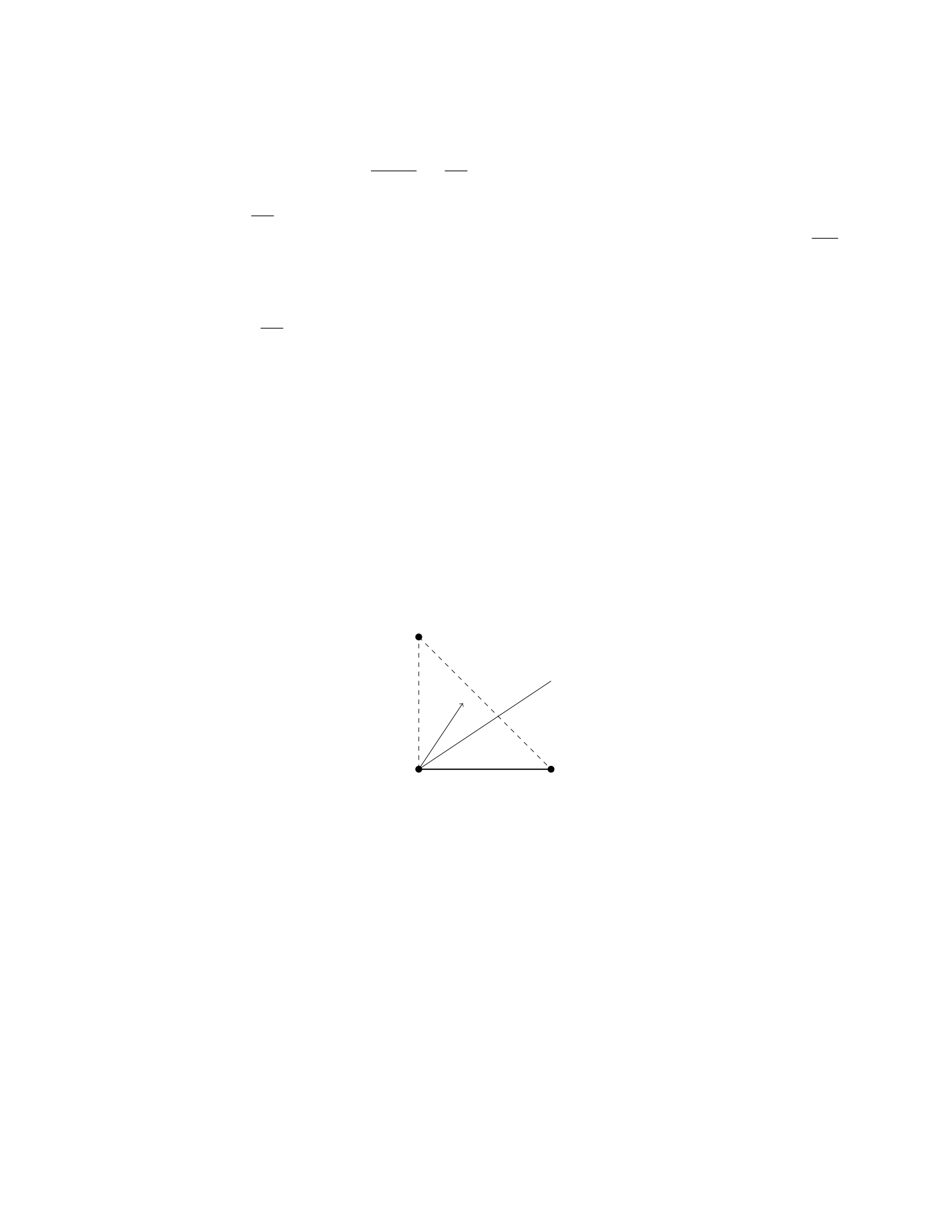
3m=10T
3
5. Substituting W= 5000 N and mg = 981 N into the equilibrium equation from step 1
gives: T+ 981 = 10T
3
6. Solving for Tin the equation from step 5: 3T+ 2943 = 10T7T= 2943 T=2943
7
T≈420.4N
7. Therefore, the tension in the beam is approximately 420.4 N.
8. To find the force exerted by the pivot on the beam, we can use the equation we found in
step 5: T+ 981 = 10T
3
9. Substituting the tension T= 420.4N into the equation from step 8 gives: Fy=T+mg =
420.4 + 981 = 1401.4N
10. Therefore, the force exerted by the pivot on the beam is approximately 1401.4 N.
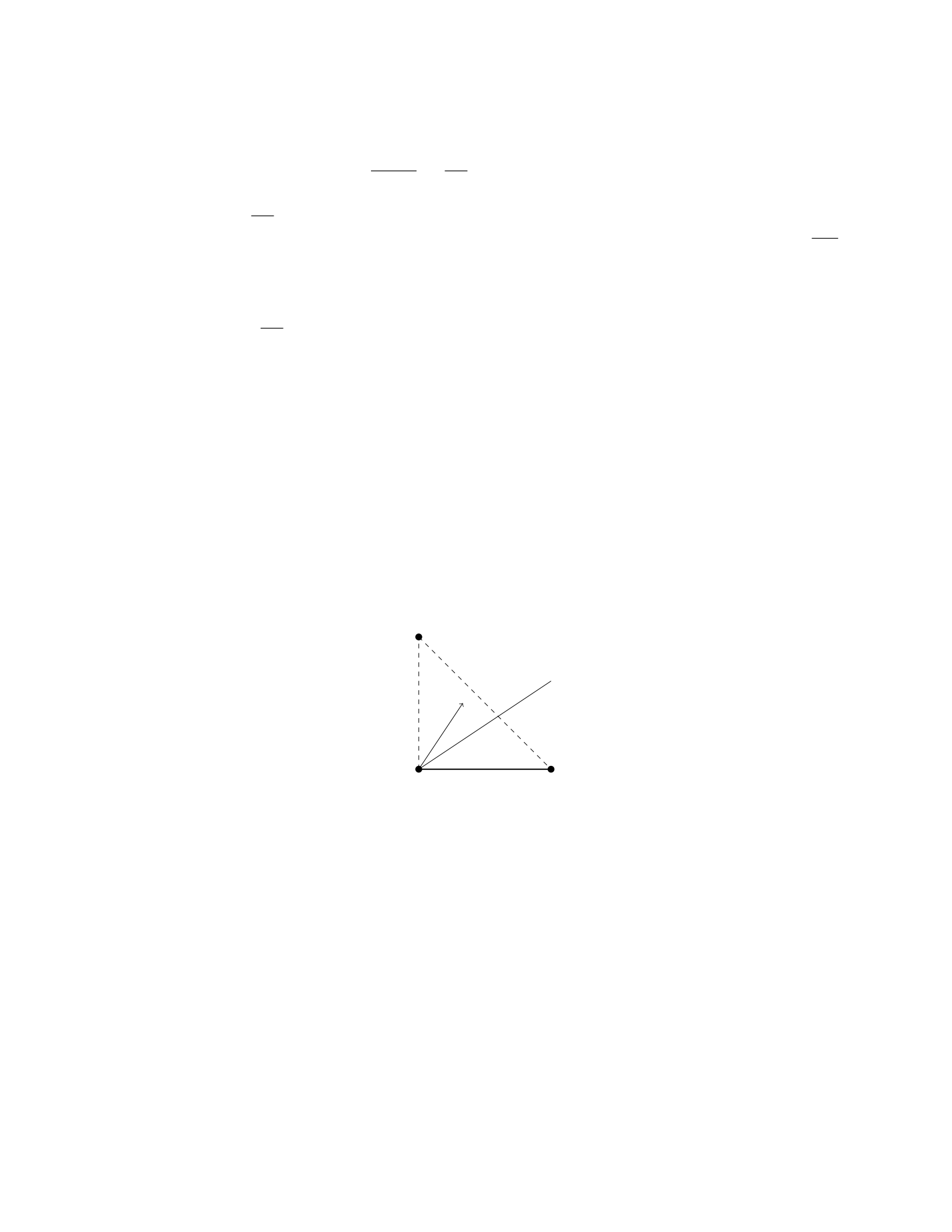
3. A uniform rod of length Land mass Mis supported at its end by a cable attached to
the ceiling, as shown in the figure below. The rod makes an angle θwith the vertical and is in
equilibrium. The cable makes an angle αwith the horizontal. Find an expression for the tension
Tin the cable in terms of M,L,θ, and α.
O
M
N
L
T
θ
α
Ans. Step 1. Analyze the forces acting on the rod.
Let’s consider the forces acting on the rod in the equilibrium position. The rod has two forces
acting on it: its weight Mg acting vertically downward at point M, and the tension Tin the
cable. We need to resolve these forces into components parallel and perpendicular to the rod.
Step 2. Resolve the forces into components.
Resolve the forces into components parallel and perpendicular to the rod. The weight Mg can
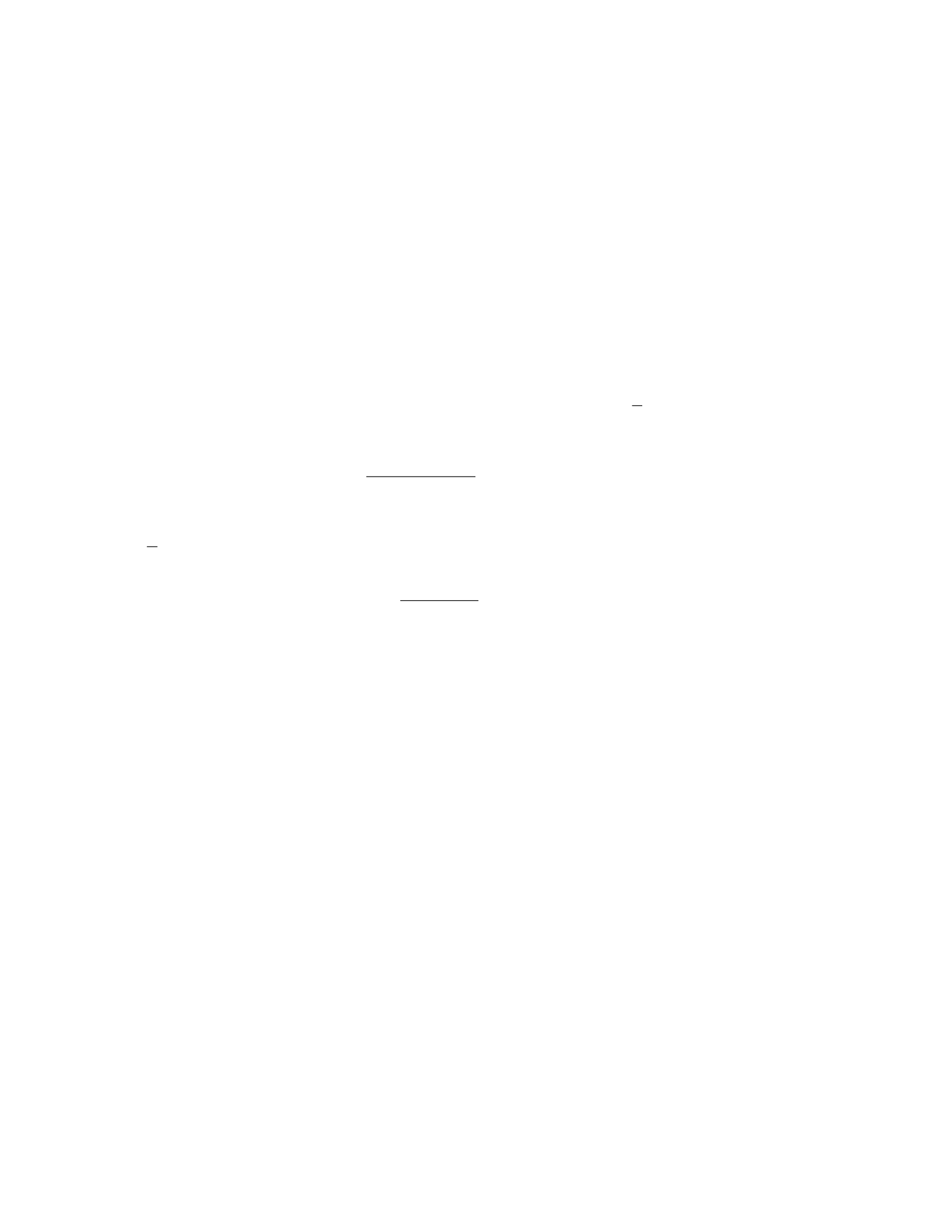
be resolved into components M g cos θand Mg sin θ, where M g cos θis parallel to the rod and
Mg sin θis perpendicular to the rod.
Step 3. Write the equilibrium equations.
In the equilibrium position, the sum of forces in the vertical direction must be zero, and the sum
of forces in the horizontal direction must be zero.
Vertical direction: Tcos α−M g cos θ= 0

Horizontal direction: Tsin α=M g sin θ
Step 4. Solve for tension T.
From the vertical equilibrium equation, we have Tcos α=M g cos θ. Substituting this into the
horizontal equilibrium equation, we get
Tsin α=Mg sin θ
Solving for T, we find
T=Mg sin θ
sin α
Therefore, the tension Tin the cable in terms of M,L,θ, and αis T=Mg sin θ
sin α.
4. Question: A thin uniform rod of length Land mass Mis initially at rest on a table. A bullet
of mass mmoving horizontally strikes the rod at a distance xfrom the center of the rod and
sticks in it. If the coefficient of restitution between the bullet and the rod is e, find the velocity
of the bullet just before the impact.
Ans. Step-by-step solution:
Let the velocity of the bullet just before the impact be v. After the impact, the bullet-rod
system will move together as a single body. The linear momentum of the system is conserved
along the horizontal direction before and after the collision. The linear momentum of the bullet-
rod system just before the collision is mv, and just after the collision is (M+m)V, where Vis
the velocity of the system after the collision.
1. Applying the principle of conservation of momentum along the horizontal direction:
mv = (M+m)V
2. The coefficient of restitution eis defined as the ratio of relative velocity of separation to
relative velocity of approach. Therefore, we have e=V−v
u−v, where uis the relative velocity of
separation between the bullet and the rod.
3. Since the bullet sticks in the rod after the collision, the relative velocity of separation uis
the final velocity of the point of impact of the bullet that is at a distance xfrom the center of
the rod. We can express uin terms of V:
u=V−ωx
where ωis the angular velocity of rotation of the system about the center of mass of the rod
after the collision.
4. The linear velocity of the point of contact of the bullet immediately after the collision is
V−ωL
2. The linear velocity of the point of contact of the bullet due to rotation is ωL
2. Therefore,
the combined velocity of the bullet at the point of contact is V−ωL
2+ωL
2=V. So, we have
u=V.

5. Substituting u=Vinto the equation for the coefficient of restitution, we get:
e=V−v
u−v=V−v
V−v= 1
This implies that V=v.
6. Substituting V=vinto the conservation of momentum equation gives:
mv = (M+m)v
m=M+m
which implies that M= 0.
Therefore, the velocity of the bullet just before the impact is v= 0.
5. A rod of length Land uniform cross-sectional area A, made of a material with Young’s
modulus Y, is suspended vertically from one end. A load Fis attached to the free end, causing
the rod to stretch by an amount ∆L. Assuming that the rod remains straight and neglecting the
weight of the rod, determine the expression for the strain in the rod and the stress in the rod.
Ans. Let’s denote the original length of the rod as Land the stretched length as L+ ∆L. We
can determine the strain and stress in the rod based on the given information.
1. Determining the Strain: The strain in the rod is given by the formula:
ε=∆L
L
2. Determining the Stress: The stress in the rod can be calculated using Hooke’s Law,
which states:
σ=Y·ε
Thus, the stress in the rod is:
σ=Y·∆L
L
6. Question:
A uniform rod of length Land mass Mis supported at one end by a pivot and is attached
at the other end by a thin thread. A block of mass mis placed at a distance xfrom the pivot
along the rod. Find the tension in the thread when the system is in equilibrium.
Ans. Step-by-step solution:

1. First, define the forces acting on the rod: Let Tbe the tension in the thread, Nbe the
normal force at the pivot, and Wrod be the weight of the rod. Also, let Wmbe the weight of the
block and Wbe the weight of the block and the part of the rod to the right of the block.
2. Next, write the force equations for the system: In the vertical direction: N+T−Wrod −
Wm= 0 ... (1)
In the torque equation: The torque about the pivot point must sum to zero for equilibrium.
Taking the torque about the pivot at the left end of the rod: T·L+Wm·L/2 −W·x= 0 ...
(2)
3. Solve for Wrod and W: From equation (1), we have: N=Wrod +Wm−T
From equation (2), we substitute in the expression for Wand solve for T:T·L+Wm·L/2 −
(Wm+Wrod −T)·x= 0
Solving for T, we get: T=Wm
L·(x+L
2)−Wrod ·(x+L
2)
4. Substituting Wrod =M·gand simplifying: T=m·g·(x+L
2)
L−M·g·(x+L
2)T=
m·g·x+m·g·L
2
L−M·g·x−M·g·L
2T=m·g
L·x+m·g
2−M·g·x−M·g·L
2
Therefore, the tension in the thread when the system is in equilibrium is: T= (m−M)·g·x/L+ (m/2 −M·L/2) ·g
7. A uniform rod of length Land mass Mis suspended horizontally and supported by two
vertical strings at its ends. If a weight of magnitude Wis added at a distance xfrom one end
of the rod in such a way that the system remains in equilibrium, determine the tension in each
string.
Ans. Let’s denote the tension in the string at the left end as T1and the tension in the string
at the right end as T2. To solve this problem, we need to consider the forces acting on the rod
and set up equilibrium conditions.
1. Setting up equilibrium along the vertical direction: The sum of forces in the vertical
direction must be zero for the rod to remain in equilibrium. Therefore, we have:
T1+T2=Mg
2. Setting up equilibrium along the horizontal direction: The torques produced by the
forces must also balance out to keep the rod in equilibrium. The torque about the point where
T1is acting is zero. Taking moments about this point (the left end), we get:
T2·L=W·x
3. Solving the equations: Now we have two equations:
T1+T2=Mg
T2·L=W·x

Substitute T2=Mg −T1from the first equation into the second equation:
(Mg −T1)·L=W·x
MgL −T1L=W·x
T1=Mg −W·x
L
4. Finding the tension in each string: Now that we have T1, we can find T2from the
first equation:
T1+T2=Mg
T2=Mg −T1
T2=Mg −(Mg −W·x
L)
T2=W·x
L
Therefore, the tension in the string at the left end is T1=Mg −W·x
Land the tension in the
string at the right end is T2=W·x
L.
8. Question: A uniform beam of length Land weight Wis suspended horizontally by two
vertical wires attached at points Aand B, each at a distance xfrom the ends of the beam. The
wire attached at point Abreaks. Determine the maximum allowable length xsuch that the beam
remains in equilibrium.
Ans. Solution: Let TAand TBbe the tensions in the wires attached at points Aand B,
respectively.
1. Draw the free-body diagram of the beam when the wire attached at point Abreaks.
Consider the forces acting on the beam: the weight W, the tension TBat point B, and the
reaction force Rat point A.
∑Fx= 0 : −TB= 0 ⇒TB= 0
∑Fy= 0 : R−W= 0 ⇒R=W
2. Determine the torque due to the weight of the beam about point B.
The torque due to the weight of the beam about point B is −W
2×L(clockwise direction is
taken as negative).
3. Set up the torque equilibrium equation about point B.
∑τB= 0 : −W
2·L= 0
4. Solve for the maximum allowable length x.

Since the beam is in equilibrium, the maximum allowable length xcan be found by setting
up the condition for equilibrium.
xW
L=W
2
x=L
2
Therefore, the maximum allowable length xsuch that the beam remains in equilibrium is
x=L/2.
9. A uniform rod of length Land mass Mis supported horizontally by two vertical strings of
equal length L, attached at each end of the rod. The strings make an angle θwith the horizontal.
Assuming the rod is in equilibrium, determine the tension in the strings.
Ans. To solve this problem, we will first analyze the forces acting on the rod to establish the
equilibrium conditions. Then, we will use trigonometric relationships to find the tension in the
strings.
1. Free Body Diagram: Let’s consider the forces acting on the rod. The weight of the
rod acts vertically downward at its center. The tensions in the strings act along the strings at an
angle θwith the horizontal. Resolving the forces vertically and horizontally, we have: - Vertically:
Tcos θ+Tcos θ=Mg - Horizontally: Tsin θ= 0
2. Equilibrium Conditions: For the rod to remain in equilibrium, the net force in both the
horizontal and vertical directions must be zero. From the horizontal equilibrium condition, we
have: Tsin θ= 0 =⇒T= 0 (which is not possible)
This implies that we made an incorrect assumption earlier, as there must be a minimum
nonzero value of tension required for equilibrium.
3. Equilibrium Analysis (Revised): Let’s consider the torques acting on the rod. The
torques produced by the tensions in the strings must balance the torque due to the weight of the
rod. We can take the torque about the center of the rod. The torque due to the tensions is zero
since their lines of action pass through the pivot point. The torque due to the weight of the rod
is given by M gL/2 in the counterclockwise direction.
4. Solving for Tension: Setting up the torque balance equation, we have: MgL/2 = 0
T=Mg/2
Therefore, the tension in the strings is T=M g
2.
10. Question:
A rod of length Land uniform cross-sectional area Ais placed horizontally on two vertical
walls. Suppose a force
Fis applied at a distance xfrom the left end of the rod. The rod is in

mechanical equilibrium. Find the expression for the normal force exerted by the left wall on the
rod in terms of L,A,x, and F.
Ans. Step-by-step solution:
We know that for the rod to be in equilibrium, the net force and the net torque acting on it
must be zero.
1. Resolving forces in the vertical direction: The vertical forces acting on the rod are the
weight Wacting downwards and the normal forces N1and N2exerted by the left and right walls
respectively.
N1+N2=W=mg (where mis the mass of the rod and gis the acceleration due to gravity)
2. Resolving torques about the left end of the rod: Taking the torque about the left end and
considering counterclockwise torques as positive, we have: τ=F(x)−N1(L/2) = 0
3. Solve for N1: From Step 2, we have F(x) = N1(L/2). Substitute for F(x)from Step 3
into Step 1: N1+N2=W=mg
Substitute N1(L/2) for F(x)in the torque equation, we get: N1(L/2) = N1(L/2)
Hence, the expression for the normal force N1exerted by the left wall on the rod is: N1=F L
2x
11. Question:
A uniform rod of length Land mass Mis hinged to a wall at one end while the other end is
attached to a rope that makes an angle θwith the horizontal. The rod is in equilibrium and the
tension in the rope is T. Find the tension in terms of M,L,g, and θ.
Ans. Step-by-step solution:
1. Draw a free-body diagram of the rod. The forces acting on the rod are the gravitational
force M g acting at the center of mass, the tension Tacting along the rope, and the normal force
Nacting at the hinge point perpendicular to the rod.
2. Resolve the forces into components. The gravitational force can be broken down into two
components: one parallel to the rod (Mg sin θ) and one perpendicular to the rod (Mg cos θ).
3. Write the equilibrium equations. The sum of the forces in the horizontal direction is zero,
so we have:
Tcos θ= 0
4. The sum of the forces in the vertical direction gives:
N−Mg cos θ= 0
5. The torque about the hinge point also needs to sum to zero since the rod is in rotational
equilibrium. The torque due to the tension Tis zero since its line of action passes through the
hinge. The torque due to the gravitational force is:
−Mg sin θ·L
2= 0
6. Solve the torque equation for T:
T=MgL sin θ
2

Hence, the tension in the rope is M gL sin θ
2.
12. A uniform ladder of length Land mass mleans against a smooth vertical wall making an
angle of θwith the horizontal floor. A firefighter of mass Mclimbs up the ladder to a height h
from its base. Determine the force exerted by the ground on the ladder and the force exerted by
the wall on the ladder in terms of the given quantities.
Ans. Let’s denote the force exerted by the ground on the ladder as Nand the force exerted by
the wall on the ladder as F.
1. Create a free body diagram of the ladder with forces acting on it. There are three forces
acting on the ladder: the force of gravity acting downward at the center of the ladder, the normal
force Nacting upward from the ground, and the force Facting outward from the wall.
2. Write the equations of equilibrium in the horizontal and vertical directions. In the horizontal
direction, the total force must be zero since the ladder is not moving horizontally. In the vertical
direction, the total force must be zero since the ladder is in static equilibrium.
3. Solve for the force exerted by the ground on the ladder (N). In the vertical direction, the
equation of equilibrium gives:
N−mg −Mg = 0
N=mg +Mg
4. Solve for the force exerted by the wall on the ladder (F). In the horizontal direction, the
equation of equilibrium gives:
F= 0
5. Therefore, the force exerted by the ground on the ladder is mg +Mg, and the force
exerted by the wall on the ladder is 0.
13. Suppose a uniform rod of length Land mass Mis suspended horizontally from two vertical
walls using two strings of length L. Given that the tension in each string is Tand the rod makes
an angle θwith the vertical, find the elongation of the strings due to the weight of the rod.
Ans. Let’s denote the distance of the attachment points of the strings from the center of the
rod as d.
1. Calculate the torque due to the gravitational force about the center of the rod: The
gravitational force exerted on the rod is M g, acting at the center of mass. The torque about the
center of the rod is given by τ= (Mg)·dsin(θ).
2. Express the torque in terms of the tension force: The tension force, T, is acting in
the strings in opposite directions and inclined at an angle θwith the vertical. The horizontal
component of tension force providing torque is 2Tcos(θ).

3. Set up the equation for equilibrium: For the rod to be in equilibrium, the net torque should
be zero. We have: (Mg)·dsin(θ) = 2Tcos(θ)·d.
4. Solve for the tension force T: Solving the equation for T, we get: T=M g sin(θ)
2cos(θ).
5. Calculate the elongation of the strings: The vertical component of Tbalances the weight
of the rod: Tsin(θ) = Mg. From this, we can express sin(θ)in terms of Land d.
6. Substitute the value of Tobtained in step 4: Substitute the expression for Tin terms of
M,g, and θinto the equation found in step 5.
This will give you the elongation of the strings due to the weight of the rod.
14. A thin cylindrical tube of length Land radius ris made from a material with Young’s
modulus Y. The tube is fixed at one end and a force Fis applied perpendicular to the other end.
Determine the magnitude of the force Frequired to stretch the tube by a small amount ∆L.
Ans. To solve this problem, we will use the concepts of equilibrium and elasticity. We’ll consider
the forces acting on the tube and then apply Hooke’s Law to find the required force. 1. Consider
the forces acting on the tube: Since the tube is in equilibrium, the force applied Fis balanced
by the restoring force due to the stretching of the tube. Additionally, there is a force due to the
pressure inside the tube. 2. Write the equation for equilibrium: The force applied Fis balanced
by the restoring force due to the stretching of the tube. The force due to pressure inside the
tube does not contribute to the stretching force, as it acts perpendicular to the direction of the
stretching. 3. Apply Hooke’s Law: Using Hooke’s Law, we can relate the restoring force to the
change in length of the tube. This allows us to determine the magnitude of the force required to
stretch the tube by a small amount ∆L. 4. Determine the magnitude of the force F: Using the
equation for equilibrium and Hooke’s Law, we can now solve for the force Frequired to stretch
the tube by ∆L.
15. A uniform rod of length Land mass Mis suspended vertically by two strings attached to
its ends. Determine the tension in each string when the rod is in equilibrium. Assume the rod is
uniform and has a negligible thickness. Express your answer in terms of M,L, and g.
Ans. Let’s denote the tension in the left string as T1and the tension in the right string as T2.
1. First, we need to calculate the center of mass of the rod. The center of mass of a uniform
rod lies at its midpoint, which is L
2from either end.
2. Next, we can analyze the forces acting on the rod when it is in equilibrium. There are
three forces acting on the rod: the gravitational force (M g) acting at the center of mass, and
the tension forces T1and T2acting at the ends.
3. Considering the forces in the vertical direction, we have:
T1+T2=Mg

4. To find another equation, we can use the torque equilibrium condition. The torques due
to the tensions T1and T2are equal and opposite, resulting in no net torque.
5. The torque due to T1is T1·L
2(clockwise), and the torque due to T2is T2·L
2(counter-
clockwise). The torque due to the gravitational force is Mg ·L
2in the counterclockwise direction.
6. Setting up the torque equation:
T1·L
2=T2·L
2+Mg ·L
2
7. Simplifying the torque equation gives us:
T1=T2+Mg
8. Now we have a system of two equations:
{T1+T2=Mg
T1=T2+Mg
9. Solving this system of equations, we find:
T1=2
3Mg and T2=1
3Mg
16. An iron bar of length Land uniform cross-sectional area Ais supported horizontally by
two vertical strings at its ends. The bar is subject to a vertical load Fapplied at its center. The
Young’s modulus of iron is Y.
Calculate the tension in each string.
Ans. To find the tension in each string, we need to consider the forces acting on the iron bar
in equilibrium.
1. Consider the forces acting in the vertical direction: The two vertical strings provide upward
forces equal to their tensions T. The force due to the load Facts downward. The weight of
the bar must also be considered, but since the bar is supported horizontally, the weight does not
create any vertical force.
2. The forces must balance each other for the bar to be in equilibrium: The total upward
force provided by the strings is 2T, and this must balance the downward force due to the load F.
3. Write the equilibrium equation:
2T=F
4. Solve for the tension T:
T=F
2
Thus, each vertical string supports a tension of F
2in order to keep the iron bar in equilibrium.
17. Question 17:
A steel rod of length 2.0 m and diameter 5.0 mm hangs vertically from the ceiling. The rod
has a 100 kg weight attached to its bottom end. If the Young’s modulus for steel is 2.0×10¹¹
N/m2, calculate the elongation of the steel rod.
Ans. To calculate the elongation of the steel rod, we can use the formula for the elongation of
a material under a tensile stress:
1. Calculate the cross-sectional area of the steel rod: The cross-sectional area of the rod can
be calculated using the formula for the area of a circle: A=πr2, where ris the radius of the
rod. Given that the diameter of the rod is 5.0 mm, the radius is r= 2.5×10⁻³m. Thus, the
cross-sectional area is:
A=π(2.5×10⁻³)2= 1.9635 ×10⁻⁵m2
2. Calculate the stress on the steel rod: The weight of the 100 kg mass is F=mg =
100 kg ×9.81 m/s2= 981 N. The stress on the rod is given by σ=F
A, where Fis the force and
Ais the cross-sectional area. Substituting in the values, we get:
σ=981
1.9635 ×10−5= 5.0×10⁷N/m2
3. Calculate the strain in the rod: The strain in the rod can be calculated using the formula
ε=σ
Y, where Yis the Young’s modulus for steel. Substituting in the values, we get:
ε=5.0×10⁷
2.0×1011 = 2.5×10⁻⁴
4. Calculate the elongation of the steel rod: The elongation of the rod can be calculated
using the formula L=ε·L0, where Lis the elongation, εis the strain, and L0is the original
length of the rod. Substituting in the values, we get:
L= 2.5×10−4×2.0 = 5.0×10⁻⁴m= 0.50 mm
Therefore, the elongation of the steel rod is 0.50 mm.
18. Question 18:
A solid bar of length Land rectangular cross-section with width wand height his suspended
vertically from a ceiling. A weight Wis hung from the bottom end of the bar. If the Young’s
modulus of the material is E, what is the elongation ∆Lof the bar due to the weight?
Given: - Length of the bar, L- Width of the bar, w- Height of the bar, h- Weight hanging
from the bar, W- Young’s modulus of the material, E
Ans. We can calculate the elongation ∆Lof the bar using the formula for the elongation of a
bar under stress:
1. Calculate the cross-sectional area of the bar: The cross-sectional area Aof the bar is given
by A=w×h.

2. Calculate the tensile stress on the bar: The weight Whanging from the bar creates a
tensile force F=Won the bar. The tensile stress σon the bar is given by σ=F
A.
3. Calculate the strain in the bar: The strain ϵin the bar can be calculated using Hooke’s
Law: ϵ=σ
E.
4. Calculate the elongation of the bar: The elongation ∆Lof the bar can be calculated using
the formula ∆L=ϵ×L.
Therefore, the elongation ∆Lof the bar due to the weight Whanging from the bottom end
can be calculated using the above steps.
19. A uniform rod of length Land mass Mis lying on a smooth horizontal table. A load of
mass mhangs at a distance xfrom one end of the rod, which is not supported by the table. Find
the reaction forces at the two ends of the rod.
Ans. Let’s denote the reaction force at the support point of the rod as Rand the reaction force
at the end where the load is hanging as S. 1. To begin, we will use the conditions for equilibrium
in the vertical direction. The sum of the forces in the vertical direction must be zero:
R+S−M·g= 0
2. Next, we will take moments about the support point of the rod, which gives us:
S·L−M·g·L
2−m·g·x= 0
3. Solving the above two equations simultaneously, we find:
R=M·g
2−m·g·x
L
S=M·g
2+m·g·x
L
Therefore, the reaction force at the support point is M·g
2−m·g·x
Land the reaction force at the
end where the load is hanging is M·g
2+m·g·x
L.
20. Question:
A uniform bar of length Land cross-sectional area Ais supported by a vertical cable attached
to its right end. The bar has a mass of Mand a center of mass located at a distance of dfrom
the right end. Determine the tension in the cable when the bar is in equilibrium.
Ans. Step-by-step solution:

1. The forces acting on the bar are the tension Tin the cable, the weight of the bar W=Mg,
the reaction force at the support N, and the force of the bar acting on the support. Since the
bar is in equilibrium, the sum of the forces in both the horizontal and vertical directions must be
zero.
2. In the vertical direction, the equation of equilibrium is:
N+T=Mg
3. In the horizontal direction, the equation of equilibrium is:
T·L=f·d
Where fis the force exerted by the bar on the support.
4. To find the force f, we can use the fact that the bar is uniform and has a mass of M.
Since the center of mass is located at a distance of dfrom the right end, the force fcan be
determined by considering the bar as two separate components: one of mass xat a distance x
from the left end and the other of mass M−xat a distance L−xfrom the left end. The
equation for the force fis:
f=∫L
0
xM
L
A
Ldx
f=AMg
2L
5. Substituting the expression for fback into the horizontal equilibrium equation gives:
T·L=AMg
2L·d
T=AMgd
2L2
6. Therefore, the tension in the cable when the bar is in equilibrium is AMgd
2L2.
21. A uniform bar of length Land mass Mis supported by two vertical strings attached to
its ends. One of the strings is pulled horizontally with a force F. The bar is in equilibrium.
Determine the tension in each string.
Ans. Let’s denote T1as the tension in the string on the left and T2as the tension in the string
on the right. To find the tension in each string, we need to analyze the forces acting on the bar
and set up equations for equilibrium. 1. Draw a free body diagram of the bar. The forces acting
on the bar are the tension T1in the left string, the tension T2in the right string, the downward
gravitational force M g, and the horizontal force F. 2. Write the equations for equilibrium in the
horizontal and vertical directions. In the horizontal direction, the sum of the horizontal forces is
zero: T1−F= 0. In the vertical direction, the sum of the vertical forces is zero: T2+Mg = 0. 3.
Solve the equations simultaneously. From the horizontal equilibrium equation, we have T1=F.

Substituting this into the vertical equilibrium equation gives T2=−M g. 4. Therefore, the
tension in the left string is T1=Fand the tension in the right string is T2=−Mg.
22. Question: A block of mass mis hanging from a vertical spring with a spring constant k.
When the block is in equilibrium, the spring is stretched by a distance x0. If the block is then
gently pushed up so the spring is compressed by a distance a, determine the frequency of small
vertical oscillations of the block.
Ans. Let’s start by finding the equilibrium position of the block. 1. At equilibrium, the weight
of the block is balanced by the spring force. The equilibrium condition can be written as:
mg =kx0,
where gis the acceleration due to gravity. 2. Next, we need to determine the equilibrium position
of the block after it has been compressed by a distance a. This new equilibrium position can be
found by considering the total force acting on the block:
mg =k(x0−a).
Solving for x0, we get:
x0=a+mg
k.
3. The restoring force when the block is displaced from the new equilibrium position is given by
Hooke’s Law:
F=−kx =−k(a+mg
k−x),
where xis the displacement from the new equilibrium position. 4. We can rewrite the above
expression in terms of the acceleration aas:
m¨a=−k(a+mg
k−x).
5. By assuming harmonic motion of small amplitude around the new equilibrium position, we
can substitute x=a+Acos(ωt)into the equation. Here, ωis the angular frequency of the
oscillation. 6. The equation then becomes:
m¨
a=−k(a+mg
k−a−Acos(ωt)).
7. Simplifying further, we get:
m¨a=−k(mg
k−Acos(ωt)).
8. Comparing the above equation to the standard form of a simple harmonic oscillator, m¨x=
−kx, we find the angular frequency of oscillation:
ω=√k
m.

9. Therefore, the frequency of small vertical oscillations of the block is f=1
2π√k
m.
23. A uniform rod of length Land mass Mis suspended horizontally by two vertical wires of
length Leach, attached to the ends of the rod. The system is in equilibrium when the wires are
at an angle of θwith the vertical. Determine the tension in each wire.
Ans. To determine the tension in each wire, we need to set up equations of equilibrium using
the forces acting on the rod. Let T1and T2be the tensions in the two wires. 1. Consider the
forces in the horizontal direction: The horizontal components of the tensions cancel each other
out, so there are no horizontal forces affecting the equilibrium. 2. Consider the forces in the
vertical direction: The weight of the rod acts downwards at its center of mass, and the vertical
components of the tensions act upwards. Therefore, the sum of the vertical components of the
tensions must equal the weight of the rod:
T1cos θ+T2cos θ=mg
3. Consider the torques about the center of mass: The torques due to the tensions in the wires
must balance the torque due to the weight of the rod. The torque due to T1is T1sin θ·Land
the torque due to T2is T2sin θ·L. The torque due to the weight of the rod is 1
2Lsin θ·Mg.
Therefore, the equation for rotational equilibrium is:
T1sin θ·L+T2sin θ·L=1
2Lsin θ·Mg
Now, we have two equations and two unknowns. We can solve these equations to find the tensions
T1and T2.
24. A thin rod of length Land mass mis attached to a wall at one end and to a rope of length
Lat the other end. The rope makes an angle θwith the rod when the system is in equilibrium.
Given that the modulus of elasticity of the rod is E, determine the tension in the rope.
Ans. To determine the tension in the rope when the system is in equilibrium, we need to analyze
the forces acting on the rod when it is in equilibrium.
1. Free Body Diagram: Consider the forces acting on the rod. We have the tension T
acting upwards along the rod, the weight of the rod mg acting downwards from its center of
mass, and the force Fdue to the wall acting on the rod at right angles to the rod. There is also
the reaction force Rexerted by the hinge on the rod.
2. Equilibrium Conditions: For the rod to be in equilibrium, the net force acting on the
rod must be zero in both the horizontal and vertical directions. Therefore, we have the following

equilibrium equations:
{Tsin(θ) = R(in the vertical direction)
Tcos(θ) + F=mg (in the horizontal direction)
3. Elasticity: The stress in the rod is given by σ=F
A, where Ais the cross-sectional area
of the rod. The strain is given by ϵ=∆L
L, where ∆Lis the elongation of the rod. From Hooke’s
Law, we have F=k∆L, where kis the spring constant.
For the rod to be in equilibrium, the elongation in the rod due to horizontal forces must be
balanced by the compression in the rod due to vertical forces.
4. Solution: Solving the equilibrium equations and applying the conditions for elasticity, we
can find the tension in the rope.
25. Question 25:
A uniform rod of length Land mass Mis suspended horizontally from two strings, each
attached to the ends of the rod. A block of mass mis then placed at a distance dfrom one end
of the rod. Given that the system is in equilibrium, determine the tension in each string.
Ans. To solve this problem, we first need to consider the forces acting on the rod and the block,
and then set up equations of equilibrium.
1. Consider the forces acting on the block: Let the tension in the left string be T1and
the tension in the right string be T2. The forces acting on the block are: the force of gravity
(mg) acting downwards, and the force of tension (T2) acting to the right. The net force in the
horizontal direction is zero, so we have:
T2=mg
2. Consider the forces acting on the rod: The forces acting on the rod at the left end
(considering the small portion of the rod between the block and the left end) are the tension
force T1acting to the left, the force of gravity (mL
Mg) acting downwards, and the force from the
block (mg) acting to the right. The net force in the horizontal direction is zero, so we have:
T1=mL
Mg+mg
3. Setting up equations of torque equilibrium: Choose the point of rotation at the right end
of the rod. The torque due to the block about the point of rotation is:
mg ·d
The torque due to the rod about the point of rotation is:
T1·L
2

Since the system is in equilibrium, the sum of torques is zero:
mg ·d=T1·L
2
4. Substituting the expressions for T1and T2from step 1 and 2 into the torque equilibrium
equation, we get:
mg ·d=(mL
Mg+mg)·L
2
Solving the above equation will give us the tensions T1and T2in terms of m,M,L,g, and
d.
exerted by the pivot can be calculated using the torque equation. Taking the torque about the
pivot point: T×10 m=W×3m, where Wis the weight of the 5000 N load.
4. Solving for Wgives: W=T×10 m
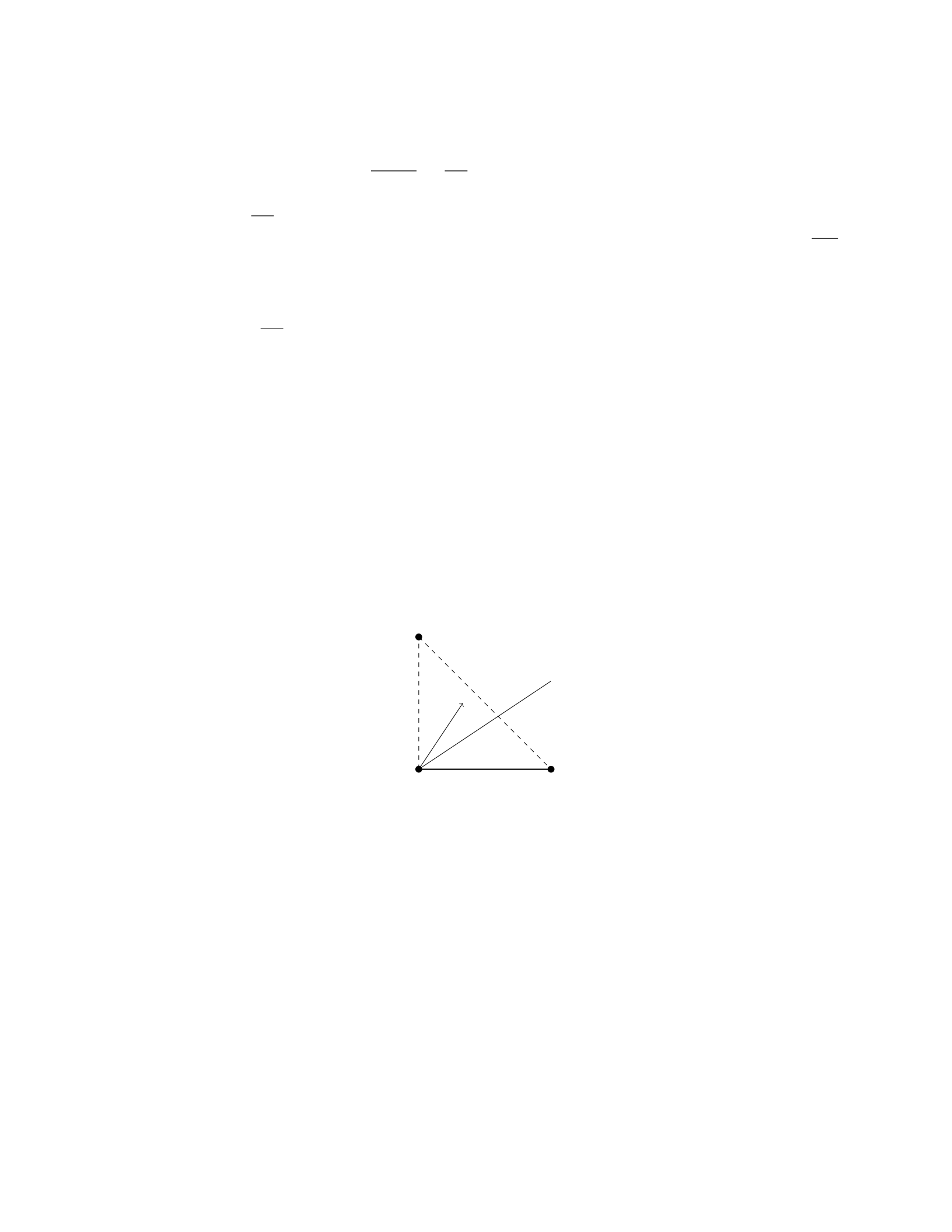
3m=10T
3
5. Substituting W= 5000 N and mg = 981 N into the equilibrium equation from step 1
gives: T+ 981 = 10T
3
6. Solving for Tin the equation from step 5: 3T+ 2943 = 10T7T= 2943 T=2943
7
T≈420.4N
7. Therefore, the tension in the beam is approximately 420.4 N.
8. To find the force exerted by the pivot on the beam, we can use the equation we found in
step 5: T+ 981 = 10T
3
9. Substituting the tension T= 420.4N into the equation from step 8 gives: Fy=T+mg =
420.4 + 981 = 1401.4N
10. Therefore, the force exerted by the pivot on the beam is approximately 1401.4 N.
3. A uniform rod of length Land mass Mis supported at its end by a cable attached to
the ceiling, as shown in the figure below. The rod makes an angle θwith the vertical and is in
equilibrium. The cable makes an angle αwith the horizontal. Find an expression for the tension
Tin the cable in terms of M,L,θ, and α.
O
M
N
L
T
θ
α
Ans. Step 1. Analyze the forces acting on the rod.
Let’s consider the forces acting on the rod in the equilibrium position. The rod has two forces
acting on it: its weight Mg acting vertically downward at point M, and the tension Tin the
cable. We need to resolve these forces into components parallel and perpendicular to the rod.
Step 2. Resolve the forces into components.
Resolve the forces into components parallel and perpendicular to the rod. The weight M g can
be resolved into components M g cos θand Mg sin θ, where M g cos θis parallel to the rod and
Mg sin θis perpendicular to the rod.
Step 3. Write the equilibrium equations.
In the equilibrium position, the sum of forces in the vertical direction must be zero, and the sum
of forces in the horizontal direction must be zero.
Vertical direction: Tcos α−M g cos θ= 0

Horizontal direction: Tsin α=M g sin θ
Step 4. Solve for tension T.
From the vertical equilibrium equation, we have Tcos α=M g cos θ. Substituting this into the
horizontal equilibrium equation, we get
Tsin α=Mg sin θ
Solving for T, we find
T=Mg sin θ
sin α
Therefore, the tension Tin the cable in terms of M,L,θ, and αis T=Mg sin θ
sin α.
4. Question: A thin uniform rod of length Land mass Mis initially at rest on a table. A bullet
of mass mmoving horizontally strikes the rod at a distance xfrom the center of the rod and
sticks in it. If the coefficient of restitution between the bullet and the rod is e, find the velocity
of the bullet just before the impact.
Ans. Step-by-step solution:
Let the velocity of the bullet just before the impact be v. After the impact, the bullet-rod
system will move together as a single body. The linear momentum of the system is conserved
along the horizontal direction before and after the collision. The linear momentum of the bullet-
rod system just before the collision is mv, and just after the collision is (M+m)V, where Vis
the velocity of the system after the collision.
1. Applying the principle of conservation of momentum along the horizontal direction:
mv = (M+m)V
2. The coefficient of restitution eis defined as the ratio of relative velocity of separation to
relative velocity of approach. Therefore, we have e=V−v
u−v, where uis the relative velocity of
separation between the bullet and the rod.
3. Since the bullet sticks in the rod after the collision, the relative velocity of separation uis
the final velocity of the point of impact of the bullet that is at a distance xfrom the center of
the rod. We can express uin terms of V:
u=V−ωx
where ωis the angular velocity of rotation of the system about the center of mass of the rod
after the collision.
4. The linear velocity of the point of contact of the bullet immediately after the collision is
V−ωL
2. The linear velocity of the point of contact of the bullet due to rotation is ωL
2. Therefore,
the combined velocity of the bullet at the point of contact is V−ωL
2+ωL
2=V. So, we have
u=V.

5. Substituting u=Vinto the equation for the coefficient of restitution, we get:
e=V−v
u−v=V−v
V−v= 1
This implies that V=v.
6. Substituting V=vinto the conservation of momentum equation gives:
mv = (M+m)v
m=M+m
which implies that M= 0.
Therefore, the velocity of the bullet just before the impact is v= 0.
5. A rod of length Land uniform cross-sectional area A, made of a material with Young’s
modulus Y, is suspended vertically from one end. A load Fis attached to the free end, causing
the rod to stretch by an amount ∆L. Assuming that the rod remains straight and neglecting the
weight of the rod, determine the expression for the strain in the rod and the stress in the rod.
Ans. Let’s denote the original length of the rod as Land the stretched length as L+ ∆L. We
can determine the strain and stress in the rod based on the given information.
1. Determining the Strain: The strain in the rod is given by the formula:
ε=∆L
L
2. Determining the Stress: The stress in the rod can be calculated using Hooke’s Law,
which states:
σ=Y·ε
Thus, the stress in the rod is:
σ=Y·∆L
L
6. Question:
A uniform rod of length Land mass Mis supported at one end by a pivot and is attached
at the other end by a thin thread. A block of mass mis placed at a distance xfrom the pivot
along the rod. Find the tension in the thread when the system is in equilibrium.
Ans. Step-by-step solution:

1. First, define the forces acting on the rod: Let Tbe the tension in the thread, Nbe the
normal force at the pivot, and Wrod be the weight of the rod. Also, let Wmbe the weight of the
block and Wbe the weight of the block and the part of the rod to the right of the block.
2. Next, write the force equations for the system: In the vertical direction: N+T−Wrod −
Wm= 0 ... (1)
In the torque equation: The torque about the pivot point must sum to zero for equilibrium.
Taking the torque about the pivot at the left end of the rod: T·L+Wm·L/2 −W·x= 0 ...
(2)
3. Solve for Wrod and W: From equation (1), we have: N=Wrod +Wm−T
From equation (2), we substitute in the expression for Wand solve for T:T·L+Wm·L/2 −
(Wm+Wrod −T)·x= 0
Solving for T, we get: T=Wm
L·(x+L
2)−Wrod ·(x+L
2)
4. Substituting Wrod =M·gand simplifying: T=m·g·(x+L
2)
L−M·g·(x+L
2)T=
m·g·x+m·g·L
2
L−M·g·x−M·g·L
2T=m·g
L·x+m·g
2−M·g·x−M·g·L
2
Therefore, the tension in the thread when the system is in equilibrium is: T= (m−M)·g·x/L+ (m/2 −M·L/2) ·g
7. A uniform rod of length Land mass Mis suspended horizontally and supported by two
vertical strings at its ends. If a weight of magnitude Wis added at a distance xfrom one end
of the rod in such a way that the system remains in equilibrium, determine the tension in each
string.
Ans. Let’s denote the tension in the string at the left end as T1and the tension in the string
at the right end as T2. To solve this problem, we need to consider the forces acting on the rod
and set up equilibrium conditions.
1. Setting up equilibrium along the vertical direction: The sum of forces in the vertical
direction must be zero for the rod to remain in equilibrium. Therefore, we have:
T1+T2=Mg
2. Setting up equilibrium along the horizontal direction: The torques produced by the
forces must also balance out to keep the rod in equilibrium. The torque about the point where
T1is acting is zero. Taking moments about this point (the left end), we get:
T2·L=W·x
3. Solving the equations: Now we have two equations:
T1+T2=Mg
T2·L=W·x

Substitute T2=Mg −T1from the first equation into the second equation:
(Mg −T1)·L=W·x
MgL −T1L=W·x
T1=Mg −W·x
L
4. Finding the tension in each string: Now that we have T1, we can find T2from the
first equation:
T1+T2=Mg
T2=Mg −T1
T2=Mg −(Mg −W·x
L)
T2=W·x
L
Therefore, the tension in the string at the left end is T1=Mg −W·x
Land the tension in the
string at the right end is T2=W·x
L.
8. Question: A uniform beam of length Land weight Wis suspended horizontally by two
vertical wires attached at points Aand B, each at a distance xfrom the ends of the beam. The
wire attached at point Abreaks. Determine the maximum allowable length xsuch that the beam
remains in equilibrium.
Ans. Solution: Let TAand TBbe the tensions in the wires attached at points Aand B,
respectively.
1. Draw the free-body diagram of the beam when the wire attached at point Abreaks.
Consider the forces acting on the beam: the weight W, the tension TBat point B, and the
reaction force Rat point A.
∑Fx= 0 : −TB= 0 ⇒TB= 0
∑Fy= 0 : R−W= 0 ⇒R=W
2. Determine the torque due to the weight of the beam about point B.
The torque due to the weight of the beam about point B is −W
2×L(clockwise direction is
taken as negative).
3. Set up the torque equilibrium equation about point B.
∑τB= 0 : −W
2·L= 0
4. Solve for the maximum allowable length x.

Since the beam is in equilibrium, the maximum allowable length xcan be found by setting
up the condition for equilibrium.
xW
L=W
2
x=L
2
Therefore, the maximum allowable length xsuch that the beam remains in equilibrium is
x=L/2.
9. A uniform rod of length Land mass Mis supported horizontally by two vertical strings of
equal length L, attached at each end of the rod. The strings make an angle θwith the horizontal.
Assuming the rod is in equilibrium, determine the tension in the strings.
Ans. To solve this problem, we will first analyze the forces acting on the rod to establish the
equilibrium conditions. Then, we will use trigonometric relationships to find the tension in the
strings.
1. Free Body Diagram: Let’s consider the forces acting on the rod. The weight of the
rod acts vertically downward at its center. The tensions in the strings act along the strings at an
angle θwith the horizontal. Resolving the forces vertically and horizontally, we have: - Vertically:
Tcos θ+Tcos θ=Mg - Horizontally: Tsin θ= 0
2. Equilibrium Conditions: For the rod to remain in equilibrium, the net force in both the
horizontal and vertical directions must be zero. From the horizontal equilibrium condition, we
have: Tsin θ= 0 =⇒T= 0 (which is not possible)
This implies that we made an incorrect assumption earlier, as there must be a minimum
nonzero value of tension required for equilibrium.
3. Equilibrium Analysis (Revised): Let’s consider the torques acting on the rod. The
torques produced by the tensions in the strings must balance the torque due to the weight of the
rod. We can take the torque about the center of the rod. The torque due to the tensions is zero
since their lines of action pass through the pivot point. The torque due to the weight of the rod
is given by M gL/2 in the counterclockwise direction.
4. Solving for Tension: Setting up the torque balance equation, we have: MgL/2 = 0
T=Mg/2
Therefore, the tension in the strings is T=M g
2.
10. Question:
A rod of length Land uniform cross-sectional area Ais placed horizontally on two vertical
walls. Suppose a force
Fis applied at a distance xfrom the left end of the rod. The rod is in

mechanical equilibrium. Find the expression for the normal force exerted by the left wall on the
rod in terms of L,A,x, and F.
Ans. Step-by-step solution:
We know that for the rod to be in equilibrium, the net force and the net torque acting on it
must be zero.
1. Resolving forces in the vertical direction: The vertical forces acting on the rod are the
weight Wacting downwards and the normal forces N1and N2exerted by the left and right walls
respectively.
N1+N2=W=mg (where mis the mass of the rod and gis the acceleration due to gravity)
2. Resolving torques about the left end of the rod: Taking the torque about the left end and
considering counterclockwise torques as positive, we have: τ=F(x)−N1(L/2) = 0
3. Solve for N1: From Step 2, we have F(x) = N1(L/2). Substitute for F(x)from Step 3
into Step 1: N1+N2=W=mg
Substitute N1(L/2) for F(x)in the torque equation, we get: N1(L/2) = N1(L/2)
Hence, the expression for the normal force N1exerted by the left wall on the rod is: N1=F L
2x
11. Question:
A uniform rod of length Land mass Mis hinged to a wall at one end while the other end is
attached to a rope that makes an angle θwith the horizontal. The rod is in equilibrium and the
tension in the rope is T. Find the tension in terms of M,L,g, and θ.
Ans. Step-by-step solution:
1. Draw a free-body diagram of the rod. The forces acting on the rod are the gravitational
force M g acting at the center of mass, the tension Tacting along the rope, and the normal force
Nacting at the hinge point perpendicular to the rod.
2. Resolve the forces into components. The gravitational force can be broken down into two
components: one parallel to the rod (Mg sin θ) and one perpendicular to the rod (Mg cos θ).
3. Write the equilibrium equations. The sum of the forces in the horizontal direction is zero,
so we have:
Tcos θ= 0
4. The sum of the forces in the vertical direction gives:
N−Mg cos θ= 0
5. The torque about the hinge point also needs to sum to zero since the rod is in rotational
equilibrium. The torque due to the tension Tis zero since its line of action passes through the
hinge. The torque due to the gravitational force is:
−Mg sin θ·L
2= 0
6. Solve the torque equation for T:
T=MgL sin θ
2

Hence, the tension in the rope is M gL sin θ
2.
12. A uniform ladder of length Land mass mleans against a smooth vertical wall making an
angle of θwith the horizontal floor. A firefighter of mass Mclimbs up the ladder to a height h
from its base. Determine the force exerted by the ground on the ladder and the force exerted by
the wall on the ladder in terms of the given quantities.
Ans. Let’s denote the force exerted by the ground on the ladder as Nand the force exerted by
the wall on the ladder as F.
1. Create a free body diagram of the ladder with forces acting on it. There are three forces
acting on the ladder: the force of gravity acting downward at the center of the ladder, the normal
force Nacting upward from the ground, and the force Facting outward from the wall.
2. Write the equations of equilibrium in the horizontal and vertical directions. In the horizontal
direction, the total force must be zero since the ladder is not moving horizontally. In the vertical
direction, the total force must be zero since the ladder is in static equilibrium.
3. Solve for the force exerted by the ground on the ladder (N). In the vertical direction, the
equation of equilibrium gives:
N−mg −Mg = 0
N=mg +Mg
4. Solve for the force exerted by the wall on the ladder (F). In the horizontal direction, the
equation of equilibrium gives:
F= 0
5. Therefore, the force exerted by the ground on the ladder is mg +Mg, and the force
exerted by the wall on the ladder is 0.
13. Suppose a uniform rod of length Land mass Mis suspended horizontally from two vertical
walls using two strings of length L. Given that the tension in each string is Tand the rod makes
an angle θwith the vertical, find the elongation of the strings due to the weight of the rod.
Ans. Let’s denote the distance of the attachment points of the strings from the center of the
rod as d.
1. Calculate the torque due to the gravitational force about the center of the rod: The
gravitational force exerted on the rod is M g, acting at the center of mass. The torque about the
center of the rod is given by τ= (Mg)·dsin(θ).
2. Express the torque in terms of the tension force: The tension force, T, is acting in
the strings in opposite directions and inclined at an angle θwith the vertical. The horizontal
component of tension force providing torque is 2Tcos(θ).

3. Set up the equation for equilibrium: For the rod to be in equilibrium, the net torque should
be zero. We have: (Mg)·dsin(θ) = 2Tcos(θ)·d.
4. Solve for the tension force T: Solving the equation for T, we get: T=M g sin(θ)
2cos(θ).
5. Calculate the elongation of the strings: The vertical component of Tbalances the weight
of the rod: Tsin(θ) = Mg. From this, we can express sin(θ)in terms of Land d.
6. Substitute the value of Tobtained in step 4: Substitute the expression for Tin terms of
M,g, and θinto the equation found in step 5.
This will give you the elongation of the strings due to the weight of the rod.
14. A thin cylindrical tube of length Land radius ris made from a material with Young’s
modulus Y. The tube is fixed at one end and a force Fis applied perpendicular to the other end.
Determine the magnitude of the force Frequired to stretch the tube by a small amount ∆L.
Ans. To solve this problem, we will use the concepts of equilibrium and elasticity. We’ll consider
the forces acting on the tube and then apply Hooke’s Law to find the required force. 1. Consider
the forces acting on the tube: Since the tube is in equilibrium, the force applied Fis balanced
by the restoring force due to the stretching of the tube. Additionally, there is a force due to the
pressure inside the tube. 2. Write the equation for equilibrium: The force applied Fis balanced
by the restoring force due to the stretching of the tube. The force due to pressure inside the
tube does not contribute to the stretching force, as it acts perpendicular to the direction of the
stretching. 3. Apply Hooke’s Law: Using Hooke’s Law, we can relate the restoring force to the
change in length of the tube. This allows us to determine the magnitude of the force required to
stretch the tube by a small amount ∆L. 4. Determine the magnitude of the force F: Using the
equation for equilibrium and Hooke’s Law, we can now solve for the force Frequired to stretch
the tube by ∆L.
15. A uniform rod of length Land mass Mis suspended vertically by two strings attached to
its ends. Determine the tension in each string when the rod is in equilibrium. Assume the rod is
uniform and has a negligible thickness. Express your answer in terms of M,L, and g.
Ans. Let’s denote the tension in the left string as T1and the tension in the right string as T2.
1. First, we need to calculate the center of mass of the rod. The center of mass of a uniform
rod lies at its midpoint, which is L
2from either end.
2. Next, we can analyze the forces acting on the rod when it is in equilibrium. There are
three forces acting on the rod: the gravitational force (M g) acting at the center of mass, and
the tension forces T1and T2acting at the ends.
3. Considering the forces in the vertical direction, we have:
T1+T2=Mg

4. To find another equation, we can use the torque equilibrium condition. The torques due
to the tensions T1and T2are equal and opposite, resulting in no net torque.
5. The torque due to T1is T1·L
2(clockwise), and the torque due to T2is T2·L
2(counter-
clockwise). The torque due to the gravitational force is Mg ·L
2in the counterclockwise direction.
6. Setting up the torque equation:
T1·L
2=T2·L
2+Mg ·L
2
7. Simplifying the torque equation gives us:
T1=T2+Mg
8. Now we have a system of two equations:
{T1+T2=Mg
T1=T2+Mg
9. Solving this system of equations, we find:
T1=2
3Mg and T2=1
3Mg
16. An iron bar of length Land uniform cross-sectional area Ais supported horizontally by
two vertical strings at its ends. The bar is subject to a vertical load Fapplied at its center. The
Young’s modulus of iron is Y.
Calculate the tension in each string.
Ans. To find the tension in each string, we need to consider the forces acting on the iron bar
in equilibrium.
1. Consider the forces acting in the vertical direction: The two vertical strings provide upward
forces equal to their tensions T. The force due to the load Facts downward. The weight of
the bar must also be considered, but since the bar is supported horizontally, the weight does not
create any vertical force.
2. The forces must balance each other for the bar to be in equilibrium: The total upward
force provided by the strings is 2T, and this must balance the downward force due to the load F.
3. Write the equilibrium equation:
2T=F
4. Solve for the tension T:
T=F
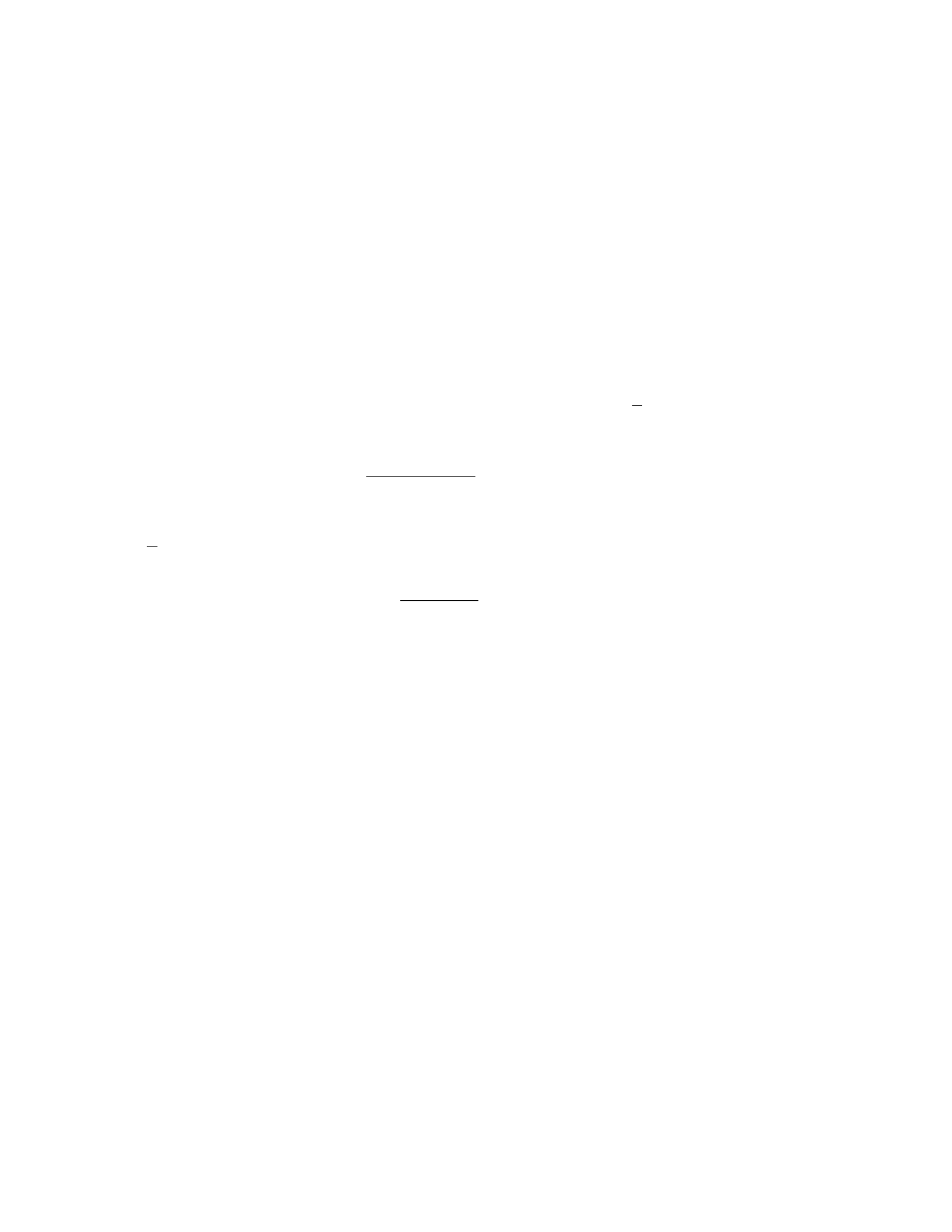
2
Thus, each vertical string supports a tension of F
2in order to keep the iron bar in equilibrium.
17. Question 17:
A steel rod of length 2.0 m and diameter 5.0 mm hangs vertically from the ceiling. The rod
has a 100 kg weight attached to its bottom end. If the Young’s modulus for steel is 2.0×10¹¹
N/m2, calculate the elongation of the steel rod.
Ans. To calculate the elongation of the steel rod, we can use the formula for the elongation of
a material under a tensile stress:
1. Calculate the cross-sectional area of the steel rod: The cross-sectional area of the rod can
be calculated using the formula for the area of a circle: A=πr2, where ris the radius of the
rod. Given that the diameter of the rod is 5.0 mm, the radius is r= 2.5×10⁻³m. Thus, the
cross-sectional area is:
A=π(2.5×10⁻³)2= 1.9635 ×10⁻⁵m2
2. Calculate the stress on the steel rod: The weight of the 100 kg mass is F=mg =
100 kg ×9.81 m/s2= 981 N. The stress on the rod is given by σ=F
A, where Fis the force and
Ais the cross-sectional area. Substituting in the values, we get:
σ=981
1.9635 ×10−5= 5.0×10⁷N/m2
3. Calculate the strain in the rod: The strain in the rod can be calculated using the formula
ε=σ
Y, where Yis the Young’s modulus for steel. Substituting in the values, we get:
ε=5.0×10⁷
2.0×1011 = 2.5×10⁻⁴
4. Calculate the elongation of the steel rod: The elongation of the rod can be calculated
using the formula L=ε·L0, where Lis the elongation, εis the strain, and L0is the original
length of the rod. Substituting in the values, we get:
L= 2.5×10−4×2.0 = 5.0×10⁻⁴m= 0.50 mm
Therefore, the elongation of the steel rod is 0.50 mm.
18. Question 18:
A solid bar of length Land rectangular cross-section with width wand height his suspended
vertically from a ceiling. A weight Wis hung from the bottom end of the bar. If the Young’s
modulus of the material is E, what is the elongation ∆Lof the bar due to the weight?
Given: - Length of the bar, L- Width of the bar, w- Height of the bar, h- Weight hanging
from the bar, W- Young’s modulus of the material, E
Ans. We can calculate the elongation ∆Lof the bar using the formula for the elongation of a
bar under stress:
1. Calculate the cross-sectional area of the bar: The cross-sectional area Aof the bar is given
by A=w×h.

2. Calculate the tensile stress on the bar: The weight Whanging from the bar creates a
tensile force F=Won the bar. The tensile stress σon the bar is given by σ=F
A.
3. Calculate the strain in the bar: The strain ϵin the bar can be calculated using Hooke’s
Law: ϵ=σ
E.
4. Calculate the elongation of the bar: The elongation ∆Lof the bar can be calculated using
the formula ∆L=ϵ×L.
Therefore, the elongation ∆Lof the bar due to the weight Whanging from the bottom end
can be calculated using the above steps.
19. A uniform rod of length Land mass Mis lying on a smooth horizontal table. A load of
mass mhangs at a distance xfrom one end of the rod, which is not supported by the table. Find
the reaction forces at the two ends of the rod.
Ans. Let’s denote the reaction force at the support point of the rod as Rand the reaction force
at the end where the load is hanging as S. 1. To begin, we will use the conditions for equilibrium
in the vertical direction. The sum of the forces in the vertical direction must be zero:
R+S−M·g= 0
2. Next, we will take moments about the support point of the rod, which gives us:
S·L−M·g·L
2−m·g·x= 0
3. Solving the above two equations simultaneously, we find:
R=M·g
2−m·g·x
L
S=M·g
2+m·g·x
L
Therefore, the reaction force at the support point is M·g
2−m·g·x
Land the reaction force at the
end where the load is hanging is M·g
2+m·g·x
L.
20. Question:
A uniform bar of length Land cross-sectional area Ais supported by a vertical cable attached
to its right end. The bar has a mass of Mand a center of mass located at a distance of dfrom
the right end. Determine the tension in the cable when the bar is in equilibrium.
Ans. Step-by-step solution:

1. The forces acting on the bar are the tension Tin the cable, the weight of the bar W=Mg,
the reaction force at the support N, and the force of the bar acting on the support. Since the
bar is in equilibrium, the sum of the forces in both the horizontal and vertical directions must be
zero.
2. In the vertical direction, the equation of equilibrium is:
N+T=Mg
3. In the horizontal direction, the equation of equilibrium is:
T·L=f·d
Where fis the force exerted by the bar on the support.
4. To find the force f, we can use the fact that the bar is uniform and has a mass of M.
Since the center of mass is located at a distance of dfrom the right end, the force fcan be
determined by considering the bar as two separate components: one of mass xat a distance x
from the left end and the other of mass M−xat a distance L−xfrom the left end. The
equation for the force fis:
f=∫L
0
xM
L
A
Ldx
f=AMg
2L
5. Substituting the expression for fback into the horizontal equilibrium equation gives:
T·L=AMg
2L·d
T=AMgd
2L2
6. Therefore, the tension in the cable when the bar is in equilibrium is AMgd
2L2.
21. A uniform bar of length Land mass Mis supported by two vertical strings attached to
its ends. One of the strings is pulled horizontally with a force F. The bar is in equilibrium.
Determine the tension in each string.
Ans. Let’s denote T1as the tension in the string on the left and T2as the tension in the string
on the right. To find the tension in each string, we need to analyze the forces acting on the bar
and set up equations for equilibrium. 1. Draw a free body diagram of the bar. The forces acting
on the bar are the tension T1in the left string, the tension T2in the right string, the downward
gravitational force M g, and the horizontal force F. 2. Write the equations for equilibrium in the
horizontal and vertical directions. In the horizontal direction, the sum of the horizontal forces is
zero: T1−F= 0. In the vertical direction, the sum of the vertical forces is zero: T2+Mg = 0. 3.
Solve the equations simultaneously. From the horizontal equilibrium equation, we have T1=F.

Substituting this into the vertical equilibrium equation gives T2=−M g. 4. Therefore, the
tension in the left string is T1=Fand the tension in the right string is T2=−Mg.
22. Question: A block of mass mis hanging from a vertical spring with a spring constant k.
When the block is in equilibrium, the spring is stretched by a distance x0. If the block is then
gently pushed up so the spring is compressed by a distance a, determine the frequency of small
vertical oscillations of the block.
Ans. Let’s start by finding the equilibrium position of the block. 1. At equilibrium, the weight
of the block is balanced by the spring force. The equilibrium condition can be written as:
mg =kx0,
where gis the acceleration due to gravity. 2. Next, we need to determine the equilibrium position
of the block after it has been compressed by a distance a. This new equilibrium position can be
found by considering the total force acting on the block:
mg =k(x0−a).
Solving for x0, we get:
x0=a+mg
k.
3. The restoring force when the block is displaced from the new equilibrium position is given by
Hooke’s Law:
F=−kx =−k(a+mg
k−x),
where xis the displacement from the new equilibrium position. 4. We can rewrite the above
expression in terms of the acceleration aas:
m¨a=−k(a+mg
k−x).
5. By assuming harmonic motion of small amplitude around the new equilibrium position, we
can substitute x=a+Acos(ωt)into the equation. Here, ωis the angular frequency of the
oscillation. 6. The equation then becomes:
m¨
a=−k(a+mg
k−a−Acos(ωt)).
7. Simplifying further, we get:
m¨a=−k(mg
k−Acos(ωt)).
8. Comparing the above equation to the standard form of a simple harmonic oscillator, m¨x=
−kx, we find the angular frequency of oscillation:
ω=√k
m.

9. Therefore, the frequency of small vertical oscillations of the block is f=1
2π√k
m.
23. A uniform rod of length Land mass Mis suspended horizontally by two vertical wires of
length Leach, attached to the ends of the rod. The system is in equilibrium when the wires are
at an angle of θwith the vertical. Determine the tension in each wire.
Ans. To determine the tension in each wire, we need to set up equations of equilibrium using
the forces acting on the rod. Let T1and T2be the tensions in the two wires. 1. Consider the
forces in the horizontal direction: The horizontal components of the tensions cancel each other
out, so there are no horizontal forces affecting the equilibrium. 2. Consider the forces in the
vertical direction: The weight of the rod acts downwards at its center of mass, and the vertical
components of the tensions act upwards. Therefore, the sum of the vertical components of the
tensions must equal the weight of the rod:
T1cos θ+T2cos θ=mg
3. Consider the torques about the center of mass: The torques due to the tensions in the wires
must balance the torque due to the weight of the rod. The torque due to T1is T1sin θ·Land
the torque due to T2is T2sin θ·L. The torque due to the weight of the rod is 1
2Lsin θ·Mg.
Therefore, the equation for rotational equilibrium is:
T1sin θ·L+T2sin θ·L=1
2Lsin θ·Mg
Now, we have two equations and two unknowns. We can solve these equations to find the tensions
T1and T2.
24. A thin rod of length Land mass mis attached to a wall at one end and to a rope of length
Lat the other end. The rope makes an angle θwith the rod when the system is in equilibrium.
Given that the modulus of elasticity of the rod is E, determine the tension in the rope.
Ans. To determine the tension in the rope when the system is in equilibrium, we need to analyze
the forces acting on the rod when it is in equilibrium.
1. Free Body Diagram: Consider the forces acting on the rod. We have the tension T
acting upwards along the rod, the weight of the rod mg acting downwards from its center of
mass, and the force Fdue to the wall acting on the rod at right angles to the rod. There is also
the reaction force Rexerted by the hinge on the rod.
2. Equilibrium Conditions: For the rod to be in equilibrium, the net force acting on the
rod must be zero in both the horizontal and vertical directions. Therefore, we have the following

equilibrium equations:
{Tsin(θ) = R(in the vertical direction)
Tcos(θ) + F=mg (in the horizontal direction)
3. Elasticity: The stress in the rod is given by σ=F
A, where Ais the cross-sectional area
of the rod. The strain is given by ϵ=∆L
L, where ∆Lis the elongation of the rod. From Hooke’s
Law, we have F=k∆L, where kis the spring constant.
For the rod to be in equilibrium, the elongation in the rod due to horizontal forces must be
balanced by the compression in the rod due to vertical forces.
4. Solution: Solving the equilibrium equations and applying the conditions for elasticity, we
can find the tension in the rope.
25. Question 25:
A uniform rod of length Land mass Mis suspended horizontally from two strings, each
attached to the ends of the rod. A block of mass mis then placed at a distance dfrom one end
of the rod. Given that the system is in equilibrium, determine the tension in each string.
Ans. To solve this problem, we first need to consider the forces acting on the rod and the block,
and then set up equations of equilibrium.
1. Consider the forces acting on the block: Let the tension in the left string be T1and
the tension in the right string be T2. The forces acting on the block are: the force of gravity
(mg) acting downwards, and the force of tension (T2) acting to the right. The net force in the
horizontal direction is zero, so we have:
T2=mg
2. Consider the forces acting on the rod: The forces acting on the rod at the left end
(considering the small portion of the rod between the block and the left end) are the tension
force T1acting to the left, the force of gravity (mL
Mg) acting downwards, and the force from the
block (mg) acting to the right. The net force in the horizontal direction is zero, so we have:
T1=mL
Mg+mg
3. Setting up equations of torque equilibrium: Choose the point of rotation at the right end
of the rod. The torque due to the block about the point of rotation is:
mg ·d
The torque due to the rod about the point of rotation is:
T1·L
2

Since the system is in equilibrium, the sum of torques is zero:
mg ·d=T1·L
2
4. Substituting the expressions for T1and T2from step 1 and 2 into the torque equilibrium
equation, we get:
mg ·d=(mL
Mg+mg)·L
2
Solving the above equation will give us the tensions T1and T2in terms of m,M,L,g, and
d.
exerted by the pivot can be calculated using the torque equation. Taking the torque about the
pivot point: T×10 m=W×3m, where Wis the weight of the 5000 N load.
4. Solving for Wgives: W=T×10 m
3m=10T
3
5. Substituting W= 5000 N and mg = 981 N into the equilibrium equation from step 1
gives: T+ 981 = 10T
3
6. Solving for Tin the equation from step 5: 3T+ 2943 = 10T7T= 2943 T=2943
7
T≈420.4N
7. Therefore, the tension in the beam is approximately 420.4 N.
8. To find the force exerted by the pivot on the beam, we can use the equation we found in
step 5: T+ 981 = 10T
3
9. Substituting the tension T= 420.4N into the equation from step 8 gives: Fy=T+mg =
420.4 + 981 = 1401.4N
10. Therefore, the force exerted by the pivot on the beam is approximately 1401.4 N.
3. A uniform rod of length Land mass Mis supported at its end by a cable attached to
the ceiling, as shown in the figure below. The rod makes an angle θwith the vertical and is in
equilibrium. The cable makes an angle αwith the horizontal. Find an expression for the tension
Tin the cable in terms of M,L,θ, and α.
O
M
N
L
T
θ
α
Ans. Step 1. Analyze the forces acting on the rod.
Let’s consider the forces acting on the rod in the equilibrium position. The rod has two forces
acting on it: its weight Mg acting vertically downward at point M, and the tension Tin the
cable. We need to resolve these forces into components parallel and perpendicular to the rod.
Step 2. Resolve the forces into components.
Resolve the forces into components parallel and perpendicular to the rod. The weight M g can
be resolved into components M g cos θand Mg sin θ, where M g cos θis parallel to the rod and
Mg sin θis perpendicular to the rod.
Step 3. Write the equilibrium equations.
In the equilibrium position, the sum of forces in the vertical direction must be zero, and the sum
of forces in the horizontal direction must be zero.
Vertical direction: Tcos α−M g cos θ= 0

Horizontal direction: Tsin α=M g sin θ
Step 4. Solve for tension T.
From the vertical equilibrium equation, we have Tcos α=M g cos θ. Substituting this into the
horizontal equilibrium equation, we get
Tsin α=Mg sin θ
Solving for T, we find
T=Mg sin θ
sin α
Therefore, the tension Tin the cable in terms of M,L,θ, and αis T=Mg sin θ
sin α.
4. Question: A thin uniform rod of length Land mass Mis initially at rest on a table. A bullet
of mass mmoving horizontally strikes the rod at a distance xfrom the center of the rod and
sticks in it. If the coefficient of restitution between the bullet and the rod is e, find the velocity
of the bullet just before the impact.
Ans. Step-by-step solution:
Let the velocity of the bullet just before the impact be v. After the impact, the bullet-rod
system will move together as a single body. The linear momentum of the system is conserved
along the horizontal direction before and after the collision. The linear momentum of the bullet-
rod system just before the collision is mv, and just after the collision is (M+m)V, where Vis
the velocity of the system after the collision.
1. Applying the principle of conservation of momentum along the horizontal direction:
mv = (M+m)V
2. The coefficient of restitution eis defined as the ratio of relative velocity of separation to
relative velocity of approach. Therefore, we have e=V−v
u−v, where uis the relative velocity of
separation between the bullet and the rod.
3. Since the bullet sticks in the rod after the collision, the relative velocity of separation uis
the final velocity of the point of impact of the bullet that is at a distance xfrom the center of
the rod. We can express uin terms of V:
u=V−ωx
where ωis the angular velocity of rotation of the system about the center of mass of the rod
after the collision.
4. The linear velocity of the point of contact of the bullet immediately after the collision is
V−ωL
2. The linear velocity of the point of contact of the bullet due to rotation is ωL
2. Therefore,
the combined velocity of the bullet at the point of contact is V−ωL
2+ωL
2=V. So, we have
u=V.

5. Substituting u=Vinto the equation for the coefficient of restitution, we get:
e=V−v
u−v=V−v
V−v= 1
This implies that V=v.
6. Substituting V=vinto the conservation of momentum equation gives:
mv = (M+m)v
m=M+m
which implies that M= 0.
Therefore, the velocity of the bullet just before the impact is v= 0.
5. A rod of length Land uniform cross-sectional area A, made of a material with Young’s
modulus Y, is suspended vertically from one end. A load Fis attached to the free end, causing
the rod to stretch by an amount ∆L. Assuming that the rod remains straight and neglecting the
weight of the rod, determine the expression for the strain in the rod and the stress in the rod.
Ans. Let’s denote the original length of the rod as Land the stretched length as L+ ∆L. We
can determine the strain and stress in the rod based on the given information.
1. Determining the Strain: The strain in the rod is given by the formula:
ε=∆L
L
2. Determining the Stress: The stress in the rod can be calculated using Hooke’s Law,
which states:
σ=Y·ε
Thus, the stress in the rod is:
σ=Y·∆L
L
6. Question:
A uniform rod of length Land mass Mis supported at one end by a pivot and is attached
at the other end by a thin thread. A block of mass mis placed at a distance xfrom the pivot
along the rod. Find the tension in the thread when the system is in equilibrium.
Ans. Step-by-step solution:

1. First, define the forces acting on the rod: Let Tbe the tension in the thread, Nbe the
normal force at the pivot, and Wrod be the weight of the rod. Also, let Wmbe the weight of the
block and Wbe the weight of the block and the part of the rod to the right of the block.
2. Next, write the force equations for the system: In the vertical direction: N+T−Wrod −
Wm= 0 ... (1)
In the torque equation: The torque about the pivot point must sum to zero for equilibrium.
Taking the torque about the pivot at the left end of the rod: T·L+Wm·L/2 −W·x= 0 ...
(2)
3. Solve for Wrod and W: From equation (1), we have: N=Wrod +Wm−T
From equation (2), we substitute in the expression for Wand solve for T:T·L+Wm·L/2 −
(Wm+Wrod −T)·x= 0
Solving for T, we get: T=Wm
L·(x+L
2)−Wrod ·(x+L
2)
4. Substituting Wrod =M·gand simplifying: T=m·g·(x+L
2)
L−M·g·(x+L
2)T=
m·g·x+m·g·L
2
L−M·g·x−M·g·L
2T=m·g
L·x+m·g
2−M·g·x−M·g·L
2
Therefore, the tension in the thread when the system is in equilibrium is: T= (m−M)·g·x/L+ (m/2 −M·L/2) ·g
7. A uniform rod of length Land mass Mis suspended horizontally and supported by two
vertical strings at its ends. If a weight of magnitude Wis added at a distance xfrom one end
of the rod in such a way that the system remains in equilibrium, determine the tension in each
string.
Ans. Let’s denote the tension in the string at the left end as T1and the tension in the string
at the right end as T2. To solve this problem, we need to consider the forces acting on the rod
and set up equilibrium conditions.
1. Setting up equilibrium along the vertical direction: The sum of forces in the vertical
direction must be zero for the rod to remain in equilibrium. Therefore, we have:
T1+T2=Mg
2. Setting up equilibrium along the horizontal direction: The torques produced by the
forces must also balance out to keep the rod in equilibrium. The torque about the point where
T1is acting is zero. Taking moments about this point (the left end), we get:
T2·L=W·x
3. Solving the equations: Now we have two equations:
T1+T2=Mg
T2·L=W·x

Substitute T2=Mg −T1from the first equation into the second equation:
(Mg −T1)·L=W·x
MgL −T1L=W·x
T1=Mg −W·x
L
4. Finding the tension in each string: Now that we have T1, we can find T2from the
first equation:
T1+T2=Mg
T2=Mg −T1
T2=Mg −(Mg −W·x
L)
T2=W·x
L
Therefore, the tension in the string at the left end is T1=Mg −W·x
Land the tension in the
string at the right end is T2=W·x
L.
8. Question: A uniform beam of length Land weight Wis suspended horizontally by two
vertical wires attached at points Aand B, each at a distance xfrom the ends of the beam. The
wire attached at point Abreaks. Determine the maximum allowable length xsuch that the beam
remains in equilibrium.
Ans. Solution: Let TAand TBbe the tensions in the wires attached at points Aand B,
respectively.
1. Draw the free-body diagram of the beam when the wire attached at point Abreaks.
Consider the forces acting on the beam: the weight W, the tension TBat point B, and the
reaction force Rat point A.
∑Fx= 0 : −TB= 0 ⇒TB= 0
∑Fy= 0 : R−W= 0 ⇒R=W
2. Determine the torque due to the weight of the beam about point B.
The torque due to the weight of the beam about point B is −W
2×L(clockwise direction is
taken as negative).
3. Set up the torque equilibrium equation about point B.
∑τB= 0 : −W
2·L= 0
4. Solve for the maximum allowable length x.

Since the beam is in equilibrium, the maximum allowable length xcan be found by setting
up the condition for equilibrium.
xW
L=W
2
x=L
2
Therefore, the maximum allowable length xsuch that the beam remains in equilibrium is
x=L/2.
9. A uniform rod of length Land mass Mis supported horizontally by two vertical strings of
equal length L, attached at each end of the rod. The strings make an angle θwith the horizontal.
Assuming the rod is in equilibrium, determine the tension in the strings.
Ans. To solve this problem, we will first analyze the forces acting on the rod to establish the
equilibrium conditions. Then, we will use trigonometric relationships to find the tension in the
strings.
1. Free Body Diagram: Let’s consider the forces acting on the rod. The weight of the
rod acts vertically downward at its center. The tensions in the strings act along the strings at an
angle θwith the horizontal. Resolving the forces vertically and horizontally, we have: - Vertically:
Tcos θ+Tcos θ=Mg - Horizontally: Tsin θ= 0
2. Equilibrium Conditions: For the rod to remain in equilibrium, the net force in both the
horizontal and vertical directions must be zero. From the horizontal equilibrium condition, we
have: Tsin θ= 0 =⇒T= 0 (which is not possible)
This implies that we made an incorrect assumption earlier, as there must be a minimum
nonzero value of tension required for equilibrium.
3. Equilibrium Analysis (Revised): Let’s consider the torques acting on the rod. The
torques produced by the tensions in the strings must balance the torque due to the weight of the
rod. We can take the torque about the center of the rod. The torque due to the tensions is zero
since their lines of action pass through the pivot point. The torque due to the weight of the rod
is given by M gL/2 in the counterclockwise direction.
4. Solving for Tension: Setting up the torque balance equation, we have: MgL/2 = 0
T=Mg/2
Therefore, the tension in the strings is T=M g
2.
10. Question:
A rod of length Land uniform cross-sectional area Ais placed horizontally on two vertical
walls. Suppose a force
Fis applied at a distance xfrom the left end of the rod. The rod is in

mechanical equilibrium. Find the expression for the normal force exerted by the left wall on the
rod in terms of L,A,x, and F.
Ans. Step-by-step solution:
We know that for the rod to be in equilibrium, the net force and the net torque acting on it
must be zero.
1. Resolving forces in the vertical direction: The vertical forces acting on the rod are the
weight Wacting downwards and the normal forces N1and N2exerted by the left and right walls
respectively.
N1+N2=W=mg (where mis the mass of the rod and gis the acceleration due to gravity)
2. Resolving torques about the left end of the rod: Taking the torque about the left end and
considering counterclockwise torques as positive, we have: τ=F(x)−N1(L/2) = 0
3. Solve for N1: From Step 2, we have F(x) = N1(L/2). Substitute for F(x)from Step 3
into Step 1: N1+N2=W=mg
Substitute N1(L/2) for F(x)in the torque equation, we get: N1(L/2) = N1(L/2)
Hence, the expression for the normal force N1exerted by the left wall on the rod is: N1=F L
2x
11. Question:
A uniform rod of length Land mass Mis hinged to a wall at one end while the other end is
attached to a rope that makes an angle θwith the horizontal. The rod is in equilibrium and the
tension in the rope is T. Find the tension in terms of M,L,g, and θ.
Ans. Step-by-step solution:
1. Draw a free-body diagram of the rod. The forces acting on the rod are the gravitational
force M g acting at the center of mass, the tension Tacting along the rope, and the normal force
Nacting at the hinge point perpendicular to the rod.
2. Resolve the forces into components. The gravitational force can be broken down into two
components: one parallel to the rod (Mg sin θ) and one perpendicular to the rod (Mg cos θ).
3. Write the equilibrium equations. The sum of the forces in the horizontal direction is zero,
so we have:
Tcos θ= 0
4. The sum of the forces in the vertical direction gives:
N−Mg cos θ= 0
5. The torque about the hinge point also needs to sum to zero since the rod is in rotational
equilibrium. The torque due to the tension Tis zero since its line of action passes through the
hinge. The torque due to the gravitational force is:
−Mg sin θ·L
2= 0
6. Solve the torque equation for T:
T=MgL sin θ
2

Hence, the tension in the rope is M gL sin θ
2.
12. A uniform ladder of length Land mass mleans against a smooth vertical wall making an
angle of θwith the horizontal floor. A firefighter of mass Mclimbs up the ladder to a height h
from its base. Determine the force exerted by the ground on the ladder and the force exerted by
the wall on the ladder in terms of the given quantities.
Ans. Let’s denote the force exerted by the ground on the ladder as Nand the force exerted by
the wall on the ladder as F.
1. Create a free body diagram of the ladder with forces acting on it. There are three forces
acting on the ladder: the force of gravity acting downward at the center of the ladder, the normal
force Nacting upward from the ground, and the force Facting outward from the wall.
2. Write the equations of equilibrium in the horizontal and vertical directions. In the horizontal
direction, the total force must be zero since the ladder is not moving horizontally. In the vertical
direction, the total force must be zero since the ladder is in static equilibrium.
3. Solve for the force exerted by the ground on the ladder (N). In the vertical direction, the
equation of equilibrium gives:
N−mg −Mg = 0
N=mg +Mg
4. Solve for the force exerted by the wall on the ladder (F). In the horizontal direction, the
equation of equilibrium gives:
F= 0
5. Therefore, the force exerted by the ground on the ladder is mg +Mg, and the force
exerted by the wall on the ladder is 0.
13. Suppose a uniform rod of length Land mass Mis suspended horizontally from two vertical
walls using two strings of length L. Given that the tension in each string is Tand the rod makes
an angle θwith the vertical, find the elongation of the strings due to the weight of the rod.
Ans. Let’s denote the distance of the attachment points of the strings from the center of the
rod as d.
1. Calculate the torque due to the gravitational force about the center of the rod: The
gravitational force exerted on the rod is M g, acting at the center of mass. The torque about the
center of the rod is given by τ= (Mg)·dsin(θ).
2. Express the torque in terms of the tension force: The tension force, T, is acting in
the strings in opposite directions and inclined at an angle θwith the vertical. The horizontal
component of tension force providing torque is 2Tcos(θ).

3. Set up the equation for equilibrium: For the rod to be in equilibrium, the net torque should
be zero. We have: (Mg)·dsin(θ) = 2Tcos(θ)·d.
4. Solve for the tension force T: Solving the equation for T, we get: T=M g sin(θ)
2cos(θ).
5. Calculate the elongation of the strings: The vertical component of Tbalances the weight
of the rod: Tsin(θ) = Mg. From this, we can express sin(θ)in terms of Land d.
6. Substitute the value of Tobtained in step 4: Substitute the expression for Tin terms of
M,g, and θinto the equation found in step 5.
This will give you the elongation of the strings due to the weight of the rod.
14. A thin cylindrical tube of length Land radius ris made from a material with Young’s
modulus Y. The tube is fixed at one end and a force Fis applied perpendicular to the other end.
Determine the magnitude of the force Frequired to stretch the tube by a small amount ∆L.
Ans. To solve this problem, we will use the concepts of equilibrium and elasticity. We’ll consider
the forces acting on the tube and then apply Hooke’s Law to find the required force. 1. Consider
the forces acting on the tube: Since the tube is in equilibrium, the force applied Fis balanced
by the restoring force due to the stretching of the tube. Additionally, there is a force due to the
pressure inside the tube. 2. Write the equation for equilibrium: The force applied Fis balanced
by the restoring force due to the stretching of the tube. The force due to pressure inside the
tube does not contribute to the stretching force, as it acts perpendicular to the direction of the
stretching. 3. Apply Hooke’s Law: Using Hooke’s Law, we can relate the restoring force to the
change in length of the tube. This allows us to determine the magnitude of the force required to
stretch the tube by a small amount ∆L. 4. Determine the magnitude of the force F: Using the
equation for equilibrium and Hooke’s Law, we can now solve for the force Frequired to stretch
the tube by ∆L.
15. A uniform rod of length Land mass Mis suspended vertically by two strings attached to
its ends. Determine the tension in each string when the rod is in equilibrium. Assume the rod is
uniform and has a negligible thickness. Express your answer in terms of M,L, and g.
Ans. Let’s denote the tension in the left string as T1and the tension in the right string as T2.
1. First, we need to calculate the center of mass of the rod. The center of mass of a uniform
rod lies at its midpoint, which is L
2from either end.
2. Next, we can analyze the forces acting on the rod when it is in equilibrium. There are
three forces acting on the rod: the gravitational force (M g) acting at the center of mass, and
the tension forces T1and T2acting at the ends.
3. Considering the forces in the vertical direction, we have:
T1+T2=Mg

4. To find another equation, we can use the torque equilibrium condition. The torques due
to the tensions T1and T2are equal and opposite, resulting in no net torque.
5. The torque due to T1is T1·L
2(clockwise), and the torque due to T2is T2·L
2(counter-
clockwise). The torque due to the gravitational force is Mg ·L
2in the counterclockwise direction.
6. Setting up the torque equation:
T1·L
2=T2·L
2+Mg ·L
2
7. Simplifying the torque equation gives us:
T1=T2+Mg
8. Now we have a system of two equations:
{T1+T2=Mg
T1=T2+Mg
9. Solving this system of equations, we find:
T1=2
3Mg and T2=1
3Mg
16. An iron bar of length Land uniform cross-sectional area Ais supported horizontally by
two vertical strings at its ends. The bar is subject to a vertical load Fapplied at its center. The
Young’s modulus of iron is Y.
Calculate the tension in each string.
Ans. To find the tension in each string, we need to consider the forces acting on the iron bar
in equilibrium.
1. Consider the forces acting in the vertical direction: The two vertical strings provide upward
forces equal to their tensions T. The force due to the load Facts downward. The weight of
the bar must also be considered, but since the bar is supported horizontally, the weight does not
create any vertical force.
2. The forces must balance each other for the bar to be in equilibrium: The total upward
force provided by the strings is 2T, and this must balance the downward force due to the load F.
3. Write the equilibrium equation:
2T=F
4. Solve for the tension T:
T=F
2
Thus, each vertical string supports a tension of F
2in order to keep the iron bar in equilibrium.
17. Question 17:
A steel rod of length 2.0 m and diameter 5.0 mm hangs vertically from the ceiling. The rod
has a 100 kg weight attached to its bottom end. If the Young’s modulus for steel is 2.0×10¹¹
N/m2, calculate the elongation of the steel rod.
Ans. To calculate the elongation of the steel rod, we can use the formula for the elongation of
a material under a tensile stress:
1. Calculate the cross-sectional area of the steel rod: The cross-sectional area of the rod can
be calculated using the formula for the area of a circle: A=πr2, where ris the radius of the
rod. Given that the diameter of the rod is 5.0 mm, the radius is r= 2.5×10⁻³m. Thus, the
cross-sectional area is:
A=π(2.5×10⁻³)2= 1.9635 ×10⁻⁵m2
2. Calculate the stress on the steel rod: The weight of the 100 kg mass is F=mg =
100 kg ×9.81 m/s2= 981 N. The stress on the rod is given by σ=F
A, where Fis the force and
Ais the cross-sectional area. Substituting in the values, we get:
σ=981
1.9635 ×10−5= 5.0×10⁷N/m2
3. Calculate the strain in the rod: The strain in the rod can be calculated using the formula
ε=σ
Y, where Yis the Young’s modulus for steel. Substituting in the values, we get:
ε=5.0×10⁷
2.0×1011 = 2.5×10⁻⁴
4. Calculate the elongation of the steel rod: The elongation of the rod can be calculated
using the formula L=ε·L0, where Lis the elongation, εis the strain, and L0is the original
length of the rod. Substituting in the values, we get:
L= 2.5×10−4×2.0 = 5.0×10⁻⁴m= 0.50 mm
Therefore, the elongation of the steel rod is 0.50 mm.
18. Question 18:
A solid bar of length Land rectangular cross-section with width wand height his suspended
vertically from a ceiling. A weight Wis hung from the bottom end of the bar. If the Young’s
modulus of the material is E, what is the elongation ∆Lof the bar due to the weight?
Given: - Length of the bar, L- Width of the bar, w- Height of the bar, h- Weight hanging
from the bar, W- Young’s modulus of the material, E
Ans. We can calculate the elongation ∆Lof the bar using the formula for the elongation of a
bar under stress:
1. Calculate the cross-sectional area of the bar: The cross-sectional area Aof the bar is given
by A=w×h.

2. Calculate the tensile stress on the bar: The weight Whanging from the bar creates a
tensile force F=Won the bar. The tensile stress σon the bar is given by σ=F
A.
3. Calculate the strain in the bar: The strain ϵin the bar can be calculated using Hooke’s
Law: ϵ=σ
E.
4. Calculate the elongation of the bar: The elongation ∆Lof the bar can be calculated using
the formula ∆L=ϵ×L.
Therefore, the elongation ∆Lof the bar due to the weight Whanging from the bottom end
can be calculated using the above steps.
19. A uniform rod of length Land mass Mis lying on a smooth horizontal table. A load of
mass mhangs at a distance xfrom one end of the rod, which is not supported by the table. Find
the reaction forces at the two ends of the rod.
Ans. Let’s denote the reaction force at the support point of the rod as Rand the reaction force
at the end where the load is hanging as S. 1. To begin, we will use the conditions for equilibrium
in the vertical direction. The sum of the forces in the vertical direction must be zero:
R+S−M·g= 0
2. Next, we will take moments about the support point of the rod, which gives us:
S·L−M·g·L
2−m·g·x= 0
3. Solving the above two equations simultaneously, we find:
R=M·g
2−m·g·x
L
S=M·g
2+m·g·x
L
Therefore, the reaction force at the support point is M·g
2−m·g·x
Land the reaction force at the
end where the load is hanging is M·g
2+m·g·x
L.
20. Question:
A uniform bar of length Land cross-sectional area Ais supported by a vertical cable attached
to its right end. The bar has a mass of Mand a center of mass located at a distance of dfrom
the right end. Determine the tension in the cable when the bar is in equilibrium.
Ans. Step-by-step solution:

1. The forces acting on the bar are the tension Tin the cable, the weight of the bar W=Mg,
the reaction force at the support N, and the force of the bar acting on the support. Since the
bar is in equilibrium, the sum of the forces in both the horizontal and vertical directions must be
zero.
2. In the vertical direction, the equation of equilibrium is:
N+T=Mg
3. In the horizontal direction, the equation of equilibrium is:
T·L=f·d
Where fis the force exerted by the bar on the support.
4. To find the force f, we can use the fact that the bar is uniform and has a mass of M.
Since the center of mass is located at a distance of dfrom the right end, the force fcan be
determined by considering the bar as two separate components: one of mass xat a distance x
from the left end and the other of mass M−xat a distance L−xfrom the left end. The
equation for the force fis:
f=∫L
0
xM
L
A
Ldx
f=AMg
2L
5. Substituting the expression for fback into the horizontal equilibrium equation gives:
T·L=AMg
2L·d
T=AMgd
2L2
6. Therefore, the tension in the cable when the bar is in equilibrium is AMgd
2L2.
21. A uniform bar of length Land mass Mis supported by two vertical strings attached to
its ends. One of the strings is pulled horizontally with a force F. The bar is in equilibrium.
Determine the tension in each string.
Ans. Let’s denote T1as the tension in the string on the left and T2as the tension in the string
on the right. To find the tension in each string, we need to analyze the forces acting on the bar
and set up equations for equilibrium. 1. Draw a free body diagram of the bar. The forces acting
on the bar are the tension T1in the left string, the tension T2in the right string, the downward
gravitational force M g, and the horizontal force F. 2. Write the equations for equilibrium in the
horizontal and vertical directions. In the horizontal direction, the sum of the horizontal forces is
zero: T1−F= 0. In the vertical direction, the sum of the vertical forces is zero: T2+Mg = 0. 3.
Solve the equations simultaneously. From the horizontal equilibrium equation, we have T1=F.

Substituting this into the vertical equilibrium equation gives T2=−M g. 4. Therefore, the
tension in the left string is T1=Fand the tension in the right string is T2=−Mg.
22. Question: A block of mass mis hanging from a vertical spring with a spring constant k.
When the block is in equilibrium, the spring is stretched by a distance x0. If the block is then
gently pushed up so the spring is compressed by a distance a, determine the frequency of small
vertical oscillations of the block.
Ans. Let’s start by finding the equilibrium position of the block. 1. At equilibrium, the weight
of the block is balanced by the spring force. The equilibrium condition can be written as:
mg =kx0,
where gis the acceleration due to gravity. 2. Next, we need to determine the equilibrium position
of the block after it has been compressed by a distance a. This new equilibrium position can be
found by considering the total force acting on the block:
mg =k(x0−a).
Solving for x0, we get:
x0=a+mg
k.
3. The restoring force when the block is displaced from the new equilibrium position is given by
Hooke’s Law:
F=−kx =−k(a+mg
k−x),
where xis the displacement from the new equilibrium position. 4. We can rewrite the above
expression in terms of the acceleration aas:
m¨a=−k(a+mg
k−x).
5. By assuming harmonic motion of small amplitude around the new equilibrium position, we
can substitute x=a+Acos(ωt)into the equation. Here, ωis the angular frequency of the
oscillation. 6. The equation then becomes:
m¨
a=−k(a+mg
k−a−Acos(ωt)).
7. Simplifying further, we get:
m¨a=−k(mg
k−Acos(ωt)).
8. Comparing the above equation to the standard form of a simple harmonic oscillator, m¨x=
−kx, we find the angular frequency of oscillation:
ω=√k
m.

9. Therefore, the frequency of small vertical oscillations of the block is f=1
2π√k
m.
23. A uniform rod of length Land mass Mis suspended horizontally by two vertical wires of
length Leach, attached to the ends of the rod. The system is in equilibrium when the wires are
at an angle of θwith the vertical. Determine the tension in each wire.
Ans. To determine the tension in each wire, we need to set up equations of equilibrium using
the forces acting on the rod. Let T1and T2be the tensions in the two wires. 1. Consider the
forces in the horizontal direction: The horizontal components of the tensions cancel each other
out, so there are no horizontal forces affecting the equilibrium. 2. Consider the forces in the
vertical direction: The weight of the rod acts downwards at its center of mass, and the vertical
components of the tensions act upwards. Therefore, the sum of the vertical components of the
tensions must equal the weight of the rod:
T1cos θ+T2cos θ=mg
3. Consider the torques about the center of mass: The torques due to the tensions in the wires
must balance the torque due to the weight of the rod. The torque due to T1is T1sin θ·Land
the torque due to T2is T2sin θ·L. The torque due to the weight of the rod is 1
2Lsin θ·Mg.
Therefore, the equation for rotational equilibrium is:
T1sin θ·L+T2sin θ·L=1
2Lsin θ·Mg
Now, we have two equations and two unknowns. We can solve these equations to find the tensions
T1and T2.
24. A thin rod of length Land mass mis attached to a wall at one end and to a rope of length
Lat the other end. The rope makes an angle θwith the rod when the system is in equilibrium.
Given that the modulus of elasticity of the rod is E, determine the tension in the rope.
Ans. To determine the tension in the rope when the system is in equilibrium, we need to analyze
the forces acting on the rod when it is in equilibrium.
1. Free Body Diagram: Consider the forces acting on the rod. We have the tension T
acting upwards along the rod, the weight of the rod mg acting downwards from its center of
mass, and the force Fdue to the wall acting on the rod at right angles to the rod. There is also
the reaction force Rexerted by the hinge on the rod.
2. Equilibrium Conditions: For the rod to be in equilibrium, the net force acting on the
rod must be zero in both the horizontal and vertical directions. Therefore, we have the following

equilibrium equations:
{Tsin(θ) = R(in the vertical direction)
Tcos(θ) + F=mg (in the horizontal direction)
3. Elasticity: The stress in the rod is given by σ=F
A, where Ais the cross-sectional area
of the rod. The strain is given by ϵ=∆L
L, where ∆Lis the elongation of the rod. From Hooke’s
Law, we have F=k∆L, where kis the spring constant.
For the rod to be in equilibrium, the elongation in the rod due to horizontal forces must be
balanced by the compression in the rod due to vertical forces.
4. Solution: Solving the equilibrium equations and applying the conditions for elasticity, we
can find the tension in the rope.
25. Question 25:
A uniform rod of length Land mass Mis suspended horizontally from two strings, each
attached to the ends of the rod. A block of mass mis then placed at a distance dfrom one end
of the rod. Given that the system is in equilibrium, determine the tension in each string.
Ans. To solve this problem, we first need to consider the forces acting on the rod and the block,
and then set up equations of equilibrium.
1. Consider the forces acting on the block: Let the tension in the left string be T1and
the tension in the right string be T2. The forces acting on the block are: the force of gravity
(mg) acting downwards, and the force of tension (T2) acting to the right. The net force in the
horizontal direction is zero, so we have:
T2=mg
2. Consider the forces acting on the rod: The forces acting on the rod at the left end
(considering the small portion of the rod between the block and the left end) are the tension
force T1acting to the left, the force of gravity (mL
Mg) acting downwards, and the force from the
block (mg) acting to the right. The net force in the horizontal direction is zero, so we have:
T1=mL
Mg+mg
3. Setting up equations of torque equilibrium: Choose the point of rotation at the right end
of the rod. The torque due to the block about the point of rotation is:
mg ·d
The torque due to the rod about the point of rotation is:
T1·L
2

Since the system is in equilibrium, the sum of torques is zero:
mg ·d=T1·L
2
4. Substituting the expressions for T1and T2from step 1 and 2 into the torque equilibrium
equation, we get:
mg ·d=(mL
Mg+mg)·L
2
Solving the above equation will give us the tensions T1and T2in terms of m,M,L,g, and
d.
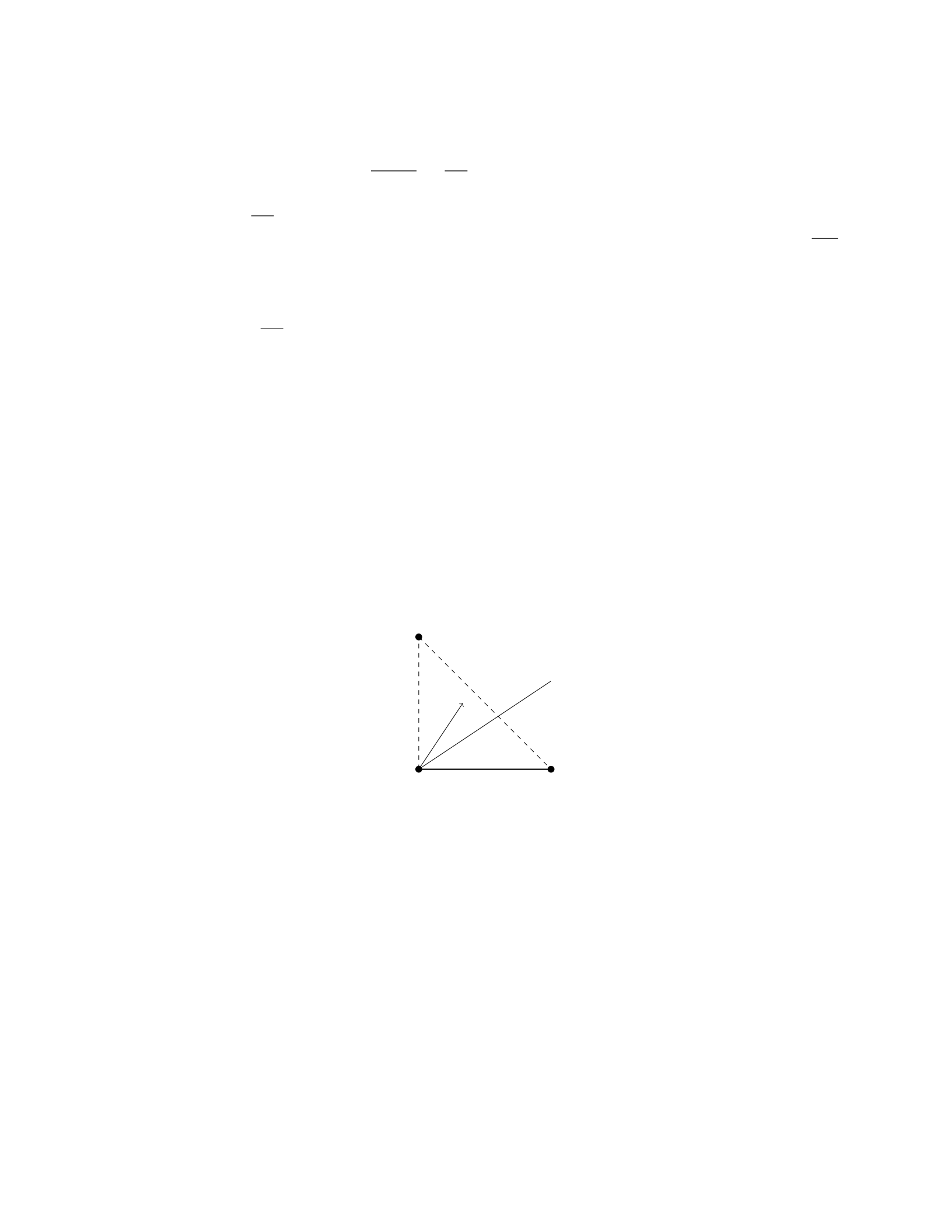
exerted by the pivot can be calculated using the torque equation. Taking the torque about the
pivot point: T×10 m=W×3m, where Wis the weight of the 5000 N load.
4. Solving for Wgives: W=T×10 m
3m=10T
3
5. Substituting W= 5000 N and mg = 981 N into the equilibrium equation from step 1
gives: T+ 981 = 10T
3
6. Solving for Tin the equation from step 5: 3T+ 2943 = 10T7T= 2943 T=2943
7
T≈420.4N
7. Therefore, the tension in the beam is approximately 420.4 N.
8. To find the force exerted by the pivot on the beam, we can use the equation we found in
step 5: T+ 981 = 10T
3
9. Substituting the tension T= 420.4N into the equation from step 8 gives: Fy=T+mg =
420.4 + 981 = 1401.4N
10. Therefore, the force exerted by the pivot on the beam is approximately 1401.4 N.
3. A uniform rod of length Land mass Mis supported at its end by a cable attached to
the ceiling, as shown in the figure below. The rod makes an angle θwith the vertical and is in
equilibrium. The cable makes an angle αwith the horizontal. Find an expression for the tension
Tin the cable in terms of M,L,θ, and α.
O
M
N
L
T
θ
α
Ans. Step 1. Analyze the forces acting on the rod.
Let’s consider the forces acting on the rod in the equilibrium position. The rod has two forces
acting on it: its weight Mg acting vertically downward at point M, and the tension Tin the
cable. We need to resolve these forces into components parallel and perpendicular to the rod.
Step 2. Resolve the forces into components.
Resolve the forces into components parallel and perpendicular to the rod. The weight M g can
be resolved into components M g cos θand Mg sin θ, where M g cos θis parallel to the rod and
Mg sin θis perpendicular to the rod.
Step 3. Write the equilibrium equations.
In the equilibrium position, the sum of forces in the vertical direction must be zero, and the sum
of forces in the horizontal direction must be zero.
Vertical direction: Tcos α−M g cos θ= 0

Horizontal direction: Tsin α=M g sin θ
Step 4. Solve for tension T.
From the vertical equilibrium equation, we have Tcos α=M g cos θ. Substituting this into the
horizontal equilibrium equation, we get
Tsin α=Mg sin θ
Solving for T, we find
T=Mg sin θ
sin α
Therefore, the tension Tin the cable in terms of M,L,θ, and αis T=Mg sin θ
sin α.
4. Question: A thin uniform rod of length Land mass Mis initially at rest on a table. A bullet
of mass mmoving horizontally strikes the rod at a distance xfrom the center of the rod and
sticks in it. If the coefficient of restitution between the bullet and the rod is e, find the velocity
of the bullet just before the impact.
Ans. Step-by-step solution:
Let the velocity of the bullet just before the impact be v. After the impact, the bullet-rod
system will move together as a single body. The linear momentum of the system is conserved
along the horizontal direction before and after the collision. The linear momentum of the bullet-
rod system just before the collision is mv, and just after the collision is (M+m)V, where Vis
the velocity of the system after the collision.
1. Applying the principle of conservation of momentum along the horizontal direction:
mv = (M+m)V
2. The coefficient of restitution eis defined as the ratio of relative velocity of separation to
relative velocity of approach. Therefore, we have e=V−v
u−v, where uis the relative velocity of
separation between the bullet and the rod.
3. Since the bullet sticks in the rod after the collision, the relative velocity of separation uis
the final velocity of the point of impact of the bullet that is at a distance xfrom the center of
the rod. We can express uin terms of V:
u=V−ωx
where ωis the angular velocity of rotation of the system about the center of mass of the rod
after the collision.
4. The linear velocity of the point of contact of the bullet immediately after the collision is
V−ωL
2. The linear velocity of the point of contact of the bullet due to rotation is ωL
2. Therefore,
the combined velocity of the bullet at the point of contact is V−ωL
2+ωL
2=V. So, we have
u=V.

5. Substituting u=Vinto the equation for the coefficient of restitution, we get:
e=V−v
u−v=V−v
V−v= 1
This implies that V=v.
6. Substituting V=vinto the conservation of momentum equation gives:
mv = (M+m)v
m=M+m
which implies that M= 0.
Therefore, the velocity of the bullet just before the impact is v= 0.
5. A rod of length Land uniform cross-sectional area A, made of a material with Young’s
modulus Y, is suspended vertically from one end. A load Fis attached to the free end, causing
the rod to stretch by an amount ∆L. Assuming that the rod remains straight and neglecting the
weight of the rod, determine the expression for the strain in the rod and the stress in the rod.
Ans. Let’s denote the original length of the rod as Land the stretched length as L+ ∆L. We
can determine the strain and stress in the rod based on the given information.
1. Determining the Strain: The strain in the rod is given by the formula:
ε=∆L
L
2. Determining the Stress: The stress in the rod can be calculated using Hooke’s Law,
which states:
σ=Y·ε
Thus, the stress in the rod is:
σ=Y·∆L
L
6. Question:
A uniform rod of length Land mass Mis supported at one end by a pivot and is attached
at the other end by a thin thread. A block of mass mis placed at a distance xfrom the pivot
along the rod. Find the tension in the thread when the system is in equilibrium.
Ans. Step-by-step solution:

1. First, define the forces acting on the rod: Let Tbe the tension in the thread, Nbe the
normal force at the pivot, and Wrod be the weight of the rod. Also, let Wmbe the weight of the
block and Wbe the weight of the block and the part of the rod to the right of the block.
2. Next, write the force equations for the system: In the vertical direction: N+T−Wrod −
Wm= 0 ... (1)
In the torque equation: The torque about the pivot point must sum to zero for equilibrium.
Taking the torque about the pivot at the left end of the rod: T·L+Wm·L/2 −W·x= 0 ...
(2)
3. Solve for Wrod and W: From equation (1), we have: N=Wrod +Wm−T
From equation (2), we substitute in the expression for Wand solve for T:T·L+Wm·L/2 −
(Wm+Wrod −T)·x= 0
Solving for T, we get: T=Wm
L·(x+L
2)−Wrod ·(x+L
2)
4. Substituting Wrod =M·gand simplifying: T=m·g·(x+L
2)
L−M·g·(x+L
2)T=
m·g·x+m·g·L
2
L−M·g·x−M·g·L
2T=m·g
L·x+m·g
2−M·g·x−M·g·L
2
Therefore, the tension in the thread when the system is in equilibrium is: T= (m−M)·g·x/L+ (m/2 −M·L/2) ·g
7. A uniform rod of length Land mass Mis suspended horizontally and supported by two
vertical strings at its ends. If a weight of magnitude Wis added at a distance xfrom one end
of the rod in such a way that the system remains in equilibrium, determine the tension in each
string.
Ans. Let’s denote the tension in the string at the left end as T1and the tension in the string
at the right end as T2. To solve this problem, we need to consider the forces acting on the rod
and set up equilibrium conditions.
1. Setting up equilibrium along the vertical direction: The sum of forces in the vertical
direction must be zero for the rod to remain in equilibrium. Therefore, we have:
T1+T2=Mg
2. Setting up equilibrium along the horizontal direction: The torques produced by the
forces must also balance out to keep the rod in equilibrium. The torque about the point where
T1is acting is zero. Taking moments about this point (the left end), we get:
T2·L=W·x
3. Solving the equations: Now we have two equations:
T1+T2=Mg
T2·L=W·x

Substitute T2=Mg −T1from the first equation into the second equation:
(Mg −T1)·L=W·x
MgL −T1L=W·x
T1=Mg −W·x
L
4. Finding the tension in each string: Now that we have T1, we can find T2from the
first equation:
T1+T2=Mg
T2=Mg −T1
T2=Mg −(Mg −W·x
L)
T2=W·x
L
Therefore, the tension in the string at the left end is T1=Mg −W·x
Land the tension in the
string at the right end is T2=W·x
L.
8. Question: A uniform beam of length Land weight Wis suspended horizontally by two
vertical wires attached at points Aand B, each at a distance xfrom the ends of the beam. The
wire attached at point Abreaks. Determine the maximum allowable length xsuch that the beam
remains in equilibrium.
Ans. Solution: Let TAand TBbe the tensions in the wires attached at points Aand B,
respectively.
1. Draw the free-body diagram of the beam when the wire attached at point Abreaks.
Consider the forces acting on the beam: the weight W, the tension TBat point B, and the
reaction force Rat point A.
∑Fx= 0 : −TB= 0 ⇒TB= 0
∑Fy= 0 : R−W= 0 ⇒R=W
2. Determine the torque due to the weight of the beam about point B.
The torque due to the weight of the beam about point B is −W
2×L(clockwise direction is
taken as negative).
3. Set up the torque equilibrium equation about point B.
∑τB= 0 : −W
2·L= 0
4. Solve for the maximum allowable length x.

Since the beam is in equilibrium, the maximum allowable length xcan be found by setting
up the condition for equilibrium.
xW
L=W
2
x=L
2
Therefore, the maximum allowable length xsuch that the beam remains in equilibrium is
x=L/2.
9. A uniform rod of length Land mass Mis supported horizontally by two vertical strings of
equal length L, attached at each end of the rod. The strings make an angle θwith the horizontal.
Assuming the rod is in equilibrium, determine the tension in the strings.
Ans. To solve this problem, we will first analyze the forces acting on the rod to establish the
equilibrium conditions. Then, we will use trigonometric relationships to find the tension in the
strings.
1. Free Body Diagram: Let’s consider the forces acting on the rod. The weight of the
rod acts vertically downward at its center. The tensions in the strings act along the strings at an
angle θwith the horizontal. Resolving the forces vertically and horizontally, we have: - Vertically:
Tcos θ+Tcos θ=Mg - Horizontally: Tsin θ= 0
2. Equilibrium Conditions: For the rod to remain in equilibrium, the net force in both the
horizontal and vertical directions must be zero. From the horizontal equilibrium condition, we
have: Tsin θ= 0 =⇒T= 0 (which is not possible)
This implies that we made an incorrect assumption earlier, as there must be a minimum
nonzero value of tension required for equilibrium.
3. Equilibrium Analysis (Revised): Let’s consider the torques acting on the rod. The
torques produced by the tensions in the strings must balance the torque due to the weight of the
rod. We can take the torque about the center of the rod. The torque due to the tensions is zero
since their lines of action pass through the pivot point. The torque due to the weight of the rod
is given by M gL/2 in the counterclockwise direction.
4. Solving for Tension: Setting up the torque balance equation, we have: MgL/2 = 0
T=Mg/2
Therefore, the tension in the strings is T=M g
2.
10. Question:
A rod of length Land uniform cross-sectional area Ais placed horizontally on two vertical
walls. Suppose a force
Fis applied at a distance xfrom the left end of the rod. The rod is in

mechanical equilibrium. Find the expression for the normal force exerted by the left wall on the
rod in terms of L,A,x, and F.
Ans. Step-by-step solution:
We know that for the rod to be in equilibrium, the net force and the net torque acting on it
must be zero.
1. Resolving forces in the vertical direction: The vertical forces acting on the rod are the
weight Wacting downwards and the normal forces N1and N2exerted by the left and right walls
respectively.
N1+N2=W=mg (where mis the mass of the rod and gis the acceleration due to gravity)
2. Resolving torques about the left end of the rod: Taking the torque about the left end and
considering counterclockwise torques as positive, we have: τ=F(x)−N1(L/2) = 0
3. Solve for N1: From Step 2, we have F(x) = N1(L/2). Substitute for F(x)from Step 3
into Step 1: N1+N2=W=mg
Substitute N1(L/2) for F(x)in the torque equation, we get: N1(L/2) = N1(L/2)
Hence, the expression for the normal force N1exerted by the left wall on the rod is: N1=F L
2x
11. Question:
A uniform rod of length Land mass Mis hinged to a wall at one end while the other end is
attached to a rope that makes an angle θwith the horizontal. The rod is in equilibrium and the
tension in the rope is T. Find the tension in terms of M,L,g, and θ.
Ans. Step-by-step solution:
1. Draw a free-body diagram of the rod. The forces acting on the rod are the gravitational
force M g acting at the center of mass, the tension Tacting along the rope, and the normal force
Nacting at the hinge point perpendicular to the rod.
2. Resolve the forces into components. The gravitational force can be broken down into two
components: one parallel to the rod (Mg sin θ) and one perpendicular to the rod (Mg cos θ).
3. Write the equilibrium equations. The sum of the forces in the horizontal direction is zero,
so we have:
Tcos θ= 0
4. The sum of the forces in the vertical direction gives:
N−Mg cos θ= 0
5. The torque about the hinge point also needs to sum to zero since the rod is in rotational
equilibrium. The torque due to the tension Tis zero since its line of action passes through the
hinge. The torque due to the gravitational force is:
−Mg sin θ·L
2= 0
6. Solve the torque equation for T:
T=MgL sin θ
2

Hence, the tension in the rope is M gL sin θ
2.
12. A uniform ladder of length Land mass mleans against a smooth vertical wall making an
angle of θwith the horizontal floor. A firefighter of mass Mclimbs up the ladder to a height h
from its base. Determine the force exerted by the ground on the ladder and the force exerted by
the wall on the ladder in terms of the given quantities.
Ans. Let’s denote the force exerted by the ground on the ladder as Nand the force exerted by
the wall on the ladder as F.
1. Create a free body diagram of the ladder with forces acting on it. There are three forces
acting on the ladder: the force of gravity acting downward at the center of the ladder, the normal
force Nacting upward from the ground, and the force Facting outward from the wall.
2. Write the equations of equilibrium in the horizontal and vertical directions. In the horizontal
direction, the total force must be zero since the ladder is not moving horizontally. In the vertical
direction, the total force must be zero since the ladder is in static equilibrium.
3. Solve for the force exerted by the ground on the ladder (N). In the vertical direction, the
equation of equilibrium gives:
N−mg −Mg = 0
N=mg +Mg
4. Solve for the force exerted by the wall on the ladder (F). In the horizontal direction, the
equation of equilibrium gives:
F= 0
5. Therefore, the force exerted by the ground on the ladder is mg +Mg, and the force
exerted by the wall on the ladder is 0.
13. Suppose a uniform rod of length Land mass Mis suspended horizontally from two vertical
walls using two strings of length L. Given that the tension in each string is Tand the rod makes
an angle θwith the vertical, find the elongation of the strings due to the weight of the rod.
Ans. Let’s denote the distance of the attachment points of the strings from the center of the
rod as d.
1. Calculate the torque due to the gravitational force about the center of the rod: The
gravitational force exerted on the rod is M g, acting at the center of mass. The torque about the
center of the rod is given by τ= (Mg)·dsin(θ).
2. Express the torque in terms of the tension force: The tension force, T, is acting in
the strings in opposite directions and inclined at an angle θwith the vertical. The horizontal
component of tension force providing torque is 2Tcos(θ).

3. Set up the equation for equilibrium: For the rod to be in equilibrium, the net torque should
be zero. We have: (Mg)·dsin(θ) = 2Tcos(θ)·d.
4. Solve for the tension force T: Solving the equation for T, we get: T=M g sin(θ)
2cos(θ).
5. Calculate the elongation of the strings: The vertical component of Tbalances the weight
of the rod: Tsin(θ) = Mg. From this, we can express sin(θ)in terms of Land d.
6. Substitute the value of Tobtained in step 4: Substitute the expression for Tin terms of
M,g, and θinto the equation found in step 5.
This will give you the elongation of the strings due to the weight of the rod.
14. A thin cylindrical tube of length Land radius ris made from a material with Young’s
modulus Y. The tube is fixed at one end and a force Fis applied perpendicular to the other end.
Determine the magnitude of the force Frequired to stretch the tube by a small amount ∆L.
Ans. To solve this problem, we will use the concepts of equilibrium and elasticity. We’ll consider
the forces acting on the tube and then apply Hooke’s Law to find the required force. 1. Consider
the forces acting on the tube: Since the tube is in equilibrium, the force applied Fis balanced
by the restoring force due to the stretching of the tube. Additionally, there is a force due to the
pressure inside the tube. 2. Write the equation for equilibrium: The force applied Fis balanced
by the restoring force due to the stretching of the tube. The force due to pressure inside the
tube does not contribute to the stretching force, as it acts perpendicular to the direction of the
stretching. 3. Apply Hooke’s Law: Using Hooke’s Law, we can relate the restoring force to the
change in length of the tube. This allows us to determine the magnitude of the force required to
stretch the tube by a small amount ∆L. 4. Determine the magnitude of the force F: Using the
equation for equilibrium and Hooke’s Law, we can now solve for the force Frequired to stretch
the tube by ∆L.
15. A uniform rod of length Land mass Mis suspended vertically by two strings attached to
its ends. Determine the tension in each string when the rod is in equilibrium. Assume the rod is
uniform and has a negligible thickness. Express your answer in terms of M,L, and g.
Ans. Let’s denote the tension in the left string as T1and the tension in the right string as T2.
1. First, we need to calculate the center of mass of the rod. The center of mass of a uniform
rod lies at its midpoint, which is L
2from either end.
2. Next, we can analyze the forces acting on the rod when it is in equilibrium. There are
three forces acting on the rod: the gravitational force (M g) acting at the center of mass, and
the tension forces T1and T2acting at the ends.
3. Considering the forces in the vertical direction, we have:
T1+T2=Mg

4. To find another equation, we can use the torque equilibrium condition. The torques due
to the tensions T1and T2are equal and opposite, resulting in no net torque.
5. The torque due to T1is T1·L
2(clockwise), and the torque due to T2is T2·L
2(counter-
clockwise). The torque due to the gravitational force is Mg ·L
2in the counterclockwise direction.
6. Setting up the torque equation:
T1·L
2=T2·L
2+Mg ·L
2
7. Simplifying the torque equation gives us:
T1=T2+Mg
8. Now we have a system of two equations:
{T1+T2=Mg
T1=T2+Mg
9. Solving this system of equations, we find:
T1=2
3Mg and T2=1
3Mg
16. An iron bar of length Land uniform cross-sectional area Ais supported horizontally by
two vertical strings at its ends. The bar is subject to a vertical load Fapplied at its center. The
Young’s modulus of iron is Y.
Calculate the tension in each string.
Ans. To find the tension in each string, we need to consider the forces acting on the iron bar
in equilibrium.
1. Consider the forces acting in the vertical direction: The two vertical strings provide upward
forces equal to their tensions T. The force due to the load Facts downward. The weight of
the bar must also be considered, but since the bar is supported horizontally, the weight does not
create any vertical force.
2. The forces must balance each other for the bar to be in equilibrium: The total upward
force provided by the strings is 2T, and this must balance the downward force due to the load F.
3. Write the equilibrium equation:
2T=F
4. Solve for the tension T:
T=F
2
Thus, each vertical string supports a tension of F
2in order to keep the iron bar in equilibrium.
17. Question 17:
A steel rod of length 2.0 m and diameter 5.0 mm hangs vertically from the ceiling. The rod
has a 100 kg weight attached to its bottom end. If the Young’s modulus for steel is 2.0×10¹¹
N/m2, calculate the elongation of the steel rod.
Ans. To calculate the elongation of the steel rod, we can use the formula for the elongation of
a material under a tensile stress:
1. Calculate the cross-sectional area of the steel rod: The cross-sectional area of the rod can
be calculated using the formula for the area of a circle: A=πr2, where ris the radius of the
rod. Given that the diameter of the rod is 5.0 mm, the radius is r= 2.5×10⁻³m. Thus, the
cross-sectional area is:
A=π(2.5×10⁻³)2= 1.9635 ×10⁻⁵m2
2. Calculate the stress on the steel rod: The weight of the 100 kg mass is F=mg =
100 kg ×9.81 m/s2= 981 N. The stress on the rod is given by σ=F
A, where Fis the force and
Ais the cross-sectional area. Substituting in the values, we get:
σ=981
1.9635 ×10−5= 5.0×10⁷N/m2
3. Calculate the strain in the rod: The strain in the rod can be calculated using the formula
ε=σ
Y, where Yis the Young’s modulus for steel. Substituting in the values, we get:
ε=5.0×10⁷
2.0×1011 = 2.5×10⁻⁴
4. Calculate the elongation of the steel rod: The elongation of the rod can be calculated
using the formula L=ε·L0, where Lis the elongation, εis the strain, and L0is the original
length of the rod. Substituting in the values, we get:
L= 2.5×10−4×2.0 = 5.0×10⁻⁴m= 0.50 mm
Therefore, the elongation of the steel rod is 0.50 mm.
18. Question 18:
A solid bar of length Land rectangular cross-section with width wand height his suspended
vertically from a ceiling. A weight Wis hung from the bottom end of the bar. If the Young’s
modulus of the material is E, what is the elongation ∆Lof the bar due to the weight?
Given: - Length of the bar, L- Width of the bar, w- Height of the bar, h- Weight hanging
from the bar, W- Young’s modulus of the material, E
Ans. We can calculate the elongation ∆Lof the bar using the formula for the elongation of a
bar under stress:
1. Calculate the cross-sectional area of the bar: The cross-sectional area Aof the bar is given
by A=w×h.

2. Calculate the tensile stress on the bar: The weight Whanging from the bar creates a
tensile force F=Won the bar. The tensile stress σon the bar is given by σ=F
A.
3. Calculate the strain in the bar: The strain ϵin the bar can be calculated using Hooke’s
Law: ϵ=σ
E.
4. Calculate the elongation of the bar: The elongation ∆Lof the bar can be calculated using
the formula ∆L=ϵ×L.
Therefore, the elongation ∆Lof the bar due to the weight Whanging from the bottom end
can be calculated using the above steps.
19. A uniform rod of length Land mass Mis lying on a smooth horizontal table. A load of
mass mhangs at a distance xfrom one end of the rod, which is not supported by the table. Find
the reaction forces at the two ends of the rod.
Ans. Let’s denote the reaction force at the support point of the rod as Rand the reaction force
at the end where the load is hanging as S. 1. To begin, we will use the conditions for equilibrium
in the vertical direction. The sum of the forces in the vertical direction must be zero:
R+S−M·g= 0
2. Next, we will take moments about the support point of the rod, which gives us:
S·L−M·g·L
2−m·g·x= 0
3. Solving the above two equations simultaneously, we find:
R=M·g
2−m·g·x
L
S=M·g
2+m·g·x
L
Therefore, the reaction force at the support point is M·g
2−m·g·x
Land the reaction force at the
end where the load is hanging is M·g
2+m·g·x
L.
20. Question:
A uniform bar of length Land cross-sectional area Ais supported by a vertical cable attached
to its right end. The bar has a mass of Mand a center of mass located at a distance of dfrom
the right end. Determine the tension in the cable when the bar is in equilibrium.
Ans. Step-by-step solution:

1. The forces acting on the bar are the tension Tin the cable, the weight of the bar W=Mg,
the reaction force at the support N, and the force of the bar acting on the support. Since the
bar is in equilibrium, the sum of the forces in both the horizontal and vertical directions must be
zero.
2. In the vertical direction, the equation of equilibrium is:
N+T=Mg
3. In the horizontal direction, the equation of equilibrium is:
T·L=f·d
Where fis the force exerted by the bar on the support.
4. To find the force f, we can use the fact that the bar is uniform and has a mass of M.
Since the center of mass is located at a distance of dfrom the right end, the force fcan be
determined by considering the bar as two separate components: one of mass xat a distance x
from the left end and the other of mass M−xat a distance L−xfrom the left end. The
equation for the force fis:
f=∫L
0
xM
L
A
Ldx
f=AMg
2L
5. Substituting the expression for fback into the horizontal equilibrium equation gives:
T·L=AMg
2L·d
T=AMgd
2L2
6. Therefore, the tension in the cable when the bar is in equilibrium is AMgd
2L2.
21. A uniform bar of length Land mass Mis supported by two vertical strings attached to
its ends. One of the strings is pulled horizontally with a force F. The bar is in equilibrium.
Determine the tension in each string.
Ans. Let’s denote T1as the tension in the string on the left and T2as the tension in the string
on the right. To find the tension in each string, we need to analyze the forces acting on the bar
and set up equations for equilibrium. 1. Draw a free body diagram of the bar. The forces acting
on the bar are the tension T1in the left string, the tension T2in the right string, the downward
gravitational force M g, and the horizontal force F. 2. Write the equations for equilibrium in the
horizontal and vertical directions. In the horizontal direction, the sum of the horizontal forces is
zero: T1−F= 0. In the vertical direction, the sum of the vertical forces is zero: T2+Mg = 0. 3.
Solve the equations simultaneously. From the horizontal equilibrium equation, we have T1=F.

Substituting this into the vertical equilibrium equation gives T2=−M g. 4. Therefore, the
tension in the left string is T1=Fand the tension in the right string is T2=−Mg.
22. Question: A block of mass mis hanging from a vertical spring with a spring constant k.
When the block is in equilibrium, the spring is stretched by a distance x0. If the block is then
gently pushed up so the spring is compressed by a distance a, determine the frequency of small
vertical oscillations of the block.
Ans. Let’s start by finding the equilibrium position of the block. 1. At equilibrium, the weight
of the block is balanced by the spring force. The equilibrium condition can be written as:
mg =kx0,
where gis the acceleration due to gravity. 2. Next, we need to determine the equilibrium position
of the block after it has been compressed by a distance a. This new equilibrium position can be
found by considering the total force acting on the block:
mg =k(x0−a).
Solving for x0, we get:
x0=a+mg
k.
3. The restoring force when the block is displaced from the new equilibrium position is given by
Hooke’s Law:
F=−kx =−k(a+mg
k−x),
where xis the displacement from the new equilibrium position. 4. We can rewrite the above
expression in terms of the acceleration aas:
m¨a=−k(a+mg
k−x).
5. By assuming harmonic motion of small amplitude around the new equilibrium position, we
can substitute x=a+Acos(ωt)into the equation. Here, ωis the angular frequency of the
oscillation. 6. The equation then becomes:
m¨
a=−k(a+mg
k−a−Acos(ωt)).
7. Simplifying further, we get:
m¨a=−k(mg
k−Acos(ωt)).
8. Comparing the above equation to the standard form of a simple harmonic oscillator, m¨x=
−kx, we find the angular frequency of oscillation:
ω=√k
m.

9. Therefore, the frequency of small vertical oscillations of the block is f=1
2π√k
m.
23. A uniform rod of length Land mass Mis suspended horizontally by two vertical wires of
length Leach, attached to the ends of the rod. The system is in equilibrium when the wires are
at an angle of θwith the vertical. Determine the tension in each wire.
Ans. To determine the tension in each wire, we need to set up equations of equilibrium using
the forces acting on the rod. Let T1and T2be the tensions in the two wires. 1. Consider the
forces in the horizontal direction: The horizontal components of the tensions cancel each other
out, so there are no horizontal forces affecting the equilibrium. 2. Consider the forces in the
vertical direction: The weight of the rod acts downwards at its center of mass, and the vertical
components of the tensions act upwards. Therefore, the sum of the vertical components of the
tensions must equal the weight of the rod:
T1cos θ+T2cos θ=mg
3. Consider the torques about the center of mass: The torques due to the tensions in the wires
must balance the torque due to the weight of the rod. The torque due to T1is T1sin θ·Land
the torque due to T2is T2sin θ·L. The torque due to the weight of the rod is 1
2Lsin θ·Mg.
Therefore, the equation for rotational equilibrium is:
T1sin θ·L+T2sin θ·L=1
2Lsin θ·Mg
Now, we have two equations and two unknowns. We can solve these equations to find the tensions
T1and T2.
24. A thin rod of length Land mass mis attached to a wall at one end and to a rope of length
Lat the other end. The rope makes an angle θwith the rod when the system is in equilibrium.
Given that the modulus of elasticity of the rod is E, determine the tension in the rope.
Ans. To determine the tension in the rope when the system is in equilibrium, we need to analyze
the forces acting on the rod when it is in equilibrium.
1. Free Body Diagram: Consider the forces acting on the rod. We have the tension T
acting upwards along the rod, the weight of the rod mg acting downwards from its center of
mass, and the force Fdue to the wall acting on the rod at right angles to the rod. There is also
the reaction force Rexerted by the hinge on the rod.
2. Equilibrium Conditions: For the rod to be in equilibrium, the net force acting on the
rod must be zero in both the horizontal and vertical directions. Therefore, we have the following

equilibrium equations:
{Tsin(θ) = R(in the vertical direction)
Tcos(θ) + F=mg (in the horizontal direction)
3. Elasticity: The stress in the rod is given by σ=F
A, where Ais the cross-sectional area
of the rod. The strain is given by ϵ=∆L
L, where ∆Lis the elongation of the rod. From Hooke’s
Law, we have F=k∆L, where kis the spring constant.
For the rod to be in equilibrium, the elongation in the rod due to horizontal forces must be
balanced by the compression in the rod due to vertical forces.
4. Solution: Solving the equilibrium equations and applying the conditions for elasticity, we
can find the tension in the rope.
25. Question 25:
A uniform rod of length Land mass Mis suspended horizontally from two strings, each
attached to the ends of the rod. A block of mass mis then placed at a distance dfrom one end
of the rod. Given that the system is in equilibrium, determine the tension in each string.
Ans. To solve this problem, we first need to consider the forces acting on the rod and the block,
and then set up equations of equilibrium.
1. Consider the forces acting on the block: Let the tension in the left string be T1and
the tension in the right string be T2. The forces acting on the block are: the force of gravity
(mg) acting downwards, and the force of tension (T2) acting to the right. The net force in the
horizontal direction is zero, so we have:
T2=mg
2. Consider the forces acting on the rod: The forces acting on the rod at the left end
(considering the small portion of the rod between the block and the left end) are the tension
force T1acting to the left, the force of gravity (mL
Mg) acting downwards, and the force from the
block (mg) acting to the right. The net force in the horizontal direction is zero, so we have:
T1=mL
Mg+mg
3. Setting up equations of torque equilibrium: Choose the point of rotation at the right end
of the rod. The torque due to the block about the point of rotation is:
mg ·d
The torque due to the rod about the point of rotation is:
T1·L
2

Since the system is in equilibrium, the sum of torques is zero:
mg ·d=T1·L
2
4. Substituting the expressions for T1and T2from step 1 and 2 into the torque equilibrium
equation, we get:
mg ·d=(mL
Mg+mg)·L
2
Solving the above equation will give us the tensions T1and T2in terms of m,M,L,g, and
d.

