



PHY302 DF/FT Quiz 60 points - Open tutorial - 60 minutes Spring 2021
Note: Be sure to attempt all 5 of the required problems. You must show your work to receive
credit! Partial credit will be given. If you cannot do a calculation but know what calculation
you should be doing, describe it in words.
1. (15 points) Compute the following integral.
ˆ∞
−∞
x2δx2−4x+ 3dx.
Solution:
We first find the values x0where the argument of δgoes to 0:
x2
0−4x0+ 3 = 0
(x0−1)(x0−3) = 0
→x0= 1 or 3.
Both values are in range, so now we use DF eq. (9):
δ((x−1)(x−3)) .
=1
|1−3|[δ(x−1) + δ(x−3)] .
=1
2[δ(x−1) + δ(x−3)]
=⇒1
2ˆ∞
−∞
x2[δ(x−1) + δ(x−3)] dx =1
212+ 32= 5.
2. (10 points) Compute
ˆ11
0
ex[δ(x−3) + δ(x+ 7)] dx.
Solution:
The argument of the second delta function is 0 when
x+ 7 = 0 →x=−7.
x=−7 is not inside the range of the integral, so the integral over the second delta
function evaluates to 0. For the first delta function, the argument is 0 when x= 3, so it
is in range. We are left with
ˆ11
0
exδ(x−3) dx =e3.
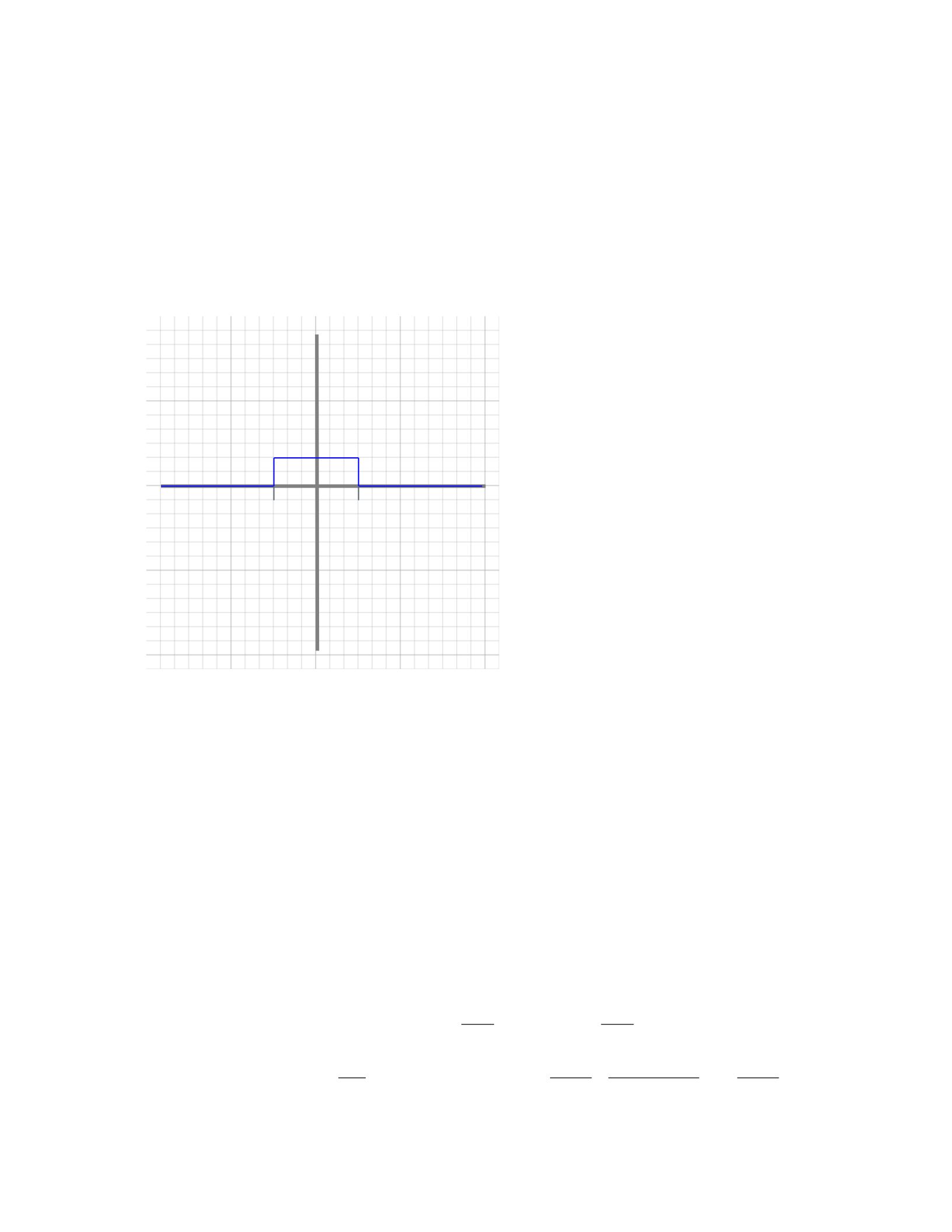
3. (10 points) Sketch a plot of H(9 −x2). Include labels for all important locations, and
show your work for the values you determine.
Solution:
The important locations are going to be where the argument, 9 −x2, crosses zero. This
happens when x=±3. These are the locations where the step function will switch on
or off. We know the step function will be on for −3< x < 3, because that’s where the
argument is positive. It will be off (= 0) outside that range. So we find:
x
H(9-x )
3-3
1
2
4. (10 points) Find the Fourier transform of
f(t) = (2 if −1< t < 3
0 if t≤ −1 or t≥3.
Solution:
This Fourier transform can be found either from first principles or by rewriting in terms
of Heaviside step functions and then using the Fourier transform tables and properties.
Here, we will compute the transform from first principles.
F[f(t)] = g(ω) = ˆ∞
−∞
f(t)e−iωt dt
=ˆ3
−1
2e−iωt dt =2
−iω e−iωt
x=3
x=−1
=2
−iω e−3iω −eiω
=4
2iω e−iω −e−2iω +e2iω=4e−iω
ωe2iω −e−2iω
2i=4e−iω
ωsin 2ω.
2

5. (15 points) Find the inverse Fourier transform, f(x), of
g(k) = 4 cos(πk)
1 + k2.
Solution:
This transform can be found by directly doing the integrals, but we will do it here via
using the Fourier transform properties and table instead. We begin by rewriting cos(πk)
in terms of complex exponentials, and giving a name to each resulting piece:
g(k) = 4 cos(πk)
1 + k2=2
1 + k2eπki +e−πki=2eπki
1 + k2
| {z }
g+(k)
+2e−πki
1 + k2
| {z }
g−(k)
.
Since Fourier transforms are linear, we can solve these separately. That is, if we can find
f±(x) such that
F[f+(x)] = g+(k),F[f−(x)] = g−(k) then F[f+(x) + f−(x)] = g(k).
So we begin with the pair f+(x) = F−1[g+(k)]. We first notice that the table has an
entry for 2a/(a2+k2). We use that entry, with a= 1:
e−xH(x) + exH(−x) = F−12
1 + k2.
Next, we can create the correct numerator by using the Spatial Shifting property from
the Fourier transform table, with x0=π:
e−(x+π)H(x+π) + ex+πH(−(x+π)) = F−12eikπ
1 + k2
The right hand side now matches g+exactly, so the left hand side must be f+(x):
f+(x) = e−x−πH(x+π) + ex+πH(−x−π).
Very similarly we find
f−(x) = e−x+πH(x−π) + ex−πH(−x+π).
So now we just use f(x) = f+(x) + f−(x) and find
f(x) = e−x−πH(x+π) + ex+πH(−x−π) + e−x+πH(x−π) + ex−πH(−x+π).
3

