


A RELATIONAL HERMENEUTICS APPROACH TO TRUTH
Truth has long been at the core of Western thought, as noted by
Martin Heidegger, Michel Foucault’s, and Fredrich Nietzsche. It is
perhaps easy to take truth for granted, at least as a concept or aim, but
Nietzsche calls us (1887/1997, pp. 111113, 118-120) to take up truth as
an issue. But truth has been taken up as an issue in multiple ways since
Nietzsche. This dissertation intends to take up the issue of truth in a
manifold way:
(1) it intends to re-examine and re-narrate the history of truth in
mainstream Western thought in a way which is perhaps more
thorough and updated than some past attempts (e.g., in
Heidegger and Foucault). This is the main purpose of
Chapters 1-4, and will involve going through the history of
truth in analytic philosophy (Chapter I), visiting examining
Nietzsche and Foucault as important historical “outlaws” of
analytic philosophy (Chapter 2), more recent
“renegade” figures of Richard Rorty, Alasdair MacIntyre, and
Hans Sluga (Chapter 3), and the broader history of truth in
antiquity, modernity, and postmodernity (Chapter 4).
(2) It intends to review significant narrations of the history of truth
especially in
Heidegger, MacIntyre, Sluga, and Pierre Hadot. This is partly
introduced in Chapter 3 and a major focus of Chapter 4.

(3) It intends to argue for (Hans Gadamer-inspired) hermeneutics
as a sort of best-approach-so-far to truth which has a resilient
integrative ability—the ability or resources to attempt to
integrate past and present, history and presence, action and
thought, subject and object, and mind and world
(Chapter 5).
(4) In intends to further the development of a hermeneutic
approach to truth in what I call ‘relational hermeneutics’
(Chapters 5-6).
(5) It intends to go about its purposes in a hermeneutic way; it
intends to embody the approach it advocates.
Given that this dissertation intends to embody a hermeneutic
way, I wish to elaborate a couple things about the style of this
dissertation. First, since Gadamer, hermeneutics has had some
suspicion of seeking truth methodologically, which is why I say ‘way’
rather than ‘method.’ I actually don’t think I (or even Gadamer) can
completely avoid some degree of method and form in our finite attempts
at truth, but hermeneutics encourages a humility about the methods and
forms we employ. Second, since the hermeneutic way is pictured as
circular or spiral rather than linear, there is a certain interplay between
issues in each chapter, rather than a linear separation of neatly
delineated topics (one per chapter). For example, there is an interplay

between the history of truth and the versions given of the history of truth
—between history and historiography (in Chapters 1-4). Another
example: there is a deep interplay between description and evaluation,
and I am usually not all that concerned to neatly distinguish between
these two. Hopefully this approach opens up a fresh perspective on
various things, however, it may come at the cost of some organizational
clarity.
Chapter 1 is the messiest chapter organizationally. It contains
several purposes itself. First it delineates the path of the dissertation,
second it will give some more present-relevant motivations for its broad
concern for truth, third it will take up the history of truth in analytic
philosophy, and finally it will bring up some broader and transitional
issues arising from that history.
Broken Promises, Failed Dreams
Why is it that a book like Milan Kundera’s The Unbearable
Lightness of Being (1984/1999) could strike such heavy chords of
relevance, could in portraying disconnected and dispersed Nietzschean
lives struggling to live in the vacuum of vacated structures and fixities,
strike readers as perhaps touching or embodying deep truths? The
resonance and beauty found in the book is not just a distant recognition,
an acknowledgment of ingenious art or brilliant merging of philosophy
and life; it is often also an identification or recognition of the surprising
proximity of the characters with our own western-societal milieu and

perhaps with the very operations of our own life and how we must go
about navigating various vacuums, dispersions, disconnections, and
disoriented orientations. Nietzsche might appear dead in most ethical
discussions within analytic philosophy, but he has become a highly
dispersed uber-apparition in Western arts and humanities, even
laughing over the shoulder of his often more visible apprentice Foucault
as Foucault more perspicuously ripples far and wide across such
oceans (while most anglo philosophy imagines itself above such
waves). So we should not be surprised at Nietzsche’s surfacing in
prescient diagnoses of the current American political situation from the
likes of Wendy Brown (2018) or Sluga (2018), nor at the play of strong
reactions and admitted moral relativism in many of our undergrads, nor
at the continued experiments in removing or absurdifying various fixities
and structures in film and literature which has been a stronger
phenomenon in Europe than in the U.S. It seems that under the
surface, there is a strong impression that something was lost—
including some collection of optimistic beliefs concerning reason,
structure, progress, Enlightenment, modernity, and truth.
As the world has been undergoing speedy digitalization, in which
communication, ‘information,’ attention, etc. are susceptible to the
heavy gravitational pull of digital media and devices, one gets the sense
that the old Nietzschean stances are even more relevant, and in new
ways, as if they have been upgraded. It feels that ‘truth’ as a valuein-

itself is even more lost, and that if one attempts to apprehend the
dynamics of the digital world, drives, such as power or desire or
pleasure, are far more operative, and far more explanatory, than truth
as a fundamental cause or motivation. Or, if one takes truth as a drive
or will—Nietzsche’s “will to truth” or Aristotle’s “all men by nature desire
to know”—then the will-to-truth appears as one drive which operates
digitally (such as in online lectures and podcasts and blogs), but as a
drive which pales in comparison to other drives (as seen in the
prevalence, addictiveness, and economic weight of various types of
digital entertainment and social media). In the digital world, truth and
reason seem even more susceptible to being downgraded to a means
or instrument which can be separated out from what people are more
fundamentally pursuing—thus, it appears that we could potentially
outsource truth and reason to AI. The instrumentality of AI mirrors an
instrumentality of reason and truth and education—it manifests a
blurring of what is instrumental and what (if anything) is not, in a way
analogous to the blurring of what is artificial and what (if anything) is
not.
Hopefully this calls us back a step to attend to the question of:
what about truth was lost and continues to be lost in these postmodern
and digital cultural dynamics?

Was truth just a dream, or a promise, or a dream which held promise,
but which failed to actualize? Are there competing dreams which have
overshadowed past dreams about truth?
Perhaps I am attempting to extend the idea of “promise” from
Albert Borgmann reflections about the “promise of technology”: “It is the
promise of technology that has both fueled and disguised the gigantic
transformative endeavors that have given our time its character. The
promise of technology was first formulated at the very beginning of the
Enlightenment” (1984, p. 69). Borgmann elaborates how this promise of
technology was tied to a promise or dream of human reason and its
potential in Francis Bacon and Rene Descartes, and to the
development of science. In this dream—we could call it the dream of
modernity—Descartes links reason and knowledge to both utility and
devices. There are various words for capturing the attempts at the
“implementation” (p. 75) of this dream: “project” (p. 70), “enterprise” (p.
74), “program” (p. 75).
What Borgmann does not attend to as much is the flip side of
promise—what might be called ‘threat.’ He does touch on what I want to
call threat: “the joys that technology is able to furnish seem to have a
parasitic and voracious character: they require as a contrast
pretechnological limits and contours, and they seem to draw vitality
from the firmness of pretechnological life by devouring and displacing it”
(1984,

p. 453). This calls for elaboration: with the promise of technology comes
the threat of backwardness, the threat of being excluded as out-of-date
or even uncivilized, the threat of domination through technology, and
the threat of being forced to join in the technological dream, or the
technological race. These threats turned out to be quite real in the
history of colonialism, as some of those ‘backward’ and ‘behind’ peoples
felt compelled to modernize perhaps out of fear at least as much as out
of ‘promise.’ These threats partially precede the actual unfolding of
implementation, the issue of whether the dream has failed, and the
question of whether the dream can be recovered (Chapter 26) or
reformed.
This connection between truth and technology in Borgmann is
explored in the light of Heidegger, and Heidegger is indeed a figure
which I will return to in Chapter 4.
However, given that I want to focus more on truth than on technology,
this elaboration of
Borgmann also brings to mind MacIntyre’s treatment of the
Enlightenment ‘project’ in
After Virtue (1981/2007) and ‘encyclopedia’ in Three Rival Versions of
Moral Inquiry (1988/2003). Instead of Borgmann’s ‘promise of
technology’ implicating an underlying promise of reason, MacIntyre
describes an Enlightenment promise (or dream) of rationally solving
morality: “The project of providing a rational vindication of morality had
decisively failed” (1981/2007, p. 48).

It’s not a far cry to consider that whether we are talking about
optimism in technology or in enlightenment morality, there is not just an
underlying promise of reason, but also an underlying promise of the
truth which reason pursues. In fact, the promise of reason does not
make sense without reference to truth, unless reason were to be
demoted to some sort of coping mechanism or rhetorical game. Even
philosophers who take reason in a pragmatic direction tend to
incorporate truth in their picture by redefining it in pragmatic terms.
At this point one might think that the promise of truth is based in
a certain optimism regarding objective reason arising in the
Enlightenment. However, if one examines antiquity (and the Middle
Ages), one quickly realizes that there was already a deeply engrained
promise of truth embedded in all manner of Western thought, whether it
was depicted in the form of escaping Plato’s cave, or fulfilling the most
divine part of one’s nature in Aristotle, or the universal reason of the
Stoics, or Jesus’ declaration “You will know the truth, and the truth will
set you free” (New International Version Bible, 2011, John 8:32). Thus,
there are certain promises or dreams about both philosophy and
religion which are tied to the promise of truth. This ‘promise’ is why
Foucault can focus on truth as the fundamental channel of
subjectivization in antiquity in his Hermeneutics of the Subject (1981-
82/2005). This ‘promise’ is also why Nietzsche’s questions about truth

are so foundational—questions along the lines of: “is truth a fiction?”, “is
truth good?”, and “is truth a mask or manifestation of power?”
If one indeed attempts to answer Nietzsche with a re-assertion of
the promise of truth—perhaps inspired by ancient philosophy, recent
philosophy, or some sort of progress of science or technology—one
must face the new problems of the 21st century. Why, in our information
age, with unprecedented access to ‘knowledge,’ are mental health
problems on the rise? Why are new digital addictions (or semi-
addictions) more powerful or desirable than the truth which people are
supposed to desire by nature? Why do addictions and power affect
many so-called wise or knowledgeable persons, whether philosophers,
professors, priests, or pastors—in a perhaps similar manner to how
they affect the so-called unwise? Why are humanities including
philosophy and theology ‘out of fashion’ and susceptible to cuts if they
are supposedly places where truth is faithfully pursued? Why does all
this information result in confusing divisiveness of various sorts, such as
in politics and in philosophy, rather than a convergence upon an
objectively accessible truth?
The promise of truth, it seems, has been broken. Truth, it seems,
has not been truthful about itself. And even worse, sometimes the
promise of truth has hidden a threat of exclusion and power.
One might wonder, however, if any better dreams have been offered.
Was

Nietzsche able to offer any better alternative dream? Does power have
a promise? What about consumption, convenience, prosperity, or
entertainment? Is it not true that one can actually make a similar claim
about other kinds of promises and dreams—the promises of
advertisements and politicians, of social media and online communities,
and of economic development and globalization—the optimistic dreams
regarding these things have also fallen short? And do they not also hide
threats, such as the threat of not participating in social media or smart-
phone-requiring-QR-code-accessibility, or the threat of not being
competitive, or the threat of various forms of exclusion from new and
‘exciting’ groups and activities and economic systems?
Alas, perhaps we humans are bound to be tragic dreamers. We
cannot help to think and make an issue of ourselves—perhaps we
cannot help but to narrate, and we cannot help but to narrate into the
future—to anticipate, to hope, and to dream. And somehow it turns out
that our dreams are often fraught with hubris. Perhaps it is not such a
bad thing that one might choose to return to dreaming about truth not
out of optimistic promise, but more out of desperation or humility arising
from the disappointment of other dreams. If truth is one of a number of
potentially tragic dreams, perhaps it is at least one of the ones worth
attempting or pursuing. I think one should be more cautious and
apprehensive here than that of Borgmann regarding the promise of
technology. The promise of truth may need some serious recovery or

reform or redemption, and we are likely to fail in our attempt to do so.
But unless we attempt something like a redemption, we won’t be able to
learn and grow from our failures and our pursuit. We might not find
much in our seeking, but if we seek, we will find more than if we give up
on seeking.
I’ll offer a couple of initial ideas for reforming the promise, or
promises, of truth— these ideas will help indicate some initial direction
to our exploration of truth. First, rather than consider truth by way of
some narrow philosophical question, such as “what is the definition of
truth?” or “is all truth relative?” or “is truth an end in itself?”, we can
open up the issue of truth so as to interface with other issues and fields.
This means we can be open to examining truth historically, examining
truth psychologically, examining truth sociologically, and examining truth
phenomenologically. Nietzsche was a trailblazer in this sort of opening.
MacIntyre is a more recent example of this opening, especially in the
area of moral inquiry; he sensed a need for ethics to make sense of
culture and culture to make sense of ethics and rival perspectives to
make sense of each other. He gave a new vision of what it means to do
ethics which involves perspectives on human nature, values, ethical
enquiry, interpretive narratives of the history of ethics and culture and
practice, and interpretations and diagnoses of rivals—in which these
various perspectives are all standing in relationship with one another. In
this dissertation I intend to approach truth in a somewhat similar style,

with an awareness of interrelated layers, but with the framework of
hermeneutics as a way to interface different layers. These layers
include the layers of truth, reason, the history of truth, and the
comparisons of rival versions of truth and reason and the history of
truth. My second idea for reforming the promise of truth will only
be touched on at the end of this dissertation, and that is the idea that
truth need not bear the full brunt of our hope, nor need it be rendered
hopeless, nor need it be its own dream. I wish to suggest and motivate
the exploration of ways of integrating the dream of truth with the dream
of relationship, and to prepare for this exploration by suggesting some
ways of integrating the issue of truth with the issue of relationship.
Truth’s Struggles in Anglo Philosophy
In this section I will start in earnest my investigation into the
history of truth which will continue through Chapter 4. This history will
start close to home by investigating the philosophical streams of our
time and place, namely the history of truth in anglophone philosophy,
which is mainly analytic philosophy, since the time of Nietzsche.
Nietzsche was not exactly appreciated in his time. His works
were hardly read, and were eclipsed by various other philosophical
developments. Searching JSTOR’s journal database (ITHAKA, 2020)
reveals how from 1876 (the first year of the journal Mind and an early
point of Nietzsche’s career) to 1950, “Kant” yields 32,269 search results
(hits), “Dewey” yields 22,506 hits, and “Nietzsche” yields 10,426 hits.

Narrowing the search to philosophy for the same years, “Kant” yields
17,339 hits, “Russell” yields
5,897 hits, “Dewey” yields 5,161 hits, and “Nietzsche” yields 3,995 hits.
(A broad
“Russell” search is not included because it would refer to more Russells
than just Bertrand.) So while Kant remained (and remains) a steady
towering figure, the twin rise of pragmatism (especially in the U.S.) and
analytic philosophy were far more impactful than Nietzsche, and Dewey
made an especially big splash outside of philosophy. William James
was another pragmatist with interdisciplinary impact. But it would be the
analytics who would more gradually come to dominate anglo philosophy
departments and to make anglo philosophy into a more specialized and
focused discipline.
During this time, a time when American philosophy was starting
to forge its own place and American university life was growing,
reactions to idealism and metaphysics were really the theme of
(especially) anglo philosophy, coupled often with a respect for science
or for the superiority of science as compared to the mess of
metaphysics. This resulted in the rise of pragmatism,
empiricism/positivism, a focus on language (Frege, Wittgenstein, Ryle,
Austin, the nascent subdiscipline of philosophy of language), logicism
with its focus on formalization (Frege, Russell, Whitehead), and logical
positivism (Carnap, Ayer). All of these diverged somewhat from the
flavor of “continental” trends (in which some Germans and Austrians

didn’t fit), wherein phenomenology was blooming (Husserl, Heidegger)
and existentialism was lively (Heidegger, Marcel, Jaspers). On the
moral side of anglo philosophy, there was a noticeable decline in
interest which accompanied the decline of idealism and the rise of
empiricism. With emotivism (Ayer, Stevenson) came the questioning of
whether ethics is about truth, but this was a bit different than
Nietzsche’s call to take up the question of truth per se. Pragmatism was
perhaps the main battleground where truth per se was at issue. E.g.
pragmatist D. L. Murray wrote “Why should we be upset by the
gorgeous spectacle of mulitudinous estimates of reality? ‘Every man his
own world’ is a good enough position to start from” (1909, p. 382). And
Bradley, in response to pragmatism:
“The doctrine that there is no truth in the end but the general working of ideas,
whatever is otherwise the character of these ideas, is, or may be, acceptable, I
once more agree, as a practical creed. But on the other side, with such a
doctrine, it seems to me, there is an end of philosophy” (1909, p. 490). In
retrospect, Rorty comments that “Georg
Simmel described [pragmatism] as ‘what the Americans were able to
get out of [Friedrich] Nietzsche.' Simmel was wrong if he thought that
William James and Dewey got their ideas from Nietzsche, but he was
right that their views overlapped his. All three wanted us to stop asking
metaphysical questions about the nature of reality and about the nature
of human beings.” (2007, pp. 915-16) As Rorty goes on to discuss (p.

916), the overlap between James, Dewey, and Nietzsche goes deeper
than a shared opposition of seeking objective metaphysical truths to a
questioning of the search for all objective truth and a questioning of the
concept of truth itself, as well as a consequent rethinking of the purpose
of philosophy.
As the century continued, analytic philosophy saw an increasing
amount of internal critiques and problematizations. First, there were
early pressures against logicism appearing in the 30s via Godel’s
incompleteness theorems and, in another direction, via Carnap’s
Principle of Tolerance, wherein Carnap claimed that there is no uniquely
correct logic or way of structuring the language of science (see Creath,
2017). Mid-century, logical positivism started to rapidly lose traction
under the attacks of Popper, Quine, and others. Finally, more generally,
empiricism and standard pictures of empiricism were being increasingly
dissected and questioned by the likes of C. I. Lewis, Sellars, Quine, and
Goodman. On the one hand, the problematization of concepts, theory,
and logical language was being carried out by, e.g., Carnap (as just
mentioned) and Lewis (with his conceptual pragmatism); and on the
other hand, the problematization of the given was taken up by Sellars.
Sellars’ attack on the given was also an attack, and led to further
attacks, on epistemological foundationalism. Any foundation for
knowledge, anything indubitable, anything acting as the raw material
transferred from reality to the mind, any analytic truth—starting with

Sellars, and then Quine, these all came under fire. It’s not that these
weren’t rejected before—the old way to reject these was to be a
pragmatist and accept a pragmatist view on truth. But now these were
being dissected piecemeal from within the realist camp, until, in an
extreme case, Goodman’s later thought problematized even reality, or
“the world,” itself, from a non-pragmatist perspective.
In order to better locate latter-20th century analytic philosophy,
first, notice that in the broader context of philosophy, the second half of
the 20th century saw a number of disruptive figures hit the philosophical
floor, starting especially in the 60s. Arguably Wittgenstein’s
(posthumous) Philosophical Investigations (1953/2010) was the
forerunner and more original disruption to the more conspicuous
disruptions in the 60s, but with its focus on language and its indirect
style, it was harder to digest in its implications for truth and reality than
Kuhn. Kuhn’s 1962 The Structure of Scientific Revolutions was a more
direct challenge on truth, reality, and all the optimism and
exemplariness which had been associated with science and scientific
knowledge. Then came Foucault, who mesmerized France with his
book The Order of Things
(1966/1970) and with his subsequent books and lectures, and his fame
spread to the U.S. in the 80s and 90s, together with a rise of interest in
Nietzsche, as shown by a highly synchronized rise in references to both
names according to the Google Books
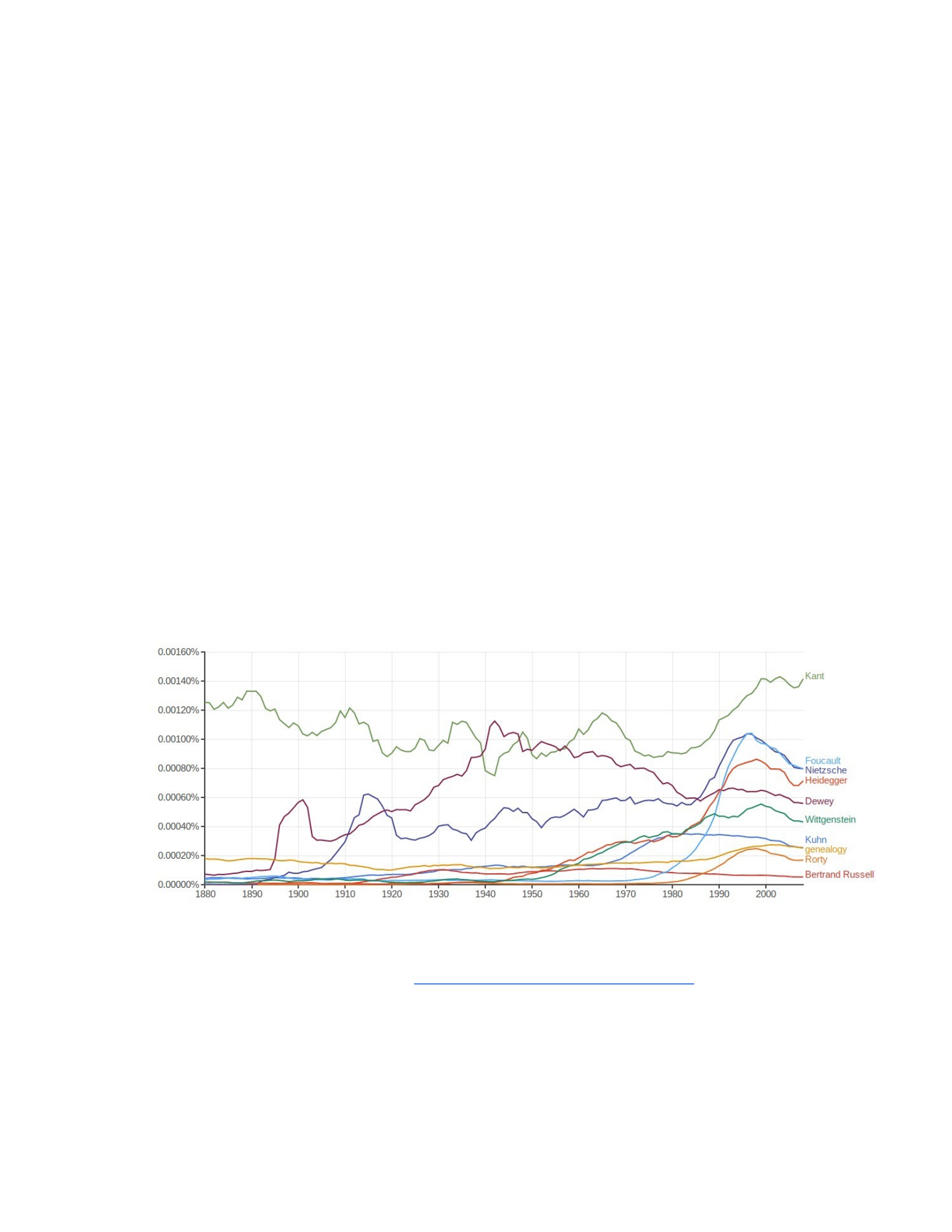
Ngram Viewer (Figure 1). After Foucault, and with the further openings
of poststructuralism and deconstruction, it was not that all of a sudden
truth became an issue, or metaphysics and realisms were finally thrown
out altogether. Perhaps it was more like the gradual erosion of the hope
and optimism of certain frameworks, certain starting points and guide-
posts, some of which were deeply embedded in Western thought
(being, truth, knowledge), and others of which were newer aspirations
(systematic logical systems and languages, structures within subjects
and cultures and histories, language and discourse), such that the old
order of things, even any order of things, became insecure, became an
inevitable niche position amongst a plurality of copings amidst an
increasingly postmodern and post-structuralist setting.
Figure 1: Philosopher References on Google’s Ngram Viewer.
Source: Google Books Ngram Viewer,
https://books.google.com/ngrams/ (see
also Michel et al., 2010)
However, the world of analytic philosophy, despite increasing
turmoil, still remained something of a recognizable school with an

underlying order. As for the turmoil of analytic philosophy—in an
opening created perhaps in part by the retreat of logical positivism, the
various problems within empiricism, and Kuhn—realism, and with it any
notion of truth dependent on realism, came particularly under attack in
the 70s.
Davidson, struggling against the implication of Kuhn for concepts in
general, wrote his impactful “On the Very Idea of a Conceptual
Scheme” in 1973. His central concern (arguably) was to save objective
truth from the Kuhnian threat of conceptual relativism, and his solution
was to give up the scheme-reality dualism: “Given the dogma of a
dualism of scheme and reality, we get conceptual relativity, and truth
relative to a scheme. Without the dogma, this kind of relativity goes by
the board” (p. 20). However, Davidson was cautious about giving any
substantial view of truth, and instead offered a stripped-down
disquotational account of truth: “The sentence ‘My skin is warm’ is true
if and only if my skin is warm. Here there is no reference to a fact, a
world, an experience, or a piece of evidence” (p. 16). Over the years,
Davidson struggled with the merits of disquotational or deflationary
views of truth inspired by Ramsay and Tarski (and picked up by Quine),
according to which there is no substantial definition of truth beyond
describing or ‘defining’ the logic of the truth predicate. (For some
discussion of such views in Horwich, Rorty, and others, see Davidson
1990.) Earlier, Davidson advocated for more exploration of a Tarski-

based correspondence theory of truth (2001, originally 1969). Later, he
admitted that Dummett helped him to see “the failure of Tarski's truth
predicates to capture completely the concept of truth” (1990).
Dummett’s work touched on truth from a variety of angles,
especially from issues in language and in considerations about various
realisms. Dummett followed in the steps of Wittgenstein in several
ways. First, he took up the theme of the examination of language as
central to philosophy. Second, and in a more specific manner than
Wittgenstein, he took seriously the idea of language as a plurality,
perhaps a plurality of games or discourses (or “seas”), each of which
could be examined separately on issues like realism vrs. anti-realism.
Third, he took up Wittgenstein’s focus on the use of language—
language as a practical ability or a practice—generally agreeing with
Wittgenstein’s notion that meaning is use: “The meaning of a
mathematical statement determines and is entirely determined by its
use” (Dummett, 1978, p. 216) and “To know a language is to be able to
employ a language” (Dummett, 1996, p. 4). In connection with this
picture of meaning, Dummett sensed a need to critique the truth-
conditional approach to meaning, offering instead a theory of meaning
based on a broadlyconstrued conception of verification (Dummett,
1976, pp. 67-137). As Putnam explained, “Understanding a sentence, in
[Dummett’s] semantics, is knowing what constitutes a proof (verification)
of it…. A primitive sentence... will be assertible if and only if verified….

The realist concepts of truth and falsity are not used in this semantics at
all” (1977, p. 487-88). Putnam, under the inspiration of Dummett,
retreated from his original belief in real realism, so to speak, into
“internal realism.” Putnam gave a logicism-based model-theoretic
argument against metaphysical realism as a major motivation for his
retreat, thereby continuing the analytic tradition of prioritizing logicism to
metaphysics. (By ‘logicism’ I am not referring to the more specific belief
in logic as fundamental to mathematics, but, loosely, as a sort of belief
in the foundational use of logic and logical models in studying broader
issues in language, epistemology, and metaphysics. For a clearer but
brief expression of this sort of logicism, see Davidson, 2001, p. 51.)
It was in this context of both new struggles—regarding Kuhn
(Davidson)—and old struggles—regarding the implications of logicism
and semantics upon realism
(Putnam)—that Rorty made an entrance with his monumental 1979
book Philosophy and the Mirror of Nature. In it and other writings, Rorty
broadly attacked an array of traditional methods and views regarding
truth, realism, and related issues, instead advocating for a pragmatic
approach which relinquishes foundationalism and representationalism.
On this view, rationality, truth, and knowledge all arise within and are
determined by social practices and as have no higher, socially-
transcendent foundation. Rorty claims inspiration from Wittgenstein,
Heidegger, and Dewey (p. 5), and though he mentions Nietzsche but

once (p. 4) and Foucault not at all, his method is highly historical and
genealogical in a way that bears a striking resemblance of Nietzsche. In
fact, its seems that Rorty’s main argumentation is genealogical—he
claims:
One way to see how analytic philosophy fits within the traditional
CartesianKantian pattern is to see traditional philosophy as an
attempt to escape from history-an attempt to find nonhistorical
conditions of any possible historical development. From this
perspective, the common message of Wittgenstein, Dewey, and
Heidegger is a historicist one. Each of the three reminds us that
investigations of the foundations of knowledge or morality or
language or society may be simply apologetics, attempts to
eternalize a certain contemporary language-game, social
practice, or self-image. The moral of this book is also historicist,
and the three parts into which it is divided are intended to put the
notions of “mind,” of “knowledge,” and of “philosophy,”
respectively, in historical perspective. (pp. 9-10)
I’m not convinced as to the merits of uniformly characterizing the
philosophies of Wittgenstein, Dewey, and Heidegger as broadly
historicist, but the method of giving a genealogical debunking is
(arguably) a straight-up mirroring of the methodology of Nietzsche’s On
the Genealogy of Morality (1887/1997). In fact, this seems to be the key
difference between Rorty and the classic pragmatists—that Rorty had a
strong connection, however weakly he initially acknowledged it, to
Nietzsche. Rorty would mention Nietzsche more in later work,
eventually commenting that “Simmel was wrong if he thought that
William James and Dewey got their ideas from Nietzsche, but he was
right that their views overlapped his” (2007, pp. 915-16), and Cornel

West similarly claimed that postmodern American philosophers were
“unconsciously prefigured by
Nietzsche” (1981, pp. 251-52). In Rorty’s APA address at the end of
1979, he refers to
Nietzsche as “more fashionable than James or Dewey” (1980, p. 720).
With Rorty, Nietzsche was becoming a more conscious prefigure.
One might expect that analytic epistemology struggled in the
wake of Rorty to reassess truth, objectivity, and the world, but perhaps it
is more accurate to say that with the ever-increasing specialization of
the discipline, and with the unique and somewhat awkward space of
Rorty’s thought, (or awkward for analytics anyways,) Rorty became just
one of the authors one could become entangled in responding to. For
instance, Nagel’s The View from Nowhere (1986) doesn’t respond to
Rorty directly but it does rethink and re-argue for pursuing objectivity
despite the Nietzschean threat of “false objectification” (p. 4) and the
broader threat of the movement of “historical interpretation” (p. 11). But
Nagel includes a significant cautious caveat: philosophy “is after eternal
and nonlocal truth, even though we know that is not what we are going
to get” (p. 10).
Other strands of analytic thought continued far more in the wake
of
Wittgensteinian considerations rather than those of Rorty. Crispin
Wright’s Truth and Objectivity (2009) is a central case of this. Wright
describes his project as “how we should best understand the contrast

between so-called realist and anti-realist views concerning different
areas of our thought and discourse, and of how the debate between
them might most effectively be prosecuted” (p. 1). There are at least
two aspects of Wright’s approach which show his affinity to Wittgenstein
(and often Dummett) over Rorty. First, he takes language as a plurality
with different ‘areas’ with potentially different games being played in
each area with its potentially “local truth predicate” (p. 174), rather than
adopting any of Rorty’s effectively uniform approach to all discourse. I
should note that my claim here could easily be disputed. On the one
hand, it is far from clear that Wittgenstein was pluralistic about
language in a way similar to Wright’s pluralism about truth. On the other
hand, Rorty would acknowledge differences in the details of different
linguistic practices—however, Rorty does make claims which are
uniform across discourse on big issues such as representation and
realism. The second aspect of affinity between Wright and Wittgenstein
is that Wright has a kind of deference to the ‘ordinary language’ of an
area of discourse—a sort of non-revisionist, Wittgensteinian ‘leave
things as they are’ approach—which seeks to derive the type of truth
predicate appropriate to a discourse as it stands: “from the standpoint
defended in the present study, the issue of truth aptitude is carried by
the syntax and internal discipline of the discourse” (p. 178). In contrast,
on Rorty’s view, an area of discourse which seems to assume a sort of
representational or transcendent view of truth could be diagnosed as

having a genealogical history rooted in Cartesian representational
thought. So while Wright attempts to dig up the workings of a discourse,
to uncover the characteristics making the discourse what it is, by
examining the “features of the local truth predicate” (p. 174)—Rorty’s
methodology allows him to dig in an additional direction, namely the
historical direction, whereby he can attempt to unearth the historical
genealogy of a discourse. Wright, following Wittgenstein, lacked this
historical dimension (see Sluga, 2011, pp. 86-91 regarding
Wittgenstein).
One might accept the relevance of examining the genealogy of
discourse and come to a different conclusion than that of Rorty. Bernard
Williams’ attempt at the issue of truth in Truth and Truthfulness (2002) is
such a case, whereby, ironically, there are various elements in Williams’
style, scope, and methodology which resemble Rorty. Williams mostly
shies away from engaging in the technical discussions surrounding truth
and semantics, instead warning against offering a definition of truth (p.
50), which was a thought that had occurred to Frege: “it is probable that
the content of the word ‘true’ is unique and indefinable” (1956, p. 291).
Williams spends far more effort employing a genealogical examination
of truth and truthfulness, specifically crediting Nietzsche regarding such
methodology (p. 15). But the main weight of Williams’ view stands in
opposition to Nietzsche and to Rorty (whom Williams specifically targets
on p. 9 and elsewhere). Williams insists on the importance of the

concept of truth, perhaps as a primitive concept (p. 50; resembling
Davidson, 1990). He associates truth with the virtue of accuracy where
accuracy involves “a sense of reality” (p. 92). This doesn’t necessarily
imply a literal realism, but it involves an acknowledgement that truth and
accuracy are separate from the determination of the subject’s will. The
technical analytic reader will find Williams vague (e.g., Elgin, 2005), as
Williams is more concerned with describing and upholding the virtue of
truthfulness and the value of truth in society, since he is worried that
such a virtue has been undermined by the likes of Rorty.
Williams wasn’t the only one concerned with Rorty’s attempt to
toss out epistemology. McDowell’s Mind and World acknowledges the
presence of Rorty from the beginning: “Rorty's work is in any case
central for the way I define my stance here” (2000, p. x). McDowell’s
method also bears some resemblances with Wittgenstein and Rorty:
My aim is to propose an account, in a diagnostic spirit, of some
characteristic anxieties of modern philosophy-anxieties that
centre… on the relation between mind and world…. I aim at
explaining how it comes about that we seem to be confronted
with philosophical obligations of a familiar sort, and I want the
explanation to enable us to unmask that appearance as illusion.
(p. xi)
Arguably, McDowell has picked up the diagnostic style of Rorty,
whereby he is mindful of questions like “how did such-and-such a
conception of empiricism arise?” and “how did such-and-such a
problem or anxiety within empiricism arise?” However, this resemblance
in methodology is limited. In contrast with Rorty’s attempt to undermine

the whole framework for doing epistemology, McDowell’s diagnosis is
more focused in its scope, as it focuses on problems and assumptions
arising out of Quine, Sellars, and Davidson and background
considerations about the nature of science, as well as the occasional
addressing of mistakes that arise from Cartesian thought. It’s as if
McDowell is augmenting particular diagnostic considerations into
mainstream epistemological issues and discussions—a sort of hybrid
enterprise. McDowell is attempting to make sense of mind and world
and the way mind transacts with world in human experience, and what
bothers him about Rorty is the loss of a world to transact with and a
proper sort of rational normativity—including an answerability, or
accountability—which governs such transactions and their import.
McDowell doesn’t clearly identify his position on the nature of
truth, as epistemology is more his point of entry. But comments such as
this—“When one thinks truly, what one thinks is the case. So since the
world is everything that is the case ..., there is no gap between thought,
as such, and the world” (2000, p. 27)—have inspired discussion
locating McDowell in the vicinity of an identity theory of truth,
reminiscent of G. E. Moore: “On [the] Moorean view facts, and hence
true propositions, are, so to speak, bodily chunks of mind-independent
reality” (Dodd, 1995, p. 161). This has motivated further discussion of
identity theories of truth (e.g., Hornsby 1997).

As this story draws to a close, in order to offer a taste of the
diversity of views about truth continuing into the 21st century, I will
mention three parties to the issue. First, Frank Jackson has remained
as a representative of the continuance of the representational approach
to truth (e.g., 2006), including truth in ethical discourse (2014, p. 721).
Second, the deflationary approach to truth that had been advanced by
earlier analytic philosophers and toyed with by Davidson has continued
to find a home in the work of Field (2001) and Horwich (2010). Finally,
although expressivism spent decades wandering the confines of
metaethics discussions, Price, under the influence of Rorty and
Blackburn, advocates for a global expressivism about all discourse in
Naturalism Without Mirrors (2011).
At this state we might ask whether Foucault and his
attentiveness to Nietzsche has finally seeped through the
consciousness of analytic thought. Since it took till the 90s for Foucault
to widely affect anglo scholarship, I measure here from 1990-2020,
restricting to English language content: JSTOR (ITHAKA, 2020) gives
70,788 hits for “Foucault”, 41,898 for “Nietzsche,” 25,062 for
“Wittgenstein,” and 60,295 for the perennial “Kant.” Narrowing the
search to philosophy for the same timeframe yields 7,232 hits for
“Foucault,” 11,310 for “Nietzsche,” 11,425 for “Wittgenstein,” and 23,198
for “Kant.” Clearly Foucault and Nietzsche have deeply affected, indeed
saturated, much of academic literature in the broader humanities. Yet

the story for anglo philosophy remains particular to itself, with perhaps a
reluctance to fully grapple with
Foucault and Nietzsche.
Schematization of Truth Issues in Analytic Philosophy
At this point, I want to offer one schema to help puzzle through
the issues surrounding truth with which analytic philosophers have been
grappling (and which will help us later). This schema offers seven
aspects of considerations regarding truth and neighboring issues, as
follows:
(1) method/criteria aspect: what are crucial aspects of
discourse(s) which we should attend to in order to base a
fuller account of it (heavily discussed by Wright 2009), such
as looking at the use of the language (Wittgenstein,
Dummett), bivalence or not (Dummett), cognitive command
or not (Wright), the role of evidence in assertions or in truth
ascriptions such as truth being evidentially-constrained
(Dummett, Wright), the best-explanation behind beliefs
(Wiggins, 1987), the broader "cosmological" explanatory role of
states of affairs
(Wright), or intersubjective convergence of beliefs under
favorable circumstances (Wiggins)? Alternative approaches
include anti-foundationalism (Rorty, 1980), anti-essentialism
(Rorty), and quietism (one interpretation of Wittgenstein).

(2) truth-concept aspect--what is the definition of truth, what is
the concept of truth used to do, how does it function. E.g.,
deflationary/minimalist (Quine, Field, Horwich), identity
(McDowell, Dodd, Hornsby), correspondence (Jackson),
coherence (Putnam, 1981), pragmatism (Rorty), truth-
pluralism (Wright), superassertability (discussed by Wright).
(3) metaphysical aspect, involving realism or anti-realism or
non-objectivism (e.g., relativism) about objects or facts.
(What is the metaphysical status of x, is it mind-
independently real?)
(4) causal aspect: stories about what leads subjects to make
judgments. This is where claims of projectivism (Blackburn,
discussed in Joyce, 2016) or dispositionalism or intuitionism
or some kind of rationalism (e.g., of a Platonic sort or a
Cartesian sort) come in (although they can also enter the
epistemological-normative seventh aspect more thoroughly).
(What causes someone to claim that p?)
(5) semantic aspect: what does someone mean when they
make a judgment.
This includes cognitivism (e.g., objectivism or error theory) or
non-cognitivism (e.g., expressivism or subjectivism), or
Wittgenstein’s meaning-as-use pragmatic approach to meaning.
We could also include the issue of reference, which quickly
verges into the metaphysical aspect.

(6) language use aspect: what is involved in using the language,
what is the point of statements, what norms of assertion are
at play, or what is the relevant language game (Wittgenstein).
E.g., Blackburn wants to justify discourse about moral truth
while being a metaphysical anti-realist.
(7) epistemological-normative aspect: does truth have a
normative import for our thinking, or at least, is truth closely
related to something which has a normative import for our
thinking (McDowell)? What is the right way to go about
attaining true beliefs (perhaps to achieve knowledge)—e.g., if
a foundational epistemological approach is right, then there
will be an account of properly foundational beliefs and proper
reasoning/warrant/justification.
Notes on the History of Analytic Philosophy
Starting with some recent grapplings with the creature known as
“analytic philosophy”: one brief stab by Rorty (1992, p. 347)
acknowledges the historical dynamics of analytic philosophy such as
the ebb and flow of the ‘linguistic turn’—a fair observation—but he
focuses only on identifying then-current (1992) analytic philosophy with
a set of central problems, which is a far too limited conception. Scott
Soames far more thorough history gives this historical description:
“Analytic philosophy is a trail of influence” (2003, p. xii). Leiter (2004)
offered comments to the effect that it is hard to currently demarcate

analytic philosophy and that a merging of ‘analytic’ and ‘continental’
philosophy is underway, which was a bit ironic considering how the
collection of papers which these comments introduce was titled The
Future for Philosophy and contained no contributions from continental
philosophers. Gutting (2005) notes this lack, and also suggests that
analytic philosophy can still be roughly demarcated: “Typically, analytic
philosophy reads experience in terms of common-sense intuitions (often
along with their developments and transformations in science) and
understands reason in terms of formal logic.” Elsewhere in Leiter’s
volume, Williamson associates good analytic philosophy with “logical
rigour and semantic sophistication” (2004, p. 128). Hacker notes that a
vague commitment to analysis is one underlying feature of analytic
philosophy, and comments on the ‘linguistic turn’ that “Language was
not the central theme of all analytic philosophy—rather the careful
examination of language and its use was a salient method of analytic
philosophy from the 1930s onward” (2007, p. 134). But his preferred
conception of analytic philosophy is as a historical phase or phases: “It
seems to me more fruitful and illuminating to use the term ‘analytic
philosophy’ as the name of a specific phase in the history of our subject”
(p. 125).
Aaron Preston gives a more detailed treatment, including a far
more thorough review of histories and conceptions of analytic
philosophy than I do here, in his Analytic Philosophy: the History of an

Illusion (2010). Preston argues that although a proper school of
philosophy should have a cohesive unity of doctrine or method, analytic
philosophy never even had such a unity to begin with: “One of the
fundamental theses advanced in this book is that to lack defining
doctrines is a devastating problem for something that purports to be a
philosophical school, movement or tradition” (p. 2). This lack-of-unity is
historically quite interesting, and though I cannot agree with Preston
that in itself this lack is a problem, Preston makes far more interesting
criticisms having to do with the illusions of unity or of agreed-on-
standards which have supported the broad social hegemony of analytic
philosophy, a hegemony which has left foundational questions largely
unasked—questions as to exactly what standards and methods are
behind what passes as “good” or “professional” philosophy (pp. 17,
156).
In order to respond and make sense of this problematic of how to
understand analytic philosophy, my own view borrows mostly from a
couple of ideas from Sluga. First, in approaching the nascent issue of
analytics making sense of their own history, Sluga notes that analytic
philosophers were not trained to think historically (1998, p. 104). Sluga
suggests that the lens of Foucauldian discursive analysis might help in
this regard, and offers the idea that at the bottom of “all talk about
philosophical schools, movements, and traditions, lies (a) the
recognition of similarities and (b) that of causal relations” (p. 106).

Sluga’s approachcan also be seen as a way of elaborating
Wittgenstein’s notion of a ‘family resemblance’ term (as evidenced by
Sluga, 2011, p.
87).
In analytic philosophy, these causal relations include lines of
influence, such as causes of intellectual inspiration or admiration in the
encountering of the work of an analytic philosopher, which influence
subsequent generations of students. But they also include more broadly
(and often mundanely) the relations of advisor-student descent, of
attentiveness to a certain cannon of important literature, of co-mingling
at certain respectable venues (e.g., APA conferences), of a sort of
partial anglo-insulation afforded by what might be termed the ‘natural
barrier’ of the English language, and of various expectations and
attitudes interwoven into the practices of academic philosophy (e.g.,
surrounding the desirability and status of ‘professor’).
The characteristic similarities will vary in terms of whether they
are aspects of doctrine or methodology or practice or central
problems, how obvious and conscious they are, how consistent and
widespread they are, and so forth. Some important similarities in the
area of doctrine and method include (1) attentiveness to the
importance or priority of language, (2) analyzing something (concept,
term, sentence, etc.) in terms of something else which clarifies the
former item, and (3) more controversially, what might be called an

immanent starting point, such as empiricism or naturalism or scientism
(Preston, 2010, p. 122), or common sense (Gutting, 2005). A similarity
in practice is the ‘lit review’ or the expectation that one will situate
oneself within ‘the literature,’ typically meaning relevant analytic
literature.
Navigating the Boundary of Analytic Philosophy
We are now perhaps better positioned to ask and to answer the
following question: is it the case, as Foucault elaborated, within the field
of discourse of analytic philosophy “the production of discourse is at
once controlled, selected, organized, and redistributed” (1972, p. 216)
in a way which excludes and prohibits and distinguishes it from
unqualified philosophy—or, as Leiter proposed, is the boundary
between analytic philosophy and continental philosophy dissipating and
obsolete? I will give two pieces of evidence in support of the former
idea: analytic discourse has been controlled and selected in a
somewhat protective, insular, and conservative way.
First, as noted earlier, looking at the raw empirical ‘archive’ of
documents, recent anglo philosophy has shown a sort of reluctance to
speak all that much about Nietzsche, and a far greater reluctance to
speak about Foucault, relative to awareness of Nietzsche and Foucault
both in anglo academic articles and in the google ngram data. All this is
reflected in the more specific story of truth within analytic philosophy:
writers like Davidson, McDowell, and Wright show a separation from the

thoughts of Nietzsche and Foucault and other continental thinkers. This
same pattern is also quite evident in the history of the history of analytic
philosophy which was briefly examined in the last section, as noted by
Sluga (1998, p. 104).
Second, the standards of writing within academic philosophy are
generally maintained in a traditional manner. Grad students in analytic
departments are trained to talk and write clearly, narrowly, and in a way
that often analyzes or discusses the analysis of key terms and concepts
which have been attended to by previous analytic philosophers (and
which allows for a decent lit review). Even if a particular advisor
becomes flexible with such standards, mainstream analytic journals
reinforce these standards quite strictly.
In other words, I claim that analytic philosophy has been
relatively isolated from a variety of outside factors and dynamics. It has
largely separated itself from cultural and technological developments,
and it has largely remained separate from continental philosophical
developments, such as historicism, Foucault, phenomenology,
poststructuralism, and deconstruction. Obviously analytic philosophy is
not entirely insular, because various non-conforming ‘renegades’ (which
I will discuss in Chapter 3) are able to reach popularity and readership
within analytic circles. But there does seem to be a greater
conservatism of methodology and central problems than in the looser
collection of ‘continental’ thinkers.

I believe that this conservatism has led analytic philosophy to
largely maintain a modernist (or ‘encyclopedic’) approach to truth, and
to neglect broader dialogues about the history of truth and versions of
the history of truth. These broader dialogues will start to open up over
the course of the next three chapters.
‘Modernist’ or ‘encyclopedic’ is quite broad, so, one way to
examine more specifically analytic concerns about truth is to consider
the schematization of truth issues offered outlined above and to
examine how that differs from the issues surrounding truth in non-
analytic philosophers such as Nietzsche and Foucault. For
Nietzsche and Foucault, we could start a sketch of truth-issues in the
following manner. History would have to be involved: how does truth
arise in and get framed by history, and perhaps conversely, how does
history arise within truth; or just more generally, how do truth and history
relate? Sociology would also be involved, especially the role and
working of power within society (or society within power), so how do
society and power relate to truth? Such a collection of issues would
include two notable places of overlap with the issues for analytics. One
place is in the view of language use: e.g., Foucault depicts truth claims
being part of the dynamics of power relations and as part of regimes of
power or regimes of truth-and-power—a notably different approach from
analytic philosophy of language. The other is in the causal aspect.
Continental thought takes up this aspect with a historical, sociological,

and phenomenological awareness: what causes or leads to truth might
involve a sociological story, a historical-genealogical story, a
phenomenological story, and/or an evolutionary-genealogical story. This
too feels like quite a different approach from analytic philosophy.
However, historical awareness, including the idea of giving a genealogy,
has actually also gained traction in analytic thought: genealogy has
often come up in considerations about truth, e.g., in John Mackie
(1977), Putnam (1981), McDowell (2000), and Williams (2004). And yet
these discussions pay little-to-know attention to any continental thought
about history or genealogy or phenomenology. It is in the thinkers on
the fringes of the analytic boundary—such as Rorty (1979), MacIntyre
(2007), and Sluga (2014)—thinkers who interact with analytics but are
not exactly analytic themselves—where the conscious dialogue with the
likes of Nietzsche, Foucault, Hegel, R. G. Collingwood, Carl Schmitt,
and Hannah Arendt is able to occur.
I am trying to join in (and motivate my joining in with) those
conscientious fringe efforts. Nietzsche and Foucault have made large
waves in thought and culture due to their revolutionary ideas and
reinterpretations of history—including their reinterpretations surrounding
truth—but this has largely been excluded from analytic discussions of
truth, since they are not part of the reputed trails of thinkers; they
(mostly) don’t have a legitimate place within the respected network of
references. Furthermore, this kind of exclusion is part of the whole

insulated culture of analytic philosophy, wherein “analytic philosophers
managed to alienate academic philosophy both from other academic
disciplines and from the general public” (Preston, 2010, pp. 314-15). On
the small scale, more specifically, my motivation to turn to Nietzsche
and Foucault is that they seem to have powerfully threatened, and
perhaps undermined, objectivity and realism regarding truth—they do
this by attending to the genealogical and sociological factors in which a
claim is asserted, legitimized, and held to be true. They are focused on
the causal origins of truth and the operations of truth. But whether one
looks directly at their writing, or one looks at the non-philosophical
disciplines influenced by them, or one looks at the analytic philosophers
who pay little attention to them, it is not exactly clear what their
arguments or positions are. So Chapter 2 will examine the perspectives
on truth in Nietzsche and Foucault, thinkers outside the analytic canon.
It seems that we have started the attempt to redeem a dream by
retracing our steps through the retracing of past dreams. Overall,
analytic philosophy is just one stage or stream in the thinking of truth,
and the dream of truth, in Western culture—and it is a thinking which
tends not to retrace its place within a long history. As we look outside of
mainstream analytic philosophy for the remainder of this dissertation,
we will need to be more aware of the dual layers of (1) offering a dream
about truth and (2) offering a narrative about the history of truth.

Chapter 2: The Outlaws: Foucault and Nietzsche
Boundary-Crossing Dynamics and Content
In the next two chapters I will be describing various recent
thinkers who attempt to cross various boundaries of mainstream
thinking in regard to truth. I aim at simultaneously describing these
efforts and attempting to join them through critical discussion. On the
large scale, my motivation is that Nietzsche and Foucault have made
large waves in thought and culture due to their revolutionary ideas and
reinterpretations of history—including their reinterpretations surrounding
truth—but this has largely been excluded from analytic discussions of
truth, since they are not part of the reputed trails of thinkers; they
(mostly) don’t have a legitimate place within the respected network of
references. Furthermore, this kind of exclusion is part of the whole
insulated culture of analytic philosophy, wherein “analytic philosophers
managed to alienate academic philosophy both from other academic
disciplines and from the general public” (Preston, 2010, pp. 314-15). On
the small scale, more specifically, my motivation to turn to Nietzsche
and Foucault is that they seem to have powerfully threatened, and
perhaps undermined, objectivity and realism regarding truth, by
attending to the genealogical and sociological factors in which truth
arises, behind which a claim is asserted, legitimized, and held to be
true. They are focused on the socio-historical origins and operations of
truth. But whether one looks directly at their writing, or one looks at the

non-philosophical disciplines influenced by them, or one looks at the
analytic philosophers who pay little attention to them, it is not exactly
clear what their positions are, let alone their arguments, let alone
whether their arguments or narratives are any good. So below the
surface story of “crossing the boundary,” I intend to keep these
questions in mind and to think critically about what the boundary-
crossers have to say about such issues.
There are various ways to cross a boundary—discuss it, debunk
it, critique it, deny it, ignore it, go around it, stumble unconsciously
across it. One can cross it with one foot and try to straddle the
boundary, or one can hop completely over it. In the process one can
carry disdain, scorn for one side or for the boundary; one can carry
sorrow and pain; one can carry hope and vision; one can emphasize
the gap; or one can try to bridge it. Boundary-crossing is a profoundly
moral, and character-building or character-altering, activity. It is moral
both in its interpersonal aspect, with our treatment of and attitude
towards those other characters involved whether dead or alive, and in
our pursuit of thinking well.
For the purpose of this chapter and the next, I want to propose a
way of categorizing boundary-crossers in terms of where they are with
respect to mainstream boundaries (including, where relevant, analytic
philosophy boundaries). First, outlaws are the thinkers who forged their
own trail in a manner which flaunted various mainstream boundaries

and manners of thinking—this is how I see Nietzsche and Foucault.
Another type we can think of as ambassadors: these are thinkers who
remain within the mainstream but try to bridge the gap between
mainstream thought and outlaws—this is how I see Ian Hacking (2002)
and Bernard Williams (2004). Finally, there are renegades who forge a
path somewhere in-between the mainstream and the outlaws but who
aren’t concerned with giving their full loyalty to either side. If one is fairly
loose with the category of renegade, then one can include thinkers as
diverse as
Rorty, MacIntyre, and Sluga.
In my makeshift categorization, both ambassadors and
renegades operate in a context already impacted by the ‘outlaws’
Nietzsche and Foucault. Thus, I will start in this chapter with these
metaphorical outlaws
Although I find the ‘ambassadors’ interesting, in my opinion the
‘renegades’ contain more unique contributions in the development of
truth. So, partly due to space limitations, in Chapter 3, I will skip the
ambassadors and proceed to the renegades.
As I discuss the outlaws and renegades, I intend to be receptive
to how their approach to boundary-crossing yields lessons or questions
with respect to truth, with the goal of understanding their motivation for
the perspective they advocate with respect for truth, as well as
understanding other aspects of the case which they build in support of
their perspective.

Nietzsche and Foucault’s boundary crossings did not have
anything to do with crossing the boundaries of analytic philosophy, but I
will explore how boundary-crossing was a significant feature of how
they operated in their respective contexts. The distinct differences
between their manner of boundary-crosssing reveals some striking
differences in character—almost as if Nietzsche is a “Joker” type of
villain who mocks boundaries and plays with a plurality of approaches
to truth, whereas Foucault is more of a serious mastermind operating
outside of conventional ‘law’ who attempts to undermine and reverse
traditional approaches to truth and theory. For each thinker I will first
explore their boundary-crossings, and then connect their boundary-
crossings to their approaches to truth.
Nietzsche
Boundary Crossing
Nietzsche strikes me as challenging and crossing at least two
significant boundaries. The first is that of writing genre. He puts forth an
eclectic mixture of literature and prose, interspersing into his thoughts
not just the use of fictional characters like Zarathustra, but sporadic
bursts of his own emotions, repulsions, and frustrations—as if there is
no separation between his private notebook and his published works;
as if he were narrating his own travails through a backwards world. The
other boundary with which Nietzsche grappled had to do with his
identity: the boundary between that of a professional academic with a

perhaps marginal yet stilldefined and named place in society, and
something else, a new identity which was ever a work-in-progress—
perhaps a poet, a nomad, a prophet, or a philosopher of the future.
MacIntyre’s Three Rival Versions (1988/2003) makes a
fascinating connection between Nietzsche’s rebellion against the
academic conventions and ethos of his time and his rejection of the
associated optimistic ‘encyclopedic’ approach to rationality:
The audience [to a lecture] came to hear and to learn from
authoritative, encyclopaedic pronouncements…. It is therefore
unsurprising that one of the two most notable nineteenth-century
rejections of the encyclopaedists’ conception of knowledge and
of rationality should have been accompanied, indeed preceded
by an abandonment of the lecture itself as a genre. (p. 33)
Departure from ethos of the university life started out, perhaps, from a
desire for a purer pursuit of truth than that afforded by the academy:
“his departure not only from the university but from bürgerlich
[bourgeois] society into the self-imposed exile of one without any fixed
home expressed in his life the thought that much earlier he had uttered
in a letter to Erwin Rohde: ‘No genuinely radical living for truth is
possible in a university’ (December 15, 1830 [sic])” (p. 35). But
Nietzsche’s suspicious gaze then turned to question truth itself (p. 35).
To add a bit more depth to MacIntyre’s account, there are a
couple of connecting routes between Nietzsche’s approach to
boundary-crossing and his approach to truth. One route is that
Nietzsche realized that truth was a deep value pervading western
history and culture, including academic culture. Thus, with his suspicion

of the values and culture of his time leading him to strive for a
“transvaluation of all values” (1895/2015, p. 13), he was inevitably led to
question the value of truth. But the more comprehensive route is that
his resentful approach to boundary-crossing (I refer to Nietzsche’s own
resentment) led him to dig up the ground which he was rejecting with
shovels of mockery, suspicion, and skepticism, and as he dug deeper
into that ground, he finally unearthed the sacred notion of truth, leading
him to a project of transconceiving (rethinking and reapproaching) truth.
Truth in its Social Functioning
As we turn now to the content of what Nietzsche says about
truth, we should be aware of several ways in which this background
shapes Nietzsche’s approach. First, his first priority and focus is to
criticize and subvert conventional views, rather than to give a fully
formed view of his own. Second, Nietzsche’s opposition to conventional
philosophy included an (almost dogmatic) opposition to being a
dogmatic and systematic thinker— to seeking a final “once and for all”
view. See, for instance, Twilight of the Idols
(1889/1998, p. 26), The Will to Power (WP) (1901/2017, p. 470), and
Beyond Good and Evil (BGE) (1886/2016, pp. 1-3, 43). Third, part of
Nietzsche’s reactionary difference in style is that he will jump from one
discussion or mode to another, making it tricky to interpret when he is
speaking directly interpretatively of what others think, or tongue-incheek
as an expression of herd-perception of truth or conventional-

philosophyperception of truth, or when he is throwing out his own idea
(and how settled he is in that idea). (A passage on Kant in WP, p. 530
illustrates the switches between direct interpretation, tongue-in-cheek
mockery, and Nietzsche’s own responses.) Even when he puts forth his
own ideas and says things like “truth is X” (e.g., WP, p. 493, 533), we
have to ask whether he is giving an aspect of how truth operates
psychologically, how it operates sociologically, how it operated in its
historical genesis, how it is or was perceived by others, or a kind of
attempt at a definition or essential aspect. So it is not surprising that on
such a big topic as truth Nietzsche gives many scattered thoughts,
some of which are quite vague, some of which seem contradictory,
leaving in the end a very rich playground for secondary literature.
Secondary literature on Nietzsche in analytic philosophy can be
tempted to try to extract a single theory of truth from Nietzsche—
perhaps get the one view which captures and makes sense of the most
of what Nietzsche says about truth (e.g., this is how I see Hussain,
2004). In light of this, I see Clark (1990) as a step up, because she
examines Nietzsche’s development over time and considers a variety of
influences on Nietzsche, a variety of Nietzsche’s works and ideas, and,
thence, a sort of developmental process in Nietzsche regarding the
issue of truth. This chapter will not comprehensively respond to Clark,
but it intends to approach the issue of truth in Nietzsche from the
perspective that Nietzsche was not a systematic thinker aiming at

establishing ‘commitments’ and ‘positions’ (focal terms for Clark), but
rather a thinker who played with a variety of ideas and expressed the
process of his thoughts rather than offering settled committed positions.
Also, my approach is admittedly weak in exploring Nietzsche’s
relationship with empiricism or positivism or naturalism—an aspect
which has gotten substantial attention in analytic philosophical literature
(partly in connection with Clark’s work)—but I do acknowledge that
positivism is one important area of ideas which Nietzsche toys with.
When Nietzsche asks “What then is truth?” (1979, p. 84) in “On
Truth and Lies in a Nonmoral Sense,” we soon discover Nietzsche’s
priority of giving a subversive genealogy rather than a definition. This
essay might just as well have been named “Genealogy of Truth,” or
even, “Genealogy of Truth, Language, and Concepts.” For in it he
employs the same suspicious everyday-view-is-but-mask genealogical
method which he will later apply in On the Genealogy of Morality (which
in this chapter will be abbreviated as GM): truth is “A movable host of
metaphors, metonymies, and; anthropomorphisms: in short, a sum of
human relations which have been poetically and rhetorically intensified,
transferred, and embellished” (1979, p. 84). More specifically, one
genealogical explanation of truth is that the intellect uses the “device” of
the apparent power of knowing, and the accompanying pride of
anthropological “knowledge” wherein “the eyes of the universe [are]
telescopically focused upon [the knower’s] action and thought,” to

detain people “a minute within existence. For without this addition they
would have every reason to flee this existence” (pp. 78-79). In other
words, knowledge is an anti-depressant medication. The second
genealogical explanation is that to exist in social peace and banish war
of all against all, “a uniformly valid and binding designation is invented
for things, and this legislation of language likewise establishes the first
laws of truth” (p. 81). In other words, truth is the outworking of a social
contract. Combining these two explanations: truth as it appears is a
mask or mechanism through which the will-to-survive operates both
psychologically and socially.
In GM, Nietzsche adds a more directly moral side to the
‘nonmoral’ genealogy just given. This moral genealogy seems more
particular, at least in much of its content, to the history of western
society, though it is a bit short on historical details and in justifying its
occasional attempt to apply its ideas beyond western society, such as to
Buddhism. It gives particular attention to the “will to truth,” rooted in the
deeply ingrained sacred value of truth in western society: “the
compulsion towards it, that unconditional will to truth, is faith in the
ascetic ideal itself, even if, as an unconscious imperative… it is the faith
in a metaphysical value, a value as such of truth as vouched for and
confirmed by that ideal alone” (III.24). This faith shares a history with
monotheism: “that faith of the Christians, which was also Plato’s faith,
that God is truth, that truth is divine”

(III.24). The story behind the story is that the whole ascetic ideal with its
will to truth “offered man a meaning” (III.28) to the emptiness and
sufferings of life—a “selfanaesthetic” (III.23)—echoing the
forementioned story told in “Truth and Lies in a Nonmoral Sense.”
Nietzsche points the reader (III.27) to look for a continued treatment in
WP.
The reader will not be disappointed if they are willing to dive into
the maze that is WP, which is a long collection of notes (posthumously
published) with various thoughts on truth and its role in nihilism. (Which
is not to say that the reader will not end up confused as well!) WP adds
further extension and depth to Nietzsche’s genealogy of truth, with a
new emphasis—whereas “Truth and Lies in a Nonmoral Sense” focused
on the genealogy of truth and language in general, WP gives particular
genealogical explanations of scientific, logical, and philosophical ideas
and conceptions connected to truth. The general approach he employs
might be called “psychological genealogy” and was introduced in
Chapter I of BGE:
It has gradually become clear to me what every great philosophy
up till now has consisted of—namely, the confession of its
originator, and a species of involuntary and unconscious auto-
biography; and moreover that the moral (or immoral) purpose in
every philosophy has constituted the true vital germ out of which
the entire plant has always grown…. In the philosopher… there
is absolutely nothing impersonal… his morality furnishes a…
testimony as to… in what order the deepest impulses of his
nature stand to each other. (p. 6)
He terms his method “the Morphology and DEVELOPMENT-
DOCTRINE OF THE WILL

TO POWER” (p. 23). However, Nietzsche’s relationship with what
counts as
“impersonal” and “nature” and the “soul” is a bit complicated, as he
often expresses skepticism and mockery toward traditional
psychological concepts while sometimes referring to them in his
genealogies (see Anderson, 2017 for a discussion). Nietzsche does
offer a helpful thought on reconceiving the soul: “the way is open for
new acceptations and refinements of the soul-hypothesis; and such
conceptions as ‘mortal soul,’ and ‘soul of subjective multiplicity,’ and
"soul as social structure of the instincts and passions," want henceforth
to have legitimate rights in science” (BGE, p. 12). It seems that the “will
to power” operates through instincts, passions, drives, and wills, largely
unconscious, which then lead to more conscious purposes, operations,
and perspectives.
WP really employs this method of psychological genealogy with
detail. This method is first applied to philosophers in the chapter titled
“Criticism of Philosophy” (pp. 406-465): “I try to show what instincts are
active behind all these pure theorists…. The so-called thirst for
knowledge may be traced to the lust of appropriation and of conquest:
in obedience to this lust the senses, memory, and the instincts, etc.,
were developed” (p. 423). Then, this method is further broadened the
chapter “The Will to
Power in Science” (pp. 466-617). A better title of this chapter would
have perhaps been “The Will to Power in Reason, Logic,

Consciousness, and Science,” since the guiding idea seems to be to
give a psychological genealogy of all these fields wherein the will to
power is asserted as the fundamental operating force. In pp. 470ff,
Nietzsche opposes various assumptions in epistemology such as
“human reason must be right” (p. 471), the idea that there are “‘facts of
consciousness’” (p. 472), and the idea that the consciousness is
something we can know as “a ‘thing-in-itself’” (p. 473). But more to the
genealogical point, he claims that we must look at conscious
phenomena, including pleasure and pain as well as thoughts, as final
effects (p. 478) of underlying psychological processes, especially the
motive force of preservation/survival and increase of power: “the
measure of the desire for knowledge depends upon the extent to which
the Will to Power grows in a certain species” (p. 480). In pp. 493ff,
Nietzsche offers a genealogical picture of ‘knowledge’ in general, which
is connected to ‘truth,’ and behind which lies the drives for ‘life’ and
‘power’: “Truth is that kind of error without which a certain species of
living being cannot exist. The value for Life is ultimately decisive” (p.
493), and “the sense of truth is the means wherewith the power is
appropriated to adjust things according to one’s taste” (p. 495). In pp.
508ff, we get a psychological genealogy of reason and logic. It starts
with desires: “The kingdom of desires out of which logic grew: the
gregarious instinct in the background” (p. 509), and “The fundamental
proneness to equalise things and to see them equal, gets to be

modified, and kept within bounds, by the consideration of what is useful
or harmful” (p. 511). This leads to “The inventive force which devised
the categories… ‘substance,’ ‘subject,’ ‘object,’ ‘being,’ ‘becoming,’ are
not matters of metaphysical truth. It was the powerful who made the
names of things into law” (p. 513). The principle of noncontradiction and
the axioms of logic are “means by which alone we can create realities,
or the concept ‘reality’” (p. 516).
One interesting feature of Nietzsche’s genealogical method is
that it presented as uniform across all domains of thought, including the
realm of morality: the genealogical process is “Exactly the same”
between the genealogy of moral concepts and “the categories of
reason…. They may have been the expression of no more than a
certain practicality answering the ends of a race and a species, —their
usefulness alone is their
‘truth’” (WP, p. 514; see also BGE, p. 211).
But, to transfer an important lesson from MacIntyre’s After Virtue
about the difference between meaning and use, these genealogies are
not so much theories of the meaning of truth-claims or the meaning or
ontology of “truth.” Rather, they are, or they start as, theories of how
truth originates and how it functions behind the consciousness of its
users. We can now ask: does this whole genealogical picture actually
yield a picture not just of how things become accepted ‘truths,’ but of
some kind of theory about truth itself, and whether there is any way we

can operate outside of the herd-pattern of ascertaining ‘truth,’ and
whether this requires a trans-conceiving of truth?
Searching for Truth Beneath Truth’s Social Functioning
As mentioned before, Nietzsche does not come to us with a
straightforward theory and argumentation for his theory, but he does
give a scattering of intriguing ideas, some of which seem to be more
stable theses. For instance, he repeatedly seems to assert a dichotomy
between his genealogical approach and conventional approaches to
truth. Conventional approaches assert that ‘truth’ captures the
possibility of some kind of objective contact with or apprehension of
reality, a possibility which excludes bias, creativity, or conceptual
construction. In the process of giving his genealogical story, Nietzsche
repeatedly stresses that conventional pictures of objectivity are
impossible: the idea of a “pure, will-less, painless, timeless, subject of
knowledge” is a “fairy-tale” (GM, III.12), there is no ‘pure reason’ or
‘knowledge as such’ (GM, III.12), we have no thought free of
interpretation (BGE, p. 22; WP, pp. 477, 481), and even basic meanings
attached to all facts are infused with values: “‘it is worth’ is actually what
is meant by ‘it is,’ or by ‘that is’” (WP, p. 556). Thus, there is no
objective ‘view from nowhere’—all we can have is perspective from a
point of view (GM, III.12; WP, pp. 15, 481) So whatever counts for truth
rather than merely ‘truth’ would still have to involve interpretation and

would always be perspectival and created by the ‘subject’— and yet
even the ‘subject’ is an interpretation or invention (WP, p. 481).
But many aspects of this view and passages about it are far from
clear in their implications. Truth is created or made: the individual “has
to give an individual meaning even to traditional words and notions. His
[sic] interpretation of a formula is at least personal, even if he does not
create the formula itself: at least as an interpreter he is creative” (WP, p.
767)—and everything in our consciousness is interpretation. We make,
or construct, the world: “the sense of truth is the means wherewith the
power is appropriated to adjust things according to one’s taste…. We
can only take cognisance of a world which we ourselves have made” (p.
495), and this is the only way to have a ‘world’: “As if a world could
remain over, when the point of view is cancelled!” (p. 567). But does this
mean that truth is mere creation, a creation without limit? Nietzsche
likes to use dramatic words like “mere” or “alone” but what do they
really mean? E.g., “Of what alone can knowledge consist?
—‘Interpretation,’ the introduction of a sense into things, not
‘explanation’ (in the majority of cases a new interpretation of an old
interpretation which… [is] little more than a mere sign)” (p. 604). It
seems reasonable to interpret this as not being a totally unrestrained
relativism, not truth as mere creation, since truth combines sense with
thing, interpretation with text; truth as relationship. One can always add
complicating passages, however: “Man ultimately finds nothing more in

things than he himself has laid in them” (p. 606) seems to question
whether there is any contribution whatsoever by the thing. And
Nietzsche frequently denies a “real world” (p. 566) and things-in-
themselves (pp. 557-558)—while p. 516 is more complicated, both
suggesting that we create realities and the concept ‘reality,’ and
seeming to assume reality: “more exactly, [logic] is our attempt at
making the actual world more calculable.”
But truth as relationship does seem to be a theme: in BGE’s
preface, Nietzsche suggests that truth is like a woman who has been
pursued by dogmatists but never won because they misunderstand her.
To continue with, so to speak, with Nietzsche’s transmetaphoring—
meaning his creation of new metaphors to replace the old—he adds the
metaphor of friendship: “Will they be new friends of ‘truth,’ these coming
philosophers? Very probably, for all philosophers hitherto have loved
their truths” (BGE, p. 43). Knowledge is a relation, even a power
relation: “Knowing means ‘to place one’s self in relation with something,’
to feel one’s self conditioned by something and one’s self conditioning
it” (WP, p. 555). The perspective of the knower contributes to truth: “The
answer to the question, ‘What is that?’ is a process of fixing a meaning
from a different standpoint…. Fundamentally the question is ‘What is
that for me?... A thing would be defined when all creatures had asked
and answered this question” (p. 556).

Resolving Truth: a Four-Fold Divergence
The final aspect to the story is to ask whether there are better or
worse ways of interpretation, of assigning meaning, of asserting things
—is there any real difference or standard governing interpretations, so
that some might be called true or better than the
“errors” Nietzsche often denounces? This question, perhaps, is the
trickiest for Nietzsche. There are plenty of passages where he seems to
characterize truth as operating the same way everywhere, namely as
interpretation and creation and expression of will to power, and he goes
so far as to call truth “error”: “Truth is that kind of error without which a
certain species of living being cannot exist. The value for Life is
ultimately decisive” (WP, p. 493). But frequently it seems obvious that
he still wants to assert difference; to present a better way of thinking, a
better ‘truth.’
It seems that Nietzsche has a mixture of about four different
pictures of doing this—of solving truth. The first picture is the most
conventional: real truth overcomes bias, or more accurately, bad
interpretation. Bad interpretation is comparable to bad philology, and
involves naivety and “perversion of meaning” (BGE, p. 22) and “error”
(WP, p. 531). The Preface of GM also speaks in this spirit, as being
written from “a fundamental will to knowledge deep inside me which
took control, speaking more and more clearly and making ever clearer
demands. And this is the only thing proper for a philosopher” (p. 2). He

even speaks of controlling pain and pleasure and sacrificing desirability
in the pursuit of unbiased truth (p. 1), and of a new “criterion of truth”
(WP, p. 459). Admittedly, I am being sloppy about this picture, because
I am combining a whole host of places where Nietzsche toys with
empiricism, positivism, and even neoKantianism (as discussed by
Hussain, 2004). As Hussain (2004) and Clark (1990) touch on, these
are ideas which affected Nietzsche and which he toyed with in what
might be called his middle period, meaning roughly the 1880s or early
1880s, before his mockery or abolishment of ‘the apparent world’ in
Twilight of the Idols (1889/1998).
The second presentation of a high road is one which Nietzsche rarely
discusses:
it is something like the combining or accumulating of more and more
perspectives to get a fuller picture—“There is only a perspectival
seeing, only a perspectival ‘knowing’; and the more affects we allow to
speak about a matter, the more eyes, different eyes, we know how to
bring to bear on one and the same matter, that much more complete
will our ‘concept’ of this matter, our ‘objectivity’, be” (GM, III.12; see also
the abovementioned WP, p. 556).
The third way to better approach truth is a conscious and active
channeling of the will to power. In GM this seems to be a power in
actively pursuing knowledge: “future ‘objectivity’… understood not as
‘contemplation without interest’ (which is, as such, a non-concept and
an absurdity), but as having in our power the ability to engage and

disengage our ‘pros’ and ‘cons’: we can use the difference in
perspectives and affective interpretations for knowledge” (GM, III.12).
But BGE and WP go further, embracing a broader sort of creative
power: “THE REAL PHILOSOPHERS, HOWEVER, ARE
COMMANDERS AND LAW-GIVERS; they say: "Thus SHALL it be!"…
Their "knowing" is CREATING, their creating is a law-giving, their will to
truth is—WILL TO POWER” (BGE,
p. 211). WP pp. 515-517 seems to suggest that this includes the power
to wield contradictions, since “The inability to contradict anything is a
proof of impotence but not of ‘truth’” (p. 515). Additionally, WP, pp. 533-
544 contain a tricky section on truth, positing various claims: “‘true’… is
“the highest degrees of activity which awaken belief in regard to the
object” (p. 533), “The criterion of truth lies in the enhancement of the
feeling of power” (p. 534), and “What is truth?—Inertia; that hypothesis
which brings satisfaction, the smallest expense of intellectual strength”
(p. 537). But reading p. 537 together with p. 538 reveals that this
approach to truth in p. 537 is the ‘truth’ of the herd rather than some
higher road. It is less clear whether the prior two quotes (pp. 533 and
534) also depict the herd’s pursuit of truth, but my interpretation is that
these also depict the herd and reveal the difference between the herd
and the real philosopher: the herd’s approach to truth is a passive,
reactive, and unconscious channel of the will to power, whereas the real
philosopher is an active, creative wielder of the will to power (which

perfectly fits with the whole of BGE, p. 211). Finally, one might think that
this whole third approach fits in perfectly with the aesthetic strand of
Nietzschean scholarship (e.g., Nehamas, 1985)—perhaps truth is
artistically created. However, Nietzsche actually places a separation
between art and truth (WP, pp. 822, 853). WP mostly emphasizes
activity and power as the approach to truth, not art.1
However, there is at least one place where Nietzsche elevates
art. I am deeming this as a fourth approach to truth: let us call it truth as
artwork. As often happens, Nietzsche is not clear about this; there is a
hint that art might be an overcoming of truth, that truth be abandoned or
overcome in favor of lies and through the higher pursuit of art: “We are
in need of lies in order to rise superior to this reality, to this truth…. Man
must already be a liar in his heart, but he must above all else be an
artist” (WP, p. 853). Art seems to be above truth: “Art and nothing else!”
(WP, p. 853) But, more precisely, this means that we already artists of
truth: “Metaphysics, religion, morality, science, all these things are but
the offshoot of [man’s] will to art,” so that a person is a “genius in
prevarication!” and a “tragic seeker after knowledge” (WP, p. 853). One
cannot help but to think that Nietzsche embodies this in his writings and
perhaps in his life more generally: as he wrote about truth, he rejected a
cold academic prosaic style in favor of what must be described as a
1 Megill 1987, pp. 36-37 further discusses the divide between art and truth in Nietzsche.

more lively and indeed more artistic style of writing, and one which
occasionally drips with a sense of existential angst and tragedy.
This multiplicity—this four-fold plurality of takes on how to best
approach truth— lends for a helpful way to briefly compare
interpretations of Nietzsche with respect to truth and to reconsider
MacIntyre’s interpretation in Three Rival Versions of Moral Inquiry.
MacIntyre recognizes the plentitude of commentary available on this
matter, and how “analytic philosophers attempt to reduce the hitherto
conceptually unsystematic to order…. [Expressing] partisanship in a
struggle to make Nietzsche safe territory for analytical philosophy”
(1990, pp. 37-38). The interpretative struggles “points us towards what
is in part ambiguity and in part instability in that thought itself” (p. 38).
On these points I entirely agree. Looking at one example of a thorough
attempt at analytic interpretation, it should not surprise us (1) just how
often Schacht (1983, Chapter 2) took Nietzsche to be constructively
giving his own views about the ‘what’ of truth, rather than speaking
about the ‘how’ of truth’s operations or originations and in the context of
his genealogical picture; and (2) how Schacht presented a system of
three levels of truths as the single system which properly represents
Nietzsche, as if Nietzsche had a single stable view. (Speaking of
systemizing, even Nehamas (1985), not himself an analytic, tries to give
something of a unified synthesis of how Nietzsche approaches truth.)
My first complaint with MacIntyre is that his reading of Nietzsche lacks

detail, and this leaves him in a poor place to jump to the criticism that
“Nietzsche “partly withheld [himself] as commentator upon and
therefore external to both modes” of utterance, namely utterance as
“intended to express what is taken to be a warranted fixity of belief and
utterance construed as a moment in the development of one position
against others, a moment doubtless to be superseded” (1990, p. 38).
Despite my complaint, I do believe that MacIntyre’s concern here is
worth reconsidering in light of Nietzsche’s multiplicity of approaches to
truth—one might call it the issue of self-conscious integrity or self-
referentiality, which raises the question of how Nietzsche sees his own
writings in light of his various portrayals of truth.. (Cf. also Anderson,
2017 about the tension between Nietzsche’s apparent complete
rejections of truth while often indicating the truth of his own views.) My
second complaint about MacIntyre is that due in part to the brevity of
MacIntyre’s treatment of Nietzsche and ‘genealogy,’ he groups together
genealogy as a single “view” and “standpoint” (p. 43), which neglects
Nietzsche’s explorations of multiple perspectives on truth. On
MacIntyre’s behalf, however, he does suggest (p. 39) that ultimately we
should look not just to Nietzsche but to the possible views and stances
he opened up. And so, who better to turn to next than to Foucault,
someone deeply influenced by Nietzsche?

Foucault
Navigating Disciplinary Boundaries
Our next outlaw, Foucault, brings to the fore the issue that any
one term—terms such as ‘philosopher,’ ‘historian of ideas,’ or ‘outlaw’—
will only give a provisional angle into the man and his work (or ‘work’).
Whereas Nietzsche was at odds with basically the whole of
society, including academia, Foucault, with all the churnings of his ideas
and his discomfort with various labels, actually fit in quite well in the
particular academic society of his time. This comfort, or fittedness,
manifested itself in three ways. First, and most materially, he found
himself following the academic pathway of doctorate to distinguished
professorship which involved, apart from detours, a proliferous
publishing and lecturing career. Second, although Foucault was
concerned with giving a history of the present which would be useful in
combating some of the problematic practices, conceptualizations, and
discourses of today—in which he was motivated to look extensively into
the histories of madness, of the clinic, of discipline, of criminality, and of
sexuality—he hardly gave any attention to the history of academia and
universities. His brief asides were not unambiguously critical: he does
vaguely indicate their role in policing discourse (in “The Order of
Discourse,” 1981), but he also discusses a recent potentially positive
democratization of academic thought (1998, pp. 456-57). Third,
Foucault envisioned himself as a new type of intellectual—one which

had been emerging in his time, in the 20th century—in which he was one
amongst others. This envisionment was a picture of identity which
contrasted with Nietzsche’s view of himself as a lone philosopher of the
future. Foucault’s “we” of new intellectuals were aware of or becoming
aware of their strategic position in the play of political struggles,
described as “What we call today 'the intellectual' (I mean the
intellectual in the political, not the sociological sense of the word, in
other words the person who utilises his knowledge, his competence and
his relation to truth in the field of political struggles)” (1980, p. 128). This
“we” is also a new sort of historically-oriented philosopher: “I think that
the central issue of philosophy and critical thought since the eighteenth
century has always been, still is, and will, I hope, remain the question:
What is this Reason that we use? What are its historical effects?”
(1984, p. 249).
Foucault is not consistent about pinning down the exact
relationship between the intellectual and the political battlefield.
Sometimes he would seem to carry a sense of propriety implying a
studied detachment: he would describe the intellectual’s role as
providing a “geological survey of the battlefield” rather than acting as a
fighter or an advisor prescribing advice (1980, p. 62), or a role as a
designer and provider of tools which can be used in struggles (1980, p.
65). He would write and lecture with an intentional reservation about
making normative claims, trying to refrain from the starkly evaluative

conclusions of historical and non-philosophical philosophies of the past,
and from “imperative discourse” (1977-78/2017, p. 3). On the other
hand, his own philosophy was leading him to think of all discourse as
already located within the plane of power-knowledge, as already
involved in fight and struggle: “Writing interests me only insofar as it
enlists itself into the reality of a contest, as an instrument of tactics, of
illumination. I would like my books to be, as it were, lancets, or Molotov
cocktails, or minefields; I would like them to self-destruct after use, like
fireworks" (Foucault, quoted in Megill, 1985, p. 243). Discourse is
already a battleground: “it is really against the effects of the power of a
discourse that is considered to be scientific that the genealogy must
wage its struggle” (1980, p. 84). The surveyor already finds himself
embroiled in warfare. Despite the ways discussed above in which
Foucault fit into the academic scene, this re-conception of the
intellectual’s role as a surveyor/fighter is a sort of boundary-crossing (or
boundary-destroying!) of the traditional conception of the intellectual as
a truth-seeker
Methodological Boundary-Crossing
Turning now to Foucault’s methodology, to the way he went
about being a surveyor-fighter, we find substantial boundary-crossings
in his methodological disruptions, along at least three fronts.
I’ll start with the most ‘material’ methodological disruption:
Foucault’s discomfort with the normalized cannons of sources normally

attended to, and his reactionary desire to attend to the shadows—the
mundane, the invisible, the ignored, and the “subjugated” voices.
Foucault had trouble, in The Archeology of Knowledge (1969/1972), to
actually land on much clarity about his own method of collecting and
understanding an archive— a difficulty which led Dreyfus and Rabinow
(1982) to think of it as methodological failure and Megill to consider the
book as a parody of Kantian methodology (Megill, 1985, pp.
227ff). But this difficulty of his own does not negate the firm
unsatisfaction which Foucault had with established-canon based
archives. In a lecture, he spoke of his enamor with “dusty tomes, texts
that are never read” (1980, p. 79), his attentiveness to localized
discourses without a system of reference such as “localized anti-
psychiatric discourses” (p. 80), and the existence of “disqualified,
popular knowledge” and “margins of knowledge” (p. 83). These are all
potential tools against “the tyranny of globalising discourses with their
hierarchy and all their privileges of a theoretical avant-garde” (p. 83).
Foucault exemplified these ideas in his forming, with others, the GIP
(Prison Information Group). The GIP attempted to reversely resist the
established disciplinary power by inverting surveillance (watching the
watchers), the trial (investigating investigators so as to put the system
on trial), and voice (hearing the subjugated voice rather than official
records) (see Welch, 2011).2
2 Gerard Noiriel (1994, p. 548) touches on basically the same “rupture Foucault brought
about in philosophical thought and practice” that I discuss in this paragraph.

Foucault’s second sort of boundary-crossing lies in his
discomfort with the theoretical and disciplinary landscape of his time
and with conforming himself into those disciplinary boundaries. (Here I
refer to academic disciplines, not penal, but it is interesting to note the
shared terminology.) This sort of boundary-crossing is not easy to
describe, since Foucault was not necessarily clear or consistent in the
way he reacted to academic trends or discussed his own relationship
with them, and also because the disciplinary landscape was already in
flux in 20th century France (perhaps more than ever), so Foucault was
far from unique in this respect. First, consider the idea of the “human
sciences.” In The Order of Things (1966/1970) Foucault took up a
concern with the human sciences, challenging their establishment as
perhaps a manifestation of a periodic fetishization of the concept of
man. Those human sciences were culminating in the 20th century in
various structuralisms and formalisms, and The Order of Things may be
Foucault’s most structural work: it described a structured history of
three eras ordered by three epistemes, where an ‘episteme’ is a
framework of thought which characterizes the thought of a whole period
(1966/1970, p. 183). Structuralism is not a clear unified field itself, but
as Megill says, “In thus suppressing the subject, Foucault
moves into the much disputed territory of structuralism” (1985, p. 203)—
meaning Foucault was joining the structuralist turn away from theory
oriented about the subject’s experience or freedom into an analysis of

overarching patterns or laws. A year after the first publication of The
Order of Things in 1966, Foucault agrees with an interviewer in
associating himself with structuralism, saying “At the very most I am the
altar boy of structuralism…. One can talk of a kind of structuralist
philosophy which could be defined as the activity which allows one to
diagnose what today is” (1967/1994, p. 581). But just three years later
in 1970 the English translation of The Order of Things had a preface in
which Foucault derides commentators who insist on calling him
structuralist, and in accordance with this departure from structuralism,
his later work shies from theories so grand or unifying as an ‘episteme.’
What remained in Foucault’s later work was a clear rejection of a
human or social “science.” He would later say the following about his
genealogical method: “Genealogies are therefore not positivistic returns
to a more careful or exact form of science. They are precisely anti-
sciences” (1980, p. 83).
The issue of Foucault’s relationship with historians and with the
identity of a historian is also not easy. Early on, Foucault’s encounters
with Marx and Althusser and with his advisor Canguilhem landed him
squarely at the intersection of philosophy and history (and arguably
sociology as well); he would later say “My books aren’t treatises in
philosophy or studies of history: at most, they are philosophical
fragments put to work in a historical field of problems” (1991, p. 74).
When he settled into his method of genealogy, it was arrived at through

encountering, and an ultimate feeling dissatisfied with, Marxist and
Hegelian approaches to history, while retaining a certain respect for
both Marx and Hegel (see Foucault, 1998, pp. 457-58, and “The Order
of Discourse,” 1981, pp. 48-78). His method was arguably also
influenced by new directions taken by new Annales school of French
historians, with its broadening of historians’ methodological scope in
certain ways (such as from limited orientations around canonical
people, events, or ideas). But not in enough ways: Noiriel (1994, p. 549)
reports that it was the philosophical horizon of Foucault’s engagement
in history which in the end distanced him from historians—in particular,
Foucault’s central concern with discourse around truth—with “the
problem of truth.” This deeper philosophical orientation explains the
resonance which grew between Foucault and Deleuze3—and
Nietzsche. Although Foucault could give endorsements of specific
thinkers, he never felt comfortable fitting into a disciplinary identity,
quipping “I confess with the appropriate chagrin that I am not an
analytic philosopher—nobody is perfect” (1993, p. 202; lecture given in
1980) and “I am not a professional historian; nobody is perfect” (quoted
in
Megill, 1987, p. 177, referring to a 1982 talk).
Lastly, at the deepest level, Foucault’s boundary-crossing lies in
his rejection of the pursuit of universal claims, of grand theory, and of
3 Resulting in both friendship and collaboration, and in Deleuze’s Foucault (1988),
where Deleuze discusses this issue of how Foucault goes beyond historical
methodology (p. 116).

the whole top-down directionality so commonly intrinsic to western
modes of thinking (e.g., 1980, pp. 126, 145, & 198; Rabinow’s
introduction in Foucault, 1984; and 1977, p. 231)—thereby crossing
invisible methodological boundaries. The mainstream directionality
which Foucault opposes can be pictured as two vectors of effectivity:
one vector originates in the realm of theoretical abstraction and
emanates outward toward discourse, application, and tangible effects,
and a parallel vector originates in the interiority of the subject (or
author), and emanates outward towards decision, actions, practices,
and statements. He repeatedly rejects
these vectors (or methodological orientations), opting instead for
virtually inverted vectors which begin with the materiality of statements,
discourses, practices, and institutions—collections of particularities—
and inquires as to how larger strategies, normalizing theories, and
subjects are composed therein. This picture of Foucault’s methodology
as a set of inverted vectors is not perfect, since the directionality of
Foucault’s methodology isn’t simply unidirectional (e.g. see
“Intellectuals and Power,” 1977, pp. 205-217), and since Foucault
wasn’t always settled about how to see the far end of the vector. E.g.,
regarding the subject, early on (in 1966/1970 and 1969/1972) he only
gives denials of the subject and indications of the retreat of the concept
of ‘man.’ Then, in the 70s (as seen in Power/Knowledge 1980), he
repeatedly refers to the individual as an important node of power

struggle, and even “sub-individuals” (p. 208). Finally, in his final years,
he turned his attention toward the ‘self’ and the relationship of self to
self as a crucial point of analysis (1990, 2005), where “It seemed
appropriate to look for the forms and modalities of the relation to the
self by which the individual constitutes and recognizes himself qua
subject” (1990, p. 6). Overall it is as if Foucault took Nietzsche’s anti-
system mentality and bended it into this wider aversion to theory.
The ‘theoretical implications’ of Foucault’s rejection of theory was
his attempt to replace the contingencies of limited history for any sort of
broader theory of conscious experience (phenomenology), of the
unconscious (Freud and psychoanalysis), of the subject (Kantianism or
perhaps existentialism), of meaning (hermeneutics), of language or
culture (structuralisms), or of history (Hegelianism, Marxism).4 His way
of retreating
from unitary theories was via a retreat into method—namely, the
method of genealogy.
This allowed Foucault to oppose and scrutinize “the claims of a unitary
body of theory” (1980, p. 83)—to “reject theory and all forms of general
discussion” (1977, p. 213). Nietzsche was Foucault’s doorway into anti-
theory: Foucault recalls in 1983 that his early encounter with Nietzsche
left him thinking “I won’t do what my contemporaries, colleagues, or
4 For some examples: see Foucault, 1980 (p. 84) regarding psychoanalysis and Marxism,
“The Order of Discourse” (1970/1981) about escaping Hegel, Dreyfus and Rabinow (2014) for
extended discussion of Foucault’s qualms with especially structuralism and hermeneutics, and
an interview “Structuralism and

professors are doing; I won’t just dismiss [Nietzsche]” (1998, p. 447).
Elsewhere, Foucault gives us another picture for understanding his
thought: it’s a reconceiving of ‘theory’ in a way which retreats from
system to ‘toolkit’ (1980, p. 145; see also his conversation with Deleuze
in 1977, pp. 205-217).
An Anti-Traditional Approach to Truth
Turning now to the issue of where all these boundary-crossings
leave Foucault concerning truth, we should first note the lurking
thematic importance of truth throughout Foucault’s work. It is in this
regard that he most conscientiously connects himself to Nietzsche: “My
relation to Nietzsche, or what I owe Nietzsche, derives mostly from the
texts around 1880, where the question of truth, the history of truth and
the will to truth were central to his work” (1998, p. 446; cf. 1980, p. 66).
To give a Foucauldian angle at history inevitably involves investigating
practices and their entanglement with discourse, and such discourse
involves what is distinguished to count as knowledge, i.e., established
truth. Even with Foucault’s later ethical turn, there is not the same
concern with a more-or-less scientific or accepted body of knowledge
connected to practice, but there remains a concern with what counts as
true, in telling the truth, and even, in living the truth.
Post-Structuralism” in Foucault, 1998, pp. 433-458 for Foucault’s affinity with historians of
science and Nietzsche as opposed to various theories at play in the French intellectual
scene.

But if the concern with truth is ubiquitous in Foucault’s thought, it
is also true that boundary-crossing is also ubiquitous. “Boundary
crossing” is even a weaker term than some of Foucault’s own language:
Foucault’s whole upsetting of traditional theoretical directions shows up
in various potent phrases—including as a “principle of reversal”
(1970/1981, p. 67), and in his affinity with Bataille’s “transgression” and
Blanchot’s
“contestation” (1977, pp. 29-52). So it shouldn’t surprise us that he
wants to ‘reverse,’ ‘transgress,’ and ‘contest’ traditional approaches to
truth. Rather than investigate what is true, or what it means to be true,
or the definition of truth, or why something is true, he largely turns his
attention to “the will to truth and its vicissitudes [which seem as if they]
were masked by truth itself” (1970/1981, p. 56)—to truth as a historical
phenomena intertwined with will, desire, and power, and which
manifests in a web of discourses, practices, and institutions. But one
goal here is to gather any evidence and clues about how (and whether)
Foucault thinks of truth beyond its socio-historical functioning.
Foucault’s boundary-crossing reversal of traditional approaches
to theory (discussed above) is particularly relevant. Where philosophy
has traditionally called for abstract infrastructure and framings of every
claim, Foucault does his best to reverse this and to write about power,
knowledge, and truth without giving a theory or definition of power,
knowledge, or truth. When he is asked or feels pressured into going
more into theoretically framing his position or his approach or himself,

he responds with either a quip, a denial, a historicizing redirection, or a
third-personal statement (about, e.g., what genealogy or philosophy has
become or must do). This sort of response was illustrated above in
relation to his discomfort with the disciplinary landscape, but it spilled
over into discomfort about giving a clear statement of his own
theoretical framework. Elusively he states “Do not ask who I am and do
not ask me to remain the same: leave it to our bureaucrats and our
police to see that our papers are in order" (1969/1972, p. 17). In a late
interview, he parries: “I have never been a Freudian, I have never been
a Marxist, and I have never been a structuralist” (1998, p. 437). When it
comes to truth, he seems even more reluctant than Nietzsche to
speculate on what his methodology implies regarding the truth about
truth itself.
One example of Foucault’s almost quietistic stance about the
nature of truth—as in, “better to shift focus from the what of truth to its
effects, and remain silent about any what”—is in the way he
appropriates Nietzsche. In the essay “Nietzsche, Genealogy, History”
(1977, pp. 139-164) one expects him to side with Nietzsche; one is
tempted to read Foucault as joining Nietzsche in claiming that “Paul
Ree was wrong” (p. 139) and that Paul Ree would “ignore the fact[s]”
(p. 139)—to perhaps endorse the accuracy or truth of Nietzsche’s
approach. But we find a certain characteristic ambiguity of Foucault, a
cautious withholding of judgment, expressed here as a detached

description of how genealogy develops in, through, and potentially
beyond Nietzsche. It seems that Foucault is hinting at the value of
Nietzsche’s insight and approach, all while refraining to actually land on
any directly endorsed commitment. In his concluding paragraph we
observe as genealogy “returns” and “becomes”—genealogy is the actor,
the force (p. 164). Elsewhere, in the essay “Nietzsche, Freud, Marx”
(1998, pp. 269-78), we see the same cautious uncommitted hint of
acknowledgement of the “modern hermeneutics” (p. 275) of these three.
In an interview he would give another angle which again avoids the
question of the truth of Nietzsche’s views or approach: “The only valid
tribute to thought such as Nietzsche’s is precisely to use it, to deform it,
to make it groan and protest. And if commentators then say I am being
faithful or unfaithful to Nietzsche, that is of absolutely no interest” (1977,
pp. 53-54).
A second example of this aversion to directly discuss his view on
truth is Foucault’s response to Dreyfus and Rabinow’s Michel Foucault:
Beyond Structuralism and Hermeneutics (1983). Foucault was invited to
submit his own material to the book— the perfect opportunity to
comment on where he stands on structuralism, hermeneutics, and other
theories tied to truth or how to approach truth. Dreyfus and Rabinow
even include substantive questions about truth in their conclusion (p.
206). But unlike other scholars, Foucault seemed unconcerned to
respond to this major discussion of his methodology—as if to leave it to

Dreyfus and Rabinow to ‘see that [his] papers are in order’! He lets
them theorize as to the development of his methodology, which they call
“interpretive analytics” (p. xii), without feeling the need to comment.
Contributions by Foucault at the end of the book instead involve his
more recent interests of power and sexuality.
The Remnants of Empiricism
If one still strives to sneak a look beyond the historical-political
functioning of truth and the quietude regarding theory about truth, one
does find a scattering of hints and clues. In order to decipher these
clues, it’s helpful to notice a developmental change between his earlier
pre-genealogical work up through The Archeology of Knowledge
(1969/1972), and the remainder of his thought starting with his preface
to the English version of The Order of Things (1970) and his inaugural
lecture
(1970/1981). I don’t pretend to discuss all the aspects of Foucault which
were more-orless continuous through these two ‘periods,’ but merely to
discuss a difference regarding his thoughts related to truth.
This early phase, up through The Archeology of Knowledge—
which can be argued to be Foucault’s structuralist phase—was more
directly empiricist in its approach to truth. Here we find The Birth of the
Clinic (1963/2003) presented as a structural investigation beginning
with facts:
Is it not possible to make a structural analysis of discourses that
would evade the fate of commentary by supposing no remainder,

nothing in excess of what has been said, but only the fact of its
historical appearance? The facts of discourse would then have to
be treated not as autonomous nuclei of multiple significations,
but as events and functional segments gradually coming
together to form a system. (p. xvii)
Likewise, The Archeology of Knowledge emphasizes attending to the
“materiality” of statements in their “positivity,” proclaiming: “If, by
substituting the analysis of rarity for the search for totalities, the
description of relations of exteriority for the theme of the transcendental
foundation, the analysis of accumulations for the quest of the origin,
one is a positivist, then I am quite happy to be one” (p. 125).
Starting in 1970 we see some indications of deep changes in
approach. We see a retreat from the direct mentioning of facts
simultaneous with the turning away from structuralism. We also see the
emergence of more obvious Nietzschean notes with the shift from
(arguably) structuralist archeology to a broader and more power-
conscious genealogical method, and with the rejection of theory and
system. This increased Nietzschean consciousness had a cost—
perhaps the cost of a sort of Nietzschean angst or apprehensiveness.
There was already some increased apprehension in Foucault about his
own method and discourse moving from The Order of Things with its
concluding brightness to the hints of insecurity in The Archeology of
Knowledge, but this apprehension is most pronounced in The Order of
Things with its self-consciousness of the dangers and violence of
discourse. (This apprehensiveness thereafter redirects itself, or

sublimates itself, as Foucault engages in the more politically-oriented
concerns of strategically opposing established discourses in the 70s—
an embracing of the violence of his own discourse.) In the 1970s
Foucault’s theoretical targets also differ a bit. His earlier targets were
“man”-oriented existentialism and phenomenology (in The Order of
Things), and “commentary,” by which he means the sort of optimistic
hermeneutics which seeks to uncover deep true meaning rather than
the suspicious hermeneutics of Nietzsche, Freud, and Marx (in The
Archeology of Knowledge). But in the 1970s many of his theoretical
attacks start resembling the broad Nietzschean opposition to
essentialism and theory in general, and meanwhile his endorsement of
empiricism fades, perhaps, into an unconscious background.
Let’s examine this opposition to essentialism, this rejection of the
idea that truth is some universal essence, some pure origin, or the final
cause or purpose of reason. There are some places where this feels
like merely a methodological stance, as in, “let’s try out the angle of
research which gives no credence to essences, to universals, to eternal
truth, and see what that does.” For instance, he starts The Birth of
Biopolitics with this approach: “I start with the theoretical and
methodological decision that consists in saying: Let’s suppose that
universals do not exist” (2008, p. 3). Likewise, the preface to volume
two of The History of Sexuality has this spirit—this methodology of “I
intended…” and “I wanted to…” and “I wondered” what would happen if

one used this angle of research, this “‘nominalist’ reduction” (in
Foucault, 1984, pp. 333-34). This is not exactly the language of
exclusive truth, of asserting “this nominalism is true, whereas
essentialism is false”—rather, it is just methodological nominalism. But
sometimes the language is stronger: “Contrary to a myth whose history
and functions would repay further study, truth isn't the reward of free
spirits, the child of protracted solitude, nor the privilege of those who
have succeeded in liberating themselves. Truth is a thing of this world: it
is produced only by virtue of multiple forms of constraint” (1980, p. 131).
As elsewhere, one can see the pull to attend to the historical workings
— how truth is produced, how it is an effect—but you also see a
metaphysical negation, a metaphysical claim. Perhaps this is something
of a betrayal of his usual quietude about the whatness of truth—or at
least an outlier, a rare step outside his usual fields of analysis. It is a
basic commitment to metaphysical nominalism—to a bit of theory(!)—to
the idea that truth and other universals have no essence or form or
substance. Such a claim goes beyond the mere methodological “This is
my angle, my fiction, my perspective on how truth operates.” Rather, it
has all the exclusive power which Foucault has so aptly analyzed
himself in The Order of Things —it attributes falsity and error to contrary
claims about truth and essences. Moreover, it appears as a timeless
claim: “truth is produced only…”—ever, always, ONLY this is all that
truth is and ever was.

These self-referential troubles should remind us of Nietzsche and
his whole struggle with both trying to be accurate in giving the right and
true genealogy while simultaneously questioning whether there is any
such thing as a “right” or “true” version of anything. Another
resemblance between Nietzsche and Foucault has to do with how
Foucault perceives his own discourse. Perhaps more than in his early
works, we see starting in the 1970s the Nietzschean spirit of aversion,
or reversal, of typical academic or philosophical attitudes about how
one regards one’s own thought. Rather than assert that he is giving the
correct view, accurate account, deep interpretation, true synthesis, or
proper groundwork to frame thought, Foucault retains an awareness
that he too (along with everyone else) is dabbling in discourses
intertwined with power. Despite his apprehensiveness with this and his
struggles with all it implies (especially in The Order of Things)—he sees
no alternative, no hint that there could be any overcoming of this by any
sort of transcendental overcoming, not even by a Nietzschean
“philosopher of the future.” There is no ultimate exit to the strategies
and “games”5 of truth—all one can do is resist, reposition, and execute
opposing strategies.
But is it merely a game, just another game, to impact a
discourse, to utilize one discourse against another, to resist the
subjectification of the reigning regime of truth— perhaps thereby to set
5 Foucault in a late interview (Foucault et al, 1994, p. 25) is into investigating these
games, and 1980, p. 209 is an example of self-ascription—describing his own work as a
game.

in play another nascent regime, a new castle in the sand? Are there any
rules to the game of truth other than those imposed by the players
themselves?
Here we come finally to a couple of places which I see as
Foucault’s most straightforward attempt to give a mature view at how he
perceives his own work, and thereby, how he sees himself in relation to
truth. The first, more terse passage, is this: “My historical work was
undertaken only as a function of those conflicts [of power in psychiatric
hospitals]. The problem and the stake there was the possibility of a
discourse which would be both true and strategically effective, the
possibility of a historical truth which could have a political effect” (1980,
p. 64). Note the distinction:
“true” and “historical truth” are added, separate qualities of a discourse
—they are not
the same as the quality of being strategically or politically “effective”!
The second, more elaborate, passage, is this:
As to the problem of fiction, it seems to me to be a very
important one; I am well aware that I have never written anything
but fictions. I do not mean to say, however, that truth is therefore
absent. It seems to me that the possibility exists for fiction to
function in truth, for a fictional discourse to induce effects of
truth, and for bringing it about that a true discourse engenders or
"manufactures' something that does not as yet exist, that is,
'fictions' it. One 'fictions' history on the basis of a political reality
that makes it true, one 'fictions' a politics not yet in existence on
the basis of a historical truth. (1980, p. 193)
Foucault actually gives very little devotion to this “important” problem of
what it means that he manufactures fictions which are yet constructed

on the basis of reality and historical truth, or how this problem fits in
with his whole idea that truth is only a thing of this world, a system of
exclusion, a regime, and a game. The open-endedness of this problem
leaves us in a different interpretative position than we were with
Nietzsche. Nietzsche freely expressed and contradicted himself, but he
didn’t have the quietistic apprehensiveness with which Foucault danced
around the issue of truth. What we seem to be seeing is that Foucault
is trying to hold on to both his empirical-historical roots, and to the
Nietzschean assertion that we construct the world and there is no way
to get beyond interpretation to get objective access to the “real world.”
Somewhat like Nietzsche, Foucault is undergoing his own struggle with
his willto-truth; Foucault remains attached to the idea that even in his
“fictions” he is somehow beholden in some sense to reality, that his
game is not entirely without rules; that truth bears some relation to
reality beyond that of fabricating a story ex nihilo. Consciously or not,
what this means is that Foucault would actually fit right into the story of
the turmoil and churnings of and surrounding empiricism—from Locke’s
distinction between primary and secondary qualities, to Kant’s
“Copernican revolution” emphasizing the world’s conforming to a priori
forms of sensibility, to the struggles with “dogmas of empiricism” in the
20th century, to McDowell’s response to “anxieties of modern
philosophy-anxieties that centre… on the relation between mind and
world” (McDowell, 2000, p. xi). Even hermeneutic philosophy has had

its own churning in the difference between Dilthey’s recovery-of-
meaning approach to Gadamer’s merging-of-horizons approach.
What we have from Foucault is merely the start to an idea, or a
theory, which he would be opposed, in principle, to nailing down
specifically. But it would be a theory of truth which is that truth cannot
but be fictitious construction, but that this fiction is not ex nihilo but
which is beholden in some way to reality. And this beholdenness is
something which Foucault strives to do in the serious discipline of his
own historical diggings, his attention to the “dusty tomes”—but which
belief in universals do not qualify for.
Universals are fictions without any connection to reality. The whole of
Foucault’s choices of language, of what he says and doesn’t say, leads
me to the belief that he is far more comfortable thinking of this
beholdenness as an empirical beholddenness than as a hermeneutic
beholdenness. Dreyfus and Rabinow’s idea that Foucault’s method is
one of “interpretive analytics” (1983, Chapter 5) is more of an extended
stretching or development of Foucault’s tools than one which takes
pains to be textually accurate to Foucault’s choice of language.
Foucault often spoke of genealogy and analysis, but he cautiously
refrained from picturing himself or his analysis as being interpretative—
a too anthropic picture, perhaps—and he always clearly opposed
“commentary,” a not fullyexplained term standing for much of
hermeneutic thought.

Conclusion
In conclusion, whereas Nietzsche expressed a pluralism of
approaches to truth that he ever experimented with, Foucault had two
colliding approaches to truth. The first was that of empiricism: one must
examine all the materiality of history, and of its deposits, in all of their
dispersion, without the errors of universals or the believe in deep
hermeneutic meaning. The second is Nietzschean-inspired bare-
genealogical relativism: truth is merely a historical phenomenon—there
is nothing to say in general about truth beyond its worldly creation, its
entwinement with power, its effects, and its dangers. There was never a
clear synthesis of these two opposing ideas.
Having visited mainstream analytic approaches to truth in
Chapter 1 and vastly different approaches to truth in the ‘outlaws’
Foucault and Nietzsche in Chapter 2, an overall contrast which we can
note is how analytic thinkers sought to offer a clear unified idea or
theory of truth, whereas Foucault and Nietzsche were not all that
concerned with offering a clear, unified theory. Next, we will consider
how ‘renegades’ approach truth in various ways which lie perhaps in the
territory between analytic approaches and the approaches of Foucault
and Nietzsche.

Chapter 3: The renegades: Rorty, MacIntyre, and Sluga
Introduction
In the thinkers on the fringes of the analytic boundary—thinkers
who were basically trained to be and started out as analytic
philosophers, but who subsequently found themselves disoriented or
derailed to some extent—conscious dialogue across philosophical
schools is able to open up. This dialogue can give weighty
consideration to the outlaws Nietzsche and Foucault, as well as
bringing in an eclectic group of others, such as Heidegger, Hegel, R. G.
Collingwood, Carl Schmitt, Hannah Arendt, John Dewey, and Thomas
Aquinas. These philosophers I call renegades, and the renegades I will
be examining in this chapter are Rorty, MacIntyre, and Sluga.
There may be a general pattern in philosophy of defining one’s
views partly in contrast to certain alternatives. Understanding that which
is opposed is often quite helpful in understanding the views of the
philosopher at hand. However, what I hope I have shown regarding
Nietzsche and Foucault is that their boundary-crossings run deeper
than just opposing a collection of alternative philosophical positions.
Nietzsche would criticize his whole culture, call for a drastic new
“philosopher of the future,” and forsake his academic position to pursue
a separate path, and Foucault would nod to ‘contestation’ and ‘reversal’
and use his pen to construct ‘Molotov cocktails’ and ‘minefields.’ Their

contestations extend into various practices and conceptions operating
in academic culture and beyond.
The ‘renegades’ operate in another context and culture than
Nietzsche and Foucault. For whatever reason—whether in part because
of their analytic training, because of the more professionalized
academic culture and publishing environment of their place and time, or
because of a backgrounding historical foreclosing of the possibility of
polymathing—the boundary-crossings and contestations of the
renegades tend to be a bit more focused and more defined than those
of the outlaws.
Even the manner of boundary-crossing of the renegades—
regarding disciplinary, academic, and professional boundaries—carries
a different texture. The renegade way could be described not so much
as concern with overturning and reversing these boundaries as ignoring
them, as freely encountering thinkers from different realms— different
schools, disciplines, and centuries—without encumbrances of propriety.
(Upon flouting the boundaries, they may at times directly attack them as
well, such as
MacIntyre in The Tasks of Philosophy (2006).)
It's not that renegades have none of the social-political concerns
against the proprieties of their school, of their discipline, of academia on
the whole, or of broader culture. (Rorty and MacIntyre have much to say
about such things.) Nor do they stick with their analytic training and

focus on parochial issues arising within analytic philosophy or any other
single school of philosophy. Rather, a quality that they share is that they
make a major theme of taking up philosophical issues which entwine a
diversity of thinkers spanning various centuries and schools. They each
embark on projects of largescale ideological contestation against
assumptions which have infected large swaths of the history of
philosophy. As I will discuss below, Rorty’s target is a sort of traditional
framework in the line of Plato, Descartes, and Kant; MacIntyre’s target
is the ‘genealogical’ and ‘encyclopedia’ versions of moral inquiry; and
Sluga’s target is the
‘normative tradition’ which includes Plato, Kant, Rawls, and Strauss.
At the end of the day, one should not take the ‘renegade’
category too seriously so as to reduce these thinkers to their
renegading. For instance, MacIntyre could also be considered as a
convert—a convert to a sort of Aristotelian-Thomistic tradition—and as a
broader cultural critic (as seen, e.g., in After Virtue (2007)). Rorty also
has a political-visionary aspect to his work to which he gives
considerable interest later in his life. Sluga perhaps remains the most
focused (and perhaps least ambitious) scholar of the group, giving
careful historical attention to Wittgenstein, Heidegger, and Foucault,
among others. One should see this idea of ‘renegading’ as a lens which
will help us understand how these philosophers react to both their
analytic origins and to the broader philosophical landscape as they
develop some of their crucial views.

I will start by giving a more extensive consideration of Rorty,
whose substantial destructive project provides contrast and context for
his pragmatic way forward. MacIntyre and Sluga provide a highly
interesting comparison as they are both consciously describing and
comparing rival versions of enquiry, so I will address them briefly on
their own, and end with a more comparative look at them. The goal, for
each renegade, is to see how their boundary-crossings, their targets,
and their diagnoses of such targets help give rise to their perspectives
on truth.
Richard Rorty
Crossing Boundaries of Discipline and Tradition
Richard Rorty started out his career as a respectable analytic
philosopher at a respectable university (Princeton). His ‘renegading’ at
the level of career comes across as quite straightforward: he moved
beyond the identity, mores, and insulation of academic philosophy
which had encapsulated his early career and took on professorships in
the humanities and in comparative literature.
The manner of this renegading from the standard analytic
philosophy sphere was for Rorty (as for MacIntyre and Sluga) mostly
not an attitude of complete rejection of analytic philosophy nor of hopes
of reconciling analytic philosophy with other schools or styles. In
Philosophy and the Mirror of Nature (PMN) in 1979, Rorty is most
engaged in coping with his changed relationship with analytic

philosophy, and this new relationship comes across as two-sided. In
part, he sees it as a productive source: “most of the particular criticisms
of the tradition which I offer are borrowed from such systematic
philosophers as Sellars, Quine, Davidson, Ryle, Malcolm, Kuhn, and
Putnam…. The dialectic within analytic philosophy… needs to be
carried a few steps further” (p. 7). But he also sees it as something to
be left behind: “These additional steps will, I think, put us in a position to
criticize the very notion of ‘analytic philosophy,’ and indeed of
‘philosophy’ itself as it has been understood since the time of Kant” (pp.
7-8). In fact, analytic philosophy is painted as part of his primary target:
“’Analytic’ philosophy is one more variant of Kantian philosophy, a
variant marked principally by thinking of representation as linguistic
rather than mental” (p. 8). In Rorty’s later works, he is less concerned
with his relationship with analytic philosophy; perhaps his attitude
becomes more one of departure, of having moved on to other
territories. In Consequences of Pragmatism he addresses the analytic-
continental divide more specifically:
We should just drop the question of what philosophy really is, or
who really counts as a philosopher… If we put aside wistful talk
of bridge-building and joining forces, we can see the analytic-
Continental split as both permanent and harmless. We should
not see it as tearing philosophy apart. There is no single entity
called ‘philosophy.’ (1982, p. 225-26).
Hence the term ‘renegade’ in the sense of maintaining a disregard for
old identities, boundaries, and quarrels.

Rorty’s main target turns out to be a collection of associated
items surrounding the philosophical ‘tradition,’ and his main intention is
to break with its boundaries, mores, fundamental assumptions, and
central problems. This tradition features Descartes and Kant (“the
traditional Cartesian-Kantian matrix,” PMN, p. 11) and is heavily
influenced by Plato (a central culprit repeatedly blamed in PMN and
Consequences of Pragmatism).
This break-with-tradition is presented as a deep break with
various misguided metaphors and assumptions within the ‘tradition’
which have led to fruitless endeavors in epistemology and philosophy of
mind (and perhaps metaphysics too, although it is less discussed). This
is summarized at the outset of PMN: “The aim of the book is to
undermine the reader's confidence in ‘the mind’ as something about
which one should have a ‘philosophical’ view, in ‘knowledge’ as
something about which there ought to be a ‘theory’ and which has
‘foundations,’ and in ‘philosophy’ as it has been conceived since Kant”
(p. 7). One big idea tying together misguided epistemology and
philosophy of minds is representationalism and its supporting metaphor
of the mind as a mirror: “It is pictures rather than propositions,
metaphors rather than statements, which determine most of our
philosophical convictions. The picture which holds traditional philosophy
captive is that of the mind as a great mirror, containing various
representations—some accurate, some not” (p. 12). There are at least

four major distinctions Rorty opposes as part of this mistaken traditional
package:
(1) the divide between the mental/conscious and what is non-mental
(“two worlds,”
p. 52) or “spirit and nature” (p. 353),
(2) privileged beliefs vrs other beliefs (certain vrs not certain,
dubitable vrs indubitable, necessary vrs contingent, the given vrs
the non-given, foundational vrs non-foundational) (Chapter IV),
(3) objective (or scientific) domains vrs subjective domains of inquiry
(pp. 321, 334), and
(4) knowledge/contemplation/theory vrs action/practice (pp. 11, 182)
and more particularly the separation of linguistic meaning from
linguistic social use (pp.
174-76).
Reconceiving Philosophy’s Self-Conception and Ethos
Though this break with the content and framework of the
philosophical ‘tradition’ is quite deep and extensive, it is not the end of
the boundary-crossing story; Rorty would not be content with an
overhaul of its basic problems and assumptions. Rather, Rorty also
takes aim at various aspects of traditional philosophy’s self-conception
and ethos. I will attempt to describe Rorty’s attempts to reconceive of
the philosophical endeavor under three dimensions—the temporal
dimension in relation to the past and future, the horizontal dimension in
relation to other disciplines and to culture, and the internal dimension of

how philosophy views its own activity. Ultimately these dimensions are
interrelated and inform each other.
Starting with the temporal dimension, Rorty embraces a
historicist vision of philosophy. This historicist turn is a reaction to
aspirations for eternal, timeless truths, to the traditional “attempt to
escape from history—an attempt to find nonhistorical conditions of any
possible historical development” (PMN, p. 9). This escape-from-time
can take various forms as “attempts to eternalize a certain
contemporary languagegame, social practice, or self-image” (p. 9). This
turn to history leads him to a main theme of PMN “to put the notions of
‘mind,’ of ‘knowledge,’ and of ‘philosophy,’ respectively, in historical
perspective” (p. 9), to eschew any “notion of ‘essence’” (p. 361), and in
particular to oppose “’Platonic’ notions of Truth and Goodness and
Reality”
(p. 310).
Positively, Rorty’s historicism considers the views of our time
which we are working with and working on as attempts at redescribing
what was talked about by our forebears—we create “just a further set of
descriptions” (PMN, p. 361)—where the new vocabularies and
language games are just as contingent as they were last century, “just
another of the potential infinity of vocabularies in which the world can be
described” (p. 367). Here Rorty is employing ideas from Davidson

(2001) about the inseparability of conceptual scheme (and vocabulary)
from content, as well as the idea from
Wittgenstein (2010) that language is inseparable from practice. We
don’t simply change our concepts or terms or beliefs or practice from
one generation/paradigm to the next; we change all four together
holistically, and all four are a packaged attempt at coping which is both
contingent and temporary (see, e.g., pp. 181-182). There is nothing
special or privileged or final about the coping of our time, which “leaves
nothing permanent behind” (1982, p. xli).
The details of what this means for the relationship between one
generation and another turn out to be a bit ambiguous. In one place he
indicates a hermeneutic connection, where we carry the hope of
“offering our descendants a way of describing the ways of describing
we had come across—a description of the descriptions which the race
has come up with so far” (1982, p. xl). Elsewhere, he exudes a more
pessimistic stance of the relationship between generations. He declares
“Great edifying philosophers are reactive and offer satires, parodies,
aphorisms…. Great edifying philosophers destroy for the sake of their
own generation” (PMN, p. 369), and he describes the attitude “typical of
later generations looking back at their ancestors” as “amused
condescension” (1982, p. xxx). To poetically and artfully create
something new, particularly insofar as such new ideas support a better
community, is a better approach than being beholden to the views and

questions of the past (1982; pp. xxx, 87, & 98). In summary, the hopeful
optimist and the ironic pessimistic in Rorty remain perpetually in
tension, and are connected to this inconsistency about whether
philosophy is parasitic upon and reactive against the past, or whether
philosophy can offer “something new under the sun” (PMN, p. 370). I
think the best way to interpret Rorty in this regard is a pluralistic
openness to both reactionary-hermeneutic and poetical-creative
endeavors (pp. 360, 377), while rejecting the notion of philosophy as a
continuous “progressive discipline” (p. 368).
How, then, does Rorty apply this broad historical attitude to
himself—how does he relate what he himself is doing to the past and to
possible futures? As elaborated above, he repeatedly expresses
dissatisfaction with the philosophical ‘tradition’: “The aim of the book is
to undermine the reader's confidence in… ‘philosophy’ as it has been
conceived since Kant” (PMN, p. 7). Hence the desire to escape “what
our fathers require of us” including “standard rules” of argumentation
and terminology (1982, p. 98).
Habermas’s word for Rorty’s relationship with past philosophy is
“rebellion”: “The existential background to Rorty’s neopragmatism is his
rebellion against the false promises of philosophy” (2000, p. 31).
However, the reality is that Rorty often takes positive ideas from a
variety of philosophers, including Quine, Sellars, Davidson, Heidegger,
Wittgenstein, Nietzsche, and Dewey. In that regard, he does not have

the same rebellious-outlaw-flavor as Nietzsche; his renegadeship is
more of an eclecticism and a disregard for any pressure to fit into a
single conversation or tradition. As for his relationship with the future,
PMN is more reactive than anticipatory, save for some thoughts in its
final pages, where he asserts that “philosophers’ moral concern should
be with the continuing the conversation of the West” (p. 394). Rorty’s
attitude toward the future is more developed in his subsequent works,
where he advocates a contingent hope toward a future with more
solidarity and where a new vocabulary (and language game) works
better. He does not anticipate attaining such a future through clear
argumentation or commensurable comparison: “Interesting philosophy
is rarely an examination of the pros and cons of a thesis. Usually it is…
a contest between an entrenched vocabulary which has become a
nuisance and a half-formed new vocabulary which vaguely promises
great things…. I am not going to offer arguments against the vocabulary
I want to replace” (1989, p. 9). But though Rorty sometimes seems to
be trying to create a vocabulary toward an immediate future free from
the mistakes of past tradition, he has a more humble view toward the
distant future. Upon describing his hope for the distant future—“My
sense of the holy, insofar as I have one, is bound up with the hope that
someday, any millennium now, my remote descendants will live in a
global civilization in which love is pretty much the only law” (Rorty &

Vattimo, 2005, p. 40)—he immediately admits “I have no idea how such a
society could come about” (p. 40).
The second dimension Rorty tries to reconceive is the horizontal
dimension, meaning the relationship of philosophy to other disciplines
and to culture.
Understanding the ‘first dimension’ of Rorty’s relationship to the past
helps prepare us for Rorty’s reactionary stance wherein he first
describes the sort of notion which he is rebelling against. There are at
least three elements Rorty is rebelling against.
The first element is foundationalism—the need for the various
areas of culture, thought, and life to have some sort of ‘grounding’ in
some sort of ‘foundation’ given by philosophy or one of its subfields.
This approach puts “philosophy in the position which Kant wished it to
have—that of judging other areas of culture on the basis of its special
knowledge of the ‘foundations’ of these areas” (PMN, p. 8). Or, more
strongly:
’Philosophy’ became, for the intellectuals, a substitute for
religion. It was the area of culture where one touched bottom,
where one found the vocabulary and the convictions which
permitted one to explain and justify one's activity as an
intellectual, and thus to discover the significance of one's life. (p.
4)
The second element, which is hardly separable from the first, is
authoritarianism. Rorty elaborates and interprets what he is opposing as
“the very idea of universal rationality as a relic of patriarchal
authoritarianism” (2000b, p. 62). In other words, the authoritarian notion

of philosophy believes that we first need to establish abstract universal
thinking—to get that right first—so that it can be the authority for the
rest of life and thought. This authoritarian aspect can also be thought of
as having overriding power—that the philosopher’s “voice always has
an overriding claim on the attention of the other participants in the
conversation” (PMN, p. 392).
A third element of traditional conceptions of philosophy’s relation
to other fields is the standard conception of disciplinary fields—in other
words, professionalism. He briefly discusses this notion of a “Fach” or
“field of professional inquiry” (PMN, p. 391)— a subject mostly
separated off from other subjects and with a mostly stable line of
problems and progress. He rejects this: “’philosophy’ is not a name for a
discipline which confronts permanent issues” (p. 264).
Having taken his stand against philosophy as foundational, as
authoritative, and as its own proper professionalized subject, Rorty’s
positive suggestion is that philosophy’s relationship to the rest of culture
is as one voice, conversation, or vocabulary amidst others. PMN
describes philosophy as a “cultural genre, a ‘voice in the conversation
of mankind’ (to use Michael Oakeshott’s phrase)” (p. 264). Science too
is just “one discourse among others” (p. 382). PMN is rife with
explanations of various thoughts and problems in terms of
“vocabularies”—different disciplines or pursuits having or are different
“vocabularies,” as are different schools within disciplines (such as

analytic philosophy, p. 8), and this idea will permeate his later works as
well (especially
Consequences of Pragmatism, 1982). Vocabularies are typically
incommensurable, and “incommensurability entails irreducibility but not
incompatibility” (PMN, p. 388). Rorty opposes old divisions of
disciplines such as the concern about what counts as proper science:
“Vocabularies are useful or useless… but they are not ‘more objective’
or ‘less objective’” (1982, p. 203). Furthermore, the differences between
vocabularies means neither that there is no way to cross-talk between
them nor that there is a single way of interpreting one to another.
Rather, the overall interdisciplinary picture he endorses is one of
community and fluidity: “terms which denote disciplines would not be
thought to divide ‘subject-matters,’ chunks of the world which had
‘interfaces’ with each other. Rather, they would be thought to denote
communities whose boundaries were as fluid as the interests of their
members” (1991, p. 45). Also, vocabularies can interpret and reinterpret
other vocabularies—and this, perhaps, is a specific purpose of
philosophy. He says “all philosophy should do is compare and contrast
cultural traditions” (p. xxxvii), elsewhere he nods to the “useful kibitzing
they [philosophers] can provide on… various topics” (PMN, p. 393), and
he even advocates the philosopher’s role as “the informed dilettante,
the polypragmatic, Socratic intermediary between various discourses”

(p. 317). This kibitzing and dilettante-ing adds valuable conversation but
is not particularly authoritative.
The third dimension, so to speak, which Rorty tries to
reconceive, is how philosophy sees its own activity (more properly). As
with the other dimensions, Rorty is consciously reactive, taking large
swaths of text to paint what he is rebelling against. In
Chapter VII of PMN he depicts the fundamental philosophical
conception he opposes as
‘epistemology’ and contrasts it with ‘hermeneutics.’ According to
epistemologyphilosophy, philosophy is a pursuit of getting ‘the facts
right’ (p. 359), of “know[ing] what is out there” (p. 360), and of objective
Truth which provides the common ground for potentially universal
agreement (p. 316) and which provides the basis for commensuration
between different perspectives and knowledge-claims (p. 317). Another
angle at what he is opposing which is broader than ‘epistemology’ is
what might be called the Platonic framework—a “Platonic
hypostatization” (p. 374)—a transcendent picture of “the ‘Platonic’
notions of Truth and Goodness and Reality which ‘realists’ need to
make their realism dramatic and controversial” (pp. 310-11; cf. p. 377).
This framework includes various claims which could be collected under
the umbrella term of “realism” (as discussed by Conant, 2000). But
since he is bringing in ‘Goodness’ too, we might say he is opposing
essentialist or Platonic “ethics” in addition to “epistemology” and

“realism.” In other words, he is opposing much of the infrastructure and
seriousness of traditional philosophy.
In addition to attacking the grand terms in which traditional
philosophy clothes itself, there are other aspects to this traditional
infrastructure which Rorty attacks. One such aspect is the mindset of
searching for and discovering truth or reality (PMN, p. 373)—that
objects are “confronted by the mind” (p. 315)—or the mindset that
philosophy is to discover the universal rules for confronting reality (p.
315). Part of that mistake is thinking that philosophy is out to offer
“accurate representations of how things are” (pp. 370-71). Another
aspect of the traditional infrastructure is the aspect of beholdenness—
the idea that philosophy and human culture is morally beholden and
responsible to something outside itself. Rorty describes this in terms of
“responsibilities toward nonhuman entities such as truth or reality” or
“obligations either to God or to some… God surrogate” (Rorty & Engel
2007, p. 40). Yet another aspect is that of system-building or theory-
building. PMN depicts itself as theory-undermining rather than theory-
constructing: “the reader in search of a new theory on any of the
subjects discussed will be disappointed” (PMN, p. 7). Rorty also
opposes seeing philosophy as ‘argument,’ ‘inquiry,’ or a ‘research
program’ (p. 372), though one might wonder the exact nature of his
relationship with argumentation given its persistent presence in his
work. Perhaps he could make his signature move and distinguish

between Argument and argument, as he does with T/truth, R/reality, and
G/goodness, wherein he wants to leave room for everyday and
contextual uses of these terms while opposing more substantial
philosophical notions of them.
It’s difficult for Rorty to describe his positive reconceptualization
of philosophy without relating it to what it’s not, as expressed most
strongly in PMN where he opposes his “edifying” approach to the
system-building approach:
Great systematic philosophers are constructive and offer
arguments. Great edifying philosophers are reactive and offer
satires, parodies, aphorisms. They know their work loses its
point when the period they were reacting against is over. They
are intentionally peripheral. Great systematic philosophers, like
great scientists, build for eternity. Great edifying philosophers
destroy for the sake of their own generation. (p. 369)
On the one hand, one should take this largely negative aspect of PMN
seriously—it shows a reactive and therapeutic aspect of Rorty’s
conception of philosophy which especially fit the particular purposes of
PMN. On the other hand, some of Rorty’s conceptions of philosophy are
broader and more positive.
The first positive conception offered is that of philosophy as
“hermeneutic.” In PMN he plays fast and loose with the term
“hermeneutics,” giving it a mess of different descriptions: as a struggle
against commensurability (p. 316), as a way of coping (p. 356), or as
having its more standard role of connecting of different cultures or

disciplines (p. 360). He closely associates it with “edification,” which he
describes as
“this project of finding new, better, more interesting, more fruitful ways of
speaking” (p. 360). Both hermeneutics and edification are related to the
idea of philosophy as conversation, and ‘conversation’ is the word that
seems to stick with him in his later work (along with ‘vocabulary’) (e.g.,
1989, pp. 6-9). With Rorty’s notion of conversation comes the need for
phronesis (p. 319) or wisdom (p. 372) rather than episteme or
straightforward argumentation. Also, the philosopher has the role of
offering new vocabulary (p. 370), which demonstrates the broader idea
of philosophy as artisticpoetic-envisioning, or as “auxiliary to the poet”
(1989, p. 8). Even the philosophy Rorty opposes is a visionary creation:
“As relativists like myself see the matter, the struggle between
relativism and fundamentalism is between two great products of the
human imagination…. It is between two visionary poems” (2011, p. 37).
Finally, one must not leave out the pragmatic aspect. As philosophy
engages in participation, it pursues “social utility” (2007, p. 38),
including solidarity and tolerance (e.g., 2007, pp. 38-39)— while also
participating in the broader human project of better coping with the
world.
As we transition to where this whole reconceptualized picture
leaves us with respect to truth, I can’t help but note that there are
several themes which resonate with Foucault and Nietzsche, one of

which is a similar carelessness or even rejection of the idea of giving a
single, unified theory about anything. Given the plurality in Rorty’s
conception of the philosopher as hermeneuticist, as edifier, as
conversationalist, as poet, and as pragmatist, perhaps we should also
be cautious about looking for a single
‘theory’ of truth to arise from within these new approaches to
philosophy.
The Goldilocks Approach to Theorizing About Truth
As Rorty opposes various things about the Platonic-Cartesian
“tradition,” one piece of that package is truth as a special relationship
between thought/language and reality, in connection with ideas like
thought/language as representational of reality, thought/language as
confronting reality (PMN, p. 170), and justification as a relation between
thought/language and reality (p. 170). The accompanying notion of truth
is one of “contact with reality” (p. 176). and so presumably would
include correspondence and identity conceptions of truth. Rorty is also
opposed to opposing various aspects of ‘Truth’ which elevate it and
‘hypostatize’ it (2000d, p. 266) into something dramatic (or Platonic,
PMN, pp. 310-11)—aspects including as transcendence,
unconditionality, authority, eternality, and existence independent of
humanity.
Given Rorty’s reactionary approach to traditional theorizing, it
should be no surprise that he doesn’t give a replacement definition.
Given Rorty’s new conceptions of philosophy just discussed, we should

examine if and how he applies these conceptions to truth—does he
shun theory and choose instead to offer alternative vocabulary and
vision(s) for truth?
What we find is a bit comparable to Foucault: a strong pull
towards quietism, toward nipping theory in the bud as a mistaken
approach, while still feeling a need to say something. The difference is
that Foucault is far more successful at avoiding saying much about truth
as he focuses instead on his histories of the present—whereas large
swaths of Rorty’s corpus (like PMN) are simultaneously epistemological
and antiepistemological; they carry a tension between Rorty’s intension
to oppose theory and his desire to delineate some kind of pragmatic
alternative, an alternative perspective which actually carries a lot of
general claims.
Let’s first examine Rorty in his quietist mode about truth (and
knowledge). He embraces “an attempt to get away from an ‘account of
human knowledge’” (PMN, p.
180). He wants to “avoid having to ask whether ‘truth’ is or is not ‘in
reach’” (2000d, p. 266), claiming that truth “is not a profitable topic”
(1982, p. xlii)—even “I think that there is nothing to be gotten right or
wrong here” (2000a, p. 25). When pragmatists such as Rorty “suggest
that we not ask questions about the nature of Truth and Goodness, they
do not invoke a theory about the nature of reality or knowledge or man
which says that ‘there is no such thing’…. They would simply like to

change the subject” (1982, p. xiv). He retreats from saying whether
truth is justification “the question of whether justifiability to the
community with which we identify entails truth is simply irrelevant”
(1991, p. 177). Part and parcel of the quietist approach is to restrict
philosophy to therapy: “The thing to do with epistemology is to ‘cure
philosophers of the delusion that there were epistemological problems”
(PMN, p. 229). Another part of Rorty’s quietism is to question the point
of arguing the issue(s) at hand: “The decision about whether to have
higher than usual standards for the application of words like "true" or
"good" or "red" is, as far as I can see, not a debatable issue” (p. 311).
One cannot help but appreciate the irony of how much Rorty
actually says about the subject which he is trying to dismiss! One can
see the tension in his introduction to Consequences of Pragmatism:
“The essays in this book are attempts to draw consequences from a
pragmatist theory about truth. This theory says that truth is not the sort
of thing one should expect to have a philosophically interesting theory
about”
(1982, p. xiii). Perhaps Rorty’s best expression of this is in Objectivity,
Relativism, Truth: “Having general epistemic principles is no more
intrinsically good or bad than having moral principles…. You need to
reformulate the principles to fit the cases, and to develop a sense for
when to forget about principles and just rely on knowhow” (1991, p. 33).
One might wonder how one could enact Rorty’s vision of philosophy—

namely to offer new vocabularies and visions of various topics—without
including any abstractions or theories. It seems that one should not rely
too much nor too little on theory and abstraction—if possible, one
should find a middle, ‘goldilocks’ way of doing just the right amount of
theory to help one to cope.
Aspects of Truth
As we examine what Rorty actually does posit regarding truth,
indeed we don’t find a single complete theory or clear definition, but we
do find a lot of claims. (Whether these count as a theory depends,
perhaps, on one’s theory of theory!)
There are places where Rorty does flirt with definitions or
theories of truth, though usually he refrains in fully embracing them or
their usefulness. In his earlier PMN and Consequences of Pragmatism
he is more quietistic. But later he seems to get more tempted to dip into
the conversation. For instance, he explains his proximity to pragmatic
theories of truth and a deflationary (minimalist) theory: “Philosophers…
like myself… swing back and forth between trying to reduce truth to
justification and propounding some form of minimalism about truth”
(1998, p. 21). In his late work he claims “I want to follow Davidson in
treating truth as a primitive term” (2000c, p. 126). But rather than trying
to decipher which definition of truth best accommodates as many of
Rorty’s works as possible, I think that a more helpful lens would be to
examine what might be called ‘aspects’ of how he envisions truth.

One aspect of Rorty’s conception of truth might be called
‘naturalism’: truth is not something separate from or transcending
nature, but is a particular and contingent human affair: “only sentences
can be true, and… human beings make truths by making languages in
which to phrase sentences” (1989, p. 9). We can thus examine and
discuss truth in its everyday uses without looking beyond—“there never
was, and never will be, a truth that is greater than we are” (2011, p. 38).
This naturalism ties directly into another aspect of Rorty’s
approach to truth, which could be called ‘behaviorism,’ or ‘epistemic
behaviorism’ (this latter term being used in PMN). Rorty’s behaviorist
approach shuns epistemological theorizing which takes ‘meaning,’
‘reference,’ or ‘accuracy’ seriously. Rather, following Wittgenstein,
epistemological terms like ‘knowledge’ and ‘truth’ can best be
understood by examining their use or function in human affairs. The
use/function of such terms is inseparable from behavior: “an ‘account of
the nature of knowledge’ can be, at most, a description of human
behavior” (PMN, p. 182). This in fact applies to all beliefs, which are
best understood as “habits of action” (2011, pp. 68-69). The particular
uses of ‘truth’ as an everyday term include commending/recommending
a belief or a source, or for expressing caution, e.g., “Bob is justified in
thinking X, but is X really true?”
Next, and connected to these first two aspects, is the aspect of
sociality. The way truth, knowledge, and justification function, as with

the rest of language, is social—“a matter of conversation and of social
practice” (p. 171). He often restricts the norms about truth and
justification entirely to the social realm. But there is a place in his later
work where he opens up a bit to the world and recants locating the
norms entirely with ones peers, instead embracing a Davidsonian
triangulation of self-peers-world. Norms governing justification and truth
are pictured as “hovering over the whole process of triangulation”
(2000e, p. 376). Against his previous works he describes “true of” as (at
least sometimes) a word-world relation (pp. 374-76). Such a view still
sees truth as always social, but also as (as least sometimes) more than
social, because of the additional inclusion of the world within the
triangle.
One aspect which survives from PMN through his later works is
the aspect of coherence (or holism): “there is no way to get outside our
beliefs and our language so as to find some test other than coherence”
(p. 178). Rorty embraces the coherentist web/network view of beliefs
over foundational accounts as part of his Davidsonian rejection of the
scheme-content distinction. We should interpret this coherentism in a
broad way. Since Rorty endorses the Wittgensteinian point that
practices (or behavior) should be seen as inseparably interweaved with
beliefs, and since beliefs and behavior are social, it seems that the
wider web of coherence includes all of society’s accepted beliefs and
practices: “This holist line of argument says that we shall never be able

to avoid the ‘hermeneutic circle’—the fact that we cannot understand
the parts of a strange culture, practice, theory, language, or whatever,
unless we know something about how the whole thing works” (p. 319).
Culture is the house of truth.
As we asked for Foucault and Nietzsche, we can ask if Rorty
sees any higher way of going about truth—any way to rise above social
truth or to be a ‘philosopher of the future.’ Rorty does actually
sometimes try to paint a picture of a better future—a future freed from
traditional notions like Truth, where conversation is tolerant and
democratic, and where philosophy is post-Philosophical. Like
Nietzsche, he sometimes includes a poetic, creative aspect to
philosophy, and to the offering of new vocabularies to help overcome
old beliefs, and the judging of “each such vocabulary on pragmatic or
aesthetic grounds alone” (PMN, p. 208). However, the creative, artistic
aspect is more muted than it is in Nietzsche. Instead, the pragmatic
aspect is far more heavily emphasized as the element which paves and
permeates the way forward for Rorty. We should see “truth as, in
James’s phrase, ‘what it is better for us to believe’” (PMN, p. 10). This
re-envisioning of truth helps us to oppose the misguided fuss over
differences in belief which don’t make “the slightest difference to any
human interest or concern” (p. 68). The pragmatic aspect is the final,
and most prominent, aspect of Rorty’s approach to truth.

MacIntyre
Turning Point
Although trained analytically, MacIntyre describes a “major
turning-point” in his approach to philosophy when he encountered
Thomas Kuhn and Imre Lakatos in the 1970s. This transformed his
“conception of what it was to make progress in philosophy or indeed in
systematic thought more generally” (2006, pp. vii-viii). One can imagine
how the pull in analytic philosophy toward science-like systematicity
cleared a path for MacIntyre to use the insights into scientific inquiry
from Kuhn and Lakatos, and to conceive of how the same angles of
analysis might apply to philosophy and its history. MacIntyre was
realizing that the grooves of philosophical thought of his time and place
could be viewed as happening within a shared paradigm or framework
with various assumptions, or even as a set of competing paradigms (or
‘rival versions’ of enquiry). Such a framework/paradigm/version-of-
enquiry provides research direction regarding proper philosophical
problems, and, in the case of the dominant framework of his day, a
“piecemeal” conception of philosophical work and progress (p. viii).
This epiphany leads MacIntyre not just to question popular moral
theories, but to dig deeper into the structures of thought and culture
which have ensnared him and broader society. This inquiry becomes a
whole research program for him. It can be thought of as starting with
big-picture notions of a philosophical culture stuck in narrow analytic

modes and a broader culture and mindset of “liberal modernity” (2006,
p. viii), but it doesn’t stop there. Throughout his subsequent work
(starting with After Virtue, hereafter AV) this diagnostic project of
understanding what is wrong with philosophyand-culture is present in
every article and chapter, whether in the background or in the
foreground; and this leads him into a variety of cultural angles, including
academic culture (2009), management and its interface with social
science (AV), and broader cultural ethos (AV). Only in the context of
that diagnostic project can MacIntyre forge ahead with positive projects
of his own; only by reflecting on the underlying grooves and frameworks
can he reconceive his own version of enquiry, thereby placing that in
relation to the paradigms of past and present (2006, p. vii).
One way to understand the trajectory of MacIntyre’s thought
would be as a twoway chariot race. His specific struggle in making
sense of academic ethical conflicts in his early career led him to think
broader all the way up to the whole picture of culture, which he attended
to most broadly in AV, and which then in turn helped inform his return
back into more specific ethical issues in subsequent works like Three
Rival Versions and Dependent Rational Animals (1999). Alternatively,
one might see AV as the first work in which he becomes engaged in a
broad hermeneutic circle of interpreting ethical theory in terms of culture
and interpreting culture in terms of ethical theory.

A well-ordered attempt to understand MacIntyre’s approach
would be to pull apart aspects of culture and examine what MacIntyre
has to say about the social order, economic order, and political order
separately—and then more specifically about the academic order, and
finally, the state of philosophy. In fact, this, in a way, will be my
approach. But we should keep in mind MacIntyre’s holistic mindset; his
emphasis on integrating and tying together different factors and
aspects.
Culture
A main concern of AV is to attend to and diagnose the broader
culture and its ethos: “We are all of us inescapably inhabitants of
advanced modernity, bearing its social and cultural marks” (2007, p. xi).
That this culture deeply troubled MacIntyre is clear from the first chapter
onward, and is re-affirmed in AV’s third edition prologue after a quarter
of a century: “It is… a time for resisting as prudently and courageously
and justly and temperately as possible the dominant social, economic,
and political order of advanced modernity. So it was twenty-six years
ago, so it is still” (p. xvi).
Arguably it is the social order, or the ethos or ethic of the social
order, which is MacIntyre’s main level of analysis both in AV and
elsewhere. While he makes occasional connections to the broader
economic and political orders, his level of analysis is more frequently
focused on the level of the characters involved in broader cultural

currents and about the character and functioning of such characters.
His diagnosis of this social level results in the following discoveries:
(1) degenerated remnants of abandoned substantial moral
frameworks (AV, Chapter
1)
(2) a continued sense (or remnant of such a sense) that there is
moral truth which can be pursued through reason and
argumentation (AV, Chapter 2; 2006,
Chapter 3)
(3) a sense of futility, endlessness, or failure of moral argumentation,
whether conducted by common persons, politicians, or
philosophers (AV)
(4) that thereby moral discourse has largely devolved such that its
de facto function is to express the preferences or emotions of the
speaker (AV, Chapter 2)
(5) that, finally, this ‘emotivism’ in discourse negatively impacts the
broader societal ethos such that “people now think, talk and act
as if emotivism were true….
Emotivism has become embodied in our culture” (AV, p. 22).
This last point is perhaps something of a tip-of-the-iceberg, since much
of AV can be interpreted as elaborating how exactly ‘emotivism’ has
impacted various aspects of culture. One very important aspect is that it
has led to a more isolated self, expressed in writers as diverse as

Sartre and Erving Goffman as holding “the self as entirely set over
against the social world” (p. 32).
On the level of the political order, MacIntyre’s concern is focused
on the classically liberal and individualist aspect of society which
enables social emotivism while denying the propriety of substantial
ethical conceptions to involve themselves in the shaping of political
decisions and institutions (1998, p. 129). Politics is about ‘interests’:
“Modern liberal politics is dominated by a conception of the political
process as one of bargaining between interests” (p. 56). The attention
to the diversity of interests focuses analysis of benefits and blame on
the level of the individual, to the exclusion of inquiry into the “structure
of community” (p. 56), leaving “no place… for a politics of the common
good” (1998, p. 239). This threatens to create a feedback loop in which
emotivism at the individual level supports and is supported by a liberal
individualistic political system: “This democratized self which has no
necessary social content and no necessary social identity can then be
anything… because it is in and for itself nothing” (AV, p. 32). The
resulting culture embodies emotivism by diminishing or evacuating any
moral substance, or any sense of beholdenness to anything higher than
the individual.
Though MacIntyre has some Marxist roots and shares its
opposition to capitalism, he differs completely from the sort of Marxist
analysis which puts economic or material conditions or structures at the

source of societal problems. Rather, the economic structure is treated
as more of a consequence of the degradation of the factors listed above
which affect the social and political levels. In the wake of the loss of
faith in and practice of rational enquiry about the common good, the
economic order devolves into conflicting economic interests, especially
individual economic interests (1999, p. 131). With the evacuation of
more substantial moral conceptions of economic activity, under the
“dominant way of understanding [industrial] work under capitalism,” the
economic order is such that “men are primarily consumers and they
work in order to be able to consume” (AV, p. 55).
The Academy
MacIntyre often travels between culture and philosophy,
bemoaning their gap, or criticizing the way each treats each other. It
isn’t until later in his career with God,
Philosophy, Universities (2009) (and, to some extent, Ethics in the
Conflicts of Modernity, 2016) that he takes up the obvious connecting
piece between these two: the culture of the academy.
At the beginning of God, Philosophy, Universities MacIntyre
draws attention to the relationship between philosophy and academic
culture: “the social forms and institutionalizations of [philosophers’]
interactions are important and none more so than those university
settings that have shaped philosophical conversation, both to its benefit
and its detriment” (2009, p. 1).

Universities have historically been concerned not just with their
disciplines but with the relationship between such disciplines: “The
history of universities since the thirteenth century has been… a history
of transformations in beliefs about the relationship between the
disciplines” (2009, p. 93). However, one notable feature about the
modern research university is disappearance of such a concern—the
disappearance of “first, any large sense of and concern for enquiry into
the relationships between the disciplines and, second, any conception
of the disciplines as each contributing to a single shared enterprise, one
whose principle aim is neither to benefit the economy nor to advance
the careers of its students” (p. 174).
In other words, there is a connection, or connections, between
the broader capitalist culture and the structure of the academy, which
have eclipsed the pursuit of goods intrinsic to universities and their
practices. One of those goods was integrity—a sort of integrated vision
of the interconnection of the disciplines, and of the connection between
that interconnection and the nature of the universe. Instead,
“Universities have become, perhaps irredeemably, fragmented” (2009,
p. 174). Or, from another angle, the prior integrity-oriented connections
have been replaced by connections between particular research
projects and ‘interests’: “The directions taken by research are, however,
generally not dictated by researchers, but by those who supply their
funding— and what gets funded depends on a variety of intellectual,

economic, and political interests” (p. 173). Teaching has experienced a
similar transformation, where internal academic goods have been
eclipsed by ties to broader economic concerns: “Research
universities… provide the specialized and professionalized human
resources and skills needed in an advanced capitalist society….
Undergraduate education has by now become largely a prologue to
specialization and professionalization” (p. 173).
The Philosophy ‘Profession’
There appears to be a fascinating disconnect between
MacIntyre’s diagnosis of the modern research university and the state
of academic philosophy. While MacIntyre criticizes the white tower as a
whole because of its loose admission of banal capitalist interests, he
criticizes the philosophical quarter of the white tower for being too
secluded and isolated from the rest of life. One might ponder, in this
light, how MacIntyre’s whitetower-theory ends up being quite
complicated.
Unlike many other disciplines, there is no sense that this
fragmented philosophical profession serves economic interests.
Occasionally MacIntyre cynically remarks on the sorts of interests the
philosophy profession might actually serve— namely, the “stability of
academic hierarchies” (2016, p. 71), or the ‘taste’ or fancy of the
occasional young person. There may be some good remaining within
the profession: there is a nod to contemporary philosophical training

having “undeniable advantages” (p. 71). This invites us to draw the
inference that philosophy is in a state of disrepair analogous to that of
the wider culture: perhaps philosophy in its current state contains only
broken moral fragments of more robust moral visions of the past.
The thematic feature of the philosophical quarter of the white
tower is that it is isolated, that it lacks having an integral place within a
larger whole. This isolation is multifaceted. The most obvious aspect of
this isolation is that which is focused on in God, Philosophy,
Universities: the loss of integration into a broader vision of the
disciplines. This integration is achieved partly by virtue of the mutual
governance of the disciplines by unifying purposes—purposes including
intellectual virtue (2009, p. 145), truth (p. 167), and shared
understanding (p. 174). This integration is underwritten by a sense of
wholeness and interrelatedness in the pursuit of knowledge. For
example: “We move toward a philosophical understanding as we grasp
the relationship of each science to the others and the distinctive
contributions that each makes to the understanding of the whole” (p.
146). This sense of wholeness is epistemological because it is
metaphysical—because there is a whole interrelated universe, there are
then interrelated facts, which can be then studied and understood in an
interrelated way in well-ordered universities (p. 145). More specifically,
the substance of this interrelatedness is the ‘principium’ or first principle,
of which the epistemological sense is interlocked with its metaphysical

sense (2006, p. 144). It is the suspicion around and rejection of these
previously unifying features of inquiry which results in the current
disintegration and isolation of philosophy. The other aspects of
philosophy’s isolation can be easily interpreted in this light—as a result
of the loss of previous unifying beliefs and goals.
The next aspect is the separation of professional philosophy from
the thinking of ‘plain persons’ (2009, p. 9; 2006, Chapter 9). This is an
obvious fallout from the disintegration of the unifying principles of
inquiry. This rift becomes embodied in language: contemporary
philosophical enquiry “has its own distinctive idiom, one very different
from that of most plain persons, most moral agents” (2016, p. 70).
Another aspect of isolation is the separation between philosophy
and broader social life or ‘practice’: “The practices of individualist and
corporate modernity are well designed to prevent the arguments of
moral philosophers, whatever their point of view, from receiving a
hearing” (2006, p. x). This ‘design’ of advanced modernity is elsewhere
described as ‘compartmentalization,’ elaborated as “the norms
governing activities in any one area are specific to that area” (1998, p.
235)—so the fragmentation and loss of broader unifying principles
leaves particular areas of society, such as politics or business or private
life, separated from philosophical enquiry as well as from each other.
This point holds a fortiori for the practices of “cultures very different from
our own”

(2016, p. 71).
Yet another aspect of philosophy’s isolation is its separation from
broader life experience. This aspect overlaps somewhat with the last
two, but comes from a different angle, an angle which problematizes the
isolation of reflection from experience. For instance: “those engaged in
philosophical enquiry are generally, like the members of other
professions, limited in their life experience” (2016, p. 71), and “The
notion that the moral philosopher can study the concepts of morality by
reflecting, Oxford armchair style, on what he or she and those around
him or her say and do is barren” (2007, p. xvii). Behind this, it seems
MacIntyre imagines a lost Aristotelian conception of inquiry into ethical
principles—the goods proper to human life—as necessarily starting
from life experience.
Finally, I would characterize MacIntyre’s criticism of an ahistorical
approach to philosophy as a final aspect of the isolation of
contemporary philosophy. Philosophers are often tempted “to exempt
their theories from… historicity” (2006, p. 5)—to think they have a final,
timeless truth. Alternatively, when confronted with starkly different
conceptual schemes or theories or philosophies, philosophy is tempted
toward skepticism or relativism. Historical consciousness and narrative
provide the proper temporally connected view of philosophy: “It is only
when theories are located in history… that we are freed from either
dogmatism or capitulation to skepticism” (p. 23).

Truth
We can now start to imagine how MacIntyre would seem to want to approach
truth. A theory of truth should not be a disconnected fragment in its own
little ‘white tower.’ He would be definitely be suspicious of defining it in
isolation, or seeing it in the way that our culture sees it, or of seeing it
merely in its conception or operation in any particular culture. It should
be integrated with other notions, theories, and with the idea of narrative.
MacIntyre expresses this vision as follows: “Traditions are thus socially
embodied theories. The ways in which transactions are structured in the
social orders which are their bearers both presuppose and give
expression to claims to truth and rationality” (1998, p. 133).
The most obvious manner of integrating a theory of truth into a
broader whole would be to connect it to a theory of reason—or, better
yet, to a theory of enquiry. This is because the concept of ‘enquiry’
envisions reasoning as happening within a broader context of time and
culture. For instance, education is not about mere information transfer,
but has the potential to reveal enquiry in its context: “Members of
audiences for the most part hear or read a lecture as a contribution to
some more extended enquiry” (1990, p. 2). Rather than seeing oneself
as striving to achieve a timeless truth in isolation, a historical
consciousness sees our beliefs as “the best account anyone has been
able to give so far” (2006, p. 6).

More specifically, one could guess that MacIntyre would seek a
‘third way’ of approaching truth—a way between dogmatism and
relativism—and this is exactly what we find MacIntyre attempting. If one
were to try to put a word on it, one might call it an ‘integrative’ or
‘narrative’ or ‘contexted’ approach. MacIntyre’s own preferred word is
‘tradition.’ This is because MacIntyre wants his philosophy, including his
theory of truth, to be conscious of its place in relation to history and
culture while overcoming the limits of our culture of advanced
modernity. Arguably, this means he is also attempting to overcome the
limits of ‘tradition’ as traditionally conceived—namely, the way
traditional mindsets often lack historical consciousness and the
intellectual humility to realize that their theories and practices always
have room for growth and adjustment (since they are merely ‘the best
so far’).
What MacIntyre says directly about truth clearly lies rooted in
and connected to the Aristotelian-Thomistic ‘tradition.’ He follows
Aquinas in equating truth with ‘adequacy’ of the intellect with reality:
“To… realities the intellect may be more or less adequate. It is adequate
insofar as its conceptions and judgments of how things are [sic]
identical with how things in fact are” (2006, p. 185). He uses ‘adequacy’
far more often than identity (Chapter 8), and he makes it clear that this
‘adequacy’ is not a pragmatic concept—it is not ‘adequacy for human
purposes’: “to explain some particular just is to identify its place in the

order of things. Explanation and understanding, thus understood, are
not interest-relative” (p. 186). More specifically, truth is the telos of
enquiry, and is envisioned as properly achieved within “a perfected
science, in which a finally adequate comprehension of first principles
has been achieved” (p. 165).
This may leave the reader confused: how can truth be the pure
telos of enquiry, pure of human interests, and yet only sought in the
mires of a human tradition which can only ever get to a ‘best so far’
view of things? Ultimately I will take my own hermeneutical angle into a
‘third way,’ but first, to get more perspective into MacIntyre’s third way, it
will be helpful to compare it to the view of another renegade: Hans
Sluga.
Hans Sluga
A Mix of Three Currents
Hans Sluga does not cover wide swaths of topics in the way
Rorty and MacIntyre have, nor is he much of a public figure. However,
his journey from being a logic teacher in England to (arguably) the most
continental philosophy professor at UC Berkeley is one which
resembles that of the other renegades. In particular, this journey has
resulted in the fascinating book Politics and the Search for the Common
Good (2014), which is wide-scoped enough to bear on the topic of truth
and calls for a fruitful comparison with MacIntyre’s Three Rival Versions

of Moral Enquiry (1988/2003). Before engaging in that comparison, let’s
dive into the story of Sluga’s renegading.
Unlike with Rorty and MacIntyre, one doesn’t find much of a
philosophicalbiographical backstory scattered across introductions to
books, chapters, and articles. (Hence my impression that Sluga is a
more reserved, quiet renegade.) But we can get a decent glimpse at
this backstory through examining Sluga’s blog and online interviews.
Hans Sluga’s memoir does not present his journey as a set of
dramatic shifts, but more like a series of waves and undercurrents. In
moving from Germany to undertake his B. Phil at Oxford, he was caught
in a strong wave of analytic philosophy: “I had come to Oxford with the
spirit of Frege” and “very much in love with logic” (2020a). Under
Richard Hare, Gilbert Ryle, and Michael Dummett, he studied and was
examined in Frege, Russell, Wittgenstein, and logic of value terms—
arguably, he was at the
center of the rising analytic movement. This wave would carry him to a
position teaching logic at Oxford and then to a position at Berkeley by
way of invitation from Alfred Tarski.
Yet underneath the main current—the waters of Sluga not being
simply of one mind—were at least two other undercurrents. One such
undercurrent could be called the ‘political’ or ‘political consciousness’
undercurrent. This undercurrent had been quite strong in Sluga’s early
years at the Gymnasium in Germany, but largely gave way to

philosophy, so that it would lie relatively dormant until finding
opportunities to resurface much later in Berkeley. The other was the
‘historical’ or ‘historical consciousness’ undercurrent. This undercurrent
was far less developed in Sluga’s childhood. But as Sluga was feeling
the first signs of the waning of the analytic wave, this historical wave
would start its rise. Part of this was a disillusionment with Hare which
dampened the strength of the whole analytic wave: “I became
somewhat disillusioned with [Hare’s] formalistic approach. This was not
uncharacteristic of the way the Oxford philosophers were thinking. Their
discussions stayed far away from the pressing moral issues of the time.
They had nothing to say about the horrors of the recent past” (Sluga,
2020a). Part of the rise of the historical wave was, like with MacIntyre,
an encounter with the historical awakening in the philosophy of science:
“Imre Lakatos and Paul Feyerabend appealed to me more with their
historically informed views on scientific theorizing…. They confirmed me
in thinking about human knowledge in historical terms, something that
was in my blood ever since I had read Heidegger” (2020a).
Upon coming to Berkeley, Sluga would find a highly analytic
atmosphere—“Most of my colleagues thought of philosophy as akin to
science and as such entirely unpolitical” (2020b)—but he also found
more reasons to see this analytic conception of philosophy as
impoverished: “I was shocked but had to admit that in other
departments philosophical ideas were examined and philosophical texts

were read that we were neglecting…. I felt drawn to broader, more
philosophical topics [than technical work in logic]” (2020b). His
publications and classes took on the historical spirit which had been
planted by earlier encounters with Heidegger and historically-minded
philosophers of science.
Thence becoming what I call a ‘renegade,’ Sluga did not concern
himself with whether to accept or reject his analytic background, as he
would rather investigate interesting thinkers and ideas for his own
reasons. He repeatedly questioned the use of the “division between
‘analytic’ and ‘Continental’ European philosophizing which has become
historically dated and philosophically stultifying” (1998, pp. 103-104). In
one respect he may not be the boldest renegade—he is quieter and
more historically focused in his work than Rorty and MacIntyre. But in
another respect, he may be the most essential renegade, since he is
least tied to any tradition of thought, emphasizing a processual view of
philosophy which appreciates the spirit and “quality of… thinking”
(1998, p. 119) of thinkers as diverse as Plato, Kant, Heidegger, and
Wittgenstein (pp.
116-119).
Eventually, the political undercurrent within Sluga would also
reawaken: “if it’s so easy to go politically wrong, what other, better way
is there? This was the question I came to think about more and more”
(2020b). As he looked back at philosopher’s stances and responses to
abhorrent political trends in early 20th century German politics, he

realized “you can be a rational thinker and a great logician and still hold
abominable political views. You can be dedicated to Kant’s philosophy
with its ethical principles and still be a Nazi” (2020b). This led to a new
line of research: “Was there perhaps a problem with the entire
[philosophy] profession or, at least, a prevailing way of thinking about
the relationship of philosophy and politics? This, then, was my next
philosophical project” (2020b).
This project allowed him to combine multiple currents:
(1) his earlier reaction to the limitations of analytic philosophy,
starting with his reaction to Hare’s detached ethics (leading to his
“beginning to question the idea that universality was a mark of
ethics” (2020a)),
(2) his historical current, which became stronger as Nietzsche and
Foucault got caught up in it, and
(3) his deeply-rooted sense of the importance of the political sphere.
This resulted first with the book Heidegger’s Crisis: Philosophy and
Politics in Nazi
Germany (1993), and later with the wider-lensed Politics and the
Search for the Common Good (2014). Due to the concern of the latter
work with the epistemological presuppositions of political philosophy—
those relating to rationality and universality— this book also gives its
own angle into the notion of truth.

A Genealogy of Political Philosophy
Politics and the Search for the Common Good (2014) gives a
unique demonstration about how elements of the methodology of
Nietzsche and Foucault can be combined with a touch of analytic
attentiveness to detail and clarity of thought. This yields an approach to
political philosophy which is at the same time coupled to both ethics and
epistemology, including, in a way, his perspective on truth. Although
Sluga seems in part to focus on the narrower scope of political truth
rather than the concept of truth in general, occasionally he hints at the
hope that his ideas have general implications. For example: “The
conception of politics as the source for a common good is the one from
which all our other philosophical conceptions have taken their departure
and against which they must therefore be measured” (p. 5). The book
intends “to map a genealogy of the diagnostic enterprise” (p. 7) but
starts (in MacIntyrean style) by depicting two rival standpoints or
versions of political enquiry and arguing for their failure. These two
versions are “normative theory” and “political naturalism,” and they bear
a certain relation to each other, being described as the “rationalistic
and… naturalistic form” of “the normative tradition in political
philosophy” (p. 7).
It is in Sluga’s description of and contention with normative
theory in Chapter I that the issue of truth surfaces. Sluga describes the
normative tradition as starting with Plato and including Aristotle (in a

more sober naturalistic form), Kant, Rawls, and Strauss (2014, pp. 12-
13). This tradition is characterized by the claims “(1) that political action
should be understood as an application of general norms and (2) that
these norms have an abstractly philosophical justification” (p. 11). He
objects that “The doubtful, but hidden, moment in the normative
thinker’s reasoning comes when he imagines this process to move from
the political level to that of the higher plane of ‘pure,’ ‘rational,’
‘philosophical’ thought” (p. 17). There are more than two ideas—there
are at least four—about (politically-relevant) truth grouped together in
this depiction of the normative tradition: (1) there are objective
normative truths, (2) there are universal objective normative truths, (3)
such truths are accessible via reason (though with at least some
difficulty), and perhaps (4) the proper access of these truths can come
with the certainty afforded by philosophical justification. And Sluga at
times seems to group together these last three elements of universality,
accessibility, and certainty in his arguments against this tradition.
The bulk of Sluga’s book is on diagnostic approaches, to which
he is eager to delve into with more nuance and detail than the
normative thinkers which he started out by criticizing. Sluga himself
embraces this diagnostic outlook on political truth, as expressed by his
saying “a temporal good may still be a good for us and … this is, in fact,
all we have or need” (2014, p. 69). This outlook at most allows for
particular objective normative truths, rather than universal rules, norms,

or definitions. He makes a sharp divide between these two options of
the diagnostic/genealogical approach and the normative approach: “I
am… not arguing for a syncretism of methods. A stark choice is before
us between two radically different forms of philosophical and political
thinking” (p. 40). One could consider interpreting Sluga as employing a
perspectivist or pragmatic approach to truth which denies the existence
or at least the accessibility of any objective truths. However, from his
privileged word ‘diagnosis,’ one does get the sense that he, perhaps
more clearly than Foucault, holds to a sense of empirical beholdenness;
one ought not simply artfully construct a diagnosis. This beholdenness
manifests in his use of the word ‘must’: “We must realize that everything
that everything that has ever been will eventually dissolve…. Our final
conclusion must be then that the common good we have been
searching for will have to be a temporary good” (p. 234). To use a word
which would make Rorty cringe, we must ‘look’—“We are forced to look
at the dissolution… of our descendants and the community” (p. 234).
A Tale of Tales About Truth and Enquiry
Sluga’s Politics and the Search for the Common Good bears a
fascinating resemblance to MacIntyre’s Three Rival Versions of Moral
Enquiry. They are both describing broad approaches to inquiry which
span across various times and philosophical schools: Sluga depicts the
two options of diagnostic vrs normative versions of inquiry, and
MacIntyre has the three options of encyclopedic, genealogical, and

traditional versions of inquiry. MacIntyre’s ‘encyclopedic’ version of
inquiry bears a very close relation to Sluga’s normative tradition, with a
slight shift from the focus on philosophical justification to universal-
scientific justification, since encylopedists see science as the unifying
model for all reason, including disciplines as diverse as logic
(MacIntyre, 1988/2003, p. 20) and natural theology (p. 9-10, 21). For
encyclopedists, natural theology together with ethical foundations
comprise a science (p. 14),
“substantive rationality is unitary [with] a single, if perhaps complex,
conception of what the standards and the achievements of rationality
are, one which every educated person can without too much difficulty
be brought to agree in acknowledging” (p. 14), “The data, so to speak,
present themselves and speak for themselves [irrespective of the
observer]” (p. 16), and sciences “reason adequately from the facts”
toward “ever more adequate unifying conceptions which specify ever
more fundamental laws” (p. 20). Though occasionally the view on truth
might be more directly articulated, as in “Humbolt’s vision of the
ordering of the academic disciplines as mirroring the order of the
cosmos itself” (p. 21), typically the encyclopedic conception of truth is
more of an unstated framework for inquiry. A cornerstone to this
framework is that truth is objective, universal, timeless, and accessible
by unbiased reason. In other words, the view of

truth, though not necessarily the path to truth, is basically the same for
MacIntyre’s encyclopedists as for Sluga’s normativists.
It is worth noting that the main contrast between Sluga’s
normativists and MacIntyre’s encyclopedists is that the characters and
timeframe are remarkably different. For MacIntyre (1988/2003) the
encyclopedia version of moral enquiry started with the Enlightenment
(including the L’Encyclopedie of Diderot and D’Alembert, p. 174), it
looked back upon Descartes as giving a foundational picture of reason
(p. 58), it included the Adam Gifford who set up the Gifford Lectures,
and it was exemplified in the 9th edition of the Encyclopaedia Brittanica.
For Sluga, the normativist tradition starts with Plato and Plato’s call for
dedicated philosophical expertise in seeking universal normative truths
(2014, p. 6). One thing they both agree upon is that these approaches
both continue problematically into the present. MacIntyre claims “even
now the… ways in which both enquiry and teaching are conducted…
are structured to a significant degree as if we still believe much of what
the major contributors to the Ninth Edition [of the Encyclopaedia
Britannica] believed” (1988/2003, p. 171) and Sluga claims
“Philosophically speaking, we are still in the age of normative thinking”
(2014, p. 11).
MacIntyre’s next version of moral enquiry, called genealogy,
suggests a matching up with the other main grouping of Sluga’s, which
he calls diagnostic thinkers. However, the trajectory is different.
MacIntyre sees Nietzsche as the flagship for genealogy, with Foucault

following him and Deleuze and Paul de Man in the same boat.
MacIntyre portrays genealogy as a mostly incoherent “project”
(1988/2003, p. 54), or perhaps, as more of a subversive stance than a
project: “in making his or her sequence of strategies of masking and
unmasking intelligible to him or herself, the genealogist has to ascribe
to the genealogical self a continuity… which can only be ascribed to a
self… [which is] not perspectival, but persistent and substantial” (p. 54).
A cornerstone to MacIntyre’s genealogists is a dismissal of objective
truth: MacIntyre’s “genealogist follows Nietzsche in dismissing any
notion of the truth and correspondingly any conception of what is as
such and timelessly as contrasted with what seems to be the case from
a variety of different perspectives” (p. 205). Arguably, MacIntyre did not
anticipate a more constructive genealogical approach like Sluga’s which
gives a positive narrative progression of diagnostic thinkers and posits a
positive political concept of “the common good” while still remaining in
the genealogical camp. Also, I would argue, both MacIntyre and Sluga
neglect attending to the empirical beholdenness which Nietzsche and
Foucault struggle with and which is inherited by Sluga.
Though Sluga opens up possibilities beyond MacIntyre’s
depiction of genealogy, MacIntyre aspires to open up a whole new third
option, a third view of moral enquiry, which he calls “tradition.”
MacIntyre’s main characters in this tradition-version include Aristotle,
Augustine, and Aquinas, and he even intimates that Socrates and Plato

fit into this history (1988/2003, p. 150), and MacIntyre sees Descartes
as a break from this tradition-version. The primary difference between
encyclopedists and traditionists, it seems, is in different conceptions of
how to reason to higher truths: “part of what put the philosophical
tradition… at odds with the philosophical thought of modernity, whether
encyclopaedic or genealogical, was both its way of conceiving
philosophy as a craft, a techne, and its conception of what such a craft
in good order is” (p. 61). True reasoning, especially enquiry into the
good, requires “both intellectual and moral virtues” (p. 61). The
development of these virtues requires self-awareness of “my particular
level of training” (p. 62) and teachers (pp. 62-63). But all we have
access to are historical and communal conclusions “which are rationally
justified as the best so far, in the light of those formulations of the
relevant standards of achievement which are rationally justified as the
best so far” (p. 64). So an individual, a community, and a whole tradition
of enquiry are all situated historically and are all caught up in a
continual quest—are all engaged in “historically situated rationality”—
even though the ultimate telos is “a timeless formulation of its own
standards which would be their final and perfected form through a
series of successful reformulations, past and yet to come” (p. 65). The
more direct espousal of the existence of objective, universal truth is
most evident in the theism espoused by most traditionists: “such theism
has as its core the view that the world is what it is independently of

human thinking…. There is a single true view of the world and its
ordering” (p. 66), and thus it seems that encyclopedists and traditionists
share the same view of truth but quite different views of rationality and
inquiry.
Synopsis and Transition
Now we have the beautiful scenery not just of rival versions of
enquiry but also of rival versions of the rival versions of enquiry: Sluga’s
version of two main versions of political-hence-also-moral enquiry, and
MacIntyre’s version of three versions of moralhence-also-political
enquiry; and versions of rationality-and-truth are at the heart of the
issue. One particularly looming question facing this face-off between
these two is whether MacIntyre’s “tradition” was prematurely closed off
by Sluga’s dichotomy between normativists and diagnosticians, or
whether MacIntyre’s “tradition” fits just fine in Sluga’s normativist
category.
Part of this schematic difference depends on what weight one is
putting on different versions of rationality in comparison with different
versions of truth; Sluga’s distinction seems to fit neatly with rival
versions of truth while painfully belittling the spectrum between
Socrates’ cynicism and Decartes’ optimism, whereas MacIntyre’s
approach focuses on different pictures of rationality (or enquiry) while
discounting the similarity between encyclopedists’ and traditionists’
conception of truth. One can conceive of the issue of objective truth to

be about truth considered apart from rationality and from all human
thought—whether it exists or subsists, whether it attaches to
propositions or facts or statements or beliefs, whether it is tied to a
divine or omniscient or ideal epistemic perspective or would so tie to a
divine or omniscient or ideal epistemic perspective if one existed, or
whether there could be any truth if no belief-making or statement-
making being existed. One can then attempt the (apparently) separate
question of rationality. How do we picture and narrate and situate our
reason, and how does that relate to objective truth? Can we gain
certainty or infallibility regarding any of our beliefs (a Cartesian theme)?
Are we better situated with particular beliefs or universal beliefs or
intuitions? Are there different domains of thought or reason for which we
should tell different stories (as Aristotle indicates in Nicomachean
Ethics, 1999, 1094b13-16)? Can we make progress, and if so how, and
how is progress defined (e.g., as approximation or proximity to truth),
and how can we tell that we have made progress? Alternatively, should
we remove all reference to objective truth from rationality, perhaps
giving up on its relevance to our human situation, conceiving rationality
and truth from an anti-realist-methodological, a pragmatic, or a
coherentist perspective? Finally, in addition to issues of truth and
rationality, we could add a third nexus of questions about language,
especially meaning (Wright (2009, pp. 4-7) mentions Dummett, Ayer,
Hare, Blackburn, and Gibbard in this regard).

However, underlying these issues about rationality and truth is
the common theme shared by Rorty, MacIntyre, and Sluga of situating
their own ideas (about truth and related matters) within a whole history
of ideas. Although Foucault and Nietzsche— in the wake of Hegel—
called upon philosophy to become aware of truth’s historicity, they didn’t
take the next step of offering a story about the history of truth. Rorty,
MacIntyre, and Sluga took this step: they offered stories about the
versions of truth in the history of Western thought. This allowed them to
more consciously situate their own views on truth in relation to the
various views of the past.
However, not only do the versions of the history of truth differ
among these renegades, but their histories are often quite broadly
sketched, without a whole lot of detailed investigation or
historiographical-methodological awareness. This is in strange contrast
with Foucault, who offered detailed investigation and a collection of
historiographical-methodological tools, but who wasn’t concerned with
offering a version of truth in light of the history of truth.
It is this contrast between the intense historical engagement of
Foucault with the intense need to react to history in the renegades
which sets the scene for the remainder of this dissertation. In the next
chapter I will use Foucault, Heidegger, and Hadot to more intensely
engage in the history of truth than anything offered by the renegades,
and in Chapters 5 and 6 I will develop my own view of truth in light of

this history. I will thereby attempt to do ‘my best so far’ to offer a
comprehensive narrative of truth as well
as an approach to truth which responds to and participates in that history.
Chapter 4: A Richer Truth Narration: Three Truth Gestalts
Introduction
In my first three chapters I have largely described views about
truth offered in the last few centuries. However, in the last chapter, we
witnessed how views about truth can implicate a whole story about the
historical development of versions of enquiry. What we found is that
MacIntyre and Sluga offered different versions of versions of enquiry.
This gives us a new territory of contestation—a contestation of the
history of approaches to truth—which lies behind the primary concern,
namely, the contestation of truth. At the end of Chapter 3, I expressed a
desire to devote this chapter to an in-depth and methodologically-aware
investigation into the history of truth.
Thus, this chapter will dive directly into the issue of the history of
approaches to truth. In order to develop a richer account of truth’s
history than those of MacIntyre or
Sluga, I intend to bring to bear the combined perspectives of Foucault,
Heidegger, and Pierre Hadot. Foucault is the most experienced
genealogist of the three, so, before I give my own account, I will offer
some reflection and critique on the tools he uses in Hermeneutics of the
Subject (1981-82/2005) for his truth narration. This will help motivate
my usage of the concept of ‘gestalt’ to narrate the development of truth

spanning through antiquity, modernity and postmodernity. My hope is
that the truth narration I develop here will inform and enrich my
motivation for developing a hermeneutical approach in the next two
chapters.
Assessing Foucault’s Genealogical Tools for Exploring Truth’s History
Hermeneutics of the Subject (1981-82/2005), like The Birth of Biopolitics
(1978-
79/2008), is a book which was likely given a premature title. Perhaps
Foucault began
his lectures (recorded in Hermeneutics of the Subject) wanting to give a
genealogy of the modern subject and the hermeneutic practices of
interpreting that subject developed in Christianity and later in
psychoanalysis. However, the bulk of the lectures focus on a network of
issues in ancient subjectivity—the care of the self, practices connected
to care of the self, discourse connected to care of the self, and the
place of truth in care of the self. Nonetheless, Foucault’s initial thoughts
into the change of subjectivity termed the “Cartesian moment” (p. 14),
coinciding roughly with the development of modern philosophy and
modern subjectivity, gives us a rich start to understanding the
developments of epistemology in modernity. Also, Foucault’s depiction
of the manner in which truth appears against a backdrop of other
elements in antiquity gives us a rich way to conceive of truth’s
situatedness within a broader context.
Broadly speaking, Foucault’s various works attempt to work with
a number of concepts. It is not easy to categorize these concepts, but,

for the purposes of this discussion, we can start by thinking of him as
starting with a collection of social elements: these potentially include
knowledge, discourse, truth, power, subjectivity, ethics, practices, and
institutions. Here I am including Foucault’s ‘axes’ of analysis— truth,
power, and ethics (Dreyfus & Rabinow, 1983)—as ‘elements.’ Foucault
tended to focus more on giving particular accounts of how these
intertwined in various aspects of society than on giving a systematic
account of these elements and their relationships— the rise and fall of
these elements in his various works accompanied not just in changes in
his thinking, but also a receptivity to the different textures of the different
cultural fields he investigated. This is also true for his more synthetic
conceptual tools for getting at the ways these elements were
intertwined with each other. After discarding his more limited conception
of ‘episteme’ as a structural concept, he later introduced the terms
‘dispositive,’ ‘governmentality,’ ‘strategy,’ and ‘problematization’ as
fruitful concepts for ‘surveying’ the ‘battlefield’ (1980, p. 62) of societal
structure and dynamics. All of these later conceptual tools (dispositive,
governmentality, strategy, and problematization) are ‘heterogeneous’
insofar as they traverse different elements (and ‘axes’). Although I
believe that these were highly fruitful concepts for exploring cultural
formations across elements, we should consider whether these
concepts were developed within a particularly modern context—with an
eye towards understanding the situatedness of modern institutions and

practices—and that they may not be an equally apt depiction of all
cultural formations, especially pre-modern formations. For example,
Foucault describes a dispositive as:
a thoroughly heterogeneous ensemble consisting of discourses,
institutions, architectural forms, regulatory decisions, laws,
administrative measures, scientific statements, philosophical,
moral and philanthropic propositions – in short, the said as much
as the unsaid. Such are the elements of the [dispositive]. The
[dispositive] itself is the system of relations that can be
established between these elements. (Foucault, 1980, p. 194)
While this is an ingenious tool for tackling things like ‘discipline’ and
‘security,’ I suggest that it is less apt for tackling the ‘system of relations’
between the aspects of antiquity which come up in Hermeneutics of the
Subject. Likewise, it seems odd to consider the development of modern
epistemology including what Foucault calls the “Cartesian moment” as
consisting of the same sort of heterogeneous mix as a dispositive.
Likewise also for the development of genealogy. The closest
Foucauldian tool which comes to mind for describing these is
‘episteme,’ however, ‘episteme’ was problematic in its structuralistic
foundationalistic analysis of the deep ‘knowledge’ (‘savoir’) underlying
society, as well as its limitation to a single axis of analysis (truth). So we
seem to be at a loss for apt conceptual tools.
Was Foucault at a loss? Hermeneutics of the Subject hardly
mentions any tools or theories or ensembles, with one exception: he
does employ his concept of the dispositive. But it is used almost as an
afterthought rather than an organizing principle. Rather than directly say

upfront that his theme of ‘care-of-the-self’ is a dispositive, he eventually
says in a roundabout way that in antiquity there was “an apparatus
(dispositif) of subjectivity, defined by the spirituality of knowledge
(savoir) and the subject’s practice of truth” which was later transformed
into “this other apparatus of subjectivity which is our own and which is, I
think, governed by the question of the subject’s knowledge
(connaissance) of himself [sic] and of the subject’s obedience to the
law” (Foucault, 1981-82/2005, p. 319). Elsewhere he distinguishes
between Plato’s and Stoicism’s dispositive of subjectivity (p. 460). He
never actually provides us with names of these dispositives or gives
further detail (although ‘care-of-the-self’ is an obvious candidate), let
alone addresses how these dispositives of subjectivity may consist in a
different sort of ‘ensemble’ than the dispositives he has discussed
elsewhere.
Arguably, taking Foucault to heart means attending not to
‘dispositive’ as a univocal tool, but rather attending to the particularities
of particular ‘dispositive’ formation in its particular historical field (place
and time).
It might actually help us significantly in considering what is going
on in these ancient cultural formations to consider some comparisons
with Foucault’s description above and with his modern dispositives of
discipline and security. One contrast is that the wider societal arena of
those later centuries—those leading up to modernity and then

encompassing modernity—was quite different from that of ancient
Athens, Greece, or Rome. In these later times, there was a societal
positioning and dynamic of a variety of relatively new institutions—the
nation-state and its bureaucratic support, the national army, the clinic,
the hospital, the prison, the judicial system, the university, the
‘economy,’ the ‘market,’ the corporation—which were arising together
with modernization and the birth of mass society. Foucault had a sense
that the dispositive was a ‘system of relations’ between elements—
elements including these sorts of institutions and related bureaucratic
and legal discourse and practices. However, the elements of the
dispositives of subjectivity in antiquity—elements often including truth,
inquiry, the subject, the philosophical school, the teacher/mentor/guide,
and various practices—were relatively decentralized, localized, and
unpercolated, or rather, percolated in a limited and uneven manner.
Arguably this allows for more localized and individualized versions of
these ancient dispositives of subjectivity as Foucault seems to indicate
(Foucault, 1981-82/2005, pp. 460, 469). They are arguably subcultural
ensembles or formations rather than cultural ensembles or formations.
Foucault argues that care-of-the-self was widespread enough among
the elite or educated to comprise a “truly general cultural phenomenon”
(p. 9), however, in my opinion it was not ‘general’ to the same extent
that discipline and security were ‘general.’

Next, there is a contrast in what might be called the weight of
axes in different dispositives, in which I am referring to Foucault’s axes
of truth, power, and ethics. For instance, in the dispositives of law,
discipline, and security, the axis of power was prominent or had a heavy
weight to it (see Dreyfus & Rabinow, 1983, p. 237). In Hermeneutics of
the Subject power is heavily underweighted relative to the axes of truth
and ethics.
Finally, there are a set of interesting contrasts arising from the
combination of philosophy and antiquity: there is a difference in the
consciousness, articulation, appropriation, and reflexivity in these
ancient dispositives of subjectivity in contrast with the dispositives of
law, discipline, and security. One might say that this is an overall
difference in agent vs. patient, or in subjective formation vs. societal
formation. The ancient individual could not be a part of a dispositive of
subjectivity, such as a form of care-of-the-self, as a mere ‘product’ of
grand societal structurings of which the individual might be hardly
aware. Rather, the ancient individual had to consciously volunteer for a
kind of training (askesis), or at least allow themselves to be drawn into
lengthy encounters with a philosopher or mentor like Socrates, to grow
an internal dispositive of subjectivity (Foucault, 1981-82/2005, p. 469).
Part of the ‘draw’ or pull was often an articulation of the dispositive and
its meaning and need—“you must care for your self, meaning your soul,
in fact you need this, or you will not be prepared for society, leadership,

misfortune, death, etc.” The subject was invited to appropriate the
dispositive into themselves. Furthermore, the dispositive was not only a
place of reflection—a place where the subject reflects and meditates on
themselves and their progress in the development of their dispositive—
the dispositive was also itself subject to reflection, meaning subject to
inquiry and critique: “Why and how must I care for myself? Is it worth
it?” This allowed for a sort of grassroot dynamism—care-of-the-self
could undergo various subcultural alterations and churnings and
variations, which
Foucault examined as he compared various ancient schools and
documents.
One should of course ask how Foucault conceives of medieval
cultural formations, and in particular how Christian confessional
practices and pastoral power (including powers and practices involved
in soul governance) fit into the just-elaborated set of contrasts between
antiquity and modernity. These topics are far richer than I have space
for, so I will restrain myself to a few exploratory remarks. In a number of
ways and places, Foucault seems to position the medieval period as
being located between modernity and antiquity. For instance, if modern
power and institutions are concerned primarily with populations and
ancient practices and schools were concerned primarily with the care of
the self, then pastoral power was concerned with both—“the shepherd
must keep his eye on all and on each, omnes et singulatim” (1977-
78/2017, p. 173). In this way, I think the development of medieval

Christian practices developed in connection with the growth of the
church as an institution which, perhaps accidentally, gradually found
itself growing in size and influence and power, including various
relationships with increasingly complex state power. What especially
deserves exploring in this regard is the shifting demands upon Christian
thought in this regard. Perhaps disagreements in the very early days of
the church could be seen as squabbles, but the stakes changed when
there became a pastoral prerogative to govern the souls, including the
theology, of a large flock of souls—and also as the church wielded
greater socio-political powers in connection with its powers of
excommunication, condemnation, and eventually the banning of books
(Index Librorem Prohibitorum). Although Foucault doesn’t delve into the
power side of theology in Hermeneutics of the Subject, I suggest that it
is in this context of the development of a unified theology for a growing
flock under pastoral power which set the scene for the ‘dissociation’ or
‘wedge’ between the spirituality of truth in antiquity and the merely
cognitive ‘access to truth’ (1981-82/2005,
p. 26) which began in medieval theology. Obviously this deserves a far
more thorough investigation, but I am suggesting that medieval
theology, together with its ambiguous relationship with spirituality, was
situated between ancient and modern approaches to
truth.

Returning to the issue of assessing truth in antiquity: how can we
hone or adjust Foucault’s notion of the dispositive, or his other tools, to
more adequately assess this ancient phenomena of care-of-the-self and
to assess, broadly speaking, the approach to truth which is implicated
therein? First, I suggest that we retreat to a broader
Foucauldian lesson: we should attend to the particularities of how an
element of society is situated within a network of other elements. Some
‘ensembles’ of elements may look different than others. Views of truth
and inquiry in a culture appear within a network of other elements.
These elements can include concepts and discourse of subjectivity, self,
society, and education, as well as broader concepts and discourse of
metaphysical and ethics. These elements also include practices and
institutions, especially those related to education and conversation.
Also, some ensembles are more widespread, engrained, and
centralized than others: the place of discipline in modern nation-states
is quite a different matter from the situatedness of care-of-the-self in
ancient Greece and Rome. We could consider broadening Foucault’s
notion of the dispositive, but I propose that we experiment with a new
conceptual tool: the notion of a gestalt.
The Ancient and Modern Gestalts of Truth
I propose using this term ‘gestalt,’ similar to but with a different
meaning from
‘dispositive,’ as a tool for understanding the situatedness of an element
within a cultural formation. By ‘gestalt’ I mean roughly a configuration or

scenery. This term is meant to capture several ideas. One is the idea
that a particular cultural element, such as ‘truth’ or ‘inquiry’ or ‘reason’ or
‘self’ or ‘school,’ is not a datum which can then be added to other
historical data to give a piecemeal depiction of a culture—it is part of a
whole picture of interrelated and inter-located elements. Another idea is
that a cultural formation can be compared to a scenery: if one focuses
on any one ‘part’ of the scenery, it can be helpful to view that as a
‘figure’ which appears in relation to a ‘background’ or ‘ground’ of other
parts or aspects of scenery. In other words, ‘gestalt’ includes the
metaphor of sight and with it the aspect of the viewer and the viewer’s
perspective—a cultural formation is looked at from various angles, by
various figures, including figures within that culture as well as figures
from without (such as us assessing antiquity from our vantage point).
This allows for a flexibility of perspective which was absent from
Foucault’s notions of dispositive and episteme. Foucault’s ‘episteme’
looked for a more stable ground, but ‘gestalt’ suggests that ‘ground’ is,
in a sense, perspectival and multidirectional. For example, ‘self’ can
‘ground’ or provide a backdrop for ‘truth,’ and likewise ‘truth’ can be
seen as backgrounding ‘self.’
We cannot help but make perspectival and contingent choices as
we paint the picture of truth’s situatedness in antiquity. Even basic
delineations of place and time have a precarious quality—which dates
qualify as ‘antiquity’ or ‘ancient’? Are we picking out the ‘West,’ or Greek

and Roman philosophy, as if these places are of special attention or
importance—and are we assuming something about the boundary
between the West and the rest, such as the boundary between Greek
and Egyptian ideas and practices and myths and other deep cultural
elements? Perhaps at least this term ‘gestalt’ gestures at these
perspectival problems, and of the awareness that there is more scenery
which is outside of the current field of vision, and perhaps other
research to come will give alternative scenic vantages which will reveal
the limits of our own and will better problematize our own contingent
boundary-choices. Anyhow, we had better start with the perspectives of
several thinkers on the matter of truth in antiquity: those of
Heidegger, Foucault, and Hadot.
Heidegger’s extreme preference for breadth and profundity of
thought over accuracy or clarity offers us a unique vantage point—a
vantage point of immense altitude and height—on the development of
truth across time. This vantage point developed in the context of his
deep-seated discomfort with ‘the times’—he had deep qualms about
various aspects of modernity, and also about the broad tendencies or
directions of thought both in modernity and in its genealogical origins.
Thus, we can interpret him as targeting a very large configuration or
gestalt of ‘modernity,’ while realizing that his critique extends back
before modernity. This gestalt sometimes focused on modern
technology, but it brought with it an elaboration of the backdrop— the

whole scenery—which comes alongside modern technology and partly
precedes modern technology. This scenery included a mindset of
utilizing, instrumentalizing, and controlling nature, people, and beings in
general. It included a tendency towards attending to and determining
beings in a way which neglected being and wonder. Thus, Heidegger’s
critique came to implicate a variety of ontological and epistemological
patterns or approaches. In particular, it led him to investigate what was
wrong with the thinking and truth-approach of modernity, and how it was
that thought had arrived at this mistake, and whether there was a better
way or approach which could be revealed by examining the history of
thought and truth. (However, we should not assume that Heidegger’s
diagnosis and account of metaphysics, which he termed ontotheology,
maps directly onto his investigation of truth. Heidegger’s account of the
unfolding of truth definitely bears some relation to his account of the
unfolding of metaphysics, but he takes up truth as a topic in its own
right.)
In Heidegger’s Parmenides (1992) lecture course he offers the
following historical depiction of the development of truth. First, truth
appears as ‘alethia’ in early Greek thought, meaning roughly
unconcealment. Alethia is opposed to ‘pseudos,’ which is falsity
interpreted as concealment or a hiding. There is a sort-of active or
anthropomorphic aspect to these ideas of alethia and psuedos—they
are often explained as verbs such as ‘to unveil,’ ‘to let appear,’ ‘to

conceal,’ ‘to cover.’ Or, more accurately, there is an intimate connection
between action and state, such as in this depiction of psuedos: “The
essence of psuedos resides in an exhibiting that conceals, or, we could
say, it resides in a dissembling. We must nevertheless think this
‘dissembling’ (obstructing, disguising) as both a process and a state of
affairs” (p. 37). Elsewhere, Heidegger associates alethia with lighting
and opening: “Lighting bestows the shining, opens what shines to an
appearance. The open is the realm of unconcealment and is governed
by disclosure” (2018, p. 103). Alethia is not something objective which
can be detached from the subjective experience or encounter (1992, p.
35; 2018, p. 103); it can also be seen as an event (2018, p. 106), and it
precedes language (2018, p. 107)—one might interpret this as meaning
that truth precedes truths similar to how being precedes beings. Thus
Heidegger portrays alethia as entwined in a landscape or scenery of
related ideas: concealment, unconcealment, sight, experience, event,
subjectivity, and thinking. The kind of thinking associated with alethia
became a huge topic for Heidegger (especially in What is Called
Thinking? 1968), including its own whole landscape of concepts, such
as questioning, wondering, entrustment, presencing, receiving, and
protecting.
Next, truth undergoes a ‘transformation’ of ‘essence’ starting in
Greek thought and extending into Roman and medieval thought (1992,
p. 49). This involves new language: homoiosis, veritas, verum,

rectitude, and adequatio. It also involves a sort of fleshing out of the
mystery and openness of alethia into determination of thought and
language and assertion. Homoiosis means roughly representation—“to
take something for something” (p. 49). The shift from alethia to
homoiosis began “above all by means of Aristotle’s thinking” (p. 49).
Roman thought and language brought a collection of latin terms—
veritas, verum, rectitude, ratio, and iustitia—about which Heidegger
offers the reader a meandering etymological discussion. This Roman
shift can be described as a sort of moralizing of the concept of truth as
the correct or right thinking and the correct or right speech. This also
means that the manner of arriving at truth takes the form of ratio, or
correct reasoning, which Heidegger associates with calculation (p. 50),
and which contrasts with the spatial enlightening picture of
encountering truth in alethia. Medieval scholastic thought introduced the
idea of adequatio—the adequacy of thought
to reality.
Finally, the thinking of modernity, which starts with Descartes and
includes Kant and Nietzsche, emphasizes careful right usage of reason
and emphasizing certainty, while carrying over various Latin notions
rather than the original notion of alethia. In other words, truth in
modernity continues and intensifies in its trajectory away from alethia as
it congeals into right and certain reason. This gives modern truth a
different scenery which heavily contrasts with the original scenery of

alethia: it is a scenery of right reason, certainty, objectivity, valid
propositions (2018, p. 103), and which bypasses or neglects
questioning, wonder, and even dialogue (p. 105). There is a noted
distancing from the subject’s activity in modern truth—rather than the
broader metaphorical array of subjective engagement implicated in
alethia (experiencing, seeing, uncovering, entrusting, presencing,
receiving, protecting, etc.), modern truth involves a focused, pure, and
separated usage of the subject’s faculty of reason. While
Heidegger’s analysis was profound and broad, it can be easily criticized
for its limited vantage point. In particular, Heidegger focused on the
etymology of a few key terms while substantially neglecting historical
details—details of theories, schools of thought, institutions, and
practices. This is where Foucault comes in handy and provides a far
more historically engaged analysis of truth. Foucault openly admits that
Hermeneutics of the Subject originates with Heideggerian inspiration:
“What is involved in the case of the subject and of the truth? And: What
is the relationship of the subject to the truth?... I have tried to reflect on
all this from the side of Heidegger and starting from Heidegger” (1981-
82/2005, p. 189).
In this project, Foucault inherits some aspects of Heidegger’s
approach. First, he is far more fascinated with ancient approaches to
truth than modern approaches. Second, like Heidegger, he emphasizes
the contrast between ancient and modern approaches. However,

Foucault differs from Heidegger in the following ways: first, instead of
collecting together a variety of terms and pictures under the heading of
truth, the fundamental question is about the relationship of subject to
truth. Secondly, rather than focusing on etymology, Foucault is far more
attuned to the historical documents, philosophical positions, discourses,
institutions, and practices surrounding truth. Third, Foucault utilizes a
genealogical method—meaning that his intention is to give a history
which bears some relation to the present—a ‘history of the present’, an
investigation of the past in a way which sheds light on the options which
the past has closed and opened in its trajectory toward the present.
In light of all this, it should not surprise us that Foucault’s
analysis and distinctions carry over some things from Heidegger, while
at the same time leaving out others and introducing new ideas. The
basic distinction Heidegger makes between alethia-truth and modern-
truth is somewhat replicated but in a very different way, with more
historical flesh and context. Foucault’s version of this distinction is
perhaps best described as the difference between “spiritual knowledge”
in antiquity and “intellectual knowledge” in modernity. This shift in
attention from truth (in Heidegger) to knowledge (in Foucault) reveals,
from the outset, an important contrast between the idealistic
philosophical purity of Heidegger mindset and the detailed, empirical
approach of Foucault.

This also means that the landscape—the gestalt of ancient truth
—appears differently to Foucault than it did to Heidegger. For Foucault,
who is foregrounding truth and the subject and searching for the
backgrounding elements against which truth and the subject are
located, his gaze into antiquity falls squarely upon “care-of-the-self” and
the practices and transformations of the self which enable the subject to
access, apprehend, and embody the truth and which simultaneously
allow the truth to transform the subject (in ‘rebound’ effects, 1981-
82/2005, p. 16). This gives us a more subjective and social scenery of
truth for Foucault—one which involves spirituality, spiritual knowledge,
care-of-the-self, transformation, knowledge-of-self, practices, training
(askesis), meditation, mentorship/mastership, conversion, culture-of-
the-self, and others. Some of these elements have articulated contrasts
with elements of modernity, but others are less clear, especially since
the main focus of Hermeneutics of the Subject is on antiquity. In
particular, it brings to my mind the question of whether there is a kind of
replacement for the arduous ancient ‘care-of-the-self’ in modernity.
Foucault does take up this issue, but with much less historical detail.
First, there is a separation and orientation around the concept of
knowledge: one can “have access to [the truth] in himself [sic] and
solely through his activity of knowing, without anything else being
demanded of him and without him having to change or alter his being
as subject” (p. 17). This leads to an emphasis on intellectual conditions,

particularly methodical conditions, which are the criteria for knowledge
of the truth. There are also some other elements backgrounding access
to truth for the modern subject: one must not be crazy, one may need to
have had suitable education about the topic at hand, and one must not
let one’s thinking process be biased by ulterior motives. In short,
modern truth, or intellectual truth, appears within a scenery of
intellectual apprehension, intellectual normality, intellectual
methodology, and intellectual separation.
We should pay attention not just to the versions of truth-gestalts
offered by Heidegger and Foucault, but also to their account of the path
between antiquity and modernity. Heidegger, in his more detached pure
account, is, in his own way, essentialist—he searches to uncover the
essence of history and the history of essence, and these two matters
are entwined: “Our aim is the history of essence itself, of truth itself. In
this appeal to history, there is guiding, if you will, a conception of the
essence of history” (1992, p. 54). Thus “the essence of ‘history’ is the
transformation of the essence of truth” (p. 55). One way to conceive of
this historical transformation of truth is as a grand ‘forgetting’ (p. 50). In
this forgetting, there is an essential shift in the “holding sway of an
essence of truth” (p. 54). But in these passages, he is not on the whole
emphasizing forgetting so much as a sort of transformation brought
about specifically via key terms and key philosophers. Aristotle was
crucial (p. 49), Descartes and Kant were also crucial (p. 52), and then

the transformation congealed or was ‘completed’ (p. 58) in Nietzsche,
Fichte, and Hegel (p. 57). But the agency is vague or covered over in
passive voice, in a way-of-speaking which would be consistent with the
vague loss of agency with forgetting something. For example: “the
realm of alethia… disappeared” (p. 50), “alethia… is transformed into
the calculating self-adjustment of ratio” (p. 50), “the province of
[alethia’s] essence is practically obliterated within the region of the
domination of Western veritas” (p. 53). Perhaps metaphorically and in
passing, Heidegger throws out an interesting phrase—“the event of the
conversion of the essence of untruth” (p. 57). It is only a passing
metaphor, but it perhaps offers a connecting point with Foucault’s
picture of the transformation of truth gestalts.
In Foucault’s struggle to find words to describe the
transformation he is grappling with between antiquity and modernity,
“event” and “moment” are helpful starting points, or metaphors, for him.
For example, care-of-the-self is described as simultaneously “an event
in thought” and “a decisive moment” (1981-82/2005, p. 9). He offers a
catchy phrase, “the Cartesian moment” (p. 14), as a starting point in
apprehending the shift away from spiritual knowledge and towards
modernity’s intellectual knowledge. It is in this kind of phrase that he
simultaneously touches base with Heidegger’s thinking and moves
beyond it. As soon as Foucault offers this phrase “Cartesian moment,”
he emphasizes its insufficiency, calling it a “bad, purely conventional

phrase” (p. 14) and “completely [arbitrary]” (p. 27). The phrase is only a
signpost or touchstone whereby to jump into the processual historical
complexity of the movement from antiquity to modernity—a movement
interspersed with accidents, resistances, and tensions. For instance, in
opposition to the way Heidegger’s essentialism pushes him towards
putting all thinkers of a time and place into the same truth-gestalt,
Foucault honestly approaches ‘modern’ thinkers with an awareness that
many of them, including Descartes, have traces or returns to the
spiritual aspects of ancient approaches. He warns: “Hegel anyway,
Schelling, Schopenhauer, Nietzsche, the Husserl of the Krisis, and
Heidegger as well… the activity of knowing… is nonetheless still linked
to the requirements of spirituality” (p. 28).
As a final comparison, I wish to add a shorter comparative
assessment on the work of Pierre Hadot, who both influenced and
responded to Foucault’s investigations into antiquity. Of course, this
comparison deserves far more attention than I will give it here,
especially considering the very close relationship between the content
and ‘archive’ they were working with. I will start with some broad
comparative remarks on their style and vantage point, before
discussing their different depictions of truthgestalts.
The main difference between the two is that Foucault is more
synthetic broadlensed, whereas Hadot is more analytic and focused. In

fact, I would go so far as to say that Foucault carries a bit of Hegel with
him (as he hinted at in his inaugural lecture).
Foucault’s Hermeneutics of the Subject is always looking to the broad
historical dynamics and comparisons and churnings—care-of-the-self
starts out this way in The Alcibiades, then it shifts here, adjusts there,
develops into a culture-of-the-self in Roman times, and subsequently
gets shuffled aside by confession practices, medieval theology, and
modernity. Hadot is different—he’s more organized, more of a point-by-
point thinker and more of a quoter. Hadot’s focus is more narrowly
historical; when he compares the ethos of ancient philosophy to that of
modern philosophy, his conclusions are more of an upshot or corollary
resulting from his historical investigation. Whereas for Foucault, the
present scene of thought and life is a sort of horizon for his examination
of the past. Foucault is always conscious of fruitful comparisons
between his archive-at-hand, the present, and any stages or transitions
between the archive and the present, such as how practices of
confession in medieval times came in-between ancient practices of the
self and modern psychology. I would even say that Foucault is more
hermeneutic—he is more free in his engagement in interpreting trends
and dynamics—whereas Hadot is more exegetical. For Foucault,
personages and their views are peripheral to key conceptual dynamics
—dynamics of care-of-the-self, practices of the self, metaphors
involving self, etc. Hadot likewise does not give much weight to

particular views or theories, but in contrast to Foucault, Hadot’s method
is more analytically static than dynamic: he gives a point-by-point
treatment of spiritual exercises, figures, and themes. Truth is not
treated as a direct theme in Hadot, so we must first examine his
depiction of ancient philosophy together with its contrast with modernity
or modern philosophy, and then ask what relevance this has for the
place of truth in those scenic depictions. Hadot’s main theme is that in
ancient philosophy, philosophy is not theory, but philosophy includes
intertwined theory-and-practice, in which practice may take on a sort of
priority. For Roman philosophy, for example, “Theory is never
considered an end in itself; it is clearly and decidedly put in the service
of practice” (1995, p. 60). For antiquity as a whole, philosophy was a
way of life—“a mode of existing-in-the-world, which had to be practiced
each instant, and the goal of which was to transform the whole of the
individual’s life” (p. 265). Hadot roughly agrees with both Heidegger and
Foucault in gesturing at the scholasticism of the Middle Ages as a step
away from the ethos of ancient philosophy: “philosophy in the Middle
Ages had become a purely theoretical and abstract activity” (p. 270).
This included the professionalism of the university. The context of the
modern university lends itself to a sort of reduction of philosophy:
“Philosophy—reduced, as we have seen, to philosophical discourse—
develops…. In modern university philosophy, philosophy is obviously no
longer a way of life or form of life” (p. 271).

In contrast with Heidegger and Foucault, Hadot’s approach
heavily deemphasizes truth in ancient philosophy, just as he de-
emphasizes theory and discourse. Some concepts which Hadot
mentions instead of truth are wisdom and the sage. Hadot occasionally
mentions the pursuit of wisdom (pp. 211-12) and assesses the sage in
Chapter 10, but one quickly realizes that this is not the same as
pursuing true propositions or correct thoughts or theories—sagacity is
more about mindset, attitude, and perspective. It’s as if theory, and truth
itself, are subordinate to ‘way of life.’
The Postmodern Truth Gestalt
One of the most fascinating things that should strike us about the
accounts given by these three thinkers about truth is the neglect of
postmodernity. It’s as if truth heads down a regressive trajectory from
antiquity to modernity, and as if the present or destination can be best
captured in terms and practices related to modernity.
Heidegger essentializes this destination—this is his tendency
across his writings, where he uses a collection of definitive terms to
characterize the essence or spirit of the times—technology, enframing,
metaphysics, or ontotheology. Arguably there is improvement in
narrative accuracy in Foucault’s account vs. Heidegger’s account,
because Foucault presents the destination in a more problematized
way: the present (or most recent past) is not simply modern intellectual
truth, but a field in which the replacement of spiritual truth with modern

intellectual truth was met with experiences of loss, nostalgia, and
resistance—Hegel is his favorite example of this (1981-82/2005, pp. 28,
487). However, it’s ironic that while on the one hand Foucault troubled
the waters of truth and discourse in many of his writings (as discussed
in the last chapter) and opened up postmodern options of thinking
otherwise on various matters (including truth), Hermeneutics of the
Subject offers us a nostalgic picture of ancient approaches to truth and
doesn’t even touch the issue of postmodernity.
There are a couple of interesting moments in the Hermeneutics
of the Subject lectures where Lacan comes up—one could view this as
a perfect example of an opportunity for Foucault to relate his story to
the troubles of postmodernity, in which truth, progress, enlightenment,
reason, and the subject are all problematized. In one of these lectures
an audience member tries to press Foucault in this direction
(198182/2005, pp. 188-89). However, Foucault makes a surprising
move—he sidesteps the whole matter of “any problematic of the truth
as game” by simply saying “let’s take things quite differently” (p. 189).
He gives an awkward attempt at building a bridge between postmodern
troublings of truth et al and the ancient subject-truth problematic,
claiming that Heidegger and Lacan can be seen as bridging this gap.
But this is an extremely flimsy bridge.
In light of everything I have mentioned in the previous chapters,
this sidestepping appears to me to be irresponsible. Or perhaps one

could view it as part of Foucault’s own game, namely, to dive into a
certain angle of research experimentally— to paraphrase: “let’s see
what we can make of antiquity through the axes of subject and truth,
and examine how that unfolds and changes over time.” The
perspective, and perspectivity, of this approach, both enables and
delimits it—it particularly limits its ability to incorporate postmodernity
into its trajectory—a bipolar trajectory from antiquity to modernity. This
leaves out the complications of postmodernity, especially insofar as
postmodernity is deeply disruptive—it disrupts the axes themselves, so-
to-speak. Foucault’s brief discussion here (1981-82/2005, p. 188-89)
neglects the issue of how postmodern thought problematizes whether
or why there is any ‘subject’ or any ‘truth’ or any ‘relation’ between
them.
However, while postmodernism problematizes so many basic
concepts, it cannot completely affect an escape from engaging with
them. Even as it problematizes ‘truth,’ ‘subject,’ ‘language,’ etc., it does
not escape networks of thinking and considering and presenting them.
In these networks, we can actually attempt to piece together a
postmodern gestalt of truth, even if this gestalt is a bit more blurry than
those of antiquity or modernity. Perhaps better than asking Foucault to
put his own documents in order about himself, a better place to look for
this is MacIntyre, who really did want to reflect on the shift in the
postmodern shift in truth. But for a more complete picture, we can

consider Nietzsche, Foucault, and Rorty as primary-source examples of
the shift to a postmodern truth-gestalt, with secondary assessment
provided by MacIntyre as well as, to an extent, Sluga.
Overall, we can see the postmodern truth-gestalt as implicating
three strands— three regions of backdrop. One is that of the subject,
the second is that of locality, and the third is that of action. These three
regions are in contrast to the objective, timeless, and unbiased (pure)
aspects of the modern truth-gestalt. I will elaborate each. First, truth
in postmodernity is not seen as the property of certain statements which
are separable from particular subjects. Truth is connected to subject(s)
in various ways. For instance, truth implicates the perspective of the
speaker, so truth can be a feature not of the isolated statement but of
the statement-of-a-person. This can easily bring in the notion of
interpretation—truth as inseparable or an aspect or goal of the subject-
interpreting-the-world (as in Nietzsche). Next, there is some affective
context to the subject’s obtaining of truth—this can involve will, such as
the ‘will to truth’ and the ‘will to power’ (in Nietzsche), or it can involve
‘drive’ as in Freud and Lacan. Third, truth can implicate society—
whether this is in a positive way, in the way that Rorty sees truth as
connected to consensus and conversation and edification, or a more
suspicious or inverted way, such as in Foucault or Jameson (1997). By
‘inverted’ I mean truth is connected to the subjects truth acts upon:
Foucault sees society wielding truth as a regime which subjectivizes its

subjects. With Foucault, truth can implicate not only the speaker(s) but
the recipients or embodying-members or patients of the agential truth.
As a final caveat, we should note that there is a paradoxical or
precarious quality to the truth-subject connection to in postmodernity,
because both the truth and the subject are critiqued and are threatened
with the same sort of ‘death’ which Nietzsche suggested of God.
Second, truth in postmodernity involves its location in space,
time, and discourse: truth is not seen as a timeless property or final
eternal achievement, but as a more ‘material’ deposit—something
located and locatable. Part of truth’s temporality is that it has a date: it is
something which attaches to a statement, thought, concept, or
discourse which occurs at a particular time. Part of truth’s spatio-
temporality is that truth is an event. Another part of truth’s temporality is
that it has a history or genealogy; a statement which appears true to a
person or a society or generation has a whole history which created the
conditions for that statement and its contents to appear and to be
affirmed. A final part of truth’s locality is its occurrence within a particular
context of surrounding statements—it is situated within a certain
discourse (Foucault) or language game (a theme in Jean-Francois
Lyotard, following Wittgenstein).
Third, the place of action in the postmodern truth gestalt, is a bit
complicated. The first complication is that action is the intersection or
intensification of the first two strands of subjectivity and locality, and, as

noted above, subjectivity can be stretched into intersubjectivity or social
regime. This means that truth is intertwined with the agency and
behavior of a historically situated subject or society (or the efficacy of a
drive). The second complication is that truth’s implication with action
can be thought in terms of pragmatism or in terms of power. One thing I
am suggesting here is that the whole pragmatist school of thought, with
its entwining of truth with action and effects, was a sort of seedling of
postmodernism, because it was a departure from the objectivity of truth
in modernity. Pragmatism “understands knowing the world as
inseparable from agency within it” (Legg and Hookway, 2021). The late
Wittgenstein has an ambiguous resemblance to pragmatism—he has
been described using the term
“logical pragmatism” (Moyal-Sherrock, 2003), which makes the
following distinction: Wittgenstein directly links action to the sense of
our statements, whereas classic pragmatism links the truth of
statements to the utility of those statements. This still implicates
Wittgenstein in this broader postmodern gestalt, and shows how he
prepared the way for Lyotard and Rorty. Lyotard took a different
pragmatic angle, which could be called sociological epistemology—The
Postmodern Condition (1984) was more of a sociological synopsis
which claimed that pragmatics were becoming a more integral to the
language games of today, or at least those games related to science
and technology. Rorty is more properly philosophical: he combined the

social-linguistic focus of Wittgenstein with the results/outcomes
concerns of classic pragmatists. Whereas pragmatism can be seen as
the more positive side of action, power can be seen as the more
negative or suspicious side. The suspicion of truth’s entwinement with
power (and drives) is a concern running through Nietzsche, Marx,
Freud, and Foucault, which has rippled into various nascent fields of
study, such as sociology, psychology, gender studies, post-colonial
studies, and others. These power-critical ways of thinking suggest some
sort of relationship between power, truth, and action—truth acts
perhaps as a medium of the legitimization of power to act, and/or as a
more direct medium of power’s action, and/or as a motive force through
which power gets subjects to act.
Truth-Gestalts and
Questions
Thus, to summarize:
(1) In the ancient truth gestalt, truth is seen in the same picture as
illumination/revealment, askesis/training,
transformation/conversion, and
mentorship/mastership/guidance/sagehood.
(2) In the modern truth gestalt, truth is seen in the same scenery as
objectivity, representation, certainty, intellectual separation, and
rational methodology.

(3) In the postmodern truth gestalt, truth is seen in the same picture
as the subject, the culture, the given time, and contexts of past,
present, and potential future action.
Each gestalt comes along with a certain formation of questions—
questions which have a relevance and meaning fitting to that gestalt.
The questions about truth in antiquity arose in or together with the
ancient truth gestalt. These include: how does the subject prepare
themselves for the truth? What are the steps of transformation,
revelation, and discipline between the state of presumptive, complacent
naivety and the state of being a sage? Likewise, questions about truth
in modernity arose in or together with the modern truth gestalt. These
include: how can we obtain objective truth? How can we separate
certain, objective truth from subjective opinion? What are the building
blocks of thought and reason, the critique of which lead us to a proper
ambition (or delimitation) and methodology for obtaining truth? The
questions about truth in postmodernity now appear in the context or
together with the postmodern truth gestalt. These include: whose truth
is being offered? Is truth an individual construction or a social
construction or some hybrid result? What behaviors, interests, or
‘games’ are at stake or are connected to the truth of a certain matter? Is
truth itself merely a game or set of games? What is the genealogy of a
certain proffered or accepted truth or concept? What is the genealogy of
truth itself?

How Others Mediate One’s Access to Truth
In this section, I will give an example of how the richer gestalt-
oriented truth narrative developed in this chapter can be used to offer
an enriched perspective on an old problem. The old problem I have in
mind is basically the following question: whence comes truth? In
particular, I wish to examine the mediatory roles of people or society in
the subject’s attainment of truth. This question has relevance to each
truth gestalt. Each gestalt has its concerns and ideas as to the role of
others in the process of attaining truth.6
In the ancient truth-gestalt, there are at least three sorts of
human mediations in the attainment of truth. The first is what may be
called the “hoi polloi,” the crowd. This can be considered broadly as in
Aristotle, or more specifically as in Socrates’ jury or Socrates’
interlocutors. These are the sources of opinions which are the first thing
to separate out from real sources or guides to truth. The second sort
are the generally accepted or respected sources of truth or wisdom or
thoughtful views—these can include sophists or other hired educators
mentioned by Plato, or various philosophers as Aristotle likes to
consider before he offers his own view on a matter, or, generally
speaking, the philosophers and views of competing philosophical
schools. These are ‘sources’ which are at some distance with the
subject—they are more sources of ideas to be pondered or discussed
6 This broader question includes more particular issues which emerge at particular times.
For example, today the dual issues of genealogy and of the genetic fallacy have become
visible.

rather than trusted sources of truth. Finally, there are the more directly
relied upon human sources of truth—the genuine guides, masters,
mentors, or sages. For Socrates, arguably the Diotima of the
Symposium qualifies as a guide; for Hellenistic philosophy students, it
could be the founder or leader of their school which functioned as a
master, mentor, and/or sage; for Roman elites such as Marcus Aurelius,
this could be personal guides and mentors. (For Aristotle, the exception
which led to scholasticism and eventually modernity, there were none.)
This source—the guide, master, mentor, or sage—was not merely an
intellectual source or “genius.” Rather, in the ancient truth gestalt, this
source would be of crucial help in the subject’s enlightenment,
transformation, and/or askesis/training. For Plato, some sort of inner
enlightenment (perhaps through recollection), as with Diotima or as
shown in the Meno, was the crucial aspect. For Hellenistic and Roman
thought, askesis/training became much more crucial.7
One can ask whether such human sources—the guide, master,
mentor, or sage—were crucial to attaining truth in antiquity, and why or
why not? One thing to notice is that generally there is some tension
within the importance or necessity of such a source. This human source
is not itself the “sun” or “light” or primary source of truth. There is a thus
a sort of secondary quality to the human source. However, the
necessity of the human source lies in the original or typical condition of
7 See Plato: Complete Works (Plato, 1997) for the Platonic references here.

the subject. This is a condition of darkness, confusion, and
imprisonment, the classic depiction of which is given in Plato’s cave.
Part of the imprisonment can be social—an imprisonment of puppet
masters, bad influences, sophistic rhetoricians, and flatterers. Part of
the imprisonment can be from one’s own soul—one’s passions, desires,
ambitions, and lack of control over one’s self. So there is a sort of
catalytic necessity of the human source:
the subject cannot simply access truth directly. The subject needs
personal help—a personal shove, pull, awakening, example,
unchaining, and guidance. This is connected to the idea that the
attainment of truth is a matter of the soul—it is a spiritual, and not
merely intellectual, affair.
Before modernity, as mentioned earlier, it can be helpful to note
intermediary medieval developments between ancient and modern
approaches to human sources of truth. Medieval thought emphasized
authority, and especially authoritative texts. This is something which
had a crucial role in the development of Christianity, as Foucault notes:
“[Christianity adds] a new element which is not found and which
obviously you won’t find in Antiquity, which is that among the conditions
[of attaining truth] is that of the relationship to the Text and faith in a
revealed Text” (1981-82/2005, p. 190). It is worth considering and
comparing how this textual-authority relationship developed in various

philosophical schools as well, such as neo-Platonism—one can also
consider if this sort of growing textual orientation was a somewhat
inevitable consequence of the longer development of traditions of
thought combined with the gradual development of literacy and of
expanding educational opportunities. Anyhow, the result was the
growing development of layered levels of complication to human roles
in mediating truth. Instead of having a single mentor or guide, medieval
philosophy students started to face layers of textual authorities,
commentaries, and interpretations, all of which could be subject to
guidance or regulation of one’s tutor and of the church.
This whole scenery changes in the modern truth-gestalt. One
might say that there is a subtle faith in the intellect—in the sanctity and
separability of reason and the mind from the rest of the human—and
that the threat to truth has been somewhat inverted. To allow someone
outside oneself to be the guide or source one depends on for truth—this
is to allow oneself to become biased, and to compromise autonomy. A
person or text outside oneself is not certain, clear, distinct, or a priori. At
best, a person or text outside oneself can provide evidence or
arguments, and they might be a genius or role-model as they do this,
but this means that the person qua person is not a genuine source or
catalyst for truth—the evidence or arguments must “speak for
themselves,” i.e., be objectively evaluated without regard for
subjectivity. A genius’s discoveries and claims must be tested and

verified just as much as anyone else’s. The personal aspect is a source
of subjectivity and bias. To be “moved” in one’s spirit by a speaker is not
to be trusted; maybe the inspiration is demonic (as Descartes feared);
maybe the Platonic cave itself is an illusion. (There is one special case
or exception to all this, which is role of Scripture to the Protestant
reformers. They considered Scripture or its core teachings to be
‘perspicuous,’ a notion comparable to a Cartesian clear and distinct
idea, and which cuts out the need for mediating human authorities or
interpreters.)
In the modern truth-gestalt, if there is something which replaces
the need for personal help, it is epistemological methodology. One must
not follow a human guide, but rather, methodological guidelines. Thus
modern epistemology becomes crucial and becomes centrally
concerned with the right methodological framework, in which it
investigates various intellectual distinctions: clear and distinct or not,
doubtable/indubitable, a priori/a posteriori, necessary/contingent,
analytic/synthetic, assumption/derivation, fact/opinion, fact/value,
rational/non-rational, evidence/conclusion, scientific/non-scientific, and
falsifiable/unfalsifiable. (For the Reformation—the epistemological
forerunner to modernity—personal sources, authorities, and guidance
had likewise been cut, and the distinction was Scriptural/nonScriptural.)
The old subjective distinctions become irrelevant: sage/non-sage, lover-
ofreputation/lover-of-wisdom, being-seen-as-good/being-genuinely-

good, orderedsoul/disordered-soul, truth-oriented speech
(parrhesia)/ulterior-motive speech (rhetoric). As Foucault discusses in
Hermeneutics of the Self, in antiquity, there was a sort of integration of
the concerns of knowing-oneself and care-of-the-self, and an
integration of philosophy and practices, as one pursued truth. In place
of such integration, the modern truth gestalt indicates layers of
separation: epistemologically there is a separation of method from
subjectivity, psychologically there is a separation of mind from non-
mind, and experientially there is a separation of thought from action,
experience, and askesis (to some extent).
Postmodernity likes to call everything into question or critique: it
questions the distinctions and separations of modernity, it questions the
meaning of ‘source,’ it questions the coherence of the subject, and it
questions the idea of truth. However, these questionings do not undo
everything—sometimes they lead to curious new angles and
developments. One quite curious development of postmodernity was a
sort of displacement of the question of human sources of truth from the
interpersonal or textual levels into sociological and psychological
directions. In other words, rather than asking who and how do personal
guides and textual authorities help or hinder one’s access to the truth,
the sociological/psychological split developed two alternative angles of
investigation, broader and narrower than the interpersonal level—one
might call these the ‘super-personal’ and the ‘sub-personal’ levels.

Super-personally, postmodern thought asks: what role do
sociological-culturallinguistic factors and histories play in the pursuit of
truth? Sub-personally, postmodern thought asks: what role do
psychological drives, motivations, and ‘will’ (for Nietzsche) play in the
pursuit of truth? Postmodern thought can also involve combinations of
these two and ask about collective social drives, motivations, and wills
—these kinds of combinations are crucial for Marx, Nietzsche, and their
influences. This raises interesting questions about the relationships
between psychology and sociology to both modernity and
postmodernity, and I think it would be interesting to explore the
interconnection between the thriving of psychology and sociology and
the postmodern environment of reactions and critiques of modernity.
But as to the topic at hand—since I am asking about human roles in
mediating access to truth, I will focus on the social level rather than the
psychological level: how does the development of super-personal ideas
in postmodern thought reframe the way in which others mediate one’s
access to truth? I realize that ‘super-personal’ is a strange wording, but
it’s an attempt to capture sociological, historical, linguistic, and perhaps
even anthropological considerations which pertain to the issue of
sources or mediations of truth. ‘Super-personal’ attempts to get at the
idea that these types of mediations are broader than that of particular
persons, authorities, and texts.

One way to divide up super-personal mediations of truth is to
distinguish between present mediations and past mediations. Some
notions of present super-personal mediations include Lyotard’s notions
of legitimation and performativity, and Rorty’s idea of solidarity.
However, in my opinion, these postmodern ideas of present mediations
are relatively one-dimensional in contrast to the array of postmodern
ideas about past super-personal mediations. Past super-personal
mediations could be described under the term ‘genealogy’ (very broadly
construed), and there are a variety of important differences in
postmodern perspectives on the past, each with implications for how
the past mediates the access to the truth today. Here are five sorts of
postmodern attitudes regarding the manner in which the past mediates
or should mediate our pursuit of truth today:
(1) Forgetfulness: people today generally forget the ancient unities
and concepts. Postmodernity can be thought of as a post-post-
antiquity. Forgetfulness is not so much a consciously
propounded view to adhere to, but it is described as a general
condition of modernity or postmodernity. Examples of
elaborations of forgetfulness include Heidegger (about Being)
and MacIntyre (about various aspects of ethics). Forgetfulness
indicates a loss of access to truth or to important truths.
(2) Nostalgia: forgetting, false enlightenment, or false progress is a
huge problem to accessing truth, because modernity forgot or

corrupted or abandoned something originally pure. Something
needs to be remembered or recovered, perhaps in a new form,
in order to access truth or important truths. (Those who bemoan
forgetfulness tend to be nostalgic, including Heidegger and
MacIntyre.)
(3) Eclecticism and dis-identification: one sees various thinkers or
times, including antiquity, not as a dialectical step or stage in a
progressive story, nor as a persona or school to identify with, but
as each offering a different perspective which we may choose to
incorporate or partially incorporate into our own perspective. Just
as postmodern thought shies away from meta-narrative-loyalty,
postmodern philosophers shy away from identifying with a single
philosopher or school (as seen quite clearly in Foucault). If this
forms a sort of synthesis of multiple influences, then this is
neither the teleological dialectical synthetic approach of Hegel’s
nor the medieval synthetic approach of reconciling authorities
and sources (or philosophy and theology), but a more the
scattered, de-centered, diverse, plural, and perhaps
cosmopolitan approach to philosophy—an eclectic synthesis. It’s
a mixed, modest attitude, which might say, “don’t identify me as
a follower of a particular philosopher or school, nor think I am
putting together a philosophical system or a grand history of
philosophy, but I am influenced by a variety of perspectives”—

this can include comparing and combining ideas from different
thinkers, schools, time periods, parts of the world, and
disciplines. This need not be a conscious ‘position,’ but we can
become aware of this simply by looking through faculty websites
and realizing that in contrast to past times, faculty rarely identify
themselves bluntly as “Platonists,” “Foucauldians,” or “Kantians,”
so much as they are specialists in the study of a collection of
topics which may include Platonism, Foucault, or Kant. This
outlook doesn’t have clear implications regarding truth access.
(4) Hermeneutic: the past can only be interpreted or understood in
light of one’s own subjective experience, and we in the present
also need the past in order to interpret where and who we are.
Thus the past and present help interpret each other; the
interpretation of texts, history, and life are entwined. Truth is
accessed—or best accessed or progressively accessed—
through interpreting and understanding the past and present in
light of each other.
(5) Deconstruction: we should be suspicious of how modernity has
not fully rid us of deep problems or deceptions which began or
were seeded in antiquity, such as in ancient unities and
concepts. For example, modernity has not fully succeeded yet in
effectively killing God, metaphysics, epistemology, the subject,

the soul, the author, hierarchy, oppressive power, etc. By itself,
deconstruction leaves a gap between the subject and truth.
Conclusion
Having now filled out a narrative of the development of three
truth gestalts and elaborated some of the wider questions and
implications of these three truth gestalts, we find ourselves in what
might be described as the best of times as well as the worst of times for
approaching truth. We also have a more richly informed history than
ever, but we also have more options on the table than ever. We have a
scenery of sceneries. To make matters worse, what we just observed is
something of a splitting of the postmodern gestalt when it comes to the
matter of how the past mediates our access to truth today. Thus, the
path ahead, in which I attempt to narrow down a path through the
maze, will perhaps be very well contextualized, but not so easily
justified.

Chapter 5: Mediational Relational Hermeneutics
Introduction
It would be quite helpful and relevant if we somehow got a
perspective on truth which was not just a theory arguing with other
theories, but a whole perspective and vision—one which:
(1) helps make sense of the history of truth through the ages,
(2) makes sense of the ‘failure’ (MacIntyre) or broken promise about
truth in the
Enlightenment and modernity,
(3) engages quite seriously with Nietzsche’s challenges about the
value and ‘will’ of truth and the entwinement of truth with power
(Foucault),
(4) engages quite seriously with the disorientation about truth—the
sense of broken promise—which one might feel from today’s
digital world or contemporary sociopolitical discourse (as
mentioned in Chapter 1), and
(5) makes sense of the various regions, or topologies, of thought. In
other words, it should have some equipment for considering truth
—or a story to tell about truth—which makes sense in different
contexts, such as in the context of natural sciences, human
‘sciences’, humanities, daily life, logic, etc.
My aim in this chapter is to propose not that hermeneutics gives
some clear or straightforward solution to all of these desiderata, but that
hermeneutics has a genuine possibility at attempting to meet or start to

meet these desiderata, in the sense of equipping us with some potent
tools and framework for navigating or engaging with these issues. This
chapter will involve a bit of reinterpreting, rephrasing, and modification
of the development of ‘universal hermeneutics’ in Heidegger, Gadamer,
and Paul Ricoeur. In the process of this elaboration and development of
a hermeneutic approach, I will not be able to specifically address every
issue about truth which has arisen in this dissertation thus far, but those
issues (and the above desiderata) provide a background which guides
my elaboration. My aim is to develop hermeneutic thought in such a
way as to better equip us to grapple with truth concerns and desiderata,
and the situation of having better equipment indirectly builds the case
for the hermeneutic approach.
Universal Hermeneutics, Understanding, and Mediation
Hermeneutics comes from the notion of ‘how to read a text.’ The
way I am considering ‘universal hermeneutics’ effectively broadens the
notions of ‘read’ and ‘text,’ so, roughly, universal hermeneutics is about
‘how to understand the world’ or ‘how to understand the truth about the
world.’ In this mindset, both understanding and truth are implicated
together. Truth is not separated out as a defined property of
propositions without regard to the subject. ‘Understanding’ (like ‘truth’)
is difficult to define, and I will conceive of ‘understanding’ in a broad
way, as involving both experience and thought in general (‘universally’).
I don’t mean to say that all experience and thought are under the

categorical heading of ‘understanding,’ but rather that understanding is
generally involved in experience and thought. (For example, decision-
making is a type of thinking which involves understanding, but it is not
exactly a type of understanding.) Thus, although I have used truth as
the focal concept for this dissertation, it seems that I could have just as
well claimed that universal hermeneutics is an approach or angle into
epistemology, with the caveat that the ‘understanding’ referred to in
universal hermeneutics seems broader than the ‘knowledge’ or
‘episteme’ which tends to be focused on in epistemology.
Instead of the Cartesian idea of ‘clear and distinct,’ or the
Platonic goal of being able to see the forms or the One in their
intellectual purity, or the empirical idea of qualia or raw data or objective
observational data—universal hermeneutics puts forth the idea that
understanding is, in some main or important sense, interpretative.
Hence there is some resonance, some analogy, between interpreting a
text and understanding the world. The interpretative aspect of
understanding means that no experience, sensation, or concept is
attained in an absolute manner—rather, everything is mediated. Here I
am close to Ricoeur (1975), who mentioned the “necessity for all
comprehension to be mediated by an interpretation” (p. 89) and claimed
“the hypothesis of philosophical hermeneutics is that interpretation is an
open process that no single vision closes” (p.

91). I will be exploring interpretation or mediation in the broadest sense.
Since ‘interpretation’ can seem narrower than ‘mediation,’ such as how
it may connote conscious activity and literal language, I will mostly
orient my discussion around a broad elaboration of mediation which is
more open to unconscious and unarticulated aspects. It is quite
reasonable to approach truth in the humanities hermeneutically and
truth in certain other subjects—logic, math, and perhaps science—
using a different approach. However, I am attempting to elaborate and
reinterpret and support a universal hermeneutics—an idea that seemed
to start with Heidegger—which sees the human condition as generally
hermeneutic. Universal hermeneutics thus suggests that even things
like ‘number’ or ‘evidence’ or ‘law of non-contradiction’ are not truths or
forms which we directly and absolutely have, as if in a void, as if
completely unassailable and safe from all mediation or reinterpretation
or questioning. We may have the strong sense that some areas of
thought and experience are structured quite differently than others—are
more deductive, are harder, are more susceptible to evidence or proof
or objective standards. Universal hermeneutics does not deny all
differentiation amongst our topics and beliefs. However, universal
hermeneutics suggests that mediation is already always present and
that new mediation or reinterpretation is always, at least potentially, a
possibility. Is a number a set, a construction, or an objective form? Can
we really abstract a proposition independent of all subjectivity in which

we can properly apply a law of non-contradiction? What is involved in
abstracting a particular human’s thought or speech into a proposition A
which cannot hold along with not-A? Do I really understand this “I” or
cogito that Descartes seems so sure exists? In other words, although
some of our thoughts and concepts seem firmer and clearer and more
certain than others, we don’t seem to be able to achieve the sort of
absolute closure or unassailability which Descartes (and many others)
sought. (More specific argumentation for a mediated self over
Descartes’ clear cogito are found scattered in Ricoeur, 1969/2000.)
There are three insufficient ways of depicting understanding
which are rejected by universal hermeneutics. The first insufficient
depiction is to focus on an X to be understood, where X is an object,
proposition, concept, experience, or datum, and to separate out X from
a subject S and from any contribution or input from S. Such an
approach would be purely objective, and focuses on the structure of
that X (or Xs) which is to be understood—what is foundational,
axiomatic, particular, universal, and so-forth. One might think that such
an approach was characteristic of modernity, at least if one goes by the
term ‘encyclopedia’ which MacIntyre (1988/2003) utilized. However, it is
interesting to note that while Descartes might be the biggest proponent
of objectivity, even Descartes’ epistemology did not fully get rid of the
subject with its ‘clear and distinct’ ideas, and Kant focuses primarily on
the subject.

The second insufficient depiction, which is not as bad as the first
and which is more historically relevant, is S-X, the depiction that a pure
subject S interprets an object, proposition, concept, experience, or
datum X. This might appear to capture almost any view of
understanding, but the point is that understanding is objectified and
abstracted into an ahistorical picture ‘S-X.’ The purity or objectivity of S,
in this depiction, could lie in the manner of an a priori structure or
essence of S or of S’s mind, as only universal objective aspects of S
are allowed into the depiction. This gives us a fuller picture of modern
epistemology—it was not just concerned with establishing the
objectivity, certainty, validity, and structure of knowledge, but also—as if
in a mirror, as Rorty would say—it sought the objective structure of the
mind and its capacities. In this light, we can see Kant’s approach as not
so much a dramatic (Copernican) revolution as a major step, or perhaps
a self-conscious fulfillment, of the shift in focus from X to S. That shift
could be seen to include Locke’s investigation of the structure of
understanding as well as Husserl’s investigations into the structure of
experience and of various aspects of thought. Like Kant and Descartes,
Husserl intentionally strove for ahistorical objectivity and certainty (at
least up until the last few years of his life).
The third insufficient depiction of ‘understanding’ is what happens
when X loses its substance, particularly as a result of historical
consciousness. This could be thought of as simply S, but perhaps it is

better thought of as S-C, where C is a construction or creation of S. This
is the depiction of relativism or subjectivism, and in it ‘understanding’
may reduce to or be led by drive or will (such as a will to power).
However, S-C has a sort of tendency towards C-C, meaning that it
undermines any substantial or essential subject and thus leaves it as
something to be constructed or created or unearthed, as we have seen
in Nietzsche and in Foucault’s The Order of Things (1966/1970).
Historical consciousness is also what paves the way for the
hermeneutic depiction, which I will crudely describe as S-M-X (subject-
medium-X) in order to capture the idea that understanding is mediated.
But this is only a starting point—a rough outline—for the hermeneutic
picture (perhaps not unlike how I presented the other insufficient
pictures in crude outline). One immediate complication regards what the
medium can be. I aim to devote a lot of effort in these last two chapters
towards elaborating on this point, but for now, we can take it as a
starting point that the medium could be seen as a horizon (Gadamer’s
way), or as the lifeworld (Husserl), or as a scenery or gestalt (inspired
by Merleau-Ponty’s 1962 term ‘field’), but I intend the term ‘medium’ to
be broader than any of these terms. I even take ‘medium’ to include
Gadamer’s idea of application, which is supposed to be part of what
contextualizes understanding. Perhaps ‘medium’ could be thought more
along the broad Heideggerian idea that we are already thrown, already

being-there, already being-in-the-world—when we engage in
understanding any part of the world. But more specifically than
Heidegger’s broad picture, I generally prefer the concept of gestalt to
the others, so I will roughly be treating the medium as a collection of
gestalts. The next complication is that we should recognize that S, M,
and X are not to be understood as absolute or nonoverlapping. Part of
my medium for understanding something—say, another person—is my
understanding of myself and how capable I am at understanding
another human being. Part of my medium for understanding the other
person now is how well I seem to have understood them in the past and
how much I think they have changed or remained the same. Thus, S
and X can in some senses overflow into M. Also, if I am interpreting
myself, then X and S can overflow into each other.
Hegel, Coherentism, and Phenomenology
At this point, we might notice that hermeneutics might be close to
several other views, leading us to enquire as to the relationship
between them. The three views I have in mind are that of Hegel,
coherentism, and phenomenology.
Hegel bears an interesting relationship to the development of
hermeneutics; he is a constant roving presence in Gadamer’s Truth and
Method (1960/1975) and Ricoeur’s The Conflict of Interpretations
(1969/2000). Obviously Hegel’s historical consciousness, broadly

speaking, is a huge influence on universal hermeneutics. I’m not
enough of a
Hegel scholar to completely elaborate on the impact on hermeneutics
on more specific
Hegelian concepts such as dialectic, sublimation, and mediation, but I
think that the Hegelian concept of mediation is a helpful background for
my own elaboration of hermeneutics, a concept which is helpfully
elaborated in O’Connor (1999). Furthermore, Hegel’s dialectics opened
up new ways of thinking about how concepts and theories (and
philosophers) relate to each other. Rather than traditional choices of
rejecting or accepting a position or being a student of a philosopher—or
choices between Athens, Jerusalem, a scholastic synthesis, or an
Enlightenment rejection of tradition—Hegel opened up the meaning of
‘synthesis’ in a way which allows for different pictures of opposition,
sublimation, resolution, and pathing which shape and yield a synthesis
of concepts or positions. So even if one doesn’t follow a straightforward
thesis-antithesissynthesis formula, I would argue that Hegelian dialects
helped prepare the way for new forms of synthesis, such as Ricoeur’s
attempt to initiate a synthesis of psychoanalytic and Hegelian positions
in The Conflict in Interpretations (1969/2000), or my attempt to
subsume or synthesize the concepts of ‘horizon,’ ‘life-world,’ and
‘gestalt’ under the concept of ‘mediation.’ Hegel also helps prepare me
to tackle a collection of dualities below.

As for coherentism, universal hermeneutics does oppose a
straightforward epistemological foundationalism. Thus universal
hermeneutics can be seen as a sort of coherentism, especially if
coherentism is merely the negation of foundationalism. However,
coherence is not exactly the same concept as interpretation. Universal
hermeneutics does not at all claim that all beliefs or experiences or
concepts must cohere, nor that they should be regarded as equal (as if
they all must have equal votes in a democracy of isolated beliefs within
us). Rather: schemas, categories, axioms, first principles, or other
structures of beliefs are already hermeneutic—they already are
mediated and potentially subject to reinterpretation. Hermeneutics does
not preclude the notion that some of them may be deep commitments
regarding which a subject may have reason to choose to close off (or
largely close off) reinterpretation. So there is a sense in which
hermeneutics is coherentist, but on the other hand, hermeneutics can
dialogue with foundations. Hermeneutics can inquire as to the meaning
of foundations, axioms, first-principles, promises, and the like; it can
investigate structures of thought, structures of experience, and
structures of meanings. (This relates to certain dualities which I will
discuss below, including scheme-content and universal-particular.)
Finally, an initial comparison situates phenomenology and
universal hermeneutics as being like twin siblings or partners. One
might first get this impression from Heidegger, who seemed to broadly

combine the two without being all that clear on those terms or on what
he was doing. Also, one might get this impression if one reads Grondin
(2014), who describes Gadamer as doing a phenomenological
hermeneutics and Ricoeur as doing a hermeneutic phenomenology.
Finally, one could get this same impression from Ricoeur (1975) who
says “there exists between phenomenology and hermeneutics a mutual
belonging” (p. 85). I would argue that this was an intentional choice—
one might say an adoption—rather than a necessary or logical
connection, because the guiding concepts of the two are different:
phenomenology was initially oriented around experience and
intentionality, whereas hermeneutics was oriented around interpretation,
language, and meaning. It seems that the adoption, or fit, was
facilitated by the expansion of hermeneutics from understanding texts
to understanding all experience.
But what if we further broaden hermeneutics from understanding
experience (or the understanding in or grounded by experience) to a
broader understanding of understanding? I mentioned above how I am
being quite broad, and perhaps loose, with the term ‘interpretation,’ and
preferring the term ‘mediation,’ so as to leave open possibilities such as
unconscious and non-verbal mediation involved in understanding. I will
go even farther: it is questionable whether we can simply separate out
understanding as something residing in our conscious thinking or in our
thinking in general, because some of our understanding is engrained in

our subconscious, or reveals itself in our intuition, or resides more
holistically in our body (as per MerleauPonty). (This messiness of
understanding is reflected in the history, industry, and shortcomings of
psychology.) This paves the way for me to depart from some of the
details of Ricoeur’s close association of phenomenology and
hermeneutics. Ricoeur claims that meaning is a fundamental
connecting point between the two: “The choice for meaning is therefore
the most general presupposition of all hermeneutics.
Hermeneutics… addresses the linguistic condition… of all experience”
(1975, p. 96). Elsewhere, Ricoeur goes beyond the linguistic, noting
that both phenomenology and hermeneutics can tackle pre-linguistic
experience (p. 99). However, unlike in The Conflict of Interpretations
(1969/2000), his arguments in this (1975) paper neglect the potential for
psychology to critique consciousness and conscious experience: “the
subject is not what we think it is” (1969/2000, p. 172). This means that
meaning itself— that is, conscious meaning—can be otherwise or more
than what we think or experience it to be, as suggested by Nietzsche,
Marx, and Freud (mentioned in pp. 148-49). I suggest that this is an
area which universal hermeneutics is far more equipped to handle than
phenomenology. We can directly tackle the subject as a ‘text’ so-to-
speak, in which the consciousness and the unconsciousness mediate
each other, drives and beliefs mediate each other, past experience and
future potential action mediate each other, and so-on. Phenomenology

offers us a lot of rich exploration of the subject-object duality, but it is
not so well equipped for assessing everything which lies around and
behind that duality—for mediation in general—since it is largely bound
to conscious experience. Insofar as conscious experience is concerned,
phenomenology enriches and inspires hermeneutics, but the subject
can frustrate both itself and the structures with which phenomenology
attempts to capture it.
(When Levinas meditates on war at the beginning of Totality and
Infinity (1979)— “In war reality rends the words and images that
dissimulate it…. Violence does not consist so much in injuring and
annihilating persons as in interrupting their continuity… making them
betray not only commitments but their own substance” (p. 21)—I see
him as engaging in a hermeneutics which goes beyond phenomenology
proper. Meaning has gotten out of hand of the conscious intentional
subject. However, one could also read this as an expansion of the
notion of phenomenology.)
Understanding as Play
Far more interesting than the comparable concept of ‘polysemy’
in Ricoeur (1969/2000) is the concept of ‘play’ in Gadamer (1960/1975).
‘Play’ is also far more pliable, since ‘polysemy’ is tied to discrete
linguistics.
To search for truth in ‘play’ may at first give the serious
philosopher a sense of diminishment and reduction; the sense of ‘mere

play’: “for the player play is not serious” (Gadamer, 1960/1975, p. 91).
However, this sense quickly falls away and opens up when one starts to
consider the meaning of ‘game’ or of ‘play’: “The player knows… that
what he [sic] is doing is ‘only a game’; but he [sic] does not know what
exactly he [sic] ‘knows’ in knowing that” (p. 92). It further opens up
when the agency and operation of the game are opened up: “the most
original sense of playing is the medial one. Thus we say that something
is ‘playing’… that something is going on” (p. 93), and “The players are
not the subjects of play; instead play merely reaches presentation
through players” (p. 93). This starts to suggest an interplay between the
players playing the game and the game playing the players. Anyhow, it
means that rather than play being a mere subjective activity, play, in the
sense explored here, is something beyond subjectivity: “play has its
own essence, independent of the consciousness of those who play” (p.
92) and “play absorbs the player into itself” (p. 94). Following Schlegel,
Gadamer takes a leap from his meditations on the spirit of play to the
nature of art and of nature: “play… refers… to the mode of being of the
work of art itself” (p. 91) and “Nature, inasmuch as it is without purpose
or intention, as it is, without exertion, a constantly self-renewing play,
can appear as a model for art” (p. 94).
When Gadamer develops his hermeneutics into a universal
hermeneutics at the end of Truth and Method (1960/1975), it is unclear
how much of his approach to aesthetics (in the first part) applies to

understanding and truth more generally. When he explored play in the
first part, it seemed as if play was a concept which he was eager to
broaden: “Someone who is able to see the whole of reality as a closed
circle of meaning… will speak of the comedy and tragedy of life….
Reality is understood as a play” (p. 101). But by the end of the book,
the concept of play seems to drop out, as language takes the center-
stage in the development of universal hermeneutics. I want to suggest
that there is something tragic about this trajectory of Truth and Method.
The initial awe about the mysterious encounter of truth in art and play
give way to a linguistic and even deterministic spirit, and Schlegel gives
way to Plato, Aristotle, and Thomas. Man (perhaps the masculine is
appropriate here, given Adam’s reference, p. 402) tames the world, and
perhaps the play of the world, via language: “man is always able to rise
above the particular habitat in which he happens to find himself, and his
speech brings the world into language” (p. 403).
What I propose to do is to take a different path into universal
hermeneutics than the path of linguistic determination, and instead
revive and develop the notion of ‘play.’ I do realize that the stakes are
quite high in this move, because this relates to the position of language
in hermeneutics, truth, and life, as well as the place of logos in
hermeneutically-influenced theology. In light of all this, I would remind
the reader of my discussion of promise in Chapter 1. There I felt that we
needed to reconsider the promise and hope imbued in truth—and here I

would add, the promise and hope imbued in language. The 20th century
saw a plethora of optimism about linguistics and linguistic philosophy
and logic, and yet, here we are in the 21st century with the impacts of
Derrida and deconstruction and where the main success of all that
linguistic and logical promise seems limited to digital circuitry. I’m not
saying that linguistics, linguistic philosophy, and logic aren’t valid
pursuits and conversations; only that there were unfulfilled promises in
those areas, and this may motivate our reconsideration of the weight
that was placed on them. Truth may reside in the play of language
and/or in the interplay of language with other things. As for theological
implications, God could be sought in the interplay of hiddenness and
revelation.
There is a specific direction in which I will take the notion of play.
I don’t mean to claim play as the ‘horizon of a hermeneutic ontology’ as
Gadamer claimed for language (1960/1975, p. 397) or as ‘experience of
the world’ (a role Gadamer also gave to language, p. 397). One could of
course play with the idea that play might be given those roles, or at
least be intrinsically involved in one’s ‘horizon’ or experience. But,
instead, I wish to see understanding as play and as interplay. There are
a variety of things which we find at play, or rather at interplay, in the
broader play of understanding. As Gadamer mentioned, the play of
understanding absorbs the player and thus calls the player beyond
themself—something is going on, something is at play, and that play is

dynamic and processual. Understanding is not a fixed determined
encyclopedia entry or a determinate intake of information. And yet, even
the dualities of determination and indetermination, and of fixity and
process, are at play. I claim that there are a variety of dualities at play
within the play of understanding, and that these deserve grappling with.
(Also, I don’t claim to be the first to grapple with them, as many of these
dualities can be found in Gadamer and Ricoeur and others, but I am
attempting to enrich our consciousness of these grapplings.) Each
duality is a scene of interplay and comediation, and also the interplay
between them may provide a gestalt which mediates the overall
understanding of an X (object, experience, proposition, or concept). My
suggestion is that truth is to be sought and found—hidden and
disclosed—through the play of understanding.
Specific Dualities
Subject-Object
This duality appears differently in the history of western
philosophy than in everyday experience. In western philosophy, there
was a sort of trajectory mentioned above from an emphasis on what is
to be understood—what is real, what is the subject matter, what are the
topics, etc.—to the subject with its structures of experience, of
understanding, of schematizing, of intending, of speaking, etc.
Hermeneutics does not need to be one-sided about this; perhaps
objects must conform to our capacities and our capacities must conform

to objects. Perhaps our understanding, and our pursuit of truth, lies in
the interplay between these two. As Pickstock (2020) says, “truth is
taken to reside in things and in the mind, and also in the proportion and
affinity between them…. The reality of truth cannot be separated from
the reality of the thinking soul” (p. xi). It is true that our capacities might
limit the manifestation of truth by or in an object, but it is also true that
an object might challenge us to ‘up our game’ and grow our abilities or
capacities for beholding the object. On a more everyday or personal
level, there is a more personal aspect of this interplay. A subject may
have the ability to mediate the object in various ways—to experiment
with it, question it, systemize it, historicize it, display it, familiarize
oneself with it, etc. Contrariwise, the object can return the favor and
mediate the subject in various ways—it can catch the subject’s
attention, challenge the subject’s understanding of other things related
to the object, change the subject’s field of potential action, or even
change the subject’s identity. As Grondin says of Gadamer and Ricoeur,
“self-understanding is always in play in any interpretation… we are
personally involved in interpretation, which implies what Gadamer calls
an application and Ricoeur an appropriation” (2014, p. 9). This takes on
a special flavor in human relationships, such as in the master-slave
dialectic, where the master’s manner of ‘understanding’ the slave is a
large part of what determines the relationship, the master’s identity, and
the master’s capacity to understand humans more generally. I take the

master-slave dialectic as an inverted example, meaning an example of
how misunderstanding and lies reside in a failed or false interplay
between subject and object.
We can also consider the mind-world duality as explored for example by
McDowell (2000) to be a similar duality, with the caveat that the term
‘mind’ can risk a diminishment of the subject in a way that disregards
unconscious, bodily, and intuitive understanding. Also, on a personal
level, one’s broad understanding of the world— something which could
be described as a ‘worldview’—plays a major role in what a subject is,
how they see themself, and what they can do.
Subjectivity-Objectivity
This is different from the subject-object duality: it is more directly
an issue about the nature of understanding as a whole, the issue
uncovered by the question as to whether understanding is subjective or
objective. (The distinction of these two dualities in illustrated by Kant,
who sought objectivity on the side of the subject.) This implicates truth,
as it brings to mind several questions about truth: is truth subjective or
objective?
Is there any objective truth? Is there any attainable objective truth?
The interplay of the first duality (subject-object) shows us how
we needn’t separate two poles of a duality into the kind of dichotomy
which these binary questions seem to pressure us into. Thus we can
back away from the classic epistemological approach to these issues in

the epistemologies of modernity, in which there were attempts to
separate objective knowledge from opinion, and objective science from
nonscience. We don’t need to start by asking what is unassailable, or
without any bias from the subject, or without any bias from the subject’s
history or tradition, or what kind of understanding qualifies as science.
At least, we don’t need to ask these questions in a dichotomous
manner. Arguably, dichotomous framings were what led Nietzsche into
subjectivism: he seems to succumb to thinking along the lines of
“everything involves interpretation, so objective truth is a façade or lie,”
“everything supposedly objective is biased by hidden drives and
motives, so there is no objective truth,” “every objective view has a
genealogy involving biased and driven subjects, so such views are
mere inventions,” and so-forth, as if revealing any subjective element or
subjective dependency in a belief underlies its qualifications for
objectivity. Accordingly, if truth is either subjective or objective, and it is
not objective, then it is subjective, invented, and illusory (as detailed in
his essay “On truth and lies in a nonmoral sense,” 1979).
Thus, we should attempt to revisit the questions about
subjectivity and objectivity from a non-dichotomous angle. The issue of
science—what it is, how it usually seems to strive for and often attain a
sort of objectivity, etc.—still seems highly relevant. Some types of
understanding, or perhaps domains of understanding, seem far more
transferable, confirmable, testable, and falsifiable than others—and

these seem to relate to the specific content, methodologies, and
practices in these various domains. Yet, even in analytic philosophy,
there seems to be a new awareness that even in science, we are
unable to attain a purely objective ‘view from nowhere’ (Nagel, 1986;
McDowell, 1998, p. 118; Miller, 2014). Nagel even uses the term
‘interplay’ (p. 4) to describe the relationship between the subjective
‘internal’ perspective and the objective ‘external’ perspective (p. 3),
acknowledging our inability to fully reconcile them. There may in fact
be localizations or nested arenas of the subjectivity-objectivity interplay.
For example, within science, objectivity could be seen a criteria, a goal,
or an ideal—however, historical consciousness of science (Kuhn, 1962)
and awareness of the pragmatic backgrounding of scientific pursuit
(Miller, 2014) complicates this picture, opening up new conversations
related to the particular interplay of subjectivity and objectivity within
science. As for philosophy, Nagel claims that it “is after eternal and
nonlocal truth, even though we know that is not what we are going to
get” (1986, p. 10). But for other parts of life—one might think of
personal experiences and relationships—
“not all reality is better understood the more objectively it is viewed” (p.
4). There are interesting ways in which romantic love encounters
interface beyond private dual intersubjectivity, such as when it
evidences itself in marriage traditions and vows or when immigration
officials ask for evidence of marriage. One may shun the thought of the

truth of the relationship residing mainly in its objective aspects, but it’s
worth pondering how the subjectivity and objectivity of a relationship
can potentially support and mediate one another—hopefully in a
different sort of way than that of science! Presumably the truth about
the love within a relationship does not attempt to the objectivity of a
philosophical treatment of love or of types of love, and it seems crude to
see the truth of a particular relationship as “half eros, half philia” in the
way a rock could be truly depicted as “half granite, half limestone.”
Gadamer’s tools of ‘prejudice,’ ‘horizon,’ and ‘application’ inform
his attempt to navigate this interplay, and in fact the whole of Truth and
Method can be seen as an attempt to ‘fuse’ subjectivity and objectivity,
including the affirmation of objectivity’s place in the domain of
aesthetics. However, Gadamer’s style of ‘play’ is different than
Ricoeur’s, who was far more respectful of the place of different methods
and methodologies in navigating various domains of thought.
Furthermore, there is some overlap between Gadamer’s approach and
MacIntyre’s, at least in the broad sense of looking to a concept of
‘tradition’ to attempt to navigate the space between modern
objectivisms and pure subjectivism.
In light of the potential for this topic to completely explode, I will
cut myself short here, while noting that this is merely an initial
exploration which notes that figures such as Nagel, McDowell,
Gadamer, Ricoeur, and MacIntyre (and perhaps even Sluga and

Rorty) have already made interesting headway into the subjectivity-
objectivity interplay.
Part of the hermeneutic perspective on this matter is that the subjective
and objective aspects of a topic can help mediate or situate each other.
For instance, as Gadamer says, subjective prejudice is actually a
necessary element in facilitating understanding, including the sorts of
objectivity attainable in understanding—one should admit one’s
subjectivity and let it cooperate with objectivity rather than treat
subjectivity and objectivity as exclusive enemies.
Scheme-Content, Universal-Particular, Concept-Perception (and Active-
Passive)
Once again, given that I am touching on large questions, I will
only be giving an initial exploration into a hermeneutic perspective on
these dualities. Also, I don’t intend to solve exactly how interrelated
these dualities are. They come across as similar, as if they are in the
same ballpark, but they may not be exactly the same. We may have
particular memories or desires, some of our schemas might be
provisional, constructive, or fictional rather than attempt to be universal,
and many of our concepts are more passively received than actively
built. Part of the messiness, as noted by Davidson (1974), is how
language is implicated as a medium for all of the above. Another part of
the messiness is that there seems to be no clean division between
scheme and content (Davidson, 1974) or between concept and
perception (Merleau-Ponty, 1962). This might leave us in a sense of
bewilderment, as expressed by Davidson: “if we cannot intelligibly say

that schemes are different, neither can we intelligibly say that they are
one” (p. 20). This is a decent enough start to these dualities, for surely
there is a bit of a mystery in how we humans go about organizing our
thoughts into concepts, terms, and theories, and then go around
educating one another for 12-20 years and developing highly
complicated ideas and even AI translators and LLMs—only to come
across the most random and devastating misunderstandings in all sorts
of relationships and communications.
One suggestion I have for this situation is to admit that our
schemas, concepts, and language fall far short of the richness of
experience, and one person’s experience is a meager attempt at
exploring the richness of reality. Language is perhaps not so much a
glorious residence for either being or Dasein than it is a shabby clearing
for collecting the residues of being which permit extended access. But
that is no small role, because that clearing and the residues it collects
enables humanity to connect and to be what it is. Language enables us
to put together schemes, concepts, theories, and so
forth.
As we saw with the dualities already explored, we needn’t look at
these dualities as strictly dichotomous, nor do we need to start by giving
each side a strict definition. Also, in this case, we can add in the
mediation of language. Thus scheme and content help mediate and
interpret each other with the help of language, and likewise for universal

and particular, and likewise for concepts and perceptions. I will risk a
crude picture here and suggest that the wider the concept, schema, or
theory, the bigger portion of being we are attempting to view. A
perception is a very small but specific piece of being, whereas a
‘transcendental’ such as goodness, truth, or being is an attempt towards
understanding, in some sense, the whole of being. The hermeneutic
circle is then readily applicable, as smaller views help interpret larger
views and vice versa. Language adds a further mediational dimension;
thoughts and perceptions help us interpret language and language
helps us organize thoughts and perceptions.
There is an additional complication I wish to bring up here, and it
has to do with the difference between experience and perception. Or, to
be more specific, it has to do with the cognitizing of perception in
Merleau-Ponty (1962) following the cognitizing of experience in Kant (at
least in the language of his first critique, 2007). What I mean by
‘cognitizing’ is that as Kant, Merleau-Ponty, and perhaps others (like
Husserl) tackled the question of the role of experience and perception in
thinking, they have tended to separate out the cognitive part of
perception and experience from affective
(emotional/desiderative/appetitive) and reactive parts. Regarding
Merleau-Ponty (1962),
I am not denying that he has given us many insights into the richness of
perception, but I claim that either perception is not all there is to
experience or there is far more to perception than explored by Merleau-

Ponty (or both). Merleau-Ponty’s concern in countering empiricism and
idealism gives him a cognitive bent (like Kant) which leads him to
largely neglect the role of affect and potential action in perception.
However, I should add that he does not entirely neglect affect—in fact,
he probably does a better job than most anyone before him in the
philosophy of perception. For instance, his mention of motivation (pp.
57-58) is a step in the right direction, as is his mention of meaning (p.
67). But many of his thoughts seem to foreclose, limit, or ignore these
elements, such as: “perception ends in objects, and the object once
constituted, appears as the reason for all the experiences of it which we
have had or could have” (p.
77).
Merleau-Ponty seems to suggest that the context of a perception
is a ‘field’ or scenery of recent perceptions, one’s sense of one’s own
body, and one’s relevant concepts. That is a good start, but I claim that
there are more layers of context than that. What we perceive and attend
to is highly colored by our whole affective world, such as what we find
meaningful, dangerous, interesting, stimulating, etc. One example of the
limitations of Merleau-Ponty’s ideas about a perception’s context is
where he doesn’t have a lot to say about the split-second reduction of a
child’s perceptive field to the dimensions of the nearest screen (see his
dry treatment of attention in 1962, Chapter 3). Another example is that
on the matter of potential action, Merleau-Ponty also seems to neglect

the Heideggerian point that our ability to act, use, and handle objects is
built into our experience, perception, and attention—a broken tool is
perceived differently than one which we are successfully utilizing
(ready-to-hand).
Thus, a broader view of perception and experience leads us to
the dualities of thought-action and thought-affect.
Thought-Action
Heidegger’s treatment of tools, ready-to-handedness, and
present-tohandedness provided a helpful start for considering the
thought-action duality.
Gadamer’s notion of application greatly enriches this duality, because it
approaches the thought-action duality from another angle—namely that
of texts and tradition rather than that of tools. Furthermore, the
realization of pragmatic encroachment in science reinforces the notion
that understanding does not seem completely separable from action.
These considerations may lead one to seriously consider a
pragmatic approach to truth, such that the action pole becomes
elevated. However, pragmatic approaches threaten to remove the
objectivity aspect of truth, leaving truth derivative upon merely human
affairs and neglecting the way truth enables us to encounter that which
is beyond us.
I suggest that our capacity and need to act, including action
which supports our bodily existence, both limits and enables our world

of thought, and likewise our thoughts both limit and enable our actions.
But I do have a worry that this overstates the interconnectedness of
thought and action. It seems as though our mind has the capacity to fly
quite a bit beyond the scope of our actions—as Pascal put it, a person
is a “thinking reed” (1958, no. 347). Sometimes the relationship of one’s
actions to one’s conception of being, the transcendent, or infinity seems
non-existent, or perhaps very indirect and tenuous. So it may be that
the thought-action duality is a rather uneven one, whereby actions and
thoughts are more readily connected in some domains, but less so in
others. Still, one might wonder whether one has any significant or true
understanding of a grand concept if that ‘understanding’ plays no role in
the determination and interpretation of one’s actions. Thus, there is a
sense in which actions can flesh out the fuller meaning, or lack thereof,
of one’s thoughts—and reflection can flesh out the meaning of one’s
actions.
Yet, in may be the ancients who were the real masters of this
duality—they seemed already engaged in far deeper ‘play’ in the
thought-action duality. For example, Foucault discusses Seneca’s
thoughts about how the truth involves a transformation of the fool
(stultitia) into the wise person (sapiential):
This [is] not at all a work of instruction or education in the
traditional sense of the term, of the transmission of theoretical
knowledge or know-how. But it is actually a certain action carried
out on the individual to whom one offers a hand and whom one
extricates from the condition, status, and mode of life and being
in which he exists. (1981-82/2005, p. 134)

Here it is not just the subject’s action which is in play—it is the
intervening act of the mentor, and perhaps even the ‘action’ or impact of
truth on the soul, thereby implicating not just the subject’s thinking, but
its whole being.8
Thought-Affect
It may seem odd to see understanding or truth in the interplay of
thought and affect, given the traditional separation between the rational
and non-rational parts of the soul in Plato and Aristotle. The passions
can threaten to take hold of us and make us ‘lose our mind.’ Yet even in
Plato there are some hints that this is not the full picture. In the
Phaedrus, Socrates takes back his initial opinion that eros, like other
passions, tends toward control, manipulation, and damage; he then
claims instead that “there is also a madness which is a divine gift,” “the
madness of love is the greatest of heaven’s blessings,” and “he [sic]
who loves the beautiful is called a lover because he [sic] partakes in it.”
This last part about participating in the beautiful resonates with
Diotima’s message in the Symposium. Furthermore, the Republic is
filled with the word ‘lover’ as if it provides a key to a person’s character,
and Book V is especially keen on expounding on the notion of love as
involving both affect and action, and on the notion of the philosopher as
one who loves wisdom (see Plato, 1997). Of course, there are all sorts
of warnings in Plato against false presumptions of knowledge or
8 This exploration of the thought-action duality relates to the description-prescription
duality, which I won’t be exploring directly, though I deem it worth exploring on its own.

wisdom, which is something Socrates frequently stumbles upon. False
knowledge or wisdom tends to be joined to a love of things other than
wisdom—reputation, admiration, power (e.g., Alcibiades), money from
admiring students (e.g., sophists), or the desire to win arguments (e.g.,
Thrasymachus).
Thus, the acute scholar of Plato would not be wholly unprepared
for Nietzsche’s psychological deconstruction of truth and morality into
drives or into the will to power. Nietzsche seemed fed up with the cold
separation of the intellect fostered by modern epistemology and
perhaps embodied by his academic environment, and he was all-
tooeager to overturn that with some disruptive psychology and
genealogy. As we saw in the last chapter, truth in modernity took on a
cold, objective feeling which did not fully engage in the being of the
subject. Truth had become adequate thought or correspondence or
representation, rather than something which hits, forms, and transforms
the soul. For Plato, truth was already engaged in complicated ways with
power. Truth challenged certain forms of power, such as raw political
power and the power of certain desires and appetites, and yet truth also
brought with it a certain kind of power—a power to captivate, free, re-
order, and transform the soul. Beauty is the ally of truth in Plato, and
this resonates in Gadamer’s depiction of the aesthetic experience of a
work of art: “The work of art… takes the person… out of the context of
his [sic] life, by the power of the work of art, and yet relates him [sic]

back to the whole of his [sic] existence” (1960/1975, p. 63). Nietzsche
may fall short here—he threatens to leave us as lone creators of
beauty, as agents only, rather than as affected recipients. To bring
this back to a hermeneutic formulation, I am suggesting that there are
aspects of our affective world, such as our desires and motives, which
mediate (probably in multiple ways) our thought and understanding. In
the other direction, I am questioning whether thoughts have much
substance if they do not mediate our affective world. To put it another
way, meaning (in the sense of semiotic signification) without meaning
(in the sense of being meaningful or meaningless) is empty.
One thing I am suggesting here is that like Socrates in the
Phaedrus, we should hesitate at our admiration of the speeches
composed by modern epistemology which condemned bias, prejudice,
tradition, etc. Yes, Descartes’ speech sounded quite good and clever.
But we should listen to the daimon or muse which whispers: “there are
more things in the soul and in its encounter with truth, than are dreamt
of in your cogito.” Within the soul’s approach to truth, one can ask
whether there is, as Desmond touches on (e.g. in Desmond, 1995),
eros or agape—or one can consider the original meaning of ‘philia’
within philosophy. The pursuit of truth draws in one’s affect, and in
particular, it seems to call upon us to seek it with some form of love.

Event-process, destination-journey. Is truth a journey or a
destination? Is understanding an event—perhaps an achievement
arrived at—or a process?
As a microcosm of understanding, we can consider philosophy,
and philosopher’s attempts at truth. Somehow this again brings to mind
Plato. Plato’s dialogues always seemed processual. The destination
was sometimes significant too, meaning that the dialogue reached a
significant conclusion or theory, but the destination was often an aporia.
The aporia mattered partly because it was a point signifying the need
for a more extended journey. But the process seemed overall to be the
more important and consistently important thing. It was in the process
that the character of the characters became manifest, and perhaps
challenged (such as Alcibiades or the Athenian jury). It was soon shown
who was genuinely up to the task of truly pursuing wisdom—who was
genuinely philosophical—and who was not.
In contrast, philosophical systems seem mostly to attempt a final
answer. This is more clear in some cases (Hegel, early Wittgenstein)
than others (Aristotle, Aquinas), but in such systematic thinkers, the
completed system seems to be the goal, and thus the destination is
emphasized as the real purpose rather than the journey.
In science, the duality is perhaps in some ways similar, and in
some ways different. There is some sense that science is a journey of
discovery and curiosity and investigation, and that it is open-ended—

this gives one the sense of process and journey. But there is also the
desire to get the answer, the result, the fundamental particle, etc. The
historical consciousness of science, as especially brought about by
Kuhn, gave us a much better sense of its processes over large
stretches of time.
Another topic I think deserves mentioning here is education.
There are pressures which pull education towards the pole of event—
education as measured, as degree, as grades, as diploma, and
(perhaps most importantly) as what material has been learned or
covered. But this draws away from education as a process of
developing a student’s mind in such a way that it also cultivates other
aspects of the student, such as the student’s social and communication
skills. Furthermore, that process itself develops friendships and other
relationships. Thus one might be tempted towards the other pole—
education is a lifelong journey, not a destination. But this may in turn
neglect the dignity of achievements, goals reached, and relationships
formed. The best people one meets at school are perhaps best thought
of as destinations in their own rights, and not mere stones along one’s
educational journey.
In Pickstock’s investigation of truth, she says: “the goal and the
way turn out to be the same” (2020, p. ix). That’s one way to mesh the
duality, but I would rather say that our understanding is a duality of
being and becoming, of achievements and growth.

Our current achievement and our future goals help us interpret the path
we are on, and the path we are on helps us interpret where we are and
the destination(s) we seek.
Undetermined-determined, concealed-revealed, unknown-
known, chaosorder, question-answer, mystery-clarity, unlimited-
limited. A keen reader of Kant may eventually start to ask some
troubling questions: “From what position can one set the limits of
reason? Is it a part of reason, this setting-the-boundary-of-reason? Is it
a part of knowledge which says that the thing-in-itself lies outside of
knowledge?” There is a paradox, if not a contradiction, in the claim that
one can know the limits of knowledge or reason out the limits of reason.
This bears some resemblance to the old Socratic paradox from
the Apology— Socrates’ knowing that he knows nothing significant (my
rephrasing). This is a more modest limit than the Kantian limits,
because it is the temporary claim of one person rather than an eternal
claim about limits for all people. It also allows one direction towards
working out this paradox which does not seem open to Kant: the
direction that acknowledges that one’s current reasoning can extend
beyond one’s current level of knowledge. (This is related to an
important piece of Platonic epistemology, namely recollection.) This
leaves Socrates more room to play with the duality of unknownknown
(or of undetermined-determined) than allowed for by Kant. For example,
it appears relatively problematic for Socrates to claim to have enough

awareness of the Good to recognize that he does not know it. Kant—
not being a very playful fellow—does not seem to have the resources to
makes sense of how he can reference the thing-initself and
philosophize about it while claiming that it lies beyond the bounds of
reason and knowledge.
Speaking of philosophers inept at play, the logical positivists
were eager to set a boundary on meaningful statements in ways which
tended to neglect the issue that their own boundary claims seemed to
lie beyond themselves, meaning beyond the boundaries they set—
meaning that the theory of logical positivism threatened to judge itself to
be meaningless.
Desmond has an insightful treatment of, or at least introduction
to, the indetermination-determination duality in Chapter 3 of The Voiding
of Being (2019). He suggests a sort of affirmation and respect for
indeterminacy which can get lost in scientism as well as in a variety of
philosophical positions (p. 101). I believe that this bears a striking
resemblance to Gadamer’s affirmation of the question and of the
questioner (exemplified in Socrates) (1960/1975, p. 325-33). Likewise,
Gadamer’s affirmation of openness (p. 325) resonates with Desmond’s
affirmation of astonishment and awe (2019, Chapter 3).
What I am suggesting is that Gadamer’s question-answer
interplay, as well Desmond’s indetermination-determination interplay,
give us a helpful start in exploring the interplay involved in this collection

of dualities. Rather than seeing understanding as residing only in the
second pole of each of these dualities, understanding could be seen as
more of a process which navigates the duality, or which works out or
works on the balance of the duality, or which pushes along the
boundary or balance between them— such as by shifting indeterminate
regions of thought into determination in a way that opens up our
awareness of new regions of indetermination.
Past-present-future. This time I am cheating at my own game—
this is not really a duality. It could be stretched out into at least two
dualities: past-present and presentfuture. Temporality is embedded into
our consciousness: “the life of consciousness… is subtended by an
‘intentional arc’ which projects round about us our past, our future, our
human setting, our physical, ideological and moral situation…. It is this
intentional arc which brings about the unity of the senses, of
intelligence, of sensibility and motility” (Merleau-Ponty, 1962, p. 157).
Merleau-Ponty and Gadamer both offer spectacular elaborations
on the pastpresent duality, and yet their elaborations are quite different.
Merleau-Ponty focuses on the subject’s own history, whereas Gadamer
focuses on ‘tradition’ and ‘application.’ One might say that language is a
dense and primary place where personal past and societal past
intersect, although rituals and various traditional practices are also
places of such intersection. For instance, our experience of our family
while growing up bears a connection to the way our particular family

was viewed by others as well as what we think of the historical practices
of family (such as marriage), and these provide the background for the
interpretation of our family and family life in the present. Likewise,
experiences in the present, such as new revelations about the histories
of our parents (and broader family) or new aspects of their functional,
dysfunctional, or non-existent relationship in the present, may lead us to
re-interpret the personal history of our family and the broader traditions
of family. One’s historical or general understanding of
‘marriage’ can shift around in ways that involve ideas about it being
‘natural,’ ‘normal,’ ‘traditional,’ ‘boring,’ ‘freeing,’ ‘imprisoning,’
‘sacred,’ ‘outdated,’ etc. as one stumbles through new life
experiences.
There is a helpful book Futurity in Phenomenology (DeRoo,
2013) which explores the present-future duality as pertaining to the
subject, though it seems to neglect Heidegger’s ‘being-towards-death.’
Various attitudes towards the future are relevant: anticipation,
expectation, ambiguity, ambivalence, hope, etc., and that these can be
self-directed or world-directed. Overall, we should remember that the
pastpresent duality is different in nature from the present-future duality.
But there is some overlap, in that both our past and our futurity
influence and shape us now—they both mediate us.
The whole ‘arc’ of past-present-future gives us something of an
open-ended story, narrative, or journey. Overall ‘time consciousness’

extends beyond ‘historical consciousness,’ though ‘historical
consciousness’ is a more determinate concept.
Conclusion
Hopefully I have shown in this chapter that not only does
hermeneutics provide some eye-opening tools for understanding
understanding and seeking truth, but it also helps enrich one’s
understanding of the history of truth. A great many of my thoughts here
are incomplete, but that is just to say that they are steps along a
significant but difficult journey.
I attempted a new elaboration of universal hermeneutics which
emphasized a broad conception of mediation and a broad conception of
play. These gave me a framework for navigating a number of deep
dualities which face understanding. I now wish to point out that I have
given these dualities a bimediational approach rather than a
dichotomous approach. In other words, the poles of these dualities
stand in a situation of relationship with one another—a relationship
which does not crowd out or exclude, but which mingles, so to speak.
This is the first sense in which I am proposing that hermeneutics should
be relational. But perhaps this is secondary to the more personal
relationality which I shall argue for in the last chapter.

Chapter 6: Interpersonal Relational Hermeneutics
Personal and Interpersonal Relationality in Understanding
In the last chapter, I presented truth as being not so much a
singularly defined, determined, and separable identity as it is something
which arises through the relationality of mediation, duality, and interplay.
One could try to put a name on this relationality—perhaps ‘mediational
relationality,’ or ‘contextual relationality,’ or
‘epistemological relationality,’ or ‘ontological relationality.’ I used the
term ‘mediational’ in my titling of the last chapter, but, here, in order to
highlight a contrast between the relationality of the last chapter and the
relationality of this chapter, then I would call the relationality of the last
chapter ‘personal relationality.’ This notion tries to get at the idea that
the subject’s pursuit of truth is mediated by fullness of the subject’s
personhood as they live in the context of their whole life-world, so that
the subject’s pursuit of truth is always enabled and challenged within
various tensions—various dualities (explored above in Chapter 5).
Within the expression ‘personal relationality,’ I am gesturing at a
conception of ‘person’ which is broader and more holistic than many
conceptions of ‘the subject,’ but which is still individual.
In my list of dualities in Chapter 5, I have intentionally left out
some aspects and dualities which are central to the hermeneutic pursuit
of truth. These aspects have to do with an additional ‘problem,’ or set of
problems, which threaten to disintegrate the whole S-M-X (subject-

medium-object) picture of understanding. The biggest problem I have in
mind is the ‘problem’ of other persons. Other persons may threaten to
cause all kinds of mayhem for a straightforward understanding of
understanding. For instance, is it a single subject S attempting to
understand or is it a society, classroom, religious or philosophical
tradition, intimate couple, or academic community which is attempting to
do the understanding? Is the subject rationally or intellectually
independent from other persons’ thinking, or should they be, if they are
to properly understand something ‘for themselves’? What happens if the
object X is a person or community which can participate in the whole
understanding process, or even change and be changed by the
understanding process? Can the medium of understanding be invaded
by interpersonal aspects like trust, hope, charity, distrust, sameness,
otherness, and Thouness? In this chapter I will attempt to explore this
second kind of relationality—what could be called interpersonal
relationality. My claim is that hermeneutical understanding should be
seen not just as personally relational (as explored in the last chapter),
but as interpersonally relational. It is my exploration which will function
as my support of this claim—an exploration which will address the
dualities of I-Thou, Same-Other, independencedependence, I-We, and
subjectivity-intersubjectivity. Other persons have various ways of
invading, enabling, driving, interrupting, opening up, and staging the
pursuit of truth.

Another way of seeing this is that pursuing truth does not just
involve a collection of ontological and epistemological tensions—it also
involves profoundly ethical tensions. So part of this investigation will
involve bringing Levinas and Buber into the hermeneutical situation.
Intersubjectivity as a Challenge to the Modern Subject
In Chapter 4 we explored the three truth gestalts of antiquity,
modernity, and postmodernity. That exploration primarily revolved
around truth and the pictures and issues surrounding truth.
Intersubjectivity was an issue which was touched on in various points of
that exploration, but it was definitely not in focus. Perhaps, then, we
need to revisit that story of truth gestalts with a new lens—the lens
which asks where the subject stands with respect to other persons in
each truth gestalt.
In the ancient truth gestalt, the truth was something to be sought
by the whole person, and not by the intellect alone—it was a spiritual
encounter. (This theme about the way the whole person sought truth in
antiquity is highlighted by Heidegger, Foucault, and Hadot.) However,
intersubjectivity was hardly at play, especially since it runs counter to
the ancient ideal of self-sufficiency. The ideal of self-sufficiency
manifested itself in multiple contexts—politically it was tied to the role of
being free rather than enslaved or constantly worried about material
concerns, relationally it could be tied to detachment, volitionally it could
be tied to a concentration on what is up to oneself and what depends on

oneself, theologically it could be tied to godlikeness (see Sedley, 2019),
and intellectually it was tied to one’s own intellectual virtues. Foucault
seems unique in his reading of ancient sources in that he sees
intersubjectivity as a significant part to play in the ancient truth gestalt,
and that by way of the mentor, guide, or master (1981-82/2005).
Intersubjectivity in the ancient truth gestalt thus does not just reduce to
just one role or function. Intersubjectivity may be involved in how one
might need to be coaxed, convinced, or even compelled to leave the
cave; or how one might need ongoing philosophical instruction at a
school; or how one might need ongoing personal philosophical
mentorship/guidance. But these forms of intersubjectivity are highly
limited compared to what will arise in reaction to modernity.
In the modern truth gestalt, truth was something attained by the
cogito or intellect rather than the whole person, and also
intersubjectivity was not in play. Perhaps one could see the
development from antiquity to modernity as involving a deep shift from
self-sufficiency to the radical independence of the isolated cogito, where
independence brings in conceptions of the individual, the subject,
freedom, and autonomy. It would be worthwhile to explore the subtle
ways in which this subtle shift connects to subtle shifts in the politics of
modernity, the ethics of modernity, the theology of modernity, etc.
(though I cannot do so here). Overall, I would say that this was
connected to a shift from a more connected self and connected world to

a more dissectible self and world, and so truth could be seen as
something attained by one aspect of the self—namely, the cogito or
intellect, which did all the dissecting. The independence of the intellect
from the biases or ‘idols’ (Francis Bacon) of tradition or subjectivity was
crucial in the picture of the enlightened mind.
The modern subject with its independence, freedom, and
individuality would be challenged from a whole array of directions, but
we can start with the change from the modern truth gestalt to the
postmodern truth gestalt. Overall, we can say that postmodernity
reacted against modern truth including its location in the modern mind.
Hegel’s zeitgeist was a profound departure from the standard modern
picture of the individual, independent mind attaining objective truth.
Thus, Hegel illustrates the trouble in delineating modernity, or rather, he
illustrates the role of historical consciousness as setting the stage for
the transition from modernity to postmodernity. The more genuine
postmodern forerunner, Nietzsche, challenges modernity by initiating
the deconstruction of the modern subject, an approach almost
antithetical to Hegel’s sublimation of the subject into the zeitgeist. Both
directions—that of Hegel and that of Nietzsche—open up
intersubjective encroachment into the pursuit of truth. For Hegel this is
positive, and yet ‘intersubjective’ feels a bit too small or grassroots,
given his telos of universality. For Nietzsche, intersubjectivity is part of
his genealogical picture which shows most views of truth to be frauds—

Nietzschean intersubjectivity means that one is part of a herd, or
perhaps part of a class as in On the Genealogy of Morality, and this
intersubjectivity is a negative thing. Ultimately it is an intersubjectivity of
the ‘truth’ which is illusion and lies, rather than of genuine truth.
Hegel and especially Nietzsche were only the beginnings of the
ways in which postmodern approaches to truth would involve
challenges of the modern subject. Basically all of the aspects of the
postmodern truth gestalt mentioned in Chapter 4— subjectivity, spatio-
temporal location, and action-entwinement—threaten to de-stabilize the
location of truth in the modern individual mind. Once the bounds of the
pure cogito were destabilized and broken, the bounds of the individual
subject were soon to follow. Once the cogito was forced into the
messiness of the world—the world of place, time, action, power, etc.—it
would not be easy to keep the subject free and independent from its
involvement and entwinement with other subjects.
However, the development of postmodernity was not a
revolution, but more of a complicated dynamic and process which
continues today. The poles of modernity and postmodernity, and
positive and negative, would ripple into the developments of ‘modern’
sociology and psychology as well as related disciplines, and such
ripples and tensions continue to today. The modern aspect of these two
disciplines strive to see themselves as new directions of modern
science—ways to correct subjective ‘folk’ ways of thinking about the

soul and society by taking the psyche and society as objects of
objective, scientific, and systematic study. The various postmodern
aspects of these including types of genealogy (exemplified by
Nietzsche), psychoanalyses of the subject (Freud, Lacan),
psychoanalyses of society (Nietzsche, Carl Jung), and types of critique
of society (exemplified by Marx and followed up by critical theory).
These postmodern aspects have tended more towards negativity, but
found some positive aspects in various Marxist visions and in Jung. The
rejection of the modern free individual would lead to waves and ripples
of intersubjectivity, but there was not an unequivocal endpoint—this
could lead to oscillations, or interplay, between the subject and the
intersubjective, and between the individual and the social.
(Intersubjectivity and sociality are not necessarily the same, nor do they
have a single dimension or definition.) This dynamic is very much alive
today, and it still seems that the overall tendency to undo the modern
individual is still at work, though not unopposed. This dynamic is worth
considering in various contexts before we bring it to a direct
consideration for hermeneutics.
Postmodern Subjectivity-Intersubjectivity Interplay Across Disciplines
In the 19th century, the rise of sociology as a separate
disciplinary science create a reaction to the modern individual—it is
forged through the awakening to the fact that individuals are not
isolated creators of their beliefs and behavior, but that humans are

social. Social identities and causes can be quite potent. Marx originally
followed Hegel in subsuming the individual into larger societal
dynamics. Weber was an original counter to this straightforward
movement from the individual to the social—he brought a conscious
awareness of the interplay between the individual and the social and re-
asserted the place of the individual in his ‘methodological individualism.’
This idea of methodological individualism provided a convenient arena
for fighting out the individual-social interplay in sociology and related
fields even to the present day (see,
e.g., Miller, 1978; Udehn, 2002; and Neck, 2021).
As sociology developed, broadened, and branched out—and as
various related disciplines sprung out of it—they too needed to face
some version of the individualsocial tension. For instance, economic
theory worked with this tension in the differentiation of microeconomics
and macroeconomics—microeconomics working mainly with individuals
with their preferences and choices (classically modeled as ‘rational’),
whereas macroeconomics works mainly with collective factors. Critical
theory seems to have started out with a deep concern for the loss of
the individual to the masses—“The individual is entirely nullified in face
of the economic powers….
Individuals as such are vanishing before the apparatus they serve”
(Horkheimer & Adorno, 2002, xvii). Critical theory is a much broader
phenomenon today, but it includes a variety of developments around

intersubjectivity and of the social. For example, in some ways
Habermas is like an intersubjective version of Kant, with his emphasis
on social theory, social action, and social ontology (Finlayson & Rees,
2023). At the extreme end of sociality would be Empire (Hardt & Negri,
2000), where even responses to large-scale social decay are spelled
out in collective terms (Section 4.3), in a manner reminiscent of Marx. A
good example of subjective-intersubjective interplay in critical theory is
Alex Honneth’s The I in We (2014).
Political theory also has to deal with subjective-intersubjective
tension. Social contracts, the protection of rights, the consent of the
governed, and the representation of the governed all must navigate the
tension between the individual and society.
Another area of this political tension is that between the pursuit of
individual happiness (or goods) and the pursuit of common goods. As
their names suggest, socialism and communism lean towards the social
pole on a variety of dimensions (causality, goods, ontology, identity,
etc.), whereas classical liberalism and libertarianism lean towards the
individual pole. In my opinion, the political philosophy which is most
relevant to this chapter’s concern with intersubjectivity is that of Judith
Butler’s Precarious Life (2004), where she juggles on the one hand the
concept of “our being socially constituted bodies” (p. 20) and the
poignant “Who ‘am’ I, without you?” (p. 22), with the concern on the
other hand for respecting the alterity of the Other (pp. 41-49).

Psychology shares an overall tension with sociology in that it
tends to look within the individual as opposed to looking out to the
social, but we find that just as sociology often pays its respect to the
subject, psychology often pays its respect to intersubjectivity. Some of
the central views of Freud and Jung are individualistic, without much
regard for intersubjectivity: Freud’s drives and topographies are
weighted toward the subject, as is Jung’s idea of ‘individuation.’
However, desire can be considered intersubjectively, as in Lacan, and
the subconscious can be considered collectively, as in Jung’s ‘collective
unconscious.’ As psychology developed more conscious stories of
human maturation, it encountered further individual-social tension.
Piaget and Kohlberg, for instance, seem to depict maturation in highly
individualistic ways—ways which suggest that the person can be
analyzed apart from their interpersonal context, and that the cognition
of the person can be analyzed apart from the rest of the person. There
are issues of egoism and individuation in Piaget which could be
considered as issues of intersubjectivity, but he didn’t have the
awareness of the sociality of development which would become more
conscious in the work of Carol Gilligan (1993) and Elliot Turiel (1983).
For instance: “This ethic [of care], which reflects a cumulative
knowledge of human relationships, evolves around a central insight,
that self and other are interdependent” (Gilligan, 1993, p. 74). In sum:
“in more recent times there has been a veritable revolution in our

understanding of intersubjectivity, with much emphasis placed on the
innate and early developing intersubjective competences of the
newborn” (Varga
& Gallagher, 2012, p. 252)
A similar general development of sociality and intersubjectivity
surfaced in philosophy of science and, eventually, in analytic
epistemology. Georges Canguilhem, Kuhn, and even Foucault
contributed towards a social apprehension of science and of the
philosophy of science. This seems to have slowly contributed to the
eventual development of social epistemology towards the end of the
20th century (O’Connor, C., Goldberg, S., & Goldman, A., 2024). Of
course epistemology also has a fairly direct relationship to the whole
challenge to objective certain truth in the modern individual, but analytic
philosophy maintained a more stubborn connection to modern
epistemology, even as various traditional epistemological axioms were
challenged (e.g., foundationalism, and dogmas of empiricism). The
privileged position of the subject has overall been maintained far more
within analytic epistemology (and analytic philosophy more generally)
than in most of the humanities and social sciences.
There is an example in virtue ethics I want to give more detailed
attention to— this is the example of MacIntyre in Dependent Rational
Animals (1999). Here MacIntyre is offering some challenge and

adjustment to the more individualistic virtue-ethics tradition which was
heavily influenced by the excellences of rationality advocated by
Aristotle—and this involves a challenge and adjustment to his former self (pp.
ix-xi). He acknowledges a slew of feminist philosophers who have helped make
progress on human dependence and related issues (p. 3). But there are
important limitations to MacIntyre’s conception of dependence—at least, for
most of the book. First, unlike many of the conceptions of intersubjectivity and
sociality which I have been discussing, MacIntyre’s dependence is a sporadic
and unequal condition—one which is more characteristic of the young, the old,
and the disabled. Second, MacIntyre’s dependence is fairly separate from his
conception of human rationality. This is because his conception of rationality is
fleshed out by the idea of the “independent practical reasoner” (Chapter 8).
This idea is connected to a picture of maturation, which which is mainly
depicted as a movement from infantile reasoning to independent reasoning:
“Acknowledgment of dependence is the key to independence” (p. 85). Infantile
and childish reasoning is characterized by dependence (p. 81), by
subservience to immediate desires (pp. 83, 86, 96), and by close attachments
and affections (pp. 8384). Unfortunately, there is a disciplinary limitation to this
discussion. Within moral philosophy, “Childhood, if noticed at all, is a topic that
receives only brief and incidental attention” (p. 81). Thus, MacIntyre sets out
fairly ‘traditionally’ (meaning, positioned within his tradition of Aristotelian-
Thomistic virtue-ethics) in his attempt to outline the maturation of moral
reasoning, a tradition which seems to underlie what “may seem too obvious”

(p. 84) to him. He seems oblivious to the discussions in developmental
psychology mentioned above which includes Piaget, Kohlberg, Gilligan, Turiel,
and others, a discussion which started out with an assumed individualistic
outlook but which has had to face various challenges and corrections from the
side of intersubjectivity and sociality.
Notwithstanding this limitation, MacIntyre manages to challenge
his own picture of the “independent practical reasoner” from different
angles than those taken up by developmental psychology. (This
‘challenge’ is my own inference rather than something MacIntyre does
intentionally.) There are hints of this challenge in his initial presentation
of the independent practical reasoner in Chapter 8 (Dependent Rational
Animals, 1999), for example: “we continue to the end of our lives to
need others to sustain us in our practical reasoning” (p. 96). However,
he develops a richer picture of the dependency and sociality of thought
in the latter part of the book (especially Chapters 11-13). Essentially,
this picture is a recognition that reasoning is a social process which is
enabled by social practices and which can involve social deliberations
and decisions; for example: “Rational enquiry is essentially social…. [It]
is therefore not something that I undertake by attempting to separate
myself from the whole set of my beliefs, relationships, and
commitments…. It is something that we undertake from within our
shared mode of practice” (p. 161; see also pp. 129, 140, 156).
MacIntyre seems to be developing an interesting tension which he is

not fully conscious of, but which leaves the reader wondering: why is it
so important to be an ‘independent’ reasoner if reasoning, deliberation,
decisions, and related practices are social and shared? In other words,
how are we supposed to be simultaneously be dependent thinkers as
well as independent thinkers? This tension is refreshing against the
backdrop of a tradition in which virtues reside in the individual soul and
its parts, and only analogously—or ‘writ large’—in the broader ‘republic’
(as Plato would have it).
Subjectivity and Intersubjectivity in Phenomenology
There is a distant resonance between the way that MacIntyre
breaks new ground in his exploration of dependence in Dependent
Rational Animals (1999) and the way Husserl breaks new ground in his
exploration of intersubjectivity in Cartesian Meditations (1931/1982).
Both are exploring the intrusion of intersubjectivity into a background
‘tradition’ which separated out and emphasized the subject. For
MacIntyre this was the subject capable of virtue and vice, whereas for
Husserl, this was the centrality of the reasoning subject in Descartes
and Kant. Like for MacIntyre (1999), the intrusion of intersubjectivity
comes off as a bit awkward—nonetheless, Husserl argues that “A priori,
my ego… can be a world-experiencing ego only by being in communion
with others like himself [sic]” (p. 139). Given the a priori quality of this
outlook, what we get from Husserl is a somewhat empty notion of
‘communion,’ and with it an abstract and cold intersubjectivity.

Heidegger continued the mantle of including some awkward
intersubjectivity which somehow finds a clunky place amidst more
central concerns. Heidegger’s intersubjectivity includes a seemingly
universal and transcendental being-with (mitsein) which seems like a
rephrasing of Husserl’s intersubjectivity: “the world is always the one
that I share with others” (2001, p. 155). However, Heidegger adds
several more details.
One is the often cited idea that tools mediate the way we experience
being-with others. Another detail reveals a negative attitude towards
intersubjectivity: authentic being means a sort of individuation which
takes responsibility for my own being. This means overcoming a simple
they-self with its simple chatter-with-others. This feels like an existential
maturation—it bears an eerie resemblance to MacIntyre’s picture of the
development of the ‘independent practical reasoner.’ But Heidegger
does not leave us any tension, or way in which the authentic self can
take on an enriched intersubjectivity. Since I am trying to depict
hermeneutics as somewhat separable from phenomenology, I will skip
Gadamer and Ricoeur. (The feeling of mismatch if one were to attempt
to place them here within the development of phenomenology gives me
even more food for thought for why and how hermeneutics should not
be simply combined with phenomenology.) I will briefly touch on
Merleau-Ponty before proceeding to the transformative intersubjectivity
of Levinas and then of Martin Buber. (I do see Levinas and Buber as

lying mainly within phenomenology, even if they stretch or overflow
previous approaches and conceptions of phenomenology in various
ways.)
In rough agreement with Stawarska (2006, p. 92), in my reading of
Phenomenology of Perception (Merleau-Ponty, 1962), I found a lack of
attentiveness to or respect for intersubjectivity. In my opinion, there was
far more focus on the subject’s body and the subject’s field of
perception than on intersubjectivity. However, Daly (2016) offers a far
more generous reading of Merleau-Ponty on intersubjectivity and she
expounds and develops his scattered thoughts on intersubjectivity into
an ethics. I don’t mean to resolve this interpretative difference, but I do
think Merleau-Ponty deserves some recognition for going beyond
Husserl and Heidegger on the issue of intersubjectivity and in laying the
seeds for further exploration.
Also, I will not delve into Alfred Shutz aside from noting that he
was an early pioneer of intersubjectivity by way of developing a
phenomenology of sociality. With Levinas and Buber there is a more
developed intersubjective and ethical turn in phenomenology.
Levinas takes intersubjectivity from being an awkward issue or
aspect of our human experience to being crucial and foundational—to
human experience, to human existence, and to phenomenology. It’s
hard to describe or organize or summarize Levinas’ intersubjectivity. It’s
as if something powerfully interrupted the continuity of his continuation

of (his teacher) Heidegger’s phenomenology, and that something was
the Other, or the Face of the Other, or alterity, or infinity, or the priority of
ethics. This gave Levinas a new direction of elaborating a
phenomenology based on that interruption, or epiphany, of the Other.
But, as the end of the preface of Totality and Infinity warns us (1979, pp.
39-40), this project should be taken as an exploratory chase or game
liable to confusion, misunderstandings, and the ongoing need for
reformulation.
I claim that the duality of subjectivity-intersubjectivity offers us a
very helpful lens for interpreting Levinas. But subjectivity-
intersubjectivity are my own words—Levinas’ Totality and Infinity has a
whole package of dualities which relate to and help explain his
approach to subjectivity and intersubjectivity. He generally presents one
pole first—the pole associated with subjectivity—in a manner which is
‘preparatory’ (1979, p. 29) for his approach to the other pole. His
discussion of Sameness prepares for and complements that of
Otherness, his discussion of interiority prepares for that of exteriority,
his discussion of totality prepares for that of infinity, his discussion of
enjoyment prepares for that of responsibility, and his discussions of
‘economy,’ ‘atheism,’ and ‘psychism’ prepares for that of ‘religion.’
However, in some ways his account of subjectivity is mixed—it includes
deep desire for what transcends it (section I.A) as well as happiness
and enjoyment, it includes sufficiency and insufficiency (p.

143), and it includes dependence and independence (p. 144). Subjectivity
contains hints and analogies (p. 109) of transcendence, such as in the depths
of desire and in the peaks of enjoyment.
The manner in which Levinas crosses from one pole to the other
might challenge my notions of duality and interplay. He often
emphasizes the drastic difference between poles—such as in his title,
Totality and Infinity. The Other is quite clearly not to be mixed with the
Same. The Other is transcendent. Even the word “intersubjectivity”
seems a bit questionable for Levinas, since it is one of those terms
which threaten to capture the self and the other into a singularity, in
other words, a totality. And yet, just as negative theology by itself is
insufficient to actually touch a person’s particular life, so the pure alterity
of a transcendent Other would seem unable to actually bear any
relation to an actual self. So Levinas cannot help but to offer ways of
bridging the gap between self and Other, namely bridges of language
and concepts. (Even if one wants to keep separate the sacred and the
profane, the same person touches both and crosses thresholds
between the two.) So I maintain that we can still work out a
subjectivityintersubjectivity duality in Levinas, while realizing as he does
that our language falls short of capturing something like ‘infinity.’
One may get the sense that Levinas’ picture of the subjective-
intersubjective duality is profoundly revolutionary. Levinas has
performed some kind of deep transformation or inversion on the level of

what may have been taken as “obvious” or as commonly shared even
by thinkers as different as Heidegger and MacIntyre (excepting the end
of Dependent Rational Animals). Both of these thinkers offer a positive
movement from intersubjectivity to a higher kind of subjectivity—for
Heidegger this is a movement from they-being or with-being (mitsein)
into authentic subjectivity, and for MacIntyre this is a movement from
infantile and childhood dependencies into the maturity of an
‘independent practical reasoner.’ For Levinas, progress is in the other
direction—from a subjectivity of interiority to an intersubjectivity wrought
by a ‘revelation’ (1979, p. 197) of the Other. This involves an inversion
of Heideggerian authenticity, which is roughly an ownership of one’s self
in its finitude and morality (a matter of subjectivity)—instead of
authenticity Levinas calls us to responsibility and sincerity (1981, p. 48)
(matters of intersubjectivity). One can also see responsibility and
sincerity not as an arrival at pure intersubjectivity, but as a further
development—as a new way to negotiate life in the “wake of alterity”
(Bergo, 2024), i.e., upon being awakened by the Other. Sincere
responsible living gets developed at the end of Totality and Infinity: “the
intersubjective experience… leads to… social experience and endows it
with meaning” (1979, p. 53). Otherwise than Being (1981) further
develops sincere responsible living in a way which offers new
perspectives into the subjectivity-objectivity duality: “All my inwardness
is invested in the form of a despite-me, for-another” (p. 11). Instead of

the original ‘separation’ elaborated in Totality and Infinity, Otherwise
than Being opens up interplay between interiority and exteriority, the
Same and the Other, subjectivity and intersubjectivity—and this
interplay privileges the latter pole of each duality. In many respects
Buber is similar to Levinas: the ‘I-Thou’ is an intersubjective relation
which is in some way ‘original’ (1958, p. 54) or fundamental, exceeds
finite understanding (“the truth… higher than reason,” p. 49), ‘I-Thou’
should be the basis for sociality and politics (“The community is built up
out of living mutual relation” p. 45), and intersubjectivity is privileged
over subjectivity because it is a higher calling and way of being. The
main difference between them has to do with the nature of the
relationship between the I and the Thou. Whereas Levinas heavily
emphasizes separation and alterity and asymmetry, Buber pictures the
I-Thou relation as symmetric and more mutual. Stawarska explains:
“unlike Buber, and despite the emphasis on otherness, Levinas
champions therefore a nonrelational notion of the self as enclosed
monadic subjectivity, purportedly in view of safeguarding the radical
separation between the self and the other necessary for a nontotalizing
account of sociality” (2009, pp. 165-66). This difference can be
conceived as a different approach to the Same-Other duality: Levinas
shuns the incorporation of the Other into the Same except insofar as
one’s inwardness can be turned toward and for another—this makes
togetherness, or we-ness, seem outof-reach. For Buber, reciprocity,

especially reciprocal Thou regard, sets the scene for togetherness. This
is even seen in Buber’s approach to God: “Of course God is the ‘wholly
Other’; but He is also the wholly Same, the wholly Present” (p. 79). This
difference between Levinas and Buber—a difference in the midst of
sameness!—can be fleshed out in how they see speech.
Levinas and Buber both give prominence to speech as a medium
of non-violent peaceful relationship between I and Thou. However, the
difference between Levinas’ asymmetric responsibility and Buber’s
reciprocity shows up in different ways they see speech. Levinas
develops speech mainly unilaterally—as address, and as ‘the Saying’
(Bergo, 2024). Buber’s view more easily facilitates the importance of
dialogue: “language is consummated as a sequence, in speech and
counter-speech…. The primary word [goes] backwards and forwards in
the same form, the word of address and the word of response… I and
Thou take their stand not merely in relation, but also in the solid give-
and-take of talk” (pp. 102-03). Furthermore, not only is there a
‘consummation’ of relationship in dialogue as an ethical goal, but there
is also an issue of a dialogical starting point in the development of an
infant as a nascent subject. Levinas is perhaps too concerned with
transcendence to notice that in the actual development of an infant in
literal time, the infant is already engaged not just in encountering a
Face, but in face-to-face intersubjectivity and reciprocity. This is why in
her development of dialogical phenomenology, Stawarska (2009) easily

transitions from “the wealth of studies on dialogic relations in infancy”
(p. 111) to a preference for Buber over Levinas in paving the way for
relationality and ethics for life beyond infancy: “Buber has a much
broader conception of ethically pregnant relations to otherness than
does
Levinas” (p. 167).
In summary, although phenomenology’s initial development in
Husserl and Heidegger privileged subjectivity over intersubjectivity, it
did open up the possibility for opening up further exploration of this
duality. The structure of approach to this duality was roughly inverted
with Levinas and Buber, who not only privileged intersubjectivity to
subjectivity, but also opened up new dualities and possibilities related to
intersubjectivity. One such possibility is Stawarska’s ‘dialogical
phenomenology.’ But if phenomenology has experienced something of
an intersubjective turn or an intersubjective opening, what about
hermeneutics?
Subjectivity and Intersubjectivity in Hermeneutics
Before Heidegger and Gadamer, hermeneutics had mainly been
about that text which was to be interpreted by a reader—the attention
had been on the text and context rather than on the subjectivity or
intersubjectivity of the subject doing the interpreting.
Dilthey had opened this up a bit, making issue of the subjectivity and
historicity of the interpreter. However, Dilthey didn’t embrace or develop

this subjectivity, including it’s prejudices, to the extent that Gadamer did.
As for intersubjectivity, we have already noted how Heidegger’s
treatment of intersubjectivity was limited. One might expect that
Gadamer would have embraced not just the subjectivity of the
interpreter, but also the intersubjectivity of the interpreter.
However, Gadamer was not as conscious about intersubjectivity
as thinkers like Levinas and Buber. He approaches intersubjectivity
diagonally, so-to-speak, by which I mean he does not take it up with the
focus with which he takes up the issue of subjectivity. For example,
when he discusses the overcoming of an objective cognitive approach
to epistemology via the concept of ‘life’ and notes the insufficient
development of ‘life’ in Dilthey and Husserl (Gadamer, 1975, p. 214ff),
the ‘I-Thou’ comes up only as a side example (p. 221). Gadamer’s main
solution is to use Heidegger’s new approach of existential hermeneutic
phenomenology (pp. 225ff).
Perhaps the main pathway for entering the subjectivity-
intersubjectivity duality in Gadamer is the idea that as one interprets a
tradition together with its texts, one is simultaneously in that tradition.
However, Gadamer is at times limited in his exploration of this duality in
a manner resembling Levinas’ limitation. This is the limitation of
onedirectional asymmetry. Gadamer’s portrayal of authority and
tradition is not completely one-directional, but the emphasis is
sometimes on letting oneself “be addressed by tradition” (1975, p. 251).

Gadamer’s treatment of authority is in this one-way mode: it is
“knowledge, namely, that the other is superior to oneself in judgment
and insight” (p. 248). This asymmetry threatens, as with Levinas, to
forestall dialogue. However, by the end of Truth and Method, Gadamer
offers us a start into a reciprocal and perhaps even dialogical approach
to hermeneutics. Even though tradition is “transmitted” (p. 321), he also
claims that “tradition is a genuine partner in communication” (p. 321).
Gadamer’s glimpse into the I-Thou relationship here shows some
resonance with that of Buber—for instance, Gadamer indicates that
there are some limited approaches to the Thou which remind one of the
ways in which Buber warns us that the Thou can be viewed as more of
an It. This includes viewing the other objectively (p. 322), or as a means
for establishing recognition or superiority (p. 323). Mastery is a “false
dialectic” (p. 323)—a degradation of the I-Thou relation. Genuine I-Thou
—“to experience the ‘Thou’ truly as a ‘Thou’” (p. 324)—involves open
listening—remaining “open to the claim of truth encountered” (p. 325).
(One might also note here that Gadamer lived out a sort of dialogical
hermeneutics in his own career and life, in which he valued interviews
and dialogue.) Gadamer also hints at the idea that this process can
locate the other at a “place between strangeness and familiarity” (p.
262)—so there is a hint at the duality of Sameness-Otherness.
However, one might claim that ‘strangeness’ is a relatively
strange concept in Gadamer. Gadamer seems so emphatic about

tradition, one’s place in tradition, understanding, good will (or charity),
etc. that one wonders if there is much room for alterity or Otherness.
This opens up Gadamer to the challenges of Derrida. Derrida’s
themes often center around writing and texts, so it seems natural to ask
about Derrida’s relation to the hermeneutic ‘tradition’ or ‘school.’ This
may have some kinship with the way in which
Ricoeur offers the term ‘hermeneutics of suspicion’ to describe
Nietzsche, Marx, and
Freud. This issue of the relationship between hermeneutics and
deconstruction was explored in light of an exchange between Gadamer
and Derrida (Michelfelder & Palmer, 1989). Given the consistent
textual-orientation as well as the anti-metaphysical orientation of
Derrida, I do want to situate him as a sort of hermeneuticist—I want to
say that what he does is a hermeneutics of disruption. Another way to
put it is that Derrida is a hermeneuticist of misunderstanding. This
captures something of the idea that
Gadamer and Derrida offer “two radically different interpretations of
interpretation” (p. 1).
Yet another way to see Derrida is as a sort of shadow of hermeneutics
in the way that Carl Jung saw the psyche as carrying a shadow in its
depths. The shadow of Derrida is hard to integrate or dialogue with, as
Gadamer found out, but unless we try—unless we consciously deal
with the potential for disruption, difference, misunderstanding, and
contradiction in hermeneutical attempts, and attempt to integrate this

into our hermeneutics—we may not be able to make hermeneutics into
a ‘complete self.’ As for Derrida on intersubjectivity, Derrida seems
to resonate with his long-term interlocutor Levinas’ idea of alterity. The
worries that I mentioned about Levinas’ speech being unidirectional
rather than dialogical, based on the distance and asymmetry of the
Other, may have a sort of illustration in Derrida—both in the way
Derrida sees communication in general, and in the way Derrida
encounters Gadamer. In general,
Derrida engages in “disrupting the determinateness of meaning”
(Michelfelder & Palmer, 1989, p. 9), and his particular encounter with
Gadamer carried tensions of dialogue/nondialogue and
engagement/non-engagement (p. 10). This roughly matches Derrida’s
style of interpreting texts, which is characterized by the disruption of
‘differance.’ ‘Differance’ is not easy to define, but it seems to denote
inevitable gaps in understanding, perhaps gaps between a text, its
meaning, its conceptualization, and the corrupting influence of standard
philosophical binary conceptions: “ ‘Differance’… brings the radical
otherness or absolute exteriority of the outside into relation with the
closed, agonistic, hierarchical field of philosophical oppositions…
according to a relation that no speculative dialectic of the same and the
other can master, for the simple reason that such a dialectic always
remains an operation of mastery” (1981, p. 5). Here we see a sort of
shadow of Levinas which admits that the other person or other text is

utterly other, and yet this leads to the response-ability to deconstruct
and disseminate a text— an apparently ironical shadow lurking behind
Levinas’ reverence.
The implications for intersubjectivity are that Derrida’s
conceptions of otherness, differance, and disruption intrude upon the
possibilities for genuine community, genuine understanding, and
genuine dialogue. I don’t mean to fully solve the problems of these
Derridean challenges, but I do wish to forge ahead into the dualities of
intersubjectivity with a cautious awareness of the darker potentialities,
or perhaps humbling limitations, of Derrida’s thought for hermeneutics.
Intersubjective Dualities and the Hermeneutical Pursuit of Truth
As in the last chapter, this section will more directly develop my
own view of hermeneutics by way of re-envisioning the pursuit of truth
within the interplay of dualities. I do think that hermeneutics should
reassess itself in light of the intersubjective and dialogical
developments in phenomenology (which remains a sort of sibling, or
close cousin, of hermeneutics). Hence, I will attempt to incorporate
many of the findings discussed above from the development of
phenomenology as well as that of hermeneutics related to
intersubjectivity, and the discussion of intersubjectivity in the other
disciplines (especially virtue ethics) is also relevant. The promises of
objective truth for the modern subject have been derailed not just by
subjectivity, but by intersubjectivity.

Dependence-Independence
Infancy is not without a nascent pursuit of truth—sensory
awareness is facilitated through bodily interaction with Mom, Dad, or
any primary caregiver. This happens similarly for other early
development processes, such as language development. An awareness
grows both of dependence and independence, simultaneously—the
infant and child simultaneously grows in understanding both of
themselves as a separate being and themselves as dependent on their
caregivers. This awareness is quite embodied, perhaps much more
than it is conscious, in the case of sensory and spatial awareness (as
explored by Merleau-Ponty). The child is exploring their world—
curiously seeking truth about the world and their own body—in ways
that far surpass its conscious, self-conscious, and reflective capacities
—perhaps in ways more original or primordial. But these ways involve
both dependence and independence.
In the classroom likewise one grows in understanding, and in
awareness of one’s own level of understanding, both separate from
classmates and from the teacher’s understanding, but also dependent
both on the teacher’s understanding as well in dependent relation to the
whole classroom environment. There is a more direct dependency in a
child’s reliance on their parents’, caregivers’ and teachers’ explanations,
as MacIntyre notes, but as the child matures, it doesn’t become simply
independent. The dependence-independence duality develops with the

child’s development. Rather than being narrowly dependent, the child’s
dependency grows broader as they become influenced by the broader
culture with its traditions. But the child is not fully dependent on
tradition. As the child reaches adolescence and then adulthood, they
gain a greater conscious and unconscious picture of their culture,
especially through stories and history and education in general, but also
through a peerwise interdependency. (This happens in the workplace
with bosses and coworkers as well.) We are ‘thrown’ into our culture
with its traditions. The differences, paradoxes, inconsistencies, and
contradictions within the child’s experience and culture are catalysts for
the development of the child’s independent pole—is Mom or Dad right?
Which teacher is better? Which book do I like better? What are my own
views and arguments? Is the culture of my peers better than that of my
parents, or is my culture better than that of others? In these processes
there can be an interplay between background prejudices and
dependencies, and foregrounded independence and prejudice-critique.
Like Gadamer claims, I don’t think truth is to be found in a horizon of
prejudice elimination. That road would perhaps force us to shun all the
language handed down to us, since prejudices subtly couch themselves
in language, and the use of common language is an intersubjective
dependency. Rather, dependency and interdependency are one aspect
of what enables our pursuit of truth, and the independence of ‘thinking
for oneself’ is another aspect.

Even for a professor, it is a sign of maturity to be able to think
with others, to be open to their feedback, to be open to dialogue, and to
be flexible enough to co-author. ‘Peer-review’ is both an aspect of
interdependence as well as a place for the differentiation of
independence. The topic of particular relationships of unequal
dependence is also relevant in adulthood and academia—this includes
Gadamer’s notion of authority (though I wish it were more dialogical), as
well as the concepts and practices of mentorship, guidance, and the
master or sage in antiquity. It is never a bad thing to admit some
dependence and ‘stand on the shoulder of giants,’ however, one of
course should maintain some independence rather than sleep on the
shoulder of giants or ride on their coattails. Also, truth must sometimes
be chosen over giants.
On top of the dependence-independence duality in sensory
development, cognitive development, and mature reasoning, there is
also an interplay of dependence and independence in our affect which
has various connections to our pursuit of truth. Our affective world is
tied to our relational world—this is more immediate in infants and
children, and more variously mediated in adulthood. This tie may
change but it seems to always remain in some form—whether we are
infants or children and adults, our affections carry a dependence-
independence tension in a manner which ties in to our relational world.
On the one hand, we have our own depths of affect inside us, in our

inner world, ‘independent’ of whether others see or understand our
emotions, moods, anxieties, desires, etc.—and yet, on the other hand,
our affect is heavily influenced by those around us in various ways,
especially from those we are closest to or admire the most or work
closest with or for, but also including broader social and political and
global concerns. As Plato illustrates, when we come into philosophical
dialogue (or the seminar room or the dissertation document), our affect
has a crucial role in what happens—are we motivated? What are we
motivated by? Are we open to being proved wrong? Do we have the
perseverance to continue despite various aporias? Selfmotivation, and
the receiving of support and encouragement and inspiration of others,
are at interplay—they are not excluded. Furthermore, we need to
consider less individualist and less idealist options than Plato—part of
one’s motivation might be recognition by others as well as care for
others, such as care for our current and future students and mentees.
(This is more to open up new questions in the ethics of intersubjective
truth-pursuit rather than to answer or resolve them.)
I-Thou
I hesitate to mention this as a single duality, or as a duality like
the others. The discussions of Thou in Levinas and Buber, and also the
‘you’ in Butler’s Precarious Life mentioned above—these raise a
plurality of issues, and perhaps dualities.

One duality is the duality of dialogue. In dialogue I speak and I
listen, so there is a duality of speaking and listening. Also, it is not just
that I speak and you speak, but also that we speak with each other. So
there can be an intersubjectivity or at least a tension about what is said
and thought—presumably a genuine dialogue is more than just me +
you, as if it is my speech and thoughts plus your speech and thoughts.
Hopefully there is a sense of we, and our speech and thoughts, the
intersubjectivity of which is more than a summation—this could be
described as an I-We duality. Even that is not enough, because
sometimes the conversation carries us both away from our
(independent) selves. What is happening in such a conversation? As in
Platonic dialogues, it may be that we are changing each other and the
truth we are uncovering is also changing us and the change in our
relationship is changing us—all at the same time. Perhaps there are
also other intersubjectivities of our broader social world which can be at
play—if our conversation is good enough to impact our political or
religious or ethical views, that might change our sense of identity, and
our perception of various traditions we are and have been a part of.
Another duality here has to do with identity. A Thou changes
what and who I am. Originally, we need parents or other primary
caregivers to develop—to even move like a human and to
communicate. But even the ways that babies look at their parents and
respond to parental attention gives some reciprocity, some reciprocal

recognition, that perhaps treats the parent as a Thou and enriches the
parent’s being. As Buber says, it is not just about having people around
—we need to regard another as a Thou—we require a Thou to become
fully human—“he who lives with It alone is not a man [sic]” (1958, p.
34). When one treats another as an It rather than as a Thou, this too
changes one: one becomes a being who distances another, and
perhaps one who instrumentalizes or even masters another, and this in
turn makes one into a person who has (at least) the potential to
distance and instrumentalize themselves.
Through mutual recognition an I-Thou relationship establishes
me as the one who sees and is seen, who recognizes and is recognize
by, and who stands in relation. As this relationship incorporates itself
into my being—and as my being gets incorporated into it—this can
transform me, for parts of myself can have a Thoudirectedness—can be
for-another (as Levinas explores in Otherwise than Being, 1981). Other
parts can have a We-directedness—they can be for-us. My relationship
with Thou becomes a part of the being of both of us. This is why the
loss of the Thou disrupts my being, so that Judith Butler says “Who ‘am’
I, without you?” (2004, p. 22). Perhaps my futurity—my sense of future
possibilities and the way my present is colored and framed by the
horizon of my future—is saturated with Thou. The removal of Thou,
then, is also transformative—a betrayal or death or final farewell can
undo me and undo my futurity, leaving me ‘beside myself’ with grief,

never again to be the same ‘I.’ Or, if one travels back towards the I pole
of subjectivity and away from the intersubjectivity implicated by Thou,
one may consider the possibility that the process of the loss of Thou
reveals who
I ‘really’ am, or at least that it reveals who I am independent of the Thou
who was lost. In summary, the messy—and sometimes beautiful—
mixture of intersubjectivity and subjectivity plays out dramatically in the
I-Thou duality.
What does all this have to do with truth? If truth is objective and
does not involve the subject, then it is not so relevant who I am,
whether I am integrated with or saturated with Thou(s), or whether I am
undone by the loss of Thou(s)—except for statements about my own
subjectivity and relationships. But if truth is something which calls my
being into pursuing it, then there does arise this issue—perhaps it might
be called a second-hand issue, or a collateral issue, or a diagonal issue
—how might the Other become implicated in my pursuit of truth or
encounter with truth? To the extent that I and Thou have become
interdependent beings, it seems that I and Thou can facilitate,
encourage, and enrich each other’s journeys of understanding,
especially through dialogue. But the truth is that this doesn’t always
happen. Even romantic partners encounter fresh and severe
misunderstandings and disagreements after their lives have been
entwined for decades. This brings up the issue of whether the Thou is

who I thought they were—or are they more Other than I had ever
imagined?
Same-Other
This duality plays out on a variety of levels. Perhaps it is primarily
about Thou(s) who are closest to me, but it is also about my culture, my
tradition, the authors I read… or even about the relation between me
and myself in the past. Finally, it can also be about beings in general, or
about Being: will that which is continue to be what it is, or does it shift
faster than my understanding can adjust to it or my words assemble to
assess it? Will my understanding remain what it is? Is the thing-in-itself,
or reality, completely foreign to what I take it to be?
The pole of Otherness is not exactly the same as skepticism.
However, in the history of philosophy, skepticisms were the main
alternatives to the philosophies which privileged sameness. Levinas,
champion of the Other, is not skeptical of the Other. Other major
opponents of sameness privileging include Deleuze (1994) with his idea
of difference and Derrida with his idea of differance. Of these three,
Levinas stands out as the only one more characterized by awe or
wonder at the Other. This may help us to realize that there was another
alternative to philosophies of Sameness—namely, mysticism, and also
negative theology. These also chose Otherness, or foreignness, or
mystery, over the optimism of Sameness.

If one looks closer at Deleuze and Levinas, one sees that there
is some tension ultimately about exactly how absolute Otherness is.
Apparently the Other is not so Other for Levinas that we cannot speak
to it; apparently there is enough sameness, or continuity, for there to be
repetition in Deleuze. Derrida ends up then as the most radical attempt
to abandon sameness for otherness. One could probably modify
arguments against radical skepticism and apply them to Derrida’s
radical differance. Or one could attempt to work out a solution to the
problem of induction in a way that gets at the differance challenge. Or
one could consider overcoming the radical challenge of differance with
faith, hope, or an existential choice—one might believe that reality, or
ourselves, or the past are not utterly and entirely separated or
fragmented. One may not be able to prove this. As with most things in
this chapter, I will forge ahead with my own hermeneutical journey,
without holding out a final proven solution.
If there is anything to the idea that understanding is a process, or
that truth is a pursuit, or even that thinking is a process, then it seems
nearly inevitable that that which is being understood is neither identical
to me nor absolutely Other. There is perhaps a variation or two of the
Meno paradox about the absolutely Other here—can one gain any
understanding of the absolutely Other… and anyways, isn’t it a piece of
understanding of something absolutely Other to recognize that it is
absolutely Other, after which it is no longer absolutely Other or

absolutely separated from me, because I have some understanding of
it? There may be similar problems with Sameness to balance out those
of Otherness: if something is absolutely the Same as me, than it must
not even be a copy of me, because a copy occupies a different location
than me… so nothing is the Same as anything except itself. (Perhaps,
then, Sameness and Otherness in general will just get us into the whole
issues and paradoxes of ontology starting with Plato, including issues
about forms, essences, and nominalism.)
I do maintain, as mentioned last chapter, that understanding
anything occupies a place between determination and indetermination
—and I assert that likewise, if there is anything to be understood, then
understanding happens between sameness and otherness. Even when
I understand myself, my understanding of myself is not even identical
with what is understood—I never have perfect understanding of myself.
Returning then to the Thou, this case deserves treatment which is…
partly the same and partly other than the general treatment of
understanding. The Thou is special. It is not an It. Part of the
specialness is that in the case of the Thou, understanding can be a
mutual process. Presuming that the Thou is a living person or persons,
the interplay of understanding can be an interpersonal interplay, in
which I can speak and act out my understanding, and the Thou can
interrupt, disrupt, foreclose, or enrich my understanding. Compared to
an it, a present Thou thus has both more possibilities of disruption to

understanding the Thou—offences, compounded misunderstandings,
personal vicissitudes, personal change—as well as more possibilities of
repairing misunderstanding. Thus, like with an it, the understanding of a
Thou occurs in the interplay of same and other. Unlike with an it, the
understanding of a Thou occurs in the interplay of a Same and an
Other. Any Sameness is more sacred, or perhaps more sacrilegious,
because it is the Sameness I share with another person. Any Otherness
is more sacred, or perhaps more sacrilegious, because it is the
Otherness I share with another person.
The interplay of Sameness and Otherness is integral to the
journey of truth in the understanding of the Other. This is in addition to
the manner in which the Thou can facilitate the pursuit of truth in
general as mentioned earlier. But we might perhaps add to that
discussion that the Thou is not always hospitable to the pursuit of truth,
but are in fact hostile. This is because the Thou is also capable of
deceit, discouragement, betrayal, and other directions of Otherness
which disrupt the path to truth.
Reconceiving the Navigation of Dualities: Directions for Further
Thought
Having now ‘determined’ a particular approach to truth, it is time
of course to ask about, or perhaps behold, the mystery of what is
indetermined within what we may have thought we had determined.

If ‘play’ or ‘interplay’ is the approach I have given to dualities and
tensions, we can then ask whether there are comparable conceptions
proposed outside of hermeneutics for navigating these tensions. We
can revisit—circle back—to whether there were answers which we
skipped over in the thinkers already discussed in
Chapters 1-4, or we can ask if there are resources elsewhere.
Here, I will take a moment to look elsewhere. I will briefly
mention here a few examples of resources, all of which were not
discussed in Chapters 1-4, which I believe could be brought into fruitful
dialogue with what I have called “relational hermeneutics” and it’s
awareness of the interrelatedness of poles in various dualities.
The first is the approach to dualities in the Daodejing and its
interpretations. The Daodejing mentions a different collection of
dualities than I have discussed, and it describes and explores them
from a very different angle, but to me that is a very good reason for
opening up a conversation between how it navigates those dualities
and the hermeneutic navigation of dualities. To give one example: it
seems to handle proper agency within a paradox of acting and not-
acting which can be signified within a single phrase, “wuwei” (directly
translated as “non-action”), which seems to embrace the duality of
acting/non-acting as a paradox without verbal resolution.
Next, there are a collection of concepts which have been
recently explored by John Milbank, Catherine Pickstock, and William

Desmond which are related to some of the dualities which I have
discussed here as well as some dualities particular to their concerns.
One of these concepts is that of the ‘middle voice’ (e.g., Pickstock, 1998).
Directly, the middle voice is relevant to the passive-active duality. But,
there may be more to explore here—perhaps the exploration of the
passive voice in Milbank and Pickstock could be use to rethink the
navigation of other dualities or of dualities in general.
Another concept which is highly thematic in Desmond is the
concept of the “between.” Desmond uses this concept to navigate some
of the dualities mentioned here (e.g., determination-indetermination in
Desmond, 2019, Chapter 3) as well as others. This concept is highly
relevant and related to my own discussion of dualities, and both my
approach and Desmond’s stand in some relation to the dialectical
approach of Hegel. Desmond gives an insightful critique of Hegelian
dialectic along the lines of: how do we know that we have the ability or
right to draw the poles of an opposition, or a duality, into a unity or
resolution or whole or totality? Desmond’s “between” thereby offers us a
helpful way out of the totalizing tendencies in Hegel and perhaps
Heidegger—a way which maintains an openness to the mystery or
surplus which confronts us in our pursuit of being, but, which, in my
interpretation of Desmond, overflows into our pursuit of truth and also
overflows into our position within the dualities—“between” the poles.
Thus, as a first attempt to put Desmond in dialogue with my relational

hermeneutics, I suggest that he approaches dualities from a
metaphysical angle, whereas I approach them from a more
epistemological angle. This may place Desmond at a strange distance
from both hermeneutics and phenomenology, but given the other
resonances between us, which I consider to be very significant, I
strongly believe that a fruitful dialogue could be pursued and that my
approach here could be substantially enriched by Desmond’s ideas.
Another intriguing concept from Desmond is that of tyranny, as
treated for example in his article on “Autonomia Turannos” (1998). We
should probably respect how themes of freedom, tyranny, power, and
liberation have reverberated across various theoretical discourses
through the ages, including more recently in contexts as diverse as
Nietzsche, Foucault, Levinas, critical theory, and liberation theology.
(We are quite bound to this discourse! To double a Foucauldian point:
not only are we unable to escape power, but we are unable to escape
talking about power.) So it makes sense to investigate what such ideas
have to say to relational hermeneutics and what relational hermeneutics
has to say to them. Desmond’s specific point in that article has to do not
so much with the individual vs the other as it has to do with autonomous
selfdetermination vs other forms of letting the self be determined. But
this might also lead to broader considerations about our dualities. It
what ways can one pole rule, dominate, or enslave the other pole? Is
there an anarchic chaos in allowing free interplay between poles, as I

have suggested, or is it liberating? These are further directions to
ponder in light of Desmond’s thoughts.
Finally, and perhaps most recently, Pickstock’s Aspects of Truth
(2020) offers the concept of ‘participation’ within what she describes as
a ‘metaphysical’ approach to truth (p. ix). Here I will offer several initial
thoughts about the relation between Pickstock’s approach to truth and
relational hermeneutics. Pickstock’s metaphysical approach can be
thought of as challenging relational hermeneutics as to whether it, like
other
‘epistemological’ approaches to truth, neglects metaphysics or hides a
metaphysics. Yet, on the other hand, this sounds like a profoundly
relational claim—a claim that epistemology cannot get off the ground
without metaphysics. This sets up a duality, or even a triality, which
resonates deeply with relational hermeneutics: epistemology does not
exist separate from metaphysics, metaphysics does not exist separate
from epistemology, and neither exist separately from ethics (construed
broadly enough to include axiology). This context complicates the
concept of participation in ways which may be worthy of exploring: is
truth mediated by hermeneutical dualities? Is metaphysical participation
mediated by hermeneutical dualities? Are the dualities, or are some of
them, both hermeneutical and metaphysical? Do we participate in both
poles of dualities as we seek truth, or do both poles of dualities
participate in being and truth?

Conclusion
Having now developed a relational hermeneutics—or rather a
start to a relational hermeneutics—a hermeneutics of mediation and
interplay, of full-personed-subjectivity and also of intersubjectivity—we
must now return to the question of the promise of truth.
This question implicates also the notion of ‘good will’ from Gadamer
and of ‘hope’ from Ricoeur, and alternatively, of the suspicion and
challenges to truth in Nietzsche. Truth is not enough. Truth gives us a
playground. Truth offers us a journey. But if one separates truth as a
matter of correct propositions, or progress, or compilation, or
adequation, or representation—this is not enough. It does not enable
or move us in this separated form. We are full persons, full subjects.
Truth is a fitting pursuit for a subject, but it is not a full pursuit for a
subject.
This is because we are not mere subjects. We are
intersubjective beings. We need playmates. The pursuit of truth is not a
journey for a mere cogito, nor for a lone journeyman. It’s a journey for
an I and a Thou, and also for an I and a We—and it’s a journey in which
we both hinder and help each other. Hopefully we have develop good
will, trust, and charity. But, somehow, even when we don’t have many of
these aspired qualities, we seem destined to undertake this journey
together. By “together” I mean both separate and together, but I do end
up with an overall privilege on the together, since it is the together

which has a much higher potential to infuse the journey with meaning
than if one were to go about it by way of pure autonomy.

