


Themes Discovered
The themes provided through data revealed both expected and unexpected results based
upon the conceptual framework created by the researcher. The first central research question had
two expected themes. The two expected themes within the first central research question are that
first participants would align in their decision-making and prioritization, and second that the
leadership framework of the participating organization would be pointed to as the resource. While
leadership job descriptions create similar responsibilities across each role of the study individual
interpretation of how to approach should also align with the presence of a leadership framework.
The resulting theme supported this theory as a high degree of alignment occurred both with each
role and across both functional roles. Leaders at the participating organization created a people-
first culture that placed its top priority in regularly occurring conversations with those they are
leading. The topics of these conversations uncovered the next priority of leaders, the personal and
professional development experience of individuals. The development of self and others is a top
priority for the leaders within this organization. Finally, it is viewed that these two priorities are
supported through the administrative activities that kept both top of mind. This order of leadership
decision-making and prioritization behaviors remained strong across both roles.
After this first theme, the remaining themes results were all unexpected. The second theme
expected both roles to point towards the leadership framework as a resource that influenced
decision-making and prioritization while also influencing the individual leadership approach.
However, the data provided an unexpected theme amongst the participants that prior mentorships
and leadership experiences were key to their decision-making and prioritization. The leadership
framework of the organization had not been cited by participants as neither a personal nor
professional resource used in their decision-making or prioritization. The leadership framework

seemed to create a culture on purpose that drove a united leadership and decisionmaking approach,
yet the participants did not work it on purpose.
The second central research question had three expected themes that again, all contained
unexpected results. The three expected themes of the second central research questions are that
first participants would identify behavior traits of their leadership framework as how the
participating organization views their success. The second is that participants would have a strong
onboarding and development under the leadership framework. The third is that participants would
identify the leadership framework as having a strong impact on how their leadership relates to one
another as a functional group. The first unexpected theme result revealed participants again
borrowed from prior mentorships and leadership experiences to determine the desired attributes of
their organization and used future experiences with those whom they lead as determining factors
on success of their leadership role.
The second unexpected theme result revealed that while most participants were introduced
to the leadership framework, there were no formal processes in place as to how they were
onboarded or developed within the use of the leadership framework. This lack of processes for the
leadership framework may have created an atmosphere where the leadership framework of the
participating organization is underutilized. Interestingly, in the third unexpected theme result,
participants acknowledged the leadership framework as playing a role in the impact of their
leadership impacting one another, but some acknowledged that the actions are not purposefully
performed. It appeared that in this participating organization the leadership framework found itself
as a useful but underutilized tool. The following sections provides a more detailed discussion of
the themes and study results.

Interpretation of Themes
Alignment of the participants’ answers to the interview questions expected to be high across
all themes with all answers pointing to and reflecting the leadership framework as a guide in which
all leaders leveraged for knowledge. In the first theme of the first central research question the
researcher did expect some role conformity. Sembiring and Normi (2021) showed in their research
tools such as job descriptions are used to ensure that activities get carried out following the role's
responsibilities. Within an employee or participant’s role, how the role is formed with resources
such as job descriptions is assumed to have created alignment within the study. This possibility of
conformity received attention through the researchers questioning which allowed for
individualized interpretation of role priority with decision-making and prioritization. While there
were multiple expected themes in the study, only this first theme of participant prioritization and
decision-making aligned as expected by the researcher. The participants placed their priority in
regular conversations with employees that prioritized personal and professional development of
others while using administrative duties to keep these first two as top priorities. A people first
culture is reflected in the interview answers.
The participating organization’s leadership framework reflected the desire for a people first
culture. Through collaboration, the organization placed a focus on building and nurturing
relationships (“The 3 C’s Behind Great Leadership,” 2018). Through confidence, the organization
placed a focus on the values of a dedication to lifetime learning and making it okay to not know
the answer (“The 3 C’s Behind Great Leadership,” 2018). Finally, through creativity, the
organization placed a focus on meaningful engagement with others (“The 3 C’s Behind Great
Leadership,” 2018). The resulting interview data reflected the organization achieved this people

first culture. However, a people first culture does not reflect the entirety of the participating
organization’s leadership framework.
It is important to recall that the participating organization reflected its desire for a leadership
framework to create guidelines or a shared global language in which to operate (“The 3 C’s Behind
Great Leadership,” 2018). In collaboration while the participants seemed to focus on building
nurturing relationships, the organization also focused on establishing clear shared goals, and
providing transparency in thinking were also priorities (“The 3 C’s Behind Great Leadership,”
2018). In confidence while the participants focused on lifetime learning, the organization also
focused on setting high expectations along with acting with integrity were also priorities (“The 3
C’s Behind Great Leadership,” 2018). Finally, in creativity while the participants focused on
meaningful engagements, the organization also focused on asking questions and embracing
constraints by turning ideas into actions were of importance (“The 3 C’s Behind Great Leadership,”
2018). In addition to a people first theme, two additional themes of action around goals and detailed
communication were also a priority in their leadership framework. These focuses did not seem to
make a strong appearance in the data leaving a large portion of the participating organizations
leadership framework unrealized or underrepresented. These unrepresented sections of the
participating organization’s leadership framework offer insight into the remaining unexpected
theme results throughout the rest of the research.
The leadership framework created alignment around one of its common themes, people.
However, in the second theme, participants did not point to the leadership framework as the
resource for their actions and learning. In this study’s first unexpected theme result, alignment
formed through the participants citing of previous work environments and mentors or leaders rather
the leadership framework of their organization. The data later reflected an acknowledgement by

participants that the leadership framework unconsciously has impact in their role with one another.
Yet the present experience of leadership in the leadership framework is largely ignored by the
participants. Warrick (2017) showed that in environments with organizational cultures, many
leaders are unaware of the significant impact culture has on the individual. Deductive reasoning of
the research analysis provided a scenario that the participating organization’s leadership
framework indeed played a role in the people culture alignment and those participants’ future
leadership versions of themselves may at that time down the road credit the leadership framework.
The remaining data in the study expected high alignment amongst participants that pointed
all actions of the participants to the leadership framework of the participating organization. Again,
while alignment occurred, it had not occurred around the leadership framework as expected. The
third theme revealed that leaders referenced prior mentorships and leadership experiences as the
determination of desired attributes for their role and that future experiences with those whom they
lead or led are determinates for understanding if they are successful within their role. The fourth
theme revealed that leaders did not experience a strong formal onboarding or development process
to the leadership framework. Finally, in the fifth theme leaders acknowledged the impact of the
leadership framework on one another yet reflected often it is not proactively worked but rather
subconscious in nature. The overall themes of this case study reflected opportunities for more
structure in the participating organization’s leadership framework.
This alignment, in the lack of alignment amongst themes appeared related to the lack of
structure around onboarding and ongoing development of the leadership framework found in the
fourth theme. When it came to being introduced and developed in how to lead through the
leadership framework, participant offered similar but varying descriptions of their personal
experiences with no reference to an organizational system, process, or set of tools. When it comes

to onboarding, Chillakuri (2020) shared that effective onboarding programs quickly introduces
employees to the organization’s values allowing them to adjust to the organization’s culture and
social aspects of their role. When it comes to continued development, Serbes (2017) shared
individuals become more familiar with goals through increased awareness of self and
organizational mechanisms which ultimately increase both interactions and achievement of
destinations. “The 3 C’s Behind Great Leadership” (2018) of the participating organization
reflected that in the leadership framework, leaders need buy-in for a shared vision in collaboration,
confidence, and creativity. The lack of both onboarding and ongoing development to the
participating organization’s leadership framework most certainly created a void or possible lack of
buy-in and most certainly contributed to lack of alignment with the leadership framework.
Participants were known to refer to the leadership framework as vague or complicated. For
example, participant D1, when referencing the leadership framework, stated “It’s very ambiguous
in my opinion. I’m used to working where there are very clearly defined competencies” (Personal
Interview, June 7, 2021). Like the distributed leadership experience, the leadership framework is
far different from that of a traditional leadership environment. Chitpin (2020) described the essence
of distributed leadership as separating the practice of leadership from the position of leadership.
This separation process requires a different approach to leadership. Kim et al. (2017) described
working in a distributed leadership environment requiring a different skill set that is collective,
integrated, and interdependent because of the crossboundary change. Currently, participants
referenced self-development as practice and development under the leadership framework. This
self-development approach reflects the confidence behaviors shared by Gameplan-a (“The 3 C’s
Behind Great Leadership,” 2018).

However, self-development towards a leadership framework is not sustainable for neither
employees nor the organization. For example, Profiroiu and Hurdubei (2018) showed that
competency models are cascaded to employees through training, career development, and
performance management so that they may contribute to the success of their organizations. Yet in
this study the leadership framework is absent of such an approach. In the literature review section
of this study, distributed leadership research reflected that alignment and clarity are essential in
distributed leadership environment. A suggestion by Pingping and Huang (2019) is to standardize
leadership through alignment of responsibility and role clarity. Participants in this study may
experience more success within the leadership framework through a more formal, collaborative,
and structured onboarding and development environment specific to the leadership framework
provided by the participating organization.
Additionally, the study left unexplored and unanswered questions around feedback directed
towards the leadership framework. Park and Choi (2020) described feedback as providing clear
communication of the organization’s expected goals and behaviors which improve both individual
and organizational effectiveness. Participants focused on conversations with others as a priority,
but the researcher did not explore frequency and formality of these conversations the leaders,
participants of this study received themselves. Park and Choi (2020) showed that the more
frequently performance feedback is provided the more an employee’s performance enhanced. This
unexplored area of feedback culture leadership receives in the study left the researcher with
unknown information that could have offered further explanation in the data analysis. Further
information regarding data analysis is offered in the next section.

Representation and Visualization of the Data
The following sections represent a detailed analysis of the data. The data are presented with
a logical flow that mirrors the central research questions of the study. First, central research
question one is analyzed through its two themes. Next, central research question two is analyzed
through its three themes. Each theme is formed through sets of interview questions. These
interview questions are found in Appendix A of the study.
Research Question One Analysis
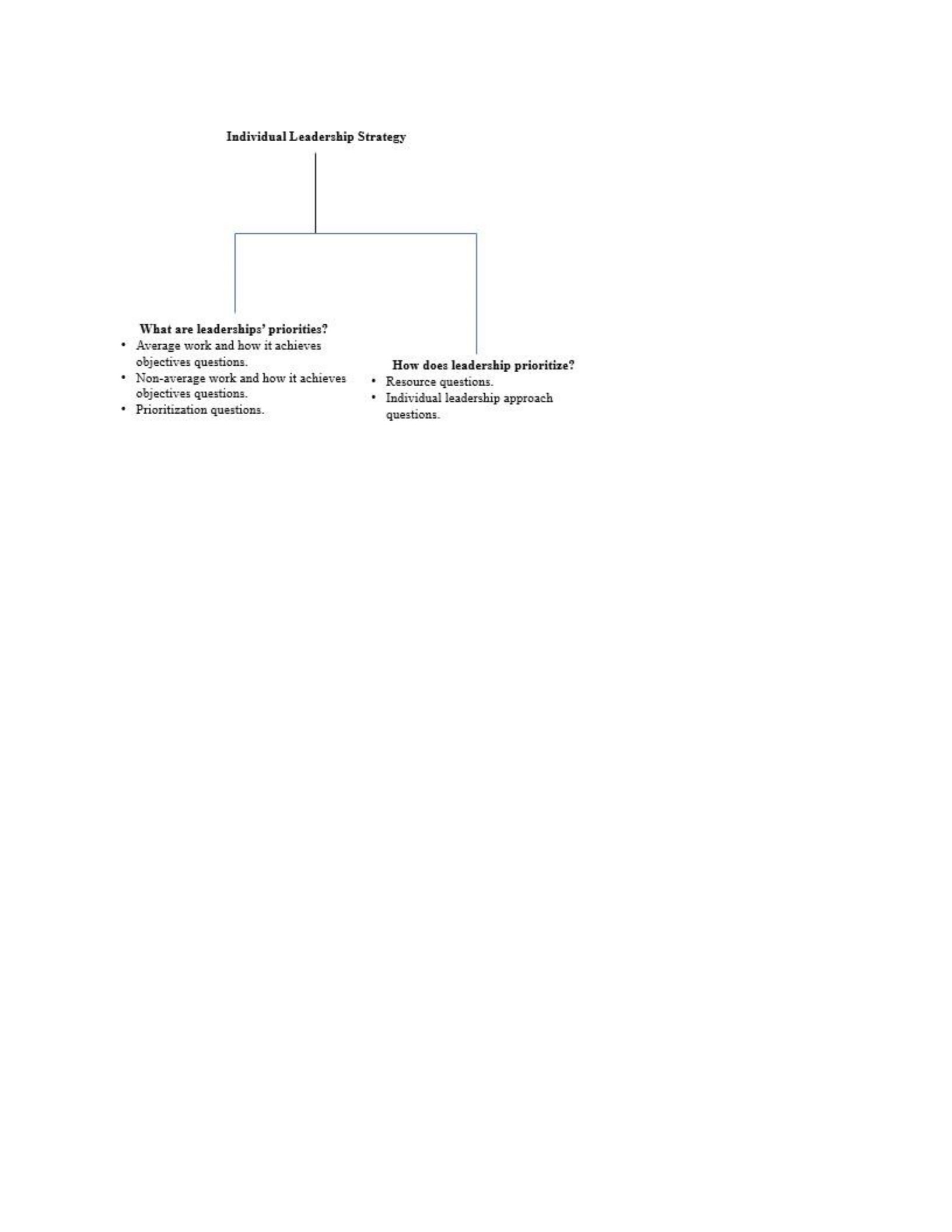
Research question one contained two data sets within the interview guide, each broken
down at the store manager and district manager theme with both compared at a single level (Figure
4). The first data set included information regarding what are the leadership priorities within the
participant’s role (What are leaderships’ priorities), including common and uncommon activities
and the prioritization of these activities and represent the first two themes of the study relating to
the first central research question of this study. The first theme of the study pertains to questions
that are addressed through interview questions one, two, three, four, five, and six. The second
theme of the study included information regarding how a leader approaches their role (How does
leadership prioritize), including personal resources, organizational resources, and leadership style
get addressed in questions seven, eight, nine, and ten.
Figure 4
Research Question One Data Set
What Are Leaderships’ Priorities? This section represents the first theme in the focus of
the first central research question. Interview questions involving what leadership priorities are
coded for three subsets of data that are comprised of six interview questions to arrive at its
overarching theme. The first coded are interview questions one and two, which focused on most
of the participants' leadership activities and why those activities are essential to their role and
objectives in accomplishing the organization's mission, vision, or purpose. The second coded are
interview questions three and four which focused on the remaining participants' leadership
activities that were still important to business but not performed often. Those activities that do not
occur often yet are still essential to their role and objectives in accomplishing the organization's
mission, vision, or purpose.
The third coded are interview questions five and six which asked the participants to rank
in order of importance and why the leadership activities were most vital to accomplishing their
role and the organization's mission, vision, and purpose. These subsets of data received analysis
across the individual SM and DM level roles; then, each level is compared to one another to
establish a final theme at a functional and cross-functional level. The interview data were then

related to the organization's leadership framework philosophy and analyzed for the final theme to
create a comprehensive understanding of the case study through multiple sources providing
triangulation. Creswell and Poth (2018) stated that triangulation with different data sources and
various emerging themes adds validity to the study.
The first subset of data, interview questions one and two contained information about the
most common activities of the role. The district manager-level participants focused the bulk of
their leadership activities on conversations and activities needed to prepare for these conversations.
Participant D2 referred to these conversations as "Touch bases" (Personal Interview, September 7,
2021). While both participants at the DM level discussed it as essential to achieving the company
goals, participant D2 stated, "Talent is at the root of everything we do" (Personal Interview,
September 7, 2021), which aligned with the answer of participant D1. Time planned for essential
activities such as people and the teams played an essential part in the bulk of their everyday
leadership roles.
Within the same first subset of data, the store manager level participants, like the district
manager level participants, focused on conversations such as formal and informal coaching along
with role modeling behaviors. Differing slightly were additional activities to make these actions
better rather than prepping for the conversation, such as found at the district manager level. What
did not vary is that both levels strongly felt that time planned for essential activities such as people
and the team is an essential part of the bulk of their everyday leadership roles. Participant S3 stated,
"My most important job is taking care of the internal employee" (Personal Interview,
July 7, 2021). Participant S2 summed up the belief in this approach by stating, "When you invest
in your team, you are investing into your business as well" (Personal Interview, July 9, 2021).
The participants’ data strongly showed that people are a top priority.

The second subset of data, interview questions three and four, contained information about
the remaining role's activities that were uncommon yet still vital to the needs of the business. The
district manager-level participants focused their remaining leadership activities on administrative
activities. Participant D2 took a defensive approach describing the leader as often "The blocker
that makes your team successful" (Personal Interview, September 7, 2021), while participant D1
described offensive administrative activities such as working on new pay bands for staff. Both used
these administrative activities as supporting individuals and teams. Participant D1 summed up this
approach as the desire "To be the employer of choice" (Personal Interview, June 7, 2021).
Within this subset of data, the store manager level participants focused their remaining
leadership activities on administrative functions such as office activities like planning and
scheduling. Participant S5 described this experience as setting a plan for the week and revising
said plan daily. However, another strong theme emerged in role modeling or performing the role
of the associate. Participant S6 described this as "Letting your associates see that you do just as
much as them and you role model everything" (Personal Interview, August 28, 2021). The most
robust reasoning behind this approach is building a stronger team through building bonds, trust,
and morals. Participant S9 stated, "When I am doing it alongside my team, whatever the activity
I am doing, it builds that mutual respect and bond for each other" (Personal Interview, August 24,
2021). The participants’ data reflected that while these actions may be administrative in nature it
is purely to support the people
The third and final subset of data, interview questions five and six, contained information
about the priority or importance of the tasks in the first two sub themes. The district manager level
participants focused on talent interactions in person and through regular electronic methods
consistently as top priorities and the administrative duties to keep these a priority. Both candidates'

first and second priorities were on and remote bases with their leadership teams, while the third
priority is administratively supporting their talent pipeline. Both candidates again aligned that we
affect the business through people and the quality of their lives. Participant D1 stated, "If we don't
have the right people or any people we are in big trouble" (Personal Interview, June 7, 2021).
Participant D2 also reflected that in the work they do, "Someone's life could be changed forever"
(Personal Interview, September 7, 2021).
Within this final subset of data, the store managers again aligned. Nearly identically
mirroring the rankings of the district managers, the store managers made touch bases and store
walks/work for the people; their top two priorities with the third priority is administratively
supporting their talent pipeline. At the district manager level, operational or administrative
activities were selected as a base or foundation to support the essential activities of the
development or training of people and ensure there is a proper plan to ensure the absolute best use
of these people.
Participant S4, when discussing a portion of the operational activities, described it as being
"That structure that can support you" (Personal Interview, July 12, 2021). The store manager level
puts people in the most critical part of their role. While participant S10 reflected, "You have to
have good people" (Personal Interview, August 27, 2021), participant S4 described having good
people investing in or raising, like thinking, "About how your parents raised you" (Personal
Interview, July 12, 2021). Participant S7 explored this concept a bit more through demonstrating
the store managers' second priority of development, stating that when coaching to behaviors, "They
can change and develop in their role" (Personal Interview, July 28, 2021). The data in this subset
reaffirmed the data of the first two with the alignment of participants in ranking the order of
importance for the top three activities within their role. The priority being regular conversations

with employees, followed by their personal and professional development, and finished with the
administrative duties that keep these first two priorities top of mind.
In these three subsets of data regarding what are leaderships’ priorities, alignment remained
prevalent for participants across the same functional role and role hierarchy from store managers
to district managers. The data placement may have varied slightly; however, a strong theme
appeared across the two roles. People and a connection to said people were a top priority. While a
personal connection seemed necessary, professional development through coaching and training
received emphasis. Communication with workers played the most vital role in the leaders'
activities. These people activities found support through vital operational activities that provided
for a people performance feedback environment. These behaviors exhibited the leadership
framework of the organization through collaboration belief that relationships are the foundation of
leadership, confidence belief in lifelong learning, and creativity's belief that leaders take the time
to be present (“The 3 C’s Behind Great Leadership,” 2018).
How Does Leadership Prioritize? This section represents the second theme in the focus
of the first central research question. The second data set of research question one contained four
coded questions with three subsets of data to arrive at its overarching theme. The first subset of
data is interview question seven regarding personal resources, while the second subset of data is
interview question eight regarding organizational resources. The third subset of data is interview
questions nine and ten, which contain information regarding the leadership approach. Within this
data the researcher expected to see less alignment among the personal resources yet strong
alignment through the organizational resource of the leadership framework influencing the
leadership behavior. This data also sought to understand if the leadership framework influenced
alignment with leadership style.

The first subset of data, interview question seven, contained information regarding personal
resources used in decision-making in the leader's role to prioritize activities in the first four
questions. At the district manager level, both spoke of learning through experience. While
participant D1 spoke to a traditional learning background in a corporate environment. “I’ve come
from world-class companies that have a lot of structure in place. That helped me here because there
are areas that we don’t have a lot of structure” (Personal Interview, June 7, 2021).
Participant D2 spoke about leadership learning through the setting of an athlete while referencing
John Wooden's book Coach Wooden's Pyramid of Success. Participant D2 related this experience
learning to the leadership framework as well, stating that "The leadership framework always comes
back to me on how I show up every single day as a leader" (Personal Interview,
September 7, 2021).
Within this subset of data, the store managers offered a similar approach. The most common
approach is that many learned through the experience learning of other corporate environments.
Participant S3 referenced "The nuances that occur or happen as a store manager over the years"
(Personal Interview, July 7, 2021), while participant S10 mentioned, "All of those pieces of training
experienced to us over the years" (Personal Interview, August 27, 2021). Like the district manager
level, this group also mentioned the nontraditional experience learning of leadership as an athlete.
For example, participant S6 stated that as an athlete, "Training, coaching, discipline, and time
management, all of those things are instilled in my DNA" (Personal Interview, August 28, 2021).
Where variance did occur is a slight result of leadership learning through the family. For example,
participants S5 family owned a business where the participant grew up and worked. It is this
experience where participant S5 stated they were "Showed the importance of community"
(Personal Interview, August 28, 2021). While alignment expected to vary here amongst participants

a common result occurred citing previous leadership or work experiences as personal resources in
their leadership decision-making.
The second subset of data, interview question eight, contained information on
organizational resources used in decision-making in the leader's role to prioritize activities in the
first four questions. It is here that the research data obtained did not match what would have been
expected out of a leadership framework environment, alignment. At the district manager level,
organizational resources lacked use. While participant D2 mentioned one training program
provided to the participant years earlier, participant D1 stated, "I do not" (Personal Interview, June
7, 2021). Here the reliance came from the resources leaders experienced in interview question five.
To the researcher's surprise, within the second subset of data, interview question six, the
store managers also did not align with the leadership framework as an organizational resource.
Few did mention the use of this tool. For example, when asked, participant S4 and participant S8
directly cited the leadership framework, while participant S1 stated that it "Has played a pretty big
role for me" (Personal Interview, July 12, 2021). The remaining participants did not reference the
leadership framework. Participant S2 stated, "I do not think there is anything I get from the
organization itself" (Personal Interview, July 9, 2021). Many cited forms, tools, and pieces of
training as organizational resources rather than the leadership framework as an initial priority or
resource. While answers varied from store managers to district manager, the common result here
is that the leadership framework is not used as a guide in decision-making.
The third subset of data, interview questions nine and ten, contained information regarding
the preferred leadership approach and sought to understand its alignment with the leadership
framework. The district manager level offered no alignment in choice of leadership style in
interview question nine, although it is worth noting that participant D2 mentioned servant

leadership but admitted the style is a "Buzz word" (Personal Interview, September 7, 2021).
Concerning interview question ten’s arrival at this selected leadership approach, both participants
aligned in what they called great leaders from their past.
Within the same data subset, the store managers also did not align with a leadership style
for interview question nine. Like at the district manager level, servant leadership style is the only
quotable researched leadership style cited by participants S1, S2, and S8. Participants’ powerful
stories from past experiences seemed to have formed the desire to be a servant leader. Answers
seemed to vary significantly in choice. Like at the district manager level, alignment did seem to
come in the data from interview question 10, where the answer of previous impactful or great
leaders is a common finding. In total, four of the 12 participants cited the servant leadership style
as their preferred approach. The researcher did not investigate leadership styles or confirm any of
the participants' knowledge of or actual display of behaviors in any leadership style. It appeared
here that the leadership framework may influence the individual leadership style, but not enough
data were present to determine with certainty. This is important in showing that the leadership
framework allows for individuality and is not an attempt to eliminate traditional leadership but
rather unite leaders with a common guide or language.

