


UNDERSTANDING K-POP TWITTER AS A SITE OF
TRANSNATIONAL SOCIAL
Introduction:
On June 20th, 2020, Alexandria Ocasio-Cortez, U.S. representative and prominent public
figure, tweeted out an official thank you to “KPop allies” and their “contributions in the fight for
justice”, a sentiment that left many confused and even angry. This tweet came following rampant
press coverage of a sparsely attended re-election rally held by Donald Trump that gave credit for
low turnout to a prank played by “Tik-Tok teens and K-pop fans” (Ortutay, 2020). This event was
one of many heavily media-covered events in 2020 that put K-pop fans, or fans of Korean pop
music, at the forefront of a conversation they had not previously seen themselves in. From taking
over white supremacist hashtags to donating millions to Black Lives Matter organizations, K-pop
fans were suddenly seen as a swarm of political activists that represented a new wave of radical
and socially engaged youth. This phenomenon gained an abundance of press coverage because it
was unique, buzzy and to some, even comical.
At its core, K-pop is technically just a music genre and K-pop fans are just enthusiasts of
that genre. However, through processes of broad scale globalization, K-pop stars and their fans
have formed massive, interconnected communities that span almost every continent. Korean pop
first emerged in the early 1990s and has experienced various waves of international popularity
starting in neighboring countries, but eventually becoming a truly global phenomenon. Currently,
band BTS is the most widely followed and internationally recognized. BTS members alone are
responsible for 19 of the 30 most retweeted tweets of all time, making them not only culturally
significant but also deeply socially relevant. As K-pop is a globalized music genre most often
consumed through social media, fans rely heavily on each other for everything from content

6
creation to song translations. This emphasis on grassroots participation and user generated fan
material has precipitated an intricately woven web of fans all over the world. While traditionally
these networks revolve around supporting certain artists and their work, recently they have made
headlines by getting involved in U.S. politics by using social media for engagement with social
justice movements.
In this thesis I attempt to go beyond the surface level opining of journalists to understand
the complex reality of social media activism in the context of K-pop fans. I aim to answer how
twitter is used by this community for various forms of content dissemination, and how these
processes utilize transnational networks of communication and transcultural negotiation. I start
by taking an ethnomusicological approach to understanding the context of K-pop as a globalized
yet distinctly locally based form of music and pop culture. From there, I will examine the
concept of the K-pop fan base as a site of transnational and transcultural communication and
community formation. Then, I will look at social media, specifically twitter, as a site of social
organization and activism especially in the context of New Social Movements, such as the Black
Lives Matter movement, and transnational political action.
The empirical research that I conduct consists of examining the expressive and strategic
purposes of tweets collected from the K-pop twitter community surrounding intense periods of
social activism. By collecting data directly from twitter, I seek to gain the most direct qualitative
content regarding grassroots organizing. The purpose of this analysis will be to answer how tweet
rhetoric is used in this context to mobilize and encourage social support for working against
injustice. Additionally, I will be analyzing the creation of communities through twitter
interactions and how individual accounts play a vital role in group action. Similarly, I will
examine to what extent K-pop fans engaging in activism actually represent transnationalism and
how. Through this research I will show the complexity and importance of studying these

7
conversations that lead to action, and I will assign credit where credit is due in terms of
productive transnational actors working for real change.
Broader Significance:
When discussing the significance of ethnomusicology, prominent field scholar George
Lipsitz states that “ethnomusicology teaches us about the dynamics of difference, about the
generative results that follow from recognizing that cultures are not the same even though we all
share a common humanity” (Lipsitz 2011, 186). When studying a field that covers so many
distinct cultures and subcultures and their complexity, it is hard to not feel as though one is
focusing only on exaggerating difference or perpetuating senses of otherness. Yet at the same
time, we must lean into discussing those distinct differences and celebrate their importance so as
to show full respect and understanding to each musical form and its origins. Lipsitz continues
that
“In the face of scholarly and civic traditions that find difference so vexing that
they frequently can only offer us an unsatisfactory choice between disembodied
universalism on the one hand and parochial particularism on the other,
ethnomusicology enables us to imagine a third option: a universalism rich with
particulars grounded in the dialogue of all, the dignity of each, and the supremacy
of none. In short, ethnomusicology can help us see which differences make a
difference” (Lipsitz 2011,186).
In the framework of globalized music that I will be working in, this sentiment is more pertinent
than ever. When it comes to how western scholarship discusses global music, hierarchies are
established, and entire genres and their fans dismissed on the ground of othering and exotism.
Through an ethnomusicological lens there are “commitments to multi-lingualism, reciprocity,

8
participation, performance, cosmopolitanism, and critical thinking [as] extraordinarily important
tools for demystifying hierarchies today” (Lipsitz 2011, 197). Lipsitz believes through the eyes
of a sociologist and historian that music has major significance as a social force, and I agree.
Through this work I will attempt to emulate his sentiments by placing emphasis on applying
dignity to all particulars I discuss and working to demystify existing hierarchies.
On a similar theme as presented by Lipsitz (2011) on the importance of seeing music as
socially significant, LaMarre et al (2012) discusses how musical consumption effects social
participation, and more broadly world view. Their article examines how an individual’s music
consumption affects the social issues that one supports. They wanted to explore the ways that a
genre of the music itself can affect attitudes regardless of lyrical composition. Their conclusion
was that their study “affirms the importance of understanding music’s influence on
individuallevel attitudes, behaviors, and judgments, as well as extending present understanding
of music effects to include behavioral outcomes” (LaMarre et al 2012, 164). Effectively their
results reaffirm the importance of fan studies in the realm of ethnomusicology. They further
support the idea of examining not only a musical genre but the reactions and engagement it
draws from the public and what they do with that reaction. I will be attempting to engage with
these same concepts in my review of K-pop fan communities as political actors.
The inherent truth of the United States is that we are all under the thumb of a white
supremacist patriarchy. This system works to discredit and silence women’s voices, particularly
young women, and more specifically young women of color. As a teenage girl, this frustrated me
as anything pop culture related I was interested in and found important was so brazenly
dismissed as trivial due to the demographic who valued it. As I grew older, my frustration
increased as I came to understand that this experience is intensified when it becomes racialized. I

9
saw this exemplified as I became a fan of, and thus involved in, discourse around K-pop. From
peers I heard comments along the lines of fetishization and other general forms of normalizing
Asian stereotypes and racist commentary. The problem of mainstream casual racism towards
Asian bodies and Asian cultural products has been normalized in mainstream American society.
Asian communities that attempt to bring our attention to these issues are silenced by tropes such
as the model minority myth. I hope in this work to shed further light on these issues and
subsequently provide academia based back up to the hard-fought fights of young women on
social media presenting extremely important ideas but finding themselves dismissed. I want to do
my part to contribute to the existing body of scholarship that treats pop music, and specifically
K-pop, as well as its fandoms, as the culturally significant and noteworthy phenomena that they
are.
Specific significance:
Beyond emphasizing the significance of ethnomusicology, I want to state the importance
of studying and discussing social media as a site for political activism. The ways that social
media has been portrayed in the media recently has been in an overwhelmingly negative light.
This of course is not without reason as we have seen, especially in the U.S., a rise of radical right
wing or even conspiracy theorist groups mobilizing through social media platforms. We saw this
situation escalate as far as an attempted coup of the U.S. capitol building on January 6th, 2021.
However, while the use of social media as a means to spread harmful misinformation is an
important problem to be addressed, the ways in which solutions are being discussed often miss
key sides of the conversation. Many propose that the best way to deal with radicalized
movements gaining traction online is to increase surveillance in these spaces. However, what
they are failing to recognize is that increased surveillance in this context would most likely serve

10
only to harm marginalized communities and especially people of color, the very populations that
also end up harmed when securitization of a physical space is increased.
The United States has a long history of racial injustice specifically in the context of
racially biased policing and securitization of public spaces. Transitively, if increased surveillance
and securitization is applied to social media spaces, it will disproportionally effect people of
color especially those attempting to politically organize. Social media is historically a place of
user driven content without restriction. Due to this, it has significance as a place for people to
express social dissent and build solidarity around societal issues. Similarly, it uniquely benefits
oppressed populations as it provides a space for the dissemination of user created content outside
of the mainstream media which is often dominated by pro-status quo ideologies (Freelon et al
2016, Nummi et al 2019, Harlow et al 2020). If this space known for its freedom of expression is
to become policed on the account of white supremacist hate groups, it will ultimately end up
harming the communicative abilities and organizational tactics of oppressed populations
attempting to mobilize for positive change and liberation. While the issue of the rise of the right
on social media must be addressed, those having this conversation must take into account how
certain actions could end up as only furthering the systemic white supremacy that perpetuates so
much of our national public policy, especially around securitization. In this paper I hope to
contribute to the conversation surrounding the importance of understanding social media as a site
of complex social interaction and organization surrounding prominent social issues.
Necessity of Nuance:

11
At the beginning of my research into the topic of K-pop fan communities and their recent
social justice related activities, I came across an article by P. Claire Dodson titled “On K-pop
Fans, Political Activism, and the Necessity of Nuance” (Dodson 2020). This article proposed a
number of important caveats regarding the conversation around K-pop fans and political
engagement. I would like to acknowledge the nuance that Dodson emphasizes in my introduction
and continue to unpack in my broader research. One point she raises is that fan activism is not a
new concept, nor is it surprising. Fan communities have used their collective affinity to mobilize
for change on many occasions in the past. Additionally, it is reductionist to talk about K-pop fans
as a unified group of all like-minded individuals. Not only is this just another way to dismiss
them, but it also ignores the complex range of people and opinions who constitute this extremely
large body. On this note, Dodson (2020) emphasizes that activism within the K-pop fandom is
being led largely by black fans, who in the past have faced backlash for their sentiments, and
even been subjected to anti-black racism within their fan community. This is an element of the
complex conversations that are happening in and around the fan communities, such as how to
deal with and address anti-black racism from fans and even from K-pop idols themselves
(Dodson 2020).
In this context, I find that my work is both in defense and critique of K-pop fans and their
online communities. It is important to recognize that this group is far from a fully unified
constituency of entirely anti-racist and progressive activists. However, it is equally important to
note that their collective actions represent very positive practices of transnational group identity
negotiation and the dissemination of important sentiment. In this paper I will attempt to cover all
sides of this nuanced conversation with an emphasis on assigning credit where credit is due in
terms of the positive outcomes and hard work being done by some fan groups. To reflect on my
own positionality, I believe I am in a favorable position to engage in this research in that I have

12
previously been engaged with this larger community of study and therefore have some level of
empathy and understanding. Although I have only ever really been a passive consumer rather
than an active participant in these spaces, having been engaged helps me research with the
content rather than only writing about it. However, as a white American I have major limitations
in experience and thus cannot understand or describe the hardships of being a fan of color,
specifically a black fan in these spaces. Nor do I have the authority to speak on racial issues
within the fan community. Thus, I lean heavily on previous scholarship done in this field and
attempt to amplify voices from within the community working to improve and further the
conversation around racial injustice.
Structure of Thesis:
The first chapter of my thesis will be an in-depth look at K-pop as a globalized cultural
phenomenon through an ethnomusicological lens. I will begin with a contextual review of the
origins of the music genre, as well as what factors contribute to its popularity, followed by an
examination of its politicization and relationship to socio-racial constructions. Then I will begin a
literature review of previous work discussing pop music and its globalization in a broad sense.
From there I engage in a review of scholarly works that utilize theories of globalization and
transnationalism to discuss K-pop specifically. Chapter 2 will follow a similar structure, this time
on the subject of twitter as a site of social media activism. The contextual review will look at the
significance of social media sites like twitter in the context of online activism and the
#BlackLivesMatter movement. Then I will provide a literature review that serves to connect the
first two chapters by reviewing previous work on how twitter has been used by both the K-pop
community and in the context of transnational activism.

13
Chapter 3 will be a breakdown of the methodology I employed to perform my empirical
research. In this chapter I start by stating my research questions and providing a detailed
explanation for my choice to use tweets for data analysis. From here I provide background
regarding the data collection process in terms of using twitter’s API. Then, I present a breakdown
of the three events I will be examining: the IWatch Dallas app crash, the #MatchaMillion
fundraiser, and the Trump Tulsa rally. These events were chosen as they represent the mostly
highly engaged with activities to occur within K-pop fan communities in 2020. Not only did they
see participation from massive amounts of fans on twitter, but they also received rampant press
coverage from the news media. In the second part of this chapter, I explain why I choose the
analysis methods that I did and how I will be implementing them. I explain how I will be
following the work of other social media and social movement scholars by hand coding my
tweets based on expressive and strategic content. Similarly, I follow the lead of Freelon et al
(2016) in my proposed network analysis that focuses on identifying communities, influential
figures, and transnational connection.
Chapter 4 will be an overview of the findings from my data analysis. In the first half of
the chapter, I will discuss the results of my tweet based textual analysis broken down by event. I
will provide numerical breakdowns of how tweets were coded as well as demonstrating how
each code was represented in the data using quotes. In the second half of the chapter, also broken
down by event, I will use network visualizations to display how twitter user communities were
formed and operated within each time frame. I will also use geospatial visualizations to discuss
the existence of transnational networks in my data and provide textual evidence to accompany
these when applicable. Chapter 5 will be a discussion of the findings outlined in chapter 4 in
which I identify common themes and contextualize them by connecting back to theories
presented in chapters 1 and 2. Finally, chapter 6 will consist of a conclusion in which I will

14
summarize my research results as well as provide study limitations and suggestions for further
work.

15
CHAPTER 1: K-Pop
Context
I. K-pop Origins
The development of Korean popular music, or K-pop, began largely during South Korea’s
period of colonization under Japan. Korea was colonized and controlled by Japan from 1910 to
1945. While this period of foreign rule was marked by rapid modernization, it is mostly
remembered for its hard legacy of oppression and cultural denial. During Japanese occupation
Korean culture and language were largely banned and many Koreans were even required to
change their names to Japanese titles (Lee, 2014). Despite this experience of cultural
suppression, Koreans were still creating cultural products, and during this period was when a
unique brand of Korean popular music began to form. Essentially, what many consider to be
modern day K-pop came about partially due to western influence in the context of Japanese
occupation where America was a symbol of modernity, freedom and a way to resist Japan's
cultural restrictions (Dore and Pugsley, 2019). Cho (2017) summarizes the creational process of
K-pop as “an outcome created during colonization, honed through the Christianity movement,
elaborated during industrialization and Westernization, and completed through globalization.
Through this process, K-pop placed itself as a music genre that represents hope and freedom of
the Koreans” (Cho, 2017, 17).
Since Korean independence from Japan in 1945, K-pop has taken on new meanings and
implications in the South Korean and global contexts. South Korea was hit hard by the Asian
financial crisis of 1997, ironically a result of globalization. The financial crisis put the South

16
Korean government in debt to the International Monetary Fund (IMF) and in need of an
economic action plan. As part of a broader solution, the Ministry of Culture began putting funds
into promoting Korean made pop music and television programs in neighboring countries
(Hogarth 2013). Previously, The Korean Broadcasting Act of 1990 transitioned the Korean
television industry from state protected to a system of free-market competition and private
ownership which allowed Korean media to enter the global commercial sphere. In 2001 the
process began for a ‘New Millennium Vision’ to be applied to the Korean media industry and
consisted mostly of government funding to the export of culture abroad (Ju and Lee 2015).
The first Korean wave of pop culture then began widely in neighboring Asian countries
but eventually began to spread to Europe and the Americas. Korean media in the US was
originally targeted to major cities where large populations of Korean migrants lived, such as Los
Angeles and Chicago (Ju and Lee 2015). At first, it was hard for Korean media to establish a
broad coverage network. This changed when many forms of Korean media went online and
began disseminating content through streaming services such as Netflix. As Ju and Lee (2015)
explain “The new era of the Korean Wave has arrived due to Web-based dissemination, which
distinguishes the latest wave from the previous one that mainly settled in the Asian region. [...]
Hence, there is no disagreement that the Korean media content can broadly penetrate its
transnational flows throughout the world due to the Internet and Web-streaming services” (Ju and
Lee 2015, 326). Of course, the credit for dissemination extends beyond web streaming services
and additionally goes to the emergence of popular access to social media networking. The
phenomenon contributes to “the dominant explanation maintain[ing] that the spread of social
network services (SNS), including YouTube, enabled K-pop to spread beyond national barriers
without heavy distribution or promotion costs” (Jang and Kim 2013, 84).

17
While web streaming services and the world wide web were important factors in the
global success of Korean pop culture, they were not the sole actors responsible. Ju and Lee
further explain that what we now see as globalized Korean pop culture began as ethnic media,
and “because of the increasing tendency of migrations, dispersed ethnic communities have
contributed to improving online connectivity to their home nations'' (Ju and Lee 2015, 326). That
being said, Korean diaspora youth in the US are largely to thank for the increased web
connectivity to Korean pop content. Historically, ethnic media was targeted to solely immigrant
populations, but globalization has changed that especially as populations become more mobilized
and ethnic identities more complicated.
This further contributes to the discussion of who consumes Korean popular culture
abroad. In their article The Korean Wave and Asian Americans: the ethnic meanings of the
transnational Korean pop culture in the USA, Ju and Lee (2015) present the idea as mentioned
above that the globalization of Korean popular content began with not only Korean, but other
East Asian youth abroad. They explain that this is at least partially because “the lives of
contemporary East Asian youth have not been carefully depicted by any other media; thus,
Korean dramas have, for them, become the most up-to-date reference.” (Ju and Lee 2015, 331) It
is fact that the Asian American population at large is one of the most underrepresented groups in
western popular media. While this quote is in the context of Korean television dramas, the
authors apply the same concept to Korean pop music depictions as well. They summarize by
stating that “although it has limited explanatory power on the tangible influence of the Korean
Wave in the USA, the discourse of Korean media inflows into Asian ethnic communities here
should not be ignored” (Ju and Lee 2015, 335).
To synthesize, the internet and social media alone are not responsible for K-pop’s
success. With the increased global movement of migrants, diasporic communities often maintain

18
cultural connectivity with their homeland. The internet has been a major catalyst for this
connectivity as it eliminates the obstacles of time and space. Therefore, the process of K-pop
world domination really began when Korean diasporic youth began using the internet to more
effectively consume Korean pop culture, and social media to spread it.
But what is to be said about the other global consumers of K-pop that do not identify
along ethnic lines? What draws them to consume this cultural product? Cho (2017) seeks to
answer this question in her paper "Sure It's Foreign Music, but It's Not Foreign to Me"
Understanding K-Pop's Popularity in the U.S. Using Q Sort. Cho uses a method of Q-Sort style
surveying to assess what are the strongest pull factors of the K-pop genre for fans. Her results
demonstrate that for some, the strongest attraction was a sense of strong affection for the
celebrities they followed, their personalities, and sharing their hard-earned successes. For others,
the draw was almost purely musical, and individuals valued the vocal and physical prowess of
performers most highly. These fans thus mostly consumed K-pop content in the forms of
produced music and choreography videos rather than interaction with the idols themselves. The
last category of fan Cho found was a group who viewed the biggest benefit of K-pop to be the
global community. Individuals in this category believe that “K-pop is a healthy hobby that
provides a chance to meet friends worldwide, creates an opportunity to understand the musical
genre from other perspectives, and never judges other people’s tastes” (Cho 2017, 44). Largely
the draw of this community is that liking K-pop is the main criteria for joining, and thus bypasses
societal, demographic, and geographic factors (Cho 2017).
II. What makes K-pop…K-pop?
When many people think of what defines K-pop as a genre, they first think of the factors that
are promoted to a globalized audience. There are many distinct factors of K-pop as a genre that

19
allows it to be consumable on such a broad scale. One such factor being the use of English in
lyrics, song titles, and group names. English is mainly employed in K-pop to appeal to
international audiences and bridge the gap between the Western and East Asian music industries.
In the pop music industry, “American” is often viewed as “universal” and therefore the use of
English allows for an audience beyond just English speakers. Here, however, it is important to
note that English is not used alone but mixed with Korean as “English is used to convey a sense
of globality, modernity, or Westernness and Korean is used to represent locality, conservatism, or
Easternness” (Cho 2017, 20). The necessity for globality can also be seen in the names of
popular K-pop groups with the most popular at the moment being BTS. Although the full version
of their name is Korean, Bangtan Sonyeondan, the abbreviation is more broadly understandable,
marketable, and consumable to a foreign audience.
Another globalized factor of K-pop is the composition of the groups themselves. Idol
groups, as K-pop bands are referred to in Korea, often consist of members of many different
nationalities. A typical group may be compiled of Korean members but also include Chinese,
Japanese, or Thai performers as well. This allows the group to have a more direct inroad to
promotion in nations outside of Korea. Furthermore, K-pop idol trainees are recruited from all
over the world with many being Korean diaspora from Canada, the U.S, Australia, and New
Zealand (Dore and Pugsley, 2019). This tactic has the added benefit of idols who are Korean in
ethnicity but still speak English fluently, thus having specific ability to relate to western fans
(Hare 2017). Similarly, some make the claim that “K-pop producers are establishing a new image
of their singers as having both stereotypically Asian facial features (such as Asian complexions
with black eyes and hair, etc.) and stereotypically European physiques (such as tall heights)”
(Jang and Kim 2013, 89).

20
When it comes to the musical composition of K-pop, “hallmarked by its hybrid genre
crossing, K‐pop fuses hip‐hop with up‐tempo synthesized pop beats, alongside romantic ballads
and dance anthems” (Brennan 2020). While the genre itself utilizes numerous musical styles
across each artist, album or even track, it is most largely known for its utilization of the
globalization of hip hop, as discussed in further detail later on in this chapter. Hip-hop as a global
phenomenon was localized into the context of South Korea in the ways that K-pop “toned down
the harsh beats of the American genre and dealt with issues more resonant with the Asian youth”
(Joo 2011).
These globalized elements are so quintessential to K-pop that many criticize the genre for
lack of authenticity or cultural blandness. While it is true that being intentionally globalized is a
trademark of K-pop’s success, Jang and Kim (2013) make the argument that there are many
distinctly Korean factors of the genre as well in their article Envisaging the Sociocultural
Dynamics of K-pop: Time/Space Hybridity, Red Queen's Race, and Cosmopolitan Striving. They
present the distinct Koreaness influencing K-pops success in the context of a number of different
factors. The first factor is the unique complexity of national Korean culture itself. They explain
that “since Korea has developed from a traditional to a highly industrial society in less than five
decades, Korean culture maintains the character of the traditional, modern, and postmodern (i.e.,
time/space hybridity)” (Jang and Kim 2013, 85). This dichotomy presents itself in K-pop in the
way that, through music and performance, idols demonstrate postmodern concepts, but also
represent traditional Confucian values such as respect for older generations and often abstaining
from topics of drugs and sex. As a result, they are presented as pure compared to American and
European celebrities embroiled in scandal. This allows K-pop idols framed as wholesome to
become “increasingly popular with neighboring East Asian audiences, as well as with Muslim
and Catholic populations worldwide (e.g. Malaysia, the Philippines, the Middle East, and South

21
America)” (Dore and Pugsley 2019, 582). Along with this, Korea is classified as positioned
between being a core country and a periphery country. This means that for tourists from highly
developed countries it holds nostalgia and for visitors from developing countries it offers
excessive modernity which the article describes as the ‘contemporaneity of the uncontemporary’
(Jang and Kim 2013).
The next set of factors defining K-pop that Jang and Kim discuss as a result of distinct
Koreaness relate to how K-pop idols are prepared for debuting in the industry. A hallmark of
Kpop is a long and intensive training period for future performers where they are not only taught
singing and dancing, but also cultural competence. Foreign trainees must work hard to learn
fluent Korean, and most trainees also learn at least some English. Jang and Kim explain that
almost every Korean must participate in a fiercely competitive educational system, and the rigor
of idol training parallels that system. As a result, young trainees are prepared to devote the time
and energy into training that they would for a career through education. Additionally, Jang and
Kim explain how
“Due to Korea’s heavy dependence on the West, especially the United States, both
politically and economically, during her compressed modernization, cosmopolitan
striving is a means of elevating one’s social and economic status in Korea through
excessive efforts at learning Western languages (e.g., English) and culture (e.g., attire,
etiquette, food, music, etc.)” (Jang and Kim 2013, 85).
The article presents that this idea leads to only Korean students adjusted to this culture being able
to complete the tough training required to achieve global competence and synchronized dancing
to melodic music. However, cosmopolitan thriving is also an act of Korean Nationalism by
representing the goal of personal and communal economic success despite limited resources
(Jang and Kim 2013).

22
Perfected and complex choreographed dancing is a factor that sets K-pop apart from other
global music industries. The argument is made by Jang and Kim that the synchronized dancing
to melodic music that K-pop groups use is only made possible through training that must start
long before fame, a practice used generously by the K-pop industry. However, “a common claim
regarding the reason K-pop bands are able to master synchronized group dancing while singing
complex harmonies is that these singers were harshly disciplined and carefully controlled by their
so-called ‘slave con- tracts’” (Jang and Kim 2013, 91). This is an idea that has some truth but
also stems from the racialized concept of ‘strict Asian training’ that is a stereotype held largely by
western consumers (Jang and Kim 2013). A last point this article makes in terms of specifying
the distinctly Koreanness of K-pop is the use of the multi-top formation in dance choreography.
This style is displayed through groups utilizing choreography that naturally changes the lead
dancer and vocal frequently. This increases entertainment value as well as highlighting collective
performance over promoting a single individual (Jang and Kim, 2013).
III. Politicization
This combination of both globalized and distinctly Korean factors makes K-pop the perfect
cultural export. As previously mentioned, government promotion of Korean culture as an export
began in the late 1990s. To this day, K-pop is used not only as a means of cultural promotion but
also as a mechanism of soft power. South Korea has slowly been using cultural exports to change
their global image and boost their fortunes. Perhaps the most obvious form this takes is through
economic gain. Boy group BTS is currently the best-known K-pop group globally. In 2019 they
accounted for $4.65 billion of South Korea’s GDP (Ro 2020). K-pop is also used strategically as
a means to boost tourism to the country. Chinese and Korean group EXO are currently, and have
been for the past year, the face of the Imagine Your Korea tourism campaign put out by the

23
Korean Tourism Organization (Tan 2019).
Although economic success is a perk of increased tourism, the Korean government has their
sights set a little higher. Like many other highly developed countries, Korea is experiencing an
aging population and declining birth rate. Cultural promotion of Korean content as well as the
opening of Korea’s higher educational system to foreign students is a strategy to encourage more
young people to move to and stay in Korea (British Council, 2018). Beyond that, groups and
their companies work hard to encourage global fans to learn about Korea beyond the bounds of
K-pop by engaging in traditional language and culture studies. A prominent example is BTS’
launch of a multi-platform learning module for fans titled “Learn Korean with BTS” in early
2020 (Delgado, 2020).
This cultural promotion, however, has aims that go far beyond the tourism industry into a
more political realm. In authoritarian, isolated, and heavily censored North Korea, foreign media
such as K-pop is banned (Joo, 2011). However, many still gain access to it and the South Korean
government maintains the goal to use it to give North Koreans an idea of the outside world and a
sense of lies being fed to them by their government (Ro 2020). K-pop is a symbol of
democratization to North Korea and is used strategically as such with popular girl group Red
Velvet even performing in Pyongyang for Kim Jong-Un in 2018 (Herman 2018). The promotion
of Korean popular culture is employed globally to encourage foreign nations and their citizens to
look favorably upon Korea. K-pop idols are expected to be cultural ambassadors to the nation
and examples of their politicization can be seen from acts EXO and CL performing at the 2018
PyeongChang Olympic Winter games to BTS speaking in front of the United Nations in 2020.
These efforts of course do not go unacknowledged and the Korean Ministry of Culture has an
Order of Cultural Merit to be awarded to “a person who has rendered outstanding meritorious

24
services in the fields of culture and art in the interest of promoting the national culture and
national development.”
V. K-pop and Race
As it is a genre that developed largely in a homogenous racial society, yet draws so
heavily from globalized popular culture, particularly that of African Americans, K-pop has a
complicated relationship with race. The complex nature of this relationship has been opined
about since the genre's inception by academics, fans, and critics alike. As we have already
discussed, it is no secret that K-pop is heavily influenced in most aspects by black culture (Lee,
2020). While there are ways in which this could be translated into appreciation, there are rampant
examples of appropriation within the industry. Well known and still popular groups have been
called out for use of black face, appropriating black hair styles, or even using racial slurs. Some
make the argument that due to their status as foreigners, the K-pop industry and its celebrities do
not hold the same responsibility to recognize racial insensitivity as western artists. This
argument, however, falls apart when one again considers how much the industry in its entirely
owes to black culture (Lee, 2020).
The article Black K-Pop: Racial Surplus and Global Consumption by Suk-Young Kim
examines the way that blackness is represented and used within the K-pop industry and the
history of how blackness has been viewed in Korea. On one hand, they discuss the fact that
South Korea itself is rapidly becoming a more multiracial society as opposed to a very
homogeneous one. On the other hand, there is the parallel that the K-pop fan base is globalizing
and is thus composed of more ethnic and racial categories. Kim introduces how cultural
appropriation is often considered to be a one-way process done by the west to non-western

25
cultures, but what about when it goes somewhat the other way? They also argue that the US
military's involvement in the 20th century transpacific warfare should be considered in this
context as well as the racialization and oppression of Koreans under Japanese colonial rule. Kim
also explains that Korean pop music is indebted much to black music styles and that was known
to the Korean musicians who popularized the styles, showing how Korea has a racialized view of
sound as does the U.S.
Along with this, as discussed later, hip hop began as a marginalized music genre in Korea
and was attractive to Koreans because of its black urban culture and representation of struggle
and poverty. However, even in music videos such as Taeyang’s Ringa Linga, which he claimed
showed people of all backgrounds coming together to enjoy themselves as one, the black bodies
are depicted laboring while the white and Asian bodies exhibit pleasure. As summarized by Kim
“On the one hand, the performance of racial variants by K-pop idols and fans has functioned as a
visual means of deconstructing racial purity in Koreans, but on the other hand, it has
problematically internalized the view that divides races into an imagined order, which has
plagued US society and politics” (Kim 2020, 90).
There is also much to be said of the ways race intersects with gender in the presentation
of blackness in K-pop. In his 2020 article HyunA: The Nexus of Blackness, Feminism, and Kpop,
Erik Raven discusses the way that the work of black female artists in the context of the U.S. is
translated into a feminist context in South Korea, specifically with the case study of popular idol
HyunA. He highlights the important ways that historically “black female hip‐hop artists not only
dialogued with American hegemonic perceptions about race, but they also addressed issues of
gender as well” (Raven 2020). Feminist movements in the U.S. have been predominately middle
class and white and thus explicitly excluded black women. Thus, their expressions of feminist

26
ideology, like many other forms of black expression, took alternative routes into society, one
such route being hip-hop. From here Raven makes the comparison that “in light of the negative
public perception of feminism in Korea, HyunA, through the blackness‐derived artform of hip‐
hop, acts as a vessel of feminist expression and embodies the goals and ideals conventional (i.e.,
academic and political) feminists cannot” (Raven 2020). Here highlighting again where the K-
pop scene has been directly influenced by and benefitted from blackness, now in the context of
gender.
Not only does the industry owe much to black culture and creativity, but also to their own
black fan base. As I have touched on before and as Lee (2020) explains “K-pop’s success in the
US was possible not because of a white, mainstream audience, but because a small, passionate
group of K-pop fans – many from communities of colour – discovered K-pop as they sought
alternatives to the mainstream popular culture that continues to privilege white representation as
the norm” (Lee, 2020). Further, while some may claim that those who continue to support or
engage with the industry despite these transgressions are complicit in their racism, critical
engagement with the fan community shows otherwise. As I discussed in my significance section,
K-pop fans are using social media and other online platforms to have these conversations as to
how to deal with racism in the industry. Largely lead by black fans, conversations are being had
particularly as to how to hold idols and entertainment companies responsible for their current and
past racist actions, even while still supporting their careers (Dodson, 2020). Or, on the more
difficult side, deciding to end a fan following based on a racist action. One of my personal first
interactions with the K-pop fan community was the reading of a post that detailed how important
it was for fans of group BTS to be understanding of those who did not support them based on
their past remarks that played heavily into narratives of colorism and discrimination. However, it

27
is important to mention again that this critical and complex discourse is sometimes met with
backlash from within the community, sometimes even in the form of racialized attacks and
criticism (Dodson, 2020).
In his article Black K-Pop fan videos and Polyculturalism, Oh (2017) discusses how
while many fans of K-pop are criticized for their interest in non-Western pop culture, black fans
are particularly marginalized because they may “encounter the additional burden of having to
argue that their fandom does not invalidate their Black identities” (Oh 2017, 280). Along with
this, however, is presented the idea that “black transnational interests free Blacks from the
strictures of the Black–White construction of race in the United States. This challenges Black
essentialism and provides freedom to define one’s self in a multiracial, global world (Oh 2017,
272). Overall, the piece highlights the dichotomy of Black K-pop fandom as both a space of
additional identity challenging while also acting as an identity affirming practice for many. Along
with this Oh comments on how, again, it is most often those who find themselves in the
marginalized fan positions that speak out to the larger community about racially specific and
marginalizing fan or industry discourses.
Literature Review: Globalization of Culture
I. Briefly defining Pop Music and its Political Origins
Popular music, or colloquially ‘pop music’, is essentially “music of the people”. While not
defined by a specific genre or sound, pop is instead defined by its creation and consumption as
music of the common people, distinct from high art (Cho, 2017). Pop music is essentially a
constantly evolving genre and to limit it to a strict definition or even to gate keep something like
“American Pop” is reductionist and incorrect. That being said, it must be acknowledged that

28
much of what today is considered the basis of pop is derived from African American musical
creation in the United States.
As Jones (2007) explains, musical products that come from black culture such as jazz,
soul and blues reject commodification and instead favor underground forms of expression. This
has helped create the phenomenon of hip hop, and thus modern-day pop derived from it, as a
social and political force. However, Jones argues that “music forms now commonly succeed in
the popular realm by moving from a cultural underground to mainstream success” (Jones 2007,
672). This practice has led to “popular forms of African American artistic expression [being]
produced, valued, and traded in global systems of capital and culture, and some forms of
expression reinforce familiar or even stereotypical conceptions of blackness.”(Jones 2007, 675)
When examining the history of representation of blackness in popular music, there is a distinct
pattern of black creation and creativity and music as a social force, but also of commodification
of black identities through mainstream media (Jones 2007). Jones uses this history to highlight
the consistently political nature of the origins of much of the popular music we consume today,
although explains that through commodification and production in the mainstream it has been
watered down.
When looking at the inherently political nature of what we today consume as globalized
pop culture media, many authors emphasize the role of hip hop and its globalization. Hip hop is a
musical and linguistic genre that originated in the U.S. as an exemplification of “how language
and discourse can expose and echo prejudice, stereotype and power” (Morgan 2016). However, it
was not inherently always a political genre, emerging first as simply party music with many
crediting the hip-hop group Public Enemy for bringing the genre into the realm of social
commentary (Rose 1991). From there “Global hip-hop has emerged from the collision and
collusion between two powerful globally pervasive forces; transnational media and capital and

29
African American popular culture that remains steeped in Africanist expressive modes” (Richard
and Pough 2016). The notion of American hip hop as transformative art and a representation of
social and political life is also the trademark of global hip hop. It was through avenues of media
technology such as social media that allowed the drivers of global hip hop, mostly youth, to
consume and perpetuate the art form into a global phenomenon. While there are numerous
examples of the genre being appropriated for capital gain, in many contexts hip hop has retained
its original context as a means of discussing societal ills and oppression. Morgan (2016)
summarizes this by stating “Hip-hop earned its place as a new lingua franca of global youth
because it focused on language as culture, science, practice, art, disguise, play and power. It is an
impossible ideology that unifies young people across racial and national boundaries while
honoring their diversity, complexity, intellect, and artistry” (Morgan 2016).
However, it is pointed out by Morgan (2016) that sometimes the result of globalization of
hip hop is that African American culture has traveled where African American bodies could not
(Morgan 2016). That being said, there are also examples of this culture being used in ways that
perpetuate anti-black sentiment with Richard and Pough (2016) highlighting the example of “a
faction within Japanese hip-hop, which borrows black tropes to perpetuate conservative racist
and xenophobic practices (Richard and Pough 2016). Along with this, historically the societal
and scholarly critiques of hip hop and its effect on society fail to highlight it as a catalyst for
positive social change and instead use a tone of degradation that stems from marginalization of
African American culture (Morgan 2016).
To round out the defining of pop music's history as more than just music, Niknafs (2019)
asserts that the influence of pop music can be seen strongly in the political, the nostalgic, and the
identity related. She argues this can especially be seen when looked at from beyond the
geographical and cultural borders of a song's origin to see how it may have influence beyond the

30
creator’s original intent. These factors all contribute to popular music as a historically proven
catalyst for complex influence and movements for societal and political change.
II. Globalization of Pop
Now that we have begun to establish a working definition of pop music, K-pop
specifically, and its main cultural origins, we will start to examine its globalization. To
understand the globalization processes of pop music we are looking into the field of globalization
of culture. Many authors have studied and theorized on this subject and most agree that the
globalization of culture is a complex, multilevel process. Verboord and Brandellero (2016)
describe two distinct dimensions of cultural globalization. The first being the actual transfusion
of cultural products across trans-nationalities, and the second being the process of interpretation
within these distinct localities and existing cultures (Verboord and Brandellero 2016). Cho (2017)
agrees by asserting that consumers of globalized culture are not consuming passively but instead
actively translating culture content they absorb into appropriate local contexts, a process termed
as “glocalization” (Cho, 2017).
When applying these concepts to the globalization of American pop music Cho argues
that “American popular culture is not taking over the global cultural product and making it
homogeneous; instead, it is spreading among nations, diffusing its influence and assisting the
formulation of new cultural content. The combination of Americanism and local, regional culture
is thus anticipated to create a new cultural product” (Cho 2017, 9). The way that the music
industry works is that it hybridizes the local and global structures to allow regional artists to find
global success. However, the local artists defying geographical spatial boundaries to reach
international audiences would not have been a thing if the industry was already entirely
Americanized. American music has had a profound effect on multinational music industry

31
growth. However, individual countries have taken the concept of Americanism and interpreted it
into their own cultural context. This can be seen in the genre of hip hop and how it has distinct
roots in African American culture, yet through globalization, its political sentiments are being
used by youth in other countries “to (re)construct, maintain, and negotiate their local situations
and identities” (Richardson and Pough, 2016).
Regev (2011) discusses historic views on foreign music consumption and how they have
changed due to the global expansion of pop. He states
“In any given country, one could map music into three basic categories: music of one’s
own culture, music identified as clearly signifying a specific ethnic or national culture
other than one’s own, and music regarded as universal. These three may be labeled the
“national,” the “exotic,” and the “cosmopolitan.” With isomorphic expansion of pop-rock
music into national fields of popular music, classification of music has been altered to a
point where the three basic categories are blurred” (Regev 2011, 561).
Across various scholarships that discuss cultural globalization, a common sentiment seems to be
the agreement that it is a process of hybridization rather than simply passive consumption of
another culture. This conceptualization is important as we move on to discuss why and how
individuals participate in consuming and creating culturally globalized products.
The Globalization of Pop Music, 1960-2010: A Multilevel analysis of Music Flows by
Verboord and Brandellero (2016) is a comprehensive study of how pop music spreads around the
globe and what factors affect this diffusion. The article begins by stating that pop charts
increasingly show consumption of foreign music, largely with the exception of the US. In terms
of what contributes to success in globalization, their results concluded that geographical distance

32
and star power of producing artists were good predictive factors for foreign success (Brandello
and Verboord, 2016). However, this study has very noticeable limitations such as the fact that it
looks only at western countries and also that the time frame of the work was all before 2010.
While social media was present before this time, it did not exist or function anywhere near the
extent to which it functions today and to the level of increased accessibility that has occurred.
Holger Lund, in his article Decolonizing Pop Music, lends an interesting perspective to
how the pop music industry operates and the ways in which the literature surrounding it is
inherently problematic. He suggests that the following questions “remain crucial for music
history writing—and crucial as well for decolonizing pop music: where, how, and by whom is a
revaluation of historical pop music undertaken? Especially of non-Western historical pop
music? ... Who is writing the canon, who the history—and based on what? The crucial power and
decision-making centers for pop music discourse are still located in the US and Europe'' (Lund
2019, 5).
One of the main problems with this framework is that western pop music evaluates
nonwestern pop as a rip off or bastardization of the western genre. When nonwestern pop is
valued, it is often reviewed as exotic, strange, or as a weird cousin to western sounds. Lund
argues that often pop produced outside of Western countries is not a copying process but a
hybridization. The positivity of this is that “hybrid pop allows musicians as well as listeners to
participate and identify with global modernity without losing their local, regional, or national
identity” (Lund 2019, 6). Thus, it is not a process to criticize but to study, understand, and draw
value from. Specific examples of this hybridization process of traditional musical structures and
western based global musical styles include genres such as Anatolian Rock or Ghanaian Highlife
(Lund 2019). By devaluing global hybrid pop, a colonial view of pop music categorizes pop
music as first and second class. Lastly the article brings up the point that in evaluating other

33
nations, America believes itself to be the ethical standard and frowns upon pop music coming
from different cultures and questionable contexts, but in reality, there are questionable contexts to
American music as well, especially what is popular (Lund 2019).
Just as Lund has discussed the negatives in terms of cultural globalization in the context
of western colonization of the pop music sphere, other authors present additional precautionary
theories on cultural globalization as well. In their article Exclusionary Reactions to Foreign
Cultures: Effects of Simultaneous Exposure to Cultures in Globalized Space (2011), Torelli et al
argue, along similar lines as the previously mentioned article by Jang and Kim, that globalization
has the effect of compressing idea of time and space. In a globalized society, traditional cultural
symbols from various different cultures can often be found in the same location or on one
product (Torelli et al 2011). They further argue that “increased cultural contacts attending
globalization has also increased the tension between accepting foreign cultural influence and
preserving the heritage culture. Such tension is evident in the marketplace, where contrastive
cultural meanings and messages of global and local brands interact to jointly influence consumer
perceptions (Torelli et al 2011). The tensions they describe here exasperated by globalization are
not without consequences.
While exposure to more cultures in a globalized space may make one more positively
aware of other cultures, Torelli et al argues that it also “draws the perceivers' attention to the
stereotypic qualities of the respective cultures, and hence enhances the perceived distance
between the two cultures and the permanence of their boundaries.” (Torelli et al
2011). Conversely, in their article Against mass media trends: Minority growth in cultural
globalization (2020), Consenza et al begin by highlighting the positives of a society fully
globally connected by means such as the internet and social media. This form of a globalized
society they define as one in which cultural symbols are shared, and from these shared norms and

34
behaviors are formed. They argue however that “although there is no consensus on the
consequences of globalization on local cultures, many scholars sustain that the exposure of
minority groups to a global culture can undermine their own cultural identity” (Consenza et al
2020). This understanding comes from the idea that globalized mass media is a feedback loop in
which the media is informed by individuals’ preferences and conversely individuals are
influenced by the media. From this structure what forms is a mainstream media that represents
the most predominant trends in culture. Thus, globalized media will largely come to represent
only the dominant groups in a global society (Consenza et al, 2020).
III. Theories on Globalization and Transnationalism in the context of K-pop
A. Transnational Culture
The theory of transnationalism is one that was invented in the 1990s as a way to discuss the
lived experiences of transnational migrants. The term broadly describes the processes that come
from migrants creating new lives in their destination country while still maintaining ties to their
home countries and cultures (Ehrkamp 2020). This definition exists in part to contrast historical
scholarly ideas on migrant assimilation, or lack thereof, and to “decenter methodological
nationalism in migration research” (Ehrkamp 2020). Along with this, the term itself has many
complexities from the idea of transnationalism as a positive outcome of migration to the idea of
forced transnationalism as a coping mechanism and a result of forced migration or deportation.
Broadly, transnationalism provides a context for individuals or social groups who represent more
than one nation-state (Ju and Lee 2015). In sum “transnationalism serves as a useful concept for

35
examining the multitude of state, economic, and social practices across international borders”
(Ehrkamp 2020).
While the term transnationalism was originally coined to discuss the physically border
crossing lives and experiences of migrants and their families, the concept now applies more
largely to contexts such as culture, which can also be transnational. In this section I will be
discussing the emergence of the transnationalism of popular culture specifically within the
context of Korean pop culture. I will start by discussing transnationalism of culture from the
Korean perspective in the context of ‘pop nationalism’ as presented by Joo (2011). When Korea
first broadly opened itself to foreign cultural exchange, the fear largely was of cultural
imperialism. First in the 1980s from America as Koreans began to largely consume content from
Hollywood, and then from Japan as the Korean government lifted the ban on its former
colonizers popular content in 1998 (Joo 2011). Transnational popular culture in East Asia had
often been associated with America, Japan or Hong Kong so the rapid rise of Korean popular
culture took many by surprise, particularly Koreans who for a long time had been most
concerned about cultural imperialism from other sources (Joo 2011).
What was once fear of foreign cultural invasion has now become nationalized pride in the
transnational success of Korean pop culture or as Joo terms `pop nationalism’ (Joo 2011). There
is pride in the image Korean popular culture presents of Korea as sophisticated and respected, an
image viewed to finally match their economic prowess as the 11th largest economy globally. This
‘pop nationalism’ has shifted the view of pop culture from low art to culturally valuable products.
Joon argues that the idea of pop nationalism challenges current theories on globalization by
saying:
“While globalization is often seen to undermine nation‐states and nationalism with the
rise of globalization, the surge of popular nationalism in Korea concerning the

36
transnational advance of Korean popular culture indicates that forces of globalization are
not completely free from nationalizing impulses. Indeed, pop nationalism in Korea is an
attempt to appropriate transnationalizing Korean popular culture in a way that celebrates
the nation and asserts its cultural prominence” (Joo 2011).
However, Joo concludes by bringing back a concept mentioned by many scholars earlier (Regev
2011, Cho 2017, Lund 2019, Verboord and Brandellero 2019) that places K-pop as largely a
product of a process or hybridization of the global and the local.
Authors Jin and Yi (2020) further theorize on the transnationality of Korean popular
culture by highlighting how “the social media-saturated aspect of Hallyu has thus become a
symbol of the contra-flow of locally produced popular culture towards global markets” (Jin and
Yi 2020, 6). They discuss again how transnational pop culture is created through the
globalization of locally produced cultural content. This is of course, partially possible in this day
and age due to the interconnected web and how cultural content is becoming less material and
instead shareable through streaming and exchanging over social media. They also argue that a
large part of the success of the global popularity of Korean culture is the utilization of
storytelling which they claim “plays a vital role in developing local culture and augmenting the
global popularity of Korean cultural content” (Jin and Yi 2020,10). However, they do point out
how largely the global success of Korean pop culture is currently limited to fandoms and has yet
to truly crack the mainstream. In this way “the Korean Wave, therefore, is an exception rather
than a norm in the transnationalization of local popular culture” (Jin and Yi 2020, 9).
B. Reactions to Globalization
The argument has been made by scholars and critics alike that K-pop as a phenomenon would
not be possible without the process of globalization. For many cultural scholars, the initial rise of

37
K-pop was a theoretical shock to the system as it was unlike many global music trends that had
come before it. Author Park (2013) presents the argument that the manufacturing of Kpop, and
other non-western music, happens in three stages “globalization of creativity, localization of
musical contents and performers, and global dissemination of the musical contents through social
media” (Park 2013, 1). However, the question remains, rather than what did globalization do for
K-pop, but what did K-pop do for globalization?
In the English language sphere, East Asia has been largely forgotten in the academic study of
popular music. It is widely viewed by many that East Asian popular music is unlike other global
pop in that it is truly a direct imitation of Euro-American music. In this context, East Asia is
looked at as a region of “consumption rather than creative production” (Shin et al 2013, 1).
Globalization is not a one-way process that happens out of the west and looking at the
globalization of East Asian music can help us understand that. Popular entertainment is highly
globalized, but Hollywood is viewed as the epicenter. However, for Asian population there is a
high degree of underrepresentation as well as an emphasis on distinctly western concepts like
individualism. The Korean media we see now getting popular, however, while showing evidence
of globalization in certain fashions and the use of English, Asian performers take center stage
instead of being type cast into roles of obscurity and exoticism (Hogarth 2013, Ju and Lee 2015).
K-Pop focuses on groups rather than solo artists which is likely a representation of Asian
groupism rather than western individualism. Hogarth (2013) goes as far as to term the Korean
wave as “an Asian Reaction to Western Dominated Globalization”.
The historical flow of popular culture from the West has helped maintain the image of
western supremacy in the field. In this regard, “Hallyu’s significance lies in its ability to alter the
direction of traditional cultural flows” (Jin and Yi 2020, 7). Many associate globalization to mean
solely the advance of American pop culture throughout the rest of the world. However, the more

38
contextual reality of cultural globalization in the Korean context is that it is actually “indigenized
and hybrid versions of American popular culture—hip‐hop, the blockbuster, and soap operas—
which came to not only replace foreign cultural contents in Korea, but also build up export
profiles of Korean popular culture in Asia” (Joo, 2011). As I have discussed, this further builds
the point that cultural globalization in the context of K-pop is both a product of and a reaction to
western driven cultural hegemony. Jo (2011) sums up this concept by stating “instead of
Americanization, intensified global flows of American popular culture have come to unsettle its
own hegemony by inadvertently invigorating local popular culture industries” (Joo 2011).
However, while many see the Korean Wave as an overwhelmingly positive form of
globalization because it challenges western dominance in the field, there are some who point to
the distinct downsides of this transnationalized phenomenon. One article that discusses this
misinterpretation of globalized pop music is “Global Imagination of K-Pop: Pop Music Fans’
Lived Experiences of Cultural Hybridity” By Kyong Yoon. This article seeks to understand how
western fans of K-pop are interpreting the globalization of the music they consume and how they
“translate transnational pop music while engaging with different modes of global imagination in
their everyday lives” (Yoon 2018, 1). The author concludes that the way many fans interpret the
cultural hybridity of K-pop is as a soft palatable version of globalization termed here even as
“cute”. Overall, the article discusses how K-pop fans' global imagination is more rooted in
escapism than actual contextual understanding of global processes and cultural exchange.
C. Global Criticism
As K-pop and its influence have spread across the global, the industry has garnered arguably
more negative attention from mainstream media than positive. In this section I will briefly
discuss criticism or problematizations of the genre both valid and biased. As discussed, the
Korean Wave disrupts the traditional flows of globalization from the west, which has many

39
positive implications for representation. However, when misinterpretation of this globalized
content occurs, it can play largely into already existing narratives of Asian infantilization. As
Jang and Kim explain “to core country audiences, Korean singers appear innocent and pure
compared to their own singers in Europe and America. This image is bolstered by the typical
racialized stereotyping of Asians, without any real evidence as to whether singers from
semiperipheral countries really are innocent or not” (Jang and Kim 2013, 89).
Similarly, there is something to be said for the ways in which western society specifically
consumes K-pop in a way that plays into existing narratives of fetishization, specifically of Asian
women. This narrative is one that comes from stereotypes surrounding Asian femininity that
were created through colonial processes and perpetuated through modern media (Hatzaw 2021).
Additionally, there is the fact that K-pop is now often mentioned as the sole representation of
Asians in the U.S. music industry in which they are actually foreign. While this representation
does have positive implications as mentioned before, it is still not representations of actual Asian-
Americans and their specific experiences and identities. However, this is much more of a critique
of western society and how it consumes and interprets K-pop than of K-pop itself. The
U.S. in particular tend to exoticize Asian identities and thus would focus more on representing
Asians from abroad to perpetuate white-supremacist narratives of othering these populations.
There are also ways in which the globalized image of K-pop can play into the stereotyped
perception of East Asia as a homogenous region of culture. Some note with concern that “much
like Koreans in the late 1980s when they charged against American cultural imperialism, the
Chinese and Vietnamese are now critical of the Korean Wave as cultural imperialism” (Joo
2011). When put into the context of the United States, this concept of homogenizing Asian
identities connects directly to the pervasive and harmful model minority myth. This ideology
comes from overgeneralization of Asian diaspora in the U.S. based on cultural stereotypes and

40
census statistics that presents Asians broadly as “the good immigrants”. These racially based
generalizations also frequently place East Asian identities at the forefront of conversations and
have the side effect of erasing all South Asian identities (Zhou and Bankston 2020).
There, unfortunately, is much to be said for the presence of global criticism of K-pop that
lacks real critique and instead plays into existing stereotypes of Asian cultures and xenophobia.
Kwon (2017) found in her studies that overall news coverage of K-pop from the United States
was more critical than that of the U.K. with the main ideology being that K-pop is a copying
process of American musical styles and full of homogenous character performers (Kwon, 2017).
Along with this, as K-pop becomes more present in western spaces, there is a tendency for them
to be discussed in a way that is blatantly racist or simply dismissive due to their non-English
product. Most recently there have been examples of English-speaking radio hosts and the likes
drawing parallels between BTS and the coronavirus or North Korea’s nuclear threats (Khan
2019, Rolli 2020b). Along with this, success of Korean artists is often treated with a level of
shock that some argue reflects a bias towards the fact that a non-western group could achieve
global success.
D. BTS and Transcultural Fandom
It is hard, nay, impossible, to even discuss the transnationality of K-pop without
dedicating at least some page space to arguably the most famous band in the world at the
moment, BTS. Bangtan Sonyeondan, translated as Bulletproof Boy Scouts, debuted in June of
2013 under entertainment company Big Hit Entertainment (Dore and Pugsley, 2019). The group
itself consists of 7 South Korean members who have a globally spanning fan base known as
A.R.M.Y (Adorable Representative MC for Youth).

41
Their intense global popularity has led to much scholarly speculation as to what sets them
apart and garners their fame. The group debuted originally as a hip hop group and some argue
that BTS’ is one of the few hip-hop identifying idol groups that doesn’t just borrow the aesthetic
of hip hop but embrace the identity aspects of the genre as well (McLaren and Jin 2020). The
main way that this manifests is through the use of their musical output as social commentary, an
aspect of the group largely credited to the amount of creative freedom the members themselves
have in music production (McLaren and Jin 2020, Dore and Pugsley 2019, Brennan 2020). Much
of their work, specifically earlier in their career, focuses on the struggles and pressures facing the
youth of the world. Notable examples include songs “‘Silver Spoon’ (Baepsae, 2015), which
discusses the economic hardships facing youth compared to their parents’ generation, and ‘Am I
Wrong’ (2016) which comments on global inequalities and the lack of action to address them”
(McLaren and Jin 2020, 111). This positions them again in a unique context of localizing the
globally extended ideas of hip hop and as Dore and Pugsley explain “while the theme of
frustrated or disenfranchised youth is common across many cultural contexts, for South Korean
youth, this frustration is particularly applicable, as they must navigate a line between traditional
Confucian values and modern attitudes in the aftermath of ‘compressed modernisation’ and the
new age of digitally facilitated globalization” (Dore and Pugsley 2019, 585).
Along with this, a signature aspect of BTS is large amounts of freely available online
content, slightly less official or edited in some ways than other idol groups. They are also
afforded a somewhat rare privilege of idols to use social media freely which they do with
abandon to interact with fans online (McLaren and Jin, 2020). One of the group’s main messages,
supported by both lyrical content and an anti-violence campaign with UNICEF, is that fans
should “love themselves” and “speak themselves”. Their most recent album Map of the Soul:7
(2020) utilizes themes of Jungian analytical psychology to both reflect their own emotional

42
journeys of self-discovery and encourage their fans to do the same (Brennan 2020). One theory
to their success is that by showing their own vulnerability, subverting traditional constructions of
masculinity, and highlighting emotional closeness and supportive friendship, BTS has created a
uniquely strong bond with their fan base (Brennan 2020). These factors come together to give
them their globally popular perceived narrative of authenticity.
McLaren and Jin (2020) argue that when examining fan studies in the transnational
context, one must also look at the transcultural, which represents flows of culturally specific
meanings across borders. Transcultural fandoms themselves are a fairly unique space in which
people of a multitude of backgrounds are creating communities based on one shared interest.
McLaren and Jin assert that ‘affective affinity’ is defined as the process through which a fan base
is built around something based on affinity regardless of cultural or national origin and this idea
is critical in the context of BTS. They further argue the importance of “the affordances of social
media and digital technologies provided to transcultural fandom and hybridized popular culture
industries such as K-pop, where not only content but moments of affinity are circulated across
national and cultural borders, is especially key when considering the unprecedented phenomenon
that is BTS” (McLaren and Jin 2020, 107). Part of this process of transculturally flowing
affective affinity is an idea of identity construction across a global network of fans. This new
shared sense of identity and profound emotional connection both with the group and other fans,
gives the ARMY an unprecedented amount of motivation and also power to act collectively
(McLaren and Jin, 2020).

43
CHAPTER 2: TWITTER
Context
I. Significance
In this section I will cover the significance of social media in scholarly work and in the
context of social activism, specifically the transcultural. Social media has the effect of bypassing
geographical distance, cultural norms, and government media gatekeeping. Social media analysis
has a strong place in studying public discourse and sentiment. In their article, “Predicting
Politician’s Supporters’ Network on Twitter Using Social Network Analysis and Semantic
Analysis”, Khan et al. explain how Twitter analysis can be used to predict the strength of
political candidates’ constituent support. Through their work they prove the value of twitter
analysis in understanding the strength of political attitudes (Khan et al, 2020). This framework
has connections to what the United States is currently experiencing in terms of the increase in
discourse surrounding racial justice within the country. This discourse has many outlets and
directions, and much of the activism, organization, and sharing of information and individual
opinion occurs online specifically on social media. Thus, those attempting to understand this
discourse and its multifaceted sides and angles, must commit themselves to an examination of
social media, like Khan et al., which I plan to attempt within this research.
Another area of significance social media presents is the idea that “the key marker of
mass social movements transitioning to participatory democratic governance is popular media
access” in the context that this popular media access is through participatory content created on
social media (Artz, 2020). This theory comes from the Artz (2020) article A Political Economy

44
for Social Movements and Revolution: Popular Media Access, Power and Cultural Hegemony in
which he hypothesizes that “popular media constructions suggest a new radically democratic
cultural hegemony based on human solidarity with collective, participatory decision-making and
cooperation offering real possibilities and experiences for increased equality and social justice”
(Artz 2020, 1388). Essentially, what he is stating is that the switch from commercial media to
democratically produced media, in my case public forum twitter, is what makes popular media
come to represent the populace and then bring about democratic decision making and increased
social justice action. This article expands largely on cultural production leading to social change
once becoming democratic and I hope to relate that idea to how the K-pop fans have created a
cross national and participatory political space through twitter and then used it to facilitate real
social change.

45
II. Social Media Activism
Social media activism is far from a new concept that has erupted suddenly in 2020,
instead it is a practice as old as the platforms themselves. “Twitter revolutions” is a term that
came about from the period of 2009-2011. One most notable example from this period is the
2010 uprising in Tunisia which scholars attributed almost solely to twitter dissent and organizing,
a direct result of Tunisian media not commenting on political dissent and social unrest (Tremayne
2014). Due to events like this holding tangible effects on local and global politics, a significant
amount of scholarly research has been created in order to understand social media led activism.
One main argument made by scholars in this field is that social media has become a
powerful source of change due to the effects of fame and collective action. Fame is a desirable
social construct that provides one with valuable social capital (Dodds et al 2019). In context,
when something trends on twitter, at a local or global level, it implies that people are talking
about it at a critical scale and this can lead to action and subsequent change (Freelon et al 2016).
Some critics claim that those who participate in activism solely on social media are participating
in “slacktivism”. While this is a valid critique, it discounts the powerful impacts that social media
can have such as popular hashtags reaching major news networks or featuring on the “trending”
list on twitter (Nummi et al 2019). Nummi et al (2019) makes the argument that “posting
substantial and frequent movement tweets on Twitter or commentaries on other major social
media like Facebook is today well within the realm of contemporary political activism, as these
posts contribute to movement consciousness‐raising activities and build political pressures to
address issues such as racialized police malpractice” (Nummi et al 2019). It is important in these
contexts to focus less on social media posts as individual action but rather to analyze them as a
collective social phenomenon. A collective social phenomenon with enough wide-spread support

46
has the power to create key political pressures and potentially affect public policy agendas
(Nummi et al 2019).
Scholars also argue that social media is such an important site of activism because it
represents grassroots and Populus led media that addresses issues ignored by mainstream media.
Some claim twitter is “subversive to autocratic regimes”, others claim its neutral, and still other
believe it is the ideal platform for control and surveillance by authorities (Tremayne 2014).
However, as Freelon et al (2016) explains in the context of the Black Lives Matter movement,
“social media uniquely benefits oppressed populations. The general idea here is that social
media helps level a media playing field dominated by pro-corporate, pro-government, and (in
the United States) anti-Black ideologies” (Freelon et al 2016, 8). This point is further proved by
Nummi et al (2019) who cites that in the U.S. “some 78% of blacks agreed that these social
media enable underrepresented groups to have an important voice” (Nummi et al 2019). Thus, it
can be argued that online collective and organizational activism from marginalized populations
can beget offline action. These movements together have the power to obtain mainstream media
attention and even influence traditional politics (Comunello et al 2016). This same ideology of
the mainstream news ignoring the plight of the marginalized also applies to how said media
provides coverage of protest movements. Mainstream news often favors official sources over
direct protester input, and this results in an asymmetrical and unrepresentative relationship
between media and protest movements. Further, “protesters need media coverage to promote
their cause, but to attract media attention the protest must involve many people and employ
radical tactics. At the same time, news coverage often stigmatizes protesters as deviants”
(Harlow et al 2020,1591).
Social media is also largely viewed as a site for the dissemination of both expressive and
strategic content from social movements which scholars often study as separate phenomena.

47
However, Tillery (2019) argues that “social movement scholars who have argued over the past
two decades that emotional appeals hold great potential to generate protest activities and, as a
result of this reality, we should dispense with the artificial distinction between expressive and
strategic behavior” (Tillery 2019). As part of this, social media is also used to define the scope
and agenda of the particular movement it is attempting to mobilize for; what issues it represents,
if outgroups have behavior that needs to change, and who is or is not a part of the movement
(Wilkins et al 2019). When it comes to movements that garner the support of “advantaged group
allies'', these outgroup populations can have both positive and negative effects on the movement
as a whole. Thus, political rhetoric is used on social media by ingroup activists to “1) promote
collective action in advantaged-group members, and (2) prevent advantaged-group domination,
dilution of the movement’s message, or more generally derailing the movement” (Wilkins et all
2019, 788). As Wilkins again summarizes “one of the key social change functions of Internet-
enabled action is the regulation of social identities and the characterization of intergroup relations
in the face of alternative characterizations” (Wilkins et al 2019, 799).
Of course, one of the main draws of social media as a site of activism is its ability to
create and utilize social networks of communication and action. A trademark of successful
movements is that they involve scale shift, small local actions become large national or even
global action. Occupy Wall Street began with a single blog post coupled with a tweet that gained
slow traction and eventually grew into a worldwide movement (Tremayne 2014). The subject of
networks is also where we begin to move away from social media largely as a concept and focus
in on the specifics of Twitter. Partially because twitter does not rely on “friending” in the way
that Facebook does, twitter-based networks are less likely to mimic real world networks and
therefore more likely to foster unique opportunities for information spread (Tremayne 2014).
Along with this, users on twitter have less of a sense that they are being surveilled by their

48
immediate peers and thus see the platform as an appropriate site to discuss more controversial
opinions which are often more relevant to their personal activism (Comunello et al 2016).
Tremayne (2014) presents the argument that “twitter and other social networks are changing the
way people are connected in important, if not revolutionary, ways” particularly in the context of
connections and organizational overlaps leading to better diffusion of movement goals and thus
fostering increased offline tangible results (Tremayne 2014).
The question that then arises for those studying specific social media movements is how
these important networks form and what ultimately brings people together. On one hand, these
networks can often form very naturally with people of shared identities who are experiencing
similar hardships and see the same need for radical change. However, along with this, the reason
that outgroup individuals participate in solidarity activism is often defined as “value rational”
wherein they find their personal values demand that they support a certain cause (Carlsen et al
2020). This activism brought on through solidarity or political altruism is important to begetting
civic action especially in the context of social media where masses are necessary. Along with
this, alignment is a necessary process for social movements, in the Occupy Wall Street context
this meant people formerly aligning with other social equality movements coming to formally
align themselves with OWS (Tremayne 2014). This alignment process has specific importance on
social media. However, as mentioned before, alignment actions from outgroup or advantaged
group allies may be detrimental to the movement if done not in accordance with how the original
leaders or ingroup members have defined.
III. #BlackLivesMatter
One social media movement which I will be referencing explicitly in this paper is that of
the #BlackLivesMatter movement. There is a distinction to be made between the official offline

49
Black Lives Matter movement and the social media movement under #BlackLivesMatter in
which they do have overlap but are distinct actors (Freelon et al 2016). In this section I will be
most frequently referring to the social media dominant side of the movement #BlackLivesMatter
or #BLM. #BlackLivesMatter was first created in July of 2013 by activists Alicia Garza, Patrisse
Khan‐Cullors, and Opal Tometi following the killing of Trayvon Martin in 2012 and the
subsequent acquittal of his murderer George Zimmerman (Gallagher et al 2017, Freelon et al
2016, Tillery 2019, Nummi et al 2019). The hashtag started small with use in only 48 public
tweets in June of 2014. However, following the continued publicity of racial injustice in the U.S.
the trend quickly began to grow to a national movement. The societal prevalence of
#BlackLivesMatter comes after a long history of black social resistance towards policing in the
U.S beginning in the early days of African American slavery. Nummi et al (2019) argues that “it
is important to understand this context and background, including the persisting white‐controlled
use of police agencies and other parts of the U.S. criminal justice system to target, criminalize,
and subordinate black Americans and other people of color” (Nummi et al 2019).
Although the movement represents a long history of activism, there are a few ways in
which #BlackLivesMatter is distinctly innovative. The first being of course their use of social
media networks and other online platforms to disseminate their message with an emphasis on
supporting all black lives (Nummi et al 2019). The second being their strategic organizational
structure which includes “(1) local chapter‐based, member‐led organizations, (2) a distinctive
#BLM hashtag and impactful online social movement, and (3) a larger black movement with
national organizing and training programs” (Nummi et al 2019). These local chapter based, and
member-led organizations are intentionally decentralized for the purpose of fast adaptability and
localized action, as well as highlighting the collective focus of the movement at large. When
discussing this movement, as I have mentioned that it has a decentralized nature, there are

50
identifiable sources of the leading voices behind it. Freelon et al (2016) and Nummi et al (2019)
emphasize that discussion of racial issues and politics on twitter are facilitated by Black Twitter
and information most often gets created and disseminated by black activist networks online and
particularly black women activists. As previously discussed, white-run media has a history of
ignoring the issues relevant to black people and also delegitimizing black social movements.
Thus, social media platforms “are very important in giving marginalized communities of color a
much stronger voice, in providing an innovative organizing mechanism, and in enabling better
coverage of movements’ offline antiracist protests” (Nummi et al 2019). In this day and age,
social media such as Twitter can operate as an alternative black media space where citizens no
longer need to physically participate in activism but instead also have the option of participating
in the media sphere.
The official goals of the organization Black Lives Matter are expressed explicitly online
and therefore not necessarily up for analysis or speculation. However, research has been done to
understand the specific sentiments of the movement following the #BlackLivesMatter movement
on twitter. In their 2016 study, Freelon et al found that amongst tweets often the “primary type of
desired outcome was policy change, whether driven by voters at the grassroots level or by federal
or judicial mandate” (Freelon et al 2016, 81). Further, Tillery (2019) made the observation that
BLM activists used twitter for a number of reasons such as “to mobilize resources, communicate
with political elites, or simply to convey their emotional states” (Tillery 2019). Tillery also notes
that despite critics' claims that the movement intended to incite violence, of the 18,078 tweets
they examined, not a single one promoted violence. They also discuss how despite the fact that
the movement branches from past ones by focusing largely on expressive communication about
the issues rather than strategic organizing, these tactics can in fact be viewed as parallel as both
encourage citizen involvement. To highlight again how social media is used in this movement,

51
Nummi et al (2019) states “the dissemination of critical information in social media has been
central to antiracist activism and to pushing systemic racism issues back into the national
conversation” especially in the context of documenting racialized policing oppression (Nummi et
al, 2019).
Finally, it is important to note that “in foregrounding these ongoing structures of U.S.
colonialism and imperialism, #BLM activists and their organizations have established more space
for solidarity and inclusion for many populations of color, including undocumented immigrants
and indigenous populations in the United States and other countries” (Nummi et al 2019). The
movement may have started in the U.S. but has since spread to be a globally recognized
sentiment with localized movements for black liberation existing in parallel in many other
nations. Networks exist between activist organizations here and in other countries working to end
police violence and oppression as well as other forms of human rights violations (Nummi et al
2019).
V. Negatives
Despite all of the extremely important social media ramifications we have discussed, it is
important to recognize that where there is power, specifically social and cultural power, there will
be those who abuse it. One of the main issues that we are currently seeing with the increase of
social media in this country is the production and dissemination of false information. When
social media is unregulated then it can lead to the large circulation of false and harmful
information that can gain traction in the public eye simply based on virality. Along with this,
while social media can create communities of positive change, it can also create communities of
hate and even violence. We have seen this in the United States with the rise of radical rights
groups and white supremacists finding like-minded voices online.

52
Conversely, there is also a negative side to social media when it is over regulated. For
example, the People's Republic of China is extremely limiting to their citizens not only in terms
of what social media platforms they can use but what can be said on such platforms. Recently a
situation occurred in which prominent K-Pop group BTS gave a speech regarding the tragedies
of the Korean War. The Chinese government expressed outrage that they did not mention the
Chinese lives lost in this conflict and took to social media to slander the group and attempt to
decrease their social support (BBC.com, 2020a). Along this theme, control of that platform can
be deceiving and “while social media is an important tool that connects activists across national
borders, governments and tech companies still control its infrastructure. For these reasons, digital
activism can enhance, but does not replace, on-the-ground relationship building and political
education.” (Sales 2020, 302).
Literature Review: Social Media and Transnationalism
I. K-pop as Transnational Media
As mentioned previously, many scholars have decisively stated that social media has been
essential for the international growth of K-pop as a cultural product (Ju and Lee 2015, Jin and
Yoon 2014, Cho 2017). As social media has developed as a platform, global youth have
“shifted their habits of consuming popular culture by relying on social media and
multidimensional digital platforms, implying the rise of social media as one of the most
significant breakthroughs in both the dissemination and the consumption of popular culture” (Jin
and Yi 2020, 11). This concept applies specifically to those consuming a globalized product such
as K-pop as it would be unavailable from traditional media sources. Thus, fans would most likely
first be exposed to it through social media networks, and then continue to consume it as such (Jin

53
and Yoon 2014). Social media works to speed up the process of connectivity from content
creation to consumption, between fans and artists, and within multinational fan communities in
the context of transnational media (Ju and Lee 2015). K-pop idols are known for their
intentionally very personal relationships with fans that is facilitated largely through twitter so as
to break through geographical barriers with their international fanbases (Cho 2017).
But to go further, there is much to be said about how social media specifically facilitates
actions transnational culture and community through K-pop. One main element of this is how, as
mentioned, social media is largely user driven, enabling members to actively communicate, form
networks and collaborate as opposed to passively consuming (Jin and Yoon 2014). When pop
culture fans consume said culture it is not a process of material possession but rather one of
participating in exploring, enjoying, and repurposing (Jin and Yoon 2014). This allows for a more
meaningful cultural economy to emerge. K-pop social media spaces in particular are “an
articulation between corporate-controlled media processes and fandom-led grassroots practices”
in which fans are engaging with official content but also reinterpreting and creating their own
products (Jin and Yoon 2014). This participatory fan driven content dissemination originally
came partially from the need for fan generated translations which allows for the ways that “the
ethnic or national characteristics of the content may be diluted by global fans embracing
transnational mobility as an element of their everyday cultural practices. In addition, globalizing
social media often softens the linguistic and cultural barriers of the recent Korean wave” (Jin and
Yoon 2014). Despite the fact that there is something to be said about how major tech corporations
have ownership and ultimate control of social media platforms “the social mediascape transforms
transnational media consumption, in which grassroots practices are articulated with the
spreadability of new media technology” (Jin and Yoon 2014).

54
II. Transnational activism
Social movements emerge when frames of injustice are broadly shared publicly and
backed up by powerful emotional responses. These social movements are then sustained largely
through interconnected social networks that provide meaning for collective action (KOINOVA
and KARABEGOVIĆ, 2017). The transnationalization process of a movement often involves an
oppressed population unable to make reforms in their local context, appealing to states and
organizations in other contexts. This process often involves the linking of local frames of
injustice to global ones for more international appeal (KOINOVA and KARABEGOVIĆ, 2017).
A distinct element of transnational social movements is that individuals or group actors may exist
in one context but be working for change in another. Thus, networks are extensively important in
this context as they provide the catalyst for mobilizing and creating moves of collective action.
To summarize this process “through networks, coalitions, global framing and resource
mobilization, contention can undergo a scale shift from local to global or vice versa”
(KOINOVA and KARABEGOVIĆ 2017, 217).
I have discussed previously the benefits of and unique opportunities offered by social
media in the context of activism, and these become only more prevalent in the context of
transnational activism (Wissenback 2020). Social media represents a method of reeducation,
especially to millennials, where they can learn about truths of society in the context of inequality
and oppression and also allows “instant circulation of calls to action and pressing issues across
national borders'' (Sales 2020, 320). Overall, social media is considered a new method of
transnational resistance that can make changes across borders, raise awareness of inequalities,
and educate the populous about issues that have been hidden by history. Sales (2020) explains

55
how in the context of transnational Filipino activism in opposition of Martial Law, “millennial
and Generation Z activists have used social media and on-the-ground mass movement building to
situate themselves in a protracted struggle against fascism and U.S. imperialism, thereby drawing
critical links between the past and present” (Sales 2020, 299). This highlights a strong prominent
example of a transnational issue that is being worked on through transnational advocacy in the
realm of social media.
The question may arise however, whether a transnational approach to support for social
change is even productive for long term success. The answer to this is most often yes as “groups
that maintain domestically ‐ bounded lobbying strategies may become more isolated from the
important issues of the day, forgoing the chance to shape how the world addresses issues that will
ultimately affect them and those they serve” (Brown, 2016). When it comes to building support
for activist movements, alignment and outgroup support can be hugely important elements. Thus,
to expand one's focus or even to accidentally garner support from international contexts largely
only creates positive outcomes for awareness and resource mobilization. However, there is the
aside that too much focus abroad, may come at the cost of decreased support at home. Also, as
we have discussed before, interference from outgroup participants does have a risk of derailing or
diluting a movement when not engaged with properly.
Due to social media, transnational linkages are growing, and this is directly and indirectly
leading to an increased moment of transnational activism. However, there are other obstacles that
prevent this from turning into actual mobilization. One active obstacle for transnational activism
to become mobilization is that of a lack of transnational collective identities and the limitation of
any one person's social network outside of their immediate environment. However, in contexts
such as what I am discussing with K-pop fans, these obstacles are slightly less present as the

56
shared transnational identity already exists, and the globalized network of social media is present
(Josselin, 2007). This being one exception to the rule is precisely why in studying transnational
activism, it is important to incorporate why different individual actors may engage in certain
practices based on underlying value morals to understand the complex contexts of a transnational
movement or sentiment. In order to begin to grasp these concepts, one must also study
“interactions within activist communities and power dynamics enshrined in communicative
relations where, e.g., media infrastructure and wider tactics are co-created by activist
communities” (Wissenbach 2020).
CHAPTER 3: Methodology
Introduction:
In order to gain perspective into the nuances of social media as a site for transnational
activism within the K-pop fan community, I analyzed data extracted directly from twitter. For
this research I chose to engage with a quantitative method of data analysis in an attempt to
understand these twitter movements as whole. I aimed to use said twitter data to answer the
following research questions:
1. How is twitter used by this community for both expressive and strategic content
dissemination in activism contexts?
2. In what ways does K-pop community activism on social media represent transnational
networks of communication and transcultural negotiation?
3. What factors allow for and encourage unified community action across such large
networks?

57
4. How is said activism and community action viewed by outgroup members in the context
of both support and opposition?
This section explains the methodology I used to extract, sort and analyze data collected
from twitter. First, I will explain how I decided which data to extract and how I extracted them.
Then I cover the process of preparing said data for analysis. The first form of analysis I will
engage with is a sentiment and strategy analysis of tweet textual content. Following that, I will
explain the network analysis I performed in order to examine community connection and
information dissemination.
Data Collection:
I. Methodology:
As discussed, social media platforms, and specifically twitter, are ever-growing sites of
social organizing and political activism (Tremayne 2014, Dodds et al 2019, Nummi et al 2019,
Comunello et al 2016). Thus, as I am looking to examine a particular set of political actions
propagated through social media, the natural course of action was for me to extract data from the
source, being twitter users themselves. While there has been rampant press coverage of the
particular events I will be discussing, as Harlow et all (2020) emphasizes, the mainstream media
has a history of misrepresenting and even demonizing protesters and protest movements. This
becomes even more pertinent when the protesters are acting in the promotion of rights for
marginalized populations (Nummi et al 2019). Thus, for the purpose of my research I will not be
analyzing press coverage of the K-pop communities’ activism but instead analyzing directly this
action as it is discussed and propagated by this community themselves. That being said, there is

58
value in the analyzation of some outgroup discussion of political movements as this provides
insight into the effectiveness of recruitment and sentiment changing efforts of the ingroup, as
well as obstacles the active group might face to success. Similarly, interactions with outgroup
members is an important facet of how social media organizing operates in terms of defining a
movement’s goal and scope (Wilkins et al 2019). So, for my purposes I will be including all
tweets I can collect related to my events of interest, both outgroup and ingroup, in order to get
the most wholistic textual analysis of communication and discourse.
Beyond sentiment creation and strategic action, one of the main uses of social media in
political movements is the creation and utilization of networks to build communities of support
and disseminate information and instruction. The creation of strong networks allows for scale
shift in a movement in which small localized action can become globally recognized (KOINOVA
and KARABEGOVIĆ, 2017). Thus, in my analysis of K-pop twitter’s social movements I will be
attempting to understand the network formations that allowed for U.S. political conversations to
become global action. I have discussed earlier the scholarship that defines K-pop as a site of
transnational media and conversation (Ju and Lee 2015, Jin and Yoon 2014). So, in my network
analysis of this community and its collective actions I will place specific emphasis on identifying
transcultural communication as well as examining the transnationality of the networks they
operate in. Specifically, I will also be looking at the role of fame in the context of network
centrality around certain prominent figures as the concept of celebrity plays an important role is
social media conversation and credibility (Dodds et al 2019).
II. Background:

59
In order to gain access to the twitter data I required, I activated a Twitter Developer
account to access the Twitter API. Due to the specific tweets that I required being from the early
Summer of 2020, I needed to upgrade my account to a Premium one to include the full archive of
tweet data beyond the past 30 days. Once I had permission to access the entire archival history of
twitter, I had to decide how I wanted to build tweet download queries in order to get both a
reasonable volume of data and data distinctly relevant to my research. In an initial survey of how
K-pop communities had been covered engaging with social justice, media analysis showed that
there were a few distinct spikes of action surrounding specific events. Additionally, following the
research of Freelon et al (2016), analyzing twitter data in distinct time units allows for further
comprehension of action and discourse. Thus, I choose to focus my data analysis specifically on
three distinct events. In the next section, I will outline each event and the data query I used to
extract tweets surrounding these events.
While each event had many unique factors to their queries, I will first cover what was
common across all three. Initially, when performing the count function on the data collection
queries I was making for even just one section of data, I realized that the volumes of tweets I
would be dealing with would be far too large to hand code. Hand coding is important for me in
this context as there is no existing code that serves the unique purpose of what I am studying. My
initial solution to this problem was to further limit my search by eliminating certain categories of
tweets such as quote tweets and reply tweets. However, although this did reduce my volume
significantly, I felt as though these tweets, from the samples I was already studying, held a large
amount of value in terms of understanding interactions that were being had. By eliminating reply
and quote tweets I would be largely missing out on key conversations I wanted to study. Since I
am in part engaging in a discourse analysis, removing conversations of tweets would be
counterproductive. Thus, I decided to go the route of keeping my queries broad, so as to capture

60
as much data as possible and perform network analyses of these large data sets. However, I did
ultimately decide to not include tweets that were merely retweets as they did not provide original
content for the purpose of coding. This decision ultimately limits the information I was able to
gather from my data in terms of network analysis.
Additionally, due to the fact that I would be hand coding, I initially limited all of my
queries to only include tweets in English. However, I realized that this decision would ultimately
severely limit my ability to conduct transnational network analysis. Thus, for each event I created
two unique queries, one which was limited to only English which I used for sentiment coding,
and one with no language restriction to be used for network analysis. In the following section I
will display both queries under each event description.
Lastly, a challenge that I encountered was the actual act of identifying tweets from within
K-pop fan communities. For the most part, the simplest ways under other circumstances to
identify a K-pop stan is through unique slang and other signifiers in their username or bio. Even
then, it is often subtle signifiers that identify an account as K-pop fan base affiliated. The best
way I could think to combat this was to create a fairly broad query that allowed for mentions of
any of the top 10 most tweeted about K-pop groups in 2020. This list was generated by twitter
and is as follows:
1. BTS
2. EXO
3. BLACKPINK
4. SEVENTEEN
5. GOT7
6. NCT 127
7. TXT
8. ATEEZ
9. TREASURE
10. STRAY KIDS

61
Additionally, each query represents a 7-day time frame with the main event centrally
located within the dates. I used this construction so as to gain access to conversation in the lead
up to the event, during the event, and the aftermath. I felt that this would provide me with the
most well-rounded content for analysis. Through this methodology I was hoping to gain access to
both pre-event strategy and sentiment as well as post event reactions and discourse.
III. Event Breakdown:
A. Event 1: IWatch Dallas App
Event date: Sunday, May 31st
During the weekend of March 31st, 2020 protests were still happening in cities all around
the United States to demand justice for the death of George Floyd at the hands of a Minneapolis
Police Officer. Such protests were taking place in the city of Dallas, prompting the Dallas Police
Department to tweet out a reminder of their IWatch Dallas mobile app which allows citizens to
upload content showing protesters engaging in illegal activity in order for the officers to make
arrests. The original tweet below displays the call to action in which the DPD also tagged the
City of Dallas and Dallas Chief of Police:
Following this posting, another tweet, now removed, called for K-pop fans to flood the app with
fancams rather than videos of protesters so as to throw off the police department's efforts.
“Fancams” is a term used to refer to fan taken videos of K-pop idols. K-pop fans answered the
call to action and within hours the app was taken down due to technical difficulties (Hallock

62
2020).
Data Query Construction:
Date range: 5/30/2020-6/5/2020
First Query components: Data set 1
•All tweets replying to: @DallasPD or @ChiefHallDPD or @CityOfDallas
•Or mentioning: “IWatch Dallas” or “IWatch”
•And including: BTS or EXO or BLACKPINK or SEVENTEEN or GOT7 or NCT or
TXT or ATEEZ or TREASURE or “kpop” or “K-pop” or “fancams”
•Additionally: Excluding retweets and allowing only language: English
•Final tweet count: 739
Second Query Components: Data set 2
•All same as above with the exception of “language: English”
•Final tweet count: 852
B. Event 2: #MatchaMillion
Event Date: Saturday, June 6th
On June 4th, 2020 idol group BTS tweeted out their support for the #BlackLivesMatter
movement and on June 5th it was confirmed via twitter by the official organization Black Lives
Matter that the group and their company, Big Hit Entertainment, had donated 1 million dollars to
the organization (Benjamin 2020). Following this, on June 6th, BTS fan and twitter presence
Daezy Agbakoba created the hashtag #MatchaMillion encouraging fans to donate as well to
match BTS’s donation. Quickly, “the fan-led charity collective One in an ARMY created an
ActBlue card that tracked donations and allowed donors to split their money between 16 groups,
including the Black Lives Matter Global Network, National Bail Out, NAACP and the Marshall
Project” (Rolli, 2020b). The donation was matched by fans within 24 hours.

63
Figure 1.
Figure 1. BTS for TIME magazine. Photo by Nhu Xuan Hua. 2018. https://time.com/collection-post/5414052/btsnext-
generation-leaders/.
Data Query Construction:

64
Date Range: 6/4/2020-6/12/2020
First Query Components: Data set 1
•All tweets containing: “#MatchaMillion”
•Additionally: Excluding retweets and allowing only language: English
•Final tweet count: 23,324
Second Query Component: Data set 2
•All same as above with the exception of “language: English”
•Final tweet count: 29,907
C. Event 3: Trump 2020 Tulsa Rally
Event Date: June 20th, 2020
On his campaign trail for the 2020 election, Donald Trump was originally set to hold a
rally in Tulsa, Oklahoma on June 19th. When announced, this decision led to public outcry as
Juneteenth is a day meant to celebrate the day that all black Americans were officially free from
slavery in the United States. Additionally, Tulsa has specific significance to racial injustice as it
was the site of the Tulsa Race Massacre of 1921. With these two factors in mind, it was seen as
especially disrespectful for Trump, a known white supremacist, to hold his rally at this place on
this day. Responding to public outrage, the rally was moved back 1 day but continued to ignore
social distancing precautions despite the ongoing Coronavirus epidemic. However, a movement
began online amongst youth to attempt to beat Trump at his own game as use social media to
troll the event. Youth on app Tik Tok as well as within the K-pop fan communities started a
campaign to sign up for tickets to the rally with no intention of attending. The goal being to
largely inflate numbers so that the rally would be sparsely filled.
The rally on June 20th was held in the BOK Center in Tulsa, a stadium which can hold
19,000, of which only 6,200 seats were filled. While the issue of where or not internet trolling

65
actually brought down the numbers is debated, in the least it threw off estimates of attendees for
the campaign. Along with this, the Trump campaign uses sign ups to collect data for targeted ads
and fake sign ups would disrupt this analysis (Ortutay, 2020).
Figure 2.
Figure 2. Empty seats in the BOK Center in Tulsa, Oklahoma during Trump campaign rally on June 20, 2020. Photo
by Matt Barnard via AP.
https://apnews.com/article/2f18f18a8b40a4635fd3590fd159241c/gallery/b38fc0efb9ce4f7697aefa42274062b3
Data Query Construction:
This query construction necessitated a few additional query arguments. When I first ran
my original query, which included all of the top ten most tweeted K-pop groups, I observed that
there were a large number that used the phrase “treasure” but not in the context of the idol group.

66
Many tweets including phrases such as “Trump is a national treasure” and this was not an issue I
had encountered in any other data pull. Thus, I decided to remove “treasure” from the query.
Additionally, I saw that many of the tweets I had pulled containing the phrase “trump” were in
the context of Barron Trump who had supposedly recently been revealed as a K-pop fan at the
time of this event. So, to avoid these kinds of tweets I filtered on tweets that did not include
“barron”.
Date range: 6/17/2020-6/23/2020
First Query components: Data set 1
•All tweets containing: #TrumpTulsaRally or Trump or Tulsa
•And including: BTS or EXO or BLACKPINK or SEVENTEEN or GOT7 or NCT or
TXT or ATEEZ or “kpop” or “K-pop”
•Additionally: Excluding retweets and “barron” and allowing only language: English
•Final tweet count: 18,323
Second Query Components: Data set 2
•All same as above with the exception of “language: English”
•Final tweet count: 21,116
Data Analysis Plan
I. Coding
In order to answer my previously stated research questions, the main purpose of my
empirical research regarding my twitter data is to gain a sense of the purpose of these tweets
across events and networks. Thus, my first form of analysis is to code tweets by purpose. When

67
talking about social movement rhetoric, the categories of purpose usually fall into three groups:
strategic, expressive and oppositional. Following the work of Tillery (2019), I acknowledge that
expressive tweets, specifically emotional testimonies, should be considered inherently strategic
in the context of garnering social support. However, for the purpose of this research I will be
coding them separately with the idea that while they may have the same end goal, their mode of
delivery is distinctly different and deserves to be studied as such. Similarly, Wilkins et al (2019)
discuss how social media is used by social movements to define scope and goals of the
movement at large. Specifically, in defining ingroup, out group, and problematic behavior. Thus,
I found it imperative to include a coded section for expressive tweets that served this purpose.
With these distinctions in mind, the code book that I generated to span all three events includes
the genres of strategic, expressive and oppositional. Within each of these categories are
subcategories that serve to specify context and if action and reaction are coming from the in or
outgroup and the more specific purposes of the expressive or strategic tweet.
Figure 3. Code Book
Code: Description:
Expressive:
• Support #1 Support from the ingroup (K-pop fan community) in the context of a
specific K-pop group
• Support #2 Support for the ingroup and their actions from the ingroup
• Support #3 Support for the ingroup and their actions from outside of the
community
• Expressive #1 Expressions of why action or activism should be done
• Expressive #2 Defining the movement ie. clarifying rules of the movement, how it
may be going wrong, and specifying in and outgroup membership
Strategic:

68
• Strategic
Instruction
Specific instructions regarding collective action (from in or outgroup)
• Strategic
Action
Description or implication of specific action
Opposition: Any tweet opposed to ingroup or ingroup related action, from
outgroup
Press: Only from press source, covering ingroup and ingroup activities
The return products of running my twitter event queries through the Twitter API were
very big data sets that included all tweet return items with a large volume of descriptive fields.
All together I ran 6 queries and thus had 6 unique data sets: 1 for each event with only English,
and 1 for each event with no language filter. For the second and third events, given the large
volume of tweets and my desire to hand code, I decided to select a random sample of 1,000
tweets for sentiment analysis. Using Excel, I randomized the tweets in the English data sets and
exported 1,000 from each event. From there, I converted all three English data sets into a format
that would be amenable to coding in NVivo. For this, I limited the tweets fields displayed to be
only the full text of the tweet, and the user screen name and input them as unique data sets into
NVivo. From there I hand coded all tweets (totally at 2,739) to the above stated codes.
Ultimately some of the tweets were either spam or simply unrelated and did not receive a code.
In my research on the previous studies done regarding K-pop fan communities, I came across the
rich, established field of fandom studies. One of the main lessons I looked to glean from this
discipline was how to properly discuss public fandom data when receiving permission from the
entire multinational community was not possible. In their work, fandom studies scholars Dym
and Fiesler (2020) discuss specifically the expectations that fandom participants have regarding
how their data will be received. They explain how there is the view amongst fans that the content
they create specifically for and within their fan community will remain in that context, and when

69
taken out of context has the potential to lead to harm. This harm can take the form of privacy
violations in terms of information shared, or harassment from within or external to the fandom.
These issues specifically have the power to harm marginalized populations within fandoms such
as LGBTQ fans or fans of color (Dym and Fiesler, 2020). With these conclusions in mind, as I
represent the data I have found from within these spaces, I will not be attributing the data I
collect to specific usernames, twitter handles, or other identifies beyond “ingroup” and
“outgroup”. I will apply this same concept to my network discussions as well and only identify
central figures by vague qualifiers unless they are prominent public political or social figures.
Although all data I collected was public, that does not mean it can be displayed out of context.
The decision to focus on protecting anonymity over individual expressivity does present
limitations to my work. Overall, the research I am engaging with, while including qualitative
elements, is much more quantitative in nature. As I am using data science to understand a very
large volume of content, the cost of this methodology is the loss of individual voice. As
mentioned before, the work done to lead and pioneer these movements (inventing hashtags ect.)
is largely led by young women, and particularly in these cases engaging with the
#BlackLivesMatter movement, young black women. As major limitation of my methodology is
the inability to engage directly with these individuals to garner their deeper insights into these
events. I will discuss further in the conclusion to this thesis my recommendations for further
work, but it is important to mention these caveats now as a preamble to my data findings and
analysis. While this methodology has significant value in this conversation regarding twitter
activism, it is not without its limitations particularly in its lack of qualitative content.
II. Network Analysis

70
For my twitter network analysis, I followed the work of Freelon et al (2016). Their 2016
article similarly uses twitter data to analyze the networks created through the Black Lives Matter
social media movement. Their methodology involved using code written in Python to convert
raw twitter data into a format that is more amenable to network and community detection.
Following their research, they made public their Python script, titled Twitter Subgraph
Manipulator or TSM, on the software sharing website GitHub. In order to utilize the python
script, I first had to make my data readable. For the network analysis I used the data sets for each
event that did not filter based on language. Using Excel, I put them each into CSV format in
which the first column was user screen name and the second column was the full text of each
tweet. From there I ran them through the first stage of TSM in order to create an edgelist. This
process converts the raw tweets into a list that shows connections, or edges, between unique
users, or nodes. These edges are typically based on retweets, mentions, replies, or quotes. Since
my data sets did not include retweets, my analysis is somewhat limited.
Once the tweets are in edgelist format, the TSM script can generate distinct communities
of users based on shared connections. Within the TSM Python script, Freelon et al (2016)
implement the Louvain method of community detection outlined in Blondel et al (2008). Freelon
et al (2015) was the original article to introduce this methodology and describes it by saying that
“Louvain creates mutually exclusive network communities that maximize internal density and
external sparsity” (Freelon et al 2015, 170). The resulting output is “a small number of very
large communities and a large number of very small communities” (Freelon et al 2015, 170). For
my purposes I only asked the code for an output of the top 10 communities in each of my 3
networks so as to streamline analysis. From there, following the TSM code allowed me to create
an edgelist that shows connections between communities rather than individual users. As
suggested by Freelon et al (2016) this allows for clearer visualization as well as quicker

71
computing time. To display the results of my network visualization I input my data into the
software Gephi. Additionally, due to the fact that my first event, IWatch Dallas, had such a small
number of individual nodes, I was able to create a network visualization that showed individual
users as opposed to only communities for a more in-depth analysis. For this visualization I used
the edgelist and community detection I had created using the TSM code and input the data into
the online visualization software Flourish.
In their work, Freelon et al (2016) implement qualitative analysis of tweet profiles within
their top 10 communities in order to label them based on shared group identity. In my work, I
found this to be unfeasible in the context of accuracy and privacy. As mentioned before, I am
working largely within an insulated fan community in which members often do not present as
themselves or have overt personal accounts but instead fan accounts. Thus, attempting to qualify
factors about their identity beyond whether they were a fan account (and thus ingroup) or not
would be very difficult. Also, as mentioned earlier, this group being insular expects a certain
level of privacy that I feel I would be invading by stalking their accounts in depth for personal
identity related information. Due to these factors, when preforming community analysis, I will
only be defining them by the players who are most central. Preforming the TSM analysis
provides not only which community users are in but also an “in-degree” variable which defines
how central they are to their given community. Thus, for each group I will be extracting the most
centralized users to garner a sense of each community’s focus.
Lastly, I wanted to use my data to attempt to examine the transnationality of the
conversations I was observing. To do this I used my data sets without language restrictions and
extracted the user reported locations from the Twitter API return. I learned early on in my data
exploration that very few people use the geolocation feature of twitter, most likely due to privacy
concerns which is exceedingly valid. Therefore, I relied solely on user reported locations of

72
which I have no way to test validity. Additionally, I collected my country data from the metadata
enriched feature termed “user derived location” from twitter, thus some users who had not
directly reported their country location had their location derived from other information in their
profile by twitter. Thus, the data I collected for this portion is subject to some inaccuracy. Using
this data, for each event I extracted an account of every unique country represented by users and
how many unique tweets came from each. Then, I used Data Wrapper to display a choropleth
map of tweet density by country for each event.

73
CHAPTER 4: Findings
Textual Analysis:
I. Overview:
In this chapter I will display the empirical findings of my data collection and analysis. As
outlined in the previous chapter my first form of analysis was the categorical coding of tweet
data and their textual content. Overall, I hand coded a total of 2,734 individual tweets to the 9
categories outlined in my codebook (Figure 3). In this chapter I will provide a breakdown of
these coded tweets by each of my three events of analysis. In this breakdown I will display a
number of example tweets. These tweets will only be attributed to whether or not the author was
ingroup or outgroup as outlines in my methods. It is also an important note that the tweets I
choose to display should be considered as illustrative of the codes they are attributed to, but not
representative of all tweets in this category. First, however, I will display a brief overview of the
data collected.

74
Figure 4.
Figure 4. This pie chart represents the distribution of textual analysis codes (Figure 3) across all 2,734 tweets
analyzed displayed as percent of total tweets assigned to each code. Data represented were collected by Sorrel
Galantowicz from the Twitter API.

75
I. IWatch Dallas
Figure 5.
Figure 5. This pie chart represents the distribution of textual analysis codes (Figure 3) across all 734 tweets from the
IWatch Dallas event displayed as total number of tweets assigned to each code. Data represented were collected by
Sorrel Galantowicz from the Twitter API.
For the IWatch Dallas event, the majority of the tweets were in the context of support
from the outgroup towards the ingroup (K-pop fans). Most of these supporting tweets centered
around press coverage of K-pop fans working to take down the IWatch Dallas app. That is, a
news source, such as Verge or Mashable, would tweet out an article about K-pop fan’s work and
non-fans would share the link. Sometimes, they would accompany the link with messages of
support for the community. However, there were many instances in which a user would simply
just tweet the article. I coded these tweets based on the sentiments of the article assuming that by
tweeting just the article with no context, the users were agreeing with the sentiment. Often, for
this event, the articles painted K-pop fans and their sabotaging of IWatch Dallas in a positive
light so most of these tweets found themselves in the Support #3 category.

76
Additionally, many of the tweets within the support #3 category were outgroup members
claiming, “I used to dislike the K-pop community, but here they did a good thing”. This was
interesting in the context of K-pop fans on twitter having a reputation for dominating
conversations with promotions for their idol groups. However, in this context the conversation
domination and shameless promotion were targeted in a strategic manner which many people
appreciated.
Outgroup member: “i take back all my comments about kpop stans being annoying. they‚
are out here flooding the white and blue lives matter hashtags with fancams. and they
spammed the dallas police iwatch app with fancams. amazing.”
Similarly, a number of tweets from outgroup members were not explicitly supportive but instead
were simply laughing at the situation. Often, I coded these as support because while they may
have had a slightly degrading tone towards the K-pop community, they were most definitely not
opposed to the action they had taken. If one is in support of police action to arrest protesters on
mas, they are very unlikely to be laughing at a situation like this one.
This event was also marked by a significant number of strategic tweets, both in
instruction and action. While there were examples of ingroup members putting out calls to action
from their fellow community members, there was also instances of outgroup members calling on
K-pop fans for help. Within the context of strategic action, there are a number of cases of ingroup
members looking to participate and asking for help, especially those looking to download the app
in another country. This accompanied many strategic instruction tweets looking to help
international ingroup members:
Ingroup member: “Do know that its OKAY to help in your lanes, especially if you live
abroad. There are a lot of things that you can do. You can donate, you can raise awareness
useing your social medias, you can flood Dallas iWatch application with fancams (that
one was epic). #BlackLivesMatter”

77
Similarly, there were ingroup and outgroup members from other parts of the country bringing
attention to other police surveillance apps such as IWatch LA.
Outgroup member: “Hey kpop stans, iWatch LA is an app being used by the police to get
information on protesters. Lets spam it with fancams okay? #kpop”
Specifically, there was a dense period of strategic instruction following the app being taken
down, but then coming back online. Now the Twittersphere was aware of what the K-pop
community was capable of and needed their action again.
Ingroup member: “If the iWatch app is working for you (supposedly it is back up) spam it
with fancams again.”
Other strategic action for this event often was fairly comical as the entire point of the event was
to “spam” or “troll” the Dallas Police department. Thus, tweets such as the following would be
considered strategic action as they were targeted directly at the department and its Chief of
police:
Ingroup member: “@DallasPD @ChiefHallDPD maybe you should stan Seventeen
instead of Racism (fancam of idol group Seventeen)”
To me, however, one of the most significant sub-sections of strategic instruction was
instructions coming from outgroup members following media coverage of the event. These were
often other activists in support of the movement giving instructions along the lines of “here is
how to take action and stay safe” or “organize discreetly so as not to be taken down”. One tweet
from within the fan community gives detailed instructions of how to continue action once you
are blocked by the original IWatch Dallas app. I will not be directly quoting these tweets so as to
further protect their authors.
In terms of expressive content, there was not a huge volume for this event. However, I did
come across some that seemed to be specifically targeted to outgroup member clarifying things
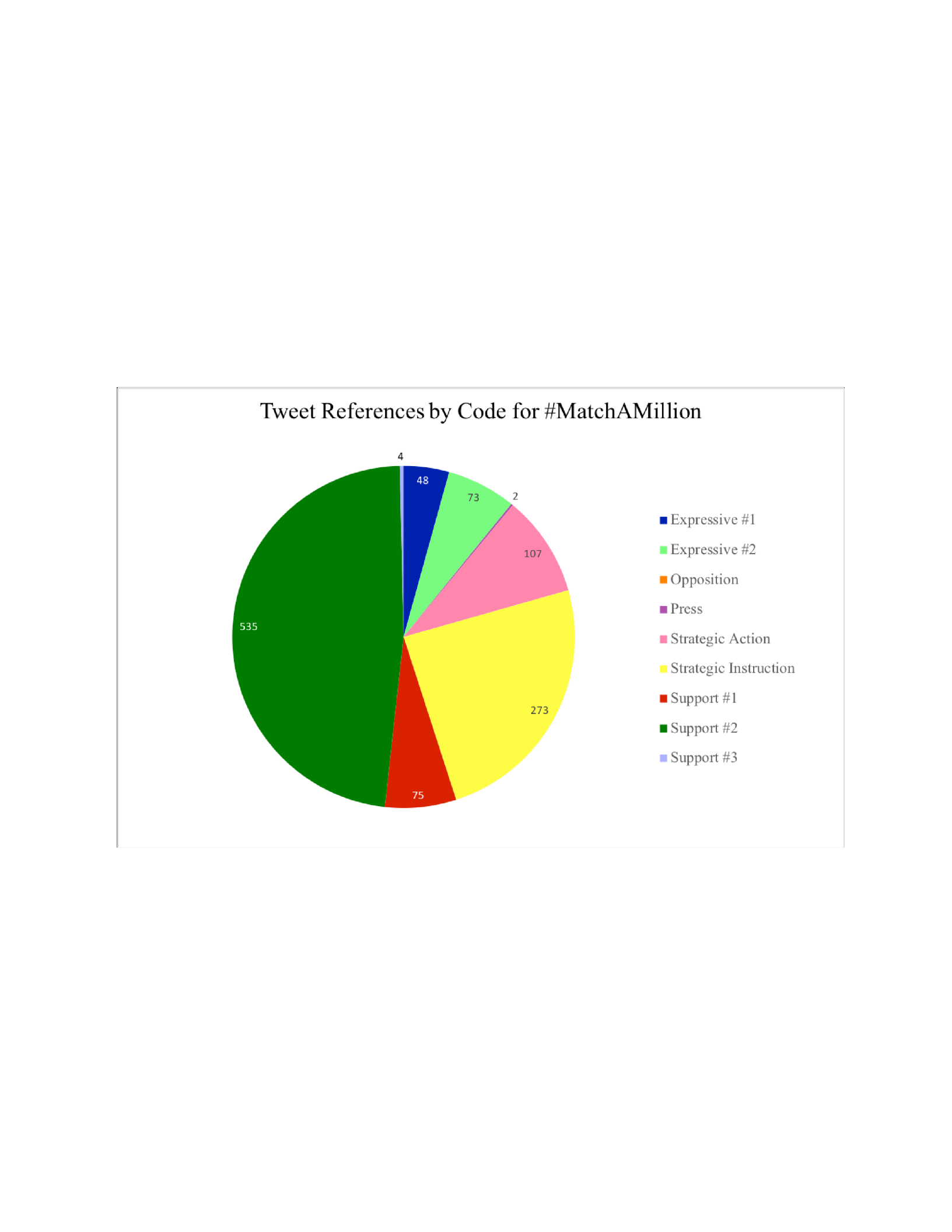
78
about the community and their actions. One particularly prominent example that connects to
discourse I discussed earlier in my introduction was as follows:
Unknown affiliation: “yes kpop Stan accounts can be funny & supportive in situations
like this but the kpop stan community as well as their fav idols can be EXTREMELY
ANTI BLACK. those accounts you liked because of what they did to the iWatch Dallas
were likely to be black ppl ESPECIALLY black women.”
II. #MatchaMillion
Figure 6.
Figure 6. This pie chart represents the distribution of textual analysis codes (Figure 3) across 1,000 randomly
selected tweets from the #MatchAMillion event displayed as total number of tweets assigned to each code. Data
represented were collected by Sorrel Galantowicz from the Twitter API.
The #MatchaMillion event was dominated by support #2, that is, support from the
ingroup to the ingroup. This is most likely because another feature of this event was the insular
nature of it to the K-pop community. It was a fan led movement that only gained the attention of
outsiders after the fundraising had ended and the monetary goal had been met. Within this

79
context, with this event was also the rise of the presence of support #1, support in the context of a
K-pop group, specifically here BTS. Overall, 45 tweets in this category were cross coded as both
support #1 and support #2, often in the context of a fan being proud of their group’s charitable
action and the fanbase’s ability to mobilize.
In group member: “#THANKYOUBTS for inspiring our generation to take action and
strive for a better world for our future. I contributed to organizations supporting
#BlackLivesMatter and I am so proud of ARMY for raising over $1 million so far.
#MatchAMillion #2MforBLM @BTS_twt (link to donation page)”
Specifically, there was an emphasis on the teamwork involved between BTS and their fanbase
(ARMY), so much so that I almost regretted not giving it a unique code. However, the vast
majority were still fans expressing their love, support, and mostly pride for the other members of
their fanbase and their success in raising money for a cause.
Despite this fundraising event being largely insular to the BTS fan community, there was
a trend amongst fans to call on big celebrities other than BTS to donate to the campaign. This
manner of tweet was coded as strategic instruction as it was usually in the form of a call to action
from small accounts to big accounts from twitter influencers to celebrities such as Jimmy Fallon
and John Cena:
In group member: “@JohnCena Hey @JohnCena, ARMY's moot, BTS ARMY is
currently attempting to match @BTS_twt‚ $1M donation to #BlackLivesMatter. Are you
able to join, fellow ARMY? Donate through the split donation option if you consider!
Thank you so much! #MatchAMillion”
However, most of the tweets in this category were targeted towards other community members.
With this, some strategic instruction was very specific, such as where and how to donate, but
much of it was along the lines of “we are so close let’s do this!” assuming everyone knew what
they are talking about. Additionally, there was a good number of tweets that fell into the
category of strategic action and strategic instruction because they were along the lines of “I

80
donated, and you should too!” This following example follows this pattern while also showing
expressive and supportive sentiments:
Ingroup member: “Tried my best and used the money I was saving, for things that can
wait, to contribute to a much more important cause, fighting for #BlackLivesMatter If
you have any money to spare at all, you should too #MatchAMillion @BTS_twt Proud to
be an ARMY”
Within the movement there was also a push to encourage those who could not donate monetarily
to be able to contribute. Many fans expressed that they could not donate due to age and access to
online banking or financial situations but still wanted to help the cause by spreading the word.
Others created ways for these fans to contribute by posting content such as this following tweet
which was sent out by the user multiple times tagging various other fan accounts:
Ingroup member: “WE ARE SO CLOSE! Every view this video gets from an ARMY, I
will donate $00.10 USD. For example, 100 views is $10.00 USD. Just please let me
know in the comments you are an ARMY! (Link to their personal YouTube video)
#MatchAMillion #MatchTheMillion LETS GET TO A MILLION BEFORE THE DAY
ENDS”
Along with this, many strategic instruction tweets were asking fans to make sure that they
donated through a certain source for validity but also to make sure that their donation counted
towards the official #MatchaMillion movement. Partially, I assume the purpose of this was not
only encouraging collective action but also making sure that credit went where credit was due.
There was one tweet in particular that was reposted by numerous fan accounts that had the clear
goal of claiming ownership to the movement:
“Dear Media and Locals, I am an ARMY a @BTS_twt fan. & it is OUR fandom that
started the #MatchAMillion donating $1M to #BlackLivesMatter not ALL the kpop
community. So please do not call us Kpop stans we are ARMY or if it is easier for you
BTS stans. Thank you”

81
Going off of this, these data were also marked by a significant rise in tweets that fell
within the expressive category. In the category of Expressive #1, or reasons for support, most
tweets demonstrated that fans wanted to clarify the point of the #MatchaMillion donation to be
for the greater good of the Black Lives Matter movement and its broader goal of racial justice.
Ingroup member: “I have been donating through the past week but I want to be a part of
this collective effort. Help out if you can and if not then help spread the word. Also
remember that money helps but the real contribution is the respect and value for black
lives! #MatchAMillion (Personal contribution receipt)”
Ingroup member: “I’m so, so proud of us! Never forget what this is for, and please
continue to support, encourage, and fight for brown/black lives. #2MForBLM
#MatchAMillion #MatchTheMillion #BlackLivesMatter ALWAYS!”
However, there was a very small subset of these expressive tweets which seemed to show a level
of ignorance in the context of “I only donated because BTS did”. This is problematic because it
implies a lack of actual support for the movement or understanding of its importance and broader
goal. On the other hand, it also shows that one group has the power to encourage action from
even those who were not previously involved. I will discuss these implications further in my
discussion portion. On the flip side of this, many of the tweets coded as expressive #2 sought to
push back against this narrative or specify to other fan members what the purpose of
participation should be.
Ingroup member: “Donate and let us help each other. Lets help and support and express
our love to all black people and black armys. @BTS_twt #MatchAMillion
#WeLoveYouBlackArmy #BlackLivesMattters”
Or they were targeted at outgroup critics:
Ingroup member: “Please understand that the #BTSARMY isn’t donating ONLY bc of
@BTS_twt a lot of us have been donating all week. This #MatchAMillion campaign is
just the first chance we can do something COLLECTIVELY and the first time we can
track our numbers”

82
Following this, other expressive #2 tweets were targeted at press coverage specifically and their
history of negative coverage for K-pop fan bases in particular, in the context of the good work
being done by #MatchAMillion.
Ingroup member: “Pretty sure it's time for journos to drop the "crazy teen fangirl"
narrative when writing about @BTS_twt and ARMY. The fanbase is a diverse mix of
teens, women, and men of all ages from all over the World and economic background.
Amazing. #MatchAMillion”
III. Trump Tulsa Rally
Figure 7.
Figure 7. This pie chart represents the distribution of textual analysis codes (Figure 3) across 1,000 randomly
selected tweets from the Trump Tulsa rally event displayed as total number of tweets assigned to each code. Data
represented were collected by Sorrel Galantowicz from the Twitter API.
This event was characterized largely by engagement and reaction from outgroup
members mostly in the context of rampant press coverage of K-pop fan’s actions towards the

83
Trump Tulsa rally. The majority of these tweets from outgroup members were in the context of
support for “the youth” as press coverage claimed that K-pop fans and Generation Z or “Tik Tok
users” were the ones leading the action to sabotage a Trump event:
Outgroup member: “After the K-Pop Stans and teenagers and their awesome response to
Tulsa, can we get a "The kids stand a chance".
They criticize the system,
By stifling their chance
Teens, youth and K-pop stans
The kids stand a chance”
As with the first event, many users simply tweeted out a link to an article that covered the
supposed action carried out by the ingroup. For this I used the same tactic as I did with the first
event and read the article to gain a sense of their positive or negative sentiment. Also, as with the
first event, many outgroup members were reacting with shock or laughing at the situation.
Similarly, to the first event, often those poking fun were considered support as they were
decidedly anti-Trump rally. However, those that expressed only shock and disbelief at the
situation often went without a code as they were neither supportive not opposing.
This event did stand out from the others in that it was the first one to show a significant
number of oppositional tweets. However, the interesting caveat was that these opposition tweets
came from both those on the side of Trump and those against him. Those against him held the
position that K-pop twitter and Gen Z did not have an effect on rally turn out, some even
claiming that by attempting to troll him they had played into his agenda. Specifically, often they
chastised those spreading the narrative of a K-pop rally sabotage because it subtracted from the
fact that the rally could have been empty simply because no one wanted to show up, Trump
supporters included.

84
Outgroup member: “Tik Tok teens and Kpop fans didn't sink the rally. NOTHING they
did explains why Trump couldn't get 20,000 people in the arena. Nothing. We need
critical media literacies!”
Outgroup member: “If the #tiktokteens story is true, and they, along with K-pop fans
bought tickets just to make the stadium look empty, you did something very counter to
your purpose. You just donated to Trump's campaign. You're an official supporter of the
re-election campaign You made an oofers”
However, there were also a large faction of oppositional tweets that were directly opposed to the
populations of K-pop fans and Tik-Tok users alike. These types of opposition came from
predominantly conservatives and Trump supporters. The rhetoric here mostly came in the form of
degradation to the demographic:
Outgroup user: “I’m not convinced that the Zoomers/KPop crowd actually know who
Donald Trump is.”
Dislike for the democratic party and all others not in support of Trump, specifically in the context
of Alexandria Ocasio Cortez who had tweeted her support for the movement:
Outgroup user:” Trump campaign rejects claims that TikTok, K-Pop fans sabotaged rally:
'Don't know what they're talking about' (Article link) #FoxNews
Fuc* #AOC!!! And the fools that follow her!!! #AOC is dumb as a big bag of nails!!!”
Or most prominently, accusations of foreign intervention:
Outgroup user: “Let me get this straight. The fake news media are giddy that K-Pop {S.
Korean) and Tic Toc {China} orchestrated a sabotage of the Trump rally ordering
hundreds of thousands of fake tickets. Why is this not foreign election interference?
Imagine if it had been done to Biden.”
Outgroup user: “They know they can't win with policies or by debating. They're already
fawning over kpop foreign interference. They'll take any ammos they can. Anything that
would hurt Trump. By any means necessary like they say. They are evil.”
Unfortunately, many of the tweets in this category could be defined at hate speech and therefor I
will not be quoting them here.

85
With this event there was also a significant number of tweets that fell into the expressive
category, specifically expressive #2. However, many of these expressive tweets were still coming
from outgroup users. Similarly, to the opposition category, many of these tweets were specifying
that low turnout at the Tulsa rally was due to lack of support not trolling. These tweets however
found themselves in expressive rather than oppositional as they had the tone of clarifying rather
than critical of the ingroup.
Outgroup user: “Attendance wasn’t low because of Tiktok and K-Pop stans. Attendance
was overhyped because of them. Had Trump known how few real supporters requested
tickets, he likely would have canceled, switched to a smaller venue, or held it outside. So
they get credit for the humiliation.”
Outgroup user: “Remember, the rally was first-come-first-serve seating. So, while the Tik
Tok kids and K-pop fans caused inflated ticket numbers, the actual poor turnout was all
Trump.”
There was also a cohort of often academic outgroup users who were expressing the fact that this
K-pop led trolling movement actually had value in terms of causing problems for the Trump
campaign. Specifically, they were discussing the idea of data skewing or poisoning and
defending the integrity of the ingroup community.
Outgroup member: “Regardless of the age of the K-Pop fans, as someone who teaches
database design and implementation for a living, this (& maybe subsequent similar
efforts) has totally screwed the integrity of the Trump campaign's data”
Lastly, a fascinating element of this event was the expressive tweets from within the
Kpop community. The majority of these were in the context of idol group TXT who had been
asked during an interview with FOX News how they felt about K-pop fans interfering with the
Trump rally. This was deemed as inappropriate by fans as the group had nothing to do with this
fan action and should not be expected to comment on controversial American politics in this
manner.

86
Ingroup member: “Would you ask an American artist their opinion on the Queen of
England??? No?? So why ask TXT their thoughts on Trump??”
Ingroup member: “i'm so confused WHY WOULD ANYONE ASK TXT ABOUT
TRUMP, THEY KOREAN , THEY GOT THEIR OWN PROBLEMS YO”
Network Analysis:
In this section I will be using visualizations created from my collected twitter data to
examine networks amongst and between communities of users. The main network visualizations
for each event show different communities of users as colored bubbles aggregated by size to
represent the number of users in that community. Each community in an event has a distinct
color so that they can be easily distinguishable. The lines connecting the community bubbles
represent edges, or connections between communities. In the context of tweet data, connections
are usually in the form of user mentions, quote tweets, or replies. The connection lines are
aggregated by the weight or strength of the connection between communities or within
themselves. Communities connected by thicker lines had more cross-user engagement such as
users from one community mentioning users from another frequently in tweets. The tables
bellow each of these visualizations provide context to each community by demonstrating central
members engaged with the most by other users.

87
I. IWatch Dallas
A. Communities
Community: Central members*:
3 Mashable, bts_twt
5 youranoncentral
Table 1.
Figure 8. Network Visualization of IWatch Dallas Communities
Figure 8. This image displays a network visualization of the top 10 communities identified from the tweets in the
IWatch Dallas event data set 2 (n=852) as derived from the TSM python scrip (Freelon et al, 2016). Edges
between communities are aggregated by thickness to represent the weight of connection as calculated by Gephi
9.2. Nodes representing communities are aggregated by size to represent number of members. Table 1 displays
community color key and central members. Data represented were collected by Sorrel Galantowicz from the
Twitter API.

88
6 Dallas Police Department
8 Verge
11 Dallas Police Chief Hall, City of Dallas
13
32
40
68
72
*Communities with no central members will be left blank
Figure 9 is very unique to the IWatch Dallas event as this type of visualization was not
possible with the other events. As described in the methods, this visualization shows the same
data displayed in Figure 8 only with greater detail. Instead of showing larger community bubbles
only varying in diameter to represent community size, this visualization shows each individual
user as its own data point so that one can get a more intimate sense of community interaction.
Similarly, the community connection lines, or edges, utilize arrows to show directionality.
Directionality represents which way an interaction occurred, who was the source and who was
the target. In other words, an arrow pointing from one user to another means that the first user
mentioned, replied to, or quoted the second user.

89
The network analysis and community detection preformed using TSM and visualized in
Gephi for the IWatch Dallas event show that largely connection occurred between only a few
large communities. The biggest communities present (#6 and #11) were centered around The
Dallas Police Department, the City of Dallas twitter, and the Dallas Police Chief. This makes
sense as many of the tweets involved in this event were in response to the original tweet put out
by the DPD asking for submissions to the IWatch Dallas app, which tagged City of Dallas and
Figure 9.
Figure 9. This image displays the same data represented in Figure 8 (the top 10 communities identified from the tweets
in the IWatch Dallas event data set 2 (n=852) as derived from the TSM python script) with the exception that
community members are not grouped but instead individual users are represented by unique data points. Additionally,
the directionality of edges is displayed through arrows. Nodes are categorized by community on the same color scale
used in Figure 8 for continuity. Visualization created on Flourish.com.

90
Chief Hall. Thus, these two communities are closely connected with the main factor
differentiating users being whether or not they tagged all three of the accounts (community #11)
or only DPD (community #6).
The third largest group, community #3, was less strongly connected to #6 and #11 and
centered around Mashable and BTS. When a community contains a news source such as
Mashable it is usually because many of these users were either replying to an article publish by
this source or simply tweeting out the article. In this context the article put out by Mashable was
titled “K-pop fans spam Dallas police 'snitch' app with videos and memes to support protesters”
and was supportive of the ingroup. We see a similar phenomenon to this in community #8
centering around an article by Verge.
The fourth largest group that was still connected to #6 and #11, community #5, was
centered around twitter user @youranoncentral. This handle is the account of an infamous social
media influencer of sorts known as “Anonymous”, a social justice activist whose twitter profile
claims they exist for the purpose of “exposing Human Rights abuses from around the world.”
Their involvement in this event comes from the fact that they put out an original call to their
followers to thwart the IWatch Dallas app when it was first promoted. Community #72 was also
connected to communities #6 and #11 although it had no central members. The other 5
communities were unconnected to any others and also had no central members. They consisted of
about a 50/50 divide between ingroup and outgroup members.

91
B. Transnationality:
Figure 10. This map displays tweet count by country for IWatch Dallas event data set 2 (n=852).
Tweets collected in the IWatch Dallas event data set 2 came from 57 unique countries
with the top three represented being the United States, Sri Lanka and the United Kingdom. There
was also a presence of transnational communicative tweets within this event which mostly fell
within the strategic category and were in the form of instruction to international fans:
Ingroup member (mentioned earlier): “Do know that it’s OKAY to help in your lanes,
especially if you live abroad. There are a lot of things that you can do. You can donate,
Figure 10.

92
you can raise awareness using your social medias, you can flood Dallas, iWatch
application with fancams (that one was epic). #BlackLivesMatter”
Ingroup member: “DOWNLOAD THE iWATCH DALLAS APP AND SPAM
RANDOM VIDEOS (e.g. fancams) SO IT WILL BE HARDER FOR THEM TO FIND
PROTESTS FOOTAGE AND IDENTIFY PROTESTORS!!!!! IF YOU’RE NOT FROM
THE US AND CANT DOWNLOAD THE APP DM ME!!
#BLACK_LIVES_MATTERS”
Or questions for international fans looking to help:
Ingroup member: “Damn i wanna download iwatch dallas to troll but its not available in
my country! Help? Lemme post my fancams chile (picture of app store error message)”
II. #MatchaMillion
A. Communities

93
Table 2.
Community: Central members*:
Figure 11.
Figure 11. This image displays a network visualization of the top 10 communities identified from the tweets in
the #MatchAMillion event data set 2 (n=29,907) as derived from the TSM python scrip (Freelon et al, 2016).
Edges between communities are aggregated by thickness to represent the weight of connection as calculated by
Gephi 9.2. Nodes representing communities are aggregated by size to represent number of members. Table 2
displays community color key and central members. Data represented were collected by Sorrel Galantowicz
from the Twitter API.

94
0 A prominent BTS fan account/translator, John Cena, James Cordon,
Jimmy Fallon
1 bts_twt, prominent Argentinian fan account
2 OneInAnArmy
3 Actblue
4 bts_bighit, bighitent, variety
9 Converted fan due to BTS donation, mix of fans and outgroup
14 Progressive activist Johnny Akzam (supportive outgroup), billboard
24 Beyonce fan account showing ingroup support, ARMY who started #
35 Prominent Korean fan account/translator
87 Prominent Canadian fan account
*Communities with no central members will be left blank
Unlike with the previous event, all of the communities in this event are connected by
edges to multiple other communities and contain central members. The largest group for this
event was community #1. This community was connected to every other group and also heavily
interconnected within itself. One of the central members here was, understandably, the official
twitter account for BTS. Interestingly, the second central member was a very highly followed
BTS fan account based in Argentina. They were central based on their support for and coverage
of the #MatchAMillion fundraiser, specifically in Spanish language tweets. Community #1 was
highly connected as well to the smaller community #4 which was central around accounts that
represent the entertainment agency which manages BTS, Bit Hit Entertainment as well as Variety
who was being asked by fans to cover the event and also to donate to the cause. The news source
was also involved because it had been covering the BTS donation and did publish an article
about the fan fundraiser as well.
The second largest community was #2 which included the twitter account for the
organization One in an Army, the BTS fan led charity group who was running the donation

95
tracking for #MatchAMilllion. Similarly, the much smaller community #3 was based around the
account for Act Blue the donation distribution and tracking service through which One in an
Army was hosting the fundraiser.
The third largest community was #0 which also contained a prominent BTS fan account
which also acts as a translator for putting Korean content related to the group into English. Other
members of this community included celebrities John Cena, James Cordon, and Jimmy Fallon.
As mentioned before, these celebrities were being asked to join in the fundraiser and donate
money to Black Lives Matter organizations. John Cena was targeted specifically as he has in the
past publicly professed to be a fan of BTS. Jimmy Fallon and James Cordon have both hosted
BTS on their respective talk shows and thus have an established relationship with the group as
well.
Another interesting central member came from group #14 in the form of Progressive
activist Johnny Akzam who is a prominent outgroup member who found himself involved by
tweeting support for the BTS donation and the subsequent fan action. Similarly, community #9
centered a user who tweeted a claim that BTS’s donation to BLM had converted him into a fan.
Additionally, community #24 had a central member who was actually a fan account for singer
Beyonce. They were expressing their support for the collective movement by BTS fans and
encouraging Beyonce fans to follow suit. Ingroup members put a lot of emphasis on interacting
with outgroup supporters as this was a strategy for not only promoting BTS and their work
outside of the fandom but also potentially gaining more traction for their fundraising outside of
their insular community. Additionally, as a community largely dismissed by mainstream, mostly
on racially biased and misogynistic grounds, engaging with outgroup supporters serves to give
the movement more validity in the mainstream.

96
Another central member of community #24 was the original influential fan account that
had started the #MatchAMillion movement in the first place. Communities #35 and #87 were
also centralized around fan accounts with large followings. These ones were based in Korea and
Canada respectively. B.
Transnationality:
Figure 12. This map displays tweet count by country for the #MatchAMillion event data set 2 (n=29,907).
This event contained tweets from 149 unique countries with the top three again being the
United States, Sri Lanka, and the United Kingdom. In terms of transnational textual
Figure 1 2.

97
communication most of what I observed with this event was that the only signifiers of
transnational content were user screen names. That is, occasionally I would notice that a tweet I
was coding in any category would simply be from a place specific username. A trend amongst
very large fandoms is to have smaller fan communities that center around certain identity factors
or geographic locations. These ranged from the hyper local (New Jersey ARMY), to the national
(Belgium ARMY), even to the continental (BTS Asia ARMY). Even coming from these
transnational group pages however, the rhetoric of tweets was often indistinguishable from other
fan posts and they followed all of the same patterns of support, expression, and strategy. That
being said, there were a few location targeted tweets such as the following:
Ingroup member: “Good morning, European Army!
The other part of the fandom has reached almost half our goal for #BlackLivesMatter
while were were sleeping! It’s not up to us to take over & #MatchAMillion for @Bts_twt.
Teamwork makes the dreamwork (Donation link)”

98
III. Trump Tulsa Rally
A. Communities
Table 3.
Community: Central members*:
1 Donald Trump and numerous other prominent conservatives
Figure 13.
Figure 13. This image displays a network visualization of the top 10 communities identified from the tweets in
the Trump Tulsa Rally event data set 2 (n=21,116) as derived from the TSM python scrip (Freelon et al, 2016).
Edges between communities are aggregated by thickness to represent the weight of connection as calculated by
Gephi 9.2. Nodes representing communities are aggregated by size to represent number of members. Table 3
displays community color key and central members. Data represented were collected by Sorrel Galantowicz
from the Twitter API.
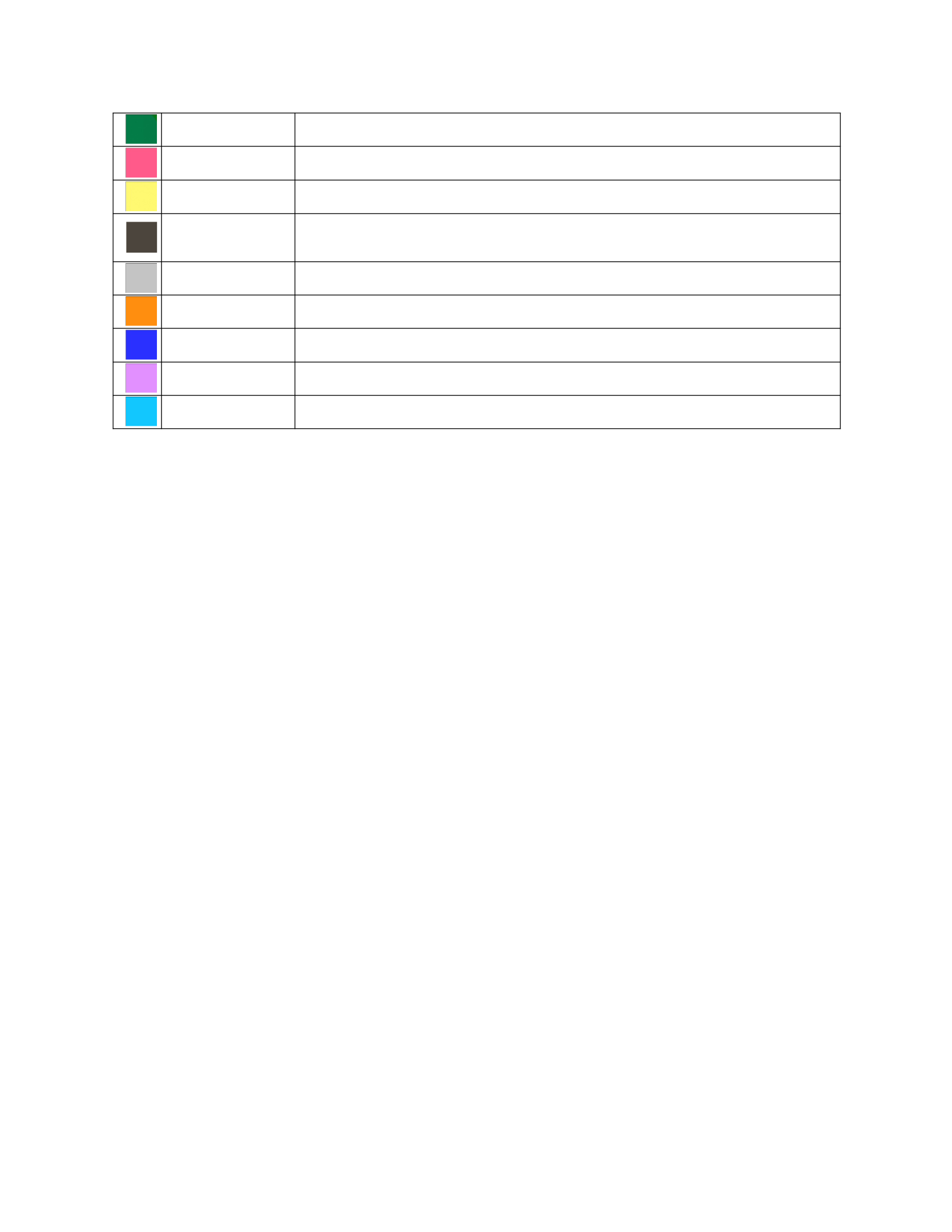
99
11 Rolling Stone, Bernie Sanders
19 Parscale, CNN, Stephanie Ruhle
20 Alexandria Ocasio-Cortez
24 Liberal Political Commentators (Joy-Ann Reid, Parker Molloy), USA
Today
34 BTS
50 New York Times
61 Official twitter of The Lincoln Project and co-founder Steve Schmidt
69
201
*Communities with no central members will be left blank
By far the largest community in this data set was community #1. This community
contained the official Twitter of former president Donald Trump as well as many other prominent
conservatives including his children and large fan accounts dedicated to him. Most of these
existed here in the context of people reacting positively to the event, him being tricked and
humiliated, and thus tagging him and his supporters to rub in the victory. One the flip side, the
community also included those tagging him in a supportive context as well.
Multiple other communities followed a pattern of including a combination of new
sources that had covered the event, and political commentators or public figures who had
separately spoken on the event. This is present with community #11 (Rolling Stone and Bernie
Sanders), community #19 (Parscale, CNN, and Stephanie Ruhle), and community #24 (Joy-Ann
Reid, Parker Molloy, and USA Today). Similarly, community #50 simply centered around the
New York Times who had published a particularly prominent article on the subject.
Community #20 was the third largest community and centered around Alexandria Ocasio
Cortez who, as discussed, had very notably tweeted her support for “K-pop allies”. This garnered
her a lot of attention in this specific event in the context of people pleased she had mentioned the

100
work of K-pop fans, and those who opposed her political standing and were upset that she was
supporting foreign factions. On a similar vein, community #61 centered around the official
twitter of The Lincoln Project, a Republican organization in public opposition to Trump and
cofounder and former member Steve Schmidt. Lastly, community #34 was the only community
to be obviously K-pop related as its central member was BTS. However, despite being one of the
top 10 largest communities, the community did not share edges with any of the other
communities and was thus disconnected network wise.
B. Transnationality:
Figure 1 4.

101
Figure 14. This map displays tweet count by country for the Trump Tulsa Rally event data set 2 (n=21,116).
This event contained tweets from 155 unique countries with the top three being the
United States, Canada, and the United Kingdom. In terms of transnational specific textual
content, none of the tweets I hand coded contained any. However, due to the spatial distribution
of tweets across the globe, this event was factually transnational at least to an extent. What I
observed, it that while the conversation around K-pop fans trolling Trump was technically
transnationally, it was not expressed as such in tweet text. However, this could be down to human
error in the manner in which I collected and analyzed my tweets. As discussed in my methods, I
had two data sets for each event, one with only English language tweets for hand coding, and one
with no language restriction for network analysis. Overall, there was a 2,793tweet difference
between these data pulls. That is, in my textual analysis there were 2,973 tweets in languages
other than English that I did not account for. Additionally, when hand coding I used a random
sample of 1,000 tweets from that original 18,323 English tweets, meaning that I somehow could
have not randomly selected any “transnational specific” tweets despite their active existence.

102
Chapter 5: Discussion
Discussion:
Defining the movement:
The largest and most influential social media and on the ground protest movement in the
United States in recent years has been the #BlackLivesMatter movement and its related off
shoots. This movement was revamped in May of 2020 catapulting the conversation around racial
justice back to the for front of national conversation. While distinctly different, one could see the
first two events analyzed as offsets of #BlackLivesMatter movement with #MatchAMillion
raising money for Black Lives Matter organizations and IWatch Dallas working to protect Black
Lives Matter protesters. With this framing we can analyze them within a comparative lens which
I will do here as part of my sentiment analysis.
In their work, Tillery (2019) performs an in-depth analysis of tweet content forming from
various social movement organizations (SMOs) who are affiliated with the #BlackLivesMatter
movement. They sought to understand how these SMOs and the Black Lives Matter movement
more broadly use twitter as a site of both expressive content relating to the cause as well as for
direct resource mobilization. They hypothesize that rather than aligning the BLM movement
more with the marginalized people’s rights movement of the past, it should be instead defined as
a New Social Movement that seeks change less directly through policy and more through
sentiment engagement. Ultimately, their study found that “the SMOs examined in this study are
building a movement that is focused much more on expressive communication than strategic
communication aimed at mobilizing resources” but that some rhetoric was dedicated to strategic
action just a much smaller subset (Tillery 2019).

103
In this context, one subset of tweet content I would like to discuss were those that fell
into the category of “I am ONLY participating in this action/activism because of BTS or K-pop”.
While only a very few of these tweets were observed both in Events 1 and 2, they still deserve
dedicated analysis. At face value, a group like BTS changing alignments so that fans identify
with BLM is a positive. As discussed, alignment is a necessary process for social movements in
gaining support, traction, and influence, especially when they exist in the social media sphere
(Tremayne 2014). Again, at face value it is positive that these fans are donating money to Black
Lives Matter organizations and it is equally impressive that a group such as BTS has the social
power to sway political views. However, when the goals of the movement at large as defined are
largely preferencing the dissemination of expressive information as to WHY one should support
the movement over resource accumulation, one directly disregarding this expressive content and
only engaging with the mobilization could be seen as counterproductive. In this lens, tweets that
fall into this category could be counted as non-progress or even a step backwards. That
being said, these conversations around the importance of expressive content in conjunction with
strategic action were being had within the fan spaces. As it is tempting for the media to define
K-pop fans and BTS ARMY as a mindless mob of obsessed teenage girls, beyond being
misogynistic in framing is factually incorrect. There were many more tweets, such as mentioned
in findings, that specify to both in and outgroup members that monetary contributions are
important but understanding of the objectives and radical systemic change is the actual point.
However, the fact that there was any tweet content or conversation within the community that
expressed such ignorance means that these expressive ideals are not reaching or being received
by every corner of the community and thus more work could be done to promote them.

104
Further, a main use of social media in the context of activism is to define the scope and
agenda of the particular movement; what issues it represents, and who is or is not a part of the
movement (Wilkins et al 2019). Usually, what I will term ‘gatekeeping’ in this discission, puts an
emphasis on group identity formation and the defining of the in and out group. Gatekeeping
looks different in the context of fan activism than in other social movements for marginalized
people’s rights because it is not ‘advantaged group’ as the outgroup with ‘marginalized group’ as
the ingroup. Instead, it is all fans as the ingroup, with minor exceptions, and all non-fans as the
outgroup. However, when it came to criticism of the ingroup and their action, much of it was
racialized. This again circles back the fact that when a multiracial and multiethnic group works
together on a cause, much of the backlash lands on the people of color while the credit from the
outgroup goes to the white faces of the movement. This ultimately has more of a commentary on
the white framings of the mainstream media than it does to the movement. However, it is an
important reminder for those in privileged positions in society, being white fans, to understand
how they will experience spaces of protest and activism differently than their non-white
community members. Similarly, this concept is another push for the importance of expressive
content being supported in these spaces as it encourages productive conversation and
constructive learning regarding racial justice and how those even in the ‘advantaged ingroup’ can
be actually promoting positive societal change. The reason I did not see as much expressive
content in my data samples could be because they were being left un-boosted by fans that saw
them as less important despite their critical nature.
While I was not performing a media coverage analysis of my three events and their
associated communities, I did consume a lot of press coverage around these subjects and am thus
able to contrast the image they painted with the reality I observed through data analysis. A
Bloomberg Businessweek article published in October of 2020 titled “No one Fights Q-anon like

105
a Global Army of K-Pop super fans” provides a brief example. While the article is theoretically
covering the political engagement of K-pop fans in a positive light, it plays into tropes and
perpetuates stereotypes in a way that left many represented in it unhappy. The article hinges on
comparing avid fans of K-pop and their process of discovering the genre with members of online
conspiracy theorist group Q-anon. Bearing in mind that one of these groups is fans of a music
genre and contains many people of color, and one is a white supremacist hate group, this
comparison is extremely offensive. Processes of group affinity formation and identity negotiation
centered around fandom such as I have observed in my research are distinctly different from
processes of group formation centering around racial bias and should be treated a such. That
being said the article chose to frame that BTS fans bullied a prominent fan twitter account into
addressing the issue of Black Lives Matter rather than framing it in the light of BTS fans placing
prominence and emphasis on those they supported addressing issues of racial injustice.
While it is true, as I have discussed, that K-pop fan communities can be spaces of
hostility and even anti-black or otherwise racially insensitive content, to frame even their
political activism in a villainous light is reductionist. As I began my paper with, this subject, as
with many cross-cultural conversations, requires nuance. Within the context of my data analysis,
I did not observe a single tweet shaming or acting hostile from one ingroup member to another,
even across idol group fandoms. In the context of #MatchAMillion in which actions was
requested of fans it was not promoted with aggressive rhetoric and instead many tweets were in
the framing of “its ok if you don’t have enough money to donate there are other things you can
still do”. The only targets of attack I observed in this context were rapper Post Malone, who was
being called out by fans for not having donated to or spoken out regarding Black Lives Matter
despite his rampant use of black culture, and the mainstream media for said community
misrepresenting. Those seeking to only critique these communities and their actions rather than

106
critically cover all nuanced perspectives often effectively work to further silence the voices of
fans from the ingroup doing the work of spreading this positive expressive content, specifically
the work being done by black female community members.
Creating networks:
My data show that, intrinsically, all three of my events operated in transnational networks
to different degrees. Now that we have established the validity of these transnational networks,
we can look at how exactly they operate. In the context of transnational activism, Koinova and
Karabegovic (2017) explain that the process of a movement making a scale shift from local to
global often involves an oppressed population unable to make reforms in their local context,
appealing to actors in other contexts. Further, this transnationalization process often involves the
linking of local frames of injustice to global ones for more international appeal (KOINOVA and
KARABEGOVIĆ, 2017). The obstacles that are most likely to form when a movement makes
the shift from local to global is an absence of transnational collective identities and the
limitations of many people’s individual networks even with the caveat of social media. In the
context of my research, many of these processes looked very different from how they have been
studied previously. In terms of a scale shift from the localized context of the U.S. to a globalized
movement, I did not observe any content along the lines of linking local frames of justice to
global ones, or even many transnational specific calls to action. As I interpreted this, there was
no need for transnational appeals or calls to action in an event like #MatchAMillion because
international fans are already going to participate on the grounds of group affinity with ARMY
and fan affinity with BTS. As mentioned, transnational group identity formation can be an
obstacle for mobilization. Thus, I theorize that a large factor in why this transnational event
worked so well was because it tapped into pre-existing transnational networks of affinity. What I

107
observed was a sense of mutual aid importance shared amongst the fan community in
#MatchAMillion with the framing of BTS helping ARMY, then ARMY helping ARMY reach
their goal with the expressive purpose of ARMY helping black ARMY. I saw this as well in the
IWatch Dallas event but on a much border scale as it was loosely “K-pop” fans who have less
bonding them intrinsically but still a sense of community and loyalty when called upon as a
group.
Many scholarly discussions previously have emphasized that K-pop is a form of
transnational media that operates through fan networks on social media (Jin and Yi 2020, Jin and
Yoo 2014, Ju and Lee 2015). Fans are most likely to be exposed to K-pop on social media and
then continue to interact with it there as it is not as available through traditional platforms.
Similarly, the user-driven nature of social media and the way fans consume transcultural products
through a process of participating in exploring, enjoying, and repurposing leads to a more
meaningful cultural economy existing in these spaces (Jin and Yoon 2014). The K-pop social
media space is a unique site of participatory fan-driven content dissemination and negotiation
between “corporate controlled media processes and fandom-led grassroots practices”
(Jin and Yoon, 2014). When considering these factors, it makes logical sense that the
relationships and networks formed between K-pop fans on social media have the potential to
carry more weight than other such networks. As my findings display, K-pop was the catalyst for
the creation of transnational affinity groups that held enough social meaning to precipitate broad
scale community action.
Connected to this idea is the importance of individual fan accounts in the context of
community formation and community action. Fan driven content is a hallmark of K-pop social
media spaces and thus accounts with the purpose of making fan content, translating Korean, or
even just having meaningful conversations about a group can attain a level of importance and

108
influence in their communities. This influence was shown clearly in the network analysis I
performed with fan accounts being the central members of many of the communities I detected.
In the case of #MatchAMillion, although theoretically the event centered around BTS, it was the
grass-roots efforts of fans and particularly the leadership of certain accounts that actually
facilitated the action. Further, as speculated by Dodson (2020) and emphasized by Nummi et al
(2019) many of these leaders were women of color building and maintaining the momentum
behind this fan specific social movement.
Ultimately what I found in my final event, the Trump Tulsa rally, was a different manner
of transnational conversation. Unfortunately, the data that I pulled centered largely around
Donald Trump much more than it related to actually discussion of K-pop activism. This means
that the transnational network I observed was much more likely a network of those
internationally who actively opposed of supported Trump. Being the celebrity he is, as well as at
the time the President of one of the world’s most powerful nations, as a subject it makes sense
that he garners a lot of public international opinion, both positive and negative. However, the
discourse that I gained from this data played an expressed role in my analysis in terms of
allowing me to understand oppositional commentary around K-pop fan communities and their
actions. Through these data I saw not only the racialized nature of some of this content but also
the dismissive contexts as well. By in large, people were so surprised by action coming from
what they perceived to be a demographic of uneducated fan girls when in reality this group is not
a monolith but a diverse body of complex multinational actors. Similarly, the positive and
negative discourse around them helped highlight the importance of data in online activism. In the
digital age, data are so important in how many systems operate, and to poison or skew said data,
as was done by fans in the IWatch Dallas and Trump Tulsa event, can have real consequences in
ways that are not entirely trivial. This lends credibility back to the field of online activism as

109
worthy of discussion especially amongst populations that are frequently dismissed by mainstream
political channels.

110
Chapter 6: Conclusion
In this thesis, I indevoured to analyze the political organizing strategies of social media
users involved in K-pop fan communities on twitter. I wanted to discover how they used different
forms of tweet rhetoric to build support, disseminate information and negotiate group identity.
Additionally, I wanted to examine to what extent these conversations represented transnational
networks and how these networks were strategically utilized. Before conducing my own
empirical research, I performed a literature review on the subjects of K-pop as an
ethnomusicological phenomenon and twitter as a site of activism. I used the work of past
scholars studying social media activism to inform the creation of my methodology for analyzing
K-pop twitter political organizing. Then, in order to actually attempt to answer the research
questions I had posed, I collected textual data directly from K-pop communities on twitter for
analysis. I coded these tweets based on their expressed purpose of either expression or strategy
and looked for content that discussed explicitly transcultural communication and mobilization.
Beyond textual evidence I used code to detect community formations within these larger data
sets and determine what bound these communities together. Additionally, I identified individual
accounts that had the ability to create centralized communities within the twittersphere. Tweet
meta-data also allowed me to derive user locations and determine the transnational scale and
scope of the communities I was analyzing and their collective actions.
Ultimately what I found was that, similar to other twitter based New Social Movements,
K-pop community based action consisted largely of expressive content and consistent efforts by
ingroup members to define and monitor the scope of the movement and the rules of engagement.
Users engaged twitter to establish support and validation for those responsible for successful

111
action as well as to call out individuals misattributing credit. They also used expressive tweets to
disseminate clearly what exactly the purpose of action was so as not to have the movement
coopted even as it reached a massive transnational scale. However, I observed that strategic
content, specifically in the context of instruction for action across national lines, was a
widespread practice. Along with this, I noted the importance of individual accounts who already
had large spheres of influence in creating important community structures for content
dissemination. In the spaces of social media sites like twitter, having a following is the key to
getting your voice heard both in the context of the twitter algorithm and in the context of basic
social connectivity. The need for big accounts to participate in and help facilitate and mobilize
group action is recognized by the K-pop community and utilized effectively when implementing
calls to action or defining a movement and its purpose.
Additionally, while all of my data sets represented transnational networks, I observed that
actually transnational mobilization required very little explicit instruction as these networks were
built on shared affinity and thus had built in expectations of mutual aid. Numerous scholars have
asserted through their work that K-pop fan spaces generate strong senses of group identity and
interpersonal relations due to their dependence on user created content (Brennan 2020, Cho 2017,
Jin and Yoon 2014, Ju and Lee 2015, McLaren and Jin 2020). My data showed this to be very
largely true in the context of fans mobilizing for collective action. Ideas around how and why to
participate in action came from within the community and were directed at other community
members in a system of expressive and strategic content dissemination that had the ability to
reach every corner of the world. In the context of all of my findings, I reaffirm the importance of
studying critically social media based community action and the positive as well as negative
processes it can represent.

112
As I was in the process of writing this thesis, the U.S. saw the rise of another largely
social media based racial justice movement in the form of #StopAsianHate. This movement was
a reaction to the marked increase in hate crimes against Asian-Americans amid the Coronavirus
pandemic and was also a call for the opening of a national conversation around the erasure of the
experiences of Asians in the U.S. and the racism they face. I find this subject relevant to mention
in the context of my research not only because it is a powerful expressive based social media
movement, but also because it connects directly to themes I have discussed and findings I have
presented. I mentioned previously in the context of K-pop how the U.S. still shows a huge lack of
representation of Asian-Americans in spheres such as popular music and popular media. The rise
of K-pop’s popularity among white American fans should be included into the conversation
around how as a mainstream culture we preference and value Asian cultures and peoples but only
as they exist outside of our immediate society. This is still a manifestation of the exoticizing and
othering of Asian cultures and the perpetuation of western supremacy in the U.S.
I want to emphasize that these concepts should be on the minds of specifically white
American fans who engage with K-pop as a cultural product. K-pop discourse is an inherently
racialized space and engaging with it has different implications for people of color. I observed
this critically as I was analyzing my data and want to again state the importance of advantaged
ingroup fans recognizing their privilege as well as listening to and uplifting the voices of other
fans of color particularly as they discuss themes of anti-Asian and anti-Black racism from within
the community and surrounding the industry.
In terms of continued action from the K-pop community in activist contexts, their work
does continue. My personal data collection for this thesis included only events centered in the US
and taking place in the early summer of 2020. However, outside of the U.S., other action has

113
been occurring in which K-pop fans have engaged. Throughout 2020, but specifically in the Fall,
pro-democracy protests have been taking place in Thailand. Peaceful protests led largely by Thai
youth call for reform of the monarchal system and its constitution, an end to military based rule,
a new and fair election, and the end of harassment of state critics (BBC.com, 2020b). Thailand is
the home to a very large community of K-pop fans and numerous idol-group specific K-pop fan
collectives. Thus, it makes sense that many Thai fans also participated in these protests and used
their fan spaces on social media to discuss it. Specifically references to pop culture were widely
used by protesters to critique the Thai monarchy and its oppressive nature (Walden and Salim,
2021).
Additionally, in early 2021 there has been a number of climate related natural disasters to
strike specifically impoverished areas of Indonesia. K-pop fans from within the country and
internationally have rallied to raise funds to be donated to disaster relief. In some cases,
individual fans effected by the disasters placed calls for help on social media and were met by
other fans providing direct aid (Walden and Salim, 2021). This pattern of action shows again the
power of social media in terms of resource mobilization and affinity-based K-pop fan
communities acting on principles of mutual aid and support. As previously discussed, fan
communities have frequently used their connectivity and power in numbers to act in charitable
ways and as the prowess of K-pop continues to spread I am certain will hear many more of these
stories in years to come.
Limitations and Further Work:

114
The main limitation that this thesis faces is the lack of first-person qualitative data.
Largely due to time constraints, I was unable to supplement my twitter based quantitative data
with interviews. However, in order to get the full story on my research subjects this would be
necessary. My efforts were focused largely on understanding the movement as a whole, but
further work should proceed in the direction of understanding the role of individuals within these
communities form their first-hand accounts. As previously discussed, the biggest downside of my
research methodology was the loss of individual voices, particularly those that are already
marginalized in society and receiving less credit for their work than they should be. My aim was
always to lend credibility through academic attention to these fans-based movements, but now
that that has been done, attention should be aimed directly at those who pioneered such efforts
and want to have their voices amplified through qualitative research. Of course, informed consent
is the most important element to this methodology, an option much less present in the analysis of
public twitter data.
Additionally, using the Twitter API as a source of data has limitations in its own right. In
terms of collecting qualitative data, on twitter there is a large prevalence of algorithmically
generated content also known as “bots” whose job it is to create tweets using buzz words that are
gaining lots of engagement. This alone has the power to skew data. Also, as I was using twitter to
gather geographically based data it is important to note that geolocation is available for very few
tweets and as mentioned, most location-based data is self-reported. As I used the meta-data
enriched feature of “user derived location” from twitter, some users who had not directly
reported their country location had their location derived from other information in their profile
by twitter. In this process there was room for machine error. Similarly, “twitter is not used
uniformly by all people around the world with strong user bases in, for example, the US, Japan,

115
and Brazil” (Dodds et al 2019). All of these factors have the caveat of potentially effecting my
ability to perform accurate transnational network analysis.
I also must acknowledge the human error that could easily have played a role in the data
that was collected and analyzed. Engaging in this research represents my very first time ever
even using computer code and more specifically my first time writing my own python scripts.
While I was able to rely on past researchers in terms of open-source code-sharing, the learning
curve of my data collection process could potentially have affected the accuracy or specificity of
the data I was able to collect and analyze. I am also personally limited in my monolingualism
and encountered many language barriers across this work that if broken would have opened
numerous doors of further understanding.
Overall, my work on this subject was extremely broad and baseline, almost to be
considered merely a jumping off point. In terms of the further work that I believe this subject
matter deserves, I emphasize the necessity of more qualitative analysis. Engaging in qualitative
interviews with K-pop fan community members, specifically those with large spheres of
influence, is essential to understanding more in depth the importance of this affinity-based
community action. I have only scratched the surface of what could be a huge multinational
research project. Additions to this research should be done in specific contexts such as
identitybased studies and in specified geographic locations. This research could help to highlight
and further understand the work done by fascinating fan sub-groups constantly navigating
crosscultural identities and global issues. However, I would note to whomever may continue this
work that they should do so bearing in mind the caveats I have mentioned in this thesis,
specifically the necessities of nuance, respect, and privacy.

