


1
COMPARATIVE COVERAGE OF COUNTY GOVERNANCE IN KENYA’S PRINT
MEDIA: A CONTENT ANALYSIS OF THE DAILY NATION AND THE STANDARD
(2014–2015)
BY
MCO 120 - Media and Society

2
CHAPTER 1: INTRODUCTION AND BACKGROUND
Introduction
One of the objects of a newspaper is to understand the popular feeling and give expression to it,
another is to arouse among the people certain desirable sentiments; the third is fearlessly expose
popular defects (Mahatma Gandhi). Since the 16th century, the role of the media as Fourth
Estate and as a medium for public discussion and debate has been recognized. Currently,
notwithstanding the mass media’s propensity for sleaze, sensationalism and frivolity, the notion
of the media as watchdog, as guardian of the public interest, and as a conduit between governors
and the governed remains deeply entrenched (Weiss, 2000).
1.1 Background
In Kenya, the newspapers have a very crucial role in promoting the cause of good governance.
Good governance is a set of ideas, which promotes legitimacy competence, transparency and
accountability of the government in due respect for human rights and the rule of law. For Kenya
to develop there is need of having institutions, which promote ingredients of good governance
especially in this era of devolution. Experiential evidence proposes that adept implementation of
communication activities can play a critical role in translating devolution objectives to actual
results on the ground. The Kenyan newspapers can apprise the citizens giving them the voice as
well as information based on devolution.
Democracy apropos governance requires that people should have the right to know the activities
of the government, especially the decision of the government that affects their life, freedom and
property. Information is significant for people to make choices regarding their participation in the
State, the market and the civil society. Sufficient information helps people to decide sensibly and

3
take the right course of action beneficial to them. The Media (both print and electronic) thus, helps
people to know what is happening around them, socialize them with the values of development
and equip them with the fundamentals of modernism. By disseminating information, the media
also makes public services more responsive to the people (Njogu, 2013).
At the process level, communication influence mechanisms contribute to improved governance by
influencing opinion, attitude, and behavior change of leaders and Policymakers (political will),
mid-level bureaucrats (organizational will), and citizens (public will) toward supporting
governance reform objectives. These pro-reform change processes occur in both the demand and
supply sides of governance. At the structural level, communication links citizens, civil society, the
media system, and government, forming a framework for national dialogue through which
informed public opinion is shaped (Weiss, 2000). Understanding the process and structural aspects
of communication is critical to effective governance in a country like Kenya.
1.1.1 The Public Sphere
The public sphere is a communicative space, a setting within society where people form their ideas
about matters of mutual concern, by partaking in a progression of public debate and cogent
argumentation (Habermas, 1989). Habermas states that public opinion is a consensus that is arrived
at through spirited discussion and legitimates government decisions. The function of the public
sphere is that of an instrument: it isolates issues of common concern among citizens, deliberates
them, proposes possible solutions and then appraises the decisions which are made by the
administration bodies. Public opinion is idyllically converted into administrative power through
the legislation process.

4
In his book Between Facts and Norms (1996), Habermas reasons that the public sphere and the
private sphere are very important spheres in any democratic society. He states that the private
sphere of the life world is an area where citizens experience matters and problems at a personal
level and this, therefore, ought to be the basis of the problems deliberated in the public sphere.
Private matters that necessitate jurisdictive directives should transpire from the private sphere,
with the help of the publics’ relations which promote them to the public arena. The public arena
itself is an area of argument, where subjects sponsored by diverse groups fight for recognition as
subjects of public concern, and actors representing various interests fight for admission to the
argument (Habermas, 1996). He sees the “role of citizen movements as vital not only in promoting
issues that affect the private sphere, but also in maintaining and reproducing the public sphere
itself by sustaining dialogue. However, he recognizes that not every group has equal access to the
debate and there are unavoidable asymmetries in the structure of the public sphere (Habermas,
1996).
As for the normative role of the media in the public sphere, Habermas (1992) acknowledges the
public’s capability to censoriously process media messages, and is less cynical about the impact
of the mediation of a cogent debate. Moreover, he agrees with many other scholars that the media
is a very imperative institution in bringing together the “abstract public sphere of isolated readers,
listeners, and viewers scattered across large geographic areas” (1996) and in creating the public
sphere to be more inclusive arena. Consequently, this means that different media sections play the
important role of gatekeeping as well as offering access to the debate to different social actors
including the public (Habermas, 1996).
The media, thus, plays a significant role in providing and maintaining the public sphere which in
turn fosters good governance in a nation state. ‘Governance’ and ‘good governance’ have

5
increasingly become central themes in development communication discourse (Weiss, 2000). Bad
governance is regarded as one of the root causes of the failure of many developing nations. Weiss
(2000) postulates that major donors and international financial institutions are basing their aid and
loans on the condition that reforms that ensures "good governance" are undertaken. Good
governance is an indeterminate term used in international development literature to describe how
public institutions conduct public affairs and manage public resources (Schramm, 1964).
Herbamas adds that rational governance cannot be attained if there is no properly functioning
public sphere.
Lines (2009) states that attaining good governance necessitates the understanding and participation
of every member and of the society. The media, their roles, channels and content, are considered
powerful enough to make this achievement a reality. But a great number of existing media
channels, and the content they deliver, cannot take up this responsibility adequately because they
are not accessible or affordable for all. The work of the media should not divide the citizens into
the information-rich and information-poor. In other words, there must be channels which serve the
right to know of the people and the interest of the public, without any control either by the state or
commercial entities. Such channels must deliver diversity of content to serve the various groups
of members of the society. In particular, content must be informative and useful – it can then be
turned into knowledge and wisdom which the people can use to eliminate poverty, alleviate
hardship, and improve quality of life in the post-modern society (Lines, 2009).
For many, the cogency and the wide reach of the mass media, primarily print media, appears reason
enough to take at face value the notion that the media have the power to enlighten the public, as
well as create false beliefs. Leinnijenhuis and Rietberg (1995) have deliberated over the real impact
of mass communication in national development especially in the third world countries. In the

6
course of this period, third world countries have been asserting that the purposive use of the mass
media is an imperative part of their struggle for progress (politically and economically). Stromberg
(2002) contends that the failure of economic progress, which should have followed the
achievement of independence, can be seen in terms of their inability to control native information
systems. Mass communication scholars though, in the 1950s and 1960s, argue that the mass media
were critical to the process of reconstruction. “Even though that view has changed over time,
emerging nations still generally hold that if the channels of information within their borders were
controlled by foreigners, they would be confirmed in a state of perhaps more hopeless dependence
than before" (Smith, 1980).
These inconsistent proclamations raise the essential questions such as Wete’s (1988) “Do the mass
media play a role in development? If so, under what type of development strategy can the mass
media be most effective? Such issues as the theoretical underpinnings of mass communication and
the emerging development strategy, basic to understanding the interrelationship between the mass
media and social change, will be considered.” Emerging democracies like Kenya are confronted
not only by poverty, sickness, illiteracy and ignorance, but also resistance to fundamental change.
Wete states, “The intellectual discussion over the starring role of mass media in national
development is the creation of the mission for alternate ways of informing, educating, and
persuading large audiences in underdeveloped nations quickly, frequently, and cheaply” (1988).
The mass media thus has a bigger role in the national development. It should be noted that the
mass media plays an integral part in reflecting the state of a country. This also means that it can
influence the proceedings (economically and politically) for the better or for worse in a given
country (Wete, 1988).
1.1.2 The Kenyan Media: A Brief History Since 1963

7
Kenya became an independent country in 1963 after a long domination by the British. At the time,
the vast majority of programs on radio and TV were brought in from British and America.
However, this changed gradually when Kenyans took over the government media.
Programs that promoted Kenyan or African culture were introduced under Jomo Kenyatta.
Bourgault (1995) agrees that as expected, Swahili became the most dominant language in most
programs and more attention was put on African music and dance. Similarly, journalists covered
more African traditions, ethos and values in order to promote the process of Africanization.
Nevertheless, it should be noted that the media industry later encountered obstacles under the
leadership of former president Daniel Arap Moi. A crackdown on reporters and other newspersons
led to arbitrary arrests and incarceration by state officials who were paranoid on the perceived
‘subversive’ activities of the media (Mungai and Gona, 2010). In 1992, the long-awaited signs of
multi-party politics started to emerge and media industry grew remarkably. The print media market
improved to four when the People Daily was set up and the alternative press-commonly called the
gutter press-also emerged. Exacting criticism of the government by the media, in partnership with
the emergence of opposition politics painted a completely different picture of the conformist
media of the earlier era (Mungai and Gona, 2010).
1.1.3 Press
Two independent national newspapers, the Daily Nation, The Standard and regional and
specialized papers like Business Daily and The Star feature quality reporting, as does the weekly,
The East African, which is published in Nairobi, Dar s Salaam and Kampala. Under the recent
regimes (Kibaki and Uhuru), the media have demonstrated greater editorial independence than in
previous years, and the number of press freedom abuses has declined. Still, some media policies

8
and incidents continue to inhibit press freedom, for instance, the need to post a costly bond prior
to publication and to register afterward. In 2003 the government invoked a restrictive constitutional
provision on court coverage to intimidate journalists reporting on a possible political murder. In
March 2006, hooded policemen raided the offices of The Standard newspaper and Kenya
Television Network, claiming concerns about internal security.
The Daily Nation which was started in 1960 is under the Nation Media Group (NMG). The
newspaper was seen as the champion of the people throughout President Daniel Arap Moi’s era.
The NMG also owns NTV, QTV and Easy FM radio and The East African (a regional weekly
paper distributed in Kenya, Uganda and Tanzania (Mwaura, 2004). Undoubtedly, NMG is the
largest media house in Eastern and Central Africa (AfriMAP, OSIEA, and OSMP, 2011). The
Standard is the oldest newspaper in Kenya and it was established in 1902. It is the only newspaper
in the Standard Group. Under the wing of Standard Group, there is a Kenya Television Network
(KTN) and Radio Maisha. People Daily was established in 1992 and by then, it was owned by the
opposition politician Kenneth Matiba (Mungai and Gona, 2010).
1.2 Statement of the problem
The Kenyan constitution that was promulgated in August 2010 has met quite a number of
expectations of many Kenyans, mainly with regard to the abolishment of “imperial presidency”,
devolution of power and resources to counties, the comprehensive bill of rights, and the extension
of participatory rights of women and marginalized groups (commission for the Implementation of
the constitution, 2012). Implementation of all of these and other innovations provided by the
constitution is scheduled to cover five years. Before the next national elections are held in 2017,
nevertheless, relevant institutions and laws have to be not only in place but also working properly
as envisaged in the constitution. Sihanya also contends that this deadline and the speed of

9
implementation during the first half year after the promulgation, implementation of the constitution
deserve first priority on the political agenda of all relevant institutions. One of the pertinent issues
that has really dragged and befuddled the common citizen is the devolution process (2012).
The County Government Act No. 17 of 2012 necessitates the county governments to use any form
of mass media they are predisposed to create awareness on devolution and governance (The
Kenyan Constitution, 2010). The mass media especially the newspaper has become the most
effective tool to distribute information to the public. Consequently, the mass media ought to play
a significant role in educating and informing the public on the pertinent issues that are otherwise
encrypted in legal language. Ghai (2011) adds that the complexity of the language used in the
constitution makes it virtually impossible for the average citizen to comprehend every aspect. The
media, at this point, becomes a very important tool for the average citizen especially in the aspect
of devolution (Ghai, 2011).
1.3 Research Objectives
1. To analyze the print media coverage of County Governments in Kenya.
2. To establish the aspects of County Governments were covered by the print media.
3. To establish the extent the Print Media focuses on County Governments and how it has
promoted good governance in Kenya.
1.4 Research Questions
In considering the media coverage of the County Governments in Kenya, the following research
questions which are based on the print media coverage were formulated.
1) To what extent has the print media covered the County Governments in Kenya?
2) Which aspects of County Governments were covered by the print media?

10
3) To what extent has the print media coverage of County Governments promoted good
governance in Kenya?
1.5 Justification of the Study
Nanz and Steffek (2004) affirm that good governance is a key concept for democratic and
economic development in many countries as witnessed around the world during the past few
decades. Kenya is one of the countries that have embraced the idea. The current constitutional
dispensation no doubt has been sustained probably because certain institutions were carefully put
in place (Commission of Implementation of the Constitution, 2012). From the field of Mass
Communication, the media educates, informs the public and sets the agenda. This makes mass
media audience consider virtually every issue which the media concentrates on as important
(McCombs and Weaver, 1985). This study will be important in the field of development
communication. It will help in proposing better strategies and perspectives that can contribute in
enhancing cognizance of citizenry responsibilities, rights and privileges that are envisaged in the
new constitution particularly devolution.
According to Njogu (2013), the mass media especially the print media has become the most
effective tool to distribute information to the public. The power of the media to influence and
educate people on matters of policy has never been important in the history of Kenya.
Consequently, it is on this basis that the researcher embarked on analyzing how the media has
covered the pertinent and ever muddling matter of devolution process in Kenya since the
promulgation of the new constitution.
1.6 Scope of the study

11
The aim of this study is to examine the print media coverage of County Governance in Kenya by
analyzing the two leading dailies: Daily Nation and The Standard. This means it is the general
coverage of the newspapers on the entire 47 counties in the country. All these newspapers have
sections covering county news in the therefore, the research will cover its content in covering the
county news.
1.7 Limitation of the Study
There are numerous limitations of this study that must be addressed. First, this study was a content
analysis and it focused on just two publications (Daily Nation and The Standard) out of many that
are in circulation. A second limitation of this study is the sample size. Time constraints limited the
sample to 364 newspapers from both publications and a period of 12 months. Even though this is
a standard number from which to draw initial conclusions, future research using a larger sample
would give more strength to the findings. Another limitation of this study is that publications are
shaped by events thus likelihood of missing out on the appropriate sample.

12
2.0 CHAPTER TWO-LITERATURE REVIEW
2.1 Introduction
Good governance is not just about government. It is also about political parties, parliament, the
judiciary, the media, and civil society. It is about how citizens, leaders and public institutions relate
to each other in order to make change happen (Making Governance Work for the Poor: DFID
White Paper, 2006)
2.2 Theoretical Framework of the Study
This study uses the concept of public sphere. Public sphere theory was established in 18th century
and accentuated by Jürgen Habermas who contended that the public sphere was characterized by
its critical nature in contraposition to the representative nature of the feudal system (Habermas,
1996; Boeder, 2005). Conferring to this concept, Hauser (1988) stated that it is a discursive place
where citizens of a given jurisdiction can exchange their ideas in order to arrive at a common
judgment. This critical nature has been enhanced by the power of the mass media even though it
has transformed most of the humanity to be passive public: the objects of a consumer's culture
(Habermas, 2006). It is interesting to note, however, that the likelihood of attaining larger numbers
of persons allow mass media users to create ties that would have been difficult to maintain without
the new tool, and these ties create networks, a popular word nowadays. But how is the society
influenced by networks? (Varnelis, 2008).
Garnham (2007) advances that certain conceptualizations of ‘network,’ ‘public sphere,’ and
‘publics’ relate to the fields in which they are hypothesized and discussed. Within the sociology,
communication and public policy camps, the idea of the public sphere is commonly believed as a
'commons' like place where deliberation and debate can transpire unobstructed. With the collapse

13
of proximity-defined associations and associative edifices (like the traditional notions of
community), the public sphere seems endangered. The question is which is the best place to
debate? How can stakeholders find appropriate associations or alliances to carry out public
objectives? Habermas has done further research on the theory and post modernism. He states that
the problem from this vantage point is about the loss of the historic public sphere and the need to
find a new space or place for exercising deliberative democracy. The brief takeaway here:
commons-like venues promote democratic deliberation by affording people space and shared
context to interact and engage with one another around public issues. Within the eclectic field of
media and communication studies, on the other hand, the public sphere is most often
conceptualized as the product or outcome of common media usage, typically at a national or
shared-language level.
The sphere extends as far as the media transmission does; media defines the shape and dynamics
of the sphere (1996). Consumption of media informs a group of people simultaneously and in so
doing defines a public audience(s), more recently referred to as ‘publics’ (Sheller, 2004; Varnelis,
2008). A case in point is the use of the public sphere theorization in defense of public service
broadcasting: public service broadcasting 4(PSB) has been traditionally characterized in most
countries by nation-wide, free-of-charge, universal, full-service content production and
distribution for ‘citizens’ as imagined recipients. There is a subtle, but burgeoning, tension
between the public sphere as viewed as a cyber-commons and as a media-derived audience of
(potentially) active citizens (Habermas, 2006).
The theory of Agenda Setting is also very important in guiding this study. The Agenda Setting role
of the mass media concerns more than just the transfer of news from the media to the public.
McCombs elucidates that agenda-setting and priming rely on the notion of attitude accessibility.

14
Mass media have the power to increase levels of importance assigned to issues by audience
members. They increase the salience of issues or the ease with which these considerations can be
retrieved from memory (McCombs, 1982). Principally, this theory asserts that the media tell
audiences what issues are important by highlighting them in coverage and placement, thereby
advancing them on the public agenda. Agenda setting theory is an influential theory within the
mass communications discipline. More than 200 empirical studies have found agenda setting
effects (McCombs & Shaw, 1972). Agenda setting has progressed from the idea that the media
suggest topics for the public agenda to the recent proposal that the media actually affect the
behavior of the audience. Ghanem (1987) established that agenda-setting research was entering a
second phase, in which the effects of the media agenda on what the public thinks has been replaced
by a research focus on how the public thinks about it.
Once a county government aspect is placed on the media agenda, a level of legitimacy is conferred
as the aspect is evaluated as newsworthy. Prestige-press reporting and ensuing coverage by smaller
media outlets perpetuates the status of the aspect as an item on the news agenda. Media coverage
reports real-world activities, but also enacts a governance mandate in which the importance
devolution processes is conveyed to a larger Kenyan public through the mass media. Agenda
setting theory and the social construction of reality work in tandem explain how issues of
devolution process rise to prominence (McQuail, 2010). Even though this concept has been
accepted by many scholars, it is believed that the reverse could be the case, in the sense that the
audience’s agenda can at times influence the media’s issue agenda (Uscinki, 2009).
Framing Theory, is a broad communication theory which was mainly influenced by a social
theorist known as Erving Goffman, elucidates that any developmental topic can be viewed from a
variety of standpoints that employ a multitude of different values and considerations.

15
Goffman suggested how individuals organize their thoughts and experiences under a series of
frames based on the individual prior experiences and knowledge and, as such, these frames
constitute the individual’s reality (Goffman, 1974). Consequently, he conceptualized framing as
‘rendering what would otherwise be meaningless aspect of the scene into something that is
meaningful’ (Goffman, 1974). Therefore, because of its interpretive nature, framing theory and its
resulting analysis lend themselves an analytical approach used by scholars to access and
understand how a variety of issues are constructed, structured and developed by the mass media.
Other scholars have also deliberated on the Framing Theory and proposed similar or
complimentary conceptualizations of the issue. For instance Gitlin (1980) explained the concept
of framing as, “persistent patterns of cognition, interpretation and presentation of selection,
emphasis and exclusion by which symbol-handlers routinely organize discourse.”
Additionally, Gamson (1992) conceptualized framing as the organizing theme in news media
accounts and argued that the frames the main media outlets offer are used by their audiences to
construct their own themes for understanding social issues. Brent et al (2005) contend that there
are two important conceptualizations of Framing Theory. “These are sociological and
psychological. The sociological conceptualization concentrates on and concerns itself with
interpretative and rhetorical processes of media discourse, as well as the processes of news
production and dissemination. The psychological conceptualization concentrates on the organizing
structure and the process by which audiences process and interpret information. These
conceptualizations, which serve to guide the theoretical and analytic nature of framing research,
are rooted in paradigmatic positions that dominate the approach to Framing Theory.”
Walter Lippmann was one of the greatest media researchers of his time. He, at one point noted in
his Public Opinion book that, “The only feeling that anyone can have about an event he does not

16
experience is the feeling aroused by his mental image of that event,” (Lippman, 1922, p. 18). This
statement has remained relevant till now and it can be applied here in Kenya vis a vis devolution
process. Good governance has been a thorny issue for many African countries Kenya included.
The recent promulgation of the new constitution has further ‘complicated’ matters as Kenyans
grope in the dark with regards to the implementation of the new constitution especially the facet
of devolution (Nwonwu & Kotze, 2008). This has been enduring problem that continues to plague
the country today. Many Kenyans hold different opinions on the devolution process. The
politicians and other political actors view it as the means of consolidating their power while the
constitutional experts and others view it as means of achieving massive national development by
means of bottom-up (Mwenda, 2010).
As these topics and issues are presented within a variety of frames, people reshape their thinking
about an issue and develop a particular conceptualization of the issue. By choosing some elements
of a reality and suppressing others, a story about a particular problem is constructed (Chong &
Druckman, 2007).
Many questions present in Kenya and international societies are complex and time consuming for
the average person to learn about and understand. Framing in communications simplifies and
organizes these multifaceted problems by endorsing particular explanations and interpretations of
the social and political issue. Ultimately, it has a packaging function that requires someone in the
media industry to select certain aspects of the larger problem, and make them more palatable for
the consumer so that it is easier to understand on a very broad, surface level (Kim, Carvalho, and
Davis 2010). The frames that the media choose to use when reporting on and representing a topic
are essential because they tell the audience what is important to think about. This can have a deep
effect on the attitudes and behavior of the individual by laying out what one should consider when

17
evaluating a variety of issues and applying them to his or her own life (Chong and Druckman 2007;
Kim, Carvalho, and Davis 2010).
The framing of devolution process by the Kenyan mass media is particularly interesting to
examine because questions of both what the cause of the confusion is, as well as solutions for the
matter, are deeply entangled, yet often addressed and conveyed individually. Tankard (2001) adds
that this definition and framing of causality and responsibility are very important because they
shape the overall approach taken by policy makers when attempting to synthesize a solution for
the issue, and when choosing who in particular the efforts towards change within society should
be directed towards and applied to.
2.3 Conceptual Framework
2.3.1 Mass Media and Good Governance
Nanz and Steffek (2004) echo the sentiments of other scholars that media acts as a medium of
communication whereby information, messages and stories can be transmitted to the general
public. There are various forms of media inexistence in the world today and they serve the purpose
of dissemination of information, as well as critiquing it in the best way possible. Key among the
media categories that exist in Kenya today includes the print media, traditional media, electronic
media, and mass communication media. Soola (2009) adds that the main aim of the media is to
bring about cognizance among the citizenry through the transfer of information. This process of
informing the public is an extremely important ingredient of good and sound governance that bring
about national development. For instance the population is informed about the shifting or updated
policies and programs of the government. It can, therefore, be substantiated that media can enhance

18
the notion of good governance through improved transparency, strengthened enhanced freedom of
expression, and expanded opportunity for citizen participation (Soola, 2009).
The media is an important institution that can and should strengthen the democracy and enhance
sound governance through the role Fog refers to as, “surveillance of sociopolitical developments,
identifying the most relevant issues, providing a platform for debate across a diverse range of
views, holding officials to account for the way they exercise power, providing incentives for
citizens to learn, choose and become involved in the political process” (2004). Therefore, it is
certainly true that the media is a strong pillar that upholds democracy.
In order to explore the effect of the media as a tool for sound governance, the British Broadcasting
Corporation (BBC) conducted a survey on governance and the media. In order to get accurate
results, the responses were received from a number of diverse groups, including policy makers,
academics and practitioners from government and media sectors.
The question put to them was along the lines as Aveggio reports, “How important do you consider
the media to be as a watchdog of governance and is this issue receiving an appropriate measure of
attention?” The responses were analyzed and the survey concluded that there was an “increasing
recognition of media’s role in governance in the development community and that there are some
indicators that the media are starting to be recognized at policy level” (2012).
In a nutshell, the ability of people, civil community and the private sector to dissect public
institutes and governments and hold them accountable is one important component of good
governance. The surveillance of the developmental function of the mass media identified by
Lasswell (1948) and Wright (1960) many decades ago shows that the media can play a pivotal role
as a watchdog for governance. As watchdogs, the news media has a responsibility to help guard

19
the public interest, ensuring the accountability of powerful decision-makers by highlighting cases
of malfeasance, misadministration and corruption, thereby strengthening the transparency and
effectiveness of governance (Lasswell, 1948; Wright, 1960).
2.4 Mass Media and National Development
Mass media enables a country to transform and develop. This translates to the growth of a nation,
thus playing an instrumental role in the socio-economic transition and development. Balan (1992)
notes that wherever there is a progressive economy and progressive development, there is a
progressive mass media system, independent of all powers. Therefore, the mass media and national
development are interlinked and inter-dependent with each other. The media, by virtue of its role,
can stimulate growth and progress. As a matter of policy, the mass media should be part and parcel
of the nation’s socio-economic development.
Schramm observes that, “Social communication’s structure is reflective of the structure and
development of the society” (1964). Consequently, any progressive society needs a vibrant and
independent media to propagate the development. Kenya is not an exception as it is an emerging
democracy, as well as a developing country. The media in Kenya plays a major role in
enlightening, apprising and entertaining the citizens. In educating the public, the Kenyan media
(exclusively the private media) has been effervescent in educating the Kenyan public about the
new constitution dispensation and other gray areas such as the devolution (Sihanya, 2012).
In 2010, The World Bank presented a report on the based on the significance of the news media in
emerging nations. The World Bank stated, “In complex modern societies, the existence of the
independent news media can be regarded as a necessary condition to guarantee a lively and

20
effective public sphere. Over the years, many rival normative standards have been developed for
evaluating the performance of media systems” (2010).
This shows the extent the news media gifts the general public with the platform to raise pertinent
issues vis a vis national development. Essentially, as agenda setters, the news media have an
obligation to raise consciousness of inescapable social, political and economic problems, help turn
the public attention to matters of common interest, inform governing officials about social needs
and apprise the international community about development challenges. As gatekeepers, the news
media also have an obligation of reflecting and incorporating the multiplicity of perspectives and
political arguments in reportage, to exploit the variety of viewpoints and arguments in lucid public
discussions, and to enrich the public sphere (Herbamass, 1996).
2.4.1 The Mass Media as an Indicator of Good Governance and National Development
The presence of mass media in any country is important because it influences development in
many ways. The existence of mass media, as indicated by such things as per capita availability of
radio receivers or newspapers, historically has correlated substantially and positively with
indicators of a country’s development, such as per capita income or gross national product
(Rummel, 1972). It is these correlations that suggest the function of the media as an indicator of
development in a given country. Indeed, many scholars have argued that mass communication
tends to promote development, which they often conceived not only in economic terms, as per
capita wealth, but also political terms, as political stability or democracy.
Positive theories (Wells, 1972) suggests that this may happen. One can think of reasons that almost
any form of media content might promote development or modernization. Entertainment media,
for instance, may show the purported advantages of life in developed countries to tradition peoples,

21
thereby promoting a necessary change. On the other hand, persuasive media may act as a sort of
agricultural extension service and facilitate diffusion of innovations. They may provide
information about, and convince people to use, new agricultural, medical, or birth control
techniques. Information media might inform citizens about public affairs especially devolution (in
the case of Kenya), thereby promoting political participation and democracy. In 1962, when most
African countries were gaining self-independence, the UNESCO General Conference authorized
a major study concerning the practicalities of media development. Wilbur Schramm (1964)
conducted the study that looked into the effect of mass media on national development. One of the
crucial discoveries of the research was that the mass media played an integral part in the political
and national development of a given country.
The study presented evidence of the lack of communication links within developing countries and
between those and the First World. Among the things Schramm recommended was a free and
vibrant media that could perform the functions of disseminating information and educating the
public on political and economic development in their countries. Schramm (1964) spells out, “For
the task of the mass media of information and the ‘new media’ of education is to speed and ease
the long , slow social transformation required for economic development, and particular, to speed
and smooth the task of mobilizing human resources behind the national effort.” Even though the
research was conducted over fifty years ago, the findings resonate with the governance and
political situation in Kenya. The Kenyan people need the mass media in more ways than one. The
citizenry need information with regards to devolution. Conceptualization of devolution system of
governance is a new phenomenon in Kenya and thus needs elaborate explanation. It is at this point
the media provides a platform with which experts and leaders can use to sensitize the public on
matters devolution.

22
2.4.2 The Mass Media and Citizen Participation in Good Governance
Lister (1998) notes, the notion of citizenship has long been a subject of debate and value laden
one in the democratic theory. To some, citizenship refers to a set of individual rights, whereas to
others it is seen as a wider set of social and civic responsibilities. More recently, some have claimed
for linking these two traditions, such that the right of participation in decision-making in social,
economic, cultural and political life should be included in the nexus of basic human rights.
Lister (1998) states citizen participation as the intervention of private citizens with determined
social interests in public activities. As noted by Cunill (1997) citizen participation… refers to
political participation but distinguishes from it at least in two ways: it abstracts both participation
mediated by political parties, as well as the one exercised by citizens when they elect political
authorities. It expresses instead - although with multiple meanings- the direct intervention of social
agents in public activities. Citizen participation in this sense involves direct ways in which citizen’s
influence and exercise control in governance, not only through the more traditional forms of
indirect representation (Lister, 1998).
The mass media becomes an important actor in citizen participation process as it informs the
citizens and provides the platform on which citizens can interact and communicate freely with one
another and the leaders, as well. Media coverage of policy issues is an important factor in
understanding citizen involvement in policy decisions. It is with this understanding that media
coverage frequency, timing and content can influence the citizens and hence promote participation.
Of note, the media promotes citizen participation by holding government to account and
empowering the local communities. It also gives the voice to the citizens who would want to air
their dissatisfaction on policy issues among other governance concerns.

23
2.4.3 Media and Devolution Process in the United Kingdom
Devolution as a form of governance has been used in various countries with every country having
its own account of this form of administration. For the purpose of this study, the researcher delved
at the United Kingdom countries of England, Wales, Northern Ireland Scotland and Westminster.
A change in policy especially in administration affects different sectors. Devolution as new policy
of governance has affected the citizens of UK in more ways than one. However, the focus of this
study is on the coverage of the devolution process. According to the Joseph Rowntree Foundation
(2010), “Ten years of devolution coincided mostly with falling levels of poverty and improving
employment rates across the UK, particularly in Scotland and the North East of England. Social
housing improvements were achieved. The Welsh approach to social care enables costs for older
people on lower incomes to be reduced and contrasts with Scotland’s more costly universal
approach. It is likely to take longer than ten years to see the true impact of devolved policies for
disadvantaged groups, especially in Wales where more limited powers are currently available.”
In a research conducted in the United Kingdom, ‘Reflecting the four nations? An analysis of
reporting devolution on UK network news media,’ the media was castigated for not highlighting
imperative information with regards to devolution process. The research findings reveal that the
media did not adequately play its role in advancing development through proper education and
dissemination of information to the public on matters to do with the process of devolution. Of note,
the public profoundly relied on the media for information on matters about devolution but there
was little to of it.
Cushion et al. (2009) explicate, “While politicians have been busy legislating post-devolution, UK
news media have found it difficult to reflect the changing contours of political life. Audiences

24
across the UK rely heavily on network news for their information about politics so the lack of
coverage or engagement with devolved policies does little to inform people—especially outside
England—about who is in charge and what they are doing. Regular viewers of UK network news,
our study suggest could remain oblivious of the fact that important decisions in areas like health
and education are being made in four separate places, while the decisions themselves, outside
England, and are almost entirely peripheral.” The findings of this study show that the media did
not sufficiently educate or inform the public on important matters of devolution. It is important to
note that the media, both conventional and alternative, can facilitate the empowerment of
individuals and collectivities.
The table (see Table 1) below shows the average audience that depends on the media for
information and education and other innumerable matters.
Table 1. BBC 1 news audiences by nation for weekday network news programs
UNITED
KINGDOM
ENGLAND
SCOTLAN
D
WALES
NORTHER-N
IRELAND
One O’clock News
Average Audience
2.8million
2.3million
280,000
140,000
75,000
Audience as
%
population
of
4.9
4.8
6.0
5.1
4.7
Six O’clock News
Average Audience
4.4 million
3.7 million
350,000
250,000
75,000

25
Audience as
%
population
of
7.7
7.8
7.3
9.0
4.7
Ten O’clock News
Average audience
4.9 million
4.1 million
370,000
250,000
125,000
Audience as
%
population
of
8.6
8.7
7.7
9.0
7.7
Source: BARB (12 months from October 2007 to September 2008)
This means that the UK media is not empowering the citizenry with devolution information so that
they can make informed decisions about the systems of governance. The study found out that even
though the media have an enormous potential to provide knowledge about devolution, they can
also be a vehicle for uncritical assumptions, beliefs, stereotypes, and political ideologies. It showed
that there was need to refocus on matters that can propel the four nations to new heights.
Cushion et al. (2009) adds that, “Given the diversity of political parties now in control of the
devolved institutions, the divergence between the political lives in the four nations is only likely
to increase. This makes it critical that the UK news media keep up with the dynamic world of
devolution, not least in terms of providing a more balanced coverage of devolved politics across
the four nations. Of course, making sense of any “clear water” that divides Westminster and the
other devolved institutions are sometimes a complicated, confusing and time-consuming task. But
any scrutiny of policy can only be enhanced by looking at alternatives close to home” (p27).

26
The study served as a wake-up call to the mass media since it was abdicating its watchdog role.
The road to success of devolution in the four nations depends on the vibrancy of the media. The
process can fully succeed if the mass media empowers individuals by enabling them to publicly
and privately scrutinize and contest decisions taken on their behalf by the power elite.
Overemphasis on political party matters will only serve to bring a developed and civilized nation
to its knees.
2.5 Devolution in Kenya
In 2005, Kenyans rejected a proposed new constitution. This regenerated a constitutional process.
Devolution was among the contentious aspects that contributed to the stalemate between the
government and other policy makers. It is important to note that the call for an alternative system
of governance stemmed from the perceived failure of the highly centralized system of governance
that many countries especially in Africa have operated since the early independence years.
Therefore, decentralization should be promoted as the best alternative policy to address the
administrative inadequacies, misappropriation of public resources and corruption that have
pigeonholed centralized systems of governments (Barret, Mude and Omiti, 2007).
The inclusion of devolution in the country’s government was one of the key restructurings of the
constitution that was inaugurated in 2010. Ghai (2010) defines “Devolution is the process of
decentralizing power from the center (central goverment) to sub-national units. It is different from
a federal system of government, since under the doctrine of parliamentary sovereignty devolution
is in theory reversible and the devolved institutions are constitutionally subordinate to the Kenyan
Parliament.” Kenya has been divided into 47 counties. There is a president, ministers, senator,
governor, and members of parliament.

27
“Devolution in Kenya has taken various forms; Administrative, For example the establishment of
Government Offices for the Regions, or, before 1999, the practice of transferring responsibilities
from central government departments to territorial departments of the same Government.
Executive - where the prerogative powers of the UK Government are transferred to ministers of
devolved governments, usually under statutory authority. Legislative-where law-making powers
are transferred to other legislatures” (Koki, Chege and Nabulumbi, 2013).
In 2013, Koki, Chege and Nabulumbi conducted a research on the state of devolution in Kenya.
The researchers interviewed a total of twelve people consisting of fellow students and lecturers.
The interviewees were expected to give their insights about devolution and how they felt about it
being applied in Kenya. The researchers asked; “Do you know what devolution is? What do you
know about devolution? Do you think Kenya can afford this form of government? What do you
think are the positive and negative effects of devolution?” (2013).
The researchers found out that 17% of the interviewees did not understand the meaning of
devolution. Those conversant with the concept gave brief explanation and most of them had
already concluded that it was a bad governance policy. 83% of the interviewees thought that Kenya
may not be able to afford devolution. The issues of burdening the taxpayer came to the fore with
most of them thought that there are so many levels of governance hence more leaders who would
demand higher pay. Other reasons include the debt situation in Kenya, unreliable leader and poor
system of governance that is not accountable. However, 17% of the respondents stated that Kenya
can afford devolution if the untapped resources are exploited and leaders of integrity are elected
to serve the people.
2.4 Rationale of Devolution in Kenya

28
Since Kenya became independent in 1963, it has experienced incidences of political instability
which have had adversarial impact on its economy as well as social cohesion. For instance, in
2008, Kenya witnessed violence following the disputed national elections held in December 2007.
Kenya has also experienced other failures from time to time. Such failures include corruption,
economic stagnation, inequalities and poverty. These failures and episodic instability can be linked
to the quality of governance (Kimenyi and Meagher, 2004). Quality of governance is in turn
dependent on institution. These institutions can take different forms ranging from the constitution,
to local authority by-laws to self-regulation in informal business setting. It is these institutions that
collectively determine the governance framework in a country. Different governance frameworks
will yield varying political, economic and social outcomes. As Kimenyi and Meagher (2004) note,
these differences emanate from the differences in the rules organizing capabilities, social and
political principles captures in the governance concept. Devolution is such governance concept.
In Kenya, devolution was advocated by experts as a political response to the vices plaguing fragile
and plural societies, such as, conflicts, inequalities, economic stagnation, corruption and inefficient
use of resources. Besides, devolution was implemented as a reaction to external pressure from
organized groups (civil and human rights groups). Nonetheless, for devolution to be successful,
the criteria of subsidiary and consensus must be observed (Dent, 2004; Kimenyi & Meagher,
2004).
There are several ways in which devolution impacts governance. First, by distributing authority
over public goods and revenues devolution makes it difficult for individuals or groups of official
actors to collude and engage in corrupt practices. Second, where devolution of authority takes
place along territorial and communal lines, it can foster effective cooperation within the devolved
units. As a result, local communities are able to mobilize social pressure against rent seeking and

29
corruption. Indeed, a growing number of countries have over the last 30 years further decentralized
administrative, fiscal and political functions of central government and sub-national governments.
These countries include the United Kingdom, Italy and Spain. In many cases, devolution has also
been driven by the need to bring government closer to the people.
3.0 CHAPTER THREE- METHODOLOGY
3.1 Introduction
Research strategy is very important for the researcher particularly in an effort to find out possible
answers to the formulated research questions. As Cooper and Schindler (2003) state, there are

30
certain relevant tools and methodologies that a research strategy must contain. Additionally, it is
important for the research to use tools and methods that point out the reliability and validity of the
material and data collected.
In addition, it is crucial that all materials and collected data is critically scrutinized and examined
(Robson, 2002). The research strategy for this project begun by collecting and examining some
background information regarding the situation of County Governments in Kenya. Final questions
for the interviews and units of analysis will be structured based on the research from noteworthy
literature. The results from the primary and the secondary data collected will be examined
in order to ascertain the most important results. In addition, some inferences will be drawn based
on the results related to the research questions (Cooper and Schindler, 2003).
3.2 Research Design
The research design used in this study will be descriptive research. According to Robson (2002)
descriptive research is defined as to portray an accurate profile of a person’s events or situations.
Based on the literature review explored there is a research done on how the two leading newspapers
cover the county news in Kenya.
The technique to be used will be descriptive survey, the most suitable research design that’s non
experimental. The term survey can be used to designate any research activity in which the
investigator gathers data from apportion of a population for the purpose of examining the
characteristics ,opinions or intentions of that population (Couchman and Dawson 1995; Polit and
Beck 2004). A descriptive design is selected because of its high degree of presentation and the
ease in which a researcher could obtain the participants opinion (Polit and Beck, 2004).

31
3.3 Population and Sampling
3.3.1 Population
Population refers to the entire collection of a set of objects, people and events or a collection of all
the items that we want to make generalizations or conclusions about. The population is chosen
because within the two newspapers, Daily Nation and The Standard Newspapers, there several
articles that deal with the county news on governance, according to (Babbie, 2007. In this study,
the population comprises of all the articles within the county news sections of the two newspapers
between October 2014 and September 2015.
3.3.2 Population Distribution
This study engages 182 Publications targeting key governance issues in the 47 counties in Kenya
from The Daily Nation and The Standard Newspaper published between the period of October
2014 and September 2015.
3.3.3 Sampling Design
The study focused on non-probability sampling where little attempt is made to generate a
representative sample (Cooper and Schindler 2011).
3.4 Sample Frame
Sampling is defined as the process of selecting certain members from a group to represent the
entire group. In most instances, the total population is so large that it is not possible to collect data
from every individual person or entity. As a result, it is scientifically acceptable to draw a sample
from the entire population, and generalize the findings of the research to that particular population
as being representative of the whole population (Bless & Higson, 2000).

32
The sampling frame is a record of the population from which a sample can be drawn (Jill and
Roger, 2005). The sample was drawn from the Daily Nation and The Standard Newspapers’
articles on county governance between October 2014 and September 2015 from their various
reporters in the respective counties.
3.5 Sampling Techniques Method
The type of non-probability sampling used is convenience sampling where the researcher selects
any readily available individuals as participants (Cooper and Schindler 2011). The target engaged
the county news articles from Daily Nation and The Standard Newspapers equally at a number of
91 articles per each newspaper to make a total of a hundred articles in general to have a balance.
3.5.1 Sample size
The sample size of this study is 182 Publications from both newspapers dailies.
3.5.2 Sampling Procedures
Based on the nature of data required for the study and the time and finances allotted, the October
2014 to September 2015 will be picked for this study since it is within the time; March 2013 and
2015 that marked the inception of a new government and thus the beginning of another era under
the new constitution. For this research, publications between October 2014 and September 2015
will be analyzed. A total of 182 publications will be analyzed for each paper at alternate days for
a period of 12 months (October 2013 to September 2015). This means that every day will have an
equal chance of being sampled
3.6 Research Instruments

33
The research instrument to be used in this study will be the search engine survey whereby the
researcher will use the internet to search for the articles from the Media houses’ websites to get
access to the articles. This instrument will be chosen because physically accessing the Newspapers
from the two media houses can be a bit tricky and cumbersome. This will guarantee that the articles
from the two newspapers will be accessed with ease with the help of the web search engines such
as Google, Hotbot, FastSearch, Yahoo, and Infoseek among other. But for this research, Google
will be the preferred search engine.
3.7 Data Collection Procedures
3.7.1 Data Source
In this project, both primary and secondary data were collected. The secondary data used was
censoriously appraised and collected from relevant literature, databases, as well as internet sources.
Further, the data used in this study was drawn from the two leading local dailies: The Daily Nation
and The Standard for the period of October 2014 to September 2015. The referenced time period
is significant on the basis of some observations. First, the country was fresh out of the election in
March 2013 and the government was hard pressed to work under the new constitution.
The constitutional implementation process that began way back in 2010 after promulgation was to
gain momentum with the new leaders in the office. Consequently, this time period will be
significant because leaders whose mandate was to ensure smooth transition had already been
elected and in office. Accordingly, there were many organizations including the Media Council of
Kenya who were interested in the media’s coverage of the devolution process in Kenya. The media
was, thus, expected to intensify the coverage of the process because it brought with it intricacies
of governance foreign to many Kenyans as witnessed later on.

34
On the source of data, the two dailies will be chosen at the exclusion of the others mainly due to
their wide reach in terms of circulation and readership, reliability in reporting and detailed
approach in presentation of County government issues.
3.8 Pilot Test
Pilot tests are "dress rehearsals" of full survey operations that are implemented to determine
whether problems exist that need to be addressed prior to putting the production survey in the field.
Traditional pilot tests are common and have been a part of the survey process since the 1940s. In
recent years, by the time a pilot test is conducted, the questionnaire has frequently already
undergone review (and revision) through expert review, focus groups, and/or cognitive interviews.
During the in-depth interview the researcher will give a brief summary on the purpose to the
interviewee before the interviews commence. Assurance of the confidentiality and anonymity is
captured in the letter and brief.
In this case the researcher, will make sure that internet sources to be used are credible and will
provide information on the articles required to ensure that the research is credible and quantitative.
3.9 Data Processing and Analysis
3.2.1 Content Analysis
In this research, Content Analysis was used. Content Analysis involves an orderly analysis of
readings, pictures and symbolic matter, not necessary from an author’s or user’s perspective.
Krippendorff further observes that, “Content analysis is potentially one of the most important
research techniques in the social sciences. The content analyst views data as representations not
physical events but of texts, images, and expressions that are created to be seen, read, interpreted,

35
and acted on for their meanings, and must therefore be analyzed with such uses in mind” (2004,
p56). Even though content analysis as a methodology was introduced more than half a century
ago, it is still applicable in the present day expressly in the field of mass communication
(particularly print media). Hansen (1998) also adds that content analysis has become an effectual
substitute to public opinion study, a method of tracking markets, political leanings and emerging
ideas.
3.9.2 Data Collection Procedure
The researcher will obtain a soft copy formal letter from the Chuka University, School of
Communication and Media explaining the objectives of the research. This letter will help the
researcher to access and or obtains permission from authorities in Nation Media Group, Kenya
National Library as well as The Standard in order to access and use their resources online since
this is an academic study that will be available online for other scholars and to avid copyright
issues. The researcher will embark on content analysis of the two newspapers.
3.9.3 Unit of Analysis
Units of Analysis are what the researcher counts and assigns categories (Stacks and Hocking,
1998). In this study, the themes that were identified for study and form the unit of analysis includes
all articles, news, opinions and commentaries that touched on the County Governments in Kenya.
Additionally, these included the knowledge of the devolution process, functions and mandates of
different officials in the devolved system of government, conflict arising from the devolution
process, powers of wide ranging positions created in the new constitution among others.
Number of articles: This entails all articles on devolution during the period under
consideration and which at the time of study were available to the researcher.

36
Placement of articles: This is the placement of the articles, opinions or news based in the
newspapers. They may appear on the front page, back page or inside.
Type of story: this entails the categories of newspaper items-news, features, editorials,
letters to-the editors, opinions, cartoons, pictures and adverts.
3.9.4 Data Analysis
This research will employ the use of Excel MS for data analysis. Data that will be obtained will
then be analyzed according to thematic concerns.
4.0 CHAPTER FOUR- DATA COLLECTION, ANALYZING AND PRESENTATION

37
4.1 Results
4.1.1 Newspapers
A total of 364 newspapers from October 2014 to September 2015 were analyzed. The sample was
drawn from both the Daily Nation and Standard newspapers. Out of the 364 newspapers, 946
articles were found to match the requirements. Daily Nation had a total of 323 articles that had
County Governance issues while Standard had a total of 623 articles with County Government
issues and the total was 946. Consequently, the Standard had more articles with County
Governance issues (63.3%) while Daily Nation had fewer articles (36.7%) (See figure 1).
Figure 1. Distribution of articles samples in Daily Nation and Standard
Daily Nation,
34.14
%
Standard,
68.86
%
Daily Nation
Standard

38
4.1.2 Day of the Week
The 946 stories in both Daily Nation and Standard were drawn from all days of the week (See
Table 2). That means Monday, Tuesday, Wednesday, Thursday, Friday, Saturday and Sunday
contributed to the total number of stories. Monday was coded as 1, Tuesday 2, Wednesday 3,
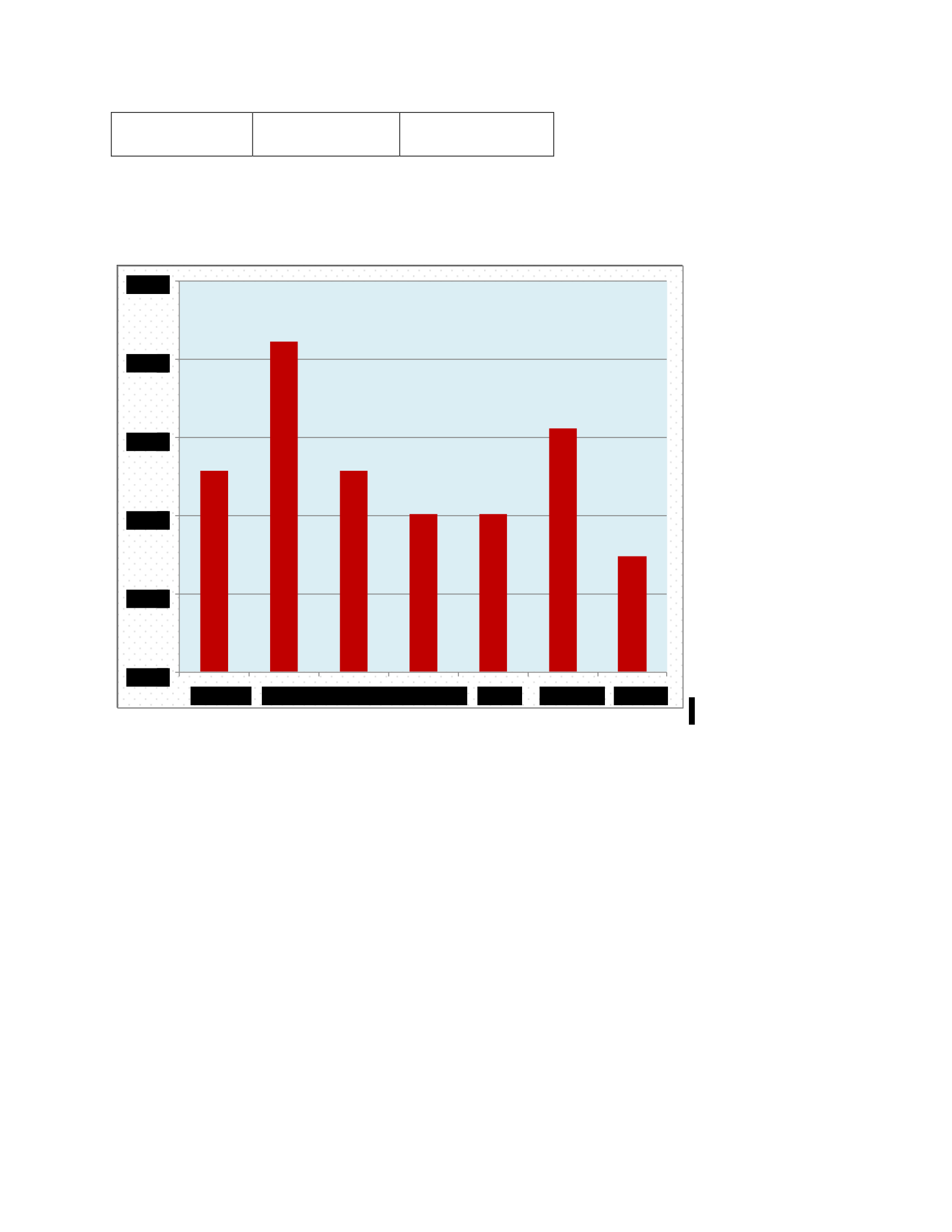
Thursday 4, Friday 5, Saturday 6 and Sunday 7. Tuesday posted the highest the day the newspapers
were sampled contributing 55 (15.11%) newspapers, while Monday posted 52 (14.29%),
Wednesday 52 (14.29%), Thursday 51(14.01%), Friday 51 (14.01%), Saturday 53 (14.56%) and
Sunday 50 (13.74%) (See Figure 2).
Table 2. Day of the Week
Day
Frequency (N)
Percentage (%)
Monday
52
14.29%
Tuesday
55
15.11%
Wednesday
52
14.29%
Thursday
51
14.01%
Friday
51
14.01%
Saturday
53
14.56%
Sunday
50
13.74%
39
Total
364
100.00%
Figure 2. Day of the Week
4.1.3 Key word
The research used certain keywords in order to establish the dominant topics inherent in the stories.
County Government was the keyword that was used in many articles. County Government or
simply County appeared 271 times with a percentage of 28.65% (See Table 3 and figure).
Governors, Governor, County Boss, or Council of Governors appeared 270 seventy times
representing about 28.54% of the total number of stories sampled. Members of the County
Assembly appeared 136 times which represents 14.38%, Devolution (in Kenya)
13.00
%
13.50
%
14.00
%
14.50
%
15.00
%
15.50
%
Monday
Tuesday
Wednesday
Thursday
Friday
Saturday
Sunday

40
58 (6.13%), Senator 91 (9.62%), County Financing 19 (2.01%), County Resources 5 (0.53%),
Revenue Allocation 44 (4.65%), County Security 28 (2.96%) while the rest posted 24 (2.54%)
times.
Table 3. Keywords
Key Word
Frequency (N)
Percentage (%)
Devolution (in Kenya)
58
6.13%
County Government
271
28.65%
Members of the county Assembly
136
14.38%
Governors
270
28.54%
Senator
91
9.62%
County Financing
19
2.01%
County Resources
5
0.53%
Revenue Allocation
44
4.65%
County Security
28
2.96%
Others
24
2.54%
Total
946
100.00%

41
Figure 3 Key word used in the articles
4.1.4 Focus
The stories were also analyzed in terms of the focus or the placement of the story in the newspapers.
The stories were categorized to be either High, Medium or Low (See Table Figure 3). High focus
stories were those stories placed on the front or back page, had a headline that mentioned the
keywords, devoted more than twenty lines to a County Governance-specific issue, had a graphic
devoted to County Governance with an issue in discussion and or was an editorial story. Medium
focus stories had a graphic that integrates a County Governance related issue with another issue,
graphic that included a County Governance-related issue, a section of an integrated story that

42
devoted 10-20 lines of the story to County Governance specific issue and a section of an integrated
story that devoted 20 lines of the story to County Governance issue. Low Focus stories had a single
mention of five to ten lines devoted to County Governance specific story, a section of an integrated
story that devotes 10-20 lines of the story to County Governance issue and there was no graphic.
Figure 4. Focus: Either High, Medium or Low
Therefore, of the entire sample of 946 articles, the number of stories of county government issues
placed on the front page, back page or editorial were 68 which is 7.19%, while medium posted the
highest with 673 (71.14%) stories. Low focus were 205 (21.67%) (See Table 4).
Table 4. Focus
Focus
Frequency
Percentage
High
68
7.19%
Medium
673
71.14%
Low
205
21.67%
High
7
%
Medium
71
%
Low
22
%
FOCUS

43
Total
946
100.00%
4.1.5 Dominant Topics
The first research question addressed the newspaper coverage of County Government within
twelve months (October 2014-September 2015). There were a total of 16 topics (See Table 5) in
the entire sample that were categorized as dominant topics owing to their frequency as well as
importance. Salaries (0.32%), Revenue Allocation (11.84%), Central Government Relations
(3.81%), County Hiring (5.29%), Corruption at County Government (1.9%), County Government
Spending (5.81%) Governors' powers (2.22%), Senators' powers (2.22%), Members of the County
Assembly (0.21%), County Governance (22.83%), MCA salaries and allowances (5.92%), County
Security (3.81%), County Administration (19.66%), County Funding (5.29%), County Resources
(7.08%), Transition Authority (1.16%) while other topics were (0.63%).
Table 5. Dominant Topics in the Articles sampled
Dominant Topic
Frequency (F)
Percentage (%)
Salaries
3
0.32
Revenue Allocation
112
11.84
Central Government Relations
36
3.81
County Hiring
50
5.29
Corruption at County Government
18
1.9
County Government Spending
55
5.81
Governors' powers
21
2.22

44
Senators' powers
21
2.22
Members of the County Assembly
2
0.21
County Governance
216
22.83
MCA salaries and Allowances
56
5.92
County Security
36
3.81
County Administration
186
19.66
County Funding
50
5.29
County Resources
67
7.08
Transition Authority
11
1.16
Others
6
0.63
Total
946
100
4.1.6 Perspective
The researcher also sought to indicate the way that the story is written. General News was any
County Government story that emphasizes facts of a recent event. Often uses a straight news or
inverted pyramid style of writing. Reflective referred to the longer, more insightful tone and
covered County Government issue in more depth or told a story rather than just presenting a series
of facts. Commentary or Criticism was any story that offered a first person opinion or a stated
opinion of the newspaper. Consequently, the stories were analyzed in terms of the General News,
Reflective and Commentary or Criticism. Therefore, of the 946 stories analyzed General News
stories totaled 700 which is equivalent of 74.00%, stories that were written from a Reflective angle

45
were 167 which is 17.65% while Commentary/Criticism totaled 79, an equivalent of 8.35%. Figure
4 shows the distribution of the three forms of treatment, their frequency and percentage.
Figure 5. Perspective in which the Articles were written: General, Reflective,
Commentary/Criticism
4.1.7 Story Source
Of the 946 stories obtained from the newspapers, the researcher analyzed them in terms of their
sources or the authors. There were five forms of story sources and they include Wire Service,
Editor, Reporter, Devolution expert as well as Elected Leaders. Table 6 shows the distribution of
the story source as well as their percentages and frequencies.
74.00
%
17.65
%
%
8.35
0.00
%
10.00
%
20.00
%
%
30.00
40.00
%
50.00
%
60.00
%
70.00
%
80.00
%
General News
Reflective
Commentary/Criticism

46
Table 6. Sources of the Story
Source of the Story
Frequency (F)
Percentage (%)
Wire Service
0
0%
Editor
41
4.33%
Reporter
835
88.27%
Devolution expert
19
2.01%
Elected Leaders
13
1.37%
Others
38
4.02%
Total
946
100.00%
Out of the sample, there were no articles or stories drawn from the Wire Service having posted
0%, there were a total of 41(4.33%) stories from the editor of the newspaper in both dailies, there

47
were 13 (1.37%) from elected leaders, there were 19 (2.01%) stories from devolution experts (See
Figure 5). A total of 835 stories both Daily Nation and Standard were written by reporters.
Figure 6. Source of the Story 4.1.8
Statistics
The 946 stories in both Daily Nation and Standard were also analyzed in terms of statistics. The
researcher indicated whether the stories sampled included statistics particularly with regards to
revenue allocation, county funding and revenue collection. Therefore, 12 (1.27%) stories included
0
%
4
%
88
%
2
%
2
%
4
%
SOURCE OF THE STORY
Wire Service
Editor
Reporter
Devolution expert
Elected Leaders
Others

48
statistics vis-a-vis County Governance while a total of 934 (98.73%) stories did not have any
element of statistics in them (See Figure 6).
4.1.9 Tone
The 946 stories were also analyzed in terms of the tone used whether Optimistic, Neutral, and
pessimistic or Advocating for Change with regards to County Governance. As shown in Table 7,
most of the stories written in both Daily Nation and Standard were neutral.
1.27
%
98.73
%
0.00
%
%
20.00
%
40.00
%
60.00
%
80.00
%
100.00
%
120.00
Yes
No
Series1
Figure 7
. Statistics

49
Table 7. Tone used in the Articles
Tone
Frequency (F)
Percent (%)
Optimistic
135
14.27%
Neutral
495
52.33%
Pessimistic
307
32.45%
Advocating for Change
9
0.95%
Total
946
100.00%
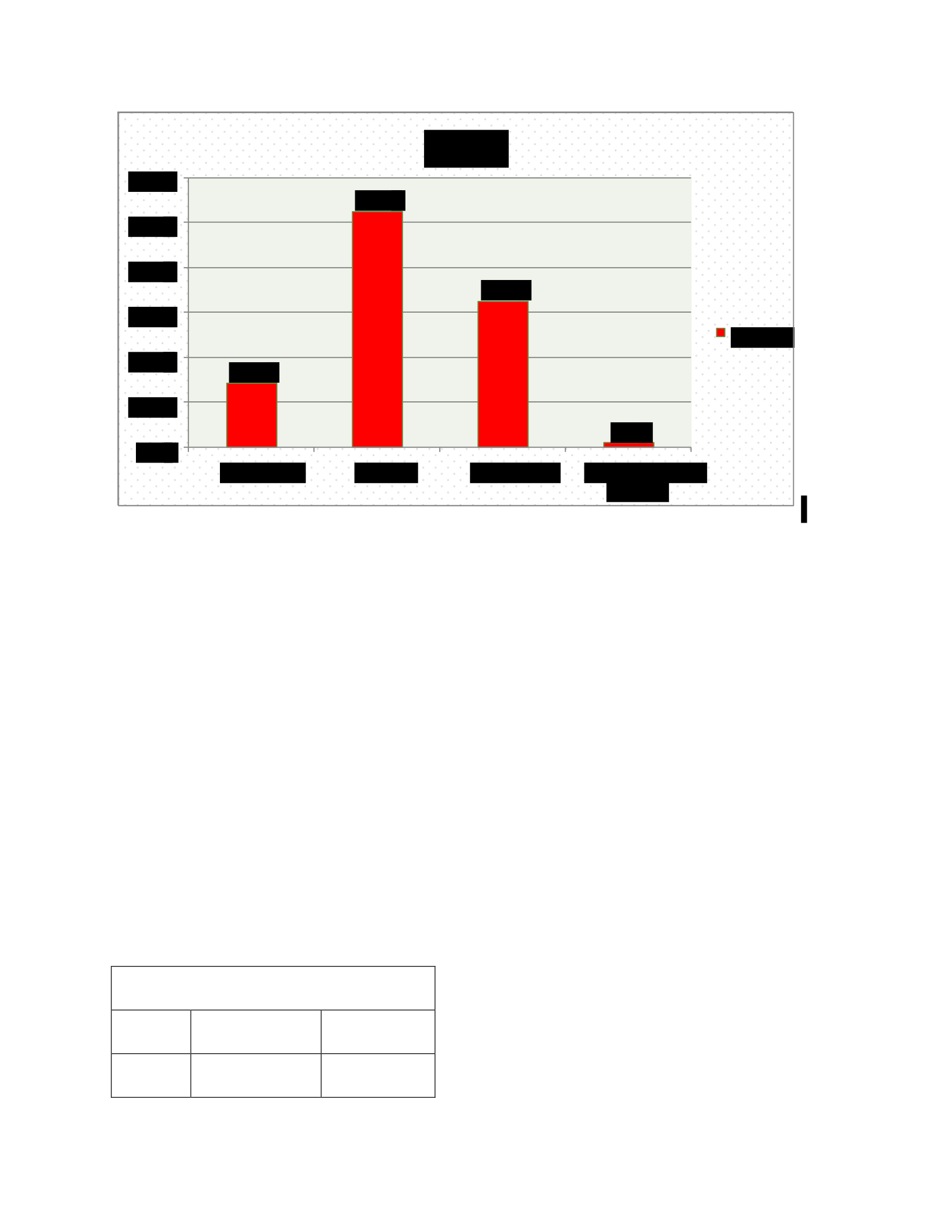
A total of 495 (52.33%) stories were neutral, 135 (14.27%) were optimistic about County
Government 307 (32.45%) were pessimistic while only 9 (0.95%) stories seemed to advocate for
change in terms of County Government. Figure 7 shows the distribution of the stories with regards
to the tone used.
50
Figure 8. Tone used in the articles
4.1.10 Picture
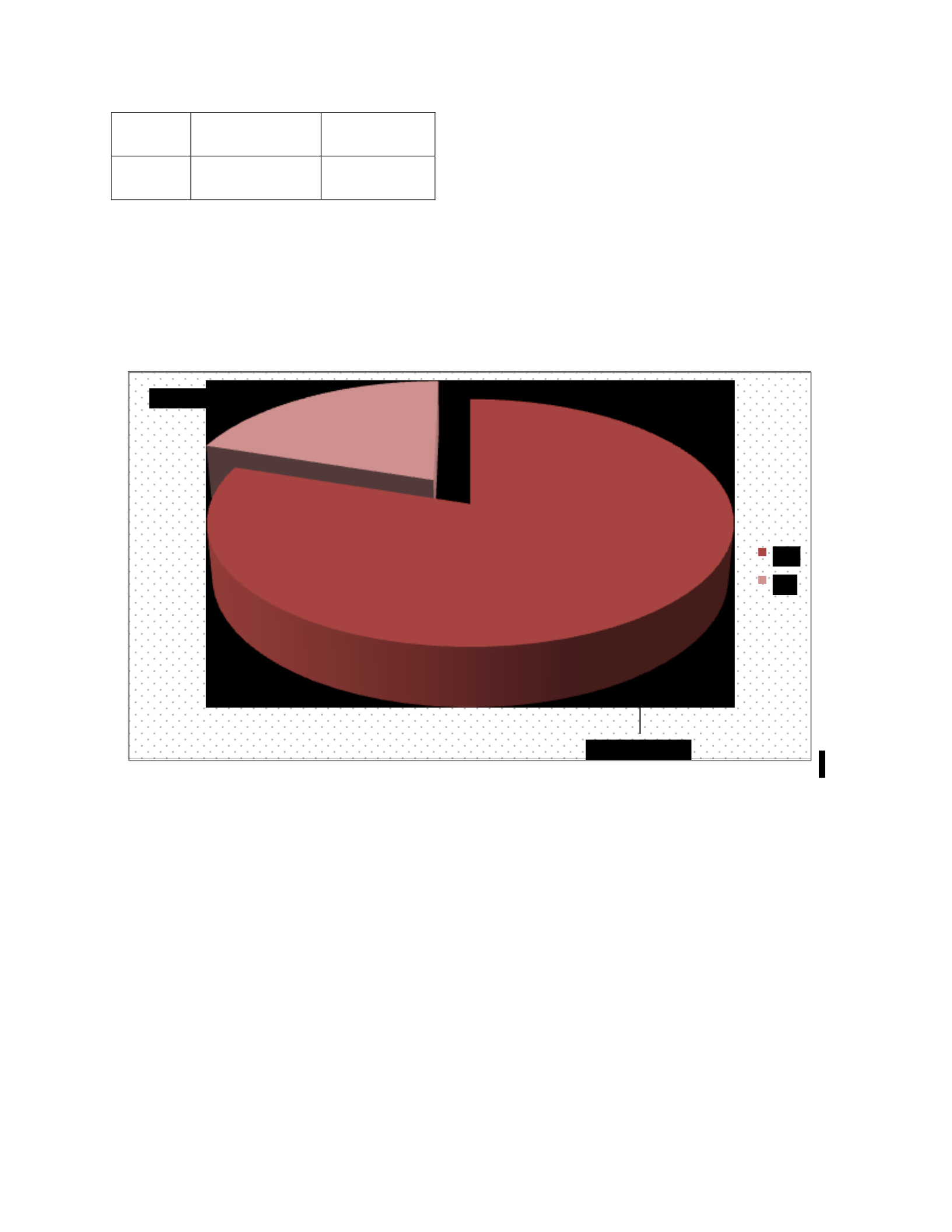
The entire 946 stories were also analyzed whether they contained pictures or not. The pictures
could for County officials namely governor, senators, members of the county assembly, county
assembly. Additionally, pictures of county buildings including county assembly, offices of the
governor, residence of the governor among others were recorded.
Table 8 shows the summary of the number of articles with pictures or no pictures.
Table 8. The Presence of Pictures
Picture
Frequency (F)
Percent (%)
Yes
758
80.13%
%
14.27
52.33
%
32.45
%
0.95
%
0.00
%
10.00
%
%
20.00
30.00
%
40.00
%
%
50.00
%
60.00
Optimistic
Neutral
Pessimistic
Advocating for
Change
TONE
Percent
51
No
188
19.87%
Total
946
100.00%
There were a total of 758 (80.13%) stories with pictures while 188 (19.87%) stories lacked the
pictures. Figure 8 shows the distribution of the pictures together with frequencies and percentages.
Figure 9. The presence or absence of picture
4.1.11 Type of picture
Similarly, the 946 stories from both Daily Nation and Standard were analyzed in terms of the type
of pictures used. In this case, the researcher came up with two types of pictures:
Yes , 80.13%
No, 19.87%
Yes
No

52
Sensationalist Picture and Symbolic picture. Of the 946 stories analyzed, 19 (2.01%) stories were
found to contain Sensationalist pictures while 927 (97.99%) stories contained symbolic pictures.
In this case symbolic refers to those pictures that merely represented an aspect of a county, or
governor. For instance, an article could contain pictures of the County Assembly, a portrait of the
governor, MCAs, senator or any other thing that is associated with county government. On the
other hand, Sensationalist picture referred to those pictures that are stimulating and provocative.
For instance, the picture of an MCA alongside that of the governor and the article details the
wrangles between the MCA and the governor. Others included pictures of figures in the
government who are purportedly against county governments and alongside a governor or
governors. Table 8 shows the distribution of the stories with regards to the pictures.
Figure 10. Symbolic or Sensationalist
%
2.01
97.99
%
0.00
%
20.00
%
%
40.00
60.00
%
80.00
%
100.00
%
120.00
%
Sensationalist picture
Symbolic picture

53
4.2 Discussion and Analysis
Good governance has been a key concept for democratic development in many countries around
the world during the past few decades. Kenya is one of those which have embraced the idea. Based
on the concept of good governance, one significant development that took place in 2010 in Kenya
was the promulgation of the new constitution that contained a new aspect of governance;
Devolution.
It has taken quite some time before the public, or even the government officials who are in
possession of information, could adequately understand how county governance work or are run.
Therefore, it was expected from the beginning that it would be the duty of the media to bring this
new concept to the attention of the fabric of Kenya. Therefore, the research was focused on the
media coverage of county governments in Kenya.
This research was a content analysis of County Government governance coverage focusing on two
leading dailies; Daily Nation and Standard. Agenda setting theory, Framing Theory as well as
Public Sphere theories were used as the theoretical foundation. The analysis examined the two
newspapers from October 2014 to October 2015. More specifically, the content analysis meant to
examine the extent the print media has covered the County Governance in Kenya. Second, it sought
to establish the most dominant aspects of county governance were covered by the print media.
As anticipated, results indicated that indeed there were various aspects of county government
covered by both Daily Nation and Standard. Standard newspaper had more stories apparently
because there was a section dedicated to county issues known as From the Counties. Daily Nation

54
on the other hand did not have any section dedicated solely on county government issues and thus
the principle reason why it had lesser stories on county government. Nonetheless, Daily Nation
later adopted the Standard model and introduced a section titled The Counties. In this respect, it is
imperative to note that the print media is a carrier of significant information; it stands for all the
agencies which are focused on presenting the information to the people and hence empower them
with vital information. Case in point, the role of the press is very important for the proper
functioning of county governments.
Consequently, Daily Nation, for a larger part of 2014 did not significantly contribute towards the
formation of public opinion around the important topics of county governance, hence did not use
its role to enhance good governance. Owing to its massive distribution across the country every
day, Daily Nation is very essential for the better governance and more importantly county
governance.
In order to promote a much better comprehension of county government aspects, the media ought
to focus on important areas of these aspects. Undeniably, in most of the headlines of the 946
articles, the term “County or County Government,” appeared more than any other word indicating
that many articles focused on the county. The term “governors” followed closely. In essence, most
of the issues about County Governance revolved around Governors and Counties. The print media
in Kenya is extremely powerful. It is not only reports on various pertinent issues, but also shapes
the events. This reflects the influence of the newspapers and their ability to determine the course
of important events. Thus, their focus on county governance cannot be underestimated.

55
In essence, the mass media ought to inform the mass people about different decisions and
governance functions, and thereby enhance their knowledge. A free, accountable and vibrant mass
media disseminates information, informs the public and policy maker alike, creates space for
diverse views regarding socio-economic and political processes, and increases people scope for
democratic participation as well as enhance good governance that will lead to national
development. Irrefutably, the two leading newspapers have performed its role of informing and
disseminating important information regarding governance in Kenya.
The second research question sought to establish the aspects of governance covered by the two
dailies. Consequently, there were a total of sixteen dominant topics covered by both Daily Nation
and The Standard. Salaries, Revenue Allocation, Central Government Relations, County Hiring,
Corruption at County Government, County Government Spending, Governors' powers, Senators'
powers, Members of the County Assembly, County Governance, Members of the County
Assembly salaries and Allowances, County Security, County Administration, County Funding,
County Resources, Transition Authority and others.
Of all the stated issues, County Governance was the most dominant topic followed closely by
Revenue Allocation and County Administration. County Governance encompassed those issues
that touched on governing of the county. In most articles, the governor and members of the county
assemblies were mentioned numerous times. They involved all that pertains with the governance
of the county, for instance, use of resources, legislation apropos to county governance, financial
accountability and management, leadership issues including conflict, ethical issues with regards to

56
county officials, appointment of county executive members and other officials among others.
County Administration posted the third highest dominant topic.
County Administration in this research entailed running of the county including how the members
of the county assembly drew their budget, the interaction between the county assembly and the
governor and the overall organization and management of the county. Indeed, the print media
focused on apposite issues that the public wanted to know or important for development of their
counties. Of note, most of the articles that touched on members of the county assembly mainly
concerned their salaries and allowances. As such, the articles published did not in any way
contribute towards good governance of the counties.
How a story or article is written in newspapers matters a lot particularly when the issue is very
important to the society. The society is made up of innumerable individuals and thus the need to
consider the level of lexis and the over-all language to be used. This refers to the style of journalism
which places the most important facts at the beginning and works "down" from there. Ideally, the
first paragraph should contain enough information to give the reader a good overview of the entire
story. The rest of the article explains and expands on the beginning. A good approach is to assume
that the story might be cut off at any point due to space limitations.
A bulk of the news stories sampled contained General News about county governance issues. This
means that most of the stories sampled were a mere reporting of County Governance issues. Of
note, for the media to effectively and sufficiently acquaint the public with vital information that
can lead to good governance, then they must give an in-depth analysis of articles. Issues about the

57
Governor, Members of the County Assembly, County Executives and Revenue allocation were
adversely mentioned or reported.
Nevertheless, most of the articles detailed what these officials have done without making an
attempt to establish the intentions as well as the truth behind their words or actions. Will this
contribute towards good governance and national development? The answer can be presented in
two perspectives. First, the main function of the press is to report or inform the public on key
events that take place within and beyond Kenya. On this front, the dailies can be said to have
delivered owing to the number of articles presented. However, the manner in which these articles
are written is critical towards making a decision whether indeed they contributed to good
governance. Unfortunately, the articles were barren and devoid of ‘meat’ essential to the running
of the counties.
Reflective news articles were a distant second posting only 17.65% of all articles. It is imperative
to note that news articles pertaining important phenomenon such as County Governance ought to
be written in a reflective and succinct way so as to pass the message commendably. Reflective
referred to the longer, more perceptive tone and covered County Governance issue profoundly or
told a story rather than just presenting a series of facts. There were only 167 stories out of the 946
sampled written in an insightful tone, more in-depth analysis as well as in an enlightening way.
This data means that the public were denied the chance to understand county governance issues
more profoundly and concisely. Commentary or Criticism stories were only 79 and this comprised
of any story that offered a first-person opinion or a stated opinion of the newspaper. Again, this is
a very low number considering the novelty of Devolution in Kenya. County Governance, which is

58
an aspect of devolution, is relatively new in Kenya. Consequently, the mass media needs to do
more than just reporting on this phenomenon and incorporate more insightful and profound articles
written in clear and succinct way.
The 88.27% (835) of the stories sampled came from reporters. The data shows that most of the
stories were actually about the occurrence of events with regards to County Governance. The
articles or news stories did not include in-depth analysis of the issues but merely reported their
occurrence. For instance, on 2nd September, 2014, the Daily Nation only reported on the intentions
of the governor and the proceedings at an event in Laikipia County on the article titled “Governors
target game parks cash: Counties seek lion’s share of the revenue generated from natural resources
in their areas” (see appendix). There were no intentions of providing the public with sufficient
information with regards to the issue of the resources, administration and the person in charge.
Another article on the same page, “Assembly team’s Uganda trip sparks outcry” (see appendix)
only reported on the issue of Members of the County Assembly’s intention to visit Uganda as well
as the colossal amount of money to be used to facilitate the trip.
A measly 19 articles were from devolution experts while 13 came from elected leaders. Apart from
articles being reflective and insightful, articles ought to be drawn from experts so that they can
give a more perceptive, sensible and rational perspective of pertinent issues, case in point, County
Governance. Expert in devolution matters such as those participated in the drafting of the new
constitution and Commission of Experts (CoE), constitutional lawyers and other important
stakeholders should have been invited to present their views on the process of devolution and
county governance and administration. Instead, a bulk of the space in both Daily Nation and

59
Standard newspapers were reserved for reporters whose main work is to report about the activities
on the ground and not an exhaustive analysis of the same.
Another important aspect that was scrutinized is the tone of the news stories or articles. Most of
the articles were ‘neutral’ in their orientation and followed closely by ‘pessimistic.’ The main point
of concern in this case is the number of articles that were pessimistic in their tone. The researcher
found out that most of the stories were negative about the County Governance issues. Certainly,
most of the stories had issues that were not progressive oriented but instead were retrogressive.
For instance, there were numerous stories about members of the county assembly extortionate
allowances and salaries, foreign trips, county resources wrangles, governor versus members of the
county assembly, senators or members of parliament among others. The data shows that the public
or even the county officials are still in the dark with regards to county governance.

60
5.0 CHAPTER 5- SUMMARY, CONCLUSIONS AND
RECOMMENDATIONS
5.1 Introduction
County Governance is an aspect of devolution and it is a relatively new phenomenon in Kenya.
County governments are facilitated by reliable sources of revenue to enable them govern and
deliver services effectively. Despite these bold provisions, most Kenyans and other learners are
still struggling to understand what Ugatuzi wa mamlaka (Devolution of power) really means. The
objective of the research was to establish the extent the print media (Daily Nation and Standard)
has covered County Governance issues in Kenya. Secondly, to establish the aspects of County
Governance that were covered by the two dailies.
In order to effusively and sufficiently understand how County Governments work, the media both
print and electronic ought to be vibrant and up to date with matters Devolution in Kenya.
According to agenda setting theory, the stories the media choose to cover can influence which
issues the public considers important. Public sphere and framing theories also indicate the need to
adequately inform the general public on how the county governments work and consequently
contribute towards good governance.
A content analysis of two leading daily newspapers (Daily Nation and Standard) was performed
using a constructed month sample (see appendix) of articles published from October 2014 to
September 2015. A total of 182 publications were analyzed for each paper at alternate days for a

61
period of 12 months (October 2014 to September 2015). This means that every day of the week
had an equal chance of being sampled.
Among the major findings, this research found out that the publications of articles regarding
County Governance were evenly distributed across the twelve months for each newspaper.
There were more news stories or articles published by the Standard (623) as opposed to Daily
Nation’s 323 because it had a section devoted exclusively on County Government matters.
The most dominant issues or topics according to the data obtained from the field were County
Governance, County Administration, County Government Spending, and Revenue allocation,
Members of the County Assembly’s salaries and Allowances, Governor’s powers and Senator’s
powers.
Another major finding is that most of the stories (835) in the two papers were written by reporters.
The news articles were plain with a mere presentation of news without any regard to exhaustive
analysis and enquiry. This aspect raises a number of concerns key among them the role of the print
media in enlightening the public with regards to County Governments. County governments, being
a new phenomenon, need to be amply explained so as the public gets informed. One of the aims
of the mass media is to inform people about the government functionaries and how they operate.
The mass media should aim at putting to an end inconsistent government practices and help in
establishing a responsive state. Good governance requires that processes and institutions produce
results that meet the needs of society. Case in point, the print media has not lived to this function
owing to the lack of information in the public arena. A similar finding points to the fact that most
of the news articles were written from a general perspective. Basically, they were events and
comments made by politicians and other actors. Regrettably, the information relayed was not

62
accompanied by the truth of the matter. These points to mastery level of the reporters with regards
to devolution. The journalists themselves are not well informed about County Governments and
other functionaries which in turn affect the quality of the pieces written on the newspapers. The
print media is essential for democracy and good governance particularly for a young nation such
as Kenya. In a word, therefore, the role of mass media plays in Kenya in promoting County
Governance is not satisfactory for the purposes of ensuring good governance.
5.1 Recommendations
Reporters may be truthful, hard-working, good citizens and take part in molding the views of other
people, but they cannot play their part efficaciously unless they keep their eyes open and mind
attuned to the present, future as well as the past. Reporters should be thoroughly informed with a
newfangled marvel like devolution in Kenya. Reporters and the rest of the mass media actors are
leaders of men in many senses of the word.
Everything that the reporter writes must and reflect the truth of the matter especially in a volatile
country like Kenya. Therefore, journalists should move to more analytical and encourage
entrenched journalism where they engage materials and experts before putting pen to paper. They
should not only report about policies made but also investigate about the implementation or non-
implementation of the policies particularly with regards to County Governments.
In many cases, too much subjectivity cannot bring any good result. Therefore, in order to produce
a good crop of reporters, every media house should come with ways of ensuring that the reporters
are well-informed on matters devolution. For instance, the media houses can up with workshops
and seminars meant to appraise their staffs on current events. It is also imperative for regulatory

63
bodies such as the Media Council of Kenya and Communication Authority of Kenya to delve into
the issue of reportage by journalists in Kenya.
The main mandate of the Media Council of Kenya is to register and accredit journalists, register
media establishments, handle complaints from the public and create and publish yearly media audit
on the Media Freedom in Kenya. They should, consequently, utilize these powers to ensure there
is lucidity and quality in the sphere of journalism in Kenya. They ought to ensure that there is
quality reporting in addition to analysis of important issues such as those pertaining to the
devolution process in Kenya. Whilst Communication Authority of Kenya does not deal directly
with journalists, it should use its powers to ensure that media outlets produce quality especially
with regards to a new phenomenon such as devolution.
There are several actors and as many viewpoints in a given society. Good governance requires
mediation of the different interests in society to reach a broad consensus in society on what is in
the best interest of the whole community and how this can be achieved. It also requires a broad
and long-term perspective on what is needed for sustainable human development and how to
achieve the goals of such development. This can only result from an understanding of the
historical, cultural and social contexts of a given society or community which is promoted by the
media. Therefore, the Kenyan print media needs to adequately train reporters on various issues
particularly political issues that led to the overhaul of the old constitution. From this point, they
will understand the fundamental truths and objects of devolution in Kenya.
Results of this study indicate inadequate voice of Devolution professionals as sources. While
this could suggest limited investigations in the area of Devolution in Kenya by journalists, it
could also suggest disinclination of devolution experts or lack of print media space for them to

64
disseminate useful information to guide the reporters and editors in their work. Therefore, the
print media management especially, the leading publications such as Daily Nation and The
Standard ought to designate a space in their newspapers to devolution and county governance
experts so as to enlighten the public about this phenomenon.
5.1.1 Recommendations for Further Research
The print media are aware of their primary responsibility: to inform the public of the issues that
concern them, in this case, the issues of devolution and more so county governance or
governments. Astonishingly, the findings of this study reveal that Devolution issues were covered
quite poorly principally relating to the quality of the articles on the stated issues. While many
people can blame it on profit making motive of the media, there is need for further research to
investigate reasons for this phenomenon.
While the scope of this study was limited to investigation of the Agenda-Setting, Framing theory
and Public Sphere in explaining the coverage of county government aspects in Kenya, future
studies ought to embrace the contributions of other channels of communication along this line. For
instance, the role of the television, radio and the internet need to be studied comprehensively in
order to find the interplay among the many communication channels that can be used in an effort
to enlighten the public about devolution in Kenya.

65
References
Abuoga, J.B., & Mutere, A. (1988). The history of the press in Kenya. Nairobi: African Council
on Communication Education.
Boeder, Pieter. (2005). Habermas Heritage: the future of the public sphere in the network
society.
Bourgault, L, M. (1995). Mass Media in Sub-Saharan Africa. Bloomington: Indiana University
Press
Bryman, A. and Bell, E. (2007). Business Research Methods, 2nd ed. Oxford: Oxford University
Press.
Cushion, S., Lewis, J. M. W. and Groves, C. R. (2009). Reflecting the four nations? An analysis
of reporting devolution on UK network news media. Journalism Studies 10(5), pp. 655-
671. (10.1080/14616700902797242)
Chong, J, Dennis, K., and James N. (2007). “Framing Theory.” Annual Review of Political
Science 10: 103-126
Commission for the Implementation of the constitution. (2011). Second Quarterly Report on the
Implementation of the Constitution, June 2011.
Cooper, R. and Schindler, P. (2003). Business Research Methods. Tata McGraw Hill.

66
Dent, Martin (2004). Identity Politics: Filling the gap between federalism and independence.
Hants: Ashgate Publishing Limited
Deacon, D., Pickering, M., Golding, P., and Murdoch, G. (1999). Researching Communication.
London: Edward Arnold.
Garnham, N (2007). Habermas and the public sphere. Global Media and Communication. 3 (2,
August), 201-214.
Gitlin, T. (1980). The whole world is watching: Mass media in the making & unmaking of the
new left. Berkeley: University of California Press
Ghai, Y, P. (2007). Devolution: Restructuring the Kenyan State. Lecture for the African
Research and Resource Forum Kenyatta International Conference Centre Nairobi, 23
November 2007.
Ghai, Yash Pal (2011). Kenya’s Constitution: An Instrument for Change. Nairobi: Clarion.
Ghauri, P., Grønhaug, K. and Kristianslund, I. (1995). Research methods in business studies: A
practical study. New York: Prentice Hall.
Goffman, Erving. (1959). Presentation of Self in Everyday Life. Carden City, NY: Double Day
Anchor Books.
Hansen, A. (1998). Mass Communication Research Methods. London: Macmillan Press.

67
Hauser, Gerard. (1999). Vernacular Dialogue and the Rhetorically of Public Opinion. Columbia:
University of South Carolina Press.
Habermas, J. (1996). Between facts and norms: Contributions to a discourse theory of law and
democracy. Cambridge, MA: MIT Press.
Habermas, J. (2006). Political Communication in Media Society: Does Democracy Still Enjoy an
Epistemic Dimension? The Impact of Normative Theory on Empirical Research.
Communication Theory, 16, 411-426.
Jibo, M. (2003). The Nigerian media: An assessment of its Role in Achieving. Nordic Journal of
African Studies, 12(2), 180-195.
Johansson, Catrin. (2007). “Goffman’s sociology: An inspiring resource for developing public
relations theory.” Public Relations Review 33: 275-280.
Kenyan Ministry of Information and Communication. Retrieved on April 28, 2014
fromwww.statehousekenya.go.ke/government/information.htm
Kim, Sei-Hill, John P. Carvalho & Andrew G. (2010). “Talking About Poverty: News Framing
of Who is Responsible for Causing and Fixing the Problem.” Journalism and
Mass Communication Quarterly 87(3/4): 563-579.

68
Kimenyi, S. Mwangi and Meaghar, P. (2004). General introduction. In: Kimneyi, S. Mwangi and
Meaghar, P., ed. 2004. Devolution and development: Governance prospects in
decentralizing states. Hants: Ashgate Publishing Ltd., Ch 1.
Kimani, N., Kabiri, N., and Mary, W. (2010). Ethnic Diversity in Eastern Africa:
Opportunities and Challenges. Nairobi: African Books Collective.
Krippendorff, K. (2004). Content Analysis: An Introduction to Its Methodology. California:
SAGE
Lines, K. (2009). Governance and the media: A survey of policy opinion. Report submitted to the
BBC World Service Trust.
Leinnijenhuis, J. & Rietberg, E.M. (1995). Parties, media, the public and the economy: Patterns
of societal agenda-setting. European journal of political research: Official journal of the
European Consortium for Political Research, 28(1), 95-118.
Lippmann, Walter. 2000. Public Opinion (Eds). New York, NY: Macmillan.
McCombs, M and Shaw, D. (1972). “The Agenda-Setting Function of Mass Media.” The Public
Opinion Quarterly 36(2): 176-187.
McCombs, M.E. (1972). Mass Communication in Political Campaigns: Information,
Gratification and Persuasion. In: Kline, F. & Tichenor, and Ph.J. (Eds.) Current
Perspectives in Mass Communication Research. Beverly Hills: SAGE.

69
McCombs, M.E. (1982). The Agenda-Setting Approach. In: Nimmo, D. & Sanders, K. (Eds.)
Handbook of Political Communication. Beverly Hills, CA.: Sage.
McCombs, M. & Weaver, D. (1985). Toward a Merger of Gratifications and Agenda-Setting
Research. In: Rosengren, K.E., Wenner, L.A. & Palmgreen, P. (Eds.) Media
Gratifications Research: Current Perspectives. Beverly Hills, CA: Sage.
McQuail, Denis (2010) McQuail’s Mass Communication Theory. 6th Ed. London: Sage
Publications.
Mortensen, Peter. (2010). “Political Attention and Public Policy: A Study of How Agenda
Setting Matters.” Scandinavian Political Studies 33(4): 356-378.
Mũngai, M., and Gona, G. (2010). (Re)membering Kenya: Identity, culture and freedom.
Nairobi: African Books Collective.
Mugenda, O., and Mugenda, G. (2003). Research Methods: Quantitative and Qualitative
Approaches. Nairobi: Laba Graphics Services.
Mwaura, Ndirangu. (2004). Kenya Today: Breaking the Yoke of Colonialism in Africa.
Nairobi: Algora Publishing.
Nanz, P and Steffek, J. (2004). Global Governance, Participation and the Public Sphere.
Government and Opposition. Volume 39, Issue 2, pages 314–335, Spring 2004.

70
Njogu, Kimani. (2013).Citizen Participation in Decision Making: Towards Inclusive
Development in Kenya (Eds). Nairobi: Twaweza Communications.
Nwonwu, F & Kotze, D. (2008). African Political Elites: The Search for Democracy and Good
Governance. Pretoria: African Books Collective.
OSIEA, AfriMAP and OSMP. (2011). Kenya: Public Broadcasting Survey. Nairobi: African
Minds.
Oriare, Peter. (2008). The Media, Legal, Regulatory and Policy Environment in Kenya. School of
Journalism and Mass Communication, University of Nairobi, Kenya. Commissioned by
the BBC World Service Trust
Oriare, M.P. (2010). Mass Media in Kenya: Systems and Practice. Nairobi: Jomo Kenyatta
Foundation.
Page, Benjamin I., Shapiro, Robert Y., & Dempsey, Glenn R. (1987a). What Moves Public
Opinion? The American Political Science Review 81, 1, 23-44. Retrieved February 25,
2008, from http://www.jstor.org/view/00030554/di961024/96p08564/0
Perry, D. (2002). Theory and Research in Mass Communication: Contexts and Consequences.
Mahwah: Routledge.
Poluha, E., & Rosendahl, M. (2002). Contesting 'Good' Governance: Cross-cultural Perspectives
on Representation Accountability and Public Space. New York:
Routledge.

71
Robson, C. (2002). Real World Research. 2nd Ed. Oxford: Blackwell.
Sihanya, Ben. (2012).Constitutional implementation in Kenya, 2010-2015: Challenges and
prospects. Nairobi: Kenya Occasional Paper, No. 5. 2012.
Schramm, W. (1964). Mass Media and National Development: The Role of Information in the
Society. California: Stanford University Press.
Smith, Anthony (1980). Geopolitics of Information: How Western Culture Dominates the World.
London: Faber and Faber.
Sheller, M. (2004). Mobile publics: beyond the network perspective. Environment and Planning
D-Society & Space, 22(1), 39-52.
Shikha V, Lukamba-Muhiya, T, and Ernest P. (2013). Public Administration in Africa:
Performance and Challenges. Boca Raton: CRC Press.
Sujian, G and Deng Z. (2011). China's Search for Good Governance. New York: Palgrave
Macmillan
Schramm, W (1964) Mass media and national development: the role of information in the
developing countries. Stanford: Stanford University Press.
Strömberg, David. (2002). Mass Media Competition, Political Competition, and Public Policy.
Social Sciences Review of Economic Studies Volume 71, Issue 1Pp. 265-284.

72
Tankard, J.W. (2001). The Empirical Approach to the Study of Media Framing. In S.D Reese,
O.H. Gandy and A.E. Grant (Eds). Framing Public Life: Perspectives on Media and our
understanding of the social World (pp. 95-106). Mahwah, NJ:
Lawrence Erlbaum
Uscinki, J. (2009). When does the public’s agenda affect the media’s issue agenda (and vice
versa?) Developing a framework of media-public influence. Social Science Quarterly vol.
90, number 4.
Weiss, Thomas. (2000). Governance, good governance and global governance: Conceptual and
actual challenges. Third World Quarterly Vol. 21, Iss. 5, 2000.
Varnelis, K. (Ed.). (2008). Networked Publics. Cambridge, MA: MIT Press

73
Appendices
Summary of Months analyzed: Daily Nation
October
2014
16
November
2014
15
December
2014
15
January
2015
16
February
2015
15
March
2015
15
April
2015
15
May
2015
16
June
2015
15
July
2015
14
August
2015
15
September
2015
15
N
182
Summary of Months analyzed: The Standard

74
October 2014
16
November 2014
15
December 2014
15
January 2015
16
February
2015
15
March
2015
15
April
2015
15
May
2015
16
June
2015
15
July
2015
14
August
2015
15
September
2015
15
N
182

75
ANALYSIS CRITERIA
Criteria
Details
Codes
1.
Source of the
story
Indicates where the article was
published
Daily Nation -DN- 1
The Standard- ST- 2
2.
Dates
The Month when the article of
published
Date Format DD.MM.
Code 1-12 starting with May as 1
and April as 12
3.
Number
Number of County Governance
stories in the newspaper- ordinary
Number
1,2,3,4,5 etc
4.
Day of the week
Indicate the day of the week when the
story was published
Monday=1
Tuesday=2
Wednesday=3
Thursday=4
Friday=5
Saturday=6

76
Sunday=7
5.
Keyword
Indicate the keyword which was used
in the analysis
Devolution (in Kenya) DD-1
County Government CG-2
Members of the county
Assembly MC-3
Governors GV-4
Senator SN-5
County Financing CF-6
County Resources CR-7
Revenue Allocation RA-8
County Security CS-9

77
6.
Focus
Indicates the level of importance
accorded to the story in a newspaper.
Three focus levels: high, medium and
low will be used.

78
High focus stories are those stories (1)
on the front or back page (2) had a
headline that mentions the keywords
(3) devoted more than twenty lines to
a County
Governance-specific issue (4) had a
graphic devoted to County
Governance with an issue in
discussion and (5) was an editorial
story.
Medium focus stories had a (1)
graphic that integrates a County
Governance related issue with another
issue (2) graphic that include a
County Governance-related issue (3)
a section of an integrated story that
devoted 10-20 lines of the story to
County Governance-specific issue (4)
a section of an integrated story that
High Focus= F1
Front Page =FS
Back Page= BS
Headline Keyword= HS
Graphic devoted to
Governance Issue= G1
Editorial Story=ES
Medium Focus= F2
Graphic integrates
Governance with another
G2
Graphic include
Governance issue=G3
County
County
issue=
County
specific
1
tory
specific
3

79
devoted 20 lines of the story to
County Governance issue;
Low Focus stories had (1) a single
mention of five to ten lines devoted to
County Governance specific story, (2)
a section of an integrated story that
devotes 10-20 lines of the story to
County Governance issue and (3) no
graphic.
Section of integrated story
devotes 10-20 lines= L
Section of integrated
related s devotes 20+
lines= L2 Low Focus F3
Section of integrated story
devotes 5-10lines= L
Section of integrated
related story devotes 10-
20 lines= L2
7.
Dominant topic
Indicate What is the dominant topic
within the story:

80
Salaries
Revenue Allocation
Central Government Relations
County Hiring
Corruption at County Government
County Government Spending
Council of Governors
Governors’ powers
Senators’ powers
Members of the County Assembly
County Governance
MCA salaries
County Security
Transitional Authority
Commission of Implementation of the
Constitution
Salaries =TI
Revenue Allocation=T2
Central Government Relations
=T3
County Hiring=T4
Corruption at County
Government=T5
County Government Spending
=T6
Council of Governors=T7
Governors’ powers=T8
Senators’ powers=T9
Members of the
County
Assembly=T10
County Governance=T11
MCA salaries=T12

81
County Assembly
County Administration
County Security=T13
Transition Authority=T14
Commission of Implementation of
the Constitution =T15 County
Assembly=T16
County administration=T17
County Funding=T18
County Resources=T19
County Health=T120

82
8.
Treatment
Indicate the way that the story is
written, not to be confused with the
subject of the story
General News: any story that
emphasizes facts of a recent event.
Often uses a straight news or inverted
pyramid style of writing.
Reflective: longer, more insightful
tone; covers County Governance
issue in more depth, tell a story rather
than just regurgitate a series of facts.
Commentary/Criticism: any story that
offers a first-person opinion or is a
stated opinion of the newspaper.
General News= NG= 1
Reflective= NR=2
Commentary/Criticism= NC=3
9.
Story source
Indicate whether the story was drawn
from

83
(1) A wire service
(2) An editor
(3) Reporter
(4) Devolution Expert
(5) Elected Leaders
(6) Others
Wire Service= SW=1
Editor=SE=2
Reporter=SR=3
Devolution expert=SD=4
Elected Leaders=SL=5
Others=SU=6
10.
Statistics
Indicate whether the story uses any
statistics (1) Yes (2) No
Yes= 1
No= 2
11.
Tone
Define if the tone of the news is
optimistic
Neutral/ambiguous
Pessimistic,
Advocating for change.
Optimistic Tone= E1
Neutral= E2
Pessimistic=E3
Advocating for change= E4

84
12.
Graphics
Define the type of graphic used
Picture- G1
Graph- G2
Illustration= G3
Cartoon=G4
Side bar list= G5
Pie Chart= G6
13.
Picture
Define the picture sensationalistic,
symbolic
Sensationalist picture= P1
Symbolic picture=P2

85
Appendix

