


Introduction
What is the molecular basis of cystic fibrosis? Know the role of the CFTR gene and
CFTR protein.
Single Gene disease, Gene Therapy replaces damaged genes
Autosomal recessive, Mendelian inheritance
Gene causing CF identified in 1989
Cystic fibrosis transmembrane conductance regulator (CFTR)
o Found on chromosome at 7q31
o 260 kb gene
o 24 exons
o CFTR Protein is an ABC Transporter
Ionic Gradient pushes Cl- out, resulting in excess of Cl- ion in mucus
Water moves out to equalize salt concentration
Imbalance in Cystic Fibrosis
o Cl- channel is blocked; therefore, no ionic gradient established
o Water doesn’t move out; therefore, mucus dries
Construct virus with CFTR Gene
o Virus with Normal CFTR Gene, Infect CF Lung Cell, Introduce Normal CFTR
Gene
o Virus Restores CFTR Function in a cell that lacks the CFTR gene and lacks the
ability to make a CFTR protein
What is gene therapy and how is gene therapy applied to disease treatments?
o Requires the knowledge of
Cell function
Gene Identity and Gene Function
Gene expression
Function of Gene product
Mechanisms of Gene Delivery
In theory, how can gene therapy be applied to treat cystic fibrosis?
Construct virus with CFTR Gene
o Insert Virus with Normal CFTR Gene to Infect CF in Lung Cell,
Introduce Normal CFTR Gene
o Virus Restores CFTR Function in a cell that lacks the CFTR gene and lacks the
ability to make a CFTR protein
3/1/25, 5:03 PM
Molecular Biology Study Guide 1
about:blank
1/32

In practice, how does the gene therapy called Glybera work (what gene is targeted, what disease is
treated, what is the gene delivery agent and why was that agent chosen)? In
practice, how does the gene therapy Kimriah work?
Glybera
Targeted gene: Lipoprotein Lipase—This gene codes for the lipoprotein lipase protein
Disease treated: Lipoprotein deficiency (LPLD)—fat degradation is impaired, caused by
mutated LPL, autosomal recessive disorder caused by mutated LPL
Disease delivery agent (why): Adeno Associated Virus (AAV). This virus has advantages as a gene
delivery vector because it is non-pathogenic, it will infect and deliver its DNA genome into non-
dividing (like the muscle cells treated in LPLD and its genome stays
outside the host chromosome thereby reducing the risk of causing other problems
Kimriah (look over writing assignment)
o CAR T-cell therapy. The addition of chimeric antigen receptor allows the
body’s own t-cells to target cancerous cells
Chapter 1
What is the cellular structure and cellular organization of prokaryotes? o
Bacteria and Archaebacteria (extreme environment)
o Inner Plasma, Outer Membrane, periplasmic space and cell wall
Lacks membrane bound nucleus or any internal membrane bound
compartment
o Single circular Chromosome
Nucleoid body
o Non-compartmentalized Cytosol
oDominated by ribosomes (15k-30k per cell) What
distinguishes Eubacteria from Archaebacteria?
o Membrane bound nucleus and internal membrane organelles
o AB lives in extreme environments
o EB can be unicellular (protists, fungi) and multicellular (plants, animals)
What are the molecular constituents of the membrane bilayer?
3/1/25, 5:03 PM
Molecular Biology Study Guide 1
about:blank
2/32

o Membrane phospholipids, molecules with two opposing characteristics
(amphipathic)
Electrically charged head group (Water soluble) Hydrophilic
Electrically neutral tail group (water insoluble) Hydrophobic
How do the properties of the membrane molecules contribute to membrane structure?
o Spontaneously form into a lipid bilayer, protects contents
Describe hydrophobic, hydrophilic and amphipathic
o Hydrophobic: Water insoluble
o Hydrophilic: Water soluble
o Amphipathic: Molecules with two opposing characteristics
What are the important functions of membranes in cellular biology?
o Separate metabolism from the environment depends on the properties of
the membrane
o Permeability barrier
o Generate and store energy
o Provide surface for enzymes
3/1/25, 5:03 PM
Molecular Biology Study Guide 1
about:blank
3/32

o Responsible for cell-cell communication
Hold cell attachment molecules
Hold receptors for signaling molecules
What are the structural characteristics, functions and interactions of cellular organelles:
o Nucleus
Structural characteristics: See photo
Functions: Command center for gene expression
Interactions of cellular organelles:
Contains 95% of the cell’s DNA
Site of RNA synthesis (transcription)
DNA is in a complex called chromatin
o Nucleolus
Structural characteristics:
Functions
Interactions of cellular organelles:
3/1/25, 5:03 PM
Molecular Biology Study Guide 1
about:blank
4/32

Contains unexpressed DNA
o Nuclear matrix (Lamins)
Structural characteristics
Cytoskeleton fibers
Lamins
Line inner membrane of the envelope
Intermediate filaments of cytoskeleton
Give shape to envelope, bind DNA
Phosphorylated during mitosis
Functions
Compartmentalize and control movement within the nucleus
Interactions of cellular organelles
o Nuclear envelope (nuclear pores)
3/1/25, 5:03 PM
Molecular Biology Study Guide 1
about:blank
5/32

Structural characteristics
Double membrane
Outer membrane is continuous with the endoplasmic reticulum
Functions
Outer and inner membranes fuse to create nuclear pores
Interactions of cellular organelles
o Chromatin organization, including nucleosomes, euchromatin
and heterochromatin,
Heterochromatin
Densely packed
Unexpressed DNA
Euchromatin
Dispersed
Actively expressed DNA
Condenses during mitosis
3/1/25, 5:03 PM
Molecular Biology Study Guide 1
about:blank
6/32

Structural characteristics:
DNA-Protein complex
Proteins are histones
Functions:
Protect DNA from enzymatic degradation
Histones help to pack DNA
Interactions of cellular organelles
oRough ER
Structural characteristics
Continuous with the outer nuclear membrane
Largest membrane in the cell
Series of membrane enclosed ducts
Interior is called the lumen
CONTAINS RIBOSOMES
Functions
3/1/25, 5:03 PM
Molecular Biology Study Guide 1
about:blank
7/32

Synthesis in lumen
Travel (modification)
Interactions of cellular organelles
o Smooth ER
Structural characteristics
Continuous with the outer nuclear membrane
Largest membrane in the cell
Series of membrane enclosed ducts
Interior is called the lumen
DOES NOT CONTAIN RIBOSOMES
Functions
Transfer vesicle
Bud from ER into transfer vesicle
Interactions of cellular organelles
Fuse with Golgi complex
3/1/25, 5:03 PM
Molecular Biology Study Guide 1
about:blank
8/32

o Golgi (importance of protein transport-for example, cystic fibrosis)
Structural characteristics
Membrane system of flattened, fluid-filled sacs
Golgi is directional (polarity)
Cis Golgi
Fusion of transfer vesicles from ER
Medial Golgi
Modification indicates final destination
Trans Golgi
Budding of proteins into secretory vesicles
Functions
Route proteins to finals destination
Proteins becomes modified with carbohydrates, lipids, or
phosphates
Interactions of cellular organelles
Defect in transport causes cystic fibrosis
3/1/25, 5:03 PM
Molecular Biology Study Guide 1
about:blank
9/32

Most common mutation in CFTR is delta F508
Causes abnormal modification in golgi
Leads to improper trafficking
Abnormal localization of protein
Never makes it to the membrane
o Lysosomes (importance of degradation-for example: Tay Sachs),
Structural characteristics
Membrane bound vesicle
Functions
Organelle specialized for degradation
Interactions of cellular organelles
Degrade non-functional/damaged molecules or organelles
Degrades molecules transported into the cells (endocytosis)
Importance of Degradation:
Defects in the ability to degrade cause some of the
most destructive diseases
3/1/25, 5:03 PM
Molecular Biology Study Guide 1
about:blank
10/32

EX: Tay Sachs—Autosomal recessive
Lack of hexosaminidase A causes deposit gangliosides in nerve
cells of the brain and spinal cord (lysosomal enzyme)
Gangliosides are made and degraded rapidly early in life as
the rain develops
Normal at birth , nerve damage by 1 yr., blind by 2 yrs.,
mental retardation, death by 3-5 yrs.
o Centrioles
Structural characteristics
Functions
Interactions of cellular organelles
o Peroxisomes
Structural characteristics
Membrane bound vesicle
Functions
Organelle specialized for degradation of long chain fatty acids
(FA)
3/1/25, 5:03 PM
Molecular Biology Study Guide 1
about:blank
11/32

Utilizes enzymes called oxidases
Oxidation rxns produces H2O2 (Hydrogen peroxide)
Catalase removes H2O2 to produce 2H2o + O2
Interactions of cellular organelles
o Mitochondria
Structural characteristics
One of the largest organelles, 25% of the cell volume
Two membranes (WOW)
Outer membrane
Smooth, contains many porins
Like outer membrane of bacteria
Inner membrane
Permeability barrier, specialized for ATP generation
Contains complete gene expression system
DNA, RNA polymerase, tRNAs, ribosomes, all
resemble bacterial system (endosymbiosis)
3/1/25, 5:03 PM
Molecular Biology Study Guide 1
about:blank
12/32

Functions
Oxidized glucose and fat to produce ATP
Interactions of cellular organelles
ATP provides energy for driving unfavorable rxns
Low energy substrate --- Enzyme (ATP ADP + Pi) --- High Energy Product
o Cytoskeleton
Structural characteristics
Scaffolding of protein fibers
3 types of filaments:
Microtubules (20 nm diameter)
Made of Tubulin
Microfilaments (7 nm diameter)
Made of actin
Intermediate filaments (10 nm diameter)
Made of many different proteins (lamins)
3/1/25, 5:03 PM
Molecular Biology Study Guide 1
about:blank
13/32

Functions
Interactions of cellular organelles
o
o Plasma membrane
Structural characteristics
Functions
Interactions of cellular organelles
o Cytosol
Structural characteristics
Everything that is NOT an organelle
HIGHLY compartmentalized
Functions
Much of cellular metabolism occurs in the cytosol
Protein synthesis occurs in the cytosol
Interactions of cellular organelles
3/1/25, 5:03 PM
Molecular Biology Study Guide 1
about:blank
14/32

Compartments are trafficking is controlled by the cytoskeleton
What are the major model systems in cellular biology? Name one advantage of
each. E. Colio
Bacteria are by far the simplest and most accessible systems
Easy to grow on defined medium
o Yeast
Simplest eukaryotic system
Small genome for EU
Genetic system can be manipulated easily
o Dictyostelium discoidium
Cellular slime mold
Simplest system for differentiation
Great for studying cell motility
o C. elegans
Multicellular, Nematode
3/1/25, 5:03 PM
Molecular Biology Study Guide 1
about:blank
15/32

Most complete system for differentiation and development
o Drosophila melanogaster
Excellent genetic model, also good for development
Short generation time
o Arabidopsis thaliana
Model system for plant molecular biology
Easy to grow in lab
o Vertebrate systems
Ultimately wish to understand humans
Cell culture, many human cell types will grow in culture, some will not
Can use model vertebrate system
Xenopus laevis (frog), developmental system
Mouse, transgenics are possible
In microscopic experiments, what is resolution and what is contrast? How are
these parameters important in microscopy?
o Resolution: The ability to distinguish between two closely spaced objects
3/1/25, 5:03 PM
Molecular Biology Study Guide 1
about:blank
16/32

o Contrast: The degree of difference between the darkest and the lightest part of
an image
o Microscopic methods attempt to improve one of these parameters
Understand the differences between fluorescence microscopy, electron microscopy, phase
contrast and differential interference contrast imaging (Nomarski).
o Fluorescence microscopy:
Can be used with either fixed or living cells
Fluorescent molecule absorbs light at one wavelength and emits light at
a second wavelength
Green F. Protein of jellyfish can be fused to any protein of interest using
standard methods of recombinant DNA
The tagged protein is expressed in cells and detected by
fluorescence microscopy
o Electron microscopy
Focus a beam of electrons rather than light
Decreases the wavelength
Resolution is much less than theoretical
3/1/25, 5:03 PM
Molecular Biology Study Guide 1
about:blank
17/32

o Transmission electron microscopy
Specimens are stained with heavy atoms to provide electron
dense structures
Electrons are then passed through sample
o Scanning electron microscopy
Surface of the cell is coated with a heavy metal
Beam of electrons scans the surface
Electrons that are scattered are collected to produce a 3D image of the
specimen
Resolution is limited to about 10 nm
o Phase contrast
Good for visualization of live, unstained cells
Use optical systems that convert variations in density or thickness into
differences in contrast
Differential interference contrast imaging
NOMARSKI
o Differential interference contrast imaging
Modification of phase microscopy emphasizes lines and edges, good for
evaluating surface qualities
3/1/25, 5:03 PM
Molecular Biology Study Guide 1
about:blank
18/32

Very little potential for labling techniques
How would you isolate and purify cellular components? Know the general steps of
cell fractionation.
o Steps of Fractionation
o Obtain a large quantity of cells
Cell culture - grow cell of interest
Whole tissue - isolate cell type from organism
o Lyse cells
Osmotic lysis - hypotonic solution, cell
bursts Homogenize
Grind against a rough surface
French press - force the cell through an orifice
smaller than the cell
Chemical lysis - digest cell wall
o Fractionate cellular contents (lysate)
Can use differential centrifugation
Isolating a cell type:
o Use flow cytometry
o Fluorescence activated cell sorter (FACS)
Differential centrifugation
o Fractionation of cell contents
Use differential
centrifugation Centrifuge
Spin a sample about axis
Generates sedimenting force
Migration by size and shape
o Density gradient centrifugation
Gradient of inert substance
3/1/25, 5:03 PM
Molecular Biology Study Guide 1
about:blank
19/32

Migration to a position equal to density
Chapter 2
Define the following weak interactions. Describe how the interactions are formed and
how they contribute to the structure of biological molecules:
o Hydrogen bonds
Attraction: with water, forms flickering crystal bonds constantly moving
and energetically
stable Donors: H
Acceptors: N O F
o Hydrophobic interactions (aka Van der Waals interactions)
Unfavorable energetically, but atoms close together will produce
a dipole
o Ionic interactions
Highly is important because it is frequently used as a solvent in the
cell and interaction with water determine structure
Describe the chemical properties of water. How does water contribute to the interactions listed
above? How does water contribute the structure of biological molecules?
o Water is important because it is frequently used as a solvent in the cell and
interactions with water determine structure
o Its polarity determines how it will interact with other molecules and in large
numbers the interactions form networks that are strong
o No other solvent behaves like water
o Biological processes occur in an aqueous environment
3/1/25, 5:03 PM
Molecular Biology Study Guide 1
about:blank
20/32
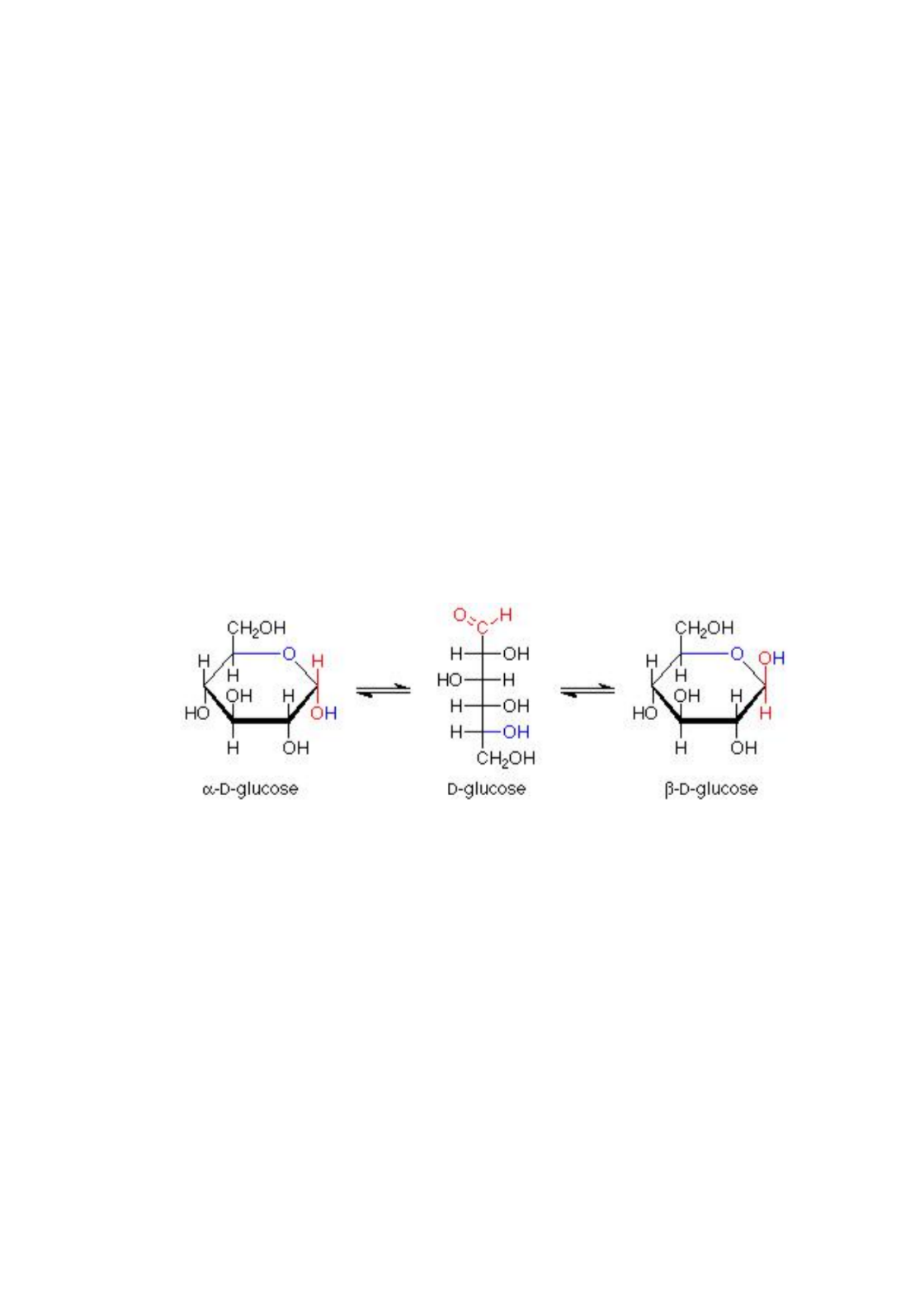
o The interactions with water determine structures in biological moecules
For each of the four major biological molecules: What is its name? What is the
monomeric unit (What are the critical structural features of the monomer, are there
important functions for the monomers)? How are the monomers linked together (name of
the linkage, what type of chemical reaction forms the linkage and what type of chemical
reaction breaks the linkage)? What are the important structural features of the polymer?
How do the structural features indicate functional capabilities? What are the key
functions of the polymer? Specifically:
For carbohydrates, be able to draw the structure of glucose and ribose (alpha and beta
forms), know the structural and functional differences between cellulose and glycogen,
identify a glycosidic linkage
o Glycosidic bond
Dehydration reaction between OH’s, link is oxygen between 2 sugars
o Cellulose vs Glycogen
Cellulose
Structural, beta glucose, 1,4 unbranched strong linkages
3/1/25, 5:03 PM
Molecular Biology Study Guide 1
about:blank
21/32

Glycogen
Alpha glucose
1,4 and 1,6 means it is branched, more flexible
For lipids, know the functions of triacylglycerols, membrane phospholipids and cholesterol.
Be able to draw a model of a membrane phospholipid and label it to show its amphipathic
quality. Describe the features of the biological membrane (fluid mosaic model) and the
features of membrane transport (active vs passive).
o Phosphate - group at one end creates polar head
o Triacylglycerol = 3 fatty acids linked to a glycerol molecule, insoluble in
water, stores energy
o Phospholipids = 2 fatty acids linked to polar head
o Cholesterol
Composed of 4 hydrocarbon rings (hydrophobic) with hydroxyl
group (hydrophilic)
Important in membranes to give structure, makes it less fluid
For nucleic acids, be able to draw the base pairs, know 5’ and 3’ ends, identify the
phosphodiester linkage, write everything you know about DNA structure.
o DNA vs RNA
o Nucleoside doesn’t have phosphate
o Sugar phosphate backbone
o Linkages occur between 5’ phosphate and 3’ hydroxy
3/1/25, 5:03 PM
Molecular Biology Study Guide 1
about:blank
22/32

o Double stranded right handed helix, 10 bp per turn, major and minor grooves
For proteins, draw the general model for an amino acid, recognize amino acid side chains as:
nonpolar, polar, positively charged, or negatively charged. Know the special functions of
glycine, proline, histidine and cysteine, identify the peptide bond.
o Side Chains
Polar
OH, Amides
Nonpolar
S, CH3, N
Positive, basic
N+
Negative acidic
COO-
o Peptide Bond
Between COO- and NH3+, H2O leaves to create O=C-NH bond
o Glycine
Provides most flexibility to backbone bond rotation
o Proline
Only secondary amine, no flexibility, will interrupt DNA helix
o Histidine
Complexes with zinc and iron, involved in ion exchange reactions
o Cysteine
Has SH group, chemically reactive with zinc and iron
For protein structure and function:
o Primary
Sequence of amino acids
o Secondary
Regular repeating structures
o Tertiary
3D folding
o Quaternary
3D arrangement of subunits
3/1/25, 5:03 PM
Molecular Biology Study Guide 1
about:blank
23/32

Describe what is meant by a domain in protein
Basic units of tertiary structure, independently folded and can often
function independently
Examples include helix-loop-helix, zinc fingers, etc.
Compare denatured state with native state (conformation). Describe the
Anfinsen experiment and its significance.
Native state is fully folded, unfolded is denatured
Experiment, adding a substance that denatures proteins and then
removing the substance resulted in the reactivation of proteins. This
proved that amino acid sequence determines folding
How do enzymes work? Know about activation energy and the role of enzymes in
catalysis. Know the role of active site (lock and key binding vs induced fit),
substrate binding site (specificity), catalytic site (catalytic power) and allosteric site
(feedback regulation)
o Active Site
Lock and key, active site is shaped specifically to substrate
Induced fit, active site recognizes substrate and changes form to function
o Catalytic site
Composed of three side chains using charge relay system, puts negative charge
on peptide bond
o Allosteric Site
3/1/25, 5:03 PM
Molecular Biology Study Guide 1
about:blank
24/32

Binds regulatory effector which alters active site and changes activity,
usually used for feedback inhibition
Describe the catalytic mechanism for serine proteases
o Hydrolyzes peptide bonds in proteins
o Enzyme forms bond with substrate
o Breaks bond
How does phosphorylation influence protein structure and function (know the roles of
kinases and phosphatases)?
o Kinase adds PO4 group, phosphatase removes them
o Phosphorylation can activate an inactive protein
Chapter 3
Distinguish anabolic from catabolic
o Anabolic = building molecules
o Catabolic = breaking them down
What is Gibbs free energy and how can it predict the spontaneity of a reaction?
What is activation energy? Recognize that energetically favorable
reactions (spontaneous) do not necessarily occur at a useful rate.
3/1/25, 5:03 PM
Molecular Biology Study Guide 1
about:blank
25/32

How do cells carry out energetically unfavorable reactions? Understand the concept
of chemical coupling.
o Pairing a reaction with ATP hydrolysis
What is the role of ATP? Know the importance and role of the phosphoanhydride bonds.
o Bonds between phosphates in ATP, release energy when broken
How do enzymes assist cellular reactions?
Describe the cellular locations, relative ATP production, and overall features of
glycolysis, the citric acid cycle and oxidative phosphorylation. Describe how these central
metabolic pathways are important for all of anabolism and catabolism.
o Glycolysis occurs in cytosol, gain ATP and NADH
o Citric Acid cycle occurs in mitochondrial matrix, and oxidative phosphorylation is in
inner membrane of mitochondria
o
Compare the ATP yield of glucose catabolism with that of fatty acid catabolism.
How does chemiosmosis and oxidative phosphorylation illustrate membrane structure
and function?
o They use electrical and chemical gradients to drive the movement of ions
Describe the cellular locations, important products and overall features of photosynthesis.
3/1/25, 5:03 PM
Molecular Biology Study Guide 1
about:blank
26/32

o Light reactions
Synthesis of ATP and NADPH creates O2
Chloroplasts
o Dark reactions
ATP and NADH drive synthesis of carbohydrates from CO2
Calvin cycle
Use gluconeogenesis to illustrate a typical anabolic pathway. Is it the direct reversal
of catabolism?
o It is not direct, certain steps are different
Chapter 4
Define:
o Gene:
A segment of DNA that codes for a product, either RNA or protein
o Allele
A variant of a gene
o Genotype
The genetic makeup of an organism
o Phenotype
The appearance or observable characteristic of an organism
o Chromosome
o Dominant
An allele that determines the organism’s appearance
o Recessive
An allele that has no influence on the organism appearance
o Diploid
Two copies of each chromosome
o Haploid
One copy of each chromosome
o Genetic linkage
Located on the same chromosome
o Independent assortment
Segregation of two hypothetical genes located on different chromosomes
3/1/25, 5:03 PM
Molecular Biology Study Guide 1
about:blank
27/32

o Meiosis
Division of sex cells
Provide a complete and detailed description of the central dogma of biology, including
the concepts of functional (enzymatic) RNA and reverse transcription.
o See slide 11 of Presentation 6
What is the genetic code?
o Nucleotides in mRNA are used as triplets to encode the different amino acids
Be prepared to address the purpose of the method, theoretical background and research
approach and an Example application following for the following methods:
o Recombinant DNA (restriction endonuclease, plasmid, origin of replication, vectors
for large inserts, expression vector), gel electrophoresis, DNA sequencing, PCR, real
time PCR, hybridization (nucleic acid blotting and in situ hybridization),
immunoblotting and immunofluorescence, transfection (stable vs transient)
transgenics, CRISPR-Cas, RNAi and siRNA.
o Lol I should have stayed awake
Chapter 5
Compare the genome sizes, gene numbers and approximate percentage of coding
regions in the human genome, yeast genome, and genome.E. coli
o Human genome
3/1/25, 5:03 PM
Molecular Biology Study Guide 1
about:blank
28/32

Size
3000 Mb
Gene numbers
21,000
Approximate percentage of coding regions
1.2%
o Yeast Genome
Size
12 Mb
Gene numbers
6000
Approximate percentage of coding regions
70%
o E. coli genome
Size
3/1/25, 5:03 PM
Molecular Biology Study Guide 1
about:blank
29/32

4.6Mb
Gene numbers
4,200
Approximate percentage of coding regions
88%
Does number of genes correlate with biological complexity? Provide evidence for
your answer.
o The number of genes does not correlate with biological complexity. Humans
have 21,000 genes and only 1% of the genome is coding; whereas apples have
57,000 genes.
Describe what we have learned by comparing genes across diverse biological organisms
o About half of human genes are common to all vertebrates
What is the transcriptome? How can you determine the transcriptome for a particular
cell?
o All the RNAs that are transcribed in a cell. Initially done by Microarray. RNA-seq
reveals the sequences of all mRNAs of all mRNAs in a cell
What is the proteome? How can you determine the proteome for a particular cell?
3/1/25, 5:03 PM
Molecular Biology Study Guide 1
about:blank
30/32

o Large-scale analysis of cell proteins. Identify and quantify all proteins expressed
in a given cell
Explain the immunoprecipitation and yeast two-hybrid system for determining
protein interactions
o Identify precipitated proteins by mass spec.
o Tried and true method to show protein-protein interaction
o Two different cDNAs (e.g., from human cells) are fused to two distinct
yeast genes
o One yeast gene codes for a DNA binding domain
o The other codes for a transcription activation domain
o If the two human proteins interact, they form a transcription factor that
stimulates reporter gene expression
o Quantify the increase (or not) of reporter gene expression
What is bioinformatics? How have computational approaches improved our
understanding of gene expression?
o An interdisciplinary field that is concerned with the development and application of
algorithms that analyze biological data to investigate the structure and function of
biological polymers and their relationships to living systems”
3/1/25, 5:03 PM
Molecular Biology Study Guide 1
about:blank
31/32

o at the interface between biology and computer science, uses computational methods
to analyze and extract biological information from all this data
What can genome wide knock down by RNAi tell us?
o Systematic screens of gene function
One approach to study gene function is to inactive each gene
Arrays of sirna assay whole genome
Know network relationships in molecular pathways
o See slide 32 presentation 7
o Negative feedback
o Positive feedback
o Feed-forward relay
o Stimulatory crosstalk
o Inhibitory crosstalk
3/1/25, 5:03 PM
Molecular Biology Study Guide 1
about:blank
32/32

