


Assignment Section--3.4_Repeated_Roots due 09/08/2021 at 11:59pm MST
Problem 1. (1 point)
Find the general solution to the homogeneous differential equa-
tion. d2y dy
dt2 -14 dt +
49y =
0
Use c1 and c2 in your answer to denote arbitrary constants, and
enter them as c 1 and c2.
y(t) = __________ help (formulas)
Answer(s) submitted:
• (cl+c2t) e'
(7t)
(correct)
Problem 2. (1 point)
Find y as a function of t if
576y" -816y'
+289y = o,
y(0) = 8, y'(0) = 2.
y(t) =------------
Solution:
SOLUTION
The characteristic equation is
576?-816r+289 = (24r-17)2 = 0.
Thus the polynomial has the repeated root r = ½¾ and the general
solution can be written as
!lt !lt
y=c1e24 +c 2
te24,
17
17
17
for which y' = ½¾c1e241
+cze241
+ ½¾c2te241
•
Substituting the initial conditions gives the system
8= c1
2 = ½¾c1 +c 2
with solution ci = 8, c2
= -J/-.
Hence the solution to the initial value problem is
Answer(s) submitted:
17
17
y= 8e241
-J/-te241
•(8-((11)/3)t)e'(((l7)/(24))t)
(correct)
Problem 3. (1 point)
Find y as a function of t if
49y11
+
56y'
+ 16y = 0,
y(0) = 8, y'(0) = 5.
y(t)=------
Solution:
SOLUTION
The characteristic equation is
49?+56r+ 16 = (7r+4)2
.
Thus the polynomial has the repeated root r = -1 and the general
solution can be written as _1, _1t
y=c1e 7 +c2te 7,
• I 4 -
1t -1t 4 _1t
for whichy =-7c1e 7 +c2e 7 -1c2te 7.
Substituting the initial conditions gives the system
8= c1
5 = -1c1 +c 2
with solution c1 = 8, c2 = rJ.
Hence the solution to the initial value problem is
Answer(s) submitted:
4 4
y= 8e-'11 + rJte-11
•(8+((67)/7)t)e'(-(4/7)t)
(correct)
Problem
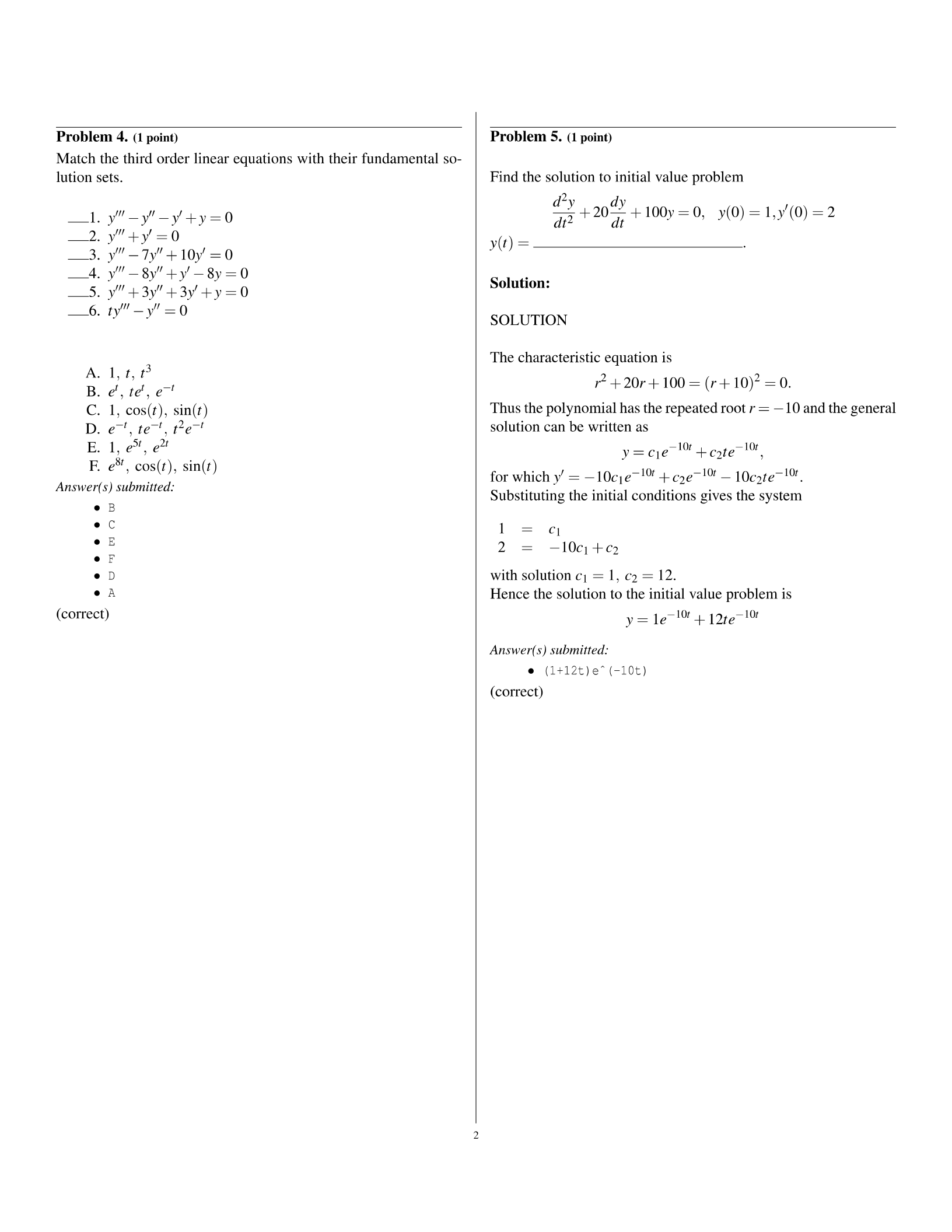
4.
(1
point)
Match
the
third
order
linear
equations
with
their
fundamental
so-
lution
sets.
4.
yl"
—y"—-y
+y=0
_2.
y”+y'
=0
__3.
y"”
—Ty”+10y'
=0
WW
fi
_
__4.
y"
—8y'
+y
—8y=0
__S5;.
y"”
+3y"+3y+y=0
__
6.
ty”
_
y!
—0
.1¢,0
.é,
te,
e7
.
1,
cos(£),
sin(t)
e,
te,
t?e#
1,
em
e2t
|
e®,
cos(t),
sin(t)
Answer(s)
submitted:
eB
t
mmoanwp
e©eeee
ro
oO
(correct)
Problem
5.
(1
point)
Find
the
solution
to
initial
value
problem
d’y
dy
—
+20—
100y
=0
0)=1,y(0)=2
y(t)
=
Solution:
SOLUTION
The
characteristic
equation
is
7?
+20r+
100
=
(r+
10)?
=0.
Thus
the
polynomial
has
the
repeated
root
r
=
—10
and
the
general
solution
can
be
written
as
—10r
y=ce
10t
+c2te
,
for
which
y’
=
—10cye7!%
+
cge7!
—
10ente7
™.
Substituting the
initial
conditions
gives
the
system
1
=
¢
2
=
-—10c,;+c2
with
solution
cj
=
1,
cz
=
12.
Hence
the
solution
to
the
initial
value
problem
is
y=1e
1%
4
124271
Answer(s)
submitted:
e
(14+12t)e*
(-10t)
(correct)

Problem
6.
(1
point)
Find
y
as
a
function
of
x
if
y”
_
Ty"
4
10y’
=0,
y(0)
=7,
y(0)
=1,
y"(0)
=S.
y(x)
=
Solution:
SOLUTION
The
characteristic
equation
is
Pr
—Tr
+10r
=
r(r°
—7Tr+10)=r(r—5)(r—2)
=0,
with
roots
7;
=
0,
r2
=
5
and
r3
=
2.
The
general
solution
can
be
written
as
y=c,
tee"
+c3e7,
for
which
y’
=
5c2e*
+
2c3e~
and
y”
=
25cre*
+.
4c3e”.
Substituting the
initial
conditions
gives
the
system
7
=
cy
te.+c3
1
=
5¢e,+2c2
5
=
25c,+4c2
with
solution
cj
=
3,
a2=
5
and
c3
=
0.
Hence
the
solution
to
the
initial
value
problem
is
y=6.8+0.2e"
Answer(s)
submitted:
e@
((34)/5)+(1/5)e*
(5x)
(correct)
Problem
7.
(1
point)
Find
y
as
a
function
of
x
if
y4)
_
8y”
+
16y”
_— 0,
y(0)
=
16,
y(0)
=
19,
y’(0)
=
16,
y’”(0)
=0.
y(x)
=
Solution:
SOLUTION
The
characteristic
equation
is
r
—
8
+
16r?
=r?(r?
—8r+16)
=
r(r—4)’,
with
roots
r;
=
0
(repeated)
and
rz
=
4(
repeated).
The
general
solution
can
be
written
as
y=cyteoox+c3e™
+
c4xe™,
for
which
yl
=
cn
+4ce3e"
+.
cge™
+
4cqxe™
y"
=
l6c3e™
+
8e4e"
+
16c4xe*
y”"
=
64c3
e**
+
48c,e*
+
64c4xe™
Substituting
the
initial
conditions
gives
the
system
16
=
cj+c¢9
19
=
c2+4c3+¢4
16
=
16c3+8c4
0
=
64c3+48c4
with
solution
c}
=
13,
cp
=
11,
c7z3
=
3
and
cg
=
—4.
Hence
the
solution
to
the
initial
value
problem
is
y=134+11x+3e™
—4xe™
Answer(s)
submitted:
@
13+11x+3e*
(4x)
-4xe*
(4x)
(correct)
Problem
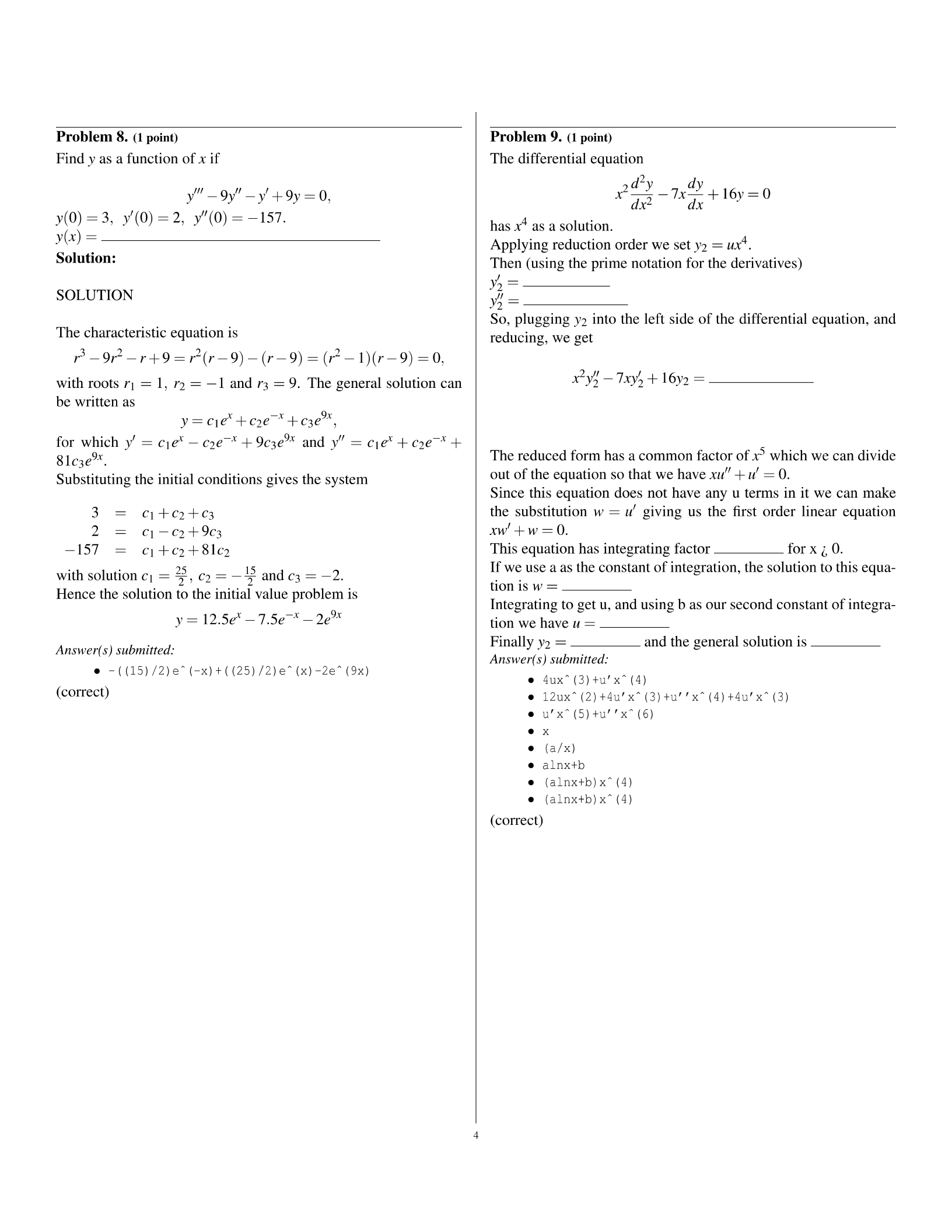
8.
(1
point)
Find
y
as
a
function
of
x
if
y”
_
Oy”
_
y’
+9y
=0,
y(0)
=3,
y/(0)
=2,
y"(0)
=
—-157.
y(x)
=
Solution:
SOLUTION
The
characteristic
equation
is
P—9r
—r+9=Pr(r—9)—(r—9)
=(P
-1)(r—9)
=0,
with
roots
r;
=
1,
72
=
—1
and
r3
=
9.
The
general
solution
can
be
written
as
y=cye+me*+
c3e"*,
for
which
y’
=
cye*
—
co9e7*
+
9c3e™
and
y”
=
cye*
+
c9e7*
+
81c3e"*.
Substituting the
initial
conditions
gives
the
system
3
=
ec
+o2.+c3
2
=
cy—c2+9c3
—157
=
cy
+o.+81c2
with
solution
cj
=
2,
cp
=
—
and
c3
=
—2.
Hence
the
solution
to
the
initial
value
problem
is
y
=
12.5e%
—7.5e-*
—
20”
Answer(s)
submitted:
@
—((15)/2)e*
(-x)+(
(25)
/2)
e*
(x)
-2e*
(9x)
(correct)
Problem
9.
(1
point)
The
differential
equation
d*y
dy
vr
—=
—Tx——
16y
=0
de
dx
+
fey
has
x‘
as
a
solution.
Applying
reduction
order
we
set
yz
=
ux‘.
Then
(using
the
prime
notation
for
the
derivatives)
So,
plugging
y2
into
the
left
side
of
the
differential
equation,
and
reducing,
we
get
x’
yy
—
Txys
+
16y2
=
The
reduced
form
has
a
common
factor
of
x°
which
we
can
divide
out
of
the
equation
so
that
we
have
xu”
+
u’
=
0.
Since
this
equation
does
not
have
any
u
terms
in
it
we
can
make
the
substitution
w
=
wv’
giving
us
the
first
order
linear
equation
xw'+w=0.
This
equation
has
integrating
factor for
x
¢
0.
If
we
use
a
as
the
constant
of
integration,
the
solution
to
this
equa-
tion
is
w=
—___
Integrating
to
get
u,
and
using
b
as
our
second
constant
of
integra-
tion
we
have
u
=
Finally
y2
=
Answer(s)
submitted:
@
4ux*
(3)
+u’x*
(4)
and
the
general
solution
is
(alnxtb)
x*
(4)
(alnxtb)
x*
(4)
@
12ux*
(2)+4u’x*
(3)
4u’’x*
(4)
+4u’
x*
(3)
@
u’x*(5)+u’’
x”
(6)
ex
@
(a/x)
@
alnx+b
e
e
(correct)
Problem
10.
(1
point)
The
differential
equation
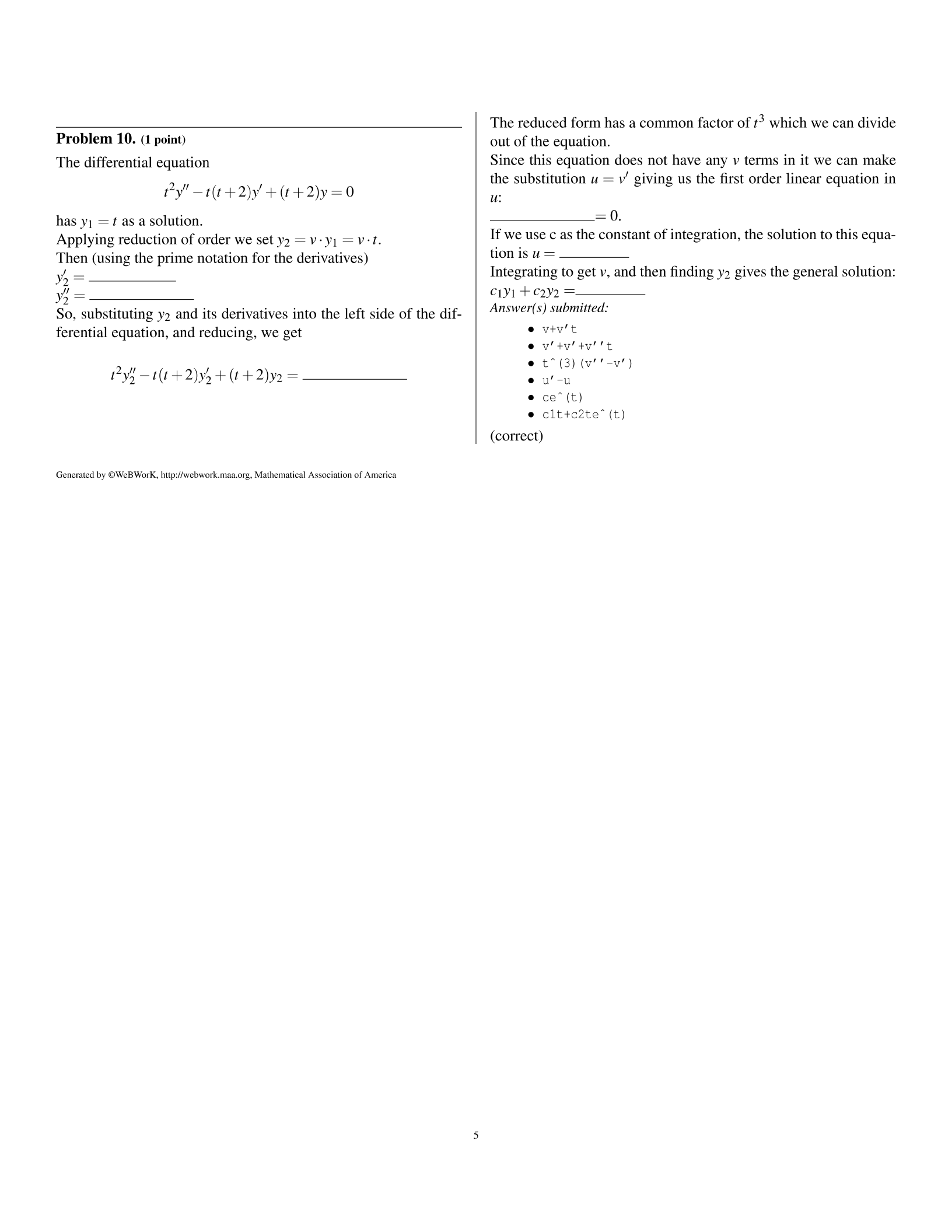
ty”
—t(t
+2)y'
+
(t+2)y
=0
has
y;
=¢
as
a
solution.
Applying
reduction
of
order
we
set
yp
=
v-y;
=v-t.
Then
(using
the
prime
notation
for
the
derivatives)
y=
———
So,
substituting
y2
and
its
derivatives
into
the
left
side
of
the
dif-
ferential
equation,
and
reducing,
we
get
t”yh
—t(t+2)y,
+
(t+2)y2
=
Generated
by
OWeBWork,
http://webwork.maa.org,
Mathematical
Association
of
America
The
reduced
form
has
a
common
factor
of
f?
which
we
can
divide
out
of
the
equation.
Since
this
equation
does
not
have
any
v
terms
in
it
we
can
make
the
substitution
u
=
v’
giving
us
the
first
order
linear
equation
in
u:
=
0.
If
we
use
c
as
the
constant
of
integration,
the
solution
to
this
equa-
tion
is
w=
Integrating
to
get
v,
and
then
finding
y2
gives
the
general
solution:
C1y1
+
C2y2
=
Answer(s)
submitted:
vivit
vitvl
tv
t
t*
(3)
(w''-v")
u’-u
ce”
(t)
clttc2te*
(t)
(correct)
Powered by TCPDF (www.tcpdf.org)

