



Austin Cholley Jones MAT 275 ONLINE B Spring 2021
Assignment Section 7.1 Introduction First Order Systems due 04/14/2021 at 11:59pm MST
1. (1 point)
Just as there are simultaneous algebraic equations (where a
pair of numbers have to satisfy a pair of equations) there are
systems of differential equations, (where a pair of functions
have to satisfy a pair of differential equations).
Indicate which pairs of functions satisfy this system. It will take
some time to make all of the calculations.
y0
1=y2y0
2=−y1
•A. y1=cos(x)y2=−sin(x)
•B. y1=2e−2xy2=3e−2x
•C. y1=e4xy2=e4x
•D. y1=sin(x)y2=cos(x)
•E. y1=exy2=ex
•F. y1=e−xy2=e−x
•G. y1=sin(x) + cos(x)y2=cos(x)−sin(x)
As you can see, finding all of the solutions, particularly of a
system of equations, can be complicated and time consuming.
It helps greatly if we study the structure of the family of solu-
tions to the equations. Then if we find a few solutions we will
be able to predict the rest of the solutions using the structure of
the family of solutions.
Answer(s) submitted:
•(A,D,G)
(correct)
Correct Answers:
•ADG
2. (1 point)
Write the given second order equation as its equivalent sys-
tem of first order equations.
u00 +8u0+4u=0
Use vto represent the ”velocity function”, i.e. v=u0(t).
Use vand ufor the two functions, rather than u(t)and v(t). (The
latter confuses webwork. Functions like sin(t)are ok.)
u0=
v0=
Now write the system using matrices:
d
dt u
v= u
v.
Solution: The first order system is
u0=v
v0=−4u−8v
In matrix form the system can be written as
u0
v0=0 1
−4−8u
v
Answer(s) submitted:
•v
•-4u-8v
•0
•1
•-4
•-8
(correct)
Correct Answers:
•v
•-8v - 4u
•0
•1
•-4
•-8
3. (1 point)
Write the given second order equation as its equivalent sys-
tem of first order equations.
u00 +2u0+7u=2.5sin(3t),u(1) = −0.5,u0(1) = 1
Use vto represent the ”velocity function”, i.e. v=u0(t).
Use uand vfor the two functions, rather than u(t)and v(t). (The
latter confuses webwork. Functions like sin(t)are OK.)
u0=
v0=
Now write the system using matrices:
d
dt u
v= u
v+
and the initial value for the vector valued function is:
u(1)
v(1) = .
Solution: The first order system is
u0=v
v0=−7u−2v+2.5sin(3t)
In matrix form the system can be written as
u0
v0=0 1
−7−2u
v+0
2.5sin(3t)
The initial condition is
u(1)
v(1)=−0.5
1
Answer(s) submitted:
•v
•-7u-2v+2.5sin(3t)
•0
•1
1
•-7
•-2
•0
•2.5sin(3t)
•-.5
•1
(correct)
Correct Answers:
•v
•-2v - 7u + 2.5sin(3t)
•0
•1
•-7
•-2
•0
•2.5sin(3t)
•-0.5
•1
4. (1 point) Write the given second order equation as its
equivalent system of first order equations.
t2u00 +5.5tu0+ (t2+3.5)u=−7sin(3t)
Use v to represent the ”velocity function”, i.e. v=u0(t).
Use vand ufor the two functions, rather than u(t)and v(t). (The
latter confuses webwork. Functions like sin(t)are ok.)
u0=
v0=
Now write the system using matrices:
d
dt u
v= u
v+.
Solution: The first order system is
u0=v
v0=−t2+3.5
t2u−5.5
tv+−7
t2sin(3t)
In matrix form the system can be written as
u0
v0=
0 1
−t2+3.5
t2−5.5
t
u
v+"0
−7
t2sin(3t)#
Answer(s) submitted:
•v
•(tˆ(2)+3.5)((u/(tˆ(2))))-5.5((v/t))-((7sin3t)/(tˆ(2)))
•0
•1
•-(((tˆ(2)+3.5))/(tˆ(2)))
•-((5.5)/t)
•0
•-((7sin(3t))/(tˆ(2)))
(score 0.875)
Correct Answers:
•v
•-5.5(1/t)v - (tˆ2 + 3.5)(1/tˆ2)u + (1/tˆ2)*(-7sin(3t))
•0
•1
•- (tˆ2--3.5)(1/tˆ2)
•-5.5(1/t)
•0
•(1/tˆ2)*(-7sin(3t))
5. (1 point)
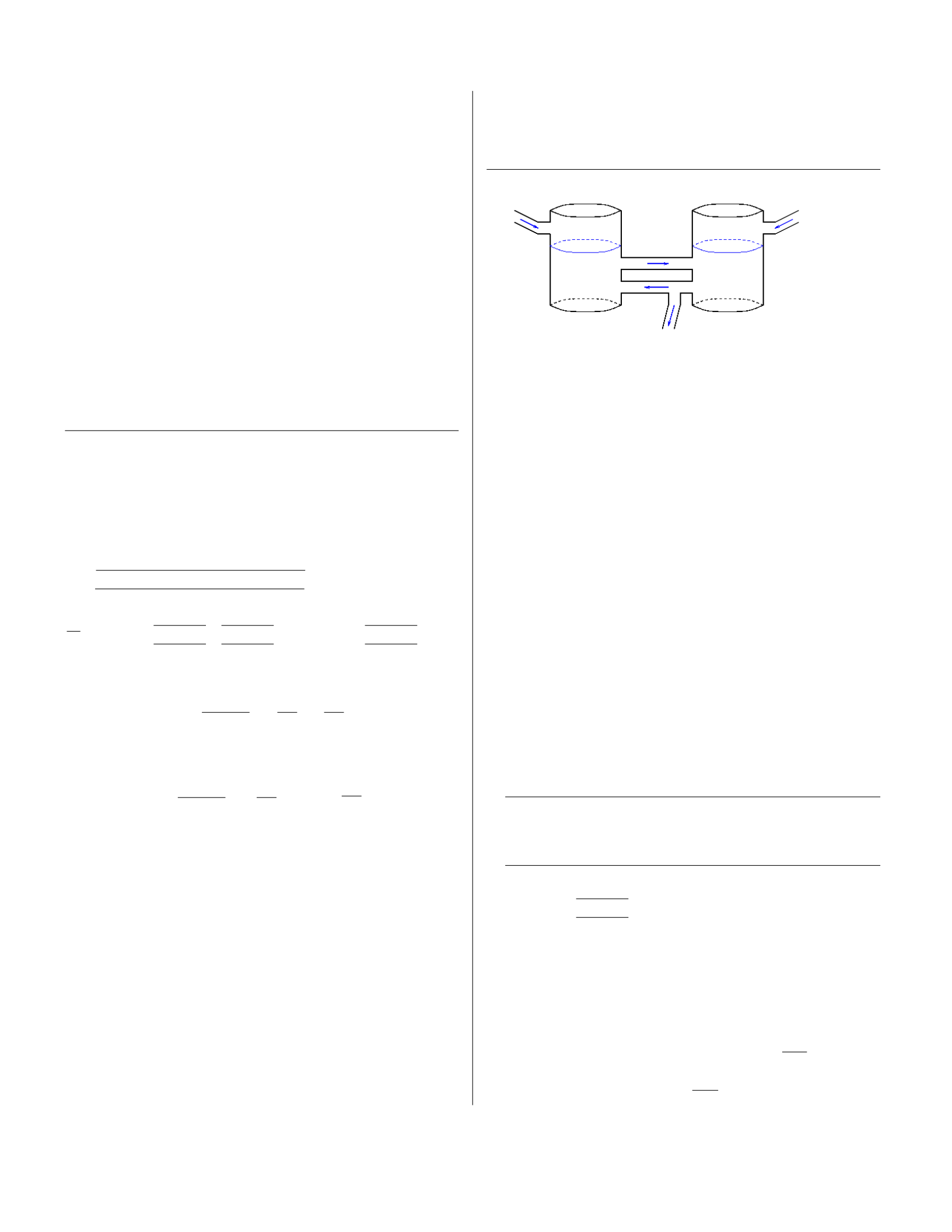
Consider two interconnected tanks as shown in the figure
above. Tank 1 initial contains 50 L (liters) of water and 115
g of salt, while tank 2 initially contains 40 L of water and 460 g
of salt. Water containing 10 g/L of salt is poured into tank1 at a
rate of 4 L/min while the mixture flowing into tank 2 contains a
salt concentration of 50 g/L of salt and is flowing at the rate of 2
L/min. The two connecting tubes have a flow rate of 7.5 L/min
from tank 1 to tank 2; and of 3.5 L/min from tank 2 back to tank
1. Tank 2 is drained at the rate of 6 L/min.
You may assume that the solutions in each tank are thor-
oughly mixed so that the concentration of the mixture leaving
any tank along any of the tubes has the same concentration of
salt as the tank as a whole. (This is not completely realistic, but
as in real physics, we are going to work with the approximate,
rather than exact description. The ’real’ equations of physics are
often too complicated to even write down precisely, much less
solve.)
How does the water in each tank change over time?
Let p(t)and q(t)be the amount of salt in g at time t in tanks
1 and 2 respectively. Write differential equations for pand q.
(As usual, use the symbols pand qrather than p(t)and q(t).)
p0=
q0=
Give the initial values:
p(0)
q(0) = .
Solution: First notice that the volume in Tank 1 is constant
and equal to 50 since there are (4+3.5)L/min entering the tank
and 7.5 L/min exiting the tank.
Similarly, the volume in Tank 2 is constnat and equal to 40, since
there are (2+7.5)L/min entering the tank and (3.5+6)L/min
exiting the tank.
Salt is entering Tank 1 at a rate of 10(4) + 3.5q(t)
40 g/s and it
is exiting the tank at a rate of 7.5p(t)
50 g/s
2

Salt is entering Tank 2 at a rate of 50(2) + 7.5p(t)
50 g/s and it
is exiting the tank at a rate of (3.5+6)q(t)
40 g/s
Thus the two differential equations are
p0=40 +3.5q
40 −7.5p
50
q0=100 +7.5p
50 −9.5q
40
The initial values are:
p(0)
q(0)=115
460
Answer(s) submitted:
•10(4)-(7.5/50)p+(3.5/40)q
•50*2-(3.5/40+6/40)q+(7.5/50)p
•115
•460
(correct)
Correct Answers:
•10*4 - (7.5/50)p + (3.5/40)q
•50*2 - ( 3.5/40 + 6/40 )q + ( 7.5/50 )p
•115
•460
6. (1 point)
Consider the system of differential equations
dx
dt =−2ydy
dt =−2x.
Convert this system to a second order differential equation
in yby differentiating the second equation with respect to tand
substituting for xfrom the first equation.
Solve the equation you obtained for yas a function of t; hence
find xas a function of t. If we also require x(0) = 5 and y(0) = 4,
what are xand y?
x(t) =
y(t) =
Solution:
SOLUTION
Differentiating the equation for y, we have
d2y
dt2=−2dx
dt =4y,
so
d2y
dt2−4y=0.
The characteristic equation is r2−4=0, so r=±2.
The general solution for yis thus
y=Ae−2t+Be2t,
so
x=−1
2y0=Ae−2t−Be2t.
Then, the initial conditions x(0) = 5 and y(0) = 4 require that
x(0) = A−B=5 and A+B=4,
so that A=4.5 and B=−0.5. Thus
x(t) = 4.5e−2t−0.5e2t
and
y(t) = 4.5e−2t+0.5e2t
Answer(s) submitted:
•-4sin(2t)+5cos(2t)
•4cos(2t)+5exp(2t)
(incorrect)
Correct Answers:
•4.5*eˆ(-2*t)--0.5*eˆ(2*t)
•4.5*eˆ(-2*t)+-0.5*eˆ(2*t)
7. (1 point)
Let wbe the number of worms (in millions) and rthe num-
ber of robins (in thousands) living on an island. Suppose wand
rsatisfy the following differential equations, which correspond
to the slope field shown below.
dw
dt =w−wr,dr
dt =−r+wr.
Assume w=4 and r=2 when t=0.
Does the number of worms increase, decrease, or stay the same
at first?
• ?
• increases
• decreases
• stays the same
Does the number of robins increase, decrease, or stay the same
at first?
• ?
• increases
• decreases
• stays the same
What happens in the long run?
• ?
• w and r both go to zero
• w goes to zero and r increases to infinity
• w increases to infinity and r goes to zero
• w and r both stay at constant values
• w and r both go to stable long-term values
• w and r oscillate
Solution:
3

SOLUTION
If w=4 and r=2, then dw
dt =−4 and dr
dt =6, so initially the
number of worms decreases and the number of robins increases.
In the long run, however, the populations will oscillate; they will
even go back to w=4 and r=2.
Answer(s) submitted:
•decreases
•increases
•w and r oscillate
(correct)
Correct Answers:
•decreases
•increases
•w and r oscillate
8. (1 point)
Consider a conflict between two armies of xand ysoldiers,
respectively. During World War I, F. W. Lanchester assumed
that if both armies are fighting a conventional battle within sight
of one another, the rate at which soldiers in one army are put out
of action (killed or wounded) is proportional to the amount of
fire the other army can concentrate on them, which is in turn pro-
portional to the number of soldiers in the opposing army. Thus
Lanchester assumed that if there are no reinforcements and t
represents time since the start of the battle, then xand yobey
the differential equations
dx
dt =−ay,dy
dt =−bx,
where aand bare positive constants.
Suppose that a=0.04 and b=0.01, and that the armies start
with x(0) = 54 and y(0) = 20 thousand soldiers. (Use units of
thousands of soldiers for both xand y.)
(a) Rewrite the system of equations as an equation for yas a
function of x:
dy
dx =
(b) Solve the differential equation you obtained in (a) to show
that the equation of the phase trajectory is
0.04y2−0.01x2=C,
for some constant C. This equation is called Lanchester’s
square law . Given the initial conditions x(0) = 54 and y(0) =
20, what is C?
C=
Solution:
SOLUTION
(a) Thinking of yas a function of xand xas a function of t,
then by the chain rule: dy
dt =dy
dx
dx
dt , so:
dy
dx =dy/dt
dx/dt =−bx
−ay =0.01x
0.04y.
(b) Separating variables,
Z0.04ydy =Z0.01x dx,so 0.04 y2
2=0.01 x2
2+k.
Multiplying by 2 and letting C=2k,
0.04y2−0.01x2=C.
Then, if we take x(0) = 54 and y(0) = 20, we can solve for Cto
get C=−13.16.
Answer(s) submitted:
•((.01x)/(.04y))
•.04(20ˆ(2))-.01*54ˆ(2)
(correct)
Correct Answers:
•0.01*x/(0.04*y)
•0.04*20ˆ2-0.01*54ˆ2
9. (1 point) This is the second part of a three-part problem.
Consider the system of differential equations
y0
1=4y1+y2,
y0
2=y1+4y2.
Verify that for any constants c1and c2, the functions
y1(t) = c1e5t+c2e3t,
y2(t) = c1e5t−c2e3t,
satisfy the system of differential equations. Enter c1as c1 and
c2as c2.
(1) Find the value of each term in the equation y0
1=4y1+y2
in terms of the variable t. (Enter the terms in the order
given.)
= + .
(2) Find the value of each term in the equation y0
2=y1+4y2
in terms of the variable t. (Enter the terms in the order
given.)
= + .
Answer(s) submitted:
•-5c1eˆ(5t)-1c2eˆ(3t)
•4(c1eˆ(5t)+c2eˆ(3t))
•(c1eˆ(5t)-c2eˆ(3t))
•5c1eˆ(5t)-3c2eˆ(3t)
•
•
(score 0.5)
Correct Answers:
•c1*5*eˆ(5*t)+c2*3*eˆ(3*t)
•4*[c1*eˆ(5*t)+c2*eˆ(3*t)]
•1*[c1*eˆ(5*t)-c2*eˆ(3*t)]
•c1*5*eˆ(5*t)-c2*3*eˆ(3*t)
•1*[c1*eˆ(5*t)+c2*eˆ(3*t)]
•4*[c1*eˆ(5*t)-c2*eˆ(3*t)]
4

