


Final Mat275 Honors
Spring 2012
April 30, 2012
Show your work - no credit for unsubstantiated claims!
1. Assume you invest $2000 and your friend invests $5000, both at an interest
rate of 6% annually, compounded continously. Which investment doubles
its value first? When will that happen? (20 points)
2. Find the approximate value of y(0.2) where y(x) is the solution of the IVP
y0=x2+y2, y(0) = 1 (1)
by Euler’s method with a step size of 0.1. (30 points)
3. Consider the following systems from population dynamics (all parameters
are positive, all variables describe populations):
˙x= (−a+by)x
˙y= (c−dx)y(2)
˙x= (a+by)x
˙y= (c+dx)y(3)
˙x= (a−by)x
˙y= (c−dx)y(4)
a) Explain why the system Eq.(2) is called a predator - prey model, the
system Eq. (3) is called a cooperative system and the system Eq. (4) is
called a competitive system.
b) Discuss why the system Eq. (3) cannot be a valid population model
for long times. (40 points)
4. (a) Determine the eigenvalues and corresponding eigenvectors of
A=0 1
−2−2
(b) Determine the solution to the initial value problem
x0=Ax x(0) = 1
0.
(c) Sketch a phase portrait with a solution for the initial conditions
x(0) = (1,0) and x(0) = (0,−1). Determine the type of phase por-
trait (saddle, sink, source, center).
(d) Is the solution moving clockwise or counterclockwise? Which one of
the two solutions in b) is closer to the origin?
(e) Which one of the two solutions reaches the origin first? (40 points)
(a) (b) (c)
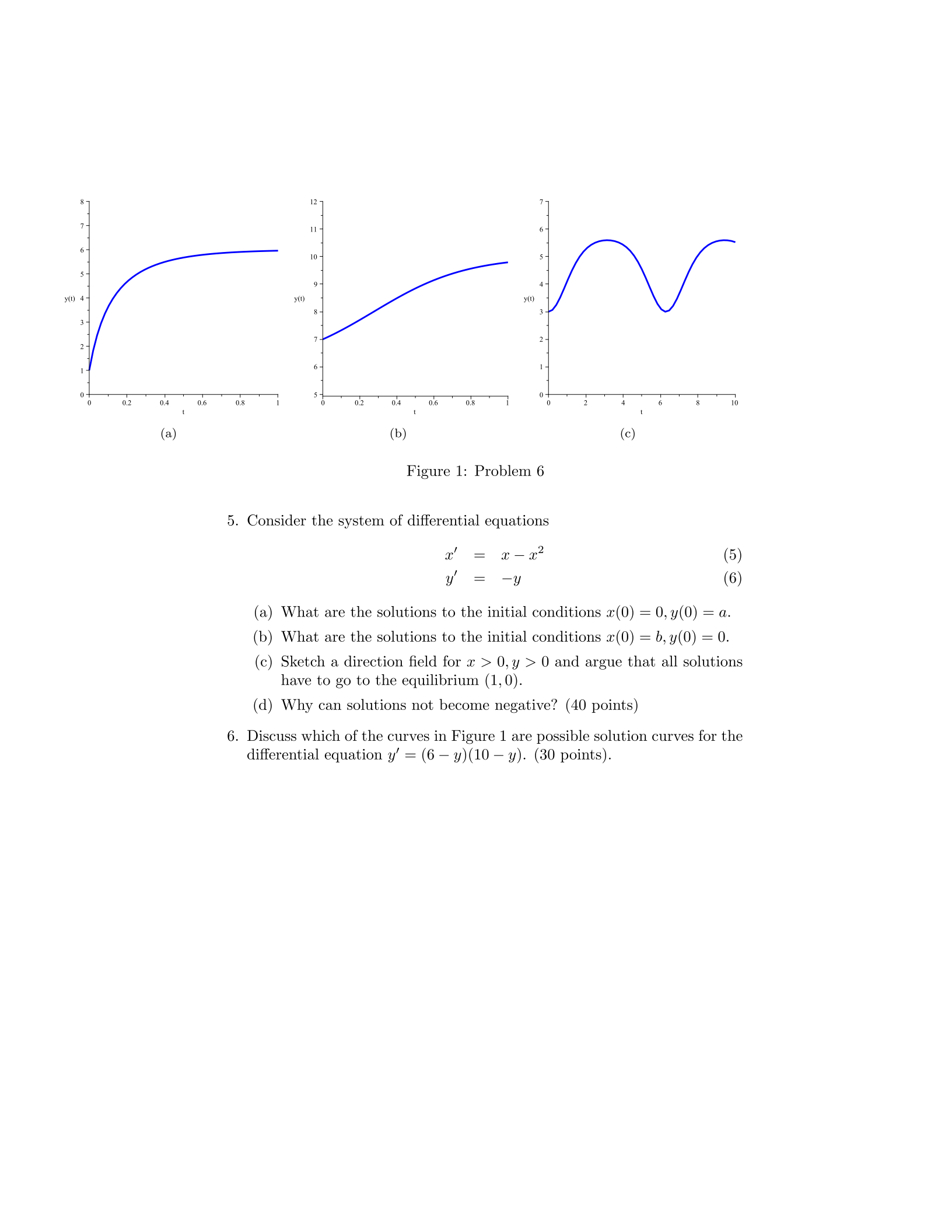
Figure 1: Problem 6
5. Consider the system of differential equations
x0=x−x2(5)
y0=−y(6)
(a) What are the solutions to the initial conditions x(0) = 0, y(0) = a.
(b) What are the solutions to the initial conditions x(0) = b, y(0) = 0.
(c) Sketch a direction field for x > 0, y > 0 and argue that all solutions
have to go to the equilibrium (1,0).
(d) Why can solutions not become negative? (40 points)
6. Discuss which of the curves in Figure 1 are possible solution curves for the
differential equation y0= (6 −y)(10 −y). (30 points).
Powered by TCPDF (www.tcpdf.org)

