


Austin Cholley Zhu MAT 267 ONLINE A Fall 2021
Assignment Section 10.1 due 08/22/2021 at 11:59pm MST
Problem 1. (1 point)
What are the projections of the point (−7,3,−9)on the coordi-
nate planes?
On the xy-plane: ( , , )
On the yz-plane: ( , , )
On the xz-plane: ( , , )
Solution:
SOLUTION:
The projection of (−7,3,−9)onto the xy-plane is (−7,3,0).
The projection of (−7,3,−9)onto the yz-plane is (0,3,−9).
The projection of (−7,3,−9)onto the xz-plane is (−7,0,−9).
Answer(s) submitted:
•-7
•3
•0
•0
•3
•-9
•-7
•0
•-9
(correct)
Correct Answers:
•-7
•3
•0
•0
•3
•-9
•-7
•0
•-9
Problem 2. (1 point)
Determine whether the three points P= (0,3,−7),Q=
(2,7,−1),R= (4,12,5)are colinear by computing the distances
between pairs of points.
Distance from Pto Q:
Distance from Qto R:
Distance from Pto R:
Are the three points colinear (y/n)?
Solution:
SOLUTION:
Distance from Pto Q:
p(2−0)2+ (7−3)2+ (−1+7)2=2√14
Distance from Qto R:
p(4−2)2+ (12 −7)2+ (5+1)2=√65
Distance from Pto R:
p(4−0)2+ (12 −3)2+ (5+7)2=√241
In order for the points to lie on a straight line, the sum of the
two shortest distances must equal the longest distance. Since
2√14 +√65 6=√241, the three points do not lie on a straigh line.
Answer(s) submitted:
•sqrt(56)
•sqrt(65)
•sqrt(241)
•n
(correct)
Correct Answers:
•7.48331477354788
•8.06225774829855
•15.52417469626
•N
1

Problem 3. (1 point)
What is the distance from the point (9,7,5)to the xz-plane?
Distance =
Solution:
SOLUTION:
The distance from the point to the xz-plane is the absolute value
of the y-coordinate of the point. Thus the distance is 7.
Answer(s) submitted:
•7
(correct)
Correct Answers:
•7
Problem 4. (1 point)
What do the following equations represent in R3?
Match the two sets of letters:
a. a vertical plane
b. a horizontal plane
c. a plane which is neither vertical nor horizontal
A. 1x+1y=−2
B. x=−1
C. y=0
D. z=6
Answer(s) submitted:
•a
•a
•a
•b
(correct)
Correct Answers:
•A
•A
•A
•B
Problem 5. (1 point)
Find the equation of the sphere centered at (−2,5,2)with radius
2.
= 0.
Give an equation which describes the intersection of this sphere
with the plane z=3.
= 0.
Solution:
SOLUTION:
An equation of the sphere with center (−2,5,2)and radius 2 is
(x+2)2+ (y−5)2+ (z−2)2=22or
(x+2)2+ (y−5)2+ (z−2)2−22=0 .
The intersection of this sphere with the plane z=3 is the set of
points on the sphere whose z-coordinate is z=3. Putting z=3
into the equation yields (x+2)2+ (y−5)2+1−22=0 or
(x+2)2+ (y−5)2−3=0.
This is a circle in the plane z=3 with center (−2,5,3)and radius
√3.
Answer(s) submitted:
•((x+2)ˆ(2)+(y-5)ˆ(2)+(z-2)ˆ(2))-4
•(x+2)ˆ(2)+(y-5)ˆ(2)+1-2ˆ(2)
(correct)
Correct Answers:
•(x - -2)**2 + (y - 5)**2 + (z - 2)**2 - 2**2
•(x - -2)**2 + (y - 5)**2 + 1 - 2**2
Problem 6. (1 point)
Find the equation of the sphere if one of its diameters has end-
points (8,3,−2)and (9,5,1).
= 0.
Solution:
SOLUTION:
The center of the sphere is the midpoint of the diameter:
8+9
2,3+5
2,−2+1
2= (8.5,4,−0.5).
The radius is half the diameter, so
r=1
2p(9−8)2+ (5−3)2+ (1+2)2=1
2√14.
Therefore an equation of the sphere is
(x−8.5)2+ (y−4)2+ (z+0.5)2−14
4=0
Answer(s) submitted:
•(x-8.5)ˆ(2)+(y-4)ˆ(2)+(z+(1/2))ˆ(2)-((sqrt(14))/2)ˆ(2)
(correct)
Correct Answers:
•(x - 8.5)**2 + (y - 4)**2 + (z - -0.5)**2 - 1.87082869338697**2
2

Problem 7. (1 point)
Find an equation of the sphere that passes through the origin and
whose center is (3,−1,2).
= 0
Note that you must put everything on the left hand side of the
equation and that we desire the coefficients of the quadratic terms
to be 1.
Solution:
SOLUTION:
The radius of the sphere is the distance from the center to the
origin: r=√32−12+22=√14. Therefore the equation of the
sphere is
(x−3)2+ (y+1)2+ (z−2)2−14 =0
Answer(s) submitted:
•xˆ(2)+yˆ(2)+zˆ(2)+(-6x+2y-4z)
(correct)
Correct Answers:
•xˆ2 + yˆ2 + zˆ2 + (-6*x + 2*y + -4*z)
Problem 8. (1 point)
Find an equation of the largest sphere with center (8,1,3)that is
contained completely in the first octant.
= 0
Note that you must move everything to the left hand side of the
equation that we desire the coefficients of the quadratic terms to
be 1.
Solution:
SOLUTION:
The largest sphere contained in the first octant must have a radius
equal to the minimum distance from the center (8,1,3)to any of
the three coordinate planes. The shortest distance is 1, thus an
equation of the sphere is
(x−8)2+ (y−1)2+ (z−3)2−12=0
Answer(s) submitted:
•xˆ(2)+yˆ(2)+zˆ(2)-2(8x+1y+3z)-1ˆ(2)+(8ˆ(2)+1ˆ(2)+3ˆ(2))
(correct)
Correct Answers:
•xˆ2 + yˆ2 + zˆ2 - 2*(8*x + 1*y + 3*z) - 1ˆ2 + (8ˆ2 + 1ˆ2 +
3ˆ2)
Problem 9. (1 point)
Find the center and radius of the sphere
x2−12x+y2−14y+z2+4z=11
Center: ( , , )
Radius:
Solution:
SOLUTION:
Completing the squares in the equation gives
(x2−12x+36)+(y2−14y+49)+(z2+4z+4) = 11+36+49+4
⇒(x−6)2+ (y−7)2+ (z+2)2=100,
which we recognize as an equation of a sphere with center
(6,7,−2)and radius 10.
Answer(s) submitted:
•6
•7
•-2
•10
(correct)
Correct Answers:
•6
•7
•-2
•10
3
Problem 10. (1 point)
Write down an (in)equality which describes the solid ball of ra-
dius 8 centered at (−6,9,−9).It should have a form like x2+y2+
(z−2)2−4>=0, where you use one of the following symbols
≤, <, =,≥, >.
The first blank is for the algebraic expression; the drop-down
list gives the (in)equatilty.
? 0.
Solution:
SOLUTION:
The solid ball consists of all the points on or inside the sphere
with radius 8 and center at (−6,9,−9). This set of points is de-
scribed by the inequality (x+6)2+ (y−9)2+ (z+9)2≤64, or,
equivalently, (x+6)2+ (y−9)2+ (z+9)2−64 ≤0.
Answer(s) submitted:
•(x+6)ˆ(2)+(y-9)ˆ(2)+(z+9)ˆ(2)-64
•<=
(correct)
Correct Answers:
•(x - -6)**2 + (y - 9)**2 + (z - -9)**2 - 8**2
•<=
Problem 11. (1 point)
You are given the following points: A= (12,−19,−16),B=
(−17,0,−4),C= (−8,10,13).
Which point is closest to the yz-plane? [?/A/B/C]
What is the distance from the yz-plane to this point?
Which point is farthest from the xy-plane? [?/A/B/C]
What is the distance from the xy-plane to this point?
Which point lies on the xz-plane? [?/A/B/C]
Solution:
SOLUTION
The distance from a point to the yz-plane is the absolute value of
the x-coordinate.
The point C(−8,10,13)has the xcoordinate with the smallest
absolute value, so Cis the point closest to the yz- plane.
The distance from the yz-plane to Cis given by the absolute value
of the x-coordinate, i.e. |−8|=8.
The distance from a point to the xy-plane is the absolute value
of the z-coordinate.
The point A(12,−19,−16)has the zcoordinate with the largest
absolute value, so Ais the point farthest from the xy- plane.
The distance from the xy-plane to Ais given by the absolute value
of the z-coordinate, i.e. |−16|=16.
A point lies on the xz-plane if its y-coordinate is zero. Thus
B(−17,0,−4)lies on the xz-plane.
Answer(s) submitted:
•C
•8
•A
•16
•B
(correct)
Correct Answers:
•C
•8
•A
•16
•B
4

Problem 12. (1 point)
Find the distance from (−6,6,−12)to each of the following:
1. The xy-plane.
Answer:
2. The yz-plane.
Answer:
3. The xz-plane.
Answer:
4. The x-axis.
Answer:
5. The y-axis.
Answer:
6. The z-axis.
Answer:
Solution:
SOLUTION
1. The distance from a point to the xy-plane is the absolute value
of the z-coordinate of the point. Thus, the distance is |−12|=12.
2. The distance from a point to the yz-plane is the absolute value
of the x-coordinate of the point. Thus, the distance is |−6|=6.
3. The distance from a point to the xz-plane is the absolute value
of the y-coordinate of the point. Thus, the distance is |6|=6.
4. The point on the x-axis closest to (−6,6,−12)is the point
(−6,0,0), (Approach the x-axis perpendicularly.)
The distance from (−6,6,−12)to the x-axis is the distance be-
tween these two points:
p(−6+6)2+ (6−0)2+ (−12 −0)2=p(6)2+ (−12)2=√180
5. The point on the y-axis closest to (−6,6,−12)is the point
(0,6,0), (Approach the y-axis perpendicularly.)
The distance from (−6,6,−12)to the y-axis is the distance be-
tween these two points:
p(−6−0)2+ (6−6)2+ (−12 −0)2=p(−6)2+ (−12)2=
√180
6. The point on the z-axis closest to (−6,6,−12)is the point
(0,0,−12), (Approach the z-axis perpendicularly.)
The distance from (−6,6,−12)to the z-axis is the distance be-
tween these two points:
p(−6−0)2+ (6−0)2+ (−12 +12)2=p(−6)2+ (6)2=√72
Answer(s) submitted:
•12
•6
•6
•sqrt(180)
•sqrt(180)
•sqrt(72)
(correct)
Correct Answers:
•|-12|
•|-6|
•|6|
•sqrt(6ˆ2+(-12)ˆ2)
•sqrt((-6)ˆ2+(-12)ˆ2)
•sqrt((-6)ˆ2+6ˆ2)
5
Problem 13. (1 point)
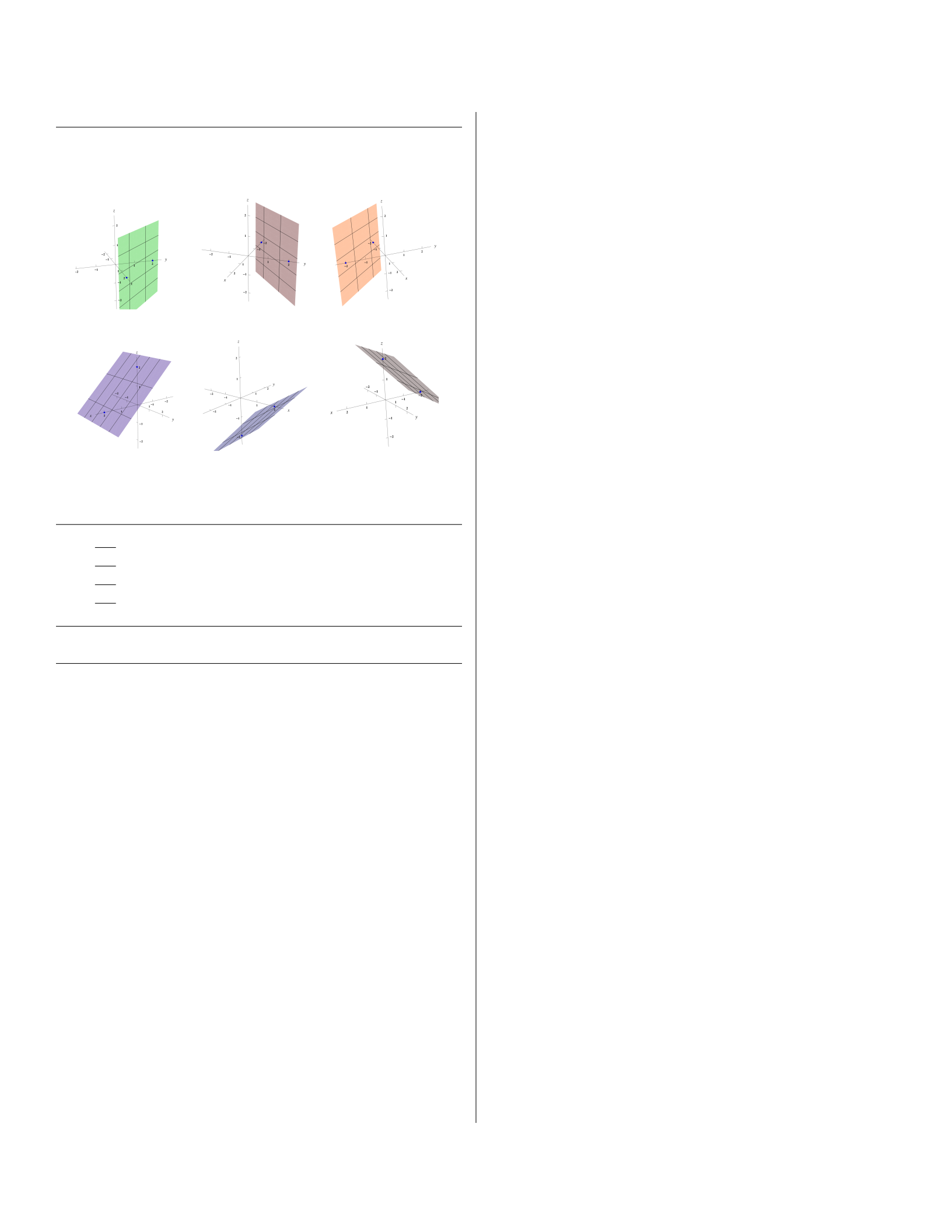
Match the equations of the plane with one of the graphs below.
A B C
D E F
1. x+y=2
2. z−x=2
3. x−z=2
4. y−x=2
Note: You can click on the graphs to enlarge the images.
Solution:
SOLUTION
1. The plane x+y=2 is a vertical plane that intersects the xy-
plane in the line y=2−x. Thus the equation matches the graph
A.
2. The plane z−x=2 is a plane parallel to the y-axis, that inter-
sects the x-axis at the point (−2,0,0)and the z-axis at the point
(0,0,2). Thus the equation matches the graph F.
3. The plane x−z=2 is a plane parallel to the y-axis, that in-
tersects the x-axis at the point (2,0,0)and the z-axis at the point
(0,0,−2). Thus the equation matches the graph E.
4. The plane y−x=2 is a vertical plane that intersects the xy-
plane in the line y=2+x. Thus the equation matches the graph
B.
Answer(s) submitted:
•a
•f
•e
•b
(correct)
Correct Answers:
•A
•F
•E
•B
6
Problem 14. (1 point)
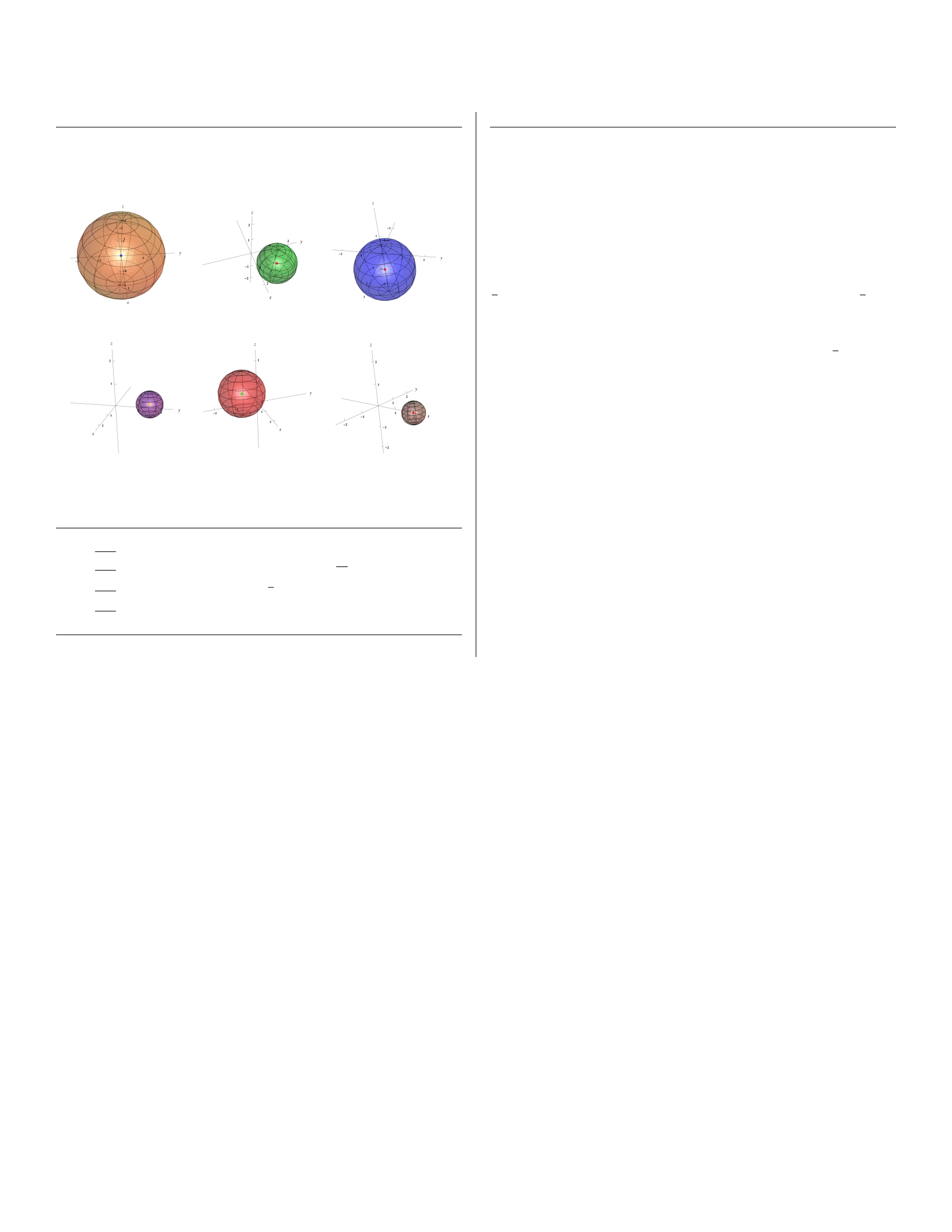
Match the equations of the spheres with one of the graphs below.
A B C
D E F
1. x2+y2+z2=4
2. x2−4x+y2−4y+z2−2z=−35
4
3. x2+y2+ (z+1)2=9
4
4. (x−1)2+ (y−1)2+z2=1
Note: You can click on the graphs to enlarge the images.
Solution:
SOLUTION
1. The sphere is centered at the origin and it has radius 2. Thus it
matches A.
2. Completing the squares, yields (x−2)2+ (y−2)2+ (z−1)2=
1
4. Thus the sphere is centered at (2,2,1)and has radius 1
2. Its
graph matches D.
3. The sphere is centered at (0,0,−1)and has radius 3
2. Thus it
matches C.
4. The sphere is centered at (1,1,0)and has radius 1. Thus it
matches B.
Answer(s) submitted:
•a
•d
•c
•b
(correct)
Correct Answers:
•A
•D
•C
•B
Generated by ©WeBWorK, http://webwork.maa.org, Mathematical Association of America
7

