



Kristopher Rider Jackiewicz MAT 267 Spring 2021
Assignment Section 13.3 due 04/18/2020 at 10:00pm MST
1. (1 point) For each of the following vector fields F, decide
whether it is conservative or not by computing the appropriate
first order partial derivatives. Type in a potential function f(that
is, ∇f=F) with f(0,0) = 0. If it is not conservative, type N.
A. F(x,y) = (2x−y)i+ (−x+6y)j
f(x,y) =
B. F(x,y) = yi+2xj
f(x,y) =
C. F(x,y) = (siny)i+ (−2y+xcosy)j
f(x,y) =
Note: Your answers should be either expressions of x and y
(e.g. “3xy + 2y”), or the letter “N”
Solution:
SOLUTION
A.
∂
∂x(−x+6y) = −1=∂
∂y(2x−y)and the domain of Fis R2
which is open and simply-connected, so Fis conservative.
Thus, there exists a function fsuch that ∇f=F, that is ,
fx(x,y) = 2x−yand fy(x,y) = −x+6y. But fx(x,y) = 2x−y
implies f(x,y) = 1x2−1xy +g(y)and differentiating both sides
of this equation with respect to ygives fy(x,y) = −1x+g0(y).
Thus −x+6y=−1x+g0(y)so g0(y) = 6yand g(y) = 3y2+K
where Kis a constant. Hence f(x,y) = 1x2−1xy +3y2+K.
Since f(0,0) = 0, it must be f(x,y) = 1x2−1xy +3y2.
B.
∂
∂x(2x) = 2,∂
∂y(y) = 1. Since these are not equal, Fis not con-
servative.
C.
∂
∂x(−2y+xcosy) = 1cosy=∂
∂y(siny)and the domain of F
is R2which is open and simply-connected, so Fis conserva-
tive. Thus, there exists a function fsuch that ∇f=F, that is ,
fx(x,y) = sinyand fy(x,y) = −2y+xcosy. But fx(x,y) = sin y
implies f(x,y) = 1xsiny+g(y)and differentiating both sides of
this equation with respect to ygives fy(x,y) = 1xcosy+g0(y).
Thus −2y+xcosy=1xcosy+g0(y)so g0(y) = −2yand g(y) =
−1y2+Kwhere Kis a constant. Hence f(x,y) = 1xsin y−1y2+
K.
Since f(0,0) = 0, it must be f(x,y) = 1xsin y−1y2.
Correct Answers:
•1*x**2 + -1*x*y + 3*y**2
•N
•1*x*sin(y) + -1*y**2
2. (1 point) Consider the vector field F(x,y,z) = (4z+4y)i+
(5z+4x)j+ (5y+4x)k.
a) Find a function fsuch that F=∇fand f(0,0,0) = 0.
f(x,y,z) =
b) Suppose Cis any curve from (0,0,0)to (1,1,1).Use part
a) to compute the line integral RCF·dr.
Solution:
SOLUTION
(a)
fx(x,y,z) = 4z+4yimplies f(x,y,z) = 4zx +4yx +g(y,z)and
fy(x,y,z) = 4x+gy(y,z).
But fy(x,y,z) = 5z+4x, so g(y,z) = 5zy +h(x)and f(x,y,z) =
4zx +4yx +5zy +h(x).
Thus fz(x,y,z) = 5y+4x+h0(z), but fz(x,y,z) = 5y+4xso
h(z) = K, a constant.
Hence a potential function for Fis 4zx +4yx +5zy +K. Since
f(0,0,0) = 0 , we have K=0 and f(x,y,z) = 4zx +4yx +5zy
(b)
∇fis is continuous, and hence fis differentiable, so, by the
Fundamental Theorem of Line Integrals, we have RC∇f·dr=
f(1,1,1)−f(0,0,0) = 13
Correct Answers:
•4*z*x +4*y*x +5*z*y
•13
3. (1 point) Consider the vector field F(x,y,z) = xi+yj+zk.
a) Find a function fsuch that F=∇fand f(0,0,0) = 0.
f(x,y,z) =
b) Use part a) to compute the work done by Fon a parti-
cle moving along the curve Cgiven by r(t) = (1+2 sint)i+
1+2sin2tj+1+4sin3tk,0≤t≤π
2.
Work =
Solution:
SOLUTION
(a)
fx(x,y,z) = ximplies f(x,y,z) = x2
2+g(y,z)and fy(x,y,z) =
gy(y,z).
But fy(x,y,z) = y, so g(y,z) = y2
2+h(z)and f(x,y,z) =
x2
2+y2
2+h(z).
Thus fz(x,y,z) = h0(z), but fz(x,y,z) = zso h(z) = z2
2+K.
Hence a potential function for Fis x2
2+y2
2+z2
2+K.
Since f(0,0,0) = 0 , we have K=0 and f(x,y,z) = x2
2+y2
2+
z2
2
1

(b)
The initial point of Cis r(0)=(1,1,1)and the terminal point is
rπ
2= (3,3,5).
∇fis is continuous, and hence fis differentiable, so, by the
Fundamental Theorem of Line Integrals, we have
Work =ZC
∇f·dr
=f(3,3,5)−f(1,1,1)
=32
2+32
2+52
2−1
2+1
2+1
2
=20
Correct Answers:
•x**2/2 +y**2/2 +z**2/2
•20
4. (1 point) Consider the vector field F=hx2+y2,4xyi.
Compute the line integrals Rc1F·drand Rc2F·dr, where
c1(t) = ht,t2iand c2(t) = ht,tifor 0 ≤t≤1.
Can you decide from your answers whether or not Fis a gradi-
ent vector field? Why or why not?
Rc1F·dr=
Rc2F·dr=
Is Fconservative? (yes/no)
Solution: c1(t) = ht,t2i ⇒ F(c1(t)) = ht2+t4,4t3iand
c0
1(t) = h1,2ti. Thus
ZC1
F·dr=Z1
0
ht2+t4,4t3i·h1,2tidt
=Z1
0
(t2+t4+8t4)dt
=Z1
0
(t2+9t4)dt
=t3
3+9t5
51
0
=1
3+9
5
=32
15
c2(t) = ht,ti ⇒ F(c2(t)) = ht2+t2,4t2iand c0
2(t) = h1,1i.
Thus
RC2F·dr=Z1
0
ht2+t2,4t2i·h1,1idt
=Z1
0
(t2+t2+4t2)dt
=Z1
0
6t2dt
=6t3
31
0
=6
3
The two paths have the same initial point, (0,0), and termi-
nal point, (1,1).Since the line integrals are not equal, the line
integral is not independent of path and therefore Fis not conser-
vative.
Correct Answers:
•2.13333333333333
•2
•no
5. (1 point) Let F=h8xy,8y2ibe a vector field in the plane,
and Cthe path y=6x2joining (0,0)to (1,6)in the plane.
A. Evaluate RCF·dr
B. Does the integral in part (A) depend on the path joining
(0,0)to (1,6)? (y/n)
Solution:
SOLUTION
A. The curve Ccan be parametrized by r(t) = ht,6t2i,0≤t≤1.
We have F(r(t)) = h48t3,288t4iand r0(t) = h1,12ti,0≤t≤1.
Thus
ZC
F·dr=Z1
0
h48t3,288t4i·h1,12tidt
=Z1
0
(48t3+3456t5)dt
=48
4+3456
6
=588
B. Since ∂
∂x(8y2) = 06=8x=∂
∂y(8xy), the vector field is not
independent of path, thus the integral in part A. does depend on
the path.
Correct Answers:
•588
•y
6. (1 point) Suppose F=F(x,y,z)is a gradient field with
F=∇f,Sis a level surface of f, and Cis a curve on S. What is
the value of the line integral RCF·dr?
Solution:
SOLUTION
Since the gradient vector ∇fat any point on the level surface
Sis perpendicular to the tangent vector r0to any curve Cthat
passes through the point, it follows that F·dr=∇f·dr=0.
Thus the value of the line integral is zero.
Correct Answers:
•0
7. (1 point) Determine whether the given set is open, con-
nected, and simply connected. For example, if it is open, con-
nected, but not simply connected, type ”YYN” standing for
”Yes, Yes, No.”
A. {(x,y)|x>1,y<2}
B. (x,y)|2x2+y2<1
C. (x,y)|x2−y2<1
2

D. (x,y)|x2−y2>1
E. (x,y)|1<x2+y2<4
Solution:
SOLUTION
A.
(i) Since the inequalities are strict, the region does not include
any of its boundary points, so it is open.
(ii) The region consists of just one ”piece” and therefore it is
connected. More formally, any two points chosen in the region
can always be joined by a path that lies entirely in the region.
(iii) The region is connected and it has no holes, so it is simply
connected (Every simple closed curve in the region encloses
only points that are in the region.)
B. The region consists of the points inside the ellipse of equa-
tion 2x2+y2=1.
(i) Since the inequality is strict, the region does not include any
of its boundary points, so it is open.
(ii) The region consists of just one ”piece” and therefore it is
connected. More formally, any two points chosen in the region
can always be joined by a path that lies entirely in the region.
(iii) The region is connected and it has no holes, so it is simply
connected (Every simple closed curve in the region encloses
only points that are in the region.)
C. The region consists of the points between, but not on , the
branches of the hyperbola of equation x2−y2<1.
(i) Since the inequality is strict, the region does not include any
of its boundary points, so it is open.
(ii) The region consists of just one ”piece” and therefore it is
connected. More formally, any two points chosen in the region
can always be joined by a path that lies entirely in the region.
(iii) The region is connected and it has no holes, so it is simply
connected (Every simple closed curve in the region encloses
only points that are in the region.)
D. The region consists of the points outside, but not on , the
branches of the hyperbola of equation x2−y2=1.
(i) Since the inequality is strict, the region does not include any
of its boundary points, so it is open.
(ii) The region consists of two separate pieces and therefore it is
not connected. (For instance, the points (−2,0)and (2,0)lie in
the region, but they cannot be joined by a path that lies entirely
in the region).
(iii) Because the region is not connected, it is not simply con-
nected.
E. The region is an annular region between circles centered
at the origin of radii 1 and 2.
(i) The region does not include any of its boundary points and
therefore it is open.
(ii) The region consists of one piece, so it is connected.
(iii) The region is not simply connected, as it has a hole (the cir-
cle of radius 1 centered at the origin). Thus any simple closed
curve that encloses this circle lies in the region but includes
points that are not in the region.
Correct Answers:
•YYY
•YYY
•YYY
•YNN
•YYN
8. (1 point)
The domain of f(x,y)is the xy-plane, and values of fare
given in the table below.
y\x01234
0 50 50 52 53 52
1 46 43 41 40 41
2 45 46 45 44 45
3 43 42 42 43 43
4 42 41 40 40 40
Find RCgrad f·d~r, where Cis
(a) A line from (3,0)to (4,2).
RCgrad f·d~r=
(b) A circle of radius 1 centered at (3,3)traversed counter-
clockwise.
RCgrad f·d~r=
Solution:
SOLUTION
(a) By the Fundamental Theorem of Line Integrals
Z(4,2)
(3,0)
grad f·d~r=f(4,2)−f(3,0) = 45 −53 =−8.
(b) By the Fundamental Theorem of Line Integrals, since C
is a closed path, RCgrad f·d~r=0.
Correct Answers:
•45-53
•0
9. (1 point)
3

The figure shows level curves of a function f(x,y).
(a) Draw gradient vectors at Qand T. Is ∇f(Q)longer
than, shorter than, or the same length as ∇f(T)?
• ?
• longer than
• shorter than
• the same length as
(b) If Cis the line segment from Pto Q, then
ZC
∇f·d~r=
(c) If Cis any piecewise-smooth path from Pto Tto
Q, then
ZC
∇f·d~r=
(d) If Cis any piecewise-smooth path from Sto P, then
ZC
∇f·d~r=
(e) If Cis any piecewise-smooth closed path from P
to Qto Tto Sto P, then
ZC
∇f·d~r=
(Click on graph to enlarge)
Solution:
SOLUTION
(a) ∇f(Q)is shorter than ∇f(T)since, in the direction of in-
crease of the function, the level curves are closer at Tthan they
are at Q.
(b) ZC
∇f·dr=f(Q)−f(P) = 26 −35 =−9
(c) ZC
∇f·dr=f(Q)−f(P) = 26 −35 =−9
(d) ZC
∇f·dr=f(P)−f(S) = 35 −26 =9
(e) ZC
∇f·dr=0 since the initial and terminal point are the
same and therefore the path is closed.
Correct Answers:
•shorter than
•-9
•-9
•9
•0
10. (1 point)
Consider the vector field ~
Fin the figure and the
closed circular path Coriented counter-clockwise.
(a) Is ZC
~
F·d~rpositive, negative, or zero?
[?/Positive/Negative/Zero]
(b) True or False: ~
F=grad ffor some function f. Hint:
use your answer to part (a).[?/True/False]
(c) Which of the following formulas best fits ~
F?
•A. ~
F=−x
~
i−y~
j
•B. ~
F=−x
(x2+y2)2~
i−y
(x2+y2)2~
j
•C. ~
F=−y
~
i+x~
j
•D. ~
F=−y
(x2+y2)2~
i+x
(x2+y2)2~
j
(Click on graph to enlarge)
Solution:
SOLUTION
(a) The longest vectors in the vector field point generally in
the same direction as the curve. Thus, the line integral is posi-
tive.
4
(b) Since the line integral along a closed path is not zero, the
vector field is not conservative. Thus, the statement is False.
(c) The vector field is a circulating vector field that rotates in the
counterclockwise direction around the origin. The magnitude of
the vectors increases as we move away from the origin. Thus,
the vector field matches C.
Correct Answers:
•Positive
•False
•C
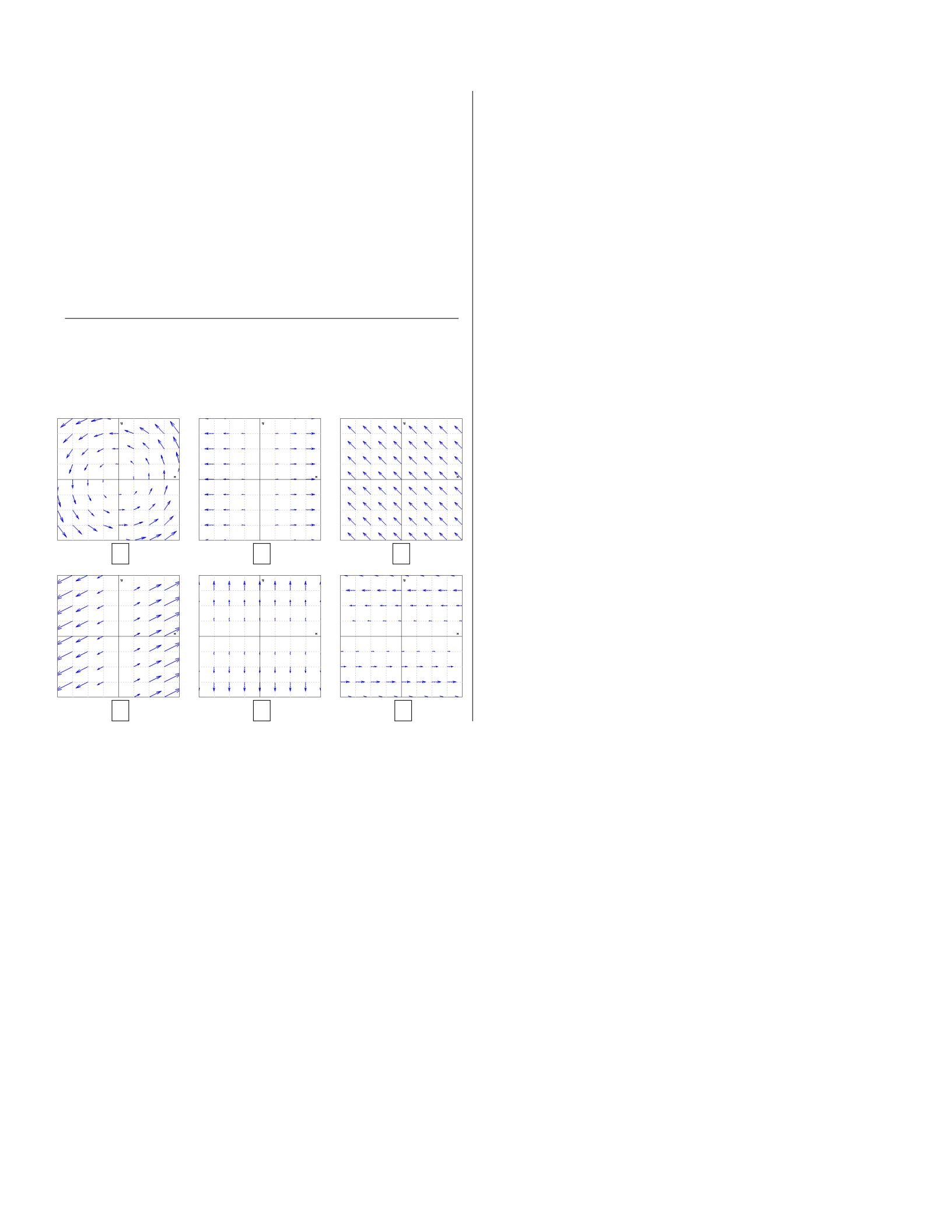
11. (1 point) Determine whether each of the following vec-
tor fields appears to be path independent (conservative) or path
dependent (not conservative).
? ? ?
? ? ?
(Click on a graph to enlarge it)
Solution:
SOLUTION
Draw any closed curve. If the line integral along the closed
curve appears to be zero , then the vector field appears to be
independent of path. Thus
1. path dependent
2. path independent
3. path independent
4. path dependent
5. path independent
6. path dependent
Correct Answers:
•path dependent
•path independent
•path independent
•path dependent
•path independent
•path dependent
Generated by ©WeBWorK, http://webwork.maa.org, Mathematical Association of America
5

