



Surgent MAT 267 ONLINE A Spring 2019
Assignment Section 13.2 due 02/25/2019 MST
1. (1 point) Evaluate the line integral ZC
x2z ds, where Cis
the line segment from (0,5,2)to (3,3,1).
Solution:
SOLUTION
The vector from the first point to the second point is given
by h3,−2,−1i. Thus, parametric equations for Care
x(t) = 3t,y(t) = 5−2t,z(t) = 2−t,0≤t≤1.
Then
ds =p(x0(t))2+ (y0(t))2+ (z0(t))2dt
=p(3)2+ (−2)2+ (−1)2dt
=√14dt
and
ZC
x2zds =Z1
0
(3t)2(2−t)√14 dt
=32√14Z1
0
(2t2−t3)dt
=32√142t3
3−t4
41
0
=32√142
3−1
4
=15
4√14
Answer(s) submitted:
•14.031215200402
(correct)
Correct Answers:
•14.0312152004023
2. (1 point) Evaluate the line integral ZC
2xy6ds, where C is
the right half of the circle x2+y2=16.
Solution:
SOLUTION
Parametric equations for Care x=4 sint,y=4cost,0≤t≤π.
Then
ZC
2xy6ds =Zπ
0
2(4sint)(4 cost)6sdx
dt 2
+dy
dt 2
dt
=Zπ
0
2(4sint)(4 cost)6p16 cos2t+16 sin2t dt
=Zπ
0
2(4sint)(4 cost)6√16 dt
=48(2)Zπ
0
sint(cos6t)dt
Using the substitution u=cost,du =−sint dt yields
ZC
2xy6ds =48(2)−Z−1
1
u6du
=48(2)u7
71
−1
=48(2)2
7
Answer(s) submitted:
•262144/7
(correct)
Correct Answers:
•37449.1428571429
3. (1 point) Compute the total mass of a wire bent in a quar-
ter circle with parametric equations: x=7cost,y=7 sint,0≤
t≤π
2and density function ρ(x,y) = x2+y2.
Solution:
SOLUTION:
m=ZC
ρ(x,y)ds
=Zπ
2
0(7cost)2+ (7 sint)2sdx
dt 2
+dy
dt 2
dt
=Zπ
2
049cos2t+49sin2tq(−7sint)2+ (7 cost)2dt
=Zπ
2
049(cos2t+sin2t)q49(sin2t+cos2t)dt
=Zπ
2
0
49√49 dt
=73π
2
Answer(s) submitted:
•7ˆ(3)(pi/2)
(correct)
Correct Answers:
•538.78314009065
4. (1 point) Let Cbe the curve which is the union of two line
segments, the first going from (0,0)to (−1,−3)and the second
going from (−1,−3)to (−2,0).
Compute the line integral ZC−1dy +3dx.
Solution:
SOLUTION
Let C1be the line segment from (0,0)to (−1,−3)and C2
the line segment from (−1,−3)to (−2,0).
On C1:x=−1t,y=−3t⇒dx =−1,dy =−3,0≤t≤1.
On C2:x=−1−1t,y=−3+3t⇒dx =−1,dy =3,0≤t≤1.
1

Then
RC−1dy +3dx =RC1(−1dy +3dx) + RC2(−1dy +3dx)
=R1
0[−1(−3) + 3(−1)] dt +R1
0[−1(3) + 3(−1)] dt
=0+R1
0(−6)dt =−6
Answer(s) submitted:
•-6
(correct)
Correct Answers:
•-6
5. (1 point) Let Fbe the radial force field F=xi+yj. Find
the work done by this force along the following two curves, both
of which go from (0,0)to (3,9).(Compare your answers!)
A. If C1is the parabola: x=t,y=t2,0≤t≤3, then
ZC1
F·dr=
B. If C2is the straight line segment: x=3t2,y=9t2,0≤
t≤1, then
ZC2
F·dr=
Solution:
SOLUTION
On C1:r(t) = ti+t2j,so F(r(t)) = ti+t2jand r0(t) = i+2tj.
Then
ZC1
F·dr=Z3
0
F(r(t)) ·r0(t)dt
=Z3
0
(ti+t2j)·(i+2tj)dt
=Z3
0
(t+2t3)dt
=t2
2+t4
23
0
=32
2+34
2
=45
On C2:r(t) = 3t2i+9t2j,so F(r(t)) = 3t2i+9t2jand
r0(t) = 6ti+18tj.Then
ZC2
F·dr=Z1
0
F(r(t)) ·r0(t)dt
=Z1
03t2i+9t2j·(6ti+18tj)dt
=Z1
018t3+162t3dt
=180t4
41
0
=45
The line integrals have the same value. The vector field appears
to be independent of path.
Answer(s) submitted:
•45
•45
(correct)
Correct Answers:
•45
•45
6. (1 point) Evaluate the line integral RCF·dr, where
F(x,y,z) = −3xi+5yj+zkand Cis given by the vector func-
tion r(t) = hsint,cost,ti,0≤t≤3π/2.
Solution:
SOLUTION
r(t) = sin(t)i+cos(t)j+tk,so F(r(t)) = −3 sin(t)i+
5cos(t)j+tkand r0(t) = cos(t)i−sin(t)j+k.Then
ZC
F·dr=Z3π/2
0
F(r(t)) ·r0(t)dt
=Z3π/2
0
(−3sin(t)i+5 cos(t)j+tk)·(cos(t)i−sin(t)j+k)dt
=Z3π/2
0
(−3sin(t)cos(t)−5cos(t)sin(t) + t)dt
=−8Z3π/2
0
sin(t)cos(t)dt +1Z3π/2
0
t dt
=−8sin2t
23π/2
0
+1t2
23π/2
0
=−4+9
8π2
Answer(s) submitted:
•(9(pi)ˆ(2))/(8)-4
(correct)
Correct Answers:
•7.1033
7. (1 point) Evaluate the line integral RCF·dr, where
F(x,y,z) = −2sin(x)i−(cos(y)) j+3xz kand C is given by the
vector function r(t) = t4i−t3j+t2k, 0 ≤t≤1.
Solution:
SOLUTION
r(t) = t4i−t3j+t2k,so F(r(t)) = −2sint4i−cost3j+
3t6kand r0(t) = 4t3i−3t2j+2tk.Then
ZC
F·dr=Z1
0
F(r(t)·r0(t)dt
=Z1
0−2(4)t3sin(t4) + 1(3)t2cos(t3) + 3(2)t7dt
=−8Z1
0
t3sin(t4)dt +3Z1
0
t2cos(t3)dt +6Z1
0
t7dt
Using the substitution u=t4,du =4t3dt in the first integral and
w=t3,dw =3t2dt in the second, yields
ZC
F·dr=−2Z1
0
sin(u)du +1Z1
0
cos(u)dt +6Z1
0
t7dt
=−2[−cosu]1
0+1[sin(u)]1
0+6t8
81
0
=−2(1−cos1) + 1sin(1) + 3
4
Answer(s) submitted:
•0.67207559654417
(correct)
Correct Answers:
•0.672076
2
8. (1 point) Find the work done by the force field
F(x,y,z) = 7xi+7yj+2kon a particle that moves along the
helix r(t) = 6 cos(t)i+6sin(t)j+3tk,0≤t≤2π.
Work =
Solution:
SOLUTION
r(t) = 6 cos(t)i+6sin(t)j+3tk,so F(r(t)) = 42cos(t)i+
42sin(t)j+2kand r0(t) = −6sin(t)i+6cos(t)j+3k.Then
Work =ZC
F·dr
=Z2π
0
F(r(t)) ·r0(t)dt
=Z2π
0
(−252sintcost+252 sintcost+6)dt
=6Z2π
0
dt
=12π
Answer(s) submitted:
•12pi
(correct)
Correct Answers:
•37.6991
9. (1 point) Let Cbe the counter-clockwise planar circle with
center at the origin and radius r>0.Without computing them,
determine for the following vector fields Fwhether the line in-
tegrals ZC
F·drare positive, negative, or zero and type P, N, or
Z as appropriate.
A. F= the radial vector field = xi+yj:
B. F= the circulating vector field = −yi+xj:
C. F= the circulating vector field = yi−xj:
D. F= the constant vector field = i+j:
Solution:
SOLUTION:
A. Vectors starting on Care perpendicular to the tangents to
C, thus the tangential component F·Tis zero and RCF·dr=
RCF·Tds =0
B. Vectors starting on Cpoint in the same direction as C,
thus the tangential component F·Tis positive and RCF·dr=
RCF·Tds is positive.
C. Vectors starting on Cpoint in the opposite direction as C,
thus the tangential component F·Tis negative and RCF·dr=
RCF·Tds is negative.
D. The tangential components in the first and third quadrant
counteract each other and so do the components in the second
and fourth quadrant. Thus RCF·dr=0
Answer(s) submitted:
•Z
•P
•N
•Z
(correct)
Correct Answers:
•Z
•P
•N
•Z
10. (1 point) A curve Cis given by a vector function
r(t),3≤t≤4, with unit tangent T(t), unit normal N(t), and unit
binormal B(t). Indicate whether the following line integrals are
positive, negative, or zero by typing P, N, or Z as appropriate:
A. ZC
T·dr=
B. ZC
N·dr=
C. ZC
B·dr=
Solution:
SOLUTION:
A. T·T=|T|2>0, thus RCT·dr=RCT·Tds is positive.
B. N·T=0, since Tand Nare perpendicular. Thus RCN·
dr=RCN·Tds =0 .
C. B·T=0, since Band Tare perpendicular. Thus RCB·
dr=RCB·Tds =0 .
Answer(s) submitted:
•P
•Z
•Z
(correct)
Correct Answers:
•P
•Z
•Z
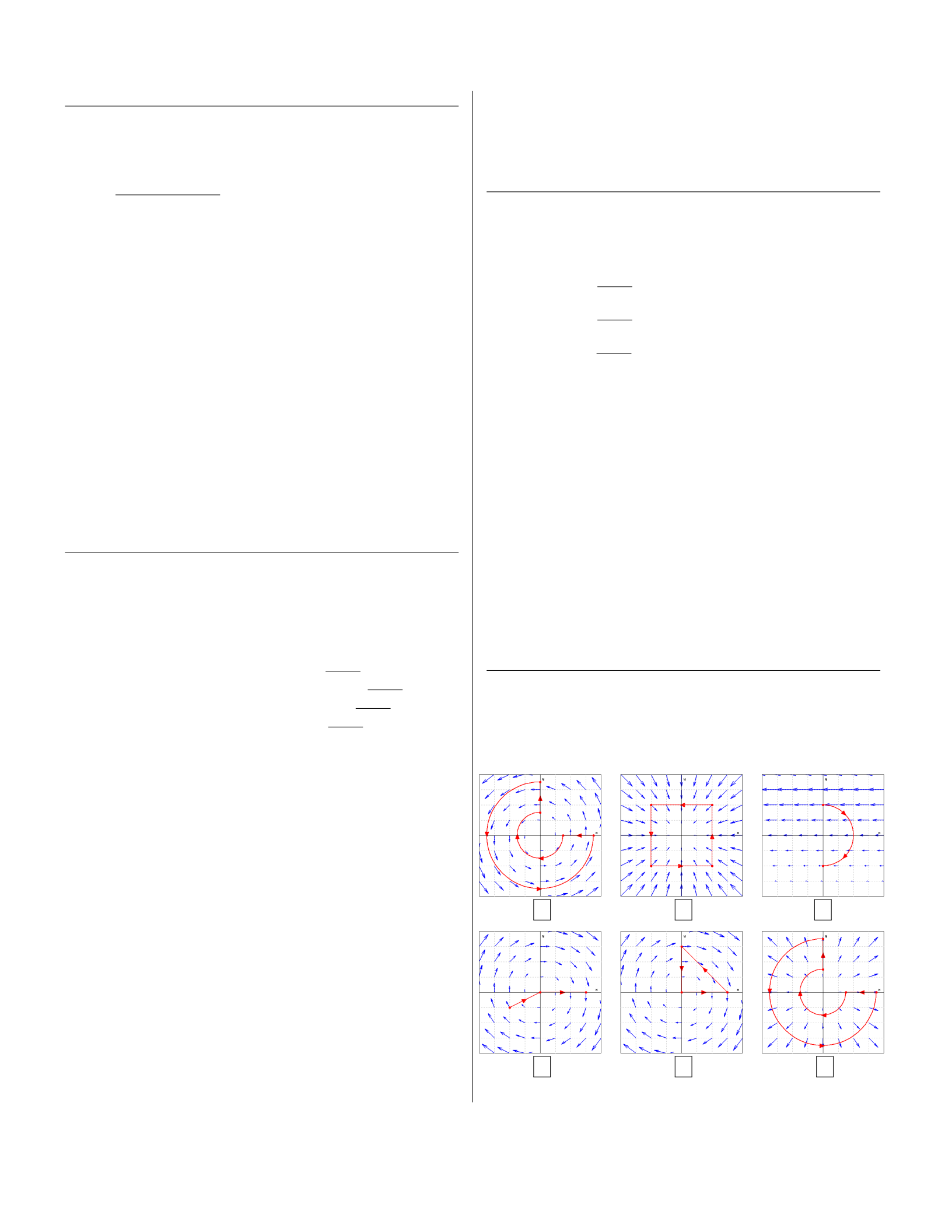
11. (1 point) Determine whether the line integral of each
vector field (in blue) along the oriented path (in red) is positive,
negative, or zero.
? ? ?
? ? ?
3
(Click on a graph to enlarge it)
Solution:
SOLUTION
1. The line integral is zero along the vertical and horizontal
segments, since the vectors are perpendicular to the segments.
The vectors along the larger circle (with larger magnitude than
the vectors along the smaller circle) generally point in same
direction of the curve. Thus the line integral is positive .
2. The line integral along the curve in the first quadrant is
counterbalanced by the line integral in the third quadrant. Sim-
ilarly for the line integrals in the second and fourth quadrant.
Thus the total line integral is zero.
3. Vectors with larger magnitude generally point in the op-
posite direction of the curve. Thus the line integral is negative .
4. The vectors are perpendicular to the line segments of the
curve. Thus the line integral is zero .
5. The line integral is zero along the vertical and horizontal
segments, since the vectors are perpendicular to the segments.
The vectors along the slanted segment generally point in oppo-
site direction of the curve. Thus the line integral is negative.
6. The vectors are perpendicular to the circles, thus the line
integral along the circles is zero. The line integrals along the or-
izontal and vertical segments counterbalance one another since
they have opposite signs. Thus the total line integral is zero .
Answer(s) submitted:
•Positive
•Zero
•Negative
•Zero
•Negative
•Zero
(correct)
Correct Answers:
•POSITIVE
•ZERO
•NEGATIVE
•ZERO
•NEGATIVE
•ZERO
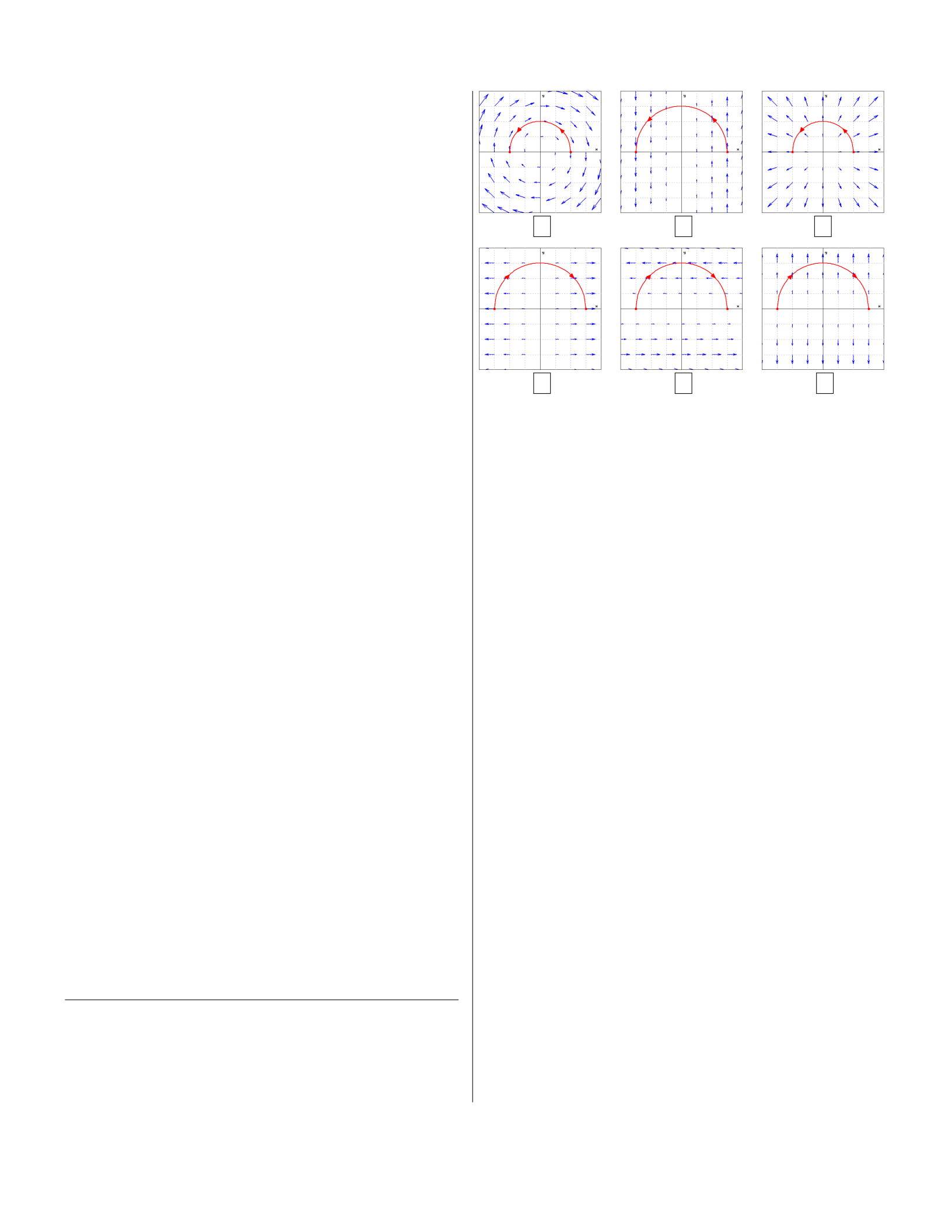
12. (1 point) Determine whether the line integral of each
vector field (in blue) along the semicircular, oriented path (in
red) is positive, negative, or zero.
? ? ?
? ? ?
(Click on a graph to enlarge it)
Solution:
SOLUTION
1. The vector field points in the opposite direction as the curve.
Thus the line integral is negative.
2. The vector field points in the same direction as the curve.
Thus the line integral is positive.
3. The vectors of the radial vector field are perpendicular to
the curve. Thus the line integral is zero.
4. The line integral in the first quadrant counterbalances the
line integral in the second quadrant. Thus the line integral along
the semicircle is zero.
5. The vectors point generally in the opposite direction as
the curve. Thus the line integral is negative.
6. The line integral in the first quadrant counterbalances the
line integral in the second quadrant. Thus the line integral along
the semicircle is zero.
Answer(s) submitted:
•Negative
•Positive
•Zero
•Zero
•Negative
•Zero
(correct)
Correct Answers:
•NEGATIVE
•POSITIVE
•ZERO
4
•ZERO
•NEGATIVE
•ZERO
13. (1 point) Suppose ~
F(x,y) = −xy
~
i+y2~
j.
(a) Find a vector parametric equation for the parabola y=x2
from the origin to the point (3,9)using tas a parameter.
~r(t) =
(b) Find the line integral of ~
Falong the parabola y=x2from
the origin to (3,9).
Solution:
SOLUTION:
(a) Usng the natural parametrization x=t,y=t2, the
parabola has vector parametric equation~r(t) = ht,t2i,0≤t≤3.
(b) F(r(t)) = −t(t2),(t2)2=h−t3,t4iand r0(t) = h1,2ti.
Then
ZC
F·dr=Z3
0
F(r(t)) ·r0(t)dt
=Z3
0
(−t3+2t5)dt
=−t4
4+t6
33
0
=−34
4+36
3
=891
4
Answer(s) submitted:
•<t,tˆ2>
•891/4
(correct)
Correct Answers:
•<t,tˆ2>
•-3ˆ4/4+3ˆ6/3
14. (1 point)
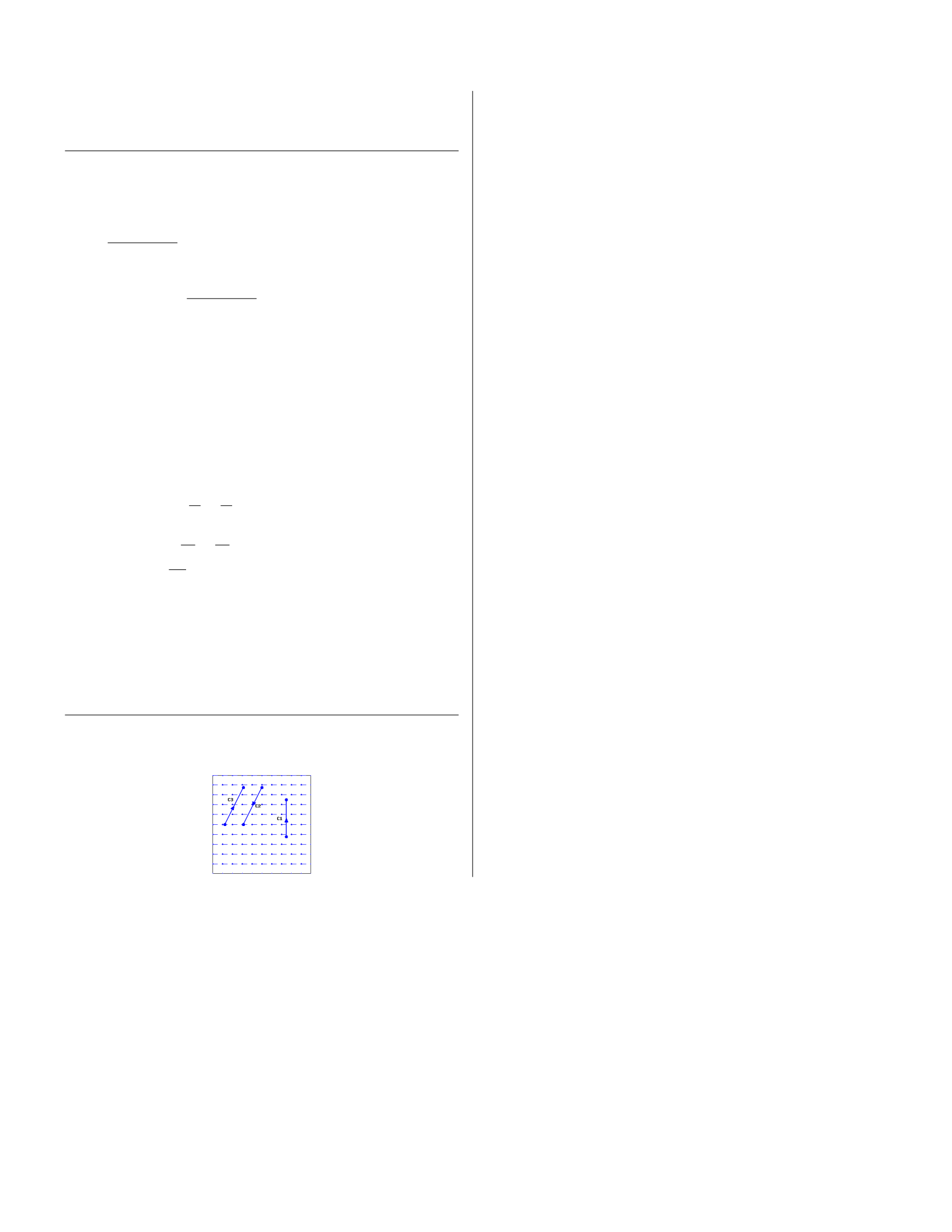
Consider the vector field ~
Fshown in the figure below to-
gether with the paths C1,C2, and C3.
(Note: For the vector field, vectors are shown with a dot at the
tail of the vector.)
Arrange the line integrals RC1~
F·d~r,RC2~
F·d~rand RC3~
F·d~r
in ascending order:
•?
•integral on C1
•integral on C2
•integral on C3
<
•?
•integral on C1
•integral on C2
•integral on C3
<
•?
•integral on C1
•integral on C2
•integral on C3
.
Solution:
SOLUTION
We can work out the relative sizes of the line integrals by
seeing which curves move in the same direction of the vec-
tors, which move in the opposite direction, and which move
perpendicular. In the first case, the integral will be positive, in
the second, negative, and in the third, zero. Thus, we see that
RC1~
F·d~r=0, because the curve moves straight up and down,
and the vector field points from right to left.
Applying this logic to each of the curves, we find that
ZC2
~
F·~r<ZC1
~
F·~r<ZC3
~
F·~r.
Answer(s) submitted:
•integral on C2
•integral on C1
•integral on C3
(correct)
Correct Answers:
•integral on C2
•integral on C1
•integral on C3
Generated by c
WeBWorK, http://webwork.maa.org, Mathematical Association of America
5

