


Surgent MAT 267 ONLINE A Spring 2019
Assignment Section 13.1 due 02/25/2019 MST
1. (1 point) Compute the gradient vector fields of the follow-
ing functions:
A. f(x,y) = 6x2+9y2
∇f(x,y) = i+j
B. f(x,y) = x9y8,
∇f(x,y) = i+j
C. f(x,y) = 6x+9y
∇f(x,y) = i+j
D. f(x,y,z) = 6x+9y+9z
∇f(x,y) = i+j+k
E. f(x,y,z) = 6x2+9y2+9z2
∇f(x,y,z) = i+j+k
Solution:
SOLUTION
A. ∇f(x,y) = fx(x,y)i+fy(x,y)j=12xi+18yj
B. ∇f(x,y) = fx(x,y)i+fy(x,y)j=9x8y8i+8x9y7j
C. ∇f(x,y) = fx(x,y)i+fy(x,y)j=6i+9j
D. ∇f(x,y,z) = fx(x,y,z)i+fy(x,y,z)j+fz(x,y,z)k=6i+
9j+9k
D. ∇f(x,y,z) = fx(x,y,z)i+fy(x,y,z)j+fz(x,y,z)k=
12xi+18yj+18zk
Answer(s) submitted:
•12x
•18y
•9xˆ8yˆ8
•xˆ9(8yˆ7)
•6
•9
•6
•9
•9
•12x
•18y
•18z
(correct)
Correct Answers:
•2*6*x
•2*9*y
•9*xˆ(8)*yˆ(8)
•8*yˆ(7)*xˆ(9)
•6
•9
•6
•9
•9
•2*6*x
•2*9*y
•2*9*z
2. (1 point)
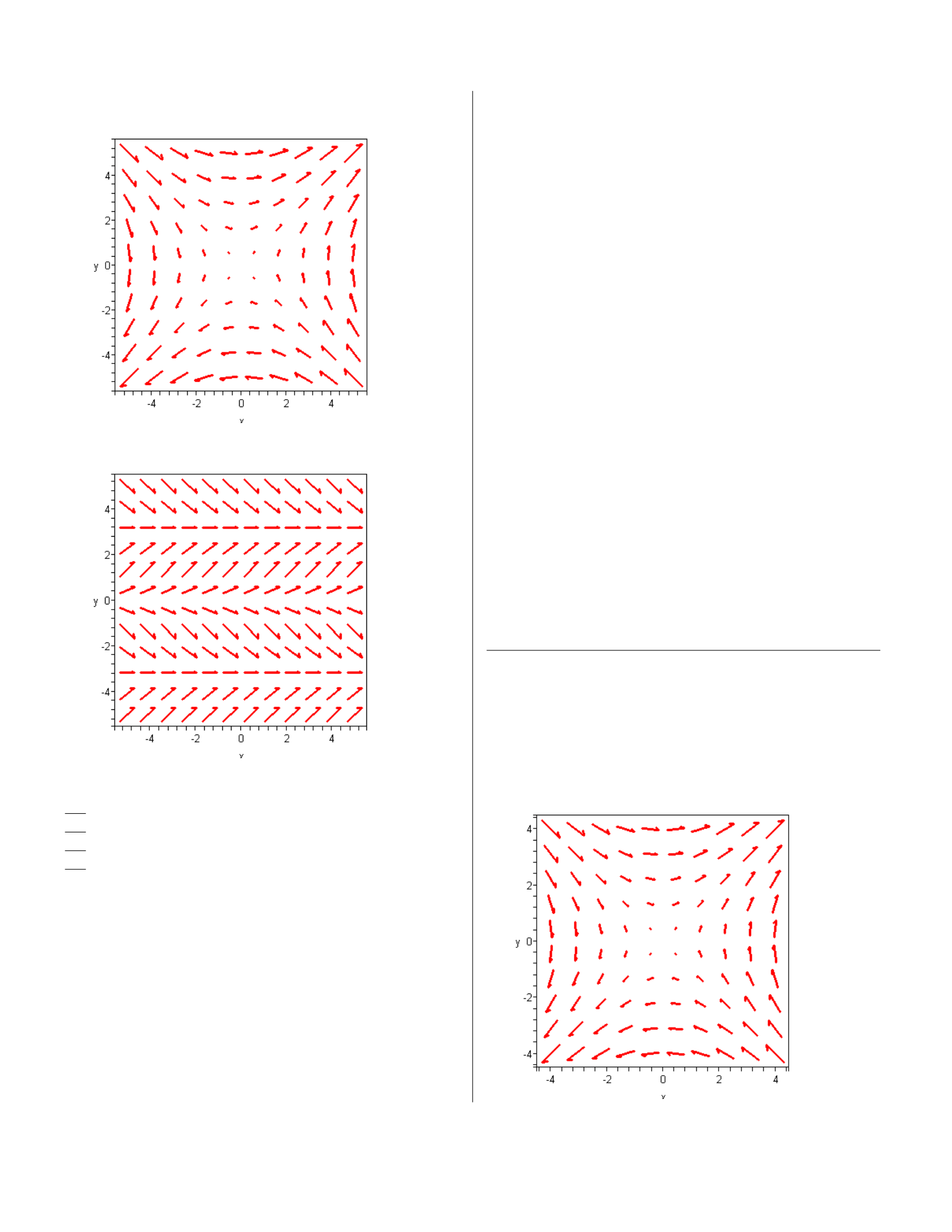
Match the plots labeled A - D with the vector fields Fbelow.
A.
B.
1
C.
D.
1. F =h1,sinyi
2. F =hy,xi
3. F =hx−2,x+1i
4. F =hy,1/xi
Solution:
SOLUTION:
1. Since the first component is always positive, all the vec-
tors point right. Also, vectors along lines with equation y=kπ,
with kany integer, are horizontal. Thus 1. corresponds to D.
2. Vectors in the first and second quadrant (y>0) point right,
while vectors in the third and fourth quadrant ( y<0) point left.
Vectors along the y-axis (x=0 ) are horizontal, while vectors
along the x-axis (y=0) are vertical . Thus 2. corresponds to C.
3. Vectors on the vertical line x=2 are vertical, while vec-
tors on the line x=−1 are horizontal. Thus 3. corresponds to
A.
4. Vectors in the first and second quadrant (y>0) point right,
while vectors in the third and fourth quadrant (y<0) point left.
As we move away from the origin, the y-component becomes
smaller and smaller, thus the vectors become more and more
horizontal . Thus 4. corresponds to B.
Answer(s) submitted:
•D
•C
•A
•B
(correct)
Correct Answers:
•D
•C
•A
•B
3. (1 point)
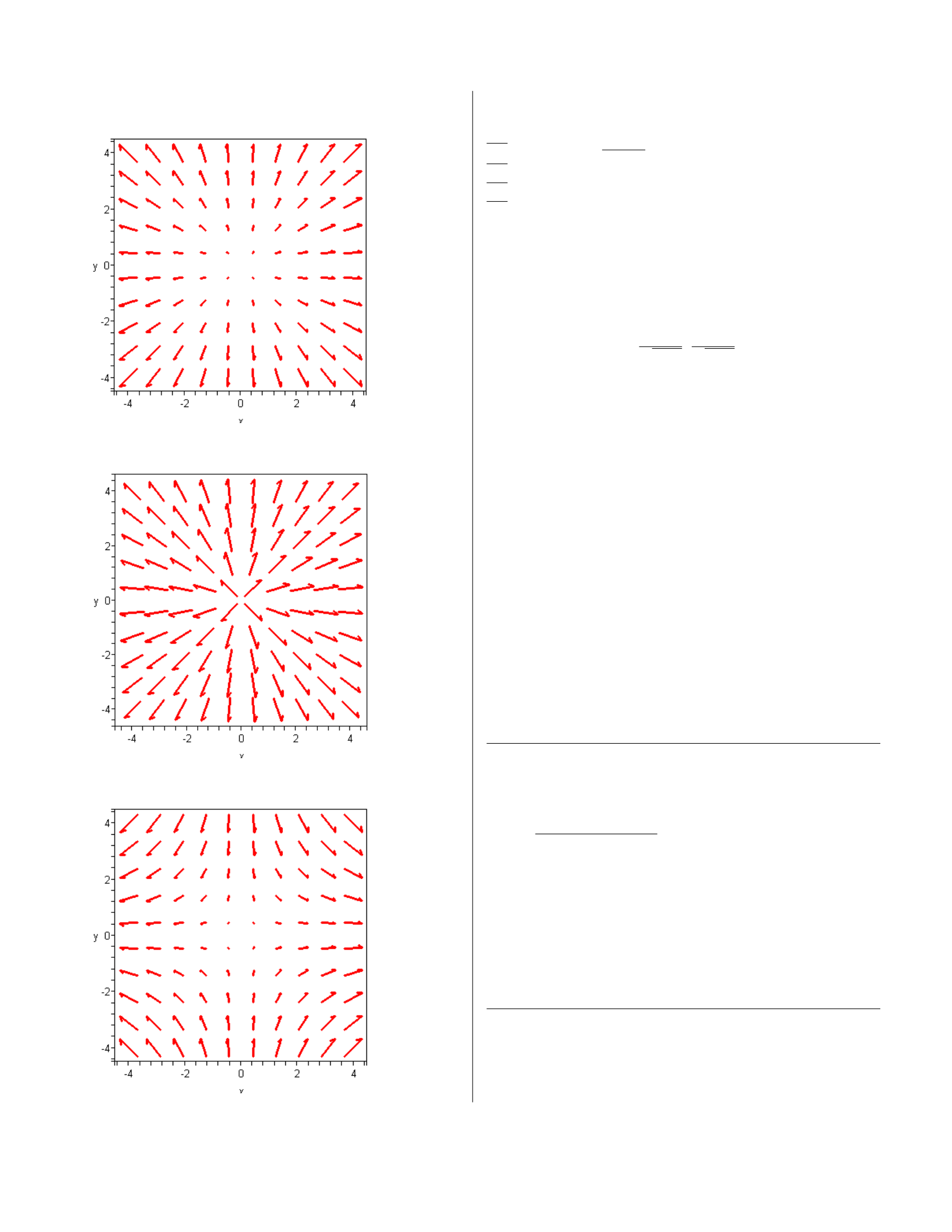
Match the functions fwith the plots of their gradient vector
fields labeled A-D.
A.
2
B.
C.
D.
1. f(x,y) = xy
2. f(x,y) = px2+y2
3. f(x,y) = x2−y2
4. f(x,y) = x2+y2
Solution:
SOLUTION:
1. The level curves are perpendicular to the gradient vectors.
The level curves for this function are hyperbolas with axis the
coordinate axis. Thus 1. corresponds to A.
2. The level curves are perpendicular to the gradient vec-
tors. The level curves for this function are circles centered at
the origin. Also ∇f=hx
√x2+y2,y
√x2+y2iand the magnitude of
the vectors is constant . Thus 2. corresponds to C.
3. The level curves are perpendicular to the gradient vectors.
The level curves for this function are hyperbolas that open along
either the x or y -axis. Thus 3. corresponds to D.
4. The level curves are perpendicular to the gradient vectors.
The level curves for this function are circles centered at the ori-
gin. Also, ∇f=h2x,2yi, and the magnitude of the vectors in-
creases as we move away from the origin. Thus 4. corresponds
to B.
Answer(s) submitted:
•A
•C
•D
•B
(correct)
Correct Answers:
•A
•C
•D
•B
4. (1 point)
Write a formula for a two-dimensional vector field which has
all vectors parallel to the y-axis and all vectors on a vertical line
having the same magnitude.
~
V=
Solution:
SOLUTION
One possible solution is ~
V(x,y) = x˜
j
Answer(s) submitted:
•xj
(correct)
Correct Answers:
•xj
5. (1 point) Each vector field shown is the gradient of a
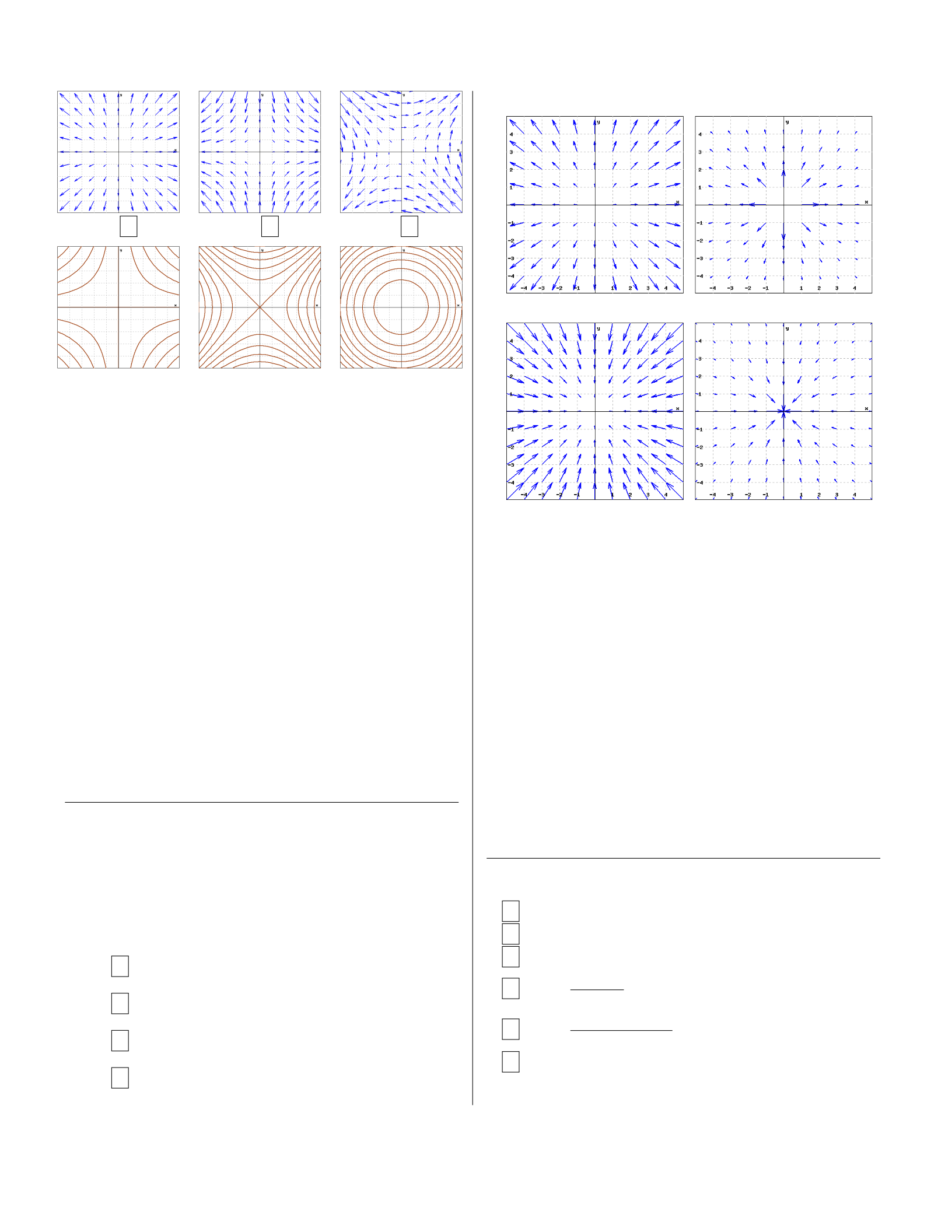
function f(x,y). Match the gradient field of each function to the
contour plot of that function.
3
1. ? 2. ? 3. ?
A B C
(Click on a graph to enlarge it.)
Solution:
SOLUTION
Gradient vectors are perpendicular to the level curves. Thus
1. matches C.
2. matches B.
3. matches A.
Answer(s) submitted:
•C
•B
•A
(correct)
Correct Answers:
•C
•B
•A
6. (1 point)
Each vector field shown shown represents the force
on a particle at different points in the plane as a result
of another particle at the origin. Match each vector field
with its description.
? 1. An attractive force whose magnitude decreases as dis-
tance increases.
? 2. An attractive force whose magnitude increases as dis-
tance increases.
? 3. A repulsive force whose magnitude decreases as dis-
tance increases.
? 4. A repulsive force whose magnitude increases as dis-
tance increases.
A B
C D
(Click on a graph to enlarge it.)
Answer(s) submitted:
•D
•C
•B
•A
(correct)
Correct Answers:
•D
•C
•B
•A
7. (1 point) Match each vector field with its graph.
? 1. ~
F=x
~
i+y~
j+z
~
k
? 2. ~
F=−y
~
i+x~
j
? 3. ~
F=~
i
? 4. ~
F=−y
~
i+x~
j
x2+y2
? 5. ~
F=x
~
i+y~
j+z
~
k
(x2+y2+z2)3/2
? 6. ~
F=x
~
i+y~
j
.
4
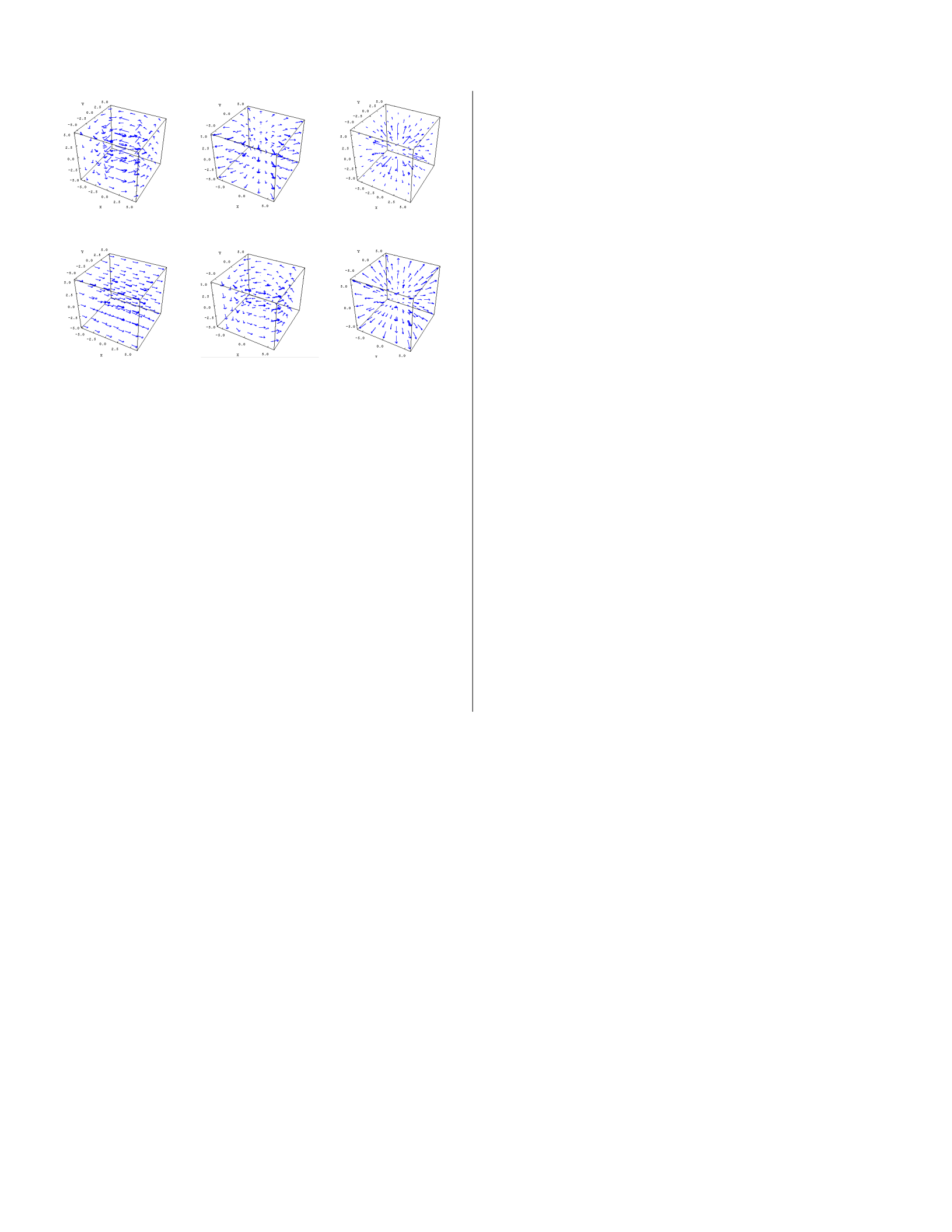
A B C
D E F
(You can drag the images to rotate them.)
Solution:
SOLUTION
1. This is a radial vector field where the magnitude of the
vectors increases as we move away from the origin. Thus the
vector field matches F.
2. The vector field is independent of z. Thus the vectors will be
the same for fixed xand yvalues as we move up and down. On
each plane of the form z=k, the vectors circulate around the
z-axis in a counterclockwise direction as seen from the positive
zaxis. The vectors increase in magnitude as we move away
from the origin. Thus the vector field matches E.
3. The vector field is constant and consists of vectors point-
ing in the direction of the positive x-axis. Thus the vector field
matches D.
4. The vector field is independent of z. Thus the vectors
will be the same for fixed xand yvalues as we move up and
down. On each plane of the form z=k, the vectors circulate
around the z-axis in a counterclockwise direction as seen from
the positive zaxis. Also, the vectors decrease in magnitude as
we move away from the origin. Thus the vector field matches A.
5. This is a radial vector field where the magnitude of the
vectors decreases as we move away from the origin. Thus the
vector field matches C.
6. The vector field is independent of z. Thus the vectors will be
the same for fixed xand yvalues as we move up and down. On
each plane of the form z=k, the vectors move away from the
origin. Thus the vector field matches B.
Answer(s) submitted:
•F
•E
•D
•A
•C
•B
(correct)
Correct Answers:
•F
•E
•D
•A
•C
•B
Generated by c
WeBWorK, http://webwork.maa.org, Mathematical Association of America
5

