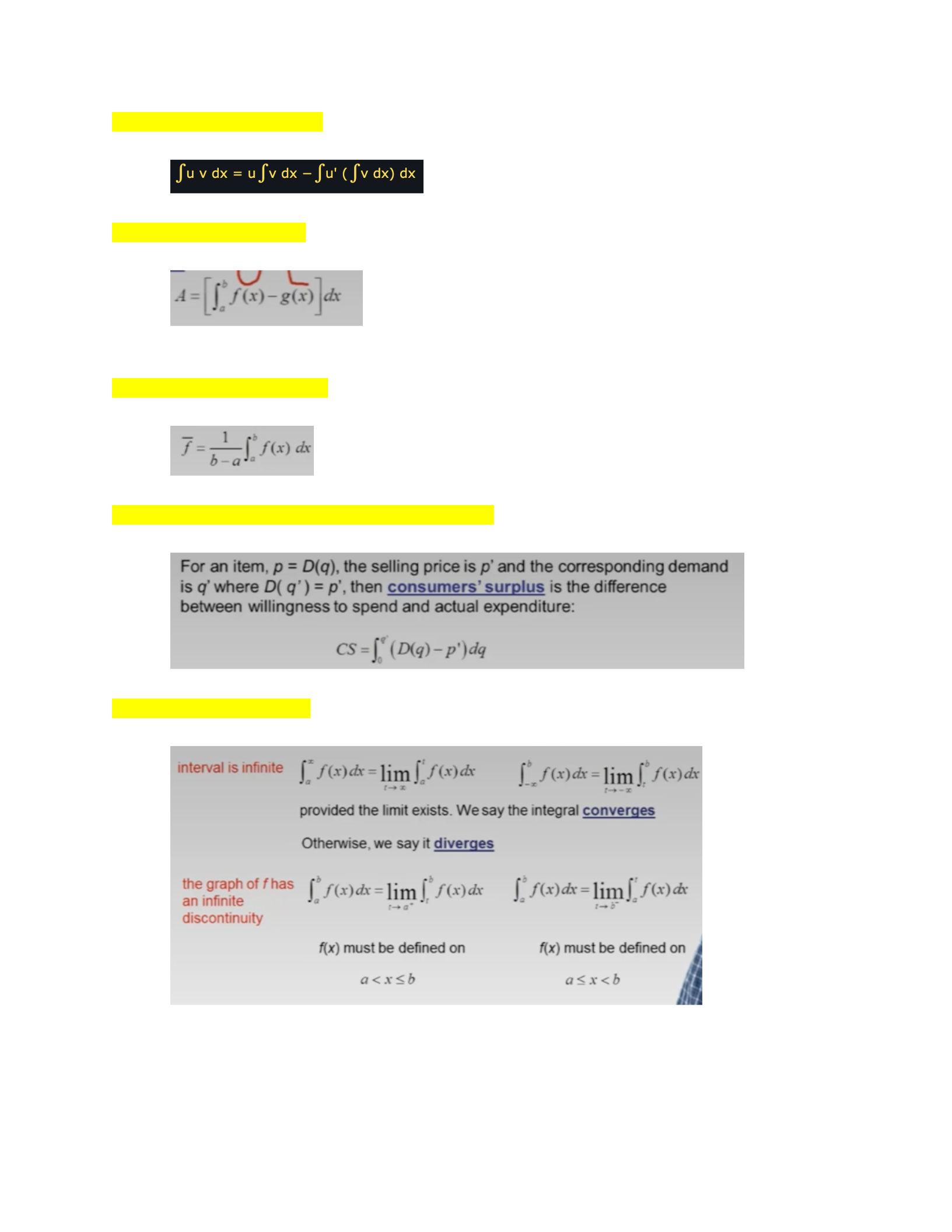
Verma 1
10.1 - Graphically Finding Limits
- lim to inf substitute in values for x that are getting bigger (ie- 10,100..) inv for lim to - inf
- Ex: If lim app 2 then u do - values like 1.9 1.99 1.999 and + like 2.00001 2.001 2.01
- Special Occasion w/ exponents set domain bc u can only have +#’s inside the exponent
so if its sqrt x-1 then the domain is [1, +inf) so use values like 1.00001, 1.001,... 1.1
- *General rule test 4 on each side +/- [] Factor then reduce
- When it does not approach a finite # - then the function ‘diverges’
- Graph Approach - both a-(left) and a+(right) must approach the same value for ato exist
10.2 - Evaluating Continuity of Limits Graphically
- Breaks in the graph are known as discontinuities 2 open holes for 1 x value is a
singularity but 2 closed dots or 1 open 1 closed means it is discontinuous on its domain
10.3 - Evaluating Continuity of Limits Algebraically (*FACTOR when NEEDED)
- Can figure out the domain using the graphical limit evaluations before defining continuity
-Piecewise functions plug-in points of the graph to see - closed dot is ≤ but open is <
- If function is discontinuous like (x^3-8)/(x-2) in this case at x = 2 then you can define it
as a limit… lim x->2 of (x^3-8)/(x-2) = 12(which is the approached y value)
- For closed functions where a value is # given just plug it in for x
-Limit of a Closed for at a singular point - evaluate num and denim to see where they
are approaching then put them over each other. For example lim -> 1+ for (x^2 - 4x
+1)/(x-1) then we see as u approach 1 from the right ontop it approaches -2. With the
den, it approaches 0 making the function approach -2/0 which is -inf - k/0+ and k/0-
correlate with positive and negative inf & k/+inf = 0
-Evaluating if a limit exists to inf - disregard any integers w/o an x value and only use
highest powers of numerator and denominator then divide them ex Lim -> inf of
(2x^2-4x)/(x^2-1) would become 2x^2/x^2 = 2 —------------(k^big - = small)----------->>
- k/small = big [] k x big = big [] k +/- big = big [] big/k = big [] k/big = small [] k^big + = big
- Other Limits - Lim h ->0 of -10 = -10 [] lim x->0+ of 10/x^2 = inf(put in # near 0 from right)
10.4 - Average Rate of Change (AROC)
- *can replace b with [a+h]
- AROC ovr [a, a+h] f(a+h) - f(a)/h where a is given, f is the function, and h is .1, .01, .001
10.6 - Equation of the Tangent Line & Algebraic Derivatives
- Definition of a derv = lim h -> 0 [f(x=h) - f(x)]/h [] number +/- h is the slope
- Then to get line do y - y1 = m(x - x1)
Verma 2
11.1 - Derivatives
- y = x^n … y’ = nx^(n-1) = Power Rule
-L ‘Hospitals Rule - If lim x->a for f(x)/g(x) is 0/0 or inf/inf then you can do f’(x)/g’(x)
- d/(letter) means d with respect to that letter value which represents a concept
- Special expectation the derv of IxI is IxI/x
11.2 - Marginal Analysis
- Marginal = Derivative [] Profit = Revenue - Cost [] Marginal Profit = P’(x) = R’(x) - C’(x)
- How fast is the cost increasing? - Derivative
-Average Cost = cost/# of items [] Revenue = price x quantity
- Marginal profit = 0 when p’(x) = 0; set p’(x) equal to 0 to find marginal profit # of products
11.3 - Product and Quotient Rules
- Product Rule: d/dx[f(x)g(x)] = f’(x)g(x) + f(x)g’(x)
- Quotient Rule: d/dx(f(x)/g(x)) =[f’(x)g(x) - f(x)g’(x)]/ [g(x)]^2]
11.4 - Chain Rule
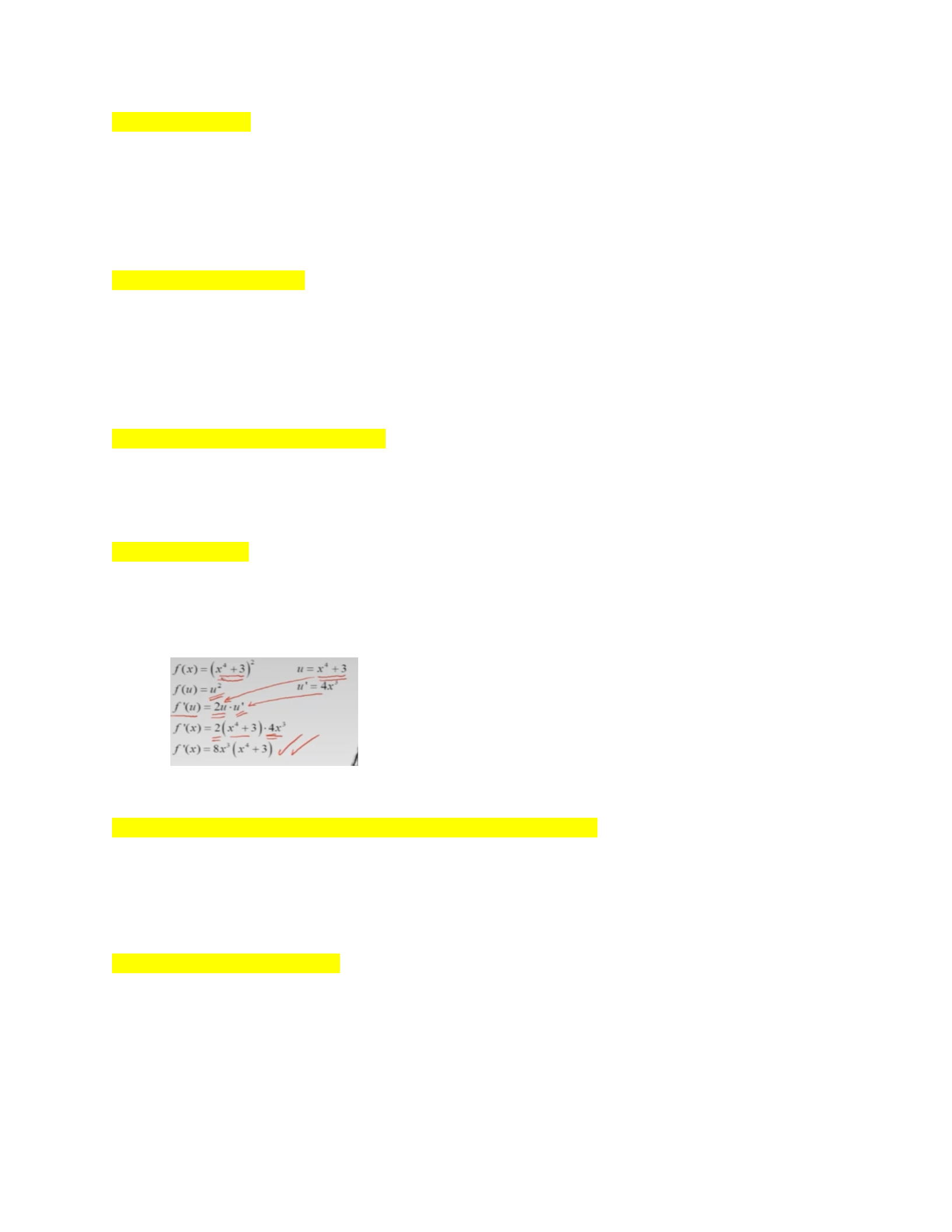
- d/dx[f(u)] = f’(u)du/dx
- Ex: d/dx(x^2) = 2x —-> d/dx(u^2) = 2u du/dx
- Inner function times outer function [] Alt notation dy/dx = dy/du x du/dx
- * if neg exponent only what’s inside () goes to the den.
-Marginal Revenue dP/dn:dP/dn x dQ/dn
11.5 - Derivatives of Logarithmic and Exponential Functions
-d/dx(ln x ) = 1/x [] d/dx(logbx) = 1/x ln b [] d/dx ln IxI = 1/x [] d/dx(logbIxI) = 1/ x ln b
-d/dx e^x = e^x [] d/dx b^x = ln b [] * for e^x don't forget to multiply the coeff by the exp
- L’ Hospitals rule w e^x if given a product of ()e^x then take the e^x and move it to den.
11.6 - Implicit Differentiation
- Solving for dy/dx [] Use chain rule on each variable y term & differentiate both sides
- All y’s change to dy/dx then just solve for dy/dx by isolating and taking derv’s
- Special case e^xy - use the chain rule which includes the product rule for exponents
- Can use the answer to find slope/tangent line by plugging in points
- Use product/quotient/log/e^x rules when necessary

Verma 3
12.1 - Min & Max
-Relative max/min if there is an open interval on a point of graph, so not the endpoints
-The actual max or min values are the y values at those points
- Absolute max/min highest or lowest point on the entire graph
-Stationary Point - if x in the domain and derv equal to 0 at that value (slope = 0 at point)
-Singular Point - if x is in the domain but derv of f(x) is not defined but in domain
-Endpoint - f x is at the end of the domain
-Relative Extrema Points - take 1st derv of function then set derv equal to 0 then solve
- Then.. plug +1/-1 (point to R & L) of the positive and neg answer into the derv eq
- If x is undefined assume a sharp curve so it is either a min or max at that point
12.2 - Application of Max & Min
-Optimization: Identify Unknowns, Identify the Objective Function, Identify Constraints
-Cost Minimizing: C(x)/x [] Take Derv [] Check Domain [] Focus on Num [] C Domain
-Area Maximizing: A = xy [] Find constraints [] Substitute them In [] Check Domain
- Length + Girth ≤ # for area of square rectangle [] usually just the sqr root for max area
12.3 - Higher Order Derivatives & Concavity
-d^2y/dx^2 - just take derivative twice - f’’(x)
- Differential notation: f”(x) = d^2f/dx^2 [] use for physics(gravity) problems
-Concavity:concave up = slope increasing [] concave down = slope decreasing
-CUP = concave up (of 2nd derv) is positive & opp for concave down
-Point of Inflections: 2nd derv is either 0 or undefined (change from conc. down to up)
-Rel. min = Stationary Point & 2nd Derv + [] Rel. Max = Stationary Point & 2nd Derv -
- If algebraically given a function and it wants POI and rel min and max
- ^Stationary points are x answers to 1st derv [] use step 2 of POI and define as max/min
- ^Possible POI is the x answer to 2nd derv [] evaluate 2nd derv by using SP’s -> up/down
12.5 - Related Rates
-Ladder Problems: db/dt [] b(base) = # [] dh/dt(fall rate) =+/- # [] b^2 +h^2 = #(length)^2
- ^Solve for h [] take derv of eq - 2b db/dt + 2h db/dt = 0 [] Solve for db/dt
-Circle Problems: dr/dt [] r(dV/dt) = # [] V = 4/3 pir^3 [] dV/dt = 4/3pi x 3r^2 dr/dt [] solve
- ^ For area use 2pir instead of the giant volume eq
12.6 - Elasticity
- Elasticity = Percentage increase in demand/ Percentage increase in price
- E = -dq/dp x p/q [] chain rule x p/q [] solve for E [] Use E eq and set equal to 1 = ans
- If E < 1 must raise price, E = 1 largest revenue, E > 1 must lower price → to inc rev.
Verma 4
13.1 - Indefinite Integral
- Power Rule: ∫x^n dx =(1/n+1)x^n+1 + C; n not = -1 [] Keep coefficients in front
- Any # is just that #x^0 so it turns into #x [] Use this process for marginal cost -> cost
-Special Cases: *Total cost - solve for C ^^^^
13.2 - Substitution
- Choose function for u: inner function () [] Find u’(du) [] Balance the integral
- Substitute u & du back in [] Antidifferentiate [] Plug u back in (back substitute)
- For e^1/x the u will be 1/x and du will be the u’ dx
- For square roots u will be what is inside the exponent and du will be u’ dx
- For du if it is just a # do 1/# and multiply it by ∫u’ all + C
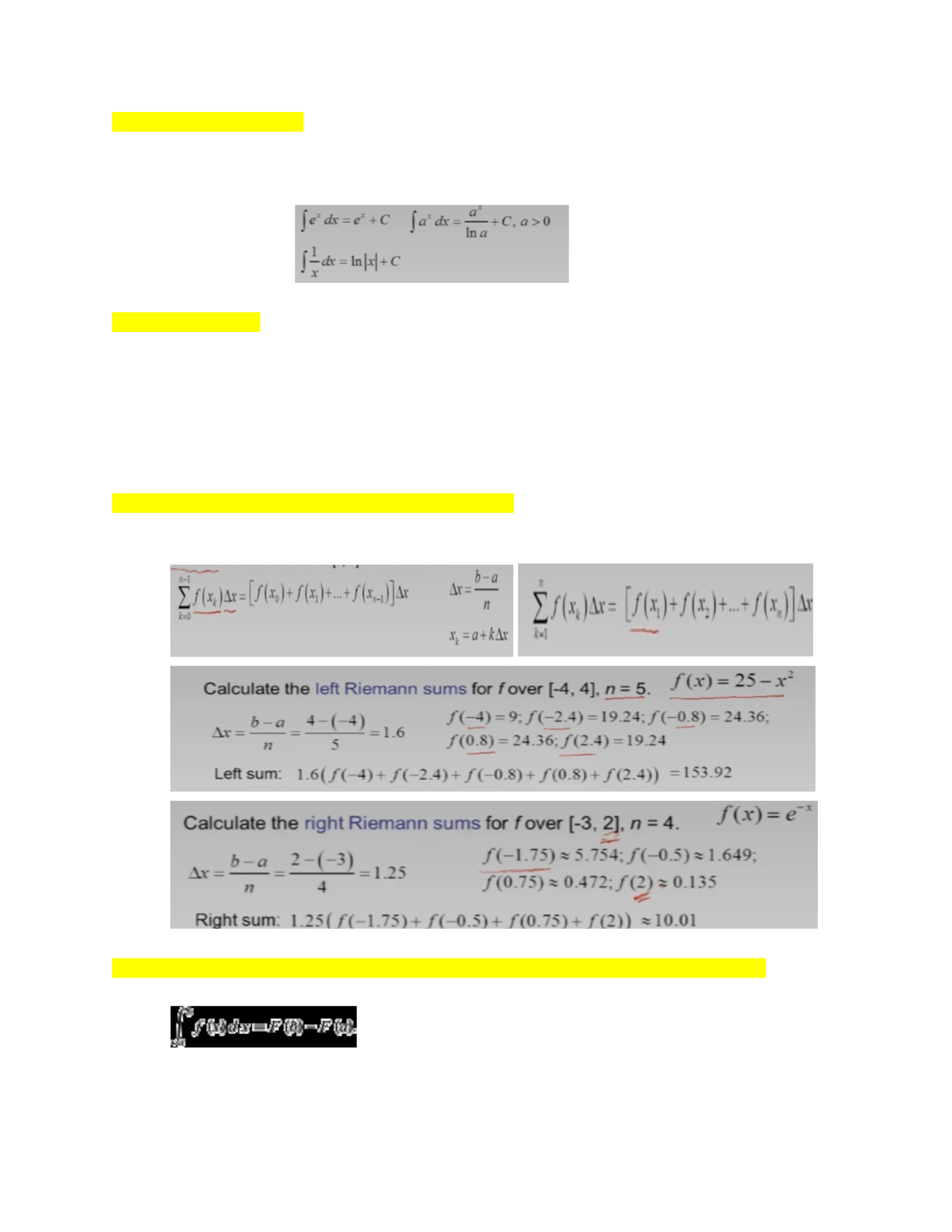
13.3 - Definite Integral (Left/Right Riemann Sums)
- Rectangles under a curve (n=4) [] width is delta x [] height is functional value f(#)
-
-
-
13.4 - Definite Integral & Fundamental Theorem of Calculus(Algebraic Approach)
-
- F is the antiderivative of f
- Possible scenario - use substitution to find antiderivative to calc the integral
- More efficient separate by parts then conjoin them after anti derived