



MAT 142 - COLLEGE MATHEMATICS - Partial
Differential Equations Practice Material - Set 1
1. Find the general solution of the partial differential equation (PDE):
uxx +uyy = 0.
Ans. To find the general solution of the given PDE, we first assume a solution of the form
u(x, y) = X(x)Y(y)and then solve the resulting ordinary differential equations.
1. Assume u(x, y) = X(x)Y(y), then the PDE becomes:
X′′(x)Y(y) + X(x)Y′′(y) = 0.
2. Divide the equation by X(x)Y(y)to separate variables:
X′′(x)
X(x)=−Y′′(y)
Y(y).
3. Since the left side depends only on xand the right side depends only on y, they must be
equal to a constant k:
X′′(x) + kX(x) = 0 and Y′′(y) + kY (y) = 0.
4. Solve the ordinary differential equation X′′(x) + kX(x) = 0: The characteristic equation
for this ODE is r2+k= 0, which gives r=±√−k=±i√k. Therefore, the general solution
for Xis:
X(x) = Acos(√kx)+Bsin(√kx).
5. Similarly, solve the ODE Y′′(y) + kY (y) = 0: The characteristic equation for this ODE is
r2+k= 0, which gives r=±√−k=±i√k. Therefore, the general solution for Yis:
Y(y) = Ccos(√ky)+Dsin(√ky).
6. Combine the solutions for X(x)and Y(y)to get the general solution for u(x, y):
u(x, y) = (Acos(√kx)+Bsin(√kx))(Ccos(√ky)+Dsin(√ky)).
Therefore, the general solution of the given PDE is of the form:
u(x, y) = ∞
∑
n=1 [(Ancos(√knx)+Bnsin(√knx))(Cncos(√kny)+Dnsin(√kny))],

where knare the constants and An, Bn, Cn, Dnare coefficients determined by initial/boundary
conditions.
2. Find the general solution of the partial differential equation:
∂2u
∂x2−4∂2u
∂x∂y + 3∂2u
∂y2= 0
Ans. Solution: 1. To solve this partial differential equation, we can try to find a solution of
the form u(x, y) = X(x)Y(y), which is separable. 2. Substitute u(x, y) = X(x)Y(y)into the
partial differential equation:
X′′(x)Y(y)−4X′(x)Y′(y)+3X(x)Y′′(y) = 0
3. Divide the equation by X(x)Y(y):
X′′(x)
X(x)−4X′(x)
X(x)
Y′(y)
Y(y)+ 3Y′′(y)
Y(y)= 0
4. Rearrange the terms to separate the variables:
X′′(x)
X(x)−4X′(x)
X(x)=−3Y′′(y)
Y(y)=λ
5. Solve the two ordinary differential equations: For X′′(x)
X(x)−4X′(x)
X(x)=λ, we get the characteristic
equation r2−4r−λ= 0. The solutions are r= 2 ±√4 + λ. For −3Y′′(y)
Y(y)=λ, we get
Y′′(y) + λ
3Y(y)=0. The solutions are Y(y) = c1e√λ
3y+c2e−√λ
3y. 6. We get two possible
cases depending on the values of λ: Case 1: If λ= 0, then X(x) = c1+c2xand Y(y) = c3+c4y.
Case 2: If λ= 0, then X(x) = c1e2+√4+λx +c2e2−√4+λx and Y(y) = c5e√λ
3y+c6e−√λ
3y. 7.
Therefore, the general solution is:
u(x, y) = (c1+c2x)(c3+c4y)+(c5e2+√4+λx +c6e2−√4+λx)(c7e√λ
3y+c8e−√λ
3y)
where c1, c2, ..., c8are arbitrary constants.

3. Find the general solution to the partial differential equation:
uxx −2uxy +uyy = 0
Ans. To find the general solution to the given partial differential equation, we will first compute
the characteristic equation and then solve it to obtain a general solution.
Step 1. Compute the characteristic equation by setting du/dx =pand du/dy =q:
du
dx =pand du
dy =q
Step 2. Rewrite the PDE in terms of pand q, using the chain rule:
uxx −2uxy +uyy = 0
px−2(py+qx) + qy= 0
Step 3. Express pand qin terms of the variables xand y:
px−2(py+qx) + qy= 0
px−2py−2qx+qy= 0
Step 4. Write the characteristic equations obtained from setting the above expression to
zero:
dx
1=dy
−2=du
−2p+q
Solving the first two equations gives us dy
dx =−2, which implies y=−2x+c1.
Step 5. Plugging y=−2x+c1into the third characteristic equation we obtain du
dx =−2p+q,
which gives u=−2px +q·x+c2(f), where c2(f)is an arbitrary function of f.
Step 6. The general solution can then be written as:
u(x, y) = −2px +q·x+c2(f)
4. Consider the partial differential equation (PDE) given by:

x2∂2u
∂x2+xy ∂2u
∂x∂y −y2∂2u
∂y2= 0
subject to the boundary conditions:
u(1, y) = cos(y), ux(1, y) = −sin(y)
and
u(x, 0) = cos(x), u(x, 0) = 0
Solution: To solve this PDE with the given boundary conditions, we first need to find the
general solution of the PDE. Let’s denote ux=∂u
∂x and uy=∂u
∂y for simplification.
Ans. 1. Calculate the general solution of the given PDE: Expand the PDE using the definition
of partial derivatives:
x2uxx +xyuxy −y2uyy = 0
2. Find the characteristic equation: We introduce new variables z=x/yand v(x, y) =
u(x, y)with respect to the independent variables xand y. Substitute x=zy into the PDE to
get:
z2y2vxx +zy2vxy −y2vyy = 0
Divide by y2and simplify to get:
z2vxx +zvxy −vyy = 0
3. Solve the characteristic equation: The characteristic equation is given by:
dx
z=dy
1=dz
0=dv
0
This implies that vis constant along the characteristic curves. Now we integrate the charac-
teristic equations to find the characteristics.
4. Find the characteristic curves: From dx
z=dy
1, we have dz = 0, which implies z=C1.
From dx
z=dv
0, we have dv = 0, which implies v=C2.
Therefore, the characteristic curves are given by z=x/y=C1and v=u=C2.
5. Solve for u: Since uis constant along the characteristic curves, the general solution is
given by:
u(x, y) = F(z) = F(x
y)
6. Apply the boundary conditions: Given u(1, y) = cos(y), we have:
u(1, y) = F(1) = cos(y)

Therefore, F(ζ) = cos(ζ).
7. Determine the solution satisfying the boundary conditions: The solution to the PDE with
the given boundary conditions is:
u(x, y) = cos (x
y)
5. Consider the partial differential equation
∂u
∂t =k∂2u
∂x2
subject to the initial condition
u(x, 0) = f(x)
and boundary conditions
u(0, t) = 0 and u(L, t) = 0
where 0≤x≤Land t > 0. Solve the partial differential equation.
Ans. Solution: 1. First, we assume a separated solution of the form u(x, t) = X(x)T(t).
2. Substitute u(x, t) = X(x)T(t)into the partial differential equation to obtain
X(x)T′(t) = kX′′(x)T(t)
3. Divide both sides by kX(x)T(t)to obtain
T′(t)
kT (t)=X′′(x)
X(x)=−λ
where λis a separation constant.
4. Solve the time ODE given by T′(t)
kT (t)=−λ, which gives T(t) = Ae−kλt.
5. Solve the spatial ODE given by X′′(x) + λX(x) = 0. The general solution is X(x) =
Bsin (√λx)+Ccos (√λx).
6. Apply the boundary conditions u(0, t) = 0 and u(L, t) = 0:
- From u(0, t) = 0, we have X(0)T(t) = 0, which implies X(0) = 0.
- From u(L, t) = 0, we have X(L)T(t) = 0, which implies X(L) = 0.
7. Since X(0) = 0 and X(L) = 0, we have

0 = Bsin(0) + Ccos(0) = Cand 0 = Bsin(√λL)
8. The condition Bsin(√λL)= 0 implies that √λL =nπ for n= 1,2,3, .... This gives
the eigenvalues λn=(nπ
L)2.
9. The corresponding normalized eigenfunctions are Xn(x) = sin (nπx
L)for n= 1,2,3, ....
10. Therefore, the general solution is
u(x, t) = ∞
∑
n=1
(ansin(ωnt)) sin (nπx
L)
where anare constants to be determined, and ωn=k(nπ
L)2.
11. Finally, apply the initial condition u(x, 0) = f(x):
f(x) = ∞
∑
n=1
ansin (nπx
L)
This allows you to determine the coefficients an, and thus the solution u(x, t).
6. Question: Solve the partial differential equation
∂2u
∂x2+∂2u
∂y2= 0
subject to the boundary conditions
1. u(x, 0) = f(x)2. u(0, y) = g(y)3. ux(L, y) = h(y)
where f(x),g(y), and h(y)are given functions, Lis a constant, and uxdenotes the partial
derivative of uwith respect to x.
Ans. Step-by-step solution: 1. Assume a separation of variables solution of the form u(x, y) =
X(x)Y(y).
2. Substitute u(x, y) = X(x)Y(y)into the partial differential equation to get
X′′
X+Y′′
Y= 0
3. Rearrange the terms to get X′′
X=−Y′′
Y.
4. Since the left side depends only on xand the right side depends only on y, both sides
must be equal to a constant −k2.

5. Solve the ODE X′′ +k2X= 0 by finding the characteristic roots r=±k.
6. Thus, the general solution for X(x)is X(x) = c1ekx +c2e−kx.
7. Solve the ODE Y′′ −k2Y= 0 to get Y(y) = c3cos(ky) + c4sin(ky).
8. The general solution for u(x, y)is the product of X(x)and Y(y), so we have
u(x, y) = (c1ekx +c2e−kx)(c3cos(ky) + c4sin(ky))
9. Apply the boundary conditions to determine the constants.
10. Use u(x, 0) = f(x)to find c1and c2.
11. Use u(0, y) = g(y)to find c3and c4.
12. Differentiate the general solution with respect to xand use ux(L, y) = h(y)to find the
remaining constants.
13. Substitute the found constants back into the general solution to get the final solution.
7. Question: Solve the following partial differential equation using the method of separation of
variables:
ut=k(uxx +uyy)
where kis a constant.
Ans. Step-by-step solution: 1. We start by assuming the solution u(x, y, t)can be written as
the product of three separate functions, each depending on only one variable:
u(x, y, t) = X(x)Y(y)T(t)
2. Substituting the separation of variables into the given PDE, we get:
X(x)Y(y)T′(t) = k(X′′(x)Y(y) + X(x)Y′′(y))T(t)
3. Dividing both sides by kX(x)Y(y)T(t), we now have:
T′(t)
kT (t)=X′′(x)
X(x)+Y′′(y)
Y(y)=−λ
4. We can now solve the three resulting ODEs: a. Solve T′(t) + kλT (t) = 0 to find T(t). b.
Solve X′′(x) + λX(x) = 0 to find X(x). c. Solve Y′′(y) + λY (y) = 0 to find Y(y).
5. The solutions to the three ODEs are: a. T(t) = Ae−kλt b. X(x) = Bcos(√λx)+
Csin(√λx)c. Y(y) = Dcos(√λy)+Esin(√λy)

6. Combining the solutions back together, we obtain:
u(x, y, t) = ∑
n,m
(Anme−kλnm t)(Bncos(√λnmx)+Cnsin(√λnmx))(Dmcos(√λnmy)+Emsin(√λnmy))
7. Applying the initial/boundary conditions will help determine the constants Anm,Bn,Cn,
Dm, and Em.
8. Suppose we have a partial differential equation of the form:
ut=k(uxx +uyy)
where kis a constant.
Let’s find the general solution to this partial differential equation.
Ans. Solution: 1. We will start by assuming a separable solution of the form u(x, y, t) =
X(x)Y(y)T(t). Substitute this into the partial differential equation to get:
XT ′=k(X′′Y T +XY ′′T)
2. Divide through by kXT to get:
T′
kT =X′′
X+Y′′
Y
3. Since the left-hand side depends only on t, and the right-hand side depends on xand y,
the only possibility for this equality to hold for all values of t,x, and yis that each side equals a
constant. Let’s call this constant −λ.
4. This gives us two ordinary differential equations:
T′
kT =−λ, X′′ =−λX, Y ′′ =−λY
5. Solving the T′equation gives us T(t) = C1e−kλt, where C1is a constant.
6. Substituting the values of λback into the X′′ and Y′′ equations give us:
X′′ +λX = 0, Y ′′ +λY = 0
7. The general solution to the spatial part of the equation (for Xand Y) is:
X(x) = Acos(√λx)+Bsin(√λx), Y (y) = Ccos(√λy)+Dsin(√λy)

where A, B, C, D are constants.
8. Finally, the general solution to the original partial differential equation is given by:
u(x, y, t) = ∞
∑
n=1
∞
∑
m=1
(Anm cos(√λnmx)+Bnm sin(√λnmx))(Cnm cos(√λnmy)+Dnm sin(√λnmy))e−kλnmt
where λnm are the eigenvalues and Anm, Bnm, Cnm, Dnm are related to the initial conditions
of the problem.
9. Find the general solution to the partial differential equation:
∂2u
∂x2+ 4 ∂2u
∂x∂y + 4∂2u
∂y2= 0
Ans. To solve the given partial differential equation, we will first assume a solution of the form
u(x, y) = X(x)Y(y). Then we will substitute it back into the partial differential equation and
solve for X(x)and Y(y)separately.
1. Assume the solution is in the form of u(x, y) = X(x)Y(y):
Let u(x, y) = X(x)Y(y).
Then the partial derivatives become:
∂u
∂x =X′(x)Y(y) ; ∂2u
∂x2=X′′(x)Y(y)
and
∂u
∂y =X(x)Y′(y) ; ∂2u
∂y2=X(x)Y′′(y)
2. Substitute the solution into the PDE:
Substitute u(x, y) = X(x)Y(y)back into the given partial differential equation:
X′′(x)Y(y)+4X′(x)Y′(y)+4X(x)Y′′(y) = 0
Divide the equation by X(x)Y(y):
X′′(x)
X(x)+ 4X′(x)Y′(y)
X(x)Y(y)+ 4Y′′(y)
Y(y)= 0
Since the left-hand side of the equation is in terms of xand yseparately, it must be equal to
a constant −λ:
X′′(x)
X(x)=−λ; 4X′(x)Y′(y)
X(x)Y(y)=−λ;Y′′(y)
Y(y)=−λ
3. Solve for X(x):
The equation X′′(x)
X(x)=−λhas the general solution:
X(x) = c1e√λx +c2e−√λx
4. Solve for Y(y):
The equation Y′′(y)
Y(y)=−λhas the general solution:
Y(y) = c3e√λy +c4e−√λy
5. General solution:
The general solution to the given partial differential equation is:
u(x, y) = (c1e√λx +c2e−√λx)(c3e√λy +c4e−√λy)
10. Question: Consider the partial differential equation ∂u
∂t = 4∂2u
∂x2subject to the initial condition
u(x, 0) = cos(2πx)for 0≤x≤1. Find the solution u(x, t).
Ans. Step-by-step solution: 1. The general solution to the given partial differential equation is
of the form u(x, t) = f(x−4t), where fis an arbitrary function. 2. Using the initial condition
u(x, 0) = cos(2πx), we have f(x) = cos(2πx). 3. Therefore, the solution to the partial
differential equation is u(x, t) = cos (2π(x−4t)).
11. Question: Solve the following partial differential equation using the method of separation
of variables: ∂u
∂t = 4∂2u
∂x2subject to the boundary conditions u(0, t) = u(1, t)=0and the initial
condition u(x, 0) = sin(2πx).

Ans. Step-by-step solution:
1. We will start by assuming a separable solution of the form u(x, t) = X(x)T(t). Substi-
tuting this into the given partial differential equation, we have:
X(x)T′(t) = 4X′′(x)T(t)
2. Dividing both sides by u(x, t)gives:
T′(t)
4T(t)=X′′(x)
X(x)=−λ2
where λis a separation constant.
3. Solving the time part of the equation gives T′(t) + 4λ2T(t)=0, with the solution
T(t) = Aexp(−4λ2t), where Ais an arbitrary constant.
4. Solving the spatial part of the equation gives X′′(x) + λ2X(x)=0, with the general
solution X(x) = Bsin(λx) + Ccos(λx).
5. Applying the boundary condition u(0, t) = 0 gives X(0)T(t) = 0, which implies X(0) = 0.
Therefore, C= 0.
6. Applying the boundary condition u(1, t) = 0 gives X(1)T(t) = 0, which implies X(λ) = 0.
For non-trivial solutions, we must have sin(λ) = 0, leading to λ=nπ for n∈Z+.
7. Therefore, the spatial part of the solution becomes Xn(x) = Bnsin(nπx), where n=
1,2,3, ....
8. Combining the spatial and time solutions, the general solution becomes:
u(x, t) = ∞
∑
n=1
Bnsin(nπx)exp(−4n2π2t)
9. Applying the initial condition u(x, 0) = sin(2πx)gives:
∞
∑
n=1
Bnsin(nπx) = sin(2πx)
10. By orthogonality of sine functions, we can find the coefficients Bn. Multiplying both
sides by sin(mπx)and integrating from 0 to 1 gives:
Bm= 2 ∫1
0
sin(2πx)sin(mπx)dx
11. Evaluating the integral gives B2= 0 for m= 2, and B2= 1 for m= 2.
12. Therefore, the solution to the partial differential equation is:
u(x, t) = sin(2πx)exp(−16π2t)

12. Question: Solve the following partial differential equation with initial condition:
ut=uxx,0< x < π, t > 0
u(0, t) = 0, u(π, t) = 0
u(x, 0) = x(π−x)
Ans. Step-by-step solution:
1. We will solve the given partial differential equation using the method of separation of
variables. Let’s assume the solution has the form u(x, t) = X(x)T(t).
2. Substituting u(x, t) = X(x)T(t)into the PDE ut=uxx gives us:
X(x)T′(t) = X′′(x)T(t)
3. Dividing by u=X(x)T(t)gives:
T′(t)
T(t)=X′′(x)
X(x)=−λ
4. Solving the ODE X′′(x)
X(x)=−λgives the eigenfunctions:
Xn(x) = Ansin(nx) + Bncos(nx)
where λ=n2for n= 1,2,3, ...
5. Substituting the boundary conditions u(0, t) = 0 and u(π, t) = 0 into X(x)gives:
Bn= 0
Ansin(nπ) = 0
6. Therefore, the eigenfunctions for the spatial part of the solution are:
Xn(x) = Ansin(nx)
with the eigenvalues λ=n2for n= 1,2,3, ...
7. Now, we solve the time part of the equation by solving T′(t) = −λT (t):
Tn(t) = Cne−n2t
where Cnis an arbitrary constant.
8. The general solution to the PDE is then given by:
u(x, t) = ∞
∑
n=1
Cne−n2tsin(nx)

9. Finally, we find the coefficients Cnby using the initial condition u(x, 0) = x(π−x):
x(π−x) = ∞
∑
n=1
Cnsin(nx)
Cn=2
π∫π
0
x(π−x)sin(nx)dx
10. Evaluating the integral gives us the values of Cn. Thus, the solution to the given partial
differential equation with the initial condition is:
u(x, t) = ∞
∑
n=1
2
πn3(1 −(−1)n)e−n2tsin(nx)
13. Consider the partial differential equation (PDE) given by:
∂u
∂t +u∂u
∂x = 0
subject to the initial condition u(x, 0) = x2. Solve this PDE using the method of character-
istics.
Ans. Step 1. We introduce the characteristic equations:
dt
ds = 1,dx
ds =u, du
ds = 0
which leads to the characteristic curves:
t=s+C1, x =C2u+C3, u =C4
where C1, C2, C3, C4are constants of integration.
Step 2. Next, we express uin terms of xand tusing the initial condition: u(x, 0) = x2.
At t= 0, we have x=C2u+C3=xand u=C4=x2.
Hence, u=x2along the characteristic curve.
Step 3. Now, we eliminate the constants by solving the characteristic equations:
From dt
ds = 1, we have t=s+C1⇒s=t−C1.
From dx
ds =x2, we have x=C2u+C3=C2x2+C3.
Differentiating x=C2x2+C3with respect to s, we get:
dx
ds = 2C2x⇒2C2x=x⇒C2=1
2.

Therefore, the characteristic curve equation becomes x=1
2x2+C3.
From the initial condition, we find that C3= 0.
Step 4. Assembling the characteristic curve, we have x=1
2x2or x= 0 and x= 2.
Hence, the solution of the PDE is given by u(x, t) = x2for x≤0and u(x, t) = 4 for x≥2.
14. Question: Find the solution to the partial differential equation ut=uxx subject to the
initial conditions u(x, 0) = 2x2and ut(x, 0) = 0.
Ans. Solution: 1. We begin by assuming the solution can be written as a product of functions
of xand t, so u(x, t) = X(x)T(t).
2. Substituting u(x, t) = X(x)T(t)into the equation ut=uxx yields 1
T(t)
dT
dt =1
X(x)
d2X
dx2.
3. Rearranging terms yields 1
T(t)
dT
dt =k2=1
X(x)
d2X
dx2, where kis a constant.
4. Solving the equation 1
T(t)
dT
dt =k2gives T(t) = Aek2t.
5. Solving the equation 1
X(x)
d2X
dx2=k2yields X(x) = Bcos(kx) + Csin(kx).
6. Since we have a linear combination of solutions, we can rewrite it as X(x) = ∑∞
n=1(Bncos(knx)+
Cnsin(knx)).
7. Applying the initial condition u(x, 0) = 2x2gives 2x2=X(x)T(0) = X(x). Therefore,
we have X(x) = 2x2.
8. Now we substitute X(x) = 2x2back into the general solution for X(x), yielding u(x, t) =
∑∞
n=1(2x2cos(knt) + Cnsin(knx)).
9. Finally, applying the initial condition ut(x, 0) = 0 gives ∑∞
n=1(−2Bnknsin(knx)) = 0.
10. Since the right side is independent of x, each term must be zero, so Bn= 0.
11. Therefore, the solution to the given partial differential equation with the initial conditions
is u(x, t) = 2x2.
15. Question: Find the general solution to the partial differential equation
∂2u
∂x2−∂2u
∂y2= 0

Ans. Solution: We can rewrite the given partial differential equation as
∂2u
∂x2=∂2u
∂y2
This suggests that the solution may involve functions that have equal second partial derivatives
with respect to xand y. Let us assume u(x, y) = f(x+y)+g(x−y), where fand gare arbitrary
functions to be determined.
1. Compute the partial derivatives of u:
∂u
∂x =f′(x+y) + g′(x−y)
∂u
∂y =f′(x+y)−g′(x−y)
2. Compute the second partial derivatives of u:
∂2u
∂x2=f′′(x+y) + g′′(x−y)
∂2u
∂y2=f′′(x+y)−g′′(x−y)
3. Plug the partial derivatives into the PDE:
f′′(x+y) + g′′(x−y) = f′′(x+y)−g′′(x−y)
Simplifying gives g′′(x−y) = 0.
4. Integrate g′′(x−y) = 0 twice to find g(x−y):Integrating the equation twice gives
g′(x−y) = Aand g(x−y) = Ax +B, where Aand Bare constants.
5. Plug g(x−y)back into the expression for u:
u(x, y) = f(x+y) + Ax +B
Hence, the general solution to the given partial differential equation is u(x, y) = f(x+y) +
Ax +B, where fis an arbitrary function of x+yand Aand Bare constants.
16. Question: Find the general solution to the partial differential equation uxx +uyy = 0.
Ans. Step-by-step solution: 1. We assume that the solution u(x, y)can be separated into
functions of xand ysuch that u(x, y) = X(x)Y(y). 2. Substitute u(x, y) = X(x)Y(y)into the
partial differential equation uxx +uyy = 0:
X′′(x)Y(y) + X(x)Y′′(y) = 0

3. Divide both sides by X(x)Y(y)to separate the variables:
X′′(x)
X(x)=−Y′′(y)
Y(y)=−λ
where λis a separation constant. 4. Solve the ordinary differential equation X′′(x)+λX(x) = 0:
The general solution to this equation is
X(x) = Acos(√λx)+Bsin(√λx)
5. Solve the ordinary differential equation Y′′(y) + λY (y)=0: The general solution to this
equation is
Y(y) = Ccos(√λy)+Dsin(√λy)
6. Combining the solutions for X(x)and Y(y), we get the general solution to the partial
differential equation:
u(x, y) = ∞
∑
n=1 (Ancos(√λnx)+Bnsin(√λnx))(Cncos(√λny)+Dnsin(√λny))
where λnare the eigenvalues obtained by solving the separation constant equation.
17. Find the general solution to the partial differential equation:
∂2u
∂x2+ 4∂2u
∂y2= 0
where u=u(x, y).
Ans. To find the general solution to the partial differential equation, we will use the method of
separation of variables.
1. Assume a solution of the form: u(x, y) = X(x)Y(y).
2. Substitute the solution into the PDE:
∂2(XY )
∂x2+ 4∂2(XY )
∂y2= 0
X′′Y+ 4XY ′′ = 0
3. Divide through by XY :
X′′
X+ 4Y′′
Y= 0

4. Rearrange the terms:
X′′
X=−4Y′′
Y
5. Set each side equal to a constant −λ:
X′′
X=−λand Y′′
Y=λ
4
6. Solve the ODEs: For X:
X′′ +λX = 0
The solution of this ODE depends on the sign of λand is given by:
X(x) =
Acos(√λx)+Bsin(√λx)if λ > 0
A+Bx if λ= 0
Acosh(√−λx)+Bsinh(√−λx)if λ < 0
For Y:
Y′′ −λ
4Y= 0
The solution of this ODE depends on the sign of λand is given by:
Y(y) =
Ce√λ
2y+De−√λ
2yif λ > 0
Cy +Dif λ= 0
Ce√−λ
2y+De−√−λ
2yif λ < 0
7. General solution: The general solution to the PDE is the sum of all possible solutions
obtained by combining the solutions for X(x)and Y(y). This can be written as:
u(x, y) = ∞
∑
n=1
cnXn(x)Yn(y)
where cnare constants determined by the initial/boundary conditions.
18. Question:
Solve the partial differential equation
3uxx −4uxy +uyy = 0
with the initial conditions

u(x, 0) = x2, uy(x, 0) = 1
where uxxrepresents the second partial derivative of uwith respect to x,uxyrepresents
the mixed partial derivative of uwith respect to xand y, and uyyrepresents the second partial
derivative of uwith respect to y.
Ans. Solution: Let’s solve the given partial differential equation using the method of charac-
teristics.
1. Compute the characteristics: The characteristic equations are given by the system of
ODEs:
dx
dt = 3,dy
dt = 1,du
dt =−4uy
Solving the first two equations, we get x= 3t+c1and y=t+c2, where c1and c2are
constants of integration.
2. Express uin terms of t:From the chain rule, we have:
du
dt =∂u
∂x
dx
dt +∂u
∂y
dy
dt = 3ux+uy
Since ux=ux(x(t), y(t)) and uy=uy(x(t), y(t)), we can rewrite the above equation as:
du
dt = 3ux+uy=−4uy
This simplifies to du
dt =−uy.
3. Solve the system of ODEs: From our expressions for x(t),y(t), and du
dt , we have the
following equations:
x= 3t+c1, y =t+c2,du
dt =−uy
Differentiating uwith respect to yand using the given initial condition uy(x, 0) = 1 gives us
uy=−1.
4. Solve for u:Integrating uy=−1with respect to ygives u=−y+ϕ(x), where ϕ(x)is
some function of x.
Using the initial condition u(x, 0) = x2, we get:
u(x, 0) = −0 + ϕ(x)
x2=ϕ(x)
Therefore, the solution to the partial differential equation with the initial conditions is u(x, y) =
x2−y.

19. Consider the partial differential equation:
uxx −2uxy +uyy = 0
Subject to the initial conditions:
u(x, 0) = x2, uy(x, 0) = ex
Find the solution for u(x, y).
Ans. To solve this partial differential equation with the given initial conditions, we follow these
steps:
1. Find the characteristic equation:
The characteristic equation for the given partial differential equation is given by:
dr2−2rs +ds2= 0
Substitute r=p+qand s=p−qinto the characteristic equation:
(p+q)2−2(p+q)(p−q)+(p−q)2= 0
Simplify the equation:
p2+ 2pq +q2−2(p2−q2) + p2−2pq +q2= 0
6q2= 0
2. Solve for the characteristics:
Since the characteristic equation simplifies to 6q2= 0, we have q= 0. This implies that the
characteristics are straight lines, and we need to parameterize the straight lines.
3. Parameterize the characteristics:
Given r=p,s= 0, we can write the characteristics as:
x=p
y= 0
u=u(x, 0) = x2
uy=ex
From the characteristic equations, we have
dx/dt = 1
dy/dt = 0
du/dt = 2pdp/dt
Using the initial conditions, we have u(p, 0) = p2,uy(p, 0) = ep. Integrating du/dt =
2pdp/dt, we get u=p2+ 2t(p),
4. Solve for the solution:
Using the initial conditions u(p, 0) = p2, we get u(p, 0) = p2=p2+ 2 ∗0⇒t(p) = 0. So
the solution is given by:
u(x, y) = u(p, 0) = p2=x2
20. Question: Solve the following partial differential equation:
∂u
∂t −4∂2u
∂x2+ 3u= 0
subject to the initial condition:
u(x, 0) = x2+ 3x
and the boundary conditions:
u(0, t) = 1 and u(π, t) = 0
Ans. Solution: We will first solve the partial differential equation and then apply the initial
and boundary conditions to find the solution u(x, t).
1. Solve the PDE: Let’s assume the solution has the form u(x, t) = X(x)T(t). Substituting
this into the PDE, we get:
T′(t)X(x)−4T(t)X′′(x)+3T(t)X(x) = 0
Dividing by u(x, t):
T′(t)
T(t)= 4X′′(x)
X(x)−3 = λ
Solving the ODEs: For T(t):
T′(t)
T(t)=−λ=⇒T(t) = c1e−λt
For X(x):
X′′(x)
X(x)=λ+ 3
4=⇒X(x) = c2cos (√λ+ 3
2x+c3sin (√λ+ 3
2x)

The general solution for u(x, t)is:
u(x, t) = ∞
∑
n=1
(c2ncos(ωnt) + c2n+1 sin(ωnt)) cos (√λn+ 3
2x)
Where λn= (ωn)2−3and ωn=2n−1
2π.
2. Apply the initial condition: Since u(x, 0) = x2+3x=X(x)T(0), we see that T(0) = 1.
Therefore, c2n=c2ne0=c2nand c2n+1 =c2n+1e0=c2n+1. Thus, the initial condition gives the
Fourier series of f(x):
f(x) = x2+ 3x=∞
∑
n=1
cncos (√λn+ 3
2x)
3. Apply the boundary conditions: Applying the boundary condition u(0, t) = 1 gives
c1cos(ω0t) = 1 =⇒c1= 1. Applying the other boundary condition u(π, t) = 0 gives:
cncos (−√λn+ 3
2π)= 0
For the cosine term to be zero, we must have cn= 0 for all nsuch that λn= (ωn)2−3 =
(2n−1)2π2−3 = 0. Solving this gives ω0=π
2as the only solution.
So, the solution is:
u(x, t) = cos (πt
2)cos (xπ
2)
21. Question: Solve the following partial differential equation using the method of separation
of variables:
ut−4uxx = 0, u(x, 0) = sin(2πx), u(0, t) = u(1, t) = 0
Ans. Step-by-step solution:
1. We start by assuming a separable solution of the form u(x, t) = X(x)T(t), where X(x)
is a function of xonly and T(t)is a function of tonly.
2. Substitute u(x, t) = X(x)T(t)into the given partial differential equation to obtain:
X(x)T′(t)−4X′′(x)T(t) = 0
3. Divide both sides by u(x, t)to separate variables:

T′(t)
T(t)= 4X′′(x)
X(x)
4. The left side of the equation only depends on t, while the right side only depends on
x. This implies both sides must be equal to a constant, say −λ. Thus, we have two ordinary
differential equations:
{T′(t)
T(t)=−λ
4X′′(x)
X(x)=−λ
5. Solve the first ODE for T(t):
T′(t) + λT (t) = 0 =⇒T(t) = c1e−λt
where c1is an arbitrary constant.
6. Solve the second ODE for X(x):
X′′(x) + λ
4X(x) = 0
This gives us the solutions:
X(x) = c2cos (√λ
2x)+c3sin (√λ
2x)
where c2and c3are arbitrary constants.
7. Applying the boundary conditions u(0, t) = u(1, t)=0gives X(0) = X(1) = 0. This
implies c2= 0 and sin (√λ
2)= 0.
8. The condition sin (√λ
2)= 0 implies that √λ
2=nπ for n= 1,2,3, .... Thus, λ= (2nπ)2.
9. So, we have the solution in the form:
u(x, t) = ∞
∑
n=1
cne−(2nπ)2tsin(2nπx)
10. Finally, applying the initial condition u(x, 0) = sin(2πx)will allow us to determine the
coefficients cnusing Fourier series.
22. Question:
Consider the partial differential equation
ut=uxx +uyy

subject to the boundary conditions
u(0, y, t) = 0, ux(L, y, t) = 0, u(x, 0, t) = 0, uy(x, L, t) = 0
and the initial condition
u(x, y, 0) = sin(πx
L)sin(πy
L)
Solve the partial differential equation using the method of separation of variables.
Ans. Step-by-step solution:
1. We start by assuming the solution of the form
u(x, y, t) = X(x)Y(y)T(t)
Substitute this into the partial differential equation to get
XY T ′=X′′Y T +XY ′′T
Divide both sides by the product XYZ to obtain
T′
T=X′′
X+Y′′
Y=−λ
where λis a separation constant.
2. From the first equation T′
T=−λ, we have
T′+λT = 0
which has the solution
T(t) = c1e−λt
3. Now, we consider the second equation X′′
X=−Y′′
Y=−λ. Solve for X(x)
X′′ +λX = 0
The general solution is
X(x) = c2cos(√λx)+c3sin(√λx)
4. Next, solve for Y(y)
Y′′ +λY = 0
The general solution is
Y(y) = c4cos(√λy)+c5sin(√λy)
5. Applying the boundary conditions leads to the following solutions for X(x)and Y(y):
X(x) = c3sin(nπ
Lx)
Y(y) = c5sin(nπ
Ly)
where nis a positive integer.
6. Using the initial condition to determine the value of λ, we find
u(x, y, 0) = ∞
∑
n=1
c3n5sin(nπ
Lx)sin(nπ
Ly)=sin(πx
L)sin(πy
L)
Matching coefficients, we find c35 =4
π2and λn= (nπ
L)2.
7. Therefore, the solution to the partial differential equation is
u(x, y, t) = ∞
∑
n=1
e−(nπ
L)2t(4
π2)sin(nπ
Lx)sin(nπ
Ly)
23. Question:
Consider the partial differential equation
ut+ux= 0
subject to the initial condition u(x, 0) = e−x2. Solve the partial differential equation using
the method of characteristics.
Ans. Step-by-step solution:
1. We start by expressing the PDE in terms of the characteristic variables. Letting s=x+t
and r=x, the characteristics are defined by the following system of ODEs:
dx
ds = 1,dt
ds = 1,du
ds = 0
2. Solving the ODEs, we find x=s+c1, t =s+c2, u =c3, where c1, c2, c3are constants.
3. Now, we express the initial condition in terms of the characteristic variables:
u(x, 0) = u(r, 0) = u(s−t, 0) = u(s−s, 0) = u(0) = e−(0)2= 1
Thus, the initial condition gives u= 1 along the characteristic curves.

4. Therefore, the general solution is u(x, t)=1along the characteristic curves represented
by x=t+c1.
Hence, the solution to the given partial differential equation with the initial condition u(x, 0) =
e−x2is u(x, t) = 1.
24. Question 24:
Consider the partial differential equation
∂u
∂t =k(∂2u
∂x2+∂2u
∂y2)
subject to the initial condition
u(x, y, 0) = f(x, y)
and the boundary conditions
u(0, y, t) = u(a, y, t) = u(x, 0, t) = u(x, b, t) = 0
where a, b, k are constants.
Find the solution u(x, y, t)of the partial differential equation.
Ans. Solution:
To solve the partial differential equation, we will use the method of separation of variables.
We assume the solution has the form
u(x, y, t) = X(x)Y(y)T(t)
Substitute this into the given partial differential equation, we have
X(x)Y(y)dT
dt =k(X′′(x)Y T (t) + XY ′′(y)T(t))
Divide both sides by kXT , we get
1
kT
dT
dt =X′′(x)
X(x)+Y′′(y)
Y(y)=−λ2
This gives us two ordinary differential equations:
X′′(x) + λ2X(x) = 0
Y′′(y) + λ2Y(y) = 0
with boundary conditions
X(0) = X(a) = Y(0) = Y(b) = 0
The solution to the ordinary differential equation for X(x)is
Xn(x) = sin (nπx
a)
with corresponding eigenvalues λn=nπ
a.
The solution to the ordinary differential equation for Y(y)is
Ym(y) = sin (mπy
b)
with corresponding eigenvalues λm=mπ
b.
Therefore, the general solution to the partial differential equation is
u(x, y, t) = ∞
∑
n=1
∞
∑
m=1
Cnm sin (nπx
a)sin (mπy
b)e−k((nπ
a)2+(mπ
b)2)t
where Cnm are constants determined by the initial condition u(x, y, 0) = f(x, y).
25. Find the general solution to the partial differential equation:
uxx −4uxy + 4uyy = 0
where uis a function of xand y.
Ans. The general solution to the given partial differential equation is
u(x, y) = F(x+ 2y) + G(x−2y)
where Fand Gare arbitrary functions.

26. Find the general solution to the following partial differential equation:
uxx −4uxy + 4uyy = 0
Ans. Solution: 1. We start by defining the auxiliary equation for the given partial differential
equation:
r2−4rs + 4s2= 0
2. We can rewrite the auxiliary equation as:
(r−2s)2= 0
3. This gives us a repeated root r= 2s. Therefore, the general solution to the PDE is of the
form:
u(x, y) = x2F(y−2x) + G(y−2x)
where Fand Gare arbitrary functions of their respective arguments.
4. Thus, the general solution to the given partial differential equation is:
u(x, y) = x2F(y−2x) + G(y−2x)
27. Question 27: Solve the partial differential equation given by
∂2u
∂x2+∂2u
∂y2= 0
subject to the boundary conditions u(0, y) = y3and u(x, 0) = x3.
Ans. Solution: 1. We can try to solve this partial differential equation using the method of
separation of variables. Let u(x, y) = X(x)Y(y). Substitute this into the PDE to get:
X′′(x)Y(y) + X(x)Y′′(y) = 0
2. Divide both sides by X(x)Y(y)to separate the variables:
X′′(x)
X(x)=−Y′′(y)
Y(y)
3. Setting both sides equal to a constant −k2, we get two ODEs:
X′′(x) + k2X(x) = 0 and Y′′(y) + k2Y(y) = 0
4. The solution to the ODE X′′(x) + k2X(x) = 0 is X(x) = c1cos(kx) + c2sin(kx).
5. The solution to the ODE Y′′(y) + k2Y(y) = 0 is Y(y) = c3eky +c4e−ky.
6. General solution is given by u(x, y) = ∑∞
n=1 ∑∞
m=1 cn,m sin(nπx)sin(mπy).
7. Apply the boundary conditions u(0, y) = y3and u(x, 0) = x3to find the values of the
coefficients cn,m. Applying u(0, y) = y3, we get:
y3=∞
∑
n=1
cn,m sin(nπ ·0) sin(mπy) = 0
8. This implies that cn,m = 0 for all n= 1.
9. Thus, the solution to the given partial differential equation subject to the boundary
conditions is u(x, y) = c1,1sin(πx)sin(πy).
28. Question 28: Solve the partial differential equation uxx + 2uxy +uyy = 0 subject to the
initial condition u(x, y) = ex+yat x= 0.
Ans. Solution: 1. We begin by finding the characteristic equation associated with the given
partial differential equation. Let p=dx/dt and q=dy/dt. Then, the characteristic equations
are given by
dx
dt = 1,dy
dt = 2.
Integrating both equations, we have x=t+c1and y= 2t+c2. 2. Next, we express u(x, y)in
terms of the variables t,c1, and c2using the original initial condition u(x, y) = ex+y. Substituting
x=t+c1and y= 2t+c2, we have
u(t, c1, c2) = et+c1+2t+c2=e3t+c1+c2.
3. Now, we differentiate uwith respect to tto obtain the total derivative du
dt . Using the chain
rule, we have du
dt =∂u
∂t +∂u
∂c1
dc1
dt +∂u
∂c2
dc2
dt .
Since u(t, c1, c2) = e3t+c1+c2, we find that
du
dt = 3e3t+c1+c2.
4. By comparing du
dt with the characteristic equations, we find that du
dt = 3u. Thus, the general
solution to the partial differential equation is u(t, c1, c2) = Ce3t+c1+c2. 5. Finally, using the initial
condition u(x, y) = ex+yat x= 0, we have u(0,0) = e0=C·e0, where Cis a constant.
Therefore, C= 1 and the solution to the partial differential equation is u(x, y) = e3t+c1+c2=
e3x+2y.
29. Question: Solve the partial differential equation uxx +uyy = 0 subject to the boundary
conditions u(x, 0) = x2and u(x, 1) = x.
Ans. Step-by-step solution:
1. We start by assuming the solution can be written as u(x, y) = X(x)Y(y). Substituting
this into the given PDE uxx +uyy = 0, we have:
X′′(x)Y(y) + X(x)Y′′(y) = 0.
2. Dividing by X(x)Y(y), we get:
X′′(x)
X(x)=−Y′′(y)
Y(y)=λ,
where λis a constant.
3. Solving the ODE X′′(x)
X(x)=λgives us X(x) = Acos(√λx)+Bsin(√λx).
4. Solving the ODE −Y′′(y)
Y(y)=λgives us Y(y) = Ce√λy +De−√λy .
5. Applying the boundary condition u(x, 0) = x2, we have X(x)Y(0) = x2. Substituting
Y(0) into this equation, we get X(x)C=x2. Thus, C= 0 and X(x) = Acos(√λx)+
Bsin(√λx).
6. Applying the boundary condition u(x, 1) = x, we have X(x)Y(1) = x. Substituting
Y(1) into this equation and the result from step 5, we get X(x)D=x. Thus, D= 0 and
X(x) = Acos(√λx).
7. Therefore, the general solution is given by u(x, y) = (Acos(√λx))(Bsinh(√λy)+
Ccosh(√λy)), where Band Care constants to be determined.
8. Using the fact that u(x, 0) = x2, we get u(x, 0) = Acos(√λx)C=x2. Since C= 0,
we have u(x, y) = Acos(√λx)sinh(√λy).

9. Applying the boundary condition u(x, 1) = x, we get Acos(√λx)sinh(√λ)=x. This
implies that √λ=(2n+1)π
2, where nis a non-negative integer.
10. Therefore, the final solution to the partial differential equation uxx +uyy = 0 subject to
the boundary conditions u(x, 0) = x2and u(x, 1) = xis:
u(x, y) = ∞
∑
n=0
cncos ((2n+ 1
2π)x)sinh ((2n+ 1)π
2y),
where cnare constants determined by the initial conditions.
30. Question 30: Solve the following partial differential equation (PDE) using the method of
separation of variables:
ut= 4uxx
subject to the initial condition u(x, 0) = sin(x)and the boundary conditions u(0, t) = 0 and
u(π, t) = 0.
Ans. Step-by-step solution:
1. Separation of Variables:
We assume the solution to the PDE can be written as a product of two functions of xand t:
u(x, t) = X(x)T(t)
Substitute this into the PDE to get:
X(x)T′(t) = 4X′′(x)T(t)
Divide both sides by u(x, t) = X(x)T(t)to separate variables:
T′(t)
4T(t)=X′′(x)
X(x)=−λ
This results in two ordinary differential equations:
X′′(x) + λX(x) = 0
T′(t)+4λT (t) = 0
2. Solving the ODE with Boundary Conditions:

Solving the first ODE with the boundary conditions u(0, t) = 0 and u(π, t) = 0 requires:
X′′(x) + λX(x) = 0
X(0) = 0, X(π) = 0
The general solution to the ODE is:
X(x) = Asin(√λx)+Bcos(√λx)
Applying the boundary conditions gives:
X(0) = 0 =⇒B= 0
X(π) = 0 =⇒Asin(√λπ)= 0
Since A= 0, we must have sin(√λπ)= 0, which implies √λ=nfor an integer n. So
λ=n2.
Thus, the eigenfunctions are:
Xn(x) = Ansin(nx)
3. Solving the Time ODE:
The time ODE becomes:
T′(t)+4n2T(t) = 0
Solving this gives:
T(t) = Cne−4n2t
4. Final Solution:
Combining the separated solutions gives the general solution:
u(x, t) = ∞
∑
n=1
Ane−4n2tsin(nx)
5. Applying Initial Condition:
Applying the initial condition u(x, 0) = sin(x)gives:
u(x, 0) = ∞
∑
n=1
Ansin(nx) = sin(x)
From which we can determine that An=2
π(by Fourier sine series).
Therefore, the solution to the PDE is:
u(x, t) = 2
π
∞
∑
n=1
e−4n2tsin(nx)

where knare the constants and An, Bn, Cn, Dnare coefficients determined by initial/boundary
conditions.
2. Find the general solution of the partial differential equation:
∂2u
∂x2−4∂2u
∂x∂y + 3∂2u
∂y2= 0
Ans. Solution: 1. To solve this partial differential equation, we can try to find a solution of
the form u(x, y) = X(x)Y(y), which is separable. 2. Substitute u(x, y) = X(x)Y(y)into the
partial differential equation:
X′′(x)Y(y)−4X′(x)Y′(y)+3X(x)Y′′(y) = 0
3. Divide the equation by X(x)Y(y):
X′′(x)
X(x)−4X′(x)
X(x)
Y′(y)
Y(y)+ 3Y′′(y)
Y(y)= 0
4. Rearrange the terms to separate the variables:
X′′(x)
X(x)−4X′(x)
X(x)=−3Y′′(y)
Y(y)=λ
5. Solve the two ordinary differential equations: For X′′(x)
X(x)−4X′(x)
X(x)=λ, we get the characteristic
equation r2−4r−λ= 0. The solutions are r= 2 ±√4 + λ. For −3Y′′(y)
Y(y)=λ, we get
Y′′(y) + λ
3Y(y)=0. The solutions are Y(y) = c1e√λ
3y+c2e−√λ
3y. 6. We get two possible
cases depending on the values of λ: Case 1: If λ= 0, then X(x) = c1+c2xand Y(y) = c3+c4y.
Case 2: If λ= 0, then X(x) = c1e2+√4+λx +c2e2−√4+λx and Y(y) = c5e√λ
3y+c6e−√λ
3y. 7.
Therefore, the general solution is:
u(x, y) = (c1+c2x)(c3+c4y)+(c5e2+√4+λx +c6e2−√4+λx)(c7e√λ
3y+c8e−√λ
3y)
where c1, c2, ..., c8are arbitrary constants.

3. Find the general solution to the partial differential equation:
uxx −2uxy +uyy = 0
Ans. To find the general solution to the given partial differential equation, we will first compute
the characteristic equation and then solve it to obtain a general solution.
Step 1. Compute the characteristic equation by setting du/dx =pand du/dy =q:
du
dx =pand du
dy =q
Step 2. Rewrite the PDE in terms of pand q, using the chain rule:
uxx −2uxy +uyy = 0
px−2(py+qx) + qy= 0
Step 3. Express pand qin terms of the variables xand y:
px−2(py+qx) + qy= 0
px−2py−2qx+qy= 0
Step 4. Write the characteristic equations obtained from setting the above expression to
zero:
dx
1=dy
−2=du
−2p+q
Solving the first two equations gives us dy
dx =−2, which implies y=−2x+c1.
Step 5. Plugging y=−2x+c1into the third characteristic equation we obtain du
dx =−2p+q,
which gives u=−2px +q·x+c2(f), where c2(f)is an arbitrary function of f.
Step 6. The general solution can then be written as:
u(x, y) = −2px +q·x+c2(f)
4. Consider the partial differential equation (PDE) given by:

x2∂2u
∂x2+xy ∂2u
∂x∂y −y2∂2u
∂y2= 0
subject to the boundary conditions:
u(1, y) = cos(y), ux(1, y) = −sin(y)
and
u(x, 0) = cos(x), u(x, 0) = 0
Solution: To solve this PDE with the given boundary conditions, we first need to find the
general solution of the PDE. Let’s denote ux=∂u
∂x and uy=∂u
∂y for simplification.
Ans. 1. Calculate the general solution of the given PDE: Expand the PDE using the definition
of partial derivatives:
x2uxx +xyuxy −y2uyy = 0
2. Find the characteristic equation: We introduce new variables z=x/yand v(x, y) =
u(x, y)with respect to the independent variables xand y. Substitute x=zy into the PDE to
get:
z2y2vxx +zy2vxy −y2vyy = 0
Divide by y2and simplify to get:
z2vxx +zvxy −vyy = 0
3. Solve the characteristic equation: The characteristic equation is given by:
dx
z=dy
1=dz
0=dv
0
This implies that vis constant along the characteristic curves. Now we integrate the charac-
teristic equations to find the characteristics.
4. Find the characteristic curves: From dx
z=dy
1, we have dz = 0, which implies z=C1.
From dx
z=dv
0, we have dv = 0, which implies v=C2.
Therefore, the characteristic curves are given by z=x/y=C1and v=u=C2.
5. Solve for u: Since uis constant along the characteristic curves, the general solution is
given by:
u(x, y) = F(z) = F(x
y)
6. Apply the boundary conditions: Given u(1, y) = cos(y), we have:
u(1, y) = F(1) = cos(y)

Therefore, F(ζ) = cos(ζ).
7. Determine the solution satisfying the boundary conditions: The solution to the PDE with
the given boundary conditions is:
u(x, y) = cos (x
y)
5. Consider the partial differential equation
∂u
∂t =k∂2u
∂x2
subject to the initial condition
u(x, 0) = f(x)
and boundary conditions
u(0, t) = 0 and u(L, t) = 0
where 0≤x≤Land t > 0. Solve the partial differential equation.
Ans. Solution: 1. First, we assume a separated solution of the form u(x, t) = X(x)T(t).
2. Substitute u(x, t) = X(x)T(t)into the partial differential equation to obtain
X(x)T′(t) = kX′′(x)T(t)
3. Divide both sides by kX(x)T(t)to obtain
T′(t)
kT (t)=X′′(x)
X(x)=−λ
where λis a separation constant.
4. Solve the time ODE given by T′(t)
kT (t)=−λ, which gives T(t) = Ae−kλt.
5. Solve the spatial ODE given by X′′(x) + λX(x) = 0. The general solution is X(x) =
Bsin (√λx)+Ccos (√λx).
6. Apply the boundary conditions u(0, t) = 0 and u(L, t) = 0:
- From u(0, t) = 0, we have X(0)T(t) = 0, which implies X(0) = 0.
- From u(L, t) = 0, we have X(L)T(t) = 0, which implies X(L) = 0.
7. Since X(0) = 0 and X(L) = 0, we have

0 = Bsin(0) + Ccos(0) = Cand 0 = Bsin(√λL)
8. The condition Bsin(√λL)= 0 implies that √λL =nπ for n= 1,2,3, .... This gives
the eigenvalues λn=(nπ
L)2.
9. The corresponding normalized eigenfunctions are Xn(x) = sin (nπx
L)for n= 1,2,3, ....
10. Therefore, the general solution is
u(x, t) = ∞
∑
n=1
(ansin(ωnt)) sin (nπx
L)
where anare constants to be determined, and ωn=k(nπ
L)2.
11. Finally, apply the initial condition u(x, 0) = f(x):
f(x) = ∞
∑
n=1
ansin (nπx
L)
This allows you to determine the coefficients an, and thus the solution u(x, t).
6. Question: Solve the partial differential equation
∂2u
∂x2+∂2u
∂y2= 0
subject to the boundary conditions
1. u(x, 0) = f(x)2. u(0, y) = g(y)3. ux(L, y) = h(y)
where f(x),g(y), and h(y)are given functions, Lis a constant, and uxdenotes the partial
derivative of uwith respect to x.
Ans. Step-by-step solution: 1. Assume a separation of variables solution of the form u(x, y) =
X(x)Y(y).
2. Substitute u(x, y) = X(x)Y(y)into the partial differential equation to get
X′′
X+Y′′
Y= 0
3. Rearrange the terms to get X′′
X=−Y′′
Y.
4. Since the left side depends only on xand the right side depends only on y, both sides
must be equal to a constant −k2.

5. Solve the ODE X′′ +k2X= 0 by finding the characteristic roots r=±k.
6. Thus, the general solution for X(x)is X(x) = c1ekx +c2e−kx.
7. Solve the ODE Y′′ −k2Y= 0 to get Y(y) = c3cos(ky) + c4sin(ky).
8. The general solution for u(x, y)is the product of X(x)and Y(y), so we have
u(x, y) = (c1ekx +c2e−kx)(c3cos(ky) + c4sin(ky))
9. Apply the boundary conditions to determine the constants.
10. Use u(x, 0) = f(x)to find c1and c2.
11. Use u(0, y) = g(y)to find c3and c4.
12. Differentiate the general solution with respect to xand use ux(L, y) = h(y)to find the
remaining constants.
13. Substitute the found constants back into the general solution to get the final solution.
7. Question: Solve the following partial differential equation using the method of separation of
variables:
ut=k(uxx +uyy)
where kis a constant.
Ans. Step-by-step solution: 1. We start by assuming the solution u(x, y, t)can be written as
the product of three separate functions, each depending on only one variable:
u(x, y, t) = X(x)Y(y)T(t)
2. Substituting the separation of variables into the given PDE, we get:
X(x)Y(y)T′(t) = k(X′′(x)Y(y) + X(x)Y′′(y))T(t)
3. Dividing both sides by kX(x)Y(y)T(t), we now have:
T′(t)
kT (t)=X′′(x)
X(x)+Y′′(y)
Y(y)=−λ
4. We can now solve the three resulting ODEs: a. Solve T′(t) + kλT (t) = 0 to find T(t). b.
Solve X′′(x) + λX(x) = 0 to find X(x). c. Solve Y′′(y) + λY (y) = 0 to find Y(y).
5. The solutions to the three ODEs are: a. T(t) = Ae−kλt b. X(x) = Bcos(√λx)+
Csin(√λx)c. Y(y) = Dcos(√λy)+Esin(√λy)

6. Combining the solutions back together, we obtain:
u(x, y, t) = ∑
n,m
(Anme−kλnm t)(Bncos(√λnmx)+Cnsin(√λnmx))(Dmcos(√λnmy)+Emsin(√λnmy))
7. Applying the initial/boundary conditions will help determine the constants Anm,Bn,Cn,
Dm, and Em.
8. Suppose we have a partial differential equation of the form:
ut=k(uxx +uyy)
where kis a constant.
Let’s find the general solution to this partial differential equation.
Ans. Solution: 1. We will start by assuming a separable solution of the form u(x, y, t) =
X(x)Y(y)T(t). Substitute this into the partial differential equation to get:
XT ′=k(X′′Y T +XY ′′T)
2. Divide through by kXT to get:
T′
kT =X′′
X+Y′′
Y
3. Since the left-hand side depends only on t, and the right-hand side depends on xand y,
the only possibility for this equality to hold for all values of t,x, and yis that each side equals a
constant. Let’s call this constant −λ.
4. This gives us two ordinary differential equations:
T′
kT =−λ, X′′ =−λX, Y ′′ =−λY
5. Solving the T′equation gives us T(t) = C1e−kλt, where C1is a constant.
6. Substituting the values of λback into the X′′ and Y′′ equations give us:
X′′ +λX = 0, Y ′′ +λY = 0
7. The general solution to the spatial part of the equation (for Xand Y) is:
X(x) = Acos(√λx)+Bsin(√λx), Y (y) = Ccos(√λy)+Dsin(√λy)

where A, B, C, D are constants.
8. Finally, the general solution to the original partial differential equation is given by:
u(x, y, t) = ∞
∑
n=1
∞
∑
m=1
(Anm cos(√λnmx)+Bnm sin(√λnmx))(Cnm cos(√λnmy)+Dnm sin(√λnmy))e−kλnmt
where λnm are the eigenvalues and Anm, Bnm, Cnm, Dnm are related to the initial conditions
of the problem.
9. Find the general solution to the partial differential equation:
∂2u
∂x2+ 4 ∂2u
∂x∂y + 4∂2u
∂y2= 0
Ans. To solve the given partial differential equation, we will first assume a solution of the form
u(x, y) = X(x)Y(y). Then we will substitute it back into the partial differential equation and
solve for X(x)and Y(y)separately.
1. Assume the solution is in the form of u(x, y) = X(x)Y(y):
Let u(x, y) = X(x)Y(y).
Then the partial derivatives become:
∂u
∂x =X′(x)Y(y) ; ∂2u
∂x2=X′′(x)Y(y)
and
∂u
∂y =X(x)Y′(y) ; ∂2u
∂y2=X(x)Y′′(y)
2. Substitute the solution into the PDE:
Substitute u(x, y) = X(x)Y(y)back into the given partial differential equation:
X′′(x)Y(y)+4X′(x)Y′(y)+4X(x)Y′′(y) = 0
Divide the equation by X(x)Y(y):
X′′(x)
X(x)+ 4X′(x)Y′(y)
X(x)Y(y)+ 4Y′′(y)
Y(y)= 0
Since the left-hand side of the equation is in terms of xand yseparately, it must be equal to
a constant −λ:
X′′(x)
X(x)=−λ; 4X′(x)Y′(y)
X(x)Y(y)=−λ;Y′′(y)
Y(y)=−λ
3. Solve for X(x):
The equation X′′(x)
X(x)=−λhas the general solution:
X(x) = c1e√λx +c2e−√λx
4. Solve for Y(y):
The equation Y′′(y)
Y(y)=−λhas the general solution:
Y(y) = c3e√λy +c4e−√λy
5. General solution:
The general solution to the given partial differential equation is:
u(x, y) = (c1e√λx +c2e−√λx)(c3e√λy +c4e−√λy)
10. Question: Consider the partial differential equation ∂u
∂t = 4∂2u
∂x2subject to the initial condition
u(x, 0) = cos(2πx)for 0≤x≤1. Find the solution u(x, t).
Ans. Step-by-step solution: 1. The general solution to the given partial differential equation is
of the form u(x, t) = f(x−4t), where fis an arbitrary function. 2. Using the initial condition
u(x, 0) = cos(2πx), we have f(x) = cos(2πx). 3. Therefore, the solution to the partial
differential equation is u(x, t) = cos (2π(x−4t)).
11. Question: Solve the following partial differential equation using the method of separation
of variables: ∂u
∂t = 4∂2u
∂x2subject to the boundary conditions u(0, t) = u(1, t)=0and the initial
condition u(x, 0) = sin(2πx).

Ans. Step-by-step solution:
1. We will start by assuming a separable solution of the form u(x, t) = X(x)T(t). Substi-
tuting this into the given partial differential equation, we have:
X(x)T′(t) = 4X′′(x)T(t)
2. Dividing both sides by u(x, t)gives:
T′(t)
4T(t)=X′′(x)
X(x)=−λ2
where λis a separation constant.
3. Solving the time part of the equation gives T′(t) + 4λ2T(t)=0, with the solution
T(t) = Aexp(−4λ2t), where Ais an arbitrary constant.
4. Solving the spatial part of the equation gives X′′(x) + λ2X(x)=0, with the general
solution X(x) = Bsin(λx) + Ccos(λx).
5. Applying the boundary condition u(0, t) = 0 gives X(0)T(t) = 0, which implies X(0) = 0.
Therefore, C= 0.
6. Applying the boundary condition u(1, t) = 0 gives X(1)T(t) = 0, which implies X(λ) = 0.
For non-trivial solutions, we must have sin(λ) = 0, leading to λ=nπ for n∈Z+.
7. Therefore, the spatial part of the solution becomes Xn(x) = Bnsin(nπx), where n=
1,2,3, ....
8. Combining the spatial and time solutions, the general solution becomes:
u(x, t) = ∞
∑
n=1
Bnsin(nπx)exp(−4n2π2t)
9. Applying the initial condition u(x, 0) = sin(2πx)gives:
∞
∑
n=1
Bnsin(nπx) = sin(2πx)
10. By orthogonality of sine functions, we can find the coefficients Bn. Multiplying both
sides by sin(mπx)and integrating from 0 to 1 gives:
Bm= 2 ∫1
0
sin(2πx)sin(mπx)dx
11. Evaluating the integral gives B2= 0 for m= 2, and B2= 1 for m= 2.
12. Therefore, the solution to the partial differential equation is:
u(x, t) = sin(2πx)exp(−16π2t)

12. Question: Solve the following partial differential equation with initial condition:
ut=uxx,0< x < π, t > 0
u(0, t) = 0, u(π, t) = 0
u(x, 0) = x(π−x)
Ans. Step-by-step solution:
1. We will solve the given partial differential equation using the method of separation of
variables. Let’s assume the solution has the form u(x, t) = X(x)T(t).
2. Substituting u(x, t) = X(x)T(t)into the PDE ut=uxx gives us:
X(x)T′(t) = X′′(x)T(t)
3. Dividing by u=X(x)T(t)gives:
T′(t)
T(t)=X′′(x)
X(x)=−λ
4. Solving the ODE X′′(x)
X(x)=−λgives the eigenfunctions:
Xn(x) = Ansin(nx) + Bncos(nx)
where λ=n2for n= 1,2,3, ...
5. Substituting the boundary conditions u(0, t) = 0 and u(π, t) = 0 into X(x)gives:
Bn= 0
Ansin(nπ) = 0
6. Therefore, the eigenfunctions for the spatial part of the solution are:
Xn(x) = Ansin(nx)
with the eigenvalues λ=n2for n= 1,2,3, ...
7. Now, we solve the time part of the equation by solving T′(t) = −λT (t):
Tn(t) = Cne−n2t
where Cnis an arbitrary constant.
8. The general solution to the PDE is then given by:
u(x, t) = ∞
∑
n=1
Cne−n2tsin(nx)

9. Finally, we find the coefficients Cnby using the initial condition u(x, 0) = x(π−x):
x(π−x) = ∞
∑
n=1
Cnsin(nx)
Cn=2
π∫π
0
x(π−x)sin(nx)dx
10. Evaluating the integral gives us the values of Cn. Thus, the solution to the given partial
differential equation with the initial condition is:
u(x, t) = ∞
∑
n=1
2
πn3(1 −(−1)n)e−n2tsin(nx)
13. Consider the partial differential equation (PDE) given by:
∂u
∂t +u∂u
∂x = 0
subject to the initial condition u(x, 0) = x2. Solve this PDE using the method of character-
istics.
Ans. Step 1. We introduce the characteristic equations:
dt
ds = 1,dx
ds =u, du
ds = 0
which leads to the characteristic curves:
t=s+C1, x =C2u+C3, u =C4
where C1, C2, C3, C4are constants of integration.
Step 2. Next, we express uin terms of xand tusing the initial condition: u(x, 0) = x2.
At t= 0, we have x=C2u+C3=xand u=C4=x2.
Hence, u=x2along the characteristic curve.
Step 3. Now, we eliminate the constants by solving the characteristic equations:
From dt
ds = 1, we have t=s+C1⇒s=t−C1.
From dx
ds =x2, we have x=C2u+C3=C2x2+C3.
Differentiating x=C2x2+C3with respect to s, we get:
dx
ds = 2C2x⇒2C2x=x⇒C2=1
2.

Therefore, the characteristic curve equation becomes x=1
2x2+C3.
From the initial condition, we find that C3= 0.
Step 4. Assembling the characteristic curve, we have x=1
2x2or x= 0 and x= 2.
Hence, the solution of the PDE is given by u(x, t) = x2for x≤0and u(x, t) = 4 for x≥2.
14. Question: Find the solution to the partial differential equation ut=uxx subject to the
initial conditions u(x, 0) = 2x2and ut(x, 0) = 0.
Ans. Solution: 1. We begin by assuming the solution can be written as a product of functions
of xand t, so u(x, t) = X(x)T(t).
2. Substituting u(x, t) = X(x)T(t)into the equation ut=uxx yields 1
T(t)
dT
dt =1
X(x)
d2X
dx2.
3. Rearranging terms yields 1
T(t)
dT
dt =k2=1
X(x)
d2X
dx2, where kis a constant.
4. Solving the equation 1
T(t)
dT
dt =k2gives T(t) = Aek2t.
5. Solving the equation 1
X(x)
d2X
dx2=k2yields X(x) = Bcos(kx) + Csin(kx).
6. Since we have a linear combination of solutions, we can rewrite it as X(x) = ∑∞
n=1(Bncos(knx)+
Cnsin(knx)).
7. Applying the initial condition u(x, 0) = 2x2gives 2x2=X(x)T(0) = X(x). Therefore,
we have X(x) = 2x2.
8. Now we substitute X(x) = 2x2back into the general solution for X(x), yielding u(x, t) =
∑∞
n=1(2x2cos(knt) + Cnsin(knx)).
9. Finally, applying the initial condition ut(x, 0) = 0 gives ∑∞
n=1(−2Bnknsin(knx)) = 0.
10. Since the right side is independent of x, each term must be zero, so Bn= 0.
11. Therefore, the solution to the given partial differential equation with the initial conditions
is u(x, t) = 2x2.
15. Question: Find the general solution to the partial differential equation
∂2u
∂x2−∂2u
∂y2= 0

Ans. Solution: We can rewrite the given partial differential equation as
∂2u
∂x2=∂2u
∂y2
This suggests that the solution may involve functions that have equal second partial derivatives
with respect to xand y. Let us assume u(x, y) = f(x+y)+g(x−y), where fand gare arbitrary
functions to be determined.
1. Compute the partial derivatives of u:
∂u
∂x =f′(x+y) + g′(x−y)
∂u
∂y =f′(x+y)−g′(x−y)
2. Compute the second partial derivatives of u:
∂2u
∂x2=f′′(x+y) + g′′(x−y)
∂2u
∂y2=f′′(x+y)−g′′(x−y)
3. Plug the partial derivatives into the PDE:
f′′(x+y) + g′′(x−y) = f′′(x+y)−g′′(x−y)
Simplifying gives g′′(x−y) = 0.
4. Integrate g′′(x−y) = 0 twice to find g(x−y):Integrating the equation twice gives
g′(x−y) = Aand g(x−y) = Ax +B, where Aand Bare constants.
5. Plug g(x−y)back into the expression for u:
u(x, y) = f(x+y) + Ax +B
Hence, the general solution to the given partial differential equation is u(x, y) = f(x+y) +
Ax +B, where fis an arbitrary function of x+yand Aand Bare constants.
16. Question: Find the general solution to the partial differential equation uxx +uyy = 0.
Ans. Step-by-step solution: 1. We assume that the solution u(x, y)can be separated into
functions of xand ysuch that u(x, y) = X(x)Y(y). 2. Substitute u(x, y) = X(x)Y(y)into the
partial differential equation uxx +uyy = 0:
X′′(x)Y(y) + X(x)Y′′(y) = 0

3. Divide both sides by X(x)Y(y)to separate the variables:
X′′(x)
X(x)=−Y′′(y)
Y(y)=−λ
where λis a separation constant. 4. Solve the ordinary differential equation X′′(x)+λX(x) = 0:
The general solution to this equation is
X(x) = Acos(√λx)+Bsin(√λx)
5. Solve the ordinary differential equation Y′′(y) + λY (y)=0: The general solution to this
equation is
Y(y) = Ccos(√λy)+Dsin(√λy)
6. Combining the solutions for X(x)and Y(y), we get the general solution to the partial
differential equation:
u(x, y) = ∞
∑
n=1 (Ancos(√λnx)+Bnsin(√λnx))(Cncos(√λny)+Dnsin(√λny))
where λnare the eigenvalues obtained by solving the separation constant equation.
17. Find the general solution to the partial differential equation:
∂2u
∂x2+ 4∂2u
∂y2= 0
where u=u(x, y).
Ans. To find the general solution to the partial differential equation, we will use the method of
separation of variables.
1. Assume a solution of the form: u(x, y) = X(x)Y(y).
2. Substitute the solution into the PDE:
∂2(XY )
∂x2+ 4∂2(XY )
∂y2= 0
X′′Y+ 4XY ′′ = 0
3. Divide through by XY :
X′′
X+ 4Y′′
Y= 0

4. Rearrange the terms:
X′′
X=−4Y′′
Y
5. Set each side equal to a constant −λ:
X′′
X=−λand Y′′
Y=λ
4
6. Solve the ODEs: For X:
X′′ +λX = 0
The solution of this ODE depends on the sign of λand is given by:
X(x) =
Acos(√λx)+Bsin(√λx)if λ > 0
A+Bx if λ= 0
Acosh(√−λx)+Bsinh(√−λx)if λ < 0
For Y:
Y′′ −λ
4Y= 0
The solution of this ODE depends on the sign of λand is given by:
Y(y) =
Ce√λ
2y+De−√λ
2yif λ > 0
Cy +Dif λ= 0
Ce√−λ
2y+De−√−λ
2yif λ < 0
7. General solution: The general solution to the PDE is the sum of all possible solutions
obtained by combining the solutions for X(x)and Y(y). This can be written as:
u(x, y) = ∞
∑
n=1
cnXn(x)Yn(y)
where cnare constants determined by the initial/boundary conditions.
18. Question:
Solve the partial differential equation
3uxx −4uxy +uyy = 0
with the initial conditions

u(x, 0) = x2, uy(x, 0) = 1
where uxxrepresents the second partial derivative of uwith respect to x,uxyrepresents
the mixed partial derivative of uwith respect to xand y, and uyyrepresents the second partial
derivative of uwith respect to y.
Ans. Solution: Let’s solve the given partial differential equation using the method of charac-
teristics.
1. Compute the characteristics: The characteristic equations are given by the system of
ODEs:
dx
dt = 3,dy
dt = 1,du
dt =−4uy
Solving the first two equations, we get x= 3t+c1and y=t+c2, where c1and c2are
constants of integration.
2. Express uin terms of t:From the chain rule, we have:
du
dt =∂u
∂x
dx
dt +∂u
∂y
dy
dt = 3ux+uy
Since ux=ux(x(t), y(t)) and uy=uy(x(t), y(t)), we can rewrite the above equation as:
du
dt = 3ux+uy=−4uy
This simplifies to du
dt =−uy.
3. Solve the system of ODEs: From our expressions for x(t),y(t), and du
dt , we have the
following equations:
x= 3t+c1, y =t+c2,du
dt =−uy
Differentiating uwith respect to yand using the given initial condition uy(x, 0) = 1 gives us
uy=−1.
4. Solve for u:Integrating uy=−1with respect to ygives u=−y+ϕ(x), where ϕ(x)is
some function of x.
Using the initial condition u(x, 0) = x2, we get:
u(x, 0) = −0 + ϕ(x)
x2=ϕ(x)
Therefore, the solution to the partial differential equation with the initial conditions is u(x, y) =
x2−y.

19. Consider the partial differential equation:
uxx −2uxy +uyy = 0
Subject to the initial conditions:
u(x, 0) = x2, uy(x, 0) = ex
Find the solution for u(x, y).
Ans. To solve this partial differential equation with the given initial conditions, we follow these
steps:
1. Find the characteristic equation:
The characteristic equation for the given partial differential equation is given by:
dr2−2rs +ds2= 0
Substitute r=p+qand s=p−qinto the characteristic equation:
(p+q)2−2(p+q)(p−q)+(p−q)2= 0
Simplify the equation:
p2+ 2pq +q2−2(p2−q2) + p2−2pq +q2= 0
6q2= 0
2. Solve for the characteristics:
Since the characteristic equation simplifies to 6q2= 0, we have q= 0. This implies that the
characteristics are straight lines, and we need to parameterize the straight lines.
3. Parameterize the characteristics:
Given r=p,s= 0, we can write the characteristics as:
x=p
y= 0
u=u(x, 0) = x2
uy=ex
From the characteristic equations, we have
dx/dt = 1
dy/dt = 0
du/dt = 2pdp/dt
Using the initial conditions, we have u(p, 0) = p2,uy(p, 0) = ep. Integrating du/dt =
2pdp/dt, we get u=p2+ 2t(p),
4. Solve for the solution:
Using the initial conditions u(p, 0) = p2, we get u(p, 0) = p2=p2+ 2 ∗0⇒t(p) = 0. So
the solution is given by:
u(x, y) = u(p, 0) = p2=x2
20. Question: Solve the following partial differential equation:
∂u
∂t −4∂2u
∂x2+ 3u= 0
subject to the initial condition:
u(x, 0) = x2+ 3x
and the boundary conditions:
u(0, t) = 1 and u(π, t) = 0
Ans. Solution: We will first solve the partial differential equation and then apply the initial
and boundary conditions to find the solution u(x, t).
1. Solve the PDE: Let’s assume the solution has the form u(x, t) = X(x)T(t). Substituting
this into the PDE, we get:
T′(t)X(x)−4T(t)X′′(x)+3T(t)X(x) = 0
Dividing by u(x, t):
T′(t)
T(t)= 4X′′(x)
X(x)−3 = λ
Solving the ODEs: For T(t):
T′(t)
T(t)=−λ=⇒T(t) = c1e−λt
For X(x):
X′′(x)
X(x)=λ+ 3
4=⇒X(x) = c2cos (√λ+ 3
2x+c3sin (√λ+ 3
2x)

The general solution for u(x, t)is:
u(x, t) = ∞
∑
n=1
(c2ncos(ωnt) + c2n+1 sin(ωnt)) cos (√λn+ 3
2x)
Where λn= (ωn)2−3and ωn=2n−1
2π.
2. Apply the initial condition: Since u(x, 0) = x2+3x=X(x)T(0), we see that T(0) = 1.
Therefore, c2n=c2ne0=c2nand c2n+1 =c2n+1e0=c2n+1. Thus, the initial condition gives the
Fourier series of f(x):
f(x) = x2+ 3x=∞
∑
n=1
cncos (√λn+ 3
2x)
3. Apply the boundary conditions: Applying the boundary condition u(0, t) = 1 gives
c1cos(ω0t) = 1 =⇒c1= 1. Applying the other boundary condition u(π, t) = 0 gives:
cncos (−√λn+ 3
2π)= 0
For the cosine term to be zero, we must have cn= 0 for all nsuch that λn= (ωn)2−3 =
(2n−1)2π2−3 = 0. Solving this gives ω0=π
2as the only solution.
So, the solution is:
u(x, t) = cos (πt
2)cos (xπ
2)
21. Question: Solve the following partial differential equation using the method of separation
of variables:
ut−4uxx = 0, u(x, 0) = sin(2πx), u(0, t) = u(1, t) = 0
Ans. Step-by-step solution:
1. We start by assuming a separable solution of the form u(x, t) = X(x)T(t), where X(x)
is a function of xonly and T(t)is a function of tonly.
2. Substitute u(x, t) = X(x)T(t)into the given partial differential equation to obtain:
X(x)T′(t)−4X′′(x)T(t) = 0
3. Divide both sides by u(x, t)to separate variables:

T′(t)
T(t)= 4X′′(x)
X(x)
4. The left side of the equation only depends on t, while the right side only depends on
x. This implies both sides must be equal to a constant, say −λ. Thus, we have two ordinary
differential equations:
{T′(t)
T(t)=−λ
4X′′(x)
X(x)=−λ
5. Solve the first ODE for T(t):
T′(t) + λT (t) = 0 =⇒T(t) = c1e−λt
where c1is an arbitrary constant.
6. Solve the second ODE for X(x):
X′′(x) + λ
4X(x) = 0
This gives us the solutions:
X(x) = c2cos (√λ
2x)+c3sin (√λ
2x)
where c2and c3are arbitrary constants.
7. Applying the boundary conditions u(0, t) = u(1, t)=0gives X(0) = X(1) = 0. This
implies c2= 0 and sin (√λ
2)= 0.
8. The condition sin (√λ
2)= 0 implies that √λ
2=nπ for n= 1,2,3, .... Thus, λ= (2nπ)2.
9. So, we have the solution in the form:
u(x, t) = ∞
∑
n=1
cne−(2nπ)2tsin(2nπx)
10. Finally, applying the initial condition u(x, 0) = sin(2πx)will allow us to determine the
coefficients cnusing Fourier series.
22. Question:
Consider the partial differential equation
ut=uxx +uyy

subject to the boundary conditions
u(0, y, t) = 0, ux(L, y, t) = 0, u(x, 0, t) = 0, uy(x, L, t) = 0
and the initial condition
u(x, y, 0) = sin(πx
L)sin(πy
L)
Solve the partial differential equation using the method of separation of variables.
Ans. Step-by-step solution:
1. We start by assuming the solution of the form
u(x, y, t) = X(x)Y(y)T(t)
Substitute this into the partial differential equation to get
XY T ′=X′′Y T +XY ′′T
Divide both sides by the product XYZ to obtain
T′
T=X′′
X+Y′′
Y=−λ
where λis a separation constant.
2. From the first equation T′
T=−λ, we have
T′+λT = 0
which has the solution
T(t) = c1e−λt
3. Now, we consider the second equation X′′
X=−Y′′
Y=−λ. Solve for X(x)
X′′ +λX = 0
The general solution is
X(x) = c2cos(√λx)+c3sin(√λx)
4. Next, solve for Y(y)
Y′′ +λY = 0
The general solution is
Y(y) = c4cos(√λy)+c5sin(√λy)
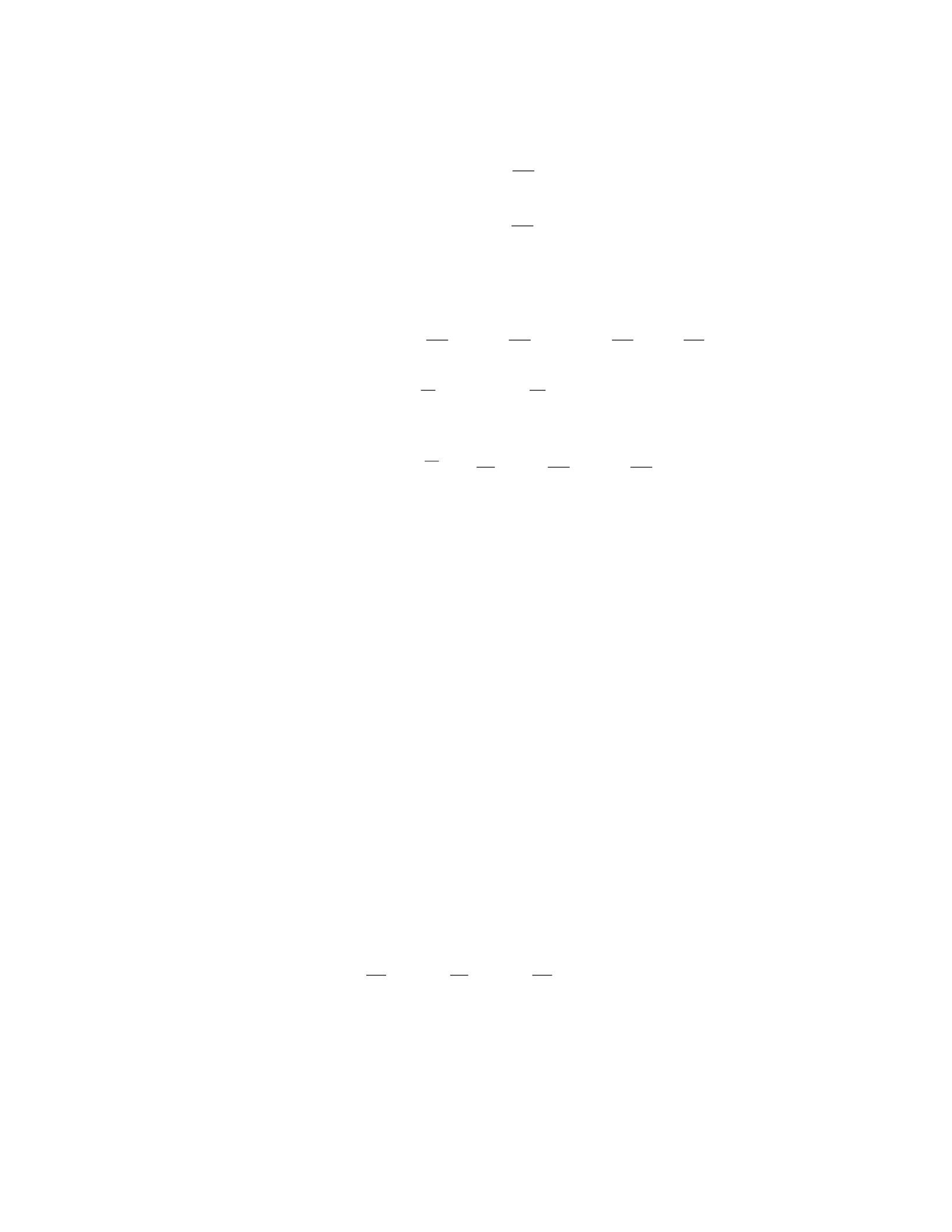
5. Applying the boundary conditions leads to the following solutions for X(x)and Y(y):
X(x) = c3sin(nπ
Lx)
Y(y) = c5sin(nπ
Ly)
where nis a positive integer.
6. Using the initial condition to determine the value of λ, we find
u(x, y, 0) = ∞
∑
n=1
c3n5sin(nπ
Lx)sin(nπ
Ly)=sin(πx
L)sin(πy
L)
Matching coefficients, we find c35 =4
π2and λn= (nπ
L)2.
7. Therefore, the solution to the partial differential equation is
u(x, y, t) = ∞
∑
n=1
e−(nπ
L)2t(4
π2)sin(nπ
Lx)sin(nπ
Ly)
23. Question:
Consider the partial differential equation
ut+ux= 0
subject to the initial condition u(x, 0) = e−x2. Solve the partial differential equation using
the method of characteristics.
Ans. Step-by-step solution:
1. We start by expressing the PDE in terms of the characteristic variables. Letting s=x+t
and r=x, the characteristics are defined by the following system of ODEs:
dx
ds = 1,dt
ds = 1,du
ds = 0
2. Solving the ODEs, we find x=s+c1, t =s+c2, u =c3, where c1, c2, c3are constants.
3. Now, we express the initial condition in terms of the characteristic variables:
u(x, 0) = u(r, 0) = u(s−t, 0) = u(s−s, 0) = u(0) = e−(0)2= 1
Thus, the initial condition gives u= 1 along the characteristic curves.

4. Therefore, the general solution is u(x, t)=1along the characteristic curves represented
by x=t+c1.
Hence, the solution to the given partial differential equation with the initial condition u(x, 0) =
e−x2is u(x, t) = 1.
24. Question 24:
Consider the partial differential equation
∂u
∂t =k(∂2u
∂x2+∂2u
∂y2)
subject to the initial condition
u(x, y, 0) = f(x, y)
and the boundary conditions
u(0, y, t) = u(a, y, t) = u(x, 0, t) = u(x, b, t) = 0
where a, b, k are constants.
Find the solution u(x, y, t)of the partial differential equation.
Ans. Solution:
To solve the partial differential equation, we will use the method of separation of variables.
We assume the solution has the form
u(x, y, t) = X(x)Y(y)T(t)
Substitute this into the given partial differential equation, we have
X(x)Y(y)dT
dt =k(X′′(x)Y T (t) + XY ′′(y)T(t))
Divide both sides by kXT , we get
1
kT
dT
dt =X′′(x)
X(x)+Y′′(y)
Y(y)=−λ2
This gives us two ordinary differential equations:
X′′(x) + λ2X(x) = 0
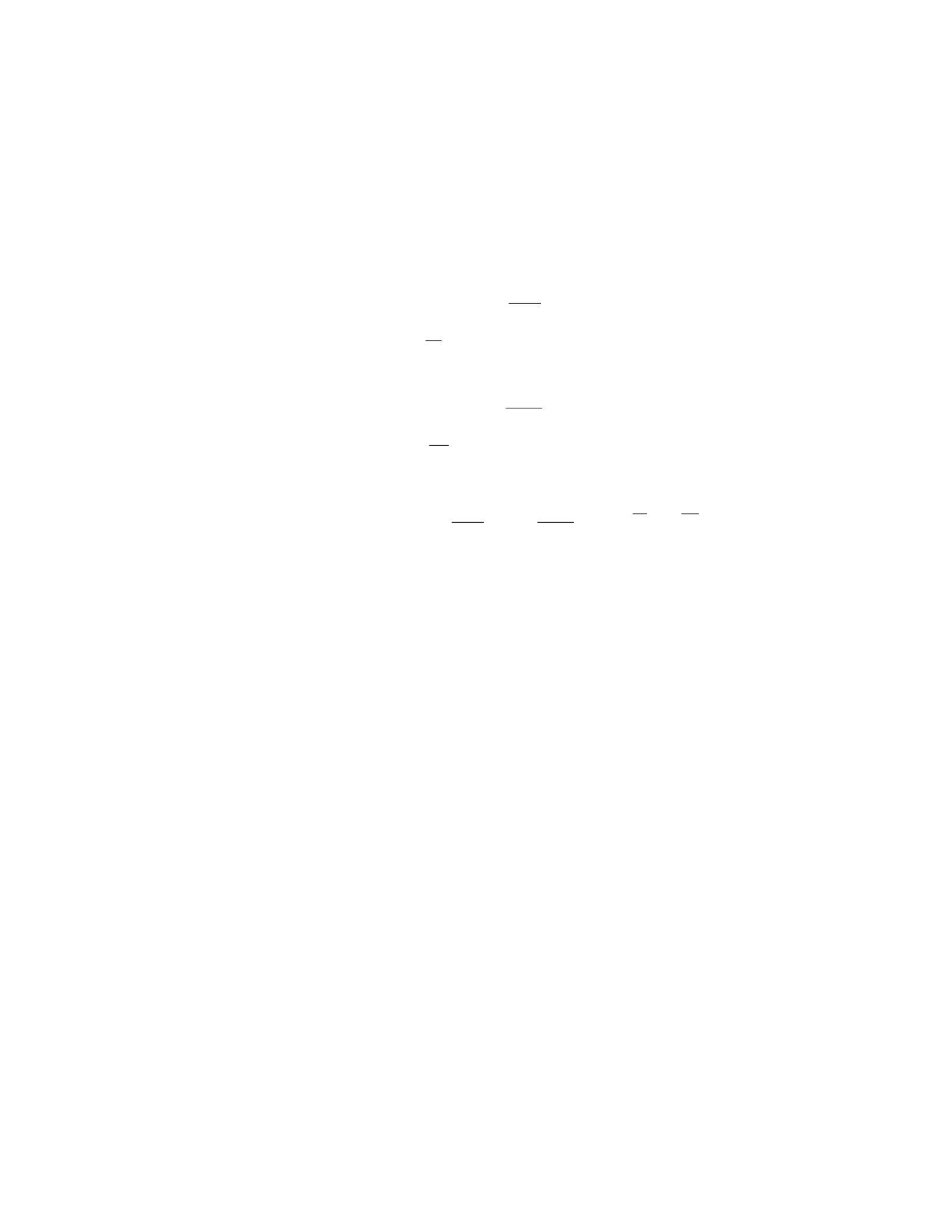
Y′′(y) + λ2Y(y) = 0
with boundary conditions
X(0) = X(a) = Y(0) = Y(b) = 0
The solution to the ordinary differential equation for X(x)is
Xn(x) = sin (nπx
a)
with corresponding eigenvalues λn=nπ
a.
The solution to the ordinary differential equation for Y(y)is
Ym(y) = sin (mπy
b)
with corresponding eigenvalues λm=mπ
b.
Therefore, the general solution to the partial differential equation is
u(x, y, t) = ∞
∑
n=1
∞
∑
m=1
Cnm sin (nπx
a)sin (mπy
b)e−k((nπ
a)2+(mπ
b)2)t
where Cnm are constants determined by the initial condition u(x, y, 0) = f(x, y).
25. Find the general solution to the partial differential equation:
uxx −4uxy + 4uyy = 0
where uis a function of xand y.
Ans. The general solution to the given partial differential equation is
u(x, y) = F(x+ 2y) + G(x−2y)
where Fand Gare arbitrary functions.

26. Find the general solution to the following partial differential equation:
uxx −4uxy + 4uyy = 0
Ans. Solution: 1. We start by defining the auxiliary equation for the given partial differential
equation:
r2−4rs + 4s2= 0
2. We can rewrite the auxiliary equation as:
(r−2s)2= 0
3. This gives us a repeated root r= 2s. Therefore, the general solution to the PDE is of the
form:
u(x, y) = x2F(y−2x) + G(y−2x)
where Fand Gare arbitrary functions of their respective arguments.
4. Thus, the general solution to the given partial differential equation is:
u(x, y) = x2F(y−2x) + G(y−2x)
27. Question 27: Solve the partial differential equation given by
∂2u
∂x2+∂2u
∂y2= 0
subject to the boundary conditions u(0, y) = y3and u(x, 0) = x3.
Ans. Solution: 1. We can try to solve this partial differential equation using the method of
separation of variables. Let u(x, y) = X(x)Y(y). Substitute this into the PDE to get:
X′′(x)Y(y) + X(x)Y′′(y) = 0
2. Divide both sides by X(x)Y(y)to separate the variables:
X′′(x)
X(x)=−Y′′(y)
Y(y)
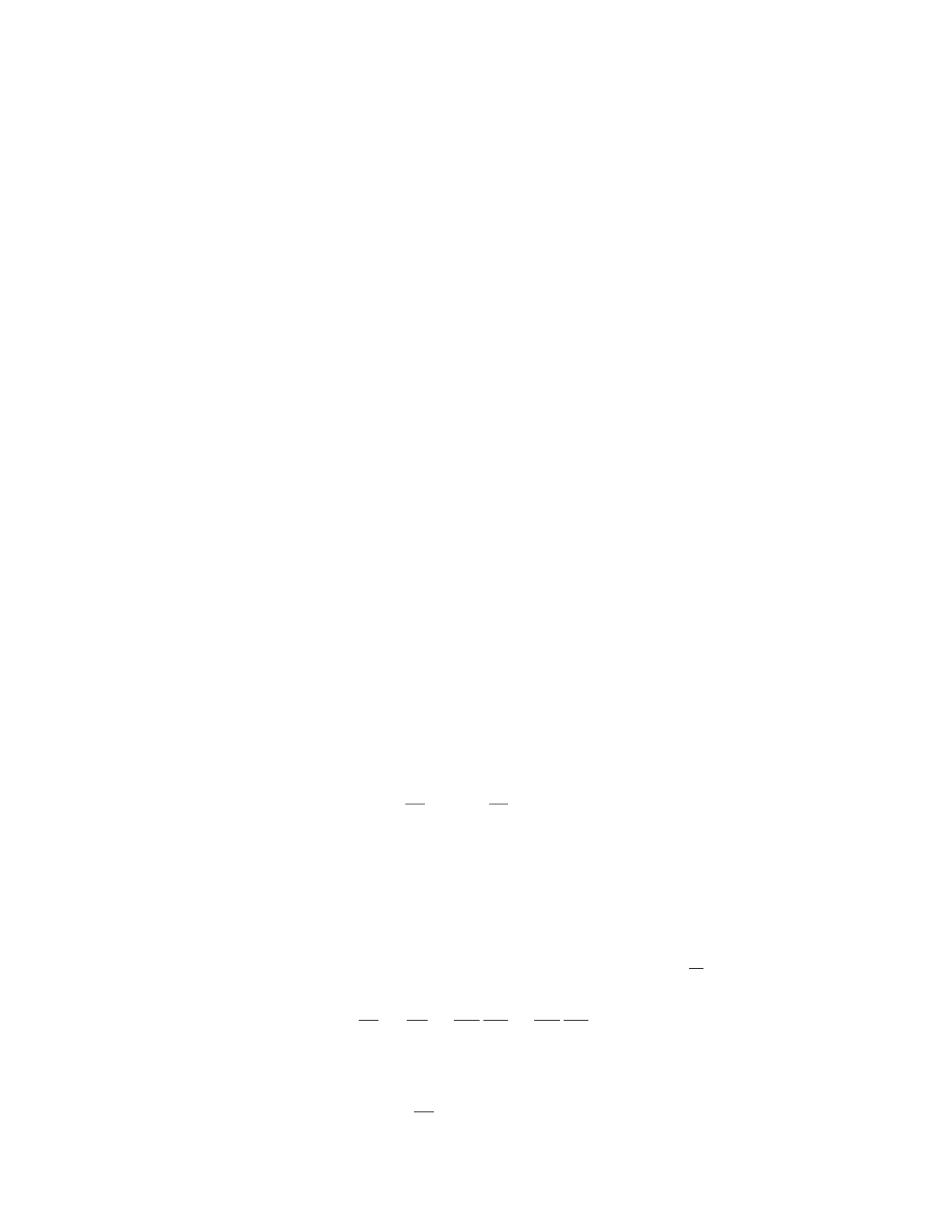
3. Setting both sides equal to a constant −k2, we get two ODEs:
X′′(x) + k2X(x) = 0 and Y′′(y) + k2Y(y) = 0
4. The solution to the ODE X′′(x) + k2X(x) = 0 is X(x) = c1cos(kx) + c2sin(kx).
5. The solution to the ODE Y′′(y) + k2Y(y) = 0 is Y(y) = c3eky +c4e−ky.
6. General solution is given by u(x, y) = ∑∞
n=1 ∑∞
m=1 cn,m sin(nπx)sin(mπy).
7. Apply the boundary conditions u(0, y) = y3and u(x, 0) = x3to find the values of the
coefficients cn,m. Applying u(0, y) = y3, we get:
y3=∞
∑
n=1
cn,m sin(nπ ·0) sin(mπy) = 0
8. This implies that cn,m = 0 for all n= 1.
9. Thus, the solution to the given partial differential equation subject to the boundary
conditions is u(x, y) = c1,1sin(πx)sin(πy).
28. Question 28: Solve the partial differential equation uxx + 2uxy +uyy = 0 subject to the
initial condition u(x, y) = ex+yat x= 0.
Ans. Solution: 1. We begin by finding the characteristic equation associated with the given
partial differential equation. Let p=dx/dt and q=dy/dt. Then, the characteristic equations
are given by
dx
dt = 1,dy
dt = 2.
Integrating both equations, we have x=t+c1and y= 2t+c2. 2. Next, we express u(x, y)in
terms of the variables t,c1, and c2using the original initial condition u(x, y) = ex+y. Substituting
x=t+c1and y= 2t+c2, we have
u(t, c1, c2) = et+c1+2t+c2=e3t+c1+c2.
3. Now, we differentiate uwith respect to tto obtain the total derivative du
dt . Using the chain
rule, we have du
dt =∂u
∂t +∂u
∂c1
dc1
dt +∂u
∂c2
dc2
dt .
Since u(t, c1, c2) = e3t+c1+c2, we find that
du
dt = 3e3t+c1+c2.
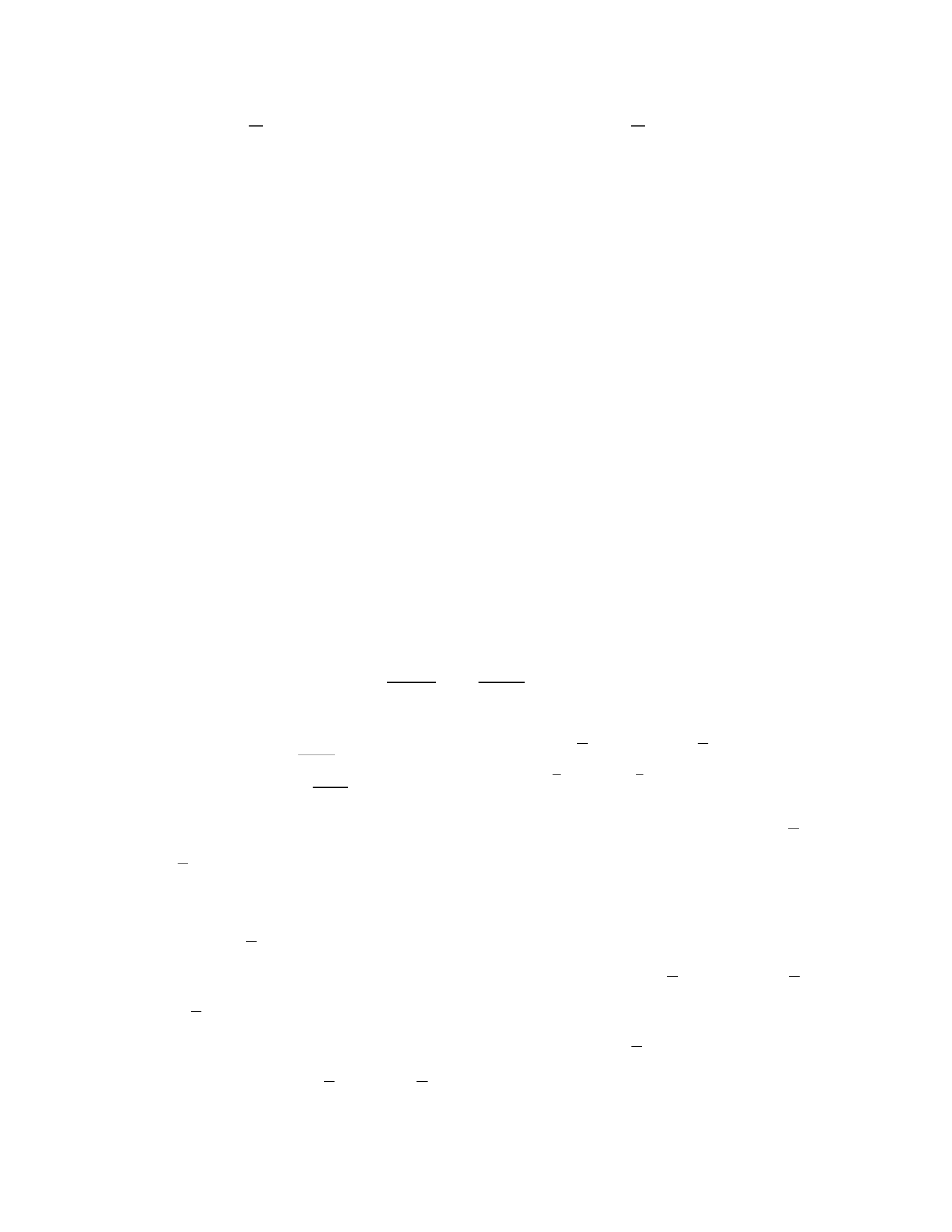
4. By comparing du
dt with the characteristic equations, we find that du
dt = 3u. Thus, the general
solution to the partial differential equation is u(t, c1, c2) = Ce3t+c1+c2. 5. Finally, using the initial
condition u(x, y) = ex+yat x= 0, we have u(0,0) = e0=C·e0, where Cis a constant.
Therefore, C= 1 and the solution to the partial differential equation is u(x, y) = e3t+c1+c2=
e3x+2y.
29. Question: Solve the partial differential equation uxx +uyy = 0 subject to the boundary
conditions u(x, 0) = x2and u(x, 1) = x.
Ans. Step-by-step solution:
1. We start by assuming the solution can be written as u(x, y) = X(x)Y(y). Substituting
this into the given PDE uxx +uyy = 0, we have:
X′′(x)Y(y) + X(x)Y′′(y) = 0.
2. Dividing by X(x)Y(y), we get:
X′′(x)
X(x)=−Y′′(y)
Y(y)=λ,
where λis a constant.
3. Solving the ODE X′′(x)
X(x)=λgives us X(x) = Acos(√λx)+Bsin(√λx).
4. Solving the ODE −Y′′(y)
Y(y)=λgives us Y(y) = Ce√λy +De−√λy .
5. Applying the boundary condition u(x, 0) = x2, we have X(x)Y(0) = x2. Substituting
Y(0) into this equation, we get X(x)C=x2. Thus, C= 0 and X(x) = Acos(√λx)+
Bsin(√λx).
6. Applying the boundary condition u(x, 1) = x, we have X(x)Y(1) = x. Substituting
Y(1) into this equation and the result from step 5, we get X(x)D=x. Thus, D= 0 and
X(x) = Acos(√λx).
7. Therefore, the general solution is given by u(x, y) = (Acos(√λx))(Bsinh(√λy)+
Ccosh(√λy)), where Band Care constants to be determined.
8. Using the fact that u(x, 0) = x2, we get u(x, 0) = Acos(√λx)C=x2. Since C= 0,
we have u(x, y) = Acos(√λx)sinh(√λy).

9. Applying the boundary condition u(x, 1) = x, we get Acos(√λx)sinh(√λ)=x. This
implies that √λ=(2n+1)π
2, where nis a non-negative integer.
10. Therefore, the final solution to the partial differential equation uxx +uyy = 0 subject to
the boundary conditions u(x, 0) = x2and u(x, 1) = xis:
u(x, y) = ∞
∑
n=0
cncos ((2n+ 1
2π)x)sinh ((2n+ 1)π
2y),
where cnare constants determined by the initial conditions.
30. Question 30: Solve the following partial differential equation (PDE) using the method of
separation of variables:
ut= 4uxx
subject to the initial condition u(x, 0) = sin(x)and the boundary conditions u(0, t) = 0 and
u(π, t) = 0.
Ans. Step-by-step solution:
1. Separation of Variables:
We assume the solution to the PDE can be written as a product of two functions of xand t:
u(x, t) = X(x)T(t)
Substitute this into the PDE to get:
X(x)T′(t) = 4X′′(x)T(t)
Divide both sides by u(x, t) = X(x)T(t)to separate variables:
T′(t)
4T(t)=X′′(x)
X(x)=−λ
This results in two ordinary differential equations:
X′′(x) + λX(x) = 0
T′(t)+4λT (t) = 0
2. Solving the ODE with Boundary Conditions:

Solving the first ODE with the boundary conditions u(0, t) = 0 and u(π, t) = 0 requires:
X′′(x) + λX(x) = 0
X(0) = 0, X(π) = 0
The general solution to the ODE is:
X(x) = Asin(√λx)+Bcos(√λx)
Applying the boundary conditions gives:
X(0) = 0 =⇒B= 0
X(π) = 0 =⇒Asin(√λπ)= 0
Since A= 0, we must have sin(√λπ)= 0, which implies √λ=nfor an integer n. So
λ=n2.
Thus, the eigenfunctions are:
Xn(x) = Ansin(nx)
3. Solving the Time ODE:
The time ODE becomes:
T′(t)+4n2T(t) = 0
Solving this gives:
T(t) = Cne−4n2t
4. Final Solution:
Combining the separated solutions gives the general solution:
u(x, t) = ∞
∑
n=1
Ane−4n2tsin(nx)
5. Applying Initial Condition:
Applying the initial condition u(x, 0) = sin(x)gives:
u(x, 0) = ∞
∑
n=1
Ansin(nx) = sin(x)
From which we can determine that An=2
π(by Fourier sine series).
Therefore, the solution to the PDE is:
u(x, t) = 2
π
∞
∑
n=1
e−4n2tsin(nx)

