


CHAPTER I
INTRODUCTION
The National Council of Teachers of Mathematics (2000) stressed the importance
of technology as an essential tool in mathematics classrooms because it can impact how
teachers teach mathematics and improve students’ mathematics learning. Digital math
games are a form of technology that can enhance mathematics learning (Falloon, 2013;
Ke & Abras, 2013; Moyer-Packenham, Lommatsch, et al., 2019). Preservice teachers
benefit from experiences using digital math games during their preparation programs to
understand how digital games can enhance student learning (Meletiou-Mavrotheris &
Prodromou, 2016; Sardone & Devlin-Scherer, 2010; Shah & Foster, 2015). It is important
for preservice teachers to observe and experience effective uses of digital math games for
instruction and evaluate digital games for teaching mathematics (Li, 2013). When
preservice teachers have experiences with digital math games, they can critically evaluate
the games because they gain awareness of specific features (e.g., feedback, content
topics, rules) that support learning (Meletiou-Mavrotheris & Prodromou, 2016).
Language awareness is important when preparing preservice teachers to teach
specific content areas, such as mathematics, especially language awareness for working
with English language learners (ELLs; Andrews, 2007). Academic language features in
mathematics include mathematical symbols, oral and written language, and visual
representations (e.g., graphs and tables; Schleppegrell, 2007). When teachers are aware of
these academic language features while planning mathematics instruction, they can better
communicate concepts and select materials to enhance instruction (Lindahl, 2019). This

2
suggests that when preservice teachers are aware of academic language features, they can
select digital math games as a material to enhance mathematics instruction.
Background of the Problem
Preservice teachers’ beliefs can impact how they use digital math games in
mathematics classrooms. Researchers have reported that preservice teachers find digital
games useful when aligned with curriculum content (Li, 2013; Sardone & Devlin-
Scherer, 2010). These beliefs about digital math games can influence how preservice
teachers use digital math games during mathematics instruction. Preservice teachers are
more likely to use digital math games when they have positive beliefs that digital math
games can support student learning (Li, 2013; Sardone & Devlin-Scherer, 2010).
Preservice teachers’ beliefs about teaching ELLs can also impact how they deliver
mathematics instruction. When teachers believe they are better prepared in mathematics
content knowledge, they also believe they are better prepared to understand how
language interconnects with mathematics (McLeman & Fernandes, 2012). Teacher
language awareness helps teachers better analyze materials to enhance instruction
(Andrews, 2001, 2007; Lindahl, 2013, 2019). This means that teacher language
awareness can help preservice teachers identify academic language features in digital
math games to support mathematics learning for ELLs. Mathematical language is an
important feature in digital math games (Ke, 2013; Moyer-Packenham, Litster, et al.,
2019). For example, Moyer-Packenham, Litster, et al. (2019) found that when students
used specific mathematics language (e.g., terminology such as “equilateral,” “decimal,”

3
or “one-fourth”) when interacting with digital math games, students had significant
learning gains from pretest to posttest. This shows that language can mediate learning
mathematics in digital math games. Additionally, the use of formal and informal
language in digital math games can impact mathematics understanding (Ke, 2013).
Therefore, language in digital math games can impact students’ understanding of
mathematics concepts. Furthermore, preservice teachers benefit from experiences with
choosing and evaluating digital math games based on academic language features
because the language used in the games can support students’ mathematics learning.
Design features in digital math games impact children’s mathematics learning
(Falloon, 2013; Ke & Abras, 2013; Moyer-Packenham, Lommatsch, et al., 2019). Design
features in a digital math game can impact students’ understanding of mathematics
concepts. For example, when a design feature, like a linked representation, is in a digital
math game, students link multiple mathematical representations, which leads to improved
mathematics learning (Moyer-Packenham, Lommatsch, et al., 2019). Therefore, if
preservice teachers are aware of design features, they can be better prepared to choose
and evaluate digital math games that promote mathematics learning.
To improve awareness of design features and academic language features,
preservice teachers need experiences choosing and evaluating digital math games that can
support mathematics learning for ELLs (Coady et al., 2011). The experiences preservice
teachers have with choosing and evaluating digital games can impact the beliefs and
practices preservice teachers bring to the classroom (Belbase, 2015; Sardone & Devlin-
Scherer, 2010; Shah & Foster, 2015). Thus, preservice teachers’ awareness and beliefs

4
about design features and academic language features can influence the way they use
digital games to enhance instruction for ELLs in mathematics.
Statement of the Problem
Preservice teachers’ experiences in their preparation courses can impact their
beliefs about using digital math games to enhance instruction for ELLs. Providing
experiences with technology in preparation courses, specifically with digital games, can
better prepare preservice teachers to choose digital math games that enhance students’
mathematics learning (Meletiou-Mavrotheris & Prodromou, 2016; Sardone & Devlin-
Scherer, 2010; Shah & Foster, 2015). Through these experiences, preservice teachers
become aware of what design features (i.e., game attributes) in digital games can promote
learning. However, preservice teachers have limited experience integrating digital math
games into mathematics instruction (Belbase, 2015; Niess, 2005). There is limited
research on how to promote preservice teachers’ awareness of design features. Therefore,
there is a need to understand further what promotes preservice teachers’ awareness of
design features in digital math games.
Preservice teachers have reported being underprepared to teach ELLs in
mainstream classrooms (Durgunoglu & Hughes, 2010; Lindahl, 2013, 2019; Reeves,
2006). To better prepare preservice teachers, Andrews (2007) and Lindahl (2013, 2019)
suggest that teachers develop an awareness of language within content materials (e.g.,
digital math games) to improve instruction for ELLs. Mathematics has many semiotic
systems (e.g., symbols, visual representations) and grammatical patterns (e.g., academic

5
vocabulary, dense noun phrases) that require an understanding of how different elements
of language interact to make mathematical meaning (Schleppegrell, 2007). The language
used in mathematics is complex and requires understanding subtle differences in the
meaning of specific terms that can impact mathematics instruction and learning, such as
the academic language features in digital math games. This suggests that preservice
teachers could benefit from understanding how language enhances or hinders learning
when students interact with digital math games. There is a body of research that examines
teacher language awareness for language teachers (Lindahl, 2013, 2019). However, there
is limited research on how teacher language awareness in mathematics can impact
students’ mathematics learning and how it can enhance mathematics instruction for
ELLs.
Taken together, each of these factors may leave many preservice teachers feeling
underprepared in their awareness of design features and academic language features to
choose effective digital math games for ELLs. With preservice teachers feeling
underprepared to teach ELLs and use digital math games in mathematics instruction, and
the complex use of language in teaching mathematics, there is a need to better understand
effective strategies that may support the preparation of preservice teachers in developing
their awareness and beliefs.
Significance of the Problem
How preservice teachers choose and evaluate digital math games for ELLs is
important because it has implications for how to better prepare preservice teachers to

6
choose digital math games that support mathematics learning for ELLs. Understanding
how preservice teachers develop awareness and beliefs about design features and
academic language features, and beliefs about using digital math games to enhance
mathematics instruction for ELLs can benefit instructors who teach preparation courses.
For example, suppose findings indicated preservice teachers increased their awareness of
design features and academic language features by evaluating digital math games. In that
case, instructors may include these types of experiences in preparation courses.
Research on design features and academic language features in digital math
games has important implications for game designers. For example, if findings show
there is a lack of design features and academic language features that support
mathematics learning for ELLs, game designers may include these types of features in
future digital math games.
Purpose of the Study
The purpose of this study was to examine how preservice teachers developed
awareness and beliefs about design features and academic language features when
choosing and evaluating digital math games for ELLs. To address this purpose, I
developed learning modules to enhance preservice teachers’ awareness of design features
and academic language features in digital math games. I also examined preservice
teachers’ beliefs about using digital math games to support mathematics learning for
ELLs.
Design features in digital math games can promote mathematics learning

7
(Falloon, 2013; Ke & Abras, 2013; Moyer-Packenham, Lommatsch, et al., 2019).
Because research that shows the important impacts of design features on student learning
has emerged recently, there needs to be more understanding of how this new research
helps prepare preservice teachers to choose and evaluate digital math games based on
effective design features. Similarly, few studies examine the language awareness of
preservice teachers when choosing digital math games for ELLs. Recent research
findings indicate that it would be beneficial for preservice teachers to have experiences in
choosing and evaluating digital math games to prepare them to choose effective games
when they begin teaching in mathematics classrooms. This suggests that preparation
programs have room to improve instruction for preservice teachers on how to effectively
enhance mathematics instruction while using digital math games with ELLs.
There has been a movement in education to improve language awareness among
students and teachers, which involves analyzing and describing language to better use
academic language in educational settings (Andrews, 2007). Teacher language awareness
is important for teachers to analyze content material used during instruction, such as
digital math games (Lindahl, 2013, 2019). This means that preservice teachers need to be
aware of complex language systems in mathematics to better choose and evaluate digital
math games.
Research Questions
The overarching research question that guided this study was: How do preservice
teachers develop awareness and beliefs about design features and academic language

8
features when choosing and evaluating digital math games for English language learners
(ELLs)? The main research questions of the study were as follows.
1. What are preservice teachers’ awareness and beliefs about design features
when choosing and evaluating digital math games for ELLs, and what
changes, if any, are exhibited after completing the learning modules?
2. What are preservice teachers’ awareness and beliefs about academic language
features when choosing and evaluating digital math games for ELLs, and what
changes, if any, are exhibited after completing the learning modules?
3. What are preservice teachers’ beliefs about their preparation for using digital
math games to support mathematics learning for ELLs, and what changes, if
any, are exhibited after completing the learning modules?
Summary of the Research Study Design
In order to explore how preservice teachers chose and evaluated digital math
games to support mathematics learning for ELLs, I employed a convergent mixed
methods design (Creswell & Plano Clark, 2017). I used qualitative and quantitative data
to analyze how preservice teachers chose and evaluated digital math games for ELLs.
The qualitative data had a prominent emphasis in this study, and the quantitative data
were supplemental to the qualitative data during merging and interpretation. This allowed
me to understand how preservice teachers developed awareness and beliefs about design
features and academic language features when choosing and evaluating digital math
games for ELLs. Twenty-one elementary preservice teachers from one university
participated in this study. I collected the data for this study using online methods over a
4-week time period. I used the following instruments: Preservice Teachers’ Beliefs about
Preparation with Digital Math Games for ELLs Survey, Digital Math Game Evaluation
Rubric, Module Reflections, and semistructured interviews. My data analysis included a

9
multi-phase process using descriptive coding, pattern coding, frequency tables, bar
graphs, a Wilcoxon signed ranked test, and a narrative comparison.
Definitions of Terms
Academic language features: “The oral and written text required to succeed in
school that entails deep understanding and communication of the language of content
within a classroom environment; revolves around meaningful application of specific
criteria related to Linguistic Complexity in the discourse dimension, Language Forms and
Conventions in the sentence dimension, and Vocabulary Usage in the word/phrase
dimension within the particular context in which communication occurs” (WIDA, 2012,
p. 124).
Awareness: The underlying relationships between what is being experienced and
what has been experienced (e.g., awareness includes knowledge and concepts; Marton &
Booth, 1997).
Design beatures: Game attributes that can determine learning potential in digital
games (Bedwell et al., 2012); elements (e.g., feedback, hints, linked representations) that
are programmed to determine how a game functions (Boyer-Thurgood, 2017).
Digital math games: Games that are designed experiences for children to learn
mathematics on a digital platform (e.g., computers, tablets, smartphones; Squire, 2006).
English language learners (ELLs): “Linguistically and culturally diverse students
who have been identified (by a WIDA screener and other placement criteria) as having
levels of English language proficiency that require language support to achieve grade-

10
level content in English” (WIDA, 2012, p. 111).
Teacher beliefs: “The information, attitudes, values, expectations, theories, and
assumptions about teaching and learning that teachers build over time and bring with
them to the classroom” (Richards, 1998, p. 66).
Teacher language awareness: “Knowledge that teachers have of the underlying
systems of the language that enables them to teach effectively” (Thornbury, 2017, p. xv).

11
CHAPTER II
LITERATURE REVIEW
There is a need to better understand effective strategies that prepare preservice
teachers to develop an awareness of design features and academic language features
when choosing and evaluating digital math games to enhance instruction for ELLs
because preservice teachers feel underprepared to teach ELLs (Durgunoglu & Hughes,
2010; Lindahl, 2013, 2019; Reeves, 2006) and have limited experiences with integrating
digital math games in mathematics instruction (Belbase, 2015; Niess, 2005). This study
examined how preservice teachers developed awareness and beliefs about design features
and academic language features when choosing and evaluating digital math games for
ELLs.
This chapter reviews the theoretical underpinnings and empirical research
relevant to the current study. First, this chapter presents the conceptual framework of the
three premises examined in this study. The second part of the chapter examines the
research literature about preservice teachers’ awareness and beliefs about design features
in digital math games. The third section examines research literature about preservice
teachers’ awareness and beliefs about academic language features in digital math games
for ELLs. The fourth section examines research literature on preservice teachers’ beliefs
about their preparation for using digital math games for instruction and about teaching
ELLs. The chapter concludes by discussing the study’s contributions to the current body
of research about preservice teachers’ awareness and beliefs about design and academic
language features when choosing and evaluating digital math games for ELLs.

12
This research study used the term English language learners (ELLs) defined as
“linguistically and culturally diverse students who have been identified (by a WIDA
screener and other placement criteria) as having levels of English language proficiency
that require language support to achieve grade-level content in English” (WIDA, 2012, p.
111). This terminology is currently used when preparing preservice teachers for working
with diverse learners. While terminology, such as multilingual, bilingual, and emergent
bilingual, have gained traction in the research literature to describe linguistically diverse
learners through an asset-oriented lens, the National Education Association continues to
use the term ELLs in their advocacy for ELLs to receive quality education and address
strategies teachers need to meet the linguistic needs of linguistically diverse students
(National Education Association, 2011). This term is also used among mathematics
education researchers (e.g., Aguirre & Zavala, 2012; Moschkovich, 2013; Turken &
Jong, 2018), making it an appropriate term for describing the linguistically diverse
students referred to in this study.
This study used the term awareness as the underlying relationships between what
is being experienced and what has been experienced (e.g., including knowledge and
concepts; Marton & Booth, 1997). Marton and Booth explain awareness as a structure
impacted by a person’s understanding of a concept and how they can relate previous
knowledge with current experiences. This means that awareness is not forming new
knowledge but is related to the types of knowledge a person brings to an experience.
Therefore, this study focuses on preservice teachers’ awareness of design features and
academic language features and does not focus on measuring new knowledge that

13
preservice teachers might gain during the study.
Conceptual Framework
This study examined how preservice teachers developed awareness and beliefs
about design features and academic language features when choosing and evaluating
digital math games for ELLs. Figure 1 shows the conceptual framework and how these
constructs connect. The conceptual framework frames the three important premises that
may impact how preservice teachers choose and evaluate digital math games to enhance
mathematics instruction for ELLs. The first premise in the conceptual framework is that
preservice teachers’ awareness and beliefs about design features in digital math games
can impact their choices of specific games selected for ELLs. The second premise is that
preservice teachers’ awareness and beliefs about academic language features in digital
math games can impact their choices of effective digital math games for ELLs. The third
premise is that preservice teachers’ beliefs about using digital math games for instruction
and teaching ELLs can impact their choices about whether or not to use the games in
mathematics instruction. Other factors likely impact the selection of digital math games
for enhancing mathematics instruction for ELLs (e.g., motivation). However, this study
focuses on these three premises that form the relationships that lead to preservice
teachers’ selection of a digital math game for enhancing mathematics instruction for
ELLs. It is important to note that I recognize that language overlaps between design
features and academic language features. For example, written or auditory language can
be feedback, a specific design feature in digital math games. However, the premises for

14
Figure 1
Relationships Between Preservice Teachers’ Awareness and Beliefs about Design
Features and Academic Language Features, and Their Beliefs about Preparation, when
Preservice Teachers Choose Digital Math Games for ELLs
this study examined design features and academic language features separately because
they have specific characteristics, as described in the sections below.
The arrows in the conceptual framework show how the three constructs may
impact how preservice teachers choose digital math games for ELLs. The top arrow
shows how preservice teachers’ awareness and beliefs about design features can impact

15
how they choose digital math games for ELLs. The middle arrow shows that preservice
teachers’ awareness and beliefs about academic language features can impact how they
choose and evaluate digital math games for ELLs. The bottom arrow shows that teacher
beliefs about their preparation can influence how they choose and evaluate digital math
games for ELLs by the experiences preservice teachers have with using digital math
games and teaching ELLs mathematics in their preparation courses. Each element of the
conceptual framework emerged from the literature, as described in detail in the following
sections.
Awareness and Beliefs about Design Features
Awareness and beliefs about design features are grounded in Mishra and
Koehler’s (2006) theory of Technological Pedagogical Content Knowledge (TPACK),
which preservice teachers may bring to this study. Figure 2 shows the TPACK
framework. There are three components of TPACK: content, pedagogy, and technology.
Mishra and Koehler (2006) identified each component to show how content,
pedagogy, and technology connect to teacher understanding and successful integration of
technology in the classroom setting. Content refers to the content knowledge (CK)
teachers have about the subject matter they teach. Pedagogy refers to the pedagogical
knowledge (PK) that teachers have that provides an understanding of the learning process
in the subject matter. When Content knowledge and pedagogical knowledge overlap,
there is pedagogical content knowledge (PCK) which means teachers understand how to
use teaching strategies to meet the needs of their students and promote a deep

16
Figure 2
Technological Pedagogical Content Knowledge (TPACK) Framework
Note. Adapted from Mishra and Koehler (2006).
understanding of the subject matter. Technology refers to teachers’ technology
knowledge (TK) about using the technology themselves. When teachers can relate
technology knowledge and content knowledge, they have technological content
knowledge (TCK), meaning they understand how the technology can change the subject
content (e.g., provide representations that are not available without technology). Teachers
have technological pedagogical knowledge (TPK) when they relate their understanding of
technology and pedagogical knowledge. This means teachers understand that teaching
strategies will change as they integrate a technological tool. Finally, when a teacher has
an “understanding of the complex relationships between technology, content, and
pedagogy, and using this understanding to develop appropriate, context-specific

17
strategies and representations” (Mishra & Koehler, 2006, p. 1029), then the teacher has
TPACK knowledge and can integrate technology in meaningful ways to enhance learning
for students.
The TPACK theory has been used to conduct research with preservice teachers to
assess their knowledge of using technology for classroom instruction (Gutiérrez-Fallas &
Henriques, 2021; Lachner et al., 2021; Lux et al., 2011; Schmidt et al., 2009). For
example, Lux et al. created a Preservice Teacher-Technological Pedagogical Content
Knowledge Survey to assess 120 preservice teachers’ perceptions and understanding of
TPACK. The survey results showed that preservice teachers’ responses had lower TPK
scores. Lux et al. suggested that these low response scores may be due to their lack of
experience integrating technology into instruction. In another study, Lachner et al.
reported that when 208 secondary preservice teachers participated in a study, the
experiment group (N = 88) outperformed the control group (N = 120) in TPACK
knowledge and had higher self-efficacy in using technology to enhance instruction after
participants interacted with TPACK learning modules. These findings are important to
the current study because it shows that the experiences preservice teachers have with
choosing and evaluating digital math games may increase their awareness of design
features, leading to better approaches for integrating digital math games for instruction.
TPACK was used as an interpretive lens to examine how 13 preservice teachers
evaluated multiple digital math games using two different rubrics and then to understand
how preservice teachers planned, taught, and reflected on a mathematics lesson using the
games they evaluated with the rubrics (Meletiou-Mavrotheris & Prodromou, 2016).

18
Results of this study showed that the prior training and awareness helped preservice
teachers better understand how to use TPACK to choose digital math games and
effectively integrate them into mathematics lessons. This finding is important to the
current study because it demonstrates that preservice teachers’ prior experiences with
evaluating digital games, and their experiences using TPACK in their methods courses,
can strengthen their awareness of design features and academic language features to
choose and evaluate digital math games effectively and to ensure that preservice teachers
are better able to integrate digital math games in mathematics lessons successfully.
TPACK is a broad framework that focuses on general technology, which has led
to a framework to include specificity on Technological Pedagogical Content Knowledge
for games (TPACK-G; Hsu et al., 2013, 2017, 2020). TPACK-G includes teachers’ game
knowledge (GK), which is the knowledge of playing games; teachers’ game pedagogical
knowledge (GPK), which is about how to appropriately use teaching methods to integrate
games in instruction; teachers’ game content knowledge (GCK), which focuses on how
games represent content; and teachers’ game pedagogical content knowledge (GPCK),
which includes how teachers use pedagogy and knowledge of games to integrate digital
games into instruction appropriately.
The TPACK-G framework research has focused on in-service teachers in the
elementary setting (Hsu et al., 2013, 2017, 2020). For example, Hsu et al. (2020) reported
that 376 in-service elementary school teachers completed a survey about their TPACK-G
knowledge. This study reported that novice teachers were significantly more positive
toward their perceptions of TPACK-G knowledge than veteran teachers. The authors of

19
this study suggested that novice teachers had more preparation for integrating technology
during their preparation program, which could explain the difference in novice teachers’
beliefs compared to teachers who had been teaching longer and did not receive such
preparation. The TPACK-G literature is important to the current study because it
provides a framework that suggests that positive beliefs can impact preservice teachers’
confidence in integrating games into mathematics instruction for ELLs. The findings of
this research are also important to the current study because they suggest that preservice
teachers’ experiences in their preparation may contribute to such beliefs.
Squire (2006) explained that educational games are “designed experiences” for
learning. This study defined digital math games as designed experiences for children to
learn mathematics on a digital platform (e.g., computers, tablets, smartphones). Digital
math games are designed experiences that include design features, defined as game
attributes that can determine learning potential in digital games (Bedwell et al., 2012).
Design features elements (e.g., feedback, hints, linked representations) are programmed
into the games that determine how the game functions (Boyer-Thurgood, 2017). Current
research has examined how design features (e.g., characteristics) can enhance content
understanding (Callaghan & Reich, 2018; Gresalfi et al., 2018; Moyer-Packenham,
Lommatsch, et al., 2019). It is important to note that language features in a digital game
overlap with the other design features in the digital game, making it difficult to separate
the two elements. For example, language can provide hints for students to complete a task
within a digital math game accurately. The characteristics of specific academic language
features in this study focus on the specific academic mathematical language used in

20
digital math games, as described in a later section of this chapter.
Research by Moyer-Packenham, Lommatsch, et al. (2019) identified eight design
features that promote mathematical understanding after 193 elementary-aged children
played 12 digital math games. These features include accuracy feedback, progressive
levels, multiple attempts, hints, focused constraint, game efficiency, linked
representations, and linked physical actions. Another study with 100 children ages 4-8
reported that features such as incentives (e.g., coins or points for correct answers),
application themes (e.g., characters), and open-ended tasks promoted children’s
engagement with the mathematics in the games (Watts et al., 2016). These findings
suggest it is important to be aware of design features in digital math games when
examining how a game aligns with mathematics learning outcomes. Based on these
findings, this research relates to the current study by positing that preservice teachers
should be aware of design features when choosing and evaluating digital math games.
Design features in digital math games can help or hinder children’s mathematics
learning (Falloon, 2013; Ke & Abras, 2013; Moyer-Packenham et al., 2020; Moyer-
Packenham, Lommatsch, et al., 2019). For example, Ke and Abras reported that middle
school-aged children in an algebra class interacted with digital math games, and certain
features (e.g., clear learning goals, rewards, open-ended challenges) improved
engagement for learning the concepts in the game. Similarly, Falloon reported that when
games had certain features (e.g., scaffolding, corrective feedback, the balance of
education and entertainment), students maintained thoughtful engagement throughout
their gameplay. Moyer-Packenham et al. (2020) conducted a study with 193 elementary-

21
aged students, where students identified design features that helped or hindered their
learning in the digital math game. A design feature a student reported as hindering their
learning was a linked physical action because the student found it difficult to move the
object on the screen to complete the mathematics task. This suggests that features in
digital math games can promote or hinder mathematics understanding by engaging
students in playing digital math games, leading to impacts on learning. Therefore,
preservice teachers need awareness of how features can promote or hinder engagement to
enhance mathematics learning in digital math games.
Feedback is an important design feature to be aware of when examining digital
math games. Boyer-Thurgood (2017) defined feedback features as “clues the app
provides following a user response that let the user know about the accuracy of their
response or how to proceed” (p. 77). Using this definition, she identified six types of
feedback features (e.g., auditory, visual, text, immediate, delayed, and requested) that can
influence learning in digital math games. Falloon (2014) reported on children’s use of
feedback features in 45 apps and found that when feedback features only had visual or
audio support (i.e., points, score, or character actions), they were less effective than
corrective feedback (i.e., tutorials). In other studies, the timing of feedback (immediate or
delayed) influenced a child’s success in a given task (Clariana et al., 2000; Hattie &
Timperley, 2007; Sedig & Liang, 2006; Shute, 2008). For example, immediate feedback
was best at a process level, while delayed feedback was more effective at a task level
(Hattie & Timperley, 2007). These findings relate to the current study by showing that
feedback features are important to be aware of when choosing digital math games

22
because they can impact mathematics learning outcomes. Thus, preservice teachers need
to be aware of feedback as an important design feature that can impact learning. The
body of research on design features is important to the current study by informing which
design features preservice teachers should be aware of when choosing and evaluating
digital math games for ELLs and which features the design of the modules should include
in this study.
Using representations in a digital math game in the game’s design features can
promote mathematics understanding. Representations are signs, objects, or characters
representing something (Goldin, 2003). Research shows that the effective use of
mathematical representations in a digital math game can impact student learning
outcomes (Castellar et al., 2015; Denham, 2015; Sedig, 2008; Siew, 2018). When
students link representations in digital math games or physical actions with digital math
games, their understanding of mathematics improves (Moyer-Packenham, Lommatsch, et
al., 2019). For example, Avraamidou et al. (2012) reported that the physical actions of
manipulating objects on a computer screen to build a house led to children abstracting
mathematics knowledge about area and perimeter because the children were using these
movements to explain why they were putting two blocks on one side to make both sides
equal area. In another study, T. White and Pea (2011) found that when four middle school
students used a program that provided multiple representations (e.g., graphs, tables, and
text), they could make connections among the representations that promoted
understanding of functions. Teachers need to be aware of the representations in digital
math games that children can interact with to make connections among representations

23
and between their physical actions with those representations.
Awareness and Beliefs About Academic Language Features
Second language acquisition (SLA) theories focus on how a second language is
learned and informs research on the importance of teacher language awareness (Gass et
al., 2013; Hummel, 2014). SLA examines patterns among linguistic characteristics,
structures of language, and social interactions and how these patterns relate to challenges
language learners may face when acquiring a new language (Ellis, 2015). Many SLA
theories have informed language education initiatives over the past 50 years. Of
particular relevance to this study, is Krashen’s (1982) notion of comprehensible input.
Krashen hypothesized that language learners acquire a new language when exposed to
input slightly above their current level of understanding. The input is the language that
learners interact with when learning (e.g., auditory language, written language). This
input can be modified for students to understand what is being said (Krashen, 1982). For
example, a teacher can manipulate the input language learners are exposed to by choosing
appropriate materials or adjusting language (e.g., adding pictures or using simple
sentences) to make the input comprehensible (Gass et al., 2013). The affective filter
students may have (e.g., motivation, anxiety, self-confidence) can impact input (Krashen,
1982). This means that the social contexts in which language learners receive linguistic
input impacts how that input is received and used in language acquisition. Language
learners can acquire a second language when they have comprehensible input and
supportive affective influences (Krashen, 1982). The teacher’s role is to ensure language

24
learners receive comprehensible input within a social context that reduces anxiety
because the input is important to learning a second language (Gass et al., 2013).
Researchers have criticized Krashen’s (1982) Comprehensible Input Hypothesis
because it assumes that language is acquired by simply understanding the input language
learners receive in a second language (Ellis, 2015); however, input alone does not lead to
acquiring a second language (Echevarria et al., 1999, 2010, 2017; Gass et al., 2013;
Swain, 1985). For example, Long’s (1983) Interaction Hypothesis explains that learners
acquire a second language by modifying input by negotiating meaning as they interact in
a conversation. Another relevant SLA theory is Swain’s (1985) Output Hypothesis which
explains that output is an important aspect of acquiring a second language because
learners must produce comprehensible, accurate, and socially acceptable output. When
language learners produce output in social contexts, they adjust their grammatical form
and can receive feedback on their output that can help develop grammatical competence.
Krashen (1982) also needed to provide specifics on how to make input
comprehensible (Lichtman & VanPatten, 2021; Long, 1983; Swain, 1985). This has led
to modifications of Krashen’s claims about input. For example, Long suggested specific
ways to modify the input to make it comprehensible for language learners. Such as using
language structures students are already familiar with, providing context and using
students’ common knowledge, and adjusting the conversation input level. Another input
form involves feedback about incorrect utterances (White, 1987). The feedback language
learners receive as they interact with language in a specific context improves their
language ability, leading the student to focus more on the target language output they are

25
producing (Gass et al., 2013).
Although the comprehensible input hypothesis is criticized because input is not
the only causal variable in SLA, the idea of input is acknowledged as important in SLA
research and teachers use various approaches to try to create comprehensible input as a
strategy to teach language learners (Lichtman & VanPatten, 2021). For example,
Echevarria et al. (1999, 2010, 2017) developed the Sheltered Instruction Observational
Protocol (SIOP) to help teachers integrate content and language instruction for ELLs.
Comprehensible input is one of the eight main components within the SIOP model.
Comprehensible input includes the variety of ways the teacher makes a lesson accessible
for ELLs. Such as the way the teacher speaks (e.g., enunciation), how they model tasks
(e.g., model academic language), and how they use multimodal strategies to improve
comprehension during a lesson (e.g., interactive whiteboards). Technology can also help
make input accessible to ELLs, such as digital math games. This supports the need for
preservice teachers to be aware of academic language features in digital math games to
help support mathematics learning for ELLs. Therefore, this study focuses on aspects of
input by examining how preservice teachers develop an awareness of academic language
features when choosing and evaluating digital math games as a form of input for ELLs.
Linguistic input, output, and feedback are important in facilitating SLA, and
teachers working with language learners need to know how to modify these classroom
language dimensions to meet the needs of their students. Teacher Language Awareness
(TLA) builds on this foundational work of SLA by focusing on “the knowledge that
teachers have of the underlying systems of the language that enables them to teach

26
effectively” (Thornbury, 2017, p. xv). This language awareness includes teacher
knowledge about content and language proficiency, specifically their understanding of a
language’s underlying organization (e.g., semantics, word meanings) of language
(Andrews, 2007). There are three domains within TLA: User Domain, Analyst Domain,
and Teacher Domain. The user Domain includes a teacher’s awareness of their language
and their diverse learners’ language. The Analyst Domain includes the teacher’s
understanding of language (e.g., rules and systems). The Teacher Domain involves how
the teacher plans lessons to support diverse learners. These domains are connected and
help teachers better instruct ELLs. For example, if teachers are aware of the input (e.g.,
the language they expose ELLs to), they can filter for language demands ELLs will
encounter (Andrews, 2001). This shows that it is important for preservice teachers to be
aware of the input they will provide through the language they use, and the language used
in supplemental materials (e.g., language in digital math games). For the purpose of this
study, the Analysis Domain supports the need for preservice teachers to be aware of
academic language features in digital math games so they can choose games that support
mathematics learning for ELLs.
There is limited research on how to prepare preservice content teachers to use
TLA in their instruction (Lindahl, 2019). There have been studies with in-service content
teachers and using professional development to prepare teachers to use TLA in their
instructional practices (Hansen-Thomas et al., 2018; Metz, 2018). For example, Hansen-
Thomas et al. (2018) used language objectives to help teachers use their language
awareness to plan content lessons for ELLs. The findings of this study suggest that

27
development programs need to start with what teachers already know about language and
build on that knowledge to help teachers develop a better understanding of specific
language structures that will strengthen their language awareness when planning
instruction for ELLs.
Current research suggests that preservice teachers have a low ability to identify
language demands and language structures that can impact ELLs (Lindahl, 2013, 2019).
For example, Lindahl (2019) found a theme among 116 preservice teachers showing they
feel underprepared in their TLA to meet the needs of ELLs even though they had
received some form of coursework in working with ELLs. Lindahl reported that
preservice teachers felt frustrated with their lack of language awareness, making it
difficult to create language objectives for content lessons. This lack of language
awareness can hinder instruction for ELLs because preservice teachers cannot identify
language demands that may impact ELLs’ understanding of content. This suggests that
preservice teachers need more instruction in methods courses about TLA and how to use
it when choosing instructional materials for ELLs.
Academic language is viewed as the “language of school” that differs in
complexity and cognitive demand compared to the language often used outside of school
(Schleppegrell, 2004). The language used in academic settings also has a different level
of cultural demand placed on students as they navigate the content knowledge and the
interaction with peers and teachers with different backgrounds (Lindahl & Watkins,
2014). This means that language used in academic settings has unique demands that
teachers need to understand to communicate successfully with students, structure

28
classroom interactions among students, and teach content concepts.
Halliday (1978) describes mathematics as a specific register that uses language
differently from everyday language and other content areas. The functional language
within the mathematics register communicates meaning for mathematical purposes.
Mathematics language forms and vocabulary are complex and include representations
(e.g., symbols, words, pictures), technical vocabulary, and grammatical patterns (e.g.,
sentence length, dense noun phrases; Adams, 2003; Lucas & Villegas, 2010, 2013;
Moschkovich, 2013; Schleppegrell, 2007). In other words, the language used in
mathematics differs from the language used in other content areas and outside of school.
For the purpose of this study, academic language feature was defined using
WIDA’s (2012) definition,
The oral and written text required to succeed in school that entails deep
understanding and communication of the language of content within a classroom
environment; revolves around meaningful application of specific criteria related
to Linguistic Complexity in the discourse dimension, Language Forms and
Conventions in the sentence dimension, and Vocabulary Usage in the word/phrase
dimension within the particular context in which communication occurs. (p. 124)
The use of the term academic language throughout this dissertation does not imply that
this work advocates for a specific type of language that should be used in digital math
games. Rather, this work aims to bring awareness to how interpretable the language in
digital math games is for language learners. The term was also used due to the limited
time preservice teachers interacted with the learning modules. Preservice teachers in this
study used the WIDA standards when learning about teaching linguistically diverse
students in their preparation courses. Therefore, it was possible for preservice teachers to
be familiar with this term. This term was intended to increase preservice teachers’

29
awareness by helping preservice teachers focus on the specific mathematics language
forms and vocabulary used in the digital math games and to evaluate how these features
related to the comprehensibility of input for ELLs.
WIDA (2012) outlined specific academic language features within three different
dimensions of sociocultural contexts for language in school. These included the discourse
dimension that focuses on linguistic complexities (e.g., amount of speech, speech
density); the sentence dimension that focuses on the language forms and conventions
(e.g., language form and purpose); and the word/phrase dimension that focuses on
vocabulary usage (e.g., specific content language, multiple meanings of words and
phrases). Similarly, Lindahl and Watkins (2014) outlined academic language demands
that teachers should consider when identifying the language in content areas and writing
a language objective that aligns with content objectives. These language demands include
specific content vocabulary, functional terms (e.g., transitions, opinions), grammar, the
structure of words, comprehension strategies, and writing conventions. Lindal and
Watkins explain that teachers can better plan effective instruction focusing on content
and language development when they have a foundation of language demands. This is
important to the current study because it shows the importance of preservice teachers
being aware of specific academic language features (e.g., amount of speech, speech
density, formal and informal language, multiple meanings of words and phrases) which
could help or hinder the comprehensibility of digital math games for ELLs.
Although a body of research focuses on preparing teachers to use their language
awareness to enhance instruction, few studies have specifically examined the language

30
demands in digital math games. With the limited body of research that has examined
language in digital math games, mathematical language is an important feature in digital
math games (Bedwell et al., 2012; Ke, 2013; Moyer-Packenham, Litster, et al., 2019).
For example, Moyer-Packenham, Litster, et al. reported that when 193 children in grades
3-6 interacted with digital math games, there were significant changes from pretest to
posttest when students used specific mathematical language in connection with
mathematical representations (e.g., symbols, images, gestures). This study demonstrated
that when students orally described their mathematics understanding in connection with
the written mathematics language (e.g., equilateral triangle) in digital math games,
students had a more explicit awareness of the mathematics in the digital math games.
This suggests that specific mathematics vocabulary in the input of digital math games can
impact students’ awareness of specific mathematics terms and shape how students talk
about the mathematics in the game. This is important to the current study because it
posits that preservice teachers should be aware of specific academic language features,
such as formal mathematics vocabulary, to help ELLs develop mathematics language as
they interact with digital math games.
The use of formal and informal language in digital math games relates to
mathematics understanding (Ke, 2013). Ke reported that most tutoring games (87%) use
formal language, while fewer games use informal language. For example, games that
used formal language focused on symbols, while other games used informal language to
describe a concept, such as describing the area as the inside of a shape. This suggests that
the use of informal language helps access the formal knowledge used in the games.

31
Ganesh and Middleton (2006) argue that using digital math games allows ELLs to
develop competencies in English and mathematics when they translate among different
representations (e.g., written texts to symbols). This shows that the language used in
digital math games can impact mathematical understanding. These findings relate to the
current study because they show how the balance of informal and formal language and
translating among representations (e.g., symbols, visuals) in a game can make it more
comprehensible for ELLs. In order to strategically select such games for use with ELL
students, preservice teachers need to cultivate language awareness and specifically
develop an understanding of the academic language features of mathematics.
Preservice Teachers’ Beliefs about Their Preparation for Using Digital
Math Games to Support Mathematics Learning for ELLs
The third premise of this study examines preservice teachers’ beliefs about their
preparation for using digital math games in mathematics instruction and their preparation
for teaching ELLs. A preservice teacher’s beliefs may impact how they choose digital
math games for ELLs. Richards (1998) defined teacher beliefs as “The information,
attitudes, values, expectations, theories, and assumptions about teaching and learning that
teachers build over time and bring with them to the classroom” (p. 66). Preservice
teachers’ experiences in life, including personal experiences, learning experiences, and
teaching experiences, form beliefs (Richardson, 1996). Preservice teachers’ beliefs can
change through their experiences in their preparation courses by reflecting on these
experiences (McLeman & Fernandes, 2012; Richardson, 1996). Understanding how

32
beliefs form and how they can change is important to the current study because the
experiences provided in this study can help preservice teachers form or change their
current beliefs about choosing and evaluating digital math games to enhance instruction
for ELLs.
Beliefs about Teaching Mathematics with
Digital Math Games
Preservice teachers’ beliefs can be impacted by the opportunities they have to
learn about digital games in content pedagogy courses (e.g., math methods courses)
(Meletiou-Mavrotheris & Prodromou, 2016; Rüth et al., 2022; Sardone & Devlin-
Scherer, 2009, 2010; Shah & Foster, 2015). For example, Shah and Foster (2015)
reported that before an intervention with 14 preservice teachers using educational games,
they believed that games were engaging for students. After the intervention of teaching
with digital games, preservice teachers believed that the digital games could promote
skills and problem-solving abilities, which positively impacted their desire to use digital
math games in future instruction. In another study, 13 preservice teachers initially
believed that games are important to integrate into instruction (Meletiou-Mavrotheris &
Prodromou, 2016). After the experience with evaluating digital math games, their beliefs
became more sophisticated because they were aware of specific features of the games
(e.g., feedback, rules, topics) to support the effectiveness of using digital math games to
enhance instruction. This suggests that when preservice teachers become aware of
specific design features in digital games, their beliefs become more sophisticated in using
digital math games for mathematics instruction. Similarly, when 25 preservice secondary

33
teachers participated in a course that allowed them to explore digital educational games
by choosing, reviewing, and teaching an educational game to a student, it positively
influenced their beliefs about using educational games for instruction (Sardone & Devlin-
Scherer, 2010). These findings are important to the current study because they highlight
the importance of examining teachers’ beliefs and how they may change when using
digital games in content preparation courses.
Beliefs about Preparation for Teaching ELLs
Teachers have reported that they are underprepared to effectively teach ELLs
(Clark & Andreasen, 2021; Durgunoglu & Hughes, 2010; Gándara et al., 2005; Lindahl,
2013, 2019; Reeves, 2006). The experiences preservice teachers have in their preparation
courses can impact their beliefs about teaching ELLs and change deficit beliefs to more
positive ones (Huerta et al., 2022; McLeman & Fernandes, 2012). For example, when
teachers had greater preparation for teaching ELLs, they reported higher confidence in
their ability to work with ELLs (Gándara et al., 2005).
The level of language knowledge preservice teachers have about language
demands in content areas also impacts their beliefs about teaching ELLs (Lindahl, 2013,
2019). For example, Huerta et al. (2022) reported that when preservice teachers (N = 136)
and in-service teachers (N = 59) completed a survey about their attitudes toward
linguistic diversity and teaching ELLs, they had limited language knowledge about
integrating language instruction into content areas instruction. This was true among
preservice teachers who believed direct translation from English to students’ first
language was the best way to support ELLs. Similarly, Lindahl (2019) reported that 116

34
preservice teachers lacked explicit knowledge of a language (e.g., forms and functions of
language, identifying language demands). The low level of language knowledge
frustrated preservice teachers, leading to a lack of confidence in their teaching. Lindahl
suggests that preservice teachers be provided experiences with language awareness tasks
that focus on specific language demands and that these tasks be embedded in content
preparation courses to help change deficit beliefs and better prepare teachers to meet the
needs of ELLs. In another study, findings indicated that when preservice teachers had
experiences with studying language issues related to ELLs, they had positive beliefs
about teaching ELLs in content areas, suggesting that the experiences preservice teachers
have with studying language issues can impact their beliefs about ELLs in the classroom
(McLeman & Fernandes, 2012). The results of these studies are important to the current
study because they show that preservice teachers’ experiences during their preparation
programs may impact their beliefs about teaching ELLs.
Summary of the Important Relationships Examined in this Study
ELLs perform significantly lower in mathematics than their English-proficient
peers (McFarland et al., 2019), and preservice teachers need to feel prepared to teach
ELLs (Durgunoglu & Hughes, 2010; McLeman & Fernandes, 2012). Therefore, it is
important to understand what prepares preservice teachers to meet ELLs’ needs
successfully because the technology used with ELLs can promote learning in
mathematics (Ganesh & Middleton, 2006; López, 2010). Ganesh and Middleton explain
that technology can help ELLs because “It is through such technology-based experiences,

35
by translating among forms of representations (e.g., from written text to symbols to
graphs to oral exposition) that students develop both competences in the English of math
instruction and also competence in mathematics.” (p. 104). López (2010) found that when
integrating digital learning formats into three third-grade classrooms, ELLs had
significant learning gains compared to their non-English language learning peers. These
findings suggest that technology, such as digital math games, can promote mathematics
learning for ELLs. Therefore, preservice teachers should be equipped with analytical
skills to identify relevant design features and academic language features for the input a
digital math game provides for ELLs and to make judgments of the comprehensibility of
the specific language demands ELLs may have when learning mathematics concepts.
Current research on digital math games reports improved learning outcomes
(Gresalfi et al., 2018; Moyer-Packenham, Lommatsch, et al., 2019; O’Rourke et al.,
2017). For example, students’ mental math skills can improve when interacting with
digital math games (Gresalfi et al., 2018; O’Rourke et al., 2017). Students also enjoy
learning mathematics more when interacting with digital math games (Moyer-
Packenham, Lommatsch, et al., 2019; O’Rourke et al., 2017). These results suggest that
digital math games positively impact students’ mathematics learning.
Methods courses must prepare preservice teachers to integrate technology in a
way that models how they can use technology in their future classrooms (Franklin, 2011;
Gibson, 2002; Meletiou-Mavrotheris & Prodromou, 2016; Niess, 2005). When 700 K-8
teachers completed a survey, only 8% said they learned to use digital games in their
preservice teacher preparation (Takeuchi & Vaala, 2014). This suggests that there is

36
limited preparation for digital game integration in education programs. Grandgenett
(2008) stated, “An effective teacher education program can indeed have a significant
impact on later teacher and student achievement” (p. 159). Effective education programs
can also provide experiences with integrating technology that help preservice teachers
have more positive beliefs about integrating technology and using it effectively in
instruction (Belbase, 2015; Gibson, 2002; Li, 2013; Sardone & Devlin-Scherer, 2009,
2010). For example, when preservice teachers are immersed in using digital games to
learn, they gain a deeper understanding of how to use digital games to enhance
instruction and have more positive beliefs about using digital games (Sardone & Devlin-
Scherer, 2009).
It is also important for preservice teachers to be better prepared to teach ELLs
(Aguirre & Zavala, 2012; Durgunoglu & Hughes, 2010; Lucas et al., 2008, 2018;
McLeman & Fernandes, 2012; Von Esch & Kavanagh, 2018). Preservice teachers’
preparation can impact their self-efficacy with teaching ELLs and how they meet their
needs (Durgunoglu & Hughes, 2010). For example, preservice teachers’ preparation for
analyzing linguistic features (e.g., vocabulary, sentence length) relates to their ability to
anticipate ELLs’ needs to complete a task (Lucas et al., 2008). In other studies, preservice
teachers who focused on vocabulary by providing non-examples or synonyms and
simplified sentences were able to help ELLs be successful in completing mathematics
problems (I & Araujo, 2019; Kruz et al., 2017; Turken & Jong, 2018). For example,
preservice teachers simplified sentences by changing numeric words to symbols or by
changing words (e.g., emperor penguins to birds) helped improve understanding because

37
it lightened the language demand but did not change the cognitive demand of the
mathematics (Kruz et al., 2017). These results show that when preservice teachers are
aware of language, they can meet the needs of ELLs. The literature on preparing
preservice teachers by integrating technology and working with ELLs is important to the
current study because it is through preparation experiences (e.g., awareness of design
features and academic language features) that preservice teachers can effectively choose
and integrate digital math games into mathematics instruction for ELLs.
Contributions of the Current Study
A body of research examines how to prepare preservice teachers to use digital
games to enhance instruction for students. However, there needs to be more research that
focuses on how to prepare preservice teachers to choose effective digital math games for
ELLs. Therefore, this study examined how preservice teachers developed awareness and
beliefs about design features and academic language features when choosing and
evaluating digital math games for ELLs. This research provides further insights into how
preservice teachers can increase their awareness of design features and academic
language features and how this awareness can impact their beliefs about using digital
math games to enhance mathematics instruction for ELLs. This is significant because
digital math games are used more often in education. Teachers and researchers need to
understand how preservice teachers develop awareness and beliefs about design features
and academic language features to choose effective digital math games that will support
mathematics learning for ELLs.

38
CHAPTER III
METHODS
The purpose of this study was to examine how preservice teachers developed
awareness and beliefs about design features and academic language features when
choosing and evaluating digital math games for ELLs. This chapter outlines the research
questions, research design, setting and participants, data sources, procedures, and data
analysis and addresses the validity and reliability of this study. The overarching research
question for this study was: How do preservice teachers develop awareness and beliefs
about design features and academic language features when choosing and evaluating
digital math games for ELLs? The main research questions of the study were as follows.
1. What are preservice teachers’ awareness and beliefs about design features
when choosing and evaluating digital math games for ELLs, and what
changes, if any, are exhibited after completing the learning modules?
2. What are preservice teachers’ awareness and beliefs about academic language
features when choosing and evaluating digital math games for ELLs, and what
changes, if any, are exhibited after completing the learning modules??
3. What are preservice teachers’ beliefs about their preparation for using digital
math games to support mathematics learning for ELLs, and what changes, if
any, are exhibited after completing the learning modules?
Research Design
This study employed a convergent mixed methods design (Creswell & Plano
Clark, 2017). Creswell and Plano Clark describe a convergent mixed method design as
analyzing qualitative and quantitative data separately and merging them for interpretation
to understand how the data types relate and provide a combined understanding of the

39
results. There was a “QUAL + quan = converge results” notion of mixed methods in this
study, meaning that qualitative data had more emphasis during data collection and
analysis (Creswell & Plano Clark, 2017, p. 63). The plus sign between QUAL and quan
shows that the methods occurred concurrently, and the equal sign shows the comparison
of the qualitative and quantitative results. This study used the Teachers’ Beliefs about
Preparation with Digital Math Games for ELLs Survey with a questionnaire variant that
included both qualitative and quantitative items. Using the qualitative and quantitative
items on the survey allowed the quantitative findings to supplement the qualitative
findings (Tashakkori & Teddlie, 2010), allowing me to better understand how preservice
teachers developed awareness and beliefs about design features and academic language
features. I also used the Digital Math Game Evaluation Rubric to gather qualitative and
quantitative data on how preservice teachers used their awareness of design features and
academic language features to evaluate digital math games for ELLs. Module Reflections
were an additional source to gather qualitative data on how preservice teachers reflected
on their awareness of design features and academic language features after watching
module lecture videos. Finally, I conducted semistructured interviews with all
participants to better corroborate and explain the survey and rubric data.
Participants
There were 40 elementary preservice teachers from one university in the western
U.S. who signed the consent form to participate in this study. Prior to recruitment, I
obtained the appropriate obtained Institutional Review Board (IRB) approval (see

40
Appendix A). There were 21 participants who completed all of the required materials.
The consent form explained that when participants withdrew or were terminated from the
study, their data would be deleted and not used. The termination occurred when
participants did not respond to three reminder emails. In the final reminder email, I
informed participants that if they did not complete the materials by the intended date,
their participation would be terminated. Table 1 summarizes the completed modules for
each participant.
Table 1
Summary of Participants Completed Modules (N = 40)
Participants
──────────────────────────────────────────────────────────
Signed consent
─────────
Module 1
─────────
Module 2
─────────
Module 3
─────────
Module 4
─────────
N
%
n
%
n
%
n
%
n
%
40
100
31
77.5
28
70.0
25
62.5
21
52.5
The 21 participants with complete data sets were between the ages of 20 and 26.
More than half (67%) of the participants were in their final semester of coursework
before their student teaching experience. A majority of the participants identified
themselves as female (90%), with 10% identifying themselves as males. Most
participants were Caucasian (95%), and 5% were Hispanic/Latinx/Spanish. In addition,
24% spoke a second language. When asked what grade levels they preferred to teach,
over half (57%) preferred teaching the upper elementary grades (e.g., grades 3-5).
Creswell and Poth (2017) explain that qualitative studies tend to have fewer
participants ranging from 5-50 participants because the study focuses on the participants’

41
views and meanings. Since this study’s emphasis was qualitative, and because there were
multiple data sources, 21 participants were a sufficient size to achieve the study’s goals
and answer the research questions. This population was also appropriate because the
elementary preservice teachers had similar knowledge foundations of teaching
mathematics, diverse learners, and integrating technology into mathematics instruction.
This study used a nonprobabilistic sampling method (Creswell & Plano Clark,
2017; Terrell, 2015). This sampling method was used because it was convenient during
the COVID-19 pandemic outbreak and provided a population that could be studied using
virtual data collection methods. I understood that this population only represented some
preservice teacher who completed the university requirements to become practicing
teachers (Creswell & Plano Clark, 2017; Terrell, 2015).
Data Sources
The qualitative and quantitative data sources included: Preservice Teachers’
Beliefs about Preparation with Digital Math Games for ELLs Survey, Digital Math Game
Evaluation Rubric, Module Reflections, and semistructured interviews. The Preservice
Teachers’ Beliefs about Preparation with Digital Math Games for ELLs Survey was
completed twice as Pre-Survey Items and Post-Survey Items. The Pre-Survey Items
included collecting demographic information about participants. The Post-Survey Items
were the Pre-Survey Items in a randomized order. The Digital Math Game Evaluation
Rubric was completed twice as a Pre-Evaluation Rubric and a Post-Evaluation Rubric.
The Evaluation Rubric was the same for both the pre-and post-evaluations.

42
I created the Preservice Teachers’ Beliefs about Preparation with Digital Math
Games for ELLs Survey, the Digital Math Game Evaluation Rubric, and Module
Reflections to understand the three constructs used in this study to examine how
preservice teachers develop awareness and beliefs about design features and academic
language features when choosing and evaluating digital math games for ELLs. Table 2
shows an overview of the open-ended and closed-ended items in the survey, evaluation
rubric, and module reflections and how they align with preservice teachers’ awareness
and beliefs about design features and academic language features. Column 1 provides the
construct that was measured. The second column explains the purpose of the construct.
Columns 3-5 show open-ended and close-ended responses by listing the number of items
from the data sources (see Appendix B, C, and D). The last column provides an example
from the instrument to reference how the statement aligns with the construct.
The Preservice Teachers’ Belief Survey was piloted with 22 preservice teachers
who volunteered to provide feedback on how long it took f to complete the survey and on
the clarity of items. Volunteers completed the survey during a math methods course using
Google Forms. This allowed me to revise the items based on the volunteer’s feedback.
The revisions included rewording to clarify some of the items and to delete redundant
items because overall feedback suggested the time it took to complete the survey needed
to be shorter. I also piloted the semistructured interview questions with two in-service
elementary teachers who volunteered to provide feedback on the clarity of the questions.
The teachers met with me using the online platform Zoom to provide feedback. I revised
the wording of some of the questions for clarity based on the teachers’ feedback.

43
Table 2
Alignment of Closed and Opened Items with Design Features, Academic Language Features, and Preservice Teachers’ Beliefs
Construct
Purpose
Items on survey
Items on evaluation
rubric
Items on the
module reflection
Example
Design features
To understand preservice
teachers’ awareness and
beliefs about design
features in digital math
games
Part 1: Closed-ended
responses
6, 7, 8, 10
Part 2: Open-ended
responses
2
Part 1: Game Overview
1, 2
Module 2:
2, 3, 4, 5
I can identify whether
the targeted mathematics
concepts are displayed
in digital math games
(Hsu et al., 2013, 2017,
2020).
Academic language features
To understand preservice
teachers’ awareness and
beliefs about academic
language features in
digital math games
Part 1: Closed-ended
responses
11, 12
Part 2: Open-ended
responses
3
Part 1: Game Overview
4
Module 3:
2, 3, 4, 5
I understand the
language demands in
mathematics that may
impact learning for
English language
learners (Durgunoglu &
Hughes, 2010).
Preservice teachers’ beliefs
To understand preservice
teachers’ beliefs about
their preparation for using
digital math games and
teaching ELLs
Part 1: Closed-ended
responses
1, 2, 3, 4, 5, 9
Part 2: Open-ended
responses
1
Part 1: Game Overview
3
Using digital math
games in mathematics
lessons can improve
students' understanding
of mathematics
(McGinnis et al., 2002).
Teaching with digital math
games
Teaching ELLs

44
Qualitative Data Sources
The qualitative data sources were three open-ended response items on the
Preservice Teachers’ Beliefs about Preparation with Digital Math Games for ELLs
Survey (Part 2), four open-ended responses on the Digital Math Game Evaluation Rubric
(Part 1), eight open-ended responses on the Module Reflections, and preservice teachers’
responses to semistructured interview questions.
The open-ended response items on Preservice Teachers’ Beliefs about Preparation
with Digital Math Games for ELLs Survey (Part 2) captured insights that validated the
close-ended items of the survey (Part 1) by providing details about preservice teachers’
thoughts (Creswell & Plano Clark, 2017). This part of the survey was important because
closed-ended responses (Part 1) only captured Likert scale ratings, while the open-ended
responses (Part 2) provided more detail about preservice teachers’ awareness and beliefs
about design features and academic language features.
The open-ended response items on the Preservice Digital Math Game Evaluation
Rubric (Part 1) provided insights to validate the close-ended items of the evaluation
rubric (Parts 2 and 3) by providing details about preservice teachers’ awareness and
beliefs about design features and academic language features (Creswell & Plano Clark,
2017). The statements were chosen based on research about evaluating educational
games. For example, Bedwell et al. (2012) used the statement “Choose the three gaming
attributes most important to you” and listed gaming attributes (e.g., fantasy, mystery,
challenge) where participants could choose three. This study adapted this wording for the
statements, “What are three gaming features most important to you?” and “What

45
academic language features in digital math games are important to learning
mathematics?” I then listed the features used in this study and asked participants to
explain why their chosen features were important. This part of the evaluation rubric was
important because closed-ended responses (Parts 2 and 3) only captured scale ratings,
while the open-ended responses (Part 1) provided more detail about how preservice
teachers evaluated the features in the digital math games.
After completing the lecture videos, the qualitative data sources on the Module
Reflections (see Appendix D) provided insights into preservice teachers’ awareness and
beliefs about design features and academic language features. These qualitative responses
provided insights that validated the qualitative and quantitative results from the survey
and the evaluation rubric (Creswell & Plano Clark, 2017). Therefore, reflections were
appropriate to use to better understand how preservice teachers’ awareness and beliefs
about design features and academic language features may have impacted how they chose
and evaluated the digital math games for ELLs.
During the study, I conducted semistructured interviews with all preservice
teacher participants (N = 21). I used an interview protocol (see Appendix E) to ask
specific questions about preservice teachers’ awareness and beliefs about design features
and academic language features and their beliefs about their preparation for using digital
math games to support mathematics learning for ELLs. These questions were adapted
from current research on preservice teachers’ preparation for using digital games and
teaching ELLs in mathematics. For example, Aguirre and Zavala (2012) used the
question, “What role do you think language (home and math); culture and

46
family/community play in learning and teaching mathematics?” in a survey in their study.
This study adapted this wording as, “Have your views about the role of academic
language features in digital math games changed since you initially chose and evaluated
the digital math games? If so, how?” Semistructured interviews allowed me to probe for
more explanations from participants (Creswell & Plano Clark, 2017). It also allowed me
to ask the participants to explain their thinking about how they chose and evaluated the
digital math games based on design features and academic language features to support
ELLs’ mathematics understanding. I recorded the interviews on the digital platform
Zoom which allowed me to watch the interviews multiple times to validate the findings
(Saldaña, 2016). I also transcribed the interviews for analysis.
Quantitative Data Sources
The two quantitative data sources were the 12 closed-ended responses on the
Preservice Teachers’ Beliefs about Preparation with Digital Math Games for ELLs
Survey (Part 1) and the nine design feature ratings and nine academic language feature
ratings on the Digital Math Game Evaluation Rubric (Parts 2 and 3). I created this survey
based on the existing literature on digital math games and teacher beliefs about ELLs. For
example, Hsu et al. (2013, 2017, 2020) used the statement, “I can identify whether the
core concepts of the subject matter knowledge are displayed in the digital games” in their
online surveys. I adapted this as, “I can identify whether the targeted mathematics
concepts are displayed in digital math games.” The Preservice Teachers’ Beliefs about
Preparation with Digital Math Games for ELLs Survey (Part 1) was a closed-ended
survey that included items that had Likert scale ratings to examine preservice teachers’

47
beliefs about design features, academic language features, and preparation for using
digital math games to support ELLs’ mathematics understanding (see Appendix B).
Preservice teachers used the Likert scale (1 strongly disagree to 6 strongly agree) to rate a
variety of statements (e.g., “Using digital math games in mathematics lessons can
improve students' understanding of mathematics”). Using an even number of scales was
appropriate because participants were familiar with the subjects in the statements (South
et al., 2022). The close-ended survey items were appropriate to address the research
questions in this study to understand preservice teachers’ views and opinions as an entire
population (Creswell & Plano Clark, 2017; Terrell, 2015).
On the Digital Math Game Evaluation Rubric (Parts 2 and 3), participants used a
scale (1-3 points) to evaluate digital math games for Design Features (Part 2) and
Academic Language Features (Part 3) (see Appendix C). Rubrics have been used in
multiple studies to evaluate educational games for learning and help researchers and
teachers choose digital games to enhance learning (Capraro et al., 2015; Gavriushenko et
al., 2015; Namukasa et al., 2016; Petri & Gresse von Wangenheim, 2016). The use of
evaluation rubrics and a scoring scale for this study was intended to help preservice
teachers increase their awareness of design features and academic language features by
evaluating each feature in the digital math games.
I created the evaluation rubrics based on the literature for design features that
identified specific features that supported learning (Avraamidou et al., 2012; Bedwell et
al., 2012; Benton et al., 2018; Boyer-Thurgood, 2017; Castellar et al., 2015; De Bock et
al., 2017; Denham, 2015; Falloon, 2013, 2014; Gee, 2007; Goldin, 2003; Hattie &

48
Timperley, 2007; Ke & Abras 2013; McGinnis et al. 2002; Moyer-Packenham,
Lommatsch et al., 2019; Sedig, 2008; Siew, 2018; Watts et al., 2016; White & Pea,
2011). For example, numerous researchers have identified multiple attempts as an
important feature in digital games because having more than one chance to engage with
the content helps students better understand the content in the digital game (Benton et al.,
2018; Gee, 2007; Moyer-Packenham, Lommatsch, et al., 2019). I also used current
literature for the language demands in content areas to identify specific academic
language features that related to comprehensible input in mathematics teaching materials
(Adams, 2003; Bedwell et al., 2012; Ganesh & Middleton, 2006; Ke, 2013; Lucas &
Villegas, 2010, 2013; Moschkovich, 2013; Moyer-Packenham, Litster, et al., 2019:
Schleppegrell, 2007; WIDA, 2012). For example, multiple meanings of words and
phrases was an important academic language feature identified by researchers that could
impact how a student comprehends mathematics (Adams, 2003; Schleppegrell, 2007;
WIDA, 2012). For instance, the word volume can mean noise level (everyday language)
or the amount of space of an object (mathematics language; Adams, 2003).
Use of first language was identified in the rubrics as an academic language
feature because it can be a resource ELLs use to help learn academic content (Lucas &
Villegas, 2010, 2013; Lucas et al., 2008; Moschkovich, 2013). However, none of the
digital math games in this study had the option to use a language other than English. This
was still used on the evaluation rubric to help increase preservice teachers’ awareness
that digital math games could have a feature where ELLs could use their first language,
which can be a resource for ELLs to learn mathematics content.

49
I created three different evaluation categories for each feature with, “1” being a
low score, “2” being a limited rating, and a “3 being a high score. For example, for
multiple attempts, I identified a “1” as “One attempt is provided for students to
experiment with mathematical concepts”; a “2” as “Limited attempts are provided for
students to experiment with mathematical concepts”; and a “3” as “Multiple or unlimited
attempts are provided for students to experiment with mathematical concepts.” For the
amount of speech, I identified a “1” as “The game uses a large amount of language
(written or auditory) that students have to process in order to participate in the game;” a
“2” as “The game uses a moderate amount of language (written or auditory) that students
have to process in order to participate in the game”; and a “3” as “The game uses a low
amount of language (written or auditory) that students have to process in order to
participate in the game.” The relationship between design features and teacher language
awareness is an important factor to use in selecting of digital math games to support
ELLs’ mathematics understanding.
Procedures
This section explains the study procedures, including the selection of the digital
math games, and the creation of the modules. The implementation procedures are
explained by discussing participant recruitment; how participants completed the
Preservice Teachers’ Beliefs Survey, the Evaluation Rubrics, and the Module
Reflections; and how I conducted the semistructured interviews. Table 3 shows a
summary of the data collection procedures.

50
Table 3
Summary of Data Collection Procedures
Prior to data collection
Obtained IRB approval, created modules and chose 12 digital math games
Week 1
Recruitment of participants and sought consent
Week 2
Participants completed Module 1
Participants completed:
• PRESERIVCE TEACHERS’ BELIEF SURVEY (Pre-Survey Items)
• EVALUATION RUBRIC (Pre-Evaluation Rubric)
Week 3
Participants completed Module 2
Participants completed:
• MODULE 2 REFLECTION: DESIGN FEATURES
Week 4
Participants completed Module 3
Participants completed:
• MODULE 3 REFLECTION: ACADEMIC LANGUAGE
FEATURES
Week 5
Participants completed Module 4
Participants completed:
• PREASERIVCE TEACHERS’ BELIEFS SURVEY (Post-Survey
Items)
• EVALUATION RUBRIC (Post-Evaluation Rubric)
Week 6-7
Participants were interviewed
Selection of Digital Math Games
This study used a selection of 12 fraction games. The digital math games were
chosen from online websites and digital game app stores (e.g., Apple App Store, Google
Play Apps) and were free of charge. The keywords “fraction games,” “equivalent fraction
games,” and “number line fraction games” were used to search for the games. I used this
number of games to provide choices for the preservice teachers and to ensure that the
number would be manageable for participants when they chose and evaluated three
digital math games. One digital math game was not chosen by any of the preservice
teachers. Table 4 shows the 11 digital math games preservice teachers used in this study,
the fraction Common Core State Standard (Common Core State Standards, 2010)

51
Table 4
Screenshots of Digital Math Games, Alignment to Common Core State Standards, and
Design Features and Academic Language Features
CCSS.MATH.CONTENT.3.NF.A.1: Understand a fraction 1/b as the quantity formed by 1 part when a
whole is partitioned into b equal parts; understand a fraction a/b as the quantity formed by a parts of size
1/b.
Fargo and Denny Part I
Flipping Pancake Fractions
Fraction Fresco
DF:
AF, MA, ML, LR
MA, HT, LP
MA, LR
ALF:
SY, VS
AP, AS, SY
SY, SS
Pizza Toppings/Representing
Fractions Visually
Smart Pirates Simple
Fractions
Seashell Fractions
DF:
AF, GE, LR
AF, HT, LP
HT, MM,
ALF:
AP, AS, SY, VS, RT, MM, SS
AP, AS, SY, SS
AP, AS, MM, SS
CCSS.MATH.CONTENT.3.NF.A.2.A: Represent a fraction 1/b on a number line diagram by defining
the interval from 0 to 1 as the whole and partitioning it into b equal parts. Recognize that each part has
size 1/b and that the endpoint of the part based at 0 locates the number 1/b on the number line.
Beach Surprise
Fraction Number Animal Rescue
DF:
AF, MM, LR
AF, HT, LP
ALF:
AP, AS, SY, VS, SS
AP, AS, SY, RT, SD
(table continues)
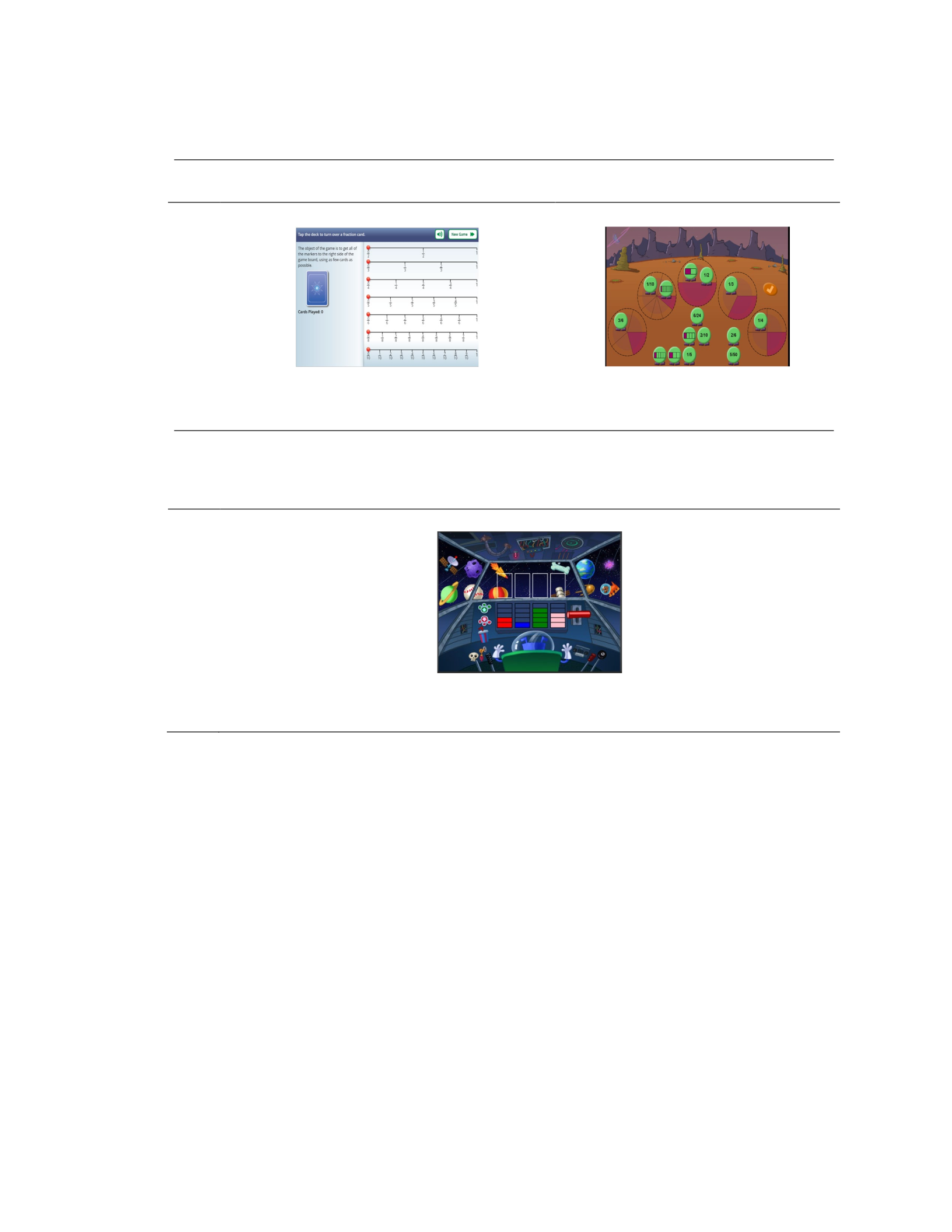
52
CCSS.MATH.CONTENT.3.NF.A.3.B: Recognize and generate simple equivalent fractions, e.g., 1/2 =
2/4, 4/6 = 2/3. Explain why the fractions are equivalent, e.g., by using a visual fraction model.
NCTM Fraction-Game
Triplets
DF:
HT, GE, ML
HT, ML, LR
ALF:
SY, RT
AS, VS
CCSS.MATH.CONTENT.3.NF.A.3.D: Compare two fractions with the same numerator or the same
denominator by reasoning about their size. Recognize that comparisons are valid only when the two
fractions refer to the same whole. Record the results of comparisons with the symbols >, =, or <, and
justify the conclusions, e.g., by using a visual fraction model.
Galactic Space Fractions
DF:
MM, HT, ML, LR
ALF:
AP, SY, VS, SD
Note. DF= design features; ALF= academic language features; AF= accuracy feedback; MA= multiple
attempts; HT= hints/tutorial; FC= focused constraint; PL= progressive levels; GE= game efficiency; ML=
mathematics learning; LR= linked representations; LP= linked physical actions; AP= appropriate level of
language; AS= amount of speech; SY= symbols; VS= visual support; RT=references require sentences to
be translated into symbolic representation; SD= speech density of formal and informal language; MM=
multiple meaning of words or phrases; SS= simple sentences; UL= use of first language.
alignment, and the design features and academic language features present in the digital
math games.
The games aligned with third-grade Common Core State Standards for fractions
(Common Core State Standards, 2010) to ensure that they matched the content that the
preservice teachers used to teach mathematics in an elementary school setting. The digital
math games were also interactive and chosen based on their inclusion of virtual

53
manipulatives, defined by Moyer-Packenham and Bolyard (2016) as
an interactive, technology-enabled visual representation of a dynamic
mathematical object, including all of the programmable features that allow it to be
manipulated, that presents opportunities for constructing mathematical
knowledge. (p. 13)
This means that the games had to include interaction with mathematical objects in the
game more than simply clicking or typing in an answer. For example, in the game “Smart
Pirate Simple Fractions,” interaction with mathematical objects involved dragging
fractional pieces and clicking correct fractions that represent the pieces left.
The digital math games were also chosen based on the design features, and
academic language features present in the games. I evaluated each digital math game
using the Evaluation Rubric. This study selected digital math games if multiple design
features were present and if multiple academic language features supported the
comprehensibility of the written or auditory language in the games. This would allow
preservice teachers to interact with digital math games that had multiple features that
could support mathematics learning for ELLs. For example, the game “Fargo and Denny
Part 1” was chosen because it had the design features: accuracy feedback (AF), multiple
attempts (MA), mathematics learning that focused on complex problem solving (ML),
and linked representations (LR), as well as the academic language features symbols (SY)
and visual support (VS) that helped make the mathematics language comprehensible for
ELLs (see Table 4).
Recruitment and Consent
Recruitment of participants were from two elementary mathematics method

54
courses offered at a local university across multiple semesters (e.g., Spring 2021, Fall
2021, Spring 2022). The courses had about 20-50 students enrolled each semester. I
explained the study to preservice teachers in each class in a video format. The video
explained the purpose of the study, the procedures, and that participants would receive a
compensation of a $40 Amazon e-gift card to those that completed all data sources
needed for this study. I then sent three follow-up emails to the students enrolled in the
courses. Next, participants completed a consent form permitting data collection for
research purposes. This form permitted survey and evaluation rubric responses, module
reflections, and the recording of the semistructured interviews. Once I received consent, I
added the participants to the Canvas page with the four learning modules.
Module Content and Data Collection
I created four learning modules with content about design features and academic
language features in digital math games. These modules were based on the literature,
aligned with the conceptual framework (see Figure 1) from Chapter II, and developed
before recruitment of preservice teachers. The use of modules was appropriate because
research has reported that mini-workshop experiences (e.g., e-learning experiences)
(Sardone & Devlin-Scherer, 2009, 2010) that provide specific experiences with digital
math games (Belbase, 2015; Handal et al., 2016; Li, 2013) and language demands for
ELLs (Durgunoglu & Hughes, 2010; Kruz et al., 2017; McLeman & Fernandes, 2012)
can improve preservice teachers abilities to choose and evaluate digital math games for
ELLs. It is important to note that the modules and the evaluation rubrics did not
distinguish among ELL students different WIDA proficiency levels because of the total

55
time preservice teachers had to interact with the learning module. Thus, the intention of
the learning modules was to be an introduction to help preservice teachers increase their
awareness of design features and academic language features.
The modules were delivered through Canvas, an online platform that allowed
participants to access and turn in materials. Participants completed the modules in
sequence and could not access a subsequent module until the module requirements that
preceded it was complete. For example, participants had to complete Module 1
requirements before they could access Module 2. This ensured that all materials were
completed appropriately (e.g., pre- survey completed before participants could access
lecture videos). These modules included content and all the data collection tools the
participants completed in the study (e.g., surveys and evaluation rubrics). All modules
were completed within a four-week time period. Participants were given one week to
complete each module to ensure that students had ample time to participate in the study
in addition to their regular university coursework. Table 5 summarizes the content in each
module.
Module 1 Procedures
During Module 1, participants virtually completed the Preservice Teachers’
Beliefs Survey (Pre-Survey Items) and chose three digital math games based on a
description of a fictional group of students in a third-grade mathematics classroom (e.g.,
“In your class, there are five English language learners. Two of your English language
learning students are towards the end of Level 3 and can understand how ideas are
connected through a few cohesive devices [e.g., pronouns], understand expanded noun

56
Table 5
Content of the Four Modules
Modules
Content
1
CONTENT: Choose and evaluate three digital math games
• Participants chose three digital math games based on the needs of their fictional
class description
DATA COLLECTION:
• Participants completed PRESERVICE TEACHERS’ BELIEFS SURVEY (Pre-
Survey Items)
• Participants evaluated three digital math games with the EVALUATION
RUBRIC (Pre-Evaluation Rubric)
2
CONTENT: Lecture video on design features
• Participants watched a lecture video that defined and provided examples of design
features in digital math games
• Participants used the evaluation rubric as they watched the video and evaluated a
digital math game in the video
DATA COLLECTION:
• Participants completed MODULE 2 REFLECTION
3
CONTENT: Lecture video on language awareness
• Participants watched a lecture video that defined and provided examples of
academic language features in digital math games
• Participants used the evaluation rubric as they watched the video and evaluated a
digital math game in the video
DATA COLLECTION:
• Participants completed MODULE 3 REFLECTION
4
CONTENT: Beliefs about choosing and evaluating three digital math games
• Participants reevaluated the three digital math games from Module 1
• Participants emailed me to set up a semistructured interview
DATA COLLECTION:
• Participants completed PRESERIVCE TEACHERS’ BELIEFS SURVEY (Post-
Survey Items)
• Participants completed EVALUATION RUBRIC (Post-Evaluation Rubric)

57
groups with classifiers, and can relate simple sentences. Three of your English language
learning students are towards the end of Level 4 and can understand multiple cohesive
devices [e.g., synonyms, antonyms], understand prepositional phrases, and relate multiple
simple sentences”). Participants evaluated the three digital math games they chose using
the Evaluation Rubric (Pre-Evaluation Rubric). Preservice teachers chose the digital math
games from a list of 12 digital math games that I provided as links on the Canvas page.
Participants had one week to complete Module 1 on their personal computers. Module 1
took participants approximately 45-60 minutes to complete. An email was sent to
participants once they were added to the Canvas page, and reminder emails were sent out
weekly to remind participants when modules needed to be completed.
Module 2 Procedures
Participants accessed Module 2 once they completed Module 1. The Canvas page
was designed for the modules to open after the previous module requirements were
complete. Module 2 provided a video I created in lecture format (see Appendix F). To
help preservice teachers increase their awareness of design features in digital math
games, the modules included a definition for each design feature and provided examples
of screenshots from digital math games that were not on the list of fraction games used in
this study. For example, I defined accuracy feedback in the video as “Accuracy feedback
is how the game provides feedback on accuracy or correct answers by providing a visual,
auditory or numerical feedback.” This definition aligns with Moyer-Packenham,
Lommatsch, et al. (2019), identifying accuracy feedback as the feedback on student
accuracy by providing a visual (e.g., pictures), auditory (e.g., sounds), or numerical (e.g.,

58
accumulating coins) form of feedback. The video then provided an image of a digital
math game not used in this study that showed the design feature. For example, the video
showed a clip of the game Chicken Coop Painter, which was not a fraction game used in
this study. In the video, I provided a guided experience where preservice teachers
evaluated each design feature using the Evaluation Rubric. I provided a short pause in the
video for preservice teachers to evaluate a design feature. Then I explained the evaluation
score that I had given the feature on the rubric and why that feature was given that
evaluation score. For example, accuracy feedback was given a “3” evaluation score in the
Chicken Coop Painter demonstration because the game provided hatched or unhatched
eggs for completed levels and showed check marks or Xs to show correct answers and an
explanation of how to solve the fractions in the game. This type of task can help increase
preservice teachers’ awareness of design features because it provides a meaningful
experience (Sardone & Devlin-Scherer, 2009) that makes preservice teachers consider
what makes a digital math game effective.
Participants completed the Module 2 Reflection based on the content of design
features in the video, which was in a quiz format on Canvas. Reflections can help form or
change beliefs about design features in digital math games (McLeman & Fernandes,
2012; Richardson, 1996), which is why it was appropriate to have preservice teachers
write a reflection about design features shown in the video. Participants had one week to
complete Module 2 on their personal computers. Module 2 took approximately 30
minutes to complete.

59
Module 3 Procedures
Participants accessed Module 3 once they completed Module 2. Module 3
provided a video in a lecture format (see Appendix F). The video defined and provided
examples of academic language features in a digital math game. To help increase
preservice teachers’ awareness of academic language features, I defined each academic
language feature based on the current literature. I provided examples of screenshots from
digital math games that were not on the list of fraction games used in this study. For
example, I defined speech density in the video as “Speech density examines the balance
of the formal and informal language in the game. If there is too much formal language,
students get lost in translating the meaning. If there is too much informal language
students may be unable to relate it to the formal mathematics.” This definition aligns with
the findings reported by Ke (2013) and Ke and Abras (2013) that using formal and
informal language relates to mathematics learning and that too much informal language
can hinder students’ mathematics understanding. I then provided an image of a digital
math game not used in this study that showed the academic language feature. The video
showed a clip of the game Chicken Coop Painter, which was not a fraction game used in
this study. I provided a guided experience where preservice teachers evaluated each
academic language feature using the Evaluation Rubric. I provided a short pause in the
video for preservice teachers to evaluate an academic language feature and then
explained the evaluation score that I had given on the rubric and why that feature was
given that evaluation score. For example, speech density was given a “1” evaluation
score in the Chicken Coop Painter demonstration because the game only used symbolic

60
representations without language support for students to understand how to multiply
fractions to find the correct number of boxes to paint. This type of task can help increase
preservice teachers’ awareness of academic language features because it provides a
meaningful experience (Sardone & Devlin-Scherer, 2009) that makes preservice teachers
consider how language can impact the comprehensibility of digital math games.
Participants completed the Module 3 Reflection based on the content of academic
language features in the video, which was in a quiz format on Canvas. This reflection
could help form or change beliefs about academic language features in digital math
games (McLeman & Fernandes, 2012; Richardson, 1996), which is why it was
appropriate to have preservice teachers reflect on the academic language features
discussed in the video. Participants had one week to complete Module 3 on their personal
computers. Module 3 took approximately 30 minutes to complete.
Module 4 Procedures
Participants accessed Module 4 once they completed Module 3. During Module 4,
participants virtually completed the Preservice Teachers’ Beliefs Survey (Post-Survey
Items) and reevaluated the three digital math games they chose in Module 1 using the
Evaluation Rubric (Post-Evaluation Rubric). Module 4 instructed participants to email
me to schedule a semistructured interview. Participants had one week to complete
Module 4 on their personal computers. Module 4 took approximately 45-60 minutes to
complete.

61
Semistructured Interviews
After the modules were completed, I conducted semistructured interviews with
each participant. Preservice teachers answered interview questions to provide greater
detail about their responses on the survey. The interviews were recorded on a digital
platform (e.g., Zoom). Participants emailed me to set up a time to meet over the digital
platform. The interviews lasted approximately 20 minutes.
Data Analysis
The data analysis for this study examined how preservice teachers developed
awareness and beliefs about design features and academic language features when
choosing and evaluating digital math games for English language learners (ELLs). I
analyzed four data sources for this study: (1) Preservice Teachers’ Beliefs about
Preparation with Digital Math Games for ELLs Survey (Pre- and Post-Survey Items); (2)
Digital Math Game Evaluation Rubric (Pre- and Post-Evaluation Rubrics); (3) Module
Reflections; and (4) semistructured interview transcripts. Data analysis occurred in a
multi-phase process that included descriptive coding, pattern coding, frequency tables,
bar graphs of frequencies, a Wilcoxon signed ranked test, and a narrative comparison.
Table 6 provides an overview of the research questions, data sources, and data analysis
procedures. The sections below describe the analysis procedures for each phase.
The first step in data analysis was data preparation. Creswell and Plano Clark
(2017) outline ways to prepare the data, which include assigning numeric values to each
response, transcribing the data, and checking the data for accuracy. Therefore, I assigned

62
Table 6
Overview of Research Questions, Data Sources, and Data Analysis
Research question
Data sources
Data analysis
1
What are preservice teachers’
awareness and beliefs about design
features when choosing and
evaluating digital math games for
ELLs, and what changes, if any,
are exhibited after completing the
learning modules?
Teachers’ Beliefs Survey (Pre-and
Post-Survey Items)1
Math Game Evaluation Rubric (Pre-
and Post-Evaluation Rubric)2
Module Reflections6
Semistructured interview
transcripts
3
Descriptive and pattern coding4
Frequency tables5
Bar Graphs8
Wilcoxon signed ranked test5
Narrative Comparison7
2
What are preservice teachers’
awareness and beliefs about
academic language features when
choosing and evaluating digital
math games for ELLs, and what
changes, if any, are exhibited after
completing the learning modules?
Teachers’ Beliefs Survey (Pre-and
Post-Survey Items)1
Math Game Evaluation Rubric (Pre-
and Post-Evaluation Rubric)2
Module Reflections6
Semistructured interview
transcripts
3
Descriptive and pattern coding4
Frequency tables5
Bar Graphs8
Wilcoxon signed ranked test5
Narrative Comparison7
3
What are preservice teachers’
beliefs about their preparation with
using digital math games to
support mathematics learning for
ELLs, and what changes, if any,
are exhibited after completing the
learning modules??
Teachers’ Beliefs Survey (Pre- and
Post-Survey Items)1
Semistructured interview
transcripts3
Descriptive and pattern coding4
Frequency tables5
Bar Graphs8
Wilcoxon signed ranked test5
Narrative Comparison7
1 Adapted from Bedwell et al., 2012; Durgunoglu & Hughes, 2010; Hsu et al., 2013, 2017, 2020; Lucas &
Villegas, 2010, 2013; McGinnis et al. 2002; Reeves, 2006; Sardone & Devlin-Scherer, 2009, 2010; Shah
& Foster, 2015.
2 Adapted from Adams, 2003; Avraamidou et al., 2012; Boyer-Thurgood, 2017; Castellar et al., 2015; De
Bock et al., 2017; Denham, 2015; Falloon, 2013, 2014; Hattie & Timperley, 2007; Ke, 2013; Ke & Abras
2013; Lucas et al., 2008, 2018; Lucas & Villegas, 2010, 2013; Moschkovich, 2013; Moyer-Packenham,
Litster, et al., 2019; Moyer-Packenham, Lommatsch, et al., 2019; Schleppegrell, 2007; Sedig, 2008; Siew,
2018; White & Pea, 2011; WIDA, 2012.
3 Adapted from Aguirre & Zavala, 2012; Bedwell et al., 2012; Franklin, 2011; Gibson, 2002; Shah &
Foster, 2015.
4 Saldaña, 2016; Tashakkori & Teddlie, 2010.
5 Boone & Boone, 2012.
6 Adapted from Aguirre & Zavala, 2012; Sardone & Devlin-Scherer, 2009.
7 Creswell & Plano Clark, 2017.
8 Cooksey, 2020; Robbins & Heiberger, 2011.

63
numbers to each participant, transcribed the semistructured interviews, and checked the
data for accuracy. I then compiled participants’ responses into files with assigned
numeric values and deleted all identifiers. I used a transcription software (e.g., Otter.ai) to
create documents of the narrative information from the semistructured interviews.
Finally, I checked the data by looking for data entry errors and transcript accuracy.
Data Analysis Phases
This study had a four-phase process to answer the research questions. The first
phase included descriptive and pattern coding (Saldaña, 2016; Tashakkori & Teddlie,
2010). This coding used the open responses on the Preservice Teachers’ Beliefs about
Preparation with Digital Math Games for ELLs Survey (Pre-and Post-Survey Items), the
Digital Math Game Evaluation Rubric (Pre- and Post-Evaluation Rubric), Module
Reflections, and semistructured interview responses. The second phase included
computing frequencies of responses and creating bar graphs to visualize and summarize
the frequency tables. The third phase involved computing a Wilcoxon signed ranked test
to compare changes on the Preservice Teachers’ Beliefs Survey (Pre- and Post-Survey
Items) and changes on the Digital Math Game Evaluation Rubric (Pre- and Post-
Evaluation Rubric). The fourth phase used a mixed methods comparison technique,
called a narrative comparison, to determine how the data converged or diverged. The
sections below describe this four-phase analysis process.
Phase I: Descriptive and Pattern Coding
The data analysis for the research questions used the same coding process. First, I

64
used descriptive coding for the open-ended responses on the Preservice Teachers’ Beliefs
about Preparation with Digital Math Games for ELLs Survey (Pre- and Post-Survey
Items), the Digital Math Game Evaluation Rubric (Pre- and Post-Evaluation Rubric),
Module Reflections, and semistructured interviews (Creswell & Plano Clark, 2017;
Saldaña, 2016; Tashakkori & Teddlie, 2010). Saldaña (2016) defines descriptive coding
as “summarizing in a word or short phrase-most often a noun- the basic topic of a passage
of qualitative data” (p. 102). This type of coding helps identify subtopics that can be
combined during a second coding phase to show themes that emerge from the qualitative
data (Saldaña, 2016). These codes summarized initial topics that emerged from responses
to identify preservice teachers’ beliefs and awareness of design and academic language
features in digital math games. Descriptive coding has been used in prior research about
preservice teachers (Meletiou-Mavrotheris & Prodromou, 2016; Sardone & Devlin-
Scherer, 2009, 2010) and applies to a wide variety of data forms (Saldaña, 2016).
Therefore, it was appropriate to use in this study as the first coding phase to gain a basic
understanding of the initial topics from the qualitative responses.
Next, I used pattern coding to identify common themes by grouping similar topics
from the first phase of descriptive coding (Saldaña, 2016). These codes were more
advanced than descriptive coding in identifying themes by providing a meaningful unit of
analysis when grouping similar ideas (Saldaña, 2016). Pattern coding helped better
understand the themes that emerged about preservice teachers’ awareness and beliefs
about design features and academic language features in digital math games. Pattern
coding has been used in prior research about preservice teachers to better understand

65
themes that emerge from qualitative data (Li, 2013; Meletiou-Mavrotheris & Prodromou,
2016). Thus, pattern coding was appropriate to use in this study as a second phase of
coding to identify the themes.
Phase II: Frequency Tables
The second part of the data analysis for the research questions included
computing frequencies and creating bar graphs. I computed frequencies using the open-
ended responses on the Preservice Teachers’ Beliefs Survey (Pre- and Post-Survey Items)
and the Digital Math Game Evaluation Rubric (Pre-and Post-Evaluation Rubric). To
compute the frequencies from the qualitative pattern coding, I transformed the qualitative
data by “quantitizing” the data to be presented in the frequency tables (Saldaña, 2016). I
counted the frequencies of the common themes that emerged during pattern coding and
reported these in a frequency table. I also computed frequencies using the close-ended
responses from the Preservice Teachers’ Beliefs Survey (Pre-and Post-Survey Items) and
Digital Math Game Evaluation Rubric (Pre-and Post-Evaluation Rubric) and reported
them in the frequency table. Frequency tables were appropriate for showing variability
among ordinal data (Boone & Boone, 2012). The frequency tables allowed me to
understand the qualitative and quantitative data as an overview of preservice teachers’
awareness and beliefs of design features and academic language features.
Once I computed the frequencies, I used a stacked bar graph to summarize
preservice teachers’ Likert scale frequencies from the Preservice Teachers’ Beliefs
Survey (Pre- and Post-Survey Items) to show how they diverged from the “agree” portion
of the Likert scale. Researchers have recommended a stacked bar graph to summarize

66
frequencies and show how frequency percentages relate to the “agree” or “disagree”
portion of a Likert scale (Cooksey, 2020; Robbins & Heiberger, 2011; South et al., 2022).
Similarly, a bar graph helped summarize preservice teachers’ composite ratings on the
Evaluation rubric. Bar graphs are appropriate when summarizing frequencies to show
relationships and important attributes of the data (Cooksey, 2020). I used the bar graph to
show the relationship between changes in preservice teachers’ frequencies of ratings from
pre- to post-evaluation rubrics.
Phase III: Wilcoxon Signed Ranked Test
To compare changes on the Preservice Teachers’ Beliefs Survey (Pre- and Post-
Survey Items) and the Digital Math Game Evaluation Rubric (Pre- and Post-Evaluation
Rubrics), I used a non-parametric test, a Wilcoxon signed ranked test, to compare
medians of individual items on a Likert scale and composite ratings on the evaluation
rubrics (Boone & Boone, 2012; Cooksey, 2020). The Likert scale items, and rubric
evaluations used in this study were ordinal measurement scales because I transformed the
qualitative data into frequency counts, which means that normal distribution cannot be
assumed, making the Wilcoxon signed ranked test appropriate to analyze changes in pre-
and post-survey responses (Boone & Boone, 2012; Clason & Dormody, 1994; Cooksey,
2020). By computing a Wilcoxon signed ranked test, I could see how preservice teachers’
awareness and beliefs about design features and academic language features changed
after completing the modules.

67
Phase IV: Narrative Comparison
During the final analysis phase, I used a mixed methods comparison technique
called a narrative comparison to merge the data sources for interpretation and answer the
overarching research question. This process began with a presentation of the qualitative
data examples followed by the quantitative data to discuss how the frequencies and
changes in the pre- and post-versions of the survey and evaluation rubric related to the
qualitative examples (Creswell & Plano Clark, 2017). The discussion was constructed by
examining how data converged or diverged by observing the data analyses and writing
memos of observations when examining the data. The observations of the data analyses
helped validate and confirm the results.
Validity and Reliability
This section addresses the validity and reliability of this study. To ensure the
mixed analysis was valid, I used multiple data sources (e.g., belief survey, evaluation
rubric, module reflections, and semistructured interviews) to triangulate the evidence
(Creswell & Plano Clark, 2017). Terrell (2015) explained the importance of ensuring the
item validity of instrument questions (e.g., surveys) and stressed the need to consider
item validity in research studies. To address this need, items and content in this study
were based on the current literature that pertained to the purpose of this study and that
aligned with the research questions. For example, survey items were adapted from Hsu et
al. (2013, 2017, 2020) survey in multiple studies.
I piloted the survey items with a small group of preservice teachers who

68
volunteered to provide feedback on clarity and how long it took to complete the items.
Survey items were revised based on this feedback to make items reliable. Using an
interview protocol ensured that interviews were reliable because each participant was
asked the same questions but allowed for flexibility in follow-up questions based on
participant responses (Saldaña, 2016). The semistructured interview questions helped
further understand the responses from the survey questions by asking participants to
elaborate on their beliefs and if they changed from the beginning of the study (Terrell,
2015). I piloted the semistructured interview questions with two in-service teachers that
volunteered to provide feedback on the clarity of questions. The semistructured interview
questions were revised based on this feedback to ensure questions were reliable.

69
CHAPTER IV
RESULTS
The purpose of this study was to examine how preservice teachers developed
awareness and beliefs about design features and academic language features when
choosing and evaluating digital math games for ELLs. This study used qualitative and
quantitative data sources to answer the research questions. The overarching research
question in this study was: How do preservice teachers develop awareness and beliefs
about design features and academic language features when choosing and evaluating
digital math games for English language learners (ELLs)? The main research questions of
the study were as follows.
1. What are preservice teachers’ awareness and beliefs about design features
when choosing and evaluating digital math games for ELLs, and what
changes, if any, are exhibited after completing the learning modules?
2. What are preservice teachers’ awareness and beliefs about academic language
features when choosing and evaluating digital math games for ELLs, and what
changes, if any, are exhibited after completing the learning modules??
3. What are preservice teachers’ beliefs about their preparation for using digital
math games to support mathematics learning for ELLs, and what changes, if
any, are exhibited after completing the learning modules?
This chapter presents the results from the mixed methods analyses. The research
questions were answered by reporting frequencies of “quantitized” qualitative data from
the Teachers’ Belief Survey (Pre- and Post-Survey Items), Math Game Evaluation Rubric
(Pre- and Post-Evaluation Rubric), and Module Reflections (Saldaña, 2016). The first
section examines preservice teachers’ awareness and beliefs about design features when
choosing and evaluating digital math games for ELLs. The second section reports

70
preservice teachers’ awareness and beliefs about academic language features in digital
math games. The third section examines preservice teachers’ beliefs about their
preparation for using digital math games to support mathematics learning for ELLs. The
chapter concludes with a summary of the results.
Preservice Teachers’ Awareness and Beliefs about Design Features
This section reflects preservice teachers’ awareness and beliefs about design
features in digital math games and the changes exhibited after completing the learning
module about design features. Results indicate that preservice teachers felt better
prepared to integrate digital math games into mathematics instruction for ELLs because
they had an increased awareness of the design features in the digital games after
completing the learning modules.
Design Features Reported on Survey Likert Items
Figure 3 shows frequencies of preservice teachers’ beliefs about identifying
mathematics content and design features in digital math games reported on the Teachers’
Beliefs Pre- and Post-Survey Likert scale items. The black vertical line shows how
preservice teachers’ reported beliefs diverge from the “disagree” (i.e., rating of 1, 2, or 3)
and “agree” (i.e., rating of 4, 5, or 6) portion of the Likert scale. The red (i.e., 1), orange
(i.e., 2), and gray (i.e., 3) bars represent the “disagree” portion of the scale, and the
yellow (i.e., 4), blue (i.e., 5), and green (i.e., 6) bars represent the “agree” portion of the
Likert scale. For example, when preservice teachers rated the statement, “I can identify
the knowledge related to mathematics in digital math games” (S6) on the pre-survey,
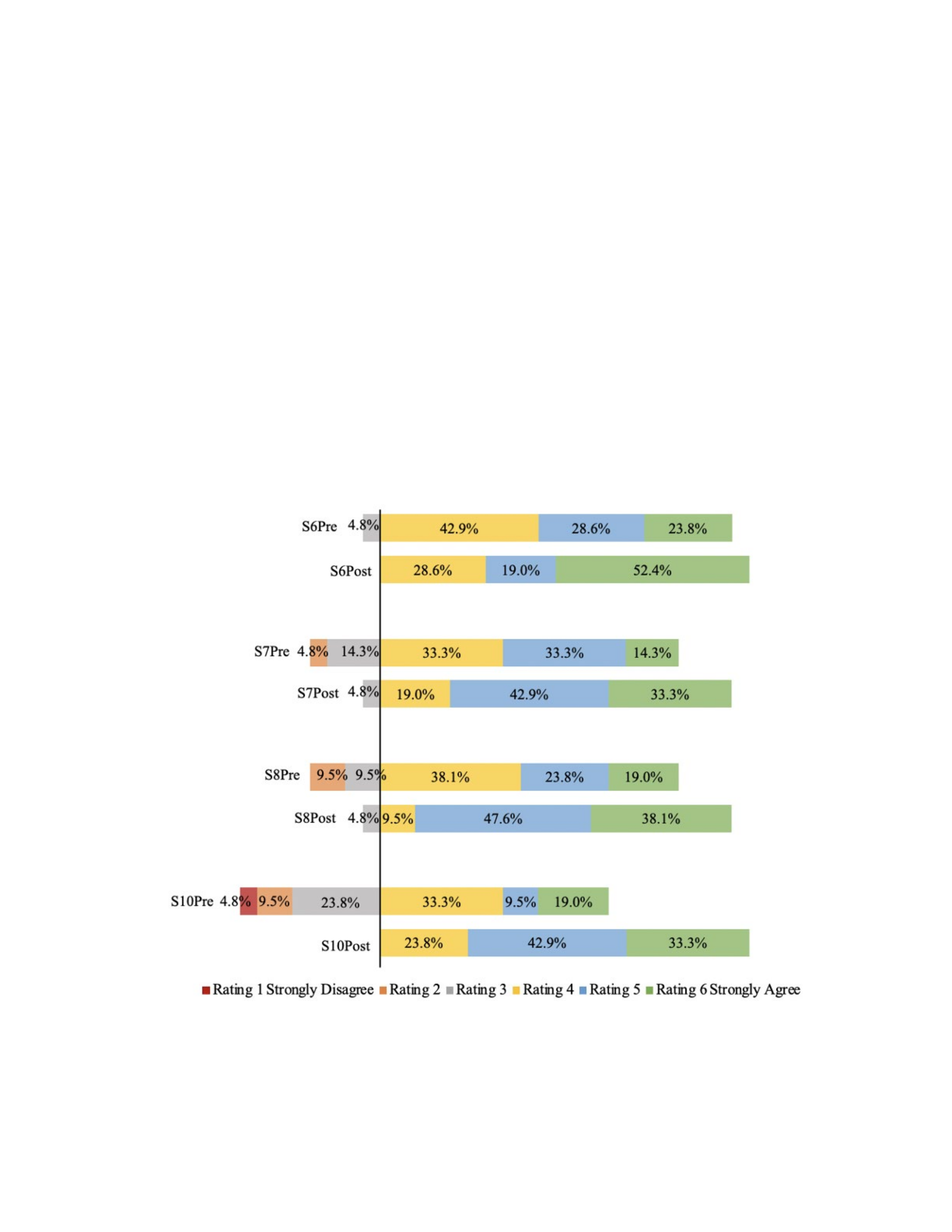
71
there were 5% of preservice teachers that rated this as a “3” (i.e., gray bar), while 43%
rated it as a “4” (i.e., yellow bar), 29% rated it as a “5” (i.e., blue bar), and 24% rated it as
a “6” (i.e., green bar). Similarly, 100% of preservice teachers agreed with this statement,
as shown by the yellow (i.e., 4), blue (i.e., 5), and green (i.e., 6) bars on the right side of
the black vertical line on the post-survey.
Figure 3
Frequencies of Likert Scale Items about Preparation for Identifying Mathematics Content
and Design Features in Digital Math Games (N = 21)
Note. S6= I can identify the knowledge related to the mathematics in digital math games; S7= I can tell
when the digital math games represent the targeted mathematics knowledge; S8= I can identify whether the
targeted mathematics concepts are displayed in digital math games; S10= I can identify design features in
digital math games that can support learning; Pre= pre-survey frequency percentages; post= post-survey
frequency percentages.

72
Figure 3 indicates that preservice teachers showed a shift in frequencies that
favored the “agree” portion for all four statements about “preparation for identifying
math content” from pre-survey (62%-95%) to post-survey (95%-100%). This indicates
that preservice teachers felt better prepared to identify mathematics content and design
features in digital math games after completing the learning modules. For example, when
preservice teachers rated, “I can tell when the digital math games represent the targeted
mathematics knowledge” (S7) and “I can identify whether the targeted mathematics
concepts are displayed in digital math games” (S8), there was an increase of frequency
toward the “agree” portion of the Likert scale from pre-survey (80%-81%) to post-survey
(95%). Additionally, preservice teachers reported the biggest shift in frequency towards
the “agree” portion of the Likert scale when they rated the statement “I can identify
design features in digital math games that can support learning” (S10), from pre-survey
(62%) to post-survey (100%). These survey items (i.e., 6, 7, 8, and 10) focus on
preservice teachers’ preparation for identifying the math content in the digital games.
Important Design Features Reported by
Preservice Teachers
Table 7 shows the frequencies of themes reported by preservice teachers about the
important design features in digital math games (from the Teachers’ Beliefs Pre- and
Post-Survey). Progressive levels, accuracy feedback, and multiple attempts were
identified as the most important design features on both the pre- and post-survey. This
suggests preservice teachers were most aware of these three design features in the digital
math games.

73
Table 7
Frequencies of Themes about Most Important Design Features on Survey (N = 21)
Frequency
──────────────────────────
Pre-response
────────────
Post-response
────────────
Design features
n
%
n
%
Progressive levels
17
81.0
12
57.1
Accuracy Feedback
15
71.4
14
66.7
Multiple attempts
15
71.4
14
66.7
Hints/Tutorials
7
33.3
8
38.1
Linked physical action
4
19.0
2
9.5
Game efficiency
2
9.5
6
28.6
Linked representation
2
9.5
8
38.1
Focused Constraint
1
4.8
4
19.0
As Table 7 indicates, more than half of preservice teachers described progressive
levels as important on the Teachers’ Beliefs Pre-Survey (81%) and Post-Survey (57%).
For example, one preservice teacher wrote, “Progressive levels can push students to what
they are capable of or what they have the potential of learning. Students will have a
feeling of accomplishment and satisfaction if they can move up levels. They are used to a
progression in levels in the computer and video games they are used to.” Another
preservice teacher explained, “Progressive Levels so that it can get harder and introduce
more complex ideas.” Similarly, a preservice teacher wrote, “Progressive levels so they
can be challenged at the appropriate level.” This shows that preservice teachers were
aware of progressive levels promoting mathematics learning by providing levels that
challenge players as they master a concept.
Similarly, high percentages of preservice teachers chose accuracy feedback and

74
multiple attempts as important on the pre-survey (71%) and post-survey (67%). For
example, one preservice teacher described accuracy feedback as important: “Kids learn
from their mistakes, and if they get feedback on their mistakes, then they can learn from
it.” Another preservice teacher stated: “Accuracy feedback is important because students
won't learn if they don't know if they are correctly solving problems. They need to know
what to change and fix to improve.” Multiple attempts were described as important when
one preservice teacher wrote, “Multiple attempts is important because students will get
really frustrated if they get it wrong and don't get another chance. Also, more chances
will give students longer time to learn how to solve the problem correctly. I don't think
it's about when a student answers correctly but if they are able to.” Another preservice
teacher wrote, “I don't think learning is just a one-time trial, and I think the game should
give them multiple attempts to try again.” This shows that preservice teachers were aware
of accuracy feedback and multiple attempts as important design features supporting their
perspective on how students learn mathematics.
Preservice teachers reported the lowest frequency of awareness for focused
constraint (5%), game efficiency (10%), and linked representations (10%) on the Teacher
Belief Pre-Survey. However, there was an increase in the percentage of preservice
teachers that reported these design features as important from pre-survey (5%-10%) to
post-survey (19%-38%). For example, there was an increase in the percentage of
preservice teachers from pre-survey (5%) to post-survey (19%) for focused constraint.
Preservice teachers’ statements showed more awareness on the post-survey by
specifically explaining how focused constraint allows students to focus on one area of

75
mathematics instead of being described on the pre-survey as helping the game stay on
topic (e.g., “I think it’s important for the lesson to stay on topic”). For example, one
preservice teacher wrote on the post-survey, “I believe that focused constraint makes it,
so students are able to have more practice working with certain ideas, being able to feel
more comfortable with them, rather than trying to deal with too much at once.”
Preservice teachers reported increased awareness of game efficiency from pre-
survey (10%) to post-survey (29%). For example, preservice teachers’ explanations
lacked awareness on the pre-survey because they focused on wasting class time (e.g., “I
don't want students wasting precious classroom time on a game that is not supporting our
learning goals”). The explanations about game efficiency showed a lack of awareness of
what this feature entails in a digital math game because game efficiency is how features
promote efficiency in completing the game task, not the efficiency of class time (Moyer-
Packenham, Lommatsch, et al., 2019). For example, in the game Pizza Toppings
Representing Fractions Visually, players can drag the toppings to cover the pieces, or
click on the slices, and the toppings are placed for them. This game feature makes the
player more efficient because they can quickly place toppings on the slices to represent a
fraction of the pizza. However, preservice teachers’ explanations on the post-survey
showed more awareness of game efficiency because they focused on the game helping
students be efficient in the task and focus on the mathematics instead of effective use of
class time. For example, one preservice teacher wrote, “Game efficiency is important
because if students have to spend more time on the menial aspects of the game as
opposed to the actual mathematics themselves, that will take away from learning.

76
Students should be able to conveniently demonstrate their understanding of the concept.”
Another preservice teacher wrote, “I believe that game efficiency is important because
when a game is efficient, students are less focused on trying to figure out how the game
works and spend more time learning from the game.”
Preservice teachers reported the biggest increase in frequency for linked
representation from pre-survey (10%) to post-survey (38%). For example, preservice
teachers’ statements on the pre-survey indicated a lack of awareness (e.g., “This is
important because we want students to be able to understand what is happening by
creating models and representations they can model and play with.”). However,
preservice teachers showed an increase in awareness on the post-survey when they wrote,
“We want everything in the math game to link to mathematical concepts that we are
targeting. We want the games to be creating multiple forms of representations and
understanding for our students,” and “Being able to link different representations of
mathematical concepts, such as words, symbols, and visual models or objects helps
students develop a deeper understanding of math concepts.” The increase in reported
frequencies and the awareness in the statements suggest that when preservice teachers
defined linked representation in the learning module and evaluated this feature in digital
math games, they had an increase in their awareness of when this design feature was
present and supported mathematics learning in digital math games.
Preservice teachers reported low frequency for linked physical action on the
Teacher Belief Pre-Survey (19%) and Post-Survey (10%). However, the statements
describing this feature on the post-survey showed more awareness than the pre-survey

77
(e.g., “I also think that physical action is important so that students get up a MOVE!”)
because they focused on how the physical action in the game related to the mathematics.
For example, one preservice teacher wrote on the post-survey, “Linked Physical action -
this allows students to physically interact with a content, further helping to solidify the
learning.” Another preservice teacher wrote, “Link physical action: inviting the students
to physically move objects or see visual changes is a great way for students to understand
the math they are completing.” Preservice teachers’ increased awareness could explain
the decrease in frequency from pre-survey (19%) to post-survey (10%) because this
awareness could have led them to believe that other design features in digital math games
were more important than linked physical action.
Design Features Reported on the Math Game
Evaluation Rubric
Figure 4 shows the frequencies of preservice teachers’ composite ratings from the
closed responses on the Math Game Evaluation Rubric Pre- and Post-Evaluation items
about design features. Preservice teachers rated each design feature as they played a
digital math game. The evaluation rubric had a scale of 1-3, where “1” was a low rating
(i.e., design feature was not in the game or it did not support learning) and “3” was a high
rating (i.e., design feature was present and supported learning). The bars in the figure
represent the ratings “1” (i.e., blue bar), “2” (i.e., orange bar), and “3” (i.e., gray bar) and
are show the evaluations for the pre- and post-evaluation rubrics (i.e., Linked Physical
Action pre, Linked Physical Action post). For example, for accuracy feedback, 56% of
preservice teachers rated this as a “1” (i.e., blue bar) on the pre-evaluation, and 50% rated

78
this as a “1” on the post-evaluation. Thirty-nine percent of preservice teachers rated
accuracy feedback as a “2” (i.e., orange bar) for both the pre- and post-evaluation. The
gray bar shows the ratings of a “3” on the pre-evaluation (6%) and post-evaluation (11%)
for accuracy feedback.
Figure 4
Composite Math Game Evaluation Rubric Ratings for Design Features (N = 18)
Note. Percentages reflect the composite scores of design feature ratings on evaluation
rubrics across all digital math games; 1= low rating; 2= limited rating; 3= high rating;
Pre= pre-evaluation scores; Post= post-evaluation scores.
The highest-rated design feature by preservice teachers was multiple attempts,
with a high rating (i.e., 3) indicating the design feature was present and supported
learning across all digital math games on the pre- and post-evaluation rubrics. This was
11.1%
5.6%
77.8%
81.5%
20.4%
14.8%
22.2%
18.5%
13.0%
29.6%
11.1%
14.8%
13.0%
16.7%
14.8%
20.4%
11.1%
16.7%
38.9%
38.9%
20.4%
16.7%
44.4%
50.0%
33.3%
40.7%
35.2%
22.2%
48.1%
38.9%
33.3%
38.9%
61.1%
57.4%
53.7%
51.9%
50.0%
55.6%
1.9%
1.9%
35.2%
35.2%
44.4%
40.7%
51.9%
48.1%
40.7%
46.3%
53.7%
44.4%
24.1%
22.2%
35.2%
31.5%
Accuracy Feedback Post
Accuracy Feedback Pre
Multiple Attempts post
Multiple Attempts Pre
Hints and Tutorials Post
Hints and Tutorials Pre
Focused Constraint Post
Focused Constraint Pre
Progressive Levels Post
Progressive Levels Pre
Game Efficency Post
Game Efficiency Pre
Mathematics Learning Post
Mathematics Learning Pre
Linked Representation Post
Linked Representation Pre
Linked Physcial Action Post
Linked Physcial Action Pre
Rating 1Rating 2Rating 3

79
the only design feature with a high percentage of preservice teachers (78%-82%) with a
“3” rating, suggesting that preservice teachers were most aware of multiple attempts
while evaluating the digital math games. This shows that preservice teachers could
identify when a digital math game provided multiple attempts to the player.
Preservice teachers rated hints and tutorials, linked representation, and linked
physical action as a limited rating across all digital math games in this study, with 44%-
61% of preservice teachers rating these as a “2” on the pre-and post-evaluation rubric.
This suggests that preservice teachers were aware of these design features because they
could identify their presence in the digital math games.
Preservice teachers rated most design features lower than a “3” rating on the
rubric across all digital math games on the pre- and post-evaluation. For example,
preservice teachers rated accuracy feedback, progressive levels, and math learning low
across all digital math games. Each of these design features had higher frequency (44%-
56%) ratings as a “1” on the pre-and post-evaluation rubrics. This suggests that
preservice teachers were aware that these design features were not present in the digital
math games. This is also supported by high percentages of preservice teachers’ awareness
of accuracy feedback and progressive levels when reported as important design features
(see Table 7).
Preservice teachers’ frequencies for the ratings of focused constraint and game
efficiency had changes in ratings from pre- and post-evaluation. For example, 40% of
preservice teachers rated focused constraint as limited (i.e., either a “1” or a “2”) on the
pre-evaluation rubric. However, on the post-evaluation rubric, this design feature was

80
rated by more preservice teachers as a “1” (44%). This was the only design feature with
an overall shift to a “1” rating. This suggests that preservice teachers increased their
awareness of this design feature from pre- to post-evaluation rubric because they may
have been able to better identify when this design feature was not present in the digital
math games after completing the learning module about design features.
Forty-six percent of preservice teachers rated game efficiency as a “1” on the pre-
evaluation rubric. However, 48% rated game efficiency as a “2” on the post-evaluation
rubric. This was the only design feature to have an overall shift from a “1” rating to a “2.”
This shift may indicate that preservice teachers became more aware of game efficiency
after completing the learning modules because they could better identify when a digital
math game had features that helped make the game more efficient.
Design Feature Themes Reported by Preservice
Teachers on Game Evaluation Rubric
Table 8 shows the frequencies of preservice teachers’ themes about the objectives,
academic content, and skills in digital math games (from the Math Game Evaluation
Rubric). Themes emerged from the statements preservice teachers used to identify the
fraction content and objectives in the digital math games. Overall, frequencies show that
preservice teachers were aware of fraction content and skills in the digital math games
because each participant could identify the fraction content and skills in the games.
As Table 8 shows, when preservice teachers were asked, “What is the objective of
the game?” three main themes emerged (based on the Math Game Evaluation Rubric): (1)
Game objective with general fraction terms (e.g., represent a fraction, make fractions);

81
Table 8
Frequencies of Themes about Objective and Academic Content in Digital Math Games on
Evaluation Rubrics (N = 18)
Frequency
───────────────────────────────────────────────
Game 1
──────────────
Game 2
──────────────
Game 3
───────────────
Pre
──────
Post
──────
Pre
──────
Post
──────
Pre
──────
Post
──────
Themes
n
%
n
%
n
%
n
%
n
%
n
%
Objective unrelated
5
27.8
2
11.1
4
22.2
3
16.7
4
22.2
3
16.7
Objective general fraction
7
38.9
10
55.6
8
44.4
8
44.4
7
38.9
11
61.1
Objective specific fraction
6
33.3
6
33.3
6
33.3
7
28.9
7
28.9
4
22.2
General Fraction knowledge
9
50.0
6
33.3
8
44.4
6
33.3
8
44.4
5
27.8
Represent fractions
7
38.9
7
38.9
5
27.8
6
33.3
4
22.2
5
27.8
Fraction Relationships
2
11.1
5
27.8
5
27.8
6
33.3
6
33.3
8
44.4
Note. N reflects the number of participants who completed the pre-evaluation rubric and post-evaluation rubric for the
same digital math games.
(2) game objective with specific fraction terms (e.g., equivalent fractions, represent a
fraction, part-whole relationships); and (3) game objective with no mathematics terms or
mathematics terms other than fractions. Results showed an increase in preservice
teachers’ use of general fraction terms from pre- (39%- 44%) to post-evaluation (44%-
61%). For example, one preservice teacher used general fraction terms when they wrote,
“Represent fractions.” Another preservice teacher wrote, “Cover a fraction (Fraction
would be given) of the pizza with toppings.” This shows that preservice teachers could
identify general fraction objectives (e.g., represent fractions, make fractions) in the digital
math games. This also aligns with the preservice teachers’ Likert scale ratings in Figure
3, where high percentages of preservice teachers “agreed” with the statements about
identifying mathematics in digital math games.

82
Preservice teachers used specific fraction terms to describe the objective on the
pre-evaluation (33%-39%) and post-evaluation (22%-39%). For example, one preservice
teacher used specific fraction terms to describe the objective as “The objective is to
visually show fractions and match the fraction with the picture. Then you order them
from least to greatest and help the rocket fly.” Another preservice teacher described the
objective with specific fraction terms when they wrote, “The students will understand
fractions as they flip the correct equivalent number of pancakes shown in fraction form
on the order.” Thus, the preservice teachers in this study may have had limited awareness
of specific fraction objectives (e.g., equivalent fractions, ordering fractions) in the digital
math games because less than half of them identified specific fraction objectives when
evaluating the digital math games.
There was a decrease in the percentage of preservice teachers that used no
mathematics terms or mathematics other than fractions when identifying the mathematics
objective in digital math games from the pre-evaluation (22%- 28%) to post-evaluation
(11%-17%; e.g., “To help the animals along the journey”). This indicates that preservice
teachers became more aware of the mathematics objectives, specifically the general
fraction objectives (e.g., represent a fraction, make fractions), in the digital math games
after completing the learning modules.
When preservice teachers were asked, “What academic content and skills are in
the digital math games?” three main themes emerged: (1) general fraction knowledge
(e.g., visualizing fractions and parts of a whole); (2) representing fractions; and (3)
relationships among fractions. Evidence of general fraction knowledge decreased in

83
frequency in the writings of preservice teachers from pre-evaluation (44%-50%) to post-
evaluation (28%-33%). For example, one preservice teacher wrote: “Players will learn to
differentiate between objects that are divided into equal parts and objects that have not
been. They will learn to count the number of pieces of equivalent parts to determine how
many parts make up a whole.” This suggests that preservice teachers wrote fewer general
statements and became more aware of specific content and skills in digital math games.
Preservice teachers used specific fraction knowledge when they described the
content and skills as representing fractions (e.g., “learning how to create a fraction”) and
relationships among fractions (e.g., “understanding the relationship between a model of a
fraction and the written form of a fraction). There was a slight increase in the percentage
of preservice teachers that used terminology for representing fractions from the pre-
evaluation (22%-39%) to post-evaluation (28%-39%). For example, one preservice
teacher wrote: “The dots are a visual representation of equal parts of the fraction. The
student learns to match the chips or dots to the appropriate fraction.”
Preservice teachers’ comments for identifying relationships among fractions
showed the biggest increase in frequency from pre-evaluation (11%-33%) to post-
evaluation (28%-44%). For example, one preservice teacher wrote, “This game promotes
deep thinking about the relationship of fractions and how they compare in size to other
fractions” Similarly, another preservice teacher wrote, “You can learn least from greatest
and how fractions compare to one another with the same denominator.” The frequency
changes for representing fractions and recognizing relationships among fractions suggest
that preservice teachers became more skilled at using specific terminology to describe the

84
mathematics content because there were increases in those frequencies (e.g., equivalent
fractions, comparing fractions, simplifying fractions).
Design Feature Themes Reported on
Module 2 Reflections
Table 9 shows the frequencies of themes reported by preservice teachers from the
Module 2 Reflection that preservice teachers completed after watching a video about
design features. Overall, the themes indicated that preservice teachers believe design
features can promote mathematics learning in digital math games. For example, when
asked to define design features, 62% of preservice teachers specifically stated that design
features could promote learning (e.g., “Different aspects of the game such as pushing
buttons or and the things displayed on the screen to play the game, and how the game can
help students to learn”).
When asked, “What role do you think design features play in helping ELLs learn
mathematics in digital math games,” most preservice teachers (86%) indicated that design
features impact mathematics learning. For example, one preservice teacher wrote, “I
think all 9 of the features can play a helpful role in making the games more accessible to
students who are English Language Learners.” Another preservice teacher wrote, “I think
that the design features of games are key to ELLs having a positive learning experience
versus a confusing, frustrating one.”
When asked, “How do you think design features helped promote mathematics
learning in the digital math game shown in the video,” 81% of preservice teachers
indicated that design features were helpful to learning fractions in the game. For example,

85
Table 9
Frequencies of Themes about Design Features in Digital Math Games on Module 2
Reflection (N = 21)
Frequency
──────────
Theme
n
%
How would you define design features?
Aspects, attributes, characteristics, elements
15
71.4
Promote learning
13
61.9
How the game runs
12
57.1
How do you think design features helped promote mathematics learning in the
digital math game shown in the video?
Design features helped learn fractions
17
81.0
Hints/tutorials
13
61.9
Accuracy feedback
7
33.3
Game efficiency
6
28.6
Progressive levels
5
23.8
Multiple attempts
3
14.3
Liked physical action
2
9.5
Mathematics learning
1
4.8
Linked representation
1
4.8
Focused constraint
1
4.8
What was your impression of the design features in the digital math game shown
in the video?
Positive
17
81.0
Negative
4
19.0
What role do you think design features play in helping ELLs learn mathematics
in digital math games?
Impact on learning
18
85.7
Multiple attempts
4
19.0
Hints/tutorials
4
19.0
Game efficiency
3
14.3
Accuracy feedback
2
9.5
Progressive levels
1
4.8
Mathematics learning
1
4.8
Linked representation
1
4.8
No impact
1
4.8
Liked physical action
0
0.0
Focused constraint
0
0.0
Note. Bolded numbers represent percentages 50% or above.

86
one preservice teacher wrote,
Overall, the design features were very helpful in providing math learning and
interaction in this game. Most of the design features scored highly, indicating that
more needs are being met.
Another preservice teacher wrote,
I think that when they are all used together to assist the child in learning, the child
gains the most out of the game at that point. I feel like they all promote different
areas of mathematical concepts that are needed in our mathematical learning
progression.
This shows that preservice teachers were aware that design features could impact
mathematics learning in digital math games.
Preservice teachers described specific design features that they believed to
promote learning on the Module 2 Reflection. For example, one preservice teacher wrote,
The multiple attempts feature would help them to keep trying (especially if they
are still trying to figure it out) and not get as frustrated like they might if it just
moved on.
Another preservice teacher wrote,
The player is provided with a tutorial before they start the game, which
automatically helps the player understand the rules and procedures for the game.
The student can then focus on learning the math objective regarding unit
fractions. Also, there are helpful hints in the game that can redirect the player
during the rounds.
This shows that preservice teachers could describe specific ways that the design
features in the game promoted mathematics learning.
When asked, “What was your impression of the design features in the digital math
game shown in the video,” 81% of preservice teachers reported positive impressions of
design features. For example, one preservice teacher wrote,
I liked the visual representation of paint buckets for fractions. It was visually

87
appealing to look at with the different colors. It was also really user-friendly to
use based off of what the video showed.
Another preservice teacher wrote,
I thought the math game did a good job of providing many of the design features
to make it a good learning experience for students.
Similarly, one preservice teacher wrote,
Overall, the design features were effective in providing a stimulating
mathematical learning experience.
This suggests that preservice teachers viewed the design features positively and
perceived that they enhanced the experience and effectiveness of the digital games.
Wilcoxon Signed-Rank Test and Preservice Teachers’
Self-Reported Changes in Awareness of Design
Features During Semistructured Interviews
The Wilcoxon Signed-Rank test indicated that post-survey ranks were statistically
higher than pre-survey ranks for all Likert scale items about mathematics content and
design features in digital math games: I can identify the knowledge related to the
mathematics in digital math games (Z = -1.964, p = .050); I can tell when the digital math
games represent the targeted mathematics knowledge (Z = -2.559, p = .010); I can
identify whether the targeted mathematics concepts are displayed in digital math games
(Z = -3.038, p = .002); I can identify design features in digital math games that can
support learning (Z = -2.854, p = .004). This shows that preservice teachers felt better
prepared to identify the mathematics content and design features in a digital math game,
which could be explained by the modules about design features that preservice teachers
completed in this study. These significant changes align with the themes from the

88
preservice teacher interviews (see Table 10). For instance, 71% of preservice teachers
indicated that their ideas of the role of design features in digital math games changed
from the beginning of this study. One preservice teacher said,
Because I don't know if I really knew too much about the design features or like,
what would like help students like influence, like how they would learn better.
Similarly, another preservice teacher said,
Because I understand, like, what the features are that I was looking at, because
when I started, I was just playing a math game to like, play the math game. And
then, um, but now I like to see like, oh, like, this concept here, like, that is gonna
help the students.
Another preservice teacher said,
I think there's knowing what to look for, like, now I know those design features
that help you to be more successful, and so you can so I don't know, I just think I
know what to look for. And they're very helpful now. So, my views have changed
positively. I know what design features to look at in games.
Table 10
Design Feature Themes Reported by Preservice Teachers During Semistructured
Interviews (N = 21)
Frequency
──────────
Theme
n
%
Changes in important design features
Changed
9
42.9
Did not change
7
33.3
Unsure
5
23.8
Changes in the role of design features
Changed
15
71.4
Little or no change
6
28.6
In contrast, the Wilcoxon Signed-Rank test indicated there were no significate
changes in post-rubric ranks compared to pre-rubric ranks for any of the design features:

89
Accuracy feedback (Z = -1.177, p = .239); multiple attempts (Z = -.462, p = .644);
hints/tutorials (Z = -.626, p = .532); focused constraint (Z = -.013, p = .990); progressive
levels (Z = -2.524, p = .012); game efficiency (Z = -.150, p = .881); mathematics learning
(Z = -1.152, p = .249); linked representation (Z = -.758, p = .433); linked physical action
(Z = -.842, p = .400). Although there were no significant changes, 43% of preservice
teachers indicated that the design features they found important at the beginning of this
study changed by the end. For example, one preservice teacher said, “I think they
changed for sure because I didn't understand some of the design features at first. I like
just used context clues and guessed. But I think the fact that now knowing what each of
them meant and seeing them in an example helped change my idea of what was most
important in a video game. So yeah, I think they definitely did change.” Similarly,
another preservice teacher said, “I think I just learned so much more about each feature,
and different things became important looking at it through the eyes of an ELL student.”
Preservice teachers reported that they became more aware of the role of design features in
digital math games.
Preservice Teachers’ Awareness and Beliefs About
Academic Language Features
This section reflects preservice teachers’ awareness and beliefs about academic
language features in digital math games and describes the changes after completing the
learning module about academic language features. Results indicate that preservice
teachers felt better prepared to integrate digital math games into mathematics instruction

90
for ELLs because they had an increased awareness of academic language features such as
the amount of speech, multiple meanings of words and phrases, and speech density.
Academic Language Features Reported on
Survey Likert Items
Figure 5 shows the frequencies of preservice teachers’ responses to beliefs about
identifying language demands in digital math games reported on the Teachers’ Beliefs
Pre- and Post-Survey. The black vertical line shows how preservice teachers’ reported
beliefs diverge from the “disagree” (i.e., rating of 1, 2, or 3) and “agree” (i.e., rating of 4,
5, or 6) portion of the Likert scale. The red (i.e., 1), orange (i.e., 2), and gray (i.e., 3) bars
represent the “disagree” portion of the scale, and the yellow (i.e., 4), blue (i.e., 5), and
green (i.e., 6) bars represent the “agree” portion of the Likert scale. For example, when
Figure 5
Frequencies of Likert Scale Items About Preparation for Identifying
Language Demands for ELLs in Digital Math Games (N = 21)
Note. S11= I understand the language demands in mathematics that may impact learning
for English language learners; S12= I can identify language demands in digital math
games that may impact learning for English language learners. Pre= pre-survey frequency
percentages; post= post-survey frequency percentages.

91
preservice teachers rated the statement, “I understand the language demands in
mathematics that may impact learning for English language learners” (S11) on the pre-
survey, 5% of preservice teachers rated this as a “1” (i.e., red bar), 14% rated this as a “2”
(i.e., orange bar) and 10% rated this as a “3” (i.e., gray bar). This shows that 29% of
preservice teachers favored the “disagree” portion of the scale (i.e., the left side of the
black vertical line). However, frequencies of responses show 95% of preservice teachers
shifted their ratings toward the “agree” portion on the post-survey, as shown by the
yellow, blue, and green bars on the right side of the black vertical line.
Preservice teachers showed a shift in responses toward the “agree” portion from
pre-survey (52%-71%) to post-survey (95%-100%) for both statements. More than half
(52%-62%) of preservice teachers rated these statements as “strongly agree” (i.e., Rating
6) on the post-survey. This indicates that learning more about language features in digital
math games may have shifted preservice teachers’ feelings about preparation to identify
language demands.
Important Academic Language Features
Reported by Preservice Teachers
Table 11 shows the frequencies of themes reported by preservice teachers about
important academic language features in digital math games on the Teachers’ Beliefs Pre-
and Post-Survey. When asked, “What academic language features in digital math games
are important to learning mathematics?” preservice teachers showed an increase in
percentage for five academic language features (speech density, multiple meaning of
words and phrases, amount of speech, symbols, and use of first language), from the pre-

92
survey to post-survey. Additionally, 50% or more of preservice teachers identified each
academic language feature as important in digital math games. This suggests that
preservice teachers became more aware of academic language features in digital math
games after completing the learning modules.
Table 11
Frequencies of Themes about Most Important Academic Language Features (N = 21)
Frequency
──────────────────────────
Pre-response
────────────
Post-response
────────────
Academic language features
n
%
n
%
Visual support
17
81.0
15
71.4
Appropriate level
14
66.7
14
66.7
Simple sentences
13
61.9
13
61.9
Use of first language
8
38.1
14
66.7
Symbols
6
28.6
15
71.4
Multiple meanings of words/phrases
4
19.0
12
57.1
Amount of speech
3
14.3
13
61.9
Speech density
2
9.5
12
57.1
Preservice teachers reported similar frequencies of responses for visual support,
appropriate level, and simple sentences as important features to learning mathematics in
digital math games on the pre-survey (61-81%) and post-survey (61%-71%). For
example, preservice teachers reported visual support as important on the pre-survey
(81%) and post-survey (71%). One preservice teacher wrote, “I believe that visual
support is important because it can help students to understand the problem on their own
and not feel like they always have to rely on someone else to help them.” Visual support
was also as described as being important to making connections between visual support

93
and words in the statements, “They are able to place a picture or a visual with what is
being said” and “students can associate the visuals with words and have two ways to
understand what they need to do.” This indicates that preservice teachers were aware of
visual support in digital math games.
Sixty-seven percent of preservice teachers reported appropriate levels as an
important academic language feature on both the pre-survey and post-survey. One
preservice teacher explained appropriate levels as important: “If the game isn't
appropriate for the age-group/content then it isn't going to be as beneficial.” Another
preservice teacher wrote, “This is so important for the digital math game to be an
effective learning tool. It has to be appropriate for the students’ abilities, and the content
needs to be appropriate.” Although preservice teachers did not specifically indicate how
the appropriate language related to the hypothetical ELL students’ language proficiencies
from Module 1, these statements indicated that preservice teachers were aware that there
needs to be alignment between the language input offered in digital math games and the
language proficiency of students.
Similarly, 62% of preservice teachers reported simple sentences as important on
the pre-and post-survey with the statements, “Sometime simple is better. It can make it
easier for the students to understand what is being said.” and “Simple sentences because
the simpler the sentences, the easier it is for all to understand.” This shows that preservice
teachers were aware that simple sentences could help make language input in digital math
games comprehensible for ELLs.
Preservice teachers reported less frequently about speech density (10%), amount

94
of speech (14%), and multiple meanings of words/phrases (19%) on the Teachers’ Beliefs
Pre-Survey. However, more than half (57%-62%) of preservice teachers reported these as
important academic language features on the post-survey. For example, some preservice
teachers’ explanations showed a lack of awareness with statements like, “Speech density
is important because it needs to be a good level for the intended audience” and “The
speech density of learning games should progress slowly in order for students to grasp
everything. It can be "jam packed," however, if this is the case there should be many
levels with a new term on each level.” However, 57% of preservice teachers identified
speech density as important on the post-survey with explanations that indicated increased
awareness, such as, “Speech density should be kept simple with a good mix of formal and
informal language” and “This is important for our ELL students too because if their
Lexile levels are low and we are using high-level content vocabulary, this could trip them
up during their game.”
There was an increase in preservice teachers that reported the amount of speech as
important from the pre-survey (14%) to the post-survey (62%; e.g., “The amount of
speech featured in digital games will determine how often the students are reading and
applying mathematics in their game”). Similarly, preservice teachers reported higher
frequencies for multiple meanings of words/phrases as important from pre-survey (19%)
to post-survey (57%). For example, one preservice teacher wrote, “While it is important
to focus on math, it's vital to have multiple meanings of words and phrases in these
games so the students are using their prior knowledge and context clues to figure it all
out.” Another preservice teacher wrote, “Since math and the English language are not

95
always consistent in what it's meaning, it's important for students to learn that there are
multiple meanings. Games can help students recognize different situations where the
words and phrases would change, which will allow the students flexibility in their
understanding.”
There was also an increase in the percentage of preservice teachers from the pre-
survey (29%) to the post-survey (71%) in the identification of symbols. For example, one
preservice teacher wrote, “By using it [symbols] correctly, the student is able to connect
the visual of symbols in math to the words used to explain it.” Another preservice teacher
wrote, “Symbols should be used in conjunction with words and visuals so the students
can make sense of what the symbols represent.” Use of first language also had an
increase in frequencies from pre-survey (38%) to post-survey (67%; e.g., “When there is
an option for the game to be played in the students' first language, the language barrier is
torn down and the student can focus on the mathematical concepts”). The increase in
frequencies for five of the academic language features (speech density, multiple meaning
of words and phrases, amount of speech, symbols, and use of first language) shows a
strong indication that preservice teachers became more aware of the academic language
features in the digital math games after completing the learning module about academic
language features.
Academic Language Features Reported on the
Math Game Evaluation Rubric
Figure 6 shows the percentage of preservice teachers’ composite ratings for
academic language features from the closed responses on the Math Game Evaluation

96
Figure 6
Composite Math Game Evaluation Rubric Ratings for Academic Language Features
(N = 18)
Note. Percentages reflect the composite scores of academic language feature ratings on evaluation rubrics
across all digital math games. Rating 1= low rating; 3= high rating; Pre= pre-evaluation scores; Post= post-
evaluation scores.
Rubric. Preservice teachers rated each academic language feature as they played a digital
math game. The evaluation rubric used a scale of 1-3, where “1” was a low rating (i.e.,
academic language feature was not in the game or it did not support learning) for the
academic language feature and 3 was a high rating (i.e., academic language feature was
present and supported learning). The bars in the figure represent the ratings “1” (i.e., blue
bar), “2” (i.e., orange bar), and “3” (i.e., gray bar) and show the evaluations for the pre-
and post-evaluation rubrics (i.e., AL pre, AL post). For example, a high percentage of
5.6%
9.3%
51.9%
57.4%
13.0%
27.8%
16.7%
29.6%
13.0%
11.1%
13.0%
20.4%
27.8%
40.7%
53.7%
68.5%
0.0%
0.0%
50.0%
55.6%
37.0%
27.8%
64.8%
55.6%
64.8%
40.7%
48.1%
42.6%
50.0%
48.1%
37.0%
38.9%
35.2%
24.1%
0.0%
0.0%
44.4%
35.2%
11.1%
14.8%
22.2%
16.7%
18.5%
29.6%
38.9%
46.3%
37.0%
31.5%
35.2%
20.4%
11.2%
7.3%
100.0%
100.0%
Appropriate Level Post
Appropriate Level Pre
Amount of Speech Post
Amount of Speech Pre
Symbols Post
Symbols Pre
Visual Support Post
Visual Support Pre
Translation Sentences to Symbols Post
Translation Sentences to Symbols Pre
Speech Density Post
Speech Density Pre
Multiple Meanings Post
Multiple Meanings Pre
Simple Sentences Post
Simple Sentences Pre
Use of First Languaeg Post
Use of First Languaeg Pre
Rating 1 Rating 2 Rating 3

97
preservice teachers rated most academic language features lower than a “3” rating on the
rubric across all digital math games, as shown by the blue (i.e., “1”) and orange bars (i.e.,
“2”) having higher frequencies than the gray bar (i.e., “3”). For instance, the use of first
language was the only academic language feature that had all preservice teachers (100%)
rate this as a “1” on both pre- and post-evaluation rubrics, as shown by the blue bar. This
indicates that preservice teachers were aware of this academic language feature because
they could easily identify that the use of first language was not in the digital math games.
This suggests that defining each academic language feature and having a guided
experience with evaluating a digital math game supports preservice teachers in
identifying academic language features that can help make input from digital math games
comprehensible for ELLs.
Figure 6 shows, that more than half of preservice teachers (52%-69%) rated the
amount of speech and simple sentences as a “3” across all digital math games on the pre-
survey and post-survey. Preservice teachers were aware of these academic language
features because they could identify them in the games. This aligns with the increased
percentages of preservice teachers who identified these academic language features as
important (see Table 11). Preservice teachers rated appropriate level, symbols, visual
support, and speech density of formal and informal language as a limited rating across all
digital math games, with 41%-65% of preservice teachers rating each of these academic
language features as a “2” on the pre-and post-evaluation rubrics.
There was an increase in the number of preservice teachers that rated visual
support as a “2” on the rubric between the pre-evaluation (40%) to post-evaluation

98
(65%), indicating an increased awareness after completing the learning modules. More
than half of preservice teachers rated this feature as being in the game (e.g., a 2 rating) on
the post-evaluation. This aligns with the high percentages of preservice teachers
identifying this as an important academic language feature (see Table 11).
Academic Language Features Themes Reported
by Preservice Teachers on the Math Game
Evaluation Rubric
Table 12 shows the frequencies of themes reported by preservice teachers about
language development in digital math games on the Math Game Evaluation Rubric.
When preservice teachers were asked, “How does the digital math game use language to
support academic language development for ELLs?” three main themes emerged: (1)
Simple or supportive language, (2) complex or not supportive language, and (3) visual
Table 12
Frequencies of Themes About Academic Language Development in Digital Math Games
on Evaluation Rubrics (N =18)
Frequency
───────────────────────────────────────────────
Game 1 (N = 18)
──────────────
Game 2 (N = 18)
──────────────
Game 3 (N = 18)
───────────────
Pre
──────
Post
──────
Pre
──────
Post
──────
Pre
──────
Post
──────
Themes
n
%
n
%
n
%
n
%
n
%
n
%
Simple language and
supportive
9
50.0
10
55.6
4
22.2
4
22.2
6
33.3
8
44.4
Complex language and not
supportive
7
38.9
5
27.8
12
66.7
11
61.1
8
44.4
8
44.4
Visual support
2
11.1
3
16.7
2
11.1
3
16.7
4
22.2
2
11.1
Note. N reflects the number of participants who completed the pre-evaluation rubric and post-evaluation rubric for the
same digital math games.

99
support. Overall, frequencies show that preservice teachers were aware of the use of
simple or complex language in digital math games.
Preservice teachers reported similar frequencies on the pre-evaluation rubric and
post-evaluation rubric for simple and complex language. For instance, similar
percentages of preservice teachers identified a game as using simple and supportive
language on the pre-evaluation rubric (22%-50%) and post-evaluation rubric (22%-55%).
Preservice teachers identified this as a theme when they used statements like, “This game
supports academic language development for English language learners by providing
them with simple academic language such as smallest to largest, arrange, specified, etc.
This game also gives students the opportunity to have more exposure to simple
sentences.” Preservice teachers reported similar percentages for identifying complex and
not supportive language on the pre-evaluation rubric (39%-67%) and post-evaluation
rubric (28%-61%). For example, one preservice teacher wrote, “The sentences were a
little more complex and using different type of vocabulary than usual for math.” Another
preservice teacher wrote, “There is close to no language academic support for ELLs. The
only language used is to give instructions.” This shows that preservice teachers were
aware of language demands in digital math games because they could identify if the
games used simple or complex language. This aligns with the increase in Likert scale
ratings, where teachers felt better prepared to identify the language demands in digital
math games (see Figure 5).
Preservice teachers showed a decrease in reported frequency for visual support
from the pre-evaluation (22%-55%) to the post-evaluation (11%-17%). Preservice

100
teachers’ statements were more precise about how the visuals and language related to
support academic language development for ELLs. For example, on the pre-survey,
preservice teachers’ statements were vague in how visuals and language related to
academic language development. Such as “Visuals would help students know what to do”
and “Visual cues and simple sentence.” However, on the post-survey, preservice teachers
used statements such as, “This allows the ELLs to hear and read the instructions and to
connect written fractions to a picture” and “The words used to correct or show how to get
the correct answer are used along with an arrow to point the direction to move on the
number line.” These statements show more awareness of how the visuals and language
are related to supporting the mathematics language development for ELLs.
Academic Language Feature Themes Reported
on Module 3 Reflections
Table 13 shows the frequencies of themes reported by preservice teachers from
the Module 3 Reflection that preservice teachers completed after watching a video about
academic language features. The themes indicated that preservice teachers believed
academic language features could promote mathematics learning in digital math games
for ELLs by helping make language comprehensible. For example, when asked, “What
role do you think academic language features play in helping ELLs learn mathematics in
digital math games?” 81% of preservice teachers stated that academic language features
could promote learning. For example, one preservice teacher wrote, “I think academic
language features play a vital role in helping ELLs learn mathematics in digital math
games because depending on how well the features are executed and used, the ELLs can

101
Table 13
Frequencies of Themes About Academic Language Features in Digital Math Games on
Module 2 Reflection (N = 21)
Frequency
──────────
Theme
n
%
How would you define academic language features?
Aspects, attributes, characteristics, elements
19
90.5
Promote understanding
6
28.6
Context
2
9.5
How do you think academic language features helped promote mathematics
learning in the digital math game shown in the video?
Promotes learning
13
61.9
Symbols
8
38.1
Hindered Learning
7
33.3
Visual support
4
19.0
Amount of speech
4
19.0
Multiple meanings words and phrases
3
14.3
Use of first language
3
14.3
Appropriate level
2
9.5
References translated to symbolic
1
4.8
Speech density
1
4.8
Simple sentences
1
4.8
What was your impression of the academic language features in the digital math
games shown in the video?
Negative
15
71.4
Positive
6
28.6
What role do you think academic language features play in helping ELLs learn
mathematics in digital math games?
Impact on learning
17
81.0
Appropriate level
8
38.1
Simple sentences
7
33.3
Multiple meanings words and phrases
5
23.8
Visual support
5
23.8
Amount of speech
4
19.0
References translated to symbolic
4
19.0
Symbols
2
9.5
Use of first language
1
4.8
Speech density
0
0.0
Note. Bolded numbers represent percentages 50% or above.

102
have an easier or much harder time trying to play the game.” Another preservice teacher
wrote, “They seem to play a very large role. Because language will be an ELL’s most
difficult obstacle, any features that help reduce the severity of that obstacle will help.
Manipulating or evaluating academic language features are ways game designers and
teachers can make or select games that reduce the cognitive strain imposed on ELLs.”
When asked, “How do you think academic language features helped promote
mathematics learning in the digital math game shown in the video?” 62% of preservice
teachers indicated that academic language features could impact mathematics learning.
For example, one preservice teacher wrote, “Academic language features seemed to assist
students in truly grasping the concept of the math being illustrated in the game. By using
the features effectively, the students can understand the math and connect the math
language to the concept of it.” Another preservice teacher wrote, “Academic language
features help to promote mathematics learning by connecting visual to academic
sentences.” There were 33% of preservice teachers who indicated these features could
hinder learning (e.g., “I don't think the language features did a good enough job to teach
the concepts behind the tasks. The features instead made the game into more suitable for
practice rather than for learning”).
When asked, “How would you define academic language features,” 29% of
preservice teachers indicated that academic language features are a way to help make
language comprehensible for ELLs and promote mathematics understanding. For
example, one preservice teacher wrote, “I would say it is the way language is used in the
game to either improve or confuse the students’ learning ability.” Another preservice

103
teacher wrote, “Things to help us see what kinds of things the games can be useful for
and to see the different ways they make practice into understanding.” This shows that
preservice teachers were aware of academic language features being important in digital
math games because they identified how language helped or hindered learning.
Preservice teachers also described specific academic language features that they
believed promoted learning. For instance, 38% of preservice teachers wrote that
appropriate level plays a role in helping ELLs learn mathematics when they wrote,
“Appropriate level of language for age group helps ELLs not be unnecessarily
overwhelmed by language that is too difficult for them to understand whether or not they
are an ELL” and “If the ELL students are just trying to decode the instructions, it is not
helping them with their math skills. The language, mathematical representation, and
explanations need to be appropriate.” Similarly, 38% of preservice teachers identified
symbols as an academic language feature that can promote mathematics learning. For
example, one preservice teacher wrote, “One of the academic language features that I
think helped promote mathematics learning was the symbols.” Another preservice teacher
wrote, “Symbols can help promote mathematics learning like the example in the video.”
This shows that preservice teachers were aware of academic language features in the
game and how they impacted learning.
When asked, “What was your impression of the design features in the digital math
game shown in the video,” 71% had negative impressions of the academic language
features in digital math games. For example, one preservice teacher wrote, “They were
lacking in many areas. There were opportunities for this game to have an improved

104
amount of speech as well as visual supports.” Another preservice teacher wrote, “I think
the academic language features in this game could have been improved. I think they tried
to keep it simple with the academic language, but in doing so they lack support in the
mathematical concepts. There was only one form of visual support, the painted array. The
academic language that is provided is not quite appropriate for the intended audience and
there could be more ways to support the translation of sentences into symbolic
representations.” This indicates that many preservice teachers viewed the digital math
game as lacking language features that could promote learning.
Wilcoxon Signed-Rank Test and Preservice Teachers’
Self-Reported Changes in Awareness of Academic
Language Features During Semistructured Interviews
The Wilcoxon Signed-Rank test indicated that post-survey ranks were statistically
higher than pre-survey ranks for all Likert scale items about identifying language
demands in digital math games: I understand the language demands in mathematics that
may support learning for English language learners (Z = -2.642, p = .008); I can identify
language demands in digital math games that may impact learning for English language
learners (Z = -2.833, p = .005). After completing the academic language features module,
preservice teachers felt better prepared to identify the language demands in a digital math
game. These significant changes align with the themes that emerged from the interviews
with preservice teachers (see Table 14). For instance, all (100%) preservice teachers
indicated that their ideas about the role of academic language features in digital math
games changed from the beginning of this study. For example, one preservice teacher
said,

105
Yes, I feel like it did. Because at the beginning, when I was trying to evaluate,
like, based off the language of it, I felt like, I didn't exactly know what I was
looking for. But then once I was learning, I was able to evaluate and see the
games actually did have that.
Another preservice teacher said,
Yeah, no, it definitely did. Because I remember when we started and I like saw
the survey, and I was like, I don't know if I've ever, like kind of, like, I got what
they like kind of were just from like previous, like education and educational
terms, but it was never like I dived in. So, I kind of just like took a guess of what
each one meant. And then once I learned like, a little bit more in depth what each
one meant. It was it was kind of like, I got a I got a better idea of like, how to
evaluate if that makes sense.
Another preservice teacher said,
Like the way that I feel a game should be set up like game efficiency and like,
appropriate language, and like the amount of language given, so it's as
streamlined as possible and accessible to both English language learners and
native English speakers.
Table 14
Academic Language Feature Themes Reported by Preservice Teachers
During Semistructured Interviews (N = 21)
Frequency
──────────
Theme
n
%
Changes in important academic language features
Changed
12
57.1
Did not change
8
38.1
Unsure
1
4.8
Changes in the role of academic language features
Changed
21
100.0
Little or no change
0
0.0
In contrast, the Wilcoxon Signed-Rank test indicated there were no significant
changes in post-rubric ranks compared to pre-rubric ranks for any of the academic

106
language features: Appropriate level (Z = -1.308, p = .191); the amount of speech (Z =
-.175, p = .861); symbols (Z = -1.864, p = .062); visual support (Z = -.122, p = .903);
references translated into symbolic representation (Z = -.842, p = .400); speech density (Z
= -1.051, p = .293); multiple meanings (Z = -2.062, p = .039); simple sentences (Z
= -.895, p = .058); use of first language (Z = .000, p = 1.00). Although there were no
significant changes, 57% of preservice teachers indicated that the academic language
features they found important at the beginning of this study changed by the end. For
example, one preservice teacher said,
I didn't really understand everything, or like I didn't understand how they
pertained to a math game, I may have understood the general term, but I didn't
understand why it would be important in a math game. They definitely did change
at the end because I was able to see, oh, that's how it was beneficial in this math
game.
Another said,
I feel like once I got more information about what each of them meant and how to
identify them in the games, then I was able to have a better opinion on which ones
were most influential to the kids.
Preservice teachers increased their awareness of academic language features after
completing the learning modules. This aligns with the high percentage of preservice
teachers that indicated all nine academic language features were important on the post-
survey (see Table 11).
Preservice Teachers’ Beliefs about their Preparation for Using Digital
Math Games to Support Mathematics Learning for ELLs
This section reflects preservice teachers’ beliefs about their preparation for using

107
digital math games to support mathematics learning for ELLs and changes exhibited after
completing the learning module about design features and academic language features.
Results indicate that preservice teachers felt more positive about their preparation for
integrating digital math games into mathematics instruction for ELLs after interacting
with the learning modules.
Preservice Teachers’ Beliefs about Preparation
Reported on Likert Scale Items
Figure 7 shows frequencies for preservice teachers’ beliefs about their preparation
for using digital math games to support mathematics learning for ELLs reported from the
Teachers’ Beliefs Survey. The vertical black line shows how preservice teachers’
reported beliefs diverge from the “disagree” (i.e., rating of 1, 2, or 3) and “agree” (i.e.,
rating of 4, 5, or 6) portion of the Likert scale. The red (i.e., 1), orange (i.e., 2), and gray
(e.g., 3) bars represent the “disagree” portion of the Likert scale, and the yellow (i.e., 4),
blue (i.e., 5), and green (i.e., 6) bars represent the “agree” portion of the Likert scale.
When preservice teachers rated the following statements: “Using digital math games in
mathematics lessons can improve students' understanding of mathematics” (S5) and
“Game features in digital math games can help students learn mathematics content” (S9),
they rated these statements towards the “agree” portion of the Likert scale on the pre-and
post-survey (95%-100%), as shown by the yellow, blue, and green bars on the right of the
black vertical line. Additionally, there was an increase in the percentage of preservice
teachers that rated these statements as “strongly agree” (i.e., 6 Rating) on the pre-survey
(29%-38%) and post-survey (71%), as shown by the green bars. This suggests that
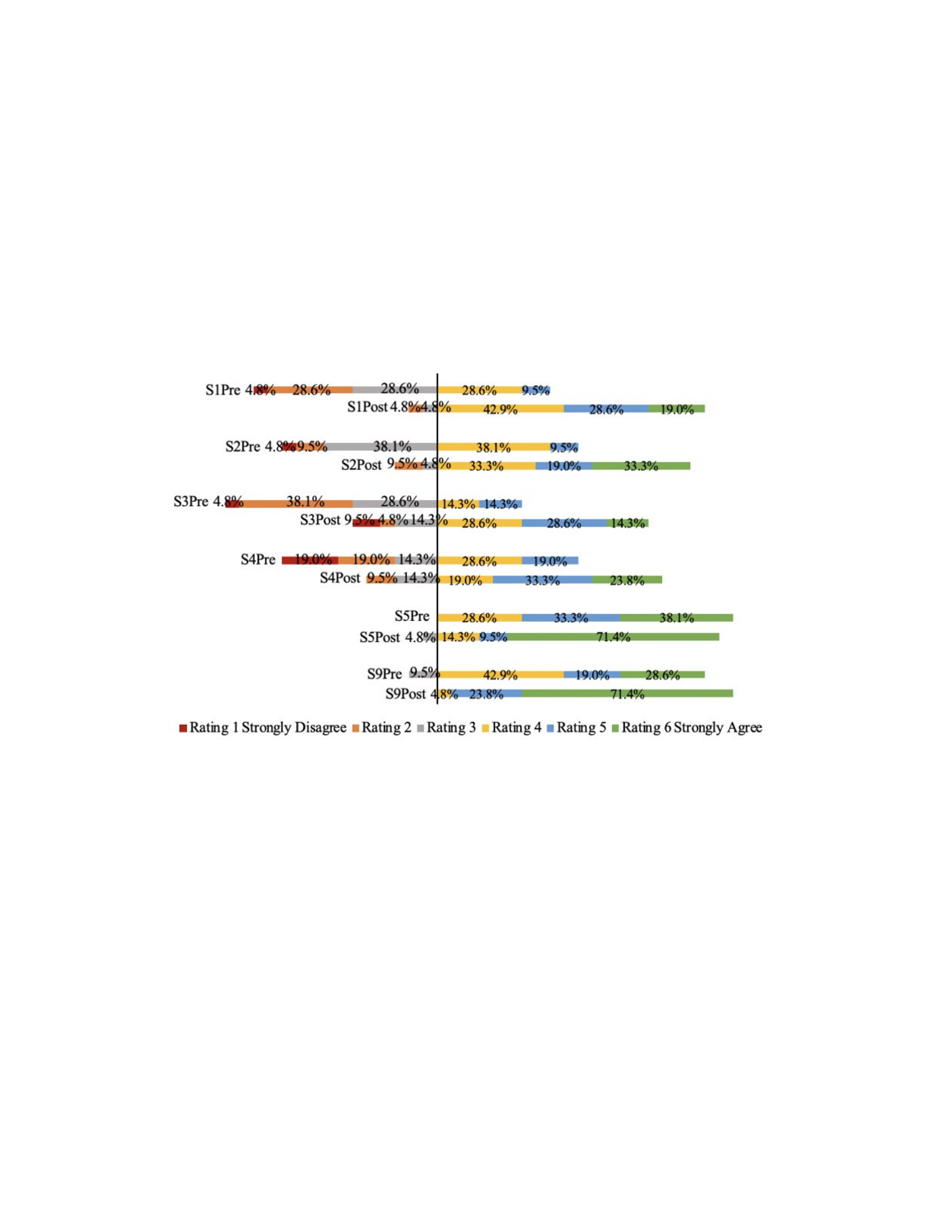
108
preservice teachers believed that digital math games could promote mathematics
learning.
Figure 7
Frequencies of Likert Scale Items About Preparation for Using Digital Math Games to
Support Mathematics Learning for ELLs (N = 21)
Note. S1 = I feel confident in choosing linguistically appropriate learning experiences for English language
learners in mathematics; S2 = I feel prepared to choose learning experiences that meet the needs of English
language learners in mathematics; S3 = I have adequate training to work with English language learners; S4
= I have adequate training to integrate digital math games into mathematics instruction; S5 = Using digital
math games in mathematics lessons can improve students' understanding of mathematics; S9 = Game
features in digital math games can help students learn mathematics content; Pre = pre-survey frequency
percentages; post = post-survey frequency percentages.
Preservice teachers may feel underprepared to teach mathematics to ELLs
because more than half (52%-71%) of the preservice teachers rated these statements
towards the “disagree” portion of the Likert scale (i.e., 1, 2, or 3) on the pre-survey. In
contrast, more than half (71%-100%) of preservice teachers shifted their ratings to the
“agree” portion (i.e., 4, 5, or 6) on the post-survey. This indicates that preservice teachers

109
felt better prepared after completing the learning modules. For example, preservice
teachers reported the biggest shift in frequencies toward the “agree” portion of the Likert
scale when they rated the statements “I feel confident in choosing linguistically
appropriate learning experiences for English language learners in mathematics” (S1) and
“I have adequate training to work with English language learners” (S3) from pre-survey
(29%-38%) to post-survey (71%-90%). Similarly, when asked to rate “I feel prepared to
choose learning experiences that meet the needs of English language learners in
mathematics” (S2) and “I have adequate training to integrate digital math games into
mathematics instruction” (S4), there was an increase in the percentage of preservice
teachers’ that favored the “agree” portion of the Likert scale from pre-survey (48%) to
post-survey (76%-86%).
Teacher Knowledge Reported by Preservice
Teachers
Table 15 shows the frequencies of themes reported by preservice teachers about
what teachers should know to integrate digital math games in mathematics instruction for
ELLs. Three main themes emerged: (1) student knowledge, (2) teacher game knowledge,
and (3) teaching strategies.
Teacher game knowledge was a theme that emerged with the biggest increase in
frequencies from pre-survey (29%) to post-survey (95%). For example, one preservice
teacher wrote, “What sort of games there are, where to find them, and how to make them
meaningful for learning.” A preservice teacher also described teacher game knowledge as
important when they wrote, “Teachers need to know how to identify quality math games

110
Table 15
Frequencies of Themes About What Teachers Should Know to Integrate Digital
Math Games in Mathematics Instruction for ELLs (N = 21)
Frequency
──────────────────────────
Pre-response
────────────
Post-response
────────────
Themes of what teachers should know
n
%
n
%
Teacher game knowledge
6
28.6
20
95.2
Student knowledge
11
52.4
5
23.8
Teaching strategies
10
47.6
4
19.0
that are digital.” Another preservice teacher wrote, “They need to understand academic
language features and design features.” The increase in frequencies suggests preservice
teachers became more aware of teacher game knowledge (e.g., design features and
academic language features) being important for integrating digital math games into
mathematics instruction for ELLs.
Preservice teachers showed a decrease in frequency for student knowledge from
the pre-survey (52%) to post-survey (24%). One preservice teacher wrote, “One thing
that teachers need to know is their students’ English level is at, especially with English
math language. Another thing that teachers need to know is how much the students
knows in their math skills.” Another preservice teacher wrote, “Teachers need to be
aware of the skills, strategies, and vocab that the students already know. Once they
realize the background knowledge of the ELL students, they can start to build off that.”
Similarly, teaching strategies had a decrease in frequencies from pre-survey (48%) to
post-survey (19%; e.g., “Teachers need to have a general understanding of teaching
techniques that can specifically help English language learners”). The decrease in

111
frequencies for these themes may suggest that preservice teachers became more aware of
other knowledge (e.g., design features, academic language features) that teachers need to
know to integrate digital math games effectively.
Beliefs about Digital Math Games Reported on
the Math Game Evaluation Rubric
Table 16 shows the frequencies of themes reported by preservice teachers about
their impressions of digital math games from the Math Game Evaluation Rubric. When
asked, “What was your overall impression of the game?” preservice teachers’ reported a
positive impression (61%-78%). One preservice teacher wrote, “I thought it was really
fun to play! I also understood it fairly easily. There were some math games that were
harder to play.” Similarly, another preservice teacher liked it because “I thought it was a
fun and creative game. It started out with small steps and works up to higher level of
fractions.”
Table 16
Frequencies of Themes About Preservice Teachers’ Impression of Digital Math Games
on Evaluation Rubrics (N = 18)
Frequency
───────────────────────────────────────────────
Game 1
──────────────
Game 2
──────────────
Game 3
───────────────
Pre
──────
Post
──────
Pre
──────
Post
──────
Pre
──────
Post
──────
Themes (impressions of game)
n
%
n
%
n
%
n
%
n
%
n
%
Liked it, impressed, fun,
engaging
14
77.8
10
55.6
11
61.1
8
44.4
13
72.2
9
50.0
Did not like it, not
engaging, confusing
4
22.2
8
44.4
7
38.9
10
55.6
5
27.8
9
50.0
Note. N reflects the number of participants who completed the pre-evaluation rubric and post-evaluation rubric for the
same digital math games.

112
In contrast, a lower percentage (22%-39%) of preservice teachers that wrote
negative impressions of the digital math games. For example, one preservice teacher
wrote, “It was difficult! I wanted to keep playing to figure out a strategy. This being said,
I think it is too advanced for 3rd grade.” Another preservice teacher wrote, “I wasn't a big
fan of it. The directions at the bottom weren't super clear and you didn't know what you
were doing.” Most preservice teachers had positive impressions of using digital math
games to enhance mathematics instruction for English language learners.
However, there was a decrease in the percentage of preservice teachers who
reported positive impressions from pre-evaluation (61%-78%) to post-evaluation (44%-
56%), which in turn, showed an increase in negative impressions from the pre-evaluation
(22%-39%) to the post-evaluation (44%-56%). This suggests that preservice teachers’
impressions of digital math games became more negative towards the end of the study.
This could be explained by preservice teachers becoming more aware of design features
and academic language features because their explanations about their impressions
specifically identified ineffective features in the games. For example, one preservice
teacher had a positive impression and wrote, “I think that this was one of my favorites
that I looked at. One feature that I liked about this game was that the level progressed.
This allows the students to be challenged more and more as they start to gain more of an
understanding of the concept. Another thing that I liked was that it gave hints and
feedback for when the students got something wrong.” Another preservice teacher wrote,
“This game is great! It gives multiple attempts, is very user-friendly, straight forward and
uses calming beach sounds.” One preservice teacher disliked a game and wrote, “The

113
game does not offer any hints or tutorials, which is so frustrating!” Another preservice
teacher wrote, “This game does not offer accuracy feedback. If the player is incorrect
about the number of pancakes flipped, the pancakes are flipped back to their cooking side
and the player has to start from scratch again. This does not teach or explain why the
player was incorrect, which would cause great frustrations.”
Preservice teachers also explained that their impressions changed from pre-
evaluation to post-evaluation. For example, one preservice teacher wrote, “Playing this
game a second time, I do not think this is a very high-quality math game. There is hardly
any feedback, hints, and the explanations are poor. I would not recommend this game.”
Similarly, another preservice teacher wrote, “I don't think that it is as effective as before.”
The changes in frequencies and preservice teachers’ use of specific features when
explaining their impressions indicate that they had more awareness of design feature and
academic language features in digital math games after completing the learning modules.
Wilcoxon Signed-Rank test and Preservice Teachers’
Self-Reported Changes in Beliefs about Their
Preparation During Semistructured Interviews
The Wilcoxon Signed-Rank test indicated that post-survey ranks were statistically
higher than pre-survey ranks for 5 of the 6 Likert scale items about preservice teacher
beliefs about their preparation for using digital math games to enhance learning for ELLs:
I feel confident in choosing linguistically appropriate learning experiences for English
language learners in mathematics (Z = -3.447, p = .001); I feel prepared to choose
learning experiences that meet the needs of English language learners in mathematics (Z
= -3.010, p = .003); I have adequate training to work with English language learners (Z

114
= -2.937, p = .003); I have adequate training to integrate digital math games into
mathematics instruction (Z = -2.979, p = .003); Game features in digital math games can
help students learn mathematics content (Z = -3.169, p = .002). In contrast, the post-
survey ranks were not significantly higher than pre-survey ranks for Using digital math
games in mathematics lessons can improve students’ understanding of mathematics (Z =
1.627, p = .103). This suggests that preservice teachers had more positive beliefs about
their preparation for integrating digital math games in mathematics instruction for ELLs
by the end of this study. This aligns with the themes that emerged from the
semistructured interviews about preservice teachers’ beliefs about their preparation,
impressions, and attitudes about digital math games (see Table 17).
Table 17
Beliefs About Preparation, Impressions, and Attitudes of Digital Math Games Reported
by Preservice Teachers During Semistructured Interviews (N = 21)
Frequency
──────────
Theme
n
%
Preparation for digital math game integration
Did not prepare
17
81.0
Prepared
4
19.0
Changes about impressions of digital math games
Changed
16
76.2
Did not change
5
23.8
Changes in attitude about using digital math games
Changed
19
90.5
Did not change
2
9.5
Note. Bolded numbers indicate percentages 50% or more.
When asked, “Do you feel that your teaching preparation courses have prepared
you to integrate digital math games into mathematics instruction for English language

115
learners? If so, how? If not, why,” 81% of preservice teachers reported that they did not
feel prepared. For example, one preservice teacher said,
No, I definitely think that I learned a lot more during this course. So, before this
course, no, I don't think that I was able to, like, learn a lot of like the supplemental
strategies that was taught in this course as well as like, I'm not only like the digital
math games, but also prepared me for like, other like science, digital games, or
like things like that and other subjects. I just think that sometimes the professor's
found it like difficult to add in, you know, to like, teach us how to, like test the
effectiveness and assess the effectiveness of the games.
Another preservice teacher said,
No, not really. Um, I think like, I feel like the courses that I've taken have been
very broad and like, they give very specific like, like, they give good ideas and
things like that. But I don't feel like when I started going through, like playing
those math games, and then like, learning about the things that you were talking
about, like academic language, and math language, I was just like, oh, like, I
would never have thought about thinking about any of these things for a math
game, or just like a game to implement into schools.
Preservice teachers indicated that their impressions (76%) and attitudes (91%)
changed about digital math games by the end of the study. For example, one preservice
teacher explained their impressions changed when they said,
So, I think that it definitely did. It kind of made me realize some of the games I
thought weren't as beneficial, were actually like, okay, that's not the worst game
you could pick. And then it also just like opened my eyes to like the reciprocal of
that of like, oh, that I thought that was a good game, but that actually has like, no
design features or anything that would like benefit a kid.
Similarly, another preservice teacher said,
I'm, like, at the very beginning of doing this module, I didn't feel like it was a
good one. But then after learning about like, the design features in the academic
language features, it helped me see like how it could be beneficial on some parts,
but also, it like didn't have like progressive levels and like not a lot of like,
teaching helped like the students understand.
When describing their change in attitudes towards using digital math games, one

116
preservice teacher said,
Yeah, I think, um, I guess I just never have thought of using math games, just
because, as I stated earlier, it never really came up in my education. But I think
that like, through this, I've found like an efficient way of choosing like good
games for that group of students. So, it's definitely inclined me way more to use
math games, for sure.
Another preservice teacher said,
Yes. It's made me realize that math games can really help the students and that, if
they're not created wisely, they can really hinder the students and frustrate them.
At least, I believe it could. So yeah, I think they're, they're a good way to make it
make math more accessible to English language learners.
This shows that preservice teachers had positive changes in their beliefs about
their preparation for integrating digital math games into mathematics instruction for
ELLs by the end of this study.
Summary of Results
Results showed preservice teachers developed awareness and beliefs about design
features and academic language features when choosing and evaluating digital math
games for ELLs after interacting with learning modules where preservice teachers
defined design features and academic language features, then used these features to
evaluate a digital math game in a guided experience. Preservice teachers had increased
awareness of design features by the end of this study. This is indicative of the significant
changes in the post-survey ranks. This shows that preservice teachers felt better prepared
to identify mathematics content and design features in digital math games. This is also
evident in the evaluation rubric results, where there were high percentages of preservice
teachers that could identify the specific mathematics concepts and the mathematical

117
terminology in digital math games because each participant identified a general or
specific fraction concept. Results indicate that a high percentage of preservice teachers
were most aware of the following design features: progressive levels, accuracy feedback,
and multiple attempts. Preservice teachers self-reported on the Module 2 reflection and
the semistructured interviews that they better understood design features and how these
features supported learning by the end of this study. This indicates that preservice
teachers felt better prepared to choose and evaluate digital math games because they were
more aware of design features that promoted mathematics learning.
Preservice teachers also reported an increase in their awareness of academic
language features. The significant changes in post-survey ranks compared to pre-survey
ranks show that preservice teachers felt better prepared to identify language demands in
digital math games. This was also evident by the high percentage of preservice teachers
that identified language as simple or complex when evaluating digital math games.
Similarly, many preservice teachers identified all nine academic language features as
important features in digital math games. Preservice teachers also self-reported on the
Module 3 reflection and the semistructured interviews that they understood academic
language features better and how these features supported learning in digital math games.
Therefore, preservice teachers were more aware of academic language features in digital
math games by the end of this study.
Preservice teachers’ beliefs became more positive about their preparation for
using digital math games to support mathematics learning for ELLs. The significant
changes in post-survey ranks compared to pre-survey ranks show that preservice teachers

118
felt better prepared to choose digital math games to support mathematics learning for
ELLs. Preservice teachers also self-reported during the semistructured interviews that
their beliefs became more positive about using digital math games in mathematics
instruction by the end of the study. Thus, preservice teachers had more positive beliefs
about their preparation for integrating digital math games into mathematics instruction
for ELLs by the end of this study.

119
CHAPTER V
DISCUSSION
The purpose of this study was to examine how preservice teachers developed
awareness and beliefs about design features and academic language features when
choosing and evaluating digital math games for English language learners (ELLs). The
overarching research question for this study was: How do preservice teachers develop
awareness and beliefs about design features and academic language features when
choosing and evaluating digital math games for English language learners (ELLs)? The
main research questions of the study were as follows.
1. What are preservice teachers’ awareness and beliefs about design features
when choosing and evaluating digital math games for ELLs, and what
changes, if any, are exhibited after completing the learning modules?
2. What are preservice teachers’ awareness and beliefs about academic language
features when choosing and evaluating digital math games for ELLs, and what
changes, if any, are exhibited after completing the learning modules??
3. What are preservice teachers’ beliefs about their preparation for using digital
math games to support mathematics learning for ELLs, and what changes, if
any, are exhibited after completing the learning modules?
This research study focused on three premises (i.e., preservice teachers’
awareness and beliefs about design features, awareness and beliefs about academic
language features, and their beliefs about using digital math games for instruction) that
can impact preservice teachers’ preparation for choosing and evaluating digital math
games to enhance mathematics instruction for ELLs. This chapter interprets the results of
this study and situates it in the existing literature. The first three sections of the chapter
discuss the results, based on changes between pre- and post-assessments of preservice

120
teachers’ awareness and beliefs about design features and academic language features,
and beliefs about their preparation for using digital math games to support mathematics
learning for ELLs. The final sections discuss the implications, limitations, and
suggestions for future research based on the findings.
Preservice Teachers’ Awareness and Beliefs About Design Features
The first premise examined how preservice teachers’ awareness and beliefs about
design features can impact how preservice teachers choose and evaluate digital math
games for ELLs. Results indicated that preservice teachers felt better prepared to
integrate digital math games into mathematics instruction for ELLs after they completed
the four modules because they had an increased awareness of design features. This was
evident in both the qualitative and quantitative findings, where preservice teachers
reported changes in their awareness of design features. For instance, an example from the
qualitative data were statements during the semistructured interviews such as, “I think I
just learned so much more about each feature, and different things became important
looking at it through the eyes of an ELL student” and “But I think the fact that now
knowing what each of them meant and seeing them in an example helped change my idea
of what was most important in a video game.” An example of this from the quantitative
data was the significant changes in post-survey ranks on the Wilcoxon Signed-Rank test
for the Likert scale items about design features.
Preservice teachers conveyed that their awareness of design features increased
through preservice teachers the semistructured interview responses (e.g., “My views have

121
changed positively. I know what design features to look at in games.”) and the increased
awareness of explanations for important design features from pre-survey (e.g., “I also
think that physical action is important so that students get up a MOVE!”) to post-survey
(e.g., “Link physical action: inviting the students to physically move objects or see visual
changes is a great way for students to understand the math they are completing”). As a
result, preservice teachers felt better prepared to choose and evaluate digital math games
for ELLs. Preservice teachers reported that their ideas about the role of design features
changed from the beginning of the study. For example, they change from an engaging
role (e.g., “Because I understand, like, what the features are that I was looking at, because
when I started, I was just playing a math game to like, play the math game”) to a learning
role where they promote mathematics learning (e.g., “I think that the design features of
games are key to ELLs having a positive learning experience versus a confusing,
frustrating one”). After completing the learning modules about design features and
academic language features, preservice teachers were more aware of design features. This
result aligns with Meletiou-Mavrotheris and Prodromou’s (2016) research, which noted
that prior training and awareness of the TPACK framework helped 13 preservice teachers
choose and use digital math games effectively in mathematics lessons. Since design
features are part of technology knowledge (TK) in the TPACK framework, preparation
courses need to provide experiences that help preservice teachers increase their
awareness of design features in digital math games to choose and effectively implement
digital math games into mathematics instruction for ELLs.
Other research that aligns with the current findings has shown that teacher game

122
content knowledge is important to effectively integrate digital games into instruction
(Hsu et al., 2013, 2017, 2020). Results in this dissertation study indicated that preservice
teachers had fraction game content knowledge, as evidenced by their ability to identify
the fraction content and skills in the digital math games. This demonstrates that
preservice teachers’ awareness of the mathematics in digital math games is important to
effectively choose and evaluate the games.
Overall, Preservice teachers reported positive impressions of design features in
digital math games. They indicated that design features could promote mathematics
learning. For example, they stated,
I think that when they are all used together to assist the child in learning, the child
gains the most out of the game at that point. I feel like they all promote different
areas of mathematical concepts that are needed in our mathematical learning
progression.
Prior researchers have reported that design features can enhance mathematics learning in
digital math games (Callaghan & Reich, 2018; Gresalfi et al., 2018; Moyer-Packenham,
Lommatsch, et al., 2019). This shows the important role of preservice teachers learning
about design features in their preparation courses to identify games that use these features
to enhance mathematics learning.
Preservice Teachers’ Awareness and Beliefs About Academic
Language Features
The second premise of this study examined how preservice teachers’ awareness
and beliefs about academic language features can impact how preservice teachers choose
and evaluate digital math games. Both qualitative and quantitative indicated that

123
preservice teachers had an increased awareness of academic language features and felt
better prepared to integrate digital math games into mathematics instruction for ELLs by
the end of this study. For instance, examples of this from the qualitative data were the
statements preservice teachers used during the semistructured interviews (e.g., “I feel like
once I got more information about what each of them meant and how to identify them in
the games, then I was able to have a better opinion on which ones were most influential
to the kids”). An example of this from the quantitative data was the significant changes in
post-survey ranks on the Wilcoxon Signed-Rank test for the Likert scale items about
academic language features.
Prior research by Lindahl (2013, 2019) has noted that preservice teachers have
low abilities to identify language demands and structures that can impact ELLs. Lindahl’s
findings aligned with preservice teachers’ beliefs at the beginning of this study when they
reported feeling underprepared to identify language demands in digital math games.
However, preservice teachers’ awareness of academic language features increased after
they completed the learning modules. For example, preservice teachers were able to
better identify the simple and complex language in the digital math games. Preservice
teachers also reported that their ideas of the role of academic language features changed
by the end of the study based on their comments during the semistructured interview
(e.g., “I felt like, I didn't exactly know what I was looking for. But then once I was
learning, I was able to evaluate and see the games actually did have that”). As a result,
preservice teachers felt better prepared to choose digital math games to support
mathematics learning for ELLs. This result has implications for preservice teachers’

124
preparation programs. It indicates the important role that experiences with identifying
language demands can play in helping preservice teachers to better identify features in
digital math games that can help make input comprehensible for ELLs. This can
potentially increase preservice teachers’ awareness of language demands and positively
impact their beliefs about their preparation.
Research has reported that mathematical language can be an important feature in
digital math games (Bedwell et al., 2012; Ke, 2013; Moyer-Packenham, Litster, et al.,
2019). The findings on the importance of mathematical language in digital math games
align with this study because preservice teachers indicated their awareness that academic
language features can promote mathematics learning in digital math games. For example,
in the current study, preservice teachers reported negative impressions of academic
language features in digital math games. However, preservice teachers conveyed that the
academic language features need improvements to better support the mathematics in the
games. This indicates that preservice teachers were aware of academic language features
and how academic language features to support students’ mathematics learning. Thus,
attention to academic language features can help preservice teachers choose and evaluate
digital math games that better align with the language needs of ELL learners.
Preservice Teachers’ Beliefs About Their Preparation for Using Digital
Math Games to Support Mathematics Learning for ELLs
The third premise in this study examined how preservice teachers’ beliefs about
their preparation for using digital math games for instruction and teaching ELLs can

125
impact how they choose and evaluate digital math games. The findings suggest that
preservice teachers had more positive beliefs about their preparation for choosing and
evaluating digital math games for ELLs by the end of this study. For instance, examples
of this from the qualitative data were the statements during the semistructured interviews,
such as, “Yes. It's made me realize that math games can really help the students and that,
if they're not created wisely, they can really hinder the students and frustrate them” and
“Yeah, I think, um, I guess I just never have thought of using math games…it's definitely
inclined me way more to use math games, for sure.” An example of this from the
quantitative data was the high percentage of preservice teachers that indicated their
attitudes about using digital math games changed by the end of the study.
There were significant changes in preservice teachers’ beliefs about their
preparation for choosing and evaluating digital math games for ELLs based on the results
of the Wilcoxon Signed-Ranked test. As noted by several research studies (Meletiou-
Mavrotheris & Prodromou, 2016; Sardone & Devlin-Scherer, 2009, 2010; Shah & Foster,
2015), when preservice teachers have opportunities to learn about digital games in
content courses, their beliefs can be impacted. For example, Meletiou-Mavrotheris and
Prodromou reported that 13 preservice teachers’ beliefs became more sophisticated after
evaluating digital math games because they were aware of specific features of the games
(e.g., feedback, rules, topics). Therefore, content courses that include experiences for
preservice teachers to choose and evaluate digital math games, like the learning modules
in this study, offer the potential to increase awareness of game features that promote
mathematics learning.

126
Preservice teachers indicated that their beliefs about the effectiveness of the
games changed after completing the learning modules. This indicates that preservice
teachers became more aware of design features and academic language features after
completing the learning modules in this study. Research has reported that preservice
teachers’ experiences in their preparation programs can impact their beliefs about using
digital math games (Belbase, 2015; Gibson, 2002; Li, 2013; Sardone & Devlin-Scherer,
2009, 2010). This aligns with this study’s findings that the learning modules about design
features and academic language features have some measure of influence on preservice
teachers’ beliefs in this study, based on the experiences they had with identifying features
and evaluating a digital math game during the learning modules. Therefore, meaningful
experiences in preservice teachers’ preparation courses focusing on design features and
academic language features can potentially develop preservice teachers’ skills in
choosing digital math games that promote mathematics learning for ELLs.
Results indicated that preservice teachers’ beliefs about using digital math games
became more positive by the end of the study. Preservice teachers reported that they felt
they could better choose digital math games, making them more willing to integrate them
into mathematics instruction. This indicates that the experiences preservice teachers have
with digital math games during their preparation can have a positive impact. This finding
also aligns with previous research (Gutiérrez-Fallas & Henriques, 2021; Sardone &
Devlin-Scherer, 2010; Shah & Foster, 2015). For example, Gutiérrez-Fallas and
Henriques reported that when 12 preservice teachers in a secondary preparation course
interacted with technology, it improved their attitude about integrating technology into

127
mathematics instruction. The results in this study support this claim because after
preservice teachers interacted with technology (e.g., digital math games), their beliefs
became more positive about using digital math games in mathematics instruction.
Similarly, Shah and Foster reported that 14 preservice teachers’ beliefs were positively
impacted by interacting with digital math games, which increased their desire to use them
in future instruction. Thus, preparation courses that integrate experiences similar to the
learning modules in this study offer the opportunity to better prepare preservice teachers
to develop positive beliefs about integrating digital math games into mathematics
instruction.
Preservice teachers reported teacher game knowledge as important for teachers to
integrate digital math games into mathematics instruction, specifically knowledge of
design features and academic language features. This shows that preservice teachers were
aware of the importance of design features and academic language features in digital
math games. Preservice teachers need this knowledge when choosing and evaluating
digital math games for ELLs. As noted by several researchers, teacher game knowledge
is important to integrate digital math games into instruction effectively (Hsu et al., 2013,
2017, 2020). Therefore, teacher preparation programs should integrate learning about
design features and academic language features to develop preservice teachers’ skills in
choosing and evaluating digital math games.
Implications and Future Research
This study makes several contributions to the field and provides important

128
implications for game designers, researchers, and preservice teacher preparation
programs. First, this study highlights important design features and academic language
features that game designers should be aware of that impact the learner’s interactions
with digital math games. For example, game designers should consider how academic
language features in digital math games help players develop mathematics language.
Game designers should also consider providing options for different languages because
the digital math games in this study only used English. This option could be a resource
ELLs use to better understand mathematics in digital math games (Lucas et al., 2008;
Lucas & Villegas, 2010; 2013; Moschkovich, 2013).
This study provides a model for how preservice teachers can increase their
awareness of design features and academic language features, which may impact their
beliefs about digital math games. For example, the model used in this study included
learning modules as short learning experiences (Sardone & Devlin-Scherer, 2009, 2010)
that provided specific interactions with design features and academic language features.
These short learning modules provided definitions of each feature and allowed preservice
teachers to use these features to evaluate a digital math game in a guided experience
where each feature was discussed using the evaluation rubric. Then, preservice teachers
used their increased awareness to re-evaluate three digital math games. These types of
experiences can increase awareness of design features and academic language features
because it encourages preservice teachers to consider what makes a digital math game
effective (Sardone & Devlin-Scherer, 2009). Thus, preparation programs could use
similar experiences to help preservice teachers increase their awareness of design features

129
and academic language features in digital math games.
Finally, this study provided rich data about preservice teachers’ awareness and
beliefs about design features and academic language features when choosing digital math
games for ELLs. Future research could continue to examine preservice teachers’
awareness of design features and academic language features and how this awareness
may influence how preservice teachers choose and evaluate digital math games for ELLs,
especially with a more representative population of elementary preservice teachers.
Future research could also examine how preservice teachers evaluate design features and
academic language features across digital math games with mathematics content other
than fractions (e.g., addition, subtraction, multiplication, division, geometry) to better
understand how preservice teachers choose and evaluate digital math games for ELLs in
additional content areas of mathematics. To advance the field, researchers could examine
preservice teachers choosing and evaluating digital math games for ELLs, then examine
the preservice teachers’ use of the games in a lesson they teach. This may provide better
insights into how preservice teachers choose digital math games and integrate them to
enhance instruction for ELLs. Future research could also revise the rubric to include five
scoring categories for the academic language features that align with WIDA proficiency
levels. This would allow preservice teachers to better identify how language features
might indicate how a digital math game better supports ELL students at different English
proficiency levels.

130
Limitations
The results of this study should be viewed through the lens of the limitations of
this study. The small population size, the lack of diversity within the population, and the
use of convenience sampling limited this study. First, there are limitations within the
population due to the small number of participants recruited from one university and the
lack of diversity within the convenience sampling of participants. Thus, generalizability
across populations is limited because the sample does not represent all characteristics of
every preservice teacher that completes the university requirements to become a
practicing teacher (Terrell, 2015). Another limitation was the short time (i.e., 4 hours)
that preservice teachers interacted with the modules in this study. Due to this short
duration, preservice teachers could not learn how to determine the appropriateness of
input for ELL students at different WIDA proficiency levels. Instead, preservice teachers
focused on the appropriateness of input based on grade and mathematics content.
Additionally, I was the only coder for the qualitative data analysis, creating the potential
for bias of the researcher’s influence on the qualitative coding process. Given these
limitations, future research should use a larger and more representative population by
sampling preservice teachers across diverse populations.
Conclusion
The results of this study indicated that preservice teachers’ felt better prepared to
integrate digital math games into mathematics instruction for ELLs after participating in
the learning modules. There were significant changes in preservice teachers’ beliefs about

131
their preparation for using digital math games to support mathematics learning for ELLs
from pre- to post-survey. Preservice teachers also self-reported changes in their
awareness of the design features and academic language features in the digital math
games. This indicates that the learning modules, and the processes that the preservice
teachers engaged in while evaluating the digital math games, supported positive changes
in their beliefs, increased awareness of the features, and ability to choose and evaluate
features of the digital math games for ELLs.
These findings advance the research literature about innovative experiences for
preparing preservice teachers to choose and evaluate digital math games. These results
can provide a model of how to help preservice teachers develop an awareness of design
features and academic language features in digital math games, which can lead to
preservice teachers effectively using digital math games to enhance mathematics
instruction for ELLs.

