


INTRODUCTION Financial transactions are foundational
Financial Transactions
Financial transactions are foundational to the national and global economy. The global
financial systems transact trillions of dollars daily and serve billions of customers (Tapscott &
Tapscott, 2016). Taking the USA as an example, the Automated Clearing House system
processes more than forty trillion dollars’ worth of annual transactions—and that only represents
about 20 percent of the electronic payments in the nation (Kiviat, 2015). With many competitors
seeking a share of this huge market, to remain competitively efficient, financial institutions must
frequently disrupt their operations and processes driven by new technologies such as blockchain
(PwC, 2017).
Workie and Jain (2017) distinguish three phases of a blockchain-based financial
transaction: 1) the initiation phase, where a client accesses the blockchain network to buy or sell
financial assets, 2) the verification of financial assets in the blockchain ledger by involved
stakeholders, and 3) the recording of the information into the blockchain ledger. In alignment
with these three phases, this dissertation focuses on four areas of financial transactions: asset
verification, record keeping, data privacy, and transaction costs. Table 1 illustrates the mapping
between the four areas of dissertation focus and the three phases of a blockchain-based financial
transaction. Asset verification and record keeping map directly to the first and second phases
respectively. However, users and financial institutions are concerned about data privacy and
transaction costs during all phases of financial transactions. To cover the four areas of focus
methodically, the dissertation explores the opportunities, challenges, and recommendations from
technological, regulatory and adoption perspectives.

Table 1: Financial Transaction Phases and Areas of Research Focus
F T P
A of Resear Focus
Transaction initiation
Data privacy
Overall
transaction cost
Verification of asset
Asset verification
Data privacy
Recording information
Record keeping
Data privacy
At present, financial transaction costs involve many layers of fees that are collected by
intermediaries. Digital payments and currency transfers require heavy consumption of human
and infrastructural assets of financial institutions that act as intermediaries to conduct, clear, and
settle transactions (Yli-Huumo, Ko, Choi, Park, & Smolander, 2016). Transaction fees are
significant—McKinsey states that the global payment industry enjoyed a 1.8 trillion dollar
revenue in 2015 (Bansal, Bruno, Istace, & Niederkorn, 2016). Moreover, it takes several days to
settle transactions—transactions such as money transfers require nearly three days to settle (Guo
& Liang, 2016; Kiviat, 2015). Although profitable to the intermediaries, these costs burden the
parties making the transaction. Blockchain technology might make these transactions faster and
less costly by eliminating several layers of intermediaries. The decentralized nature of
blockchain could imply costly layers of redundancy, infrastructural costs, and delays.
Nonetheless, the reverse could be true because the technology could provide its own
costefficiencies—as will be described later. Efficiencies could be gained in the same way that
double-entry accounting has improved security and reliability despite its redundancy, and
analogous to how computer technology has improved security and reliability—until cyber risks
evolved. Blockchain technology could, therefore, be the next step in security and reliability.
Nonetheless, many challenges and issues would need to be resolved before getting there.

I.2 Blockchain Technology
Blockchain technology was introduced by Nakamoto (2008) to bypass middleman actors
such as financial institutions by allowing direct peer-to-peer transactions. To achieve this goal,
Nakamoto suggested a peer-to-peer distributed ledger. In this way, payer and payee can exchange
directly over the network, utilizing encryption and consensus mechanisms (Guo & Liang, 2016;
Tsai, Blower, Zhu, & Yu, 2016; Zhu & Zhou, 2016) to make transactions tamperproof since any
modification to the historical data record is detectable by participating blockchain network nodes
(B. Lee & Lee, 2017; Tapscott & Tapscott, 2017).
One of the fundamental objectives of any payment system is to guard against double
spending. In other words, the system should be able to track who owns the money and should
only allow the person who owns the money to spend it once and not more than once. Blockchain
technology solves the double spending issue through a consensus mechanism (Nakamoto, 2008;
Pazaitis, De Filippi, & Kostakis) that will be detailed later in this dissertation.
Blockchain technology comprises several technological and non-technological concepts
and ideas. The integration of these concepts and ideas allows value exchanges without a trusted
central institution (Kiviat, 2015). As a result, there is a growing interest in the technology
because it provides security, anonymity, and data integrity without third-party organizations in
control of the transactions (Yli-Huumo et al., 2016). Although it could theoretically
disintermediate, in reality, blockchain networks re-intermediate trust away from the center
(Mougayar, 2016) and form ‘multi-center, weakly intermediated’ schemes (Guo & Liang, 2016).
The decentralized nature of blockchain technology could also make the data more transparent
when compared to centralized transactions (Yli-Huumo et al., 2016). However, since public
blockchain network users could opt to act anonymously, a high level of privacy could diminish

the degree of transparency from the perspective of entities that need to know more about end
users.
Initially, blockchain technology emerged as the underpinning platform for the Bitcoin
cryptocurrency. However, for the reasons outlined, banks expect it will help them streamline and
reduce the costs of activities such as international payments and trading settlement (Irrera &
Shumaker, 2017). This expectation opens the door for a potentially disruptive technology that
could have broad implications for the financial sector. Zhao, Fan, and Yan (2016) and Mougayar
(2016) predict that the transformational effect of blockchain technology on enabling trustworthy
transactions globally will parallel the paradigmatic influence of the Internet on accessibility to
information. Zhao et al. (2016) further elaborate that decentralized trust—arising from
blockchain technology—will attenuate costs of transactions that are due to non-technical aspects
of centralization. Similarly, Guo and Liang (2016) posit that applying blockchain technology can
resolve many of the efficiency bottlenecks, delays, fraud, and operational risks they assert infest
the financial industry. Nonetheless, blockchain networks are inherently slow since 1) getting a
whole network to a consensus on a single truth is time-consuming and 2) peer-to-peer nodes
have to act both as a client and a server (Tsai et al., 2016).
I.3 State of Adoption
Since blockchain technology could offer opportunities to reduce cost and improve the
speed of transaction settlements, exchanges, banks, and the whole securities industry are
increasingly interested in the technology (de Meijer, 2016). Moreover, international institutions
including the International Monetary Fund, and nations, such as the USA, the UK, Japan, China,
Russia, India, and South Africa have initiated research on blockchain technology applications
targeting many fields (Guo & Liang, 2016).

Recently, international institutions, including the United Nations and the International
Monetary Fund (Guo & Liang, 2016), as well as central banks in the U.K., China, the USA,
Korea, Singapore, Japan, Russia, India, Netherlands, and South Africa have recently announced
blockchain technology plans (Mori, 2016; Tsai et al., 2016). National stock exchanges such as
Nasdaq; banking titans such as J.P. Morgan; and financial bodies such as the USA Depository
Trust & Clearing Corporation and the People’s Bank of China have all started their blockchain
technology research laboratories (Guo & Liang, 2016; Mori, 2016). Most financial institutions
have pilot programs for blockchain technology. For instance, R3—founded in 2015 as a
blockchain technology consortium—has partnered with over eighty financial institutions and
bodies (R3, n.d.). China Financial Blockchain Consortium (Guo & Liang, 2016) is another
alliance. Traditional companies have jumped on the blockchain technology bandwagon with a
variety of offerings. For instance, IBM has built a supply chain blockchain with a mission
statement to lubricate exchange, enhance trust, increase accountability, and elevate transparency.
IBM CEO Ginni Rometty stated: “What the Internet did for communications, blockchain will do
for trusted transactions” (IBM, n.d.). Startups such as Blockstream and Digital Asset Holdings
already offer financial institutions services that facilitate digital asset dealing (Pilkington, 2015).
According to Coindesk (2017a), enterprise-oriented blockchain-based projects grew in size, and
pilot projects continued in partnership with major groups and corporations as summarized in
Table 2.

Table 2: State of Enterprise Blockchain Technology (Coindesk, 2017a)
Hyperledger expands projects and
members:
4 top level frameworks including EVM
code, 130 members, PoCs in finance, and
working groups in healthcare
Enterprise Ethereum Alliance is born:
EEA launches with major membership list,
focused on permissioned Ethereum with
interoperability with public blockchains
Corporates expand staffing, R&D labs:
Enterprises, consortia, and working groups
continue launching pilots, PoCs and tests
Ripple expands to Japan, completes pilot:
Mitsubishi joins board, 47 bank consortia
implements cloud-based payment pilot
R3 continues diverse tests:
Demos Ethereum applications, and
commercial paper programs
DTCC (Depository Trust & Clearing
Corporation) expands DLT settlement
trials:
Eying REPO market, working with startups
including Digital Asset and R3
I.4 Research Approach
Even though blockchain technology could impact many aspects of our lives, thus far,
there are only a few published academic papers that treat the technology from a business
perspective. aver Research on blockchain technology has been mainly attentive to technical and
legal topics (Lindman, Tuunainen, & Rossi, 2017) primarily published in practitioner-oriented
journals and on websites that are targeting Bitcoin evangelists and hobbyists. Over 80 percent of
the extant literature focuses on Bitcoin systems, and less than 20 percent deals with other
blockchain technology applications (Yli-Huumo et al., 2016) with most of that focused on
technological (Beck, Czepluch, Lollike, & Malone, 2016; Lindman et al., 2017; Teigland, Yetis,
& Larsson, 2013) and legal problems (Bollen, 2013; Ingram & Morisse, 2016; Lindman et al.,
2017). Hence, as blockchain technology permeates, further research in the domains of
information systems (IS) and management is called for (Giaglis & Kypriotaki, 2014; Lindman et

al., 2017; Van Alstyne, 2014). This dissertation contributes to the efforts of bridging this gap in
knowledge.
To explore the impact of blockchain technology on financial transactions, this dissertation
uses a pluralistic method that combines a review of the literature, an analysis of the perspectives
of key industry players and observers, and a theoretical interpretation through the lens of
transaction cost theory (Coase, 1937; Ouchi, 1980; Williamson, 1975). A pluralist approach that
compares and contrasts multiple plausible perspectives on reality is crucial to the emergence of
rigorous scientific knowledge (Azevedo, 1997; Van de Ven, 2007) as it can provide
complementary insights and possible synthesis of them to study an emerging business
phenomenon. Furthermore, using multiple perspectives on a complex business problem
decreases the likelihood of unintended bias in interpretations (Van de Ven, 2007).
When utilizing a pluralist methodology, the researcher moves iteratively between data
and theory (A. S. Lee & Baskerville, 2003) contrasting perspectives and synthesizing findings
into a holistic account. Consistent with the approach, this dissertation moves between description
and theory by drawing on a) the intersection of literature about blockchain technology and
financial transactions, b) interviews with financial industry executives and subject matter experts
about the impact of blockchain technology on financial transactions, and c) transaction cost
theory (Coase, 1937; Ouchi, 1980; Williamson, 1975) as a particularly thought-provoking
theoretical framework that promises insights into the potentially disruptive effects of the
technology. When applying the first and second methods, we adopt a broad view of the
phenomenon exploring various types of blockchain technology impacts on financial transactions.
In this way, we report findings such as technical, regulatory, and adoption issues. Moreover, in
this case, the term ‘transaction cost’ has a broader meaning to engulf ‘transaction theory’ costs,

production costs (Dyer, 1997; Zajac & Olsen, 1993), and transition costs that are related to
deploying blockchain technology. Nevertheless, when we look through the prism of transaction
cost theory, we zoom in to solely focus on ‘transaction theory’ costs.
A detailed account of how the dissertation has applied the pluralist methodology is found
in appendix A.
I.5 The Role of Theory
The field of IS is concerned with studying phenomena that emerge from the interaction
between technological systems and social systems (Gregor, 2006; A. S. Lee, 2001). As such, the
use of blockchain technology in any industry satisfies the definition of IS and could be explored
targeting the four central goals of IS theory (Gregor, 2006). The second goal is to explain how,
why, and when things occur based on causality and methods of argumentation (Gregor, 2006).
The third goal is to probabilistically predict what will transpire in the future if certain
preconditions obtain (Gregor, 2006). Finally, the fourth goal is future-oriented like prediction
with theory offering a prescription of normative methods and structures for the development of
artifacts to attain desired outcomes (Gregor, 2006).
This dissertation provides descriptive accounts and examines opportunities and risks from
business and societal perspectives (Lindman et al., 2017) to uncover new explanations
underlying the blockchain technology phenomenon by invoking transaction cost theory to
explicate the interaction of the financial sector with blockchain technology (Gregor, 2006). In
part, the goal here is a response to the assessment of Zhao et al. (2016) that research in the
economic and social validity of blockchain technology applications is lagging because it takes
more effort to uncover. Additionally, there is a lack of a deep understanding regarding how
blockchain technology decentralized services are designed, developed, and organized to

revolutionize trust (Lindman et al., 2017). In addition, this research seeks to foresee (Gregor,
2006) the impact of blockchain technology on financial transactions by enlisting perceptions by
key industry players and observers and by adopting theoretical interpretations. Hence, the final
integrative goal of this research is to prescriptively (Gregor, 2006) outline insights into how
financial organizations can prepare for blockchain technology opportunities and threats.
The transaction cost theory is a fitting theoretical framework for understanding and
explicating the impact of blockchain technology on financial transactions because blockchains
could impact how transactions are conducted. Transaction cost theory is interdisciplinary by
virtue of joining economic perspectives with aspects of organization theory and contract law
(Williamson, 1979). The theory is concerned with minimizing the cost of transactional activities
that are not directly attributed to the production of goods and services, and are instead related to
the cost of searching, bargaining, monitoring, and enforcement activities that are associated with
the transaction of goods and services (Husted & Folger, 2004). Consequently, a persistent goal of
transaction cost theory is concerned with organizational boundaries around the decision of
whether a transaction is more efficiently performed within a firm or outside a firm’s boundaries
(Coase, 1937; Geyskens, Steenkamp, & Kumar, 2006).
Ouchi (1980) defines a ‘transaction cost’ as any activity that is conducted to satisfy the
expectations of participants in an exchange. Usually such costs are attributed to the difficulty of
redeploying assets to their next best use—the asset specificity challenge (Husted & Folger, 2004;
Klein, Crawford, & Alchian, 1978; Williamson, 1985, 1991)—or to the difficulties in measuring
individual contributions to team effort—the metering problem which is also referred to as
performance ambiguity (Alchian & Demsetz, 1972; Husted & Folger, 2004; Milgrom & Roberts,

1992; Ouchi, 1980). Another problem with perceiving equity is contingent goal incongruence—
the degree to which exchange participants have incompatible objectives (Husted & Folger, 2004;
Ouchi, 1980).
There are two primitives in transaction cost theory that are closely related to the
aforementioned notions. First, bounded rationality—the individual’s limitation on receiving,
sustaining, retrieving, and processing information (Simon, 1955; Williamson, 1973). The second
is opportunism—exemplified by dodging duties, breaching agreements, and stealing (Alchian &
Demsetz, 1972; Husted & Folger, 2004) as each participant endeavors to maximize their
advantages in transactions through dishonesty and lack of transparency (Williamson, 1973).
Moreover, Williamson also specific two more transaction costs determinants: frequency,
meaning how often a contract is invoked (Milgrom & Roberts, 1992; Williamson, 1979) and
uncertainty, comprising ex ante difficulties of anticipating all future scenarios, language
equivocality, and ex post performance ambiguity.
Accordingly, Table 3 summarizes the research design for this dissertation based on
Mathiassen (2017). The table defines the problem setting, the area of concern, the analytical
framing, the method, the research question, and the expected contribution to the body of
knowledge.
Table 3: Research Design Summary—Adapted from Mathiassen (2017)
C
D
D
P
The problem setting
represents people’s concerns
in a real-world problematic
situation.
Blockchain technology could offer opportunities
concerning financial transactions. On the other
hand, to implement blockchain technology there
are many technological, regulatory, and
adoption challenges.

A
The area of concern
represents a body of
knowledge within the
literature that relates to the
problem setting.
The impact of blockchain technology on
financial transactions with specific focus on
asset verification, record keeping, data privacy,
and transaction costs
F
The conceptual framing helps
structuring the analysis of data
to answer the research
question. FA draws on
concepts from the areas of
concern, whereas FI is
independent of area of
concern.
The study will leverage transaction cost theory
as an independent conceptual framing FI.
M
The adopted methods of
empirical inquiry.
The study adopts a pluralist approach by
combining three different methods of inquiry:
Method 1: Extant literature analysis. Method
2: Perception analysis based on interviews
with financial executives, subject matter
experts, and blockchain technology
researchers.
Method 3: Theoretical interpretation of insights
from Methods 1 and 2 based on transaction cost
theory.
RQ
The research question relates
to the problem setting; it
opens the research into the
area of concern and helps
ensure the research design is
coherent and consistent.
What is the impact of blockchain technology on
financial transactions?
C
The contributions to the
problem setting and area of
concern and possibly to
conceptual framework and
method.
This study contributes to the existing body of
knowledge as follows:
Contribution to practitioners: Insights into how
financial organizations can prepare for
blockchain technology opportunities and threats
CP.

Contribution to the literature: A synthesis of the
extant financial literature related to blockchain
technology, coupled with empirical accounts of
industry perceptions of the impact of
blockchain technology CA on financial
transactions.
Contribution to the theory: A theoretical
interpretation of the phenomenon through the
lens of transaction cost theory CF.
II TECHNOLOGY: BLOCKCHAINS
Blockchain technology is both an economic innovation—a new architecture for enabling
humans or machines exchanges without the need of full trust—and a technological innovation—
a novel decentralized ledger that engenders trust (Liebenau & Elaluf-Calderwood, 2016;
Lindman et al., 2017) because the technology could provide the platform to record transactions
and share data between participating parties in a more efficient, transparent, and verifiable
manner (Workie & Jain, 2017). However, disruptive innovations usually surpass the internal
absorption and usurpation capabilities of established institutions (Mougayar, 2016) and both
established institutions and startups will have to navigate the regulatory and adoption turbulences
and technological hurdles as will be detailed later in this dissertation.
II.1 Blockchain Explained
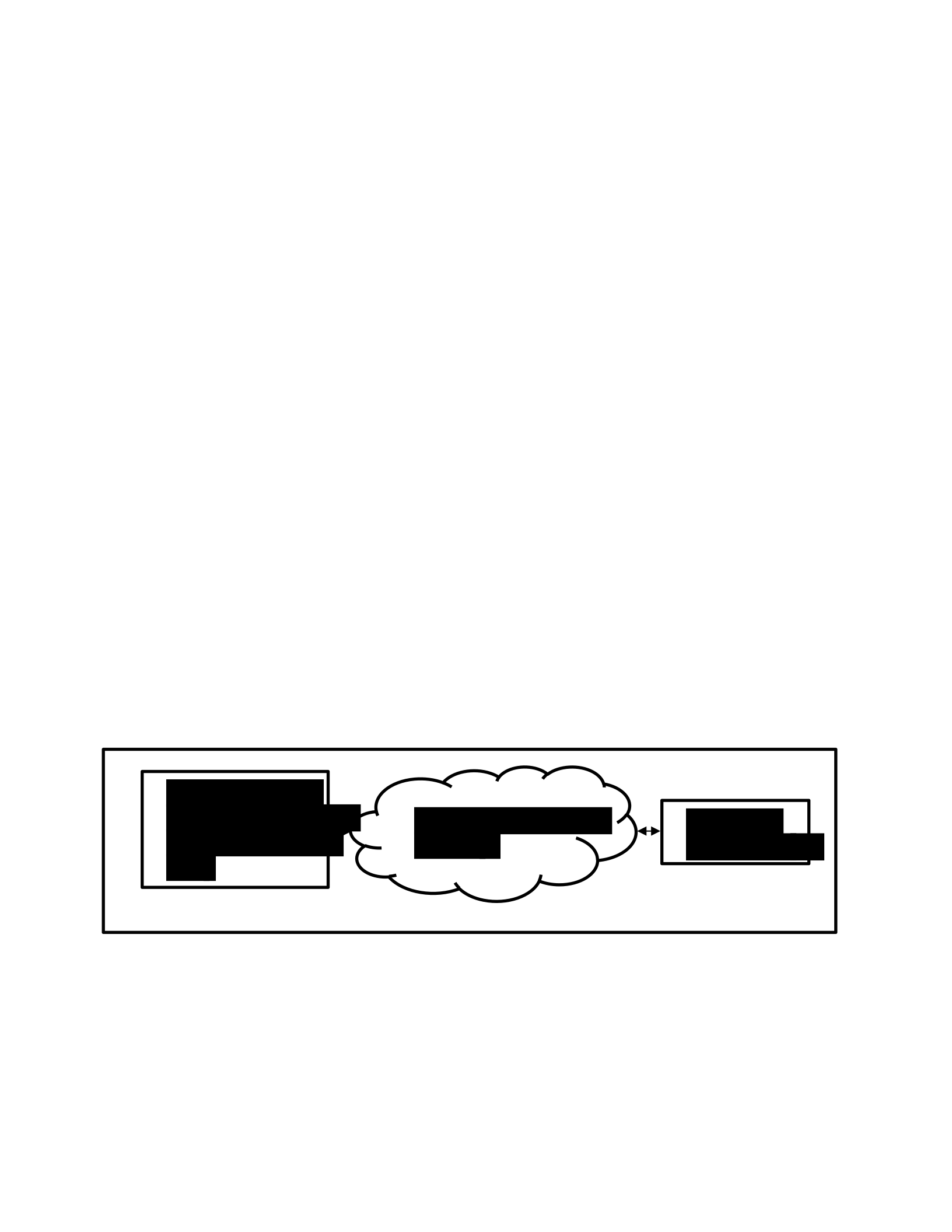
To explain how blockchain technology works, we start with a simple scenario based on
Bitcoin blockchain. In our scenario, Alice wants to use some of her Bitcoins to buy an audible
book from Bob through the Bitcoin blockchain—Figure 1.
Figure 1: A Simplified Blockchain-based Transaction
Alice initiates the exchange by sending a broadcast message to the blockchain network.
The message contains the electronic address of Bob and the amount required to pay for the
audiobook. Next, the blockchain network assembles Alice’s transaction information and adds it
to its public ledger. Then, seeing the payment from Alice, Bob sends Alice the electronic keys to
Bitcoin Blockchian
Network
Alice has some
Bitcoins and wants
to buy an audible
book
Bob sells
audible books

download the audible book. Based on this scenario, we present the underpinning blockchain
concepts that explain how the transaction in the scenario works.
To support the ensuing elaboration of the above scenario, we describe in Table 4 the
relevant Bitcoin blockchain terms.
Table 4: Bitcoin Blockchain Terms
T
D
Transaction
According to (BitcoinWiki, n.d.) a Bitcoin transaction is
1. A transfer of value that is broadcasted to the network and
recorded by the network into a block.
2. Typically references previous transaction outputs as new
transaction inputs and dedicates all input Bitcoin values to new
outputs.
3. Not encrypted, so it is possible to browse and view every
transaction ever recorded into a block.
4. Once buried under enough confirmations it can be considered
irreversible.
Block
A unit of data in the blockchain that includes a hash of itself, the hash
of the prior block, and multiple transactions (Narayanan, Bonneau,
Felten, Miller, & Goldfeder, 2016).
Bitcoin blockchain reached 510188 blocks as of 2018 Feb 20th
(Blockchain, n.d.).
Blockchain
Is a chain of blocks where each block is cryptographically linked to
the prior one (Mattila, 2016).
Blockchain
Network
A peer-to-peer arbitrarily connected network with no hierarchy, no
centralization, and no master nodes; where each full node stores a
replica of the blockchain and relays info to its connected neighbors
(Narayanan et al., 2016).
Node
Any computer that connects to the Bitcoin network (BitcoinWiki,
n.d.).

Full node
A special type of node that fully validates transactions and blocks;
almost all full nodes also support the network by accepting
transactions and blocks from other full nodes, validating those
transactions and blocks, and then further relaying them to neighboring
nodes (BitcoinCore, n.d.).
The number of full nodes is unknown. (Bitnodes, 2018) asserts that
there are 11389 reachable full nodes as of 2018 Feb 20th, but
estimates by different sources vary significantly.
Miner
A full node that competes to build the next block (Tapscott &
Tapscott, 2016).
Estimates vary, but they are thousands Bitcoin miners.
II.2 Authentication
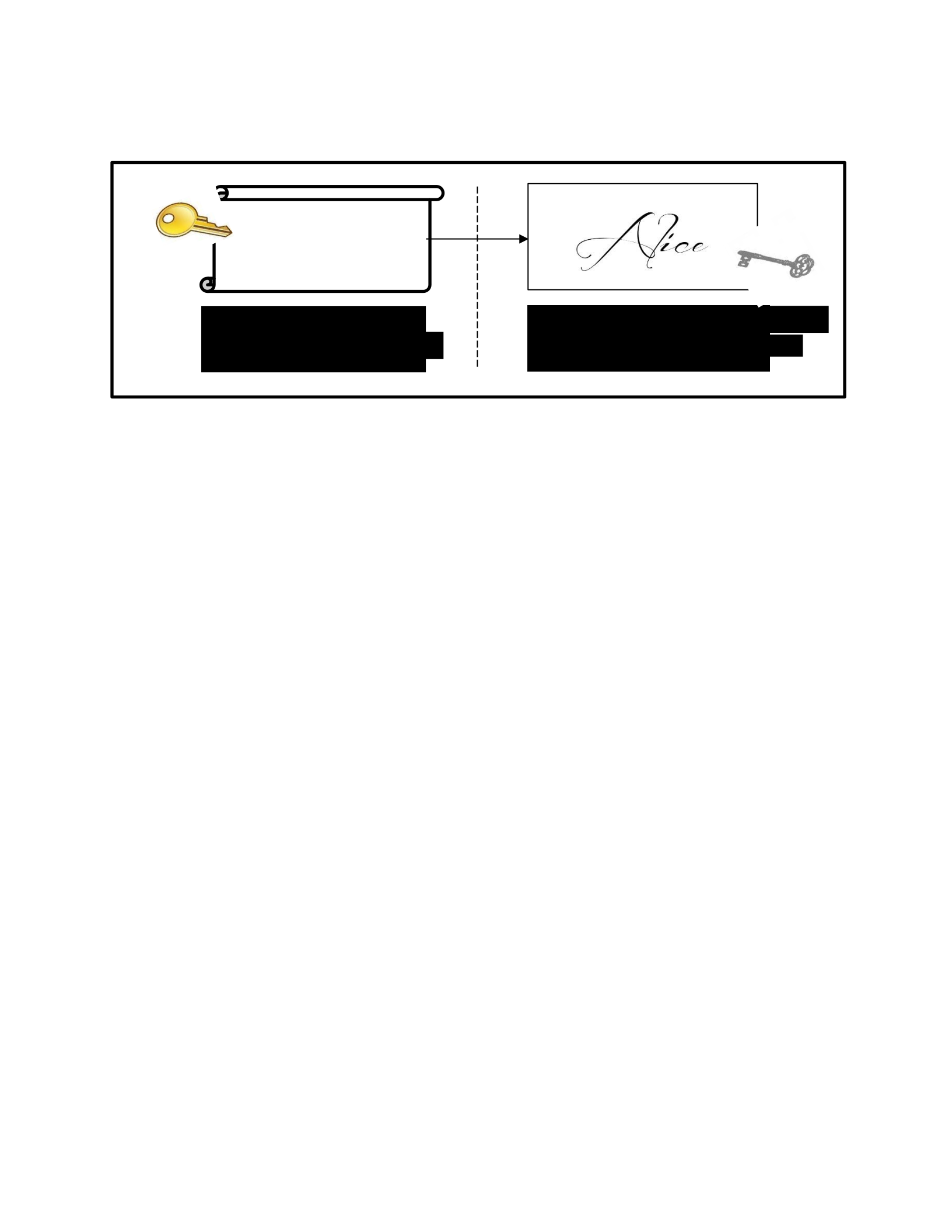
How does the Bitcoin blockchain network and Bob know that Alice authenticated the
transaction? The answer is digital signature. Alice initiates the transaction by using her private
key—a password that only Alice knows—to digitally sign, and therefore, authenticate the
transaction. Paralleling the objectives of a traditional hand-written signature, a digital signature
is a cryptographic mechanism that utilizes pairs of private and public keys to satisfy four
objectives (Badev & Chen, 2014). First, only the signatory can sign with her specific signature.
Second, it is not possible to append the signature to other than the signed documents. Third, the
signatory cannot deny her signature. Fourth, the recipient can validate that the document has the
authentic signature of the signatory. Narayanan et al. (2016) explain how the public and private
keys are generated using a mathematical algorithm such that if Alice signs a message with her
private key, and Bob knows her public key, then Bob can verify that Alice has indeed signed the
message and that the message has not been tampered with. Figure 2 depicts this authentication
scenario.
16
Figure
2: Authentication Using Digital Signature—Adapted from Badev and Chen (2014)
II.3 Content and Verification
What is in the transaction initiated by Alice? Narayanan et al. (2016) explain how
transactions are constructed in a Bitcoin blockchain network, in the scenario where Alice intends
to send some Bitcoins to Bob. The transaction comprises a pointer to where Alice acquired the
Bitcoins in the historical record of the blockchain, the amount she wants to transfer to Bob, the
public key of Bob which is the payee's digital address, Alice’s digital signature for the whole
transaction, and a small transaction fee as an optional incentive for the node that assembles her
transaction. Figure 3 illustrates the content of the transaction broadcasted by Alice to the
blockchain network.
Upon receiving Alice’s transaction, the blockchain network verifies a few items such as
Alice’s digital signature and her claim of ownership of the Bitcoins. Following the verification of
the veracity of the transaction, one of the nodes in the blockchain network assembles Alice’s
transaction into a block of data alongside hundreds of other transactions, and hence, the block
becomes part of the chain or ledger. The network is now aware that the Bitcoins spent by Alice
Se
nder Sig
n
s message
using own private key
Recipient verifies signature
using sender’s public key
17
Figure
are owned by Bob. By virtue of Alice’s transaction being part of the public ledger, Bob may
confidently send Alice the keys to the audiobook she bought from him.
3: Transaction from Alice to Bob—Adapted from Narayanan et al. (2016)
Input: Pointers to where Alice acquired the Bitcoins
Output 1: Bitcoins to be transferred to Bob and his public key
Output 2: Change address—Alice’s public key and change amount
Signature: Alice’s digital signature of the whole transaction
Notes:
• The total of inputs should be equal or greater than the total of outputs
• When total of inputs is greater than total of outputs, the difference is considered as a
transaction fee
II.4 Network Operation
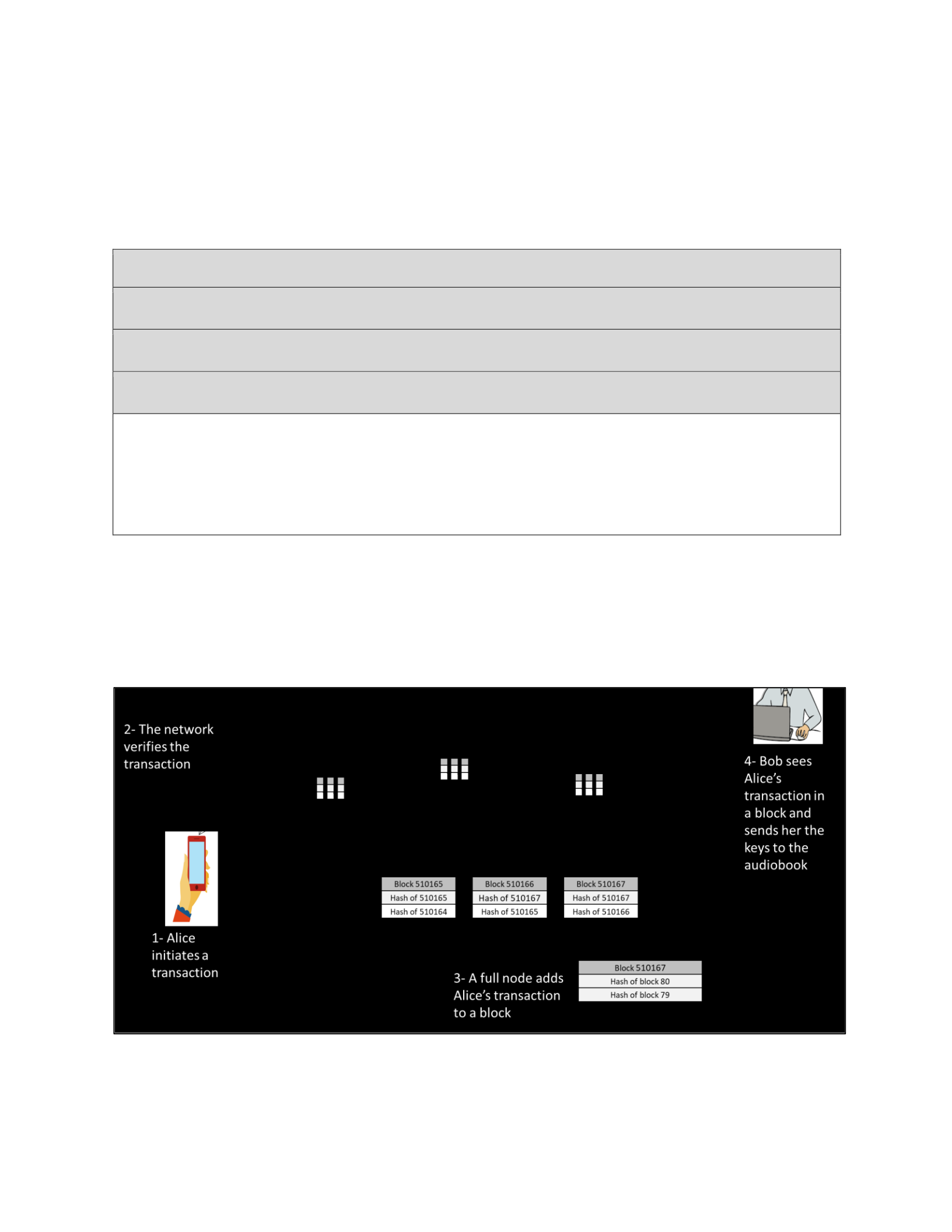
How does the Bitcoin blockchain network operate? Our scenario is based on the Bitcoin
blockchain network. Figure 4 depicts the steps of our scenario in more details.
Figure 4: Alice Transacting with Bob through Blockchain Network
18
Figure
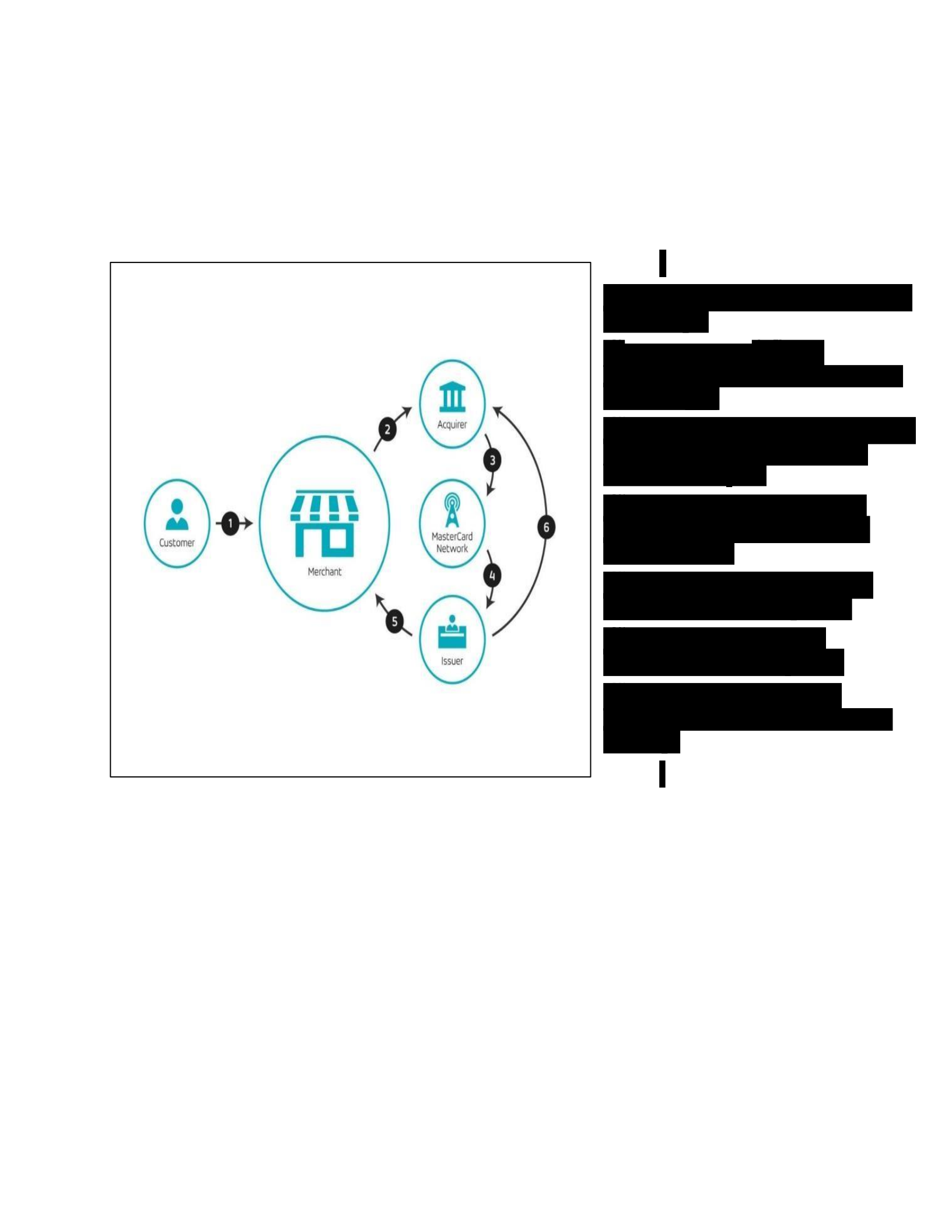
To contrast and, therefore, appreciate the simplification blockchain technology brings to
the table, Figure 5 depicts a traditional credit card transaction.
5: A Traditional Credit Card Transaction (MasterCard, n.d.)
Bitcoin is a cryptocurrency operating over a public blockchain network. According to
Narayanan et al. (2016), the Bitcoin blockchain network comprises many nodes that are
arbitrarily and partially connected to relay information to each other using the blockchain
protocol. The Bitcoin blockchain network is a peer-to-peer network that has no hierarchy, no
centralization, and no master nodes.
Some full nodes participate in the tasks of validating and relaying transactions in the
1
-
Customer buys a good using
credit card
2
-
Merchant’s point
-
of
-
sale
sends customer’s information
to the acqu
irer
3
-
Acquirer asks MasterCard to
get authorization from the
customer’s bank
4
-
MasterCard submits the
transaction to the bank for
authorization
5
-
The bank authorizes and
responds to the merchant
6
-
The bank routes the
payment to the acquirer
7
-
Acquirer deposits the
payment into the merchant’s
account

19
Figure
Bitcoin blockchain network (Swan, 2015). Such full nodes are called ‘miners’—a metaphor for
their quest to compete with each other to build new blocks. Since the Bitcoin protocol allows full
nodes to share their knowledge about transactions with their neighbors, the network guards

20
against double-spending by validating each new transaction against the list of unspent
transactions in the ledger (Bjerg, 2016). ‘Miners’ are motivated by two monetary incentives
described by Narayanan et al. (2016). First, each new valid block conceives a set amount of new
bitcoins that will belong to the builder of that block. Second, the block builder collects the
transaction fees of all the transactions included in the block.
Narayanan et al. (2016) go on to explain this operation of a blockchain network. Before a
‘miner’ builds a new block, she must find a solution for a hard-to-solve mathematical puzzle.
This endeavor is referred to as proof of work since it requires spending a significant amount of
computational power to solve the puzzle. That is the reason, on average, it takes nine minutes to
generate a new block in the Bitcoin blockchain network. Next, other ‘miners’ verify the integrity
of the newly-built block and append it to the longest chain. The longest valid chain is considered
the operational blockchain that the network nodes honor and extend. Honoring and extending the
longest valid chain is another significant component of the consensus mechanism that allows the
network to function without a central authority.
II.5 Chain of Blocks
How are blocks structured? From a database perspective, the blockchain is a series of data
blocks that are cryptographically chained together (Mattila, 2016) as each block contains the
‘hash’—a unique short encryption of the message—of the preceding block, and therefore, it is a
chain of blocks or a 'blockchain'. A hash function produces an easy to compute, but extremely
hard to invert fixed-length compact ‘hash’ from a message of arbitrary length (Gilbert &
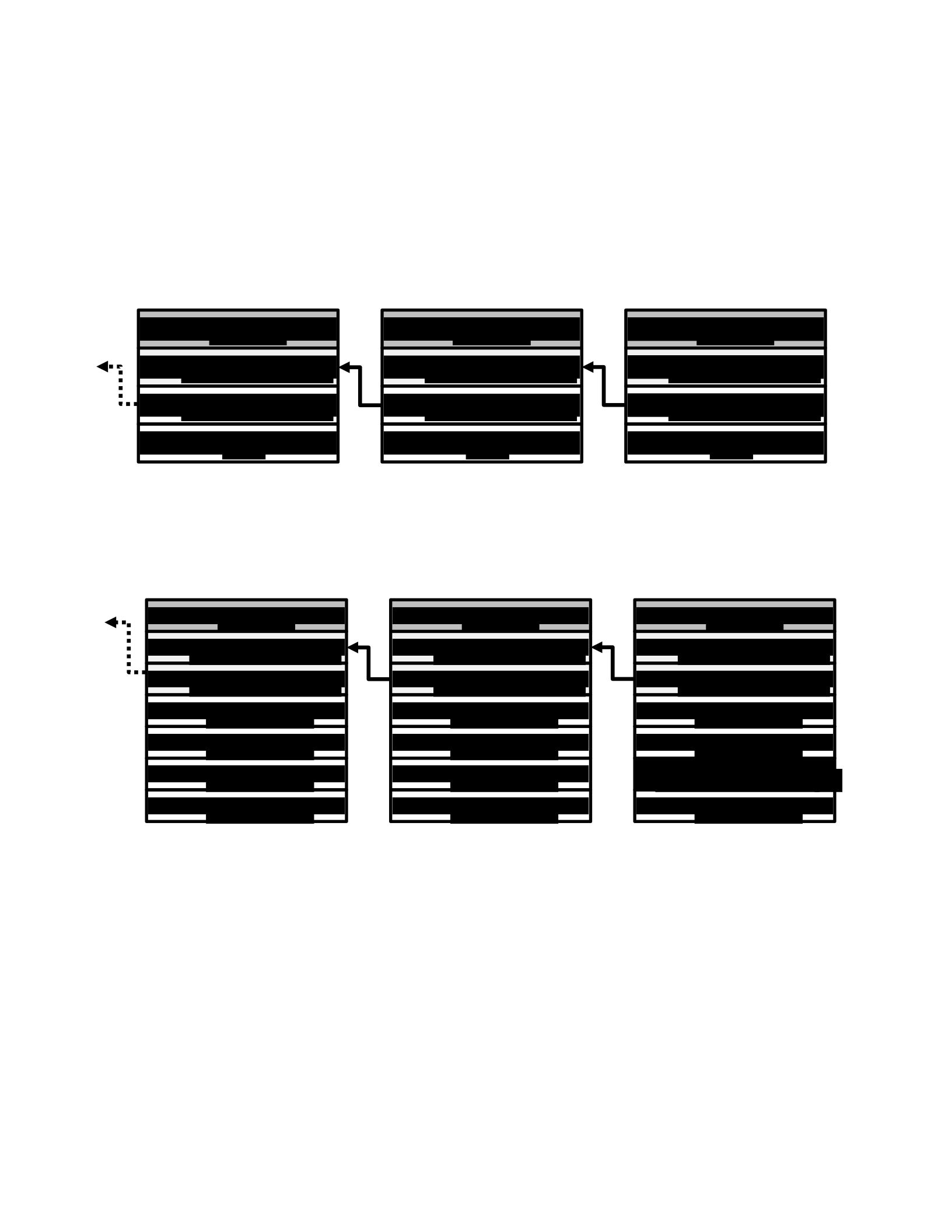
Handschuh, 2003). Figure 6 illustrates a high-level schematic of a blockchain ledger or database.
Since the header of the block contains a ‘hash’ of the data of the current block, and the current
block contains the hash from the previous block, back to the genesis block, the history of every
21
past block predicates the latest block. The ‘hash-chaining’ of blocks makes it extremely difficult
to hack a blockchain—as we mentioned earlier, it is hard to solve the mathematical puzzle for a
single block, let alone to work backward to rebuild many blocks that satisfy the required
solutions.
Figure 6: Chain of Blocks in a Bitcoin Blockchain (Narayanan et al., 2016)
Each Bitcoin block is a collection of transactions in the range of 2000 transactions per
block. Figure 7 depicts a simplified representation of the Bitcoin blockchain ledger.
Figure 7: Simplified Blocks of Transaction(Narayanan et al., 2016)
II.6 Blockchain Categories
This dissertation adopts the definition of blockchain by Mougayar (2016) as “a
technology that permanently records transactions in a way that cannot be later erased but can
only be sequentially updated, in essence keeping a never-ending historical trail.” As such,
immutability is the defining attribute of blockchains. Therefore, except for immutability, which
must be present in every blockchain, the rest of the attributes exist at varying degrees (Coletti,
Hash of block 81
Data
Block 82
Hash of block 82
Hash of block 80
Data
Block 81
Hash of block 81
Hash of block 79
Data
Block 80
Hash of block 80
Transaction
Transaction
T of A
Hash of block 81
Transaction
Block 82
Hash of block 82
Transaction
Transaction
Transaction
Hash of block 80
Transaction
Block 81
Hash of block 81
Transaction
Transaction
Transaction
Hash of block 79
Transaction
Block 80
Hash of block 80

22
2015; DeRose, 2015; Pilkington, 2015). The key attributes of blockchain technology are
distributed ledgers, cryptography, consensus mechanisms, and peer-to-peer transmission (Guo &
Liang, 2016; Tsai et al., 2016). It is, therefore, a meta-technology that integrates several
technologies to form a gestalt—greater than the sum of its parts (Mougayar, 2016).
There are different flavors of blockchains with diverse sets of attributes (Pilkington,
2015) and varying levels of control that define categories of blockchains. Table 5 illustrates a
typological distinction between the main categories. These different categories provide flexible
trust-based services (Lindman et al., 2017) as will be further elaborated later. Each blockchain is
a standalone database with varying levels of access and control. Public blockchains are
unconditionally accessible by every Internet user (Buterin, 2015; Pilkington, 2015). At the other
end of the spectrum, access to an entirely private blockchain is controlled by a central locus of
governance (Buterin, 2015; Pilkington, 2015). In between the public and private dichotomy, there
is a continuum (Allison, 2015; Brown, 2014; Pilkington, 2015) of permissioned, hybrid, or
partially decentralized blockchains (Buterin, 2015; Pilkington, 2015).
Table 5: Categories of Blockchains—Adapted from (Guo & Liang, 2016)
P Blockchain
C
B
P
Participants
Anyone
Specific groups
Centrally
controlled
Credit
mechanism
Consensus
Mechanisms
Collective
endorsement
Self-endorsement
Bookkeeper
All participants
Participants
decide
Self-determined
Incentive
Needed
Optional
Not needed

23
Prominent
advantage
Self-established
credit
Efficiency and cost
optimization
Transparency and
traceability
Prominent
advantage
Self-established
credit
Efficiency and cost
optimization
Transparency and
traceability
Typical application
Bitcoin
Clearing
Audits
Load capacity
30-20 times/second
1000-10000
times/second
Varies
III APPLICATION: FINANCIAL TRANSACTIONS
Analogous to how the digital wave disrupted the telecommunication industry, blockchain
technology is emerging as a FinTech paradigm shift (Guo & Liang, 2016) that promises to
enhance the efficiency of financial transactions and to transform the global financial network
altogether (de Meijer, 2015). Leaders of the financial industry expect the technology to disrupt
the sector. A 2016 survey conducted by McKinsey unveils that approximately 50 percent of the
executives in the financial industry are confident that blockchain technology will have a
significant impact within three years (Guo & Liang, 2016; McKinsey, 2016). IBM pronounced
that 66 percent of banks will have a scalable blockchain-based deployment by the year 2020
(Fortune, 2016; Guo & Liang, 2016; Zhao et al., 2016). Such predictions demonstrate that
change is imminent and may materialize within the next few years. Furthermore, the financial
industry has already begun to undergo a technological revolution (Accenture, 2015; Kiviat,
2015). To move from general notions of the impact of blockchain technology on financial
transactions, we focus on four specific issues that play indispensable roles across financial
transactions. These are asset verification, record keeping, data privacy, and transaction costs. The

24
relevance was explained earlier in Table 1 in relation to the three phases of any transaction
described by Workie and Jain (2017): 1) the initiation phase, where a client accesses the
blockchain network to buy or sell financial assets 2) the verification of financial assets in the
blockchain database by involved intermediaries and stakeholders, and 3) the recording of the
information into the blockchain ledger.
In this chapter, ‘transaction costs’ have a broader meaning to include transaction costs
from Transaction Cost Theory as well as production costs (Dyer, 1997) (Dyer, 1997; Zajac &
Olsen, 1993. In addition, we touch upon transition costs of moving from current technologies in
financial transactions to a blockchain-enabled environment.
III.1 Asset Verification
The first activity in trading a financial asset on a blockchain network is to verify specific
attributes of the asset (Workie & Jain, 2017). The asset verification involves confirming that the
parties who seek to exchange are the legitimate owners of the corresponding assets (FINRA,
2017). Ownership according to Stephen Pair, CEO of BitPay, is established when some entity
recognizes, documents, and defends the rights of someone over an asset (Tapscott & Tapscott,
2016). As such, blockchain technology can facilitate direct ownership verification by virtue of a
consensus mechanism (Workie & Jain, 2017) that is already agreed upon by all participants. The
confirmation of the ownership of the asset in the blockchain network is carried by a single full
node that constructs the block that encompasses the asset information and is also corroborated by
other full nodes in the network which continuously verify the validity of every new block and the
overall veracity of the whole ledger. The strength of the blockchain stems from that fact that no
single custodian—full node—has control over the entire ledger at any time (Rechtman, 2017).

25
Instead, it is akin to a majority rule. The apparent risk here is when a single entity controls over
50 percent of the custodians of the network (Rechtman, 2017). Whether that is likely or not
depends on the operational environment.
The immutability attribute of blockchain data makes it possible to store information
indefinitely in its database. Subsequently, this elevates the level of trust in the veracity of assets
information on a blockchain. Furthermore, immutability leads to traceability (Mori, 2016)
because blockchain contains verifiable timestamped records of every asset ever transacted in
blockchain (Crosby, Pattanayak, Verma, & Kalyanaraman, 2016). Therefore, by virtue of its
built-in native audit trail, blockchain technology is readily available to verify assets (Rechtman,
2017). As such, asset verification becomes viable and possibly more reliable using blockchain
technology. On the other hand, immutability means that it is not possible—especially in a public
blockchain—to fix a mistake pertaining to an asset by editing the database. Instead, one must
append the corrected representation of the asset in a new block. Therefore, immutability affords
traceability and reliability; nonetheless, it makes it difficult to fix mistakes and human errors.
Due to the nature of its distributed ledger, it is arguable that blockchain built-in
redundancy is helpful in significantly reducing the risk of losing assets information (Rechtman,
2017). Hence, compared to centralized databases, blockchain is more reliable and fault-tolerant
because clones of the database—chain or ledger—are maintained by multiple network nodes
(Mori, 2016). If most of the network nodes go down, the network will continue to verify records
uninterrupted since the database is available in many other nodes and the consensus mechanism
is independent of the number of operational full nodes. Nevertheless, redundancy comes with the
price of taxing resources in terms of storage and processing requirement.

26
In any case, a decentralized consensus mechanism requires significant infrastructural and
operational expenses in areas of communication networks, computation, and storage to operate a
chatty transactional financial system (Tsai et al., 2016; Yli-Huumo et al., 2016; Zhao et al.,
2016). Moreover, it requires effort to integrate blockchain-based asset verification, at scale, with
the financial legacy platforms and processes; and to enhance the capabilities of blockchain
technology to meet the requirements of the financial industry (Tsai et al., 2016). Financial
systems, for the most part, require high throughput and speed—stock exchanges execute over
100K transactions per second that may require asset verification; hence, blockchain technology
must be able to handle these types of loads. Moreover, Tsai et al. (2016) state that since the
blockchain protocols are executed sequentially, it is difficult to meet the financial industry
requirements no matter how much computational power is added, especially that blockchain
network is inherently slow because it is peer-to-peer, which means that each node needs to act
both as a client and a server. However, some people such as Mougayar (2016) argue that
scalability is a moving target that has, historically speaking, been met by technological
innovations and by the pressure of imminent demand.
From a compliance point of view, before deploying a blockchain-based network, there are
several regulatory rules concerning asset verification that broker-dealers need to devise ways to
comply with. Some of these asset verification requirements are established by FINRA and
Exchange Act Rules (FINRA, 2017). Furthermore, for a global blockchain covered by
heterogeneous jurisdictions, the task of asset verification from a regulatory framework is further
complicated (Mori, 2016).

27
III.2 Record Keeping
Record keeping is to resiliently and accurately preserve past information through time in
a manner that satisfies involved parties (Witte, 2016)—precisely what blockchain technology
does by design, and as such, blockchain technology is capable of keeping records (DuPont &
Maurer, 2015). Furthermore, the technology could have a significant impact on record keeping
(Kiviat, 2015) since it alters centricity and reshapes governance (Guo & Liang, 2016). Currently,
financial institutions keep records across disparate databases, unlike a shared blockchain ledger
which affords a central repository where records are accessible by all participating institutions.
Guo and Liang (2016) asserts that many of the financial sectors’ problems stem from a)
poor quality of records needed for assessing individual credit, b) inability to share records, c)
lack of utilization of external sources of records such as the Internet data, and d) difficulties of
meeting compliance requirements related to customers’ records such as know your customer
(KYC). According to Moyano and Ross (2017), the annual costs of KYC due diligence per bank
is up to 500 million dollars. They further conclude that financial institutions should collaborate
among themselves, and other stakeholders, to develop blockchain-based record keeping systems
to address these weaknesses. Such blockchain networks could be permissioned (private with
appropriate access control) to allow financial institutions (exchanges, central banks, banks, and
insurance firms) to enhance reputability, accountability, and controllability (de Meijer, 2015) by
computationally, efficiently, and seamlessly keep records across the financial value chain (Kiviat,
2015). Nonetheless, to achieve this desired vision for record keeping, financial institutions need
to agree on what records to share, how to contribute to the cost of building and maintaining the
network, and how to manage access control.

28
A record of information stored on a blockchain ledger attains further veracity over time,
and as such, blockchain technology is well positioned to be the source of truth, the provider of
accurate records, and ultimately, the platform for trust and record keeping due to its immutability
attribute and consensus mechanisms (DuPont & Maurer, 2015; Mori, 2016). Consequently,
blockchain technology can natively, seamlessly, and more transparently afford robust audit trails
of records of dividend disbursements, ownership details, stock split terms, stock transactions
timestamps, taxes reports, and compliance reporting requirements (Rechtman, 2017). Therefore,
blockchain technology is a readily available reporting infrastructure (Workie & Jain, 2017) and is
impactful to auditing and monitoring (Kiviat, 2015) requirements and practices desired by
financial institutions and regulatory bodies. To attain this collaborative record keeping interface,
it would require building the appropriate tools and processes. Additionally, inasmuch as
blockchain data is immutable and irreversible, the industry must innovate solutions for how to
address issues that may arise from erroneous human or platform record entries (de Meijer, 2015).
Furthermore, there need to be considerations of computational resources for maintaining a
blockchain’s growing ledger (Workie & Jain, 2017) that is redundantly stored in multiple nodes.
However, the risk here is likely insignificant grounded on Moore’s law that computing storage
and Central Processing Units (CPUs) tends to get cheaper and faster, thus allowing cheaper
record keeping and faster record retrieval. Furthermore, if we envision a future permeated by
machine-to-machine type of transactions, then when pushing the blockchain technology towards
the internet of things (IoT) periphery, the current blockchain techniques are generally not
appropriate since IoT devices work with low computational power and are limited to tiny
amounts of energy consumption (Atzori, 2016; Zhao et al., 2016).

29
According to Rechtman (2017), to guard against fraud and errors, financial custodians
keep records independently, and if a conflict arises between records during reconciliation, then
the majority win—Figure 8 illustrates the reconciliation process. It is arguable that blockchain’s
single truth can afford seamless records reconciliation. Figure 8: Records Reconciliation
(Rechtman, 2017)
In late 2015, Nasdaq finalized the first-ever private security record keeping over its
blockchain, thus leading to a significant reduction of settlement time and the elimination of paper
stock certification records (Nasdaq, 2015). Some of the financial sectors that could seek to utilize
blockchain technology to enhance their record keeping practices are a) equity markets, where the
current process require a slow and manual tracking of records of shares ownership, b) debt
markets, where the current settlement time is long and involves multiparty, c) repurchase
agreements, where currently there is risk of settlement failures and lengthy settlement time, d)

30
corporate bonds, where blockchain technology could digitize the records of assets and codify the
necessary calculations, e) derivative market, where records transparency could aid both
regulators and participants currently struggling to conduct and monitor the intricate post-trade
records and activities, and f) customer identity management, where a shared blockchain records
could provide a centralized repository to ease the task (Workie & Jain, 2017).
Again, there are regulatory requirements that need to be met by a blockchain-based
deployment vis-à-vis record keeping. For instance, broker-dealers have to comply with
recordkeeping compliance requirements such as Exchange Act and FINRA rules that mandate the
minimum length of time for keeping the record, establish the required type of records, and detail
accessibility to attestations (FINRA, 2017).
III.3 Data Privacy
Data privacy is an essential aspect in financial transactions because customers care about
their data privacy, and consequently, businesses must care as well since it makes good business
sense to care about the wants of the customers. Besides, financial institutions must comply with
regulatory mandates around data privacy. We could think about data here to mean two things: a)
content data that pertains to transactions and the like and b) identity data that provides
information about the users of a blockchain network. Furthermore, privacy and transparency are
two desired outcomes, but sometimes they conflict. While individuals usually care more about
their privacy than transparency, the collective typically cares more about transparency.
Blockchain technology can paradoxically and flexibly swing between a continuum of
high degree of transparency—decentralization of a public blockchain ledger makes the data more
accessible (Yli-Huumo et al., 2016)—and high level of privacy (Narayanan et al., 2016)—
pseudonymity of users of Bitcoin and similar blockchains is made possible by a lack of a central

31
authority that governs the network users as well as by its built-in cryptography. The level of data
privacy and transparency depends on whether the blockchain network is public, private, or a
hybrid, in addition to other operational architecture issues—see Table 5. Furthermore, the level
of transparency is also a function of the how the data is stored in the network since it is possible
to encrypt the data before sending it to the network. However, if access control is not managed
well, it can lead to dire consequences (Rechtman, 2017). Besides, although blockchain
technology could reduce security and privacy risk, it could introduce new issues because of the
decentralized nature of blockchain network (Workie & Jain, 2017). For example, safeguarding
private keys is of amplified importance in a public blockchain network. Although stealing private
keys from a blockchain network user is akin to stealing passwords from users of non-blockchain
users, the subtle difference is that if a password is forgotten, in decentralized blockchain network,
it is impossible to retrieve private keys due to the absence of a central authority.
Some people express concerns that bitcoin and similar blockchains could be used for
illegal activities encouraged by the anonymity of the users. However, as detailed by Narayanan et
al. (2016), Bitcoin blockchain is pseudonymous—network identities could be traced to realworld
identities. Also, the culpability of cryptocurrency to criminal activities is not more than cash.
Furthermore, since blockchain data is immutable, the fact that there is a permanent trace of
activities on the ledger could be discouraging to criminals (Tapscott & Tapscott, 2016).
Workie and Jain (2017) aver that innovative technologies, when operating in alignment
with the goal of achieving market integrity and protecting investors, could enhance access,
efficiency, and transparency. However, they go on to state the need to augment blockchain
technology with policies that address privacy objectives such as a safeguarding “personally
identifiable information and trade strategies.” Moreover, they assert that private blockchain

32
networks could exclude non-network participants from access to data and, therefore, reduce the
level of transparency.
In the views of Guo and Liang (2016), one of the problems facing the financial sector
stems from the lack of definition of privacy and security terms vis-à-vis ownership of user data.
It is arguable that the design philosophy of blockchain technology is founded on enabling users
to control their transactions and their data. Therefore, many blockchain technology advocates
such as Tapscott and Tapscott (2016) call for shifting towards a society where users are in full
control of their data. It is not clear if financial institutions will tilt towards the direction of less
centricity in controlling users’ data.
The area of user data is further complicated due to regulatory requirements such as KYC,
Anti-Money Laundering (AML), and customer data protection (FINRA, 2017). Nonetheless, the
lack of clarity of regulatory and compliance requirements create uncertainty for financial
institutions when assessing blockchain technology with consideration of privacy and
transparency requirements. Moreover, since a blockchain network could cross the boundaries of
multiple jurisdictions, financial institutions must contemplate how to satisfy privacy and
transparency regulatory requirements in these different jurisdictions. Besides, financial regulators
are still comprehending the implications of blockchain technology (Kiviat, 2015). For example,
the definition of finality in current settlements is radically different from the protocolbased
consensus mechanism in blockchain networks (Mori, 2016).
III.4 Transaction Costs
Past technological advancements had conceived substitutes that consequently intensified
the degree of competition. For instance, Internet financial products have encroached upon the
market share of traditional financial institutions (Guo & Liang, 2016). In order to survive and

33
meet ever-increasing customer’s demands, the financial sector must continuously innovate (Guo
& Liang, 2016; Zhao et al., 2016) and attenuate transaction costs (Zhao et al., 2016) through the
deployment of new technologies. Hence, blockchain technology has been touted as the
innovation engine for financial areas such as clearing and settlement, payment systems,
operational risks, and insurance (de Meijer, 2015; Kakavand & Kost De Sevres, 2016; Peters &
Panayi, 2016; Zhao et al., 2016).
Currently, interbank payments often pass through intermediary clearing houses where
they get scrutinized through complicated, time-consuming, and expensive processes (Guo &
Liang, 2016). The technology, according to de Meijer (2015) may reduce the cost of transactions
and increase their speed in the areas of business-to-business payments and peer-to-peer
remittance market; and could help in reducing the cost of the securities sector embodied by
exchanges and traditional banks. Nonetheless, from an implementation perspective, Workie and
Jain (2017) state that blockchain technology players, rightfully, focus on discrete applications
that target current pain points of significant inefficiencies with a vision of implement the
solutions gradually rather than adopting wholesale changes. A somewhat related point is made by
Mougayar (2016) who avers that it is easier to adopt decentralization from scratch versus from
centralized systems.
Although blockchain technology could allow long-term cost reduction, in the short term
some upfront expenditure is required to develop a blockchain-based infrastructure. Taking the
payment sector as a major candidate for innovation through blockchain technology, in the year
2013 and 2014, 5.4 billion dollars was invested in FinTech innovation (Kiviat, 2015) with the
anticipation that blockchain technology could revolutionize the infrastructure and lead to new
business models (de Meijer, 2015; Lindman et al., 2017) that could consequently generate more

34
value and save cost. According to a 2016 World Economic Forum report, the investment in
exploring financial applications of blockchain technology exceeded 1.5 billion dollars (Workie &
Jain, 2017).
In addition to the payment and clearing area, the technology could decrease transaction
costs related to credit information (Guo & Liang, 2016) and significantly reduce the amount of
time of settlement (Tapscott & Tapscott, 2016) enabling near real-time settlement due to its
network-based consensus mechanism, resulting in saving days of delay. However, the adoption
of blockchain real-time settlement would require a departure from established procedures for
lending and borrowing securities and the practice of conducting trades when the market is open
during specific hours of the day (Mori, 2016). Blockchain technology could automate the back
office operations in the area of clearing and settlement, and decrease the transaction costs related
to authentication of trading records by making them transparent to all participating parties (de
Meijer, 2015). Another target area of transaction costs reduction through the deployment of
blockchain technology is private equity exchange. To exemplify, NASDAQ established a startup
called chain.com to furnish a blockchain-based platform for private equity exchanges (Crosby et
al., 2016; Zhao et al., 2016). One of IBM’s goals is to utilize blockchain technology in order to
reduce coordination costs in capital markets and to streamline settlements in derivatives markets
(Coindesk, 2017b). In supply-chain finance, blockchain technology could reduce costs of
financing by automating manual processes and attenuating legal risks through smart contracts
(Guo & Liang, 2016).
McKinsey estimates that blockchain technology could a) reduce the cost of a cross-border
transaction from 26 dollars to 15 dollars, b) lower the annual operational costs by as much as 15
billion dollars, and c) reduce the annual cost of risk by as much as 1.6 billion dollars (Guo &

35
Liang, 2016). A FinTech report estimates that blockchain technology will allow banks to save as
much as twenty billion dollars in areas of cross-border payments, securities trading, and
regulatory compliance (Mori, 2016; Oliver Wyman, Anthemis Group, & Santander Innoventures,
2015).
Some researchers suggest that the deployment of blockchain technology alone will not
lead to significant reduction is transaction costs. For instance, Mori (2016) asserts that 80 percent
of the challenges in the financial industry are attributed to business models and processes, and
only 20 percent are attributable to technological hurdles. That means introducing blockchain
technology alone is not enough. To be effective, such efforts must be coupled with fundamental
changes of established process and business models.
Blockchain technology could potentially permeate all sectors of the financial industry. Its
impact will include private securities, insurance, Internet finance, and other financial sectors
(Wang, Chen, & Xu, 2016). However, in accordance with systems development best practices,
Tsai et al. (2016) suggest deploying blockchain features in modular and insular forms, with each
module targeting a specific functionality such as accounting, or trading, but not both.
Furthermore, the value of centralization itself should be carefully assessed as stressed by
Auctus_Team (2017) who warns against forcing blockchain technology as a substitute for
addressing problems that traditional centralized databases can solve sufficiently well.

36
IV PERSPECTIVE: STAKEHOLDER VIEWS
As one of the three pillars of the dissertation pluralist methodology, we have interviewed
sixteen participants with expertise in blockchain technology and the financial industry. The views
of the stakeholders augment the literature review presented above, and both chapters will be
analyzed later through the lens of transaction cost theory. Six of the participants held executive
roles in financial institutions, five were researchers, and five were subject matter experts. The
diversity of views provided a number of opportunities, challenges, and recommendations
regarding blockchain technology and its impact on financial transactions. In this chapter, we
synthesize the participants’ perspectives with a focus on asset verification, record keeping, data
privacy, and transaction costs. The views are grouped into four areas: transaction issue,
technological issues, regulatory issues, and adoption issues. As mentioned earlier, in this chapter
‘transaction costs’ have a broader meaning to include transaction costs in the sense of
Transaction Cost Theory as well as production costs (Dyer, 1997; Zajac & Olsen, 1993); in
addition, we touch upon transition costs of moving from current technologies to a blockchain-
enabled environment.
IV.1 Transaction Issues
Participants agreed that financial services are based on trust. Hence, when a transaction
transpires between two parties, the financial intermediary verifies the asset, records the
transaction, and ensures that both parties are served satisfactorily: “When buying shares,
financial institutions guarantee delivery of those shares and the agreed upon payment to the
corresponding parties. Even if one party defaults, financial institutions absorb that risk by
delivering to the other party.” Consequently, the intermediary financial institution charges a
commission for the service. The above scenario exemplifies the type of trust-based service

37
blockchain technology will have to deliver if it were to play a role in asset verification and record
keeping.
“Visa today takes 3% of the transaction fee if you pay at a Walmart. Inherently, Walmart
will include that in the price since most of the transactions are credit card based,” said one of the
participants. Financial institutions also incur high costs when they go through intermediaries:
“Clearinghouses trade trillions of dollars daily. They charge a commission for each transaction.
Although it is an extremely tiny commission, with millions and millions of transactions, banks
have to pay substantial amounts.” Blockchain technology could afford opportunities to attenuate
these types of costs. Current financial institutions have been closely linked to central banks,
partially for regulatory purposes. Stock exchanges, brokers, and banks participate in assets
verification and record keeping in a manner that is inefficient as it takes a long time and uses
significant human resources. Some participants believed that blockchain technology would
reduce transaction costs: “You have to stitch so many different things and pour millions of
dollars. If you have blockchain architecture, this cost will drastically reduce, because everything
is connected.” Another participant advocated using blockchain technology as a means “to
support transactions across geographical distances without a very heavyweight institutional
arrangement.” Nevertheless, others see the phenomenon as “full of hype and euphoria with real
potential for only a few use cases.” Along similar lines, a financial executive participant stated
that “blockchain technology opportunities are limited because of the way the whole asset
industry is structured right now. Change is not happening, it would require quite a bit.”
Nonetheless, the majority of participants believed that blockchain technology will further elevate
that level of network-based trust and furnish a better platform for verifying assets, keeping
records, protecting data privacy, and reducing transaction costs: “Blockchain technology can
codify something of value and assign it a proof of authorship or a proof of ownership, and that

38
becomes a digitally codified asset. Which when put on the blockchain will be immutable,
meaning everybody can publicly verify it via a search and authenticate who owns it, at a specific
timestamp.” Given that it could be shared publicly, at a much lower transaction cost than we do
today.” Another participant expressed the current issue with transaction costs as follows: “Today
in banking for example, if you own a credit card, if you pay merchandise from Walmart, the
payment has to process through a number of channels, first of all, the card issuer: e.g., Bank of
America. Also, the transaction has to pass through different payment networks such as Master
Card.”
A few of the participants pointed out that, in some regards, we now trust computers more
than people as exemplified by Uber: “I will get in a car with somebody in the middle of the night
that I have never met before. Still, I completely trust that the Uber driver has been vetted well
enough by the network.” Blockchain exemplifies such networks that are capable of asset
verification and record keeping concerning reputational data. However, like every newly
introduced technology, blockchain is not fully charted waters as expressed by one of the
participants: “It is so fascinating, and we still do not understand it. We still do not understand
some of the negative.”
Some participants compared the inevitability of the permeation of blockchain-based
financial transactions to what some countries in Africa and South-East Asia have done regarding
cellular technologies as “they leapfrogged western economies such as the USA or Canada. I
could send money from one person to another person, in Kenya five years back. The USA is now
trying it out. Now all the banks are doing it.” Hence, it is quite possible to leapfrog with
blockchain technology, not hindered by all the regulations or all the legacy technologies. For that
reason, “some of the venture capitalists think the next Apple or Google will come from the

39
blockchain world.” Nonetheless, some participants posited that just like the Internet promised to
decentralize and ended up moving in a different direction, blockchain technology will not deliver
on all its promises. For example, the current transaction fee structure in a Bitcoin and similar
blockchains has not fulfilled its promises of allowing microtransactions at low cost. Moreover,
the quest of decentralization itself could prove to be elusive “It is frequently the case in human
history that people think that anarchy is a good idea, but it turns out that every time that power is
put in the hands of people, we end up coalescing into some centralization.” Blockchain mining
pools is an example of how we are trending towards centralization as time passes.
Many participants saw inadequacy in the number of transactions per second—
throughput—despite some promising consensus-based mechanisms. Therefore, they suggested
that the technology is not ready for prime time for financial transactions. In the USA some banks
have 35 million customers or more. In China or India, some banks have over 100 million
customers. It is a daunting task for a blockchain to handle that type of volume in real or semireal-
time: “Imagine, you are at a cashier, and instead of only Visa approving your transaction, every
participant has to approve it, verify its authenticity, and get to unanimity.” Those are the type of
challenges that need to be overcome computationally before blockchain technology could be
adopted widely. Developers have to come up with algorithms that meets current processing
standards because “when customers go to Walmart, they have expectations that their cards will
be approved in less than 30 secs.” Contrarily, one of the participants pointed out that although
instantaneously processed, Visa and similar settlements take several days in the backend.
Payments fall into two buckets. The first bucket is consumer payments which are person
to person, person to commercial, commercial to commercial, and commercial to person. The
second bucket is treasury payments, and that is bank to bank. The payment sector uses the

40
SWIFT (Society for the Worldwide Interbank Financial Telecommunication) platform to carry
interbank payment instructions. In the SWIFT network one bank could connect directly to
another bank, or the case could be it must go through an intermediate bank to exchange the
payment information with another bank. No one bank is connected to all the banks. Those
intermediaries collect transaction fees. Going through the SWIFT hob is essential since
regulations mandate banks to know who is on the other end of the transaction. Nevertheless,
treasury payments are not slow because of the speed of SWIFT. The speed issue could be due to
banks holding on payments to check certain things. To resolve these issues, SWIFT is being
replaced by a new platform called SWIFT GPI (Global Payment Innovation). SWIFT GPI is an
improvement over SWIFT since it mandates filling some of the payment fields such as the tax
rates. Moreover, participating SWIFT GPI banks must meet certain service level agreements.
Against this backdrop, participants in payments sector had no high anticipations from blockchain
technology in the treasury payments area since SWIFT GPI is resolving speed and transparency
issues. Additionally, the issue with speed concerning treasury payments is not technological but a
liquidity issue: “It is bit of a falsehood to think money is flowing all the time, because unless
value passes from one place to another” via central banks, “it does not really happen. The
limitation is business days and time zones. Commercial banks are governed by their central
banks and central banks close. That is a critical component to how fast you can go when you go
around to the other side of the planet.”
It is not straightforward to compare the costs of transactions that are blockchain-based
versus those that are not. For example, factors that contribute to a transaction costs stemming
from a Visa payment are radically different compared to a cryptocurrency payment—
computational energy, fees, and so on. Therefore, “transaction costs should be viewed on a use

41
case basis and cannot be generalized.” Moreover, use cases differ. For example, “if it takes me X
amount of dollars to send one bitcoin from one party to the other, that is different from
transacting a bond. When you start looking at it that way, you also have to look at matching
architectures.” Asset verification and record reconciliation are not simple, and according to a
participating financial executive, this is where blockchain technology could make a difference:
“Let us take Apple shares for example. At any point in time, we need to know who has assets or
equity in Apple because we need to have the correct info to be able to pay dividends, taxes, tax
rates, etc. Keeping track of that is very tricky. Therefore, reconciliation is very complex, and
something takes long. That is where blockchain technology might make a difference.”
Some participants advocated using blockchain technology for internal operations
concerning record keeping, asset verification, and data privacy protection: “It does not have to be
a public or peer-to-peer in the consumer sense. They can use blockchain technology just within
their ecosystem and start using distributed computing as the way to securely store private
information.” For example, record keeping, and asset verification processes could indeed take
advantage of blockchain technology: “hedge funds try to verify assets. They use excel sheets.
Many things are messed up.” On the other hand, some participants argued that blockchain
technology is more effective in attenuation transaction costs in large multiparty context:
“Blockchain technology brings down transaction costs for large multiparty transactions where
many institutions and people come together such as stock exchanges and the DTCC. For internal
system concerned with record keeping, inventory management, and the like, there has not been
much blockchain-based application development.”
Potentially, blockchain technology could introduce a massive change regarding how we
would interact with capital markets: “The way to raise capital today is either you through
investment banks as a company or through private placements with institutional investors.

42
Tomorrow it is going to be a blockchain environment.” Another participant echoed views along
the same lines: “In the USA alone, only 55% of the people have access to the stock market, and
these types of new technologies are going to socialize finance.”
Before applying blockchain technology to enhance asset verification, record keeping, data
privacy, or transaction costs, it must prove its advantage over established technologies: “You use
blockchain technology in a use case that is very centralized. Besides, if your system does not
require any trust because it is a single company, then you probably do not need blockchain
technology.” Finally, one of the participants stressed the need to objectively contemplate the
dichotomy of centralization versus decentralization without taking sides. “I listened to Vitalic
Buterin—the founder of Ethereum—and he realizes that there is just as many good people and
just as many bad people in both the cryptocurrency world and the banking industry.” Table 6
highlights the summary of this section.
Table 6: Industry Perceptions of Transaction Issues
O
C
R
Blockchain technology can
reduce transaction costs and
improve asset verification
and record keeping
Blockchain technology is
uncharted waters in the area of
financial transactions
Deploy blockchain
technology only when it
adds value relative to
established transaction
technologies
Blockchain technology can
improve efficiency of
record reconciliation
Blockchain technology can
increase access to finance
and capital markets
Current capabilities of blockchain
platforms do not meet all financial
transaction requirements
Financial institutions find it
difficult to understand the impact
of blockchain technology for
financial transactions
Deploy blockchain
technology for large
multiparty transactions
Compare blockchain
versus non-blockchain
transaction costs on a use
case basis

43
Blockchain technology can
enable leapfrogging,
especially in developing
economies
It is difficult to compare costs of
blockchain transactions to
nonblockchain transactions
IV.2 Technological Issues
“Most processes are semi-manual, and therefore the sector is looking for ways to
optimize, automate, streamline, and make transactions faster while maintaining the same level of
security,” said one of the financial executives while stressing that it is becoming increasingly
difficult to generate satisfactory profit. Most participants believed that blockchain technology
could play a major role in improving the processing of financial transactions. According to one of
the participants, some studies show if blockchain technology is used as an infrastructure,
transaction cost will decrease anywhere between 25 and 75 percent. However, a few participants
stated that blockchain technology is meager as architecture or that “it is hype more than better
technology.” Moreover, financial transaction systems are not just a single system that could be
simply replaced by a blockchain-based system. They are multiple interconnected systems.
Consequently, one of the participants posited that “there would not be a chance for a disrupter to
come and change the way things are set up. Few people would even understand what we do.”
An executive from the insurance sector described a use case which illustrates how
blockchain technology is being implemented to enable asset verification, record keeping, data
privacy and transaction costs attenuation: Today when two people get into an auto accident with
each other, their proof of insurance is paper insurance cards. The coverage could have been
canceled. To improve the process of proof of insurance, “we developed a plugin that goes into
Geico’s or Allstate’s mobile APP.” To exchange insurance information, the two people tap their
phones together to access “the policy blockchain to get verification of current coverages.”
Moreover, in the future, authorities could get a feed from the state department of motor vehicles

44
of licensed motorist and compare that to that policy blockchain and be able to identify uninsured
motorist proactively. The policy blockchain is a private blockchain “accessible by participating
insurance carriers, insurance distribution firms, and brokers.” It uses ‘proof of authority’ as a
consensus mechanism—the level of access is based on the user’s identity. When the two drivers
tap their phones together, they get a temporary access to each other’s data. Although the ledger is
distributed, some of the data is hashed such that participating institutions can only see what they
want each other to see. Blockchain technology allows different degrees of so-called
zeroknowledge proof, whereby one can, for instance, prove she had a private data at an earlier
time without revealing its content. For instance, “if I want to confidentially prove that I have the
idea on a certain date, I would hash it and put the hash on the blockchain. Later, if someone says
I have the idea, I can prove that I had the idea by showing its timestamped hash on the
blockchain, and ‘unhash’ it with my public key.”
There will always be cryptography researchers working on developing better encryption
methods. Contrarily, there will always be cryptography researchers looking for ways to break
encryption. Part of that is driven by the tension between privacy and transparency where, for
instance, the government believes that it has good intentions when finding ways to break the
current methods of encryption: “Government wants to have more visibility, and citizens often
want more privacy. That ongoing is not just related to blockchain technology.” Additionally,
hackers also play a role in breaking cryptography, and consequently, push researchers to find
stronger cryptography schemes: “There is no model that humans can build that has perfect
encryption. Also, in the next 50-100 years, we might see quantum computers that will break all
methods of encryption we currently have. With the advent of AI (Artificial Intelligence), there
might be better encryption built with AI. Nevertheless, there could also be better ways to break

45
the cryptography by AI.” When someone breaks a hash function, we stop using it and come up
with a stronger one. Breaking a hash function does not mean that hashed data could be inverted.
Even after a hash function is ‘broken’ it is still useful for checking data integrity. It is almost not
possible to recreate the original piece of data. Hence, breaking a hash function is not a danger to
privacy or the data integrity. However, “we run the risk of the hash losing its proof of prior
knowledge of something” as we have explained above.
Another intriguing area related to privacy is identity. There are personal identity data and
user-generated data. Many participating subject matter experts believed that blockchain
technology allows users to control the use of their data: “Self- sovereign identity means if it is my
identity, I should be empowered to share it with whomever I want, whenever I want, but only
limited to whomever I want. The government can attest to my identity and can authenticate it but
at the end of the day it is my identity.”
Especially with public blockchains, another security issue is “the risk of losing
passwords” or private keys since no central authority exists to allow retrieval of private keys. As
such, backing up and storing private keys is crucial. Doing so, however, might compromise these
private keys. When implementing blockchain technology, in addition to the costs of building up
the blockchain network and employing blockchain technology experts, there are also security
costs. It is not clear if blockchain technology security costs are higher than with current systems:
“Currently they have to safeguard the database. So, they are facing similar issues. However, with
blockchain technology, cybersecurity may be of a different nature. People cannot take over the
blockchain, but if they can steal your keys, they can wreak havoc.” Blockchain by itself is
phenomenally secure, is hard to hack, and even if someone manages to get closer to that, the
system can upgrade to a different cryptographic protocol and keep it more secure: “Breaking in

46
the blockchain is very remote. I do not foresee that happening in the near future. All the stories
about someone stealing Bitcoins or hacking Ethereum are because of bad coding or bad ways of
saving private keys.”
All participants agreed that scalability is a significant technical challenge. Therefore,
although we have touched on scalability in previous sections, we will treat it here for further
details. Blockchain is “centralized and fully decentralized at the same time. Therefore, it takes
long to validate transactions since it has to be one truth and it has to be distributed so that
everybody has access to it at the same time.” It is not easy for an entire large network, through a
censuses mechanism, to agree to a single record. That is one of the reasons it is difficult to
achieve high throughput. Nonetheless, “there are several proposals to increase that.” For
example, Bitcoin is testing a proposal called ‘lightning’ where transactions could be verified on
‘sidechains’ and bundled together then pushed to the main blockchain as a single record. In
addition to the speed issue, blockchain networks that use proof of work type of consensus
mechanisms require much energy consumption. Nevertheless, “there are many other mechanisms
such as ‘proof of stake’ that are faster and more energy friendly.” For private blockchains,
scalability is less of an issue since the networks are smaller. Another challenge with scalability is
the sheer size of the blockchain. Blockchain is sequential: “When you have a huge number of
transactions every second, then the size of blockchain can grow to become unmanageable.” That
also results in “fewer people being willing to store the entire blockchain,” thereby weakening
some of the advantages of decentralization. Ethereum has a proposal called ‘Plasma’ with the
idea of storing only part of the blockchain. Of course, there must be a way to access the full
history when needed. Furthermore, some of the participants reasoned that space is “not a big
issue because we have already seen solutions in the past such as light nodes that do not need to

47
store the full blockchain." Besides, “memory and hard disk space are cheap these days.” From a
strategic scalability perspective, “it is hard to be aware of all the different flavors of blockchains
in an arms race to see who can provide better features.”
The blockchain ledger could accept unstructured data which could pose a technical
challenge since bad data could go in without governing rules. In a structured database, “there are
some rules codified in the database, which make sure that the data that goes in is pure and
pristine. Blockchain has no such rules.” The issue is especially concerning when considering the
immutability nature of blockchain records: “In a public blockchain it is hard to go back and
modify the record because one has to get agreement from everyone.” That is precisely what
happened when Ethereum had to split into ‘Ethereum Classic’ and ‘Ethereum’ since people could
not agree on whether to rectify the record or not after a hacking incident. In a permissioned
blockchain, it could be manageable for participating parties to agree to modify the record.
Notwithstanding that challenge, this dissertation adopts the core definition of blockchain as being
immutable. Immutability, on the one hand, is an advantage because nothing is ever lost. On the
other hand, as we mentioned earlier, it taxes the network computational resources. Many of the
participants advocated storing data into the blockchain ledger only when there is a need for
immutability and keeping the rest in a different database that could be accessible by the
blockchain network. Some of the participants went further to express reservations regarding
using blockchain as a database: “Many people try to turn it into a database. Blockchain should
not be used as a database, is not made to be one, and is not very good one if you try to use it that
way.” Using blockchain as a database is “basically wasting space.”
A best practice adopted by a consortium led by one of the participants was to build a
reusable blockchain framework that can “accelerate the building of applications on top of this

48
framework.” Leaders of a consultancy recommended staying platform agnostic: “We see
advantages in being platform agnostic and have the choice between all different platforms. We
believe that there are use cases for every one of them.” Each blockchain platform has its
technical advantages and disadvantages. For example, Ethereum is suitable for smart contracts
while Ripple is a better fit for payments. As such, a participant who led a consortium averred that
building an interoperability layer is vital: “One of the things that we have built into our
blockchain framework, and again this is very bleeding edge, is an interoperability layer.”
Table 7 highlights the technical opportunities, challenges, and recommendations related to
blockchain technology in the space of financial asset verification, record keeping, data privacy,
and transaction costs.
Table 7: Industry Perceptions of Technological Issues
O
C
R
Blockchain technology
could further automate
many financial
transactions processes
It is hard to keep up with the
technical features of different
blockchain platforms
The need for immutability
qualifies if the data should go
into blockchain or not
Blockchain records are
stored redundantly and
cryptographically secure,
making it hard to lose or
hack
Provisioning access in a
permissioned blockchain is
complicated
Access provisioning schemes
are critical for competing
entities to be comfortable with
having data in a common
blockchain
Blockchain affords a
central collaborative
repository for record
keeping
Hash functions are almost
guaranteed to be broken in
the future
Build the blockchain framework
in a manner that is extendable to
broad use cases

49
Blockchain can fit the
desired shades of privacy
and transparency
Blockchain throughput is
currently not adequate for
some financial applications
Remain blockchain platform
agnostic
Blockchain enables users
to control their private
data
It is not possible to retrieve
lost private keys in
blockchain
Device secure practices for
storing blockchain private keys
IV.3 Regulatory Issues
Since it deals with public money, the financial sector is “one of the most regulated
industries in the USA.” Regulations are essential to protect the public from being subject to
misguidance, robbery, “Ponzi schemes,” and other types of mischiefs. Although blockchain can
be used to bypass regulations and intermediary financial institutions, participants argued that no
matter how the technology is developed, it “will end up landing somewhere in a jurisdiction”
Some laws will be federal, and others will be state laws: “In the European Union (EU), there will
be federal laws at the EU level, and there will be laws specific to each country.” As such,
blockchain technology will be regulated like other financial services technologies where
regulations vary greatly from country to country with “some common denominators to account
for global concerns such as KYC and AML.” Regulating blockchain technology could, therefore,
be challenging and “confusing because the beauty of decentralized networks is not having
borders, although we still have borders and live in physical places. There are rules and taxes that
we cannot just end on a dime.” In any way, some of the participants cautioned against
overregulation: “Overregulation is not good because it stifles innovation.”
The technology is still new and evolving making it difficult for the regulators to have a
good grasp of how it works: “The problem is that the regulators themselves do not understand
how cryptocurrencies or blockchain technology works. This is a new and evolving technology.”

50
From a regulatory point of view, there are two schools of thoughts: the first advocates pushing
new laws right now; the second advocates waiting and monitoring patiently to see what type of
new laws will be required. Which school of thought prevails “depends on what the technology
ends up facilitating.” It also depends on if ‘catastrophic’ events transpire as exemplified by one
of the participants: “It is only a matter of time. In 2008 banks went bankrupt. The regulations
were missing certain areas that caused the collapse of the banks. Then the government bailed out
the banks causing a massive loss for the economy. It took more than ten years to recover.” Hence,
right now the regulators ought to start thinking how to regulate blockchain technology and in
what form without crippling innovation. A US-based participant argued that the state of
regulatory uncertainty is hurting the growth of blockchain technology: “The largest problem is
the regulatory framework. The USA is behind. Uncertainty is hurting blockchain technology.
Only 12% to 18% ICO (Initial Coin Offering) is based in the USA. The country waited for too
long.” Nonetheless, some participants expected regulations to solidify in the coming one or two
years: “In the range of a one or two-year timeframe we could expect to see some regulatory
guidance and control in place.”
Current regulations have been tailored for a “financial ecosystem that we have developed
over the past 100 to 200 years.” The regulatory framework will have to adapt to the new
financial practices we are creating. Regulations typically lag innovation: “Regulations are always
two phases lagging behind the maturity of the technology.” Moreover, regulations take time:
“There are many approvals required, notices of proposed rule meeting—meaning making
regulations based on feedback from the industry—or passing bills such as the Dodd-Frank Act.”
Still, in some blockchain-related areas, we already have some regulations: “There are pockets of
cryptocurrency or blockchain technology where there are regulations right now.” For instance,

51
Bitcoin futures are now listed on Chicago Mercantile Exchange and Chicago Board of
Exchange—both are well respected financial institutions that are regulated by the Commodity
Future Trading Commission.
When asked whether incumbents or startups will spearhead blockchain technology,
executives in the financial industry answered in favor of the former. They reasoned based on
regulations: “Regulatory requirements are the biggest hurdle for a blockchain-based alternative
provider to be a disruptor and start offering services as we do.” Incumbents already adhere to a
comprehensive set of regulatory and compliance requirements. As such, their answer implicitly
averred that blockchain-based services would be heavily regulated. One of the participants
illustrated the challenge facing new entrants as follows: “Google or Amazon tried to develop
their own bank. Their CEO admitted that it was more complicated than they thought it would be.
That was just plain vanilla capital banking or commercial banking. I do not think they could
venture into corporate banking, investment banking, the whole payment industry, or securities.”
Financial institutions spend a large part of their budget on compliance. Some participants
stated that compliance costs are by far the primary cost factor: “We spend more money and time
on people who look after compliance than we spend on people who serve clients.” As such,
blockchain technology could potentially attenuate the compliance-related processes, and
therefore, significantly reduce financial transaction costs. The idea is to store customer’s
information into a shared blockchain ledger instead of each financial institution vetting every
customer on their own: “Blockchain technology is a fantastic way to comply with KYC. All you
have to do is to put the data on the blockchain, and anyone can use an App to verify.” Of course,
this should be done in compliance with regulations governing customer data privacy.

52
Blockchain technology can be used for positive and negative purposes. Some participants
expressed concerns about using its cryptocurrency for illicit activities such as “drug trafficking,
arms smuggling, or any illegal activity such as requesting ransom payments.” At some point in
time “China banned Bitcoin. Banning is not a solution, but you need to have effective controls to
avoid illegal activities.” North Korea, given the type of scrutiny put on its transactions, is
allegedly channeling money through Bitcoin and other cryptocurrencies. Hence, the recent
appreciation of cryptocurrency is partially attributed to higher demand generated by North Korea
and the like.
When computers and the Internet sprung into existence, there was a need for some
regulatory arrangements to allow authorities to snoop on suspects’ hard disks and online
activities to check for illicit activities such as child pornography and terrorism. There might be
“a need for some extra sort of blockchain sensors” to achieve similar objectives. In any case, the
nature of privacy-related regulations “will vary greatly from country to country, from Estonia
where everything is on blockchain, to countries where they will take many years before doing
anything.”
Blockchain technology could challenge some of the established data privacy norms. For
instance, today, in the USA, three credit bureaus have the oligopoly on credit scores of people:
Equifax, Experian, and TransUnion. If the USA has something like Lithuania’s identity
management blockchain, anybody can check out credit scores and other details. That will be a
significant change to how asset and record verification are conducted. Furthermore, the presence
of blockchain technology could surface some renewed regulatory questions: “Who authorized
Equifax to collect data on me?” Equifax, Experian, and TransUnion are not governmental
entities; they are private companies. What are the users’ rights “regarding Equifax securing their

53
identity?” “Who authorized Equifax to share their data?” and “What do they gain from Equifax
sharing their data?” Users may gain access to services by virtue of their identity information
being shared. However, there are no direct monetary benefits to the user. Hence, blockchain
technology can alter the landscape of credit rating agencies: “People can even obtain a return
from their data. That would affect the business model of credit rating agencies and may reduce
their profits. They might even cease to exist.”
One of the participants explained the regulatory framework surrounding blockchainbased
financial transactions as follows: “Mycelium is a smartphone App that taps into Bitcoin
blockchain.” A person could be living anywhere in the world and be able to send and receive
money to anyone anywhere. Having Mycelium is akin to having a global bank account “without
having to go to a place and give my photo ID or registration. I just downloaded the app.” That
puts a different burden on regulators since today, “regulators are used to work through the
banks.” As such, regulators have shifted the burden of enforcing the prohibition of activities such
as money laundering to the banks. The authorities just audit the bank’s ledger. With the presence
of Mycelium, the regulators must pivot, change, and adapt to a different way of looking at
transactions. Hence, KYC is no more like a person going into a place giving her identification
card. KYC in the future “will mean who is downloading the information? What is the serial
number of the device? To whom is the device registered?” There will be an expanded network of
things coupled with a rich web of activities that the authorities could tap into to know the
customer. The authorities will have to crawl these different pieces of information and stitch them
together to get a reasonable picture of the customer.
Nivaura, a UK-based company, “just a few weeks ago issued the first regulated bond in
collaboration with the British regulator.” Nivaura resolved the technical aspects and engaged the

54
regulator to agree to two things: 1) this is a financial instrument that lives in a public blockchain,
and 2) it is a legal instrument, meaning that parties involved in the transaction have legal
obligations they must adhere to (if not, one party could drag the other into the court of law). This
is an illustrative “example of innovative companies engaging with regulators to expand the
regulations in a way that makes sense in this blockchain real world” related to asset verification,
and record keeping. A different example refers to the ‘proof of insurance’ example detailed
earlier. In this case, the road had already been paved from a regulatory standpoint since every
state in the USA had already agreed to honor electronic verification of proof of insurance.
Notwithstanding other use cases could summon more restrictive requirements from regulators,
especially with regards to data privacy, asset verification, and record keeping.
Finally, blockchain technology could offer a collaborative platform that is also helpful to
authorities in terms of streamlining the reports required by the regulators from financial
institutions: “It is a big arduous task for them to gather that information across various back
office systems. If you have the information on the blockchain, you could very easily create a use
case to do all that regulatory reporting very quickly and cut out many working hours required for
that.” Table 8 summarizes the perceptions of the industry stakeholders on regulatory issues
concerning the impact of blockchain technology on financial transactions.
Table 8: Industry Perceptions of Regulatory Issues
O
C
R
Blockchain technology can
reduce financial transaction
costs related to compliance
Blockchain technology is new
and evolving, making it hard
for regulators to grasp
Regulators should guard
against overregulation so as
not to stifle innovation

55
Blockchain offers an
immutable trail of records to
authorized auditors
The state of regulatory
uncertainty is hurting the
growth of blockchain
technology
Regulators should adapt to
emerging paradigm shifts in
financial transactions
Blockchain-based platforms
can furnish a streamlined
and collaborative reporting
infrastructure
Blockchain-related regulations
will vary accross jurisdictions,
challenging the borderless
nature of blockchain
Innovators should
collaborate with regulators
to back their products with
authoritative power
IV.4 Adoption Issues
The current financial ecosystem operates based on well-established processes and
methods of transaction. With the introduction of blockchain technology, we can transact, verify
assets, keep records, and protect data in a decentralized fashion with fewer intermediaries and
fewer loci of control, thus, enabling a consumer-to-consumer web of transactions. Nonetheless,
some participants questioned some of the core value propositions of blockchain: “To say you
have a private blockchain, why even have a blockchain? Why not just have encrypted hard
drives?” Other participants countered: “Who will maintain the common central database? You
have several banks, and each has its own interests. A central party, such as a stock exchange,
will have monopoly power and will charge other parties. Blockchain technology allows
decentralized environment management without relying on a central party.” Depending on how
compelling the new technology is, the availability of resolutions of some of the challenges, and
the degree of willingness to embrace, the financial transactions ecosystem might adopt the
emerging technology at varying rates and degrees or might reject it all together. One of the
participants averred: “The current ecosystem is not sophisticated enough to fully disintermediate.
It may take 10 to 20 years to get there. Will there be a pure peer-to-peer transaction? That
depends on the use cases and the relative value it creates.”

56
The RiskBlock is an insurance consortium. They use a social concept called ‘proof of
collaboration’ to encourage and monitor the effectiveness of blockchains shared among a number
of highly competitive insurance companies that are typically cautious about how much
information they share with each other and how much they work together: “One of the first
hurdles that we had was to be able to prove that these competitors could come together on these
various solutions and work together.” Regardless of the quality of the underlying solution, a
shared blockchain would not be useful if participating parties are not willing to work together:
“It does not matter how good the proof of insurance is if it is one-sided.” From a data privacy
perspective, the starting point is public blockchain where everyone can see all the data records,
although they may not see the identities of who are conducting the transactions. However,
financial institutions do not want all their data to be public: “Some of them are legally bound
from disclosing all their data.” Even if the data is encrypted, there is a risk that “someone could
break the cryptography or reverse engineer the data.” The successful adoption of the RiskBlock
for asset verification, record keeping, and data privacy protection is driven by the demonstration
of immediate benefits to the participating parties such as “reduced cost, enhanced efficiencies,
customer service improvement, and greater revenue.” As such, consortiums must focus on
bringing true production value to their members: “Our motto is 'no science experiments' such as
proof of concepts and standalone projects that never make it into production."
“No organization wants to be a dinosaur when significant changes transpire,” said one of
the participants. Large financial service providers are, therefore, exploring blockchain technology
by typically building pilot projects on top of the Ethereum public blockchain platform where
implementations may be private, or may utilize some other framework such as Hyperledger—an
open source blockchain technology development consortium. Many financial institutions have

57
their in-house research teams. For instance, Bank of America, one of the biggest banks in the
USA, has already filed for more than twenty-five patents in the area of blockchain technology. A
participating financial executive stated that incubating blockchain technology projects is
inevitable because “I fear that something might come along with blockchain technology that I did
not see, and I lose positioning.” Another participant echoed views along marketing lines: “Every
bank in London has blockchain technology projects, mostly so they can just say they have one.”
Even technology giants such as IBM, Microsoft, and Oracle offer various implementations of the
technology. However, many of the implementations are exploratory in nature: “Blockchain
technology projects are fairly small-scale operations, and for the most part it is more about
trying to figure it out.” Financial institutions are hesitant to spend heavily or build their own new
private network within their organizations since: “CTOs, CIOs, and CFOs are waiting until
blockchain technology is mature before they spend the money.”
Nevertheless, there are high anticipations of growth: “I envision that in the next couple of years,
the growth will speed up, and people who initially doubted blockchain technology will realize its
potential.”
Some sectors are more advanced in their roadmap than others: “The Australian stock
exchange is going to move all their settlement on blockchain making it much more efficient. The
verification will depend on cryptography. The transaction will ensue instantly.” The participant
continued: “Traditional financial transactions such as stocks and bonds will still take place on
established stock exchanges such as Nasdaq or NYSE (New York Stock Exchange), but they might
move their settlement to a blockchain.” Senegal and Tunisia already have their currencies on
blockchain. Singapore and China are thinking about coming up with national digital currencies

58
“because of the transaction cost. It will boost the GDP by 3 to 4 percent just by replacing 30 to
40 percent of the national currency with cryptocurrency due to the reduction of friction.”
Blockchain-based startups will force incumbents to reduce transaction costs: “Visa and
MasterCard are now a duopoly in the payment sector. If we have many other options then,
especially internationally, they have to reduce their fees drastically to remain competitive.” In
essence, startups are innovating. However, established financial institutions are not sitting still.
As such, “blockchain technology will disrupt many businesses like how Apple changed the
Newsweek.” Overall, “the winner might be the customers because they will enjoy better service,
faster transactions, more transparency, and to some extent they will be more in charge of their
own data and their own assets.” Nonetheless, it is difficult to realize the possibilities of a new
technology as exemplified by one of the participants: “In my daily routine, when I ask operation
people: Can blockchain technology apply to this or that? The answer is always no.”
As an adoption roadblock, the dichotomy between privacy and transparency is not a
technical issue but a business choice concerning the balance between confidentiality and
verifiability: “If you encrypt data, then you increase privacy and confidentiality, but you lose
transparency and verifiability. This tradeoff will always be there. There is no technical solution
to that. It is a business decision.” Public blockchain networks allow high degrees of anonymity
but “we cannot have a system where people do things completely anonymously.” There are
different blockchain networks with different objectives from a privacy perspective. ‘Zcash’ and
‘Monero’ are the type of blockchain networks that claim to offer full privacy protection.
However, participants believed that no blockchain is fully anonymous because one could track
transactions back to a user’s activities and patterns. Concerning asset verification and privacy, all

59
participants believed that it is easier to track blockchain-based transactions than tracking cash
transactions.
A general challenge is how to maneuver the idea of blockchain technology “in an aligned
way of using it within the existing system and then in a radically new way of pulling things apart
so you can do things in new ways.” Overall, adoption is more concerned with desired business
outcome than with technology: “I would be more interested in getting a technology that helps me
measure and manage liquidity. If a specific technology makes that possible, I will buy.” The fate
and rate of adoption, therefore, hinges on creating relative value out of the technology.
Consequently, viable ecosystems emerge around the technology: “Without the ecosystem, the
technology itself is just sitting in a lab.”
Another significant challenge is how to settle around standards that all the industry
players will adopt. There are consortiums such as the R3 consortium and the Ethereum alliance.
They sometimes call themselves a financial institution or a standard, but the adoption of which is
not unanimous. For example, “Goldman Sachs used to be part of R3, then they left later probably
because they have different goals.”
There are several adoption challenges related to maintenance and governance: “In a
private blockchain network, who should be an admin?” “If any dispute occurs, who resolves it?”
“Who manages the blockchain infrastructure?” “If a new version is out, who is responsible for
release management?” These are the type of challenges financial executives must think about
when planning to adopt blockchain technology.
A participant explained a framework for adopting blockchain smart contracts in which
blockchain technologies could be used for two types of smart contracts. The first type is a simple
encounter smart contract that is evoked repetitively. The second type is relationship smart

60
contract that attempts to solve ongoing equivocal problems that might need intermittent human
interaction. As such, the adoption of blockchain smart contracts becomes more accessible by
thinking about them as partially automated: “Enabling them to get on with the job as much as
possible and to only interact with them when needed.” As such, smart contracts could be adopted
faster by making a conscious decision to “codify more into the automatic part and less into the
human part. To solve an equivocal problem, it might need more human assistance.”
A participant recommended adopting blockchain technology in a controlled way: “As a
banker, rather than jump in, which could bring numerous problems I could not think of, I would
cautiously watch the technology as it matures, then adopt it in a controlled way. Banks deal with
billions of dollars. The accountability and penalties are extremely high.” Some participating
consultants offer a strategic path for adoption: “The technology is evolving and improving so fast.
So, it is a strategic decision to invest now while it is still developing to gain a head start.”
The summary of this section is found in Table 9.
Table 9: Industry Perceptions of Adoption Issues
O
C
R
Adopting blockchain
technology reduces reliance
on central authorities that
may charge service fees
It is hard for financial
institutions to adapt to
collaborating and sharing
information with competitors
Invest early while
blockchain technology is
still developing to gain
competitive edge
The growth of
blockchainbased startups
forces incumbents to
innovate and
reduce transaction costs
Financial institutions will
unlikely invest heavily in
blockchain technology before
it is mature
Demonstrate tangible
relative value of blockchain
technology projects and
consortiums

61
Adopting blockchain
technology reduces opacity,
increase speed, and
democratizes users’ data
It is hard to settle on standards
for blockchain transactions
that all industry players will
adopt
Align blockchain
technology with established
systems while exploring
radical innovative ways
Partial adoption of
cryptocurrency reduces
friction and increases a
nation’s GDP
The benefits of adopting
blockchain for internal
transactions are not clear
Adopt blockchain
technology in a controlled
way
The dichotomy between
privacy and transparency is
a business decision, not a
technical limitation
Device sound plans for
governance and
maintenance of the
blockchain
V THEORY: TRANSACTION COST ANALYSIS
In this chapter, we add a theoretical perspective on the impact of blockchain technology
on financial transactions by applying transaction cost theory to analyze the insights from our
literature review and stakeholder perceptions. Tapscott and Tapscott (2016) provide a general
transaction cost analysis of blockchain technology independent of industry. We build on and
extend their work by presenting a transaction cost analysis for financial transactions.
Specifically, we explore the transaction cost theory activities comprising searching, bargaining,
and controlling (monitoring and enforcement) (Hennart, 1993; Husted & Folger, 2004;
Williamson, 1985) to shed light on how the adoption of blockchain technology will affect the
transaction costs related to asset verification, record keeping, and data privacy. We also go
beyond the analysis of Tapscott and Tapscott (2016) by examining not only where blockchain
technology attenuates transaction cost but also where it increases transaction cost. Finally, to

62
compare transaction costs between traditional technologies and blockchain technology, we
assume that the blockchain network is already up and running. This assumption allows us to
avoid the complications in comparing sunk costs that are related to established technologies with
implementation costs that are related to deploying blockchain technology.
Transaction cost theory is concerned with the costs of transactional activities that are not
directly attributed to the production of goods and services but are instead associated with the cost
of searching, bargaining, and controlling activities that accompany the transaction of goods and
services (Husted & Folger, 2004). Owed to the benefit of competition, transaction cost theory
assumes a priori that markets are more efficient than hierarchies (Geyskens et al., 2006) and then
moves on to define when hierarchies are better. Coase (1937), the founder of transaction cost
theory, established that vertical integration into hierarchies applies when transaction costs are
lower compared to the forces of free markets. The theory was further developed by Williamson
(1985) specifying contracting between the firm and its stakeholders—customers, employees,
partners, creditors, and suppliers—as the focus of analysis (Milgrom & Roberts, 1992).
According to Ouchi (1980), transaction costs appear primarily due to the difficulty of
evaluating the goods or services that are transacted. As such, transaction costs in Ouchi's view
are due to activities that advance the goal of guaranteeing the expectations of the exchange
participants. He further posits that the difficulty in achieving such a goal may be attributed to
lack of trust between the parties. Williamson posits that transaction costs are determined by:
1) Frequency, meaning how often a contract is invoked (Milgrom & Roberts, 1992; Williamson,
1979).
2) Asset specificity, referring to whether the asset could be deployed to a different purpose
(Husted & Folger, 2004; Klein et al., 1978; Williamson, 1979), and therefore, raising the

63
concern of goal incongruence (Ouchi, 1980) which is defined as the degree to which parties
to an exchange have incompatible objectives (Husted & Folger, 2004).
3) Uncertainty, comprising ex ante difficulties of anticipating all future scenarios, language
equivocality (Milgrom & Roberts, 1992; Williamson, 1975), and ex post performance
ambiguity concerning the difficulty of measuring performance (Ouchi, 1980) or in other
words, the metering problem related to the intricacy of assessing the level of contribution of
each individual or entity to a joint effort (Alchian & Demsetz, 1972; Husted & Folger, 2004;
Milgrom & Roberts, 1992).
4) Bounded rationality, positing that people have limited ability to store, process, and retrieve
information (Simon, 1955; Williamson, 1973).
5) Opportunism, exemplified by dodging duties, breaching agreements, and stealing (Alchian &
Demsetz, 1972; Husted & Folger, 2004; Williamson, 1979).
V.1 Searching
Searching costs involve ex-ante activities (Husted & Folger, 2004) that are related to
gathering information to support transactions such as identifying counter partners (Dyer, 1997),
verifying assets, searching for information related to KYC, and gathering reputation data to
assess credibility. Tapscott and Tapscott (2016) list three distinctive characteristics concerning
blockchain technology search: 1) in a blockchain realm, the user can control the level of their
privacy, 2) unlike the Internet which tends to present information that is unreliable, perishable,
and abundant, blockchain information is tamperproof, permanent, and not as abundant, and 3)
information on a blockchain is not just a snapshot at a specific time, it is a chronological account
or a state machine in the words of Mougayar (2016). As such, we proceed to cover how each of
the above blockchain technology attributes affects the searching cost in financial transactions.

64
First, from a data privacy perspective, by virtue of blockchain technology empowering
customers to control their data, customers can enter their correct expansive identity record
elements, hence, arguably increasing its veracity and richness. Consequently, credit reporting
agencies would not need to extensively search multiple data sources to draw an accurate view of
the customer’s profile. In this way, the cost of searching blockchain is lower in terms of human
power and effort since credit reporting agencies do not have to search disparate data sources that
might have a lower quality of records or conflicting records of information. As such, it is helpful
to service providers who according to Guo and Liang (2016) suffer from poor quality of records
needed for assessing individual credit. Hence, Guo and Liang posit blockchain technology could
decrease ‘searching’ transaction costs related to credit information. On the other hand, it is also
arguable that due to opportunism, users being in charge of presenting their own data may falsify
their records or be less transparent about them. Consequently, searching risk costs could increase
by requiring more expenditure in searching multiple reputational elements to arrive at
appropriate user risk profile assessments. Since users of a blockchain, especially a public one,
could be pseudonymous, the cost for searching users’ private data could also increase in this case.
Moreover, some of the data entered by the users could be encrypted making it impossible to
search or use without the permission of the user, thus, incurring additional searching costs. In a
blockchain, the data is phenomenally secure and conserved; however, if someone loses their
private keys, then there is not a way to retrieve the password. Consequently, it is plausible that
users who lose their private keys would create new identifications, and therefore, generate
multiple profiles, resulting in increased costs of searching due to duplications and fragmentation
of their data. Searching costs could also increase if people, empowered by blockchain
technology, choose to monetize their identity data and their content data. In any case, Workie and

65
Jain (2017) posit that blockchain technology eases customer identity management due to its
shared, centralized repository.
Second, blockchain records are tamperproof, permanent, and less abundant. Being
tamperproof attenuates the likelihood of opportunistic behavior exemplified by participating
entities attempting to falsify records, therefore, increasing the cost of searching for data elements
to verify assets and keep records. When the information is less abundant it decreases the effect of
bounded rationality, and consequently, reduces searching cost for asset verification and record
keeping, as well as the search of users’ private data—a similar conclusion reached by Williamson
(1975) who avers that the ease of verification is critical to the operation of capital markets. One
of the reasons blockchain records and private data are permanent is immutability. Immutability of
the blockchain records increases the fidelity of the information on the blockchain. Once a search
for a particular record at a specific timestamp is run, the results will always be valid. Therefore,
no costly repetitive search is needed. In addition to immutability, the permanence of blockchain
data is also guaranteed by the nature of its distributed ledger, since, compared to centralized
databases, blockchain ledger is more reliable and fault-tolerant owed to the clones of its ledger
that is maintained by multiple network nodes (Mori, 2016). If most of the network nodes go
down, the network will continue to verify records uninterrupted since the database is available in
many other nodes and the consensus mechanism is independent of the number of operational full
nodes. Therefore, the built-in redundancy could significantly reduce the risk of losing records
and private data (Rechtman, 2017). As such, the cost of inability to search records is reduced
owed to lack of risks of downtime due to failure or congestion.
Third and finally, blockchain is a state machine, meaning that events or records are
chronologically and immutably documented on the blockchain ledger. In this context,

66
immutability means it is impossible to correct past records on the blockchain. As such, the
immutability of records and private data could increase searching cost since one has to search for
the latest update of the record, which could have multiple versions of it. This is especially true in
a public blockchain where a high degree of goal incongruence could make editing a past
blockchain record extremely difficult since it requires the consensus of many participants. In
private blockchains, goal incongruence is arguably less, hence, it might be easier for participating
entities to align around a protocol on how to edit or purge records.
To illustrate searching transaction costs analysis, we turn our attention to two financial
transaction activities: record reconciliation and KYC. Blockchain technology could significantly
help record reconciliation—a combination of asset verification and record keeping. The savings
in searching costs associated with reconciliations are significant as corroborated by the
stakeholders perspective asserting that blockchain technology would help reconciliation: “Let us
take Apple shares for example. At any point in time, we need to know who has assets or equity in
Apple because we need to have the correct info to be able to pay dividends, taxes, tax rates, etc.
Keeping track of that is very tricky. Therefore, reconciliation is very complex, and something
takes long. That is where blockchain technology might make a difference.” According to
Rechtman (2017), to guard against fraud and errors, financial custodians keep records
independently (Figure 8). Therefore, it is necessary to search the records of all custodians and
compare them to make a manual judgment call concerning a reconciliation decision. Assuming
individuals and parties are opportunistic, have different goals, and act with bounded rationality,
searching for reconciliation is costly. Contrarily, the veracity of the data on a blockchain is
automatically corroborated by all nodes of the network and is shared as a single truth across the
whole network. When recording an asset, the whole blockchain network automatically

67
corroborates the new entry. Consequently, record reconciliation becomes a seamless activity.
Therefore, blockchain technology significantly attenuates searching activities vis-à-vis record
reconciliation.
As a second illustration, the annual costs of KYC due diligence per bank are up to 500
million dollars (Moyano & Ross, 2017) and Guo and Liang (2016) stress the difficulties faced by
financial institutions in meeting KYC compliance requirements. Along the same lines, our
participants suggested that blockchain technology could significantly reduce searching costs
related to KYC: “Blockchain technology is a fantastic way to comply with KYC. All you have to
do is to put the data on the blockchain, and anyone can use an App to verify.” However, some of
the participants argued that blockchain technology will change the nature of searching where
KYC in the future “will mean who is downloading the information, what is the serial number of
the device, to who is the device registered, and so on.” In this case, financial institutions would
have to crawl these different pieces of information to stitch them together to get a reasonable
picture of the customer, arguably increasing searching costs. Some participants suggested
blockchain technology might even shift the KYC burdens from financial institutions to
government authorities. If this prediction transpires, it would mean increased searching costs for
the authorities, but reduced searching costs for the institutions. It is unclear whether the KYC due
diligence will remain with the banks or shift to the authorities; however, it is likely that the
nature of searching for KYC information will change with blockchain technology. Further
searching costs could be incurred due to pseudonymous behavior by some customers as we have
explained earlier in this section. Table 10 summarizes searching transaction costs related to
blockchain-enabled financial transactions.

68
Table 10: Searching Transaction Costs
E
C
Attenuated
transaction
costs
Immutability of the blockchain records increases the fidelity of its
information
Blockchain technology allows users to enter their own correct expansive
identity data elements allowing credit agencies to reduce the need to
corroborate data from multiple sources
Blockchain data is less abundant resulting is reducing the effect of bounded
rationality
With blockchain technology, searching and verifying assets are redundantly
reliable and accessible
Blockchain technology eliminates the need for searching to reconcile records
Blockchain technology could significantly reduce searching costs related to
the current KYC process
Increased
transaction
costs
Immutability of blockchain data makes it difficult to correct past records
Users in charge of their own data may opportunistically falsify their records
or be less transparent about them
Users of a blockchain, especially a public one, could be pseudonymous
Some of the data entered by the users could be encrypted
Users of a blockchain could choose to monetize their identity and content
data
Blockchain is more prone to the duplications and fragmentation of users’
profiles when users lose their private keys
If the nature of KYC changes by blockchain technology, financial institutions
or authorities would have to crawl more pieces of information
V.2 Bargaining
Bargaining transaction costs are related to negotiating, contracting, determining, devising,
and arranging the steps to be taken and the terms of exchange when conducting business with

69
others (Dyer, 1997; Husted & Folger, 2004; Milgrom & Roberts, 1990). As such, in a
blockchain-based financial transaction realm, bargaining takes place with customers concerning
matters of access to private data and services and with partners when cooperating on a shared
blockchain—partners could be collaborators or competitors. Accordingly, we proceed to cover
three areas to examine the differences between bargaining costs with or without blockchain
technology. The areas are bargaining with partners, bargaining with customers, and smart
contract as a prominent blockchain native feature that is specially related to bargaining.
First, we examine partnering bargaining costs. Workie and Jain (2017) suggest that
blockchain technology is helpful where financial transactions involve multiparty in areas such as
repurchase agreements when there are risks of settlement failure—an assessment corroborated by
participants: “Blockchain technology brings down transaction costs for large multiparty
transactions where many institutions and people come together such as stock exchanges and the
DTCC.” In a blockchain realm, partners share a ledger with predefined consensus mechanism,
agreed upon shared records, and code-based asset verification process. Consequently, the
blockchain environment has reduced frequency, higher goal congruence, lower performance
ambiguity, and less effect of bounded rationality. Therefore, parties sharing a blockchain enjoy
attenuated bargaining costs of negotiation and renegotiations: A participant aver that the
technology “supports transactions across geographical distances without a very heavyweight
institutional arrangement.” Moreover, if the shared ledger was designed with high level of
transparency, the result is further reduced performance ambiguity and opportunism since
negotiations between partners are anchored on accurate records and realistic expectations.
Arguably, the reverse holds true—a blockchain that emphasizes privacy results in higher
performance ambiguity and opportunism. Therefore, we conclude that the higher degree of

70
transparency of a blockchain, the less the transaction bargaining costs. To illustrate, we revisit
our ‘proof of insurance’ earlier example. The policy blockchain is a private blockchain
“accessible by participating insurance carriers, insurance distribution firms, and brokers.” It
uses ‘proof of authority’ as a consensus mechanism—the level of access is based on the user’s
identity. In this case, insurance carriers require significantly less bargaining effort to be able to
settle an accident between two of their policyholders.
Second, we examine bargaining with customers. Inasmuch as blockchain users are able to
control their data, additional bargaining costs between the customers and the financial institutions
are expected so as to be able to convince customers to share their information, or even buy the
information in the case of some customers desiring to monetize their identity information: “Self-
sovereign identity means if it is my identity, I should be empowered to share it with whomever I
want, whenever I want, but only limited to whomever I want.” Since we have concluded earlier
that the ability of the users to control their information will improve the veracity, richness, and
access to their private identity data, it is arguable that due to decreased uncertainty, bargaining
costs between customers and financial institutions will decrease. For example, credit and
insurance rates are easy to bargain provided accurate, rich, semi-real-time telemetry data based
on accurate user profile data or drivers record. It is also plausible that the richness of private data
and the flexibility to share which type of private data elements will result in a decreased asset
specificity of the user’s identity data elements a product in itself. Therefore, bargaining
transaction costs will decrease.
Finally, smart contracts is a prominent native feature of blockchain technology—digitally
drafting and automatically enforcing transactions instead of arduous human interventions (de
Meijer, 2015; Yli-Huumo et al., 2016; Zhao et al., 2016). A contract is “a framework that is a

71
highly adjustable and almost never accurately indicative of real working relations, but a guide in
cases of doubt or conflict” (Llewellyn, 1931; Williamson, 2008). Williamson posits that contracts
are never complete due to 1) environmental uncertainty owed to the unpredictability of future
contingencies (Geyskens et al., 2006), 1) behavioral uncertainty stemming from performance
ambiguity ex-post (Milgrom & Roberts, 1990), 3) language equivocality where the more detailed
the contract, the more likely it contains ambiguous clauses (Milgrom & Roberts, 1990), and 4)
bounded rationality (Simon, 1955; Williamson, 1973). Compared to traditional contracts, when
constructing a smart contract, heftier negotiation costs obtain since smart contracts are code-
based with less room for future flexibility needed to accommodate for future uncertainty,
bounded rationality, and challenges concerning the conversion of equivocal language into
algorisms (Simon, 1955; Williamson, 1973). Therefore, with a smart contract people might be
more reluctant to commit to a code-based that is perceived to be a rigid contract, and if they do, it
will take significant effort to agree to the terms and the translation of the terms into an algorithm.
Furthermore, since a smart contract has to account for every scenario, it is arguable that more
burdensome upfront negotiations costs obtain. Nonetheless, once a smart contract is deployed, no
future renegotiations costs are expected, and therefore, not costs of renegotiations are incurred.
To summarize, Table 11 illustrates the bargaining transaction costs as they relate to the impact of
blockchain technology on asset verification, record keeping, and data privacy.
Table 11: Bargaining Transaction Costs
E
C
Attenuated
transaction
costs
In a blockchain realm, partners share a ledger with predefined consensus
mechanism, agreed upon shared records, and code-based asset verification
process

72
It is possible to design a blockchain with a high level of transparency
The ability of the users to control their information improves the veracity,
richness, and access to their private identity data, leading to a decreased
uncertainty
The richness of blockchain users’ private data and the flexibility to share
which type of private data elements results in a decreased asset specificity of
the user’s identity data elements
Blockchain smart contracts require no future adjustments
Increased
transaction
costs
It is possible to design a blockchain with a high level of privacy
Inasmuch as blockchain users are able to control their data, financial
institutions need to convince customers to share their information or even
offer to buy
Preparing a smart contract requires heavy bargaining costs
V.3 Controlling
Control costs are ex-post transaction costs related to monitoring and enforcing
predetermined obligations to ensure their fair fulfillment or to respond to the breach thereof by
any party (Husted & Folger, 2004; Milgrom & Roberts, 1992). In a blockchain-based financial
transaction ecosystem, control costs comprise costs such as tracking assets, monitoring records,
ensuring the protection of private data, enforcing AML laws, and policing the execution of
financial contracts.
We first explicate the reasons blockchain technology could be designed as a readily
transparent control platform (Workie & Jain, 2017; Yli-Huumo et al., 2016), hence affecting the
controlling costs of auditing, monitoring (Kiviat, 2015), and enforcement requirements and
practices desired by financial institutions, government authorities, and regulatory bodies. First, as
we have explained earlier, blockchain timestamps events and records (Crosby et al., 2016). As
such, owing to the dimension of chronology, it impacts control ling costs due to the effects on

73
performance ambiguity, opportunism, and bounded rationality. Second, by design, blockchain
transactions are immutable and tamperproof (Mougayar, 2016; Wang et al., 2016), thereby,
affecting opportunism. Third, blockchain ledger is “centralized and fully decentralized at the
same time,” thus, impacting goal incongruence and asset specificity. Fourth, blockchain
technology employs code-based consensus mechanisms (DuPont & Maurer, 2015; Mori, 2016),
and consequently, impacting controlling costs determinants of frequency, goal incongruence, and
performance ambiguity. Finally, blockchain technology has smart contracts as a native feature
(Auctus_Team, 2017; Mougayar, 2016), therefore, impacting the effects of frequency,
uncertainty, bounded rationality, and opportunism. Next, we cover each one of the above
attributes in relation to financial transactions controlling costs.
First, the impact of timestamping on transaction controlling costs could be explicated by a
scenario where a customer initiates a transaction to buy a specific financial asset. Owing to the
timestamp of the event and the timestamp of the value of the asset, it would be possible to
crossverify the value of the asset at that exact timestamp, and therefore, less transaction
controlling costs are incurred due to the reduction of opportunism—where, for example, the
seller could opportunistically claim an asset value at a different timestamp—or bounded
rationality behavior. Likewise, user private data is readily available to be visualized as time
series, hence, reducing the costs of monitoring activities stemming from performance ambiguity.
Second, by design, blockchain transactions are immutable and tamperproof. Any
opportunistic modification of the historical data record is detectable by participating blockchain
network nodes (B. Lee & Lee, 2017; Tapscott & Tapscott, 2017). Evidence that is tamperproof
reduces litigation transaction costs incurred by parties that are involved in a dispute.
Furthermore, immutability leads to traceability (Mori, 2016) due to the verifiability of every

74
record ever transacted on a blockchain (Crosby et al., 2016). Contrarily, in blockchains with a
high level of privacy such as Monero, and Zcash, pseudonymous behavior by users could raise
the costs for authorities to control illicit activates such as AML. On the other hand, blockchain
being immutable, it is arguable that controlling costs associated with blockchain exchanges are
less than cash exchanges since a permanent trace of activities on the ledger could be
discouraging to criminals (Tapscott & Tapscott, 2016). From the regulators perspective, they are
“used to work through the banks.” In a blockchain world, regulators might absorb the burden of
enforcing the prohibition of activities such as money laundering. In such cases, financial
institutions would enjoy less controlling transaction costs while the authorities would incur
additional transaction controlling costs.
Third, blockchain ledger is “centralized and fully decentralized at the same time.” As
such, it has built-in redundancy leading to less transaction controlling costs attributed to the loss
of access due to network downtime or congestion. Moreover, a blockchain ledger is a single
source of truth (Pilkington, 2015) that is shared across the whole network. Therefore, monitoring
costs are reduced owed to a reduced asset specificity of its data that is accessible by all
authorized participants. However, in a blockchain environment, sharing data between partners,
and sometimes competitors, is essential. For instance, “it does not matter how good the proof of
insurance is if it is one-sided.” Hence, further transaction controlling is needed to monitor the
‘proof of collaboration’ meta-records: “One of the first hurdles that we had was to be able to
prove that these competitors could come together on these various solutions and work together.”
Fourth, blockchain technology employs code-based consensus mechanisms (DuPont & Maurer,
2015; Mori, 2016). As such, less transaction controlling is needed due to the attenuation of the
effects of bounded rationality and language equivocality. Furthermore, the blockchain records are

75
also corroborated by other full nodes in the network continuously verifying the validity of every
new block and the overall integrity of the whole ledger. As such, the built-in and code-based
automation reduce manual efforts to achieve the same with traditional setups. Moreover, if
‘monitoring’ is considered as a skill, the generality of blockchain code-based capability reduces
the asset specificity compared to more traditional monitoring procedures. Similarly, the current
processes of digital payments and currency transfers require heavy consumption of human and
infrastructural assets of financial institutions that act as intermediaries to conduct, clear, and
settle transactions (Yli-Huumo et al., 2016). With a public blockchain, parties can exchange
directly over the network, utilizing encryption and consensus mechanisms (Guo & Liang, 2016;
Tsai et al., 2016; Zhu & Zhou, 2016) with thinner layers of intermediaries and less involvement
of external judicial systems to monitor and enforce the fairness of value exchanges. To illustrate,
blockchain technology can enforce ownership by virtue of a consensus mechanism (Workie &
Jain, 2017) that is already agreed upon by all participants, and therefore, reducing the transaction
enforcement costs.
Fifth and lastly, we examine controlling costs for smart contracts. In the ‘Bargaining’
section we have examined smart contracts ex-ante bargaining costs provided environmental
uncertainty and the difficulties vis-à-vis the translation of equivocal language to code. If we
assume a smart contract is already appropriately coded and deployed, it is arguable that the smart
contract would significantly attenuate the monitoring, enforcement, and litigation controlling
transaction costs. In general, contractual disputes represent a significant share of litigations in the
US and the UK—44 percent and 57 percent of the cases respectively (Swan, 2015; Swanson,
2014). Accordingly, Tapscott and Tapscott (2016) assert that smart contracts could
disintermediation the law profession.

76
The current financial transaction controlling process is slow and semi-manual. If replaced
by blockchain technology, the ensuing elevated transparency could aid both regulators and
participants currently struggling to conduct and monitor the intricate post-trade records and
activities (Workie & Jain, 2017). Blockchain technology can natively, seamlessly, and more
transparently afford robust audit trails of records of dividend disbursements, ownership details,
stock split terms, stock transactions timestamps, taxes reports, and compliance reporting
requirements (Rechtman, 2017). Therefore, financial institutions and regulators could build
collaborative platforms that would reduce the transaction controlling costs required by the
regulators from financial institutions: “It is a big arduous task for them to gather that information
across various back office systems. If you have the information on the blockchain, you could very
easily create a use case to do all that regulatory reporting very quickly and cut out many working
hours required for that.”
Finally, a blockchain could traverse multiple jurisdictions which could be “confusing
because the beauty of decentralized networks is not having borders, although we still have
borders and live in physical places. There are rules and taxes that we cannot just end on a dime.”
Therefore, applying these multijurisdictional laws contributes to the transaction enforcement
costs. For instance, the nature of privacy-related regulations “varies greatly from country to
country, from Estonia where everything is on blockchain, to countries where they will take many
years before doing anything.” Table 12 summarizes the financial transactions
controlling costs.
Table 12: Controlling Transaction Costs
E
C
Blockchain timestamps attenuate the effects of bounded rationality,
opportunism, and performance ambiguity

77
Attenuated
transaction
costs
Blockchain immutability affords evidence that is tamperproof
Blockchain immutability increases traceability and verifiability
In a blockchain world, financial institutions might get rid of the burden of
being required to enforce the prohibition of activities such as money
laundering
Blockchain has built-in redundancy
Blockchain shared ledger has a reduced asset specificity
Blockchain code-based consensus mechanism attenuates the effects of
bounded rationality and language equivocality
In a blockchain environment, monitoring records validity and network
integrity are built-in, code-based, and less asset specific
Blockchain technology affords thinner layers of intermediaries and less
involvement of external judicial systems to monitor and enforce the fairness
of value exchanges
Smart contracts significantly attenuate the monitoring, enforcement, and
litigation controlling
Blockchain can natively, seamlessly, and more transparently afford robust
audit trails of records
Increased
transaction
costs
A blockchain with a high level of privacy raises the cost for controlling illicit
activates
In a blockchain world, government authorities might absorb the burden of
prohibiting things such as money laundering
In a blockchain environment, there is a need to share data between partners,
and sometimes competitors
For a blockchain crossing multiple jurisdictions, there is a need to enforce all
global laws covered

78
VI DISCUSSION
Blockchain is an integrative meta-technology characterized by a decentralized and
distributed single truth ledger, immutable and tamperproof data records, code-based consensus
mechanisms, time-stamped records, peer-to-peer transmission, built-in cryptography, and native
applications such as smart contracts (Mougayar, 2016; Wang et al., 2016). Motivated by its
potential to reduce the costs and improve the performance of financial transactions, the
technology has been touted as the innovation engine for the financial industry (de Meijer, 2015;
Guo & Liang, 2016; Zhao et al., 2016). With its introduction, it is possible to verify assets, keep
records, and protect data in a decentralized fashion with less friction and fewer loci of control
(Yli-Huumo et al., 2016). As such, financial institutions are increasingly interested in the
technology (de Meijer, 2016).
Against this backdrop, this dissertation contributes to the body of knowledge concerning
the impact of this emerging phenomenon on asset verification, record keeping, data privacy, and
transaction costs. To achieve our goal, we have employed a pluralist methodology that develops
and contrasts a review of the literature, an analysis of the perspectives of key industry players
and observers, and a theoretical interpretation through the lens of transaction cost theory (Coase,
1937; Ouchi, 1980; Williamson, 1975). By discussing and synthesizing these different
perspectives in the following, this dissertation offers a number of specific contributions to the
body of knowledge related to the impact of blockchain technology on financial transactions.
VI.1 Blockchain Technology Can Enable Asset Verification, Record Keeping, and Data
Privacy
Enabled by the characteristics of its ledger, network, and protocol, blockchain technology
can facilitate asset verification and records keeping (Workie & Jain, 2017) in a manner agreed

79
upon by all participants. The network has a high level of goal congruence engendered by its
nodes corroborating to verify the validity of new information and the overall veracity of existing
records (Mougayar, 2016). No single custodian can exercise opportunistic control over the
blockchain ledger at any time (Rechtman, 2017). The ledger is, therefore, a single truth that is
redundantly distributed across the network enabling asset verification and record keeping with
high integrity and accessibility. As such, blockchain technology eliminates the need for the
current semi-manual processes where multiple custodians keep records in disparate databases
and where each financial institution verifies assets on its own. Consequently, for blockchain
participants, asset reconciliation becomes automatic since the ledger has a single shared
preagreed upon truth at any particular timestamp. This is of significant value because asset
verification and record reconciliation consume much of the financial institutions’ resources: “We
need to have the correct info to be able to pay dividends, taxes, tax rates, etc. Keeping track of
that is very tricky. Therefore, reconciliation is very complex, and something that takes long. That
is where blockchain technology might make a difference.”
Data privacy and transparency are two desired outcomes, but sometimes they conflict.
The tradeoff between privacy and transparency is a business decision concerning the balance
between confidentiality and verifiability. A blockchain network could be designed to enable the
desired balance between transparency and privacy (Narayanan et al., 2016; Yli-Huumo et al.,
2016). The level of data privacy and transparency depends on factors such as the agreed upon
policy regarding the pseudonymity of the users, whether the data is stored using encryption, the
access control scheme, and whether the blockchain network is public, private, hybrid, or
permissioned. Moreover, blockchain users could control their “Self-sovereign identity” data

80
(Tapscott & Tapscott, 2016) leading to the improvement of its veracity and richness, and
therefore, reducing its asset specificity.
These insights were corroborated by our literature review and empirical data and were
further supported by our theoretical analysis.
VI.2 On Balance, Blockchain Technology Can Lower Financial Transaction Costs
In alignment with our theoretical analysis we focus on ‘transaction theory’ costs and
further support our argument pluralistically with our literature review and empirical data where
transaction costs takes a broader meaning of ‘transaction theory’ costs and production costs
(Dyer, 1997; Zajac & Olsen, 1993), in addition to transition costs. As such, we proceed to discern
the impact of blockchain technology on searching, bargaining, and controlling costs.
First, considering searching costs, the ability of blockchain users to enter their own
identity data increases the integrity and richness of the ledger. Therefore, significantly reducing
searching costs for credit reporting data. Contrarily, pseudonymity behavior, encrypting records,
and falsifying own records increase searching costs. However, it is less significant assuming
users’ reputational data is important to them to receive financial transaction services.
Furthermore, blockchain searching attributes increase the fidelity of the information and
significantly reduces searching costs. On the other hand, the need to search for multiple versions
due to immutability could be solved technologically. Our pluralistic findings detailed KYC and
asset reconciliation as two major exemplars where blockchain technology positively attenuates
transaction searching costs.
Second, related to bargaining costs, blockchain tenants share a pre-agreed upon
codebased and transparent ecosystem. This significantly reduces the negotiation and
renegotiation costs since bargainers are anchored on correct information. We argue that

81
blockchains with more focus on privacy will be less profuse since the quest for transparency
drives the value proposition of building a blockchain network. The ‘proof of insurance’ example
drawn from our empirical data supports this conclusion. Indeed, there is a possibility that some
users might try to monetize their identify data, therefore increasing bargaining cost. Nevertheless,
it is less likely there will be many such users for reasons explained above. Certainly, negotiating
smart contracts could significantly increase bargaining costs. Nonetheless, these bargaining costs
are less significant compared to the savings on the controlling costs.
Third and finally, we consider controlling costs. The ability to design a blockchain as a
readily transparent controlling platform (Workie & Jain, 2017; Yli-Huumo et al., 2016)
significantly reduces controlling costs (Kiviat, 2015) as shown by the long list of where
blockchain technology attenuates controlling costs—Table 12. The few areas where blockchain
technology increases cost are of less significance based on the following argument: a) we have
already addressed private blockchains above b) the scenario of the authorities absorbing KYC
and AML compliance requirements is merely a matter of shifting costs away from financial
institutions, c) the need for monitoring the sharing of data between partners could reduce over
time as goal congruency increases, and d) enforcing all global laws covered by a blockchain
network might be of significance, but not too different compared to traditional technologies.
Therefore, we conclude that, on balance, blockchain technology attenuates transaction
costs.
VI.3 Blockchain Technology Furnishes a Reporting Platform for Financial Transactions
The findings from our pluralistic method concur that blockchain technology could
potentially be the platform for reporting activities for financial transactions. Owed to
immutability and decentralization, the permanence of blockchain data (Narayanan et al., 2016)

82
makes it a reliable platform to keep important records indefinitely. The events are verifiable and
traceable due to their timestamps (Crosby et al., 2016; Tapscott & Tapscott, 2016). Furthermore,
corroborated by the whole network (Rechtman, 2017), data on a blockchain ledger attains a high
level of integrity and veracity. With its built-in cryptography, data privacy and access control are
built-in capabilities. Besides, its native applications such as smart contracts (Mougayar, 2016;
Wang et al., 2016) could enable process automation. As such, blockchain technology can
natively, seamlessly, and more transparently afford robust audit trails of records of financial
transactions (Rechtman, 2017) with minimal transaction costs.
As a readily available reporting infrastructure (Workie & Jain, 2017), blockchain
technology is impactful to auditing and monitoring (Kiviat, 2015) requirements and practices
desired by financial institutions and regulatory bodies. The platform could enable financial
institutions to exchange reports among themselves, as well as with authorities in compliance with
regulatory requirements: “It is a big arduous task for them to gather that information across
various back office systems. If you have the information on the blockchain, you could very easily
create a use case to do all that regulatory reporting very quickly and cut out many working hours
required for that.”
VI.4 Blockchain Technology Requires Approaching Financial Transactions Differently
Blockchain technology is greater than the sum of its parts (Mougayar, 2016). Thus, it is
both a technological and economic innovation that offers a platform to record transactions and
share data between participating parties in a more efficient, transparent, and verifiable manner
(Liebenau & Elaluf-Calderwood, 2016; Lindman et al., 2017; Workie & Jain, 2017). The
technology reshapes centricity and reshapes governance (Guo & Liang, 2016). Synthesizing the
perspectives of our literature review, empirical data, and theoretical analysis, we found the

83
following six aspects about blockchain-based financial transactions that behoove managers to
approach financial transactions differently when considering blockchain technology.
First, a blockchain network is a multitenant environment. Its value proposition obtains
when the ecosystem is a decentralized multiparty that would benefit from an engendered trust. To
be successful, blockchain participants should do away with isolated data records and share
information on the blockchain ledger to enhance reputability, accountability, and controllability
(de Meijer, 2015) by computationally, efficiently, and seamlessly keeping records across the
financial value chain (Kiviat, 2015). In this way, blockchain participants are enabled to work
with high level of goal congruence and low level of performance ambiguity.
Second, blockchain records alter the nature of financial transactions and their transaction
costs since they a) attain further veracity over time (Narayanan et al., 2016), therefore, redefining
traditional concepts such as the finality of settlements (Mori, 2016), b) are immutably
corroborated by the whole network, c) are secure, but could raise security issues of different
nature, d) could be made accessible to only the intended audience, and e) are chronological
accounts of events (Tapscott & Tapscott, 2016).
Third, the technology could expand the richness and reach of financial transaction
services (de Meijer, 2015). Nonetheless, much of the gain would not be owed to the automation
of current processes, but to the development of new business models (Mori, 2016; Workie &
Jain, 2017). An extreme exemplar could be the emergence of DAOs—organizations with
selfgoverned operations and user-produced value creation and rewards (Mougayar, 2016).
Fourth, blockchain technology enables individuals to assume controls of their privacy
aspects (Nakamoto, 2008). Tapscott and Tapscott (2016) further posit that not only would
blockchain technology furnish a flexible means for individuals to control and protect their data,

84
but also to monetize their identities and personal information. The implications were
demonstrated in our empirical and theoretical analysis, and are exemplified by the potentially
significant impact on credit reporting industry.
Fifth, the current financial transaction regulations that have been tailored for a “financial
ecosystem that we have developed in the past 100 to 200 years” will have to adapt to a different
world. There might be “a need for some extra sort of blockchain sensors” to enable monitoring
financial activities. The nature of compliance requirements such as KYC and AML could become
different. As such, KYC and AML could be expanded to searching and monitoring a network of
vibrant online activities. Moreover, the transaction costs of KYC and AML due diligence might
shift from financial institutions to government authorities.
Sixth and finally, blockchain-based startups will force incumbents to reduce transaction
costs: “Visa and MasterCard are now a duopoly in the payment sector. If we have many other
options then, especially internationally, they have to reduce their fees drastically to remain
competitive.” Therefore, incumbents must invest in exploring blockchain technology since it is
“a strategic decision to invest now while it is still developing to gain a head start.” Moreover,
potentially, blockchain technology could introduce a massive change regarding how we would
interact with capital markets in the form of ICOs.
VI.5 Adoption of Blockchain Technology for Financial Transactions is Uncertain and
Complex
Like all newly introduced technologies, blockchain technology is far from fully charted
waters: “It is so fascinating, and we still do not understand it. We still do not understand some of
the negative.” Disruptive innovations usually surpass the internal absorption and usurpation
capabilities of established institutions (Mougayar, 2016). To successfully transition to blockchain

85
technology, incumbents and startups will have to resolve the technological, regulatory, adoption,
and transaction hurdles as we found in our literature review, empirical data, and theoretical
analysis.
First, blockchain technology is not yet mature, and therefore, several technological issues
arise. Many financial systems require high throughput, thus, presenting a challenge for
blockchain technology provided its sequential ledger, consensus mechanism, and the need for its
nodes to operate in server-client dual mode (Tsai et al., 2016). Storage requirements are also high
given its ever-growing ledger (Yli-Huumo et al., 2016; Zhao et al., 2016). There are also security
risks such as the 50% attack (Narayanan et al., 2016) and “the risk of losing passwords.”
Immutability makes it “hard to go back and modify the record because one has to get agreement
from everyone.” Moreover, its built-in redundancy comes with the price of taxing computational
and networking resources. Therefore, the financial industry leaders “are waiting until blockchain
technology is mature before they spend the money.”
Second, the regulatory framework is still evolving, therefore, adding to the uncertainty
surrounding a relatively new technology: “The largest problem is the regulatory framework.”
Besides, “the regulators themselves do not understand how cryptocurrencies or blockchain
technology works.” Thus far, there are a few compliance requirements concerning asset
verification, record keeping, and data privacy (FINRA, 2017). Furthermore, for a global
blockchain covered by heterogeneous jurisdictions, compliance is further complicated (Mori,
2016).
Third and finally, there are several general adoption issues. For instance, not all
stakeholders appreciate the value proposition of blockchain technology, but some see it as “full of
hype and euphoria with real potential for only a few use cases.” Some believe blockchain

86
technology will not deliver on all its promises. Many stakeholders, therefore, advocate gradual
adoption: “Rather than jump in, which could bring numerous problems I could not think of, I
would cautiously watch the technology as it matures, then adopt it in a controlled way.” The
decision of when to use blockchain technology versus traditional ones is complex
(Auctus_Team, 2017) and “it is hard to be aware of all the different flavors of blockchains in an
arms race to see who can provide better features.” Sharing a blockchain network requires
participating parties to agree on governance and operational aspects and probably settling around
standards that all the industry players will adopt. It requires effort to integrate the current
multiple interconnected financial systems or replace with blockchain technology. Besides,
although, on balance, blockchain technology attenuates transaction costs, it also increases some
of them—Tables 10-12.

87
VII REFLECTIONS
Based on our pluralistic methodology, we have uncovered specific areas that pertain to
the impact of blockchain on financial transactions. In this section, we reflect on some general
themes that have emerged through this dissertation.
VII.1 Understanding the Complexity of Designing Blockchains
We have detailed how complex blockchain technology is. As such, the industry needs
guidance to simplify how to design, develop, and organize blockchain-based financial transaction
services (Lindman et al., 2017). To assist with this goal, we emphasize the key dimensions of
blockchains.
Table 5 illustrates a few major categories of blockchains. However, the characteristics of
blockchain technology allow financial institutions to conduct and operate a wide array of
financial transaction services at any point in three-dimensional octants as shown in Figure 9. The
figure shows the three operational axes.
The first axis measures the degree of access control. Access refers to who can write and
read which data on a blockchain. At the lowest end, a blockchain can be unconditionally
accessible by every Internet user (Buterin, 2015; Pilkington, 2015). At the opposite end, access to
an entirely private blockchain is controlled by a central locus of governance (Buterin, 2015;
Pilkington, 2015). The second axis is the degree of privacy. Privacy refers to aspects of level of
encryption and degree of user anonymity (Narayanan et al., 2016; Yli-Huumo et al., 2016). A
blockchain can be designed with a high degree of privacy, a high degree of transparency, or
anywhere in between. The third axis is concerned with the degree of decentralization.
Decentralization refers to several things including the type of consensus mechanism used, the

88
ownership and distribution of the network nodes, and who participates in coding and
development. Similar to the other dimensions, decentralization is not an ‘all or nothing’
(Narayanan et al., 2016).
Figure 9: Dimensions of Blockchain
Choosing levels of a blockchain access control, privacy, or centralization should be based
on the suitability of the configuration to the business needs rather than on technological
limitations. However, according to Ethereum founder Vitalik Buterin, these choices are subject to
what is called the “blockchain trilemma.” The trilemma states that between security, privacy, and
decentralization, , one can only achieve optimal solutions in two of the three dimensions.
High
decentralization
low
centralization
No access
control
High
privacy
High access
control
High
transparency

89
VII.2 Applying Transaction Cost to Blockchain Design
We have analyzed blockchain transaction costs related to the activities of searching,
bargaining, and controlling. This exercise proved useful, and there are additional opportunities to
apply transaction cost theory to interpret the blockchain technology phenomenon. As we have
discussed, transaction cost theory assumes a priori that markets are generally more efficient than
hierarchies (Geyskens et al., 2006) and also defines when hierarchies perform better (Coase,
1937). The determinants of the boundaries are frequency, asset specificity, goal incongruence,
uncertainty, bounded rationality, and opportunism (Klein et al., 1978; Milgrom & Roberts, 1992;
Ouchi, 1980; Williamson, 1979).
Akin to the market versus hierarchy dichotomy, the choices of the type of access control,
level of privacy, the degree of decentralization could be analyzed using the above transaction cost
determinants. A typical blockchain is decentralized with multiparty sharing information on the
ledger to enhance reputability, accountability, and controllability (de Meijer, 2015) by
computationally, efficiently, and seamlessly keeping records across the financial value chain
(Kiviat, 2015). However, other configurations are possible, and sometimes desirable.
A highly accessible and decentralized blockchain is extremely immutable, and therefore,
it is not possible to fix a mistake. In this sense, immutability affords traceability and reliability;
nonetheless, it makes it difficult to fix mistakes and human errors. The choice of this
configuration is arguably needed when there are high levels of opportunism and goal
incongruence. A blockchain with high privacy could be the choice of users whose primary
concern is opportunism. A transparent, decentralized, and accessible blockchain could the choice
when transactions are frequent with a low level of asset specificity.

90
VII.3 Appreciating the Blockchain Ecosystem
For blockchain innovation to permeate, a surrounding and integrated ecosystem needs to
flourish. Blockchain technology alone will not lead to a significant transformation of financial
transactions. For instance, Mori (2016) asserts that 80 percent of the challenges in the financial
industry are associated with business models and processes, and only 20 percent are attributable
to technological hurdles. As such, redesigning processes and coming up with innovative business
models are vital to the success of a blockchain technology paradigm shift. Doing so is not easy
by any means as stated by one of the participants: “Blockchain technology opportunities are
limited because of the way the whole asset industry is structured right now. Change is not
happening, it would require quite a bit.”
The ecosystem comprises a) blockchain-based new entrants to the financial transaction
sector, b) incumbent financial services providers, c) interconnectors between different entities
exemplified by cryptocurrency exchanges, d) technology innovators—incumbents and
entrepreneurs—to supply the market with blockchain-based solutions, and e) regulators to
guarantee compliance and to build the required regulatory framework. In addition, the ecosystem
includes new types of consumers with new aspirations, passion, and demands. In this way,
collaboration and convergent interests are essential to unleashing the power of blockchain
technology.
From a technology stack ecosystem point of view, we envision a future permeated by
machine-to-machine type of transactions pushing the blockchain technology towards the internet
of things (IoT) periphery. Besides, AI is expected to play an important role in adding analytical
capability to blockchain technology. That is especially important for blockchain smart contracts
to become smarter, more dynamic, and more flexible (machine learning type of AI), and more

91
integrated with big data. The integration of these three technologies could lead to unprecedented,
innovative waves of development.
VII.4 Creating Value with Blockchains
To understand the value creation options owed to blockchain technology, it is worth
revisiting blockchain as a meta-technology that integrates several technologies to form a gestalt
(Kiviat, 2015; Mougayar, 2016)—see Figure 10 which illustrates the main characteristics of
blockchains that we have covered in this dissertation.
Figure 10: Blockchain Gestalt
The original promise of blockchain technology introduced by Nakamoto (2008) was to
bypass middleman actors and allowing direct peer-to-peer transactions, a vision celebrated by
anarchists and alarming to institutionalists. Ten years passed since, and the technology adoption
Decentralized
and
distributed
single truth
Immutable,
tamperproof,
time
-
stamped
Native
applications
such as smart
contracts
Peer
-
to
-
peer
transmission
Built
-
in
cryptography
Code
-
based
consensus
mechanisms

92
is shaping in a way that is rather different. Instead of disintermediating, we see the
reintermediation of trust away from the center (Mougayar, 2016) and the formation of
‘multicenter, weakly intermediated’ schemes (Guo & Liang, 2016) exemplified by
cryptocurrency exchanges and blockchain-based escrow services. Many businesses were
established to enable financial transactions and to exchange value. As such, blockchain
technology permits the displacement of older and thicker layers of intermediation with newer and
thinner ones. In doing so, the technology surpasses equivalence in terms of speed of financial
transactions and their cost, level of trust, degree of flexibility, and broadening business models
(de Meijer, 2015; Guo & Liang, 2016; Kiviat, 2015)—not only from a business side, but also
from consumer and regulator sides.
VII.5 Considering Blockchain Applications
Blockchain applications can be categorized in many ways as we have seen in Appendix
B, and Appendix D. We have uncovered three broad areas that are being actively pursued by
financial transactions providers.
The first area of applications is payments. Blockchain technology can reduce the cost of
cross-border transactions, lower annual operational costs, and reduce annual cost of risk (Guo &
Liang, 2016). Besides, the phenomenon of cryptocurrency in itself is destined for more adoption
as exemplified by some countries augmenting their fiat currencies by cryptocurrency. The
payment sector gave rise to new models of financial transaction services such as cryptocurrency
exchanges, digital asset escrow service providers, and different type of cryptocurrency minters.
The exchanges allow end users to swap cryptocurrencies with each other or with fiat currency.

93
The concern of cryptocurrency being used for illicit activities is countered by blockchain
traceability and the concept of pseudonymity (Tapscott & Tapscott, 2016). In this context,
pseudonymity could be considered as a balance between privacy and transparency.
Second, immutability and timestamps of blockchain data make the technology suitable
for tracking assets and activities with an elevated level of trust in the veracity of assets
information (Crosby et al., 2016; Mori, 2016; Rechtman, 2017). As such, blockchain technology
affords a suitable platform for asset reconciliation (Rechtman, 2017). It is also a suitable system
to achieve compliance auditing services required by regulators (Kiviat, 2015; Workie & Jain,
2017). Moreover, supply chain financial transactions are another major field for blockchain
technology as exemplified by IBM Hyperledger.
The third area is identity management. The capabilities of blockchain in managing
identity are exemplified by its implementation in the country of Georgia. Moreover, the
technology allows “self- sovereign identity” where users have more control over their identity
and their content. Blockchain technology can challenge some of the established identity privacy
norms where individual and the collective—instead of central entities—are in control of
reputational information.
VIII CONCLUDING REMARKS
Asset verification, record keeping, data privacy, and transaction costs are but some few
areas of the financial transaction domain. Moreover, our theoretical framework is but one of
many lenses to explore the impact of blockchain technology on financial transactions. Future
research should, therefore, examine different theoretical frameworks and additional financial
transaction areas to shed more light on the phenomenon.

94
Although we have utilized transaction cost theory, we have focused on the impact on
searching, bargaining, and controlling costs. However, we have left out a central transaction cost
theory goal concerning organizational boundaries around the decision of ‘make, buy, or ally’
(Coase, 1937; Ouchi, 1980; Williamson, 1979). As such, future research should consider
extending this dissertation to examine the governance aspect.
Compared to our theoretical analysis where we solely focused on ‘transaction theory’
costs, while collecting and synthesizing the literature and the empirical data, we broadly
examined various aspects of blockchain technology impact on financial transactions. Moreover,
in this case, the term ‘transaction cost’ took a broader meaning to engulf ‘transaction theory’
costs and production costs (Dyer, 1997; Zajac & Olsen, 1993), in addition to transition costs—
blockchain technology enablement costs. As such, future research should look deeper into these
broader areas of costs related to transitioning to and operating blockchain-enabled financial
transactions.
APPENDICES
Appendix A: Pluralist Methodology
Mingers and Brocklesby (1997) define a methodology as a structured set of guidelines or
activities to undertake a study. They further posit that a methodology will develop implicitly or
explicitly within a particular paradigm embodying its philosophical assumptions in terms of
ontology—the types and nature of entities—epistemology—the possibilities of, and limitations
on, our knowledge—and praxeology—the nature of our actions. For further details about the
characteristics of the main paradigm families the reader may refer to Appendix F.
This dissertation employs a pluralist approach, where all situations are viewed as
inherently complex and multidimensional, therefore, would benefit from multimethodology

95
(Mingers, 2001). The real-world is ontologically stratified and differentiated (Bhaskar, 1994),
and therefore, pluralism is essential to portray the richness and multidimensionality of the real
world. Mingers (2001) avers that research methods are instruments for provoking a response
from a complex multidimensional world, and in this respect, different methods may produce
useful information about various aspects of the world. Hence, to construct a rich view of a
phenomenon, it is both desirable and feasible to use pluralist methodology to gain richer and
more reliable representation of reality. From an engaged scholarship standpoint, pluralist
methodology is sensible because practitioners are already ahead of academia in combining
methodologies in practice (Mingers & Brocklesby, 1997).
Furthermore, Mingers and Brocklesby (1997) advocate that a study comprises several
phases where each phase has different tasks and requirements, and therefore, could be embarked
upon more effectively with a different methodology or a diversity of methodologies.
Additionally, Mingers and Brocklesby (1997) align with the view of postmodernists where
methods or parts of methods may be removed from their theoretical and philosophical base and
pressed into the service of different, even competing, logics.
To the common argument that research methods are bound to particular paradigms that
are incommensurable, Mingers (2001) reiterates that the world is almost certainly more complex
than we could ever know, therefore, this argument is an epistemic fallacy—limiting what may
exist to our current knowledge—and an anthropic fallacy—defining existence as centered around
human being (Bhaskar, 1978). Hence, it is both ontologically desirable and possible to approach
a phenomenon pluralistically. Mingers (2001) goes further to affirm the feasibility of detaching
research methods from a paradigm and using them within a context that proposes different
assumptions.

96
Tashakkori and Teddlie (1998) list additional benefits of pluralist methodology. First,
triangulation allows the researcher to validate data and results by blending a range of data
sources, methods, or observers. Second, pluralist methodology aids creativity through the
discovery of fresh or paradoxical factors that stimulate further research. Finally, pluralist
methodology permits the expansion of the scope of the research to draw broader conclusions
from situations (Mingers, 2001).
Triangulating multiple perspectives or methods on a complex business problem or
challenge attenuates the likelihood of unintended bias in interpretations (Van de Ven, 2007).
Furthermore, a pluralist methodology that compares and contrasts multiple plausible models of
reality is crucial to the emergence of rigorous scientific knowledge (Azevedo, 1997; Van de Ven,
2007). Most importantly, a pluralist methodology can help to study a business phenomenon that
is emerging and not well researched, by providing complementary types of insights. The essence
of pluralist methodology is to combine perspectives and parts of methodologies (Mingers &
Brocklesby, 1997).
Against this backdrop, this dissertation iteratively traverses multiple perspectives by
drawing on three methods. First, is exploring the literature on blockchain technology as it relates
to the financial industry. The second method of this research is a number of interviews on
blockchain technology with financial sector executives, subject matter experts, and academics to
enhance the understanding of a complex phenomenon by engaging the perspectives of diverse
scholars and stakeholders (Bechara & Van de Ven, 2007). Third, transaction cost theory (Coase,
1937; Ouchi, 1980; Williamson, 1975) as a particularly stimulating theoretical framework that
promises insights into the potentially disruptive effects of the blockchain technology. This
dissertation will employ an iterative juxtaposing and analysis of these three perspectives and

97
methods While collecting and synthesizing the literature and the empirical data, we broadly
examined various aspects of blockchain technology impacts on financial transactions. Moreover,
in this case, the term ‘transaction cost’ took a broader meaning to engulf ‘transaction theory’
costs and production costs (Dyer, 1997; Zajac & Olsen, 1993), in addition to transition costs—
blockchain technology enablement costs. However, during the theoretical analysis, we zoomed in
to solely focus on ‘transaction theory’ costs.
Underlying this qualitative dissertation, the researcher espouses, at the paradigm level, a
critical realist stance that adopts a combination of an objective ontology and a subjective
epistemology (Bechara & Van de Ven, 2007). This paradigm sits well with the context of the
inquiry at hand as well as with the pluralist methodology because of five major assumptions
made by Bechara and Van de Ven (2007). First there is a real world; however, we are limited in
our ability to understand it. Second, all facts and data are theory-laden. Third, even though some
methods are better than others in a given context, no form of inquiry can be value-free and
unbiased. Fourth, triangulation produces more rigorous knowledge. Finally, the fit of a
methodology is context specific.
Appendix A.1: The Literature Review Method
The first side of the triangular pluralistic methodology is the literature review. The
literature review situates the research contextually and builds on prior research (Myers, 2013).
The literature review is the foundation (Webster & Watson, 2002) that forms the empirical basis
for conducting the research (Trochim, Donnelly, & Arora, 2015). A major purpose of the
literature review is to recognize what is covered by the extant literature and to validate the
originality of the intended contribution as inspired by the research question.

98
According to Webster and Watson (2002), two forms of literature reviews exist. First,
when treating a mature subject matter that is well covered by the extant literature. Second, when
exploring an emerging topic that has a dearth of coverage by the extant research. Inasmuch as
blockchain technology is emerging, the approach of research adopted here aligns with the second
from where it is beneficial to augment with potential theoretical foundations (Webster & Watson,
2002) as explicated by the subsequent theoretical interpretation section. Moreover, the
triangulation with the perception analysis method helps in tightening the inherent looseness in
extant body of knowledge of such an emerging field as in the case of the topic of this
dissertation.
Based on the research question concerning the impact of blockchain technology on
financial transactions, the first step taken was to identify the intersection of the literature streams
comprising the overlap of blockchain technology with the financial industry. Although a few
technological articles were covered, the focus was on the business-related literature streams. To
fully comprehend the underlying business aspects and technological schemes of blockchain
technology, the researcher took notes from attending a virtual class offered by Princeton
University (Princeton University, 2014) as well as reading five books on the topic. The effort was
followed by a systematic literature review—a relatively broad survey of relevant literature that is
considered complete when no new concepts emerge in the article set (Trochim et al., 2015).
Accordingly, a systematic review of related literature began by searching for articles covering the
intersection of literature on blockchain technology and the intersection with the financial
industry. The search of the extant literature yielded four hundred and twenty related articles.
The next step was to examine the summaries of the articles mentioned above with two
goals in mind. The first goal was to identify which articles are strongly related to this dissertation

99
subject matter. The second goal was to group the concepts into subcategories. Following this
winnowing effort, the articles were read, and related passages were identified. Furthermore,
additional related articles—referenced in the set—were discovered. Next, the supplementary
articles were read, and related passages were identified. The overall effort resulted in a)
fiftyseven articles of general nature detailing blockchain-related business and technological
aspects;
b) forty-three articles concerning the intersection of blockchain technology with the financial
industry—inclusive of current and potential future blockchain-based financial applications; c)
thirty articles covering various non-financial applications of blockchain technology; and d) seven
articles related to legal and legislative areas of blockchain technology. In addition to the five
books mentioned earlier, the literature set comprised academic papers, white papers, industry
blogs, and videos. The deviation from the reliance on only academic articles is due to the
newness and emergence of the blockchain technology phenomenon.
Next, a systematic data analysis of the passages was conducted to identify and categorize
text passages in relation to the corresponding ‘literature review’ sections in the manuscript. Open
coding was employed to identify passages in the texts that describe relevant phenomena (Myers,
2013). Later, axial coding was utilized to conceptualize and group the passages into categories in
order to triangulate with the perception analysis data. Axial coding specifies each category’s
properties and dimensions (Charmaz, 2014). Finally, selective coding (Strauss & Corbin, 1990)
was employed to selects core categories and relate them to corresponding concepts from
transaction cost theory—the theoretical framework.
In addition, the literature review supports the systematic compilation and synthesis of all
of the extant literature related to a research subject matter (Trochim et al., 2015) and concisely

100
explicates what has been learned (Webster & Watson, 2002). Accordingly, to enable the synthesis
of uncovered concepts, the literature review was organized into three chapters: 1)
Introduction, 2) Technology: Blockchains, and 3) Application: Financial Transactions.
Appendix A.2: The Perception Analysis Method
The second pillar of the triangular pluralist mythology is the perception analysis.
Interviews are like night vision goggles that permit the researcher a vivid view of the scattered
objects in the field (Myers, 2013; Rubin & Rubin, 2011). The inclusion of the perception analysis
of blockchain technology practitioners, experts, and researchers increases the rigor of the
research because it fills the contextual gaps typically present in the extant literature concerning
emerging fields such as the one being examined by this dissertation. Furthermore, a significant
benefit for augmenting the literature review method with the perception data is to bridge the
temporal lag where there is two to three-year between conducting studies and their publication in
academic journals (Myers, 2013). Additionally, the perception analysis serves to validate insights
from the theoretical interpretation method. Finally, interviews are primary data—collected by the
researcher—that adds richness and credibility to qualitative research (Myers, 2013).
The first step was to decide on how many people to interview in order to gain their
perception. Inasmuch as this is a qualitative research, sample size has no significance. A more
critical concern than the number of interviews is to make sure that the pool of participants
embodies a variety of voices (Myers, 2013; Myers & Newman, 2007). As such, we believed that
sixteen participants provided enough variety of voices. Our confidence level in reaching rigorous
conclusions is further elevated by virtue of triangulating the data from the interviews with both
the literature review and the theoretical perspective. To further ensure diversity of views, target
participants were selected as follows: a) six financial industry blockchain technology executives,

101
b) five senior blockchain technology subject matter experts, and c) five blockchain researchers.
A semi-structured interview was devised with prepared questions; however, at times, we
deviated from the script and improvised new questions depending on the conversation (Myers,
2013). The reader may refer to Appendix I for details regarding structure of the interviews.
According to Myers (2013), semi-structured interviews enable the interviewees to provide more
rich insights and to offer valuable information. Contrasted with structured interviews where the
researcher sticks to prepared questions, and unstructured interviews where no prepared questions
are preformulated, semi-structured interviews allow flexibility while sustaining a reasonable
level of focus. As such, each participant was separately interviewed once for a duration of sixty
minutes by telephone. The researcher took notes during each interview. Additionally, each
interview was recorded digitally and transcribed later.
Next, we engaged in systematic data analysis of the interview transcripts. First, open
coding was applied to uncover relevant concepts (Myers, 2013). 286 passages were captured.
The second step was to use axial coding to conceptualize and group the passages into higherlevel
concepts (Charmaz, 2014) resulting into 9 distinct codes. Third and finally, selective coding was
employed to select core categories and relate them to other categories (Strauss & Corbin, 1990)
being our four arear areas of financial transaction in the case: asset verification, record keeping,
data privacy, and transaction costs. The perception analysis was iteratively juxtaposed to the data
generated with the literature review method. Moreover, data from both the interviews and the
literature review was iteratively related to the insights from the theoretical interpretation method
as will be explicated in the next section.

102
During all phases of the interview process precautionary measures were taken to protect
the privacy of the participants’ personal information and their organizational data. The tools used
for conducting the interviews are listed in Appendices F, G, and H.
On the one hand, the goal of practical knowledge is concerned with situations in a
particular case. On the other hand, the purpose of scientific knowledge is to seek a generalization
that can be used to explain and understand things (Van de Ven, 2007). As such, the perception
analysis method covers the former, while the next method covers the latter.
Appendix A.3: The Theoretical Interpretations Method
The third and final leg of the pluralistic methodology is the theoretical interpretation.
Theoretical frameworks provide abstract, conceptual understandings of the phenomenon under
investigation (Charmaz, 2014). The approach adopted by the pluralistic methodology of this
dissertation aligns with the way Yin (2013) advocates triangulating multiple sources of empirical
data with theoretical schemes (Myers, 2013). As such, this dissertation embarked upon
iteratively triangulating transaction cost theory concepts, as a theoretical framework, with the
literature review and the interviews data. The endeavor provided more profound insights
supported by: a) practical knowledge that aided the understanding of a particular practical
situation and b) theoretical knowledge that helped in describing the fundamental nature of things
(Van de Ven, 2007).
This dissertation started by applying the literature review method as detailed in the
‘Literature Review Method’ section. Next, the perception analysis method was applied as
explained in the ‘Perception Analysis Method’ section. Lastly, transaction cost theory was
invoked to understand and explain findings from the two preceding methods. This sequential
approach aligns with Lawrence (1992) who advocates problem-oriented approaches rather than

103
theory-oriented approaches (Van de Ven, 2007). Lawrence suggests to start by surveying the field
to inspect the problem and make an initial assessment of significant parameters; and then explore
relevant theory for promising conceptualizations (Van de Ven, 2007). Furthermore, this
dissertation summoned transaction cost theory in a fashion aligned with the view of Locke and
Latham (2004) who aver that extant frameworks are likely inspirational resource for making
sense of data since theory can be used to open up new possibilities (Van de Ven, 2007). As such,
the intended approach of this dissertation of exposing the tension between data and concepts of
transaction cost theory led to an interaction of observations that refined research foci and
generated possibilities to uncover new interpretations that, at times, conflicted with prevailing
views or advanced different perspectives (Van de Ven, 2007).
Drawing on the literature review and the perception analysis, we obtained perspicacity to
identify transaction cost theory concepts with potential explanatory power of interpreting the
blockchain technology phenomenon in the financial industry. To achieve that, we thoroughly
studied research papers detailing the fundamentals of transaction cost theory as exemplified by
(Coase, 1937, 2013; Commons, 1931, 1932; Ouchi, 1980; Williamson, 1973, 1975, 1979, 1985,
1988, 1994, 2008, 2010a, 2010b, 2014). Next, to acquire expertise with the analytical utility of
transaction cost theory concepts, we read studies that engage transaction cost theory as a
framework for analyzing different phenomena as exemplified by (Anderson & Gatignon, 1986;
Cheung, 1969; Pollak, 1985).
Transaction cost theory is interdisciplinary as it joins economics with aspects of
organization theory and contract law (Williamson, 1979). The kernel question of transaction cost
theory is concerned with organizational boundaries around the decision of ‘make, buy, or ally;’ in
other words, whether a transaction is more efficiently performed within a firm—vertical

104
integration—or outside the firm—market governance—(Coase, 1937; Geyskens et al., 2006). As
such, the goal of minimizing transaction costs determines the governance mechanisms (Husted &
Folger, 2004). Transaction costs consist of searching, bargaining, monitoring, enforcement, and
other costs that are not directly related to the production of goods or services (Husted & Folger,
2004). Accordingly, the industry perception data and the literature review data were analyzed to
examine impact of blockchain technology on transaction costs. The transaction costs approach
allows identifying the circumstances—comprising goal incongruence and performance ambiguity
in Ouchi’s view—which produce the costs of mediating exchanges between participants (Ouchi,
1980). In Williamson’s views, transaction costs are determined by: a) frequency, meaning how
often a contract is invoked (Milgrom & Roberts, 1992; Williamson,
1979), b) asset specificity, referring to whether the asset could be deployed to a different purpose
(Husted & Folger, 2004; Klein et al., 1978; Williamson, 1979), and therefore, raising the concern
of goal incongruence (Ouchi, 1980) which is defined as the degree to which parties to an
exchange have incompatible objectives (Husted & Folger, 2004), c) uncertainty, comprising ex
ante difficulties of anticipating all future scenarios, language equivocality (Milgrom & Roberts,
1992; Williamson, 1975), and ex post performance ambiguity concerning the difficulty of
measuring performance, (Ouchi, 1980) or in other words, the metering problem related to the
intricacy of assessing the level of contribution of each individual or entity to a joint effort
(Alchian & Demsetz, 1972; Husted & Folger, 2004; Milgrom & Roberts, 1992), d) bounded
rationality, positing that people have limited ability to store, process, and retrieve information
(Simon, 1955; Williamson, 1973), and e) opportunism, exemplified by dodging duties, breaching
agreements, and stealing (Alchian & Demsetz, 1972; Husted & Folger, 2004; Williamson, 1979).

105
Accordingly, we examine the aforementioned transaction costs determinants to contrast
traditional technologies with blockchain technology. Therefore, we stress the differentiating
characteristics of blockchain technology. First, blockchain timestamps events and records
(Crosby et al., 2016). Second, by design, blockchain transactions are immutable and tamperproof
(Mougayar, 2016; Wang et al., 2016). Third, blockchain ledger is “centralized and fully
decentralized at the same time.” Fourth, blockchain employs code-based consensus mechanisms
(DuPont & Maurer, 2015; Mori, 2016). Fifth and finally, blockchain has smart contracts as a
native feature (Auctus_Team, 2017; Mougayar, 2016)—digitally drafting and automatically
enforcing transactions instead of burdensome human interventions (de Meijer, 2015; Yli-Huumo
et al., 2016; Zhao et al., 2016).
Tapscott and Tapscott (2016) provided a general transaction cost analysis of blockchain
technology independent of industry. We build on and extend their work by presenting a
transaction cost analysis specific to financial transactions. Specifically, we explore the
transaction cost theory activities comprising searching, bargaining, and controlling (monitoring
and enforcement) (Hennart, 1993; Husted & Folger, 2004; Williamson, 1985) to shed light on
how the adoption of blockchain technology will affect the transaction costs related to asset
verification, record keeping and data privacy. We also go beyond the analysis of Tapscott and
Tapscott (2016) by examining not only where blockchain technology attenuates transaction cost
but also where it increases transaction cost. Finally, to objectively compare transaction costs
between traditional technologies and blockchain technology, we assume that the blockchain
network is already up and running. The assumption allows us to avoid the complications in
comparing sunk costs that are related to established technologies with enablement costs that are
related to deploying blockchain technology.

106
In this way, this dissertation sought to employ transaction cost theory to make sense of
blockchain technology phenomenon in the financial industry. The approach is analogous to past
analysis conducted by researchers such as the study by Cheung (1969) that utilizes the
transaction cost theory concepts of uncertainty and contracts to examine contractual records in
Chinese agricultural communities. Another example is the analysis of entry mode decision into
international markets through the lens of transaction cost theory by Anderson and Gatignon
(1986). A final and third example is the work of Pollak (1985) who examines the economic
activity and behavior of the family through the lens of transaction cost theory.
In summary, the employment of transaction cost theory enriched the insights of the
findings because according to Van de Ven (2007) scientific inquiry involves a repetitive contrast
between theoretical ideas and empirical data that aids in making sense of the observations.
Appendix B: General Blockchain Applications
Blockchain technology use beyond cryptocurrency is being tried in many industries
where some forms of exchange is conducted (Yli-Huumo et al., 2016). Zhao et al. (2016) posit
that the evolution of blockchain technology runs through blockchain 1.0 with a focus on digital
currency, then blockchain 2.0 concerning digital finance, to blockchain 3.0 encompassing a
digital society. Zhao et al. discern that despite the burgeoning of many experimental projects,
blockchain 2.0 and 3.0 will need many years to flourish and bring about significant economic
impacts. Mougayar (2016) concurs and anticipates blockchain technology adoption and evolution
to parallel the Web’s, which formed initially over seven years after the launch of the Internet in
1983, but then required additional efforts over three years (1994-1997) for most business to
understand its potential. Therefore, Mougayar expects that blockchain technology will persist as

107
a semi-complex phenomenon for the period 2015–2018, analogous to how it took Bitcoin three
years (2009–2012) before it started to permeate into the main fabric of the economy.
To establish a reference for understanding current and potential blockchain-based
offerings, this dissertation will invoke the utilitarian framework of Mougayar (2016) which lists
blockchain technology touch-points as programmable assets, programmable trust, programmable
ownership, programmable money, programmable identity, and programmable contracts. Swan
(2015) provides other classifications for applications —see Appendix D. The details of each of
Mougayar’s six concepts will follow. Because blockchain technology applications may overlap
with more than one touch-point, the examples offered under each are not necessarily mutually
exclusive. Furthermore, because the concepts of programable assets and programable ownership
are intricately conjoined, they will be combined in a single section.
Appendix B.1: Programmable Assets and Programmable Ownership
According to Swan (2015), blockchain technology allows registry, inventory, and
exchange of hard assets such as houses and computers; intangible assets such as shares,
reservations, and health data; and copyrights such as music albums, audible books, and digitized
fine art. The exchange of assets is possible because blockchain immutably stores information
about every transaction and ensures its legitimacy (Pilkington, 2015). In other words, the
blockchain time-stamps documents signifying rights or ownership, therefore providing
indisputable certifications that are cryptographically secure and enabling seamless verification
capabilities (Mougayar, 2016) (Swan, 2015). As such, in a blockchain database, anything can be
treated as a ‘smart property’ (Swan, 2015). Smart property is the notion of assigning a unique
identifier such that an asset can be traced, administered, and exchanged (Swan, 2015). Mougayar
(2016) considers smart property a native unit requirement for blockchain operations defined as a

108
digitized version of an item that includes specific rights to use and typically has a value
associated with it. Elaborating further, Mougayar states that smart property extends the concept
of a digital asset by associating it to a blockchain such that it can never be double-spent,
doubleowned, or double-sent. As such, a smart property is "an asset or thing that knows who
owns it" and, as such, it enables more possibilities, flexibility, and discoverability to facilitate
frictionless decentralized peer-to-peer exchanges (Mougayar, 2016). However, that does not
imply that related contracts concerning the exchanges are not subject to existing laws (Swan,
2015).
In this way, smart property enables things like domain name systems (DNS) as embodied
by Namecoin—an open-source organization that seeks to heighten decentralization, security,
censorship resistance, privacy, and speed of certain apparatuses of the Internet exemplified by
DNS (Namecoin, n.d.)—and digital content distribution and anti-counterfeit—enabled by the
immutability attribute which prevents double-spending, double-owning, or double-sending
(Mougayar, 2016; Wang et al., 2016). Another example listed by Swan (2015) is a preestablished
smart contract that would automatically transfer a title deed of an automobile from the financing
firm to the individual owner upon receiving the final payment. In this sense, blockchain becomes
a single source of truth (Pilkington, 2015) for the latest status of ownership of assets. The
absence of central human intervention to enforce verifiability is a fundamental blockchain
technology novelty (Swan, 2015).
Blockchain technology enables irrefutable proofs that are cryptographically secure
through the time-stamping of documents representing rights or ownership (Mougayar, 2016). As
such, blockchain technology allows exact ownership and chain of custody to be ascertained (de
Meijer, 2015). Consequently, for the legal sector, this facilitates efficient digital asset exchange

109
concerning document and authorship verification, title transfers, and contract enforcement
(Kiviat, 2015). Two of the established blockchain-based enterprises are Viacoin (VIAcoin, n.d.)
which offers notarizing services through the timestamping, transfer, and verification of
ownership of documents (Kiviat, 2015); and Libra (Libra, n.d.) which supplies business
customers with reports, audits, and digital asset transactions analysis in any blockchain database
(Pilkington, 2015).
Blockchain technology could furnish a transactional platform for sharing economy
services (Mainelli & Smith, 2015), as it naturally allows trusted documentation of large-scale
peer-to-peer activities (Lindman et al., 2017). Contrary to the misconception of considering
Airbnb, Uber, and the like as sharing economy, these businesses do not share but rather
aggregate, and in the process, they collect data for commercial exploitation (Tapscott &
Tapscott, 2016). Moreover, Uber and Airbnb exemplify oligopolistic intermediaries according to
Mougayar (2016). Swan (2015) expects the emergence of decentralized models of Airbnb—for
lodging, Getaround—for vehicles rentals, and LaZooz—for peer-based ride sharing. Backfeed is
a leader in the sharing economy space. On its homepage, Backfeed mission statement is to
develop a distributed governance system for blockchain-based applications that allows
collaborative creation and distribution of value in spontaneously emerging networks of peers
(Backfeed, n.d.). Toyota Research Institute has a vision to use blockchain technology to allow car
owners to monetize seats, trunk space and other unused resources (Coindesk, 2017g). Vitalik
Buterin, founder of the Ethereum blockchain said: “Whereas most technologies tend to automate
workers on the periphery doing menial tasks, blockchains automate away the center. Instead of
putting the taxi driver out of a job, blockchain puts Uber out of a job and lets the taxi drivers
work with the customer directly” (Tapscott & Tapscott, 2016).

110
Appendix B.2: Programmable Trust
Joichi Ito, Director, MIT Media Lab said: “Blockchain is to trust as the Internet is to
information" (Tapscott & Tapscott, 2016). Blockchain technology embeds trust as an intrinsic
attribute of transactions by implanting rules that represent trust, making blockchain a platform
for validating transactions via logic in the network, not via a protected database entry or central
authority (Mougayar, 2016). Swan (2015) describes blockchain as trustless in the sense that users
do not need to trust each other or a central intermediary, but only need to trust the system. She
further explicates that the blockchains immutability, transparency, access, and reach enable
global trust.
From executive stock exercises to online lottery to patenting—through time binding
commitments with proof of knowledge—the blockchain trust fabric can transform any form of
transaction. Democratic system could be strengthened by blockchain because the technology can
elevate the level of trust in voting (de Meijer, 2015; Lindman et al., 2017) where transparency
(Zhao et al., 2016) and immutability attributes are the primary blockchain technology enablers.
The technology could also be used for the creation of smart property where blockchain becomes
an inventory, tracking, and an exchange mechanism for hard assets like diamonds, and for tracing
the authenticity and origin of goods for socially responsible consumers and businesses (Lindman
et al., 2017).
Blockchain technology can transform trust in supply chain management by exacting
provenance (Kim & Laskowski, 2016; Zhao et al., 2016) because it furnishes a shared,
consensus-based public ledger that can track the process from source to destination (Crosby et
al., 2016; Zhao et al., 2016). According to Arvind Krishna, the director of research at IBM
(Coindesk, 2017b), the technology could save billions of dollars spent in coordination costs in

111
both capital markets and the shipping industry; a typical shipment gets scrutinized by about thirty
administrations before reaching its final destination; blockchain technology is ideal to aggregate
and transmit the certifications required during the process, and therefore could save 20 percent of
the cost.
There has always been tension between transparency and privacy. Transparency enhances
the collective trust—increased transparency provides increased levels of trust (Mougayar, 2016).
Nevertheless, at users’ level, trust is also concerned with privacy. In a public blockchain network,
selective transparency and privacy are achieved via cryptographic technologies, where
transactions can be verified without revealing all aspects of the identity of their user (Mougayar,
2016).
Another application of the trust feature in blockchain technology is prediction markets,
where the platform could furnish a system for increased trust and confidence in the outcome of
the process. For example, Predictious—enabling crowd predictions from the presidential
elections to the Oscars (Predictious, n.d.)—and Fairlay—enables users to bet on sport events like
horse races and popular events like elections (Fairlay, n.d.)—offer betting venues for the typical
real-world outcomes (Swan, 2015). A distinct flavor of trust-based blockchain technology
applications is distributed cloud storage—exemplified by Storj (Storj, n.d.) which allows users to
store data securely, economically, and privately without a centralized authority (Kiviat, 2015;
Tapscott & Tapscott, 2016). Storj uses peer-to-peer protocols to provide secure, and private cloud
storage (Swan, 2015) that enables users to monetize their extra space in a manner that provides
more trust and privacy, compared to regular clouds, because the data is encrypted and
fragmented. Mougayar (2016) affirms that blockchain networks do not replace cloud computing,
but rather unbundle and democratize parts of it.

112
Blockchain technology enables new business models and resolves the trust issue more
efficiently via code-based networks (Zhao et al., 2016). A distinct and foundational blockchain
technology application is an emerging business model called distributed autonomous
organization—organizations with self-governed operations and user-produced value creation and
rewards (Mougayar, 2016). The distributed autonomous organization is a transformational
concept that could radically alter the architecture of trust, and subsequently, the structure of
businesses.
Appendix B.3: Programable Identity
Tapscott and Tapscott (2016) posit that blockchain technology will allow ‘the virtual
you—your avatar’ be owned by you, hence, empowering you to reveal only what you needed to,
depending on the situation, while whisking up your data crumbs when navigating the digital
sphere. Moreover, the blockchain technology concept of zero-knowledge—ability to proof
something without revealing information—protects the confidentiality of transactions and the
privacy of individuals where one can prove something without revealing any information about
one’s identity or the content of the transaction (Narayanan et al., 2016).
According to a Coindesk (2017c) article, about 2.4 billion individuals do not have a
government-issued identity?, and for those who do, the current centralized systems that manage
those identities are cumbersome at best. The article goes on to suggest that blockchain
technology could aggregate fragmented identities and reputation systems that are spread out
across numerous forms such as passports and birth certificates; and platforms like LinkedIn and
Uber. Drummond Reed, chief trust officer of Evernym—a company building an identity network
on a permissioned blockchain—argued that fear about privacy is unjustified, stating: "You do not
put private data on the chain. You put public data on the chain" (Coindesk, 2017c). Put in a

113
slightly different way, in a blockchain database, one can reveal their public elements of identity,
while securely encrypt their private elements. Identity and reputation go together hand in hand.
Identify reputation in the physical world is local according to Tapscott and Tapscott (2016)—
shopkeepers, employers, friends—however, in the blockchain digital economy, reputations is
globally portable, allowing a resident of Africa to establish the reputation required to borrow
money from America. Ultimately, the technology enables an open, democratic, and scalable
digital economy (Wang et al., 2016).
Appendix B.4: Programable Contracts
Smart contracts are contracts that are digitally drafted and automatically enforced with the
goal of attenuating human interventions (de Meijer, 2015; Yli-Huumo et al., 2016; Zhao et al.,
2016), and hence, reduce transaction costs. Smart contracts are potentially a groundbreaking
application of blockchain technology. Mougayar (2016) argues that smart contracts are a vital
underpinning of blockchain technology and their role in blockchain technology is analogous to
how HTML allowed information to be openly publishable and linkable on the Web. The
possibilities for programmable contracts were implanted into the blockchain protocol at its
contrivance (Swan, 2015). Smart contracts potentially could substitute some of the functions
currently executed by expensive and slow legacy intermediaries (Mougayar, 2016).
There are three elements of smart contracts that make them distinct: 1) autonomy—
ensuing its launch the code acts on its own, 2) self-sufficiency—ability to direct resources on its
own, and 3) decentralization—distributed over multiple servers where a smart contract is
selfexecuting across the network (De Filippi, 2014; Swan, 2015). Therefore, a smart contract
embodies ‘code is law’ because it will execute ‘no matter what’ in a fashion that could introduce
a new paradigm that requires hefty absorption by the society for smart contracts to become

114
common (Swan, 2015). However, Lindman et al. (2017) contend that the standing of smart
contracts will upsurge by virtue of the broader adoption of the Internet of things.
A traditional contract is a promise between two or more parties to exchange commitments
(Swan, 2015). She further posits that while trust plays a central role in traditional contracts, smart
contracts minimize trust requirements because they are defined and executed by the code (Swan,
2015). Smart contracts do not change the expected outcome, they only lessen the role of human
judgment (Swan, 2015). Steve Omohundro, president of think tank Self-Aware Systems, said:
"That intersection of legal descriptions and software is fundamental, and the smart contracts are
the first step in that direction" (Tapscott & Tapscott, 2016). Smart contracts will potentially
attenuate court litigations (de Meijer, 2015) and enable frictionless transactions.
Since the launch of Ethereum in 2015, smart contracts enjoyed increased cognizance.
Ethereum actualizes the possibilities of smart contracts by furnishing an open source platform
(Ethereum, n.d.) that is foundational to its mission (Mougayar, 2016). Smart contracts stimulate
autonomous economic agents and decentralized autonomous organizations where code displaces
human management and traditional corporations (Tapscott & Tapscott, 2016) because coupled
with the underlying blockchain platform, smart contracts enable innovative business models and
settle the trust conundrum more profoundly (Zhao et al., 2016). As such, “smart contract also
provides a means for owners of assets to pool their resources and create a corporation on the
blockchain, where the articles of incorporation are coded into the contract, clearly spelling out
and enforcing the rights of those owners” owners” (Tapscott & Tapscott, 2016).
For example, a smart contract-based mortgage could reset automatically upon checking a
prespecified agreement-encoded website (Swan, 2015) or could enable renting hotel rooms
without human intervention (Zhao et al., 2016). Other simple examples listed by (Swan, 2015)

115
are a smart contract that enacts a gift upon a grandchild’s eighteenth birthday, or a preestablished
smart contract that automatically transfers the ownership of a car title to individual owner upon
completion of payments. A final smart contract example is envisioned by Toyota Research
Institute where vehicle's sensors could store driving data on a blockchain, hence, allowing
owners to be eligible for lower insurance rates by virtue of increased transparency, reduce fraud,
and access to driving data that measures safety habits (Coindesk, 2017d).
To interconnect smart contracts on the blockchain to off-chain databases, smart oracles
are required. Smart oracles hold real-world information, such as an identity, a certificate, or any
data element and could behave in an agent-like fashion to direct the smart contracts (Mougayar,
2016). Therefore, one could envisage a world of interconnections and interactions between smart
contracts, smart oracles, Internet of Things, and artificial intelligence that would open a wide
range of possibilities.
Appendix B.5: Programable Money
As a continuation of the earlier chapter ‘General applications’, this section will discuss
programable money as the sixth and final chapter touch-point of blockchain technology
according to the framework of Mougayar (2016). Although Bitcoin will be the focus of the
discussion, the argument applies to any brand of cryptocurrency. Bitcoin is chosen because it is
the first and the one with largest share in the cryptocurrency market, where numerous brands of
cryptocurrency have emerged. One example is Litecoin—a platform similar to Bitcoin but faster
(Kiviat, 2015).
Money is defined as a medium of exchange, a store of value, and a unit of account
(Greeley, 2013; Van Alstyne, 2014). Although Bitcoins have no physical existence, no
government sponsorship, and operate with mostly technical regulation, Bitcoin has all the of the

116
three above mentioned attributes of money (Van Alstyne, 2014). Alternatively, according to Bjerg
(2016) money could be conceptualized through any of three major theories: commodity theory,
fiat theory, and credit theory; and “it is arguable that Bitcoin is commodity money without gold,
fiat money without a state, and credit money without debt.” To the question of whether Bitcoin
has value, Van Alstyne (2014) answers affirmatively that it already has. He further posits that, in
the future, countries will establish their own cryptocurrency. Bitcoin adoption has increased
rapidly, and today Bitcoin is honored as a unit of payment for various goods and services (Bjerg,
2016).
As explained earlier, new Bitcoins are produced by ‘miners’ as a reward for their
computational participation in the bitcoin network. The cryptocurrency is then circulated in the
blockchain user’s network and is thereafter exchanged with goods, services or traditional fiat
currencies. Van Alstyne (2014) argues for Bitcoin over conventional exchange methods stating
that a) the Bitcoin network furnishes a near frictionless commerce platform that enables less
expensive transactions (Andreessen, 2014), b) transcends credit cards at detecting fraud since
Bitcoin transactions require public authentication, and c) the Bitcoin protocol guarantees that
only authorized parties can spend from a specific account with a guaranteed desired level of
privacy and pseudonymity. Nonetheless, the pseudonymity feature led some critics to raise
concerns related to the misuse of cryptocurrency for unlawful activities (de Meijer, 2015; Van
Alstyne, 2014). However, conventional payment methods are hardly any different in that respect.
To the contrary, Van Alstyne (2014) argues that the preferred method of exchange for criminals is
cash. Moreover, he avers that the immutability and traceability of the blockchain ledger make it
possible for legal authorities to identify and track lawless activities.
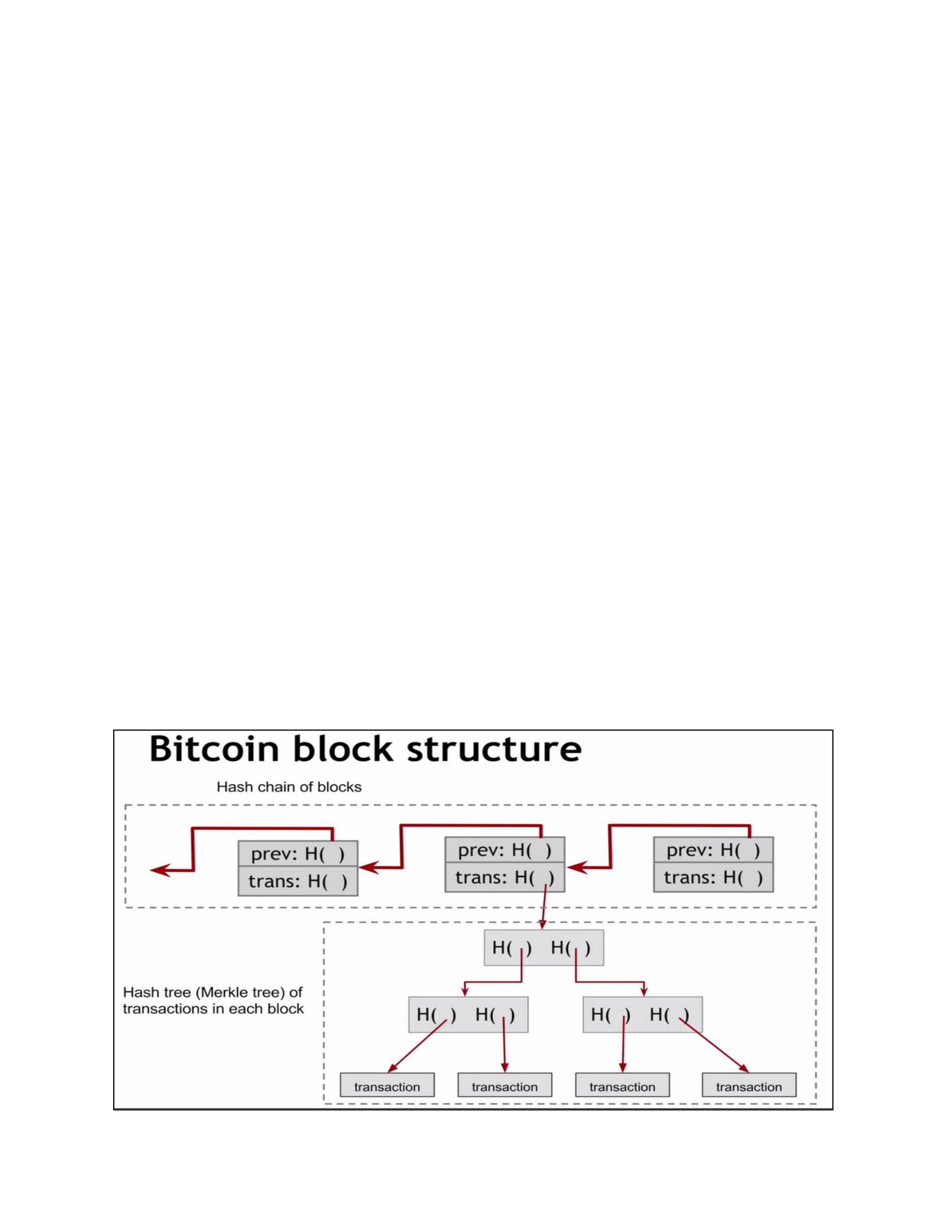
117
Bitcoin presents a conceptual departure from conventional forms of money (Bjerg, 2016)
and, therefore, is a fundamental change to some foundational basics in the financial industry.
Consequently, it could existentially threaten traditional financial institutions because it radically
alters the way transactions are conducted. Subsequently, the financial industry must explore how
to benefit from cryptocurrency while adjusting for consequences that may not be advantageous.
Consequently, de Meijer (2015) avers that financial institutions may benefit from collaborating
with the ecosystem around crypto technology. Furthermore, a) cryptocurrencies are increasingly
adopted by users, b) more salespoints are accepting cryptocurrency as a method for exchange,
and c) the market cap of cryptocurrencies continues to increase—The reader may refer to
Appendix E to appreciate the growth of market cap of cryptocurrency. Therefore, the financial
industry cannot ignore the cryptocurrency growing phenomenon.
Appendix C: Actual blockchain structure
Actual blockchain structure (Narayanan et al., 2016)
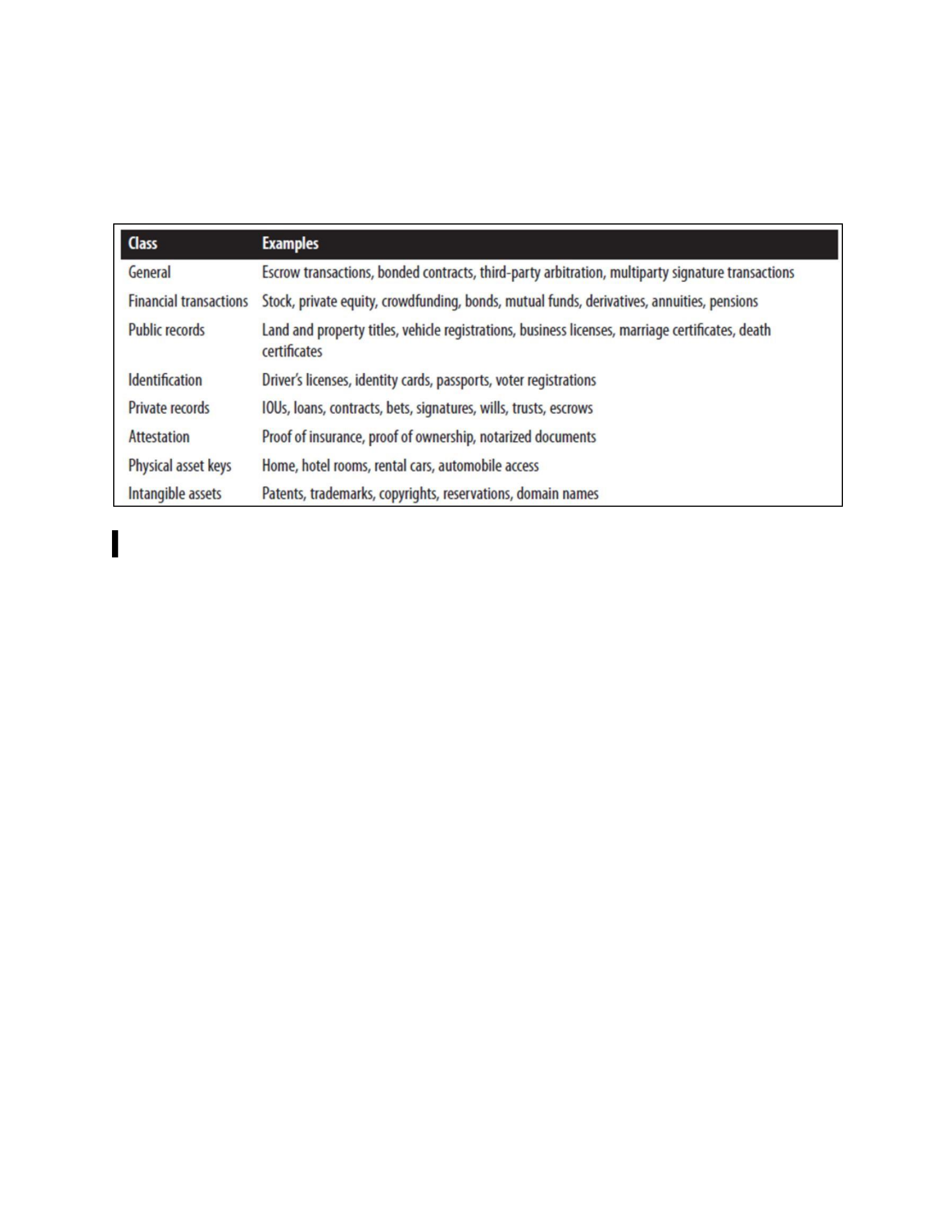
118
Appendix D: Classes of Blockchain technology Non-Cryptocurrency Applications
Blockchain Technology Applications Beyond Cryptocurrency (Swan, 2015)

119
Appendix E: Market Cap of Top 10 Cryptocurrencies
Market Cap of Top 10 Cryptocurrencies (cryptocurrencychart, n.d.).

120
Appendix F: Major Research Paradigms
Positivist, Interpretive, & Critical Paradigms (Myers, 2013)
P
I
C Systems
The dominant form of
research in most business
and management disciplines
Not as common but has
gained ground over the past
two decades
Much less common.
However, there are signs of
growth
Reality is objectively given
and can be described by
measurable properties, which
are independent of the
observer and their
instruments
Access to reality is only
through social constructions
such as language,
consciousness, shared
meanings, and instruments.
The observer is part of the
reality constructed
Social reality is historically
constituted and is produced
and reproduced by people.
Although people can
consciously act to change
their reality, they are
constrained by forms of
social, cultural, and political
domination.
Aligns with the tools of the
natural science.
The tools of the natural
sciences are inappropriate for
the study of social and
organizational phenomena
Similar to interpretive
The language of science can
be exact. Meanings are
separate from facts.
Human science Languages is
irreducibly equivocal and
evolving. Meanings are the
facts.
Similar to interpretive
Attempts to increase the
predictive understanding of
phenomena
Attempts to understand
phenomena through the
meanings that people assign
to them
Challenges prevailing
beliefs, values, and
assumptions that might be
taken for granted by the
subjects.
Empirical data are assumed
to be objective
The correct meaning of data
is determined by the context
Different interpretations are
given different weight or
preference—sometimes
imposed by some upon
others.

121
Assumes value-free data and
facts
Tries to be value-free, though
acknowledging the
Explicit ethical basis that
motivates the researcher
difficulty
work
Propositions in terms of
independent, dependent
variables, and relationships
Focus instead on the
complexity of human sense
making as the situation
emerges
Similar to Interpretive

122
Appendix G: Recruitment E-mail
The following email was sent to each prospective participant in the study:
Request to Participate in a Georgia State University Research Regarding the Impact of
Blockchain Subject: Technology on the Financial Industry
Email Text:
Dear <Name of candidate participant>,
As a subject matter expert on blockchain technology, you are cordially invited to
participate in a research study. The purpose of the study is to investigate the impact of blockchain
technology on the financial sector.
Please feel free to read exact details in the ‘informed consent form’ attached. If you agree
to participate, we will contact you to arrange for a time slot convenient to you.
Participation in the research is voluntary and consists of a single interview over the
phone, lasting no more than 1 hour. You may skip questions or stop participating at any time.
Your name and other facts that might point to you will not appear when the researchers
present this study or publish its results. The findings will be summarized and reported in a
synthesized form. You will not be identified personally. Nor will your organization be identified.
Summary:
Name and contact information of the interviewer: Al Tilooby at 510-770-4599 or
Where the research will be conducted: Over the phone from Georgia State University
Purpose of research: To investigate the impact of blockchain technology on the financial
sector
A summary of the criteria that will be used to determine eligibility: Financial industry
blockchain technology executives, senior blockchain technology subject matter experts, and
blockchain technology researchers.
A brief list of participation benefits: There are no direct benefits to you personally.
Overall, the research team hope to contribute the following to the existing body of knowledge:
• Contribution to practitioners: How financial institutions can prepare for blockchain
technology opportunities and threats.
• Contribution to the literature: A synthesis of the extant financial literature related to
blockchain technology, coupled with empirical accounts of industry perception of the
future impact of blockchain technology.

123
• Contribution to the theory: A theoretical interpretation of blockchain technology as a
disruptive technology in terms of transaction cost theory.
The number of participants to be enrolled: 16 participants.
Time or other commitment required: 1-hour interview conducted in a single session.
Compensation, if any: You will not receive compensation for participating in this
research.
Thank you and Best Regards,
Name: Al Tilooby
Candidate – Doctorate in Business
J. Mack Robinson College of Business
Georgia State University
35 Broad Street, NW, Suite 427
Atlanta GA 30303 e-mail:
[email protected] phone:
+1-510-770-4599 Appendix
H: Informed Consent From
The following form was sent to and discussed with and accepted by all participants before the
interviews.
Georgia State University Department of Computer Information Systems
Informed Consent
Title: The impact of blockchain technology on financial transactions
Investigators: Lars Mathiassen and Al Tilooby
I.Purpose:
You are invited to participate in a research study. The purpose of the study is to investigate the
impact of blockchain technology on financial transactions with focus on asset verification,
record keeping, data privacy, and transaction costs. You are invited to participate because you
are a subject matter expert. Sixteen participants will participate in this study. Each participant

124
will individually be interviewed over the phone for a maximum of one hour at a time slot of their
convenience.
II.Procedures:
If you decide to participate, one of the investigators will contact you to arrange for a time slot
convenient to you, then call you at the time to conduct and record the interview. The audio
recordings will be captured on the investigator’s smart phone that is password-protected. The
recording will be destroyed after the completion of the transcriptions to protect the
confidentiality of the data. Only one investigator will conduct your interview.
III.Risks:
In this study, you will not have any more risks than you would in a normal day of life.
IV.Benefits:
Participation in this study may not benefit you personally. Overall, we hope that the society will
benefit from the contributions of this study to the existing body of knowledge as follows:
a) Contribution to practitioners: How the financial organizations can prepare for
blockchain technology opportunities and threats.
b) Contribution to the literature: A synthesis of the extant financial literature related to
blockchain technology, coupled with empirical accounts of industry perception of the
future impact of blockchain.
c) Contribution to the theory: A theoretical interpretation of blockchain as a disruptive
technology in terms of transaction cost theory.
V. Voluntary Participation and Withdrawal:
Participation in research is voluntary. You do not have to be in this study. If you decide to be in
the study and change your mind, you have the right to drop out at any time. You may skip
questions or stop participating at any time. Whatever you decide, you will not lose any benefits
to which you are otherwise entitled to.
VI.Confidentiality:
The investigators will keep your records private to the extent allowed by law. Dr. Lars
Mathiassen, and Al Tilooby will have access to the information you provide. Information may
also be shared with those who make sure the study is done correctly—GSU Institutional Review
Board, the Office for Human Research Protection (OHRP). The investigators will use your
initials instead of your name on the study records. The information you provide will be stored on
a password-protected smartphone for audio, and password-protected computer for taking notes
and transcribing. The audio recording will be stored for no more than two weeks and then
destroyed after the completion of the transcriptions to protect the confidentiality of the data. Your

125
name and other facts that might point to you or the institution you work for will not appear when
the researchers present this study or publish its results. The findings will be summarized and
reported in a synthesized form. You will not be identified personally. Nor will your organization
be identified.
VII.Contact Persons:
Contact Lars Mathiassen at 404-413-7855 or lars.mathiassen@ceprin.org; or Al Tilooby at
510770-4599 or [email protected] if you have questions, concerns, or complaints about
this study. You can also call if you think you have been harmed by the study. Call Susan Vogtner
in the Georgia State University Office of Research Integrity at 404-413-3513 or
[email protected] if you want to talk to someone who is not part of the study team. You can
talk about questions, concerns, offer input, obtain information, or suggestions about the study.
You can also call Susan Vogtner if you have questions or concerns about your rights in this study.
VIII.Copy of Consent Form to Participant:
Please save a copy of this consent form for your records.
If you are willing to volunteer for this research and be audio recorded, please continue with the
interview.

126
Appendix I: Interview Protocol
The following semi-structured interview protocol was conducted with each of the study
participants:
Interview Metadata
Date
Initials of the interviewee
Category of the interviewee:
1. Financial industry executive
2. Senior blockchain technology subject matter
experts
3. Blockchain technology researcher
Length of Interview
Introductory script:
Hi <participant’s name>. Thanks for accepting to participate in this study. My name is Al
Tilooby. I am a candidate for a doctoral degree in business at Georgia State University. Please
let me know if you have questions about the informed consent form, or other general questions.
Thank you <participant’s name>. If you are willing to volunteer for this research and be
audio recorded, please continue with the interview. And With your permission, I am going to start
the recording and take notes as well.
Just to make sure I ask the right questions, please tell me a bit about you and your
background.
Thank you <participant’s name>. The purpose of our interview today is to gather your
perspective as input to our research study. The study is to understand the impact of blockchain
technology on financial transactions with emphasis on asset verification, record keeping, data

127
privacy, and transaction costs. You have been selected to participate in this study because you
are a subject matter expert.
Semi-Structured Interview Questions
Opportunities
Challenges & Issues
Regulatory
How could blockchain
technology enhance asset
verification in financial
transactions?
What are some of the
challenges and issues the
financial industry could face
with blockchain technology
regarding asset verification
in financial transactions?
Any regulatory aspects to
watch out for in relation to
blockchain technology and
asset verification in
financial transactions?
How could blockchain
technology enhance record
keeping in financial
transactions?
What are some of the
challenges and issues the
financial industry could face
with blockchain technology
regarding record keeping in
financial transactions?
Any regulatory aspects to
watch out for in relation to
blockchain technology and
record keeping in financial
transactions?
How could blockchain
technology strengthen data
privacy in financial
transactions?
What are some of the
challenges and issues the
financial industry could face
with blockchain technology
related to data privacy
protection in financial
transactions?
Any regulatory aspects to
watch out for in relation to
blockchain technology and
data privacy in financial
transactions?
Could blockchain
technology decrease
financial transaction costs?
What are some of the
challenges and issues the
financial industry could face
with transaction costs in
relation to blockchain
technology?
Any regulatory aspects to
watch out for in relation to
blockchain technology and
transaction costs in financial
transactions?
Any use cases for
blockchain technology you
could think of in financial
transactions with regards to
Challenges and issues that
arise from these use cases?
Regulatory impacts due to
these use cases?

128

