


Introduction Security Objectives Through Information
1.1 Background:
This research investigated how different kinds of information security training affect the nature
and scope of information security policies within a firm. Maximizing information security within
an organization starts with the creation of information security policies. They are the security
objectives for protecting the firm’s information systems (Karyda et. al., 2005). For example, many
firms have security policies regarding acceptable computer use, e-mail, and passwords (Rotvold,
2008). Information security training, also known as security awareness training, is a method of
educating all employees on how best to protect the firm’s information systems. For example,
employees may learn about viruses and worms, or how to recognize phishing e-mails. The goal is
for employees to utilize what they learned in training in real-time working, so that the organization
optimizes the security of its information systems.
Why are information security policies and training so important? Security policies and training
are important today because companies now rely heavily on information systems in almost every
aspect of the business, making information security vital to corporate success. Information systems
aid business strategy, organizational design, management control systems, the creation and
maintaining of competitive advantages, and much more. The technological aspects of information
systems give firms a presence on the Internet, make telecommuting possible, aid in unified
communication of multiple media, create virtual meeting places, and much more. A firm’s
information systems also include its data repositories, where sensitive corporate information, such

as intellectual property and customer data may be kept. Because of the dependency on information
systems and the potential high cost of disruptions or breaches, a top priority of any modern
company is protecting its information systems. Information security policies are the backbone for
protecting information systems and information security training is the mechanism used to educate
employees about security policies.
The importance of security policies emerges without question when weighed against the billions
of dollars that are lost each year from firms inadequately protecting their information systems. The
Association of Certified Fraud Examiners 2006 survey reported that businesses lose 5% of their
revenue to fraud each year, which equates to a $652 billion in total losses (ACFE, 2006). In the
2008 version of the survey, those numbers had increased to 7%, or $913 billion in total losses,
indicating a sharp rise in the magnitude of the problem (ACFE, 2008). Organizations must do
everything they can to protect their information systems. The risks of not doing so can be more
costly and last longer than the immediate monetary loss caused by the crisis, in the form of
collateral damage to the company’s reputation and trust with stakeholders (ACFE, 2006).
Now that we accept the importance of information security policies and training for the protection
of information systems and know that failing to do so properly can cost billions of dollars, what is
this research attempting to demonstrate that can forward the cause of information security? This
research attempted to demonstrate that the nature and scope of information security training a
manager receives affects the nature and scope of the information security policies they will create.
Previous research has demonstrated that socio-technical solutions are the best way to maximize
information security (Backhouse & Dhillon, 1996; Dhillon and Backhouse, 2000, 2001; Trompeter
& Eloff, 2001; Siponen, 2001; Dhillon & Torkzadeh, 2006; Dhillon, 2007). Socio-technical
solutions refers to a mix of technical aspects of security- such as access controls, virus detection,

and encryption, as well as social aspects of security- such as having an ethics program and a strong
security culture. If the nature and scope of information security training is socio-technical, will
the manager’s value-based objectives toward information security be socio-technical and what
impact would socio-technical security objectives have on information security policy? These are
fundamental questions this research attempted to answer.
Four different training videos were created and given to four different groups of managers, or future
managers. The training consisted of a socio-technical video, social only video, technical only
video, and control video. Using the value-focused method developed by Keeney (1992), each
group developed a list of value-based security objectives that were then ranked using a ranking
Delphi method developed by Schmidt (1997). Analysis of the data thus obtained demonstrates that
socio-technical training given to managers will yield a stronger mix of sociotechnical policies than
social only training, technical only training, or no training at all.
The rest of this chapter is organized as follows: Section 1.2 describes the current problem that is
to be addressed by this research. Section 1.3 and 1.4 describe the argument and research questions
used to justify this research. Section 1.5 describes the definitions of common terms used
throughout this research, such as information security and information security policies.
Section 1.6 describes the remaining chapters of this research.
1.2 Current Problem:
Many researchers have stated that a socio-technical approach is best for maximizing information
security and have stressed the importance of social aspects for information security (Backhouse &
Dhillon, 1996; Straub & Welke, 1998; Dhillon and Backhouse, 2000, 2001; Trompeter & Eloff,

2001; Siponen, 2001; Dhillon & Torkzadeh, 2006; Dhillon, 2007). Recognizing the social aspects
of information security can be known as the socio-technical or socio-organizational perspective
(Siponen, 2001). For example, Dhillon (2001, p. 147) stated that the “socioorganizational
perspective is the way forward if security of information systems is to be achieved.” If recognizing
social and technical aspects of information security is so important, one would expect organizations
to have socio-technical information security policies and information security training. However,
current research has reported that information security policies lack social aspects of security
(Rotvold, 2008; CWS, 2010; Fulford & Doherty, 2003). For example, Rotvold (2007) reported 24
top security policies in use by organizations and only two were socially related policies, concerning
ethics and social engineering. Ethics policies were used in 60.4% of the organizations and social
engineering policies were used in 14.3% of the surveyed organizations. The top policies used by
organizations were acceptable use policy (89%), e-mail policy (84.6%), and password policy
(78%). In other research, the Cybersecurity Watch Survey 2010’s top three security policies were
password policy, acceptable use policy, and Internet monitoring policy (CWS, 2010). Of the more
than 30 top security policies reported by the survey, over 90% used technical solutions. Fulford &
Doherty (2003)’s research also demonstrated the lack of social aspects security in their list of
security policies which are currently being used by organizations.
The content of information security training is predominately adopted from information security
policies (Rotvold, 2007; CSI, 2006, 2007). Rotvold (2007) reported that security policies were the
number one topic of security training. The CSI Survey (2006, 2007) also reported information
security policies as a top topic of information security training. In discussing the content of
information security training, Straub and Welke (1998, p. 451) stated that the content should
include “employee policies…and other topics that have a bearing on preventing misuse of system

assets.” If information security policies are technically oriented, then so will be the information
security training.
To further complicate the problem, researchers call for information security training to be a primary
method for protecting information systems (Straub & Welke, 1998; Solms & Solms, 2004; May,
2008; Rezgui and Marks, 2008). Practitioners seem to be following the advice. The 2010
Cybersecurity Watch Survey reported that information security training was a top method for
protecting information systems (CWS, 2010). What this means is that organizations are using
information security awareness training as a primary means of protection, but their information
security polices and policy-based training lacks social aspects of security. Those creating
information security policies need to create socio-technical policies so that the information security
training is socio-technical and information security is maximized.
Corporate information security policy is created at the strategic level of the organization by
managers that have very little experience or knowledge of creating security policy (Hone & Eloff,
2002). The authors’ state that those creating the policy often lack the knowledge to be able to do
so. Their “lack of skills and understanding” in developing a security policy often compels the
authors to “turn to other organization’s policies, commercially available sources or templates
available from public sources, such as the Internet, for answers to their questions” (pp. 402-403).
Among the commercially available options are checklists or standardized guidelines. According
to Ernst & Young’s 2008 Global Information Security Survey, 70% of those organizations surveyed
used standardized guidelines to create security policies and that number is expected to increase
(GISS, 2008). However, we know that checklists or guidelines have many shortcomings, including
the lack of flexibility to changing business environments and lack of attention paid to social aspects
of security (Baskerville & Siponen, 2002; Dhillon & Backhouse, 2001). Managers that lack the

knowledge to create socio-technical information security policies and end up creating security
policies based on standardized checklists will inevitably fail to maximize information security by
not including social aspects of security.
1.3 Argument:
The fundamental argument of this research argues that the nature and scope of information security
training that managers’ receive impacts the nature and scope of the information security policies
they create (figure 1.1).
I I
S Security T Policy
Figure 1.1: Fundamental Argument
The nature and scope of training can be socio-technical, social only, or technical only. It is also
possible that managers will receive no training at all. Managers that create information security
policies will be influenced differently depending on which type of training they receive, or if they
receive no training at all. That influence will affect the nature and scope of the security policies
they create. For example, managers receiving socio-technical information security training will
create socio-technical information security policies.
A more detailed argument involves the manager’s values and objectives toward information
security, where the nature and scope of the information security training a manager receives shapes
the manager’s values (see figure 1.2). The training shapes their beliefs (values) about how to best

protect information systems. The manager’s values then impact their individual objectives toward
securing information systems. The manager’s objectives then impact the nature and scope of the
information security policies they create. Another way of thinking about it is that training affects
a manager’s beliefs and those beliefs influence the manager’s goals and those goals influence the
policies they create. For example, managers that receive sociotechnical information security
training will be influenced by the training to alter or reinforce their core beliefs about protecting
information systems with socio-technical aspects of security. These socio-technical oriented core
beliefs about how to protect information systems will impact their objectives for doing so. Their
socio-technical oriented value-based objectives will then impact the nature and scope of the
information security policies they create. In this example, the policies thus created would be socio-
technically oriented.
Figure 1.2: Detailed Argument
1.4 Research Questions:
The focus of this research leads to the following two research questions:
1. To what extent are manager’s values towards securing information systems influenced by
the nature and scope of information security training they receive?
N &
S of
I
S
T
S
V
I
I
O
I
N &
S of
I
S
P

2. To what extent do value-based objectives influence the nature and scope of information
security policy?
The first research question will address the relationship between the first and second boxes of the
detailed argument (figure 1.2). Will the training shape their core beliefs about how to protect
information systems? For example, will socio-technical training, technical only training, or social
only training lead to predominately socio-technical values, predominately technical values, or
predominately social values? This first research question will also ascertain the values of managers
that receive no information security training.
The second research question will address the relationship between the third and fourth boxes of
the detailed argument (figure 1.2). Influenced by the manager’s value-based objectives for
securing information systems, what will be the nature and scope of the security policies they
create? Will they create socio-technical policy, technical policy, social policy, or something else?
1.5 Definitions:
This section gives a more detailed definition of the terms and phrases already introduced and used
throughout this research. There are other terms or phrases that are not used throughout this
research, but are particular to certain sections or chapters. Those terms and phrases are defined
and described in those sections or chapters, where they are more relevant.
1.5.1 Information Systems:
An information system, as described by Dhillon (2007), is the system that handles information at
three levels – technical, formal, and informal. Within an organization, the technical system is the
organization’s information technology infrastructure and consists primarily of hardware, software,

data and network components. It is everything that supports the flow and processing of
information. The formal system consists of rules and procedures, such as security strategy,
policies, and processes (Dhillon, 2007). Acceptance of the formal system’s rules and procedures
by the people is a social process, which is part of the informal system. The informal system
consists of social constructs, such as culture, norms, beliefs, attitudes and informal communication.
An information system is the system that handles information in and across these three systems.
1.5.2 Information Security:
Information security, also known as information systems security, refers to the protection of an
information system at three levels: technical, formal, and informal. There must be coordination
between the three systems for the effective management of information security. At the technical
level, information security is concerned with technological solutions to security, such as using
firewalls, biometric scanners for authentication and anti-virus software. At the formal level,
information security is concerned with creating organizational structures and processes to ensure
security and integrity (Dhillon, 2007). This includes the creation of proper responsibility
structures, maintaining integrity of roles, and creating and verifying proper business processes
(Dhillon, 2007). At the informal level, information security is concerned with the social aspects
of security, such as creating and maintaining a security culture, integrity of employees, trust
relationships, and ethicality.
1.5.3 Information Security Policy:

Karyda et. al (2005, p. 247) state that “an IS security policy includes the intentions and priorities
with regard to the protection of the IS, usually referred to as security objectives, together with a
general description of the means and methods to achieve these objectives.” At a high level,
corporate security policy describes the overall security vision in the form of security objectives.
These objectives are abstract in nature and written in generalized terms, such as the statement of
the need to ensure that sensitive data is protected from unauthorized access. At a lower level,
procedurally oriented policies are derived from the corporate level policies to reflect the means for
achieving the higher level objectives. To continue the previous example of protecting sensitive
data from unauthorized access, a procedurally oriented policy might be to create a password policy
that protects such data. Other procedurally oriented policies might be to require all employees to
have passwords at least 8 characters long and to change their passwords every 30 days. There may
be multiple procedurally oriented policies for each corporate level policy.
1.5.4 Information Security Training:
Information security training, also known as security awareness training, is a method of educating
all employees on how best to protect an organization’s information systems. Training most often
reflects the procedure oriented security policies. The most effective information security training
will address threats posed by technically oriented aspects of security as well as socially oriented
aspects of security.
A goal of security awareness training is to create overall security awareness. According to Rezgui
& Marks (2008), the meaning of security awareness falls into two categories. The first are those
that consider security awareness to mean “attracting users’ attention to IS security issues” and the
second considers security awareness to mean “the user’s understanding of IS security and

optimally, committing to it” (p. 244). Whether computer security awareness training makes
employees only aware of security issues or makes them fully understand and committed to
upholding this security can depend on many factors, such as the quality of the training and the
employees themselves. There is research that suggests using theories from psychology and
sociology to create training in certain ways can lead to better absorption by employees and can
increase the likelihood of employees following security policy (Siponen, 2000; Thomson & Von
Solms, 1998). However, this research on the effect of information security training on information
security policies is focused on the nature and scope of the training and not the delivery method or
psychological acceptance of the training.
1.6 Thesis Structure:
This thesis is structured as follows: Chapter one of this research is the introduction, where the
relationship between information security training and information security policy is introduced.
This chapter includes the author’s argument and definitions of key terms used throughout this
research. Chapter two is a literature review that investigates information security training,
information security policies, technical and social aspects of security, and how manager’s
objectives lead to practice. Chapter two concludes with a discussion of how the literature review
is relevant to this research. Chapter three discusses the methodology of this research, starting with
the creation of the training videos and a description of the experimental design and participants.
The value focused research methodology is reviewed and discussed along with the ranking Delphi
methodology. Chapter four describes the execution and analysis of the value focused method data
collection and discusses the relevant results. Chapter five describes the execution and analysis of
the ranking Delphi method and the relevant results. Chapter six discusses the key findings and the

relevance to information security research. Chapter seven concludes this research by summarizing
the study and the key findings, along with any research limitations.
1. Literature Review
2.1 Introduction:
This dissertation investigates how the nature and scope of information security training affects the
nature and scope of information security policies within a firm. The central argument is that
training affects policies, so it is important to review literature pertaining to information security
training and information security policies. But before reviewing training and policies, it is
important to review the nature and scope of training and policies, which involve the social and
technical aspects of security. The argument believes that the particular type of training a manager
receives will affect the policies he or she creates, so it is also important to establish a link between
a manager’s security objectives and the security policies he or she creates. These areas will be
reviewed in the following sections, starting with a review of socio-technical security. Information
security policy and information security training will then be reviewed. The discussion will link

these topics and discuss the connection with creating information security policies. The final
section is the conclusion that relates the overall literature review to this dissertation’s argument
and research questions.
2.2 Socio-technical Security:
Social aspects of security refer to human related aspects of organizations that need to be taken into
consideration in order to maximize information security. This can include many concepts, such
the responsibility, integrity, trust and ethicality (RITE) of individuals as described by Dhillon and
Backhouse (2000). Social aspects of security can also include norms, security culture, beliefs, and
attitudes within organizations (Dhillon, 2007). The research below demonstrates the need for
information security to go beyond merely focusing on technological solutions to security threats
and highlights the need for the recognition of social aspects of security.
But before reviewing research related to the social aspects of security, it is important to briefly
describe the technical aspects of security. Most organizations rely heavily on the technical
solutions to security threats, as they are often the first line of defense. Examples of technical
solutions to security threats include hardware and software firewalls, antivirus software, password
usage, smart cards and much more. The goal of this section is to demonstrate the importance for
information systems security research to go beyond the sole reliance on technical solutions to
security threats and to incorporate the social aspects of security as well.
Over 30 years ago, Bostrom and Heinen (1977) called for systems development to include the
social aspects of organizations. The socio-technical system (STS) was introduced in a paper
discussing the redesign of management of information system’s methodologies. The authors
argued that system designers created flawed systems because they failed to recognize the

importance of the social aspects of organizations. They describe a socio-technical system as “two
jointly independent, but correlative interacting systems” (p. 17). The technical system is concerned
with processes, tasks, and technology, while the social system is concerned with the attributes of
people (attitudes, skills, and values), the relationships of people, reward systems, and authority
structures (Bostrom and Heinen, 1977). The outputs of the system “are the result of joint
interactions between these two systems” (p. 17). The authors go on to discuss areas where
designers fail to recognize social aspects of organizations. The focus of this research may have
been on correcting failures in MIS development, but the recognition of the concept of there being
a socio-technical system that must be considered in IS development is important for all subsequent
information systems research.
Siponen’s (2001) research analyzed three approaches to developing security for information
systems. The approaches are called information/database modeling approaches, responsibility
approaches and security-modified information systems development approaches and are classified
into four generations. First and second generations focus on checklists and technical solutions.
The third and fourth generations include modeling and socio-technical solutions respectively.
Information/database modeling approaches includes “research on the organizational and
conceptual level, along with methods covering database security” (p. 9). There are very few studies
using this approach. Responsibility modeling refers to the use of responsibility as a basis for
ensuring secure information systems development. Securitymodified information system
development approaches “refer to any approach that is modified from an information system or
development approach” (p. 3). The third and fourth generations, which include responsibility
modeling and security-modified information system development approaches, have an intellectual
origin in data modeling, information systems and computer science (p. 17). The authors concluded

that the most commonly held organizational role of information systems security was the technical
view, which ignores the social aspects of security. “There is a lack of aforementioned approaches
which recognize the social aspects of information systems, i.e. socio-technical and social
organizational roles of information systems security” (p. 22). Social aspects of information
systems security is part of the fourth and latest generation of secure information systems
development.
In a (2001) paper by Dhillon and Backhouse, the authors map the current directions in information
systems security research. The authors did so by using the Burrell and Morgan (1979) framework
and four paradigms: functionalist, interpretative, radical humanist, and radical structuralist.
Functionalists often derive their approaches from the natural sciences. Interpretivism “is
concerned with the subjective understanding that individuals ascribe to their social situations” (p.
129). The radical paradigms oppose the regulation view of society and advocate radical change.
The authors concluded that there was a noticeable trend in information systems research which
was moving away from the functionalist and technical view point, but not in information systems
security research. They write that much of the information systems security research up to this
date had been “classified under the functionalist paradigm and the theorists have treated security
as something tangible and concrete” (p. 147). Information system security should not be
considered in a mechanistic manner and doing so would relegate inter-organizational and
intraorganizational social relationships as incidental (Dhillon & Backhouse, 2001). The authors
suggest that if security of information systems is to be achieved, then the socio-organizational
perspective is the way forward.

In other research, Trompeter and Eloff (2001) recommend that ethical aspects of security should
be considered as important as the technical and functional aspects of security. Information security
ethical principles should be incorporated with the inception, development, and maintenance of an
organization’s IT system and should govern security controls and measures (Trompeter & Eloff,
2001). The guiding principles should “include the right of both the individual and the organization
to privacy, to property of their information and to the obligation to uphold this socio-ethical
commitment” (pp. 286-387). “The creation of a socio-ethical awareness of infosec (information
security) that takes cognizance of the human dimension will help organizations and clients alike...”
(p. 390).
Developing a strong security culture has also been linked to more secure information systems. A
security culture “reflects the values and beliefs of information security shared by all members at
all levels of the organization” (D’Arcy & Greene, 2009, p. 147). In a study of 105 computer using
professionals, D’Arcy and Greene (2009) investigated the relationship between security culture
and security policy compliance and security extra-role behavior. Compliant behavior refers to a
user’s compliance with security policies and regulations. Extra-role behavior refers to behaviors
that go beyond the job description and are not part of the formal job duties. Examples of extra-
role behavior include attending voluntary security training, promoting safe computing practices,
and speaking out about inefficient security controls. The results of the survey provided strong
evidence that security culture contributes to both compliant user behavior and extra-role behaviors.
The authors state that “developing a security culture that consists of top management commitment
to security and ongoing security communication is extremely beneficial in promoting both a
compliant and proactive security-conscious user population” (p. 154).

In other security culture research, Vroom and von Solms (2004) stress the importance of a strong
security culture and suggest ways of changing the culture. The authors propose to address security
culture through three aspects of organizational behavior- the individual, the group and the formal
organization. Individuals are unique and bring multiple characteristics into the organization.
Individual attitudes, motivation, job satisfaction, etc. is influenced by organizational forces and the
behavior of an individual is important for developing a culture (Vroom & von Solms, 2004).
Groups are made up of individuals and have their own values and norms. Groups develop
characteristics beyond those of the individual. The formal organization can be compared according
to characteristics common to them, such as the size of the organization (Vroom & von Solms,
2004). The behavior of the individual, group, and formal organization influences each other and
are not mutually exclusive. In order to change culture, changes need to take place at all three
levels. The authors suggest the best way to change the security culture is to change the shared
values and knowledge of the group. Investigating the cultural influences on the group and
changing them separately will slowly start to alter group behavior. The altered group behavior will
then influence individual behavior, which will have an eventual effect on the formal organization.
The authors suggest that changing one aspect “will filter through the organization at a formal and
individual level and the culture will eventually change into a secure one” (p. 197).
Security culture is important for ensuring appropriate behavior, according to von Solms and von
Solms (2004). The author’s research investigates the integration of security polices, education and
security culture. Management creates security polices and defines what they expect from group
members within the organization. Groups are defined as collections of individuals that have shared
basic assumptions. The group members must accept the policies created by management and agree
that they benefit the organization. Managers can dictate the behavior of employees by “expressing

collective values, norms, and knowledge, by defining specific policies and procedures” (p. 277).
Security policies can be expressed in the group’s beliefs, which form the security culture.
Educating new group members then helps cultivate the security culture by teaching new members
the group beliefs, which they will embrace as part of the group’s basic shared assumptions.
Aligning information security policies with the security culture and educating employees on a
continuous basis is one way of positively affecting employee behavior.
In a paper about organizational culture and security culture, Ruighaver et al. (2007) suggest that
information security is generally a management problem and an organization’s security culture
reflects how management handles the problem. The authors argue that “technical security
measures and security policies will often need to be (re)designed to support an organization’s
security culture” (p. 56). Suggesting that security culture is influenced by organizational culture,
the authors investigate security culture using an eight dimensional framework developed by Detert
et al. (2000) to study organizational culture. The framework was used to highlight aspects of
security culture along the eight dimensions using empirical case study research from information
systems. Based on the relation of security culture to organizational culture within the framework,
the authors highlighted several aspects of good security culture. Below are some select findings
(Ruighaver et al., 2007):
1. “Organizations with a high-quality security culture should place an emphasis on longterm
commitment and strategic management” (p. 58);
2. a degree of trust and accountability needs to be established with employees;
3. employees with responsibility over particular aspects of security should be given a strong
sense of ownership;

4. responsibility and accountability for security decision making should be clearly defined in
policies;
5. educating employees about their roles and responsibilities is important; and
6. good security culture should find a balance between internal and external focus, where
there is awareness of the external environment and its threats, as well as an awareness of
the internal environment.
Other aspects of security culture, such as attitudes, norms and shared expectations did not fit into
the framework, but were also considered important by the authors.
In research aiming to improve user security behavior, Leach (2003) discusses six factors that have
strong influence over people’s security behavior and three steps organizations can take to improve
behavior. The threats include user errors and negligence, such as forgetting to apply security
procedures, and deliberate acts, such as emailing sensitive data without protection. The factors
that influence security behavior come from an organization’s culture and practices and can be
divided into two areas: (1) encompassing the users’ understanding of what behaviors the company
expects of them, and (2) the factors which influence the user’s personal willingness to constrain
their behavior to stay within accepted norms (Leach, 2003). The user’s understanding of
expectations are described by what they are told, what they see being practiced by others around
them, and their experience built on decisions they made in the past. Personal willingness to comply
with expectations are described by people’s personal values and standards of conduct, sense of
obligation towards their employer and the degree of difficulty they experience in complying with
the company’s procedures.

Not all of these factors which affect how people behave can be influenced by the organization,
such as an employee’s personal values. However, organizations can focus on the three key factors
they can influence. The author suggests organizations should focus on the behavior demonstrated
by management, the user’s security common sense and decision-making skills, and the user’s
psychological contract with their employer. Below is a summary of concepts related to these three
factors (Leach, 2003):
1. ensure senior management and junior staff have good security behavior;
2. provide feedback on the correctness of security behavior;
3. reward staff for good security;
4. give additional training to staff that demonstrate bad security behavior;
5. teach the user’s the principles they need to make good decisions;
6. provide continuous feedback and support;
7. create a strong security culture to motivate staff to behave consistently; and
8. discuss security regularly with management and staff.
The author suggests that leadership is the key to creating a more secure environment. Top
management must support the security goals and lead by example.
In other research about socio-technical aspects of security, Dhillon and Backhouse (2000) move
beyond the confidentiality, integrity and availability (CIA) of information with a paper that
introduces a concept known as RITE. The authors suggest that information system security needs
to change to not only addressing the data, but the changing organizational context as well.
Organizations have focused much of their attention on CIA, where the authors define
confidentiality as restricting data access to those who are authorized, integrity as preventing

unauthorized modification of data, and availability as preventing unauthorized withholding of data
or resources. If information systems are to be secure, there needs to be considerations beyond
CIA. The authors suggest “inculcating a subculture where responsibility, integrity, trust and
ethicality (RITE) are considered important and are the first steps towards securing the information
assets” (p. 127.)
Responsibility refers to individuals understanding their responsibilities and knowledge of roles
within the organization, which also includes individual accountability. Responsibility is important
in situations where formal guidance and rules are absent. Integrity refers to the integrity of the
person employed by the organization. Before employees are given access to sensitive information,
they should be properly screened. However, the integrity of an individual can change over time,
such as when personal factors change. An economic recession, foreclosure, bankruptcy, divorce
or many other such factors can lead a once honest employee down the wrong path. Organizations
need to consider how they will continue to reassess the integrity of individuals as time passes.
Trust refers to a mutual system of trust between the individual and the organization. “Division of
labor demands that your colleagues should be trusted to act in accordance with company norms
and [the] accepted and agreed [upon] patterns of behavior” (p. 128). Today’s organizations have
less supervision, which gives employees more control. Mutual trust plays an important role in
such environments. However, trust has a half life that needs to be reassured periodically. Ethicality
goes beyond company rules and policies and into an area where rules do not exist. When a situation
arises within an organization where a rule or policy stating how to handle the situation does not
exist, individuals need to rely on some form of appropriate ethical norms. Responsibility, integrity,
trust and ethicality (RITE) of individuals and confidentiality, integrity, and availability (CIA) of

information are important for this dissertation because they are core socio-technical aspects of
information security that will be used to support this dissertation’s argument.
In a book describing socio-technical security by Dhillon (2007), the author writes about
maintaining the integrity of three vital systems of information systems security: the formal,
informal and technical systems. The formal system within organizations represents the rules,
regulations, governance, policies, procedures, or processes. The informal system represents social
norms, security culture, beliefs, and attitudes of people. The technical system uses technology
(computers) to automate parts of the formal system.
There must be coordination between the three systems to effectively manage information systems
security. Dhillon describes the coordination among the three systems with an analogy of a fried
egg. The yolk represents the technical system, which is held in place by the rules and regulations
of the formal system. The formal system is the thin membrane holding the yolk. The white of the
egg represents the informal system. The analogy “suggests the appropriate subservient role of the
technical system within an organization” and “also cautions about the consequences of
overbureaucratization of the formal systems and their relationship to the informal systems” (p. 5).
Managing security involves using controls with all three systems, meaning the controls themselves
can be formal, informal, or technical. For example, a technical control might require a password
or retinal scan to gain access to a computer. Expanding or shortening the organizational hierarchy
is an example of formal control and giving security awareness training to employees is an example
of an informal control (Dhillon, 2007). Controls must complement one another and Dhillon
recommends “an overarching policy that determines the nature of controls being implemented and
therefore provides comprehensive security to the organization”

(p. 6).
In other research by Dhillon and Torkzadeh (2006), the authors used the value-focused thinking
method to interview 103 managers about their values in managing information systems security.
This approach yielded 9 fundamental objectives for information systems security and 16 means
objectives for achieving them within an organization. Of the 9 fundamental objectives, 7 are social
objectives and 2 are technical objectives. The two technical objectives are to maximize access
control and data integrity. The seven social objectives are to enhance management development
practices and the integrity of business process, maximize privacy and organizational integrity,
provide adequate human resource management practices, develop and sustain an ethical
environment, and promote individual work ethic. The authors suggest that overall information
security that primarily focuses on the technical aspects of confidentiality, integrity, and availability
(CIA) of information is inadequate and that socio-organizational objectives must be taken into
consideration. This paper was included in the socio-technical section of this literature review
because of the result’s socio-technical implications, but it is also important to this dissertation in
that it used the value-focused thinking method in its methodology. The value-focused thinking
method by Keeney (1994) is the same method used in this dissertation and will be described further
in the next chapter.
In summary, the importance of social aspects in addition to technical aspects in information
systems research is nothing new, as reported by Bostrom and Heinen in 1977. However, it took
over 20 years before Dhillon and Backhouse (2001) reported a trend toward social aspects in
mainstream information systems research. In the same paper, Dhillon and Backhouse state that
mainstream information systems security research had yet to make the transition and that
socioorganizational aspects of security must be acknowledged in order to maximize security. Since

that time, mainstream research has made that transition and social aspects of security are now
considered an important part of overall security. For example, Trompeter and Eloff (2001) called
for ethical principles in the development of information systems and security standards. Ruighaver
et al. (2007) discussed the importance of a security culture in relation to the organizational culture
and listed several aspects of good security culture, such as having an emphasis on employee
responsibility and accountability, trust and security education. Also related to security culture was
Leech’s (2003) paper that suggested multiple ways of positively influencing employee behavior,
by actions like managers leading by example by displaying good security practices of their own.
D’Archy and Greene (2009) found that security culture contributes to compliant user behavior and
extra-role behaviors. Dhillon (2007) reported the necessity of considering the social aspects of the
informal system along with the formal and technical systems for achieving maximum security. Of
particular importance to this research is the Dhillon and Backhouse (2000) paper describing the
significance of responsibility, integrity, trust and ethicality (RITE) of individuals. Also of interest
to this research is the use of the valuefocused approach in demonstrating the importance of socio-
organizational objectives in Dhillon and Torkzadeh’s (2006) paper.
2.3 Information Security Policy:
Baskerville and Siponen (2002)’s paper describes a three level division of security policy: highlevel
policy, low-level policy, and meta-policy. At the highest level, “security policy is a highlevel
overall plan embracing the general security goals and acceptable procedures” (p. 338).
Policies at this level are generalized and more abstract than at the lower level. Lower level policies
are derived from the high-level policies and are specific policies designed to support the objectives
outlined at the highest level. Where a high level policy might describe a particular resource that

needs to be protected and those responsible for protecting it, a lower level policy would describe
the particular processes to be used to protect the resource. For instance, a highlevel policy might
state that department “A” needs to protect asset “X.” A low-level policy that reflects the high-level
policy might state that password or retinal scan technology needs to be in place to protect asset
“X.”
In the third level of the division of security policies, the authors introduce meta-policy. Metapolicy
is “policy about policies.” These policies “declare the organization’s plan for creating and
maintaining its information security policies” (p. 339). Meta-policy describes who is responsible
for making policies, when policy creation is to take place, how policies are made, and how and
when are polices reviewed, modified, or eliminated.
In support of the need for meta-policy, the authors point out that emergent organizations with
changing business environments need meta-policy. Unlike checklist security standards,
metapolicy can help organizations adapt their security policies to changes in the business
environment. Checklists are security guidelines that can be used to help create security policies.
However, the authors point out several shortcomings of such guidelines: (1) they fail to adequately
address the fact that organizations are different and require different security policies (as cited by
Baskerville, 1993), (2) they do not consider social aspects of security (as cited by Dhillon &
Backhouse, 2001), (3) they “are broadly written, necessitation ad hoc decision making and
judgment” (as cited by Ferris, 1994, p. 338), and (4) they overlook normal business requirements,
which may result in conflict between business and security requirements (Baskerville & Siponen,
2002).

In other security policy research, Karyda et al (2005) explore the processes of formulation,
implementation and adoption of security policy in two different organizations. In both cases, the
companies enlisted external consultants to conduct a risk analysis and create guidelines and
recommendations. Management considered the recommendations and called upon their IT staff to
implement the policies. The authors revisited each firm later to gauge the level of adoption by the
users. In both cases, the consultants called for creating a security officer and establishing roles
and responsibilities for that person.
The adoption of the security policy had mixed results. The first company had adopted the policy
fairly well and the second company had not. However, the second company did not conduct
security awareness training for their employees. Those employees had a negative attitude toward
the security policies out of fear and lack of understanding. This emphasizes the importance of
having an information security training program to educate employees on security policies. The
first company already had an ethics policy in place and that policy worked well with the new
security policies toward creating a security culture. The authors mentioned the importance of
creating a security culture. In addition to the ethics policy in the first company, the authors did not
report any other social aspects of security as being incorporated into the security policies. They
mentioned roles and responsibilities, but only for the new security position and not for all the
employees. There appears to be little or no consideration for socio-technical aspects of security in
the creation of security policy in this study.
In other research, Doherty & Fulford (2006) argue that information security policy should be
aligned with the strategic information systems plan (SISP). The “strategic information systems
plan is a critical prerequisite for policy formulation, as it defines the business context in which
information security will be managed and therefore the objectives of, and priorities for, security

management” (p. 57). The strategic information systems plan is typically based on corporate
objectives and the business plan. Aligning the information security plan to the SISP would link
the security plan to the business plan. Mentioned below is how the authors summarized benefits
of alignment- Doherty & Fulford (2006):
1. security can be more proactive instead of reactive to security threats;
2. security policy will have a stronger business orientation;
3. security policy can be adjusted in advance of strategic information systems initiatives;
4. strategic information systems plans can be viewed from a security perspective before
implementation;
5. new systems created by the SISP can incorporate security controls identified by related
security policy; and
6. this raises business manager’s awareness of security threats and countermeasures.
Information security policy risk analysis is the topic of a paper from Spinellis et al. (1999), where
the authors suggest that any information systems security policy should start with a risk analysis.
“The objective of risk analysis is to identify and assess the risks to which the IS and its assets are
exposed in order to select appropriate and justified security safeguards” (p. 122). The authors list
five stages of risk analysis: (1) asset identification and valuation; (2) threats assessment; (3)
vulnerabilities assessment; (4) existing/planned safeguards assessment; and (5) risk assessment. A
risk analysis methodology, CRAMM, was used to analyze a home-office and small enterprise
scenario. The authors conclude that both environments have security weaknesses which are
common to large enterprises, but the current security infrastructure and business practices of the
smaller firms hinder effective risk management.

As mentioned earlier in research by Baskerville and Siponen (2002) and Dhillon and Backhouse
(2001), checklists (standards) are often used by organizations to create information security policy.
The Ernst & Young’s 2008 Global Information Security Survey researched the use of security
standards in developing security policy. The survey covered nearly 1400 organizations in more
than 50 countries across all major industries. According to the survey, the use of information
security standards has increased to 70% and the belief is that the use of international information
security standards will continue to increase (GISS, 2008). The international standards used by
respondents were ISO/IEC 27001:2005, ISO/IEC 27002:2005, and Information Security Forum’s
(ISF), the Standard of Good Practice for Information Security. ISO/IEC 27001:2005 is defined as
a standard that “provides a model for establishing, implementing, operating, monitoring,
reviewing, maintaining and improving an information security management system” (p. 11).
ISO/IEC 27002:2005 “outlines the potential control mechanisms which may be implemented based
on the guidance provided within ISO/IEC 27001:2005” (p. 11). The Standard of Good Practice
for Information Security “addresses information security from a business perspective, providing a
practical basis for assessing an organization’s information security arrangements” (p. 11).
Undertaking research to discover the content of information security policy, Fulford & Doherty
(2003) questioned managers representing 158 organizations from multiple industries and varying
organizational size. The authors reported the top items and the percentage of inclusion in their
security policy as: personal use of the information system (45%), disclosure of information (38%),
physical security (37%), violations and breaches (36%), viruses, worms, and trojans (34%), system
access (33%), mobile computing (32%), Internet access (30%), software (25%), encryption (25%),
and contingency planning (17%). Of the 158 organizations surveyed, 76% of them had a formal

written security policy. The authors statistically tested and verified that those without a security
policy were not of the same organizational type.
In summary, in this information security policy literature review, we have learned that management
at the strategic level of the organization is involved in creating the high-level security policies
(Baskerville & Siponen, (2002). In order to create these policies, they gather information from
various sources. These may include standardized checklists, external consultants, current
organizational culture, current security measures, risk analysis, business objectives and the
strategic information systems plan (Baskerville & Siponen, 2002; Karyda, et al, 2005; Spinellis, et
al, 1999; Doherty & Fulford, 2006). High-level polices are used to create low level policies, known
as corporate and procedure policies in this dissertation. Procedure policies are more specific
policies that are usually created with the input of content specific professionals and not upper
management. For example, technical policies at this level are often created by information
technology professionals or legal considerations may involve lawyers (Karyda, et al, 2005). The
procedural policies are based on the corporate policies, which should reflect the business plan
(Spinellis, et al., 1999). Security policy is also primarily technical and lacks the social aspects of
security. According to Fulford & Doherty (2003), some of the top items that organizations include
in security policy are breaches, viruses, worms, trojans, system access, software and encryption.
Checklists, which are often used as guidelines for security policy are also technically oriented and
lack social aspects of security (Baskerville & Siponen, 2002; Dhillon & Backhouse, 2001). In
order to maximize security, social aspects of security must be considered along with technical
aspects (Dhillon, 2007).
2.4 Information Security Training:

Information security training, also called security awareness training in some research, is a
relatively small topic within information systems research. Only a few studies investigate
information security training as the main focus of the research. Like in the case of many topics
within the discipline, there are multiple definitions. Siponen (2000, p. 32) defines “information
security awareness” as “a state where users in an organization are aware of – [and] ideally
committed to – their security mission.” Straub & Welke (1998, p. 450) define security awareness
training as “the training of managers and other professionals in proper use of system assets.” The
authors state that training should review employee policies, such as system authorizations,
conditionalities of use, password management, penalties for security breaches etc. (Straub &
Welke, 1998). “The training should also make participants aware of the general effectiveness of
deterrent, preventive, detective, and remedial countermeasures in lowering systems risk” ( p. 451).
This dissertation defines information security training as a method of educating all employees on
how best to protect an organization’s information systems.
Information security training research primarily falls into two research streams, one researches the
necessity of having a training program and the other researches how to make training more
effective. The necessity of training is important to this dissertation because this research forwards
the suggestion that training of managers can help maximize information security. Making training
more effective is also important to this dissertation because this research creates training videos to
support the central argument. Very little research has investigated the content of information
security training, but a few studies and surveys were found. The content of current training is also
important for this dissertation because this research argues that current training is technical in
nature and is linked to the information security policies.

In researching the importance of information security training, Rezgui and Marks (2008) conducted
a case study to investigate factors that affect the information security awareness of staff at an
institution of higher education. Through questionnaires, interviews, observation and documents,
the authors collected data and used various coding techniques for analysis. The research
discovered that factors such as conscientiousness, cultural assumptions and beliefs and social
conditions affect university staff behavior and attitude towards work and information security
awareness (Rezgui & Marks, 2008). Of particular interest was the fact that the university did not
have a computer security awareness training program and did not know how that affected employee
security awareness. Rezgui and Marks recommend the establishment of an information security
training program. The problems discovered with employee’s security awareness are listed below
(Rezgui & Marks, 2008, p. 250):
1. “many respondents were not acquainted with basic IS security practices, including how to
change their passwords or how to back up their data;”
2. “users shared passwords;”
3. “operative, unlocked computers were left unattended;”
4. “laptops were not locked and left out;”
5. “users were confused about the existence of an IS policy and none had seen one;”
6. “users did not know how to locate an IS staff member;”
7. “users could not identify the university IS goals and objectives;” and
8. “users regarded university data as of no interest to them.”
In other research that supports the need for security awareness training, May (2008) developed a
decision model that provides informed alternatives to decision makers who desire to maximize IS

security within an organization. The model is based on Dhillon & Torkzadeh’s (2006) nine
fundamental and sixteen means objectives that are essential in maximizing information systems
security. This decision model consisted of 69 ranked value-driven tasks and associated security
objectives they impact. Of particular interest is that security awareness training was ranked #1 of
the 69 tasks. Therefore, security awareness training was found to be the most important task
associated with maximizing information systems security. According to May’s research,
awareness training impacts 14 sub-objectives, such as ensuring sensitive data is adequately
secured, emphasizing the importance of data privacy and maintaining personal accountability.
The need for security awareness training is nothing new. Straub and Welke (1998) stated that
systems “risk can be managed or reduced when managers are aware of the full range of controls
available and implement the most effective controls” (p. 441). Lacking knowledge can lead to less
effective security. To cope with systems risk, the authors identify an approach that includes the
use of a security risk planning model, security awareness training and countermeasure matrix
analysis. The awareness program involves educating managers and users. The managers should
be educated on the security action cycle, which involves deterrence, prevention, detection and
remedies for computer abuse. Managers should also be educated on “obvious vulnerabilities and
resources which are required to secure systems at some minimal ‘acceptable’ level” (p. 460).
Everyone, including managers and users should receive security awareness training covering high
level objectives, such as the security action cycle, as well as specific lower level vulnerabilities
and responses. This training should also cover security policies and be offered to new employees
at orientation and veteran employees in refresher programs. While this paper suggests that
managers receive specific training that is in addition to the information security training, the paper

fails to recognize the importance of socio-technical aspects of security. Instead the authors suggest
the use of checklists, which have been shown to be technically oriented.
In supporting the need for information security training, Von Solms and Von Solms (2004) create
a list of the ten most deadly sins of information security management. In the list is “not realizing
the core importance of information security awareness amongst users” (p. 372). The authors state
that in some companies “no proper awareness programs exist, and users are unaware of the risks
of using the company’s IT infrastructure and the potential damage they can cause” (p. 375). The
consequence of committing this sin, according to the authors, is that “many information security
related intentions will fail to materialize” (p. 375).
In other research demonstrating the importance of security awareness training, Lamour (2008) used
the Solomon four group experimental design to investigate the effects of training on security
practitioners and users. The experimental design consisted of pre-tests and post-tests for groups
that received training as well as control groups that did not receive training. Practitioners received
training on how to secure Cisco routers. Users received training on how to recognize phishing
attacks. The results showed that the practitioner group that received training nearly quadrupled
their scores from pre-test to post-test, from about 25% to near 100%. The practitioner control
group that did not receive training remained at the low 25% level. The user treatment group also
had a large increase in recognizing phishing attacks. They increased from 40% to over 90% from
pre-test to post-test scores. The control group that did not receive training remained at the low
40% level. These results indicate that training can be useful for both practitioners and users.
In calling for more research in the area of security awareness training, Schultz (2004) states that
he fears too many security awareness training programs are subpar. “Some simply present

platitudes about security to their captive audiences instead of teaching things that could and should
make a practical difference in each attendee’s daily job” (Schultz, 2004, p. 2). Also, many
programs are out of alignment with business goals and are taught by independent training
organizations, resulting in a “one size fits all” approach (Schultz, 2004). Schultz suggests that
posters, coffee cups, pens, and slogans are overused and have become meaningless and
“gimmicky” (Schultz, 2004). Schultz suggests that research should work to address the following
issues regarding security awareness training: (1) “How can we better measure and then maximize
ROI for security training and awareness?” (p. 2); (2) “How can we better align security training
and awareness efforts with business drivers?” (p. 2); (3) “How to impart users, system
administrators, managers and others the security-related knowledge and skills they really need?”
(p. 2); (4) “How can we enable them to better retain and put into practice what they learn?” (p. 2);
and (5) that there is a need for evidence of success stories.
Another stream of information security training research attempts to make training more effective.
For instance, in researching how people internalize training, Siponen (2000) believes current
methods are descriptive and lack theoretical foundations in motivation and behavior. From the
viewpoint of behavioral theories, a laissez-faire style of leadership and lax management attitude
concerning security and passing around of circulars are inept and inapplicable in security
procedures (Siponen, 2000). “Successful organizational awareness or education requires more
actions than merely the given of a set of rules” (Siponen, 2000, p. 36). Security guidelines need
to be justified and relevant, in a way that people’s cognitive states can be changed by justifying
each guideline (Siponen, 2000). “End users may change their attitude and motivation towards the
guidelines in the intended way” (p. 36). Siponen suggests a persuasion framework based on the
theory of intrinsic motivation, the theory of planned behavior, and the technology acceptance

model. The practical approaches or principles derived from these theories are morals and ethics,
well-being, a feeling of security, rationality, logic and emotions. The goal is to create justifiable
security guidelines based on these theoretically based principles. Doing so gives management the
best chances that their employees will internalize the guidelines and minimize errors.
In other research about the psychological factors of security training, Thomson & von Solms
(1998) suggest that techniques from social psychology can be applied to security awareness
training to make training more effective. In order to bring a positive change in an employee’s
behavior, the authors suggest using social psychology principles such as changing behavior
directly, using a change in behavior to influence a person’s attitude, and changing a person’s
attitude through persuasion. A security awareness program should teach measures that become
subconsciously entrenched into the end-user, so that they do not have to think in order to promote
security (Thomson & von Solms, 1998). Examples include habitually signing off from the
computer when leaving the office, making sure the screen is not visible to those not authorized to
see it, and making regular backups of important data (Thomson & von Solms, 1998). Based on
these principles, the authors make suggestions for conducting security awareness training. A
summary of these suggestions follows (Thomson & von Solms, 1998):
1. an awareness program should be geared toward groups of similar work levels (upper
management, line employees, etc.);
2. sessions should be divided into a number of short education sessions, to allow participants
to be more relaxed and to retain their full attention;
3. commitment from employees is required at the conclusion of each session;
4. the material adherence should be evaluated, preferably without the participant’s
knowledge. The authors suggest this may be done through observation or each participant

could report what they have done to implement what they have learned in previous
sessions;
5. visible tokens of appreciation should be given to those that adhered to the training
techniques. Tokens should be visible, but not of great monetary value;
6. each session should cover more topics than actually required. Getting commitment for all
topics and then reducing down to what is necessary makes participants feel like the
instructor has given them something and they may be more likely to adhere to the remaining
topics; and
7. the presenter should be an expert and well presented.
How to make security training more effective was the topic of research from Cone et al. (2007),
where the authors describe a video game, CyberCIEGE, that was developed to deliver security
awareness training. The game was designed to make security awareness training more effective,
while holding the trainee’s attention long enough to get the message across. The game uses
adaptable virtual scenarios to allow players to make choices about security in a particular enterprise
environment and see the consequences of their choices, when the environment is under attack from
hackers, vandals, and potentially well-motivated professionals (Cone et al. 2007). The authors
conclude that the game can be an effective addition to awareness training programs.
In investigating various formats of training, Shaw et al. (2009) reported on the impact of
information richness on online information security awareness training effectiveness. The authors
identify three levels of security awareness: perception, comprehension and projection. Perception
is “to achieve an understanding of the presence or awareness of a threat” (p. 93). Comprehension
refers to the user’s ability to understand and assess the dangers posed by various security risks.
Projection is the ability of users to project or predict the future course of security attacks.

The research investigates the impact of hypermedia, multimedia and hypertext to increase security
awareness among the three awareness levels. Hypermedia is the richest medium and is defined as
“an interactive medium that can consist of graphics, audio, video, plain text and hyperlinks,
intertwined to create a generally non-linear medium of information” (p. 94). Multimedia has less
richness than hypermedia and more than hypertext. “Multimedia combines text, image, sound,
music, animation, video and virtual reality, but must be accessed in a linear sequence” (p. 95).
Hypertext is the least rich medium and is described as “plain text with the hyperlink features that
does not incorporate feedback capability, multiple cues, language variety and personal focus” (p.
95).
The authors find positive correlations between the degree of media richness and the improvement
of security awareness among the awareness levels. Hypermedia was the most effective, followed
by multimedia and hypertext. However, there was a negative effect of too much richness on
learning performance at the perception level. The authors suggest media richness is less important
for learning at the perception level and most important for advancing to the comprehension and
projection levels.
Only a few studies or surveys were found that investigated information security training in context
with the actual content of training. One was Rotvold (2008), where the author attempted to
discover the current state of security training within organizations by conducting a survey of 144
organizations representing small to large organizations in many sectors. Sixty percent of the
organizations surveyed reported their organizations performed security awareness training, with
44.7% of the 60% reporting it was mandatory. In those 44.7%, attendance was tracked 72.8% of
the time. Given these reported numbers, the actual percentage of employees receiving security
awareness training can be quite low. Training was most frequently offered once a year (45%) and

the training was conducted by IT staff 58% of the time, followed by management which conducted
the training 28% of the time. The top delivery methods for security awareness training were face-
to-face sessions (54%), e-mail messages (53%), online training (47%), presentations (32%),
newsletters (29%), and posters/flyers (28%). The most common general topic in information
security training was security policy. Some of Rovold’s top policy training topics are ‘acceptable
use (89%), e-mail (85%), passwords (78%), backup and recovery (71%), antivirus (70%), software
installation and licensing (67%) and disaster recovery (58.2%). Of the top 15 topics in information
security training, where policies was number one, all were technically oriented.
In a government sponsored survey, the 2006 CSI\FBI Computer Crime and Security Survey found
that information security policies were the most important topic of information security training
(CSI, 2006). In the 2007 version of the survey, security policies were still a top topic for security
training (CSI, 2007). The 2008 and 2009 versions of the survey no longer investigated the primary
topics of training.
In summary of current information security training research, this literature review demonstrates
the need for information security training and shows how vulnerable security can be without a
training program. The literature review also demonstrates the characteristics of effective training,
and also describes ways to make it more effective. It does so in the form of theoretical models or
frameworks, though none of these models are tested. These theoretical concepts focus on learning
and obeying through persuasion and motivation to get trainees to remember and obey the content
of the training. Very little research was found that investigated the actual content of information
security training, with Rotvold’s (2008) paper being the only in-depth study. Rotvold’s study not
only revealed to us that security policy was the content of training, but also listed the security

policy topics. The CSI (2006, 2007) surveys also stated that security policy was a top topic of
training, but did not list the actual policy topics.
2.5 Literature Review Discussion:
The nature and scope of information security training and information security policy is important
to this dissertation because research demonstrates that the socio-technical approach is the best way
to maximize the security of information systems (Dhillon and Backhouse, 2000, 2001; Trompeter
& Eloff, 2001; Dhillon & Torkzadeh, 2006; Dhillon, 2007; Siponen, 2001). However, current
information security training and information security policy is technically oriented, and lacking
in the social aspects of security (Rotvold, 2008; CWS, 2010; Fulford & Doherty, 2003). The social
aspects of information security are important because they engage the human element of
information systems. While organizations rely heavily on computers and other technology to
compete, they still need people to use and maintain that technology. Focusing only on securing
the technology and ignoring the people that use the technology is incomplete security.
To consider the people side of organizations, Dhillon and Backhouse (2000) describe a concept
called RITE, which stands for responsibility, integrity, trust and ethicality of individuals. The
authors state that organizations need to ensure that employees understand their roles and
responsibilities within the organization. The integrity of employees is also very important, as well
as having a trusting relationship between employees and the employer. Organizations should also
consider the ethicality of employees. Ethical aspects of security are just as important as technical
aspects and companies with ethics programs suffer less economic crime (Trompeter & Eloff, 2001,
ECS, 2007). Another social aspect of information security that no organization should ignore is
the creation of a strong security culture (Ruighaver et al., 2007; Dhillon, 2007; Karyda, et al., 2005;

von Solms & von Solms, 2004; Leech, 2003; Vroom and von Solms, 2004). A strong security
culture has been linked to such things as compliant user behavior and employees engaging in
security enhancing conduct beyond their mandatory job descriptions (D’Arcy & Greene, 2009).
If socio-technical security is the best way to protect information systems, then how does an
organization create socio-technical security? They do it through their information security policies.
Information security policy is broken down into corporate security policy and procedural security
policy, which Baskerville and Siponen (2002) call high and low level security policy. The creation
of corporate security policy is the crucial beginning for overall information systems security
because this level of policy affects lower level procedural policy and information security training
programs. Corporate security policy describes general goals for information security, but not the
actual means for accomplishing those goals. Procedural security policy describes the means for
carrying out the corporate security policy. Corporate security policy is used as the template for
procedure oriented security policy (Baskerville & Siponen, 2002). A goal of any organization
should be for managers to create socio-technical corporate security policy so that procedural
security policies also become socio-technical.
Once corporate and procedural information security policies are socio-technical, how will
information security training be affected? The connection between information security policy and
information security training is that the topic of training is primarily the procedural security
policies (Straub & Welke, 1998; Rotvold, 2006; CSI, 2006, 2007). Recall that the procedural
security policies are the means for implementing the corporate policies. A part of the
implementation process is to educate the employees about the policies. It is difficult to have
policies and expect employees to follow them if they are not educated about them adequately. This
inadequacy leads to employees/users that lack the proper security knowledge (Rezgui & Marks,

2008). This is why procedural policies are the primary subject of information security training.
Organizations currently use information security training as a primary way of protecting their
information systems (CWS, 2010).
We know that information systems should be protected with socio-technical solutions and that
information security training is a primary method for protection. We also know that information
security training is based on procedural security policy and that procedural security policy is a
means for achieving corporate security policy. The last piece to the puzzle discusses the creation
of the corporate security policy and possible reasons it is not created with socio-technical solutions.
Corporate security policy is created at the strategic level of the organization by managers that have
very little experience or knowledge of creating security policy (Hone & Eloff, 2002; von Solms &
von Solms, 2004). Their expertise is usually in some other area, such as business planning,
forecasting, finance, etc. Hone and Eloff (2002) suggest that those creating the policy often lack
the knowledge to do so. Their “lack of skills and understanding” in developing a security policy
often leads the authors to “turn to other organization’s policies, commercially available sources or
templates available from public sources, such as the Internet, for answers to their questions” (pp.
402-403).
Among the commercially available options available to managers are checklists or standardized
guidelines. According to Ernst & Young’s 2008 Global Information Security Survey, 70% of those
organizations surveyed used standardized guidelines to create security policies and that number is
expected to increase (GISS, 2008). However, we know that checklists or guidelines have many
shortcomings, including the lack of flexibility to changing business environments and the lack of
attention to social aspects of security (Baskerville & Siponen, 2002; Dhillon & Backhouse, 2001).
It is completely understandable why managers use checklists over 70% of the time to create

security policies. Checklists have become widely used by organizations and are generally
accepted.
In deciding what corporate security polices to create, a manager has many options to consider.
They can use the above option, such as checklists, or they can also rely on their education,
experience and knowledge. Their decision is likely to be based on a combination of all of these,
but should be aligned with what they truly believe will be the most effective way of protecting
their information systems. A manager’s belief system about what they think are the most effective
ways of protecting their information systems is known as their value system, as described by
Keeney (1992). Keeney’s work with value-based objectives and decision making is discussed in
chapter three’s methodology. Keeney’s research is getting introduced here to help make sense of
the connection between the concepts reviewed in this chapter. A manager’s internal values about
how best to protect their information systems are expressed through their value-based objectives.
Keeney defines value-based objectives as “statements of something that one wants to strive
towards” (p. 34). It is these objectives that managers use to create corporate security policy. If
their beliefs (values) are that socio-technical solutions are the best way for protecting their
information systems, then they will create socio-technical information security objectives. As seen
in figure 2.1, these socio-technical security objectives will influence the corporate security policy
they create. Corporate security policy will then inform procedural security policy and the
information security training will then be socio-technical as well.
M 's C P I
I I
S S
S S

O P P T
Figure 2.1: Policy to Training Relationship
2.6 Literature Review Conclusion:
There is a downward flowing relationship between a manager’s individual objectives, corporate
security policy, procedural security policy and information security training. This relationship
stresses the importance of the manager’s value-based security objectives on corporate security
policy because of the effect on procedural policy and training. If managers have socio-technical
value-based security objectives, they will create socio-technical corporate security policies, thus
leading to socio-technical procedural policies and training. A socio-technical approach to
information security is necessary to maximize security. However, security policy and training is
currently technical in most organizations, meaning manager’s value-based security objectives are
currently technically oriented. This research argues that manager’s value-based security objectives
can be influenced to be socio-technical, thus impacting security policy and training in a positive
way.

2. Theory and Methodology
3.1 Introduction:
The literature review demonstrated the importance of social and technical aspects in maximizing
overall security (Backhouse & Dhillon, 1996; Dhillon and Backhouse, 2000, 2001; Trompeter &
Eloff, 2001; Siponen, 2001; Dhillon & Torkzadeh, 2006; Dhillon, 2007). The review also outlined
the relationship between corporate information security policy, procedural information security
policy and information security training, as well as the importance of all three to overall
information security (Rezgui and Marks, 2008; May, 2008; Rotvold, 2007, 2008; CSI, 2006, 2007;
Von Solms & Von Solms, 2004; Straub & Welke, 1998). The problem is that managers creating
information security policy are creating technically oriented policy and minimizing or ignoring the
social aspects of security (Rotvold, 2008; CWS, 2010; Fulford & Doherty, 2003). This may be
because managers often lack the knowledge to create proper information security policy (Hone &

Eloff, 2002). Therefore, this dissertation will attempt to train managers on the importance of socio-
technical information security with the goal of encouraging them to implement it into their
information security policy.
But how do we know that what managers learn in training will be used in the security policy they
create? We know this from the theoretical foundation of value-focused thinking, described by
Keeney (1992) and mentioned in the previous chapters. A manager’s values and value-based
objectives represent the manager’s core beliefs about the decision situation, in this case, about what
security policies to create to maximize information security. By using the value-focused thinking
approach, this dissertation will ascertain manager’s values about maximizing information security
after watching an information security training video. There will be four groups of managers and
four types of training videos, with each video having a different nature and scope. Analyzing the
group’s values and value-based objectives toward maximizing information security will help us
answer this dissertation’s research questions.
Another important part of this dissertation is determining how the groups will rank their lists of
value-based objectives. An output from the value-focused thinking method is an unranked list of
value-based security objectives for maximizing information security. Because information
security training often receives less than 1% of the security budget and is often the first to get cut
in budget reductions, this dissertation is interested in ascertaining how managers would rank their
value-based security objectives (CSI, 2006, 2007, 2008, 2009, Rotvold, 2007, 2008). If budget
restrictions mean some value-based security objectives get implemented and some do not, which
do managers feel are most and least important and what implications would their choices have on
overall information security? To determine a ranked list of value-based objectives from each group
of managers, a ranking Delphi methodology is used. The Delphi methodology has been around

for over 50 years and the ranking Delphi methodology was formalized by Schmidt (1997) and is
used to obtain group rankings of objectives that can then be used for decision making.
The next two sections describe the value-focused thinking method and how it has been used in
research. The following two sections describe the ranking Delphi method and how it has been
used in research, particularly information systems research. The following section describes this
dissertation’s research method and the four groups of participants. The last section concludes this
chapter.
3.2 Value-Focused Thinking:
Managers creating information security policy are faced with a decision problem. How do they
decide what policies to create that will maximize information security? When faced with a
problem, a typical decision maker considers the alternatives for solving the problem, and then
considers the objectives for evaluating the alternatives (Keeney, 1992). This leads to the decision
maker solving the decision problem by choosing among available alternatives. Keeney (1994)
refers to this type of decision making as alternative-focused thinking and describes it as reactive
and not proactive. “Solving decision problems is the sole aim of alternative focused thinking”
(Keeney, 1992, p. 47).
Values also solve decision problems, but go beyond that narrowed focus by identifying decision
opportunities, also known as problem finding (Keeney, 1994). Keeney introduced value-focused
thinking in 1992 and described values as more fundamental than alternatives that define all a
decision maker cares about in a given decision situation (Keeney, 1992). The idea of considering
values first, before alternatives, is known as value-focused thinking and can be used to make better
decisions. The reason a decision maker is concerned with a decision problem to begin with is

because of consequences. If the decision maker did nothing, there would be undesirable
consequences, thus this is the reason alternatives were generated. The alternatives presumably
have more desirable consequences. The desirability of various consequences is based on one’s
values, so decision making should also be based on one’s values and not alternatives. “Alternative-
focused thinking is designed to solve decision problems,” where “value-focused thinking is
designed to identify desirable decision opportunities and create alternatives” (Keeney, 1996, p.
538). Value focused thinking identifies the best possible outcome and assists in making it a reality
versus other approaches which identify the best of what is available (Keeney, 1992). Value-focused
thinking was chosen for this dissertation because the method identifies values first, which represent
how managers truly feel about maximizing information security. Influencing manager’s core
beliefs about how to best maximize information security is central to this dissertation’s argument.
The best way to gauge the influence of training given to managers is to ascertain their values.
“Value-focused thinking is designed to focus the decision maker on the essential activities that
must occur prior to solving a decision problem” (Keeney, 1994, p. 33). Figure 3.1 shows how
thinking about values is at the core of many decision making constructs. According to Keeney
(1994), value-focused thinking can help uncover hidden objectives, lead to more productive
information collection, improve communication among concerned parties, facilitate involvement
of multiple stakeholders, enhance the creation and evaluation of alternatives, guide strategic
thinking, identify decision opportunities and enhance the coordination of interconnected decisions
(Keeney, 1994). Thinking about values is at the core of all of these.
Value-focused thinking is a process that identifies objectives, where objectives are defined as
“statements of something that one wants to strive toward” (p. 34). Objectives are characterized by
three features: a decision context, an object and a direction of preference. For example, a security
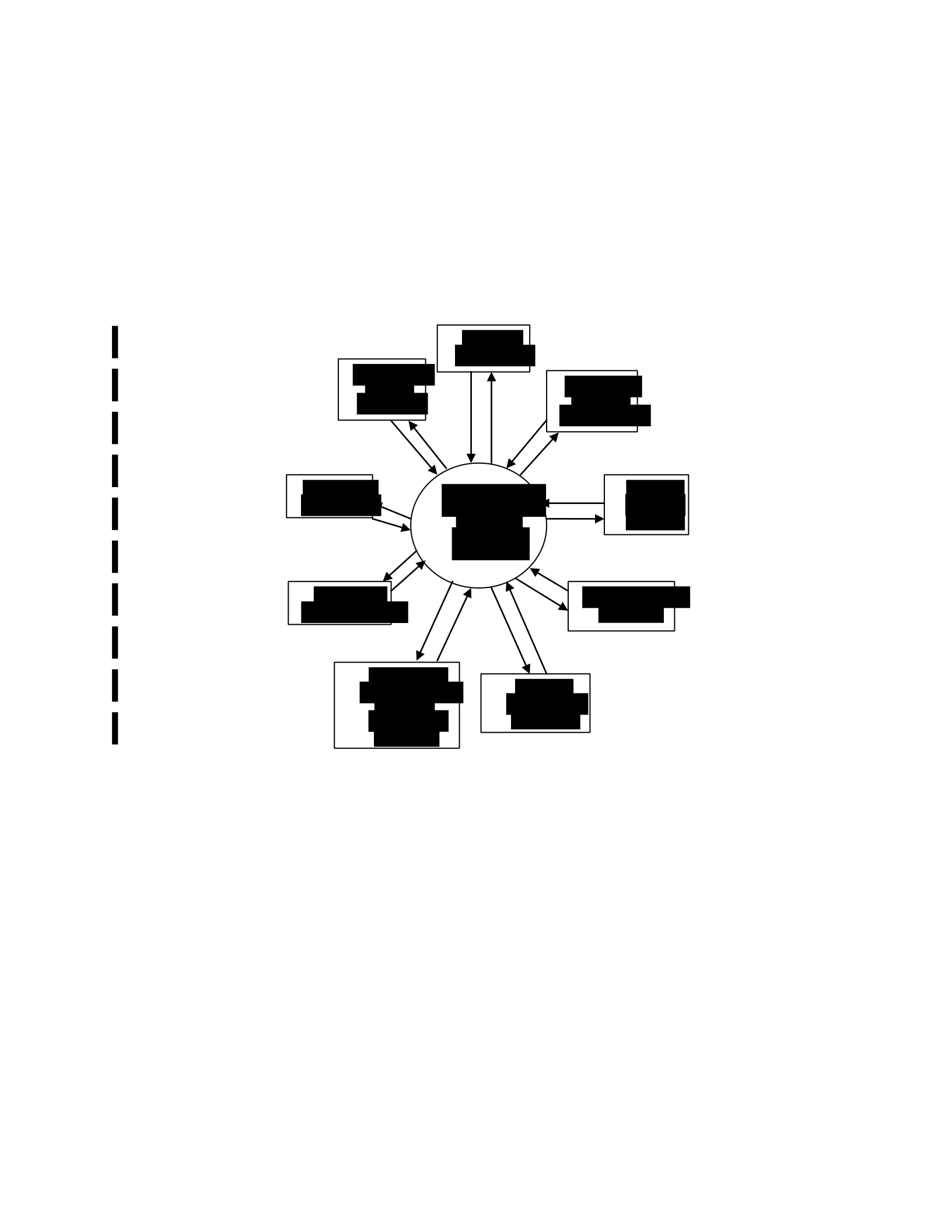
manager might have an objective to “minimize phishing email.” The decision context is
information security. The object is phishing email and the direction of preference is less phishing
email rather than more. Objectives are further distinguished as either fundamental objectives or
means objectives.
Figure 3.1: Thinking about Values:
The Basis for Quality Decision Making (Keeney, 1994)
Fundamental objectives are “the ends that decision makers value in a specific decision context”
and means objectives are “methods to achieve ends” (p. 34). This dissertation’s use of value-
focused thinking yields a list of unranked security objectives for each of the four groups of
participants.
Thinking
about
Values
Uncovering
hidden
objectives
Creating
alternatives
Identifying
decision
opportunities
Guiding
strategic
thinking
Interconnecting
decisions
Guiding
information
collection
Facilitating
involvement in
multiple-
stakeholder
decisions
Improving
communication
Evaluating
alternatives

Keeney (1992, p. 57) describes 10 different, but overlapping, methods for identifying objectives
through values, such as using alternatives, consequences, goals, constraints, guidelines and various
perspectives. However, Keeney believes the best way to discover one’s values is to ask for them
(Keeny, 1994). If the goal is to obtain a list of objectives related to a decision problem from
decision makers, start by asking them to develop a list of values, known as a wish list. This is an
unranked list of one’s values toward a given decision. For example, a person buying a car might
list low maintenance costs, comfortable ride and safety as some of their core values. Some means
for achieving these values might be good gas mileage, computerized suspension, leather seats, anti-
lock brakes and air bags. Keeney (1999, p. 534) describes three steps for obtaining a list of
fundamental and means objectives: (1) develop a list of values; (2) express values in common
form; and (3) organize the values and indicate relationships.
The first step involves asking people to develop a wish list of values about a certain topic. The
second step involves the researcher converting the values to objectives by restating the values into
a common form. For example, the person purchasing the car might have written down that they
wished for a car that did not cost a lot to maintain. The researcher might restate this value into the
objective “ensure low maintenance costs.” The third step involves separating fundamental
objectives from means objectives. Using the same car example, there may be the means objectives
“ensure car safety,” “ensure the use of anti-lock brakes,” “ensure the use of front air bags,” and
“ensure the use of side air bags.” These can be the means objectives for the fundamental objective
“ensure car safety.”
Value-focused thinking has been used in a wide variety of research, ranging from military to
environmental applications. Sample topics where value-focused thinking have been used include
fighting terrorists (Bullock, et al, 2008), selecting automatic rifles for the Croatian Army (Peharda

& Hunjak, 2008), locating community correction centers (Johnson, 2006), understanding
organizational safety (Merrick, et al, 2005), climate change (Keeney & McDaniels, 2001), Internet
commerce (Keeney, 1999), mobile communications (Yoo, et al, 2001), and business process
modeling (Neiger & Churilov, 2004). Because value-focused thinking is a decision making
methodology, it can be used in almost any situation where decisions need to be made, whether a
personal decision or an organizational decision. This is why value-focused thinking has been used
in such a wide variety of research topics.
Value-focused thinking has not been widely used in information systems or information security
research. Dhillon and Torkzadeh (2006) used value-focused thinking when they interviewed 103
managers to assess their values on information security. As discussed in chapter two, the authors
described 9 fundamental objectives and 16 means objectives related to information security. In the
only other information systems research found that used value-focused thinking, Barclay and Osei-
Bryson (2010) used value-focused thinking to evaluate the values of stakeholders of information
systems projects. The authors proposed a formal method to develop a comprehensive set of
objectives grounded in the views of the project stakeholders (Barclay & Osei-Bryson, 2010).
3.3 Ranking Delphi Method:
The output of the value-focused thinking method in this dissertation is a robust list of security
objectives for each of the four groups. This list helps answer the research questions about the
affect of training on the values of the participants and the affect of their value-based objectives on
information security policy. Next, we determine which objectives the groups feel are most
important. In a time of budget constraints or when it is just not possible to implement every
security objective listed, which security objectives are important enough to implement and which

are expendable? To determine the answer to this question, a ranking Delphi method was used to
create a ranked list of security objectives.
The Delphi method originated with the Rand Corporation in the 1950’s and was used to generate
a consensus of opinion from an anonymous group of experts. It was first used by the military to
investigate nuclear arsenal levels. However, the Delphi method can be used to achieve consensus
on just about any non-complex topic, such as developing a list of criteria, forecasting trends,
ranking and answering specific questions about a topic. For complex topics that cannot be
described in a short and precise research question, other methodologies, like scenarios, are better
suited. There are a series of rounds (iterations) with the group members about the topic that leads
to a higher level of mutual agreement. In each round, the participants are told the results of the
previous round and given a chance to change their opinion. Changing one’s opinion to reflect the
group opinion leads to higher group consensus. The anonymity of the group members eliminates
group think and personality conflicts that may otherwise bias results. Anonymity also makes it
easier for group members to change their mind about a topic without the knowledge of other group
members.
The ranking-type Delphi method is a group exercise and group size can vary dramatically
depending on the nature of the topic and the availability of experts. Some topics may only have a
few people in the world considered to be knowledgeable enough to warrant a Delphi study. Okoli
& Pawlowski (2004) suggest adequate group size for a Delphi study is 10-18 participants, but can
be lower depending on group dynamics. Loo (2002) suggests group sizes of 5-10 can be adequate.
Because the Delphi method can be applied to multiple forms of research questions, there are
multiple variations of the methodology. This dissertation is interested in ranking the list of security

objectives produced by the groups, so a ranking methodology was chosen. The ranking Delphi
methodology is what is typically used in information systems research. This variation uses group
members to obtain a ranking of key objectives, which can then be used for decision making. Prior
to Schmidt (1997), a problem with the ranking-type Delphi method was the lack of a formal set of
published rules. Researchers followed inconsistent methodologies, lacked statistical support for
many conclusions, and did not follow for a consistent means of reporting results (Schmidt, 1997).
Schmidt (1997) presented “a method based on nonparametric statistical techniques, to conduct
ranking-type Delphi surveys, perform analysis and report results” (Schmidt, 1997, p. 763).
Schmidt’s technique allowed for statistical support of conclusions, outlined a clear method, and
defined a definitive stopping point for the iterations. Since then, many Delphi studies wishing to
employ ranking utilized the ranking-type Delphi method described by Schmidt. This dissertation
chose Schmidt’s technique because of the methodological improvements over previous techniques
and for the rich supply of literature support for the Schmidt’s method.
Schmidt’s techniques for conducting ranking-type Delphi research follow a three phase approach.
The first phase discovers the issues, the second determines the most important issues and the third
phase ranks the issues. Below are step by step guidelines for conducting rankingtype Delphi
Research, as presented by Schmidt (1997). In this dissertation, phase one was conducted using the
value-focused thinking approach, which yielded an unranked list of security objectives.
Phase 1: Discovery of Issues
1. Encourage respondents to submit as many issues as possible.
2. Ask for a description of each issue.

3. The researcher consolidates the list, including different terms that appear to mean the same
thing. Put similar terms together and give a consolidated description.
4. Respondents now verify proper mapping and that their ideas are fairly represented.
Phase 2: Determining the Most Important Issues
1. Send each participant a randomly ordered consolidated list from phase 1 (this list was
created with the value-focused thinking method).
2. Participants select at least 10% (more if less than 100 items) of the issues they feel are most
important. Do not ask participants to limit their list to a particular number of issues. Ask
them to list the minimum number and go beyond if necessary.
3. The researcher eliminates all issues not selected by a simple majority of respondents, which
creates a new consolidated list. Groups will have varying lengths of lists.
4. If the list is still too long, conduct phase 2 again with the shortened list.
Phase 3: Ranking the Issues
1. Arrange the paired list in random order and ask respondents to rank all the issues. Statistics
can be used to rank ties, but it’s easier to ask respondents to avoid ties.
2. Apply Kendall’s Method to create a consensual ranking of the individual lists. Kendall’s
coefficient of concordance (W) (Kendall & Gibbons, 1990; Siegel & Castellan, 1988).
3. After each round in this phase, the researcher must ask the participants if another round
should be conducted to obtain a better consensus.
4. Monitor Kendall’s W (see table 3.1). A leveling off of Kendall’s W indicates lack of
progress from the previous round, so polling should stop. This coupled with verbal group

consensus strongly supports stopping. Consider the actual value of W as the indication of
consensus strength and not the statistical significance of W. A high value indicates
consensus in groups of 10 or less. In groups of 10 or more, a smaller value of W can be
significant. Kendall’s W ranges from 0 (no agreement) to 1 (complete agreement). A
strong consensus is W = .7 and is a good indicator to stop polling.
5. Information to monitor beyond mean ranks: (1) interpretation of Kendall’s W from the
previous round; (2) percentage of respondents placing each item in the top half of their list;
and (3) comments from the participants. The first two convey the degree of consensus. Do
not consider standard deviation as a form of consensus because it cannot be applied to
ordinal level data.
Table 3.1: Interpretation of Kendall’s W. (Schmidt, 1997)
W
Interpretation
Confidence in Ranks
.1
Very weak agreement
None
.3
Weak agreement
Low
.5
Moderate agreement
Fair
.7
Strong agreement
High
.9
Unusually strong agreement
Very high
The Delphi method has been utilized in research for over 50 years, so hundreds of studies were
found utilizing the method. Many of the studies focused on forecasting or developing a framework
and most identified some set of issues or factors pertaining to the topic under study. Since the
Delphi method is used to get a consensus of opinion from an anonymous group, it can be utilized
in a large variety of disciplines and fields. Recent examples were found in molecular genetics
(Marsden, 2009), medical ethics (Vorm, 2009), psychotherapy (Opie, 2008), ecology (Prato, 2008),
tourism (Lee, 2008), biological conservation (Patrick, 2008), engineering (Miura, 2008) and
accident analysis (Kim, 2008).

There were dozens of studies found in information systems/information technology research that
utilized the Delphi method. Table 3.2 lists five of the studies found that utilized the Delphi method,
but did not utilize the techniques for ranking described by Schmidt (1997). Those studies will now
be described in more detail to demonstrate their inconsistencies with Schmidt’s formal
methodology.
Table 3.2: Delphi Method in IS Research
Author
Purpose
Group Size
Doke & Swanson
(1995)
Identify decision variables for selecting prototyping in
information systems development.
31, 29, 27
Brancheau, et al.
(1996)
Identify critical issues facing information systems executives in
the forthcoming 3-5 years.
78, 87, 83
Hayne & Pollard
(2000)
Identify the critical issues in information systems for the
forthcoming 5 years.
176, 157
Mulligan (2002)
Classify information technology within the financial services
industry
25, 24, 23
Nakatsu &
Iacovou (2009)
Identify risk factors for domestic and offshore outsourced projects
(two groups)
15, 15, 15
14, 11, 12
Doke and Swanson (1995) used a ranking Delphi method to identify decision variables for selecting
prototyping in information systems development. Thirty one MIS managers completed round one
of the group iterations, which yielded nine decision variables for selecting prototyping. Twenty
nine participated in the second round, where a tenth decision variable was added. Twenty seven
participated in the third and final round. This ranking method was one of the older methodologies
that did not utilize Schmidt’s (1997) techniques. Schmidt’s techniques would not have allowed for
the addition of new decision variables in the second round.
In a paper published in MIS Quarterly, Brancheau et al. (1996) forecasted critical issues facing
information systems executives in the forthcoming 3-5 years. Participants were members of the
Society for Information Management (SIM), where 78 participated in the first round, 87 in the

second round, and 83 in the third round. Not all of these participants were the same throughout
the rounds and 108 overall participants were used. Interchanging participants during the iterations
is one of the inconsistencies of previous methodologies. The results of this study yielded 21 critical
issues, where business relationship issues declined and technology infrastructure issues increased
in importance.
In another paper forecasting the critical issues in information systems in the forthcoming five years,
Hayne and Pollard (2000) used a modified Delphi technique. The authors invited 920 members
from the Canadian Information Processing Society (CIPS) to join the study and 176 participated
in round one. To boost participation, the authors sent out 536 additional requests to the non-
respondents for a total of 712 invitations. Of those 712, 157 participated in round two. However,
the authors do not disclose how many of those that participated in round two did not participate in
round one and how results may be affected by those participants not having had input in the
previous round. The authors reported results on the top 10 upcoming critical issues facing
information systems.
In other research, Mullican (2002) used a Delphi Study to help classify information technology
within the financial services industry. The group was made up of senior information technology
managers from 11 organizations. Round one had 25 participants, round two had 24, and round
three had 23 participants. A positive point in the author’s methodology was that while participation
decreased, each remaining participant did participate in the previous round. Since each round
builds on the previous, it is much better to lose participants than it is to add new ones in later
rounds. The results of the Delphi portion of this research produced the initial specification of a
capability-based typology for information technology. The authors used this specification for a
follow-up case study.

In the last study reviewed that did not use Schmidt’s Delphi techniques, Nakatsu and Iacovau
(2009) used a Delphi study to identify risk factors for domestic and offshore outsourced projects.
Two Delphi panels were assembled, one for domestic risk factors and one for offshore risk factors.
The domestic panel started with 17 participants and the offshore panel started with 15 participants.
The participants consisted of experienced information technology managers that engage in
outsourcing. In round one of the Delphi study, 15 domestic panelists and 14 offshore panelists
participated. In round two, the same 15 domestic panelists participated, but only 11 offshore
panelists participated. In round three, the domestic panel again had 15 participants, and the
offshore panel increased to 12, meaning the additional panelist did not participate in the previous
round. While the authors did calculate a Kendall’s coefficient of concordance (W), they chose to
quit the iterations because of their panelist’s busy schedules and not according to a consensus of
the panelists, which is described in Schmidt’s techniques. Neither panel reported strong consensus,
as Kendall’s W was .51 for the domestic group and .53 for the offshore group after round 3. Both
are moderate consensus indicators. In the final results, the authors reported 20 domestic risk
factors and 25 offshore risk factors.
All of the studies just discussed used the Delphi method in information systems research. However,
there was no consistency in the methodology, particularly on when the study should end. They all
went for several rounds, whether it was necessary or not. Only one reported a Kendall’s coefficient
of concordance (W) for measuring consensus, but did not use the measurement to determine if
further iterations should be conducted. The primary reason Schmidt’s Delphi techniques were
chosen for this dissertation is because of the well defined methodology, versus the inconsistent
methodologies just reviewed.

Table 3.3 describes five studies that used Schmidt’s ranking techniques and reported the relevant
information. The Schmidt ranking Delphi method is what is used in this dissertation. The studies
will now be described in more detail.
Table 3.3: Ranking Delphi Method in IS Research (Schmidt, 1997)
Author
Purpose
Group Size
Kendall’s W
Schmidt et al.
(2001)
Develops a list of common risk factors of
information technology project failure.
Group 1: 9
Group 2: 13
Group 3: 19
.19, .53, .51
.17, .39, .46, .50
.35, .60, .73
Keil, et al.
(2002)
Compares the perceptions of information
technology project risk factors between users
and project managers.
15, 10
.5, .24
Mursu et al.
(2003)
Identify key software project risks in Nigeria.
11, 5
.142, .256
Lee & Anderson
(2006)
Identify factors impacting the information
technology project management capability.
33, 33, 32
.28
Kasi, et al.
(2008)
Identify the most important barriers to
conducting post mortem evaluations on failed
information technology projects.
23, 23, 23
.26, .33, .52
Schmidt et al. (2001) used his own methodology to develop a list of common risk factors of
information technology project failure. The authors ran three separate ranking Delphi panels at
the same time, one from the United States (19 panelists), one from Hong Kong (9 panelists), and
one from Finland (13 panelists). This was done to include cultural differences and to compare the
group’s results. Participants were experienced project managers from each culture. The initial list
of 53 risk factors was created in combination with all 3 groups. The master list was sent to all
three groups to be reduced in size. The United States group reduced the list to 17 items, Hong
Kong reduced their list to 15 items, and the Finnish group reduced their list to 23 items. Kendall’s
W for the United States group for 3 rounds of ranking was .35, .60, and .73, ending with strong
consensus. Kendall’s W for the Hong Kong group through three rounds of ranking was .19, .53,
and .51. Ranking ended with moderate consensus because round three failed to significantly

increase Kendall’s W, but instead decreased it. The Finnish group needed four iterations to reach
consensus. Kendall’s W for the Finnish group’s four rounds was .17, .39, .46, and .50, ending with
moderate consensus. The iterations were stopped because the fourth iteration failed to significantly
increase Kendall’s W. The authors reported results of the final rankings from the three groups and
compared the group’s rankings to one another. They also compared rankings to other Delphi
studies. This study from Schmidt et al. (2001) is the closest study in relation to this dissertation.
This dissertation also has multiple groups requiring varying number of iterations to reach
consensus.
In research that compares the perceptions of information technology project risk factors between
users and project managers, Keil, et al. (2002) used Schmidt’s Delphi techniques. Fifteen
participants started with an initial list of 53 project risk factors and the list was narrowed to 13 by
majority. The initial list was provided to the participants and they were asked to shorten it starting
with phase two of Schmidt’s technique. This dissertation also starts with Schmidt’s phase two, as
phase one was accomplished by value-focused thinking. The participants first round of ranking
yielded a Kendall’s W of .5. The second round of ranking lost 5 participants and Kendall’s W
dropped to .24. After contacting participants, the authors concluded that participants no longer
believed a better consensus could be achieved beyond the initial .5, which indicates moderate
agreement. The study was stopped and consensus results were reported at .5, after the first
iteration.
In another study about project risks, Mursu et al. (2003) identified key software project risks in
Nigeria. The 11 participants were project managers representing 11 different companies. The
panel initially created a list of 72 key software lists. That list was then narrowed to 19 risk factors.
The first round of ranking yielded a Kendall’s W of .142, which is not unusual for the first round.

Like the Keil, et al. (2002) study, the second round dropped several participants, leaving only 5.
Kendall’s W increased to .256, which still indicates weak agreement. Because there was little
movement in Kendall’s W and both rounds resulted in weak agreement, the authors decided to stop
the study with questionable results.
Changing research topics to project management capabilities, Lee and Anderson (2006) used a
Delphi method to identify factors that impact capability. The participants consisted of 33
information technology project managers. The authors started with a predetermined list of 35
factors that influence project effectiveness and the group narrowed the list to 13. There were three
iterations of ranking with a final Kendall’s W of .28. This can be considered weak agreement, but
smaller values of Kendall’s W can be considered significant for larger group sizes. The values of
Kendall’s W were not reported after the first two rounds. The authors reported results as the final
list of 13 factors impacting project management capabilities.
The last Delphi study to be reviewed is research from Kasi et al. (2008), where the authors identify
the most important barriers to conducting post mortem evaluations on failed information
technology projects. The panelists consisted of 23 experienced practitioners. Like the Keil et al.
(2002) research, the authors started with a predetermined list of 31 barriers. The group was asked
to use that list to brainstorm additional barriers, from which they generated 7 more, forming a total
of 38. The panelists then reduced the list from 38 to 19. There were then three rounds of ranking
with Kendall’s W improving from .26 to .33 in the second iteration, and then to .52 in the third
iteration. The authors stated that they believed an additional round would not produce better results
and that they were satisfied with .52, which indicates moderate consensus. This decision to stop
should be a consensus of the group according to Schmidt, but the authors did not report if the group
was consulted in the decision. The authors also did not report if the number of participants changed

in iterations two and three, and the assumption is that they did not. The final results of 19 ranked
barriers to conducting post mortem evaluations of failed information technology projects was
reported.
All of these Delphi studies followed Schmidt’s techniques and reported the step by step process,
making the results easy to comprehend. The studies also reported the relevant information, such
as the size of the initial list, the size of the shortened list and Kendall’s W of the final ranking.
There were other studies that stated they followed Schmidt’s techniques, but failed to report
important data, such as Kendall’s W (Addison, 2003; Okoli & Pawlowski, 2004; Weimer &
Seuring, 2008).
3.4 Research Design:
Value-focused thinking and Delphi studies can consist of any number of groups, with each group
coming to its own conclusion about a topic of interest. Typically, only one group is used to create
objectives or make a decision about a particular topic and that group is usually a group of experts,
as evident in most studies in the review of research. This dissertation instead assembled four
groups of panelists, each of which developed their own list of security objectives using the value-
focused thinking approach. Each group then ranked those security objectives using Schmidt’s
ranking Delphi method.
The four groups were assembled and asked to watch a 35 minute video, followed by a valuefocused
thinking exercise to ascertain the participant’s values about the topic of information security. There
was a socio-technical group, social group, technical group, and control group. The socio-technical
group watched a video describing social and technical aspects of information security (see table
3.4). The social group’s video covered only the social aspects of information security for half of

the video and the second half was padded with sexual harassment training. The technical group’s
video covered only technical aspects of information security for the first half of the video and the
second half was padded with sexual harassment training. The sexual harassment part of the videos
was added to lengthen the video to 35 minutes to make all groups equal in video length. Group
four was the control group that watched a video about anger management and sexual harassment,
which are topics believed to be unrelated to information security and would not affect the results.
More specific content for each video is discussed in chapter four.
After watching the video, the participants were asked to write down what they valued as the most
important topics to corporate information security and information security training. Participants
were told to act as if they were managers in charge of maximizing information security and the
effectiveness of information security training program (see appendix A for a full description of the
survey instrument).
Table 3.4: Experimental Design
Gets No
Technical Technical Training Training
Gets Social
Training
No Social
Training
Following Keeney’s (1992) value-focused thinking methodology, the participant’s values were
ascertained and converted to security objectives. The objectives for each individual participant
Group #1 (Socio-
Technical)
Group #2 (Social)
Group #3 (Technical)
Group #4 (Control)

were then combined into a group master list to be ranked by the participant’s working as a group.
Similar objectives listed by different names were clustered into common form for the master list.
Participants were given an opportunity to review the master list to verify their original values were
converted to objectives properly and described in the master list accordingly. This process is
explained in much more detail in the next chapter.
Ranking the objectives was performed using Schmidt’s (1997) ranking-type Delphi methodology.
Several rounds of anonymous ranking were conducted with each group. Analysis of the group
consensus was measured with Kendall’s W, as determined by using PASW statistical software
(formally SPSS). The outcome of each group was a list of ranked objectives identifying what the
group determined as the most important security objectives in creating an effective information
security awareness program and maximizing overall information security.
This process is explained in detail in chapter five.
3.5 Conclusion:
Four groups of managers were used to determine the influence of training on security objectives
and the ranking of those objectives. To help panelists think about social and technical aspects of
security before writing down their values about information security, a series of videos were
produced. One group watched a video explaining the importance of both social and technical
aspects of information security. Another group watched a video explaining the importance of only
the social aspects of information security. A third group watched a video of only the importance
of the technical aspects of information security. The fourth group was a control group to see how
managers would perform with no education imparted from a training video.

Keeney’s (1992) value-focused thinking methodology was used to determine the manager’s values
about information security and to create security objectives. Schmidt’s (1997) rankingtype Delphi
methodology was used to rank the security objectives to determine their importance. Both
methodologies have a proven research record. The procedure and analysis of these methodologies
and the discussion of the results are in the next chapters. Chapter four discusses the value-focused
thinking analysis and chapter five discusses the ranking-type Delphi analysis.
Chapter six discusses the results and overall implications to information systems research.
3. Defining Objectives That Inform Security Policy
The objective of this chapter is to illustrate the impact of different kinds of information security
training on information security policy formulation. This was a long process that involved creating
four training videos, collecting data, and following Keeney’s method of converting values to
objectives. Each of these areas will be discussed in detail below.
4.1 Training Video Creation:

Four different training videos were produced that lasted a total of 35 minutes each. One video
covered social and technical topics, another covered only social topics, a third covered only
technical topics and the fourth video was used as a control video and covered none of those topics.
More specific content of each video will be discussed in the following sections and a more detailed
outline of each video can be found in appendix B. The format of the videos involved a combination
of a series of one-on-one interviews with an expert in social and technical aspects of information
security and how-to video lectures. In the expert interviews, the interviewer asked questions
pertaining to socio-technical topics and the expert responded in a way that explained the topic, thus
creating a learning environment for the viewer. The how-to videos were an assortment of
educational lectures on particular topics, such as how to backup computer data or how to create a
secure password. All of the how-to videos are free public interest videos available to anyone from
companies such as Microsoft and Cisco. A more detailed look at the content of each video is given
next.
4.1.1 Socio-Technical Group Training Video:
The socio-technical training video covered social and technical aspects of information security, as
discussed in the literature review. The overall theme of the video covered Dhillon and Backhouse’s
(2000) confidentiality, integrity and availability (CIA) of data as the starting point for the technical
discussion and the responsibility, integrity, trust, and ethicality (RITE) of people as the starting
point of the social discussion. One question asked by the interviewer that opened the dialog with
the subject matter expert was how to manage the insider threat. The expert responded by discussing
Dhillon’s (2007) formal, informal, and technical systems of information security, as well as
policies, procedures, processes, guiding principles, security culture, legal systems and standards.
Further questioning led to examples of the formal, informal, and technical systems. Norms and

culture were discussed in detail as examples of the informal system. Rules, regulations and
processes were discussed as examples of the formal system. Access rights, encryption, and
passwords were used as examples of the technical system, as mentioned by Dhillon and Backhouse
(2000) and Rotvold (2008). More examples of topics discussed in this video include responsibility
and authority structures, leadership styles, management commitment, deterrents, resource
allocation, user involvement and regulations.
4.1.2 Social Group Training Video:
The social group training video contains the social elements of information security and not the
technical elements. Therefore, to have the video last for 35 minutes to be equal to the length of
the other videos, part of the social video contained filler. This filler video was in the form of
training on sexual harassment and was chosen because the topic is unrelated to securing
information resources and poses the minimum risk of affecting the values of the participants.
Adding this filler was necessary to make up the time of the missing technical aspects of information
security.
The social aspects of security in this video primarily focused on the responsibility, integrity, trust
and ethicality (RITE) of people from Dhillon and Backhouse (2000). One question asked by the
interviewer was how to manage people and culture. The expert responded by explaining
motivation through good leadership, power of groups, people relationships and positive and
negative intentions. Another interview question asked about tools or techniques that could be used
to teach proper social systems. The expert then explained how to understand silent messages from
groups or organizations, group associations and interactions with others. Other topics covered in
this video include motivating and influencing people through leadership, power relationships,

belief systems influencing attitudes, work situations, personal factors, opportunities for crime,
privacy, social and emotional intelligence and empathy.
4.1.3 Technical Group Training Video:
The technical group training video contained technical aspects of information security and not the
social aspects. Like the social video, filler was needed to make up for the missing content so that
the total video length would be 35 minutes. Sexual harassment was the topic chosen for the filler
video because it is a topic believed to have a minimal influence on the values of the participants.
The technical part of this video consisted of a series of presentations on multiple technical security
topics. The primary topics covered are those reported by Rotvold (2007) as those organizations
currently include in security awareness training and what Fulford & Doherty (2003) reported as
those which organizations currently include in their information security policy. A sample of topics
include computer updates, viruses, malware, secure e-mail, data backup, physical security,
encryption, passwords, firewalls and phishing. This video represents what research suggests is the
typical security awareness training video given by most corporations today.
4.1.4 Control Group Training Video:
The control group video was intended to last 35 minutes like the other videos, but with material
that was believed to have a minimal affect on the participant’s values. Since this video does not
contain any social or technical aspects of security, it had to be filled with unrelated information.
Like the filler used in the social and technical videos, sexual harassment was used as part of the
filler. However, more filler was needed to meet the time requirements. Therefore, a video segment

on anger management was added to extend the total time to 35 minutes. Both topics are unrelated
to social and technical aspects of information security.
4.2 Data Collection:
The four groups in this research were made up of current and future business managers that were
enrolled in a Master’s of Business Administration degree program. Forty-one participants were
randomly assigned to one of the four groups, resulting in three groups of ten and one group of
eleven (see table 4.1 for group dynamics). The forty-one participants represented 31 different
corporations.
Table 4.1: Group Dynamics
Group
Group
Size
Male
Female
Average
Age
Average
Management
Experience
(years)
Companies
Represented
Socio-
Technical
10
7
3
32
1.7
7
Social
10
8
2
27
1.3
8
Technical
10
8
2
28
.8
9
Control
11
9
2
30
1.2
7
Before watching the training video, each group was told that their input was to help maximize
information security and information security training and that they would get to help in choosing
what security topics to include. They were told that information security training is the method of
educating all employees on how best to protect an organization’s information systems. Each group
was presented with one of the four training videos and participants were allowed to take notes if
needed. At the conclusion of the video, participants were asked to write down and briefly describe
what topics they believed are most important if they were a manager in charge of maximizing

information security and the effectiveness of the information security training program. They were
asked to format their answers as if they were creating a wish list with no constraints.
4.3 Values to Objectives:
According to Keeney (1994), the best way to learn someone’s values about a particular subject is
to ask them to tell you in the form of a wish list. Participants listed what they wished to be included
in an information security program that maximized information security. These wishes are the
participant’s values toward information security. However, the raw data from the participants came
in many forms. Many included one value in a statement, such as “I think training should include
password use,” but some included several values per statement, such as “I think training should
include password use and virus protection.” Others wrote in paragraph form that contained even
more values. This raw data had to be converted to a common form that represented single values,
which is described in section 4.3.1. An example of a value would be “I wish training included a
topic on passwords.” The values then needed to be converted to objectives and clustered. An
example of an objective could be converting the previous value to the objective “ensure password
protection is fully utilized.” Clustering refers to grouping similar objectives into a single objective.
Many objectives may end up referring to utilizing password protection, but were stated using
different words. In this case, they can be clustered into a single objective. This involved converting
the values into objective statements and clustering similar objectives. This process is described in
section 4.3.2 and results in a final list of security objectives representative of each group of
participants. The socio-technical group was chosen to demonstrate this process. The next few
sections follow the process through to the completion of five objectives, out of the 72 the group
finished with. For a complete conversion process, see appendices D and E.

4.3.1 Raw Data to Common Form
Participant’s raw data input had to be broken down into a single common form, where only one
value was represented at a time. To simply the statements in the process of converting the raw
data, participant statements were reworded and expressed as wishes. Raw data that contained
multiple wishes were broken down into individual statements. For example, in table 4.2, ST1’s
raw data stated “all computers must be password protected, something as easy as screen saver
passwords might deter an intruder.” The common form of this statement yields two wishes, “I wish
computers were password protected,” and “I wish screen saver passwords were utilized.” If there
was any confusion, any additional descriptions or elaboration given by the participants was used
to better understand the participant’s intended value. The letters ST is a code that represents the
socio-technical group. The codes S, T, and C were used to represent the social group, technical
group, and control group respectively. The number following the code represents the number
assigned to each participant, 1-10 or 1-11 for the control group. Adding codes to the original input
for each participant makes it easier to trace the final objectives back to the participant or
participants from which they originated. See appendix D for the complete conversion of all raw
data to common form.
Table 4.2: Socio-technical Group Raw Data Conversion to Common Form Sample
Raw data from participant
Formatted in common form as wishes
Issue passwords to all employees.
ST1: I wish all employees were issued passwords
In order to get access, an employee must enter his or her
password.
ST1: I wish passwords were required for access
All computers must be password protected, something as
easy as screen saver passwords might deter an intruder.
ST1: I wish all computers were password protected
ST1: I wish screen saver passwords were utilized
Integrity of the people in the organization, trust between
the organization and the employees are more important
than everything.
ST2: I wish employees had integrity
ST2: I wish for trust between the organization and
employees
Emphasize individual integrity in the video as much as
possible.
ST8: I wish employees were taught about individual
integrity
ST3: I wish employees were familiar with basic
procedures

Make sure people are familiar with the basic procedures,
passwords, logging in, logging off, not sharing
confidential data, and so forth.
ST3: I wish employees were familiar with password
policy
ST3: I wish employees were familiar with procedures of
logging in and logging off
ST3: I wish employees were familiar with the policy of not
sharing confidential data
Can you share information, for example, in many
companies in “development and research department for
new products?” Are they allowed to email or share facts?
ST7: I wish there were confidentiality policies
Ethics – people need to be ethical and trusting.
ST5: I wish employees were ethical
ST5: I wish employees were trustworthy
The training that would be given to the employee should
involve mutual trust.
ST2: I wish employees received training in mutual trust
Because success is going to come with employees.
Employees need to trust the company.
ST2: I wish employees knew that trusting the company
leads to success
Reinforce ethics. There is no need for any of this if people
are not compelled to do unethical things.
ST6: I wish ethics were stressed
4.3.2 Clustering and Converting Values to Objectives
The output of the previous section of converting the raw data to values is a list of single values
expressed as wishes from each of the participants for each group. However, many of these values
expressed as wishes are similar to one another. For example, two values from two different
participants in the control group stated “I wish training included an Internet policy” and “I wish
training included acceptable Internet usage.” These values are both about establishing rules that
govern the use of the Internet. Clustering them together and converting them into an actionable
objective can be done in the same step. Converting a value in the form of a wish to an objective
that is actionable is a fairly straightforward process. Just add a verb to the value and restate it as
an objective. In our example, the two Internet usage related values can be clustered and converted
into the objective “ensure training includes an Internet usage policy.” This converts two values into
one actionable objective. Table 4.3 follows the values from the previous table for the socio-

technical group through the clustering and conversion process into final objectives. Again, for a
complete list of this conversion process, see appendix E.
Table 4.3: Socio-technical Group Objective conversion and Cluster Sample
Values
Objectives
ST1: I wish all employees were issued passwords
Ensure password protection is fully utilized
ST1: I wish passwords were required for access
ST1: I wish all computers were password protected
ST1: I wish screen saver passwords were utilized
ST2: I wish employees had integrity
Ensure training covers employee integrity
ST8: I wish employees were taught about individual
integrity
ST3: I wish employees were familiar with the policy of not
sharing confidential data
Ensure data confidentiality policies are in place
ST7: I wish there were confidentiality policies
ST5: I wish employees were trustworthy
Ensure a trust relationship between employees and the
company
ST2: I wish for trust between the organization and
employees
ST2: I wish employees received training in mutual trust
ST2: I wish employees knew that trusting the company leads
to success
ST5: I wish employees were ethical
Ensure appropriate ethics training
ST6: I wish ethics were stressed
4.3.3 Final Group Objectives
The previous section clustered and converted values to objectives, yielding a final list of group
objectives (see appendix F). The socio-technical group finished with the most objectives at 72.
The social group finished with 37, the technical group finished with 43, and the control group
finished with 49 security objectives. These lists of security objectives do not represent a ranked
order, but instead are represented randomly. In chapter five, the ranking Delphi method is used to
shorten and rank the security objectives of each group.
The significance of the final list of objectives is that it represents the security objectives that the
group members feel are important for maximizing the effectiveness of information security and

information security training. Each objective was analyzed and placed into one of three categories
for group analysis. The technical category (T) represents all objectives there were technical in
nature and require a technical implementation in order to satisfy the objective, such as “ensuring
password protection is fully utilized.” The social category (S) represents all objectives that are
social in nature, such as “ensuring appropriate ethics training.” The general category (G)
represents objectives that are neither technical nor social. General objectives are often related to
how security training should be presented, such as “ensure examples are fully utilized in security
training,” and “ensure training is simple and short.” The pie charts in appendix E represent the
technical, social, or general orientation of each group’s objectives as percentages. The next section
discusses the group’s final objectives in much more detail and the significance of their relation to
information security policy.
4.4 Discussion:
Taking a closer look at the final security objectives of the four groups, the first result that emerges
is that the socio-technical group created a lot more objectives than did the other groups, almost
60% more than the average of the other groups. More important than the total number of objectives
created by each group, is the quality of those objectives and the mix of social, technical and general
objectives. Too few social objectives and many technical objectives mean that security policy will
lack adequate social aspects and be technically dominant. Too many general objectives means the
participants were focused too much on aesthetics, such as having hands-on training and colorful
presentations, and not focused enough on social and technical aspects of security.
The socio-technical group not only had more objectives, but had an adequate representation of
social and technical objectives. Of the 72 total security objectives, 25% were social, 34.72% were

technical, and 40.28% were general objectives. This is a good percentage of social and technical
objectives. It is to be expected that there will be a higher percentage of technical objectives than
social objectives, mainly because there are more technical solutions to information security than
there are social solutions. While there were too many general objectives from all groups, the socio-
technical group was among the best at minimizing them. Most of the general objectives were
appropriate for conducting awareness training, such as using examples in training, using
stimulating videos and involving management in training.
The socio-technical group’s final list of social security objectives included many objectives that
the literature review stated were most important. In representing the responsibility, integrity, trust
and ethicality of employees (RITE), the group listed multiple objectives. For instance, they had a
security objective to create an ethics training program. Ethical aspects of security are just as
important as technical aspects and companies with ethics programs suffer less economic crime
(Trompeter & Eloff, 2001, ECS, 2007). The group also had security objectives to ensure a trusting
relationship between the employee and the employer and to clearly define the employee’s roles
and responsibilities. In current organizations where employees are empowered with more
responsibility, building a trusting relationship between the employee and the employer is more
important than ever (Dhillon, 2007). In addition, employees need to understand their roles within
the organization, which also includes individual accountability (Dhillon & Backhouse, 2000). The
group also had security objectives relating to the screening of employees, hiring responsible
employees, and promoting the integrity of the individual. Dhillon and Backhouse (2000) warn
about ensuring the integrity of the individual before giving them access to sensitive resources, so
these objectives are also very important.

The socio-technical group was the only group to completely represent all aspects of RITE. Other
important social objectives created by this group include the creation of a mix of formal, informal,
and technical control systems, creating reward systems, acknowledging employee commitment
and employee motivation. The only important social aspect that this group omitted was creating
a security culture, which is a major oversight. A strong security culture is very important for
information security and has been linked to such things as compliant user behavior and employees
engaging in security measures beyond their mandatory job descriptions (Ruighaver et al., 2007;
Dhillon, 2007; Karyda, et al., 2005; von Solms & von Solms, 2004; Leech, 2003; Vroom and von
Solms, 2004; D’Arcy & Greene, 2009). While creating a security culture is very important and
not creating a security objective to do so is a significant omission, the socio-technical group
otherwise created a robust list of social security objectives.
On the technical side, the socio-technical group created an adequate list of technical objectives and
represented the confidentiality, integrity, and availability (CIA) of information. For instance they
included technical objectives to ensure data confidentiality, appropriate access, intrusion detection,
password management, biometric authentication, data monitoring, firewalls, proper infrastructure
planning, and system reliability. Restricting data access to those that are authorized is crucial to
protecting the confidentiality of data (Dhillon, 2007). This group’s objective for ensuring data
confidentiality specifically addresses this task. The integrity of data is important because it is
concerned with the trustworthiness and correctness of the data (Dhillon, 2007). Data that cannot
be trusted as correct is worthless data. The socio-technical group’s objectives for intrusion
detection and data monitoring help protect the integrity of data. Beyond the confidentiality and
integrity of data, making it available to those in need is equally important. This can mean
contingency planning, disaster recovery planning, or ensuring the reliability of data access

(Dhillon, 2007). The socio-technical group’s objectives for the use of firewalls, ensuring system
reliability, and proper infrastructure planning relate to ensuring the reliability of data access. The
socio-technical group also listed technical objectives for protection from portable devices, physical
access to systems, and securing Web servers. Overall, the socio-technical group created a robust
list of social and technical security objectives. These socio-technical security objectives
implemented as the organization’s information security policies and distributed through the
information security training program would come close to maximizing overall information
security. The only exception would be the lack of a security culture.
The social group’s final list of security objectives consisted of 27.03% social, 24.32% technical,
and 48.65% general objectives. This is a large percentage of general objectives. The true test is
to evaluate the quality of social and technical objectives against RITE, CIA, and other important
social and technical aspects. It is good to recall here that the social group only received social
training, so any technical security objectives listed were not influenced by the training. Therefore,
it was anticipated that this group would have a robust list of social objectives and a moderate list
of technical objectives. However, the social security objectives listed by this group in regard to
RITE were not as comprehensive as anticipated. They listed objectives for considering employee
integrity and employee ethics, but failed to create security objectives for defining roles and
responsibilities and creating trusting relationships. They also failed to list the creation of a positive
security culture, as did the socio-technical group. The above mentioned are three important social
security objectives omitted by this group and all three were covered in their training video. It is
unclear why the group failed to list these objectives and is perhaps a topic to be addressed in future
research. The group did list other important social objectives, such as recognizing employee

cultural differences, manager emotional intelligence, employee decision making, corporate values,
morale, employee gender differences and the effects of employee dissatisfaction.
On the technical side of security, the social group also left a few security holes. In support of CIA,
the social group created security objectives for confidentiality and integrity of information, but
failed to create objectives to preserve the availability of data. However, they did list other
important technical objectives, such as password protection, physical security, personal data
protection, and identity theft.
Overall, the social group’s list of social objectives was incomplete, which is a surprise considering
they received social training. They also created an incomplete list of technical security objectives,
which is understandable considering they did not receive technical training. There was an
overabundance of general objectives, with many relating to conducting awareness training and
some completely unrelated. For instance, how to handle the media is unrelated to information
security and security awareness training, while hands-on training is relevant to conducting
information security training. These socio-technical security objectives when implemented as the
organization’s information security policies and distributed through the information security
training program would not maximize overall information security and would leave some security
holes in both the social and technical areas.
The technical group received technical training and no social training. Therefore, they were
expected to be strong in technical aspects of security, but relatively weak in social aspects. This
group listed 11.63% social objectives, 48.84% technical objectives, and 39.53% general objectives.
This is the largest percentage of technical objectives from all the groups. In representing RITE,
they created a security objective to address employee roles and responsibilities, but failed to list

objectives in regard to employee integrity, trust, and ethicality. This was no surprise, but what was
a surprise was that the technical group listed security culture, employee culture and corporate
values. This is the only group to create an objective for security culture and they did not receive
training on the topic. This shows that without social training, the group still came up with several
important social objectives. However, the overall list of social objectives is poor and not nearly as
comprehensive as the social or socio-technical group.
Technical objectives were very strong for the technical group, as they had an abundance of
objectives related to CIA. For instance, they listed data protection, data recovery, data backups
and data confidentiality as security objectives. They also listed many other technical aspects of
information security, such as password protection, physical security, the use of encryption,
auditing, SPAM filtering, phishing, virus detection, worm detection, spyware detection and the use
of virtual private networks.
Overall, the technical group created an incomplete list of social objectives and a robust list of
technical objectives. They also had less general objectives than the other three groups, at 34.9%.
Many of those objectives were about the aesthetics of training, such as using bright imagery,
interactive training, hands-on exercises, and using humor in training. These sociotechnical security
objectives when implemented as the organization’s information security policies and distributed
through the information security training program would not maximize overall information
security and would leave many security holes in the social side of security. This type of security
depicts the scenario in today’s organizations, as we learned from the literature review;
organizations today have technically oriented information security policy and training (Rotvold,
2008; CWS, 2010; Fulford & Doherty, 2003).

The control group represents managers that get no formal training on how to maximize information
security, which is the status quo for most organizations (Hone & Eloff, 2002). The training this
group received had nothing to do with information security, so it is expected that the group will
produce a weak list of social objectives and a moderate list of technical objectives. In regard to
percentages, the control group’s final list of security objectives included only 6.12% social
objectives, but had 44.9% technical and 48.98% general objectives. This is a very low percentage
of social objectives and large percentage of general objectives. Out of 49 total objectives, only 3
were socially related. Two of those social objectives related to RITE’s trust and ethics components
and the third related to social engineering. Only the control group included social engineering as
a security objective, which was somewhat of a surprise. Beyond those three objectives, which
were very good, the control group was missing many other social aspects of information security
and was by far the worst representation of social objectives of all the groups.
The control group’s list of technical objectives was much more comprehensive. All aspects of CIA
were represented. For instance, the group listed data confidentiality, data backup, and encryption
as technical security objectives. They also included physical security, wireless networking,
intrusion detection, firewall configuration, virus detection, SPAM detection and domain naming
service security.
Overall, the control group had an incomplete representation of social objectives and a nice
representation of technical objectives. It was a surprise that their technical security objectives were
well represented. The social group also did not receive technical training, but was only able to
produce a moderate list of technical objectives. The control group listed far too many general
objectives and had the largest percentage out of all the groups at 48.98%. Like the other groups,
many were related to information security training, like having interactive training, using examples

and using qualified trainers. These socio-technical security objectives when implemented as the
organization’s information security policies and distributed through the information security
training program would not maximize overall information security and would leave many security
holes in the social area of security.
In regard to social objectives, the socio-technical group created 20 total social objectives, compared
to 10 for the social group, 5 for the technical group, and 3 for the control group. The socio-technical
group was the only group to create a robust list of social objectives and to list satisfactory objectives
for RITE, which is somewhat of a surprise that they were the only group to do it. The social group
received the same training on RITE as the socio-technical group, but failed to enlist trust, and roles
and responsibilities. However, the social group did have a moderate list of social objectives and
performed better than the technical and control groups. Both the technical and control groups had
insufficient lists of social security objectives.
For the technical objectives, the socio-technical group created 25 total technical objectives,
compared to 9 for the social group, 21 for the technical group, and 22 for the control group. Only
the social group failed to have a comprehensive list of technical objectives, failing to satisfy the
availability of data part of CIA. All other groups satisfied CIA and listed plenty of additional
technical objectives.
The lists of security objectives from all four groups produced a few other interesting results. For
instance, the results of the control group are similar to the technical group, in that the social aspects
of information security policy and training would be poor and the technical aspects of information
security policy and training would be excellent. It was not expected that the control group would
have excellent technical representation. This implies that training managers on the technical

aspects of security only is no better than not training them at all. With no training, managers are
still aware of the technical aspects of security. However, the results are mixed in that the social
group did not receive technical training either and produced only a moderate list of technical
objectives. The social group’s second surprise was that they only produced a moderate list of social
objectives as well. Since they received in depth social training, it was expected their social list of
security objectives would be excellent. Another unexpected result was that the technical group
was the only group to list the creation of a security culture as a security objective. They did not
receive social training and the social and socio-technical groups did, but neither of the latter groups
listed that objective. That was the only surprise for the sociotechnical group. They otherwise
produced an excellent list of social and technical security objectives.
4.5 Conclusion:
The objective of this chapter was to demonstrate the impact of different kinds of information
security training on information security policy formulation. The chapter started with the creation
of four training videos, including a socio-technical video, a social only video, a technical only
video, and a control video. Groups of managers were formed and each group watched one of the
videos. Following the video, each group participant wrote down their values for maximizing the
effectiveness of information security and information security training. Following Keeney’s value-
focused thinking methodology, the values were converted and clustered into lists of value-based
security objectives. Each group’s security objectives were analyzed in regard to the nature and
scope of the information security policy they would inform.

Overall, the socio-technical group had the most comprehensive list of security objectives,
satisfying both RITE and CIA. They were the only group to have satisfied both and have many
other important social and technical objectives. The social group failed to completely satisfy both
RITE and CIA, but had moderate lists of social and technical objectives. The technical and control
groups both had excellent lists of technical security objectives, but weak lists of social security
objectives. The output of this chapter is an unranked list of security objectives representative of
each group’s values. Chapter five uses the ranking Delphi method to narrow and rank the lists of
security objectives to discover which objectives the groups feel are most and least important.

4. Ranking Delphi Analysis
5.1 Background:
The last chapter used Keeney’s value-focused thinking methodology to create lists of valuebased
security objectives from four groups of panelists. The nature and scope of each list of security
objectives was analyzed for their social and technical aspects as deemed important from the
literature review. For instance, the lists were analyzed for representation of the responsibility,
integrity, trust and ethicality of individuals (RITE) and the confidentiality, integrity and availability
of information (CIA) in addition to other important social and technical security objectives. Also
discussed in chapter four was the nature and scope of the information security policy informed by
each list of security objectives. What we do not know from chapter four is the degree of importance
attached to each security objective. Which security objectives would get eliminated if the security
budget was reduced? Recall that the lists of value-based objectives are wish lists developed by the
participants without other constraints such as budgets. In the real world, there may be money to
do some things and not others. The purpose of chapter five is to use a ranking Delphi method to
shorten the lists and rank the remaining security objectives. The shortened ranked lists will tell us
which security objectives the participants feel are most and least important.
According to Schmidt’s (1997) guidelines for conducting ranking-type Delphi research, three
phases must be conducted. The first phase involves discovering the issues pertaining to a particular
topic. This was accomplished with the value-focused method discussed in chapter four, where
each group produced an unranked list of objectives they thought were important for maximizing

the effectiveness of information security and training. The socio-technical group listed 72
objectives, the social group had 37 objectives, the technical group had 43 objectives, and the
control group had 49 objectives. This chapter starts with Schmidt’s phase two, which was to
shorten the lists before they could be arranged in a ranked order.
Phase two of Schmidt’s guidelines states that the panelists are to be asked to shorten the list to no
less than 10% of the original number of objectives and no more than 100 objectives. An ideal list
would be somewhere around 20 objectives, according to Schmidt, but could certainly be more or
less depending on the topic. Since none of the groups had more than 100 objectives to begin with,
the upper limit was not a constraint. According to Schmidt’s guidelines, participants were told
there was no correct number of final objectives, but to include what they believed were the most
important objectives from the list. Once each group member submitted a shortened list of what
they believed were the most important objectives from the original list, a final list was created.
This was accomplished by retaining objectives that appeared on a majority of the participant’s
shortened lists. For example, if 60% of the participants thought a particular objective was
important and they included that objective on their shortened list, then that objective would be
included in the final list. If a particular objective was only represented by 40% of the participant’s
shortened lists, then it did not get included in the final list. Phase two could be repeated if necessary
to shorten the list further.
Phase three of Schmidt’s guidelines created a group ranking of the final list of objectives from most
important to least important. This phase involved asking the group members to rank the final list
of objectives from what they believed were the most important objectives to the least important
objectives and each participant was given a randomly ordered list of objectives to start. Kendall’s
coefficient of concordance (Kendall’s W) was then determined by analyzing the ranked lists from

the group members, which was used to determine group consensus. The higher the coefficient, the
better group consensus was. There were multiple iterations of this process, with each iteration
producing a newly ranked list of objectives based on the group mean rank of each objective. The
new group ranking was then sent back to each group member to be ranked again. This process
was repeated until one of two things happened. The first is when Kendall’s coefficient of
concordance is .7 or greater and the group agrees further iterations would not significantly improve
consensus. A coefficient of .7 or greater indicates strong agreement on the ranked list of objectives.
The second stopping point could be if the group’s coefficient levels off at some point below .7 and
does not significantly increase with further iterations. This would mean the group failed to reach
strong agreement on the final ranked list of objectives and they would never be in strong agreement.
The next few sections of this chapter discuss phases two and three of Schmidt’s guidelines as they
pertain to this research. Section 5.2 narrows the long lists of objectives from the valuefocused
thinking chapter down to manageable lists of final objectives. Section 5.3 discusses the ranking
process through multiple iterations and produces a final ranked list of objectives from each group.
Section 5.4 discusses the ranked lists and the affect on information security policy and section 5.5
concludes the chapter.
5.2 Determining the Most Important Objectives:
Each group was given a randomly ordered list of objectives that their group produced in the value-
focused thinking piece of this research. They were asked to keep the objectives they believed were
most important and discard the rest. They were given no particular goal for a final number of

objectives they should have. This process was accomplished via e-mail with each of the
participants. Once the shortened list was received from each of the participants, a final list of
objectives was produced. This was accomplished by keeping objectives that appeared on the
shortened lists of the majority of group members, according to Schmidt’s guidelines. Since three
of the groups had ten members and one of the groups had eleven members, it was decided that an
objective would be kept for the final list if it was found on six of the participants shortened lists.
Six participants agreeing to the objective as important would be in the majority for all groups,
whereas five would not be the majority for any of the groups. The shortened unranked lists of
objectives for each group can be found in appendix G. The socio-technical group shortened their
list to 12 objectives they believed were most important. The social group shortened their list to
23, the technical group to 22, and the control group to 25 objectives. The number of final objectives
for each group falls within Schmidt’s goal of greater than 10% of the original list and less than 100
objectives. Also included in the tables in appendix G is the percentage of participants from each
group that included that objective in their shortened list. The higher that percentage, the more
group members that believed the objective was important enough to include on their final list of
objectives. The lists are sorted by percentage of inclusion from participants and should not to be
confused with the ranking process discussed in the next section.
5.3 Ranking the Objectives:
The previous step narrowed each group’s list of objectives down to what they believed were the
most important objectives, which yielded a much shorter list of objectives for each group. The
next step was to rank the objectives from most important to least important. A randomly ordered
list was sent to each participant for ranking. The participants were told the list is randomly ordered
and to not imply any ranking. PASW-17, formally known as SPSS-17, was used to perform

statistical analysis on the ranked lists. In order to use PASW to determine the mean rank and group
consensus, each objective was translated into an alphabetic letter. The random list of objectives
that was sent to each group participant was represented in PAWS as the letters of the alphabet as
seen on tables 5.1 and 5.2 for the social group. The participants only received a list of objectives
without the letters, but the researcher uses the letters for the columns in PASW’s data view. The
social group had 23 objectives, so the columns in PASW were labeled A-W to represent the 23
objectives. The rows in PASW were numbered 1-10 to represent the 10 participants in the social
group. To explain this process as efficiently as possible, the social group was chosen for this
example because that group had group consensus and stopped after two iterations and the others
stopped after three.
Table 5.1: Social Group Objective Conversion to Letters Iteration One
A. Ensure hand’s on training
B. Ensure managers are involved in providing training
C. Ensure the importance of security is addressed with all employees
D. Ensure training addresses corporate information theft
E. Ensure training addresses data protection
F. Ensure training addresses employee ethics
G. Ensure training addresses employee integrity
H. Ensure training addresses factors affecting employee decision making
I. Ensure training addresses how employee dissatisfaction affects security
J. Ensure training addresses strong passwords while minimizing the need to write them down
K. Ensure training addresses the relationship between emotional intelligence and security
L. Ensure training addresses the social interaction between companies and individuals
M. Ensure training considers employee cultural differences
N. Ensure training covers legal aspects of security
O. Ensure training covers personal data security
P. Ensure training covers privacy rights
Q. Ensure training covers the most common threats and how to prevent them
R. Ensure training describes corporate values
S. Ensure training includes confidentiality policy
T. Ensure training includes continuing education as threats change
U. Ensure training includes technical aspects
V. Ensure training is up to date with current security issues
W. Ensure training utilizes real world examples, including the corporate consequences of bad security

Table 5.2 is the data view from PASW for the social group’s first iteration. The letters A-W from
table 5.1 that represent the objectives are the columns in PASW. The ten participants are the rows.
The data that fills the cells are the actual rankings provided by each of the participants for iteration
one. For example, participant number one thought that “ensure training covers the most common
threats and how to prevent them” was the most important objective. This can be seen by looking
at row “Part 1” for participant one and column “Q,” where that participant placed the number one.
Because the number one is in that column, this means that participant listed that objective as
number one in their ranking. All 23 of their rankings are listed in this manner. Recall that the
participants did not receive a list with the letters, but only the objectives. This means that the
researcher had to apply the letters back to each participant’s ranked list based on table 5.1. Think
of it as a conversion process from objectives to letters for easy entry into PASW. Once PASW
gives the results, they can be easily converted from letters back to objectives. This process of using
letters to represent the objectives in PASW was performed for all participants for each group and
for each iteration.
Table 5.2: Social Group PASW Input for Iteration One
A
B
C
D
E
F
G
H
I
J
K
L
M
N
O
P
Q
R
S
T
U
V
W
Part. 1
6
18
7
19
8
10
9
11
22
12
21
20
23
13
5
14
1
15
16
2
4
3
17
Part. 2
22
2
3
16
7
17
18
10
21
11
9
8
23
12
5
19
4
13
20
15
6
1
14
Part. 3
9
13
3
17
14
7
20
18
21
23
12
22
5
6
16
11
1
15
19
4
10
8
2
Part. 4
23
8
2
10
11
3
4
15
16
17
18
19
21
9
12
13
6
1
14
20
22
5
7
Part. 5
1
23
5
21
22
2
3
18
4
20
9
10
11
13
14
19
8
12
16
15
17
6
7
Part. 6
19
8
17
2
6
15
7
21
9
12
3
10
11
18
1
13
4
16
14
5
23
22
20
Part. 7
1
7
2
10
3
16
17
20
21
18
22
23
19
8
4
5
11
12
13
14
15
9
6
Part. 8
8
7
6
17
18
9
5
19
2
22
3
4
20
10
16
15
11
12
21
13
23
14
1
Part. 9
19
17
18
11
10
9
12
13
8
23
5
14
15
2
3
4
20
1
16
6
22
7
21
Part. 10
22
5
10
17
4
6
11
19
21
20
18
12
7
13
1
14
15
23
8
16
3
2
9

Analysis of the participant’s rankings using PASW yielded the following results for the first
iteration of the social group (table 5.3). Each objective has a mean rank and standard deviation.
This table is sorted by the mean and then standard deviation to break ties. The first column
represents the alphabetic letter originally assigned to each objective, so it is easy to see how the
original random list was moved around to form this ranked list. Objective “C” comes in first,
which is “ensure the importance of security is addressed with all employees.” It has the lowest
mean of 7.3. Several objectives have the same mean, such as “O” and “V,” which came in number
2 and 3 in the ranked list. In such cases, the objective with the lower standard deviation earns the
higher ranking, according to Schmidt’s guidelines. This is why objective “O” comes in second
with a standard deviation of 6.111 and objective “V” comes in third with a standard deviation of
6.29.
Table 5.3: Social Group First Iteration Sorted by Mean
Letter
Mean
Std.
Deviation
Objective
C
7.3
5.926
Ensure the importance of security is addressed with all employees
O
7.7
6.111
Ensure training covers personal data security
V
7.7
6.29
Ensure training is up to date with current security issues
Q
8.1
6.19
Ensure training covers the most common threats and how to prevent them
F
9.4
5.232
Ensure training addresses employee ethics
E
10.3
6.129
Ensure training addresses data protection
N
10.4
4.452
Ensure training covers legal aspects of security
W
10.4
7.183
Ensure training utilizes real world examples, including the corporate consequences of bad
G
10.6
6.096
Ensure training addresses employee integrity
B
10.8
6.663
Ensure managers are involved in providing training
T
11
6.164
Ensure training includes continuing education as threats change
R
12
6.65
Ensure training describes corporate values
K
12
7.318
Ensure training addresses the relationship between emotional intelligence and security
P
12.7
5.012
Ensure training covers privacy rights
A
13
8.894
Ensure hand’s on training
D
14
5.676
Ensure training addresses corporate information theft
L
14.2
6.477
Ensure training addresses the social interaction between companies and individuals
I
14.5
7.934
Ensure training addresses how employee dissatisfaction affects security
U
14.5
8.155
Ensure training includes technical aspects
M
15.5
6.654
Ensure training considers employee cultural differences

S
15.7
3.802
Ensure training includes confidentiality policy
H
16.4
3.893
Ensure training addresses factors affecting employee decision making
J
17.8
4.662
Ensure training addresses strong passwords while minimizing the need to write them down
Kendall’s W = .193
In addition to the mean rank and standard deviation, PASW also yields Kendall’s Coefficient of
Concordance, also known as Kendall’s W, which is reported at the bottom of the table. Kendall's
Coefficient of Concordance (W) is used to calculate consensus among three or more people.
Kendall’s W ranges from 0-1, with zero indicating no agreement and one indicating full agreement.
For the first iteration, the social group’s consensus was .193, which is very weak agreement
according to Schmidt’s scale (see chapter 3). Another round must be done to see if the group is
capable of achieving better agreement.
The second round of ranking for the social group started with each participant receiving the group
ranking results from the first round. The new list was created using the mean rank from round one,
as seen in table 5.4. This is the first time each participant saw the ranked objectives as a group.
Again, letters are added to the ranked list for easy input into PASW, but the participants only
receive the ranked objectives and not the letters. Each participant was asked to make any changes
they believed were necessary, such as moving objectives up and down the list to satisfy their
individual values. If they believed the list was satisfactory, they did not have to change anything.
Group consensus is expected to increase at this point because individuals usually only move the
objectives they feel strongly about and leave the others alone. The more that get left alone, the
greater the group consensus.
Table 5.4 represents the social group’s first list of ranked objectives with letters assigned for
representation in PASW. This group of assigned letters A-W is different than the original list sent

to participants, as the letters now represent the first ranking and not the randomly ordered list. Just
like in the first round, the researcher converts the participant’s newly ranked list for round two to
the letters represented in table 5.4 and enters them into PASW. The results from PASW are then
converted from letters back to objectives.
Table 5.4: Social Group Objective Conversion to Letters Iteration Two
A. Ensure the importance of security is addressed with all employees
B. Ensure training covers personal data security
C. Ensure training is up to date with current security issues
D. Ensure training covers the most common threats and how to prevent them
E. Ensure training addresses employee ethics
F. Ensure training addresses data protection
G. Ensure training covers legal aspects of security
H. Ensure training utilizes real world examples, including the corporate consequences of bad
I. Ensure training addresses employee integrity
J. Ensure managers are involved in providing training
K. Ensure training includes continuing education as threats change
L. Ensure training describes corporate values
M. Ensure training addresses the relationship between emotional intelligence and security
N. Ensure training covers privacy rights
O. Ensure hand’s on training
P. Ensure training addresses corporate information theft
Q. Ensure training addresses the social interaction between companies and individuals
R. Ensure training addresses how employee dissatisfaction affects security
S. Ensure training includes technical aspects
T. Ensure training considers employee cultural differences
U. Ensure training includes confidentiality policy
V. Ensure training addresses factors affecting employee decision making
W. Ensure training addresses strong passwords while minimizing the need to write them down
Table 5.5 displays the results from PASW for the group’s second ranking iteration. The letters in
the left column represent the previous ranking, so you can see which items moved up and down
the list. As you can see, letter “A” remained in the top spot, which means the participants did not
change the number one ranking for that objective. Its standard deviation is also very low, indicating
strong agreement on the number one ranking. Kendall’s W increased dramatically to .744, which
means the group now has strong consensus. According to Schmidt, the researcher should ask the
participants if they feel a third iteration will produce any better results. If a majority of the group

feels that a third iteration will strengthen consensus, then a third iteration should be performed. In
this case, the majority of the social group’s participants responded that an additional iteration
would not improve consensus, so this was the final ranking for the social group.
Table 5.5: Social Group Second Iteration (Sorted by Mean)
Letter
Mean
Std.
Deviation
Objective
A
1.10
0.32
Ensure the importance of security is addressed with all employees
C
4.40
3.44
Ensure training is up to date with current security issues
E
4.90
1.52
Ensure training addresses employee ethics
D
5.10
2.23
Ensure training covers the most common threats and how to prevent them
B
7.10
6.67
Ensure training covers personal data security
H
7.50
2.84
Ensure training utilizes real world examples, including the corporate
consequences of bad security
F
7.70
4.14
Ensure training addresses data protection
I
8.20
2.70
Ensure training addresses employee integrity
G
8.50
1.35
Ensure training covers legal aspects of security
J
10.00
1.89
Ensure managers are involved in providing training
K
11.30
4.03
Ensure training includes continuing education as threats change
L
11.80
4.10
Ensure training describes corporate values
M
13.10
3.54
Ensure training addresses the relationship between emotional intelligence and
O
13.50
6.13
Ensure hand’s on training
P
14.20
3.65
Ensure training addresses corporate information theft
N
14.50
0.85
Ensure training covers privacy rights
R
16.20
5.05
Ensure training addresses how employee dissatisfaction affects security
Q
17.00
3.74
Ensure training addresses the social interaction between companies and
S
18.70
2.54
Ensure training includes technical aspects
T
18.90
4.20
Ensure training considers employee cultural differences
U
19.70
2.54
Ensure training includes confidentiality policy
V
20.20
3.91
Ensure training addresses factors affecting employee decision making
W
22.40
1.90
Ensure training addresses strong passwords while minimizing the need to
Kendall’s W = .744
The process described above was for the social group, but the same process was used with the
socio-technical, technical, and control groups. The final ranked list of objectives for each group
with Kendall’s W results can be found in appendix G. The social group had consensus after the

second round and so did the socio-technical group when they had a Kendall’s W of .734 after the
second iteration, but the socio-technical group decided to go another round and improved their
consensus to .825, while the social group agreed to stop after the second round. For the
sociotechnical group, one hundred percent of the group felt they could do better with the additional
round.
The technical group was the only group to not reach a strong consensus. A Kendall’s W of .627
falls between moderate and strong agreement- according to Schmidt’s guidelines, which is
perfectly fine. A Kendall’s W of .7 is desirable, but not mandatory. When a group appears to stall
or makes little progress with successive iterations according to Kendall’s W, as this group did with
a score of .582 advancing to .627, the researcher may stop if the group agrees they can no longer
make progress. In this case, the majority of the technical group agreed that no further progress
could be made with an additional iteration. One interesting point should be made about this group.
One of the ten participants believed very strongly about their rankings and those rankings were
dramatically different than the rest of the group. While nine of the ten participants were coming
to a consensus, this one individual was standing out in disagreement. If that one individual were
excluded from the group, the group consensus would have been .890. The difference between .890
that could have been and the .627 that the group stopped with can be explained by one individual
participant who strongly disagreed with the others.
The control group finished with a very strong consensus of .992. However, it should be noted that
only four of the eleven participants made any changes to the final ranking. This means they were
satisfied with the results of second round. The four that did make changes only made minor
changes, thus resulting in an almost perfect group consensus.

5.4 Discussion:
Chapter four concluded with a long list of security objectives for each group. The percentages of
social, technical, and general objectives were noted for each group. More importantly, the
objectives chosen by each group were compared against the social objectives for RITE, the
technical objectives of CIA, and other important socio-technical objectives. Chapter five’s goal
was to have the groups rank what they thought were the most important objectives to information
security. The ranking process makes the group narrow the list by eliminating some objectives and
keeping others. The objectives that remain are then ranked from most important to least important.
To analyze the results of the final rankings, it is important to ask some of the same questions we
did with the full objective lists from chapter four. What are the social, technical, and general
objective percentages from the final rankings? How do the final rankings compare to RITE, CIA,
and other important socio-technical objectives? In addition, what important objectives were in the
original list of objectives, but did not make it to the final rankings list? Eliminating important
objectives would mean the group did not feel they were important enough to keep on the final
ranked list. Another question to answer is what objectives did the groups feel were worthy of a
top ten ranking? The most important question to answer is how information security policies are
affected by the now shortened list of security objectives. All of these questions will be answered
for each group next.
The final percentages of social, technical, and general objectives are displayed in figure 5.1. All
of the groups maintained percentages similar to what they had with the complete list in chapter
four. The socio-technical and social groups both reduced the percentage of general objectives and
increased technical objectives, which is a positive note. The social group also increased their
percentage of social objectives. The technical group reduced their general objectives by 3%,
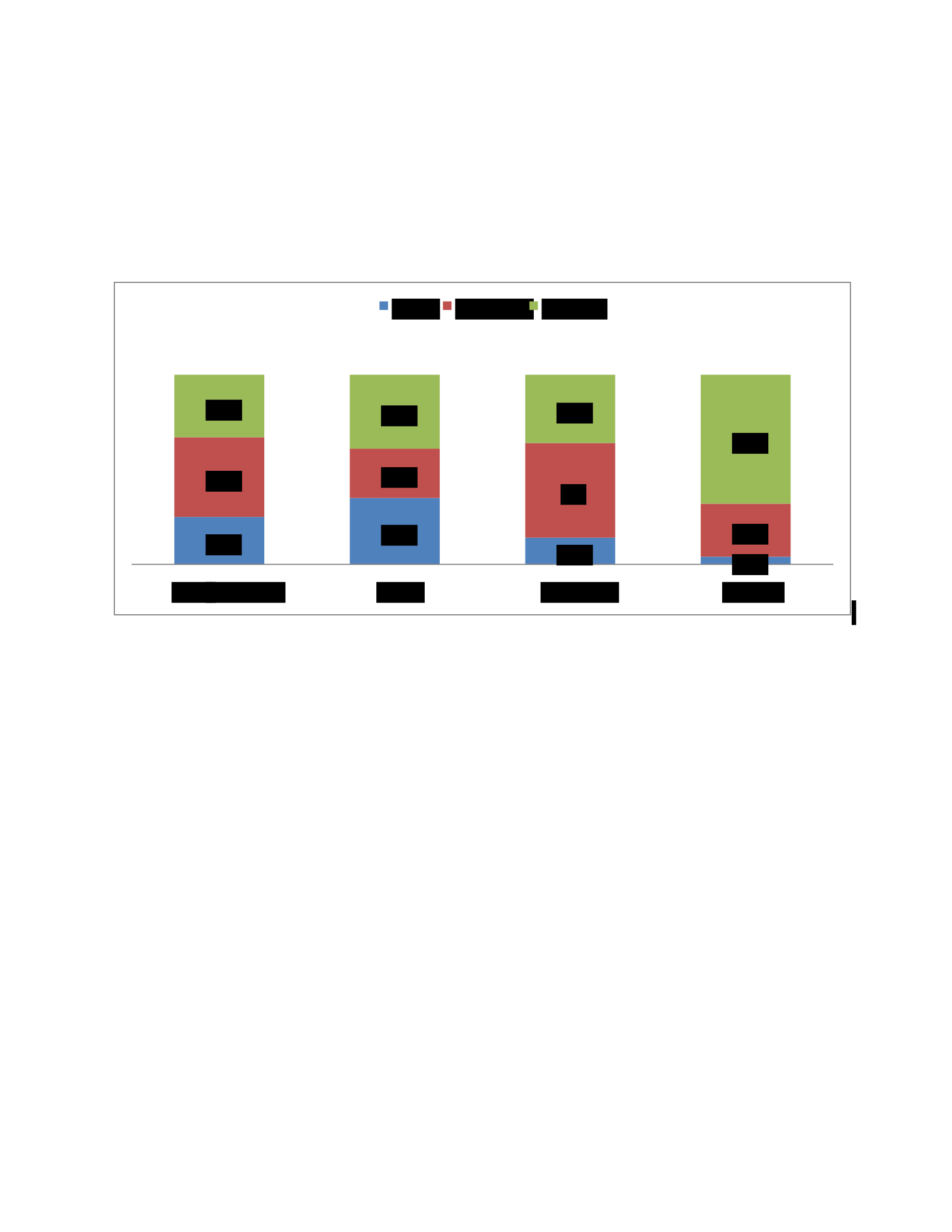
adding that percentage to their social objectives. The control group is the only group that
deteriorated by increasing the general objective percentage by 18% at the expense of lowering
technical and social objective percentages.
Figure 5.1: Group Percentages
As was discussed in chapter four, the percentages of social, technical, and general objectives are
not as important as the quality of the chosen objectives. The socio-technical group started with the
most robust list of 72 objectives and narrowed it down to 12, by far the shortest ranked list of all
the groups. In doing so, the group failed to include many important objectives they had in the
initial list. Significant objectives they included relating to RITE are “ensure clearly defined roles
and responsibilities,” and “ensure potential employees are screened before being hired,” which can
relate to the integrity of the employee. However, the group eliminated the two other important
RITE objectives relating to trust and ethics. Other social objectives dropped by this group include
the creation of a mix of formal, informal, and technical control systems, creating reward systems,
acknowledging employee commitment and employee motivation.
0.25
0.35
0.14
0.04
0.42
0.26
0.5
0.28
0.33
0.39
0.36
0.68
Socio
-
technical
Social
Technical
Control
Social
Technical
General

From CIA, the group included “ensure data confidentiality policies are in place,” which of course
relates to the confidentiality of data. They also included “ensure computers are updated regularly,”
which can relate to availability of data. Maintaining computers and networks is essential for
ensuring data is accessible by those that need it when they need it. However, the group eliminated
their objectives relating to the integrity of data, which leaves some security holes related to CIA.
The group also eliminated the technical objectives for implementing firewalls, protection from
portable devices, physical access to systems and securing Web servers.
The socio-technical group eliminated many important objectives when they narrowed their 72
objectives to 12. For instance, ethics training did not make the final list because it was only chosen
by 30% of the respondents for inclusion in the final list. Others that did not make the final list
include employee integrity (20%), protecting databases from intrusion (30%), and building a trust
relationship between employee and employer (50%). It was a surprise that ethics, employee
integrity, and building trust relationships scored so low and the first two were not even close to
making the final list. Those topics were stressed as very important in the video training the group
received. Overall, the socio-technical group left some holes in security by eliminating important
objectives. They also included too many general objectives, though the percentage decreased when
compared to the larger list. Overall, the socio-technical group ended with an incomplete list of
social and technical security objectives, which is definitely a setback from the excellent socio-
technical objectives they did have. These socio-technical security objectives implemented as the
organization’s information security policies and distributed through the information security
training program would not maximize overall information security and would leave some security
holes in both the social and technical areas.

The social group was able to keep most of the important objectives that they had originally listed.
Though this group did not fully represent RITE and CIA to begin with, they did keep what
objectives they did have relating to those concepts. They ranked employee ethics and employee
integrity both in the top ten, which is great for social aspects that often get ignored. Other important
social objectives that made the list relate to employees, such as understanding social interactions
between individuals (employees) and their employers, factors affecting employee decision making
and employee cultural differences. Social objectives that were dropped from the ranked list include
employee morale, which only 30% of the participants thought was important, and employee gender
(10%).
The technical objectives listed by the social group were sparse to begin with. Beyond
confidentiality and data protection, their ranked list included the use of strong passwords and
personal data protection. Technical objectives dropped from the longer list related to physical
security and identity theft. Also making the final list was an overabundance of general objectives.
Overall, the social group kept most of the important socio-technical objectives they originally had,
but they started with an incomplete list of social and technical objectives. These socio-technical
security objectives when implemented as the organization’s information security policies and
distributed through the information security training program would not maximize overall
information security and would leave some security holes in both the social and technical areas.
The technical group started with a list strong in technical objectives and weak in social objectives,
but they had listed a few surprise social objectives. The good news is that almost every social
objective originally listed was included on the final ranked list of objectives. They maintained
their surprise social objectives relating to roles and responsibilities and developing a security
culture. The only important social objective that was eliminated related to employee cultural

differences. This group also did well maintaining their technical objectives in the final list. All
objectives relating to CIA were maintained and the only important objective eliminated related to
physical security, which only 20% of the participants thought was important. Overall, the technical
group maintained the important socio-technical objectives and maintained their weak showing for
social objectives and excellent showing of technical objectives. These sociotechnical security
objectives when implemented as the organization’s information security policies and distributed
through the information security training program would not maximize overall information
security and would leave some security holes in the social side of information security.
The control group started with a strong technical list of objectives and a very weak social list of
objectives. They only had three social objectives out of forty-nine to start. Unfortunately, only
one of those was included in the final list, which was the need for ethics training. Only 20% of the
group believed employee trust was important and 10% thought social engineering was important.
The group maintained many of the original technical objectives, but eliminated some important
ones, including some related to CIA. The most notable technical objectives eliminated were
encryption, which only 20% of the participants found important, firewalls (50%), SPAM (40%),
virus scanning (30%), and intrusion detection (20%). While the group started with an adequate
list of technical objectives, they finished with an incomplete list by eliminating too many important
objectives. These socio-technical security objectives when implemented as the organization’s
information security policies and distributed through the information security training program
would not maximize overall information security and would leave some security holes in both the
social and technical areas.
Analyzing the top 10 objectives from each of the groups is a little more revealing as to what the
groups believed were important objectives. In times of budget constraints, the top 10 have the best

chance of getting implemented. As in the original list of objectives, the socio-technical group
outperformed the others. This group had the least number of general objectives in the top ten, with
30%, and only one general objective in the top five. They had 40% technical objectives, which
was better than all the other groups, and 30% social objectives, which was equal to the best from
the other groups. The top three objectives were social objectives and included two from RITE,
relating to responsibilities and integrity. Several of the technical objectives related to
confidentiality and availability of information from CIA. This is the best top 10 of all the groups,
but still leaves many security holes.
The social group had the second best outcome, but overall was not very good. The group had a lot
of general objectives in the top ten, at 60%, including the top two ranked objectives. The other
four included two social and two technical objectives. The two social objectives included two
pieces from RITE, ethics and employee integrity. One of the technical objectives related to the
integrity of information from CIA.
The technical group had poor socio-technical representation from the top 10 objectives, with 60%
general objectives, 10% technical, and 30% social. The top four objectives were general
objectives. It is surprising that the group that received technical training would only have one
technical objective in the top ten, which was ranked number ten, and three times as many social
objectives. That one technical objective related to the confidentiality of information from CIA.
Building a security culture was ranked number seven.
The control group was by far the worst performer with the top ten objectives. Ninety percent of
the top ten were general objectives. There were no social objectives and one technical objective,

which related to data confidentiality of information from CIA. Overall, the top 10 security
objectives for the control group would provide little or no security.
5.5 Conclusion:
This chapter asked the groups to narrow down their long lists of security objectives by keeping the
objectives the group believed were most important. They were then asked to rank the objectives
from most important to least important. Overall, the socio-technical group dropped some
important socio-technical objectives, such as objectives relating to employee ethics and employee
integrity. While they started off well with a robust list, they narrowed it too much, leaving out
important objectives and compromising security. The social group started with a moderate list of
socio-technical objectives and maintained most of them in the final ranked list. The technical
group started with strong technical objectives and weak social objectives and decided to keep many
of those for the final ranked list. On the other hand, the control group also started with a strong
list of technical objectives and a weak list of social objectives, but made it weaker by eliminating
all but one social objective from the final ranked list. On the technical side, the control group
eliminated several important objectives, such as encryption, which is important for ensuring the
integrity of data in CIA.
Analyzing the final ranked list of objectives and the top ten objectives from each group makes it
clear that the socio-technical group produced the best list of objectives, even though they narrowed
their list too much and eliminated some important objectives. The socio-technical group still had
the strongest showing, especially if we only analyze the top ten objectives. The social group had
the second best performance, ranking ethics and integrity in the top ten. Analysis also makes it
clear that the technical and control groups had the worst lists of objectives. The technical group

did a good job of keeping important objectives in the final ranked list, but failed to include them
in the top ten. The control group performed poorly from the beginning and got worse as they
eliminated important objectives from the final ranking and filled 90% of the top ten with general
objectives.
5. Discussion
6.1 General Discussion:
The purpose of this research was to investigate how different kinds of information security training
affect the nature and scope of information security policies within a firm. Previous research had
not investigated this connection and it was not known if such a relationship existed. Four groups
of current or potential managers were shown different types of information security training; (1)
socio-technical training, (2) social training, (3) technical training, and (4) control group training.
Each group then listed their values toward information security and those values were clustered
and converted into security objectives using Keeney’s (1992) value-focused thinking methodology.
A manager’s value-based security objectives are what managers use to make security decisions.
Their value-based security objectives toward maximizing information security indicate the nature
and scope of the information security policies they will create. This research found that the nature

and scope of information security training given to managers does influence the nature and scope
of information security policies. Making this connection changes our understanding of the
relationship between managers, information security policy and information security training.
Prior to this research, the connection between these constructs was fuzzy at best. According to
information systems security research, managers create the information security policies and
information security training is based on those policies (Hone & Eloff, 2002; Rotvold, 2007;
M 's I I
I S S
O P T
Figure 6.1: Prior Policy to Training Relationship Understanding
CSI, 2006, 2007; Straub & Welke, 1998). The training teaches employees about the policies with
the intent of them using and following what they learned to better protect information systems.
The connection between managers, policies, and training is the extent to which information
systems security literature previously understood the relationship (figure 6.1).
What this dissertation’s findings suggest is that the relationship is not flat and does not flow in one
direction from the manager to the training, but in fact comes full circle back to the manager.
Security awareness training is intended for all employees, including management. This means that
the managers that create information security policy influence the nature and scope of information
security training that they themselves will get as part of their regular security training. A significant
finding of this research is that training affects policy, which creates the loopback seen in figure 6.2.

Managers are affected by the nature and scope of the information security training they receive.
The training influences or reinforces their way of thinking about security and thus the information
security policy they create or modify, which leads to the creation or modification of future
information security training.
Figure 6.2: Policy to Training Relationship
A more detailed understanding of this relationship suggests that the nature and scope of information
security training that a manager receives shapes the manager’s values toward information security
(figure 6.3). A manager’s values impact the manager’s objectives toward information security,
which influences the nature and scope of corporate security policies they create. The corporate
security policies are high level security policies that are the basis for lower level procedural
security policies, which in turn is the basis for information security training. The loop back to the
managers is through the training. The information security training is intended for all employees,
including the managers that created the security policy in the first place. More importantly, middle
managers that will someday create corporate information security policy are also influenced by the
training, thus helping to maintain the cyclic nature and scope of security policy and training.
I
S Policy
I
S
T
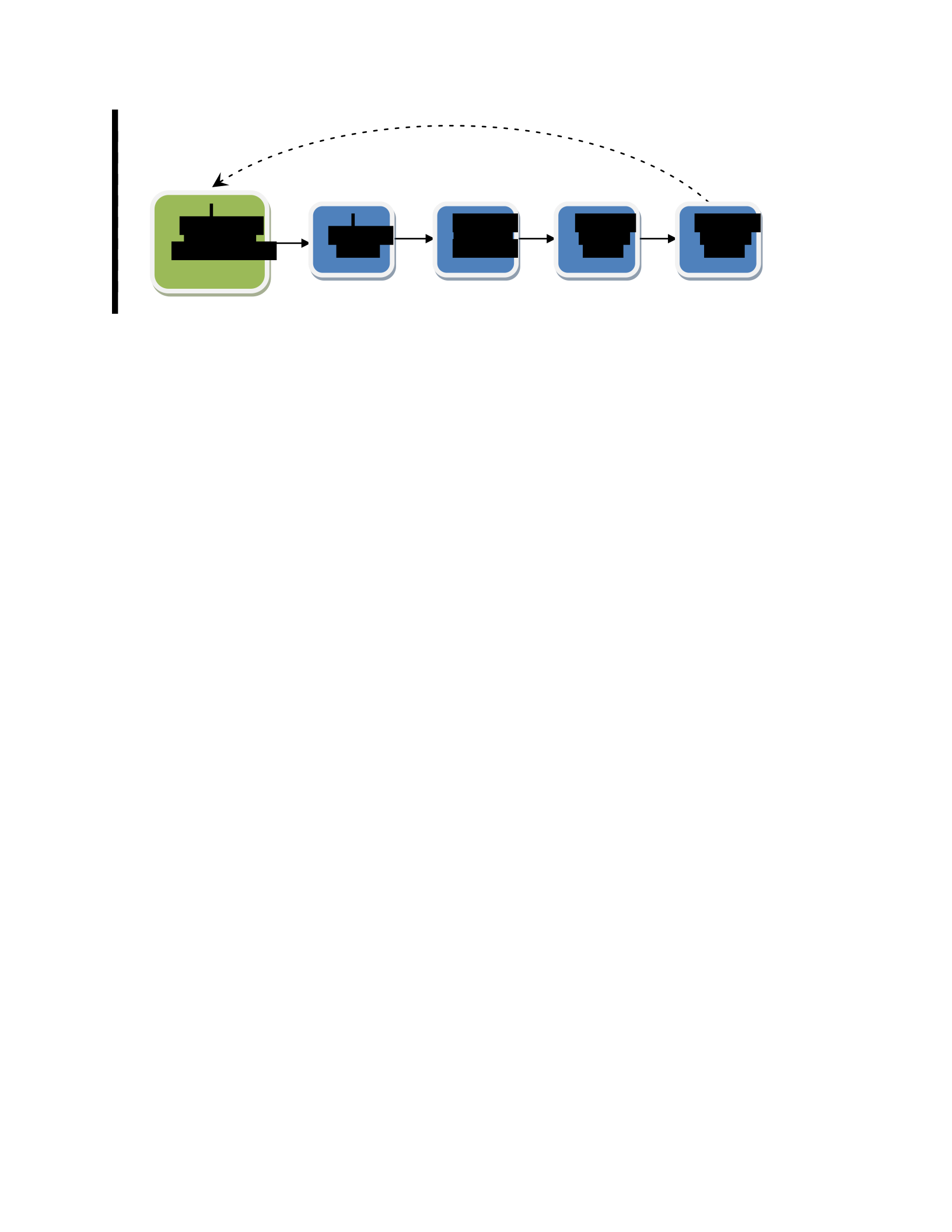
Figure 6.3: Low Level Policy\Training Relationship
The problem with this cycle is that current information security policy and information security
training is technical in nature (Rotvold, 2008; CWS, 2010; Fulford & Doherty, 2003). Therefore,
manager’s values and objectives toward information security must be technically oriented, so
security policy and training become technically oriented. This technically oriented information
security training then reinforces current manager’s technical thinking and influences new
manager’s values and objectives into technical thinking. This represents the state of information
security policy and information security training in organizations today, which is a major problem.
There has to be a break in the cycle to introduce socio-technical aspects of security. The literature
review strongly indicates that socio-technical aspects of security are necessary for maximizing
information security (Dhillon and Backhouse, 2000, 2001; Trompeter & Eloff, 2001; Dhillon &
Torkzadeh, 2006; Dhillon, 2007; Siponen, 2001). This dissertation suggests that giving managers’
socio-technical information security training will impact their values and objectives toward
information security, thus impacting the information security policy they create. The security
policy then created will be influenced by the manager’s value-based objectives for securing
information systems. According to the cycle, creating socio-technical security policy will lead to
socio-technical information security training, which in turn will start a new cycle of socio-technical
security policy and training, thus maximizing information security. This process is defined in more
detail later in this chapter under the emergent issues section 6.3.1.
C
S
P
M ’
I
O
M ’
V
All Employee
Information
Security Training
P
S
P

Another reason there needs to be a break in the cycle is because of the heavy dependence on
checklists. We know that 70% of companies use checklists, which are technically oriented (GISS,
2008; Baskerville & Siponen, 2002; Dhillon & Backhouse, 2001). Checklists seem like a great
idea for managers that are unaware of what should be included in security policies and have only
been exposed to technically oriented training. Both their basis for security thinking and their value-
based objectives for securing information systems are technically oriented. Since industry standard
security guidelines are technically oriented, using them as the basis for security policies seems like
the proper course of action. However, doing so leads to technically oriented corporate and
procedural security polices, which leads to technically oriented information security training. The
result is less than optimal information security. Also, the technically oriented information security
training leads to the next generation of managers that have technically oriented value-based
security objectives.
To demonstrate the relationship between information security training and information security
policy created by managers, four groups of current or potential managers were given various kinds
of training. The control and technical groups will be discussed first. The control group received
no relevant training and was used to compare the other three groups. This means that participants
were asked to list their objectives for securing information systems based on their current values
without any influence from the training video. They had to rely on their own feelings, experiences,
and education about how they wished to maximize information security. The technical group
received relevant technical training and represents companies that offer technically oriented
information security training currently. Neither group received training on the social aspects of
security.

Results indicate that both groups did an excellent job representing technical objectives and both
represented social objectives poorly. The technical group did slightly better in both areas, but not
significantly. The control group’s results indicate that no training at all satisfies a great deal of the
technical aspects of security, as they fared very well with listing technical objectives. The control
group did satisfy all aspects of CIA and included several other important objectives. CIA strands
for the confidentiality, integrity and availability of information.
The major problem with both of these groups is the lack of social aspects of security, which
research has stated as important for maximizing information security (Dhillon and Backhouse,
2000, 2001; Trompeter & Eloff, 2001; Dhillon & Torkzadeh, 2006; Dhillon, 2007; Siponen, 2001).
Both groups had major deficiencies and did not come close to satisfying the requirements of RITE
and were missing many other important social objectives. RITE stands for the responsibility,
integrity, trust and ethicality of individuals. However, the technical group did list a couple of
important social objectives, including the creation of a security culture. They were the only group
of the four to list this objective, which is very important for information security.
The significant difference between the control group and the technical group was the ranking of
the security objectives. This tells us what objectives each group feels are the most important. The
original list of objectives was reduced in size by keeping the objectives that the majority of the
group believed were more important and the rest were eliminated. The shortened list was then
ranked. The technical group’s final list of objectives kept many of the important technical
objectives and the most important social objectives. Creating a security culture was introduced by
only one of the ten participants, yet 90% of the group agreed creating a security culture was
important enough to keep in the final list and the objective finished ranked 7th out of all objectives.

In contrast to the technical group that maintained most of the best objectives in their final ranking,
the control group eliminated many of their important objectives, including many that related to
CIA. The control group only had 3 social objects out of 49 total objectives to begin with and then
eliminated two of them from the final rankings. The only positive point is that the one they kept
was creating an ethics program, but the objective barely made the list. Two participants suggested
ethics in the initial list and 55% of the group agreed to keep it on the final list and it finished outside
the top 10 in the final ranking. It is clear from the results of the technical and control groups that
companies with technically oriented training and companies with no training leave large gaps in
information security. Both groups supported technical aspects of security but mostly ignored the
social aspects.
The socio-technical and the social groups had different outcomes than did the technical and control
groups. The social group did not have as strong a result for social objectives as was anticipated,
though the result was better than the technical and control groups. Overall, the social group had
an inadequate list of social objectives. They failed to fully represent RITE, but did include several
other important social objectives. On the technical side, the social group’s final list of objectives
was not as robust as the technical and control groups. But the group did produce a moderate list of
technical objectives. A positive point for the social group is their realization of the important social
and technical objectives. In their shortened list of ranked objectives, they kept most of their
important social and technical objectives and kept all of their objectives relating to CIA and RITE.
Employee ethics and employee integrity were both ranked in the top ten objectives.
The socio-technical group received social and technical information security training and produced
the best mix of socio-technical objectives out of all the groups. The socio-technical group
produced a robust list of social objectives and was the only group to include all of the objectives

relating to RITE. The major social aspect omission from the socio-technical group, and the social
group, was the creation of a security culture. Only the technical group included that objective.
The surprise is not so much that the technical group listed it when they did not receive training
about security culture, but that the social and socio-technical groups did receive security culture
training and failed to include it in their objective lists. The socio-technical group also produced a
robust list of technical objectives, representing all aspects of CIA and beyond.
While the socio-technical group started with an excellent list of social and technical objectives, the
ranking Delphi study indicates they did not realize the importance of some of those objectives.
The complete representation of RITE was stripped down in the final ranking to only two of those
constructs. They also dropped some important technical objectives, including the integrity of data
component of CIA. Examples of important objectives dropped by the sociotechnical group include
employee ethics and integrity, motivation, commitment, and intrusion detection.
Overall, the socio-technical group produced the best list of security objectives and was the only
group to fully represent RITE and CIA and include many other important security objectives. This
demonstrates that training did affect their values toward securing information systems. The
disappointing result from this group is that they eliminated many of those important security
objectives in their ranked list. The social group’s results were also a little disappointing because
they failed to fully represent RITE. However, they did include several other important social
security objectives. The technical and control groups did not have many surprises. Both created
a robust list of technical objectives and a poor list of social objectives, but the technical group was
a little better in both areas.
6.2 Research Questions:

This research had two primary research questions related to the effect of training given to managers
on their values toward security of information systems and the security policy they create. Value-
focused thinking research was used to ascertain individual values toward securing information
systems from four groups of managers that completed four different training programs. The
security values of each group were converted into security objectives and clustered into similar
objectives. Each group’s list of security objectives were then reduced and ranked according to
importance. The first research question discusses the group’s values toward securing information
systems in relation to the nature and scope of the training they received. Did the training affect the
way managers think and feel about securing information systems? The second research question
discusses the security policy implications in relation to each group’s value-based objectives.
Managers will create security policy based on their value-based objectives, so will that security
policy maximize information security?
6.2.1 Influence of Training on Values:
The first research question asked to what extent manager’s values toward securing information
systems are influenced by the nature and scope of information security training they receive. Each
group listed their values toward securing information systems after watching one of four different
training videos. One’s values define all a decision maker cares about in a given decision situation
(Keeney, 1994). The values listed by the participants from each group describe how they feel and
care about securing information systems at a personal level. Based on the responses of the
technical, social, and socio-technical groups compared to the responses of the control group, one
can see that the nature and scope of information security training has influence on manager’s values
toward securing information systems, though the results are mixed.

The control group represents a company that does not train managers on the importance of
sociotechnical security. Their values would be molded by their education, personal experiences,
and beliefs. The resultant values of the control group were technically dominant and very weak
socially. This means that with no training, manager’s basic beliefs toward securing information
systems would be to primarily use technical solutions and little or no social solutions. In the control
group’s original list of security objectives, only 3 socially oriented value-based security objectives
were represented. However, the group listed 22 technically oriented value-based security
objectives, such as data confidentiality, data backup, and passwords. The complete list of
technically oriented value-based security objectives was very good for securing information
systems and represented all components of CIA. Overall, the control group, with no training, had
an adequate representation of technically oriented value-based security objectives and a poor
representation of socially oriented value-based security objectives. The difference between the
results from the control group and the results of the other three groups is attributed to the training
those other groups received.
The technical group’s training represents training that occurs in most companies today. It is
technical in nature and does not include social aspects of security. The values of the group’s
participants following the training were also technical in nature and were weak in representing the
social aspects of security. However the technical group’s value-base objectives were a little more
robust than were the control group’s technically oriented value-based security objectives. Among
the technical group’s 25 technical values were additional concepts, like encryption, malware, and
phishing. The technical group’s superior technical values are attributed to the technical training
they received. As with the control group, the poor social representation is attributed to the lack of
social training imparted in both groups.

The social group received only social training and no technical training. Therefore, if their values
were affected by the training, then it would be expected that their technically oriented value-based
security objectives would be similar to the control group’s values. However, the results indicate
that the social group’s value-based objectives toward technical solutions for information security
would provide only moderate information security, which is not as strong as the control group’s
technical objectives. The social group produced only 9 technically oriented security objectives,
compared to 22 for the control group. It appears that social-only training affected the manager’s
values in a negative way, leading them to produce far few technical objectives than the control
group.
The social group’s socially oriented value-based objectives were expected to be better than the
control group and the technical group’s objectives. The control group and the technical group did
not receive social training, so the social group’s socially oriented value-based objectives can be
compared to both. The social group’s socially oriented value-based objectives were better than the
control group and the technical group. The social group had 10 total socially oriented value-based
objectives, compared to 3 from the control group and 5 for the technical group. The social group
also listed many socially oriented value-based objectives that the control and technical groups did
not, like, employee integrity, employee dissatisfaction, emotional intelligence, social interactions
between companies and employees, and cultural differences. These additional values were topics
discussed in their training video and the inclusion of these topics in the group’s value-based
security objectives is attributed to the training.
The socio-technical group is the only group that received both social and technical training, so the
expectation would be that this group’s values toward social and technical aspects of security would
be stronger than the control group. Since the control group and the social group did not receive

technical training, the technical values of the socio-technical group can be compared to both. The
results show that the socio-technical group created 25 technically oriented value-based security
objectives, compared to 22 for the control group and 9 for the social group. This is comparable to
the control group and far better than the social group. The social values of the socio-technical
group were also well represented, with 20 in all, and better than the other groups, even the social
group that also received social training.
Overall, the nature and scope of information security training does affect the manager’s values
toward securing information systems, but more so for social values than technical values. Groups
that received technical training had similar representation of technical values than did groups that
did not receive technical training. This is attributed to people already having technically oriented
values going in. Groups that received social training had a much better social value representation
than did groups that did not receive social training. An unexpected result is the negative impact
on technical values from receiving only social training and no technical training, where the social
group’s technically oriented value-based objectives were far less than the other groups. These
results indicate that training has an effect on values.
6.2.2 Implications for Information Security Policy:
The second research question asked to what extent value-based objectives influence the nature and
scope of information security policy. To answer this question, categories were created to represent
the quality of the information security policy that would be created from the manager’s value-
based objectives. For the social aspects of information security, five components were identified
from the literature review as most important. Those are the responsibility, integrity, trust, and
ethicality (RITE) of individuals and the creation of a security culture. Five categories used to rate

the inclusion of the five social components are very good, good, moderate, poor, and very poor
(see table 6.1). All five of these components must be represented in the information security policy
in order to maximize information security and receive a very good rating. For the technical
components, the three components found to be most important from the literature review were
confidentiality, integrity and availability (CIA) of information. The three categories used to rate
the inclusion of these components were very good, moderate and very poor (see table 6.1).
Table 6.1: Security Policy Categorization Criteria
Categories
Social
Technical
Very Good
Full support of RITE and a security culture
(5 components)
Full support of CIA (3
components)
Good
4 of 5 components
Moderate
3 of 5 components
2 of 3 components
Poor
2 of 5 components
Very Poor
1 or less component
1 or less component
This dissertation used the value-focused thinking methodology to produce a list of value-based
security objectives for each of the four groups. That list was then reduced and ranked using a
ranking Delphi methodology, producing a shorter list of security objectives. Both lists are analyzed
in this section in regard to the information security policy they would inform. The quality of that
policy is based on the categories described in table 6.1. The security policy based on the longer
unranked lists of security objectives will be discussed first, followed by a discussion of the shorter,
ranked lists (see table 6.2).
Information security policy informed by the value-based security objectives created by the
sociotechnical group came the closest to maximizing information security. The social policy was
categorized as good and not very good only because the group failed to include the creation of a
security culture. Information security policy that does not provide for the creation of a strong
security culture is not maximizing information security. On the technical side, the information

security policy was very good and supports all aspects of CIA. By far, the socio-technical group’s
information security policy produced the strongest overall information security of all the groups.
The social group’s information security policy informed by their value-based security objectives
was a disappointment. It was anticipated that their social security policy would be good or very
good, but instead it was poor. They failed to create policy for instituting a security culture as well
as two of the four components of RITE. On the technical side, security policy from the social
group was also less than adequate. They were the only group to have moderate technical security
policy and not fully represent CIA, while all the other groups produced very good technical policy.
The technical group and the control group both produced poor social security policy. This fit into
expectations because both groups did not receive training on the social aspects of security and they
both produced a poor list of socially oriented value-based objectives, thus leading to poor social
security policy. On the technical side, both the technical group and the control group produced
very good technical security policy. Of course this is no surprise for the technical group since they
received technical training and produced an excellent list of technically oriented value-based
objectives. The control group also produced an excellent list of technically oriented value-based
objectives and their very good technical security policy was a minor surprise. Employees are
predominately exposed to technically oriented policies and these get reinforced through technically
oriented information security training. It was therefore expected that all participants from all
groups would have a technically oriented view for protecting information systems, not from the
training given in this dissertation, but from their own education and personal experiences. The
training in this dissertation would only enhance that technical view if they received technical
training. It was expected that the control group would have moderate technical information
security policy, but not very good policy. Very good technical security policy required the

representation of all aspects of the confidentiality, integrity, and availability (CIA) of information.
The expectation was that the control group would represent most, but not all aspects of CIA.
Table 6.2: Socio-technical Security Policy (all objectives)
Group
Social Policy
Technical Policy
Socio-Technical
Good
Very Good
Social
Poor
Moderate
Technical
Poor
Very Good
Control
Poor
Very Good
Table 6.3 represents the information security policy created with the value-based security
objectives from the shortened and ranked list of security objectives from chapter five. The ranking
Delphi method called for the original list to be shortened before it was ranked. Doing so eliminated
many objectives from each group’s list, some of which were important for maximizing information
security. If constraints, such as budgets, meant that managers could not implement all value-based
security objectives in security policy- which would they choose to implement and which would
they chose to eliminate. The ranking Delphi method gave us this answer by keeping only what the
managers considered the most important value-based security objectives and discarding the rest.
The security policy implemented based on these value-based security objectives is the biggest
surprise of this dissertation.
The socio-technical, social, and technical groups all produced poor social security policy and the
control group produced very poor social security policy. The surprise here is that the sociotechnical
group did not consider the trust and ethicality pieces of RITE important enough to keep in their
final list of ranked objectives. This prevented the group from producing good social security
policy and made them present poor social security policy. In a time of budget constraints the socio-
technical group would consider eliminating ethics training as a means of security. The social,
technical, and control groups all had poor social policy in the original list, so it was no surprise

that the social and technical groups remained poor and the control group sank a little lower to very
poor.
The technical aspects of information security policy also produced some unexpected results with
the socio-technical group. The group eliminated value based security objectives relating to the
integrity of data, so the quality of their technical security policy decreased from very good in the
initial list to moderate in the ranked list. The social group started with moderate technical security
policy and continued with moderate technical security policy in the ranked list. The technical
group started with very good technical security policy and continued with very good technical
security policy in the ranked list. The control group decreased from very good technical security
policy to moderate technical security policy in the ranked list because they eliminated one of their
important CIA objectives.
Table 6.3: Socio-technical Security Policy (ranked objectives)
Group
Social Policy
Technical Policy
Socio-Technical
Poor
Moderate
Social
Poor
Moderate
Technical
Poor
Very Good
Control
Very Poor
Moderate
Overall, the social and technical groups maintained their important value-based security objectives
from the original list to the ranked list, so the quality of their information security policy remained
the same. The socio-technical and control groups both eliminated important value-based security
objectives relating to RITE and CIA, so the quality of their information security policy diminished.
If constraints did not exist and the organization could create security policy based on the original
list of value-based security objectives, the socio-technical group by far would produce the highest

quality information security policy. The social group would produce the worst. Both the technical
and control groups would produce poor social policy and very good technical policy. The technical
group represents how organizations are handling things today. The literature review showed that
organizations predominately had technically oriented security policy.
If constraints are a problem, such as budget cuts, the information security policy produced from
the ranked list of value-based security objectives leaves a lot of security holes. The technical group
produced the highest quality information security policy, which comprised poor social policy and
very good technical policy. The socio-technical and social groups tied for second with poor social
policy and moderate technical policy. The control group came in last with very poor social policy
and moderate technical policy.
6.3 Emergent Issues:
This dissertation has shown that specialized information security training given to managers can
influence their values for protecting information systems and the information security policy they
create. The emerging issues stemming from such findings are in the area of information security
training, policy planning and policy creation. The next section discusses the information security
training giving to all employees and the specialized information security training that should be
given to management. The following section discusses the implications of such training on policy
planning and creation.
6.3.1 Information Security Training:
Information security training is a method of educating all employees on how best to protect an
organization’s information systems. Rotvold (2008) reported that it is imparted to employees most

often once a year by IT staff. The literature review also told us that the nature and scope of
information security training is based on information security policies and that both were
technically oriented in today’s organizations (Rotvold, 2008; CWS, 2010; Fulford & Doherty,
2003; Straub & Welke, 1998). In order to change the nature and scope of information security
training to socio-technical, information security policy must change its nature and scope to
sociotechnical. This can be accomplished by creating another type of information security training
that is to be given to managers, and not just the managers that create and modify information
security policies, but to all managers. This training needs to be in addition to the training given to
all employees and specifically given to management (figure 6.4). Like the training given to the
socio-technical group in this dissertation, the training needs to teach both social and technical
aspects of information security. There are several reasons it should be given to all managers and
not just those that create or modify information security policy. One is that some of those middle
managers will eventually work their way up to be the ones creating and modifying policy and the
earlier they understand the socio-technical perspective, the better. Another reason to include all
managers is because all managers will need to be involved to implement some socio-technical
aspects of security, such as creating a strong security culture.
Figure 6.4 represents managers receiving two types of training, one being the regular training
giving to all employees that is based on the procedural security policy. The second training is a
socio-technical training that teaches managers about the importance of socio-technical security and
how to create and modify information security policy. Like the socio-technical group in this
dissertation, the goal of this training is to produce socio-technical security policy by influencing
manager’s values and individual objectives toward securing information systems. Once the
managers implement socio-technical security policy, the regular information security training
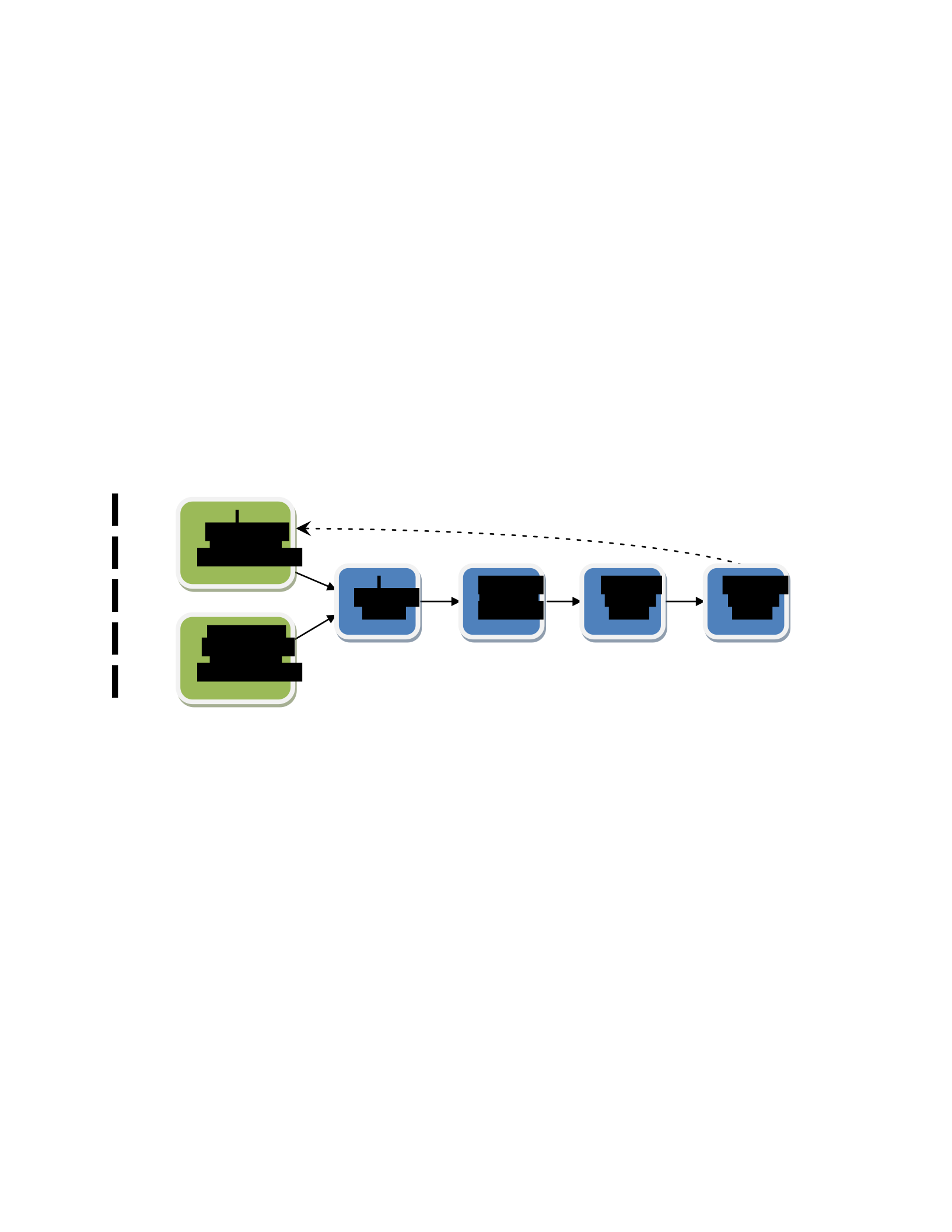
given to all employees will then become socio-technical. This will not happen overnight, but
instead will take some time for the new socio-technical security policies to be implemented and
for the previously technically oriented information security training to be modified to become
socio-technical to reflect the new policies. The loopback depicted in the diagram reflects the new
socio-technical procedural security policy’s influence on information security training given to all
employees. Once the cycle is complete and policies and training become socio-technical,
managers will then receive socio-technical security training as a part of the regular training
program that all employees receive as well as socio-technical training on how to create and modify
socio-technical information security policies.
Figure 6.4: New Policy to Training Relationship
At the least, the special training given to managers should cover the concepts of RITE, CIA, and
the creation of a security culture (Dhillon & Backhouse, 2000; Dhillon, 2007). The concepts of
RITE are the responsibility, integrity, trust, and ethicality of individuals. Examples include
creating proper responsibility and authority structures, background checks, building a trusting
culture and ensuring good ethical principles. The concepts of CIA are the confidentiality, integrity
and availability of information. Examples include ensuring appropriate access to data, backing up
data, encrypting data, data integrity checks, and maintaining a functioning network and equipment.
C
S
P
M ’
I
O
M ’
V
All Employee
Information
Security Training
Management
Socio-technical
Information
Security Training
P
S
P

The creation of a security culture is also very important for maximizing information security
(Ruighaver et al., 2007; Dhillon, 2007; Karyda, et al., 2005; von Solms & von Solms, 2004; Leech,
2003; Vroom and von Solms, 2004). A strong security culture has been linked to such things as
compliant user behavior and employees engaging in security practices beyond their mandatory job
descriptions (D’Arcy & Greene, 2009). Beyond those already mentioned, other socio-technical
aspects of security that should be discussed include describing the formal, informal and technical
systems (Dhillon, 2007), leadership styles, management commitment, user involvement, reward
systems, motivation, group association and interpreting and dealing with negative silent messages.
The goal of this training is to influence the values of the managers that receive it in regard to what
they believe are the best ways of maximizing information security. If the nature and scope of their
values are influenced to be socio-technical, then their value-based security objectives for protecting
information systems will also be socio-technical. Like this dissertation’s sociotechnical group’s
original list of security objectives, the managers receiving this training will also have strong value-
based security objectives. Those value-based objectives will in turn inform the information
security policy they create or modify and that information security policy will then become socio-
technical. This would mean security policies would support the creation of a security culture and
would include policies supporting RITE and CIA. As these policies trickle down and inform the
creation of new information security training, employees will start learning about their roles and
responsibilities, accountability and about good ethical principles. Reward systems will be created,
users will be more involved, management will be more committed, and trusting relationships
between employees and the employer will be established. These among others mentioned earlier
will strengthen the organization’s security culture, all of which leads to maximized information
security.

6.3.2 Policy Planning and Creation:
The development of information security policies does not just start with a to-do list that can be
checked off as completed. Managers have to know what assets need to be protected and determine
what policies are best for protecting those assets. This usually involves some form of risk analysis
and SWOT (strengths, weaknesses, opportunities, and threats) analysis. Before creating policies,
it just makes sense to understand what it is you have that needs protection, the level of importance
the assets have for the organization, what the cost would be if protection fails, what the threats to
the assets are, where the threats come from, what policies are currently in place to protect the
assets, and anything else that will help determine the best policies to create, modify or eliminate.
Baskerville and Siponen (2002) state that organizations should first have a meta-policy about how
to create, modify, and implement information security policy. A meta-policy is a policy about how
to handle the creation, modification, and elimination of security policies. Meta-policy details who
is responsible for making policies, when policy creation is to take place, how policies are made,
and how and when policies are reviewed, modified or eliminated. This dissertation research
believes that meta-policy should include training for all managers, and especially those involved
in policy creation and modification. Meta-policy dictates everything from who makes the policies
to how and when they are created, modified and eliminated. It should also include the training for
those involved in this process.
Once managers have received training, completed the analysis of the assets, and determined the
strengths and weaknesses of the current security policy, they are ready to create, modify, or

eliminate information security policies. We know from the literature review that checklists are
used by 70% of organizations (CWS, 2010). However, we also know that checklists are technical
by nature and lack flexibility to changing business environments (Baskerville & Siponen, 2002;
Dhillon & Backhouse, 2001). Managers should understand that they can use checklists, but only
as references for the technical aspects of security and only if they fit the organizations business
requirements and processes. The technical aspects of security have never been the problem; the
problem has been the lack of social aspects. In addition to the technical solutions to information
security as informed by checklists, managers must still ensure the creation of the social aspects of
security they learned about in their training.
One social aspect that should never be overlooked is the creation of a strong security culture. To
create a strong security culture, it needs to be tied to the information security policies. Managers
can dictate the behavior of employees by “expressing collective values, norms, and knowledge,
through defining specific policies” (Solms & von Solms, 2004, p. 277). In research from
Ruighaver et al. (2007), the authors highlight several factors of good security culture. One of them
is developing a degree of trust and accountability between employees and employers, which is a
part of Dhillon and Backhouse (2000)’s RITE and should be included in the security policies.
Another factor of good security culture identified by Ruighaver et al. (2007) was that employees
should be educated on their roles and responsibilities. This was another part of RITE and should
also be included in the information security policies. The two other parts of RITE that should also
be part of the information security policy and support the security culture are the integrity and
ethicality of individuals. Integrity can start with a background check. Ethicality can be positively
influenced through a formal ethics training program. Companies with ethics programs suffer less
economic crime (Trompeter & Eloff, 2001, ECS, 2007). Beyond creating policies that support a

strong security culture and represent the social aspects of RITE and the technical aspects of CIA,
policies should also incorporate some of the social concepts described in the training section, such
as involving users, creating reward systems and motivating employees.
6.4 Conclusion:
This chapter reported the findings of this research, answered the primary research questions and
discussed emergent issues. A significant finding of this research was that the nature and scope of
information security training giving to managers affects the nature and scope of their values.
Another significant finding was that the quality of information security policy was affected by
manager’s value-based security objectives. The group of managers receiving socio-technical
training would produce the highest quality information security policies based on their original list
of value-based security objectives. The group that received no training would produce the worst
information security policies. The implications of these findings lead us to believe that specialized
socio-technical training should be given to managers and that this training should be part of a meta-
policy within the organization. If managers were to receive socio-technical training, the security
policies they create or modify would be socio-technical. Socio-technical policies would lead to
socio-technical information security policy given to all employees, thus maximizing information
security.

6. Conclusion
7.1 Overview of the Research:
This dissertation argues that the nature and scope of information security training that managers’
receive impacts the nature and scope of the information security policies they create. It is argued
that the training affects manager’s values toward maximizing information security and that their
value-based objectives influence the nature and scope of the information security policy they
create. The motivation for this research stems from a recent trend in information systems security
research; that the best way to maximize information security is a socio-technical approach
(Backhouse & Dhillon, 1996; Dhillon and Backhouse, 2000, 2001; Trompeter & Eloff, 2001;
Siponen, 2001; Dhillon & Torkzadeh, 2006; Dhillon, 2007). While the research trend has come to
this conclusion, the means for achieving socio-technical security is mostly unanswered.
This research attempts to achieve socio-technical security through the heart of the information
security program, the information security policies and the information security training program.
Information security policies are the guiding principles for securing information systems and
information security training is the education given to employees to teach them how to best protect
information systems using the methods described in the policies. Information security training is
primarily based on the information security policies (Rotvold, 2007; CSI, 2006, 2007).
A major problem discussed in the literature review is that current information security policies and
information security training is predominately technical in nature, ignoring the social aspects of

security (Rotvold, 2008; CWS, 2010; Fulford & Doherty, 2003). This may be because 70% of
organizations use standardized guidelines (checklists) to create security policies and the reliance
on checklists is expected to rise (GISS, 2008). However, checklists have many shortcomings,
including the lack of flexibility to changing business environments and the lack of attention to
social aspects of security (Baskerville & Siponen, 2002; Dhillon & Backhouse, 2001).
Organizations that rely on checklists to create their security policies will no doubt have technically
oriented security policies and training. Another reason that policies and training may be technical
in nature and the use of checklists is high is that managers that create information security policies
lack the skills and knowledge to do so (Hone & Eloff, 2002). This lack of knowledge leads
managers to turn to other sources for help, such as standardized checklists (Hone & Eloff, 2002).
To potentially solve these problems, this dissertation created four types of information security
training and used four groups of managers to see if there was an effect on the information security
policy they would create. The four types of training were socio-technical training, social only
training, technical only training, and control group non-related training. The experimental design
called for the groups to watch their respective videos and then write down what topics they believed
were most important if they were a manager in charge of maximizing information security and the
effectiveness of the information security training program. This exercise is part of Keeney’s (1992)
value-focused thinking methodology where each group produces a list of values. The values
represent how managers truly feel about maximizing information security. Following the
methodology, the values were converted and clustered into lists of value-based security objectives
for each group. The value-based security objectives represent what the managers wish to strive
toward in order to maximize information security. When faced with the decisions involved with
creating the organizations information security policy that maximizes information security, the

managers will use their value-based security objectives. The lists of values and value-based
objectives created by each group were used to answer two research questions.
This dissertations first research question asked as to what extent manager’s values toward securing
information systems are influenced by the nature and scope of information security training they
receive. The findings indicate that values are affected by training, but the results are mixed. The
control group with no relevant training produced an excellent list of technical values and a poor
list of social values. The technical group that received only technical training also produced an
excellent list of technical values and a poor list of social values, which was expected. The socio-
technical group that received both technical and social training produced an excellent list of
technical values and an adequate list of social values. This confirmed that the social training
affected the values of the socio-technical group. The social group was the group that produced the
mixed results. They received only social training, yet produced a poor list of social values.
However, they did have many more social values than the control or technical groups. This
indicates that their values were affected by the training, but not as significantly as with the socio-
technical group. The social group’s technical values were also not as good as the other groups.
While the other three groups had excellent lists of technical values, the social group had a moderate
list. This indicates that social only training may have had a negative impact on producing technical
values.
This dissertations second research question asked to what extent value-based objectives influence
the nature and scope of information security policy. This question was answered in two parts. The
first part used the full lists of value-based security objectives to determine the quality of
information security policy they would inform. The second part answered the same question, but
with a shortened and ranked list of security objectives. The second list was produced using a

ranking Delphi methodology developed by Schmidt (1997). Following the ranking Delphi method,
the groups were asked to reduce their original lists of value-based objectives by keeping only those
objectives they believed were most important and discarding the rest. This process produced a
shortened list of security objectives that the groups then ranked from most important to least
important. The ranking process took several iterations.
Information security policy informed by the value-based objectives from the original lists
represented the highest quality for the socio-technical group. Their value-based security objectives
would have created good social policy and very good technical policy. They were the only group
that would have produced good social policy, as the other groups all would have created poor social
policy. For technical security policy, the technical and control group’s would have produced very
good policy and the social group would have produced moderate policy. The socio-technical group
would have produced the best overall security policy of the four groups.
The shortened lists that resulted from using the ranking Delphi methodology produced different
results. Because the original lists of security objectives were shortened, some groups eliminated
important security objectives. In particular, the socio-technical group eliminated many important
value-based security objectives and the effect on information security policy was dramatic.
Information security policy based on the shortened ranked list would have produced poor social
policy and moderate technical policy. This indicates that managers from this group did not believe
many of the important security objectives were actually important, so they were eliminated from
the list. If security policy were created based on the shortened list of objectives, overall security
would be dramatically weaker. The social and technical groups both maintained their quality of
information security policy with the shortened lists. However, the control group’s potential

security policy got weaker as they also discarded some important security objectives. Their
potential social security policy dropped from being poor to very poor and their potential technical
security policy dropped from being very good to moderate.
Overall results of this dissertation indicate that information security training given to managers
does affect their values toward securing information systems. The quality of information security
policy informed by the manager’s value based security objectives is also affected by training. In
order to maximize information security with socio-technical aspects of security, managers should
receive socio-technical information security training. The results indicate that managers receiving
socio-technical training would produce socio-technical security policies.
7.2 Contributions:
The most important part of a dissertation is the contribution the research makes to knowledge.
There are several contributions this research makes that cross the practical, methodological, and
theoretical realms. The first two subsections describe the practical and theoretical contributions
this research makes to information systems security. The last subsection describes the
methodological contribution that can be applied not only to the information systems discipline, but
beyond.
7.2.1 Practical:
The practical contribution this research makes explains how organizations should go about
creating, and modifying information security policies to maximize overall information security.
Done properly, organizations will no longer have such a strong dependence on security checklists
and will have socio-technical information security policies. To accomplish this, this dissertation

calls for all organizations to have a specialized information security training program for managers
that teaches them the importance of socio-technical security. The socio-technical training should
cover the important technical aspects of security as well as the important social aspects of security,
such as the concepts of RITE, CIA, and the creation of a security culture. If done properly,
manager’s values toward securing information systems will be affected by the training and result
in socio-technical security policies. The security policies will inform sociotechnical versions of
information security training that is given to all employees. The result is maximized information
security through socio-technical information security policies and a socio-technical information
security training program.
7.2.2 Theoretical:
The theoretical contribution of this dissertation is through a model that describes information
security policy and information security training as affecting one another (figure 7.1). The prior
understanding of this relationship was that it was a one way relationship where information security
policy affected information security training, where the training is based on the policies.
Figure 7.1: Policy to Training Relationship
However, this model suggests that the makeup of information security training also affects
information security policies. The primary reason managers create technically oriented
I
S
T
I
S Policy

information security policies is that they do not know any better. This could be because the only
training they have seen is the information security training given to them each year. The control
group in this dissertation demonstrates what the literature review told us in that organizations
currently have technically oriented information security policies and training. Managers receiving
technically oriented training over the years become technically oriented toward securing
information systems, as we saw in the control group’s excellent technical security policy. Adding
a specialized training for managers to the existing information security training program can break
this cycle of technically oriented policies and training and lead to a new socio-technical cycle.
7.2.3 Methodological:
The methodological contribution of this dissertation was the use of the value-focused thinking
approach as the input to the ranking Delphi study. No other study has been found that combined
these methodologies. The ranking Delphi methodology consists of three phases, the first of which
is the discovery of issues. This is where panelists brainstorm for an initial list of issues pertaining
to the topic under study. The second and third phases are to shorten the list and rank the issues.
Some researchers choose to alter the first phase by introducing the panelists to a predetermined list
of issues (Keil, et al., 2002; Lee & Anderson, 2006; Kasi et al., 2008). The panelists do not have
any input as to the makeup of this predetermined list of issues. They only get to shorten the list
and rank the remaining issues. This dissertation instead chose to use the value-focused thinking
approach to determine the initial list of issues, called objectives in this research. The value-focused
thinking approach is superior to phase one’s brainstorming activity in that the panelist’s values are
determined. The output of phase one is still a list of issues (objectives), but obtained through the
participants’ values. In addition, there is no predetermined list and the same panelists are used for
all three phases of the ranking Delphi methodology.

7.3 Limitations:
There are two major limitations to this research, including generalizability and thoroughness of
training. The non-random selection of MBA students to represent managers is a limitation on
several fronts. The first is that while over 90% of them were managers, not all of them were
managers. Those that were not managers were studying to become managers, but were not
currently employed as managers. The second limitation with using students was that they were
junior managers and not managers that created or modified information security policies. Their
average number of years as managers was relatively low. The last limitation with using MBA
students is generalizing results to all managers. While the non-random selection represented 31
different companies, the results are only generalizable to other non-random selections of MBA
students.
The second major limitation of this research is the training given to the participants. Each training
video was 35 minutes in length, which is a short period of time to adequately teach the complicated
concepts of socio-technical security. In order to cover all the topics necessary, each topic was
discussed quickly and efficiently. This may have led to an under emphasis on certain topics.
7.4 Future Research Directions:
Given the limitation, this research still produced significant results. However, future research
directions should attempt to minimize the limitations. The next logical step should be to conduct
this study with a random selection of managers and not MBA students. Another research direction
could be an action research study involving managers that create or modify information security
policy. Those manager’s values could be ascertained before and after training as a pre and post
test. The training should be socio-technical training and the video should be lengthened to at least

an hour to give more time to adequately address all the topics. The video could also be replaced
with a one hour lecture. The information security policies should be analyzed before the training
and at some point after the training to see if the training affected the creation or modification of
security policies. Information security training given to all employees should also be analyzed
before and after the training given to managers to see if it too was affected by the management
training.
If follow-up studies demonstrate that training managers affects information security policy and
information security training by making them both more socio-technical in nature, then another
study should try to determine if socio-technical security affects security incidents. The number of
security incidents by insiders and outsiders could be monitored for a time period before and after
the implementation of socio-technical security.

