



Introduction In recent years we have witnessed
In recent years we have witnessed a shift in the innovation landscape of
organizations from closed, to more open models which embrace solutions from the outside.
Widespread use of the internet and web 2.0 technologies have made it easier for organizations to
connect with their clients, service providers, and the public at large, for more collaborative
problem solving and innovation. This open approach to innovation is operationalized through a
number of emergent practices which include open innovation, crowdsourcing, and prize contests.
Though originating as a private sector practice, this open approach to problem solving
and innovation has recently spread to public sector organizations. For example the US federal
government has moved from small scale experimentation with prize contests (referred to as
challenges) in a handful of agencies, to a government-wide policy pronouncement. Challenges
are viewed as a desirable alternative to the commonly used grants and contracts, as they open up
the problem solving space to a wider audience with more diverse capabilities. The US Open
Government initiative introduced in 2009, and the America Competes Reauthorization Act of
2010 (U.S. Congress, 2011), provided legislation and guidelines to institutionalize the use of
challenges in all federal agencies. The General Service Administration (GSA) was tasked with
providing the technology infrastructure (challenge.gov web platform) and institutional support to
agencies.
1.2 Problem Statement
Introduction of this government-wide policy on challenges signalled an unprecedented
commitment by the US federal government to stimulating new types of innovation and creativity

in problem solving. The policy empowered agencies to open up their problem solving space
beyond their regular pool of contractors, and to engage members of the public in finding
solutions to the nation’s most complex problems. Requirements for traditional grant and research
proposals are normally very specific and may limit creativity in both the solicitation and
submissions. With challenges it is easy to specify the desired result without identifying the path
to achieving it, thus enabling the use of novel and nontraditional approach to solutions. The wide
reach of challenges also makes it possible for a problem from one domain to be solved by
someone from a different domain. Therefore talented people who would not normally qualify for
grants and contracts would encounter fewer barriers to participation.
According to (Rogers, 2003) an authority innovation-decision (such as the open
government initiative) should trigger compliance by all agencies, though in reality some may
circumvent the requisite action. Regarding this particular decision made by the White House
Office of Science and Technology Policy (OSTP), there has not been full compliance by all
agencies. Out of the hundreds of executive departments and independent agencies (as listed on
usa.gov), preliminary analysis of listings on the challenge.gov platform revealed that challenges
had not been implemented by the majority of agencies as expected.
After the first year of operation only thirty six (36) departments and agencies had
implemented challenges, with an additional eleven (11) coming on board by the second year.
Further, there were noted disparities in the frequency and manner in which challenges were being
used across agencies. For example, five (5) agencies were responsible for close to half (41%) of
all challenges posted. These were NASA with 17, Environmental Protection Agency with 12,
Health and Human Services 11, Department of Defense 10, and Air Force 10. On the other hand
the majority of agencies (70%) had each posted 3 or less challenges. Thus the rate of

implementation observed in the first two years represents a divergence from the widespread
implementation mandated by the Open Government directive and issued by the Office of
Management and Budget (OMB) in December 2009.
The America Competes Reauthorization Act of 2010 gave broad authority to agencies,
allowing them to run prize competitions to help spur innovation, solve tough problems, and
advance their core missions (White House, 2012). Preliminary empirical analysis of listings on
the challenge.gov platform revealed that challenges were not always being employed for the
intended purpose. Some agencies consistently used challenges to solve complex mission-related
problems requiring highly specialized skills such as designing combat vehicles, energy efficient
light bulbs, and energy efficient homes. On the other hand some agencies focused on creativity
contests (e.g video, poster, photo, and logo contests) pertaining mainly to public service
announcements and producing informational material not requiring highly specialized skills. The
concern was that some uses did not promote innovation as intended by the Open
Government initiative and articulated in the America Competes Reauthorization Act. It could be
argued that some challenge implementations did not innovate, but rather reinforced the status
quo. One visible sign of disparity in the level of complexity and importance to the agency was
revealed in the amount of prize money offered and awarded. Some agencies paid out large sums
of money such as the Department of Energy which offered $27 million for 7 challenges, and the
Department of the Treasury which offered over half a billion dollars for 1 challenge. Others paid
out moderate amounts such as the Navy which offered $2 million for 2 challenges, the
Department of Defense hosted 10 challenges totaling $251,000, and the Corporation for National
and Community Service offered $500,000 for 2 challenges. At the lower end of the scale many

executed smaller amounts under $5000, and the US EPA executed 12 challenges with no
monetary compensation offered.
A further intention of the America Competes Act of 2010 was the institutionalization of
challenges as an added option to more common methods such as grants and contracts. Efforts to
facilitate an enabling environment for more widespread and long term use among agencies can
be enhanced by understanding how challenges are currently being used and by whom. The
development and deployment of policies to support innovation should be informed by an
understanding of critical aspects of the innovation process, best captured using efficient data
collection and analysis of innovation activities (OECD and Eurostat, 2005). Since challenges
represent a relatively new practice, any further development or refinement of policies, legislation
and guidelines should be informed by empirical data collected from adopting agencies. This
study provides an opportunity to get a first hand understanding of the motivations, organizational
practices and conditions which favor challenge adoption.
While questions regarding disparities in adoption rates and patterns have continually been
investigated for various types of organizational innovations, research reviews suggest that they
have not been answered definitely, and further research is recommended (Damanpour &
Schneider, 2006; Tidd, 2001; Wolfe, 1994). Further, these questions need to be answered in the
context of this specific type of organizational innovation (challenges) which is still an emerging
practice.
1.3 Objective and Research Questions
The main objective of this study is to understand and explain how, and under what
conditions challenges are being used by US federal agencies and departments as a tool to

promote innovation. In response to the issues identified in the problem statement, the specific
research questions are:
1. How are federal agencies using challenges, and how do these challenges differ in terms
of the level of innovation involved?
2. How do agencies adopt and implement challenges?
3. How do the various adoption and implementation factors influence the type of enactment
of the adopting agency?
1.4 Methodological Approach
This was an exploratory study aimed at understanding adoption of an emerging
phenomenon in the US Federal Government. Research was conducted using a single case study
of challenge.gov, using data from multiple agencies which were early adopters of the platform.
Prominent concepts from the various streams of literature were used as sensitizing concepts to
guide initial data collection and analysis. Data was collected from two primary sources- archival
data from the challenge.gov web platform, and interviews with challenge managers and
administrators. Related documentation including policy documents, reports, and websites were
used to supplement and corroborate the main data. Data analysis incorporated a combination of
deductive and inductive approach.
1.5 Theoretical Approach
Challenges were introduced as a mechanism to help agencies solve complex problems by
reaching out to a wider audience. In a broad sense, challenges can be viewed as an organizational
innovation because they were introduced for their potential to contribute to the performance or

effectiveness of the organization (Damanpour, 1991; West & Anderson, 1996). The study was
organized around the three research questions.
Research question 1 “How are federal agencies using challenges, and how do these
challenges differ in terms of the level of innovation involved” explored the different ways in
which challenges were being used by adopting agencies. Response to this question involved
qualitative inductive analysis of archival listings on the challenge.gov web platform. The
objective of the analysis was to uncover any discernible patterns in the types of challenges
implemented, the topics they addressed, and the level of innovation invoked. A typology of
challenges emerged following a descriptive and analytical classification process.
Research question 2 “How do agencies adopt and implement challenges” investigated the
process by which agencies adopt and implement challenges. This question drew on multiple
research streams related to the adoption process, organizational innovativeness, and the
distinctiveness of public sector agencies. Research on the adoption process focuses on the
sequence of events related to adoption (Rogers, 2003) and identifies three major stages: i)
preadoption or initiation ii) the adoption decision, and iii) post-adoption or implementation
(Damanpour & Schneider, 2006; Rogers, 2003; Zaltman, Duncan, & Holbek, 1973, Zmud,
1982;). While there is general consensus on the three main stages there is no consensus on the
activities and events which make up each of these stages. Therefore several variations have been
suggested such as: Hage & Aiken, 1970; Klein & Sorra, 1996; Van de Ven, Angle, & Poole,
2000; Zaltman et al., 1973. Also influencing the adoption process, organizational innovativeness
research examines the various determinants which can enhance or hinder an organization’s
innovation efforts (Damanpour, 1991). This research stream is broad and fragmented and lacks
consensus on which factors are the most influential (Crossan & Apaydin, 2010; Read, 2000;

Wolfe, 1994). This study departs from the norm of separating process and innovativeness
research, and combines them in one model to form a more holistic picture of the challenge
adoption process.
While the organizational innovation literature provides the main theoretical foundation
for this study, it did not offer a specific theory or model which directly addressed adoption of
challenges in government agencies. Thus it became necessary to expand the literature search to
address the contextual aspects of the type of innovation and the type of organization. Many of
the prominent models and concepts have been derived around research on technological
innovations (Damanpour & Aravind, 2012; Rogers, 2003; Tornatzky, Fleischer, & Chakrabarti,
1990). Challenges on the other hand represent a mechanism to facilitate problem solving and
innovation. Though administered via a technology platform, challenges cannot strictly be
classified as a technological innovation as defined in the organization innovation literature.
Adoption took place in public sector agencies triggered by a government wide mandate,
prompting the review of two additional literature streams pertaining to open innovation and
public sector organizations. Open innovation covers new mechanisms and approach to problem
solving and includes derivatives such as crowdsourcing, challenges and prize contests. Various
studies highlight factors which influence the adoption process for open innovation mechanisms,
the more prominent of which are: organization commitment and not-invented-here syndrome
(Chesbrough & Crowther, 2006); and the use of intermediaries, and the types of problems
addressed (Brabham, 2008; Brabham, 2009). The public sector innovation literature is
introduced mainly to highlight the different circumstances and conditions that may influence
innovation in public sector organizations. The primary contribution from this literature stream is
organizational bureaucracy and red tape, which if present can hinder the adoption process

(Bozeman & Feeney, 2011; Vigoda-Gadot, Shoham, Schwabsky, & Ruvio, 2005). The more
prominent factors of the various streams of literature are then used to guide data collection and
analysis.
Question 3 “How do the various adoption and implementation factors influence the type
of enactment of the adopting agency” investigates how variations in components of the adoption
process influence the type of innovation enactment. It builds on the model derived from question
2 as well as Orlikowski’s (2000) types of enactment to build a typology of adoption displayed by
different groups of agencies.
1.6 Remainder of Document
This chapter gives an introductory look at the use of challenges in US Federal
government agencies. It outlines the background and motivation for the study, specific research
questions, and the theoretical and methodological approach.
Chapter 2 reviews the extant literature relevant to this study. It starts with organizational
innovation literature followed by contextual literature on newer forms of open innovation, and
touches on public sector organizations. The chapter concludes by highlighting sensitizing
concepts used to guide the study. Chapter 3 traces the background and history of the Open
Government policy and legislation. It also outlines the use of challenges and the challenge.gov
web platform. Chapter 4 outlines the research philosophy and research design including data
collection and analysis strategies. Chapter 5 presents results of the analysis organized according
to the three research questions. Results are discussed in chapter 6 and connections are made with
the research literature. Chapter 7 is the concluding chapter and it contains a summary of
contributions, recommendations, limitations, and directions for future study.

2 Literature Review
This is an exploratory study of the adoption of challenges as a problem solving
mechanism in public sector organizations. Challenges fit within the broad definition of
organization innovations, and relevant portions of the extensive and well documented
organization innovation literature were reviewed. This literature provided theoretical direction
for the study by giving insight into stages of the adoption process and various determinants of
organization innovations. However it did not offer one specific theory or model which could be
used to address adoption of this problem-solving innovation instituted in response to a
government wide mandate.
Challenges fall under the open innovation paradigm where organizations use solutions
from outside the organization to address internal problems. This approach to problem solving
started out as a private sector practice and was later instituted as a policy instrument of the US
federal government. In light of this, the contextual literature on open innovation is introduced,
followed by specific considerations for public sector organizations. These literature streams all
contributed to the early conceptual development of the study.
The chapter starts with the definitions and dimensions of organizational innovation,
followed by the broad and fragmented literature on innovation processes and determinants. This
is followed by the literature on open forms of innovation, followed by specific considerations for
public sector organizations.
2.1 Innovation Research
Over the past few decades innovation research has become increasingly fragmented, as
researchers with varied academic backgrounds employ a wide range of theoretical lenses and
methodologies (Crossan & Apaydin, 2010; Damanpour, 1991; Gopalakrishnan & Damanpour,

1997). All these differences have led to complexity in the conceptualization and measurement of
the phenomenon ( Damanpour & Aravind, 2012). Given the fundamental differences in the
various types of innovation, no single universal innovation theory has emerged (Read, 2000;
Crossan and Apaydin, 2010) and it is inappropriate to assume that a universal theory will fit
across all types (Dewar & Dutton, 1986; Downs & Mohr, 1976; Wolfe, 1994) . As a result,
researchers have found it more productive to focus on specific aspects of innovation such as
processes, dimensions, determinants (Damanpour & Aravind, 2012). This section presents
definitions, dimensions and processes of organizational innovation.
2.1.1 Definitions
Common definitions for innovation describe it as an idea, practice, or object which is
perceived to be new by a particular unit (Dewar & Dutton, 1986; Rogers, 2003; Zaltman et al.,
1973). The innovating unit can be an individual, team, organization (or organizational unit),
industry, or economy (Damanpour and Avarind, 2012). Even if the idea, practice or object may
already be in existence, it is considered an innovation if it is perceived as new by that particular
unit (Gopalakrishnan & Damanpour, 1997).
Innovation can be contrasted with the related term invention, which refers to the first time
the idea, process or product is discovered (Rogers, 2003). While an invention may not
necessarily have any practical application, an innovation is expected to be useful (Read, 2000).
An invention is therefore considered an innovation only after it becomes commercially available
(Rogers, 2003). Invention and innovation of a product or process can occur in quick succession
or with a lengthy time lag (Rogers, 2003).
An organizational innovation can be defined as any new product, process, system (Daft,
1978; Damanpour & Evan, 1984), structure, plan or program (Damanpour, 1991) introduced into

an organization. Organizational innovations are commonly introduced for their potential to
contribute to the performance or effectiveness of the organization (Damanpour, 1991; West &
Anderson, 1996), and may represent tactical or preemptive moves in response to changing
internal and external environmental conditions (Damanpour, 1991).
Therefore challenges fit into the definition of organization innovation, introduced for their
potential to contribute to the problem solving capabilities of the organization.
2.1.2 Dimensions of organizational innovation
The literature makes distinctions between specific dimensions (or types) of organizational
innovation. These dimensions are usually represented as dichotomies such as: technological vs
administrative/managerial, product versus process; radical versus incremental (Dewar & Dutton,
1986; Gopalakrishnan & Damanpour, 1997; Peled, 2001; Read, 2000). The first major
dichotomy distinguishes administrative from technological innovations. The other major
dichotomies fall under the banner of technological innovations: product versus process and
radical versus incremental. These are introduced below.
Administrative innovations are related to the social structure of the organization and
cover organization policies such as recruitment, task structure, resource allocation and rewards
(Daft, 1978). Thus administrative innovations focus on managerial aspects and have an indirect
relationship with the basic work activity of the organization (Crossan & Apaydin, 2010;
Gopalakrishnan & Damanpour, 1997). Other descriptions of non-technical forms of innovation
refer to it as management innovation because they reflect changes in the way the work of
management is carried out. This includes a departure from traditional processes, practices and
techniques (Volberda, Van Den Bosch, & Heij, 2013) and contribute to improving organization
performance (Mol & Birkinshaw, 2009). Technological innovations on the other hand include

products, processes and technologies which contribute directly to the basic work activity of the
organization (Gopalakrishnan and Damanpour, 1997; Crossan and Apaydin, 2010). They include
technologies such as knowledge-derived tools, artifacts, and devices by which people extend and
interact with their environment (Tornatzky, Fleischer, & Chakrabarti, 1990, p11). Technological
innovations play an important role in organizational change by helping organizations change
what they do and how they do it (Tornansky et al, 1990).
Technological innovations can be classified further based on whether they are a terminal
product or part of a process to achieve some further outcome. Product innovations are outputs of
the organization and are an end product for their creators and users. Process innovations are used
to help the organization achieve a further outcome such as improved production or an enhanced
product (Read, 2000; Tornansky and Fleischer,1990). The radical vs incremental dimension
represents the level of new knowledge embedded in a technological process innovation (Dewar
and Dutton, 1986; Read, 2000). It is also an indication of the extent to which the internal
activities and outputs of the organization are changed (Damanpour & Aravind, 2012).
Incremental innovations result in minor improvements while radical innovations involve
fundamental or revolutionary changes in technology (Dewar and Dutton, 1986; Read, 2000).
The two dimensions actually represent a theoretical continuum, but are frequently represented as
a dichotomy due to difficulty in interpretation and measurement of middle values (Dewar &
Dutton, 1986; Hage, 1980).
While challenges may not be an exact match with any of the innovation dimensions
described above, their characteristics most closely match an administrative innovation.
Challenges are primarily a problem-solving mechanism employed to solve a range of problems
which may or may not be directly related to the basic work activity of the organization. Thus
similar to administrative innovations, challenges can be viewed as a means to achieving the basic

work activity, thus the indirect relationship. In line with the description of administrative
innovations above, challenges represent a departure from the traditional practices and techniques
of problem solving, and contribute to improving organizational performance. By contrast,
technological innovations were identified earlier as the products, processes and technologies
which contribute directly to the basic work activity of the organization (Gopalakrishnan and
Damanpour, 1997; Crossan and Apaydin, 2010).
2.1.3 Innovation Processes: Generation, Adoption, Diffusion
This section examines the processes through which innovations enter the organization.
Organizational innovations can be developed internally or acquired from an external
source (Damanpour and Avarind, 2012; Damanpour and Evan, 1984; Lippert & Govindarajulu,
2006). The process of internal development is referred to as generation and involves activities
related to the creation and development of new ideas. These activities include recognizing the
opportunity, research, design, commercial development, marketing, and distribution (Damanpour
and Avarind, 2012; Tornatzky et al., 1990).
The process by which an innovation is introduced into the organization (after it is
generated) is referred to as adoption (Damanpour & Schneider, 2006; Zaltman et al., 1973). This
process starts with knowledge of the innovation and forming an attitude towards it, to a decision
to adopt or reject, and to implementation (Rogers, 2003). Adoption may be directed by a
deliberate choice by management or may be imposed by external conditions (Damanpour and
Schneider, 2006). The innovation can be adopted by the generating organization, or made
available on the market for purchase and adoption by other organizations (Damanpour &
Aravind, 2012; Klein & Sorra, 1996). Adoption results in implementation of a new product,

service, technology or practice (Daft, 1978; Klein & Sorra, 1996) which address specific needs
or problems within the organization (Damanpour & Wischnevsky, 2006). Generation on the other
hand is a creative process which does not necessarily address a specific problem.
Diffusion is another related term which is widely used and researched. Diffusion is
defined by Rogers (2003) as “the process in which an innovation is communicated through
certain channels over time among the members of a social system” (p5). Thus diffusion can only
spread through the organization after adoption has taken place (Crossan & Apaydin, 2010).
While there is a vast body of literature examining the diffusion of innovations by individuals
acting on their own and within organizations, this is outside the scope of this study. The main
focus of this study is on organizational adoption of challenges.
2.1.4 Adoption of Organizational Innovations
Research on the adoption of organizational innovations is wide-ranging and spans many
fields. Two major streams of this literature cover separate aspects of the adoption process-
process theory and variance research (Wolfe, 1994; Hameed, Counsell, & Swift, 2012).
Process Theory focuses on the process by which an innovation is introduced and
eventually used within the organization. It views the innovation process as a series of sequential
steps and investigations try to identify the various stages and their sequence (Rogers, 2003).
Wolfe (1994) identifies two generations of process theory: i) stage model research views
adoption as a series of stages which fall in a particular time and order ii) process research focuses
on theory building and uses longitudinal in-depth qualitative inquiry to get full description of
sequences and conditions of the innovation process. Variance research examines the
determinants which make an organization more or less likely to innovate, also referred to as

organizational innovativeness (OI). This approach identifies the various factors and innovation
attributes which influence patterns of adoption over time (Benbasat,1984; Rogers, 2003; Wolfe,
1994 ).
The stage model approach and variance approach are considered separate research
streams because most studies generally focus on one single approach (Wolfe, 1994). The
intention of this study is not to stay limited to one specific stream, but rather to get a more
complete picture of adoption and implementation by combining approaches. It is expected that
the stage model and process research literature will inform research on the important stages,
while the variance literature will provide direction on factors and conditions which influence the
stages.
2.1.4.1 Stages in the Adoption process
The adoption process is described as the main sequence of events leading up to the actual
use of an innovation within an organization (Rogers, 2003,Frambach & Schillewaert, 2002). The
process begins with activities leading towards the adoption decision followed by the action
needed to put it into continual use (Damanpour, 1991). These activities have been classified in a
variety of stages by different researchers for example: awareness, selection, adoption decision,
implementation, routinization (Klein & Sorra, 1996); knowledge/awareness, evaluation/choice,
adoption, implementation, expansion (Meyer & Goes, 1988); initiation, development,
implementation, termination (Van de Ven et al., 2000); knowledge awareness, attitude formation,
adoption decision , initial implementation, sustained implementation (Zaltman et al., 1973);
evaluation, initiation, implementation, routinization (Hage & Aiken, 1970). Despite the
variations in terminology the significant amount of overlap between models cannot be ignored

(Wolfe, 1994).
Wolfe (1994) summarizes the common pattern among models as follows: the organization
first becomes aware of the innovation, it is matched with a problem or opportunity, followed by
evaluation of costs and benefits, during which forces in favor of or against may try to influence
the decision. The decision is then made to adopt (or reject) followed by implementation.
Following implementation the decision is reviewed and the innovation may either be continued
or discontinued. If continued it becomes routine and is eventually infused into organizational
operations. A more common simplification of the various models group all stages into three
major sub-processes: i) pre-adoption or initiation ii) the adoption decision and iii) post-adoption
or implementation (Rogers, 2003, Damanpour and Schneider, 2006; Zaltman et al., 1973, Zmud,
1982). I will now look at each of these stages below.
Initiation
This first stage in the adoption process consists of activities leading to the adoption
decision. Before a decision is made to adopt a particular innovation, a need is recognized
followed by the search for a solution. At this point organization personnel become aware of the
innovation, assess its suitability, and propose its adoption to others (Meyer & Goes, 1988);
Damanpour and Schneider, 2006). Initiation activities have been identified as problem
recognition, information gathering, formation of attitude, evaluation, and identification of
resources (Damanpour, 1991), or grouped into smaller sub-phases agenda setting, and matching
(Rogers, 2003).
Rogers (2003) describes the agenda-setting and matching stages as follows. During
agenda-setting organizational problems are identified, followed by a search for the appropriate
innovation to address the problem. This is ongoing and may last several months to several years.

While some organizations start by seeking solutions to a problem, the majority opportunistically
scan the environment for new ideas and innovations without having a specific problem in mind.
Thus in many cases organizational adoption of innovations are driven by solutions rather than
problems. During the matching stage the problem is conceptually matched with the innovation to
see whether there is a fit. This stage involves planning, design, and feasibility testing where the
benefits and potential problems are identified. If a mismatch is found between the problem and
solution, the decision makers may choose to abort before actual implementation. If it is identified
as a good fit then the process is given the go-ahead. This stage is critical as there must be a good
fit if the new idea can be sustained over time (Rogers, 2003).
Adoption Decision
Once the innovation is evaluated a decision can be made to adopt or reject. If found to be
strategically, technically, and financially acceptable it is chosen as the desired solution (Meyer
and Goes, 1988). The decision may be influenced by internal factors such as a performance gap,
or may be imposed by external conditions like an environmental change (Damanpour and
Schneider, 2006). The adoption decision is usually (though not always) followed by some form
of organization commitment (Damanpour and Schneider, 2006) accompanied by allocation of
resources for acquisition, alteration and assimilation (Meyer and Goes, 1988).
Rogers (2003:p403) identifies three types of innovation decisions which precede
organizational adoption. Optional decisions are taken when an individual makes a decision to
adopt or reject an innovation independent of decisions by other individuals in the organization.
Collective decisions are made when the adoption decision is reached by consensus among a
group of individuals in the organization. Authority decisions to adopt are made when one
individual or small group of individuals with some form of power, social status or expertise

makes a decision to adopt or reject. In some situations two of more types of adoption decisions
are made in sequence, for example an optional decision is taken by an individual after a
collective or authority decision has been made. These are referred to as contingent decisions.
The open government initiative represented an authority decision by the White House
which instructed executive departments and agencies to immediately adopt challenges as an
innovation tool. This study aims to understand and explain how and why various agencies
responded differently to that authority adoption decision, particularly the subsequent contingent
decision to adopt. Non-adopters are outside the scope of this study.
Implementation
An innovation is not truly adopted until it has been implemented, allowing the intended
objectives to be met (Damanpour & Schneider, 2009). Once the adoption decision is made the
next stages are focused on putting it into use (Zaltman et al, 1973) by organizational personnel,
clients, or customers (Damanpour and Schneider, 2006). Implementation consists of activities
relating to modifications in the innovation itself, or preparations within the organization
including trial use and acceptance (Damapour, 1991, Meyer and Goes, 1988).
Rogers (2003) identified three sequential sub-processes of implementation:
redefining/restructuring, clarifying, and routinizing. During initial implementation there is some
redefining/restructuring of both the innovation and the organization to accommodate each other.
In some cases the innovation is re-invented or modified to suit the needs of the organization. In
other situations changes have to be made to the organization structure to facilitate its use. These
changes may include the establishment of a new organizational unit, new job roles and
procedures. Internally developed innovations are usually familiar to employees and perceived as

compatible with the organization. Externally developed innovations are perceived as more
compatible with the organization if they are flexible and allow significant amounts of reinvention
by employees (Rogers, 2003). As an externally developed innovation, challenges may be more
compatible with some agencies than others based on how much re-invention is undertaken,
signified by the different types of challenges implemented.
During the next stage – clarifying - the meaning of the innovation becomes clearer as it is
used more widely. This allows for the correction of any misunderstandings or unwarranted side
effects. As new arrangements are being made, use of the innovation is becoming stabilized and
more embedded in the organizational structure. Initial implementation is surrounded by
uncertainty around questions such as how it works, who is responsible, who it affects. The
clarifying process provides an opportunity to clear up these uncertainties by allowing employees
to gradually gain a common understanding of the innovation (Rogers, 2003).
Routinizing is the final stage of implementation where the innovation eventually loses its
separate identity and becomes incorporated into regular organizational activities. At this stage a
decision can be made to discontinue or sustain the innovation over a longer term. Some factors
such as a high level of participation by employees or re-invention of the innovation increase the
likelihood of the innovation being sustained by the organization (Rogers, 2003).
Though this outcome is desirable it is not automatic, as the organization has to first
undergo a set of structural changes to accommodate the innovation. According to DeSanctis &
Poole (1994) and Orlikowski (2000) changes may be reflexive in that the new structures give rise
to changes in the innovation as users change habits during recurrent use. If use is ongoing the
process is stabilized and eventually becomes integrated into the operations of the organization.

This reflects one of the original objectives of the Open Government Initiative that challenges
become integrated into regular organizational activities.
Though there is often a major gap between the adoption decision and actual
implementation (Crossan & Apaydin, 2010), an innovation is not truly adopted until it has been
put in use by the adopting organization (Damanpour and Schneider, 2009). Hence use of both
terms adoption and implementation.
2.1.4.2 Patterns of Adoption and Implementation (Enactment)
While the major phases of the adoption process may be similar for the various agencies,
widely differing conditions and contexts within these agencies may lead to different patterns of
adoption and the way the innovation is invoked (or enacted). Orlikowski (2000) investigated
adoption of the same technological innovation in different organizational contexts and found that
varying circumstances and contexts cause users and decision makers to enact it in different ways
leading to different organizational outcomes. The type of enactment was classified according to
the degree of change that was effected in the organization: inertia produced little or no change,
application produced some enhancements but not full change, and change produced a complete
transformation.
In a study of the adoption and use of technological innovations by members of a
university community, (Lin, Singer, & Ha, 2010) found support for the types of enactment
represented in Orlikowski’s (2000) typology. Their findings indicate that different users enacted
the technology differently in different contexts. Inertia was represented by members who made
limited use of the technology, application represented by those who used the technology to
enhance teaching and augment service, while some users made maximum use of the technology
representing the change enactment.

While adopting agencies are all US federal government agencies, they vary widely in
terms of mission, operations and conditions. It is likely that any innovation adopted and
implemented under such varying conditions will be enacted in different ways, leading to varying
levels of change.
2.1.5 Organizational Innovativeness
The focus of the previous section has been the process by which an organization adopts
and implements an innovation. In this section the focus shifts to organizational innovativeness
which examines an organization’s propensity to innovate (Wolfe, 1994) with emphasis on the
various determinants which can enhance or hinder those efforts (Damanpour, 1991). These
determinants may be internal to the organization or may be a part of the larger external system
(Van de Ven, 1993).
Research on the determinants of innovation is extensive and fragmented and lacks
consensus on a theory or on which specific factors are most influential (Wolfe, 1994; Crossman
and Apaydin, 2010). The broad range of commonly studied determinants varies in influence
depending on the context and requirements of the organization (Read, 2000). Tornatzky et al.
(1990) group relevant elements into three main contexts: technology, organization and
environment. They describe the technological context as the internal technology practices and
equipment, as well as new technologies available on the outside. Some important considerations
include the amount of divergence between the new technology, the ability of the new technology
to fit into the existing practices, and the willingness and ability of the organization to learn about
the new technology. The organization context refers to elements which are internal to the
organization and include characteristics such as organization size, structure, human and financial
resources. Other factors related to operations include decision making, communication and

interaction between employees, and mechanisms for monitoring changes in the external
environment. Environmental context refers to the arena outside of the organization which has the
potential to influence the innovation process. Elements of the environment include the industry,
collaborators and competitors, government regulations, and information flow from the outside.
The organization’s capacity to make effective adoption and implementation decisions is affected
by the manner in which it is linked to these environmental factors.
The technological context is not as relevant in this situation as the focus is on the problem
solving and innovation capabilities of challenges rather than the technological aspect. The
environmental context is relevant because of the wide range of external forces, events and trends
in the external environment that can trigger organizational innovation ( Damanpour, 1991; Tang,
1998). More innovative organizations are likely to emerge from an external environment where
the social and cultural norms favor innovation (Tang, 1998). The industry or sector of an
organization can influence its innovativeness (Damanpour, 1991; Van de Ven, 1986) as
innovation is likely to occur where there are necessary and sufficient conditions in the external
environment to support it (Tang, 1998). For example in private enterprise, some firms seek to
innovate as a reaction to pressure of maintaining competitive advantage or recognition within an
industry (Lippert & Govindarajulu, 2006).
Among the three contexts described above, organizational variables are the most widely
studied and are regarded as the primary determinants of organizational innovation (Damanpour,
1987; 1991; Kim, 1980). This includes factors such as the nature of an organization’s task,
vision, mission, and strategy. For example an organization whose primary task is stable and
undemanding is less likely innovate (Tang, 1998). Other prominent organizational factors which
influence innovation include support from management and the availability of organizational

resources (Read, 2000; Spivey, Munson, & Wolcott, 1997). Management plays a crucial role in
setting innovation goals, encouraging initiatives from employees, and making the decision to
approve or reject innovation proposals (Daft, 1978). Other factors such as organization size and
structure have been researched repeatedly and found to influence the level of organizational
innovativeness (Zaltman et al, 1973; Frambach and Schillewaert, 2002). However there are
contradictory indications for organization size as larger organizations are seen as having a greater
need to innovate, while smaller organizations are seen as more flexible and hospitable to
innovation (Frambach and Schillewaert, 2002). Organization structure has also been identified
for both enabling and inhibiting adoption in different studies (Damanpour, 1991). Agencies in
the study vary on several dimensions such as size, structure and mission. With such a wide range
of possible organizational innovativeness factors, it is expected that factors will influence
agencies differently, and that some will be more influential than others.
2.2 Context of Challenge Adoption
Wolfe (1994) describes innovation research as complex and context-sensitive, and urges
researchers to minimize ambiguity by clearly addressing certain aspects of their study. These
include areas such as: the stream of innovation research relevant to the research questions, the
stage of the innovation process that is the focus of the study, the type of organization, and the
attributes of the innovation itself. So far the literature review has outlined the various streams of
the organization innovation literature relevant to this study such as the adoption process and
determinants of innovativeness. However the extant literature, and by extension the literature
review, has not specifically addressed the context of adopting a new problem solving mechanism
as an organizational innovation.
The literature on adoption processes and determinants of innovativeness has been
dominated by studies conducted around technological innovations (e.g. Damanpour and Avarind;

2011; Rogers, 2003; Tornatzky et al., 1990). This includes research on how firms stimulate and
develop new technology, products and services (Crossan and Apaydin, 2010; Volberda et al,
2013). However despite the focus on technological innovation and the product development
process, the literature is applied in all contexts (Damanpour and Avarind, 2012). In a systematic
review of organizational innovation literature spanning a twenty seven (27) year period, Crossan
and Apaydin (2010) found that not enough attention had been paid to the type of innovation
studied. They found that the majority of articles published within that time period (about fifty
percent) spoke of some general or unspecified type of innovation. This means that any theoretical
or empirical differences that may be attributed to the type of innovation remain understudied or
unknown. Of the remaining articles, they found that eighteen percent (18%) referred to
technology (product or process) innovations, and another twenty percent (20%) to product or
service innovation and six percent (6%) to knowledge innovations. There was no evidence that
significant consideration was given to problem solving type of innovations in this literature.
While it is expected that challenge adoption will conform to major theoretical aspects of
the organization innovation literature discussed above, some form of divergence is expected to
account for the unique characteristics of challenges. For example, challenges do not exactly
match any of the dimensions of organization innovation described earlier. It is not an
administrative/management innovation because the focus is not on how the organization is run.
Though administered via a technology platform, challenges differ from the typical products,
processes or technologies normally classified as technological challenges. Rather, they represent
a problem solving mechanism employed to spur further innovation. Technological innovations
are employed for their contribution to the basic work activity of the organization, which is
usually the production of goods and services. Challenges, on the other hand are deployed in

many different ways that do not always relate directly to the organization itself. The introduction
of challenges into government organizations was primarily aimed at promoting research and
development in science and technology areas related to national importance. This research and
development would essentially create an environment conducive to private sector investment in
areas where market forces do not adequately encourage investment (National Academy of
Engineering, 1999). Challenges are sometimes used to motivate scientists and engineers to focus
their efforts on societal goals (Stine, 2009) and to encourage entrepreneurship around new
technologies. Thus in many cases the agency hosting the challenge is not the primary beneficiary.
A distinct feature of challenges is the practice of embracing outside contributions in
solving problems, which overlap with extant practices like prize contests and newer practices like
crowdsourcing and open innovation. According to Wolfe (1994) different types of innovation
employ distinct innovation processes, and the determinants of adoption differ as the
characteristics of the innovations differ. This new trend of opening up the problem solving space
is an emergent practice in organizations, in contrast to the types of organization innovations
typically studied. The differences in approach are distinct enough to warrant a closer look at the
literature on open innovation and the relevant related concepts introduced in the sections below.
The following section helps understand the context of the more open forms of innovation.
The section starts by defining prizes and contests, as well as details of their background and
benefits. This is followed by the definition and explanation of the related crowdsourcing
concept, followed by definition and review of the more general open innovation literature,
focusing on adoption determinants.

2.2.1 Prizes and Contests
The definition of prizes and contests below were taken from the National Academy of
Engineering report (1999) commissioned from the White House, and which represents the
official start of a national dialog on the use of prizes in the federal government. Prizes are
rewards in the form of cash or non-monetary compensation given to individuals or groups for a
particular behaviour or achievement. Recognition prizes acknowledge some accomplishment that
has already occurred such as the highly regarded Nobel Prizes (National Academy of
Engineering, 1999). Inducement or incentive prizes offer cash or other type of reward as an
incentive to get people or groups to meet a specified goal. Contests refer to the competition
through which prizes are awarded. Both recognition and inducement prizes are executed through
contests where a number of submissions are judged according to specific criteria, with the prize
being awarded to the winner (National Academy of Engineering, 1999).
The term challenge is used to represent prize contests being adopted by federal agencies,
where members of the public are challenged to help solve a problem in exchange for some
reward. Challenges are hosted on the public web-based platform challenge.gov.
2.2.1.1 Background of Prize Contests
Prize contests have been used throughout history to push the boundaries of technological
discovery and innovation. For example the modern day canning industry can be traced to
enhancements in food preservation techniques dating back to the 1700s (Stine, 2009). At that
time the French government offered a prize of 12,000 francs to anyone who could develop
technologies to advance food preservation for military troops. Modern chemistry as we know it

today is the result of a prize contest launched by the French Academy over 200 years ago when a
prize of 100,000 francs was offered for the production of soda alkali from sea salt (Kalil, 2006).
The often-cited Longitude Prize dates back to 1714 and was launched by the British Parliament.
It led to the invention of the marine chronometer which solved the problem of measuring
longitude at sea (McKinsey & Company, 2009).
In more recent times the Ansari X-Prize identified as the largest prize in history led to the
building and launching of a spacecraft by a private team based on certain predefined
specifications. The prize launched in 1996 was awarded in October 2004 and led to the
formation of a new industry by opening up the spaceflight industry to a non-government entity
for the first time in history (X PRIZE Foundation, 2011). While many of the earlier prizes focus
on advancing technology for the benefit of society, some of the more recent ones launched by
private companies aim at advancing internal operations to boost profits. For example the widely
discussed Netflix Prize launched in 2006 offered a prize purse of $1 million to any individual or
team who could design an algorithm to increase the accuracy of the company’s personalized
movie recommendation (NetFlix.com, n.d). The movie recommendation system relied on movie
ratings from Netflix viewers to predict and recommend future movie choices. After receiving
entries from more than 40,000 teams in 186 countries, the prize was awarded in 2009 to a seven
member team BellKor's Pragmatic Chaos representing four countries. The use of the innovative
algorithm has allowed Netflix to stay competitive in a highly volatile and fast changing market
segment by reaching out to innovators such as mathematicians and statisticians who were
previously not part of the Netflix’s own R&D department (Netflix.com, n.d.).
2.2.1.2 Prize Types

Different prize types present opportunities for different approaches to stimulating
innovation. Using research in the philanthropic sector, McKinsey and Company (2009) identified
seven different change levers representing ways in which prizes could produce innovation and
change. The change levers identified are: (i) identify excellence (ii) influence public perception
(iii) focus communities on specific problems (iv) mobilize new talent (v) strengthen
problemsolving communities (vi) educating individuals and (vii) mobilizing capital. Varying
combinations of these change levers result in six (6) different prize archetypes based on how they
are combined. The six prize archetypes and associated change levers are:
•Exemplar prizes define excellence and focus attention in a particular area by giving
recognition and showing appreciation to accomplishments. The publicity associated with
these prizes also serves to influence public opinion and set an agenda within the
discipline. The change levers are identifying excellence and influencing perception.
•Exposition prizes draw attention to a broad list of potential ideas and select the best
among them. They influence change by identifying excellence and mobilizing capital.
•Network prizes aim to create and strengthen networks among communities around a
particular theme by fostering interaction among stakeholders. Network prizes influence
change by identifying excellence, strengthening community, and mobilizing capital.
•Participation prizes aim to get broad participation with the goal of influencing
participants to make behavior and lifestyle changes. These prizes attempt to influence
change by strengthening community and educating and improving skills.
•Market stimulation prizes aim to counter market forces that prevent the achievement of a
desirable social outcome. They work to mobilize previously unidentified talent, drive
costs down by stimulating competition and exposing latent demand. Market stimulation

prizes seek to effect change through four change levers: identifying excellence,
mobilizing talent and capital, focusing a community, and influencing perception.
•Point solution prizes focus on finding a solution to a well-defined problem which
requires some form of innovation. Companies such as InnoCentive serve as
intermediaries for client companies seeking solutions to point solution prizes.
Intermediaries use open innovation platforms to pose the problems to their solver
community. Point solution prizes seek to influence change by focusing a community and
mobilizing talent.
These six (6) prize types were also highlighted in the 2010 memo entitled “Guidance on
the Use of Challenges and Prizes to Promote Open Government” from the Office of Management
and Budget (OMB) to heads of executive departments and agencies. Agencies considering the
use of challenges were reminded of the broader aim of spurring change, and encouraged to
consider which of the six types would best accomplish that goal (White House, 2010).
2.2.1.3 Prize Contests to stimulate innovation
In the private sector, recognition and inducement prizes are widely used to promote
breakthrough in a given field and to reward advances or revolutionary development in traditional
and nontraditional thinking (Schroeder, 2004). While many of the earlier prize contests in
history were privately sponsored, recent trends show an increase in the use of prizes in
government. This trend is triggered by a need for creative thinking among government suppliers
(Stallbaumer, 2006) and indicates an increasing belief in government agencies of the
effectiveness of prizes in driving innovation (McKinsey & Company, 2009).

According to the NAE (1999) report, the introduction of prizes in US federal agencies
was primarily aimed at stimulating private sector investment in R&D and innovation in areas of
national importance. These areas include safety, energy efficiency, and public health, where
market forces do not adequately encourage investment. A related objective was to motivate
scientists and engineers to focus their efforts on societal goals not yet reached (Stine, 2009) and
inspire participation from those who may not otherwise be inclined to participate (Stallbaumer,
2006).
2.2.1.4 Benefits of Prizes and Contests
Traditionally the US federal government showed a preference for using grants,
competitively-bid contracts, and the patent system to pay for innovation (Mckinsey & Company,
2009). Prizes offer an alternative to these traditional methods and other investments which may
otherwise be viewed as too risky or costly (Stine, 2009).
Prizes stimulate creativity and unconventional approaches to innovation by allowing the
government to set a goal for technological advancement without dictating the method (National
Academy of Engineering, 1999). They also play a very important role in public outreach and
education by drawing attention to the societal challenge being tackled, and the potential role of
science and technology in addressing the challenge (National Academy of Engineering, 1999).
An additional benefit of the public outreach is that it may generate enthusiasm around science
and technology related skills and entrepreneurship opportunities and encourage more young
people to pursue careers in that field (Kalil, 2006). While highlighting the importance of prizes in
motivating science and technology innovation, Stallbaumer (2006) cautioned that their use
should not conflict with private sector efforts and that advancement of some new technologies

are best left to private enterprise. By the same token government intervention is welcomed if the
private sector has fallen short.
2.2.2 Crowdsourcing
Crowdsourcing is a term used to refer to the practice of outsourcing to crowds. Jeff
Howe (2006) is widely credited with coining the term and the following widely used definition:
Crowdsourcing is the act of taking a job traditionally performed by a designated
agent (usually an employee) and outsourcing it to an undefined, generally large
group of people in the form of an open call (Howe, 2006).
Crowdsourcing involves a diverse set of practices from contests where individual winning
entries are selected and rewarded, to pooling of individual contributions to contribute to a single
solution (Schenk & Guittard, 2009). It is used in various types of situations such as: i)
inexpensive completion of routine tasks by members of the crowd acting either independently or
collectively ii) to provide a number of possible solutions to complex problems iii) for creative
tasks modelled after offline poster and logo design contests Schenk and Guittard (2009).
Crowdsourcing can also be used for idea generation where a search is broadcast to the crowd for
new ideas (Hennala, Parjanen, & Uotila, 2011) or to gather user feedback for development or
improvement of products and services (Poetz & Schreier, 2011).
Crowdsourcing is more than just the latest web 2.0 fad, but rather can be viewed as a
strategic model capable of producing superior solutions by reaching out to motivated members of
the public (Brabham, 2008; Terwiesch & Xu, 2008). While the practice may not be new, the
interactive nature of the internet and web 2.0 tools provides the organization with free and easy
access to the crowd (Schenk & Guittard, 2011). Organizations make the details of their problems
publicly available and invite potential solvers to submit solutions (Jeppesen & Lakhani, 2010).

Thus rather than contacting known experts, the call goes out to anonymous individuals who are
usually amateurs (Schenk & Guittard, 2009).
One of the major benefits of this practice is the opportunity to get ideas and solutions
from individuals with diverse views and experiences, thus presenting a different perspective from
employees (Brabham, 2008). Crowdsourcing allows firms with limited budgets to get access a
wide range of skills at reasonable cost (Whitla, 2009) as the crowd labour is often worth more
than payments for winning solutions (Brabham, 2008).
One commonly cited example of the early successes of open innovation and
crowdsourcing involves the company InnoCentive which played the role of knowledge broker to
firms in science and high-technology industries. Lakhani & Panetta (2007) provide a
description of the business model. InnoCentive provides client firms with a forum for posting
difficult science-related problems for which an in-house search for a solution may be too
expensive or time consuming. Cash prizes ranging from $5,000 to $100,000 were usually offered
for an acceptable solution. Potential solutions were submitted by members of InnoCentive’s
solver network which consisted of over 120,000 scientists from countries around the world. In
return for the prize money the solver with the winning solution gave up all intellectual property
rights, and the solution became the property of the seeker firm.
Based on the definition and uses stated above, prize contests (Challenges) can be viewed
as one form of crowdsourcing where members of the crowd submit individual entries and
compete to win a prize. There are other forms of crowdsourcing where members of the public
jointly collaborate or contribute to the end product, and there is no search for a ‘winning
solution’. This type of crowdsourcing is not considered challenges or prize contests.

Crowdsourcing is part of a growing trend in which organizations are opening up their innovation
processes to embrace ideas and solutions from external sources broadly referred to as open
innovation. This topic is introduced next.
2.2.3 Open Innovation
The open innovation concept was first proposed by Henry Chesbrough in his 2003 book
entitled “Open Innovation: The New Imperative for Creating and Profiting from Technology”.
Since then the topic has generated much interest, discussion and research. The most cited
definition given by Chesbrough (2006, p1) describes it as:
the use of purposive inflows and outflows of knowledge to accelerate internal innovation
and expand the markets for external use of innovation
Sometimes an organization encounters a problem which cannot be solved internally for
various reasons related to knowledge or capacity and needs to look outside for possible solutions
(Jeppesen & Lakhani, 2010). Some organizations lack internal capacity to develop and
commercialize all internal discoveries and are forced to shelve spillover ideas from their
Research and Development (R&D) efforts (Chesbrough & Crowther, 2006). Thus openness in
innovation refers to the practice of embracing outside participation as well as sharing with others
on the outside (Chesbrough, 2011).
The three distinct approaches to open innovation based on the core processes are: i)
outside-in where companies utilize external ideas and technologies from suppliers, customers and
other partners to enrich their own operations and production (Gassmann & Enkel, 2004) ii)
inside-out where companies market their internally developed ideas and technologies to the

outside, for example amazon.com offering its online retailing technology to other large vendors
for a fee. iii) co-creation which combines the outside-in with inside-out processes, and use joint
operations to develop and commercialize innovation (Enkel, Gassmann, & Chesbrough, 2009;
Gassmann & Enkel, 2004). The internet allows the easy flow of information and the connection
of widely dispersed experts and enthusiasts (Chesbrough, 2003).
The most common definitions of open innovation reveal an emphasis on outside-in
process which involves the opening up of organizational boundaries to knowledge in-flows from
the outside (Enkel et al., 2009; West & Gallagher, 2006). Prize contests and crowdsourcing
practices as described above fall under the outside-in category where solutions are solicited from
outside the organization to solve internal problems.
2.2.3.1 Benefits of Open Innovation
Both research and practice have labelled this new approach of opening up to outsiders as
beneficial to solving problems. Empirical data suggests that the primary driver of open
innovation in private firms goes beyond the mere desire to adopt a new paradigm, and is targeted
at growth in new products and revenue (Chesbrough & Crowther, 2006). When used in the new
product development process the innovating company can receive input directly from its
intended audience in the early stages of idea generation and design, translating into innovation at
a faster rate and with lower risk (Chakravorti, 2010).
In an empirical study in the scientific community Lakhani, Jeppesen, Lohse, & Panetta,
(2007) found that open innovation led to the successful resolution of one-third of problems which
were previously unsolved by experts within Research and Development departments. When
comparing ideas for new products generated by professional employees of a firm versus those
submitted by users in an idea generation contest, Poetz & Schreier (2011) found that the user

submitted ideas had significantly higher scores on novelty and customer benefit. While this
approach has proven effective in improving innovation outcomes in a number of cases, Lakhani
and Panetta (2007) caution that traditional organizations should not view it as a ‘silver bullet’
solution to all innovation problems but rather as a supplement to their on-going innovation
strategies.
2.2.3.2 Factors influencing adoption of Open Innovation Practices
Companies which decide to invest in open innovation are sometimes hindered from
profiting from these activities due to certain risks and barriers which they face (Enkel et al,
2009). Thus despite the stories of success and benefits being achieved by some implementing
firms, the open innovation process still proves to be extremely challenging for many others. Also
there is still uncertainty surrounding the long term sustainability of these new types of initiatives
(Chesbrough & Appleyard, 2007).
In a study of Small and Medium Enterprises (SMEs), Van de Vrande, De Jong,
Vanhaverbeke, & De Rochemont (2009) found a diverse set of organizational, managerial and
cultural issues brought on by interaction with external partners. An empirical investigation
conducted in a range of industries outside the high technology sector (Chesbrough and Crowther,
2006) sought to document practices which provided favourable conditions for adopting open
innovation practices within an organization. They found a critical requirement was the
introduction of highly focused practices which were in alignment with overall objectives of the
business, and identified two critical adoption challenges: i) the not invented here (NIH)
syndrome, and ii) sustaining internal commitment long enough to realize the benefits of open
innovation.

In a detailed assessment of a ‘successful’ implementation of open innovation at Proctor
and Gamble, Huston & Sakkab (2006) provided a first-hand account of some of the changes
experienced. By their account, the company had to cultivate an internal culture of change
different from the existing centralized and internally focused culture. This involved promoting
the exchange of ideas emanating both within and outside the organization. Another practice that
was adopted involved a reward structure to recognize employees involved in the development of
a successful product, whether the ideas came from inside or outside. One of the reasons given
for providing rewards was to force change in the culture of resistance and “not invented here”
syndrome. They report that initial resistance was centred on the belief that the importation of
external ideas would somehow reduce the need for internal ideas and that some people would
lose their jobs. On the contrary, there was a need for new skills, and the practice has now been
generally embraced despite a few pockets of resistance. The report underscores the importance
of top management support, including explicit declaration as a company strategy from the CEO.
They claim that any initiative is destined to fail if it is seen merely as an isolated trial handled by
a selected minority.
2.2.4 Gaps in Open innovation Research
The emerging research on open innovation and crowdsourcing focuses mainly on the use
of these concepts in private business firms, particularly in the manufacturing and production
sectors. Other studies found that open innovation concepts could be suitably applied in a broader
context outside of the high tech manufacturing industry (e.g Chesbrough and Crowther, 2006).
Open innovation concepts can be readily applied to the provision of services as it allows
companies the opportunity to work closely with customers in the development of new solutions
(Chesbrough, 2011). There is also a strong and increasing incidence of open innovation in Small

and Medium Enterprises (SMEs) and service firms (Van de Vrande et al., 2009). While there is
increasing utilization of open innovation in many firms (Enkel et al., 2009; Huizingh, 2010) there
are shortfalls in the knowledge and understanding of organization-related mechanisms to
implement open innovation, as well as a lack of understanding of when to adopt and how to
receive maximum value from it (Enkel et al., 2009). As far as the various forms of open
innovation are concerned, it is important to understand the processes and conditions which best
facilitate their adoption into various organization types, including the public sector.
Many of the prominent prize contests in history outlined in the literature (e.g. Stine, 2009,
Kalil, 2006, McKinsey & Company, 2009; X PRIZE Foundation, 2011) as well as the more
recent examples like Netflix (recounted above) were privately sponsored events aimed at solving
one specific problem, and not as a regular organizational occurrence. Other prominent work on
crowdsourcing (e.g. Lakhani and Panetta, 2007), examine the work of the popular innovation
broker Innocentive in facilitating crowdsourcing for different companies in the high technology
industry. The focus of this work is on ideal features of prizes rather than as an organizational
innovation. With the exception of a handful of studies (e.g. Chesbrough & Crowther, 2006;
Huston & Sakkab, 2006) the research literature has not adequately addressed topics such as the
organizational conditions and processes necessary to facilitate and institutionalize the adoption of
these emergent forms of innovation. Therefore this study can bridge the gap between research on
organization innovation and newer forms of open innovation.

2.3 Organizational Context
This study examines the adoption of a practice which started in the private sector and
later spread to public sector institutions. Historically the greater emphasis of innovation research
has been in the private sector (Damanpour & Schneider, 2009). A significant proportion of this
innovation literature emanates from theories of new product development and technological
innovation (Hartley, 2005). Similar to the private sector, the public sector innovation literature is
fragmented and lacking consensus on general theories and concepts (de Vries, Bekkers, &
Tummers, 2014). Vigoda-Gadot et al (2005) express support the application of existing
knowledge from the private business sector to inform public sector innovation research, but
should also be informed by the public management doctrine.
The intention for this study is to use concepts from the more established and better
developed organization innovation literature to inform the study on adoption in public sector,
while also acknowledging and making allowances for differences which may influence variation
in innovation activities. While the type of organization is not the focus of the study, it is
important to examine prominent differences which may have an impact on the findings.
Comparing the two sectors, the most commonly mentioned difference is the underlying
goal of market viability and profit in private institutions versus the multiple, often intangible and
sometimes conflicting goals of the public sector (Caudle, Gorr, & Newcomer, 1991). In the
private sector successful innovation is highly desirable as a means of ensuring competitiveness
(Hartley, 2005; Vigoda-Gadot et al, 2005). In the public sector innovation is viewed as
justifiable only when it is seen to increase public value in the efficiency and quality of
governance and services (Hartley, 2005, De Vries, H.A., Bekkers, V.J.J.M., Tummers, L.G.,
2014).

According to Potts & Kastelle (2010) there is a structural disconnect between the political
mandate to introduce new initiatives and the subsequent development and implementation by
employees whose general approach may be less than enthusiastic. They contrast this with private
sector innovation where incentives are aligned so that those backing a new idea receive
compensation if it succeeds but bear the risk if it is a failure. Additionally, public sector
leadership may display some aversion to getting involved in complex innovation projects
(Vigoda-Gadot et al, 2005).
Public sector agencies are often described as bureaucratic and conservative with the
tendency to follow strict rules and methods with which they are familiar (Vigoda-Gadot et al,
2005). However in recent decades, some movement away from classic bureaucratic structures
has made them somewhat more receptive to the introduction of innovative ideas (Vigoda-Gadot
et al., 2005). There are increasingly more incentives to innovate at all levels of the public sector
driven largely by public and media expectations for improved quality of services, combined with
the pressure of tightening public finances (Clark, Good, & Simmonds, 2008).
In a survey of public sector innovators the most commonly reported situations that led to
their innovations were identified as: the political system, new leadership, crisis situation, internal
problems, and new opportunities (Borins, 2001). Of these the most frequently identified
innovation trigger was internal problems which included conditions such as resource constraints,
and inability to coordinate some policy or meet demand for a program (Borins, 2001). Other
reported barriers to innovation include the lack of incentives to innovate, lack of funding, and the
need for public support (Damanpour & Schneider, 2009). While opening up to the outside is an
exciting prospect, its use may be limited to particular circumstances. For example there is a need

for secrecy in certain sectors like the intelligence community where public articulation of a need
may be a sign or admission of vulnerability (Doney, 2009).
In a recent review of public sector innovation research, De Vries et al (2014)
recommended further research in some specific areas which they found inadequate. Two of these
areas are directly relevant to this study and have potential to influence the findings. These are i)
recognizing importance of the environmental context which includes effects of an external push
such as policy and political pressures and ii) identifying linkages and interrelationships between
the various influential factors.
The factors mentioned in this section highlight pertinent considerations for adoption by
public sector organizations, though it also does not specifically address newer forms of
innovation. For this study three major streams of literature were reviewed: organizational
innovation, open innovation, and public sector innovation. Since no one theory or framework
provided the ideal fit, prominent concepts from the various streams were combined to provide
conceptual direction for this study. These concepts are discussed in the next section along with
reasons for their selection.
2.4 Conceptual Framework
The focus of this study is to understand and explain the adoption of a newer form of
organizational innovation in public sector agencies. From the literature review it was still not
clear which of the wide range of innovation concepts and models would offer the most accurate
explanation for adoption and implementation in the particular context being studied. Further,
because of the emerging nature of the phenomenon my objective was not to test existing
concepts, hypothesis, and theories derived from other contexts, but rather to inductively build a
framework which was truly representative (Merriam, 2009). Therefore I used an exploratory

approach which acknowledged the potential contributions from the literature while leaving room
for emergence of more relevant explanations from the data.
Sensitizing concepts are often used in qualitative research to orient data collection and
analysis (Patton, 2002). While the inductive nature of qualitative research encourages us to be
open to learning as much as we can about the phenomenon, the use of sensitizing concepts helps
ensure that we do not enter the field with a completely blank slate (Patton, 2002). This is also in
line with advice from Eisenhardt’s (1989) and Yin (2009) concerning case research where they
advocate using existing literature to help frame the research problem and questions, and identify
some initial concepts and variables to guide data collection.
Following this advice I identified six (6) sensitizing concepts based on their prominence
in the literature, and from observations and preliminary analysis of listings on the Challenge.gov
web platform. I used these concepts at the beginning of the study to build a conceptual
framework and to guide data collection and analysis. The original objectives of the study were to
identify the enabling and hindering conditions for challenge implementation as well as factors
influencing the adoption decision. At that point I focused around the contextual literature on open
innovation and crowdsourcing, reflected in the limited focus of the sensitizing concepts. Due to
the iterative nature of qualitative research, additional components of the implementation process
and different patterns of adoption started to emerge as the study progressed. This presented an
opportunity to adjust the research questions and expand the literature reviewed. Despite the
expanded objectives, the original propositions are still critical as they help trace the conceptual
development of the study and origin of the interview instrument. I present the initial sensitizing
concepts below along with reasons for their selection.

2.4.1 Management support
As stated earlier, the organizational innovation literature is extensive and fragmented with
inconsistent findings. Notwithstanding these inconsistencies, the importance of management in
leading and influencing innovation activities remains the most commonly identified factor. For
example Read (2000) identified management support for innovation and an innovative culture as
the most important determinant. Damanpour (1991) identified attitudes of top managers and
their willingness to take risks and contribute to the successful implementation as critical.
Mumford & Licuanan (2004) highlighted the importance of leadership guidance and support in
creating conditions conducive to innovation, and Vigoda-Gadot et al. (2005) found leadership
and vision to be an important determinant for public sector organizations in Europe. While there
seems to be consensus on the role of management, the level and type of support may not always
be equal. Dewar and Dutton (1986) highlight the important role of senior executives though
indicating that they may or may not embrace change. Crossan and Apaydin (2010) underscore
the importance of leadership from all levels of the organization to lead as well as maintain
momentum. The type and level of support from management is expected to have an important
impact on the adoption process.
2.4.2 Employee attitudes (Not-Invented-Here Syndrome)
This concept was selected for its prominence in the open innovation literature. Regarding
attitudes to inputs from open innovation, the Not-Invented-Here (NIH) syndrome is identified as
a major influential factor (Chesbrough & Crowther, 2006; Chesbrough, 2011; Huston & Sakkab,
2006). This concept imported from the research and development literature refers to internal
resistance to outside knowledge. In describing the build-up to Proctor and Gamble’s successful
open innovation practices, Huston and Sakkab (2006) refer to the realization that “massive

operational changes” were needed to shift the company’s attitude to innovations from resistance
to enthusiasm, from “not-invented-here” to “proudly-found-elsewhere”. Companies in the study
reported they were able to overcome NIH and obtain buy-in from employees through articulating
reasons why internal efforts were not adequately meeting objectives. Through the process they
were also able to create a greater level of organizational commitment and alignment to the open
innovation approach. Like other open innovation practices, challenges solicit contributions from
outside the organization and efforts may be hindered if the NIH syndrome is present.
2.4.3 Organization commitment
Organization commitment is a broad term used by Chesbrough and Crowther (2006) in
the open innovation literature to refer to the level of commitment displayed by the organization.
The level of commitment was found to be a significant determinant and was evidenced by the
presence of enabling factors such as resources and modified processes to promote innovation. In
their study of open innovation in European Small and Medium Enterprises, Enkel et al., (2009)
found that one of the critical challenges encountered was the sustenance of internal commitment
long enough until the benefits were realized. Some indicators of this commitment were the
allocation of dedicated human and financial resources, and fostering a balance between open
innovation activities and regular business. Chesbrough and Crowther (2006) identified internal
commitment as one of the critical factors in how organizations ‘adopted, deployed and
encouraged’ open innovation. Their indicators of commitment include: senior management
support, funding, innovation champions, revised internal processes, metrics and incentives.
Therefore it is likely that the presence of organization commitment will have a positive influence
on the adoption and implementation process of challenges.

2.4.4 Use of intermediaries
From the open innovation and crowdsourcing literature Terwiesch & Xu (2008) used the
example of pioneer crowdsourcing intermediary InnoCentive to describe the role of an
intermediary in executing contests for its clients. Potential solvers register with the intermediary
indicating their area of specialization (or interest). The intermediary works with the seeker
organization to help formulate a description of the problem and rules of the contest, including
considerations for ownership or transfer of intellectual property rights. The problem description
is then made available to the pool of solvers, some of whom then attempt the problem with a
(usually) smaller number submitting solutions. These solutions are then forwarded to the seeker
who makes a judgment on suitability, and makes arrangements for advertised rewards where
appropriate. Huizingh (2010) suggests that both smaller firms and larger organizations can
benefit from using intermediaries, especially when engaging in the essential but time-consuming
tasks related to locating and establishing partnerships for outbound open innovation. Chang &
Kannan (2008) highlight the rising engagement of third-party firms to act as intermediaries
between government departments trying to reach out to citizens using various forms of new
technologies.
Preliminary analysis of the challenge.gov website revealed that among agencies
producing the largest number of challenges, over sixty percent (60%) had their challenges hosted
on third party sites such as Innocentive, TopCoder, Health 2.0. This is an indication that the
challenges were managed by intermediary organizations hired or working in partnership with
adopting agencies. Due to the extra duties involved in the adoption and implementation of
challenges, it is projected that the use of intermediary organizations will have a positive influence
on the adoption process.

2.4.5 Nature of problem faced
While the promises of open innovation and crowdsourcing practices seem appealing, the
process is not a good fit with all types of problems (Terwiesch and Xu, 2008). Problems may
vary in complexity (e.g simple, complex, creative) (Schenk and Guittard, 2009) and further
research can help determine which types of ventures succeed and which ones fail (Brabham,
2008). For example, a problem which can be clearly defined and all the data provided can be
easily outsourced (Brabham, 2009). One of the earliest and most prominent observations made
from preliminary analysis of the challenge.gov platform was the variation in challenge types
from basic public service announcements to highly complex scientific and technological
problems. Therefore it is important to examine how those variations influence the likelihood of
adoption as well as the nature of the adoption process.
2.4.6 Organizational red-tape
Organizational red-tape refers to rules that create unnecessary compliance burdens for the
organization without contributing to functional objectives (Bozeman & Feeney, 2011). This is
especially relevant for public organizations as they tend to be more bureaucratic, in direct
contrast to the more flexible and dynamic nature of private organizations which can more easily
facilitate innovation (Vigoda-Gadot et al., 2005). The authority decision to adopt challenges as a
government-wide practice had the underlying assumption that this practice could easily be
transferred from private to public sector agencies. It is a common perception that bureaucracy
and red-tape in public sector agencies act as a hindrance to innovation efforts.

In contrast to common perceptions, Pandey and Bretschneider (1997) found that
organizational red-tape had differentiated effects on different organizations, producing different
dynamics and outcomes. Thus while high levels of red tape generally acted as a hindrance to
innovation adoption, Pandey and Bretschneider (1997) found that high levels of red-tape could
actually motivate organizations to adopt innovations as a way of overcoming the red-tape. While
it is expected that red-tape will have some effect on challenge adoption, the extent and level of
this effect are not known at this point.
Having examined the various literature streams and highlighting the conceptual direction
for this study, the focus now shifts to the research setting.
3 The Research Setting
This chapter traces the background of the Open Government Initiative and the
introduction of challenges in federal agencies.
3.1 Overview
Challenge.gov is a web-based platform that enables U.S. federal agencies to post
challenges and invite members of the public to submit solutions. The platform is administered
by the U.S. General Services Administration (GSA) though their Office of Citizen Services and
Innovative Technologies, in partnership with the developer ChallengePost (GSA, 2011a). While
the platform is administered by the GSA, implementing departments and agencies bear full
responsibility for all activities related to the planning, formulation, execution, and posting to the
web platform. GSA provides guidance and policy support while the provider ChallengePost
provides technical support.

3.2 Background
As far back as 1999 the National Academy of Engineering (NAE) acting on a request
from the President’s National Economic Council began a national dialogue to explore the
possible use of prizes as a way to spur technological innovation to benefit society as a whole.
This dialogue was held in the form of a one and a half day workshop hosted by the NAE and
sponsored by the National Science Foundation (NSF). The event brought together experts from
academia, industry and government with the objective of building a knowledgebase to guide
policy, and increase public understanding on the use of prizes to promote innovation.
The NAE (1999) report identified four different ways in which federally funded
inducement prize contests can be used to promote technological advancement: 1) new or best
inventions awarded for the invention of a new technology or technique based on a specified
technical objective 2) new applications awards offered to anyone who can extend an existing
technology to meet a new objective 3) performance improvement awards offered for improving
the performance of an existing product 4) technology diffusion offered to those who help a new
technology spread in the marketplace (e.g. through sales or production activities).
One of the recommendations coming out of the NAE led workshop was that limited
experiments should be encouraged among federal departments that sponsor research and
technology development in science and engineering (NAE, 1999). Based on this
recommendation, Congress authorized limited use of Prizes in 2003 (Stine, 2009), and pilot
programs were set up in a small number of science and technology oriented departments and
agencies.
The first prize contest referred to as the Defense Advanced Research Projects Agency
(DARPA) Grand Challenge was launched in 2004 under authorization of the Bob Stump

National Defense Authorization Act for Fiscal Year 2003 (H.R. 4546, Sec. 2374b) (Stine, 2009).
The focus of this Grand Challenge was to advance research and development in unmanned
combat vehicles that could navigate intelligently and save American lives on the battlefield. A $1
million dollar prize was offered to the individual or team who could conduct a successful field
test under prescribed conditions. The price went unclaimed as none of the 15 finalists were able
to get their vehicles over the difficult desert route. In 2005 the second DARPA Grand Challenge
was hosted with the same objective of designing and testing an unmanned combat vehicle, this
time increasing the prize amount to $2 million and changing the route for the field test. The
prize was won by the Stanford racing team with the fastest time out of the five teams that
completed the prescribed route (DARPA, 2007). The third prize contest titled the DARPA
Urban Challenge was launched in 2007, and involved the safe manoeuvre of unmanned vehicles
in high traffic areas. Prizes were awarded to three winning teams out of eleven qualifiers (Stine,
2009).
The next agency to launch prize contests was NASA under the Centennial Challenges
program launched in 2005 (NASA, n.d.). NASA sought to drive progress and solve technical
problems in aerospace technology by inviting participation from independent inventors, student
groups and companies. The Power Beaming Challenge was launched in 2005 and continued in
subsequent years until a winner was announced in 2009 (NASA, n.d). The focus of this
challenge was to wirelessly power mechanical devices so they could propel themselves up a
vertical cable. The technology could allow NASA to remotely propel rovers and other
instruments on the moon. A prize was awarded in 2009 to LaserMotive LLC of Seattle,
Washington (NASA, 2009). The Strong Tether Challenge was launched in 2006 and offered a
prize of $2 million for the design of very long, strong cables with higher than normal strength to

weight ratio. Contests were held every year (except 2008) with no team claiming the prize to
date. Other past prizes offered under the NASA Centennial Challenge program include the
Astronaut Glove Challenge launched in 2009 and awarded in 2010, and the Green Flight
Challenge sponsored by Google in 2011. Competitions were managed on behalf of NASA by
third party non-profit organizations.
The Department of Defense launched the $1million Wearable Power Prize Competition in
2007 under authorization from the John Warner National Defense Authorization Act of 2007
(P.L. 110-36) (Stine, 2009). The objective was to develop a lightweight, long-endurance power
pack to be used by war fighters in the field. Six finalist teams were selected from 169 registered
entries, and the prize was shared between first, second and third place winners (US Department
of Defense, 2008). Other agencies which launched pilot prizes during that period include the
Department of Energy (DOE), and the Biomedical Advanced Research and Development
Authority (BARDA) which falls under the jurisdiction of the Department of Health and Human
Services (HHS).
3.3 US Open Government Initiative – White House
More widespread use of prizes in the US federal government was introduced as part of
the Open Government initiative of the Obama administration. On his first day of office in
January 2009, President Obama signalled his administration’s commitment to creating
unprecedented level of openness and transparency in government. In a memorandum issued to
all heads of departments and executive agencies he identified transparency, participation, and
collaboration as the three cornerstones of his open government initiative. He also highlighted the
critical role of openness in strengthening democracy, efficiency, and effectiveness in Government
(White House, 2009a). This was followed by an Open Government Directive issued by the

Office of Management and Budget (OMB) in December 2009, which mandated executive
departments and agencies to advance their open government initiatives and to set goals and
deadlines for action. The OMB reiterated its commitment to helping agencies find costeffective
and innovative solutions through the use of contests and challenges, thereby promoting the open
government initiative (White House, 2009b).
3.4 America Competes Reauthorization Act 2010
In January 2010 the US Congress passed the “America Creating Opportunities to
Meaningfully Promote Excellence in Technology, Education, and Science Reauthorization Act”
commonly referred to as the “America COMPETES Reauthorization Act of 2010”. The stated
objective of the Act was “to invest in innovation through research and development, to improve
the competitiveness of the United States, and for other purposes” (America Competes
Reauthorization Act, 2010). The Act gave broad authority to agencies allowing them to run prize
competitions, with the objective of it being used as a standard tool to help agencies “spur
innovation, solve tough problems, and advance their core missions” (White House, 2012). The
Act outlined the legal and operational framework under which contests could be implemented by
federal agencies. It addressed issues such as types of challenges, participant eligibility,
government liability, intellectual property and post implementation reporting guidelines, among
other things. It also specifically identified the role of the General Services Administration (GSA)
in providing administrative assistance to help agencies in their preparations to implement prize
competitions. Within 180 days of the enactment, GSA was expected to help further agency
efforts by facilitating the government wide sharing of best practices, and provide access to
relevant products and services through the development of a contract vehicle, and provide

technical assistance in planning and implementation of challenges (America Competes
Reauthorization Act, 2010).
3.5 Challenge.gov Platform
In March 2010 the OMB provided specific guidance and instructions to agencies on the
projected use of challenges and prizes (simply referred to as challenges). Agencies were
encouraged to make use of this tool as a means to further their mission and the principles of open
governance (White House, 2010). They were instructed to increase their capacity to support,
design and manage prizes, and to proactively identify and address any legal, regulatory or
technical barriers hindering the implementation of these challenges. In that memo, the GSA was
tasked with making available a web-based platform within 120 days which would allow agencies
to post challenges and invite submissions from potential solvers. Reiterating the role laid out in
the America COMPETES Reauthorization Act, the GSA was tasked with facilitating the sharing
of best practices across government in the longer term. They were also tasked with expeditiously
providing a contract vehicle where agencies could access relevant products and services to aid
their challenge initiatives (White House, 2010). In response to the OMB directive, the GSA
selected ChallengePost as the provider for the no cost government challenge platform
Challenge.gov, after evaluating offers from eight organizations (GSA, 2011a).
The web-based platform Challenge.gov was launched in the public domain in September
2010 and served as a central site for all prize contests hosted by federal agencies (GSA, 2011a).
The platform is administered by GSA in partnership with provider ChallengePost, and is made
available at no cost to all federal agencies. The platform facilitates the public broadcast of
problems by agencies in the form of contests (also called challenges). For each challenge,
members of the public or specific groups are invited to submit solutions, which are evaluated by

a panel of judges or put up for public vote. Generally the submitted solutions remain in the
public domain to allow other users to comment or vote on the various entries. Various
combinations of monetary and non-monetary incentives are awarded to the winner(s) of each
specific challenge (GSA, 2011a).
After the first year of operation the platform had hosted 115 Challenges from 36 agencies,
received 1,515 user submissions, and paid out $38 million in prizes (GSA, 2011b). By the
second year the number of contests had increased to over 200 submitted by 47 agencies.
According to a report from the White House OSTP (2012), significant new activity had been
observed in areas of national priority such as health, veterans’ services, and employment.
3.6 Adopting Units
Due to the emergent nature of challenge adoption across the federal government, there are
wide variations in the structure of adopting units across agencies and departments. Adopting
units vary in features such as composition, place in organizational structure, level of formality
and autonomy within the agency. For example in some agencies adoptions follow the formal
structure of the agency and is contained within functional divisions, while in other cases adoption
is informal and based on collaboration across functional divisions. A small number of agencies
have a centralized approach where one person or unit is formally charged with the responsibility
of planning and managing all challenges in partnership with the relevant functional units.
However, the majority of agencies have a decentralized approach where functional units and
individuals take full responsibility. Some challenge managers were (formally or informally)
appointed by administration, while some voluntarily took up the responsibility of leading the
initiative due to professional interests or functional overlap. Duties were sometimes carried out

by designated personnel acting alone or with the support of external contractors, and in other
cases they were added on to regular professional duties. The number of projects executed per
adopting unit ranged from a onetime occurrence to a portfolio exceeding 10 projects per year.
The next chapter presents the research methodology.
4 Methodology
This chapter starts with the philosophical perspective that guided the research and
explains the various choices for the research design and strategy.
4.1 Research Philosophy
The way a researcher conducts an inquiry is influenced by the way he/she views the
world (Schutt, 2009). This study is guided by the interpretive perspective which postulates that
reality is socially constructed, and the main aim of social science research is to understand the
meanings that people give to that reality (Schutt, 2009). Interpretivist researchers believe there is
no one single reality, but rather multiple realities which represent different interpretations of a
single event (Merriam, 2009). In direct contrast positivist researchers view reality as objective
and concrete, which can be observed and measured with scientific methods (Schutt, 2009).
Therefore the underlying objective of interpretive research is not to ‘find’ knowledge, but to
construct it (Merriam, 2009).
I selected the interpretivist perspective primarily because of the exploratory nature of this
research. The main objective of the study was to get an understanding of the reasons and
conditions that influenced an agency’s adoption of challenges as a tool to spur innovation. As an
emerging phenomenon I thought it was important to gain an understanding of the situation from

the perspective of the human actors involved in the process, rather than imposing explanations
developed in some other external contexts (Orlikowski & Baroudi, 1991). This perspective
placed value on the experiences of the public employees and how they interpreted what was
happening within their respective agencies. This I believed would present a more realistic picture
of what was actually happening.
Interpretive research also recognizes the researcher as an actor in the process which is
being studied and capable of interpreting what they see and hear in the field (Miles & Huberman,
1994). I therefore acted as an instrument for data collection and analysis by collecting and
interpreting data directly from participants (Merriam, 2009). This had an advantage because at
any time during the interview I could respond or adapt immediately to the situation at hand. For
example I was able to ask clarification questions, summarize and interpret responses, and get
verification and feedback from participants (Merriam, 2009). I felt this perspective was ideal as
it recognized that as a researcher I was not coming into this study as a blank slate. My several
years of work experience in implementing and managing public sector innovations could
enhance my understanding and interpretation of the data collected. However I also had to be
mindful that I did not bring any preconceived biases to the aanalysis and interpretation of results
(Patton, 2002). In this case bias was not an issue since my experiences had been in another
country and I had no personal interest or benefit in the outcome of this study. Further, the use of
informants from many different agencies helped ensure that multiple views were captured,
reducing effects of any potential personal bias.
4.2 Qualitative Research as a tradition of Interpretivist perspective
Interpretivist researchers employ qualitative research methods which capture people in
their natural settings (Lincoln & Guba, 1985). The term ‘qualitative’ suggests an emphasis on

the qualities of the entities and processes studied, as opposed to quantities and intensity
measured by quantitative methods ( Denzin & Lincoln, 2000). Qualitative research focuses on
understanding how social experiences are created and how they are given meaning by the
participants (Denzin and Lincoln, 2000, Merriam, 2009). This makes it an ideal approach for
exploring disparities in the number and types of challenges being adopted and implemented by
the various agencies. Therefore I used qualitative inquiry to understand why and how challenges
were being implemented in each agency, and more importantly to understand the differences.
4.3 Research Design
The inquiry took the form of a single-case study of the challenge.gov web platform. Data
was collected from multiple early adopting agencies that hosted challenges on challenge.gov
during the first two (2) years - September 2010 to August 2012. The two primary sources of data
were: i) interviews with challenge managers, planners and administrators, ii) archival listings of
challenges from the challenge.gov web platform. Related documentation from reports, policy
documents and websites were used to supplement and corroborate the main data. Below I
provide details and justification for various components of the research design.
4.4 Case Study
Benbasat, Goldstein, & Mead (1987) advocated the case research strategy for studying
organizational innovation. This he felt provided the opportunity to capture knowledge directly
from practitioners which could then be used to develop theory. Eisenhardt (1989) also
highlighted the importance of using case study evidence to generate theory. The case study
strategy is suitable for this study because the objective was to understand and explain major
events and conditions related to the adoption and implementation of challenges as an

organizational innovation. An expected outcome was to offer a tentative theory based on the data
collected.
Other justification for using the case study approach is provided in Yin’s (2009)
guidelines for when a case study is the preferred method. The first condition identified by Yin
(2009) relates to the type of research question that is asked. Research questions that ask “how”
or “why” suggest an objective which is explanatory, and deals with tracing operational links over
time. He contrasts these to “who” and “where” and certain “what” questions which suggests
descriptive or predictive goals, and are more likely favor survey methods. This guideline speaks
directly to this study’s intention to understand and offer an explanation for how challenges are
being adopted and implemented. The three research questions ask “how”, for example: 1) How
are federal departments and agencies using challenges, and how do challenges differ in terms of
the level of innovation involved? 2) How do agencies adopt and implement Challenges? 3) How
do the various adoption and implementation factors influence the type of innovation enactment
of the implementing agency?
The second and third conditions identified by Yin (2009) where case study is a favored
method refers to a need to manipulate events, and the level of control the researcher has over
research conditions. For example a case study is appropriate where conditions do not need to be
manipulated as in experiments. For this study I was interested in understanding how the different
events and processes occurred in their natural setting, and was not interested in manipulating the
conditions or events. For the third condition Yin (2009) identified case studies as the appropriate
choice for studying contemporary events and practical problems. At the time, the challenge.gov
platform was less than two (2) years old, and the practices in the various agencies were still
emerging.

4.4.1 Case Selection
A case can be described as an integrated system (Stake, 1995) which is bounded by some
common obvious boundary (Merriam, 2009). An important first step in any case study is to
identify the case boundaries (Merriam, 2009). All federal agencies adopting challenges under
the Open Government Initiative are required to list their challenges on the centrally administered
Challenge.gov web platform. Challenge.gov therefore provides a visible boundary for the case.
Selection of this particular case for study was in line with the guidelines articulated by
Stake (1995). For example, he advocates that the first criterion for selecting a particular case is
that it enables us to maximize what can be learnt within the limited time available. Further,
selection may also be based on the need to get understanding and insight into a particular
situation or question. Accordingly, this case provided an ideal opportunity to get direct exposure
and insight into how federal agencies were adopting this new approach to problem solving and
innovation. Stake (1995) also advised that we should select cases which are “hospitable to our
inquiry” and provide easy access to willing participants (p4). This was one of my primary
motivators for selecting this particular case, as the administering agency the General Services
Administration (GSA) was very interested in the results of the study. They agreed to give full
access to case related data such as contact information for potential participants, documentation,
and invitation to activities related to the case in exchange for a report on the findings.
Case design may be either single or multiple depending on the situation at hand.
According to Yin (2009) single-case designs are sometimes considered to be vulnerable because
everything depends on this one case, in comparison to multiple case designs which are
considered to be more robust. However there are situations where single-case designs are
appropriate and justifiable such as when the case is unique (Yin, 2009). This case is unique
because of the unprecedented and unique nature of the Open Government Initiative. To date this

represents the biggest policy push to adopting challenges as an innovation tool in public sector
agencies. The policy is being promoted from the highest levels of the US Federal Government
and has been accompanied by legislation and allocation of specific resources.
Another justification for the appropriateness of single case designs can be found in
Stake’s (1995) categorization of intrinsic case studies. He describes an intrinsic case study as
one where the case itself is of primary interest, and is selected because the researcher wants to
know more about the specific case, and not for its ability to represent other cases. In this
situation my interest is in understanding and explaining the adoption and implementation of
challenges among US Federal agencies. I consider this an intrinsic case study because the
phenomenon is tied to the context. The intended outcome is to offer a conceptual framework to
represent this specific case, not to build general theory.
4.4.2 Unit of analysis
This is a single case study of challenge.gov with multiple adopting units. The presence of
sub-units provides an opportunity for rich analysis and better understanding of the case, as data
can be analyzed separately within each sub-unit as well as across all the sub-units (Baxter &
Jack, 2008). Interview data was collected and analyzed at the level of the sub-unit (adopting
unit.
4.5 Data collection
Case studies usually have multiple sources of evidence such as interviews, documents and
archives, and observations (Denzin & Lincoln, 2000; Eisenhardt, 1989). The main data sources
were interviews with challenge managers, planners and implementers; and archival listings on

challenge.gov web platform. Documentation related to the open government initiative and the
challenge initiatives were used to corroborate and supplement the main data sources.
4.5.1 Archival data from Challenge.gov
I collected data from the challenge.gov web platform in two phases. The first phase was
conducted in January 2012 and involved one hundred and forty three (143) challenge listings
posted on the platform from its launch in September 2010 until December 31 2011. The second
phase was conducted in September 2012 and involved an additional sixty (60) challenges which
had been added to the site from January to mid-September 2012. This brought the total number
of challenges hosted on the platform from inception to the second anniversary to just over two
hundred (200).
Challenges were listed on the site in reverse chronological order. The listing for each
challenge was represented by an image and basic identifying information such as name, agency,
prize value, and submission deadline. Each listing had a link to more detailed information such
as objectives, background, narrative descriptions, and submission and judging details. Though
the descriptions had a standard layout, there were variations in the level of details provided by
different host agencies. For each phase of data entry I manually entered basic identifying
information for each challenge into an electronic spreadsheet. Each row represented a separate
challenge listing and each column represented an attribute. Some attributes represented
qualitative data such as description, objectives, and submission type, while others represented
quantitative data such as prize value, contest dates and number of submissions.
Some challenges were hosted entirely on the challenge.gov platform, so that all related
data from announcement, submissions, judging, and prize awards could be found in one central

location. For others the platform was used solely to announce the contest, and third party sites
were used for managing submissions and judging.
4.5.2 Interviews
In a case study interviews are essential to get descriptions and interpretations of what we
cannot observe for ourselves from others (Stake, 1995) and to find out information from
someone else’s mind and understand their perspective (Patton, 2002). Interviews allowed me to
discover the multiple realities and viewpoints from the perspective of the challenge managers
and administrators (Stake, 1995). It was important to get their perspectives because I wanted to
understand the intentions and motivations driving adoption as well as their various experiences
during implementation.
4.5.2.1 Preliminary Interviews and data gathering
I made initial contact with the relevant GSA officers in August 2011 through a member of
my dissertation committee. Over the next few months we conducted a series of preliminary
discussions and informal interviews via telephone and email, to help get a better understanding
of the initiative and how it had progressed to date. I then formulated and shared a high level
outline of the objectives and expected outcomes of the proposed research to ensure there was an
overlap between my objectives and theirs. Over the next few months we held additional informal
interviews and discussions as I refined the research proposal. The GSA officers were very keen
on the proposed research and agreed to provide the necessary endorsement and access to research
data and participants.
Additional preliminary data gathering took place in March 2012 at a challenge Meet and
Greet event in Washington DC organized by the GSA challenge team. During the proceedings I
conducted brief preliminary interviews with twelve (12) participants representing challenge

programs from different agencies. I enquired about the background and current status of
initiatives at their agencies, and some of the major hindrances they faced. I took handwritten
notes which I used later to modify the research questions and provide direction for the literature
review.
4.5.2.2 Sampling and Recruitment for main interviews
Purposive sampling refers to the practice of selecting a sample from which the most can
be learned (Merriam, 2009). I thought that the most could be learned by capturing data from as
many agencies as possible, and employed a comprehensive sampling strategy where every unit of
interest is selected for data collection (Miles & Huberman, 1994). The challenge.gov program
managers provided contact names and information for the challenges listed on the challenge.gov
platform. I sent out individually addressed email to potential participants from fifty one (51)
adopting units, introducing the study and soliciting their participation (see appendix for
recruitment email). For those who responded and were willing I set up appointments for an
interview at their convenience. For those who were not immediately responsive I followed up
with a second email, followed by a telephone call if still not responsive after two weeks.
As recruitment activities and interviews progressed I noted that it would not be possible
to interview all players within the projected time frame since some remained non-responsive
even after follow-up emails and phone calls. As a result I had to adjust the sampling strategy to
make it more purposive and ensure that I had representatives from the now emerging theoretical
groupings based on frequency of executions. The adjustment of sampling strategy is not unusual
in qualitative studies and Strauss & Corbin (1998) caution that sticking too rigidly to the set
sampling procedure can have negative effects on creativity and the analytic process. At this point

I targeted certain programs on both ends of the spectrum: large numbers of challenges (e.g
greater than 10) as well as infrequent implementers (3 or less).
The final sample consisted of 36 interviewees representing 31 adopting units. Table 1
lists the number of challenges and interviewees by agency. These interviewees included mainly
challenge managers, contractors, and overall administrators. Some of the units (3) were
represented by two respondents who agreed to do joint interviews.
4.5.2.3 Interview Procedure
I conducted interviews during the period May to October 2012. Each interview lasted
approximately 45 minutes to one hour, and was conducted face-to-face or via telephone as
logistics permitted. This was a study involving human subjects and I sought and obtained
Institutional Review Board (IRB) approval (see Appendix) before commencement of interviews.
All participants received information on the objectives of the study and were given an
opportunity to ask questions or seek clarification prior to the interview. I also sought permission
to record interviews while ensuring participants of anonymity and confidentiality when reporting
results. I recorded interviews using a hand held digital recorder, and in two cases where
permission was not given to record I used handwritten notes. All participants received an
informed consent form and were given the opportunity to opt out of the study with no
consequences.
Executive Agencies and Departments Implementing
Challenges
No of listings on
challenge.gov
No. of
Interviewees
US Department of Agriculture 4
Center for Nutrition Policy and Promotion 1
Forest Service 1
National Institute of Food and Agriculture 1 1

US Department of Commerce 1
US Patent and Trademark Office 2
US Department of Defense 11
Air Force 12 2
Army 1
Navy 2 1
National Security Agency 1
US Department of Education 6 2
US Department of Energy 8 1
US Department of Health and Human Services 14 2
Administration on Aging 1
Centers for Disease Control and Prevention 6
Centers for Medicare & Medicaid Services (CMS) 1
Let's Move Faith and Communities 1
National Institute of Health 6 2
Office of the National Coordinator for Health Information Technology 21 2
Substance Abuse & Mental Health Services Administration 3 1
US Department of Homeland Security Transportation
Security Agency (TSA) 1 1
Federal Emergency Management Agency(FEMA) 1
US Department of Housing and Urban Development 1
US Department of Justice National
Institute of Justice 1 1
US Department of Labor 5 1
Occupational Safety and Health Review Commission 2
US Department of State 2 1
US Department of the Interior 1
National Park Service 1
US Department of the Treasury 3
US Department of Transportation 8 2
Distraction.gov 1
US Department of Veterans Affairs 4 2
Executive Office of the President The
White House 3
Council on Environmental Quality 1
Independent Agencies

Consumer Product Safety Commission (CPSC) 1
Corporation for National and Community Service 5 1
Election Assistance Commission 1
Environmental Protection Agency (EPA) 15 3
Federal Communications Commission (FCC) 3
General Services Administration (GSA) 4 3
National Aeronautics and Space Administration (NASA) 20 3
National Archives and Records Administration (NARA) 2 1
National Science Foundation (NSF) 4 1
Small Business Administration (SBA) 7 1
Social Security Administration (SSA) 1
US Agency for International Development (USAID) 3 1
TOTALS 205 36
Table 1: Number of Interviewees by Agency
4.5.2.4 Interview Protocol
The interview protocol was developed using the research questions and sensitizing
concepts selected from the literature as a guide. Development of the protocol was an iterative
process involving several rounds of revisions after consultation with committee members, GSA
program officers, and pretesting with two challenge managers. Questions were open-ended and
followed a semi-structured format which allowed for exploration of main themes from the
literature, while allowing flexibility to explore emerging themes and new ideas. Questions
focused on the processes, enabling and hindering conditions, outcomes, lessons learned, and
recommendations. Plain language was used to make questions easy to understand, and care was
taken to avoid technical jargon and concepts directly from the literature (Merriam, 2009).
Questions were organized into six (6) major groupings described below (See appendix for
entire protocol).
a) Background Information

The first set of questions served as a warm-up for the interview and helped establish basic
facts about the respondent and the implementing unit. Questions enquired about
respondents’ educational and professional background, and their role within the
organization. It also enquired about the mission and operations of their agency and
implementing unit.
b) Agency Innovations
In this section the questions focused on general innovation practices including common
sources of motivation and inspiration to innovate.
c) Decisions/Processes
This section captured critical data on reasons for the decision to adopt, enablers, and
hurdles. It asked participants to recall specific challenges and recount their motivation for
adopting, and the nature and level of decision making required. It also probed into
specific enablers and hurdles identified in Chapter 2 as sensitizing concepts. These
include: special initiatives and organization commitment, management support, rules and
red tape, attitude of colleagues and NIH syndrome. Questions also probed into
alternatives routes that were considered, challenges abandoned along the way, other
hurdles, and surprising incidences encountered.
d) Lessons Learned and recommendations for public managers
The last section of the instrument asked participants to reflect on their experiences and to
offer recommendations based on their assessments. It solicited personal opinions on
effectiveness of the method, and the types of problems that were suitable. Some questions

used repetition to ensure that the most salient points were captured, and participants were
asked again to reflect on the most important enablers and hurdles.
e) Opportunity for additional information
At the end of the interview there was an opportunity for the respondent to add anything
pertinent that did not come up in the interview. There was also an opportunity to ask
questions or seek clarification on anything concerning the research project.
4.5.3 Documentation and web resources
In case study research documents play an important role in corroborating and
supplementing data from other sources as well as providing leads to other sources of data (Yin
2009). I consulted various forms of documentation such as reports, press releases, agency and
provider websites, blogs, YouTube videos and social media pages to help corroborate and
supplement data from challenge.gov listings and interview data.
Concerning archival data collection on challenges, the non-standard layout of external
sites led to many instances of missing or difficult to locate data. I relied extensively on related
documentation such as agency websites, media announcements, articles and blogs to locate any
missing data. For the analysis and categorization of challenges there were many cases where I
had to rely on reports and media releases to supplement data and provide insight into initial
goals, plans and outcomes.
I used agency websites and the social media platform LinkedIn to collect background
information on interviewees prior to the interview. I also used documentation from agency
websites and media releases to supplement and corroborate interview data concerning planning

and execution of prominent challenges. I also used repositories of reports and policy documents
found on websites of agencies such as Department of Health and Human Services (HHS), NASA
Center of Excellence, GSA and the challenge.gov Listserv to help provide a more complete
picture of processes, guidelines and trends for challenge execution.
4.6 Data Analysis
Qualitative analysis is a highly intuitive process which is creative, dynamic and iterative
(Taylor & Bogdan, 1998) Throughout the analysis I was constantly trying to refine my
interpretations (Taylor and Bogdan, 1998) by going back and forth between the data, emerging
themes and the literature. First I analyzed the archival listings of challenge.gov and then moved
to coding and analysis of interview data.
4.6.1 Analysis of archival data from web platform
I collected and analysed data from the platform in two phases which were eight months
apart. Initial steps involved browsing through the list of challenges looking for repetitions and
common themes to help identify common attributes which could inform the classification
process. I closely examined each column of attributes such as description, objectives,
submission requirements, judging criteria and prize value. First I compared values of each
attribute looking for patterns and variations. As I began to notice similarities I formed loose
groupings of similar types and iteratively tried to combine smaller groupings into larger ones.
For example in examining the attribute submission types, I identified various formats such as
video contests, photography contests, logos, mobile applications, data management software for
institutions, blueprints, white papers, etc. During the next iteration I combined these smaller
groupings into four larger groups: creativity contests (posters, video, photos, slogan, logo, etc.);

software products (mobile and institutional apps); research papers and ideas; and product
(design, prototype, actual product) or working model of a product.
I used the similar method to look for groupings among other attributes. The most
prominent groupings were found among the objectives attribute, which I was able to link to the
submissions groupings. For example I was able to link challenge objectives related to public
education and engagement with submission type creativity contest, and established similar links
among other groups. Then I went a step further in the analysis and placed categories along an
innovation continuum by making comparisons among the objectives, descriptions and outcomes
of the different groups. The emergent categories and their properties are detailed in the Findings
chapter which follows.
Validation and support for the classifications came from three sources: 1) coding was
conducted in two distinct phases nine months apart and categories remained stable between
phases 2) consultation with one of the GSA program managers for challenge.gov agreed that the
representation was accurate and 3) interview data from challenge managers revealed support for
the view that not all challenges were equal, and that there were differences in level of
sophistication and innovation.
4.6.2 Analysis of interview data
Analysis of the interview data was an iterative process which began during data collection
and continued long after data collection was complete. Following Miles and Huberman (1994),
after each interview I wrote a memo to document any major thoughts, hunches, ideas which
could inform the ongoing data collection and analysis. Recorded interviews were professionally
transcribed into word processing documents. For each interview I read through the transcript
while listening to the recording. This helped ensure accuracy of the transcript and helped regain

some of the context that may have been lost in transcription. I read through transcripts a second
and third time and made notes on emerging themes and patterns.
There were two major activities in the analysis i) coding to identify the main activities
and decisions of the challenge adoption process and ii) identification of agency groupings. I will
first describe the coding and development of the adoption model.
I loaded electronic transcripts into the qualitative data analysis computer software
package NVivo 10 along with corresponding memos. I also imported my provisional list of start
codes into the software. This list contained eighty six (86) codes derived from sensitizing
concepts identified earlier, combined with concepts from the research questions (Miles and
Huberman, 1994) and the first set of variables emerging from the data (Strauss & Corbin, 1998).
The provisional start list captured presence or absence of concepts from the data such as:
employee attitude (NIH syndrome), management support, special funding, dedicated employee,
use of intermediaries, organizational red-tape. As I progressed through coding more interviews I
was continuously revising the codes to ensure that it reflected the data. For example some codes
did not have sufficient segments to fit them and eventually had to be discontinued or combined
with other codes, while others with extensive number of segments had to be broken down into
sub codes (Miles and Huberman, 1994).
The first level of coding was descriptive and the focus was on naming, labeling and
identifying categories and variations within these categories. For example one category was
agency mission, with variations within that category identified like public engagement, research
and development, service provision. Another emerging category was external trigger with
dimensions policy, exposure, and mandate. I continued identifying categories through several
rounds of coding until I felt there were no new categories emerging which were relevant to the

research question (Lincoln & Guba, 1985). The final list of codes grew to over two hundred
(200) codes (see appendix).
The next level of coding was more analytic and focused on identifying and explaining
patterns and recurrences (Miles and Huberman, 1994). At this point I sought to find relationships
between the various codes, as well as reasons for these relationships. This involved looking at
the various contexts, circumstances, and intervening conditions under which adoption was likely
to take place. Utilizing data displays as suggested by Miles and Huberman (1994), I used a
diagram to represent the categories and their relationships. I represented the various categories as
boxes and used lines to represent the relationship between them. The diagram went through
several iterations and revisions during which time I got feedback and input from colleagues and
members of my committee. The final diagram which emerged (chapter 5, Figure 3) represents the
various components and relationships involved in challenge adoption and implementation.
After writing memos and reflecting on the first set of interviews I noticed a pattern
emerging with two different groups of agencies. In the first group, agencies were adopting
awareness type challenges which focused largely on public service announcements and education
campaigns. The other group adopted research and solution type challenges related to science and
technology related topics. As I continued reading through interviews and memoing, I noticed a
third group that seemed to fall somewhere in the middle. That third group of agencies were
implementing software application type challenges (service) for use by their constituents.
Recalling the typology of challenges and continuum of increasing innovation levels which
emerged from analysing the archival list from challenge.gov, I concluded that the three groups of
adopting agencies were implementing challenges with varying levels of innovation. With this
realization I went back to the literature in search of some similar phenomenon. During this

literature search I encountered Orlikowsk’s typology where technology adoption in organizations
followed three enactment types: inertia, application and change. I was able to identify agencies
that fit each type of enactment. From that I was able to build a profile for each enactment type
where I highlighted factors from the adoption model such as external trigger, internal motivation,
preparation type. Once I built this profile for each enactment type, I used pattern matching (Yin,
2009) which allowed me to compare new cases. Therefore I was able to group the remaining
agencies according to the three enactment types.
4.7 Accuracy and trustworthiness of results
Overall, reliability and generalizability do not feature very prominently in qualitative
research. What is more important is ensuring the accuracy (Creswell, 2006) and trustworthiness
of the findings (Yin, 2009). Creswell (2006) recommends that qualitative researchers use at least
two of the common verification techniques to help ensure accuracy of findings. Triangulation is
the most well known strategy of increasing the credibility of research results. I employed data
triangulation which involves the use of multiple data sources to help corroborate the findings
(Yin, 2009). I conducted multiple interviews to get a wide range of perspectives using people
from different agencies and implementing units, and representing different roles such as agency
challenge managers and coordinators, program managers, and private contractors executing
challenges. There was consistency in the findings regarding the adoption process and influencing
factors resulting in the representation of the process and different agency groupings. This
consistency provided an indication of validity of findings (Patton, 1999).
Another method to ensuring validity of results was maintaining a chain of evidence by
carefully documenting all steps increases the reliability of information gathered for a case study.
This makes it possible for an external observer to follow (and replicate if desired) and trace the

steps from research questions to conclusion (Yin 2009, p122). The steps for this study have been
carefully documented to ensure that proper procedures were followed, and that it can be
replicated by another researcher if necessary.
Results are presented in the next chapter.
5 Findings
This chapter presents findings based on the three research questions which guided the
study. The first question examined the types of challenges posted by agencies on the
challenge.gov web platform. Analysis involved classification of over two hundred (200)
challenges into four (4) major categories falling along a continuum of increasing innovation.
Research question 2 sought to reconstruct the sequence of events, processes and conditions
leading to challenge adoption and implementation. The various components are represented in a
diagram followed by the narrative description. Research question 3 examined how variations in
the components of the adoption and implementation process result in different enactments of
challenges. The three types of enactment used by Orlikowski (2000) - inertia, application and
change – are used as a typology to classify the different patterns observed.
Detailed presentation of findings follow.
5.1 Research question 1
How are federal departments and agencies using challenges, and how do challenges differ
in terms of the level of innovation involved?
One of the primary objectives of the challenge program was to provide a tool to help
agencies innovate. This research question sought to gain deeper insight into how challenges

were deployed at the various agencies; and to what extent they were put to innovative uses. For
example, one popular way that challenges were used to spur innovation was to create a climate
and conditions under which others could innovate:
A very central part of what we are trying to do…is to create a climate where a lot of these
tools can be developed. But we are a very small team, and we are not so quick to develop
the tools ourselves, but we can create a climate and conditions under which tools can be
developed then (Informant 8)
From my preliminary observations of the challenge.gov platform, it was evident that not all
challenges were being used to spur innovation. Some were being used to replicate existing
practices and maintain the status quo rather than transforming the way of doing things. Some of
the more savvy informants articulated observations that some challenges were not meeting the
intended innovation goals. They spoke of the need for more carefully selected objectives to allow
maximum creativity and target knowledge gaps. The following quotes illustrate views of two
participants who stressed that challenges only make sense when there is room for creativity and
innovation.
I think that if there’s a piece of technology that you need and you have very, very
clear specifications, and there’s not much room for creativity or building in
other functionality, if what you need is a key to fit into a lock, then challenges
probably aren’t the way to go. (Informant 9)
I feel like a challenge really makes more sense when you don’t know what the solution is.
Like if we want to do some amazing thing and we don’t know how to figure it out.
(Informant 22)
Concerning why challenges were not always deployed for innovative uses, a key informant
suggested that some agencies were implementing challenges because it was the popular thing to
do and they did not want to be left behind.
…it’s a new thing that a lot of people are trying, and people don’t want to be left out or
left behind, so they feel like well, I better try this too. And, I’d better show my
management that I’m thinking about this before they come to me. So, government

personnel just want to show their leadership hey, we’re thinking about this and we’re
trying to get this going….(Informant 24)
Some also felt that there was tremendous pressure on agencies to implement regardless of the
nature of, or appropriateness of the problem:
I think there can be value in giving outside perspectives to solve problems. And that
challenges can be a valuable tool for solving those problems. I think for some time now,
since challenges have become a bigger thing in government, there’s pressure to do
challenges, whether or not you really have a problem that a challenge makes sense as
your way of finding the solution [..]. . I guess that they have a place, but there’s been a
push to do them, just to do them. (Informant 22)
The differing perspectives on why challenges are not always used for innovative means are
summed up in the following quotes. The first quote identifies a fundamental lack of
understanding for challenges as the main reason.
There is a lack of fundamental understanding of how challenges work and where, and
how to create them in a way that might actually meet your goals, and what kind of issues
lend themselves to being solved through challenges. (Informant 35)
The second quote has a more opportunistic outlook that agencies are ‘playing it safe’ because the
program is still new and not fully accepted. However, once fully accepted it would potentially
draw riskier but more innovative uses.
Given that there were a lot of eyes on this program, a natural inclination is to play
it safe. And I think that once challenges are more accepted, and more part of the
norm across government, there will be more space to take on those larger
challenges. Challenges that are higher risk, but also potentially higher reward
(Informant 9)
The remainder of the question examines the actual manner in which challenges have been used
among the various agencies.
Challenge Categories

Following qualitative analysis of over two hundred (200) challenges listed on the
challenge.gov platform, I identified four (4) distinct categories. The categories represented
varying patterns in objectives and complexity of problems addressed. The majority embraced an
element of public education and outreach. These required minimum skills to participate,
produced low innovation and made minimum contribution to agency operations. At the other
end of the spectrum there were some complex problems which required specialized training or
skills to solve, produced higher levels of innovation, and made more significant contributions to
agency operations.
Following this I arranged the categories along a continuum of increasing levels of
innovation based on my perceptions of the level of novelty required for the solution, as well as
level of specialized skills and knowledge required to solve. The largest category (awareness)
focused on public service announcements and education campaigns, which generally represented
lower levels of innovation. The operational category focused on functional outcomes resulting
from new or extended knowledge and represented the highest innovation level. Service and
research categories fell at different points in between, with service representing a slightly higher
level.
Below I present a profile of each category accompanied by examples and quotes. The
examples have been extracted from archival listings on challenge.gov and identify challenge
name and agency name. The quotes were extracted from interview data and were used to support
placement of the various categories along the innovation continuum. In order to maintain
anonymity of interviewees, the highlighted challenge examples did not coincide with quotes
from interviews.

5.1.1 Awareness
Challenges in this category had a mandate to inform, sensitize or educate on topics with
wide public appeal such as the community, health, and the environment. Participation usually
involved submission of creative products such as videos, posters, photos, slogans, logos, and to a
lesser extent nominations for recognition awards. Minimum skills were required for
participation, translating into low barriers to entry and low innovative outcome. The general
public was usually the main beneficiary, though in some cases specific groups were targeted.
Awareness challenges represented forty percent (40%) of total implementations, making it the
largest category.
Name of
Challenge
Agency Contest Objective
(extracted directly from
challenge.gov)
Description
(extracted directly from
challenge.gov)
National Radon
Poster Contest
Environmental
Protection Agency
(US EPA)
Raise radon awareness in
schools using posters
Engage student leaders in raising
radon awareness through their
posters among their family, school
and community
Youth
Sustainability
Challenge:
Creating An
America Built to
Last
Council on
Environmental
Quality
Raise awareness of young
people on practices to
foster sustainability in the
US and the world at large
Create a video to tell the world
what you are doing in your
community to foster sustainability
and create an America and a world
built to last
Picture It! Safe
Workplaces for
Everyone
Occupational Safety
and Health
Administration
(OSHA)
Kick off a national
collaboration that relies on
talent, imagination and
creativity to raise awareness
of workplace safety and
health
Capture an image of workplace
safety and health and share it with
the OSHA
Stop Bullying Video
Challenge
Department of
Health and Human
Services
To help prevent and end
bullying in schools and
communities across the
nation.
Create a video to tell us how you
can be more than a bystander and
help kids who are involved in
bullying

Absentee Voting
Slogan Contest
Department of
Defense,
Federal Voting
Assistance program
Promote absentee voting
by the Uniformed Services,
their families, and U.S.
citizens residing outside the
United States.
Create a simple slogan (or slogans)
that express the importance of
voting and will inspire others to
vote.
Two-Second
Turnoff Distracted
Driving Video
Challenge
Department of
Transportation,
National Highway
Safety
Administration
Bring awareness to
distracted driving
Create a video with a Public
Service Announcement against
distracted driving and post it on
YouTube
HBCU Mental
Health Promotion
Campaign 2011
Substance Abuse &
Mental Health
Services
Administration
To utilize the creative
talents of Historically Black
Colleges and Universities
(HBCU) students to produce
a communication campaign
to raise awareness and
education about mental
health, its impact on the
overall wellbeing of
students and associated
impacts on academic
performance.
Produce a communication
campaign to raise awareness and
education about mental health, its
impact on the overall well-being of
students attending Historically
Black Colleges and Universities
(HBCUs) and associated impacts on
academic performance.
Table 2 Examples of Awareness Type Challenges One informant who previously ran a video
contest expressed the view that many of these contests did not solve any specific problem, an
indication of its lower ranking on the innovation scale:
Video challenges to me seem like a contest. There’s not really a problem to solve, it’s just
we’re saying we want you to make a video on a topic, and give some money to the best
one. It’s like do you really need the videos? If you really wanted the videos, why not have
that specially created. I guess I can see the value of having the public submit videos,
but what is that really solving? (Informant 22)
Another informant who ran several large scale challenges saw awareness challenges as an
important starting point for agencies to learn from, though advocating progression to more
sophisticated types.
I think it’s worthwhile for everybody to get their feet in the water, to try these things out,
but to try to do things a little more sophisticated than poster competitions and video
competitions, things like that. I think, that’s a great place to start, but they would be
wasting an opportunity if they got stuck there. (Informant 26)
Another expressed excitement over the prospect of moving from awareness challenges to larger
more innovative projects, which was the ultimate goal:

I think it’s exciting as we move from small scale videos and apps to larger sort of point
solution challenges…. (Informant 8)
Examples of Awareness type challenges extracted from challenge.gov are listed in Table 2.
5.1.2 Research
These challenges sought ideas to expand industry knowledge on particular topics, and in
some cases foster development of new technologies or products. Topics were usually science and
technology related. The targeted participants had to have knowledge and understanding of the
field, but did not necessarily need practical experience. Submissions were sought in the form of
white papers, conference papers, idea submissions, and usually required some form of research
or new knowledge, but did not require operationalization. This was the smallest category and
contained fourteen (14%) of the total number of challenges.
The challenges in this category can be considered more innovative than awareness
challenges because they involve the discovery of new knowledge or ideas. However the level of
innovation is limited because the solicitations focus on the discovery and presentation of the new
knowledge. Neither the hosting agency, nor participants seemed particularly interested in
immediate application of that knowledge to solve any identified problem. The following
illustrates:
The way the challenge was set up was to invite ideas for other ways to use [new
technology name]. Assuming that it’s out in the world, which we’re not certain of, but if
it were, what should we do with it? So there’s what we call an ideation challenge, which
is to say, we just want to know your thoughts, just a white paper. (Informant 16)
The next illustrates one common example of research challenges which involved the search for
ideas on how to jumpstart a particular type of software development.

It wasn’t a problem that we were facing; I wouldn’t describe it that way. We are trying to
jumpstart data application development across the country. And so we put out a (notice)
that encourages the researchers in the universities and colleges across the country to
submit a white paper to us, and then we would look at it and see if the ideas are good or
not, and if they were, we would ask them to submit a bigger proposal to us. But that
doesn’t really reach into the open source developer community. So in order to reach out to
the hundreds of thousands of open source developers, to hold a competition would be a
better approach. So, we’re doing both simultaneously. We still want to reach out to the
universities and the researchers that are there, but we want to reach out to anyone who
has a great idea for [project name], and we don’t care where the persons are located. We
really want to get the best ideas. (Informant 32)
Generally the objective of research challenges was not for the internal use of hosting agencies,
but rather to expand knowledge and jumpstart use of new technologies in industry. The
following quote describes the agency’s intention of encouraging research on a particular type of
material, which can then be used by practitioners to manufacture commercial products.
What we’re trying to do is spur innovation. We are not trying to create something that
we can hold and use and be the proprietors of. We want this to be something that can be
used by the public. We will maintain rights to use it within the federal system, but the
developer has the right to continue developing it, or to sell it to do whatever they want.
Because we’re obviously not in the business of making money. We just want to get the
feel, pushing in this direction, because there’s a need among the practitioners, and we’d
like to have people focus on that. (Informant 30)
Examples of Research type challenges are listed in Table 3.
Name of
Challenge
Agency Contest Objective
(extracted directly from
challenge.gov)
Description
(extracted directly from
challenge.gov)
DTIC Student
Paper Competition
Department of
Defense; The
Defense Technical
Information Center
(DTIC)
-To promote the generation
of new ideas and the
conduct of new research in
areas of strategic interest to
DTIC
-To promote understanding
of DTIC's mission and
program among
information professionals
Defense Technical Information
Center (DTIC) solicits student
papers for consideration on the
agenda of its annual conference

NIH Lessons About
Bioscience (LAB)
Challenge
National Institutes
of Health
Contribute to collection of
engaging, inexpensive
experiments for students
from kindergarten through
high school
Help us bring cool experiments
into the classroom so everyone can
enjoy doing science! Submit
written procedures of
experiments. The best experiments
will become part of an official
collection that NIH will distribute
for free in print and electronically.
StartUp Amarica
Policy Challenge
The White House Help knock down barriers to
innovation and
entrepreneurship in health
care IT, clean energy, and
learning technologies
Potential entrepreneurs post
barriers to growth of their
business, and members of the
public submit ideas for potential
solutions.
Connected Vehicle
Technology
Challenge
Department of
Transportation,
Research and
Innovative
Technology
Administration
(RITA)
Solicit ideas that will help
build the transportation
system of the 21st century
With new wireless technology,
vehicles can “talk” to each other.
The DOT challenged the public to
submit white papers to share ideas
for what vehicles should say to
each other.
Sponsoring
Scholars in Science
Navy,
Office of Naval
Research (ONR)
-Stimulate K-12, higher Ed
and educational research
initiatives designed to
heighten student interest in
the STEM disciplines. -
Growing the pipeline of
future scientists and
engineers for the naval
workforce.
Present white papers aimed at
generating innovative projects that
cultivate student interest and
participation in science,
technology, engineering and
mathematics (STEM). Each winner
will receive a research grant worth
up to $100,000 to further develop
their proposal.
Table 3 Examples of Research Type Challenges
5.1.3 Service
The objective of these challenges was to initiate or improve delivery of government
services by facilitating production of software tools and other methods. Software tools included
applications for institutions providing public services and mobile applications to facilitate public
access to government services. Other objectives included promoting the use of publicly
available datasets and spurring entrepreneurship and industry around provision of a service. The
target audience generally consisted of software developers and enthusiasts. This represented the
second most common type of implementation and accounted for twenty six percent (26%) of the
total.

The following quote illustrate the use of a challenge for the development of software
applications to help consumers. The reason I classify these service challenges as slightly more
innovative than research challenges, is that they go beyond solicitation of ideas, and result in an
end product that can be used for public benefit.
… this is where the prizes and challenges come in. Because of many of the new and
sophisticated tools, like social media platforms. We the government are not so advanced
in developing these. So what we have is a lot of raw data. And much of why we are
interested in prizes and challenges, is because we are trying to incite, promote, sort of
leverage the talent, skills, and knowledge of those outside of the department. Those who
can help build tools using those platforms that help consumers and physicians and
researchers, and so on, access [agency name] data for the purposes of improving their
health. (Informant 8)
So we try to get challenges that have high operational impact, and strategic value. And
what I mean by that is we don’t want ideas for changing the color on our logo. We want
how do we enhance the customer experience at […] which is a really important issue. So
we don’t want fluffy challenges we want real impact. (Informant 31)
Name of
Challenge
Agency Contest Objective
(extracted directly from
challenge.gov)
Description
(extracted directly from
challenge.gov)
US DOT
Motorcoach Safety
Data Student
Challenge
Department of
Transportation;
Federal Motor
Carrier Safety
Administration
(FMCSA)
Seeking fresh ideas and
innovative solutions to
make vast amounts of data
easier to access and
understand for motorcoach
travelers
Create an online or mobile
application product to translate
safety data into a web-based or
mobile application that helps bus
travelers quickly choose the safest
bus available.
Apps for
Entrepreneurs
Small Business
Administration
Give small businesses and
entrepreneurs better tools
to navigate the Federal
Government more
effectively
Create apps to help small
businesses and entrepreneurs
identify useful programs and
services on federal government
websites
Electronic Health
Record (EHR)
Accessibility
Module Challenge
Office of the
National
Coordinator for
Health Information
Technology
To promote accessibility
and usability in health IT for
the disabled community,
and significantly improve
the health of disabled
individuals.
Create and test an application that
makes it easy for disabled
consumers to access and interact
with the health data stored in their
EHRs.

Apps for Energy
Department of
Energy
Help homeowners and
businesses take action,
understand their usage and
make better-informed
decisions.
Create new apps that help utility
customers make the most of their
Green Button electricity usage
data.
CDC Flu App
Challenge
Centers for Disease
Control and
Prevention
To promote healthy
behavior for flu prevention
by introducing the software
development community to
those resources, and
generating useful and
innovative solutions with
those data
Use CDC flu data to develop an
innovative mobile or web app, data
visualization, system, tool, or
game.
Department of
Commerce
Business App
Challenge
Department of
Commerce
To help businesses identify
opportunities, grow,
enhance productivity and
create jobs.
Design an app for innovative ways
to utilize Department of Commerce
and other publicly available data
Blue Button for All
Americans
Department of
Veteran’s Affairs
(VA Innovation
Initiative)
To encourage widespread
use of Blue Button℠
personal health records
(PHRs) outside Federal
health care programs to
benefit all Americans --
including Veterans who
receive care from non-VA
providers
Looking for a simple, secure and
convenient app which uses the
Blue Button(sm) technology and
which is installed on the websites
of 25,000 physicians across
America
Occupational
Employment
Statistics Challenge
Department of
Labor
Finding new ways to use
Occupational Employment
Statistics
Create data visualizations that
assist in planning education or
training, making career choices,
moving to a new area, or
negotiating pay.
Table 4 Examples of Service type Challenges
While these challenges ranked fairly high on the innovation continuum, those who were running
them recognized that there was a higher level of innovation to aspire to:
I don’t know that we’ve developed something that it is incredibly innovative. As
innovative as some of the apps [software applications] have been, they’re still mobile
apps. There hasn’t been any sort of industry disrupting technologies. (Informant 9)
And though they had not quite gotten to the type of challenges they considered the most
innovative, there was definite desire to move to in that direction:
But so far, the contests that we have held are primarily more educational and like
working with our records to produce mash-ups and things like that. Maybe in the future

we’re kind of always thinking about how we could run a contest or a challenge on some
kind of tech heavy questions or things like that, but we just haven’t gotten there yet.
(Informant 35)
I would say to date, most of our challenges have been around apps, or… promotional
videos. That is changing. I mean we are moving toward more complex solutions.
(Informant 8)
Examples of Service type challenges are listed in Table 4.
5.1.4 Operational
These challenges sought to provide a functional solution to a specific problem and were
generally science and technology related. Solutions in this category were highly technical and
targeted participants with specialized knowledge and skills. The submission format included
finished products or plans, designs, models, prototypes of actual products (e.g. energy saving
light bulb, combat vehicle). Unlike other categories, solutions were sometimes intended for use
in operations of the hosting agency. This category represented twenty (20%) of challenges.
Challenges within this category were viewed by informants as closer to the ideal of what
challenges should be designed to achieve. Informant 22 who worked on a video challenge
referred to a challenge ran by another agency as epitomizing the ideal:
the Department of Energy did some challenge about creating a better light bulb or
something. That was really looking for innovative outside ideas that came from smart
people that maybe didn’t work at their department, or their agency. To me that’s a
challenge. We’re asking you to solve it however you want and we want a specific end
result. (Informant 22)
Informant 27 who had ran numerous operational challenges articulated the need for more
technical challenges to stretch the knowledge environment level and promote innovation:
I think to engage the scientific and engineering workforce out there; they need to be
technical challenges, not just ideation challenges or apps challenges which folks are
doing, which I don’t think stretch the knowledge environment level. (Informant 27)

Informant 9 who ran one of the larger and more prominent challenge programs provided a vision
for the ideal transformational challenge which goes beyond the technological and scientific to
transform entire processes or workflows. This type of challenge may be complex and risky, but
potentially represent innovation at the highest levels:
Those with higher risk and potentially higher reward might be more on the lines of how
do we change an entire process. And that is something where a solution would go beyond
just a technological solution. Maybe it requires an entire change in workflows or a
change in mentality, or building an entirely different group of people into a process. That
may be more difficult to implement and would not necessarily guarantee results...but have
potentially higher reward. (Informant 9)
Examples of Operational type challenges are listed in Table 5.
Name of
Challenge
Agency Contest Objective
(extracted directly from
challenge.gov)
Description
(extracted directly from
challenge.gov)
Medical
Transportation
Device for Combat
Rescue
Air Force Deliver a concept/design for
a next-generation medical
transportation device
Produce innovative designs for a
transportation device that can be
carried into a combat site by a single
rescuer and safely evacuate the
injured
USPTO Algorithm
Challenge
Patent and
Trademark Office
Deliver an algorithm that
can automatically identify
and locate specific elements
within patent documents
Develop new algorithms to aid in
patent examination
Design and
simulation of an
accurate
shooterlocator
Air Force Looking for a design of a
shooter locator that can
detect any small arms fire
within a fraction of a
second and pinpoint its
source accurately (within a
few meters) within a few
seconds
Requires a written proposal and
proof-of-concept data including a
computer simulation of the radio
frequency and electrical performance
of the system. Convincing evidence of
feasibility based on component
availability and physics or empirical
simulation is required for the award.
Experimental evidence desired but
not required.
Bright Tomorrow
Lighting Prize
(L-Prize)
Department of
Energy
-Spur development of ultra-
efficient solid-state lighting
products to replace the
Design and produce lamps that are
suitable for replacing 90-watt 120V
standard halogen or 70-watt 120V

common light bulb -
Substantially accelerate
America's shift from
inefficient, dated lighting
products to innovative,
high-performance products
halogen infrared (HIR) PAR 38 lamps.
These products will allow direct
replacement of halogen PAR 38 lamps
in lighting fixtures with medium
screw-in (Edison) sockets. As such,
winning products must be similar to
the products targeted for
replacement, in terms of size, shape,
operating environment, and light
output, distribution, and quality.
Sample Return
Robot Challenge
NASA Encourage innovations in
automatic navigation and
robotic manipulator
technologies
Demonstrate a robot that can locate
and retrieve geologic samples from a
wide and varied terrain without
human control.
2011-2012 FAA
Design
Competition for
Universities
Federal Aviation
Administration,
Department of
Transportation
National Design
Competition for Universities
addressing airport design
challenges
Students can address technical
challenges regarding the safety,
capacity and efficiency of the nation’s
airports, offer innovative solutions,
and win cash for outstanding
proposals
Table 5 Examples of Operational type Challenges (extracted from Challenge.gov)
Type of
challenge
Submission
format
Objective Target
Audience
(Participants)
Beneficiary % of
total
Awareness
- Creativity contests
(poster, photo,
video, art, music,
slogan, logo)
- Nominations for
public recognition
- Ideas
Inform, sensitize, educate
on certain issues or
services, gather ideas
General public General public 40%
Research
- Research paper
- proposal
-increase knowledge
about new technology
-spur entrepreneurship
around new technology
-engage broader group
of potential solvers
-inform and influence
policy
Specialists in
particular field
(e.g.
researchers,
scientists,
engineers,
universities)
Specific industry
or sector
14%

Service
- software products
- mobile applications
-encourage use of public
data
-enhance and market
government services
-encourage
entrepreneurship
around provision of
service
- Software
developers
- enthusiasts
- Constituents
- entrepreneurs
26%
Operational
(functional)
- physical product
- software system
- Representation of
solution
(e.g Blueprint,
Prototype,
proposal, plan)
Improve or solve
functional problem
- Scientists
- Engineers
- software
developers
- other
professionals
- Host agency
- Industry
20%
Table 6: Summary Characteristics of the various Challenge Types
20%
Figure 1: Challenge Categories
awareness
40%
operational
services
26%
research
14%
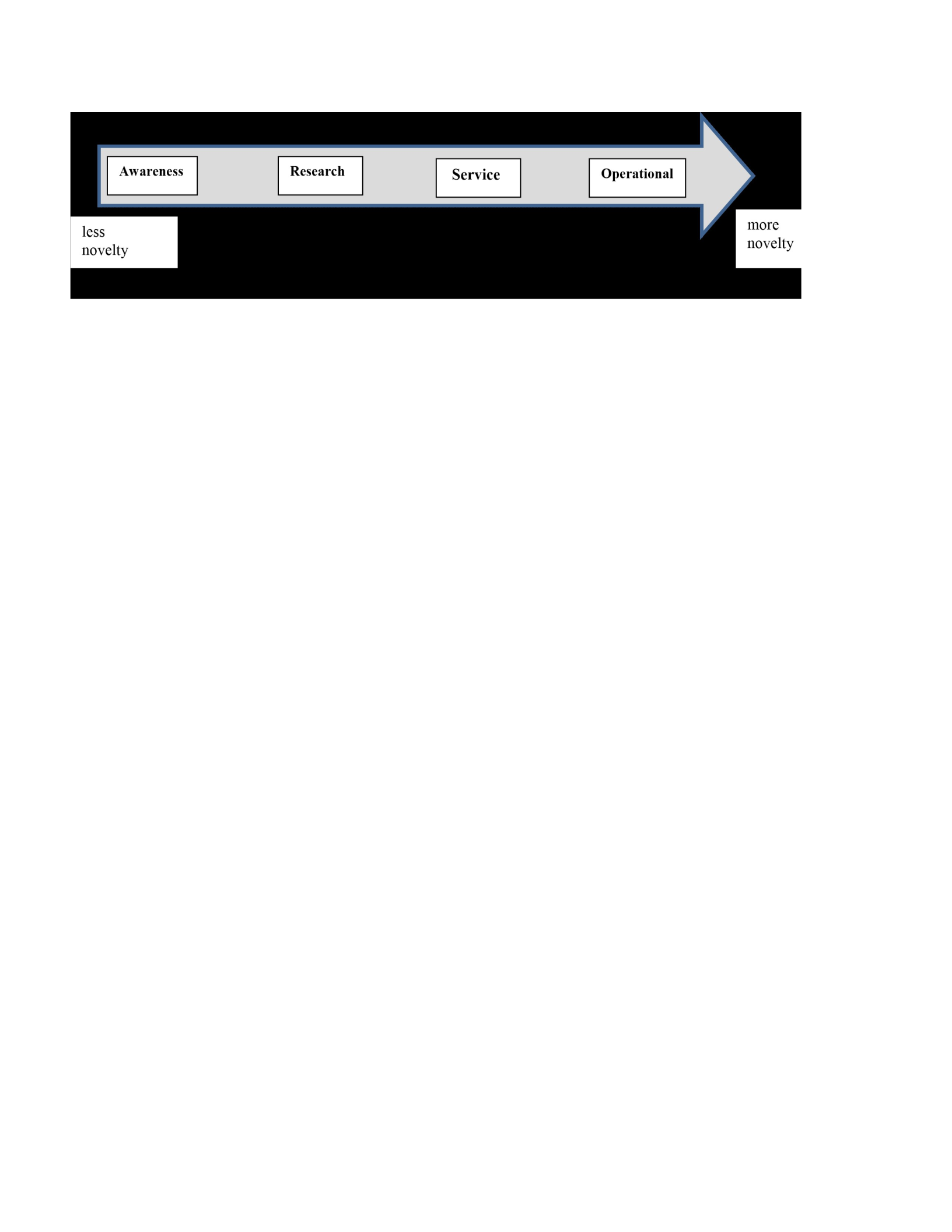
Figure 2: Continuum of innovation levels
Question 1 investigated the types of challenges hosted on the challenge.gov platform.
Analysis and classification of 203 challenges hosted by 47 agencies revealed four distinct
categories, which ranked from low to high in the level of innovation attempted. The next
question investigates the stages and influencing conditions involved in the adoption and
implementation of challenges.
5.2 Research Question 2
How do agencies adopt and implement Challenges?
This question sought to reconstruct the set of events, factors, and conditions involved in
the adoption and implementation of challenges. Responses were extracted from interview data
and were based on informants’ description of their experiences before, during, and after
adoption.
The resulting model (Figure 3) emerged as a representation of the challenge adoption
process. The model outlines the various stages of the process, the factors that influence the
stages, and the relationships between them. The main stages of the model are i) external trigger,
ii) internal motivation, iii) selection of challenge characteristics iv) implementation preparation,
and v) execution and feedback. The factors which influence those stages are a) agency mission
and experiences, and b) enablers/hurdles.
Figure 3: Challenge adoption model
The adoption process illustrated in the challenge adoption model (Figure 3) can be
described as follows:
An external stimulus triggers the process. Depending on the nature of the stimulus, the
agency develops an internal motivation to act. The motivation influences decisions about
challenge characteristics such as type and objective. Agency characteristics such as the mission
and experiences influence the type of motivation as well as challenge characteristics. The agency
makes preparations to implement using either an ad-hoc or the more strategic learn first
approach. Implementation is influenced by the degree to which certain critical factors are
present. When present, these factors act as enablers, while their absence serves as a hindrance.
Challenge execution involves activities such as collection of submissions, judging, and awarding
prizes. The execution experience during one challenge provides feedback for, and influences the
External
Trigger
•
Mandate
•
Exposure
•
Policy
Internal
ation Motiv
•
edience Exp
•
eriment Exp
•
blem- Pro
ng Solvi
lenge Chal
Characteristics
•
Objective
•
Type
Preparation
•
Ad-hoc
•
Learn-first
Execution
Enablers/Hurdles
•
Internal processes
•
Management Support
•
Resources
•
Feedback
Agency
Characteristics
•
Mission
•
Experiences

motivation for succeeding challenges. Further description for each component is detailed
below.
5.2.1 External Trigger
A trigger from the external environment sensitized the adopting agencies to the
availability of challenges as a problem solving tool. While the policy directive was sufficient to
act as a stimulus in some agencies, additional triggers were necessary in others. For example one
informant representing a large challenge program explained how the passage of the America
Competes Act legislation was the primary driver of what they were doing:
A big driver of all the things that we’re doing now, around challenges stems from a
particular piece of legislation that was called the America Competes Act. […].The
America Competes Act gave government agencies the ability to use challenges as a
mechanism to spur innovation. Prior to America Competes, essentially the only way that
a government agency could pay you, in sort of, the broader sense, was either through a
grant, or through a contract. Now with the Competes Act, government agencies are able
to use competitions and prize challenges as a way to encourage people to innovate, to
build applications and thus be rewarded for their innovations. So, a big part of why
we’re running the challenges through [agency name], is that it is specifically focused on
the Competes Act and using the challenge mechanism (Informant 33)
From another perspective an informant recalled wanting to run a particular competition before
hearing about challenge.gov:
We had actually tried to do this competition even before Challenge.gov, we were kind of
sensitized to it (Informant 10)
However in the absence of the special legislation they were unable to run a competition and
award a prize. This changed when America Competes was passed.

…But then we realized that competitions actually fall in a different category, and we
didn’t have authorization to actually have competitions and make prize awards. So then
we had to kind of put that in the back burner. And when the America Competes Act came
along, then we were able to go ahead and really fully realize our vision for the whole
program. (Informant 10)
These are just examples of external triggers. Further analysis revealed three main categories for
external triggers: the legislation and policy, specific directives from outside the agency, and
exposure to the practice in other agencies. Brief explanations follow.
i. Mandate: Following passage of the government wide policy, some agencies received
specific directives to implement. These directives were communicated orally or via
informal communication channels, and in some cases were accompanied by a timeline
within which to act.
ii. Exposure: Some agencies were exposed to the practice in scientific and research
organizations in the business sector, while others witnessed the adoption by other
government agencies. In some cases the exposure happened before the policy and
legislation were implemented, but had to wait for the legislation. In other cases some
were aware of the legislation, but were only prompted to act after seeing it implemented
in other agencies within or outside of government.
iii. Introduction of Policy and Legislation: Before running challenges, agencies must be
legally authorized to do so by an Act of Congress. Prior to 2010 a limited number of
agencies were able to run challenges under legal authority specific to their functions.
Others had done background research and were contemplating ways they could employ
challenges. In 2010 Congress passed the America Competes Reauthorization Act which

granted legal authority to all agencies to run challenges and award prizes, in addition to
guidelines and stipulations for use. When the legislation was enacted it served as an
external stimulus to those agencies that had already been considering it, thus triggering
the formal adoption.
5.2.2 Organizational Mission and Experiences
Organizational characteristics such as mission and experiences were important
determinants in the challenge adoption process. The primary mission types emerging from the
data were (1) service provision, (2) public education and information, (3) regulatory, and (4)
research and development related to science and technology. Some challenges reflected the core
mission of the agency, and were seen as more critical than those addressing topics outside the
core mission. In the following quote, the informant indicated that his challenge effort was
enabled because he was able to link it to work his organization had been doing for years.
I think what helped me a lot was that I was able to link the challenge effort to work we’d
already been doing for years. I think these are really crucial to be rooted in strategic
planning. The organization in my opinion needs to fully understand why they’re moving
in a particular direction, and if they choose new problem solving tools like this, why they
are choosing them. And then to understand where are they applying them for the most
effect. (Informant 12)
In a contrasting situation, an agency whose primary mission was regulatory encountered some
resistance, because their mission did not readily accommodate the level of innovation and change
which challenges were meant to promote.
One of the important pieces that frames all of this discussion about us being a regulatory
agency, there’s an added layer of resistance to coming up with innovative approaches to
our regulations, because it takes a lot to change. So we don’t have some of the same
flexibility as the other agencies do. (Informant 20)
Outside of challenge adoption, different agencies had varying experiences with producing
innovations. The agencies which stood out as having more innovative challenges, also had in

place very clear and established processes for regular innovation. The two quotes below
represent examples of agencies with clearly articulated innovation initiatives outside of
challenges.
We absolutely do have a process. In fact we’ve got a few different ones depending on the
nature of the innovation or the issues that we’re dealing with. Or the constituency from
which we’d like to garner the ideas. For example, if you’re to take the [contest name]
that we run once a year, that’s the process that begins in late fiscal year, let’s say 2011.
We identified challenge areas we want to focus on at a strategic level for the [agency
name] and by February, we’ve effectively settled on a group of 4 to 5 different issues, and
we write them into problem statements that are no more than a few pages long each.
[…] And we use that in order to solicit ideas from industry. That’s not into the prize
challenge, but it’s one of the ways in which we go about soliciting ideas and investing in
innovation. What follows after that is a white paper phase. We take those white papers
and we determine which ones we want to seek full proposals from. (Informant 17)
Internally, one of the programs that I helped develop is a contest called [contest name].
And this is a contest we run twice a year where we invite employees to submit write-ups
about innovations that they have developed, or they have developed in partnership with
contractors. […].We invite our employees to submit innovations, and then we have a
social networking platform where we display the top 20 or so, and we ask our entire
community of employees to vote, comment on which innovations they like best, which
ones they think would be most applicable in their home agency, and then we select
winners and honorable mentions, and we celebrate them at a ceremony that we telecast
across the department, and the winners actually receive cash awards.[…] We’re trying to
show our employee base that these are things that they too could develop, and, try and
generate good ideas, and or showcase things that could be applied elsewhere (Informant
8)
The agency mission and experiences influence the agency’s internal motivation to adopt, as well
as the challenge characteristics.
5.2.3 Motivation
Depending on the nature of the external stimulus, the agency develops an internal
motivation to act. That motivation is critical because it set the tone for subsequent events and the
overall adoption pattern. In some cases there was no real reason for adopting, except that they

were following instructions. In other cases the agency simply sought to take advantage of an
opportunity created by the America Competes Legislation. For example:
So it wasn’t a specific problem that we had, rather it was an opportunity that we had a
lot of data, and a lot of software developers who might want to use it. And, he said let’s
take advantage of that opportunity. (Informant 21)
In other cases there was a deliberate strategic move to address specific areas that needed
innovating:
Coming out of our strategic plan and looking at now having learned about open
innovation tools, we did an analysis of our portfolio of work to see what problems we
might want to address. […]. With any portfolio of work like that, you have gaps,
insufficient resources or knowledge or technologies. So we took those gaps and we
worked with [name] to use this 2 by 2 quadrant and criteria to map our gaps to various
types of collaborative opportunities, and we did a whole workshop with him to do that.
So we selected 12 challenges to potentially run a prize, and then we worked through
certain criteria to see if they would map to the open innovation quadrant. And the ones
that did, we then felt had a high likelihood of success. (Informant 27)
On other cases it was a combination of reasons, for example:
We did a challenge really for two things. One was to understand how to work with
challenges period, because this agency had no experience of working with challenges.
And the other one was to be able to attract interest and attention from communities that
we don’t know of, to become involved in [technology name]. (Informant 15)
The different forms of internal motivation can be classified as follows:
i. Expedience: These agencies were faced with situations where compliance with the
policy or some directive was the ultimate objective. Therefore they chose the easiest and
quickest way to get the Challenge over and done with.
ii. Experiment: Some informants spoke of being exposed to the use of challenges in
practice and were motivated to try it out. At this point they were not sure how or under
what circumstances it would be best utilized, but were excited at what they saw and

wanted to experiment. They usually took a wait and see approach before attempting to
implement any long term program.
iii. Problem solving: Some were able to match this new tool with existing problem areas
which were either previously tackled or were being contemplated. For others it was an
opportunity to address gaps in their strategic plans or to attempt something which they
were previously unable to do. This usually included a long term objective of integrating
challenges into the regular operations of the agency for purposes such as an alternative to
grants and contracts.
5.2.4 Challenge Characteristics
Selection of challenge characteristics refers to the selections made for challenge type and
objective. While this represents two activities, the separation is often indistinguishable in
practice. As mentioned earlier, the agency mission and experiences influence the challenge topic
and type of challenge selected.
Challenge Objective
The challenge objective refers to the problem or topic which the challenge addresses.
Objectives that closely match the agency mission or operations give an indication of high
importance to the agency. Objectives that are loosely related to the agency mission are usually
seen as less important. The challenge objective also gives an indication of the level of innovation
employed. For example, did they just use members of the public to do the same tasks that they
would have done anyway (little or no innovation)? Or did they use it as an opportunity to
produce something which they were not capable of doing before (true innovation)? The ideal

objective as described by one informant was for innovative uses, and not for traditional uses that
have been repeated year after year.
If you want to do something that you typically do, but you just want to use
Challenge.gov, and you already have a process in place, and, you think well
maybe I can speed it up using Challenge.gov, that’s really not going to work.
[…]. But if it’s something related to innovation and we’re seeking to solve a
problem that we have been unable to solve over the past couple years. So
there’s a difference between an expected deliverable that you’re doing year after
year, or an existing issue that there is no deliverable for, because you haven’t
been able to solve. If that’s the case, then use Challenge.gov. If it’s to
reinvent a deliverable of sorts, that might not be the best. Then you really need
to look, inside and think otherwise (Informant 13)
Stressing the ideals of innovation, challenges are most effective when they have an objective of
helping the agency accomplish something they were not able to do before using traditional
methods.
Well, it was easy to make that decision. So, these were gaps where we had tried
other tools. We had tried research grants, or we had tried small business
proposals, or both. Possibly even contracts. These were areas where people felt
they were somewhat stuck. That makes it a little bit easier to be at the end of the
line where people pulled out gaps that they thought were important problems, but
they hadn’t been able to solve those yet. (Informant 27)
The three categories of topic motives emerging from the data are listed below, ordered by
increasing level of innovativeness:
i. No specific problem; introduced mainly for the sake of using the tool ii.
Try to find an easier way of doing some existing task
iii. Do something they were not able to do before

Challenge Type
The type is characterized by factors such as objective, task, submission format, and gives
an indication of the level of innovation involved. Four main challenge types emerged during
analysis of challenge.gov listings: Awareness, Research, Service, and Operational (detailed in
research question 1 above). Challenges with awareness as the main objective represent lower
innovation levels, while those with operational objectives represent the highest level. Awareness
and research challenges are generally considered easier to execute and often associated with
adhoc implementation. Service and operational challenges often require more organizational
effort and can be associated with long term planning and more systematic organizational effort
and commitment.
5.2.5 Preparation
Different agencies had different approaches to challenge implementation, and this was
reflected in their preparations for the process. Preparation involved planned deliberate attempts
to provide structure and guidance at the organization level, and included organization initiatives
such as internal contests, designated personnel, training, and the creation of a framework of
guiding policies. In the final analysis avoiding procedural difficulties all came down to the
organization’s prior preparation and ability to learn from past experiences.
Those with a long term view of integrating challenges into regular operations had a
strategic learn-first approach. They spent time upfront conducting preparation activities to ensure
a smooth implementation. These activities included internal initiatives such as pilots, education
and training, and setting up and documenting internal policies and procedures. Additionally,
some contracted out to private or non-profit entities with experience in that area, freeing them of
time-consuming procedures. The following illustrates:

And so much of the work that I’ve done on prizes and challenges is background policy
work. A lot of what I’ve done is setting up the framework. So, you know, the America
Competes Act was passed a year ago, and agencies were sort of handed this new
authority, and yet we didn’t have any systems. I mean we had like no mechanism for
actually paying our winners, and we had no policies, and we had no framework, so for
example talk about one policy in particular is our delegation of authority. So the
Secretary was given authority to run prizes and challenges. But an organization as large
as ours, it doesn’t make sense to channel everything through the Secretary. So we
developed a delegation authority whereby the secretary delegated that authority to our
agency heads, and then we created another policy where prizes and challenges that are
above a certain monetary threshold go through secretarial review. But anything that’s
smaller would just go through an agency review. (Informant 8)
This type of preparation and arrangement was even more critical for large departments that have
several agencies under their jurisdiction. This next example outlines how one large department
centralized the process to make it easier for their agencies.
So when you have [number] different agencies, if you democratize this process, what you
have is chaos. So, no one knows what the other person is doing, how the process really
works, best practices, minimum requirements, legal jargon, etcetera. So what we’ve
done is we’ve centralized it. We have educated each of our agencies not only on the
potential, but on the requirements, on how they should think about their challenges.
And, they are responsible on most cases for coming up with the idea. But we are
responsible for coordinating and running and leading the management of
implementation, execution, evaluation, and then conclusion, of the challenges. And it’s a
group of individuals that work together to ensure that all are aware. Otherwise, it’s over-
democratized, and you lose control, and then something might get lost. (Informant 13)
The end result of this centralization was described as a fast track process to help agencies under
that department execute a challenge.
What we have provided them is with a fast track process of being able to formulate,
launch, and, and execute the challenges, then conclude them, evaluate, and then award.
It is a formalized process, easy to follow, and you don’t need to be a subject matter
expert. (Informant 13)
Others with a short term focus used an ad-hoc or trial and error type of approach where they
learned as they went along. With that approach there were no internal processes in place and

implementation was not usually a smooth process. For example in the arrangement below,
everyone is left on their own to figure out how a challenge should be run.
There is no one person responsible for all the challenges coming out of the agency. I
think (there are) pockets of one or two people around the agency that want to do a
challenge and then figure out how to get it done (Informant 29)
5.2.6 Enablers/Hurdles
The path taken by agencies during preparation influenced internal readiness to deal with
the rest of the implementation process. Those agencies which took the learn-first approach took
measures in advance, to ensure the presence of enabling conditions, and had a smoother
implementation experience. The quote below identifies some of what the informant considered
important enablers which should be put in place.
If you’re going to run a challenge, make sure to allocate the right amount of resources.
Be ready to invest the time. Be ready to learn how other successful challenges have
been run. Be ready to create compelling price structures, and a list of judges, not just
within the federal scope. And reach out to departments that have done it before and
have done it well. (Informant 13)
And, speaking of specific factors that enabled to successful execution of multiple challenges:
I think just departmental leadership, openness to doing things in a different way.
Looking outside of your sandbox, and saying so this is how things are being done outside
of our department, learning from them. Having an open mind at the, at the highest level.
And we’ve gotten a lot of support from our leadership - the Deputy Secretary is a
champion in this area. (Informant 13)
Agencies which took the ad-hoc approach did not do as much advance preparation, resulting in
less availability or absence of enabling conditions. The absence of an enabler (or its availability
in lesser quantities) is viewed as a hindrance.
The list below identifies the major enabling conditions emerging from the data:

i. Internal processes: This refers to the existence of an internal mechanism with
clearly identified and documented procedures and guiding policies to run
challenges. It is a reflection of the extent of process knowledge within the
agency and covers activities such as: a) weeding out non-viable challenge topics,
b) allocation and payment of prizes, and c) obtaining legal compliance.
ii. Management support: This is a reflection of the level of support displayed by
leadership of the agency for the challenge initiative. The level of support was not
equal across agencies. Some agencies received visible support from the highest
levels such as the Secretary or administrator, signaling the agency’s commitment
to supporting all aspects of the program. Other agencies received passive
endorsement with no visible support, or agency-wide commitment for the
initiative.
iii. Financial resources: The larger challenge programs had dedicated financial
resources which could be used to offer larger prize purses, thus attracting higher
levels of innovation. Financial resources also facilitated the hiring of external
contractors and partners with expertise, removing the burden of challenge
management and implementation from employees. In some agencies funds were
allocated to run internal pilot programs, which enabled the learning process and
promoted the use of challenges. Financial resources were also more likely to be
present among agencies with ongoing research and development or innovation
portfolios.

iv. Human resources: some agencies had a designated challenge manager for whom
implementation related activities were a priority. In other cases, duties had to be
absorbed by Program or Communication Officers, who performed them in
conjunction with their regular duties. The adoption and implementation
processes were described as time-consuming and burdensome, and influenced
future decisions to execute challenges.
5.2.7 Execution and Feedback
Execution follows the preparation stage, and the execution experience is influenced by
the presence (or absence) of process enablers. Execution covers all necessary activities needed to
complete the Challenge. Activities include publicity, hosting on platform, judging, and awarding
the prize. Publicity refers to activities related to the promotion and marketing to the public and
target audiences using traditional and new media channels. It may also involve promotion to
agency employees with the objective of obtaining organization buy-in. Next, the challenge is
hosted on the challenge.gov platform, and in some cases agency websites of third party providers
or implementing agency. This activity involves technical actions associated with uploading and
managing on the platform, as well as responding to queries from the public. Judging involves the
selection of judges, and ensuring that the judging criteria are adhered to. Following judging, an
award is made to the winning submission, accompanied by a certain level of publicity.

Given that the program was new, the execution experience was not always
straightforward, leading to sometimes difficult execution experience as recounted in the quotes
below:
None of the early challenges have been easy, simply because they’re new. One of the
things that happens when you have a new tool is people are scared. People think about
everything that could go wrong, they think about are we complying with every regulation
and rule we’re supposed to. And so I mean the approval process to do this was
complicated, not because the challenge was inherently complicated, but because it was
one of the first. (Informant 8)
I think you need to have somebody who is devoted to being in charge of that. Like you
need to have a clear project manager to deal with the legal, to deal with judging, to deal
with the submissions- just the administrative tasks that have to be done in a challenge.
Challenge.gov is nice because you can collect all of your submissions and things in one
place. But you still have to have judges go in and judge them. And you have to find
judges and coordinate when they’re judging. So, there’s a lot of administrative work that
somebody needs to be devoted to doing. (Informant 22)
Following completion of one challenge, feedback from the experience will influence the
agency’s motivation for subsequent challenges. This is represented in the model by a feedback
loop. For agencies with an initial goal of running multiple challenges, the early experiences were
used to fine-tune internal processes and conditions, contributing to smoother implementation for
subsequent challenges. For others, feedback from the first execution experience helped
determine future direction of the challenge program. These agencies were able to learn from
early experiences and made appropriate internal adjustments, enabling them to replicate the
process later on. The following quote illustrates the numerous difficulties that were associated
with selection of judges. However once the appropriate steps were covered, this experience was
used as feedback to inform a department policy to guide future challenges.
One of the issues that came up in this challenge was the issue of judging, and who was
allowed to judge a challenge. And we have fixed rules that state that inherently
governmental functions must be done by the government, and if they’re not done by the
government, then they need to be done by special government employees […]. And one

of the difficulties with this first challenge was with selecting who be the appropriate
judges. And so that just took a while. But I mean the benefit is once we went through
this, then we were able to come up with a policy for the department around how we select
judges. (Informant 8)
Some agencies lost interest in continuing the program:
...there was a long gap, and there was some interest in starting up some challenges again
here. I think they still maybe on the table, although I don’t know where they are in the
process. (Informant 35)
Others lacked the desire or ability to make the necessary adjustments, and abandoned the idea of
future challenges.
5.3 Research Question 3
How do the various adoption and implementation factors influence the type of innovation
enactment of the implementing agency?
5.3.1 Types of Enactment
The challenge adoption model presented and described in Figure 3, represents the various
stages, factors and conditions that agencies navigate during adoption and implementation.
Following Orlikowski’s (2000) typology of enactment introduced in Chapter 2, I categorized
agencies based on the level of change stimulated by challenge adoption. This resulted in three
agency groupings characterized by the following descriptions:
•Inertia retains the existing way of doing things. It represents the lowest level of
innovation because it signifies no change in organizational practices.
•Application augments or refines the existing ways of doing things, and demonstrates
moderate innovation levels.

•Change substantially alters (or transforms) the existing way of doing things. This
represents the highest level of innovation due to the substantial changes in existing
practices.
For each group I demonstrate how the enactment type is related to specific conditions at each
stage. For example inertia enactment is associated with a specific type of external trigger
(directive), a specific type of motivation (expedience), specific type of challenge objective (no
specific problem), and so on. The conditions for each enactment type are illustrated and
supported with examples from interview transcripts.
5.3.2 Inertia Enactment
This form of enactment evoked little or no change in the agency’s approach to problem
solving and innovation. Agencies within this group were responding to a specific directive to
adopt, or external pressure to conform. They primary motivation was expedience, leading to the
selection of challenge objectives and types they felt were the easiest and quickest to execute.
There was minimal upfront preparation, leading to an absence of critical enablers such as internal
processes and funding. This led to numerous difficulties during execution, making repetition
unlikely.
5.3.2.1 External Trigger
During the early days of the Open Government initiative, there were formal
communications to agencies strongly urging them to employ prizes and challenges as a problem
solving mechanism. There was also informal marketing and promotion from the White House
Office of Science and Technology Policy (OSTP), using word of mouth and personal
communication channels. This informal evangelizing sometimes resulted in specific directives to
individual agencies to undertake a challenge project, usually within a relatively short time frame.

This directive was sometimes relayed directly to program staff, and in other instances relayed
through the agency head. The following quotes illustrate examples of both.
we were told that we needed to do some type of event, and that we had a few months to
pull it together, and that we had to use challenge.gov to do it. (Informant 34)
it came about in a very straightforward manner. …the then Technology Officer told us that
he wanted us to do a challenge. And he wanted it out in two weeks (Informant 30)
We were told to use a challenge… it came down that Challenge.gov is launching; we need
to have challenges (Informant 22)
These mandates coming from outside the agency triggered a specific type of motivation, which
influenced subsequent implementation events.
5.3.2.2 Organization Mission and Experiences
The agencies with missions related to public outreach often selected awareness
challenges, while those with research missions deployed ideation type research challenges. Both
of these types fall on the lower end of the innovation continuum for challenge types. The
challenges executed in this group were not seen as central or critical to the agency mission, and
in one case the challenge was contradictory to the mission.
We provide leadership, we don’t generally provide implementation. Implementation is
supposed to be a job for the states, not of the national office. So this was something kind
of outside of our agreed responsibilities in order to do this. (Informant 34)
In terms of experiences, these agencies did not indicate any elaborate ongoing innovation
processes.
5.3.2.3 Internal Motivation (Expedience)
Directives given with a tight timeframe led to hasty selections. At this point the focus was
on complying with the directive, rather than making strategic choices about problem solving or

innovation. For example, informant 22 who was responsible for executing a video contest
admitted that this was the only idea they could come up with at the time:
And so it was told us that we needed to do a challenge, and to think of a challenge, and
that was what we came up with (Informant 22)
Similarly, informant 34 who executed a photography contest admitted that they were not dealing
with any specific issue, but rather complying with the directive that had been given:
Ours really wasn’t that issue based. Challenge.gov is something that we were told from
higher ups within the government that they wanted used (Informant 34)
The internal motivation was very closely tied to challenge objective, and by extension the
challenge type.
5.3.2.4 Challenge Characteristics (objective and type)
Owing to the random manner in which these challenge projects were selected, there was
not sufficient time to be strategic about selecting problems or issues to advance the mission or
work plan of the agency. As a result the objectives were neither central nor critical to the work
plan of the agencies, and did not invoke high levels of innovation. For example, Informant 34
who admitted that their photo contest was not trying to solve any specific problem:
…So we weren’t looking at an issue. We came up with the only thing we could think of,
and that was to do a photography contest. (Informant 34)
Another admitted that they had no idea what to with a challenge and struggled to find an
appropriate topic:
… so we said so what should we be doing with a challenge. We think it’s a useful tool, but
we’re not exactly sure what problem fits it (Informant 16)
There is a very close relationship between the challenge objective and challenge type. The two
are interrelated and often the choices are made in conjunction with each other. The types of
challenges implemented were geared towards awareness (see description in research question 1)
which include creativity contests such as video, poster, photo, slogans, etc. These invoke the

lowest levels of innovation. For example one informant indicated that their poster contest did not
involve any form of innovation since it could have easily been done internally:
I just would have had our graphic designer do it. I mean we have those resources
available (Informant 22)
There were also two research type challenges in this group however these were on the lower end
of the scale because they were mainly looking for ideas on how to deploy different technologies.
5.3.2.5 Preparation
The approach to implementation is an indicator of whether the agency intends to build a
sustainable challenge program, or whether it is intended as a one-time event. Within this group,
agencies proceeded in an ad-hoc manner, and went straight to implementation once challenge
objective and type were identified. They did not make provisions for advance preparation and
experimentation, and actions did not demonstrate intentions of developing a sustainable program.
As a result, informants in this group reported an absence of the critical enablers, discussed in the
section below.
5.3.2.6 Enablers/Hurdles
One of the biggest and most common hurdles reported was the absence of internal
processes to guide challenge implementation. This was very closely related to a lack of
knowledge both around the challenge process, and to a lesser extent the requirements of the
platform itself. Challenges in this group were implemented in the early days of the Open
Government initiative, and there was little institutional knowledge across the agencies. In the

absence of any guiding mechanism or prior training, those charged with the task struggled
considerably with the process and were forced to learn while doing.
One informant explained that it had taken over a year to figure out the mechanisms for
internal procedures such as disbursing money and awarding prizes.
We had to figure out an internal mechanism for making it happen. And that’s taken over
a year. So to get that really down right, and then to get procedures for disbursing the
money, for granting the prizes, for reviewing the different proposals, to do it right takes
some time. (Informant 30)
Another explained that the process was not systemized within their agency:
…when I heard of it (challenges) it wasn’t systematized at all (Informant 35)
Another common hurdle reported from this group was that running the challenge came with
additional responsibilities which had to be absorbed by current staff. Because it was mandated,
some felt that responsibilities were just thrust on them. They described challenge responsibilities
as time consuming and burdensome. Informant 34 talked about the personal experience of having
to work overtime to get it done.
We weren’t given any funding. It was something we had to add to our current job
responsibility. I had to come in on the weekends in order to work on this project, because
I just couldn’t fit it into my regular assignment. (Informant 34)
Another key informant put it in general perspective:
The lack of dedicated resources is a big one. This is pretty much an unfunded mandate or
unfunded option for people to use. And so it ends up being an additional task that
somebody takes on in addition to their other responsibilities. I can easily see it being a
full time job for one person, at least for an agency. (Informant 35)
The lack of certain key enablers made for a difficult implementation experience and reduced the
likelihood of agencies running repeat challenges.
5.3.2.7 Execution and Feedback

For those agencies with awareness challenges, they had run one or two challenges, with
no immediate plans to repeat. In response to the question whether there were plans for more
challenges, informants indicated that repeats were unlikely for various reasons stemming from
lack of fit with agency mission, changing priorities with departure of an administrator, and
seemingly a loss of interest. Some of the reasons are illustrated below:
Question: Do you plan on running any more challenges?
Response: Not unless we’re given another mandate to do one. (Informant 34)
In the case referred to by informant 22, there were plans on the way which included funding to
do additional challenges. However with the departure of the administrator, the plans as well as
the funding were put on hold and so the agency did not run any more challenges. The following
quote illustrates:
So there was money put aside. An idea was that that money would be used across the
agency to support challenges. And that the agency had a goal of doing, think it was 20 or
25 challenges in the next year. But I don’t think that that’s a goal any longer, since that
administrator is no longer here […]. So if that administrator is no longer here, and that
money is no longer being set aside for challenges, I think that was part of the concern.
[…]. So no, we haven’t done any other challenges (Informant 22)
For the research oriented agencies, there were no initial plans to institute more challenges.
However, there was now the potential to work on setting up internal processes to help enable
future challenges.
5.3.2.8 Inertia Enactment Summary
The following table provides a summary for characteristics of inertia enactment.
Inertia Enactment
External trigger -Directive

Internal motivation -Expedience (choose the easiest and quickest way to get this done)
Challenge objective
and type
-Problems were not very critical, not taken directly from work plan
-Types: Awareness and research
Agency Mission and
Experiences
-Mainly public outreach, some research oriented
- No elaborate innovation processes
Approach to
Implementation
-Did not spend time to build internal processes
-Encountered difficulties during implementation
Enablers/Hurdles -Lack of dedicated financial and human resources
-Lack of internal processes
Execution and
Feedback
-Encountered difficulties during execution
-Abandoned idea after one or 2 challenges
Table 7: Inertia Enactment Summary
5.3.3 Application Enactment
Application enactment refers to a situation when an agency uses challenges to improve
(but not fully transform) existing processes. For example, the development of a software
application to make the agency’s data more accessible to the public can be viewed as a form of
application. However if this approach is used inconsistently, it has not caused a fundamental
change in the way the agency solves problems or innovates, and does not represent change or
transformation. Adoption in these agencies started out as capitalizing on an opportunity to try
this new tool and matching it with a suitable problem/issue. Another form of application
enactment involved the use of challenges to improve a task that was previously performed using
another means.
We had tried to operate something similar to these before Challenges. So we had some
structure and rules in place which the General Counsel helped us develop. So we just
adapted them for the challenge, that we retain ownership of the submissions and stuff like
that. (Informant 4)

Adoption did not usually start out with a plan for long term integration. However a positive
learning experience could lead to the continuation of the program while the opposite led to its
termination.
5.3.3.1 External Trigger (Exposure)
A common thread echoed by informants in this group was that outside of the policy and
legislation, they were moved to act by some form of encounter or exposure to challenges in
practice. Some of these interactions occurred while attending formal challenge events and
demonstrations. For example informant (4) recalled attendance at one such event:
Well quite a few of us have attended a session sponsored by the White House talking
about challenges. So we brought that message back (Informant 4)
In addition to attendance, the conversations and personal interactions that followed were
instrumental in making an impression. Informant (32) recalled one such interaction:
Robynn Sturm at OSTP came and talked to [my group] maybe a year ago, and I’ve had
many telephone conversations with her, to kind of clarify issues. And so she was very
helpful in educating me on how to do this. (Informant 32)
As part of the interactions, there were conversations about implementing specific challenges.
However in contrast to the inertia group, these were described by informants as suggestions
rather than directives, because these were tied to specific objectives. The following quotes
illustrate:
The idea was suggested by Aneesh Chopra, who was at the time the Chief Technology
Officer of the United States. He suggested that we do this challenge. (Informant 21)
Right after that conference, some colleagues and I, went and we met with Todd Park
(OSTP), because we loved this idea of opening up data and making it available. And so
he said well why don’t you consider doing a challenge? (Informant 12)
This exposure or personal encounters triggered an interest within the agency, motivating them to

act.
5.3.3.2 Organization Mission and Experiences
This represented the largest group of agencies representing varying missions and
operation. This group was not as distinct as the inertia and change groups. Many had operations
which produced large quantities of data related to public issues such as health, education and the
environment.
5.3.3.3 Internal Motivation (Experiment)
Exposure to the challenge program triggered the desire within agencies to experiment.
Program officers and managers were curious to explore to see whether it fit their needs. For
example informant 11 spoke of the agency’s desire to try a challenge because they had not done
one before:
Yeah, the whole point was like we need to do a challenge. We haven’t done a challenge at
all. We haven’t leveraged this platform. (Informant 11)
The desire to do a challenge preceded the identification of how exactly it would be used.
It was just getting at that’s what we’re going to use. So I have a little bit of a different
history with challenges. I actually remember the very first apps challenge done here in
D.C., called [challenge name]. I even know the guy [name] who did this from his
marketing firm, who ran the first one. So I’d always known about challenges, knew about
challenge.gov. So this was like, hey we need to do the same thing, we need something like
that, and so let’s run something. (Informant 29)
However the motivation got a boost when they were able to capitalize on the opportunity and
match the tool with an existing issue:

Well we looked at what we were trying to get, what our end result was going to be, and
we thought it was an effective tool, rather than us trying to build some tool inside to get
what we need. (Informant 4)
5.3.3.4 Challenge Characteristics
Stemming from the desire to experiment, some challenge objectives were not related to
specific problems, but were used as an outreach and engagement tool. However this form of
engagement required tasks which were slightly more complex than awareness challenges. This is
illustrated in the following example:
So our goal was really to excite the students. So we were not really so much interested
in the end result, even though that’s a desirable outcome. But we were really interested in
the process of engaging the students to push themselves and to expand their boundaries
and get them excited about the topic…. (Informant 10)
Others saw the opportunity to go beyond engagement, and incorporated an issue which needed
addressing. For example, as part of the Open Data initiative, agencies were required to make
their data publicly available. This opened up new opportunities for creating software applications
to enable public consumption of the data, as well as opportunities for entrepreneurship. The
following quotes illustrate:
So it wasn’t a specific problem that we had, rather it was an opportunity. We had a lot of
data and there were a lot of software developers who might want to use it. And he said
let’s take advantage of that opportunity. (Informant 21)
more than anything else was just marketing the fact that we did have a set of web API,’s
or web services that was available. There wasn’t really a problem, it was more used as a
marketing tool (Informant 11)
The types of challenge were mainly service involving software applications, but also included
some research and a few awareness types.

5.3.3.5 Preparation
The decision to run a challenge preceded the selection of a problem or issue. Adoption
was seen as an opportunity to experiment with something extra, not necessarily critical to the
internal operations. Similar to inertia enactment, initial challenges undertaken by an agency
focused on ad-hoc and stand-alone issues. Implementation was not preceded by long term
preparation and learning, but rather was more improvised. Challenge champions had to take the
approach of learning by doing, and had the task of convincing management and colleagues.
In setting up the first big challenge the [agency name] did, I am very inclusive and I
brought everyone to the table to understand what I was doing, so I brought in people from
our Office of General Counsel, I brought in people from our Policy Office, to let them
know exactly what it was that I was planning on doing, and for them to be able to give me
any input, or to share any concerns they might have.[…] So during all the planning of
the [name]competition, I had all of the stakeholders in conversation with me about what I
was doing. (Informant 32)
Some organizations were able to learn during the process and use that new knowledge to inform
future attempts.
5.3.3.6 Enablers/Hurdles
Initiatives were bottom-up and decentralized, resulting in an absence of official
organization policies, guidelines, and training initiatives. In the absence of a guiding framework,
challenge managers and champions were forced to learn as they went along, encountering many
hurdles along the way.
Lack of Internal Processes
With the practice still emerging, many agencies lacked documented instructions on the
mechanics and sequence of tasks necessary for achieving milestones such as getting the project

approved, and the allocation and disbursement of cash prizes. Several challenge managers spoke
of uncertainties, and recounted having to learn through trial and error with no one to turn to for
help. While some saw these as part of the learning process, others blamed it for lengthy delays in
execution.
…the first time anyone in our agency had ever done one of these, and… part of me was
(thinking) I don’t know what I’m doing, and I don’t know who to ask for help. So we just
kind of figured it out as we went along (Informant 23)
it was a very big ordeal, because we didn’t even know who had to approve what, and so
the procedure was not defined. We didn’t know if it could be approved at our agency, or
the head agency. So, this was really challenging. (Informant 10)
Though the process for the first challenge was extremely difficult, the experience improved with
subsequent projects as agencies were able to learn and improve. Thus agencies were now able to
set policies and guidelines based on earlier experiences, making it easier for other individuals
and internal implementing units. This is illustrated in the account given by informant 10:
I was one of the first at [agency name] to do a challenge, and the [agency head office]
really worked with me, and that kind of set precedent. And that’s how they established
rules for challenges. So now there is a very organized way to help people who want to do
other kind of challenges, to guide them. (Informant 10)
Absence of dedicated staff resources
The challenge effort was initiated by curious program managers and professional staff
who acted as pioneers within their agencies. They voluntarily took on duties of challenge
manager or champion, in addition to their regular duties. However they soon realized the extent
of time commitment required:
From the first thought, it wasn’t clear to me how much time commitment this takes on the
challenge manager’s part. But it really takes time from establishing the competition and
running it, and staying on top and answering the questions, and making sure that the
website works properly and all these things. So that would be one thing that I would
really make sure somebody who’s considering a challenge is aware of… (Informant 10)

In the absence of an appointed challenge manager, the situation was improved with someone who
takes on special projects or innovation:
having someone who’s willing to experiment like myself, is important because that’s kind
of my job is to take on special projects (Informant 32)
Management endorsed but not management driven
Challenge champions were often successful in educating top management and their
colleagues, resulting in management endorsement. While management was generally supportive,
that support was limited to endorsement rather than driven from the top.
Our associate administrator was very enthusiastic about doing this from the beginning.
And so beyond that, we had to do some education, even up to the administrative level, just
to let them know what we were doing (Informant 11)
Though not common, there were a few cases where risk-averse management hindered the process
of challenge execution.
Before we launch a challenge, we put it through our whole vetting process, all the way up
to the, the head of the agency, to make sure that they’re okay with it. (Informant 4)
and continued…
It’s just like they’re afraid, they like all the safety with the grant competition. There are
more steps and more checks or balances. And they’re afraid of what’s going to be posted,
what’s going to be submitted, especially with public voting they’re a little nervous.
They’re more nervous the less control we have over the results. They know that we’re
supposed to be turning towards challenges, and we’ve structured these in a way that
we’ve gotten it past them. It’s been challenging to us internally. We can’t give out cash
awards outside of the grant mechanism, is a view of our legal office. (Informant 4)
Lack of funding for cash prizes
Because of the spontaneous manner in which these challenges emerged, there was often no
funding in the current budget allocated for cash awards. However, there were positive reports
that challenges could be run successfully in the absence of monetary prizes.

So there’s no monetary…we didn’t have funding for this. And, the experience we had
with the [challenge name] challenge was that if you do it the right way, you don’t need
money. That people are using this because they want to be part of something larger, it’s a
resource for them. And having the recognition from the White House makes a big
difference. (Informant 5)
5.3.3.7 Execution and feedback
The hurdles encountered during implementation made the experience difficult. Some
agencies were able to learn from the process and make improvements for the future. However
without all the required enablers, the rate of adoption was still intermittent and did not cause a
transformation in the agency’s existing practices. Other agencies were not able to learn from the
initial experiences, and abandoned after the first few initial attempts. In response to the question
of whether there were any challenges that had been planned prior, or were there future plans, this
informant responded in the negative for both questions:
This is our first foray… we don’t have any (challenges) in the queue right now.
(Informant 5)
5.3.3.8 Application Enactment Summary
The following table provides a summary for characteristics of application enactment.
Application Enactment
External trigger -Exposure
Internal
motivation
-Experiment (curious about challenges)
Challenge
objective and type
-Problems were not very critical, not taken directly from work plan
-Service, research
Agency Mission
and experiences
primarily service
Approach to
implementation
-Did not spend time to build internal processes
-Encountered difficulties during implementation
-After running the first or second challenge some agencies decided to
build organizational procedures so program could be continued

Enablers/Hurdles -Absence of internal processes
-Lack of dedicated human resources
Execution and
Feedback
Two sub groups
- One group experienced characteristics similar to inertia, and
abandoned after a small number of challenges
- One group learned during the process, and have started to
institute internal processes for program continuation
Table 8: Application Enactment Summary
5.3.4 Change Enactment
This is the most innovative use of challenges, as it enables transformation of the agency’s
approach to problem solving and innovation. Challenges implemented in this category were
problem-driven and initiated at the program level, with a long term focus on integration as a
problem solving tool. Generally these initiatives were strategic, and linked to the agency
mission. Many of the agencies within this group had existing Research and Development
portfolios and budgets, and were used to engaging external providers for solutions. Some had
previously experimented with challenges and internal pilot programs, enabling a smooth
implementation process. There was a high repetition rate with agencies in this group averaging
over ten (10) per year.
5.3.4.1 External Trigger (Policy/Legislation)
Introduction of the Open Government Initiative and subsequent passage of the America
Competes Reauthorization Act acted as the primary trigger within this group. Through
interaction with industry, they became familiar with the emerging trends involving open
innovation and crowdsourcing and had an early start. Based on their early knowledge of the
mechanisms, some of these agencies ventured to pilot innovation initiatives even before the
passage of the America Competes Reauthorization Act of 2010. Thus while the policy and

legislation was the primary external triggers, these agencies were poised to adopt because of their
knowledge and history with other open innovation practices.
We started Open Innovation in 2006, the first government agency to do so. Before that
Open Innovation was primarily done in industry. We started crowdsourcing in 2006/2007
(Informant 2)
And later continued…
We started much earlier (than other organizations). We understood, we reached out to
Proctor and Gamble to understand what worked and what wouldn’t. We benefitted from
experience. Plus the push from OSTP. (Informant 2)
Well in parallel, we became aware of open innovation techniques, case studies through
Harvard Business School. And, we thought that shed our need to open up our problem
solving space. And so, we did pilot projects back in 2009, 2010, using open innovation
platforms. (Informant 27)
There was a push on in 2004 to get [agency name] the ability to do these kinds of things.
The people recognized back in the 1999, 2000, 2001 timeframe that this was an
interesting pathway that was not available to federal agencies. And so there was about a
3 year process that [our agency] went through to build the case, and present it to
Congress to get the authority to do these kind of competitions and award cash prizes.
(Informant 26)
Others that did not run early pilots were poised to respond to the policy by matching the
challenge tool to appropriate problems. This is illustrated in the following quote:
So, we were trying out the use of the Prize Authority and the America Competes
Act for the first time. (Informant 17)
5.3.4.2 Organizational Mission and experiences

While the policy was directed at all federal agencies, only a small number were able to
respond in a strategic and deliberate manner. These agencies were poised to respond to the policy
pronouncements due to previous experiences with pilot programs, or their active and anticipatory
pursuit of new approaches to problem solving. Some had major research and development
portfolios and it was common practice to engage the services of external partners, providers, and
contractors.
Organizational missions covered areas related to research and development primarily in
areas related to science and technology. Due to the strategic selection of challenge objectives,
they were closely linked to the agency mission and organizational strategy. For example
informant 26 explained the deliberate alignment with agency mission and strategy:
First and foremost it has to be something that was relevant to our mission. Things that
would bring about new capabilities that we don’t currently have, or any existing
capabilities (Informant 26)
That particular challenge is directly connected to the strategy that had been developed.
There’s direct connection for the output from that particular challenge to be fed into a
future project (Informant 26)
Linking with mission and operations was not limited to science and technology agencies. Two
agencies with a regulatory focus were able to use their innovation portfolios in soliciting
software application challenges to empower their constituents to make decisions based on their
policies and legislation.
We do our own research and development, and issue grants through various mechanisms
to outside investigators, and we use contracts for technical development, depending, and
small business proposals as well. So we had used a variety of tools, we always have, for
new ideas. (Informant 27)
5.3.4.3 Internal Motivation (problem solving)

Generally these agencies embraced the policy, as they were motivated by the real or
perceived advantages of challenges in problem solving and innovation. Some had positive
experiences from early pilot programs and easily embraced the new policy. Others had found
existing methods inadequate in fulfilling their innovation needs, and embraced the alternative
provided by the new policy.
Agencies that frequently outsource to external contractors usually draw from the same
regular pool of bidders with similar background and skill sets. Challenges offer a way to reach
wider audience with diverse backgrounds, offering the possibility of revolutionary approaches to
problem solving and innovation. For example one informant spoke of the desire to reach outside
their usual list of contractors to get a more innovative approach to problem- solving:
We’re interested in getting as many options demonstrated for consideration and ultimate
use, as possible. And, we were looking for some out of the box solutions, trying to be
different than what we would get from our typical group of people who propose to our
contract and grant opportunities. (Informant 26)
And continued…
The reasons that we decided to use the challenge as opposed to setting up some other
mechanism, is that one could envision that there’s a whole lot of different ways that one
could design a software for [the solution]. It was deemed to be a good candidate for
doing it as a challenge, rather than doing it by contract, where you would basically be
forced to choose amongst all these possible ways of doing it. When you really don’t have
a good basis for making that particular choice and you only get one possible solution at
best for the amount of money that would be invested, as opposed to potentially multiple
solutions. (Informant 26)
Some attempts at innovation require a more open ended approach than the typical
requests for proposals (RFP) allow. It may be more fruitful to simply state the desired end results
without specifying the approach. Informant 17 spoke of a situation where the typical RFP would
have been too restrictive because they did not know how the problem should be solved.

Informant 17 articulated that challenges provided the perfect approach for this level of flexibility,
since it absolved them of obligations to pay if they did not get the desired end result:
We didn’t know how to solve the problem, and not such that we could have
created RFP, where we were confident would have been the right way to solve
the problem. We knew the problem that needed to be solved was […]. What
we didn’t know was what the best way to go about doing that. And so we
wouldn’t have been able to say to industry here’s what we’re looking for […].
Instead we just said here’s the end result, and, the beauty of the prize challenge
is that you only pay for results. If you’re just interested in the result, the prize
challenge is perfect for this. (Informant 17)
Also compared to procurement through RFPs, informant (18) underscored the potential
cost savings when using challenges, because you only pay for the outcome:
First of all, imagine the dire alternative which is that we would have put out
through a conventional procurement process an RFP, that would have been bid
on by dozens of vendors, one of whom we would have picked in the hope of
being able to actually execute the expectations. And they would have or they
wouldn’t have, but it would have been a lot more expensive, and taken a lot
longer. Instead, the government takes some risk in this, in the sense that we
don’t even know if anybody’s going to respond to the contest. But we
minimize the possibility of a failed outcome after a lot of money has been
spent... We know what the outcome is before we pay. And we’re paying a lot
less than I think anybody would have estimated if we had gone through the
more conventional process. (Informant 18)
5.3.4.4 Challenge Characteristics
Agencies within this group were not forced into compliance with the policy, but rather
self selected based on their innovation needs. Problems were therefore strategically selected and
objectives were skewed toward problem solving and innovation. Agencies within this group had
research and development portfolios, and had a common practice of reaching out to external
contractors. Some objectives had very practical application such as the development of tools or
technologies:

We’ve run a number of different challenges across a wide variety of topics. These include
tools or apps or technologies that we want to have developed. (Informant 9)
The main challenge types in this category were service and operational. The service challenges
solicited software solutions such as mobile and institutional applications meant to provide a
service to the agency’s constituents. The operational solicited development of solutions more
directly related to the core operations of the agency and usually involved some form of scientific
or technological innovation.
5.3.4.5 Preparation
One of the major distinguishing factors of this group was their strategic approach to
implementation. The first step was the basic understanding of the nature and role of challenges
as articulated by informant (Informant 27):
I think these are really crucial to be rooted in strategic planning. That, the organization
in my opinion, needs to fully understand why they’re moving in a particular direction,
and if they choose new problem solving tools like this, why they are choosing them. And
then to understand where are they applying them for the most effect. (Informant 27)
They pursued goals of long term integration by first setting up internal policies and guidelines, in
direct contrast to ad-hoc trial and error approach used by other agencies.
What we’re trying to do is more systemic and long term, where we’re taking advantage of
the support from top leadership, but also trying to do cultural change so that prizes and,
and competitions become part of the routine set of tools that one considers in order to
accomplish the task that one is assigned. In the long run, eventually you’d like everybody
to think, do I want to do this as a contract, or as a grant, or do I want to use this as a
prize competition. (Informant 26)
They used a variety of preparatory initiatives and events such as pilot programs, staff education
and training, and documenting procedures. The positive impact of those preparatory steps is
evident from the enablers described below.
5.3.4.6 Enablers/Hurdles

The implementation experience was aided by presence of a variety of enablers; the major
ones being internal processes, management support, and resources.
Internal Processes
Early pilot projects were used as learning experiences to help the lay out an internal
mechanism to guide implementation. For example informant 26 described how his agency
collected data from pilot programs to inform decisions and provide guidance on use of the tool.
There were about a half a dozen challenges that were initiated with the specific intent of
trying to work with different sizes of organizations, different sizes of prize purses. We
collect data that you could use to make decisions later on, and for wide dissemination
and utilization of the tool. (Informant 26)
As challenge programs grew, project ideas were being submitted from different parts of the
agency. Not all ideas were viable, and failed projects could mean wasted time and money. Some
agencies instituted internal mechanisms to weed out potential failures, as illustrated in the
following quotes:
Not every problem is meant for a Challenge. Agencies have failed when they have not
done upfront homework (Informant 2)
Vetting process is used to weed out inappropriate problems. We stopped several because
they were not viable (Informant 3)
We have several layers of review. I give it that initial eye test, or schedule, if the idea is
completely unworkable, then I will ask that submitter to put a little bit more thought into
it, and respond to a specific area depending on what they send me. After that, there is a
steering committee made up of individuals from numerous different units within the
agency. After that, we can go into full challenge development, and make certain key
people at [agency name] are aware of what we’re doing. We need to make sure that it’s
not something that the agency is already trying to do. So we take in all that feedback,
and then finally the challenge is approved by [agency head]. (Informant 9)
For some leading agencies the internal implementation process could be easily identified and
articulated:

The first process is problem definition. The second process is prize feasibility, and the
third process or stage is prize design. So you don’t even really get to prize design until
you’ve answered two questions. First, what problem are you trying to solve, and second,
is this problem suitable to be solved through a prize? (Informant 28)
Management Support
Informants spoke of receiving support from the highest levels of their agencies and the
importance of that support in moving the program forward.
We have a high level executive understanding and support of prize competitions, which is
very, very important, and not all agencies have. (Informant 28)
Positive effects of this support were even more evident when management was directly involved
in implementation decisions:
We brief top level management at the broad level on the plans for the year. However we
do not have to get approval for individual challenges. I can make the decision.
(Informant 2)
Now in my case, I’m a senior manager at [agency name], and so after securing the
funding, it could be my decision to go ahead. (Informant 27)
By contrast, the following quote from informant 9 illustrates how the lack of leadership support
in a partner agency hindered the whole project:
You definitely have to have leadership that is willing to move forward with the challenge
process. We worked with another department on a challenge for about a month, and it
was pretty well developed. But finally, it appeared that their Secretary’s office got cold
feet and wanted to pursue solutions through more traditional means. So actually, you
have to have buy-in at the executive level. (Informant 9)
Resources
Agencies executing change enactment had established challenge programs which were
running in excess of ten (10) challenges a year. They utilized services of external contractors and
non-profit organizations to manage some or all aspects of the implementation:
…part of what the contractor does for us, is handle a lot of the challenge
logistics, and running the review panels that we use to evaluate the

submissions. They already had a platform when they won the bid. And their use
of that platform eases the whole panel management process (Informant 9)
From a contractor’s perspective:
As part of our relationship with [agency name], not only are we running the competitions
for them, but we are also advising them on areas where they can pursue competitions and
they can run competitions (Informant 33)
Financial resources also enabled them to have a dedicated challenge manager to coordinate all
implementation events.
5.3.4.7 Execution and Feedback
The challenges in this group generally addressed mission related issues. Early
preparation and a strategic approach paved the way for presence of internal processes and other
critical enablers. This led to smooth implementation, prompting greater frequency in launching
challenges. These agencies had on average over ten (10) challenges per year and advanced
towards integration in regular operations.
5.3.4.8 Change Enactment Summary
The following table provides a summary for characteristics of change enactment.
Change Enactment
External trigger -Government policy and legislation to introduce this new tool
Internal motivation -New way of addressing existing problems
Challenge objective
and type
-Objective: Directly related to mission/work plan, involved R&D -Type:
Operational, Service
Agency Mission and
Experiences
-Mission: Emphasis on Science, Technology, R&D, innovation
-Experiences: pilot innovation programs
Approach to
implementation
-Went through process of learning and documenting steps as an agency

Enablers/Hurdles - Financial resources: tend to have larger R&D budgets, had
funding to do internal pilot programs and offer large cash prizes
- Management directly involved in process
- Resources: had dedicated challenge manager and also hired
third-party providers to run challenge
Execution and
feedback
-Established internal processes, so did not encounter many difficulties
with challenge execution
-Large numbers of challenges, established program
Table 9: Change Enactment Summary
5.3.5 Summary of different enactment types
The table below compares the main characteristics of the three enactment types.
Stages Inertia Application Change
External Trigger Mandate Exposure to practice Policy and Legislation
Internal Motivation Expedience Experiment Problem Solving
Agency Mission public outreach,
some research
Primarily service Science, Tech, R&D
Agency Experiences
(with innovation)
limited Some experience Experience with prior pilot
programs and innovation
portfolio
Challenge Objective Not directly
related to core
mission
Mission related
Portfolio of problems
directly related to mission
Challenge Type Mainly awareness
(a few research)
Research and Service Service and Operational
Preparation Ad-hoc Ad-hoc but sometimes Strategic learn-first
approach
Enablers/Hurdles Many hurdles Many initial hurdles
Many enablers
Execution Difficult
Difficult at start
Gets easier if repeated
Smooth
Feedback Not often repeated Sometimes repeated Often repeated
Table 10: Summary of enactment types

6 Discussion
The objective of this study was to help us understand the motivations, conditions and
processes that influence and characterize adoption of challenges in US federal agencies.
Challenges fall under the broad umbrella of organizational innovation. Challenges also overlap
with open innovation practices because they offer a more open and collaborative path to problem
solving and innovation. Concepts from organizational innovation and open innovation literature
provided initial direction for the study, while public sector innovation literature was used to
highlight organizational characteristics for special consideration.
In this chapter I recap the various findings and discuss to what extent they reflect existing
literature, and where they extend the boundaries. The discussion is ordered based on findings for
the three research questions.
6.1 Challenge Types and Level of Innovation
The first research question examined the manner in which challenges were being used by
the various agencies and sought to establish patterns and explanations. Following analysis and
classification of challenges listed on the web platform, four (4) categories emerged namely:
awareness, research, service, and operational. These categories were mainly descriptive and
grouped based on similarity in objectives, beneficiary type, and submission format. More
indepth analysis revealed different levels of innovativeness, suggesting an innovation continuum
among categories.
The Office of Management and Budget (OMB) used the classification by McKinsey and
Company (2009) in providing guidelines to agencies on the different ways in which challenges
can be employed. McKinsey’s grouping identifies six types of prize contests, where each type is

based on a combination of two or more objectives termed change levers. For example, exemplar
prizes focus attention on particular areas by recognizing accomplishments, and are based on two
change levers: i) identifying excellence and ii) influencing public perception. Another prize
typeexposition, also focuses attention to ideas and is based on the change levers i) identifying
excellence and ii) mobilizing capital. Therefore while change levers help define a particular
type, they are not unique to any particular type. By contrast the challenge types emerging from
this study are grouped based on primary objectives, and each grouping is formed around one
particular objective. For example awareness challenges are grouped together because their main
objective is to raise awareness on particular topics primarily through creativity contests (such as
logos, posters, videos, slogans and photos). While challenges falling under other categories may
have some awareness aspect, they would not fall in the awareness category because it is not their
primary purpose.
There is a high degree of overlap between McKinsey’s point solution prizes which aim to
find the solution to a well-defined problem, and the newly identified category operational
challenges which seek to provide a functional solution to a specific problem. The problem in this
case is usually science and technology related, requiring a technical solution. While the type
descriptions demonstrate similarity between the two, the focus of point solution prizes as
specified by the change levers is i) to focus a community and ii) to mobilize talent. On the other
hand the primary focus of operational challenges is to find the solution to a specific problem.
Identification of challenge categories confirms observations from the preliminary analysis
of differentiated uses among agencies. As stated in McKinsey (2009), the six prize types are not
exhaustive, and new variations were expected with the growing prize industry. While
McKinsey’s types were based on prizes from the private and philanthropic sectors, the four

emergent types offer a more appropriate representation for challenges because they were derived
directly from the data. Thus identification of the four (4) new prize types extends the general
literature on prizes, as well as the growing literature on challenges in US government agencies.
Additional findings on the continuum of innovation levels among types helped highlight
that different challenge types promote different levels of innovation. While the analysis was not
able to offer a specific measure for innovation levels, other factors such as the level of
specialized skills, complexity and novelty of solution, served as indicators. This is a key finding
because it highlights the extent to which the various challenge types meet the innovation
objective of the Open Government initiative. This is reflected in the objectives of the America
Competes Act which are “to invest in innovation through research and development…” (America
Competes Reauthorization Act, 2010), and also to help agencies “spur innovation, solve tough
problems, and advance their core missions” (White House, 2012).
The innovation continuum also confirms preliminary observations articulated in the
problem statement, concerning disparities in the types and level of problems tackled by the
various agencies. Concern was expressed that some challenges addressed topics which did not
facilitate innovation, but essentially maintained the status quo; while others fulfilled the true
mandate of tackling difficult and complex problems. The ordering of challenge types as an
innovation continuum goes a step further than McKinsey’s (2009) grouping which projects the
assumption of equality among the various prize types and change levers. No mention is made of
different levels of complexity or innovation in McKinsey’s grouping. Thus the four challenge
types presented in the previous chapter provide a useful tool to help agencies evaluate to what
extent their challenges approach the innovation goal.

The placement along an innovation continuum is not meant to suggest that challenges at
the lower end should not be pursued. For example awareness challenges may be a good fit for
agencies with outreach as a big part of their mission, due to the ability to extend the level of
participation and outreach. For example in cases where agencies normally held public contests
or solicited nominations for awards, challenges could be employed to help the agency better
manage the outreach activity. In this scenario, challenge.gov provided a central repository to
accept public submissions while incorporating the newer feature of public viewing and voting on
submissions. Awareness challenges also have the advantage of less organizational effort and
resources, and can be used by agencies as a learning experience and a stepping stone to
launching more complex challenges. Unfortunately however, the evidence did not demonstrate
that organizations starting with less innovative challenges later move to more innovative ones.
This is in line with concerns expressed by administrators of the program that some agencies miss
opportunities for innovation by not moving beyond less innovative challenge types. However
after just two years of the platform, it may be too early to make a determination of whether
implementation of awareness challenges eventually leads to the more innovative categories.
This can be monitored in a future study.
The next part of the discussion examines the stages and conditions related to challenge
adoption.
6.2 Adoption Model
Response to the second research question involved reconstructing the various adoption
and implementation activities and events as reported by informants. The outcome of this analysis
is a challenge adoption model consisting of components and relationships that make up the
adoption process. The model is data driven and therefore provides a closer representation of the
phenomenon under study. It extends the organizational innovation literature by offering a

representation specifically relevant to challenge adoption as part of the US Open Government
initiative. Model components include stages in the adoption process, as well as variable
conditions which influence the stages. The model combines stage model and process research
with variance research, to present a more holistic picture of the process. This is a departure from
the literature where these two elements are usually explored in separate research streams.
Challenges form a subset of open innovation practices, and this model also extends the open
innovation and prize literature.
The emergent model breaks down the adoption process into stages, following the trend of
stage model research (Wolfe, 1994). Stage models generally present a series of stages connected
by unidirectional arrows, suggesting a rigid order from start to end. This level of rigidity is not
always realistic in such a dynamic process where there are likely to be variations in the order and
timing of activities. The challenge model eliminates the rigidity of stage models by replacing the
directional arrows with simple connections indicating relationships between stages. This
provides a more dynamic and realistic representation of adoption related activities and events.
6.2.1 Stages in the adoption process
Over the years researchers have offered several variations in classification of innovation
stages (e.g. Hage and Aiken, 1970; Klein and Sorra, 1996; Angle and Van de Van, 2000). With
such propensity for variation, it is no surprise that a different set of stages emerged in the
challenge model. However the question remains, do these differences exist only in terminology,
or do they reflect true differences in activities and events? For this part of the discussion a
comparison will be made between the stages of the challenge model, and the major adoption

subprocesses put forward by Rogers (2003) and others (discussed in chapter 2). These sub-
processes are initiation and implementation, and the comparison is illustrated in Figure 4 below.
Initiation
Initiation in the organization innovation literature represents the initial stages where the
organization becomes aware of the innovation, matches it with a problem or opportunity, and
evaluates costs and benefits in preparation for the adoption decision (Wolfe, 1994, Rogers, 2003).
Though individual stages of the challenge model differ from existing models, the initiation sub-
process can be mapped to combined activities in two stages of the model: external trigger and
motivation. The external trigger is comparable to the awareness stage (different from awareness
type challenge) in many of the stage models, and represents how the organization encountered
the notion of challenges following the policy pronouncement. As discussed in the previous
chapter, organizations encountered challenges through three different external triggers namely: i)
mandate ii) exposure to the practice in outside organizations or other government agencies and
iii) the policy and legislation. The internal motivation in the challenge model is comparable to
the matching and evaluation stages from the literature, where the organization examines the
options and develops the motivation to adopt by matching with a problem or opportunity. Again
there are three possible values for motivation namely: i) expedience ii) experiment and iii)
problem solving. Thus there are identifiable stages within the challenge model which are
comparable with the initiation sub-process from the literature. However the main difference is
that while models from the organization innovation literature assume a singular adoption path,
the challenge model provides alternate values for each step, setting the stage for different
enactment types.
Figure 4: Comparison between Challenge adoption model and Rogers (2003) adoption sub-processes
Implementation
Similarities can also be drawn between the adoption model and the organization literature
for the implementation phase. Implementation from the organizational innovation literature
covers activities related to modifying the innovation to fit the organization, or within the
organization to accommodate the innovation (Rogers, 2003). Challenge implementation starts
with selection of challenge characteristics such as the type and problem/issue that will be
addressed. Rogers (2003) also indicates that flexible innovations are more compatible with the
organization as they allow significant amounts of re-invention by employees. The typology of
challenges presented in Research Question 1 gives an indication of their flexibility to
accommodate a wide range of problems from simple to the most complex. Thus the organization
can potentially benefit more where challenges are modified to address complex mission related
problems, rather than the more generic public outreach situations. The next part of
implementation as described by Rogers (2003) is the clarifying process during which employees
Enablers/
Hurdles
Comparable to implementation
Comparable to initiation
Mission/
Experiences
Experiment Exposure Challenge
Characteristics
Preparation
mainly
Ad-hoc
Execution

get a better understanding of the innovation and clear up uncertainties around questions such as
how it works, who is responsible, and who it affects. A parallel can be drawn with the preparation
stage in the adoption model where the organization takes steps in paving the way for
implementation activities. As stated earlier, some organizations take time upfront to allow
employees to learn about the process and set out procedures from smooth implementation, while
others approach it in an ad-hoc manner of learning while doing. Here again the challenge model
makes a departure from the literature by providing two distinct paths which separates
organizations that undertake significant preparation from those which do not. The paths continue
to define the organization’s adoption journey, and are reflected in the degree to which critical
enabling factors are present. Inclusion of these variable enabling factors in the adoption model is
another departure from the literature which simply focuses on the stages.
One of the motives of the America Competes Act is the long term integration of
challenges as a standard problem-solving mechanism alongside more established methods like
grants and contracts (White House, 2012). Thus while there is a common objective of
routinization and long term integration, these are represented differently in the two models.
Rogers (2003) describes routinizing as the last step in implementation where the innovation
eventually loses its separate identity and becomes incorporated into regular organizational
activities. For the challenge model, implementation ends when the first challenge is executed (i.e
an award is made), and routinization comes after the implementation process has been repeated
several times. Thus the number of challenges executed can be used as a proxy for routization in
challenge adoption and implementation.

Decision
In the literature the decision is marked by one clear step or go/no-go choice. It is usually
made following initiation and before implementation, and is applicable to all adoption scenarios.
With challenge adoption there were two decisions. First an authority decision was made by an
entity external to the organization (White House OSTP) followed by a contingency decision
made at the organization level. Since all agencies received the same authority decision, the
differentiating factor would be the contingency decision which was within organizational control.
However, this study only focused on adopting organizations, and it was not possible to know
what a negative decision might look like, or where exactly the decision point would fall. Thus the
challenge adoption model differs from the existing model because it does not contain a decision
point.
Judging from the reasons given by informants for their adoption decision, it is tempting to
draw a parallel between the agency’s internal motivation to adopt and the adoption decision.
In that scenario, the motivation provides the closest insight into the driving reasons for adoption.
For example inertia enactment was triggered by the directive to execute a challenge. For
application enactment the motivation was to experiment with challenges mainly to see what they
were like and how they worked. For change enactment the main motivation was the need to
solve particular problems, or innovate in areas where there were gaps. However, before forming
any conclusions about the link between the motivation and adoption decision, further study
should be conducted to include non-adopters.
6.2.2 Enabling Conditions for challenge adoption
The conceptual framework presented at the beginning of the study (section 2.5) used
sensitizing concepts from the three literature streams considered relevant to the study, namely

organization innovation, open innovation (and related concepts), and public sector organizations.
The concepts selected from the literature were: management support, employee attitudes (NIH
syndrome), organizational commitment, nature of problem faced, use of intermediaries and
organizational red tape. This conceptual framework provided an important starting point which
gave general direction to the study, and specific direction to data collection and analysis. In light
of the broad findings which include a challenge adoption model and a typology of enactment, the
initial framework diminished in theoretical importance. Notwithstanding, its practical
importance cannot be ignored, since it highlights factors within the direct control of the adopting
organization which can be adjusted for a more effective adoption process.
While there may be a long list of potential enablers, the top four which emerged from the
data are: internal processes, management support, financial resources and human resources. The
presence of these factors was found to help implementation, while their absence (or limited
presence) was found to hinder the process. Now for a closer look at those factors.
Management Support
The emergence of management support as a critical enabler is consistent with the
literature on organizational innovation (Damanpour, 1991, Crossan and Apaydin, 2010) and
public sector innovation (Vigoda-Gadot et al., 2005). In both the data and literature, support
from management has been identified as the most critical organizational factor, since it has direct
consequences on the remainder of the adoption and implementation experience. Crossan and
Apaydin (2010) also underscored the importance of getting support from all levels of
management to lead and maintain momentum for the process. The data also gave an indication
of differing levels of support at different agencies ranging from leading and driving the effort, to
merely approving the process. There were no reported cases of outright opposition but rather

skepticism in a few instances. In one case the departure and subsequent replacement of a
supportive administrator resulted in changing organizational priorities, and the challenge
program was placed on the back burner. On the other hand, initiatives that were management
led or driven had greater likelihood of getting organizational resources to enable the process.
Thus management support is closely linked with the availability of resources, as discussed below.
Organization Commitment
In the open innovation literature, Chesbrough and Crowther (2006) identified
organization commitment as a critical enabler of open innovation initiatives. This broad term
referred to the general level of commitment the organization displayed towards the initiative, and
included a wide range of indicators such as senior management support, funding, innovation
champions, revised internal processes, metrics and incentives. In a general sense the data
supports the literature in highlighting the importance of having the entire organization prepare to
accommodate the adoption process. More specifically the data helped identify which of the list
of indicators are the most important to the study context – challenge adoption in public sector
organizations.
The specific organization commitment factors which emerged from the data were the
availability of human and financial processes, as well as internal processes. Human Resources
referred to the presence of specially designated staff with temporary or longer term appointments
to oversee the running of challenges. Financial resources refer to funding for challenge-related
activities such as prize awards and hiring contractors or intermediaries to undertake the extra
steps required for implementation. The emergence of financial and human resources as critical
enablers is an indication that challenges have not been fully integrated and routinized into
organizational practices, and are still viewed as extra work, requiring extra personnel and extra

funding. Therefore it would be interesting to follow whether these factors continue being an
issue after a few additional years of challenge use.
Internal Processes
The presence of internal processes did not appear in the initial conceptual framework, but
has emerged as important enabler of challenge adoption. Internal processes refer to the
establishment and presence of organization policies and mechanisms to guide employees
undertaking challenge adoption activities. The absence of adequate internal processes was often
a hindrance to implementation. Respondents recounted difficulties caused by the lack of
understanding of financial and legal procedures, compounded by an absence organization
policies and mechanisms.
The Not-Invented-Here syndrome (NIH)
This factor was included in the initial framework as a major potential hindrance to the
adoption process, but did not appear in the data as expected. In the open innovation literature the
NIH syndrome was used to refer to internal resistance to outside knowledge (Chesbrough and
Crowther, 2006; Huston and Sakkab, 2006). While the existence of NIH was seen as a hindrance
to open innovation practices, its existence was not insurmountable. In one of the studies Huston
and Sakkab (2006) reported that the company was able to counter negative effects of the NIH
syndrome by shifting the organization attitudes to get buy-in and support from employees.
The data indicated a high level of support from colleagues and non-management
employees. This finding is in direct contradiction to open innovation literature where
Chesbrough and Crowther (2006) found resistance among employees in private enterprises. The
negative NIH syndrome in private enterprises is plausible specifically in the manufacturing and
production sector where Research and Development (R&D) employees or entire organizations

may be compensated for income generating innovations. On the other hand only a very small
number of public sector agencies have R&D staff, and these functions are usually outsourced to
private enterprises. Therefore organization culture may already be favorable to external input in
the form of grants, contracts, and outsourcing. Further, there is no compensation to individuals
or agencies for ground-breaking innovation, which may explain the absence of NIH syndrome.
Organizational red-tape
Organizational red-tape refers to rules that create unnecessary compliance burdens for the
organization without contributing to functional objectives (Bozeman and Feeney, 2011). This
factor was thought worthy of exploration since public sector organizations are often viewed as
bureaucratic and not receptive to change. While some informants mentioned that they were
burdened with following specific rules and regulations, organizational red-tape did not stand out
as a major hindrance.
This was a study of early adopters, and it is possible that these agencies were able to
adopt early on because they have moved away from the typical bureaucratic structures. This is in
line with an observation by Vigoda-Gadot et al. (2005) that in recent decades some public
organizations have moved away from the classic bureaucratic structures, making them more
receptive to innovation. An alternative explanation is that these agencies were motivated to
adopt challenges early because they viewed existing paths to innovation and problem solving as
extremely burdensome. This is in line with the finding by Pandey and Bretschneider (1997) that
agencies with high levels of red-tape were motivated to innovate as a way of minimizing
burdensome effects of the red-tape. While the findings show that red-tape was not a significant
hindrance, the data did not reveal the underlying reasons for this. Future studies could try to
measure and collect data on the level of red-tape in the organization prior to challenge adoption.

The related concept organizational processes (discussed above) stood out as a major
enabler (or potential hindrance in its absence). While regular organizational rules did not pose a
big threat, the need to follow rules and procedures specifically related to the process of challenge
implementation was indeed a burden. An important consideration is the passage of the America
Competes Act of 2010 which gave agencies legal authority to run challenges and pay out cash
rewards. Prior to this legislation, rules and budgetary regulations of many agencies restricted
their ability to run competitions and pay our awards. Prior to the passage of America Competes,
other agencies like NASA and Department of Defense modified their governing Acts to give
them authority to run challenges. Other agencies which tried to implement challenges prior to
passage of appropriate legislation encountered difficulties with existing budgetary rules. This
seems to indicate the existence of special legislation including America Competes had gone a
long way in mitigating restrictions of these regulations.
6.3 Types of Enactment
The third research question explored the influence of the various adoption and
implementation factors on the manner in which the agency enacted challenges. The variations at
each stage of the challenge model created the possibility for multiple paths for adoption and
implementation. Orlikowski’s (2000) framework provided a basis for a typology of enactment
which featured three types – inertia, application and change. Though Orlikowski’s framework is
based on the study of technology adoption in organizations, it is used here to extend the
organization innovation literature to the adoption of challenges. Thus a framework developed to
explain adoption patterns of a technological innovation has been employed to explain similar
patterns in an administrative innovation. Orlikowski’s framework recognizes that when the same
technology (and by extension innovation) is adopted under different contexts, it results in
different adoption experiences and paths. This is a departure from the adoption models presented

in the organization innovation literature (see chapter 2), which refer to just one adoption path.
This typology of enactment also has practical significance since it can provide insight into which
combination of circumstances and conditions result in desired outcomes, and which
combinations produce less desired outcomes. It is worth noting that enactment types may change
if organizational conditions change.
6.4 Considerations for public sector organizations
Innovation and open innovation practices started in the private business sector before
being adopted by public organizations. By the same token, research studies from the private
sector are constantly being applied to study these phenomena in public organizations. There are
ongoing debates about the merits and shortcomings of applying concepts across sectors which
cannot be solved here. However the unique attributes of public sector organizations cannot be
ignored.
The findings highlight diversity in adoption patterns and the consequent enactment types.
This diversity is a demonstration of the variation in organizational characteristics such as
mission, goals, and experiences in public sector institutions. This is in agreement with
observations by Caudle et al (1991) of the multiple, often intangible and sometimes conflicting
goals of public sector organizations as opposed to the single profit motive in private institutions.
The effects of introducing the innovation through a government-wide policy mandate cannot be
ignored. In some cases the need to comply with the policy superseded all other motivations,
leading to less innovative implementations. In keeping with the profit motive of private sector
organizations, it is reasonable to suggest that these less innovative or noncompetitive
implementations be more difficult to justify and less likely to be implemented in private firms.

At the individual level the study explored attitudes to embracing outside knowledge, and
found that the idea was widely embraced, in contrast to the not-invented-here syndrome. One
other potentially important aspect of individual attitudes not explored during this study was the
individual motivations to adopt. For example Potts & Kastelle (2010) suggest that sometimes
there is a structural disconnect between the political mandate to introduce new initiatives and the
employees whose general approach may be less than enthusiastic. Public sector employees may
not be sufficiently motivated to innovate, as there is often no reward at the individual or
organization level for being innovative. This is also in keeping with Damanpour & Schneider's
(2009) identification of common barriers to innovation in the public sector which include the
lack of incentives to innovate, and lack of funding. This is in contrast to private institutions
where resources are usually allocated for innovation, as well as financial rewards for innovative
organization or group.

7 Conclusion
This was a study of early adopters of challenges within the US Federal Government. The
organization innovation literature and open innovation literature provided the initial conceptual
direction for the study. Data was collected from the challenge.gov web platform and interviews
with challenge managers and administrators from adopting agencies. This chapter presents a
summary of contributions to theory and practice, limitations of the study, and directions for
future study.
7.1 Contributions to Theory
This study makes several contributions to theory:
1. The development of a typology of challenges consisting four groups based on similar
objectives. Though there may be other groupings for prize contests in general, this
represents the only grouping to date which is specific to challenges implemented in US
federal agencies. The groups have been arranged along a continuum of increasing levels
of innovation, indicating that all challenges did not necessarily meet the innovation
objectives of the Open Government initiative.
2. The challenge adoption model combines innovation stages with variable conditions
impacting the stages. Stage model research and organizational innovativeness research
usually represent separate streams in the organizational innovation literature. In the
challenge adoption model they are combined to give a more realistic representation.
While the model is based on the organization innovation literature, it highlights stages
and conditions which are unique to challenge adoption in US federal government

agencies. Unlike many existing adoption models which display a rigid sequence of
stages, this model focuses on the relationships between the various components.
3. This study extends and enriches Orlikowski’s (2000) typology of enactment for
technology adoption by combining it with factors from a new domain. The incorporation
of factors from the challenge adoption model (e.g. external trigger, internal motivation,
etc) into each of the three enactment types adds richness to the framework by making it
actionable and extending its practical applicability. The incorporation of factors from
challenge adoption also boosts the explanatory power of the framework by helping to
explain why some enactments lead to major change while others lead to no change. The
grouping of agencies based on the three enactment types is one demonstration of the
practical applicability of this enhanced framework.
4. Though Orlikowski’s framework was developed around the adoption of technological
innovations, the findings show that it can be successfully applied to characterize adoption
patterns in an administrative innovation. This is another instance where the framework is
made more actionable by applying it across the various dimensions of organizational
innovation.
5. The use of challenges and prize contests and other open innovation practices started in
private organizations and are still relatively new to the public sector. This study helps
explain how a private sector innovation has been adopted in the public sector by
highlighting the various stages, conditions, and organization reactions. By focusing on
early adopters, the study leads the way in exploring open innovation practices in the
public sector prior to more widespread adoption.

The findings indicate that the organizational innovation literature is an appropriate
perspective to study challenge adoption in public sector organizations. The resulting challenge
adoption model matched some foundational aspects from more general adoption models such as
the initiation and implementation stages, but diverged in places pertaining to the feedback loop.
The similarities with other adoption models developed outside the public sector supports the
view expressed by Vigoda-Gadot et al (2005), that existing knowledge from the private business
sector can be used to inform public sector innovation research. However there is a need to extend
that knowledge to consider specific characteristics of the public sector.
The greatest overall contribution to theory is the recognition that the adoption of
challenges differed across agencies based on varying organizational scenarios. Thus even though
all agencies faced the same policy pronouncement and type of innovation (challenges), the
variations among stages and conditions in the emergent model were sufficient to yield different
enactment types. The findings also reflect recommendations by De Vries et al (2014) that the
environmental context of external push such as policy and political pressures need to be
considered in public sector innovation research. Further, the various factors should not be looked
at in isolation, but should also consider linkages and interrelationships among them.
7.2 Contributions to practice
The research findings confirm legitimacy of concerns expressed in the problem statement
about disparities in challenge types and innovation levels. They also bring to light the conditions
which promote true change and those which simply maintain the status quo (inertia). This
provides a starting point for discussion among policy makers and administrators about how the
conditions can be maximized to promote true innovation and change. The findings provide a

perspective on when and where challenge adoption contributes to the highest level of innovation,
as well as an understanding of the enabling and hindering conditions. At the level of the
adopting unit, results can be used to inform decisions and alert prospective challenge managers
on critical areas to be addressed.
Based on the interest expressed by the GSA program managers, I compiled the following
recommendations which can be used to inform policy and practice. The recommendations
underscore the importance of purpose, planning, and support as important precursors to a smooth
adoption and implementation process.
1. Challenges do not fit all situations
Challenges were introduced as a tool to spur innovation and should only be used in
situations where there is an innovation goal. Before a decision is made to use a
challenge, there should be a clear and specific purpose why a challenge will be used and
what the agency intends to get out of it. Generally, challenges are most appropriate when
there is a clear intended outcome with some uncertainty as to how best that outcome can
be achieved. For this reason, agencies seeking to innovate should avoid implementing the
common types of awareness challenges involving creativity contests.
2. Clear decision point needed
The internal motivation to adopt is often indistinguishable from the decision to adopt.
That means that too often agencies go ahead with challenges once there is sufficient
desire (motivation), without going through the requisite evaluation and decision making
process. A clear decision point is needed after the motivation surfaces, where agencies
examine the feasibility of the idea, weigh the alternatives, and make a definite go or nogo
decision.

3. Management Support
The data showed that management support was the single biggest enabler for challenge
adoption and implementation. Challenge initiatives originating or strongly supported at
top management level are more likely to benefit from resource allocation and
organization commitment. For initiatives originating at the program level, it is essential
to get buy-in and support from top management in order to secure approval and
allocation of resources. Program managers need to sensitize top management from early
on the value and potential benefits of this mechanism.
4. Planning at the strategic level
Advance planning and preparation is a critical prerequisite for smooth adoption and
implementation. However some agencies made the mistake of quickly rolling out their
first challenge without spending time upfront to lay out plans for a sustainable program.
At the strategic level, agencies should view the challenge mechanism as a new approach
to problem solving and innovation which can potentially replace existing methods. Thus,
rather than experimenting with isolated efforts, initiatives should be linked to the
organization’s mission and long term goals. For example NASA’s thriving challenge
program began by tackling areas in their strategic plan where they had been unable to
make progress over a number of years.
5. Planning at the operational level
This involves working out the details of challenges upfront to avoid uncertainty and
ambiguity in later stages. Before launching, each challenge needs to be tested to ensure it
is feasible and that objectives are attainable. Staff should be trained in the procedural and
legal requirements, and legal counsel should be brought on board early in the process.

Human and financial resources need to be identified for tasks such as formulating contest rules,
allocation of prizes, marketing and publicity, responding to queries and judging. To be included
in the overall plan is a strategy for how the solutions will be rolled out or deployed after selection
of winning entries. Plans should also be made for documenting and debriefing on challenge
implementation procedures, with the objective of learning and improving current procedures.
6. Specially Designated Staff
An important output of the planning process should be the identification of human
resources to perform challenge duties. From all reports, tasks are time consuming and
burdensome when combined with regular duties. These include tasks related to outreach,
problem definition, responding to public queries, judging, awarding prizes, and
consultation with internal and external partners. While a handful of agencies have
specially assigned challenge managers, the majority rely on program managers and
regular staff to perform these additional duties. For agencies planning to establish a
sustainable challenge program, the appointment of specially designated staff is
recommended. An alternative arrangement currently utilized by agencies with larger
challenge programs (e.g NASA, ONCHIT) is to form partnerships with third party
(forprofit or non-profit) providers. Thus agency staff can focus on planning and
coordinating while other tasks can be offloaded onto the external partner.
7. Documenting and Sharing best practices
Challenge execution is an emerging practice with many unknowns. Procedural
difficulties encountered in the early stages reportedly became easier with subsequent
attempts, underscoring the importance of continuous learning. Agencies can learn from
their own experiences as well as the experiences of others by documenting and sharing
best practices. So far the GSA, White House OSTP, and HHS have online resources

which other agencies are able to access. There have been calls for a central repository
containing resources such as rules, procedures, templates and sample documents which
can provide guidance at each stage. Others may benefit from the formation of formal or
informal partnerships among staff.
7.3 Limitations
As in any research on real life situations, there were conditions which were out of my
control. I had to make decisions and compromises to enhance feasibility of the study, which had
consequences for how the results are presented and interpreted. In the interest of transparency I
would like to acknowledge the limitations and allow the reader to place the results in context.
One of the limitations is the short time frame covered by the study. The challenge.gov
platform was legislated and put into practice just two years before the start of the study, and
current users are viewed as early adopters. Huizingh (2010) contends that though lessons have
been learned by studying early adopters of open innovation, these lessons are not always
applicable to those who adopt later. He theorized that some of the later adopters may not be as
excited about the new concepts and practices used by the early adopters, and may not be as
willing to change. Therefore at this point it is difficult to predict whether findings will still be
applicable a few years from now when new agencies come on board.
The study only presents the perspective of adopting agencies. It would have been
interesting to get the perspective of non-adopters as well, particularly concerning the reasons for
delayed or non-adoption. This was tentatively added to the initial research design, but presented
challenges in identifying and classifying non-adopters. With only 47 implementing units and
agencies, the remaining majority fell into the category of non-adopters. At that point it was
difficult to identify significant criteria besides non-adoption which could be used to guide

theoretical sampling. An alternative approach was to identify those who had considered or
initiated adoption but did not carry out the project. However it was impossible to identify these
cases since there was no requirement to inform the GSA during early planning stages.
Responsibility for challenge management and adoption varied widely among agencies, and it was
difficult to speculate within which program or portfolio it may have fallen within nonadopting
agencies. Therefore even if a non-adopting agency was identified, it was not clear which units or
individuals should be targeted. In light of these difficulties a decision was taken to focus on
adopting agencies only.
Interviews were the primary form of data collection. However interviews rely on the
ability of informants to recall past events and are subject to problems of bias and poor recall
(Yin, 2009). Recognizing this shortcoming, interview data was corroborated with information
from other sources where feasible (Yin, 2009) such as other personnel from the same agency,
documentation, and the challenge.gov web platform.
Collecting data from listings on the challenge.gov platform presented some logistical
challenges. In most cases challenge listings identified executive departments and parent agencies
but not implementing units. For example the listings may indicate that Agency A hosted 10
challenges, giving the impression of an established challenge program. However in reality this
scenario may turn out to be a number of unrelated and sometimes isolated implementations
undertaken in different units of the agency. In some cases this made it difficult to identify the
persons responsible for a particular challenge, and also created difficulties in accurately
compiling lists for smaller implementing units.

