



INTRODUCTION The research study national policy advocacy
The purpose of this dissertation research study is to articulate and map the
changes found in historical discourses of P-16 national policy advocacy and state-level
policy formation. Understanding how and when the discourses of P-16 initiatives evolve
highlights how the changes in motivations and rationales behind policy development can
potentially influence sustainability of education policy. This research also explores the
relationship between the momentum to create education reform through policy and the
actual creation of policy through state level regulatory entities. By exploring this latter
relationship, this research also adds to the policy analysis research base and provides
information about the mechanisms of educational policy creation. This historical analysis
combines both mapping of discourses and an examination of the influence of discourse in
policy processes in order to understand a national large scale education reform initiative.
Policy discourse analysis is used as the methodology to develop the narrative of
changing discourses. Policy discourse analysis is an examination of policy language.
Discourse can be understood as a type of communication, written, verbal, or non-verbal.
In this dissertation, discourse refers to the language found in the texts of national P-16
policy advocacy documents and state level P-16 policy formation documents.
Understanding discourse is a way to understand the meanings, practices, and agendas of
policy processes. Through policy discourse analysis, a deeper understanding of P-16 as an
education reform is attained. In particular, the incorporation of time provides a method
for mapping historical discourse development of P-16 initiatives in the United States,

providing a vital component in understanding the role of discourse in the creation of
education policy.
Previous research on P-16 education, while extremely informative, has generally
examined the outcomes of programs or it has taken on a tone of advocacy. This
dissertation is a departure from both previous research and advocacy based reports
because it positions the research study as a policy analysis. This chapter establishes the
groundwork for this dissertation research. First, an overview of P-16 initiatives is
developed, including what they are and a short history of the reform effort to date. This
introduction to ―P-16‖ and the subsequent review of the P-16 educational reform
advocacy literature provides a basis for this dissertaion research. This is followed by a
brief exploration of the theoretical foundation used in this study. The research questions
are next. This chapter concludes with the assumptions and limitations of the study and the
organization of the dissertation.
What is P-16? – Defining P-16 Initiatives
―P-16‖ is an educational reform initiative encompassing statewide systemic
policy changes that refocus the way the current educational system is configured,
governed, authorized, and funded. P-16 advocates highlight the creation of one aligned
educational system, a pipeline of education, where all the subsystems, preschool through

higher education, work together to provide a better education for students (Van de Water
and Rainwater 2001). P-16 is often described by the advocates (Portch 2006; Rochford et
al. 2005; Van de Water and Rainwater 2001) as a systemic reform initiative which creates
a seamless educational system, in which students enter ready to learn through a quality
preschool program (P) and exit with a degree (16) and/or a career.
P-16, as a state level reform initiative, encompasses several elements of
educational reform, including teacher training, curricula, student outcome measures,
alignment of high school graduation requirements with postsecondary requisites, state
level data gathering and use of data to form scientific justification for reforms, and
governance alignment of efforts (Consortium for Policy Research in Education 2000; Van
de Water and Rainwater 2001). P-16 is generally implemented in one of two ways, either
legislatively or through policy formation from state governance agencies (Cohen and
Spillane 1992; Imber and vanGeel 2004).
P-16 initiatives, known alternatively as P-20, K-20, K-16, B-20, PK-20, PK-20+,
and PreK-16, are state level policy reform initiatives. The moniker ―P-16‖ came into the
educational reform lexicon in the mid-1980s. As was typical of this time period, calls for
changes in the current educational system were prominent. National reports, such as A
Nation at Risk (1983), highlighted problems and concerns with the educational systems
throughout the Unites States. In 1985, the concept of P-16 was introduced by Harold
Hodgkinson in his seminal policy report All One System. Hodgkinson developed the idea
that education systems should connect K-12 with postsecondary education. P-16
proponents advocated for continued change, calling for concrete systemic change for the
purpose of meeting America‘s educational ideals of democracy, equity, access, as well as

to serve the purpose of developing a more educated workforce and economically strong
nation.
In the early 1990s, several states developed P-16 councils and began the process
of working toward a P-16 system. Georgia, Texas and Oregon pioneered the P-16 systems
in the United States, creating statewide systems which connected K-12 and public higher
education programs. Throughout the 2000s, states increasingly became involved in the P-
16 movement. In 2000, six states had formed a P-16 council. By 2010, 38 states had
formed a P-16 council. In addition, by 2010, 46 states had either developed or were in the
process of developing a state level P-16 program (Durand 2010). The increased presence
of this reform throughout the United States, as well as the continued national advocacy
for the development and implementation of further P-16 efforts forms the foundational
relevance of this dissertation research.
P-16 Advocacy Literature Review
In this section, a concise review of the relevant literature follows. The literature on
P-16 is predominantly policy advocacy based. In this dissertation, advocacy literature is
defined as that literature which seeks to promote or advocate for a particular education
reform. This type of literature is not empirical research, but rather advocates for change
for a variety of reasons. In this case, it refers to reports, articles, or papers which seek
change through written arguments for an educational reform initiative through the policy
process. In contrast to research studies, advocacy literature clearly has a bias or
predisposition toward a certain outcome. The ―P-16 system‖ as described in the
advocacy literature can be considered an ideal type of system (Weber 1947). In viewing

the P-16 system as a general phenomenon of educational reform and subjectively
grouping the characteristics and ideas associated with P-16, it is possible to construct a
common ideal type. In this way, the ideas, thoughts, and actions of what P-16 advocates
promoted nationally (based on their research and educational ideals) are used to both
understand P-
16 as an education reform initiative, as well as to map the consequent actions of states‘
policy formation. Key P-16 advocacy literature is covered in brief here, with a more
detailed examination in Chapter Two.
In their seminal research study, Michael Usdan et al.‘s 1969 book, Education and
State Politics: The Developing Relationship between Elementary-Secondary and Higher
Education, set the stage for education reformists to make connections between K-12
education and postsecondary education. This study, although not an advocacy based
piece, was the first effort to make the connection between K-12 and postsecondary
education. It is widely cited as the first ―P-16‖ study and used in future advocacy reports
as evidence of the need for one continuous educational system.
Following on this concept of aligning educational sectors, Harold Hodgkinson‘s
policy report All One System (1985) promoted the idea that education systems should
connect K-12 with postsecondary education. He observed that most states view
postsecondary systems as separate and distinct from K-12 schooling and recommended
that state education organizations overcome decades of separation of funding,
governance, accountability, and standards to establish one seamless system. In his
follow-up, All One System: A Second Look, (1999), Hodgkinson continued to promote the
ideal system where education systems are aligned and worked together. In addition, he

advocated for including preschool in this systemic reform effort. These works attest to the
consistency of the P-16 concept throughout the 1980s and 1990s. In addition, these
reports set the stage for future P-16 advocacy reports by developing the concept of P-16
and helping to define the elements that it encompasses.
Continuing the focus on connecting successive levels of education at the state
level, in 2000, The Consortium for Policy Research in Education published the policy
brief, Bridging the K-12 /Postsecondary Divide with a Coherent K-12 System. This brief
noted a division between K-12 and higher education and called for an alignment of
assessments and standards, improvement of teacher training and quality, and improved
data reporting systems.
Van de Water and Rainwater‘s 2001 policy report, What is P-16 Education? A
Primer for Legislators, defines P-16 as a system-wide comprehensive education reform
effort which describes the educational experience as a pipeline, where each level,
preschool to higher education, flows into the next level. Through a clear exposition on the
elements of a P-16 system, as well as outlining the strengths and challenges of P-16, the
authors define what P-16 should be for policy-makers.
Shortly after, the 2002 policy report, Gathering Momentum: Building the
Learning Connection between Schools and Colleges, focused on critical elements of
developing a K-16 system (The Hechinger Institute on Education and Media, The
Institute for Educational Leadership, and The National Center for Public Policy and
Higher Education 2002). They assert that the key elements of the P-16 issue are
improving equity in education, increasing relationships, communication, and levels of

cooperation between various levels of governance within state education settings,
aligning assessments and standards across the state, improving teacher training, and
including community involvement in education efforts.
These advocacy reports are the basis for the P-16 education initiatives because
they provide the reform movement with definitions and guidelines for development.
These were chosen to be highlighted in this study because they are the most quoted and
utilized in both future policy advocacy and policy development.
Research and Evaluation of P-16 Initiatives
Although several P-16 programs have been in progress for more than a decade,
there is very little research evaluating these programs. Generally, this research focuses on
certain aspects of P-16 reforms, such as program evaluations, reports on developments of
parts of a P-16 system (i.e. data warehouses or preschool programs), or on alignment
efforts at the state level, and not on the systems as a whole. Highlights of this research are
provided here with full exploration in Chapter Two.
The first research study on educational alignment efforts was Michael Usdan et
al.‘s book, Education and State Politics: The Developing Relationship between
Elementary-Secondary and Higher Education (1969). They completed a twelve state
study using interviews with key officials and archival state documents to consider three
elements of relationships between K-12 and higher education; the form of the
relationship, any processes affecting relationships and an analysis of the relationship for
patterns and uncovered meanings (Usdan, Minar, and Hurwitz 1969). They reported that

these relationships could be categorized as either conflictual or cooperative, although
conflict and fractured relationships were most common in the studied states.
This empirical research include explorations of alignment efforts between K-12
and postsecondary schooling (Brown and Conley 2007; Dounay 2006; Oregon
Roundtable and Oregon Business Council 2005, 2005) and governance collaborations
(Anderson-Butcher et al. 2005; McGrath 2006; McGrath et al. 2005). States have
conducted their own single state evaluations designed to report on outcomes including
student achievement and program evaluations. For example, Indiana is in the process of
exploring several alignment programs between Indiana Universities and high schools
(Center for P-16 Research and Collaboration- Indiana 2010). Texas and Georgia have also
completed evaluations on the effectiveness of their programs (Texas Education Agency
2008; Kettlewell, Kaste, and Jones 2000).
Additionally, a literature search revealed only two dissertations with P-16 as the
topic. Both were examinations of elements of state- level P-16 initiatives. The first is an
in-depth qualitative case study policy analysis of dual enrollment courses over a 30 year
period in Florida (Rasch 2004). The second is a broad study of the relationship between
two separate sectors of the state budget, K-12 and postsecondary education (Streams
2007). Streams‘ study provides a quantitative national study of fiscal elements of
education. Both are studies of P-16 systems with a focus on outcomes. However, one is a
singular case study, albeit over three decades, that looks in depth at one state. The other is
a broader national study which focuses solely on a particular element of P-16 systems. In
contrast, this dissertation embarks on a policy analysis which includes both an historical

look at P-16 as a reform movement over several decades, as well as provides the breadth
of sampling across all fifty states in the P-16 movement. By looking historically at the
inception of this reform and encompassing all fifty states in this analysis, this study
contributes to the research base by exploring how a large national educational reform
initiative is conceived and sustained.
With this knowledge of the limitations in the research base on P-16 programs and
related policies, this study endeavored to further investigate P-16 initiatives throughout
the United States using policy analysis. The study documents the historical development
and changes of specific types of discourse of the P-16 movement. Utilizing P-16 policy
documents (both national advocacy and state level policy and legislation documents), this
study adds in the dimension of time for two outcomes. First, this study maps and
documents the history of P-16 policy making in the United States. Second, this study
uncovers the historical changes of discourse of P-16 policymaking – from advocacy to
formation - through the use of the theoretical framework described in the next section.
Theoretical Foundation
This research project examined whether the discourses of P-16 shifted over time.
Such an analysis is important because the discourses of the policy process have the
potential to affect both the implementation and the sustainability of education reform
initiatives. This analysis provides policy makers with a clearer understanding of the
underlying rationales and motivations behind the development of P-16 as a policy. The

following theoretical framework was applied to the analysis of the data. This framework
stems from three discourses- sociological, economic, and organizational discourses-
prevalent in the policy advocacy literature previously discussed.
In order to examine P-16 initiatives, various theories from social sciences are
applied to explore discourses in the policy process from advocacy to formation. As
previously noted, policy discourse analysis is an examination of policy language- or
discourse- expressed in policy documents and materials (Clarke 2007). Analysis is done
through coding of documents to develop categorizations of data, sorting and analyzing
patterns within the data, identifying points of conflict that reflect different interpretations
by different documents or policy communities, and explaining the implications of the
different ways of interpreting or developing meaning from the texts (Clarke 2007).
In this study, the researcher turned to theoretical concepts to guide the coding and
categorization of the documents. The theoretical framework developed for this study
utilizes three social science lenses- sociological, economic, and organizational rationales-
prevalent in the policy advocacy literature, in order to focus the analysis and
interpretation of discourses. The theoretical concepts used in this study‘s model have a
long history of use in education reform initiatives, ideals of schooling, and education
policy processes (See for example Bowe, Ball, and Gold 1992; Callan 2001; Coleman
1986; Fuhrman, Clune, and Elmore 1991; Katznelson and Weir 1985; Lagemann 2000;
McGuinn 2006; Rose 2010; Rothstein, Jacobsen, and Wilder 2006; Ruppert 1994; Sanoff
2006; Spring 2001; Zigler and Styfco 2000; Zumeta 2001; Tyack, James, and Benavot

1987). This study aims to examine the use of these theoretical concepts as they apply to
P-16. The three social science rationales utilized for this study are discussed in the
following sections.
Sociological Rationales
Some of the P-16 advocacy literature (Consortium for Policy Research in
Education 2000; Hodgkinson 1985; Hodgkinson 1999; Usdan, Minar, and Hurwitz 1969;
Van de Water and Rainwater 2001) utilizes social justice language as a rationale for the
development of a P-16 statewide initiative. While not explicitly mentioning any
sociological theories or theorists, the discourse within some P-16 policy advocacy
literature contains language (or discourse) which helped to formulate and focus the P-16
reform movement on creating a more socially stable, seamless, interdependent education
system. Examples of this type of language within P-16 advocacy literature includes
support for increased student accessibility, opportunities for preschool programs,
development of systems which address current societal inequities, and utilizing legislative
or regulatory entities to legitimize this movement. In other examples, the widely used
pipeline metaphor which describes an ideal type system where education is seamlessly
and continuously provided to all students from preschool through postsecondary
education is used by advocates. Thus, three sociological lenses, functionalism, conflict
theory, and rational-legal authority, are employed in the analysis of the documents of this
study.
The first sociological theory utilized in the theoretical framework focuses on the
functional nature of education. Functionalist frameworks (Durkheim 1956, 1961, 1964;

Parsons 1959) approach education as a support for the creation of a socially unitized
society, the development of culture, values, and social unity, and determining which
students have the necessary characteristics for particular functions in society. The second
theory explored for this study is that of the conflict theorists (Bowles and Gintis 1976;
Coleman 1966; Jencks et al. 1972; Willis 1977). Conflict theorists critically review the
functionalist paradigm and believe that competition, inequality, conflict, and revolution
are inevitable parts of systems, including education systems. The third sociological
construct brought to bear on this research is the rational-legal authority of Weber (1958).
The concept of rational-legal authority refers to the idea that institutions follow the rules
set up by official legal routes and policy decrees because they hold power and strength of
authority. These sociological concepts are applied to the analysis of discourses within
P16 advocacy and policy formation documents.
Economic Rationales
In addition, the P-16 policy advocacy literature (Krueger 2006; Portch 2006;
Rochford et al. 2005; Venezia et al. 2005), relies on economic rationales for developing a
P-16 system. Examples of this type of language within the P-16 advocacy literature
include developing a P-16 system in order to create a more efficient and productive
education system. This system would develop a more skilled workforce with increased
education attainment. Therefore, three key concepts are employed in this economic
portion of this theoretical framework.
The first concept in the economic portion of the framework is the development of
human capital; defined as the investment of humans in education and learning

experiences (Becker 1993; Hartog, 2000). The second key concept is demonstrated by
Hanushek (1986) who stated that education can lead to a more efficient and productive
society. The third key economic concept in the P-16 advocacy literature is increased
economic growth. Thurow (1977) explains that education systems can lead to a better
trained workforce, with knowledge and skills to participate in a technical and
everchanging competitive economy. This concept stems from the notion that the world
economic boundaries are becoming more blurred and that education can help people be
more prepared to participate in a global economic society. These three economic
theoretical principles were brought to bear upon the discourse analysis of the language of
both national P-16 advocacy literature and the statewide P-16 policy formation
documents.
Organizational Rationales
The third segment of the theoretical framework used in this study is focused on
organizational reform. System change discourses are present in the language of P-16
advocacy, connecting the sociological and economic rationales and providing a stabile
and constant underpinning to this reform effort. Examples of this type of language in the
P-16 advocacy literature include developing a pipeline through alignment programs,
pragmatic matters such as development of a P-16 council or establishing evaluative
structures, and organizational restructuring through increased communication and goal
setting. Thus, the theory of systems change is applied to this study.
This research examined system reform through an organizational lens, to
investigate P-16 systems through a systems organizational framework. Open system

theorists (Hall 2002; Katz and Kahn 1978; Lawrence and Lorsch 1967; Scott 1992, 2001)
believe that as systems are more open, their connections with external elements are
critical, susbsystems have increased communication. In contrast, a closed system is
characterized by inflexible and impenetrable boundaries. Katz and Kahn (1978) describe
the closed system perspective as that which views an organization by examining internal
structures, but little consideration of external environments.
The multi-theoretical model outlined here takes into account three significant
rationales, sociological, economic, and organizational, for the development of P-16
initiatives. These rationales and the model guide the methodology of this study. Further
details on this model are expanded in Chapter Two (see Figure 2.1 for a graphic
depiction). Utilization of this framework provided a conceptual lens for the coding and
categorization of the discourses within P-16 national policy advocacy and state policy
formation documents. Additionally, this theoretical framework comprises the analytical
lens applied to policy discourse analysis of these documents.
Methodology
As previously discussed, the theoretical model developed to frame this study
focused on the analysis of language found in P-16 reform initiative. The multi-theoretical
focus, sociological, economic, and organizational, forms the basis for utilizing policy
discourse analysis as the chosen methodology. This methodology is briefly discussed in
this section with a full description in Chapter Three.
Discourse analysis, as a methodology, can be interpreted in many ways. Many
agree that discourse analysis is the study of language (Fairclough 1992; Gee 1999; Woods

2006). However, approaches to discourse analysis can take many formats and refers to
various definitions of ―language,‖ including texts of all kinds- documents, newspapers,
books, articles, textbooks, etc; verbal communications- speech, conversation, exchanges,
dialogues; and non-verbal communications- gestures, facial expressions, movement (see
for example, Myers 2000; Fairclough 1992; Luke 1995;
Laclau and Mouffe 1985; Woods 2006; Foucault 1972; Jørgensen and Phillips 2002; Van
Dijk 1997). This study uses policy discourse analysis to examine the shifting discourses
in the text-based language found in national P-16 policy advocacy literature and state
level P-16 policy and legislative documents. Using policy discourse analysis provides a
departure from other policy analyses which use critical discourse analysis as their
methodology.
Policy discourse analysis may explore the content and structure of the language of
policy (Ball 2006). This can include policy formation, practice, and contexts of policy.
Ball (2006) discusses two forms of policy discourse, policy as text and policy as
discourse. Policy as text is represented by both documents and outcome while policy as
discourse makes sense of language, understanding contexts and meaning through analysis
of words, word order, and phrases (Ball 2006; Glynos et al. 2009; Lewis and Simon
1986). Interpreting the words within policy documents and seeking understanding,
implications, and assumptions are critical in policy discourse analysis (Ball 2006). Many
reform initiatives attempt to address complex problems and policy discourse analysis
offers the researcher a new way of examining these complexities. Researchers utilize
preestablished theoretical frameworks to guide the policy discourse analysis of policy

formation, establishment, or practice (deLeon 1998; Fischer 1995; Fischer, Miller, and
Sidney 2007).
For this study, three types of documents were studied. The first is a sample of P16
national policy advocacy documents which represent the history of P-16 policy advocacy.
P-16 policy formation documents, including all state level official policy and legislative
documents pertaining to P-16 comprise the other two types. Using the computer aided
software program, NVivo 8 (QSR International 2009), this researcher coded all
documents by sentence in order to uncover and capture the emerging discourses.
Categorical coding was predetermined based on the literature review and the theoretical
framework and focuses on sociological, economic, and organizational elements.
Data analysis utilized a meta- matrix system to explore the depth and breadth of
discourse levels in the documents (Miles and Huberman 1994). Presence (or absence) of
discourse was documented and a depth of discourse was determined by using a
LOW/MOD/HIGH coding system as described by Miles and Huberman (1994). This was
followed by a mapping of the chronology of discourses throughout the cases. Analysis
included the notation of shifting of P-16 discourses, relationships between cases, and
ultimately a narrative policy discourse analysis. These analyses ultimately led to the
validation (or disproof) of the hypotheses.
Research Questions
In summary, the general intent of this dissertation research study is to
articulate the shifting of P-16 policy discourses. Analyzing the rationales behind the
momentum for P-16 to gain a foothold in education reform and the formation of P-16

initiatives constitutes a new focus for the study of P-16. Additionally, the purpose is to
determine if relationships exist between the intersections of discourses found in P-16
national policy advocacy documents and P-16 state level policy formation
documents. This analysis furthers the knowledge of policy mechanisms and processes by
focusing specifically on processes that initiate and formulate policy. By focusing on the
historical changes of a large scale national reform initiative, this study adds information
as to how discourse plays a role in the development and formation of P-16 initiatives.
Thus, the following questions comprise the basis for this dissertation research.
Question One: Do the dominant discourses within the P-16 national policy advocacy
literature and the P-16 state level policy and legislative documents vary by era of time?
Question Two: What are the relationships between time eras of P-16 and the influence of
P-16 national policy advocacy literature and P-16 policy formation (represented by state
level policy and legislation)?
A. What are the volume and frequency of P-16 policy advocacy documents over
time?
B. What are the volume and frequency of P-16 policy formation documents over
time?
C. Do the discourses of P-16 national policy advocacy literature and P-16 policy
formation have influence on each other?
Assumptions and Limitations
Assumptions
This researcher acknowledges the following assumptions about the
research study. It is assumed that official policy and legislative documents are accurate

documentary representations of state level policy formation. Based upon literature
searches of policy and policy formation mechanisms (Bell and Stevenson 2006; Essex
2005; Hawkesworth 1988; Taylor et al. 1997; Yudof et al. 2002; Ball 2006; Clarke 2007;
Fischer 1995; Fischer, Miller, and Sidney 2007; Sabatier 2007; Stone 1997), this
assumption appears to be appropriate.
In this study, it is assumed that how states choose to label their P-16 programs
does not affect the outcomes of this study. In fact, states label their P-16 programs in
many different ways and this could potentially affect how the program is seen (a B-20
program clearly has a different set of parameters and needs than a K-16 program). It
could also potentially affect the types of legislation or policy developed. However, this
study is designed to identify commonalities among programs and thus it is beyond the
focus of this study to determine how differences in program labels might affect the
programs.
Finally, several assumptions about the research questions were made prior to
analysis, particularly in regard to time sequences. These assumptions were based upon the
literature review and lead the researcher toward a natural sequence of early policy
advocacy and formation versus later policy advocacy and formation. These assumptions
were found to be valid in most, but not all circumstances. However, this researcher has
compensated for these errors in the findings section with further time delineations.

Limitations
This researcher also acknowledges the following limitations within this research
study. The first limitation is that the boundaries of time established in this study (January
1, 1985- June 30, 2010) leave the possibility of missing some potential data sources.
There is the possibility that some P-16 policy was officially installed prior to January 1,
1985. However, based upon the literature search of P-16 and prior research (Durand
2007; Mokher 2010), 1992 is the earliest date states claim to have established any official
P-16 programs. Additionally, as P-16 is currently a widespread movement in the United
States, the status of P-16 changes rapidly. Therefore, setting an end date for data
collection of June 30, 2010 leaves the possibility that changes to P-16 in some states may
occur after this date.
Second, as the focus of this effort is on the language of policy formation, it may
not be possible to infer conclusions for policy practice. This study aims to explore the
relationships between the discourses of policy advocacy and formation. In addition, it
maps the shifting of discourses of P-16 initiatives over time. It leaves exploration of the
implementation and practice of P-16 for further study.
Place and context matter, particularly in discourse analysis. It is acknowledged
that states contexts, and in particular, state characteristics such as governance, population,
political conditions, economic environment, and geography could potentially affect
discourse about education policy. Due to the structure established for this study, not
every context can be accounted for in this study. In this study, context is limited to time,
place (state), and text. Contextual issues could be important to future studies.

Finally, the nature of discourse analysis requires the researcher to include some of
their own biases, knowledge, and previous experience with the subject. These biases and
previous knowledge can be both helpful in providing necessary background and
foundation to this study, as well as potentially detrimental if the researcher allows biases
to cloud analytic study. This researcher has developed and followed several steps to
alleviate bias and error in this study. These steps are described in Chapter Three.
However, it is acknowledged that despite great care, the potential for bias still exists and
this researcher accepts all errors as her own.
Organization of the Study
This study is organized as follows. Chapter One consists of an introduction,
summary of the research literature, synopsis of the theoretical foundation, overview of the
methodology, statement of purpose, research questions, assumptions, limitations, and the
organization of the study. Chapter Two provides an overview of the relevant literature of
P-16, including P-16 definitions, current research on P-16 programs, proponents for P16,
and challenges of P-16. Chapter Two also contains the current status of P-16 programs in
the United States, both at the state level and federal level. Finally, the theoretical
foundation is esablished and the theoretical model is introduced in Chapter Two. Chapter
Three explains the methodology in detail. An examination of policy analysis in general
and policy discourse analysis specifically is undertaken. Then,
Chapter Three contains a description of the sampling methods, coding procedures, the
software analytical tool, and the data analysis plan. Chapters Four and Five present the
research findings. Chapter Six presents a summary of the study, a discussion of the
findings in relation to the theoretical model, and implications for policy and practice.


CHAPTER TWO
LITERATURE REVIEW
AND THEORETICAL FOUNDATION
INTRODUCTION
The purpose of this study is to develop a historical mapping of the shifts in
dominant discourses of P-16 policy processes. National P-16 advocacy literature and
official state level P-16 policy and legislative documents were explored using a
theoretical model, which takes into account the element of time. This study narrates the
shifting of discourses, relationships between discourses within parts of the policy process,
and articulates the rationales behind P-16- an educational policy reform.
Chapter Two is divided into three sections. The first is a literature review of the
relevant P-16 literature. This includes both P-16 policy advocacy literature and P-16
empirical research studies. The second section comprises a look at policy analysis and its
connection to the study of P-16 initiatives. The third section builds upon the previous two
sections providing the theoretical foundation for this study, with three critical components
to P-16 policy analysis and how they link to the theoretical model developed for this
dissertation.

P-16 Defined
Within the last two decades, a new model of education reform has emerged.
Known generally as P-16, these initiatives are state level policy efforts aimed at
developing an educational system where each stage, from early childhood education to
higher education, builds into the next (Portch 2006). P-16 advocates describe these
initiatives as systemic state level comprehensive reform efforts (Portch 2006; Rochford et
al. 2005; Van de Water and Rainwater 2001). In a P-16 system, all educational
stakeholders, from preschool to higher education, work to improve the system as a whole
(VandeWater and Rainwater 2001). These efforts are described in the policy advocacy
literature as ―policy umbrellas‖ which gather several reform efforts (preschool, data
reform, teacher quality reform, alignment efforts, and economic development) and call
for all educational stakeholders to communicate, coordinate, and make one consistent
system.
In this study, the term ―P-16‖ is defined by the advocacy literature. The
fundamental P-16 literature is primarily based upon these policy reports or literature
issued by education consortiums and P-16 advocates. As previously stated, in this
dissertation, advocacy literature is defined as that literature which advocates for a
particular education reform. This promotion of education reform is not in a salesmanship
or marketing type of way, but rather coherent and consistent arguments for reform. These
arguments are founded in the creation of change because current conditions or
circumstances have been deemed in need of either improvement or advancement. In
contrast to empirical research studies, advocacy literature clearly has a bias or
predisposition toward a certain outcome.

The ―P-16 system‖ as described in the advocacy literature is an ideal type of
system (Weber 1947). When viewing P-16 as a general phenomenon of education reform,
it is possible to construct an ideal type by grouping the characteristics and ideas
associated with P-16. Weber (1947) refers to understanding an ideal type as a way of
focusing on what motivates social action and behavior through the construction of an
abstract typology that incorporates all of the characteristics of the studied phenomenon,
with the understanding that the general typology may not correspond to the
contextualization of specific cases. Weber‘s conception of ideal types is a used as a tool to
frame the general synthesis of ideas, thoughts and actions of what P-16 advocates
promote historically and nationally. Then it is applied at the state level as a means of
documenting how P-16 as a phenomenon manifests as policy formation.
In the case of this dissertation, the advocacy literature is founded on the premise
that the current structure and mechanisms of the education system are deficient in
meeting the needs of students, parents, schools, and the general economy of the state and
nation. This basic foundation, enhanced by current statistics and facts which emphasize
their argument, form the advocacy literature and the primary phase of policy development
of P-16. Therefore, the definition of P-16 is gleaned from this policy advocacy literature.
P-16 Advocacy Literature Review
P-16 literature consists primarily of a significant and influential collection of
reports that are designed to advocate for the creation of a redesigned, reconfigured and
newly governed system of education at the state level. There is currently a lack of
empirical research studies on P-16 as a policy or as a program. In this section, four

seminal P-16 policy literatures are reviewed. While other P-16 advocates and challengers
exist and are noted in the following sections, the four policy advocacy reports reviewed
here were chosen based upon their widespread use in subsequent P-16 policy and
literature and their complete coverage of the P-16 issues.
In their seminal research study, Michael Usdan et al.‘s 1969 book, Education and
State Politics: The Developing Relationship between Elementary-Secondary and Higher
Education, set the stage for education reformists to make connections between K-12
education and postsecondary education. This study, although not an advocacy based
piece, was the first effort to make the connection between K-12 and postsecondary
education. It is widely cited as the first ―P-16‖ research study and used in future
advocacy reports as evidence of the need for one continuous educational system.
In 1985, Harold Hodgkinson‘s policy report, All One System, re-proposed the
initiative that would connect K-12 with postsecondary education. He argued that our
nation‘s postsecondary schools were reliant upon the quality of the K-12 school system
and yet, as he observed, states view these as two separate and distinct systems
(Hodgkinson 1985). In 1999, Hodgkinson returned with a re-examination of P-16 and its
relevant issues in All One System: A Second Look. In this follow-up, he focuses on the
description of a P-16 system and its parts. He first discusses the merits of a quality
statewide preschool program, particularly the strength of the national program Head Start.
He notes that a linkage mechanism that joins early childhood education with later
schooling involves licensing, training, and credentialing staff, creating clear and
attainable goals for kindergarten so that preschool curricula can help meet these goals,
and developing communication linkages between elementary school and preschool

personnel (Hodgkinson 1999, p 4). He also observes that preschool is particularly
important for the poorest children and recommends that children have access to safe,
quality, developmentally appropriate programs with nutrition, physical activity, and
health care as additional goals of such programs (p 5).
Hodgkinson (1999) continues the P-16 discussion by moving up the educational
pipeline and examining elementary schooling and in particular, the transition points from
elementary school to middle school and beyond. He focuses on standardized testing as a
gateway to linking early and middle education (p 8). Then he explores the connections
between high school education and workforce or college. This exploration looks at the
connection in the form of people, guidance counselors, teachers, advisors, and testing,
SATs, College Boards, and ACT tests (p 10). He concludes this report with the following:
―K-16, so far, is an idea: education should be a seamless web from
kindergarten to college graduation. It almost always leaves out the crucial first
five years of life, but has been very useful in some states in which the governors
have supported educational standards that are calibrated across the grades and
levels (p15).‖
Hodgkinson‘s policy reports set the stage for further P-16 advocacy reports and
kept the P-16 idea and name in the education spotlight in the 1980s and 1990s.
Following on the concept of connecting K-12 and postsecondary education
systems, in 2000, The Consortium for Policy Research in Education published a policy
brief called Bridging the K-12/Postsecondary Divide with a Coherent K-16 System. They
observed that cross-system collaborations are starting to be evident in many states, nearly
a dozen by 1999. These collaborative efforts are generated by changing educational
environments including increasing percentages of students attending postsecondary

education, democratic values, and economic motivations (p 1-2). Remarking on the
disjuncture between K-12 and higher education, they called for the ―institutionalization
of a K-16 perspective and improving teaching to meet more demanding K-16 standards
(Consortium for Policy Research in Education 2000, p 2). They found that this schism
between educational levels is evident in conflicting student standards, inequality of
opportunities for some students, high school drop-out rates and college remediation. They
sum up the rifts by stating:
―Because there is not an integrated accountability system for the two
systems, postsecondary faculties blame high schools for sending them poorly
prepared students; high school administrators blame colleges for not doing a
better job preparing teachers; high school teachers blame middle and elementary
schools for not better preparing students for secondary school; students and their
parents often cite a lack of information about what is required for postsecondary
admissions and course placement. Everyone is to blame; no one is responsible (p
4).‖
The Consortium for Policy Research in Education report (2000) called for the
institutionalization of K-16 ideals- particularly the alignment of assessments and
standards between K-12 and postsecondary (p 5). These alignments could be made easier
through student counseling, parent and student college information sessions, and
postsecondary outreach programs. They also explained the need for a K-16 statewide data
reporting system ―that would allow policy makers, educators, and the mass media to
trace the progress of students from high schools through postsecondary institutions (p 5).‖
Additionally, they promoted the improvement of teacher quality and training as a way of
improving the education system as a whole. Noting that there are many obstacles to a
K16 system, such as historical separations of K-12 and postsecondary educators and

political divisions at governance levels, they found that more than a dozen states have
begun to cooperate on P-16 efforts at a state level (p 10).
Shortly after that, Van de Water and Rainwater‘s P-16 policy report, What is P-16
Education? A Primer for Legislators, is written for the Education Commission of the
States in 2001. In this treatise on P-16, Van de Water and Rainwater define P-16, clearly
outline the strengths and challenges of P-16 systems, explore P-16 systems in four states
and finally propose a step by step guide for establishing P-16 education system. Their oft
quoted and idealized explanation of P16 is:
―Imagine a system of education where every child enters school ready to learn,
where all third graders read at or above grade level, where all students have taken
algebra by the end of the 8th grade, where high school exit exams test students at
the 12th-grade level and are aligned with college admissions requirements, where
all young people graduate from high school prepared for college or work, and
where every student who enters college finishes college.(p
1)‖
In an examination of the education system, they found that the system lacks a
coherent and connected plan for meeting the educational needs of its students (p 5).
Noting that previous efforts to reform the education system had been rather piecemeal,
they found that by 2000, twenty-four states reported ―multi-faceted P-16 initiatives‖
(Van de Water and Rainwater 2001). P-16 is thus defined as:
―…the shorthand term for an integrated system of education stretching from
early childhood (the ―P‖ stands for pre-kindergarten or preschool) through a
four year college degree (―grade 16‖). The ultimate goal of P-16 system is to
improve student achievement by getting kids off to a good start, raising academic

standards, conducting appropriate assessments, improving teacher quality and
generally smoothing student transitions from one level of learning to the next (p
3).‖
In addition, this policy brief outlines eight potential strengths of a P-16 system
(Van de Water and Rainwater 2001, p 7-8). The first describes a system that is inclusive
for all learners from all races, social classes, ages, and ability levels. Other possible assets
of a P-16 system include the alignment of educational efforts at all levels, system-wide
support of standards and assessments, creation of a coherent progression of learning,
curricula, and standards, and removes boundaries at transition points. Additionally, they
describe how a P-16 system would potentially reduce the need for remediation at all
levels, is more effective and efficient, and shows the ability of the education system to
adapt to changing needs and wants of the economy.
Conversely, they portray seven potential challenges to a P-16 system (Van de
Water and Rainwater 2001p 8-9). These possible obstacles include the length of time
necessary to develop such a complex system, current structural issues such as fragmented
state educational organizations, leadership issues, and historical boundaries, as well as
acknowledgement that including a preschool element to the educational system creates a
new set of issues including financial, jurisdictional, and assessments. The final challenge
that is covered is lack of evidence that this new system is effective. In conclusion, Van de
Water and Rainwater (2001) examine P-16 efforts in four states, Georgia, Maryland,
Missouri, and Oregon, using them as illustrations of how to create a policy leadership for
P-16. Through a clear exposition on the elements of a P-16 system, as well as outlining

the strengths and challenges of P-16, the authors define what P-16 should be for
policymakers as well as advocate for future P-16 policy development.
These types of policy reports are continuing their focus on alignment of
educational elements within the state system. In 2002, the Institute for Educational
Leadership and the National Center for Public Policy and Higher Education published the
proceedings from The Learning Connection Conference. This K-16 policy report,
Gathering Momentum: Building the Learning Connection between Schools and Colleges,
examines five key issues in developing and framing a K-16 system. Proclaiming that
―decades of disconnection have lead to the expectation that two systems should stand
apart,‖ this report looks at improving the connections between K-12 and postsecondary
education (The Hechinger Institute on Education and Media, The Institute for
Educational Leadership, and The National Center for Public Policy and Higher Education
2002, p 2). This report asserts that nearly half of all U.S. states are developing policy talks
about K-16 systems and a dozen have already created one (p 3).
The report, Gathering Momentum (2002), explores five critical issues behind K16
efforts. The first fundamental element of K-16 discussions from this advocacy group is
the issue of equity. Stating ―when thinking about strengthening connections and
collaboration between K-12 and higher education, states can start by considering the
equity implications (p 5);‖ the committee promotes the notion that years of race, class,
gender, age and other educational gaps could be rectified through K-16 efforts. The next
critical factor from this advocacy group is governance issues including developing
leaders and policy makers from all levels of education in order to make sustainable
change.

The third essential element promoted by these advocates for reform calls for
discussion between K-16 leaders surrounding the alignment of standards and
assessments. Teacher quality and training, particularly teacher professional development,
comprises the next advocated for critical element of K-16 reform. Finally, this report
includes community resources and the roles of universities as neighborhood builders as
the fifth significant component of K-16 system reform efforts.
In summary, according to the current advocates and leaders of this P-16
movement, the P-16 educational system has many goals. These goals include creation of
an educational system focused on providing equitable and high quality educational access
for students and preparation of all students to participate in the competitive global
economy (Portch 2006; Rochford et al. 2005; Hodgkinson 1985; Hodgkinson 1999; Van
de Water and Rainwater 2001). In order to accomplish these goals, P-16 initiatives focus
on preparing students in preschool, building content knowledge, social skills, critical and
creative thinking skills, and civic and moral values (Portch 2006; Rochford et al. 2005;
National Governors Association 2005). When students emerge from the pipeline they are
ready to contribute to society by holding a job, paying taxes, voting, owning a home, and
raising the next generation of citizens (The Hechinger Institute on Education and Media,
The Institute for Educational Leadership, and The National Center for Public Policy and
Higher Education 2002).
This strong and developing advocacy literature base forms the movement behind
P-16 initiatives. These reports advocate for change. They call for concrete systemic
changes to state-wide education systems. In order to do this, they call upon the American
education ideals of equity, student access, democracy as well as calling on the concepts of

economic growth, a more educated workforce, and increased accountability and
standards.
This advocacy literature and the ideas, both concrete and abstract, that they
promote are the primary literature on P-16. They are the source of definition for the
movement and the resulting policy development. However, they do not provide empirical,
tested, or scientific research on the P-16 initiatives (or parts of the initiatives themselves).
This type of research empirically-based research is sparse. Perhaps for many states, it is
still the beginning of their P-16 programs and evaluations have yet to be undertaken. In
the next section, key empirical studies of P-16 are reviewed.
Empirical Research on P-16 Initiatives
As shown previously, early P-16 policy literature concentrated on defining what
P-16 is, what it could be, developing the central aspects of this reform effort (Preschool,
Teacher Quality and Training, Statewide Data Systems, Alignment Efforts, and Economic
Efforts), and advocating for P-16 efforts to get underway. However, this literature also
noted that there was a considerable lack of research on P-16 efforts currently ongoing and
called for future research studies to provide evidence of success or failure of these efforts
(Hodgkinson 1999; The Hechinger Institute on Education and
Media, The Institute for Educational Leadership, and The National Center for Public
Policy and Higher Education 2002; Van de Water and Rainwater 2001; Venezia et al.
2005). To date, this empirical research is limited.

Much of the empirical research focuses on the alignment element of P-16. In other
words, the research focuses on the connections between K-12 and postsecondary
education and its implementation or outcomes. For example, in the first P-16 study in
1969, Michael Usdan, David Minar and Emanuel Hurwitz Jr. developed the idea of a
relationship between elementary-secondary schools and schools of higher education. In
their book, Education and State Politics: The Developing Relationship between
Elementary-Secondary and Higher Education, they examined a ―sharp division in our
society between elementary and secondary education on the one hand and higher
education on the other.‖ (Usdan, Minar, and Hurwitz 1969, p v.)
This qualitative study examined interviews from twelve states with key officials in
prominent educational and political positions as well as collecting supplementary state
documents (official reports, statistical documents, staff studies, newspapers, and other
relevant materials) through comparative state to state analysis (Usdan, Minar, and
Hurwitz 1969, p 5). In this study, relationships between state educational institutions and
the political institutions and processes are considered, primarily those involved in state
decision making such as legislatures, governors, budget, and finance agencies. Usdan et
al. reported that relationships that they found could be categorized in one of two ways-
either conflict or cooperation. Conflict and outright friction between levels of education
were found in most states. Only three study states had mechanisms for broad coordination
and they found that they were relatively new and unable to be judged on their merits (p
165). Additionally, they noted that the structure of state government and long standing
divisions between elementary-secondary education and higher education greatly affect
coordination and conflict (p 170).

This study, while outdated, provides an early glimpse into the problems that states
encounter when establishing alignment efforts. It is interesting that the authors noted
many of the same difficulties that states currently face in developing and implementing P-
16 efforts. In addition, this study is often utilized by advocates (Hodgkinson 1985;
Hodgkinson 1999), as evidence of long-standing divisions between sectors of educational
governance.
Other P-16 studies focus on the alignment efforts specifically between high school
and post-secondary education. Brown and Conley (2007) frame their study as of import
to P-16 policy makers. They examine the alignment between high school assessment tests
and standards set at institutions of higher education using a two-pronged theoretical
approach. This study applied both theories of systems coherence and alignment, as well
as signaling theory, to the analysis (Brown and Conley 2007). This national study
explored data from twenty states using alignment analysis as the methodology. The
method involves researchers analyzing and rating entry level postsecondary course
documents along a preset ―knowledge development‖ scale and comparing them to
analysis and rating of standards and objectives of high school assessment standards. This
study found moderate to poor levels of alignment between levels of college knowledge
expectation and high school assessments in Math and English.
Another study (Dounay 2006) focused on mapping the current status of alignment
efforts throughout the United States. Although an excellent resource for policy makers
who are looking to compare their state‘s program with others, this report provides no
analysis or recommendations for future policy.

Other studies examine the connection and alignment efforts between high school
and postsecondary education, but refine their studies to a single state level analysis.
Rasch‘s 2004 dissertation research explored Florida‘s dual enrollment policy as it works
within their P-16 system. The historical case study explores the thirty-year history of
dual-enrollment in Florida using inter-organizational and micro-political theory. This
analysis uses interviews and archival data to provide an in depth look at one element of a
P-16 system and offers insight into the challenges of such a model (Rasch 2004). This
single state study provides a limited view of P-16.
Oregon‘s Higher Education Roundtable provides two reports (Oregon Roundtable
and Oregon Business Council 2005, 2005) related to access in higher education which
provides an overview of the current connections and linkages between high schools and
public postsecondary institutions in Oregon. In addition, it offers recommendations for
policy makers. These studies provide an interesting case history of alignment policies
and outcomes in Oregon, which is particularly of interest because Oregon has one of the
longest standing P-16 programs in the United States. It is, however, limited in that it
provides only a single state study and a look at alignment policies only.
National studies of specific aspects of P-16 have been conducted. In 2007,
L‘Orange and Ewell conducted a study on the status of statewide data systems for the
Data Quality Campaign (DQC). This fifty state survey examined states progress in
meeting ten goals established by the DQC. They reported that only one state, Florida, had
established all ten essential elements, while ten more states had established eight
elements. However, all fifty states have committed to establishing all ten essential
elements (L'Orange and Ewell 2007). The Education Commission of the States (ECS) has

issued several reports on the status of certain elements of P-16 in the states. In 2006, the
conducted a study of all fifty states and compared high school graduation requirements
with state college admission requirements (Dounay 2006). In 2008, a report on the
establishment of P-16 councils in the states listed the names of councils, stakeholders
involved in developing the councils, any legislation or statutes establishing the councils
and their responsibilities in each state (Dounay 2008). In 2008, ECS established a
database and a resulting report on the status of data systems in the fifty states, providing
states with data on post secondary students (Colasanti 2008). These reports provide a
national portrait of the status of P-16 in the United States. They are not peer-reviewed
studies and some (Dounay 2006, 2008; Colasanti 2008) offer an account of these
programs, but no analysis or recommendations for policy or practice.
Other national studies add to the research base. Streams‘ 2007 dissertation
research explored issues of policy interaction and public finance of both K-12 and public
higher education. This study develops a theoretical model of public subsidies for public
education where multiple jurisdictions interact with one another. This qualitative study
includes longitudinal data (1984-2001) from forty-seven states and explores changes in
funding support in K-12 versus public higher education. The study concluded that aging
populations correlated with lower state financial support for education, particularly K-12
education. In addition, it found a positive relationship exists between states that states
centralization measures and non- court-mandated support for higher education. While
bringing in P-16 policy development and connections between levels of education as an
impetus for this research, it is primarily a study of finance and public subsidies, rather
than a study of P-16 programs. In fact, although discussed rather extensively in the

literature review section, the connection is not made of findings to P-16 policies in this
study.
A national study of P-16 councils (Mokher 2010) used network theory to frame
the potential relationships between the formation of P-16 councils in the fifty United
States and three state level characteristics; leadership, organizational, and environmental.
For leadership she utilized governor‘s state of the state addresses to determine if they
were an ―education governor‖ (amount of the speech which was geared toward
education, as determined through content analysis), margin of victory for the governor in
office, roles of the governor in certain areas of education boards, and number of terms in
office. In the organizational element, she focused on share of revenue given to K-12
education and consolidation of governance of boards of education. In the environmental
element, she chose percentage of adults with a bachelor‘s degree, unemployment rates in
the state, and size of population of the state. Mokher‘s quantitative study found that most
of the explored factors did not affect the formation of a P-16 council. The exceptions
were that being an ―education governor‖ seemed to influence the likelihood of there
being a P-16 council in the state. In addition, she found that as the population goes up in a
state, states were more likely to have a P-16 council (Mohker 2010). This national study
offers a look at the potential connections between state level characteristics and the
implementation of policy.
Another national investigation of P-16 initiatives across the fifty United States
was undertaken, focusing on documenting P-16 definitions, goals, and challenges, as well
as providing an overview of four policy goals relevant to P-16 at that time; preschool,
teacher quality improvement, data system development, and alignment policies (Durand

2007). Following this initial exploratory study, subsequent research (Durand 2010)
investigated the subject of boundary spanning in P-16 state level legislation and policy
records in a sample of six randomly chosen states. Using open systems theory and content
analysis as the methodology to explore how organizational boundaries are opened
through policy and legislation, this study revealed a lack of consensus between
literaturederived definitions of P-16 initiatives and state level programs. The language of
the studied legislative and policy documents emphasized motivation for aligning and
opening state systems of curricula, funding, governance, and communication. Both
studies provided insight into this future dissertation research by illuminating the lack of
empirical research on P-16 initiatives, providing an overview of P-16 initiatives in the
United States, and refining the methodological and theoretical models used in this study.
For this research study a review and update of Durand‘s (2007) was completed.
This includes a review of the states‘ P-16 initiatives. The practice of P-16 policy is varied
throughout the United States. The vast majority of states have some form of a P-16 policy
initiative. This researcher found that as of 2010, forty-six states have begun a P-16
education reform initiative [See table 2.1 for synopsis, Appendix A for details].
Additionally, according to a 2008 report from the Education Commission of the States,
twenty-nine states have also established some form of P-16 legislation (Dounay 2008).
However, these states were at different stages in implementing policies. Of the forty-six
(46) states that had a P-16 program, twenty-one (21) states were in Phase One, the policy
discussion phase. This is defined as states that may have designated a P-16 council and/or
have initiated discussions around the development of a P-16 system, but have not yet
begun implementing P-16 policies. These states may have clearly defined what goals they

hope to meet and what policies they plan to implement, but they have not yet put them
into practice.
Fifteen states are in Phase Two. These states have moved beyond the initial policy
discussion phase and implemented at least one of the major P-16 policy goals, preschool,
data warehousing, alignment, or teacher training/quality, within the P-16 framework
[Appendix A]. These states have also instituted P-16 policy discussions at the state level
and many have a P-16 Council established to create policy and maintain reform.
However, establishment of a P-16 council is not a mandatory requirement to reach Phase
One.
Ten states are in the final phase, or Phase Three, which means that they have a
statewide, implemented P-16 program [Appendix A]. These states have implemented the
five main P-16 policy objectives to some extent. This does not mean that the policies are
completely meeting statewide goals, but merely that the states are attempting to make
reforms in these areas within their P-16 framework.
Four states have no formal P-16 initiative in place at this time. Many of these
states have participated in P-16 discussions at national P-16 conferences. However, these
states have not designated a P-16 council, nor have they established any P-16 goals
within a P-16 framework. Some of these states have established a statewide early
childhood education program or a data warehouse system; however, these were not
considered in this analysis because they were not explicitly part of a statewide P-16
initiative.

TABLE 2.1 SYNOPSIS OF STATE P-16 PROGRAM STATUS AS OF JANUARY
2010
P-16 Phase # of
States
States
None- State does not have a P-
16 initiative at this time
4 Alabama, Alaska, Michigan, Vermont
Phase 1- State is in policy
discussions regarding P-16.
State may have established a
P-16 Council
21 California, Colorado, Connecticut, Delaware, Idaho,
Illinois, Iowa, Kansas, Maine, Maryland, Minnesota,
Mississippi, Missouri, Nevada, New Hampshire, New
Mexico, North Dakota, South Dakota, Utah, Virginia,
Washington
Phase 2- State has
implemented one to three
policy initiatives
15 Arizona, Arkansas, Hawaii, Indiana, Louisiana,
Montana, Nebraska, New York, North Carolina,
Rhode Island, South Carolina, Tennessee, West
Virginia, Wisconsin, Wyoming
Phase 3– State has
implemented four major
policy initiatives and engages
in P-16 policy discussions at
state level
10 Florida, Georgia, Kentucky, Massachusetts, New
Jersey, Ohio, Oklahoma, Oregon, Pennsylvania, Texas

There is no federal P-16 policy at this time. However, P-16 does get support at the
federal level. The US Department of Education 2006 report, A Test of Leadership:
Charting the Future of Higher Education, found that reforms were urgently needed. The
report called for more data, better alignment of standards between higher education and
K-12, clearer expectations from institutions of higher education, and stronger students
emerging from the education system (U.S. Department of Education 2006, pp vii-viii).
National level government groups, such as the National Governors Association (NGA),
recommend P-16 reforms, particularly the alignment of federal laws and programs to
support P-16 efforts (National Governors Association 2005, 2007). In the 2005 NGA
report (p 1), they stated:
―Federal law should reinforce sound state education practices, including
statewide efforts to strengthen P-16 alignment. This does not mean that Congress
should mandate a one-size-fits-all solution to federal P-16 alignment. State
systems vary significantly and different approaches are needed at different levels
along the education pipeline. Yet one constant is true, federal education law
should roll back restrictions on states‘ ability to align and integrate delivery
systems for students at all levels of education.‖
The recent federal grant program, Race to the Top (2009), also provides financial
support to states that apply for and win grants for the development of education initiatives
for:
―creating conditions for education innovation and reform; achieving significant
improvement outcomes, including making substantial gains in student
achievement, closing achievement gaps, improving high school graduation rates,
and ensuring student preparation for success in college and careers; and
implementing ambitious plans for success in four core education reform areas:

Standards and Assessments, Building Data Systems, Improving Teacher Quality,
and Improving Student Achievement in lowest performing schools (Department of
Education 2009).‖
In addition, federal sources provide financial support for P-16 programs through
other current federal programs, notably Head Start, NCLB, Workforce Investment Act,
Individuals with Disabilities Education Act, GEAR UP, and the Higher Education Act,
receive federal funds to operate. These programs have been incorporated within state
level P-16 frameworks (Rochford and Conner 2005; National Governors Association
2005).
Summary of Literature Review
In summary, the previously reviewed studies identify a clear need in the research
base for continued empirical studies of P-16 programs in the United States. The empirical
studies reviewed here offer limited glimpses of P-16 programs, either by focusing on
particular elements of a P-16 program or by focusing on a single state‘s program.
Although, important studies to be sure, they are in direct contrast to this dissertation
research which frames P-16 from a policy analysis viewpoint. This longitudinal and
comparative study of P-16 policy discourse explores the shifting of discourse from policy
advocacy to policy formation.
P-16 as a Policy Analysis
This research study offers an exploration from a policy analysis viewpoint,
exploring P-16 as a policy from advocacy to formation. It examines the relationships and
linkages between impetus for policy and policy structure and formation through a

national historical exploration of policy discourse. An appreciation and comprehension of
how policy discourse analysis is achieved and understood is critical to the process of
policy study (Bell and Stevenson 2006; Heck 2004; Taylor et al. 1997). To that end, an
examination of the policy analysis process is the next section of this chapter. First, this
section begins with a look at law and its relationship to state level policy making and its
relevance for exploration in this study. A description of the policy process follows.
Discourse analysis as a methodology is next. Then, an explanation as to why policy
discourse analysis is the best method to investigate the chosen research questions.
Law and Policy
This research looks at state systems because the power for education, through law
and policy, resides predominantly within states. The federal constitution‘s 10th
Amendment, which limits federal power over the states, gives state legislatures absolute
power to make laws that govern education (Cambron-McCabe, McCarthy, and Thomas
2004). Legislatures can dictate who can and may attend schools, allow governance
arrangements, and designate standards for curricula, teacher quality, and assessments
(Imber and vanGeel 2004). Legislatures can designate authority to subordinate agencies,
such as state departments of education or state boards of education and their leaders.
These centralized powers have control over state education policy as well (Essex 2005).
State level polices are not mandates, but rather are a strong recommendation that is
backed by high level executive offices (Essex 2005). P-16 laws and official policies that
are established by these authorities are of interest because they are the first line in
attempting to create education practice.

Policy Analysis
Policies, at any level, are developed to create a change in the current situation; that
is to address particular social, economic, or political problems (Heck 2004, 2). Public
policy is defined as ―what the government, acting on our behalf, chooses to do or not to
do, such as law, regulation, ruling, decision, or order, or a combination of these (Birkland
2005, 139).‖ Ball (2006) adds that ―policies embody claims to speak with authority, they
legitimate and initiate practices in the world, and they privilege certain visions and
interests (26).‖
Understanding the process by which policies are conceived, developed,
established and implemented is critical to the study of why some policies are effective,
why some policies are partially effective, and why some do not have the desired
outcomes (Heck 2004). Policy research is both complex and dynamic, leading to a variety
of tools for study and analysis. This section first examines what the policy analysis
process is and then explores the ways and means of undertaking policy research.
The analysis of policy can be viewed through a number of lenses. A review of the
literature finds that policy analysis is multifaceted with different definitions depending
upon the focus of the researcher. Policy appears to be both a product and a process.
Taylor et al. (1997) defines policy as a process which ―involves the recognition of a
‗problem‘ which requires a policy response (p 24). Others describe policy as a product,
―the bringing of resources of government –money, rules, and authority- into the service
of political objective; and by using those resources to influence the actions of individuals
and institutions (McDonnell and Elmore 1991, 157).‖

Policy analysis can be classified in two ways, analysis for policy or analysis of
policy (Bell and Stevenson 2006; Heck 2004). When a researcher is working on an
analysis for policy, there are three possible motivations. First is policy advocacy which
strives to promote or advance a particular policy (or set of policies). The second is to
provide policy makers with information and advice so that they can make more informed
decisions and take more promising actions. The third involves monitoring and evaluating
existing policies to determine performance and evaluate the need for change. On the other
hand, when a researcher undertakes an analysis of policy she can examine either the
development and history of the policy or the content of the policy (Bell and Stevenson
2006, 10-11). Birkland (2005) adds that laws and decisions of the policy process can be
thought of as outputs of the policy system (158).
Taylor, et al. (1997) caution that analyzing policy is about more than the words in
a document. They state ―to analyze policies simply in terms of the words written in
formal documents is to overlook the nuances and subtleties of the context which give the
text meaning and significance. Policies are thus dynamic and interactive and not merely a
set of instructions or intentions (Taylor et al. 1997, 15).‖ They also view policy as
complex and ever-changing. However, they include the analysis of underlying values to
policy analysis, asking what the justifications for the policy are, whose interest are they in
and how are they prioritized (Taylor et al. 1997).
Broadly defined, qualitative research of the policy process examines context,
cases, and social processes to interpret or find meaning in situations (Neuman 2006).
Traditional, positivistic policy analysis is guided by the scientific method which finds that
there is a logic to inquiry (Yanow 2000). This logic can be reapplied, tested, and is

deductive (Fischer, Miller, and Sidney 2007). In a scientific inquiry, the policy process
can be examined as a series of linear steps (Fischer, Miller, and Sidney 2007). Policy
analysis, in this tradition, can examine any of the following steps or the entire process of
policy making and implementation. The rational process of policy development and
implementation utilizes the following systematic and comprehensive process (Lindblom
1959).
1. Identify the problem – structure the problem with facts and knowledge – a
problem is the difference between the current situation and the preferred
solution.
2. Specify goals and other values.
3. Evaluate alternatives and the consequences of alternatives.
4. Identify the optimal solution.
5. Collect feedback, data and evaluate.
However, the rational policy process is limited by resources and human capacity
leading to bounded rationality (Simon 1982), where decisions are made based upon the
best available knowledge at the time. Others argue that this model does not take into
account political considerations and social contexts, and assumes that there is only one
solution to any given problem (Hawkesworth 1988; Lindblom 1993). Postpositivist
theorists (Fischer, Miller, and Sidney 2007; Sabatier 2007; Stone 1997; Yanow 2000)
also take issue with the linear framework of policy formation and take a myriad of
complicating factors, such as debates, politics, economics, stakeholders, party interests,
power, beliefs, and goals, into account in their analyses. The post-positivistic researcher
acknowledges that no one individual can perfectly see the world and that bias and
objectivity are part of research. Theoretical frameworks help guide the post-positivistic
researcher toward a concept of reality.

In this project, the context of policy meaning is represented in the language within
P-16 advocacy documents and state level policy and legislative documents. These
documents represent the policy discussion/identification of the problem phase as well as
the policy formation phase. The discourse found within these documents was examined
with the aforementioned overarching theoretical focus, searching for sociological,
economic, and organizational theoretical rationales for P-16 systems and initiatives.
Discourse Analysis
The use of discourse analysis in qualitative research takes many forms. In general,
many researchers (Fairclough 1992; Gee 1999; Gill 2000; Woods 2006) agree that
discourse analysis is the study of language. Discourse analytic approaches share an
interest in determining meaning through the structure and construction of language
(Glynos et al. 2009). However, the study of discursive language takes on many formats.
A brief survey of the literature on discourse analysis finds that there are multiple types of
discourse analysis, each with their own formats, methodologies for analysis, and
theoretical backgrounds; including conversation analysis (Myers 2000), critical discourse
analysis (Gee 1999; Wodak 2001; Fairclough 1992; Luke 1995; Vavrus and Seghers
2009), political discourse analysis (Laclau and Mouffe 1985) discourse analysis of the
law or medicine (Woods 2006), discourse analysis in psychology (Parker 2004)
(Jørgensen and Phillips 2002), semiotics or critical language studies (Fairclough 1992),
poststructural discourse analysis (Foucault 1972, 1980), organizational discourse analysis
(Grant et al. 2004), and policy discourse analysis (Ball 2006; deLeon 1998; Fischer
1995).

Additionally, discourse analysis can study different types of language including
texts of all kinds- documents, newspapers, books, articles, textbooks, etc, verbal
communications- speech, conversation, exchanges, dialogues , and non-verbal
communications- gestures, facial expressions, movement (vanDijk 1997; Jørgensen and
Phillips 2002). VanDijk (1997) characterizes discourse as a ―communicative event,‖
either simple or complex, and describes three dimensions of discourse (p 2). Discourse
can involve (a) language use, (b) cognition or communication of beliefs, and (c)
interaction in social situations (VanDijk 1997, 2). He continues, beyond ―systematic
descriptions, we may expect discourse studies to formulate theories that explain such
relationships between language use, beliefs and interaction (VanDijk 1997, 2).‖ His
analysis of the types of discourse and their uses make clear the need for explicit
definitions of the modes of discourse as well as the methods of analysis in research
projects. The current research study, rooted in the previously discussed policy
frameworks, uses a policy discourse analysis framework to study the shifting of
discourse, over time, in the language of state level P-16 policy and legislative documents.
Policy Discourse Analysis
Policy discourse analysis examines the structure and content of the language of
policy and policy making. Policy discourse analysis aims to understand policy formation,
practice, and the contexts surrounding them (Ball 2006). Ball (2006, 6) describes policy
as statements about what could or should be and the way things are. He then claims,
―Discourse provides a particular and pertinent way of understanding policy formation,
for policies are, pre-eminently, statements about practice- the way things could or should
be- which rest upon, derive from, statements about the world- about the way things are.‖

He further defines the difference between policy as text and policy as discourse. Policy as
text is a symbolic representation of a complex and ever-changing process of policy, a
product of compromise, negotiation, serendipity, and agenda (p 44-45). Policies as text
are ―interventions into practice‖ and ―both a product and a tool of production (p 46).‖
Policy as discourse is a way of making meaning, appreciating policy formation,
understanding contexts through the order and organization of words, phrases, chunks of
language (p 48). Ball finds that, in analysis, policy as discourse forms a complement to
policy as text. Lewis and Simon (1986) provide a similar explanation. Policy as text
refers to concrete products that exist within a particular policy discourse. Policy discourse
refers to the organization of meaning-making practices (Lewis and Simon 1986, 457-8).
Policy discourse analysis can utilize the language of policy documents to find out
―what a policy means‖ (Glynos et al. 2009, 21). Interpreting context within text
―enables the researcher to test her assumptions about the limits of the policy community,
the significance of the gathered artifacts, and the meaning of the narratives gathered
(Glynos et al. 2009, 23). This approach to research sees policy as an evolving social
process which is founded on a network of assumptions and meanings (Ball 2006). This
tactic of understanding policy through discourse follows the postpositivist traditions
which find that complex or ―wicked‖ problems cannot be predictable (deLeon 1998;
Fischer 1995). The researcher made judgments and emphasize certain selected contexts,
based upon chosen frameworks or theoretical lenses (Fischer, Miller, and Sidney 2007).
Policy discourse analysis has been used in several recent policy studies. Three
(Allan 2008; Fimyar 2008; Iverson 2008) are highlighted here. In the first example,
Fimyar (2008) utilized policy discourse analysis to examine recent policy documents for

examples of emerging governance in post-communist Ukraine. She analyzed three state
issued policy documents, dated 1999-2003, as cultural and ideological artifacts and
determined the dominant discourses, renewal, subordination, competency, choice and
autonomy, in them (Fimyar 2008). Her study ―unraveled the dominant and competing
discourses embedded in policy documents and connected them to broad socio-political
contexts and the theoretical framework (Fimyar 2008, 579). Employing Foucault‘s
governmentality framework, Fimyar analyzes the documents to show how emerging
governmentality was evident.
In the second example, Iverson (2008) examined twenty-one diversity action plans
in United States Land-Grant Universities for discourses in diversity. Iverson frames
discourses as ―frameworks or ways of viewing issues‖ and through discourse, social
identity is determined (Iverson 2008, 184). Utilizing a poststructuralist view and a
multiple theoretical framework including a commitment to social justice, a belief that
many competing truth claims exist, and recognition of power as a productive force,
Iverson examined twenty-one diversity action plan documents. Using NVivo to help her
qualitative discourse inquiry, four discourses emerged, marketplace, excellence,
managerialism, and democracy, and through these emergent discourses, action plans for
future policy were recommended.
Finally, Allan (2008) examines the discourses within twenty-one university
women‘s commission reports at four research universities in the United States. Allan
(2008) uses policy discourse analysis to examine the ―silences‖ within policy reports,
explaining that understanding silences can help determine how to solve social problems
through policy (p 49). Allan describes policy discourse analysis as ―an explicit focus on

policy discourses and the discursive shaping of positions through policy. The approach
highlights the discursive power of policy by investigating the written text of policy
documents as primary data sources situated within a larger sociopolitical context (Allan
2008, 49).‖ She applies lenses of feminism, critical analysis, and poststructural
perspectives in order to frame her study and explore how dominant discourses of
femininity, access, and professionalism play a role in women‘s status within university
settings. Her study concludes with recommendations for future policy, including
increasing awareness of silences, constructing images of women, and promoting
discourse analysis of policy. These three studies provide example of using policy
discourse analysis as a method for deeper understanding of the processes of policy. This
current study utilizes the above examples as templates for policy discourse analysis,
while going beyond previous studies to incorporate the study of discourses of a national
large-scale education reform policy.
Summary of Policy Analysis
In summary, policy discourse analysis is used as the methodology to develop the
narrative of changing discourses. Policy discourse analysis is an examination of discourse
found in the texts of national P-16 policy advocacy documents and state level P-16 policy
formation documents. Understanding discourse is a way to understand the meanings,
practices, and agendas of policy processes. Through policy discourse analysis, a deeper
understanding of P-16 as an education reform is attained. In addition, it provides a vital
component in understanding the role of discourse in the creation of education policy.

Theoretical Foundation
Introduction to Theoretical Foundation
The purpose of this dissertation is to determine if there are changes in the
discourse of P-16 over time and if so, how the discursive changes of advocacy may affect
the discourse of policy formation. This study focuses on articulating the changes in
discourse of both national P-16 policy advocacy literature and P-16 policy formation
documents of all fifty United States.
The theoretical concepts used in this study‘s model have a long history of use in
education reform initiatives, ideals of schooling, and education policy processes (see for
example Bowe, Ball, and Gold 1992; Callan 2001; Coleman 1986; Fuhrman, Clune, and
Elmore 1991; Katznelson and Weir 1985; Lagemann 2000; McGuinn 2006; Rose 2010;
Rothstein, Jacobsen, and Wilder 2006; Ruppert 1994; Sanoff 2006; Spring 2001; Zigler
and Styfco 2000; Zumeta 2001; Tyack, James, and Benavot 1987). Reforms such as the
preschool and the school choice are examples of using ideals such as access, equity,
accountability, and student achievement to advocate for and develop their initiatives. This
study examines the use of these theoretical concepts (and others) as they apply to P-16.
This analysis is based upon a theoretical model developed for this project. There
are three elements to this theoretical model, sociologic, economic, and organizational.
The first, sociological framework, is based upon reviews of the language formulated by
policy advocates for an ideal P-16 system. Some discourses communicate and

emphasize sociological or social justice rationales, including providing schooling for all
and the good of society. The policy advocacy language in some documents also focuses
on economic rationales for a statewide P-16 system, particularly creating a skilled and
ready workforce and improving the economy, thus providing the second element of the
theoretical framework. The final element is based on organizational system reform
language. Throughout the history of P-16 advocacy, there are discourses calling for
restructuring and aligning the education system. This alignment language encourages the
transformation of the organization from a disjointed, fractured system to one that has new
characteristics, namely a system with more open communication between subsystems, as
well as cooperation and coordination of goals and efforts. This organizational reform
language seems to represent a foundational basis for the P-16 reform movement. It
remains consistent throughout the history of P-16 initiatives while the frameworks of
priorities and goals of the P-16 movement have shifted through different theoretical
lenses, sociological and economic.
In this section, these three theoretical constructs are discussed and developed.
Following these discussions, a theoretical model is introduced as the conceptual
framework from which this research project commences.
Sociological Rationales in P-16
The first element of the mulit-theoretical model for this research stems from the
language within P-16 advocacy literature. The advocacy literature (Hodgkinson 1985;
Hodgkinson 1999; Usdan, Minar, and Hurwitz 1969; Van de Water and Rainwater 2001;

Consortium for Policy Research in Education 2000) utlizes language that claims that a
P16 initiative would create an education system that has the characteristics and purpose
of a socially integrated, stable, and interdependent organization with a particular focus on
providing access and equity for all students. While not explicitly mentioning sociological
frames or theorists, the advocates appeared to use language from sociology that helped
formulate, focus, and frame the larger P-16 reform movement in order to substantiate
their policy reform movement.
For example, one of the constructs of P-16 focused on the functional or
structuralist nature of education. While not specifically citing these theories or theorists,
advocates nevertheless seem to have employed the language of this point of view.
Functionalist theory of education finds that the education system can be utilized to create
a socially cohesive and congruous society (Durkheim 1964, 1956). Durkheim (1964)
emphasizes that society is held together by this mutual interdependence and that leads to
stability. From this lens, education is valuable as a support for culture, values, and social
unity. He also believed that society is the source of morality and that education is utilized
to perpetuate societal morality and create individuals who can function in society
(Durkheim 1961).
The advocacy literature further describes how a P-16 system fulfills a societal
purpose of education as selection; where education takes into account differing abilities
and backgrounds of students, measuring accomplishments of students based on more than
grades (for example, being able to meet cultural and moral standards of the time). In
using these constructs, advocates are in essence utilizing the theoretical concepts put forth
by Parsons (1959) who finds that education becomes a way of determining which

students have the necessary characteristics, or the ability to learn and develop them, for
certain roles and responsibilities in society. Through this lens, he describes the
interdependence between education and society, thus theorizing a direct link between the
institution of education and the perpetuation of society (Parsons 1959).
P-16 advocates also stressed the importance of including state level officials,
particularly legal and governmental administrators, in order to lend legitimacy and
authority to these reform initiatives. In utilizing these ideas, supporters of P-16 seem to
have adopted some of the sociological frameworks of Weber (1958) who conceived of
rational-legal authority and its influence on institutions. Rational-legal authority is
described by Weber (1958) in his analysis of three different types of authority (traditional,
charismatic, rational-legal). In a system which utilizes rational-legal authority, power is
formed through the law (legal) or through natural law (rationality). Weber believed that
systems that abide by law or rules did so because of their beliefs that the legitimacy of the
rules was strengthened by the power and status of the government. P-16 advocates
highlight the need for empowering P-16 councils and reform initiatives through
governmental support, legal mandates, and policy directives.
Therefore, P-16 advocacy literature appears to be influenced by these frameworks
(Durkheim 1956, 1961, 1964; Parsons 1959; Weber 1958) when using discourses that
emphasized how education, in a P-16 system, creates a better society with individuals
who are qualified for their responsibilities when they emerge from the system. The
primary functions of education, as seen in a P-16 system, would be to create good
citizens, socialize and adapt generations of students to society, and increase access for all
students to education. In addition, P-16 reforms result from official state level policy

reform through legislative and policy decrees. Examples of this language in the P-16
literature (Hodgkinson 1985; Hodgkinson 1999; Usdan, Minar, and Hurwitz 1969; Van de
Water and Rainwater 2001; Consortium for Policy Research in Education 2000) include
legislative authority, providing more education for all students, the value of education as a
goal for building a better society, and the promotion of societal culture and values.
P-16 advocacy literature also acknowledges that the current status of the education
system is not addressing many societal inequities. P-16 advocates aim to provide a
mechanism, through organizational change, for the education of all students and make use
of language emphasizing access, fairness, and equal educational opportunities to stress
these intentions. This line of reasoning seems to be fundamentally influenced by the
sociological conflict theorists who explore constructs of equity and access.
Conflict theorists (Bowles and Gintis 1976; Jencks et al. 1972; Jencks and Brown
1975) are critical of some of the concepts put forth by sociological functionalists. Conflict
theorists believe that the functional constructs in education systems inevitably lead to
stratification and thus conflict. As individuals and organizations seek to maximize their
benefits they find that current systems maintain certain opportunities and access for elite
(higher socioeconomic status) members of society. In education, conflict theory is often
used to examine reform movements, inequalities, and issues of equity and access
(Bowles and Gintis 1976; Coleman 1966; Jencks et al. 1972; Jencks and Brown 1975).
Bowles and Gintis, in their 1976 book, Schooling in Capitalist America, describe
an education system in the United States that perpetuates opportunities for higher

socioeconomic status (SES) families while maintaining inequality of attainment, access,
and achievement for lower SES children. They state
―The educational system serves- through the correspondence of its social
relations with those of economic life- to reproduce economic inequality and to
distort personal development. Thus under corporate capitalism, the objectives of
liberal education reform are contradictory: It is precisely because of its role as
producer of an alienated and stratified labor force that the educational system has
developed its repressive and unequal structure. In the history of U.S. education, it
is the integrative fucntion which has dominated the purpose of schooling, to the
detriment of the other liberal objectives (Bowles and Gintis 1976, 48).‖
This educational system, ripe for conflict, generates many forms of reform
movements focused on repairing inequities and providing access. In the 1960s, 1970s,
and 1980s, many years prior to P-16 reform conversations on a national level, there were
many studies examining the educational system and its flaws in providing educational
opportunities for all children. In particular, some examples of research (Bowles and
Gintis 1976; Coleman 1966; Jencks et al. 1972; Willis 1977) focusing on inequalities in
schools and school systems demonstrate that the institution of education was not meeting
the needs of all of its students.
Coleman, et al‘s 1966 landmark study of the Equality of Educational Opportunity
national data (often referred to as The Coleman Report) explored the disparities in
educational opportunities for children based on race, religion, national origin and color.
This study concluded that academic achievement was related to school environment,
particularly student peers. In other words, if a student was surrounded by other students
with higher educational goals and higher family educational backgrounds, then they were

more likely to have higher student achievement. This study led to many national policy
decisions, in particular busing in order to achieve racial balance within schools.
Bowles and Gintis (1976) exploration of educational attainment in the 1970s. In
this study, they reported that socioeconomic background of families was tied to
attainment levels of education of children, holding IQ constant; higher SES levels were
associated with increased attainment of schooling (Bowles and Gintis 1976). In another
study, Jencks et al (1972) explored the relationships between school inputs and resources
and student achievement at the K-12 level. This research, consistent with Coleman‘s 1966
study, detailed statistical analyses and reported that student achievement was related to
socioeconomic status of schoolmates (Jencks et al. 1972). Willis‘ ethnographic study of
social class, Learning to Labor (1977), conveyed that alienation of working class boys by
the educational system leads to their resistance to school and the continuation of their
lives in working class.
While the previously mentioned studies predate P-16 initiatives, they represent
influences leading to the larger P-16 conversation in the 1980s and subsequent refrom
movement in the 1990s. These frameworks seemingly influenced the advocates of P-16
whose some discourses referred to changing the current education system to provide
access to all students, creating educational opportunities through systemwide changes
such as transitional programs, teacher quality reform, and offering universal preschool
opportunities to all young students.

Economic Rationales in P-16
The second element of the mulit-theoretical model is based on economic theories.
The discourses of advocates for P-16 also use economic rationales to promote the
development of a P-16 education system. Prominent in some advocacy literature are the
utilization of economic frameworks for the creation of a statewide P-16 system. Again,
while advocates do not explicitly mention theory or theorists in their rationales, the
language employed by the literature seems to have changed its focus to economic
rationales discourses.
For example, the development of human capital has been touted as a goal of a P16
system. The construct of human capital refers to the idea that humans have the ability to
accumulate capital through their investment in educational experiences (Becker 1993).
Becker (1993) also states,
―… expenditures on education, training, medical care, etc., are investments
in capital. However, these produce human, not physical or financial, capital
because you cannot separate a person from his or her knowledge, skills, health, or
values the way it is possible to move financial and physical assets while the owner
stays put (p 16).‖
Human capital is a method of valuing human skill and knowledge (Hartog 2000).
Hartog (2000) further explains, ―Capital is the value of productive services that can be
generated, it is the potential performance of the engine.‖ (p 7) Human capital and
education research has shown that increasing investment in human capital provides many
returns, including increased lifetime earnings and higher salaries (Hartog 2000; Becker
1993; Langlett 2002), better health (Becker 1993; Schultz 1961), societal economic

growth (Becker 1993), and intergenerational effects such as increased human capital of
offspring, improved prenatal and infant care, and decreased fertility (less offspring)
(Currie and Moretti 2003) .
Additionally, some P-16 advocacy literature appears to focus on articulating the
goal of increasing production and efficiency, through language such as increasing
workforce production, more efficient system, global and national economic development,
creation of a knowledge society, and generating a skilled and productive workforce.
These economic concepts are influenced by the frameworks of production and efficiency
presented by Hanushek (1986). Extensively reviewing his studies of how and if
education can lead to increased production, as well as how schools can increase their
efficiency as organization, he shows that studies of expenditures in education have
reflected a connection to student retention, enrollment, and completion rates, teacher
skills, salary, and performance, and student achievement (Hanushek 1986).
Finally, the reviewed policy literature discusses economic growth. This is found in
language such as global and national economic development, creation of a knowledge
society, and generating a skilled and productive workforce. P-16 advocates seem to have
been influenced by economic growth frameworks such as those from Thurow (1977),
who states that education has many benefits to society. He discusses how education leads
to a more productive, better trained workforce which leads to a more technical and
skillbased society. These types of jobs lead to a more industrious economy with higher
economic standards of living (Thurow 1977, 332). Again, these key concepts are
prevalent in the P-16 policy advocacy literature as motivations for the establishment of a
new, aligned education system.

Organizational Rationales in P-16
The third element of the theoretical model is based on organizational system
change theories. The P-16 advocacy literature uses discourses of organizational systems
change to frame the conversation of how P-16 initiatives can shift state education systems
from fragmented and disorganized to more coherent, coordinated, and cooperative
systems. P-16 initiatives, as defined in the advocacy literature (Hodgkinson 1985;
Hodgkinson 1999; Usdan, Minar, and Hurwitz 1969; Van de Water and Rainwater 2001;
Consortium for Policy Research in Education 2000), call for P-16 reforms to occur
through the restructuring and realignment of the current education system. Systems
change, in P-16 advocacy, utilizes ideas of systems-building and creation of ―all one
system‖ as scaffolds for change. Systems change and the discourses that surround it,
including realigning elements within the educational system, increasing communication
between stakeholders, evaluation of systems in order to improve, and coordinating
elements, form the discourses of P-16 advocacy. Thus they are the basis for imposing
organizational discourses on the discourse policy analysis framework of this study.
A state level P-16 program works within the education system. A system is
characterized by inputs which go through processes to produce outputs, all of which work
together to accomplish the system‘s overall goals (Scott 1992, 589; Katz and Kahn 1978).
Systems can be comprised of subsystems (Scott 1992), as states are comprised of many
subparts; including legislatures, governors, judicial offices, departments, and school
districts. Each subsystem has its own set of boundaries, inputs, outputs and processes

(Scott 1992). In this study, the subsystems considered are state level education
departments (including higher education, K-12, Early Childhood Education), legislatures,
and P-16 councils.
This study investigates whether the discourses are predominently focused on
creating a more open or a more closed organizational system. In an open system
organizational model interdependence and connections between subsystems is critical
(Weick 1976). In an open system organization, all of the subparts of the system work
together through interdependent and coherent connections (Scott 1992; Katz and Kahn
1978). In an open systems perspective, ―environments shape, support, and infiltrate
organizations. Connections with ‗external‘ elements may be more critical than those with
‗internal‘ components…‖ (Scott 1992, p 25) According to Lawrence and Lorsch (1967),
open system organizations can use increased communication to maximize their flexibility.
Additionally, members within an open system have behaviors that are interrelated and are
oriented toward particular goals (Lawrence and Lorsch 1967).
In the open system perspective, analysts would consider external components such
as finance, outside governance, and politics (Katz and Kahn 1978). Katz and Kahn
(1978) further explain that open systems have subsystems with communication, feedback,
and governance links between them. Scott (1992) defines organizations in open systems
as not a formal structure but as a system of interdependent activities. Scott adds:
Organizations are systems of interdependent activities linking
shifting coalitions of participants; the systems are embedded in -
dependent on continuing exchanges with and constituted by-- the
environments in which they operate (Scott 1992, 25).

In contrast, a closed system is characterized by inflexible and impenetrable
boundaries. Katz and Kahn (1978) describe the closed system perspective as that which
views an organization by examining internal structures, but little consideration of external
environments. Traditionally, closed systems are seen as isolated or independent from their
environment. Scott (2001) adds that closed system ideas are based upon rational system
models and bureaucratic notions of organizations (see for example, Taylor 1911; Barnard
1936; Weber 1947), and that some of these original ideas are still prevalent in the closed
system model of today. These constructs include promotion of efficiency of the
organization, fixed division of labor, and hierarchy of governance.
P-16 systems, as described in the advocacy literature, have some of the features of
an open system. In a P-16 education system, advocates call for the traditional boundaries
to be set aside for a new way of thinking about education (VandeWater and Rainwater
2001; Hodgkinson 1985; Hodgkinson 1999; Portch 2006; Rochford et al. 2005; Venezia
et al. 2005). P-16 requires a change in viewpoint; thinking about education as a long-term
process with aligned standards and assessments, blended funding, and increased
communication between stakeholders (Portch 2006; VandeWater and Rainwater 2001;
McGrath et al. 2005). In contrast, the P-16 advocacy literature portrays an ideal P-16
system as having some of the features of a closed system such as being stable, efficient,
and self-sustaining (Portch 2006; Rochford et al. 2005; Van de Water and Rainwater
2001; Venezia et al. 2005).
The organizational discourse of change in this advocacy literature seems to lay the
groundwork for the P-16 education reform movement and appears to remain constant
throughout the lifetime of P-16. The P-16 dialogue is reliant upon this continuity of the

organizational theoretical focus to hold the movement together and weather the changes
through the previously mentioned sociological and economic theoretical lens shifts.
Theoretical Model
In order to build upon the advocacy literature foundation, this researcher utilized
the following theoretical framework [see Figure 2.1] as a lens to investigate the research
questions. This model takes on three perspectives, outlined previously. The first is based
upon the sociological frameworks of Durkheim (1956, 1964), Parsons (1959), Weber
(cite), Coleman et. al. (1966), and Bowles and Gintis (1976). Through this sociological
perspective, language was explored that focuses on sociological concepts such as
providing access, creating a more integrated seamless education system, developing an
equitable system, and creating a better society through more civic-minded, better
prepared citizens.
The second perspective is based upon the economic concepts of human capital
(Becker 1993; Currie and Moretti 2003; Hartog 2000; Langlett 2002; Schultz 1961),
production and efficiency (Hanushek 1986), and economic growth (Thurow 1977).
Through this economic framework, language was explored that focuses on these
concepts. Finally, the framework that remains constant throughout all documents, the
organizational systems reform framework. Through this organizational construct, ideas
such as creating a new system were analyzed with the characteristics of an open system
and a closed system compared and contrasted (Weick 1976; Hall 2002; Katz and Kahn
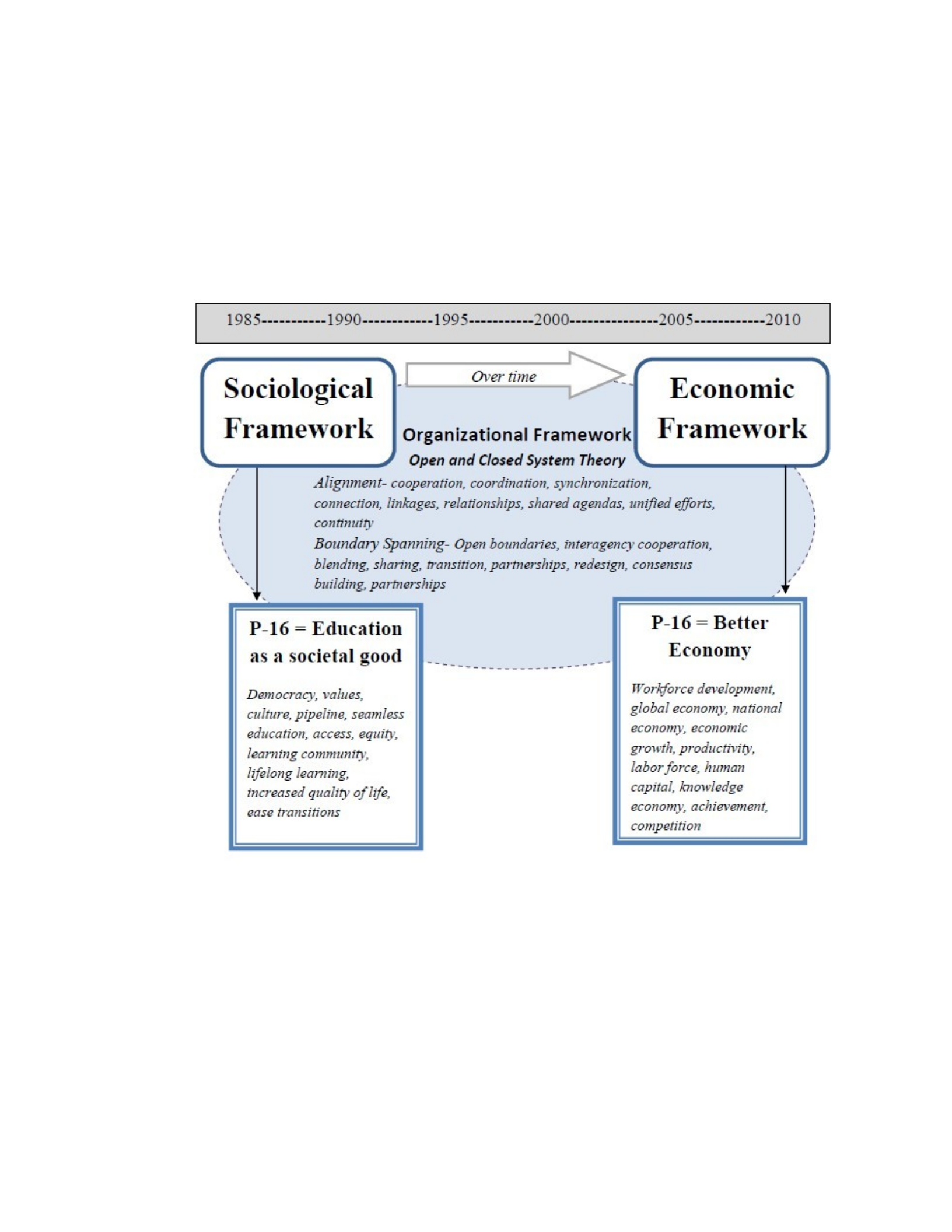
1978; Scott 1992; Lawrence and Lorsch 1967). This theoretical framework served as an
overarching conceptual tool in the analysis of P-16 advocacy and policy formation
documents.
Figure 2.1 Theoretical Framework
Using the theoretical model developed for this research, both national P-16
advocacy documents and state level P-16 legislative and policy documents of fifty states
were examined to identify discourses within the language of these documents. The
overarching conceptual tool provided a multi-perspective focus, examining two
theoretical motivations, sociological and economic, and one widespread theory of utility,

organizational systems theory. Based upon the transformation of focus in the language of
P-16 policy advocacy literature, this research aims to examine the language within P-16
policy documents to see if they also represent a shifting of motivation behind P-16
policy initiatives through the shifting of discourses.
Conclusion
In conclusion, it has been demonstrated that through the span of P-16 as an
educational reform movement, proponents have transformed the underlying discourses
from sociological constructs to economic constructs, while utilizing a strong foundational
overarching concept, organizational open system theories continually throughout.
Through this literature analysis, it is seen that reform through policy is constantly
evolving and that the formation of P-16 is also undergoing continual and progressive
transformations. This study is framed in a policy analysis lens in order to explore the
shifting of discourse throughout the policy process of P-16 initiatives. The theoretical
framework provided forms the conceptual lens through which this research project is
approached. The purpose of this study is to explore and enhance the understanding of P16
initiatives through the examination of discourse within official state level P-16 policy and
legislative documents. In the next chapter, Chapter Three, the methodology and research
design is discussed.
CHAPTER THREE

METHODOLOGY
Introduction
This dissertation research study examines the discourses of P-16 policy advocacy
and formation, explores historic shifts of these discourses, and investigates whether the
discourses of advocacy influenced the discourses of policy formation. To do this, P-16 is
viewed through a theoretical framework using policy discourse analysis as the
methodology to explore changes in the discourses of official P-16 policy and legislative
documents. In this chapter, the methodology of this dissertation research is described and
explained. First, the research questions are restated. Then, an explanation of how the
documents utilized for this dissertaion research were chosen and collected. Then a
description of the chosen qualitative software, NVivo8, as well as an accounting of the
coding process follows. Finally, the research questions are explored and anticipated
findings (hypotheses) of those questions with an explanation of how each of these
hypotheses were responded to using policy discourse analysis as the methodology.
Research Questions, Assumptions, and Hypotheses
Question One: Do the dominant discourses within the P-16 national policy advocacy
literature and the P-16 state level policy and legislative documents vary by era of
time?
Assumption I: This question begins a multilayered analysis that maps a
relationship between time, policy advocacy, and policy formation.
Assumption II: There are two time frames for each type of document being
collected. The advocacy literature started several years before policy
formation began in any state, thus accounting for the expected differences in
the early time frames. The Hodgkinson advocacy literature (1985) is the
beginning of the advocacy literature Time Era 1. Policy formation began about

three years later. Texas started P-16 legislation in 1993, Maine in 1995, and
Maryland had P-16 policy in 1996 thus setting the 1987 beginning time frame
for policy formation as a starting point.
The second time frame is established to explore the potential shifts in
discourses. This time frame is about 2002, but is flexible in that there are
some changes in levels of discourse prior to 2002. 2002 was chosen as a
starting point for the second time eras (for both advocacy and policy
formation) based on reading and previous research.
Assumption III: There is a time lag between policy advocacy and policy
formation. This lag is described in the literature and is prevalent in policy
formation studies.
Contexts:
•Advocacy Literature Time Era 1: 1985-2002
•Advocacy Literature Time Era 2: 2002-2010
•Policy Formation Time Era 3: 1987-2002
•Policy Formation Time Era 4: 2002-2010 Categories:
•Sociological Discourses
•Economic Discourses
•Organizational Discourses
Hypotheses:
1a. If the national policy advocacy documents have a published date during Time
Era 1, then the dominant discourses are more likely to be focused on sociological
discourses than economic discourses.
1b. If the national policy advocacy documents have a published date during Time
Era 2, then the dominant discourses are more likely to be focused on economic
discourses than on sociological discourses.
1c. The organizational discourses within national P-16 policy advocacy literature
have remained constant throughout Time Eras 1 and 2.
1d: If the state level P-16 policy and legislation documents are created in Time
Era 3, these documents will have dominant discourses that will be more likely to
be focused on sociological discourses than economic discourses.
1e: If the state level P-16 policy and legislation documents are created in Time
Era 4, these documents will have dominant discourses that will be more likely to
be focused on economic discourses than sociological discourses.

1f: The discourses of organizational change within state level P-16 policy and
legislation documents have remained constant throughout Time Eras 3 and 4.
Question Two: What are the relationships between time eras of P-16 and the
influence of P-16 national policy advocacy literature and P-16 policy formation
(represented by state level policy and legislation)?
A. What are the volume and frequency of P-16 policy advocacy documents
over time?
B. What are the volume and frequency of P-16 policy formation documents
over time?
C. Do the discourses of P-16 national policy advocacy literature and P-16
policy formation have influence on each other?
Assumption IV: This question and the more specific follow-up questions
examined the entry points where states became a part of the P-16 world by
creating policy or legislation. It is designed to observe how states depict P-16
through their policy/legislative language depending on their time entering into
P-16. For example, a state that started a program in the 1990s is likely have
many iterations of what P-16 ―is‖- how it‘s legislated or made into policy
over the past twenty years. It is also likely that a state that has only recently
formed a P-16 program may have skipped discourses and gone straight to
economic rationales.
Assumption V: The time frame assumptions from Question One continue here
in Question Two.
Assumption VI: Discourse analysis, by its nature, allows the researcher to
make judgments based on theory and frameworks outlined in advance by the
researcher. In this case, the theoretical framework is set up to examine any
shifting of discourses across time. The final steps of policy discourse analysis
call for the researcher to look beyond the ―counts‖ of words/phrases and to
determine the meaning of policy. Influence is used in this research to
demonstrate how the language and meaning behind the advocacy literature
may be observed in the language and meaning of policy formation.
Contexts:
•Advocacy Literature Time Era 1: 1985-2002
•Advocacy Literature Time Era 2: 2002-2010
•Policy Formation Time Era 3: 1987-2002
•Policy Formation Time Era 4: 2002-2010 Categories:

•P-16 National Policy Advocacy Literature
•P-16 State Policy and Legislation
Hypotheses:
2a: The volume (number of pages) and frequency (how often) of P-16 national
policy advocacy literature will be greater in Time Era 1 and less in Time Era 2.
2b: The volume (number of pages) and frequency (how often) of P-16 state policy
and legislation will be greater in Time Era 4 and less in Time Era 3.
2c: If a state formulated P-16 policy (through legislation or state level policy) in
Time Era 3, then the language is influenced by the language of the advocacy
literature of Time Era 1.
2d: If a state formulated P-16 policy (through legislation or state level policy) in
Time Era 4, then the language is influenced by the language of the advocacy
literature of Time Era 2.
2e: If a state formulated P-16 policy (through legislation or state level policy) in
Time Era 4, then the language is also influenced by the language of state level
policy/legislation in time Era 3.
Data Collection
For this dissertation research study, three types of documents were gathered, (1)
national P-16 policy advocacy literature; (2) P-16 state level policy documents; and (3) P-
16 state level legislative documents. Comparison between national P-16 advocacy
documents and state level P-16 formation documents is warranted because national level
policy advocacy may influence state level policy formation. States utilize national policy
advocacy documents in their rationales behind the development and formation of policy,
as evidenced by their use of these advocacy documents on their P-16 websites. These
advocacy documents are referenced and cited on the websites in suggested reference lists,
mission statements, and state level analyses of P-16 programs (or parts of programs).

The first type of document collected for this study is a representative sampling of
the national P-16 policy advocacy literature. The chosen documents met the following
criteria. They were from national policy advocacy organizations or authors associated
with these organizations. The chosen documents represent an overall P-16 agenda, not
specific parts of a P-16 agenda. For example, national organizations such as the Pew
Foundation and Education Commission of the States were consulted. However, while
they have a stake in P-16 initiatives, advocacy agendas from organizations such as the
National Federation of Teachers or NIEER were not included as they promote particular
parts of P-16 rather than the whole of P-16. While some of these policy advocacy
documents have been cited as representative of the overall policy advocacy literature in
previous chapters of this proposal, there are additional advocacy documents included in
the analysis portion of this project. State P-16 council websites were also searched for
potential documents for this project.
Documents were collected that were published during the time period 1985
(Hodgkinson 1985 as a starting point) to June 30, 2010 in order to match the exclusion
point established for the archival policy and legislative documents. Seventeen national
policy advocacy documents were selected; see table 3.1 ―Number of Advocacy
Documents by Year‖ for the breakdown. See Appendix C for a list of the national policy
advocacy documents chosen and used in this study.
Table 3.1 Number of Advocacy Documents by Year
Year Number of Advocacy Documents
1985 1
1999 2

2000 2
2001 2
2002 4
2003 1
2004 0
2005 1
2006 2
2007 0
2008 2
2009 0
2010 0
Total 17
An historical archival document search was conducted for the second type of
documents in this study. All state-level P-16 legislative documents were collected from
state level government sources. For the purposes of this study, P-16 legislation is defined
as those laws enacted by a state legislature that pertain to P-16 (or as named by the state)
initiatives. Pending bills or legislation were not included in this study as they are not final
and have no power to create practice. The search gathered documents from state-level
governments.
Legislation is publically accessible through several sources. These sources include
each state‘s legislature website, state government portals, and each state‘s law libraries.
Laws that do not explicitly mention P-16 (or the state‘s alternative name) were not
included in this study. This may have inadvertently left out some P-16 legislation. In
order to mitigate this possibility, the researcher cross-checked lists of P-16 legislation
collected on the Education Commission of the States website. In addition, each state‘s
own P-16 websites were checked for potential P-16 legislation. A total of 157 legislative
documents were discovered in twenty-four states (see Table 3.2 Number of Policy

Formation Documents by Year and Map 3.1 for a map of states with legislative
documents).
Map 3.1
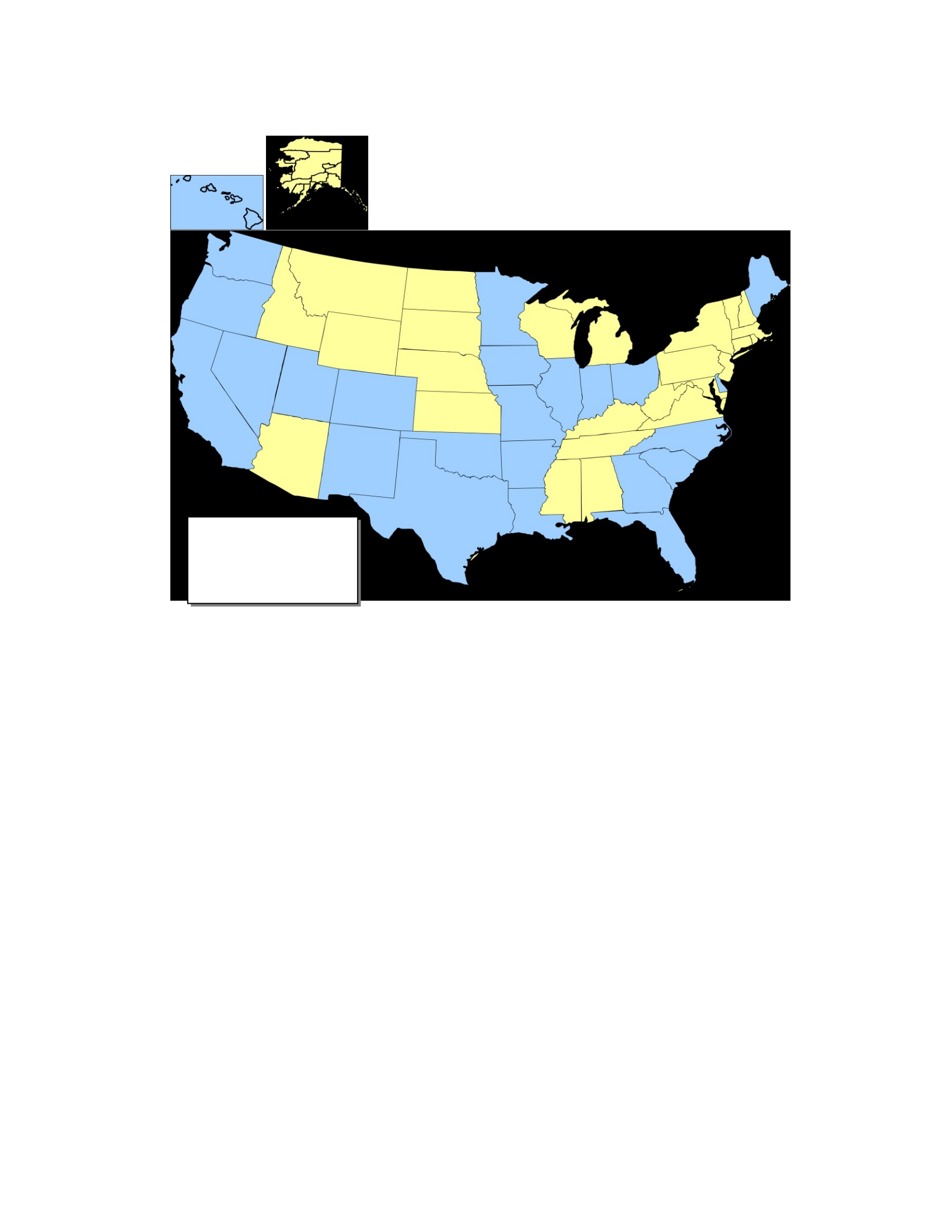
P-16 Policy Formation Documents – States with Legislative Documents
The third type of documents that were collected includes all official state level
P16 policy documents. State P-16 policy documents are defined as those that are from an
official state government education agency. Policy documents are also publically
available. An archival historical search of state government sites was used to gain access
to obtain official PDFs (or other formats) of state level P-16 policy. Searches were limited
to those policy documents that explicitly refer to P-16. This excluded policy documents
that may have included some part of the P-16 policy objectives, but are not part of an
official state agency P-16 policy. For example, if there is a state preschool policy but the
policy is not a part of a P-16 initiative, it is not included in the documents for the
proposed study. Unless these policies are explicitly included within P-16 legislation or
States with P-16
legislative
documents
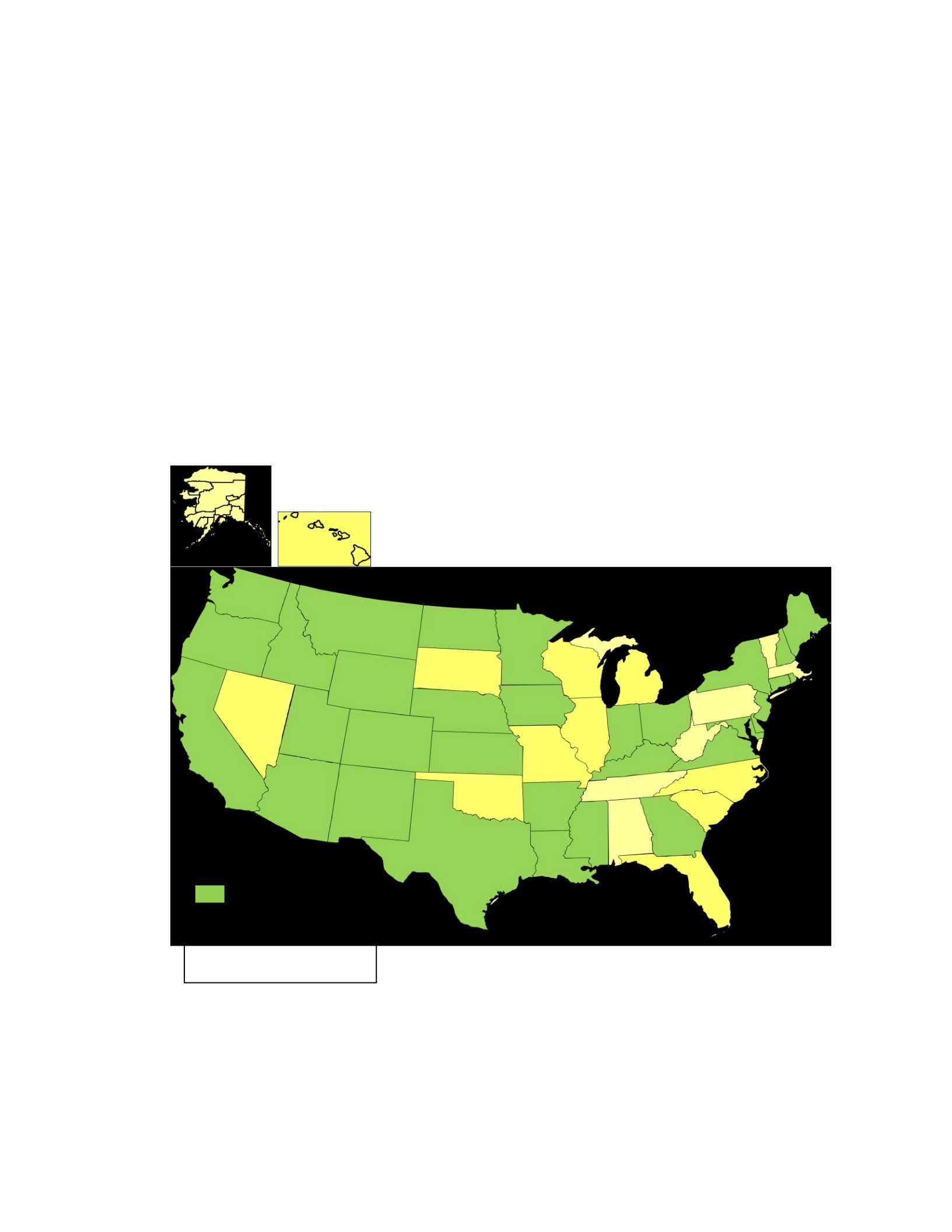
state policy, they were considered beyond the scope of this research study. A total of 89
policy documents were discovered in twenty-four states. In addition, 24 other types of
policy documents (including by laws and Governor‘s Executive Orders) were collected
from fourteen states (see Table 3.2 Number of Policy Formation
Documents by Year and Map 3.2 for a map of states with policy and other documents).
Map 3.2
P-16 Policy Formation Documents – States with Policy Documents
Previous studies have shown that the first states to implement their programs did
so in 1992 (Durand 2007; Mohker 2010) , so by searching for any legislative or policy
States with P-16
Policy, Governor’s
Executive Orders or
Bylaws

documents from 1985 and later, this research covered the relevant legislative and official
policy documents from all fifty United States. The cutoff date for inclusion of documents
was June 30, 2010. This allowed recent policies to be included but established a point of
exclusion. A total of 270 state level P-16 policy formation documents were accumulated
(Table 3.2 Number of Policy Formation Documents by Year); 157 (58%) were legislative
documents, 89 (33%) were state level policy documents, and 24 (9%) were other
(Governor‘s Executive Orders and P-16 Council By-Laws). There are documents from 39
states and they range from one page to sixty-eight pages long. The vast majority (70%) of
state level documents were dated from 2003-2010. A complete categorization and
summarization of all documents collected can be seen in Appendix B. In addition,
Appendix C contains a citation list of all collected documents.
Table 3.2
Number of Policy Formation Documents by Year
YEAR Number of
Formation
Documents
Number
of Policy
Docs
Number
of Law
Docs
Number
of Other
Docs
1985 0 0 0 0
1987 3 0 3 0
1990 1 0 1 0
1991 2 0 2 0
1993 2 0 2 0
1994 1 0 1 0
1995 3 0 3 0
1996 0 0 0 0
1997 1 0 1 0
1998 0 0 0 0
1999 2 0 2 0
2000 30 13 17 0
2001 10 7 2 1 exec
order
2002 21 7 14 0
2003 19 4 12 3 exec
order
2004 19 9 9 1 exec
order
2005 29 4 19 6 exec
order
2006 23 8 13 2 exec
order
2007 35 11 21 3 exec
order
2008 22 10 10 2 exec
order
2009 27 10 14 3 exec
order
2010 20 6 11 3 bylaws
TOTALS 270 89 157 24

Computer Aided Software- NVivo 8
Policy discourse analysis as the methodology and the qualitative software program
NVivo 8 (QSR International 2009) as the means were used to qualitatively analyze the
270 policy formation and 17 policy advocacy documents. NVivo 8 is a comprehensive
qualitative software package that assists the researcher in organizing and sorting data, as
well as supporting the coding and categorization process. Cohen, Manion, and Morrison
(2007) found that using a computer program for qualitative analysis is particularly
effective when coping with data overload and retrieval, coding, comparison, linkages, and
ultimately analysis (p 488). However, they caution that the programs do not actually
perform any analysis, but rather ―facilitate and assist it‖ (Cohen, Manion, and Morrison
2007, 489). Others (Krippendorff 2004; Miles and Huberman 1994) affirm that the
benefits of using software programs include processing large amounts of data quickly and
reliably, assistance with coding, search and retrieval within documents, offering data
display methods, and strengthening theory-building.
Coding
Once the documents for each of the fifty states were collected, categorical coding
of each document, including words in titles, table of contents, captions, sidebars,
committee membership lists, and glossaries (but not bibliographies, author names, or
appendices) occurred, utilizing the software program NVivo8. In particular, a priori
categories developed from the literature review and the theoretical model were utilized to
help guide the coding process (Neuman 2006).

Table 3.3 demonstrates the codes that were determined by this researcher through
a systematic, sentence-by-sentence, examination of P-16 policy formation documents
from two states. The first document is a state level P-16 policy document from New
Jersey (The New Jersey High School Redesign Steering Committee 2008). The second is
the legislation pertaining to P-16 from Texas (Texas Constitution and Statutes: Education
Code Sec. 7. 005- 006., Sec. 7. 010, Sec 61.001.-002., Sec 61. 076.- 0761.- 0762. 2009).
Each sentence within each of the documents was examined for any and all phrases that
could fit within the three predetermined frameworks: organizational, sociological, and
economic.
All of the words and phrases were collected and then sorted into similar coding
categories. Each of these categories was given a name. In each of these categories,
multiple words represent each theme; therefore, these are truly categorical
representations, rather than a count of a particular word. Table 3.3 represents the
categories and examples of the phrases collected within those categories. There are nine
category codes within each framework. Nine codes were chosen in order to use a
metamatrix framework (Miles and Huberman 1994). Using nine codes allows for a
comparative analysis in which ―levels of code depth‖ can be measured through even
numbers of categorical codes within each level of code depth. In this case, one to three
codes represents LO, four to six codes represents MOD, and seven to nine codes
represents HIGH. The meta-matrix gives the qualitative researcher a way to structure the
counting process beyond simple counts (Miles and Huberman 1994).
Nine codes were chosen (as opposed to 12 or 16) because when going through the
pre-coding process with the aforementioned documents, eight or nine categories appeared

in each framework. In the organizational framework, where only eight appeared after the
pre-coding process, this researcher added an organizational code, P-16 Councils, which
seemed likely to appear based on the literature review.
The coding categories were designed to help the researcher find commonalities
among the documents. In other words, find the areas where categories match up and are
common between the types of documents. The categories are based upon the previously
established theoretical model and fall under three main discourses, sociological,
organizational, or economic. These codes were applied to all three types of documents.
The coding process involved a two-step process. First, each document was read in
its entirety by this researcher. This process helps the researcher gain insight into the
overall themes and discourses that might emerge from the more detailed coding.
Documents were then downloaded into NVivo8 and a sentence-by-sentence coding was
begun. Previous studies (Durand 2010) have shown that paragraphs of differing sizes are
not a representative analysis. This is because the varying styles of policy advocacy, state
legislation, and state policy language mean that paragraph by paragraph analysis misses
the depth to which certain categories are represented. Weber (1990) explains that
sentences are often the recording units of analysis when the investigator is interested in
words or phrases that occur closely together and a sense of words with multiple meanings
might occur (p 22). He also finds that investigators might code an entire paragraph to
reduce the effort required however, this reduces the reliability of the study (Weber 1990,
23).

Upon the reading of each sentence, a determination of which (if any) codes were
apparent in the sentence. A sentence could have no codes or all of the codes could apply
to the sentence. Sentences were expected to have overlapping between codes; i.e.
sentences may fit into more than one category on the coding chart. This was handled by
coding a sentence with multiple codes. The following examples demonstrate the coding
process and how each sentence would fit within the coding categories designated.
The first example is from New Jersey (The New Jersey High School Redesign
Steering Committee 2008). The direct quote from the document is in italics. Following
this, the codes for that were assigned to the sentence are outlined and the part of the
sentence that corresponds to the coded category is listed.
The Steering Committee‘s mission was to recommend those education policy
revisions required to ensure that all students graduate from high school prepared
for work, further education and citizenship.
Coded:
•Achievement – graduate from high school
•Workforce Preparation- prepared for work
•College Readiness- prepared for … further education
•Organization- The steering committee
•Equity- all students
•Citizen- prepared for…citizenship
•Goals- mission

The second example is from Minnesota (Minnesota Law 127A.70, subdivision 13,
2009). The direct quote from the document is in italics. Then the codes and the part of the
sentence or a reason why it was coded follows.
A P-20 education partnership is established to create a seamless system of
education that maximizes achievements of all students, from early childhood
through elementary, secondary, and postsecondary education, while promoting the
efficient use of financial and human resources.
Coded:
•Pipeline- to create a seamless system of education
•Equity- all students
•Achievement- maximizes achievements
•Efficiency -while promoting the efficient use of financial and human resources
•Allocation- while promoting the efficient use of financial and human resources
•P-16 Council- A P-20 education partnership is established
•Collaboration- education partnership
•Alignment- from early childhood through elementary, secondary, and
postsecondary education
Appendix E provides another example of the coding process by showing a screen
shot of a coded document as it appears in NVivo8. For this study, each sentence in its
entirety was coded within NVivo 8 under a narrow context. This allowed for easier
analysis after the coding stage was completed because NVivo 8 has the ability display the

sentence for context and allows linkage back to entire paragraphs if more background or
context is needed. NVivo8 allows for multiple coding options in the same sentence, while
keeping track of individual code counts.
Miles and Huberman (1994) describe coding as a form of analysis because
selections are made by the researcher as to what to code for and what to exclude, based
upon chosen theoretical models, frameworks, or lenses. The coding process has some
limitations embedded within; particularly the notion that the researcher is doing little
more than counting, researcher bias, and the idea that a priori codes are the only codes
possible (Miles and Huberman 1994). However, Miles and Huberman (1994) suggest
ways to combat these hazards, such as to revisit coded material, understand that emerging
codes may occur, acknowledge potential researcher bias, and require a rigorous
examination of the data from multiple perspectives. Validity and reliability of this study
are addressed below.
Table 3.3
CODING SEARCH TERMS
CATEGORY NAME Examples of language category
Sociological
Pipeline Education continuum, pipeline(ideal), pathways, seamless system
Access Access, recruit minority students, financial assistance
Equity Equity, equal educational opportunity, bridge programs,
disadvantaged students, closing the gap, education for all,
Learning Community Learning community, 21st century skills
Lifelong Learning Lifelong learning, comprehensive education
Quality of Life Quality of Life, Sociological
Culture Culture, organizational culture, culturally sensitive
Citizenship Citizenship, civic literacy, civic engagement, voting,
democracy, Demographics
High Quality Education High quality education, quality programs
Economic
Achievement Achievement, performance indicators, degree attainment,
student assessment, graduation requirements
Efficiency Efficiency, efficient system
Effectiveness Effective
Workforce Preparation Workforce demands, highly educated workforce, jobs,
entrepreneurial experience, preparation for work
College Readiness College readiness, high school to college, college preparation
Knowledge Knowledge, skill attainment, skilled and educated workforce,
knowledge economy
Competition Global competitiveness, dissolving geographic boundaries,
competition, comparisons between states
Accountability Accountability, testing, standards
Economic Growth Brave new world, industrialized society, economic growth,
technical society
Organizational
Alignment Align, continuity, ease of transition, articulation between
systems, coordination, pipeline (concrete)
Goals Shared action agenda, strategic action plan, agreement on
expectations, mission, vision
Collaboration Unified efforts, links, partnership, cooperate, consensus
building, collaborate, coordinate people/groups
Organization Redesign, coordinate, develop infrastructure, framework for
change, governance, change of structure
P-16 Council P-16 council (or the name that the state uses)
Allocate Reallocate, shared budgets, funding, resources
Communication Exchange information, communicate, report, share
Boundary Organizational boundaries, borders, challenges, difficulties
Evaluation of Programs Evaluation of programs
Reliability, Validity and Potential Biases of Project
In order to assess the validity and reliability of the coding framework a collection
of passages from a sample of all three types of documents was accumulated. In order to
address potential vulnerabilities in this study (Miles and Huberman 1994), several steps
were taken. First, the data was examined from multiple perspectives. Several chosen
paragraphs from the policy formation documents were coded by two other doctoral
students in the department after they were trained in coding techniques and expectations.
An 85-90% inter-rater reliability was achieved.
Second, the researcher was open to the potential for emerging codes and coded all
documents with codes that emerged. However, there were no codes that emerged that
were critical to this research study, so they have been saved for future studies. Third, this
researcher acknowledges that the a priori coding scheme can be a source of researcher
bias. This potential bias was combated by collecting emerging codes and examining those
codes for potential importance to this study. Finally, coded material was revisited. Ten
percent of the documents were randomly sampled for recoding and that recoding was
measured for reliability. The inter-rater reliability for the recoding process was 93-100%.

In addition, in order to meet the requirements of the Institutional Review Board
(IRB) of University at Albany, SUNY, the researcher has completed the CITI training and
submitted this project to IRB for review. Because this research does not include any
human subjects and involves only documents that are accessible in the public domain, an
expedited approval from IRB has been given. This letter has been copied and attached in
Appendix D.
While this project was designed to eliminate as many potential biases as possible,
the nature of the project introduces a few biases that are discussed here. The sampling
process, although designed to include all P-16 policy formation documents, potentially
excludes some documents due to the restrictions set by the researcher. In particular, not
including policy or legislation that is potentially used by P-16 committees or councils but
has not been labeled P-16 could introduce some bias. This is likely to occur in states that
have firmly established programs, such as a statewide preschool program, but the
program is not explicitly and unambiguously linked to P-16 in policy or legislation. This
research has been set up to match the policy advocacy literature which talks about
explicitly linking all parts of a P-16 system.
Research Questions- Analyses and Hypotheses
This section contains a description of how each research question was examined.
Then, anticipated findings of that question are described. The first step, following coding,
was to include qualitative descriptions of the found discourses. This first step detailed the
existence (or not) of any discourses. In order to do this, a meta-matrix was used for
analysis. Miles and Huberman (1994) define a case ordered meta- matrix as an analysis

problem that sorts and demonstrates the cases to show the data for each variable across all
cases. The effects can be clustered in order to more easily exhibit the potential results.
This type of matrix is appropriate for making comparisons and contrasts, noting relations
between variables including patterns and themes (p 190).
In the case ordered meta- matrix developed for this study (see Meta-Matrix One:
Existence of Codes within Documents), each document was considered one case. The
cases were ordered by date (earliest to latest). A classification of each coding category
was entered in the cells of the meta-matrix, a 1 if the key term is present in the document
and a 0 if it is not. This first step provides a record of discourse representation within
each case/document.
In the next step, this researcher performed an assessment to determine the depth of
the three types of discourses (sociological, economic, and organizational) in each
document. Miles and Huberman (1994) describe researcher assessment within qualitative
analysis to include notation of relationships between variables, counting, and evaluating
strengths based on prior knowledge and literature searches. In this study, a scaled rating
to represent the presence of key terms within documents was a priori created by this
researcher based upon study of discourse policy analysis (deLeon 1998; vanDijk 1997)
and literature and theoretical reviews in Chapters Two. For each document, a scaled
rating was assigned for the three types of discourses (Miles and Huberman 1994) based
on the following scale:
High Presence of 7-9 key terms- high level of discourse in document
Moderate Presence of 4-6 key terms- medium level of discourse in document
Low Presence of 1-3 key terms- low level of discourse in document

None Presence of 0 key terms- none- discourse not present in document
Thus, each document receives three scores, a discourse level for sociological
discourses, a discourse level for economic discourses, and a discourse level for
organizational discourses. (An example of the meta-matrix and the scoring process is
available in Appendix F).
Discursive depths were found by using the meta-matrix and determining whether
a code exists in the document. If it did, regardless of how much it exists, it was labeled 1.
There are nine potential discourses found in each discourse category. Thus, nine
sociological discourses, nine economic discourses, and nine organizational discourses
were examined. It follows then that each document has a potential score of 0-9 in each of
three measured discourses.
Once all the documents were analyzed individually and the entire meta-matrix
was filled in, the next step involved creating a timeline of discourse levels. This was
easily captured in the policy advocacy documents. However, because of the sheer
numbers of policy formation documents in each year, it is difficult to see the trend of
discourses over the course of twenty-five years. To alleviate this problem, a measure to
capture average annual discourses for the state level policy formation documents was
created. Average annual discourses levels give a portrait of the trend by year. This process
involved separating the documents by year and then taking the levels of discourse for
each document within a year and creating an average. As an example, in the year 2001 the
discourse levels of all of the documents (n=11) from that year were determined first. Each
document received a score of 0-9 for sociological discourses, 0-9 for economic

discourses, and 0-9 for organizational discourses. Then an average sociological score for
2001 was created by summing the sociological scores across the 11 documents and
dividing the total by 11. The same process was repeated to get an average economic
discourse score and an average organizational score for 2001. This process continued for
every year over the twenty-five year time frame- generating average annual discourse
levels for the policy formation documents. This process is demonstrated in Appendix F.

Table 3.4
Meta-Matrix One -Existence of Codes within Documents
Cases/ Documents Earliest
(1995)
→ → Latest
(2010)
P-16 Discourses Case 1 Case 2 … Case N
SOCIOLOGICAL
Access y/n y/n y/n y/n
Citizenship y/n y/n y/n y/n
Culture y/n y/n y/n y/n
Equity y/n y/n y/n y/n
High Quality Education y/n y/n y/n y/n
Learning Community y/n y/n y/n y/n
Lifelong Learning y/n y/n y/n y/n
Pipeline y/n y/n y/n y/n
Quality of Life y/n y/n y/n y/n
Discourse Level/Research Assessment H/M/L/N H/M/L/N H/M/L/N H/M/L/N
ORGANIZATIONAL
Alignment y/n y/n y/n y/n
Allocation y/n y/n y/n y/n
Boundary y/n y/n y/n y/n
Collaboration y/n y/n y/n y/n
Communication y/n y/n y/n y/n
Evaluation of Programs y/n y/n y/n y/n
Goals y/n y/n y/n y/n
Organization y/n y/n y/n y/n
P16 Council y/n y/n y/n y/n
Discourse Level/Research Assessment H/M/L/N H/M/L/N H/M/L/N H/M/L/N
ECONOMIC
Accountability y/n y/n y/n y/n
Achievement y/n y/n y/n y/n
College Readiness y/n y/n y/n y/n
Competition y/n y/n y/n y/n
Economic Growth y/n y/n y/n y/n
Effective y/n y/n y/n y/n

Efficient y/n y/n y/n y/n
Knowledge y/n y/n y/n y/n
Workforce Preparation y/n y/n y/n y/n
Discourse Level/Research Assessment H/M/L/N H/M/L/N H/M/L/N H/M/L/N
Research Questions
Question One
Do the dominant discourses within the P-16 national policy advocacy literature and
the P-16 state level policy and legislative documents vary by era of time?
This question started the multilayered analysis to examine a mapping of a relationship
between time, policy advocacy, and policy formation. In order to answer this question the
analysis took several steps. First, a timeline mapping of each document, advocacy and
policy formation, occurred. This timeline laid out each document by year, from 1985 to
2010, giving a picture of the frequency of occurrence of each type of document over time.
A second timeline mapped three levels of discourse, sociological, economic, and
organizational. The scaled researcher analysis was then layered into this analysis to
determine depth of discourse within documents over time.
Anticipated Findings for Question One
•Advocacy Literature Time Era 1: 1985-2002
•Advocacy Literature Time Era 2: 2002-2010
•Policy Formation Time Era 3: 1987-2002
•Policy Formation Time Era 4: 2002-2010
Hypotheses:
1a. If the national policy advocacy documents have a published date during Time
Era 1, then the dominant discourses is more likely to be focused on sociological
discourses than economic discourses.

1b. If the national policy advocacy documents have a published date during Time
Era 2, then the dominant discourses is more likely to be focused on economic
discourses than on sociological discourses.
1c. The organizational discourses within national P-16 policy advocacy literature
have remained constant throughout Time Eras 1 and 2.
1d: If the state level P-16 policy and legislation documents are created in Time
Era 3, these documents will have dominant discourses that are more likely to be
focused on sociological discourses than economic discourses.
1e: If the state level P-16 policy and legislation documents are created in Time
Era 4, these documents will have dominant discourses that are more likely to be
focused on economic discourses than sociological discourses.
1f: The discourses of organizational change within state level P-16 policy and
legislation documents have remained constant throughout Time Eras 3 and 4.
Question Two
What are the relationships between time eras of P-16 and the influence of P-16
national policy advocacy literature and P-16 policy formation (represented by state
level policy and legislation)?
A. What are the volume and frequency of P-16 policy advocacy documents
over time?
B. What are the volume and frequency of P-16 policy formation documents
over time?
C. Do the discourses of P-16 national policy advocacy literature and P-16
policy formation have influence on each other?
This question and the more specific follow-up questions examined the entry points
where states become part of the P-16 world by creating policy or legislation. It was
designed to observe how states depict P-16 through their policy/legislative language
depending on their time entering into P-16. For example, a state that started a program in
the 1990s is likely have many iterations of what P-16 ―is‖- how it‘s legislated or made
into policy over the past twenty years. It is also likely that a state that has only recently

formed a P-16 program may have skipped discourses and gone straight to economic
rationales. In order to answer Research Question Two (and its sub questions), this
research took the following steps. For Part A- a count of page numbers and timeline
occurrences created a volume and frequency of all types of documents studied in this
project. This provides the researcher and reader with some background of what is
happening in P-16 policy advocacy and formation in the United States. This counting
(and charting of) the documents volume and frequency formulates the response to
hypotheses 2a and 2b. Below are the predicted outcomes of this question.
In order to respond to part B, this researcher conducted an in- depth policy
discourse analysis based upon the findings from the data of P-16 discourses within the
P16 policy advocacy, legislative, and policy documents (Miles and Huberman 1994). This
historical analysis examined the chronology of discourses in state level P-16 legislation
and policy. The narrative of this historical process involved noting patterns of discourse
shifts and relationships between cases in order to extrapolate the ways that the dominant
discourses of P-16 shape the realities of P-16 for the states. In order to determine any
shifting of discourses or any potential influence of discourses from one type of policy to
another (advocacy influencing formation perhaps), the researcher used policy discourse
analysis. Discourse analysis, by its nature, allows the researcher to make judgments based
on theory and frameworks outlined in advance by the researcher. In this case, the
theoretical framework was set up to examine any shifting of discourses across time. The
final steps of policy discourse analysis call for the researcher to look beyond the
―counts‖ of words/phrases and to determine the meaning of policy. Influence is used in
this research to demonstrate how the language and meaning behind the advocacy

literature may be observed in the language and meaning of policy formation. It also
allows this researcher to determine if the expected findings in hypotheses 2C-2E are
valid. Further discussion of this question continues in Chapter Five.
Anticipated Findings for Question Two
•Advocacy Literature Time Era 1: 1985-2002
•Advocacy Literature Time Era 2: 2002-2010
•Policy Formation Time Era 3: 1987-2002
•Policy Formation Time Era 4: 2002-2010
Hypotheses:
2a: The volume (number of pages) and frequency (how often) of P-16 national
policy advocacy literature is greater in Time Era 1 and less in Time Era 2.
2b: The volume (size and number of pages) and frequency (how often) of P-16
state policy and legislation is greater in Time Era 4 and less in Time Era 3.
2c: If a state formulated P-16 policy (through legislation or state level policy) in
Time Era 3, then the language is influenced by the language of the advocacy
literature of Time Era 1.
2d: If a state formulated P-16 policy (through legislation or state level policy) in
Time Era 4, then the language is influenced by the language of the advocacy
literature of Time Era 2.
2e: If a state formulated P-16 policy (through legislation or state level policy) in
Time Era 4, then the language is also influenced by the language of state level
policy/legislation in time Era 3.
Summary
In summary, this study employed policy discourse analysis as a methodology

and utilized the qualitative software program NVivo8 as the means to explore and
examine constructs and context of the language of P-16 policy. This study focused on
investigating the historical transformation of discourse over the lifetime of P-16 policy
advocacy and formation. A priori coding schemes were based upon previous literature
reviews and theoretical foundations found in Chapter Two. Two hundred and eightyseven
documents were found and coded on a sentence-by-sentence basis. In the next chapter,
findings from analysis are presented.

CHAPTER FOUR FINDINGS PART ONE
Introduction
This study examined the shift of discourses of P-16 through the examination of
language of both policy advocacy literature and policy formation documents. A
multitheoretical framework was developed in order to set the context for the analysis.
This theoretical framework involves three primary perspectives: (1) sociological
framework; (2) organizational framework; and (3) economic framework. In this chapter,
the results and findings from this analysis are explored and answers to the previously laid
out research questions are expounded upon. These questions are:
Question One: Do the dominant discourses within the P-16 national policy advocacy
literature and the P-16 state level policy and legislative documents vary by era of
time?
Question Two: What are the relationships between time eras of P-16 and the
influence of P-16 national policy advocacy literature and P-16 policy formation
(represented by state level policy and legislation)?
A. What are the volume and frequency of P-16 literature and policy over
time?
B. Do the discourses of P-16 national policy advocacy literature and P-16
policy formation have influence on each other?
This chapter responds to each question and its corresponding hypotheses in
sequence. A synopsis of findings is presented at the end of the chapter. A discussion of
analysis and implications follows in Chapter Six.

Question One Findings
Question One: Do the dominant discourses within the P-16 national policy advocacy
literature and the P-16 state level policy and legislative documents vary by era of
time?
In order to examine the relationships between time, policy advocacy, and policy
formation, several steps were taken. In the first step, a meta-matrix which lays out both
time and type of policy document (advocacy vs. formation) was developed. This process
made possible the development of a timeline of frequencies of pre-established discourses
within the policy documents. In addition, a mapping of the existence of documents was
undertaken.
The P-16 advocacy documents sampled to represent this category were
predominantly found to be published during the five year span from 1999-2003. 65% of
the sampled advocacy documents were published during this five year span (see Graph
4.1). In contrast, the five year span that encompasses the greatest number of policy
formation documents is 2005-2009. Fifty-one percent of the policy formation documents
were dated during this time period (see Graph 4.2). This finding is expected because the
literature review indicated that policy advocacy leads to policy formation, with a lag time
between them. Thus, it is found that the period of greatest P-16 policy formation is about
2 years behind the period of greatest P-16 policy advocacy.
Graph 4.1
P-16 Sampled Policy Advocacy Documents
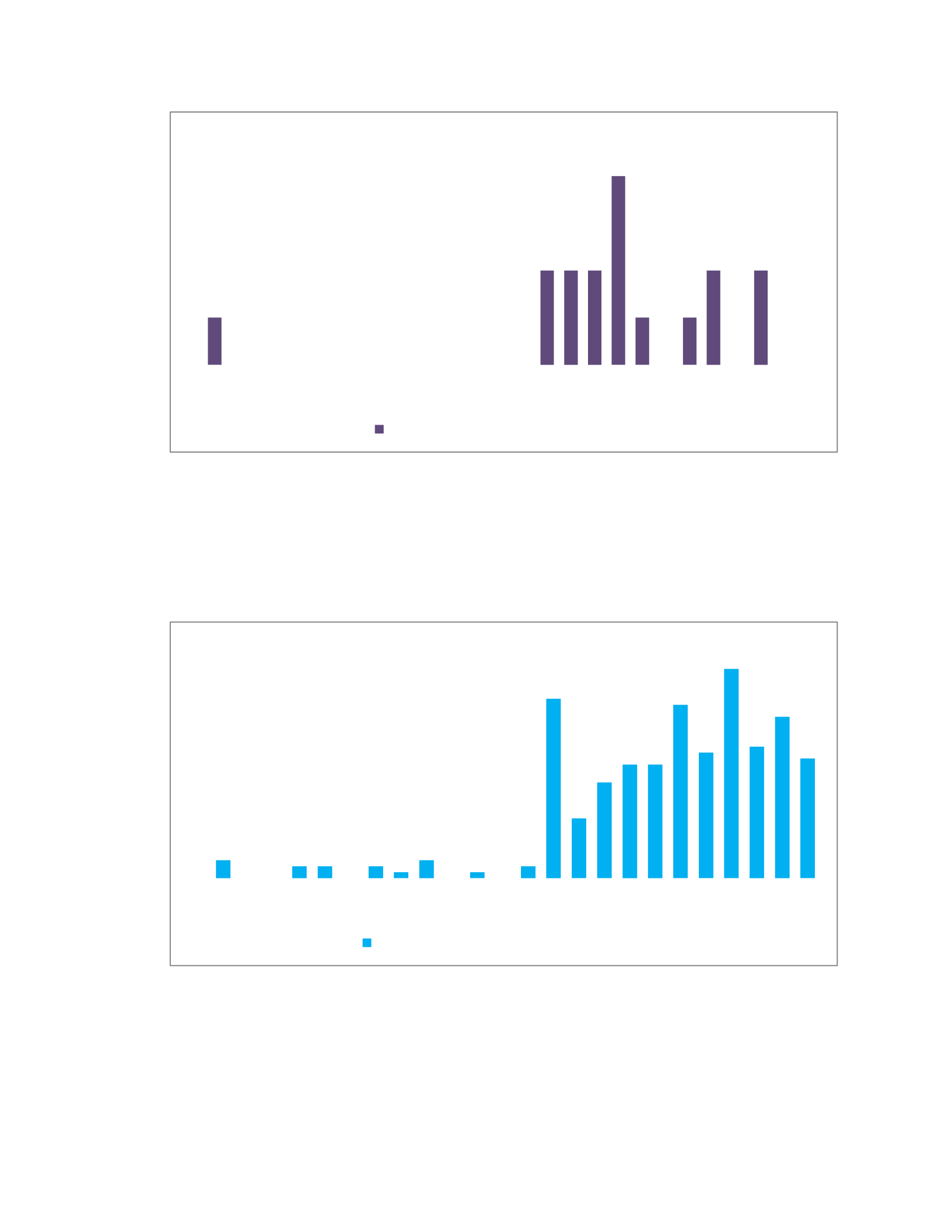
Graph 4.2
Total P-16 Policy Formation Documents
The next step in the analyses involved the mapping of coded discourses over the
twenty-five year time span. Two maps were developed- one for policy advocacy
0
1
2
3
4
5
1985
1986
1987
1988
1989
1990
1991
1992
1993
1994
1995
1996
1997
1998
1999
2000
2001
2002
2003
2004
2005
2006
2007
2008
2009
2010
Number of Advocacy Documents (n=17)
0
5
10
15
20
25
30
35
40
1987
1988
1989
1990
1991
1992
1993
1994
1995
1996
1997
1998
1999
2000
2001
2002
2003
2004
2005
2006
2007
2008
2009
2010
Total Policy Formation Documents (n = 270)

documents and one for policy formation documents. These maps show the comparison of
the three discourses, sociological, organizational, and economic, that occur in the P-16
policy formation and advocacy documents. As described in Chapter Three, discursive
depths were found by using a meta-matrix (see Appendix F for example) and determining
whether a code exists in the document. If it did, regardless of how much it exists, it was
labeled 1. There are nine potential discourses found in each discourse category. Thus,
nine sociological discourses, nine economic discourses, and nine organizational
discourses were examined. It follows then that each document has a potential score of 0-9
in each of three measured discourses. Average annual discourses were taken for the policy
formation documents to portray the annual trends. Graph 4.3 (P-16 Policy Advocacy
Documents Average Annual Discourses) demonstrates the average discourses found in the
P-16 advocacy formation documents in each year, from 1985- 2010. Graph 4.4 (P-16
Policy Formation Documents Average Annual Discourses) demonstrates the average
annual discourses found in the P-16 policy formation documents, from 1987- 2010. A
more detailed examination of data points follows below in response to the predetermined
hypotheses.
Graph 4.3
P-16 Policy Advocacy Documents Average Annual Discourses
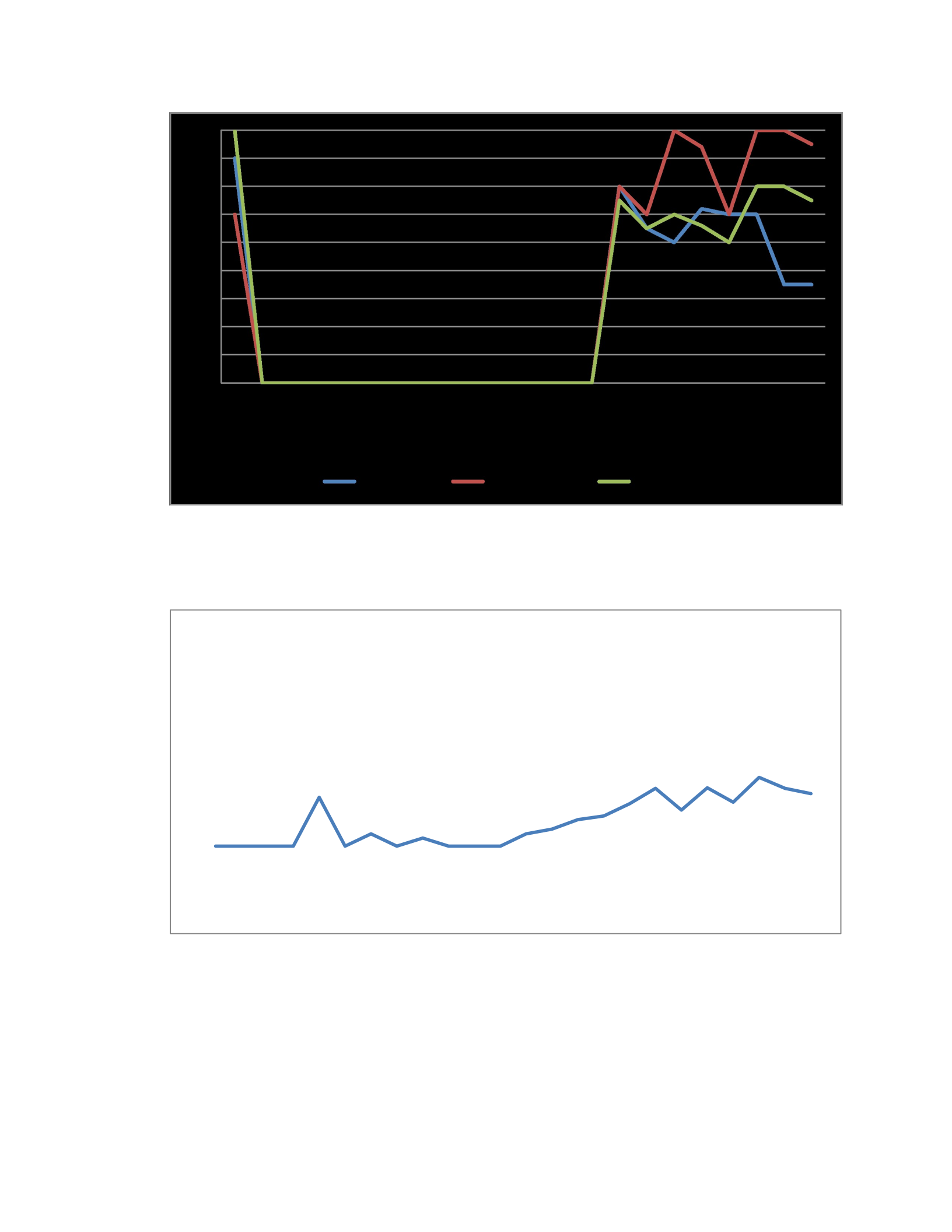
Graph 4.4a
P-16 Policy Formation Documents Average Annual Sociological Discourses
Graph 4.4b
P-16 Policy Formation Documents Average Annual Economic Discourses
0
1
2
3
4
5
6
7
8
9
1987
1988
1989
1990
1991
1992
1993
1994
1995
1996
1997
1998
1999
2000
2001
2002
2003
2004
2005
2006
2007
2008
2009
2010
SOCIOLOGICAL
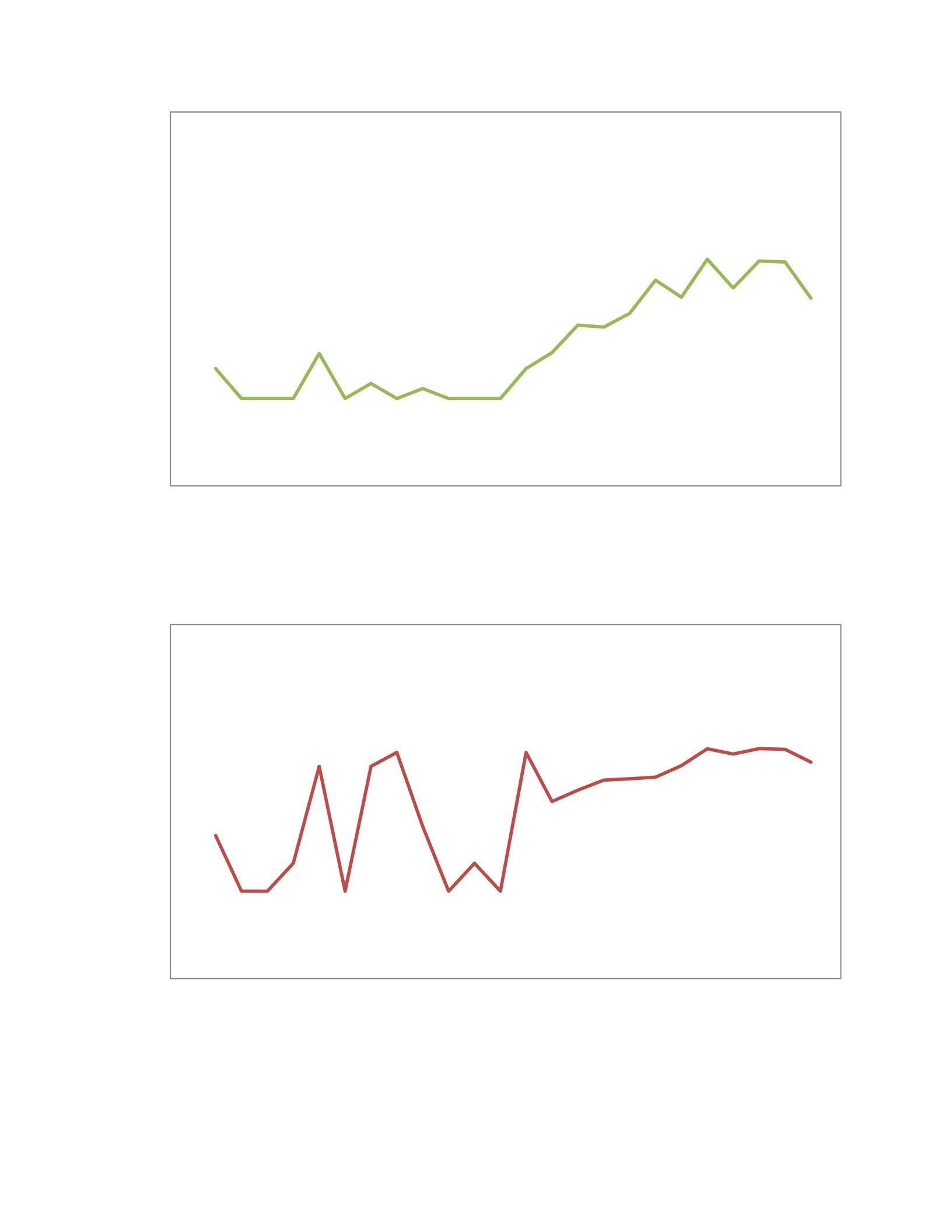
Graph 4.4c
P-16 Policy Formation Documents Average Annual Organizational Discourses
Graph 4.4
0
1
2
3
4
5
6
7
8
9
1987
1988
1989
1990
1991
1992
1993
1994
1995
1996
1997
1998
1999
2000
2001
2002
2003
2004
2005
2006
2007
2008
2009
2010
ECONOMIC
0
1
2
3
4
5
6
7
8
9
1987
1988
1989
1990
1991
1992
1993
1994
1995
1996
1997
1998
1999
2000
2001
2002
2003
2004
2005
2006
2007
2008
2009
2010
ORGANIZATIONAL
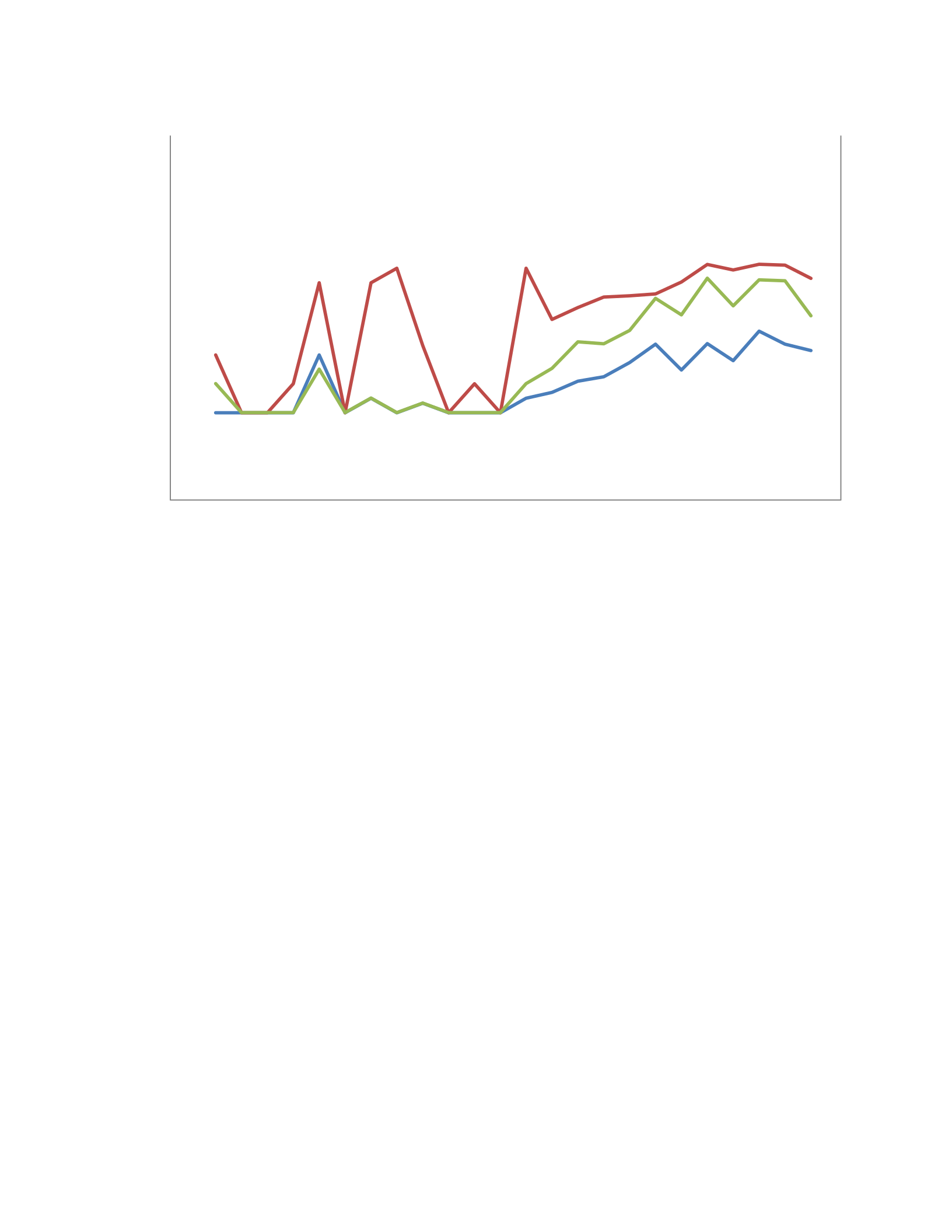
P-16 Policy Formation Documents Average Annual Discourses
Analysis of coding of the P-16 documents found that an important distinction
between the discourses of P-16 policy advocacy and that of P-16 policy formation
emerged. In each of the advocacy documents sampled, all three expected discourses
(sociological, economic, and organizational discourses) were present at some level.
However, the policy formation documents differed greatly in terms of their discursive
levels. It was found that most in the policy formation documents (98%) had
organizational discourses. This is not surprising because policy and legislative formation
documents are geared to the development and establishment of policy. Organizational
discourses often speak to a practical set of discourses which explore the set of actions or
plans for the establishment of a program or policy.
0
1
2
3
4
5
6
7
8
9
1987
1988
1989
1990
1991
1992
1993
1994
1995
1996
1997
1998
1999
2000
2001
2002
2003
2004
2005
2006
2007
2008
2009
2010
SOCIOLOGICAL ORGANIZATIONAL ECONOMIC

Economic discourses were found in 80% of the policy formation documents.
Although this represents a vast majority of documents, it was still surprising that
economic discourses did not appear in more of the formation documents. Although
strong levels of economic discourses were not expected in all documents over the
twentyfive year time frame, based on the presence of economic discourses throughout the
historic span of advocacy literature, it was expected that some level economic discourse
would be present in all documents.
In another surprising finding, only 39% of the policy formation documents had
any sociological discourses. This was unexpected, as sociological discourses remained
prevalent throughout the advocacy documents and it was expected that more sociological
discourses would be found.
Question One Hypotheses
Hypothesis 1a
Hypothesis 1a: If the national policy advocacy documents have a published date during
Time Era 1 [1985-2002], then the dominant discourses are more likely to be focused on
sociological discourses than economic discourses.
Seventeen P-16 policy advocacy documents were purposively sampled for this
analysis. As previously stated, these documents were chosen based upon their impact on
P-16 based on citations in (1) other advocacy documents; (2) state level P-16 documents
(i.e. mission statements, information about state level P-16 programs); and (3) reports or
articles about P-16 program analyses. As expected, and as demonstrated in Graph 4.5 (P16
Advocacy Documents Sociological and Economic Average Annual Discourses), 55% of

the documents within the 1985-2002 (Era 1) time period were rated slightly higher on
sociological discourses than they were on economic discourses. A score of nine was the
highest rating given for any document‘s discourse level. In the given time frame, 55% of
the documents (n=11) rated HIGH (received a score of 7-9) on the sociological discourse
scale, while only 45% of the same documents rated HIGH on the economic discourse
scale. The linear trend lines in Graph 4.5 show the relative stability of the economic
discourses of the advocacy documents, with the trend line decreasing slightly over the
time period 1985 to 2002. However, the linear sociological trend line shows a definitive
decrease in sociological discourses over this time, starting in the HIGH range and ending
in the MOD discourse scale.
The unexpected finding of this time frame is that the economic discourses of the
earliest P-16 policy advocacy documents were more evident than they were expected to
be. Early policy advocacy documents utilized economic rationales within the discourses
nearly on parity with the amount of sociological discourses. In fact, economic discourses
remained a relatively steady presence throughout the P-16 policy advocacy documents
included in this study.
Graph 4.5

P-16 Advocacy Documents Sociological and Economic Average Annual Discourses
1985- 2010
Hypothesis 1b
Hypothesis 1b: If the national policy advocacy documents have a published date during
Time Era 2 [2003-2010], then the dominant discourses are more likely to be focused on
economic discourses than on sociological discourses.
As expected, 83% of the documents within the 2003-2010 time period (Time Era
2) were rated higher on economic discourses than they were on sociological discourses.
As before, a score of nine was the highest given rating in any one document‘s discourse
level. In the given time frame, 50% of the documents rated HIGH (7-9) on the economic
discourse scale, while the other 50% rated MOD (4-6) on the economic discourse scale.
In contrast, 67% of the documents rated MOD on the sociological discourse scale, the
highest score achieved during Time Era 2. The linear trend lines in Graph 4.5 show the
relative stability of the economic discourses of the advocacy documents, with the trend
0
1
2
3
4
5
6
7
8
9
1985 {n=1}
1986
1987
1988
1989
1990
1991
1992
1993
1994
1995
1997
1998
1999 {n=2}
2000 {n=2}
2001 {n=2}
2002 {n=4}
=1}
n
2003 {
2004
2005 {n=1}
2006 {n=2}
2007
2008 {n=2}
2009
2010
Sociological Economic Linear (Sociological) Linear (Economic)

line decreasing slightly over the time period 2003 to 2010. However, the linear
sociological trend line shows a definitive decrease in sociological discourses over this
time, starting in the MOD range and ending in the LOW discourse scale.
Hypothesis 1c
Hypothesis 1c: The organizational discourses within national P-16 policy advocacy
literature have remained consistent throughout Time Eras 1 and 2 [1985-2010].
As expected based on the literature search of P-16 policy, the analysis
demonstrates a generally stable level of organizational discourse throughout 1985-2010
(Time Eras 1 and 2). As demonstrated in Graph 4.6 (P-16 Advocacy Documents Average
Annual Organizational Discourses), the sampled P-16 advocacy documents are most
likely to be rated HIGH on the organizational discourse scale. In the 1985-2010
timeframe, 76% rated HIGH on the organizational scale, with 100% of the average annual
organizational discourses scored at MOD or HIGH. The linear organizational trend line
shows an increasing trend of organizational discourse over time, with the trend line
showing an increase from the MOD scale of 6 over time to the HIGH scale of 9.
Graph 4.6
P-16 Advocacy Documents Average Annual Organizational Discourses 1985-2010
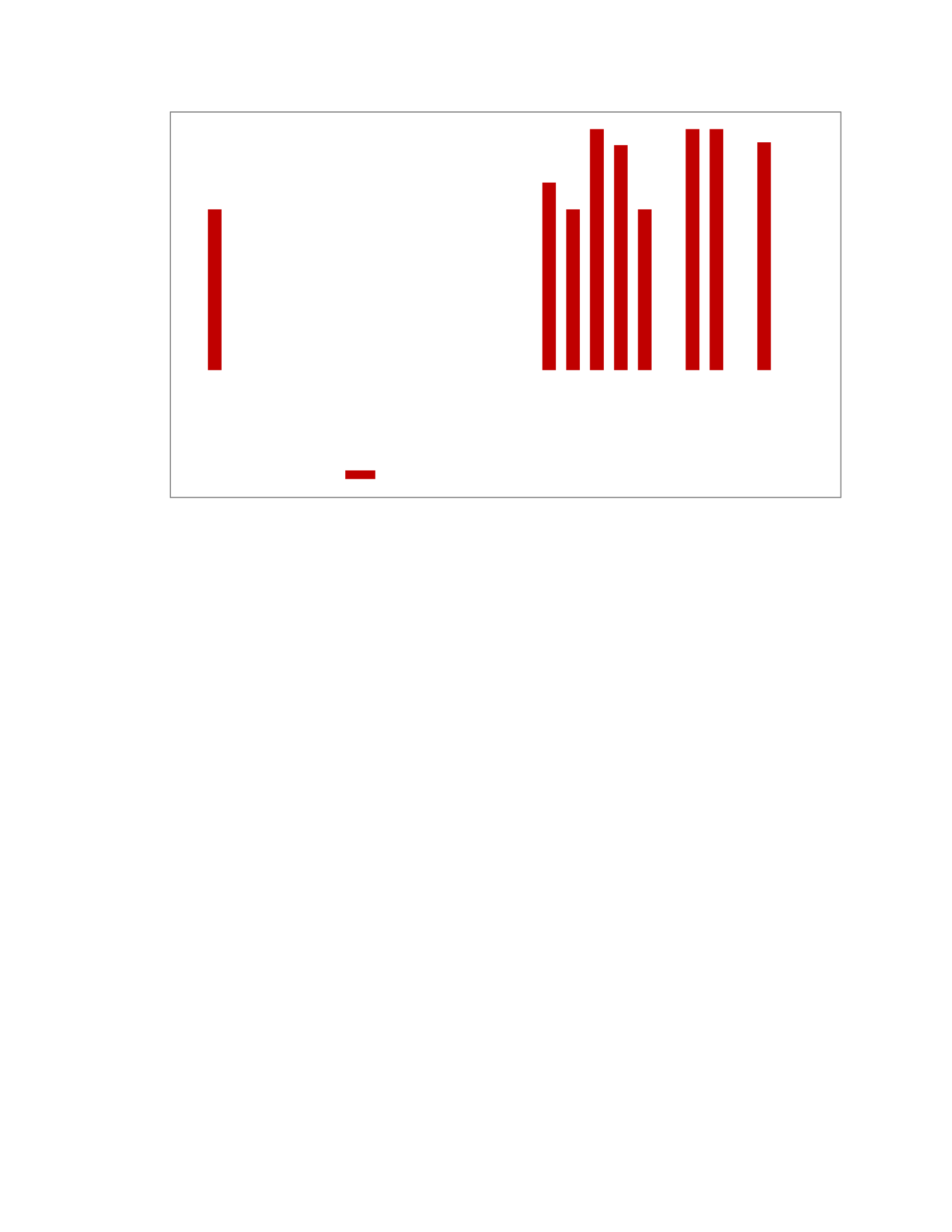
Hypothesis 1d
Hypothesis 1d: If the state level P-16 policy and legislation documents are created in
Time Era 3 [1987-2002], these documents will have dominant discourses that are more
likely to be focused on sociological discourses than economic discourses.
The expected outcome was not found for this hypothesis. In examining Time Era
3 [1987-2002], very few policy formation documents were found prior to 2000. From
1987- 1999, there were fifteen P-16 policy formation documents from 7 states. In
contrast, from 2000-2002, sixty-one P-16 policy formation documents from 12 states
were found. Average annual discourse levels for sociological and economic discourses
can be seen in Graph 4.7 (P-16 Policy Formation Documents Average Annual
Sociological and Economic Discourses 1987-2002).
Prior to 2000, the average levels of sociological discourse and economic discourse
in the P-16 policy formation documents are generally the same; i.e. NONE (no evidence
0
1
2
3
4
5
6
7
8
9
1985 {n=1}
1986
1987
1988
1989
1990
1991
1992
1993
1994
1995
1996
1997
1998
1999 {n=2}
2000 {n=2}
2001 {n=2}
2002 {n=4}
n
2003 {
=1}
2004
2005 {n=1}
2006 {n=2}
2007
2008 {n=2}
2009
2010
Organizational Linear (Organizational)

of any sociological discourses in the document) or LOW (scored 1-3). The average annual
levels of sociological and economic discourses are LOW throughout Time Era 3 [1987-
2002], with no average discourse level score rising above a scaled score of 2.5 (out of 9)
in any year. A close look at individual documents reveals that all fifteen documents dated
prior to 2000 scored either LOW or NONE in economic and sociological discourses. A
slight increase of average annual economic discourses over sociological discourses can be
found in 1987. A detailed examination of the data points reveals three documents found in
1987 with no sociological discourses in any of them and only one had any economic
discourses with a low level score of 3.
However, in 1999, a trend emerges and the level of economic discourses begins to
outpace the level of sociological discourses in the P-16 policy formation documents. In
the years 2000-2002, the average annual levels of economic and sociological discourses
remain low, but steadily increasing. Examining the documents in these years in depth, it
is found that the documents are dominantly scored NONE or LOW in sociological
discourses (90% of the scores were either NONE or LOW). In contrast, while the
documents are also primarily scored LOW or NONE in economic discourses (77% of
documents scored LOW or NONE), more economic discourses are starting to emerge-
10% scored HIGH on the economic discourse scale and 13% had MOD scores. As seen in
Graph 4.7, from 1999-2002 economic discourses are generally scaled twice as much as
sociological discourses.
Graph 4.7a
P-16 Policy Formation Documents
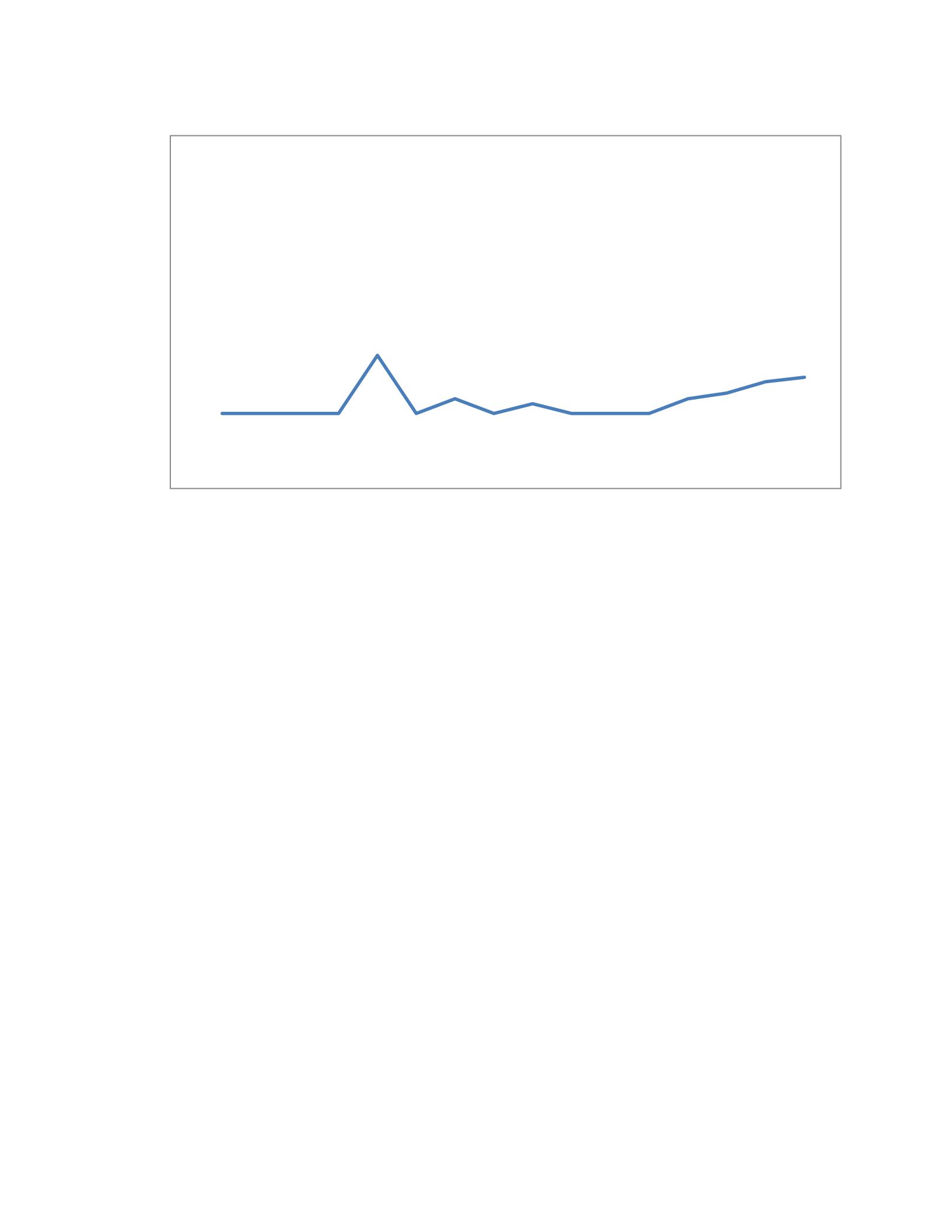
Average Annual Sociological Discourses 1987-2002
Graph 4.7b
P-16 Policy Formation Documents Average Annual Economic Discourses 1987-2002
0
1
2
3
4
5
6
7
8
9
1987 1988 1989 1990 1991 1992 1993 1994 1995 1996 1997 1998 1999 2000 2001 2002
SOCIOLOGICAL
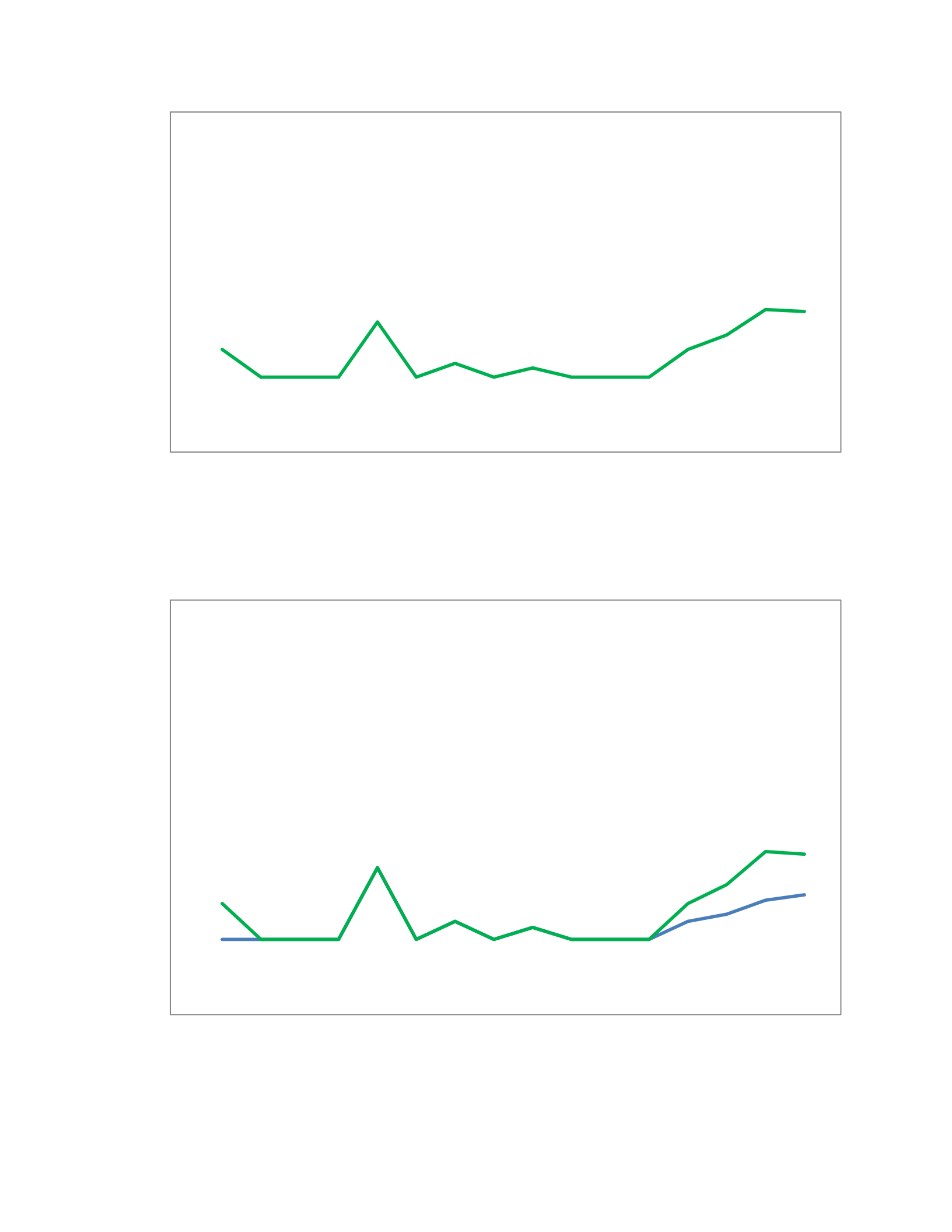
Graph 4.7
P-16 Policy Formation Documents Average Annual Sociological and Economic
Discourses 1987-2002
0
1
2
3
4
5
6
7
8
9
1987 1988 1989 1990 1991 1992 1993 1994 1995 1996 1997 1998 1999 2000 2001 2002
ECONOMIC
0
1
2
3
4
5
6
7
8
9
1987 1988 1989 1990 1991 1992 1993 1994 1995 1996 1997 1998 1999 2000 2001 2002
SOCIOLOGICAL ECONOMIC

Hypothesis 1e
Hypothesis 1e: If the state level P-16 policy and legislation documents are created in
Time Era 4 [2003-2010], these documents will have dominant discourses that are more
likely to be focused on economic discourses than sociological discourses.
In Time Era 4, Hypothesis 1e is upheld. As Graph 4.8 (P-16 Policy Formation
Documents Annual Average Sociological and Economic Discourses 2003-2010) shows,
the P-16 policy formation documents are more likely to be focused on economic
discourses than they are on sociological discourses. There are 209 P-16 policy formation
documents dated 2003-2010 from thirty-nine of the fifty United States. During this time
period, the average annual coded score of the formation documents is generally two
scaled points higher in economic discourses than it is in sociological discourses
throughout this time period. The average annual levels of discourse remain relatively
steady over this seven year period. The average annual economic discourse level is MOD
throughout this time, fluctuating between a score of 3 and 4.5, with a very slight trend up
over time. The average annual sociological discourse continues its steady LOW course,
with scores between 1.5 and 2.8, again with a slight trend up over time.
With closer examination of the data during this time period, another trend is
revealed. Over time, the documents become more likely to receive HIGH or MOD scores
in economic discourses. As previously noted, from 2000-2002, 23% of the documents had
HIGH or MOD scores. Over the next seven years, the P-16 policy formation documents
that scored HIGH or MOD ranged from 37% to 60%, with an overall 47% of the
documents with these scores. The linear economic discourse trend line shows a slight
increase in economic discourses over this time period, from 3.5 to nearly 4.5.
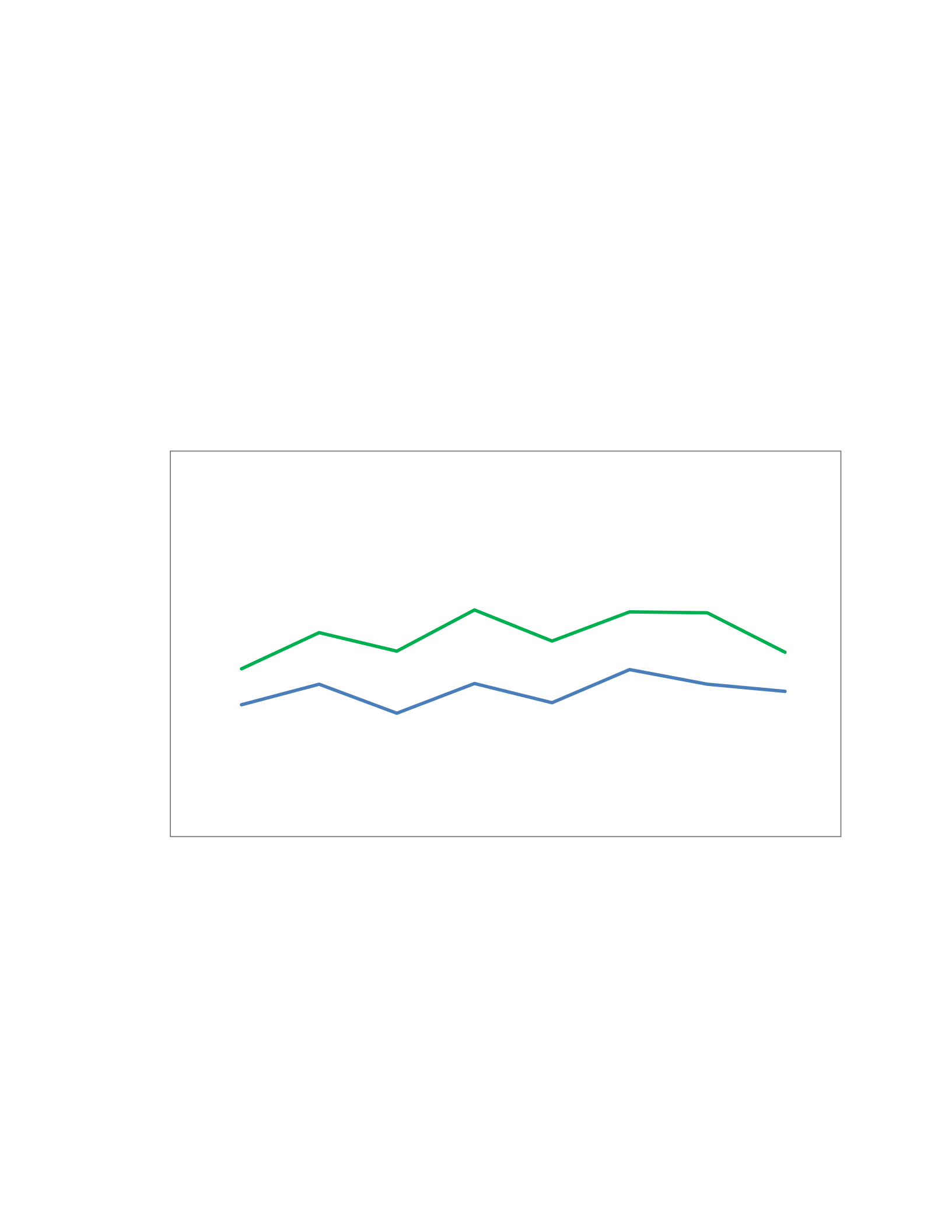
The documents of this time era are most likely to be scored LOW or NONE in
sociological discourses- 76% of the documents in this time era are scored thusly.
However, it is significant to note that the level of sociological discourse, while still low
overall, rose slightly over time. The linear sociological trend line shows this slight
increase over time, increasing about a half a point on the scale over this time period.
Graph 4.8
P-16 Policy Formation Documents
Annual Average Sociological and Economic Discourses 2003-2010
Hypothesis 1f
Hypothesis 1f: The discourses of organizational change within state level P-16 policy and
legislation documents have remained consistent throughout Time Eras 3 and 4
[19872010].
0
1
2
3
4
5
6
7
8
9
2003 2004 2005 2006 2007 2008 2009 2010
SOCIOLOGICAL ECONOMIC Linear (SOCIOLOGICAL) Linear (ECONOMIC)

The state level P-16 policy formation documents demonstrate a steady moderate
average annual level of organizational discourses from 1999-2010 (see Graph 4.9 P-16
Policy Formation Documents Average Annual Organizational Discourses 1987-2010).
Prior to 1999, there is fluctuation in the average annual levels of organizational
discourses, from LOW to MOD. This fluctuation may be due to the fact that only 15
documents are in this time span, thus each data point represents one or two document
scores, rather than the average of 9-35 document scores that are represented in later years.
From 2000-2010, the documents average annual organizational discourse scores remain
in the MOD range with a slight increase over time from a score of 3.23 in 2000 to 4.65 in
2010. The linear economic discourse trend line shows this slight increase in scaled score
discourse levels over this time period.
Graph 4.9
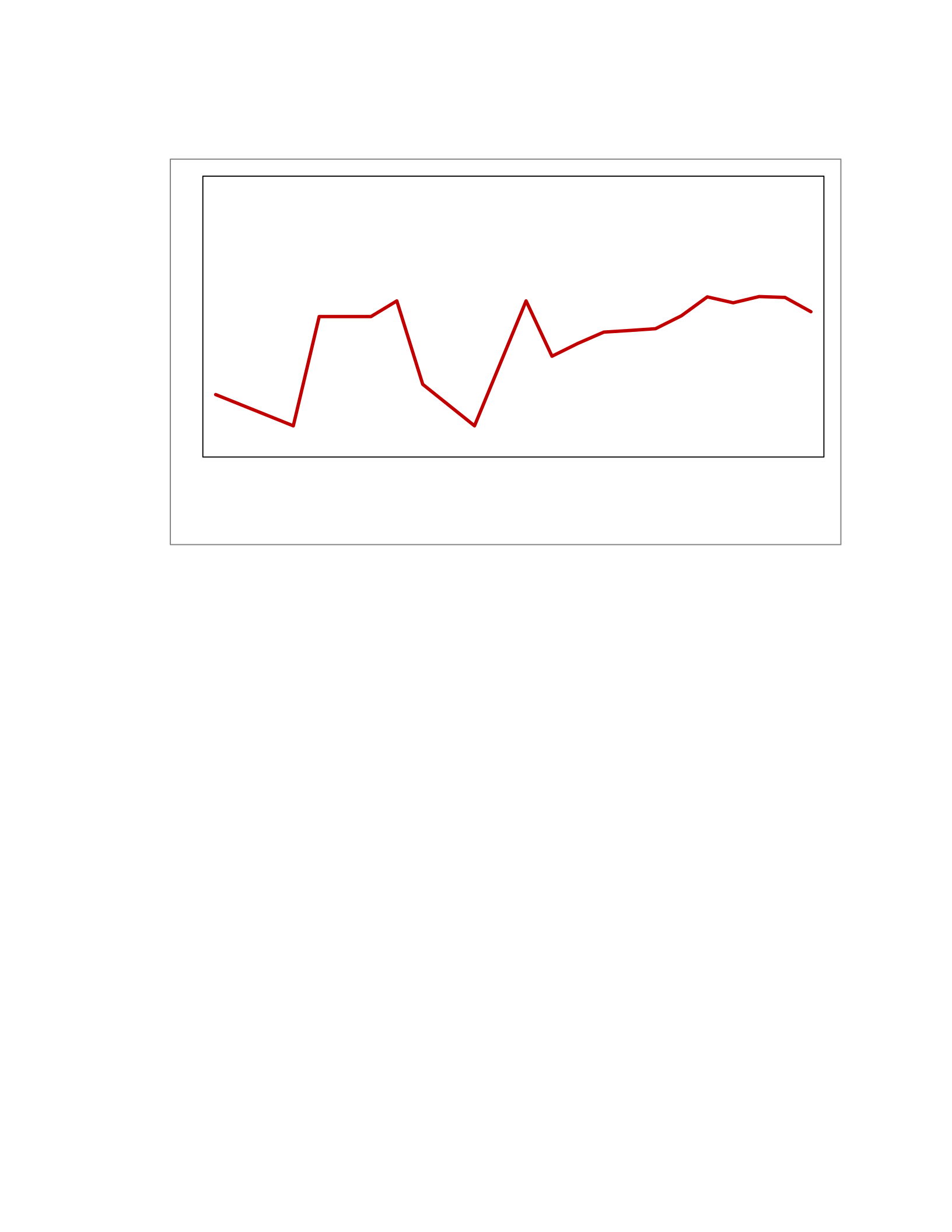
P-16 Policy Formation Documents Average Annual Organizational Discourses 1987-
2010
Summary
In this chapter, the findings from Research Question One and its
hypotheses are presented. Chapter Five presents findings from Research Question Two
and resulting hypotheses. This study has found that the discourses of P-16 policy
advocacy and formation documents have shifted over time. The evidence collected shows
that the discourse shifts are more clearly seen after the late 1990s when more documents
are available for study. Although P-16 clearly got its start in the late 1980s, there were not
enough documents for study until approximately 1998/1999. However, from 19982010,
the hypotheses generally find empirical support and the shift from more sociological
discourse to more economic rationales discourse is evident over time. It also appears that
the organizational discourses generally remain steady and stable during this
time frame.
0
1
2
3
4
5
6
7
8
9
1987
1988
1989
1990
1991
1992
1993
1994
1995
1996
1997
1998
1999
2000
2001
2002
2003
2004
2005
2006
2007
2008
2009
2010
ORGANIZATIONAL Linear (ORGANIZATIONAL)

CHAPTER FIVE
FINDINGS PART TWO
Question Two Findings
Question Two: What are the relationships between time eras of P-16 and the
influence of P-16 national policy advocacy literature and P-16 policy formation
(represented by state level policy and legislation)?
A. What are the volume and frequency of P-16 policy advocacy documents
over time?
B. What are the volume and frequency of P-16 policy formation documents
over time?
C. Do the discourses of P-16 national policy advocacy literature and P-16
policy formation have influence on each other?
The examination of relationships between time, policy advocacy, and policy
formation aims to explore how and when states become a part of the P-16 world. This
research uses official policy language to determine what is happening in policy formation
and when it is happening in relationship to policy advocacy. The first part of this question
gathers some background information on P-16 in the fifty United States through some
basic frequencies and mapping of information. The second part (part B) provides an in
depth historical policy discourse analysis of P-16 policy advocacy and formation
documents.

Question Two Hypotheses
Hypothesis 2a
Hypothesis 2a: The volume (number of pages) and frequency (how often) of P-16
national policy advocacy literature is greater in Time Era 1 and less in Time Era 2.
There are seventeen total P-16 policy advocacy documents sampled for this study.
The frequency and volume of the sampled national policy advocacy literature, as shown
in Table 5.1, are greater in Time Era 1 [1985-2002] than they are in Time Era 2
[20032010]. There are eleven total sampled advocacy documents published between 1985
and 2002. These eleven documents have a total of 195 pages, with documents ranging
from 2 to 68 pages long. There are six total sampled advocacy documents published
between 2003 and 2010. These six documents have a total of 144 pages, with documents
ranging from 5 pages to 68 pages long. However, the average page number per document
is greater in Time Era 2 than it is in Time Era 1. The average number of pages per
document in Time Era 2 is 24 pages/ document, while the average in Time Era 1 is 18
pages/ document. Thus, as expected, the volume and frequency of P-16 policy advocacy
are greater in earlier years of the history of P-16 (Time Era 1) than they are in the later
years (Time Era 2).
It should be noted that although there appears to be a great gap in the advocacy
literature between 1985 and 1999, this is not the case. It appears that there was no
advocacy for P-16 in the years 1986-1998. However, this is due to the sampling
procedure for the advocacy documents. Not all P-16 advocacy documents were selected

to be included in this study. The criteria for sampling advocacy documents required that
the most prevalently cited or quoted advocacy documents are included in the sample.
Thus, the seventeen chosen documents were sampled. These documents were cited in
both subsequent P-16 advocacy and on the P-16 state level websites as sources of P-16
information. There was P-16 advocacy during this ―gap‖, but it did not fit within the
sampling criteria of this particular study.
Table 5.1
Sampled Advocacy Documents- By Year
YEAR # ADVOCACY
DOCUMENTS
PAGES of ADVOCACY
DOCUMENTS
1985 1 22
1987 0 0
1990 0 0
1991 0 0
1993 0 0
1994 0 0
1995 0 0
1996 0 0
1997 0 0
1998 0 0
1999 2 47
2000 2 14
2001 2 11
2002 4 101
2003 1 5
2004 0 0
2005 1 68
2006 2 50
2007 0 0
2008 2 21
2009 0 0
2010 0 0
TOTALS 17 339

Hypothesis 2b
Hypothesis 2b: The volume (number of pages) and frequency (how often) of P-16 state
policy and legislation is greater in Time Era 4 and less in Time Era 3.
There are 270 total P-16 policy formation documents collected for this study. The
frequency and volume of the sampled national policy advocacy literature, as shown in
Table 5.2, is greater in Time Era 4 [2003-2010] than it is in Time Era 3 [1987-2002].
There are 209 total P-16 policy formation documents published between 2003 and 2010.
These documents have a total of 1426 pages, with documents ranging from 1 to 90 pages
long. The average page length per document in Time Era 4 is 7 pages/ document. There
are 61 total P-16 policy formation documents published between 1985 and 2002. These
61 documents have a total of 172 pages, ranging from 1 to 23 pages long. The average
page number per document in Time Era 3 is 3 pages/ document. Based upon the
literature, it was expected that the volume and frequency of policy formation documents
would be greater in the later years of P-16 policy history.
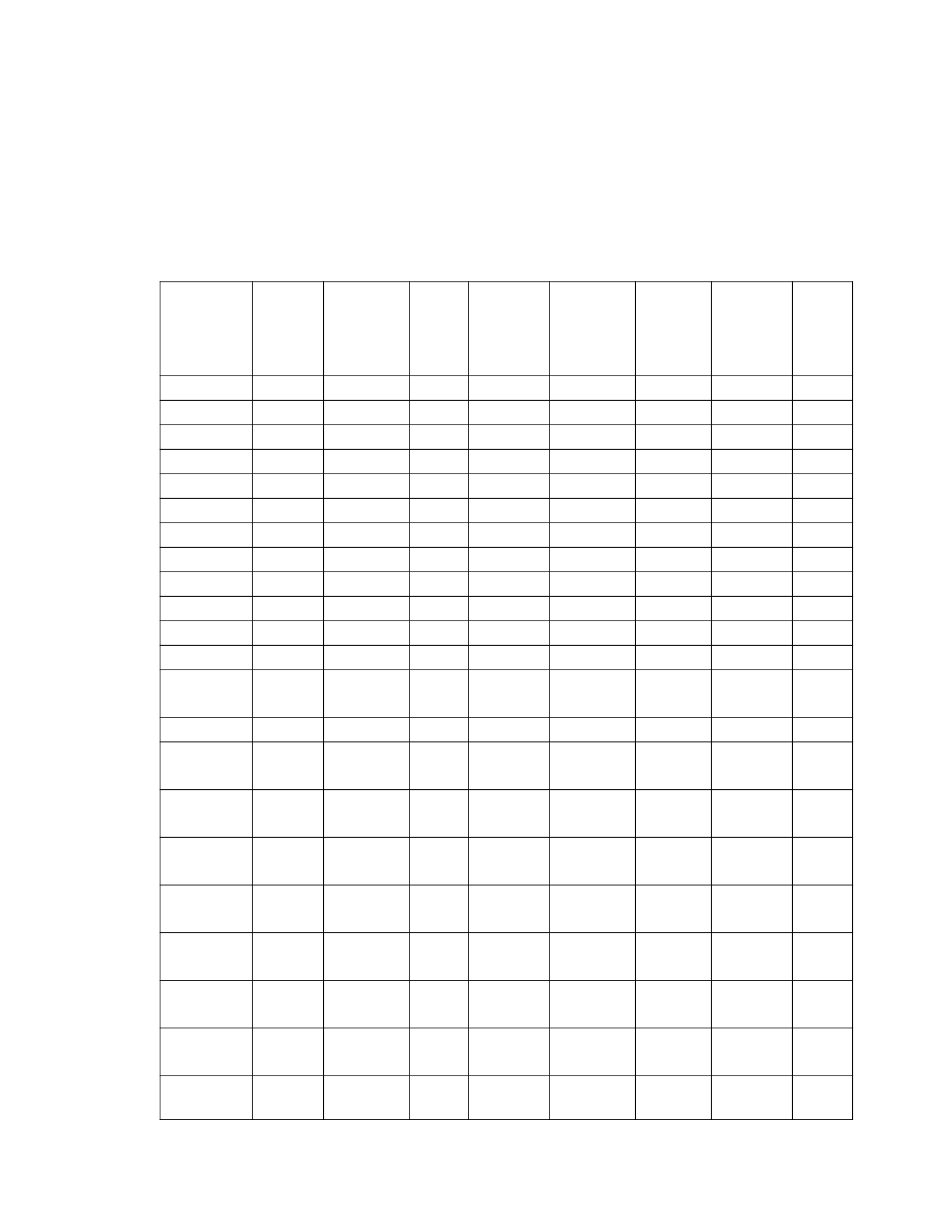
Table 5.2
Policy Formation Documents
YEAR Total
Forma
tion
Docs
No. of
Policy
Docs
No.
of
Law
Docs
No. of
Other
Docs
Pages
Policy
Pages
Law
Pages
Other
Total
Page
s
1985 0 0 0 0 0 0 0 0
1987 3 0 3 0 0 3 0 3
1990 1 0 1 0 0 1 0 1
1991 2 0 2 0 0 3 0 3
1993 2 0 2 0 0 2 0 2
1994 1 0 1 0 0 5 0 5
1995 3 0 3 0 0 3 0 3
1996 0 0 0 0 0 0 0 0
1997 1 0 1 0 0 1 0 1
1998 0 0 0 0 0 0 0 0
1999 2 0 2 0 0 15 0 15
2000 30 13 17 0 36 19 0 55
2001 10 7 2 1 exec
order
16 7 2 25
2002 21 7 14 0 34 28 0 62
2003 19 4 12 3 exec
order
10 32 7 49
2004 19 9 9 1 exec
order
92 10 2 104
2005 29 4 19 6 exec
order
8 65 12 85
2006 23 8 13 2 exec
order
122 72 4 198
2007 35 11 21 3 exec
order
170
102 11 283
2008 22 10 10 2 exec
order
262 22 5 289
2009 27 10 14 3 exec
order
172 114 8 294
2010 20 6 11 3 54 62 8 124
bylaws
TOTAL 270 89 157 24 976 566 59 1601
Hypothesis 2c
Hypothesis 2c: If a state formulated P-16 policy (through legislation or state level policy)
in Time Era 3 [1987-2002], then the language is changed by the language of the
advocacy literature of Time Era 1 [1985-2002].
The analysis of this hypothesis is divided into two time sections, 1987-1999 and
2000-2002. This is because during the 1987-1999, there were only fifteen laws passed in
seven states (Oregon, Texas, Maine, Colorado, North Carolina, Wyoming, and Indiana)
regarding P-16. In 2000-2002, there were a sixty-one policy formation documents, 27
were official state level policy documents from six states (Illinois, Indiana, New Jersey,
California, Florida, and Maryland), 33 were state laws from five states (Florida, Georgia,
Texas, Kentucky, and North Dakota), and 1 Governor‘s Executive Order (Iowa). The two
time periods are different in respect to development of P-16 because of the amount of
policy formation documents that were found during these time periods and thus warrant
two findings discussions.
1987-1998
In the first time section, 1987-1999, six states passed P-16 laws. These laws were
generally short in text- ranging from less than a page to seven pages in length. The laws
generated were focused on two subjects. The first is the coordination of state agencies
under one state authority. This authority may not have been named P-16 at the time, but

later became the P-16 agency (Wyoming) or the law developed into the P-16 laws of that
state (Texas). The second is the development of a P-16 council in order to study or
evaluate the process of developing a P-16 education system within the state. In this very
early time of P-16, rather than being heavily influenced by P-16 policy advocacy
language, states policy formation relied on general ideas put forth by Hodgkinson (1985),
but not actual discourses. In other words, the language within the Hodgkinson policy
report is not replicated or similar to the language within early policy formation. However,
the ―idea of P-16‖ which included connecting the levels of education and developing
councils to create further policy is found. National Governors Association (www.nga.org)
meetings in the 1990s where discussions were held on P-16 concepts, as well as state and
local level voluntary and Governor led efforts in states such as Georgia, Texas, and
Oregon also likely influenced the early development of P-16 initiatives during this time
period.
These early P-16 laws were beginning efforts for creating a coordinated education
system. Language examples are included here in order to provide the reader with clarity
as to discourses represented within the P-16 policy formation documents. The language
examples provided here demonstrate the types of ―development of programs or systems‖
that is found in this early time frame. Discourses refer to connecting of systems,
coordinating activities and elements within the system, and developing plans for further
alignment. Examples include:
― (1) The State Board of Higher Education [,] and the State Board of
Education [and the Oregon Educational Coordinating Commission] shall hold at

least one meeting annually for the purpose of coordinating their activities and
facilitating the solution of problems of mutual concern.‖
―The State Board of Education and the Texas Higher Education
Coordinating Board, in conjunction with other appropriate agencies, shall ensure
that long-range plans and educational programs established by each board
provide a comprehensive education for the students of this state under the
jurisdiction of that board, extending from early childhood education through
postgraduate study.‖
The creation of P-16 councils (under various names) was also prominent in the P-
16 laws of 1987-1999. Language of P-16 council creation examples include:
―The Education Cabinet is created. The Education Cabinet shall be
located administratively within, and shall exercise its powers within existing
resources of, the Office of the Governor. However, the Education Cabinet shall
exercise its statutory powers independently of the Office of the Governor.‖
―The Education Roundtable is established.‖
Other language clarifies the intent of the P-16 councils, their membership and
leadership, and meetings information (how often, where, who attends), as well as
allocation of funds information for P-16 council operations. Thus, the findings are that
during the time period 1985-1999, P-16 policy advocacy documents sampled for this
study do not influence the state‘s policy formation in a measurable or observable way.
1999-2002

In the second time period, 2000-2002, eleven states had policy formation
documents. Of the sixty-one documents, 54% were laws and 46% were policy (including
one executive order). Overall, these documents varied in length, from one to sixty-eight
pages long, however the policies average 4 pages/ documents while laws average 1.7
pages/ document. During this time frame, the emergence of some influence of advocacy
language on policy formation begins.
P-16 Policy Advocacy Dominant Discourses 1999-2002
In the P-16 policy advocacy literature published between 1999 and 2002, strong
discourses are apparent (see Table 5.3 Dominant Discourses Advocacy vs. Formation
1999-2002). In these ten documents, the three dominant economic discourses are
accountability, achievement, and college preparation/ readiness. These three discourses
appear in 100% of the advocacy documents of this time period.
Table 5.3
Dominant Discourses Advocacy vs. Formation 1999-2002
DOMINANT
DISCOURSES
#1 D
D
#2 D
D
# 3 D
D
E
A
1999-2002
Accountability Achievement College Preparation
E
F
2000-2002
Accountability Achievement Efficient
S
A
1999-2002
Pipeline Access High Quality
Education
S
F
2000-2002
Equity Pipeline Access and
High Quality
Education
O
A
1999-2002
Alignment Boundary Goals
O
F
2000-2002
Evaluation of
Programs
Alignment Organization
As previously mentioned, language examples are included here in order to provide
the reader with clarity as to discourses represented within the P-16 policy advocacy
documents. These examples are given to demonstrate how the sentences were coded as
types of discourses. Discourse examples (sample sentences) from the advocacy
documents from1999-2002 are provided. Each sentence is quoted in full. Then, in order
to demonstrate how the sentence was coded either a portion of the sentence is bolded or
an explanation from the researcher follows in bold.

*Accountability in Advocacy Documents 1999-2002
―Today, national standards, in national tests, as well as state testing programs
are on the front burner and equity issues get less attention than in the past.‖
―Currently, K-12 and postsecondary institutions move in different orbits,
upholding different sets of standards regarding what students should know and
be able to do.”
―Regardless of the type of system a state or local community chooses, it is
important to note that the goal is the same: to create a system of education that
begins in early childhood and ends after college, and promotes access, standards,
accountability and lifelong learning.‖
―This roundtable focused on the need for stringent accountability systems
linked to standards, and on system reform in place of remediating students after-
the-fact on postsecondary campuses‖
*Achievement in Advocacy Documents 1999-2002
―It is important to keep both quality and equality in mind, as we need a set of
equity/ linkages that will help reduce the effects of economic and social
differences, and a set of content-based linkages that will smooth students' passage
through the system and allow them to achieve at the highest levels they are
capable of.‖
―A system of incentives could be used to encourage and reward student
achievement and parent involvement along the P-16 path.‖
―Math achievement in the 8th grade clears the way for students to take
advanced classes in high school.‖

―K–12, for example, might be held accountable not only for improving student
achievement and closing gaps between groups, but also for assuring that all of its
secondary teachers have deep and substantial knowledge in the subject areas they
are teaching.‖
*College Preparation/Readiness in Advocacy Documents 1999-2002
―Uninformed students are likely to miss taking important academic courses,
almost ensuring that they will be inadequately prepared for postsecondary
work.”
―This idea has major implications for community colleges and other
postsecondary institutions and raises a basic question: What does it mean to be at
an academic level appropriate to begin college?‖
―The goal is to increase the chances that high school graduates will be
wellprepared for college-level work and can move smoothly to the next level
without requiring remediation.‖
―Finally, the lack of early and high-quality college counseling for all, combined
with widespread ―senioritis‖ in the final year, mean that many students are
poorly prepared for college.‖
The three strongest sociological discourses are pipeline, access, and high quality
education, appearing in 90%, 80% and 80% of the advocacy documents, respectively. As
previously noted, discourse examples (sample sentences) from the advocacy documents
from1999-2002 are provided. Each sentence is quoted in full. Then, in order to
demonstrate how the sentence was coded either a portion of the sentence is bolded or an
explanation from the researcher follows in bold. Examples of these sociological
discourses in the 1999-2002 policy advocacy documents follow.

*Pipeline in Advocacy Documents 1999-2002
―K-16, so far, is an idea: education should be a seamless web from
kindergarten to college graduation.”
―The shorthand term for such initiatives, P-16, reflects the central vision of a
coherent, flexible continuum of public education that stretches from preschool
to grade 16, culminating in a baccalaureate degree.‖
*Access in Advocacy Documents 1999-2002
―All children will have access to high-quality and developmentally appropriate
preschool programs that help prepare children for school.‖
―New technologies may mean the end of distance as a barrier, and allow states
to reformulate the goal of providing access.‖
―In response to this dramatic change and other developments, communities and
states across the country are looking for ways to improve student achievement,
access to and success in higher education.‖
―Expanding access to early learning for children ages 3 to 5, and improving
their readiness for kindergarten.‖
*High Quality Education in Advocacy Documents 1999-2002
―Children who attend a quality preschool program experience higher rates of
graduation and enrollment in postsecondary institutions, as well as lower rates of
grade retention, fewer special education placements, fewer dropouts and teenage
pregnancies, and higher employment rates as teens and young adults.‖

―Provides access to high-quality education opportunities for all students
regardless of race, ethnicity, income or gender…thereby preparing all learners to
be successful as citizens and workers.‖
―High-quality, easily accessible programs: Services for young children that are
available inequitably and that further segregate children by income do not
characterize any public service in this nation, and they should not characterize
those services for our youngest and most vulnerable citizens.‖
The three dominant organizational discourses found in the 1999-2002 policy
advocacy literature are alignment, boundary, and collaboration, appearing in 100%,
100%, and 90% of the documents, respectively. Language examples of these
organizational discourses in the 1999-2002 policy advocacy documents are included here
in order to demonstrate the types of discourses represented within the P-16 policy
advocacy documents. Discourse examples (sample sentences) from the advocacy
documents from1999-2002 are provided. Each sentence is quoted in full and either a
portion of the sentence is bolded to demonstrate why this sentence was coded the way it
was.
*Alignment in Advocacy Documents 1999-2002
―No faculty member in higher education ever got tenure because of a concern
for the linkage of higher education with ‘lower education’."
―Aligning these different standards and then providing all students hoping to
attend postsecondary institutions with the information and academic skills they
need to succeed would represent enormous leaps forward, especially during this
time of declining affirmative action admissions‖

―Putting together a comprehensive bill requires recognition of the crucial
interconnectedness of the various components of a P-16 system.‖
―Here are a few of the reasons that it is crucial to work toward a fully aligned
system.‖
*Boundary in Advocacy Documents 1999-2002
―There are some new jurisdictional issues as well.‖
―Guarantee permeable boundaries between schools and colleges that ensure all
advanced high school students have the opportunity to pursue college-level
instruction at their school or local college.‖
―American education has long been characterized by a profound disjuncture
between K-12 and postsecondary education—two systems that often act
independently and at cross-purposes from one another.‖
―Other options include sponsoring a policy audit to identify various
opportunities and barriers, or establishing an advisory body to help build the P16
vision and sell the idea.‖
*Collaboration in Advocacy Documents 1999-2002
―Attempts at collaboration usually fail against segmentation unless there is
some kind of broad-based institutional effort.‖
―In many states the voluntary and cooperative relationship between state boards
of education and higher education systems is seen as the success behind their
effort.‖

―The earliest efforts at cross-system collaboration tended to be piecemeal; that
is, they focused on a portion of the P-16 continuum, such as teacher education or
high school exit standards and college admission requirements, and did not
attempt to create a full-fledged seamless education system.‖
―A P-16 system seeks to improve student flow and raise student achievement
through collaboration and coordination across all education levels.‖
P-16 Policy Formation Dominant Discourses 1999-2002
If the advocacy discourses are influential, it would be expected, based on the
literature, that policy formation documents would have the same dominant discourses in
their text. In exploring the dominant discourses of P-16 policy formation literature
published in 2000-2002, it is apparent that in the comparison of all three discourse
categories, it is found that the discourses found within advocacy documents are also
primarily the same discourses found in the formation documents.
The top three dominant economic discourses of the policy formation literature are
accountability (79%), student achievement (39%), and efficient (27%). In contrast,
college readiness, in only 18% of the policy formation documents, is not considered a
primary economic discourse during the 2000-2002 timeframe. Discourse examples
(sample sentences) from the P-16 policy formation documents from1999-2002 are
provided. Each sentence is quoted in full and in order to demonstrate how the sentence
was coded, either a portion of the sentence is bolded or an explanation from the
researcher follows in bold.

*Accountability in Policy Formation Documents 1999-2002
―Contribute to the development of an assessment system that links student
learning in schools to higher education admissions and placement processes in a
manner that provides students and parents with a consistent message as to the
importance of mastering State Board of Education standards;‖
―7)’Sunshine State Standards’ are standards that identify what public school students
should know and be able to do‖
―Enabling students to meet high standards‖
―The Alignment Commission shall develop and agree upon common standards
for all core curriculum courses taught by P-16 educators in the state.‖
*Achievement in Policy Formation Documents 1999-2002
‗Publish and make presentations on Achievement in California that contains a
comprehensive picture of the current situation in terms of the performance of
students across multiple educational levels in order to inform the development of
policy and programs;‖
―During the second meeting, the staff team reached a similar conclusion about
progress in Illinois, but also determined that the current P-16 initiative is neither
comprehensive nor bold enough to adequately address issues of student
achievement and teacher quality.57‖
―WHEREAS, meaningful improvement in student achievement at all
educational levels requires leadership that promotes and facilitates improvements
from kindergarten through college graduation;‖
―Given New Jersey‘s growing number of immigrants and minorities and the
increasing importance of a college degree in our high-tech economy, EOF must

build on this success to help more students overcome disadvantaged backgrounds
to succeed in college and achieve their educational goals.‖
*Efficient in Policy Formation Documents 1999-2002
―Develop a plan for a comprehensive and coherent system that efficiently uses
State, institutional, and private resources in a collaborative manner to facilitate
access by students, families, and educators on preparing and applying for higher
education;‖
―WHEREAS, our traditional educational system can sometimes lead to
inefficiencies including; inconsistent admission criteria; service duplication;
inefficient funding strategies; and delayed responses to critical state needs;‖
―New Jersey‘s community colleges strive to provide a convenient and efficient
transfer route for baccalaureate seekers, reducing overall tuition outlays.62‖
When comparing the P-16 advocacy documents to the policy formation
documents of the 1999-2002 time-period, it was found that the dominant sociological
discourses of the policy formation documents are the same as those for advocacy
documents. The primary sociological discourses of the policy formation documents are
equity (28%), pipeline (18%), and access and high quality education (13% each). While
pipeline, access, and high quality education appear in both lists of dominant discourses,
equity is not among the top three discourses for advocacy documents. Nevertheless, it is
a critical discourse within the advocacy documents of this time period, appearing in 80%
of them. Examples of the discourses found within the policy formation documents of this
time period are found below. As previously noted, the sentences below are direct quotes

from policy formation documents (1999-2202) and then are bolded to demonstrate how
they would be coded as such.
*Equity in Policy Formation Documents 1999-2002
―The outcome of this collaboration is to develop a coherent, high quality
educational experience for each and every learner - kindergarten through
postgraduate programs.‖
―(3) PURPOSE.--The purpose of the Florida K-20 Education Code is to
provide by law for a state system of schools, courses, classes, and educational
institutions and services adequate to allow, for all Florida's students, the
opportunity to obtain a high quality education.‖
―The institutions are expanding their capacity to meet increasing enrollment and
needs, enhancing flexibility to serve students effectively through nontraditional
means, and strengthening parity among all minority groups in respect to
enrollment, academic performance, faculty retention, and graduation rates.‖
*Pipeline in Advocacy Documents 1999-2002
―Despite the need for increased educational attainment by all students, the
pipeline is leaking badly;‖
―12) To establish a Citizen Information Center responsible for the preparation,
publication, and distribution of materials relating to the state system of seamless
K-20 public education‖
―To achieve within existing resources true systemic change in education
governance by establishing a seamless academic educational system that fosters
an integrated continuum of kindergarten through graduate school education for
Florida's citizens.‖

*Access in Policy Formation Documents 1999-2002
―The report must specify, for each limited-access program within each
institution, the following categories, by race and gender:‖
―Providing all children and youth in Georgia with access to a quality program
which supports their development of essential competencies in order that they may
realize their potential;‖
―Every student must have access to and take course content that is rigorous and
relevant.‖
―As colleges and universities strive to provide both access and success for all
potential students, government support for institutions is crucial.‖
*High Quality Education in Policy Formation Documents 1999-2002
―3) PURPOSE.--The purpose of the Florida K-20 Education Code is to provide
by law for a state system of schools, courses, classes, and educational institutions
and services adequate to allow, for all Florida's students, the opportunity to
obtain a high quality education.‖
―WHEREAS, the Partnership focuses on providing to Maryland students a
seamless path of high quality academic opportunity from pre-kindergarten
through college and beyond‖
―New Jersey‘s system of higher education aspires to be among the best in the
world, embracing excellence, access, and affordability.‖

Finally, in comparing the organizational discourses, there is only one that is
dominant in both policy advocacy and formation documents. Alignment is in 100% of the
advocacy documents, but in 49% of the policy formation documents of this time frame.
The other two primary discourses that appear in the policy formation documents appear
to be related to creation of programs. The first, evaluation of programs (in 61% of the
documents), is coded language which refers to P-16 councils evaluating the work of
education organizations in the state or evaluating their own work. The second,
organization (44%), is language which refers to governance, reorganization, and
restructuring. As previously mentioned, examples of each of the dominant organizational
discourses of the policy formation documents of the 1999-2000 time-period are provided
in order to demonstrate the types of language within each primary discourse. These
examples are quoted directly from policy formation documents (in italics) and then are
bolded to emphasize why this sentence was coded as such.
*Alignment in Policy Formation Documents 1999-2002
―c) Alignment of standards and resources.--Academic standards for every level
of the K-20 education system are aligned, and education financial resources are
aligned with student performance expectations at each level of the K-20 education
system.‖
―Strategic Imperative 5: Setting and Aligning Academic Standards at Every
Level of the K-20 Education System‖
―Matches high school graduation and college admission requirements (seek
changes in legislation, if necessary, as early as next spring);‖

―A local P-16 council shall promote the preparation and development of
teachers, the alignment of competency standards, and the elimination of barriers
that impede student transition from preschool through baccalaureate programs.‖
*Evaluation of Programs in Policy Formation Documents 1999-2002
―The Governor, as chairperson of the council, may appoint such study
commissions as he or she shall deem appropriate to the purposes of this chapter
to study education questions, issue findings, and make recommendations to the
council.‖
―(a) Before June 30, 2000, the Indiana state board of education (as defined in
IC 20-10.1-1-17) shall obtain an independent evaluation of all state education
programs and policies for the purpose of:‖
*Organization in Policy Formation Documents 1999-2002
―The State Board of Community Colleges is abolished.‖
―(b) The member agencies of the council and other departments, boards, and
offices of this state shall cooperate fully with the office and shall provide the
office with all information that the council deems necessary for the office to
discharge its accountability duties under this article regarding the education
programs and units governed by such member agencies or other departments,
boards, or offices.‖
―This Memorandum of Understanding defines the individual and joint
obligations of the Maryland State department of Education (MSDE), the
Maryland Higher Education Commission (MHEC) and the University System
of Maryland (USM), the primary partners, for the full implementation of the
Maryland Partnership for Teaching and Learning K-16 as reflected in the vision
statement, mission statement, and the commitments set forth below‖

Policy Discourse Analysis of Influence 1999-2002
From 1999-2002, it is clear that the dominant sociological and economic
discourses are generally the same from P-16 advocacy documents to P-16 policy
formation documents. However, it is not as clear when looking at the dominant
organizational discourses that there is a policy advocacy to policy formation connection.
This study‘s analysis goes to a second level to explore the discourses within the
documents through policy discourse analysis to see if the same themes or discourses
emerge. This analysis found evidence that themes that emerged in P-16 policy advocacy
documents were also present in P-16 policy formation documents during the 1999-2002
time period. This analysis goes beyond the ―counting of codes‖ to determine what
underlying themes emerged during the coding process. For this section, several examples
of analysis are provided to demonstrate the policy discourse analysis process and the
outcomes from the process.
For example, in the economic discourses, achievement is a dominant discourse in
both advocacy and formation documents (1999-2002). In a closer examination of the
discourses that were coded achievement, a key theme emerged. This theme refers to
increasing achievement of students in the state education system through several means,
including increasing high school graduation rates, increasing college completion rates,
and increasing the access to higher level courses throughout their educational career. As
This quote from the 2001 policy report, What is P-16 Education?: A Primer for

Legislators (Van de Water and Rainwater 2001), is an example of this type of discourse
within the P-16 policy advocacy literature of this time.
―Imagine a system of education where every child enters school ready to learn,
where all third graders read at or above grade level, where all students have taken
algebra by the end of the 8th grade, where high school exit exams test students at
the 12th-grade level and are aligned with college admissions requirements, where
all young people graduate from high school prepared for college or work, and
where every student who enters college finishes college.‖
Through policy discourse analysis, it was found that during 1999-2002, states
were using similar language to describe student achievement and to develop policy. Two
examples are provided here. These are not the only examples of this type of discourse, but
are provided here as examples of what the economic discourse of achievement is during
this time frame. The first example is from a 2002 Florida Law (1000.03).
―(a) Learning and completion at all levels, including increased high school
graduation rate and readiness for postsecondary education without remediation.-
All students demonstrate increased learning and completion at all levels, graduate
from high school, and are prepared to enter postsecondary education without
remediation.‖
The second example of state policy formation discourse which refers to
achievement is from the Illinois State Board of Education 2000 P-16 Plan.
―Build a safety and support net around every student to ensure they stay in
school and are successful in their educational and career endeavors.‖

Sociological discourses found in the 1999-2002 documents also had emerging
themes. As previously stated, the dominant sociological discourses were initially able to
be traced from advocacy to policy formation through the notation of what discourses
appeared most often. A closer examination of the sociological discourses found that there
is evidence of a connection between the discourses of P-16 advocacy and the discourses
of P-16 policy formation.
For example, access emerged as a key discourse of the P-16 advocacy documents
in 1999-2002. In an exploration of the discourses of these documents, it became clear that
within the access coded portions of the document, a theme emerged. This theme is that
education should do a better job of providing access to students, particularly in the areas
of access to postsecondary education and access to preschool education. Two
representative quotes are provided here. The first is from the 1985 policy report, All One
System (Hodgkinson 1985). The second is from the 2001 policy report, What is P-16
Education?: A Primer for Legislators (Van de Water and Rainwater 2001).
―On the second criterion, we undoubtedly have a long way to go, although
access to the best institution can be improved by better institutional publicity at
the college level so that the student knows what the institution expects, plus,
better guidance from secondary schools and employers, so that the student's
aspirations are realistic and clear.‖
―Expanding access to early learning for children ages 3 to 5, and improving
their readiness for kindergarten‖
Then in P-16 policy formation documents of the 1999-2002 time period, the same
discourses are found which promote the increase of access to both college and preschool

for students in the state. Two examples are provided here. The first is from the Governor
of Iowa‘s 2001 Executive Order:
―Potential topical issues that the Roundtable may consider can include, but shall
not be limited to: Expanding access to early learning opportunities; smoothing
student transitions between learning levels and across learning sectors; closing
the achievement gap between students of different backgrounds; upgrading
teacher education and professional development; strengthening relationships
between families/communities and schools; creating a wider range if learning
opportunities and experiences for students in the final two years of their
secondary education; improving and streamlining remedial services; coordinating
programming and curricula; and assessing employer needs within the state and
implementing those needs into a comprehensive educational policy.‖
And from Florida‘s 2002 K-20 policy, K-20 Strategic Plan:
―Increase Access to and Production of Baccalaureate, Master and Doctoral
Degrees‖
As previously discussed, using the dominant discourses as the sole basis of
analysis for determining the connection between discourses of policy advocacy and
policy formation revealed there were few obvious connections in the organizational
discourses. However, a closer examination of the discourses, through policy discourse
analysis, found that the same types of discourses are occurring in the 1999-2002 P-16
policy advocacy and policy formation. In an organizational discourse example, it was
found that boundary was a key coding category. The boundary discourses stress the

potential barriers between different agencies and ways to maneuver around them through
policy.
As an example of this type of discourse, this quote from the 2001 policy report,
What is P-16? A Primer for Legislators, is provided: ―One of the most challenging parts
of a P-16 system is getting legislators and education leaders from different systems to
think about early learning, elementary, secondary and postsecondary education as one
system instead of several.‖ (Van de Water and Rainwater 2001)
States utilized this organizational boundary discourse in their 1999-2002 P-16
policy formation documents. Two examples of the organizational boundary
discourse follow. The first is from Georgia Law (20-14-8 2000)
―(15) To mediate disputes among the Department of Education, the University
System of Georgia, the Department of Technical and Adult Education, the
Professional Standards Commission, the Office of School Readiness, and the
Office of Education Accountability in matters regarding accountability or
education system seamlessness.‖
A second example from Iowa 2001 Governor‘s Executive Order also uses this
boundary discourse to point out the difficulties that the current educational system
boundaries and barriers can create when developing a P-16 system.
―WHEREAS, the state‘s current educational system reflects a traditional
approach, wherein the structure of education delivery is divided into three distinct,
and somewhat disjointed levels: (1) early childhood; (2) kindergarten through
12th grade; and (3) post secondary, with each level being further divided into
public and private educational systems;‖

Thus, there is evidence that the discourses of P-16 advocacy documents have
influence on the discourses of P-16 policy formation documents in the time era
19992002.
Hypothesis 2d
Hypothesis 2d: If a state formulated P-16 policy (through legislation or state level policy)
in Time Era 4 [2003-2010], then the language will be changed by the language of the
advocacy literature of Time Era 2 [2003-2010].
In the time period 2003-2010, there are six national P-16 policy advocacy
documents sampled. During this same time period, 209 state level policy formation
documents were found. There are 62 state level official policy documents from
twentyfour states, 20 Governor‘s Executive Orders from twelve states, and 3 P-16 council
By Laws from Minnesota. Additionally, there are 109 state laws from twenty-four states.
Total number of pages per document ranges from one to sixty-eight. However, there is a
wide range in average number of pages by type of document- 2.5 pages/ document for
executive orders, 4.4 pages/ document for laws, and 14.3 pages/ document for policy.
During this time frame, as in the previous time frame, some influence of P-16 policy
advocacy discourses on policy formation discourses is evident.

Table 5.4
Dominant Discourses Advocacy vs. Formation 2003-2010
DOMINANT
DISCOURSES
#1 D
D
#2 D
D
# 3 D
D
E
A
2003-2010
Accountability Achievement College Preparation
and
Economic Growth
E
F
2003-2010
Accountability Achievement College Preparation
and
Workforce Preparation
S
A
2003-2010
Pipeline Citizenship Culture and
Equity
S
F
2003-2010
Equity Pipeline Access
O
A
2003-2010
Alignment and
Boundary
Communication and
Evaluation of
Programs
Goals and
Organization
O
F
2003-2010
Collaboration Alignment Allocation
In the P-16 policy advocacy literature published between 2003 and 2010, strong
discourses are apparent (see Table 5.4). In these six documents, four dominant economic
discourses emerge. They are accountability, achievement, college preparation/ readiness,
and economic growth. Each of these discourses occurs in 100% of the advocacy
documents of this time period. Examples of the discourses present (by coded category)

are presented below. In order to demonstrate how the coding of language was done each
sentence is quoted directly (in italics) and then a portion of the sentence is bolded in order
to emphasize why this sentence was coded as such.
P-16 Policy Advocacy Dominant Discourses 2003-2010
*Accountability in Advocacy Documents 2003-2010
―States need to connect their accountability systems to span K–12 and
postsecondary education.‖
―There are few accountability systems that track college readiness from
secondary to postsecondary education.‖
―For successful transitions, standards must be rigorous at all levels and must
prepare students to move through transitions smoothly.‖
*Achievement in Advocacy Documents 2003-2010
―Every state needs to increase the percentage of students who complete high
school and finish some form of postsecondary education; existing governance
structures and policies cannot meet this overwhelming need.‖
―There is widespread agreement among policymakers, the business community,
and educational leaders that the United States needs to raise the educational
achievement of its young population.‖
―P-16 – an integrated system of education designed to raise student
achievement at all levels, preschool through a baccalaureate degree – has gained
interest in many states because of its focus on collaboration, alignment and
educational attainment.‖

―Noble goals set forth for P-16 councils in enabling legislation or executive
orders — improving student achievement, improving postsecondary completion,
etc. — need to be distilled into actionable specifics.‖
*College Preparation/Readiness in Advocacy Documents 2003-2010
Despite their high aspirations, many students are not well prepared for college,
and too few complete their college programs.‖
Today, however, when the vast majority of high school students aspire to attend
college, states need policies that require K–12 and postsecondary education to
collaborate to improve the college readiness of all high school students.‖
―In place of a goal such as, ―Students will enter college ready to learn,‖ a goal
might state, ‗The postsecondary remediation rate in mathematics at four-year
public institutions will be reduced to 25% by 2016‘.‖
―It is necessary to consider innovation, real-world skills, and depth beyond
subject-specific skills in determining what students need to succeed in college
and the work force.‖
*Economic Growth in Advocacy Documents 2003-2010
―This challenge places the United States at a crossroads: we can improve
college readiness and completion rates and thereby prepare the workforce for the
economic and civic challenges of the next generation, or we can allow gaps in
educational achievement to undermine our competitive edge and our
communities’ economic prosperity.‖
―States that are successful in integrating precollegiate and higher education
share the presence of an external civic culture that stresses a belief that the two
levels must come together to improve the labor force and the economy.‖

The four dominant sociological discourses are pipeline, citizenship, culture and
equity, appearing in 100%, 83%, 67% and 67% of the advocacy documents, respectively.
Examples of the discourses of the policy advocacy documents from the 2003-2010
timeperiod follow and as previously noted, these examples are direct quotes from Policy
advocacy documents in italics and then bolded portions of the text to demonstrate how a
sentence would have been coded within the given category.
*Pipeline in Advocacy Documents 2003-2010
―States must create high-quality data systems that span the K–16 continuum.‖
―Leaks in the Pipeline‖
―It focuses on the interrelated nature of the education pipeline, an idea that
goes as far back as the 1980s.‖
―Many states have correctly perceived that they cannot improve the P-12 to
postsecondary pipeline if no early learning student data are collected.‖
*Citizenship in Advocacy Documents 2003-2010
―It must also produce students who are prepared to take their place in society
as active citizens.‖
―Or can the system be deemed successful if high school students who choose not
to enter postsecondary education are nevertheless productive members of society
and skilled laborers?‖

*Culture in Advocacy Documents 2003-2010
―The history of public education in the United States has several defining
moments in which economic, political, and cultural forces demanded a more
diverse and better informed student body.‖
―In addition, this report identifies the role of other factors— such as leadership
and state culture and history—in implementing and sustaining K–16 reforms
within states.‖
―Each state‘s responses to these challenges will be unique, tempered by
historical context, political culture, and the educational and other resources that
are available.‖
―States that are successful in integrating precollegiate and higher education
share the presence of an external civic culture that stresses a belief that the two
levels must come together to improve the labor force and the economy.‖ *Equity in
Advocacy Documents 2003-2010
―inequities in college preparation opportunities‖
―Today, however, when the vast majority of high school students aspire to attend
college, states need policies that require K–12 and postsecondary education to
collaborate to improve the college readiness of all high school students.‖
―Policymakers know the results of the current system – achievement gaps, low
participation rates and remediation.‖
Five organizational discourses emerge as dominant in the advocacy documents of
the 2003-2010 time-period. They are alignment, boundary, communication, evaluation of

programs, organization-each appearing in 100% of the documents. The discourses of
collaboration and P-16 council are also significant discourses in the policy advocacy
documents, with occurrences in 83% of the documents each. The following examples of
organizational discourse within policy advocacy documents are presented as direct quotes
(in italics) with bolded portions to demonstrate why the sentence was coded within the
given category.
*Alignment in Advocacy Documents 2003-2010
―For instance, in almost every state, high school students must meet coursework
requirements that are not connected to the requirements for college admission.
In those states that require course alignment, the secondary and postsecondary
sectors may find agreement in the number of math courses but not in the course
title or content of these courses.‖
―To reverse this course, we must connect high school and postsecondary
education standards, policies, and practices.‖
―This report identifies four state policy dimensions for improving college
readiness and success: the alignment of coursework and assessments; state
finance; statewide data systems; and accountability.‖
―P-16 – an integrated system of education designed to raise student achievement
at all levels, preschool through a baccalaureate degree – has gained interest in
many states because of its focus on collaboration, alignment and educational
attainment.‖

*Boundary in Advocacy Documents 2003-2010
―As research has documented, reforms that focus either on K–12 schools or on
colleges and universities are likely to perpetuate some of the key barriers to
improving educational achievement for students.‖
―Historically, the three levels of the modern American education system – early
learning, K-12 and postsecondary – have developed and operated independently
of each other, leading to a fractured and disjointed educational path for students
to follow.‖
―And conversely, K-12 and postsecondary leaders can learn from political
leaders the roadblocks their solutions may encounter, and ways to overcome
these roadblocks.‖
*Communication in Advocacy Documents 2003-2010
―We caution state education leaders that convening a commission and holding
cross-system discussions may be helpful, but are not sufficient for creating
meaningful and lasting K–16 reform.‖
―As P-16 has progressed in the states, a common language and understanding
of what it means has developed.‖
―Community and business voices, by contrast, are present to inform state
leaders of needs identified on-the-ground, assist in defining policy solutions to
address those needs, inform their constituencies of the council‘s activities while
seeking their buy-in or feedback, and to bring this feedback back to the council.‖

*Evaluation of Programs in Advocacy Documents 2003-2010
―Without such systems, it is impossible to assess needs effectively, understand
where the problems are, gain traction for changes needed, and evaluate reforms.”
―A robust statewide data system is needed to determine the effectiveness of
programs and reforms in improving student achievement.‖
―But assessing the impact of P-16 in most states is a difficult matter..‖
―To evaluate the effectiveness of a P-16 system, states need to develop
evaluation mechanisms that examine the system's goals, activities undertaken to
achieve those goals, performance indicators to determine whether or not the goals
have been achieved, and how the goals and activities should be revised.‖
*Organization in Advocacy Documents 2003-2010
―This report is based on findings from Partnerships for Student Success (PSS), a
four-state study that analyzed K–16 educational governance and policies at the
state level, such as organizational structures, leadership, finance, curricula and
assessment, accountability, and data systems.‖
―Currently, most states maintain separate legislative committee structures
governing K–12 and postsecondary education.‖
―Does a successful P-16 education system require a governance change?‖
P-16 Policy Formation Dominant Discourses 2003-2010
As noted above, if the advocacy discourses are influential, it would be expected,
based on the literature, that policy formation documents would have mostly the same
dominant discourses in their text. In the analyses of the dominant discourses of the P-16

policy formation literature published in 2003-2010, there is evidence of policy advocacy
documents influencing policy formation documents in all three discourse categories (see
Table 5.4 Dominant Discourses Advocacy vs. Formation 2003-2010). The dominant
economic discourses of the policy formation literature are accountability (65%), student
achievement (55%), and college readiness (44%). Economic growth, a significant
discourse in the advocacy literature is in 1/3 of the policy formation documents of this
time frame. Workforce preparation (42%) emerges as an important discourse in the policy
formation documents and is often used in tandem with college preparation in the
literature. This is reflected by the similar percentages of occurrence in the documents.
Examples from policy formation documents (2003-2010) are presented here with direct
quoted sentences in italics and a bolded portion which demonstrates why a sentence
would be coded within that category.
*Accountability in Policy Formation Documents 2003-2010
―WHEREAS, the strengths of a P-20 system are inclusion, alignment of effort,
support for standards and assessment, logical progressions for learners, reduced
need for remediation, removal of artificial barriers and opening the door to
building on previously successful partnerships and furthering such partnerships
on behalf of the State,‖
―With the exception of matters relating to the State University System, the State
Board of Education shall oversee the enforcement of all laws and rules, and the
timely provision of direction, resources, assistance, intervention when needed, and
strong incentives and disincentives to force accountability for results.‖
―GOAL 3: TRANSPARENT ACCOUNTABILITY - Increase transparency and
accountability in Idaho‘s public education system.‖

―The roundtable shall make recommendations to the state board for improving
the academic standards under IC 20-31-3.‖
―Public accountability for learning outcomes and stewardship of public funds
are priorities for Missouri‘s higher education institutions.‖
*Achievement in Policy Formation Documents 2003-2010
―Connecticut‘s future young workers are expected to be less prepared for the
21st century careers than those they are replacing in large part because nearly
half our future workforce will be coming out of the state‘s urban centers where a
significant and stubborn achievement gap persists.‖
―Provide leadership in the development, implementation, evaluation, and
revision of a comprehensive school counseling plan that contributes to school
renewal by promoting increased academic success, career preparedness, and
social/emotional development for all students.‖
―Mission: Ensure Higher Academic Achievement for All Students‖
―WHEREAS, a seamless, coherent state system of education is carried out best
by a formal structure that ensures improved student achievement at all levels
through more formalized and systemic communication and alignment between
Rhode Island‘s elementary, secondary and post secondary (―PK-16‖) education
systems and workforce development programs;‖
*College Preparation/Readiness in Policy Formation Documents 2003-2010
―The commissioner shall have unlimited access to such data solely for the
purposes of conducting studies, reporting annual and longitudinal student
outcomes, and improving college readiness and articulation.‖

―Furthers the goal of raising Maine‘s high school-to-college rate from 55% to
70%;‖
―The department shall ensure that the readiness assessment system is
aligned with state academic content and performance standards, college
placement tests and entry-level career skill requirements.‖
―Finally, high school students must be provided guidance and curricula that will
enable them to complete successfully their individual graduation plans, preparing
them for a seamless transition to relevant employment, further training, or
postsecondary study.‖
*Workforce Preparation in Policy Formation Documents 2003-2010
―To articulate a framework for systemic educational improvement and
innovation that will enable every student to meet or exceed Illinois learning
standards and be well-prepared to succeed in the workforce and community.‖
―An integrated high quality educational system that prepares Kansans for life
and work ”
―Maryland‘s business and education communities recognize the importance of
aligning education policies to the State‘s economic needs in order to better
prepare students for the job market and to allow the State to grow economically;‖
―One of the report‘s specific recommendations is to create a P-20 Council to
evaluate early learning, K-12, higher education and workforce preparation with
the goal of increasing accountability in our education system.‖

The primary sociological discourses of the policy formation documents during this
time frame are equity (36%), pipeline (33%), and access (29%). While pipeline and
equity appear in both lists of dominant discourses, access is not among the top three
discourses for advocacy documents. Nevertheless, it is a critical discourse within the
advocacy documents of this time period, appearing in 50% of them. Citizenship and
culture are critical discourses from the advocacy literature of this time period, but they do
not appear to be dominant in the policy formation documents, appearing in only 19% and
15% respectively. Examples of this language are provided below as a demonstration of
the types of primary discourses found in the policy formation documents of this time
frame. As before, the sentences are direct quotes from the policy formation documents
and with bolded portions to demonstrate why a sentence was coded within the given
category.
*Equity in Policy Formation Documents 2003-2010
―Eliminating the achievement gap between groups of students, especially those
gaps associated with socio-economic status and racial-ethnic background.‖
―Vision: Create a World-Class Education System for All Students in Louisiana
Mission: Ensure Higher Academic Achievement for All Students‖
―WHEREAS, all Nebraska students deserve a high quality of education‖
―They foresee a New York in which gaps in achievement have closed, and the
overall level of knowledge and skill among the people matches or exceeds the best
in the world.‖

*Pipeline in Policy Formation Documents 2003-2010
―The P-20 Council shall explore ways Arizona can achieve a more effective,
efficient and equitable education pipeline through some or all of the following
strategies‖
―To remain competitive in the 21st century, Connecticut must renew its efforts to
ensure a talent pipeline that must be all-inclusive, diverse, and operate as a
seamless continuum, encompassing the state‘s early childhood education efforts
at one end and world-class‖
―(a) The General Assembly finds that preparing Illinoisans for success in school
and the workplace requires a continuum of quality education from preschool
through graduate school.‖
―Increasingly, however, more and more people are calling for what is often
called a K-16, or P-16, perspective on education—a recognition that this is
155 ideally
‘all one system.’ ‖
*Access in Policy Formation Documents 2003-2010
―VISION: The State Board of Education envisions an accessible, seamless
public education system that results in a highly educated citizenry.‖
―What other post-secondary programs/offerings are available in Kansas (e.g.,
concurrent credit, developmental education)?‖
―That the goals of the P-16 Working Group shall be to increase access and
success at all education levels by regularly assessing educational

accomplishments, bridging curricula, increasing articulation, and sharing data,
including the development of a shared data system.‖
―Provide better pathways to higher education for low-income residents;‖
Finally, in the analyses of organizational discourses, it is clear that organizational
discourses are dominant throughout the advocacy documents, with six out of nine
discourses (alignment, boundary, communication, evaluation of programs, organization)
appearing in all advocacy documents, two more (collaboration and P-16 council)
appearing in 83% of the advocacy documents, and the last (allocation) in 67% of this time
-period. Thus, all nine organizational discourses are significant in the advocacy
documents in 2003-2010. Five organizational discourses in the policy formation
documents are significant- collaboration (64%), alignment (63%), allocation (62%),
communication (56%) and P-16 Council (50%). Examples of discourses found in the
policy formation documents are provided below. These sentences are direct quotes from
P-16 policy formation documents with bolded portions to explain why a sentence would
be in that coded category.
*Collaboration in Policy Formation Documents 2003-2010
―Whereas, the ARRA funds are also subject to increased accountability and
reporting responsibilities that will require all of the critical stakeholders in
education to collaborate in new ways;‖
―WHEREAS, growing 21st century talent is no longer the province of any single
agency, but necessarily involves multiple entities functioning in collaborative
ways with a unified purpose;‖

―WHEREAS, the Community College System and the University of Maine
System established a Coordinating Advisory Council in 2003 to increase
collaboration;‖
―Accomplishing these two related goals requires unprecedented collaboration
among parents, employers, elected leaders and educators.‖
*Alignment in Policy Formation Documents 2003-2010
―Recognize that the alignment of high-quality kindergarten with high-quality
preschool is critical to a successful P-20 system in the state of Colorado;164‖
―(c) Alignment of standards and resources.--Academic standards for every
level of the K-20 education system are aligned, and education financial resources
are aligned with student performance expectations at each level of the K-20
education system.‖
―Whereas the P-16 Plan calls for ensuring that Indiana‘s requirements for high
school graduation be aligned with the expectations of college and a
knowledgebased economy;‖
*Allocation in Policy Formation Documents 2003-2010
―This diversity contributes to the Council‘s success by increasing understanding
of issues and barriers for all stakeholders, by maintaining communication across
agencies and organizations, by reducing the potential for duplication of efforts,
and by gaining the support of elected leaders who influence policy and authorize
funding.”
―Align resources to strategic goals‖

―The Council shall coordinate the implementation and evaluation of the plan,
including resource alignment in the use of federal, state, district and private
funds to support policy ‖
―Institution funding from competitive Federally funded grants‖
*Communication in Policy Formation Documents 2003-2010
―WHEREAS, the Kansas State Board of Education and the Kansas Board of
Regents have jointly endorsed a collaborative effort to improve communication,
cooperation and coordination at all levels of education governance in the state;‖
―Assist agencies in public relations aspects of LDS in communication with
school districts and charter schools, higher education institutions and the
public.‖
―The Subcommittee refined its specific charge, created definitions and developed
a plan for communicating with other subcommittee members and developmental
education stakeholders.
*P-16 Council in Policy Formation Documents 2003-2010
―(a) There shall be formed a P-20 Council to coordinate educational efforts of
publicly-funded programs from early care through higher education and to foster
partnerships among groups concerned with public education.‖
―To audit and inspect or cause to be audited or inspected for the purpose of
verification, research, analysis, reporting, or for other purposes related to the
performance of its powers and duties as provided in this article and for the
purposes of auditing pre-kindergarten, elementary, middle grades, and secondary
education, postsecondary education, and education work force programs and

schools, local school systems, institutes, colleges, universities, regional
educational service agencies, and other public education programs and entities as
defined by the council;‖
―Whereas the Education Roundtable was created by the Indiana General
Assembly in 1999 and signed into law by Governor Frank O‘Bannon;‖
―The Education Coordinating Committee, referred to in this section as the
"committee," is established to promote efficiency, cooperative effort and strategic
planning between the Department of Education, the State Board of Education, the
University of Maine System, the Maine Community College System and the Maine
Maritime Academy.‖
Policy Discourse Analysis of Influence 2003-2010
From 2003-2010, it is clear that the dominant sociological and economic
discourses are generally the same from P-16 advocacy documents to P-16 policy
formation documents. However, it is not as clear when looking at the dominant
organizational discourses that there is a policy advocacy to policy formation connection.
The second level of the analysis in this study is to explore the discourses within the
documents through policy discourse analysis to see if the same themes or discourses
emerge. This analysis has shown that the same themes emerged from P-16 policy
advocacy and P-16 policy formation during the 2003-2010 time period. This analysis
goes beyond the ―counting of codes‖ to determine what underlying themes emerged
during the coding process. For this section, several examples of analysis are provided to
demonstrate the policy discourse analysis process and the outcomes from the process. The

examples do not represent the entire analysis which will be summarized at the end of this
section.
For example, in the economic discourses, accountability is a dominant discourse
in both advocacy and formation documents of this time period. In a closer examination of
the discourses that were coded accountability, two themes emerge. The first is the
connection of standards between K-12 and postsecondary education. These generally
refer to aligning or coordinating the requirements for high school graduation and the
expectations for college level work. This quote from the 2005 policy advocacy report,
The Governance Divide (Venezia et al. 2005) is representative of this type of discourse.
―States need to connect their accountability systems to span K-12 and
postsecondary education. Currently accountability systems are usually designed
for either K-12 or postsecondary education without much attention to the
interface between the two. Accountability systems need to reflect, better, the reality
of students‘ educational paths.‖
States use this theme of connecting accountability systems in the discourse of
policy formation as shown in the two examples provided here. This legislation from
Colorado (SB 08-212 2009) is the first example of the use of this theme within
accountability discourses.
―Since 1993, implementation of standards-based education has resulted in
significant increases in the ability of school districts and the state to measure
what each student knows and is able to demonstrate at various levels in the
student's academic career and in significant increases in learning and academic
achievement among some students enrolled in the public schools of the state;‖
This second example is from Minnesota‘s 2008 P-16 policy, Minnesota‘s

Promise: World Class Schools, World Class State.
Align Expectations: Integrate college and workforce readiness standards into
Minnesota‘s K-12 academic standards to ensure that all students are prepared for
higher education and high-skill employment after high school.
The second accountability theme that emerges from a policy discourse analysis
examination of the policy advocacy and formation documents (2003-2010) is that states
need to develop ways to track accountability measures across the state. This quote from
the 2006 policy advocacy report, Claiming Common Ground, is representative of this
type of discourse. ―There are few accountability systems that track college readiness
from secondary to postsecondary education. And no one is held responsible for the
students who drop between the cracks of the two systems.‖(Callan et al. 2006)
States use this theme of developing accountability measures across the state in
their policy formation documents, as shown here in two examples. Although only two
examples are provided, there are many more from other states which are similar and
continue along this theme. From the Texas 2007 P-16 Council Developmental Education
report:
―Having standards, competencies, and objectives, that are consistent
throughout the state, ensures that all students are achieving and performing at
least at the same basic minimum level; that all schools are measuring the same
basic knowledge and skill areas and expecting similar performance; and
ensures that common state-wide data is available for research, comparing
student performance, preparing reports and requests for the legislature and
more importantly, ensuring more accountability of higher education.‖
And from the 2008 California policy, Closing the Achievement Gap:

Strategies to reform education, as they relate to closing the achievement gap in
particular, have centered on such things as incorporating a quality
prekindergarten program, implementing a robust data collection system,
developing rigorous curriculum, implementing quality professional development,
investing in an effective accountability system, and strengthening articulation
throughout the P-16 system.
Themes also emerged in the sociological discourses found in the documents in this
study. As previously stated, the dominant sociological discourses were initially able to be
traced from advocacy to policy formation through the notation of what discourses
appeared most often. However, some discourses appeared to be critical in the P-16
advocacy documents, but the counts were not as high in the policy formation documents.
In this situation, policy discourse analysis provides a closer examination of the themes.
For example, citizenship emerged as a key discourse of the P-16 advocacy
documents in 2003-2010. However, it did not appear in the top discourses of P-16 policy
formation documents of this time. In an exploration of the discourses of these documents,
it becomes clear that within the citizenship coded sections, a theme emerged. This is that
one of the reasons for schooling is to create and produce students who will become active
citizens. Schools will produce citizens will participate in society, particularly through
being ―good citizens‖. This representative quote is from the 2003 policy report , P-16:
Building a cohesive education system from preschool through postsecondary (Krueger
and Rainwater 2003).
―It (the education system) must also produce students who are prepared to take
their place in society as active citizens. While volunteerism among young people
currently is increasing, voting rates are down. Here too, the role of postsecondary
education is vital.‖

Then in subsequent P-16 policy formation documents, the same discourses are
found which promote the use of education to create good citizens or prepare students for
citizenship. Two examples are provided here. The first is from North Dakota‘s 2006 P16
Education Task Force policy report:
―Proficiency standards for high school graduation in North Dakota are as
applicable to students who go on to post-secondary education as they are to
students who choose to enter the workforce after high school graduation, and they
are essential to developing good citizens.‖
And from Ohio‘s 2010 policy Developing a P-16 System:
―Public education is the cornerstone that binds the forces of good government,
economic prosperity and civic engagement together to advance the state.‖
In the organizational discourses, as previously noted, there were few obvious
connections between the discourses if it is solely based on the dominant discourses.
However, a closer examination of the discourses through policy discourse analysis finds
that the same types of discourses are occurring in the 2003-2010 P-16 policy advocacy
and policy formation. In an organizational discourse example, it was found that
communication was a critical coding category. The discourses stress interagency
communication between educational levels as well as between subsystems of state
government.
As an example of this type of discourse, this quote from the 2006 policy report,
Claiming Common Ground, is provided: ―As a result, there are few widespread practices

or traditions for these two systems of education to communicate with each other, much
less to collaborate to improve student achievement across institutions.‖ (Callan et al.
2006)
States utilize this discourse in their 2003-2010 P-16 policy formation. Two
examples of the organizational communication discourse follow. The first is from Kansas
P-20 Education Council policy report (2008)
―Policymakers in at least 30 states have looked for ways to enhance an
integrated system of education in which all levels of education as well as business
partners and legislators, coordinate, communicate, and educate as one system.‖
A second example from New Mexico (Executive Order 2009) also uses this
communication discourse to stress the importance of communication across agencies.
―WHEREAS, such an effective PreK-20 education data system requires the close
coordination and cross-departmental communication among state agencies, public
schools, higher education institutions and entities that address New
Mexico‘s children from birth through their education to their entrance into the
workforce;‖
Summary
Thus, while not all discourses are translated from P-16 policy advocacy into
policy formation, based on the findings from this research the conclusion can be drawn
that P-16 policy advocacy discourses are influencing the discourses of P-16 policy
formation during the time period 2003-2010. As previously stated, the discourses that are
dominant in the advocacy documents are often in more of the documents than the policy

formation documents, but this is to be expected based upon the literature. The states are
employing discourses from advocacy in order to formulate policy in the 2003-2010 time
period. In addition, due to policy discourse analysis, the discourses of P-16 policy
advocacy are similar in dominant themes to the discourses of P-16 policy formation.
Themes emerged, through policy discourse analysis, which demonstrate the connections
between P-16 advocacy and policy formation during this time period.
Hypothesis 2e
Hypothesis 2e: If a state formulated P-16 policy (through legislation or state level policy)
in Time Era 4 [2003-2010], then the language will also be changed by the language of
state level policy/legislation in time Era 3 [1987-2002].
This hypothesis is based on the idea that states might be subject to peer influence
in their development of policy. In other words, if other states or they themselves have
already developed state level P-16 policies or legislation, the earlier discourses may
potentially influence future formation of state level policies or legislation. In order to
explore this hypothesis, two steps were performed. First, an overall historical analysis of
the discourses from early formation to later formation was performed. This is a national
exploration of the discourses of P-16 – early (prior to 2002) vs. later (after 2002). Then a
closer examination of two states, Texas and Florida, was completed. This more detailed
examination looks at the history of discourses within each state. Overall Analysis of
Discourse
In order to determine if there is evidence of influence from early policy on later
policy, an analysis of the earlier P-16 policy documents (2000-2002) compared to the
later P-16 policy formation documents (2003-2010) was conducted. In other words, the
discourses of early policy formation were compared to the discourses of later policy
formation. Similarities and differences were noted in this analysis. The earlier time frame
was narrowed down to 2000-2002 due to the sparse number of documents (n=15) found
in the previous era (1985-1999). As was found previously, there is evidence of P-16
policy formation discourses influence on later policy formation discourses (see Table 5.5
Dominant Discourses Early P-16 Formation vs. Later P-16 Formation).
Table 5.5
Dominant Discourses Early P-16 Formation vs. Later P-16 Formation
DOMINANT
DISCOURSES
#1 D
D
#2 D
D
# 3 D
D
E
F
2000-2002
Accountability Achievement Efficient
E
F
2003-2010
Accountability Achievement College Preparation and
Workforce Preparation
S
F
2000-2002
Equity Pipeline Access and
High Quality Education
S
F
2003-2010
Equity Pipeline Access
O
F
2000-2002
Evaluation of
Programs
Alignment Organization

O
F
2003-2010
Collaboration Alignment Allocation
In the analyses of the dominant economic discourses of the P-16 policy formation
literature published in 2000-2010, there is evidence of early policy formation documents
influence on later policy formation documents (see Table 5.5). The dominant economic
discourses of the policy formation literature of 2000-2002 are accountability (79%),
student achievement (39%), and efficiency (23%). In 2003-2010, accountability (65%)
and student achievement (55%) are dominant economic discourses. Two thirds of
dominant discourses from earlier time frames are the same as they are in the later time
frame.
In 2000-2002, the three dominant sociological discourses are equity (28%),
pipeline (33%), and access (13%). These discourses remain dominant in 2003-2010 and
in fact seem to be more dominant, appearing in more documents over the time frame-
equity (36%), pipeline (33%), and access (29%). This provides evidence of a connection
between the sociological discourses of early policy development and later policy
formation.
Finally, in the analyses of organizational discourses, there appears to be a limited
influence of early discourses on later discourses. In the years 2000-2002, the three
dominant organizational discourses are evaluation of programs, alignment, and
organization. In 2003-2010, only alignment is a dominant discourse, with collaboration
and allocation rising to be more significant. Thus, the dominant organizational discourses

appear to have shifted over time, with only one discourse remaining the same from the
early time frame to the later time frame.
Texas and Florida
Texas and Florida were chosen for a closer examination because they both have
significant histories of P-16 policy making. Texas has had a P-16 plan for close to twenty-
five years. Florida has had a K-20 system for about ten years. Analysis of their formation
documents finds that within these states there is evidence of prior discourses informing
and influencing later discourses. As these states updated their P-16 laws or policies from
previous iterations, they often use the same language throughout. In fact, as policies or
laws were changed, the discourses would remain the same or were often added to, rather
than subtracted from. Changes in wording often consists of changes in names of
organizational structures (for example, changing the name of the P-16 council) or in
changing the people or organizations that are included in a P-16 system.
Texas
Texas began developing their P-16 system in 1987 by passing a law that called for
coordination within the higher education system. This coordination was gradually
extended over time throughout the entire P-16 system, with the Texas Higher Education
Coordinating Board overseeing this aligned system. Over the past twenty-five years,
Texas has created a P-16 Council, first through an informal network and then through
legislation. They also have developed a series of local P-16 councils which perform
onthe-ground P-16 work. Texas has also worked with other state education agencies to
develop and pass legislation relating to the alignment of college expectations and high

school outcomes, financing of such programs, and further strengthen the authority of the
Texas Higher Education Coordinating Board. Twenty-five policy formation documents
were found for this study (see Graph 5.1).
As demonstrated in Graph 5.1, the annual average organizational discourses of
P16 in Texas generally increased slightly over time from the LOW scaled range early to
MOD scaled range later. Both annual average sociological and annual average economic
discourses remained generally stable over time staying consistently in the LOW scaled
range. Early discourses (1987-2002) that emerge as dominant in Texas are achievement
(economic), collaboration (organizational), and pipeline (sociological). Later discourses
(2003-2010) that are significant are accountability and achievment (economic),
collaboration (organizational), and pipeline (sociological). Thus the dominant discourses
are continuing to be dominantly the same from the early time frame to the later time
frame.
In addition, a close examination of two particular education statutes pertaining to
P-16 in Texas demonstrate that over time only minor changes are made in these laws. In
the Texas Education Statutes Sec. 7.005 (Cooperation between State Agencies of Higher
Education), the law was first passed in 1995 and then altered in 2003. The single change
in the entire law in 2003 was to change the title of the P-16 advisory committee from
―Joint Advisory Committee‖ (1995 title) to ―P-16 Council‖ (2003 title). A look at an
additional part of the education statutes in Texas (Sec 61.076) finds that changes to this
statute over time include changes to the name of the P-16 advisory board, changes in
description of power and organizational components of the board, and information about
grants or other funding sources for enacting these laws.
Graph 5.1
Texas P-16 Policy Formation Documents
Average Annual Discourses 1987-2010
Florida
0
1
2
3
4
5
6
7
8
9
1987 {n=2}
1988
1989
1990
1991
1992
1993 {n=1}
1994
1995 {n=2}
1996
1997
1998
1999
2000
2001 {n=1}
2002
2003 {n=2}
2004
2005 {n=4}
n=
5}
2006 {
n=
2007 {
8}
2008
2009
2010
Economic Organizational Sociological

Florida began developing a K-20 system in the early 2000‘s with the consolidation
of the entire education system under the Florida Board of Education. In the past ten years,
Florida‘s K-20 system has developed an accountability system, a K-20 budget, and a K-
20 data warehouse system in order to support the alignment of educational efforts across
the statewide education system. Forty-seven policy formation documents were found
from Florida for this study (See Graph 5.2).
As demonstrated in Graph 5.2, the annual average organizational discourses of
P16 in Florida flucutated over the ten years. The early high annual average is based on
one document in each of the first two years. However, post 2001, the scaled
organizational discourse level remains in the MOD to LOW range. The annual average
sociological and annual average economic discourses mirror the national discourse
trends. Although both tend to be in the LOW range, the sociological scale started stronger
in early documents and then decreased over time. The economic discourses started lower
than the sociological discourses, but around 2003 the average annual economic discourses
began outpacing the average annual sociological discourses.
The top two early discourses (2000-2004) that emerge as dominant in Florida are
accountability and efficiency (economic), alignment and allocation (organizational), and
pipeline and equity (sociological). Later discourses (2005-2010) that are significant are
accountability and efficiency (economic), alignment and allocation (organizational), and
equity and access (sociological). The dominant discourses are continuing to be
dominantly the same from the early time frame to the later time frame.
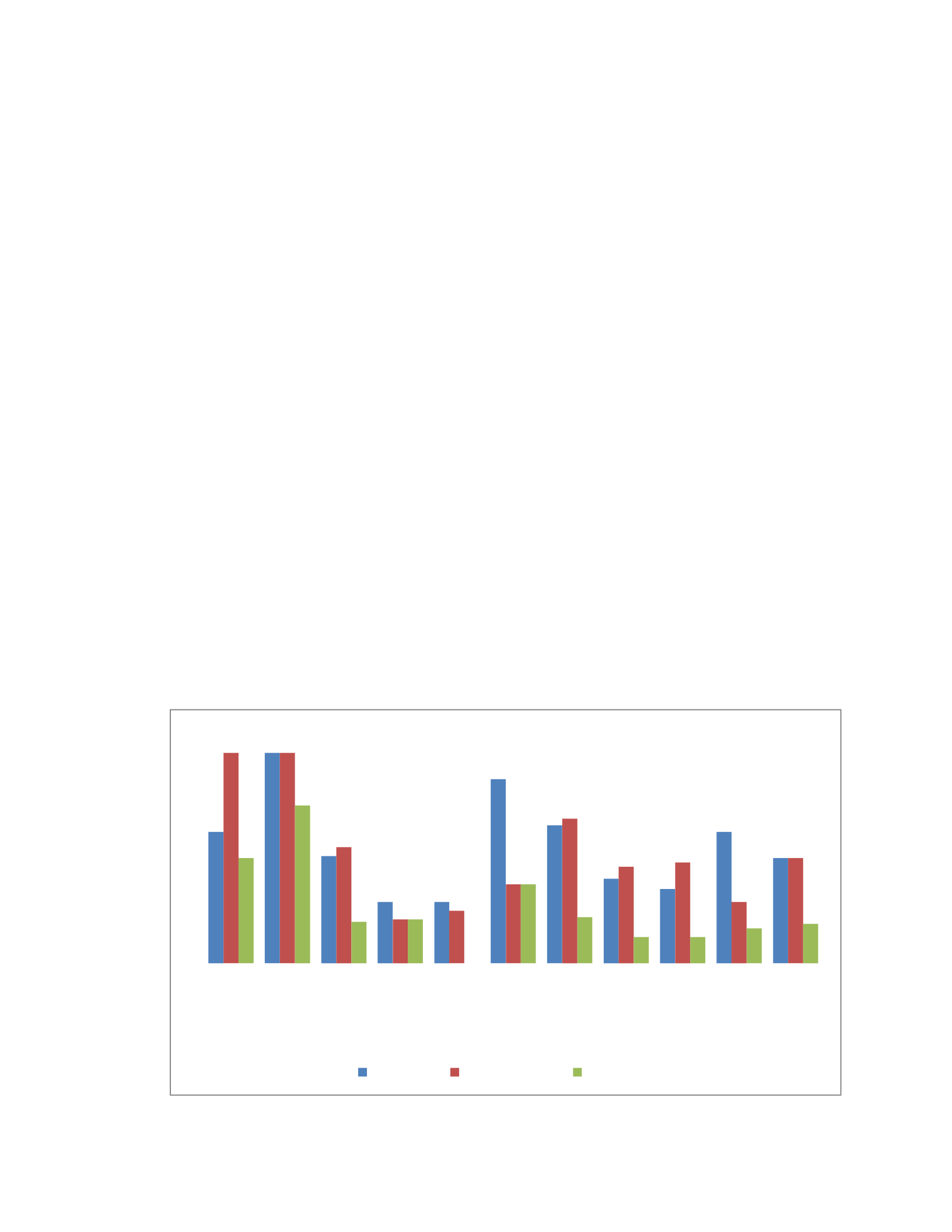
In a closer examination of the formation documents from Florida, from Florida‘s
Education Statutes, the discourses from the early phases of law 1008.31 (2002) reflect a
HIGH level of economic discourses, with a MOD level of organizational discourses and a
LOW level of sociological discourses. This law underwent legislative changes five times
in 2003, 2005, 2006, 2008, and 2010. Over this time, the economic discourses remained
HIGH, increasing slightly within the HIGH scale from a 7 to an 8. The organizational
discourses remained at a MOD level throughout, increasing slightly within the MOD
scale from a 4 to a 5. The sociological discourses started in the LOW scaled range and
during the first years of the legislative change remained at either LOW or NONE on the
sociological scale. In 2006, 2008, and 2010 the sociological discourses increased slightly
and moved to the low end of the MOD range, scoring a 4 in each of those years.
Graph 5.2
Florida P-16 Policy Formation Documents
Average Annual Discourses 2000-2010
0
1
2
3
4
5
6
7
8
9
2000 {n=1}
2001 {n=1}
2002 {n=12}
2003 {n=3}
2004 {n=3}
2005 {n=1}
n=
4}
2006 {
9}
2007 {
n=
2008 {n=6}
2009 {n=3}
2010 {n=4}
Economic Organizational Sociological

Thus, while not all discourses are translated from one time period to another in
P16 policy formation documents, the conclusion can be drawn that there is both (1)
evidence of a intra-state connection of discourses from early policy formation to later
policy formation; and (2) national evidence that the discourses of the P-16 policy
formation documents from 2000-2002 have influence on the discourses of the P-16 policy
formation documents of 2003-2010.
Summary
The findings of this study reveal that the national discourses of the education
reform policy have shifted over time. While a sociological focus was dominant in the
earlier phases of P-16 development, economic rationales took precedence as time went
on. During the lifetime of P-16 policy advocacy and formation, this study revealed that
discourses generally remain consistent. In addition, as expected, advocacy was most
prevalent at the beginning phases of policy development, and formation most prevalent at
the later phases of P-16 policy development. This study also demonstrated that the
discourses of P-16 policy advocacy appear to influence the discourses of P-16 policy
formation throughout the studied time-period of P-16. Results also suggest that early P16
policy formation influences the discourses of later P-16 policy formation.

CHAPTER SIX
SUMMARY DISCUSSION, CONCLUSIONS, AND IMPLICATIONS FOR POLICY
The purpose of this study was to explore the shifting of discourses in P-16 policy
advocacy and formation. P-16 national advocacy literature and official state level P-16
policy and legislative documents were analyzed for evidence of dominant discourses. The
discourses were mapped using policy discourse analysis as the methodology and a
multitheoretical framework as the analytical lens. This historical model included a
longitudinal exploration of educational reform policy discourses of policy processes. A
comparative policy discourse analysis was also undertaken between policy advocacy
documents and state level policy formation documents, as well as between early policy
formation discourses compared to later policy formation discourses. These analyses
provided information about the mechanisms of policy creation and the role of discourse
in policy making.
This final chapter provides an overall summary and discussion of the major
findings of this research, articulates the significance of this study, and offers some
implications for policy and practice, as well as some preliminary recommendations for
the sustainability of P-16 as an educational reform movement.
Significance of Research
The significance of this research lies in the connection between policy advocacy
and policy formation. This study found evidence that the discourses in the advocacy

documents for P-16, a nationally promoted educational reform movement, were
influencing the discourses of P-16 state level policy formation. Additionally, it found
evidence that this influence continued over time. This impact of this finding overall, as
well as the import over time, is significant because the discourses of advocacy appear
critical enough to be manifested in the formulation of policy, which then is likely used in
policy implementation. Thus, the discourses of P-16 policy advocacy are vital to the P-16
policy process; in essence creating both the meaning of the policy and the materialization
in policy formation. Put in terms of everyday impact, reform ―talk‖ becomes educational
mandates which, in turn, impact the everyday lives of all those involved in schooling.
This research study also addresses a void in the research on P-16. Previously, this
research primarily focused on proposing and advocating for P-16 initiatives and their
formation at the state level (Chamberlin and Plucker 2008; Consortium for Policy
Research in Education 2000; Education Commission of the States 2002; Hodgkinson
1985; Hodgkinson 1999; Krueger and Rainwater 2003; The Hechinger Institute on
Education and Media, The Institute for Educational Leadership, and The National Center
for Public Policy and Higher Education 2002; Van de Water and Rainwater 2001; Venezia
et al. 2005). However, there have been limited empirical studies on P-16 programs or
their subsequent implementation. Those that were studied generally focused on specific
aspects of P-16 initiatives (Georgia P-16 Department 2006; Integrated Data
Transfer Project 2006; L'Orange and Ewell 2007; Mohker 2010; Oregon Roundtable and
Oregon Business Council 2005; Rasch 2004; Texas Education Agency 2008) or they took
broader historical perspective on one aspect of a P-16 program (Streams 2007). This
current study goes beyond these previous advocacy reports and empirical research studies

to explore a historical perspective on a nationally advocated educational reform initiative
that subsequently formulated at various state levels. This policy analysis utilizes policy
discourse analysis as the methodology for exploring the policy process, through its
evidentiary policy documents or discourse.
Additionally, this study is significant in its historical mapping of the progression
of P-16 discourses from their original inception in national advocacy through their
manifestation in state level policy formation. In doing so, it uses the theoretical lenses of
sociological, economic, and organizational rationales to understand how and when the
discourses of P-16 change along these specific theoretical perspectives. The study
emphasizes how changing rationales for policy development- economic, sociological, and
organizational- can potentially influence the implementation and subsequently the
sustainability of an education policy. This knowledge can potentially lead to more
effective policy levers in future educational reform policy making.
Finally, this study provides an example of how policy discourse analysis is a
relevant methodology for gaining a deeper understanding of how general education
reform movements, such as P-16, can be studied both as a current phenomenon and as a
mechanism of state/national systems of change. Through policy discourse analysis, this
research was able to find evidence of an historical connection between policy advocacy
and policy formation for a large scale national reform initiative. The use of policy
discourse analysis as a method for analyzing education policy adds a deeper level of
analysis than content analysis alone, providing the researcher with the ability to utilize
contexts and concepts to determine meaning and substance behind policy processes.

Major Findings
Driven by two primary research questions, this study examined both P-16 policy
advocacy and policy formation documents at the state level in order to explore the
shifting of discourses over time. It also explored the relationship between the discourses
of policy advocacy at the national level and policy formation at the state level. These
discourses were mapped to concepts from sociology, economics, and organizational
theory. Four major findings are highlighted:
1. Over time, the sociological discourses of both P-16 policy advocacy and
policy formation decreased in the examined documents.
2. The economic discourses of both P-16 advocacy documents and P-16 policy
formation documents became more prevalent over time.
3. The organizational discourses of both P-16 advocacy documents and P-16
policy documents remained stable over time.
4. The discourses of P-16 advocacy appear to influence the discourses of P-16
policy formation.
Interpretation of Findings
Changes in Discourses
Statewide P-16 initiatives have persisted over more than two decades in the
United States (Hodgkinson 1985; Hodgkinson 1999; Mohker 2010; Van de Water and
Rainwater 2001; VandeWater and Krueger 2002). Over that time, this study found that the
discourses of P-16 policy processes, both conceptual and developmental, have shifted and

transformed; focusing on different P-16 policy formation rationales for sustaining P16 as
an educational reform movement. States have adopted these shifting discourses over time,
from sociological to economic rationales, while continuing to maintain organizational and
systems change as a fundamental basis for sustaining this reform. These results suggest
that educational reform can withstand changes in some discourses as long as there is a
foundational discourse that remains constant.
Based on the P-16 advocacy literature (Chamberlin and Plucker 2008; Consortium
for Policy Research in Education 2000; Education Commission of the States 2002;
Hodgkinson 1985; Hodgkinson 1999; Krueger and Rainwater 2003; The Hechinger
Institute on Education and Media, The Institute for Educational Leadership, and The
National Center for Public Policy and Higher Education 2002; Van de Water and
Rainwater 2001; Venezia et al. 2005), sociological rationales for the development of P-16
initiatives were expected to decline over time. As expected, the study found sociological
discourses did decrease over time in the advocacy literature (1985-2010). These
rationales formed the basis of early arguments for the creation of P-16 in the advocacy
literature. This is likely because these sociological rationales had formed the basis for
many prior policy reform movements including the access and equity movements in the
1960s and 1970s (Brubacher and Rudy 2008; Coleman 1966; Rose 2010; Spring 2001).
Prior advocacy from large educational think tanks, such as the Rand Corporation,
Education Commission of the States, and the Stanford Research Institute, also utilized
these educational equity and access ideals in their reports (Education Commission of the
States 2011; RAND Corporation 2011; Stanford Research Institute 2011). Prior to 2002,
P-16 advocates promoted a system which would provide additional access to educational

opportunities for more students, specifically calling for increasing the democratic ideals
of education, equitable opportunities, and providing access to both preschool and higher
education through alternative means (Hodgkinson 1985; Hodgkinson 1999; Levine 1999;
Consortium for Policy Research in Education 2000; Ziebarth and Rainwater 2000; Van de
Water and Rainwater 2001). This then was, as hypothesized, consistent with prior
discourses which this study assumed were influential in the initial phases of the P-16
advocacy movement.
It was further hypothesized that a similar trend of declining sociological rationales
over time would be evident in the discourses of P-16 policy formation documents. This
conjecture was based on the idea that competing discourses (economic) would provided
competing rationales for a large scale education reform movement. This hypothesis was
accurate for the policy documents from 1999-2010. Sociological rationales of access and
equity are present in many documents of this time frame. However, they occupy only
small portions of the discourse, which suggests that they are both competing with other
discourses and may be present merely to make concession to long-standing American
educational ideals. For example, policy formation documents have discourses which
make references to providing access to ―all students.‖ However, the resulting laws
generally focus on access for a specific group or do not address access issues at all.
Future analysis of the connection between sociological and economic rationales could
provide information on the ways that these rationales are utilized. If sociological
rationales have become merely a concession and are generally mentioned in tandem with
economic rationales, these sociological rationales could be lost in the discourse. Analysis

could explain if sociological discourses are primarily rationales for development or they
are destined to become mechanized through policy implementation at state or local levels.
Based on the P-16 advocacy literature, the economic rationales of P-16 advocacy
literature were expected to increase over time (1985-2010). As projected, this study found
evidence that this was accurate. National economic policies and events may have
influenced national P-16 policy advocacy; turning discourses toward a greater focus on
economic rationales to justify formation of this education reform. For example, in the
1990s, the economy boomed during the dot-com era and declined after the dot-com bust
(Rhode and Toniolo 2006). In 2003, the U.S. economy was beginning to recover briefly
from the recession following the September 11th terrorist attacks. The housing market was
strong, the stock market was rising, and the unemployment rate was low. In 2008, the
housing market collapsed based on sub-prime mortgage failures, stock market prices fell
precipitously, and the unemployment rate increased (Lewis 2010). With all the volatility
in the economic picture over this time, it is no surprise that the economic discourses
continued to rise in P-16 policy formation. It seems during a growing economy, further
growth and competitiveness would naturally continue to be a national goal and the
increased economic discourses speak to this. In times of economic downturns, the need
for improvements in education and ways to grow the economy and employment ranks
would be even more critical to the economic discourses.
Economic policies in the United States, generally designed to assist with national
economic situations at the time, also likely influenced the rationales behind P-16

