


INTRODUCTION Summaries Education without borders
“The best way to predict the future is to create it.”
-Peter Drucker
Education without borders exposes the idea that, in a globalized world, borders
serve as a way to maintain the status quo. However, if the status quo adequately serves
only those who can afford it, what are the implications of inequity in education for the
ability of educators and leaders to incorporate globalization into education? At the center
of this debate are policymakers who argue for global learning in schools but who are
unable to navigate effective avenues to lead the public education system towards this
innovation. By investigating global mindedness among educational leaders, we can
explore the major and minor patterns, themes, or links to global learning with regard to
21st-century educational policy.
How do students of multiple languages, cultures, and modalities of learning
interact and find value in each other’s abilities? Can an individual’s life-learning be seen
as an asset on the global scale? The implications of globalization with regard to education
are vast, intricate, and far reaching. But to what extent does globalization change
education? Change is inevitable, and globalization has forced education to shift, as we
saw in 2020 with the COVID-19 pandemic. However, not knowing the extent to which
globalization affects education creates a problem. Furthermore, the viewpoint of
educational leadership is essential to creating actionable change. How can educational
organizations make changes to, prepare for, or teach for global learning if there is no
collective research to identify and provide evidence of how education is being affected by
globalization or to determine the effectiveness of current policies?

Evolution determines survival in the natural world. Similarly, educational
structures must evolve now that the global community has become a reality of our
existence, both to ensure that future generations are prepared to work in increasingly
globalized jobs and because education based on 19th-century models of teaching are
becoming obsolete. Incorporating globalization into education is essential. With the
undeniable educational platform shift following the COVID-19 global pandemic, we have
first-hand experiential knowledge of the inequities of student access to global learning
platforms. Instances were reported of students and even teachers sitting outside of fast-
food restaurants to gain access to Wi-Fi. If we fail to teach children how to be
active/productive participants within the global community, we are failing to prepare
them for the future. Education in the age of globalization must merge learning with a
child’s natural creativity and curiosity in order to maintain relevancy.
For this academic integration of global thinking to occur, there must be policy that
guides the learning community. Well-defined policies can be game changers. Educational
institutions need clarity on the best practices with regard to policy that can naturally
diffuse globalization into education and provide access to this global learning to the
masses. Educational leaders’ perspectives on this dimension of education can assist
policymakers in creating meaningful laws that reflect the needs and aims of educational
leaders who represent the larger educational community. Access to the global community,
evolution of current educational structures, and the application of 21st century skills to
improve student outcomes can be potential effects of valuing educational leaderships
perspectives with regard to globalization and education.

Globalization has quickly woven its way into every aspect of our economic,
technological, and social lives. It is only natural that the educational system transforms
into a globally competent powerhouse. We must hold our educational system accountable
for creating quality education based on equity and realistic policies that reflect the 21st
century needs of our youth. It is with skilled educational leaders and collaborative
educational structures, school districts can compete, thrive, and communicate within the
global context. Effective communication is a pillar of effective educational leadership.
Therefore, educational leadership perspectives of how to incorporate complex ideas such
as globalization and education are valuable to policy makers. It is with educational
leaders that a balance of the individual community and the global community can
intertwine to create meaningful global exchange. When we educate with a global
perspective, we create the future leaders of our country who can maneuver and excel in
the global 21st century. Therefore, it is imperative to better understand the global
mindedness of our leaders, as it is through leadership that informed change can be
introduced through policy to bring about actionable steps for progress.
Purpose of the Study
The purpose of this study is to analyze and synthesize educational leaders’ global
mindedness regarding the future policy implications of globalization on education. This
research aims to serve as a way to solidify the major and minor identifiable themes that
make policy with regard to globalization easy or difficult to implement in the field of
education from the perspective of educational leaders. It seeks to discover how
globalization fits into the field of education, and to identify if there are policies currently
in place that are based on outdated or insufficient research. Just as Apple seeks to update

their products and software with improved internal analytics, the education sector must
also remedy policy that could work better. Fixing a problem before it emerges can elevate
productivity. The purpose of this research is to fundamentally ground how the
perspectives of superintendents’ and their global mindedness can highlight the
phenomenon of globalization regarding education.
An alternative motive for this research is to investigate where and why delays in
implementing globalization may occur from a leadership perspective. By identifying
these patterns, educational leaders and policymakers can use this study to reflect on local
practices. Research based on community policy can also prepare future educational
leaders, policymakers, educators, and students for their role in our globalized educational
society. Providing access to quality globalized education means creating avenues through
collaborative policy for educational leaders to organize and communicate with the
educational community and for students to explore the opportunities afforded by
globalization.
Theoretical Framework
This research is guided by the diffusion theory of innovation framework. This
framework highlights how a phenomenon or innovation is viewed, practiced, and shared
to bring about change.
Diffusion Theory of Innovation
Leadership in the 21st century recognizes that it is only through the collective
whole that effective and ongoing change is possible. The global innovations shaping the
economy are not the sole purpose of change. The diffusion, acceptance, and increasing
preference for these new innovations in daily life has created the need to reconsider

where globalization and global mindedness fit within the educational system: “Diffusion
is a kind of social change, defined as the process by which alteration occurs in the
structure and function of a social system” (Rogers, 1995, p. 36). Educational leadership
pairs with this diffusion of social change and alterations in the way they communicate the
need for innovation or change in educational structures. Educational leadership balances
the mandates from policy and needs of individual districts. Effective communication of
new or potential innovations such as globalization and education is needed to establish
civic buy-in in an attempt to diffuse the benefits to the larger community.
Educational systems are structured with educational leadership at the forefront of
implementing change. The way educational leaders communicate empower the culture of
change within their learning community. For the purposes of this research, “Diffusion of
Innovation (DOI) Theory, developed by E.M. Rogers in 1962, is one of the oldest social
science theories. It originated in communication to explain how, over time, an idea or
product gains momentum and diffuses (or spreads) through a specific population or social
system. The end result of this diffusion is that people, as part of a social system, adopt a
new idea, behavior, or product. (LaMorte, 2019, p. 4).” Effective communication of
educational leaders that can invite collective change towards a global learning experience.
Different communities have different needs and different perspectives of what
globalization and education can mean for their district, however striving toward the goal
of a more collaborative global learning community can create meaningful opportunities
for global learning to prosper. “Adoption means that a person does something differently
than what they had previously (i.e., purchase or use a new product, acquire, and perform a
new behavior, etc.). The key to adoption is that the person must perceive the idea,

behavior, or product as new or innovative. (LaMorte, 2019, p. 4).” The global mindedness
of school district superintendents is the initial step to discover how far global change is
from the educational system. The perspectives of educational leaders can determine how
or if the adoption of globalization and education is an innovation desired within their
local educational community. Because superintendents are the paramount leaders and
agents of change in their school districts, their perceptions and global mindedness fosters
the diffusion of global educational opportunities. The theory of diffusion suggests that
there are different stages to the adoption of new innovations, therefore it would be
sufficient to suggest that the global mindedness of educational leaders relating to
globalization and education may also have different stages perceptions with regard to this
topic. With regard to educational leadership, early adaption is benefits superintendents’
ability to lead and the learning community’s ability to evolve. The benefit of inclination
to adopt innovation is, “The early adopters are not too far ahead of the average individual
in innovativeness, they serve as a role model for many other members of a social
system… The early adopter knows that to continue to earn this esteem of colleagues and
to maintain a central position in the communication networks of the system, he or she,
must make judicious innovation decisions… The early adopter decreases uncertainty
about a new idea by adopting it, and then conveying a subjective evaluation of the
innovation to near-peers through interpersonal networks” (Rogers, 1995, p. 489).”
Educational leadership that recognizes innovation in its infancy has the time to use it to
create future possibilities and potentials. Educational leadership does not have to be the
innovator but has to be able to recognize the innovative shifts within educational
potentials within their district to create continuous prosperous change. It is important to

understand the connection between educational leaders and global mindedness in
globalization and innovative educational policy. Educational leadership that finds
significance in global learning for better student outcomes will more readily seek global
opportunities for their district.
The Connection to Social Justice and the Vincentian Mission in Education
As the Class of 2013 St. Vincent DePaul Social Justice Award holder for the St.
John’s University School of Education, I hold the university’s dedication to providing
equity in education. This research reflects the particular values associated with our
university mission statement as it is rooted in the desire to represent all people in
globalized educational research while discussing the global mindedness of educational
leadership. Research can no longer serve only those with privilege or power. Institutional
structures that demolish barriers and seek instead to build educational systems that value
many forms of learning and knowledge can flourish in the age of global learning. Global
connections for educational advancement can create connections that people may strive to
feel when learning. Global learning is the act of intellectual togetherness. The
phenomenon of globalization and education will continue to evolve within the field of
education. Superintendents’ perspectives of the global community are an important piece
to uncovering what the needs are to meaningful global exchange.
Research Question(s)
The overarching research questions primarily seek to uncover the global
mindedness of superintendents in suburban school of New York and how it shapes their
views on globalization in education. The research questions are the following:

RQ1: How do superintendents view education as a means for creating global
connections, ambassadors, and innovators?
RQ2: What major or minor concepts do superintendents consider when
explaining the phenomenon of globalization for the purposes of education?
RQ3: With regard to education and globalization, does the current educational
system provide the capacity for meaningful global learning and/or exchanges?
RQ4: Are there national or local educational policies that are easily or
meaningfully put into practice that provide avenues to guide educational
leaders toward a more global and interconnected educational system? RQ5: In
what ways does educational leaders’ global mindedness impact educational
policy and influence the presence of globalization in educational practice?
Design and Methods
This research calls for a qualitative methodology for data collection, which is
useful as it can uncover the intent to which questions are responded to. When discussing
the phenomena of globalization, educational leadership, global perspectives, and policy, it
is important to gather insight into the interviewees’ perspectives through their responses:
“The pure qualitative strategy… combines naturalistic inquiry, qualitative data, and
content analysis” (Bogdan & Biklen, 2016). This strategy is beneficial for this research as
it provides a full response from the participants and an opportunity for them to explain
their perceptions and intent.
A phenomenological qualitative study can best analyze and synthesize the
perspectives of suburban New York superintendents regarding global mindedness.

Globalization as a concept or goal is a lived experience. Here, the phenomenon and its
implications on education and policy is studied through the perceptions of educational
leaders that point to the increasing diffusion of global awareness and pave the way to
interpret possible policy shifts. Phenomenological research by definition is meant to
“describe the common meaning for several individuals of their lived experience of a
concept or phenomenon. Phenomenologists focus on describing what all participants have
in common as they experience a phenomenon” (Creswell & Poth, 2018, p. 75). The
chosen methodology is meant to synthesize superintendents’ experiences of educational
policy, educational leadership, and global mindedness to create shifts in potential
educational policy to better align global learning with 21st-century learning skills.
The need to predict and further the needs of educational leadership to create space
to incorporate globalization lies at the forefront of this study. This qualitative research has
the capability to open a conversation with educational leaders about how educational
policy and leadership affects those with the least social, financial, and/or political power.
For change to last, it must be incremental and steady, and it must have shareholder input.
When educational leaders empower the learning community to build trust, consolidate
visions, and evolve the system, embracing the future becomes a matter of action. Policy
done with haste may result in pockets of resistance or uncertainty. Isolated visions form
disconnections, which then become gaps and fissures in the foundations of a shared
vision. Concise, well-crafted visions produce true policy change. To reveal the fixed
structures that inhibit globalized changes in educational policy, we must be prepared to let
go of the status quo of educational structures that cater only to a portion of the student
population and prepare students for the globalized world they will become a part of.

Change in the form of the structured theory of diffusion suggests that evolution of
knowledge is based on leadership that sees value in change. By incorporating educational
leadership perspectives into educational policy, we can introduce incremental
improvements to those who balance between required mandates and the learning
community. Slow and purposeful steps to change the mindsets of policymakers can help
to bring about meaningful change in how educators feel valued on a global scale.
In this study, the global mindedness of educational leaders serves as the
foundation for the exploration of future changes in policy. The research is based on
interviews, peer-reviewed articles, and papers regarding education, globalization, and/or
policy. The use of peer-reviewed scholarship provides a solid foundation of high-quality
evidence and themes within educational policy and how policy is influenced by
policymakers and leaders. The end goal of this study is to have a better idea of how
educational leadership and educational policy can be reviewed to implement
evidencebased theories regarding globalization, education, and policy.
Using integrative literature to integrate globalization, education, and policy, this
study offers an in-depth analysis of educational leaders’ global perspectives on
globalization and education in a way that may connect to educational policy reform. The
study analyzes educational leaderships perspectives of on globalization and education and
how policies can combine to incorporate the leadership outlook. The significance of this
study lies in the ability to highlight how educational leaders can bring forth perspectives
that encourage new policies to bring globalization to the local educational level. Through
comparative coding and the technological assistance of a program called Dedoose, the
researcher compares multiple sources of information to uncover consistencies in patterns

and themes in the data gathered from participant interview responses. The study aims to
understand educational leaderships’ perspectives regarding globalization, why
globalization may be difficult to implement in education, and where there are small
pathways that open the way for gains. Educational leaderships global mindedness
regarding the phenomenon of globalization and education can uncover what promotes or
delays globalized education and contribute to frameworks to guide policymakers.
Definition of Terms
Global Competency
Zhao (2009) stated that, according to the University of Wisconsin Global
Competency Task Force (2008), a globally competent person should have “the skills,
knowledge, and attitude to work effectively in our increasingly interdependent world.”
This report further states, “Foremost amongst these ‘global competencies’ are the abilities
to communicate effectively across linguistic and cultural boundaries, to see and
understand the world from a perspective other than one’s own, and to understand and
appreciate the diversity of societies and cultures. Students need to appreciate the
interdependence of nations in a global economy and to know how to adapt their work to a
variety of cultures” (p. 3). Fernando Reimers, a Harvard University education professor,
has a similar definition: I define Global Competency as the knowledge and skills that help
people understand the flat world in which they live, the skills to integrate across
disciplinary domains to comprehend global affairs and events and to create possibilities to
address them. Global competencies are also the attitudinal and ethical dispositions that
make it possible to interact peacefully, respectfully, and productively with fellow human
beings from diverse geographies. (Zhao, 2009, p. 165)

Global Mindedness
Hett’s (1993) research defines global mindedness as, “a worldview in which one
sees oneself as connected to the global community and feels a sense of responsibility to
its members. This commitment is reflected in the individual's attitudes, beliefs, and
behaviors” (p. 143). For the purposes of this research, this definition of global
mindedness aligns directly with superintendents’ global mindedness with regard to
community, responsibility, and commitment. A second defining factor of global
mindedness is that “[p]eople who are global-minded possess an ecological world view,
believe in the unity of humankind and the interdependence of humanity, support universal
human rights, have loyalties that extend beyond national borders, and are futurists” (Hett,
1993, p. 9). Unity, interconnection, support, and loyalty are grounding pillars for
superintendents who use the complexities of the present to create a better future.
Globalization
Thomas Friedman (2016) viewed globalization to relate to an organization and
individual equally: “For a long time, many economists insisted that globalization was
simply a measure of trade in physical goods, services, and financial transactions. That
definition is way too narrow. Globalization, for me, has always meant the ability of any
individual or company to compete, connect, exchange, or collaborate globally. And by
that definition, globalization is now exploding” (Friedman, 2016, p. 120). Using this
definition for globalization intends to highlight that, today, a single person can be a global
entity.

Policy
This study uses “John Prunty’s definition of policy as the ‘authoritative allocation
of values’” (Taylor & Henry, 2000, p. 498). Educational policy is a set of communal and
cultural values that is put in place authoritatively to develop a pathway for citizens to
create a world within the structure of regulations. While regulations and policy can
change, the allocated values and intent of the authority and policy are consequential.
Twenty-First Century Skills
There is an immense latitude that learning now encompasses. This is why the
Partnership for 21st Century Learning “agrees that understanding and appreciating
diverse cultures are additional core competencies that all high school graduates need to
master and thus has included ‘Global Awareness’ in its ‘21st Century Skills Framework,’
which it has been promoting for the last several years to policymakers and education
leaders around the country” (Wagner, 2009, p. 25).
According to the Partnership, global awareness refers to the ability of students to:
- “[use] 21st century skills [such as critical thinking and problem solving] to
understand and address global issues;
- [learn] from and [work] collaboratively with individuals representing diverse
cultures, religions, and lifestyles in a spirit of mutual respect and open dialogue in
personal, work and community contexts;
- [understand] other nations and cultures, including the use of non-English
languages.” (Wagner, 2009, p. 25)
Wagner (2009) acknowledged how “[p]olicymakers and education leaders all like
to talk about ‘21st century skills’ for a 21st century society shaped by globalization and

technology. [The Partnership for 21st Century Skills] believes that ‘every child in America
needs 21st century knowledge and skills to succeed as effective citizens, workers and
leaders, in the 21st century’… According to its framework ‘the skills, knowledge and
expertise students should master to succeed in work and life in the 21st century’ are the
following:
- Core Subjects (English, reading or language arts, world languages, arts,
mathematics, economics, science, geography, history, government, and civics) and
21st Century Themes (global awareness, financial, economic, business, and
entrepreneurial literacy; civic literacy; health literacy)
- Learning and Innovation Skills (creativity and innovation skills, critical-thinking
and problem-solving skills, communication, and collaboration skills)
- Information, media, and Technology Skills (information literacy, media literacy,
ICT [information and communication technology] literacy)
- Life and Career Skills (flexibility and adaptability, initiative and self-direction,
social and cross-cultural skills, productivity and accountability, leadership and
responsibility).” (Wagner, 2009, p. 24-25).
These aforementioned skills are directly linked to those needed to be a productive global
citizen and personal ambassador. They create a well-rounded view of how instrumental
the education system is in shaping the future of not just a country, but the planet. The
educational leadership’s perspectives of these 21st-century skills can highlight the need
for policy change that aligns with a global perspective.
CHAPTER 2: REVIEW OF RELATED RESEARCH
Leadership in the 21st century relies on collective innovation. However,
innovation alone does not guarantee the implementation of new practices or perceptions.

Effective leaders bring educational systems to change with dynamic equilibrium, which
“occurs when the rate of change in a social system is commensurate with the system’s
ability to cope with it” (Rogers, 1995, p. 798). Within the dynamic system, there is a
sense of trust that great innovations balance the gains and losses. The willingness to grow
and learn is the dynamic piece to this equilibrium. This aligns with Friedman’s (2016)
example of how the complexities of globalization rely on an individual’s ability to
continuously move forward, like pedaling on a bike rather than attempting to balance in
stillness.
Theoretical Framework
“Many technologists believe that advantageous innovations will sell themselves,
that the obvious benefits of a new idea will be widely realized by potential adopters, and
that the innovation will therefore diffuse rapidly. Seldom is this the case” (Rogers, 1995,
p. 37). This is due to the need to see the benefits of innovation in action. Abstract ideas
for potential technologies serve no purpose without the ability to see them resolve a
problem or challenge. Diffusion is “the process by which an innovation is communicated
through certain channels over time among members of a social system. The four main
elements are the innovation, communication channels, time, and the social system”
(Rogers, 1995, p. 53).
Educational leaders are directly linked to this process through communication and
system thinking actions. Leaders assume the need to motivate people to change.
However, before motivating others to change, they must uncover the essential
information and possible hurdles: “Innovation-evaluation information, is the reduction on
uncertainty about an innovation’s expected consequences” (Rogers, 1995, p. 73). By

reducing uncertainty, they create a more precise understanding of the benefit of the
innovation: “Diffusion is a particular type of communication in which the message
content this is exchanges is concerned with a new idea” (Rogers, 1995, p. 67). This leads
to decisions to either reject the innovation, or to continue with it. With time, one moves
from “knowledge [of the innovation], persuasion [to use the innovation], decision [to
reject or adopt the innovation], implementation [using the innovation], and confirmation
[reinforcement of innovation]” (Rogers, 1995, p. 72). The process of “diffusion occurs
within the social system” (Rogers, 1995, p. 79). Educational leadership and policymakers
perceptions drive educational endeavors that in turn reflect “how the system’s social
structure affects diffusion” (Rogers, 1995, p. 79).
With regard to globalization, the global mindedness of the educational leadership
reflects the authority innovation-decision to incorporate the diffusion of innovations.
“Authority innovation-decision are choices to adopt or reject an innovation that are made
by a relatively few individuals in a system who possess power, status, or technical
expertise” (Rogers, 1995, p. 89). Educational leadership that plans global educational
possibilities allow globalization to diffuse and be reflected in actionable decision-making.
As such, “[a]uthority decisions are much more common than optional decisions in formal
organizations, such as, factories, schools, or government organizations… Generally, the
fastest rate of adaption of innovations results from authority decisions (depending of
course on how innovative the authorities are)” (Rogers, 1995, p. 90). This is why the
perceptions and global mindedness of superintendents are essential to incorporating
globalization in public schools: “One can imagine other types of innovation-decisions in
which the first decision is of an authority sort followed by a collective decision” (Rogers,

1995). Superintendents can be the catalyst of diffusion for globalization as an innovation
and create actionable policy to structure meaningful change.
Review of Related Literature
A Historical Introduction of the United States to the Global Platform
Globalization today might ignite thoughts of the technological advances and
global interactions that only the 21st century could fuel. However, the presence of
globalization precedes today by far. It dates back to the Silk Road that linked Asian and
Europe for the trade of silk, spice, and salt. It can also be seen in more the founding of the
New World and the arrival of pilgrims to North and South America. What makes
globalization different in the 21st century is the technology that makes the economic and
the social injustices of globalization instantly apparent. This makes it increasingly
important to consider what globalization can mean in the future: “Indeed, as the world
becomes more interdependent and complex, it becomes more vital than ever to widen
your aperture and to synthesize more perspectives” (Friedman, 2016, p. 14). In essence,
“[t]he flattening world means that we are now connecting all the knowledge centers on
the planet together into a single global network which—if politics and terrorism do not
get in the way—could usher in an amazing era of prosperity, innovation, and
collaboration, by companies, communities, and individuals” (Friedman, 2007, p. 23).
Globalization must be seen to include and represent the global community, which we are
now able to represent adequately. The future of globalization will be led by generations
who have grown up with access to the global community, where personal success can “go
viral” in an instant. This new age of globalization can represent the world as a whole, not
only those who can afford it or have privilege over others.

At the forefront of globalization is the United States, where policies can live and
die as bills in Congress. However, with American innovation, great diplomatic decisions
can affect how global policy is shaped: “It was not only immigration that invented the
American people. The American people invented themselves. They found themselves
with an unprecedented regime and an extraordinary land, and they came here to find
things they could not find at home. Once here, they had to invent their lives. It was not
simply a matter of choosing among the many possibilities. It was also inventing
possibilities that were not yet seen” (Friedman, 2020, p. 102). Therefore, it was not only
immigration that invented globalization, but the monetary value placed on cultural
diffusion and cultural reciprocity. Today, there is a need to turn to other cultures and
groups for new needs and desires. Thus, as the nation “created by immigrants,” the
United States has always focused on the needs of the homeland while also concentrating
on the broader impacts on a global scale.
The United States has become a global stakeholder, and U.S. policy has been a
stronghold assisting innovation and leading to roads “paved with gold”:
Technology is intended to create products, and products must be sold. [Thomas
Edison] understood the subtlety of invention, which was not mastering the science
nor building the product. The subtlety was in understanding what society needed
and what the customer would buy. It was not enough to be a scientist or an
engineer. It was also necessary to be a sociologist. Thomas Edison became the
template for Henry Ford, Bill Gates, Elon Musk, and all of the rest who
understood that the inventor had to have a user and that business was the bridge
between the two. (Friedman, 2020, p. 116)

Therefore, understanding what society needs leads to the need for effective
communication of innovations. It is with effective communication of new inventions that
they disperse throughout society. Business has found extreme success in the global
market, and it is time for educational policy to do the same. In order to advance
education, we must create a solid foundational policy for support. The following
exemplifies why the United States is a global power with the responsibility to create
policy that can inspire other countries to adapt a global mindset through innovative
policy:
At the heart of this is the culture of technology. It is not unique to America, but it
still is quintessentially American. In a book by Arthur Koestler on Stalin’s purges,
the protagonist, sitting in his cell, wonders what is happening in the world, having
not read a newspaper in months. He wonders if the Americans have invented time
travel. This gives you a sense of how the world, even in the 1930’s, thought of
America. No great art, no deep thought, no brilliant strategy, but a country
capable of extraordinary feats of technological brilliance. (Friedman, 2020, p.
382)
The educational community is at a precipice of a golden age that will merge
educational opportunity with global exposure: “A golden age is an age that in spite of all
the pains that are normal and possible nevertheless creates something extraordinary…
What we remember about the golden ages in history is not what was common to all times
but what was unique to them” (Friedman, 2020, p. 347). The unique aspect that 21st-
century globalization brings to education is the opportunity to appreciate the

distinctiveness of cultures with the awareness that globalization affords a multitude of
perspectives.
Tensions in Policymaking
Policymaking in the United States is a process that involves many central and
local governments which need to collectively find a purpose in new legislature. This can
inspire debate, which leads to the re-writing or re-thinking of the intent behind the
legislature. This is why we have amendments in place that can apply change that is seen
to be fit by the collective, following any debate and discord. The success of the United
States lies in its ability to combine the new and old to develop mechanisms for innovative
change: “Every layer of innovation gets built on the next” (Friedman, 2007, p. 124). The
same applies for policy. We must remember that the world watches the United States as it
seeks problem-solving pathways. Creative innovation in the United States offers global
possibilities, and global responsibilities. The United States is a global powerhouse that
offers problem-resolution pathways that have far-reaching consequences on human lives.
As such, those who speak about the innovative nature of the United States refer to
it as an invented culture, referring to “the regime [that] was invented, I am therefore
saying that it was invented by men who were lifelong inventors. They were technologists.
They tried to create things that would manage nature and ease human existence.
Invention was not only part of the regime. It was built into American culture” (Friedman,
2020, p. 44). The U.S. culture disrupts the systems in place that already work, in search of
a quicker, smarter, more economically efficient, and financially appealing way. U.S.
culture is disruptive, as it offers a more direct way to travel, but others must still pay a toll
to use the road. Without the toll, they can still reach the same point, but it will take longer

and likely be a bumpier process. U.S. culture is designed to compete constantly. Within
interconnected systems, a competitive culture is what drives new and better innovations.
Educational structures can benefit from innovation based on competition that disrupts in
order to bring new and better systems.
Power/Dominance
The U.S. global dominance is undeniable: “The United States has become an
empire. It is an empire of power and global reach, but of course not a formal empire. Its
power derives from the size of its economy, its military, and the seductive power of its
culture. These in turn derive from its regime, land, and people” (Friedman, 2020, p. 143).
It is important to note that the American people are part of a global phenomenon. The
modern-day U.S. empire has unmeasurable global effects. Education as a globalized
interest can have wide reaching impacts. In fact, “[a]n empire exists when its power is so
great compared with other nations that simply by existing, it changes the shape of their
relationships and the way other nations behave” (Friedman, 2020, p. 144).
The purpose of this study is not to determine whether or not the United States
changes other nations’ behavior positively or negatively, but simply to acknowledge that
other countries view policy made in the United States as reputable:
Empires are resented and hated. They are also admired and envied. They define
the culture of the world. By this definition, the United States is an empire. English
has become the global language of business and government, and it has become
an expectation that professionals around the world will speak English. I have been
at meetings where the United States was vehemently condemned by foreign
experts and politicians speaking English. The British opened the door to the use of

English, but the Americans have taken it much further. The fact that American
power exists without any formal structure indicates that the United States is more
powerful than most empires have been, historically. Its empire is not only global
but casual. It has and uses power casually, controlling the world without a clear
plan or even a systematic intent. (Friedman, 2020, p. 157)
Therefore, educational policy stemming from the U.S. may bring traction and interest to
the global education arena. While the U.S. can be seen as a global superpower, if the U.S.
uses globalization and education to incorporate a sense of collaborative systems, other
nations may follow suite. If the United States chooses to be part of the global educational
structures, other nations may have more incentive to participate educationally.
Innovation and Innovative Policy
Before we can discuss the policies that should be put forth for the betterment of
education, we must discuss why the United States is different from other countries in
terms of policy. The country was shaped by its founders to create policy hubs that grapple
with the minutia of policy and the vision and intent of policy. In this way, the collective
whole is impactful when the separate parts work in tandem towards a common goal. The
U.S. Founding Fathers wrote the Constitution to transcend time through balance and
flexibility. While the separation between private and public life was meant to create safe
boundaries, it has also resulted in difficulty in creating legislation to fulfill the needs of
both private and public entities: “The moral principles were complex and sometimes at
odds with each other, but they had a common core: each American ought to be free to
succeed or fail in the things he wished to undertake” (Friedman, 2020, p. 33). Our
constitutional documents describe our basic rights: “The state would not hinder anyone. A

person’s fate would be determined only by his character and talents. The founders did
more than separate the state and private life. They created an ongoing tension between
them” (Friedman, 2020, p. 33).
This tension is displayed in the way policy has become nearly impossible to
implement in a timely manner. Through the action of specific political parties, it has also
become focused on prominent figures rather than on practicality. “Governments can be
machines, but nations have to accommodate the actual lives of people. People don’t live
abstract lives. They live real ones, within nations, and those nations give them a sense of
who they are. Partly it has to do with the government. Partly it has to do with the
principles of the nation, the things that tell us what kinds of people we are and ought to
be” (Friedman, 2020, p. 36). This is an important feature of policy, which must reflect a
country’s values and core beliefs, in addition, to being practical. Policy that is not easily
put into practice, or that is impractical due to the financial burden or untimely
implementation, will be left to those who have passion: “Jefferson and Franklin
questioned all political premises. They also questioned all things and how to improve
them. This inventiveness can be seen throughout American history, from farm
implements to smartphones. This inventiveness was coupled with a sense of urgency”
(Friedman, 2020, p. 44). Urgency can be unspoken or unidentifiable, but it is a motivation
that cannot be ignored, especially if shared by the masses. Educational policymakers must
reflect the needs of the people they govern, while effectively communicating and the core
beliefs of their community within new innovations.

Community
A shared vision can create policy that motivates stakeholders. It is most beneficial
to the community when stakeholders are present for discussions on new and old policy.
Stakeholders can provide insight into how policy directly hinders or helps achieve a goal.
Policymaking should also be done with a team mentality and searching for evidence of
why a policy is needed and how it can preserve the initial intention while still progressing
with time. It is only through the phenomenon of globalization that organizations now
have global outreach. Participation in the global community for large and small
communities is now possible.
Globalization is the word we came up with to describe the changing relationships
between governments and big businesses,” said David Rothkopf, a former senior
Department of Commerce official in the Clinton administration and now a private
strategic consultant. “But what is going on today is a much broader, much more
profound phenomenon.” It is not simply about how governments, business, and
people communicate, not just about how organizations interact, but it is-about the
emergence of completely new social, political, and business models. (Friedman,
2007, p. 83)
These new global interconnections reflect a system modeled for a global community that
reflects local people. Part of globalization is balancing one’s participation in the global
and local community. Therefore, the educational model is still in need for a systematic
review to incorporate these new models. “National policy leaders can still be central
players in reform adoption, even in the globalized world that exerts isomorphic pressures
on national education systems” (Komatsu, 2013, p. 13). Policy leaders are central to

educational policy reform with regard to ensuring their policy reflects the people they
govern. Inclusive measures allows for more widespread adoption and incorporation of
educational policy reforms.
Progress
Progress is slow and develops with shared mindsets. However, “the
democratization of information is having a profound impact on society” (Friedman, 2007,
p. 280). Progress that produces positive results cycles through a culture long after the
initial idea was introduced. Therefore, ensuring adequate access to information is
important. For example, technology is part of our culture and now “[t]echnology is not
just a machine but a mode of approaching a problem” (Friedman, 2020, p. 258). The
skeptics all said, “It takes people a long time to change their habits and learn new
technology. [But] people did it very quickly, and ten years later there wereeight hundred
million people on the Internet. The reason? “People will change their habits quickly
when they have a strong reason to do so, and people have an innate urge to connect with
other people” said Andreessen. “And when you give people a new way to connect with
other people, they will punch through any technical barrier, they will learn new
languages—people are wired to want to connect with other people and they find it
objectionable not to able to.”
(Friedman, 2007, p. 113)
The connections available make seeing multiple perspectives of issues necessary.
Using the technology available today, we have access to free “think-tanks” that represent
the good, bad, and ugly thoughts in society:

It is interesting to note that at the time of political instability there is frequently a
new communication technology that is blamed for the dissemination of negativity
or vitriol. In the 1960’s, it was television, rendering the country passive victims of
the news media. In the 1920’s, it was the movies, peddling a form of collective
sentimentality and licentiousness, along with radio introducing the immediacy of
news. (Friedman, 2020, p. 251)
We must not focus on the pros and cons of technology available today, but
acknowledge the progress it has offered to the global community, which proves it is here
to stay: “The big question for the future is, what is the next transformative technology and
how do we recognize it in its early form?” (Friedman, 2020, p. 305). Early adopters to
new innovations have the ability to grow with new technologies as it evolves. There is
evidence that suggests that the global market is changing. What we should note is that
“Uber, the world’s largest taxi company, owns no vehicles. Facebook, the world’s most
popular media owner, creates no content. Alibaba, the most valuable retailer, has no
inventory. Further, Airbnb, the world’s largest accommodation provider, owns no real
estate. “Something interesting is happening” (Friedman, 2016, p. 97).
Technology is making it possible for future generations to eventually allow
parents to choose their children’s teachers, the classroom content, and the classes their
children take on a global scale. It will be the movement toward a “school of choice” with
people centering their education on their wants, needs, likes, and passions. For this
reason, educational policy must stay relevant, and there cannot be gaps in legislation:
“The flatter the world gets, the more we are going to need a system of global governance
that keeps up with all the new legal and illegal forms of collaboration” (Friedman, 2007,

p. 390). There are innovators and inventors in classrooms today who are dreaming of the
next big transformative technology. It is the responsibility of leaders and policymakers to
find urgency in developing policy and frameworks towards globalization and education.
Put bluntly, “[y]esterday’s solution doesn’t solve tomorrow’s problem” (Wagner, 2009, p.
17).
Policy Change/Modification
An educational leader’s role in education is to remove roadblocks to ensure
forward progression leading to elevated success, and to guarantee that teachers have
access to quality material to challenge, create wonder, and inspire future generations.
“Happiness is the emotional engine powering the United States. It is the only country to
make the pursuit of happiness a fundamental right. But with happiness comes
disappointment, just as with technology comes obsolescence” (Friedman, 2020, p. 46). It
is not only necessary that policy is created but necessary for policy to be updated as new
technology and awareness becomes available. Connections between policy makers and
educational leaders presents the multiple aspects of leadership needed to create large
scale policy that is flexible enough to be implemented in local communities. “The
challenge is for education leaders and policymakers to agree on the skills that matter most
for administrators and then to develop ways to assess them” (Wagner, 2009, p. 153). In
these instances, time is of the utmost importance. Simply providing more education is
probably a good thing on balance, especially if a more educated labor force is more
flexible and can cope more readily with non-routine tasks and occupational changes. But
it is far from a panacea. In the future, how we educate our children may prove to be more
important than how much we educate them” (Friedman, 2007, p. 471). Creating citizens

with 21st century skills can transfer rote knowledge into actionable skills needed. No
longer do student need to memorize facts, it is using facts to create new thoughts.
With this in mind, creating educational policy is difficult because it relies on
predictions on the future: “The problem is that prediction depends on modeling (a subject
I know a little about) and effective modeling of change depends on understanding all of
the variables, their baseline interaction, and the impact of new forces on the variables”
(Friedman, 2020, p. 367). However, modifying educational policy should not be
considered a failure but should be treated as an update: “Once invented, the inventions
had to be reinvented to deal with new challenges and new possibilities” (Friedman, 2020,
p. 367). Educational policy must be modified to reflect new challenges and possibilities,
and policymakers and educational leaders can create policy with the intent of “[f]reedom
of action based on commander’s intent means that the expectation is success, not a
particular way of achieving success” (Friedman, 2020, p. 338). Intent-based policy is
created to assist educational professionals in creating new educational evidence-based
practices.
The Speed of Globalization
The limitless speed of globalization is enough to send any system into overdrive.
However, Thomas Friedman discusses the concepts of creation as “[w]hen you press the
pause button on a machine, it stops. But when you press the pause button on human
beings they start,” …Dov Seidman, CEO of LRN, which advises global businesses on
ethics and leadership (Friedman, 2016). “You start to reflect, you start to rethink your
assumptions, you start to reimagine what is possible and, most importantly, you start to
reconnect with your most deeply held beliefs. Once you’ve done that, you can begin to

reimagine a better path” (Friedman, 2016, p. 4). We all know the saying that if you do not
learn from the past, you are doomed to repeat it. Well, “the ancients believed that there
was wisdom in patience and that wisdom comes from patience… Patience wasn’t just the
absence of speed-It was space for reflection and thought” (Friedman, 2016, p. 6).
The speed at which globalization is changing our world is compounding. In other
words, the shifts may appear small, but over time they become quite monumental: To
illustrate this kind of exponential growth, Brynjolfsson and McAfee recalled the famous
legend of the king who was so impressed with the man who invented the game of chess
that he offered him any reward. The inventor of chess said that all he wanted was
enough rice to feed his family. The king said, “Of course, it shall be done. How much
would you like?” The man asked the king to simply place a single grain of rice on the
first square of a chessboard, then two on the next, then four on the next, with each
subsequent square receiving twice as many grains as the previous one. The king agreed,
noted Brynjolfsson and McAfee— without realizing that sixty-three instances of
doubling yields a fantastically big number: something like eighteen quintillion grains of
rice. That is the power of exponential change. (Friedman, 2016, p. 26)
Exponential growth in terms of learning capabilities are now possible through
collaborative learning platforms. The learning experiences and exchanges of the world
are now possible. Part of the learning process are the mishaps that teach endurance from
failure. “Innovation, Teller said, is a cycle of experimenting, learning, applying
knowledge, and then assessing success or failure. And when the outcome is failure, that’s
just a reason to start the cycle over again. One of X’s mottos is ‘Fail fast’ (Friedman,
2016, p. 35).” Between the constant compounding principles of globalization and “fail

fast” innovations, the concept of lifelong learning is essential to any type of stability in
the 21st century:
The new kind of stability has to be dynamic stability. There are some ways of
being, like riding a bicycle, where you cannot stand still, but once you are moving
it is actually easier. It is not our natural state. But humanity has to learn to exist in
this state. (Friedman, 2016, p. 35)
This dynamic stability creates momentum for innovation. Education can be the
promotion for young innovators that learn how to use this dynamic stability to their
advantage. However, “Another big challenge is the way we educate our population. We
go to school for 12 or more years during our childhood and early adulthood, and then we
are done. But when the pace of change is this fast, the only way to retain a lifelong
working capacity is to engage in lifelong learning. These are signs “that our societal
structures are failing to keep pace with the rate of change,” …Everything feels like it’s in
constant catch-up mode” (Friedman, 2016, p. 33).” Therefore, education can be the
groundwork that brings calm to future populations who will need to be comfortable with
constant improvements. “Leaders need to be able to operate in this new dynamic
environment of globalization, the shrinking of distance and reaction time, working in
different cultures, new nuclear powers, and clash of civilizations” (Wagner, 2009, p. 21).
Incorporated within this new form of leadership will be the need to effectively
communicate with those that share different opinions.
Dynamic leadership is creating new leaders. We must all find and surround
ourselves with people who can visualize better solutions: “Another part of critical

thinking is surrounding yourself with people who have differences of opinion and who
can help you come to the best solution: team-based leadership” (Wagner, 2009, p. 22).
Some solidarity can be reflective, but “isolation is the enemy of improvement” (Wagner,
2009, p. 157). “Command-and-control leadership style is becoming less and less valued
in organizations. People have to understand the importance of working fluidly and across
boundaries. As organizations become more global, the ability to work fluidly around the
world is a competitive advantage: understanding how to leverage the globe, time zones,
where the work can best be done, where there are skills that best match the task, either
because of the culture or the training” (Wagner, 2009, p. 23). Policy makers should
recognize the value in collaboration of educational leaders. “The recognition of the
factors that are critical for success in education policy reforms calls for policy makers to
have better knowledge on how to respond” (Pont, 2014, p. 25). Part of gaining the
knowledge to respond is knowledge of what is happening within local communities.
Collaboration between educational leadership and educational policy makers can expand
commonalities and create meaningful dialogue for educational needs.
The Role of Leadership
The speed of globalization drives the need for leadership that views the
community as the knowledge base for collective goal setting:
Despite the unprecedented speed and frequency related to the amount of
information and ideas that traverse the globe, education appears to be stuck in a
time warp framed by issues and objectives set decades before the effects of
technological innovation, enhanced communication, changing political conditions
and global migrations. (Hersey, 2012, p. 1)

By creating educational leadership with the capacity to exchange new and innovation
thoughts, new educational connections can be created. Leadership in the 21st century
needs to “take advantage of the commons and the notion that all of us are smarter than
one of us; if everyone works on a program or product and then shares their
improvements, that product will get smarter faster and then drive more change even
faster” (Friedman, 2016, p. 55). Educational improvements should not be left within
isolated learning communities. By sharing new and important knowledge bases, the bar
can be heightened for educational community as a whole. “The interconnectedness and
interdependency of peoples, countries and nations increase every day through travel,
commerce, advancing technologies, international relations, environmental concerns and a
growing global identity” (McCarthy, 2011, p. 35).
The idea of a global identity is interesting, as it supposes that an individual can
have an identity on a global scale through the use of technology-based processes, such as
social media, while also contributing to the community in which they live. This type of
global access makes learning, teaching, and leading in the 21st century extremely
dynamic: “Some superintendents are including global education for their students. More
superintendents may decide to include global education if more research and case studies
were available” (McCarthy, 2011, p. 21). Research provides evidence on which the
leadership can base claims and motivate change within their district. If the global
mindedness paradigm creates a desire and capacity to expand educational leadership’s
view of what education can mean for the future, it is the duty of policymakers to ensure
that leaders have the freedom to systematically explore the possibilities:

The definition of leadership offered by a Harvard University expert on the subject,
Ronald Heifetz, who says the role of a leader is ‘to help people face reality and to
mobilize them to make change’ as their environment changes to ensure the security and
prosperity of their community (Friedman, 2016, p. 311). Without resources or
collaborative forums, educational leadership is forced to create change in isolation.
Therefore, in order for educational leaders to promote global educational experiences,
they need the opportunity to learn and fund such experiences. Leaders must innovate
within a social culture, as [o]ur ability to forge deep relationships—to love, to care, to
hope, to trust, and to build voluntary communities based on shared values—is one of the
most uniquely human capacities we have. It is the single most important thing that
differentiates us from nature and machines. Not everything is better faster or meant to go
faster.
(Friedman, 2016, p. 6)
The culture within the learning community is based on experiences and relationships. For
educational leadership purposes, new innovations come from effective communication
and connection with the learning community. Educational leaders who understand and
connect with the learning community can effectively communicate why new innovations,
such as globalization and education can be beneficial. “If school leaders are to be seen as
responsive and active participants, and real change in education is to occur, then an
understanding of the perspectives, skills, characteristics, and mindsets needed for life in a
global world must be identified and understood” (Hersey, 2012, p. 49).
The organized, meaningful use of data can sway public opinion in favor of making
substantial change. This is the premise for this research. Statistics reminds us that

correlation does not equal cause, but organized data can help maximize leaders’ ability to
prove cause through data correlation. However, for educational leadership, providing
concise accurate structured data takes time and resources. The major difference between
unstructured and structured data becomes: “Unstructured data was a mess. It meant you
just vacuumed up everything out there that you could digitize and store, without any
particular structure” (Friedman, 2016, p. 58), whereas structured data assists in the
grounding of shared visions based on documented realities. When educational leadership
has access to data grounded in research, they can make informed decisions for their
learning community. In the words of Friedman (2016), “[b]ig data analytics: when you
can see more, you can understand more, and if you can understand more, you can make
better decisions rather than blind guesses. And so, data tied to analytics gives us better
vision” (p. 58). Having a clear vision for the learning community centralizes energies
and resources towards a common goal. When technology made the leap from
unstructured to structured data, we became able to “search all that unstructured data and
find the patterns. This ability to sift mountains of unstructured data, without necessarily
knowing what you were looking at, and be able to query it and get answers back and
identify patterns was a profound breakthrough” (Friedman, 2016, p. 59). Globalization
and education is in its infancy of research, however there are plenty of opportunities to
begin gather data. “Finally, it is important to understand that going from practice to
policy requires taking into consideration the context and challenges of implementation.
Every policy reform can be different because of the system’s political structure, social,
cultural and economic context” (Pont, 2014, p. 24). Finding research based trends of
commonality and connecting them to the community takes understanding the important
features of the learning community. “It is important to note here that the sociological

analysis of institutional isomorphism focuses on systems rather than the individuals who
control them” (Komatsu, 2013, p. 6). Changing the educational system to provide more
global learning experiences will allow those within the learning community to choose to
participate and in what capacity. Komatsu (2013) mentioned “Steiner-Khamsi (2006),
for example, insisted that the global convergence of education occurred only at the level
of ‘policy talk’ and very rarely at the level of implementation” (p. 7). Discussing
potential is the starting point, but implementation is where the educational leadership can
help shape policy into action: “Changing the mind-set of students and teachers to
recognize the importance of globalization requires the efforts of a visionary school leader
who is committed to the importance of global education” (Merriman & Nicoletti, 2008,
p.14). When educational leaders choose to invest resources into global education, there
are learning experiences that shape the youth and provide a wider range of possibilities
for their future. Therefore, it is essential for educational leadership to communicate
effectively new innovations, such as global education in a way that makes the learning
community willingly and wanting to explore what global learning can mean for their
content, students, and community. More options and opportunity for exploration of
innovations, create a larger pool of knowledge within a district learning community.
Superintendency
Superintendency reflects the top echelon of leadership within the educational
community with regard to ability to inspire research-based change. Superintendents lead
the other leaders within a school district. Being that the superintendent is the leader of
leaders within a school district, and the culminating force behind meaningful change, this
research focuses on their perspectives and thoughts behind globalization and education.

Many superintendents create meaningful cultures within their districts to serve students
with quality educational experiences. This does not mean that superintendents do not
perceive the barriers within educational policy. Educational leadership must remove
barriers to empower teachers in their instruction, and superintendents must also be served
by policy that reflects their needs and the needs of the community. Superintendents’
thoughts, suggestions, and reflections on global mindedness can offer insight into the
factors that are important to educational leaders at the district and local level for
globalization to be brought into schools in meaningful and actionable ways.
Superintendents face internal challenges, such as resource limits, Board of
Education (BOE) decisions, and more. There are also the external challenges, such as
budget cuts, policy changes, public perceptions of education, and educational reforms not
made by local governing units. While balancing internal and external factors,
superintendents must find ways to reflect the core values of their local community and
develop the learning community into a coherent systems thinking machine focused on a
shared vision.
Superintendency as a utility of change leadership continues to evolve as
policymakers recognize the complexity of educational reform: “Superintendents are being
viewed as pivotal actors in the complex algorithm for managing districts and leading
policy implementation efforts” (Björk et al., 2014, p. 444). Therefore, if superintendents
are being seen as crucial in terms of implementation of policy, their perspectives are
valuable in the creation of said policy. By incorporating superintendents in policy
decision-making processes, they can better communicate the need to implement new

initiatives within their local district. “A superintendent serves as a school district’s chief
executive officer (CEO) and manages its day-to-day affairs” (Björk et al., 2014, p.
446). Superintendents serve as the formal collective leader within the school community.
With the incorporation of new innovations, superintendents have had to expand their
responsibilities to incorporate oversight into these new advances. Thus, the perceptions of
superintendents are essential in the introduction of any functionable policy:
The formal position of school-district superintendent was established in Buffalo,
New York in 1837… the superintendent position has been defined through a process of
continuous adaptation to social, economic, and political changes [and]… [a]s the pace of
change accelerated during the twentieth century, these events not only had a profound
effect in terms of redefining the nature of schooling but also in reshaping superintendents’
work. (Björk et al., 2014, p. 447) Change is no simple task when approaching a
community. Clear communication and understanding of this new change is vital for the
stakeholders. Superintendents must connect with the many stakeholders with different
perspectives to communicate how this change is beneficial for the learning community.
When superintendents are put in the position of communicating policy without full
comprehension or collaboration, there is a disconnect between policy and action. “In
many instances, externally imposed educational reforms are often accompanied by
ambiguity, uncertainty, or resistance, which means that superintendents must possess the
acuity to handle political dynamics within municipal governments, school boards, district
offices, and parent organizations”
(Björk & Browne-Ferrigno, 2016, p. 130).
“[S]hifts in national education policy altered how school districts were organized,
managed, and governed which in turn reconfigured superintendents’ roles” (Björk &

Browne-Ferrigno, 2016, p. 121). According to Bjork et. Al. (2014), the roles of
superintendents are to serve as teacher-scholar, manager, democratic political leader,
social scientist, and communicator. Superintendents effectively lead when these five roles
of superintendents reflect the local community they serve. One role that reflects
educational leadership is the superintendent as teacher-scholar: “Since the early 1900s,
the state-level policies directed toward establishing common schools unambiguously
called for superintendents to implement mandated curriculum and supervise teachers”
(Björk et al., 2014, p. 452). Discussing this through a leadership perspective lens,
superintendents’ state-regulated protocols become negotiable when best practices using
evidence-based research teaching methods have an influence on how state mandates are
taught: “To be successful, superintendents are expected to be creative, implementers,
facilitators, and motivators for change all in the hopes of achieving the primary goal of
increasing student learning” (Przybylski et al., 2018, p. 18). Ultimately superintendents
are responsible to the learning community to bring resources for the improvement of
student outcomes. Superintendents’ displays of leadership within the academic
community reflects back to the learning community in dynamic equilibrium, where
constant improvement becomes the norm. Creating motivation assists superintendents’
goal to increase student learning as new efforts to incorporate latest quality learning
practices come around. Effective communication and professional resources for faculty
also contribute to the success of superintendents as teacher-scholar.
On the other hand, the second role of superintendent as manager was “imposed on
school districts to make them run like businesses” (Björk et al., 2014, p. 453). This was
initially controversial, but “[w]ithin a few decades it was recognized that serving as both

effective school-district manage and as an instructional leader were not mutually
exclusive but actually complementary aspects of their work” (Björk et al., 2014, p. 453).
Explicit discussion to the BOE regarding the of balancing of public resources and funds
for instructional improvement has become part of the superintendent’s responsibility. “In
the USA, superintendents convened leadership teams to achieve greater coherency of
support services, and to achieve operational efficiencies and consistency of vision and
voice” (Björk et al., 2014, p. 470). The creation of educational leadership teams within
local districts assist in the organization of educational data and progression of shared
visions. Fundamentally, the third role of superintendent as democratic political leader
reflects “superintendents’ political success rested on their capacity to galvanize support of
school board members, citizens, parents, and employees for district initiatives, while also
deftly handling demands of special interest groups during decision making” (Björk et al.,
2014, p. 454). Effective communication and alignment of shared visions within the local
community promotes support for new initiatives geared towards improving or
implementing features of a shared vision. Superintendents’ role as they incorporate “In
current circumstances, the issue is not whether superintendents enact a political role but
how well they do it” (Björk & Browne-Ferrigno, 2016, p. 128). Effective connections and
communication to the community reflects the balance of different ideals within education
and what that means for different families within the learning community.
Superintendents must engage with the local community and the different
stakeholders within it. Educational leadership balances and ensures equity within the
different stakeholder groups within a community.

Although they tend to be cautious in disclosing the breadth and intensity of their
political involvement in working with central office staffs, school principals,
school boards, and community-based interest groups, most do not have a choice
as to whether they are engaged in politics but rather only how they will
participate. (Björk et al., 2014, p. 471)
The development of professional relationships with community members provides
alternate perspectives and considerations when attempting to bring new initiatives to a
learning community. “Superintendents responded to political influences by working
closely with school board members, forming leadership teams, communicating frequently
and directly to various stakeholders, and developing relationships with key community
members” (Przybylski et al., 2018, p. 19).
Public education provides education for all. Keeping in mind the societal struggles
do not cease to continue to affect students when they walk into school buildings.
Therefore, effective educational leadership ensures to plan for possible social struggles of
their student and community population. The fourth role of superintendent as applied
social scientist recognizes how “[s]uperintendents’ disposition towards datainformed
decision making recognizes the relationship between education and society and is central
to understanding how changing demographics, poverty, racism, drugs, and violence may
affect children’s academic performance” (Björk & Browne-Ferrigno, 2016,
p. 126). High quality educational experiences with global perspectives may change
perspectives of possibilities, especially for students who live in instability. Knowing there
is more to the world than their community and acknowledging global impacts can
promote academic motivation. It is therefore the superintendent who can rally the

community through effective communication to bring new initiatives for change. Finally,
the fifth role of superintendent as communicator reflects the importance of making
connections and being able to effectively address the purpose, role, and function of
change:
Educational reforms launched during the early 1980’s underscored the need for
superintendents to communicate with a wider array of stakeholders and engage
them in rethinking the nature and direction of public education. During this
period, traditional, top-down models of communication were challenged by
scholars who believed that it had a negative impact on worker commitment and
job satisfaction. Which reduced overall organizational effectiveness. (Björk et al.,
2014, p. 456)
Superintendents weave and connect the many stakeholders and central needs of a local
school district. This takes exploration of how all stakeholders are interconnected and the
role of superintendent is to find common interests among stakeholders.
“These nationwide reports and scholarly studies not only enhance our
understanding of the devolution of governance and decision-making authority in the
Nordic countries but also heighten our understanding of how superintendents’ have
increased their acuity for micropolitics” (Björk & Browne-Ferrigno, 2016, p. 122). All in
all, the role of superintendent echoes the need for analytical reflection of self and
community. The coalescence of each role and educational leadership experiences creates
the perspective for superintendents. Therefore, by better understanding superintendents’
perspectives of leadership and global-mindedness we can have a well-rounded
understanding of what New York superintendents might need in order to find success on a

global scale. Systematic reform for global education require participation from
superintendents for they are closely connected to the community they serve. During the
last three decades, the emergence of a global economy and competitive markets
heightened concern for the future well-being of the USA, fueled demands for improving
education, and simulated interest in superintendents’ leadership role in launching and
sustaining large-scale systematic reform. (Björk et al., 2014, p. 459)
Superintendency in Finland and China
Different educational systems such as Finland and China reflect alternative
educational perspectives. National well-being does not need to come at a cost while
introducing globalization to education. “The notion of globalizations helps reveal the
shared sense of urgency in policymakers’ efforts to preserve, protect, and promote their
nations’ social, economic, and political well-being” (Björk et al., 2014, p. 468). The
educational system currently in place has left superintendents in a traditional leadership
pattern and “Findings suggest that superintendents hold ideas and go about their duties
significantly shaped by leadership traditions, as well as social, economic, and cultural
contexts” (Przybylski et al., 2018, p. 1). Different educational systems reflect the
leadership style of their country. “Furthermore, the educational contexts that
superintendents operate under in their respective countries inform why particular
practices are existent” (Przybylski et al., 2018, p. 1).
Education in Finland is a well-respected course for study. Education and
educational leadership is based on ensuring high-quality educators are teaching students.
In Finland, [a]ccording to the 1968 Act on the Administration of the Municipal
Provision of Education, the basic task of superintendents was to assist municipal

school boards in the preparation, supervision, and execution of local educational
issues. The 1969 Decree on the Directors and Secretaries of the Municipal
Provision of Education that followed also reinforced the need for professional
superintendents by stipulating their qualifications and job responsibilities.
Although superintendents could meet these qualifications in various ways, they all
had to meet the requirements of possessing teacher qualifications, completing
university-based studies in pedagogy and advanced studies in educational
administration, and having prior administrative experience. These qualifications
provided a strong foundation for superintendents to be able to address effectively
their 16 specified work responsibilities. (Risku et al., 2014, p. 391)
Finnish leaders understand that strong educators create strong educational leadership.
Finland also represents an educational style that welcomes the community-created shared
vision. Finland’s approach to education represents a strong grounding of educational
philosophy and values. It uses competent and experienced educators as leaders within
their educational system. By ensuring a strong core of educational practice throughout the
educational system, a common understanding of how to bring change can be adopted in
an actionable format.
On the other hand, China’s education system appears to have a structure based on
strict adherence to tradition: “superintendents are chosen on seniority or for local political
motives …it is common for superintendents to have no educational experience
whatsoever” (Przybylski et al., 2018, p. 14). China reflect a more seniority based
educational system. “The authoritarian style of management that is carried forth severely
restricts the prospects for change and amendments to the overall structure, human

capacity, and objectives of the school district” (Przybylski et al., 2018, p. 15). It appears
that within the Chinese educational system consistency is important. “Decision making
follows the bureaucratic format of passing along directives from higher echelons of
authority to those that will ensure the policies will be carried out as mandated”
(Przybylski et al., 2018, p. 15). Educational policy appears to stem from authoritative
perspectives. “Administrators– superintendents and principals––are typically, civil
service officials with little or no K-12 experience” (Przybylski et al., 2018, p. 15). The
culture of the educational community is led by educational leaders. The “government
policies and the mindset of the ‘common good’ is deeply-seated in present day Chinese
society, thus creating a sense of anxiety whenever change is encountered” (Przybylski et
al., 2018, p. 16). Chinese preservation of culture may be why change is met with
hesitance. This hesitance can also suggest the need for more communication from
leadership. “Superintendents are restricted in the current framework and for the most part
are ill prepared to take on the responsibilities of change if opportunities were to come
forth” (Przybylski et al., 2018, p. 16). “The superintendent is more of an operational
implementer; rather than a visionary planning strategically” (Przybylski et al., 2018, p.
16). This perspective of educational leadership is vastly different from that of the western
world. “There is barely room for the superintendent to seek changes as a response to
specific district concerns or interests. Simply put, the current system quashes such
thinking” (Przybylski et al., 2018, p. 16). This educational system is meant to create
citizens that reflect the needs and culture of Chinese society.
While the educational system in China is very different from the U.S., there are
instances of similarity. “Similar to U.S. rural superintendents, Chinese superintendents,

particularly in the western portion of the country, deal with divergent community beliefs
and values” (Przybylski et al., 2018, p. 16). Instances of conflicting community beliefs
and values is where the role of superintendent is essential for the educational good of the
youth. To fuse oppositional educational perspectives based on the common good of their
learning community is the responsibility of the superintendent. “Up to this point in time,
Chinese educational leaders and policymakers have been open to many Western theories
on education and leadership; however, the present situation implores the question of how
far China should go to using Western ideas to building new organizations within its
educational system” (Przybylski et al., 2018, p. 20). When global education is viewed as a
means for collective good and knowledge creation, we can move away from East versus
West mentality towards global educational innovations.
[F]or China to just adopt the U.S. structure of district leadership and the roles of
the superintendent will simply not work… The philosophical disparity between
the two countries is clearly evident concerning education. It would be
unreasonable to simply suggest Chinese superintendents to shadow the actions of
those of the United States. (Przybylski et al., 2018, p. 23)
Leadership must develop their own personal style of leadership, simply copying another
leader will not be effective. However, exploring alternative leadership perspectives and
styles can be beneficial. Effective leaders keep what works and make small changes that
benefit their leadership needs.

Globalization and Education
For most of the world, education serves as a means for upward social and
financial mobility. The United States has created legislature surrounding the value of
higher education:
…it follows from the 1787 Northwest Ordinance that was introduced by Thomas
Jefferson in 1784, requiring every new state to fund a university. Jefferson and his
colleagues believed that the development of such universities would create a
learned class of farmers and merchants, contributing to the development of the
economy and establishing the basis of democracy. The graduates of these
universities would serve as the educated leaders of their community and as
inventors of the future. (Friedman, 2020, p. 324)
This aligns with the thinking that each community has value and leaders can lift society.
A strong foundation of the United States is education. To provide perspective on the role
education plays in the United States:
America has 4,000 colleges and universities,” said Allen E. Goodman, president
of the Institute for International Education. “The rest of the world combined has
7,768 institutions of higher education. In the state of California alone, there are
about 130 colleges and universities. There are only 14 countries in the world that
have more than that number. (Friedman, 2007, p. 504)
Education is part of the cultural identity of the United States. However, how does our
educational policy reflect the skills one must master for success in life after 12th grade?
“Effective communication, curiosity, and critical-thinking skills, as we will see, are much
more than just the traditional desirable outcomes of a liberal arts education. They are

essential competencies and habits of mind for life in the twenty-first century” (Wagner,
2009, p. 346). With access to so many educational institutions and a large array of
educational possibilities, the United States educational system can be used to create
meaningful educational development towards twenty-first century learning competencies.
“The global achievement gap remains invisible to most of us—in part, because it is fueled
by fundamental economic, social, political, and technological changes that have taken
place so rapidly over the last two decades that they seem more like static in people’s lives
than like tangible forces that are shaping our future. But these changes are powerful, and
until we understand them and rethink what young people need to know in the twenty-first
century and how they are best taught, our future as a country remains uncertain” (Wagner,
2009, p. 9). Globalization and technology have been catalysts to the rapid change
happening, by ensuring education parallels the needs of the twenty-first century we
develop students with the skills they need to ensure stability in the workforce of the
future. “All of these changes illuminate the importance of another set of essential survival
skills for work today: agility and adaptability” (Wagner, 2009, p. 30).” Using knowledge
develops one’s ability to innovate in the stage of constant change. This dynamic stability
related to finding calm within constant change will be important for the twenty-first
century.
“Education is supposed to prepare future citizens—that is, to equip them with the
necessary skills, knowledge, attitudes, and perspectives to live a prosperous and happy
life as well as to perform responsibilities required of them as citizens of a society” (Zhao,
2009, p. 13). Therefore, education is at the core of all societies and their operational
functions. Well-defined educational frameworks grounded in collaboration of

stakeholders map out effective change. “What we need is a paradigm shift in thinking
about education both what we should teach and how we should deliver it” (Zhao, 2009, p.
18). This shift includes acknowledging that global education is a possibility with current
technologies. Creating a global educational experience prepares students for global
markets that otherwise they would need to learn privately. “Public education is one of the
largest investments Americans make, it affects their future on many levels” (Zhao, 2009,
p. 32). “Governments and their constituents are calling for more efficient and effective
public services, with greater engagement, and schooling is at the heart of this public
provision across OECD countries” (Pont, 2014, p. 7). With public education at the heart
of pubic investments, it is important to better understand the perspectives of those
running the current educational system. Those in a position of leadership have ideas and
understanding of how to create actionable change. “Building on current leadership
practices, contextualized policies can weave together different components to
professionalize school leadership” (Pont, 2014, p. 19). Superintendents and educational
leadership provide meaningful actionable perspectives behind initiatives, therefore
incorporating them in educational decision-making would be beneficial. Komatsu (2013)
noted, “[w]ith the global models more easily available and actively advocated by
international organizations, it is argued that these global models penetrate daily life more
than ever before (p. 6)” Global citizenry, especially in the United States, is prevalent; it is
time our educational structure matched the business and commerce sector in providing
global learning. “Government and business groups talk about the necessity of schools
meeting the needs of the global economy” (Spring, 2008, p. 331). “It is certain that a
central global discussion is about the knowledge economy. Contained within discourses

about the knowledge economy are discussions of technology, human capitol, lifelong
learning, and global migration of workers” (Spring, 2008, p. 337). Lifelong learning and
global learning pair in unison, as global experiences expand one’s experiential knowledge
of the world. “Discourses about the knowledge economy focus on the necessity of
educating students with skills for the global workplace” (Spring, 2008, p. 337).
Globalization has trickled its way into education, now best educational practices can be
shared globally. “Education is affected by all of these changes associated with
globalization: it is affected structurally, in policy terms, in practice terms, and in the
experiences that young people bring with them to their education” (Rizvi & Lingard,
2000, p. 421). “Educational policy is now often conceptualized as a central plank of
national economic planning the skills of a nation’s people being an important factor in
attracting peripatetic capital to a specific place” (Rizvi & Lingard, 2000, p. 424).
Education is the foundation for the future workforce. Exploring global innovations of
educational practice can create options and opportunity for educational leaders to grow
their own potentials and therefore the potentials of their learning community.
Educators
“For instance, we have not even begun to tap the potential of putting the lectures
of great teachers on video. Why suffer through bad teachers when a great teacher is just a
flat screen away” (Friedman, 2007, p. 593). The media platform called Masterclass is a
series that teaches “students” who pay for a membership the ins and outs of various
subjects taught by high profile masterminds in their chosen field. It truly tips its hat to
“learning by choice.” We can agree that there are certain ground level needs that students
should be exposed to in reading, writing, mathematics, science, and history. However,

student choice is a development that technology affords, granting the opportunity to truly
prioritize student-centered study. The virtual world of the internet unlocks limitless
opportunities for study: “Therefore, teaching them how to navigate that virtual world, and
how to sift through it and separate the voice, the filth, and the lies from facts, the wisdom,
and the real sources of knowledge becomes more important than ever” (Friedman, 2007,
p. 474).
PISA/OECD
International comparative studies such as the Programme for International Student
Assessment (PISA) and Organization for Economic Co-operation and Development
(OECD) allow for global exploration using competition and high stakes testing as a way
to organize educational systems.
The Organization for Economic Co-operation and Development (OECD) was
founded in 1961 in order to promote economic growth and world trade. It
sponsors the Programme for International Student Assessment (PISA), which was
launched in 2000. PISA develops and administers standardized assessments of
reading, mathematical, and scientific literacy to a sample of between 4,500 and
10,000 15-year-olds in participating countries. However, the OECD leaders were
concerned about the extent to which these subject-content skills translate into the
kinds of skills adults need in life. (Wagner, 2009, p. 73)
These international examinations were the beginning of acknowledging that the
educational systems of the world may in fact be comparable. In addition, by
acknowledging the inadequacies of such examinations and attempting to create new ones,

again international educational institutions recognize the importance of transferrable
skills as important over rote memorization of facts.
So, in 2003, they [PISA/OECD] administered a remarkable test of problemsolving
skills, in addition to other assessments, in all forty-one of the countries then
involved in the program. The goal was to measure what they call “crosscurricular
competencies”—that is, to directly assess life competencies that apply across
different areas of the school curriculum. The assessment measured students’
problem-solving abilities in three areas:
• Making decisions under constraints
• Evaluating and designing systems for a particular situation
• Trouble-shooting a malfunctioning device or system based on a set of
symptoms. (Wagner, 2009, p. 73)
Measuring transferable skills also creates global equity. When skills are measured rather
than rote memorization, global equity is involved because it can level the playing field to
measure ability and maneuvering of information. Global skillsets are ones that are
maneuverable and applicable from country to country.
When international educational systems find value in international collaboration
for the success of future generations, this is where global learning begins to expand. This
translates to the need to expand educational policy to reflect the new needs of the future
global workforce:
The OECD is essentially an intergovernmental organization, comprising twentynine
predominantly wealthy Western countries though, since the mid-l990’s, the
trajectory has changed to include countries such as Mexico, the Czech Republic,

Hungary, Korea, and Poland. While there are significant ideological differences
among OECD countries, in particular between social democratic and market liberal
orientations, decision making is essentially consensual. This means that policy
positions tend to be sufficiently flexible to enable individual member countries to
develop their own policy stances. Unlike, say, the World Bank, the OECD has no
prescriptive mandate over its member countries. Rather, it describes itself as a place
for reflection, discussion, research, and analysis “that may often help governments
shape policy,” exerting influence through processes of “mutual examination by
governments, multilateral surveillance and peer pressure to conform or reform.
(Taylor & Henry, 2000, p. 489)
This collaboration assists in expanding the possibilities for future educational
policy on a global level. The OECD is a platform for educational discourse. Using
platforms currently available would be beneficial for the purposes of not repeating
already solid global education findings. Instead, benefits of organizations such as OECD
and examinations such as PISA can be used for the purposes of expanding global access.
Education leaders need access to as many research based organizations as possible. By
offering true connections for educational leaders with reasonable stipends, payment no
longer becomes a hinder to educational leadership access. When educational leadership
has access to meaningful organizations, they can begin to incorporate meaningful global
actions into their local district. In addition, “international organizations influence the
incorporation and diffusion of educational ideologies and practices within and among
nation-states and suggest that international organizations ‘have been an important catalyst
in spreading world cultural themes and accounts, and research conceptualizing them as

institutionalizing mechanisms can provide important insights in the area of comparative
education” (Taylor & Henry, 2000, p. 489). This is the future of educational cultural
reciprocity. Educational cultural reciprocity can mean a form of education based on the
value of knowledge regardless of where in earth such knowledge derives.
In order for mutual respect-based knowledge to be the norm, educational
leadership in return needs actionable policy. “Educational reform and improvement do
not end with policy recommendations or with legislation. Successful reforms require
effective policy implementation, which translates intentions into effects in the world of
educational practice” (OECD, 2018). This tips its hat to the educational leaders and
educators who implement global learning societal changes in isolation because of the
value it may have towards the betterment of their districts’ student body.
Upcoming initiatives reflect the needs of the future. The “OECD has created a
Framework 2030 for students entering school in 2018, who will be young adults in 2030.
Part of the shared vision includes environmental, economic, and social endeavors to teach
and prepare students with skills for the future” (OECD, 2018). Creating a shared vision
that reflects environmental frameworks recognize how a changing climate can affect
current and future citizens of the world. This framework reflects global interconnections
related to how individual countries can longer ignore global environmental impacts. This
is a very recent incorporation of science-based research that we must educate our youth
on preservation for future generations. “Recognizing how globalization might affect
national education policies and practices involves three things: appreciating and
specifying the nature and force of the extranational effect; specifying what it is that may
be affected, in this case ‘education,’ and what forms those changes may take; and how

that effect occurs, whether directly, in traceable ways indirectly, or consequentially on
other changes it may bring about within or on the education sector” (Dale, 2000, p. 427).
Educational research on the interconnections of education and globalization can be used
to explicitly discern the ways in which education and educational policy is changed by
global interactions. Interconnecting factors and exams
PISA OECD Standings
The duplication of prosperity is a desired outcome, especially when it relates to
international student achievement and learning outcomes. In Europe, “Finland’s longterm
commitment to public education has contributed to perhaps its most notable
accomplishment—its students consistently being ranked at the top of international
comparisons of academic performance since the early 2000s. For example, Finland had
the best total results in the 2000, 2003, and 2006 PISA surveys, and in the 2009 survey,
Finland was ranked third” (Risku et al., 2014, p. 383). International ranking of European
educational systems such as Finland provide a comparable educational format.
Linguistically European countries acquire language, even English, at a rate of success that
the United States has not been able to mimic. However, based on the 2018 PISA, it
appears that Finland has declined in overall performance. The following rankings are
reflected from the 2018 PISA by OECD:
-Reading was the main subject assessed in PISA 2018. The PISA 2018 reading
assessment, which was delivered on computer in most of the 79 countries and
economies that participated, included new text and assessment formats made
possible through digital delivery. The test aimed to assess reading literacy in the
digital environment while retaining the ability to measure trends in reading

literacy over the past two decades. PISA 2018 defined reading literacy as
understanding, using, evaluating, reflecting on, and engaging with texts in order
to achieve one’s goals, to develop one’s knowledge and potential, and to
participate in society.” (OECD, 2019) Digital literacy is an essential skill of the
future. Being able to determine perspectives, biases, and purpose within a digital
context is a skillset students must be able to develop in order to function in the
digital era.
-In Reading: Beijing, Shanghai, Jiangsu, and Zhejiang (China) and Singapore
scored significantly higher in reading than all other countries/ economies that
participated in PISA 2018. Estonia, Canada, Finland, and Ireland were the
highest‐ performing OECD countries in reading. (OECD, 2019)
-In Math and Science: Around one in six 15‐ year‐ old students in Beijing,
Shanghai, Jiangsu and Zhejiang (China) (16.5%), and about one in seven students
in Singapore (13.8%), scored at Level 6 in mathematics, the highest level of
proficiency that PISA describes. These students are capable of advanced
mathematical thinking and reasoning. On average across OECD countries, only
2.4% of students scored at this level. (OECD, 2019)
Based on these findings, China’s student population is leading the world in reading, math,
and science. This finding is significant for purposes of international educational
reflection. This is because “Trends in Performance: On average across OECD countries,
mean performance in reading, mathematics and science remained stable between 2015
and 2018” (OECD, 2019). The 2018 PISA by OECD is again reflected by:

-Seven countries/economies saw improvements, on average, in the reading,
mathematics and science performance of their students throughout their
participation in PISA: Albania, Colombia, Macao (China), the Republic of
Moldova, Peru, Portugal and Qatar. Seven countries saw declining mean
performance across all three subjects: Australia, Finland, Iceland, Korea, the
Netherlands, New Zealand and the Slovak Republic. (OECD, 2019)
Equity of education using the PISA evaluations can also be assessed. Access to education
and educational resources, is an indicator for academic success. Therefore it is no surprise
that countries who are in need of educational infrastructure scored well below those with
adequate access. “Around the world, the share of 15‐ year‐ old students, in grade 7 and
above, who reached a minimum level of proficiency in reading (at least Level 2 on the
PISA scale) ranged from close to 90% in Beijing, Shanghai, Jiangsu and
Zhejiang (China), Estonia, Macao (China) and Singapore, to less than 10% in Cambodia,
Senegal and Zambia (countries that participated in the PISA for Development assessment
in 2017).” (OECD, 2019).
Strong findings based on the PISA show that there is clearly room for
improvement in the U.S. education system. In order to keep the United States competitive
on the global market, educational infrastructure to develop 21st century skills is needed. In
order for the United States to create an equitable educational system that functions for the
purposes of creating a competent workforce, we must analyze the ways in which we
educate our students in comparison to countries who outrank the U.S. If we take this line
of global comparison seriously, we can begin to hand pick educational practices that
develop the needed skills for the twenty-first century workforce.

Educational Career Paths for the 21st Century
Education serves its nation by developing human capital into effective citizens of
society. Educational policy is meant to serve as standards for those they govern, however,
very rarely do life events happen in exact spectrums. “Indeed, there is a certain paradox
between the ideal school policies and the different realities in which they are
implemented” (Magalhães, 2013, p. 92). For this reason, flexibility built within policy is
necessary. Educational leadership that prepares its learning population with 21st century
transferable skills, prepares the future workforce. “Louis Pasteur said it a long time ago:
‘Fortune favors the prepared mind’” (Friedman, 2007, p. 215). Preparing learners today
with transferable skills, provides a solid foundation for building upon other unforeseen
yet potentials. Therefore, “[t]he first more important ability you can develop in a flat
world is the ability to ‘learn how to learn’––to constantly absorb, and teach yourself, new
ways of doing old things or new ways of doing new things” (Friedman, 2007, p. 472).
This can look like a staircase; you rise and achieve success in an area of choice (or need)
and then you perfect it, which feels like a plateau. However, this is truly the learning
curve that enables the learner to grapple with the small parts that make up the whole (new
buttons, new integrated technology aspects). Then you engage in the process of what
needs to be done to make the process better, faster, stronger, more efficient, and then take
the next step up, learn the new process, perfect it, and move up another step.
This process provides a solid foundation of learning that builds on prior
knowledge, with infinite possibilities. Part of shaping the minds of 21st-century learners
is teaching students how to enjoy the process of learning, to see that learning is supposed
to awaken and enlighten and teach perseverance: “To learn how to learn, you have to love

learning—or you have to at least enjoy it—because so much of learning is about being
motivated to teach yourself” (Friedman, 2007, p. 473). Educational systems that create
educational experiences surrounding intrinsic exploration allows for students to learn
where and how to research and test hypotheses. “Curious passionate kids are
selfeducators and self-motivators” (Friedman, 2007, p. 479). Technology available today
allows for students to develop innovations, track their progress, and reinvent better
solutions. “In the flat world, educational opportunities are limitless, even without help
from school, government, churches, or business” (Friedman, 2007, p. 478).
The virtual world of the internet unlocks limitless opportunities of study. “What
schools should do is to provide opportunities and resources to support students’
development in their chosen areas” (Zhao, 2009, p. 154). Similarly, to how students
choose their elective coursework, education now can be studies of choice that extend
student interest into actual areas of study. “In the increasingly globalized world, what is
needed is a diversity of talents rather than individuals with the same competencies. If we
adopt a global mindset, rather than a local, nationalist one, we will find that historical,
cultural, and political factors have resulted in a variety of educational systems that have
developed varying practices to cultivate talents valued in different societies” (Zhao, 2009,
p. 158). Companies in the 21st century look for competency in knowledge that is “less
about technical skills and knowledge than about learning how to think, and their concern
was that time spent on test preparation and memorizing more content knowledge comes
at the expense of teaching students to use their minds well” (Wagner, 2009, p. 6). Career
paths in the 21st century reflect common ideas of effective communication, collaboration,
problem-solving, and creation. Students in the 21st century reflect an interconnected

global workforce, and therefore global learning experiences are necessary to develop
global competencies.
Conclusion
Education as a whole is deep rooted in the governmental structure of the United
States. For generations, education has been viewed as a means for upward social mobility.
With that said, the United States is currently outranked on the PISA international
assessment. Being that education is a major financial public investment, it is clear that
outdated learning approaches serve to only perpetuate current outcomes. Therefore, it is
time for the United States educational system to transform to meet the needs of the 21st
century. By focusing on transferable skills, the educational system will more closely align
with the needs of the 21st century workforce. It should be noted that innovations, even
well-functioning ones, do not encourage mass acceptance. Therefore, globalization and
education, while appearing to be beneficial, will have an uphill battle without proper
policy, community, and educational leadership support. Leadership that communicates
effectively can bring about meaningful change. In addition, educational policy should
reflect the needs of the educational leader. In closing, educational leadership perspectives
provide valuable educational and leadership knowledge based that is beneficial for
actionable change and policy makers alike.
CHAPTER 3: METHOD
The purpose of this qualitative phenomenological study is to develop an
understanding of the educational leaderships’ global mindedness through the perceptions
of superintendents in suburban New York regarding globalization and policy.

Globalization is generally defined as “the ability of any individual or company to
compete, connect, exchange, or collaborate globally” (Friedman, 2016, p. 120).
Methods and Procedures
Research Questions
In this research, the interviews with superintendents of suburban New York school
districts sought to answer the following research questions:
RQ1: How do superintendents view education as a means for creating global
connections, ambassadors, and innovators?
RQ2: What major or minor concepts do superintendents consider when
explaining the phenomena of globalization for the purposes of education?
RQ3: With regard to education and globalization, does the current educational
system provide the capacity for meaningful global learning and/or exchanges?
RQ4: Are there national or local educational policies that are easily or
meaningfully put into practice that provide avenues to guide educational
leaders toward a more global and interconnected educational system? RQ5: In
what ways does educational leaders’ global mindedness impact educational
policy and influence the presence of globalization in educational practice?
The intent of this research is to create strategic representation those in power can use to
provide perspective on globalization to inform policy designed for an interconnected
educational future.
Setting
Suburban New York State (NYS) encompasses the eastern suburbs of New York
City. Typically, these schools are community centered and lead by school leadership in

the form of a superintendent and the community comprising of the school board.
Suburban New York demographics range from the wealthy gold coast to homes deemed
inhospitable and everything in between. This qualitative research was conducted virtually
using interviews. This allowed for a higher likelihood of participation. Acknowledging a
district leader’s capacity to change is shaped by the district climate. The theory of
diffusion to progress or be delayed is directly impacted by effective communication from
leadership. Change to incorporate globalization into education, a district leader must feel
that they are within a district that’s community encourages large-scale change.
Participants
The participants in this research were past or present suburban New York
superintendents. The recruiting process included virtual interviews which may have
encouraged more participants to participate on this topic that is so relevant but still not
yet grounded in actionable practice. The pertinent demographic characteristics were that
the participants currently held the role of superintendent in suburban New York. This
ensured consistency within the role of the participants and across the regional setting. The
participant sampling was homogeneous, as this “[f]ocuses, reduces, simplifies, and
facilitates group interviewing” (Creswell & Poth, 2018, p. 159). Each participant also
needed to meet the criterion of being a present educational leader in the role of
superintendent, as setting this criterion was “useful for quality assurance” (Creswell &
Poth, 2018, p. 159).
Data Collection Procedures
Data collection was in the form of virtual interviews using a password-protected
Zoom meeting platform. The reasoning for this is that the Zoom virtual conferencing

source became widely known during the pandemic. Zoom also provides the option to
record sessions, and the password option provides a sense of security and anonymity for
the interviewee. The researcher used planned questions, as the purpose of qualitative
research is to move beyond “yes” and “no” or scaled answers. When appropriate,
followup questions to responses were recorded and included within the study. The
qualitative interview process “attempts to understand the world from the subjects’ point
of view, to unfold the meaning of their experience, to uncover their lived world”
(Creswell & Poth, 2018, p. 164). In the attempt to understand the participants’
perspectives, going slightly off script to uncover a deeper perspective can prove helpful
for research. However, the data collection procedures followed relevant systematic topics
that related solely to the research.
The diffusion theory assisted directly with the reasoning behind using interviews
as the form of data collection. Ideas and perspectives diffuse when organic interactions
take place and honest conversation about thought-provoking topics can occur. Interviews
allow for individuals to explain their thought-processes and verbally visualize how the
future of education can be shaped. Superintendents have extremely strict timeframes to
do pro bono interviews. Therefore, there was an extremely limited timeline for the
interview process.
Trustworthiness of Design
The organization of information is essential for validation. Creswell and Poth
(2018) discussed research validation by relating it to perspective and terms for research.
Each superintendent had their own personal experiences, they brought with them to the

global learning community. Therefore, perspective was essential to the data collection.
“Terms: Primary criteria: credibility, authenticity, criticality, and integrity Secondary
Criteria: explicitness, vividness, creativity, thoroughness, congruence, and sensitivity”
(Creswell & Poth, 2018, p. 258). These terms are essential when attempting to unveil
meaningful connections and findings within the data.
In terms of reliability, the password required to enter our virtual interview
conference was a form of protection of validity. This ensured that only the researcher and
interviewee were in the virtual conference and that no other unknown virtual interceptor
had access to the confidential perspectives and ideas of the participants. To order the
interview data, the researcher used the DeDoose platform to discover patterns and themes
and to present them in a manageable format. When the researcher was not analyzing,
synthesizing, or using the research, it was kept within an external hard drive.
Research Ethics
The researcher extended formal emails for participation to non-charter public
suburban New York school districts. New York State has a core curriculum that is taught
using state standards, so the superintendents of suburban New York lead within a
framework based on state mandates. For the purposes of this research, non-charter public
schools reflect the majority of the student population and require a public balance
between the Board of Education and the acting Superintendent.
A signed voluntary participation and confidentiality agreement was distributed
after approval from St. John’s University’s Institutional Review Board (IRB). Participant
benefits from participation included the healthy discussion of global thoughts and their

influences or impacts on education, and the notion that participation could be a
foundation for meaningful change.
Qualitative Data Analysis Approach
The phenomenon of globalization steers this study. By definition,
phenomenological research “describe(s) the common meaning for several individuals of
their lived experience of a concept or a phenomenon” (Creswell & Poth, 2018, p. 75).
The ontological philosophy of research seeks to uncover “the nature of reality: (Creswell
& Poth, 2018, p. 20). For the purposes of this study, the nature of reality was focused on
educational leaders’ global mindedness, which can have direct impact on community. The
goal was to discover the global mindedness and different perspectives of educational
leaders on the topic of globalization and education. The ontological philosophical
structure can help expose the reality of “divergent perspectives (Creswell & Poth, 2018,
p. 315).
This research focused on “phenomenology [, which] emphasizes the common
experiences for a number of individuals” (Creswell & Poth, 2018, p. 82). It entails a
philosophical discussion about the basic ideas involved in conducting a
phenomenological study. This revolves around the lived experiences of individuals and
how they have both subjective experiences of the phenomenon and objective experiences
of something in common with other people. “Thus, there is a refusal of the subjective–
objective perspective, and for these reasons, phenomenology lies somewhere on a
continuum between qualitative and quantitative research” (Creswell & Poth, 2018, p. 76).
An ending for phenomenology with a descriptive passage that discusses the “essence of
the experience of individuals incorporating “what” they have experienced and “how” they

experienced it. The “essence” is the culminating aspect of a phenomenological study”
(Creswell & Poth, 2018, p. 77).
Superintendents are in a very specific role at the precipice of a period that is new
enough to be both wearying and exciting for globalization and education. The
“[r]esearcher in the phenomenological mode attempt[s] to understand the meaning of
events and interactions to ordinary people in particular situations” (Bogdan & Biklen,
2016, p. 23). These particular situations reveal the absolute interconnectedness of the
world, and the desire to be part of a community. Douglas, 1976 discusses how
“Phenomenologists do not assume they know what things mean to the people they are
studying (Bogdan & Biklen, 2016).” Psathas, 1973 mentions, “Phenomenological inquiry
begins with silence (Bogdan & Biklen, 2016).” This “silence” is an attempt to grasp what
they are studying by bracketing an idea the participants take for granted as true. That is,
researchers act as if they do not know what a phenomenon or idea means and study it to
find out what is actually taken for granted. What phenomenologists emphasize, then, is
the subjective aspects of people’s behavior. They attempt to gain entry into the conceptual
world of their informants (Geertz, 1973) in order to understand how and what meaning
they construct around events in their daily lives (Bogdan & Biklen, 2016).
“Phenomenologists believe that multiple ways of interpreting experiences are available to
each of us through interacting with others, and that the meaning of our experiences
constitutes reality. Reality, consequently, is “socially constructed” (Bogdan & Biklen,
2016, p. 23).”
For the purpose of this research, virtual interviews served as the safest forum that
minimized exposure to COVID-19 for all parties. The virtual forum chosen was a

confidential password-protected Zoom conference room. The interviews were recorded
and transcribed solely for research purposes. To maintain participant anonymity, the
recordings were held in a password-protected digital folder. For coding, the researcher
formatted the qualitative computer-assisted data with Dedoose. This was chosen for its
digital research formatting assistance and coding assistance.
Researcher Role
The researchers’ role in this study was to use current educational leadership’s
global mindedness to condense unbiased information into themes relating to educational
policy centered on the implications of globalization for future policy. This meant to
discover what overall research on this topic was accurately portraying before
policymakers to sway their thoughts and policies. Combining unbiased research into a
single relevant resource promotes efficiency for future researchers and policymakers
alike. Uncovering the implications of globalization on policy and policymakers opens
way for a discussion on the role of globalization in education. Along with this, it reveals
what systems must be put in place for a successful roll-out of new innovative policy that
is flexible enough to be interpreted to fulfill the needs of a local community but strong
enough to hold the basic values and intent with which it was meant to be implemented.
Researcher Assumptions
As an English as a New Language (ENL) educator, my perspective of the global
community reflects the importance each local community plays in the greater world. I
believe that each culture shares geographical knowledge at an expert level, even those
cultures whose knowledge is measured on an experiential basis, and all are equally
valuable to knowledge pursued in academia. I believe that globalization of education is a

key to elevating the human race towards 21st century skillsets. To ensure my views of
inclusivity as a source of greater good for humanity did not skew my research, it was
essential that I voluntarily reported my potential bias regarding a global educational
equity policy and framework, which are the visions that underlay this project and my
future research.
Conclusion
The phenomenon of globalization is a continuous factor for the educational
system. Therefore, understanding the implications of globalization has on the
perspectives of superintendents can unlock policy needs. Virtual interviews were
performed for the purposes of participation and pandemic safety protocol. The Dedoose
coding software was used to code research. Codes were then used to present findings.
CHAPTER 4: RESULTS
For the purposes of this study, the researcher interviewed five New York State
superintendents to provide an in-depth analysis of their thoughts and perspectives
regarding globalization, education, and what might help or hinder these interconnected
interactions. Of the interviewed superintendents, three (3) were female and two (2) were
males, with an age range from 49 to 62 years. All of the superintendents were born in the
United States, and English was their native language. Two superintendents had parents
immigrate to the United States from other countries. All of the superintendents described
their ethnicity as White, Caucasian, or Irish American. All of the superintendents had over
22 years in education and also had licenses or experience in other career pathways prior
to going into education. They all participated through Zoom interviews, and the
researcher then transcribed the audio of that interview.

This research revealed the following themes: educational leadership, the global
community, educational structures/systems, funding and resources, communication,
collaboration, civic engagement and buy-in, policy, student outcomes, and the pandemic
(Figures 1-2). It is important to note that the researcher anticipated many bi-focal
thoughts regarding the incorporation of global learning in public education. During the
pandemic, many global interactions such as exchange programs were also paused.
Between 2020-2022, the educational leadership had to be hyper-focused on the health and
wellbeing of their communities to expose gaps in exposure. Prior to this study, the
researcher also anticipated many uncut ideas of globalization and education, as there is a
clear need for more research and more supportive educational frameworks.
Figure 1 below represents each individual participant and their themed coded
responses. The focus of this research was on educational leadership. Therefore, the
significance of coding total for educational leadership highest (48 coding responses) is
reflective of research topic. This is not significant as this is an anticipated and expected
research outcome based on the topic centered on this research. Another code that
represents research is global community, which is second highest code found within
research (39 coding responses). Again, this was anticipated as it is the focus of research.
The research hypothesized that hindered policy would reflect higher (31) coded responses
than helpful policy which reflects (13) coded responses. Also, not monumental findings.
Findings of interest in terms of participant coding responses in Figure 1 reflect student
outcomes (38 coded responses). This is significant as participants reflect to student
outcomes for reasoning to incorporate global learning community in education. A second
finding from Figure 1 was that civic engagement/buy-in reflect (22) coded responses and

are expressed as a major impact for participants’ ability in helping/hindering globalization
in education. A final finding from Figure 1 displays communication (28) coded responses
and collaboration (25) coded responses. Both communication and collaboration are
thought to affect how globalization is incorporated within education.
Figure 2 below represents code co-occurrence within participant responses. This
acknowledges that some responses incorporated more than one coded responses within
the research data. The highest three code co-occurrences from superintendent participant
responses linked students’ outcomes and global community with 11 co-occurrences,
educational leadership and student outcomes with 10 co-occurrences, and educational
structures and collaboration with 9 co-occurrences. Significance of linking student
outcomes with global community code co-occurrences reflects the overall findings that
superintendents believe students may benefit from the global community. The code
cooccurrences of educational leadership and student outcomes are significant for this
research as it connects how educational leadership impacts student outcomes. The third
code co-occurrences of educational structures and collaboration reflect the desire of
educational structures to be created through collaborative efforts that represent the
educational leadership perspectives.
Figure 1
Themes from the Qualitative Interviews
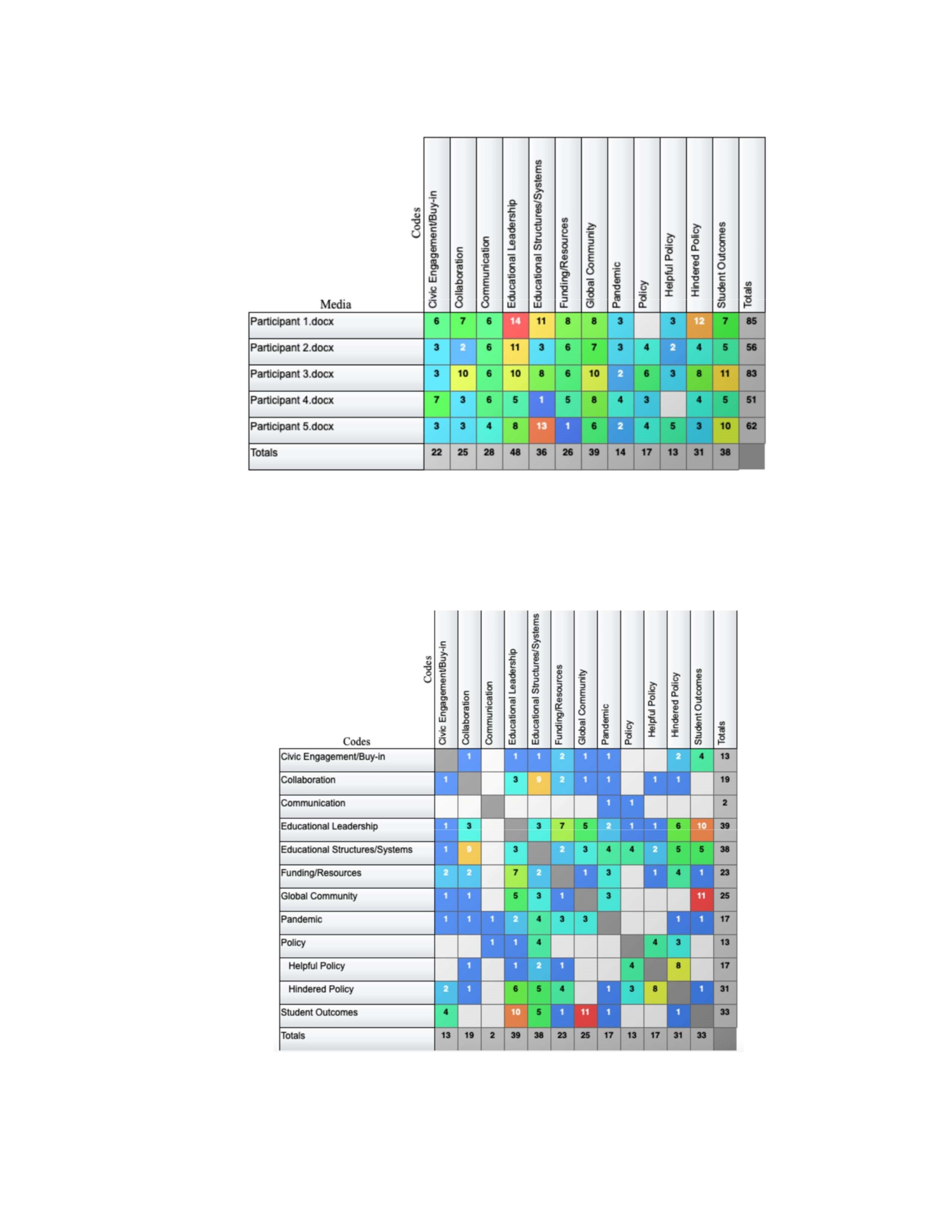
Figure 2
Co-Occurrence of Codes

Results/Findings
Research Question 1: How Do Superintendents View Education as a Means for
Creating Global Connections, Ambassadors, and Innovators?
The five superintendents interviewed for this study not only felt that education
could be a means for creating global connections, ambassadors, and innovators, but also
expressed an overall sense of responsibility to create rewarding global educational
experiences for their students. The themes relating to this question addressed educational
leadership responsibility, the global community and education, student outcomes, and the
pandemic. These will all be discussed more at length below.
The educational leadership perspective of responsibility was a continuous thought.
The superintendents understood that they had a hand in shaping and creating educational
outcomes within their student learning community. Each superintendent felt responsible
for student outcomes and expressed that, if a funded globalization framework was offered
as a research-grounded educational best-practice, they would give exposure and time to
that taskforce. With regard to the attempt to create global connections, ambassadors, and
innovators, the superintendents expressed that more inclusive collaboration was needed
for this to be successful. They also spoke to the benefits of the global community, stating
that the future of education and the workforce will involve specific skillsets that the
global community needs.
The superintendents mentioned that the global community can develop student
understandings of the broader world and shift their perspectives to a global outlook.
Educational leaders want to improve student outcomes, and global connections are
considered to improve student outcomes on resumes, job prospects, and transferrable

21st-century workforce skills. As this is the second year of the COVID-19 pandemic, it
would be remiss not to note the underlying “cause for pause” with regard to the virus and
globalization. The COVID-19 virus has created many educational obstacles for school
leadership. The luxury of thinking creatively in terms of education has not been easy in
the past 2 years in the realm of global learning. While the pandemic has created many
obstacles, it has also displayed the clear interconnectedness of our planet.
Educational Leadership Responsibility
Education is a means for creating the foundations for participating in a global
society. The participants in this study did not shy away from the awareness that they had a
duty to expand their learning communities’ global competencies. When asked if
educational leaders are responsible for educating global competencies of students, the
participants unanimously affirmed that they were. Participant 1 (P1) responded, “I believe
we do, but in the format that we currently have, I think it’s difficult. And again, that’s
driven by policy, curriculum, mandates.” P2 responded, “I think so. Yes.” P3 replied, “I
would say so. Yes. I think that because if they’re not going to learn it at home, then we
need to learn it in school. We have to learn someplace.” P4 responded, “Yeah, I think we
should be,” and P5 replied, “Absolutely. 100%. We are responsible for that.”
There was a degree of passion that differed between each interviewee, but they all
respond affirmatively. The response of P1 includes other themes, such as policy and
factors that make global learning difficult to implement. However, it is important first to
focus on the fact that five NYS superintendents all felt a sense of responsibility for
educating their students on global competencies. This displays the responsibility of
educational leadership. While this view is commendable, the participants were also

realistic about the fact that there are many more forces acting upon the meaningful
execution of globalization in education. These will be discussed more later. The
educational system as a whole can create global connections, ambassadors, and
innovations. While this may or may not be actively happening within each NYS district,
the interviewees believed that educational leadership is responsible for global
competencies related to student outcomes.
Educational ambassadorship for the purposes of education can form pathways to
allow for more global interactions. These interactions can point to best practices. When
asked about educational ambassadors, P2 stated, “I think it’s always great when you have
the opportunity to have conversation about what’s happening in other places and what
could you do to improve your local school district.” As an educational leader, choosing
the interactions that will best fit your population matter. When asked about
ambassadorship, P5 mentioned that an important role of educational leadership’s was to
vet or research potential sources of global development. According to P5,
I think those are wonderful opportunities for dialogue and for conversation and
for learning. Obviously, you would want to look at and study systems that have a
demonstrated, proven track record of providing optimal opportunities for kids in
their learning experiences. And conversely also, inviting others to see what we are
doing and also get feedback on how we could do things better. I think anytime
you have the opportunity to create connections and bridges and relationships, you
open up the door to learning and to improving outcomes and opportunities for
everyone.

P2 also voiced the importance of vetting by saying, “I think if educational
ambassadors were well trained, that could be something beneficial.” Analyzing
educational systems aligns with educational leadership’s commitment and understanding
of the community it serves. While there are many big innovations in education,
understanding the learning community is essential for motivating change. When
educational leaders have a grounded understanding of what they need, it can be easier for
them to research the types of educational systems applicable to their learning community.
Global Community and Education
The educational leaders in this study viewed the educational community as a
source of learning that could lead to greater student outcomes. Shifting from their
personal thoughts on the responsibility of the educational leadership to push for global
competencies, the participants here viewed the global community as a
perspectivechanging, skill-creating opportunity. Participation in the global community
was an opportunity to expand global competencies. P2 made the point that the global
community was, “very important. If we don’t work together, I think we’re going to all fail
together.”
P1 stated that education is preparation for the future. This follows the common
theme of superintendents feeling responsible for their students’ educational outcomes
regarding exposure to globalized educational experiences. Participant 1 revealed the
appeal of being a part of the global community as, “it [the global community] definitely
appeals to me because my, I guess, motto, is that we are preparing students for
occupations that don’t currently exist. So, we have to think of the skillsets that they may
need, to tackle the jobs that we don’t even know are out there or will be out there.” The

underlying idea behind this is that students should be exposed to the skillsets they need to
become a meaningful part of the workforce and global community. When students are
exposed to these skillsets, they can participate, collaborate, or compete meaningfully
within the job sector or chosen career pathways that emerge down the line.
While revealing the importance of the global community for student outcomes, a
second perspective was the notion that many other aspects of our society are global. This
shows that educational leaders understand how interconnected the global community is
and how important it is for education to pave the way for the global community. P1
discussed the global community in terms of the realization of access to needs and found
that the future of education lies, at least in part, with the global community: “It’s huge.
Just because we live in a society that it’s easy for us to go out and get clean water, there
are societies that don’t have clean water. And exposing our children to that and solutions
to those problems, I think, is where we have to [make] our society not just creative and
innovative, but compassionate. We all don’t live with the freedoms that we have, that we
take for granted in United States.” P1 brought up the ideas that underly the purpose of the
global community, one being that the students of today will grow into the society of the
future, so we are all empowered when we shape students to be creative and innovative
citizens and to have compassion for those around them.
P5 discussed the global community for the future of education by mentioning
other large societal factors and how they contribute to education. Alongside the expansion
of educational opportunities, the future of education will include more interconnected
capabilities. As P5 stated,

Well, I think it’s critically important. I think we are part of a much larger society.
It’s expanded exponentially by a variety of factors: economic, political,
technological, social. And so that global community will, we need to be able to
prepare our kids to be able to live within it and be successful in it and interact
within it. And we also have to be aware of how it impacts our life in every way
and have an understanding of how to be able to contribute to that global
community to make it better for everyone.
Part of the preparation for our students is providing perspective on how the global
community affects education. P3 found that the global community does impact education:
[F]or example, right now, there’s this growing tension with Ukraine and certainly what’s
going on with Russia with that, and also China and Taiwan. I mean, these things do have
an impact. We’re taking a look at how at the Olympics, there’s the political implications.
So, I think that there’s impacts from that. I just truly believe that everything does trickle
down into the schools. I mean if we keep our head in
the sand, then we’re not doing our children any service, so it’s important to have
current events to discuss current events and for students to be aware of what’s
going on globally.
Being part of the global community for educators is being able to discuss difficult
topics and analyze the different perspectives using facts. For any community, it is easy to
become comfortable in benign day-to-day processes. Being part of the global educational
community appeals for P4 under the premise that students deserve an expanded view of
the world: “it appeal[s] to me so that students could be more worldly and understand that
things don’t happen in a vacuum.”

This idea of being part of the global community can reveal to students how
outside influences change, mold, and impact the educational system that leads directly to
them. The global community is constantly changing. P3 defined the global community in
this way:
[T]o me, global community is not only the respect for our cultural differences but
working together. This is a global history term with, cultural diffusion, as we
embark and trade. We’re also sharing our cultural aspects with that trade. And it’s
influencing one another. I mean, certainly United States is the prime example that
we are, except for our indigenous native Americans, we are a nation of
immigrants. And so that’s what makes America great. We have a little bit of
influence from many different countries around the world.
P3 nodded to the idea that respect for the global community includes recognizing
that it has had an impact on the United States through cultural diffusion. The global
community is connected through many aspects of life. It is only reasonable that these
educational leaders expressed the opinion that the global community as a whole impacts
larger societal factors, even inadvertently.
Student Outcomes
The participants revealed their own responsibility for creating global educational
experiences and acknowledged the larger impacts of the global community. However,
student outcomes were a major theme throughout this research. At the core of global
connections for education is the notion that these can bring quality student learning and
outcomes. The educational leaders interviewed here believed in the importance of
practicing the skillsets that will be required for future educational and career endeavors.

P3 discussed student outcomes in terms of how globalization has changed education from
the perspective of hire ability based on educational experiences. P3 stated, “to see
students be successful, to see them feeling prepared and feeling that they are… I’m trying
to think of the right term here, like that people want to hire them. And that people look at
their high school resume and say, ‘Wow, you’re so prepared for the real world,’ that
would make me happy.”
This merges the association of a student body with competent global knowledge,
the potential for successful student educational outcomes, and the personal feelings of
educational leaders. It shows that educational leaders know their responsibility in
ensuring that society has the knowledge base it needs for the future and building global
connections as a skillset. Students need to be able to find the value in these educational
outcomes. When discussing the rewards of global education, P4 mentioned, “I think of it
as students becoming more worldly and understanding that maybe they have to become
global citizens, not just local.” This leads to the thought process that global connections
can lead to improved student outlooks in terms of personal possibilities. P4 also
mentioned, “I think life experience and getting out of your community is really important
for growing and expanding your horizons.” This leads into the idea that, when students
“expand their horizons,” they can be more innovative in their problem-solving and
critical thinking abilities, particularly if coupled with effective communication skills to
create a “well-rounded” person.
Education creates global connections, ambassadors, and innovators when we use
our current resources to build meaningful bonds centered on shared interests. In the words
of P1, “we have an opportunity to provide children and staff with the resources they need

to explore a greater area. I think of robotics because robotics has an international
component. It provides students with like a blog that they’re able to find out what they’re
doing in China, what they’re doing in some of the other countries, like Costa Rica. It’s a
common language that the kids all understand. We may not understand it, but they do. I
mean, they’re speaking in code.” Part of global connections is creating meaningful
relationships where international students have new common learning interests to
explore. This provides learning experiences based in the value of all cultures and
perspectives, ensuring a balance of power so that no student can be considered an expert.
Educational outcomes centered on student interests such as robotics is an “opportunity,”
P1 stated.
Such student-centered interests that explore focused learning outcomes can further
the potential needs and skillsets that allow for innovation among youth. An interesting
thought P1 mentioned subtly is that technological coding can skip language barriers that
can clog the pipelines to global communications and connections. P1 appeared to align
their personal responsibility with student global connections and experiences to benefit
the future of the learning community. When discussing the rewards of global learning, P5
said,
I think there’s just so many things that are rewarding and beneficial for students.
It’s the cross-cultural connections, it’s the humanistic element of globalization.
It’s also the skillsets that we want to help students develop so that they are
applicable to any kind of environment that they see themselves in terms of their
post-secondary education and careers. The collaboration skills, the creativity
opportunities, the communication skill sets, critical thinking, and problem

solving. All of those types of things or those attributes are applicable in almost
anything that we do. So, I think, globalization helps to enhance it from that
approach.
All the aforementioned skills are needed for the 21st-century workforce. The
assembly line worker has been replaced by machines, and the future workforce will rely
on the student outcomes of today. Multiple and alternative perspectives are important for
student outcomes, as they lead to new ideas. In the case of NYS, students do not
necessarily need to leave the state to interact with those outside of their “zone of
familiarity,” as there are urban, suburban, and rural parts to the state that have different
ways of life and that may lead to different learning perspectives. P1 perceived the rewards
of a more interconnected educational system in the following way: “The creativity, the
innovation, the collaboration with other countries with other students… You don’t have to
go far for it to be different from a different perspective.” On the other hand, P2 saw the
rewards of global education as “the ability to see the results and the impact that it could
have.” Global education can lead to skillsets that develop into positive student
educational and experiential outcomes.
Research Question 2: What Major or Minor Concepts Do Superintendents Consider
When Explaining the Phenomena of Globalization for the Purposes of Education?
The phenomenon of globalization for the purposes of education, at first glance, is
about the interconnected learning community. However, in order for superintendents to
create educational experiences that allow for global interconnections, there must be local
public support. The greater civic and learning community interests must align with buy-in
factors that make local support actionable. Therefore, superintendents’ perspectives of the

local community must be considered when explaining the phenomena of globalization
and education.
When considering globalization and education there is a need for educational
leaders to have the capacity to create educational experiences that allow for global
interconnections, without media or public perceptions skewing local attitudes toward
international communities of learning. When explaining the phenomenon of globalization
in the educational system, civic buy-in through effective communication is at the core.
The common themes related to the second research question were therefore civic
engagement and buy-in, communication, educational structures and systems, educational
leadership participation within educational structures, and student outcomes.
Civic Engagement and Buy-In
A common theme within this research was the need for civic engagement and buy-
in. Fascinatingly, the superintendents reflected on their responsibility for developing
global competencies, how the global community affects many facets of life, and the
potential global learning has to creating meaningful student outcomes, but they also
pointed to a major obstacle to explaining the phenomenon of globalization in education:
public opinion. P4 mentioned that civic buy-in is essential: “people aren’t necessarily
looking at that [global education] or clamoring for that type of education. But the timing
of it is interesting because there’s a faction, probably, of a lot of communities that would
rail against globalization.” These hypothetical scenarios are not deceptive, and this is
where effective communication becomes fundamental.
P2 noted a second facet of civic buy-in that needs to be considered when
explaining the phenomena of globalization and education: “You need buy-in, and that’s

tough to get people to realize that they need to add another thing onto their plate.” With
the major changes to the educational system introduced to the pandemic, it is not
surprising that superintendents, educational leaders, educators, families, and students
alike are hard-pressed to add another educational change to the learning community. This
is where clear communication can systematically change the educational structures in
place. A potential way to encourage civic buy-in is to have a strong understanding of the
values and needs of the community and speak to those uniting factors and interests.
Communication
Communication is intensely important to explaining the phenomena of
globalization for the purposes of education to the public. When asked about how
important effective communication was to their educational leadership role, each
participant found it to be essential. P1 said, “you can’t communicate too often,” P2 noted
it was “totally 100% important,” and P3 said it was “100%, the most important thing.
Communication is the key.” P4 also stated, “it’s crucial,” and P5 agreed: “It’s mission
critical… I think a lot of people lose sight in the idea that it’s one-way. It’s got to be
twoway.” P5 pointed to the importance of active listening in good communication and
emphasized this aspect:
It’s really important to engage in two-way communication. You have to be
available to listen and meet with people and talk with them and hear their
concerns. So having an open-door policy, making myself available to the
community, to stakeholders, to the faculty, to kids, to parents, to all of the
stakeholders in the community and being an active listener with regard to their…
Obviously the school board is involved in that as a major stakeholder. Being an

active listener in terms of understanding what they want for their children and
their community is part of communication. It’s important to also engage the
stakeholders in the activities and keep them well-informed about what’s going on
in the district.
Effective communication begins with listening. However, when communication is
not frequent enough, interest and buy-in can waiver. P4 found that “good leaders
communicate frequently. I think the communication is clear. I think it’s explicit. I think
it’s honest. And I think good leaders communicate in a way where people can feel their
passion and it motivates people.” The motivation that brings about educational change
lies within each communal stakeholder groups. P4 expressed that educational leadership
communication should be transparent and inclusive. And I think the one [communication
style] that works the worse is non-answers and “because I said so.” If you’ve been
watching board meetings and you think about communication, all over [New York],
there’s board members and superintendents that are getting pelted from people… It’s a
challenge, every board meeting. I find that people can respect an answer. I find they more
readily accept an answer, even if it’s one they don’t agree with, than a non-answer.
Non-answers are a bookmark that prevents the conversation from moving
forward. P1 agreed with the notion that an upsetting answer was better than no answer
and noted the importance of ensuring “honesty and transparency.” This shows respect
when having difficult conversations, especially regarding excessed positions. When
educational leaders prioritize having those uncomfortable conversations, this reflects the
culture of the community. P1 stated, “it’s important. Otherwise, you… you’re going to
have angry people.” P4 mentioned “trying to nip things into bud too. You anticipate

what’s going to be a hot button issue.” Each superintendent used the common adjective of
“transparency” with regard to communication. This reveals that, to create meaningful
working relationships, we must be able to communicate in a way that reflects ethical and
moral responsibilities to the learning community we serve.
Educational Structures/Systems
There are educational systems and structures in place that we must consider when
explaining the phenomena of globalization and education. Educational structures are
crucial to the successful incorporation of global learning in education. P2 found that the
educational system, “gives the framework. I think it really requires a commitment on
behalf of the individuals within the different school systems.” This points to the larger
realization that frameworks alone do not ensure civic support or community interest;
rather, these supports ebb and flow depending on district initiatives. When discussing the
idea of global education as conjoining civic support and learning structures, the
framework that aligns with individual district objectives that will pique interest for
communities. Global learning and global participation are not remotely enforceable, like
state exams for graduation. All educational leaders are responsible for ensuring that the
educational structures in place reflect and promote the healthy exploration of new global
topics. Global learning must reflect authentic partnerships.
A healthy combination of collaboration and competition within the global learning
community can provide balance. When asked if education is based more on competition
or collaboration, three of the five superintendents responded that it was competition. P2
stated directly, “Competition.” P3 elaborated with,

Certainly competition. I mean, even when I was a teacher, some colleagues
wouldn’t even want to share out a lesson plan, or they were very territorial on
what they were doing, and I’m the opposite. I’m like, “Listen. I did this, you want
to come into my class? Do you want to see what I'm doing?” I was the first
teacher in my district to have a smartboard. I invited everybody in to see, but
some people, instead of being happy, were like, “Why did he get it?” I think we’re
way too competitive, and we need to be much more collaborative.
An educational structure based on individual competition leads to individual innovation,
and this can create concerns for global learning, as collective systems thinking and
collective shared visions are inherently more collaborative in nature. If teachers feel that
they cannot collaborate within their own districts, the global education system has a long
way to go.
However, a sidenote regarding this individualized competition might align with
the time it takes to creating elaborate lessons, which is not always compensated. Online
formats like teachers-pay-teachers encourage the capitalistic entrepreneurial systems
within our government format, as these systems allow teachers to pay one another for
lesson plans, virtual and paper-based student work, summative and formative
assessments, behavioral systems, and more. P5 found our education system as a whole to
be based on “competition. That is typically the mindset of American schools, American
education, especially pre-K-12. And that is almost cultural. For Americans, there’s this
cultural idea of individualism and survival of the fittest. And much of American history,
American literature and American culture have a tendency to glorify that kind of

competition.” When explaining globalization for the purposes of education, P5 made a
good point of recognizing the internal workings that motivate the core of U.S. culture.
Two superintendents did say that education aligns with collaboration. P4 stated,
“in places I’ve worked, the competition’s not necessarily within the organization. So, I
would say it’s collaboration.” This perspective is based on personal experiences and
aligns with leadership. Leaders who promote shared visions, systems thinking
approaches, and collaboration can slowly shift mindsets to a more open exchange of best
practices. P1 agreed: “Collaboration. Competition doesn’t drive what we do.”
Interestingly, each participant believed that both competition and collaboration
have a place in education and in society as a whole. When asked about the benefits of
education based on competition and collaboration, P2 stated:
[F]or some communities, competition is important to be number one, to be at the
top. And then for a district like [District Name], I need to collaborate because I
don’t have the resources that, let’s say, [another District Name] has. So, I have to
rely on them. I don’t have all the staff that they have. I don’t have the public’s
relations that they have… transportation, sharing with your colleagues… because
you don’t have enough buses or bus drivers.
This is a direct example of P1’s experiences as a superintendent and their
perspective on the importance of collaboration. P1 expressed that relying on others does
not make a leader weak but provides the essential resources to be able to compete. P2’s
perspective on competition and collaboration was that “competition forces you to try to
do the best you can. Collaboration, working together for the best of all.” Each participant

pointed to the fact that education must find an internal balance. However, P3 had a
commercial perspective toward educational structures:
Well, certainly I don’t want to say that all competition is bad because businesses
sharpen themselves when they’re in competition. So, if we lived in a rural area,
there would be much less competition. And I find that there’s less opportunities.
Whereas [New York], there seems to be commerce everywhere. And so, there’s a
lot of competition and businesses have to stay sharp to meet those needs. But I
also feel that we need to do a much better job of the collaboration, and the more
collaboration we have, I think will lead to more opportunities.
While P3 reflected on competition within education as important, both
competition and collaboration are needed to improve different aspects of society. P4
mentioned historical events that require both a competitive aspect and used science as an
example of a curriculum that encourages collaboration: “I think if you think about
education based on competition, we could go all the way back to the space race probably.
To be the first on the moon and so on. I think that’s a good example of competition. Then
there’s probably some science examples that are based on collaboration, I would
imagine.” Both history and science offer two perspectives that highlight the benefits of
competition and collaboration.
In terms of education, based on the benefits of competition and collaboration, P5
stated,
So, when you really take a look at the effectiveness of the private and public
sector, when it comes to achievements whether they are in science, whether
they’re in research, whether they’re in medicine, whether they’re in discovery,

discovery of new ideas and pathways, those typically occur in environments that
encourage collaboration. Even when you look at some of our successful
corporations and companies in the United States. And we really need to align
more effectively and move away from this culture of individual achievement, as
opposed to collaborative success, and get people thinking along those mindsets.
Two of the superintendents, P3 and P5, believed that education is based on
competition but that collaboration should be a stronger aspect within the educational
system and structure. When asked if the educational global community is connected, all
interviewees said “no” or answered this question in the context of how individual districts
can be global but not as a collective international educational community. P1 said, “I
don’t think so.” P2 said “no,” and P3 voiced
Not at all, because I certainly see Finland’s approach, which I think most of the
world does look towards and has that respect. I think that quite frankly, and I hate
to say this, but the United States, I think we’ve kind of lost our way when it
comes to public education. I don’t think we are putting enough concentration and
supports and financial supports that we should. And I think that, unfortunately,
politics in America has entered into public education when it should not. And I
think we need to continue to think out of the box and be more innovative the way
we were in the past.
P3 noted the lack of global connections available due to the lack of funding as a
feature of the educational system’s lack of global interconnections. P4 responded, “not in
my experience” to this question, and P5 replied,

It is connected in sort of an ad hoc kind of a way. I think that’s more connected on
the university level and on the research level, at much higher levels than it is at
the pre-K-12 level. And I think that part of that has to do with the fact that, at least
in the United States, we have really 50 different systems of education and they’re
all governed in very similar ways and also very dissimilar ways. So, I think that
there’s more work that definitely can be done in terms of that globalization or
interconnectedness on the pre-K-12 level. It’s happening, those connections and
partnerships are happening, but it’s not very well organized or very
wellorchestrated. And it really is dependent upon individuals who are interested in
seeking out those types of opportunities.
Creating connective international frameworks can create a more equitable and full
global learning experience. The current education system only creates islands of
innovation. While competition is important, collaboration among educational leadership
can form meaningful bonds and create authentic learning possibilities. P3 thought that
educational leadership, if provided supportive educational policy structures, would
benefit from more collaboration. P3 found that globalization integration could be made
possible, as “I would say to allow more of a deeper conversation between
superintendents, between us and our colleagues in other countries.”
Of the five participants, P2 mentioned global education experiences: “I visited
different schools in different countries.” Creating meaningful pathways for educational
leadership participation in the international arena is important. P3 noted, “I don’t really
do that because I don’t see those pathways… And I would certainly welcome that if I
would be able to be put in touch with somebody who can make that happen.” P5 also

said, “in terms of the global participation, I would say that I am not part of any global
organization at this time in my career that is focused on educational issues.” Without
creating learning opportunities for educational leadership to participate globally, this
perpetuates independent global learning experiences rather than collaboration.
Student Outcomes
When explaining the phenomena of globalization and education, student outcomes
are at the core of creating meaningful learning experiences. When defining globalization,
P3 stated,
[T]he definition would have to share that it’s preparing students for the world that
we’re in nowadays. For example, I look at Manhattan as the Mecca or the
metropolis of the world, people from every walk of life are in Manhattan, and
anybody can come from any country, and they could work hard to do what they
need to do and to advance and to get ahead. And there’s a lot of innovation with
that. So, I think if we are able to connect the importance of future job prospects
being prepared… teaching about the various cultural experiences and historical
experiences. I just think that’s important. Kids really need to know that so that
they’re really fully prepared as citizens and can make informed decisions.
NYS in particular does have access to a very culturally diverse population.
Student outcomes are where the results of global learning can speak for themselves. The
future of society is built in part within the educational experiences provided to the youth.
When considering reasons to integrate globalization into schools, P4 shared, “I think
people should consider it so that our children, and our students, in the future are able to
compete because I think that’ll probably be necessary.” Considering the educational and

global structures currently in place when explaining the phenomenon of education can
better prepare students for the future and for careers we cannot even imagine yet.
Research Question 3: With Regard to Education and Globalization, Does the
Current Educational System Provide the Capacity for Meaningful Global Learning
and/or Exchanges?
Educational Structures
The capacity of the educational system to provide meaningful global learning and
exchanges currently relies heavily on those seeking out ways to pursue these educational
features. Innovation working in isolation promotes inequity. When asked about the
educational system’s capacity to provide global learning or exchanges, P5 responded
with,
I believe that there are pockets of innovation, of opportunity, of creativity when it
comes to this issue, and how it happens is really dependent upon having
individuals who are committed to that vision and committed to that purpose. I
would say that the [educational] system itself needs to improve in that area to
provide those opportunities. And it would require… a focused, systemic effort on
those specific areas that would allow further, really, freedom of opportunities for
exploration, opportunities to pilot some areas of innovation, and study their
outcomes, and what the effects are, and what the benefits are. I think that would
be a first step in moving in a direction that would allow the [educational] system
to expand.
Educational structures must be in place that support those who are willing and
who want to explore educationally. P1 relayed the idea of risk-taking in the format of the

current educational structure and how it limits those who want to take methodological
risks. The current educational framework does not account for calculated risk in the
improvement of educational outcomes, creating an unstable foundation for education. P1
spoke to the educational system and observed,
I don’t think we’re there yet, until we change the education of educators. Right
now, I think the individuals teaching, our teachers have been far removed from
the classroom. Many of them are retirees, and this is their retirement job. We
could do a lot better. Our teachers are still standing up in front of a room, and
speaking to children, versus letting children explore, and they feel like they’re not
teaching if students are doing the heavy lifting. It’s a hard shift. There are very
few teachers that I know do it and take that risk. Very few.
Again, it is important to note that unplanned risks have unplanned outcomes.
However, when educational systems allow for well-researched risk, in particular in
relation to global learning, the implications for learning outcomes can create 21st-century
educational exchange. The educational system’s capacity to provide meaningful global
exchanges can grow. With regard to this, P3 stated,
I think we do [have the capacity]. I don’t think it’s enough. I mean, certainly,
we’re very fortunate. BOCES [Board of Cooperative Educational Services’ does
offer a lot, so we have a lot of different types of coursework and partnering with
them. We also partner with [local university] as well… So, I’m very happy to see
that we’re working with [local university]. But I think we need to do more…
Again, it all has to do with the district synergy, working with different groups, and
really having the best opportunities for our students.

P3 mentioned the need to continue reaching out to work with others and develop a
more interconnected base to ensure that students have opportunities. Currently, the
educational system encourages isolated innovation within individual districts. A potential
pathway to integrate global learning could be the partnering of educational leadership and
stakeholders to create interconnected international learning communities focused on
providing global learning outcomes for students.
Funding/Resources
The capacity for any educational system to make change depends on the support
of the civic community and funds from local, state, and federal governments, which
should invest in all they deem beneficial and necessary. Therefore, if the government
views education as a pathway for the civic future, it must make financial investments
towards global learning outcomes. P1 highlighted that policymakers should have a reason
for globalization, affirming, “I would think they [politicians] would. I just look at the
resources that schools are given, and for the most part, our politicians don’t put the
money into education.” P2, when asked about limitations for global learning, replied:
“Time and money.” P4 echoed that the major hindrance to more meaningful global
exchanges for education are funding, the pandemic, and civic support: “I think [what
hinders it is] its finances. I certainly think right now it’s a pandemic. I think it’s
misinformation campaigns.”
Again, civic involvement is essential to creating any change, but even publicly
supported initiatives are difficult to implement without the needed funding. When asked
what was needed from policymakers to make globalization possible in schools, the
superintendents emphasized resources in the form of a framework and funding. P1 said,

“I do think we have a big disconnect when it comes to what’s required of schools and the
funding behind it and the reality base.” P2 stated, “money.” P3 observed,
Well, certainly if they gave us funding and opportunities to partner and meet with
leaders from other nations. I would love the opportunity to meet with educational
directors or the equivalent of the tendency of somebody in another country. I
would love the opportunity for our students at [District Name] to go and exchange
programs and our staff as well with a particular country in their school district.
Just to kind of get another perspective because we all learn from looking at all of
the different things that we’re doing. I think when everybody does everything the
same way, and we have conformity, I don’t think that that leads to any innovation
or growth.
When speaking to the capacity to introduce globalization to schools, P4 remarked,
“I think policy makers should first ask what the goals are, ‘What do we need to
accomplish this’ and then work backwards from that. Then of course… studying abroad
or getting to really immerse students in cultures over summertime. I think funding
because trips and programs like that you don’t really move the needle on globalization if
the only people that study abroad are the people who can afford it.” Focusing on the
inclusivity of globalization for students and the funding required to ensure all students
have access to this educational endeavor is essential is fully understanding the benefits of
global learning and global relations in education.
On this point, P5 remarked, “I think that we open up the opportunity to create this
framework to pursue opportunities that support this understanding of what globalization
is and how it impacts our society, and how our children need to be prepared to interface

with that globalized world, and the resources and the support to be able to implement
those kinds of initiatives.” This response can be linked to those of P3 and P4 because
collaboration with others from alternative perspectives towards a shared vision creates a
mental model that reflects a global framework. This can then become a shared resource
used by multiple districts that can individualize it to fit their districts’ needs. The capacity
to create these collective frameworks is possible but, as P2 explained, local leaders are
limited in their ability to create a global community when resources such as “time and
money” are not allotted.
Superintendents would support for globalization in education with the proper
funding and policy frameworks. Communication and support is key to expressing the
urgency for any change initiative. When asked if they would want more exposure to
globalization if policy and funding supported this endeavor, all five superintendents
replied with a “yes.” Regarding policy and funding support, P1 said, “I would definitely
be in favor of it, and I would spend time and resources if it was provided to me.” P2
stated, “Yes. I would be interested. And the amount of time really would be dependent
upon the amount of time I have in a day.” P3 noted, “absolutely without a doubt, I think
it's so important and vital. So, I would say we probably need to start like planting a seed
and then watch it grow and then see as it becomes more influential.” P4 was very honest
by saying, “yeah, I would want access to it, and I’d be willing to spend a good amount of
time, but it would not be a top priority on my list. I feel like where I work at the moment,
we have bigger fish to fry first.”
Knowing your community and its capacity to make meaningful change is
important. Also, globalization does not have to be a top priority for it to be a progressive

structure within educational structures; it can be phased in through slow, meaningful
stages. P5 noted, “I think that it’s really important. And again, I would want to see it not
within a vacuum, right? But across the content area it’s something that should be diffused
throughout the curriculum, throughout the content areas. And I think it’s aligned with
what research tells us our best practices in terms of higher order in student engagement
and higher order learning. So, I would want to spend a lot of time on something like that.”
Civic Encouragement and Buy-In
The capacity for globalization to be meaningfully incorporated into our education
system relies on funding just as much as it does on public support. Without public support
for global interactions and learning, this avenue of learning is immobile. P3 highlighted
the hindrances for more meaningful global exchanges within education as “time, money,
politics, I would say, are the big roadblocks.” Time for collaboration and funding are
typical responses to questions, but it is clear that politics have an impact on public
education. The limitations local leaders face while incorporating global learning tied back
again to funding for P4: “I think it’s budget constraints. And then I also think it’s closed
mindedness, to be honest with you.” The perspective of P1 regarding hindrances was,
“finances, resources, support from our government, support from our parents.” P3
explained the phenomenon of globalization for the purposes of creating global
community connections in the following way:
I think it has to do with synergy. It’s so important for districts to partner with
many different groups and organizations. The great thing that I see about [District
Name] is that really, I’ve met with practically every single stakeholder group in
the district, and they either currently partner with the district or want to partner

with the district further. So, I think that that’s truly beneficial, but in addition to
that, we collectively need to do a better job of having more conversations with
innovation, taking risks, supporting our teachers and students to take those risks.
And we know that sometimes when you take a risk, you fail, but then we learn
from the failure. When we become too scared to take risks, we become
complacent, and then we end up falling behind. And from all of the courses that I
took in my experience in the business world is that businesses that continue to
change and put effort into their research and development are more successful. I’ll
give you a very simple example. If you look at McDonald’s, why is McDonald’s
so successful? Because they’re always looking at their menu, they’re trying to
come up with different ways. Right now, they have their app, and they offer all
these different things. So, they’re bringing in people Millennials and Gen-Z into
the equation. And at the same time, they have certain staples on their menu that
people may have had when they’re kids and maybe older now. So, they do a nice
mixture of that, and they market very well. So, I feel that that’s extremely
important too.
When schools incorporate stakeholders as a means to create new opportunities, the
shared vision of communal empowerment creates community bonds. This fail-fast
mentality allows for risk taking within a confined placeholder. This type of systematic
experimental global learning could be the bridge along which to bring in new positive
civic opinions regarding what global learning can mean. The capacity for global learning
to enter our educational systems depends heavily on funding, the opportunity to
collaborate, and civic support.

The Pandemic
The capacity to educate during a global pandemic over the past 2 years has been
exhausting. Educators have had to shift from in-person learning to various distance
learning methods, reaching what is now described as the “new normal.” This has included
new vocabulary that can be applied to the field of education: social distancing, contact
tracing, virtual/distance learning, flattening the curve, and super-spreader events to name
a few. Educators are now seen as essential workers and have been creating educational
remedies throughout the span of the pandemic, which has exposed food insecurities,
housing insecurities, financial insecurities, medical inequities, racial inequities, a
social/emotional crisis, and, for the purposes of this research, to learning inequities within
education.
Educational leaders have had to become creative and to move education on a
pathway toward success while keeping in mind the health and safety of the entire learning
community. Therefore, this study comes at an interesting moment. During this global
pandemic, the attempt to incorporate globalization into education is not very high on any
educational leader or politician’s list of needs. However, we now know the capabilities of
our educators, educational leaders, and policymakers. If only we knew then what we
know now! Through educational initiatives, we also have access to the technology base to
support potential international connections. Therefore, to fully discuss the capacity for
education to incorporate a global view, we must consider the experiences of educational
leaders during the pandemic, which made it clear that global connections are at the
forefront and future of our interconnected world.

Due to the pandemic, education became virtual, almost immediately. In this
context, P2 found that, in terms of meaningful global exchange, “I think it’s also very
difficult to do a whole lot right now with COVID because everything right now pretty
much has to be virtual.” At the same time P2 found that globalization,
…probably should affect it [education] more. But again, just the world and
current events and what’s happening around us is impacting how we’re
responding. And again, I point to COVID. That now has changed the entire world
and made us realize, or at least made me realize that we’re very interconnected.
What’s happening in one part of the world really does impact everybody.
The pandemic seems to have brought out this virtual togetherness, while
simultaneously increasing separation. However, the appeal of being a part of the global
educational community for P3 was that, absolutely because it’s not just New York State
or the United States, but we really are a global economy as we see how we’re all being
affected due to the pandemic.
We’re all connected. And so, it’s important for us to have perspectives not just
educationally, economically. We do need to be aware of other nations as well.
P5 reiterated the current effects of globalization and the pandemic, saying,
Well, I think that globalization has really affected all of us in education right now
on a variety of different levels. Certainly, responding to a pandemic has really had
a tremendous impact on everyone. Policymakers, politics, the classroom teacher,
obviously school leaders have really had to juggle a lot over the last 2 years now.
We’re coming into 2 years in March that we’ve been dealing with this situation. I

mean, that, in and of itself, I think demonstrates and illustrates the point about the
fact that we are in this interdependent world.
The pandemic has also exposed limitations and inequities in our educational
system, like those P3 mentioned: “I would say certainly Wi-Fi issues, socioeconomic
issues.” Educational leaders have been put in difficult positions to uphold legislation that
they are not part of making, and, as P5 remarked, “superintendents and school leaders
were kind of left to figure things out on their own.” The pandemic may have also
weakened the appeal of global exchange, as it has been 2 years since international travel
was not at a limited capacity. When asked about globalization impacting education, P4
stated,
I don’t think it does presently. Certainly, in the last two and a half years, maybe
that’s an anomaly, but I don’t think it really does. I think it’s limited to the trip to
Spain, France, or Italy, and I think that makes it [globalization in education]
lacking.”
P5 discussed the process of looking beyond the pandemic to the future of global learning:
I think that there are tremendous opportunities and capitalizing, again, as we come
out of the pandemic, we’re just starting, to not only regroup, but also reengage a
with the rest of the world. We’ve been very isolated, but there are opportunities,
it’s [global education] very interdisciplinary in its approach. And there are
opportunities across the curriculum to move in those directions to provide
opportunities for kids. And so, again, I imagine that if we were having this
conversation pre-COVID or well post-COVID, I’d be able to be providing you
with more concrete kinds of examples… everything has sort of been ground to a
halt because of the pandemic.

The pandemic has exposed weak systems within our government. Our educational
system was turned upside down, but the confusion brought on by the pandemic may have
actually opened the door to global education in a way we never thought possible
previously due to the new sense of virtual togetherness.
Pandemic Technology
One benefit of the pandemic in terms of the integration of globalization in schools
has been the expansive shift to online learning platforms. While some schools were
already incorporating online learning, the educational shift would not have been possible
without distance learning. When asked what technology platforms were most beneficial
during the pandemic, the participants highlighted similar platforms across all schools.
This is promising because using the same online learning platforms ensures that all
students have experience with the same formats for learning and the things that were
initially difficult to understand, such as how to turn in an assignment, are now nearly
common knowledge for all students with virtual learning experience.
Common learning platforms create common formats for dialogue. This can be
beneficial to global learning if international students also have exposure to the same
learning platforms. This technology learning shift rested on the capacity for students and
staff to have access to technologies for learning and teaching. P1 explained that their
district was fortunate because
…we were a Google platform before [the pandemic] and students from four to
eight had their own Chromebooks. So, we only needed to get Chromebooks for K
to three, but our teachers were already using them in the classroom. So, it was an
easy transition. And again, funding could have prevented us from putting those

Chromebooks in everybody’s hands immediately, but we were fortunate enough
to get a donation and the person who donated them had them in his warehouse.
So, we didn’t have to wait for a supply to come in.
Not all districts were as fortunate to already be using Google learning platforms
prior to the pandemic. However, P2 stated, “we use Seesaw primarily for elementary, and
Google Classroom, secondary. Administratively, Google Meet, even FaceTime, Teams,
whatever we’re on. All of those types of things have been very beneficial.” P3 remarked,
“I would say it’s definitely different between the availability of Seesaw… on the
elementary level, the secondary level Google.” P4 used “Google Classroom.” Finally, the
technology for P5 was mainly Google:
Our platform was Google platform. It was Google classroom, the Google suite of
applications. That had existed prior to the pandemic. And so our staff was used to
utilizing that pretty regularly, every day. It was already a system of an educational
platform that existed, but we had to harness it and make it work for kids that were
now no longer in the building, that were at home. And so there’s going to be
continued research in this area of virtual learning in the different virtual
platforms. The thing that I feel was very important from the beginning of the
pandemic was the relationships and keeping the kids connected to each other and
to the faculty. And so we really focused our efforts on live streaming, and that was
challenging for the staff, very challenging for lower elementary kids who needed
a lot of assistance at home back when we were fully remote. For their parents, it
was really challenging. But I think it goes back to, again, there’s a whole host of
methods that we can use, and we have to be open to an amalgam of tools that

work for kids and for the faculty. The teachers worked extremely hard to get
through that, as did families and kids. And so I know that as time passes and we
look back and reflect on this period of education during the pandemic, I think
there’s going to be a lot of lessons that come out of that for us.
Focusing again on the similarities between these five districts, with each district
using the same learning platform, the pandemic actually brought learning closer in terms
of educational capacities. To have five districts, and countless more across the country,
using the same educational platform is an educational feat. It is extremely rare to see
nonmandated or systemically regulated educational experiences that work effectively
across multiple districts. Technology is the great unifier. The exchange of thoughts can be
made global using technology. With shared educational platforms, this thought-sharing
space can create meaningful educational learning experiences.
Collaboration
The capacity for collaboration could be the most important yet exclusionary factor
when discussing the incorporation of globalization into education. When discussing ways
policy could integrate globalization into schools, P1 replied, “I think globalization has to
be more global. We’re all in our own bubbles. We really are.” This leads to educational
leader isolation. When asked which educational leadership forums support NYS
superintendents, P2 said “My superintendent’s association primarily.” However, P3 said,
I’m part of quite a few different organizations… in my current superintendency, I do meet
regularly to share with my colleagues in [name of] County. I’m also part of the legislative
committee. We do take a look at policies and procedures in New York State, and I’m able
to give input and speak with them regarding that. And it’s important for any of us to reach

out when we need any type of assistance or help and to really be vulnerable and say, “I
could use some help.” I think everybody does in life. I don’t think there’s anybody who
knows all the answers to everything. And I think if I had that approach, I don’t think I’d
be a good superintendent. So I think that it’s all about seeing what my strengths are and
looking at what my areas of weakness are, and getting the help to be better with those
areas.
P4 shared, “well, first it’s colleagues, then it’s local and state organizations. For
me, it’s [name of] County School Superintendents. It’s New York State Council School
Superintendents.” P5 said,
We have a lot of professional organizations to be part of. The biggest one, of
course, is for the region, which is New York State… New York State Council of
School Superintendents. We also have close partnership and affiliation with the
New York State Council for Social Studies… we have a lot of resources and
networks that exist to support us and that we connect to and collaborate on a very
regular basis. School Boards Association. We also have regionals superintendents’
groups. We have the AASA, which is a national organization. These
organizations have the capacity to collectively encourage and form meaningful
connections for superintendents. With these systems in place, currently there is
the opportunity for a more global outlook of educational experiences. When
superintendents have access to other educational leaders, meaningful connections
can form. With these forums and organizations in place, if global learning was to
become a topic implemented at the state level, these educational leaders could
have access to each other as a collaborative knowledge base.

When discussing forums for support, P1 said,
I would not have gotten through this pandemic without the [name of] County
superintendents, without the New York State Council of School
Superintendents… Those days of hiding and not sharing are gone. Survival has
been to share, and I think that’s what we need in education but yet if you think
about it, my teachers don’t have the opportunity to share like I do with my
superintendents. When you try to do a shared superintendent’s conference day,
people are missing, or you don’t have the same day off. We can’t get subs, so
professional development to go visit another school is out of the question. They’re
limited. They really are. I would love more exchange programs, I would love for
teachers to go over to Finland and having somebody pay for that. I think we
would get teachers going to Ecuador in South America to spend time working on
building schools, if somebody would pay for it. I have a lot of young teachers
here that do not have families. Some of them are former contractors. Some of
them are servers. I could see some of my younger teachers going to Ecuador and
studying there for a year. How great of a teacher would they be to come back to
Springs if they had that opportunity? I haven’t seen anything that provides that
opportunity. If I want to go to Finland, it’s going to cost me about $10,000. They
have a program. It’s an immersion program for, I guess it’s six weeks. So, your
employer has to give you your salary, you have to pay for your airfare, you have
to pay for them to provide this program to you. I just think there’s more that the
government can offer to make our teachers better, to make our administrators
better. It’s all on us to do it ourselves.

This exhibits the frustrations for public education leaders. There may be great
programs available but, without the proper resources, it is out of the question for public
school districts. This is another example of why global learning integration moves at a
slow pace. It appears to be mostly the entrepreneurs and private sector noticing that
educational leaders and professionals want access to the best practices not just in their
state but around the world. However, due to the high costs and the lack of public funding
for global education, this is left to individuals or individual districts. Within NYS, each
superintendent collaborates within their state superintendent association. However, when
asked nationally how they collaborate, P1 answered, “I don’t participate nationally due to
the enormous cost to belong to national organizations.” P4 also replied, “I haven’t
really.” However, P2 responded, “I belong to several different organizations,” and P3
replied,
It’s a challenge, but I do try at least once or twice a year to attend different
national conferences and connect with my colleagues. A lot of time nowadays, we
do have the ability to communicate with one another through like we are now
through Zoom. So that is helpful, but when you’re in person with your colleagues,
and you can spend that time, and you can discuss some of the concerns that you
have, or some of the problems you have in your district and speaking to
colleagues in other districts and what their experiences are and where we could
mentor and support one another and help to make things better. And even though
no two districts are exactly the same.
Participant 5 noted, “I’m involved in a number of national organizations, leadership
organizations, and that’s how I stay connected with regard to national issues.” With each

superintendent having to afford their own resources to belong to different association, it
again points to why collaboration might help more for global learning.
Research Question 4: Are There National or Local Educational Policies That are
Easily or Meaningfully Put into Practice That Provide Avenues to Guide
Educational Leaders Toward a More Global and Interconnected Educational
System?
Policy and Policymakers
Within this research, policy appeared to be another unifying them, but not in the
success stories of policy promoting a global perspective, and more in the scarcity of
policies that promote global frameworks and globalized learning. In terms of this study,
policy offers educational leaders a pathway to creating a more global and interconnected
educational system. However, the superintendents interviewed had perspectives on
policies, policymakers, and what was helpful or hindered educational policies and
frameworks. When asked what policymakers needed to know about education, P1 said,
“We need a shift. We need a change. They need to know that the way we’ve been
traditionally doing things is not the way that we have to continue to do things. If you look
at Finland’s education system, which is one of the books that I’ve read, they do things
very differently than here. There isn’t the kind of testing that we do. They have more
recess; they have more time to explore a topic.” P2 said that policy makers should know
“how significant it is and how beneficial” globalization can be in education. P3
mentioned,
I think that they [policy makers] really need to know that there’s a missed
opportunity there, that we’re not doing enough, and that we need to have that

synergy with other nations as well. For example, I mean our closest ally being
Great Britain, we speak the same language, but their educational system is
completely different than ours, but why don’t we have those conversations? Why
don’t we take a look and see what the Brits are doing, is that better? Or what
we’re doing, is that better? Or what could we change? What could they change?
Why are we not engaging in conversation with our cousins, if you will, from
Great Britain?
To begin global learning, why not start with a country that has a different culture but is
linguistically similar? P5 thought that policymakers
need to be able to have an understanding and a framework, fundamentally, what
are the underpinnings and outcomes that we expect from public education. And in light of
the fact that we are in a globalized interdependent world, how do we create opportunities
to prepare our citizens, to prepare our students to be able to actively engage in and
participate in such a world. And I would argue that there are some differing opinions
about that, about what that ought to look like. And so, I think that policy makers, first,
need to be educated about the implications of globalization, and then have an
understanding of how education has to help provide support for effective well-educated
citizenry in such an environment. Understanding the inner workings of how education
systems really work within our school districts and the extensive communications needed
to garner civic support would reflect a more inclusive decision-making team.
When asked what policymakers need to know about education and what policy
makers misinterpret about education, P1 said, “I don’t think policymakers have been in a
classroom in a long time.” This disconnect between what really goes on within schools

can be why educational policy often is met with resistance. P2 reiterates this point: “I
don’t think that they realize how sometimes their ideas actually get carried out. And I
don’t think they realize how difficult change can be.” P2 mentioned the difficulty of
change because most change is based on the realization of better practices, efficient
communication, and a foundation built on trust. When asked about policymakers, P3
observed,
I think that policymakers, with all of their best intentions in trying to help
districts, are trying to raise the bar, [and] forget that we are dealing with children,
and we’re not dealing with a product. We’re dealing with children who come into
our buildings with real concerns or issues or learning gaps. I will say teaching is a
very challenging job. There are so many facets to it, and being an administrator as
well, all of this work in education, it’s not easy. I think that policymakers don’t
understand that. And I think that a lot of times, they don’t think things through
when they’re making policies. Because then, all of a sudden, it becomes another
mandate that the district has to do… And a lot of the time, the politicians don’t
really look at the whole picture, and I wish that more politicians would reach out
to us as educators when they’re going to make policy. Because I look at it this
way, I’m certainly not going to tell a medical doctor how he or she should
perform heart surgery, but it seems that with education, everybody seems to be an
expert… and they don’t realize that there’s a whole science behind it. And there’s
a tremendous amount of research behind it. And that as educators, we obtain our
certification through really a rigorous process. So, I think that’s where there’s a

little disconnect, and I do wish that politicians would work with us more and ask
us to be involved in the decision-making process more.
P3 did a great job visualizing the humanism of our students and families within
the learning community. This type of change does not have to do with manufacturing; it
has to do with changing perspectives, and that lies in connecting with the hearts and
minds of the people. This is why creating meaningful bonds within the community is
essential for superintendency. In order to bring about change, it must be communicated
effectively, with urgency, and tug at the hearts and minds of the learning community.
When policymakers skip stakeholder buy-in and enforce new policies and frameworks
without the proper communications, they force superintendents to juggle upholding
mandates (probably linked to funding), communicating why these mandates are in place
to stakeholders, and implementing them in a way that reflects the needs, desires, and
resources within their learning community. P5 linked this to the abstract thoughts
regarding the purpose of education. When asked about what policymakers need to know
and what they misinterpret about education P5 stated, “I think it goes back to what is the
purpose, what is [public education’s] reason for existence, and having an understanding
of what that is, and a defined, focal focus and vision and plan for education. I think that’s
important.”
When asked what policymakers contribute to the field of education, P1 said, “they
add layers.” P2’s response aligned with that of P1: “Well, they’re the people that tell us
what we have to do.” P3 stated, “I think it has to do with all of the different mandates that
we have all the rules and regulations. I would say that’s where it’s driven by.” P4
discussed the role of policy as, “I think policy has the power of steering focus or targeting

focus. Sometimes the focus is a good thing. Sometimes it distracts from really important
things. Sometimes a policy action creates competing demands. Sometimes it has
unintended consequences, but sometimes it hits the mark.” Finally, P5 discussed the
power of policymakers and their impact on education:
Policymakers have the ability to set policy and therefore set the direction. And
there are a lot of factors that can influence the policymakers themselves. And it
goes back to that idea of what are those philosophies with regard to things like
globalization, and how are policymakers impacted by their own political
alignment and ideology. That’s going to have an impact. So, they’re very
powerful.
Adults in education have so much power over the learning experiences to which
students are exposed, which reflects back on educational philosophies and why this work
is so important for education. Educational policy is a driving factor. P2 discussed the
effects of educational policy in the following way: “Well, policy is the guiding principles
of what you do, but it could also be the other way around. Your practice can shape your
policy or create your policy.” P3 stated that educational policy has a tremendous effect
because it drives a lot of our professional development. It drives programming. It drives
all the different vendors in which districts partner with, whether it is a shared partnership
or where we’re paying the vendor with taxpayer money. So, I feel that it has a tremendous
impact, and that’s why I stand by again that our members of Congress need to speak to
teachers and administrators before they make policies in the federal level. And certainly,
in Albany, I would hope that they would continue to engage with educators,
administrators more so on our state level.

P3 also mentioned how incorporating educational administrators and educators
within policy is necessary. P4 then discussed the larger effects of educational policy: “I
think it has a trickle-down effect.” P5 commented on the effects of educational policy in
the following way:
Policy really sets the direction for what the expectations are in terms of standards
and outcomes and expectations for what we do as educators, as teachers, and what
the expectations are for learning. I think there’s so many ways that policy
impacts… the testing programs that exist, that are federally aligned… there’s an
expectation that the system has to prepare students for those benchmarks, that
measured program, and measure student outcome and performance. So, they
really set the course in the direction.
High-stakes educational testing is linked to funding, which is another way that policy
affects educational outcomes.
Global education is a topic relatively isolated from the rest of the conversation on
educational structures. Students in the United States are not required to travel to other
countries, learn of other cultures, or even speak another language fluently in order to
graduate from high school, so global education typically can be sidelined. In some
instances, policy may make leadership in a global society easier. P4 remarked that
“policymakers could probably do a better job getting buy-in and participation earlier on
in the process, rather than just handing down a policy where people are obligated to
follow the policy.” This perspective reinstates the idea that communication is key to
successful policy implementation. On the other hand, P3 stated,

I think that however we look at things, you do need policies. You do need rules.
So, there are rules and regulations we have with everything. I think that that’s
necessary. Otherwise, we’ll have chaos in society and expectations. But I think
that we do need to do a better job in having those opportunities come up, that we
have that in policy for globalization. I do feel currently it’s pretty absent from
most policymakers’ minds. I don’t think that they really look into that. I could be
remiss, I could be wrong, but from anything I’ve read, it seems to be a lot of
policy right now in this country on internal. We’re looking too much the way
America is behaving internally, and we’re not looking enough of how we’re
dealing internationally. We’re looking at really domestic policy instead of foreign
policy.
There are many factors as to why international educational expectations are not in
place. However, with no framework for this global educational process, individuals are
left to explore this avenue of education alone. When asked if there were national or local
policies to guide educational leaders towards a more global educational system, the
majority of participants were not aware of any, stating, “None that I know of” (P1), “if
there any, I am not aware of any” (P4), and “I don’t think that there is… I think it, again,
it exists in pockets. I don’t think that it exists as a particular pathway or one particular
approach” (P5). P3 expanded on this:
I’m actually not aware that there is anything like that. Which again makes it more
challenging for us. Because I guess I don’t understand why we seem to operate more in
our individual silos in districts, and it would be nicer to have more of those
opportunities. But the only opportunities I have out there is that if I say I personally

attend a conference and I meet with other superintendents, and we get together, or I meet
with the county superintendents… there’s so many things that we’re talking about that
have nothing to do with globalization, which is unfortunate. I feel there’s a tremendous
amount of missed opportunities. The underpinning of the participants’ responses focused
on a desire for a more collaborative administrative experience where interesting topics
within education could be explored, discussed, and framed as meaningful learning
opportunities.
Aspects That Are Helpful
Educational policy that respects individuality and incorporates a sense of
flexibility in the approach is more likely to create meaningful outcomes. In terms of
creating meaningful policy that promotes global educational outcomes, collaboration with
educational leaders and educators is crucial. When asked if policy can help integrate
globalization into public education, the majority of superintendents interviewed replied
with some form of yes: “I’m sure it would” (P2). P3 believed that the integration of
policy would best be implemented “if we really worked with the secretary of education
and our members of the Senate in the House on the federal level, and then the state level
getting more support from Albany, but also to working with them so that we provide more
professional development opportunities for our board members because that’s also
important too.” P5 also discussed how policy with educational leadership collaboration
can help integrate globalization into education:
Policy can definitely help support that [globalization]. And again, policy creates…
frameworks and creating that framework, getting information from the field on

how to develop that so that that can become a focal point in an initiative that gets
attention across the content area and within the curriculum. That’s very important.
There are occasions when policy has been helpful. P1 remarked that “the policy
that I think have been helpful is the safety policies about anti-bullying, the financial
policies to keep districts safe as far as financial, data privacy policies to keep our kids’
data and our staff’s data safe. I think the biggest three that I support is the financial ones,
the safety ones, which includes the anti-bullying.” These are policies that promote
financial, digital, and social emotional safety. P1 also mentioned other helpful policies,
such as “policy that helps us is the sexual harassment, the anti-bullying, the social
emotional policies that we have to deal with the whole child. I think those are some
policies that have been helpful.” Policies that focus on the protection of private data,
social emotional wellness, and safety in the workplace are all examples of how policy can
promote a better educational system.
Policy that promotes high standards is also helpful in educational structures. P5
stated,
I think what they [policymakers] get right is wanting to have a standard of
expectation with regard to equity, with regard to access, with regard to
opportunity for all. I think what they get right is, especially in the United States,
supporting the needs of special education learners who need interventions,
learners who need accommodations and support. And as much as we still have yet
to go traveling in terms of truly making sure that we are providing equity,
policymakers are focused on it, and I think that’s a positive thing. Economic, with
all the different disaggregated groups, students who are economically challenged,

students who are challenged because they’re English language learners, or there
are incidents of racism. And the fact that there are some who have not had, for a
variety of different reasons, the same opportunity. That work is really important,
and I think policymakers are really working on that.
P5 appeared hopeful for a better educational future because of policy focused on
equity in educational opportunities. P3 remarked this regarding helpful educational
policies: “I would say they’ve gotten right, certainly, our supports for special education
students. I think that they’ve gotten that right, with an IEP, even 504 Plans for our
students. I think that that has been ways to help address situations.” Discussing policies
that have been a success in education sheds light on how creating meaningful policy is
possible. As echoed throughout this research, funding, effective communication that
encourages civic support, collaboration among stakeholders, and policies that provide a
framework can help integrate global learning in public education.
Aspects That Hinder
Educational policy that is a one-size-fits-all approach ignores the fact that
educational structures serve individuals with individual educational needs. Educational
policy often overlooks that people have different talents and does not allow students to
shine in their own chosen or practiced skill in the educational setting. P5 discussed the
educational detriment of one-size-fits-all policies: “I think in terms of what they
[policymakers] could improve upon, is that there have to be many pathways. And there
isn’t just one-size-fits-all. There is just one way for students to demonstrate that they have
mastered and accomplished what they need to in order to demonstrate that they’re
proficient. I would say that we’ve got to be more individualized in our approach for the

learning needs, and we certainly have the ability to do that.” An educational structure that
allows for global learning opens the possibilities for students to explore individual talents
and see people using those same talents to participate meaningfully within global society.
P5 also mentioned that a hindrance to educational policy is bureaucracy [as you] stifle a
lot of opportunity, creativity, innovation when you overly regulate. I think that’s
always the concern with policy in terms of broad strokes. There has to be
flexibility within policy to allow for the individual needs
and unique needs that may exist in a particular area. And I think that New York
does that well. I think that New York allows for opportunities at the local level for
decision making that are really important. From a broad perspective, I would look
it that way. You don’t want policy to be so narrow that it doesn’t allow for the
meeting of the unique needs of the various constituents that are served by the
policy.
P3 also mentioned that policy can be restrictive and, to remedy this, stated that policy
should be created in consultation with those who have to implement it. P3 stated, I find
that most of the time, policy could actually be a little restrictive, and it may not fully
allow us the opportunities to engage in conversations. So again, I circle back to. I think
the main problem is that our policymakers, whether it’s on the federal or state level, may
have the best of intentions, but they really should sit down and let teachers and
administrators look at some of these potential policy changes they want to make and ask
our opinion for it.

Policy implementation without community support hinders policymakers, educational
leaders, teachers, and, ultimately, the students. P4 discussed a hindrance in educational
policy connected with communication:
I think policies that are intended to force schools, or educators, to focus on all
students. I think something like No Child Left Behind was actually well intended.
I think Common Core policy was well intended. I don’t have disputes with that,
but I think at least in New York, the way Common Core was rolled out was
disastrous. As a person who was a building principal and a superintendent, I
understand this notion of having a sense of urgency and in education, if you delay
a decision by a year, then you’ve cost a whole other year of not attending to the
needs of students. I understand that, but sometimes the rollout that policy makers
implement, it seems to be that… If I have a criticism, I think that’s where they get
it wrong sometimes because I think that they might not understand the challenges
of a rollout, and that a rushed rollout causes more resistance. You can’t get the
positive momentum you need. I think Common Core is a good example of that.
Student educational outcomes are important, as is providing high-quality learning
experiences. However, educational policy that hinders individuality in education is where
policy hits a snag. P4 continued: “sometimes policy promotes angst and anger. A good
example of it is Annual Professional Performance Review (APPR) and Common Core. I
mean, those are two policy examples that riled up teacher unions and riled up parents.
And it forced educational leaders to expand a great deal of energy on things that didn’t
have to do directly with the classroom or instruction.”

Another hindrance to educational policy is when policymakers underestimate the
time, buy-in, funding needed, learning curve, and process it takes to make meaningful
change. P3 stated,
I think where they [policymakers] get it wrong… I mention APPR… I think too
that they just feel that it’s very easy for us to snap our fingers and to make change.
I don’t think they realize that change is slow, and it has to be methodical and done
right, and paced correctly. I think that’s the other thing, too, is that our
policymakers don’t understand that it’s all timing and pacing.
Another hindrance is the lack of support. P2 observed, “I don’t really think they
[policymakers] give us a whole lot of support in general. I think they make policy, but I
don’t know that they often help us carry it out.” In terms of global learning and policy, P5
noted,
[F]rom a K-12 perspective, I think that the achievements of any kinds of
globalized opportunities for exchange and ideas, provide opportunity for
outcomes that can really expand understanding, knowledge, opportunity,
collaboration, but I can’t think of anything that has occurred, sustained systemic
kind of an approach to that. I think it goes back to what I’d said earlier about
those things being ad hoc, happening because people saw value and had a vision
and wanted to make those things happen. So I definitely think that there are
achievements in those areas, but to what extent they’ve been built into some kind
of a systematic approach, I don’t know that exists yet, from the K-12 perspective.
Hindered policy in terms of global learning will continue to confine international
learning experiences to pockets of exploration. This exploration without frameworks,

funding, or community support will also be experienced inequitably by those who cannot
afford international experiences. Policymakers need to communicate in ways that are
meaningful to educational leaders and to the greater educational community. The study
participants did not know of any major policies that promoted educational globalization
because. without frameworks and pathways or actionable policy, globalization and
education remain isolated experiences. This displays how policy and policymakers who
do not support, promote, or encourage collaboration on the local, state, or national levels
fail to foresee the benefits of global learning. Superintendents have ideas to ways
incorporate global learning, but when they are kept isolated, global, local, and state
collaboration, competition, and communication suffers.
Research Question 5: In What Ways Does Educational Leaders’ Global Mindedness
Impact Educational Policy and Influence the Presence of Globalization in
Educational Practice?
Educational Leadership Perspectives
Throughout this research, multiple superintendents stated repeatedly that
educational leadership could benefit from more collaboration and that educational policy
would be more effective if the perspectives of educational leaders were taken into
account. However, when discussing the global community and education, P3 brought a
larger perspective regarding globalization’s effects on innovating through collaboration: I
would say that life is much more complicated today than it was even 20 years ago. So
certainly, there are many more challenges that our educators, our administrators,
policymakers, we’re all facing. The world is becoming more complex. But the beauty in it
is that if we work together collectively, and without kind of sounding like I’m being too

much of an optimist, but if we could get together as nations and work closer, like the
United Nations’ original intent was supposed to be, I think we could accomplish so much
more. Instead, there’s so much negative competition between nations and trying to outdo
one another, trying to have that control. But what I try to say to people is that if you look
at things economically, everybody could have the pieces of the pie, but when we work
together, and we provide a more solid foundation, the pie gets bigger. When the pie’s
bigger, there are more pieces for people to have. And when you do the opposite, and you
don’t encourage the innovation and the conversations and the support from one another,
then what happens is the actual pie starts to get smaller,
and then people start competing for those pieces of pie. That’s not something that
I think benefits America or the world.
This is an all-encompassing idea: the vision that the global community can expand with
innovation. The “pie” is a great analogy for the potential for the global community. If we
choose to stick with this analogy, we can also infer that different “flavors of pie” can
increase opportunity for thought. This reflects the global mindedness of P3 in very clear
ways, showing how the global community and education can meaningfully interact,
leading to innovation and success.
The global community as a means for creating global connections is also seen in a
statement by P5:
Education has the potential to be the incubator, and has the potential to really be
at the forefront of providing those kinds of [global] opportunities. And to the
extent that we can provide those opportunities for kids requires that level of
creativity, that level of entrepreneurship, and the freedom to be able to explore

those opportunities. I think that fundamentally and foundationally, those really are
the purposes of education. And when we think about the creation of public
education as an opportunity for all citizens that speaks to the desire to have a
well-educated citizenry, that can effectively compete, engage, and collaborate in
whatever arena there is to do so, and certainly now in a globalized arena. I think
it’s a mission critical function of education to provide those things.
P5 reflected on global mindedness that welcomes critical thinking and
problemsolving. P5 also reflected on global mindedness in a way that “fundamentally and
foundationally” provides perspective of what this participant found to be the purpose of
education and how global education can fit into the public education arena. Global
participation and global mindedness in educational leadership must begin with a better
understanding of the population. P1 did research to build cultural connections within the
student population:
…from reading books on education. I have personally been reading a lot of books
about the struggles of Latina students on coming into this country. Some are
nonfiction, some are fiction, but they still give me a perspective on what their
journey was like here, because I do want to better understand my population.
This educational leader is aware that personal awareness and responsibility for
alternative struggles can impact their ability to positively lead a learning community.
Global mindedness can include considering alternative perspectives from varying cultural
norms. An educational leader educating themself on cultures reflected within their
learning community is a form of global mindedness.

P4 reflected on experiential learning that can provide a high level of global
integration and appreciation for other cultures through summer trips to other countries
where children have more than five days to get immersed in a culture, where the trip is
more than say a February break, or spring break trip, but where they have time to really
get immersed in a culture, and live among people that are from other nations, and use
that as a starting point for building relationships. I think it would need to be not just one
school, somewhere in Europe, or some other part of the world, but it could be really
powerful if school districts had connections all over the place.
P4 mentioned a high level of global learning exchanges because, while in another
country, students can use language acquisition, cultural norms, and the opportunity to
reflect on their own life experiences to visualize how there are different lifestyles around
the world, not associating them with “good” or “bad” but appreciating the “different.”
Every community has some expertise or something to be proud of and share with
the global educational community. P2 believed her district spends a lot of time on
building good character:
We spend a lot of time trying to think of ways to do things compassionately and
kindly. I do spend a lot of time with my colleagues, so we share ideas some with
each other. I do think that my district has a lot to contribute [globally]. I think
everybody’s district has a lot to contribute.
This emphasis on global mindedness is what inspired this research. If we as educational
leaders influence the educational structures in which we work, we can appreciate the hard
work others put into their districts and communities. These examples of global

mindedness paired with funding and frameworks can lead to true implemented change
towards a more global learning experience in public education.
Educational Structures/Systems
Globalization within educational practice is currently linked to individual district
capabilities and funding. The global mindedness of educators does not appear to shape
policy outcomes at the federal or state level due to a lack of collaboration. When asked if
it will be educational leaders or policymakers to forge globalization in education, the
participants offered a variety of perspectives: “I think it’s going to be policymakers,
unfortunately, unless they give leadership the ability to be independent” (P1); “I believe
leadership. Policies can be enforced, or they can be not enforced so much” (P2); “I would
say effective leadership because we, through our conversations, could influence
policymakers if they listen to us” (P3). On this question, P5 remarked, “I think it’s a
combination of both. And I think it’s important for the leaders to communicate to the
policymakers what their concerns are in this area, so that they have an understanding.
And by the same token, it’s important for policymakers to seek out that information and
seek input from the field and from the educational leaders. It is clear that, with the current
educational structures in place, superintendents feel responsible for creating the global
educational outcomes for students.
The presence of globalization within educational practice is, again, based on
individual district initiatives. P2 described the global exchanges available to her students:
Our district takes field trips to other countries. We did before COVID. We are picking
them back up this year. We do a lot of, particularly the foreign language, there’s a lot of

pen pals, your traditional kind of thing. We have a business program that collaborates
with students from around the world.
These global exchanges, if broadened to a larger scale that incorporates other
districts, could create “pods” of educational learning friendships for students. P3 looked
to the future, following the pandemic, for ways to incorporate “student exchange
programs or teacher exchange programs. That’s something that I think would be great.”
P4 discussed global exchange within educational practice in their district as a “a trip
abroad with foreign language students.” Bringing high school students abroad opens the
world to them and shows them it is much larger than their hometown. On this, P5
mentioned other potential for growth through a
…technical education program in agriculture. We also have entrepreneurial
courses and classwork where kids are communicating with students from other
parts of the country. It is not in other parts of the region, it’s not international yet,
but certainly that is an area of opportunity that we want to pursue. Up until the
pandemic, travel was an important opportunity for educational interests and
activities… In previous settings, we’ve had exchanges with students in South
Africa, learning opportunities, opportunities to connect and certainly opportunities
to participate in workshops with the United Nations. Providing opportunities to
expose kids to the world beyond our doors is really a very important, and we’re
hoping to be able to get back to those opportunities as we move past this
pandemic, which is another example of how we’re so interdependent in how the
world has become really globalized.

Based on these examples of global learning within independent districts, there is a desire
to continue to incorporate similar practices within education. Acknowledging the global
mindedness of these superintendents is important, but this must be put into practice in
individual educational structures. This research reflects how the current educational
structures in place can be improved with global educational frameworks and collaborative
input with educational leaders. With these educational structural improvements, the 21st-
century student may emerge from public education with the ability to think critically,
problem-solve, and view the world from multiple cultural perspectives and experiences.
Conclusion
Applying the perspectives of superintendents to the vast landscape of
globalization and education can be a humbling experience. Obviously, these thoughts and
perspectives require collaboration and communication for the exchange of alternative
perspectives, which can be a daunting task. All of the participants used their educational
experiences, knowledge base, and personal thoughts to create a better international
educational forum. Cultural reciprocity is the awareness of other cultures for their core
values and to promote the development of healthy cultural exchanges, meaning that each
culture is valued for what it can learn from and teach to another. Global learning reflects
an understanding of the responsibility to the local learning community by providing
experiences that can change student and teacher perspectives on the possibilities and
capabilities of the learning community.
Beneficial student outcomes are at the core of the educational community, and
global learning is just an extension of those potential outcomes. Again, without the
support of educational leaders in focusing, developing, and providing actionable practice

of global exploration, 21st-century skillsets must be acquired outside of public education.
This increases inequity in education and in future education and career paths. The
education system as a whole relies on effective communication to introduce new and
innovative perspectives. Effective communication and collaboration can increase civic
buy-in and propel new learning initiatives forward.
The superintendents’ perspectives documented here reflect those of the learning
communities they serve, their personal experiences, and the resources available.
Therefore, global educational frameworks must be flexible enough to allow all districts to
incorporate global initiatives. When we explore the benefits of global learning, this can
lead our students to evolve into well-rounded, productive 21st-century global citizens.

CHAPTER 5: DISCUSSION
Globalization has impacted education in ways research has not yet caught up to.
Therefore, effective policy for global education is stagnant. Educational leaders have
many thoughts and ideas that can benefit the global learning community. The
responsibility felt by the superintendents interviewed in this study is clear and apparent.
While their sense of responsibility for their leadership role and desire for a more
interconnected global educational platform is evident, this often depends on independent
innovations within individual school districts in NYS. It is admirable that school
superintendents feel a sense of responsibility to create global exchanges and
ambassadorship experiences when there is such a lack of funding and structures around
which to base their internal systems. It reflects that educational leaders know that global
competency is essential for the future, and their own personal experiences and district
emphases drive this learning. A profound element that emerged from this study is how
superintendents feel about effective communication and civic buy-in. The impacts of
forward thinking in education today can create the foundations for our society in the
future. The overall implications of findings determine that collaboration with educational
leadership is necessary for globalization and education to be integrated into public
education with actionable policy. Superintendents in this research are able to comprehend
the importance of global learning for student outcomes and desire funded collaborative
frameworks to guide this innovation.
Implications of Findings

Educational Leaders’ Responsibility
Overall, it appears that the New York public school superintendents in this
research felt a sense of responsibility and duty to their students and local community. The
data support the findings that all the superintendents appeared to be open and interested in
creating global connections, ambassadorships, and innovations. However, they needed
more partnership in the form of research-based exposure, funding/resources, and
collaborative time to bring global learning to their districts. Each superintendent
responded in a “yes” format when asked if educating students on global competencies
was the responsibility of educational leaders. However, the participants also recognized
that there are many other forces that complicate how globalization and global learning are
brought into the public education arena, including communication, the pandemic, civic
buy-in, and the lack of funding/resources.
The educational leaders’ sense of responsibility was reflected within the
theoretical framework, as leaders, in this case the superintendents, must review, reflect
on, and evaluate the new phenomenon of globalization within the arena of educational
innovation. Then, they must communicate effectively in order to reduce uncertainty about
how this is beneficial for the betterment of student outcomes. A potential limitation of this
finding is that non-mandated educational potentials, such as global learning, are typically
interesting to discuss in abstract terms but difficult to implement within districts without
public support, policy, or funding/resources.

