



Introduction Barriers of Innovation
A collection of survey items provided information on the barriers of innovation in
Air Force S&T organizations. Survey item 15 identified the most significant barriers to
pursuing innovation. Survey items 17, 18, and 19 provided additional insight into
obstacles observed by Air Force scientists and engineers. The responses not only
characterized the Air Force S&T challenges but provided a basis of comparison with the
industry survey as well.
Survey Item 15 - Barriers of Innovation: Table 32 portrays the perceived barriers
to pursuing innovation in Air Force S&T organizations. Insufficient resources,
organizational constraints, and lack of innovation strategy top the list of perceived
barriers. AFRL persons also found a lack of clear goals and entrenched programs to also
be obstacles for new ideas. In comparison, industry professionals found organizational
policies and existing programs to be less threatening to innovation. Instead, the industry
survey identified short-term mindset and lack of leadership support to be higher ranked
barriers.
In Air Force S&T, organizational constraints were considered a large barrier
(ranked #2) while leadership/management support was not considered an overwhelming
obstacle (ranked #10). However, this delta may imply that many AFRL personnel do not
believe Air Force senior leadership are empowered to improve the organizational policy,
strategy, and bureaucracy within the organization. Additionally, Table 33 summarizes
several supporting multiple choice items providing insights into innovation barriers.
These results indicate that in both Air Force S&T and industry organizations, employees

are unclear on how to gain support for new ideas and feel the rewards and recognition for
innovative behaviors to be somewhat limited.
Characteristics of Innovative Culture
Several survey items also examined the characteristics of innovative culture in Air
Force S&T organizations. Survey item 12 identified the most important factors for
developing an innovative culture. Respondents scored various characteristics using a
scale of 1 to 5 where 1=Not Important, 2=Somewhat Important, 3=Important, 4=Highly
Important, and 5=Extremely Important. The results of survey item 22, and 25 provided
further cultural observations by AF scientists and engineers.
Survey Item 12 - Developing an Innovative Culture: Table 34 outlines the
importance of different factors for developing an innovative culture in Air Force S&T
organizations. The factors were rank ordered based on the mean scores provided by
AFRL respondents. Freedom to innovate (with a mean score of 3.79) was cited as the
most important consideration followed by teamwork/collaboration (3.77) and the ability
to select the right ideas for research (3.59).
The comparison survey in industry found customer focus to be the most important
factor in developing an innovative culture. Comparing the means between the studies
using statistical tests shows freedom to innovate to be strongly viewed in the Air Force
S&T community while customer focus, organizational communication, and innovation
measurement are more important to industry respondents. Although innovation goals,
diversity, and organizational structures were the lowest ranked in both studies, the AFRL

persons perceived these to be much less important to innovative culture than their
industry counterparts.
Industry scored higher on 12 of the 14 factors, and 8 of the 12 were found to be
statistically significant. The largest differences in rankings were freedom to innovate,
customer focus, and organizational communication. These results support previous Air
Force S&T findings indicating that AFRL personnel desire sense of freedom from
bureaucratic constraints and non-value added work. The results also indicate that while
Air Force S&T professionals desire a culture of technology push, industry places greater
hope on addressing the direct and often short-term needs of the customer. Therefore,
given the access to the appropriate resources (people, time, and money) and the freedom
to experiment, a greater degree of long-term, dominant, and breakthrough technology
may emerge from Air Force S&T investments.
Table 35 summarizes several supporting items providing additional findings
regarding innovative culture. These results indicated that while both Air Force S&T and
industry employees understand the importance of innovation, industry is more confident
in what innovation means and how to become more innovative. However, the study
results indicate that the innovative culture found in industry might be better aligned to
foster sustaining innovation than disruptive innovation. These findings indicate that the
Air Force S&T community may be more cognizant that building a robust innovative

culture, based on long-term disruptive technology dominance, is very challenging in
today’s fiscally constrained and operationally focused Air Force.
Interview Evaluation
The senior leadership interviews were analyzed using a grounded theory
qualitative method of inductive study. The interview analysis, provided in complete
detail under Appendix F, illustrates various themes and concepts evident in the responses.
The major themes summarized in the following sections not only address the
investigative question regarding senior leadership but also provide additional insight into
the other investigative questions as well. In addition, the evaluation provides a point of
comparison between the viewpoints of Air Force S&T leaders and their industry CEO
counterparts. The interviews were designed to answer the investigative question on Air
Force S&T senior leadership perspectives on innovation. Although the discussions were
open-ended, the interviews were structured to provide a direct point of comparison
between AFRL leadership and industry CEOs. The interview data and comparisons are
presented in four areas: views, emphasis, collaboration, and culture.
Senior Leadership Views of Innovation
Some of the interview questions were designed to query AFRL senior leadership
regarding innovation definitions, importance, and integration into business/technology
strategy. Table 36 outlines the views of innovation expressed by the interview

participants. Most AFRL leaders (64%) defined innovation in the same manner and
perceived innovation as an extremely/highly important part of Air Force S&T (73%).
The AFRL directors and senior staff felt innovation was most applicable in both
responding to urgent needs and generating S&T knowledge. Fifty-five percent of the
respondents saw innovation as less significant in developing technology based on specific
customer requirements. In addition, 82% of the AFRL senior leaders interviewed
articulated that innovation was not properly considered in the current Air Force S&T
business and technology strategy. Although AFRL senior leaders think innovation is
important and relevant, they have been challenged in integrating innovation into Air
Force S&T strategic planning. This finding indicates the AFRL business and technology
strategy may be overly constrained and driven by external influences.
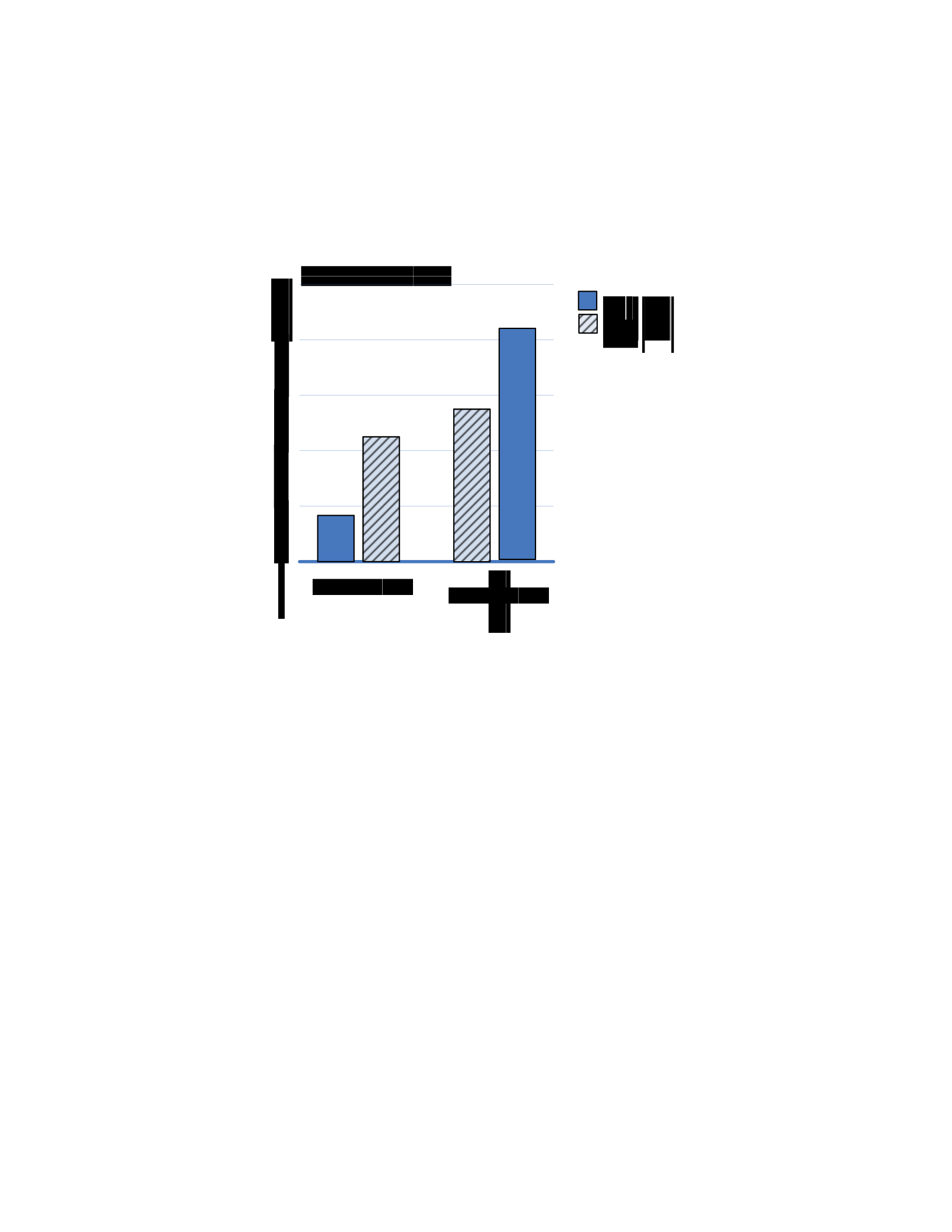
As illustrated in Figure 11, integrating innovation into business and technology
strategy is a challenge facing both industry CEOs and Air Force S&T leadership.
Although company CEOs perceive much better integration than their Air Force
counterparts, they are also frustrated (IBM, 2006). Most AFRL directors and staff cited
administrative burdens, excessive planning, too much centralization, and over emphasis
on requirements mapping as shortfalls in the current innovation strategy. Most AFRL
senior leaders saw a definite need to change the way innovation is fostered. One
respondent explained, “We have become so focused on planning for Focused Long-Term
Challenges (FLTCs)…that we have forgotten to strategize on fostering the gamechanging
(disruptive) ideas that make the FLTCs work.”
Figure 11. Integration of Innovation into Business and Technology Strategy
Senior Leadership Innovation Emphasis
Some of the interview questions examined what types of innovation are being
stressed by Air Force S&T leadership and in what areas the greatest innovation success is
perceived. Table 37 outlines the major themes in innovation emphasis. All the AFRL
interviewees referenced product/service innovation (to include knowledge/technology) as
the primary area of emphasis. Only 55% of the AFRL senior leaders referenced processes
and organizational areas as places for creativity and idea encouragement. Even fewer
participants (27%) emphasized innovation in operational activities including concepts of

operations (CONOPS) and revolutionary techniques and tactics. One director explained
that, “The service laboratories are designed to be innovative in technology products,
especially in the exploitation and application side of innovation.” Additionally, several
respondents noted that while operational innovation is not currently a large area of
emphasis and strength in AFRL, collaborating directly with the warfighter on the
revolutionary use of technology to enhance the techniques and tactics of warfare is an
opportunity the Air Force S&T community should foster.
Comparing areas of focus, as depicted in Figure 12, shows nearly identical
innovation emphasis by industry CEOs and AFRL senior leadership. According to the
IBM industry study (2006), the CEOs of top performing companies are focusing about
55% of their idea attention on products with about 30% on process/organizational
innovation. Air Force S&T leaders approximated similar levels of emphasis in their
organizations. Companies are seeing business model innovation as the primary means to
preempt threats and create them. However, several Air Force S&T senior leaders noted
that operational innovation is an area where game-changing technology could have the
most profound impact on Air Force wartime competiveness.

Senior Leadership Perspectives on Role of Collaboration
Numerous interview questions were structured to collect perspectives on how
collaboration impacts organizational innovation. The importance of collaboration,
benefits of collaboration, and productivity of collaborants were the primary questions
answered. Table 38 illustrates that AFRL senior leader interviewees (100%) not only see
collaboration as important but essential in harnessing the benefits of disruptive
innovation. In addition, the majority of Air Force S&T senior leaders have the strongest
confidence in the ideas of their in-house government, in-house support contractors, and
academic resources.

Comparing industry CEO and AFRL senior leader responses identifies several
similarities and differences in the sources of disruptive ideas. Figure 13 illustrates
several comparisons in innovation catalysts for industry and Air Force S&T
organizations. Leaders in industry and the Air Force S&T community rely heavily on
internal resources for innovation. They also both see formal collaboration with external
organizations as a solid source of new concepts. However, industry CEOs cited greater
value in ideas from their customers and even considered the competition as a key
resource for successful innovation. This confirms assertions made by Christensen (2003)
that many innovative breakthroughs are initiated by company marketers who segment
customers along a variety of psychological dimensions in order to define a profile of the
customer most likely to buy a particular product. In contrast, Air Force S&T senior
leaders placed greater confidence in the breakthrough ideas of academia. These results
align with previous survey findings where AFRL scientists and engineers cited
collaboration with academia, nonprofits, and other government agencies as a leading
driver of Air Force S&T innovation.
Senior Leadership Perspectives on Innovative Culture
Interview questions were also designed to query senior leadership observations on
the innovative culture within Air Force S&T organizations. Table 39 summarizes the key
perspectives on the strength of innovative culture, obstacles of innovation, actions to

foster innovativeness, and rewards for disruptive innovation. Although all the AFRL
leaders interviewed explained specific actions being taken to foster innovation in their
respective organizations, the majority (73%) did not consider AFRL as having a strong
innovative culture. The lack of flexibility in strategic planning and budgeting was the
most frequently cited obstacle to disruptive innovation. Limited resources and
government policies, including the restrictiveness of the federal acquisition regulations,
were also commonly mentioned barriers. Six of the AFRL senior leaders felt they
personally had control over the barriers to innovative culture while the rest felt they had
only some control to address the obstacles. In addition, 73% of the interview participants
articulated that innovation is not properly rewarded in their respective AFRL
organizations. While both non-financial rewards and compensatory motivations are being
currently used, most AFRL senior leaders acknowledged that considerable efforts were
needed to instill better incentives for creative risk-taking and breakthrough ideas.

Comparing the results of the AFRL interviews with those of the IBM CEO Study, several
interesting similarities and differences were noted, especially in the area of innovative
culture barriers. As outlined in Figure 14, a variety of internal and external obstacles
make it difficult to build an innovative mindset. Government and other legal restrictions
were cited as the largest external hindrance for both company CEOs and AFRL
leadership. Limited resources, unsupportive culture, and process immaturity were also
common internal challenges. Inflexibility in strategic plans and budgets, the most
frequent Air Force S&T response, was not specifically identified in the IBM CEO study.
Neither was leadership turnover and lack of effective collaboration. In contrast, industry
CEOs cited economic uncertainty, technology shortfalls, infrastructure difficulties, and
insufficient access to information as being greater hindrances than their Air Force S&T
counterparts. Overall, both industry CEOs and AFRL senior leaders recognize the
importance of innovative culture and acknowledge the need for organizational leaders to
take responsibility in fostering a spirit of innovation.
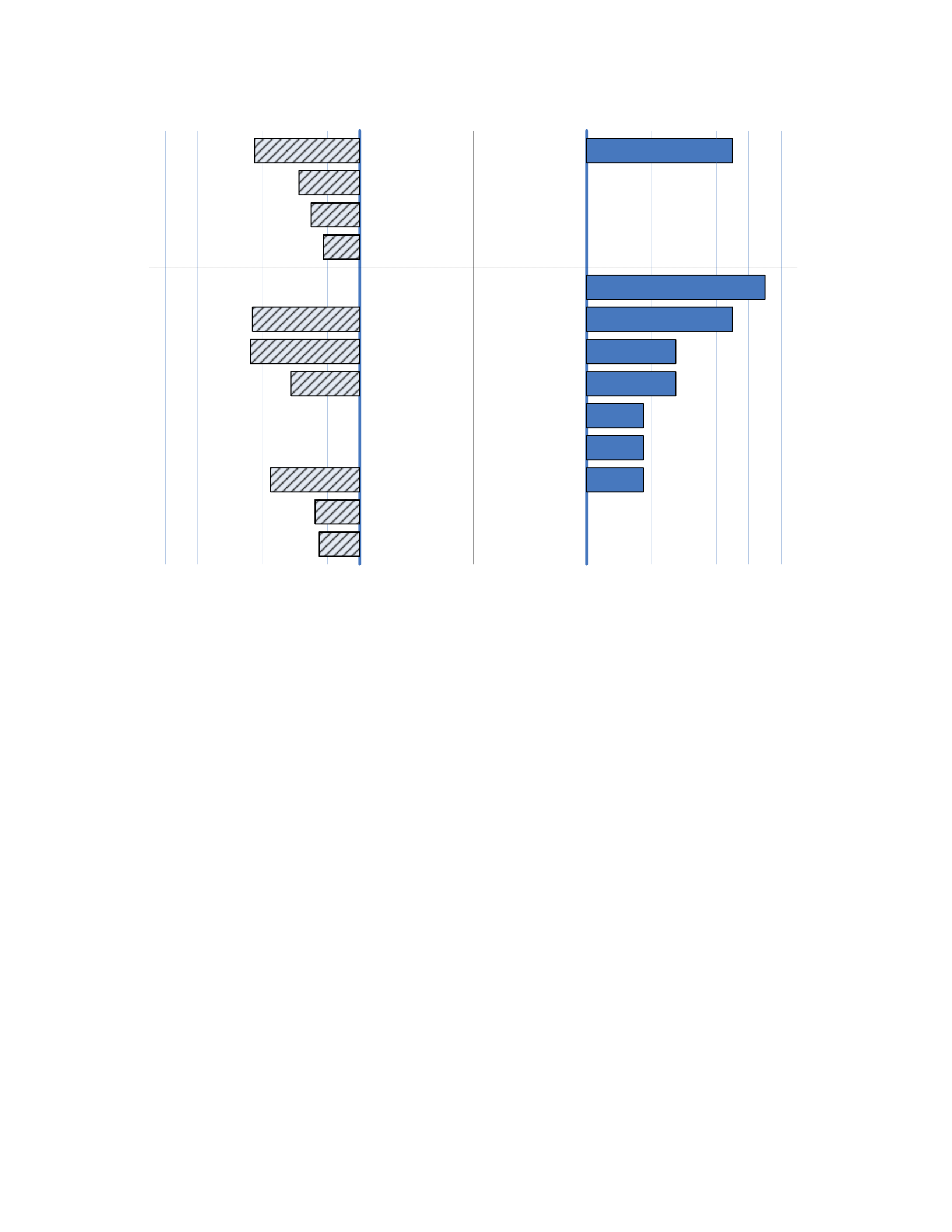
Figure 14. Innovation Obstacles Facing Senior Leaders
Model Analysis
Christensen (2003) proposed that building an organization capable of disruptive
growth requires a careful balance of resources, processes, and values. Combining these
thoughts with the research findings of this study provided a model for fostering disruptive
innovation. The model presented in Chapter II for fostering disruptive innovation defined
that an increase in the right motivation, plus an increase in the right focus of innovation
resources, plus a decrease in the barriers of innovation, plus an increase in the
characteristics of innovative culture, will foster an increase in the emergence of disruptive
innovation. The comprehensive literature review of innovation concepts also identified
Unsupportive Culture
and Climate
100 403020
Limited resources for
investment
Workforce Issues
Process Immaturity
Inflexible physical and
IT Infrastructure
Insufficient Access to
Information
AFRL Sr Ldr Responses
4060 1030 0
Govmt and Other
Legal Restrictions
Economic
Uncertainty
Inadequate Enabling
Technologies
Workforce Issues
Arising Externally
Industry CEO Responses
60502050
Govmt and Other
Legal Restrictions
Inflexible strategic
plans and budgets
Limited resources for
investment
Process Immaturity
Leadership turnover
and mgt instability
Lack of effective
collaboration
Workforce Issues (inc
training/rewards)
Unsupportive Culture
and Climate
External
Internal
ExternalInternal

various ideal heuristics for motivation, focus, barriers, and culture that are credited with
successful disruptive innovation. Figure 15 summarizes the study results and
demonstrates the similarities and differences between industry and the Air Force S&T
community with respect to the critical model variables. Specific findings that correspond
to the concepts of disruptive innovation are highlighted to show organizational attributes
that typically foster game-changing ideas. In addition, the summary shows that while the
model serves as a basic framework for innovation improvement, the application and
specific attributes will be domain dependent.
This chapter provided the results and analysis of the study research. First, a
detailed quantitative analysis of the survey data including the comparative analysis was
presented. Next, the qualitative evaluation of the interview data was outlined and
presented. Finally, the survey and interview results were combined with the information
gathered in the literature review to provide depth and support to the proposed innovation
emergence model.

V. Conclusions and Recommendations
The purpose of this thesis research was to study the motivation, focus, barriers,
and culture needed to foster disruptive innovation in Air Force Science and Technology
(S&T) and to investigate how industry innovation strategies could improve breakthrough
Air Force technology emergence. This chapter provides the conclusions,
recommendations, limitations, and follow-on studies for this thesis effort. The first
section provides a detailed description of the research conclusions. The next section
outlines a series of recommendations for the Air Force S&T community based on the
literature review, data results, and research findings. The third section summarizes the
limitations of this study and provides guidance regarding interpretations and applicability
of findings. The last section in the chapter provides some suggestions for future research
designed to further enhance the knowledge base in this area of research.
Research Conclusions
Based on the defined investigative questions, comprehensive literature review,
multifaceted data results, and detailed analysis findings, the following research
conclusions have been developed:
1. Air Force S&T pursues innovation in order to keep the warfighter state-
of-the-art with leading edge technologies. This motivation, exhibiting a desire for
longterm relevance and dominance, coincides with the ideal attributes for increased
disruptive innovation emergence. In contrast, industry appears to be more driven to

innovation to respond to customer demands, improve operational efficiency, and increase
profits.
Industry motivation, more short-term oriented, is less likely to foster new systems with
completely new value propositions. Although the study results found Air Force scientists
and engineers perceive less attention to innovation than their industry counterparts, Air
Force S&T exudes the right motivation to foster disruptive innovation.
2. Air Force S&T, heavily reliant on external resources, struggles with
developing an executable strategy designed to foster disruptive innovation. While most
Air Force S&T professionals see a balance of investment focus, highly structured and
rigid strategic planning make breakthroughs difficult for innovators. Air Force S&T
appears to depend on other organizations for innovation, focusing primarily on the
development of technological products. The Air Force S&T community has also failed to
capitalize on opportunities for operational innovation, especially collaborating with the
warfighter on technologically advanced techniques and tactics. In comparison, industry
seeks to use innovation as a means to address the profit generating needs of customers,
utilizing a balance of product and business model innovation to compete in market
segments. The study results suggest that Air Force S&T may not be actively using the
principles of radical thinking as a means to gamechanging improvement in business
organizational activities.
3. Air Force S&T professionals perceive significant internal organizational
barriers hampering the emergence of disruptive innovation. Insufficient resources,
organizational constraints, lack of innovation strategy, and entrenched programs were
perceived as the greatest obstacles to new ideas. Both the industry and Air Force S&T

communities acknowledge the detrimental affect of innovation barriers, although industry
appears more confident in its ability to overcome bureaucratic constraints. Industry
creativity was less threatened by organizational policies, possibly indicating that the
increased focus of resources in business model innovation returned benefits in overall
company efficiency.
4. Air Force scientists and engineers believe strong innovation culture is best
characterized by freedom and collaboration. The study indicated that Air Force S&T
professionals desire a culture that allows them freedom to research without administrative
burdens and non-value added diversions. In addition, Air Force S&T innovation is
contingent on alliances and partnerships with internal and external entities. While Air
Force S&T believes in a culture of freedom and industry sees customer focus as the key
to innovation emergence, both Air Force S&T and industry employees understand the
tremendous importance of organizational culture in fostering breakthroughs.
5. Air Force S&T senior leaders understand the criticality of innovation but
struggle with the optimal approach to fostering disruptive innovation in their
organizations Most Air Force S&T leaders agreed that innovation was not well
integrated into their business and technology strategy which was hampered by overly
constrained planning and restrictive external influences. Although other findings indicate
strong reliance on external sources, Air Force S&T leadership places great confidence in
the ideas of their in-house personnel. Unfortunately, most senior leaders do not perceive
that Air Force S&T organizations posses a strong innovative culture. In addition, most
Air Force S&T senior leaders acknowledged that considerable improvement efforts were

needed to facilitate flexible planning, thereby freeing resources, collaboration, and
rewards for creative risk-taking.
6. Innovative organizations require strong and inspiring leadership and both
Air Force S&T senior leaders and company CEOs agree that innovative thinking must be
orchestrated from the top. Supportive leadership is critical to motivation, strategy,
overcoming obstacles, and building an innovative culture. While both Air Force and
industry leadership hold themselves accountable for fostering disruptive innovation,
complex dimensions of disruptive innovation continue to be challenging regardless of the
domain.
7. Air Force S&T is capable of regaining its prominence as a leader in
disruptive technological innovation by applying the emergence model, capturing the
relevant best practices of industry, and exploiting the positive attributes of the military
domain. The research findings combine to establish the proposed model for fostering
disruptive innovation in either industry or government organizations. Given an increase
in the right motivation, an increase in the right focus of innovation resources, a decrease
in the barriers of innovation, and an increase in the characteristics of innovative culture,
disruptive innovation will emerge. Although the model is not intended to be an equation
for guaranteed success, it does provide a conceptual formula to ensure that all critical
elements needed to foster breakthrough innovation are considered.

Recommendations
Based on this thesis research, the followed recommendations are provided to the
Air Force S&T community to help foster the emergence of disruptive technology:
1. Exercise caution with relying on industry to generate relevant disruptive
innovation for the Air Force. Given the differences in motivation, drivers, and resource
focus, outsourcing innovation to commercial companies may not provide the long-term
relevant technologies needed to dominate the battlespace. While industry is a key
collaborative partner, Air Force S&T should invest in enhancing its internal workforce to
ensure the emergence of revolutionary military technology.
2. Infuse greater flexibility and innovativeness into AFRL business and
technology strategy through the use of discovery-based planning. Discovery-based
planning allows experimental results and assumption validation to drive investment
strategies. The added resilience in AFRL planning will allow technology breakthroughs
to evolve less bounded and foster increased levels of disruptive innovation.
3. Establish freedom for the scientist and engineering workforce as a priority
of Air Force S&T process improvement efforts. AFRL’s greatest asset has always been the
intellectual power of its technological workforce. AFRL needs to ensure that all
management approaches, supporting activities, and enabling activities place optimization
of the scientist and engineer’s (S&E) time as the goal of process improvement efforts. In
order for AFRL to achieve disruptive technological prominence, the S&E must be given
larger amounts of working time free from administrative burden and non-value added

work. Even if granting freedom to the S&E increases the responsibilities of management
and support personnel, the long-term benefits of increased disruptive innovation
emergence is worth the risk.
4. Utilize successful sustaining innovation to build advocacy and generate
resources for disruptive technology innovation. Not all AFRL efforts can or even should
be focused on gamechanging ideas. Balanced investments are essential to success.
However, AFRL should be careful not to allow incremental improvements in entrenched
existing programs in such a way that invention and exploitation of disruptive concepts is
neglected. Sustaining technology and requirements-based development play a valuable
role as long as they are used to obtain resources for more long-term disruptive
breakthroughs.
5. Increase the use of experimental venues to increase technological
collaboration with the warfighter and to access the operational impacts of disruptive
innovation. While AF S&T’s motivation and focus on the state-of-the-art is critical,
AFRL can also learn from industry’s strong customer focus. More discovery-based
experimental venues with the warfighter will increase AFRL’s position as a relevant force
in helping with operational innovation, especially in the application of technological
advancements for disruptive warfighting tactics and techniques.
6. Elevate the innovative culture of AFRL by orchestrating risk-taking from
the top. Senior leadership views of innovation play a profound role on the sense of
entrepreneurship in the organization. By demonstrating greater risk-taking in approaches
to supporting and enabling processes, senior leadership will send a decisive message to
the workforce and infuse innovative spirit within the organization. The S&E workforce

will observe the trend in leadership and respond with increases in relevant disruptive
ideas.
Limitations of the Research
Although efforts were taken throughout this research to mitigate risks to reliability
and validity, sample bias in the survey still arose as a threat to internal validity. As
detailed in the methodology chapter, the sample demographics demonstrated some
deviations from the population demographics. Volunteerism may have played a role in
creating the bias, as the persons who chose to participate in the survey were concentrated
in certain geographic sites and directorates. Although the findings were not analyzed
based on directorates or geographic demographics, the sampling bias should still be
considered when evaluating the generalizations made by the survey portion of this study.

Future Research
Based on the emerging topic and lack of specific literature on disruptive
innovation in military organizations, a primarily qualitative research method, supported
by some quantitative data, was used in this thesis study. The resulting model for fostering
disruptive innovation lends itself well to further quantitative inferential research. The
following suggestions for investigative questions examined singularly or as part of a
larger research study, would provide the needed quantitative validation of the model for
fostering disruptive innovation:
1. How does a military organization’s motivation for innovation relate to the
successful emergence of disruptive innovation?
2. What focus of innovation resources in a military organization provide the
most successful emergence of disruptive innovation?
3. How does the elimination of barriers relate to an organization’s ability to
foster disruptive innovation? What common barriers to innovation have the
most detrimental effect on organizational innovativeness?
4. How do increased levels in the characteristics of innovative culture relate to
an organization’s ability to foster disruptive innovation? What characteristics
of innovative culture have the greatest effect on the emergence of disruptive
innovation?
5. How can organizational success in fostering disruptive innovation be
quantified? What organizational metrics and measures can be used to quantify
the successful emergence of disruptive innovation?
In Air Force S&T, organizational constraints were considered a large barrier
(ranked #2) while leadership/management support was not considered an overwhelming
obstacle (ranked #10). However, this delta may imply that many AFRL personnel do not
believe Air Force senior leadership are empowered to improve the organizational policy,
strategy, and bureaucracy within the organization. Additionally, Table 33 summarizes
several supporting multiple choice items providing insights into innovation barriers.

These results indicate that in both Air Force S&T and industry organizations, employees
are unclear on how to gain support for new ideas and feel the rewards and recognition for
innovative behaviors to be somewhat limited.
Characteristics of Innovative Culture
Several survey items also examined the characteristics of innovative culture in Air
Force S&T organizations. Survey item 12 identified the most important factors for
developing an innovative culture. Respondents scored various characteristics using a
scale of 1 to 5 where 1=Not Important, 2=Somewhat Important, 3=Important, 4=Highly
Important, and 5=Extremely Important. The results of survey item 22, and 25 provided
further cultural observations by AF scientists and engineers.
Survey Item 12 - Developing an Innovative Culture: Table 34 outlines the
importance of different factors for developing an innovative culture in Air Force S&T
organizations. The factors were rank ordered based on the mean scores provided by
AFRL respondents. Freedom to innovate (with a mean score of 3.79) was cited as the
most important consideration followed by teamwork/collaboration (3.77) and the ability
to select the right ideas for research (3.59).
The comparison survey in industry found customer focus to be the most important
factor in developing an innovative culture. Comparing the means between the studies
using statistical tests shows freedom to innovate to be strongly viewed in the Air Force
S&T community while customer focus, organizational communication, and innovation
measurement are more important to industry respondents. Although innovation goals,
diversity, and organizational structures were the lowest ranked in both studies, the AFRL

persons perceived these to be much less important to innovative culture than their
industry counterparts.
Industry scored higher on 12 of the 14 factors, and 8 of the 12 were found to be
statistically significant. The largest differences in rankings were freedom to innovate,
customer focus, and organizational communication. These results support previous Air
Force S&T findings indicating that AFRL personnel desire sense of freedom from
bureaucratic constraints and non-value added work. The results also indicate that while
Air Force S&T professionals desire a culture of technology push, industry places greater
hope on addressing the direct and often short-term needs of the customer. Therefore,
given the access to the appropriate resources (people, time, and money) and the freedom
to experiment, a greater degree of long-term, dominant, and breakthrough technology
may emerge from Air Force S&T investments.
Table 35 summarizes several supporting items providing additional findings
regarding innovative culture. These results indicated that while both Air Force S&T and
industry employees understand the importance of innovation, industry is more confident
in what innovation means and how to become more innovative. However, the study
results indicate that the innovative culture found in industry might be better aligned to
foster sustaining innovation than disruptive innovation. These findings indicate that the
Air Force S&T community may be more cognizant that building a robust innovative

culture, based on long-term disruptive technology dominance, is very challenging in
today’s fiscally constrained and operationally focused Air Force.
Interview Evaluation
The senior leadership interviews were analyzed using a grounded theory
qualitative method of inductive study. The interview analysis, provided in complete
detail under Appendix F, illustrates various themes and concepts evident in the responses.
The major themes summarized in the following sections not only address the
investigative question regarding senior leadership but also provide additional insight into
the other investigative questions as well. In addition, the evaluation provides a point of
comparison between the viewpoints of Air Force S&T leaders and their industry CEO
counterparts. The interviews were designed to answer the investigative question on Air
Force S&T senior leadership perspectives on innovation. Although the discussions were
open-ended, the interviews were structured to provide a direct point of comparison
between AFRL leadership and industry CEOs. The interview data and comparisons are
presented in four areas: views, emphasis, collaboration, and culture.
Senior Leadership Views of Innovation
Some of the interview questions were designed to query AFRL senior leadership
regarding innovation definitions, importance, and integration into business/technology
strategy. Table 36 outlines the views of innovation expressed by the interview

participants. Most AFRL leaders (64%) defined innovation in the same manner and
perceived innovation as an extremely/highly important part of Air Force S&T (73%).
The AFRL directors and senior staff felt innovation was most applicable in both
responding to urgent needs and generating S&T knowledge. Fifty-five percent of the
respondents saw innovation as less significant in developing technology based on specific
customer requirements. In addition, 82% of the AFRL senior leaders interviewed
articulated that innovation was not properly considered in the current Air Force S&T
business and technology strategy. Although AFRL senior leaders think innovation is
important and relevant, they have been challenged in integrating innovation into Air
Force S&T strategic planning. This finding indicates the AFRL business and technology
strategy may be overly constrained and driven by external influences.
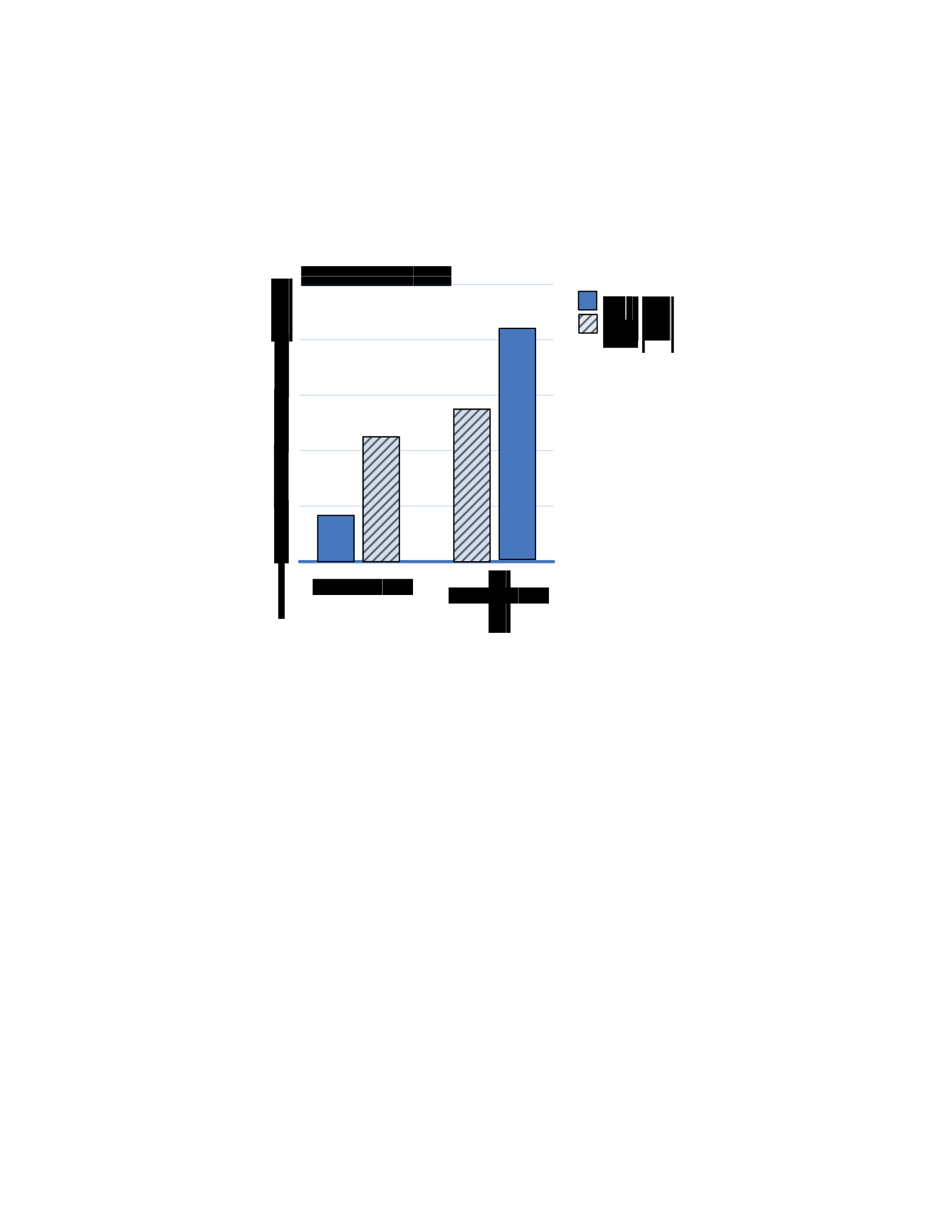
As illustrated in Figure 11, integrating innovation into business and technology
strategy is a challenge facing both industry CEOs and Air Force S&T leadership.
Although company CEOs perceive much better integration than their Air Force
counterparts, they are also frustrated (IBM, 2006). Most AFRL directors and staff cited
administrative burdens, excessive planning, too much centralization, and over emphasis
on requirements mapping as shortfalls in the current innovation strategy. Most AFRL
senior leaders saw a definite need to change the way innovation is fostered. One
respondent explained, “We have become so focused on planning for Focused Long-Term
Challenges (FLTCs)…that we have forgotten to strategize on fostering the gamechanging
(disruptive) ideas that make the FLTCs work.”
Figure 11. Integration of Innovation into Business and Technology Strategy
Senior Leadership Innovation Emphasis
Some of the interview questions examined what types of innovation are being
stressed by Air Force S&T leadership and in what areas the greatest innovation success is
perceived. Table 37 outlines the major themes in innovation emphasis. All the AFRL
interviewees referenced product/service innovation (to include knowledge/technology) as
the primary area of emphasis. Only 55% of the AFRL senior leaders referenced processes
and organizational areas as places for creativity and idea encouragement. Even fewer
participants (27%) emphasized innovation in operational activities including concepts of

operations (CONOPS) and revolutionary techniques and tactics. One director explained
that, “The service laboratories are designed to be innovative in technology products,
especially in the exploitation and application side of innovation.” Additionally, several
respondents noted that while operational innovation is not currently a large area of
emphasis and strength in AFRL, collaborating directly with the warfighter on the
revolutionary use of technology to enhance the techniques and tactics of warfare is an
opportunity the Air Force S&T community should foster.
Comparing areas of focus, as depicted in Figure 12, shows nearly identical
innovation emphasis by industry CEOs and AFRL senior leadership. According to the
IBM industry study (2006), the CEOs of top performing companies are focusing about
55% of their idea attention on products with about 30% on process/organizational
innovation. Air Force S&T leaders approximated similar levels of emphasis in their
organizations. Companies are seeing business model innovation as the primary means to
preempt threats and create them. However, several Air Force S&T senior leaders noted
that operational innovation is an area where game-changing technology could have the
most profound impact on Air Force wartime competiveness.

Senior Leadership Perspectives on Role of Collaboration
Numerous interview questions were structured to collect perspectives on how
collaboration impacts organizational innovation. The importance of collaboration,
benefits of collaboration, and productivity of collaborants were the primary questions
answered. Table 38 illustrates that AFRL senior leader interviewees (100%) not only see
collaboration as important but essential in harnessing the benefits of disruptive
innovation. In addition, the majority of Air Force S&T senior leaders have the strongest
confidence in the ideas of their in-house government, in-house support contractors, and
academic resources.

Comparing industry CEO and AFRL senior leader responses identifies several
similarities and differences in the sources of disruptive ideas. Figure 13 illustrates
several comparisons in innovation catalysts for industry and Air Force S&T
organizations. Leaders in industry and the Air Force S&T community rely heavily on
internal resources for innovation. They also both see formal collaboration with external
organizations as a solid source of new concepts. However, industry CEOs cited greater
value in ideas from their customers and even considered the competition as a key
resource for successful innovation. This confirms assertions made by Christensen (2003)
that many innovative breakthroughs are initiated by company marketers who segment
customers along a variety of psychological dimensions in order to define a profile of the
customer most likely to buy a particular product. In contrast, Air Force S&T senior
leaders placed greater confidence in the breakthrough ideas of academia. These results
align with previous survey findings where AFRL scientists and engineers cited
collaboration with academia, nonprofits, and other government agencies as a leading
driver of Air Force S&T innovation.
Senior Leadership Perspectives on Innovative Culture
Interview questions were also designed to query senior leadership observations on
the innovative culture within Air Force S&T organizations. Table 39 summarizes the key
perspectives on the strength of innovative culture, obstacles of innovation, actions to

foster innovativeness, and rewards for disruptive innovation. Although all the AFRL
leaders interviewed explained specific actions being taken to foster innovation in their
respective organizations, the majority (73%) did not consider AFRL as having a strong
innovative culture. The lack of flexibility in strategic planning and budgeting was the
most frequently cited obstacle to disruptive innovation. Limited resources and
government policies, including the restrictiveness of the federal acquisition regulations,
were also commonly mentioned barriers. Six of the AFRL senior leaders felt they
personally had control over the barriers to innovative culture while the rest felt they had
only some control to address the obstacles. In addition, 73% of the interview participants
articulated that innovation is not properly rewarded in their respective AFRL
organizations. While both non-financial rewards and compensatory motivations are being
currently used, most AFRL senior leaders acknowledged that considerable efforts were
needed to instill better incentives for creative risk-taking and breakthrough ideas.

Comparing the results of the AFRL interviews with those of the IBM CEO Study, several
interesting similarities and differences were noted, especially in the area of innovative
culture barriers. As outlined in Figure 14, a variety of internal and external obstacles
make it difficult to build an innovative mindset. Government and other legal restrictions
were cited as the largest external hindrance for both company CEOs and AFRL
leadership. Limited resources, unsupportive culture, and process immaturity were also
common internal challenges. Inflexibility in strategic plans and budgets, the most
frequent Air Force S&T response, was not specifically identified in the IBM CEO study.
Neither was leadership turnover and lack of effective collaboration. In contrast, industry
CEOs cited economic uncertainty, technology shortfalls, infrastructure difficulties, and
insufficient access to information as being greater hindrances than their Air Force S&T
counterparts. Overall, both industry CEOs and AFRL senior leaders recognize the
importance of innovative culture and acknowledge the need for organizational leaders to
take responsibility in fostering a spirit of innovation.
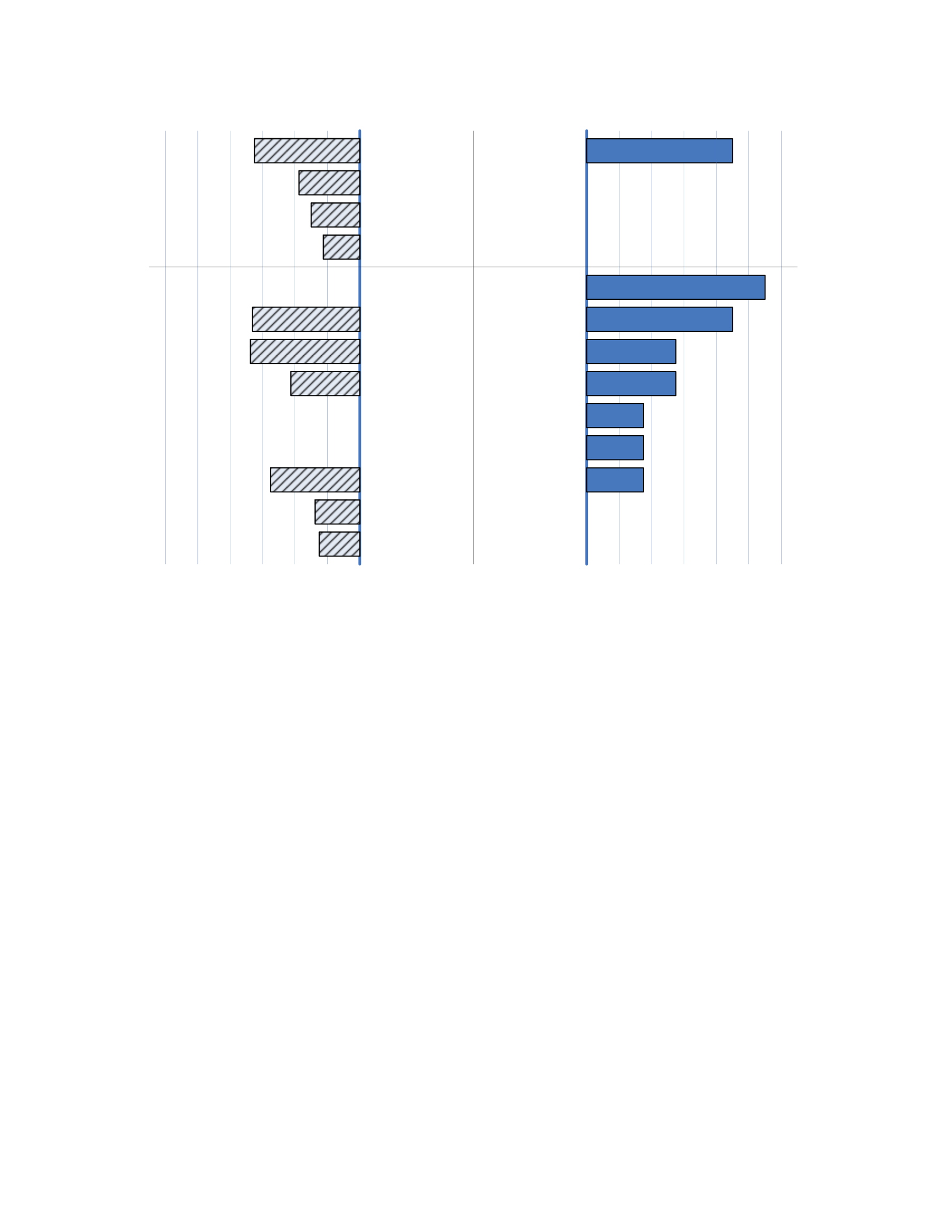
Figure 14. Innovation Obstacles Facing Senior Leaders
Model Analysis
Christensen (2003) proposed that building an organization capable of disruptive
growth requires a careful balance of resources, processes, and values. Combining these
thoughts with the research findings of this study provided a model for fostering disruptive
innovation. The model presented in Chapter II for fostering disruptive innovation defined
that an increase in the right motivation, plus an increase in the right focus of innovation
resources, plus a decrease in the barriers of innovation, plus an increase in the
characteristics of innovative culture, will foster an increase in the emergence of disruptive
innovation. The comprehensive literature review of innovation concepts also identified
Unsupportive Culture
and Climate
100 403020
Limited resources for
investment
Workforce Issues
Process Immaturity
Inflexible physical and
IT Infrastructure
Insufficient Access to
Information
AFRL Sr Ldr Responses
4060 1030 0
Govmt and Other
Legal Restrictions
Economic
Uncertainty
Inadequate Enabling
Technologies
Workforce Issues
Arising Externally
Industry CEO Responses
60502050
Govmt and Other
Legal Restrictions
Inflexible strategic
plans and budgets
Limited resources for
investment
Process Immaturity
Leadership turnover
and mgt instability
Lack of effective
collaboration
Workforce Issues (inc
training/rewards)
Unsupportive Culture
and Climate
External
Internal
ExternalInternal

various ideal heuristics for motivation, focus, barriers, and culture that are credited with
successful disruptive innovation. Figure 15 summarizes the study results and
demonstrates the similarities and differences between industry and the Air Force S&T
community with respect to the critical model variables. Specific findings that correspond
to the concepts of disruptive innovation are highlighted to show organizational attributes
that typically foster game-changing ideas. In addition, the summary shows that while the
model serves as a basic framework for innovation improvement, the application and
specific attributes will be domain dependent.
This chapter provided the results and analysis of the study research. First, a
detailed quantitative analysis of the survey data including the comparative analysis was
presented. Next, the qualitative evaluation of the interview data was outlined and
presented. Finally, the survey and interview results were combined with the information
gathered in the literature review to provide depth and support to the proposed innovation
emergence model.

V. Conclusions and Recommendations
The purpose of this thesis research was to study the motivation, focus, barriers,
and culture needed to foster disruptive innovation in Air Force Science and Technology
(S&T) and to investigate how industry innovation strategies could improve breakthrough
Air Force technology emergence. This chapter provides the conclusions,
recommendations, limitations, and follow-on studies for this thesis effort. The first
section provides a detailed description of the research conclusions. The next section
outlines a series of recommendations for the Air Force S&T community based on the
literature review, data results, and research findings. The third section summarizes the
limitations of this study and provides guidance regarding interpretations and applicability
of findings. The last section in the chapter provides some suggestions for future research
designed to further enhance the knowledge base in this area of research.
Research Conclusions
Based on the defined investigative questions, comprehensive literature review,
multifaceted data results, and detailed analysis findings, the following research
conclusions have been developed:
1. Air Force S&T pursues innovation in order to keep the warfighter state-
of-the-art with leading edge technologies. This motivation, exhibiting a desire for
longterm relevance and dominance, coincides with the ideal attributes for increased
disruptive innovation emergence. In contrast, industry appears to be more driven to

innovation to respond to customer demands, improve operational efficiency, and increase
profits.
Industry motivation, more short-term oriented, is less likely to foster new systems with
completely new value propositions. Although the study results found Air Force scientists
and engineers perceive less attention to innovation than their industry counterparts, Air
Force S&T exudes the right motivation to foster disruptive innovation.
2. Air Force S&T, heavily reliant on external resources, struggles with
developing an executable strategy designed to foster disruptive innovation. While most
Air Force S&T professionals see a balance of investment focus, highly structured and
rigid strategic planning make breakthroughs difficult for innovators. Air Force S&T
appears to depend on other organizations for innovation, focusing primarily on the
development of technological products. The Air Force S&T community has also failed to
capitalize on opportunities for operational innovation, especially collaborating with the
warfighter on technologically advanced techniques and tactics. In comparison, industry
seeks to use innovation as a means to address the profit generating needs of customers,
utilizing a balance of product and business model innovation to compete in market
segments. The study results suggest that Air Force S&T may not be actively using the
principles of radical thinking as a means to gamechanging improvement in business
organizational activities.
3. Air Force S&T professionals perceive significant internal organizational
barriers hampering the emergence of disruptive innovation. Insufficient resources,
organizational constraints, lack of innovation strategy, and entrenched programs were
perceived as the greatest obstacles to new ideas. Both the industry and Air Force S&T

communities acknowledge the detrimental affect of innovation barriers, although industry
appears more confident in its ability to overcome bureaucratic constraints. Industry
creativity was less threatened by organizational policies, possibly indicating that the
increased focus of resources in business model innovation returned benefits in overall
company efficiency.
4. Air Force scientists and engineers believe strong innovation culture is best
characterized by freedom and collaboration. The study indicated that Air Force S&T
professionals desire a culture that allows them freedom to research without administrative
burdens and non-value added diversions. In addition, Air Force S&T innovation is
contingent on alliances and partnerships with internal and external entities. While Air
Force S&T believes in a culture of freedom and industry sees customer focus as the key
to innovation emergence, both Air Force S&T and industry employees understand the
tremendous importance of organizational culture in fostering breakthroughs.
5. Air Force S&T senior leaders understand the criticality of innovation but
struggle with the optimal approach to fostering disruptive innovation in their
organizations Most Air Force S&T leaders agreed that innovation was not well
integrated into their business and technology strategy which was hampered by overly
constrained planning and restrictive external influences. Although other findings indicate
strong reliance on external sources, Air Force S&T leadership places great confidence in
the ideas of their in-house personnel. Unfortunately, most senior leaders do not perceive
that Air Force S&T organizations posses a strong innovative culture. In addition, most
Air Force S&T senior leaders acknowledged that considerable improvement efforts were

needed to facilitate flexible planning, thereby freeing resources, collaboration, and
rewards for creative risk-taking.
6. Innovative organizations require strong and inspiring leadership and both
Air Force S&T senior leaders and company CEOs agree that innovative thinking must be
orchestrated from the top. Supportive leadership is critical to motivation, strategy,
overcoming obstacles, and building an innovative culture. While both Air Force and
industry leadership hold themselves accountable for fostering disruptive innovation,
complex dimensions of disruptive innovation continue to be challenging regardless of the
domain.
7. Air Force S&T is capable of regaining its prominence as a leader in
disruptive technological innovation by applying the emergence model, capturing the
relevant best practices of industry, and exploiting the positive attributes of the military
domain. The research findings combine to establish the proposed model for fostering
disruptive innovation in either industry or government organizations. Given an increase
in the right motivation, an increase in the right focus of innovation resources, a decrease
in the barriers of innovation, and an increase in the characteristics of innovative culture,
disruptive innovation will emerge. Although the model is not intended to be an equation
for guaranteed success, it does provide a conceptual formula to ensure that all critical
elements needed to foster breakthrough innovation are considered.

Recommendations
Based on this thesis research, the followed recommendations are provided to the
Air Force S&T community to help foster the emergence of disruptive technology:
1. Exercise caution with relying on industry to generate relevant disruptive
innovation for the Air Force. Given the differences in motivation, drivers, and resource
focus, outsourcing innovation to commercial companies may not provide the long-term
relevant technologies needed to dominate the battlespace. While industry is a key
collaborative partner, Air Force S&T should invest in enhancing its internal workforce to
ensure the emergence of revolutionary military technology.
2. Infuse greater flexibility and innovativeness into AFRL business and
technology strategy through the use of discovery-based planning. Discovery-based
planning allows experimental results and assumption validation to drive investment
strategies. The added resilience in AFRL planning will allow technology breakthroughs
to evolve less bounded and foster increased levels of disruptive innovation.
3. Establish freedom for the scientist and engineering workforce as a priority
of Air Force S&T process improvement efforts. AFRL’s greatest asset has always been the
intellectual power of its technological workforce. AFRL needs to ensure that all
management approaches, supporting activities, and enabling activities place optimization
of the scientist and engineer’s (S&E) time as the goal of process improvement efforts. In
order for AFRL to achieve disruptive technological prominence, the S&E must be given
larger amounts of working time free from administrative burden and non-value added

work. Even if granting freedom to the S&E increases the responsibilities of management
and support personnel, the long-term benefits of increased disruptive innovation
emergence is worth the risk.
4. Utilize successful sustaining innovation to build advocacy and generate
resources for disruptive technology innovation. Not all AFRL efforts can or even should
be focused on gamechanging ideas. Balanced investments are essential to success.
However, AFRL should be careful not to allow incremental improvements in entrenched
existing programs in such a way that invention and exploitation of disruptive concepts is
neglected. Sustaining technology and requirements-based development play a valuable
role as long as they are used to obtain resources for more long-term disruptive
breakthroughs.
5. Increase the use of experimental venues to increase technological
collaboration with the warfighter and to access the operational impacts of disruptive
innovation. While AF S&T’s motivation and focus on the state-of-the-art is critical,
AFRL can also learn from industry’s strong customer focus. More discovery-based
experimental venues with the warfighter will increase AFRL’s position as a relevant force
in helping with operational innovation, especially in the application of technological
advancements for disruptive warfighting tactics and techniques.
6. Elevate the innovative culture of AFRL by orchestrating risk-taking from
the top. Senior leadership views of innovation play a profound role on the sense of
entrepreneurship in the organization. By demonstrating greater risk-taking in approaches
to supporting and enabling processes, senior leadership will send a decisive message to
the workforce and infuse innovative spirit within the organization. The S&E workforce

will observe the trend in leadership and respond with increases in relevant disruptive
ideas.
Limitations of the Research
Although efforts were taken throughout this research to mitigate risks to reliability
and validity, sample bias in the survey still arose as a threat to internal validity. As
detailed in the methodology chapter, the sample demographics demonstrated some
deviations from the population demographics. Volunteerism may have played a role in
creating the bias, as the persons who chose to participate in the survey were concentrated
in certain geographic sites and directorates. Although the findings were not analyzed
based on directorates or geographic demographics, the sampling bias should still be
considered when evaluating the generalizations made by the survey portion of this study.

Future Research
Based on the emerging topic and lack of specific literature on disruptive
innovation in military organizations, a primarily qualitative research method, supported
by some quantitative data, was used in this thesis study. The resulting model for fostering
disruptive innovation lends itself well to further quantitative inferential research. The
following suggestions for investigative questions examined singularly or as part of a
larger research study, would provide the needed quantitative validation of the model for
fostering disruptive innovation:
1. How does a military organization’s motivation for innovation relate to the
successful emergence of disruptive innovation?
2. What focus of innovation resources in a military organization provide the
most successful emergence of disruptive innovation?
3. How does the elimination of barriers relate to an organization’s ability to
foster disruptive innovation? What common barriers to innovation have the
most detrimental effect on organizational innovativeness?
4. How do increased levels in the characteristics of innovative culture relate to
an organization’s ability to foster disruptive innovation? What characteristics
of innovative culture have the greatest effect on the emergence of disruptive
innovation?
5. How can organizational success in fostering disruptive innovation be
quantified? What organizational metrics and measures can be used to quantify
the successful emergence of disruptive innovation?
In Air Force S&T, organizational constraints were considered a large barrier
(ranked #2) while leadership/management support was not considered an overwhelming
obstacle (ranked #10). However, this delta may imply that many AFRL personnel do not
believe Air Force senior leadership are empowered to improve the organizational policy,
strategy, and bureaucracy within the organization. Additionally, Table 33 summarizes
several supporting multiple choice items providing insights into innovation barriers.

These results indicate that in both Air Force S&T and industry organizations, employees
are unclear on how to gain support for new ideas and feel the rewards and recognition for
innovative behaviors to be somewhat limited.
Characteristics of Innovative Culture
Several survey items also examined the characteristics of innovative culture in Air
Force S&T organizations. Survey item 12 identified the most important factors for
developing an innovative culture. Respondents scored various characteristics using a
scale of 1 to 5 where 1=Not Important, 2=Somewhat Important, 3=Important, 4=Highly
Important, and 5=Extremely Important. The results of survey item 22, and 25 provided
further cultural observations by AF scientists and engineers.
Survey Item 12 - Developing an Innovative Culture: Table 34 outlines the
importance of different factors for developing an innovative culture in Air Force S&T
organizations. The factors were rank ordered based on the mean scores provided by
AFRL respondents. Freedom to innovate (with a mean score of 3.79) was cited as the
most important consideration followed by teamwork/collaboration (3.77) and the ability
to select the right ideas for research (3.59).
The comparison survey in industry found customer focus to be the most important
factor in developing an innovative culture. Comparing the means between the studies
using statistical tests shows freedom to innovate to be strongly viewed in the Air Force
S&T community while customer focus, organizational communication, and innovation
measurement are more important to industry respondents. Although innovation goals,
diversity, and organizational structures were the lowest ranked in both studies, the AFRL

persons perceived these to be much less important to innovative culture than their
industry counterparts.
Industry scored higher on 12 of the 14 factors, and 8 of the 12 were found to be
statistically significant. The largest differences in rankings were freedom to innovate,
customer focus, and organizational communication. These results support previous Air
Force S&T findings indicating that AFRL personnel desire sense of freedom from
bureaucratic constraints and non-value added work. The results also indicate that while
Air Force S&T professionals desire a culture of technology push, industry places greater
hope on addressing the direct and often short-term needs of the customer. Therefore,
given the access to the appropriate resources (people, time, and money) and the freedom
to experiment, a greater degree of long-term, dominant, and breakthrough technology
may emerge from Air Force S&T investments.
Table 35 summarizes several supporting items providing additional findings
regarding innovative culture. These results indicated that while both Air Force S&T and
industry employees understand the importance of innovation, industry is more confident
in what innovation means and how to become more innovative. However, the study
results indicate that the innovative culture found in industry might be better aligned to
foster sustaining innovation than disruptive innovation. These findings indicate that the
Air Force S&T community may be more cognizant that building a robust innovative

culture, based on long-term disruptive technology dominance, is very challenging in
today’s fiscally constrained and operationally focused Air Force.
Interview Evaluation
The senior leadership interviews were analyzed using a grounded theory
qualitative method of inductive study. The interview analysis, provided in complete
detail under Appendix F, illustrates various themes and concepts evident in the responses.
The major themes summarized in the following sections not only address the
investigative question regarding senior leadership but also provide additional insight into
the other investigative questions as well. In addition, the evaluation provides a point of
comparison between the viewpoints of Air Force S&T leaders and their industry CEO
counterparts. The interviews were designed to answer the investigative question on Air
Force S&T senior leadership perspectives on innovation. Although the discussions were
open-ended, the interviews were structured to provide a direct point of comparison
between AFRL leadership and industry CEOs. The interview data and comparisons are
presented in four areas: views, emphasis, collaboration, and culture.
Senior Leadership Views of Innovation
Some of the interview questions were designed to query AFRL senior leadership
regarding innovation definitions, importance, and integration into business/technology
strategy. Table 36 outlines the views of innovation expressed by the interview

participants. Most AFRL leaders (64%) defined innovation in the same manner and
perceived innovation as an extremely/highly important part of Air Force S&T (73%).
The AFRL directors and senior staff felt innovation was most applicable in both
responding to urgent needs and generating S&T knowledge. Fifty-five percent of the
respondents saw innovation as less significant in developing technology based on specific
customer requirements. In addition, 82% of the AFRL senior leaders interviewed
articulated that innovation was not properly considered in the current Air Force S&T
business and technology strategy. Although AFRL senior leaders think innovation is
important and relevant, they have been challenged in integrating innovation into Air
Force S&T strategic planning. This finding indicates the AFRL business and technology
strategy may be overly constrained and driven by external influences.
As illustrated in Figure 11, integrating innovation into business and technology
strategy is a challenge facing both industry CEOs and Air Force S&T leadership.
Although company CEOs perceive much better integration than their Air Force
counterparts, they are also frustrated (IBM, 2006). Most AFRL directors and staff cited
administrative burdens, excessive planning, too much centralization, and over emphasis
on requirements mapping as shortfalls in the current innovation strategy. Most AFRL
senior leaders saw a definite need to change the way innovation is fostered. One
respondent explained, “We have become so focused on planning for Focused Long-Term

Challenges (FLTCs)…that we have forgotten to strategize on fostering the gamechanging
(disruptive) ideas that make the FLTCs work.”
Figure 11. Integration of Innovation into Business and Technology Strategy
Senior Leadership Innovation Emphasis
Some of the interview questions examined what types of innovation are being
stressed by Air Force S&T leadership and in what areas the greatest innovation success is
perceived. Table 37 outlines the major themes in innovation emphasis. All the AFRL
interviewees referenced product/service innovation (to include knowledge/technology) as
the primary area of emphasis. Only 55% of the AFRL senior leaders referenced processes
and organizational areas as places for creativity and idea encouragement. Even fewer
participants (27%) emphasized innovation in operational activities including concepts of

operations (CONOPS) and revolutionary techniques and tactics. One director explained
that, “The service laboratories are designed to be innovative in technology products,
especially in the exploitation and application side of innovation.” Additionally, several
respondents noted that while operational innovation is not currently a large area of
emphasis and strength in AFRL, collaborating directly with the warfighter on the
revolutionary use of technology to enhance the techniques and tactics of warfare is an
opportunity the Air Force S&T community should foster.
Comparing areas of focus, as depicted in Figure 12, shows nearly identical
innovation emphasis by industry CEOs and AFRL senior leadership. According to the
IBM industry study (2006), the CEOs of top performing companies are focusing about
55% of their idea attention on products with about 30% on process/organizational
innovation. Air Force S&T leaders approximated similar levels of emphasis in their
organizations. Companies are seeing business model innovation as the primary means to
preempt threats and create them. However, several Air Force S&T senior leaders noted
that operational innovation is an area where game-changing technology could have the
most profound impact on Air Force wartime competiveness.

Senior Leadership Perspectives on Role of Collaboration
Numerous interview questions were structured to collect perspectives on how
collaboration impacts organizational innovation. The importance of collaboration,
benefits of collaboration, and productivity of collaborants were the primary questions
answered. Table 38 illustrates that AFRL senior leader interviewees (100%) not only see
collaboration as important but essential in harnessing the benefits of disruptive
innovation. In addition, the majority of Air Force S&T senior leaders have the strongest
confidence in the ideas of their in-house government, in-house support contractors, and
academic resources.

Comparing industry CEO and AFRL senior leader responses identifies several
similarities and differences in the sources of disruptive ideas. Figure 13 illustrates
several comparisons in innovation catalysts for industry and Air Force S&T
organizations. Leaders in industry and the Air Force S&T community rely heavily on
internal resources for innovation. They also both see formal collaboration with external
organizations as a solid source of new concepts. However, industry CEOs cited greater
value in ideas from their customers and even considered the competition as a key
resource for successful innovation. This confirms assertions made by Christensen (2003)
that many innovative breakthroughs are initiated by company marketers who segment
customers along a variety of psychological dimensions in order to define a profile of the
customer most likely to buy a particular product. In contrast, Air Force S&T senior
leaders placed greater confidence in the breakthrough ideas of academia. These results
align with previous survey findings where AFRL scientists and engineers cited
collaboration with academia, nonprofits, and other government agencies as a leading
driver of Air Force S&T innovation.
Senior Leadership Perspectives on Innovative Culture
Interview questions were also designed to query senior leadership observations on
the innovative culture within Air Force S&T organizations. Table 39 summarizes the key
perspectives on the strength of innovative culture, obstacles of innovation, actions to

foster innovativeness, and rewards for disruptive innovation. Although all the AFRL
leaders interviewed explained specific actions being taken to foster innovation in their
respective organizations, the majority (73%) did not consider AFRL as having a strong
innovative culture. The lack of flexibility in strategic planning and budgeting was the
most frequently cited obstacle to disruptive innovation. Limited resources and
government policies, including the restrictiveness of the federal acquisition regulations,
were also commonly mentioned barriers. Six of the AFRL senior leaders felt they
personally had control over the barriers to innovative culture while the rest felt they had
only some control to address the obstacles. In addition, 73% of the interview participants
articulated that innovation is not properly rewarded in their respective AFRL
organizations. While both non-financial rewards and compensatory motivations are being
currently used, most AFRL senior leaders acknowledged that considerable efforts were
needed to instill better incentives for creative risk-taking and breakthrough ideas.

Comparing the results of the AFRL interviews with those of the IBM CEO Study, several
interesting similarities and differences were noted, especially in the area of innovative
culture barriers. As outlined in Figure 14, a variety of internal and external obstacles
make it difficult to build an innovative mindset. Government and other legal restrictions
were cited as the largest external hindrance for both company CEOs and AFRL
leadership. Limited resources, unsupportive culture, and process immaturity were also
common internal challenges. Inflexibility in strategic plans and budgets, the most
frequent Air Force S&T response, was not specifically identified in the IBM CEO study.
Neither was leadership turnover and lack of effective collaboration. In contrast, industry
CEOs cited economic uncertainty, technology shortfalls, infrastructure difficulties, and
insufficient access to information as being greater hindrances than their Air Force S&T
counterparts. Overall, both industry CEOs and AFRL senior leaders recognize the
importance of innovative culture and acknowledge the need for organizational leaders to
take responsibility in fostering a spirit of innovation.
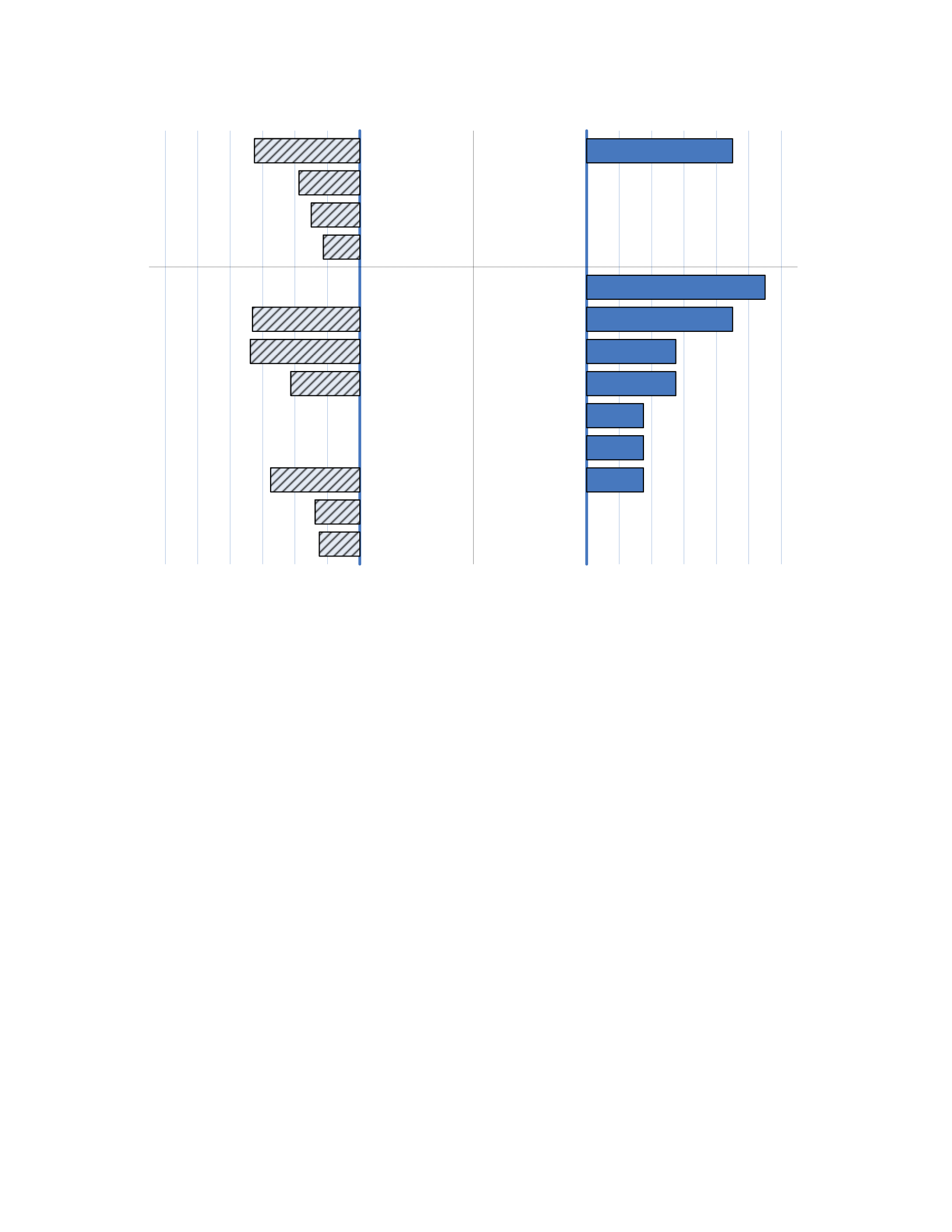
Figure 14. Innovation Obstacles Facing Senior Leaders
Model Analysis
Christensen (2003) proposed that building an organization capable of disruptive
growth requires a careful balance of resources, processes, and values. Combining these
thoughts with the research findings of this study provided a model for fostering disruptive
innovation. The model presented in Chapter II for fostering disruptive innovation defined
that an increase in the right motivation, plus an increase in the right focus of innovation
resources, plus a decrease in the barriers of innovation, plus an increase in the
characteristics of innovative culture, will foster an increase in the emergence of disruptive
innovation. The comprehensive literature review of innovation concepts also identified
Unsupportive Culture
and Climate
100 403020
Limited resources for
investment
Workforce Issues
Process Immaturity
Inflexible physical and
IT Infrastructure
Insufficient Access to
Information
AFRL Sr Ldr Responses
4060 1030 0
Govmt and Other
Legal Restrictions
Economic
Uncertainty
Inadequate Enabling
Technologies
Workforce Issues
Arising Externally
Industry CEO Responses
60502050
Govmt and Other
Legal Restrictions
Inflexible strategic
plans and budgets
Limited resources for
investment
Process Immaturity
Leadership turnover
and mgt instability
Lack of effective
collaboration
Workforce Issues (inc
training/rewards)
Unsupportive Culture
and Climate
External
Internal
ExternalInternal

various ideal heuristics for motivation, focus, barriers, and culture that are credited with
successful disruptive innovation. Figure 15 summarizes the study results and
demonstrates the similarities and differences between industry and the Air Force S&T
community with respect to the critical model variables. Specific findings that correspond
to the concepts of disruptive innovation are highlighted to show organizational attributes
that typically foster game-changing ideas. In addition, the summary shows that while the
model serves as a basic framework for innovation improvement, the application and
specific attributes will be domain dependent.
This chapter provided the results and analysis of the study research. First, a
detailed quantitative analysis of the survey data including the comparative analysis was
presented. Next, the qualitative evaluation of the interview data was outlined and
presented. Finally, the survey and interview results were combined with the information
gathered in the literature review to provide depth and support to the proposed innovation
emergence model.

V. Conclusions and Recommendations
The purpose of this thesis research was to study the motivation, focus, barriers,
and culture needed to foster disruptive innovation in Air Force Science and Technology
(S&T) and to investigate how industry innovation strategies could improve breakthrough
Air Force technology emergence. This chapter provides the conclusions,
recommendations, limitations, and follow-on studies for this thesis effort. The first
section provides a detailed description of the research conclusions. The next section
outlines a series of recommendations for the Air Force S&T community based on the
literature review, data results, and research findings. The third section summarizes the
limitations of this study and provides guidance regarding interpretations and applicability
of findings. The last section in the chapter provides some suggestions for future research
designed to further enhance the knowledge base in this area of research.
Research Conclusions
Based on the defined investigative questions, comprehensive literature review,
multifaceted data results, and detailed analysis findings, the following research
conclusions have been developed:
1. Air Force S&T pursues innovation in order to keep the warfighter state-
of-the-art with leading edge technologies. This motivation, exhibiting a desire for
longterm relevance and dominance, coincides with the ideal attributes for increased
disruptive innovation emergence. In contrast, industry appears to be more driven to

innovation to respond to customer demands, improve operational efficiency, and increase
profits.
Industry motivation, more short-term oriented, is less likely to foster new systems with
completely new value propositions. Although the study results found Air Force scientists
and engineers perceive less attention to innovation than their industry counterparts, Air
Force S&T exudes the right motivation to foster disruptive innovation.
2. Air Force S&T, heavily reliant on external resources, struggles with
developing an executable strategy designed to foster disruptive innovation. While most
Air Force S&T professionals see a balance of investment focus, highly structured and
rigid strategic planning make breakthroughs difficult for innovators. Air Force S&T
appears to depend on other organizations for innovation, focusing primarily on the
development of technological products. The Air Force S&T community has also failed to
capitalize on opportunities for operational innovation, especially collaborating with the
warfighter on technologically advanced techniques and tactics. In comparison, industry
seeks to use innovation as a means to address the profit generating needs of customers,
utilizing a balance of product and business model innovation to compete in market
segments. The study results suggest that Air Force S&T may not be actively using the
principles of radical thinking as a means to gamechanging improvement in business
organizational activities.
3. Air Force S&T professionals perceive significant internal organizational
barriers hampering the emergence of disruptive innovation. Insufficient resources,
organizational constraints, lack of innovation strategy, and entrenched programs were
perceived as the greatest obstacles to new ideas. Both the industry and Air Force S&T

communities acknowledge the detrimental affect of innovation barriers, although industry
appears more confident in its ability to overcome bureaucratic constraints. Industry
creativity was less threatened by organizational policies, possibly indicating that the
increased focus of resources in business model innovation returned benefits in overall
company efficiency.
4. Air Force scientists and engineers believe strong innovation culture is best
characterized by freedom and collaboration. The study indicated that Air Force S&T
professionals desire a culture that allows them freedom to research without administrative
burdens and non-value added diversions. In addition, Air Force S&T innovation is
contingent on alliances and partnerships with internal and external entities. While Air
Force S&T believes in a culture of freedom and industry sees customer focus as the key
to innovation emergence, both Air Force S&T and industry employees understand the
tremendous importance of organizational culture in fostering breakthroughs.
5. Air Force S&T senior leaders understand the criticality of innovation but
struggle with the optimal approach to fostering disruptive innovation in their
organizations Most Air Force S&T leaders agreed that innovation was not well
integrated into their business and technology strategy which was hampered by overly
constrained planning and restrictive external influences. Although other findings indicate
strong reliance on external sources, Air Force S&T leadership places great confidence in
the ideas of their in-house personnel. Unfortunately, most senior leaders do not perceive
that Air Force S&T organizations posses a strong innovative culture. In addition, most
Air Force S&T senior leaders acknowledged that considerable improvement efforts were

needed to facilitate flexible planning, thereby freeing resources, collaboration, and
rewards for creative risk-taking.
6. Innovative organizations require strong and inspiring leadership and both
Air Force S&T senior leaders and company CEOs agree that innovative thinking must be
orchestrated from the top. Supportive leadership is critical to motivation, strategy,
overcoming obstacles, and building an innovative culture. While both Air Force and
industry leadership hold themselves accountable for fostering disruptive innovation,
complex dimensions of disruptive innovation continue to be challenging regardless of the
domain.
7. Air Force S&T is capable of regaining its prominence as a leader in
disruptive technological innovation by applying the emergence model, capturing the
relevant best practices of industry, and exploiting the positive attributes of the military
domain. The research findings combine to establish the proposed model for fostering
disruptive innovation in either industry or government organizations. Given an increase
in the right motivation, an increase in the right focus of innovation resources, a decrease
in the barriers of innovation, and an increase in the characteristics of innovative culture,
disruptive innovation will emerge. Although the model is not intended to be an equation
for guaranteed success, it does provide a conceptual formula to ensure that all critical
elements needed to foster breakthrough innovation are considered.

Recommendations
Based on this thesis research, the followed recommendations are provided to the
Air Force S&T community to help foster the emergence of disruptive technology:
1. Exercise caution with relying on industry to generate relevant disruptive
innovation for the Air Force. Given the differences in motivation, drivers, and resource
focus, outsourcing innovation to commercial companies may not provide the long-term
relevant technologies needed to dominate the battlespace. While industry is a key
collaborative partner, Air Force S&T should invest in enhancing its internal workforce to
ensure the emergence of revolutionary military technology.
2. Infuse greater flexibility and innovativeness into AFRL business and
technology strategy through the use of discovery-based planning. Discovery-based
planning allows experimental results and assumption validation to drive investment
strategies. The added resilience in AFRL planning will allow technology breakthroughs
to evolve less bounded and foster increased levels of disruptive innovation.
3. Establish freedom for the scientist and engineering workforce as a priority
of Air Force S&T process improvement efforts. AFRL’s greatest asset has always been the
intellectual power of its technological workforce. AFRL needs to ensure that all
management approaches, supporting activities, and enabling activities place optimization
of the scientist and engineer’s (S&E) time as the goal of process improvement efforts. In
order for AFRL to achieve disruptive technological prominence, the S&E must be given
larger amounts of working time free from administrative burden and non-value added

work. Even if granting freedom to the S&E increases the responsibilities of management
and support personnel, the long-term benefits of increased disruptive innovation
emergence is worth the risk.
4. Utilize successful sustaining innovation to build advocacy and generate
resources for disruptive technology innovation. Not all AFRL efforts can or even should
be focused on gamechanging ideas. Balanced investments are essential to success.
However, AFRL should be careful not to allow incremental improvements in entrenched
existing programs in such a way that invention and exploitation of disruptive concepts is
neglected. Sustaining technology and requirements-based development play a valuable
role as long as they are used to obtain resources for more long-term disruptive
breakthroughs.
5. Increase the use of experimental venues to increase technological
collaboration with the warfighter and to access the operational impacts of disruptive
innovation. While AF S&T’s motivation and focus on the state-of-the-art is critical,
AFRL can also learn from industry’s strong customer focus. More discovery-based
experimental venues with the warfighter will increase AFRL’s position as a relevant force
in helping with operational innovation, especially in the application of technological
advancements for disruptive warfighting tactics and techniques.
6. Elevate the innovative culture of AFRL by orchestrating risk-taking from
the top. Senior leadership views of innovation play a profound role on the sense of
entrepreneurship in the organization. By demonstrating greater risk-taking in approaches
to supporting and enabling processes, senior leadership will send a decisive message to
the workforce and infuse innovative spirit within the organization. The S&E workforce

will observe the trend in leadership and respond with increases in relevant disruptive
ideas.
Limitations of the Research
Although efforts were taken throughout this research to mitigate risks to reliability
and validity, sample bias in the survey still arose as a threat to internal validity. As
detailed in the methodology chapter, the sample demographics demonstrated some
deviations from the population demographics. Volunteerism may have played a role in
creating the bias, as the persons who chose to participate in the survey were concentrated
in certain geographic sites and directorates. Although the findings were not analyzed
based on directorates or geographic demographics, the sampling bias should still be
considered when evaluating the generalizations made by the survey portion of this study.

Future Research
Based on the emerging topic and lack of specific literature on disruptive
innovation in military organizations, a primarily qualitative research method, supported
by some quantitative data, was used in this thesis study. The resulting model for fostering
disruptive innovation lends itself well to further quantitative inferential research. The
following suggestions for investigative questions examined singularly or as part of a
larger research study, would provide the needed quantitative validation of the model for
fostering disruptive innovation:
1. How does a military organization’s motivation for innovation relate to the
successful emergence of disruptive innovation?
2. What focus of innovation resources in a military organization provide the
most successful emergence of disruptive innovation?
3. How does the elimination of barriers relate to an organization’s ability to
foster disruptive innovation? What common barriers to innovation have the
most detrimental effect on organizational innovativeness?
4. How do increased levels in the characteristics of innovative culture relate to
an organization’s ability to foster disruptive innovation? What characteristics
of innovative culture have the greatest effect on the emergence of disruptive
innovation?
5. How can organizational success in fostering disruptive innovation be
quantified? What organizational metrics and measures can be used to quantify
the successful emergence of disruptive innovation?
In Air Force S&T, organizational constraints were considered a large barrier
(ranked #2) while leadership/management support was not considered an overwhelming
obstacle (ranked #10). However, this delta may imply that many AFRL personnel do not
believe Air Force senior leadership are empowered to improve the organizational policy,
strategy, and bureaucracy within the organization. Additionally, Table 33 summarizes
several supporting multiple choice items providing insights into innovation barriers.

These results indicate that in both Air Force S&T and industry organizations, employees
are unclear on how to gain support for new ideas and feel the rewards and recognition for
innovative behaviors to be somewhat limited.
Characteristics of Innovative Culture
Several survey items also examined the characteristics of innovative culture in Air
Force S&T organizations. Survey item 12 identified the most important factors for
developing an innovative culture. Respondents scored various characteristics using a
scale of 1 to 5 where 1=Not Important, 2=Somewhat Important, 3=Important, 4=Highly
Important, and 5=Extremely Important. The results of survey item 22, and 25 provided
further cultural observations by AF scientists and engineers.
Survey Item 12 - Developing an Innovative Culture: Table 34 outlines the
importance of different factors for developing an innovative culture in Air Force S&T
organizations. The factors were rank ordered based on the mean scores provided by
AFRL respondents. Freedom to innovate (with a mean score of 3.79) was cited as the
most important consideration followed by teamwork/collaboration (3.77) and the ability
to select the right ideas for research (3.59).
The comparison survey in industry found customer focus to be the most important
factor in developing an innovative culture. Comparing the means between the studies
using statistical tests shows freedom to innovate to be strongly viewed in the Air Force
S&T community while customer focus, organizational communication, and innovation
measurement are more important to industry respondents. Although innovation goals,
diversity, and organizational structures were the lowest ranked in both studies, the AFRL

persons perceived these to be much less important to innovative culture than their
industry counterparts.
Industry scored higher on 12 of the 14 factors, and 8 of the 12 were found to be
statistically significant. The largest differences in rankings were freedom to innovate,
customer focus, and organizational communication. These results support previous Air
Force S&T findings indicating that AFRL personnel desire sense of freedom from
bureaucratic constraints and non-value added work. The results also indicate that while
Air Force S&T professionals desire a culture of technology push, industry places greater
hope on addressing the direct and often short-term needs of the customer. Therefore,
given the access to the appropriate resources (people, time, and money) and the freedom
to experiment, a greater degree of long-term, dominant, and breakthrough technology
may emerge from Air Force S&T investments.
Table 35 summarizes several supporting items providing additional findings
regarding innovative culture. These results indicated that while both Air Force S&T and
industry employees understand the importance of innovation, industry is more confident
in what innovation means and how to become more innovative. However, the study
results indicate that the innovative culture found in industry might be better aligned to
foster sustaining innovation than disruptive innovation. These findings indicate that the
Air Force S&T community may be more cognizant that building a robust innovative

culture, based on long-term disruptive technology dominance, is very challenging in
today’s fiscally constrained and operationally focused Air Force.
Interview Evaluation
The senior leadership interviews were analyzed using a grounded theory
qualitative method of inductive study. The interview analysis, provided in complete
detail under Appendix F, illustrates various themes and concepts evident in the responses.
The major themes summarized in the following sections not only address the
investigative question regarding senior leadership but also provide additional insight into
the other investigative questions as well. In addition, the evaluation provides a point of
comparison between the viewpoints of Air Force S&T leaders and their industry CEO
counterparts. The interviews were designed to answer the investigative question on Air
Force S&T senior leadership perspectives on innovation. Although the discussions were
open-ended, the interviews were structured to provide a direct point of comparison
between AFRL leadership and industry CEOs. The interview data and comparisons are
presented in four areas: views, emphasis, collaboration, and culture.
Senior Leadership Views of Innovation
Some of the interview questions were designed to query AFRL senior leadership
regarding innovation definitions, importance, and integration into business/technology
strategy. Table 36 outlines the views of innovation expressed by the interview

participants. Most AFRL leaders (64%) defined innovation in the same manner and
perceived innovation as an extremely/highly important part of Air Force S&T (73%).
The AFRL directors and senior staff felt innovation was most applicable in both
responding to urgent needs and generating S&T knowledge. Fifty-five percent of the
respondents saw innovation as less significant in developing technology based on specific
customer requirements. In addition, 82% of the AFRL senior leaders interviewed
articulated that innovation was not properly considered in the current Air Force S&T
business and technology strategy. Although AFRL senior leaders think innovation is
important and relevant, they have been challenged in integrating innovation into Air
Force S&T strategic planning. This finding indicates the AFRL business and technology
strategy may be overly constrained and driven by external influences.
As illustrated in Figure 11, integrating innovation into business and technology
strategy is a challenge facing both industry CEOs and Air Force S&T leadership.
Although company CEOs perceive much better integration than their Air Force
counterparts, they are also frustrated (IBM, 2006). Most AFRL directors and staff cited
administrative burdens, excessive planning, too much centralization, and over emphasis
on requirements mapping as shortfalls in the current innovation strategy. Most AFRL
senior leaders saw a definite need to change the way innovation is fostered. One
respondent explained, “We have become so focused on planning for Focused Long-Term
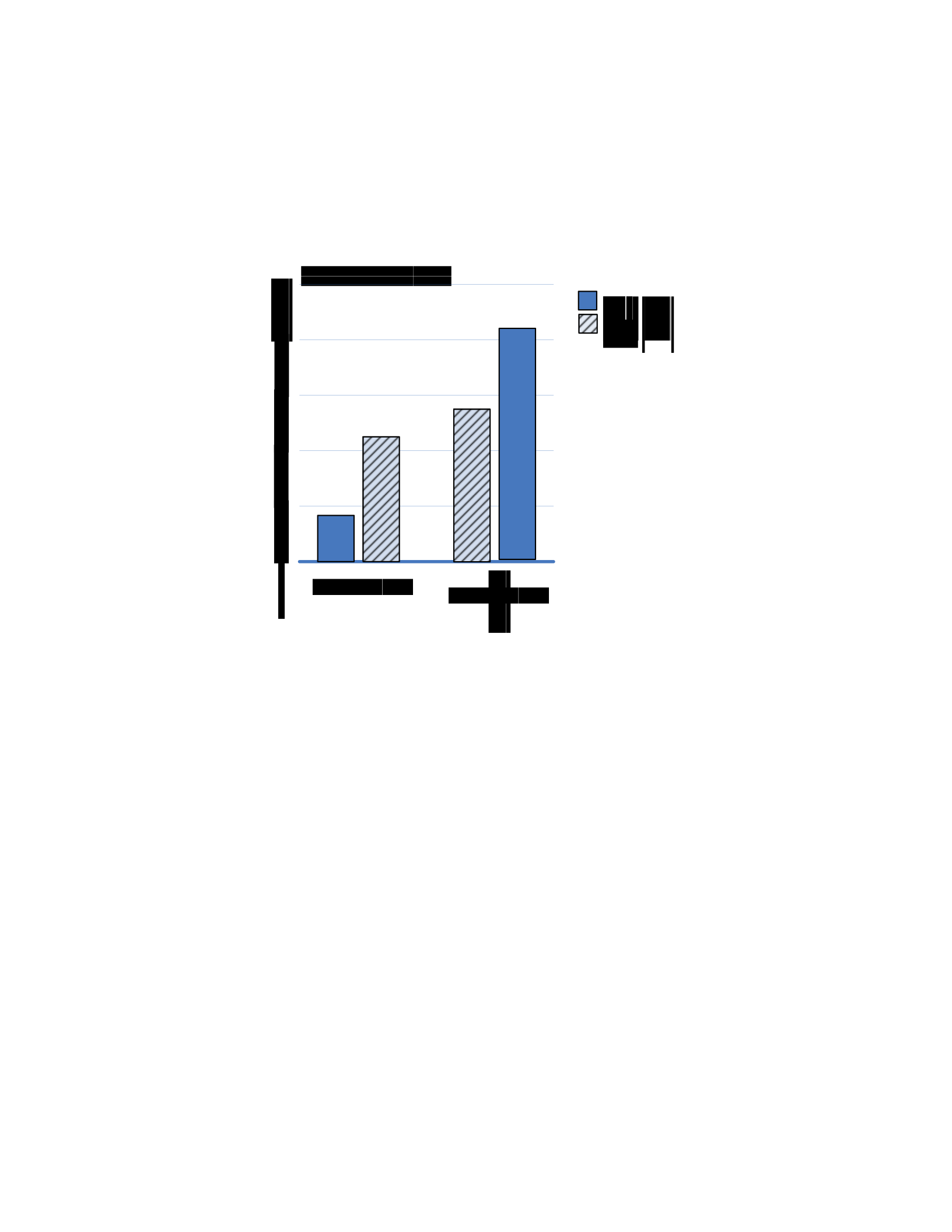
Challenges (FLTCs)…that we have forgotten to strategize on fostering the gamechanging
(disruptive) ideas that make the FLTCs work.”
Figure 11. Integration of Innovation into Business and Technology Strategy
Senior Leadership Innovation Emphasis
Some of the interview questions examined what types of innovation are being
stressed by Air Force S&T leadership and in what areas the greatest innovation success is
perceived. Table 37 outlines the major themes in innovation emphasis. All the AFRL
interviewees referenced product/service innovation (to include knowledge/technology) as
the primary area of emphasis. Only 55% of the AFRL senior leaders referenced processes
and organizational areas as places for creativity and idea encouragement. Even fewer
participants (27%) emphasized innovation in operational activities including concepts of

operations (CONOPS) and revolutionary techniques and tactics. One director explained
that, “The service laboratories are designed to be innovative in technology products,
especially in the exploitation and application side of innovation.” Additionally, several
respondents noted that while operational innovation is not currently a large area of
emphasis and strength in AFRL, collaborating directly with the warfighter on the
revolutionary use of technology to enhance the techniques and tactics of warfare is an
opportunity the Air Force S&T community should foster.
Comparing areas of focus, as depicted in Figure 12, shows nearly identical
innovation emphasis by industry CEOs and AFRL senior leadership. According to the
IBM industry study (2006), the CEOs of top performing companies are focusing about
55% of their idea attention on products with about 30% on process/organizational
innovation. Air Force S&T leaders approximated similar levels of emphasis in their
organizations. Companies are seeing business model innovation as the primary means to
preempt threats and create them. However, several Air Force S&T senior leaders noted
that operational innovation is an area where game-changing technology could have the
most profound impact on Air Force wartime competiveness.

Senior Leadership Perspectives on Role of Collaboration
Numerous interview questions were structured to collect perspectives on how
collaboration impacts organizational innovation. The importance of collaboration,
benefits of collaboration, and productivity of collaborants were the primary questions
answered. Table 38 illustrates that AFRL senior leader interviewees (100%) not only see
collaboration as important but essential in harnessing the benefits of disruptive
innovation. In addition, the majority of Air Force S&T senior leaders have the strongest
confidence in the ideas of their in-house government, in-house support contractors, and
academic resources.

Comparing industry CEO and AFRL senior leader responses identifies several
similarities and differences in the sources of disruptive ideas. Figure 13 illustrates
several comparisons in innovation catalysts for industry and Air Force S&T
organizations. Leaders in industry and the Air Force S&T community rely heavily on
internal resources for innovation. They also both see formal collaboration with external
organizations as a solid source of new concepts. However, industry CEOs cited greater
value in ideas from their customers and even considered the competition as a key
resource for successful innovation. This confirms assertions made by Christensen (2003)
that many innovative breakthroughs are initiated by company marketers who segment
customers along a variety of psychological dimensions in order to define a profile of the
customer most likely to buy a particular product. In contrast, Air Force S&T senior
leaders placed greater confidence in the breakthrough ideas of academia. These results
align with previous survey findings where AFRL scientists and engineers cited
collaboration with academia, nonprofits, and other government agencies as a leading
driver of Air Force S&T innovation.
Senior Leadership Perspectives on Innovative Culture
Interview questions were also designed to query senior leadership observations on
the innovative culture within Air Force S&T organizations. Table 39 summarizes the key
perspectives on the strength of innovative culture, obstacles of innovation, actions to

foster innovativeness, and rewards for disruptive innovation. Although all the AFRL
leaders interviewed explained specific actions being taken to foster innovation in their
respective organizations, the majority (73%) did not consider AFRL as having a strong
innovative culture. The lack of flexibility in strategic planning and budgeting was the
most frequently cited obstacle to disruptive innovation. Limited resources and
government policies, including the restrictiveness of the federal acquisition regulations,
were also commonly mentioned barriers. Six of the AFRL senior leaders felt they
personally had control over the barriers to innovative culture while the rest felt they had
only some control to address the obstacles. In addition, 73% of the interview participants
articulated that innovation is not properly rewarded in their respective AFRL
organizations. While both non-financial rewards and compensatory motivations are being
currently used, most AFRL senior leaders acknowledged that considerable efforts were
needed to instill better incentives for creative risk-taking and breakthrough ideas.

Comparing the results of the AFRL interviews with those of the IBM CEO Study, several
interesting similarities and differences were noted, especially in the area of innovative
culture barriers. As outlined in Figure 14, a variety of internal and external obstacles
make it difficult to build an innovative mindset. Government and other legal restrictions
were cited as the largest external hindrance for both company CEOs and AFRL
leadership. Limited resources, unsupportive culture, and process immaturity were also
common internal challenges. Inflexibility in strategic plans and budgets, the most
frequent Air Force S&T response, was not specifically identified in the IBM CEO study.
Neither was leadership turnover and lack of effective collaboration. In contrast, industry
CEOs cited economic uncertainty, technology shortfalls, infrastructure difficulties, and
insufficient access to information as being greater hindrances than their Air Force S&T
counterparts. Overall, both industry CEOs and AFRL senior leaders recognize the
importance of innovative culture and acknowledge the need for organizational leaders to
take responsibility in fostering a spirit of innovation.

Figure 14. Innovation Obstacles Facing Senior Leaders
Model Analysis
Christensen (2003) proposed that building an organization capable of disruptive
growth requires a careful balance of resources, processes, and values. Combining these
thoughts with the research findings of this study provided a model for fostering disruptive
innovation. The model presented in Chapter II for fostering disruptive innovation defined
that an increase in the right motivation, plus an increase in the right focus of innovation
resources, plus a decrease in the barriers of innovation, plus an increase in the
characteristics of innovative culture, will foster an increase in the emergence of disruptive
innovation. The comprehensive literature review of innovation concepts also identified
Unsupportive Culture
and Climate
100 403020
Limited resources for
investment
Workforce Issues
Process Immaturity
Inflexible physical and
IT Infrastructure
Insufficient Access to
Information
AFRL Sr Ldr Responses
4060 1030 0
Govmt and Other
Legal Restrictions
Economic
Uncertainty
Inadequate Enabling
Technologies
Workforce Issues
Arising Externally
Industry CEO Responses
60502050
Govmt and Other
Legal Restrictions
Inflexible strategic
plans and budgets
Limited resources for
investment
Process Immaturity
Leadership turnover
and mgt instability
Lack of effective
collaboration
Workforce Issues (inc
training/rewards)
Unsupportive Culture
and Climate
External
Internal
ExternalInternal

various ideal heuristics for motivation, focus, barriers, and culture that are credited with
successful disruptive innovation. Figure 15 summarizes the study results and
demonstrates the similarities and differences between industry and the Air Force S&T
community with respect to the critical model variables. Specific findings that correspond
to the concepts of disruptive innovation are highlighted to show organizational attributes
that typically foster game-changing ideas. In addition, the summary shows that while the
model serves as a basic framework for innovation improvement, the application and
specific attributes will be domain dependent.
This chapter provided the results and analysis of the study research. First, a
detailed quantitative analysis of the survey data including the comparative analysis was
presented. Next, the qualitative evaluation of the interview data was outlined and
presented. Finally, the survey and interview results were combined with the information
gathered in the literature review to provide depth and support to the proposed innovation
emergence model.

V. Conclusions and Recommendations
The purpose of this thesis research was to study the motivation, focus, barriers,
and culture needed to foster disruptive innovation in Air Force Science and Technology
(S&T) and to investigate how industry innovation strategies could improve breakthrough
Air Force technology emergence. This chapter provides the conclusions,
recommendations, limitations, and follow-on studies for this thesis effort. The first
section provides a detailed description of the research conclusions. The next section
outlines a series of recommendations for the Air Force S&T community based on the
literature review, data results, and research findings. The third section summarizes the
limitations of this study and provides guidance regarding interpretations and applicability
of findings. The last section in the chapter provides some suggestions for future research
designed to further enhance the knowledge base in this area of research.
Research Conclusions
Based on the defined investigative questions, comprehensive literature review,
multifaceted data results, and detailed analysis findings, the following research
conclusions have been developed:
1. Air Force S&T pursues innovation in order to keep the warfighter state-
of-the-art with leading edge technologies. This motivation, exhibiting a desire for
longterm relevance and dominance, coincides with the ideal attributes for increased
disruptive innovation emergence. In contrast, industry appears to be more driven to

innovation to respond to customer demands, improve operational efficiency, and increase
profits.
Industry motivation, more short-term oriented, is less likely to foster new systems with
completely new value propositions. Although the study results found Air Force scientists
and engineers perceive less attention to innovation than their industry counterparts, Air
Force S&T exudes the right motivation to foster disruptive innovation.
2. Air Force S&T, heavily reliant on external resources, struggles with
developing an executable strategy designed to foster disruptive innovation. While most
Air Force S&T professionals see a balance of investment focus, highly structured and
rigid strategic planning make breakthroughs difficult for innovators. Air Force S&T
appears to depend on other organizations for innovation, focusing primarily on the
development of technological products. The Air Force S&T community has also failed to
capitalize on opportunities for operational innovation, especially collaborating with the
warfighter on technologically advanced techniques and tactics. In comparison, industry
seeks to use innovation as a means to address the profit generating needs of customers,
utilizing a balance of product and business model innovation to compete in market
segments. The study results suggest that Air Force S&T may not be actively using the
principles of radical thinking as a means to gamechanging improvement in business
organizational activities.
3. Air Force S&T professionals perceive significant internal organizational
barriers hampering the emergence of disruptive innovation. Insufficient resources,
organizational constraints, lack of innovation strategy, and entrenched programs were
perceived as the greatest obstacles to new ideas. Both the industry and Air Force S&T

communities acknowledge the detrimental affect of innovation barriers, although industry
appears more confident in its ability to overcome bureaucratic constraints. Industry
creativity was less threatened by organizational policies, possibly indicating that the
increased focus of resources in business model innovation returned benefits in overall
company efficiency.
4. Air Force scientists and engineers believe strong innovation culture is best
characterized by freedom and collaboration. The study indicated that Air Force S&T
professionals desire a culture that allows them freedom to research without administrative
burdens and non-value added diversions. In addition, Air Force S&T innovation is
contingent on alliances and partnerships with internal and external entities. While Air
Force S&T believes in a culture of freedom and industry sees customer focus as the key
to innovation emergence, both Air Force S&T and industry employees understand the
tremendous importance of organizational culture in fostering breakthroughs.
5. Air Force S&T senior leaders understand the criticality of innovation but
struggle with the optimal approach to fostering disruptive innovation in their
organizations Most Air Force S&T leaders agreed that innovation was not well
integrated into their business and technology strategy which was hampered by overly
constrained planning and restrictive external influences. Although other findings indicate
strong reliance on external sources, Air Force S&T leadership places great confidence in
the ideas of their in-house personnel. Unfortunately, most senior leaders do not perceive
that Air Force S&T organizations posses a strong innovative culture. In addition, most
Air Force S&T senior leaders acknowledged that considerable improvement efforts were

needed to facilitate flexible planning, thereby freeing resources, collaboration, and
rewards for creative risk-taking.
6. Innovative organizations require strong and inspiring leadership and both
Air Force S&T senior leaders and company CEOs agree that innovative thinking must be
orchestrated from the top. Supportive leadership is critical to motivation, strategy,
overcoming obstacles, and building an innovative culture. While both Air Force and
industry leadership hold themselves accountable for fostering disruptive innovation,
complex dimensions of disruptive innovation continue to be challenging regardless of the
domain.
7. Air Force S&T is capable of regaining its prominence as a leader in
disruptive technological innovation by applying the emergence model, capturing the
relevant best practices of industry, and exploiting the positive attributes of the military
domain. The research findings combine to establish the proposed model for fostering
disruptive innovation in either industry or government organizations. Given an increase
in the right motivation, an increase in the right focus of innovation resources, a decrease
in the barriers of innovation, and an increase in the characteristics of innovative culture,
disruptive innovation will emerge. Although the model is not intended to be an equation
for guaranteed success, it does provide a conceptual formula to ensure that all critical
elements needed to foster breakthrough innovation are considered.

Recommendations
Based on this thesis research, the followed recommendations are provided to the
Air Force S&T community to help foster the emergence of disruptive technology:
1. Exercise caution with relying on industry to generate relevant disruptive
innovation for the Air Force. Given the differences in motivation, drivers, and resource
focus, outsourcing innovation to commercial companies may not provide the long-term
relevant technologies needed to dominate the battlespace. While industry is a key
collaborative partner, Air Force S&T should invest in enhancing its internal workforce to
ensure the emergence of revolutionary military technology.
2. Infuse greater flexibility and innovativeness into AFRL business and
technology strategy through the use of discovery-based planning. Discovery-based
planning allows experimental results and assumption validation to drive investment
strategies. The added resilience in AFRL planning will allow technology breakthroughs
to evolve less bounded and foster increased levels of disruptive innovation.
3. Establish freedom for the scientist and engineering workforce as a priority
of Air Force S&T process improvement efforts. AFRL’s greatest asset has always been the
intellectual power of its technological workforce. AFRL needs to ensure that all
management approaches, supporting activities, and enabling activities place optimization
of the scientist and engineer’s (S&E) time as the goal of process improvement efforts. In
order for AFRL to achieve disruptive technological prominence, the S&E must be given
larger amounts of working time free from administrative burden and non-value added

work. Even if granting freedom to the S&E increases the responsibilities of management
and support personnel, the long-term benefits of increased disruptive innovation
emergence is worth the risk.
4. Utilize successful sustaining innovation to build advocacy and generate
resources for disruptive technology innovation. Not all AFRL efforts can or even should
be focused on gamechanging ideas. Balanced investments are essential to success.
However, AFRL should be careful not to allow incremental improvements in entrenched
existing programs in such a way that invention and exploitation of disruptive concepts is
neglected. Sustaining technology and requirements-based development play a valuable
role as long as they are used to obtain resources for more long-term disruptive
breakthroughs.
5. Increase the use of experimental venues to increase technological
collaboration with the warfighter and to access the operational impacts of disruptive
innovation. While AF S&T’s motivation and focus on the state-of-the-art is critical,
AFRL can also learn from industry’s strong customer focus. More discovery-based
experimental venues with the warfighter will increase AFRL’s position as a relevant force
in helping with operational innovation, especially in the application of technological
advancements for disruptive warfighting tactics and techniques.
6. Elevate the innovative culture of AFRL by orchestrating risk-taking from
the top. Senior leadership views of innovation play a profound role on the sense of
entrepreneurship in the organization. By demonstrating greater risk-taking in approaches
to supporting and enabling processes, senior leadership will send a decisive message to
the workforce and infuse innovative spirit within the organization. The S&E workforce

will observe the trend in leadership and respond with increases in relevant disruptive
ideas.
Limitations of the Research
Although efforts were taken throughout this research to mitigate risks to reliability
and validity, sample bias in the survey still arose as a threat to internal validity. As
detailed in the methodology chapter, the sample demographics demonstrated some
deviations from the population demographics. Volunteerism may have played a role in
creating the bias, as the persons who chose to participate in the survey were concentrated
in certain geographic sites and directorates. Although the findings were not analyzed
based on directorates or geographic demographics, the sampling bias should still be
considered when evaluating the generalizations made by the survey portion of this study.

Future Research
Based on the emerging topic and lack of specific literature on disruptive
innovation in military organizations, a primarily qualitative research method, supported
by some quantitative data, was used in this thesis study. The resulting model for fostering
disruptive innovation lends itself well to further quantitative inferential research. The
following suggestions for investigative questions examined singularly or as part of a
larger research study, would provide the needed quantitative validation of the model for
fostering disruptive innovation:
1. How does a military organization’s motivation for innovation relate to the
successful emergence of disruptive innovation?
2. What focus of innovation resources in a military organization provide the
most successful emergence of disruptive innovation?
3. How does the elimination of barriers relate to an organization’s ability to
foster disruptive innovation? What common barriers to innovation have the
most detrimental effect on organizational innovativeness?
4. How do increased levels in the characteristics of innovative culture relate to
an organization’s ability to foster disruptive innovation? What characteristics
of innovative culture have the greatest effect on the emergence of disruptive
innovation?
5. How can organizational success in fostering disruptive innovation be
quantified? What organizational metrics and measures can be used to quantify
the successful emergence of disruptive innovation?
In Air Force S&T, organizational constraints were considered a large barrier
(ranked #2) while leadership/management support was not considered an overwhelming
obstacle (ranked #10). However, this delta may imply that many AFRL personnel do not
believe Air Force senior leadership are empowered to improve the organizational policy,
strategy, and bureaucracy within the organization. Additionally, Table 33 summarizes
several supporting multiple choice items providing insights into innovation barriers.

These results indicate that in both Air Force S&T and industry organizations, employees
are unclear on how to gain support for new ideas and feel the rewards and recognition for
innovative behaviors to be somewhat limited.
Characteristics of Innovative Culture
Several survey items also examined the characteristics of innovative culture in Air
Force S&T organizations. Survey item 12 identified the most important factors for
developing an innovative culture. Respondents scored various characteristics using a
scale of 1 to 5 where 1=Not Important, 2=Somewhat Important, 3=Important, 4=Highly
Important, and 5=Extremely Important. The results of survey item 22, and 25 provided
further cultural observations by AF scientists and engineers.
Survey Item 12 - Developing an Innovative Culture: Table 34 outlines the
importance of different factors for developing an innovative culture in Air Force S&T
organizations. The factors were rank ordered based on the mean scores provided by
AFRL respondents. Freedom to innovate (with a mean score of 3.79) was cited as the
most important consideration followed by teamwork/collaboration (3.77) and the ability
to select the right ideas for research (3.59).
The comparison survey in industry found customer focus to be the most important
factor in developing an innovative culture. Comparing the means between the studies
using statistical tests shows freedom to innovate to be strongly viewed in the Air Force
S&T community while customer focus, organizational communication, and innovation
measurement are more important to industry respondents. Although innovation goals,
diversity, and organizational structures were the lowest ranked in both studies, the AFRL

persons perceived these to be much less important to innovative culture than their
industry counterparts.
Industry scored higher on 12 of the 14 factors, and 8 of the 12 were found to be
statistically significant. The largest differences in rankings were freedom to innovate,
customer focus, and organizational communication. These results support previous Air
Force S&T findings indicating that AFRL personnel desire sense of freedom from
bureaucratic constraints and non-value added work. The results also indicate that while
Air Force S&T professionals desire a culture of technology push, industry places greater
hope on addressing the direct and often short-term needs of the customer. Therefore,
given the access to the appropriate resources (people, time, and money) and the freedom
to experiment, a greater degree of long-term, dominant, and breakthrough technology
may emerge from Air Force S&T investments.
Table 35 summarizes several supporting items providing additional findings
regarding innovative culture. These results indicated that while both Air Force S&T and
industry employees understand the importance of innovation, industry is more confident
in what innovation means and how to become more innovative. However, the study
results indicate that the innovative culture found in industry might be better aligned to
foster sustaining innovation than disruptive innovation. These findings indicate that the
Air Force S&T community may be more cognizant that building a robust innovative

culture, based on long-term disruptive technology dominance, is very challenging in
today’s fiscally constrained and operationally focused Air Force.
Interview Evaluation
The senior leadership interviews were analyzed using a grounded theory
qualitative method of inductive study. The interview analysis, provided in complete
detail under Appendix F, illustrates various themes and concepts evident in the responses.
The major themes summarized in the following sections not only address the
investigative question regarding senior leadership but also provide additional insight into
the other investigative questions as well. In addition, the evaluation provides a point of
comparison between the viewpoints of Air Force S&T leaders and their industry CEO
counterparts. The interviews were designed to answer the investigative question on Air
Force S&T senior leadership perspectives on innovation. Although the discussions were
open-ended, the interviews were structured to provide a direct point of comparison
between AFRL leadership and industry CEOs. The interview data and comparisons are
presented in four areas: views, emphasis, collaboration, and culture.
Senior Leadership Views of Innovation
Some of the interview questions were designed to query AFRL senior leadership
regarding innovation definitions, importance, and integration into business/technology
strategy. Table 36 outlines the views of innovation expressed by the interview

participants. Most AFRL leaders (64%) defined innovation in the same manner and
perceived innovation as an extremely/highly important part of Air Force S&T (73%).
The AFRL directors and senior staff felt innovation was most applicable in both
responding to urgent needs and generating S&T knowledge. Fifty-five percent of the
respondents saw innovation as less significant in developing technology based on specific
customer requirements. In addition, 82% of the AFRL senior leaders interviewed
articulated that innovation was not properly considered in the current Air Force S&T
business and technology strategy. Although AFRL senior leaders think innovation is
important and relevant, they have been challenged in integrating innovation into Air
Force S&T strategic planning. This finding indicates the AFRL business and technology
strategy may be overly constrained and driven by external influences.
As illustrated in Figure 11, integrating innovation into business and technology
strategy is a challenge facing both industry CEOs and Air Force S&T leadership.
Although company CEOs perceive much better integration than their Air Force
counterparts, they are also frustrated (IBM, 2006). Most AFRL directors and staff cited
administrative burdens, excessive planning, too much centralization, and over emphasis
on requirements mapping as shortfalls in the current innovation strategy. Most AFRL
senior leaders saw a definite need to change the way innovation is fostered. One
respondent explained, “We have become so focused on planning for Focused Long-Term
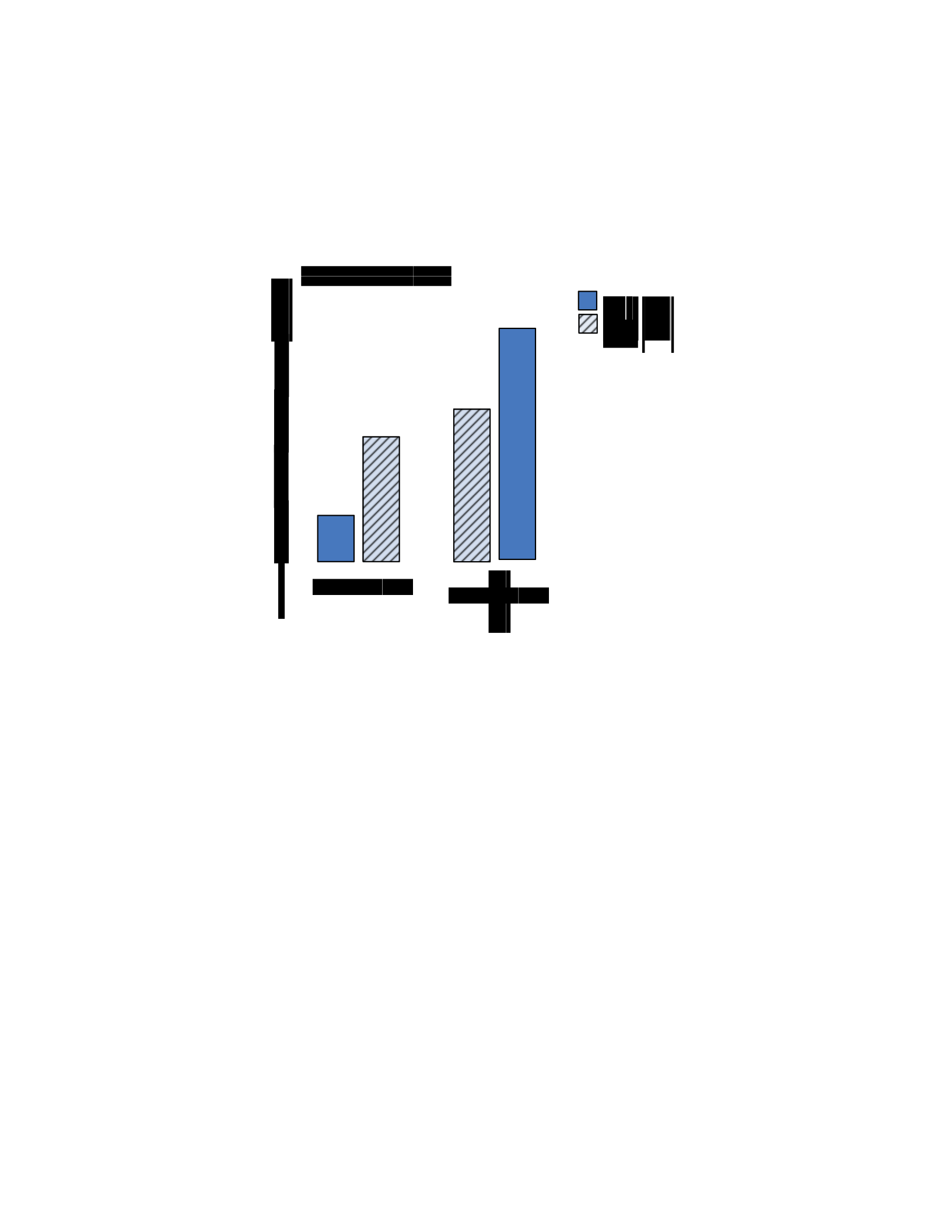
Challenges (FLTCs)…that we have forgotten to strategize on fostering the gamechanging
(disruptive) ideas that make the FLTCs work.”
Figure 11. Integration of Innovation into Business and Technology Strategy
Senior Leadership Innovation Emphasis
Some of the interview questions examined what types of innovation are being
stressed by Air Force S&T leadership and in what areas the greatest innovation success is
perceived. Table 37 outlines the major themes in innovation emphasis. All the AFRL
interviewees referenced product/service innovation (to include knowledge/technology) as
the primary area of emphasis. Only 55% of the AFRL senior leaders referenced processes
and organizational areas as places for creativity and idea encouragement. Even fewer
participants (27%) emphasized innovation in operational activities including concepts of

operations (CONOPS) and revolutionary techniques and tactics. One director explained
that, “The service laboratories are designed to be innovative in technology products,
especially in the exploitation and application side of innovation.” Additionally, several
respondents noted that while operational innovation is not currently a large area of
emphasis and strength in AFRL, collaborating directly with the warfighter on the
revolutionary use of technology to enhance the techniques and tactics of warfare is an
opportunity the Air Force S&T community should foster.
Comparing areas of focus, as depicted in Figure 12, shows nearly identical
innovation emphasis by industry CEOs and AFRL senior leadership. According to the
IBM industry study (2006), the CEOs of top performing companies are focusing about
55% of their idea attention on products with about 30% on process/organizational
innovation. Air Force S&T leaders approximated similar levels of emphasis in their
organizations. Companies are seeing business model innovation as the primary means to
preempt threats and create them. However, several Air Force S&T senior leaders noted
that operational innovation is an area where game-changing technology could have the
most profound impact on Air Force wartime competiveness.
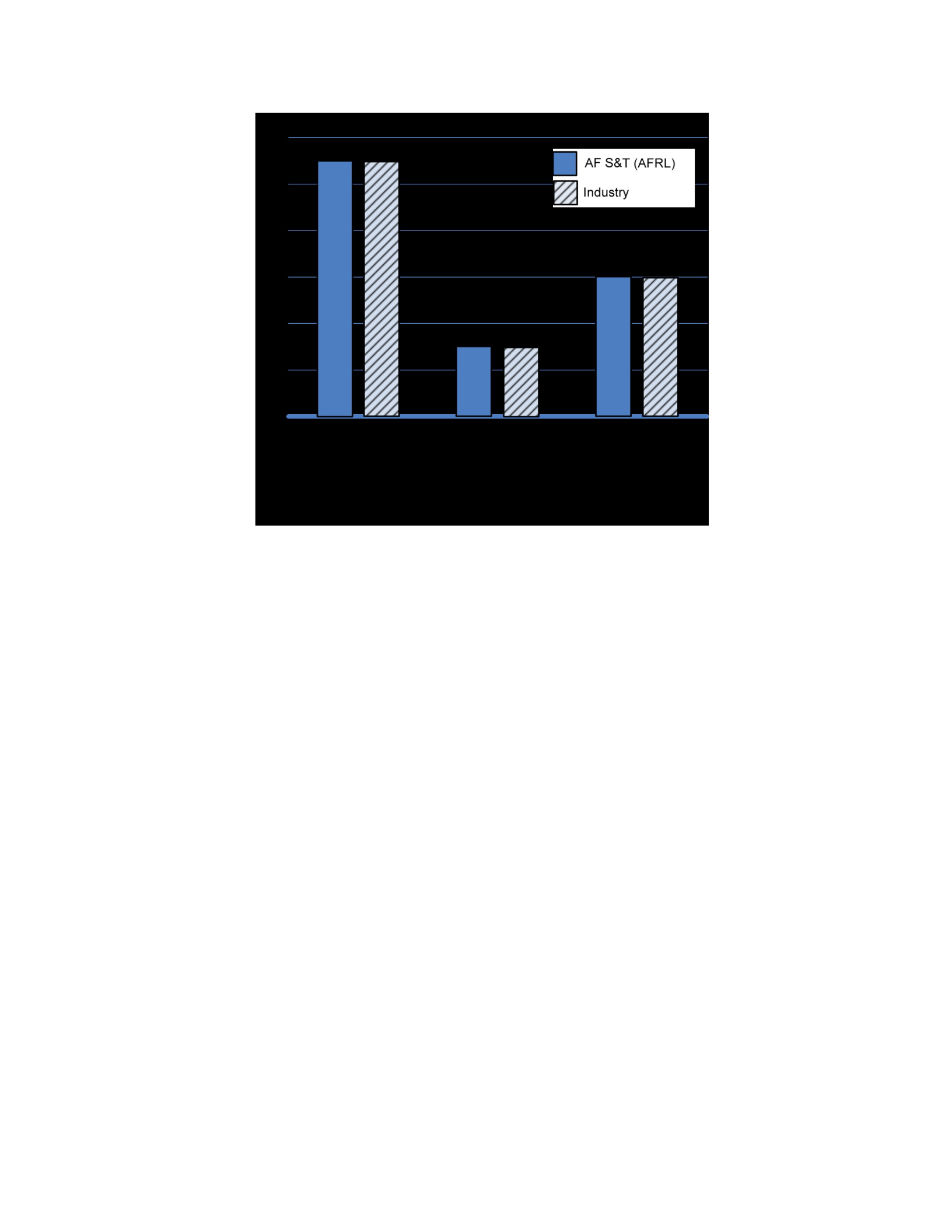
Senior Leadership Perspectives on Role of Collaboration
Numerous interview questions were structured to collect perspectives on how
collaboration impacts organizational innovation. The importance of collaboration,
benefits of collaboration, and productivity of collaborants were the primary questions
answered. Table 38 illustrates that AFRL senior leader interviewees (100%) not only see
collaboration as important but essential in harnessing the benefits of disruptive
innovation. In addition, the majority of Air Force S&T senior leaders have the strongest
confidence in the ideas of their in-house government, in-house support contractors, and
academic resources.

Comparing industry CEO and AFRL senior leader responses identifies several
similarities and differences in the sources of disruptive ideas. Figure 13 illustrates
several comparisons in innovation catalysts for industry and Air Force S&T
organizations. Leaders in industry and the Air Force S&T community rely heavily on
internal resources for innovation. They also both see formal collaboration with external
organizations as a solid source of new concepts. However, industry CEOs cited greater
value in ideas from their customers and even considered the competition as a key
resource for successful innovation. This confirms assertions made by Christensen (2003)
that many innovative breakthroughs are initiated by company marketers who segment
customers along a variety of psychological dimensions in order to define a profile of the
customer most likely to buy a particular product. In contrast, Air Force S&T senior
leaders placed greater confidence in the breakthrough ideas of academia. These results
align with previous survey findings where AFRL scientists and engineers cited
collaboration with academia, nonprofits, and other government agencies as a leading
driver of Air Force S&T innovation.
Senior Leadership Perspectives on Innovative Culture
Interview questions were also designed to query senior leadership observations on
the innovative culture within Air Force S&T organizations. Table 39 summarizes the key
perspectives on the strength of innovative culture, obstacles of innovation, actions to

foster innovativeness, and rewards for disruptive innovation. Although all the AFRL
leaders interviewed explained specific actions being taken to foster innovation in their
respective organizations, the majority (73%) did not consider AFRL as having a strong
innovative culture. The lack of flexibility in strategic planning and budgeting was the
most frequently cited obstacle to disruptive innovation. Limited resources and
government policies, including the restrictiveness of the federal acquisition regulations,
were also commonly mentioned barriers. Six of the AFRL senior leaders felt they
personally had control over the barriers to innovative culture while the rest felt they had
only some control to address the obstacles. In addition, 73% of the interview participants
articulated that innovation is not properly rewarded in their respective AFRL
organizations. While both non-financial rewards and compensatory motivations are being
currently used, most AFRL senior leaders acknowledged that considerable efforts were
needed to instill better incentives for creative risk-taking and breakthrough ideas.

Comparing the results of the AFRL interviews with those of the IBM CEO Study, several
interesting similarities and differences were noted, especially in the area of innovative
culture barriers. As outlined in Figure 14, a variety of internal and external obstacles
make it difficult to build an innovative mindset. Government and other legal restrictions
were cited as the largest external hindrance for both company CEOs and AFRL
leadership. Limited resources, unsupportive culture, and process immaturity were also
common internal challenges. Inflexibility in strategic plans and budgets, the most
frequent Air Force S&T response, was not specifically identified in the IBM CEO study.
Neither was leadership turnover and lack of effective collaboration. In contrast, industry
CEOs cited economic uncertainty, technology shortfalls, infrastructure difficulties, and
insufficient access to information as being greater hindrances than their Air Force S&T
counterparts. Overall, both industry CEOs and AFRL senior leaders recognize the
importance of innovative culture and acknowledge the need for organizational leaders to
take responsibility in fostering a spirit of innovation.
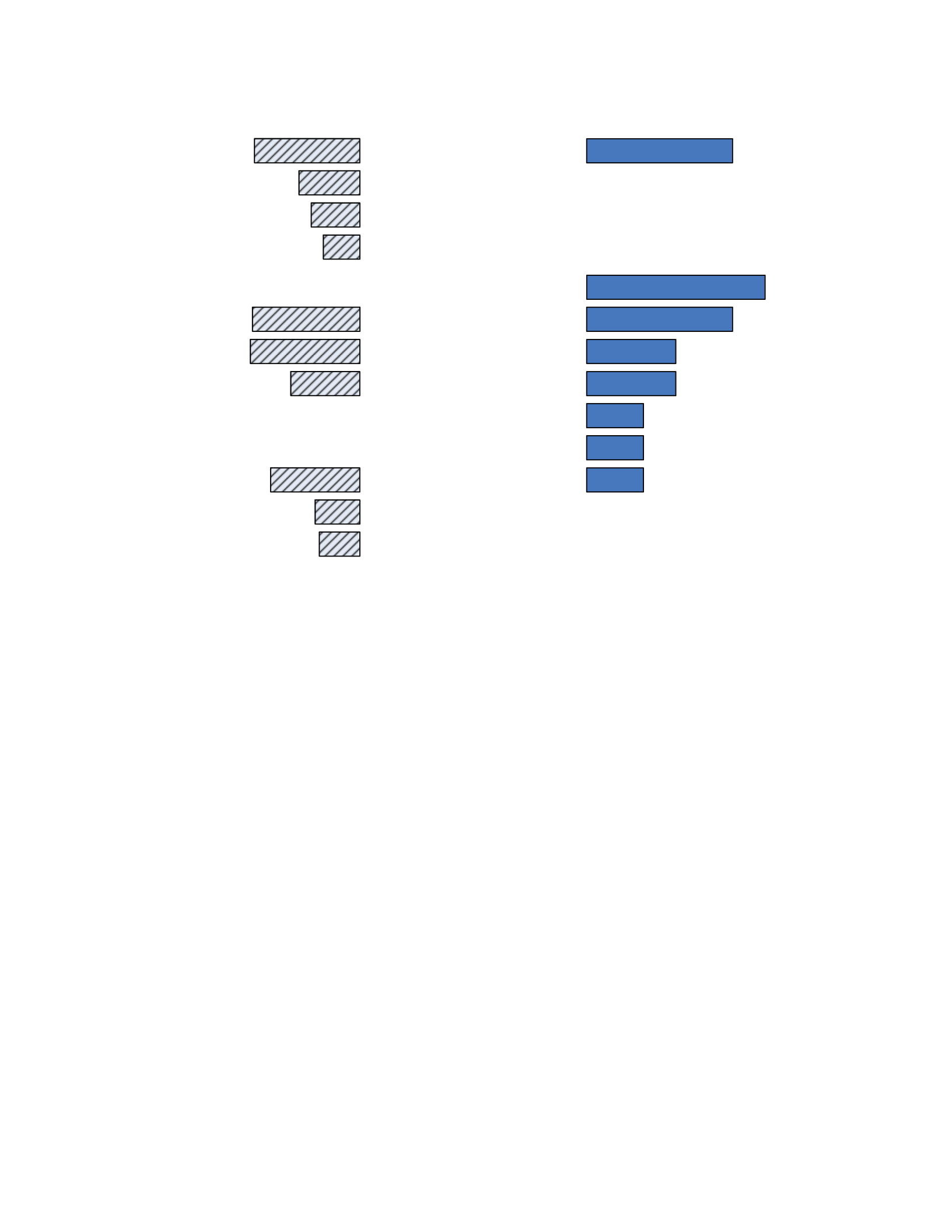
Figure 14. Innovation Obstacles Facing Senior Leaders
Model Analysis
Christensen (2003) proposed that building an organization capable of disruptive
growth requires a careful balance of resources, processes, and values. Combining these
thoughts with the research findings of this study provided a model for fostering disruptive
innovation. The model presented in Chapter II for fostering disruptive innovation defined
that an increase in the right motivation, plus an increase in the right focus of innovation
resources, plus a decrease in the barriers of innovation, plus an increase in the
characteristics of innovative culture, will foster an increase in the emergence of disruptive
innovation. The comprehensive literature review of innovation concepts also identified
Unsupportive Culture
and Climate
100 403020
Limited resources for
investment
Workforce Issues
Process Immaturity
Inflexible physical and
IT Infrastructure
Insufficient Access to
Information
AFRL Sr Ldr Responses
4060 1030 0
Govmt and Other
Legal Restrictions
Economic
Uncertainty
Inadequate Enabling
Technologies
Workforce Issues
Arising Externally
Industry CEO Responses
60502050
Govmt and Other
Legal Restrictions
Inflexible strategic
plans and budgets
Limited resources for
investment
Process Immaturity
Leadership turnover
and mgt instability
Lack of effective
collaboration
Workforce Issues (inc
training/rewards)
Unsupportive Culture
and Climate
External
Internal
ExternalInternal

various ideal heuristics for motivation, focus, barriers, and culture that are credited with
successful disruptive innovation. Figure 15 summarizes the study results and
demonstrates the similarities and differences between industry and the Air Force S&T
community with respect to the critical model variables. Specific findings that correspond
to the concepts of disruptive innovation are highlighted to show organizational attributes
that typically foster game-changing ideas. In addition, the summary shows that while the
model serves as a basic framework for innovation improvement, the application and
specific attributes will be domain dependent.
This chapter provided the results and analysis of the study research. First, a
detailed quantitative analysis of the survey data including the comparative analysis was
presented. Next, the qualitative evaluation of the interview data was outlined and
presented. Finally, the survey and interview results were combined with the information
gathered in the literature review to provide depth and support to the proposed innovation
emergence model.

V. Conclusions and Recommendations
The purpose of this thesis research was to study the motivation, focus, barriers,
and culture needed to foster disruptive innovation in Air Force Science and Technology
(S&T) and to investigate how industry innovation strategies could improve breakthrough
Air Force technology emergence. This chapter provides the conclusions,
recommendations, limitations, and follow-on studies for this thesis effort. The first
section provides a detailed description of the research conclusions. The next section
outlines a series of recommendations for the Air Force S&T community based on the
literature review, data results, and research findings. The third section summarizes the
limitations of this study and provides guidance regarding interpretations and applicability
of findings. The last section in the chapter provides some suggestions for future research
designed to further enhance the knowledge base in this area of research.
Research Conclusions
Based on the defined investigative questions, comprehensive literature review,
multifaceted data results, and detailed analysis findings, the following research
conclusions have been developed:
1. Air Force S&T pursues innovation in order to keep the warfighter state-
of-the-art with leading edge technologies. This motivation, exhibiting a desire for
longterm relevance and dominance, coincides with the ideal attributes for increased
disruptive innovation emergence. In contrast, industry appears to be more driven to

innovation to respond to customer demands, improve operational efficiency, and increase
profits.
Industry motivation, more short-term oriented, is less likely to foster new systems with
completely new value propositions. Although the study results found Air Force scientists
and engineers perceive less attention to innovation than their industry counterparts, Air
Force S&T exudes the right motivation to foster disruptive innovation.
2. Air Force S&T, heavily reliant on external resources, struggles with
developing an executable strategy designed to foster disruptive innovation. While most
Air Force S&T professionals see a balance of investment focus, highly structured and
rigid strategic planning make breakthroughs difficult for innovators. Air Force S&T
appears to depend on other organizations for innovation, focusing primarily on the
development of technological products. The Air Force S&T community has also failed to
capitalize on opportunities for operational innovation, especially collaborating with the
warfighter on technologically advanced techniques and tactics. In comparison, industry
seeks to use innovation as a means to address the profit generating needs of customers,
utilizing a balance of product and business model innovation to compete in market
segments. The study results suggest that Air Force S&T may not be actively using the
principles of radical thinking as a means to gamechanging improvement in business
organizational activities.
3. Air Force S&T professionals perceive significant internal organizational
barriers hampering the emergence of disruptive innovation. Insufficient resources,
organizational constraints, lack of innovation strategy, and entrenched programs were
perceived as the greatest obstacles to new ideas. Both the industry and Air Force S&T

communities acknowledge the detrimental affect of innovation barriers, although industry
appears more confident in its ability to overcome bureaucratic constraints. Industry
creativity was less threatened by organizational policies, possibly indicating that the
increased focus of resources in business model innovation returned benefits in overall
company efficiency.
4. Air Force scientists and engineers believe strong innovation culture is best
characterized by freedom and collaboration. The study indicated that Air Force S&T
professionals desire a culture that allows them freedom to research without administrative
burdens and non-value added diversions. In addition, Air Force S&T innovation is
contingent on alliances and partnerships with internal and external entities. While Air
Force S&T believes in a culture of freedom and industry sees customer focus as the key
to innovation emergence, both Air Force S&T and industry employees understand the
tremendous importance of organizational culture in fostering breakthroughs.
5. Air Force S&T senior leaders understand the criticality of innovation but
struggle with the optimal approach to fostering disruptive innovation in their
organizations Most Air Force S&T leaders agreed that innovation was not well
integrated into their business and technology strategy which was hampered by overly
constrained planning and restrictive external influences. Although other findings indicate
strong reliance on external sources, Air Force S&T leadership places great confidence in
the ideas of their in-house personnel. Unfortunately, most senior leaders do not perceive
that Air Force S&T organizations posses a strong innovative culture. In addition, most
Air Force S&T senior leaders acknowledged that considerable improvement efforts were

needed to facilitate flexible planning, thereby freeing resources, collaboration, and
rewards for creative risk-taking.
6. Innovative organizations require strong and inspiring leadership and both
Air Force S&T senior leaders and company CEOs agree that innovative thinking must be
orchestrated from the top. Supportive leadership is critical to motivation, strategy,
overcoming obstacles, and building an innovative culture. While both Air Force and
industry leadership hold themselves accountable for fostering disruptive innovation,
complex dimensions of disruptive innovation continue to be challenging regardless of the
domain.
7. Air Force S&T is capable of regaining its prominence as a leader in
disruptive technological innovation by applying the emergence model, capturing the
relevant best practices of industry, and exploiting the positive attributes of the military
domain. The research findings combine to establish the proposed model for fostering
disruptive innovation in either industry or government organizations. Given an increase
in the right motivation, an increase in the right focus of innovation resources, a decrease
in the barriers of innovation, and an increase in the characteristics of innovative culture,
disruptive innovation will emerge. Although the model is not intended to be an equation
for guaranteed success, it does provide a conceptual formula to ensure that all critical
elements needed to foster breakthrough innovation are considered.

Recommendations
Based on this thesis research, the followed recommendations are provided to the
Air Force S&T community to help foster the emergence of disruptive technology:
1. Exercise caution with relying on industry to generate relevant disruptive
innovation for the Air Force. Given the differences in motivation, drivers, and resource
focus, outsourcing innovation to commercial companies may not provide the long-term
relevant technologies needed to dominate the battlespace. While industry is a key
collaborative partner, Air Force S&T should invest in enhancing its internal workforce to
ensure the emergence of revolutionary military technology.
2. Infuse greater flexibility and innovativeness into AFRL business and
technology strategy through the use of discovery-based planning. Discovery-based
planning allows experimental results and assumption validation to drive investment
strategies. The added resilience in AFRL planning will allow technology breakthroughs
to evolve less bounded and foster increased levels of disruptive innovation.
3. Establish freedom for the scientist and engineering workforce as a priority
of Air Force S&T process improvement efforts. AFRL’s greatest asset has always been the
intellectual power of its technological workforce. AFRL needs to ensure that all
management approaches, supporting activities, and enabling activities place optimization
of the scientist and engineer’s (S&E) time as the goal of process improvement efforts. In
order for AFRL to achieve disruptive technological prominence, the S&E must be given
larger amounts of working time free from administrative burden and non-value added

work. Even if granting freedom to the S&E increases the responsibilities of management
and support personnel, the long-term benefits of increased disruptive innovation
emergence is worth the risk.
4. Utilize successful sustaining innovation to build advocacy and generate
resources for disruptive technology innovation. Not all AFRL efforts can or even should
be focused on gamechanging ideas. Balanced investments are essential to success.
However, AFRL should be careful not to allow incremental improvements in entrenched
existing programs in such a way that invention and exploitation of disruptive concepts is
neglected. Sustaining technology and requirements-based development play a valuable
role as long as they are used to obtain resources for more long-term disruptive
breakthroughs.
5. Increase the use of experimental venues to increase technological
collaboration with the warfighter and to access the operational impacts of disruptive
innovation. While AF S&T’s motivation and focus on the state-of-the-art is critical,
AFRL can also learn from industry’s strong customer focus. More discovery-based
experimental venues with the warfighter will increase AFRL’s position as a relevant force
in helping with operational innovation, especially in the application of technological
advancements for disruptive warfighting tactics and techniques.
6. Elevate the innovative culture of AFRL by orchestrating risk-taking from
the top. Senior leadership views of innovation play a profound role on the sense of
entrepreneurship in the organization. By demonstrating greater risk-taking in approaches
to supporting and enabling processes, senior leadership will send a decisive message to
the workforce and infuse innovative spirit within the organization. The S&E workforce

will observe the trend in leadership and respond with increases in relevant disruptive
ideas.
Limitations of the Research
Although efforts were taken throughout this research to mitigate risks to reliability
and validity, sample bias in the survey still arose as a threat to internal validity. As
detailed in the methodology chapter, the sample demographics demonstrated some
deviations from the population demographics. Volunteerism may have played a role in
creating the bias, as the persons who chose to participate in the survey were concentrated
in certain geographic sites and directorates. Although the findings were not analyzed
based on directorates or geographic demographics, the sampling bias should still be
considered when evaluating the generalizations made by the survey portion of this study.

Future Research
Based on the emerging topic and lack of specific literature on disruptive
innovation in military organizations, a primarily qualitative research method, supported
by some quantitative data, was used in this thesis study. The resulting model for fostering
disruptive innovation lends itself well to further quantitative inferential research. The
following suggestions for investigative questions examined singularly or as part of a
larger research study, would provide the needed quantitative validation of the model for
fostering disruptive innovation:
1. How does a military organization’s motivation for innovation relate to the
successful emergence of disruptive innovation?
2. What focus of innovation resources in a military organization provide the
most successful emergence of disruptive innovation?
3. How does the elimination of barriers relate to an organization’s ability to
foster disruptive innovation? What common barriers to innovation have the
most detrimental effect on organizational innovativeness?
4. How do increased levels in the characteristics of innovative culture relate to
an organization’s ability to foster disruptive innovation? What characteristics
of innovative culture have the greatest effect on the emergence of disruptive
innovation?
5. How can organizational success in fostering disruptive innovation be
quantified? What organizational metrics and measures can be used to quantify
the successful emergence of disruptive innovation?
In Air Force S&T, organizational constraints were considered a large barrier
(ranked #2) while leadership/management support was not considered an overwhelming
obstacle (ranked #10). However, this delta may imply that many AFRL personnel do not
believe Air Force senior leadership are empowered to improve the organizational policy,
strategy, and bureaucracy within the organization. Additionally, Table 33 summarizes
several supporting multiple choice items providing insights into innovation barriers.

These results indicate that in both Air Force S&T and industry organizations, employees
are unclear on how to gain support for new ideas and feel the rewards and recognition for
innovative behaviors to be somewhat limited.
Characteristics of Innovative Culture
Several survey items also examined the characteristics of innovative culture in Air
Force S&T organizations. Survey item 12 identified the most important factors for
developing an innovative culture. Respondents scored various characteristics using a
scale of 1 to 5 where 1=Not Important, 2=Somewhat Important, 3=Important, 4=Highly
Important, and 5=Extremely Important. The results of survey item 22, and 25 provided
further cultural observations by AF scientists and engineers.
Survey Item 12 - Developing an Innovative Culture: Table 34 outlines the
importance of different factors for developing an innovative culture in Air Force S&T
organizations. The factors were rank ordered based on the mean scores provided by
AFRL respondents. Freedom to innovate (with a mean score of 3.79) was cited as the
most important consideration followed by teamwork/collaboration (3.77) and the ability
to select the right ideas for research (3.59).
The comparison survey in industry found customer focus to be the most important
factor in developing an innovative culture. Comparing the means between the studies
using statistical tests shows freedom to innovate to be strongly viewed in the Air Force
S&T community while customer focus, organizational communication, and innovation
measurement are more important to industry respondents. Although innovation goals,
diversity, and organizational structures were the lowest ranked in both studies, the AFRL

persons perceived these to be much less important to innovative culture than their
industry counterparts.
Industry scored higher on 12 of the 14 factors, and 8 of the 12 were found to be
statistically significant. The largest differences in rankings were freedom to innovate,
customer focus, and organizational communication. These results support previous Air
Force S&T findings indicating that AFRL personnel desire sense of freedom from
bureaucratic constraints and non-value added work. The results also indicate that while
Air Force S&T professionals desire a culture of technology push, industry places greater
hope on addressing the direct and often short-term needs of the customer. Therefore,
given the access to the appropriate resources (people, time, and money) and the freedom
to experiment, a greater degree of long-term, dominant, and breakthrough technology
may emerge from Air Force S&T investments.
Table 35 summarizes several supporting items providing additional findings
regarding innovative culture. These results indicated that while both Air Force S&T and
industry employees understand the importance of innovation, industry is more confident
in what innovation means and how to become more innovative. However, the study
results indicate that the innovative culture found in industry might be better aligned to
foster sustaining innovation than disruptive innovation. These findings indicate that the
Air Force S&T community may be more cognizant that building a robust innovative

culture, based on long-term disruptive technology dominance, is very challenging in
today’s fiscally constrained and operationally focused Air Force.
Interview Evaluation
The senior leadership interviews were analyzed using a grounded theory
qualitative method of inductive study. The interview analysis, provided in complete
detail under Appendix F, illustrates various themes and concepts evident in the responses.
The major themes summarized in the following sections not only address the
investigative question regarding senior leadership but also provide additional insight into
the other investigative questions as well. In addition, the evaluation provides a point of
comparison between the viewpoints of Air Force S&T leaders and their industry CEO
counterparts. The interviews were designed to answer the investigative question on Air
Force S&T senior leadership perspectives on innovation. Although the discussions were
open-ended, the interviews were structured to provide a direct point of comparison
between AFRL leadership and industry CEOs. The interview data and comparisons are
presented in four areas: views, emphasis, collaboration, and culture.
Senior Leadership Views of Innovation
Some of the interview questions were designed to query AFRL senior leadership
regarding innovation definitions, importance, and integration into business/technology
strategy. Table 36 outlines the views of innovation expressed by the interview

participants. Most AFRL leaders (64%) defined innovation in the same manner and
perceived innovation as an extremely/highly important part of Air Force S&T (73%).
The AFRL directors and senior staff felt innovation was most applicable in both
responding to urgent needs and generating S&T knowledge. Fifty-five percent of the
respondents saw innovation as less significant in developing technology based on specific
customer requirements. In addition, 82% of the AFRL senior leaders interviewed
articulated that innovation was not properly considered in the current Air Force S&T
business and technology strategy. Although AFRL senior leaders think innovation is
important and relevant, they have been challenged in integrating innovation into Air
Force S&T strategic planning. This finding indicates the AFRL business and technology
strategy may be overly constrained and driven by external influences.
As illustrated in Figure 11, integrating innovation into business and technology
strategy is a challenge facing both industry CEOs and Air Force S&T leadership.
Although company CEOs perceive much better integration than their Air Force
counterparts, they are also frustrated (IBM, 2006). Most AFRL directors and staff cited
administrative burdens, excessive planning, too much centralization, and over emphasis
on requirements mapping as shortfalls in the current innovation strategy. Most AFRL
senior leaders saw a definite need to change the way innovation is fostered. One
respondent explained, “We have become so focused on planning for Focused Long-Term
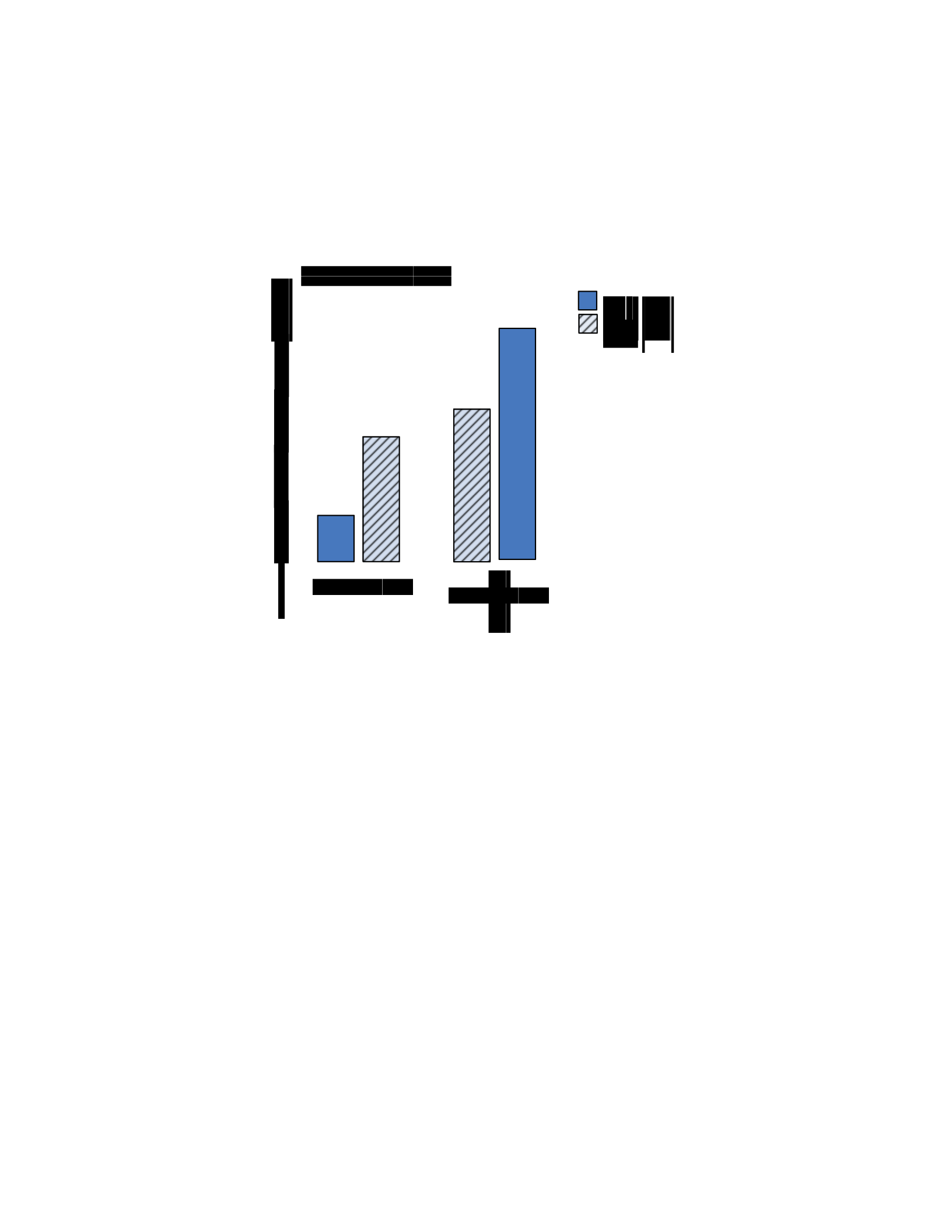
Challenges (FLTCs)…that we have forgotten to strategize on fostering the gamechanging
(disruptive) ideas that make the FLTCs work.”
Figure 11. Integration of Innovation into Business and Technology Strategy
Senior Leadership Innovation Emphasis
Some of the interview questions examined what types of innovation are being
stressed by Air Force S&T leadership and in what areas the greatest innovation success is
perceived. Table 37 outlines the major themes in innovation emphasis. All the AFRL
interviewees referenced product/service innovation (to include knowledge/technology) as
the primary area of emphasis. Only 55% of the AFRL senior leaders referenced processes
and organizational areas as places for creativity and idea encouragement. Even fewer
participants (27%) emphasized innovation in operational activities including concepts of

operations (CONOPS) and revolutionary techniques and tactics. One director explained
that, “The service laboratories are designed to be innovative in technology products,
especially in the exploitation and application side of innovation.” Additionally, several
respondents noted that while operational innovation is not currently a large area of
emphasis and strength in AFRL, collaborating directly with the warfighter on the
revolutionary use of technology to enhance the techniques and tactics of warfare is an
opportunity the Air Force S&T community should foster.
Comparing areas of focus, as depicted in Figure 12, shows nearly identical
innovation emphasis by industry CEOs and AFRL senior leadership. According to the
IBM industry study (2006), the CEOs of top performing companies are focusing about
55% of their idea attention on products with about 30% on process/organizational
innovation. Air Force S&T leaders approximated similar levels of emphasis in their
organizations. Companies are seeing business model innovation as the primary means to
preempt threats and create them. However, several Air Force S&T senior leaders noted
that operational innovation is an area where game-changing technology could have the
most profound impact on Air Force wartime competiveness.
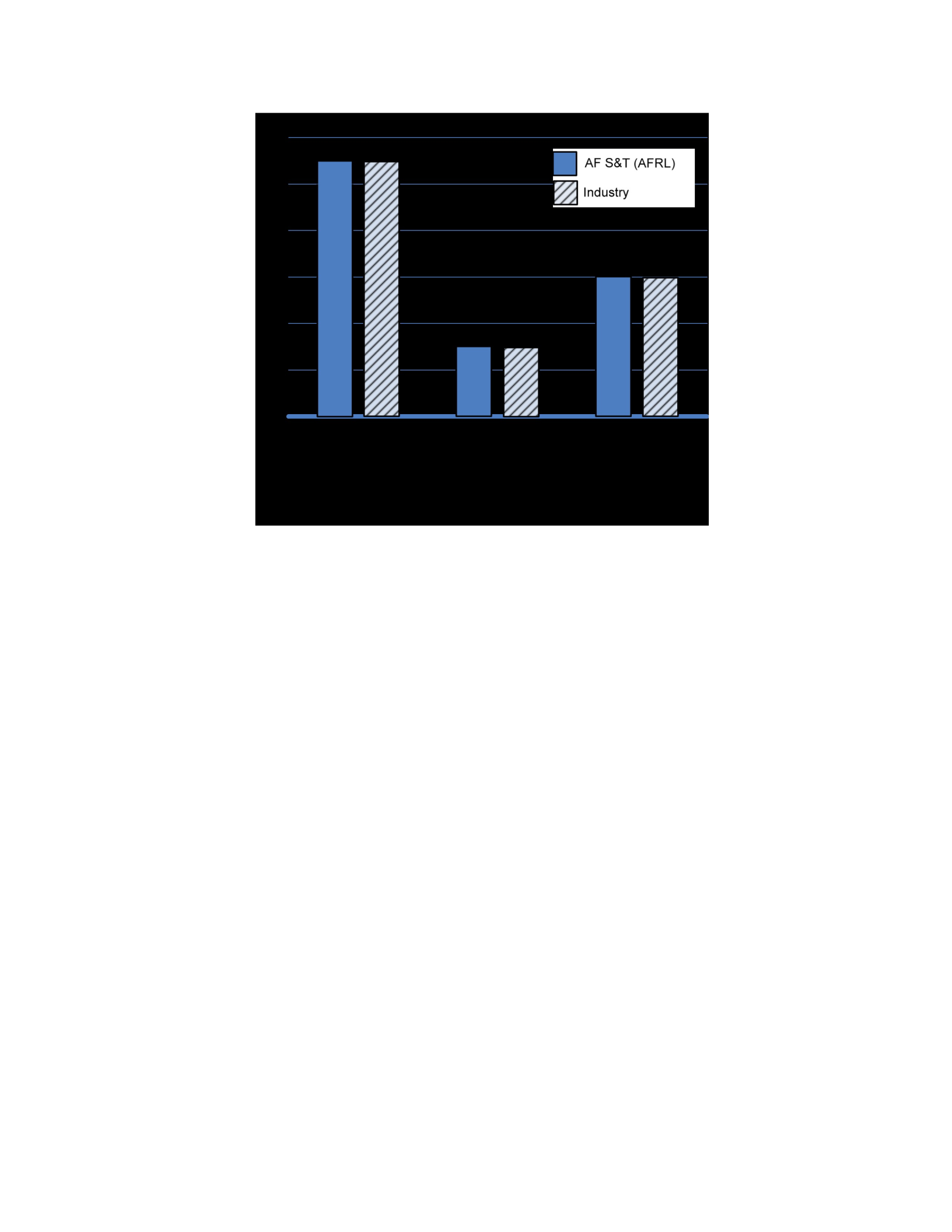
Senior Leadership Perspectives on Role of Collaboration
Numerous interview questions were structured to collect perspectives on how
collaboration impacts organizational innovation. The importance of collaboration,
benefits of collaboration, and productivity of collaborants were the primary questions
answered. Table 38 illustrates that AFRL senior leader interviewees (100%) not only see
collaboration as important but essential in harnessing the benefits of disruptive
innovation. In addition, the majority of Air Force S&T senior leaders have the strongest
confidence in the ideas of their in-house government, in-house support contractors, and
academic resources.

Comparing industry CEO and AFRL senior leader responses identifies several
similarities and differences in the sources of disruptive ideas. Figure 13 illustrates
several comparisons in innovation catalysts for industry and Air Force S&T
organizations. Leaders in industry and the Air Force S&T community rely heavily on
internal resources for innovation. They also both see formal collaboration with external
organizations as a solid source of new concepts. However, industry CEOs cited greater
value in ideas from their customers and even considered the competition as a key
resource for successful innovation. This confirms assertions made by Christensen (2003)
that many innovative breakthroughs are initiated by company marketers who segment
customers along a variety of psychological dimensions in order to define a profile of the
customer most likely to buy a particular product. In contrast, Air Force S&T senior
leaders placed greater confidence in the breakthrough ideas of academia. These results
align with previous survey findings where AFRL scientists and engineers cited
collaboration with academia, nonprofits, and other government agencies as a leading
driver of Air Force S&T innovation.
Senior Leadership Perspectives on Innovative Culture
Interview questions were also designed to query senior leadership observations on
the innovative culture within Air Force S&T organizations. Table 39 summarizes the key
perspectives on the strength of innovative culture, obstacles of innovation, actions to

foster innovativeness, and rewards for disruptive innovation. Although all the AFRL
leaders interviewed explained specific actions being taken to foster innovation in their
respective organizations, the majority (73%) did not consider AFRL as having a strong
innovative culture. The lack of flexibility in strategic planning and budgeting was the
most frequently cited obstacle to disruptive innovation. Limited resources and
government policies, including the restrictiveness of the federal acquisition regulations,
were also commonly mentioned barriers. Six of the AFRL senior leaders felt they
personally had control over the barriers to innovative culture while the rest felt they had
only some control to address the obstacles. In addition, 73% of the interview participants
articulated that innovation is not properly rewarded in their respective AFRL
organizations. While both non-financial rewards and compensatory motivations are being
currently used, most AFRL senior leaders acknowledged that considerable efforts were
needed to instill better incentives for creative risk-taking and breakthrough ideas.

Comparing the results of the AFRL interviews with those of the IBM CEO Study, several
interesting similarities and differences were noted, especially in the area of innovative
culture barriers. As outlined in Figure 14, a variety of internal and external obstacles
make it difficult to build an innovative mindset. Government and other legal restrictions
were cited as the largest external hindrance for both company CEOs and AFRL
leadership. Limited resources, unsupportive culture, and process immaturity were also
common internal challenges. Inflexibility in strategic plans and budgets, the most
frequent Air Force S&T response, was not specifically identified in the IBM CEO study.
Neither was leadership turnover and lack of effective collaboration. In contrast, industry
CEOs cited economic uncertainty, technology shortfalls, infrastructure difficulties, and
insufficient access to information as being greater hindrances than their Air Force S&T
counterparts. Overall, both industry CEOs and AFRL senior leaders recognize the
importance of innovative culture and acknowledge the need for organizational leaders to
take responsibility in fostering a spirit of innovation.
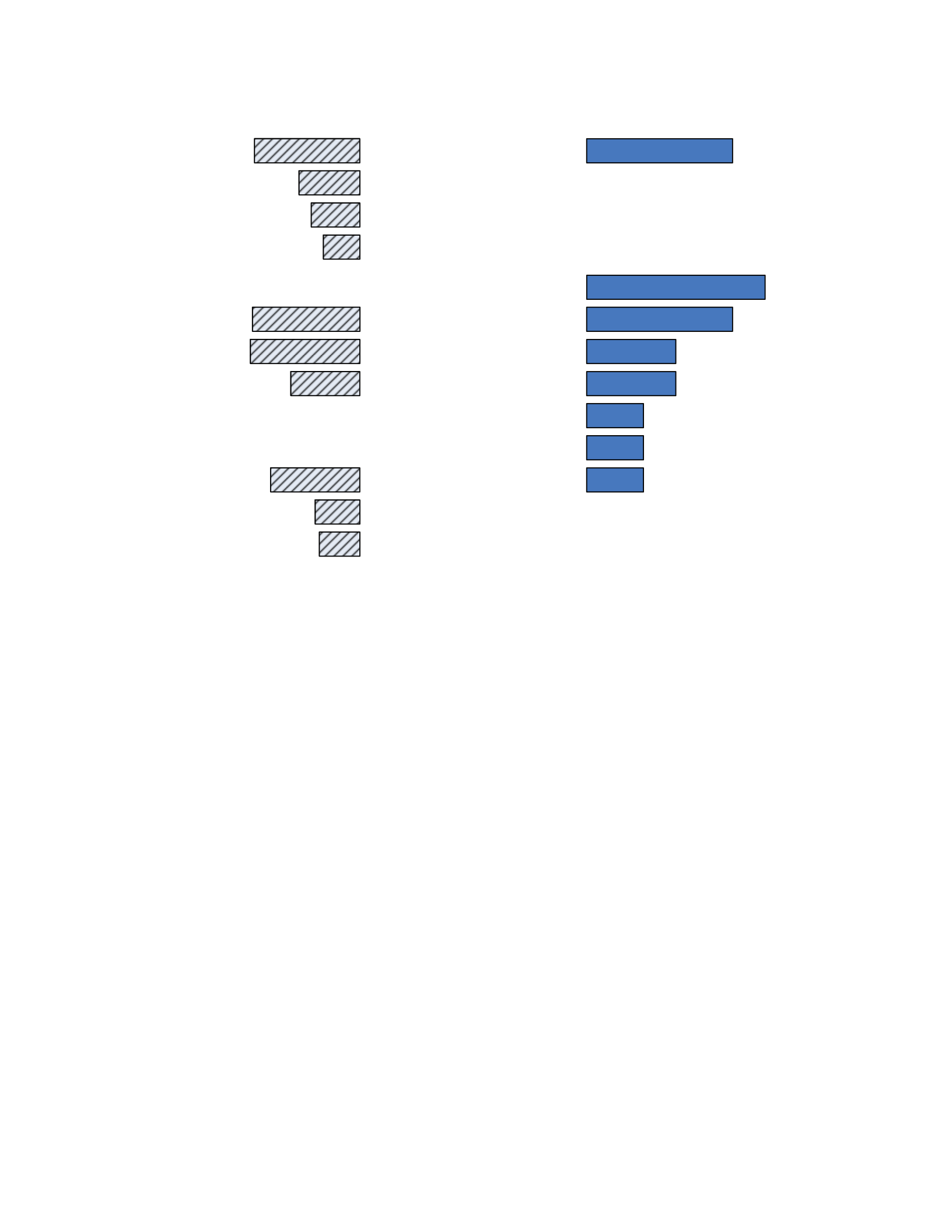
Figure 14. Innovation Obstacles Facing Senior Leaders
Model Analysis
Christensen (2003) proposed that building an organization capable of disruptive
growth requires a careful balance of resources, processes, and values. Combining these
thoughts with the research findings of this study provided a model for fostering disruptive
innovation. The model presented in Chapter II for fostering disruptive innovation defined
that an increase in the right motivation, plus an increase in the right focus of innovation
resources, plus a decrease in the barriers of innovation, plus an increase in the
characteristics of innovative culture, will foster an increase in the emergence of disruptive
innovation. The comprehensive literature review of innovation concepts also identified
Unsupportive Culture
and Climate
100 403020
Limited resources for
investment
Workforce Issues
Process Immaturity
Inflexible physical and
IT Infrastructure
Insufficient Access to
Information
AFRL Sr Ldr Responses
4060 1030 0
Govmt and Other
Legal Restrictions
Economic
Uncertainty
Inadequate Enabling
Technologies
Workforce Issues
Arising Externally
Industry CEO Responses
60502050
Govmt and Other
Legal Restrictions
Inflexible strategic
plans and budgets
Limited resources for
investment
Process Immaturity
Leadership turnover
and mgt instability
Lack of effective
collaboration
Workforce Issues (inc
training/rewards)
Unsupportive Culture
and Climate
External
Internal
ExternalInternal

various ideal heuristics for motivation, focus, barriers, and culture that are credited with
successful disruptive innovation. Figure 15 summarizes the study results and
demonstrates the similarities and differences between industry and the Air Force S&T
community with respect to the critical model variables. Specific findings that correspond
to the concepts of disruptive innovation are highlighted to show organizational attributes
that typically foster game-changing ideas. In addition, the summary shows that while the
model serves as a basic framework for innovation improvement, the application and
specific attributes will be domain dependent.
This chapter provided the results and analysis of the study research. First, a
detailed quantitative analysis of the survey data including the comparative analysis was
presented. Next, the qualitative evaluation of the interview data was outlined and
presented. Finally, the survey and interview results were combined with the information
gathered in the literature review to provide depth and support to the proposed innovation
emergence model.

V. Conclusions and Recommendations
The purpose of this thesis research was to study the motivation, focus, barriers,
and culture needed to foster disruptive innovation in Air Force Science and Technology
(S&T) and to investigate how industry innovation strategies could improve breakthrough
Air Force technology emergence. This chapter provides the conclusions,
recommendations, limitations, and follow-on studies for this thesis effort. The first
section provides a detailed description of the research conclusions. The next section
outlines a series of recommendations for the Air Force S&T community based on the
literature review, data results, and research findings. The third section summarizes the
limitations of this study and provides guidance regarding interpretations and applicability
of findings. The last section in the chapter provides some suggestions for future research
designed to further enhance the knowledge base in this area of research.
Research Conclusions
Based on the defined investigative questions, comprehensive literature review,
multifaceted data results, and detailed analysis findings, the following research
conclusions have been developed:
1. Air Force S&T pursues innovation in order to keep the warfighter state-
of-the-art with leading edge technologies. This motivation, exhibiting a desire for
longterm relevance and dominance, coincides with the ideal attributes for increased
disruptive innovation emergence. In contrast, industry appears to be more driven to

innovation to respond to customer demands, improve operational efficiency, and increase
profits.
Industry motivation, more short-term oriented, is less likely to foster new systems with
completely new value propositions. Although the study results found Air Force scientists
and engineers perceive less attention to innovation than their industry counterparts, Air
Force S&T exudes the right motivation to foster disruptive innovation.
2. Air Force S&T, heavily reliant on external resources, struggles with
developing an executable strategy designed to foster disruptive innovation. While most
Air Force S&T professionals see a balance of investment focus, highly structured and
rigid strategic planning make breakthroughs difficult for innovators. Air Force S&T
appears to depend on other organizations for innovation, focusing primarily on the
development of technological products. The Air Force S&T community has also failed to
capitalize on opportunities for operational innovation, especially collaborating with the
warfighter on technologically advanced techniques and tactics. In comparison, industry
seeks to use innovation as a means to address the profit generating needs of customers,
utilizing a balance of product and business model innovation to compete in market
segments. The study results suggest that Air Force S&T may not be actively using the
principles of radical thinking as a means to gamechanging improvement in business
organizational activities.
3. Air Force S&T professionals perceive significant internal organizational
barriers hampering the emergence of disruptive innovation. Insufficient resources,
organizational constraints, lack of innovation strategy, and entrenched programs were
perceived as the greatest obstacles to new ideas. Both the industry and Air Force S&T

communities acknowledge the detrimental affect of innovation barriers, although industry
appears more confident in its ability to overcome bureaucratic constraints. Industry
creativity was less threatened by organizational policies, possibly indicating that the
increased focus of resources in business model innovation returned benefits in overall
company efficiency.
4. Air Force scientists and engineers believe strong innovation culture is best
characterized by freedom and collaboration. The study indicated that Air Force S&T
professionals desire a culture that allows them freedom to research without administrative
burdens and non-value added diversions. In addition, Air Force S&T innovation is
contingent on alliances and partnerships with internal and external entities. While Air
Force S&T believes in a culture of freedom and industry sees customer focus as the key
to innovation emergence, both Air Force S&T and industry employees understand the
tremendous importance of organizational culture in fostering breakthroughs.
5. Air Force S&T senior leaders understand the criticality of innovation but
struggle with the optimal approach to fostering disruptive innovation in their
organizations Most Air Force S&T leaders agreed that innovation was not well
integrated into their business and technology strategy which was hampered by overly
constrained planning and restrictive external influences. Although other findings indicate
strong reliance on external sources, Air Force S&T leadership places great confidence in
the ideas of their in-house personnel. Unfortunately, most senior leaders do not perceive
that Air Force S&T organizations posses a strong innovative culture. In addition, most
Air Force S&T senior leaders acknowledged that considerable improvement efforts were

needed to facilitate flexible planning, thereby freeing resources, collaboration, and
rewards for creative risk-taking.
6. Innovative organizations require strong and inspiring leadership and both
Air Force S&T senior leaders and company CEOs agree that innovative thinking must be
orchestrated from the top. Supportive leadership is critical to motivation, strategy,
overcoming obstacles, and building an innovative culture. While both Air Force and
industry leadership hold themselves accountable for fostering disruptive innovation,
complex dimensions of disruptive innovation continue to be challenging regardless of the
domain.
7. Air Force S&T is capable of regaining its prominence as a leader in
disruptive technological innovation by applying the emergence model, capturing the
relevant best practices of industry, and exploiting the positive attributes of the military
domain. The research findings combine to establish the proposed model for fostering
disruptive innovation in either industry or government organizations. Given an increase
in the right motivation, an increase in the right focus of innovation resources, a decrease
in the barriers of innovation, and an increase in the characteristics of innovative culture,
disruptive innovation will emerge. Although the model is not intended to be an equation
for guaranteed success, it does provide a conceptual formula to ensure that all critical
elements needed to foster breakthrough innovation are considered.

Recommendations
Based on this thesis research, the followed recommendations are provided to the
Air Force S&T community to help foster the emergence of disruptive technology:
1. Exercise caution with relying on industry to generate relevant disruptive
innovation for the Air Force. Given the differences in motivation, drivers, and resource
focus, outsourcing innovation to commercial companies may not provide the long-term
relevant technologies needed to dominate the battlespace. While industry is a key
collaborative partner, Air Force S&T should invest in enhancing its internal workforce to
ensure the emergence of revolutionary military technology.
2. Infuse greater flexibility and innovativeness into AFRL business and
technology strategy through the use of discovery-based planning. Discovery-based
planning allows experimental results and assumption validation to drive investment
strategies. The added resilience in AFRL planning will allow technology breakthroughs
to evolve less bounded and foster increased levels of disruptive innovation.
3. Establish freedom for the scientist and engineering workforce as a priority
of Air Force S&T process improvement efforts. AFRL’s greatest asset has always been the
intellectual power of its technological workforce. AFRL needs to ensure that all
management approaches, supporting activities, and enabling activities place optimization
of the scientist and engineer’s (S&E) time as the goal of process improvement efforts. In
order for AFRL to achieve disruptive technological prominence, the S&E must be given
larger amounts of working time free from administrative burden and non-value added

work. Even if granting freedom to the S&E increases the responsibilities of management
and support personnel, the long-term benefits of increased disruptive innovation
emergence is worth the risk.
4. Utilize successful sustaining innovation to build advocacy and generate
resources for disruptive technology innovation. Not all AFRL efforts can or even should
be focused on gamechanging ideas. Balanced investments are essential to success.
However, AFRL should be careful not to allow incremental improvements in entrenched
existing programs in such a way that invention and exploitation of disruptive concepts is
neglected. Sustaining technology and requirements-based development play a valuable
role as long as they are used to obtain resources for more long-term disruptive
breakthroughs.
5. Increase the use of experimental venues to increase technological
collaboration with the warfighter and to access the operational impacts of disruptive
innovation. While AF S&T’s motivation and focus on the state-of-the-art is critical,
AFRL can also learn from industry’s strong customer focus. More discovery-based
experimental venues with the warfighter will increase AFRL’s position as a relevant force
in helping with operational innovation, especially in the application of technological
advancements for disruptive warfighting tactics and techniques.
6. Elevate the innovative culture of AFRL by orchestrating risk-taking from
the top. Senior leadership views of innovation play a profound role on the sense of
entrepreneurship in the organization. By demonstrating greater risk-taking in approaches
to supporting and enabling processes, senior leadership will send a decisive message to
the workforce and infuse innovative spirit within the organization. The S&E workforce

will observe the trend in leadership and respond with increases in relevant disruptive
ideas.
Limitations of the Research
Although efforts were taken throughout this research to mitigate risks to reliability
and validity, sample bias in the survey still arose as a threat to internal validity. As
detailed in the methodology chapter, the sample demographics demonstrated some
deviations from the population demographics. Volunteerism may have played a role in
creating the bias, as the persons who chose to participate in the survey were concentrated
in certain geographic sites and directorates. Although the findings were not analyzed
based on directorates or geographic demographics, the sampling bias should still be
considered when evaluating the generalizations made by the survey portion of this study.

Future Research
Based on the emerging topic and lack of specific literature on disruptive
innovation in military organizations, a primarily qualitative research method, supported
by some quantitative data, was used in this thesis study. The resulting model for fostering
disruptive innovation lends itself well to further quantitative inferential research. The
following suggestions for investigative questions examined singularly or as part of a
larger research study, would provide the needed quantitative validation of the model for
fostering disruptive innovation:
1. How does a military organization’s motivation for innovation relate to the
successful emergence of disruptive innovation?
2. What focus of innovation resources in a military organization provide the
most successful emergence of disruptive innovation?
3. How does the elimination of barriers relate to an organization’s ability to
foster disruptive innovation? What common barriers to innovation have the
most detrimental effect on organizational innovativeness?
4. How do increased levels in the characteristics of innovative culture relate to
an organization’s ability to foster disruptive innovation? What characteristics
of innovative culture have the greatest effect on the emergence of disruptive
innovation?
5. How can organizational success in fostering disruptive innovation be
quantified? What organizational metrics and measures can be used to quantify
the successful emergence of disruptive innovation?
In Air Force S&T, organizational constraints were considered a large barrier
(ranked #2) while leadership/management support was not considered an overwhelming
obstacle (ranked #10). However, this delta may imply that many AFRL personnel do not
believe Air Force senior leadership are empowered to improve the organizational policy,
strategy, and bureaucracy within the organization. Additionally, Table 33 summarizes
several supporting multiple choice items providing insights into innovation barriers.

These results indicate that in both Air Force S&T and industry organizations, employees
are unclear on how to gain support for new ideas and feel the rewards and recognition for
innovative behaviors to be somewhat limited.
Characteristics of Innovative Culture
Several survey items also examined the characteristics of innovative culture in Air
Force S&T organizations. Survey item 12 identified the most important factors for
developing an innovative culture. Respondents scored various characteristics using a
scale of 1 to 5 where 1=Not Important, 2=Somewhat Important, 3=Important, 4=Highly
Important, and 5=Extremely Important. The results of survey item 22, and 25 provided
further cultural observations by AF scientists and engineers.
Survey Item 12 - Developing an Innovative Culture: Table 34 outlines the
importance of different factors for developing an innovative culture in Air Force S&T
organizations. The factors were rank ordered based on the mean scores provided by
AFRL respondents. Freedom to innovate (with a mean score of 3.79) was cited as the
most important consideration followed by teamwork/collaboration (3.77) and the ability
to select the right ideas for research (3.59).
The comparison survey in industry found customer focus to be the most important
factor in developing an innovative culture. Comparing the means between the studies
using statistical tests shows freedom to innovate to be strongly viewed in the Air Force
S&T community while customer focus, organizational communication, and innovation
measurement are more important to industry respondents. Although innovation goals,
diversity, and organizational structures were the lowest ranked in both studies, the AFRL

persons perceived these to be much less important to innovative culture than their
industry counterparts.
Industry scored higher on 12 of the 14 factors, and 8 of the 12 were found to be
statistically significant. The largest differences in rankings were freedom to innovate,
customer focus, and organizational communication. These results support previous Air
Force S&T findings indicating that AFRL personnel desire sense of freedom from
bureaucratic constraints and non-value added work. The results also indicate that while
Air Force S&T professionals desire a culture of technology push, industry places greater
hope on addressing the direct and often short-term needs of the customer. Therefore,
given the access to the appropriate resources (people, time, and money) and the freedom
to experiment, a greater degree of long-term, dominant, and breakthrough technology
may emerge from Air Force S&T investments.
Table 35 summarizes several supporting items providing additional findings
regarding innovative culture. These results indicated that while both Air Force S&T and
industry employees understand the importance of innovation, industry is more confident
in what innovation means and how to become more innovative. However, the study
results indicate that the innovative culture found in industry might be better aligned to
foster sustaining innovation than disruptive innovation. These findings indicate that the
Air Force S&T community may be more cognizant that building a robust innovative

culture, based on long-term disruptive technology dominance, is very challenging in
today’s fiscally constrained and operationally focused Air Force.
Interview Evaluation
The senior leadership interviews were analyzed using a grounded theory
qualitative method of inductive study. The interview analysis, provided in complete
detail under Appendix F, illustrates various themes and concepts evident in the responses.
The major themes summarized in the following sections not only address the
investigative question regarding senior leadership but also provide additional insight into
the other investigative questions as well. In addition, the evaluation provides a point of
comparison between the viewpoints of Air Force S&T leaders and their industry CEO
counterparts. The interviews were designed to answer the investigative question on Air
Force S&T senior leadership perspectives on innovation. Although the discussions were
open-ended, the interviews were structured to provide a direct point of comparison
between AFRL leadership and industry CEOs. The interview data and comparisons are
presented in four areas: views, emphasis, collaboration, and culture.
Senior Leadership Views of Innovation
Some of the interview questions were designed to query AFRL senior leadership
regarding innovation definitions, importance, and integration into business/technology
strategy. Table 36 outlines the views of innovation expressed by the interview

participants. Most AFRL leaders (64%) defined innovation in the same manner and
perceived innovation as an extremely/highly important part of Air Force S&T (73%).
The AFRL directors and senior staff felt innovation was most applicable in both
responding to urgent needs and generating S&T knowledge. Fifty-five percent of the
respondents saw innovation as less significant in developing technology based on specific
customer requirements. In addition, 82% of the AFRL senior leaders interviewed
articulated that innovation was not properly considered in the current Air Force S&T
business and technology strategy. Although AFRL senior leaders think innovation is
important and relevant, they have been challenged in integrating innovation into Air
Force S&T strategic planning. This finding indicates the AFRL business and technology
strategy may be overly constrained and driven by external influences.
As illustrated in Figure 11, integrating innovation into business and technology
strategy is a challenge facing both industry CEOs and Air Force S&T leadership.
Although company CEOs perceive much better integration than their Air Force
counterparts, they are also frustrated (IBM, 2006). Most AFRL directors and staff cited
administrative burdens, excessive planning, too much centralization, and over emphasis
on requirements mapping as shortfalls in the current innovation strategy. Most AFRL
senior leaders saw a definite need to change the way innovation is fostered. One
respondent explained, “We have become so focused on planning for Focused Long-Term
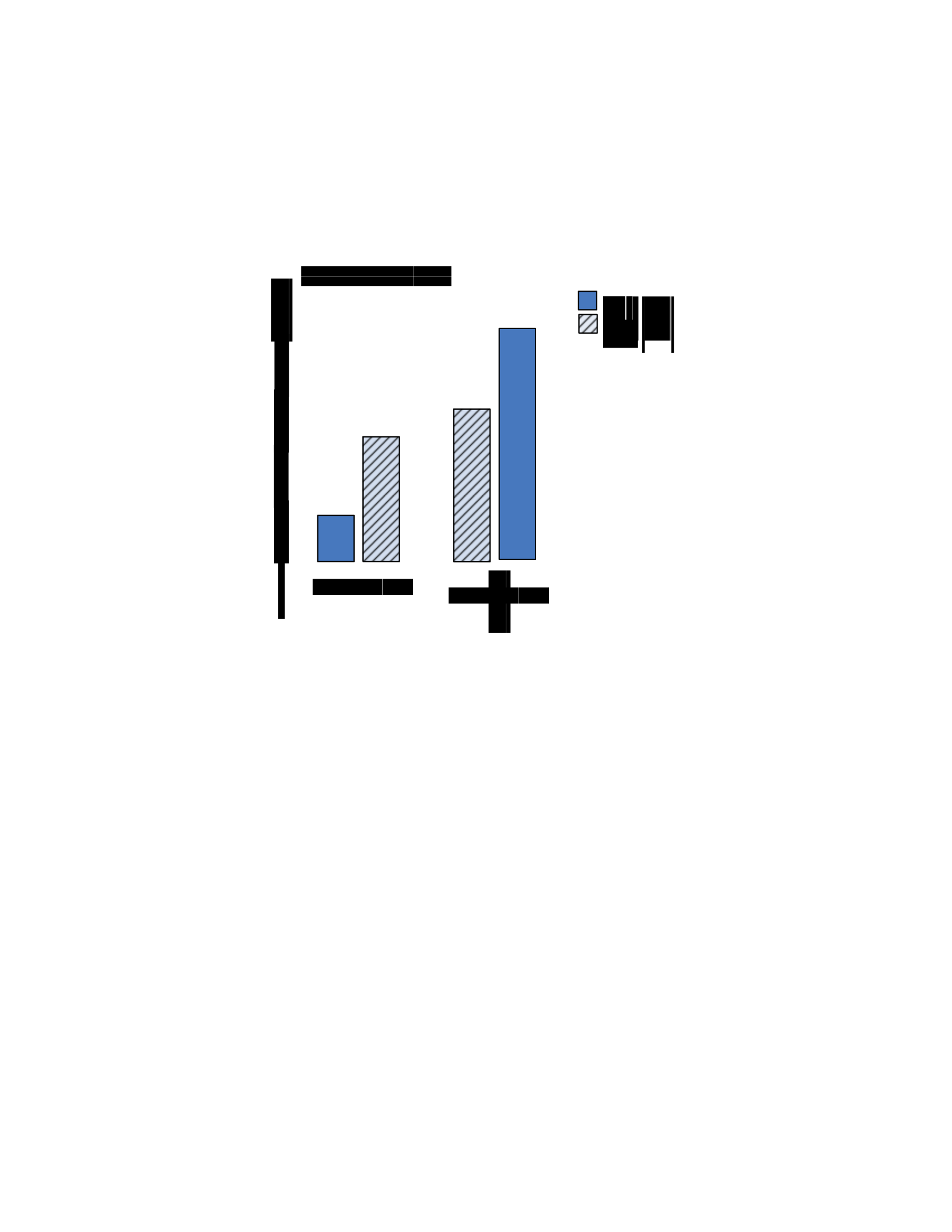
Challenges (FLTCs)…that we have forgotten to strategize on fostering the gamechanging
(disruptive) ideas that make the FLTCs work.”
Figure 11. Integration of Innovation into Business and Technology Strategy
Senior Leadership Innovation Emphasis
Some of the interview questions examined what types of innovation are being
stressed by Air Force S&T leadership and in what areas the greatest innovation success is
perceived. Table 37 outlines the major themes in innovation emphasis. All the AFRL
interviewees referenced product/service innovation (to include knowledge/technology) as
the primary area of emphasis. Only 55% of the AFRL senior leaders referenced processes
and organizational areas as places for creativity and idea encouragement. Even fewer
participants (27%) emphasized innovation in operational activities including concepts of

operations (CONOPS) and revolutionary techniques and tactics. One director explained
that, “The service laboratories are designed to be innovative in technology products,
especially in the exploitation and application side of innovation.” Additionally, several
respondents noted that while operational innovation is not currently a large area of
emphasis and strength in AFRL, collaborating directly with the warfighter on the
revolutionary use of technology to enhance the techniques and tactics of warfare is an
opportunity the Air Force S&T community should foster.
Comparing areas of focus, as depicted in Figure 12, shows nearly identical
innovation emphasis by industry CEOs and AFRL senior leadership. According to the
IBM industry study (2006), the CEOs of top performing companies are focusing about
55% of their idea attention on products with about 30% on process/organizational
innovation. Air Force S&T leaders approximated similar levels of emphasis in their
organizations. Companies are seeing business model innovation as the primary means to
preempt threats and create them. However, several Air Force S&T senior leaders noted
that operational innovation is an area where game-changing technology could have the
most profound impact on Air Force wartime competiveness.
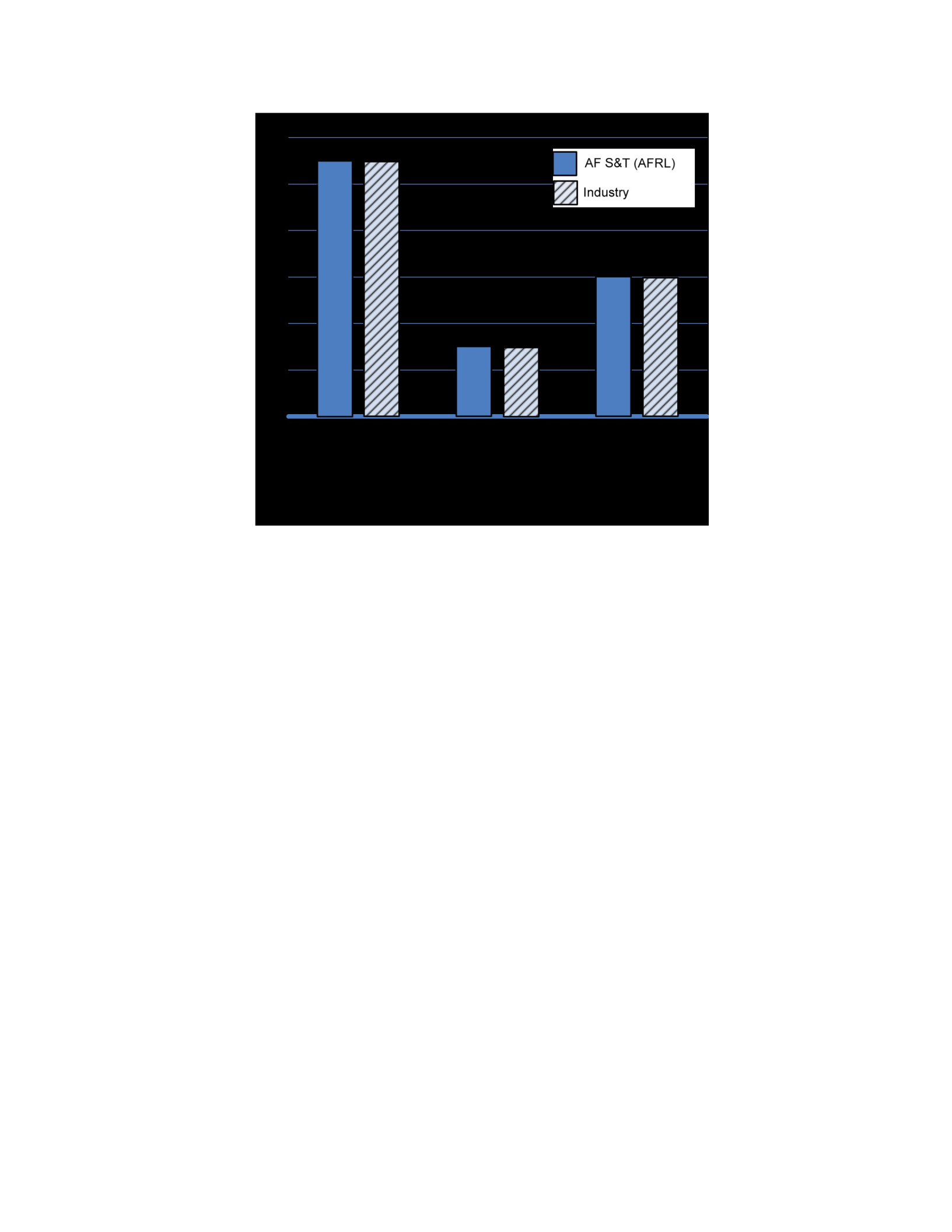
Senior Leadership Perspectives on Role of Collaboration
Numerous interview questions were structured to collect perspectives on how
collaboration impacts organizational innovation. The importance of collaboration,
benefits of collaboration, and productivity of collaborants were the primary questions
answered. Table 38 illustrates that AFRL senior leader interviewees (100%) not only see
collaboration as important but essential in harnessing the benefits of disruptive
innovation. In addition, the majority of Air Force S&T senior leaders have the strongest
confidence in the ideas of their in-house government, in-house support contractors, and
academic resources.

Comparing industry CEO and AFRL senior leader responses identifies several
similarities and differences in the sources of disruptive ideas. Figure 13 illustrates
several comparisons in innovation catalysts for industry and Air Force S&T
organizations. Leaders in industry and the Air Force S&T community rely heavily on
internal resources for innovation. They also both see formal collaboration with external
organizations as a solid source of new concepts. However, industry CEOs cited greater
value in ideas from their customers and even considered the competition as a key
resource for successful innovation. This confirms assertions made by Christensen (2003)
that many innovative breakthroughs are initiated by company marketers who segment
customers along a variety of psychological dimensions in order to define a profile of the
customer most likely to buy a particular product. In contrast, Air Force S&T senior
leaders placed greater confidence in the breakthrough ideas of academia. These results
align with previous survey findings where AFRL scientists and engineers cited
collaboration with academia, nonprofits, and other government agencies as a leading
driver of Air Force S&T innovation.
Senior Leadership Perspectives on Innovative Culture
Interview questions were also designed to query senior leadership observations on
the innovative culture within Air Force S&T organizations. Table 39 summarizes the key
perspectives on the strength of innovative culture, obstacles of innovation, actions to

foster innovativeness, and rewards for disruptive innovation. Although all the AFRL
leaders interviewed explained specific actions being taken to foster innovation in their
respective organizations, the majority (73%) did not consider AFRL as having a strong
innovative culture. The lack of flexibility in strategic planning and budgeting was the
most frequently cited obstacle to disruptive innovation. Limited resources and
government policies, including the restrictiveness of the federal acquisition regulations,
were also commonly mentioned barriers. Six of the AFRL senior leaders felt they
personally had control over the barriers to innovative culture while the rest felt they had
only some control to address the obstacles. In addition, 73% of the interview participants
articulated that innovation is not properly rewarded in their respective AFRL
organizations. While both non-financial rewards and compensatory motivations are being
currently used, most AFRL senior leaders acknowledged that considerable efforts were
needed to instill better incentives for creative risk-taking and breakthrough ideas.

Comparing the results of the AFRL interviews with those of the IBM CEO Study, several
interesting similarities and differences were noted, especially in the area of innovative
culture barriers. As outlined in Figure 14, a variety of internal and external obstacles
make it difficult to build an innovative mindset. Government and other legal restrictions
were cited as the largest external hindrance for both company CEOs and AFRL
leadership. Limited resources, unsupportive culture, and process immaturity were also
common internal challenges. Inflexibility in strategic plans and budgets, the most
frequent Air Force S&T response, was not specifically identified in the IBM CEO study.
Neither was leadership turnover and lack of effective collaboration. In contrast, industry
CEOs cited economic uncertainty, technology shortfalls, infrastructure difficulties, and
insufficient access to information as being greater hindrances than their Air Force S&T
counterparts. Overall, both industry CEOs and AFRL senior leaders recognize the
importance of innovative culture and acknowledge the need for organizational leaders to
take responsibility in fostering a spirit of innovation.
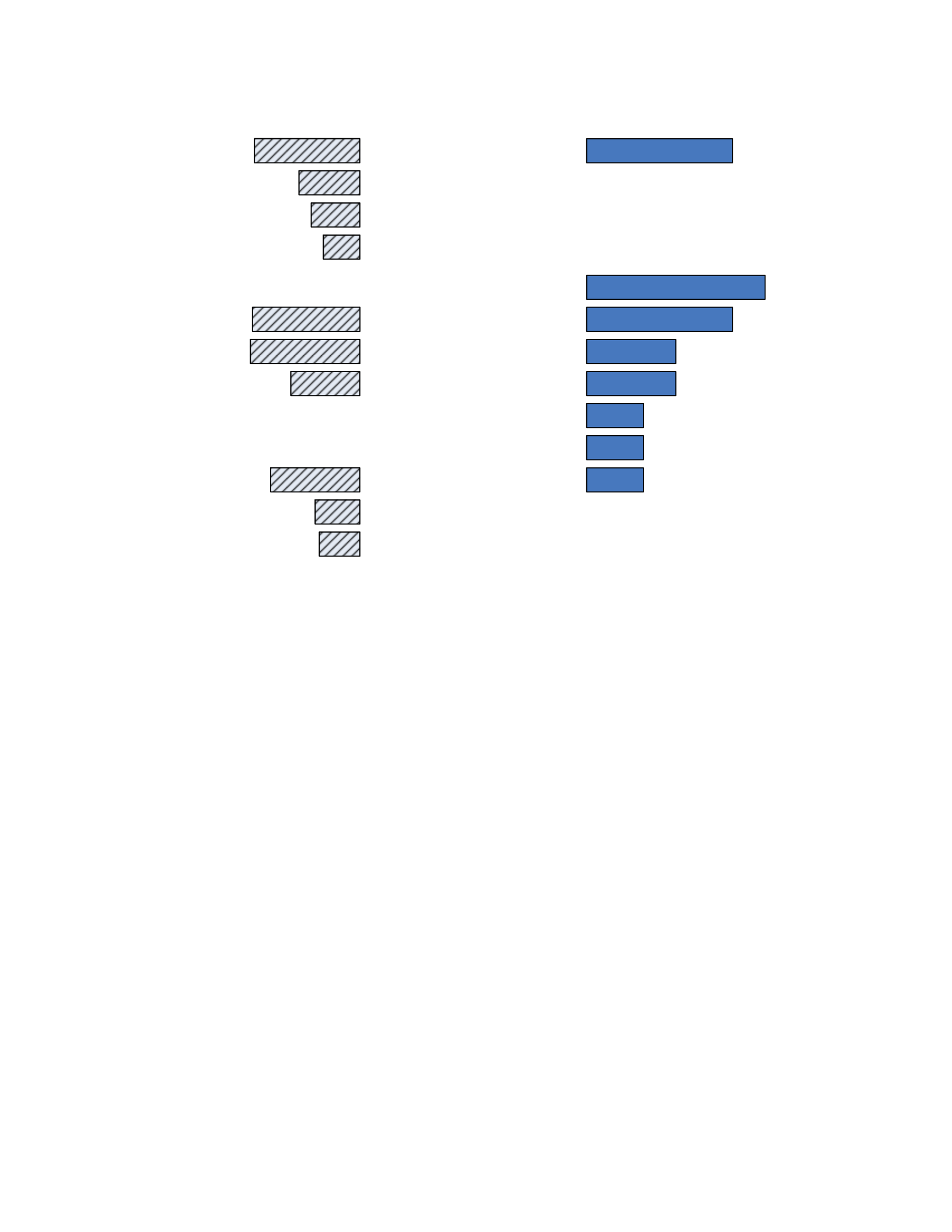
Figure 14. Innovation Obstacles Facing Senior Leaders
Model Analysis
Christensen (2003) proposed that building an organization capable of disruptive
growth requires a careful balance of resources, processes, and values. Combining these
thoughts with the research findings of this study provided a model for fostering disruptive
innovation. The model presented in Chapter II for fostering disruptive innovation defined
that an increase in the right motivation, plus an increase in the right focus of innovation
resources, plus a decrease in the barriers of innovation, plus an increase in the
characteristics of innovative culture, will foster an increase in the emergence of disruptive
innovation. The comprehensive literature review of innovation concepts also identified
Unsupportive Culture
and Climate
100 403020
Limited resources for
investment
Workforce Issues
Process Immaturity
Inflexible physical and
IT Infrastructure
Insufficient Access to
Information
AFRL Sr Ldr Responses
4060 1030 0
Govmt and Other
Legal Restrictions
Economic
Uncertainty
Inadequate Enabling
Technologies
Workforce Issues
Arising Externally
Industry CEO Responses
60502050
Govmt and Other
Legal Restrictions
Inflexible strategic
plans and budgets
Limited resources for
investment
Process Immaturity
Leadership turnover
and mgt instability
Lack of effective
collaboration
Workforce Issues (inc
training/rewards)
Unsupportive Culture
and Climate
External
Internal
ExternalInternal

various ideal heuristics for motivation, focus, barriers, and culture that are credited with
successful disruptive innovation. Figure 15 summarizes the study results and
demonstrates the similarities and differences between industry and the Air Force S&T
community with respect to the critical model variables. Specific findings that correspond
to the concepts of disruptive innovation are highlighted to show organizational attributes
that typically foster game-changing ideas. In addition, the summary shows that while the
model serves as a basic framework for innovation improvement, the application and
specific attributes will be domain dependent.
This chapter provided the results and analysis of the study research. First, a
detailed quantitative analysis of the survey data including the comparative analysis was
presented. Next, the qualitative evaluation of the interview data was outlined and
presented. Finally, the survey and interview results were combined with the information
gathered in the literature review to provide depth and support to the proposed innovation
emergence model.

V. Conclusions and Recommendations
The purpose of this thesis research was to study the motivation, focus, barriers,
and culture needed to foster disruptive innovation in Air Force Science and Technology
(S&T) and to investigate how industry innovation strategies could improve breakthrough
Air Force technology emergence. This chapter provides the conclusions,
recommendations, limitations, and follow-on studies for this thesis effort. The first
section provides a detailed description of the research conclusions. The next section
outlines a series of recommendations for the Air Force S&T community based on the
literature review, data results, and research findings. The third section summarizes the
limitations of this study and provides guidance regarding interpretations and applicability
of findings. The last section in the chapter provides some suggestions for future research
designed to further enhance the knowledge base in this area of research.
Research Conclusions
Based on the defined investigative questions, comprehensive literature review,
multifaceted data results, and detailed analysis findings, the following research
conclusions have been developed:
1. Air Force S&T pursues innovation in order to keep the warfighter state-
of-the-art with leading edge technologies. This motivation, exhibiting a desire for
longterm relevance and dominance, coincides with the ideal attributes for increased
disruptive innovation emergence. In contrast, industry appears to be more driven to

innovation to respond to customer demands, improve operational efficiency, and increase
profits.
Industry motivation, more short-term oriented, is less likely to foster new systems with
completely new value propositions. Although the study results found Air Force scientists
and engineers perceive less attention to innovation than their industry counterparts, Air
Force S&T exudes the right motivation to foster disruptive innovation.
2. Air Force S&T, heavily reliant on external resources, struggles with
developing an executable strategy designed to foster disruptive innovation. While most
Air Force S&T professionals see a balance of investment focus, highly structured and
rigid strategic planning make breakthroughs difficult for innovators. Air Force S&T
appears to depend on other organizations for innovation, focusing primarily on the
development of technological products. The Air Force S&T community has also failed to
capitalize on opportunities for operational innovation, especially collaborating with the
warfighter on technologically advanced techniques and tactics. In comparison, industry
seeks to use innovation as a means to address the profit generating needs of customers,
utilizing a balance of product and business model innovation to compete in market
segments. The study results suggest that Air Force S&T may not be actively using the
principles of radical thinking as a means to gamechanging improvement in business
organizational activities.
3. Air Force S&T professionals perceive significant internal organizational
barriers hampering the emergence of disruptive innovation. Insufficient resources,
organizational constraints, lack of innovation strategy, and entrenched programs were
perceived as the greatest obstacles to new ideas. Both the industry and Air Force S&T

communities acknowledge the detrimental affect of innovation barriers, although industry
appears more confident in its ability to overcome bureaucratic constraints. Industry
creativity was less threatened by organizational policies, possibly indicating that the
increased focus of resources in business model innovation returned benefits in overall
company efficiency.
4. Air Force scientists and engineers believe strong innovation culture is best
characterized by freedom and collaboration. The study indicated that Air Force S&T
professionals desire a culture that allows them freedom to research without administrative
burdens and non-value added diversions. In addition, Air Force S&T innovation is
contingent on alliances and partnerships with internal and external entities. While Air
Force S&T believes in a culture of freedom and industry sees customer focus as the key
to innovation emergence, both Air Force S&T and industry employees understand the
tremendous importance of organizational culture in fostering breakthroughs.
5. Air Force S&T senior leaders understand the criticality of innovation but
struggle with the optimal approach to fostering disruptive innovation in their
organizations Most Air Force S&T leaders agreed that innovation was not well
integrated into their business and technology strategy which was hampered by overly
constrained planning and restrictive external influences. Although other findings indicate
strong reliance on external sources, Air Force S&T leadership places great confidence in
the ideas of their in-house personnel. Unfortunately, most senior leaders do not perceive
that Air Force S&T organizations posses a strong innovative culture. In addition, most
Air Force S&T senior leaders acknowledged that considerable improvement efforts were

needed to facilitate flexible planning, thereby freeing resources, collaboration, and
rewards for creative risk-taking.
6. Innovative organizations require strong and inspiring leadership and both
Air Force S&T senior leaders and company CEOs agree that innovative thinking must be
orchestrated from the top. Supportive leadership is critical to motivation, strategy,
overcoming obstacles, and building an innovative culture. While both Air Force and
industry leadership hold themselves accountable for fostering disruptive innovation,
complex dimensions of disruptive innovation continue to be challenging regardless of the
domain.
7. Air Force S&T is capable of regaining its prominence as a leader in
disruptive technological innovation by applying the emergence model, capturing the
relevant best practices of industry, and exploiting the positive attributes of the military
domain. The research findings combine to establish the proposed model for fostering
disruptive innovation in either industry or government organizations. Given an increase
in the right motivation, an increase in the right focus of innovation resources, a decrease
in the barriers of innovation, and an increase in the characteristics of innovative culture,
disruptive innovation will emerge. Although the model is not intended to be an equation
for guaranteed success, it does provide a conceptual formula to ensure that all critical
elements needed to foster breakthrough innovation are considered.

Recommendations
Based on this thesis research, the followed recommendations are provided to the
Air Force S&T community to help foster the emergence of disruptive technology:
1. Exercise caution with relying on industry to generate relevant disruptive
innovation for the Air Force. Given the differences in motivation, drivers, and resource
focus, outsourcing innovation to commercial companies may not provide the long-term
relevant technologies needed to dominate the battlespace. While industry is a key
collaborative partner, Air Force S&T should invest in enhancing its internal workforce to
ensure the emergence of revolutionary military technology.
2. Infuse greater flexibility and innovativeness into AFRL business and
technology strategy through the use of discovery-based planning. Discovery-based
planning allows experimental results and assumption validation to drive investment
strategies. The added resilience in AFRL planning will allow technology breakthroughs
to evolve less bounded and foster increased levels of disruptive innovation.
3. Establish freedom for the scientist and engineering workforce as a priority
of Air Force S&T process improvement efforts. AFRL’s greatest asset has always been the
intellectual power of its technological workforce. AFRL needs to ensure that all
management approaches, supporting activities, and enabling activities place optimization
of the scientist and engineer’s (S&E) time as the goal of process improvement efforts. In
order for AFRL to achieve disruptive technological prominence, the S&E must be given
larger amounts of working time free from administrative burden and non-value added

work. Even if granting freedom to the S&E increases the responsibilities of management
and support personnel, the long-term benefits of increased disruptive innovation
emergence is worth the risk.
4. Utilize successful sustaining innovation to build advocacy and generate
resources for disruptive technology innovation. Not all AFRL efforts can or even should
be focused on gamechanging ideas. Balanced investments are essential to success.
However, AFRL should be careful not to allow incremental improvements in entrenched
existing programs in such a way that invention and exploitation of disruptive concepts is
neglected. Sustaining technology and requirements-based development play a valuable
role as long as they are used to obtain resources for more long-term disruptive
breakthroughs.
5. Increase the use of experimental venues to increase technological
collaboration with the warfighter and to access the operational impacts of disruptive
innovation. While AF S&T’s motivation and focus on the state-of-the-art is critical,
AFRL can also learn from industry’s strong customer focus. More discovery-based
experimental venues with the warfighter will increase AFRL’s position as a relevant force
in helping with operational innovation, especially in the application of technological
advancements for disruptive warfighting tactics and techniques.
6. Elevate the innovative culture of AFRL by orchestrating risk-taking from
the top. Senior leadership views of innovation play a profound role on the sense of
entrepreneurship in the organization. By demonstrating greater risk-taking in approaches
to supporting and enabling processes, senior leadership will send a decisive message to
the workforce and infuse innovative spirit within the organization. The S&E workforce

will observe the trend in leadership and respond with increases in relevant disruptive
ideas.
Limitations of the Research
Although efforts were taken throughout this research to mitigate risks to reliability
and validity, sample bias in the survey still arose as a threat to internal validity. As
detailed in the methodology chapter, the sample demographics demonstrated some
deviations from the population demographics. Volunteerism may have played a role in
creating the bias, as the persons who chose to participate in the survey were concentrated
in certain geographic sites and directorates. Although the findings were not analyzed
based on directorates or geographic demographics, the sampling bias should still be
considered when evaluating the generalizations made by the survey portion of this study.

Future Research
Based on the emerging topic and lack of specific literature on disruptive
innovation in military organizations, a primarily qualitative research method, supported
by some quantitative data, was used in this thesis study. The resulting model for fostering
disruptive innovation lends itself well to further quantitative inferential research. The
following suggestions for investigative questions examined singularly or as part of a
larger research study, would provide the needed quantitative validation of the model for
fostering disruptive innovation:
1. How does a military organization’s motivation for innovation relate to the
successful emergence of disruptive innovation?
2. What focus of innovation resources in a military organization provide the
most successful emergence of disruptive innovation?
3. How does the elimination of barriers relate to an organization’s ability to
foster disruptive innovation? What common barriers to innovation have the
most detrimental effect on organizational innovativeness?
4. How do increased levels in the characteristics of innovative culture relate to
an organization’s ability to foster disruptive innovation? What characteristics
of innovative culture have the greatest effect on the emergence of disruptive
innovation?
5. How can organizational success in fostering disruptive innovation be
quantified? What organizational metrics and measures can be used to quantify
the successful emergence of disruptive innovation?

