


1
Section 1: Foundation of the Study and Literature Review
Ebola virus disease (EVD) outbreaks have been a major public health concern for
decades because of the high morbidity and mortality associated with the disease (Centers
for Disease Control and Prevention [CDC], 2018). For example, during the 2014-2016
EVD epidemic in West Africa, 11,310 fatalities were confirmed by the CDC, and it is
possible there were many additional cases that were not confirmed (2017). Though new
research is emerging, currently there is no cure for the infection (CDC, 2018). It therefore
remains the responsibility of those in public health to attempt to prevent—or at the very
least limit—the spread of future EVD outbreaks.
Since there is no cure for EVD infection, only supportive therapy such as IV
fluids, antidiarrheal medication, and pain medication can be used (Chertow, Kleine,
Edwards, Scaini, Giuliani, & Sprecher, 2014). This therapy can be costly, especially if
the outbreak is located in a country that already has minimal healthcare resources.
Without sufficient esources, countries are forced to ask for assistance. During the 2014-
2015 outbreak in West Africa, outside aid workers helped control the spread of the
disease (Chertow et al., 2014). Though necessary, this added both additional cost and
additional risk in controlling the outbreak, since many of these workers became ill
themselves (Chertow et al., 2014). This cost, in addition to the loss of workers during the
outbreak, seriously damaged many countries’ economies during the epidemic (Gostin &
Friedman, 2015).
External aid workers and travelers also have the potential to carry the disease
back to their own countries (Rothstein, 2015). Many countries instated quarantine

2
measures during the 2014-2015 West African EVD epidemic, but some workers and
travelers who were exposed to the virus had already traveled back to their home country
by the time these measures were in place (Rothstein, 2015). Diseases can spread more
rapidly from one country to another as modern modes of transportation, such as flying
and trains, become more ubiquitous throughout the world (Rothstein, 2015).
In America specifically, eleven individuals who had traveled from West Africa
were treated with EVD, and of those individuals some had returned to the United States
before developing symptoms (CDC, 2017b). It is important to remember that it is
possible to spread EVD before symptoms begin or when only mild symptoms are
presenting (CDC, 2017b). Several Americans died as a result of the 2014-2016 outbreak,
including a doctor and other aid workers (CDC, 2017b).
While there is still a lot that remains unknown about EVD, it is well understood
that the virus is spread through body fluids (CDC, 2018). Individuals who protect
themselves from contaminated body fluids through proper hygiene are more likely to
avoid infection (CDC, 2018). Increasing proper hygiene campaigns in at risk countries
like Liberia may be an appropriate step to prevent another deadly epidemic. To do this
effectively, it is important to ascertain how much individuals already know about both the
virus and the measures that can be taken to prevent the spread of infection.
A survey conducted in Monrovia, Liberia, during the 2014-2016 outbreak asked
individuals what they knew about EVD and what they knew about hygiene measures that
could be taken to avoid infection (Humanitarian Data Exchange, 2017). Within, this
population, those who were employed will be looked at specifically in this study

3
(Humanitarian Data Exchange, 2017). Around 97% of the population in Liberia is
employed (CIA, 2018). Employed individuals are more likely to be exposed to the
disease because they are leaving their homes, and they are a specific population that can
be targeted through future educational campaigns (CDC, 2018).
Ultimately, if there is another EVD outbreak in Liberia, improving preventative
measures among employed Liberians may protect both individuals and the economy by
limiting the spread of disease and thus reducing morbidity and mortality associated with
it. Basic hygiene improvements may even reduce the morbidity and mortality associated
with other diseases (CDC, 2018). Finally, employers may realize from this work that they
have an opportunity to reduce the spread of disease through workplace education.
This chapter is organized into six sections. The first section provides the
background of this study. The second section provides the problem statement, and the
third section provides the purpose of the study. The fourth section includes both the
research questions and the hypotheses. The fifth section examines the theoretical
framework of the study. The sixth section covers the nature of the study. Final parts of
this section include the definition of terms, assumptions, scope and delimitation,
limitation, significance, and summary.
Background
Historical Perspectives on EVD
The first major outbreaks of EVD occurred during the 1970s in the Democratic
Republic of the Congo (DRC; Li & Chen, 2014). It was nearly 2 decades later before
another outbreak was reported (Li & Chen, 2014). Since the 1990s, outbreaks have

4
occurred in several countries, including the Democratic Republic of the Congo, Gabon,
and Uganda (Li & Chen, 2014). Most outbreaks have been isolated and have occurred in
countries near or around the equator in Africa (Li & Chen, 2014). There have been
isolated cases in other countries, including the U.S. (Li & Chen, 2014).
These cases are rare and have typically occurred when a sick animal has been
transported from Africa for research purposes (Li & Chen, 2014). A table showing the
location of previous EVD outbreaks up to the present epidemic, as well as case numbers
and fatality rates, can be seen below in Table 1.
Table 1
List of EVD Outbreaks
Country Cases Deaths Year
Democratic Republic
of the Congo (DRC)
Ongoing Ongoing 2018
DRC 8 4 2017
DRC 66 49 2016
Multiple 28652 11325 2014-2016
Uganda 6 3 2012
DRC 36 13 2012
Uganda 11 4 2012
Uganda 1 1 2011
DRC 32 15 2008
Uganda 149 37 2007
DRC 264 187 2007
South Sudan 17 7 2004
Republic of Congo 35 29 2003
Republic of Congo 143 128 2002
Republic of Congo 57 43 2001
Gabon 65 53 2001
Uganda 425 224 2000
South Africa 2 1 1996
Gabon 60 45 1996
Gabon 37 21 1996
DRC 315 250 1995

5
Ivory Coast 1 0 1994
Gabon 52 31 1994
South Sudan 34 22 1979
DRC 1 1 1977
South Sudan 284 151 1976
DRC 318 280 1976
Note. List of EVD Outbreaks. CDC. (2018b). EVD Distribution Map: Cases of EVD in
Africa 1976 to 2017. https://www.cdc.gov/vhf/EVD/history/distribution-map.html
Ecology and Transmission of EVD
The primary means of initial transmission of EVD during an epidemic has been
zoonotic (Li & Chen, 2014). Swine, monkeys, and humans are all known carriers and
fruit bats have been confirmed as reservoirs for the virus (Li & Chen, 2014). Often,
humans come into contact with these animals when seeking a food source. This is termed
a spill over event which means that the virus can now cross species into humans (CDC,
2016b). Monkeys in particular are a common food source in many African countries
(Rizkalla, Blanco-Silva, & Gruver, 2007). Also called “bush meat,” monkeys are found
in abundance in some areas and are relatively easy to hunt because of their large size
(Rizkalla, Blanco-Silva, & Gruver, 2007). In some instances, bats may also be consumed
as food (Rizkalla, Blanco-Silva, & Gruver, 2007).
Known Risk Factors for Ebola Virus Disease
Consumption or interaction with bush meat or wild animals in Africa is one
known ways that EVD may be introduced into a population (Rizkalla, Blanco-Silva, &
Gruver, 2007). Hunters who kill and consume or sell bush meat may not realize the
animal is sick, since some animals can be contagious without displaying symptoms.
However, some hunters may still sell or consume a sick animal out of desperation for

6
food or income. Individuals who buy these animals in a market may not see any visual
signs that the meat is diseased (Rizkalla, Blanco-Silva, & Gruver, 2007).
Caregivers for the sick are another at risk group. Specifically, women are more at
risk for contracting EVD (Suwantarat & Apisarnthanarak, 2015). This is because,
culturally, women are given the task of tending to the children and also often assume the
responsibility of caring for those who are unable to care for themselves within the
extended family (Suwantarat & Apisarnthanarak, 2015). Extended family often includes
primarily the older, but may also include younger siblings in some situations (Suwantarat
& Apisarnthanarak, 2015).
Proper precautions to prevent transmission may not be taken by caregivers for
several reasons. In many areas, access to healthcare is limited or costly (Boozary, Farmer,
& Jha, 2014). Second, because EVD mimics the symptoms of many other diseases, it is
possible that some caretakers assume their patient is sick with something other than EVD
(Beeching, Fenech, & Houlihan, 2014). Even if EVD is suspected, limited resources may
inhibit a caretaker’s ability to protect themselves (Gatherer, 2014).
Caregivers outside of the immediate family may also be more at risk for
contracting EVD. Healthcare workers, such as doctors and nurses, those working in
public health, and home healthcare providers such as midwives, are more at risk for
exposure. This population is more at risk compared to the general population simply
because of the quantity of ill people that they care for on a daily basis. This is to be
expected during outbreaks anywhere, but it is important to note that certain additional
challenges existed in many areas where the 2014-2016 outbreak occurred. It can be

7
challenging and time consuming to put protective measures in place in areas where the
healthcare infrastructure is not well developed. Bleach, for example, is one of the few
disinfectants that can effectively kill EVD and not all small clinics in West Africa had or
have enough bleach on hand to deal with an outbreak (Gee & Skovdal, 2017). PPE or
proper protective gear for doctors and nurses should ideally include a complete body
covering, including shoes, double gloves, and a face shield (Gee & Skovdal, 2017). These
are not items that are commonly available or routinely worn when available in most
clinics throughout Africa (Gee & Skovdal, 2017). Therefore, these steps for protection
may not be in place when the first patients arrive (Gee & Skovdal, 2017). Sometimes
individuals are misdiagnosed as well, thus leading to an even further delay in healthcare
providers taking correct protective measures and thus increasing the chance of
nosocomial infections (Gee & Skovdal, 2017).
Finally, some people are at risk who are exposed to more body fluids than others.
Children who breast feed are more at risk of contracting the disease from the mother
(Bausch, et al., 2007). Men who engage in intercourse after recovering from the disease
are more likely to spread the disease to their partners through their semen (Bausch, et al.,
2007). Healthcare workers who tend to the body fluids of patients can be more at risk,
such as nurses who change bedding or bed pans (Suwantarat & Apisarnthanarak, 2015).
Similarly, anyone who prepares a body for a funeral and comes into contact with body
fluids through that process may be more likely to contract the disease (Pandey, Atkins,
Medlock, Wenzel, Townsend, Childs, & Galvani, 2014).

8
Problem Statement
In 2014, an EVD outbreak erupted in Western Africa (CDC, 2017). Three
countries, Liberia, Sierra Leone, and Guinea, experienced the highest number of cases
from the epidemic with the greatest degree of morbidity and mortality coming from
Liberia (CDC, 2017). At one point during the epidemic in Liberia, over 800 individuals a
week were being diagnosed with EVD (CDC, 2017). Though EVD is difficult to contain,
the spread of the disease may be slowed down through public health education campaigns
(CDC, 2018).
One possible public health campaign could have targeted working adults in
Liberia. In Liberia, over 97% of the adult population report working in some capacity
(CIA, 2018). A large portion of the population could, therefore, be reached through
workplace EVD education initiatives. Currently, there is no research that shows how
much workers know about EVD and about preventative hygiene.
However, there is research showing how non-pharmaceutical public health
campaigns have reduced the spread of disease during other pandemics. In an article by
the CDC (2006), the effectiveness of public health campaigns in major disease outbreaks
were explored. The article looked only at pandemics in the last century and how public
health responded to them. A pandemic is a disease outbreak that effects a large
geographic area including more than one country (CDC, 2006). Specifically, the CDC
looked at the 1918 flu pandemic and SARS pandemic in Eastern Asia. The 1918 flu
pandemic was explored in the article because it was the worse pandemic since the Black
Plague. The 1918 flu public health campaign was also the first public health campaign in

9
America that specifically looked at methods of public health to slow a pandemic (CDC,
2006). The SARS pandemic was explored because it is one of the most recent influenza
pandemics, and because extensive public health measures were used to prevent it from
becoming worse (CDC, 2006).
What the article found is that in some past epidemics, such as during the 1918 flu
pandemic, quarantine measures were not enough to contain the disease and keep it from
spreading to other areas (CDC, 2006). The article suggests that more than just
quarantining has to be used to stop an outbreak of any kind (CDC, 2006). With SARS
and other recent flu outbreaks throughout the world, research has investigated exactly
what public health measures may work to reduce spread of disease beyond just
quarantining. One multivariate case control study in Hong Kong found that those who
washed their hands more than 10 times a day were less likely to contract respiratory
illnesses (CDC, 2006). EVD is not considered to be a respiratory illness, but like SARS
and other respiratory illnesses, the spread of EVD has been proven to be reduced through
hand washing (CDC, 2018). Hygiene education and public health education about
diseases and how they spread may therefore be an essential part of stopping
communicable disease outbreaks.
Another aspect of this problem is that such a high rate of illness not only resulted
in high mortality rates, it also had a damaging effect on the country’s economy (Adegun,
2014). Economies suffer during epidemics for many reasons. Businesses lose workers,
people are afraid to get out into the public, and often tourism and trade also decline
(Adegun, 2014). During the 2014-2016 outbreak, an estimated $2.2 billion was loss in

10
GDP in Liberia, Sierra Leone, and Guinea (CDC, 2016). Significant financial losses
occurred in the areas of private sector growth, agricultural production, and cross- border
trade (CDC, 2016). To ensure the stability of Liberia’s economy in case of a future
epidemic, it is imperative that measures be taken to protect the working class. These same
measures may have global implications, since no country is totally immune to the
possibility of an epidemic.
The endemic countries in Africa were not the only countries whose economies
were affected by the outbreak. The United States alone donated over $2 billion to efforts
in Western Africa to contain the disease (CDC, 2016). Countries like the United States,
Great Britain, and Germany paid out large amounts of money to ensure that the affected
countries had the resources they needed (CDC, 2016). Without these resources, the
disease could have spread from Africa to the donor countries, so it was seen as a
necessary expense (CDC, 2018).
Widespread food shortages were another problem that occurred during the EVD
outbreak of 2014-2016 (CDC, 2016). As mentioned, many individuals were unable to
work during the epidemic, leading to a loss in agricultural production (CDC, 2016). The
loss of agricultural production was severe enough that it led to food insecurity throughout
the affected regions (CDC, 2016). Food insecurity persisted as a serious issue long after
the epidemic ended (CDC, 2016). It has taken these countries a long time to recover in
this particular area (CDC, 2016).
It is also important to note the impact the EVD outbreak had on healthcare
systems throughout Western Africa. During the outbreak, 881 healthcare workers became

11
infected with the disease, of which 513 died (CDC, 2016). It is estimated that overall
healthcare services were reduced by up to 50% (CDC, 2016). This created multiple
problems. First, during the outbreak it was difficult to adequately treat the large number
of incoming EVD patients in healthcare facilities when the facility was short staffed (Gee
& Skovdal, 2017). Secondly, other diseases became less of a priority, leading to a surge
of deaths caused by HIV/AIDS, malaria, and tuberculosis. Some of these deaths may
have been because some patients with other diseases were afraid of contracting EVD if
they sought care at a facility that also saw EVD patients (Gee & Skovdal, 2017). For
patients with other diseases who did seek care, it is believed that these patients were no
longer getting adequate care because care facilities were short staffed. It has been
estimated that an additional 10,600 lives were lost to HIV/AIDS because of inadequate
care during this time (CDC, 2016).
Finally, this epidemic had a huge impact on children in Western Africa. Nearly
20% of all EVD cases were children (CDC, 2016). It is also estimated that after the
epidemic ended, over 17,000 orphans were left as a result of the disease (CDC, 2016).
During the outbreak, children suffered academically with some areas cancelling school
for close to 30 weeks (CDC, 2016). Children also missed out on routine health checks
and vaccinations during this time, making them more vulnerable to other infections
(CDC, 2016).
This research filled a gap in understanding by specifically looking at whether or
not those working in Liberia during the epidemic had adequate knowledge about EVD
and its prevention. Literature searches yielded no results when looking for data specific to

12
this population group in Liberia. However, researchers have cited the need for improved
education in Liberia as gaps in current research (Christie, Davies-Wayne, Cordier-
Lasalle, Blackley, Laney, Williams,... & Ladner, 2015). Specifically, Christie et al.
(2015) found that knowledge about EVD spreading through semen needed to be
improved in Liberia. In Nigeria, volunteer health advisors who were already working in a
healthcare field during the epidemic showed gaps in EVD knowledge (Patel, Pharr,
Ihesiaba, Oduenyi, Hunt, Patel, ... & Ezeanolue, 2016). It is possible that there is a similar
deficit of knowledge among workers in another West African nation, Liberia.
Literature searches also revealed that a similar approach to understanding EVD
knowledge in the United States yielded interesting results. First, those in the United
States with more knowledge about EVD were considered to have a lower risk of
contracting the disease if it came to the United States (Rolison, & Hanoch, 2015).
Second, research found that increasing knowledge about EVD led to individuals taking
the disease more seriously (Rolison, & Hanoch, 2015).
Social change may occur when businesses realize that they have an opportunity to
educate a large portion of the Liberian population. Secondarily, social change may occur
if individuals follow the guidance/training offered by their organizations, resulting in less
illness and fewer businesses losing workers in the future. When businesses are able to
function during an epidemic, the economy suffers less loss and thus many vulnerable
populations who rely on economic assistance remain unharmed.

13
Purpose of the Study
The aim of this study was to investigate the impact of employed adults’
socioeconomic and demographic factors on the use of EVD preventative measures. This
study could be used to inform future public health campaigns among working adults.
Workplaces offer a way to get information to large groups of individuals at a time (Gee &
Sokval, 2017). Workplaces can also serve as a great place to begin to enforce proper
hygiene practices that may then be done at home as well, once the individual knows what
to do (Gee & Sokval, 2017). Seeing others participate in these programs can also serve as
a form of positive peer pressure (Gee & Sokval, 2017). This study was conducted to
reveal whether or not working adults were more or less educated about EVD than those
who did not work and may therefore offer insight into whether or not workplace
education is being done.
Research Questions and Hypotheses
This study was guided by the following two research questions:
1. Is there an association between socioeconomic and demographic factors
(education, age, gender, and occupation) and frequency of employed adults
who report the use of preventative hygiene practices (use of hand sanitizer and
bleach) in Monrovia, Liberia?
a. H1
0
: There is no statistically significant association between
socioeconomic and demographic factors and frequency of employed adults
who report to use preventative hygiene practices in Monrovia, Liberia.

14
b. H1
A
: There is a statistically significant association between socioeconomic
and demographic factors and frequency of employed adults who report to
use preventative hygiene practices in Monrovia, Liberia.
2. Is there an association between socioeconomic and demographic factors
(education, age, gender, and occupation) and frequency of employed adults
who report understanding the basic nature of the EVD (common symptoms
and how it is spread) in Monrovia, Liberia?
a. H1
0
: There is no statistically significant association between
socioeconomic and demographic factors and frequency of employed adults
who report understanding the basic nature of the EVD in Monrovia,
Liberia.
b. H1
A
: There is a statistically significant association between socioeconomic
and demographic factors and frequency of employed adults who report
understanding the basic nature of the EVD in Monrovia, Liberia.
Nature of the Study
A cross sectional survey was used as the secondary data source for this research.
The survey was conducted by a Liberian NGO, called Parley, which is a partner with the
United Nations which, in turn, runs the Humanitarian Data Exchange (2017). According
to the Humanitarian Data Exchange (2017), the survey selected 77 communities from 15
wards in the capital of Monrovia (). The number of communities chosen from each ward
was proportional to that ward’s population size, so no ward was under- or
overrepresented in the survey (). Households surveyed from each community were

15
randomly chosen (). In the survey, individuals were asked about their awareness of EVD
as well as the steps they had taken to prevent EVD infection (). The study also recorded
the individuals’ occupation, gender, and education ().
The survey was conducted from December 2014 to January 2015 (Humanitarian
Data Exchange, 2017). At this point, EVD had been present in Monrovia for
approximately six months (CDC, 2018). The survey asked questions about hand hygiene
and the nature of the EVD virus, for example, how it is spread, how to know if you have
it, etc. (Humanitarian Data Exchange, 2017). These results were divided based on
education, age, occupation, and gender to see if there was a correlation between any of
these sociodemographic/socioeconomic factors listed and knowledge about EVD and the
prevention of EVD through improved hygiene.
Population
The population of the survey included representation from every community in
Monrovia (Humanitarian Data Exchange, 2017). Monrovia is the capital of Liberia and
has a population of over 1 million, nearly a fourth of the country’s total population (CIA,
2018). Those living in Monrovia have faced many challenges, including civil wars (CIA,
2018). The most recent war ended in 2003, but when the EVD epidemic struck Monrovia
in 2014, the city had not yet fully recovered (CIA, 2018). The war combined with other
health issues, like high fertility rates, likely contributed to the fact that a majority of the
population (almost 60%) was under the age of 25 (CIA, 2018).
Currently, Liberia is considered a low-income nation, though a majority of the
population does work (CIA, 2018). Major industries include mining and agriculture (CIA,

16
2018). A majority of the population also lives without access to improved sanitation,
which is a factor being explored (CIA, 2018). In urban areas like Monrovia, it is
estimated that 72% of the population does not have access to improved sanitation like
waste disposal and clean water (CIA, 2018).
Theoretical Foundation for the Study
The theory of reasoned action/planned behavior is applicable to EVD prevention
(Fishbein, 1979). This theory assumes that most health-related decisions are rational
decisions that lead to planned behavior (Bensley & Brookins-Fisher, 2003). Preventative
hygiene and understanding how disease is spread may lead to better informed citizens
and thus better planned actions/behaviors (Bensley & Brookins-Fisher, 2003). Therefore,
the first step is to know which demographic groups of workers need to be a focus of new
interventions so that beliefs about EVD can be changed. Second, it is important to know
which demographic groups of workers are at risk, so EVD infection may be prevented
through targeted educational campaigns designed to meet the specific issues (CDC,
2018).
Under this theory, specifically the situational factors, attitudes, intentions, and
subjective norms about hygiene practices among workers will be explored to determine
which demographic groups of workers need to be targeted (Bensley & Brookins-Fisher,
2003). First, certain occupations may have situational factors that cause those groups to
be more at risk for contracting the disease than others (CDC, 2018). Miners, for example,
are in close proximity to bats and may be more at risk of contracting the disease, and
funeral and healthcare workers may come into more contact with body fluids than other

17
occupations (CDC, 2018). This may mean that these individuals know more about EVD
and thus use more preventative hygiene techniques then other occupations which are less
likely to be exposed.
Attitudes and intentions may also vary across different demographic groups of
workers based on individual level of education. Some occupations require educational
experience while others do not. A study by Oladimeji, Gidado, Nguku, Nwangwu, Patil,
Oladosu,... & Musa, found that healthcare workers with more education, such as doctors,
were more likely to practice good hygiene (2015). Healthcare workers with less
education did not practice hygiene techniques adequately (Oladimeji et al., 2015).
Finally, subjective norms about hygiene may vary among different ages, genders,
and different occupations. Occupations that earn less money may not have as a high of a
standard for preventative hygiene, since it can be costly to purchase things like soap,
clean water, and hand sanitizer (Doocy & Burnham, 2006). Whether or not hygiene
practices are more of a norm among a certain gender or age was explored as well. In one
scenario, bathroom handwashing rates in a service station were recorded (Judah, Aunger,
Schmidt, Michie, Granger, & Curtis, 2009). It was discovered that men in particular were
less likely to wash their hands than women and thus needed to be targeted differently
with public health campaigns (Judah, Aunger, Schmidt, Michie, Granger, & Curtis,
2009). Men were more likely to wash their hands if a picture reminding them to wash
their hands contained disgusting facts about germs (Judah, Aunger, Schmidt, Michie,
Granger, & Curtis, 2009). Women did not need to be disgusted in order to wash their
hands more often? (Judah, Aunger, Schmidt, Michie, Granger, & Curtis, 2009). For

18
women, an advertisement reminding them to wash their hands was sufficient (Judah,
Aunger, Schmidt, Michie, Granger, & Curtis, 2009). Finally, different ages may be more
at risk for disease due to socioeconomic factors. According to Maharaj (2012), the older
may be more at risk for disease due to poverty and lack of access to healthcare.
Literature Search Strategy
For the literature review, two research strategies were used. First, several
databases (list them all here, database1, database2, database3, and Google Scholar) were
used to find peer-reviewed scholarly articles on the topic. The following keywords were
used: EVD in Liberia, the history of EVD, EVD, the history of Liberia, the Theory of
Reasoned Action/ Planned Behavior, and the culture of Liberia. All searches were limited
to the years 2008 to 2020, though some primary sources outside of this range were
included. Little research was found on how much employed adults knew about the EVD
virus in Liberia. Therefore, I explored how these factors were associated with EVD virus
fatality in previous outbreaks in other countries in Western Africa.
Secondly, the CDC, CIA World Factbook, and the World Health Organization
were accessed directly. The CDC and WHO both have pages dedicated to information on
EVD that can be searched by country. The CIA World Factbook has a page on Liberia,
from which some information was derived. All of these sites are updated regularly.
Information from these sites was not older than 2014.
Finally, census data were used from the 2008 household census in Liberia. These
were collected and published online through the Liberia Institute of Statistics and Geo-

19
Information Services (LIS-GIS). This census was government sponsored and therefore
had reliable oversight in its distribution and publication.
Introduction
EVD has been cited by the WHO (2018) as one of the ten most serious diseases in
the world today. This disease has baffled scientists for decades and there still remain
many unanswered questions about the disease (WHO, 2018). Fortunately, there are some
basic facts about the nature of the disease, how it is spread, and how it may be prevented
that offer some insight into possible prevention techniques (WHO, 2015). All of these
topics were explored in further detail throughout this section.
About EVD
EVD is a violent and often lethal infection caused by a virus from the family
Filoviradae (Beeching, Fenech, & Houlihan, 2014). There are two types of hemorrhagic
fevers included in this family: Marburg and EVD (Li & Chen, 2014). Though similar,
EVD has been the virus of most concern over recent years since the 2014 outbreak in
West Africa (Li & Chen 2014). There are five known species of EVD viruses: Zaire,
Sudan, Reston, Tai Forest (which was also known as Cote d’Ivoire EVD virus until
2010), and Bundibugyo (Li & Chen, 2014). The Sudan and Zaire strains are known to be
the predominant species associated with recent epidemics (Li & Chen, 2014). The fatality
rates for all five strains vary but may be as high as 90% in some instances (Li & Chen,
2014).
In order to contract the disease, one must come into contact with infected body
fluids from an EVD patient (Beeching, Fenech, & Houlihan, 2014). Once exposed, it

20
takes 1- 21 days to develop symptoms depending on age, health, and strain of the virus
(Beeching, Fenech, & Houlihan, 2014). At first, symptoms may include high fever,
fatigue, nausea, abdominal pain, and vomiting (Beeching, Fenech, & Houlihan, 2014).
This makes the virus difficult to distinguish from many other diseases including malaria
and cholera (Beeching, Fenech, & Houlihan, 2014). After these symptoms manifest, a
patient may then develop unexplained bleeding or bruising (Beeching, Fenech, &
Houlihan, 2014). Bleeding and bruising are indicators that the patient has a hemorrhagic
virus and further testing must be done to determine what hemorrhagic fever has presented
(Beeching, Fenech, & Houlihan, 2014).
A patient is considered contagious as soon as he or she has presented any of the
previously mentioned symptoms (Beeching, Fenech, & Houlian, 2014). Once symptoms
develop, the virus multiplies inside the body rapidly (Bausch, Towner, Dowell, Kaducu,
Lukwiya, Sanchez, & Rollin, 2007). The virus may be present once a patient is
symptomatic in the saliva, mucous, tears, breast milk, and semen (Bausch, et al., 2007).
The virus may survive in body fluids even after death and has been proven to survive in
semen for up to 40 days after symptoms have ended (Bausch et al., 2007).
The 2014- 2016 EVD Outbreak in West Africa
In December 2013, Guinea reported its first cases of EVD to the World Health
Organization, and in March 2014 the WHO released a statement about the outbreak that
would go on to kill thousands across primarily three countries (Gatherer, 2014). The
disease spread west from Guinea into Liberia and Sierra Leone. Cases were reported in
Monrovia, Liberia in 2014. This is unique since in the past most EVD outbreaks have

21
occurred in remote settings (Gatherer, 2014). The spread of the epidemic into an urban
center presented new challenges to managing the disease in a dense population (Gatherer,
2014).
Τhis particular epidemic was the largest EVD epidemic because of the number of
cases reported as well as because of the large geographic area that was affected (Gomes,
Piontti, Rossi, Chao, Longini, Halloran, & Vespignani, 2014). Though response was
rapid, the disease continued to spread rapidly throughout Western Africa (Gomes, et al.,
2014). After months of efforts by the World Health Organization and others to contain
the virus and set up EVD Treatment Centers, the epidemic was declared over in
December 2016 (WHO, 2018). A total of over 28,000 cases were confirmed and many
more suspected (WHO, 2018).
The 2014-2016 EVD Outbreak in Monrovia, Liberia
As of the 2008 census, Monrovia, Liberia contained over a fourth of the entire
population of the country of Liberia or around 970,000 individuals (LIS-GIS, 2008). As
the capital city of Liberia, Monrovia has served for decades as the Liberian hub of
commerce and trade (LIS-GIS, 2008). However, at times Monrovia has had set backs. In
the 1990s a violent civil war took place in Liberia leaving thousands of orphans and
damaging nearly every infrastructure in Monrovia (Huband, 2013). Though the 2014
EVD outbreak occurred years later, Monrovia was still recovering from the war (Huband,
2013). As a result, in many respects the city was considerably vulnerable when the
disease hit.

22
In a dense population setting like Monrovia, disease has the opportunity to spread
more rapidly even when sound infrastructure is in place (Eisenstein, 2016). Individuals
are forced into closer proximity due to volume which may be increased even more so in
cities with limited resources (Eisenstein, 2016). Diseases like EVD spread quickly when
urban centers lack adequate housing and sanitation (Eisenstein, 2016). Though the city
has made great developmental strides over recent years, there are still areas in Monrovia
that could be improved (Eisenstein, 2016). EVD entering this city created a challenge for
those attempting to contain the virus. It is important to establish prevention techniques in
case this disease or others spread into the city again before the city has completely
rebuilt.
Possible Prevention Techniques- The Role of the Workplace
There are certain universal precautions that may be taken to lower the risk of
contracting EVD. During an EVD outbreak, individuals who work in healthcare or who
prepare bodies for funerals should use PPE or proper protective equipment (Suwantarat &
Apisarnthanarak, 2015). For EVD, this should include facial shields, gloves, boots, and
multiple layers of protective clothing. Individuals who work outside of healthcare should
get loved ones suspected of having the disease to a hospital immediately and not try to
devise their own PPE at home (Suwantarat & Apisarnthanarak, 2015).
During an outbreak, everyone should adhere to locally mandated curfews and
quarantine measures, report suspected cases, and practice good hygiene (Pandey et al.,
2014). Good hygiene includes the use of bleach to clean possibly contaminated items and
the use of soap and water or hand sanitizer after being in public (Gatherer, 2014).

23
Additionally, no one should consume or handle bush meat (Rizkalla, Blanco-Silva, &
Gruver, 2007).
The WHO (2015) investigated best practices that could be used to prevent the
spread of EVD through improved hygiene and infection control. It was recommended
that these practices be shared with healthcare workers to reduce the spread of the disease
among this population (WHO, 2015). These recommendations include steps that anyone
can take to reduce the spread of disease. This information therefore would also be
beneficial to share in many other professions. It is one hope of this research that an
educational campaign may develop to improve workplace hygiene. This paper by WHO
lays out the procedure for improving workplace hygiene.
Improving workplace hygiene would be a logical step to reduce EVD outbreaks
since according to the CIA, in 2014, the unemployment rate in Liberia was only 2.8%
(CIA, 2018). Though much of the country still falls beneath the poverty line, the majority
of its citizens are employed to some degree. Employers could reach their employees
through workplace educational programs and thus also reach a large portion of the
population (CDC, 2016). In the SARS outbreak and during the 1918 flu outbreak,
workplaces, dormitories, schools, and other confined groups were targeted by public
health workers (CDC, 2016). Hygiene programs in many instances worked to reduce
some of the illness being transferred in these confined groups (CDC, 2016).
In order to conduct a successful workplace education program, it is wise to
consider that certain groups within this population may be more or less at risk.
Individuals may be more or less at risk based on their age, gender, occupation, or

24
education. This assumption is supported by research done by Glynn (2015). Glynn found
in his research that there exists variability in EVD virus infection rates among different
age groups and sexes though the reason for this trend is unknown.
In addition to certain ages and sexes being more at risk, a situation report
published by WHO (2016) noted that healthcare workers were more at risk for catching
EVD. While this group may be more educated about EVD, they are still being exposed
more than the general population (WHO, 2016). It is possible that other occupations are
more at risk as well. The CDC notes that those who interact with dead bodies for example
may also be more at risk (2018).
Decreasing the spread of disease in the workplace not only saves lives, it saves
incomes. Arbogast, Moore-Schilts, Jarvis, Harpster-Hagen, Hughes, and Parker (2016)
found that hand hygiene education amongst employees significantly reduced various
types of illnesses and absenteeism in the workplace. In an epidemic, this will stabilize the
national economy by ensuring that vital businesses continue to stay open, make money,
and serve the citizens (Adegun, 2014). This also ensures that individuals are healthy
enough to keep working and thus providing financially for their families (Adegun, 2014).
Definitions
ETC or EVD treatment centers. EVD Treatment Centers abbreviated as ETCs on
most CDC and WHO maps are hospitals, clinics, or aid stations that have the ability to
adequately treat and diagnose EVD through lab techniques (CDC, 2018).
EVD or EVD. EVD commonly abbreviated as EVD is a hemorrhagic fever that
caused an epidemic in 2014-2015 throughout Western Africa (CDC, 2018).

25
EVD Fatality Rates. The number of individuals who died as a result of EVD in
Liberia has been calculated and will be used in this study (CDC, 2018).
Hemorrhagic fever. Hemorrhagic fevers are a unique type of illness which can
break down capillaries causing both internal and external hemorrhaging (CDC, 2018).
The subsequent loss of blood and bodily fluids can easily lead to death without medical
intervention (CDC, 2018). Though others exist, the only hemorrhagic fever being studied
in this research is the EVD virus (CDC, 2018).
PPE (Personal Protective Equipment). Personal protective equipment sometimes
abbreviated as PPE includes protective clothing which is used as standard protocol when
dealing with EVD patients (OSHA, 2018). EVD treatment centers would have access to
this equipment (OSHA, 2018).
Preventative Hygiene. For EVD, preventative hygiene practices may include
washing hands, using hand sanitizer, and the use of bleach (CDC, 2018).
Protective factors. Protective factors is a term that is used in public health to refer
to factors that may protect an individual from becoming ill, in this case with EVD (CDC,
2018). One example of a protective factor may have been access to bleach prior to the
outbreak (CDC, 2018).
Remission. Remission often refers to someone who has been cured from an illness
or is no longer demonstrating symptoms of an illness (CDC, 2018). EVD cannot be
cured, but through supportive therapy it is possible for someone to survive EVD (CDC,
2018). Something unique about EVD is that during remission, EVD patients do not have
EVD symptoms, but they may still be contagious for a period of time (CDC, 2018).

26
Individuals may also still have long-term health issues associated with EVD after the
disease goes into remission (CDC, 2018).
Supportive therapy. There is no known cure for EVD illness so the only way to
treat EVD symptoms is through supportive therapy such as fluids and pain medication
(CDC, 2018). What supportive therapy is used can differ based on the illness so it is
important to note what can be done for EVD treatment (CDC, 2018).
Viral load. Viral load refers to the amount of virus in a given amount of fluid
(CDC, 2018). The viral load necessary to contract EVD is very small (CDC, 2018).
Assumptions
This study was based on the following four assumptions:
1. The survey used was developed through a combined effort of MIT and the
Liberian government. It was assumed that the survey was the same one
published on the Humanitarian Data Exchange and MIT websites. It was also
assumed that the survey was distributed as reported by the Humanitarian Data
Exchange.
2. Assumptions have been made for fatality rates used in some references
throughout this work. Some cases of EVD may not have been reported due to
a lack of immediate relatives, misdiagnosis, or fear of reporting to the
government. It was subsequently assumed that these cases were not the
majority of cases reported and were ubiquitous in occurrence throughout the
country. Because it was assumed that these cases occurred in small proportion

27
and evenly throughout the country, it was also assumed that they do not create
bias in the data.
3. It was assumed that the doctors and treatment centers reporting EVD cases
diagnosed the disease accurately and provided the correct data to the World
Health Organization.
Scope and Delimitations
This study was based on data collected by Liberian nonprofit organizations and
the Liberian government during the 2014-2016 EVD epidemic. Specifically, these data
refer to Monrovia, the capital city of Liberia. It was a cross-sectional survey that
attempted to get a comparable response rate in each section of the city. The expected
response rate was based on population number and did not discriminate based on age,
gender, occupation, or religion. These data created certain delimitations.
1. The data used were part of a survey and therefore did not include a control
group.
2. This study constitutes an analysis of secondary data and therefore I did not
have any contact with patients or any control over data collection.
3. This study was delimited by the information that was collected by doctors in
the field.
4. The time of this study delimits the study to only the 2014-2015 outbreak in
Liberia and not anywhere else or during any other timeframe.
Limitations
This research has five limitations due to the methods used to collect data.

28
1. Data may be missing because some respondents could have refused to
complete the survey. The investigators did assume that they would not get a
100% response rate when they began the survey (Humanitarian Data
Exchange, 2017). The surveyors divided the city into districts and attempted
to get a comparable response rate per the population in each district to give an
adequate overview of the city as a whole without one district being over- or
underrepresented (Humanitarian Data Exchange, 2017). It is believed that this
was accomplished, based on the data and based on the investigators’
description of the data (Humanitarian Data Exchange, 2017).
2. This survey was reliant on individuals in the field to accurately collect and
report the data. Individual error may have occurred, but making the survey
short, simple, and electronic may have alleviated some of this concern
(Humanitarian Data Exchange, 2017). Investigators were also told to report
issues (Humanitarian Data Exchange, 2017).
3. The data collection occurred over several days, so it is possible that data
collection changed during that time frame.
4. As cross-sectional research, results will show correlation and not necessarily
causation (HHS, 2007).
5. As a cross-sectional survey, a single moment in time is being explored (HHS,
2007). While both populations and knowledge can be dynamic, this survey
nevertheless offers an important view of how much people knew about EVD

29
in the early stages of the epidemic—when public health measures are most
important (CDC, 2018).
Significance
During the 2014-2016 outbreak in Liberia, nearly 5,000 people died with over
10,000 confirmed total cases (CDC, 2018). It is imperative to the sustained progress of
Liberia to understand how much information the working class in Monrovia received
about EVD. This knowledge can inform social change by preventing similar rates of
morbidity and mortality in a future epidemic. These individuals are, in a sense, a captive
audience with their employers. Results might encourage employers to offer more EVD
education to ensure that workers stay healthy. If workers are as uneducated as the rest of
the population, then this may reveal a gap in prevention strategies that could be easily
resolved through workplace initiatives.
Social change implications include not only saving lives, but the development of
better workplace health campaigns that could prevent thousands of workers from having
to stay home. This, in turn, would protect the economy which suffered during the
epidemic. In Monrovia, 20% of all businesses closed completely during the epidemic
(Bowles, Hjort, Melvin, & Werker, 2015). Several issues occurred when businesses
closed: an economic decline, increased poverty, and over 75% of the population reported
food shortages (CIA, 2018). Education to prevent EVD could reduce the number of
individuals who become ill, thus allowing businesses to remain open and serve the
public.

30
Summary and Transition
Though EVD has existed for decades, the most recent outbreak in West Africa
was the most devastating, with over 11,000 confirmed EVD virus fatalities (CDC, 2017).
This quantitative study used secondary data collected by the Liberian Government,
organized by MIT, and published by the World Bank to further understand what
sociodemographic and socioeconomic factors among working adults may be associated
with EVD fatality in Liberia. The theory of reasoned action/ planned behavior was used
to further understand what roles society, communities, relationships, and individuals
played in the spread of EVD. These associations were analyzed using regression
techniques and SPSS software.
The study’s methodology and the analysis plan are described in the Section 2.

31
Section 2: Research Design and Data Collection
Introduction
In the previous section, I offered an overview of the current literature relevant to
EVD outbreaks in Monrovia, Liberia. A survey was conducted in Liberia during the early
phases of the most recent outbreak of EVD in Liberia in 2014 (Humanitarian Data
Exchange, 2017). The survey asked individuals about preventative hygiene and the
spread of EVD (Humanitarian Data Exchange, 2017). Through this survey, a gap in the
literature was addressed. Specifically, I used these data to examine whether or not there
are differences by sociodemographic groups in Monrovia, Liberia in the uptake of these
preventative hygiene techniques and general understanding about EVD at the beginning
of the EVD outbreak.
In this section, I will provide an outline of the research design and data collection
methodology. This will involve the data collection process, design rationale, and
instrumentation. I will also address possible ethical concerns and threats to validity. I will
explain how these concerns will be addressed, where applicable. Finally, I will
summarize what will be done to analyze the data in the next section.
Research Design and Rationale
The purpose of the 2014 primary study was to perform a population based cross-
sectional survey that explored EVD knowledge among individuals living in Monrovia,
Liberia during the 2014-2016 EVD outbreak (Humanitarian Data Exchange, 2017). A
cross-sectional survey was chosen by the groups in charge of the initial project because
they wanted a baseline understanding of what individuals living in the region understood

32
about EVD (Morse, 2015). I sought to use the data collected by the survey on hygiene
and basic EVD knowledge among working adults to determine whether there is a
difference in understanding among various sociodemographic groups. In this study, I
used a combination of univariate, bivariate, and multivariable analysis techniques to
determine which predictors have a significant effect on outcome and which did not.
Some challenges with the data did exist. Cross-sectional surveys do not
investigate change over time and thus can predict only association and not causation
(HHS, 2007). Another limitation of this study was the possibility of social desirability
bias (Lavrakas, 2008). Individuals may have lied on the survey to appear as though they
were using better hygiene practices than they really were (Lavrakas, 2008). The survey
attempted to reassure respondents that all responses were anonymous and that the
importance of honesty was imperative (Morse, 2015). This eliminated some of the
possible respondent bias.
Methodology
Study Population
Monrovia is on the Western Atlantic coast of the African nation, Liberia (CIA,
2018). Monrovia is the capital city of Liberia and by far the largest city in the country
(CIA, 2018). The population of Monrovia was estimated to be 970,000, according to the
most recent census conducted in 2008 (LIS-GIS). In 2003, a civil war left Monrovia
decimated (Bastian, 2014). According to the World Bank, in 2008, prior to the outbreak,
there were only 50 doctors in the entire country (World Bank, 2019). In 2014, there were
still too few doctors to meet the needs of the population, and thus, during the outbreak,

33
many hospitals were forced to close: many of the health workers had died (Bastian,
2014). By the time of the survey, efforts to stem the spread of EVD in Monrovia took on
two forms: public health initiatives, with a focus on prevention, and outside aid (Bastian,
2014). Specifically, groups like the World Health Organization and Red Cross began
setting up mobile ETRs or EVD treatment centers (Bastian, 2014). Additionally, these
same groups used ad campaigns and community forums to spread the word about the
epidemic (Bastian, 2014).
The primary survey attempted to gain an accurate representation of the entire
city’s population through a three-tiered sampling technique (Morse, 2015). Of the
households surveyed, a total of 1,572 individuals responded to the survey (Morse,
Grépin, Blair, & Tsai, 2016). Other than being an adult, there were no restrictions on
respondents (Morse, 2015). Respondents were therefore a mixture of genders, ages,
education levels, religions, and economic classes (Humanitarian Data Exchange, 2017).
Homes where the only adult present had an active case of EVD were excluded from the
data collection to protect the surveyors and because of the assumption that those seriously
ill would not be able to answer the survey (Morse et al., 2016).
Sampling and Sampling Procedures
Sampling of the population took place in three unique stages in Monrovia,
Liberia (Morse, 2015). Monrovia is divided into wards which are large clusters of
communities similar to the American concept of counties. From these wards, 77
communities were chosen based on their population size so representation would be
proportional throughout each ward (Morse, 2015). For example, a larger ward may have

34
ten communities chosen for sampling relevant to the ward’s population size while a
smaller ward may only have one community chosen for sampling (Morse, 2015). From
each community, 20 households were randomly selected to participate in the study
(Morse, 2015). From each household, only one adult (over the age of 18) respondent was
allowed to answer the survey (Morse, 2015). If an individual was not home, another
home in the sampling section was randomly chosen (Morse, et al., 2016). Overall, the
participation rate was 95% (Morse, et al., 2016).
Power Analysis
From the survey, only specific questions will be used to address the research
questions. Using all of the available sample taken from the 1572 participants ensures
adequate power and also improves validity. A priori power analysis was conducted to
determine sample size (G* Power calculator Universitaet Duesseldorf, 2010). While there
are no similar studies in this population group, a medium effect size (OR = 1.5) was
selected for regression analysis (Chen et al., 2010). The estimated sample size was 417
participants to achieve satisfactory statistical power (>0.95). Also, after the completion of
the study, a post hoc power analysis was also conducted to confirm that adequate power
was achieved.
Data Collection and Management
The MIT Lab of Governance designed and commissioned the project now
considered part of the EVD Trust of Communication and Cooperation (Morse, 2015).
MIT used Parley to conduct the door to door surveys in Monrovia, Liberia (Morse, 2015).
Parley Liberia is a non-profit organization that functions outside of the Liberian

35
government and works on primarily social services projects (Bloomberg, 2019).
Surveyors used handheld devices with Pendragon Software to conduct the surveys
(Pendragon, 2019).
Pendragon Software allows users to access data that is being collected remotely
via a cloud (2019). This is why the principle lab at MIT chose this software. Access to
the cloud is through a secure, remotely encrypted ODBC connection (Pendragon, 2019).
This prevents the data from being tampered with and protects the data from being altered
by anyone outside of administrators with access to the cloud (Pendragon, 2019).
Data were reviewed at least once daily by the principle investigators to make sure
the surveys were being done completely and accurately (Morse et al., 2016).
Furthermore, principle investigators checked the timestamp on the surveys and made sure
GPS was enabled on the hand-held devices (Morse, et al., 2016). The investigators then
checked the time and GPS coordinates frequently to make sure that the individuals in the
field doing the surveys were going to the correct locations (Morse et al., 2016).
Individuals who conducted the surveys went through extensive training and none of the
surveyors reported any negative experiences (Morse, 2015).
Data Accessibility and Permissions
MIT oversaw the development and implementation of the EVD response survey
(Morse, 2015). These results were then shared with the Humanitarian Data Exchange in
an attempt to share information with other organizations who may respond to the EVD
crisis (2017). The Humanitarian Data Exchange is an open data sharing platform (2017).

36
The website was developed by the United Nations and is managed in Hague
(Humanitarian Data Exchange, 2017).
Instrumentation and Operationalization
In order to decrease survey collection error, surveys were done electronically on
hand-held devices (Morse, 2015). The surveyors used Pendragon Survey Software to ask
respondents the questions (Morse, 2015). The survey lasted on average 45 minutes and
included questions about food security, economic security, government response, EVD
knowledge, and demographic characteristics (Humanitarian Data Exchange, 2017). Data
were secured by not including personally identifiable information per the regulations
established by the organizations collecting the data (Humanitarian Data Exchange, 2017).
Operationalization of Variables
All the predictor variables in this study were nominal (Table 2). The dependent
variables are dichotomous with yes or no categories.
Table 2
Operationalization of Variables
Dependent Variable Coding Predictors Coding
RQ1: Use of
preventive hygiene
techniques (use of
chlorine, use of hand
sanitizer, not shaking
hands) by employed
adults.
No = 0
Yes = 1
Don’t know = 97
Don’t want to answer
this specific question:
98
Education 0-None
1-Some ABC
2-Completed ABC
3-Some junior high
4-Completed junior
high
5-Some high school
6-Completed high
school
7-Some university
8-Completed
university

37
88-Other
RQ2: Understanding
of the basic nature of
the EVD (common
symptoms and how
it’s spread) by
employed adults.
No = 0
Yes = 1
Don’t know = 97
Age 18-34 = 1
35-54 = 2
55-70 = 3
70+ = 4
Do not wish to report
age: 5
Gender Male = 0
Female = 1
Other = 2
Occupation 0-None
1-
Professional/technical
2-Clerical
3-Sales and services
4-Skilled manual
5-Unskilled manual
6-Domestic service
7-Agriculture
88-Other
Data were downloaded from the Humanitarian Data Exchange as an Excel
worksheet. The Humanitarian Data Exchange is an open platform for sharing data that
may be helpful to other organizations during a crisis (2017). Data analysis of the Excel
worksheet was accomplished using the IBM Statistical Package for Social Sciences also
known as SPSS (IBM, 2019). Data were cleaned prior to publication for any outliers or
duplicate cases by the investigators (Morse, 2015). According to the website, there is a
review committee that ensures submissions were collected ethically and do not disclose
personally identifiable information (Humanitarian Data Exchange, 2017).
Data analysis methods were chosen based on the type of data collected
(quantitative). Descriptive statistics were used to examine each of the two dependent

38
variables against all of the independent variables (age, gender, education, and
occupation). Univariate analysis included frequency displayed as percentage of each of
the demographic response categories. Further, multivariable analysis (binomial
regression) was applied to test the association between the sociodemographic predictors
and the two outcome variables. A result was considered statistically significant with a p ≤
.05.
Threats to Validity
Door to door surveys can offer a unique insight into the thoughts and problems
being faced by a population at a given moment in time (Morse, 2015). However, cross
sectional surveys can also have a negative impact on validity (HHS, 2007). Limitations of
this cross-sectional survey include the missing data of the homes skipped for active EVD
cases and possible inaccurate reporting. Limitations of cross-sectional surveys in general
is that they only allow for a glimpse of an issue over a distinct period of time (HHS,
2007). This means that only association and not causation can be determined (HHS,
2007).
Surveyors were told to randomly pick 20 homes within each designated zone but
to skip any home with someone actively infected with EVD (Humanitarian Data
Exchange, 2017). If someone was not home, surveyors went to the next home and so on
as long as they remained in the pre-designated sample zone (Morse, 2015). As a result,
there was an over 95% response rate (Morse, 2015). The surveys collected were
completely finished so there was no incomplete or missing data within the surveys
analyzed (Humanitarian Data Exchange, 2017). Accurate reporting was confirmed as

39
much as possible by the investigators by making the surveys electronic, monitoring
survey data entry multiple times a day, ensuring the data collected correlated with the
sampling plan geographically by having GPS on the survey devices, and by frequently
communicating with the surveyors who also underwent extensive training to prevent
error (Morse et al., 2016).
External Validity
One common threat to external validity includes selection bias (Alexander, Lopes,
Ricchetti-Mastersson, & Yeatts, 2013). In this research, the primary investigators ensured
that the population surveyed was a proportional representation of the population of each
community (Morse, 2015). Additionally, they ensured that the homes chosen for surveys
were random with the one exception of homes where the only adult had an active case of
EVD were avoided (Morse et al., 2016). This was a necessary step to protect the
surveyors (Morse et al., 2016). Additionally, individuals with EVD were often unable to
answer a survey because they were so ill.
External validity was also limited because Liberia has had unique issues
historically that made the country even more unstable entering into this crisis (Bastian,
2014). A civil war which ended in 2003 saw the death of over 250, 000 Liberian citizens
(CIA, 2018). The war wreaked havoc on the country’s economy and health infrastructure,
of which neither had fully recovered by 2014 (Bastian, 2014). The civil war and declining
economy may have therefore limited the ability to generalize this study to other countries
in some ways. Economically though, many other sub-Saharan African nations have a
similar GDP and poor health infrastructure (CIA, 2018). Additionally, Monrovia may

40
face another epidemic or other urban areas within Liberia may face an epidemic of
similar nature and thus the benefits of this research are still important (WHO, 2018).
Internal Validity
Instrumentation was the primary internal validity concern entering into the
primary data collection. To alleviate user error, an electronic version was made (Morse,
2015). No surveyors reported experiencing difficulty using the program (Morse, et al.,
2016). Investigators monitored data entry remotely through the day to make sure the data
was being collected correctly (Morse et al., 2016).
Furthermore, there was no evidence of any historical events that could have
affected internal validity during the time frame samples were collected, though it took a
month to get all of the over 1,000 surveys completed (Morse et al., 2016). It is possible
that over a month an individual could learn more about EVD and preventive hygiene.
Therefore, hypothetically, in December someone may answer the questions differently
compared to if they had been surveyed later in January. Overall, though, a month was the
shortest feasible amount of time possible to collect the data and each community was
completed on the same day to ensure consistency at least among that cluster of
respondents (Morse et al., 2016).
Ethical Procedures
For the primary study, the group that originally conducted the research at MIT
obtained approval from the IRB at MIT (Morse et al., 2016). In Liberia, approval for
conducting the survey was obtained through the Peacebuilding Office at the Ministry of
Internal Affairs (Morse et al., 2016). An informed consent was obtained from everyone

41
who participated in the survey (Morse et al., 2016). The Humanitarian Data Exchange
where the data are publicly published also has a rigorous ethics process prior to allowing
a source to publish data on the site (2017). As a part of the United Nations Secretariat,
The Humanitarian Data Exchange ensures that personally identifiable information is
never published (2017). The site has an internal review process to make sure such
sensitive data is never shared (Humanitarian Data Exchange, 2017). Additionally, the site
has a way for viewers and publishers to report data that is suspected to be unethical
(Humanitarian Data Exchange, 2017). For the secondary data study, the Walden
University IRB approval was obtained prior to analyzing the data.
Ethical Considerations
One ethical consideration was privacy of the population being surveyed.
Individuals were promised anonymity in the survey (Morse, 2015). In order to ensure
this, the surveyors did not collect names or identifiable information (Humanitarian Data
Exchange, 2017). Instead respondents were given a number to symbolize their response
(Humanitarian Data Exchange, 2017). Omitting names prevents the data collected from
being traced to an individual and eliminates concerns about identity protection.
Summary and Transition
In this section, I outlined my research design and rationale. I explored the
instrumentalization used to collect the primary data and what will be done to analyze the
data in this project. I overviewed the operationalization of variables that I will be using to
perform my statistical analysis and then offered a plan for that analysis using univariate

42
and multivariate analysis techniques. In Section 3, I will report and display the results of
my SPSS analyses.

43
Section 3: Presentation of the Results and Findings
The purpose of this study was to determine if there was a significant difference in
EVD knowledge and prevention among different demographic groups of employed adults
in Monrovia, Liberia, during the 2014-2016 EVD epidemic.Age, education level, gender,
occupation, religion, and ward were chosen from the data source for further investigation
as possible predictors of EVD understanding and preventative practices.
The study’s research questions were as follows:
1. Is there an association between socioeconomic and demographic factors
(education, age, gender, ward, religion, and occupation) and frequency of
employed adults who report the use of preventative hygiene practices (use of
hand sanitizer and bleach) in Monrovia, Liberia?
2. Is there an association between socioeconomic and demographic factors
(education, age, gender, ward, religion, and occupation) and frequency of
employed adults who report understanding the basic nature of the EVD
(common symptoms and how it is spread) in Monrovia, Liberia?
This section includes a description of the data that were collected for analysis, and
how the data were cleaned from a larger survey, leaving only the statistics necessary for
this research’s purpose. From the final data set, secondary analysis was conducted using
SPSS v. 25 software to produce descriptive statistics, chi-square analyses, and
multivariable analyses. Finally, this section will be summarized and a transition to section
4 will be provided.

44
Description of Data Abstracted for Analysis
The primary data were derived from a survey conducted by MIT in 2015, which
was then published on the public data forum, the Humanitarian Data Exchange in 2017.
The survey was collected in Monrovia, but not by MIT researchers. Instead, they hired an
agency in Monrovia to use door to door electronic surveys that uploaded results to a
cloud managed remotely in real time by the MIT group. MIT made efforts (seen in
Section 2 under “Sampling and Sampling Procedures”) to ensure that the survey
questions were written to be widely inclusive of the current EVD situation in the city.
The primary researchers also mapped the city in a way that would ensure equitable
survey representation of the citizens in the various wards, and they thoroughly trained
those collecting the survey data to decrease field-related errors. This yielded a 95%
overall survey participation rate.
Survey restrictions for participation were minimal and included the following:
respondents had to be over the age of 18, the only representative of their household
taking the survey, and had to be asymptomatic for the surveyor’s protection. Those
surveyed were asked their age, gender, occupation, ward of residence, religion, and
education level in addition to EVD-related questions. For more detail on data collection
methods, see Section 2.
Data Preparation
Data analysis began after approval from the Walden University Institution Review
Board (Approval No. 12-13-19-0608067). These data had already been deidentified by
the primary data collectors. To begin analysis though, the data had to be further refined.

45
The survey utilized in this study included multiple questions that covered the
current state of EVD progression in Monrovia at the time the survey was conducted.
Many of the questions and answers were not necessary for inclusion in this research such
as political and personal viewpoints. Certain assessment questions and categories were
therefore excluded in order to narrow the focus of the project to address the research
questions specifically. Other individual survey questions were grouped together into one
question so more meaningful analysis could be performed.
The following survey questions were combined for the category, “EVD
knowledge”:
• Understanding of symptoms/ signs of EVD
• Awareness of how EVD is transmitted
• General knowledge about the virus
The following survey questions were combined into the category, “EVD
prevention”:
• Use of a bucket with bleach before entering the home
• Use of hand sanitizer
According to the inclusion criteria, the number of cases in the final dataset was
1334. The data analysis was performed by doing descriptive statistics of all variables of
the dataset, chi- square analysis between each predictor and the dependent variables, and
multivariable analysis.

46
Descriptive Statistics
First, descriptive statistics were conducted on both the dependent and independent
variables. Age was converted to categorical from numerical, and thus all data was
categorical in nature. The descriptive statistics table 3 below shows the number and
percent of employed adults per variable category for 1334 collected survey responses.
Table 3
Descriptive Statistics of the EVD Monrovia Study Sample (N = 1334)
Variable Employed Adults
N %
Ward
New Kru Town 103 7.8
Congo Town 46 3.5
Paynesville 414 31.3
Gardnersnesville 93 7.0
New George 81 6.1
Bardensville 35 2.6
Caldwell 58 4.4
Logan Town 50 3.8
Clara Town 72 5.4
West Point 79 6.0
Sonwein 53 4.0
Slipway 66 5.0
Sinkor 53 4.0
Lakpazee 55 4.2
Old Road 64 4.8
Gender
Male 625 46.9
Female 709 53.1
Education
None 158 12.0
Some completed-abc 130 9.9
Some completed-junior
high
210 15.9
Some completed-high
school
559 42.4

47
Some completed-
university
260 19.7
Religion
Christian 1193 89.4
Muslim 133 10.0
Other 8 6.0
Age
18-34 639 47.9
35-54 570 42.7
>54 125 9.4
Occupation
Professional-clerical 225 16.8
Manual 411 30.6
Sales-services 538 40.1
Other 168 12.5
Bucket Use
No 299 22.4
Yes
1035 77.6
Sanitizer Use
No 752 56.4
Yes 582 43.6
How you get EVD
Aware of how you get
EVD
1230 91.7
Do not know how you get
it
112 8.3
Symptoms/ signs
Aware of symptoms/
signs
1271 94.7
Do not know symptoms/
signs
71 5.3
Knowledge
Low knowledge 911 67.9
High knowledge 431 32.1
Since the data were categorical, it was necessary to display frequency (labeled N)
of the individual survey responses and valid percent of the responses as well. Valid
percent figures will be designated with a % after them in the following breakdown of
results. All variables had 1334 responses with no missing data included.

48
Notable results of the descriptive statistics included that most participants had a
high school or college degree, were Christian, lived in Paynesville, and worked in sales-
services or manual labor. Additionally, there were more individuals in the 18- 54 age
categories.
Several facts may contribute to the data seen above. For age, a civil war in the
early 2000s had a high death tole (Bastian, 2014). Many in the 18-34 category would
have been too young to fight. The next age groups would have likely seen the most
fatalities.
For ward, Paynesville had the most residents. Paynesville is a large suburb, larger
than Monrovia city itself, that expands from a busy market area. Markets are essential to
the Liberian economy (CIA, 2018). This combined with the large geographic area of
Paynesville contribute to its higher population. Individuals from this survey primarily
work in sales- service and manual labor positions. According to the CIA World Fact
Book, mining and agriculture are the primary occupations in Liberia which would be
classified as manual positions (2018). Within agriculture, some who sell their goods may
have selected that on the survey response as well. Markets are common in Liberia where
agricultural products, manmade goods, and meats are sold (CIA, 2018).
Within the gender category, the frequency was slightly skewed towards females
who accounted for 53.1% of the population. The CIA World Fact Book says that
maternal mortality is a serious issue in Liberia, and that female genital cutting is putting
female lives at risk (2018). While these facts would suggest there should be fewer women

49
than men, the Fact Book also notes these issues are more prevalent among tribes and in
rural settings (CIA, 2018). This study was set in Monrovia, an urban setting.
In the religion category, 1193 reported to be Christian (89.4%), 133 Muslim
(10%), and 8 other (6.0%). In cities like Monrovia, tribal cultures are becoming scarcer
and are often only seen in outlying areas of Liberia. Traditional burial practices are a
high-risk activity for EVD transmission (CDC, 2018).
Within the research question related to preventative hygiene, respondents were
more likely to use buckets. However, slightly less people used hand sanitizer than those
who did not.
Within the research question pertaining to overall understanding of EVD, most
respondents were aware of how you get EVD, the signs and symptoms of EVD, and
overall knowledge.
Bivariate Analysis
This phase of analysis utilized the chi-square test and Cramer’s V measure for
effect. Chi-square tests are used with categorical data sets to determine if two variables in
the same population are related. Chi-square tests examine independence between the
observed and expected data, and for this research, the tests were held to a p value at 0.05.
Cramer’s V was included when an association was found through the chi-square tests to
demonstrate the strength of the association.
This research examined five dependent variables and six independent variables.
To make the data more user friendly, all dependent variables were combined under each
independent variable creating 6 total tables instead of several. All independent variables

50
and dependent variables were not further combined into one table because that table
would appear too congested and thus would not be easy to read. The following tables
show the combined chi-square results with Cramer’s V included.
Table 4 displays the results for the association between age, preventative hygiene
practices, and understanding EVD.
Table 4
Bivariate analysis (chi-square test) between age and preventative hygiene practices and
understanding of EVD (N = 1326).
Age
Dependent
Variables
18-34 years
N (%)
35-54 years
N (%)
>54 years
N (%)
Total X
2
P Cramer’s V
Total 636 565
125 1326
Bucket Use 4.351 .114 -
No 156 (52.5) 120 (40.4) 21 (7.1) 297
Yes 480 (46.6) 445 (43.2) 104(10.1) 1029
Sanitizer
Use
1.653 .438 -
No 364 (48.7) 308 (41.2) 75 (10.0) 747
Yes 272 (47.0) 257 (44.4) 50 (8.6) 579
Total 639 570 125 1334
How you
get EVD
.809 .667 -
Aware of
how you
get EVD
588 (48.1) 523 (42.8) 112 (9.2) 1223
Do not
know how
you get it
51 (45.9) 47 (42.3) 13 (11.7) 111
EVD
Symptoms/
Signs
1.004 .605 -
Aware of
symptoms/
signs
607 (48.1) 540 (42.8) 116 (9.2) 1263
Do not
know
symptoms/
signs
32 (45.1) 30 (42.3) 9 (12.7) 71
EVD
Knowledge
.733 .693 -

51
Low
knowledge
430 (47.5) 387 (42.7) 89 (9.8) 906
High
knowledge
209 (48.8) 183 (42.8) 36 (8.4) 428
Among those who did not use a bucket with bleach, 52.5% were 18-34 years old,
40.4% were 35-54 years old, and 7.1% older than 54 years. A sentence can't start with a
number, unless it’s spelled out 46.6% of 18-34 years old, 43.2% of 35-54 years old, and
10.1% of greater than 54 years old used buckets with bleach to clean. According to the
chi-square test, with a X
2
value of 4.351 and p value of .114, there was no significant
association found between age and bucket use.
Among hand sanitizer use, 48.7% of 18-34 years old, 41.2% of 35-54 year olds,
and 10% of those older than 54 years did not use hand sanitizer. Forty-seven percent of
18-34 year-olds, 44.4% of 35-54 year-olds, and 8.6% of greater than 54 years old used
hand sanitizer. Using the chi-square test to examine the relationship between sanitizer use
and age, with a X
2
value of 1.653 and p value of .438, there was no significant difference.
For the age category, 48.1% of 18- 34 year-olds, 42.8% of 35-54 year-olds, and
9.2% of > 54 year-olds, were aware of how you get EVD. For the next question, 45.9% of
the 18-34 age category, 42.3% of 35-54 year-olds, and 11.7% of > 54 year-olds were
unaware of how you get EVD. According to the chi-square of association between how
you get EVD and age, with a X
2
value of .809 and p value of .667, there was no
significant difference.
For those who understood the signs and symptoms of EVD, 48.1% of 18-34 year-
olds, 42.8% of 35-54 year-olds, and 9.2% of > 54 years were aware of the signs and

52
symptoms. Next, for 18-34 year-olds 45.1%, 42.3% of 35-54 year-olds, and 12.7% of >
54 year-olds were unaware. According to the chi-square test, with a X
2
value of 1.004 and
p value of .605,, there was no significant difference.
Results for the last dependent variable tested for the independent variable age in
bivariate analysis, showed that 47.5% of 18-34 year-olds, 42.7% of 35-54 year-olds, and
9.8% of > 54 year-olds, have a low level of knowledge about EVD. The next result
showed, 48.8% of the 18-34 age category, 42.8% of 35-54 year-olds, and 8.4% of > 54
year-olds, have high knowledge of EVD. According to the chi-square test, these
differences were not significant with a X
2
value of .773 and p value of .693.
Table 5 displays the results for the association between education and
preventative hygiene practices, and understanding EVD.
Table 5
Bivariate analysis (chi-square test) between education and preventative hygiene
practices and understanding of EVD (N = 1326).
Education
Dependent
Variables
0 None
N (%)
Some
completed
ABC N (%)
Some
completed
junior high N
(%)
Some
completed
high school N
(%)
Some
completed
university N
(%)
Total X
2
P Cramer’s V
Total 157 130
209 553 260 1309
Bucket Use 24.395 .000 .137
No 37
(12.6)
46 (15.7) 54 (18.4) 119 (40.6) 37 (12.6) 293
Yes 120
(9.2)
84 (8.3) 155 (11.8) 434 (42.7) 223 (17.0) 1016
Sanitizer Use 68.484 .000 .229

53
No 111
(15.0)
99 (13.4) 133 (18.0) 291 (39.4) 105 (14.2) 739
Yes 46 (8.1) 31 (5.4) 76 (13.3) 262 (46.0) 155 (27.2) 570
Total 158 130 210 559 260 1317
How you get
EVD
55.704 .000 .206
Aware of how
you get EVD
135
(11.2)
104 (8.6) 187 (15.5) 526 (43.5) 257 (21.3)
1209
Do not know
how you get it
23
(21.3)
26 (24.1) 23 (21.3) 33 (30.6) 3 (2.8) 108
EVD
Symptoms/
Signs
49.912 .000 .195
Aware of
symptoms/
signs
138
(11.0)
114 (9.1) 196 (15.7) 542 (43.4) 259 (20.7) 1249
Do not know
symptoms/
signs
20
(29.4)
16 (23.5) 14 (20.6) 17 (25.0) 1 (1.5) 68
EVD
Knowledge
85.911 .000 .255
Low
knowledge
124
(13.8)
107 (11.9) 171 (19.0) 372 (41.4) 125 (13.9) 899 .
High
knowledge
34 (8.1) 23 (5.5) 39 (9.3) 187 (44.7) 135 (32.3) 418
The next independent variable explored was education. This was broken into no
education, some completed ABC (elementary school), some completed junior high, some
completed high school, and some completed university. According to the results, 12.6%
of those not using buckets had no education, 15.7% ABC, 18.4% junior high, 40.6% high
school, and 12.6% university. On the other hand, 9.2% of those using buckets had no
education, 8.3% ABC, 11.8% junior high, 42.7% high school, and 17% university chose

54
to use buckets. The chi-square result showed a X
2
value of 24.395 and p< .0001. With p
below .05 and Cramer’s V at .137 (small effect size) there was a significant association
between bucket use and education level thus rejecting the null hypothesis and accepting
the alternative. This association is shown through the statistics to be an increase in bucket
use as education levels increase, at least until the high school level.
Regarding hand sanitizer, 15% of those not using it had no education, 13.4%
ABC, 18% junior high, 39.4% high school, and 14.2% university. On the contrary, 8.1%
of those using hand sanitizer had no education, 5.4% ABC, 13.3% junior high, 46% high
school, and 27.2% university. The chi-square result showed a X
2
value of 64.484 5 and p<
.0001. With p value below .05 and Cramer’s V at .229 (small effect size) there was a
significant association between hand sanitizer use and education level thus rejecting the
null hypothesis and accepting the alternative. This association is shown through the
statistics to be an increase in hand sanitizer use as education levels increase.
For participants having individual awareness about contracting EVD, 11.2% had
no education, 8.6% ABC, 15.5% junior high, 43.5% high school, and 21.3% university.
Those unaware included 21.3% with no education, 24.1% ABC, 21.3% junior high,
30.6% high school, and 2.8% university. There was an increase in awareness of how you
get EVD as education levels increase. The chi-square test showed a X
2
value of 55.704
and p<.0001. Cramer’s V = .195 (small effect size) thus interpreted that this increase in
awareness with education level is significant, and the null hypothesis can be rejected.
The next dependent variable examined with education was awareness of EVD
signs and symptoms; 11% of those of no education, 9.1% of ABC, 15.7% of junior high,

55
43.4% of high school, and 20.7% of university were aware of the signs and symptoms.
The dispersal of percentages among those unaware of the symptoms and sign of EVD per
education group were as follows: 29.4% with no education, 23.5% of ABC, 20.6% of
junior high, 25% of high school, and 1.5% of university. This showed an increase in
awareness with some education levels and a significant difference demonstrated by chi-
square results that included a X
2
value = 49.912, p value<.0001, and a Cramer’s V =
.195 (small effect size). The null hypothesis can be rejected in favor of the alternative
hypothesis that there is a significant difference among education levels and EVD signs
and symptoms.
For overall knowledge of EVD, 13.8% with no education, 11.9% of ABC, 19% of
junior high, 41.4% of high school and 13.9% of university had low knowledge. For
overall high knowledge of EVD among education groups the results were as follows:
8.1% with no education, 5.5% ABC, 9.3% junior high, 44.7% high school, and 32.3%
university. X
2
= 85.911, p<.0001, and Cramer’s V = .255 (small effect size) for these
tests therefore showing a significant difference between the two categories. Knowledge
increased with education levels which allow rejection of the null hypothesis.
Table 6 displays the results for the association between gender and preventative
hygiene practices, and understanding EVD.
Table 6

56
Bivariate analysis (chi-square test) between gender and preventative hygiene practices
and understanding of EVD (N = 1326).
Gender
Dependent
Variables
Male
N (%)
Female N
(%)
Total X
2
P Cramer’s
V
Total 622 704 1326
Bucket Use 3.090 .079 -
No 126
(42.4)
171 (57.6) 297
Yes 496
(48.2)
533 (51.8) 1029
Sanitizer
Use
16.313 .000 .111
No 314
(42.0)
433 (58) 747 9
Yes 308
(53.2)
271 (46.8) 579
Total 625 709 1334
How you
get EVD
14.254 .000 .103
Aware of
how you get
EVD
592
(48.4)
631 (51.6)
1223
Do not
know how
you get it
33
(29.7)
78 (70.3) 111
EVD
Symptoms/
Signs
8.986 .003 .082
Aware of
symptoms/
signs
604
(47.8)
659 (52.2) 1263
Do not
know
symptoms/
signs
21
(29.6)
50 (70.4) 71
EVD
Knowledge
26.113 .000 .140
Low
knowledge
381
(42.1)
525 (57.9) 906 .
High
knowledge
244
(57.0)
184 (43.0) 428
The third independent variable examined for association was gender. The male
population had 42.4% of respondents and 57.6% of females did not use buckets. Further,

57
48.2% did use buckets. The chi-square results yielded a X
2
value of 3.090 and p value of
.079. The value.079 is higher than the threshold for significance of .05 thus the null
hypothesis is accepted.
For the hand sanitizer category, 42% of males and 58% of females did not use
hand sanitizer. 53.2% of males did use hand sanitizer while 46.8% of females did. The
chi-square test for independence resulted in a X
2
= 16.313, a p<.0001, and a Cramer’s V
= .111 (small effect size). There was a significant difference (more males used hand
sanitizer than females) thus the null hypothesis is rejected.
Next, 48.4% of males and 51.6% of females were aware of how you get EVD.
However, 29.7% of males and 70.3% of females were not aware of how you get EVD.
Chi-square testing revealed an X
2
of 14.254, a p value<.0001, and Cramer’s V = .103.
Males were more likely to know how you get EVD than women and this result was
significant.
For the signs and symptoms variable, 47.8% of males and 52.2% of females were
aware of the signs and symptoms of EVD, but fewer males (29.6%) and 70.4% of
females did not know the signs and symptoms of EVD. The chi-square test gave a X
2
of
8.986, a p = .003. Additionally, Cramer’s V = .082 (small effect size). These results
showed that males were aware of the signs and symptoms of EVD significantly more
than women.
Finally, 42.1% of males and 57.9% of females had low knowledge of EVD while
57% of males and 43% of females had high knowledge of EVD. Males knew more than

58
women in this category, and chi-square testing revealed this difference was significant
(X
2
= 26.113, p<.0001 and Cramer’s V = .140).
Table 7 displays the results for the association between occupation and
preventative hygiene practices, and understanding EVD.
Table 7
Bivariate analysis (chi-square test) between occupation and preventative hygiene
practices and understanding of EVD (N = 1326).
Occupation
Dependent
Variables
Professional-clerical
N (%)
Manual N (%) Sales-services
(%)
Other N
(%)
Total X
2
P Cramer’s V
Total 225 407
535 167 1334
Bucket Use 14.917 .002 .106
No 32 (10.7) 84 (28.1) 141 (47.2) 42 (14.0) 299
Yes 193 (18.6) 323 (31.2) 394 (38.1) 125
(12.1)
1035
Sanitizer Use 26.515 .000 .141
No 97 (12.9) 229 (30.5) 312 (41.5) 114
(15.2)
752
Yes 128 (22.0) 178 (30.6) 223 (38.3) 53 (9.1) 582
Total 225 411 538 168 1342
How you get
EVD
26.175 .000 .140
Aware of how
you get EVD
216 (17.6) 386 (31.4) 489 (39.8) 139
(11.3)
1230
Do not know
how you get it
9 (8.0) 25 (22.3) 49 (43.8) 29 (25.9) 112
EVD Symptoms/
Signs
23.766 .000 .133
Aware of
symptoms/ signs
222 (17.5) 395 (31.1) 506 (39.8) 148
(11.6)
1271

59
Do not know
symptoms/ signs
3 (4.2) 16 (22.5) 32 (45.1) 20 (28.2) 71
EVD Knowledge 9.600 .022 .085
Low knowledge 133 (14.6) 287 (31.5) 373 (40.9) 118
(13.0)
911 .
High knowledge 92 (21.3) 124 (28.8) 165 (38.3) 50 (11.6) 431
Occupation was the next independent variable analyzed. For bucket use, 10.7% of
professional-clerical, 28.1% of manual professions, 47.2% of sales services, and 14% of
other did not use buckets. 18.6% of professional-clerical, 31.2% of manual, 38.1% of
sales-services, and 12.1% of other used buckets. The chi-square test yielded a X
2
=
14.917, p = .002, and Cramer’s V = .106. There is a significant association between
bucket use and occupation. The participants who were more likely to use buckets
included the professional and manual job groups.
Next, 12.9% of professional-clerical, 30.5% of manual, 41.5% of sales services,
and 15.2% of other jobs did not use hand sanitizer. 22% of professional clerical, 30.6% of
manual, 38.3% of sales services and 9.1% of other did use hand sanitizer. Significantly
more professional clerical workers and manual workers used hand sanitizer (X
2
= 26.515,
a p value<.0001, and a Cramer’s V = .141-small effect size).
For those aware of how you get EVD, 17.6% of professional clerical, 31.4% of
manual, 39.8% of sales services, and 11.3% of others fell into the awareness category.
The lack of awareness category included 8.0% of professional clerical, 22.3% of manual
laborers, 43.8% of sales and services, and 25.9% of other. Chi-square analysis yielded a
X
2
of 26.175, a p< .0001, and a Cramer’s V = .140 (small effect size). A significant

60
higher amount of higher awareness was found among professional clerical workers and
manual workers.
For the next variable, 17.5% of professional clerical, 31.1% of manual, 39.8% of
sales services, and 11.6% of other reported knowing the signs and symptoms of EVD.
4.2% of professional clerical, 22.5% of manual, 45.1% of sales services, and 28.2% of
other did not know any of the signs or symptoms of EVD. Chi-square showed a
significant with a difference between professional clerical and manual having higher
awareness than sales service or other (X
2
= 23.766, p <.0001, and Cramer’s V = .133-
small effect size).
Finally, 14.6% of professional clerical, 31.5% of manual, 40.9% of sales services,
and 13% of others had low knowledge of EVD. 21.3%. of professional clerical, 28.8% of
manual, 38.3% of sales services, and 11.6% of other had high knowledge of EVD. This
too was significant as found by chi-square testing, although with a very small effect size
(X
2
= 9.6, p = .022, and Cramer’s V = .085).
Table 8 displays the results for the association between religion and preventative
hygiene practices, and understanding EVD.

61
Table 8
Bivariate analysis (chi-square test) between religion and preventative hygiene practices
and understanding of EVD (N = 1326).
Religion
Dependent
Variables
Christian N
(%)
Muslim N (%) Other N (%) Total X
2
P Cramer’s V
Total 1186 132
8 1326
Bucket Use .345 .842 -
No 268 (90.2) 27 (9.1) 2 (0.7) 297
Yes 918 (89.2) 105 (10.2) 6 (0.6) 1029
Sanitizer Use 1.307 .520 -
No 669 (89.6) 72 (9.6) 6 (0.8) 747
Yes 517 (89.3) 60 (10.4) 2 (0.3) 579
Total 1193 133 8 1334
How you get
EVD
1.112 .573 -
Aware of how
you get EVD
1095 (89.5) 120 (9.8) 8 (0.7) 1223
Do not know
how you get it
98 (88.3) 13 (11.7) 0 (0.0) 111
EVD Symptoms/
Signs
.455 .797 -
Aware of
symptoms/ signs
1129 (89.4) 126 (10.0) 8 (0.6) 1263
Do not know
symptoms/ signs
64 (90.1) 7 (9.9) 0 (0.0) 71
EVD Knowledge 4.131 .127 -
Low knowledge 805 (88.9) 93 (10.3) 8 (0.9) 906 .
High knowledge 388 (90.7) 40 (9.3) 0 (0.0) 428
Religion was also examined in this research as a possible predictor variable. For
the individuals who did not use buckets, 90.2% were Christians did not use buckets, 9.1%
Muslims, and 0.7% of other religions. Similarly, individuals who used buckets were

62
89.2% Christians, 10.2% Muslims, and 0.6% of other religions. Thus, there was no
significant difference in the association between religion and bucket use (X
2
= .345 and
p = .842).
There was also no significant difference between religion and use of hand
sanitizer (X
2
of 1.307 and a p of .520); 89.6% of Christians did not use hand sanitizer,
9.6% of Muslims did not, and neither did 0.8% of other religions. However, 89.3% of
Christians used hand sanitizer, 10.4% of Muslims used hand sanitizer, and 0.3% of others
used hand sanitizer.
Further, the participants who were aware of how you get EVD were 89.5%
Christians, 9.8% Muslims, and 0.7% of others. 88.3% Christians, 11.7% Muslims, and
0% of other religions. There was no significant difference between religion and
awareness of how you get EVD (X
2
of 1.112 and a p = .573).
Within the signs and symptoms category, 89.4% Christians were aware of the
signs and symptoms, 10% Muslims and 0.6% of others. Among those not aware of the
signs and symptoms, 90.1% were Christians and 9.9% were Muslims. Thus, there was no
significant association between religion and awareness of EVD signs and symptoms (X
2
= .455 and p value = .797).
For overall knowledge of EVD, 88.9% of Christians, 10.3% of Muslims, and
0.9% of other religions had low knowledge. 90.7% of Christians, 9.3% of Muslims, and
0% of others had high knowledge, but these results were not significantly different (X
2
of
4.131 and p = .127).

63
Table 9 displays the results for the association between ward and preventative
hygiene practices, and understanding EVD.
Table 9
Bivariate analysis (chi-square test) between ward and preventative hygiene practices and
understanding of EVD (N = 1326).
Ward
Dependent
Variables
Z100-New
KruTown
N (%)
Z1000-
Congo
Town
N (%)
Z1100-
Paynesville
N (%)
Z1200-
Gardnersnesville
N (%)
Total X
2
P Cramer’s V
Total 103 44 412 92
Bucket Use
No 18 (6.1) 2 (0.7) 101 (34.2) 27 (9.2)
Yes 85 (8.3) 42 (4.1) 311 (30.5) 65 (6.4)
Sanitizer Use
No 54 (7.3) 20 (2.7) 238 (32.1) 47 (6.3)
Yes 49 (8.6) 24 (4.2) 174 (30.4) 45 (7.9)
Total 103 46 414 93
How you get
EVD
Aware of how
you get EVD
93 (7.7) 44 (3.6) 394 (32.6) 87 (7.2)
Do not know
how you get it
10 (8.9) 2 (1.8) 20 (17.9) 6 (5.4)
EVD Symptoms/
Signs
Aware of
symptoms/ signs
97 (7.8) 44 (3.5) 396 (31.7) 90 (7.2)
Do not know
symptoms/ signs
6 (8.5) 2 (2.8) 18 (25.4) 3 (4.2)
EVD Knowledge
Low knowledge 76 (8.5) 31 (3.5) 269 (30.1) 52 (5.8) .
High knowledge 27 (6.3) 15 (3.5) 145 (34.0) 41 (9.6)

64
Ward
Dependent
Variables
Z1300-
New
George
N (%)
Z1400-
Bardnesville
N (%)
Z1600-Caldwell
N (%)
Z200-Logan
Town
N (%)
Total X
2
P Cramer’s V
Total 80 35
58 50
Bucket Use
No 15 (5.1) 15 (5.1) 23 (7.8) 4 (1.4)
Yes 65 (6.4) 20 (2.0) 35 (3.4) 46 (4.5)
Sanitizer Use
No 43 (5.8) 24 (3.2) 41 (5.5) 25 (3.4)
Yes 37 (6.5) 11 (1.9) 17 (3.0) 25 (4.4)
Total 81 35 58 50
How you get
EVD
Aware of how
you get EVD
72 (6.0) 33 (2.7) 50 (4.1) 40 (3.3)
Do not know
how you get it
9 (8.0) 2 (1.8) 8 (7.1) 10 (8.9)
EVD Symptoms/
Signs
Aware of
symptoms/ signs
78 (6.2) 33 (2.6) 54 (4.3) 44 (3.5)
Do not know
symptoms/ signs
3 (4.2) 2 (2.8) 4 (5.6) 6 (8.5)
EVD Knowledge
Low knowledge 52 (5.8) 22 (2.5) 49 (5.5) 32 (3.6)
High knowledge 29 (6.8) 13 (3.0) 9 (2.1) 18 (4.2)
Ward
Dependent
Variables
Z300-
Clara
Town =
10
N (%)
Z400-West Point
= 11
N (%)
Z500-Soniwein
= 12
N (%)
Z600-Slipway =
13
N (%)
Total X
2
P Cramer’s V

65
Total 70 79
53 66
Bucket Use
No 5 (1.7) 3 (1.0) 15 (5.1) 26 (8.8)
Yes 65 (6.4) 76 (7.5) 38 (3.7) 40 (3.9)
Sanitizer Use
No 40 (5.4) 47 (6.3) 30 (4.0) 43 (5.8)
Yes 30 (5.2) 32 (5.6) 23 (4.0) 23 (4.0)
Total 72 79 53 66
How you get
EVD
Aware of how
you get EVD
64 (5.3) 69 (5.7) 49 (4.0) 62 (5.1)
Do not know
how you get it
8 (7.1) 10 (8.9) 4 (3.6) 4 (3.6)
EVD Symptoms/
Signs
Aware of
symptoms/ signs
67 (5.4) 77 (6.2) 50 (4.0) 63 (5.0)
Do not know
symptoms/ signs
5 (7.0) 2 (2.8) 3 (4.2) 3 (4.2)
EVD Knowledge
Low knowledge 55 (6.1) 60 (6.7) 44 (4.9) 41 (4.6)
High knowledge 17 (4.0) 19 (4.4) 9 (2.1) 25 (5.9)
Ward
Dependent
Variables
Z700-
Sinkor =
14
N (%)
Z800-Lakpazee
= 15
N (%)
Z900-Old Road
= 16
N (%)
Total X
2
P Cramer’s V
Total 53 55 64 1314
Bucket Use 78.647 .000 .245
No 8 (2.7) 15 (5.1) 18 (6.1) 295
Yes 45 (4.4) 40 (3.9) 46 (4.5) 1019
Sanitizer Use 26.098 .025 .141
No 18 (2.4) 34 (4.6) 37 (5.0) 741
Yes 35 (6.1) 21 (3.7) 27 (4.7) 573

66
Total 53 55 64 1322
How you get
EVD
30.228 .007 .151
Aware of how
you get EVD
51 (4.2) 47 (3.9) 55 (4.5) 1210
Do not know
how you get it
2 (1.8) 8 (7.1) 9 (8.0) 112
EVD Symptoms/
Signs
15.466 .348 -
Aware of
symptoms/ signs
51 (4.1) 48 (3.8) 59 (4.7) 1251
Do not know
symptoms/ signs
2 (2.8) 7 (9.9) 5 (7.0) 71
EVD Knowledge 33.622 .002 .159
Low knowledge 29 (3.2) 39 (4.4) 44 (4.9) 895 .
High knowledge 24 (5.6) 16 (3.7) 20 (4.7) 427
Finally, the wards, how the city of Monrovia is divided into communities, was
tested for association with the dependent variables. First, 6.1% New Kru Town, 0.7%
Congo Town, 34.2% Paynesville, 9.2% Gardnernesville, 5.1% New George, 5.1%
Bardnesville, 7.8% Caldwell, 1.4% Logan Town, 1.7% Clara Town, 1% West Point,
5.1% Soniwein, 8.8% Slipway, 2.7% Sinkor, 5.1% Lakpazee, and 6.1% Old Road did
not use buckets. 8.3% New Kru Town, 4.1% Congo Town, 30.5% Paynesville, 6.4%
Gardnernesville, 6.4% New George, 2% Bardnesville, 3.4% Caldwell, 4.5% Logan
Town, 6.4 % Clara Town, 7.5% West Point, 3.7% Soniwein, 3.9% Slipway, 4.4% Sinkor,
3.9% Lakpazee, and 4.5% Old Road did use buckets. The chi-square test resulted in X
2
=
78.647 and a p<.0001, and Cramer’s V = .245 (small effect size). There is a statistically
significant difference between ward and bucket use. Specifically, New Kru Town, Congo

67
Town, New George, Logan Town, Clara Town, West Point, and Sinkor all used buckets
at higher rates per population size within dependent variable inquiry.
The dependent variable tested next was hand sanitizer use. For this variable, 7.3%
New Kru Town, 2.7% Congo Town, 32.1% Paynesville, 6.3% Gardnernesville, 5.8%
New George, 3.2% Bardnesville, 5.5% Caldwell, 3.4% Logan Town, 5.4% Clara Town,
6.3% West Point, 4% Soniwein, 5.8% Slipway, 2.4% Sinkor, 4.6% Lakpazee, and 5%
Old Road did not use hand sanitizer. 8.6% New Kru Town, 4.2% Congo Town, 30.4%
Paynesville, 7.9% Gardnernesville, 6.5%% New George, 1.9% Bardnesville, 3%
Caldwell, 4.4% Logan Town, 5.2% Clara Town, 5.6% West Point, 4% Soniwein, 4%
Slipway, 6.1% Sinkor, 3.7% Lakpazee, and 4.7% Old Road did use hand sanitizer. The
chi-square test results were X
2
= 26.098 and p = .025, and Cramer’s V was .141 (small
effect size). There was an association found between hand sanitizer use and ward.
Specifically, New Kru Town, Congo Town, Paynesville, New George, Logan Town, and
Sinkor all used hand sanitizer at higher rates per population size within dependent
variable inquiry.
The next variable showed that 7.7% New Kru Town, 3.6% Congo Town, 32.6%
Paynesville, 7.2% Gardnernesville, 6% New George, 2.7% Bardnesville, 4.1% Caldwell,
3.3% Logan Town, 5.3% Clara Town, 5.7% West Point, 4% Soniwein, 5.1% Slipway,
4.2% Sinkor, 3.9% Lakpazee, and 4.5% Old Road reported being aware of how you get
EVD. 8.9% New Kru Town, 1.8% Congo Town, 17.9% Paynesville, 5.4%
Gardnernesville, 8% New George, 1.8% Bardnesville, 7.1% Caldwell, 8.9% Logan
Town, 7.1% Clara Town, 8.9% West Point, 3.6% Soniwein, 3.6% Slipway, 1.8%

68
Sinkor, 9.9% Lakpazee, and 8% Old Road reported not being aware of how you get
EVD. The chi-square test yielded a X
2
= 30.228, a p = .007, and Cramer’s V = .151
(small effect size). Thus, there was a significant association found between EVD
knowledge and ward. Specifically, Congo Town, Paynesville, Gardenrnesville,
Bardnesville, Soniwein, Slipway, and Sinkor had greater awareness about contracting
EVD compared to the other wards.
The following percentages per ward show how respondents to the survey reported
awareness of the signs and symptoms of EVD: 7.8% New Kru Town, 3.5% Congo Town,
31.7% Paynesville, 7.2% Gardnernesville, 6.2% New George, 2.6% Bardnesville, 4.3%
Caldwell, 3.5% Logan Town, 5.4% Clara Town, 6.2% West Point, 4% Soniwein, 5%
Slipway, 4.1% Sinkor, 3.8% Lakpazee, and 4.7% Old Road. 8.5% New Kru Town, 2.8%
Congo Town, 25.4% Paynesville, 4.2% Gardnernesville, 4.2% New George, 2.8%
Bardnesville, 5.6% Caldwell, 8.5% Logan Town, 7% Clara Town, 2.8% West Point,
4.2% Soniwein, 4.2% Slipway, 2.8% Sinkor, 9.9% Lakpazee, and 7% Old Road do not
know the symptoms/ signs of EVD. These differences were not statistically significant
(X
2
= 15.466 and a p = .348).
Lastly, 8.5% New Kru Town, 3.5% Congo Town, 30.1% Paynesville, 5.8%
Gardnernesville, 5.8% New George, 2.5% Bardnesville, 5.5% Caldwell, 3.6% Logan
Town, 6.1% Clara Town, 6.7% West Point, 4.9% Soniwein, 4.6% Slipway, 3.2% Sinkor,
4.4% Lakpazee, and 4.9% Old Road had low knowledge about EVD. 6.3% New Kru
Town, 3.5% Congo Town, 34% Paynesville, 9.6% Gardnernesville, 6.8% New George,
3% Bardnesville, 2.1% Caldwell, 4.2% Logan Town, 4% Clara Town, 4.4% West Point,

69
2.1% Soniwein, 5.9% Slipway, 5.6% Sinkor, 3.7% Lakpazee, and 4.7% Old Road had
high knowledge. The chi-square test for independence yielded an X
2
of 33.622 and p
value of .002, and the Cramer’s V = .159 (small effect size). Therefore, the difference is
significant, and the null hypothesis is rejected. The differences were most notable with
Paynesville, Gardnernesville, New George, Bardnesville, Logan Town, Slipway, and
Sinkor having more knowledge.
Multivariable Analysis
Binomial logistic regression was used for multivariable analysis. Binomial
logistic regression was chosen because it can show the association between multiple
independent variables and a dependent variable. Predictors occupation, education, and
gender were analyzed with each dependent variable from the research questions. Table 10
answers research question 2: Is there an association between socioeconomic and
demographic factors (education, age, gender, and occupation) and frequency of employed
adults who report understanding the basic nature of the EVD (common symptoms and
how it is spread) in Monrovia, Liberia?
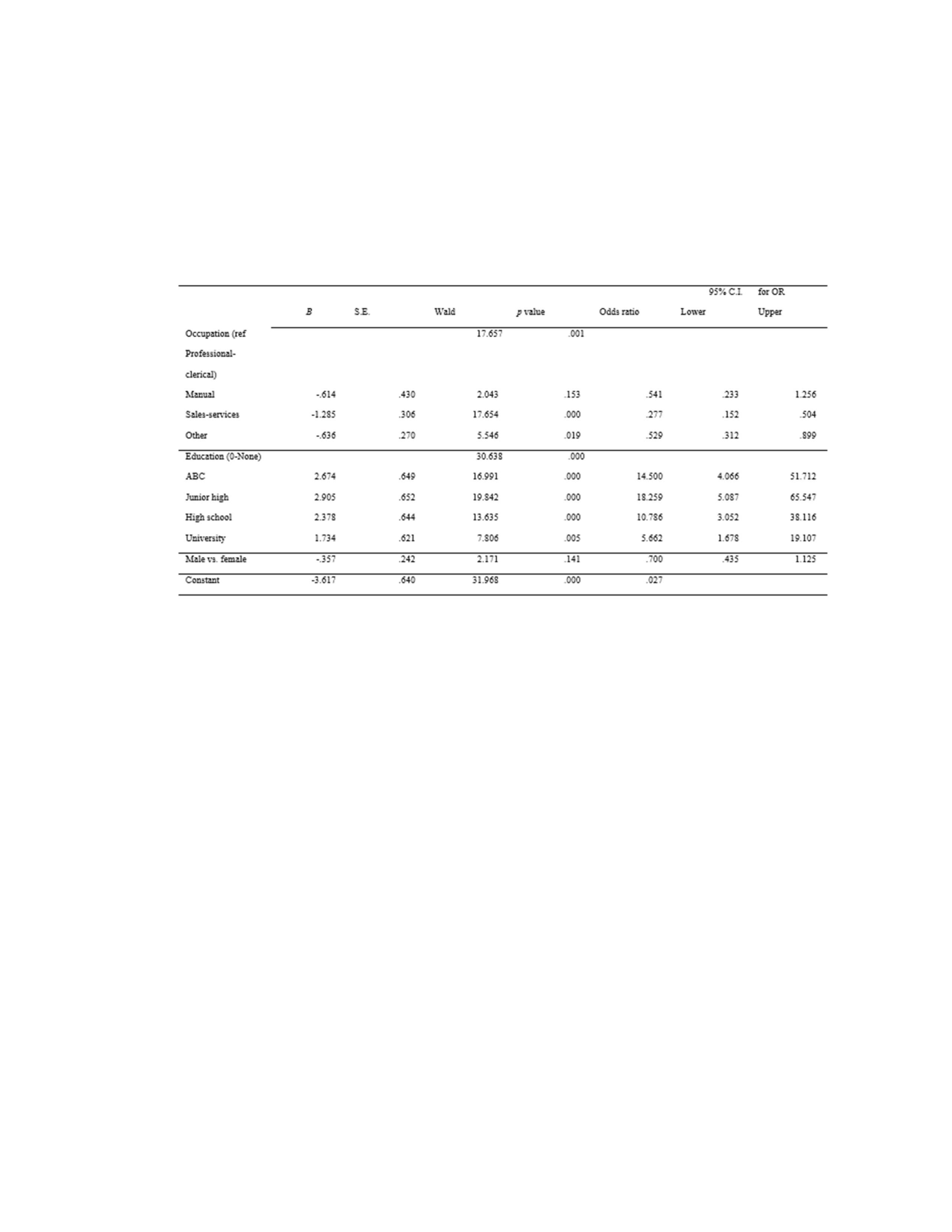
70
Table 10.
Multivariable analysis for the dependent variable “How you get EVD” with predictors
occupation, education, and gender.
The Hosmer and Lemeshow test showed the results adequately fit the data at p =
.869. Additionally, according to the Nagelkerke R
2
, a 13% variation in the outcome is
explained by this model.
Occupation was a significant predictor of understanding how you get EVD (p =
0.001). The interpretation of the results are as follows: individuals of manual (OR = .541,
95% CI = .233-1.256), sales services (OR = .277, 95% CI = .152-.504), or other
occupation (OR = .529, 95% CI = .312-.899 ) are less likely to understand how you get
EVD, compared to professional-clerical participants.
With p < .0001, education is also a significant predictor of how you get EVD. All
those with formal education were more likely to know more about how you get EVD than
those with no formal education. Compared to no education in descending order, junior

71
high had the greatest level of understanding (OR = 18.259, 95% CI = 5.087-65.547)
followed by ABC (OR = 14.5, 95% CI = 4.066-51.712), high school (OR = 10.786, 95%
CI = 3.052-38.116), and university (OR = 5.662, 95% CI = 1.678-19.107). In summary,
compared to no education, those with ABC were 14.5 times more likely to understand
how you get EVD, those who finished junior high were 18.259 times more likely to know
how you get EVD, those who completed high school were 10.786 times more likely than
those with no education to know how you get EVD, and those who finished university
were 5.662 times more likely to know how you get EVD compared to those with no
formal education.
For gender, the p value is .141 which is above the 5% significance level. Gender
is therefore, not a significant predictor of understanding how you get EVD.
Table 11 partially answers research question 2: Is there an association between
socioeconomic and demographic factors (education, age, gender, and occupation) and
frequency of employed adults who report understanding the basic nature of the EVD
(common symptoms and how it is spread) in Monrovia, Liberia? This table shows the
association between independent variables occupation, education, and gender and the
dependent variable EVD knowledge.

72
Table 11
Multivariable analysis for the dependent variable “Knowledge” with predictors
occupation, education, and gender.
The Hosmer and Lemeshow test showed the results adequately fit the data at p =
.270. Additionally, according to the Nagelkerke R
2
, a 9.7% variation in the outcome is
explained by this model.
Occupation with a p value of .391 was not a significant predictor of EVD
knowledge. With a p<.0001, education is a significant predictor of EVD knowledge.
Compared to no education in descending order, university had the highest level of
knowledge (OR = .452, 95% CI = .326-.626) followed by ABC (OR = .266, 95% CI =
.164-.432), junior high (OR = .212, 95% CI = .123-.367), and high school (OR = .210,
95% CI = .133-.331).

73
For EVD knowledge among genders the p value is .009 thus showing a
significant difference between males and females. Examination shows that with males
used as the reference gender and an odds ratio of 1.417 (95% CI = 1.092-1.840), females
are more likely to have greater knowledge about EVD.
Table 12 shows the association between sanitizer use and predictors occupation,
education, and gender. This table corresponds with the first research question: Is there an
association between socioeconomic and demographic factors (education, age, gender, and
occupation) and frequency of employed adults who report the use of preventative hygiene
practices (use of hand sanitizer and bleach) in Monrovia, Liberia?
Table 12
Multivariable analysis for the dependent variable “Sanitizer” with predictors
occupation, education, and gender

74
The Hosmer and Lemeshow test showed the results adequately fit the data at p =
.737. Further, according to the Nagelkerke R
2
, 8.1% variation in the outcome is explained
by this model.
Occupation was a significant predictor of hand sanitizer use among this
population with a p value = .019. individuals with occupations besides professional-
clerical were less likely to use hand sanitizer. Those in manual jobs were 1.827 less likely
to use hand sanitizer (95% CI = 1.165-2.865). Individuals in sales-services used hand
sanitizer 1.759 times less (95% CI = 1.184-2.613), and those in the other category used
hand sanitizer 1.435 times less (95% CI = .976-2.130).
Education is a significant predictor of hand sanitizer use with p value<.0001.
Increased hand sanitizer use was seen among those with formal education. The use of
hand sanitizer can be seen as follows among education levels: university (OR = .648,
95% CI = .470-.892), high school (OR = .285-.641), ABC (OR = .315, 95% CI = .200-
.497), and junior high (OR = .255, 95% CI = .153-.423).
For gender, p value = .212. Gender is not a significant predictor of hand sanitizer
use.
The Table 13 demonstrates the association between occupation, education, and
gender with the dependent variable signs and symptoms. Signs and symptoms was a
component of the second research question looking at overall EVD knowledge among the
study population.

75
Table 13
Multivariable analysis for the dependent variable “Signs and Symptoms” with predictors
occupation, education, and gender.
The Hosmer and Lemeshow test showed the results adequately fit the data at p =
.498. Further, according to the Nagelkerke R
2
, a 14.2% variation in the outcome is
explained by this model.
For occupation, the p value = .004. Occupation is thus a significant predictor of
understanding EVD signs and symptoms. Individuals working in professional or clerical
fields were more likely to understand the signs and symptoms of EVD. This is
demonstrated through the odds ratios of the other professions: other (OR = .474, 95% CI
= .252-.893), sales-service (OR = .287, 95% CI = .141-.581), and manual (OR = .279,
95% CI = .076-1.018).

76
Education is also a significant predictor in this category with p value< .0001. All
those with formal education were more likely to know more about EVD signs and
symptoms. Specifically, those with ABC education were 31.398 times more likely to
know the signs and symptoms (95% CI = 3.990-247.098), junior high 25.362 times more
likely (95% CI = 3.155-203.898), high school 15.685 times (95% CI = 1.971-124.815),
and university 7.347 times (95% CI = .952-56.734).
For gender, the p value is .424 which is above the 5% significance level.
Therefore, gender is not a significant predictor of EVD sign and symptom recognition.
Bucket use was the second part of the first research question which looked at
preventative hygiene use in the study population. Sown below is bucket use among
working adults of the following demographics: education, occupation, and gender.

77
Table 14
Multivariable analysis for the dependent variable “Bucket Use” with predictors
occupation, education, and gender
The Hosmer and Lemeshow test showed the results adequately fit the data at p =
.995. Further, according to the Nagelkerke R
2
, 3.7% variation in the outcome is explained
by this model.
Occupation was a significant predictor of bucket use among this population with a
p value = .049. Individuals with occupations besides professional-clerical were less
likely to use hand sanitizer. The interpretation of the results are as follows: individuals of
manual (OR = 1.432, 95% CI = .829-2.472) sales services (OR = 1.316, 95% CI = .853-
2.030) or other occupation (OR = .899, 95% CI = .595-1.358) are less likely to
understand how you get EVD, compared to professional-clerical participants.

78
Education was a significant predictor of bucket use with p value = .005. All
education levels beyond no education had increased bucket use; in decreasing order
bucket use was as follows: university (OR = .652, 95% CI = .427-.998), ABC (OR =
.601, 95% CI = ..348-.1.037), high school (OR = .536, 95% CI = .326-.883), and
junior high (OR = .353, 95% CI = .205-.610).
For gender, the p value is is .583, thus gender is not a significant predictor of
bucket use.
Summary and Transition
The results of the descriptive statistics, chi-square analysis, and binomial logistic
regression were presented in Section 3. These results explored the association between
independent variables (age, occupation, education, ward, and religion) and preventative
hygiene measures including the use of hand sanitizer and buckets with bleach. The
second research question explored the association of these independent and EVD
understanding as measured by overall knowledge, knowledge of the signs and symptoms,
and awareness of how you get EVD.
Chi-square analysis revealed that age, ward and religion were not significant
predictors of EVD understanding and preventive hygiene and were eliminated as
independent variables for multivariable analysis. Based on BLR analysis, education was a
significant predictor of EVD understanding for all criteria/ categories, so the first null
hypothesis is rejected. Education is a significant predictor of preventative hygiene use
among both criteria defined in the first hypothesis, so the null hypothesis is rejected.
Gender was not a significant predictor of knowledge pertaining to how you get EVD and

79
signs and symptoms but was for overall knowledge with females knowing more than
males. Gender was not a predictor for hand sanitizer use or bucket use. Occupation was a
significant predictor for how you get EVD and signs and symptoms but not general EVD
knowledge. For hypothesis two, occupation was a significant predictor of hand sanitizer
use but not of bucket use.
Section 4 is next and will cover a more detailed interpretation of these findings.
Also, in Section 4 the limitations, recommendations for future study, and the use of this
research to promote social change will be discussed.

80
Section 4: Application to Professional Practice and Implications for Social Change
Healthcare and public health professionals are becoming increasingly concerned
as EVD outbreaks over the last decade have shown rising mortality rates (CDC, 2017).
The EVD outbreak of 2014-2016 caused over 11,000 deaths throughout Africa with
Liberia experiencing the highest morbidity and mortality (CDC, 2017). Spread into urban
centers like Monrovia, Liberia is partially responsible for this new trend (CDC, 2017). A
cross-sectional survey conducted by MIT in Monrovia during the epidemic was used to
explore the nature of EVD in Liberia in more detail.
Using the survey, this study explored the impact of sociodemographic and
socioeconomic factors on the use of bleach and hand sanitizer and on general EVD
knowledge among employed adult Monrovians, by using bivariate (chi-square) and
multivariable analysis (binomial logistic regression). The survey was conducted in all 15
of Monrovia’s wards. Seventy-seven communities were chosen within the wards, based
on population size, and then homes were chosen randomly by the surveyors. Data were
collected electronically and uploaded in real time to a cloud, where researchers could
oversee its accuracy and address concerns.
A better understanding of these associations could lead to more effective
preventative programming among employed adults in future outbreaks. In Section 4,
these results will be discussed within the context of the literature, and recommendations
for practice and future research, as well as social change implications, will be provided.
Interpretation of the Findings
Key findings of the study

81
According to the results of the study, occupation and education were significant
predictors of hand sanitizer use, but gender was not. People working in professional-
clerical jobs were more likely to use hand sanitizer compared to other occupations. Those
who finished university were most likely to use hand sanitizer followed by those who
finished high school, ABC, junior high, and no school.
Occupation and education were also significant predictors of bucket use. Those in
professional-clerical positions were most likely to use buckets with bleach as were those
with formal education. Bucket use decreased among levels of education in the following
order: university, ABC, high school, junior high, and none. Therefore, occupation and
education are significant predictors of use of preventative hygiene practices.
In addition, I explored the association between EVD knowledge and
sociodemographic factors. The first variable, “How you get EVD,” was analyzed with
predictors occupation, education, and gender. Occupation and education, but not gender,
were found to be significant predictors. Within occupation, those working in manual,
sales-services, or “other” occupations were less likely to understand how you get EVD
compared to individuals working in professional-clerical occupations. For education,
those who finished junior high had the greatest level of knowledge followed by ABC,
high school, university, and no formal education.
The second variable, “Knowledge,” encompassed general knowledge questions
about EVD. Occupation was not a significant predictor of EVD knowledge, but education
and gender were. Knowledge about EVD decreased in the following order among the

82
categories: university, ABC, junior high, high school, and none. Females were more
likely to know about EVD.
Occupation and education, but not gender, were significant predictors of
understanding EVD signs and symptoms. Those working in clerical-professional fields
had the highest amount of knowledge, and those with formal education were more likely
to know the signs and symptoms. For education, knowledge decreased in the following
order: ABC, junior high, high school, and university.
Finally, occupation and education were predictors for understanding how you get
EVD and understanding of EVD signs and symptoms. For EVD knowledge, education
and gender were also significant predictors.
Findings in Relation to the Literature
Research has shown that certain age groups, especially the older, are more at risk
for dying or developing complications from EVD (Glynn, 2015). Older individuals are
also more likely than the rest of the Liberian population to be impoverished or lack
healthcare (Maharaj, 2012). These facts make age an important demographic to consider
when examining the 2014-2016 EVD epidemic. Results from this study showed that age
was not a significant predictor of EVD knowledge or preventative hygiene. This indicates
that despite lack of adequate healthcare or finances, older are still able to practice basic
EVD hygiene measures and understand general EVD knowledge.
In this study, religion was not a significant predictor of EVD knowledge or
preventative hygiene. One of the highest risk activities for contracting EVD is any
contact with bodily fluids including through Liberian burial practices (Pandey, Atkins,

83
Medlock, Wenzel, Townsend, Childs, & Galvani, 2014). Though burial ceremonies
themselves may differ among religions, the Liberian burial ceremonies that increase
exposure may be more cultural compared to religious as indicated by literature (CDC,
2018). Use of PPE while burying an EVD positive body and use of professional burial
services should continue to be promoted indiscriminately among all religions studied:
Christians, Muslims, tribal, etc. (Suwantarat & Apisarnthanarak, 2015).
Ward was not considered a significant predictor of EVD knowledge or
preventative hygiene use among employed Monrovians, probably because the significant
predictors found in this study (occupation, education, and gender) were more or less
evenly distributed among the communities in Monrovia. Any investment into educational
campaigns proposed in professional practice should thus be done throughout Monrovia
and not be focused in one specific community.
Professional-clerical occupations were found to be significantly more aware of
EVD signs and symptoms and how EVD is spread and were more likely to use
preventative hygiene compared to other professions. This field would include healthcare
workers who are known to be more at risk for contracting EVD (Suwantarat &
Apisarnthanarak, 2015). Literature revealed a lack of resources including medicine and
PPE likely led to increased infection rates among this field (Gee & Skovdal, 2017).
However, these results show that more basic hygiene practices like hand sanitizer and
bleach were being used. It is also logical that healthcare workers would have more
knowledge about EVD signs and symptoms and how EVD is spread compared to other
professions because of their training (Oladimeji, et al., 2015). Though this same study by

84
Oladimeji, et al. found that often the quality of training varied (2015). Other professional
occupations may be at a similar advantage because of trainings and access to hand
sanitizer or more financial means to purchase preventative hygiene measures (Doocy, &
Burnham, 2006).
Other occupations may put some workers more at risk, such as miners who are
exposed to bats which are known carriers of EVD (CDC, 2018). Hunters and those who
sell bush meat in the markets are also more at risk for contracting EVD (CDC, 2018). It is
therefore concerning that these professions are included in the group of occupations who
were less likely to know how EVD is spread, the signs and symptoms of EVD, and were
less likely to use preventative hygiene. Educational efforts or aide for hygiene items
would be a valuable initiative among these groups (Doocy & Burnham, 2006).
For the variable education, those with formal education (ABC-university)
understood more about EVD and practiced more preventative EVD hygiene measures
compared to those with no formal education. Public health-based education programs
have been proven to be one way to mitigate the spread of EVD (CDC, 2018). Varying
levels of EVD knowledge and hygiene practice among grade levels cannot be clearly
determined, but based on these results and current literature, education on EVD
throughout school would likely be beneficial (CDC, 2018).
Several studies have shown differences in male vs. female hygiene practices and
public health knowledge (Judah et al., 2009). This research revealed women had more
general EVD knowledge compared to men, but the two genders were comparable when

85
looking at preventative hygiene measures, knowledge of signs and symptoms, and
knowledge of how EVD is spread.
Women are traditionally the caregivers for those who are sick in the home as well
as for extended family (Suwantarat & Apisarnthanarak, 2015). As the epidemic
progressed, mistrust of the government and hospitals led to even more home care
(Suwantarat & Apisarnthanarak, 2015). Women were considered more at risk for
contracting EVD for this reason, and because they were more likely to prepare bodies for
burial (Suwantarat & Apisarnthanarak, 2015). Based on this literature, females in the
study population would have been most likely to have personally cared for an EVD
relative or to have prepared a body for burial (Suwantarat & Apisarnthanarak, 2015).
Thus, women are seeing and experiencing a side of the EVD epidemic statistically more
than men which may be giving them more insight into generally what happens during
EVD progression (Suwantarat & Apisarnthanarak, 2015). Those who care for the sick are
also more likely to take precautions (if possible), which could include seeking additional
educational (Gatherer, 2014).
Interpretation of Findings in the Context of the Theoretical Framework
The Theory of Reasoned Action/ Planned Behavior examines the relationship
between attitudes and behaviors (Bensley & Brookins-Fisher, 2003). For this study, the
behaviors being analyzed were the use of preventative hygiene and learning/remembering
knowledge about EVD. Contracting EVD is the potential negative outcome of not taking
these measures. This analysis assumes that people want to prevent EVD infection. There
are several reasons individuals would be motivated to prevent EVD infection including

86
working to provide for themselves and their families, serving as caregivers, and because
they witnessed the personal and economic effects from previous epidemics (Suwantarat
& Apisarnthanarak, 2015).
Attitudes about these behaviors can be influenced by several internal and external
factors including beliefs about what outcome the behavior will yield and how valuable
that outcome may be (Bensley & Brookins-Fisher, 2003). In schools, consistent education
may be used to reinforce the belief that learning and remembering EVD facts and using
preventative hygiene will result in not getting infected, and further that not getting
infected will prevent serious illness and possibly death (CDC, 2018). Kids will be more
likely to practice preventative hygiene and retain knowledge if they believe that
remembering the signs and symptoms of EVD, knowing about EVD, and knowing how
to identify EVD prevent infection.
This research showed that individuals working in professional-clerical positions
were more likely to know about EVD signs and symptoms and how EVD is spread and to
practice EVD preventative hygiene. A person in healthcare may believe the hygiene
measures discussed prevent EVD because they have lived experience in addition to
training (CDC, 2016). This belief will lead to those in healthcare being more likely to
practice these behaviors (Bensley & Brookins-Fisher, 2003). If training about
preventative hygiene and the need to have EVD knowledge to reduce transmission is less
among other professions or if access to preventative hygiene is less, than beliefs about
their effectiveness in disease prevention may be less as well (Bensley & Brookins-Fisher,
2003).

87
Women serve an important role in Liberian society by functioning as caregivers,
mothers, teachers, cooks, etc. (Suwantarat & Apisarnthanarak, 2015). They are essential
to the running of the household and family in the Liberian culture (Suwantarat &
Apisarnthanarak, 2015). Females were identified as having more EVD knowledge than
men in this study population. Within the context of the TRA/ PB, women believe that
having more EVD knowledge is likely to help prevent EVD infection (Bensley &
Brookins-Fisher, 2003). It is unknown whether this is because of lived experience
because they remembered the trauma from previous EVD outbreaks or if it is done
purposefully to prevent the spread to their families after caring for a sick loved one and to
protect themselves as a crucial part of the home.
Social norms also play an important role in behavioral decision making (Bensley
& Brookins-Fisher, 2003). With this study, variations within different education levels
offer an opportunity to look at social norms in more detail. Children will be more likely
to do a desired behavior if a child believes his or her parents, teachers, and peers want
them to learn more about EVD and want them to practice preventative hygiene. Parents
and teachers should show children how proud they are when they practice and remember
what they have learned.
People want approval from their peers, not just throughout school, but as adults
too (Bensley & Brookins-Fisher, 2003). This may offer insight into the occupations
where disparities were seen in EVD knowledge and preventative hygiene practices. If an
individual sees his coworkers taking more precautions or believes his coworkers approve
or want him/her to adopt these behaviors than they are more likely to do so themselves.

88
Workers were motivated to get back to work after the previous EVD epidemic caused
significant job losses and economic hardship. EVD infection prevention can prevent this
(CDC, 2018). Education could reinforce this as an additional benefit of EVD prevention
beyond preventing serious illness (CDC, 2018). If coworkers and bosses are motivated in
some way to practice these skills, then slowly everyone in the workplace will get on
board. Establishing social norms may be done through training or purchasing hand
sanitizer and bleach for employees as is done for healthcare workers, the population with
the most knowledge of EVD and best prevention practices.
Based on cultural norms, women believe they must serve the role as the caretaker
(Suwantarat & Apisarnthanarak, 2015). As such, women likely believe their family wants
them to take precautions to know about EVD so they can identify the ill and to protect
themselves. However, these theories do not account for other cultural or demographic
motivators. Ward, for example, was a potential predictor used in this study, but it was not
found to be significant (Bensley & Brookins-Fisher, 2003). On the other hand, cultural
factors like traditional burials or hunting bushmeat are considered to be risk factors for
infection (CDC, 2018).
Other external and internal barriers that cannot be overcome may exist as well,
such as financial barriers to purchase hygiene measures, personality barriers (some
people may not be influenced by social norms or have attitudes that are unchangeable by
reason), some people may be afraid, some may be unable to get a professional-clerical
job, and some people may lack access to education (Bensley & Brookins-Fisher, 2003).
Extending education and media campaigns to all literacy levels, even those without

89
formal education, to all occupations, and possible government subsidizing may be
options. Campaigns could also address mistrust of the government and fear of the disease
so people can begin to feel in control and make more reasoned decisions.
Limitations
There are some limitations to the secondary data set which was chosen for this
research. The primary investigators mitigated many potential issues with the data such as
using a non-governmental agency to do the surveying, collecting data electronically for
monitoring and accuracy, and mapping out the data collection strategically so an accurate
representation of the population would occur. However, regardless of these measures
certain challenges exist.
First, the survey was cross sectional meaning that the data collected can only
demonstrate association and not necessarily causation (HHS, 2007). Cross sectional
surveys like this one also only refer to a brief time period. Thus, this study may not be an
accurate representation of the preventative hygiene practices used throughout the entire
epidemic or the knowledge of EVD among the population for those two years. However,
the data were collected at the early stages of the epidemic in Liberia and still can offer
insights into the questions being posed in this research.
Additionally, there is always the possibility of field error despite safeguards.
Investigators were told to report any problems, and respondents were given anonymity.
Further, keeping the survey simple and electronic hopefully reduced incorrect responses.

