


SMALL AND MEDIUM ENTERPRISE MANAGEMENT
ARIZONA STATE UNIVERSITY
ENT 441 - ENTREPRENEURIAL MANAGEMENT
WEEK 5
Introduction:
The position of Small and Medium Enterprises (SMEs) has an important and strategic role in
the national economic system, among others because:
1.
The number of business units is huge (around 3.4 million).
2.
Labor-intensive (8.7 million people in 2006).
3.
As a creditor, it is relatively compliant in returning capital.
4.
The resilience of SMEs is quite high in the face of various upheavals (the monetary
crisis in 1997).
So it can be said that SMEs are the backbone of the economy that has repeatedly proven
to contribute more than 50% of GDP.
Facing the era of free trade and came into force on January 1, 2010, Indonesia opened its
domestic market to ASEAN countries (Indonesia, Thailand, Malaysia, Singapore, the
Philippines and Brunei Darussalam, Cambodia, Vietnam) with China called the ASEAN
China Free Trade Agreement (ACFTA). Impact on the increasing opportunities as well as
threats for SMEs in the country from the invasion of foreign products with quality and price
are very competitive. Moreover, the implementation of the AEC (Asean Economic
Community) since the beginning of 2016 where countries outside Indonesia see Indonesia as a
"golden field". What is more worrying is that if SMEs view AEC and the era of globalization
as obstacles to their existence due to their inability, then this will be very dangerous for the
industrial structure as a whole. It is no wonder that the Jokowi-Jk administration is actively
spawning policy packages whose purpose is to anticipate that companies in Indonesia will
benefit and win the competition.
Based on the results of a study of SMEs in Indonesia conducted by Prof. Urata from

Japan in 2000, 4 (four) main non-financial weaknesses of SMEs were found, namely (Noordin
Noor: 2006):
1.
Lack of knowledge on production technology and quality control.
2.
Limitations in marketing.
3.
Limited human resources in the field of improving the quality of human resources.
4.
Lack of administrative knowledge on accounting financing.
Globalization has signaled that the future will be characterized by increasingly intense
competition among businesses with a low-cost economy. Previously, SMEs have also
experienced many difficulties in facing competition with stronger national business sectors.
Moreover, the impact of globalization has increasingly entered the country. Therefore,
business actors, especially those on the SME scale, need to prepare the right strategy to make
Indonesian SMEs able to face competition, both on a national, regional and global scale with
high competitiveness.
SME is a business activity carried out, either by individuals or groups, where the initial
capital is not of great value and has the aim of making a profit with a relatively limited
amount of labor and assets. Generally, a person who is involved in the business world is
called an entrepreneur or entrepreneur. Usually an entrepreneur has the courage to take risks
in starting to lead a business, to achieve profits by utilizing resources (people, equipment
materials and capital) effectively and efficiently.
A successful business is a reflection of a successful entrepreneur. In every activity, the
entrepreneur is able to see opportunities and take advantage of them to achieve benefits that
are useful for himself, the environment and the continuation of his business. If the
entrepreneur in every business activity as well as his life and life is fair and balanced. Then
his goals will be in line with the goals of his family and nation.
7.1. Characteristics of Small and Medium Enterprises:
Small and Medium Enterprises (SMEs) need to be prepared in order to survive and
thrive despite having to face competition from stronger economic actors, both domestically
and from abroad. Various coaching programs for SMEs that have been carried out so far do
not seem to pay too much attention to the distinctive characteristics of SMEs that actually
need to be utilized properly in order to become a force that cannot be rivaled by stronger
economic actors.
SMEs actually have unique characteristics, special traits, which make them inappropriate
for carrying out certain business activities. But it is also these unique characteristics that cause
them to excel when SMEs take a certain position in the industrial and business world.
The characteristics of small businesses are as follows:
1.
Generally managed by the owner.
2.
The organizational structure is simple.
3.
The owner knows his employees.
4.
The percentage of company failures is high.
5.
Shortage of skilled managers.
6.
Long-term capital is difficult to obtain.
7.
The number of employees is small.
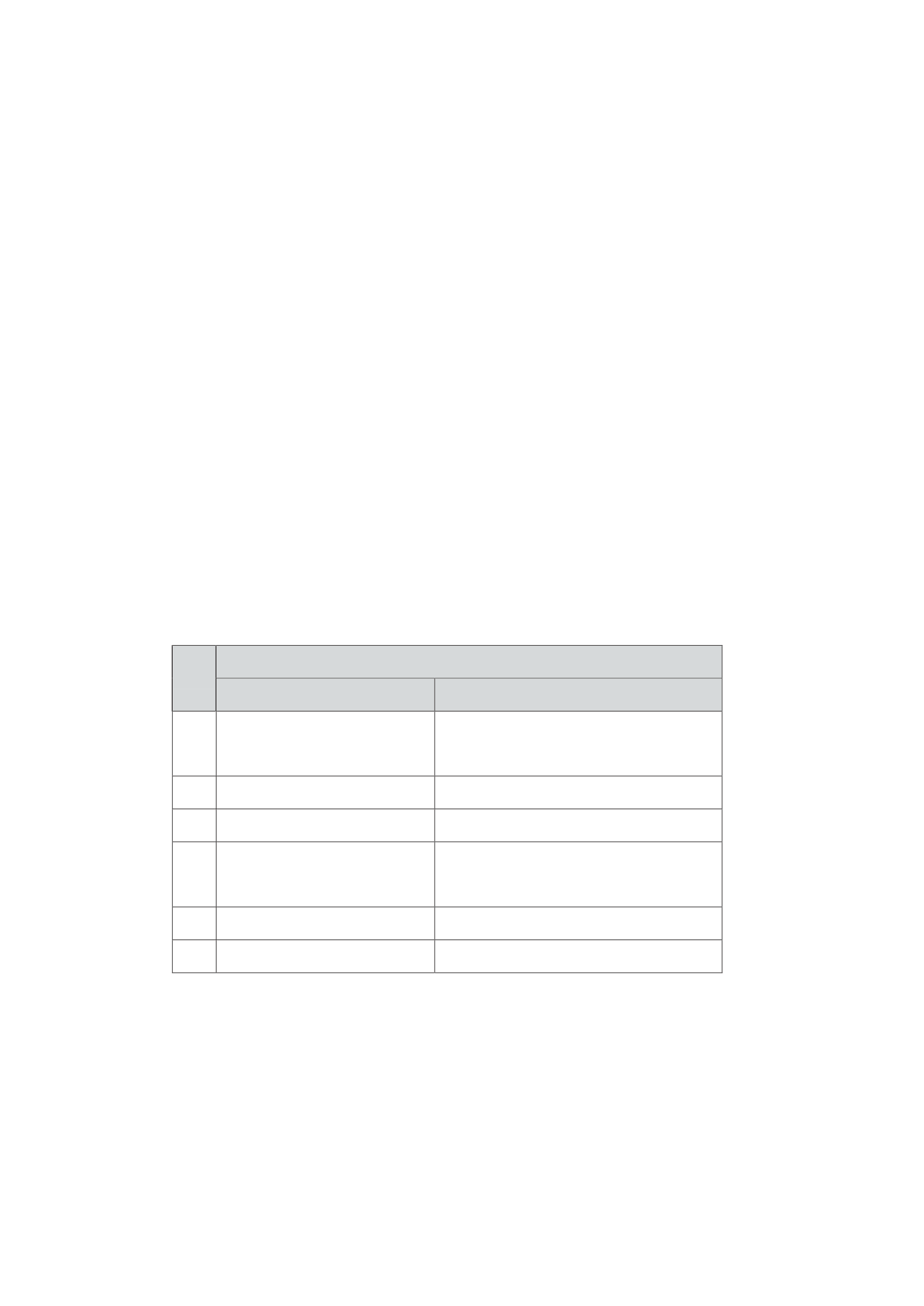
The differences between a small enterprise business and a large enterprise business are as
shown in Table 7.1 as follows:
Table 7.1: Differences between small and large businesses
No.
Differences in effort
Small Business
Big Business
1
Generally, the owner
becomes the manager
Non-owner manager
2
Local area of operation
Regional or national
3
Simple organization
Complex organization
4
Owner is intimate with
employees
The owner does not know the
employees
5
Many failures
Rarely fails
6
All-round owner
Specialist management
Industry Business Limits
Small and Medium Industrial Enterprises (SMEs) according to the ministry of industry are
industrial enterprises consisting of small industries and medium industries, namely:
1.
Small industries are companies that have business activities in the industrial sector with a
maximum investment value of IDR 200 million excluding the value of land and buildings for
business premises. And has a sales value per year of IDR 1 billion or less.

2.
Medium-sized industries are companies that conduct business activities in the industrial sector
with an investment value greater than Rp 200 million up to a maximum of Rp 10 billion
excluding the value of land and buildings for business premises. And has a sales value per
year greater than Rp 1 billion but less than Rp 50 billion.
3.
Large industries are companies that conduct business activities in the industrial sector with an
investment value greater than Rp 10 billion excluding the value of land and buildings for
business premises. As well as having sales value per year greater than IDR 50 billion.
The disadvantages of small businesses are as follows:
1.
Less future-oriented
2.
Rare innovation
3.
Rarely held regeneration
4.
Quickly satisfied
5.
Lack of technology responsiveness
6.
Lack of understanding of regulations
7.
Lack of management understanding
8.
Inadequate capital structure
SEGMENTATION, TARGETING AND POSITIONING:
In order to have a sustainable competitive advantage, companies must describe market
segments to understand what the market demands (demand perspectives), needs and wants
(wants and needs), benefits sought (benefits sought). The company must prevent the escape of
customers (customers switchable) and should obtain customer loyalty (customer loyalty).
Companies need to group people according to certain characteristics for the purpose of
marketing programs called segmentation. After segmentation is done, market targeting is
done. Market targeting means choosing which of the available market segments to target for
the retail company's marketing. After targeting, the next is marketing, positioning. Positioning
means how to place the company name (Brand) and its merchandise in the minds of the
intended consumers or position themselves in the brains and hearts of consumers.

8.1. Segmentation
Kotler, defines market segmentation as a process to divide the market into more homogeneous
consumer groups, where each consumer group can be selected as a target market for the
company to achieve with its marketing mix strategy, while Murphy, defines market
segmentation as a process of dividing the entire heterogeneous market (environment) into
smaller and homogeneous groups with relatively similar needs that a company is expected to
fulfill properly.
Market segmentation helps companies to create a specific product and meet the needs of
a part of the market that is targeted, so the usefulness of market segmentation for marketing
strategy design is as follows:
🔾 Gain more effective competitive positioning for existing brands
🔾 Further streamline the current brand positioning by relying on limited markets
🔾 Separate positioning of two or more brands from the same company to minimize
cannibalism
🔾 Identify gaps in the market that indicate opportunities to develop new products
Effective market segmentation must meet the following requirements:
🔾 Measurability: indicates that the amount of purchasing power of each segment should be
measurable to a certain degree, despite the fact that some segments are not.
certain variables are not easy to measure.
🔾 Accessibility: indicates how far the segment can be reached and served effectively.
🔾 Substantially: a group will deserve to be called a segment if it is large enough and/or
profitable enough.
🔾 Feasibility: indicates the extent to which programs are effective can be structured to appeal
to the segment.
In conducting market segmentation, there are procedures that are usually carried out in
marketing research, which consist of three stages, namely:
🔾 Survey stage
Researchers will conduct interviews and form focus teams to increase knowledge about

consumer motivations, attitudes and behaviors and to do this, researchers prepare formal
questionnaires to collect data about:
•
Product attributes and their level of importance
•
Brand awareness and brandratings
•
Product usage pattern
•
Attitude by product category
•
Psychographic and mediagraphic demographics of the respondents
🔾 Analysis Stage
The researcher will use factor analysis on the data to separate highly correlated
variables, and then perform clustering analysis to generate market segments.
🔾 Profile Giving Stage
Each group will be given a profile related to attitudes, ratings, demographics,
psychographics and media consumption habits.Example of segmentation at Diamond
Supermarket
Based on the results of observations and surveys, the majority of segmentations at D-
best Fatmawati are housewives, retirees, and expatriates. And according to the
management, Diamond Supermarket's target consumers include all segments, namely from
the lower to the upper class (premium).
8.2. Targeting
Targeting is choosing one or more market segments to enter or how a company
optimizes a market and in determining the company's target market should use the concepts of
prioritization, variability and flexibility. The concept of variability is used to deal with an
increasingly competitive situation, because companies cannot provide the same service to
everyone who has been prioritized. The more the same the less optimal it will be, and the
company can be optimal in serving people if it can provide more variety. The concept of
flexibility has to do with the variation earlier because the more flexible, a company can
provide variations without spending a lot of additional costs. Example of target marketing at
Diamond Supermarket.
Diamon supermarket's marketing target is all segments of the family or individual. In
addition to their target consumers are expatriates. Judging from the provision of imported
products they have provided on the product display at Diamond Supermarket.

8.3. Positioning
The definition of positioning is given by several experts as follows:
•
According to Don E. Schwitz
Positioning is how to improve and place the products we make against our competitors in
the minds of consumers, in other words, positioning is used to fill and fulfill consumer
desires in certain categories.
•
According to Kotler
An act of designing a company's offerings and image so that it creates its own place and
value in the minds of consumers.
•
According to Al Ries and Jack Trout
Positioning is everything you do to the mind of the prospect, in other words you put the
product into the mind of your process.
•
According to David A. Aaker
Positioning is another word for "impression", and that impression is directed towards a
number of objects that form competition with each other.
So it can be concluded that positioning is an effort made by companies in designing their
products so that they can create their own impression and image in the minds of their
consumers as expected.
Some positioning strategies to face the competitive world are as follows:
•
Positioning by attributes: Companies position themselves according to attributes such as
size, length of existence and so on.
•
Positioning by benefit: The product is positioned as a leader in a particular benefit.
•
Positioning by use or application: Positioning the product as the best for a number of uses
or applications.
•
Positioning by user: Positioning the product as the best for a number of user groups.
•
Positioning according to competitors: The product positions itself better than the named
or implied competitor.
•
Positioning by product category: The product is positioned as a leader in a product
category.
•
Quality or price positioning: Product is positioned to offer the best value

According to Kotler, there are 4 classifications of company positions according to their
role in the target market, namely:
•
Market leader
These companies have the largest market share and usually lead in price changes, new product
launches, distribution coverage and promotional intensity.
•
Market challenger
These companies are positioned after the market leader or in the second position. These
companies can do two things, they can aggressively attack the market leader to gain market
share (market challengers) or they can be quiet and not cause a stir (market followers).
•
Market followers
This model company prefers to follow rather than challenge the market leader. The things that
are imitated are usually the products, distribution and advertising of the leader, but even
though the marketing strategy follows the market leader, there are usually still differences
compared to the market leader such as price, packaging or in addition to adapting sometimes
improving it.
•
Market breaker
The alternative to a large market follower is a leader in a small market or niche. Small
companies generally avoid competing against large companies and aim for small markets that
do not attract large companies and the basic idea of a niche is specialization. Example of
positioning at Diamond Supermarket
Diamond Supermarket's positioning is on fresh products and offers a fairly cheap price. Based
on the results of FGD (Focus Group Discussion), customers say that fresh products at
Diamond Supermarket have good quality compared to the quality of competitors, and the
prices offered by them are also quite reasonable and cheap.
According to customers, Diamond has a fairly comfortable shopping place compared to
Hypermarket. The characteristics of Diamond Supermarket customers are that they do not like
crowded places, preferring a comfortable and quiet place. And also has a complete product
and good quality. It can be seen that the positioning of Diamond Supermarket in the eyes of
its customers is quality.
Good, fresh and cheap products and a convenient shopping place.

Marketing Aspects of Entrepreneurship:
At the initial stage, a new entrepreneur must have the ability to look forward to business
prospects from the marketing aspect (customer future condition) which includes answers to
the questions: change of customer behavior?
1.
Who are (he customers) Occupants
2.
What do they need and Want Objects
3.
Why Objectives are they Trying to SatisfyObjective
4.
Who Participates in the buying to decision Organization
5.
How do customers make their buying decisions Operation
6.
When do customers seen ready to buy Occasions
7.
Where do customers prefer to buy Outlet
The Success of New Entrepreneurs in Creating Market Competition
1.
Win through higher quality
2.
Win through better services
3.
Win through lower price
4.
Win through high market share
5.
Win through adaptation and customization
6.
Win through continuous product improvement
7.
Win through product innovation
8.
Win through exceeding customer expectations
9.
Win through entering high-growth markets
Market Analysis Aspects
External environment
•
Economy
•
Culture
•
Technology
•
Demand
•
Legal Consideration
•
Competition

•
Raw Materials
Internal environment
•
Financial resources
•
Goal and objective
•
Management team
•
Suppliers
Industry Environment
Six different types of unique essentials
•
Emerging industry
•
Transitional industry
•
Maturing industry
•
Decline of the industry
•
Fragmented industry
•
Global industry
9.1. SWOT Analysis
Entrepreneurs should know SWOT analysis is an analysis model to identify how big and
small the strengths and weaknesses of the company are as well as how big and small the
opportunities and threats are.
Business changes and waves are increasingly complicated and full of uncertainty, so the
strategic planning board must be sharper in conducting environmental analysis. A number of
trends in relevant assumptions must be re-thinking, re-inventing and re-engineering. The
power of the 3Rs above should be carried out in determining the goals, objectives and
strategies, tactics and policies of the company or organization.
Data needs from environmental analysis can use the SWOT analysis method. A
comprehensive analysis of all aspects, both internal and external environmental aspects. To
analyze the internal environment, a company or organization must be able to identify all the
strengths and weaknesses of the company or organization. Meanwhile, to analyze the external
environment, the company or organization must be able to identify all the opportunities and
threats that have the potential to disrupt the company or organization.

•
Strength
Is a strength possessed by a company or organization, such as marketing and distribution
resources. engineering resources (R&D) production and operations resources and financial
resources coupled with other capabilities that are suitable for market needs and superior to
competitors.
•
Weakness
It is a weakness that a company or organization has, such as marketing and distribution
resources, engineering resources (R&D), production and operations resources and financial
resources coupled with other weaknesses against market needs and weak compared to
competitors.
•
Oportunity
Is an opportunity or potential opportunity that a company or organization has, such as socio-
economic opportunities, technology, competitors, suppliers and government opportunities that
can benefit the company's environment.
•
Threat
Is a potential threat that may occur to a company or organization, such as socio-economic
threats, technology, competitors and competition, as well as threats to government aspects that
can disrupt and threaten the continuity of the company or organization.
9.2. Value Chain Analysis
In this value chain analysis is an attempt to divide the business, into the activities of the
company, the activity by Michael Porter in his book Competitive Advantage is divided into
two major groups, namely.
🔾 Primary activity:
These activities include all activities related to inward logistics activities, operations
activities, outward logistics activities, marketing and sales activities and service activities.
🔾 Supporting activity (secondary activity):
These activities include all activities related to corporate infrastructure activities,
human resource management activities, technology development activities and purchasing
activities.
This activity, as shown in Figure 36 in this session, means that the company creates added

value from its activities for consumers. If that value is the price or value that the consumer
pays for the expected amount, then the firm will earn a margin or profit. Moreover, if the
company creates high value while the cost is low, the company will earn a higher margin.
These activities are not all companies can do, there are companies that are able to carry out
and many are not able to do it as a whole. If they are unable to carry out some of them, then
some of them can be; handed over to other parties. For example, IBM; Apple and many others
outsource or hand over to other parties or outsiders in the manufacture of computer
processors.
To increase competitive advantage, companies should conduct benchmarking, which is a
technique to develop the company's ability to excel compared to competitors. This
benchmarking strategy process can use generic strategies, such as differentiation, overall cost
leadership and focus, both differentiation focus and cost focus. For more details, see the
discussion of generic strategies in this book. Figure 3.6: porter's value chain analysis
9.3. Business Strategy
A good marketing strategy must be built on a strong business understanding of market
dynamics, combined with an understanding of needs and wants, competitors, human capital
skills, suppliers both inward and outward. Not only that, but the ability to vary the marketing
mix, segmentation targeting and positioning will greatly help win business competition.
Definition of strategy is a fundamental plan of action that is intended to achieve the
company's objective (Lesser Robert Bittel 1998: 942) The definition of strategy is a
fundamental plan to achieve the company's goals.
Kenneth R. Andrews states that corporate strategy is a pattern of decisions in a company
that determines and expresses the goals, purposes or objectives that produce the main policies
and plans for achieving goals and detailing the range of businesses to be pursued by the
company. Here are some more definitions given:
a.
Strategy, a word derived from the ancient Greek "strategia" (which means the art of the
general) is concerned with the key decisions required to reach an objective or set of
objectives. (William M. Pride, O.C. Ferrel "Marketing" Basic Concepts and Decisions
fourth Edition, Houghton Mifflin Coy, Boston, 1995 : 25)
b.
A marketing strategy encompasses selecting and analyzing a target market (the group of
people whom the organization wants to reach) and ceraUng or maintaining an

appropriate marketing mix that will satisfy those people.
c.
Strategy is the determination of the long-term goals of an enterprise and the adoption of
courses of action and the allocation of resources necessary for carrying out those goals
(Chandler, 2002).
d.
Strategies consist of integrated decisions, actions, or plans that will set and achieve
viable organizational goals (Smart, 1995).
e.
Then we added the definition of business strategy:
f.
Business strategies are the directional actions and decisions, which are required
competitively to achieve the company's goals.
The Difference between Strategy and Tactics:
Strategy is directional actions decisions for the company as a whole and for any function or
area of the business, while tactic is the implementation of the strategies, with emphasis
normally confined to the direct-line functions of the business, such as sales and marketing.
manufacturing, engineering, research and development.
So strategy is the determination of the overall plan or direction of the business, while
tactics are a way that is the implementation of a strategy that emphasizes its support for the
success of the strategy in certain parts of business activities. So, marketing strategy is the
determination of a plan to achieve the desired goals and objectives.
In marketing, which is likened to a battlefield for producers, and traders, it is necessary to
set a strategy. how to win the war. Many opponents are faced in the market field, but
opponents in this market field, should not be killed. as well as enemies in military warfare.
Especially in the Pancasila economic system, it is required that there is mutual care between
strong entrepreneurs and weak entrepreneurs, a foster father system. Only in the control of the
market each tries to control the market and strengthen its position. Therefore, the company
needs a strategy, so a grand strategy or grand strategy is set, and a core strategy or core
strategy. If this grand strategy is correct, it is expected that the company's marketing activities
can be directed to achieve the planned goals. The company will be able to master a broad
market share or a stable market position. Market share means broad control of the market,
while market position is a solid position of a product. For example, market share and
Japanese-made cars are very broad, while Mercedes Benz cars have an unshakable market
position.

9.4. External Forces Affecting the Business
In the picture, you can see a company organization surrounded by
environtmental forces (the influence of external forces), namely in the form of influence from:
a.
Economic system.
b.
Government system.
c.
Socio-cultural system.
Now let us look at the elements in the picture one by one.
1. Organization
This company organization deals with suppliers = suppliers = sellers) of goods to the
company. This means that the company buys goods from the seller, to be reprocessed in the
factory, or to be resold in the shop business. In this relationship between suppliers and
companies, work all the functions contained in marketing. After the goods are processed or
unprocessed in the organization, they are passed on to the final consumer, through various
intermediary channels. In carrying out these activities, the company cannot be separated from
the influence of external forces, namely the influence of economic conditions, government
situations, and socio-cultural influences.
2. Economic System
The influence of the economic system, can be in the form of general policies in the
economic field carried out by the government, for example the emergence of new regulations
that regulate and affect prices, the number of goods on the market, import-export restrictions,
and so on.
All these policies will affect the corporate world. Then there is also the influence of
technology, which greatly helps ease production and technical marketing activities, such as
using sophisticated communication tools, using computer systems for processing company
data and so on.
Finally, the existence of a competitive system cannot be ignored by corporate
organizations. This requires company management to always think, look for new techniques
in order to attract the attention of subscriptions, with price policies, services and so on.
3. Government System
The government system greatly affects the activities of the corporate world, because
the government through the activities of political parties can change or create new regulations.

Or through influential groups in the government or through representatives of the people in
the DPR can also exert pressure that encourages a new policy, so that new legal regulations,
laws and regulations must be obeyed.
4. Social and Cultural Systems
The socio-cultural climate prevailing in a society greatly affects the life of the
corporate world. The existence of certain attitudes and values, the existence of customs and
prohibitions, the existence of fashions and tastes, which are influenced by the level of
education of the people, and the level of needs and abilities of the people, all affect the
company's activities.
A society with a large number of educated people will have different behavior and
consumption patterns than a society where most of the population is made up of people who
do not go to school.
a.
State of the Supplier
It is difficult for an entrepreneur to predict when a new supplier will appear in addition
to the existing one. Therefore, entrepreneurs must always improve their products or business
services and supplies. Entrepreneurs should not sleep soundly because new suppliers have not
appeared. The principle of always improving quality even if there are no new entrants is an
activity that must always be carefully considered.
b.
State of Competition.
It is difficult for an entrepreneur to predict when a new rival will appear. Therefore,
entrepreneurs must always improve their products or business services. Entrepreneurs should
not sleep soundly because new competition has not yet emerged. The principle of always
improving quality even if there is no competition is an activity that must always be
considered.
c.
Technology Development
When a new technology will emerge that improves the production process both in terms of
efficiency and in terms of models is difficult to predict. To overcome this, entrepreneurs must
try to use new technology faster than other competitors. But in this case there is also a risk,
the newly emerging technology will be overtaken by other more sophisticated technologies.
Therefore, careful consideration is needed.
d.
Demographic Change
With the family planning program in our country, the population growth rate can be reduced.

This affects the sales volume of certain goods, especially goods for babies and children and
adolescents, or vice versa. Companies or marketers must be able to map the population and
the development of the population, its age level, its economy and its tastes.
e.
Political and Economic Policy
Changes in government regulations in the economic field in the form of rising and falling
interest rates, credit restrictions, monetary politics, or political changes, members of
Parliament, changes in officials can affect the course of business activities. These changes
cannot be predicted in advance.
f.
Natural Resources
In some cases these natural resources are difficult to predict when they will diminish or when
new sources will be found. With the high price of engines, for example, in order to reduce the
use of gasoline, it will affect the purchase of cars or reduce car users. This will affect the use
of car parts and tires that are more economical, which will have an adverse effect on certain
industries.
Although the above variables are considered uncontrollable, in some aspects they can be
predicted by entrepreneurs based on their past experiences, including:
1.
Market segmentation
One definition of a market segment states that a market segment consists of a large
identifiable group within a market with similar wants, purchasing power, geographical
location, buying attitudes, or buying habits. (Kotler, 2002: 256) In marketing policy,
entrepreneurs must determine the target direction strategy and marketing. Whether the
marketing target is aimed at all levels of the consumer community, or only sets certain market
segments. Both types of strategies have advantages and disadvantages. Entrepreneurs who
direct the strategy want to Controlling all market segments, if successful, will certainly gain
huge profits, because the sales turnover is large. But nowadays, producers have started to
choose certain segments, which are more specialized in nature. For example, toothpaste has
begun to be directed whether high-level consumers, with high prices, or toothpaste or all
levels of society. If the toothpaste is marketed to the whole society, then a classification is
made based on its size, for example, there are toothpastes that prioritize white teeth, scratched
teeth, bleeding gums and so on, the use of which is sometimes recommended by dentists.
Many manufacturers are starting to abandon mass marketing, but some are sticking to
it. To deal with mass marketing, producers must do mass production, mass distribution, mass

promotion, which is directed at all consumers. Now there are many market specialization
options that can be an alternative for producers including:
a.
Segment marketing. that is, choosing certain segments to be served by its products.
b.
Niche marketing. which means a niche is a more narrowly defined group, typically a
small market whose needs are not well served. In this case, consumers are further
grouped into small groups, which are usually specialized groups, willing to pay more, but
satisfying, for example perfumes for special people, specialty clothing stores and tailors,
and so on.
c.
Local marketing, the target market here is adjusted to the condition of the neighborhood
community to be served.
d.
Individual marketing, this specifically serves one person, customized marketing, or one-
to-one marketing. For example, an order for shoes, clothes that are specifically made for
someone's order In the current period of specialization, it is difficult for people to direct
their marketing to all types of consumers, which is called missal marketing. Tactics
aimed at controlling all consumer groups, can even have the opposite effect, will kill the
business because it does not achieve adequate sales turnover as expressed below: "if you
try to sell to everybody, you'll end up selling to nobody". So if the company reaches out to
all market segments, it will not achieve its target market goals, because now there is a
specialization of certain goods for certain segments.
The reason why market segmentation should be held is stated by Philip Kotler (2001: 219):
"markets consist of buyers, and buyers differ in one or more ways. They may differ in their
wants, resource location, buying attitudes, and buying practices. Any of these variables can
be used to segment a market".
Developing market segments, among others:
1. Based on geography
In this case, markets can be disaggregated by nationality, province, city, and so on.
Producers can enter all markets or be divided according to the producer's wishes. To
achieve these geographical targets, advertisements, promotions, and other sales efforts are
arranged that lead to certain localizations that can be classified as capital regions,
provinces, districts, villages, suburbs, cold regions, hot regions and the following.
2. By demographic
In this case the market is divided into variables of gender, age, number of family

members, income, position, education, religion, ethnicity and so on. This demographic
factor is very widely used in the preparation of market segmentation. The reason this
segmentation is widely used is that the needs and desires of consumers are closely related
to demographics. Moreover, this element is easier to measure in number.
James F. Engel, Warshow and Kinnear state: "The most useful dimensions of
demographicclassificationare:1.Age,2.Income,3.Geographiclocation,4.Lifecycle,5. Social
class, 6. Occupation, 7. Home ownership, 8. Education".
The above demographic measures are often used to differentiate commodities and their
potential customers. Some of these measures have been discussed on the previous page.
3. Psychologically based
In this case the market is disaggregated based on groups of social class, lifestyle,
personality. Although consumers come from the same demographic elements,
psychographics can be different. Social class will create strong and weak consumers.
Strong consumers will differ in their choice of cars, clothes, furniture, leisure activities,
reading habits, and places to shop. Similarly, lifestyle makes consumers different in
consuming goods. For example, the consumption of drinks and food is stimulated by
various forms of adveritising (advertising) that create certain images to consumer groups.
Regarding reading, there are also differences in the tendency to subscribe to certain
newspapers or magazines. Personality-related segmentation is for example carried out by
cosmetics, cigarettes, insurance and beverage products.
James F. Engel et. Al; states "psychographics focus on the consumer's activities, interests,
and opinions using what are now known as A10 measures.
Kotler states in psychographic-segmentation, buyers are divided into different groups on the
basis of lifestyle or personality and values.
a.
Lifestyle, this indicates that the group gives clues that they are from a certain social class,
for example, the cars they own, sports.
b.
Personality, this is shown by the request for a personal brand, or their personal
characteristics are on the product being purchased, for example a car color order.
So the term psychographic focuses on the symptoms of consumer activities (behavior),
interests and opinions, this is known as A10. Examples of commodities that have
psychographics are fast food, American franchises such as Mc Donald, Wendy's, Kentucky,
California Fried Chicken, jeans and so on.

4. Based on behavioral segmentation It can be classified in segments:
a.
Occasion, event, namely consumers who consume something on special days, for example on
holidays many people charter vehicles, Eid days usually have specific foods that need to be
served by producers.
b.
Benefits, for example in the marketing of toothpaste, each consumer has different aspects of
benefits, some are concerned with economic aspects, cheap, for treatment, concerned with the
taste of the toothpaste, and the following.
c.
User status, in this case classified as top users, novice users, potential users, former users.
Which group the manufacturer will address needs to be identified as best as possible.
d.
Usage rate means the level of usage, whether this consumer is a moderate user, an occasional
user or a heavy user.
e.
Loyalty, in this case the segment is seen in terms of whether the consumer group, group, is
very loyal, less loyal, easily switches to another brand, and so on.
f.
Attitude, seen as an attitude that can be positive, negative, indifferent, or unhappy with the
product.
5. Marketing budget
The strategy of determining the amount of funds for marketing activities greatly
affects marketing success. In general, when funds increase for marketing activities, the
number of sales increases. However, it is not the case that the amount of increased funds for
marketing activities will not automatically increase the number of sales. If this is the case then
all producers will be successful, all goods will lake, Itanya with a strategy to increase the
marketing expenditure budget.
The amount of the marketing expenditure budget depends on the goods being
marketed, and also on the experience of the entrepreneur. Generally for luxury goods will be
more marketing expenditure budget, compared with the goods need a lot of marketing costs,
which are required for promotional costs, in the form of newspaper ads, radio, banners,
patches, gifts, and as follows. Also the cost for personal selling, to serve the consumers which
can reach 50-60% of the selling price.
6. Timing
Here the entrepreneur has to keep track of when he should start marketing his goods,
or when a shop or restaurant should open. If a restaurant opens on days when people will be

fasting, this is an unwise strategy, because during the fasting month, the number of sales will
increase restaurants will decline drastically. Or a bookstore should be opened and stocked
before the new school year. By maintaining this timeliness, the company will gain multiple
benefits, in addition to material benefits, it will also gain experience, and be quickly
recognized by consumers. Herein lies the phrase time is money, time is money, first come first
served. If we have already started, we must not be careless about the possibility of new
competitors entering, by always maintaining the quality of goods, services, and so on.
9.5. Marketing Mix
As described on the previous page, this marketing mix is a strategy to mix markerting
activities, so that the maximum combination is sought so as to bring satisfactory results.
Marketing mix in many literature is also referred to as a tool to win the competition. There are
4 components included in this marketing mix activity, known as the 4 P's, which will be
analyzed one by one.
1.
Product
2.
Price
3.
Place/Distribution
4.
Promotion
a.
Product
Product is the central point of marketing activities. This product can be in the form of
goods and can also be a service. If there is no product, no transfer of property rights, there is
no marketing. All other marketing activities are used to support the product movement. One
thing to remember is, how great the promotion, distribution, and price efforts, if not followed
by a quality product, favored by consumers, then this marketing mix effort will not succeed.
Therefore, it is necessary to don, what products will be marketed, what are the tastes of
today's consumers, what are their needs and wants. Needs beta on consumer needs.
Consumers buy an item, because it is mean Ibuttih-kannya. However, consumers do not buy
goods, just to obtain goods, but there are other elements behind the goods, such as the beauty
of wearing them, according to taste, color, smooth, sweet, fresh and so on.
Therefore, the products produced must consider "product features", namely the model,
appearance, special characteristics, attributes of the product. For example, a watch, in addition
to qualifying as a watch. also has other characteristics, for example, there is a date day, small,

small, color, color durability, model, there is a warranty, there is service after buying (after
sales service).
This type of sub-combination of product components can be further broken down into
four main components. The first and foremost component is the number of goods to be
offered for companies offering services, which are all the services that will be offered. The
second component is any specialized services (technical, maintenance, and after sales service)
that the offering company offers to support the sale of goods (after sales service).
The third component is the seal and its reputation (for consumer goods), quality, toughness,
and general usage factors (especially for industrial goods and equipment). Although quality
and durability factors are also important for consumer goods, they are usually considered an
important part of the trade mark and reputation of the goods, so are not treated as separate
factors. The final component is concerned with the appearance of the goods and their
packaging.
In brief, it can be stated that the combination of product components for consumer
goods will occur from the item itself, its cut, model, color, trade mark, wrapper and label,
quality, appearance and durability. As for industrial goods, the combination of these
components consists of models or variations, appearance, durability, technical specifications
and toughness. Although in the components in advance there is no mention of the packaging
factor, many modern companies include the element of wrapping as a protector of goods
during transportation, as an important part of the combination of product components, in other
words, the safety of the goods to the customer is an important part of the product combination
of industrial goods.
In making decisions on which product components to use, the following are
considerations for entrepreneurs. First, that the competitive strength of each type (series) of
goods will be contained in the value of the series of goods itself, as well as the modification of
the types of goods contained in each series, in accordance with the development of consumer
needs. And in terms of this consideration, any manufacturer of serialized goods must remain
outdated must be immediately removed from the series, while new types of goods or additions
to the types must be produced immediately.
Second, the services provided by the company in order to support the sale of goods,
should always be adjusted to the development of the number of goods produced, technology
and consumer needs.
Third, because technology is evolving, the standards that the company has set for

quality, age, use, shape of goods, and so on, need to be reviewed from time to time.
Some strategies that need to be developed in this product are:
1).
Brand strategy
As is well known, the brand determines the characteristics of an item. In its strategy, it is
possible that the manufacturer does not brand its goods, but leaves the brand to the
distributors, just as supermarket stores give their own brands, even though the producers are
not supermarkets. This strategy has certainly been carefully thought out, what will happen if
the brand of the supermarket becomes more famous. For the producer, it may not be a
problem as long as the supermarket is still order goods from the manufacturer. However, it
will be difficult if supermarkets no longer buy, or build their own factories.
2).
Wrapping strategy
This wrapping strategy, it is necessary to consider the possibility of changing the wrapper,
when it should be changed, and its possible effect on sales. Also the strategy of making
wrappers that can be reused after the contents run out (reuse packaging), and multiple
packaging, which includes various types of goods in one wrapper.
3).
Trading up and trading down strategy
Trading up strategy means that the company makes new products that are high in price and
will increase prestige for buyers, in addition to existing products that are low in price, and less
concerned with prestige. For example, Daihatsu cars, in addition to its cheap commercial cars,
also produces sedans that are quite high in price. The intention is none other than to increase
the number of sales, from the price of the Italian car.
Trading down strategy means making a new product with a low price, in addition to the old
product with a high price. It means giving low-income consumers the opportunity to buy a
Toyota Corolla sedan, as well as producing cars with Corolla engines, but at a much lower
price, such as Kijang cars.
b.
Price.
The issue of price policy is also decisive for product marketing success. Price policy can be
carried out at every level of distribution, such as by producers, by wholesalers and retailers.
Many pricing strategies can be carried out by the three distribution institutions, among others:
Inverted pricing strategy, where the producer tries to set the highest retail price (HET). After
the HET is set, the producer tries to calculate the price for the reatiler, the price for the

wholesaler, and finally the price for the factory. In this way the producer sets the value added
for each channeling institution, and monitors the selling price of the product. For example, the
price of a bohlamp (electric light bulb) for the end consumer is around Rp. 1,800. From this
price, it is calculated backwards, down to the producer price and the cost price. The profit
percentage is calculated from the sales price.
Figure 9.2: Calculation process, with the uniform price for consumers set at Rp. 1,800.00, it
can be calculated backwards from the factory price, giving a percentage of profit for each
institution. The manufacturer gets 50% of the factory price, the wholesaler gets 20% of the
purchase price to the manufacturer, the retailer gets 25% of the purchase price to the
wholesaler. The above percentages are calculated from the selling price of each distributor.
There are generally three pricing strategies that manufacturers can follow, depending
on the circumstances of the product. The strategies are:
🔾
Skiming price, which is setting the price as high as possible. This strategy is only possible if
the product is geared towards income consumers.
high, and it is a very special new product. In order to obtain these products, considerable
experimental, laboratory costs have been incurred. Then, the prices of these goods were
gradually reduced.
🔾 Penetration price, which aims to break the product into the market, because many similar
goods already exist in the market. Therefore, the producer
trying to capture the market with low prices.
🔾
A strategy that tries to follow market prices (live and let live policy). Even if, for example, a
producer can produce goods at a cost price of
The producer, however, does not want to lower his price. It would be better for him to
follow the market price, as there is a concern that if the price is lowered, a price war will
arise and this would be very dangerous.
In addition to the above strategies, there are many more pricing strategies that can be
carried out by marketing institutions as described in the previous chapter.
c.
Place/distribution
Before producers market their products, there is already planning about the
distribution pattern that will be carried out. Here, the intermediaries and the selection of
distribution channels are very important. These intermediaries are very important because

they are in contact with consumers in every way. We can imagine, how difficult the product
market would be if there were no people selling, no shops, kiosks, supermarkets and so on. In
a saying "You can eliminate the middlemen, but you cannot eliminate their functions" means
you can eliminate the middlemen, but you cannot eliminate their functions. The middleman
can be a good purchasing agent for consumers, and can also be an expert salesperson for
producers. Manufacturers can hold a shelf display competition among retailers to increase
sales. The store with the best display will be given a prize. Or the manufacturer may not hold
a competition, but simply borrowed a store shelf from a store for a certain number of months,
then was rewarded, as rent for the display.
Distributors must be chosen carefully, because in the business world there are many
possibilities for dishonesty. In fact, it has been emphasized that a business that is successful
and can live continuously is a business that is run on the basis of honesty ethics, meaning that
it behaves honestly in all matters, such as honesty in paying debts, keeping promises, and so
on.
There is a saying "choose your distribution channel by losing your wife, because when
you get into trouble it's difficult to set it right" (Alex Triyana, 2005: 55).
Manufacturers can also implement push and pull strategies. Push strategy means
encouraging distribution channels to sell more products to consumers, as distributors will get
the prize from in-store to consumers by relying on mass media promotions.
So to encourage sales through distribution channels can be done by providing special
discounts, bonuses, contests, and advertising.
d.
(Promotion
Promotion in today's modern marketing age cannot be ignored. This promotion was
very developed during the "selling concept" where producers relied heavily, giving high
hopes for increased sales by using promotions. Recently, producers have begun to pay
attention to their tastes, by making goods that meet the needs and wants of consumers.
Manufacturers have seen the window, no longer see the glass. In other words, here producers
begin to pay attention to products that are in accordance with consumer desires.
Between promotion and product, cannot be separated, these are two lovebirds who
embrace each other to lead to successful marketing. Here there must be a balance, good
products, in accordance with consumer tastes, coupled with the right promotional techniques
will greatly help the success of usahamarketing.

Included in this promotional combination are the activities of advertising, personal selling,
sales promotion, publicity, all of which are used by companies to increase sales.
The scope of promotional activities is influenced by the types of activities carried out.
The scope of the reach of promotional activities carried out only by advertising alone will be
narrower than those used simultaneously along with technical activities depending on the type
of media variations used in each component, when the promotional activities are carried out.
The advertising media used is a national daily. then the distance of advertising coverage will
be further than when only local dailies are used.
The promotional activities of rival companies are another factor to consider. If the
company is not yet well-known for its reputation and rivals are too active in promotion, the
company needs to take certain steps.
In placing the marketing mix must adhere to the economic principle, namely: "With
the smallest sacrifice wants to get the biggest mix results". So in setting the marketing mix, in
the sense of achieving certain sales targets, we must set the best marketing mix. Things that
must be considered as follows:
•
Marketing mix must be balanced
In implementing the marketing mix in general, it must be attempted in a balanced state.
Balanced here is in a state of balance that is as good as possible, for example, a massive
advertise is held without an effort to improve the quality of production, the results
achieved will be less than satisfactory. Therefore, massive advertising must be balanced
by good product quality.
•
Marketing mix should not be static
Here the marketing mix should not be static, but must be dynamic. For example, rivals
try to imitate the marketing mix strategy, which we launch then we must quickly organize
new tactics. Here the dynamics and creativity of the marketing manager are required.
•
Marketing mix should not be copied
In implementing the marketing mix, it is not necessarily appropriate if one company
imitates or simply plagiarizes other companies, because the situation and conditions of
the company are not exactly the same. If we only imitate, it can actually harm the
company, for example, the markerting mix of industrial goods is more dominant in using
personal selling, while the marketing mix in cigarette companies uses more advertising or
billboards.

•
Marketing mix has a long-term goal
In implementing the marketing mix, it should strive to achieve long-term goals, this does
not mean that short-term goals are ignored. Because some short-term goals are also used
to achieve long-term goals.
By aiming at long-term goals in setting the marketing mix, the stability of the company
will be better. For example, to control the market in the long term, product X tries to use
the market in the long term, product quality products and distribution channels (product
and place). So this company creates high-quality products and appoints bona fide
distributors in each district. While other companies may try to use a mix between product
and promotion. So in addition to mut's being maintained, promotions are also carried out,
massive advertising.
•
Marketing mix is based on experience
There is a well-known expression that "Experience is the best teacher". Based on that,
actually setting the marketing mix based on past experiences will generally be more
successful, because However, this will be difficult for companies that must be established
or companies that produce new goods. Nevertheless, the company must still implement
the best marketing mix.

