


1
CHAPTER I
INTRODUCTION
Background of the Problem
Writing is a crucial skill that students must possess in order to communicate
successfully in a competitive 21st century job market (Arnold et al., 2017; Balgopal &
Wallace, 2013; Dede, 2009; Fry & Villagomez, 2012; Hill, 1994; Russell, 2013).
Employers, therefore, understand the importance of writing and the value of possessing a
skill that allows for communication and exchange of ideas. In a survey of 120 major U.S.
corporations, researchers for the National Commission on Writing (NCW, 2004) noted
that writing was an important factor in hiring and promoting, and was a requirement for
professional opportunity. The NCW (2004) proclaimed that “people that cannot write
and communicate clearly will not be hired, and if already working, are unlikely to last
long enough to be considered for promotion” (p. 3). Business leaders viewed the ability
to write effectively as a prerequisite for success in the business world and a skill that
dictated students’ career success. Writing is a gateway into the job market and ever
present in daily operations of the business world, where “two-thirds of salaried
employees in large American companies have some writing responsibility” (NCW, 2004,
p. 3). Business leaders acknowledged that the importance of writing in the business
world ranged from correspondence to formal analytical reports and understood the skill
of writing as one that provided opportunity (Education Partnerships Inc., 2006; NCW,
2004). The ability to convey information in a direct manner shows writing as a useful

2
tool and critical in the corporate world at large: a skill that is imperative for student
success (NCW, 2004).
Writing is important in both the business world and K-12 and postsecondary
classrooms in that writing enables students to draw connections between among content
to further develop content knowledge understanding (NCW, 2004). The NCW (2004)
characterized the importance of writing in the classroom as “not simply a way for
students to demonstrate what they know [… but] a way to help them understand what
they know” (p. 13). Whereas the product of writing assesses student understanding of
content, the act of writing actively encourages development of critical thinking and
content knowledge. McLeod and Miraglia (2001) emphasized this connection between
writing and content understanding and noted that “writing [was] an essential component
of critical thinking and problem solving […] a way of constructing knowledge” (p. 16).
In another study, researchers found that using writing as a tool in the content area
classroom provided students the opportunity to further develop and discover knowledge
of the content while creating opportunities for students to authentically learn (Gunel,
Hand, & Prain, 2007). Writing is a critical aspect of the educational system in the form
of a tool to encourage content knowledge acquisition and development of critical thinking
skills.
Given the important role that writing plays in students’ future employability and
academic success, many K-12 schools have developed literacy plans or programs to
ensure students are receiving needed writing instruction. This study focused on one
particular high school and its implementation of a literacy program through the use of
grant funding. The study further focused on the role of content area teachers in writing

3
instruction. Examples of academic content range from U.S. history and American
literature to biology and geometry. The participating school district received the Striving
Readers Comprehensive Literacy (SRCL) grant from the Georgia Department of
Education (GaDOE) in 2014 to improve literacy and writing instruction at each of the
four schools and area pre-K programs within the district. In order to complete the grant
application process, all content area teachers at the high school completed a needs
assessment survey to determine teachers’ perceptions of areas of improvement regarding
literacy instruction. The resulting analysis of data from the needs assessment survey
formed the basis of the school literacy plan and identified key areas of need in that the
majority of the teachers did not view writing instruction as their role and lacked a
pedagogical understanding to confidently implement writing strategies.
Statement of the Problem
Despite the importance of writing to student success, results of the participating
high school’s needs assessment survey, conducted as part of the SRCL grant application
process, revealed a lack of teacher understanding regarding the role of content area
teachers in writing instruction (GaDOE, 2014). The survey “highlighted a lack of
professional learning toward literacy instruction across the curriculum […and] a lack of
understanding of the role literacy plays in all content areas and a perception that literacy
is confined to the ELA classroom” (GaDOE, 2014, p. 3). The goal of the SRCL program
was to improve literacy instruction throughout each level and content area within the
district. In order to have successful implementation of content area writing and literacy
instruction, teacher buy-in, or willingness, and confidence in writing and writing
instruction were critical (Atwell, 1984; Frager, 1994; Romano, 2007). Teachers across

4
content areas have a shared responsibility to incorporate writing instruction into the
curriculum; however, needs assessment survey data collected at the time of grant
application revealed that the faculty did not embrace writing instruction responsibility
(NCTE, 2011; Russell, 1994).
Furthermore, analysis of national, state, and school level assessment data showed
a deficit in student writing ability in general despite the importance of writing on the
success of students in both higher education and the job market. National, state, and local
assessment of literacy scores generally showed that students needed more support and
instruction in writing. Researchers for the National Center for Educational Statistics
(NCES, 2012) assessed the writing ability of students in Grade 12 through an assessment,
the National Assessment of Educational Progress (NAEP), which measures the ability to
effectively communicate thoughts through narrative, persuasive, and informational
writing. These researchers discovered that 24% of students nationally scored at the
proficient level during the 2012 assessment (NCES, 2012). The state of Georgia
currently uses a system of assessments, the Georgia Milestones, to measure the mastery
of prescribed state standards in content areas from Grades 3 through 12 (GaDOE, 2016).
The most recent state Milestones assessment data revealed that 47.1% of ninth-grade
students and 51.1% of 11th-grade students scored in the lower two levels (GaDOE,
2016). These data showed that a staggeringly high percentage of students, over half of
the 11th-grade students in Georgia did not have the literacy and writing skills required to
be successful at the college and career level and required increased academic support.
The participating high school data fell below the state averages, further reinforcing the
need to focus on writing instruction at not only the national and state levels but also at the
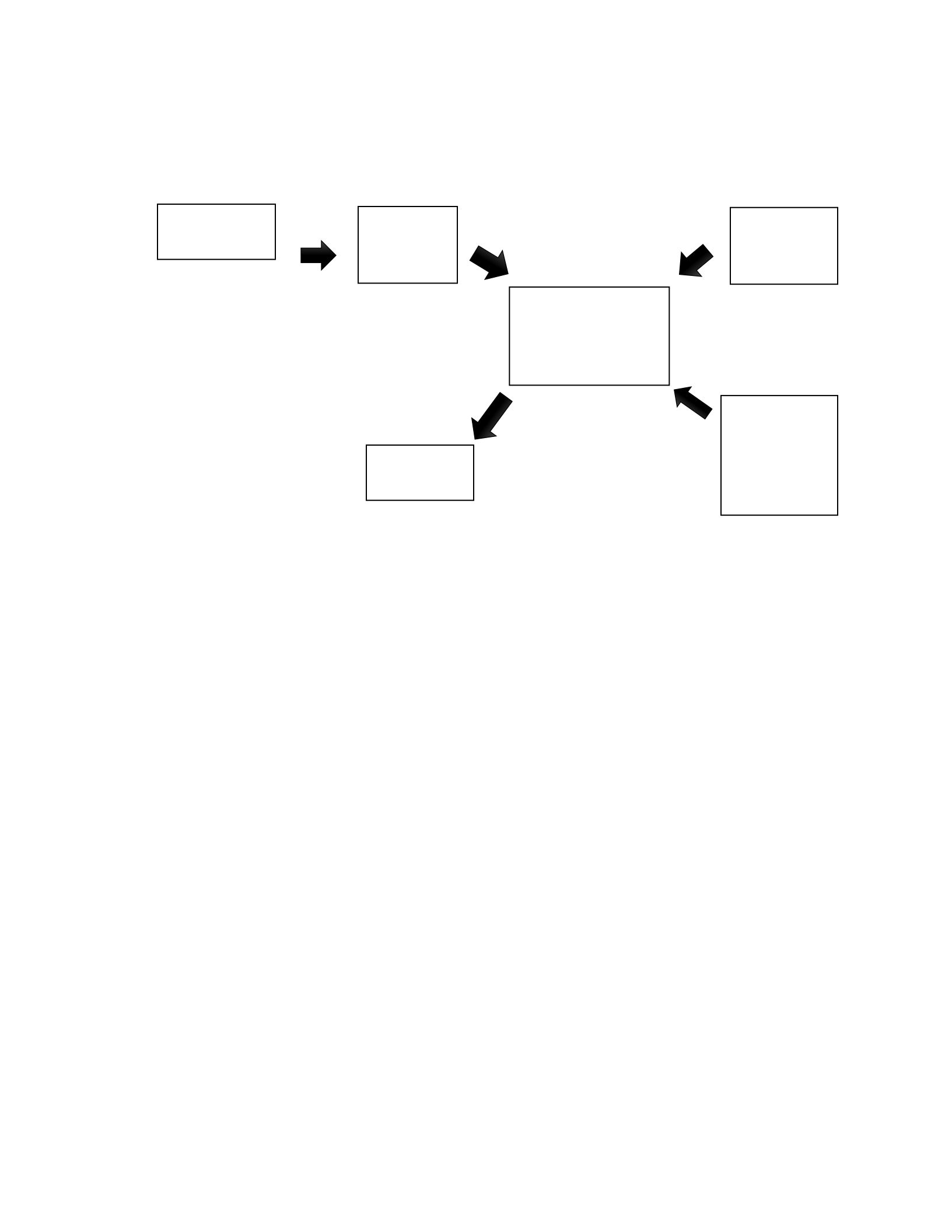
5
local level. Figure 1 presents a visual representation in regards to the statement of the
problem.
Importance
of writing
Perceived
writing
defect
Implementation
of content area
writing
instruction
Teacher
buy-in and
efficacy
Teacher
perceptions
of role as
writing
instructors
SRCL
grant goals
Figure 1. A visual representation of the problem statement. This figure illustrates the
importance of teacher perceptions in order to achieve SRCL grant goals.
Purpose of the Study
The purpose of the study was to investigate teachers’ perceptions, confidence, and
use of writing instructional strategies throughout content areas at the conclusion of
implementation of the five-year SRCL grant. Through the study, the researcher sought to
understand the perceptions of teachers as writing instructors and use of writing
instructional strategies utilized in content area classrooms at the end of grant
implementation as compared to initial data collected during the 2014 application process.
Based on the reviewed needs assessment survey, a clear lack of understanding of content
area teachers’ role in writing instruction and usage of writing strategies at the time of the
grant application in 2014 was revealed. Five years into grant implementation, the
perceptions of the participating high school teachers’ role as writing instructors and their

6
implementation of writing strategies in content areas were unknown. Furthermore, the
implementation of writing strategies and amount of time given to dedicated writing
instructional strategies throughout content areas remained unknown.
Research Questions
The overarching research focus for this study centered on content area teachers’
perceptions as instructors of writing and their perceptions of writing instruction strategies
used in their classrooms. The specific questions for this research study were
1. How do content area teachers perceive their role as instructors of writing?
2. How do teachers perceive their confidence and knowledge of writing instruction?
3. How are content area teachers implementing writing instruction strategies?
Conceptual Framework
The six goals of the state literacy plan, as determined by the Georgia Literacy
Task Force (GLTF), were to (a) increase high school graduation rate and postsecondary
enrollment, (b) improve teacher quality and retention, (c) improve workforce readiness,
(d) improve educational leadership, (e) improve achievement scores, and (f) make
policies that ensure academic and financial accountability (Fernandez & O’Conner,
2016). These six goals formed the basis of the state literacy plan with the understanding
that increased writing instruction across the curriculum was an important aspect of the
learning process and, therefore, a key component in the achievement of these goals
(GaDOE, 2010; INWAC, 2014). The GLTF reinforced the importance of writing
instruction across the curriculum as an effective tool to help students successfully convey
thoughts, think critically, and build knowledge in all content areas (CCSS, 2010; GaDOE,
2010). Therefore, teachers’ perceptions of writing and implementation of writing

7
instructional strategies are instrumental to the success of district literacy plans and the
vehicle to accomplishing of the goals of the state literacy plan (GaDOE, 2010).
However, the understanding of teachers’ perceptions and buy-in when considering
implementation of writing strategies was critical as teachers must possess a willingness to
add newly learned strategies to their curriculum. Figure 2 details the relationship
between teachers’ perceptions of writing and the use of writing instructional strategies
across the curriculum. Through the study, the researcher analyzed teachers’ perceptions
as writing instructors and confidence in implementation of writing instruction strategies
in order to understand teachers’ willingness to use writing instruction in content area
classrooms to achieve the goals suggested by the GLTF.
6 Goals of the Striving Readers
Comprehensive Literacy Program (SRCL)
Content Area Writing
Instruction
Perceptions
Teachers
Implementation
of Writing
Strategies
Study
Figure 2. The constructs of the study in relationship to the goals of SRCL. This figure
illustrates teachers’ perceptions and use of writing strategies leads to writing instruction
across the curriculum, which, in turn, leads to the goals of the SRCL grant.

8
Methodology Overview
The chosen methodology of the study was a mixed methods explanatory design
that allowed for analysis of quantitative data in order to inform development and analysis
of the qualitative data instrument. The qualitative phase followed the quantitative phase
in order to inform and elaborate on results from the quantitative phase (Creswell, 2012).
The quantitative data instrument was a survey created using Google Forms that consisted
of items from the needs assessment survey used by the participating school during the
grant application process combined with items that explored the writing strategies
teachers utilized during classroom instruction. The survey was made available to the
certified faculty of the participating school through email. The qualitative instrument
consisted of an interview protocol that ensured consistency among each interview. These
individual, semi-structured interviews were based on the findings from the quantitative
phase. The second qualitative data source was teacher lesson plan documentation used to
reinforce findings gained from the interviews. The desired sample size for the qualitative
phase was eight participants who were selected through a stratified sampling process
from each of the following four content areas: (a) ELA, (b) math, (c) science, and (d)
social studies. The stratified sampling technique was non-proportional in that each of
these five subgroups were given equal representation instead of population percentage of
the subgroups.
Delimitations and Limitations
The study was limited due to the possible effect of the target population on
participation and generalizability. With 57 certified teachers at the participating high
school, a small population size could negatively affect the study due to lack of

9
participation. With a smaller population, the difficulty of obtaining a high survey return
percentage was a concern. The small population size further created a limitation with the
non-proportional stratified sampling technique used to select potential interview
participants. The size of each content area department provided for fewer possible
participants for the qualitative phase. Furthermore, the small population size created an
inability to generalize study results to a greater population. Study results will be limited
in that an understanding gained of teachers’ perceptions as writing instructors at the
participating high school will not translate to an understanding of teachers’ perceptions at
other SRCL high schools in the state of Georgia.
The delimitations of the study consisted of the use of the target population.
Despite the limitations a small population size could potentially create, the accessibility
and make-up of the population allowed for great value to the researcher. The entire
desired target population was accessible due to researcher employment with the
participant high school. With the desire to understand teachers’ perceptions of writing at
the participant high school, the researcher communicated and interacted with the
population with ease. Furthermore, the researcher maintained professional connections
and was well known to the population. These connections potentially increased the
population’s willingness to participate in the quantitative and qualitative aspect of the
study.
Definition of Terms
Content area teachers are educators with specific knowledge and understanding
of a certain academic area in regards to English language arts, mathematics, social
studies, and science (Great Schools Partnership, 2014).

10
Explanatory sequential research design is a design in which, the researcher “first
collects and analyzes quantitative data, then the findings inform qualitative data
collection and analysis” (Fetters, Curry, & Creswell, 2013, p. 2136). The final aspect of
this design is the interpretation of results in which both the quantitative and qualitative
data are integrated and analyzed (Creswell, 2012; Fetters & Freshwater, 2015).
A shared responsibility of writing was described as an understanding that all
content area teachers were considered teachers of writing and were responsible for
content area writing instruction as related to the specific content taught (CCSS, 2010;
GaDOE, 2010).
Striving Readers Comprehensive Literacy Program (SRCL) was a federal grant
that allowed the state of Georgia, to develop a state literacy team, GLTF, to create a state
literacy plan with goals and guidelines to aid districts in development of literacy
instruction (U.S. Department of Education, 2010).
Significance of the Study
The significance of the study was related to the unique, singular focus of the
target population of the participating high school, as opposed to a larger sample size. The
researcher further embraced the opportunity to study a specific SRCL school and the
understanding of teacher buy-in in relation to implementation of writing strategies.
Through the understanding of teachers’ perceptions, leadership could implement
professional development at the conclusion of the SRCL grant that targets teacher
confidence and willingness to use writing instruction. The current body of Georgia
SRCL literature lacked a study that detailed the perceptions of teachers from a specific
SRCL school, as teacher dedication and buy-in of writing and literacy instruction across

11
the curriculum are crucial in the implementation of the SRCL grant. With a statewide
macro approach, current literature lacked analysis of a single school at a micro level. The
current SRCL literature consisted of three annual reports, which were used to conduct a
statistical analysis of SRCL data from the district and grade level. These reports included
suggestions of strategies based on teacher feedback. Prior literature also consisted of a
case study commissioned by the U.S. Department of Education, which described the
experience, implementation, and results of all SRCL schools in Georgia based on Georgia
Milestones data. To fill this gap, the researcher focused on a specific understanding of
teachers’ perceptions of a single Georgia high school.
Many stakeholders, ranging from district leadership to students, could benefit
from the results of the study. First, at the district level, through understanding of
teachers’ perceptions of writing and use of writing tasks, district leadership could better
utilize future funds to provide a more targeted professional development program to the
high school teachers. Through the understanding of teachers’ perceptions regarding
writing instruction, district leadership could also better support content area classroom
teachers’ writing instruction implementation. Second, the results of this study pertained
to the participating high school faculty. The original needs assessment survey conducted
during the grant application process was used to determine initial perceptions of the
faculty concerning writing instruction use in content area classrooms and correlated with
the results from this study to determine the degree of change in teacher perceptions.
Therefore, the results were of paramount importance to the participating high school and
provided an understanding of current teacher perceptions of content area writing. These
teachers also gained ideas of instructional strategies used by other teachers that could be

12
implemented in their classrooms. This understanding could lead to future faculty-led
professional development sessions or implementation of professional learning
communities within and across content area departments that could aid in implementation
of new writing strategies and instructional models. Third, the students could benefit from
the results of the study with the increased teacher knowledge of writing demonstrated
through classroom writing instruction. Finally, with greater understanding of writing
instruction, the community and business leaders could gain the benefit of graduates
exposed to a greater degree of writing instruction. With the importance of writing in the
business world, community business leaders would have a greater supply of potential
quality employees. Consequently, the need of this study was of chief importance to all
stakeholders of the district of the participating high school.
Summary
Writing is a critical aspect of both the educational and business worlds and is a
critical skill for students to possess in order to succeed in a competitive job market.
Despite this importance, there is a perceived student writing deficit characterized through
high-stakes assessment scores and student inability to complete college level writing
tasks. In order for teachers to utilize writing as a tool that gives students the opportunity
to explore content knowledge and understanding, teachers must possess confidence and
willingness to embrace writing instructional strategies. Despite the importance of writing
to student success, results of teacher analysis of the participating high school’s needs
assessment survey, conducted as part of the SRCL grant application process, revealed a
lack of teacher understanding regarding the role of content area teachers in writing
instruction (GaDOE, 2014). The purpose of the study was to investigate teachers’

13
perceptions, confidence, and use of writing instructional strategies throughout content
areas at the conclusion of the five-year SRCL grant.
.

14
CHAPTER II
REVIEW OF LITERATURE
Historical Overview
Importance of Writing
The ability to write is crucial in order to succeed in the aggressive business world
and the competitive 21st century job market (Fry & Villagomez, 2012). According to a
report by the National Writing Project and Negin (2006), “writing is the gateway for
success in academia, the new workplace, and the global economy” (p. 2). Writing is a
requirement for students to possess in order to communicate ideas quickly, efficiently,
and clearly to endure the rigors of today’s fast-paced and demanding world (NCW,
2004). This writing is evident in students’ real-world need to convey thoughts, ideas, and
arguments through both written and oral modes to be successful in an ever-changing and
competitive job market. In a survey of 120 major U.S. corporations, researchers from the
NCW (2004) noted that writing was an important factor in hiring and promoting, and was
required for professional opportunity. The NCW proclaimed that “people that cannot
write and communicate clearly will not be hired, and if already working, are unlikely to
last long enough to be considered for promotion” (p. 3). The ability to write effectively is
seen as a prerequisite to be successful in the business world and is a skill that can dictate
a students’ career success. The NCW further described the importance of writing in that
“two-thirds of salaried employees in large American companies have some writing
responsibility” (p. 3). Business leaders acknowledge the importance of writing in the

15
business world and understand the skill of writing as one that provides opportunity
(Education Partnerships Inc., 2006). In the business world, writing exists in the form of
memos, PowerPoints, email correspondence, technical reports, formal reports, and
presentations (Education Partnerships Inc., 2006). The NWC (2004) reinforced this
understanding and based on survey response data, reported that more than half of all
responding companies described frequent use of writing through policy, technical reports,
formal reports, PowerPoints, and correspondence. Writing is even present in the work
lives of technical workers and engineers who are required to produce written
documentation and reports once material technical work is completed (NCW, 2004). The
importance of writing in the business world and workforce cannot be understated as
writing ability is a necessary key to student career success.
With the arrival of the 21st century, writing instruction remains a critical aspect of
our educational system (Coskie & Hornof, 2013; Dede, 2009; NCES, 2012). Writing is
not only an important skill to possess in the business world but also one that is crucial to
student learning in content areas. Kelly Gallagher (2017) described writing as
“foundational to [students’] literate lives” (p. 25). This characterization of writing
demonstrated the importance of writing as a foundational skill and basis on which
students build on throughout their lives. In K-12 and university classrooms, writing
enables students to draw connections between content to further develop knowledge
(NCW, 2003). The NCW (2003) further epitomized the importance of writing in the
classroom as “not simply a way for students to demonstrate what they know [… but] a
way to help them understand what they know” (p. 13). Writing does not only assess
student understanding, but also could be used to actively encourage development of

16
critical thinking and content knowledge. McLeod and Miraglia (2001) emphasized this
connection between writing and content understanding and noted that “writing [was] an
essential component of critical thinking and problem solving […] a way of constructing
knowledge” (p.16). Therefore, writing is a tool for classroom instruction that can be
effectively utilized in order to connect the content of the subject area with a students’
deeper understanding of the material. Arnold et al. (2017) suggested that writing was a
key component in students’ ability to analyze, learn, and understand specific content
material ranging from scientific theories to historical cause and effect. Just as McLeod
and Miraglia (2001), Arnold et al. (2017) described writing as a tool in development of
critical thinking and deeper understanding of content knowledge. Gunel et al. (2007),
through analysis of six studies that related to writing in science classrooms, further
reinforced the importance of writing in the content areas as a means of developing
reasoning and critical thinking skills. Gunel et al. suggested that writing strategies that
“requires students to re-represent their knowledge in different forms, and as such, greater
learning opportunities exist” (p. 634). The practice of writing allows students to develop
greater content understanding through reconstruction and synthesis of information in
order to create a composition. Writing as tool in the content area classroom can provide
students with the opportunity to further develop and discover knowledge of the content
while creating opportunities for students to authentically learn. Writing in the content
area classroom can have a significant influence on student learning and understanding of
the content material. The NCW (2003) noted the educational value of writing in that “at
its best, writing is learning” (p. 13).

17
Writing and Learning
Writing is a crucial ability for students to possess to be successful in the
classroom and workforce of the 21st century, and an ability that potentially greatly
influences learning (Arnold et al., 2017; Dede, 2009; Fitzgerald & Shanahan, 2000). The
importance of writing in learning is apparent and cannot be understated, although it can
be nebulous (Fitzgerald & Shanahan, 2000). Educators, administrators, and researchers
all make common assumptions through observational means about the relationship
between writing and learning in that writing directly leads to learning (Arnold et al.,
2017; Balgopal & Wallace, 2013; Hill, 1994; Russell, 2013). The International Network
of Writing-Across-the-Curriculum (INWAC, 2014) noted that “writing has long been
recognized as enhancing the learning process” (p. 5). This common assumption
regarding writing referred to when students write, they learn and improve literacy (Fry &
Villanova, 2012; Hill, 1994). Writing was said to require students to synthesize content
information in order to display understanding and learning of the content. However,
despite these common assumptions based on observation and perceptions, little empirical
research evidence existed that specifically defined the relationship between writing and
literacy (Arnold et al., 2017; Balgopal & Wallace, 2013; Hill, 1994; Russell, 2013).
Many studies have been conducted to measure the relationship between writing
and learning in order to gain empirical evidence that reinforced the assumptions of a
positive connection between writing and learning held by many educators (Arnold et al.,
2017; Balgopal & Wallace, 2013; Dede, 2009; Fitzgerald & Shanahan, 2012; Fry &
Villagomez, 2012; Hill, 1994; Russell, 2013). Interestingly, researchers’ results were
mixed in that these studies (Arnold et al., 2017; Balgopal & Wallace, 2013; Dede, 2009;

18
Fitzgerald & Shanahan, 2012; Fry & Villagomez, 2012; Hill, 1994; Russell, 2013) found
a positive connection between writing and learning; however, other studies showed little
evidence to support a positive connection between writing and learning. Thus, the
contradictory, or nebulous, nature of the relationship between writing and learning
existed in contradicting research studies. Arnold et al. (2017) conducted an experimental
study to determine the effectiveness of three different writing strategies (i.e., essay
writing, note taking, and highlighting) on learning. Arnold et al. found that writing tasks
requiring students to recall resulted in improved performance on a final assessment when
compared to the other two selected writing strategies. Therefore, Arnold et al. concluded
that essay writing and free recall led to a positive increase in learning as a result of the
utilization of writing strategies. Furthermore, Arnold et al. also showed the importance
of understanding the cognitive aspect of writing and how each cognitive process related
to learning. Balgopal and Wallace (2017) suggested a similar conclusion that writing
improved literacy. Balgopal and Wallace conducted a qualitative study with the purpose
of determining the effectiveness of writing strategies in the development of scientific
literacy. Based on the results of the study, Balgopal and Wallace found that writing
allowed for greater development of scientific theory. Both studies (Arnold et al., 2017;
Balgopal & Wallace, 2017) reinforced the assumption of the positive influence writing
had on the development of literacy and learning. However, Fry and Villagomez (2012)
argued that writing did not significantly improve student learning. Fry and Villagomez
conducted a quasi-experimental mixed methods study in order to determine the impact of
writing on student learning. Through the analysis of quantitative data, Fry and
Villagomez (2012) noted that writing did not have a statistically significant influence on

19
student achievement and learning. Likewise, Klein (1999) noted that there was no
evidence, based on assessments and empirical data, of the effect of writing and learning,
but conceded that there was a positive yet inconsistent impact writing had on learning.
The commonly accepted and nebulous assumption of the importance of writing in
learning and the development of literacy are reflected in the contradicting empirical
evidence related to the influence writing has on learning.
Positive Benefits of Writing
Despite the lack of empirical evidence that demonstrated the influence of writing
on learning, researchers suggested that are definite benefits to the inclusion of writing
strategies in the content areas (Arnold et al., 2017; Fry & Villagomez, 2012; Graham &
Perin, 2007; Hill, 1994; Russell, 2013). Graham and Perin (2007) noted that “although
the impact of writing activity on content learning is small, it is consistent enough to
predict some enhancement in learning as a result of writing-to-learn activities” (p. 20).
Writing-to-learn activities are strategies that used writing as a tool of learning content,
which allow the content area teacher to encourage students to delve deeper into the
content through writing in order to develop deeper content understanding. Graham and
Perin conducted a meta-analysis using quasi-experimental and experimental research into
the effect of writing on learning in order to offer strategies that demonstrated positive
results of writing on learning. Graham and Perin found that although the meta-analysis
effect size of content area writing was small, (.23), 75% of writing–to-learn studies
revealed positive results on writing and learning. Through the meta-analysis of multiple
research studies, Graham and Perin showed that writing not only had a positive influence
on learning but that the act of writing could be an effective tool in content area classroom

20
instruction in order to encourage development of student content knowledge. In order to
understand the role that writing has on learning, one simply has to observe and would
realize “the idea that writing promotes learning and reasoning is still commonplace”
(Hill, 1994, p. 3). Hill (1994) argued that there were observational perceptions of the
common sense notion of the importance of writing and learning. This researcher further
argued a key point in that there should be less emphasis on the lack of empirical evidence
of writing influence on learning but more focus on instructional practices of writing as a
crucial instructional tool. Hill conceded the difficulty of understanding the direct
empirical connection between writing and learning, but suggested that there were
numerous ways, such as external memory, that writing benefited the learning process.
Writing, therefore, is an instructional tool that allows students to reinforce and understand
content knowledge (Arnold et al., 2017).
Russell (2013) suggested that although much empirical data showed writing to
have no effect on learning, the possible long-term effects of writing instruction strategies
may be of more benefit than simple educational writing assessments. The value of
writing on the learning process comes through the use of writing as a means of creating
knowledge and understanding of content as opposed to assessment of knowledge. Fry
and Villagomez (2012) analyzed qualitative data that described writing as helpful in
making sense of content. Russell (2013) reflected this idea that writing was a tool for
learning instead of simply a tool for assessing learning. Russell described writing in the
same light as Fry and Villagomez (2012), “a means of engaging students with the
problems and methods of a discipline” (p. 164). Hill (1994) noted the same
characteristic, as writing helped students “identify problems in their understanding or

21
gaps in their knowledge” (p. 6). Writing is a tool for understanding the content or self-
assessing students’ gaps in knowledge. To write in a specific content, one must
demonstrate and self-assess the knowledge of the material (Russell, 2013). Each of these
researchers described that the benefits of writing came as a tool for learning and making
sense of content material instead of an assessment of learning (Graham & Perin, 2007).
Despite the lack of concrete, empirical evidence that suggested a positive relationship
between writing and learning, writing strategies in content area classrooms aid students in
development of critical thinking skills and content knowledge.
Perceived Student Writing Deficit
However, notwithstanding the importance of writing in relationship to learning
and the business and education worlds, educators, researchers, and business leaders,
nationally, have discerned a lack of K-12 and college level students’ writing
proficiencies, which has been a longstanding concern (McLeod, 2001; Russell, 1994).
This lack of proficiency was evident through the multiple writing crises that arose during
the 19th and 20th centuries, as Russell (1994) noted that “writing has always been an
issue in American secondary and higher education since written papers and examinations
came into wide use in the 1870s” (p. 3). A writing crisis occurred in the 1870s as a result
of changes that came as a consequence of the Morrill Land Grant Act of 1862 and a shift
in the university model geared towards departmentalization and research, which allowed
for a wider range of education programs (McLeod, 2001; Russell, 1994). As a result,
teachers perceived a lack of student writing ability because of an inability to complete
university-level writing tasks (McLeod, 2001). This perceived lack of student writing
deficiencies continued throughout the 20th century and became evident in the 1970s. The

22
decade of the 1970s brought further evidence of a writing crisis and reignited interest in
the longstanding teacher perception of a lack of student writing ability in the United
States. With the GI Bill of the post-World War II years and social and political upheaval
of the 1960s, less strenuous university entrance requirements allowed for a more racially
and ethnically diverse student population (Bazerman et al., 2005; McLeod, 2001; Russell,
1991). The crisis of the 1970s created a change in demographics at the postsecondary
level, along with less rigorous admission standards, which opened universities to a wider
range of students (McLeod, 2001; Russell, 1991). With a wider range of students
entering universities, these students entered with a wider range of abilities and needs
(McLeod, 2001). The lack of writing ability and inability to complete university-level
writing assignments caused further reinforcement of a national writing crisis and concern
over student writing ability. The writing crisis of the 1970s was further publicly fueled
by Sheils (1975) and the Newsweek article “Why Johnny Can’t Write”. Sheils described
the lack of college students’ inability to write “ordinary, expository English with any real
degree of structure and lucidity” (p. 58) and described the downhill descent of U.S.
literacy. Sheils revealed the problems of secondary and postsecondary students and
provided momentum and desire for writing instruction reform at the high school and
university levels (Brewster & Klump, 2004). Despite the national press concerning the
lack of secondary and postsecondary writing deficiencies, students continued to display a
lack of writing ability throughout the latter years of the 20th century and into the 21st
century.

23
National Writing Assessment Data
One must only look at current and past assessment data of writing in the United
States to see evidence of this nationally perceived lack of writing proficiency and the
need for focused and effective writing instruction to prepare students for the university
classroom and 21st century workforce. Educator and researcher analysis of NAEP data at
the national level and Georgia Milestones data at the state and local levels showed a
declining trend of student writing ability. These data further highlighted teachers’
perceived decrease in overall student writing ability (McLeod, 2001). Current national
research concerning student writing in the United States showed a deficit in student
writing ability. Researchers for NCES (2012) assessed the writing ability of students in
Grade 12 through a computer-based writing assessment, the NAEP measures ability to
effectively communicate thoughts through narrative, persuasive, and informational
writing. These researchers discovered that 24% of students scored at the proficient level
during the 2012 assessment, which was described as students at this level could
effectively and clearly convey thoughts through written language (NCES, 2012). This
percentage has changed little since the 1998 assessment with 22% and has remained at
24% based on the 2002 and 2006 assessments (NCES, 2007). Based on these assessment
data, only one-fourth of students possess the writing abilities that are required for success
in the university classroom and job market. This decade long trend only highlights
students’ deficit of a skill that is “fundamental in business” and prerequisite for job
promotion (NCW, 2004, p. 8). NAEP data also showed that 54% of the 52,200 students
in Grades 8 and 12 tested nationally scored at the “basic level" or had “partial mastery of
the prerequisite knowledge and skills” to effectively communicate in writing (NCES,

24
2012, p. 2). NAEP data collected by NCES showed a national trend of little
improvement in student writing ability in the new millennium. Over the past two
decades, a consistent 24% of students showed the ability to effectively write to meet the
needs and rigors of the 21st century, while over half of U.S. students are ill-prepared to
write and communicate in the demanding world and job market.
State Writing Assessment Data
This national trend in the deficit of student writing ability was also visible at the
state level, as noted by results of previously administered high-stakes assessments. The
current study was situated in the state of Georgia, and, therefore, the relevance of high
stakes assessment data at the state level was important in understanding the state of
students’ writing ability. The state of Georgia uses a system of assessments, Georgia
Milestones, first implemented in the 2014-2015 school year, to measure the mastery of
prescribed state standards in content areas from Grades 3 through 12 and provides
students with an assessment for readiness for the next level (GaDOE, 2016). The English
language arts (ELA) Milestones have open response questions based on provided texts
that measure both the content and writing standards of the Georgia Standards of
Excellence. These open response questions allowed educators to gain an understanding
of Georgia students’ writing ability. The Georgia Milestones also consist of multiple-
choice questions that measure reading comprehension skills. The scores collected from
the Georgia Milestones are holistic scores, which reflect students writing and reading
ability in order to gauge students’ college and career readiness. Milestones data analysis
draws on the relationship between reading and writing. Milestones data analysis showed
a trend that while student writing ability and reading comprehension seems to improve, a

25
large number of students still lack the ability to communicate effectively at the next level.
Georgia Milestones were administered in the subjects of 9th grade literature and
American literature, in which a majority of students displayed partial or lacked
demonstration of needed writing skills (Fincher, 2016; GaDOE, 2014, 2015). For the
initial year of implementation, educator analysis of Milestones data revealed that 61% of
students in ninth grade and 63.9% of students in 11th grade scored in the beginning
learner or developing learner levels, or the two lower levels of performance (Fincher,
2016; GaDOE, 2014). Students at the beginning learner level “need substantial academic
support to be prepared for the next level” whereas developing level students “needed
additional academic support” (GaDOE, 2016, p. 1). These percentages improved slightly
in the 2015-2016 school year, with 58.8% of students in ninth grade and 56.8% of
students in 11th grade scored in the same performance level. However, the most recent
Milestones data showed that 47.1% of students in ninth grade and 51.1% of students in
11th grade scored in the lower two levels. Despite this decrease in the percentage of
students at the lower two levels of performance, there remains a high percentage of
students, over half, who do not have the skills required to be successful at the next level
and require increased academic support, which are students who are entering their final
year of high school and will be headed to colleges and the workforce in just over a year.
Despite these scores being a combination of both reading comprehension and writing
ability, analysis of the Milestones assessment data showed that a large number of Georgia
students require additional academic support and are not ready to handle the
communication rigors of the next level, or college.

26
Local Writing Assessment Data
Analysis of the participating high school’s Milestones data, as presented in Table
1, showed a similar lack of student writing ability and a higher percentage of students ill-
equipped to enter the university classroom or workforce (GaDOE, 2017). For the initial
year of implementation, an educator analysis of the Milestones data revealed that 78.8%
of students in ninth grade and 76.3% of students in 11th grade scored in the two lower
levels of performance. These percentages changed slightly in the 2015-2016 school year
with 72.7% of students in ninth grade and 80% of students in 11th grade tested in the
bottom two performance levels. However, the most recent Milestones scores revealed
improvement; 66.7% of students in ninth grade and 62.7% of students in 11th grade
scored in the lower two levels. Each year, the participating high school has reported
above state averages in the percentage of students scoring in the beginning and
developing learner levels. The National Council of Teachers of English (NCTE, 2011)
noted the importance of reading and writing in order to enhance student learning and
achievement. NCTE (2011) also noted that “studies show that reading and writing […]
are essential to learning. Without strategies for reading course material and opportunities
to write thoughtfully about it, students have difficulty mastering concepts” (p. 16). These
high-stakes assessments showed a definite need to improve writing instruction and focus
on improvement of literacy. With the importance of writing capability as a prerequisite
to success in the job market and university classroom, students continue to show a
deficiency in that skill at the national, state, and local levels. Based on Georgia
Milestones scores at the state and local levels, a large percentage of students are not

27
prepared for the writing rigors of the work force and academic world, and, therefore,
these students require increased support and instruction for writing (GaDOE, 2016).
Table 1
Percentage of Students Scoring in the Beginning and Developing Learner Levels
Year
Test
2014-2015
2015-2016
2016-2017
State Ninth Grade Literature
61
58.8
47.1
Local Ninth Grade Literature
78.8
72.7
66.7
State American Literature
63.9
56.8
51.7
Local American Literature
76.3
80
62.7
Note: Milestones data for ninth grade literature and American literature comparing state
and local assessment result percentages of students who scored in the beginning and
developing learner levels.
Teachers’ Perceptions
In order for teachers to utilize writing as a tool that gives students the opportunity
to explore content knowledge and understanding, teachers must possess confidence and
willingness to embrace writing instructional strategies. Teachers’ self-perceptions of
their role and confidence as writers and writing instructors directly influenced teachers’
willingness and ability to teach writing and incorporate writing instruction into content
curriculum (Bifuh-Ambe, 2013; Curtis, 2017; Lewis & Sanchez, 2017; Troia et al.,
2011). Therefore, based on the purpose of the current study, to understand teachers’
perceptions as writing instructors and use of writing instruction strategies, the
understanding of prior research concerning teachers’ perceptions was critical. Analysis
of teachers’ perceptions revealed two themes among the literature: (a) ELA writing
instruction ownership, and (b) teacher efficacy. The theme of ELA writing instruction
ownership, as presented in Table 2, aligned closely with Research Question 1, or how

28
content area teachers perceived their role as instructors of writing (Hanstedt, 2012;
McLeod, 2001; NCTE, 2011; Russell, 1990, 1994). Based on content area teacher
perceptions of ELA ownership, teachers lack buy-in or willingness to incorporate writing
instruction (McLeod, 2001; Russell, 1994). The second theme, teacher efficacy, or
confidence, reflected Research Questions 2 and 3, as noted in Table 3 (Bifuh-Ambe,
2013; Curtis, 2017; Gillespie, Graham, Kiuhara, & Hebert, 2013; Lewis & Sanchez,
2017; Troia et al., 2011). The understanding of teacher efficacy related to how teachers
perceived their confidence, knowledge, and willingness to implement writing instruction.
Furthermore, teachers should have buy-in or willingness to incorporate new writing
strategies into content area classrooms despite perceptions of ELA ownership of writing
instruction (Ates, Cetinkaya, & Yildirim, 2014).
Teachers across content areas share the responsibility for addressing the deficit in
student writing ability and dire assessment results; however, based on prior research of
teachers’ perceptions, the common belief of ELA ownership, or writing instruction as
solely the responsibility of English teachers, was prevalent among secondary and
postsecondary educators (McLeod, 2001; Russell, 1990, 1994, 2013). The NCW (2003)
described the importance of cross-curricular writing but noted the “near-total neglect of
writing outside English departments” (p. 28). The perception of ELA ownership
reinforced common assumptions of where writing instruction should take place and the
perceived role content area teachers played in writing instruction. Prior research
literature characterized K-12 and postsecondary content area teachers’ perception of
writing as being solely the responsibility and domain of the ELA department, thus
allowing for content area teachers to focus solely on content instruction (Hanstedt, 2012;

29
NCTE, 2011; Russell, 1990, 1994, 2013). Russell (1994) described administrator and
teacher perceptions, in principle, that “every teacher should teach writing” but did not
hold true in practice (p. 4). This belief is a common thought in education; however, it is
not an idea that is put into practice due to teachers’ perceptions of ELA department
ownership of writing and view of writing in content classrooms (Russell, 1994).
Since the inception of high schools in the late 19th century, disciplinary
organization and focus with curriculum shaped by the entrance requirements of
postsecondary institutions, which gave rise to ELA ownership of writing (Bazerman et
al., 2005). With this disciplinary focus, English departments eventually became the
caretakers of writing instruction and responsible for student writing and literary analysis
(Bazerman et al., 2005). This disciplinary model also added to the assumption that
writing instruction was to happen only in ELA classrooms, thus allowing other discipline
instructors to focus solely on content (Bazerman et al., 2005). Further English
department writing responsibilities came with changes to entrance requirements and
waves of students who seemed to lack efficient writing ability to meet the demands of
postsecondary education in the form of freshman or remedial composition classes
(Russell, 1990). Russell (1994) further reinforced English department ownership of
writing and noted “since the turn of the century, the American educational system has
placed the responsibility for teaching writing outside the disciplines” (p. 4). Long has
writing been considered the domain of ELA departments, which allowed content area
teachers the freedom from complaints of the lack of student writing ability (Russell,
1990, 1994). In an anecdote, McLeod (2001) reinforced Russell’s (1990, 1994)
characterization and described a confrontation with a colleague over student

30
writing. This colleague in the history department was furious over the lack of writing
ability as displayed through an assigned historical analysis essay. McLeod (2001)
recalled the colleague blamed the English department for failure to teach students to write
effectively. The assumption of ELA department ownership of writing further encouraged
a disconnect between content disciplines and writing instruction.
Hanstedt (2012) reinforced the perception of writing responsibility laid solely
with ELA departments, in that “people outside of the English department worry that they
might be forced to do someone else’s job” (p. 48). Hanstedt described a teacher
perception that writing instruction was the job of ELA teachers and for content area
teachers to teach writing meant that the ELA teachers were not doing their jobs. This
perception allowed for content area teachers to ignore responsibility for the lack of
student writing skills (McLeod, 2001). NCTE (2011) further described content area
teachers’ difficulty in coming to terms with how writing fit in the confines of content
curriculum, which added to the ease of allowing English department ownership of
writing. NCTE further defined this disconnect as teachers simply do not see how their
content area is linked to reading and writing and, therefore, see little need to implement
writing strategies in content area instruction. This negative perception of the benefit and
need of writing instruction in content area classrooms limits successful implementation of
writing instruction strategies within content area classrooms, which could encourage
student development of content knowledge. This perceived English department
ownership developed as a result of departmentalization of the disciplines, which caused
the task of writing instruction to fall outside the content areas, persisted as a result of

31
content area teachers’ perceived lack of role in writing instruction, and led to a deficit of
teacher buy-in for content area writing (Russell, 1990, 1994).
With the perceived ELA ownership of writing, many teachers lack buy-in to
willingly incorporate writing into content area instruction. This lack of buy-in is
characterized by time, ability, and understanding. Secondary level content area
teachers argue, because of immensity of the amount of content required by state and local
standards, content area teachers simply lacked the time to include writing instruction
(Brewster & Klump, 2004; McLeod, 2001). Educators at the post-secondary level also
describe the importance of protecting time to focus on content material as opposed to
sacrificing time to teach a skill that many believe students should already possess at the
college level (McLeod, 2001). In addition to the issue of time, Russell (1990, 2013)
emphasized content area teachers’ lack of confidence in teaching writing as an important
characteristic in the lack of willingness to use content area writing instructional
strategies. Teachers who were self-conscious or lacked ability to write are unwilling to
include teaching a skill they did not possess. Romano (2007) noted that “teachers who
write demonstrate to students someone who loves to think, explore, and communicate
through writing” (p. 171). However, teachers who lack the buy-in or willingness to
incorporate demonstration of writing as a result of a lack of self-efficacy as a writer miss
the opportunity to instruct students how a writer creates writing. NCTE (2011) suggested
that content area teachers struggle with how their subjects are linked with writing and,
therefore, lack buy-in and willingness to implement new writing instruction as a result of
a lack of understanding of their role as instructors of writing. With the perceived ELA
ownership of writing, many teachers do not see writing instruction as their responsibility

32
and lack understanding of their role as writing instructors. Therefore, they lack buy-in to
willingly use time to incorporate writing into content area instruction strategies.
Teachers’ Writing Efficacy
In addition to the limitations concerning content area teachers’ perceptions of
ELA department ownership of writing, teacher self-efficacy as writing instructors further
contributes to content area teachers’ lack of buy-in and willingness to implement
effective writing instruction successfully. Albert Bandura’s (1977) theory of self-
efficacy described the importance of personal belief and confidence in one’s own
abilities. This concept of teachers’ self-perceptions of efficacy as writers directly related
to teachers’ willingness and ability to incorporate writing instruction and, therefore,
required support and instruction in order to implement instructional strategies
successfully (Bifuh-Ambe, 2013; Troia et al., 2011). Confidence, or lack thereof, had an
effect on content area teachers’ willingness to implement writing strategies in classroom
instruction based on the confidence in their ability to write effectively.
Teacher Self-Efficacy as Writers
Teacher self-efficacy, or perception of their own abilities in writing ability, was
an important factor in writing instruction and lack of proficiency led to a lack of desire
and difficulty to include writing instruction in classroom practices (Bifuh-Ambe, 2013;
Russell, 2013, 1990). Albert Bandura’s (1977) concept of self-efficacy characterized the
importance of how one perceived their own abilities to accomplish a task. For teachers,
this concept could be applied to how teachers perceived their own abilities as writing
instructors or their ability to teach writing effectively based on their own writing ability.
Taimalu and Oim (2005) reinforced Bandura’s (1977) understanding of self-efficacy and

33
applied the concept to educators’ ability influence student achievement. The confidence
that educators possess in their abilities to convey content knowledge relate directly to
student achievement. Within the concept of self-efficacy, Bandura (1977) described the
idea of instructional choice based on self-efficacy in that “not only can perceived self-
efficacy have direct influence on choice of activities and settings but through
expectations of eventual success” (p. 194). Thus, teacher confidence can lead an
educator to not implement a successful writing strategy simply because of fear of a
negative outcome. A teacher’s perception of personal writing ability could influence
instructional choices. Russell (2013) also noted the importance of confidence in content
area teachers’ writing instruction practices as inherent in a lack of understanding in
teaching writing form. Content area teachers do not perceive themselves as teachers of
writing but as teachers of specific content (Russell, 2013). Content area teachers are
experts in teaching their specific content but lack confidence and knowledge in teaching
the form or structure of writing (Russell, 2013). For writing instruction, content area
teachers should be able to teach students how to write in the form and expectations of the
teachers’ specific content areas. The difficulty for content area teachers, as noted by
Russell (1990), came with teacher confidence to “explain (and to some extent
conceptualize) the conventions of [the teacher’s] discipline and--more difficult still--
describe how the conventions she requires [...] are different from the conventions [...] in
another class” (p. 56). As a result, content teachers have the added difficulty of
instructing students of not only how to write but how to write in a specific content area
that is guided by specific conventions and expectations. Teachers, therefore, who do not

34
perceive themselves as effective writers will limit the use of writing instructional
strategies in the content area classrooms.
Content area teachers should possess a positive perception of self-efficacy in
order to effectively implement writing instruction into the content area classroom. Bifuh-
Ambe (2013) reflected the importance of teacher writing confidence, in that “teachers
must feel competent as writers and writing teachers in order to provide the kind of
instruction and modeling that will help students develop into proficient writers” (p. 137).
Content area teachers must have the confidence and professional development in order to
provide effective writing instruction (Bifuh-Ambe, 2013; Curtis, 2017). In a mixed
methods study, Bifuh-Ambe (2013) examined teacher attitudes towards writing
instruction, implemented a 10-week workshop, and utilized pre and post surveys to
understand teacher perceptions. Bifuh-Ambe discovered that teachers’ beliefs and
epistemologies not only influenced instructional choices, but teacher efficacy also
influenced student progress in writing. Through the analysis of survey data, Bifuh-Ambe
described that the “improvement of teachers’ writing ability and proficiency would in
turn improve students’ writing achievements” (p. 137). Furthermore, Lewis and Sanchez
(2017) also noted the importance of teachers’ self-perceptions of efficacy in regards to
writing instruction. In a longitudinal study, which spanned the academic years of 2012-
2014, Lewis and Sanchez surveyed over 160 preservice teachers and noted a
“disconnection between the perception of overall writing proficiency and the perception
of proficiency in revision and editing”, and, therefore, there is a perceived lack of
confidence in teacher writing ability in connection to writing instruction (p. 7). Teachers’
perceptions and self-efficacy as writers have a direct influence in regards to writing

35
instruction in content area classroom. However, professional development and support
are required.
Teacher Efficacy, Professional Development, and Writing Instruction
Teacher efficacy in their writing ability has a direct influence on content area
teachers’ willingness to implement writing instruction, and, therefore, professional
development is required for successful implementation. Troia et al. (2011) described the
importance of teachers’ understanding of writing instruction as those teachers who lack
knowledge of writing instructional strategies limit student writing development and are
less willing to utilize new strategies as opposed to teachers who possess strong writing
confidence and understanding. Zimmerman, Morgan, and Kidder-Brown (2014)
characterized this connection between teacher efficacy and professional development; for
students to learn writing, they must receive effective writing instruction. However, many
teachers not only do not perceive themselves as writers but also feel ill-prepared to teach
writing. This lack of self-efficacy requires professional development in order to provide
effective writing instruction and student learning. Prior research of teacher efficacy in
writing showed a direct relationship with classroom writing instruction and teacher
efficacy and displayed the importance of professional development (Bifuh-Ambe, 2013;
Curtis, 2017; Gillespie et al., 2013; Lewis & Sanchez, 2017; Troia et al., 2011).
For effective content area writing instruction, professional development is
required to improve teachers’ writing efficacy, perceptions of writing, and use of writing
instructional strategies (Gillespie et al., 2013). Atwell (1984) characterized the
importance of professional development through experience and noted “up until three
years ago, nobody wrote much of anything at my school. Nobody wrote because nobody

36
taught writing. Nobody taught writing because nobody was trained to teach writing” (p.
240). In order to teach writing, a teacher must have confidence in his or her writing
ability and willingness to utilize writing strategies during instruction. Professional
development is critical in developing teacher ability and confidence in writing. In a year-
long study of six elementary school teachers who received professional development in
writing instruction, Troia et al. (2011) found that “teachers who possessed a relatively
strong sense of general teaching efficacy tended to use more instructional adaptions for
struggling writers” and, therefore, reinforced the importance of teacher writing efficacy
to improve writing instruction and student writing ability (p. 177). Troia et al. drew the
connection between the need for professional development in order to improve teachers’
efficacy in writing and, in turn, improve writing instruction. Likewise, Curtis (2017)
described the importance of professional development through modeling in improving
writing instruction through improvement of teacher self-efficacy. In a study of two
kindergarten teachers, Curtis researched the effect of professional development through
the use of a literacy coach modeling writing instructional strategies on perceptions,
knowledge, and efficacy of teacher writing ability and instruction. Through survey data,
Curtis noted that “modeling specific writing strategies over a period of time did have a
positive impact on teachers and their ability to teach writing” (p. 24). Similarly, through
analysis of survey data, Gillespie et al. (2013) found that the use of writing strategies to
support student learning was directly related to teachers’ preparation through professional
development. In a study of 800 teachers of ninth to 12thgraders teachers, Gillespie et al.
found that teachers utilized an average of 24 different writing strategies during the school
year. However, teachers reported little professional development to support effective

37
implementation. Gillespie et al. further described the utilized writing strategies involved
writing that did not include actual composition. Teachers noted the use of short answers,
notetaking, worksheets, and summarizing but did not include writing that was creative or
analytical (Gillespie et al., 2013). The results of this study showed a need for
professional development to instruct teachers on the implementation of writing strategies
and writing instruction techniques (Gillespie et al., 2013). Without professional
development, lack of teacher self-efficacy as writers leads to a lack of buy-in in
implementing writing instruction in the content areas.
Theoretical Framework
The theoretical basis of this study embraced the teacher-as-writer. Based on the
perceived writing deficiency, which lingered into the 21st century, and the importance of
writing in the academic classroom and the business world, teachers should have
confidence as writing instructors in order to help students improve writing ability through
effective implementation of writing instructional strategies in content areas. Atwell
(1984), Calkins (1993), Graves (1990), and Susi (1984) characterized the importance of
teacher confidence as avid readers and writers in order to be effective teachers of reading
and writing through modeling self-efficacy and professional development. In accordance
with these researchers, Romano (2007) further developed and reinforced the use of the
idea of the teacher-as-writer through the benefits and necessities of a teacher’s comfort as
a writer. Applegate and Applegate (2004) described the importance of teachers’ self-
efficacy as a model during instruction. Similarly, Frager (1994) conducted a study that
reinforced the views of Atwell (1984), Calkins (1993), Graves (1990), and Susi (1984)
through categorizing teachers into four writing groups. However, Brooks (2007)

38
conducted a study that utilized the works of Atwell (1984), Calkins (1993), and Graves
1984 as a framework and found that the writing experience played little role in effective
writing instruction. Despite the findings of Brooks (2007), the characterization of
Calkins (1993), Graves (1990), Atwell (1984), and Susi (1984) of the importance of
teachers’ confidence as writers remained a critical component of effective
implementation of content area writing instruction.
Ideological Background
The teacher-as-writer framework reflected the importance of teacher self-efficacy
as writers, and teacher perceptions of willingness to buy-in to the implementation of
writing instructional strategies in content area classrooms. The teacher-as-writer
framework was based on the understanding of the importance of teachers being confident
in their own writing ability to implement writing instruction and model writing in order to
create enthusiasm within the student and an environment that will foster student writing.
Romano (2007) described the teacher-as-writer as crucial in that one who taught the craft
should practice the craft as well. This practice allowed students to see the teacher-as-
writer as an authority and provided credibility to the writing instruction. Romano further
described the benefits of the teacher-as-writer as one who modeled writing instruction
and went beyond simply telling students how to write. Romano (1987) described that an
important aspect of the teacher-as-writer model was to help students develop the feeling
that writing was not only a critical aspect of their lives but to develop a joy for writing
that was evident in the teacher. Atwell (1984) characterized this framework as what she
called “getting inside writing” (p. 241). In order for teachers to not only teach writing
effectively but also develop a passion and enjoyment of writing within students, teachers

39
should first become active participants within the writing process. Teachers become
“insiders” willing to embrace writing in the classroom and develop an environment that
fosters a love for writing in the teacher and the student. Through becoming a writing
insider, teachers could understand the process and challenge students during composition,
and they could better encourage and aid students while they write. Students should see
the teacher as more than simply someone who conveys information but as active
participants in the writing process that models and encourages the act of composition.
Susi (1984) described the importance of teachers modeling the act of composition in
order to “share the visible part of that process” (p. 713). When teachers have the
confidence in their own writing ability to write with students, teachers have the unique
opportunity to demonstrate how they maneuver through all aspects of the writing process.
Similarly, in a study of preservice teachers, Applegate and Applegate (2004)
described the importance of teacher self-efficacy and the teacher-as-writer as a model
during reading instruction that motivated and encouraged students to read and
encapsulated this idea as the Peter Effect. Applegate and Applegate alluded to the
Biblical story of Peter and the beggar. In Acts 3:5, Peter was approached by a crippled
beggar, and, when asked for money, Peter simply replied that he could not give what he
did not have (Applegate & Applegate, 2004). Applegate and Applegate (2004) used this
allusion to demonstrate the importance of teacher confidence as an avid reader. If a
teacher was not an avid and confident reader who enjoyed reading, then that feeling could
not be encouraged in their students. Applegate and Applegate’s study focused on a
teacher’s role in fostering a love for reading by being an avid reader. Despite the focus
on reading, the allusion provided a similar analogy to Atwell’s (1984) description of the

40
importance of teachers’ self-efficacy in writing. Confidence in writing ability was
required for a teacher to get inside writing to encourage passion within students, and,
therefore, the teacher cannot give what the teacher does not have. By “getting inside
writing”, teachers-as-writers showed the visible aspects of the writing process and created
a positive environment for writing. The teacher-as-writer framework used for this study
was based on the research of Frager (1994).
Frager and Teacher Self-Efficacy
Frager (1994) reinforced the framework of the teacher-as-writer through a three-
day workshop with 32 participants ranging from primary to high school English teachers.
The focus of this workshop was to study and develop teachers’ understanding of
themselves as writers. Teachers who participated in the workshop wrote about their
perceptions as writers and discussed their writing samples in small groups. Based on data
and writing samples gained from the workshop, Frager determined four writing groups
that described the teacher-as-writer: (a) reluctant writers, (b) practical writers, (c) integral
writers, (d) perspectives as writers. The five reluctant writers disliked writing and did not
see themselves as effective writers. Practical writers consisted of six teachers who only
wrote out of necessity or as a means of organization. The integral writers consisted of six
teachers who described writing as an important aspect of their lives and an activity they
constantly used in every aspect of their lives. The final group consisted of nine teachers
who gave different accounts of the what it meant to be a writer. Frager concluded that
“teachers who feel writing is an integral part of their lives can help some students feel the
same way” (p. 277). Teacher self-efficacy and ability to write could have an effect on
student achievement and perspective of writing (Atwell, 1984). Frager (1994) further

41
described the two important influences that were evident in the teacher-as-writer model:
(a) learning is through modeling and (b) shared feelings. Students learn about the act of
composition through observing how the teacher maneuver through the writing process.
This idea of the importance of modeling is reflected through Atwell’s “getting inside
writing” as a means of showing the visible aspects of the writing process (Atwell, 1984).
Frager (1994) also described the importance of feelings and perspectives for the teacher-
as-writer, in that “teaching involves sharing feelings about the writing process as much as
demonstrating techniques for good writing” (p. 277). The ways that teachers perceive
their own self-efficacy as writers and their own views on the importance of writing could
influence students’ feelings concerning writing. Frager noted that “there is reason to
believe that teachers who are themselves fearful and reluctant writers influence some
students to share that apprehension” (p. 277). This transference of feelings toward
writing from the teacher to the student illustrated the importance of the allusion to the
Peter Effect and the positive perceptions teacher should possess as the teacher-as-writer.
A teacher who lacks confidence or a positive view of the act of composition cannot give
the students confidence or a positive view of writing. They cannot give students what
they do not have (Applegate & Applegate, 2004). Frager’s (1994) research provided
reason to embrace the importance of the teacher-as-writer in implementing content area
writing instruction and curriculum policies. However, Brooks (2007) presented a counter
argument, which suggested teacher self-efficacy was less important.
Brooks’s Counter Argument
Where Frager and other researchers found the teacher-as-writer to be a critical
component to writing instruction, Brooks (2007), in a case study of fourth-grade teachers,

42
concluded that writing efficacy played little role in instruction. The theoretical basis of
Brook’s study was the theories set forth by the research of Atwell (1984), Calkins (1993),
and Graves (1990), which related to the importance of teachers’ writing ability in teacher
efficacy as writing instructors. The participants of the study consisted of four teachers
who were recommended by an administrator as excellent teachers of reading and writing.
These teachers were chosen from a greater sample of 21 teachers with varying degrees of
self-efficacy as writers; however, the four chosen participants were avid readers and
writers with a positive perception of writing. Brooks (2007) primarily collected
interview data but also utilized field notes, which related to how the teachers reading and
writing influenced their ability to implement writing instruction effectively. The purpose
of Brooks’ study was to examine the idea that teachers must be confident, avid readers
and writers, as described by Atwell (1984), Calkins (1993), Graves (1990), Romano
(2007) and Susi (1984), in order to implement effective writing and reading instruction.
Brooks (2007) found that, despite each of the four teachers in the participating study
considering themselves to be avid readers and writers, personal reading and writing
experiences did not play a significant role in the teachers’ ability to provide effective
reading and writing instruction. Brooks’s findings directly opposed the theoretical works
of Atwell (1984), Calkins (1993), and Graves (1990) and suggested that the teachers-as-
writer framework argued by Romano (2007) and Frager (1994) was not critical in teacher
ability to implement writing instruction effectively.
Despite the findings of Brooks (2007), the characterization of Calkins (1993),
Graves (1990), Atwell (1984), Romano (2007), and Susi (1984) of the importance of
teachers’ confidence as writers remained a critical component of effective

43
implementation of content area writing instruction. Brooks (2007) focused on the writing
experiences of four teachers who had a positive self-efficacy as writers and writing
instructors and did not consider teachers who had a negative perception of writing, or
what Frager (1994) called reluctant writers. Brooks’s (2007) conclusions were based on
those teachers who exemplified the teacher-as-writer and overlooked reluctant writers in
order to examine the importance of the teacher-as-writer during writing instruction.
Brooks’s conclusion that teacher efficacy in writing was not critical for effective writing
instruction was based on the one-sided analysis of the cases of four teachers who
perceived themselves as teachers-as-writers. With Brooks’s conclusion that self-efficacy
in writing was not important, Frager (1994) suggested the opposite and cited Gillespie
(1987) who used an analogy of skiing to describe the importance of a writing instructor
practicing the craft that he taught. Gillespie described “I can know the vocabulary,
describe the techniques and equipment, label and name the parts […] but I still don’t
know how to ski until I practice on the snow time and time again, and sometimes fall” (p.
741). Gillespie argued that one can know everything about a skill, but without practice,
experience, and self-efficacy, one cannot master and teach the skill. Gillespie drew the
comparison of skiing to writing and the act of composition. A teacher can describe the
act of composition, techniques, vocabulary, and processes of writing, but one must
practice the act of composition to project the authority and confidence to teach the craft.
Frager (1994) related the Gillespie (1987) skiing analogy to the teacher-as-writer and the
importance of teacher’s writing efficacy by asking two questions: (a) “who would take
skiing lessons from an instructor who painfully struggles to make it to the bottom of the
slope? (b) who would learn writing from a teacher who painfully struggles to express

44
thoughts and ideas on a page?” (p. 274). These questions contradicted the findings of
Brooks (2007) and emphasized the importance of the teachers’ self-efficacy as a writing
instructors. The teacher-as-writer framework was based on the understanding of the
importance of teachers being confident in their own writing ability to implement writing
instruction and model writing in order to create enthusiasm within the student and an
environment that will foster student writing.
Striving Readers Comprehensive Literacy Program
In order to curtail student deficiencies in writing, support and professional
development are required to improve teacher confidence and efficacy in writing for
successful instruction implementation, with one such form found in the development of
literacy programs at the state level through the use of a federal grant (U.S. Department of
Education, 2010). The SRCL was a federal grant that allowed the state of Georgia to
establish a state literacy team, GLTF, to create a state literacy plan with goals and
guidelines to aid districts in development and improvement of literacy instruction (U.S.
Department of Education, 2010). The SRCL was an initiative by the federal government
in order to encourage the development of literacy programs at the state level (U.S.
Department of Education, 2010). The program was authorized as part of the
Consolidated Appropriations Act (2010) under the Title I section of the Elementary and
Secondary Education Act (U.S. Department of Education, 2010). This program
distributed funds in the form of discretionary grants to states in order to create literacy
programs to advance literacy skills ranging from pre-reading skills and writing for
students birth through Grade 12 (U.S. Department of Education, 2010). Funds were
awarded to states in order to develop a literacy team who would formulate a state literacy

45
plan in order to advance the development of reading and writing skills across all ages
(U.S. Department of Education, 2010).
Goals
As a result of these funds from the U.S. Department of Education, the GaDOE
created the GLTF, which began development of a state literacy plan to serve as a
framework in order to cultivate and improve reading literacy in districts around the state
(GaDOE, 2014). The GLTF defined literacy as “the ability to speak, listen, read, and
write” in order to create the Georgia literacy plan, which served as a model for district
literacy plans (Fernandez & O’Conner, 2016, p. 1). The GLTF further described the
importance of developing students’ ability to convey thoughts and communicate with
others effectively, think and respond critically, and utilize knowledge in all content areas
(GaDOE, 2010). In accordance with this definition, Georgia’s SRCL program and the
GLTF identified six goals in order to ensure a focused and well developed literacy plan:
(a) increase high school graduation rate and postsecondary enrollment, (b) improve
teacher quality and retention, (c) improve workforce readiness, (d) improve educational
leadership, (e) improve achievement scores, and (f) make policies that ensure academic
and financial accountability (Fernandez & O’Conner, 2016). In order to aid students in
obtaining these elements of literacy and goals, the GLTF described the importance of
creating authentic literacy opportunities through cross-curricular texts and more writing
instruction in the content areas (Fernandez & O’Conner, 2016). The GLTF further
described the importance of writing instruction across the curriculum in order to develop
students’ ability to convey their thoughts and communicate with others effectively, which

46
became an important element in the state literacy plan and an important tool in the
development of literacy (Fernandez & O’Conner, 2016; GaDOE, 2010).
Grant Application Process
The GaDOE, since receiving the SRCL grant in 2011, developed a process to
determine which local education agency would receive funds as a sub-grantee. This
method began with assessment of eligibility of the local educational agency applicant.
To qualify for the grant, the applying district was required to have at least 35% of the
student population qualify for free or reduced lunch, agree to implement data-driven
literacy instruction, and implement between two and four hours of content area reading
instruction (Fernandez & O’Conner, 2016). With the support of program management,
the applying district formed school and district level literacy teams, which would be
responsible for collecting data and the actual writing of the grant. The literacy team at
each applicant school formed a school literacy plan based on the needs of that school.
The focus of this literacy plan was to demonstrate strong literacy instruction across the
curriculum and exhibited how the school would use grant funding to implement effective
literacy instruction, leadership, professional development, and intervention to encourage
student growth in literacy (Fernandez & O’Conner, 2016). Each school in the applying
district, over a three- to four-month time period, then completed an application that
contained a school literacy plan, needs assessment analysis, school narrative, student and
teacher data, goals and objectives, materials, professional development plan, detailed
budget, and sustainability plan in order to qualify for the annual SRCL sub-grant
competition (Fernandez & O’Conner, 2016). Each application was reviewed by an expert
panel who scored the application with a 100-point rubric. District scores were calculated

47
based on the combined scores of the district schools; the highest score in each subgroup
(i.e., large systems, mid-sized systems, and small systems) received the grant (Fernandez
& O’Conner, 2016). Once funds, which were based on student population size, were
released to the winning sub-grantees, the GaDOE monitored the implementation of grant
funds through surveys and school observations (Fernandez & O’Conner, 2016). As an
added requirement to receive funds, districts were required to purchase and administer,
three times per year, two universal screeners, the Dynamic Indicators of Basic Early
Literacy Skills (DIBELS) and the Scholastic Reading Inventory (SRI), as a means to
quantify student growths in literacy development (Fernandez & O’Conner, 2016). The
grant application process encouraged applying districts to analyze data related to building
literacy and identified targeted areas of need in which funds could be utilized to improve
literacy instruction. The SRCL grant program allowed grantee districts the opportunity to
use funds for the development and improvement of literacy programs throughout each
school level (GaDOE, 2014).
Statewide Implementation Data
Statewide implementation data related to the SRCL grant consisted of three
annual reports and a statewide case study (Fernandez & O’Conner, 2016; Pasquarella,
2013, 2014, 2015). The three annual reports were conducted by Pasquarella (2013, 2014,
2015) of the University of Delaware. Each of these reports consisted of data analysis at
the district level and at the school level collected from DIBELS at the elementary level
and SRI at the middle and high school levels. Through analysis of district data,
Pasquarella (2013) drew statewide comparisons and additionally focused a comparison of
the schools within each district. Each of these reports described the empirical influence

48
of the SRCL grant on literacy in the state of Georgia (Pasquarella, 2013). The initial
report presented by Pasquarella (2013) described how all districts made significant
growth and progress in foundational skills and reading comprehension over the course of
the academic year, despite the fact that half of the students enrolled were characterized as
economically disadvantaged. The study consisted of 15 school districts with 118 schools
that received SRCL grant funds and utilized repeated measures analysis of variance
(ANOVAs) in order to draw comparisons across districts based on performance and
growth (Pasquarella, 2013). Based on the analysis of data, Pasquarella (2013) found
evidence of student growth as a result of “professional development initiatives that [were]
directed towards learning how to incorporate evidence-based strategies and curriculum
maps into instructional plans may be associated with growth in comprehension” (p. 221).
Effective implementation of instructional practices was an important aspect that led to
growth in student achievement.
Pasquarella (2014) further described the positive growth of schools that received
the SRCL grant. Eighteen school districts submitted data for analysis in the 2014-2015
academic school year. The 2014 report consisted of data analysis at the district level and
then disaggregated by grade level. Pasquarella (2014) found continued growth from
participating school based on SRI data analysis, “on average, students gained 9.63 points
from fall to spring […] in the previous year, average student growth was 7.5 points” (p.
8). Schools that received the SRCL grant maintained high performance and growth in
reading comprehension and foundational skills. Based on surveys submitted by teachers
in participating districts, Pasquarella (2014) noted that a wide range of teachers
emphasized the importance of increased use of literacy strategies across the curriculum

49
and emphasized the importance of professional development. Furthermore, for high
school growth, “use of evidence based strategies and teacher use of web materials and
writing curriculum appear to be integrated into the curriculum almost daily” (p. 118).
Pasquarella noted a theme in the responses of teachers within SRCL schools, in that most
reported an importance in the use of writing and literacy strategies across the curriculum.
The 2015-2016 district level annual report for the SRCL plan was once again
compiled through the work of Pasquarella (2015). Pasquarella used the same structure to
present data from the SRI and DIBELS and utilized ANOVAs to analyze district level
and grade level comparisons of student achievement. Pasquarella noted that “on average,
students gained 7.73 points from fall to spring […] in the previous years, average student
growth was 7.5 and 9.3 points indicating consistency with previous years” (p. 8). The
number of SRCL school districts increased to 24, with each district representing positive
gains overall at the elementary level. SRI data showed positive gains for both middle and
high school students. However, not all districts submitted SRI data related to the middle
and high schools.
The case study of Fernandez and O’Conner (2016) based on all participating
SRCL schools in the state of Georgia during the 2014-2015 academic year provided a
macro analysis of performance across all four cohorts of the SRCL grant based on
assessment data. The case study consisted of 36 SRCL school districts with 80% of
students defined as economically disadvantaged. The SRCL grant, as Fernandez and
O’Conner noted, encouraged the use of research-based literacy and writing instruction
across the content areas through sustainable professional development. The case study
was not as detailed as the annual reports conducted by Pasquarella (2013, 2014, 2015) but

50
came to different conclusions. Whereas Pasquarella utilized a statistical analysis of data,
Fernandez and O’Conner (2016) provided a more descriptive analysis of the grant
process, program goals, and state literacy plan, with overall analysis related to the
Georgia Milestones. Pasquarella (2013, 2014, 2015) reported SRCL schools as having
mostly positive results, while the Fernandez and O’Conner (2016) case study showed that
SRCL schools were below state levels in reading and writing. Fernandez and O’Conner
accounted lower test scores to the state of Georgia’s transition to the Georgia Milestones,
a more difficult and rigorous standardized assessment and did not take into account SRI
and DIBELS data. Despite the increased rigor of the test, Fernandez and O’Conner noted
that “the percentage of SRCL participating students who met or exceeded proficiency on
the state language arts assessment was 29% in fifth grade, 32% in eighth grade, and 27%
in high school” (p. 2). Each of these percentages were 10 percentage points less than the
state average. Fernandez and O’Conner’s analysis showed that only a small percentage
of SRCL students met or exceeded proficiency in reading and writing, based on data from
the Georgia Milestones. Both Pasquarella (2013, 2014, 2015) and Fernandez and
O’Conner (2016) provided an understanding of the performance of students in SRCL
schools. Pasquarella (2013, 2014, 2015) provided an in-depth analysis of DIBELS and
SRI data at the district and grade levels through the use of statistical analysis (i.e.,
repeated measures ANOVAs) to draw comparisons across grade levels and districts. The
understanding gleaned from Pasquarella showed an overly positive growth in reading and
literacy performance. Research studies related to Georgia’s SRCL grant program were
limited to three empirical studies and one case study to provide a macro understanding of
the performance of SRCL schools.

51
Needs Assessment Survey Analysis
The current study focused on a specific school’s need to improve reading and
writing proficiencies as per guidelines set forth in the SRCL grant. However, it is
important to understand teachers’ perceptions as writing instructors and their
understanding of implementation of writing strategies. Through the study, the researcher
desired to understand teachers’ perceptions as teachers of writing and use of writing
instruction in classrooms across the content areas in response to the data used to create
the participating high school’s literacy plan in cooperation with guidelines from the
GaDOE. In order to understand current teachers’ perceptions of writing as compared to
teachers’ perceptions at the time of SRCL grant application, analysis of the background
information of the grant and needs assessment data was required to complete the grant
application process.
In order to develop the school literacy plan, the participating high school literacy
team (HSLT) first administered the “Survey of Literacy Instruction for Middle and High
School Staff” to all certified and classified staff (n = 85). In addition to this survey, the
HSLT also administered the Georgia Literacy Plan Needs Assessment for Literacy
Survey to all certified staff (n = 71) in order to collect additional data to determine and
prioritize critical areas of concerns. The Georgia Literacy Plan Needs Assessment
Survey was based on six building blocks of effective literacy instruction: (a) engaged
leadership, (b) continuity of care and instruction, (c) ongoing formative and summative
assessments, (d) best practices in literacy instruction, (e) systems of tiered intervention,
and (f) professional learning and resources; all of which stood as key components to the
creation of the school literacy plan (GaDOE, 2014). Survey items were scored based on

52
a four-level scale: (a) fully operational, (b) operational, (c) emergent, (d) not addressed.
The data analyzed from the participating high school’s needs assessment survey revealed
teachers’ perceptions of writing at the time of grant application and provided the
researcher with a basis to compare teachers’ perceptions at the end of the five-year grant
implementation.
After data analysis, the HSLT members concluded that the “data highlighted a
lack of professional learning directed toward literacy instruction across the curriculum
[… and] a lack of understanding of the role literacy plays in all content areas and a
perception that literacy is confined to the ELA classroom” (GaDOE, 2014, p. 3). Based
on the data, there was a need for professional development in regards to how to teach
writing and information concerning available strategies to teach writing across the
curriculum. The researcher also noted that the perceptions of the teachers’ role in literacy
provided the understanding of the school’s perceived deficiencies as related to the use of
writing strategies across the curriculum to improve literacy. Data from four items
reflected this idea of teachers’ perceptions and usage of writing across the curriculum that
directly related to the statement of the problem for the study. The four items discussed in
the next section reinforced the need to understand teachers’ perceptions of writing
instruction across the curriculum in order to improve literacy.
The HSLT noted multiple areas of concern revealed by the participating school’s
needs assessment survey that directly related to the purpose of the study. The first item,
Block One, Part D, a school culture exists in which teachers across the content areas
accept responsibility for literacy instruction, revealed that 39% of teachers perceived a
lack of understanding of content area teachers’ role in literacy instruction (GaDOE, 2014,

53
Literacy Plan, p. 5). Furthermore, nine percent of that 39% described this item as not
addressed, showing concerns of how teachers perceived writing instruction. The second
item, Block One, Part E, literacy instruction is optimized in all content areas, further
demonstrated the lack of use of writing instruction across the curriculum (GaDOE, 2014,
Literacy Plan, p. 7). Fifty-one percent of teachers described a lack of literacy instruction
across the curriculum, and 10% noted this item was not addressed (GaDOE, 2014
Literacy Plan, p. 7). This item showed a lack of use of narrative, informational, and
argumentative writing strategies in content area classrooms (GaDOE, 2014, Literacy,
Plan, p. 7). The third item, Block Two, Part B, teachers provide literacy instruction
across the curriculum, further described the perceptions of teachers and reinforced the
idea of literacy as the domain of the ELA department. Forty-eight percent of teachers felt
that writing literacy only occurred in ELA classrooms, with nine percent noting that
instruction was not guided by a comprehensive language arts program and implemented
across the curriculum (GaDOE, 2014, Literacy Plan, p. 10). The final item that
demonstrated a lack of teacher understanding of writing literacy across the curriculum
and further highlighted teacher perceptions of writing instruction was Block Four, Part B,
all students receive effective writing instruction across the curriculum (GaDOE, 2014,
Literacy Plan, p. 17). Forty-seven percent of teachers described this item as “emergent,”
and, of that percentage, 7% described the item as not addressed (GaDOE, 2014, Literacy
Plan, p. 18). Teachers noted that they were beginning to develop a plan for writing
instruction across the curriculum but reinforced that the perception of writing was only
taught by ELA teachers (GaDOE, 2014, Literacy Plan, p. 18). These items demonstrated
teachers’ perceptions of writing at the time of SRCL grant application. Accordingly,

54
each of these items illustrated a need for better understanding of literacy instructional
strategies and content area teachers’ role in writing instruction. The needs assessment
survey also demonstrated a gap in the knowledge base of the faculty of the participating
school and provided a need to understand current perceptions.
Implementation of Grant
In order to understand how teachers perceived and utilized writing instruction as a
result of implementation of resources from the SRCL grant, use of strategies that the
participating high school planned to employ required consideration as a response to
improve areas of need. As a part of the school literacy plan, HSLT described different
strategies that would be implemented as a response to teachers’ perception of writing
instruction across the curriculum and the ability to implement writing strategies in the
classroom. A key aspect of planned intervention was the focus on importance of writing
and writing instruction across the curriculum (GaDOE, 2014, Literacy Plan, p.
6). During the first year of implementation, faculty at the participating school
participated in a two-day summer professional development, which focused on research-
based literacy and writing instructional strategies that could be used across the
curriculum. The literacy plan called for additional professional learning centered around
writing instructional strategies, implementation of consistent daily literacy activities
across the curriculum including journal writing, research papers, and document-based
questions in order to improve literacy (GaDOE, 2014, Literacy Plan, p. 6). Furthermore,
the HSLT planned to increase the amount of time students were exposed to literacy
activities during the day and described a focus on reading and writing as an “integral part
of learning in every class every day” (GaDOE, 2014, Literacy Plan, p. 7). The HSLT at

55
the participating school included different strategies and professional development in the
high school literacy plan in order to achieve the goals of the SRCL grant and state
literacy plan. However, teacher confidence and buy-in were required to implement
literacy and writing instructional strategies across the curriculum effectively.
Summary
Writing is a critical skill for students to possess in both the academic and business
worlds. Writing can be an effective tool to develop content understanding and a major
factor in hiring and promoting based on the ability to communicate effectively. Writing
is a critical ability and potentially greatly influences learning. Despite the importance of
writing in relation to learning and the academic and business worlds, many educators and
business leaders discerned a deficit of K-12 and college level students’ writing ability.
The national writing assessment, NAEP, reinforced this perception and revealed that only
24% of students in Grade 12 were proficient writers and ready for the writing rigors of
college and the business world. At the state level, Georgia Milestones data further
reinforced the perception of student writing deficits as a vast majority of students scored
in the lower two levels and required increased academic support. As a result of the
importance of writing and the perceived lack of student writing proficiencies, writing
instruction is a critical component in classrooms. However, teachers’ self-perceptions of
their role and confidence as writers directly influences willingness and ability to teach
writing in content area classrooms. Teachers across content areas share the responsibility
for addressing the deficit in student writing ability. Based on prior research of teachers’
perceptions, the common belief of ELA ownership, or writing instruction as solely the
responsibility of English teachers, not the role of the content teacher, was a predominant

56
belief among secondary and post-secondary teachers. Many teachers do not view the
teaching of writing as part of their jobs and, therefore, lack buy-in or willingness to
implement strategies. One factor that contributed to content teachers’ lack of buy-in is
their self-efficacy, or confidence, as writers. Professional development could have a
positive effect on teacher confidence through providing teachers writing instructional
strategies for content area classrooms. The purpose of the study was to investigate
teachers’ perceptions, confidence, and use of writing instructional strategies in content
area classrooms at the end of implementation of the five-year SRCL grant.

57
CHAPTER III
METHODOLOGY
Introduction
With the dawn of the 21st century, writing remains a critical component of the
business world and K-12 through postsecondary classrooms (NCW, 2004). Business
leaders and educators each stressed the importance of the ability to clearly communicate
ideas through written words. Despite the importance of writing, students’ writing
performance has been a longstanding concern; therefore, the need for improved writing
instruction has remained a desire throughout the history of education in the United States
(McLeod, 2001; Russell, 1994). However, teacher buy-in and willingness to implement
writing tasks and strategies are required for improved writing instruction (Atwell, 1998;
Calkins, 1993; Graves, 1990; Romano, 2007; Susi, 1984). Teacher buy-in and
understanding of literacy instruction at the participating high school presented a problem
based on analysis of the needs assessment survey, which was completed at the time of
SRCL grant application in 2014. The HSLT described a “lack of understanding of the
role literacy plays in all content areas and a perception that literacy is confined to the
ELA classroom” (GaDOE, 2014, p. 3). This issue of a lack of understanding of content
area teachers’ role in literacy instruction was prevalent at the time of grant application
and could potentially influence student writing development beyond the life of the grant.
The purpose of this study was to investigate teachers’ perceptions, confidence,
and use of writing instructional strategies in content area classrooms at the end of

58
implementation of the five-year SRCL grant. The researcher chose an explanatory
sequential mixed method as the research design in order to explore this problem. This
design allowed for quantitative data to be collected and utilized to inform the qualitative
instrument and implementation. The population for the study consisted of 57 certified
faculty members. This study took place at a rural Georgia high school at the end of the
five-year SRCL grant. The student body enrollment was over 800. The data instrument
utilized for Phase 1, the quantitative phase, comprised of a survey that reflected key
aspects of the original needs assessment survey conducted by the HSLT of the
participating school at the time of SRCL grant application. Permission was obtained
from the GaDOE to utilize items from the needs assessment survey. The Phase 1 survey
was administered to the entire faculty of the participating high school. Quantitative
analysis of the data consisted of the use of Statistical Package for the Social Sciences
(SPSS) version 25 through a descriptive statistics approach, which allowed for the
discovery of trends in the data. Descriptive statistics allowed for comparison and
correlation of data results to survey data collected from initial needs assessment survey
conducted during SRCL grant application. Phase 2 of the study consisted of semi-
structured interview and participant lesson plan document protocols. These protocol
instruments were used to delve deeper into trends revealed through analysis of survey
data. Qualitative data were analyzed through a phenomenological lens in order to focus
on the trends that emerged during Phase 1.

59
Research Questions
The overarching research focus for this study centered on content area teachers’
perceptions as instructors of writing and their perceptions of writing instruction strategies
used in their classrooms. The specific questions for this research study were
1. How do content area teachers perceive their role as instructors of writing?
2. How do teachers perceive their confidence and knowledge of writing instruction?
3. How are content area teachers implementing writing instruction strategies?
Research Design
For the study, an explanatory sequential mixed methods design was the chosen
research design as the best means to utilize and integrate both quantitative and qualitative
data sources, which, when analyzed together, provided a more detailed understanding of
teachers’ perceptions of writing and writing instruction implementation (Creswell,
2012). In this design, the researcher “first collects and analyzes quantitative data, then
the findings inform qualitative data collection and analysis” (Fetters et al., 2013, p.
2136). Figure 3 illustrated the relationship between the quantitative phase of data
collection and analysis and the qualitative phase of data collection and analysis. The
qualitative phase followed the quantitative phase in order to inform and elaborate on
results from the quantitative phase (Creswell, 2012). Data interpretation occurred after
quantitative data analysis and after qualitative data analysis. The final aspect of this
design was the integration of results, in which both the quantitative and qualitative data
were integrated and analyzed (Creswell, 2012; Fetters & Freshwater, 2015). Integration
of the data occurred through a narrative approach at the reporting level once all data were
analyzed. Creswell noted the importance of how the researcher “explicitly combines or
60
mixes the two data sets” as a key characteristic of mixed methods research (Creswell,
2012, p. 557). Therefore, the design allowed for quantitative findings to be presented
first, followed by the qualitative findings, and finally, the findings were integrated
(Fetters & Freshwater, 2015). This design allowed the researcher to utilize survey
participants as possible interview participants during the qualitative phase of the
study. Also, this design allowed the researcher to use qualitative interviews to elaborate
and reinforce the quantitative survey findings (Creswell & Plano Clark, 2007). Through
the use of both quantitative and qualitative data, the researcher gained a more detailed
understanding of the phenomenon of teachers’ perceptions than through the use of only
one method (Creswell, 2012).
Quantitative Data
Collection and
Analysis
Qualitative Data
Collection and Analysis
Interpretation
Interpretation
Integration of data at the
reporting level through a
narrative approach
Figure 3. Visual representation of the study. The study design of the relationship
between quantitative and qualitative data collection and analysis and mixed methods
integration (Creswell, 2012).

61
Population
The setting of the study took place at a rural Georgia high school with a student
enrollment of over 800 students. The target population was all certified faculty members
of the participating high school during the 2018-19 school year. Therefore, the accessible
population, the population to which the researcher had access, was all certified staff at the
participating high school, from which 57 certified teachers participated. Administrators,
non-certified staff, and district personnel were omitted from the population as the purpose
of the study was to understand content area classroom teachers’ perceptions and use of
writing in content area classroom instruction.
Summary of Method Procedures
The methodological approach of the explanatory sequential design allowed for a
clear and defined organization through separation and identification of the quantitative
and qualitative aspects of the study (Creswell, 2012). The purpose of the study was to
understand teachers’ perceptions of writing and use of writing instruction in the
classroom, and the study was divided into two phases: (a) quantitative data collection and
analysis and (b) qualitative data collection and analysis. During Phase 1, the researcher
administered a survey through Google Forms with the accessible population, the certified
faculty of the participating high school. The survey was distributed by an email that
described the purpose and information concerning the survey through faculty email. The
survey consisted of four parts: (a) teacher demographics, (b) SRCL abbreviated needs
assessment survey, (c) teachers’ perceptions, and (d) teachers’ use of writing instruction.
Informed consent was required for the participant to complete the survey. The purpose of
the survey was to gain an understanding of overall teacher perceptions of writing and

62
how writing instruction was implemented across the curriculum. Once the survey data
were collected, the data were analyzed through a descriptive statistics approach with
SPSS version 25. The survey consisted of 15 items from the Georgia SRCL needs
assessment survey, and an analysis was conducted using a line-item percentage
comparison. In addition, survey data analysis also consisted of a cross-tabulation using
demographic variables. Experience, grade level, gender, subjects currently taught, and
the highest degree earned were analyzed in order to determine frequency counts for
participant responses by these variables. Trends in the survey data were noted in order to
be compared to the qualitative data and informed the interview protocol of Phase 2
through the development of follow-up questions. Furthermore, Phase 2 consisted of
interviews of eight participants who were selected through a stratified sampling of survey
participants and interview participant submitted lesson plan documents. This sampling
technique allowed the researcher to ensure that each of the content sub areas, (a) ELA,
(b) math, (c) science, and (d) social studies, were equally represented. In order to invite
participants to the interview, an email invitation was sent to the selected participants.
This email contained information that described the interview process and requirements.
Furthermore, the email contained attachments of the informed consent form and
interview protocol for the interview participants to review prior to the session. The
purpose of the interview process was to gain an understanding of personal experiences
and perceptions of writing and writing instruction in content area classroom. The
interviews were conducted personally by the researcher at a time and place convenient
for the interview participant. The interviews were transcribed by the principal researcher.
The transcription process consisted of two phases: initial transcription and review.

63
Following initial transcription, the principal researcher reviewed the transcript for typos
and ensured the transcript matched the audio recording. As a final aspect of review, the
interview participant reviewed the transcript to ensure accuracy. The researcher
conducted the qualitative data analysis through a phenomenology lens, which allowed for
analysis of the data thematically. Emergent themes were noted through analysis of the
textual data of the interview transcripts and lesson plan documents, which were coded
through two waves. The first wave of data analysis consisted of the researcher reviewing
each transcript and creating initial codes that related to the teachers’ perceptions of
writing, as a writer, and the use of writing during instruction. The researcher created a
codebook to organize and note the meaning of reoccurring ideas and concepts. The
second wave of analysis included combining codes into themes. The personal
experiences and themes from Phase 2 were integrated into the survey data collected in
Phase 1, and both data sources were mixed and interpreted based on overall common
themes and trends, using a narrative approach. The findings of the study were presented
based on themes that integrated both quantitative and qualitative data analysis. The
themes and personal experiences collected during Phase 2 provided details and a more
thorough understanding of the trends identified through analysis of survey data.
Phase 1: Quantitative
Participants
Because the entire population of the participating school were potential
participants, there was no sampling method required. The researcher created the
quantitative survey instrument available in an online format through Google Forms and
was made accessible to the population through a website link, which was delivered

64
through district email. The email invitation (see Appendix B) to complete the survey
consisted of the purpose of the survey and a description of the survey. Members of the
population had the opportunity to participate voluntarily and complete the survey.
Furthermore, a description was included at the beginning of the quantitative instrument
that outlined the goal, purpose, and significance of the study in order to obtain informed
consent from the participants who completed the survey. Participants were required to
acknowledge informed consent (see Appendix A) before beginning the survey by
selecting “accept” or “decline.” Those participants who accepted were allowed to
continue to the survey, and those participants who declined were given the option to
submit and end the survey. The recipients received a week to complete the 34-question
survey. The desired response rate, as noted by Gay, Mills, and Airasian (2012), was
50%, with any percentage above adding to confidence of the findings. In order to
achieve this percentage, a plan for follow-up surveys consisted of program created
invitations sent to those individuals who did not complete the survey within one week.
Quantitative data analysis began once the 50% response rate threshold was reached.
Instrument
The survey was divided into four parts: (a) teacher demographics, (b) SRCL
abbreviated needs assessment survey, (c) teachers’ perceptions, and (d) teachers’ use of
writing instruction. Before the participants could access the survey, the first screen
displayed the informed consent with two options: “accept” and “decline.” Those
participants who accepted were allowed to continue to the survey, and those participants
who declined were given the option to submit and end the survey. Part 1 of the survey
instrument consisted of demographic information, which included number of years of

65
experience, grade level, gender, subjects currently taught, and the highest degree earned.
Part 2 of the quantitative instrument was characterized as a trend survey in order to
“examine changes over time in a particular population defined by some particular trait”
(Gay et al., 2012, p. 185). Part 2 consisted of 15 questions derived from the GaDOE
needs assessment survey. The GaDOE created the needs assessment survey as a
component of SRCL grant qualification, and the responses included a Likert scale
consisting of (a) fully operational, (b) operational, (c) emergent, and (d) not addressed.
Fully operational signified that the item was completely implemented in the operation of
the school. Operational described that the item was in the beginning stages of
implementation. Emergent signifies that the item was in the preliminary or planning
stages before implementation. Not addressed signified that the item was not currently
implemented in the operation of the school. The purpose of Part 2 was to gain data
concerning teachers’ perceptions, which was compared to the previous administration of
the needs assessment survey in 2014. As demonstrated in Table 2, the research questions
of the study were used to identify and select items from the needs assessment survey that
aligned to the research study purpose; therefore, the entirety of the survey was not used.
The original needs assessment survey was divided into six sections, or blocks, and the
numbering of the items in Part 2 of the survey remained consistent with the original
needs assessment survey.

66
Table 2
Item Analysis of Part 2 of the Quantitative Survey
Item
Literature
Research
Question
1.a. Administrator demonstrates commitment to
Gillespie, Graham,
3
learn about and support evidence-based literacy
Kiuhara, & Hebert,
instruction in his/her school.
2014
1.b. A school literacy leadership team organized
GaDOE, 2010
3
by the administrator is active.
1.C. The effective use of time and personnel is
GaDOE, 2010
3
leveraged through scheduling and collaborative
planning (6-12).
1.D. A school culture exists in which teachers
Gillespie, Graham,
1, 3
across the content areas accept responsibility for
Kiuhara, & Hebert,
literacy instruction as articulated in the Common
2014
Core Georgia Performance Standards (CCGPS).
1.E. Literacy instruction is optimized in all
Gillespie, Graham,
1, 3
content areas.
Kiuhara, & Hebert,
2014
2.A. Active collaborative school teams ensure a
Gillespie, Graham,
3
consistent literacy focus across the curriculum.
Kiuhara, & Hebert,
2014
2.B. Teachers provide literacy instruction across
Gillespie, Graham,
1, 3
the curriculum.
Kiuhara, & Hebert,
2014
3.a. An infrastructure for ongoing formative and
Gillespie, Graham,
3
summative assessments is in place to determine
Kiuhara, & Hebert,
the need for and the intensity of interventions
2014
and to evaluate the effectiveness of instruction.
3. D. Summative data is used to make
Gillespie, Graham,
3
programming decisions as well as to monitor
Kiuhara, & Hebert,
individual student progress.
2014

67
Table 2 (continued)
Item
Literature
Research
Question
3.E. A clearly articulated strategy for using data
Gillespie, Graham,
3
to improve teaching and learning is followed.
Kiuhara, & Hebert,
2014
4.a.2. All students receive direct, explicit
Gillespie, Graham,
3
instruction in reading and writing.
Kiuhara, & Hebert,
2014
4.A.5. Extended time is provided for literacy
Gillespie, Graham,
3
instruction.
Kiuhara, & Hebert,
2014; Troia et al., 2011
4. B.1. All students receive effective writing
Gillespie, Graham,
1, 3
instruction across the curriculum.
Kiuhara, & Hebert,
2014
4.C. Teachers are intentional in efforts to
GaDOE, 2010
1, 3
develop and maintain interest and engagement as
students’ progress through school.
6.B. In-service personnel participate in ongoing
Bifuh-Ambe, 2013
2
professional learning in all aspects of literacy
instruction including disciplinary literacy in the
content areas.
Part 3 of the survey consisted of 19 questions that related to teachers’ perceptions
of writing in content area classrooms. Survey questions were developed by the
researcher based on the following five topics: (a) teacher writing instruction practices, (b)
teachers’ personal writing practices, (c) teacher confidence in writing, (d) teacher beliefs,
and (e) experience with professional development in writing. As demonstrated in Table
3, each topic reflected an aspect of the research questions that guided the study.
Timeliness was also considered in the development of the number of items for Part 3.
The briefness of questions during Part 3 was a method to improve response rate, as
teachers would have end of school year responsibilities and would be less likely to
participate in a long, time consuming survey. A Likert scale, consisting of (a) Strongly
Agree, (b) Agree, (c) Disagree, and (d) Strongly Disagree, was used to score survey

68
items. Information gained from Part 3 of the survey concerning teachers’ perceptions
was used to create follow up questions for the Phase 2 interview protocol.
Table 3
Item Analysis of Part 3 of Quantitative Survey
Item
Literature
Research
Question
1. I enjoy teaching writing.
2. I take time to instruct students
on how to specifically write in
my content area.
3. A teacher has to be a good
writer to teach writing.
4. Essay writing is difficult to
implement and not important in
my class.
5. Writing should be
incorporated in all classes.
6. Teachers in my content area
do not have to be good writers.
7. Content area classes should
focus on content and not writing.
8. Writing instruction should
occur mainly in ELA
classrooms.
9. There is not enough time to
teach writing and content
material.
10. I feel confident enough in
my writing ability to critique
another person’s writing.
11. I feel confident in my ability
to clearly express my ideas in
writing.
12. I don’t think I am as good of
a writer as others.
13. I have difficulty organizing
my thoughts and ideas when I
write.
14. I think journal writing is a
great way to keep up with
thoughts.
Lewis & Sanchez, 2014; Bifuh-Ambe,
2
2013
Bifuh-Ambe, 2013
2
Curtis, 2017
2
Lewis & Sanchez, 2014
1, 2
Hanstedt, 2012; Mcleod, 2001; NCTE,
1
2011; Russell, 1990
Hanstedt, 2012
1
Hanstedt, 2012; Mcleod, 2001; NCTE,
1
2011; Russell, 1990
NCTE, 2011; Russell, 1990
1
Hanstedt, 2012;
1
Lewis & Sanchez, 2014
2
Bifuh-Ambe, 2013
2
Lewis & Sanchez, 2014
2
Lewis & Sanchez, 2014
1, 2
Curtis, 2017
2

69
Table 3 (continued)
Item
Literature
Research
Question
15. I avoid writing at all costs.
Lewis & Sanchez, 2014
2
16. I enjoy writing in my spare
Lewis & Sanchez, 2014; Bifuh-Ambe,
2
time.
2013
17. Expressing my ideas through
Curtis, 2017
2
writing seems to be a waste of
time.
18. There are professional
Bifuh-Ambe, 2013
2
development opportunities
available for content area writing
instruction.
19. I do not need instruction in
Bifuh-Ambe, 2013
2
writing.
Part 4 of the survey consisted of one item, which related to teachers’ use of
writing instruction and writing tasks in content area classrooms. The survey item was
developed by the researcher based on common writing instruction strategies and tasks
(Atwell, 1994; Gillespie et al., 2014; Troia et al., 2011). As demonstrated in Table 4, the
item reflected an aspect of the research questions that guided the study. The item
consisted of a list of writing strategies and tasks for the participants to denote their
current writing instruction practices. The purpose of Part 4 was to determine which tasks
and strategies were used during content area instruction, and these findings informed
interview follow-up questions.
Table 4
Item Analysis of Part 4 of Quantitative Survey
Item
Literature
Research
Question
Please mark the following
Gillespie, Graham, Kiuhara, &
3
strategies you use during
Hebert, 2014; Troia et al., 2011
instruction:

70
Data collection consisted of implementation of the quantitative survey instrument
through the use of an online format, Google Forms, which allowed the respondents to
complete and submit the survey at their convenience. Google Forms was chosen because
of researcher familiarity with the platform and settings that allowed the researcher to
control the setup of the survey. The settings also allowed for the initial screen to display
the informed consent. The platform also gave options to direct where the form sent the
participant based on the answer. Those participants who chose “accept” were taken to
Part 1 of the survey. Those participants who chose “decline” were given the option to
submit and end participation. Potential respondents of the population of the participating
school received an email with the Google Forms website link through the district email
service and had one week to respond. The email, which contained a description of the
purpose of the study and information concerning the survey, was sent to the entire faculty
of the participating high school. The researcher collected the responses, which were
compiled into a spreadsheet through an aspect of Google Forms platform. The
spreadsheet compiling component of Google Forms provided another benefit that led to
the utilization of the platform over other options. The spreadsheet showed line item
responses to each survey question in a format that could be uploaded into SPSS.
Anonymity of the respondents was ensured as respondent email addresses were not
collected as means of identification.
Pilot Study
A pilot study was conducted in order to ascertain the content validity of the
survey instrument. The pilot study was conducted prior to the implementation of the
study and consisted of four participants. Participants of the pilot study consisted of two

71
administrators and two guidance counselors and were selected through selective sampling
based on their expertise in the educational field, prior content area classroom teaching
experience, and classroom observation experience. Participation in the pilot study was
voluntary, and the participants were not members of the target population. Participant
recruitment consisted of in-person requests by the principal researcher in order to discuss
the reasons for the pilot study, time commitment, and goals. During implementation of
the pilot study, participants were gathered in a conference room and received a packet
that consisted of a recruitment email, informed consent form for the pilot study, and a
hard copy of the survey instrument. First, the participants were required to read and
acknowledge the informed consent form in order to continue with their participation in
the pilot study. Next, the participants read the email invitation and provided feedback
concerning understandability and grammar. Finally, the participants read and answered
each of the survey questions on the hard copy survey. They were encouraged to make
comments in the margins and provide feedback concerning understandability, directions,
and overall effectiveness of the instrument. Once participants completed the survey and
provided feedback, their role in the study concluded.
Despite the pilot participants not being current classroom teachers, the pilot study
sample provided effective and detailed feedback on the recruitment email, informed
consent form, and survey instrument. The participants provided written and verbal
feedback concerning all aspects of the study. Minor changes were made to the
recruitment email in order to clarify phrasing and grammar. Upon verbal conversations
with the participants, the informed consent form was described as effective in informing
the participants of their role and rights in the study. Based on each participant’s survey

72
submission, minor changes were made to the survey instrument in order ensure clarity of
the survey items. Feedback also ensured data collected through the survey instrument
could answer the intended research questions and purpose of the study.
Data Analysis
Survey data were analyzed through a descriptive statistics approach using SPSS,
which was produced and distributed by IBM. The approach consisted of analysis of basic
information about the participants and a statistical analysis of responses based on numeric
values (Gay et al., 2012). The researcher also compiled categorical data concerning years
of experience, content and grade level taught, gender, and educational experience.
First, the data results were compared with the initial administration of the needs
assessment survey that the participating school conducted in 2014 during the application
process. The analysis was made using on a line-item percentage to compare with the
results from the 2014 needs assessment survey results. Only the 15 items of the needs
assessment survey that related to the purpose of the study were compared. Through this
analysis of specific items, changes in the percentages were noted in relation to the
changes of teachers’ perceptions of writing. Second, survey data analysis consisted of a
cross-tabulation analysis using the demographic variables, which included experience,
grade level, gender, subjects currently taught, and the highest degree earned. Trends
related to teachers’ perceptions and use of writing were noted by the researcher through
the use of note cards. Statistical data results were recorded on note cards and then
divided based on research questions. Trends were then formulated based on analysis of
data corresponding to each research question. The understandings and trends regarding

73
teachers’ perceptions gained from the needs assessment correlation analysis and cross-
tabulation of demographics were further utilized to guide Phase 2 of the study.
Phase 2: Qualitative
Participants
Participants for Phase 2, the qualitative phase, were selected from the participants
of Phase 1. The desired sample size for Phase 2 was eight participants who were selected
through a stratified sampling process drawing from the respondents of the Phase 1
survey. The stratified sampling technique was non-proportional in that each of the four
subgroups were given equal representation instead of a population percentage of the
subgroups (Gay et al., 2012). This sampling was desired as a means to prevent one
content area from dominating the data. The researcher desired eight participants across
the following four academic content areas: (a) ELA, (b) math, (c) science, and (d) social
studies, and two participants were selected from each subgroup. The stratified sampling
technique allowed for a balanced and equal sample based on four content areas. Other
sampling techniques, like random sampling, would not guarantee an equal sampling
representation among the different content areas. Stratified sampling, therefore,
prevented over representation with one subgroup dominating the qualitative data. This
sampling technique also ensured that each subject area had equal opportunity to provide
perspectives specific to that content area, and thus created a varied and rich description of
teacher perceptions of writing. In order to form the sample, the researcher first identified
the sample size (n = 8) and subgroups, (a) ELA, (b) math, (c) science, and (d) social
studies. Members of each subgroup were classified based on the content area taught and
randomly selected to participate in individual, semi-structured interviews. The purpose

74
of randomly selected participants in Phase 2 was to eliminate researcher bias, and taking
this approach prevented the researcher from choosing participants who shared a certain
point of view, which would have skewed data results. Randomization ensured and
provided an unbiased representation of teacher perceptions. Participants of Phase 2 were
chosen through a randomized drawing of names, which was available only to the
researcher. The names of each participant who completed the survey from Phase 1 were
written on a notecard and placed into a container separated by content area taught. Two
names were blindly drawn from each container in order to ensure randomization. Names
of the randomly chosen interviewees were changed through the use of pseudonyms in
order to ensure anonymity of the participants. The interviews were voluntary, and, if an
individual chose not to participate in the interview aspect of the study, another name was
drawn. Those participants who were selected for Phase 2 were informed through an
email letter (see Appendix B), which described the interview process and requirements.
Furthermore, the email contained the informed consent (see Appendix A) and interview
protocol (see Appendix F) for the interview participants’ review prior to the session.
Also contained in the email was a request to bring four to five lesson plans for the
document analysis portion of the study.
Instruments
In order to improve trustworthiness of the data, two qualitative instruments were
utilized: (a) interview protocol and (b) lesson plan document analysis protocol. The
purpose of the qualitative instruments was to collect data that explained and elaborated
on the understandings gained from Phase 1 by providing individual and personalized
experiences (Creswell, 2012). The first instrument utilized was individual, semi-

75
structured interviews that consisted of 14 questions, in addition to probing questions that
allowed flexibility for more in-depth exploration of topics that became apparent during
the interview (Hayes & Singh, 2012). With the interview as semi-structured, the
researcher developed an interview protocol to ensure consistency, but the researcher had
the freedom to control the pace, sequence, and content of the interview through the use of
additional interview questions that better allowed the interviewee the opportunity to
provide a detailed account and description of the experience (Hayes & Singh, 2012).
This interview protocol provided a format and structure to the interview and ensured
continuity between interviews. The second instrument utilized was interview participant
lesson plan documents, which detailed strategies and activities used during instruction. A
document analysis protocol was created in order to provide for continuity during
document analysis. The document analysis protocol ensured that the same information
and topics were analyzed among all documents. The analysis of lesson plans could
collaborate the data gained from the survey and interview of writing strategies used in the
classroom. In order to ensure the most accurate and useful lesson plan data were
collected, interview participants were asked to bring four to five lesson plans of their
choice that reflected their use of writing instruction to the interview session. The lesson
plans collected were from the 2018-2019 school year, in order to demonstrate a current
use of writing instructional strategies.
This interview approach was chosen over a focus group approach as teachers in a
group would be more likely to agree with other as a result of “group conformity” (Hayes
& Singh, 2012, p. 254). Also, teachers would be less likely to be candid with their
thoughts concerning writing and writing instructional practices when in a focus group

76
setting with co-workers. Individualized interviews allowed for an environment
conducive to eliciting genuine responses through established interview rapport (Hayes &
Singh, 2012).
As described in Table 5, the interview protocol was created by the researcher
through two phases. An initial protocol was developed that consisted of 14 questions
with additional probing questions. Interview questions consisted of background
questions to provide a demographic understanding of the participant. Further questions
consisted of opinion and feeling questions in order to gain an understanding of
participants’ perceptions of writing (Hayes & Singh, 2012). Knowledge questions were
asked to gain an understanding of the participants’ writing instructional practices and
examples of writing strategies implemented during classroom instruction (Hayes &
Singh, 2012). Probing questions further allowed the researcher to gain greater detail in
understanding teachers’ writing instruction practices. The questions were based on the
four parts of the quantitative instrument: (a) teacher demographics, (b) SRCL abbreviated
needs assessment survey, (c) teachers’ perceptions, and (d) teachers’ use of writing
instruction. These parts allowed for continuity during data collection and analysis and
ensured that qualitative data would reinforce and elaborate on the quantitative data
through personal explanations and experiences.
Table 5
Item Analysis of Qualitative Instrument
Item
Literature
Interview
Research
Question
Question
Amount of time
Gillespie, Graham, Kiuhara, & Hebert,
1
2
writing
2014
A good writer
Curtis, 2017; Troia et al., 2011
2,3
2

77
Use of writing
Curtis, 2017
4
3
instruction
How often writing
Gillespie, Graham, Kiuhara, & Hebert,
5
2, 3
instruction
2014
Writing effectiveness
Curtis, 2017; Troia et al., 2011
6
2
Teacher writing
Curtis, 2017
7
2
confidence
Writing strategies
Gillespie, Graham, Kiuhara, & Hebert,
8
3
2014
Teacher confidence
Curtis, 2017; Mcleod, 2001; NCTE,
9
1, 2
and teaching writing
2011; Russell, 1990
Content area Teacher
Mcleod, 2001; NCTE, 2011; Russell,
10
1
role in teaching
1990
writing
Professional
Bifuh-Ambe, 2013
11
3
development
Writing in content
Mcleod, 2001; NCTE, 2011; Russell,
12
1
areas
1990
Improvement of
Gillespie, Graham, Kiuhara, & Hebert,
13
2, 3
writing
2014
Professional
Bifuh-Ambe, 2013
14
3
development benefit
The second phase of the interview protocol development utilized the findings of
the Phase 1 quantitative data analysis. The trends that emerged from the data helped to
inform the final version of the qualitative interview protocol. Through the
understandings gained with analysis of the quantitative data collected from the survey
instrument, the interview protocol questions better elaborated on the trends of the
quantitative data. More specific focus and probing questions were added to the protocol
in order to increase validity of the instrument. The final version of the interview protocol
consisted of questions to gain a complete understanding of teachers’ perceptions or the
role of writing in content areas and specific writing strategies used during instruction.
The development of an interview protocol was then created using the qualitative
interview instrument in order to systematically guide the collection of data. The protocol
consisted of a step-by-step format of the practice of conducting individual interviews.

78
The interview protocol described the consent process, pre-interview elements, during
interview routine and questions, probes for discussion, and materials and supplies. The
use of this protocol ensured continuity among interviews and the collection of accurate
and appropriate data. The interview protocol also included a field notes form to
accompany the interview transcript. This form was utilized by the researcher to reflect
on the interview immediately at the conclusion of the session. The field notes form
consisted of (a) impression of interviewee, (b) general reflections of the interview, (c)
special requests that require follow up, and (d) summary of interview. The first section
of the field notes, impression of interviewee, allowed the interviewer to make note of
gestures, body language, and mannerisms of the interviewee that would not be noted by
the interview transcript. The second section of the field notes required the interviewer to
make general reflections about the interview. This section would allow the researcher to
make note of important information and overall connections and understandings of the
interview at the end of the session. The third section allowed for noted requests of
transcripts and other information to ensure fidelity of requests. The final section,
summary of interview, allowed the interview to create a brief abstract of the interview to
aid in recollection during data analysis and integration. This form was meant to
accompany the interview transcript and provide the researcher with personal notes to
provide additional information during data analysis.
The second qualitative instrument consisted of examining lesson plans as records
of the interview participants’ instructional strategies. When an interview date and time
were agreed upon, the interview participant was asked to bring four or five lesson plans
that showed examples of how the teacher used writing instruction in their classrooms.

79
The participants were asked that these lesson plans come from the fall and spring
semesters of the 2018-2019 school year. This timeframe ensure that the lesson plans
were current and would give teachers an ample time period to select the lessons. Four to
five lesson plans would ensure an appropriate sample size that could display how the
participating teachers utilized writing in their content area classrooms. By allowing the
participants to choose which lesson plans to submit, they had the ability to produce plans
that showed what they thought content area writing looked like. The purpose of this
study was to determine how content area writers perceived writing instruction in content
areas. The purpose of collecting the lesson plan documents at the time of interview was
to gain an understanding of writing instructional strategies in use during content area
instruction. However, limitations did exist with the use of this instrument. First, the
lesson plans may not have reflected what was actually implemented in the classroom.
Lesson plans may not have been updated to reflect changes in instruction. Also, lesson
plans may lack detailed descriptions of how writing instructional strategies were
implemented. Through allowing the participants to select the lesson plans, the impact of
these limitations would be minimized and applicable data would more likely be
submitted. Despite these limitations, this instrument was used to reinforce data accuracy
through triangulation and indicate the number of uses of strategies discussed during the
interview. This instrument added another layer of detail to the qualitative understanding
of the quantitative data. The lesson plans corroborated the descriptions of the writing
strategies during the interview session, what content area teachers view as writing
instruction, and noted the occurrences of writing strategies used during instruction.
Although the lesson plans could potentially lack detail, a detailed understanding was

80
gained through the interview process; therefore, this instrument was an effective
compliment to the first qualitative instrument. Through analysis of the lesson plan
documents, a better understanding of the use of writing instructional strategies in content
area classrooms was ascertained.
Data Collection
Data collection consisted of eight 30-minute to one-hour interviews in which the
researcher and participant discussed the topics being researched. Data saturation, or “the
point in which the data collection process no longer produces any new or relevant data,”
was used to determine the number of interview participants (Dworkin, 2012, p. 1319).
Participants were met individually and at a time and place of their choosing to ensure
their comfort during the interview process. At the beginning of each interview session,
the participants were briefed on the purpose, significance of the study, major topics, and
interviewee rights. The participants acknowledged their understanding with a signature
on the informed consent form in order for the interview process to proceed. The
participants were also informed that a digital recorder would be used in order to provide
an accurate transcription of the interview. The digital recorder was a small, handheld
device with abundant internal storage to ensure the entirety of the interview would be
captured. Each participant was made verbally aware when the recorder was recording
and was allowed the opportunity to pause recording if needed. The interviewer utilized
the interview protocol as a means to stay consistent between interviews and ensured the
interviewee was judiciously informed of the interview process. Upon completion of the
interview, the recorded aspect of the session was transferred to computer as a digital file
in order to be transcribed. The transcription process was conducted by the principal

81
researcher and consisted of two phases: initial transcription and review. Following initial
transcription, the principal researcher reviewed the transcript for typos and ensured the
transcript matched the audio recording. As a final aspect of review, the interview
participant reviewed the transcript to ensure accuracy. Once an interview was
transcribed, analysis of the data was conducted before the next scheduled interview.
Lesson plans were also acquired at the time of interview and were analyzed at the same
time as the corresponding interview. This procedure ensured that pertinent information
from the lesson plans that elaborated or confirmed themes from the interview were not
overlooked or forgotten. The lesson plans also reflected current instructional practices
and coincided with the timeframe that was discussed during the interview.
In order to ensure effective data collection and analysis in systematic and
consistent means, a document analysis protocol was created. This form consisted of the
following sections (a) type of document, (b) dates, and (c) document information. The
first two sections of the document analysis consisted of identification of the lesson plan
document. The final section regarding document information consisted of five questions,
which would be analyzed and answered based on the lesson plan document. The five
questions were (a) What student writing tasks or activities were described in the lesson
plan; (b) How were the writing tasks described; (c) Was the writing task for assessment
or instruction; (d) Did the writing task require cognitive processes of writing or simple
recall; and (e) Evidence or important quotes. These questions provided a framework for
analysis of all lesson plan documents and ensured collection of relevant data pertaining to
the research questions.

82
Trustworthiness
Trustworthiness was addressed through four constructs as described by Guba
(1981) and emphasized by Gay et al. (2012) and Shenton (2004): credibility,
transferability, dependability, and confirmability. Credibility, as noted by Shenton
(2004), is related to internal validity in that the “study measures or tests what is actually
intended” (p. 64). Credibility was established in four ways: (a) familiarity, (b)
triangulation, (c) honesty of participants, and (d) member checks. Credibility of the study
was reinforced through the familiarity experienced with the participating high school
faculty, which allowed for a deeper understanding of the environment and an increased
amount of trust between the researcher and participants (Shenton, 2004). Triangulation
of data, through the utilization of three different data collection instruments, ensured that
conclusions drawn from data analysis are supported in multiple ways. The inclusion of
participant lesson plans provided an opportunity to cross-check information provided
during the interview process. Further credibility was ensured through the use of member
checks. Member checks related to the accuracy of data were conducted by the interview
participants of the research study. Interview participants were given the opportunity to
review transcripts and analysis of the data for accuracy and ensured their personal
experiences were portrayed correctly.
Transferability, as noted by Shenton (2004), was related to external validity in
that the “extent to which the findings of one study can be applied to other situations” (p.
69). The context of the study was a rural Georgia high school with a small population
consisting of only certified teachers, and generalizability was not the expressed goal of
the study. However, descriptions of the participating high school, background of the

83
SRCL grant, and other information had been offered in order for the reader to determine
the possibility of transferability (Shenton, 2004). Despite the difficulty of transferability
of the specific context related to the school and teacher backgrounds, other recipients of
the SRCL grant could reproduce the study to provide a wider range understanding of
teachers’ perceptions. Shenton (2004) was quick to note that differences in results would
not be a sign of untrustworthiness due to the difference in contexts and participants.
Dependability related to the idea of reliability, or the understanding that “if a
work were repeated, in the same context, with the same methods, and with the same
participants, similar results would be obtained” (Shenton, 2004, p. 71). In order to
account for dependability in the study, a detailed and systematic description of the
contexts and procedures was included in order to allow for reproduction of the study.
Furthermore, the quantitative and qualitative protocols were described in detail and
provided in Appendix E and Appendix F.
The final aspect of trustworthiness was confirmability, or “the qualitative
investigator’s comparable concern for objectivity” (Shenton, 2004, p. 72).
Confirmability related to the researcher’s ability to describe the experiences of the
participants without allowing personal bias and opinions to influence results of data
analysis. Confirmability was established through two means: the use of triangulation of
data and clear acknowledgements of the researcher’s biases and predispositions (Shenton,
2004). Through the use of multiple data points, conclusions drawn from the analysis of
data were informed through a quantitative survey instrument and qualitative instruments
including interview protocol and lesson plan analysis. Each of these three data points

84
were considered in presenting data results in order to avoid reliance on preconceived
researcher bias.
An important aspect to establish and ensure confirmability is the direct
acknowledgement of researcher bias. As a result of the researcher being a faculty
member of the participating high school and a member of the target population, steps
were taken in order to prevent established researcher bias to influence the data analysis
results. The researcher has taught English composition at the participating high school
for 7 years and held the belief that writing was an important aspect of the learning
process. The researcher further held that writing should be implemented throughout all
content areas as a means to reinforce content understanding. Despite these biases, steps
were taken to prevent undesired influence during data analysis. These steps consisted of
(a) member checking, (b) journaling, and (c) triangulation of data. Interview participants
were given the opportunity to review transcripts and analysis of data for accuracy. The
use of member checking allowed participants to ensure their perceptions and personal
experiences were portrayed with fidelity. Researcher bias was minimized as participants
had the opportunity to view data analysis and conclusion. Journaling, or “reflective
commentary”, provided documentation of researcher observations related to the research
process (Shenton, 2004, p. 68). The researcher used the reflective journal as a means to
make note of impressions and thoughts during data collection and analysis. A notebook
was obtained to record the researcher’s thoughts to ensure acknowledged biases did not
interfere with the data analysis process. During data analysis, the notebook was used to
record feelings, thoughts, experiences, and other insights to ensure transparency. This
process allowed for perceived bias to be explained during data analysis and create a trail

85
that showed the reflective thoughts that led to the researcher’s conclusions (Ortlipp,
2008). Finally, triangulation of the data provided for improved confirmability through
the use of multiple data sources. Conclusions drawn from multiple data sources reduced
the presence of researcher bias in interpretation of the data.
Data Analysis
The qualitative data analysis process was viewed through a phenomenological
lens, which allowed for analysis of the “data thematically to extract essences and
essentials of participant meanings" (Miles, Huberman, & Saldaña, 2014, p. 8). Hayes and
Singh (2012) described this approach as a means to “discover and describe the meaning
or essence of participants’ lived experiences, or knowledge” (p. 50). As a result of a
phenomenological approach, the researcher desired to understand the phenomenon of
teachers’ perceptions through participants’ lived experiences. Therefore, a more
emergent data analysis method allowed the researcher to analyze the data and identify
themes as they became evident (Miles et al., 2014). Emergent themes were identified by
reoccurring codes during the data analysis process.
The qualitative data analysis consisted of two waves of coding and development
of emergent themes. The interview protocol document was utilized in data collection to
ensure the uniformity of each interview and also ensured that relevant information was
gained. The researcher began by personally reading each interview transcript
immediately after the session and made reflective notes that noted emergent themes.
After the initial reading of the transcript, codes were created and assigned based on
meaningful topics and ideas within the data. A codebook was created, which listed code
labels from the first wave. The codebook provided readers with an understanding of the

86
labels and definitions. The codebook was structured based on the description provided
by DeCuir-Gunby, Marshall, and McCulloch (2011): (a) code name/label, (b) full
definition, and (c) example. The codebook allowed the researcher to analyze the raw data
of the transcripts through established codes with a detailed definition that described
criteria for the inclusion of an idea or concept labeled by the code. A second wave of
coding was conducted to make specific note of common themes throughout each of the
transcribed interview texts. During the second wave of analysis, repetition of the codes
were noted through the interviews, and similar codes were combined to form themes.
The researcher then drew comparisons between each of the interviews and noted
examples and descriptions in perceptions and attitudes towards writing. Once themes
were identified, the researcher utilized note cards in order to record and organize critical
quotes and phrases to present the views of the participants faithfully.
Common writing instruction strategies implemented in the classrooms as
described by the participants were analyzed based on lesson plan documents. The lesson
plan documents were collected from interview participants at the time of their interview
sessions and reflected the fall and spring semesters of the 2018-2019 academic year. The
lesson plans were coded along with the respective interview transcripts in order to
maintain continuity in analysis. During the first wave of analysis, codes were established
that related to writing strategies used during classroom instruction. During the second
wave of analysis, occurrence rates of the codes and descriptions of the writing strategies
were recorded. The recursive codes were combined into themes that added to the
understanding of writing use described by the participants during the interview session.
The lesson plan analysis added detail and understanding to the descriptions gained

87
through the interview process and further confirmed teachers’ use of writing strategies in
content area classrooms.
Mixed Methods Integration
Integration of both quantitative and qualitative measures was conducted at
multiple levels of the study. Fetters et al. (2013) emphasized the importance of
integration of both quantitative and qualitative data at three levels: (a) study design level,
(b) methods level, and (c) integration and reporting level. At the design level, the
researcher utilized the explanatory sequential design that required the researcher to
collect and analyze the quantitative data first. Based on the survey responses and initial
understanding of teacher perceptions of writing, the researcher then created an interview
protocol that elaborated on the understandings generated through previous analysis. The
intent was for the qualitative aspect of the study to elaborate and explain the quantitative
aspect (Fetters et al., 2013). This framework allowed for rich details that made the
quantitative data more valuable through a more detailed understanding of personal
experiences. Also, based on the research design framework, the survey responses of the
population allowed for the influence of the study through the development of the
interview protocol.
Fetters et al. (2013) described the use of four approaches to integrate data at the
methods level: (a) connecting, (b) building, (c) merging, and (d) embedding. For the
purpose of this study, the connecting and building approaches were utilized. At the
methods level, the researcher utilized the idea that data builds upon previous data as
presented by Fetters et al. in order to integrate the quantitative and qualitative data. The
connecting approach of integration was embraced through the selection of the interview

88
participants from the survey respondents. Therefore, the participants of Phase 1
influenced the selection of participants for Phase 2, in that the randomly selected eight
interview participants were chosen from the Phase 1 participant pool. The building
approach of integration allowed results from one data source (the quantitative) to inform
the data collection of the other source (the qualitative). An important aspect of this
approach was that the qualitative data set reinforced and elaborated on the quantitative
data set (Fetters et al. 2013). In addition, by using a method that allowed for data to build
upon each phase, the understandings and findings of Phase 1 were elaborated and
explained through the qualitative data of Phase 2.
Integration of the quantitative and qualitative data at the interpretation and
reporting level consisted of integration through narrative integration. Fetters et al. (2013)
described this type of integration as one where the quantitative and qualitative findings
are reported together. Fetters et al. further described the weaving approach to narrative
integration. This approach weaved both the quantitative and the qualitative data together
based on a theme by theme basis (Fetters et al., 2013). Through this approach, the
descriptive qualitative themes were presented together with the quantitative statistical
analyses to bring about a better understanding of teachers’ perceptions of writing and use
of writing strategies during classroom instruction. The findings of the study were
presented based on themes that integrated both quantitative and qualitative data analysis.
Ethical Considerations
Ethical considerations were taken into account in order to ensure fair treatment of
the participants of the study and trustworthiness of the reported conclusions. The
following considerations were used (a) institutional review board (IRB), (b) informed

89
consent, and (c) permission requests. The first ethical consideration consisted of IRB
approval. In order to obtain this approval, the researcher completed an online ethics
course, Research Involving Human Subjects. The course covered concepts that included
reproducibility of research results, authorship, conflicts of interest, data management,
peer review, research misconduct, and plagiarism. In addition to completion of this
course, the researcher was required to submit all documentation, which included
instruments and methodology to ensure correct ethical treatment. The second ethical
consideration, informed consent, ensured interview participants were informed about the
study. Each participant received an informed consent form that described the goals of the
study, the methodology, and rights of the participant. The form also described
participants’ right to refuse participation in the study and further elaborated on their
ability to withdraw from the interview process at any time. Participants who withdrew
their participation were ensured their data up to the point of withdrawal would be deleted
and not used in the study. Additionally, names of the randomly chosen interviewees were
changed through the use of pseudonyms in order to ensure anonymity of the participants.
The final aspect of ethical consideration related to permission (see Appendix D). The
researcher obtained permission from the GADOE in order to use aspects of the SRCL
Needs Assessment survey. The survey was developed by the GaDOE and was a
requirement for the SRCL grant application process.
Limitations and Delimitations
The study was limited due to the possible effect of the target population on
participation and generalizability. With 61 certified teachers at the participating high
school, a small population size could negatively affect the study due to lack of

90
participation. With a smaller population, the difficulty of obtaining a high survey return
percentage was a concern. The small population size further created a limitation with the
non-proportional stratified sampling technique used to select potential interview
participants. The size of each content area department provided for fewer possible
participants for the qualitative phase. Furthermore, the small population size created an
inability to generalize study results to a greater population. Study results were limited in
that an understanding gained of teachers’ perceptions as writing instructors at the
participating high school will not translate to an understanding of teachers’ perceptions at
other SRCL high schools in the state of Georgia.
The delimitation of the study consisted of the use of the target population.
Despite the limitations a small population size could potentially create, the accessibility
and make-up of the population allowed for great value to the researcher. The entire
desired target population was accessible due to researcher employment with the
participant high school. With the desire to understand teachers’ perceptions of writing at
the participant high school, the researcher communicated and interacted with the
population with ease. Furthermore, the researcher maintained professional connections
and was well known to the population. This professional relationship potentially
increased the population’s willingness to participate in the quantitative and qualitative
aspect of the study.
Summary
The purpose of the study was to investigate teachers’ perceptions, confidence, and
use of writing instructional strategies in content area classrooms at the end of
implementation of the five-year SRCL grant. To answer the research questions, an

91
explanatory sequential research design was chosen to gather both quantitative and
qualitative data. For Phase 1, quantitative data were collected from the population who
consisted of certified faculty members of the participating high school. A survey
consisting of structured items was created through Google Forms and made available to
the target population in an online format through faculty email. Data analysis consisted
of descriptive statistics to gain a statistical understanding of responses and compared to
the findings of the initial needs assessment survey conducted at the time of SRCL grant
application and a cross-tabulation of responses based on demographic variables. For
Phase 2, qualitative data were collected from respondents from the Phase 1 survey. The
qualitative sample size of eight participants was selected through a non-proportional
stratified sampling process with each of the four academic content areas, ELA, math,
science, and social studies, represented. This sampling ensured equal representation and
prevented one subgroup from dominating the qualitative data and ensured that each
subject area had equal opportunity to provide perspectives specific to that content area.
Furthermore, the participants of Phase 2 were chosen through a randomized drawing of
names, available only to the researcher. The instruments utilized were individual, semi-
structured interview protocol that consisted of 14 questions in addition to probing
questions and a document analysis protocol of the interviewees’ lesson plan data. The
qualitative data analysis consisted of emergent themes and was guided by a
phenomenology approach in order to understand the phenomenon of teachers’
perceptions of writing through their lived experiences. The final aspect of the
explanatory research design was the integration of the quantitative and qualitative data.
This aspect was accomplished through a narrative weaving approach in which both the

92
quantitative and qualitative findings were combined and discussed together based on
themes.

93
CHAPTER IV
RESULTS
Introduction
Writing is an important skill for students to possess in order to be competitive in a
global job market, and writing instruction is required in order to curtail a perceived
student writing deficit (McLeod, 2001; Russell, 1994). However, teacher buy-in and
confidence are critical for effective writing instruction to take place (Atwell, 1998;
Calkins, 1993; Graves, 1990; Romano, 2007; Susi, 1984). Teacher buy-in and
understanding of literacy instruction at the participating high school were presented as a
problem based on the HSLT analysis of the needs assessment survey, which was
completed at the time of SRCL grant application in 2014. Based on analysis of the needs
assessment survey, the HSLT described a “lack of understanding of the role literacy plays
in all content areas and a perception that literacy is confined to the English language arts
(ELA) classroom” (GaDOE, 2014, p. 3).
Therefore, the purpose of the study was to investigate teachers’ perceptions,
confidence, and use of writing instructional strategies throughout content areas at the
conclusion of implementation of the five-year SRCL grant. An explanatory sequential
mixed methods research design was chosen to explore this purpose. The research design
consisted of two phases. Phase 1, the quantitative phase, consisted of administering a
survey to all certified faculty members of the participating high school. Participants had
a one-week window to respond. Quantitative data were analyzed through the use of

94
SPSS and consisted of descriptive statistical analysis and cross-tabulations based on
demographics. The raw survey data were tallied and analyzed in order to inform Phase 2
of the study. Phase 2, the qualitative phase, consisted of interviews and a lesson plan
document analysis. The interview transcription process consisted of two phases: initial
transcription and review. Following initial transcription, the principal researcher
reviewed the transcript for errors and ensured the transcript matched the audio recording.
As a final aspect of review, the interview participant reviewed the transcript to ensure
accuracy. Qualitative data analysis consisted of two waves of coding and development of
emergent themes that related to the research questions. A codebook was created to
provide readers with an understanding of the labels and definitions. The codebook also
provided the principal researcher an organized structure to analyze the raw textual data of
the transcripts. Document analysis of lesson plans was based on a protocol that ensured
all documents were consistently analyzed. A pilot study was conducted prior to
implementation of the study in order to receive feedback concerning the survey
instrument and ensure content validity.
The findings were presented through a mixed methods weaving approach where
both quantitative and qualitative data were reported together in a narrative integration
(Fetters et al., 2013). Further organization of presentation of the findings was based on
emergent themes related to each of the research questions. First, the result of the pilot
study was reported in order to discuss minor changes made to the survey instrument.
Next, the raw data of needs assessment survey items were reported and compared to the
findings of the initial needs assessment survey conducted in 2014. The discussion of the
needs assessment survey through the use of both qualitative and quantitative means

95
followed. Next, three themes were described in regards to RQ1: (a) minimal role in
teaching writing, (b) ELA ownership, and (c) requirement of teacher buy-in. Two themes
were evident in regards to RQ2: (a) knowledge of content area writing and (b) teacher
self-efficacy as writers. Two themes were evident for RQ3: (a) writing implementation
and (b) writing as summative assessment. Understanding of the themes provided an
overall understanding regarding teachers’ perceptions, confidence, and use of writing
instructional strategies throughout content areas at the conclusion of implementation of
the five-year SRCL grant.
Research Questions
The overarching research focus for this study centered on content area teachers’
perceptions as instructors of writing and their perceptions of writing instruction strategies
used in their classrooms. The specific questions for this research study were:
RQ1. How do content area teachers perceive their role as instructors of writing?
RQ2. How do teachers perceive their confidence and knowledge of writing instruction?
RQ3. How are content area teachers implementing writing instruction strategies?
Participants
The study took place at a small, rural high school in the State of Georgia with a
student enrollment of over 800 students. The school is currently a Title 1 school and
services a low-income population of students. According to NCES, the free and reduced
lunch population of the participating high school for the 2017-2018 school year consisted
of 851 students out of the reported 919, or 92% of the student population (NCES, 2019).
According to 2018 U.S. Census data, the county that the participating high school serves

96
had a total population of 20,299 with 21.6% in poverty and a median household income
of 40, 269 (U.S. Census Bureau, 2018).
During Phase 1 of the study, a quantitative instrument in the form of a survey was
administered to 57 certified faculty members. Of the total population surveyed, 31
teachers submitted responses to the interview for a response rate of 54%. The desired
response rate was 50%. Demographic information was collected at the beginning of the
survey, presented in Table 6, in order to conduct cross-tabulations of survey items and
demographic variables. A majority of respondents were female, which represented
64.5% of respondents and closely resembled 60% of female teachers who comprised the
total population.
Table 6
Frequency Data Regarding Gender of Respondents
Gender
Population
n
%
Male
40%
11
35.5
Female
60%
20
64.5
Respondents were further broken down by content area, teaching experience, and
grade level taught. Data collected and presented in Table 7 represented all departments,
except physical education, with multiple teachers from each content area responding.
However, 15 respondents came from ELA and Career, Technical, Agricultural Education
(CTAE), which accounted for half of the sample.

97
Table 7
Frequency Data Regarding Content Area
Total number of
Content area
N
%
faculty members in
the content area
Math
5
16.1
8
Science
6
19.4
8
Social studies
5
16.1
8
English language arts
7
22.6
10
CTAE
8
25.8
18
P.E.
0
0
5
In regards to teaching experience, as presented in Table 8, a majority of
respondents, 38.7%, characterized their teaching experience as 0 to 5 years. Furthermore,
a large part of the respondents, 35.5%, characterized their teaching experience as more
than 20 years. Through analysis, these percentages suggested that teachers at the
beginning and ending of their careers were more apt to complete the survey.
Table 8
Frequency Data Regarding Years of Experience
Years of experience
n
%
0-5 years
12
38.7
6-10 years
4
12.9
11-15 years
2
6.5
16-20 years
2
6.5
21-25 years
4
12.9
26-30 years
5
16.1
31+ years
2
6.5
Respondents were further broken down by grade level taught, as presented in
Table 9. Multiple grade levels could be selected on the survey to consider teachers who
taught multiple grades. Based on demographic information, teachers of freshman,
sophomores, and juniors were equally represented by the respondents. However, only
32.3% of respondents were characterized as teachers of seniors. The sample of survey

98
respondents provided an accurate representation of the population of certified teachers of
the participating high school.
Table 9
Frequency Data Regarding Grade Level Taught
Demographic Information
n
%
Teachers of freshman
19
61.3
Teachers of Sophomores
19
61.3
Teachers of Juniors
21
67.7
Teachers of Seniors
10
32.3
The interview participants consisted of eight randomly selected respondents of the
Phase 1 survey. The sample consisted of two certified teachers from each of the
following four academic content areas: (a) ELA, (b) math, (c) science, and (d) social
studies. Participants ranged in experience from 3 years to 25 years and had teaching
experience and certification in their content area.
Pilot Study Findings
Prior to implementation of the Phase 1 survey instrument, a pilot study was
conducted to ensure the content validity of the instrument. Participants of the pilot study
consisted of two administrators and two guidance counselors and were selected through
selective sampling based on their expertise in the educational field, prior content area
classroom teaching experience, and classroom observation experience. Based on their
provided feedback, minor changes were made to the instrument. These changes were
presented in Table 10. The phrase “separate from the school leadership team” was added
to Item 1B to clearly differentiate a school literacy team and the school leadership team.
The term “cross-curricular” was added to Item 2A to clarify the type of collaboration the

99
participants would describe. Finally, the term “schoolwide” as added to Item 3E in order
to clarify what type of strategy was in place. The pilot participants also discovered two
minor errors in the formatting of the survey. The demographic item of “grades currently
taught” provided a blank fifth option that should not have been a choice. The fifth option
was deleted before the survey was administered to the population. Also, with the same
item, a question was raised about teachers who taught multiple grades. Initially,
respondents would only be allowed to choose one grade level. However, the item was
amended to allow respondents to choose multiple grade levels to correctly identify grade
levels taught. Based on the feedback provided, the pilot study participants provided
insights that helped to verify content validity and ensured the quantitative instrument
gathered data useful to the purpose of the study.
Table 10
Changes to Survey Based on Pilot Study Results
Survey Item
Pre-pilot survey item
Post-pilot survey item
1B
A school literacy leadership
A school literacy leadership
team organized by the
team, separate from the school
administrator is active.
leadership team, is organized
and active.
2A
Active collaborative school
Active cross-curricular
teams ensure consistent literacy
collaborative school teams
focus across the curriculum
ensure a consistent literacy
focus across the curriculum
3E
A clearly articulated strategy for
A clearly articulated, school
using data to improve teaching
wide strategy for using data to
and learning is followed
improve teaching and learning
is followed.
Grades currently taught
Grades currently taught (mark
Grades currently taught (mark
only one oval)
9th
any that apply)
9th
10th
10th
11th
11th
12th
12th
Option 5

100
2019 Needs Assessment Survey Findings
Part 2 of the quantitative survey consisted of 15 questions derived from the
GaDOE needs assessment survey and was scored with a Likert scale consisting of (a)
fully operational, (b) operational, (c) emergent, and (d) not addressed. Fully operational
signified that the item was completely implemented in the operation of the school.
Operational described that the item was in the beginning stages of implementation.
Emergent signified that the item was in the preliminary or planning stages before
implementation. Not addressed signified that the item was not currently implemented in
the operation of the school.
As presented in Table 11, the raw data findings of Part 2 of the quantitative
survey instrument are compared to the findings of the initial needs assessment survey
conducted by the participating high school at the time of SRCL grant application in 2014.
Initial observation of the raw data showed a similarity in percentages among multiple
items between the 2014 and 2019 data sets. Despite a change in faculty over the time
period of the SRCL grant and a smaller sample size of participation, percentages of
responses among multiple items remained relatively consistent. Item 1A demonstrated
this idea and despite a change in leadership, 22.6% of faculty in 2019 in relation to 27%
of faculty in 2014 felt administrator commitment to learn and support literacy instruction
was fully operational. For the same item, relatively similar percentages represent those
teachers who felt leadership commitment to literacy instruction was not addressed, with
1% in 2014 and 3.2% in 2019. Likewise, 79% of respondents in 2014 and 74.1% of
respondents in 2019 felt Item 1C2, effective use of collaborative planning, was at least
operational.

101
Table 11
Frequency Data Comparison of 2014 and 2019 Needs Assessment Survey Data
Needs Assessment
Fully
Not Addressed
Emergent
Operational
Year
Operational
1.A: Administrator demonstrates commitment to learn about and support evidence
based literacy instruction
2014
1%
17%
54%
27%
2019
3.2 %
16.1 %
58.1 %
22.6%
1.B: School literacy team is organized and active
2014
14%
23%
37%
26%
2019
41.9%
32.3%
22.6%
3.2%
1.C.2: Effective use of time through collaborative planning
2014
7%
14%
50%
29%
2019
3.2 %
22.6 %
51.5 %
22.6%
1.D: Create a school culture in which teachers across the curriculum are responsible
for literacy instruction
2014
9%
30%
41%
20%
2019
9.7 %
32.3 %
45.2 %
12.9%
1.E: Literacy instruction is optimized in all content areas
2014
10%
41%
33%
16%
2019
12.9 %
38.7 %
38.7 %
6.5%
2.A: Active cross-curricular collaborative school teams ensure consistent literary
focus
2014
14%
41%
33%
11%
2019
29.0 %
51.6 %
12.9 %
6.5%
2.B: Teachers provide literary instruction across the curriculum
2014
9%
39%
41%
11%
2019
12.9 %
41.9 %
38.7 %
6.5%
3.A: An infrastructure for ongoing formative and summative assessment is in place
2014
6%
34%
43%
17%
2019
9.7 %
12.9 %
58.1 %
16.1%
3.D: Summative data is used to make programming decisions
2014
10%
27%
49%
14%
2019
12.9%
12.9 %
58.1 %
16.1%
3.E: A clearly articulated, schoolwide strategy for using data to improve teaching
and learning is followed
2014
9%
27%
44%
20%
2019
3.2%
45.2 %
48.4 %
3.2%
4.A.2: All students receive direct, explicit reading instruction
2014
9%
37%
40%
14%
2019
16.1%
22.5%
41.9 %
19.4%

102
Table 11 (continued)
Needs Assessment
Fully
Not Addressed
Emergent
Operational
Year
Operational
4.A.5: Extended time is provided for literacy instruction
2014
9%
37%
40%
14%
2019
12.9%
29.0%
29.0 %
29.0%
4.B: All students receive effective writing instruction across the curriculum
2014
7%
40%
41%
11%
2019
12.9%
45.2%
32.3 %
9.7%
4.C: Teachers are intentional in efforts to develop and maintain interest and
engagement as students’ progress through school
2014
1%
23%
57%
19%
2019
6.5%
12.9%
64.5 %
16.1%
6.B: In-service personnel participate in ongoing professional learning in all aspects
of literary instruction including disciplinary literacy in content areas
2014
20%
29%
39%
13%
2019
25.8%
29%
35.5 %
9.7%
2019 Needs Assessment Survey Discussion
The purpose of the study was to investigate teachers’ perceptions, confidence, and
use of writing instructional strategies throughout content areas at the conclusion of
implementation of the five-year SRCL grant. Moreover, the purpose of Part 2 of the
quantitative instrument was to gain data concerning teachers’ perceptions that would be
compared to the previous administration of the needs assessment survey in 2014. Several
items of interest were noted during data analysis that demonstrated a discrepancy
between school culture of shared literacy responsibility and literacy implementation in
content area classrooms.
In 2014, 61% of the faculty believed that Item 1D, a school culture in which
teachers across the curriculum are responsible for literacy and writing instruction, was at
least operational or in practice. That number declined slightly to 58.1% in 2019. On one
hand, the interview participants reinforced this belief when each of the eight participants
noted that content area instruction should include writing and suggested a shared writing

103
responsibility within their school culture. Participant 2 reflected his/her belief in this
culture through a comment that “the practice of writing and writing in assessment should
be integrated into every content area.” On the other hand, despite a majority perception
of a school culture that embraced all teachers’ responsibility to teach literacy and writing,
a majority (n = 6) of the interview participants described having no role in writing or
literacy instruction in their content classroom. In addition, for Item 1E, 51% in 2014 and
51.6% in 2019 felt that optimized literacy instruction in all content areas was below
operational. Also, 54.8% of respondents in 2019, up from 48% in 2014, described Item
2B, teachers provide literacy instruction across the curriculum, as below operational.
Furthermore, a majority of respondents, 58.1% in 2019, which increased from 47% in
2014, felt that the idea that all students received effective writing instruction across the
curriculum was below operational. Despite a perception of a culture of shared
responsibility of literacy instruction, over half of the faculty, at the end of grant
implementation, felt that writing instruction across the curriculum was in the beginning
stage of implementation, or below operational.
In response to Item 1B, 25.8% of respondents felt a school literacy team was
organized and active, a decline from 63% in 2014. A school literacy team was active at
the beginning of grant implementation and less active at the end. In the early stages of
the grant, the literacy team provided insight and leadership. Without an active literacy
team to monitor and guide literacy instructional practices, teachers lacked a resource who
encouraged a shared responsibility of literacy instruction throughout the content areas.
Therefore, without a school literacy team, inconsistencies between a perception of a
school culture of shared writing instruction responsibility and practice became possible.

104
Item 2A further provided a possible understanding to the discrepancy in that only 19.4%
of respondents, down from 44% in 2014, described active cross-curricular collaborative
school teams ensured consistent literacy focus. A vast majority of respondents, 80.6%,
felt that cross-curricular collaboration was below operational and, therefore, potentially
limited implementation of a schoolwide culture of shared responsibility in writing and
literacy instruction. Interview participants further noted the lack of cross-curricular
collaboration as a means of limitation between implementation and a shared
responsibility culture. Multiple participants noted limited collaboration or discussion
among different content area departments. Participant 1 commented that “we need to
have more conversations […] teachers are really bad about putting themselves in their
classrooms and only needing themselves or only meeting with those in their content area”
and “are very departmentalized.” Participant 1 described a lack of interdisciplinary
collaboration among all content areas. Participant 6, when asked about cross-curricular
collaboration further elaborated that “I typically don’t see that.” There was little formal
encouragement of cross-curricular collaboration, as Participant 6 further described a lack
of buy-in from the faculty. “People have to be committed and invested …I just don’t
think that people are invested here for lots of reasons due to trust, stress, [and] all the
other things that keep it from being [implemented]” (Participant 4). With the lack of a
school literacy team and dedicated cross-curricular collaboration, discrepancies formed
between teachers’ perception of a schoolwide culture that viewed writing instruction as a
shared responsibility among content area teachers and actual implementation of writing
instruction.

105
Another possible understanding for this discrepancy regarding teachers’
perceptions of shared writing instruction responsibility and content area teachers’ role in
such instruction may be found in responses to Item 6B, in-service personal participate in
ongoing professional learning in all aspects of literacy instruction including disciplinary
literacy in content areas. Over half of respondents, 54.8% of teachers in 2019, down
from 49% in 2014, felt ongoing professional development in content area literacy
instruction was below operational, or lacking. Participants of the study reported the
importance of teachers’ capability to teach writing; however, many teachers noted a lack
of professional development in content area writing instruction. A majority of
respondents described a lack of professional development, which potentially limited the
implementation of a shared responsibility of writing culture into practice. For Item 3.19,
74.2% of respondents felt they needed instruction in content area writing. Interview
participants reinforced this belief when asked about the occurrence of professional
development in content area writing and literacy instruction. Seven of the eight
participants noted that they had not received professional development in the past year in
regards to content area writing and literacy instruction. One participant, an ELA teacher,
went to one writing instruction workshop in the past year. Participant 1 reflected the
need for professional development and commented “math teachers don’t realize there is a
lot of literacy in math […] and [professional development] would help math teachers
understand more the importance of the [literacy instruction].” Each of these items, as
described in Table 12, potentially provided insight into the inconsistencies related to a
perception of a shared writing instruction culture and the practice of content area writing
instruction.

106
Table 12
Frequency Data Regarding the Discrepancy between a Perceived School Culture of a
Shared Responsibility of Literacy Instruction and Teachers’ Perceptions
Needs Assessment
Fully
Not Addressed
Emergent
Operational
Year
Operational
1.B: School literacy team is organized and active
2014
14%
23%
37%
26%
2019
41.9%
32.3%
22.6%
3.2%
1.D: Create a school culture in which teachers across the curriculum are responsible for
literacy instruction
2014
9%
30%
41%
20%
2019
9.7 %
32.3 %
45.2 %
12.9%
1.E: Literacy instruction is optimized in all content areas
2014
10%
41%
33%
16%
2019
12.9 %
38.7 %
38.7 %
6.5%
2.A: Active cross-curricular collaborative school teams ensure consistent literary focus
2014
14%
41%
33%
11%
2019
29.0 %
51.6 %
12.9 %
6.5%
2.B: Teachers provide literary instruction across the curriculum
2014
9%
39%
41%
11%
2019
12.9 %
41.9 %
38.7 %
6.5%
4.B: All students receive effective writing instruction across the curriculum
2014
7%
40%
41%
11%
2019
12.9%
45.2%
32.3 %
9.7%
6.B: In-service personnel participate in ongoing professional learning in all aspects of
literary instruction including disciplinary literacy in content areas
2014
20%
29%
39%
13%
2019
25.8%
29%
35.5 %
9.7%
3.19: I do not need instruction in content area writing
Strongly Agree
Agree
Disagree
Strongly Disagree
6.5%
19.4%
67.7%
6.5%
SRCL Impact and Role on Content Area Writing Instruction
Furthermore, each interview participant noted there was no visible schoolwide
improvement of writing instruction or writing implementation in content area instruction.
Participant 5 commented that “I have not seen or heard of any significant writing
improvement or seen any professional development geared towards writing or discussion
across content areas about writing.” Likewise, Participant 1 commented that “I don’t

107
really feel like we saw an effective change from year to year.” These two teachers
described a perception that the SRCL grant funds did not create an apparent change in
implementation of writing instruction or literacy instruction in the participating high
school. Participants 2 and 6, both employed at the participating high school for three
years, each described little change or discussion concerning the grant. Participant 2 noted
that “I have not personally been aware of any changes.” Participant 6 suggested that no
changes resulted from the grant but also noted that “I haven’t heard one word about the
SRCL grant…there has not been any professional development or follow-up.”
Participant 4 summarized the impact of the SRCL grant as “nothing has affected me
personally, if anything, [student] writing is getting worse.” Being a teacher of freshman
students each year, the teacher believed students writing abilities declined from year to
year, despite the SRCL grant implementation being district wide.
In relation to SRCL grant implementation, Participant 3 described a short
anecdote concerning notebooks purchased using grant funds. When Participant 3 first
arrived at the participating high school three years ago, the teacher found a large box of
composition notebooks in a bookroom that was going to go to waste. The notebooks
were “supposed to go toward writing in math and it was supposed to be for warm-ups the
year before I got here […] they planned on throwing them away. I would say it has
definitely digressed.” Participant 3 described an initial initiative to use grant funds to
increase the use of research-based vocabulary and writing strategies in literacy instruction
across the curriculum. The teacher’s anecdote described an attempt to use the SRCL
grant to make positive changes. However, strategy implementation did not continue.
Participant 8 also felt that there was no visible change in writing and literacy instruction

108
in content area classrooms and described that vocabulary improvement strategies were
based on content vocabulary. Despite the use of vocabulary improvement strategies,
Participant 8 discerned that “there was absolutely no uniformity” and no opportunity to
cross-collaborate. Participants 3 and 8 described an attempt in using the SRCL grant to
improve literacy instruction throughout content area classrooms but emphasized the lack
of uniformity and consistency that prevented the success of implementation.
Participant 7 made similar comments concerning the lack of success of
implementation of the SRCL grant; however, the participant noted contributing factors
that could possibly have affected implementation. The teacher mentioned that “whoever
the powers to be when the grant was written are no longer here […] you’re saying 2014,
that’s two principals back, so it has never been stressed to me” (Participant 7).
Participant 8 also further suggested that although the strategies were research-based,
academic indifference of the students played a role in preventing the strategies from
becoming effective. Participant 8 noted that “the problem that we had with [vocabulary
intervention] was that there was absolutely no grade attached to it, so academic
indifference kicks in for the students.” Not only did a change in leadership prevent
consistent implementation of the grant, but also a lack of student buy-in prevented
implemented strategies from taking hold.
Survey respondents noted that a culture of shared responsibility of writing and
literacy instruction existed; however, interview participants contradicted this
characterization. Multiple factors might have contributed to this discrepancy. The lack of
an active literacy team limited monitoring and support for content area writing
instruction. Furthermore, a lack of cross-curricular collaboration potentially fueled this

109
discrepancy through limited discussion of writing implementation among content areas.
Also, a lack of professional development geared toward content area writing instruction
limited teachers’ understanding of content area writing. In addition, a perception that
there was no visible schoolwide improvement of writing instruction in content area
classrooms as a result of implementation of the SRCL grant due to change in leadership
further added to the discrepancy between perceived culture of shared responsibility of
writing instruction and actual implementation.
Research Question 1
The purpose of Research Question 1 was to examine how content area teachers
perceived their roles as instructors of writing. During data analysis, three themes became
evident in regards to how content area teachers perceived their role as writing instructors:
(a) minimal role in teaching writing, (b) ELA ownership, and (c) requirement of teacher
buy-in. Content area teachers perceived a minimal role in writing instruction despite a
view of the importance of writing in content area instruction. Furthermore, participants
described a perception of ELA ownership based on ELA teachers’ expertise in writing
and the time required to implement effective writing instruction. In addition, content area
teachers described teacher buy-in as an important aspect of successful writing instruction
in content area classrooms and perception of role as writing instructors. Each of these
themes demonstrated how content area teachers at the end of SRCL grant implementation
perceived their role as writing instructors and mirrored teachers’ perceptions as indicated
in the survey results from 2014.

110
Theme 1: Minimal Role in Teaching Writing
Content area teachers viewed writing as an aspect of content area instruction that
could have a positive effect on student learning, although content area teachers embraced
a minimal role as instructors of writing. Based on Item 1D, 48.1% of respondents
perceived a school culture in which teachers across the curriculum were responsible for
literacy instruction. Almost half of the survey respondents felt that content area teachers
were responsible for literacy instruction in content areas. For Item 3.5, 87% of teachers
felt that writing should be implemented into all classes. Most content area teachers
believed that writing should be taught across all content areas and writing was effective
in helping students learn. When participants reported on their own teaching practices and
experiences, all non-ELA content teachers did not take on the role of writing instructor.
Interview participants described content area teachers as having a minimal role in
teaching writing in the content area classroom. Each of the eight interview participants
reinforced this understanding and believed that content area instruction should include
writing. Furthermore, each interview participant believed that writing was effective in
helping the student learn. Despite this belief, the role of content area teachers in writing
instruction was described as minimal. Of the eight participants, all six non-ELA content
area teachers described that they had little or no role in writing instruction. Participant 1
noted that “I don’t think I really have much of a role. I think most of that happens in the
ELA classroom.” Participant 7 reinforced this idea that the content area teachers’ role
was “basically to stay out of the ELA teachers’ way.” Participant 6 reflected this
sentiment in that “I would end up doing more damage than helping.” Participant 4
described the content area teachers’ role as “while I think everybody has some

111
responsibility in [writing instruction], I think it should be handled elsewhere.”
Participant 6 viewed content area teachers’ role as “not so much writing […but] getting
them to read things outside of their norm.”
Both ELA teachers viewed their role as a writing instructor and teacher of writing
in order to “help students become more comfortable writing,” which further added to a
perceived ELA responsibility of writing instruction (Participant 5). These perceptions of
the content area teachers’ role in writing instruction put Items 1E and 2B in perspective,
as Table 13 presented. For Item 1E, 51.6% of respondents noted that optimized literacy
instruction in all content areas was below operational. For Item 2B, 54.8% of
respondents noted teachers providing literary instruction across the curriculum was not
addressed or was emergent. Despite the view of the importance of inclusion of writing in
content area instruction, a majority of respondents described content area writing
instruction as below operational, reflecting a perception of a minimal role and
responsibility for teaching writing in content area instruction.
Table 13
Frequency Data Related to a Perceived Minimal Role of Content Area Teachers in
Writing Instruction
Needs Assessment
Fully
Not Addressed
Emergent
Operational
Year
Operational
1.D: Create a school culture in which teachers across the curriculum are responsible for
literacy instruction
2019
9.7 %
32.3 %
45.2 %
12.9%
1.E: Literacy instruction is optimized in all content areas
2019
12.9 %
38.7 %
38.7 %
6.5%
2.B: Teachers provide literary instruction across the curriculum
2019
12.9 %
41.9 %
38.7 %
6.5%
3.5: Writing should be implemented into all classes
2019
41.9%
45.2%
12.9%
3.2%

112
Theme 2: Perception of ELA Ownership
ELA ownership of writing instruction, or the idea that writing should mainly
occur in ELA content instruction instead of content area instruction, was evident based on
analysis of survey respondent data and interview participant’s responses. The responses
to Item 3.8, which stated that writing instruction should occur mainly in ELA classrooms,
described that 71% of respondents agreed, and of that group, 22.6% strongly agreed with
this statement. Not only did a vast majority agree that writing instruction should mainly
be in the domain of ELA classrooms, but nearly one-fourth felt that they strongly agreed
with that sentiment. Participant 1 reflected this thought and noted that “I think most of
that [teaching writing] happens in the ELA classrooms.” Participant 5 further noted that
“I haven’t seen [writing instruction] enough in practice. I haven’t really seen it outside of
an ELA classroom.” Each of the two ELA teachers, Participants 2 and 5, were asked if
they used writing instruction during content instruction and both replied with laughter
“well…being an ELA teacher…” (Participant 5). This sentiment suggested the
importance of writing to the ELA content and also the assumption that writing instruction
was not only the ELA teacher’s role, but their responsibility. Participant 2 noted that
“primarily I do think that it’s the ELA teacher’s job to teach writing.” ELA teachers
seemed to assume writing ownership in ELA classrooms, while other content area
teachers see ELA ownership in writing instruction because they feel writing opportunities
are limited in content classrooms.
A common sentiment that became evident during analysis of interview data was
that content area teachers felt that ELA teachers possessed an expertise in writing
instruction and writing evaluation. Therefore, writing instruction should take place in the

113
ELA classroom. Participant 3 had some comfort in helping students with punctuation,
but he/she felt that ELA teachers possessed more writing expertise because “we don’t go
into as much detail quite like literature class would.” Participant 3 was comfortable with
basic writing structure but lacked the writing expertise that ELA teachers possessed to go
into more depth with writing. Participant 3’s comments reflected what Participant 1
noted as “some people are so ELA-minded and not math-minded that we almost put up a
brick wall between us.” Participant 1 suggested that being “ELA-minded”, ELA teachers
were more adept as writing instructors, as opposed to being “math-minded” with an
expertise in mathematical computations. Participant 6 further reinforced this idea in that
“I am not an English teacher, and I have a feeling I would end up doing more damage
than helping.” These non-ELA teachers described common sentiments that ELA teachers
had the skills and expertise to teach writing effectively, while other content area teachers
lack comfort and understanding to teach writing effectively. Participant 5 further
described the idea of expertise as related to writing and content area instruction: “As an
English teacher, I am more equipped at doing vocabulary and looking at root words and
context clues […] I wouldn’t expect a math teacher to have those same kind of strategies
in their tool kit.” Participant 5 described the importance of ELA teachers having a wide
understanding and expertise of the writing process and strategies in order to help students
with their writing and improve student writing ability. Participant 2 further noted that
“[one] must have, especially as an English teacher, [one] has to be fluent with all those
things.” Participant 2 further described the perception of English teachers’ expertise in
writing instruction in that ELA teachers have access to more tools and strategies to teach

114
writing. Content area teachers viewed ELA classrooms as a natural home for writing
instruction based on ELA teachers’ knowledge and expertise in teaching writing.
Time further played into the perception that writing instruction should mainly
take place in the ELA classroom. According to responses for Item 3.9, there was not
enough time to teach writing and content material; 64.5%, including all social studies
teachers, agreed with this statement. Participant 5, an ELA teacher who implemented
writing instruction on a daily basis, described that “my content area more than any other
provides specific opportunities for writing.” Participant 5 acknowledged that there was
time and opportunity to implement writing instruction in the ELA classroom as opposed
to other content areas. Participant 2, another ELA teacher who also implemented writing
instruction daily, noted that it was a large part of ELA state standards and described that
“I understand time wise they feel like they probably don’t have time to teach writing
because they have their content standards [to cover].” For non-ELA content area
teachers, time was a barrier to increased implementation of writing. Participant 6
reflected this view in that “there are other classes better suited for [students] to write.”
Participant 1 described utilizing writing instruction only once a month due to “math in
itself has so many standards that we have to meet that we struggle just to cover all the
content without adding what I would call extra.” Participant 4 further noted that
Participant 4’s class was an End of Course Test (EOC) that required the participant to get
through the curriculum map in order to ensure students were prepared for the high-stakes
test, which left little time to implement writing instruction. Not only do content area
teachers feel a time crunch to cover content material, they also feel that writing
instruction took too much time to implement. Participant 5 acknowledged that

115
“everybody feels constraints of writing because writing takes a lot longer than other tasks
you could have students do.” Upon reflection of a writing strategy, Participant 3 felt that
“it took up too much time.” Participant 4 came to a similar conclusion while discussing a
cell campaign project. The project “was about two weeks’ worth of in-class time and we
were not able to go over the information in class” (Participant 4). As a result of
obligation to cover EOC-related content material and writing instruction being time
intensive, content area teachers held a perceived view of ELA ownership of writing
instruction.
Theme 3: Requirement of Teacher Buy-in
Content area teachers’ buy-in was related to how they perceived their role as
instructors of writing. Content area teachers described teacher buy-in as an important
aspect of increased writing instruction in content area classroom instruction. Participant
6 noted that “people have to be committed and invested” in order to be willing to add
writing instruction to content area classrooms. Teachers’ buy-in to a shared
responsibility of writing instruction across the curriculum did not happen with
ultimatums or directives. Participant 5 noted that teacher buy-in came from helping
teachers to understand how to write within a content area that was directly tied to
standards-based instruction. Furthermore, Participant 5 described the current
environment as “we just get these overarching ultimatums like ‘you need to do this in
your room’ but then we are never told how that connects to what we are doing or how
that looks so we just push it off.” Teacher buy-in was an important aspect in
understanding teachers’ perceptions of role in writing instruction. Participant 2 further
elaborated in that “teachers have to be willing to try [writing instruction] and then you

116
also have to have a leadership team or administrator or academic coach that is going to
follow up and provide help.” Without buy-in to instructional practices and support,
teachers’ perception of their role in content area writing instruction was potentially
negatively affected.
Research Question 2
The purpose of Research Question 2 was to examine teachers’ perceptions of their
confidence and knowledge of writing instruction. During data analysis, two themes
became evident in regards to how content area teachers perceived their confidence and
knowledge of writing: (a) knowledge of content area writing and (b) teacher self-efficacy
as writers. Teacher knowledge and self-efficacy as writers were important factors that
led to content area teachers’ use of writing strategies and tasks during content area
instruction. However, participants displayed a lack of understanding of content area
writing as characterized by formal writing, as opposed to writing to learn, and expressed
a lack of self-efficacy in writing ability, which led to negative perceptions of writing
usage during content area instruction.
Theme 1: Knowledge of Content Area Writing
Graham and Perin (2007) showed that writing not only had a positive influence on
learning, but the act of writing could be an effective tool in content area classroom
instruction in order to encourage development of student content knowledge. Writing,
therefore, is an instructional tool that allows students to reinforce and understand content
knowledge (Arnold et al., 2017). To this end, writing-to-learn activities were strategies
that used writing as a tool of learning content that allowed the content area teacher to
encourage students to delve deeper into the content through writing in order to develop

117
deeper content understanding. Writing is more than assessment of learning (Russell,
1994). However, many teachers not only described writing as a summative practice, but
few noted writing as an instructional tool to be used to help students develop deeper
understandings of content material.
Teacher participants displayed a limited understanding of what content area
writing entailed and what writing to learn strategies looked like when implemented. Each
teacher agreed that writing effectively helped students learn the content However, further
analysis of survey responses and interview participant descriptions suggested a
misunderstanding of what constituted content area writing. As noted in Table 14, this
limited understanding or confusion concerning what constitutes writing instruction was
evident in that 77.4% of respondents for Item 3.2, I take time to instruct students on how
to specifically write in my content area, stated they agreed with the statement. A vast
majority of teachers felt they used specific writing instruction during content instruction.
However, other items showed a lack of perceived implementation in content area
classrooms as noted by Item 1E where 51.6% described the idea that literacy instruction
was optimized in all content areas as only emergent. Just under half the respondents,
48.4%, did not believe that literacy instruction was optimized in content area classrooms.
This belief contradicts the majority of teachers’ perceptions of instructing students to
specifically write in their content. Furthermore, 58.1% of respondents noted that Item
4B, all students receive effective writing instruction across the curriculum, was only an
emergent idea at best. Despite a majority of teachers having described use of writing
instruction, one-third of the respondents did not believe writing instruction was taking
place across the curriculum. These discrepancies demonstrated a possible perceived

118
misunderstanding of knowledge in what constituted writing instruction during content
instruction.
Table 14
Frequency Data Related to Content Area Teachers’ Knowledge of Content Area Writing
Strongly Agree
Agree
Disagree
Strongly Disagree
3.2: I take time to instruct students on how to specifically write in my content area
25.8%
51.6%
19.4%
3.2%
A limited understanding became evident in analysis of interview participants’
thoughts concerning content area writing instruction. Most content area teachers
immediately associated writing essays and formal structured writing as a requirement for
content area writing instruction. Participant 1 described that “we just don’t write
paragraphs [in math] to explain things, we just write short sentences and so when I think
of writing, I think of essays and researching different things.” Participant 3 further
equated content area writing through the use of essay type open response questions on
end of unit assessments. When asked what types of writing tasks are used, Participant 4
described limiting essay writing in the science classroom due to the difficulties of grading
research papers and essays and noted that “this was one of the struggles in learning how
to implement writing in the classroom.” Participant 4 perceived writing essays as a
necessary part of content area writing instruction. Participant 7 responded similarly as
“we don’t write essays or papers [in social studies], but we have a lot of open-ended
questions;” thus, the researcher identified a perceived understanding of content area
writing instruction required formal essay writing. Participant 6 also reflected this idea
and noted “I look at the definition of writing, I immediately think of essays, short stories,

119
reports, and stuff like that.” Participant 6 described a perception that ELA style writing,
like essays and creative writing, was a required characteristic of content area writing
instruction. As an example of content area writing instruction, Participant 8 described
that once during the fall semester, students wrote an essay related to “current affairs
information, otherwise a lot of what we do in economics is not something that would
necessary lend itself to writing.” Participant 8 saw essay writing as an example of
writing instruction and, therefore, was limited to when the teacher could align the content
with the opportunity to write a formal essay. A majority of the interview participants
shared this perception and saw content area writing as implementation of formal,
structured essays and open response questions.
A majority of interview participants displayed a limited understanding of content
area writing instruction that went beyond the use of essay writing. Interview participants
viewed content area writing instruction as structured and formal essays and did not seem
to recognize that informal writing constituted content area writing instruction. Interview
participants provided examples of informal writing strategies or writing to learn strategies
However, they did not seem to recognize that these types of writing strategies reflected
content area writing instruction. Despite equating essay and structured writing as an
important characteristic of content area writing, Participant 4 also noted the importance
of providing instruction concerning science content specific writing. Participant 4
provided direct content area writing instruction in order to teach students how to write lab
reports. This teacher provided specific examples and feedback related to writing the
abstract, procedures, and results of a lab report. Participant 5 reinforced this idea that
content area teachers should use writing during instruction because “writing varies so

120
much depending on content.” The teacher further described that content area writing
“should be in terms of whatever the content area requires. I don’t think that a science
teacher should be making students write a five-paragraph essay if that is not within the
boundaries of their content.” To reinforce this idea, the teacher further summarized
content area writing in that “I think that writing needs to be used in whatever way fits
into the standards.” Whereas many teachers assumed content area writing required
formal essays, Participant 5 noted that content area writing should look like the content
and recommended not attempting to implement ELA style writing into other content
classrooms. Participant 2 described this definition of content area writing in providing
potential strategies in that students “can write about how they came to the answer of an
equation, or they can respond to an event they learned in social studies.” This teacher
described that content area writing should expose students to different types of writing in
different contexts to help students engage with and better understand the content material.
Participant 2 further described that content area writing helps students to “process new
information and forces them to organize content material in a logical way.” Despite these
participants’ understanding and knowledge of content area writing, there was an overall
confusion on what “content area writing” was and looked like.
Theme 2: Teacher Self-efficacy as Writers
Participants of the study reported that the importance of teachers’ capability to
teach writing. However, many teachers acknowledged they lacked confidence and self-
efficacy to implement content area writing instruction. Participants described the
importance of teachers’ perceptions of writing ability and self-efficacy. As noted by
Table 15, 74.2% of respondents agreed that a teacher had to be a good writer to teach

121
writing. Interview participants reinforced this understanding and provided insight into
why perceptions of writing ability and confidence were important. Seven of the eight
interview participants answered “yes” when asked if a teacher had to be a good writer in
order to teach writing. Multiple participants noted that you cannot teach what you do not
know in regards to teachers’ self-efficacy and writing ability. Participant 2 suggested
“not that [a teacher has] to be an expert, but you have to have some personal experience
with what you are asking them to do.” Participant 4 reiterated this understanding, “I
think you need at least a good basic understanding; you don’t have to be J.K. [Rowling]
but you do need a basic understanding.” Participant 5 noted that “you have to be
comfortable within whatever that type of writing is […] I don’t think a biology teacher
needs to be good at writing a literary analysis in order to teach how to write a lab report.”
Participant 7 added “mainly because if you don’t understand how something goes, it
makes it hard to teach it. Participant 3 provided an alternate explanation, “I guess you
have to comfortable but at the same time, you and your students can learn together.” Each
participant described the importance of writing ability in teaching writing.
Study participants also acknowledged that personal writing ability influenced
writing instruction. Six of the eight interview participants answered in the affirmative
when asked if personal writing ability influenced writing instruction. Participant 6
described how a teacher’s strength in an aspect of writing could have a positive influence
on the teacher’s implementation of writing instruction. The teacher described editing and
revising as a strength and could instruct students in that aspect. Participant 5 felt that
planning, organizing, and brainstorming were a strength and reinforced how personal
writing ability influenced writing instruction. The teacher commented that “I think

122
because of that and that is how my brain works as a writer, I really emphasize that in my
teaching.” Participant 2 recognized that a teacher must have experience and
understanding with writing in order to guide, model, and help students in their writing.
The teacher commented that with knowledge and writing ability “you can model
[writing] and you can provide a think aloud for them. You can’t just expect them to write
it and then grade it arbitrarily.” Each of these participants described that a teacher’s self-
efficacy as a writer played a role in the implementation and use of writing instruction;
however, the two teachers felt writing ability had little effect on writing instruction.
Participant 8 described writing ability as a barrier to instruction. Participant 8 was
a confident writer that practices academic writing and discourse in which a topic was
researched, analyzed, and discussed “using very high ended academic language.”
Participant 8 commented that “I cannot even approach getting the students to that point.”
Because of Participant 8’s strong and academically sophisticated writing background, the
participant perceived a barrier to implementing writing instruction. Participant 8 knew
what good and effective academic writing looked like through experience; however, the
participant felt that background did not help his students reach a higher level of academic
writing ability. Participant 1, a math teacher, also felt that writing ability had little effect
on teaching writing in math because “it’s not more of the essay kind of writing. It is
more of short sentences that explains things.” Participant 1 felt that math content writing
consisted of short writing of mathematical processes instead of longer academic essays
and noted that teacher writing ability had little influence on writing instruction.
Despite the importance of teachers’ self-efficacy on writing instruction, many
teachers described a confidence in different areas of the writing process. Survey

123
respondents described overall positive views in regards to self-efficacy as writers. For
Item 3.10, 93.6% of the respondents felt confident enough in their own writing ability to
critique another person’s work. Likewise, for Item 3.11, 90.3% of respondents felt
confident in their ability to clearly express ideas in writing. Furthermore, for Item 13,
90.3% disagreed with the statement, “I have difficulty organizing my thoughts and
ideas.” However, the confidence that was described in these survey items declined when
respondents compared their writing ability to others. For Item 3.12, 58% of respondents
felt that they were not as good of a writer as others. Despite the confidence in writing
ability teachers described on the survey, the interview participants reported a low
perception of writing ability and comfort level in teaching writing. Each teacher agreed
that writing was an effective means to help students learn content material; however, each
of the eight interview participants admitted a low comfort level in teaching different
aspects of writing.
Table 15
Frequency Data Related to Content Area Teachers’ Self-efficacy as Writing Instructors
Strongly Agree
Agree
Disagree
Strongly Disagree
3.3: A teacher has to be a good writer to teach writing
12.9%
61.3%
25.8%
0%
3.10: I feel confident enough in my writing ability to critique another person’s writing.
32.3%
61.3%
6.5%
0%
3.11: I feel confident in my ability to clearly express my ideas in writing.
48.4%
41.9%
9.7%
0%
3.12: I don’t think I am as good of a writer as others
3.2%
54.8%
32.3%
9.7%
3.13: I have difficulty organizing my thoughts and ideas as I work
0%
9.7%
74.2%
16.1%

124
Research Question 3
The purpose of Research Question 3 was to examine how content area teachers
implement writing instruction at the participating high school. During data analysis, two
themes became evident in regards to content area teachers’ implementation of writing
instruction: (a) writing implementation and (b) writing as summative assessment.
Content area teachers reported that the use of a variety of writing strategies and tasks;
however, most of the tasks did not require a high degree of cognitive processing.
Teachers used writing strategies for a limited purpose. Despite a common perception
among participants that characterized content area writing as very structured and formal,
each of the interview participants described effective use of writing instruction to engage
their students in content material learning through writing.
Theme 1: Writing Implementation
Interview respondents reported the use of numerous writing strategies and tasks in
content area instruction. Table 16 presented the findings of Part 4 of the survey
instrument, in which survey respondents were asked to note any writing strategy or task
they implemented during classroom instruction. Mostly, teachers chose from the
predetermined list of writing strategies and tasks; however, three additional strategies
were entered in by participants. Based on cross tabulation of survey responses from Part
4, ELA respondents reported the use of 11 of the 12 listed strategies and tasks.
Furthermore, ELA respondents noted the use of responsive writing and creative writing
during instruction. Math respondents noted the use of six different strategies and
represented the fewest use of writing strategies during instruction. Overall, math
respondents primarily reported the use of worksheets and notes, while one respondent

125
noted the use of Role, Audience, Format, and Topic (RAFT) and quick writes. Writing
tasks teachers perceived as summative, research papers and essay tests, showed to be
utilized by half of the respondents.
Tasks that required little cognitive processing, like notetaking, worksheets, fill-in-
the-blank notes, and summarization, showed high response rates among respondents. Of
the 31 respondents, 26 noted the use of worksheets, and 27 utilized notes as forms of
writing instruction. Respondents showed a lower response rate for creative tasks, such as
free-verse poetry, quick writes, and creative writing. Journaling was the most widely
used creative task with 17 respondents citing use. Other writing strategies and tasks, like
conferencing, micro-themes, and document-based questions showed a low response rate
of fewer than five respondents. Based on the analysis of Part 4, teachers viewed writing
as more summative or useful in simple writing exercises and not widely used for creative
means. The raw data from Part 4 was further described and elaborated through
discussion with interview participants that described different unique means of
implementing writing instruction and use of writing as a summative assessment strategy.
Each interview participant described and documented, through lesson plans, examples of
how they used writing instruction in order to help their students effectively learn the
content material.
Table 16
Frequency Data Related to Writing Strategies and Tasks Implemented in Content Area
Classrooms
Writing task/strategy
Number of teacher
responses
Percentage of
responses
Journals
17
11%
Essay test
14
10%
Research paper
13
9%

126
Table 16 (continued)
Writing task/strategy
Number of teacher
responses
Percentage of
responses
Worksheets
26
17%
Notes
27
17%
Free-verse poetry
2
1%
Summarization
18
11%
RAFT
6
3%
Quick writes
9
6%
Micro themes
0
0
Conferencing
4
3%
Fill in the Blank notes
20
12%
Creative writing
1
1%
Responsive writing
1
1%
Document-based question (DBQ)
1
1%
Science implementation of content area writing instruction. The two science
teacher interview participants provided insight on writing instructional strategies they
implemented during classroom instruction. These two participants varied in occurrences
of implementation of writing instruction, with one describing weekly use and the other
monthly. Participant 4 described an elaborate, authentic project that implemented
numerous types of literacy and content area writing opportunities. Participant 4
implemented a cell project that required students to work in groups to create a
presidential campaign for their assigned organelle. Students were required to research
their organelle, create a campaign poster with an original slogan, a pamphlet, a video ad,
a mascot, and give a final speech. The project ended with the class voting for the cell
organelle president. This elaborate project created an authentic means for the students to
gain content understanding of content material through a multimodal literacy and writing
assignment. Both participants described the occasional use of the RAFT strategy, which
six survey respondents utilized to help students connect and understand content material.
Despite the content of the science class being more mathematical, Participant 6 utilized

127
the RAFT strategy in order for students to understand abstract concepts like atom
movement or the carbon cycle. Participant 4 also noted using of the RAFT strategy in
order to understand the movement and organization of molecules through what the
teacher called the molecule game. The students rolled dice and then correlated the
number they rolled with a specific role, audience, format, and topic. The students then
wrote a creative story based on their dice roll and understanding of the content.
According to survey data, 27 respondents, almost all survey participants,
described the notetaking task as a means of implemented content area writing.
Participant 6 further noted the use of writing in taking notes and created what the
participant called “muscle memory”. Participant 6 perceived the value of writing as a
means of simply writing and rewriting content material notes in order to gain
memorization. Participant 4 further noted the use of the note-taking and worksheets as
examples of content area writing, and described that the goal of these strategies were
perceived as “if you write it, you are more likely to remember it,” similar to Participant
6’s view of muscle memory. However, Participant 4 also described notetaking as
requiring “not a whole lot of brain activity,” which signified that note taking was a simple
process and not reflective of the cognitive processes utilized in writing.
In addition to these creative uses of content area writing, Participant 4 also
described the importance of teaching students how to write lab reports. Through
modeling, Participant 4 taught students how to write specific aspects and sections of a lab
report in order to display insights and information from scientific lab experiments. For
lab reports, students were required to have an abstract, an introduction, detailed
procedures, materials, and a conclusion based on the collected data. Participant 4

128
described the importance of a science teacher teaching science content area writing in
order to help students to think and write like a scientist. Participant 4 also noted the
importance that helping students to not only describe their conclusions based on data but
also gave an explanation as to the “why and how” of the data. The teacher would model
how to write different sections and provide examples that showed “what a good one looks
like.”
Math implementation of content area writing instruction. The two math teacher
interview participants further provided insight on writing instructional strategies
implemented during math content instruction. Each of the teachers described a monthly
occurrence of writing instruction, which simply occurred on the unit test as a form of
assessment in order to prepare for the EOC; however, both participants discussed
instructional writing tasks and strategies that helped students comprehend mathematical
content through writing instruction. The math teachers perceived math content writing as
related to students’ ability to describe their thought process while solving problems.
Participant 1 described math as very numerical and, therefore, did not write paragraphs;
however, the participant noted that “whatever goes through [the student’s] head needs to
come put on paper.” In order to encourage student development and expression of the
thought process required to solve a mathematical equation, Participant 1 routinely
encouraged students to write their thoughts on their desks with dry erase markers. The
desks were coated in a material that allowed dry erase markers to be wiped off. This
strategy gave the students the opportunity to write larger and display their thought
process while erasing and working through their errors. Participant 3 described the use of
worksheets and fill-in-the-blank notes in order to provide writing instruction. Based on

129
survey data, 20 respondents reported using fill-in-the-blank notes, and 26 reported using
worksheets during instruction. Participant 3 described how these tasks encouraged the
students to write. One worksheet required students to write their own detailed word
problem “so [the students] have to come up with names and numbers and a whole
background for the problem” (Participant 3). Participant 3 further described the use of
writing in pairs, which allowed for collaboration and discussion among the students. The
students also conducted brief quick writes or solved equations and discuss their thought
processes with each other.
Social studies implementation of content area writing instruction. Both social
studies teachers described writing as a critical component of learning; however, the
teachers described monthly use of content area writing instruction. Participant 7
described an effective strategy to help students understand the nuances of the Declaration
of Independence through the use of a RAFT assignment. Instead of students simply
summarizing the document, they were tasked with rewriting the document so that a
younger audience could understand the content. This task forced students to analyze and
synthesize information into a different format. The teacher described the reasoning and
benefit of the strategy as “if [the student] can process this and put it into a simpler form
so [a different audience] can understand, maybe [the students] understand the content
better” (Participant 7).
Participant 8 described two examples of personal implementation of writing tasks
and instruction in an economics class. The teacher utilized a jigsaw strategy in which
students were divided into groups where each group received a different article. The
groups had a certain amount of time to read and discuss their article before they switched

130
groups. In the new groups, each group member shared their understanding of the article
and made note of a group consensus concerning different aspects of what they read on a
graphic organizer. Afterwards, the teacher wrote the following prompt on the board:
“should the United States pay off its national debt or not?” (Participant 8). The students
wrote a constructed response based on the information they read and were given from the
other groups. This strategy allowed the students to critically think like economists
concerning the content material through authentic means. The teacher further described
the use of podcasts regarding the marketplace morning report in order to experience the
content through authentic means. The students summarized the podcast and described
how the podcast related to the content being studied. The goal of the strategy was to help
the students “to become analytical and use critical thinking skills.” Despite the expressed
lack of occurrence of writing instruction, these teachers described how content area
writing instruction was implemented in the social studies classroom.
ELA implementation of content area writing instruction. The two ELA teachers
embraced writing instruction in their classroom as a daily occurrence and further
elaborated on different strategies used in order to help students gain content
understanding. Both teachers described use of the RAFT model and quick-writes in order
to engage students in the content. Nine teachers noted use of the quick write strategy
during classroom instruction. In addition, both teachers noted use of a strategy they
referred to as timed writing. Participant 5 discussed the use of the time writing strategy
as a means to create a composition in a limited amount of time order to provide
instruction in the writing process and editing of drafts. The strategy allowed the teacher
to provide dedicated writing instruction in order to teach structure and review techniques.

131
Participant 2 also described the successful use of timed writing where multiple revision
stations were set up and allowed students to revise their drafts based on the station topic.
Participant 2 further noted that one station related to sensory details. The students read
through their drafts and highlighted all sensory details and then used material at the
station in order to incorporate the idea into their compositions. The students then moved
to the next station at their own pace and incorporated different strategies and techniques
into their composition.
Both participants described dedicated use of writing instruction; however, both
teachers felt the constraints of preparation for EOC testing. Participant 5 noted being
“confined by state standards and state testing […] it feels like a sacrifice to do creative
writing, free writing, that kind of thing.” Therefore, both teachers felt a need to focus on
structured and formal writing. Participants 2 and 5 utilized graphic organizers that
focused on brainstorming and prewrite exercises that emphasized the usefulness of
organizing thoughts before writing. Participant 2 also focused on the use of outlining and
content webs to help students visualize how their formal writing should be structured.
Furthermore, both teachers utilized sentence starters and sentence stems, which provided
differentiated instruction to students who struggled with formal essay writing.
Theme 2: Writing as Summative Assessment
Participants of the study viewed the use of writing during content area instruction
as a means of summative assessment in order to show what students learned. For Item
3A, an infrastructure for ongoing formative and summative assessment is in place, 74.2%
of respondents noted this item to be at least operational. Similarly, for Item 3D,
summative data is used to make programming decisions, 74.2% of respondents perceived

132
this item as being at least operational across the school. Survey respondents perceived
the importance of summative assessment in making instructional decisions.
Participant 2 reflected this belief in that “I feel that it is probably used more for
assessing in other content areas [because writing] is really the measure if you mastered
the content, is if you can explain it in your own words.” Furthermore, respondents noted
in Part 4 of the survey that tasks related to summative assessment, research paper and
essay test, were frequently noted as being used during content area instruction. Fifteen
respondents noted the use of essay tests, and 13 noted the use of research papers during
instruction. Participant 3 described the use of open response and essay questions on unit
assessments in order to use writing to assess learning and commented that “if they can
write about it and tell you what they are doing then we know that they know what they
are doing.” Participant 5 mirrored this explanation and remarked “if you can effectively
write about a topic or concept…then that means you actually understand what the
concept is.” Furthermore, Participant 5 mentioned that if you can write about a topic, “it
shows that you really understand more so than if you answered some multiple-choice
questions.”
Participant 7 further elaborated on the use of open response and essay questions
on unit assessments as a means to determine student learning and declared that writing
“works better as summative.” Participant 8 also described the importance of summative
writing in that “I tag a short writing assignment to [a test and] I think that if you are
having the students write down their thoughts, they are not guessing.” Each of these
participants described a perception of use of writing to show what a student learned about
the content material. Participant 4 further added to the perception of writing as a means

133
to assess learning in that “you have to have the steps to lead up to it.” Participant 4 felt
that summative writing should take into account what the teacher desired to assess and
how the students were prepared for the assessment. Most of the interview participants
described the perception of the use of writing as a means to assess summative learning.
Summary
The purpose of the study was to investigate teachers’ perceptions, confidence, and
use of writing instructional strategies throughout content areas at the conclusion of
implementation of the five-year SRCL grant. The overarching research question that
guided the study was, what are content area teachers’ perceptions as instructors of writing
and their perceptions of writing instruction strategies used in their classrooms? In order
to answer this question, three sub-questions were developed: (a) How do content area
teachers perceive their role as instructors of writing, (b) How do teachers perceive their
confidence and knowledge of writing instruction, and (c) How are content area teachers
implementing writing instruction strategies. To answer these questions, an explanatory
sequential research design was chosen to gather both quantitative and qualitative data.
Comparison of the needs assessment survey data demonstrated a discrepancy between a
perceived school culture of shared responsibility of literacy instruction and teachers’
perceptions of writing instruction implementation in content area classrooms. Teachers
reported the importance of content area writing; however, teachers did not perceive wide
use of writing instructional strategies across the curriculum. Teachers further
demonstrated a limited understanding concerning content area teachers’ role in content
area writing instruction. This knowledge was reinforced by a perceived ELA ownership
of writing in that instructors of writing should be good writers as writing ability impacted

134
writing instruction. In this regard, many teachers reported a lack of confidence and self-
efficacy in personal writing ability. This limited knowledge of what constituted content
area writing instruction was emphasized through each interview participant. Interview
participants cited examples of informal writing strategies and tasks geared toward helping
students better understand content area material; however, teachers did not seem to
recognize the examples as content area writing instruction. As a possible result of limited
knowledge and professional development, as noted by each interview participant, there
was no visible schoolwide improvement of writing instruction or writing implementation
in content area instruction based on implementation of the SRCL grant.

135
CHAPTER V
DISCUSSION
Summary of the Study
Writing is a critical skill for students to possess in order to be successful in the
global job market and higher education classroom (Arnold et al., 2017; Balgopal &
Wallace, 2013; Dede, 2009; Fry & Villagomez, 2012; Hill, 1994; Russell, 2013). Despite
the importance of writing to student success, results of the participating high school’s
needs assessment survey, conducted as part of the SRCL grant application process in
2014, revealed a lack of teacher understanding regarding the role of content area teachers
in writing instruction (GaDOE, 2014). Furthermore, student writing deficiencies are
evident in national, state, and local standardized assessments and Georgia Milestones
data.
In order for teachers to utilize writing as a tool that allows students the
opportunity to explore content knowledge and understanding, teachers should possess
confidence and willingness to embrace writing instructional strategies (Russell, 1994).
Teachers’ self-perceptions and confidence as instructors of writing directly influenced the
efficacy and willingness to implement writing instruction (Bifuh-Ambe, 2013; Troia et
al., 2011). Teachers’ views and beliefs influence instructional choices and
implementation of writing strategies. If teachers lack knowledge of such instructional
strategies and the confidence to implement them, teachers may require professional
development and learning in order to build confidence in writing implementation.

136
Furthermore, the current body of Georgia SRCL grant program literature lacked
empirical studies that detailed the perceptions of teachers from a specific SRCL school as
teacher dedication and buy-in of writing and literacy instruction across the curriculum are
crucial in the implementation of the SRCL grant.
The purpose of this study was to investigate teachers’ perceptions, confidence,
and use of writing instructional strategies throughout content areas at the conclusion of
implementation of the five-year SRCL grant. The overarching research question that
guided the study was, What are content area teachers’ perceptions as instructors of
writing and their perceptions of writing instruction strategies used in their classrooms? In
order to answer this question, three sub-questions were developed: (a) How do content
area teachers perceive their role as instructors of writing, (b) How do teachers perceive
their confidence and knowledge of writing instruction, and (c) How are content area
teachers implementing writing instruction strategies.
To answer the research questions, the methodology of the study consisted of an
explanatory sequential research design in order to gather both quantitative and qualitative
data. For Phase 1, quantitative data were collected from 31 respondents of the population
that consisted of 57 certified faculty members of the participating high school. A survey
consisting of structured items was created through Google Forms and made available to
the target population in an online format through district email. Data analysis consisted
of descriptive statistics to gain a statistical understanding of responses, comparison of the
results to the findings of the initial needs assessment survey conducted at the time of
SRCL grant application, and a cross-tabulation of responses based on demographics.

137
For Phase 2, qualitative data were collected from respondents of the Phase 1
survey. The qualitative sample size of eight participants was selected through a non-
proportional stratified sampling process with each of the four academic content areas,
ELA, math, science, and social studies, represented. The qualitative instruments utilized
were an individual, semi-structured interview protocol that consisted of 14 questions in
addition to probing questions and a document analysis protocol of interviewee lesson
plan data. The qualitative data analysis consisted of identification of emergent themes
and was guided by a phenomenological approach in order to understand the phenomenon
of teachers’ perceptions of writing through their lived experiences and
understanding. The final aspect of the explanatory research design was the integration of
the quantitative and qualitative data through a narrative weaving approach in which both
the quantitative and qualitative findings were combined and discussed together based on
emergent themes.
Based on the findings of the data analysis and comparison of the needs
assessment survey data, a discrepancy between a perceived school culture of shared
responsibility of literacy instruction and teachers’ perceptions of writing instruction
implementation in content area classrooms became evident. Furthermore, study
participants emphasized a perceived ELA ownership of writing in that writing instruction
primarily occurred in ELA classrooms. Study participants also reported the importance
of content area writing; however, participants described a perceived lack of wide use of
writing instructional strategies across the curriculum. In addition, study participants
demonstrated a lack of understanding concerning content area teachers’ roles in content
area writing instruction. Participants described a limited understanding of content writing

138
in that content area writing was primarily constituted of formal essays and as a means of
summative assessment. Despite this lack of understanding concerning writing
instruction, each interview participant unintentionally cited examples of content area
writing strategies and tasks geared toward helping students better understand content area
material through compositional writing. Furthermore, survey respondents reported use of
a variety of writing instructional strategies and tasks; however, these tasks did not require
a high amount of cognitive processes. As a possible result of lack of understanding and
professional development, as noted by each interview participant, there was no visible
schoolwide improvement of writing instruction or writing implementation in content area
instruction based on implementation of the SRCL grant.
Analysis of the Findings
Whose Role it is to Teach Writing
ELA ownership. The findings of the current study affirmed the conclusions of
other researchers in regards to whose role it is to teach writing. Multiple researchers
(Hanstedt, 2012; McLeod, 2001; NCTE, 2011; Russell, 1990, 1994) suggested teachers’
understandings of their roles as instructors of writing were driven by a perception of ELA
ownership of writing, which further led to a belief of a lack of responsibility towards
content area writing instruction. The empirical evidence of the findings reinforced
previous scholarship and suggested that a perception of ELA ownership of writing was a
common sentiment. Russell (1990, 1994) suggested that departmentalization at the
secondary and post-secondary levels led to content areas teachers’ willingness to accept
ELA ownership and responsibility for writing instruction. Departmentalization at the
secondary and post-secondary level meant that teachers became specialized in specific

139
content areas, which were divided into content departments. Participant 1 reinforced the
idea of departmentalization at the high school level and noted that “we are very
departmental and not encouraged [to collaborate with other departments] as much as we
should be […] we need to have more conversations.” Participant 1 described the idea of
departmentalization in that content area teachers planned and collaborated with teachers
with their content department more so than teachers of other departments. The schedule
of the high school featured in this study provided content area teachers with common
planning periods with other teachers in their respective content to encourage
interdepartmental collaboration. Teachers have the opportunity to meet with their
department during their planning period, but, due to the structure of the planning
schedule, teachers had little ability to meet with others outside their content area to share
and learn about content area writing instruction. Departmentalization, therefore, limited
teachers’ access to discuss writing instruction and potentially reinforced the idea of ELA
ownership of writing instruction.
McLeod (2001) further described examples and reasoning of ELA ownership of
writing instruction. McLeod (2001) acknowledged the existence of this perception
through an anecdote concerning a colleague from the history department. In complaining
about college students’ writing ability, the professor described a perception of ELA
ownership in that the lack of writing ability was a result of English teachers not doing
their job. Participant 4 mirrored this anecdote through a belief that specific writing
instruction should have occurred before the students reached high school, and ELA
teachers in the middle grades should have focused more on writing practices. Participant
7 described teachers as “sort of territorial” when test scores are involved and further

140
noted that the teacher basically “stayed out of the ELA teacher’s way” in regards to
writing instruction. Teachers in the current study perceived that writing instruction
should occur in ELA classrooms and was the responsibility of ELA teachers.
Content area teachers’ roles in writing. Hanstedt (2012) described the complexity
of content area writing and writing instruction. Good writing was defined differently in
each content area and was difficult for content area teachers to teach. Similarly,
interview participants described struggling with how to connect writing to their content.
In fact, findings of the current study contradicted prior literature in that participants
perceived little to no active role in writing instruction. The six non-ELA teachers each
reported that they had no role in writing instruction; however, the two ELA teachers
described their role as one of importance. Participant 1, a math teacher, described that,
because the math content was numerical, the teacher did not have a role in writing
instruction. This teacher noted that “math is very numerical and so we just don’t write
paragraphs to explain things.” Participant 3, a math teacher, struggled with capitalization
and punctuation when constructed responses were utilized in math content instruction.
The teacher did not believe that kind of writing instruction should be in a math
classroom; however, the teacher determined grammar convention training was a need for
the students.
Participant 7, a social studies teacher, described a “hands off” role in writing
instruction by simply “staying out of the ELA teacher’s way.” Participant 4, a science
teacher, described the use of formal research papers during content instruction but
reported a lack of role in teaching writing when in the form of grammar and sentence
structure. Participant 6 described the difficulty in implementing writing into a science

141
classroom “when I am thinking about writing, for my students […] I am trying to get
them to focus on the importance of an individual word, phrase, or symbol.” The teacher
had difficulty in aligning writing into the context of science content for a specific
purpose. Other teachers found it difficult to take time to teach students grammar and
writing instead of content material. Content area teachers experienced confusion as to
how writing might be integrated into their content curriculum. Without understanding
how or why to teach writing, these teachers seemed not to perceive a need to take on this
instructional role. Instead, teachers took on the traditional view of teaching writing as the
ELA teacher’s role and responsibility.
. The Common Core State Standards (2010) suggested that content area teachers
shared a responsibility in writing instruction. Furthermore, the NCTE (2011) emphasized
the importance of content area teachers implementing writing instruction as a means to
improve content understanding and embraced the idea of shared responsibility in writing
instruction. Russell (1994) and McLeod (2001) noted the importance of content area
teachers embracing a role in content area instruction. Russell (1994) further argued that
content area teachers had a responsibility to teach students how to write in their specific
content areas and model how scientists, mathematicians, and historians utilized writing.
Study findings contradicted the arguments made by Russell (1994) and McLeod (2001) in
that most of the study participants did not see their role as teaching students to write in
specific content areas.
How to Teach Writing
Writing perceived as summative. A further finding of the current study was a
prevalent perception among content area teachers that writing was a summative activity;

142
a strategy that should be used to assess student learning as opposed to helping students
learn the content material. Russell (1994) argued that writing was more than just
assessment of learning: it could be a tool for the actual learning of content material.
Tasks like RAFT writing assignments created an opportunity for students to explore and
reinforce their understanding of the content. Through this RAFT task, students were
required to consider the role, audience, format, and topic in a compositional writing.
Teachers created the opportunity for students to delve deeper into the content and
strengthen their content knowledge. This task differed from utilizing a constructed
response or essay question to assess whether the student gained mastery of the content.
Through analysis of the findings, teacher perceptions at the participating school were
inconsistent with Russell’s argument in that participants primarily perceived and utilized
writing as a means to assess learning and not as a tool for learning. Interview Participant
7, a social studies teacher, described that writing worked best as a means to assess student
learning. Furthermore, Participant 2, a math teacher, used writing to assess how students
critically think through a problem. Respondents for Part 4 of the quantitative survey
noted the use of summative type tasks, like essay tests and formal essays, more frequently
than other creative tasks that require cognitive processing to create a composition.
Teacher understanding, implementation, and knowledge of writing-to-learn tasks, as
described by Russell, were lacking.
Writing tasks lacked cognitive processing. Respondents and interview
participants of the current study described types of writing tasks and instruction that did
not require students to utilize cognitive processing or analysis in order to create
compositions. These types of writing tasks related to notes, worksheets, fill-in-the-blank

143
notes, and summarization. These writing tasks also accounted for a vast majority of
respondent answers to Part 4 of the survey, with notes and worksheets most frequently
cited. Tasks that required a student to create a composition through cognitive processing,
like quick writes, RAFT tasks, creative and responsive writing, were among the least
frequently used. These findings reinforced the conclusions of Gillespie et al. (2013) in
that many of the writing strategies and tasks used during high school writing instruction
involved little composition. Furthermore, multiple interview participants noted the use of
notes and summarization as means of providing writing instruction. Interview
participants described writing instruction as simply having students write, or putting
pencil to paper. A majority of the interview participants described examples of writing
instruction in which students were passive recipients of information and not engaged in
tasks that required critical thinking in order to form coherent compositions.
How to Become a Writing Teacher
The teacher as writer model guided the research study in that content area
teachers shared a responsibility in writing instruction (CCSS, 2010). The theoretical
framework was based on the understandings developed by Frager (1994), Sushi (1984),
and Romano (2007) where each described teachers as writing models. Frager (1994)
described the importance of teachers’ perceptions of writing on the influence of writing
instruction in that perceptions could be passed to students. A majority of respondents
from the current study, 68.1%, noted that they did not enjoy writing in their spare time.
Furthermore, a majority of interview participants described having little role as content
area teachers in writing instruction. In addition, a majority of teachers perceived little
enjoyment in personal writing; therefore, these negative perceptions potentially prevented

144
the implementation of writing instruction into content area teachers’ classroom
instruction due to the conclusions described by Frager where teachers’ perceptions
influence writing instruction. Teachers had a negative view of writing, and, therefore,
there was a negative influence on their writing instruction implementation.
Many teachers reported a lack of confidence and self-efficacy in teaching writing.
Bifuh-Ambe (2012) noted that teachers’ confidence and proficiency in writing ability
impacted writing instruction. Study findings affirmed the conclusion of Bifuh-Ambe in
that many of the interview participants (n = 6) noted that their confidence levels in
writing were low, which reflected the infrequency of use of writing instruction in their
content instruction. Half of the interview participants (n = 4) noted that they used writing
instruction at least once a month, while two noted weekly use. The two ELA teachers
reported writing instruction use on a daily basis and a higher level of confidence than
other content area teachers. As a result of a lack of confidence and proficiency in
writing, teachers were less willing to implement writing instruction. In regards to the
significance of confidence in writing ability, Curtis (2017) found the importance of
modeling writing instruction in improving the confidence and writing ability of teachers.
In addition, Curtis further found that teachers’ attitudes towards writing improved. These
conclusions were affirmed by the findings in that the two ELA teachers described their
use of modeling during writing instruction, which potentially could have influenced their
positive attitudes towards writing. Curtis further highlighted a need to embrace a more
positive culture of writing through encouragement of development of confidence and
teacher self-efficacy.

145
Romano (2007) described the teacher as writer model and self-efficacy as
“teachers who write demonstrate to students someone who loves to think, explore, and
communicate through writing” (p. 171). Sushi (1984) also contended that teachers were
to actively model the writing process during writing instruction. Participants of this
study, however, felt limited by their confidence in writing to provide effective modelling
of writing instruction. A majority of interview participants viewed themselves as good
writers, while each described a lack of comfort in teaching writing. Based on the
understandings provided by Romano (2007) and Sushi (1984), lack of confidence and
self-efficacy as experienced by the study participants potentially prevented teachers from
acting as writing models in their classrooms.
Limitations of the Study
The study was limited in the following ways: (a) population size, (b)
instrumentation, and (c) time period. The population size proved to be a limitation.
Despite a 54% obtained response rate, above the 50% desired response rate, the resulting
sampling size was small. Each of the 57 certified faculty members of the participating
high school who comprised the population had the opportunity to complete the survey.
Only 31 respondents completed and submitted the survey to participate in the study. This
sample was smaller compared to the 71 respondents of the initial needs assessment
survey conducted at the time of grant application in 2014. A larger sample from a larger
population would have provided more data, adding to the validity of the survey data and
conclusions. Furthermore, during the grant implementation years of 2014-2019, there
was a considerably high turnover rate for not just leadership but also teachers at the
participating high school. Many teachers and administrators who were present at the

146
outset of the grant and participated in the initial needs assessment survey had departed the
school by the conclusion of the grant. There is little opportunity to correlate survey
results from the initial grant application and the current study because the needs
assessment survey conducted in 2014 was anonymous and did not record participant
identification.
Instrumentation also proved to be a limitation of the study. The instruments and
protocols developed for the study were meant to gather relevant data concerning teachers’
perceptions of writing, their role as writing instructors, and writing instruction use in
content area classrooms. However, more specific questions concerning perceptions of
ELA ownership would have been beneficial. Interview data provided information
concerning ELA ownership, but the survey instrument lacked items that addressed the
issue. Furthermore, survey items and interview questions concerning teachers’ personal
writing practices, i.e. occurrence of personal writing and types of personal writing,
provided interesting data but, upon analysis, did not aid in answering the research
questions that guided the study. Initially, items related to the aspect of teachers’ personal
writing practices were meant to gain an insight to another facet of teacher confidence and
knowledge of writing. However, analysis of the items related to teachers’ personal
writing practices did not provide additional information to answer Research Question 2.
In addition, the time period in which the study was conducted presented a
challenge. Data collection and analysis began in the middle of May with teachers trying
to close out the school year. The study was conducted after the administration of the
Georgia Milestones, but data collection still took place during a busy time for teachers.
This time period potentially created difficulties for members of the population to respond

147
to the survey. With teachers focusing on closing out a school year and end of school year
duties ranging from finalizing grades, lesson plans, and paperwork responsibilities,
teachers potentially were less willing to complete another survey. Despite the amount of
usable data and the understandings gained through data analysis, the population,
instruments, and time period became limitations of the study.
Recommendations for Future Research
The overall findings of the study suggested a number of possibilities for future
research endeavors. These topics include (a) teacher preparation, (b) content area
teachers’ understanding of writing, (c) literacy leadership, and (d) cross-departmental
collaboration.
Based on teacher demographics of the survey instrument for the current study,
teachers with 0 to 5 years of experience constituted a large percentage of respondents. Of
the 31 respondents, 12 (38.7%) belonged to the 0 to 5 years of experience group. These
teachers were relatively new to the field of education and joined the participating high
school after the initial implementation and grant application in 2014. Furthermore, based
on perceived lack of content area teachers’ role in content area instruction, the findings
could potentially provide opportunity for future research endeavors. With a majority of
teachers who were new to the profession, how are preparation programs preparing future
teachers for content area writing? Further cross-tabulation will provide information as to
the novice teachers’ perceptions and practices as content area writing teachers. Further
cross-tabulation of collected survey data from the current study could be the basis of
future study into preservice teachers’ perceptions of their role in content area writing

148
instruction. Current data, however, will not provide any insights into preservice teachers’
perceptions.
The findings of the current study showed that content area teachers did not
possess common understandings of content area writing. This finding was evident in that
numerous interview participants described writing as effective only as summative
assessment. Interview participants further described writing as tasks related to formal
writing. Future research could be conducted into how each content area understood and
defined writing in content area instruction. Furthermore, the qualitative data of the
current survey provided a better understanding of the quantitative survey; however, the
qualitative data also revealed contradiction between survey respondents and interview
participants. A majority of survey respondents, 61%, described that a school culture in
which teachers across the curriculum were responsible for literacy instruction was at least
operational. The majority of interview participants described that content area teachers
did not have a role in writing instruction. Further research could be conducted into the
reasons for the contradictory findings of the quantitative and qualitative instruments.
The lack of professional development targeted towards literacy and writing
instruction in order to obtain the goals of the SRCL grant persisted due to the lack of a
formal literacy leadership team that would have potentially provided support and ensured
implementation of content area writing strategies. Based on Item 1b, 41.9% of survey
respondents noted a literacy leadership team that was organized and active was not
addressed at the participant school. Further research would be beneficial to understand
the role of a literacy leadership team and how that leadership team could potentially
create a culture of shared responsibility of writing instruction by all teachers. In order to

149
address teachers’ perceptions of their role as instructors of writing and ELA ownership of
writing, a literacy leadership team could be created and mandated with organizing
beneficial, in-house and expert led professional develop in relation to content area
instruction. The literacy leadership team could also monitor and support implementation
of learned strategies through observations and modeling writing instruction.
Findings of the current study revealed a lack of time for cross-departmental
collaboration across different content areas. Participant 1 described how the schedule
allowed for common planning among departments but did not allow for time to
collaborate among other content areas. Other interview participants further described a
lack of time to meet with other content area teachers to discuss and collaborate on
effective writing strategies. Considerations for further study into interdepartmental
collaboration and school scheduling would help to better understand how teachers could
effectively collaborate.
Implications of the Study
The stated problem of the study referred to a lack of teacher understanding
regarding the role of content area teachers in writing instruction based on analysis of the
2014 needs assessment survey conducted during SRCL grant application. The current
study findings reflected a similar lack of teacher understanding regarding content area
writing instruction. Therefore, the findings of this study pertained to each of the different
stakeholders in the participating high school’s district. The district leadership can better
utilize funds for specific professional development geared toward content area writing
based on the understood perceptions of the high school teachers. This dedicated
professional development could potentially increase the amount of content area writing

150
instruction implemented in the participating high school. Professional development
concentrated toward writing instructional strategies and content area teachers’ role in
writing instruction could improve learning and writing ability and would reinforce a
sense of shared responsibility of writing instruction among all content areas. Professional
development could help teachers understand that content area writing is more than essay
writing and summative assessment; writing can be a tool to help students learn content
material. In addition, understanding of the study findings could give district leadership
the tools to provide additional support for teachers’ classroom instruction. Further
research could be conducted as to why the participating faculty felt that the SRCL grant
was ineffective and provided no improvement and implement changes to improve content
area writing instruction.
Teachers could benefit from the study through the implementation of professional
learning communities (PLCs) that allow for teachers of all content areas to share writing
instructional strategies and discuss implementation of writing instruction in content area
classrooms. PLCs are organized meetings of teachers in order to discuss instructional
strategies and data. Furthermore, content area departments could create PLCs that focus
on how to implement writing instruction and writing tasks into specific content area
classrooms. This shared collaboration and discussion among teachers of different
departments would help to develop and support a culture of shared responsibility of
writing instruction. Students would benefit from the increased teacher knowledge and
understanding of a shared responsibility of writing instruction.
Both students and the community will benefit from the increased writing
instruction throughout each content area. The students would further learn how writing

151
can have different meanings and expectations based on the content area. Students would
be exposed to the different facets of writing and will increase practice and understanding
of the writing process in different contexts; and thereby possibly increasing student
writing ability. The community business leaders would benefit as students graduate with
the writing ability and skills to be competitive in the current job market. Business leaders
could recruit and retain local students and have less need to train students to complete
necessary writing tasks.
Dissemination of the Findings
Findings of the current study were disseminated to the faculty and leadership of
the participating high school and district leadership. The principal researcher met with
the participating high school’s leadership and discussed the findings of the study. A
discussion of means to address writing instruction further ensued. Furthermore,
dissemination of the results to the faculty of the participating high school was conducted
through the use of principal researcher led PLCs. The purpose of these PLCs was to have
different teachers from different content area departments to meet and discuss strategies
related to content area writing instruction. In this environment, teachers could gain
instructional strategies concerning writing instruction and reinforce the idea that writing
instruction is a shared responsibility among all content area teachers. The principal
researcher also met with district leadership in order to discuss the findings of the current
study. Targeted professional development and the development of a literacy leadership
team were discussed.

152
Conclusion
In a fast-paced world and competitive job market, student writing ability is an
important skill to possess in order to be successful. Teachers must reinforce their
implementation of content area writing instruction in order to better prepare students for
the rigors and responsibilities of college and life. However, findings of the current study
revealed that teachers at the participating high school embraced a minimal role of writing
instruction during content area instruction. Furthermore, content area teachers perceived
writing instruction as the responsibility of ELA teachers and that it should primarily take
place during ELA content instruction. These findings reinforced the findings of prior
research in that teachers’ understandings of their role as instructors of writing were
driven by perceptions of ELA ownership of writing, which led to a belief of a lack of
responsibility towards content area writing instruction (Hanstedt, 2012; McLeod, 2001;
NCTE, 2011; Russell, 1990, 1994). Further findings reflected that content area teachers
lacked understanding and self-efficacy regarding content area writing instruction. These
findings affirmed prior research in that many interview participants noted low self-
efficacy in writing ability, which reflected the infrequency of use of writing instruction in
content area classrooms (Bifuh-Ambe, 2013; Curtis, 2017; Lewis & Sanchez, 2017; Troia
et al., 2011). Findings also revealed that content area teachers implemented writing tasks
that required little cognitive processing. Tasks like note-taking, worksheets, fill-in-the-
blank notes, and summarization showed high response rates among survey respondents.
These findings reinforced the findings of Gillespie et al. (2014) in that many of the
writing strategies and tasks used during high school writing instruction involved little
composition. Further findings of the study revealed that teachers viewed the use of

153
writing during content area instruction as a means of summative assessment in order to
show what students have learned. Russell (1994) argued that writing was more than just
assessment of learning; it could be a tool of for actual learning of content material.
Findings of the study showed that teacher perceptions at the participating school were
inconsistent with Russell’s argument. Teachers must be comfortable with writing in
order to implement instruction that gives students the opportunity to improve
compositional skills while gaining content understanding by delving deeper into the
content material. When writing is not confined only to ELA classrooms, students can
explore other facets and purposes of writing, which improves writing ability and makes
them more prepared for the future.

