



Anjana Shyam
165 Calvert Dr.
Cupertino, CA 95014
Nov 24, 2023
Committee of Higher Education
1020 N Street Office, Room 173
Dear Mr. Fong and Mr. Ta:
As a college student, that was raised by a special education educator, postsecondary preparedness
and neurodivergent inclusion in postsecondary education is an issue that has always been very important
to me. My mother always reiterated how there was a lack of support for special education educators.
Many educators were overworked, and the curriculum did not adequately prepare its students for the
postsecondary world. Several differently abled scholars would recall that their transition from high school
to college was “particularly difficult”, as they had fulfilled their school’s requirements for graduation, but
were not prepared for the intellectual rigors and personal challenges of higher education. Although
students with intellectual and physical disabilities are the fastest growing minority group on college
campuses, significant barriers that discourage many disabled scholars from pursuing and continuing
higher education still persist and need to be dismantled in order to preserve a future of academia that
incorporates their talents and perspectives. The solution I propose is to offer programs in high school that
make the transition from high school to college more accessible, and pedagogical changes such as
flexibility in assessments, changes in delivery strategies of course material, appropriate changes to course
content, and providing the necessary accommodations to differently abled students based on the learning
environment(in person, hybrid, and/or online). The implementation of these changes have been researched
extensively, and have been proven to be effective in several higher education campuses worldwide.
3/1/25, 11:32 AM
Project 2 Final Draft
about:blank
1/9

Disability exclusion in higher education has been a contentious matter in higher education spaces
historically, and continues to be a topic circulating in panels about higher education today. Prior to the
1970s, students with disabilities were denied admission to colleges and universities in the US, with one
1962 survey of midwestern colleges revealing that 65% of those institutions would deny students with
physical disabilities. While this remained the precedent until the early 1970s, a study conducted in the
early 1990s concluded that youths with disabilities were three times as likely to enroll in higher education
than their abled counterparts, and reported having a stronger belief in self improvement and professional
development through higher education than their abled counterparts, demonstrating the magnitude to
which higher education was suffering without disabled scholars. Throughout the past half century, the
United States has begun to emphasize the access, retention, and graduation of diverse populations. While
this has been emphasized through federal legislation, specifically in Section 504 of the Rehabilitation Act
and the American with Disabilities Act, microaggressions and exclusion in the social sphere persist,
which have a profound impact on several students, many of whom have noted that one of the biggest
challenges that they face on higher education campuses are some of the attitudes that their peers and even
faculty have that make seeking accommodations very difficult. Many faculty members have denied
accommodations to students due to indolence or lack of awareness, barring students from taking
examinations or even accessing vital course material in some courses. These factors have expectedly
resulted in the large disparity between the number of disabled adults that have received a high school
diploma(72%) and the number of adults(50%) that have completed a bachelor’s degree within 6 years.
These attitudes are sometimes a result of a lack of understanding of disabilities, and therefore breed
ignorance, which adversely affects the university experiences for differently abled scholars.
With this understanding in mind, supporting differently abled students in higher education necessitates
changes on not only the policy level, but also the cultural level. Course curriculums should be developed
with inclusion and accessibility in mind, however the mindset concerning disability inclusion in higher
education was strictly legal until 1998. The preservation of multiculturalism and diversity on college
3/1/25, 11:32 AM
Project 2 Final Draft
about:blank
2/9

campuses was strictly ensuring that students had equal access to instruction, and providing the physical
accommodations mandated by the American Disabilities Act of 1990 and the Rehabilitation Act of 1973.
The philosophy behind the accommodations provided to students, that were necessary to make sure the
material was accessible, was to “level the playing field”. This philosophy would persist for 20 years
between the late 1970s to the late 1990s, until a paradigm shift was instituted in 1998 by Silver, Bourke,
and Strehom, who introduced the notion of Universal Design(UD), as a framework of instruction that
would make education more accessible. Universal design, in the context of instruction, requires that
curricula should be developed with accessibility as a primary focal point of instructional planning.
Universal Design results in the creation of learning environments that accommodate people belonging to a
spectrum of abilities and learning backgrounds. By adapting the principles of UD to instructional
strategies that have been established as effective for students with disabilities, we can ensure that
pedagogical practices are primarily research based. The University of Connecticut’s Demonstration
Project “Assuring Equal Access for College Students with LD by implementing Universal Design in the
Instructional Environment”, published in 2003, established the principles, paradigm, and future of UD.
The nine principles defined the types of instruction(Equitable Use, Flexibility in Use, Simple and Intuitive
Instruction, Perceptible Information Instruction, Tolerance for Error Instruction, Low Physical Effort
Instruction, Instructional Climate Instruction) in addition to the considerations of the size of a learning
environment and the community that the learning environments houses. The study that pooled student
experiences from four focus groups across three institutions found that Universal Design principles for
Instruction indeed provided a strong foundation that encompasses a whole array of learning environments
and student backgrounds.
Delivery strategies, with the UDI framework, have been identified as a highly effective
component of inclusivity in higher education. The study, aforementioned, found that faculty responses
were synchronous with student responses about highly effective instruction, and that faculty placing a
higher emphasis on research would leave instruction on the backburner resulting in a poorer outcome for
neurodiverse students. The strategies for highly effective instruction were identified as setting clear
3/1/25, 11:32 AM
Project 2 Final Draft
about:blank
3/9

expectations and demands, approachability and availability, active engagement with students, and setting
high expectations, which were noted to have a striking similarity to UDI principles. Nearly every
Teaching Fellow and faculty member noted the importance of clarity and organization in delineating
course expectations and policies. Assessing and teaching for depth of knowledge rather than breadth of
knowledge were also identified as vital objectives for effective and inclusive teaching. Another technique
that was noted for its effectiveness was providing course and lecture outlines to all students(adhering to
Principle 1 of equitable use), which enabled active listening and engagement with the course material
rather than frantic note taking that would cause students to miss key concepts along the way.
Implementing the instructional climate principle, many faculty members offered examples of their
availability in and out of the classroom to inculcate a sense of approachability within the professor student
dynamic. Implementing Principle 4, Perceptible Information, the use of comprehensive technology to
facilitate learning were noted as a method of better visualizing abstract concepts. The use of technology
helped make abstract concepts more tangible and relevant, while stimulating and challenging the student.
The importance of challenging students’ and setting high expectations for their capabilities was repeatedly
reiterated in interviews of faculty members. Three professors noted that teaching students with disabilities
required individualized strategy and accommodation, alteration of pedagogical methods(possibly altering
the speed of the lecture), and utilizing different methods of assessing and delivering knowledge. Faculty
from a broad range of disciplines were surveyed, a testament to the comprehensive and versatile nature of
the UDI model. It can be used to develop an accessibility first curriculum for STEM, humanities, and
vocational disciplines. Other strategies such as implementing scheduled breaks to allow students to
discuss the material and have a mental break before learning more material, and providing frequent
reminders of deadlines and a method to break down larger projects into more achievable mini-deadlines.
Opposition to personalized instruction, which has been deemed effective for differently abled
scholars, is there is very minimal empirical data about the benefits of personalized instruction. There has
been minimal data to prove that personalized instruction has benefited a student’s learning, however there
have been cases of the contrary. It can be exhausting for both the instructor and the student in many cases,
3/1/25, 11:32 AM
Project 2 Final Draft
about:blank
4/9

and many educators argue to leverage technology to expand one-on-one tutoring, claiming that
personalized instruction to cater to the student’s unique needs and abilities can alienate the learner, often
preventing that student from engaging in the social aspects of education, relegating the professor as a
facilitator of the student’s learning. However, this frame of thinking is incorrect as enabling the student to
be in charge of their learning journey is more useful for them in a higher education learning environment,
rather than being drilled in the information in a manner that is not receptive to their learning style.
Professors, in the University of Connecticut study, noted how setting high expectations for their students
resulted in higher performances. Giving students autonomy over their learning and giving them the
necessary tools for them to exhibit their potential is the more effective approach in empowering our
neurodiverse youth to showcase their knowledge, and ultimately achieve their personal academic and pre
professional goals.
Flexibility in course assessments has been a repeatedly emphasized means of dismantling the
barriers to education that several students with disabilities face in higher education. Assessments have to
accommodate the processing strategies, speeds, and working memories of neurodiverse students. Offering
flexibility between the type of final examination a student wants to take (a final project or a final exam)
allows the student to choose what format best showcases their understanding of the material without
hindrances that their intellectual disabilities cause them in scoring highly in one form of examination.
The flexibility offered through allowing the student to choose their personal method of examination
adheres to the UD emphasis on accessibility. Providing accessibility through flexible assessments
empowers neurodiverse students, reinforcing that they are in charge of their educational journey.
Extended meeting time, appropriate modifications to the volume of material assessed, and extra
instruction are all useful companions to flexibility in assessments. Adjustments to the form of
assessments, such as group assessments emphasizing collaborative learning, enhances students’
educational experience, while appropriately assessing their understanding of the material. They are
receiving assessments similar to their neurotypical counterparts, but are offered assessments that are more
likely to model the professional environment in which they will be solving these problems, instead of
3/1/25, 11:32 AM
Project 2 Final Draft
about:blank
5/9

placing them in an environment post-graduation that is entirely different from their undergraduate
learning environment.
In conclusion, as chairmen of the Committee of Higher Education in the Bay Area, I believe that
this matter is of utmost importance to both of you, but should be to far more people. Many are woefully
unaware of the sheer talent and potential that exists in our neurodiverse youth, who aren’t able to nurture
their passions, and allow their hopes and dreams to come to fruition. Academia, our workforce, and
ultimately, our society as a whole suffers without the unique perspective that our neurodiverse youth offer.
Neglecting our youth, is neglecting our future. It is our choice to make these changes to higher education
today or simply watch society’s steady decline.
Sincerely,
Anjana S.
3/1/25, 11:32 AM
Project 2 Final Draft
about:blank
6/9
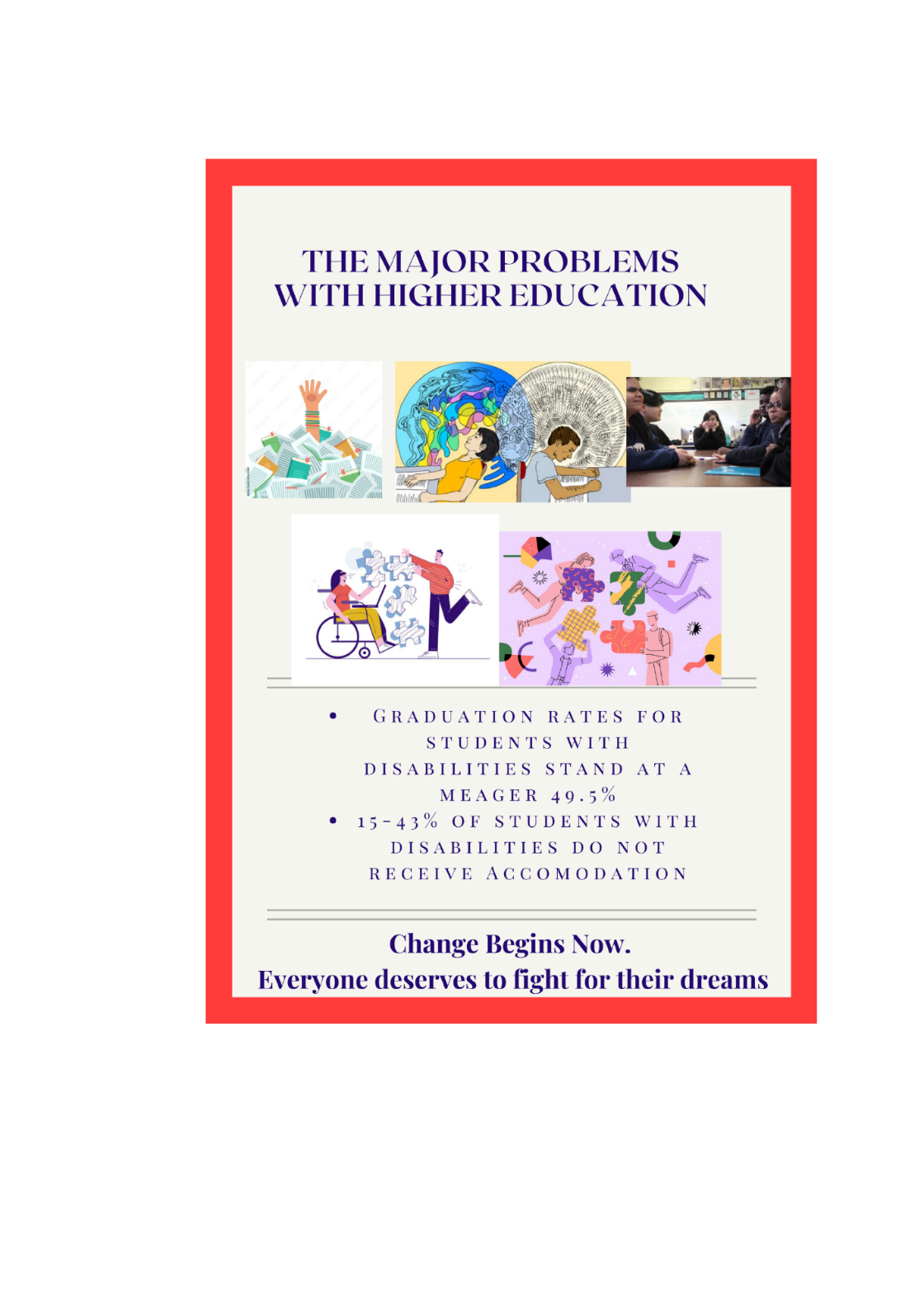
THE
MAJOR
PROBLEMS
WITH
HIGHER
EDUCATION
Sine:
YS
ty.
ra
oy
a
vs
GRADUATION
RATES
FOR
STUDENTS
WITH
DISABILITIES
STAND
AT
A
MEAGER
49.5%
5-43%
OF
STUDENTS
WITH
DISABILITIES
DO
NOT
RECEIVE
ACCOMODATION
Change
Begins
Now.
Everyone
deserves
to
fight
for their
dreams
3/1/25, 11:32 AM
Project 2 Final Draft
about:blank
7/9

References:
Nieminen, J. H. (2022, May 7). UnveilingableismandDisablisminassessment:Acriticalanalysisof
disabledstudents’experiencesofassessmentandassessmentaccommodations-highereducation.
SpringerLink. https://link.springer.com/article/10.1007/s10734-022-00857-1
Specht, J. (2014). Table of contents. ExceptionalityEducationInternational, 24(1).
https://doi.org/10.5206/eei.v24i1.7706
Patricia Silver, Andrew Bourke & K. C. Strehorn (1998). Universal Instructional Design in Higher Education: An
Approach for Inclusion, Equity & Excellence, 31:2, 47-51, DOI: 10.1080/1066568980310206
Collaboration strategies to facilitate successful transition of ... (n.d.-a).
https://www.researchgate.net/profile/Donna-Korbel/publication/230410966_Collaboration_strategies_to_f
acilitate_successful_transition_of_students_with_disabilities_in_a_changing_higher_education_environm
ent/links/6019529b299bf1cc2698f379/Collaboration-strategies-to-facilitate-successful-transition-of-stude
nts-with-disabilities-in-a-changing-higher-education-environment.pdf
Clifton, G. (2012). Supporting the development of Critical Thinking: Lessons for widening participation.
WideningParticipationandLifelongLearning, 14(2), 29–39. https://doi.org/10.5456/wpll.14.2.29
Academicaccommodationsforstudentswithlearningdisabilities. Academic Accommodations for
Students with Learning Disabilities | DO-IT. (n.d.-b).
https://www.washington.edu/doit/academic-accommodations-students-learning-disabilities
3/1/25, 11:32 AM
Project 2 Final Draft
about:blank
8/9

