



1
1. Introduction
1.1 Development Background of Industrial Parks
Industrial parks serve as fundamental platforms and crucial growth
poles for regional economic development. Since the 1990s, China has
implemented pilot economic development zones, leading to the vigorous
development of industrial parks nationwide over the past two decades. This
underscores the significance of industrial parks. However, in the last decade,
the rapid advancement of digital technology has highlighted the inefficiencies
and functional limitations of traditional industrial parks. Integrating emerging
digital technologies into these parks to achieve high-quality development has
become a pivotal strategy for transforming economic development models
across various regions. Consequently, leveraging emerging digital
technologies to empower the transformation of industrial parks is increasingly
prominent. In line with the national informatization development strategy and
the deployment of the new infrastructure strategy, industrial parks are now
driven by technological innovation and employ digital transformation,
intelligent upgrading, and integrated innovation to build a park infrastructure
system based on digital technology. This shift represents an inevitable trend
toward the digital and ecological development of industrial parks. Therefore,
this chapter systematically reviews the basic concepts, development history,
types, and current status of industrial parks to provide a research background
and practical basis for this study.

2
1.1.1 Concept and connotation of industrial parks
An industrial park is a specific area planned by national or regional
governments through administrative means according to the inherent
requirements of economic development. Within this area, leveraging special
policies, industrial enterprises are clustered to capitalize on the moderate
concentration of various production factors. This fosters distinctive industrial
characteristics, significant cluster advantages, and a well-organized functional
layout, thereby enhancing the development and competitiveness of regional
industries. China hosts various types of industrial parks, including export
processing zones, free trade zones, industrial parks, science parks, technology
parks, technology towns, economic and technological development zones,
high- tech industrial development zones, eco-industrial parks, and creative
industry parks. As significant forms of spatial agglomeration for regional
economic development and industrial adjustment and upgrading, these parks
undertake vital missions such as gathering innovative resources, cultivating
new industries, and promoting urbanization. Industrial parks perform five key
functions: resource gathering, technology penetration, enterprise incubation,
demonstration and leading role, and peripheral influence. By offering one-stop
services and an environment conducive to innovation for enterprises, these
parks enable numerous small and medium-sized enterprises (SMEs) to
specialize, scale up, and innovate, thereby driving local economic and
social

3
development.
Table 1.1 Five Functions of Industrial Parks
Function Interpretation
Resource gathering Gather human, material, financial, information, policy,
and other resources to exert synergy and scale effect.
Technology penetration
Allow new technologies to penetrate into traditional
industries, related industries, and other fields of society.
For example, microelectronics technology promotes
electronization and automation in the mechanical
industry, and robotics technology and artificial
intelligence (AI) technology are integrated with each
other.
Enterprise incubation
Cultivate and incubate start-ups, technology-based
SMEs, and innovative R&D technological achievements
to help them grow steadily and gain market
competitiveness.
Demonstration and leading role
Exert positive influence on enterprises and organizations
outside industrial parks and promote technological
advancement through innovations and breakthroughs in
parks’ organizational structure, products, and
technologies.
Peripheral influence
Promote the development of local commerce, science
and technology, education, transportation, and other
aspects and create employment opportunities for local
people.
1.1.2 Development history of industrial parks in China
Over more than 30 years, China’s industrial parks have continuously
evolved, forming distinctive patterns across different regions. Utilizing
industrial park policies, regions have seen the transition from traditional
industrial parks to manufacturing and modern industrial parks, along with
diverse organizational modes and node functions being observed. Overall, the
development of industrial parks in China can be divided into four stages (as
shown in Table 1.2):
Stage 1.0: The factor agglomeration stage, where local governments
demarcate specific geographic spaces to provide basic production factors and
services for enterprises in the park featuring amenities such as water and

4
electricity supplies, well-maintained roads and communication infrastructure,
drainage systems, and leveled sites. Stage 2.0: Governments aim to guide the
development of advantageous and leading industries through parks, forming a
low-cost development pattern with concentrated industrial production factors.
Stage 3.0: Recognizing that the low-cost, high-pollution, and low-added-value
pattern is unsustainable, governments focus on developing science and
technology industries by clustering enterprises with significant technological
strength to build high-tech industrial clusters. The constantly emerging sci-
tech parks during this stage promote industrial transformation and upgrading.
Stage 4.0: Both national and local governments elevate sci-tech parks to new
heights through large-scale new sci-tech towns and national high-tech
development zones. Overall, the evolution of these stages indicates a shift
from extensive to refined development, labor-intensive to technology-
intensive industries, and single-function to multifunctional industrial parks
closely integrated with urban development.

5
Table 1.2 Four Development Stages of Industrial Parks
Park 1.0 Park 2.0 Park 3.0 Park 4.0
Compariso
n item
Factor
clustering
stage
Industry leading
stage
Innovation and
breakthrough
stage
High-tech new town stage
Core
drivers
Preferential
government
policies and
low costs
Preferential
government
policies and
enterprise
competitiveness;
oriented by
industrial chain
integration
Largely
technologies;
oriented by
innovative
technology
development and
high-end
supporting
services
Wealth; oriented by high-
value brands, high-quality
professionals, high R&D
level, and high value-
added capacity and rate of
return
Park type
Industrial
parks
around
gathering
single
enterprises
or similar
enterprises
Industrial parks
around
extending the
industrial chain
of core
enterprises
Industrial
communities
around industrial
cluster layout
Complexes around
integrating industrial
functions and urban
functions
Dominant
industries
Labor-
intensive
traditional
industries
with low
added value
Capital-intensive
industries, such
as electronic
communication
equipment
manufacturing
and vehicle
manufacturing
Technology-
intensive and
innovative
industries, such as
biotechnology,
new energy, and
information
network industry
Sci-tech R&D, cultural
creativity, high-end
modern services, etc.
Park
functions
Focus on
manufactur
ing and
processing
of single
products
Focus on
product
manufacturing
Composite
functions of sci-
tech R&D and
product
manufacturing
A gathering place of
capital, industrial, and life
activities, with modern
comprehensive urban
functions
Urban
relations
Basically
disengaged
Relatively
disengaged
Pivotally
influenced Closely integrated
Representa
tive parks
Industrial
park
High-tech
industrial
development
zone
Zhongguancun
Science Park
Nanshan Science and
Technology Park,
Shenzhen
Data source: compiled and formed by referring to the LeadLeo
Research Institute.1
1Zheng, M. (2019). Overview of China’s industrial park industry. LeadLeo Research
Institute.

6
1.1.3 Types of industrial parks
Industrial parks can be classified into two main types based on their
establishment objectives: traditional industrial parks with a single economic
growth orientation and modern industrial parks with diversified
comprehensive development goals.2
(1) Traditional industrial parks
Traditional industrial parks are designed to facilitate the gathering and
flow of conventional production factors such as raw materials, labor, and
capital. They also promote the sharing of resources like land, transportation,
and infrastructure to create an agglomeration effect. These parks can be further
divided into export processing zones and industrial parks. Export processing
zones are special areas established by a country or region to manufacture,
process, and assemble export commodities. The goal is to utilize foreign capital
to develop export-oriented industries and expand foreign trade, thereby
expanding international markets and fostering an export-oriented economy.
The majority or all of the products from these zones are destined for export.
Industrial parks are areas where specific tracts of land are designated and pre-
planned exclusively for industrial facilities. As a strategic means of industrial
development, industrial parks reduce infrastructure costs, stimulate regional
economic growth, and offer various benefits to local communities.
2Wang, J. [Jici], & Zhu, K. (2018). Relevant theories of foreign industrial parks and their
implications for China. Urban Planning International.

7
(2) Modern industrial parks
Modern industrial parks arise during an era marked by global energy
crises and competition in both soft and hard power of sci-tech innovation
worldwide. These parks have a problem-oriented focus and can be subdivided
into sci-tech parks, eco-industrial parks, innovation parks, and other categories
(as shown in Table 1.3).

8
Table 1.3 Types of Industrial Parks3
Type Typical
industry Leadership Main
function Management mode Example
Export
processing
zones
Labor-
intensive
traditional
industries
Government
and its
agents
Resource
gathering
A management
committee is
established as an
agency of the
government, which
is responsible for
daily management
affairs in the zone
and cannot engage in
commercial
activities.
Hangzhou
Export
Processing
Zone
Industrial
parks
Labor-
intensive
traditional
industries
Industry-
leading
enterprises
Resource
gathering
A management
committee is
established as a
public institution
directly under the
industrial park to
organize, implement,
and formulate various
management systems
and service
regulations of the
park, to create a good
investment
environment for the
park.
Songmudao
Chemical
Industrial
Park, Dalian
Sci-tech
parks
Technology-
intensive and
innovative
industries
A dedicated
park
operating
company
Resource
gathering
Technolog
y
penetratio
n
Enterprise
incubation
Co-established by
governments and
enterprises but
operated by them
separately;
established by
governments and
operated by
companies
Zhongguancu
n Science
Park
Eco-
industrial
parks
High-tech
and
environmenta
l protection
industries
New park
solution
providers
Resource
gathering
Demonstr
ation and
leading
role
Designed with
efficient park
management systems
to implement
efficient management
of all aspects of parks
and promote their
sound operations
Qingdao
Sino-German
Ecopark
Innovation
parks
Sci-tech
R&D,
cultural
creativity,
high-end
modern
services, etc.
A dedicated
park
operating
company
Resource
gathering
Enterprise
incubation
Peripheral
influence
“Park + market-
oriented operation
company.” A
management service
center and a
management
company are
established.
Binjiang
Innovation
Park
Source: prepared by the author

9
Sci-tech parks are comprehensive areas where high-tech industries
cluster around innovation as the core. They include research institutions,
institutions of higher learning, high-tech enterprises, and the necessary
business and life service facilities and infrastructure such as municipal and
transportation systems. These parks represent the most effective spatial
organization for developing a knowledge economy. Eco-industrial parks form
regional systems comprising industrial enterprises, agriculture, and residential
areas. Enterprises within these parks share resources through close industrial
relations. They contribute to reducing the environmental impact of production
processes, strengthening waste recycling, lowering production costs,
improving economic benefits, and achieving sustainable development.
Innovation parks, focusing on innovation experiences, aim to attract
employees to participate in and enjoy the process of sci-tech innovation,
contributing to developing innovative and creative industries. Innovation parks
primarily provide office spaces such as conference rooms and laboratories for
innovation teams, coordinate industrial chains for project experiments,
transform and apply valuable scientific research achievements of industrial
chains, outsource service projects, and sell cultural and creative products.
To summarize, traditional industrial parks embody four main modes
of operation and management: government and its agency organizations
dominate; industry leaders dominate; professional park operating companies
dominate; new solution providers for park operation dominate. Different
operating entities and governance modes suit different types of industrial
parks.
1.1.4 Development status of industrial parks
Currently, industrial parks in China are at a transformative juncture. On

10
the one hand, numerous traditional industrial parks are transforming and
upgrading in response to national industrial transformation. On the other hand,
industrial parks dominated by emerging industries are quickly burgeoning,
creating an overall prosperous landscape. The total number of various
industrial parks exceeds 25,000.3 However, the further development of
industrial parks faces several challenges, which generally fall into three areas.
Insufficient digital planning for sci-tech parks. The long-
established development path of industrial parks based on traditional models is
no longer adequate for the digital age. This has led to insufficient overall
digital planning and a lack of coordinated development for high-tech industrial
parks. Consequently, there is a low-level repetition in digital transformation
efforts, with high competition frequency but insufficient synergistic benefits.
For example, in addition to focusing on commerce and trade industries, many
parks set up technology and finance sectors, without distinguishing
differentiated industrial characteristics. Internal park development often lacks
systematic and forward-looking planning, focusing instead on fragmented
functional development. This results in isolated functional subsystems that fail
to meet the needs of current industrial ecological development.
Inefficient digital services in sci-tech parks. Most sci-tech parks
still operate under GDP-centric management and governance models. While
business owners in parks provide basic services such as energy, water, and
sites, they often neglect issues like high energy consumption, pollution, and
waste. The
development of digital empowerment systems for
innovation and

11
3Wang, D. [Depei]. (2022, July 7). Driving economic growth by over 30%, facing serious overcapacity
and eight barriers to park development. Yicai. Retrieved from https://m.yicai.com/news/101309151.html

12
entrepreneurship is significantly lacking. Digital and intelligent solutions pose
significant challenges to the transformation of such industrial parks.
Furthermore, traditional industrial parks suffer from outdated infrastructure,
such as old network systems and weak power supplies, which fail to meet the
needs of modern enterprises, especially those requiring digital platform
development models.
Lack of support for innovation-driven entrepreneurship.
Traditional industrial parks have historically attracted enterprises through
location and tax policy advantages, providing basic, simple management
services. However, with the current saturation of industrial parks, relying
solely on tax, land, and energy price advantages is no longer effective for
investment attraction. In the context of national strategies for innovation-
driven and high- quality development, enterprises now prioritize services that
promote effective innovation-driven entrepreneurship, such as environmental,
technical, talent, financial, and information services. However, traditional
industrial parks are relatively weak in these areas, necessitating urgent
transformation and upgrading.
1.2 Digital Transformation of Industrial Parks
1.2.1 Evolution of digital park ecosystem
Digital transformation has become a strategic imperative to
effectively address existing challenges in developing industrial parks. With the
advent of the digital economy, industrial digitization and digital
industrialization have set new trends for the transformation of industrial parks.
In general, the development of China’s industrial parks has reached a critical
period for transformation and upgrading. On the one hand, in the context of
industrial

13
digital transformation, many enterprises in traditional industrial parks have
undergone transformation and upgrading, promoting the overall digital
transformation of the parks. On the other hand, industrial parks dominated by
emerging industries have rapidly emerged, creating a flourishing scene for
industrial parks. The total number of various industrial parks now exceeds
25,000 (Wang Depei, 2022).
Different studies offer varied conclusions on the direction of
industrial park transformation. K. Zhang et al. (2012) and Ai et al. (2016)
suggested that future industrial parks will emphasize the coordinated
development of production, life, and ecological activities, transforming into an
ecological economic development model. Enterprises within these parks shift
from traditional manufacturing to high and new technology, focusing more on
technological innovation, increasing R&D investment, and gradually capturing
high value-added links in the industrial chain. The management systems of
industrial parks are evolving toward intelligence, humanization, and perfection
to meet increasingly intricate social needs.
Z. Zhong et al. (2021) and G. Zhu (2021) argued that industrial parks
develop in an ecological manner. Under the trend of digital development, the
ecosystem of digital parks has become a product of the transformation and
upgrading of traditional industrial parks. By adopting digital, platform-based,
and intelligent technologies, industrial parks develop an ecological system that
integrates people, machines, things, and materials through comprehensive
perception and extensive connection, forming an organism and sustainable
development space characterized by active service and intelligent evolution.
Digital parks use information technologies such as cloud computing and the

14
Internet of Things (IoT) to perceive, monitor, analyze, control, and integrate
all key links. They are intelligent parks based on digital foundations (H. Liu,
2016). Digital parks use technologies like IoT and cloud computing to monitor
park dynamics at all times, improving operational efficiency and reducing
operating costs (M. Ma, 2016). G. Zeng (2022) pointed out that the
increasingly complex development of digital industrial parks is conducive to
multi-park management, which requires discipline and organizational support
from fields such as industrial planning, economic development, industrial
technology, transportation systems, ecological balance, and scientific research.
Based on the above, we summarize the characteristics of the digital
park ecosystem as follows: (1) Parks adopt IoT, digital, intelligent, and
platform-based technologies to transform infrastructure digitally. This
provides efficient and low-cost basic property services for enterprises and
empowers innovation-driven entrepreneurship with various resources inside
and outside parks. (2) Parks demonstrate the interactive and integrated
development of production and life activities. Digital parks offer compound
functions such as office space, R&D, production, enterprise display, residence,
and commerce, providing comprehensive service support for enterprises and
individuals in parks. (3) Parks serve as innovation and entrepreneurship
empowerment platforms for settled enterprises. Historically, industrial parks
provided low value-added and non-technology-oriented services, such as life
services and production services. Now, facing the national innovation-driven
development strategy, they are transforming from providing lifestyle services
to delivering innovative entrepreneurship services, promoting the high-quality
development of enterprises within the parks.

15
1.2.2 Development trend of industrial parks as digital platforms
With the ecological development trend of industrial parks, the
management of sci-tech parks is also showing a trend toward ecological,
platform-based, and systematic development. Relying on digital infrastructure,
the interconnection and coordinated development between these parks and
enterprises within them have been realized. The development of digital
platforms reflects the following trends in organizational elements, inter-
element relations, and organizational structures.
First, digital organization development of industrial parks. The digital
organization development of industrial parks is foundational to achieving
platform-based and ecological development. Parks’ digital organization can be
divided into three aspects: base system (digitization of infrastructure), digital
process, and front-middle-back office collaboration. Regarding the base
system development, industrial parks should use technologies like AI,
blockchain, cloud computing, data analytics (ABCD) plus 5G to build a big
data platform that integrates both government and business data. Government
data includes services, spatiotemporal information, building information, and
safety information, which aid in providing policy consulting services for
enterprises in parks. Business data include customer, market, industry data,
and industrial analysis, providing business support for enterprises in parks.
Regarding digital process development, to ensure orderly data operations,
parks need to establish a well-organized data process system with robust data
standardization, processes, and normalization systems. This supports both
service provision for enterprises and effective governance. It is also necessary
to ensure sound organizational development of enterprises in parks. Front-
middle-back office

16
collaboration represents the development of organizational systems of park
management institutions. It enables the back office to manage underlying data,
the middle office to design functional systems based on different customer
scenarios, and the front office to meet personalized needs.
Second, the organizational change for platform-based development of
industrial parks. The platform-based development of industrial parks depends
not only on digital technology but also on digital organizational change to
create a collaborative system of digital platforms for the parks. Corresponding
to digital technology, organizational change encompasses the organizational
change of park management institutions and their interactions with enterprises
within parks. Firstly, the park management institution should establish a “park
brain.” This concept is not technical but functional. It involves creating a
collaborative command system using technological means and building
various modules according to the park’s service functions (such as
comprehensive management, government services, economic analysis,
innovation incubation, and precise investment attraction). It should enable
human-computer interaction management, allowing for overall perception,
real-time monitoring, full-line scheduling, and data-driven decision-making
within the park. Secondly, there must be efficient interaction between the
“park brain” and various terminals (enterprises in the park). The park
management institutions should implement digital interactions with each node.
In terms of organizational design, the most effective organizational modules
should be selected according to forms like project teams, technical teams, and
service teams, to ensure efficient connections with the “park brain.”
Third, digital empowerment of industrial parks to entrepreneurial

17
enterprises. Traditional industrial park management is often closed, with all
services provided by operating institutions and designed by the management
enterprises within the parks. This model is not conducive to large-scale, wide-
ranging, and platform-based park operations. Supported by digital technology,
future industrial parks should be platform-empowered. Firstly, parks should
pursue open partnerships. Various park services can be provided by
professional service organizations outside the park. Secondly, park services
should be oriented toward innovation and entrepreneurship. Parks should be
high-level suppliers of innovation and entrepreneurship elements rather than
low-level service providers. They should design service technology structures,
functional elements, main tasks, and implementation paths centered on their
development goals to provide high-quality services for enterprise innovation
and entrepreneurship. Thirdly, interaction and collaboration can be realized
among enterprises in each node of the park. The park platform should offer
specialized services such as collaborative R&D, production and
manufacturing, enhancement technology, and efficiency technology.
Enterprises within the park should act as synergistic entities, cooperating and
empowering each other to continuously enhance the digital capability of the
park, promote digital technology innovation, and create a digital
organizational community.
1.3 Research Questions
The digital transformation of industrial parks has become a crucial
strategic direction for their development, with building digital platforms as a
key approach of great significance. However, there are challenges in creating
digital platforms and achieving the transformation of industrial parks. For
instance, current platform functions are mainly focused on information

18
display,

19
which hampers empowerment in innovation and entrepreneurship. The
systems of digital platform capabilities and entrepreneurship empowerment
evaluation have not been systematically constructed, and the pathway for
digital platforms to empower entrepreneurial enterprises needs further
exploration. In response, the study focuses on the core question of “how to
build digital platform capabilities for sci-tech industrial parks to empower
entrepreneurship of enterprises in the parks.”
To answer this question, this study focuses on three sub-questions.
First, what digital platform capabilities should be developed for sci-tech
industrial parks? This study identifies and refines the connotations and
dimensions of digital platform capabilities through case studies to build a
capability system that can empower entrepreneurial enterprises.
Second, how can these digital platform capabilities empower
entrepreneurial enterprises in the parks? Based on the proposed digital
platform capability system, the study tests the mechanism and action process
of digital platform capabilities on the entrepreneurship empowerment
performance of entrepreneurial enterprises in parks using questionnaire data.
Third, how do the basic standardized management systems impact the
empowerment of digital platform capabilities on entrepreneurial enterprises in
industrial parks? The study proposes that the basic standardized management
system acts as a boundary condition affecting the digital platform capabilities
and the performance of empowerment over entrepreneurial enterprises in
industrial parks. The moderating effect of this system is also tested using
questionnaire data.

20
1.4 Research Significance
From the perspective of industry development, China’s industrial
park development remains largely traditional. There is an urgent need to
address issues such as insufficient overall planning and coordination of digital
parks, low efficiency of digital services, and inadequate support for
innovation-driven entrepreneurship. From the perspective of digital
transformation, currently, industrial parks are in the initial stages of digital
transformation. Therefore, it is pressing to explore an ecological, platform-
based, and systematic development path for industrial parks through the
development of a digital park ecosystem. Specifically, theoretical
breakthroughs and practical explorations can be made in three key areas: the
digital organizational development of industrial parks; the organizational
change in industrial parks’ platform-based development; and the digital
empowerment of industrial parks to entrepreneurial enterprises.
1.4.1. Theoretical significance
First, this study introduces the concept of digital platform capabilities
and identifies its connotation and dimensions, providing a theoretical reference
for the capacity building of industrial parks. The study explores the concept,
connotation, and characteristics of digital platform capabilities, proposing two
dimensions: digital platform complementarity capability and digital platform
integration capability, based on resource elements and platform enterprise
integration, aiming to establish a digital platform capability system for
industrial parks.
Second, the study outlines the components and measurement methods
of digital platform capabilities. It highlights that the practical value of digital
platform capabilities lies in understanding the specific management systems

21
for

22
developing digital platforms of parks. It describes operational ideas such as
platform complementarity capability and platform integration capability.
Through case studies, it proposes standardized indicators and measurement
methods for platform capabilities, along with a performance evaluation model
for platform-empowered entrepreneurship in sci-tech industrial parks, providing
a referential standardized base for digital platform development within parks.
Third, the study establishes the causal relationship between digital
platform capabilities and entrepreneurship empowerment performance. It
explores the mechanism and process through which digital platform
capabilities impact the entrepreneurship empowerment performance of
entrepreneurial enterprises in parks. Using parks’ basic standardized
management system as a moderating variable, this study reveals the positive
effect of the interaction between digital platform capabilities and basic
standardization capability on improving entrepreneurial empowerment in
parks. These contributions can serve as a theoretical reference for the platform
organization development of high-tech industrial parks in the digital age.
1.4.2 Practical significance
Given the development of digital technology and digital industries, it
has become a significant practical challenge to build a digital capability
system to empower enterprises and new entrepreneurs in industrial parks in
combination with parks’ positions. Considering the “gathering and interactive
benefits” for subsequent digital platforms, this study proposes a conceptual
framework of “digital platform capabilities,” outlining the constituent
elements, system functions, and mechanisms of action. The study’s practical
value includes the following aspects.

23
First, this study provides a realistic framework for developing digital
platforms for management institutions and operating enterprises in industrial
parks. The research results will offer guidance for the digital transformation of
industrial parks and propose ideas about establishing a collaborative online-
offline service system for parks to serve enterprises. Specifically, systematic
thinking is provided for case enterprises to strategically develop the capability
system of park development, and these enterprises are guided to explore
mechanisms that more effectively serve enterprises in parks.
Second, the study offers a framework and strategic guidance for
building a digital platform in Zhixin Zedi Science and Technology Industrial
Park. By analyzing the basic elements of digital platform capacity
development and basic standardized management system design, the study
provides paths and implementation ideas for enterprises to build digital
platforms and better empower enterprises in parks to achieve high-quality,
efficient, and cost- effective entrepreneurship. It also offers strategic
suggestions for the future development of Zhixin Zedi.
Third, the study provides policy suggestions for developing park
service systems in various regions and industries across China, as well as
suggestions for the construction of national entrepreneurial parks. It proposes
an operational system for the digital transformation of future industrial parks
from a system level, establishing basic standardized systems comprising a
project-based operating system, team-based organizational system, and
collaboration ecosystem. This aims to provide policy guidance for parks to
better serve and empower enterprises’ innovation and entrepreneurship.

24
1.5 Research Ideas and Content Framework
The study employs the following ideas:
First, the development of sci-tech industrial parks requires a thinking
shift from traditional park service to entrepreneurship empowerment within an
innovation ecosystem. Based on this logic, sci-tech industrial parks are seen as
platform organizations for entrepreneurship empowerment, and their digital
transformation involves establishing digital platform organizations.
Second, the internal foundation of a digital platform organization is
its digital platform capabilities. A capability system is formed through online
and offline collaboration, cooperation between companies and external partners,
and collaboration between companies and entrepreneurial enterprises within
the park. The core components of this system are the digital platform
complementarity capability and the digital platform integration capability.
Third, to empower entrepreneurial enterprises in the park through
digital platform capabilities, it is essential to establish basic standardized
systems comprising a project-based operating system and collaboration
ecosystem. This will solidify the base of AI industrial parks and continuously
empower innovation and entrepreneurship for enterprises in parks.
Fourth, the overall theoretical model follows a causal logic of digital
platform capabilities — entrepreneurial performance of enterprises in parks.
Empowerment performance can be measured in two ways: direct performance
(reduction of entrepreneurial costs and improvement of entrepreneurial
efficiency) and indirect performance (it can be service effectiveness during the
entrepreneurial process).
Based on the above ideas, this study introduces the concept of digital

25
platform capabilities. This concept aims to integrate resources inside and
outside parks and achieve platform-based management through digital
technology and management systems. Digital platform capabilities include
industrial focus, service professional capability, and platform integration
capability.
The purpose of proposing digital platform capabilities is to build a
foundational framework for future industrial parks. This framework includes a
causal relationship model with basic standardized systems as the condition,
digital platform integration capability as the core variable, and
entrepreneurship empowerment performance as the result. The model involves
three constructs: basic standardized systems, digital platform capabilities, and
entrepreneurship empowerment performance. In this model, digital platform
capabilities are independent variables, entrepreneurship empowerment
performance denotes a dependent variable, and basic standardized systems are
moderating variables.
Based on the above research ideas, the basic research framework
includes the following five parts:
First, Introduction. This part reveals the current development trend of
industrial parks and their demand for digital transformation by analyzing the
industry background and case enterprises. It outlines the basic theoretical and
practical problems to be solved, forming the research objectives and basic
framework. The case method and empirical method are also explained in this
part.
Second, Literature Review. This part starts with the platform-based
transformation of industrial parks, sorting out the basic path of their digital
transformation. It introduces the logic and capacity building of digital

26
platforms

27
and outlines the relationship between digital platform capabilities and
innovation and entrepreneurship empowerment, providing a theoretical
background for subsequent research.
Third, Case Studies. This part discusses exploratory research, aiming
to construct the theoretical logic, basic framework, and empirical conceptual
model. It systematically analyzes the platform organization, structure, and
elements formed through the adoption of digital technology by sci-tech parks.
This part reveals the underlying mechanism and important conditions for
platform capabilities to empower entrepreneurial enterprises, forming a
theoretical framework and proposing the causal logic between platform
capabilities and entrepreneurial empowerment. The case study results serve as
a basis for empirical testing in the next part.
Fourth, Research Hypotheses and Testing. This part tests the basic
hypotheses using an empirical statistical model to measure the main effects
and moderating variables. It reveals the correlation analysis among digital
platform capabilities, basic standardized systems, and entrepreneurship
empowerment performance. Relevant theories of digital transformation and
platform capabilities are employed to discuss the research conclusions and
analyze the theoretical logic and explanation mechanism of the empirical
results.
Fifth, Conclusions and Outlook. This part summarizes the research
conclusions and theoretical contributions, provides policy suggestions for
improving the digital platform system of industrial parks in the context of
digital transformation, and proposes the study’s shortcomings and future
research prospects.

28
1.6 Research Methods
The study analyzes organizations including Zhixin Zedi,
entrepreneurial enterprises, and service enterprises. Data is obtained through
these enterprise units for statistical analysis and case studies. The research
methods mainly include three aspects:
(1) Literature analysis. Digital platform capabilities represent a new
construct. To improve construct validity, we review and summarize Chinese
and international literature to propose the connotations and measures of digital
capabilities, digital platform capabilities, and entrepreneurship empowerment
performance. Corresponding theories are used to explain the interrelationship
between these constructs.
(2) Case studies. Using Zhixin Zedi as a case study, we analyze its
development process, current organizational structure, and business content to
identify the components of digital platform capabilities. Additionally, we
examine innovative and entrepreneurial enterprises within the park as another
category of case study to analyze the platform elements and coordination
mechanisms of Zhixin Zedi. From the perspective of these enterprises, we
analyze the service content and satisfaction and explore the organization and
effect of activities, resource needs, and resource allocation of the digital
platform to examine the service performance of the platform for enterprises,
thus proposing the underlying mechanism through which the digital platform
empowers entrepreneurship.
(3) Statistical analysis. First-hand data are collected through
questionnaires for statistical analysis to test the causal relationship among
model constructs. Questionnaires are distributed to enterprises (samples) that
29
have used digital platforms in digital industrial parks. After the samples are
collected, regression analysis is carried out to test the impact of the digital
platform empowerment system on entrepreneurial enterprises’ empowerment
performance and to examine the moderating effect of the basic standardized
systems.
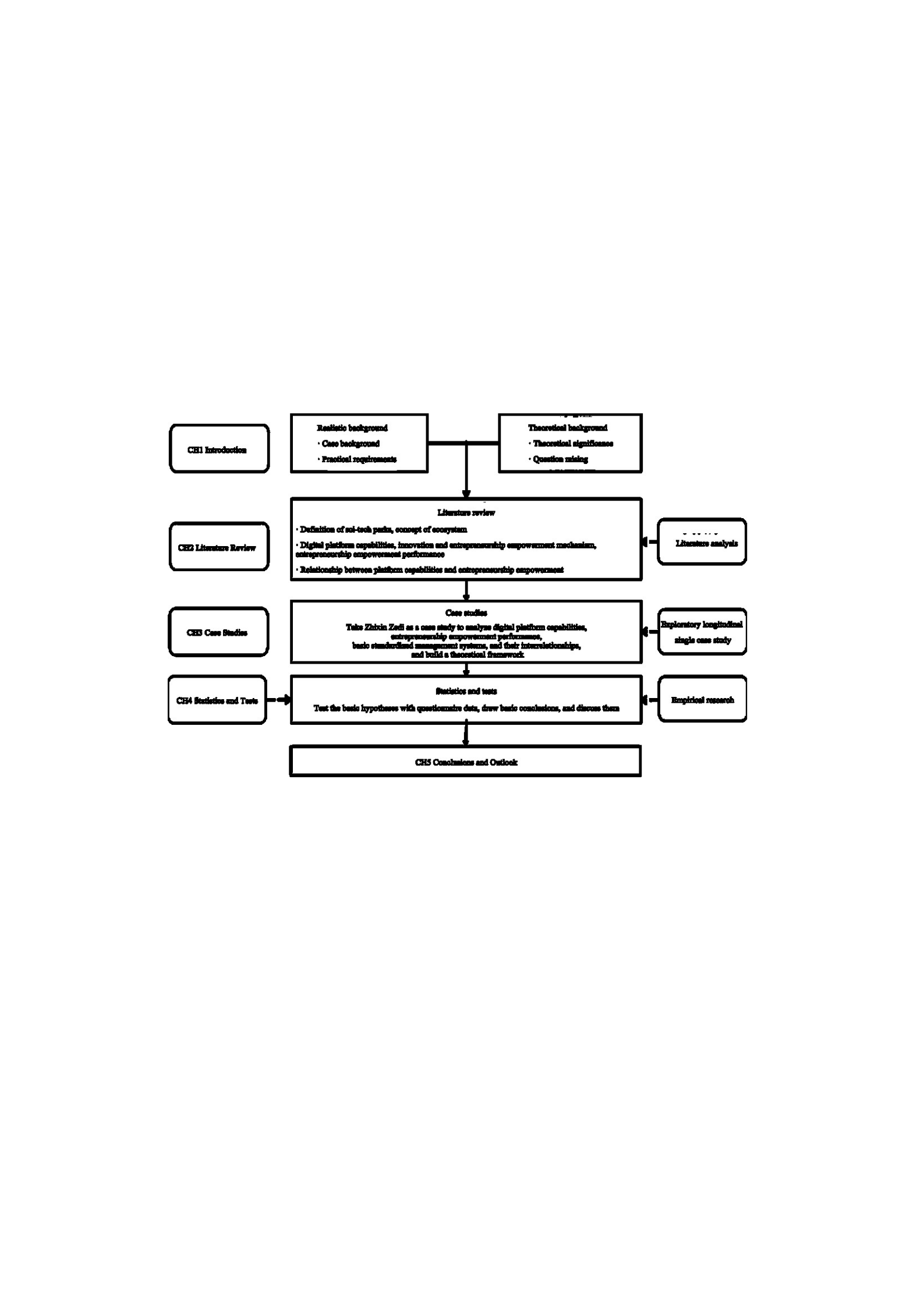
Based on the above chapter relationships and research methods, the
technology roadmap of this study is shown in Figure 1.1.
Figure 1.1 Technology Roadmap

30
2. Literature Review
2.1 Typical Construction Path of Digital Park Ecosystems
In response to the requirements of digital, platform-based, intelligent,
and ecological development for enterprises, traditional industrial parks must
build digital ecosystems, form an ecological system that empowers innovation-
driven entrepreneurship, and serve the green and high-quality development of
the regional economy. The digital park ecosystem is a product of the
transformation and upgrading of traditional industrial parks. By adopting
digital, platform-based, and intelligent technologies, it constructs an ecological
system based on comprehensive perception and extensive connection, deeply
integrating people, machines, events, and things. It is an organic life form and
sustainable development space characterized by proactive service, intelligent
evolution, and other features.
Currently, in China, the Bohai Rim, Yangtze River Delta, and Pearl
River Delta regions have emerged as the three major agglomerations for the
construction of digital parks, leveraging their extensive industrial park
platforms. In the central regions along the Yangtze River, there is great
potential for coordinated development among the cities along the river,
leading to active efforts in digital park construction. The vast western regions
are seizing the new opportunities presented by industrial transfer, combining
their unique geographical features and existing industrial park foundations, to
accelerate the planning and construction of digital engineering projects. Based
on insights gained from leading digitization practices in existing parks, this
paper summarizes four key paths for building digital park ecosystems.

31
2.1.1 Path 1: Transformation and upgrading of government-led
traditional industrial parks
In government-led traditional industrial parks, local governments
create relevant industry support policies and favorable tax conditions based on
the needs of urban development and socioeconomic growth to attract external
enterprises to settle in the parks, thereby facilitating industrial agglomeration.
The government takes responsibility for the construction of park infrastructure
but avoids excessive interference in the internal operations of the park.
Instead, it establishes governing bodies within the park, typically in the form
of a park management committee, to oversee and govern the park. During the
transformation and upgrading of government-led traditional industrial parks
into parks with digital ecosystems, the park management committee will first
digitize the existing assets and services within the park. This digital
transformation enables the flow and integration of resources driven by online
information, enhancing the park’s monitoring, early warning, prediction, and
response capabilities. Furthermore, the park management committee invests
in digital technology platforms to integrate and achieve synergy between
online and offline resources, as well as within and outside the park. This
enables the provision of convenient information services for the public in
industrial parks, facilitates the construction of comfortable office
environments, expands the scope of park services, and enhances service
efficiency. Lastly, the park management committee strengthens the park’s
features, core capabilities, and access rules to attract and introduce high-
quality complementary resources from outside the park. This is done to build
an open digital park ecosystem, leverage the advantages of both the park’s
internal resources and complementary

32
resources, and empower enterprises within the park with innovation-driven
entrepreneurship.
Case of adopting this path: Suzhou Lianfa Industrial Park’s
transformation and upgrading with a focus on financial services. With a
development history of 20 years, Lianfa Industrial Park had a small-scale
tenant with a low added value, which fell far behind the pace of optimizing
and adjusting the industrial structure of the park. In 2010, Suzhou Industrial
Park established the first national-level large-scale RMB fund of funds (FOF),
the “Guochuang Kaiyuan FOF” with a total size of RMB 60 billion. Over
time, dozens of sub-funds have been established through investments. In 2020,
an RMB 10 billion government industrial investment fund and an RMB 2
billion angel FOF were established to increase investment in strategic
emerging industries. Leveraging the policy advantages of the China (Jiangsu)
Pilot Free Trade Zone Suzhou Area, efforts are being accelerated to promote
financial openness and innovation. The government departments have built an
industrial park platform and formed an ecosystem for innovation and
entrepreneurship by opening up park functions. Under the active guidance of
the Jinji Lake CBD, Suzhou Lianfa Industrial Park has launched
comprehensive renovation and upgrading efforts while simultaneously
adjusting and upgrading business formats through iterative replacement of
traditional industrial tenants. So far, the park has achieved a 70% carrier
renewal rate, gradually attracting around 30 enterprises in industries such as
electronic components, medical devices, and semiconductor equipment,
forming a cross-industry digital park ecosystem. 4

33
4Free imagination. (2022, June 24). Government-led city-industry integration model—Suzhou Industrial
Park. QQ.com. Retrieved from https://new.qq.com/rain/a/20220624A08JJ100

34
2.1.2 Path 2: Transformation and upgrading of traditional industrial
parks led by industry-leading enterprises
Traditional industrial parks led by industry-leading enterprises refer to
industrial parks where these enterprises act as the main developers and
operators. They are responsible for unified planning and design, infrastructure
construction, investment attraction, operation services, and industrial
incubation of the industrial park projects, driving the operation and
development of the industrial park in a market-oriented manner. With their
brand advantages and position in the industry chain, these leading enterprises
attract upstream, downstream, and supporting enterprises to settle in the park,
forming efficient collaboration and promoting regional industrial and economic
development. Through digital transformation, the leading enterprises extend
their presence beyond the existing industrial foundation. First, they utilize
digital technologies such as AI and 5G to strengthen the digital infrastructure
construction of traditional industrial parks, enhancing the provision of digital
services within parks. Second, they open up multidimensional and multisource
data generated by parks’ internal operations, advancing the research and
development of shared solutions within parks. Last, leveraging their
technological and resource advantages, the leading enterprises build park
ecosystems based on digital platforms and other means, enhancing the synergy
of the industry chain within and outside parks and empowering enterprises
within parks with innovation-driven entrepreneurship.
Case of adopting this path: from Yutai Textile Park to Yutai
Cultural and Creative Industrial Park. Yanjiao High-tech Industrial
Development Zone in Sanhe is the production site of Yutai Textile
Printing and Dyeing

35
Machinery, a foreign-funded enterprise. In recent years, due to the
requirements for industrial transformation and upgrading and urban spatial
optimization, existing projects have faced shortcomings such as low
technological content, low industrial added value, and a low industrial
hierarchy. Most of the factories are either idle or subleased. In 2019, through
the efforts of the Zone, Yutai Textile acquired the entire old factory area and,
based on the “Two Exits and Two Optimizations” policy, revitalized the idle
industrial land and transformed it into a pilot project for industrial
transformation and upgrading, and established the Yutai Cultural and Creative
Industrial Park, thereby realizing “second-time business starting.” In
supporting the transformation and upgrading of the park’s ecosystem, the
Sanhe Municipal People’s Government boldly innovated and issued the
Management Measures for Industrial Enterprise Technological
Transformation Projects and the Pilot Measures for Promoting the
Redevelopment of Inefficient State-owned Construction Land in Urban Areas
to provide policy services for the park. During this period, Yanjiao High-tech
Zone also introduced the Implementation Measures for Industrial Project
Transformation and Upgrading (Trial) to further clarify the path and
streamline the process for the reuse of existing industrial land. The Yutai
Cultural and Creative Industrial Park is positioned based on the original textile
machinery and clothing design, to achieve industrial upgrades and extensions.
It focuses on three major industries: intelligent manufacturing, creative design,
and modern services, actively develops headquarters functions, and creates a
sci-tech innovation industrial park that gathers sci-tech innovative
manufacturing
and
cultural
and
creative
industries,
thereby
empowering

36
enterprises within the park with innovation-driven entrepreneurship. 5
2.1.3 Path 3: transformation and upgrading of traditional industrial
parks led by professional park operators
The separation of ownership and operation rights in industrial parks
has led to the emergence of professional industrial park operators. These
operators engage in cooperation from the planning stage of the industrial park,
ensuring the feasibility of project positioning and planning while gaining
insights into the local conditions and amassing customer resources.
Professional industrial park operators can provide more systematic and
specialized services for the industrial park, including park planning,
construction, investment attraction, operation, and enterprise entry and exit.
During the process of transforming traditional industrial parks into parks with
digital ecosystems, professional industrial park operators first need to digitize
and upgrade their comprehensive service systems by introducing advanced
digital technologies and management concepts. Second, they follow the
renovation logic of “information technology + industrial park management”
and integrate innovative technologies such as cloud computing, AI, big data,
IoT, and mobile web. By relying on a unified platform, they establish an
information-based and integrated management system that covers various
aspects, including office collaboration, investment attraction, financial
management, property management, industrial analysis, and project incubation
for traditional industrial parks. Last, they open up park resources to attract
external entities and provide
5Official Baijiahao account of Xiaoxiang Morning Herald. (2021, April 25). Fifteenth
typical case of transformation in parks: Yutai Cultural and Creative Industrial Park “takes

37
in the fresh while getting rid of the stale” to foster cultural and creative dynamism.
Xiaoxiang Morning Herald.

38
more opportunities for innovation and entrepreneurship for enterprises within
parks.
Case of adopting this path: Liando Group invested in the
establishment of Yuepu Technology to explore a new model of park
operation. Founded in 1991, Liando Group has a registered capital of RMB
620 million and oversees over 20 subsidiary companies. It is a conglomerate
that integrates industrial parks, template steel structures, and investment
business. Liando Group is one of the earliest enterprises in China engaged in
industrial park development and operation. With its long history in the
industry and years of development, Liando Group has established a unique
development model, gaining a first-mover advantage and accumulating
resources. In September 2020, Liando Group invested RMB 500 million to
establish Shanghai Yuepu Technology Co., Ltd., a new company registered in
Jiading District, Shanghai, with its office in the Hongqiao Business District. It
also launched its new subsidiary brand, Yuepu Technology Industrial
Development Group (hereinafter referred to as “Yuepu”). Yuepu marks the
initiation of Liando’s second direction in the industrial park business,
differentiating itself from traditional manufacturing parks. It primarily focuses
on sci-tech parks, catering to the “hard-tech industry” and targeting cities of
the first and second tiers. It has formed an innovative operational model of
“investment + space + operation
+ scenario.” Regarding the creation of a digital park ecosystem, Yuepu first
establishes a favorable ecological environment, embodying Liando Group’s
concept of “ecology-based technology.” Second, it enhances the level of
synergy and collaboration in the industry chain, achieving the “chain-based
technology” of Liando Group. Furthermore, it promotes global collaboration,

39
regional collaboration, and cross-industry collaboration, realizing the
“technology collaboration” of Liando Group. It tightly integrates scenarios
with technological applications to create the “scenario-based technology” of
Liando Group. Lastly, it accelerates the upgrading and transformation of urban
functions, focusing on “talent density” to achieve the “pinnacle-based
technology” of Liando Group. Through the transformation of the “Five
Transformations,” Liando Group achieves comprehensive upgrading of the
enterprise itself, constructing a high-energy ecosystem that empowers
industrial parks for innovation-driven high-quality development.
2.1.4 Path 4: New solution providers build digital park ecosystem
The new solution providers for industrial parks refer to the large-scale
park operators that leverage emerging digital technologies, platform
technologies, and intelligent technologies to provide full lifecycle
empowerment for the integration of investment, construction, operation, and
maintenance of industrial parks. New solution providers view industrial parks
as spatial complexes integrating the physical world, humanistic world, and
digital world and strive to build a digital park ecosystem that encompasses
sensing, connectivity, and intelligence for all. New solution providers lead the
construction of digital industrial park ecosystems through two main paths:
First, they respond to regional government needs for the development of
emerging and strategic industries by spearheading the planning, design,
development, and operation and maintenance of new industrial parks. They
leverage their brand and government endorsements to attract top-notch partner
enterprises and employ advanced concepts and technologies to create model
new industrial parks. Second,
they
focus
on
projects
that
combine
“new
planning
and

40
construction” with the “renovation of old industrial parks,” conducting
second- time creation based on the original characteristics of the industrial
parks. By leveraging their strong advantages in systematic, digital, and
platform-based solutions, they take over and renovate old industrial parks,
again using their brand and government endorsements to attract excellent
participants and jointly building a new digital industrial park ecosystem.
Case of adopting this path: Enjoy Town creates a digital park that
empowers the full lifecycle. Enjoy Town was established in 2014 with its
headquarters in Hangzhou. As a practitioner of vibrant communities in future
towns, Enjoy Town is a capital management operator of sci-tech innovation
communities with development capabilities and a service provider of
communities in the digital society. With the mission of “making community
life more colorful with culture and technology,” Enjoy Town integrates
international resources to develop digital communities in the mode of
“integrating investment, construction, operation, and maintenance.” Guided by
the development strategy of “empowering future communities with culture and
technology and promoting consumption upgrades through the integration of
culture and tourism,” Enjoy Town focuses on future communities and culture-
tourism integration business and has initially formed a complete industry chain
encompassing investment, investment attraction, construction, and operation of
future communities and culture-tourism integration projects. It has invested,
constructed, and operated two main thematic products: innovative future
community-neighborhood center cultural complex and creative culture-tourism
integrated complex. As a comprehensive service provider for the digital
society, Enjoy Town is driven by the dual engines of culture and technology. It
plans a business architecture of

41
“One Headquarters, Two Groups,” focusing on digital community operation
projects in the three major urban clusters of Zhejiang Province and new towns
across various regions. It exerts influence on the Yangtze River Delta region,
providing local governments, enterprises, and developers with services
throughout the full lifecycle of digital communities, including investment
services, project services, ecosystem enterprise incubation services, digital
empowerment services, and research and academic services.6
2.2 Capability System for Entrepreneurship Empowerment of
Digital Parks
The digital park ecosystem needs to empower the park’s enterprises
with innovation-driven entrepreneurship, and the leader of the ecosystem must
possess a certain capability base. Based on existing research findings (J. Liu,
2015; Z. Ma, 2020; Wang Dongyang, 2022; Wang Shuguang et al., 2022), the
capability system of the leader in the digital park ecosystem should include
capabilities to build the digital park ecosystem and integrate internal and
external resources of the park to empower innovation-driven entrepreneurship.
Specifically, it encompasses five core capabilities: infrastructure construction,
core component development, boundary resource development, ecosystem
values establishment, and ecosystem governance.
2.2.1 Infrastructure construction capacity
The infrastructure of an industrial park is a fundamental requirement
for supporting the operation of a digital park ecosystem. The leader of the

42
digital park ecosystem must possess strong infrastructure construction
capability to
6Zhang, L., & Shen, G. (2020, March 22). Qicai Community in Guali Town, Xiaoshan
District: The town’s role in future communities. Zhejiang Daily.

43
ensure a solid foundation for the ecosystem. The infrastructure of the digital
park ecosystem includes physical space infrastructure and network space
infrastructure (M. Ma, 2016). On the one hand, the leader needs to invest in
the spatial layout planning and construction of the industrial park, such as
production and manufacturing systems, logistics systems, transportation
systems, sewage systems, energy supply systems, environmental protection
systems, and logistical support systems. On the other hand, the construction of
network space infrastructure includes network transmission infrastructure,
basic data collection for supporting the operation of the industrial park,
intelligent devices and platforms for the park’s basic production and daily life,
basic data storage for the park, and basic data governance for the park, among
others.
The construction of infrastructure in the digital park ecosystem is a
process that relies on technological advancements and continuous
improvement. The digital park ecosystem needs to respond to the requirements
of economic development while complying with national and regional
regulatory provisions. Therefore, the leader must continuously adopt new
technologies to update and iterate the infrastructure of the ecosystem based on
external environmental pressures and internal growth demands. This includes
the application of platform-based and intelligent technologies to enhance the
operational efficiency of the digital park ecosystem.
2.2.2 Core component development capability
According to the definition of an innovation ecosystem (Jacobides et
al., 2018), the leader of a digital park ecosystem must invest in the
development of core components. These core components define the
competitive advantage of the ecosystem that distinguishes it from others and

44
are crucial for attracting

45
complementary parties to participate in the ecosystem.
The core components of a digital park ecosystem are determined
based on the industry characteristics and the core competitive advantages of
the leading enterprises within the ecosystem. For example, the core advantage
of Suzhou Industrial Park lies in its industrial funds. Therefore, it is confirmed
that its core component is the financial services module.7 In Yutai Industrial
Park, the foundation lies in the production and manufacturing of textile
printing and dyeing machinery equipment. Its core components are based on
existing textile machinery and clothing design, focusing on three major
components: intelligent manufacturing, creative design, and modern services.8
The development of core components in a digital park ecosystem requires the
leader to form a professional team, gain deep insights into the practice of
industry enterprises, and build universal functional components that can
significantly enhance the operational efficiency of industry enterprises. These
core components should be continuously updated and iterated upon.
The development of core components in a digital park ecosystem
requires a high level of standardization and modularization. This is necessary
for the core components to be utilized by other complementary parties within
the ecosystem. Standardization of the core components helps to reduce the
development and operational costs for the leader of the ecosystem, while
modularization enables the customization of the core components to meet the
7Free imagination. (2022, June 24). Government-led city-industry integration model—
Suzhou Industrial Park. QQ.com. Retrieved from
https://new.qq.com/rain/a/20220624A08JJ100
8Official Baijiahao account of Xiaoxiang Morning Herald. (2021, April 25). Fifteenth typical
case of transformation in parks: Yutai Cultural and Creative Industrial Park “takes in the
fresh while getting rid of the stale” to foster cultural and creative dynamism. Xiaoxiang
Morning Herald. Retrieved from https://baijiahao.baidu.com/s? id=1697999611793620980

46
individual demands of different complementary parties. In summary, the core
component development capability is one of the key capabilities of the leader
in a digital park ecosystem.
2.2.3 Boundary resource development capability
Boundary resources refer to all the tools, methods, processes, rules,
APIs, digital platforms, and more that enable complementary parties in an
innovation ecosystem to access the ecosystem, use core components, and
create complementary components (Eaton et al., 2015; Ghazawneh &
Henfridsson, 2013). For example, Alibaba developed Alipay to facilitate
efficient settlement between merchants and consumers on their e-commerce
platform. It also developed AliWangWang to enable
effective communication between
merchants and consumers, building trust and improving transaction efficiency.
Boundary resource development capability is one of the core
capabilities of the leader in a digital park ecosystem. It determines the
possibility and efficiency of complementary parties accessing the core
components of the ecosystem. A well-developed and efficient boundary
resource system can incentivize complementary parties to actively adopt core
components and create complementary components, enriching the diversity of
ecosystem resources and providing more opportunities for ecosystem parties to
innovate and start businesses.
In the process of developing boundary resources, the leader of a
digital park ecosystem needs to continuously interact with complementary
parties and understand their pain points and challenges in accessing and using
the core components. Leveraging platform-based and intelligent technologies,
the leader can provide targeted new boundary resource solutions or

47
optimize existing

48
boundary resources to ultimately improve the boundary resource development
capability, enhancing the openness of the digital park ecosystem and attracting
more complementary parties to participate in the ecosystem.
2.2.4 Ecosystem values establishment capacity
Competition also exists among digital park ecosystems. When the
benefits of land and tax policies disappear, industrial parks need to identify
new sources of competitive advantage (Yu et al., 2011). When complementary
parties, consumers, and others engage in value co-creation within the
ecosystem, the values upheld by the digital park ecosystem serve as one of the
sources of its attractiveness. Complementary parties tend to choose ecosystems
that align with their values to contribute their resources and capabilities,
engaging in value co-creation and sharing with other complementary parties,
consumers, and leaders within the ecosystems. Similarly, consumers prefer to
be embedded in ecosystems that align with their values to contribute digitally
and consume. The values of the digital park ecosystem remain crucial for
gaining long-term support from complementary parties and consumers. When
complementary parties and consumers find themselves unable to identify with
the values of the ecosystem, they may reduce their involvement or even
withdraw from the ecosystem.
The leader of a digital park ecosystem should adhere to institutional
regulations, social norms, and public awareness in establishing ecosystem
values. The leader should also draw strength from national and social
development trends, demands of industry enterprises, public expectations, and
the essence of traditional cultures. By doing so, the leader can build ecosystem
values that are recognized by key stakeholders, ensuring the support of

49
complementary parties, consumers, and others for driving the digital park
ecosystem.
2.2.5 Ecosystem governance capacity
The ecosystem governance capability of a digital park is one of the
core capabilities of its leader and is crucial for the sustainable development of
the ecosystem. The ecosystem governance of a digital park involves the
construction, implementation, evaluation, and optimization of a series of
ecosystem rules. Ecosystem governance primarily deals with three types of
relationships: the relationship between the ecosystem and the environment, the
relationship between participants and the ecosystem, and the relationship
among participants (Sun, 2021).
In terms of governance regarding the relationship between the
ecosystem and the environment, the digital park ecosystem must draw
energy from external environments, including information, policies, and
funding. Therefore, its leader needs to plan and design the digital park
ecosystem to ensure it aligns with the requirements of national development
strategies. This alignment will enable the ecosystem to leverage national and
regional policies, providing support for national and regional economic
development. In terms of the governance of the relationship between
participants and the ecosystem, the leader must first establish appropriate
entry rules for participants to enter the ecosystem. The leader should
selectively choose high-quality complementary parties to join the ecosystem
and provide consumers with high- quality products and services. Furthermore,
it is important to impose sanctions on behaviors that harm the interests of the
digital park ecosystem and other participants, such as providing counterfeit or
substandard products or deceiving

50
consumers. Simultaneously, incentives should be provided for behaviors that
benefit the digital park ecosystem and other participants, fostering a positive
culture of collective participation and sharing within the ecosystem. Lastly, the
digital park ecosystem should operate voluntarily, allowing participants to
voluntarily exit the ecosystem. The ecosystem should rely on the
attractiveness of its services, brands, and core components rather than
enforcing rules to retain participants. In terms of the governance of the
relationship among participants, the leader should uphold a fair and just
stance and establish mechanisms for value creation contribution and sharing
that are fair and equitable within the ecosystem, ensuring that participants’
contributions receive commensurate rewards. This can include implementing
appropriate mechanisms for intellectual property protection, dispute
resolution, and cooperation with judicial enforcement.
When constructing the governance capability of a digital park
ecosystem, the leader needs to adopt advanced governance concepts and tools
and leverage the power of intelligent technology, digital technology, and
platform technology to enhance governance effectiveness. Additionally, in the
process of designing specific governance rules, it is essential to consider the
interests of multiple stakeholders within the ecosystem. Therefore, the leader
needs to maintain sufficient openness and actively engage the government,
consumers, complementary parties, and the public in co-creating the
governance rules of the ecosystem. This ensures that these rules can achieve a
certain balance and stability in the context of multiple stakeholders’ interests,
thereby ensuring the long-term sustainability of the digital park ecosystem. In
reality, the governance experience of existing ecosystem leaders has shown
that

51
they should not abuse their dominant position to arbitrarily harm the interests
of ecosystem participants and the public. A wise leader aims to earn limited
profits while allowing the ecosystem to become an infinite game.
2.3 Entrepreneurship Empowerment Mechanism of Digital
Park Ecosystem
The digital park ecosystem aims to surpass traditional industrial parks
in terms of efficiency and functionality and provide services beyond basic
property management for settled enterprises. The operator of the industrial park
can not only rely on its own resources to serve settled enterprises but also
connect with external resources to provide them with services and enhance
their innovation-driven entrepreneurial efficiency. Based on existing research
(Chang et al., 2021; H. Wang, 2022) and observations of leading parks, this
report summarizes the services that the digital park ecosystem can provide to
park enterprises. In addition to basic property services, the digital park
ecosystem can offer incubation services, financial and insurance services,
logistics services, policy services, information services, supply chain services,
and other value- added services, as shown in Table 2.2.

52
Table 2.1 Services of Digital Park Ecosystem
Service
item Interpretation of services
Property
service
Basic property management, vehicle operations, and warehouse
management, as well as fire and theft prevention, security services, and
cleaning and sanitation, with property facilities available for repair anytime
and anywhere.
Incubation
service
Set functions such as house leasing, industrial and commercial registration,
project evaluation and declaration, sci-tech funds, loan financing, and
entrepreneurship and employment training.
Financial
and
insurance
service
Introduce professional financial services companies to provide financing,
guarantees, insurance, and warehouse receipt pledges for settled enterprises.
Logistics
service
Offer freight forwarding, cargo transshipment, and logistics outsourcing
services for settled enterprises, using a logistics service platform to reduce
logistics costs, integrate information resources, and achieve efficient
allocation of social resources.
Policy
service
Provide policy services for settled enterprises, ensuring that they receive
appropriate policy support at every stage of their development. This
includes rent subsidies, warehouse repair and renovation subsidies, water
and electricity subsidies, preferential tax policies, talent introduction
policies, and project subsidies.
Information
service
Offer information services for settled enterprises, including vehicle
management systems, warehousing and distribution management systems,
customer management systems, financial management and settlement
systems, and decision support systems.
Supply
chain
service
Deeply involved in the supply chain management of settled enterprises,
providing integrated supply chain management services from procurement
and supply to the online and offline of components and parts and semi-
finished products during the production process, as well as the sales and
distribution of finished products.
Value-
added
service
Provide comprehensive innovation and entrepreneurship services based on
the needs of settled enterprises, such as warehousing management,
transportation and distribution, information services, financial services,
talent outsourcing, and other value-added services (leasing, office services,
etc.), to achieve multi-format revenue.
This study, from the perspective of the innovation-driven
entrepreneurial lifecycle, distinguishes the process of empowering park
enterprises’ innovation-driven entrepreneurship by the digital park ecosystem
into three stages: identification of innovation-driven entrepreneurial
opportunities, implementation of innovation-driven entrepreneurial activities,
and transformation of innovation-driven entrepreneurial achievements. Based
on this, it explores the empowering mechanism.

53
2.3.1 Identification of entrepreneurship opportunities empowered by
digital park ecosystem
The core components provided by the digital park ecosystem offer
complementary parties opportunities for innovation-driven entrepreneurship.
Complementary parties within the ecosystem can leverage the core
components provided by the leader to engage in complementary innovation-
driven entrepreneurship (Autio et al., 2018). For example, a logistics
entrepreneurial enterprise can utilize the logistics interface provided by the
digital park ecosystem to establish a logistics fleet and undertake logistics
operations within the park, enabling entrepreneurial activities. Similarly, a
pallet manufacturing enterprise can also join the digital park ecosystem to
provide shared pallets, facilitating entrepreneurial endeavors.
The digital park ecosystem also integrates a vast array of resources,
allowing participating enterprises to interact with resource owners. This
interaction fosters the emergence of entrepreneurial ideas (Autio & Levie,
2017). For example, a financial service institution can provide financial
services for upstream and downstream enterprises in the supply chain within
the digital park ecosystem. By innovating the model of supply chain finance, it
can help these enterprises address issues such as loans for advance payment.
Similarly, a talent service institution can identify opportunities for tailored
professional talent development programs based on the common talent needs
of enterprises within the ecosystem.
The digital park ecosystem, leveraging digital platforms and network
information technology, aggregates a vast amount of consumer data, thereby
providing opportunities for participating enterprises to conduct data mining,
54
identification of new demands, and demand-driven innovation-driven
entrepreneurship. For example, the leader of the digital park innovation
ecosystem can analyze customer and consumer evaluation data from
downstream of the park to identify numerous opportunities for innovation-
driven entrepreneurship. Subsequently, they can invite both internal and
external enterprises within the ecosystem that possess the corresponding
capabilities to provide suitable solutions and realize innovation-driven
entrepreneurship.
Figure 2.1 Mechanism of Digital Park Ecosystem Empowering the Identification of
Innovation-driven Entrepreneurship Opportunities
2.3.2 Implementation of entrepreneurial activities empowered by digital
park ecosystem
The digital park ecosystem brings together a multitude of tangible and
intangible resources from both internal and external sources, helping
innovation-driven entrepreneurial enterprises materialize their innovation-
driven entrepreneurial ideas and rapidly transform entrepreneurial
opportunities into innovative products or services. Participating enterprises
often lack sufficient resources for innovation-driven entrepreneurship,
with these
Smart park ecosystem's empowerment
mechanism
Identification of innovation-driven
entrepreneurial opportunities for
participating enterprises
Complementary innovation- driven
entrepreneurial opportunities
Enterprises
participating
in the
ecosystem
Utilization of ecosystem's core components
Demand-driven innovation-driven
entrepreneurial opportunities
Data mining of customers/consumers
gathered by the ecosystem
Co-creat ive innovation-driven
entrepreneurial opportunities
Interplay among ecosystem participants

55
resources dispersed across different entities (Nambisan et al., 2018). The
digital park ecosystem, by connecting, accessing, and integrating a diverse
range of internal and external participants with heterogeneity, can assist
participating enterprises in quickly searching for, negotiating, and transacting
the resources required for innovation-driven entrepreneurship. Moreover,
through value co- creation, it can even overcome integration barriers caused
by resource exclusivity, enabling the rapid realization of innovation-driven
entrepreneurial ideas.
Even if the digital park ecosystem itself is not directly connected to or
integrated with the innovation-driven entrepreneurial resources required by
participating enterprises, it can still provide strong legitimacy endorsement for
these enterprises due to its significant economic and brand influence. This
helps them efficiently integrate innovation and entrepreneurship resources that
may not be accessible within the ecosystem itself (Autio & Levie, 2017). For
example, an enterprise from Haier’s Food Network can leverage the
endorsement of Haier to directly engage with senior executives from SF
Express, quickly establishing a partnership for the exclusive delivery of roast
duck ingredients. This enables the rapid implementation of their creative
project for home-cooked roast duck.
The digital park ecosystem not only empowers participating
enterprises in their search for resources and access to resources for innovation-
driven entrepreneurship but also provides tools, methods, and technological
empowerment for integrating and utilizing these resources in the process of
innovation-driven entrepreneurship. This helps improve the efficiency of
resource integration and utilization, accelerating the realization of innovation-

56
driven entrepreneurship (Acs et al., 2014). For example, participating
enterprises can leverage the legal services provided by the digital park
ecosystem to swiftly establish transactions or cooperative agreements with
resource providers required for innovation-driven entrepreneurship, thereby
enhancing the efficiency of innovation-driven entrepreneurial activities.
Figure 2.2 Mechanism of Digital Park Ecosystem Empowering the Implementation of
Innovation-driven Entrepreneurial Activities
2.3.3 Transformation of entrepreneurial achievements empowered by
digital park ecosystem
The digital park ecosystem, by integrating a large number of industry
chain enterprises, consumers, venture capital institutions, and incubators,
empowers the transformation of innovation-driven entrepreneurial
achievements, enabling them to quickly realize economic value (Elia et al.,
2016). There are three specific scenarios in which it promotes the
transformation of achievements and advances entrepreneurship:
Scenario 1: When the innovation-driven entrepreneurial achievements
of participating enterprises bring value to industry chain enterprises, the vast
number of industry chain enterprises, collected by the digital park ecosystem,
can serve as the initial users of these achievements. This helps expedite the
innovation trial period, allowing for quicker refinement of innovation-driven
Smart park ecosystem's empowerment mechanism
Implementation of innovation-driven
entrepreneurial activities by participating
enterprises
Enterprises
participating
in the
ecosystem
Reduce the cost of resource search and
utilization for innovation-driven
entrepreneurial enterprises
Improve the integration efficiency of
unconnected resources in the ecosystem for
innovative and entrepreneurial enterprises
Provide legal endorsement for
innovative and entrepreneurial
enterprises by virtue of the influence
and brand of the smart park ecosystem
Resource integration tools,
methods, and technologies
Connect, access, and integrate
heterogeneous resources

57
entrepreneurial products and services. Ultimately, this brings a rapid entry into
the open market and the success of innovation-driven entrepreneurship.
Scenario 2: When the innovation-driven entrepreneurial achievements
of participating enterprises bring value to consumers, the digital park
ecosystem can leverage its online and offline information resources, media
resources, and traffic resources for these achievements. This assistance helps
participating enterprises swiftly monetize their innovation-driven
entrepreneurial achievements (Rippa & Secundo, 2019), mitigating the risk of
failure in innovation-driven entrepreneurship due to a lack of a viable business
model.
Scenario 3: In cases where the innovation-driven entrepreneurial
achievements of participating enterprises cannot be rapidly monetized within
the digital park ecosystem, they can still be empowered by venture capital
institutions and incubators connected with the ecosystem. This support helps
them better secure funding for innovation-driven entrepreneurship and receive
incubation services, thereby accelerating the progression of their innovation-
driven entrepreneurship outcomes toward mature markets.
Figure 2.3 Mechanism of Digital Park Ecosystem Empowering the Transformation
of Innovation-driven Entrepreneurial Achievements
Smart park ecosystem's empowerment
mechanism
Transformation of innovation-driven
entrepreneurial achievements by
participating enterprises
Accelerate the test of innovation-driven
entrepreneurial achievements to develop
mature products or services and introduce
them to the market
Enterprises
participating in
the ecosystem
Ecosystem supply chain entities become the fi
rst users
Innovation-driven entrepreneurial
achievements obtain funds and incubation
services for rapid growth
Quick access and services for venture capital
institutions, incubators, etc.
Inclination of ecosystem information, media,
and traffic resources
Quickly build a business model to realize profits
quickly

58
Given the lack of an overview of research on how industrial parks

59
empower innovation-driven entrepreneurship, this study first employs a
literature analysis method to clarify the definition and connotation of industrial
parks. Based on the economic growth goals and diversified development
objectives of industrial park construction, this study distinguishes between five
basic types of traditional and modern industrial parks: export processing parks,
industrial parks, sci-tech parks, ecological industrial parks, and innovation
parks. Additionally, the concept of a digital park ecosystem is proposed based
on the trend of intelligent and ecological development in industrial parks. Next,
from the perspectives of innovation ecosystems and service innovation
systems, this study examines the core capabilities system of the digital park
ecosystem in empowering innovation-driven entrepreneurship. These
capabilities include the leader’s infrastructure construction capacity, core
component development capability, boundary resource development capability,
ecosystem values establishment capacity, and ecosystem governance capacity.
Finally, from the perspective of the innovation-driven entrepreneurship
process, this study elucidates the mechanisms through which the digital park
ecosystem empowers the identification of innovation-driven entrepreneurial
opportunities, the implementation of innovation-driven entrepreneurial
activities, and the transformation of innovation-driven entrepreneurial
achievements. This study addresses the lack of a comprehensive overview of
existing studies on industrial parks empowering innovation-driven
entrepreneurship, offering insights into the intelligent and ecological
development of industrial parks and the empowerment of innovation-driven
entrepreneurship. It provides government departments with strategies for
promoting the transformation and upgrading of industrial parks and serving
the national innovation-driven development

60
strategy.
2.4 Evaluation System for Entrepreneurship Empowerment of Digital
Park Ecosystem
Previous studies have discussed the evaluation system for
entrepreneurship empowerment of the digital park ecosystem. They have
examined the performance of the digital park ecosystem in empowering
innovation-driven entrepreneurship from three dimensions: the output of
innovation-driven entrepreneurial enterprises in the park, the output of
intermediary service agencies, and the social impact of innovation-driven
entrepreneurship in the digital park. Furthermore, they have evaluated
entrepreneurship empowerment performance from multiple perspectives,
including innovation output, entrepreneurial output, technology transfer,
financial services, talent services, enterprise incubation, and economic
contribution. The details are presented in Table 2.2.

61
Table 2.2 Entrepreneurship Empowerment Evaluation of Digital Park Ecosystem
Dimension Index type Specific index Definition of index
Output of
innovative
and
entreprene
urial
enterprises
Output of
intermedia
ry service
agencies
Social
Innovation
output
Entrepreneu
rial output
Technology
transfer
Financial
services
Talent
services
Enterprise
incubation
Economic
contribution
Number of scientific
research output of
enterprises in the park
Number of innovative
brands of enterprises in
the park
Net growth rate of
enterprises in the park
Growth rate of high-tech
enterprises in the park
Number of technology
transfers in the park
Technology transfer
efficiency of the park
Coverage of financial
intermediary services in
the park
Average financing
amount of enterprises in
the park
Number of talents
introduced in the park
Talent retention rate of
the park
Number of incubated
enterprises in the park
Annual “graduation”
rate of incubated
enterprises in the park
Economic contribution
rate of the park
Contribution rate of tax
payment of the park
Energy consumption per
Number of patents and papers
published by enterprises in the
park
Number of innovative brands
of all enterprises in the park
Proportion of the net increase
in the number of enterprises in
the park to that at the end of
the previous year
Proportion of the number of
certified high-tech enterprises
in the park to the total number
of enterprises at the end of the
previous year
Average annual transaction
volume of technology contract
conclusions in the park
Average annual transaction
amount of technology contract
conclusions in the park
Number of enterprises served
by financial service institutions
in the park
Ratio of financing received by
enterprises in the park to the
number of enterprises
Annual number of talents
attracted by the park
Ratio of the number of talents
retained in the park to the total
number of talents attracted
Total number of incubated
enterprises in the park
Proportion of the annual
number of graduated
enterprises in the park to that
under incubation
Proportion of park GDP in
urban GDP
Proportion of park tax payment
to urban tax revenue
Average energy consumption
impact unit of output value in the per RMB 10,000 added value
Energy
consumption
contribution
park
Labor productivity of
the park
Contribution rate of
green GDP in the park
of enterprises in the park
Industrial added value of unit
labor force in the park
Proportion of green GDP of the
park in urban GDP

62
Table 2.2 Evaluation Index System for Entrepreneurship Empowerment of Digital
Park Ecosystem (Continued)
Dimension Primary
index Secondary index Definition of index
Employment
contribution
Contribution rate of
employment of the park
Proportion of employed people
in parks to urban employment
Number of people educated
and trained in the park
Annual number of visitors and
trainees in the park
Number of interns accepted
by the park
Annual number of college
interns received by the park
Talent
contribution Number of on-the-job
talents trained in the park
Number of talents who have
obtained vocational skill
certification above the
provincial level annually in the
park
Talent spillover level of the
park
Ratio of population outflow to
inflow in the park
Note: The growth of park enterprises does not solely come from park
incubation but also includes enterprises formed through investment attraction,
natural-person investment and establishment, and other non-incubation means.
In addition, to effectively evaluate the digital park ecosystem’s
entrepreneurship empowerment performance, the Zhejiang Province’s sci-tech
departments take the lead in organizing an annual performance evaluation of
digital park ecosystems across the province. Based on annual statistical data,
the qualitative evaluation is carried out based on the assessment and evaluation
index system through methods such as listening to reports, reviewing
documents, on-site visits, and interviews with enterprises in parks. It takes into
account factors such as innovation output, entrepreneurial output, output of
intermediary service agencies, and the overall social impact of innovation-
driven entrepreneurship within the digital park ecosystem. The evaluation
results are categorized into four levels: excellent, good, qualified, and not

63
qualified. Government departments can utilize these results to formulate
governance policies, optimize policies, and provide incentives and rewards for
the digital park ecosystem, thereby promoting continuous improvement and
enhancement of the digital park ecosystem and better serving the national
innovation-driven development strategy.
2.5 Literature Review
Based on the definition and construction path of the digital park
ecosystem, as well as the literature review on the capability system,
empowerment mechanisms, and empowerment achievements, it is evident that
the study of building digital platform capabilities and entrepreneurship
empowerment performance of sci-tech industrial parks holds theoretical
significance. Existing research provides a theoretical foundation for further
exploration in this study. However, as research on digital transformation and
digital platform capabilities of sci-tech industrial parks is still in its infancy,
the understanding of key factors such as the composition, mechanisms, and
boundary conditions of digital platform capabilities is not yet thorough.
Therefore, there are still theoretical gaps in the following three aspects:
(1) The dimensions and composition of digital platform capabilities
are not yet clear. In terms of the capability system for entrepreneurship
empowerment of sci-tech industrial parks, existing research has provided
theoretical frameworks like the five-capability system. However, there is a
lack of identification and discussion regarding the key dimensions within it.
As digital platforms serve as the core enabler for sci-tech industrial parks, the
composition and dimensions of the digital platform capabilities are crucial for
in-depth research into the empowerment mechanisms and conditions of sci-
tech

64
industrial parks. Therefore, it is necessary to consider digital platform
capabilities as the core construct of this study and conduct an in-depth
exploration of the dimensions and composition.
(2) The mechanisms and boundary conditions for sci-tech industrial
parks to achieve entrepreneurship empowerment through digital platform
capabilities are not yet clear. In terms of the mechanisms for entrepreneurship
empowerment in sci-tech industrial parks, existing research has explored the
service types, empowerment paths, and achievements that sci-tech industrial
parks can provide. However, without a clear definition and analysis of digital
platform capabilities, there has been insufficient exploration of the mechanisms
through which digital platform capabilities empower entrepreneurial
enterprises. Furthermore, there is a lack of discussion on the organizational
foundations required to integrate digital platform capabilities, which prevents
addressing the question of “under what conditions can digital platform
capabilities achieve entrepreneurship empowerment.” Therefore, this study will
build upon the existing theoretical foundation to further explore the
mechanisms and boundary conditions of digital platform capabilities
influencing entrepreneurship empowerment.
(3) There is a lack of a comprehensive and systematic evaluation
system for entrepreneurship empowerment performance. Existing research
often evaluates empowerment performance from individual or multiple
dimensions (such as achievement output, efficiency improvement, etc.), but
lacks a comprehensive and systematic performance evaluation system.
Therefore, based on existing theories and practical experiences, this paper will
measure entrepreneurship empowerment performance and preliminarily

65
construct a comprehensive and systematic evaluation system for
entrepreneurship empowerment performance.

66
3. Digital Platform Capabilities Empower Entrepreneurial
Enterprises: Longitudinal Case Study
According to the literature review in Chapter 2, the construction of
digital platforms and entrepreneurship empowerment of sci-tech industrial
parks hold theoretical significance. However, research on digital platform
capabilities of sci-tech industrial parks is still in its early stages, and there is a
lack of thorough understanding regarding the composition, mechanisms, and
boundary conditions of digital platform capabilities. There is also a need for
further exploration of the mechanisms through which digital platform
capabilities empower entrepreneurship enterprises. To address these issues,
this chapter will focus on the development process of the Zhixin Zedi
Artificial Intelligence Industrial Park as a focal case. Adopting a longitudinal
exploratory single-case research method, this chapter will clarify the
dimensions and connotations of the digital platform capability system, analyze
the mechanisms and enabling conditions for entrepreneurship empowerment at
different stages of digital platform capabilities, and propose a theoretical
framework for digital platform capabilities’ empowerment for entrepreneurial
enterprises.
3.1 Research Method
3.1.1 Method selection
This study adopts a longitudinal single-case research method. First, the
research topic of this study involves exploring the detailed processes of “how,”
and case studies are suitable for answering questions including “how” and
“why” (Eisenhardt, 1989). Compared to multiple cases, a single-case study
allows for a comprehensive presentation of case data and its inherent
significance, facilitating focused analysis and discussion (Siggelkow, 2002).

67
Second, a

68
longitudinal case study can demonstrate the process of change in phenomena
over time (Huber & Vande Ven, 1990). This study analyzes the dynamic
evolution of enterprise digital platform capabilities and their empowerment
mechanisms. Conducting a longitudinal study on this topic will contribute to a
deeper understanding of differences in digital platform capability
empowerment at different stages, as well as the achievements brought by the
empowering effects.
3.1.2 Case selection
This study follows the principle of theoretical sampling (Eisenhardt,
1989) and selects the Zhixin Zedi Artificial Intelligence Industrial Park as the
case study object. The selected case enterprise meets the following criteria: (1)
Actively constructing platforms and developing corresponding digital platform
capabilities, (2) Dedicated to empowering entrepreneurial enterprises, and (3)
Able to provide real-time and retrospective firsthand and secondhand data at
the organizational and functional levels (Pettigrew, 1990). The Zhixin Zedi
Artificial Intelligence Industrial Park was established in 2017 and is guided by
technological innovation, all-factor development, and digital platform
capability empowerment. By providing a digital ecosystem for regional AI
industry innovation and entrepreneurship, the park supports the sci-tech
innovation and entrepreneurship of enterprises within the park in the field of
AI. The park adequately showcases the required digital platform capabilities
and empowerment mechanisms at different stages, making it a typical sample
for this study.
3.1.3 Data source
This study utilizes multiple data sources, including in-depth interviews,

69
archival documents, and media reports, to complement and cross-validate each
other, ensuring the reliability and validity of the research information and data.
(1) In-depth interviews. The research team has been conducting
longitudinal case study work on the Zhixin Zedi Artificial Intelligence
Industrial Park since January 2024. They have closely followed the process of
the case enterprise empowering entrepreneurial enterprises through digital
platform capabilities. Face-to-face in-depth interviews were conducted with
various levels of managers within Zhixin Zedi, including senior executives,
technology department managers, and marketing department managers. The
interviews primarily focused on topics such as enterprise digital development,
platform construction, digital platform capabilities, and entrepreneurial
enterprises. Each interview lasted approximately 120 to 180 minutes and was
recorded. The interview content was transcribed and organized promptly.
(2) Archival documents. Internal publications, such as publications
documenting key events within the Zhixin Zedi Artificial Intelligence
Industrial Park, were examined.
(3) Media reports. News reports related to the case enterprise and the
latest industry trends were collected through the case enterprise’s official
website, industry association websites, and search engines like Baidu and
Bing.
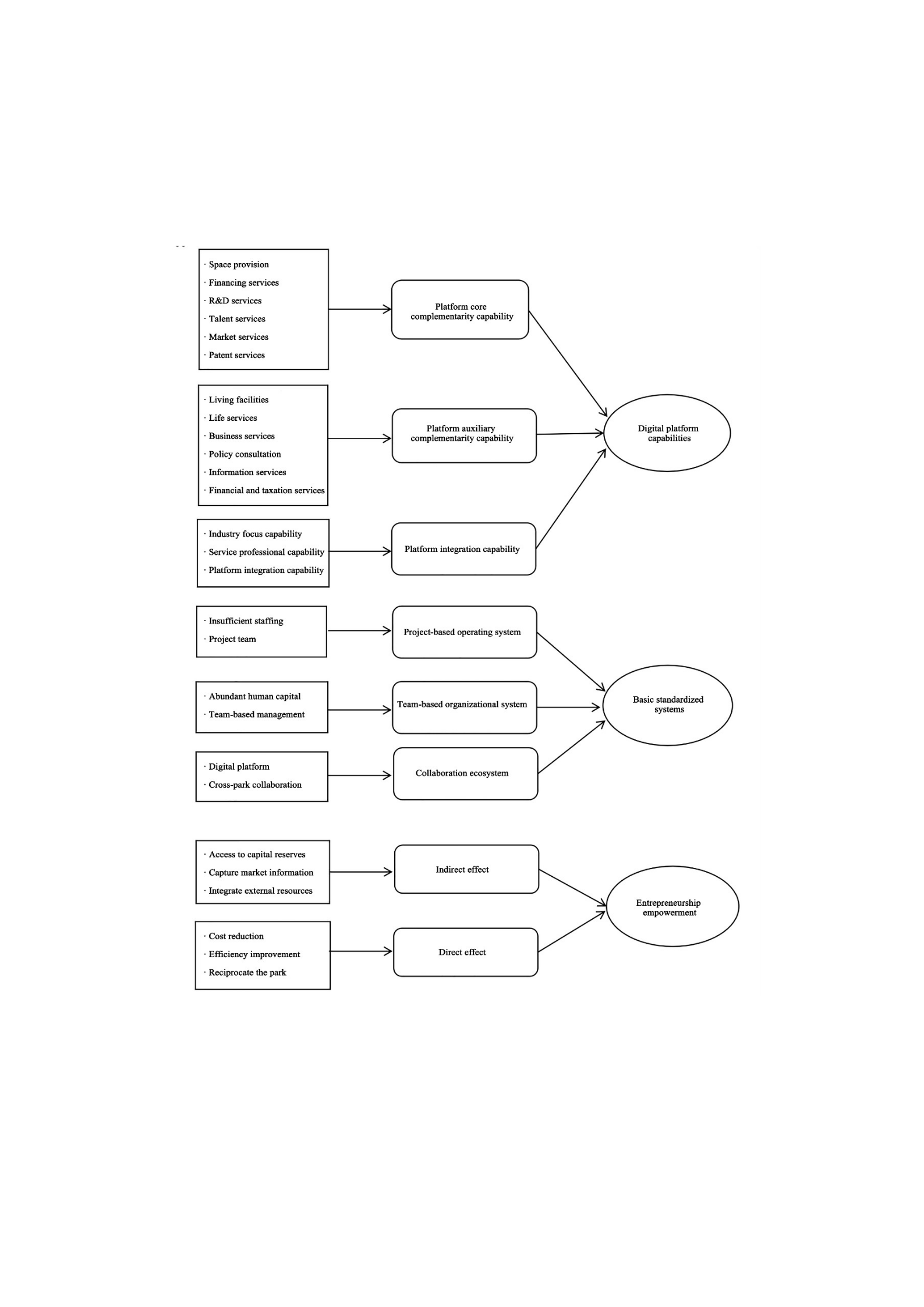
70
3.1.4 Data analysis
First-level
concept Theoretical
category
Aggregation
dimension
Figure 3.1 Coding Structure of This Study
3.2 Background Introduction of Case Enterprise
Zhejiang Zhixin Zedi Science and Technology Development Co., Ltd.
(hereinafter referred to as “Zhixin Zedi”) was established in 2010. It is a

71
specialized park operator and innovation and entrepreneurship service
provider with a core focus on “sci-tech industrial park construction and
operation.” Zhixin Zedi’s mission is to create a favorable environment for
entrepreneurship and innovation, provide comprehensive entrepreneurship and
innovation services, and foster the growth of thousands of sci-tech enterprises.
It is dedicated to building an innovation and entrepreneurship community that
integrates entrepreneurship with industrial elements to provide all-factor
development services for the rapid growth of SMEs. Building a platform-
based digital ecosystem is a strategic focus for Zhixin Zedi. Following the
strategy of digital transformation and development, it has structured the
development of industrial parks into a platform-based approach and has
successively established sci-tech industrial parks in Zhejiang, Shandong,
Anhui, Sichuan, and other regions. The strategic blueprint of Zhixin Zedi is
to adhere to the development concept of “integrated innovation, open
integration, and win-win cooperation,” position the park as an “entrepreneurial
platform provider, entrepreneurial resource organizer, and entrepreneurial
service provider” and strive to build itself into a service-oriented enterprise for
sci-tech innovation and entrepreneurship.
Zhixin Zedi, relying on technologies such as the Internet, AI, and big
data, has gradually explored the path of digital transformation for the sci-tech
industrial park operators. Among them, one representative park is the
Artificial Intelligence Industrial Park established in the Binjiang National
High-tech Industrial Park. The goal is to provide a digital ecosystem for the
innovation and entrepreneurship of the regional AI industry, supporting the
sci-tech innovation and entrepreneurship of enterprises within the park in
the field of AI. In the

72
future, Zhixin Zedi will be rooted in Zhejiang and expand its influence
nationwide. It aspires to become a catalyst for the high-quality development of
small and medium-sized sci-tech enterprises, a leader in industry innovation
and development, and an enabler for regional industrial and economic
transformation.
Zhixin Zedi’s service system construction: Based on the current
understanding of industrial park development, the construction of the park’s
service system, and the practical needs arising from customer interactions,
Zhixin Zedi, over the past more than a decade, has built a service system that
empowers entrepreneurship for enterprises within the park. This system is
based on 12 service elements: talent, facilities, space, patents, enterprises,
information, culture, law, capital, finance and taxation, air traffic control, and
policy. In the context of the rapid development of the digital economy,
leveraging the role of the park’s digital platform to achieve digital
transformation is the core task for the company’s next phase of development.
However, the company is also acutely aware that due to the lack of
clarity in Zhixin Zedi’s digital transformation strategic path and the
insufficiency of its digital resources and capabilities, there are a series of
challenges in the depth of the company’s digital transformation and
development and in empowering innovation and entrepreneurship for
enterprises within the park:
(1) The construction of the digital platform within the industrial park
is still in the early stages of exploration and has not yet formed a relatively
mature system and structure. Currently, Zhixin Zedi operates parks of different
types, with diverse industries within each park. It is necessary to analyze the

73
characteristics of different parks and industries and explore organizational and
operational models that have their own unique features.
(2) The platform-based functionality of the industrial parks is also
continuously improved. The transition of sci-tech parks from traditional park
management to digital innovation and entrepreneurship empowerment requires
the establishment of a platform-based system organized by various functional
modules. These modules may include sci-tech empowerment, entrepreneurship
empowerment, market empowerment, park service empowerment, sci-tech
finance empowerment, and talent empowerment. To achieve this, it is
necessary to explore the platform-based and ecological organizational systems
of sci-tech parks, enabling effective collaboration and integration of various
functionalities.
(3) The empowerment mechanism of the digital platform for
entrepreneurial enterprises within the industrial park is still to be explored.
Zhixin Zedi has explicitly stated that its future core function is to empower
entrepreneurial enterprises within the park. However, a well-established and
effective empowerment mechanism has yet to be developed. Currently, its
main revenue and profits still come from the “middleman” profit model. To
generate profits through the aggregation and empowerment of innovative and
entrepreneurial elements, it is essential to further explore effective paths.
(4) Evaluating the effectiveness of platform-based empowerment
within sci-tech industrial parks is challenging. For entrepreneurial enterprises,
what they most need is to directly and indirectly access the value of
empowerment. How can sci-tech industrial parks give play to the core
complementary party role of entrepreneurial enterprises and achieve tightly
coupled growth with park enterprises? If this question can be addressed, the

74
platform of sci-tech industrial parks can realize value co-creation and shared
distribution with entrepreneurial enterprises.
3.3 Case Discovery
3.3.1 Start-up stage: 2017-2018
In 2017, with the vigorous development of the digital economy, the
rapid advancement of digital technology has become a new engine for
enterprise growth. To accelerate the breakthrough of intelligent industrial
carrier management, the application of new-generation information
technologies such as big data, cloud computing, and AI has become an
important means to enhance carrier services and management levels. At the
same time, the shortcomings of traditional industrial parks in terms of
efficiency and functionality have gradually become apparent. The use of
emerging digital technologies to empower park transformation and upgrading
has become increasingly prominent. In alignment with the national
informatization development strategy and the deployment of new
infrastructure initiatives, industrial parks are now adopting a model driven by
technological innovation. They are focusing on digital transformation,
intelligent upgrading, and integrated innovation to build a digital technology
park infrastructure system. This evolution represents an inevitable trend
toward the digital and ecological development of industrial parks. Therefore,
Zhixin Zedi, by dialectically perceiving threats and opportunities, has
officially launched the construction of the Artificial Intelligence Industrial
Park. It is dedicated to building a specialized platform for the development
and innovation of the AI industry, aiming to become a demonstrative platform
for the industrialization of AI technology R&D and application.

75
3.3.1.1 Basic standardized systems
The basic standardized systems of the Artificial Intelligence Industrial
Park comprise a project-based operating system, a team-based organizational
system, and a collaboration ecosystem. The project-based operating system
involves temporary staffing for each project to address relevant issues. The
team-based organizational system, a higher level of the project-based
operating system, involves professional teams dedicated to providing solutions
for each project. The collaboration ecosystem represents the highest level,
bringing together entities such as third-party institutions, entrepreneurial
enterprises, and the Artificial Intelligence Industrial Park to achieve synergy.
In the start-up stage, Zhixin Zedi Artificial Intelligence Industrial
Park faced a staffing shortage and adopted the project-based operating system,
temporarily assigning employees to specific projects. For example, when
providing financing services for entrepreneurial enterprises in the park,
managers may mobilize personnel from various functional departments to set
up a temporary project team. Upon completion of the project, these personnel
return to their original positions.
3.3.1.2 Digital platform capabilities
At this stage, the digital platform capabilities of the Artificial
Intelligence Industrial Park encompass platform core complementarity
capability, platform auxiliary complementarity capability, and platform
integration capability. However, these capabilities have not yet reached full
maturity. In the start-up stage, the core complementarity capability is mainly
similar to that of traditional industrial parks, with a focus on addressing the
initial needs of entrepreneurial enterprises by providing physical space and

76
funds, along with offering relevant R&D services regarding AI technology.
Building upon the core complementarity capability, the platform auxiliary
complementarity capability offers essential life services for entrepreneurial
enterprises within the parks. The purpose of establishing the Artificial
Intelligence Industrial Park is to distinguish it from the diversified
development trend of traditional parks and build a park dedicated exclusively
to a specific industry. As a result, the platform integration capability at this
stage is reflected in industry concentration.
(1) Platform core complementarity capability
The platform core complementarity capability in the start-up stage
comprises space provision, financing services, and R&D services. An
industrial park is a specific area planned by national or regional governments
through administrative means according to the inherent requirements of
economic development. Within this area, industrial enterprises take advantage
of the park’s special policies and the moderate concentration of various
production factors to foster the development of advantageous and leading
industries, forming a cost-efficient development model characterized by
relatively concentrated industrial production factors. Therefore, physical space
is one of the core elements of a park. Zhixin Zedi Artificial Intelligence
Industrial Park, located in Hangzhou High-Tech Zone, comprises buildings A,
B, C, and D, with a total construction area of over 80,000 square meters. The
park serves multiple functions such as office, production, enterprise
exhibition, residence, and commerce, providing sufficient foundational
physical space support for entrepreneurial enterprises to engage in
entrepreneurial activities.
Restricted by their development capabilities and external

77
environmental factors, entrepreneurial enterprises have continually faced
capital constraints throughout their development. Problems such as high rent,
difficult financing, heavy tax burdens, and insufficient effective asset
mortgages have also become persistent issues that plague enterprises. To solve
the financing difficulties faced by entrepreneurial enterprises and further
support their growth, the Artificial Intelligence Industrial Park has cooperated
with Zhejiang Venture Capital Association to establish the “Zhejiang Artificial
Intelligence Industry Investment Fund Alliance,” which is jointly established
by dozens of renowned investment institutions in the province, including
Tisiwi, Zheshang Venture Capital O2O Consumer Fund, and Ginkgo Data
Fund. This professional investment and financing platform is established to
provide capital support, incubation, and nurturing for high-quality enterprises
or projects settled in the park and leverage the leading role of capital in driving
the growth and development of AI enterprises.
Entrepreneurial enterprises often struggle with low R&D levels, high
R&D risks, and delayed returns on R&D investments, all of which aggravate
their risks of failure. Moreover, entrepreneurial enterprises in the park lack
knowledge and insights related to core AI technologies, resulting in significant
technical bottlenecks. To this end, the Artificial Intelligence Industrial Park
has jointly built an “AI Public Technology Service Platform” with Hangzhou
Innovation Institute of Beihang University and Zhejiang Provincial Intelligent
Research Institute. This platform covers five centers: the AI Research and
Development Center, the High-performance Computing and Big Data Center,
the Digital Certification Service Center, the AI Industry Chain Collaborative
Innovation Center, and the AI Industry Technological Achievements Trading

78
Center. It provides AI entrepreneurial enterprises within the park with a range
of services focused on high-tech AI-related R&D, such as chip integration,
industrial IoT, intelligent robots, network security, big data processing, and
material testing.
(2) Platform auxiliary complementarity capability
The platform auxiliary complementarity capability in the start-up
stage includes supporting living facilities, life services, and business services.
In addition to core elements such as space, capital, and R&D, entrepreneurial
enterprises within the park also need one-stop and efficient basic services
related to business and life. The Artificial Intelligence Industrial Park provides
diversified and all-round facilities including canteens, gyms, and conference
rooms tailored for entrepreneurial enterprises. It sets up three functional zones:
the incubation area, the public service area, and the supporting business area to
meet the development needs of enterprises. Additionally, the park has also
established five centers. The operation center provides perfect services to
support the settlement of entrepreneurial enterprises. The life center provides
facilities such as supermarkets and sunshine leisure bars to enrich employees’
spiritual needs. The conference center features large, medium, and small
public meeting rooms. The activity center offers leisure places including book
bars, coffee bars, and small gardens. The social center sets up an
entrepreneurship club to hold various entrepreneurial activities to foster the
rapid growth of entrepreneurial enterprises.
By leveraging the auxiliary complementarity capability provided, the
Artificial Intelligence Industrial Park has achieved: ① Low-cost openness. It
is open to all entrepreneurial enterprises by offering some free services
while

79
charging fees for others, or by adopting a membership service system to
provide entrepreneurs with a relatively low-cost growth environment; ②
Mutual assistance and synergy. Activities such as salons, training camps,
training, and entrepreneurship competitions foster effective communication
among entrepreneurs and the establishment of communities. A shared working
environment enables entrepreneurs to assist and inspire one another, share
resources, and achieve the goal of collaborative progress. This “aggregation”
leads to a synergistic “fusion.” ③ Facilitation. The park offers venue space
and hosts related activities, enabling entrepreneurs to display products, share
ideas, and conduct project roadshows. ④“All-factor” innovation. The park
provides “all-factor” innovation and entrepreneurship services such as
materials, equipment, facilities, creativity, and innovation and
entrepreneurship plans tailored for entrepreneurial activities.
(3) Platform integration capability
Platform integration capability in the start-up stage refers to industry
concentration. Leveraging AI technology, Zhixin Zedi AI Industrial Park
distinguishes itself from traditional sci-tech industrial parks by fostering an
innovation and entrepreneurship community that integrates entrepreneurship
and industrial elements, providing all-factor development services for the
rapid growth of SMEs. The Artificial Intelligence Industrial Park brings
together AI entrepreneurial enterprises, creating distinct advantages with
distinctive industrial characteristics, remarkable cluster advantages, and a
perfect function design. The park nurtures numerous entrepreneurial
enterprises, facilitating their professional development, business expansion,
and innovation. This, in turn,
enhances
the
overall
development
and
competitiveness
of
regional

80
industries.
Relying on industry concentration, the Artificial Intelligence
Industrial Park cooperates with scientific research institutions such as the AI
Innovation Alliance, AI Laboratory, and the Institute of Artificial Intelligence,
Zhejiang University, to build a professional production and service platform
centered on the development of the AI industry, forming the pattern of “one
main body, three transformations, and five platforms.” This initiative fosters
the growth of the AI industry. The Artificial Intelligence Industrial Park aims
to drive achievements in AI technology and facilitate its industrialization and
capitalization. To support this vision, five sub-platforms, namely AI Industry-
University-Research Cooperation Platform, Industrial Technology
Achievement Promotion Platform, Industrial Public Service Platform,
Entrepreneur Exchange Platform, and Industrial Investment Development
Platform will be established to support the entrepreneurship and growth of AI
enterprises and boost the innovation-based development of the regional AI
industry.
3.3.1.3 Entrepreneurship empowerment
At this stage, the Artificial Intelligence Industrial Park has just been
established. Significant human, material, and financial resources are necessary
in the early stage to develop the essential digital platform capabilities and
empower entrepreneurial enterprises with services. As a result, the direct
effects (cost reduction and efficiency improvement) brought by
entrepreneurial empowerment are not obvious. Conversely, the Artificial
Intelligence Industrial Park leverages the agglomeration effect of resources to
maximize service efficiency in the entrepreneurial process. The indirect effects
of empowerment are notably significant, particularly in the enhancement of

81
capital, material, and

82
life services.
Based on the platform core complementarity capability, platform
auxiliary complementarity capability, and platform integration capability, the
park can offer more external resources to entrepreneurial enterprises. The
diversification of resource types facilitates the transformation of enterprises’
various advantages into indirect entrepreneurial performance (Hannah &
Eisenhardt, 2018). For example, financial resources can supply sufficient
capital reserves for the R&D and market investment of new products and
services in entrepreneurial enterprises. By providing financing services, the
Artificial Intelligence Industrial Park enables entrepreneurial enterprises
within the park to secure financing of RMB 2 billion. Hangzhou Lingxin
Microelectronics settled in the park in 2018. Through the matchmaking of the
park, the company has successively secured the first round of financing of
RMB 4 million from Jianyu Taicang Tianda Investment and a technology loan
of RMB 3 million from the Bank of Hangzhou. Material resources constitute
the infrastructure (including life and business services) that entrepreneurs rely
on to carry out entrepreneurial activities. These resources play a crucial role in
the daily management and operation decisions of entrepreneurial enterprises
(Xie et al., 2020). The core and auxiliary complementarity capabilities of the
platform can facilitate the rational allocation and utilization of heterogeneous
resources. This helps entrepreneurial organizations timely capture market
information and seize fleeting opportunities, thus enhancing their indirect
performance.

83
Table 3.1 Typical Examples and Coding Results in the Start-up Stage
Citation of typical examples in the start-up stage Theoretical
category
Aggregation
dimension
“Entrepreneurial enterprises need capital the most in
the early stage, but they often face challenges such
as financing difficulties at this stage. Therefore,
parks must introduce professional financial service
companies to provide financial and insurance
services such as financing, guarantee, insurance, and
warehouse receipt pledges for settled enterprises,
helping them solve pain points in financing.” (Zheng)
Platform core
complementarity
capability
“The park offers an excellent green environment and
complete supporting facilities, and it responds
quickly to any questions we may have.” (An
enterprise in the park)
Platform
auxiliary
complementarity
capability
Digital
platform
capabiliti
es
“Currently, digital technology is continually
advancing, and the country has been promoting this
development as well. From the very beginning, we
aimed to create an industrial park focused on AI.”
(Zheng)
Platform
integration
capability
“When providing various services for
entrepreneurial enterprises in the park, we may
mobilize personnel from various functional
departments and set up a temporary project team.
Upon completion of the project, these personnel
return to their original positions.” (Human Resources
Director)
Project-based
operating system
Basic
standardized
systems
“By providing financing services, the Artificial
Intelligence Industrial Park enables entrepreneurial
enterprises within the park to secure financing of
RMB 2 billion.” (Chief Financial Officer)
Indirect effect Entrepreneurship
empowerment
3.3.2 Development stage: 2019-2021
In 2019, the market size of AI expanded significantly, with its core
industry reaching nearly RMB 57 billion, profoundly changing the production
methods, lifestyles, and economic structure of human society. Park platforms
play a crucial role in cultivating the AI industry. Hangzhou has been
designated as a national pilot zone for new-generation AI innovation and
development, with the Artificial Intelligence Industrial Park serving as a key
platform for its growth and development. During this stage, Zhixin Zedi relied
on the platform of Hangzhou Artificial Intelligence Industrial Park to enhance
the cultivation and development of the
AI industry and build a multi-

84
level and diverse

85
entrepreneurship and innovation service system, fostering an AI industry
ecosystem that integrates incubators, multipliers, and accelerators. This
initiative has created an excellent innovation and entrepreneurship
environment for the high-quality development of AI enterprises. In 2021, the
Zhixin Zedi Artificial Intelligence Industrial Park was recognized as a national
incubator for sci-tech enterprises. As a key driver for industrial development,
the park continuously fosters the cultivation of AI and other industrial projects
and enterprise development. It has become a vital engine propelling industrial
growth.
3.3.2.1 Basic standardized systems
In the development stage, the continuous improvement of
infrastructure and gradual enrichment of human capital in the Zhixin Zedi
Artificial Intelligence Industrial Park have led to the establishment of basic
standardized systems, forming a park management system combining the
team- based organizational system and project-based operating system. That is
to say, the park organized internal management and backbone according to the
project- based system and managed projects according to the team-based
organizational system. Managing the management and backbone in a project-
based organizational structure can help the Artificial Intelligence Industrial
Park optimize the utilization of resources, especially key human, material, and
financial resources. This approach can strengthen the core cohesion of
managers and backbones, foster mutual trust, cooperation, and assistance, and
improve the efficiency and flexibility of critical project management. It also
clarifies organizational objectives, enabling unified command and rapid
decision- making
when
confronting
major
projects.
Implementing
the
team-based

86
organizational system for each service project—for instance, creating human
resources teams dedicated to specific HR service projects—enables the park to
provide professional, personalized, and precise service plans tailored to the
diverse needs of enterprises within the park.
3.3.2.2 Digital platform capabilities
In the development stage, the mismatch between the annual increase
in the number of enterprises incubated in the park and the park’s limited
service capabilities drove the park to further enhance and improve its digital
platform capabilities including platform core and auxiliary complementarity
capabilities and platform integration capability. The park has enhanced its core
complementarity capability by strengthening space provision, financial
services, and R&D support. Additionally, it has placed a strong emphasis on
talent, patent, and market services. The park has further developed its auxiliary
complementarity capability by improving supporting living facilities, life
services, and business services, offering related basic services such as policy
consulting services, information services, and finance and taxation services.
The professional service capability has emerged as a new form of platform
core capabilities, enabling the park to provide all-around and all-factor services
for SMEs. The further improvement of the three capabilities has laid a solid
service foundation for the high-quality development of enterprises settled in
the park.
(1) Platform core complementarity capability
The core complementarity capability in the development stage
includes space provision, financing services, R&D services, talent services,
patent services, and market services. The first three complementarity
capabilities in the start-up stage have been further improved and

87
supplemented. For example,

88
building upon its continually improved service offerings, the Zhixin Zedi
Artificial Intelligence Industrial Park has further strengthened strategic
cooperation with banks to provide a variety of financing services for settled
enterprises. During this stage, talent, patent, and market services were initially
developed. It is essential for entrepreneurial enterprises in the AI field to have
access to top-notch AI talent and cultivate continuous talent acquisition
capabilities. However, start-ups face heavy pressure in acquiring professional
talent. To alleviate the dilemma of talent shortage faced by enterprises in the
park, the Artificial Intelligence Industrial Park provided talent service support
for these enterprises. This included access to AI expert consultant teams, one-
on-one guidance from entrepreneurship mentors, and enterprise-university-
scientific research institution cooperation. By leveraging the resources and
expertise of these mentors, the park assists these enterprises in knowing
themselves and provides them with scientific and technological resource
support.
Patent application by enterprises has far-reaching significance. For
start-ups, especially technology enterprises in the AI field, it is not enough to
focus solely on R&D, marketable products, excellent quality, and market
development. Effectively managing patent issues and high-level application
patent tools are essential capabilities for these innovative enterprises. To assist
enterprises in the park in deploying and carrying out patent-related work, the
Zhixin Zedi Artificial Intelligence Industrial Park has provided specialized
intellectual property services. It has established a learning and exchange
platform and regularly carried out knowledge-sharing and training activities in
service fields such as project application, intellectual property rights, and legal

89
affairs according to the actual needs of these enterprises. As of 2021,
enterprises incubated within the park have achieved fruitful results in the AI
field, amassing over 710 scientific and technological achievements including
invention patents, software copyrights, utility models, appearance designs, and
trademarks. Notably, 51.4% of these incubated enterprises hold valid
intellectual property rights.
In addition, technological advances and innovations have driven the
emergence of new markets. With the continuous development and applications
of AI technology, the AI market size continues to expand and is projected to
maintain a high growth rate in the next few years. AI enterprises must think
about how to seize market opportunities in the AI era. To help enterprises seize
market opportunities and expand their development potential, the park has
actively established cooperative relations with the Zhejiang Equity Exchange,
Zhejiang Property & Stock Exchange, and Zhejiang Venture Capital
Association. The park has actively assisted incubated enterprises in listing
technological achievements for trading at the exchange centers, opening up
capital channels, fostering the matchmaking between achievement promotion
and investment and financing, and realizing the capitalization of achievements
and enterprises. Additionally, leveraging media and WeChat official accounts
at various levels, the park has comprehensively showcased incubator news and
development information of these incubated enterprises, actively helping them
promote their brands, increase their popularity, and secure market
opportunities. For example, the park actively collaborated with Binjiang
District’s initiative to recommend quality incubation carrier enterprises. It
recommended UFintech as a distinguished enterprise within the park, leading
to a special report.

90
(2) Platform auxiliary complementarity capability
In the development stage, the park has further developed its auxiliary
complementarity capability by improving supporting living facilities, life
services, and business services, offering related basic services such as policy
consulting services, information services, and finance and taxation services.
The development of the AI industry cannot be separated from the support of
relevant policies and systems. Government-issued innovation policies,
intellectual property protection policies, and other related policies will
substantially influence the innovation results of AI entrepreneurial enterprises.
Understanding and navigating these policies effectively is a crucial challenge
that entrepreneurial enterprises must overcome to succeed. During this stage,
the Zhixin Zedi Artificial Intelligence Industrial Park cooperated with multiple
forces to irregularly organize various policy interpretation and service
activities, creating a mutually beneficial interactive exchange platform for the
government, the park, and enterprises. These initiatives contributed
significantly to the development and growth of the enterprises involved. For
example, it held a training session on the application of scientific and
technological talent projects in 2021 to effectively help project applicants
better grasp relevant talent policies and key application points.
Additionally, in the information age, decision-making, schemes, or
plans are closely intertwined with information. Providing effective
information services allows enterprises to timely and efficiently utilize
information resources, addressing the issue of information islands. To this end,
the park has actively established an information exchange platform and
regularly organized entrepreneurship and innovation activities such as
annual meetings of

91
entrepreneurs, entrepreneur salons, and industrial cooperation and exchange
meetings in the park. Such initiatives have fostered knowledge and
information sharing, bringing together various enterprises and assisting them
in accessing a broader array of information sources. Moreover, these
initiatives have bridged the digital divide, eliminated information or resource
asymmetry, and promoted coordinated development among various
enterprises.
In addition, finance and taxation services are essential for micro-,
small-, and medium-sized enterprises to start a business and conduct business
operations. However, as many enterprises expand their business scale, they
often fall behind in accounting and financial management. Their financial
practices tend to be inconsistent, inefficient, and unclear. To assist enterprises
in overcoming fiscal and taxation problems and focusing on business
operations and development strategies, the park has actively cooperated with
government agencies to hold regular themed salons and training activities
centered on their fiscal and taxation issues and combined with their actual
needs. These initiatives have enhanced enterprise managers’ financial
expertise, fostered their financial mindset, and promoted standardized and
professional development of enterprises.
(3) Platform integration capability
Platform integration capability in the development stage refers to
professional service capability. Zhixin Zedi Artificial Intelligence Industrial
Park, recognized as a national incubator for sci-tech enterprises, has
established a complete enterprise incubation system and created the
“Entrepreneurship Code” for the innovation and entrepreneurship service
platform. By offering one-stop integrated services, the park provides

92
enterprises with “12-factor

93
services,” namely space carrier services, finance and taxation industrial and
commercial services, capital services, legal consulting services, human
resources services, cultural services, information management services,
technological innovation services, enterprise management services, policy
guidance services, intellectual property rights services, and basic supporting
services. By integrating various service factors, the park has provided all-
around and all-factor services for SMEs, establishing a robust service system
that empowers enterprises in the park to start a business. At this stage, the park
served as a service provider, builder, and organizer, effectively becoming an
all- factor service provider. However, due to the short history of the digital
platform and the inadequate facilities available at that time, the park still faced
the critical challenge of “efficiently and cost-effectively integrating various
service factors to build a replicable service system.” This still requires ongoing
investments and efforts from the park.
3.3.2.3 Entrepreneurship empowerment
In the development stage, the Zhixin Zedi Artificial Intelligence
Industrial Park leveraged the cutting-edge AI industry platform to
continuously optimize core and auxiliary complementarity capabilities and
platform integration capability. The park has actively fostered a favorable
innovation and entrepreneurship environment for enterprises within the park
and provided all- factor entrepreneurial growth services to enhance their
internal driving force and constantly empower them to accelerate resource
acquisition, integration, and reconstruction. This, in turn, has accelerated the
development and performance enhancement of the AI industry.
On the one hand, the digital platform acts as a two-sided market and

94
can connect a variety of external resources using digital platform capabilities.
The Artificial Intelligence Industrial Park leveraged the cutting-edge AI
industry platform to maximize the key role of digital platform capabilities,
offering services such as information services, consulting services, and talent
services to settled enterprises in various forms of activities. This enabled
enterprises within the park to search for and obtain high-quality external
information resources at a low cost and through multiple channels and
frequencies, thereby mitigating their resource disadvantages. Additionally, it
has fostered a strategic symbiosis between park-based and platform enterprises
under a framework of “dependent upgrading” (W. Chen & Wang Jiexiang,
2021), assisting enterprises within the park in reducing matching costs and
accelerating their common growth. For example, the park has successively
provided technology matchmaking, consultation, and services for more than 10
AI enterprises within the park. Annually, it hosts over 100 training activities on
policies and talent development and provides entrepreneurship services for
more than 200 enterprises, attracting a total of over 3,000 participants.
On the other hand, digital platform capabilities serve as resource
integration and reconfiguration capabilities that can integrate platform
information and resources. The Artificial Intelligence Industrial Park has
integrated 12 preferential service factors tailored to the needs of SMEs
throughout the whole entrepreneurial process. The park has provided all-
around support for the entrepreneurial growth of incubated enterprises, helping
them effectively match and integrate internal and external resources, forming a
unique resource combination. As a result, these enterprises could quickly
respond to market demands and enhance their performance. For example, the

95
innovation and entrepreneurship service platform “Entrepreneurship Code”
developed by the Zhixin Zedi Artificial Intelligence Industrial Park has
effectively improved the integration efficiency of settled enterprises on
platform resources, fostering their new product development or new value
creation.

96
Table 3.2 Typical Examples and Coding Results of the Development Stage
Citation of typical examples in the development stage Theoretical
category
Aggregation
dimension
“We provide entrepreneurial enterprises with a range of
services such as house leasing, industrial and
commercial registration, project evaluation and
declaration, sci-tech funds, loan financing, and
entrepreneurship and employment training.” (Gan)
Platform core
complementarity
capability
“The government provides a range of supportive
policies for entrepreneurial enterprises, such as water
and electricity subsidies and preferential tax policies.
However, many of these enterprises remain unaware of
these policies. Therefore, the park offers policy services
to settled enterprises, ensuring that they get appropriate
policy support at each stage of their development. These
services include rent subsidies, warehouse repair and
renovation subsidies, water and electricity subsidies,
preferential tax policies, talent introduction policies,
and project subsidies.” (Director of Marketing
Department)
Platform
auxiliary
complementarity
capability
Digital
platform
capabilities
“We provide services beyond basic property
management for settled enterprises. In addition to
leveraging our own resources, we also tap into external
resources to provide them with services and enhance
their innovation-driven entrepreneurial efficiency.”
(Zheng)
Platform
integration
capability
“The park organizes and manages internal management
and backbone in a project-based organizational
structure. This approach fosters clear organizational
objectives, facilitates unified command, and enables
rapid decision- making.” (Human Resources Director)
Project-based
operating system
Basic
standardized
systems
“Implementing the team-based organizational system
for various service projects—for instance, creating
human resources teams dedicated to specific HR service
projects—enables the park to enhance efficiency,
increase adaptability, and provide professional,
personalized, and precise services for settled
enterprises.” (Human Resources Director)
Team-based
organizational
system
“We have successively provided technology
matchmaking, consultation, and services for more than
10 AI enterprises within the park. Annually, it hosts
over 100 training activities on policies and talent and
provides entrepreneurship services for more than 200
enterprises, attracting a total of over 3,000 participants.”
(Zheng)
Indirect effect
Entrepreneur
ship
empowerme
nt
“The park helps settled enterprises search for
and obtain high-quality external information
resources at a low cost and through multiple
channels and frequencies, fostering their new
product development or new value creation
while assisting them in reducing matching
costs and accelerating their common
growth.” (Chief Financial Officer)
Direct
effect

97
3.3.3 Maturity stage: 2022-now
Since 2022, the Artificial Intelligence Industrial Park has been
officially on the right track, with various services and support systems
gradually maturing and improving. By providing high-quality office space and
building an efficient resource matchmaking platform, the park has met the
basic daily operation needs of enterprises. Moreover, it has offered
comprehensive support in key areas such as financing, R&D, and marketing.
Additionally, the park has actively fostered a conducive environment for
innovation and vigorously promoted exchanges and cooperation among
enterprises, fostering a benign development ecosystem. It can be said that the
park on the right track has created an ideal stage for many enterprises to grow
and thrive. In March 2023, the park was approved as a “National Incubator for
Sci-tech Enterprises.” In May of the same year, it was recognized as one of the
“Top 10 Low-carbon Application Scenarios in Hangzhou,” consistently
contributing to low-carbon energy-saving digital intelligence park
management as well as innovation and entrepreneurship services. During this
stage, the park’s three key capabilities have been continuously upgraded to
support the growth of enterprises.
3.3.3.1 Basic standardized systems
With the increasing maturity of the construction of digital platforms
within the park, the assistance system has undergone significant changes and
enhancements. The park management system integrating the project-based
operating system and the team-based organizational system developed in the
development stage has been further upgraded into an assistance mechanism
comprising the “project-based operating system + team-based organizational
system + collaboration ecosystem.” This upgrade has enhanced the park’s core

98
competitiveness and offered unprecedented development opportunities to the
incubated enterprises. Specifically, all organizations within the park, including
incubated enterprises, park assistance project teams, external investment
teams, and information service providers can realize smooth communication
with each other through digital platforms and achieve efficient ecological
synergy.
The enhancement of financing services is a vivid example. In the past,
the park provided many start-ups with financial service support through the
project-based system during their incubation stage, especially in the early
stages. This means that after the incubation stage ends, these enterprises face
the significant challenge of lacking continuous and professional financing
guidance and resource matchmaking. This abrupt halt in service provision
often leaves enterprises confused during the subsequent financing process,
making it difficult for them to effectively navigate the complex capital market.
However, with the continuous improvement of the park’s support mechanisms,
the current situation has improved significantly.
To address the aforementioned service pain points, the park extends
its support beyond short-term assistance services during the incubation stage
to cover various stages of the enterprise life cycle. Specifically, enterprises can
leverage the digital platform built by the park to reconnect with project teams
they have previously engaged with. They can resolve new challenges by
communicating in real-time with the project teams on the digital platform. The
project teams faced challenges in maintaining detailed information records of
each enterprise due to the large number of enterprises they served. This long-
standing problem has been completely solved with the introduction of the
digital platform. The platform allows them to easily access relevant

99
information from

100
previous assistance stages, ensuring continuity and efficiency in their services.
The establishment of this long-term service mechanism not only enhances the
financing success rate of enterprises but also strengthens the connection
between the park and enterprises, ensuring that enterprises receive continuous
and stable financing service support at different stages of their development.
Moreover, the park has also thoughtfully established a complete
information database, enabling enterprises to access various financing
channels and successful cases to understand market trends and the latest
policies.
3.3.3.2 Digital platform capabilities
Faced with the delay in information processing and other persistent
problems of platform outsourcing teams during the start-up and development
stages, the park has come to understand that these problems must be
fundamentally solved to truly enhance the operational efficiency and service
quality of the platform. Therefore, the park decided to establish its own digital
platform construction team. Through the self-established team, the park has
achieved faster and more accurate information processing and business
response while better grasping the core technology and key information of the
digital platform.
After the park masters the digital platform construction capability, its
three platform capabilities can better demonstrate their value. Relying on the
main framework of the digital platform, the core complementarity capability
plays a vital role in data processing, information analysis, and business
support, providing users with stable and efficient services. Specifically, the
core complementarity capability of the platform provides support for
incubated enterprises in terms of core technologies, resource integration,

101
and business

102
models, thus providing strong support for their core businesses. The platform
auxiliary complementarity capability focuses on providing a range of auxiliary
services that optimize user experience and boost operational efficiency,
ensuring seamless overall operations of the platform. Both provide a
continuous flow of development support for the incubated enterprises, from
internal to external resources.
(1) Platform core complementarity capability
After five years of official operation, the park’s development
smoothly transitioned into a mature stage, and the platform core
complementarity capability reached a new height. The core capabilities such
as financing, R&D, talent, markets, patents, and space services support each
other to form a strong complementary effect. To foster the continuous growth
of the platform core complementarity capability, the park formulated a perfect
enterprise incubation management system, internal management system, and
AI professional technical service platform management measures. These
initiatives aimed to enhance the park’s incubation capacity and management
efficiency. According to the latest policies and regulations, the park has
developed a systematic enterprise incubation mechanism and established
comprehensive management measures. It has also set standards for
enterprises’ entry into incubation, “graduation” standards, enterprise
assessment methods, and incubation fund management methods. These
initiatives have effectively implemented a strategy of “supporting and assisting
some enterprises while phasing out others,” creating a better development
environment for the growth of incubated enterprises.
In addition to providing services for enterprises relying on its resources,

103
the park has also actively connected with external resources and successfully
established close cooperative relations with organizations such as investment
industry associations, prominent domestic investment institutions, financial
service institutions, and investment and financing service organizations to
provide comprehensive professional capital services such as direct investment
and investment introduction for incubated enterprises. The park’s investment
and financing team boasts years of experience in the science and technology
industry, financial consultancy, and industrial investment. They can assist
enterprises in opening up capital channels and promoting the rapid
development of the AI industry as well as innovative and entrepreneurial
enterprises. The team is dedicated to ensuring that enterprises in the incubator
navigate the downturn smoothly, boosting the confidence and vitality of
market entities, and minimizing the adverse impact of the external
environment on their economic development.
(2) Platform auxiliary complementarity capability
The park has always been at the forefront in terms of platform
auxiliary complementarity capability. The park stands out in offering a four-in-
one mentor service system. To address the diverse needs of settled enterprises,
the park has set up a four-in-one service system consisting of liaison officers,
instructors, entrepreneurship mentors, and expert consultants. It assigns at least
one mentor and one liaison officer to every 10 incubated enterprises. Staff
members with rich work experience and strong coordination capabilities serve
as liaison officers. Their primary responsibilities include addressing
enterprises’ consultations promptly and understanding and assisting in solving
their service needs.
Instructors’
primary
responsibilities
include
visiting
enterprises,

104
declaring enterprise policies, recommending government activities and
competitions, tracking follow-up services, and assisting entrepreneurship
mentors in providing one-to-one guidance services for enterprises.
Entrepreneurship mentors offer services through entrepreneurship lecture
salons and one-on-one guidance for enterprises. Expert consultants provide
services through technology R&D matchmaking meetings and one-to-one
guidance. In 2022, the mentors communicated with enterprises over 25 times.
The construction of digital platforms has significantly improved the
previous platform auxiliary complementarity capability. Nowadays, with more
convenient and efficient supporting living facilities and business services,
enterprises can easily access necessary services through digital platforms
anytime and anywhere. Compared with the tedious offline application process
previously required before the construction of digital platforms, enterprises
now only need to apply for meeting venues, accommodation, and other matters
online, which greatly reduces the approval process and waiting time. In
addition, the park has also launched a park code feature. After successful
application, enterprises only need to scan the park code for confirmation,
which simplifies the process while improving work efficiency. This digital
transformation not only reduces the time costs of enterprises but also enhances
the service quality and response speed of the park, further boosting its
attractiveness and competitiveness. Simultaneously, the construction of digital
platforms enhances park management by providing greater convenience,
enabling the park to understand the needs of enterprises more accurately,
optimize resource allocation, and promote its sustainable development. On the
digital platform, employees can even access detailed information such as the
number of queues

105
in restaurants, helping enterprises better arrange and plan their time.
(3) Platform integration capability
After the park developed into a mature stage, its platform integration
capability has been further enhanced and refined. The park focused on simply
integrating various service resources and building a one-stop service platform
at its inception. It has now evolved to include more professional and efficient
third-party institutions within the platform. These third-party institutions cover
various fields such as legal consultation, financial audit, marketing, and
human resources, providing more comprehensive and professional service
support for incubated enterprises. The engagement of these third-party
organizations not only enriches the services offered by the park but also
significantly expands the business scope of incubated enterprises. Enterprises
can access external resources more easily and establish closer ties with
partners, thus accelerating their growth and development. Additionally, the
professional services offered by these third-party organizations alleviate many
concerns for enterprises, enabling them to focus more on their core business.
Up to now, the park has established strategic cooperation with various
institutions such as Zhejiang Public Service Platform for SMEs, Hangzhou
SME Service Center, and Zhejiang Jingxin Smart City Planning & Research
Institute to jointly establish an AI industry public service platform, offering
various services such as information, technology, talent, policies, and industrial
resources to the enterprises incubated within the park. Moreover, the park has
also established cooperation with institutions such as Zhejiang Equity
Exchange, Zhejiang Property & Stock Exchange, Zhejiang Venture Capital
Association, and Zhejiang Jingxin Smart City Planning & Research Institute.
They aim to

106
actively help high-quality incubated enterprises apply for listing on the
innovation board at Zhejiang Equity Exchange and list and trade their
technological achievements at Zhejiang Property & Stock Exchange. They are
also committed to opening up capital channels as well as promoting
achievements and facilitating investment-financing matchmaking, thereby
realizing the capitalization of these achievements and enterprises. The
establishment of the aforementioned multi-level and multi-entity platforms not
only significantly expands the park’s original boundaries, making it offer more
extensive services, but also provides more diversified and higher-quality
development opportunities for incubated enterprises.
3.3.3.3 Entrepreneurship empowerment
In the mature stage of park development, by building and improving
digital platforms, the park integrated core technologies, resources, services,
and other capabilities to offer comprehensive and multi-level entrepreneurial
empowerment support to incubated enterprises. This empowerment not only
reduced the entrepreneurial costs of enterprises and improved their operational
efficiency, but also promoted their technological innovation and market
expansion, injecting strong impetus into their rapid growth and sustainable
development.
Entrepreneurship empowerment is primarily reflected in three
aspects. The first involves technology and resource support: The park provides
advanced technical support and resource integration services for entrepreneurs
through digital platforms. This support includes the applications of cutting-
edge technologies such as cloud computing, big data, and AI, as well as the
integration of resources such as funds, talents, and market channels. This

107
support helps address the difficulties entrepreneurs encounter in technology
development and marketing, thus reducing the barriers and risks associated
with starting a business. The second focuses on operational optimization and
efficiency enhancement: The park offers a range of fine management and
optimization services through digital platforms, such as the interpretation of
cutting-edge policies and evaluation of fiscal and taxation schemes, to help
entrepreneurs boost operational efficiency and market competitiveness. These
services help entrepreneurs manage businesses more efficiently and achieve
rapid growth. The third lies in industrial matchmaking and cooperation
expansion: The park actively organizes various industrial matchmaking
activities, providing a platform for entrepreneurs to exchange and cooperate
with peers, as well as with scientific research institutions and investment
institutions. These activities help incubated enterprises expand business
cooperation and gain more market opportunities and resource support.
Take Hangzhou Shunyuan Microelectronics Co., Ltd. within the park
as an example. The park actively conducted thorough communication and
interviews with this enterprise during its incubation stage to understand its
current difficulties. These difficulties primarily included: The enterprise
needed to apply for the qualification as an innovative small/medium-sized
enterprise as part of its operation and development plan and required
professional organizations to review and guide its relevant application
materials; it had investment and financing needs, with a desire to connect with
multiple financial institutions; it hoped to participate in more industrial
resource matchmaking activities. The park promptly provided support
leveraging existing resources and previous successful cases. First, it arranged
entrepreneurship mentors to

108
offer one-to-one project application guidance through digital platforms;
second, the park assigned these mentors to analyze the enterprise’s capital
needs and facilitated its thorough communication with Hangzhou United Bank
and Tailong Bank; finally, the park actively invited the enterprise to
participate in industry-related activities to meet its needs for resource
matchmaking.
The rapid improvement and development of platform integration
capability in the maturity stage facilitate the smooth development of industry
concentration and professional service capabilities, thus bringing significant
indirect effects to entrepreneurship empowerment. The development of
platform integration capability signifies that the platforms can effectively
integrate various resources, services, and functions to form an efficient and
collaborative entrepreneurial ecosystem. This integration not only enhances
the platforms’ operational efficiency and service quality but also creates
favorable conditions for increased industry concentration and professional
service capabilities. In terms of industry concentration, the development of
platform integration capability allows the platforms to more accurately
understand the needs and development trends of specific industries. By
integrating industry resources, expert insights, and market information, the
platforms offer entrepreneurs more in-depth and professional industry analysis
and guidance. This precise guidance helps entrepreneurs better understand the
current situation and future development directions of the industry, allowing
them to make more informed decisions and plans. In terms of professional
service capability, the development of platform integration capability has
enriched service content and enhanced service quality. By integrating various
service providers and partners, the platforms can provide one-stop and

109
all-around

110
service support for entrepreneurs. Additionally, the platforms can also
leverage advanced information technology and data analysis tools to
continuously optimize and improve the service process and enhance service
efficiency and user experience.
Take the Artificial Intelligence Industry Investment and Development
Platform built by the park as an example. The park has cooperated with the
Zhejiang Venture Capital Association to establish the “Zhejiang Artificial
Intelligence Industry Investment Fund Alliance” to build a professional
investment and financing platform. This platform has brought together dozens
of renowned investment institutions in the province, providing capital support,
incubation, and nurturing for high-quality enterprises or projects settled in the
park and fully leveraging the leading role of capital in driving the growth and
development of AI enterprises. Currently, the incubator has signed a contract
with Tailong Bank to jointly set up a debt financing credit of RMB 200
million. Additionally, it has cooperated closely with the Bank of Nanjing,
Agricultural Bank of China Hangzhou Branch, Hangzhou United Bank
Science and Technology Sub-branch, Hangzhou United Bank Cultural and
Creative Sub- branch, and China Construction Bank to assist enterprises in
securing “leasing loans” and “operating loans.” These collaborations have
facilitated enterprises’ utilization of capital recovery points and enhanced the
strength of the incubator. Moreover, enterprises can pay housing funds in
installments. These initiatives have solved enterprises’ capital chain issues in
the start-up stage, allowing them to optimize the use of existing funds and
providing broad space for their rapid and convenient growth.
In addition, the park also regularly holds financing matchmaking

111
meetings and training activities to build a bridge for exchanges and
cooperation between enterprises and investors, helping enterprises solve their
financing difficulties. The park has successfully helped Hangzhou Lingxin
Microelectronics apply for Eyas Enterprise and National High-tech Enterprise
qualifications, as well as with the announcement of two inventions and the
authorization of two. As a result, the company has secured the first round of
financing of RMB 4 million from Jianyu Taicang Tianda Investment and a
technology loan of RMB 3 million from the Bank of Hangzhou. In addition to
financing, the park also places a strong emphasis on other platform
capabilities. It is deeply committed to improving service quality and
mechanisms and constantly innovates upon its original foundation, striving to
provide more sustainable and comprehensive services for enterprises.
With the continuous growth and meticulous nurturing of the park’s
three major capabilities, a benign ecosystem has emerged where enterprises
and the park nourish each other and grow together. While utilizing the park’s
resources and services, these enterprises also actively participated in various
park activities, significantly contributing to the park’s cultural development
and brand promotion. More importantly, some successful enterprises began to
give back their advantageous resources and services to the park and provide
guidance and help for other start-ups, creating a positive experience-passing
effect. The interaction and cooperation between enterprises and the park not
only foster the rapid growth of enterprises but also drive the continuous
innovation and development of the park. By integrating various resources and
services, the park fosters an optimal growth environment for enterprises. In
return, these enterprises inject new opportunities and vitality into the park
through their

112
efforts and development. This model of mutual support and shared
development has laid a solid foundation for the park’s enduring prosperity.
Enhancing the three aforementioned capabilities not only enhances
the park’s overall competitiveness but also creates a broader development
space with more opportunities for the enterprises incubated within it. In the
future, with ongoing innovation and improvement of the park, we believe that
more excellent enterprises will settle and flourish in the park to achieve their
entrepreneurial dreams.

113
Table 3.3 Typical Examples and Coding Results of the Maturity Stage
Citation of typical examples of the maturity stage Theoretical
category
Aggregation
dimension
“Core abilities such as financing, R&D, talent, markets,
patents, and space services support each other to form a
strong complementary effect. The aim is to promote the
continuous growth of the platform’s core complementarity
capability.” (Gan)
Platform core
complementar
ity capability
“According to the diversified needs of settled enterprises,
the park is equipped with a four-in-one service system
consisting of liaison officers, instructors, entrepreneurship
mentors, and expert-level consultants to meet enterprises’
needs.” (Zheng)
Platform
auxiliary
complementar
ity capability Digital platform
capabilities
“The park has established strategic cooperation with various
third-party institutions such as Zhejiang Public Service
Platform for SMEs, Hangzhou SME Service Center, and
Zhejiang Economic and Information Smart City Research
Institute to realize the expansion and integration of
resources. Not only does this significantly expand the
park’s original boundaries, making its services more
extensive, but it also provides more diversified and higher-
quality development opportunities for enterprises in it.”
(Marketing Department Director)
Platform
integration
capability
“Settled enterprises can use the digital platform built by
the park to connect with project teams they have
previously engaged with. They can resolve new challenges
by communicating in real time with the project teams on
the digital platform.” (Human Resources Director)
Project-based
operating
system Basic
standardized
systems
“Building on the digital platform, we are further advancing
the construction of a team-based organizational system to
ensure the continuity and efficiency of our services.”
(Human Resources Director)
Team-based
organizational
system
“Entrepreneurial enterprises can access more new
resources. By building a digital platform, we can empower
them with resource search and access, tools, methods, and
technology empowerment.” (CTO)
Collaboration
ecosystem
“We have established a complete information database
where enterprises can access various financing channels and
successful cases to understand market trends and the latest
policies. Additionally, the park regularly organizes
financing matchmaking events and training activities to
provide a platform for communication and cooperation
between enterprises and investors, helping companies
address financing challenges.” (Marketing Department
Director)
Indire
ct
effect
Entrepreneurship
empowerment
“The park now presents a benign ecology in which
enterprises and the park nourish each other and grow
together. Some successful enterprises have begun to give
back their advantageous resources and services to the park,
providing guidance and help for other start-ups, creating a
positive long-running effect.” (Chief Financial Officer)
Dire
ct
effe
ct
Therefore, this study obtains the following case study-based theoretical
analytical framework:
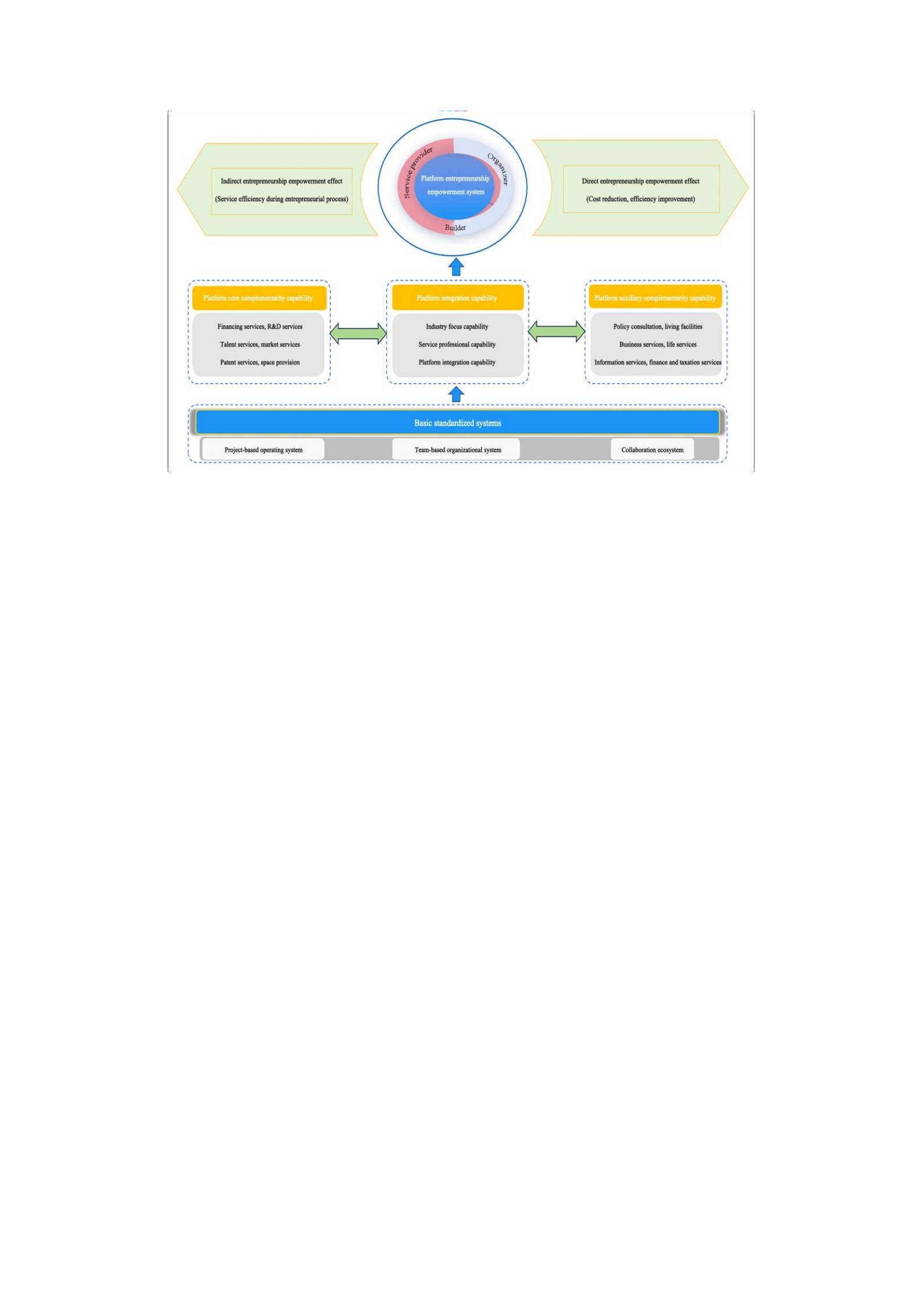
114
Figure 3.2 Theoretical Analytical Framework
3.4 Case Discussion
3.4.1 Digital platform capability system: Construction process and
connotation dimensions
From the case material, it is evident that the development of Zhixin
Zedi’s digital platform capabilities features three stages: the start-up stage, the
development stage, and the maturity stage. In these three stages, digital
platform capabilities comprise three major capabilities: the platform’s core
complementarity capability, the platform’s auxiliary complementarity capability,
and the platform integration capability. With the continuous improvement of
the Zhixin Zedi Digital Park, digital platform capabilities have gradually
transformed from immaturity to maturity. The connotation of capabilities has
become richer, the level of capabilities has enhanced, and the empowerment
performance has significantly increased.
During the start-up stage, these three types of capabilities were not
yet mature and had relatively simplistic connotations. Platform’s
core

115
complementarity capability mainly focuses on providing physical space,
funding, and R&D services to meet the primary needs of entrepreneurial
enterprises. Based on the core complementarity capability, platform’s
auxiliary complementarity capability provides basic living services for
entrepreneurial enterprises in the park. Platform integration capability
contributes to the development of the industrial park by providing focus
ability.
During the development stage, the connotations of the three
capabilities have all been enriched. Regarding the platform’s core
complementarity capability, not only space provision, financing services, and
R&D services have been further strengthened, but also talent services, patent
services, and market services have been introduced. In terms of platform
auxiliary complementarity capability, on the foundation of improving living
facilities, life services, and business services, further development has been
achieved in related services such as policy consultation services, information
services, and financial and tax services. Platform integration capability sees
the emergence of a new form, the professional service capability, enabling the
park to provide comprehensive all-element services for SMEs.
During the maturity stage, the three capabilities not only further
expand their connotations, forming mutual support, but also, supported by
digital technology, their capability levels are significantly enhanced.
Platform’s core complementarity capability not only provides comprehensive
support such as incubation space, funding, R&D, and talent for entrepreneurial
enterprises but also relies on strong data processing, information analysis, and
business support abilities to underpin the core operations of these enterprises.
Meanwhile, while providing a series of auxiliary services, the

116
platform’s auxiliary

117
complementarity capability also continuously optimizes user experience and
enhances operational efficiency through digital technology. The platform
integration capability has been further solidified, integrating more professional
and efficient third-party organizations, and providing industry-specific and
platform-specific services based on a precise understanding of the needs of
entrepreneurial enterprises.
Finally, in analyzing the digital platform capability building process
of Zhixin Zedi, it is found that the platform’s auxiliary complementarity
capability and the platform’s core complementarity capability exhibit logical
consistency, both focusing on platform connection resources and elements.
The platform integration capability emphasizes platform enterprises, reflected
in Zhixin Zedi’s integration of platform elements and the provision of
professional services for entrepreneurial enterprises. Therefore, based on the
analysis of the case data, this study combines the platform’s core
complementarity capability with its auxiliary complementary capability to
establish the digital platform complementarity capability. As a result, the
digital platform capability framework comprises two dimensions: platform
complementarity capability and platform integration capability. Digital
platform capabilities are deconstructed from the perspectives of platform
resource elements and the integration of platform enterprises.
3.4.2 Digital platform capabilities and enterprise entrepreneurship
empowerment
The empowerment of entrepreneurial enterprises by digital platform
capabilities is reflected in two aspects: direct entrepreneurship empowerment
and indirect entrepreneurship empowerment. In terms of direct entrepreneurship

118
empowerment, digital platform capabilities assist entrepreneurial enterprises
by providing the resources needed for entrepreneurial activities, helping them
overcome challenges in technology development and market promotion, thus
reducing entrepreneurial costs and risks. These capabilities enhance the
enterprises’ operational efficiency and market competitiveness by offering a
range of refined management and optimization services through digital
platforms. By continuously providing entrepreneurial enterprises with
professional services in the field of AI and expanding collaboration networks,
they facilitate technological innovation and market expansion for enterprises.
Therefore, digital platform capabilities can enhance the growth, profitability,
and innovation of entrepreneurial enterprises, effectively improving their
performance.
In terms of indirect entrepreneurship empowerment, as digital
platform capabilities continue to evolve and improve, advancements have been
seen not only in service professionalism but also in the ongoing optimization
and enhancement of service processes. This allows for the provision of
continuous, precise services to entrepreneurial enterprises, enhancing service
efficiency and user experience. The continuous development of digital
platforms has enabled the evolving ecosystem of industrial parks, attracting
the involvement of more third-party service providers and thus creating a
better entrepreneurial environment and commercial atmosphere for
entrepreneurial enterprises. A virtuous development cycle is fostered between
digital industrial parks and entrepreneurial enterprises. The park supports the
growth of entrepreneurial enterprises through digital platforms, while
entrepreneurial enterprises, in turn, reciprocate the park with their
advantageous resources and services, thereby

119
driving continuous innovation and development within the park. In this
process, entrepreneurial enterprises can consistently enjoy better service
experiences within a positive entrepreneurial ecosystem with long-term and
sustainable development.
3.4.3 Basic standardized systems and digital platform empowerment
Based on the case material, it is apparent that basic standardized
systems are a critical organizational guarantee for achieving digital platform
empowerment. Specifically, the basic standardized systems comprise three
aspects: the project-based operating system, the team-based organizational
system, and the collaboration ecosystem. The project-based operating system
refers to establishing project teams to address issues related to enterprises
within the park. The team-based organizational system involves a professional
team providing solutions for projects. The collaboration ecosystem focuses on
the seamless communication achieved between incubated enterprises, park
assistance project teams, external investment teams, and information service
providers through digital platforms. It aims at facilitating efficient ecological
synergy among these entities. Based on these three aspects, the park can
continuously provide entrepreneurial enterprises with sustained, professional,
and precise services, thus ensuring the effectiveness of digital platform
empowerment.
Further analysis of the basic standardized systems reveals the project-
based operating system and the team-based organizational system are logically
consistent, both achieving park project operations through teamwork and
discussing organizational systems at the level of individual park projects. The
collaboration ecosystem transcends the boundaries of projects and parks,
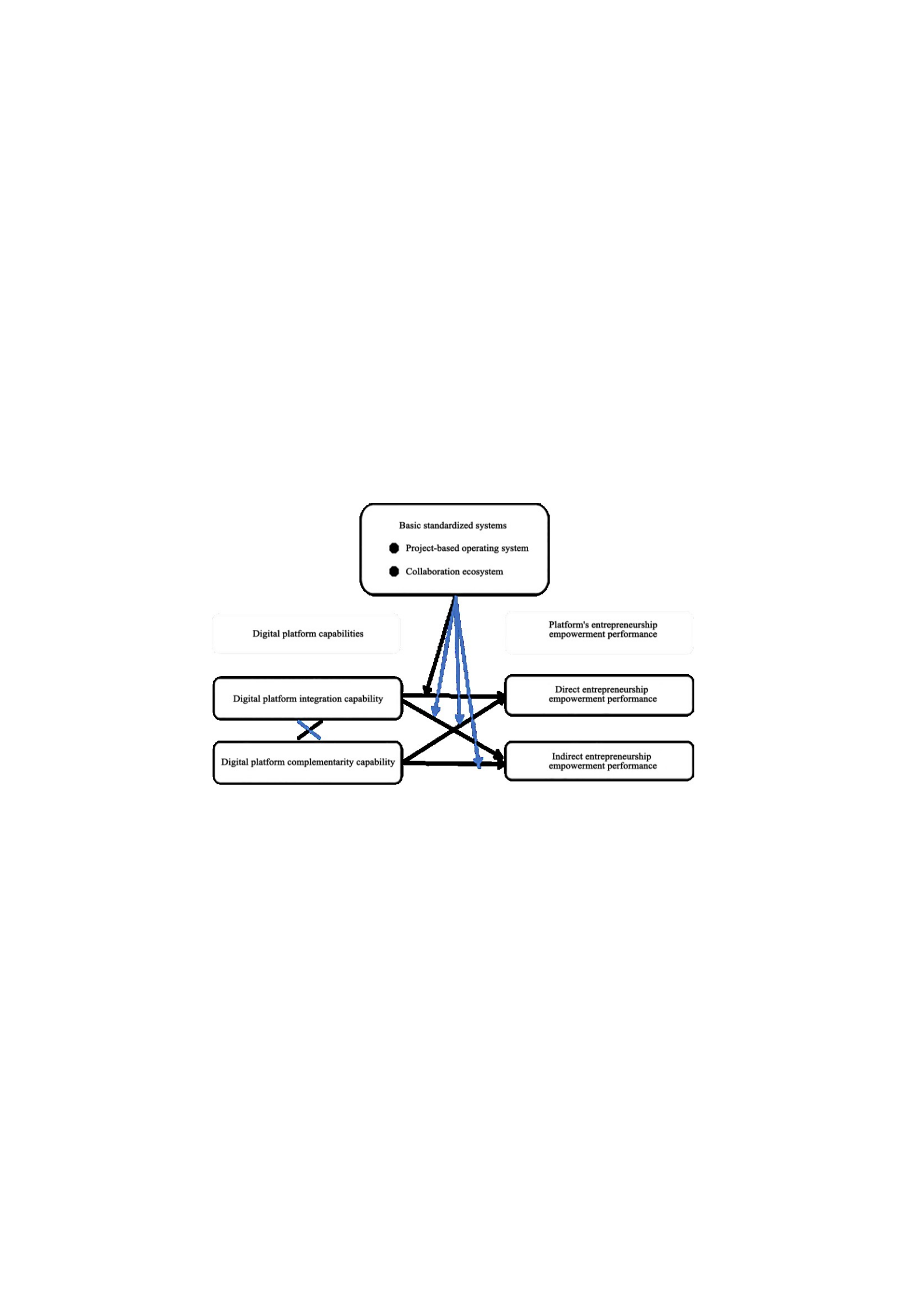
120
encompassing various parks, complementary enterprises, and entrepreneurial
enterprises, embodying a systemic concept of the ecosystem. Thus, leveraging
case data analysis, this study merges the project-based operating system with
the team-based organizational system. With this approach, basic standardized
systems consist of two dimensions: the project-based operating system and the
collaboration ecosystem, deconstructing the management system of the park
from both the project level and the ecosystem level.
Based on the analysis results from the cases above, this study presents
the theoretical model as shown in Figure 3.3.
Figure 3.3 Theoretical Model of the Study

121
4. Digital Platform Capabilities and Their
Entrepreneurship Empowerment Performance: Hypotheses
and Testing
Through the exploratory case analysis of the Zhixin Zedi Industrial
Park in Chapter 3, this study initially establishes the digital platform capability
system of the park. It identifies two key dimensions—platform integration
capability and platform complementarity capability—and constructs a
theoretical framework model of “digital platform capabilities-entrepreneurship
empowerment performance.” Additionally, the sub-study identifies basic
standardized systems as a key boundary condition influencing the role of
digital platform capabilities, pointing out that its implementation significantly
affects the effectiveness of digital platform capabilities. Building upon the
previous research, this chapter further examines the conclusions obtained from
the case studies. Through theoretical deduction and standardized large-sample
empirical analysis, it tests the relationships among digital platform
capabilities, basic standardized systems, and entrepreneurship empowerment
performance within the industrial park. The results are then discussed.
4.1 Hypothesis Deduction
4.1.1 Research on digital platform capabilities and entrepreneurship
empowerment performance
4.1.1.1 Platform complementarity capability and entrepreneurship
empowerment performance
As the digital development of industrial parks advances, many digital
industry park management enterprises are trying to connect internal and
external resources by building digital platforms to empower entrepreneurial
enterprises. Digital platforms leverage digital infrastructure to enable users

122
to quickly

123
digitize, store, and share large amounts of diverse information, facilitating
rapid access and connection to information and resources. This allows for
online interaction of information and knowledge with partners (Zhu et al.,
2015). Therefore, digital platform capabilities are defined as the technological
ability of park management enterprises to support and empower
entrepreneurial enterprises through digital platforms, enabling them to
exchange information with partners, engage in electronic interconnection, and
collaborate online (Rai & Tang, 2010; Zhu et al., 2015).
Furthermore, existing studies categorize the digital platform
capabilities into various dimensions such as platform integration, platform
complementarity, and platform restructuring (Wang Dongyang, 2022; Wang
Shuguang et al., 2022). Building upon existing theories and case study results,
this study further subdivides digital platform capabilities into digital platform
complementarity capability and digital platform integration capability. In this
context, digital platform complementarity capability, viewed from the
perspective of platform resource elements, emphasizes the platform’s
connection to core complementary resources and auxiliary complementary
resources. This fosters information exchange and resource complementarity
between entrepreneurial enterprises within the park and service enterprises on
the platform. Digital platform integration capability, seen from the viewpoint
of platform leaders, highlights how park management enterprises integrate and
restructure internal and external resources based on digital platforms to
provide professional industries and platform services for entrepreneurial
enterprises (Grant, 1996; Li Zhenhua et al., 2019).
Platform
complementarity
capability
is a
critical
dimension
of

124
capabilities that empowers entrepreneurship within industrial parks.
Specifically, this complementarity can be observed from two perspectives:
core complementarity and auxiliary complementarity. The concept of core
complementarity originates from Teece (1986), who introduced the idea of
complementary assets, highlighting that unique complementary assets are
crucial in helping enterprises achieve technological innovation. Furthermore,
in the literature on platforms and innovation ecosystems, core
complementarity is considered the indispensable information, technologies,
and resources for innovation that platform participants provide for platform
enterprises (Jacobides et al., 2018; Wang Jiexiang et al., 2021; Wei & L. Xu,
2014). In digital industrial parks, entrepreneurial enterprises can gain the
necessary information, technology, and resources needed during the
entrepreneurial process by establishing connections with platform participants
who are linked to digital platforms and possess core complementary resources,
thus enhancing their entrepreneurial performance. On the one hand,
entrepreneurial enterprises in the early stages of development typically face
shortages of various resources such as financial resources, spatial resources,
and market resources. In the later stages of innovation and entrepreneurship
activities, they also encounter the absence of key resources like talent
resources, R&D resources, and patent resources. Entrepreneurial costs and
risks remain at high levels. Additionally, due to the liability of newness,
entrepreneurial enterprises often struggle with a lack of legitimacy and find it
challenging to easily acquire the aforementioned critical resources from the
market (Shi & Shi, 2020; J. Su et al., 2017). The platform’s core
complementarity capability of digital industrial parks not only connects
entrepreneurial enterprises with numerous complementary parties with key

125
and

126
core resources but also provides reputation endorsements, significantly
reducing the difficulty for enterprises to acquire essential resources for
development. This enhances these enterprises’ efficiency in acquiring
necessary resources and boosts the survival rate of entrepreneurial enterprises
(Z. Su et al., 2023). On the other hand, entrepreneurial enterprises typically
operate in niche markets and have higher organizational fragility. The
platform’s core complementarity capability of digital industrial parks can
assist entrepreneurial enterprises in acquiring a large amount of heterogeneous
key resources, enabling them to introduce new knowledge and technologies
and establish unique competitive advantages (Yam et al., 2011). Therefore, the
core complementarity capabilities of digital platforms undoubtedly enhance
the direct entrepreneurial performance of entrepreneurial enterprises.
Auxiliary complementarity derives from Teece’s (1986) definition of
complementary assets, which emphasizes that although generic
complementary assets may be relatively easily obtained, they play a crucial
role in helping enterprises more efficiently achieve the commercialization of
products, serving as important resources for enterprise development.
Furthermore, in the literature related to platforms and innovation ecosystems,
auxiliary complementarity is considered as the information, technology, and
resources provided by platform participants to platform enterprises. It is not
essential for enterprise development but can enhance enterprise efficiency
(Jacobides et al., 2018). In digital industrial parks, entrepreneurial enterprises
can enrich their information channels, further decrease entrepreneurial risks,
and enhance the efficiency of their entrepreneurial activities by establishing
connections with platform participants
that
are
connected
to
digital
platforms
and
hold
auxiliary

127
complementary resources. On the one hand, while important information such
as policies and taxes may not directly impact the survival of entrepreneurial
enterprises, they can influence their acquisition of funds and the conduct of
business, providing support for entrepreneurial enterprises. However, many
entrepreneurial enterprises lack the experience and channels to obtain relevant
information and may even lack essential professionals in finance, business
services, and other areas. As a result, they fail to timely access such
information, thus facing increased entrepreneurial costs and risks. Platform’s
auxiliary complementarity capability of digital industrial parks can assist
entrepreneurial enterprises in acquiring important information related to
policies, finance, taxes, and others. It can also connect relevant
complementary parties to provide government services, business services, tax
services, and more for entrepreneurial enterprises, thereby enhancing the
success rate of these enterprises (Du et al., 2020; Stam, 2015). On the other
hand, robust infrastructure is equally crucial in enhancing the performance of
entrepreneurial enterprises. High-quality infrastructure, living facilities, and
life services not only enhance the daily operational efficiency of
entrepreneurial enterprises but also increase communication and collaboration
efficiency between these enterprises and other counterparts, assuring attracting
more platform participants (Cumming et al., 2019). Hence, the auxiliary
complementarity capability of digital platforms can also enhance the direct
entrepreneurial performance of entrepreneurial enterprises.
In conclusion, this study puts forward Hypothesis 1a:
Hypothesis 1a: Digital platform complementarity capability positively
promotes direct entrepreneurship empowerment performance.

128
Digital platform complementarity capability not only directly
enhances the performance of entrepreneurial enterprises but also improves the
efficiency of the entrepreneurial process services provided by digital parks for
these enterprises. From the perspective of the platform’s core complementarity
capability, by collaborating with platform participants that provide
complementary resources critical to innovative and entrepreneurial activities
on the platform, entrepreneurial enterprises realize the increment of value and
attract more entrepreneurial enterprises from related fields to join the platform.
Furthermore, more entrepreneurial enterprises attract more companies with
vital complementary resources for innovative and entrepreneurial activities to
become platform complementary parties. Therefore, digital platforms in
industrial parks establish a multilateral network effect, continuously attracting
innovative complementary parties and entrepreneurial enterprises from various
domains. This further enhances the attractiveness of digital platforms for
entrepreneurial enterprises, enabling these enterprises to access more
necessary resources on the platform and leading to increased satisfaction with
the entrepreneurial process.
From the perspective of the platform’s auxiliary complementarity
capability, by providing services such as policies, financial and tax
information, business services, and other supporting services for
entrepreneurial enterprises, digital industrial parks create a favorable business
environment and nurture a conducive commercial atmosphere for enterprises.
Entrepreneurial enterprises cannot merely access pertinent information from
external organizations linked to digital platforms but can also engage in
organizational learning by communicating with other entrepreneurial
enterprises within the industrial park.

129
This allows them to accumulate experience in entrepreneurial activities,
thereby continuously advancing the virtuous cycle of entrepreneurial activities
in the industrial park (Li Zhenhua & F. Li, 2018). Simultaneously, a favorable
living environment and infrastructure assure information exchange and office
life for entrepreneurial enterprises, stimulating their enthusiasm and
satisfaction for innovation and entrepreneurship (Cumming et al., 2019).
To sum up, this study proposes Hypothesis 1b:
Hypothesis 1b: Digital platform complementarity capability
positively promotes indirect entrepreneurship empowerment performance.
4.1.1.2 Research on platform integration capability and entrepreneurship
empowerment performance
Building on the core complementarity resources and auxiliary
complementarity resources provided by platform complementary parties
linked to digital platforms to entrepreneurial enterprises, platform enterprises
(i.e., park management enterprises) further integrate internal and external
resources to enhance the matching of resources for both internal and external
participants and provide industry-specific and service-specific services, thus
empowering entrepreneurial enterprises.
Firstly, platform enterprises with platform integration capability
integrate internal and external resources linked to digital platforms. Research
on entrepreneurial ecosystems indicates that the resources needed by
entrepreneurial enterprises exhibit distinct heterogeneous characteristics,
placing demands on the resource allocation capabilities of leaders within the
entrepreneurial ecosystem. Platform enterprises with platform integration
capability can effectively organize internal and external resources, thereby

130
helping entrepreneurial enterprises identify and connect the needed resources
based on a comprehensive understanding of the needs of entrepreneurial
enterprises. This helps enhance resource allocation efficiency (Helfat &
Raubitschek, 2018; Teece, 2018). In rapidly changing market environments,
platform enterprises can continuously monitor changes in the external market
based on the scalability of digital platforms. They can connect and integrate
changing partner networks according to the needs of entrepreneurial
enterprises, enabling enterprises to address challenges from the external
environment (Baldwin, 2012; Marion et al., 2015; Weill & Ross, 2009).
Furthermore, platform integration capability can enhance communication
among the platform’s internal and external participants and promote the
alignment of resources, capabilities, activities, and goals by designing
integrated architectures effectively, enabling entrepreneurial enterprises to
collaborate smoothly with complementary parties through sufficient
communication (Gonzalez et al., 2018; Wareham et al., 2014).
Moreover, based on resource integration, platform enterprises with
platform integration capability organize and restructure platform resources to
provide the resources necessary for the industrial development of
entrepreneurial enterprises. On the one hand, the complementary resources
provided by digital platform complementary parties may not meet the actual
needs of entrepreneurial enterprises. This is because these participants are
often third-party service organizations serving the entire industry, and they
may have a limited understanding of specific industries. In contrast, platform
enterprises on digital platforms of industrial parks can leverage their in-depth
understanding of entrepreneurial enterprises and their accumulated industry-

131
specific knowledge and expertise from prolonged engagement in industry-
specific entrepreneurial incubation activities. They can integrate and
restructure platform resources, thereby providing industrial resources that are
better aligned with the specific needs of entrepreneurial enterprises. This
provides a smooth channel for the conversion and application of external
knowledge resources, enhancing the efficiency of resource utilization for
entrepreneurial enterprises (Rai & Tang, 2010). Also, in a rapidly evolving
business environment, the complementary resources provided by participants
in digital platforms require real-time adjustments and supplements. This calls
for platform enterprises to be able to promptly identify opportunities and
threats in industry development, proactively bring in platform participants that
better meet requirements by adjusting platform architecture and rules, and
coordinate relationships among new participants (Boudreau, 2017; Helfat &
Raubitschek, 2018). By following this approach, digital platforms can
consistently offer entrepreneurial enterprises complementary resources that
align with the current industry development needs, ultimately elevating the
long-term competitive edge of these enterprises (W. Liu et al., 2024; Wilden et
al., 2016).
Lastly, platform enterprises with platform integration capability
continuously optimize platform architecture and governance models to provide
professional services for entrepreneurial enterprises. Digital platforms provide
enterprises with a shared space, enabling them to integrate new knowledge and
ideas with partners at low cost and high efficiency, unrestricted by time and
space. However, this requires robust digital infrastructure, suitable digital
platform architecture, and an effective governance model as support. Platform
enterprises with high integration capability can effectively manage these

132
elements (Jacobides et al., 2018; Tiwana, 2010). In terms of digital
infrastructure and platform architecture, platform enterprises with high
integration capability can adjust platform modules and interfaces promptly
based on the needs of entrepreneurial enterprises, thereby enhancing the
efficiency of information acquisition and business operations for the
enterprises on platforms. Regarding platform governance models, platform
enterprises with high integration capability can establish authoritative
transaction rules and behavioral patterns tailored to platform business
operations. They can also offer guidelines for potential conflicts among
internal and external participants, thereby providing environmental protection
and institutional support for cooperation between entrepreneurial enterprises
and platform participants, ultimately increasing the likelihood of collaboration
success (Cenamor et al., 2017).
In conclusion, this study proposes hypothesis 2a:
Hypothesis 2a: Digital platform integration capability positively
promotes direct entrepreneurship empowerment performance.
As digital platform complementarity capability enhances direct
entrepreneurial enterprise empowerment performance, it also improves the
effectiveness of entrepreneurial process services provided by digital parks for
entrepreneurial enterprises. Firstly, by integrating and coordinating
complementary resources from platforms, entrepreneurial enterprises can
quickly and accurately identify, acquire, and apply the resources needed for
their innovative and entrepreneurial activities. This reduces the expenditure for
enterprises in terms of resource searching and costs, as well as the trial-and-
error costs for enterprises. This allows entrepreneurial enterprises to focus on

133
their core operations, enhancing the overall experience of enterprises in
entrepreneurial activities and hence improving platform service efficiency
(Wu et al., 2014).
Furthermore, through the restructuring of complementary resources
on platforms, entrepreneurial enterprises can perceive opportunities and threats
that may exist in entrepreneurial activities. This helps enterprises obtain
market information related to customer needs and competitive intelligence,
stimulating entrepreneurial enterprises to create new knowledge and generate
new ideas. This not only reduces risks in conducting entrepreneurial activities
for enterprises but also enhances the ability and likelihood of entrepreneurial
enterprises seizing opportunities. It boosts the innovative vitality and
entrepreneurial enthusiasm of entrepreneurial enterprises (Agarwal & Selen,
2009; Mikalef & Pateli, 2017).
Furthermore, by offering professional services, entrepreneurial
enterprises engaging in innovative and entrepreneurial activities can integrate
new knowledge and ideas with partners without being constrained by time and
space. This integration can be achieved at low cost and high efficiency.
Entrepreneurial enterprises are no longer confined to tedious daily operational
tasks. This enhances enterprises’ operational efficiency and increases the sense
of happiness for entrepreneurial enterprises in the entrepreneurial process.
Lastly, digital platform integration capability can also generate
stronger positive cross-side network effects within digital platforms. After the
gap between entrepreneurial enterprises and platform participants with
complementary resources is bridged, transaction costs on platforms are
significantly reduced. This means that entrepreneurial enterprises can engage
in

134
transactions with a greater number of complementary resource providers. This
enables platforms to attract a greater quantity and a more comprehensive
variety of platform participants, continuously expanding complementary
resources and services to broaden the platforms’ scope. Consequently, they
can provide entrepreneurial enterprises with more comprehensive and
attractive resources and services (Helfat & Raubitschek, 2018). Therefore,
platform enterprises with better platform integration capability can enhance
platforms’ overall value creation and create a positive cycle by strengthening
positive network effects. This will continuously improve the attractiveness of
digital platforms to entrepreneurial enterprises and the satisfaction of these
enterprises.
In conclusion, this study proposes hypothesis 2b:
Hypothesis 2b: Digital platform integration capability positively
promotes indirect entrepreneurship empowerment performance.
4.1.1.3 Research on platform complementarity capability, platform
integration capability, and entrepreneurship empowerment performance
Platform complementarity capability enables platform enterprises to
leverage their resource integration capability more effectively, offering
entrepreneurial enterprises more efficient, industry-aligned, and professional
entrepreneurial services. This enhances the resource utilization efficiency of
entrepreneurial enterprises and, ultimately, improves entrepreneurship
empowerment performance. On the one hand, with the gradual enhancement
of platform complementarity capability, the connection depth and breadth of
platform enterprises with core complementary parties and auxiliary
complementary parties continue to increase. This allows platform enterprises
to continuously acquire core market knowledge and technical expertise

135
through

136
organizational learning based on ongoing connections. Moreover, they
continually accumulate capabilities in business and other auxiliary services
(Fu et al., 2024). This enables platform enterprises to further understand
complementary enterprise resource and service content as well as the needs of
entrepreneurial enterprises. With a more targeted approach to coordinating and
integrating needs and resources, platform enterprises can offer specialized
industry services based on the industrial needs of entrepreneurial enterprises.
This ultimately enhances the efficiency and precision of resource allocation
(Beltagui et al., 2020; Nambisan & Sawhney, 2011).
On the other hand, with the gradual enhancement of platform
complementarity capability, platform enterprises accumulate extensive
experience and abilities in communicating with platform participants. This
allows them to identify potential conflicts and risks in cooperation between
platform complementary parties and entrepreneurial enterprises, and to
prevent them through effective platform system design. Platform enterprises
thus can provide professional services such as demand matching and industrial
resource supply more efficiently and ensure cooperation between
entrepreneurial enterprises and complementary parties (Brahm & Tarzijan,
2016). At the same time, while linking complementary resources, platform
enterprises can generate economic returns and continually invest in platform
infrastructure development. This empowers platforms to deliver a more user-
friendly and boundary-based platform interface, as well as more efficient key
facilities like data storage, processing, and cloud services, hence smoother and
more convenient communication between complementary parties and
entrepreneurial enterprises (Clarysse et al., 2014). Therefore, the
professional service level of platform

137
enterprises is further enhanced. This not only improves the cooperation
efficiency of entrepreneurial enterprises but also enhances the overall user
experience of entrepreneurial enterprises using platform services.
The platform integration capability can stimulate platforms to acquire
more complementary resources and expand and enhance the range and quality
of resources available to entrepreneurial enterprises, thereby providing support
and assurance for the sustainable development of the entrepreneurial
ecosystem. On the one hand, platform enterprises with better platform
integration capability can enhance the alignment between platform
complementary parties’ resources and entrepreneurial enterprises’ needs,
coordinate the collaborative process, and reduce cooperation friction, thus
facilitating more partnerships (Baldwin & Clark, 2000; Wareham et al., 2014).
This encourages more enterprises with complementary resources to join digital
platforms and establish cooperative relationships with entrepreneurial
enterprises. The depth and breadth of the relationships between entrepreneurial
enterprises and platform complementary parties are significantly enhanced as a
result. This injects new elements into the innovative and entrepreneurial
activities of entrepreneurial enterprises, inspiring entrepreneurial enterprises to
generate new ideas and solutions. It significantly enhances the efficiency of
these enterprises’ innovative and entrepreneurial activities.
On the other hand, platform enterprises with better platform
integration capability can leverage their industry expertise and service
professionalism to build a strong reputation, making digital platforms an
effective resource aggregation and information communication medium, thus
attracting more complementary resource providers and entrepreneurial
enterprises. This further

138
stimulates the network effects of digital platforms, continuously expanding
their scale and supporting the long-term sustainable growth of digital
platforms. As a result, entrepreneurial enterprises not only benefit from deeper
and stronger complementary relationships but also profit from the
endorsement effect brought by the reputation overflow of digital platforms.
This ensures continuous support from digital platforms throughout long-term
development (Cennamo & Santalo, 2019).
In conclusion, this study proposes hypothesis 3a and hypothesis 3b.
Hypothesis 3a: The interaction between platform integration
capability and complementary capability significantly promotes direct
entrepreneurship empowerment performance.
Hypothesis 3b: The interaction between platform integration
capability and complementary capability significantly promotes indirect
entrepreneurship empowerment performance.
4.1.2 Research on digital platform capabilities, basic standardized
systems, and entrepreneurship empowerment performance
4.1.2.1 Platform complementarity capability, project-based operating
system, and entrepreneurship empowerment performance
Basic standardized systems refer to standardized management
systems of industrial parks. Specifically, basic standardized systems include a
project- based operating system and a collaboration ecosystem. The project-
based operating system involves the professional management of each
industrial park conducted by project teams possessing strong professional
expertise and service quality. These teams provide continuous, long-term, and
professional services centered around project themes. The collaboration
ecosystem emphasizes cross-

139
industry and cross-domain collaboration, where platform enterprises, platform
participants with complementary resources, entrepreneurial enterprises, and
other entities form an entrepreneurial ecosystem to achieve synergistic
interaction. It can be seen that the project-based operating system and the
collaboration ecosystem respectively represent management systems at the
project level and ecosystem level.
The project-based operating system divides project teams based on
industrial boundaries, with specialized operational teams being responsible for
each project team. Members of the operational teams often possess industry-
specific knowledge and skills in business and information services. They serve
as facilitators, promoting the communication of platform owners with
platform- based complementary enterprises and entrepreneurial enterprises.
On the one hand, project teams can leverage their expertise and skills to
establish an understanding of platform-linked complementary resources,
assisting in the transfer and diffusion of resources and technologies (Fichter &
Beucker, 2012). This enables the platform to effectively allocate resources
after linking complementary resources so that complementary resources can
effectively serve the needs of entrepreneurial enterprises.
On the other hand, the project-based operating system allows
industrial parks to present a unified front in external communications,
engaging with platform complementary parties in a project format. This
approach enhances both the platform’s efficiency and experience of
entrepreneurship empowerment from two perspectives. Firstly, industrial
parks serve as an endorsement for project teams, allowing platform
complementary parties to perceive themselves as serving the entire industrial
park rather than individual

140
entrepreneurial enterprises. This reduces the negative impact of uncertainties
brought by the liability of newness of individual entrepreneurial enterprises for
platform complementary parties. It mitigates the concerns of platform
complementary parties, making them more willing to serve entrepreneurial
enterprises (Nooteboom, 2013; Sun & Wei, 2019). Secondly, project teams
reduce the friction that may arise when platform complementary parties
communicate one-on-one with entrepreneurial enterprises, avoiding the
inefficiency issues caused by platform complementary parties coordinating the
personalized demands of entrepreneurial enterprises. This not only makes
collaboration easier to achieve and improves collaboration efficiency but also
enhances the perception of entrepreneurial enterprises in using platform
complementary parties’ resources and services (Howells, 2006).
In conclusion, this study proposes hypotheses 4a and 4b:
Hypothesis 4a: The project-based operating system promotes a
positive correlation between platform complementarity capability and direct
entrepreneurship empowerment performance.
Hypothesis 4b: The project-based operating system promotes a
positive correlation between platform complementarity capability and indirect
entrepreneurship empowerment performance.
4.1.2.2 Platform integration capability, project-based standardized
systems, and entrepreneurship empowerment performance
The project-based operating system not only fosters connections
between entrepreneurial enterprises and platform complementary parties on
digital platforms but also deepens the platform owner’s comprehension of both
parties. This ensures that the industry-specific services and platform-specific

141
services provided by digital platforms to entrepreneurial enterprises are more
tailored to the actual needs of these enterprises. On the one hand, project
teams, through long-term dedication to the development of specific industrial
parks, have accumulated rich industry-specific knowledge and skills. They
have a comprehensive understanding of the positions of park enterprises
within the industry chains and their developmental needs. This enables them to
develop core service capabilities tailored to specific industries, making
resource matching and connections more efficient. The industry services
provided by platforms are more professional, thereby improving the direct
empowerment of platform integration capability to entrepreneurial enterprises
(Hlefat & Raubitschek, 2018).
Moreover, the project-based operating system ensures the provision
of long-term, sustainable services to entrepreneurial enterprises, thus elevating
the indirect empowerment of platform integration capability to entrepreneurial
enterprises. By maintaining contact with entrepreneurial enterprises through
meetings and other channels, responding promptly to their needs, establishing
archives for entrepreneurial enterprises, and offering full-lifecycle services,
project teams can establish a continuous service flow for entrepreneurial
enterprises. This ensures that services are delivered professionally and
efficiently. In the long-term and continuous service process, the increasingly
close relationship between project teams and entrepreneurial enterprises
allows for a deep understanding of the enterprises. This enables the platforms
to consistently provide the most appropriate resources and services for these
entrepreneurial enterprises, thereby significantly enhancing the service
efficiency of digital platforms.

142
In conclusion, this study proposes hypotheses 5a and 5b:
Hypothesis 5a: The project-based operating system promotes a
positive correlation between platform integration capability and direct
entrepreneurship empowerment performance.
Hypothesis 5b: The project-based operating system promotes a
positive correlation between platform integration capability and indirect
entrepreneurship empowerment performance.
4.1.2.3 Platform complementarity capability, collaboration ecosystem,
and entrepreneurship empowerment performance
The collaboration ecosystem emphasizes cross-industry and cross-
domain collaboration to address the diverse, all-element, and whole-process
needs of entrepreneurial enterprises. Platform enterprises, platform participants
with complementary resources, entrepreneurial enterprises, and other entities
collaborate to form an ecosystem of elements (points), links (lines), and
platforms (planes), meeting the growth and development requirements of
enterprises. On the one hand, the collaboration ecosystem can form a resource
pool that sparks resource synergy effects. Especially in dynamic and uncertain
environments, the aggregation of resources from different industries and
domains provides entrepreneurial enterprises with new information and
creativity. This assistance enables the expansion of entrepreneurial enterprises’
existing business scope, thereby enhancing their resilience to risks (Attour &
Barbaroux, 2015). Hence, the cross-domain overlay of platform
complementary resources generates a “1+1>2” effect, promoting the role of
platform complementarity capability in enterprises’ entrepreneurship
empowerment performance.

143
On the other hand, the collaboration ecosystem can also increase the
overall value of digital platforms by aggregating platform complementary
parties from different industries and regions to attract a wider range of
participants. With the continuous increase in the types and numbers of
platform complementary parties and the expansion of the ecosystem, the
reputation of digital platforms also rises. This further promotes the formation
of a good cooperative relationship between entrepreneurial enterprises and
platform complementary parties, reducing concerns of platform
complementary parties about various factors such as business scale regarding
newly built enterprises. In this way, the willingness of platform
complementary parties to invest resources and participate is enhanced.
Simultaneously, with the continuous and healthy development of the
ecosystem, entrepreneurial enterprises can cultivate a conducive business
environment where the efficiency of entrepreneurial process services and
entrepreneurial activities is further enhanced (Cennamo & Santalo, 2019).
In conclusion, the study proposes hypothesis 6a and hypothesis 6b.
Hypothesis 6a: The collaboration ecosystem promotes a positive
correlation between platform complementarity capability and direct
entrepreneurship empowerment performance.
Hypothesis 6b: The collaboration ecosystem promotes a positive
correlation between platform complementarity capability and indirect
entrepreneurship empowerment performance.
4.1.2.4 Platform integration capability, collaboration ecosystem, and
entrepreneurship empowerment performance
By
establishing
a
cross-industry
and
cross-regional
collaboration

144
ecosystem, platform enterprises have enhanced their ability to provide
industry- specific services and platform-based professional services for
entrepreneurial enterprises. By integrating core complementary resources from
different industries, platform enterprises can establish their knowledge base
and methodology, enabling them to help entrepreneurial enterprises find, link,
and reconstruct resources more quickly and effectively. Moreover, by
integrating auxiliary complementary resources from different domains and
areas, platform enterprises can accumulate a wide range of experience in
business, support, and information services, providing entrepreneurial
enterprises with higher-quality entrepreneurial services (Isenberg et al., 2011;
Oh et al., 2016). Therefore, the collaboration ecosystem can enhance platform
enterprises’ experience, knowledge, and service levels, thereby improving the
role of platform integration capability in direct entrepreneurship empowerment
performance.
By creating a collaboration ecosystem that connects platform
enterprises, platform complementary parties, and entrepreneurial enterprises,
all parties gain a deeper understanding of each other’s needs and challenges.
This helps platform enterprises establish beneficial cooperative relationships
between platform complementary parties and entrepreneurial enterprises more
effectively, ultimately enhancing the overall value of the platforms. This also
allows all participants on the platform to have a better service experience
through platform collaboration (Jacobides et al., 2018). Therefore, the
collaboration ecosystem can promote the formation of beneficial cooperative
relationships and enhance the role of platform integration capability in
promoting indirect entrepreneurship empowerment performance.
Therefore, this study proposes hypotheses 7a and 7b:

145
Hypothesis 7a: The collaboration ecosystem promotes a positive
correlation between platform integration capability and direct entrepreneurship
empowerment performance.
Hypothesis 7b: The collaboration ecosystem promotes a positive
correlation between platform integration capability and indirect
entrepreneurship empowerment performance.
4.2 Research Design
4.2.1 Questionnaire design
In this study, the research hypotheses involve constructs that cannot
be directly observed, so questionnaires were used to measure the
aforementioned constructs. The questionnaire was designed according to the
suggestions of Dunn and Steaker (1994) as follows:
(1) Formation of the first questionnaire draft. Based on the results of
case studies and existing theoretical literature, this study proposed a
theoretical model. Since the independent, moderating, and dependent variables
in this study are based on the results of the case studies and exhibit similarities
and differences with existing constructs, questionnaire items were designed by
integrating existing scales with the results of the case studies.
(2) Modification of the questionnaire. After drafting the initial
version, I sought feedback from scholars in the field of entrepreneurial
ecosystem research and digital platform research at Zhejiang University.
Additionally, input was gathered from MBA students with entrepreneurial
ecosystem work experience, as well as the management team of the Zhixin
Zedi Industrial Park and enterprises within the park. The former provided
theoretical assurance for the reliability and validity of the questionnaire,
while the latter ensured that

146
questionnaire respondents could quickly and fully understand the
questionnaire items in practice. After feedback was obtained, the questionnaire
measure items and statements were adjusted to further enhance the reliability
and validity of the questionnaire.
(3) Finalization of the questionnaire. After the questionnaire was
modified, a small-scale trial questionnaire filling activity was conducted at the
Zhixin Zedi Industrial Park, and then some measure items were removed
based on the reliability and validity test results from the small sample, thereby
finalizing the questionnaire.
(4) Avoidance of common method bias. This study took the following
measures. Firstly, in the questionnaire design, antonymous items and
sequential changes were employed to adjust the order of questionnaire items,
resulting in five different versions of the questionnaire. These versions were
randomly distributed to different respondents to reduce their habitual thinking.
Secondly, in this study, the industrial park management team sent out emails
to recruit questionnaire respondents. The study utilized anonymous surveys
and informed participants that there were no right or wrong answers in the
questionnaire results. The data would be used solely for academic research
purposes, and the research team would ensure the confidentiality of all
information provided. This approach aimed to eliminate concerns about
information leakage from respondents and enhance the quality of
questionnaire responses. Finally, this study employed cross-validation of
subjective and objective data. For instance, when measuring entrepreneurship
empowerment performance, participants were asked to respond to subjective
items (“The efficiency of starting and running the company has improved,”
etc.) along with objective data (such as

147
compound growth rate over the past three years, number of patent applications,
etc.). This approach aimed to further enhance the quality of the data.
4.2.2 Measure of variables
The variables in this study include independent variables (platform
complementarity capability and platform integration capability), moderating
variables (project-based operating system and collaboration ecosystem),
dependent variables (direct entrepreneurship empowerment performance and
indirect entrepreneurship empowerment performance), and control variables
(industry type, enterprise size, enterprise age, government subsidies, number
of patents, enterprise revenue, and annual revenue growth rate). In this study,
the 5-Point Likert Scale was utilized to measure each item in the
questionnaire. The scale ranges from 1 to 5, with “1” for “Completely
Inconsistent,” “2” for “Relatively Inconsistent,” “3” for “Neutral,” “4” for
“Relatively Consistent,” and “5” for “Completely Consistent.”
4.2.2.1 Measure of independent variables
The independent variables in this study consist of two constructs:
platform complementarity capability and platform integration capability.
Platform complementarity capability refers to digital platforms connecting
complementary parties with core complementary resources and auxiliary
complementary resources, providing complementary resources for
entrepreneurial enterprises. The existing literature provides references and
inspiration for the design of this questionnaire item on the types of resources
in the entrepreneurial ecosystem (Isenberg et al., 2011; Spigel, 2017). This
study, in conjunction with the results of case studies, measures platform
complementarity capability through the following five items.

148
Table 4.1 Items for Measuring Platform Complementarity Capability
Code Item References
HBNL1 The digital platforms of sci-tech industrial parks provide us
with space services.
HBNL2
The digital platforms of sci-tech industrial parks provide us
with resources and services needed for R&D (such as technical
resources, talent resources, and patent services). Results of
case studies;
Isenberg,
2011;
HBNL3
The digital platforms of sci-tech industrial parks provide us
with resources and services needed for market development
(such as market resources and financing services).
Spigel, 2017
HBNL4
The digital platforms of sci-tech industrial parks provide us
with information services (such as policy consulting, finance,
and taxation services).
HBNL5
The digital platforms of sci-tech industrial parks provide us
with supporting services (such as life-supporting services,
business services, and information services).
Platform integration capability refers to the ability of platform
enterprises to integrate and restructure internal and external resources within
the platform, providing entrepreneurial enterprises with industry-specific and
service-specialized services. Based on the existing literature frameworks on
resource integration (Grant, 1996; Li Zhenhua et al., 2019) and discussions on
platform integration capabilities (Cenamor et al., 2019), this study, combining
with the results from case studies, measures platform integration capability
through the following five items.

149
Table 4.2 Measure Items for Platform Integration Capability
Code Item References
ZHNL1
The digital platforms of sci-tech industrial parks integrate
resources and service information both within and outside
the parks, enabling us to identify/understand the resources
and services available for use.
ZHNL2
The digital platforms of sci-tech industrial parks can link
resources and services inside and outside the parks, enabling
us to obtain needed resources and services. Case study
results;
ZHNL3
The digital platforms of sci-tech industrial parks can
reconstruct the resources and services integrated by the
platforms, providing us with resources and services that meet
our needs.
Cenamor et al.,
2019;
Grant,1996;
Li Zhenhua et
al., 2019;
ZHNL4
The digital platforms of sci-tech industrial parks can provide
us with industry-related resources and services based on the
platforms-integrated resources and services.
ZHNL5
The digital platforms of sci-tech industrial parks can
coordinate the platforms-integrated resources and services,
providing us with professional platform services.
4.2.2.2 Measure of moderating variables
The moderating variables in this study include two constructs:
project- based operating system and collaboration ecosystem. The project-
based operating system refers to the professional management of an industrial
park by project teams to provide professional and continuous services for
entrepreneurial enterprises. The existing literature discussing incubators and
industrial park management (Bergek & Norrman, 2008; Scillitoe &
Chakrabarti, 2010; Wu & Feng, 2021) serves as a reference and inspiration for
designing this item. This study, in conjunction with case study results,
measures the project- based operating system through the following five items.

150
Table 4.3 Items for Measuring Project-based Operating System
Code Item References
XMH1 The park’s project teams have a deep understanding of industry
development trends and needs.
XMH2 The park’s project teams can provide various services required
by enterprises at all stages.
Results of
case studies;
Bergek &
XMH3 The park’s project teams regularly hold meetings with us and
utilize various other forms of communication.
Norrman,
2008;
Scillitoe &
Chakrabarti,
2010;
Wu & Feng,
2021
XMH4
The digital platform staff of sci-tech industrial parks possess
excellent professional qualities (e.g., familiarity with park
operations, understanding of industry conditions, and capability
to facilitate business connections).
XMH5 The digital platform staff of sci-tech industrial parks exhibits
good service quality (e.g. prompt response and friendly attitude).
Collaboration ecosystem refers to multiple entities such as platform
enterprises, platform participants with complementary resources, and
entrepreneurial enterprises forming an entrepreneurial ecosystem to achieve
synergies across industries and domains. The existing literature discussing
entrepreneurial collaboration ecosystems and enterprise network cooperation
provides reference and inspiration for designing this item (Cenamor et al.,
2019; Den Hartigh, 2006; Xiang et al., 2021). This study, in conjunction with
case study results, measures the collaboration ecosystem through the following
five items.

151
Table 4.4 Items for Measuring Collaboration Ecosystem
Code Item References
XTH1 In sci-tech industrial parks, we can collaborate with multiple
enterprises within and outside the parks.
Results of
case studies;
Cenamor et
al., 2019;
Den Hartigh,
2006;
Xiang et al.,
2021
XTH2 In sci-tech industrial parks, we can form long-term collaborations
with partners within and outside the parks.
XTH3
In sci-tech industrial parks, we frequently engage in discussions
with partners within and outside the parks on how to achieve
mutual benefits and reciprocity.
XTH4 In sci-tech industrial parks, we can establish complementary
relationships with partners both inside and outside the parks.
XTH5 In sci-tech industrial parks, we can collaborate with partners in
different fields/industries inside and outside the parks.
4.2.2.3 Measurement of dependent variables
The dependent variables in this study are “direct entrepreneurship
empowerment performance” and “indirect entrepreneurship empowerment
performance.” Specifically, “direct entrepreneurship empowerment
performance” refers to the performance of entrepreneurial enterprises after
they enter sci-tech industrial parks. The existing literature provides a basis for
designing items, as it measures the entrepreneurship ecosystem and the
performance of entrepreneurial enterprises in industrial parks (Eveleens et al.,
2017; Y. Li & Zhang Yanming, 2012). This study incorporates findings from
case studies and evaluates the “project-based operating system” using the
following five items.

152
Table 4.5 Items of Direct Entrepreneurship Empowerment Performance
Code Item References
ZJJX1 After entering parks, enterprises have enhanced their
entrepreneurial and operational efficiency.
Results of
case studies;
Eveleens et
al., 2017;
Y. Li &
Zhang
Yanming,
2012
ZJJX2 After entering parks, enterprises have increased their market
shares.
ZJJX3 After entering parks, enterprises have boosted their return on
investment and profit margins.
ZJJX4 After entering parks, enterprises have increased the growth
rate of sales revenue.
ZJJX5 After entering parks, enterprises have enhanced their
capability and level of technological innovation.
“Indirect entrepreneurship empowerment performance” refers to the
perceived service efficiency in sci-tech industrial parks by entrepreneurial
enterprises during their entrepreneurial process. The exploration of industrial
park evaluation in existing literature provides a reference for designing items
(H. Wang, 2022). This study combines findings from case studies to measure
the “project-based operating system” using the following five items.
Table 4.6 Items of Indirect Entrepreneurship Empowerment Performance
Code Item References
JJJX1 We are satisfied with the space provided by the platform in
the entrepreneurial process.
Wang, H. (2022).
Research on the
competitiveness of
Xi’an High-tech
Industries
Development
Zone from the
perspective of
innovation and
entrepreneurship
ecosystem.
Management &
Technology of
SME, (16), 40-42.
JJJX2 We are satisfied with the industry-related services
provided by the platform in the entrepreneurial process.
JJJX3 We are satisfied with the platform information services
provided by the platform in the entrepreneurial process.
JJJX4 We are satisfied with the living supporting services
provided by the platform in the entrepreneurial process.
JJJX5 We are willing to keep using the resources and services
offered by the platform.
4.2.2.4 Control variables

153
To more accurately analyze the relationship between digital platform
capabilities, basic standardized systems, and entrepreneurship empowerment
performance, this study sets control variables at both the industry and
enterprise levels. A total of eight control variables are included: industry type
(including whether it is a service industry or a high-tech industry), enterprise
size, enterprise age, amount of government subsidies, number of patents,
enterprise revenue, and annual growth rate of revenue.
4.3 Hypothesis Testing
4.3.1 Data collection and sample
4.3.1.1 Sample
This study focuses on the relationship between the digital platform
capability system and entrepreneurship empowerment performance in digital
industrial parks. Therefore, the sample consists of entrepreneurial enterprises
in these parks. The sample collection criteria are as follows: (1) To enhance
the accuracy of respondents’ evaluations of digital platform capabilities,
sample enterprises must have used the digital platforms provided by parks
where they operate in the past three years. (2) Sample enterprises should be
those that have engaged or are engaging in entrepreneurial activities in digital
industrial parks.
(3) Considering the diversity of entrepreneurial enterprises, this study does not
impose further restrictions on industry, region, size, or other factors.
4.3.1.2 Data collection
The questionnaire for this study was distributed over three months,
from March 2024 to May 2024. A total of 370 questionnaires were distributed
through online and offline channels with the assistance of park management
enterprises. Out of these, 291 questionnaires were collected. After 39 invalid

154
questionnaires were excluded, 252 valid questionnaires were obtained,
accounting for 68.1% of the total collected.
The criteria for excluding invalid questionnaires are as follows: (1)
The questionnaire is incomplete or key variables are not filled in by the
respondent.
(2) All items in the questionnaire are filled with the same value. (3) The online
questionnaire is completed in a short time. The basic information of the final
sample is shown in Table 4.7.
Table 4.7 Distribution of Sample Characteristics (N=252)
Sample
characteristics Enterprise characteristics Number of
samples Proportion
Enterprise age
1-2 years 99 39.29
3-4 years 55 21.82
5-10 years 77 30.56
11-20 years 16 6.35
20+ years 5 2.00
Number of
employees
1-12 employees 32 12.69
13-25 employees 103 40.86
26-50 employees 89 35.34
Number of
employees
51-100 employees 21 8.35
100+ employees 7 2.80
Industry
High-tech industry 91 36.11
Non-high-tech industry 161 63.89
Manufacturing industry 15 5.95
Service industry 237 94.05
Regarding enterprise age, 60% of the enterprises have operated for
over two years. About 50% of the respondents’ enterprises have fewer than 25
employees, 35% have 26-50 employees, and around 11% have more than 50

155
employees. In terms of industry classification, enterprises from high-tech
industries account for 36.11%, while those from non-high-tech industries
account for 63.89%. Specifically, manufacturing enterprises make up 5.95%
and service enterprises constitute 94.05%.
4.3.1.3 Descriptive statistical analysis
The mean value, standard deviation, skewness, kurtosis, and Pearson
correlation coefficient of the independent variables, intermediary variables,
dependent variables, and control variables involved in this study are presented
in Table 4.8. The mean values of the variables range from .007 to 5.690, and
the standard deviations range from .025 to 5.061. The dependent and
independent variables are positively correlated, with significant correlation
coefficients at the .05 level and specific values less than .75. Therefore, it is
inferred that while there is a correlation between the variables, no
multicollinearity exists.
4.3.2 Reliability and validity tests
4.3.2.1 Reliability test
First, the questionnaire was tested for reliability. Given the
dimensions of integration and complementarity capabilities of independent
variables, the project- and collaboration-based features of moderating
variables, and the Cronbach’s α between the direct and indirect performance of
dependent variables are greater than .8, indicating that the measurements
exhibit good internal consistency. The specific testing results are shown in
Table 4.9.

135
SMU Classification: Restricted
Table 4.8 Statistical Description
Mean
value
Standar
d
deviati
on
Numbe
r of
employ
ees
(log)
Enterpr
ise age
(log)
Numbe
r of
patents
(log)
Annual
revenu
e
(log)
Industr
y
High-
tech
Revenu
e
growth
Govern
ment
subsidi
es
Integra
tion
capabil
ity
Compl
ementa
rity
capabil
ity
Project
-based
Collab
oration
-based
Direct
perfor
mance
Indirec
t
perfor
mance
Enterprise size (log) 3.243 .759 1.000
Enterprise age (log) 1.468 .75 .161*1.000
Number of patents
(log) .671 .887 .300** .211** 1.000
Annual revenue (log) 5.69 1.15 .569** .209** .151*1.000
Industry .94 .237 -.017 -.001 .009 -.024 1.000
High-tech .361 .481 .432** -.004 .475** .080 -.090 1.000
Revenue growth .007 .025 .081 .046 .178** .069 .012 .027 1.000
Government subsidy .857 5.061 .026 .012 .093 .024 .026 -.036 .454** 1.000
Integration capability 4.487 .496 -.048 .220** .075 -.100 -.010 -.025 -.015 -.006 1.000
Complementarity
capability 4.437 .537 .013 .148*.131*-.055 .080 .057 .169** .132*.322** 1
.
0
0
0
Project-based 4.598 .428 .122 .006 .086 .049 -.001 .147*.121 .018 .024 .332** 1.000
Collaboration-based 4.687 .478 .034 -.085 .067 -.031 .018 .141*.061 -.006 .193** .240** .396** 1.000
Direct performance 4.01 .697 -.075 .173** .047 -.169** .105 -.008 .086 .086 .713** .613** .195** .211** 1.000
Indirect performance 4.183 .657 .107 .047 .192** -.027 -.063 .184** .111 .063 .457** .523** .549** .430** .503** 1.000

136
Table 4.9 Cronbach’s Alpha Reliability Analysis of Measurement Scale Primary
Variables (N=252)
Item Corrected item total
correlation
Cronbach’s α if item is
deleted Cronbach’s α
ZHNL ZHNL1 .851 .948 .954
ZHNL2 .845 .949
ZHNL3 .948 .931
ZHNL4 .879 .943
ZHNL5 .846 .948
HBNL HBNL1 .786 .886 .909
HBNL2 .730 .898
HBNL3 .760 .892
HBNL4 .768 .890
HBNL5 .811 .881
XMH XMH1 .790 .890 .912
XMH2 .742 .900
XMH3 .836 .880
XMH4 .752 .897
XMH5 .762 .895
XTH XTH1 .792 .934 .939
XTH2 .815 .928
XTH3 .843 .924
XTH4 .891 .915
XTH5 .914 .949
ZJJX ZJJX1 .890 .936 .952
ZJJX2 .889 .936
ZJJX3 .844 .944
ZJJX4 .849 .943
ZJJX5 .859 .941
JJJX JJJX1 .907 .923 .945
JJJX2 .804 .941
JJJX3 .919 .919
JJJX4 .905 .922
JJJX5 .734 .953
4.3.2.2 Exploratory factor analysis
The suitability of the study variables for exploratory factor analysis
was first verified. According to the Kaiser–Meyer–Olkin (KMO) test for
sampling adequacy, the KMO value is .925, which exceeds the reference value
of .7. Besides, Bartlett’s sphericity test shows high significance. Thus, this
study

137
is deemed suitable for exploratory factor analysis.
Table 4.10 KMO and Bartlett’s Tests
KMO value .925
Bartlett’s
sphericity test
Approximate
chi-square 7,694.0
67
df 435
Table 4.10 KMO and Bartlett’s Tests (Continued)
Bartlett’s
sphericity test P-value 0
The results of the exploratory factor analysis are shown in Table 4.11.
The criteria adopted for this analysis are as follows: The extraction principle is
that the eigenvalue must be greater than 1, the maximum number of rotation
iterations is 25, and the rotation solution method used is the maximum
variance method. The minimum factor loading coefficient for each item
is .656, and the results pass the tests.

138
Table 4.11 Descriptive Statistics of Variables and Exploratory Factor Analysis
Results (N=252)
Item
Descriptive
statistics Integration
capability
Complemen
tarity
capability
Project-
based
Collaborati
on-based
Direct
performan
ce
Indirect
performanc
e
Mean
value
Standard
deviation
ZHNL
14. .587 .817
ZHNL
24. .604 .829
ZHNL
34. .582 .902
ZHNL
44. .582 .877
ZHNL
54. .566 .862
HBN
L1 4. .589 .832
HBN
L2 4. .582 .749
HBN
L3 4. .583 .790
HBN
L4 4. .568 .828
HBN
L5 4. .575 .840
XMH
14. .508 .806
XMH
24. .504 .782
XMH
34. .496 .866

139
XMH
44. .492 .811
XMH
54. .487 .799
X
T
H
1
4. .574 .8
45
X
T
H
2
4. .529 .8
54
X
T
H
3
4. .495 .8
57
X
T
H
4
4. .515 .9
04
X
T
H
5
4. .549 .8
69
ZJJX1 4. .749 .672
ZJJX2 4. .765 .681
ZJJX3 3. .752 .686
ZJJX4 4. .798 .662
ZJJX5 4. .741 .656
X
1
4. .671 .812
X
2
4. .769 .722
X
4. .726 .788

140
3
X
4
4. .692 .809
X
5
4. .767 .702

141
4.3.2.3 Confirmatory factor analysis
Confirmatory factor analysis (CFA) was primarily used to test the
convergent validity and discriminant validity of the measurement
questionnaire. High convergent validity requires that in the measurement
model, the indicators of the same construct load onto the same factor. High
discriminant validity requires that the square root of the average variance
extracted (AVE) of a measure within a variable is greater than the correlation
coefficient between that variable and other variables, indicating that the
constructs are distinct. Through this analysis, the data from 252 valid
questionnaires can be tested for the appropriateness and realness of model
construction validity.
The CFA model is shown in Figure 4.1, and the analysis results are
presented in Tables 4.12 and Table 4.13.
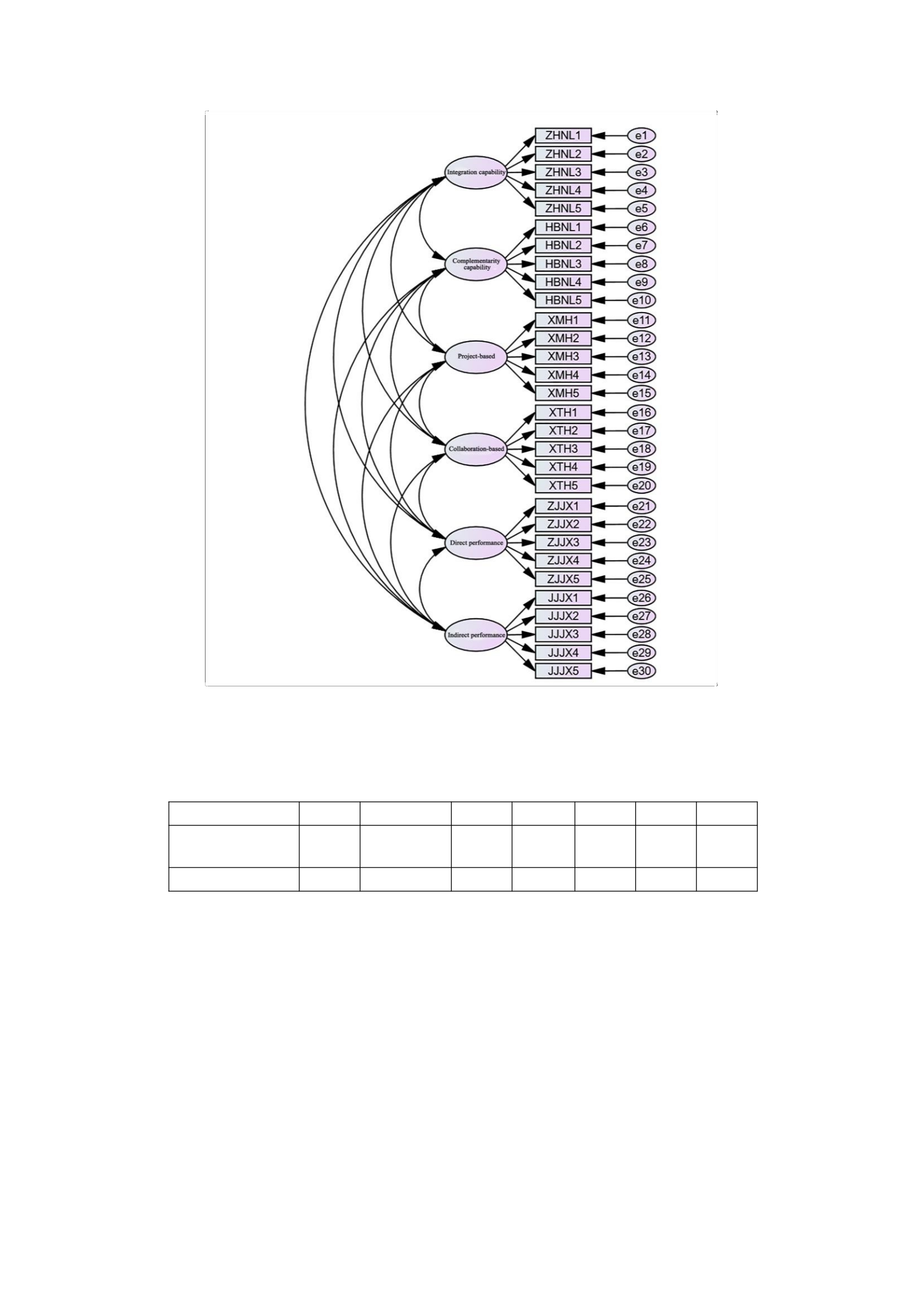
142
Figure 4.1 CFA Measurement Model
Table 4.12 Fit Index of Variable Construct CFA (N=606)
Model fit index χ²/df RMSEA PGFI TLI NFI IFI CFI
Independent
variable model 1.968 .062 .699 .945 .905 .951 .951
Reference value <3 <.10 >.5 >.9 >.9 >.9 >.9

143
Table 4.13 Estimates of CFA Construct and Path Coefficient (N=252)
Unstandardi
zed loading
coefficient
Standardized
loading
coefficient
S.E. p CR AVE
Square
root of
AVE
ZHNL1 <--- Integration
capability 1.000 .858 - - .955 .810 .900
ZHNL2 <--- Integration
capability 1.025 .855 .056 ***
ZHNL3 <--- Integration
capability 1.137 .984 .046 ***
ZHNL4 <--- Integration
capability 1.065 .922 .050 ***
ZHNL5 <--- Integration
capability .983 .874 .051 ***
HBNL1 <--- Complementarity
capability 1.000 .832 - - .910 .670 .819
HBNL2 <--- Complementarity
capability .932 .785 .064 ***
HBNL3 <--- Complementarity
capability .965 .811 .063 ***
HBNL4 <--- Complementarity
capability .943 .813 .062 ***
HBNL5 <--- Complementarity
capability .999 .851 .061 ***
XMH1 <--- Project-based 1.000 .849 - - .913 .677 .823
XMH2 <--- Project-based .919 .788 .061 ***
XMH3 <--- Project-based 1.020 .887 .056 ***
XMH4 <--- Project-based .902 .792 .060 ***
XMH5 <--- Project-based .896 .795 .059 ***
XTH1 <--- Collaboration-based 1.000 .812 - - .94 .760 .872
XTH2 <--- Collaboration-based .965 .850 .060 ***
XTH3 <--- Collaboration-based .934 .879 .055 ***
XTH4 <--- Collaboration-based 1.028 .930 .055 ***
XTH5 <--- Collaboration-based 1.038 .882 .061 ***
ZJJX1 <--- Direct performance 1.000 .919 - - .952 .799 .894
ZJJX2 <--- Direct performance 1.020 .918 .041 ***
ZJJX3 <--- Direct performance .950 .870 .044 ***
ZJJX4 <--- Direct performance 1.012 .874 .046 ***
ZJJX5 <--- Direct performance .952 .885 .042 ***
JJJX1 <--- Indirect
performance 1.000 .898 - - .981 .911 .954
JJJX2 <--- Indirect
performance 1.176 1.000 .036 ***
JJJX3 <--- Indirect
performance 1.161 .992 .037 ***
JJJX4 <--- Indirect
performance 1.006 .897 .044 ***
JJJX5 <--- Indirect
performance 1.118 .980 .037 ***
***: p<.001
With
reference
to Anderson
and
Gerbing
(1988),
the
following

144
indicators were analyzed in this study: TLI, NFI, IFI, and CFI are all greater
than .9, and PGFI is greater than .5, indicating that the model and data have a
high degree of fit, as shown in the table. The items in this measurement
questionnaire correspond to the hypothesized factors one by one, and the
standardized factor loads of the items are all greater than .5, meeting the
criteria. This shows good convergent validity of the measurement. The
constructs all have CR values exceeding .7 and AVE values exceeding .5
(Fornell & Larcker, 1981), demonstrating good discriminant validity of the
measurement. The comparison indicates that the correlation coefficients
between the table’s statistical expressions and table factors, as well as between
the independent variable dimensions and other dimensions, are less than the
square root of the diagonal AVE of the correlation matrix.
4.3.3 Multiple regression analysis
Based on the validity and reliability tests of large sample
questionnaires, this section further performs correlation analysis and causal
regression analysis on variable relations to verify the hypotheses in the
conceptual model of this study.
4.3.3.1 Research on platform complementarity capability, platform
integration capability, and direct entrepreneurship empowerment
performance
For Hypotheses 1a, 2a, and 3a of this study, multiple linear regression
was used to test the direct entrepreneurship empowerment performance as a
dependent variable. The analysis results are shown in Table 4.14. Model 1.1
incorporates platform integration capability. Model 1.2 incorporates platform
complementarity capability. Model 1.3 incorporates both platform integration

145
and complementarity capabilities. Model 1.4, based on Model 1.3, adds the
interaction term between platform integration capability and platform
complementarity capability. The results show that: (1) When platform
integration capability is included in the model alone, the β coefficient is .981.
(2) When platform complementarity capability is included in the model alone,
the β coefficient is .760. (3) When both platform integration capability and
platform complementarity capability are included in the model, the β
coefficients are .807 and .536 respectively. All these coefficients have
significant effects on direct performance at the .001 level, indicating that
Hypotheses 1a and 2a are supported. (4) When the interaction term is added,
its β coefficient is .233, which is significant for direct performance at the .01
level, indicating that Hypothesis 3a is supported.

146
Table 4.14 Impact of Platform Complementarity Capability and Platform Integration
Capability on Direct Entrepreneurship Empowerment Performance
Model 1.1 Model 1.2 Model 1.3 Model 1.4
Integration capability .981*** .807*** -.166
(.063) (.055) (.342)
Complementarity capability .760*** .536*** -.468
(.066) (.051) (.352)
Interaction term .233**
(.081)
Revenue growth 2.206 -.288 .715 .759
(1.347) (1.543) (1.125) (1.108)
Government subsidy .008 .002 .004 .004
(.007) (.008) (.006) (.005)
Industry .328* .158 .228* .231*
(.128) (.146) (.107) (.105)
High-tech .071 -.012 .039 .009
(.080) (.091) (.066) (.066)
Annual revenue
(log)
-.067* -.095* -.051 -.056*
(.033) (.038) (.028) (.027)
Enterprise size (log) -.001 .000 -.002 .005
(.055) (.063) (.046) (.045)
Enterprise age (log) .044 .117* .014 .010
(.043) (.049) (.036) (.036)
Number of patents
(log)
-.033 -.023 -.048 -.040
(.041) (.046) (.034) (.033)
Constant -.404 .881* 4.084** 2.260
(.360) (.371) (23.863) (1.484)
Sample size 252 252 252 252
R square .546 .412 .690 .701
DW 1.748 1.866 2.016 2.019
* p<.05 ** p<.01 ***p<.001
4.3.3.2 Research on platform complementarity capability, platform
integration capability, and indirect entrepreneurship
empowerment performance
For Hypotheses 1b, 2b, and 3b of this study, multiple linear
regression was adopted to test the indirect entrepreneurship empowerment
performance as a dependent variable. The analysis results are shown in Table
4.15. The specific

147
operation process is the same as that in the previous section: Model 2.1
incorporates platform integration capability. Model 2.2 incorporates platform
complementarity capability. Model 2.3 incorporates both platform integration
and complementarity capabilities. Model 2.4 adds the interaction term
between platform integration capability and platform complementarity
capability. The results show that: (1) When platform integration capability is
included in the model alone, the β coefficient is .627. (2) When platform
complementarity capability is included in the model alone, the β coefficient
is .634. (3) When both platform integration capability and platform
complementarity capability are included in the model simultaneously, the β
coefficients are .463 and .505 respectively. All these coefficients have
significant effects on indirect performance at the .001 level, indicating that
Hypotheses 1b and 2b are supported. (4) When the interaction term is added,
its β coefficient is .242, which is significant for indirect performance at the .05
level. This indicates that Hypothesis 3b is supported.

148
Table 4.15 Impact of Platform Complementarity Capability and Platform Integration
Capability on Indirect Entrepreneurship Empowerment Performance
Model 2.1 Model 2.2 Model 2.3 Model 2.4
Integration capability .627*** .463*** -.548
(.075) (.071) (.444)
Complementarity capability .634*** .505*** -.538
(.068) (.065) (.457)
Interaction term .242*
(.105)
Revenue growth 2.345 .364 .939 .984
(1.606) (1.569) (1.452) (1.439)
Government subsidy .003 -.002 -.001 -.001
(.008) (.008) (.007) (.007)
Industry -.137 -.272 -.231 -.228
(.153) (.149) (.138) (.136)
High-tech .162 .103 .132 .101
(.095) (.092) (.085) (.086)
Annual revenue
(log)
-.021 -.031 -.006 -.011
(.040) (.038) (.036) (.035)
Enterprise size (log) .068 .068 .067 .074
(.066) (.064) (.059) (.058)
Enterprise age (log) -.074 -.043 -.102* -.106*
(.052) (.049) (.047) (.046)
Number of patents
(log)
.061 .062 .047 .056
(.049) (.047) (.044) (.043)
Constant 1.388** 1.567*** -.035 4.303*
(.429) (.378) (.427) (1.928)
Sample size 252 252 252 252
R square .274 .412 .418 .431
DW 1.627 1.626 1.725 1.699
* p<.05 ** p<.01 ***p<.001
4.3.3.3 Moderating effect test of the project-based operating system
For Hypotheses 4a and 5a, multiple linear regression was employed
to test the direct entrepreneurship empowerment performance as a dependent
variable. The results are shown in Table 4.16. Model 3.1 incorporates platform
integration capability. Model 3.2, based on Model 3.1, adds the interaction
term between platform integration capability and the project-based operating
system.

149
Model 3.3 incorporates platform complementarity capability. Model 3.4, based
on Model 3.3, adds the interaction term between platform complementarity
capability and the project-based operating system. The results show that: (1)
The interaction term between platform integration capability and the project-
based operating system has a β coefficient of .653. (2) The interaction term
between platform complementarity capability and the project-based operating
system has a β coefficient of .648. Both interaction terms are significant for
direct entrepreneurship empowerment performance at the .001 level. Thus,
Hypotheses 4a and 5a are supported.

150
Table 4.16 Digital Platform Capabilities, Project-based Operating System, and Direct
Entrepreneurship Empowerment Performance
Dependent Variable: Direct Entrepreneurship Empowerment Performance
Model
3.1 Model 3.2 Model
3.3 Model 3.4
Integration capability .972*** -2.080**
(.061) (.632)
Integration capability * Project-based .653***
(.135)
Complementarity capability .753*** -2.185**
(
.
0
7
)
(.677)
Complementarity capability * Project-
based
.648***
(.149)
Project-based .287*** -2.615*** .023 -2.792***
(.070) (.602) (.087) (.651)
Revenue growth 1.570 1.7
73
-.322 -.634
(1.314) (1.257) (1.551) (1.498)
Government subsidy .009 .00
6
.002 .003
(.007) (.006) (.008) (.007)
Industry .322** .31
6*
*
.158 .082
(.124) (.119) (.147) (.143)
High-tech .040 .02 -.014 -.002
(.078) (.074) (.091) (.088)
Annual revenue (log) -.067* -.077* -.095* -.089*
(.032) (.031) (.038) (.037)
Enterprise size (log) -.012 .00
1
-.001 -.007
(.053) (.051) (.063) (.061)
Enterprise age (log) .047 .03 .118* .085
(.042) (.04) (.049) (.048)
Number of patents (log) -.032 -.022 -.023 -.016
(.040) (.038) (.047) (.045)
Constant -1.630** 11.976**
*.805 13.612**
*
(.459) (2.839) (.468) (2.971)
Sample size 252 25
2
252 252
R square .576 .61
4
.412 .456
DW 1.830 1.7
72
1.868 1.809

151
* p<.05 ** p<.01 ***p<.001
For Hypotheses 4b and 5b, multiple linear regression was used to test
the indirect entrepreneurship empowerment performance as a dependent
variable. The results are shown in Table 4.17. Model 4.1 incorporates platform

152
integration capability. Model 4.2, based on Model 4.1, adds the interaction
term between platform integration capability and the project-based operating
system. Model 4.3 incorporates platform complementarity capability. Model
4.4, based on Model 4.3, adds the interaction term between platform
complementarity capability and the project-based operating system. The
results show that: (1) The interaction term between platform integration
capability and the project- based operating system has a β coefficient of .142,
which has no significant effect on indirect entrepreneurship empowerment
performance. (2) The interaction term between platform complementarity
capability and the project- based operating system has a β coefficient of .353,
which has a significant effect on indirect entrepreneurship empowerment
performance at the .05 level. These results indicate that Hypothesis 4b is
supported, while Hypothesis 5b is not supported.

153
Table 4.17 Digital Platform Capabilities, Project-based Operating System, and
Indirect Entrepreneurship Empowerment Performance
Dependent Variable: Indirect Entrepreneurship Empowerment Performance
Model 4.1 Model 4.2 Model 4.3 Model 4.4
Integration capability .602*** -.064
(.061) (.656)
Integration capability *
Project-based
.142
(.14)
Complementarity
capability .467*** -1.132
(.064) (.628)
Complementarity
capability * Project-based
.353*
(.138)
Project-based .791*** .158 .627*** -.905
(.069) (.625) (.079) (.604)
Revenue growth .59 .634 -.583 -.752
(1.306) (1.306) (1.403) (1.389)
Government subsidy .005 .005 .001 .002
(.006) (.006) (.007) (.007)
Industry -.152 -.153 -.254 -.295*
(.123) (.123) (.133) (.132)
High-tech .078 .073 .044 .051
(.077) (.077) (.083) (.082)
Annual revenue (log) -.021 -.024 -.039 -.036
(.032) (.032) (.034) (.034)
Enterprise size (log) .038 .041 .044 .041
(.053) (.053) (.057) (.056)
Enterprise age (log) -.066 -.07 -.022 -.04
(.042) (.042) (.044) (.044)
Number of patents (log) .065 .067 .071 .074
(.039) (.039) (.042) (.042)
Constant -1.992*** .975 -.486 6.483*
(.456) (2.949) (.424) (2.755)

154
Table 4.17 Digital Platform Capabilities, Project-based Operating System,
and Indirect Entrepreneurship Empowerment Performance (Continued)
Dependent Variable: Indirect Entrepreneurship Empowerment Performance
Model 4.1 Model 4.2 Model 4.3 Model 4.4
Sample size 252 252 252 252
R square .529 .531 .459 .473
DW 1.778 1.770 1.665 1.667
* p<.05 ** p<.01 ***p<.001
4.3.3.4 Moderating effect test of collaboration ecosystem
For Hypotheses 6a and 7a of this study, multiple linear regression was
adopted to test the direct entrepreneurship empowerment performance as a
dependent variable. The analysis results are shown in Table 4.18. Model 5.1
incorporates platform integration capability. Model 5.2, based on Model 5.1,
adds the interaction term between platform integration capability and the
collaboration ecosystem. Model 5.3 incorporates platform complementarity
capability. Model 5.4, based on Model 5.3, adds the interaction term between
platform complementarity capability and the collaboration ecosystem. The
results show that: (1) The interaction term between platform integration
capability and the collaboration ecosystem has a β coefficient of .323, which is
significant for direct entrepreneurship empowerment performance at the .05
level. (2) The interaction term between platform complementarity capability
and the collaboration ecosystem has a β coefficient of .454, which is
significant for direct entrepreneurship empowerment performance at the .001
level. These results indicate that Hypotheses 6a and 7a are supported.

155
Table 4.18 Digital Platform Capabilities, Collaboration Ecosystem, and Direct
Entrepreneurship Empowerment Performance
Dependent Variable: Direct Entrepreneurship Empowerment Performance
Model 5.1 Model
5.2
Model 5.3 Model 5.4
Integration
capability .958*** -.564
(.065) (.679)
Integration
capability *
Collaboration
.323*
(.144)
Complementar
ity capability .732*** -1.375*
(.068) (.583)
Complementar
ity capability *
Collaboration
.454***
(.125)
Collaboration-
based .105 -1.312* .126 -
1.841***
(.066) (.633) (.075) (.546)
Revenue
growth 2.044 1.893 -.395 -.335
(1.347) (1.337) (1.538) (1.501)
Government
subsidy .008 .008 .003 .003
(.007) (.007) (.008) (.007)
Industry .321* .303* .155 .112
(.128) (.127) (.146) (.143)
High-tech .055 .043 -.028 -.044
(.08) (.080) (.091) (.089)
Annual
revenue (log)
-.068* -.065* -.095* -.099**
(.033) (.033) (.038) (.037)
Enterprise size
(log)
0 -.002 0 .008
(.055) (.054) (.062) (.061)
Enterprise age
(log)
.053 .05 .127* .111*
(.044) (.043) (.049) (.048)
Number of
patents (log)
-.033 -.031 -.023 -.018
(.041) (.040) (.046) (.045)
Constant -.791 5.883 .407 9.565***
(.433) (2.996) (.466) (2.559)
Sample size 252 252 252 252
R square .551 .560 .419 .449
DW 1.773 1.744 1.866 1.864
* p<.05 ** p<.01 ***p<.001
For Hypotheses 6b and 7b of this study, multiple linear regression was

156
employed to test the indirect entrepreneurship empowerment performance as a
dependent variable. The analysis results are shown in Table 4.19. Model 6.1
incorporates platform integration capability. Model 6.2, based on Model 6.1,
adds the interaction term between platform integration capability and the
collaboration ecosystem. Model 6.3 incorporates platform complementarity
capability. Model 6.4, based on Model 6.3, adds the interaction term between
platform complementarity capability and the collaboration ecosystem. The
results show that: (1) The interaction term between platform integration
capability and the collaboration ecosystem has a β coefficient of .177, which
has no significant effect on indirect entrepreneurship empowerment
performance. (2) The interaction term between platform complementarity
capability and the collaboration ecosystem has a β coefficient of .269, which
has a significant effect on indirect entrepreneurship empowerment
performance at the .05 level. Thus, Hypothesis 6b is supported, while
Hypothesis 7b is not supported.

157
Table 4.19 Digital Platform Capabilities, Collaboration Ecosystem, and Indirect
Entrepreneurship Empowerment Performance
Dependent Variable: Indirect Entrepreneurship Empowerment Performance
Model
6.1
Model 6.2 Model 6.3 Model
6.4
Integration
capability .528*** -.303
(.072) (.762)
Integration
capability *
Collaboration
.177
(.161)
Complementari
ty capability .539*** -.709
(.065) (.567)
Complementari
ty capability *
Collaboration
.269*
(.121)
Collaboration-
based .450*** -.324 .425*** -.74
(.073) (.711) (.072) (.530)
Revenue
growth 1.649 1.566 .002 .037
(1.500) (1.502) (1.470) (1.459)
Government
subsidy .004 .004 .000 .001
(.007) (.007) (.007) (.007)
Industry -.167 -.177 -.280* -.305*
(.142) (.143) (.139) (.139)
High-tech .096 .089 .049 .039
(.089) (.089) (.087) (.086)
Annual revenue
(log)
-.023 -.021 -.031 -.034
(.037) (.037) (.036) (.036)
Enterprise size
(log)
.07 .069 .07 .074
(.061) (.061) (.060) (.059)
Enterprise age
(log)
-.034 -.035 -.01 -.019
(.049) (.049) (.047) (.046)
Number of
patents (log)
.062 .063 .062 .065
(.045) (.045) (.044) (.044)
Constant -.275 3.369 -.032 5.394*
(.482) (3.364) (.445) (2.487)
Sample size 252 252 252 252
R square .373 .376 .402 .414
DW 1.660 1.659 1.608 1.646
4.3.4 Results discussion
The hypothesis testing results are shown in Table 4.20.

158
Table 4.20 Hypothesis Testing Results
Research hypothesis Analysis
result
Hypothesis 1a: Digital platform complementarity capability positively
promotes direct entrepreneurship empowerment performance. Sup
port
ed
Hypothesis 1b: Digital platform complementarity capability positively
promotes indirect entrepreneurship empowerment performance. Sup
port
ed
Hypothesis 2a: Digital platform integration capability positively promotes
direct entrepreneurship empowerment performance. Sup
port
ed
Hypothesis 2b: Digital platform integration capability positively promotes
indirect entrepreneurship empowerment performance. Sup
port
ed
Hypothesis 3a: The interaction between platform integration capability
and platform complementarity capability can significantly promote direct
entrepreneurship empowerment performance.
Sup
port
ed
Hypothesis 3b: The interaction between platform integration capability
and platform complementarity capability can significantly promote
indirect entrepreneurship empowerment performance.
Sup
port
ed
Hypothesis 4a: The project-based operating system promotes a positive
correlation between platform complementarity capability and direct
entrepreneurship empowerment performance.
Sup
port
ed
Hypothesis 4b: The project-based operating system promotes a positive
correlation between platform complementarity capability and indirect
entrepreneurship empowerment performance.
Sup
port
ed
Hypothesis 5a: The project-based operating system promotes a positive
correlation between platform integration capability and direct
entrepreneurship empowerment performance.
Sup
port
ed
Hypothesis 5b: The project-based operating system promotes a positive
correlation between platform integration capability and indirect
entrepreneurship empowerment performance.
Not
supported
Hypothesis 6a: The collaboration ecosystem promotes a positive
correlation between platform complementarity capability and direct
entrepreneurship empowerment performance.
Sup
port
ed
Hypothesis 6b: The collaboration ecosystem promotes a positive
correlation between platform complementarity capability and indirect
entrepreneurship empowerment performance.
Sup
port
ed
Hypothesis 7a: The collaboration ecosystem promotes a positive
correlation between platform integration capability and direct
entrepreneurship empowerment performance.
Sup
port
ed
Hypothesis 7b: The collaboration ecosystem promotes a positive
correlation between platform integration capability and indirect
entrepreneurship empowerment performance.
Not
supported

159
4.3.4.1 Impact of digital platform capabilities on entrepreneurship
empowerment performance
According to the testing results, the digital platform capability system
includes two dimensions: platform complementarity capability and platform

160
integration capability, both of which can promote entrepreneurship
empowerment performance. The platform complementarity capability
emphasizes that the platform accesses core and auxiliary complementary
resources. It promotes information exchange and resource complementarity
between entrepreneurial enterprises in the parks and service enterprises on the
platforms, thus improving direct and indirect entrepreneurial performance. The
platform integration capability represents that platform enterprises integrate
and reconstruct internal and external resources based on digital platforms. It
provides professional industrial and entrepreneurial services for
entrepreneurial enterprises, improving direct and indirect entrepreneurial
performance. Regarding theoretical logic, these two dimensions are consistent
with the discussion on platform resources and platform leaders in existing
platform theories. However, they also take into account the situational
characteristics of digital industrial parks to form a framework for the digital
platform capability system. The interaction between platform complementarity
capability and platform integration capability can also promote
entrepreneurship empowerment performance. This demonstrates that the
breadth and depth of platform resources and the integration and reconstruction
of resources by platform enterprises promote each other. The more resources
the platform accesses, the more professional services platform enterprises can
provide after resource integration. Conversely, the more professional services
platform enterprises provide, the more resources the platform can access.
Therefore, digital platforms need to have both platform complementarity
capability and platform integration capability to maximize their empowerment
of entrepreneurial enterprises.

161
The comparison of model coefficients shows that platform integration
capability is more influential than platform complementarity capability in
promoting entrepreneurship empowerment performance. This indicates that
when digital platforms possess both capabilities, platform integration
capability plays a more significant role in promoting entrepreneurship
empowerment performance. This provides further evidence that digital
platforms cannot only rely on complementary resources but also need to
integrate and reconstruct these resources through the management of platform
enterprises to provide professional services that meet the needs of
entrepreneurial enterprises. It highlights the importance of park management
enterprises as platform enterprises in digital industrial parks. Thus, the current
digital platform capability framework is an inheritance and development of
existing platform theories.
4.3.4.2 Moderating effects of basic standardized systems
The tests indicate that basic standardized systems encompass two
dimensions: the project-based operating system and the collaboration ecosystem.
Both of these dimensions moderate the relationship between digital platform
capabilities and entrepreneurship empowerment performance.
On the one hand, the project-based operating system fosters a positive
correlation between platform complementarity capability and both direct and
indirect entrepreneurship empowerment performance. It also promotes a
positive correlation between platform integration capability and direct
entrepreneurship empowerment performance. This suggests that the project-
based operating system can significantly enhance the results of entrepreneurial
activities. By implementing professional management within each industrial

162
park through project teams, it provides continuous, long-term, and specialized
services for entrepreneurial enterprises centered around project themes,
enhancing the growth, profitability, and innovation of entrepreneurial
enterprises. Additionally, the project team’s role as a bridge strengthens the
relationship between entrepreneurial enterprises and platform complementary
parties. This, in turn, improves the perceived service efficiency for
entrepreneurial enterprises throughout the entrepreneurial process.
On the other hand, the collaboration ecosystem promotes the positive
correlation between platform complementarity capability and both direct and
indirect entrepreneurship empowerment performance, as well as the positive
correlation between platform integration capability and direct entrepreneurship
empowerment performance. This demonstrates that the collaboration
ecosystem can better fulfill the diversified, total-factor, and whole-process
needs of entrepreneurial enterprises by establishing a cross-industry and cross-
regional ecosystem. This approach effectively enhances the efficiency and
outcomes of entrepreneurial activities, enabling enterprises to achieve better
direct performance. Moreover, the growing ecosystem generates positive
externalities for digital platforms, allowing entrepreneurial enterprises to
benefit from an improved entrepreneurial atmosphere and increased service
efficiency during the entrepreneurial process.
However, two hypotheses were not verified in this study: the
promotion of the project-based operating system on the positive correlation
between platform integration capability and indirect entrepreneurship
empowerment performance, and the role of the collaboration ecosystem in the
positive correlation
between
platform
integration
capability
and
indirect

163
entrepreneurship empowerment performance. This study suggests that this
may be due to several factors: (1) There is a potential substitution relationship
between platform integration capability and basic standardized systems. While
basic standardized systems can enhance the role of platform integration
capability in promoting the outcomes of entrepreneurial enterprises, in terms
of perceived service efficiency, basic standardized systems and platform
integration capability may exhibit similar characteristics. Both of them provide
more professional services for entrepreneurial enterprises through digital
industrial park management enterprises. Therefore, entrepreneurial enterprises
might not perceive a significant improvement in service efficiency. (2) This
study collected data through questionnaire distribution. The respondents of the
questionnaire were entrepreneurial enterprises in the parks, and the
measurement of basic standardized systems was based on the subjective
perception of respondents. However, employees of entrepreneurial enterprises
may not directly experience the operation and management mode of park
management enterprises. Hence, they may not perceive the service efficiency
of basic standardized systems clearly. (3) During the questionnaire distribution
process, despite efforts to collect data from multiple channels and parks to
improve data quality, successful enterprises were often more willing to
participate. These enterprises typically possess rich entrepreneurial resources
and might not perceive the service efficiency provided by park management
enterprises as significantly improved. In conclusion, the promotion effect of
basic standardized systems (the project-based operating system and the
collaboration ecosystem) on the positive correlation between platform
integration capability and indirect entrepreneurship empowerment
performance

164
is not significant.

165
5 Conclusions and Outlook
This chapter summarizes the study’s key conclusions and, based on
these findings, refines the main theoretical contributions and practical
implications of this study. Furthermore, it analyzes the study’s limitations and
proposes directions for future research.
5.1 Main Conclusions
This study presents the fundamental idea of using digital technology
to empower the transformation and upgrading of industrial parks. It
emphasizes the urgent need for industrial technology parks to build digital
platforms that empower entrepreneurial enterprises in the parks, facilitating
high-quality development through digital transformation, intelligent
upgrading, and integrated innovation. This study points out the challenges in
building digital platforms and achieving the transformation of industrial parks.
For instance, current platform functions mainly focus on information display,
which hampers their empowering role in innovation and entrepreneurship. The
systems of digital platform capabilities and entrepreneurship empowerment
evaluation have not been systematically constructed, and the pathway for
digital platforms to empower entrepreneurial enterprises needs further
exploration. This study focuses on the core question of “how to build digital
platform capabilities for sci-tech industrial parks to empower entrepreneurship
of enterprises in the parks.”
It centers on three sub-questions. First, what digital platform
capabilities should be developed for sci-tech industrial parks? Second, how
can these digital platform capabilities empower entrepreneurial enterprises in
the parks? Third, how do the basic standardized management systems impact
the

166
empowerment of digital platform capabilities on entrepreneurial enterprises in
industrial parks? To answer these questions, this study employs literature
analysis, case studies, and statistical tests, leading to the following
conclusions: First, sci-tech industrial parks’ digital platform capabilities
comprise platform complementarity capability and platform integration
capability. Through an exploratory longitudinal single-case analysis of
Zhixin Zedi Artificial Intelligence Industrial Park, this study provides
an in-depth description of the process of building digital platform
capabilities and summarizes the capabilities’ dimensions. Specifically,
access-based platform complementarity capability focuses on building a
platform ecosystem and capabilities from a “chain” perspective. It
considers the diverse needs of entrepreneurial enterprises, emphasizing the
importance of strengthening, supplementing, and extending the industry,
supply, talent, innovation, and capital chains. This approach aims to build
collaboration and complementarity ecosystems and capabilities that center on
the development needs of industries and entrepreneurship. Platform
integration capability highlights platform owners’ role in integrating
relevant resources to build a platform ecosystem and capabilities. From the
perspective of platform owner management, this involves establishing a total-
factor service system according to the development needs of entrepreneurial
enterprises and restructuring resources to provide
entrepreneurial enterprises with industrial and platform professional services
that align with these needs. These two dimensions explain digital platform
capabilities from the perspectives of platform resource characteristics and the
management of platforms by platform enterprises. Through the development
of platform complementarity capability and platform integration capability

167
of

168
digital platforms in industrial parks, a total-factor ecosystem featuring
comprehensive factors and a full-link ecosystem featuring collaboration are
formed. This enhances the empowerment capability of digital platforms, thus
meeting the growth needs of entrepreneurial enterprises and promoting
industrial development to the greatest extent.
Second, digital platform capabilities facilitate entrepreneurial
enterprises in accessing complementary resources, offering them industrial
and platform professional services, thus enhancing both direct and indirect
entrepreneurship empowerment performance. Direct entrepreneurship
empowerment performance emphasizes the growth, innovation, and
profitability of entrepreneurial enterprises. This is because parks have
firsthand knowledge of the needs of settled enterprises, allowing them to
provide the most targeted services. The impact of this is evident, directly
reflected in the development dimensions of the enterprises within the parks.
Indirect entrepreneurship empowerment performance emphasizes the
perceived service efficiency by entrepreneurial enterprises during their
entrepreneurial process. Given the large number of settled enterprises, it is
impractical to provide direct services for each one. Therefore, creating a
favorable atmosphere for entrepreneurial growth and industrial development
within the parks is crucial. This fosters a favorable environment for unified
entrepreneurship, instilling high hopes and making the parks a fertile ground
for enterprise growth and industrial development.
Third, basic standardized management systems significantly enhance
the empowerment of digital platform capabilities for entrepreneurial
enterprises. Basic standardized systems encompass two dimensions: the
project-based

169
operating system and the collaboration ecosystem. The former involves the
professional management of each industrial park by project teams. These
teams featuring strong professional and service quality provide continuous,
long-term, and specialized services centered around project themes, promoting
the efficient and pragmatic operation of platforms. The latter emphasizes
cross-industry and cross-domain collaboration. Platform enterprises, platform
participants with complementary resources, entrepreneurial enterprises, and
other entities collaborate to form an ecosystem integrating factors (dot), links
(line), and platforms (plane) according to the diversified, total-factor, and
whole-process needs of entrepreneurial enterprises. This meets their growth
and development needs. The project-based operating system and collaboration
ecosystem represent management systems at the project and ecosystem levels
respectively. By building a professional and continuous project-based
operating system, the correlation between entrepreneurial enterprises and
digital platforms is enhanced, allowing digital platform capabilities to impact
entrepreneurial enterprises more directly and efficiently. Meanwhile, by
establishing a cross- industry and cross-regional collaboration ecosystem, the
depth and breadth of the correlation between entrepreneurial enterprises and
complementary parties are further improved, making the enhancement effect
of digital platform capabilities on entrepreneurial enterprises more evident.
5.2 Theoretical Contributions
This study explores the relationship between the building of digital
platform capabilities and entrepreneurship empowerment performance in
industrial parks, contributing to the research on digital platform capabilities
and the empowerment of industrial parks to entrepreneurial enterprises:

170
First, it constructs a framework for digital platform capabilities.
Existing studies have examined digital platform capabilities from two
perspectives: digital industrial park capability systems and platform capability
systems. However, discussions on industrial park capability systems often lack
the identification of key dimensions and analysis of mechanisms and those on
platform capability systems overlook the role of platform leaders. By
integrating these perspectives, this study proposes the concepts of platform
complementarity capability and platform integration capability from the
viewpoints of the platform itself and platform enterprise management. It
establishes a foundational framework for digital platform capability systems in
industrial parks, offering new insights into platform capability systems and
identifying key capability dimensions for industrial park managers in the
digital economy era.
Second, this study delves into the mechanisms by which industrial
parks empower entrepreneurial enterprises. While existing studies have
explored how industrial parks empower entrepreneurial enterprises through
opportunity identification, activity implementation, and achievement
transformation, they focus on traditional industrial parks and lack exploration
of empowerment mechanisms and pathways in the digital era. This study
asserts that digital platforms should be the core medium for empowering
entrepreneurial enterprises in industrial parks. It analyzes the mechanism of
digital platform capabilities on entrepreneurship empowerment performance.
Third, this study identifies and tests basic standardized systems as a
crucial moderating variable. Although existing studies suggest that platform
capabilities are essential for platform and digital industrial park development,

171
they seldom answer the question of “what organizational management system
ensures the implementation of these capabilities.” Developing and achieving
organizational capability must be supported by an effective organizational
management system. Therefore, building a basic standardized management
system is a crucial prerequisite for digital platforms in industrial parks to
effectively empower entrepreneurial enterprises. This study identifies the
project-based operating system and collaboration ecosystem as vital
dimensions of basic standardized management systems from both park
management and cross-park management levels. It explores and tests the
moderating role of basic standardized systems.
Fourth, this study develops an empowerment performance evaluation
system. Existing studies of empowerment performance often focus on single or
multiple dimensions, such as achievement and efficiency improvement, but
lack a comprehensive and systematic evaluation system. They also tend to
emphasize entrepreneurial results over entrepreneurial experiences. This study
proposes that entrepreneurship empowerment performance encompasses two
dimensions: direct entrepreneurship empowerment performance
and indirect entrepreneurship empowerment
performance. The former is reflected by traditional
indicators
such
as
growth,
profitability,
and
innovation
of entrepreneurial enterprises, while
the latter focuses on the service efficiency of industrial parks during the
entrepreneurial process. By combining financial and non-financial indicators as
well as subjective and objective indicators, this study provides a holistic
evaluation of entrepreneurship empowerment performance. It also analyzes
the impact of digital technology on industrial parks’ empowerment.
Specifically, it is necessary to further stimulate the network

172
effect by improving the efficiency of entrepreneurship services to achieve the
long-term sustainable development of industrial parks.
5.3 Management Significance
In the digital economy era, building digital empowerment platforms
in industrial parks holds great management significance. These platforms can
integrate various service resources, create a replicable entrepreneurship service
system, improve the operational efficiency and service quality of industrial
parks, meet the diversified needs of enterprises, and promote the high-quality
development of industrial parks.
From a park operation perspective, digital empowerment platforms
can significantly enhance the intelligence level of park management. They
allow for real-time monitoring of various operational data within the park,
providing accurate and timely decision support for managers. These platforms
can integrate various service resources, enabling centralized management and
efficient allocation. This makes services offered by the parks more targeted
and effective. Digital empowerment platforms can facilitate deeper exchanges
and cooperation among enterprises, fostering a closely-knit industry chain and
ecosystem. This, in turn, attracts more high-quality enterprises to settle in the
parks.
From an enterprise service perspective, by integrating various service
resources, digital empowerment platforms in the parks can reduce intermediate
links and operating costs, ensuring efficient utilization and optimal allocation
of resources. These platforms help to form a replicable entrepreneurship
service system where standardized processes can serve as a model for other
parks. Digital empowerment platforms can provide customized service
solutions

173
tailored to the actual needs of enterprises.
From an industrial development perspective, digital empowerment
platforms can offer efficient and targeted data support for parks and
enterprises. This enables better insights into market dynamics, optimizes
decision-making processes, and supports industrial innovation and
development. These platforms can gather resources from governments,
enterprises, and scientific research institutions, as well as talent, technology,
and financial support, achieving resource sharing and complementary
advantages. They help deeply understand the needs of enterprises, link
upstream and downstream industry resources, and meet the diversified needs
of enterprises during industrial upgrading.
From a government support perspective, digital empowerment
platforms enable real-time park monitoring by integrating advanced information
technology and data resources. This provides scientific and accurate
information, aiding governments in achieving refined and intelligent park
management. These platforms gather various production factors and resources,
facilitate governments in providing one-stop services, optimize resource
allocation, and enhance service efficiency. They can offer various services
such as technology transfer, financial support, and market promotion. This all-
round support reduces entrepreneurial costs, stimulates innovation, and
deepens communication and cooperation among stakeholders, fostering a joint
force to drive development.
5.4 Shortcomings and Future Research Prospects
5.4.1 Shortcomings
This study explores, summarizes, and tests the relationship between
digital platform capabilities, basic standardized systems, and entrepreneurship

174
empowerment performance using an exploratory longitudinal single-case
study and a large-sample empirical test. It establishes a theoretical model for
digital platforms to empower entrepreneurial enterprises. However, there are
still some shortcomings in the research methods, primarily concerning the
insufficient universality of case studies and the limitations of sample data.
Insufficient universality of case studies. Although a longitudinal
single-case study can describe the development process of cases in depth and
vividly, it faces the problem of lacking universality. The establishment process
of different types of industrial parks, the building of digital platform
capabilities, and their explanation of the empowerment performance of
different enterprises need further exploration and discussion. Future studies
should observe and interview industrial parks across various industries and
development stages. Furthermore, more abundant data should be statistically
analyzed to test the replicability of case results.
Sample data limitations. Despite using various methods to obtain data
and attempting to control common method bias, there are still data limitations
in the model’s statistical analysis based on cross-sectional and first-hand data.
These limitations hinder understanding the changes in key variables over time.
During data collection, this study was constrained by time and resources,
distributing questionnaires only to several industrial parks in Hangzhou with
the help of park management enterprises. This approach caused problems such
as insufficient variability and social desirability issues, affecting the
universality and replicability of the study’s conclusions. Future studies should
try to test the model based on panel data and incorporate more second-hand
data for analysis. It is also crucial to expand the scope of sample collection,
conducting in-depth

175
investigations and data collection from industrial parks in different regions
and different types of entrepreneurial enterprises. This will further enhance the
reliability of study results.
5.4.2 Future research prospects
Although this study has made progress in the digital platform
capability system’s composition, the empowerment mechanism of digital
platforms, and the moderating role of basic standardized management systems,
there are still many areas that can be further explored. First, current studies
assume that digital platforms can empower entrepreneurial enterprises. This
study explores digital platform capabilities’ composition and the empowerment
mechanism based on this assumption. Nevertheless, this premise requires
further testing. Future research could use quasi-experiments and second-hand
data verification to explore the differences in empowerment performance and
approaches of entrepreneurial enterprises in industrial parks with and without
digital platforms. This would further clarify the role of digital platform
capabilities and provide references for practical and theoretical development.
Second, current studies mainly discuss the empowerment of digital
platforms from the perspective of digital platform managers and provide
general resources and services for entrepreneurial enterprises. However, there
should be differences in the dimensions and mechanisms of empowerment for
enterprises at different development stages and in various industries. It is
necessary to pay attention to the impact of different characteristics of
entrepreneurial enterprises on digital platform capabilities from an enterprise
perspective. This will improve the consistency between platform capabilities
and the needs of entrepreneurial enterprises and provide customized digital
services.

176
Third, digital infrastructure is the cornerstone of digital platform
empowerment. A solid digital infrastructure is necessary to provide better
services for entrepreneurial enterprises. While this study discusses the
moderating role of basic standardized management systems and explores the
boundary conditions for ensuring digital platform empowerment from an
organizational perspective, it lacks further attention to digital infrastructure
from a technical perspective. Future studies should establish a more systematic
digital platform empowerment model by integrating organizational and
technical perspectives.
Fourth, future studies should pay attention to the development of
digital technology and AI technology. This study still focuses on the analysis
and utilization of static data. With the continuous progress of technology and
the deep integration of industries, platforms will use big data, AI, and other
technologies to deeply analyze the needs of enterprises, build a comprehensive
digital ecosystem, promote close cooperation between upstream and
downstream enterprises in the industry chain, and provide more targeted
services and solutions. Digital empowerment platforms of sci-tech industrial
parks will develop more comprehensive content, more intelligent functions,
and more customized services. Therefore, it is necessary to further explore the
relationship between digital platform empowerment supported by emerging
digital technologies and entrepreneurial enterprise performance.

177
References:
Acs Z J, Autio E, Szerb L. National Systems of Entrepreneurship:
Measurement issues and policy implications [J]. Research Policy,
2014, 43(3): 476- 494.
Agarwal R, Selen W. Dynamic capability building in service value networks
for achieving service innovation[J]. Decision sciences, 2009, 40(3):
431-
475.
Ai, D., Liu, Y. [Yanpeng], & Yang, J. (2016). Research on smart park
construction scheme. Modern Electronics Technique, (39), 45-48.
Anderson, J. C, & Gerbing, D. W. Structural equation modeling in practice: A
review and recommended two-step approach. Psychological Bulletin,
1988, 103(3), 411-423.
Attour A, Barbaroux P. Architectural knowledge and the birth of a platform
ecosystem: a case study[J]. Journal of Innovation Economics &
Management, 2016 (1): 11-30.
Autio E, Levie J, Management of entrepreneurial ecosystems[M]. 2017: The
Wiley Handbook of Entrepreneurship.
Autio E, Nambisan S, Thomas L D W, et al. Digital affordances, spatial
affordances, and the genesis of entrepreneurial ecosystems [J].
Strategic Entrepreneurship Journal, 2018, 12(1): 72-95.
Baldwin C Y, Clark K B. Design rules, Volume 1: The power of modularity[M].
MIT press, 2000.
Baldwin R E. Global supply chains: why they emerged, why they matter, and
where they are going[J]. 2012.

178
Barrera G A F, Durany X Gi, Ponsjr, et al. Trends in global research on
industrial parks: a bibliometric analysis from 1996-2019[J]. Heliyon,
2021, 7(8): 1-14.
Beltagui A, Rosli A, Candi M. Exaptation in a digital innovation ecosystem:
The disruptive impacts of 3D printing[J]. Research policy, 2020, 49(1):
103833.
Bergek A, Norrman C. Incubator best practice: A framework[J]. Technovation,
2008, 28(1-2): 20-28.
Boudreau K J. Platform Boundary Choices & Governance: Opening-Up While
Still Coordinating and Orchestrating☆[M]//Entrepreneurship,
innovation, and platforms. Emerald Publishing Limited, 2017: 227-
297.
Brahm F, Tarziján J. Toward an integrated theory of the firm: The interplay
between internal organization and vertical integration[J]. Strategic
Management Journal, 2016, 37(12): 2481-2502.
Cenamor J, Parida V, Wincent J. How entrepreneurial SMEs compete through
digital platforms: The roles of digital platform capability, network
capability and ambidexterity[J]. Journal of Business Research, 2019,
100: 196-206.
Cenamor J, Sjödin D R, Parida V. Adopting a platform approach in
servitization: Leveraging the value of digitalization[J]. International
Journal of Production Economics, 2017, 192: 54-65.
Cennamo C, Santaló J. Generativity tension and value creation in platform
ecosystems[J]. Organization science, 2019, 30(3): 617-641.

179
Chang, M., Chen, Q., Xu, X., Wang, S. [Shiwen], & Yang, L. (2021).
Comparative analysis on innovation and entrepreneurship development
paths and resources environment of environmental protection industrial
parks in China. Sichuan Environment, 40(05), 150-156.
Chen, W., & Wang, J. [Jiexiang]. (2021). Dependent upgrading: Digital
transformation strategy of participants in the platform ecosystem.
Management World, 37(10), 195-214.
Chen, X. (2015). Intelligent transformation and evaluation of industrial parks.
Science & Technology Progress and Policy, (10), 114-118.
Clarysse B, Wright M, Bruneel J, et al. Creating value in ecosystems: Crossing
the chasm between knowledge and business ecosystems[J]. Research
policy, 2014, 43(7): 1164-1176.
Cumming D, Werth J C, Zhang Y. Governance in entrepreneurial ecosystems:
venture capitalists vs. technology parks[J]. Small Business Economics,
2019, 52: 455-484.
den Hartigh E, Tol M, Visscher W. The health measurement of a business
ecosystem[C]//Proceedings of the European Network on Chaos and
Complexity Research and Management Practice Meeting. 2006: 1-39.
Dong, S., & Li, Z. [Zhi]. (2018). Research review of industrial agglomeration
and park economic development. Modern Economic Information, (18),
474-475.
Dunn, S. C., Seaker, R. F., & Waller, M. A. Latent variables in business
logistics research: Scale development and validation. Journal of
Business Logistics, 1994, 15(2), 145-172.

180
Du, Y., Liu, Q., & Cheng, J. (2020). What kind of business environment
ecology produces high entrepreneurial dynamism in cities: An analysis
at the institutional level. Management World, 36(9), 141-155.
Eaton, B., Elaluf-Calderwood, S., Sørensen, C., & Youngjin, Y. Distributed
tuning of boundary resources: The case of Apple’s IOS service system.
MIS Quarterly, 2015(39): 212-217.
Eisenhardt, K. M. Building Theories from Case Study Research[J].
Academy of Management Review, 1989, 14(4):532-550.
Elia G, Margherita A, Petti C. An operational model to develop technology
entrepreneurship “EGO-system” [J]. International Journal of
Innovation & Technology Management, 2016, 13.
Eveleens C P, van Rijnsoever F J, Niesten E M M I. How network-based
incubation helps start-up performance: a systematic review against the
background of management theories[J]. The Journal of Technology
Transfer, 2017, 42: 676-713.
Fornell C, Larcker D F. Evaluating structural equation models with
unobservable variables and measurement error[J]. Journal of
marketing research, 1981, 18(1): 39-50.
Ghazawneh, A., & Henfridsson, O. Balancing platform control and external
contribution in third-party development: The boundary resources
model. Information Systems Journal, 2013(23): 173-192.
Grant R M. Prospering in dynamically-competitive environments:
Organizational capability as knowledge integration[J]. Organization
science, 1996, 7(4): 375-387.

181
Hannah D. P, Eisenhardt K. M. How Firms Navigate Cooperation and
Competition in Nascent Ecosystems[J].Strategic Management Journal,
2018, 39(3):3163-3192.
He, J., Zhou, G., & Yang, Y. [Yunyuan]. (2016). Domestic literature review
on transformation and upgrading of industrial parks. Journal of
Chuxiong Normal University, 31(9), 73-78.
Helfat C E, Raubitschek R S. Dynamic and integrative capabilities for
profiting from innovation in digital platform-based ecosystems[J].
Research policy, 2018, 47(8): 1391-1399.
Howells J. Intermediation and the role of intermediaries in innovation[J].
Research policy, 2006, 35(5): 715-728.
Hu, W., Li, J. [Jun], & Mou, H. (2010). Exploration of building park
innovation service system. Chinese University Technology Transfer.
Innovation communities: Teamworking of key persons-a success factor in
radical innovation[M]. Springer Science & Business Media, 2012.
Isenberg P, Elmqvist N, Scholtz J, et al. Collaborative visualization:
Definition, challenges, and research agenda[J]. Information
Visualization, 2011, 10(4): 310-326.
Jacobides, M. G., Cennamo, C., & Gawer, A. Towards a theory of ecosystems[J].
Strategic Management Journal, 2018(39): 2255-2276.
Li, J. [Jingye]. (2016). Research on the agglomeration development of
industrial parks from a new industrialization perspective. Commercial
Research, (9), 46-53.

182
Li, Y., & Zhang, Y. [Yanming]. (2012). Research on network resources,
entrepreneurial orientation, and performance of incubated enterprises:
An empirical analysis based on national business incubation bases in
Dalian. China Soft Science, (08), 98-110.
Li, Z. [Zhenhua], & Li, F. (2018). Correlation among incubation networks,
cluster social capital, and incubation performance. Management
Review, 30(08), 79-89.
Li, Z. [Zhenhua], Liu, C., & Wu, W. (2019). Incubation network structure
social capital, resource integration capability, and incubation
performance. Science Research Management, 40(09), 190-198.
Liu, H. (2016). Building smart parks to promote the upgrading of traditional
parks. Economic Research Guide, (4), 113-114.
Liu, J. (2015). Out of the homogenization dilemma of park development.
China Industry Review, (4), 16-20.
Liu, L., Zhang, M. [Min], Han, L., & Zheng, W. (2020). Problems to be solved
urgently in environmental impact assessment of industrial park
planning and countermeasures. Chinese Journal of Environmental
Management, 12(06), 47-51.
Liu, Y. [Yi], Zhang, Y. [Yi], & Xie, X. (2024). Research on resource
reconstruction mechanism of industrial Internet platforms: From
breadth and depth perspectives. Research on Economics and
Management, 45(01), 112-126.
Ma, M. (2016). Research review of smart parks in China. Computer
Knowledge and Technology, 12(3), 174-176.

183
Ma, Q. (2002). Management statistics: Research on data acquisition,
statistical principles, SPSS tools, and applications. China Science
Publishing & Media Ltd.
Ma, Z. (2020). Research on sustainable profit model of smart parks. Business
Culture, (14), 36-37.
Marion T J, Eddleston K A, Friar J H, et al. The evolution of
interorganizational relationships in emerging ventures: An
ethnographic study within the new product development process[J].
Journal of business Venturing, 2015, 30(1): 167-184.
Mikalef P, Pateli A. Information technology-enabled dynamic capabilities and
their indirect effect on competitive performance: Findings from PLS-
SEM and fsQCA[J]. Journal of Business Research, 2017, 70: 1-16.
Nambisan S, Sawhney M. Orchestration processes in network-centric
innovation: Evidence from the field[J]. Academy of management
perspectives, 2011, 25(3): 40-57.
Nambisan S, Siegel D, Kenney M. On open innovation, platforms, and
entrepreneurship [J]. Strategic Entrepreneurship Journal, 2018, 12(3):
354-368.
Nooteboom B. Trust and innovation[M]//Handbook of advances in trust
research. Edward Elgar Publishing, 2013: 106-122.
Oh D S, Phillips F, Park S, et al. Innovation ecosystems: A critical
examination[J]. Technovation, 2016, 54: 1-6.

184
Pan, J. (2014). Research on characteristics of the sci-tech park
entrepreneurship ecosystem and the adjustment mechanism of
enterprise actions. Zhejiang University.
Pettigrew, A. M. Longitudinal field research on change: Theory and practice[J].
Organization Science, 1990, 1(3): 267-292.
Qin, X., & Li, D. (2022). Research on the development strategy of cultural and
creative industrial parks from a metaverse perspective: Taking Shenzhen
Cultural and Creative Industrial Park as an example. On Economic
Problems, (11), 96-105.
Rai A, Tang X. Leveraging IT capabilities and competitive process
capabilities for the management of interorganizational relationship
portfolios[J]. Information systems research, 2010, 21(3): 516-542.
Ren, H., & Zhen, J. (2021). General theory of industrial park management.
Shanghai: Shanghai People’s Publishing House.
Rippa P, Secundo G. Digital academic entrepreneurship: The potential of
digital technologies on academic entrepreneurship [J]. Technological
Forecasting and Social Change, 2019, 146: 900-911.
Scillitoe J L, Chakrabarti A K. The role of incubator interactions in assisting
new ventures[J]. Technovation, 2010, 30(3): 155-167.
Shi X, Shi Y. Unpacking the process of resource allocation within an
entrepreneurial ecosystem[J]. Research Policy, 2022, 51(9): 104378.
Siggelkow, N. Evolution Toward Fit[J]. Administrative Science Quarterly, 2002,
47(1):125-159.

185
Spigel B.
The relational organization of entrepreneurial ecosystems[J].
Entrepreneurship theory and practice, 2017, 41(1): 49-72.
Stam E. Entrepreneurial ecosystems and regional policy: a sympathetic
critique[J]. European planning studies, 2015, 23(9): 1759-1769.
Su, J., Lin, J., & Zhang, Y. [Yanming]. (2017). Evolution path and mechanism
of resource actions in entrepreneurial enterprises: From gathering to
collaboration. Studies in Science of Science, 35(11), 1659-1672.
Su, Z., Wei, J., Zhang, Y. [Yu] et al. (2023). Research on the mechanism of
entrepreneurial enterprises building symbiotic ecosystems. Studies in
Science of Science, 1-14.
Sun, C., & Wei, J. Digging deep into the enterprise innovation ecosystem:
How do enterprises build and coordinate innovation ecosystem at firm
level. Chinese Management Studies, 2019, 13(4), 820-839.
Sun, W. (2021). Innovation ecosystem construction, value co-creation, and
governance of technology-based SMEs: Taking sci-tech parks as an
example. Contemporary Economic Management, 43(05), 14-22.
Teece D J. Profiting from technological innovation: Implications for
integration, collaboration, licensing and public policy[J]. Research
policy, 1986, 15(6): 285-305.
Tiwana A, Konsynski B, Bush AA. Research commentary—Platform evolution:
Coevolution of platform architecture, governance, and environmental
dynamics[J]. Information systems research, 2010, 21(4): 675-687.
Unido (HPED/IPPS). Industrial estates: principles and practice[R]. Vienna:
United Nations Industrial Development Organization, 1997.

186
Van de Ven, A. H., Huber, G. P. Longitudinal Field Research Methods for
Studying Processes of Organizational Change[J]. Organization
Science, 1990, 1(3):213-219.
Wang, D. [Depei]. (2022, July 7). Driving economic growth by over 30%,
facing serious overcapacity and eight barriers to park development.
Yicai. Retrieved from https://m.yicai.com/news/101309151.html
Wang, D. [Dongyang]. (2022). Smart park construction is the development
direction of future industrial park transformation and upgrading.
Chinese Industry & Economy, (13), 52-55.
Wang, H. (2022). Research on the competitiveness of Xi’an High-tech
Industries Development Zone from the perspective of innovation and
entrepreneurship ecosystem. Management & Technology of SME,
(16), 40-42.
Wang, J. [Jici], & Zhu, K. (2018). Relevant theories of foreign industrial parks
and their implications for China. Urban Planning International,
33(02), 1-7.
Wang, J. [Jiexiang], Chen, W., Jiang, S. et al. (2021). Participant strategy in
platform ecosystem: Decoupling of complementarity and dependency.
Management World, 37(02), 126-147.
Wang, S. [Shuguang], & Liang, S. (2022). New pattern of two-way spillover,
cross-regional collaboration, and system dynamic balance in industrial
parks. Expanding Horizons, (05), 112-120.

187
Wang, S. [Shuguang], Zheng, L., & Liang, S. (2022). Institutional evolution
and model innovation of industrial parks in the process of China’s
industrialization. Reform, (05), 90-101.
Wang, X. (2014). Interaction and integration between the development zone
and city: An empirical analysis based on the Yangtze River Delta.
Nanjing: Southeast University Press.
Wang, X., & Gu, H. (2015). 30-year development zone planning in China:
Exploration of urban and rural planning facing globalization and
marketization. Planners, 31(02), 84-89.
Wareham J, Fox P B, Cano Giner J L. Technology ecosystem governance[J].
Organization science, 2014, 25(4): 1195-1215.
Wei, J., & Xu, L. (2014). Double embedding of knowledge networks,
knowledge integration, and innovation capability of cluster enterprises.
Journal of Management Sciences in China, 17(02), 34-47.
Wei, J., Yang, Y. [Yang], Wu, A., Chen, L. et al. (2022). Digital strategy.
Zhejiang University Press.
Weill P, Ross J W. IT savvy: What top executives must know to go from pain
to gain[M]. Harvard Business Press, 2009.
Wilden R, Devinney T M, Dowling G R. The architecture of dynamic
capability research identifying the building blocks of a configurational
approach[J]. Academy of management annals, 2016, 10(1): 997-1076.
Wu, B., Wan, Z., & Levinthal, D. A. Complementary assets as pipes and
prisms: Innovation incentives and trajectory choices. Strategic
Management Journal, 2014, 35(9), 1257-1278.

188
Wu, M. (2009). Structural equation model: Operation and application of
AMOS. Chongqing University Press.
Wu, X., & Feng, H. (2021). Establishment and development of incubator
ecosystems in sci-tech enterprises. Science and Technology
Management Research, 41(8), 94-100.
Xiang, G., Gao, T., & Zeng, C. (2021). How do incubators improve the
performance of incubated enterprises: An analysis from a configuration
perspective. East China Economic Management, 35(12), 110-119.
Xiang, S. (2006). Analysis of operation effect of park economy based on
industrial agglomeration. Journal of Xiangtan University: Philosophy
and Social Sciences, (3), 62-67.
Xie, K., Xia, Z., & Xiao, J. (2020). Enterprise realization mechanism of big
data as a realistic production factor: From a product innovation
perspective. China Industrial Economics, (5), 42-60.
Yam R C M, Lo W, Tang E P Y, et al. Analysis of sources of innovation,
technological innovation capabilities, and performance: An empirical
study of Hong Kong manufacturing industries[J]. Research policy,
2011, 40(3): 391-402.
Yu, D., Lin, T., & Liang, Z. (2011). Discussion on the development trend of
park informatization. Guangdong Communication Technology, (7), 15-
22.
Zeng, G. (2022). Exploration of public service design in industrial parks.
Urban Development, (09), 88-89.
Zhang, J. (2020). Research review of industrial agglomeration and park
economic development. Northern Economy and Trade, (02), 125-126.

189
Zhang, K., Zhang, Y. [Yi], & Yan, J. (2012). Solutions for informatization of
smart parks. Information & Communications, (6), 118-119.
Zhang, W., & Zeng, Z. (2022). Problems faced by existing industrial parks and
exploration of upgrading paths: Taking Guangzhou Science City
improvement planning as an example. Urban Architecture Space,
29(09), 163-165.
Zhong, Z., Shen, L., & Wang, X. (2021). Spatial evolution characteristics and
influencing factors of smart industry space in the Yangtze River Delta.
Economic Geography, 41(11), 106-117.
Zhu, G. (2021). Transformation of urban comprehensive function
agglomeration areas in smart industrial parks. Informatization of China
Construction, (15), 34-35.
Zhu Z, Zhao J, Tang X, et al. Leveraging e-business process for business
value: A layered structure perspective[J]. Information & Management,
2015, 52(6): 679-691.

