


Types of Money
Two Types of Money
1. Fiat Money
a. Made valuable by law
b. Quantity controlled by government or central bank
c. Otherwise valueless paper
d. Currently the money used in all developed economies
2. Commodity Money
a. Has value outside of being money (valued as something else)
b. Quantity controlled by nature
c. Examples: gold, silver, deerskins, shells
d. Not used as money in any developed economy, but still an asset
Benefits of Fiat Money
● Quantity can be controlled by the government or central bank
● Allows for monetary policy
● Low cost to create
○ Can also be a disadvantage because governments can create it easily
○ Overproduction can cause inflation
Benefits of Commodity Money
● Government cannot cause inflation by the overproduction of money
Money: Meaning, Functions, and Liquidity
The Meaning of Money
● Regularly accepted by sellers in exchange for goods and services
●Double coincidence of wants – what people want always has to match on both sides
of the transaction; what you offer has to match what the other party wants
○ Makes transactions almost impossible and inefficient
● Money ≠ Currency
● Money ≠ Wealth
● Money ≠ Financial assets
Three Functions of Money
1. Medium of Exchange – provides an accepted payment method for goods and services;
whatever we’re using as money needs to be acceptable in exchange for goods and
services
2. Unit of Account – provides buyers and sellers a common reference point for valuing
goods and services; needs to be easy to count the value, price, and cost of something

a. E.g. a car costs $15,000; you earn $15 an hour at your job
3. Store of Value – provides a means of transferring purchasing power from the present to
the future; what is used as money still needs to be available at a point in time; cannot
decay or fall apart
Other Forms of Money
● Sea shells
● Tobacco and cigarettes
● Cocoa beans
● Bitcoin (electronic money)
○ Store of value is not consistent because its value fluctuates (what would it be
worth 10 years from now?)
Liquidity
●Liquidity – how easily can something be used for goods and services
● Some assets are more liquid than others
○ Money is the most liquid asset in the economy
○ Stocks and bonds are less liquid
○ Art is even less liquid (complicated to convert this to something that can be used
for goods and services)
● Necessary to balance liquidity and store of value
Measuring Money
Two Measures of Money
1. M1 – the most liquid part of the money supply; can be quickly turned into goods and
services
a. Currency
b. Demand deposits – deposits that we can access with our debit card and checks
c. Other checkable deposits
d. Travelers checks
2. M2 – all of M1 + less liquid parts of the money supply
a. M1
b. Savings deposits
c. Small time deposits (CDs)
d. Money market mutual funds
Money Supply
● Money is currency and bank deposits (checking accounts, savings accounts, time
deposits)
● All else held constant, the money supply changes as currency or deposits change
○ Either currency increases and/or bank deposits increase

The Federal Reserve System
Origins and Reasons for Existence
● The Fed = Central bank of the US
● Most economies operate a Fiat money system
● Created in 1913 in response to a major banking crisis that you cannot run a Fiat money
system without a central bank
● Regulates the quantity of money in the economy and oversee the health of the money
system in the US
The Fed – Organization
● 7 member board of governors
● Board includes Chairman – usually seen as one of the most powerful people in the world
● Appointed by the US president and confirmed by the Senate
● Federal Reserve System
○ Federal Reserve Board
○ 12 regional Federal Reserve Banks
The Fed – Key Functions
● Oversee the banking system
● Regulate the quantity of money in the economy – monetary policy
● Tools of monetary policy
○ Open Market Operations (OMO)
○ Discount rate
○ Reserve requirements
● Used to ensure max employment and stable prices in the US economy
Federal Open Market Committee (FOMC)
● Key element of the FED
● Monetary policy decisions are made by the federal open market committee
● The FOMC consists of 12 members:
○ Seven members from the board of governors
○ Presidents of the Regional Reserve Banks (on a rotating basis)
● Meets regularly to assess the health of the US economy
FOMC and the Economy
● Responsible for open market operations (OMO)
● OMO – the purchase and sale of securities in the open market; purchases and sales of
US treasuries
● OMO’s influence the main interest rates in the economy
● Key tool used by the Federal Reserve in the implementation of monetary policy

Money
Money vs. Barter
●Money – assets that people are generally willing to accept in exchange for goods and
services or payment of debts
●Barter – exchange of goods and services for other goods and services
○ Requires double coincidence of wants
○ Both parties need to have something that the other wants to trade
● Money eliminates the double coincidence of wants
Functions of Money
For something to function as money, it needs to satisfy all of the following conditions:
1. Medium of exchange – sellers are willing to accept for goods and services
2. Unit of account – goods and services are priced in money
3. Store of value – holds value for use in the future
4. Standard of deferred payment – debts are written in terms of money
What can be money?
Money must be…
1. Acceptable and usable by most people
2. Of standardized quantity
3. Durable
4. Valuable relative to its weight (portable)
5. Divisible
a. E.g. breaking a $10 bill to $1s
Types of Money
1. Commodity money – a good that is used as money that also has value independent of
its use as money (intrinsic value)
a. E.g. gold and silver can be used as money or as jewelry
2. Fiat money – money, such as paper currency, that is authorized by the central bank that
does not need to be exchange for gold or some other commodity
a. Backed by confidence of trust
b. Has value because we believe it has value (no intrinsic value)
Money in the United States (M1 and M2)
● Fiat money with two measures: M1 and M2
●M1 – currency + checking account deposits + traveler’s checks
○ Narrower definition of money
●M2 – M1 + savings account deposits + small time deposits (CDs) + non-institutional
money market deposits
○ Broader definition of money
Key distinction: Money is a type of asset, but not the only type of asset that households use to

store wealth (other types include stocks, bonds, and gold – these are assets, NOT money)
Bank Balance Sheet
Assets of Banks
●Reserves: funds that banks keep in the vault or on deposit at the Federal Reserve
○ Uses them to satisfy customer withdrawals
●Loans: how banks earn profit
○ Consumers pay loans back with interest, generating profits
●Securities: in place to they earn a little bit of interest maybe waiting for good loan
opportunities to arise
Liabilities of Banks
●Deposits: consumers deposit and withdraw money which banks take from the reserves
●Debt (borrowing): borrowing from other banks or federal reserves
Bank Balance Sheet

Example
If the bank liquidated, all of its assets and paying back all of its liabilities would leave the owners
with $500.
Leverage Ratio
Leverage Ratio = Assets / Capital
Leverage ratio meaning: For every dollar of capital that this bank has, it has $10 in assets.
Insolvent Banks
What happens when some of the borrowers cannot pay back their loan and they default?
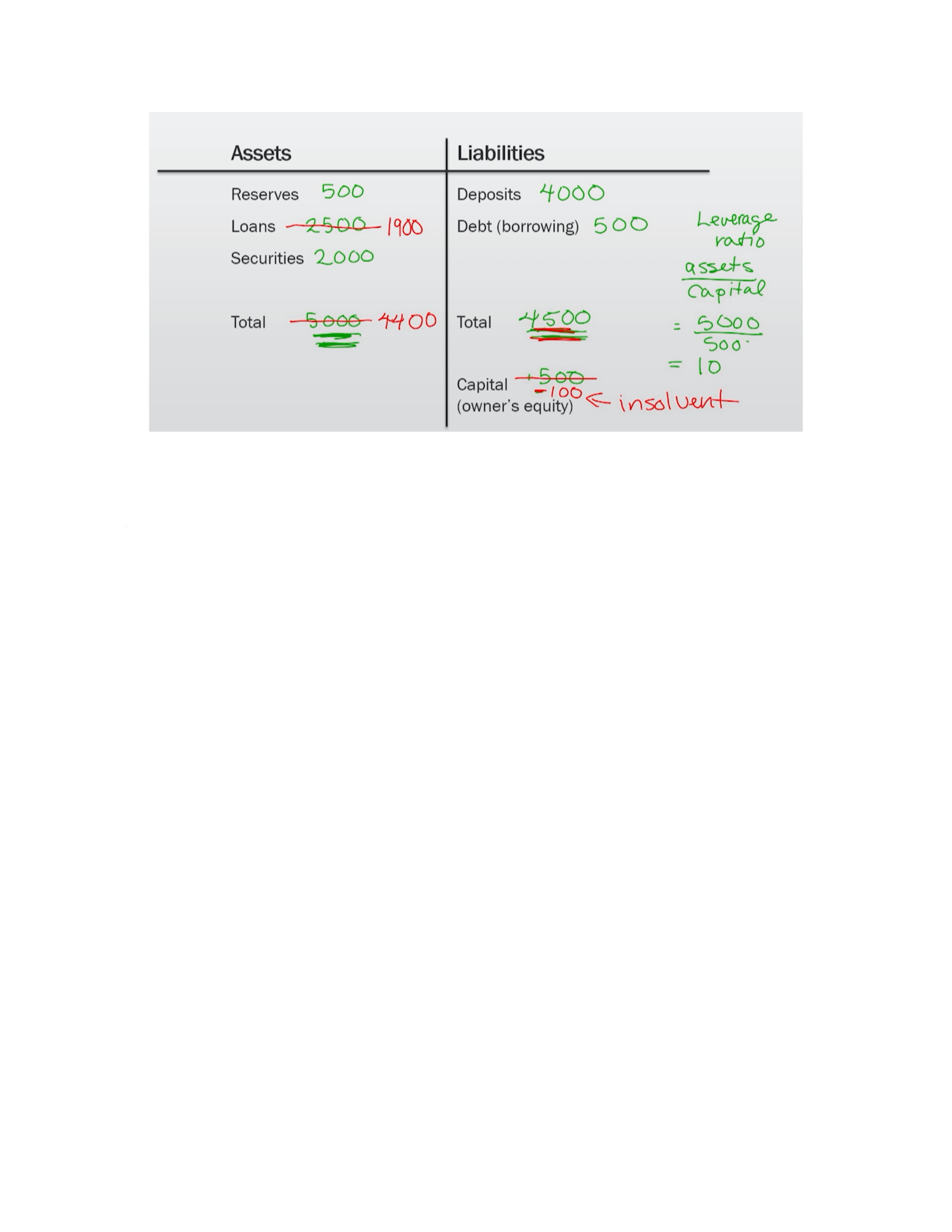
Insolvent banks occur when they have negative capital. They either fail on their own or are
closed by regulators.
Deposit Expansion
How can money supply expand through the banking system?
Bank Reserves
● Banks hold a fraction of total deposits in the reserve
○ Fractional reserve banking
○ If everyone went to the bank and requested a withdrawal of all deposits they’ve
made, the banks would not have that money.
○ They have lent those funds out to borrowers
● The Federal Reserve sets the reserve requirement (RR)
○ RR – % of total deposits banks are required to keep in reserve
Reserves Equations
Reserves = Depend Deposits – Loans
Required Reserves = Demand Deposits * Required Reserve Ratio
Excess Reserves = Reserves – Required Reserves

Bank Balance Sheet – RR
Bank One is required to keep $400 ($4,000 deposits * 10% RR) in the reserves. They have
$100 in excess that they can use to profit.
This bank used the excess money to make a loan of $100 to Sally, who deposits the
money to Bank Two.

Bank Two is required to keep 10% of the money that Sally deposited in their Reserves.
They have an excess of $90 that they can use to make a loan to Bill.
Bank Three is required to keep 10% of the money that Bill deposited in their Reserves.
They have an excess of $81 left over to which they can use to make a loan.
Deposit Expansion

Deposit Expansion Multiplier
Deposit Expansion Multiplier = 1 / RR
●The maximum amount of money that can be created from $1 in the reserves = $1 * 1/RR
●Money supply expands and contracts as banks make or reduce loans
●Money is created in the banking system
● Use this equation to calculate the eventual effect of a deposit into the money
supply

