



1
Introduction & Overview
While 80% of IT decision makers of Fortune 500 companies recognised cloud tech-
nology as giving their organisation a competitive advantage, security is still a major
concern and barrier to cloud adoption [17]. It outranks even compliance and integrity.
Thus, there is a high need for developing a cloud security solution. This research
presents a novel approach of mitigating cloud specific security challenges with tar-
geted concurrent cloud audits.

Chapter 1. Introduction & Overview
1.1 Introduction
Growing network and therefore internet bandwidth in combination with virtualization
technology lead to a new form of utility computing, which allows us to use comput-
ing resources in a flexible and on-demand fashion. Within the last four years, cloud
computing changed information technology drastically in multiple application areas.
Whereas USB sticks or external hard disk were the common way of quickly exchanging
large data between two parties, such as a photo collection or large simulation results,
cloud storage services like Dropbox [18], ownCloud [19] or Apple iCloud [20] replaced
them. Start-up companies don’t invest a high amount of hardware for their first data
centre, but renting Software as a Service products, such as Google Mail for email ser-
vices, Office 365 [21] or Google Apps [22] for office applications. If computing power
is needed for customised applications, public cloud infrastructure provider, such as
Amazon Web Services [23] offer virtual PCs on-demand on a pay per use model for
just a couple of cents per hour [24]. Companies can focus on the development of their
real products, instead of taking care of data centre design, acquisition of hardware
and training of administration personell. Industry is taking advantages of this new,
flexible available on-demand cloud computing model by outsourcing services to cloud
service providers (CSP), or using the technology in their own data centres to increase
flexibility and accelerate deployment of IT resources. The convenience, efficiency and
cost benefits of cloud computing has even made hospitals to move health care data
and records to the cloud [25].
This lets assume, that security is one of the major targets of cloud providers offering
cloud computing services. However, missing security standards, numerous security
incidents at public cloud infrastructures as well as a rather reserved information pol-
icy on security measures taken to protect customer data, has lead to become cloud
2

1.2. Aims & Objectives
computing security the number one concern of IT decision makers, when it comes to
utilising cloud services [8]. In case, data stored in cloud resources gets stolen or be-
comes unavailable for multiple days due to a failing network connection, the financial
loss to the user in this case would not only be that one particular service is not avail-
able, but could lead to a complete threat of the companies existence, since suddenly
no IT services are available anymore. Thus, a detailed analysis of cloud computing
security risks, possible mitigation approaches and enhanced cloud security systems is
necessary to establish trust in the technology and increase security.
1.2 Aims & Objectives
Literature review on related work in the area of cloud computing security shows, that
the following limitations exist:
•Existing security guidelines and frameworks stay rather high level, lacking the
necessary technical depth and needs, especially for IaaS clouds
•SaaS cloud audits exist, however IaaS cloud audits are missing
•A cloud and hypervisor independent audit system for IaaS clouds is missing
•Existing cloud audits require specials hardware
•A security language for IaaS cloud audits is missing. Existing security languages
are not applicable
•No cloud data set including cloud specific attacks is freely available
Thus, this research on security audit compliance for cloud computing develops a novel
cloud auditing system: the Security Audit as a Service architecture. It addresses the
identified limitations by providing the following features:
•A detailed IaaS cloud audit criteria catalogue with sufficient technical depth for
cloud customers and providers
3

Chapter 1. Introduction & Overview
•A technology independent, cloud provider interoperable audit system for IaaS
clouds, which does not require special hardware
•A hypervisor technology independent sensor system utilising software agents
•A security language to model IaaS cloud security demands and corresponding
audit checks
•Establishment of contact with cloud providers to build a cloud usage data set
including cloud attacks or development of a cloud data set simulator
The aim of this research is to identify cloud specific security challenges in Infrastructure
as a Service (IaaS) clouds and how they can be addressed. This has been achieved by
developing a flexible, on-demand cloud audit system, which performs specific targeted
security audits in case the cloud infrastructure changes. In order to achieve this, the
research can be divided into six distinct phases.
•To identify differences between traditional and new, cloud specific security chal-
lenges for IaaS clouds
•To investigate how security audits need to change, to address the identified cloud
specific security challenges
•To design and evaluate a new cloud security audit architecture, which aims to
increase transparency for cloud consumers and cloud providers
•To design a cloud audit policy language to model desired security states of cloud
components and corresponding cloud audits to validate these states.
•To design and elaborate that an anomaly detection system can identify advanced
cloud specific security challenges by utilising machine learning techniques
•To implement and test a prototype of the cloud audit system to demonstrate its
practical effectiveness
4

1.2. Aims & Objectives
The first part of the research contains a comprehensive review and discussion about
differences between traditional - but through cloud characteristics enhanced - security
challenges and cloud specific security challenges. Through an understanding of the
development of cloud computing technology and their specific characteristics, this
phase of the research provides the comprehensive arguments and the basis for the
need of a cloud specific security audit system. This identified, the second phase of
the research proceeds with an analysis of security audits, giving insights on how they
need to change to address the identified cloud security challenges. The outcome of
this phase is an audit criteria test catalogue for cloud infrastructures, containing over
140 security checks for cloud customer and provider.
In order to achieve the objective of transparently utilising cloud audits to address
cloud specific security challenges, it was imperative to design an on-demand audit ar-
chitecture for IaaS clouds. From the established requirements, the approach of utilising
lightweight software agents to perform specific targeted so called “concurrent” security
audits of cloud instances proved to be feasible. However, a security policy language
was needed to design the desired security states of cloud instances and corresponding
cloud audits and agents to monitor and evaluate this security state. Therefore, during
the next phase of research a comprehensive analysis on existing security policy lan-
guages was undertaken. Since none of the existing languages fulfilled the established
requirements, a new Cloud Audit Policy Language (CAPL) was developed. To ad-
dress more advanced cloud specific security challenges, the research showed that two
different classes of mitigation approaches prove promising: rule based anomaly detec-
tion and behavioural based anomaly detection. Whereas rule based anomaly detection
proved to be already possible with the developed audit architecture and cloud audit
policy language from earlier research phases, deeper research on pattern matching and
machine learning technique was performed to address the class of behavioural based
anomaly detection in clouds. As a result, an anomaly detection system, based on neu-
5

Chapter 1. Introduction & Overview
ral networks proved to successfully identify advanced cloud security challenges and
promises high potential on mitigation of future cloud security problems arising from
misuse of cloud environments. The completion of the final phase was to design and
evaluate a prototype of the developed Security Audit as a Service architecture, which
includes a prototype of the Cloud Audit Policy Language and the designed anomaly
detection system. Three demonstrations were built, to evaluate the effectiveness of
the developed approach.
1.3 Thesis Structure
The thesis addresses the aforementioned objectives in order and is comprised of the
following Chapters.
Chapter 2 - Review of Cloud Computing, starts with an introduction into cloud com-
puting technology. A brief evolution is presented and key definitions are established.
Cloud computing consists of different deploy and service models, which get elaborated.
Following on, a cloud computing reference architecture and typical participating roles
of cloud players gets presented. After discussing related technologies to cloud comput-
ing, the commercial cloud landscape is drawn. The Chapter finishes with a discussion
on advantages and disadvantages of cloud computing.
Chapter 3 - Cloud Infrastructure Audit presents the first main stage of research - the
identification of cloud specific security issues. It shows, how cloud security audits
need to adapt to be an adequate measure to mitigate the presented security issues.
As a result of this part of the research, a Cloud Audit Test Criteria catalogue gets
presented, which is targeted for the cloud user as well as the cloud provider to get a
transparent knowledge of an IaaS cloud’s security status.
6

1.3. Thesis Structure
After laying out the ground of requirements for cloud audits, Chapter 4 - Security
Audit as a Service presents a cloud audit architecture to address the presented cloud
security issues. First, the context is set by definition of involved users and groups.
Then, the Security Audit as a Service (SAaaS) architecture gets presented. It is based
on lightweight software agents, which perform targeted audits in case of a cloud infras-
tructure change. Thus, a detailed description on the developed agents is given. The
Chapter concludes with a presentation of all developed SAaaS services. The SAaaS
architecture forms the second stage of the main research, which gets extended by the
work of the following Chapters.
To execute specific targeted audits, business processes of cloud components as well as
a desired security status of the virtual instances needs to be definable. Thus, Chapter
5 - A Cloud Audit Policy Language presents the third part of the main research. First,
the context is set by a presentation of use cases and the definition of requirements on a
cloud audit policy language. Based upon those, a comparison of existing security lan-
guages is provided. Since no existing language satisfied the established requirements,
the Chapter continues with a detailed presentation of the developed Cloud Audit Pol-
icy Language. The Chapter finishes with a description of how the Cloud Audit Policy
Language integrates into the SAaaS architecture, forming its second stage of expan-
sion.
To address advanced and future cloud security issues, Chapter 6 - Anomaly Detection
in IaaS Clouds presents a cloud anomaly detection system. After setting the context,
a distinction between rule based and behavioural based detection methods is made.
First, rule based anomaly detection gets elaborated, followed by a behavioural based
detection system. This utilises a machine learning approach for advanced cloud mis-
usage detection. To show feasibility of the system, a cloud usage data simulator gets
7

Chapter 1. Introduction & Overview
presented, simulating selected user specific and cloud wide anomaly scenarios. Results
are presented and discussed, before the Chapter closes. The anomaly detection system
forms the third development stage of the SAaaS architecture.
To practically validate the benefit of the whole research, a prototype of the developed
cloud audit system gets presented in Chapter 7 - Security Audit as a Service Prototype.
The Chapter follows the structure of the main research phases and presents the three
consecutive development stages of the SAaaS prototype:
•Stage 1 - SAaaS architecture with agents performing concurrent cloud audits
•Stage 2 - Integration of the Cloud Audit Policy Language
•Stage 3 - Integration of an anomaly detection system for IaaS clouds
Stage one, starts with the basic architecture development, which focuses on the con-
cept of using agents to perform specific targeted cloud audits. For the second proto-
type stage, integration of a cloud policy language gets discussed. The third extension
of the prototype introduces the integration of the rule based and behavioural based
anomaly detection system into the SAaaS prototype. Each prototype Section ends
with a demonstration of this specific part of the development stage.
Chapter 8 - Evaluation of the SAaaS Architecture evaluates the presented research
against the established issues. Therefore, it discusses first how the developed SAaaS
system addresses the presented cloud specific security issues and how cloud audits
are improved by it. Then, a technical evaluation on the performance of the software
agents is presented, followed by a comparison Cloud Audit Policy Language against
the established requirements. The Chapter finishes with a discussion on the developed
anomaly detection system and justifies the chosen approach of simulating cloud usage
data and using neural networks as a machine learning technique.
8

1.4. Security Audit as a Service Research Grant
Finally, Chapter 9 presents the main conclusions arising from the research, highlighting
its key achievements and limitations. It also contains a discussion on areas for future
research and development. The thesis also provides a number of appendices in support
of the main discussion, including the Cloud Audit Test Criteria catalogue, a detailed
overview of developed software agents, the CAPL language specification and more
technical information. The appendices also contain 15 published papers arising from
the research programme.
Each Chapter starts with an introduction into the corresponding research area. The
goal of the research subtopic is formulated (heading “Summary of Research”). Related
work of each topic is presented at the beginning of each chapter, after use cases or
requirements have been established. After presenting the research, every chapter ends
with a summary of the work presented.
Nomenclature
Within this thesis, cloud computing related terms are used. Technical terms are
introduced at their first appearance, a collection of the most important ones are listed
in Section 9.4 - Glossary. The terms cloud customer, cloud consumer and cloud user
are used interchangeably throughout this work.
1.4 Security Audit as a Service Research Grant
The research topic “Security Audit as a Service” presented in this thesis, was applied
for a research grant at the program “Information Society - IT Security” at the Federal
Ministry of Education and Research (BMBF) of Germany. The program committee
found the research on cloud security issues and the proposed Security Audit as a
Service system eligible and issued a grant for the period of two years, starting June
2011. It is referenced under the grant number 01BY1116.
9


2
Review of Cloud Computing
“I think there is a world market for about five computers.”
(Thomas J. Watson, Chairman of the Board of International
Business Machines (IBM), 1943)
This chapter introduces the concept of cloud computing by presenting its evolution as
a service computing methodology and elaborating necessary basic knowledge on the
technology, which is necessary to follow the research presented in this thesis.

Chapter 2. Review of Cloud Computing
2.1 Introduction
Cloud computing represents one of the most significant shifts in information technology
many of us are likely to see in our lifetimes [26]. This chapter will show the evolution
of cloud computing and why it is such a relevant topic in information technology right
now. The introduction of important cloud deployment and service models as well as
a presentation of a cloud reference architecture lays out the technical foundation for
this thesis. Typical roles and related technologies are elaborated and an overview
about the current provider landscape is given. Parts of this Chapter’s work have been
published in “Cloud Infrastructure & Applications - CloudIA” [27].
2.2 Evolution of Cloud Computing
Cloud computing is often described as the new computing paradigm, which will com-
pletely change the consumption of computing. Nicolas Carr describes cloud computing
in “The Big Switch” [28] as an information revolution within the information age and
compares it with a major development of the industrial era: the introduction of elec-
tricity. Mather et al. say in “Cloud Security and Privacy”, that “... Cloud Computing
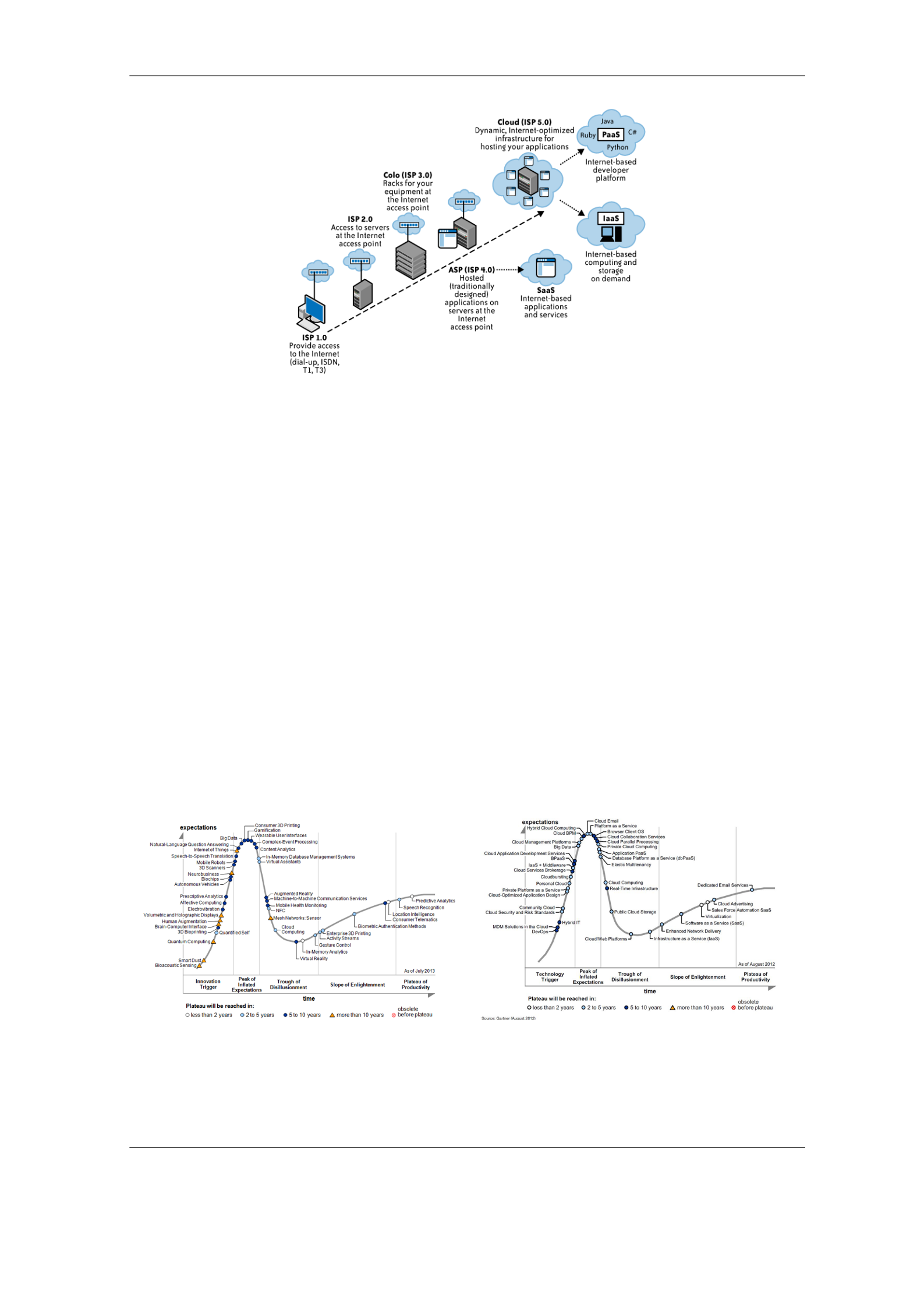
itself is a logical evolution of computing.” [1, p.3]. Figure 2.1 shows cloud computing
as a development in the Internet service provider (ISP) model. While the first ISPs
(ISP 1.0) just provided Internet access, their business model developed further to of-
fering general services like access emails and servers (ISP 2.0). Enterprises asked for
special services and ISPs offered specialised data centers for hosting customers’ servers
including the infrastructure needed to run them, which is defined as “co-location facil-
ities” (ISP 3.0). The successor of this were application service provider (ASPs), which
offered not just bare computing infrastructure but higher services like customised ap-
plication for organisations (ISP 4.0). The main difference between ASPs and cloud
12
2.2. Evolution of Cloud Computing
Figure 2.1: Evolution of cloud computing [1, p.4]
computing providers is the underlying infrastructure design. ASPs already offered a
specific service to multiple customers, but commonly through dedicated infrastruc-
tures, meaning each customer used its own dedicated instance, which usually ran on
a dedicated server and no other customers used the service on this particular server.
In cloud computing, especially in a Software as a Service (SaaS) model, services are
offered on infrastructure, shared by multiple customers [1, p.3,4]. The Gartner Re-
search Group yearly investigates new technologies and how to discern a hype from
what’s commercially viable [29], see Figure 2.2. While all cloud technologies were
summarised under the term “The Cloud” in the 2009 hype cycle, it was divided in
(a) Technology hype cycle 2013 (b) Cloud Computing specific hype cycle 2012
Figure 2.2: Cloud Computing - Technology hype by Gartner [2, 3]
13
Chapter 2. Review of Cloud Computing
three entries: Cloud Computing, Cloud/Web Platforms and Private Cloud Comput-
ing in 2010. In 2013, Gartner rated cloud computing to be over the status of being
just a hype (Figure 2.2(a)), getting closer to productivity as compared to 2009. Since
2011, Gartner devotes a complete own hype cycle to cloud computing, Figure 2.2(b)
shows the last version from 2012. Gartner sees Cloud/Web Platforms even closer
to productivity than one year before. Furthermore, most of the cloud technologies
were classified 2-5 years or 5-10 years from maturity, which is also an indicator of the
increasing importance of cloud computing for information and computing technolo-
gies. In 2013, Gartner’s analysts expect IT decision makers now to have more realistic
strategies for integrating this technology, due to not accomplished cost advantages in
former years [30].
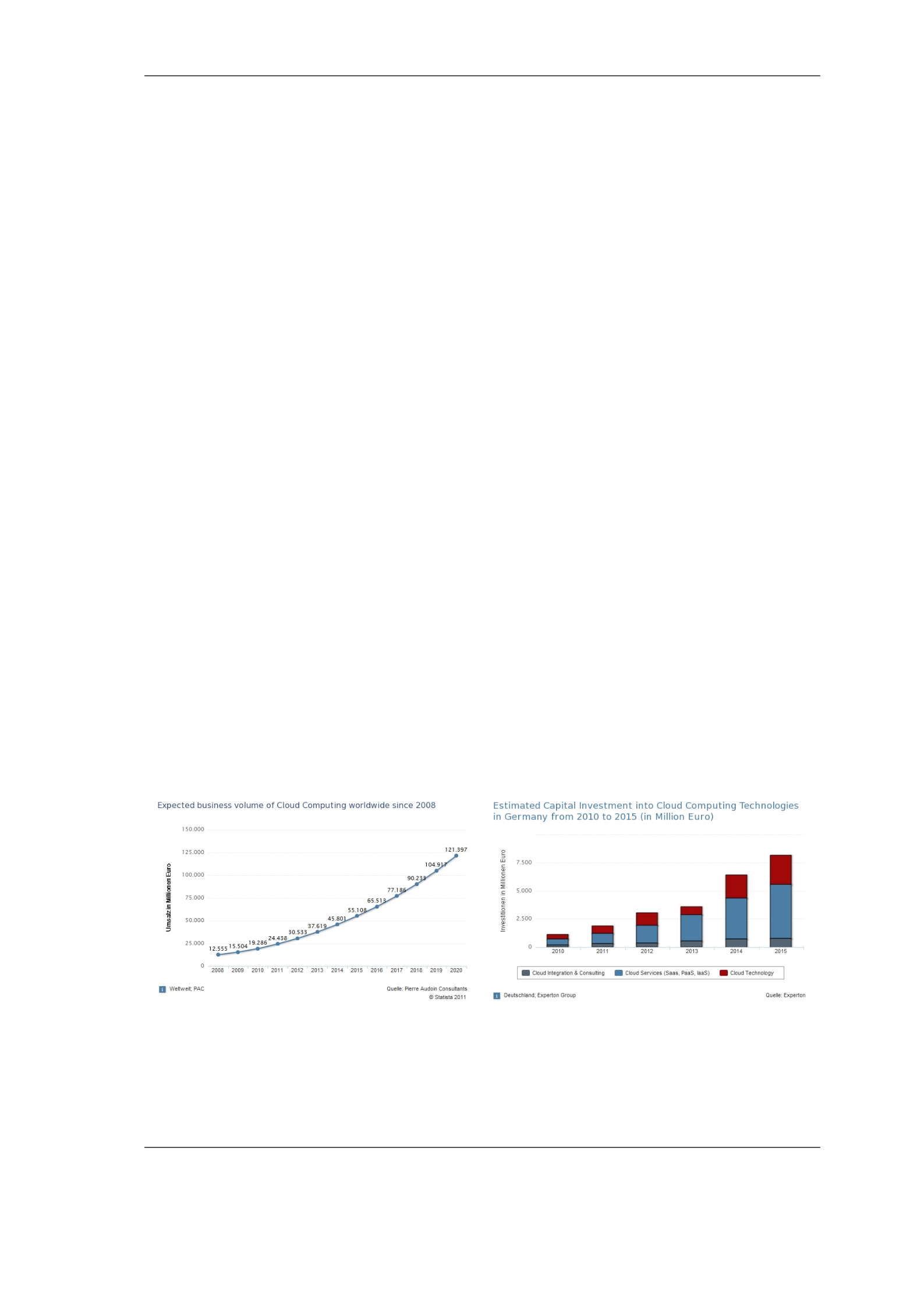
Industry analysts are foreseeing a huge financial potential in cloud computing, as
Figure 2.3 shows. A business volume of 121,897 million Euro for cloud computing
is expected (Figure 2.3(a)) until 2020. The estimated capital investment in cloud
computing in Germany alone is expected to rise by 871% (see Figure 2.3(b)) from 548
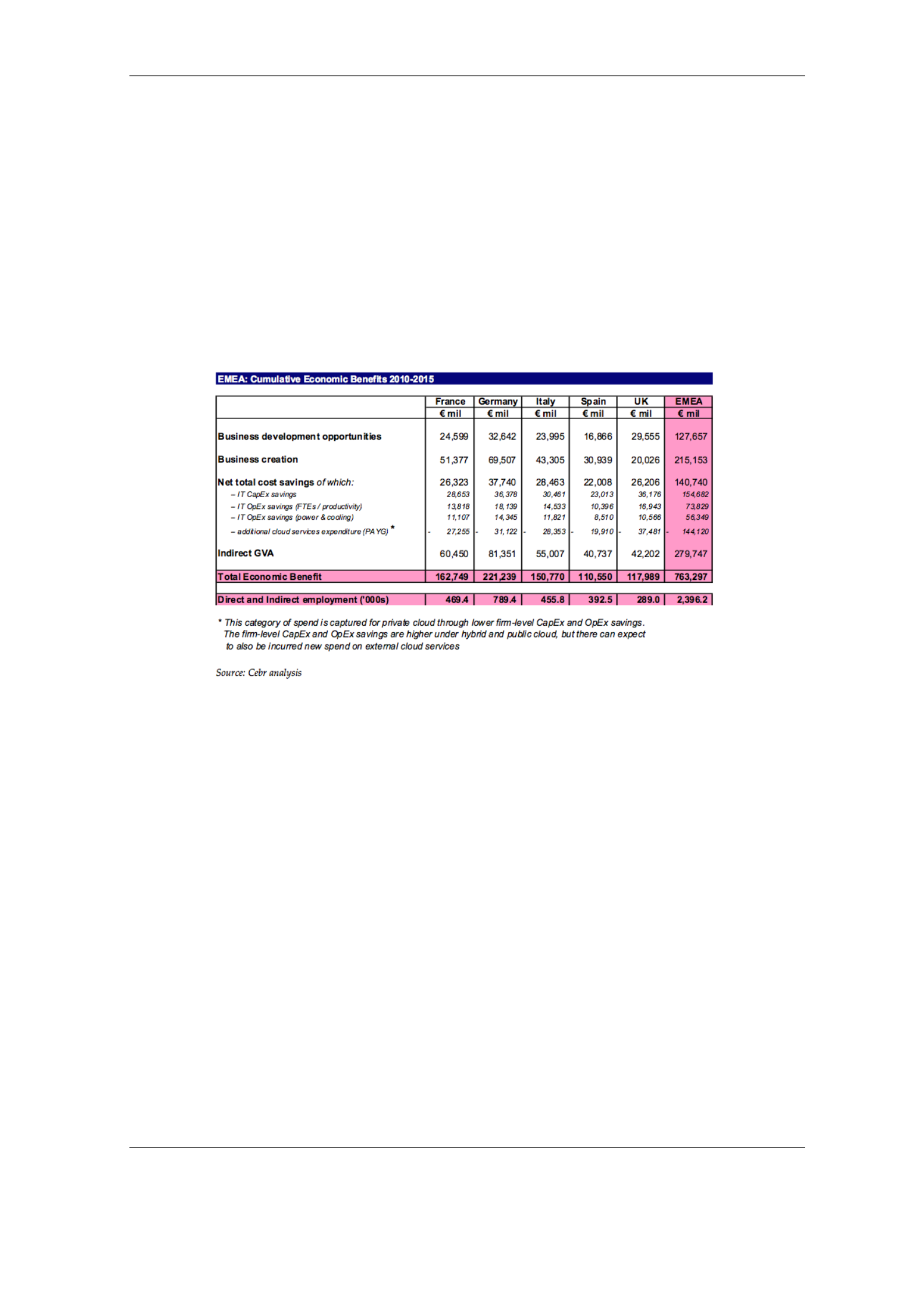
million Euro in 2010 to 8.775 million Euro by 2015 [5]. As depicted in Figure 2.4,
high economic benefits are expected from cloud computing to business and the wider
EMEA economy of France, Germany, Italy, Spain and the UK [6].
(a) Expected business volume of cloud computing
2008-2020
(b) Expected capital investment cloud computing
in Germany
Figure 2.3: Expected market expansion of cloud computing [4, 5]
14
2.3. Definition of Cloud Computing
The study states, that across the five economies as a whole, widespread adoption of
cloud computing has the potential to generate over 763 billion Euro of cumulative
economic benefits over the period 2010 to 2015. This is 1.57% of the total estimated
cumulative GDP of the five economies over the same period [6, p.7]. Furthermore,
it states that cloud computing could improve the efficiency of an average employee
by 2.1%, while also reducing the amount of investment tied up in underutilised IT
capacity.
Figure 2.4: Expected business benefits through cloud computing 2010 - 2015 [6]
2.3 Definition of Cloud Computing
The key of cloud computing lies in its component-based nature, such as reusability,
substitutability (e.g. alternative implementations, specialised interfaces and runtime
component replacements), extensibility, customizability and scalability [31]. Foster
et al. [32] discuss the basic concepts of cloud computing and identify the differences
compared to grid computing. In addition, Armbrust et al. [33] give a good overview of
cloud computing by highlighting some of the obstacles and opportunities in the field.
The definition of the US National Institute of Standards and Technology (NIST) has
15

Chapter 2. Review of Cloud Computing
evolved into a de facto standard for cloud computing: “Cloud Computing is a model
for enabling convenient, on-demand network access to a shared pool of configurable
computing resources (e.g., networks, servers, storage, applications and services) that
can be rapidly provisioned and released with minimal management effort or service
provider interaction. This cloud model promotes availability and is composed of five
essential characteristics, three service models and four deployment models” [34].
NIST’s definition identifies the following main cloud characteristics:
On-demand self service Cloud customer can provision and manage computing power
and network storage without any human interaction with a service provider.
Broad network access Cloud resources are accessed via the network (mostly the In-
ternet) using standardized Internet protocols.
Resource pooling A providers’ computing and storage resources are shared between
multiple customers as a multi-tenant model. A customer has no control or
knowledge over the exact physical location, where its data is stored, or where
its rented resources are executed.
Rapid elasticity Resources can be deployed elastically and scaled rapidly to fulfil the
current demand by scaling up and down automatically. The cloud customer only
pays for the resources and services they actually use.
Measured service Resources consumption gets measured and optimised by cloud con-
trol systems depending on how each customer uses its cloud resources (storage,
processing, bandwidth). Transparency is provided to the provider and its cus-
tomers by monitoring and reporting of the cloud usage.
Cloud computing is not a new technology, in fact it combines known and established
technologies, such as virtualization and infrastructure management to provide IT ser-
16

2.4. Cloud Deployment & Service Models
vices as an on-demand model. In this work it is defined that cloud computing delivers
Infrastructure-, Platform-, and Software as a Service (IaaS, PaaS, and SaaS) on a
simple pay-per-use basis.
2.4 Cloud Deployment & Service Models
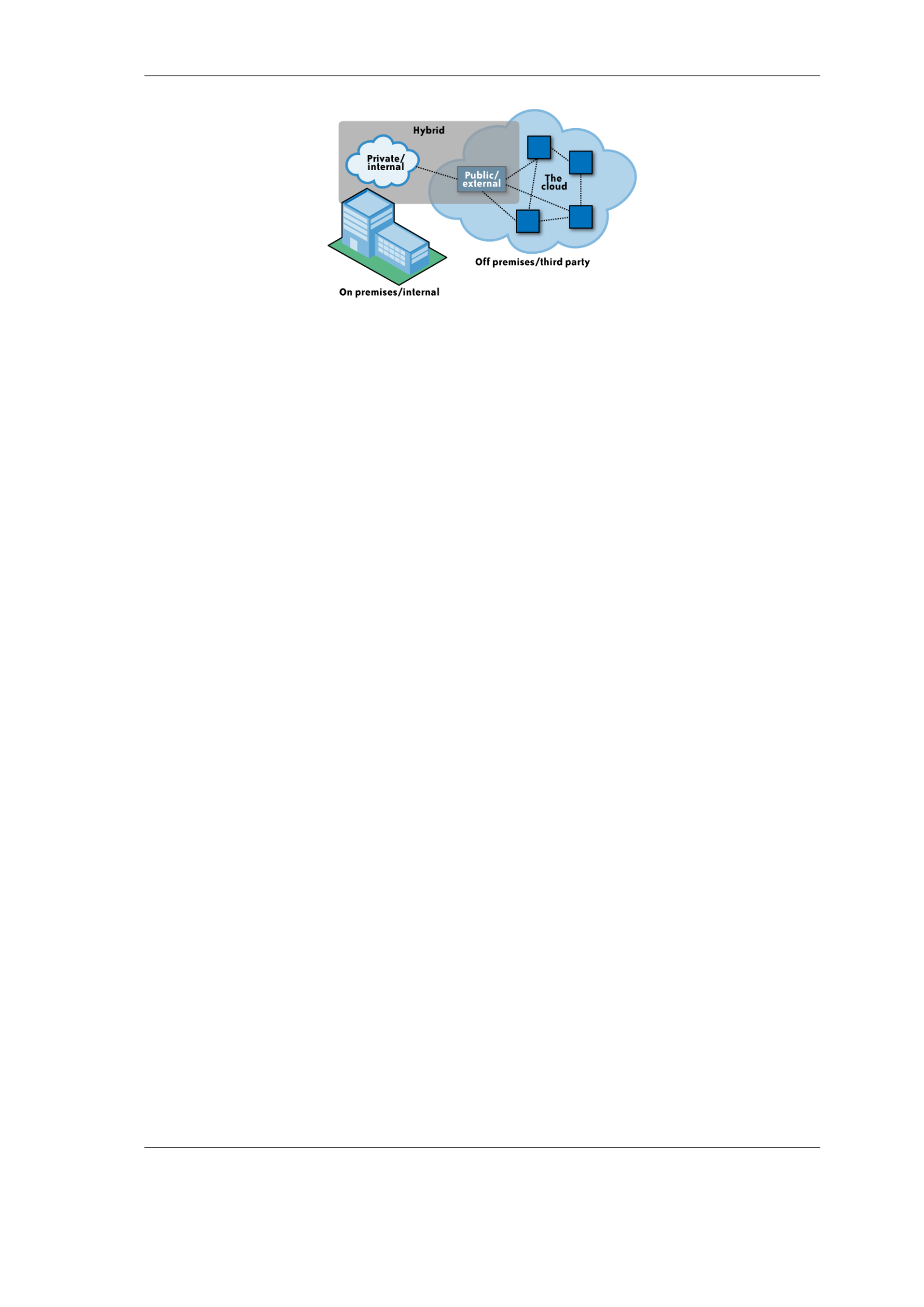
NISTs’ definition of cloud computing [35] states four deployment models, see Figure
2.5, which are typical for cloud computing: Private Cloud, Community Cloud, Public
Cloud and Hybrid Cloud.
Public Clouds - also known as external Clouds, are operated and managed by a
third-party vendor (business, academic or government) for open use by a non-limited
group of customers. Services are offered over the Internet and accessible through web
applications, web services or established data communication protocols like Secure
Shell (SSH). Security management is done by the vendor, responsible for the public
cloud offering. Therefore, customers don’t have a good insight into physical and log-
ical security measures of the private Cloud [1, p.23]. A popular commercial public
cloud offer is the Elastic Cloud (EC2) by Amazon Web Services (AWS) [23].
Community Clouds - the cloud infrastructure is provisioned for exclusive use by a
specific community of consumers from organisations that have shared concerns (e.g.,
mission, security requirements, policy, and compliance considerations) [35, p.3]. Typi-
cally it is owned and managed by one or multiple members of that community, who are
also responsible for the security management of the cloud environment. G-Cloud [36] -
a cloud environment providing UK governmental agencies with information and com-
munications technology (ICT) services is an example of a community cloud.
17
Chapter 2. Review of Cloud Computing
Figure 2.5: Cloud deployment models [1, p.25]
Private Clouds - also known as internal Clouds, are cloud offerings exclusively used
by a single organisation, such as a large enterprise serving its internal customers, such
as different branches. The cloud infrastructure is commonly run on private networks,
operated and managed by the organisation itself, a third party or a combination of
both [35, p.3]. Cloud Infrastructure and Applications (CloudIA) - a cloud environment
for students at the University of Applied Sciences Furtwangen (HFU) is an example
of a private cloud.
Hybrid Clouds - are a combination of the private cloud and the public cloud model.
In a hybrid cloud, both clouds exist independently including their corresponding char-
acteristics. Users are consuming most of the time the Private Cloud resources, but in
specific situations, such as load peeks resources from the public cloud are used to sat-
isfy the demand. This special case is also known as “Cloud Bursting”. It ensures, that
a sudden increase in computing requirement is handled gracefully. In a hybrid cloud
scenario, sensitive data is commonly kept in the private cloud, and only non-sensitive
data gets processed in the public cloud. An example for a hybrid cloud scenario is the
combination of a private cloud infrastructure and a security vendor’s public network
of threat intelligence delivered through public cloud services, such as Trend Micro’s
Smart Protection Network [37].
18

2.4. Cloud Deployment & Service Models
Cloud Service Models
The following three fundamental service models can be identified in cloud computing,
which also correlate to NIST’s cloud definition: Infrastructure as a Service (IaaS),
Platform as a Service (PaaS) and Software as a Service (SaaS). They describe the
degree of a cloud’s availability to users.
Infrastructure as a Service
This layer provides an abstract view on the underlying hardware, which includes PCs,
mass storage systems or network components. They get logically partitioned and pro-
vided as virtual resources, by utilising virtualization technology such as, KVM [38],
Xen [39], VMware [40]. Thus, a flexible management of the provided resources is
possible, allowing a cloud user to create, start, stop, delete or scale virtual resources.
In contrast to traditional IT-Hosting services, only a virtual instance gets provided
instead the whole physical machine. This enables CSPs to optimally divide available
hardware resources and provide customers with an on-demand self service on a pay-
as-you-go basis. In IaaS, cloud service provider only ensure availability and usability
of the infrastructure. Management of rented virtual resources, installation of addi-
tional services, such as web server or email server as well as connectivity to externals
systems are in the responsibility of the cloud customer. In some cases, where the op-
erating system is included and a software license is required the software license costs
are either amalgamated into the costs for the service or included as a surcharge [41].
A special sub-model of IaaS is the Storage as a Service model, where only storage
space is provided by the CSP. Popular IaaS providers are Amazon Web Services [23],
Rackspace [42] or Hosting.com [43]. The currently most popular storage as a service
provider is Dropbox [18]. The research, presented in this thesis is residing on the IaaS
layer.
19
Chapter 2. Review of Cloud Computing
Figure 2.6: Cloud service models [1]
Platform as a Service
Platform as a Services delivers a comprehensive development environment to applica-
tion developers. The developed applications are also offered through the PaaS plat-
form [1]. PaaS customer don’t have to deal with installation and configuration of a vir-
tual server, since this is provided by the CSP. The provider defines the programming
languages, which can be used and supplies toolkits, developer standards, libraries,
databases, a software development environment and APIs as well as distribution- and
payment channels. This enables a multi-tenant application development with a rapid
application propagation with minimal entry costs. In a complete PaaS solution, de-
velopers can build and deploy web applications without installing any tools on their
computer. Popular PaaS offers are Google Apps [22], Force.com [44] and Microsoft
Windows Azure [45].
Software as a Service
In the Software as a Service model, the cloud provider also acts as an application
developer. The cloud customer rents software for use on a subscription or a pay-per-
use basis. It is mostly used through a web browser or an adapted interface provided by
the cloud service provider (CSP). The main difference between the traditional software
20

2.5. Cloud Computing Architecture
model and the Software as a Service model is its multi-tenancy orientation. Software is
not just purchased and installed on one specific server, serving one single customer’s
end user group. The SaaS model is a multi-tenant architecture, which means the
physical backend is shared among different customers but is logically unique for each
customer. It is common that SaaS provider utilise PaaS or IaaS provider to host their
services, to benefit from scalability advantages. Popular SaaS providers are Google
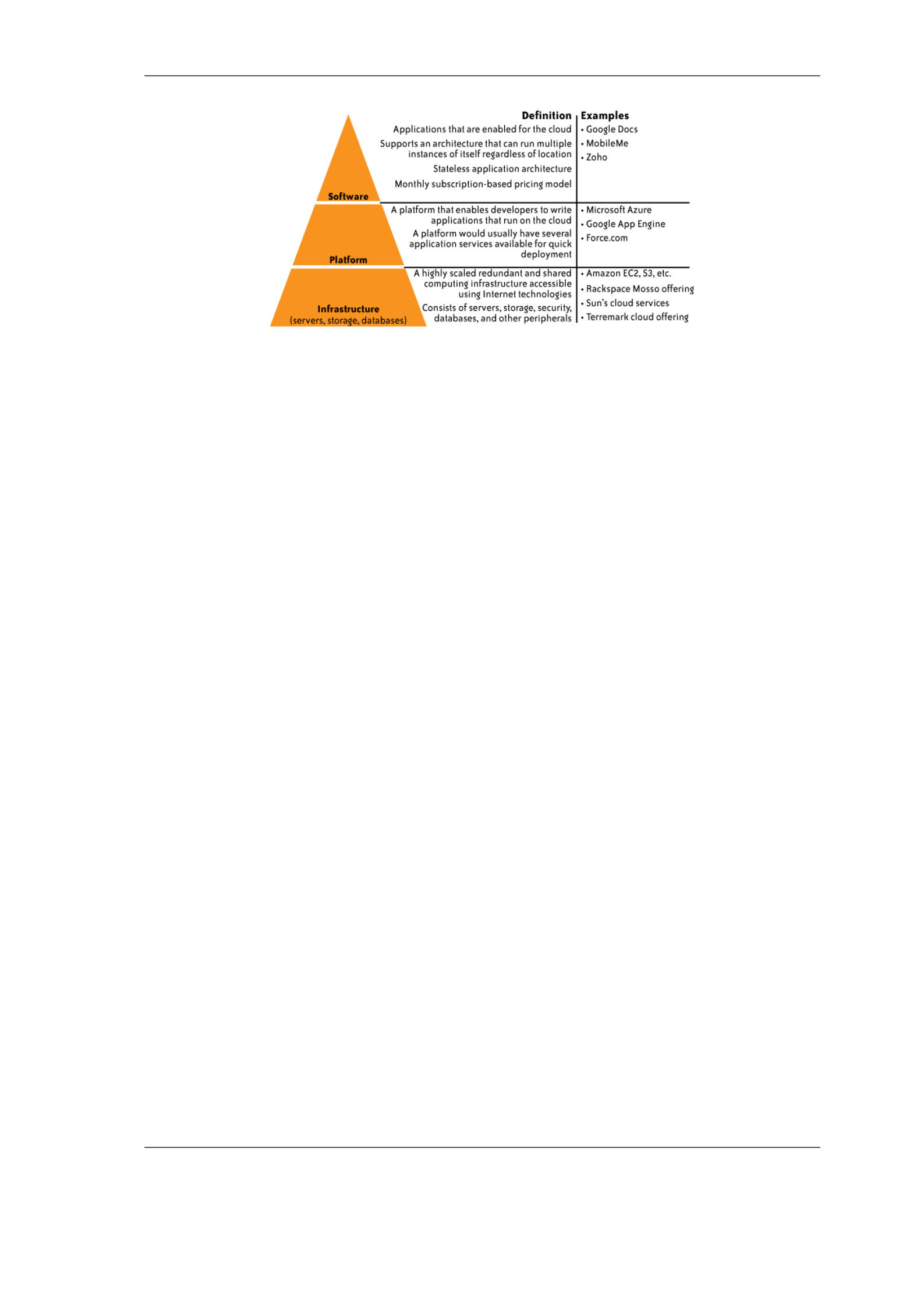
Docs [46], Microsoft Office Online Services 365 [21] and Salesforce.com [47]. Figure 2.6
depicts the introduced service models and lists examples of commercial cloud provider
for the corresponding service.
2.5 Cloud Computing Architecture
Each cloud architecture includes certain components, independently of the targeted
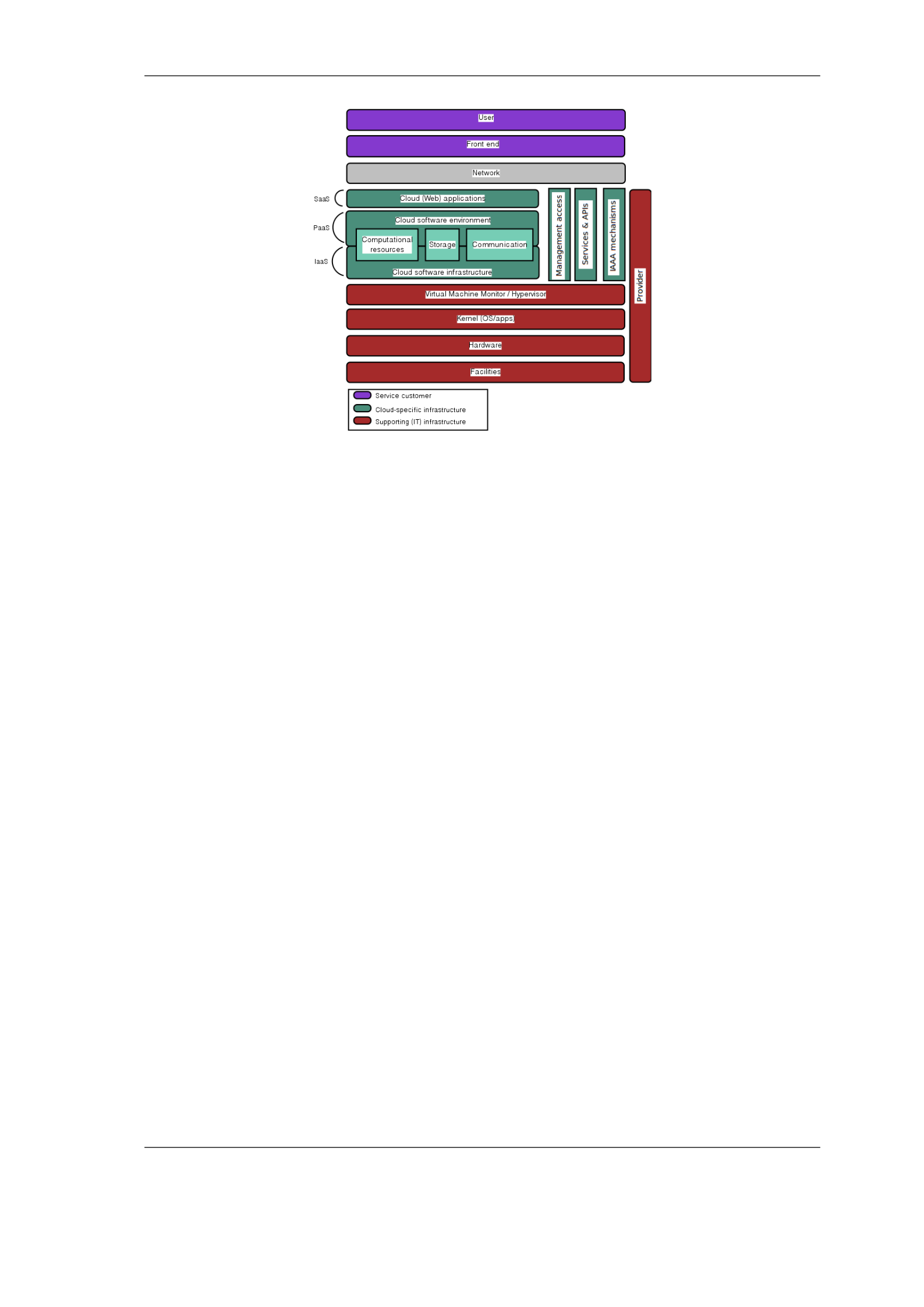
cloud service model. Figure 2.7 shows a cloud computing reference architecture, de-
scribed by Grobauer et al. [7], which is based on research by the University of Cal-
ifornia, Los Angeles and IBM [48]. This architecture serves as a fundamental basis
architecture of this research, and gets enhanced during the presentation of this dis-
sertation. It includes the most security-relevant cloud service components and shows,
which of them are managed by the cloud provider. Commonly, the provider maintains
one or multiple data centers (facilities) including necessary utilities, such as electricity
or air condition. In this facilities hardware is operated, which are typically physical
cloud hosts as well as networking equipment such as, switches, routers and network
cables. On a cloud host, an Operating System (OS) and applications supply basic sup-
porting functionality, like network connectivity or inter-process communication. On
top of that, the hypervisor layer provides the ability of flexible resource pooling. The
cloud software infrastructure and cloud software environment are an abstraction of the
cloud resources provided as a service including all necessary software components, such
21
Chapter 2. Review of Cloud Computing
Figure 2.7: The cloud reference architecture based on [7]
as a cloud management software. It interacts with supporting services like Domain
Name System (DNS), Management access systems, e.g., an admin management web
console, and identity, authentication, authorisation and auditing mechanisms (IAAA).
On top of that is the cloud web application layer, which typically uses a browser front
end for user interaction. Up to this layer, depending on the cloud service model, the
service components are controlled by the provider. On top of that, the network layer
gets explicitly pointed out, since this is the network between the cloud provider and
the cloud customer, and is mostly fully untrusted (Public Cloud) or semi trusted (Hy-
brid Cloud, Private Cloud), depending on the cloud deployment model.
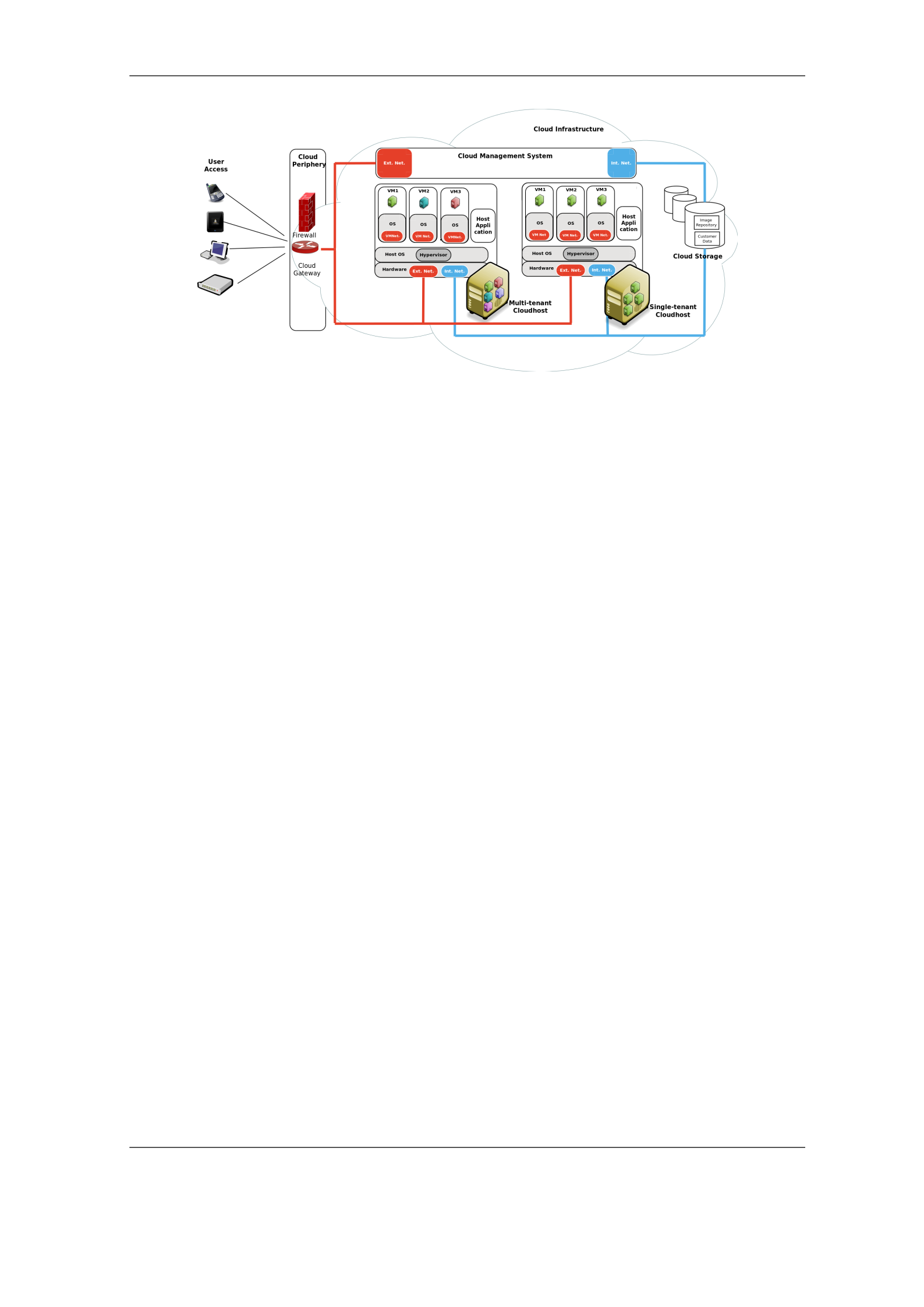
Since this research is focused on Infrastructure as a Service Clouds, Figure 2.8 shows
a high level overview of typical technical infrastructure components of an IaaS Cloud.
User access is typically provided through numerous client devices using standardized
network protocols, such as SSH or HTTP. Furthermore, an application programming
interface (API) is provided, using Representational State Transfer (REST) or XML
Remote Procedure Calls (RPC). As a core component within an IaaS Cloud, the
22
2.6. Roles in Cloud Computing
Figure 2.8: Typical components of an IaaS cloud infrastructure
cloud management system manages access and deployment of cloud resources. Cloud
instance, such as virtual machines (IaaS), customer developed web applications (PaaS)
or rented software instances (SaaS), are deployed and executed on cloud hosts. Data,
such as VM images or customer data are stored on a cloud storage system. Typically,
a distributed filesystem is used for this and copies are distributed over multiple storage
components. Virtual machines are executed on a cloud host through a virtualization
hypervisor, such as Xen, KVM or VMware. Dependent on the service model, customer
share a physical cloud host (multi-tenancy) or use a customer exclusive cloud host
(single-tenancy). Data centre peripherals, such as firewalls, routers, switches, and
network connections are extended by virtualized components and supplied by the
cloud service provider.
2.6 Roles in Cloud Computing
The cloud computing paradigm mainly identifies three roles: provider, integrator and
consumer. Each of these roles include specific responsibilities and expectations rel-
ative to another [41]. An investigation among different cloud service providers was
done during the initial phase of the research. Depending on the considered service
23

Chapter 2. Review of Cloud Computing
Cloud Service Model Identified Roles
* Cloud service assembler
IaaS Cloud provider, cloud customer
PaaS Cloud provider, service provider, cloud customer, service de-
veloper, user / user groups
SaaS Cloud provider, service provider, cloud customer, service de-
veloper, user / user groups
Table 2.1: Roles in cloud computing
model (IaaS, PaaS, SaaS), it can be differentiated between multiple roles, which will
be elaborated in the following. Table 2.1 summarizes the identified roles over the
common cloud service models.
IaaS roles
In an IaaS scenario two roles can be identified: cloud provider and cloud customer.
The cloud provider supplies and manages the infrastructure to run virtual machines.
He enables cloud customers to access the virtual machines, commonly through SSH
(Linux/Unix VMs) or Remote Desktop Protocol (RDP) (Windows VMs) connections.
Typically, the provider provides preconfigured virtual machine images. The customer
is exclusively responsible for the software stack inside a deployed VM. The Cloud
customer is a person or organisation, which runs virtual machines on an IaaS in-
frastructure. He has full access to this VM. There should be no difference between
running a VM inside a provider’s IaaS infrastructure and a physical machine in the
customer’s own data center. The cloud customer implies the role of the VM adminis-
trator, also including the responsibility of software update and patch management of
software within the VM. Furthermore, the cloud customer is responsible for the user
and access management. A CSP can support the customer e.g., generating SSH key
pairs, but deployment and safe storage is up to the cloud customer.
24

2.6. Roles in Cloud Computing
PaaS roles
In an PaaS scenario five roles can be identified: cloud provider, service provider, cloud
customer, service developer and user / user groups. The definition of a cloud provider
differs from the one of an IaaS provider. In PaaS, a cloud customer does not get full
access to a virtual machine, he just gets access to a platform for running web appli-
cations. Therefore, a PaaS provider has additional responsibilities (as compared to
an IaaS provider), such as installation and maintenance of the software stack inside a
virtual machine e.g., OS, web server, database server, application server. Typically,
an API for application development is provided by the PaaS provider. The service
provider uses the cloud provider’s platform to offer his service, typically as web ap-
plications, developed on the provided API. The service provider is a customer of the
cloud provider. In a PaaS scenario the cloud customer is understood as a contractional
partner with the service provider. He rents licenses for using the provided applica-
tion from the service provider. If a cloud customer develops software on the cloud
platform, he also inherits the role of the service provider. The service developer is
typically employed with the service provider. He develops and maintains the offered
(web) applications. Therefore, he needs access to the deployed (web) application to
fulfil his role. The user or user groups represent the end customer of the offered (web)
application, who actually work with it.
SaaS roles
In the SaaS scenario the same five roles exist, as in the PaaS scenario: Cloud provider,
service provider, cloud customer, service developer and user / user groups, although
their definition differs. The cloud provider supplies the platform for running services
in the cloud. He also acts as a service provider, by offering (self-developed) services.
The service provider is in a SaaS scenario a sub-role of the cloud provider. The
cloud customer is a contractional partner of the service provider, renting software us-
25

Chapter 2. Review of Cloud Computing
age licenses. The service developer is typically employed with the service provider,
developing and maintaining the offered (web) applications. The user or user groups
represent the end customer of the offered (web) application, who actually work with it.
Independent of the underlying service model, the Cloud Service Assembler knows the
cloud architecture and how to compose cloud services. He can be employed by the
cloud provider or a third party utilising different cloud service providers.
2.7 Related Technologies to Cloud Computing
Cloud computing is related to the following technologies by sharing certain aspects:
Virtualization, Client/Server model, Grid Computing, Utility Computing and Dis-
tributed Computing.
Virtualization is an enabling core technology for cloud computing. It allows the
abstraction of physical hardware to provide virtual resources. A virtualized host is
known as a Virtual Machine. Thus, it is possible to aggregate resources of one or
multiple physical machines, such as CPU power, memory, network connectivity, disk
storage, etc., and assign them dynamically as virtual resources to applications or ser-
vices on-demand. Therefore, virtualization can be defined as a foundation technology
of cloud computing [49].
The Client-Server Model is a Distributed Computing paradigm. It consists
of a provider of a certain resource or a service (server) and somebody that requests
this special service (client). Commonly a network is used for communication between
servers and clients, but both can exist on a single host as well. “One or more Clients
and one or more Servers, along with the underlying operating system and inter-process
communication systems, form a composite system allowing distributed computation,
analysis, and presentation” [50]. Cloud computing is building heavily on the client-
26

2.8. Commercial Cloud Landscape
server model, since offered provider resources are consumed by a client.
Utility Computing represents a business model, in which computing resources are
bundled as metered services and provided on-demand. Customers get charged based
on their usage, rather than on fixed, rigid contracts. Cloud computing can be seen
as one form of utility computing, since it provides dynamically packaged (virtual)
resources and adopts the utility-based billing and accounting scheme.
Grid Computing delivers storage and computation capability over a network. To
achieve this it “enables resource sharing and coordinated problem solving in dynamic,
multi-institutional virtual organisations [51]. Typically grids are built by a number of
corporations, professional groups or university consortia to serve a specific, specialised
task, such as the Search for Extraterrestrial Intelligence (SETI@HOME) project. In
SETI people are sharing unused processor cycles of their PCs to search for signs from
outer space. While cloud computing shares a lot of Grid Computing’s attributes (deliv-
ery of abstracted resources and services) it differs from it in security, the programming
model, the underlying business, computation and data model, as well as applications
and abstractions [32].
Cloud computing correlates with the addressed and other technologies of the dis-
tributed computing paradigm, such as Cluster- and Super Computing. But in contrast
to cloud computing, Cluster- and Super computing are more application oriented, not
intended to be shared in an on-demand fashion. Nevertheless, Cluster- or High Per-
formance Computing can also be implemented in a service oriented delivery model
(like cloud computing) as described in “ViteraaS: Virtual Cluster as a Service” [52].
2.8 Commercial Cloud Landscape
Due to the introduced cloud computing attributes and advantages, several business
models have rapidly evolved to harness cloud computing through offering computing
27

Chapter 2. Review of Cloud Computing
infrastructure, programming and software application platforms or storage as a ser-
vice. Due to the large amount of existing vendors in cloud computing it is hard to
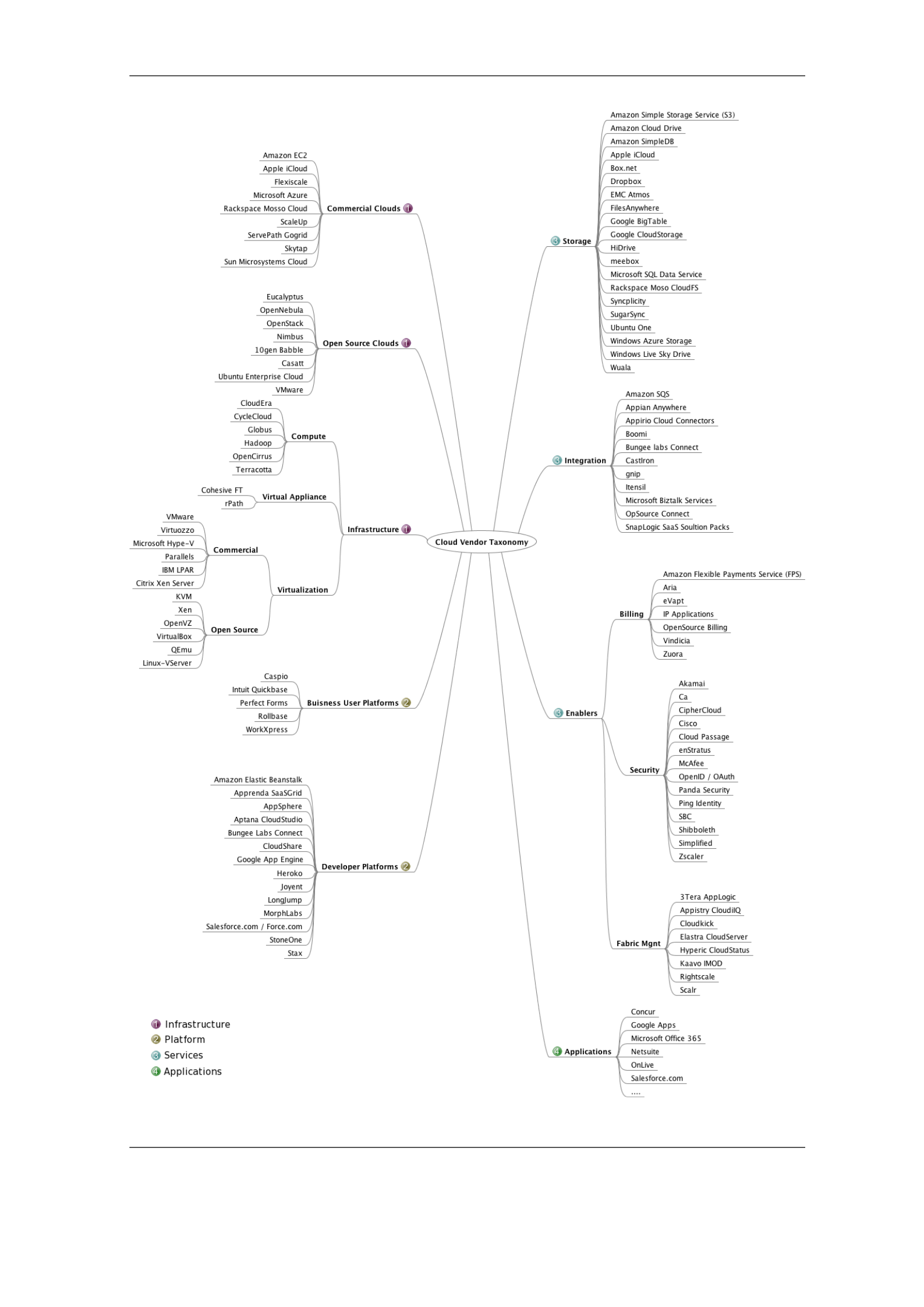
give a comprehensive vendor overview. However, Peter Laird published the first list
of cloud vendors in 2008, which got updated in 2009 [53]. This was used as a basis for
this research to give an overview of available cloud vendors, depicted in Figure 2.9. It
shows a (non-comprehensive) taxonomy of cloud vendors. Another cloud taxonomy
is provided by opencrowd under [54]. A survey by SearchCloudComputing.com [55]
identified the following Top 10 cloud computing service provider in 2011. The rank-
ing is based on “customer traction, solid technical innovation and management track
record”:
1. Amazon Web Service [23] - IaaS and Storage as a Service provider
2. Verizon/Terremark [56] - IaaS provider for telecommunications hardware
3. IBM [57] - provider of “Smart Business Test and Development Cloud”, a non-
public IaaS offer for enterprises
4. Salesforce.com [47] - a SaaS provider, which expands into PaaS services in 2011
5. CSC [58] - an IT integrator offering the private cloud service BizCloud
6. Rackspace - IaaS provider, publishes the free cloud software OpenStack [59]
7. Google App Engine [22] - offers PaaS services
8. BlueLock [60] - an IaaS provider offering VMware vCloud Express
9. Microsoft [45] - a SAaaS and PaaS provider (Windows Azure)
10. Joyent [61] - formed a partnership with Dell to sell preconfigured cloud infras-
tructure packages
28
2.8. Commercial Cloud Landscape
Figure 2.9: Cloud vendor taxonomy (4th quarter 2011)
29

Chapter 2. Review of Cloud Computing
One finding of the ranking is, that most of the Top 10 companies are “established cloud
providers”, being in the market for multiple years. Amazon was the first company
offering IaaS services on a large scale since 2006, three years before the term “Cloud”
was becoming a hype. Also IBM, Salesforce, Rackspace and Google participated in
the cloud market from the very beginning. This also proves the evolution of cloud
computing, from being a hype to a product developing, enterprise ready technology.
Surprisingly, Dropbox Inc. is missing in this ranking, although they are providing the
most widely know Storage as a Service product (Dropbox [18]) to end users.
Furthermore, a typical business development can be identified: as soon as an emerging
technology transfers from just being a hype to a possible valuable business model,
other established companies in this market are adding it to their portfolio as well.
The ranking reflects this with companies like Microsoft, Verizon or Dell, which are
established enterprises of the information technology industry now entering the cloud
computing market as well.
2.9 Advantages and Disadvantages of Cloud
Computing
Advantages of cloud computing exist for both involved parties: cloud customer and
cloud service provider. For the cloud customer, e.g. small- and medium-sized en-
terprises, cloud computing enables them to avoid the over-provisioning of IT infras-
tructure and training personnel. Thus, SMEs can take advantage of using a cloud
when the IT capacity needs to be modified on the fly. Typically, more resources are
needed for services that are available only for a certain period. For example, AF83,
a company specialising in social networking and live web solutions, used Amazon IT
infrastructure to deliver a live concert via the Web and mobile devices [62]. The con-
30

2.9. Advantages and Disadvantages of Cloud Computing
cert attracted 7,000 simultaneous users. By using cloud computing, AF83 avoided
purchasing new hardware for this special event, and delivered a successful service in a
short amount of time. For companies with large IT infrastructure, such as Amazon or
Google, becoming a cloud provider allows them to offer their resources to SMEs based
on pay-as- you-go and subscription models, respectively. Because not all services re-
quire full resources at the same time for a long periods of time, these companies can
still use and lease their existing infrastructure with a relatively small cost. Hence,
they can reduce the total cost of ownership (TCO) and increase their own hardware
utilisation [33]. The following advantages of cloud computing can be identified [49]:
No up-front investment. Cloud computing uses a pay-per-use service model.
Therefore, cloud users can save large investments into data center infrastructure or
software by renting it on-demand from a cloud service provider.
Lower operating and maintenance costs. Due to cloud computing’s on-demand
self service attribute rented cloud resources can be decreased or completely released
in case of a low demand. This reduces operational costs. Typical costs, which can be
lowered are hardware maintenance and staff training costs.
High scalability. Cloud resources can be pooled up to huge instances to satisfy
peak load situations. Cloud user can declare thresholds, such as new connections per
second to a certain cloud service, to define when a service should scale up or down.
No provider interaction is necessary. This is also referred as “surge computing” [33].
Easy Access. Cloud services are easy accessible commonly either through a web
based interfaces, such as a web page or an application programming interface. This
can be a traditional PC or laptop as well as a tablet PC, a mobile phone or even just
a browser plugin, like Amazon S3 Organizer [63].
Reduced business risk. In case of hardware failures, misconfiguration of services or
missing maintenance (backup management), the business risk gets outsourced to the
CSP who often has better experience and is better equipped to manage these risks.
31

Chapter 2. Review of Cloud Computing
Besides these benefits, there can also be disadvantages and risks identified in cloud
computing:
Higher operating costs Cloud’s access on-demand provides low up-front invest-
ment for customers to get an IT infrastructure. But, if multiple cloud resources are
used permanently, cloud renting costs could quickly exceed traditional IT outsourcing
models. A typical webserver scenario with 1 medium Amazon EC2 instances, used
24/7 during a whole month with 40GB of storage, 10% backup space, 10GB incoming
and 50 GB outgoing network traffic results in estimated costs of $148.13 [24]. This
compares to total costs of 40 EUR with a traditional root server hosting offer [64].
Network dependency By the nature of cloud computing, customers rely heavily
upon the network connection, more precisely the Internet connection in a Public Cloud
scenario. In case of connection problems or loss cloud resources are not available any-
more. Offline usage is not possible.
Vendor dependency and lock-in In case of a security or availability incident, cloud
customers depend highly on the cloud vendor to get information about what happened
and when a service will be available again. In particular, “small” cloud customers are
affected, as the CSP will unlikely consider their interest in a reasonable time frame.
Because of missing cloud interoperability standards there is a particular risk of vendor
lock-in. In SaaS, it is not so different to move from one solution to another, which
is quite comparable to a traditional software application switch. However, the data
format needs to be compatible. In a PaaS scenario there is a high risk of vendor lock-
in especially through the given programming languages and interfaces. This is even
increased if a proprietary language is used by the CSP. In an IaaS scenario lock-in can
be less severe due to the use of (standardized) virtualization software. Anyhow, there
is a risk due to incompatible hypervisor formats. Furthermore, VM images are typ-
ically very big (multiple Gigabyte), resulting in high bandwidth transfer costs when
32

2.10. Summary
moving them from one CSP to another. A research analysts from Gartner even sees
lock-in and missing standards even surpass security as the biggest objection to cloud
computing [65].
Data security Data is an important business asset. Since a proper, CSP indepen-
dent security model is not developed yet, there is a loss of control over data in cloud
computing. This is mainly because of: unknown physical location of hardware and
software (especially in Public Clouds), absence of cloud security standards, lack of
compliance standards, such as HIPAA [66], SOX [67], PCI [68], SAS 70 [69] and a risk
of data loss due to improper backups or system failures in the virtualized environment.
Chapter 3 elaborates on this further.
2.10 Summary
In this chapter the evolution and key attributes of cloud computing were introduced.
A definition of cloud computing was given, and common cloud computing service and
deployment models were discussed. Basic service components of cloud infrastructures
were shown and studies were presented, which prove, that cloud computing technology
is important to industry and not just a hype. Related technologies were introduced and
how cloud computing is distinguished from them. A cloud vendor taxonomy informed
about the commercial cloud landscape and advantages as well as disadvantages of
cloud computing were discussed.
33


3
Cloud Infrastructure Audit
“Security is a process, not a product”
(Bruce Schneier, Security technologist)
After setting the context and showing related work, this Chapter presents the first
main phase of the research: the analysis of cloud specific security challenges and how
they can be approached with cloud security audits. An audit criteria test catalogue
gets presented at the end of this Chapter, forming the first novel contribution of this
research.
Chapter 3. Cloud Infrastructure Audit
3.1 Introduction
Pushed by cloud vendors promising “infinite scalability and resources” combined with
on-demand access from everywhere, cloud user quickly forget that there is still a real
IT infrastructure behind a cloud, where the architectural complexity is actually in-
creased compared to traditional data centers. The chapter starts with discussing,
why there is a high research demand on cloud computing security and underpinning
it by introducing disclosed cloud computing security incidents at a commercial cloud
provider. A study on the security issues relevant to cloud computing is presented.
Subsequently, security audits are introduced and it is elaborated, how they can be
utilised to mitigate the identified cloud security challenges. As a result, a cloud audit
test criteria catalogue is developed.
Summary of Research
This part of the research analyses cloud specific security issues and shows how
security audits can be adapted to mitigate the identified challenges.
Parts of this research phase have been published in the following papers and presented
to the research community at the corresponding conferences:
•Designing Cloud Services Adhering to Government Privacy Laws, 3rd IEEE
International Symposium on Trust, Security and Privacy for Emerging Applica-
tions 2010 [70]
•Security issues in IT outsourcing through cloud computing, journal Practical
Commercial Information Technology [71] - Winner of annual Best Paper prize
•Understanding Cloud Audits, book chapter in Privacy and Security for cloud
Computing 2013 [72]
36

3.2. Security Concerns in Cloud Computing
3.2 Security Concerns in Cloud Computing
Beneath the advantages of cloud computing, enterprise analysts and research have
identified cloud specific security problems as the major research area in cloud com-
puting [73, 74, 75, 76]. In a survey amongst 235 CIOs and other IT executives at
leading U.S. companies with annual sales of more than $500 million USD [8], security
concerns were the major issue which hinders a broad industry acceptance of actually
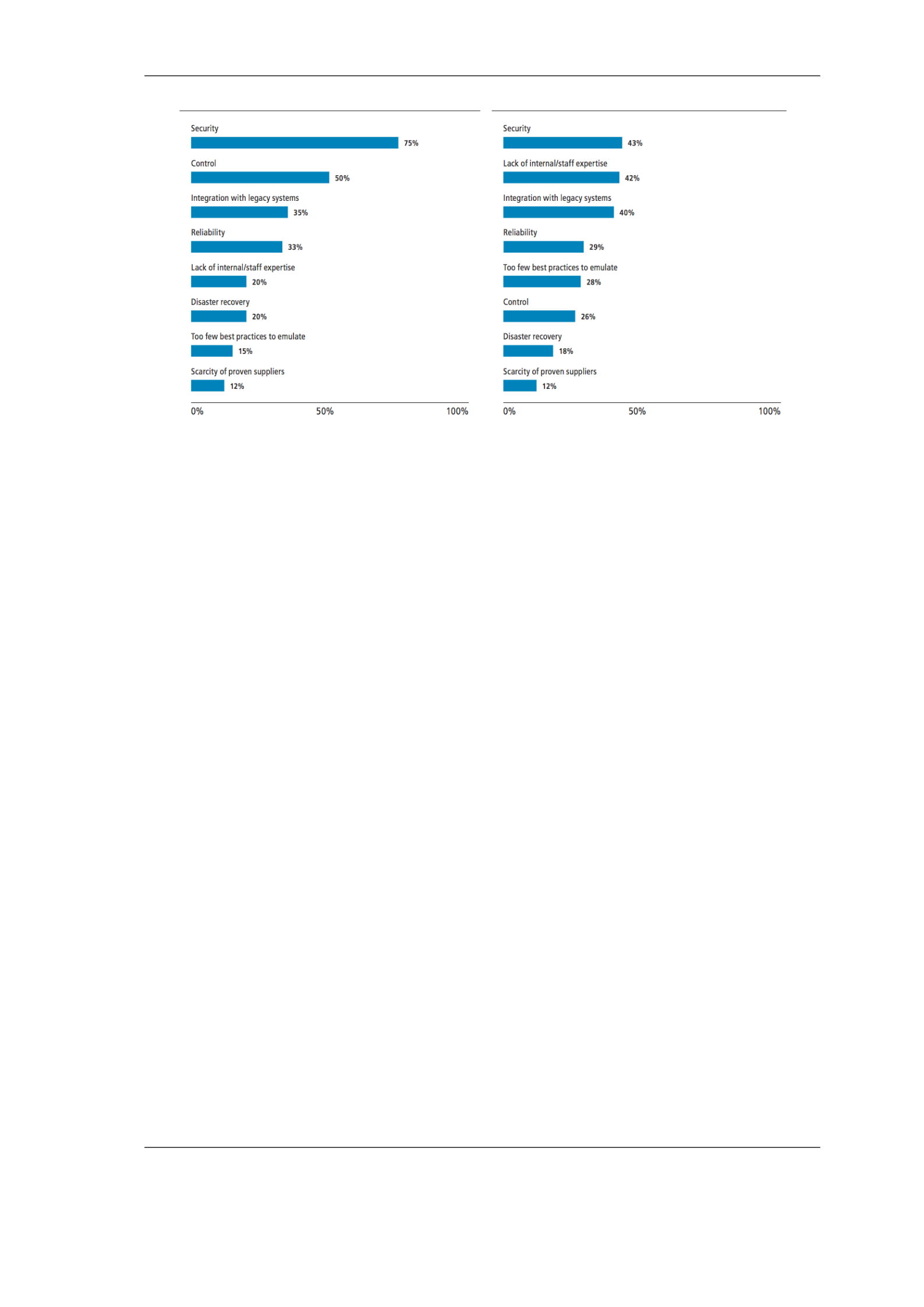
utilising cloud technologies, as illustrated by Figure 3.1. The fact, that also for pri-
vate cloud solutions (where an enterprise uses cloud technology only within their own
IT infrastructure) security concerns are named as the major obstacle suggests, that
there is a general lack of trust in cloud computing security. Since security is still a
considerable challenge for classic IT environments, it is even more for cloud environ-
ments due to its unique characteristics, such as: seamless scalability, shared resources,
multi-tenancy, access from everywhere, on-demand availability and third party host-
ing. Whereas a security incident in a traditional online system can mainly lead to
one specific compromised system, in cloud computing this risk is much more severe,
since a compromised cloud instance can result in the compromisation of all IT services
of a specific company run within the cloud. Follow-up attacks are expected, which
could also lead to an intrusion into further areas of a companies IT, not necessarily
run within a cloud. Although existing industry recommendations (ITIL), standards
(ISO 20000, ISO 27001, CobiT) and laws (e.g., Germany’s Federal Data Protection
Act) provide well established security and privacy rule sets for data center providers,
research has shown that additional regulations have to be defined for cloud environ-
ments [73, 70]. The following examples of cloud security incidents assist in illustrating
the need for better cloud computing security:
•Hackers stole credentials of Salesforce.com customers via phishing (2007) [77]
37
Chapter 3. Cloud Infrastructure Audit
Figure 3.1: Top concerns on cloud computing at organisations [8]
•T-Mobile customers lost data due to “Sidekick disaster” of Microsoft cloud
(2009) [78]
•Botnet incident at Amazon EC2 infected customer’s computers and compro-
mised their privacy (2009) [79]
•Amazon customer services were unavailable for multiple days and data was lost
due to a logical flaw in the cloud storage design (2011) [80, 81]
•Hotmail accounts were hacked due to technical flaws in Microsoft software (2012) [82]
To show, that traditional IT security best practices can not just be applied to cloud
computing environments, the Amazon security incident serves as an example: After an
infrastructure outage in April 2011, Amazon’s Compute Cloud EC2 was not available
causing popular services like Reddit to be unable to serve its customers [80]. While
such an outage also violates EC2’s quality of service level agreements of 99.95% avail-
ability: ( ˆ
= 1,825 outage days/year), Amazon’s support handling caused a strong loss
of trust in it as a cloud provider due to the following:
(1) Amazon data centers are divided into several availability zones to distribute the
impact of (hardware) failures. For resilience reasons users distribute their data over
38
3.2. Security Concerns in Cloud Computing
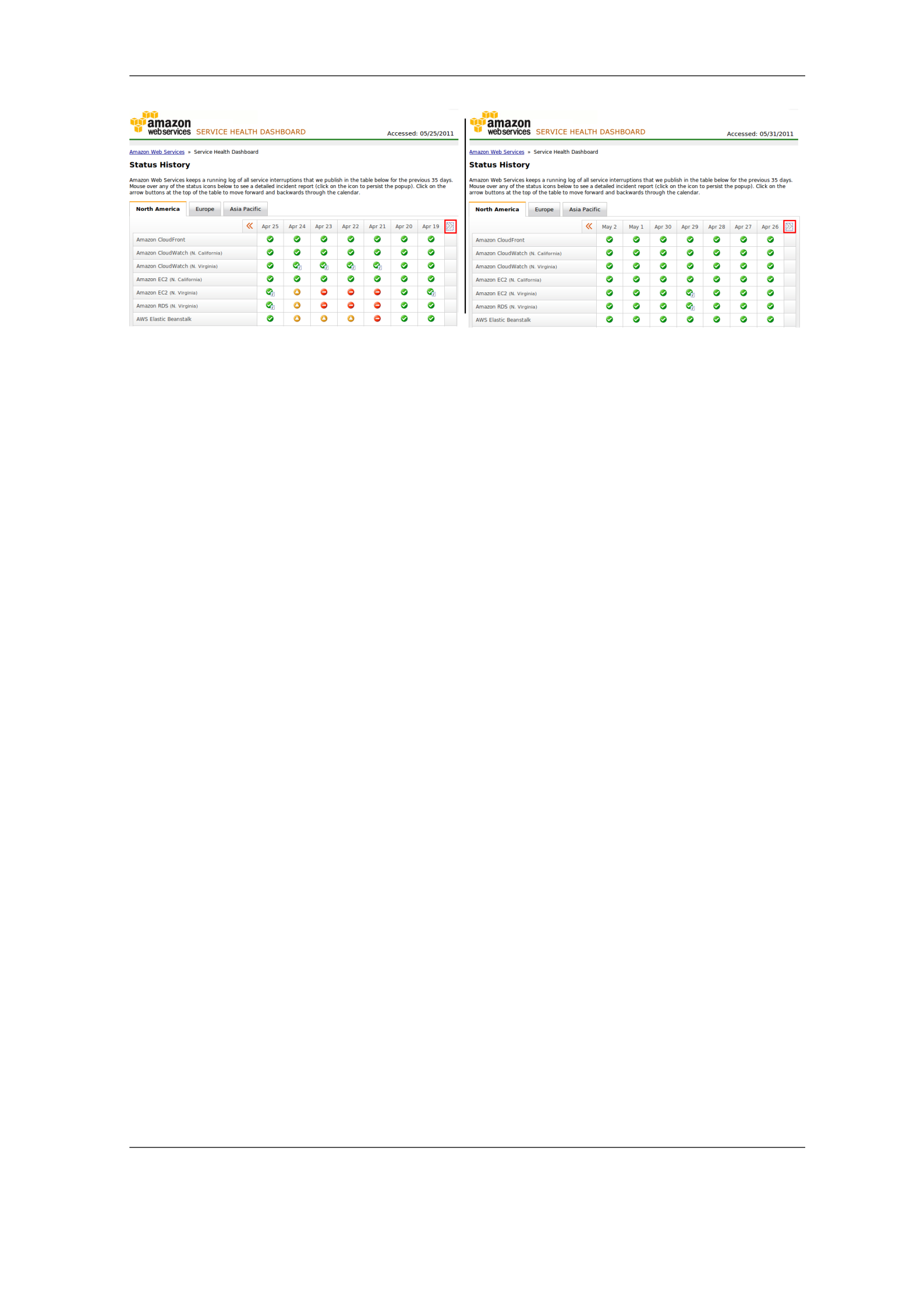
Figure 3.2: Amazon Health Dashboard accessed at 05/25/2011 and 05/31/2011
different availability zones. As a result of the outage EC2 customers permanently
lost data, although services were hosted on different EC2 availability zones [81]. A
company offering webservice usage monitoring lost 11 hours of historical data.
(2) During the crash an EC2 customer running a monitoring service of cardiac patients
tried to reach Amazon’s support unsuccessfully. Neither information about the ex-
pected downtime nor moving the unreachable instances to a different EC2 data center
was offered.
(3) Since hardware sovereignty is given away in cloud computing security, health and
monitoring information is critical to cloud users to build there services in an appro-
priate way regardless which cloud model (public, hybrid, private cloud) is used. This
is already known from traditional IT outsourcing and providers try to establish trust
to customers by proving their compliance to IT security standards like ISO27001 [83]
or ISO9001 [84]. Amazon AWS so far seams to follow a contrary approach: although
AWS provides status information about the cloud infrastructure at the Amazon Ser-
vice Health Dashboard [85] users can only see a service’ history over the last five weeks.
Amazons problems from April 2011 were not visible anymore to users by the end of
May 2011, as depicted in Figure 3.2.
Maintaining consistent security across boundaries is complex and challenging for infor-
mation security professionals [1]. The Cloud Security Alliance defined a cloud model
39

Chapter 3. Cloud Infrastructure Audit
Layer Service model
Software as a
Service
Platform as a
Service
Infrastructure
as a Service
Facility XXX
Network XXX
Hardware XXX
Operating System X X ?
Middleware X? -
Application X- -
User - - -
Table 3.1: What the cloud provider controls [14]
consisting of seven layers: facility, network, hardware, operating system, middleware
technology, application and user. Table 3.1 shows in which cloud service model which
cloud architectural layer is controlled by the cloud provider [14].
3.3 Related Work
One of the first professional groups, which published about cloud computing security,
is the Cloud Computing Security Alliance (CSA). CSA is an organisation with around
120 corporate members and has a broad remit to address all aspects of cloud security,
including compliance, global security related legislation and regulation, identity man-
agement, and the challenge of monitoring and auditing security across a cloud based
IT supply chain [86]. Its main work is the “Security Guidance for Critical Areas of
Focus in Cloud Computing” [86], which identifies several key security domains and
topics, such as compliance and audit, incident report and encryption. It provides sev-
eral recommendations on each domain. The guide was first released in April 2009, the
current version 3 was released in November 2011. It is known as a de facto standard
document when it comes to security guidelines for cloud computing. In addition, CSA
released the guideline: “Top Threats to Cloud Computing V1.0” [26] in 2010. It iden-
40

3.3. Related Work
tifies the most urgent threats, which need to be addressed in cloud computing. The
guide was updated in 2013 as “The Notorious Nine - Cloud Computing Top Threats
in 2013” [87]. Although many major cloud security issues were identified by CSA,
the work of this thesis partially extends them by the issues “Data life cycle in case
of provider termination” and “Missing monitoring of cloud scalability”, presented in
Section 3.4 - Cloud Computing Security Issues.
The European Network and Information Security Agency (ENISA) publishes the guide
“Cloud Computing Security Risk Assessment” [74]. It presents a survey, which iden-
tifies security for cloud computing and especially the need for a trustable, higher
assurance cloud architecture as the major cloud related research area to be addressed.
Vulnerabilities, technical and legal risks as well as a demo scenario of an SME moving
into cloud computing gets presented. A high level questionnaire to evaluate the risk
of moving services into a cloud environment is provided. Although this work is a step
into the right direction, it still stays to high level when it comes to recommendations
for a secure utilisation of cloud technology. It is becoming clear, that there is an ur-
gent need for a detailed security check list or catalogue for the cloud consumer, which
can be given to the provider to evaluate if necessary security features are in place to
protect customers data and address cloud specific security issues.
The German Federal Office for Information Security (Bundesamt f¨ur Sicherheit in der
Informationstechnik (BSI)) published the white paper “Security recommendations for
cloud computing provider” [88] in 2011. It provides detailed recommendations, how
cloud providers should secure their infrastructure and which questions should be asked
a provider to achieve a high level of security and governance to data protection laws.
The white paper was updated by security experts from industry and academia and
released as a technical guide in 2012 [89]. Although it is very detailed, some cloud
specific security issues are missing, including almost all possible attacks on the cloud
management system, such as scalability attacks, and resultant billing and accounting
41

Chapter 3. Cloud Infrastructure Audit
issues. Again, this identifies the urgent need for a technical detailed analysis on cloud
specific security issues, resulting in a cloud audit criteria catalogue for cloud consumer
and provider. Thus, contact with the BSI was established and results of the research
were submitted to the BSI to contribute in their effort. However, it remains unclear if
the BSI utilised the results within the guide. All the presented guides, provide recom-
mendations for cloud users especially on the management level. However, a specific
architectural proposal, how the suggestions made can be implemented is missing. The
research work proposed in this thesis intends to fill this gap.
Cloud Security Research Papers
A rather high level, but comprehensive perspective on the whole topic of cloud com-
puting security is given by Mather et al in the book “Cloud Security and Privacy” [1].
It provides a very good entry into the topic especially by laying out the necessary
groundwork. Due to the wide area the book covers it can’t go very deep into the
necessary topics important for this research.
The most comprehensive survey about current literature addressing cloud security
issues is given by Vaquero et al. in [75]. It categorises the most widely accepted
cloud security issues into three different domains of the Infrastructure as a Service
model: machine virtualization, network virtualization and the physical domain. It
also proposes prevention frameworks on several architectural levels to address the
identified issues. Pearson [90] proposes several software design guidelines for delivering
cloud services taking privacy into account, such as using a privacy impact assessment,
allowing user choice and providing feedback. While Chen et al. state in [76] that many
IaaS-related cloud security problems are problems of traditional computing solved by
presented technology frameworks it also demands an architecture that enables “mutual
trust” for cloud user and cloud provider. Both papers confirm and complement the
42

3.3. Related Work
cloud specific security issues identified by this research. Furthermore, they identified
a demand for a two-way trust enabling architecture for cloud infrastructures and the
ability of “choosable security primitives with well considered defaults” [76]. The SAaaS
architecture, presented in Chapter 4, will provide this mutual trust. SAaaS’ Cloud
Audit Policy Language (see Chapter 5) enables the user to define its own security
levels and to choose from a spectrum of security subsystems as demanded by [76].
Amazon’s cloud platform Elastic Compute Cloud (EC2) allows users to create and
share virtual machine images. Balduzzi et al. [91] analyzed the security risks of running
third party images. The work gave a good insight about the current risk, which comes
from pre-configured cloud appliances. After the investigation of over 5000 Amazon
Machine Images (AMIs), they found that 98% of Windows AMIs and 58% of Linux
AMIs contain software with critical vulnerabilities [91]. Furthermore, two VM images
were infected with malware, two were configured to write logs to an external machine,
21.8% contained leftover credentials that would allow a third party to remotely log
into a machine [91]. Their approach is to start AMIs on EC2 and then scan them
for security problems and privacy risks. However, their system is not intended to be
used as an auditing service. They execute a predefined set of security and privacy
checks and provide no way of customizing policies, which will be supported by the
work proposed in this research.
Other Cloud Audit Projects
To address the lack of existing standards regarding cloud specific security problems, a
number of open audit projects have been created. A working group of the Cloud Secu-
rity Alliance is the umbrella project Governance, Risk Management and Compliance
(CSR) [92]. It includes the sub projects “Cloud Audit A6”, “Cloud Controls Matrix
(CCM)”, “Consensus Assessments Initiative Questionnaire (CAIQ)” and “Cloud Trust
43

Chapter 3. Cloud Infrastructure Audit
Protocol (CTP)”. The Cloud Audit A6 - Automated Audit, Assertion, Assessment and
Assurance API [93] has the goal to provide a common interface and namespace for
cloud computing providers to automate the audit, assertion, assessment, and assurance
of their cloud environments. The Cloud Controls Matrix “is specifically designed to
provide fundamental security principles to guide cloud vendors and to assist prospec-
tive cloud customers in assessing the overall security risk of a cloud provider.” [92].
A questionnaire about which security controls exist in IaaS, PaaS and SaaS offers is
provided by the Consensus Assessments Initiative Questionnaire. Finally, the CTP is
an initiative to create a machine and human readable protocol which provides Trans-
parency as a Service for cloud users about compliance of cloud provider [94].
The “EuroCloud Star Audit” [95] is a German certification for SaaS providers. It
aims to establish a high level of security and transparency for users and providers
alike. The audit starts with the provider’s general profile, carries on with contract
and compliance including data privacy protection, general security, operation and
infrastructure, operation processes and goes as far as application and implementation.
Wang et al. present in [96] a system to audit integrity and security of public data
cloud storage. Their solution allows a third party auditor to be able to efficiently
audit the cloud data storage without demanding the local copy of data, and introduce
no additional on-line burden to the cloud user. Therefore they combine the public
key based homomorphic authenticator with random masking to achieve a privacy-
preserving public cloud data auditing system.
A “Dynamic Audit Services for Outsourced Storages in Clouds” is presented by Zhu et
al in [97]. The approach uses fragment structures, random sampling and index-hash
tables, supporting provable updates to outsourced data and timely anomaly detection.
Massonett et al. discuss in [98] the problem for IT security audits if federated cloud
infrastructures are spanned across different countries. They introduce a existing fed-
erated cloud monitoring infrastructure to monitor in which country data is actually
44

3.3. Related Work
saved without compromising cloud isolation. In the presented approach, collaboration
is required between the cloud infrastructure provider and the user of the cloud, the
service provider. The proposed architecture is validated by an e-Government case
study with legal data location constraints.
Tancock introduces in [99] a privacy impact assessment decision support tool that
can be integrated within a cloud computing environment. The authors show that
privacy weaknesses impact legal compliance, data security and user trust in cloud
environments. The presented system is a systematic process for evaluating the possible
future effects that a particular activity or proposal may have on an individual’s privacy.
With the system presented, risk analysis of moving a service to a cloud environment
can be enhanced. A distributed monitoring facility can deliver the input to detect
multiple Cloud-specific security issues. Li et al. present in [100] a method how cloud
storage services can benefit from a trusted third party audit (TPA). They introduce
issues and solutions for the application of a TPA, such as protection for data integrity,
support of dynamic data, access control batch audits and minimised audit costs.
Although the introduced Cloud Control Matrix by CSA and guidelines by ENISA and
BSI are a first step into the right direction, they lack a necessary technical depth
when it comes to security guidelines and corresponding checks. Currently, most audit
guidelines in cloud computing are either very high level or are focussing on the specific
model of Software as a Service clouds. However, there has been little effort made on
auditing of IaaS clouds. Detailed security criteria in form of technical and organiza-
tional IaaS audit checks are necessary, which can be used by the cloud customers to
evaluate the security status of a cloud. The presented EuroCloud Star Audit would de-
liver this technical depth, however it is only targeted for Software as a Service clouds.
Such a detailed audit criteria list is missing for IaaS clouds. Thus, as a first part of
this research an IaaS audit criteria catalogue needs to be developed, which delivers
this missing technical depth.
45

Chapter 3. Cloud Infrastructure Audit
The introduced related research work is introducing valuable security concepts for
clouds. However, they are concentrating on a very specific types of IaaS clouds, such
as Storage as a Service clouds ( [97]). Others ( [100]) are requiring the usage of
additional or special hardware (TPM) or are assuming a inter-provider collaboration
( [98]), which does not exist, due to to lack of cloud standards. Therefore, a cloud
audit system, which is targeted for general IaaS clouds and does not introduce the
need of special hardware is needed. It should be simple and based on standardised
hardware and software. It needs to be able to deliver audit information, independent
on the underlying cloud provider’s infrastructure.
3.4 Cloud Computing Security Issues
A detailed analysis of the actual security impact is not easy to find, because very of-
ten security problems are declared as cloud security problems, although they already
exist in traditional IT-outsourcing scenarios and are merely exacerbated in cloud en-
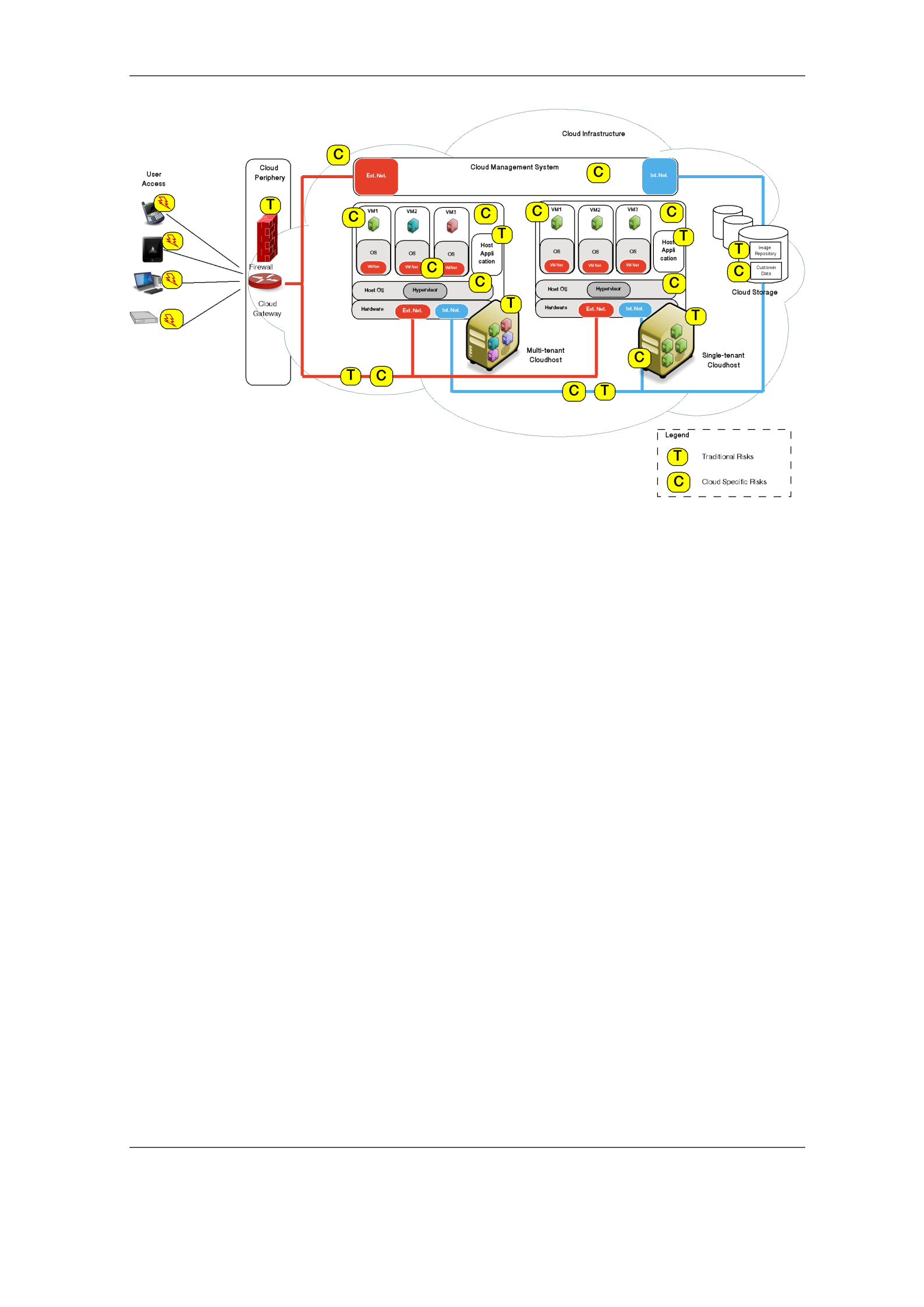
vironments. Figure 3.3 shows an updated version of Figure 2.8 (Section 2.5 - Cloud
Computing Architecture) highlighting typical “hot spots” of traditional and cloud
specific security risks in an IaaS cloud environment.
The German Federal Office for Information Security publishes the IT baseline protec-
tion catalogues [101], enabling enterprises to achieve an appropriate security level for
all types of information. The catalogues were extended by a special module covering
virtualization in 2010. As part of the research presented in this report, a compre-
hensive study on all available IT baseline protection catalogues as well as current
scientific literature available ([73, 26, 74, 75, 76]) was published. A comparison and
origin classification of security issues from classic IT-Housing, IT-Outsourcing and
cloud computing was undertaken. New cloud specific security issues, as well as al-
ready known security issues which are amplified by the usage of cloud computing were
46
3.4. Cloud Computing Security Issues
Figure 3.3: Security Risks in a typical IaaS cloud environment
identified. Recommended security best-practice of security issues which are amplified
by cloud computing are evaluated due to their applicability. This section will list
cloud security problems and compare them to similar problems already known from
traditional IT outsourcing. Furthermore, each identified issue is categorised by the
affected core principles of information security, such as availability, confidentiality,
integrity [102].
3.4.1 Cloud Computing vs. Classic IT Outsourcing
In the definition of traditional “IT outsourcing” the two most common models existing
on the market are combined: IT housing and outsourcing. In IT housing, a customer
provides its own hardware, e.g. server, and just runs them in a data center of a
service provider. He is only providing the necessary infrastructure components, like
network components, cooling or power. Administration of the hardware stays with the
customer. In outsourcing, a customer rents the complete infrastructure from a service
47

Chapter 3. Cloud Infrastructure Audit
provider, including any hardware and software. Administration is undertaken by the
service provider. In traditional IT outsourcing administration or business processes
get, partly or fully externalised to a third party service provider. A customer is
renting a certain infrastructure and using it exclusively, which is called a single tenant
model. An extension of infrastructure or service requires a prior communication with
the service provider. Long contract durations are characteristic for traditional IT
outsourcing. In cloud computing, a customer is also renting a certain infrastructure
but shares them most of the time with other customers. This is identified as the multi-
tenant model. Scalability of the rented service is simple, automatable and adaptable
without prior interaction of the cloud provider. Cloud computing contracts are flexible
in duration and can vary from just a couple of minutes to years. A number of research
papers [103, 76, 74], etc. identified cloud security and privacy problems. They all have
in common the following differentiation of identified cloud-specific security problems:
•Amplified Cloud Security Problems (amplified CSP): problems, already known
from traditional, distributed IT-environments, but amplified through cloud com-
puting attributes
•Specific cloud Security Problems (specific CSP): security problems which arise
due to cloud computing’s special characteristics.
In a comprehensive study on academic literature, best practices and standard rec-
ommendations on cloud computing security were analysed to identify cloud security
issues. An important source for security guidelines in Germany are the IT Security
Baseline Catalogues [101] published by the German Federal Office for Information Se-
curity. Thus, they were analysed to identify which existing security recommendations
already cover cloud security issues, and how they need to be updated or completed.
The following list of cloud specific security issues is the result of this investigation.
48

3.4. Cloud Computing Security Issues
3.4.2 Amplified Cloud Security Problems
Amplified cloud security problems (amplified CSP) are mainly originated by under-
lying technologies upon which cloud computing is substantially built, such as, virtu-
alization technology, web applications and multi-tenant software architectures. Fur-
thermore, problems originating in well known and commonly established security best-
practices, which are difficult or impossible to implement in a cloud computing envi-
ronment are also classified as amplified CSP. The following amplified CSP have been
identified:
A1: Misuse of administrator rights / malicious insiders
Misuse of administrator rights is a severe problem already known in traditional IT. In
a recent survey [104] among 300 IT professionals 26% admitted, that at least one staff
member has abused a privileged login to access information. In cloud computing this
threat is amplified. Virtual machines are mostly provided as managed root servers.
The cloud provider is responsible for the underlying host system and has access to the
VMs running on the host through the hypervisor. A misuse through malicious insiders
is possible and hard to detect due to a general lack of transparency into provider pro-
cess and procedure. This affects the following core principles of information security:
confidentiality, authenticity, authorisation, integrity, data protection, accountability
and non-repudiation.
A2. Missing transparency of applied security measures
In traditional IT outsourcing, this risk is mitigated by well defined regulation: The
customer (IT housing) or the provider (IT outsourcing) is responsible for the appli-
cation of security measures. They must be communicated to the customer. Providers
can prove their compliance to baseline security measures with ISO 27001 or PCI DSS
49

Chapter 3. Cloud Infrastructure Audit
certificates. In cloud computing there is a lack in transparency regarding applied
provider security measures and processes exists. The underlying hardware infrastruc-
ture gets masqueraded to protect it from attacks. Cloud customers currently need
to trust the provider that they are compliant to current security standards. Amazon
Web Services announced in December 2010 that the AWS data center, infrastructure
and services are compliant to ISO 27001 and PCI DSS Level 1 [105]. However, to
date no agreed standard criteria for running a secure cloud infrastructure exist. This
affects the following core principles of information security: integrity, availability and
data protection.
A3. Missing transparency with security incidents
Since computing systems are completely owned by the customer in IT housing, they
are responsible for securing all evidence in case of a security incident. In IT out-
sourcing this responsibility is transferred to the service provider which employs skilled
personnel, e.g. an own Computer Emergency Response Team (CERT). In cloud com-
puting, customer and provider need to work together to collect all information of a
security incident. Problems with hardware must be mapped to the different customer
cloud resources to react on incidents and initiate correct problem management. But a
standardized procedure is currently missing. Current cloud offers available in the mar-
ket do not offer a transparent process for its customers on how security incidences are
detected, which efforts are taken by the provider to mitigate it and how the provider
supports its customer during the investigation phase. This is an increased risk in
cloud computing. This affects the following core principles of information security:
data protection, integrity, availability and non-repudiation.
A4. Shared technology issues
This threat includes the problem of sharing physical resources with multiple customers
50

3.4. Cloud Computing Security Issues
Year Name Description
2007 vmftp [106] Directory traversal vulnerability in VMware tools
2009 XEN Ownage Trilogy [107] Exploiting drivers using DMA
2009 VMware Cloudburst [108] Abuse of a lack of access control in a VMware 3D graphics driver
2011 KVM Virtunoid [109] Dangling pointers due to a bug in the hardware emulation layer
2012 VMware
VMSA-2012-0009 [110]
a) Bug in the Backdoor API (for communication between VMware
tools and host) channel between VM and host b) Bug in the SCSI
device registration (no further details available, potentially bug in
hardware emulation layer) c) Buffer overflow in floppy driver (no
further details available, potentially bug in hardware emulation
layer)
2012 VMDK Has Left The
Building [111]
Design flaw in the VMware ESXi hard disk handling
2012 XEN Sysret [112] Para virtualization API design flaw
Table 3.2: Overview of Hypervisor outbreaks [15]
as well the problem of misconfigured VMs that endangers other resources. In IT hous-
ing this threat only applies for misconfiguration of security parameters and is limited
to one corresponding customer. In IT outsourcing the provider is fully responsible to
configure running services securely. In cloud computing this is caused by the use of
virtualization. Table 3.2 shows security incidents based on hypervisor outbreaks to
illustrate the increased risk for cloud computing. The main problem is the lack of
isolation, which for cloud computing can be categorised into:
•VM isolation: If one customer runs an improperly configured VM in the cloud
this also endangers other VMs running on this specific host. An attacker could
use a VM as an entry point to get access to the host machine through a hy-
pervisor flaw to gain inappropriate levels of control or influence on the under-
lying platform. Exploits seem rare but have already been demonstrated by
Kortchorski [108] and Rutkowska [113]. Although few successful attacks are
published so far, increasing code complexity in hypervisor software amplifies
this threat.
•Memory/Cache isolation: Often, the underlying components that make up this
51

Chapter 3. Cloud Infrastructure Audit
infrastructure, e.g. GPUs or CPU caches were not designed to offer strong iso-
lation properties for a multi-tenant architecture [26]. These resources need to
be quickly allocated and de-allocated to fulfil a current demand. Well estab-
lished measures for secure data wiping might not be applicable. So far no cloud
provider discloses information on how shared resources get securely wiped before
being reassigned to a different customer. Furthermore, by getting a default root
access to a VM in current IaaS offering enlarges the attack vector of breaking
through the isolation of shared resources. Certified Common Criteria compliant
hypervisor software (minimum EAL 4) could mitigate this threat [88].
•I/O isolation: if there are problems with the virtual network (bridge software)
traffic sniffing can be undertaken by an attacker.
Another security risk comes from the usage of pre-provided virtual machine images.
The number of administrators of a traditional data centre is limited and they all are
working under the same company security policy, while installing and maintaining
machines. This can be completely different in a cloud infrastructure. Public mar-
ketplaces for exchanging cloud appliances such as, OpenNebula Marketplace [114],
Amazon Web Services EC2 Management Console or the Amazon Web Services Mar-
ketplace [115] provide cloud customers with an easy and efficient way of finding the
right virtual machine image. But they also allow users to be administrators of their
virtual machines, or upload and share their custom made VM images with other users.
Although cloud providers provide security guidelines [116] on how to prepare an image
before releasing it to a marketplace, current research by Balduzzi [91], Bugiel [117]
and Meer [118] shows, that marketplace images are highly insecure due to old software
versions or “forgotten” or restorable security credentials, such as SSH private keys.
Users, uploading appliances are usually more or less anonymous. There is no way
to easily determine whether a custom appliance is legit or maliciously manipulated.
52

3.4. Cloud Computing Security Issues
Images could contain rootkits, which are performing passive eavesdropping attacks
such as traffic analysis, keylogging or transmission of user’s data to external systems
for industrial spying [91].
This affects the following core principles of information security: integrity, availability,
data protection, confidentiality, authentication and non-repudiation.
A5. Data life cycle in case of provider switch or termination
This threat does not exist in IT housing since data and computing resources remain
the property of the customer if he changes the housing provider. In IT outsourcing
service level agreements control how data is transferred to a customer or how storage
devices need to be securely wiped or disposed of. In cloud computing this threat is
increased due to shared usage of resources. Customers need to define special rules for
end of contract scenarios regulating how data gets exported from the cloud and how
a provider has to securely erase customer’s data [26]. This affects the following core
principles of information security: data protection and confidentiality.
A6. Monitoring of Service Level Agreements
IT housing and IT outsourcing can easily log events per user. In a cloud several multi-
tenant applications running in a virtualized environment need special tools to monitor
Service Level Agreements. New tools for hypervisor, virtualized networking monitor-
ing, etc. must be available. This affects the following core principles of information
security: availability and integrity.
3.4.3 Specific Cloud Security Problems
Due to the prior given definition, specific cloud security problems (specific CSP) exist,
when they originate or affect at least one of NIST’s cloud characteristics.
53

Chapter 3. Cloud Infrastructure Audit
B1. Unclear data location
In traditional IT outsourcing a customer always knows where and from whom its data
gets stored and processed. Mostly, customers can physically visit a data center to
inform themselves personally about the security measurements a provider has taken
for data protection. Germany’s data protection act §11 (1) states that where other
bodies are commissioned to collect, process or use personal data, the responsibility for
compliance within the provisions of this act and with other data protection provisions
shall rest with the principal [119]. From the interpretation of this act, users must
know the exact location of their data and their cloud providers’ court of jurisdiction.
An export or move of data is not possible without prior notification of the customer.
In current cloud computing offerings customers do not have the possibility of knowing
where the data gets stored or processed. Only a very rough decision about a cloud
data centre’s continental location can be made, e.g. AWS data center in Northern
Ireland. Nevertheless, currently there is no way to prove if data is not outsourced
by a cloud provider. A current court decision about legitimate access of US govern-
mental agencies to data of US originated firms even of data centers located outside
of US area of jurisdiction [120] strongly amplifies this risk. This affects the following
core principles of information security: data protection, confidentiality and availability.
B2. Abuse and nefarious use of cloud resources
Characteristic for cloud computing is fast access to numerous virtual machines within
a very short time frame. This attracts not only legally acting enterprises or organi-
sations but also individuals and organisations with more malicious intent. Amazon’s
cloud was already used to host malware (e.g. trojans). Also the Zeus botnet (a
phishing trojan that steals banking information) was known to be hosted on virtual
machines within the Amazon cloud. Another possibility would be to aggregate many
VMs and use them to DDoS a single target and thereby preventing others to use its
54

3.4. Cloud Computing Security Issues
services. While this threat mainly addresses the cloud provider, the cloud customer
can also be affected. As a result of the Zeus Botnet big parts of Amazon’s IP address
range was blacklisted on spam lists causing e-mails from “good” customers, running
their mail server in Amazon, being rejected as well. This issue affects the following
core principles of information security: availability.
B3. Missing Monitoring
A security incident within a cloud environment should get detected and eliminated by
the cloud provider. If customer data is in danger, this should be communicated. To
the best knowledge of the author, no cloud provider so far runs an information system
that will inform the customer automatically. But especially in cases of personal data
processing, e.g. credit card information, it could be important for a cloud customer
to know if a security problem exists, so he can stop the service to guarantee data
protection and integrity and minimise risk for its own systems. For a sustainable risk
analysis of running a service in a cloud it is important to know:
•Which data protection measures exist to secure the cloud environment (anti virus
protection, Intrusion Detection Systems (IDS), measures for Denial of Service
(DoS) detection and prevention, patch and change management)
•History of service breakdowns
•Measurements taken for availability, backup, reliability and data recovery
•Installed software versions at cloud host systems and periphery
•Tracking of administrative access of cloud provider service personnel
•What information and support is available during a service breakdown or a
security incident.
For monitoring security of large IT infrastructures a best practice approach is to run
55

Chapter 3. Cloud Infrastructure Audit
an Intrusion Detection Systems with distributed sensors as input feeds. But this ap-
proach breaks down for cloud infrastructures, mainly, because of the complexity and
frequently changing environment driven by the users. Traditional IDS setups are built
around a single monolithic entity, which is not adaptive enough to do data collection
and processing in an efficient and meaningful way [121]. This affects the following
core principles of information security: non-repudiation, availability, data protection
and confidentiality.
B4. Insecure Application Programming Interfaces
Cloud resources are mostly deployed, controlled, orchestrated and managed through
specific cloud Application Programming Interfaces offered by the provider. The se-
curity and availability of general cloud services is dependent upon the security of
these basic APIs. From authentication and access control to encryption and activ-
ity monitoring, these interfaces must be designed to protect against both accidental
and malicious attempts to circumvent policy [26]. Since third party providers es-
sentially build their services upon these APIs, e.g. load balancer service, a complex
architectural layer gets inserted which needs to be subject to careful investigation.
Standardized protocols and measurements for secure software development (Microsoft
Secure Development Life cycle (SDL) or Software Assurance Maturity Model (SAMM)
of the Open Web Application Security Projects (OWASP)) address this threat. This
affects the following core principles of information security: confidentiality, integrity,
availability, non-repudiation, data protection and accountability.
B5. Missing monitoring of cloud scalability
One reason for using a cloud infrastructure is to benefit from its scalability attributes.
In this context it is most often used to deal with usage peeks, for example if a new
version of software gets released and huge download requests are expected. Char-
56

3.4. Cloud Computing Security Issues
acteristic to peeks is that they are mostly foreseeable and limited to a certain time
frame. Therefore, cloud users design their cloud application to start new instances if
a certain threshold is reached to provide service availability. This introduces two new
challenges for cloud security:
B5.1) IaaS up-scaling - business driven Since a user’s infrastructure can change rapidly
(grow, shrink) in case of a peek scenario a monitoring system needs to be aware
of the peek situation and the defined scalability thresholds.
B5.2) IaaS up-scaling - attack driven Most of the time scalability thresholds, like
“maximum number new VMs to be created” get defined once. Mostly during
the design phase for the first peek event. If the peek was managed well by
the thresholds they just stay, like defined, although they might be not needed
anymore (e.g., until the next major version release). This enables a new cloud
specific attack: Financial damage due to nefarious abuse of cloud resources.
An attacker can cause the creation of new cloud instances up to the scalability
threshold by creating a huge number of allowed requests, which do not result in
any successful business case but could be caused by e.g., distribution of malicious
software.
This affects the following core principles of information security: availability and ac-
countability.
B6. Missing interoperability of cloud provider
To minimise the potential damage of a provider downtime or in case of a provider
change, interoperability between different cloud providers is very important. Current
cloud offerings are not compatible with each other due to the usage of customised
VM formats or proprietary APIs. A migration of cloud resources from one provider
to another is not possible. This increases the risk of vendor and data lock-in. For
57

Chapter 3. Cloud Infrastructure Audit
example, a customer of a Microsoft Azure database service can not use it with a
service, developed and running on the Google App Engine cloud [88]. Standards are
necessary to mitigate this risk. First developments are started with the following
projects:
•Open Cloud Computing Interface
•Open Virtualization Format (OVF)
•Open Stack Cloud Software by Rackspace Hosting, NASA
Furthermore, a detailed strategy needs to be defined between provider and customer
which regulates data formats, perpetuation of logic relations and total costs in case
of a provider change [88]. This affects the following core principles of information
security: availability.
B7. Increased complexity due to cloud characteristics
Cloud computing environments are far more complex than traditional data centers
structures. Therefore, known best practices may not be enough to mitigate a security
incident as shown in the Amazon example in Section 3.2. While having a backup
server image might be enough in a traditional data center, this does not necessarily
apply for cloud environments. Security and business continuity measurements best
practices need to be re-evaluated for cloud infrastructures. This affects the following
core principles of information security: availability, integrity, confidentiality.
Table 3.3 summarizes the presented cloud security problems (amplified CSP & specific
CSP) and classifies them due to their origin (IT outsourcing (OC), virtualization (V),
cloud computing (C)). If known, real world examples of security incidents resulting
from a discussed problem are listed with short overview of counter measures.
In addition to operating issues, unclear laws and regulations are also a challenge for
58

3.4. Cloud Computing Security Issues
No. Issue Origin Incident examples Affected security principles
A1 Misuse of administrator
rights / malicious insiders
OC Liebermann Password Survey
(2011)
confidentiality, authenticity, au-
thorisation, integrity, data pro-
tection, ac- countability, non- re-
pudiation
A2 Missing transparency of
applied security measures
OC &
V
Heartland Data Breach (2009) integrity, availability, data pro-
tection
A3 Missing transparency with
security incidents
OC Amazon Service Health Dash-
board history (2011)
data protection, integrity, avail-
ability, non-repudiation
A4 Shared technology issues OC, V Red- & Blue- Pill Expolits
(2008), Cloud Burst (2009),
UDP- Flood Attack in (2009),
Analysis of Amazon AMIs
(2012)
integrity, availability, data pro-
tection, confidentiality, authenti-
cation, non-repudiation
A5 Data life cycle in case of
provider switch or termina-
tion
OC - data protection, confidentiality
B1 Intransparent data loca-
tion
C - data protection, confidentiality,
availability
B2 Abuse and nefarious use of
cloud resources
C Zeus Botnet, Trojan and mali-
cious office documents in Ama-
zon EC2 (2010)
availability
B3 Missing Monitoring C - non-repudiation, availability,
data protection, confidentiality
B4 Insecure APIs C Attack of Amazon SOAP API,
Gruschka (2009)
confidentiality, integrity, avail-
ability, non-repudiation, data
protection, accountability
B5 Missing monitoring of
cloud scalability
C Miscalculated bill of costs in
Amazon EC2, ToasterNET
(2011)
A availability, accountability
B6 Missing interoperability of
cloud provider
C EMC Storage cloud closes
(2010), Iron Mountain ends
cloud storage service (2010)
availability
B7 Increased complexity C Amazon outage and data loss,
(04/2011), (08/2011)
availability, integrity, confiden-
tiality
Table 3.3: Overview of cloud security problems
industries’ adoption of cloud technologies. IT Infrastructure Library (ITIL) [122] pro-
vides an auditable best practices catalogue for IT Service Management (ITSM). In
addition, ISO Standard 27001:2005 [83] provides international auditable requirements
for information security. ISO/IEC 27002 gives best practice recommendations on in-
formation security management. However, in cloud computing, IT resources are no
longer solely in their own data center. Therefore, it is the discretion of a cloud provider
59

Chapter 3. Cloud Infrastructure Audit
to follow ITSM and ISO standards. Germany’s Federal Data Protection Act [119] spec-
ifies the acquisition, processing and storage of personal data. It is known to be the
strictest data protection law within Europe. §4b (2) and (3) of the act define that
personal data can only be transferred for processing into countries with the same ade-
quate level of privacy protection laws. In addition, §4 (3) and §4 (16) of the act specify
that whenever personal data are acquired and/or processed by third-party instances,
the affected person has to be notified. Finally, §11 (1) states that where other bodies
are commissioned to collect, process or use personal data, the responsibility for com-
pliance with the provisions of this act and with other data protection provisions shall
rest with the principal [119]. From the interpretation of this act, users must know the
exact location of their data are and their cloud providers’ court of jurisdiction. Unfor-
tunately, this violates one of the cloud computing principles to host services wherever
free resources are available.
Although existing recommendations, standards and laws provide well-established se-
curity and privacy rulesets for data center providers, it is becoming clear that they
are not designed for virtual environments. Hence, a privacy and security framework is
needed that proves the validity and applicability of existing laws to cloud computing.
3.5 Security Audits in Clouds
Since the literature review on existing cloud audit projects (Chapter 3.3) identified
a strong demand in technically sound cloud specific audits, research was done to in-
vestigate, how security audits need to change to mitigate the identified cloud security
issues. That’s why, this section introduces different IT security audit types and dis-
cusses how classic audits need to change to consider the special characteristics of cloud
computing environments and their security. Important challenges for cloud audits are
60
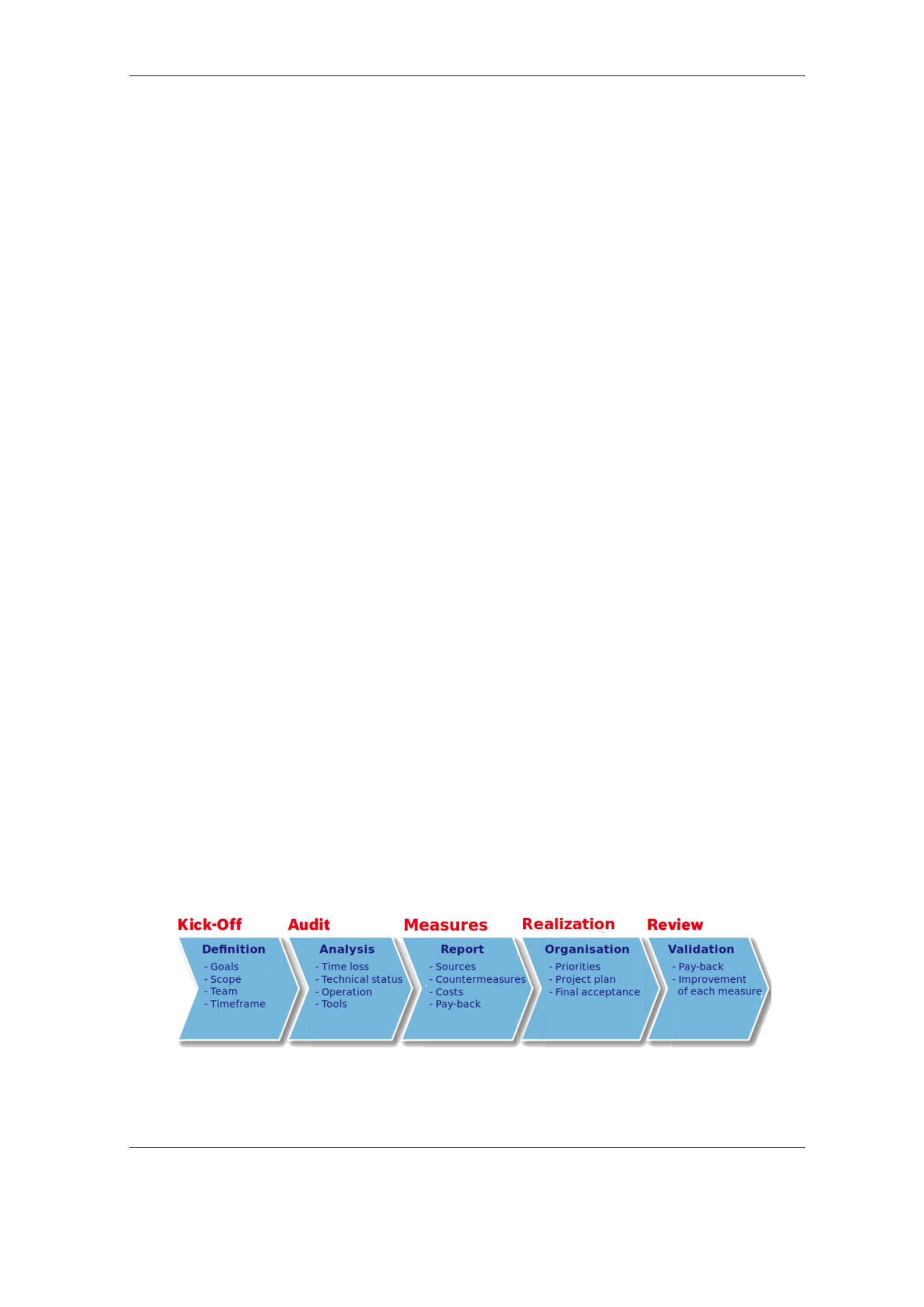
3.5. Security Audits in Clouds
presented, and the main questions are given which a cloud audit should answer. This
section finishes with a discussion of IT security audit industry standards for traditional
data centres as well as new standards for cloud environments and a novel Cloud Audit
Test Criteria catalogue gets introduced.
3.5.1 IT Security Audit Types
An audit can be defined as:
“Formal inspection and verification to check whether a standard or set of guidelines
is being followed, records are accurate, or efficiency and effectiveness targets are being
met.” [123]
The audit of IT environments focuses upon a particular technology area, for example,
network infrastructure. Generally, IT audits can be characterised into four areas:
general controls audits, application control audits, network/infrastructure audits and
system development audits. The IT security audit focuses upon security issues of
the whole IT infrastructure and can be defined as the process of IT risk analysis and
vulnerability assessment. Figure 3.4 shows the process of a security audit: typical
phases are definition, analysis, reporting, organisation and validation. It is good
practice to use the results of the validation phase as additional input for a future
audit. Typically, these audits are part of a quality management process to reduce the
number of security holes.
Figure 3.4: Traditional steps of an IT security audit process
61

Chapter 3. Cloud Infrastructure Audit
IT security audits can be categorised into the following types:
Vulnerability assessment. Its task is to expose known security problems in all
services of an IT infrastructure. Broad and automated vulnerability scans are used to
assess the weaknesses of the IT. Experts manually verify detected vulnerabilities.
Vulnerability audit. It is a risk-based approach where IT is seen from the per-
spective of an attacker. It simulates an attack from malicious outsiders (hackers) by
performing a penetration test. It is an intensive technical security audit with a high
percentage of manual testing and verification.
Application security audit It is an intensive security audit of an application and
its associated components (e.g. web application security scanner).
Vulnerability management. It specifies an automated vulnerability audit, and
characteristics include automated, regular vulnerability scans and documentation of
detected vulnerabilities in chronological order over multiple scans.
3.5.2 Classic IT Security Audits vs. Cloud Audits
For classical IT audits, today’s standard is the Statements on Standards for Attesta-
tion Engagements No. 16 (SSAE 16) [124] report. SSAE 16 is an AICPA auditing
standard for reporting on controls at service organisations (including data centres)
in the United States. It requires that the auditor obtains a written assertion from
management regarding the design and operating effectiveness of the controls being re-
viewed. This should minimise the following IT related risks, which are also applicable
for cloud infrastructures:
•Loss of business focus of the service.
•Solutions failing to meet business and/or user requirements. The service is not
performing as expected.
•Contractual discrepancies between the service user and the service provider.
62

3.5. Security Audits in Clouds
•Compromised security and confidentiality.
•Invalid or incorrect processed transactions.
•Pure software quality (high number of failures).
With the appearance of cloud infrastructures, cloud-specific risks regarding IT security
audits have been discussed and addressed by many researchers [76, 75], industry [87]
and institutions [86, 74]. It can be summarised as:
Greater dependency on the provider Access to data or the control of resources
in the cloud is still very much provider dependent. The cloud resource access inter-
faces are complex, and the extra control interfaces increase the vulnerability of cloud
infrastructures. The risk of data lock-in is high, and because of the appearance of
many new cloud providers, the risk of bankruptcy should not be neglected. There is
a lack of standardized access interfaces to the cloud.
Increased complexity of compliance with laws and regulations Although a
service is hosted at a cloud provider, the customer is still responsible for the data and
service quality to the service users. Thus, the laws and regulations of a cloud provider
country might be quite different than from the cloud customers’. The nature of cloud
computing is to hide the location of the resources to the customer. The processing
and data location can be anywhere, which might violate laws (e.g. European law of
privacy forces the location in Europe for personal private data).
Reliance on the Internet The organisation’s data stored in the cloud is only ac-
cessible through the Internet, which raises further security issues like data integrity,
privacy and all kinds of attacks from this public environment.
Dynamic nature of cloud computing Processing and data location can be changed
at any time because of load-balancing reasons or infrastructure failure. This causes
many monitoring and controlling problems, and therefore, arguably the level of secu-
rity decreases. Since the provider can scale the customer’s infrastructure automati-
63

Chapter 3. Cloud Infrastructure Audit
cally, the user must have control of this to limit the number of instances and control
of the costs. Otherwise, a denial of service eats up all the revenue of the business
service.
Thus, for cloud computing, an audit needs to clarify the following questions:
Privileged user access Since the provider has root access to the infrastructure and
therefore can read unencrypted data on the cloud storage. So the number of admin-
istrators with root access should be minimised.
Regulatory compliance Customers are responsible for the data, even if it is in an
external data centre. It has to be ensured that the provider takes care of backup,
has reasonable data recovery times and strong encryption algorithms are used, if data
encryption is needed.
Data confidentiality, integrity, privacy, availability and segregation In a
cloud, the environment is typically shared among the customers. It is important
to verify that it is secure. If the VM of another company is compromised, would my
company VM be affected? Do you want to share a resource with your competitor?
For many applications, resource sharing is acceptable, but for enterprise critical ap-
plications, you might want resources exclusively. Can a provider offer this? Special
interest should be taken in understanding how the data is segregated and secured at
the cloud provider. Is data replicated over multiple sites? Are backup strategies log-
ically consistent? Is data really encrypted? Is data access limited to the customer’s
application? Is it possible to limit the data location to predefined areas? The cloud
provider should transparently inform about the key management, access control, data
segmentation, used encryption algorithms utilised, etc., of the cloud infrastructure.
Additionally, business continuity plans and disaster recovery plans have to be defined
in cooperation with the provider.
Investigative support Suppose the customer’s resources are compromised. The
64

3.5. Security Audits in Clouds
provider might have problems in undertaking forensic analysis, since logging in cloud
environments are not user partitioned.
Monitor and control of cloud services Do customers get service level agreements,
which can be adapted to the needs of the customers? Will the customers be able to
monitor and manage them afterwards? Do the cloud interfaces offer sufficient and
reliable information for the integration, control and monitoring tasks? How is data
audited, which is stored, transmitted and processed outside the company? Is there
access to accounting information?
Data retention For data stored in a cloud, questions need to be answered: How
long can data be stored? How are data archived? How much is budgeted to retain
data [125]? For retaining data from the cloud, it is important to clarify the following:
How can data be retrieved? How is data integrity maintained during this process?
How is data removed/securely wiped from the cloud storage systems?
Service level agreements are most often used to clarify the majority of these ques-
tions [1]. Nevertheless, SLAs are no support for a cloud customer without enforcement
or traceability. It is important to provide a customer with the ability to check log data
(physical, virtual and logical), event transport and storage services as well as event
processing rules derived from SLAs.
From the technical point of view, the following challenges need to be covered [126]:
•Loss of 1:1 mapping: Due to the technology shifts towards VMs, virtual
landscaped, location transparency is not clear for the customer.
•Static gets variable: Dynamic changes of IPs, data centres and servers depend
on demand, time of day, etc.
•Audit analysis: How can data be retrieved, correlated and extracted meaning-
fully in a permanently changing infrastructure (VM start and stop)?
65

Chapter 3. Cloud Infrastructure Audit
Control en-
vironment/
company
level controls
Information
security
IT service
delivery/
operations
Systems
develop-
ment
Financial
report-
ing sys-
tem
Specific tech-
nologies or
incremental
requirements
Best practices
guidance
COBIT
COSCO
ISO27002 ITIL ISO
20000-2
CMM/ISO
21827
ITGI-SOX ISO var. ANSI
var. NIST var.
Certification/
audit criteria/
requirement
ISO 27001 ISO 20000-1
Regulatory/
Industry
requirements
FFIEC
HIPAA
HITRUST
NIST PCI
ISO2700X
SOX
PCAOB
EV SSL
Audit
framework
SAS 70
SysTrust
WebTrust
BITS FISAP
PCAOB WebTrust CA
WebTrust EV
GAPP
Table 3.4: Industry standards for IT security [16]
•Audit as a service: For customers, it might be important to audit their busi-
ness processes across multiple cloud providers.
Towards a Cloud Audit - Audit Standards
Multiple industry standards exist regarding compliance, regulation and best practices.
Compliance to these standards enables companies to perform IT security audits which
fit to their infrastructure. Since cloud infrastructures are definitely a special kind of
IT infrastructure, cloud service providers (CSP) need to consider what IT services
customers are allowed to run on their infrastructure and which industry standards
apply to that business model. Table 3.4 shows available industry standards and their
special focus [16]. Over the past three years, new IT security standards appeared,
which are specialised for cloud infrastructures:
•CloudAudit A6: Automated Audit, Assertion, Assessment and Assurance API [127]
•EuroCloud Star Audit [95]
•Cloud Controls Matrix by Cloud Security Alliance [128]
66

3.5. Security Audits in Clouds
CloudAudit A6 Its goal is to provide a common interface and namespace that allows
cloud computing providers to automate the Audit, Assertion, Assessment and Assur-
ance (A6) of their cloud environments. The interoperability between different clouds
to avoid resource lock-in is important. It should be ensured that virtual machines
can be controlled and hosted at different cloud sides. Therefore, the cloud provider
should offer standardized interfaces to make the cloud more transparent in a secure
and reliable way. One initiative is the DiffCloud interface, a language- independent
REST-API.
EuroCloud Star Audit is a certificate for SaaS providers. It is the first specific certi-
fication for the Software as a Service model by the German EuroCloud Deutschland eco
e.V. [95]. The audit aims to establish a high level of security and transparency for
users and providers alike. The audit starts with the provider’s general profile; carries
on with contract and compliance including data privacy protection, general security,
operation and infrastructure and operation processes and goes as far as application
and implementation. The audit consists mainly of six steps:
1. Questionnaire: The SaaS provider fills out a questionnaire about company pro-
file, contract clauses, compliance, security and safety, infrastructure, business
processes and implementation.
2. Evaluation of questionnaire: Auditors evaluate the questionnaire.
3. Auditor interview: Auditors interview the SaaS provider about questionnaire
details, validity of certifications and implementation of documentation processes.
4. On-site verification: Auditors verify in an on-site visit questionnaire details,
validity of certifications and documentation processes. This includes a visit of
the provider’s data centre if applicable.
67

Chapter 3. Cloud Infrastructure Audit
5. Evaluation and star ranking: Auditors evaluate results based on a point-based
evaluation matrix to decide which SaaS stars can be assigned. Detailed infor-
mation about the matrix can be found in EuroCloud quick reference [129].
6. Assignment of certificate: The provider gets 1–5 SaaS EuroCloud stars assigned,
dependent on the results of the evaluation. The certificate is valid for 24 months.
Although Eurostar Cloud Audits can already show some references of firms who suc-
cessfully got the certificate [130] it remains unclear who the auditors are and how their
qualification is verified.
Cloud Security Control Matrix Published by the Cloud Security Alliance, the
cloud Security Control Matrix (CCM) is designed to provide fundamental security
principles as guidance for cloud providers and to assist prospective cloud customers
in assessing the overall security risk of a cloud provider. It provides an overview of
audit attributes for a cloud infrastructure and classifies which cloud service models as
well as cloud infrastructure components are affected by this attribute. It furthermore
provides information about which specific section of available audit industry standards
(as listed in Table 3.4) is addressing the respective issue.
The analysis on cloud security issues (Section 3.4) identified open research topics in
the area of cloud computing security. The literature review on cloud audit projects
(Chapter 3.3 as well as the analysis on audits (Section 3.5) showed, that they are a
feasible approach to mitigate the identified problems. However, a cloud audit system
needs to respect the cloud’s characteristics, especially it flexibility and frequently
changing infrastructure. There is clearly a need for a novel cloud audit system, since
none exist so far. Thus, this research will continue on the development of a novel cloud
audit system (to be presented in Chapter 4). To describe the main targets for the audit
system to be developed, a well acknowledged approach in Software Engineering is the
68
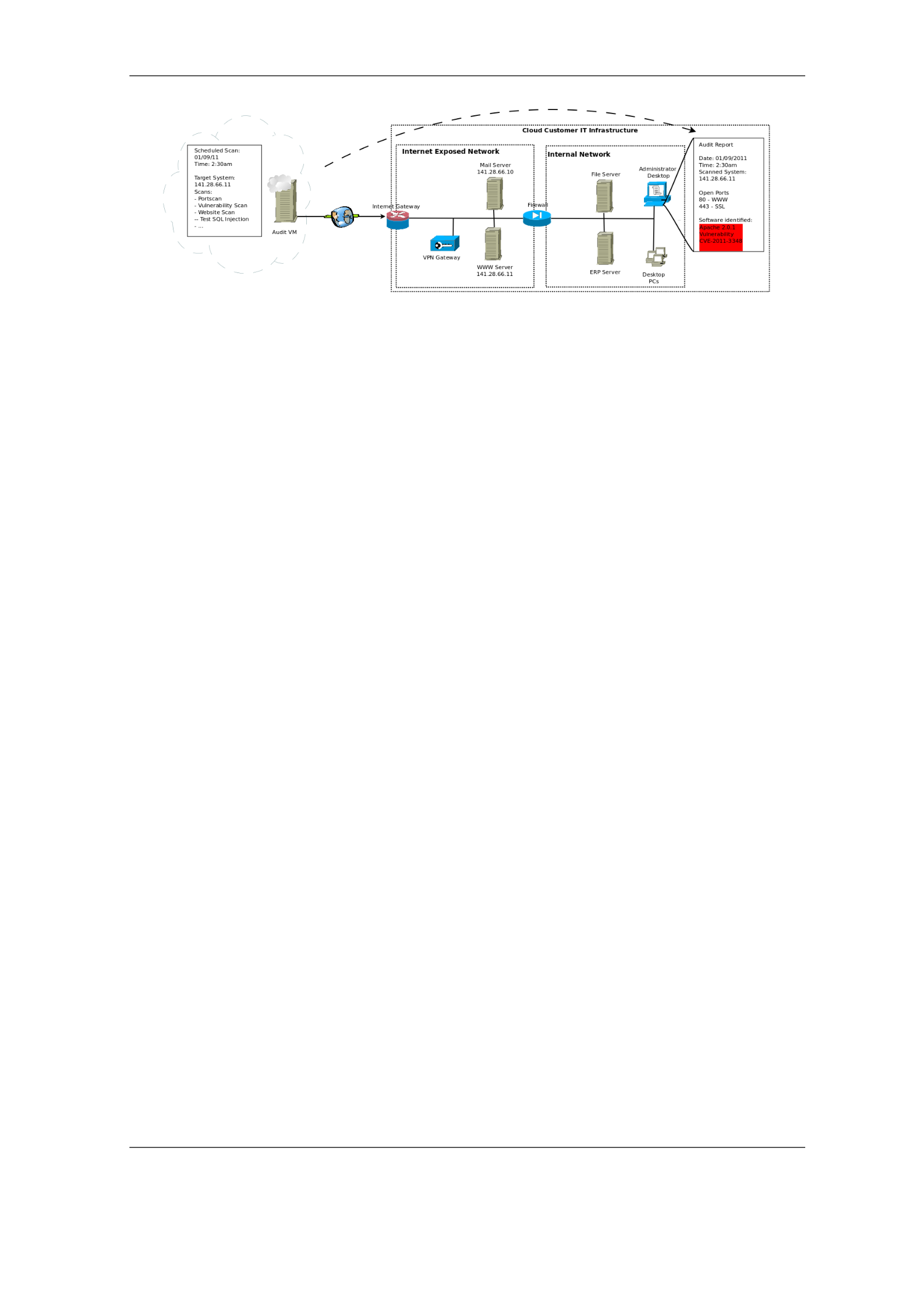
3.5. Security Audits in Clouds
Figure 3.5: Audit from the Cloud
definition of use cases, to describe the (non-) functional, architectural and derived
requirements and stakeholders of the target system.
3.5.3 Cloud Audit Use Cases
While cloud environments cause new challenges to traditional IT security audits due
to their characteristics, they also enable new business cases to perform security audits
on a regular basis. This section discusses the following possible use cases for cloud
audits, which also form the use case scenarios for the work of this thesis:
a) Audit of non-cloud IT
b) Audit of cloud IT from the cloud customer point of view
c) Audit of cloud IT from the cloud provider point of view
Use Case A) - Audit of Non-Cloud IT
A typical enterprise is running at least the following basic IT infrastructure:
•File server to store documents
•Web server for company web site
•Mail server
•ERP system for financial transac-
tion and reporting
•Internet connection and basic net-
work services
69

Chapter 3. Cloud Infrastructure Audit
Installation and maintenance are undertaken either by an external provider or an
internal system administrator. Since some of these components are exposed to the
internet due to their very nature, IT security audits should be performed to provide
a descent level of protection of data and system availability. But especially small and
medium enterprises face the following problems:
•Costs of an IT security audit performed by a third-party security provider are
out of proportion to the company’s revenue and available IT budget.
•Security is also undertaken by the company’s administrator; however, frequently,
IT security specific knowledge is missing. Priority is more commonly attributed
to system maintenance and security controls rather than training.
Due to the cloud computing’s pay on-demand model, “audits from the cloud” can be
offered as depicted in Figure 3.5. A cloud customer can rent an “Audit VM”, which
was compiled by a security provider, including typical vulnerability assessment soft-
ware. The tools are configured to start automatically in a logical order after the VM
was booted, working through a list of target IP addresses of systems to be scanned.
These will be the internet exposed systems of the customer. The results are con-
ditioned in a standardized form to an audit report, which is sent to the customer’s
administrator. If security problems were identified (for example, an outdated version
of web server software), recommendations, (for instance, from the Common Vulner-
ability and Exposures (CVE)) database are given on how the problem can be fixed.
Customers subscribed to this service, schedule the scans to be performed either once
or on a regular (for example, weekly) basis. Thus, common security problems like
vulnerabilities due to outdated software, insecure configuration of services or compro-
mised systems can be detected. Simultaneously, a comprehensible documentation of
a system’s state over time gets created. After the scan is completed, the report gets
mailed to the customer and the audit VM gets shut down. Customer benefits are:
70

3.5. Security Audits in Clouds
•Pay on-demand model: Audit VM only costs during runtime
•Security knowledge comes from external provider who maintains the audit VM
•Regular vulnerability assessment of Internet-exposed systems
•Audit report in standardized format provided taking into account a system’s
security status over time
It is imaginable that this service could be extended by scanning customer systems,
which are not directly exposed to the Internet. Therefore, an authorised SSH host
key or VPN certificate of the audit VM could be imported to an internal customer
gateway, allowing the audit VM to first establish a connection to a customer’s data
centre. Then internal systems can be included in the scan as well, as depicted in Figure
3.5 There are already some companies on the market that offer a similar service to
the described use case:
•Retina cloud by eEye Digital Security [131]
•The cloud Penetrator by SecPoint [132]
•Website security and anti virus scanner by Kyplex [133]
Use Case B) - Audit of Cloud IT from the Cloud Customer Point of View
In this use case, a cloud customer already uses a cloud offer and runs some instances
(VMs) in a cloud. Due to the introduced cloud computing’s characteristics and re-
sulting problems, the customer faces the following problems:
•Missing monitoring of cloud instances
•Data security issues due to unknown data location and shared technology
•Missing auditability of the cloud provider due to missing transparency
•Loss of overview due to frequent infrastructure changes (VM start and stop)
71

Chapter 3. Cloud Infrastructure Audit
In the traditional data centre scenario, the server landscape does not change often, and
especially SME administrators know “their” systems by heart. In cloud computing,
this can change due to the scalability of cloud resources. Dependent on the demand,
the quantity of a customer’s active cloud instances can increase and decrease quite
frequently, for example, to fulfil a demand of service requests. Since cloud computing
offers “inexhaustible” computing resources, users as well as administrators pick up
on this advantage quite fast. For example, getting an additional machine exclusively
just to try out a new version of a certain piece of software was very unlikely in tra-
ditional IT environments; in cloud computing, this is only a couple of mouse clicks
away at little cost.1Administrators like this, because demand can be satisfied quite
quickly, other running systems are not affected and there is no additional physical
space needed. But this comfort can quickly lead to a loss of overview of the entire
infrastructure, which is critical for securing it. Furthermore, in traditional data cen-
tres, security administrators harden systems and use a combination of firewall rules
and intrusion detection system to secure it. But in the cloud, this is not applicable
anymore due to the loss of control over hardware and shared technology issues. To
overcome these problems in this use case, each cloud instance and the corresponding
cloud infrastructure, for example, virtual switches, VM hosts, router and switches, are
monitorable. Therefore, an agent framework can be used, providing “audit agents”
deployed at core components of a cloud infrastructure, as illustrated in Figure 3.6. It
shows the cloud reference architecture based on work from University of Los Angeles
and IBM [48], presented earlier in Chapter 2. By adding audit agents to every layer,
transparency to the cloud infrastructure can be provided for the user. Each agent is
producing events in case an ominous transaction was detected. The cloud customer
will define cloud security policies regulating, which components should be monitored
1If a private cloud scenario is considered, costs come down to zero in currency terms, and just the
available resources count.
72
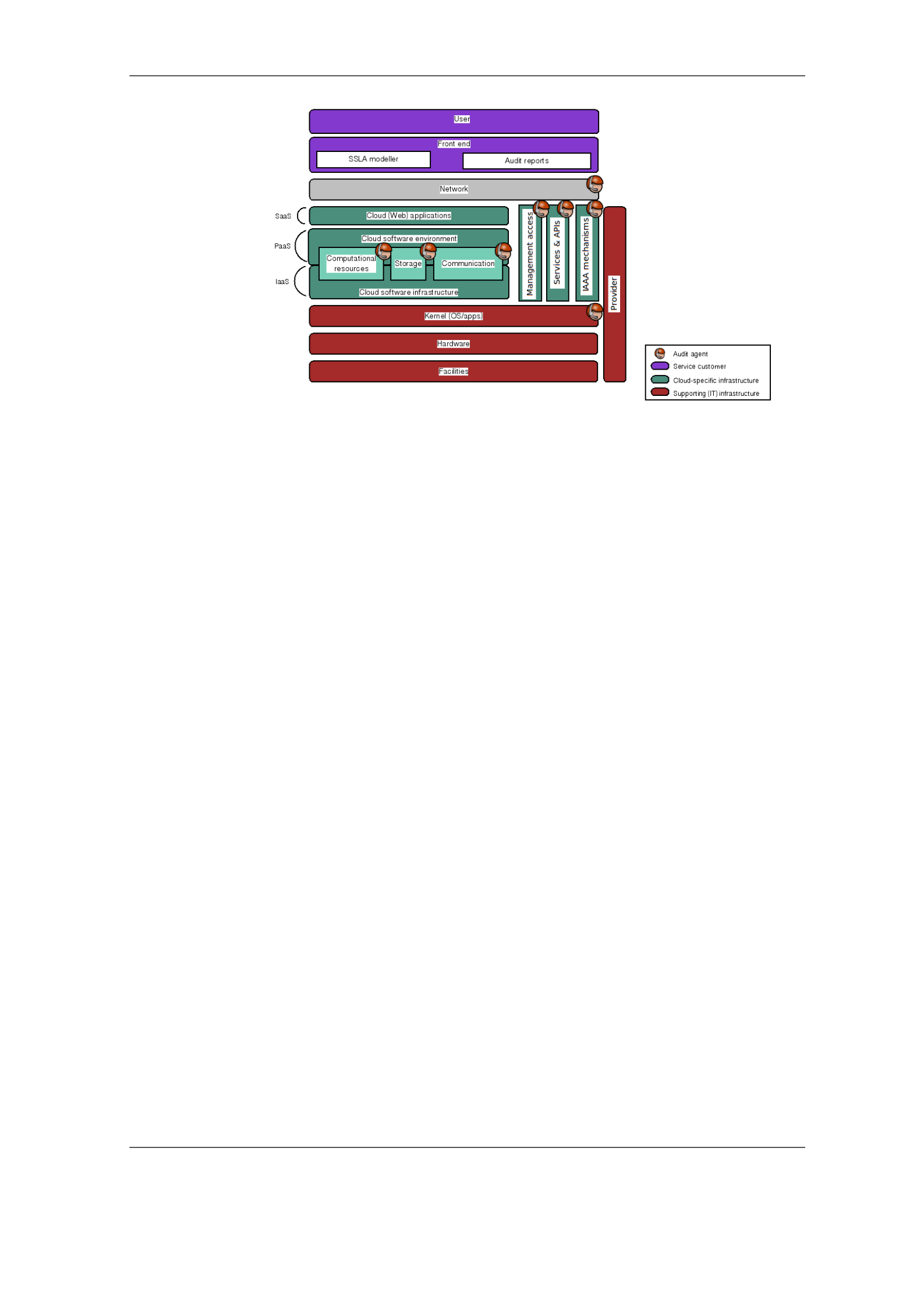
3.5. Security Audits in Clouds
Figure 3.6: The cloud reference architecture extended by audit agents
and how, as well as alarm levels describing how the system automatically reacts in the
event of a detected security incident.
Additionally, the described audit system from the previous use case can be applied
to internal cloud instances as well, extended by using the audit agent’s events as
additional input for the audit report. The following advantages can be achieved for a
cloud customer:
•Better overview of all customer-associated instances, possibly created from mul-
tiple accounts
•Transparency about cloud instances’ security state
•Transparency about provider’s administrative access
The following open-source or research projects are aiming to support this use case:
•CloudAudit A6 [127]
•Security Audit as a Service (SAaaS) [134]
73

Chapter 3. Cloud Infrastructure Audit
Use Case C) - Audit of Cloud IT from the Cloud Provider Point of View
From the cloud provider’s point of view, running and maintaining a cloud infras-
tructure are more challenging than a classic data centre. The reasons lie in cloud
computing’s characteristics, mainly its multi-tenant user model. To be successful, a
cloud provider needs to prove the following:
•Compliance to laws, especially data protection laws
•Compliance to laws of all sub tractors
•Isolation and adequate segregation of shared computing and storage resources
•Measurements taken for availability, service and data protection, for example,
backups and comprehensive continuity-of-operations plan
•Measurements taken to secure the cloud network environment, for example, in-
trusion detection systems, firewalls and logging facilities
•Accordance of cloud infrastructure with audit requirements
•Logging of all administrative access to customer’s cloud resources, for example,two-
factor authentication for cloud administrators, codes of conduct and confiden-
tiality agreements
•Customer specific audit requirements
To fulfil this need, this research as well as governmental and industry security ex-
perts [88], for example, the German Federal Office for Information Security (BSI),
recommends security audits and certificates as the preferred method of proof. Tradi-
tional IT security audits or penetration tests need to be adapted to a cloud’s specific
attributes, as described in the previous chapters. Principally, it is important to provide
continuous monitoring of the cloud’s security state over time. Due to the frequently
changing infrastructure, the possibility that misusers of cloud resources are already
74

3.5. Security Audits in Clouds
within the cloud’s network (currently most are authenticated by a credit card number)
are facts that traditional intrusion detection systems cannot cope with. Therefore, a
monitoring system built on audit agents as described in use case B) - Audit of Cloud
IT from the Cloud Customer Point of View can provide the following advantages for
a cloud provider:
•Monitoring and detection of attacks against the cloud management system
•Monitoring of cloud usage behaviour to detect misuse of cloud resources (by
legally registered cloud customer)
•Support for IT forensic investigations in case of successful attacks
•Displays security state of cloud infrastructure over time
•Proof of compliance to laws
•Possible interface to third-party security provider for external audits
Special Use Case: Auditing of Virtual Machine Images
A special use case for cloud audits is the security of virtual machine images. As listed
in Section 3.4 - Shared technology issues, using third party appliance images from
public marketplaces can pose a significant security risk. Therefore, not only running
virtual machines need to be audited in a cloud environment, but also virtual appliance
images, from which virtual machines are created. Thus, the topic gets elaborated in
more detail in the following subsection. However, in the total scope of this research,
auditing of virtual machine images is considered as either part of Use Case B) - Audit
of Cloud IT from the Cloud Customer Point of View or Use Case C) - Audit of Cloud
IT from the Cloud Provider Point of View.
75

Chapter 3. Cloud Infrastructure Audit
VM Auditing Requirements
To be able to automatically audit VM images, it is essential to describe the security and
privacy requirements, in a machine understandable way. This is commonly achieved
by the definition of security policies, transferring a requirement into a checklist of one
or multiple testable conditions. To respect cloud user’s and provider’s security require-
ments, both parties need to be able to create policies. A key factor for the success
of such a system is the detailed and distinct definition of security policies. However,
this is contrary to a short VM deployment process a cloud user expects. Therefore,
this work proposes to create a very easily operable, security policy generator, where
cloud users can define security policies in a human way of thinking. Simple policies
could be supported by a graphical web interface with templates utilising check boxes
or drop-down lists. This needs then to be translated into a machine understandable
format, which results in the audit checks to be performed. The output of these checks
needs to be translated back into a human understandable format, which will form
the audit report submitted to the image creator, cloud provider and image user. In
summary, the following important audit requirements can be identified:
•Automatic VM image auditing, to provide short response times to an image
creator who wants to publish its image.
•The system needs to respect different security requirements from the image cre-
ator as well as the cloud provider.
•The system needs to produce a human understandable output in case an image
did not pass the security check, providing the image creator with information
about what prohibited the image release so that he is able to fix it.
•Security policies need to be described in a machine understandable way.
76

3.5. Security Audits in Clouds
VM Audit Roles
When it comes to auditing virtual machine appliances, there are a couple of different
roles, which need to be considered: appliance user,appliance creator,cloud provider,
audit service provider and audit tool provider. These roles will be described in more
detail in the following.
The appliance user is a customer of the cloud provider obtaining the virtual machine
images via the appliance store. The main concern of the appliance user is to make
sure, that the VM complies with the company’s IT security policy when using third
party appliances. Such a security policy may include the necessity of malware checks
(e.g., viruses, trojans, spyware, rootkits etc.), checks for undesirable software (e.g.,
games, file sharing software) but also a more detailed view on the operating system
and services configuration of an appliance. For example, if there exist unprivileged
system user accounts for running a web server or if there are any leftover default
passwords, which the appliance creator may have overlooked. The auditing’s goal,
from an appliance user’s point of view, is to make sure a virtual appliance complies
to his company’s security policy, before the appliance is started and integrated in the
company’s IT infrastructure.
The appliance creator can be the cloud provider himself or a customer of the cloud
provider. He creates individual VMs and shares them with other cloud customers
using an appliance store. Before publishing virtual appliances, the appliance creator
has to make sure that there is no private data, which could compromise privacy (e.g.,
logs, browser cache, user information like names and addresses), left on the image.
Another, often overlooked, aspect are non-securely deleted files on the image’s file
system. It is often possible to recover such files with little effort using file carving tools,
like extundelete [135] or winundelete [136]. The auditing’s goal from the appliance
creator’s point of view is therefore mostly to make sure policies, which prevent the
77

Chapter 3. Cloud Infrastructure Audit
disclosure of sensitive data, are used during auditing of the appliance before it gets
published.
The cloud provider provides the technical infrastructure for running the virtual
machine image and also runs the appliance store. Providers usually have little or no
interest in restricting the creation and publication of virtual machine appliances, as
long as there is no violation of laws or terms of use. Such violations may include the
intentional distribution of malware, intentionally misconfigured services or any form
of illegal content, such as pirated software.
The two remaining roles audit service provider and audit tool provider have no
immediate interest in auditing virtual machine appliances. They merely complete the
auditing process by providing additional services and tools. The audit tool provider
designs, develops and provides programs and services for auditing virtual machine im-
ages. The audit service provider is a specialist in auditing IT infrastructure and there-
fore has extensive knowledge about auditing procedures and methodologies, which he
offers to the cloud provider. They also provide the cloud provider with work-flows,
recommendations about the tools to use, knowledge about currently emerging threats
to security and privacy as well as any additional auditing know-how.
Auditing Categories
The auditing categories identified by the author are security,privacy and legal con-
cerns. Multiple audit cases from these categories can be arbitrarily combined to form
an auditing policy. Each of the previously described roles has a different view on the
requirements the audit process has to fulfil. Table 3.5 illustrates this circumstance.
The security category includes requirements regarding the absence of malware and
otherwise undesirable software in the virtual appliance. Also, the preconfiguration of
the appliance’s services, like access rights on a file system level, the combination of
services (e.g., mail daemons and network attached storage (NAS) service on the same
78

3.5. Security Audits in Clouds
Appliance
User
Appliance
Creator
Cloud
Provider
Security
Malware x x
Undesirable Software x
Account Requirements x
Login Requirements x
Password Strength x
Access Rights x x
Service Misconfiguration x x
Unwanted Service Combination x
Privacy
Browser Caches x
Log Files x
History Files x
Insecurely Deleted Files x
Legal
Software Licenses x x
Illegal Content x x x
Customer Specific Requirements x
Table 3.5: Virtual Appliance Audit Categories
appliance), insecure default service configurations, the use of insecure default pass-
words and login requirements (allowing remote administrator access with passwords)
are the most common concerns. The privacy category includes mostly requirements,
which should help preventing unintentional data loss. This includes leftovers from the
appliance setup process, like log files, command line history or insecurely deleted files.
Additionally, this category also includes data generated by end-user applications (e.g.,
browser caches). The legal category includes all sorts of compliance requirements, for
example illegal content stored on the image.
The appliance user obviously has much more interest in secure and compliant appli-
ances. One could argue that data loss while using the appliance because of miscon-
figured services or backdoor programs could be assigned to the privacy category, but
79

Chapter 3. Cloud Infrastructure Audit
this data loss arises because of security problems.
The appliance creator has mostly privacy concerns, when publishing virtual appliances.
Checks for the previously described problems need to be thoroughly executed before
publishing a virtual appliance. Also, not publishing preinstalled software licenses is a
legal problem, which needs to be checked.
The cloud provider’s main concern is protecting his own infrastructure. Therefore, the
categories, which apply are security and legal. Checking virtual appliance images for
malware may reduce the risk of malware spreading and hackers using the appliance
store as a basis for their attacks. Checking for illegal content may also be necessary
because the cloud provider stores virtual appliances.
As mentioned, in the total scope of this research work, auditing of virtual machine
images is considered a sup part of Use Case B & C) - Audit of cloud IT from either
the cloud customer or cloud provider point of view.
3.5.4 Cloud Audit Test Criteria Catalogue
As elaborated, security audits are a commonly acknowledged measure to validate se-
curity for IT infrastructures. However, since cloud computing introduces new security
risks, cloud security audits need to consider the special characteristics of cloud com-
puting. Based on the studies on cloud security issues (Section 3.4) and cloud audits
(Section 3.5) multiple interviews and meetings with a German cloud provider [137]
and a German IT security provider [138] were held to identify security concerns and
challenges of applied cloud computing technology. As a result, an “Audit Test Criteria
for Cloud Infrastructures” catalogue [9] was developed by this research. It is written
in German (since it is also an official deliverable by the SAaaS project, which is funded
by the German government), publicly available for download at the Security Audit
as a Service project web site [139]. The catalogue is also an official deliverable of the
80

3.5. Security Audits in Clouds
funded SAaaS research project, introduced in Chapter 1.4.
The catalogue is targeted for professional, safety aware cloud customer, IT decision
makers who consider moving services to or changing their data centre structure to
become a cloud provider and cloud computing provider and their administrators who
wants to operate a secure cloud environment. Furthermore, it is also meant for security
service providers, who investigate cloud infrastructures in a penetration test or a
infrastructure audit. The catalogue provides over 140 test criteria. Each test criterion
is classified into an audit category, numbered and sorted in ascending order. For
example, the first audit test criterion (in German: Auditpr¨ufkriterium PK) “A1PK1
- Log analysis” is the first test criterion of the audit criteria “A1 - Security of network
connections”.
All criteria are classified (A, AA, or AAA) according to the official “protection require-
ments classes”, defined in the IT security baseline catalogues [101] from the Federal
Office for Information Security, Germany. Audit test criteria of class A apply for
systems, data or usage scenarios with normal protection requirements. Class AA ap-
plies for systems, data or usage scenarios with high protection requirements, and class
AAA apply for systems, data or usage scenarios with very high protection require-
ments. Each of the 140 audit test criteria is explained in detail within the catalogue.
At the end of each subcategory a table (see Figure 3.7) summarizes all test criteria of
the category to provide a quick overview. The protection requirement class is indicated
in column 3 - 5.
All test criteria are divided in the following subcategories:
User Access: contains audit criteria to validate a secure user access to the rented
cloud services, including programming interfaces, which are quite commonly used in
IaaS and PaaS Clouds.
Network & Peripherals: covers requirements for typical network components of a
cloud infrastructure, such as switches and routers, especially virtual switches, virtual
81
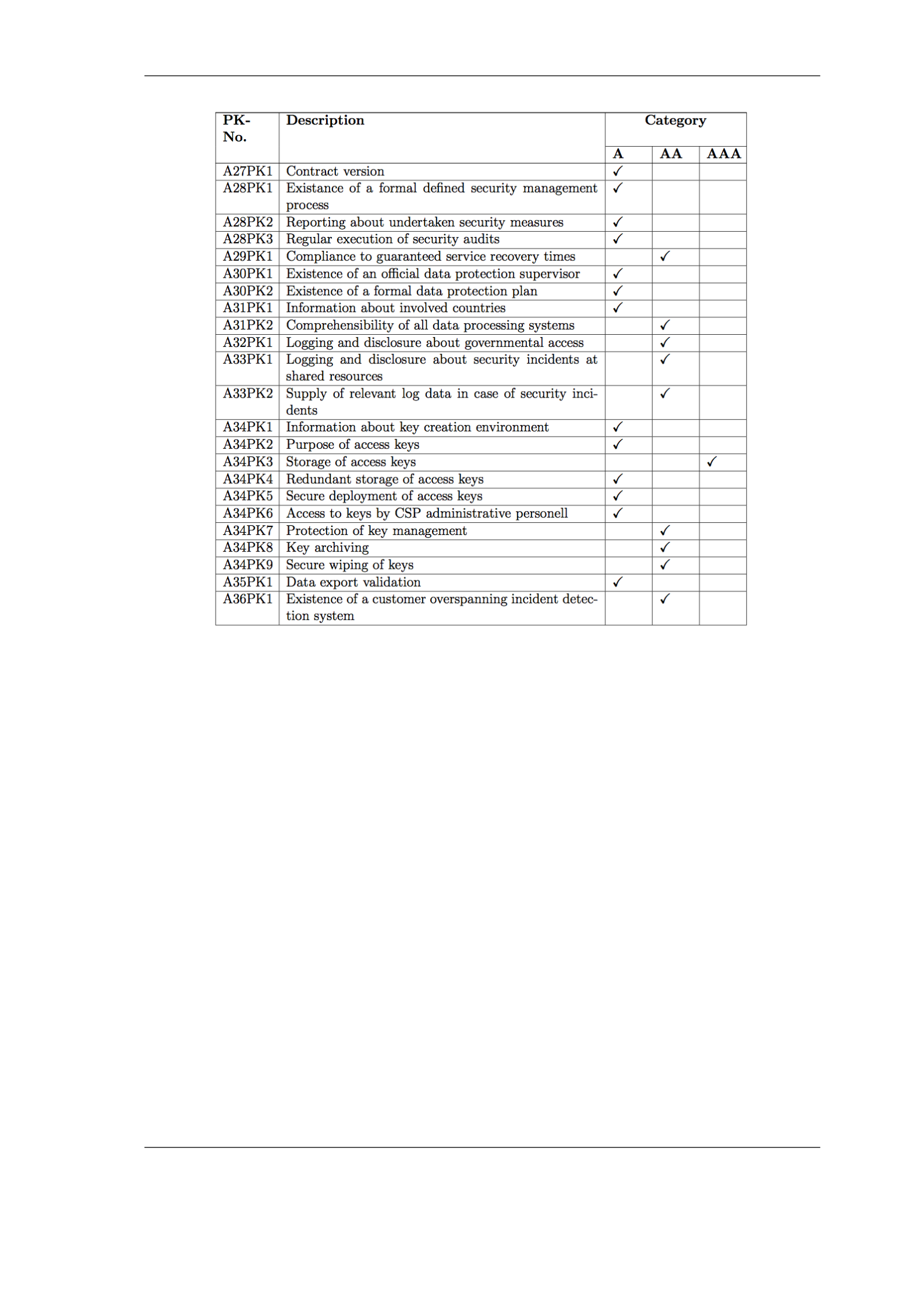
Chapter 3. Cloud Infrastructure Audit
Figure 3.7: Summary audit test cases “Infrastructure overlapping criteria” [9]
networks and their segregation. Tests include the validation that only encrypted
connections are used between cloud components.
Cloud Management System: This category concentrates on the security of the core
component of an IaaS Cloud, the cloud management system. It is used for management
and life cycle of the virtual resources offered to cloud users. Furthermore, it provides
monitoring information about the cloud infrastructure and their services, such as load
balancer, scalability thresholds or scalability actions. It is also important for user
management, billing and accounting due to a cloud’s pay on demand characteristic.
Cloud Hosts: contains audit criteria on the security of cloud service hosting ma-
chines. Beneath a secure configuration of the hardware and its operating system it
concentrates on the hypervisor security, which provides virtualization functions.
82

3.5. Security Audits in Clouds
Cloud Backend Storage System: stores VM images (IaaS, SaaS) and user data of
Storage as a Service services. Typically distributed databases are used for this in a
cloud infrastructure. An important test critera is a proof of data security and secure
data wiping in case of shared storage units (especially duplicates) or if a customer
quits its cloud usage.
Infrastructure Overlapping Criteria: cover non-technical, organisational and con-
tractional audit test criteria. Very important are service recovery guarantees regulat-
ing, at what time cloud resources are available again after an infrastructure failure.
Test criteria in this category also oblige the provider to provide information about
processes in case of governmental requests on customer data. Who is legally allowed
to file a request on customer data disclosure? Is governmental access on customer
date recorded and accessible to the cloud customer? This category covers also the
proof of physical data location. In case of bankruptcy of the cloud service provider
clear procedures must exist, on how customer get their data out of the cloud. Do
export interfaces exist? Is the export format standardized or compatible to other
cloud service provider? Finally, which technical measurements are taken by the CSP
to detect cloud specific security incidents? Are early detection measures in place to
protect parts of a cloud in case of a security incident?
Administrative Access from cloud service provider’s personell: Since a cloud
provider’s personell, especially administrators of cloud infrastructure components, has
privileged access to confidential data, transparency about access monitoring and trace-
ability is very important.
IaaS specific criteria: covers all technical and organisational criteria which do not
fit in any of the other categories, since they are specific to IaaS cloud infrastructures.
In IaaS it is important to differentiate if VM images are provided by the CSP or
completely created and managed by the cloud user. If VM images are provided by
83
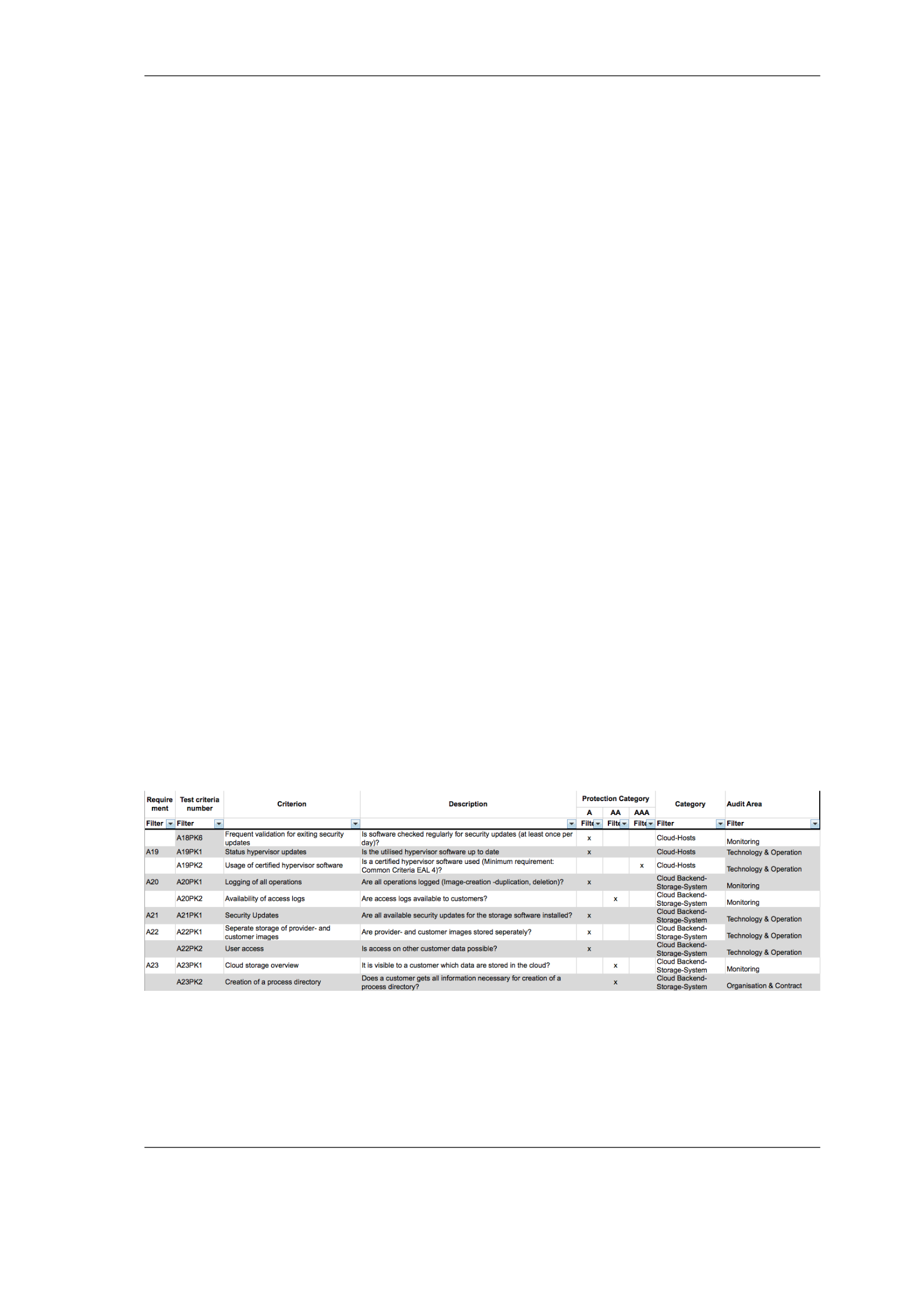
Chapter 3. Cloud Infrastructure Audit
the CSP, responsibility about compliance to the audit test criteria of this category is
with the provider, whereas if no images are provided, responsibility lies with the cloud
user.
PaaS specific criteria: Fundamental system settings of the underlying cloud in-
frastructure usually can’t be managed by the cloud user. Thus, administrative re-
sponsibility is with the cloud service provider. Since in PaaS cloud applications are
developed by cloud user, responsibility about security in data processing and manage-
ment within the application is with the cloud user [140]. This subcategory contains
PaaS specific audit test criteria.
SaaS specific critera: For SaaS, all IaaS and PaaS criteria apply. In addition, this
subcategory lists SaaS specific audit test cases, such as specific export formats of user
data in case of a provider switch or what measurements exist to detect misusage of
the rented software.
Cloud Audit Criteria Excel Spreadsheet
Additionally to the catalogue, an Excel spreadsheet, which contains all audit test
criteria was created as a result of this research. Figure 3.8 shows a cutout of the
spreadsheet.
Figure 3.8: Cutout of audit test criteria catalogue spreadsheet [10]
It can be used to provide input criteria based on the audit criteria catalogue for an
84

3.6. Summary
expert system. It is separated into the following columns: audit criteria, description,
protection class, criteria class and audit area.
The audit criteria describes the technical or organisational measure which needs to
be audited, such as: “Which measurements exist to test virtual machines on the
availability of software updates (OS and applications) on a regular basis” (Figure 3.8,
row 1). The description column lists detailed test information on the corresponding
test criteria, such as possible tools for the test or minimum or maximum values. In this
example it states: “Is a check for security updates performed at least once a day for all
software installed on VM images?”. The protection class column indicates if this test
criterion applies for assets with a normal (class A), high (class AA) or very high (class
AAA) protection requirement class. The audit area describes typical topic areas of
security audits, such as technical components and operation, monitoring, organisation
and contract or business continuity management. The spreadsheet enables user to
filter the criteria corresponding to their needs, such as protection class of their assets,
audit class or audit area. The catalogue is already used in industry, for example by
the management of the data centre of the federal state Rhineland-Palatinate [141].
Further cooperative developments of the catalogue are planed.
3.6 Summary
This chapter introduced cloud security incidents to show that there is a demand for
research on cloud security. Then, the main differences between traditional IT out-
sourcing and cloud computing were discussed. Amplified Cloud Security Problems
(amplified CSP) and Specific Cloud Security Problems (specific CSP) were presented
and a classification of affected core principles of information security was given for
every identified problem. Table 3.3 summarised the presented cloud security prob-
lems, classified them according to their origin (IT outsourcing, virtualization or cloud
85

Chapter 3. Cloud Infrastructure Audit
computing). If known, real-world examples of security incidents resulting from a dis-
cussed problem were listed, and a short overview of countermeasures was provided.
Due to the identified lack of technical audit criteria for IaaS clouds (Chapter 3.3 an
analysis of traditional it security audits was performed. To provide audits for cloud
computing infrastructures, there is a critical need for audit criteria respecting cloud’s
characteristics and nature. The following limitations current audits and related work
on cloud audits were identified:
•Lack of technical and organisational detailed audit criteria for clouds, especially
IaaS clouds
•High fluctuation in infrastructure: In IaaS cloud infrastructure changes very
frequently. An audit needs to respect this, re-validating security status after
change
•Loss of 1:1 mapping: Due to the technology shifts towards VMs, virtual land-
scaped, location transparency is not clear for the customer.
•Static gets variable: Dynamic changes of IPs, data centres and servers depend
on demand, time of day, etc.
•Audit analysis: Data needs to be retrieved, correlated and extracted meaning-
fully in a permanently changing infrastructure
•Audit as a service: For customers, it might be important to audit their business
processes across multiple cloud providers.
To mitigate the first limitation, an audit test criteria catalogue for cloud infrastructures
was developed and published. It contains over 140 audit test criteria, arranged in ten
categories (depicted in Figure 3.9) to mitigate the elaborated cloud security risks. To
address the remaining limitations, this research then went on to develop a Security
Audit as a Service system for cloud computing to provide the following advantages
86
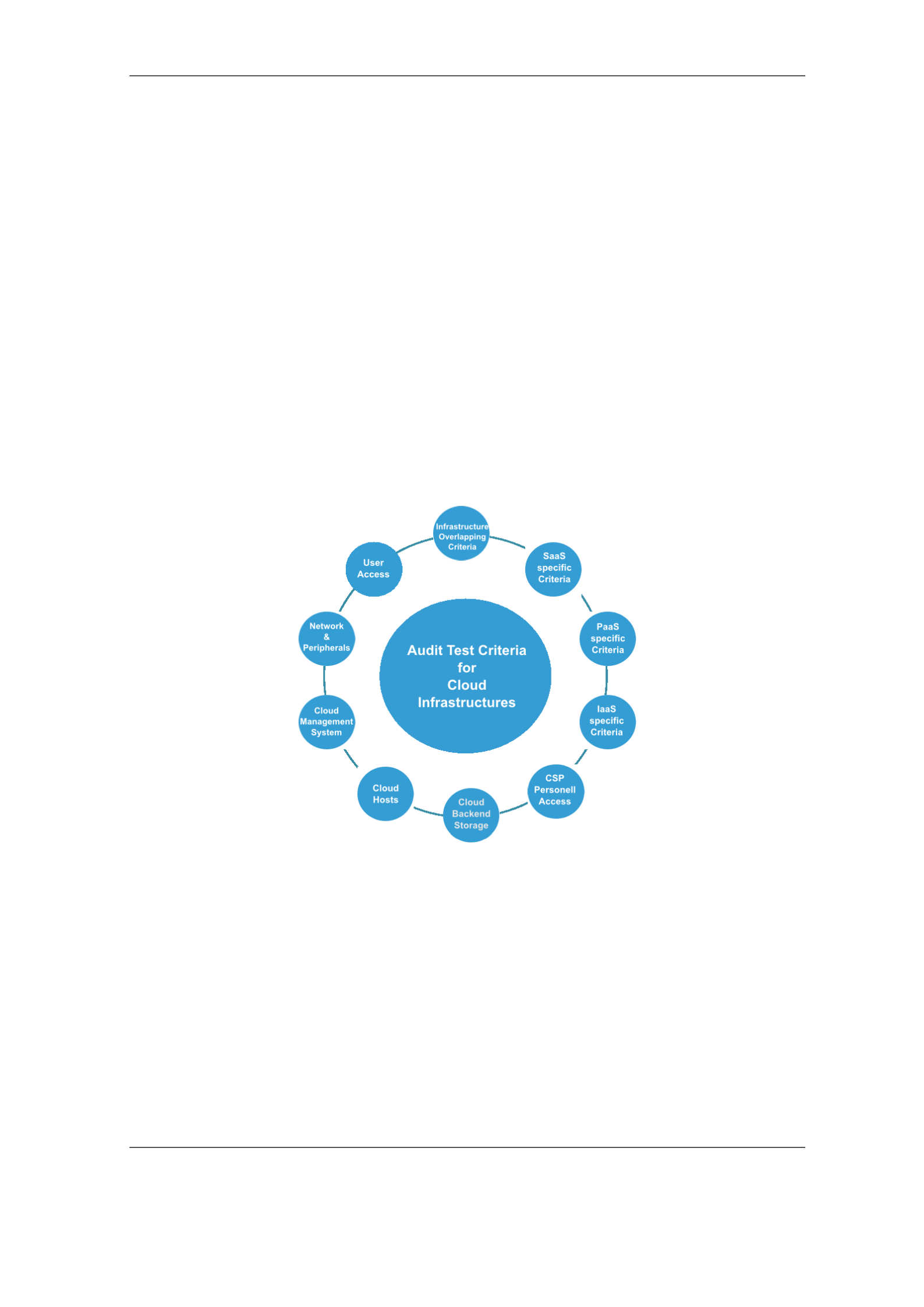
3.6. Summary
over traditional audits:
•High fluctuation in infrastructure: Consideration of a cloud’s flexible nature
•Consideration of virtualization technology and their characteristics
•Consideration of a cloud’s variability: Dynamic changes of IPs, data centres and
servers of virtual instances
•Audit analysis: Meaningful correlation and presentation of data for cloud cus-
tomers and providers
•Audit as a service: on-demand provider independent audit system, configurable
in a flexible manner
Figure 3.9: Audit Test Criteria Catalogue for Cloud Infrastructures [9] categories
87


4
Security Audit as a Service (SAaaS)
“Logic will get you from A to B. Imagination will take you
everywhere.”
(Albert Einstein, Theoretical physicist)
The previous work identified a need for a security system respecting cloud specific
characteristics. Whereas organisational and regulatory needs could be satisfied with
the previously presented audit catalogue, there is still a need for a technical audit
solution for clouds. Thus, this chapter introduces the Security Audit as a Service
(SAaaS) architecture. It is built upon intelligent software agents, which are aware
of underlying business driven intercommunication of cloud services. This enables the
architecture to be flexible and to supported cross customer event monitoring within a
cloud infrastructure. An agent definition is given, and it is elaborated how agents can
improve incident detection and auditing in a highly dynamic infrastructure. Finally,
the SAaaS architecture components is presented in detail. It forms the second novel
contribution of the research.

Chapter 4. Security Audit as a Service (SAaaS)
4.1 Introduction
Monitoring and auditing the security of large IT infrastructures with distributed sen-
sors as input feeds is commonly done by Intrusion Detection Systems. But this ap-
proach breaks down for cloud infrastructures, mainly because of the complexity and
frequently changing environment driven by the user. Literature review on cloud audit
systems (Section 4.2) shows, that there has been little effort made to address this issue
of auditing a frequently changing cloud infrastructure. To mitigate this problem, this
research proposes a concurrent audit system for cloud infrastructures: Security Audit
as a Service. It is a novel audit system which can be either used as an on-demand audit
system from the cloud, which can evaluate an user’s internet exposed IT components,
or as a concurrent audit system, which monitors cloud instances, reacts on changes
within a cloud infrastructure and automatically performs security audits of the affected
cloud instances to evaluate their security status. This is called “concurrent auditing”.
To achieve this, SAaaS is build upon intelligent agents, collecting data directly at the
source, analysing and aggregating information and distributing them, while consider-
ing the underlying business process. The usage of agents enables a concurrent auditing
of cloud components, while maintaining the cloud’s specific flexibility.
Summary of Research
This part of the research develops the Security Audit as a Service system, which
fulfils the identified limitations on cloud audits, by providing:
•A virtualization and cloud software independent audit system
•A cloud audit system, which respects IaaS cloud characteristics
•A possibility for specifically targeted audits of affected cloud instances
•A lightweight agent framework to respect a cloud flexibility and scalability
90

4.2. Related Work
Parts of this research phase have been published in the following papers and presented
to the research community at the corresponding conferences:
•An Autonomous Agent Based Incident Detection System for Cloud Environ-
ments, 3rd IEEE International Conference on cloud Computing Technology and
Science 2011 [142]
•Incident Detection for Cloud Environments, International Conference on Emerg-
ing Network Intelligence 2011 [143] - Winner of Best Paper Award - Track
Security
•Validating Cloud Infrastructure Changes by Cloud Audits, Eighth IEEE World
Congress on Services 2012 [144] - Winner of 2nd place at IEEE Services
Cup 2012
•An agent based business aware incident detection system for cloud environments,
Journal of cloud Computing: Advances, Systems and Applications 2012 [145]
4.2 Related Work
Before presenting the Security Audit as a Service architecture, related work on IaaS
cloud security systems utilising agents is elaborated. Raj et al. [146] introduce a vir-
tualization service implemented as Xen Virtual Machine extensions, which provides
role based access control based on a trust value of a VM. This trust is based upon
a VM’s attributes, such as number of open network connections. Access to different
cloud services, for example file access is given on a VM’s trust value. The implemen-
tation presented is mainly based on Xen tools. The proposed services by [146] are
valuable, however strictly limited to Xen. Thus, a technology independent audit sys-
tem is needed. The developed SAaaS system of this research will deliver a hypervisor
technology independent audit solution, which is widely applicable.
91

Chapter 4. Security Audit as a Service (SAaaS)
In [147] Wei et al. present a VM image management system, which controls VM image
access and tracks image provenance to address the issue of security patches for VM
base images. It provides a prototype image scanner to scan software versions installed
within a VM image and filter for the user to exclude images with unpatched software
stacks. The proposed SAaaS architecture will extend the presented trust model of
[147] by the ability to evaluate business process driven cloud infrastructure changes
by the evaluation of underlying security business flows.
To provide secure cloud hosts running VM images the authors of [148] and [75] pro-
pose the usage of TPM/TCPA crypt chips for secure OS installation. The SAaaS
architecture can utilise all of the above introduced techniques to establish a trusted
computing base for cloud environments and extends them to provide cross customer
trust.
The applicability of using complex event processing (CEP) in cloud environments is
demonstrated by Schaaf et al. in [149]. The authors present a predictive cloud broker
which reacts to changes in business processes and reflects them in up- or downscaling
of cloud resources (VMs). As a decision base distributed monitoring instances in re-
lational database systems are used to feed the CEP engine. While this approach is an
initial step in the same direction as this research, the work remains quite high level
and in particular focuses upon business process changes whereas SAaaS targets the
detection of security incidents. Despite these different application areas, principles of
this work can be applied to SAaaS. It extends them by the consideration of business
process flows, and a reduction of event storms.
Due to the loss of hardware governance in cloud computing, customers need to trust
the provider that data does only get stored on the providers’ storage compliant to
applying data protection laws. This can result in unclear data location. Ries et al.
present in [150] a geo-location approach based on network coordinate systems and
evaluate the accuracy of three prevalent systems.
92

4.2. Related Work
Detecting abuse and nefarious use of cloud resources can be a challenging task, which
proves the rather high level work of [149]. Just evaluating VM usage data, like CPU
and memory usage, or the number of open network connections is not enough, since
it can result in a false-positive decision. To filter out nefarious use of a cloud in-
frastructure, an audit system has to combine usage and network data of the cloud
wide network. Due to the distributed nature of cloud computing, information about
network flow has to be collected at many different physical locations. However, to
get the whole picture this data has to be analysed in the overall context. Therefore,
for the audit system of this research, distributed sensor agents get developed, which
feed an anomaly detection system to evaluate the cloud’s security status in an overall
context. Furthermore, an anomaly detection system gets developed, which utilises be-
haviour analysis and anomaly detection techniques to distinguish between “normal”
and nefarious use of cloud resources.
Distributed Agents Research
Since a core component of the Security Audit as a Service architecture are distributed
agents (presented in Chapter 4), this section presents related work on the usage of
agent architectures.
The advantages of using agents to overcome the challenges of monitoring a frequently
changing infrastructure is discussed in research especially in the area of Intrusion De-
tection & Prevention Systems (IDS, IPS) and demonstrated in [151, 152, 153, 154].
Lui et al. demonstrate in [151] that anomaly detection can enhance the detection of
new, unknown network attacks in an IDS. They show that certain data mining algo-
rithms are more suited to detected certain network attacks than others. Therefore,
multiple agents are proposed, implementing different data mining algorithms to lead
to a higher, more precise detection rate of unknown network attacks. This supports
93

Chapter 4. Security Audit as a Service (SAaaS)
the approach of this research, that agents can enhance anomaly detection of unknown
attacks. While the agents presented by Lui et al. are very static in their perimeter,
the proposed SAaaS agents in our work can be extended during runtime to adapt
better to the current infrastructure state.
Zamboni et al. present in [155], how traditional Intrusion Detection Systems can
be enhanced by using autonomous agents. They confirm the advantages of using
autonomous agents in regards to scalability and system overlapping security event
detection. In contrast to the SAaaS architecture, their research is focusing on the
detection of intrusions into a relatively closed environment, whereas this work applies
to an open (cloud) environment, where incidents like abuse of resources needs to be
detected. While Chirumamilla et al. show in [152], that agents can enhance the se-
curity of wireless networks they don’t really benefit from typical agent characteristics
like deployment on demand as the SAaaS agents presented by this research.
Mo et al. introduce in [156] an IDS based on distributed agents using mobile tech-
nology. They show, how mobile agents can support anomaly detection thereby over-
coming the flaws of traditional intrusion detection in accuracy and performance. The
paradigm of cooperating distributed autonomous agents and its corresponding advan-
tages for IDS’ is also shown by Sengupta et al. in [157]. The presented advantages
apply for the SAaaS agents, developed in this research as well.
Kr¨ugel and Toth show in [154], that processing limitations of IDS can be enhanced by
using mobile agents. Instead of moving sensor information to a central processing unit
they use agents to correlate the monitored event data, thus increasing fault tolerance
and scalability of the intrusion detection system. This idea is partially supported by
the event preprocessing of the presented SAaaS agents in this work. The concepts of
agent frameworks have been widely used in distributed networking environments. Due
to their characteristics (elaborated in Section 4.6) they are perfectly suitable to fulfil
94

4.3. SAaaS Use Cases
requirements of a cloud security audit system. However, due to the best knowledge of
the author no research so far has utilised them to mitigate cloud security issues as it
is done by this research.
4.3 SAaaS Use Cases
The Security Audit as a Service system utilises the following three use cases to show
the usefulness of the proposed architecture. They are a more specific version of the
cloud audit use cases described in Chapter 3.5.3 - Cloud Audit Use Cases.
Use Case 1 - Automated security audit: In this use case, the SAaaS architecture
is used as a Software as a Service solution. An audit can consist of regular vulnerability
scans of a user’s internet exposed systems (not necessarily cloud instances). Results
get automatically evaluated, post-processed and submitted as a security report in
a standardised format to the user. Additionally, to simplify black box scans, it is
imaginable to deposit an entry credential (e.g., a ssh key pair) in the service so that
the service can log in and perform internal security scans. While such systems already
exist as appliances (e.g., Nessus appliance), especially small SMEs can profit from
this service running in a cloud since they only need to pay per scan. For the cloud
provider this service is valuable since computing resources are only allocated for the
duration of a scan. Afterwards, the compute resources are released and made available
for different tasks.
Use Case 2 - Auditing of cloud VM images Using third party appliance images
from public marketplaces can pose a significant security risk, as introduced in Chapter
3.4.2 - A4 Shared Technology Issues. Therefore, images from which virtual machines
are created, need to be audited. This is important for cloud provider to protect the
cloud infrastructure turning into a “Swiss cheese” by running many vulnerable virtual
machines. It is also important for the cloud user to protect their virtual instances,
95

Chapter 4. Security Audit as a Service (SAaaS)
since data could be stolen or the VMs get used as an entry point to their own data
centre.
Use Case 3 - Monitoring and audit of cloud instances: User VMs running in
a cloud infrastructure are equipped with a SAaaS agent. The user creates security
policies defining the behaviour of this VM to be considered “normal”, which VM
components are to be monitored and how to alert the customer in case of system
deviation from the defined manner. The status gets conditioned in a user-friendly
format in a web portal - the SAaaS security dashboard. This continuous monitoring
creates transparency about the security status of a user’s cloud VMs, hence increasing
the user’s trust into the cloud environment.
Use Case 4 - Cloud infrastructure monitoring and audit: The security status
of the entire cloud environment, especially the cloud management system, access to
customer data and data paths are monitored. Usage and communication behaviour
profiles are created automatically and continuously analyzed for substantial changes.
This way, monitoring across different customers is used by the cloud provider as well
as a third parties, like a security service provider to ensure the overall cloud security
status. Standardised interfaces enable security audits of the cloud infrastructure,
which can lead to a cloud security certification.
Before explaining the SAaaS architecture in detail, this chapter continues explaining
the underlying SAaaS event processing sequence. To support this, consider the follow-
ing example of a typical web application architecture, consisting of one or multiple web
servers and a database backend is deployed over multiple VMs in a Cloud. The VMs
are logically grouped together, and labelled as WWW-Cluster1. Initially, the cloud
customer’s administrator installs the VMs with the necessary software, e.g., Apache
web server, MySQL database. After the functional configuration, security policies are
modelled to describe the target infrastructure state. This can be:
A) Technical rules, such as allowed network protocols and connections between VMs.
96

4.4. Cloud Audits Using Agents
A finished configuration of the web servers and a notification trigger in case changes
to its config files are recognised. As a result of these policies, software agents called VM
agents are configured with the necessary tools to monitor and assess these require-
ments and automatically deployed to the VMs.
B) Business flow related security policies can be created as well, such as a simple
scalability policy: “If the cloud management systems gets an upscale event request
for components of WWW-Cluster1, first the actual load of all web servers needs to be
checked. If the average load over all web servers is not higher than a certain threshold,
e.g., 100 http connections / web server, upscaling gets denied and an alarm is raised
since the event must originate from a systems failure or a security incident at the cloud
management system. The same scenario works for downscaling in an inverse manner:
If a downscaling event for WWW-Cluster1 gets detected, but the actual load is above
a downscale threshold, an alarm gets raised.
4.4 Cloud Audits Using Agents
To generalise this scenario: in the SAaaS architecture a modelled security state of
certain components gets monitored by agents, which are deployed at the specific re-
source, such as the cloud management system, a cloud host or a VM. Agents were
chosen over plain objects because of their following attributes, according to [158]:
•Agents function continuously and autonomously in a particular environment
•Agents are able to carry out activities in a flexible and intelligent manner that
is responsive to changes in the environment
•Agents are able to learn from its surroundings
•Agents can communicate and cooperate with each other
•Agents can be (re-) used by multiple entities
97
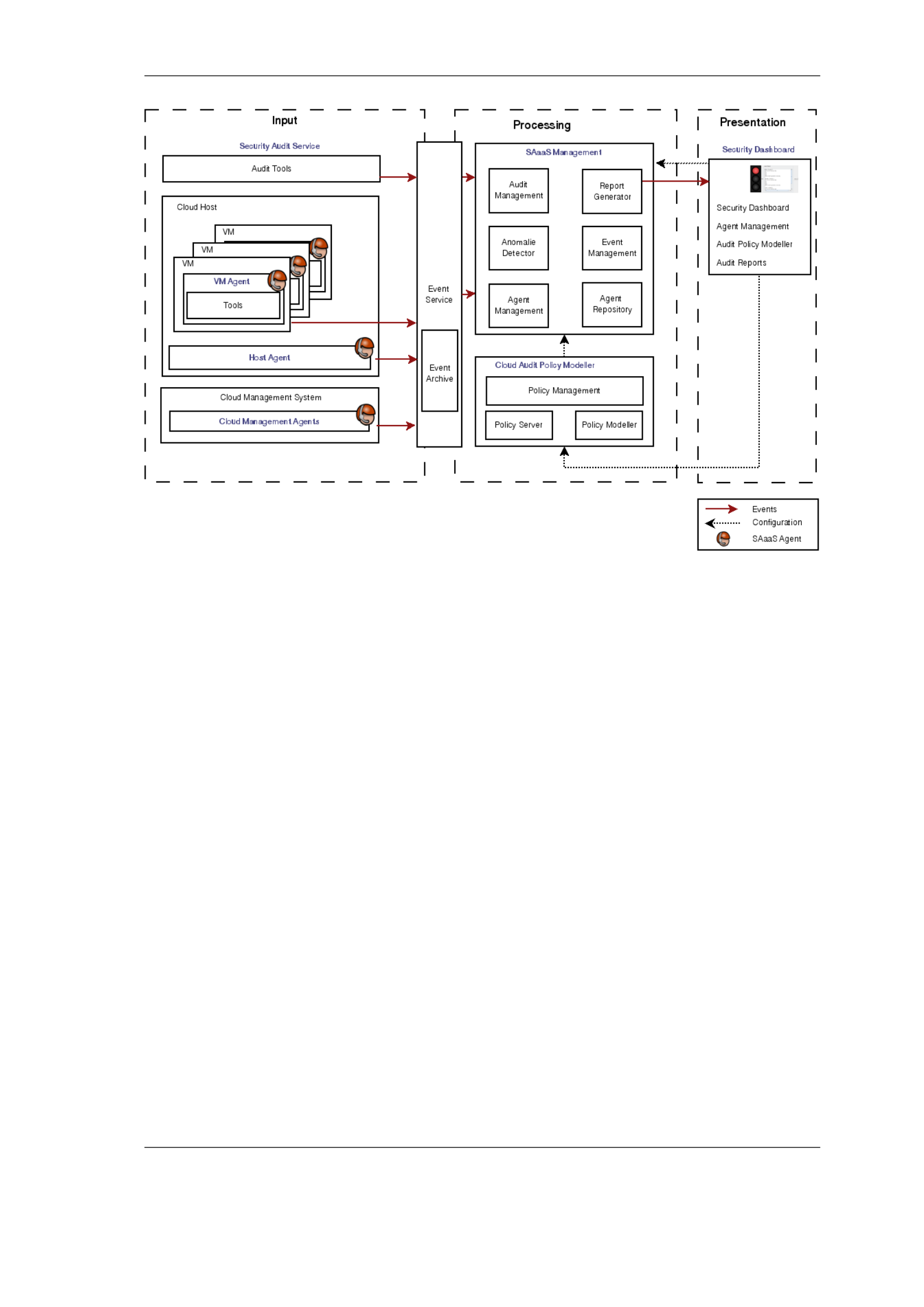
Chapter 4. Security Audit as a Service (SAaaS)
Figure 4.1: SAaaS event processing sequence
Since the agents in the SAaaS architecture are running independently, not necessarily
connected to a certain central instance, agents can receive data from other instances
and send information to other instances like other SAaaS agents or the SAaaS’ event
processing system. The “central” event processing system gets itself implemented as
an agent, which can be scaled and distributed over multiple VMs.
4.5 SAaaS Event Processing
Figure 4.1 gives a high level overview of the SAaaS architecture and where events are
generated and forwarded within the SAaaS architecture. It can be divided into three
logical layers: Input, Processing and Presentation.
Input: The SAaaS architecture gets its monitoring information from distributed
agents, which are positioned at key points of a cloud’s infrastructure, to detect changes
98

4.5. SAaaS Event Processing
in a cloud environment. Possible key points are: running VMs of cloud users, the VM
hosting systems (Cloud hosts), data storage, network transition points like virtual
switches, hardware switches, firewalls, and especially the cloud management system.
An agent integrates several monitor and policy enforcing tools. A logging component
is recording the chronological sequence of events produced by the agent, building audit
trails.
Processing: Each SAaaS agent receives security and audit policies from the audit
policy modeller component. Through security policies, each agent gets a rule set (its
intelligence) specifying actions in case of a cloud change (e.g., modification of a frozen
config file). Thus, every occurrence gets first preprocessed by an agent, which reduces
communication between VM agents and cloud management agent. The Cloud Audit
Policy Modeller consists of a graphical Policy Modeller (policy front end) and a Policy
Server (policy backend). The policy modeller is used to create cloud specific audit poli-
cies. An example could be: “In case of a registered VM upscaling event, the minimum
load on all web server VMs must be at least >1000 requests/second”. Details on
cloud audit policies are discussed in Chapter 5. Cloud audit policies get sent from the
Policy Management to the Agent Management to configure the corresponding agents.
Different agent templates are stored in an agent repository and created on demand.
By using the monitoring information of the distributed agents in combination with
the security policies, a cloud behaviour model is built up for every cloud user. This is
analysed by the Anomaly Detection module to detect user specific or user overlapping
security incidents. Countermeasures can then be applied to early detect and prohibit
security or privacy breaches. Details on the Anomaly Detection are presented in Chap-
ter 6 - Anomaly Detection. An Audit Management module manages concurrent audits
of cloud instances, dependent on the events received from the SAaaS agents or the
anomaly detection module. The Report Generator conditions events, corresponding
security status as well as audit report results in a human friendly presentation.
99
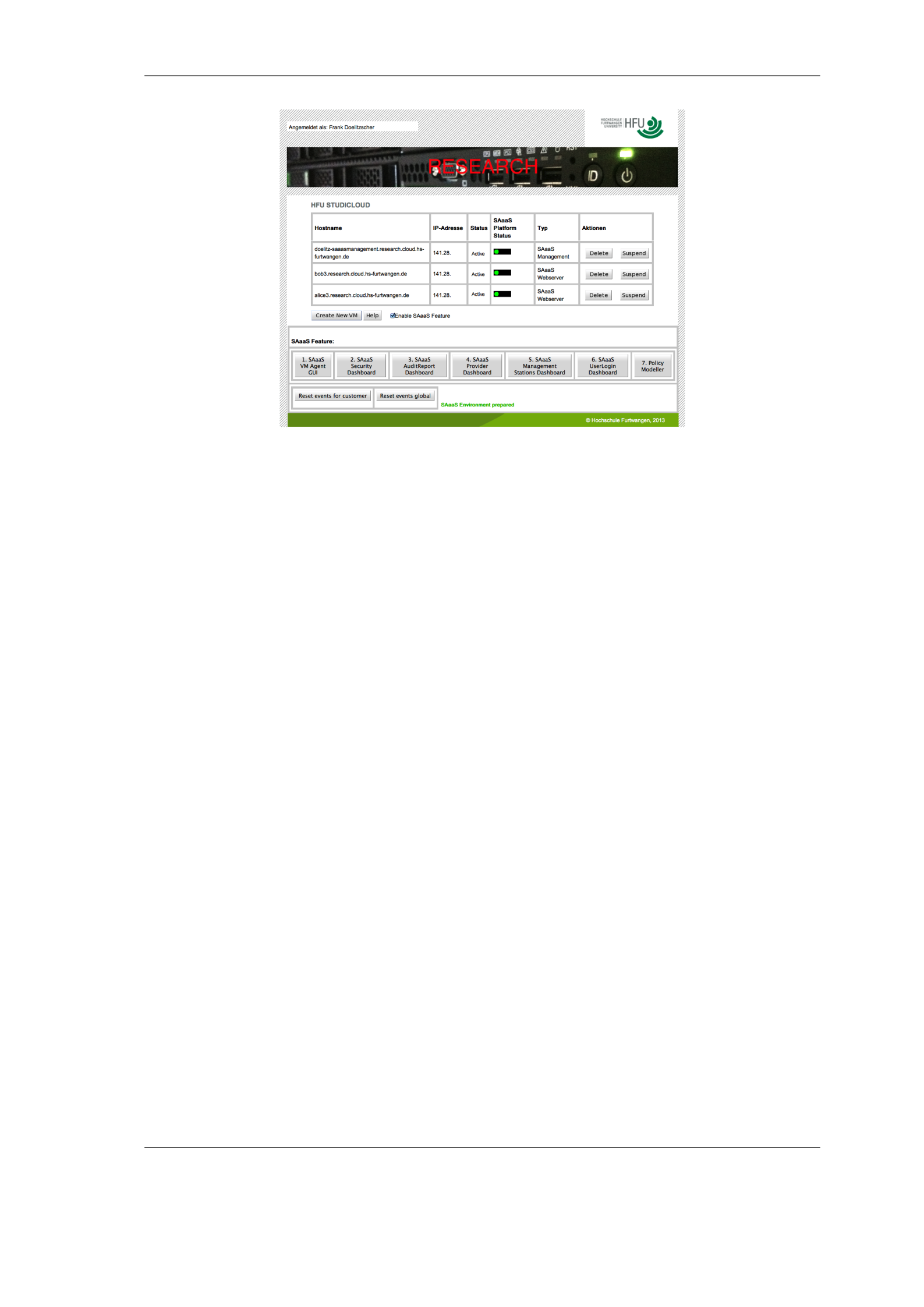
Chapter 4. Security Audit as a Service (SAaaS)
Figure 4.2: Security Audit as a Service Management Interface
Presentation: As a single interaction point to cloud users, the SAaaS Security Dash-
board provides VM information, audit reports and cloud instances’ security status.
Information is organised in different granular hierarchies, depending on the informa-
tion detail necessary. At the highest level a simple three colour indicator informs
about a user’s cloud services overall status. It also provides a graphical user interface
to deploy agents to cloud instances or allows user to manually trigger a specific audit.
Audit policies can be created through the Policy Modeller. Figure 4.2 shows a part of
the security dashboard prototype, which gets described in more detail in Chapter 7.
Communication between the distributed agents and the security dashboard is handled
by an Event Service. Events are stored in an Event Archive.
4.6 SAaaS Agents
Agents provide the basis of the SAaaS architecture’s main information framework.
As a correlating technology, distributed objects could also be a suitable technology
for the targeted audit system. A lot of discussion has been done, how agents differ
100
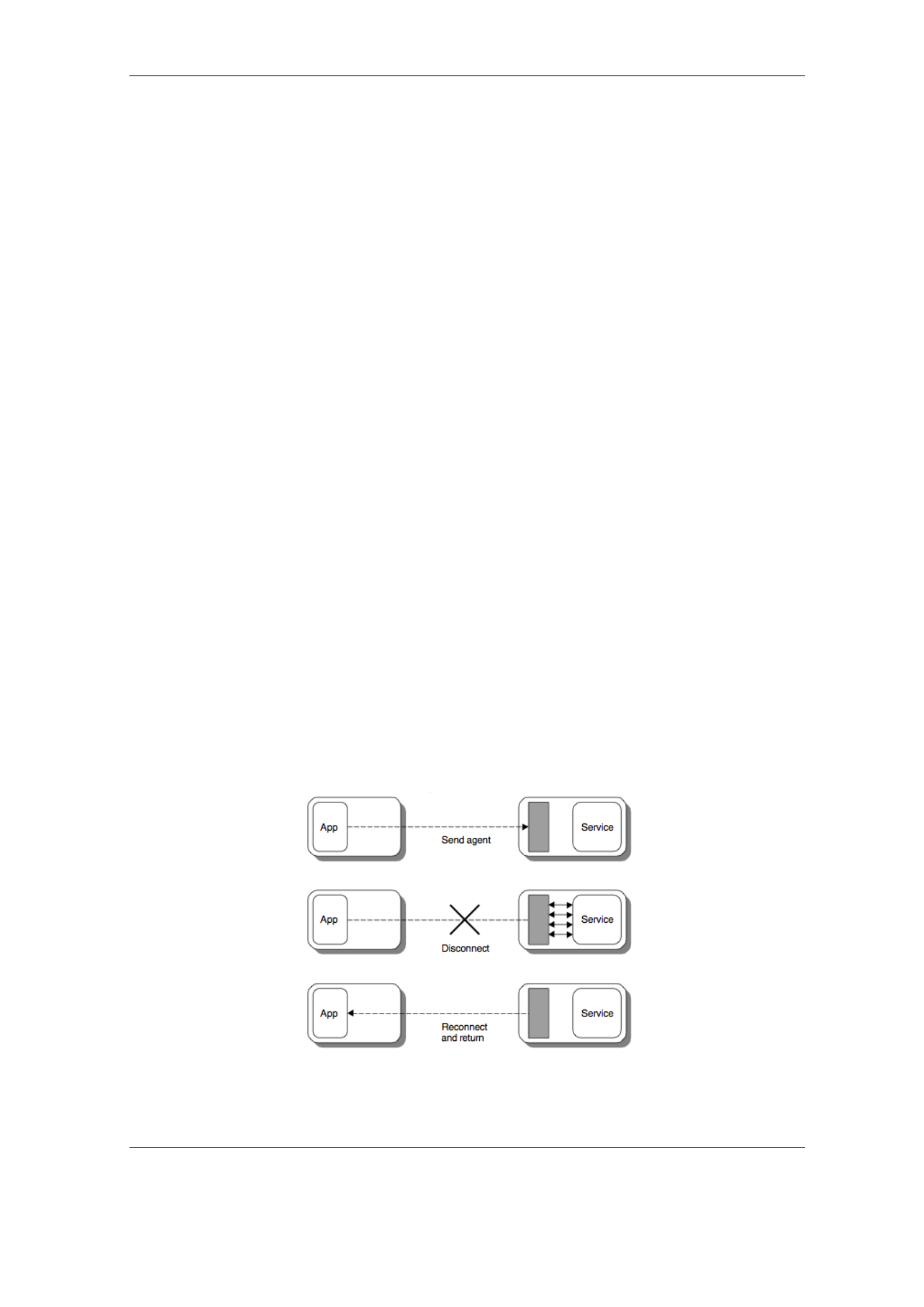
4.6. SAaaS Agents
from normal, distributed programs [11]. However, in comparison agents provide the
following advantages over distributed objects:
Standardised design Whereas a plain distributed object approach establishes the
need for developing a custom deploy and communication framework, utilising an agent
framework provides already well defined program structures, interfaces, a communica-
tion language and separation of duties. This reduces the risk of unnecessary complexity
and beginner’s mistakes.
Asynchronous and autonomous execution Distributed objects normally rely on
a continuously open network connection between the central server and the dispatched
object. In case of a security environment, such as the targeted sensor agents in the
SAaaS framework, it is important that sensors are continue in their operation even
if the network connection is disrupted, since this could also be intentionally done to
hide a security incident. Tasks can be embodied into agents and transferred to their
target execution environment, e.g. a VM. After being deployed, the agent becomes
independent of its creating process, see Figure 4.3. It can act asynchronously and
autonomously continue and sharing its information with other entities (agents), even
if the connection to a central instance is disrupted. It can reconnect to a central
instance when network connectivity is re-established.
Figure 4.3: Asynchronous and autonomous agent execution [11]
101
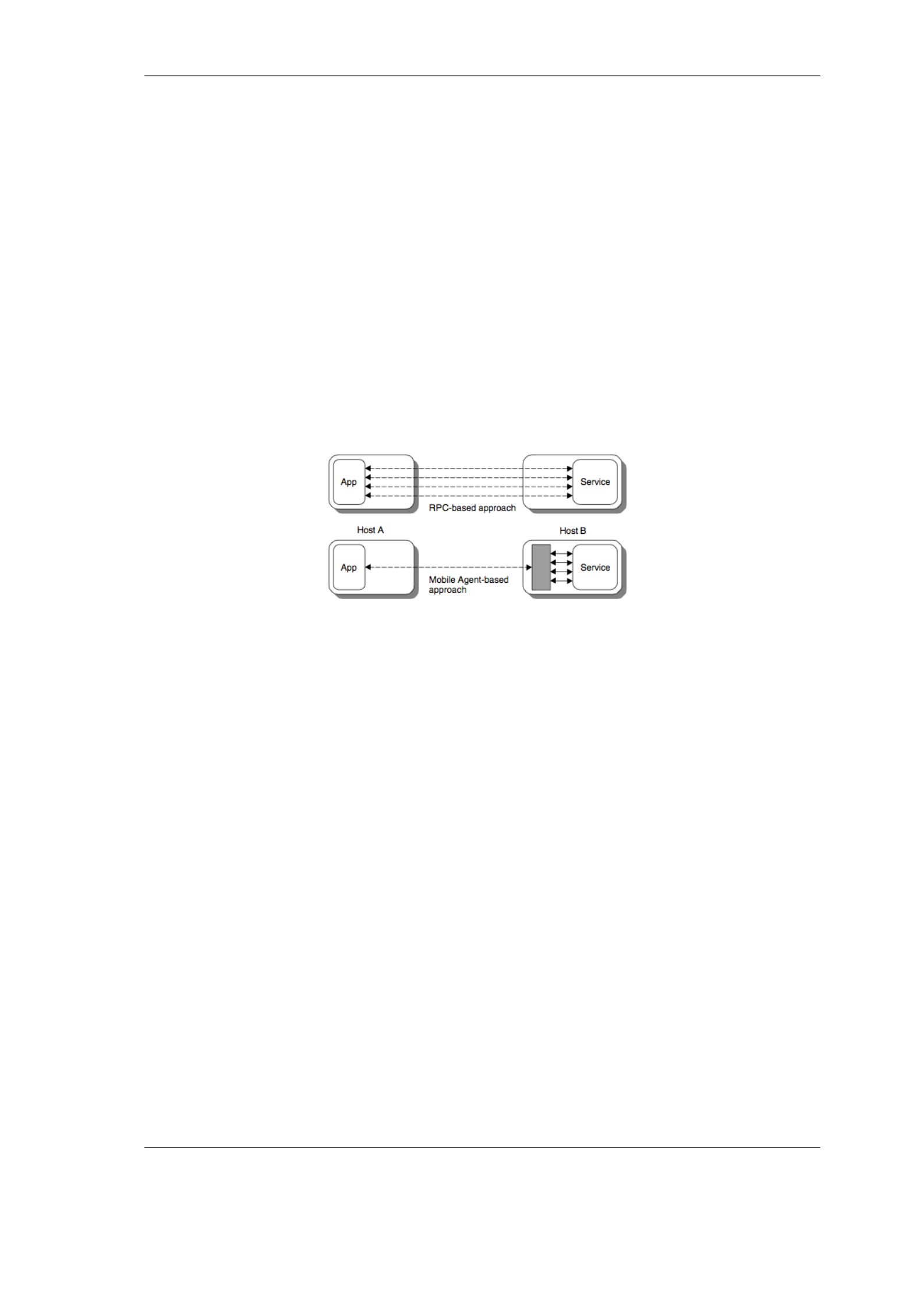
Chapter 4. Security Audit as a Service (SAaaS)
Adaptability Agents sense their execution environment and are able to react on
changes. Agents support the ability to distribute themselves to different platforms to
maintain their optimal configuration to solve a particular problem [11].
Reduced Network Load Distributed objects rely heavily on communication pro-
tocols that involve multiple interactions between the “client” and the “server”. This
results in a lot of network traffic. Agents allow to packet the communication and
dispatch it to a destination host where it gets processed. The further allow the def-
inition of generic preprocessing agents, which reduces the raw data transmitted over
the network [11], see also Figure 4.4.
Figure 4.4: Agents reduce network load [11]
Fault tolerance and robustness Agents adaptability makes it easier to build fault-
tolerant systems or define a secure default behaviour for unexpected situations. If a
platform or instance gets shut down, all agents deployed on this instance will be warned
and given time to either transmit their data to another agent or deploy themselves to
another instance to continue operation [11].
For the SAaaS architecture, an evaluation of existing agent frameworks was carried
out, with the following requirements:
•Dynamic, adaptive infrastructure
•Good performance
•Open Source software platform
•Documentation & community support
102

4.6. SAaaS Agents
Since the CloudIA [27] architecture is built around the cloud management system
OpenNebula [159], another requirement was a compatible agent programming lan-
guage: Java. As a result, the Java Agent Development Platform (JADE) [160] was
chosen, which enables the implementation of multi-agent systems. It consists of an ac-
tive community and a frequently updated mailing list. Its agents are very lightweight.
The learning curve of agent development was not steep, which could lead to a good
market acceptance of the project. “JADE can be considered an agent middleware
that implements an Agent Platform and a development framework. It deals with all
those aspects that are not peculiar of the agent internals and that are independent
of the applications, such as message transport, encoding and parsing, or agent life-
cycle.”[160]. Furthermore, it already provides a user interface, which alleviates agents
creation, deployment and testing. The Java Agent Development Framework met all
the established requirements, introduced above.
Java Agent Development Framework
The Java Agent Development Framework supplies the basis of the SAaaS’ security and
audit agents. It allows creation, deployment and orchestration of lightweight software
agents. JADE agents are small, Java applications, which are developed to execute a
specific task, dependent on a required entry behaviour. JADE is a multi agent system,
which defines agents according to the IEEE Computer Society standards organisation
for agent-based technology and its interoperability with other technologies (FIPA).
It provides agent management components, such as Naming Service, Yellow- Page
Service, Message Transport und Parsing Service. Agent communication is realised as
messages, utilising the FIPA Agent Communication Language (ACL) [161] format.
Main JADE characteristic is its implementation in JAVA, which results in a platform
independent applicability. Each JADE platform runs at least one main container with
103

Chapter 4. Security Audit as a Service (SAaaS)
three default agents and contain more sub-containers. Default agents are an Agent
Management System (AMS), a Directory Facility (DF) and a Remote GUI Agent
(RMA), which provide agent management functionality and are described in more
detail in Chapter 7, Section 7.2. Newly created agents are running in the JADE main
container or a sub-container. Thus, each SAaaS enabled cloud component runs a
JADE container, containing at least an AMS, DF and RMA agent [162].
Type of Software Agents
In the SAaaS architecture, mainly four different agent types exist: Sensor agents,
Audit agents,Metric agents and Management agents. However, respecting loca-
tion and task, two different agent classes were identified:
•Sensor agents
–SAaaS sensor agents
–SAaaS metric agents
–SAaaS audit agents
•Management agents
–SAaaS management agents
Sensor agents are agents, which get configured and deployed to a certain instance,
for example a VM to execute a very specific task. They are configured in advance
with a certain task (e.g. monitor a logfile, perform a list of audit checks) and dis-
tribute their results (events) to other agent(s). They run independently on a remote
instance and are not necessarily connected to a central instance. In the SAaaS en-
vironment, SAaaS sensor agents, metric agents and audit agents fall into this category.
Management agents are agents, which serve an underlying supporting management
task, such as: agent creation, agent deployment, event preprocessing and forward-
ing. Although they also run independently, by their assigned task, they are meant
to interact with other agents to support them. In the SAaaS environment, SAaaS
104
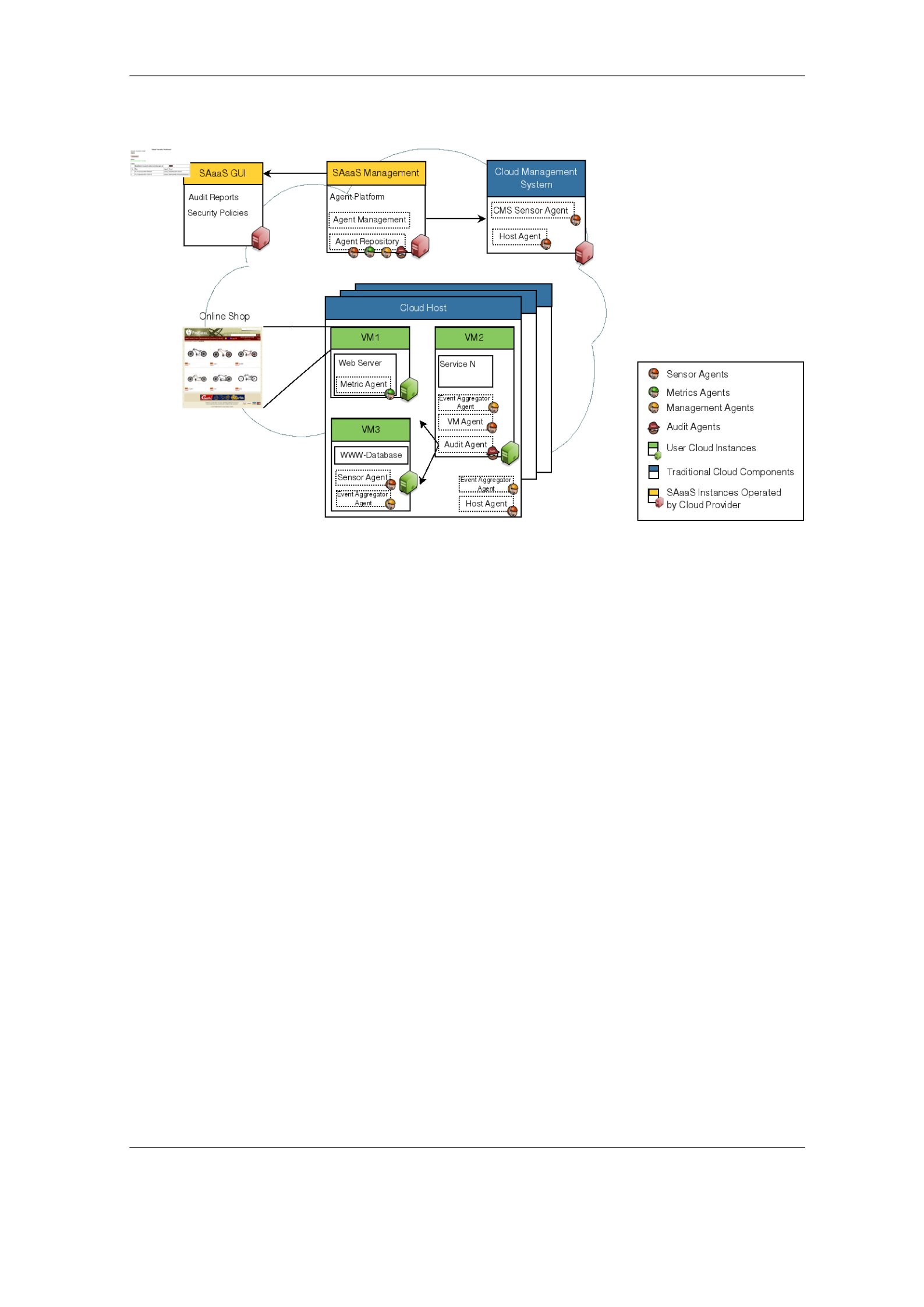
4.6. SAaaS Agents
management agents, such as the Event Aggregator agent fall into this category.
Figure 4.5: Types of SAaaS agents distributed in an IaaS Cloud
Figure 4.5, shows a high level IaaS cloud infrastructure with the different agents dis-
tributed over the different cloud components. Agents collecting data are called Sensor
Agents. If the location of an agent needs to be expressed, they are also titled as VM
Agent (agent running on a VM), Host Agent (agent running on a cloud host, mon-
itoring for example hypervisor activities) or CMS Agent (agent monitoring the cloud
management system). Specific targeted security audits perform specific checks of sys-
tems, which are affected by a change within the cloud environment. These checks
are performed by Audit Agents. In case a specific, technical parameter needs to be
validated to make a decision on a security status, this is called a threshold. Thresh-
old values to be checked are defined as metrics and get checked by Metric Agents.
To create, deploy and manage an agents life cycle and communication, Management
Agents exist. For example, before an event from a specific sensor agent gets trans-
mitted to another agent platform, it gets preprocessed and aggregated by an Event
Aggregator Agent, which also runs on same location (agent platform) as the corre-
105
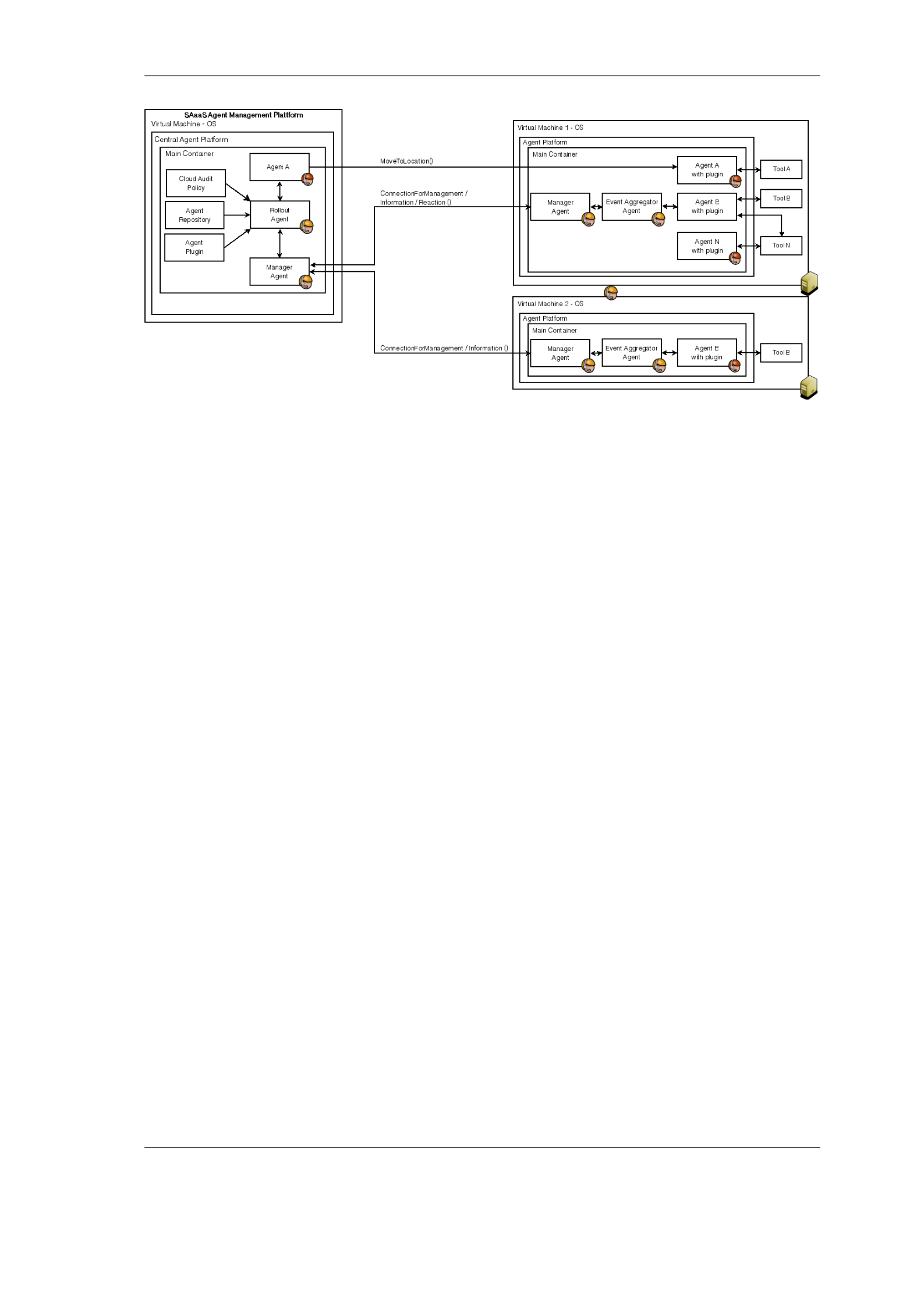
Chapter 4. Security Audit as a Service (SAaaS)
Figure 4.6: Basic SAaaS agent design
sponding sensor agent, e.g., a VM. Thus, the overall messages sent to a global cloud
event processing system is reduced, which is especially important in large cloud com-
puting environments. Details on specific agents are described in Chapter 7, Section
7.2 - SAaaS Prototype Development. A complete list of all developed agents, including
technical details is provided in Appendix A.2 - Developed SAaaS Agents.
Agent Architecture
Figure 4.6 illustrates a basic SAaaS agent architecture. On the left side, it shows the
SAaaS Agent Management Platform, deployed on a VM. It is responsible for a com-
plete agent life-cycle: creation, configuration, deployment, monitoring, management
and deletion. All agent life-cycle stages can be executed on-demand, which fulfils
the requirement of a dynamic infrastructure. To create an agent, the SAaaS Agent
Management Platform receives requirements from the Cloud Audit Policy module.
This can include a configuration for a specific sensor agent (validate CPU load at VM
x) or audit cases in case an audit agent is needed. Based on these requirements, an
agent template is chosen and a new agent gets created, configured and equipped with
additional tools, which are necessary for the agent. This could include a file mon-
106

4.6. SAaaS Agents
itoring tool necessary to monitor a specific directory for changes at the target VM.
As soon as the agent is build completely, it gets moved to the manager agent on the
target agent platform on the target VM and starts working. Agents live in an agent
platform, which provides them with basic services such as message delivery. A plat-
form is composed of one or more containers. Containers can be executed on different
hosts thus achieving a distributed platform. Each container can contain zero or more
agents [162]. To provide monitoring or auditing functionality, a VM agents interacts
through agent plugins with stand-alone tools, such as a process monitor, an IDS or
an anti virus scanner. To harness the potential of cloud computing an agent can be
deployed to a VM on-demand according to the policies a user defines. Inter-agent
and inter-platform communication uses the Agent Communication Language Format
(ACL). On the right side of Figure 4.6, two VMs with different deployed agents are
depicted. Several tools are installed, feeding the different agents with information.
SAaaS Services in an IaaS Cloud
Figure 4.7 shows a more detailed view of SAaaS service components, which are avail-
able for every cloud user. The Figure shows instances of cloud “user 1”, who runs
two SAaaS enabled VMs in an IaaS Cloud. In addition to his two VMs, a SAaaS
Agent Management Platform runs exclusively (for every user) on a separate VM. As
described above, it is responsible for the agent management. Furthermore, it runs
a Report Generator module, which conditions audit reports to a user readable for-
mat. Events, agent configurations, audit reports, user specific SAaaS configuration
settings and behaviour data are stored in a user exclusive SAaaS database service.
Additional SAaaS services are an Cloud Audit Policy Management and an Anomaly
Detection module, which are described later in detail in Chapter 5 - Cloud Audit
Policy Language and Chapter 6 - Anomaly Detection and are therefore greyed-out in
107
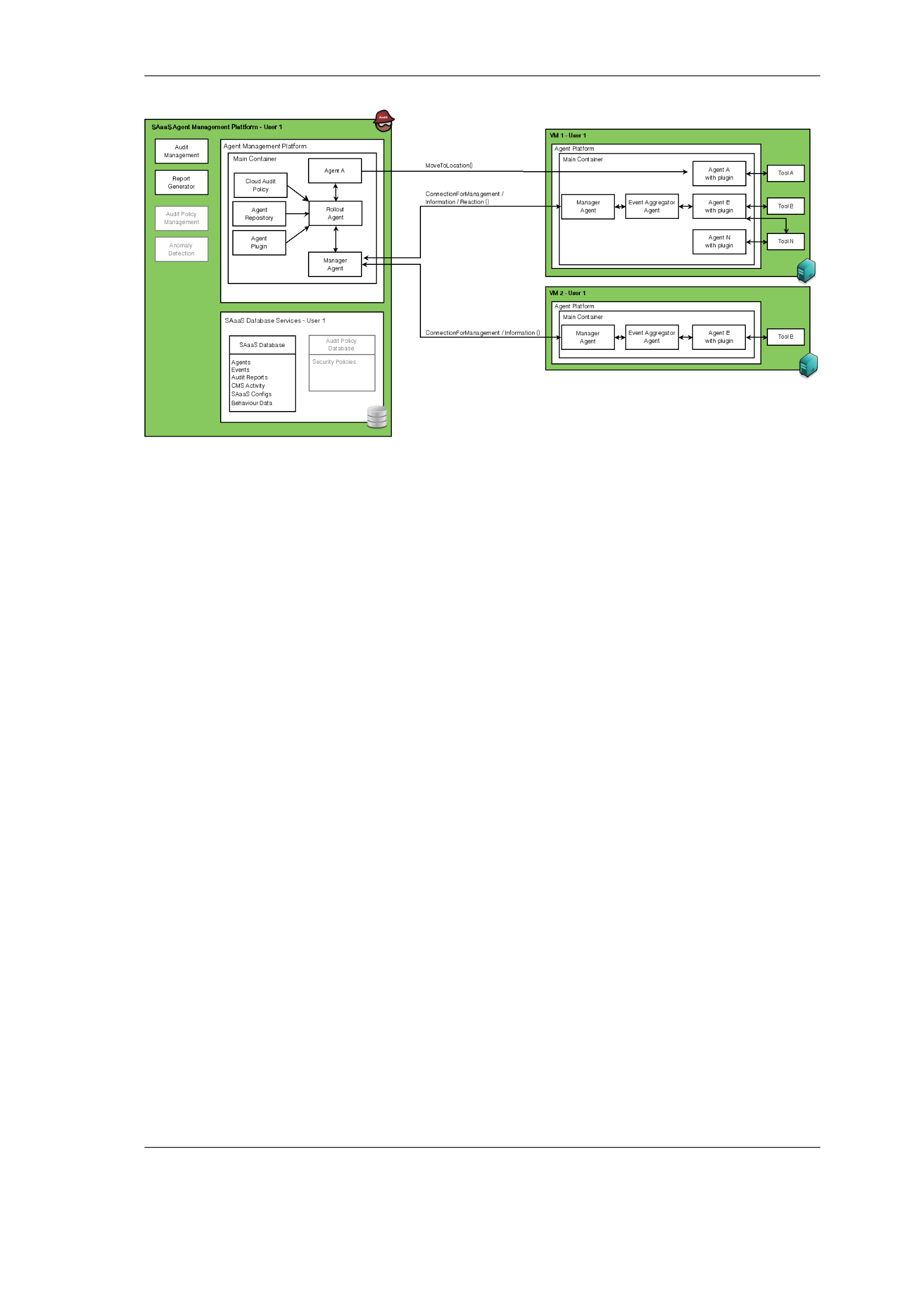
Chapter 4. Security Audit as a Service (SAaaS)
Figure 4.7: SAaaS Service Components - User View
Figure 4.7. Depending on the amount of SAaaS enabled cloud resources, the SAaaS
management services are running on the same VM or can be spanned over multi-
ple VMs. Thus, scalability is ensured. To achieve customer overspanning security,
the same SAaaS components are deployed for the cloud provider, as shown in Figure
4.8. The formerly presented SAaaS user components (Figure 4.7) are combined into
one box each “SAaaS User Management - User 1” - “SAaaS User Management User
N”. The provider’s SAaaS Management Platform is depicted in orange. Despite in-
vestigating virtual instances of a specific user, the provider’s SAaaS components are
operating cloud wide. Thus, cloud wide security or audit policies can be deployed
or a cloud wide incident or anomaly detection can be executed. For example, the
provider’s CMS agent stores all cloud management system actions, from all users in
the provider’s SAaaS data base, whereas the user specific SAaaS DB stores only CMS
events of the corresponding user. Configuration of the SAaaS services is done through
the SAaaS GUI. It is a web based interface allowing the user or provider to:
•Activate or deactivate SAaaS services for his VMs
•Manage agents (create, deploy, delete, move)
108
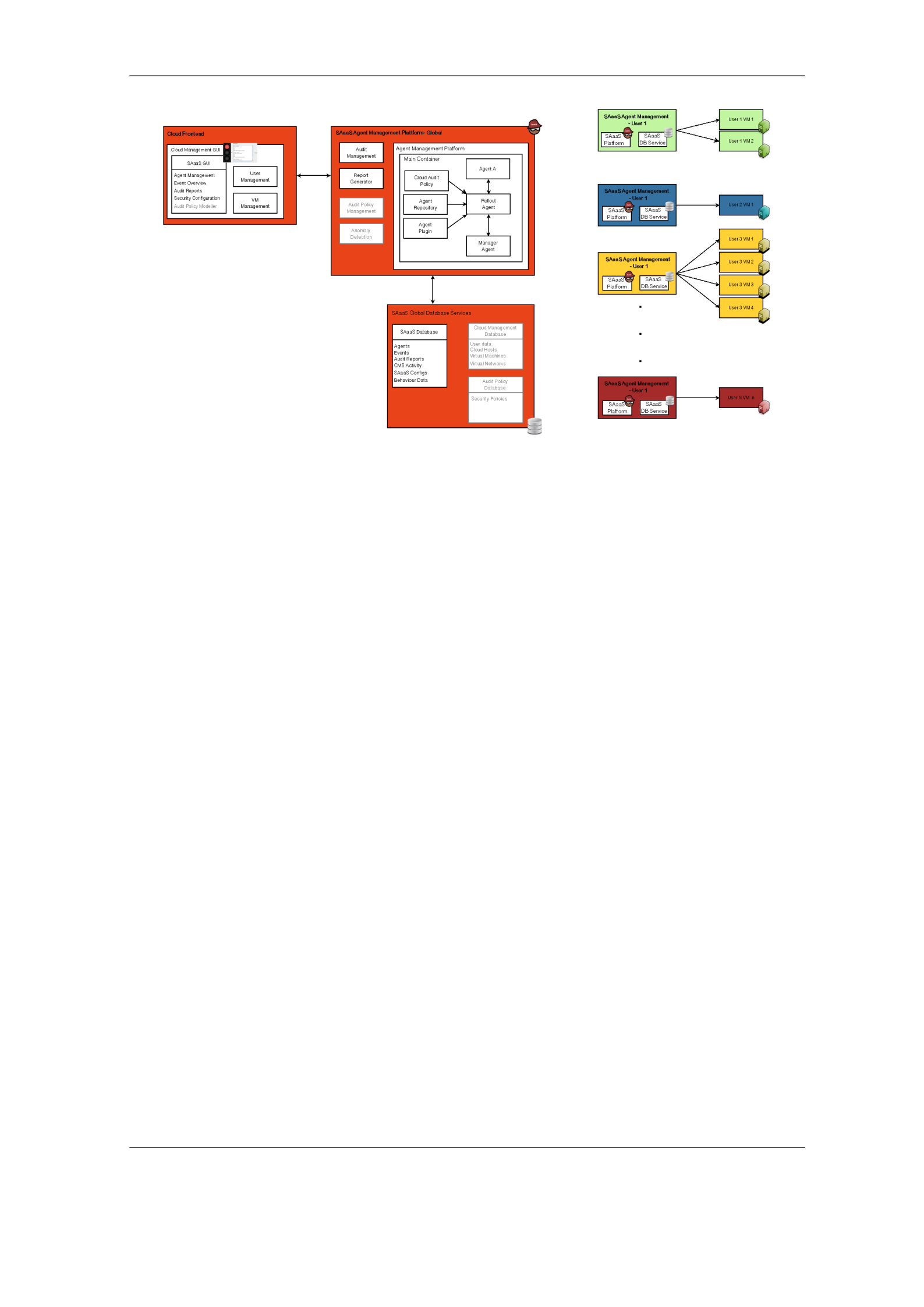
4.7. Evaluation: SAaaS Architecture
Figure 4.8: SAaaS Service Components - Provider View
•Investigate events (event log)
•See audit reports or perform manual audits
•Configure Security settings for his virtual instances
•Modell and manage (create, deploy, delete) audit policies
4.7 Evaluation: SAaaS Architecture
Since the developed Security Audit as a Service architecture is a major novel con-
tribution of this research by providing an audit system which respects IaaS cloud
characteristics, it gets evaluated in the following.
How Agents Can Improve Cloud Audits
Security incident detection in cloud environments is a non trivial task due to a cloud’s
characteristics. Using audit agents in an agent platform for cloud audits helps to
commit to those characteristics, which can be described as:
109

Chapter 4. Security Audit as a Service (SAaaS)
Reduction of events Especially the frequently changing infrastructure poses a big
challenge to define something, like normal behaviour and detect anomalous behaviour.
Therefore it is important to have a high number of sensors capturing simple events.
Simple events need to be preprocessed and abstracted to complex events, reducing the
possibility “of event storms”.
Fast adaption Combined with knowledge about business process flows it will be pos-
sible to detect security incidents in a frequently changing infrastructure while keeping
the network load low. The usage of autonomous acting agents delivers this possibility.
Flexibility Agents can also be added, removed or reconfigurated during runtime with-
out altering other components. Thus, the amount of monitoring entities (e.g., network
connections of a VM, running processes, storage access, etc.) of a cloud instance can
be changed without restarting the incident detection system. Simultaneously, using
agents can save computing resources since the underlying business process flow can
be taken into account.
Increased fault tolerance Using autonomous agents has advantages in case of a
system failure. Agents can monitor the existence of co-located agents. If an agent stops
for whatever reason this stays not undetected. Concepts of asymmetric cryptography
or Trusted Platform Module technology can be used to guarantee the integrity of a
(re-)started agent. However, this topic has not been addressed by this research work.
If an agent stops, damage is restricted to this single agent or a small subset of agents,
which are requiring information from this agent.
SAaaS agents are enabled to be aware of underlying business flows. A cloud provider
can offer different business cases for VMs, such as “Online Shop” instances. Thus,
preconfigured agents get automatically deployed with those instances. Within this
architecture, several simple agents are logically belonging together forming an agent
group where every agent knows about the other agent. While single agents monitor
simple events (e.g., user login on a VM) they share them with other agents, as pre-
110

4.7. Evaluation: SAaaS Architecture
sented in Chapter 7.5.2 - SAaaS Demo 3a - Login Bruteforce Detection. Thus, cloud
security audits get a wider spectrum of vision, not just focused on the security state of
a single instance. Furthermore, by ordering agents in a hierarchical structure (multiple
simple agents can exists on the same platform e.g., inside a VM), preprocessing of de-
tected simple events and information sharing between logical associated agents leads
to a reduction of network load [162]. Thus, the system is more scalable by reducing
data sent to upper system layers. This is introduced and used in [163]. Combining
events from sensor agents monitoring cloud hosts and VMs and infrastructure moni-
toring agents (network agent, firewall agent) incident detection is not limited to either
host or network based sensors, which is especially important for the characteristics
of cloud environments. This leads to an increased durability of the overall incident
detection system. Furthermore, agents can be updated to new versions (depending
their interface remains unchanged) without restarting the whole incident detection
system or other SAaaS agents running at a VM.
Monitoring is done by simple sensor agents, like the introduced inotify agent. Analysis,
planning and execution is done via the Event Aggregator agent. Due to the modular
design this can be realised by several, single agents as well. Especially, the execution
of actions dependent on the analysis result is implemented as an extra agent, thus
can be used independently of the underlying event detection (e.g. file system change,
infrastructure change, etc). One advantage, of this agent’s intelligence is a reduction of
manual user interaction. When deploying a new VM, dependend on the VM template
a user has chosen, the SAaaS Agent Management knows, which agents need to be
deployed to this VM. In case a new image gets used, first a software investigation
agent could be deployed to the VM analysing, which software packages are installed
on this particular VM. Dependend on the results, the SAaaS agent management knows,
which agents should be deployed to this VM.
In the SAaaS enabled cloud a user has to define one or multiple VM Management
111

Chapter 4. Security Audit as a Service (SAaaS)
stations. These are basically IP devices, which are allowed to establish a manage-
ment connection (e.g. SSH) to a VM. This prevents the SAaaS agents from sending
false-positive events, like in the following scenario: Given a SAaaS enabled VM with
an inotify agent already deployed monitoring file system changes. When the cloud
user logs into this VM to change some configuration files, this gets immediately de-
tected by the inotify agent. It sends these events to the local Event Aggregator agent.
Instead of just forwarding the events to the SAaaS event management system, the
Event Aggregator agent first checks, if an allowed management connection is estab-
lished to this VM. Is this the case, the inotify events are classified as “allowed” not
resulting in an alarm. Only a “configuration changed” event gets forwarded. When
the management connection is closed again, the Event Aggregator Agent notifies the
SAaaS Agent Management to automatically deploy a new Audit agent to validate the
security state of this VM after this configuration change. This forms the concept of
automatic concurrent cloud audits.
Agent Performance Measurements
It is essential for the SAaaS architecture, that the agents are very efficient not causing
a high offset of resource consumption. Therefore, performance tests were executed to
show the overhead introduced to the cloud VMs by the JADE platform. Additionally,
it is tested, how fast agents can be deployed to a VM in runtime and second how
fast the agent communication is. All tests are done at the university’s research cloud
infrastructure CloudIA. Table 4.1 shows the real and virtual hardware configuration
of the utilised systems. Each test was performed at least 10 times, average values are
presented in the following.
Performance Test 1 - JADE platform overhead
First, the introduced overhead by the JADE platform was tested. E.Cortese et al.
112

4.7. Evaluation: SAaaS Architecture
Cloud Host Virtual Machine
CPU 8x CPU: Intel(R) Xeon(R)
CPU E5504 @ 2.00GHz 64-
bit architecture
1 virtual CPU @ 2.00GHz
64-bit architecture
Memory 12 GB 512 MB RAM
Network Gigabit Ethernet Gigabit Ethernet
Storage 40 GB HDD SATA 4GB virtual HDD )
Storage protocol SATA NFS
Table 4.1: Evaluation: SAaaS agent performance lab setup
show in [164] that running the platform is not introducing a high CPU overhead. Ad-
ditionally, it was measured how the boot process of a VM gets delayed because the
JADE platform needs to be started. BootChart [165] was used to analyse overhead,
see Figure A.3 - Bootchart analysis of VM without SAaaS agent platform and Figure
A.4 - Bootchart analysis of VM with SAaaS agent platform in Appendix A.4. It can be
confirmed, that in worse case the JADE platform adds two seconds to the total boot
time of a VM of 13 seconds. For the assumed SAaaS usage scenario this is acceptable.
Performance Test 2 - Agent deploy time
Second, the time was tested it takes to create, configure and deploy an agent to a new
platform. Therefore, five measure times are introduces:
•t0 - agent gets created
•t1 - agent gets started at the Agent Management VM
•t2 - agent loaded its configuration
•t3 - agent got transferred to target VM
•t4 - agent starts working on target VM
Figure 4.9 shows the involved JADE agents, developed for this test. The test was done
first, using no connection security for transferring the agents (MTP HTTP). Second,
113
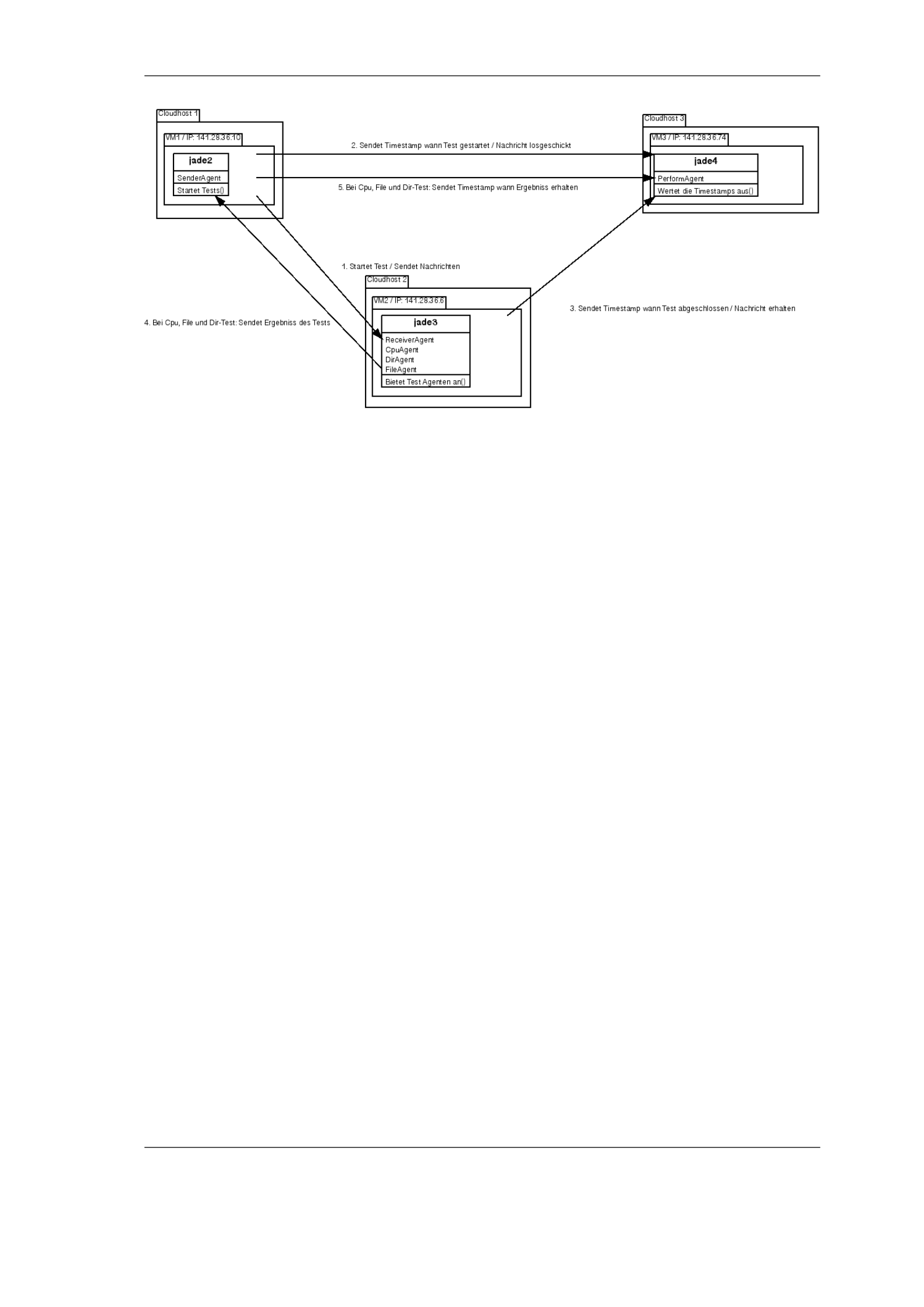
Chapter 4. Security Audit as a Service (SAaaS)
Figure 4.9: SAaaS Agent Platform performance test components: agent deploy time
a secure and authenticated channel between platforms was used (MTP HTTPS) to
see how much impact secure communication introduces. Figure 4.10 confirms, that on
average it only takes 180ms for a full deploy of an agent using MTP HTTP and 210
ms using MTP HTTPS. This proves the applicability of the JADE agent platform to
support the presented SAaaS use case.
Performance Test 3 - Agent message time
Third, the agent message performance was tested. The roundtrip time of a variable
amount of message with a variable payload (string length of event message) between
two agents was measured. As a constraint a maximum roundtrip time of 1 second was
set. Figure 4.11 shows, that with the JADE agents we are able to send more than 500
messages with a maximum payload of 10.000 characters at once before the limiting
constraint is hit. This is acceptable for the introduced SAaaS scenario. However, the
test also showed, that after sending 220 packets with a length of 1.000.000 Strings, a
java.lang.OutOfMemoryError: Java heap space error was thrown at the receiver agent.
This limit is due to a default configuration parameter of the Java VM and could be
solved by adding the option “-Xms256m” to increase the heap size for this Java VM.
114
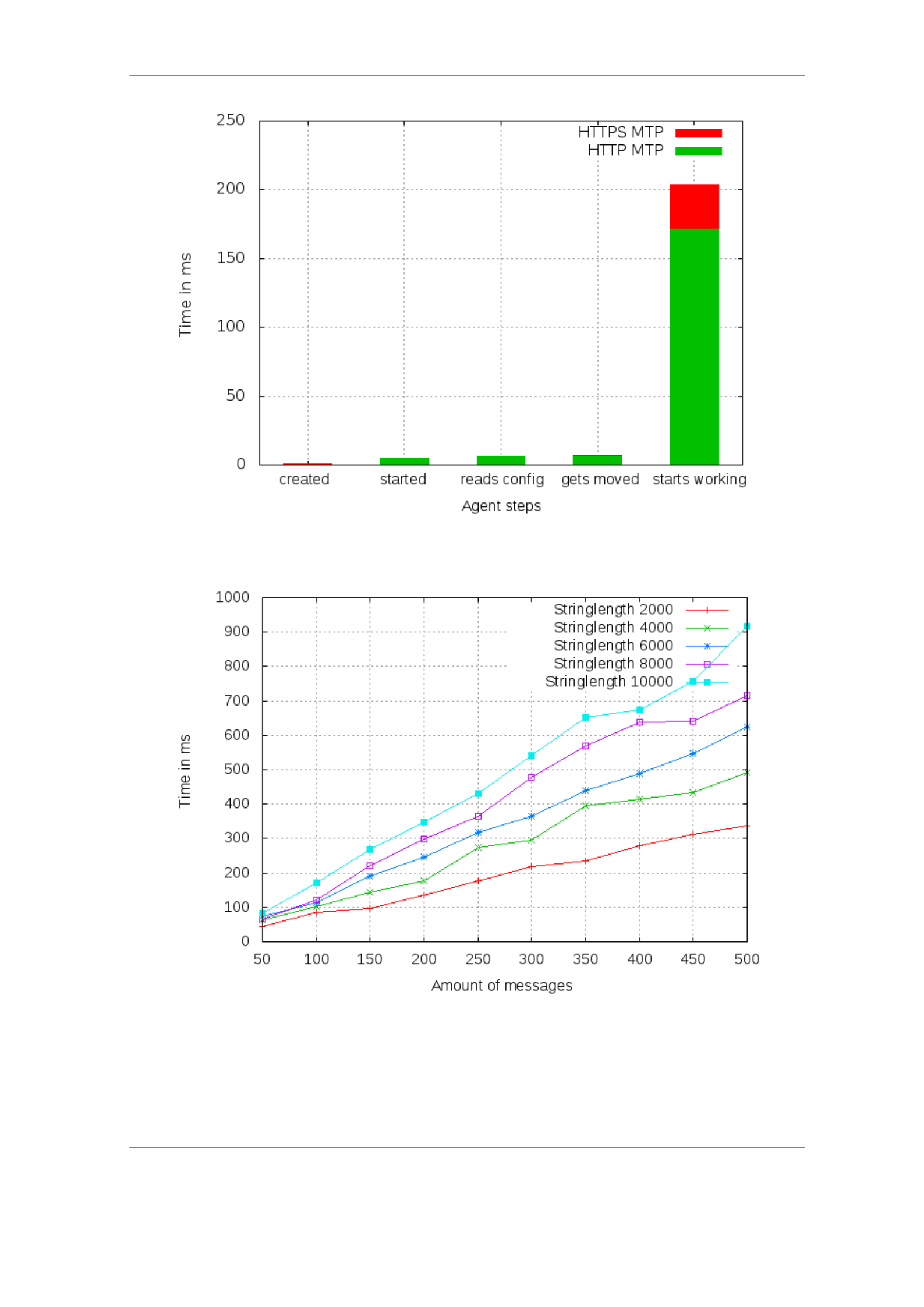
4.7. Evaluation: SAaaS Architecture
Figure 4.10: SAaaS Agent performance test: Agent deploy time
Figure 4.11: Agent message roundtrip time
115

Chapter 4. Security Audit as a Service (SAaaS)
4.8 Summary
Former research on cloud security issues (Chapter 3) identified that security audits
could be a feasible approach to address the identified cloud security issues. The sub-
sequent literature review on cloud audit systems showed, that their is a critical lack of
cloud specific audit systems, respecting a cloud’s characteristics. Thus, this research
developed the Security Audit as a Service architecture to address the identified limi-
tations. It is based on mobile, lightweight agents, which perform concurrent security
audits in case a change within a cloud infrastructure is detected. Changes are de-
tected by sensor agents, which are deployed at key points of a cloud infrastructure.
Events are preprocessed and abstracted by management agents. In case a change got
detected, audit agents are configured with very specific audits to evaluate the security
status of the (change) affected cloud instances. An example use case concerning cloud
scalability was presented and details on the utilised agent architecture discussed. A
general agent design was elaborated. In a qualitative and technical evaluation it was
shown that agents are a feasible approach to create a cloud audit system. The novel
SAaaS architecture mitigates the following identified limitations in the area of cloud
auditing:
•A technology independent, cloud provider interoperable audit system for IaaS
clouds, which does not require special hardware
•A hypervisor technology independent sensor system utilising software agents
Besides those technical attributes, it provides more transparency in cloud infrastruc-
tures for cloud customers and providers. This enables cloud customers a better risk
analysis of IaaS cloud infrastructures and helps cloud providers to maintain a secure
cloud environment.
116

5
A Cloud Audit Policy Language
“Language is the blood of the soul into which thoughts run and
out of which they grow.”
(Oliver Wendell Holmes, Physician, poet, professor, author)
To be able to define security constraints and corresponding cloud audits, security
policies need to be modelled. For implementation and especially for an automatic
enforcement through concurrent cloud audits, a language representation of a concrete
security policy is needed. Thus, the Cloud Audit Policy Language (CAPL) is de-
veloped. This chapter describes the requirements for a cloud audit policy language.
Beneath generic attributes, six specific policy scenarios are introduced, which form
the requirements for the target language. Afterwards, already existing security policy
languages get introduced and evaluated. It is elaborated, why none of them fulfils
the established requirements. Therefore, a new Cloud Audit Policy Language is intro-
duced, which is based on the Cloud Infrastructure Management Interface specification.
It forms the third novel contribution of the research, after the cloud audit test criteria
catalogue and the SAaaS architecture.

Chapter 5. A Cloud Audit Policy Language
5.1 Introduction
Cloud instances of a customer always serve a certain business case. Thus, different
VMs require a different level of security protection, dependent on the service they are
providing. The presented SAaaS agents are a technical tool to fulfil those different re-
quirements in a flexible manner. However, they need to get an understanding how the
desired nominal security state looks like, which checks (audits) need to be performed
to validate the current state, and which tools are necessary for this task. Ideally, con-
figuration needs to be done by the personal who knows the deployed instances best:
the cloud provider’s administration personnel for the cloud architecture, and the cloud
customer for his cloud instances. Thus, it is essential for those groups to describe the
security and privacy requirements, in a machine understandable way, which will enable
automatic, concurrent security audits. This is commonly achieved by the definition of
security policies, transferring a requirement into a checklist of one or multiple testable
conditions. To respect cloud user’s and provider’s security requirements, both parties
need to be able to create policies.
Summary of Research
This part of the research presents a novel cloud audit policy language, which is
used to model security policies and cloud audits, which result in SAaaS agent
configurations.
Parts of this research phase have been published in the following papers and presented
to the research community at the corresponding conferences:
•Sun Behind Clouds - On Automatic Cloud Security Audits and a Cloud Audit
Policy Language, International Journal on Advances in Networks and Services
2013 [166]
118
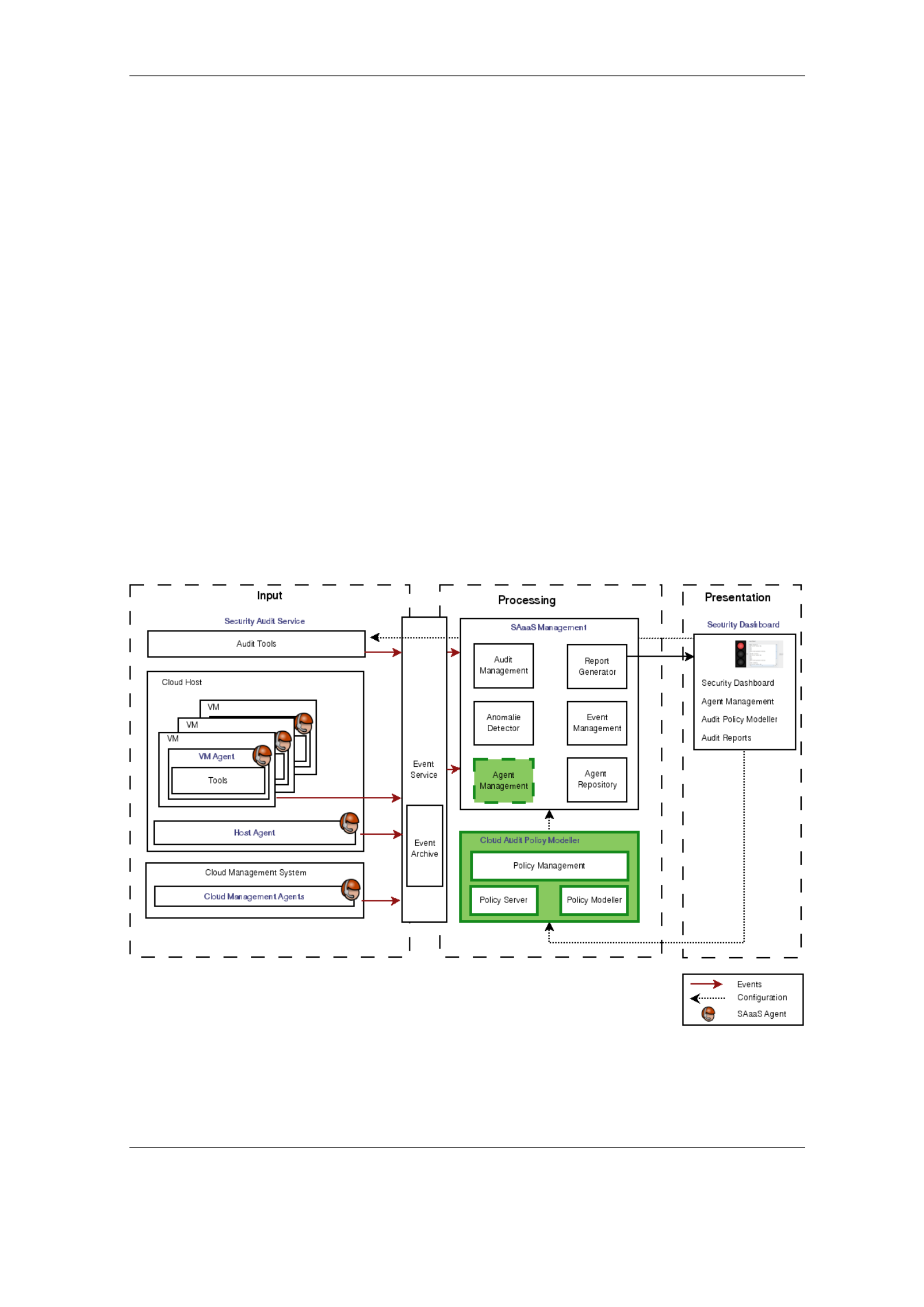
5.1. Introduction
Association within the SAaaS architecture
Figure 5.1 highlights, which part of the whole SAaaS architecture is addressed by
the Cloud Audit Policy Language. It covers the Cloud Audit Policy Modeller, which
consists of the modules:
•Policy Management - Definition and communication of security and audit poli-
cies
•Policy Server - Backend for the policy management
•Policy Modeller - Frontend for cloud user and provider to model policies
Since cloud audits are represented in the Cloud Audit Policy Language, the configu-
ration settings of SAaaS Audit agents is dependent upon the security policy language
as well. Thus, Agent Management is partly highlighted in Figure 5.1 as well.
Figure 5.1: Affiliation of cloud Audit Policy Language within SAaaS architecture
119

Chapter 5. A Cloud Audit Policy Language
Use Case Scenarios
Before analysing existing security policy languages, three use case scenarios are dis-
cussed, the target language should fulfil.
Modelling of security requirements of VM images
Public marketplaces for exchanging cloud appliances such as, OpenNebula Market-
place [114], Amazon Web Services EC2 Management Console or the Amazon Web
Services Marketplace [115] provide cloud customers with an easy and efficient way of
finding the right virtual machine image. But they also allow users to be administrators
of their virtual machines, or upload and share their custom made VM images with
other users. Although cloud providers provide security guidelines [116] on how to pre-
pare an image before releasing it to a marketplace, current research by Balduzzi [91],
Bugiel [117] and Meer [118] shows that marketplace images are highly insecure due
to old software versions or “forgotten” or restorable security credentials, such as SSH
private keys. Furthermore, a provider has interest in the VMs, running in his cloud
environment as well. A single VM with a lot of security vulnerabilities could have
an impact on the cloud’s overall security state, since it could be used as a gateway
for hackers to undercut a cloud providers security defence mechanisms. This could be
due to an improperly configured VM or due to the usage of outdated software within
a customer’s VM. Thus frequent security audits of VM images are necessary, which
could be executed every time before a new VM image gets used.
Modelling of technical and business process flow dependent actions
After deploying a VM to the cloud, a user needs to model his security requirements.
This could be technical attributes, like allowed open network ports, or user access
controls. Furthermore, the description of business process flows can improve security
120

5.1. Introduction
in a highly dynamic infrastructure as a cloud as well. Consider an online shop scenario
with web servers delivery database content in an IaaS cloud. A) If a request (using the
allowed protocols) to the database VM without a preceding service request to the web
application is detected this is rated as an abnormal behaviour, which does not occur in
a valid business process flow. Therefore an event should be generated. B) If an upscale
request for the user’s web server instances gets registered at the cloud management
system, without a corresponding high load on the web server VMs, this is considered
abnormal as well. Business process flow dependent rules need to be modelled by a
cloud user who is aware of its cloud instances and the underlying business process.
Automatic SAaaS agent configuration
After modelling security requirements and cloud audit checks, they need to be en-
forced. As a result, in the SAaaS system agents get configured with necessary tools
(agent plugins, see Chapter 4, Figure 4.6) to monitor these requirements. Thus, a ma-
chine understandable security policy language is necessary, which allows the definition
of a resulting SAaaS agent configuration. Since an automatic direct translation of all
imaginable security policies into SAaaS agents configurations is considered unfeasible
for a cloud provider, a community approach is estimated for a production use of this
system. A cloud providers personnel, as well as cloud customer can develop modular
agent configurations based on certain security policies. The network monitoring tool
Nagios [167] is a popular example, where a huge user community provides Nagios plu-
gins [168].
A key factor for the success of such a system is the detailed and distinct definition of
security policies. However, this is contrary to a short VM deployment process a cloud
user expects. Therefore, this work proposes to create a very easily operable, security
policy generator, where cloud users can define security policies in a human way of
121

Chapter 5. A Cloud Audit Policy Language
thinking, such as: “The VM must be checked for malware”. Such simple policies could
be supported by a graphical web interface with templates utilising check boxes or drop-
down lists. This needs then to be translated into a machine understandable format,
which results in the audit checks to be performed. The output of these checks needs
to be translated back into a human understandable format, which will form the audit
report submitted to the image creator, cloud provider and image user. To summarise,
the target cloud audit policy language should provide the following possibilities:
•Modelling of technical security requirements
•Modelling of audit checks for VM images
–VM images need to be audited in an automatic manner, to provide short
response times to an image creator who wants to publish its image
–The system needs to respect different security requirements from the image
creator as well as the cloud provider
–The system needs to produce a human understandable output in case an
image did not pass the security check, providing the image creator with
information about what prohibited the image release.
•Modelling of business flow dependent cloud actions
•Security policies need to be described in a machine understandable way
5.2 Related Work
Before analysing specific already security languages, related research work on security
languages for clouds gets discussed. Literature review shows, that very little research
in the area of cloud audit languages has been done. Morsy and Faheem identified the
need for automated policy enforcement systems [169]. The main reason behind this
argument is the increase in attacks and changes in organisational policies. Although,
122

5.3. Requirements for a Cloud Audit Policy Language
a lot of different security policy definition languages exist (e.g., LaSCO, XACML,
SPARQL, etc.), it is shown that each of those has different limitations in terms of
policy constraints. Therefore, Morsy and Faheem propose a policy automation frame-
work, including a new language called Standard Security Policy Language (SSPL),
which tries to simplify the process of creating machine-readable security policies. The
results of their policiy language analysis will be confirmed by the security policy lan-
guage evaluation presented in this work. However, the presented Standard Security
Policy Language seems that it only reached a research level, since to the best knowl-
edge of the author, no public implementation or practical application using it could be
found. During this research, the following additional security policy languages were in-
vestigated: Language for Security Constraints on Objects(LaSCO) [170], Rei Ontology
Specifications (REI) [171], Ponder [172] & Ponder2 [173], eXtensible Access Control
Markup Language (XACML) [174], SPARQL Protocol And RDF Query Language
(SPARQL) [175], Open Vulnerability and Assessment Language (OVAL) [176] as well
as business process languages like Business Process Execution Language (BPEL) [177],
and Workflow and Agents Development Environment (WADE) [178] and the Intru-
sion Detection Message Exchange Format (IDMEF) [179]. They get discussed in more
detail later in this Chapter, but before requirements for a cloud audit policy language
need to be defined.
5.3 Requirements for a Cloud Audit Policy Language
Since the main target for a cloud audit policy language is to be able to transfer cloud
security and audit rules into a machine understandable format two requirement classes
on the language can be identified:
•Generic language requirements
•Specific language requirements: modelling of cloud audit policies
123

Chapter 5. A Cloud Audit Policy Language
Generic Language Requirements
1. Technological Support Policies can be described, using textual as well as graph-
ical methods. However, the focus of SAaaS will be on a textual description of policies.
All language candidates will be analyzed with regards to their technological basis,
especially whether they build upon established standards such as XML and JSON or
they introduce completely new language formats. Using widely accepted technologies
may be beneficial because there already exist a lot of tools such as parsers, interpreters
and comprehensive documentation. Custom language formats however can be tailored
to the problem domain and might improve flexibility and readability. To ensure a fast
adoption by developers and leverage the large amount of tools already available, XML
should be the preferred language base.
2. Development Activity Estimation Release cycles of tools, the size of the
developing community and the adoption of a language by other projects indicates a
high development activity and is an indicator for a future proof implementation.
3. Documentation Quality A comprehensive documentation is essential for un-
derstanding and evaluating a policy language. The quality of the documentation is
hereby defined by factors such as the logical structure, accessibility, profoundness and
consistency.
4. Complexity & Integratability in SAaaS The target language should be com-
plex enough to fulfil all requirements but also generalisable up to a certain point. Too
much complexity will affect the ease of learning by cloud administrators and there-
fore indirectly and negatively influence the utilisation of the language, which affects
its overall success. Furthermore, it is essential to evaluate if the language can be
integrated into the SAaaS architecture, presented in Chapter 4.
124

5.3. Requirements for a Cloud Audit Policy Language
Specific Language Requirements
In addition to those generic requirements, there are specific language requirements to
be considered when choosing a policy language. The most important criterion is the
ability to model security requirements of cloud components, such as VMs and their
interaction with each other. Beneath the generic requirements listed above, the target
language needs to support:
•Monitored Objects Definition of any kind of entities in the cloud infrastructure,
which shall be monitored (e.g., hosts, virtual machines, files)
•Logical Policy Operations Combination need to be supported, to create more
complex policies by combining them with logical operators such as AND and
OR
•Policy Scoping By grouping virtual machines or policies the process of creating
and managing policies becomes easier. Also, incorporating the ability to define
policies, which can only be used by the provider, may prove to be beneficial
To identify functional requirements for cloud audit policies, a bottom up approach was
taken by defining the following example policy scenarios, which need to be describable
by the security policy definition language:
No. Policy Scenario Example Policy
P1 Malware
Since malware affects availability, integrity and con-
fidentiality, every VM image needs to be checked for
viruses and malware before being started within a
cloud. Running VMs must be checked frequently.
The VM is free of
malware.
125

Chapter 5. A Cloud Audit Policy Language
No. Policy Scenario Example Policy
P2 Monitoring of filesystem
Malicious attacks often result in change of the file sys-
tems’ content, such as modification of config files or
installation of malicious software. Therefore, a cloud
audit policy should allow to define: a) A certain file (or
folder) may not be changed at all. Every single change
should raise an action. b) Validation of a certain file
containing a specific content. Latter is most important
in config files, which affect security configurations.
File X has not
been changed.
P3 Technical attribute modelling
Security is expressed if the infrastructure complies to
certain technical attributes. A very simple rule defines
the state of a network port (open/closed).
Port 80 is open.
Allowed network
protocols: HTTP
P4 VM content
A VM contains software. Security can be increased by
banning certain software products or limiting specific
versions of a software, to prevent data leakage or just
to be compliant to existing software licenses.
Software X must
(not) be installed.
P5 Process communication
By modelling, which process are allowed to exchange
data, data leakage can be prevented and defence in
depth measures can be applied.
Program X is al-
lowed to commu-
nicate with pro-
gram Y.
126

5.3. Requirements for a Cloud Audit Policy Language
No. Policy Scenario Example Policy
P6 VM scalability
One attribute of cloud environments is flexibility and
on-demand availability of resources. Depending on
a currently existing demand additional VMs can be
added to a certain service cluster (VM upscale) and
when demand lowers, VMs can be decommissioned
again (VM downscale). But this could also be mis-
used by attackers to compromise the availability of a
customer’s cloud based infrastructure, by downscaling
VMs during a high demand period. Contrary, unnec-
essary upscaling of VMs increases the running costs of
a customer.
Upscaling of VMs
in VM cluster
“WWW-Server”
is only permitted
if average re-
quests per second
≥N”.
P7 Data traces
In case of VM marketplaces, users prepare VM images
and offer them at the marketplace (role: appliance cre-
ator). It is important, that these images don’t con-
tain any personal information of the VM image creator,
such as private key files or passwords, which could lead
to a security breach. It is to validate that files are
cleared e.g., history file, and critical information is se-
curely wiped (and not be restorable anymore even with
file carving tools).
The VM does
not contain any
personal informa-
tion.
127

Chapter 5. A Cloud Audit Policy Language
5.4 Evaluation of Existing Security Policy Languages
A huge number of policy definition languages exist (ASL, LaSCO, PDL, XACML,
SPARQL, SSPL, OVAL, etc.), all aiming to model security policies. Furthermore,
business process languages (BPEL, WADE, YAWL, ADEPT, etc.) are applicable as
well, which increases the size of languages to choose from. After a first investiga-
tion upon the applicability of those languages, WS-Trust, IDMEF, SSPL, PAX PDL,
CADF and KAoS were sorted out, since they have not been proven to be compatible for
the SAaaS approach. For the SAaaS use case, five possible language candidates were
identified for a detailed investigation based upon the requirements described above:
REI, Ponder, LaSCO, CIM and CIMI. They are presented in more detail in the fol-
lowing subsection. However, in this work the focus lies upon whether the language is
suitable for SAaaS1.
REI
REI [171] is an OWL Lite based language, developed by Lalana Kagal in 2005. REI
allows the definition of management, security, privacy and conversation policies [171].
These policies define the optimal behavior in a problem domain. A policy is hereby
defined by the prohibition, permission or the obligation to perform an action on a
target. It supports the definition of monitored object with “targets” and “users”.
Combination of multiple policies is supported by “Denotic Objects”. Management of
conflicting policies is solved through the definition of priorities. REI got its last update
in 2005. Furthermore, there is no active user community available. Documentation is
rare, a rough description of classes and some papers exist. Learning curve seems to be
steep and long, since it is a complex and nested architecture. This is contrary to an
easy entry aspired by the SAaaS architecture, since the user should be able to easily
1A detailed description and investigation of each language is given in [180].
128

5.4. Evaluation of Existing Security Policy Languages
Evaluation Property Fulfilment Description
Technological base OWL Lite
Definition of monitored objects XVia attribute targets or user
Combination of policies XPolicies can be created from more Denotic Objects
(permitted/prohibited/mandatory)
Area of validity X“Policy Domains” can be created through constraints
and object groups
Conflict management XBased on priorities
Last version cLast update 2005
Acceptance Only in PhD thesis of author, no practical implemen-
tation
Community support None
Documentation Rough description of classes[171], paper, presentations
Complexity Long training period expected, complex & nested ar-
chitecture
Support of SAaaS policy scenarios XYes
Estimated implementation effort cUnclear
Integratability into SAaaS architecture cAdvantages of OWL (semantics) not necessary
Miscellaneous Although implementations are mentioned in literature,
no source code or executables were found
Table 5.2: REI characteristics
create their own policies, and further more important developers should be able to
easily provide the policy-agent-tool configuration. The focus on semantic technology
is not needed for SAaaS and introduces needless complexity. Additionally, REI has
no practical relevance nor has it spread beyond a PhD thesis, which it was developed
for. These are knock-out criteria for applicability to the SAaaS architecture, since a
wide acceptation is aspired. Table 5.2 summarises all REI characteristics according to
the established requirements.
Ponder
Ponder [172] is a policy specification language, which already features tools and ser-
vices for policy enforcement and evaluation. Ponder is based on a proprietary language
format, Ponder Talk. One of the main concepts behind Ponder is the general-purpose
object management system and message passing paradigm [173]. In this, the language
129

Chapter 5. A Cloud Audit Policy Language
Evaluation Property Fulfilment Description
Technological base PonderTalk (SmallTalk)
Definition of monitored objects XPossible, through managed object, action and target
syntax
Combination of policies XPossible via an Obligation policy
Area of validity XConcept of self-managed cell
Conflict management XSupported
Last version XLast update 2011
Acceptance cMultiple paper citations available
Community support None
Documentation Examples exist, but only for older Ponder version. Not
for Ponder2
Complexity cPolicy readability: human friendly, development is dif-
ficult
Support of SAaaS policy scenarios XYes
Estimated implementation effort Very high, since Ponder includes its own agent frame-
work
Integratability into SAaaS architecture No, own agents need to be used. Different philosophy
of policy evaluation
Miscellaneous
Table 5.3: Ponder characteristics
is meant to be implemented in a way that the actual decision making process (deciding
whether a policy is fulfilled or not) needs to be as close as possible implemented to its
data source. In a cloud scenario this would mean, that the decision engine needs to
be implemented on each single machine. This is a knock out criterion for the targeted
SAaaS scenario, since this would highly increase complexity. Furthermore, there is no
active community supporting Ponder and it requires the usage of own Ponder-specific
agents. Therefore, the developed SAaaS agents won’t be usable. Thus investigation
into Ponder was not continued further. Table 5.3 summarises all Ponder characteristics
according to the established requirements.
Language for Security Constraints on Objects (LaSCO)
The Language for Security Constraints on Objects (LaSCO) [170] follows a graph
based approach to define policies. Allowed and forbidden actions can be modelled
130
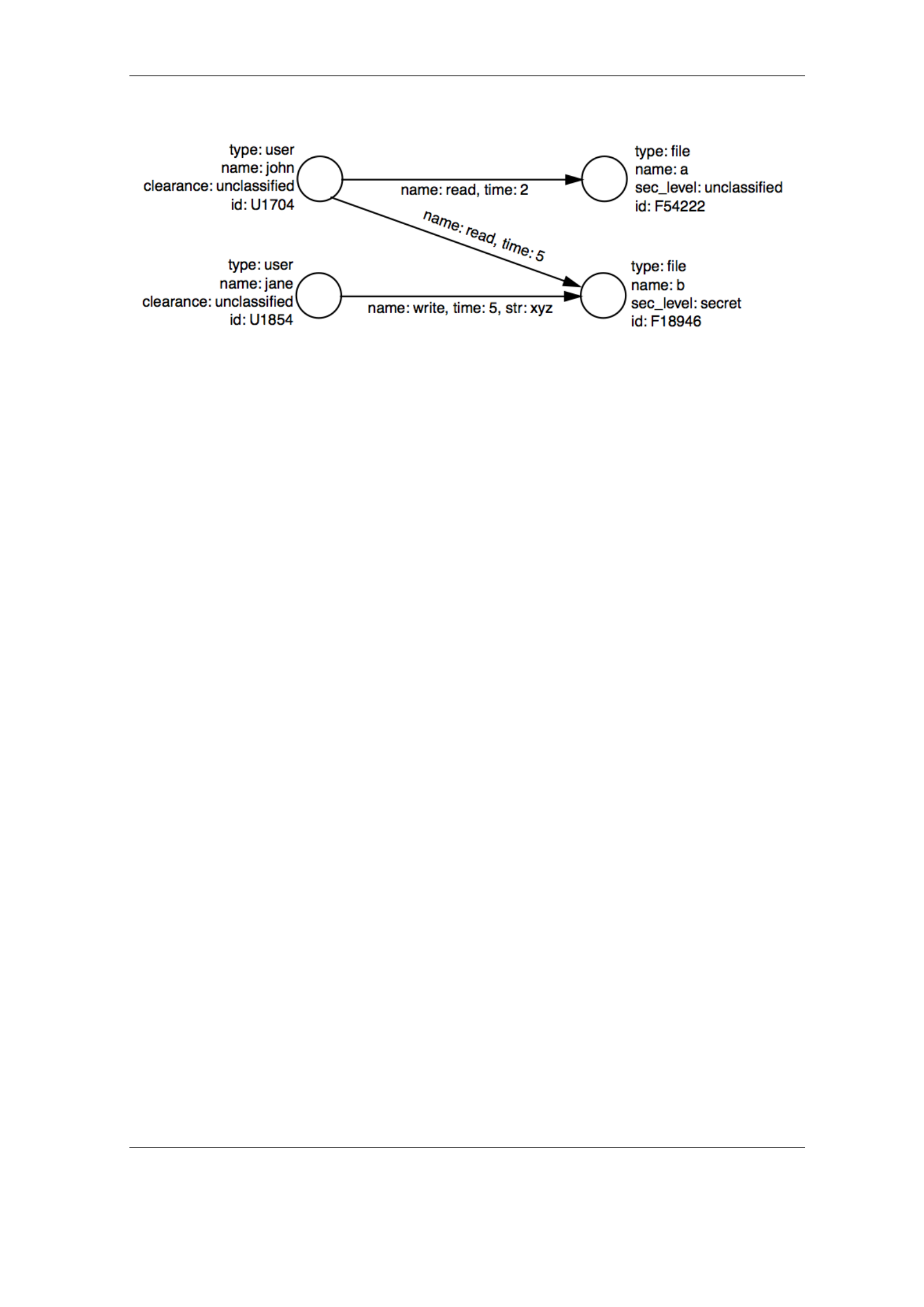
5.4. Evaluation of Existing Security Policy Languages
Figure 5.2: LaSCO example [12]
which get assigned to objects. Domains enable to define an area of validity in which a
policy is valid. LaSCO comes with a Java based interpreter for graph interpretation.
Figure 5.2 shows an example graph. “LaSCO Policies are annotated graphs that
are matched to the system graph and which is then checked for adherence to the
policy” [170]. Objects are represented as nodes and have several attributes, such as
user or file, defined by the attribute type. Edges define events or actions. Following a
graph based approach would introduces a lot of unnecessary complexity, since it would
confront policy developers with a rather complex and steep learning curve. For the
SAaaS system one requirement is it’s simplicity and seamless support of commonly
known technologies (see generic language requirements). Furthermore, no conflict
management is supported by LaSCO, there is no community support and it has not
spread over academic boundaries. Thus it is not suitable for the SAaaS scenario. Table
5.4 summarises all LaSCO characteristics according to the established requirements.
Common Information Model (CIM)
The Common Information Model (CIM) [181] is a model to describe elements and the
relationships between them (such as network components or policies). Its specification
gets developed by the Distributed Management Taskforce Inc. (DMTF) since 1997.
131

Chapter 5. A Cloud Audit Policy Language
Evaluation Property Fulfilment Description
Technological base Directed graphs
Definition of monitored objects XPossible, via nodes
Combination of policies XPossible via conjunctions
Area of validity XDefinition of Domains possible
Conflict management Not supported
Last version c2000
Acceptance Only PhD dissertation [12] and paper [170]
Community support None
Documentation Only examples in PhD dissertation
Complexity Very complex due to graph based origin
Support of SAaaS policy scenarios XYes
Estimated implementation effort Very high, completely different base
Integratability into SAaaS architecture No, due to graph based nature
Miscellaneous
Table 5.4: LaSCO characteristics
CIM is divided into the CIM Specification [181] and CIM Schema [182]. “The CIM
Specification describes an object-oriented meta model based on the Unified Modelling
Language (UML). This model includes expressions for common elements that must
be clearly presented to management applications (e.g., classes, properties, methods,
indications and associations)” [183]. The specification is the base for all CIM schemes.
It defines the master schema, which contains structure und syntax of all CIM models.
It is based on object oriented programming languages - familiar concepts are classes,
inheritance or key attributes. Schemes contain collections of models and are hierarchi-
cally constructed. Each model is a collection of classes to represent data with its own
meaning and area of validity, such as policies or networks. CIM provides currently
1400 classes for representing various elements and their connections. Models are writ-
ten in UML and Managed Object Format (MOF). CIM was also extended with a CIM
Policy model. It includes the following classes:
•PolicyCondition - Contains multiple sub-classes for representing dependencies,
such as user, authentication, network packet filter, time periods.
132

5.4. Evaluation of Existing Security Policy Languages
•PolicyAction - One or multiple, reusable actions which can be assigned to one
or more policies. They get executed, in case a policy condition gets into effect
•PolicyRule - The actual policy in the form of “if x, then y”. Actions are executed
if one or multiple conditions apply. “AND/OR” connections of conditions are
possible.
•PolicyGroup - Allows grouping of single policies
•PolicySet - A collection of policies
•PolicyInSystem - Assignment of a policy to a certain object, such as a host.
During research, version 2.34 was investigated, current version is 2.38. It addresses
most of the SAaaS requirements. Although CIM seems very compatible to the targeted
SAaaS scenario it would require a lot of overhead added to the overall system. A
complete CIM and WBEM implementation would be necessary, just to be able to
define CIM policies. Since this would add an unnecessary amount of complexity and
overhead to the SAaaS system, it has been considered not suitable for SAaaS.
Table 5.5 summarises all CIM characteristics according to the established require-
ments.
Cloud Infrastructure Management Interface (CIMI)
“The Cloud Infrastructure Management Interface CIMI)... describes the model and
protocol for management interactions between a cloud Infrastructure as a Service
provider and the consumers of an IaaS service. The basic resources of IaaS (machines,
storage, and networks) are modelled with the goal of providing consumer management
access to an implementation of IaaS and facilitating portability between cloud imple-
mentations” [186]. It is developed by the Cloud Management Initiative [187] which
also belongs to the Distributed Management Taskforce Inc. Its main documentation
is the CIMI specification [186] and the CIMI Primer [188]. CIMI provides a XML
133
Chapter 5. A Cloud Audit Policy Language
Evaluation Property Fulfilment Description
Technological base cUML, MOF or XML (in combination with WBEM)
Definition of monitored objects XVia association PolicyInSystem a policy can be bound
to a VM
Combination of policies XMultiple Conditions can be combined in a PolicyRule.
Multiple policies can be combined to a PolicySet
Area of validity cUnclear
Conflict management XBased on priorities
Last version cCIM 1998, policy model not clear
Acceptance XIndustry implementation exist: Windows Manage-
ment Instrumentation [184], SBLIM project [185]
Community support XNone for policy model itself, but for specific implemen-
tations
Documentation XDetailed documentation, but with inconsistency be-
tween different versions.
Complexity High, due to huge CIM feature set and inconsistencies
in documentation
Support of SAaaS policy scenarios XYes
Estimated implementation effort High, since a complete CIM and WBEM implementa-
tion would be necessary
Integratability into SAaaS architecture XYes
Miscellaneous
Table 5.5: CIM & CIM policy model characteristics (version 2.34)
based description language to manage cloud infrastructure components. Furthermore,
actions can be modelled, such as starting and stopping of a VM or access manage-
ment. Monitoring metrics for certain aspects can be defined, such as CPU load or
network bandwidth. CIMI uses a REST based protocol for identification and access
to modelled objects or actions. Thus, a management system can be implemented as
web services, in a client server infrastructure. The server would manage and store
objects described with the CIMI language. In the SAaaS context this would be cloud
components and audit policies. The client(s) would create, request and edit objects
through REST requests. In the SAaaS context, this would be cloud user creating
policies or the agent management module requesting an agent-tool configuration. A
CIMI described object, for example a cloud host with an ID 1, would be addressed by:
http://example.org/cimi/machines/1. A CIMI XML schema of modelled cloud
134

5.4. Evaluation of Existing Security Policy Languages
objects is available under [189]. Objects can be described in XML or JSON. Listing
5.1 shows the creation of a new machine in CIMI, which could be either a cloud host
or a VM. Line 1 and 2 show the request of a client, line 14 and 15 the server’s answer.
Line 4 - 12 contain information about an object (a new VM) to be created.
1POST / ma ch ine s HTTP/ 1 . 1
2Content−Type: a p p l i c a t i o n / j so n
3
4{” resourceURI ” :” h t t p : // schemas . dmtf . o rg / cim i /1/ M achineCr eat e ” ,
5”name” :”myMachine1” ,
6”description”:”My very f i r s t machine ” ,
7”machineTemplate” :{
8”machineConfig” :{” h r e f ” :” h t t p: // example . com/ c o n f i g s / t i ny ” },
9”machineImage” :{” h r e f ” :” h t t p : // example . com/ imag es /WinXP−SP2” },
10 ” c r e d e n t i a l ” :{” h r e f ” :” h t t p : // e xa mple . com/ c r e d s / 123 45 ” }
11 }
12 }
13
14 HTTP/ 1 . 1 201 Cre at ed
15 L o c a t i o n : h t t p : // ex ample . com/ mac hin es /8 437 52
Listing 5.1: CIMI Example
CIMI was developed by a sub-organisation of the DMTF, thus it is oriented close to
CIM. Although CIMI looks even more suitable than the previously presented CIM it
does not include a policy model. This is a knockout criterion. However, since the
language is almost supporting all established requirements, the to be developed Cloud
Audit Policy Language presented in the next section will be based on CIMI. Table 5.6
summarises all CIMI characteristics according to the established requirements.
Evaluation
All language evaluation criteria are summarised in the evaluation summary, depicted
in Table 5.7. All knock-out criteria (which do not fulfil the requirements introduced
in Section 5.3) are displayed in bold red.
135
Chapter 5. A Cloud Audit Policy Language
Evaluation Property Fulfilment Description
Technological base XXML, JSON
Definition of monitored objects XDescription of IaaS cloud components exists
Combination of policies XNo policies, but combination of objects supported
Area of validity XTailored to IaaS cloud environments
Conflict management Not existing
Last version XCloud Infrastructure Management Interface (CIMI)
Model and REST Interface over HTTP Specification:
October 2012
Acceptance None
Community support None
Documentation XDetailed documentation, white paper, standard.
Complexity XTailored to IaaS cloud environments
Support of SAaaS policy scenarios No policies phraseable
Estimated implementation effort cModerate, policy extension needs to be developed
Integratability into SAaaS architecture XYes
Miscellaneous
Table 5.6: CIMI characteristics (version 1.0.1)
REI is an OWL based language, which allows the definition of management, security,
privacy and conversation policies. The focus on semantic technology is not needed
for SAaaS and introduces needless complexity. Additionally, REI has no practical
relevance nor has it spread beyond a PhD thesis, which it was developed for. CIM is
a model to describe elements and the relationships between them (such as policies).
It addresses most of the SAaaS requirements. Because of the policy model, CIM
is suitable as a policy language for cloud audits. PolicyActions could be used to
deploy corresponding agents in case a condition applies. However, an implementation
according to the CIM standard would have gone way beyond the requirements of
the SAaaS project. Implementation of a complete WBEM framework would have
been necessary, just to support one CIM model (policy model). Ponder is based on
a proprietary language (Ponder Talk), thus policy plugin developers would need to
learn a complete new language. This is against the requirement of using a widely
accepted technological base and does not promise to be future-proof. Additionally,
136

5.4. Evaluation of Existing Security Policy Languages
in the Ponder methodology, the decision engine needs to be implemented on each
single monitoring instance. This is a knock-out criteria for the usage of Ponder for
the SAaaS scenario. LaSCO follows a graph based approach. Although it might
open up some interesting opportunities for a graphical policy modeller, the problem
of conflict management is not addressed [170] and similarly to REI, LaSCO has not
spread beyond academic boundaries (one dissertation in [12]). Furthermore, no active
community exists. These points make this language unsuitable for SAaaS.
Existing security policy languages are either too complex, badly documented or very
specialised for a specific context. It is shown, that none of the evaluated security
languages fulfils the established requirements. As a result, an own cloud audit security
policy language needed to be developed.
137

Chapter 5. A Cloud Audit Policy Language
Evaluation
Property
REI Ponder LaSCO CIM CIMI
Eval. Details Eval. Details Eval. Details Eval. Details Eval. Details
Technological Base OWL Lite PonderTalk
(SmallTalk)
Directed graphs XMOF & UML, XML
through WBEM
XXML, JSON
Definition of moni-
tored objects
XTargets, user XManaged Object, Ac-
tion, Target Syntax
XNodes XPolicyInSystem XIaaS cloud environ-
ments
Combination of
policies
XDenotic objects XObligation policy XConjunctions XConditions, Poli-
cyRule, PolicySet
XCombination of ob-
jects
Area of validity XConstraints, objects
groups
XSelf managed cell XDomains cUnclear XIaaS clouds
Conflict manage-
ment
XPriorities XYes Not implemented XPriorities Not existing
Last version cUpdated 2005 X2011 c2000 XCurrently revised
(2013)
X2012
Acceptance Only PhD thesis,
no practical appli-
cation
cCited in multiple pa-
pers
Only PhD disserta-
tion [12] and pa-
per [170]
XWindows Mgnt. In-
strumentation [184],
SBLIM [185]
None
Community sup-
port
None None None XNone for CIM, but
for specific implemen-
tations
None
Documentation cRough description of
classes[171], paper,
presentations
cGood examples, but
for old Ponder version
cOnly one PhD disser-
tation
XUML Diagram[182],
Policy profile[190]
XSchema, Primer
Complexity Long training period,
complex & nested ar-
chitecture
cPolicies are human
friendly readable, but
developing own is
difficult
Very complex due to
its graph based origin
High, due to incon-
sistencies of different
versions
XTailored to IaaS
clouds
Support of SAaaS
policy scenarios
XYes XYes XYes XYes No policies, but tai-
lored to IaaS clouds
Implementation ef-
fort
cUnclear Very high, since it
brings its own agents
Completely differ-
ent base layer
Complete CIM and
WBEM implemen-
tation necessary
cModerate, policy ex-
tension needed
Integratability in
SAaaS architecture
cSemantic of OWL
not necessary
No, own agents
necessary, differ-
ent philosophy of
policy evaluation
No, due to graph
based nature
XYes XYes
Table 5.7: Comparison of existing security policy languages
138

5.5. Cloud Audit Policy Language (CAPL)
5.5 Cloud Audit Policy Language (CAPL)
From the evaluation of the existing security policy language, CIMI seems very suitable
for supporting the SAaaS scenario requirements. However, it lacks a policy module.
Thus, instead of developing a completely new language, the Cloud Audit Policy Lan-
guage (CAPL) was developed as an extension of CIMI. CIMI already delivers a detailed
object description of IaaS cloud components and a standardised protocol. Core fea-
tures like the object model, the protocol and a simplified variant of CIMI classes (e.g.,
Machine,MachineConfiguration,MachineImage) are inherited by CAPL. However,
due to the different focus of CIMI on managing cloud infrastructures some classes of
CIMI have not been adopted in CAPL, because they are not required for the SAaaS
scenario. Others were modified, extended or new classes for the support of policies
were added. By staying close to the CIMI standard, it will be possible to define secu-
rity policy for any CIMI compatible cloud infrastructure. Thus, the compatibility of
the presented SAaaS system is increased.
CAPL User Roles
CAPL uses slightly simplified definitions of the CIMI roles Cloud Provider and Cloud
Consumer. The cloud provider manages and provisions cloud services and possesses
full access rights. The cloud consumer uses cloud services as well as the service for
auditing his virtual machines. The cloud consumer has a limited set of access rights,
which are required to define policies and triggering audits.
CAPL Service Interface
CIMI uses a REST based protocol for communication. CAPL adopts the CIMI service
interface.
139

Chapter 5. A Cloud Audit Policy Language
CAPL Language Base
The CAPL language format is technically oriented onto CIMI, which offers XML or
JSON as a language format. An advantage of using a XML language is the availability
of XML schema, which can be used for data validation. Thus, an incoming policy can
be easily checked if all required arguments are provided. To be interoperable with other
services and due to the wide distribution of XML in large distributed architectures,
XML was preferred over JSON.
CAPL Definition
CAPL is based on a object/class model. Figure 5.3 shows the class diagram. As
introduced, CAPL is designed to be oriented closely to the CIMI standard, but missing
classes were added. CAPL enhances CIMI by adding several new classes:
•Machine
The Machine class represents a machine, which shall be audited. CIMI uses
Machines only for virtual machines. However, CAPL enhances the scope of
Machines and includes host machines running virtual machines because those
might be as well targets for audits.
•MachineTemplate
The MachineTemplate defines the initial configuration of a VM.
•Policy
Defines a policy rule (e.g., “a virtual machine must not contain malware”), which
can be assigned to a machine or a group.
•PolicySet
A PolicySet contains multiple Policies. Only if all contained conditions of the
rules are fulfilled, the PolicySet evaluates to success. A PolicySet may be used
140
5.5. Cloud Audit Policy Language (CAPL)
Figure 5.3: CAPL class diagram
like a policy and attached to machines or groups. Rules contained in a Policy-
Set may be linked disjunctive or conjunctive (using AND/OR). This behavior
originates from the CIM policy model [191].
•Group
Groups are used to manage related objects like multiple rules and machines. In
such a case all rules of the group apply to all machines.
•RuleType
RuleType describes what a policy is supposed to check and defines attributes
and configurations, which the policy has to set.
In the following, the term “Policies” is uses as a interchangeably for the classes:
PolicyRule,PolicySet and MetricRule.
141

Chapter 5. A Cloud Audit Policy Language
CAPL Namespace
For CAPL, an own namespace has been assigned at http://research.cloud.hs-
furtwangen.de/capl/. Thus, a distinct class identification is achieved and conflicts
when using different schemes are avoided. Each CAPL class is assigned under the
attribute resourceURI within the namespace.
CAPL Data Types
CAPL uses different data types. If possible, common data types, known from other
programming languages were used. Table 5.8 lists available CAPL data types.
Data Type Name Description
Integer Integer A whole number
String Text A sequence of characters including text, numbers and special
characters.
Date Date Timestamp
URI URI Contains a uniform resource identifier
EntityReference Reference A reference to an other object identified by a URI. Used
within objects as href=‘‘uri’’ and represented in the XML
schema as EntityReference
EntityReference
Collection
List of references Gives back a list of references to class instances. Inherits
from Abstract-Collection.
Attributes Key/Value pairs A list of self-defined attributes with a unique name and a
corresponding value. Each key should be unique within a list.
Represented as <tagname key=keyname>value</tagname>
Collection List A list of multiple data of one data type.
Example: EntityReferenceCollection is a list of ref-
erences. Each single data type also has a corresponding
collection for creating an extensive list of this specific data
type, such as MachineCollection or GroupCollection
IntervalType Unit of interval Describes the unit of an interval. Possible values are:
•no - No Interval, one-time execution
•minutes - value in minutes
•hours - value in hours
•days - value in days
•weeks - value in weeks
ConditionType Composition Defines a composition of multiple rules. Possible values are
either D- Disjunction or Cfor conjunction
Table 5.8: CAPL data types
142
5.5. Cloud Audit Policy Language (CAPL)
CAPL Classes
For CAPL, the following classes are developed, also depicted in the class diagram,
shown in Figure 5.3:
•CloudEntryPoint
•AbstractCollection
•Machine
•MachineCollection
•MachineTemplate
•Group
•GroupCollection
•RuleType
•RuleTypeCollection
•Policies
•PolicySet
•PolicyCollection
•Action
•ActionCollection
To support readability only the most important classes to understand the CAPL
language specification are described, in the following. A complete class description of
all developed classes is provided in Appendix A.3
Basic Class Structure
Each CAPL class consists of the following basic structure of attributes. They have the
same meaning in every class, thus they are going to be presented here once and not
included every time in the description of the corresponding classes. Table 5.9 provides
a definition of the basic class attributes.
Data Type Name Description
resourceURI URI Contains the URI for identification of type within XML schema
Id URI Object ID under which it can be referenced
name String Name of instance
description String Description of corresponding instance
created Date Gets automatically set at object creation time
updated Date Gets automatically updated at object modification time
Table 5.9: CAPL classes: basic attribute structure
143
Chapter 5. A Cloud Audit Policy Language
Cloud Entry Point
The Cloud Entry Point provides an interface for accessing the CAPL server. It pro-
vides an overview over all available resources and their corresponding URIs for a
CAPL client (SAaaS Policy Modeller). It does not use the same basic structure,
described in Table 5.9. For the SAaaS prototype (see Chapter 7) it is accessible at
https://cloud.hs- furtwangen.de/CAPLPrototyp/rest/. Table 5.10 describes the
attributes of the Cloud Entry Point.
Data Type Name Description
id String ID of Cloud Entry Point, e.g. https://research.cloud.hs-
furtwangen.de/ CAPLPrototyp/rest/CEP
baseURI URI Contains the base URI, e.g. https://research.
cloud.hs-furtwangen.de/CAPLPrototyp/rest/
machines EntityReference A reference for MachineCollection, which delivers all Ma-
chineTemplate instances, e.g. https://research.cloud.hs-
furtwangen.de/ CAPLPrototyp/rest/MachineTemplates
groups EntityReference A reference for GroupCollection, which delivers all group
instances, e.g. https://research.cloud.hs-furtwangen.de/
CAPLPrototyp/rest/groups
policies EntityReference A reference for PolicyCollection, which delivers all policy
instances, e.g. https://research.cloud.hs-furtwangen.de/
CAPLPrototyp/rest/policies
ruleTypes EntityReference A reference to the list of all available RuleType,
e.g. https:// research.cloud.hs-furtwangen.de
/CAPLPrototyp/rest/ruleTypes
Table 5.10: CAPL class: cloud Entry Point
AbstractCollection
For every class, an additional class with the name schema [Class-Name]Collection is
implemented, for providing lists and instances of this class. These “collection-classes”
inherit from an abstract class AbstractCollection. Thus, each single class has the
same structure as class AbstractCollection. No additional attributes exist. In case,
a class contains a collection as an attribute, it is possible to get a list of instances
or references (EntityReferenceCollection) for this specific class. Thus, only data
which is necessary gets queried and submitted, saving unnecessary data overhead.
144

5.5. Cloud Audit Policy Language (CAPL)
This design is inherited from the CIMI specification and applied to CAPL as well.
Table 5.11 provides a definition of AbstractCollection.
Data Type Name Description
id URI ID of Collection under which it can be referenced
count Integer Number of objects in this list
collection Collection specific data-
type
A list of instances of this data type.
Example: In case of MachineCollection it includes
multiple instances of type Machine
Table 5.11: CAPL class: AbstractCollection
Machine
AMachine is an instance which needs to be audited. This can be a physical cloud
host or a virtual machine. Audit Policies can be assigned to a Machine.Machines
can be logically grouped together via the class Group. Machines are created by read-
ing information from the cloud management system, which hosts and VMs exist. A
definition of Machine is provided in Table 5.12.
Data Type Name Description
resourceURI URI Contains the base URI, e.g. https://research.cloud.hs-
furtwangen.de/CAPLPrototyp/rest/machines
cpu Integer Number of CPUs
memory Integer Size of RAM
machineTemplate EntityReference A reference to MachineTemplate, which this instance is
based on
ip String IP of instance
domain String Domain of instance
policies EntityReferenceCollection A list with references to policies which apply for this instance
groups EntityReferenceCollection A list of references to groups this instance is a member of
Table 5.12: CAPL class: Machine
MachineCollection
Delivers a list of instances of type Machine. Table 5.13 provides a definition of all
attributes.
145

Chapter 5. A Cloud Audit Policy Language
Data Type Name Description
id URI ID of Collection under which it can be referenced
count Integer Number of objects in this list
collection Machine A list of Machine instances
Table 5.13: CAPL class: MachineCollection
Group
The class Group provides the possibility to group Policies or Machines. All assigned
policies of a certain Group apply for all Machines of this group.
Table 5.14 provides attributes of class Group.
Data Type Name Description
resourceURI URI Contains the base URI, e.g. https://research.cloud.hs-
furtwangen.de/CAPLPrototyp/rest/groups
enabled Boolean Defines if group is enabled or not (not implemented in SAaaS
prototype)
policies EntityReference A list of references on policies which are assigned to Machines
of this group
machines EntityReference A list of Machines, which are member of this group. All
member inherit all policies of this group
Table 5.14: CAPL class: Group
RuleType
RuleType defines the type of a rule and representing the SAaaS agent type. For each
existing agent type a RuleType exists. RuleTypes are managed by the cloud provider.
The class was defined to be very general, to support a variety of different rules. Since
different rules contain different attributes, rule specific attributes get defined by the
the attribute properties. Properties need to be provided at creation of a policy. They
are used as a context-based attribute. They are stored in a hash map and assigned
to the target agent upon agent configuration time. They are representing an agent’s
configuration. Context-based attributes can be assigned to simple data types, thus
the CAPL server can evaluate if a context-based attribute is provided correctly and
146
5.5. Cloud Audit Policy Language (CAPL)
can validate it. As an example a reference on a group can be assigned to the data type
GroupReference. To provide information on available RuleTypes, a policy developer
can access them from the CAPL server via a GET request. A definition of RuleTypes
is given in Table 5.15. For the SAaaS prototype, RuleTypes for the defined policy
scenarios presented in Section 5.3 are implemented.
Data Type Name Description
resourceURI URI Contains the base URI, e.g. https://research.cloud.hs-
furtwangen.de/CAPLPrototyp/rest/ruleTypes
category String Enables categorisation of RuleTypes for sorting possibilities
visibility Boolean Defines if a RuleType is accessible for cloud user. Used for
development, for beta RuleTypes during development
attributeKey String Context-based value, which needs to be defined in a policy.
Table 5.15: CAPL class: RuleTypes
Policies
Each policy contains the same basic structure, as shown in Table 5.16. Additionally,
each policy contains policy specific attributes with context-based attributes. They
are depending on the type of policy and defined by the attribute RuleType. They
are resulting in an agent’s configuration. Policies can be assigned to Machines,
MachineTemplates, and Groups. A possible policy could be “Configuration of web
server apache2 is finished”. This results in a policy configuring a SAaaS inotify
agent to monitor the file httpd.conf for filesystem changes. This functionality is
implemented with the context-based attributes, defined by the attribute attribute.
Its context is defined by the corresponding RuleType. Listing 5.2 elaborates how the
attributes correspond to each other: The listing shows a policy which forbids changes
on the file httpd.conf. Line 2-10 are common attributes, which are equally available in
different policies. Line 11-15 show the context-based values, which are defined by the
RuleType inotify (line 8). Line 12 states that a change (attribute action, line 13) of
147

Chapter 5. A Cloud Audit Policy Language
the file httpd.conf (attribute path, line 14) is not allowed (attribute permission, line
12).
1<Po li c yR u le>
2<name>F r e e z e h tt pd . c o n f</name>
3<refName>freezehttpd</refName>
4<description>h t tp d . c o n f i s f i n a l , must n ot be cha nge d .</description>
5<created>0 4 . 0 2 . 2 0 1 3</created>
6<updated>0 4 . 0 2 . 2 0 1 3</updated>
7<enabled>true</enabled>
8<ruleType>i n o t i f y</ruleType>
9<t a r g e t R e s s o u r c e h r e f=” h t t p : // example . o rg / m ach ine s /www1”/>
10 <intervalType>no</intervalType>
11 <properties>
12 <permission>den i ed</permission>
13 <a c t i o n>change</a c t i o n>
14 <path>/ e t c / a pa ch e2 / h t tp d . c o n f</path>
15 </properties>
16 </ Po l ic yR ule>
Listing 5.2: CAPL Policy: config freeze httpd.conf
Data Type Name Description
resourceURI URI Contains the base URI, e.g. https://research.cloud.hs-
furtwangen.de/CAPLPrototyp/rest/policies
enabled Boolean Defines if policy is enabled or not
deploymentRessource EntityReference Is used in case a policy gets executed by a different Machine.
targetRessource EntityReference Machine,MachineTemplate or Group a policy is assigned to
intervalType IntervalType Defines interval a policy should be executed
interval Integer Defines value of interval
attribute Attribute Key/value pair containing context-based attributes of policy.
Context is defined by RuleType. Can be used multiple times
within a policy
Table 5.16: CAPL class: Policies
PolicySet
APolicySet is a Policy which contains multiple policies. A PolicySet can be assigned
to a Machine, a MachineTemplate and a Group. The attribute ConditionType
148
5.5. Cloud Audit Policy Language (CAPL)
defines, how the policies are connected with each other. Possible values are: D -
Disjunction, or C - Conjunction. In case of a conjunct connection, all policies need
to be fulfilled for the PolicySet to be fulfilled. This corresponds to a traditional AND
connection. In case of a disjunctive connection, only on policy needs to be fulfilled
fort he PolicySet to be fulfilled. This method was adapted from the CIM Policy
model [191]. A description of class PolicySet is provided in Table 5.17
Data Type Name Description
resourceURI URI Contains the base URI
enabled Boolean Defines if PolicySet is enabled or not
conditionType ConditionType Defines Type of Condition. For SAaaS prototype values Dor
Care available
targetRessource EntityReference Machine,MachineTemplate or Group a policy is assigned to
policies EntityReferenceCollection List of URIs to PolicyRule or MetricRule
intervalType IntervalType Defines interval a PolicySet should be executed
interval Integer Defines value of interval
Table 5.17: CAPL class: PolicySet
Action
Action enables the executed of operations. It is used for execution policies and if a
Machine is added to a Group. Its definition is provided in Table 5.18.
Data Type Name Description
resourceURI URI Contains the base URI
action String Defines type of action. Possible values for SAaaS prototype:
•addMachine - add a Machine to a Group
•removeMachine - removes a Machine from a Group
•run - start audit
target Reference Contains resource which the action applies to. In case of
addMachine it contains the Machine which to add to a Group.
Table 5.18: CAPL class: Action
As already mentioned, a comprehensive definition of all CAPL classes is provided in
Appendix A.3. Javadoc documentation can be found on the CD attached to this PhD
149

Chapter 5. A Cloud Audit Policy Language
thesis in the folder “CloudAuditPolicyLanguageJavaDoc”. CAPL is implemented as
a client-server architecture using a database backend for serialisation of objects. Its
technical implementation is described in Chapter 7, Section 7.4.
CAPL Library
All classes necessary for serialisation are stored in a CAPL library libCAPL.jar. It is
used by the CAPL server and client for de-/ serialisation in XML or JSON. It enables
the development of new CAPL clients. It is provided as Open Source software at the
SAaaS website [139].
An example, which depicts the key features of CAPL, is shown in listing 5.3. This
Policy describes the conditions under which upscaling of Web server VMs is allowed.
In this case, it is measured whether upscaling is allowed or not.
5.6 CAPL Integration into SAaaS Architecture
The Cloud Audit Policy Language architecture consists of three major modules. A
graphical user interface (Policy Modeller), the CAPL server and a database where
policies are stored.
Policy Modeller is a graphical user interface of CAPL which is integrated into the
SAaaS web GUI. It provides possibilities for policy definition and management. It
communicates with the CAPL server over an XML protocol.
CAPL Server A REST service, which manages the cloud audit policies. It gets ac-
cessed over a standardised HTTP methods. It is responsible for creation, alteration
and deletion of policies and answers policy requests. It forms a single instance for
policy management.
150
5.6. CAPL Integration into SAaaS Architecture
CAPL Database The CAPL server stores all cloud audit policies in a relational
database.
Policy Creation
Figure 5.4 shows the CAPL and SAaaS components in a simplified IaaS cloud archi-
tecture. As an example, creation of a scalability policy is assumed, with a following
audit of this policy. In blue, the process of a policy creation is described. A user
creates the following example policies 1via the graphical CAPL Policy Modeller (or
directly through the REST interface):
a) Config freeze for configuration of web server
b) Scalability threshold: 100 requests / second
The policy modeller serialises the data in XML and send them via HTTP POST to
the CAPL server 2. The policies get saved into the policy database 3. Since policy
a) defines a monitoring of the web server’s configuration file, an inotify agent gets
created 5and deployed 6to the target VM, where it installs the necessary tool
(inotify) and starts working 7.
Audit Execution
In case a user requests a manual audit 1, or an automatic concurrent audits gets
issued 1a the run method at the CAPL server gets executed 2. In this example, it
is assumed that an upscale event was registered at the cloud management system and
necessary policies are loaded. The CAPL server fetches all applying policies via the
Machine URI from the policy database 3and checks, which agent is necessary for
these policies. This information is forwarded to the SAaaS Agent Management 4,
which creates the corresponding audit agent 5, and deploys it to the target VM(s)
6. When the agent arrives at the agent platform within the target VM(s), it starts
151
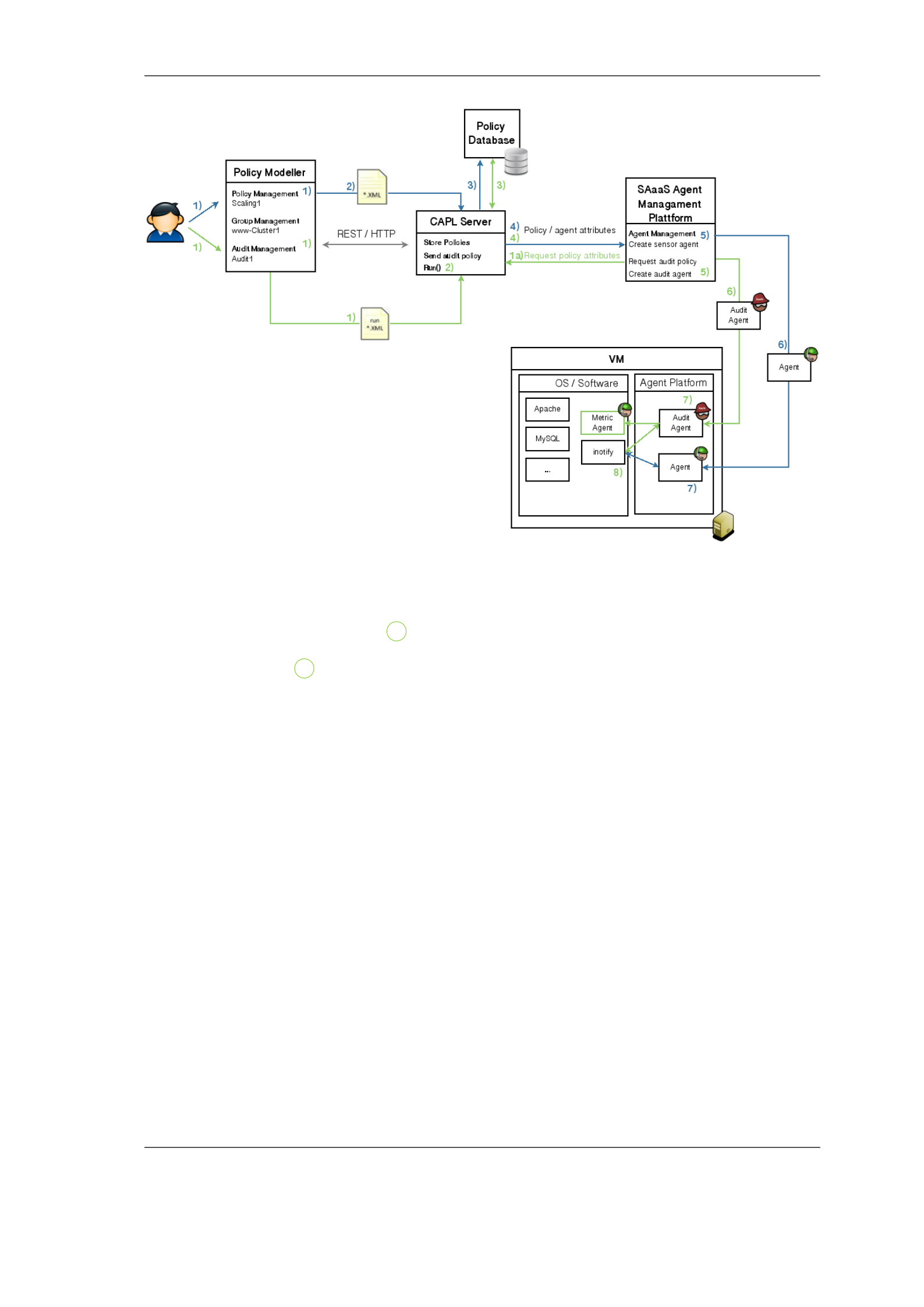
Chapter 5. A Cloud Audit Policy Language
Figure 5.4: Integration of CAPL within SAaaS architecture
with executing its audit tasks 7. In this example, a metric agent checks the current
http request count 8, which gets reported back to the Scalability Agent at the SAaaS
Agent Management Platform.
Listing 5.3 shows the resulting policy in CAPL presentation. This policy describes the
conditions under which upscaling of Web server VMs is allowed. Line 2 represents the
URI of the web server group WWWCluster1. Line 11 and 12 state that two machines
(ID 6 & 7) are members of this group. Line 17 shows the URI of the corresponding
upscale policy, which has a context-based RuleType attribute upscale with a metric
of requests per second and a corresponding threshold of 10.
1<Group xmnls=” h t t p : // r e s e a r c h . c lo u d . hs−f ur tw an g en . de / c a p l / ”>
2<i d>h t t p s : // r e s e a r c h . c lo ud . hs−f urtwangen . de /CAPLPrototyp/ groups / wwwCluster1</
i d>
3<name>C l u s t e r a t L o ad ba la nce r1</name>
4<refName>WWWCluster1</refName>
5<description>Group o f web s e r v e r s at l o a d b a l a n c e r 1
152

5.6. CAPL Integration into SAaaS Architecture
6</description>
7<created>2013−03−03</created>
8<updated>2013−03−03</updated>
9<enabled>true</enabled>
10 <machines>
11 <machine h r e f=” h t t p s : // r e s e a r c h . c lo ud . hs−furtwangen . de /CAPLPrototyp/ r e s t /
machines/6” />
12 <machine h r e f=” h t t p s : // r e s e a r c h . c lo ud . hs−furtwangen . de /CAPLPrototyp/ r e s t /
machines/7” />
13 </machines>
14 </Group>
15
16 <P o l i c y xmnls=” h t t p : // r e s e a r c h . c lo ud . hs−f ur twa n ge n . d e/ c a p l / ”>
17 <i d>h t t p s : // r e s e a r c h . c lo ud . hs−f u r t w angen . de /CAPLPrototyp/ p o l i c i e s / u p s ca l e</i d>
18 <name>U p sc al e i s Allowed</name>
19 <refName>upscaleCluster1</refName>
20 <description>U pscal e i s o nl y a l lo w ed when r e q u e s t s on m ach ine s i s h i gh e r than
10</description>
21 <created>2013−03−04</created>
22 <updated>2013−03−04</updated>
23 <enabled>true</enabled>
24 <ruleType h r e f=” h t t p s : // r e s e a r c h . c lo ud . hs−furtwangen . de /CAPLPrototyp/ r e s t /
r ul e Ty pe s / u p s c a l e ” />
25 <intervalType>no</intervalType>
26 <targetResource href=” h t t p s : // r e s e a r c h . c lo ud . hs−furtwangen . de /CAPLPrototyp/
r e s t / machines /5”/>
27 <a t t r i b u t e key=” m e t r i c ”>r e q u e s t s p er second</ a t t r i b u t e>
28 <a t t r i b u t e key=”threshold”>10</ a t t r i b u t e>
29 <a t t r i b u t e key=” c l u s t e r ”>h t t p s : // r e s e a r c h . c lo ud . hs−f u r t wangen . de /CAPLPrototyp/
groups /wwwCluster1
30 </ a t t r i b u t e>
31 </P o l i c y>
Listing 5.3: CAPL Example
This is a simplified scenario for showing the whole process how security and cloud
audit policies defined by CAPL integrate into the SAaaS architecture. In a real world
scenario, a load balancer would be running in front of a group of content delivering web
servers. In case of a detected upscaling request, the current requests can be measured
153

Chapter 5. A Cloud Audit Policy Language
directly at the load balancer. However, this can be done on-demand by a SAaaS agent
as well, especially if the load balancer software is not compatible with an existing
security monitoring application. For scenarios with an increased protection need, a
cloud user does not necessarily trust the load balance, since it could be a malfunction,
or hacked by an attacker. Then, by deploying agents to the web servers in addition
to the load balance, they can either confirm the reported load by the load balancer or
indicate a load balancer malfunction.
5.7 Evaluation: Cloud Audit Policy Language
To describe cloud audit and security policies, a Cloud Audit Policy Language was
needed. Chapter 5.4 already evaluated existing security languages against the re-
quirements, established for the SAaaS architecture. Thus, it is not done gain here.
However, a comparison of the developed language against the requirements is still
missing up to this point.
Because none of the evaluated languages fulfilled the requirements of SAaaS on a policy
language such as missing conflict management o combination of policies (see Table
5.7 - Comparison of existing security policy languages), while retaining a reasonable
complexity, CAPL was developed, which specifically addresses all those requirements.
CAPL extends the Cloud Infrastructure Management Interface CIMI by a definition
of security policies. It provides a textual and graphical interface for the description
of security policies. The language format is XML based, which provides user friendly
readability and support of widely accepted technologies, such as parsers, interpreters
or documentation. It provides the ability to model monitored objects, such as VMs,
cloud hosts or technical details. With its CIMI base it is close to a standard for cloud
infrastructure description. Logical policy operations, such as AND or OR allow the
creation of complex description of security states or a combination of different policies.
154

5.7. Evaluation: Cloud Audit Policy Language
By grouping instances or policies it is possible to easily apply policies to a wide range
of resources. All established use cases (Section 5.3 - Specific Language Requirements)
are supported by CAPL. However, developing a new policy language also has some
negative aspects. The CAPL language so far is used in the SAaaS project only, which
leads to a rather poor acceptance. Also, besides the SAaaS project members, there is
no community surrounding and developing this language. Table 5.19 evaluates CAPL
against the requirements, established in Chapter 5.3. By remaining closely to the
CIMI standard, it will be possible to define security policy for any CIMI compatible
cloud infrastructure. This also increases the compatibility of the proposed SAaaS
system. Another advantage of CAPL is its simplicity, since it is tailored to the SAaaS
target scenario.
Requirement CAPL
Supp. Details
Technological Base ⊕XML
Definition of monitored objects ⊕Tailored to problem domain
Combination of policies ⊕Groups
Area of validity ⊕CIMI compatible infrastructures
Conflict management ⊕Included
Last version cUnder active but internal development
Acceptance Not spread beyond SAaaS
Community support Only SAaaS
Documentation cCAPL documentation [180]
Complexity ⊕Tailored to problem domain
Support of SAaaS policy scenarios ⊕Full
Implementation effort cOwn development
Integratability in SAaaS architecture ⊕Fully integratable
Table 5.19: Evaluation of CAPL
155

Chapter 5. A Cloud Audit Policy Language
5.8 Summary
This chapter presented an evaluation of existing security policy languages to support
the requirements established for the SAaaS environment. Since none of them fulfilled
those, a new Cloud Audit Policy Language (CAPL) was developed and presented. De-
tails on the language design and specification were given and an example scenario was
drawn, which explained the integration of the language into the SAaaS architecture.
156

6
Anomaly Detection
“If you are different from the rest of the flock, they bite you.”
(Vincent O’Sullivan, writer, poet and critic)
This chapter presents an anomaly detection system for Infrastructure as a Service
clouds as a feasibility study to show, how the SAaaS system can be extended to
address more advanced and future cloud security issues. It is based on cloud customers’
usage behaviour analysis. A machine learning approach utilising neural networks
is used to analyse and learn the normal usage behaviour of cloud customers. This
enables the detection of user specific as well as cloud wide anomalies, which could
indicate a security incident. It increases transparency for cloud customers about the
security of their cloud instances and supports cloud providers to detect misusage of
their infrastructure.

Chapter 6. Anomaly Detection
6.1 Introduction
As elaborated in Chapter 3, IaaS clouds are inherently complex, large scale, frequently
changing infrastructures, which bring traditional monitoring systems to their lim-
its [121]. This is amplified by cloud characteristics, such as on-demand availability,
elasticity of resources and multi-tenancy. But, not only industry is taking advantages
of these characteristics. Security incidents at large cloud service providers, like the
distribution of the Zeus botnet in Amazon Elastic Cloud [79] as well as academic
research [91] show, that cyber criminals also make excessive use of IaaS cloud envi-
ronments. Traditional IDS setups are built around a single monolithic entity, which
is not adaptive enough to do data collection and processing in an efficient and mean-
ingful way [121]. Therefore, this part of the research will demonstrate that parts of
these misusage cases of cloud environments are detectable by using machine learning
techniques. This is, because a change in the cloud usage behaviour of a customer or
multiple customers often goes along with the abuse of cloud resources. The anomaly
detection system presented in this work is located within a cloud, provided by the cloud
provider, monitoring cloud usage of single cloud users, as well as user-overspanning
cloud usage.
Summary of Research
This part of the research shows, that anomaly detection based on behaviour
analysis is a valid approach to identify more advanced, so far unknown cloud
security issues.
Parts of this research phase have been published in the following papers and presented
to the research community at the corresponding conferences:
•Anomaly Detection in IaaS Clouds, 5th IEEE International Conference on Cloud
Computing Technology and Science 2013 [192]
158

6.1. Introduction
•Validating Cloud Infrastructure Changes by Cloud Audits, Eighth IEEE World
Congress on Services 2012 [144] - Winner of 2nd place at IEEE Services Cup
2012
•An agent based business aware incident detection system for cloud environments,
Journal of Cloud Computing: Advances, Systems and Applications 2012 [145]
Association within the SAaaS architecture
The anomaly detecting is an own module withing the overall SAaaS architecture (see
Figure 4.1, Chapter 4) It uses information from the SAaaS sensor agents to base its
decisions on.
6.1.1 Use Cases for Anomaly Detection in IaaS Clouds
To achieve an effective anomaly detection, Winter et al. claim [193] that it is crucial
that the types of events to be detected are defined in advance and the system is
designed and configured accordingly. Therefore, first an analysis was undertaken to
determine, which cloud specific security threats can be detected by anomaly detection.
To achieve a valid classification, identified cloud specific security risks (presented in
Section 3.4 ) were analysed and classified according to their detectability. Two classes
of anomaly detection methods for cloud security risks were identified:
•Rule based anomaly detection. Some risks are detectable by a rule based
approach. This is always feasible, in case a certain threshold can be assigned to a
specific value, either by the cloud user or the cloud provider. In case of the earlier
presented scenario of a finished VM configuration, it results in a security policiy,
stating: “Configuration of V MID=1 is finished, each change of a configuration
file indicates a security incident”. Rules can be easily applied and successfully
audited utilising the presented SAaaS agent framework.
159

Chapter 6. Anomaly Detection
•Behavioural based anomaly detection. Other cloud specific risks, are not
easily detectable, since no clear rule can be applied to a define a normal be-
haviour. For example, if a user’s cloud credentials got stolen and VMs are
created on his account. From the providers point of view, the user is able to
access their cloud management interface with his correct login credentials and
only legal cloud actions are executed. No hacking or exploiting of vulnerabilities
took place. However, this can still be a potential threat to the cloud infrastruc-
ture, since it could be misused to carry out follow-on attacks, such as hosting of
a botnet [79].
Table 6.1 provides an overview of security risks, their corresponding security impact
and their detection class. The main priority of the selected risks is on cloud spe-
cific risks for IaaS clouds. Some risks can be classified for both detection categories,
dependent on the actual attack, which originates from this risk.
Before showing how anomaly detection on cloud security issues can be done, related
work gets presented first.
6.2 Related Work
To mitigate specific security issues in cloud environments, this chapter elaborates an
anomaly detection system. Consequently, related research work on anomaly detection
in cloud computing environments is presented. First, other anomaly detection sys-
tems are introduced, followed by work on neural networks and their applicability for
increasing security in cloud environments.
Anomaly Detection Systems
A good introduction to anomaly detection is given by Banerjee et al. in [194]. Starting
with anomaly detection in general and its applications, they later go into detail about
160

6.2. Related Work
Cloud Risk Risk Impact Detection Type
Abuse of cloud
resources Unsecured instances Instances of different users are
used to distribute malware
Rule based
Misuse of cloud instances Compromised cloud instances
are misused to execute follow-
on attacks
Rule & Behavioural
based
Account misusage cloud instances can be con-
trolled by attacker
Rule & Behavioural
based
Missing monitoring of
cloud scalability
Cloud scalability attacks Malicious upscaling causes
costs for cloud user, malicious
downscaling affects service
availability of cloud instances
Rule based
Missing security
monitoring Cloud Login Bruteforce IP range of cloud instances gets
tested for weak authentication
with one specific login creden-
tial combination
Rule based
Attacks on cloud Services cloud management system gets
misued to execute malicious
commands
Rule & Behavioural
based
Cloud account hijacking Malicious creation, altering or
deletion of cloud instances
Behaviour based
Shared Technology Is-
sues
Virtualization Vulnerabil-
ities
Vulnerabilities in Hypervisor
enable access to the entire
cloud infrastructure
Rule based
Table 6.1: Considered cloud security risks
various algorithms. The work is finished with a case study of anomaly detection in
network intrusion detection, where the authors present a system in use at University
of Minnesota, which in the past successfully detected various network anomalies un-
detected by SNORT, such as new worms or very slow network scans. Lazarevic et
al. [195], Garc´ıa-Teodoro et al. [196] and Patcha and Park [197] provide overviews
over different anomaly detection techniques for intrusion detection. They all discuss
advantages and drawbacks of various approaches, each focusing on a different subset.
Lazarevic et al. compare different outlier detection techniques using distance-based
methods like local outlier factor, nearest neighbour of unsupervised support vector ma-
chines. The algorithms are benchmarked, using the 1998 DARPA Intrusion Detection
Evaluation Data [198], where the former scores the best results.
Nascimento and Correia [199] describe a system for finding anomalies in HTTP re-
quests which can also be applied to HTTP services running as SaaS. They compare
161

Chapter 6. Anomaly Detection
different algorithms of which most are based upon analysing string tuples of different
lengths.
Zhang et al. introduce in [200] an anomaly detection system for cloud networks based
on NetFlow data. The paper gives just a high level overview of a proposed anomaly
detection system, rather than providing details on the detection algorithm. However,
Netflow information can be used by the presented SAaaS anomaly detection system
as an additional input classifier to enhance the anomaly detection.
Pannu et al. present in [201] that anomaly detection based on support vector machines
is a valid approach for validating cloud dependability assurance. In contrast to the
anomaly detection system presented in this work, unlabelled monitoring data are used,
which are processed by a support vector machines algorithm. This might be interesting
for the presented SAaaS anomaly detection system as well, since unlabelled data can
be used. A performance comparison on the anomaly detection rate would be necessary
to show which approach performs better.
Fu introduces in [202] a performance metric system for autonomic anomaly detection
in cloud environments. It is based on decision trees to identify the most important
performance metrics out of a broad spectrum. Although the authors state, that this is
used in an anomaly detection system, none is presented. However, the proposed metric
evaluation could be a valuable addition for the proposed anomaly detection system
(presented in this work) to automatically evaluate more valuable input classifiers.
Neural Networks in Clouds
Artificial neural networks (ANN) have broad applications to real world business prob-
lems and have been successfully applied in many industries [203]. Maithili et al. use
neural networks in a cloud environment to estimate the possible recurrence rate of
tumours by using data from lymphatic node positive patients. They show a success
rate of 95%. A cloud based development framework enhances the efficiency and ac-
162

6.2. Related Work
curacy of diagnosis.Mahmood et al. propose in [204] an intrusion detection system in
cloud computing environments using neural networks. Cloud traffic data contains a
lot of ineffective information, which needs to be identified and removed. This process
is commonly known as feature reduction as a preprocessing step to overcome the curse
of dimensionality [204]. Neural networks are used to obtain the optimal number of
features to build an efficient model for the intrusion detection system. Joshi et al.
argue in [205], that cloud environments are a profitable target for DDoS attacks. To
mitigate the danger, they present a cloud trace back model, which is built on neural
networks to trace back the source of a distributed denial of service attacks. They
show, that neural networks are able to successfully identify an attack origin by 91%.
Although research starts using neural networks to mitigate issues in cloud computing,
so far their potential has not been used to identify security issues or cloud specific
security attacks on cloud environments. Especially based on an IaaS cloud’s nature
of a frequently changing infrastructure, there is huge potential to benefit from neural
networks for security attack detection, mainly due to their ability to identify anoma-
lies in a big parameter space. With this addition knowledge a cloud audit system
can be enhanced tremendously. Another major obstacle in the development of cloud
auditing systems is the lack of quantitative information upon attack data. So far, no
free available cloud usage data set is available, which could be used for evaluating and
tuning developed audit systems. The authors of [205] also suffer from the absence of
a real cloud data set. While Joshi et al. avoid this problem by using the DARPA
data set [198], this was not feasible for this research, since it does not contain any
cloud specific data, such as cloud management events. Thus high effort is needed to
either get this data or develop a data simulator to advance the area of cloud attack
detection.
In the following, rule based and behavioural based cloud security risks get elaborated
in more detail. Each of them can be divided into two subcategories:
163

Chapter 6. Anomaly Detection
•User-centric anomaly detection. Usage behaviour of a single cloud user is
analyzed. Thus, attacks on the user’s instances, misusage of the user’s account
or errors in billing and accounting could be identified. A cloud user is interested
in this information, since it affects the security of his cloud instances.
•Cloud wide anomaly detection. Behaviour of all cloud customers of a cloud
infrastructure is analyzed. The provider is interested in this information, since
it is able to indicate misusage of a cloud infrastructure. The user may be a
benefactor as well as the security of his cloud instances is affected.
Instead of opening up a third category for risks, which apply to both parties (provider
and user), those risks get listed under the category of the party who has more value
of the information.
6.3 Rule Based Anomaly Detection
Rule based risks are detectable by defining security policies for a certain security state,
and a threshold of an allowed deviation from that state. If a monitoring system detects
a certain event, it compares the current situation against the security policies.
6.3.1 User-centric Anomaly Detection Use Cases
Account misusage is a well known problem from the area of web application and thus,
also affects the cloud’s management web interface. An attacker can gain access to a
victim’s account by different means like hacking weak user credentials or exploiting
security flaws present in the application [206]. In cloud computing however, access
to an account does not only grant access to the victim’s data but also to the data
hosted on services, which run under the victim’s account and thereby potentially to
data of many service users. Additionally, the attacker could spawn multiple new cloud
164

6.3. Rule Based Anomaly Detection
instances, using them for his own malicious intent and thus financially damaging the
victim as he has to pay for the instances. By bringing down the victim’s services an
attacker could potentially cause even more damage. The anomaly of misusage can
be detected by the fact, that the customer usually uses his cloud resources mostly
between certain times each day, for example 8AM and 5PM. This can be stated in a
rule, provided by the customer. But suddenly, heavy usage is registered during the
night times.
One more cloud specific security risk are cloud scalability attacks. If an attacker is able
to execute VM upscaling commands, this results in increasing costs for the cloud user.
Conversely, an attacker executes downscaling commands, this results in an decreased
availability of a user’s cloud instances. Further consequences are possible, such as loss
of service transactions during a high demand period. Detection can be achieved with
a security policy regulating, that each CMS scalability command should precede a
demand verification to validate if a scaling event is valid. Demand verification could
be done at multiple points, such as a load balancer or at the affected cloud instances,
such as members of a web server cluster itself.
6.3.2 Cloud Wide Anomaly Detection Use Cases
The cloud’s computing power can also be used to carry out attacks on other targets.
One possibility is to aggregate many VMs and use them to perform a Distributed
Denial of Service (DDoS) attack on a single target, thereby preventing others to use
its services. To detect such attacks, the network has to be monitored for abnormal
activity especially from the inside. Due to the distributed nature of cloud computing
information about network flow has to be collected at many different physical locations.
To get the whole picture however, this data has to be analysed in the overall context.
An example scenario is depicted in Figure 6.1: An attacker creates only a few number
165
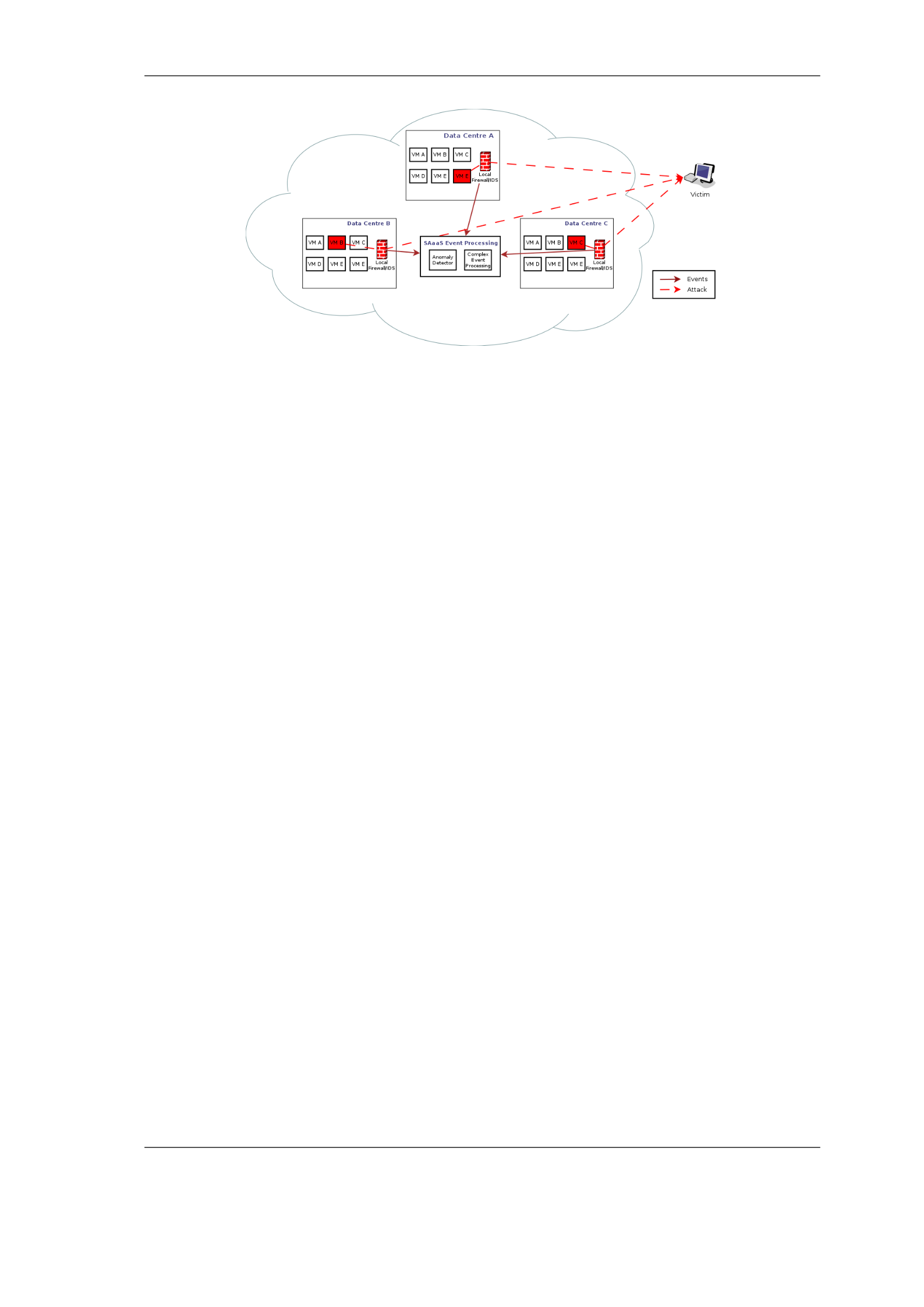
Chapter 6. Anomaly Detection
Figure 6.1: DDoS Attack Scenario
of instances in each of the cloud’s data centers. Then he uses all of these distributed
instances to DDoS a victim’s host. If only the data in each data center was analysed
for its own, maybe no attack would be detected as only a few hosts take part in it.
If however, the data is combined and analysed in an overspanning detection system,
this attack can be perceived in its whole extent.
A cloud infrastructure can run a huge number of systems, maintained by different
cloud users, resulting in a heterogeneous level of security configuration. Mostly these
instances are close together within a limited IP range. This is very attractive for
misusage. Traditional bruteforce attacks on logins, such as SSH, MySQL, etc., try
numerous combinations of username:password couples on one single target IP. Detec-
tion is simple, since this behaviour results in massive “login denied” messages in the
SSH server’s logfile. Therefore, sophisticated cloud login bruteforce attacks perform a
“slow attack”, by trying only one specific user + password combination on a whole IP
range of a cloud provider’s instances, instead of flooding one victim with millions of
possible login credentials from a dictionary [207]. Consequently, the attack is hard to
detect for traditional monitoring systems, like an IDS. By monitoring login attempts
cloud wide over multiple cloud customer instances, a successful login with (multiple)
preceding unsuccessful login attempts at different cloud instances can be defined as
166
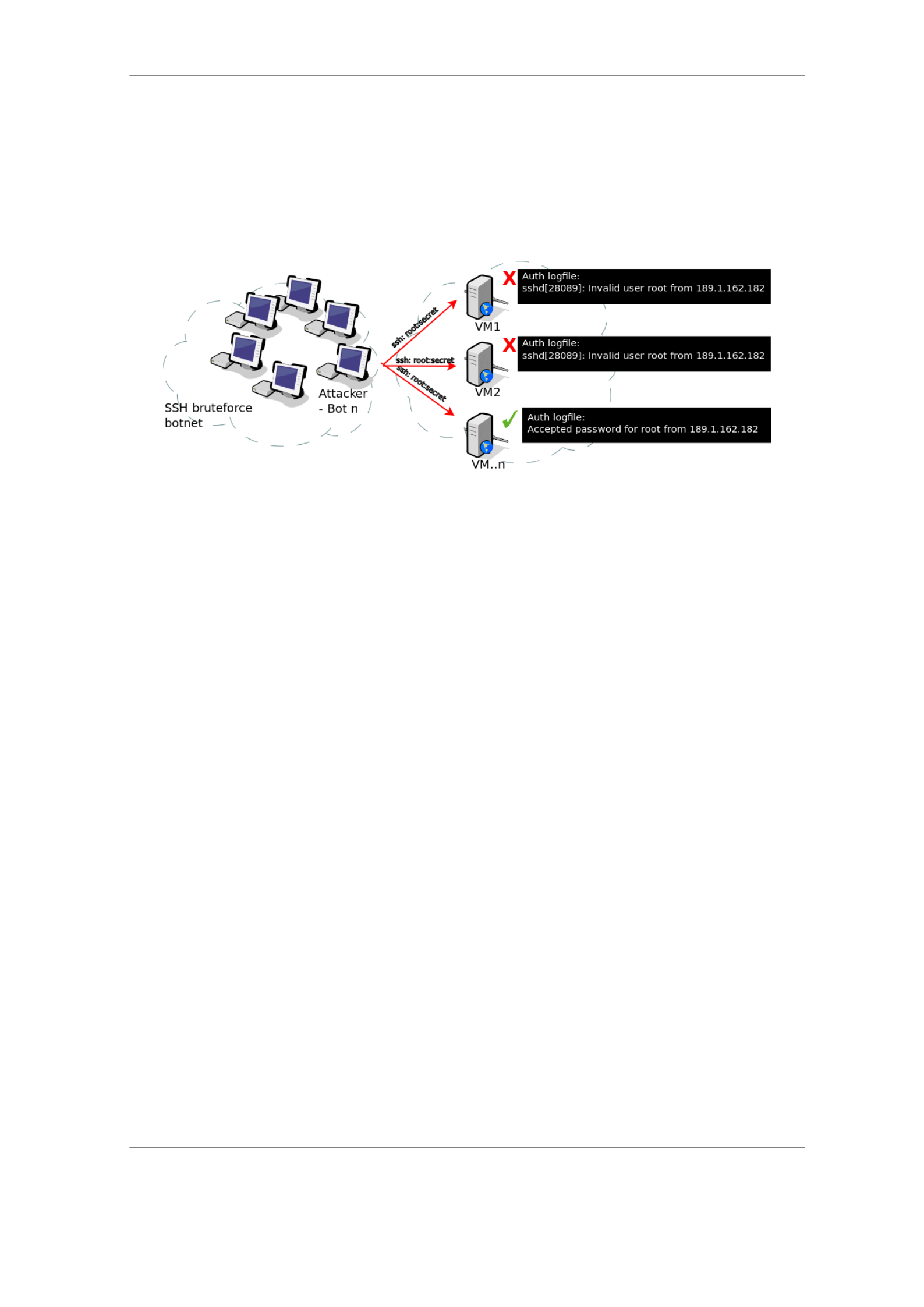
6.3. Rule Based Anomaly Detection
abnormal behaviour and thus detected. Figure 6.2 depicts a cloud login bruteforce
attack on SSH. This risk is not only limited to login attacks, but applies also for in-
formation gathering attacks, such as a slow port scan.
Figure 6.2: Distributed SSH bruteforce on weakly secured cloud instances
Several hypervisor vulnerabilities have been found in the past that allow an attacker
to gain access to a cloud host from inside a VM (e.g. [108],[109]). As cloud computing
and especially IaaS relies heavily on virtualization technologies this poses a threat to
every cloud provider. By accessing the underlying host, an attacker not only gains
access to real hardware, but also to all other VMs running on this machine. It is
therefore essential, that VM escaping attacks get detected and appropriate counter
measures are taken. This includes monitoring process activity on all cloud hosts for
unusual activity, for example the commands that are being executed or syscalls as
described by Hofmeyr et al. in [208]. The following risk scenarios for a rule based
anomaly detection system have been identified:
•Misusage of VMs to execute follow-on attacks
•Hosting of (malicious) data or software
•Malicious creation / deletion of VMs
•Scalability attacks
167

Chapter 6. Anomaly Detection
6.3.3 Rule Based Anomaly Detection Architecture
Rule based anomaly detection can be already achieved by the presented SAaaS archi-
tecture (Chapter 4) and the Cloud Audit Policy Language (Chapter 5). Rules can be
described as security policies with a corresponding threshold in CAPL format. When-
ever a cloud sensor agent detect a change, which affects a user’s instances, SAaaS
agents get configured with the corresponding user’s security policies and deployed to
the affected VMs. The previously introduced “Attack on cloud scalability” scenario
is used to explain an example of user-centric anomaly detection in more detail.
Consider a cloud user deploys an online shop within a cloud, see Figure 6.3. To share
load, two web servers are running on different VMs, a load balancer is distributing
incoming http requests. All web servers are combined to a virtual group “WWW-
Cluster1” by a CAPL policy. Scalability features are enabled based on the metric “http
requests per second”. A CAPL upscaling policy 1 regulates, that if the total number
of incoming requests per second exceeds a certain threshold, e.g. 100 requests / second,
an upscale event for group WWW-Cluster1 gets issued to the cloud management
system and an additional web server VM gets created and added to WWW-Cluster1.
To prevent attacks on scalability the following CAPL monitoring policy gets assigned
to WWW-Cluster1:
Name : Scalability protection WWW-Cluster1
Policy Type : Scalability
VM Group : WWW-Cluster1
Metric : Requests per second
Threshold : 100
As a result, 2 this policy gets registered at the SAaaS CMS sensor agent, which
monitors CMS events. On an incoming upscale event for WWW-Cluster1, the defined
168
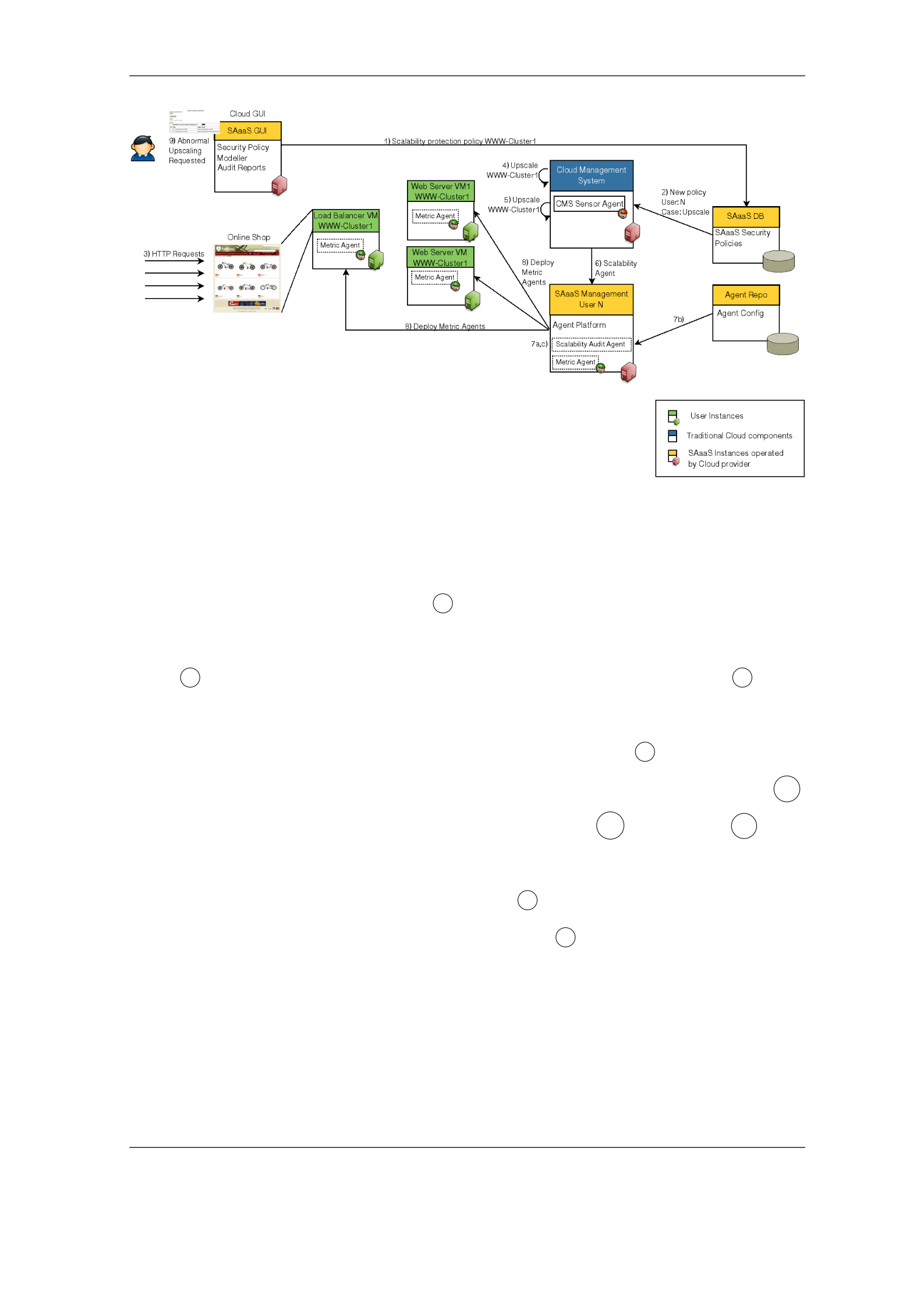
6.3. Rule Based Anomaly Detection
Figure 6.3: User-centric anomaly detection: cloud scalability
conditions are checked before execution of the upscale command.
Now let’s assume there is a high load 3 on the web servers due to a product launch
of the user’s company. Therefore, the cloud management system gets an upscale
event 4 for WWW-Cluster1, which gets intercepted by a SAaaS agent 5 . The
event provokes according to the policy set a concurrent audit, which leads to the
creation and configuration of a new Scalability Audit Agent 6 at the user specific
SAaaS Management VM. The audit agent gets created from the agent repository 7a ,
configured with the scalability check for WWW-Cluster1 7b and started 7c . The
agent creates a new metric agent, which gets deployed to the load balancer to check
the current total amount of registered requests 8 . Additionally, metric agents get
deployed to the web server VMs of WWW-Cluster1 8 to validate the current load
of HTTP requests. All metric agents report the result back to the audit agent. The
audit agent evaluates the result and decides, dependent on the average load reported
by the metric agents, if the upscale event is okay or not. The results get conditioned
into an audit report. By pulling the information from multiple sources (load balancer
169
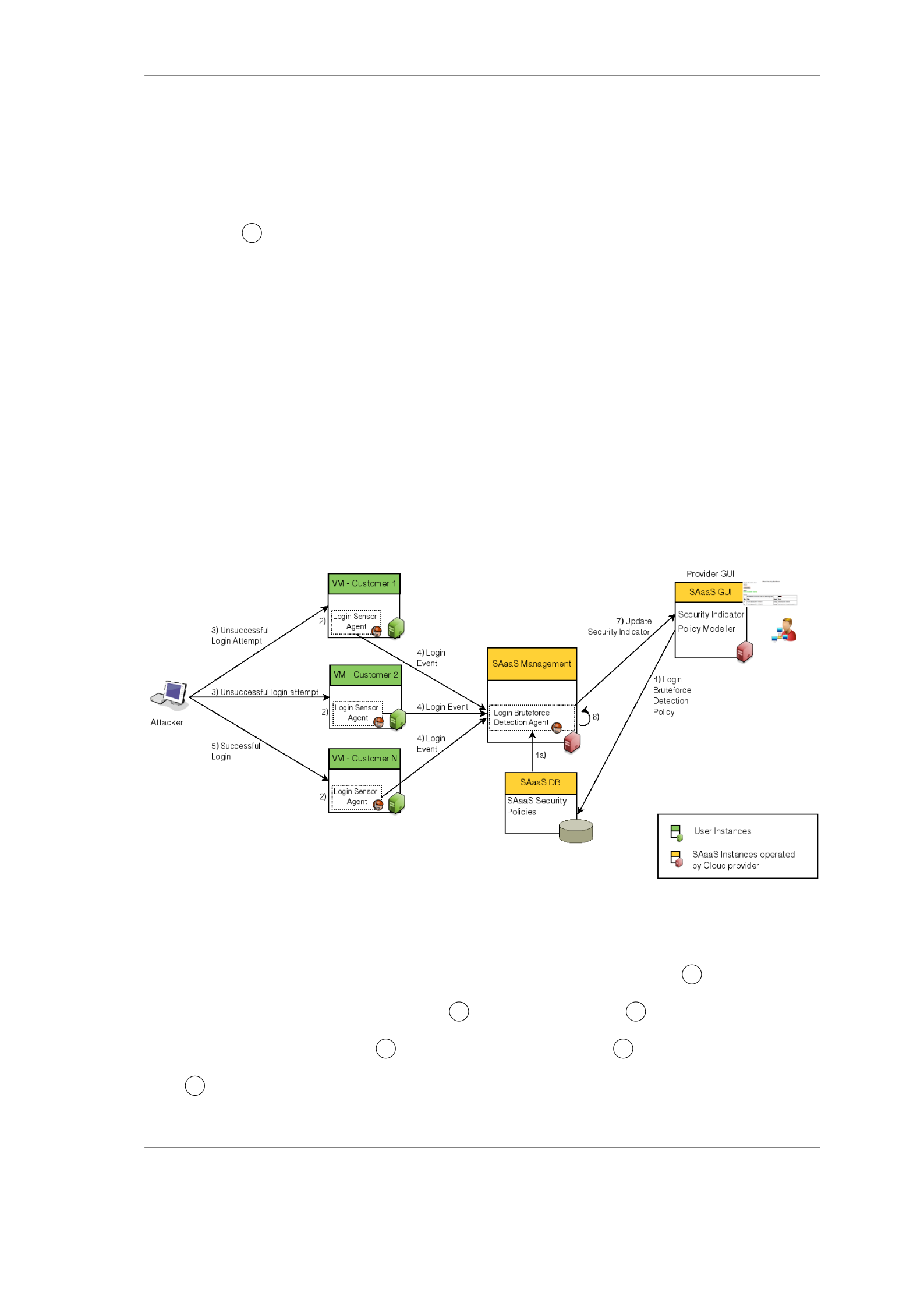
Chapter 6. Anomaly Detection
and WWW-Cluster1 web server VMs), a compromised load balancer or compromised
agents at the web server VMs could be detected. In case the reported load is below
the defined upscaling threshold this is considered as an anomaly, which get reported
to the user 9 . Different notification schemes, such as alerting the user via email,
short text message or further actions are imaginable.
As for a cloud wide anomaly detection, the previously elaborated scenario “Cloud
Login Bruteforce Attack” could be considered. In a similar manner as CAPL en-
ables cloud user to define security policies for their VMs, it can be used for the cloud
provider to define security policies for the whole cloud infrastructure. Thus, one could
state: “If a successful login from one SRC IP address (the attacker) is preceded by
a number of nfailed login attempts, this is an abnormal behaviour, which needs to
be reported. Figure 6.4 visualises the involved SAaaS components. It is assumed,
Figure 6.4: Cloud wide anomaly detection: Login bruteforce detection
that a corresponding CAPL policy was set by the cloud provider 1 . Login sensor
agents deployed over all VM instances 2 report information 4 about (successful and
unsuccessful) login attempts 3 . In case a successful login 5 is detected, it is exam-
ined 6 against the login event history of this Src IP. In case the login violates the
170

6.4. Behavioural Based Anomaly Detection
defined security policy, an event is added to the SAaaS Security Event dashboard and
the SAaaS security indicator is updated 7 . Again, different notification or response
schemes are imaginable.
These two scenarios were chosen to show, that whenever a rule can be defined to model
an abnormal or normal behaviour, the combination of SAaaS monitoring agents and
cloud audit security policies can be used to identify rule based detectable anomalies
in a cloud infrastructure. However, as indicated in Table 6.1, not all cloud security
risks can be addressed by a rule based detection method.
6.4 Behavioural Based Anomaly Detection
”Most current approaches to misusage detection involve the use of rule based expert
systems to identify indications of known attacks. However, these techniques are less
successful in identifying attacks, which vary from expected patterns“ [209].
Similar risks, especially the ones originating from the increased complexity and multi-
tenancy of a cloud infrastructure are not addressable by a static, rule based detection
method. For those it is hard to define a meaningful security policy because of the
complexity of the parameter space and the dynamic environment. Requirements for
an anomaly detection system supporting these dynamics are:
•Cover a wide spectrum of different input parameters
•Learn how normal behaviour looks like
•Detect anomalies in this behaviour
•Adapt fast and robustly to the changing environment
To build up behaviour profiles, measurable key values called ”input parameters“ need
to be identified, which can be linked with a cloud user’s profile. Thus, a machine
171

Chapter 6. Anomaly Detection
understandable profile of his cloud usage behaviour can be built. Machine learning
techniques can then be utilised to analyse these profiles. Important for the quality
of the machine learning approach is the quality of the parameter describing a sys-
tem, which are forming the input for the machine learning system.Thus, the identified
cloud security issues (presented in Chapter 3.4) were analysed on their technical de-
tectability and classified to either rule based or behavioural based detectability. This
classification of cloud security issues is available electronically on the attached DVD
in the folder ”CloudSecurityIssues“. All rule based detectable cloud security issues
can be mitigated by modelling of CAPL security policies. For all remaining security
issues, an analysis has been done, which information (input parameter) is necessary
to support an anomaly detection in on this specific subject. Due to time constraints
on finishing the PhD thesis, only input parameters for an anomaly detection in VM
misusage were identified. As a result, Table 6.2 shows IaaS input parameters, which
have have been identified by this research to be valuable for anomaly detection in IaaS
clouds, and where this information originates. The presented SAaaS agents provide a
well suited technical possibility to collect these information.
Classifier Description Origin
VM affiliation The user id a VM belongs to CMS agent
Time stamp The time stamp of a VM management command CMS agent
VM Action The VM management command executed, e.g. VM-
CREATE, VM-DELETE, VM-STOP, VM-MIGRATE
CMS agent
VM Creator SRC IP range The IP range of a user accessing the CMS for VM
management tasks, such as VM creation, VM altering,
VM stopping
Agent monitoring cloud
GUI logfile
Running VM Count Number of currently running VMs of that user CMS
VM services Open ports indicating services offered on a VM Audit agent
Continued on next page
172

6.4. Behavioural Based Anomaly Detection
Classifier Description Origin
VM image The type of VM image chosen, such as Linux VM im-
age, Windows VM image, OwnCloud or specific ver-
sions of those
CMS agent
VM parameter Virtual hardware configuration of VM, such as Vir-
tual CPU, Virtual RAM, Virtual disk space, amount
of Virtual Networking interfaces, Virtual Network in-
terface type, other Virtual peripherals
CMS
VM software Software, which is installed within a VM. This could
be derived from package management
Audit agent
VM Network protocols Networking protocols used by a VM to communicate Host agent
VM CPU consumption CPU consumption utilised by VM Host agent @ hypervisor
VM RAM consumption RAM consumption utilised by VM Host agent @ hypervisor
VM I/O consumption I/O consumption utilised by VM Host agent @ hypervisor
VM network bandwidth Network bandwidth utilised by VM Host agent @ virtual
switch
Cloud data centre Which target data centre is selected for VM, in case of
multiple available cloud data centres, such as Amazon
Availability Zones Zones[210]
CMS
VM outgoing network targets IP range of destinations VM sends packets to Host agent @ virtual
switch
SRC IP range VM configura-
tion
IP range of systems establishing configuration connec-
tions to VM, such as a direct SSH login or Windows
Remote Desktop connection
Host agent @ virtual
switch
Specific VM software metrics Customised information of certain software installed
on VM, such as web server load on web server VM
SAaaS metric agents
Table 6.2: Anomaly detection: direct input parameters for IaaS cloud usage
173
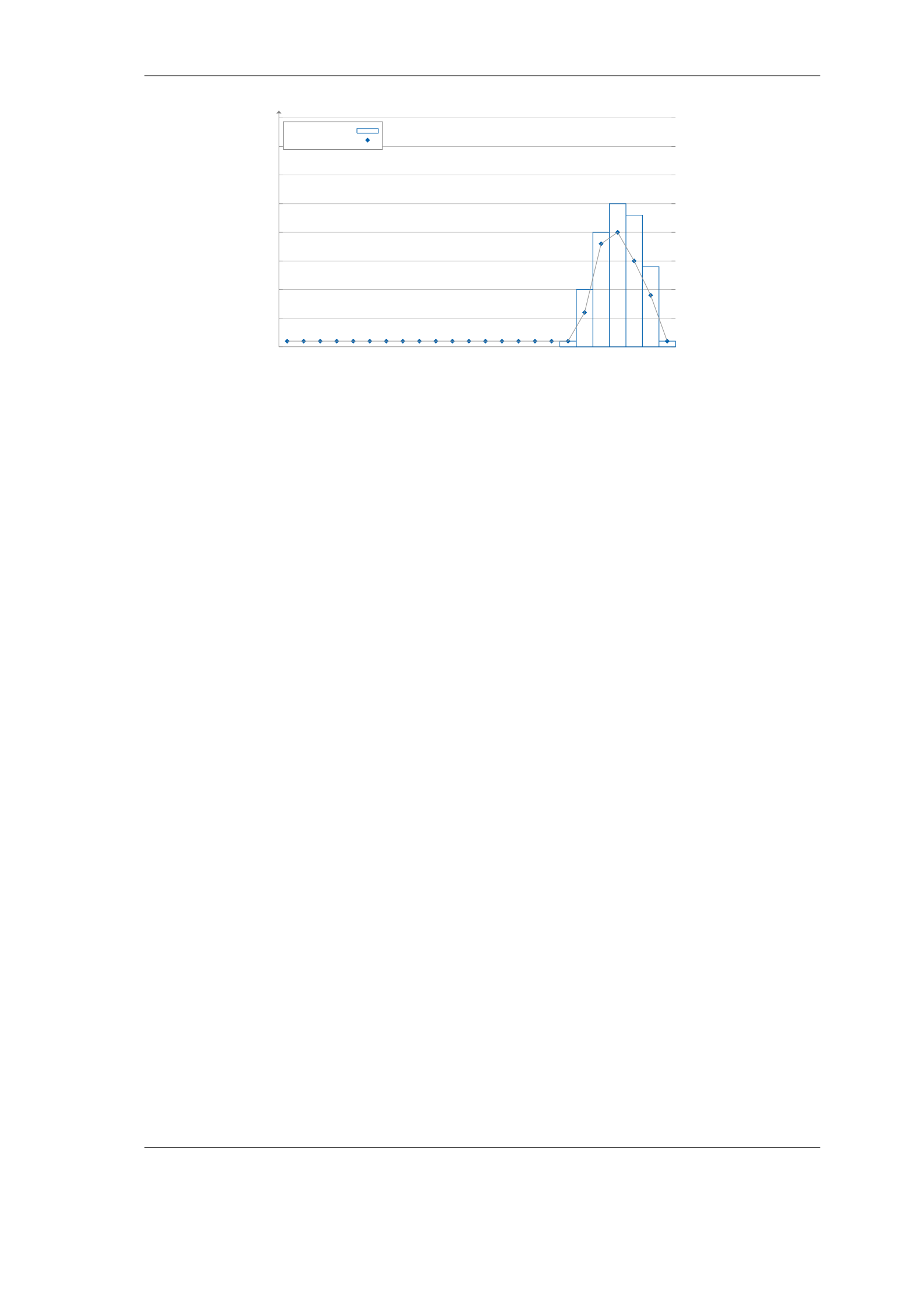
Chapter 6. Anomaly Detection
0
5
10
15
20
25
30
35
40
0-1 1-2 2-3 3-4 4-5 5-6 6-7 7-8 8-9 9-10
10-11
11-12
12-13
13-14
14-15
15-16
16-17
17-18
18-19
19-20
20-21
21-22
22-23
23-24
0
1
2
3
4
5
6
7
8
Requests (in thousands)
VMs (number)
Time of day
LastVMActions
RunningVMCount
Figure 6.5: Anomaly Detection: online movie rental - normal behaviour
Based on those direct input parameters (information is directly available), additional
derived parameters, called ”features“ [211, p2] can be deducted. Table 6.3 shows
identified features for IaaS clouds. Features are based on the combination of multiple
direct input parameters. They often indicate a trend of a certain action or behaviour,
since they are referring to a certain time frame. The feature Last VM count actions
contains an average number of VM management actions, such as VM-CREATE, VM-
STOP or VM-MIGRATE over a time frame, for example the last hour. As an example,
consider an online movie rental provider, who uses VMs in a cloud in addition to his
own data center to absorb load peeks. Load peeks normally occur every day during
the evening between 18:00pm and 24:00pm, since people are rather watching movies
in the evening than during the day. As a result, the feature Last VM count actions
is increasing until the peek of requested instances is reached and then decreases when
people are finished watching, going to bed. Figure 6.5 shows a graphical representation
of this normal behaviour. Additionally, to elaborate the difference between direct
classifiers and features, the direct classifier Running VM Count is also shown. It follows
the data line of the feature, since more VMs are running during the peek time and
174
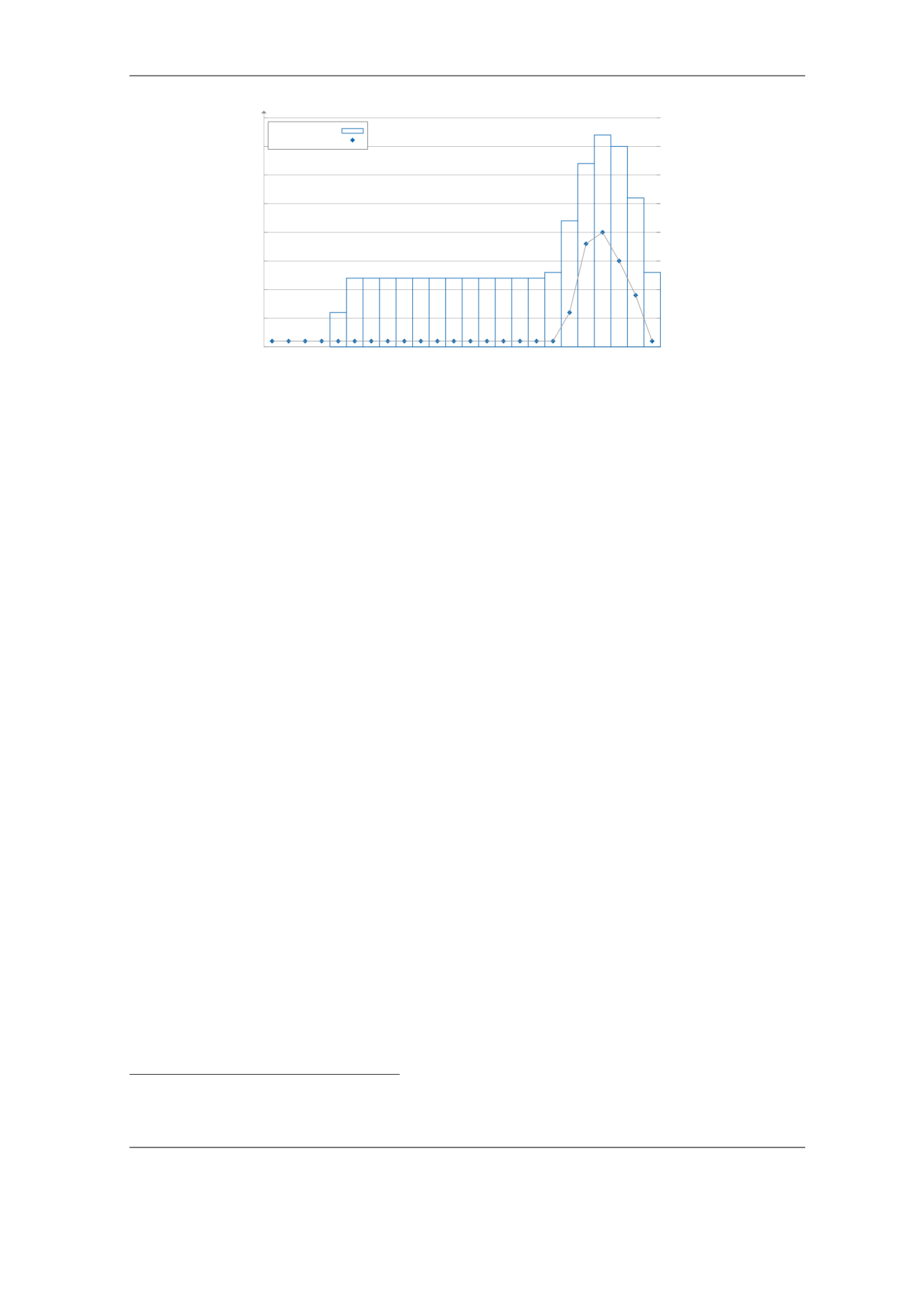
6.4. Behavioural Based Anomaly Detection
0
5
10
15
20
25
30
35
40
0-1 1-2 2-3 3-4 4-5 5-6 6-7 7-8 8-9 9-10
10-11
11-12
12-13
13-14
14-15
15-16
16-17
17-18
18-19
19-20
20-21
21-22
22-23
23-24
0
1
2
3
4
5
6
7
8
Requests (in thousands)
VMs (number)
Time of day
LastVMActions
RunningVMCount
Figure 6.6: Anomaly Detection: online movie rental - abnormal behaviour
afterwards they get revoked1. So far, no additional value is achieved with the feature in
addition to the direct classifier. Now, a malfunction in the cloud management system
is assumed, causing a permanent creation and deletion of one virtual instance every
five minutes, starting at 4:30pm. Figure 6.6 again, depicts the two classifiers. It can
be seen, that the Running VM Count classifier does not expose the malfunction, since
the average overall VM count does not change. However, the feature Last VM count
actions exposes the malfunction, since the amount of VM actions (VM CREATE,
VM-DELETE) within the time frame expands constantly. Naturally, an anomaly
detection system is run not just for one day, but for multiple days, so this malfunction
can get detected by comparison of the different days.
The target of the anomaly detection system for the Security Audit as a Service infras-
tructure aims to identify anomalies in IaaS clouds. This target scope is not limited
to the detection of cloud abuse or attacks. The system is also valuable for cloud user
and provider detecting anomalies not originating from a security incident, but a mal-
function of a system component or misconfiguration. This could simply be a forgotten
installation of a certain piece of software (e.g. anti virus software) or a configuration,
1It is assumed that one VM is always running, that’s why there is always a VM count of one.
175

Chapter 6. Anomaly Detection
Classifier Description Calculated From
Last VM count create Number of VM-CREATE commands of that user dur-
ing a particular time frame
Time stamp & VM Ac-
tion
Last VM count stop Number of VM-STOP commands of that user during
a particular time frame
Time stamp & VM Ac-
tion
Last VM count delete Number of VM-DELETE commands of that user dur-
ing a particular time frame
Time stamp & VM Ac-
tion
Last VM count migrate Number of VM-MIGRATE commands of that user
during a particular time frame
Time stamp & VM Ac-
tion
Last VM count actions Array of last VM management actions within a par-
ticular time frame
Time stamp & VM Ac-
tion
Last VM count images Array of last VM images chosen for a new VM within
a particular time frame
Time stamp & VM Im-
ages
Last VM count VM pa-
rameters
Array of last virtual hardware chosen for a new VM
within a particular time frame
Time stamp & VM pa-
rameter
... ... ...
Last [DIRECT-
CLASSIFIER-NAME]
Array of any possible direct classifier listed in Table
6.2, within a particular time frame
Time stamp & [DI-
RECT CLASSIFIER]
Table 6.3: Anomaly detection: feature for IaaS Clouds usage
which is not coherent to a companies security policy. A main advantage of machine
learning techniques, is their ability to automatically learn coherence’s between differ-
ent classifiers, which may, especially in a huge data set, not be evident for humans.
For example, it can be easily identified by humans, that if suddenly multiple VMs of
different cloud customers, are communicating over a so far unused network protocol at
the very same time to a same target IP, this can be considered an anomaly, indicating
a security incident, such as a botnet infection. Or these VMs are compromised to ex-
ecute a DDoS attack, as already happened in the Amazon Cloud [79]. However, it is
not that obvious to humans, if VMs are created from a compromised PC within a com-
panies regular data center. The malicious VMs might be created from the usual SRC
IP address, with the usual virtual hardware characteristics. However, the attacker
might create the VM from a different VM image, e.g. an older, outdated version of
the regular used image where security patches are missing. Or, the same image gets
used but, to execute follow on attacks, an usually installed anti virus software is left
176

6.4. Behavioural Based Anomaly Detection
out. These fine grained combinations of different features can be learned by a machine
learning technique, leading to an successful anomaly detection.
To address the introduced problem of behavioural based anomaly detection in an IaaS
Cloud, a machine learning approach, based on artificial neural networks (ANN) was
chosen. Neural networks are based on the concepts of statistical pattern recogni-
tion and have emerged as a practical technology, with successful application in many
fields, such as speech recognition, fraud detection or classification of handwritten char-
acters [211].
Same as for the Rule Based anomaly detection scenario, the behavioural based anomaly
detection is split into ”User-centric anomaly detection“ and ”Cloud wide anomaly de-
tection“ sub-scenarios. The following scenarios are developed.
6.4.1 User-centric Anomaly Detection
User anomaly scenarios are focused on the behaviour analysis of one particular cloud
user. The target is to learn the cloud usage behaviour of this particular user and to
detect anomalies in case his behaviour changes. By monitoring user account activity,
user cloud interaction, such as interaction time or origin of requests, VM images used,
VM instance behaviour, such as CPU utilisation, memory consumption, network I/O,
time of VM utilisation, etc., a user’s cloud usage behaviour can be learned. Thus,
abnormal usage scenarios can be identified. The following use cases for user specific
behavioural based anomaly detection are addressed:
The possibility to quickly aggregate massive loads of computing power is very attrac-
tive. This is also true for criminals who can use this power for example to crack hashed
passwords or decode CAPTCHAs. Technically there is however no non-intrusive way
to decide for what exactly cloud computing power is used. Even if there was, data
protection laws and credibility concerns prevent such monitoring. However, moni-
toring the user’s behavior for anomalies can help detecting account misusage. For
177

Chapter 6. Anomaly Detection
example heavy activity on a rather silent account would cause suspicion, especially if
the login source is from another country or continent. Additionally, to the VM count
and geographical login source, the weekday and time as well as usage of available VM
types can be taken into account.
Anomaly Detection Model For User Scenarios
While rule based anomaly detection is a rather simple task, whenever a meaningful
threshold can be applied, behavioural based anomaly detection can be used whenever
a threshold definition is not possible. This is a rather challenging topic. Depending on
the specific use case scenario, different input information, classifiers, need to be used
to learn a certain usage behaviour and successfully detect anomalies. To show the
feasibility of a behaviour based anomaly detection system, this research concentrates
on one specific risk: Account misusage. It aims to answer the following research ques-
tion: “How can it been verified, that a user is responsible for a certain VM creation?
The anomaly detection system needs to learn, how a user uses a particular VM by
analysing create and stop times of it over a certain training period. Afterwards, the
system is able to tell, based on a single VM-CREATE or VM-STOP event, if this fits
to the user’s behaviour or not.
To show the applicability and performance of an anomaly detection system, an IaaS
cloud usage data set - the training data - was needed to test the system’s detection
rate. Quality of training data is important, since if the training data is more accu-
rate, the performance of the trained system will be improved. Collecting training data
can be achieved in three ways: recording real cloud usage data, using sanitised data
or using simulated data [212]. Multiple public cloud providers, such as Amazon or
IBM were contacted, but refused to disclose usage data, not even in an anonymized
form. Thus, a simulation environment for IaaS cloud usage was created (presented
178
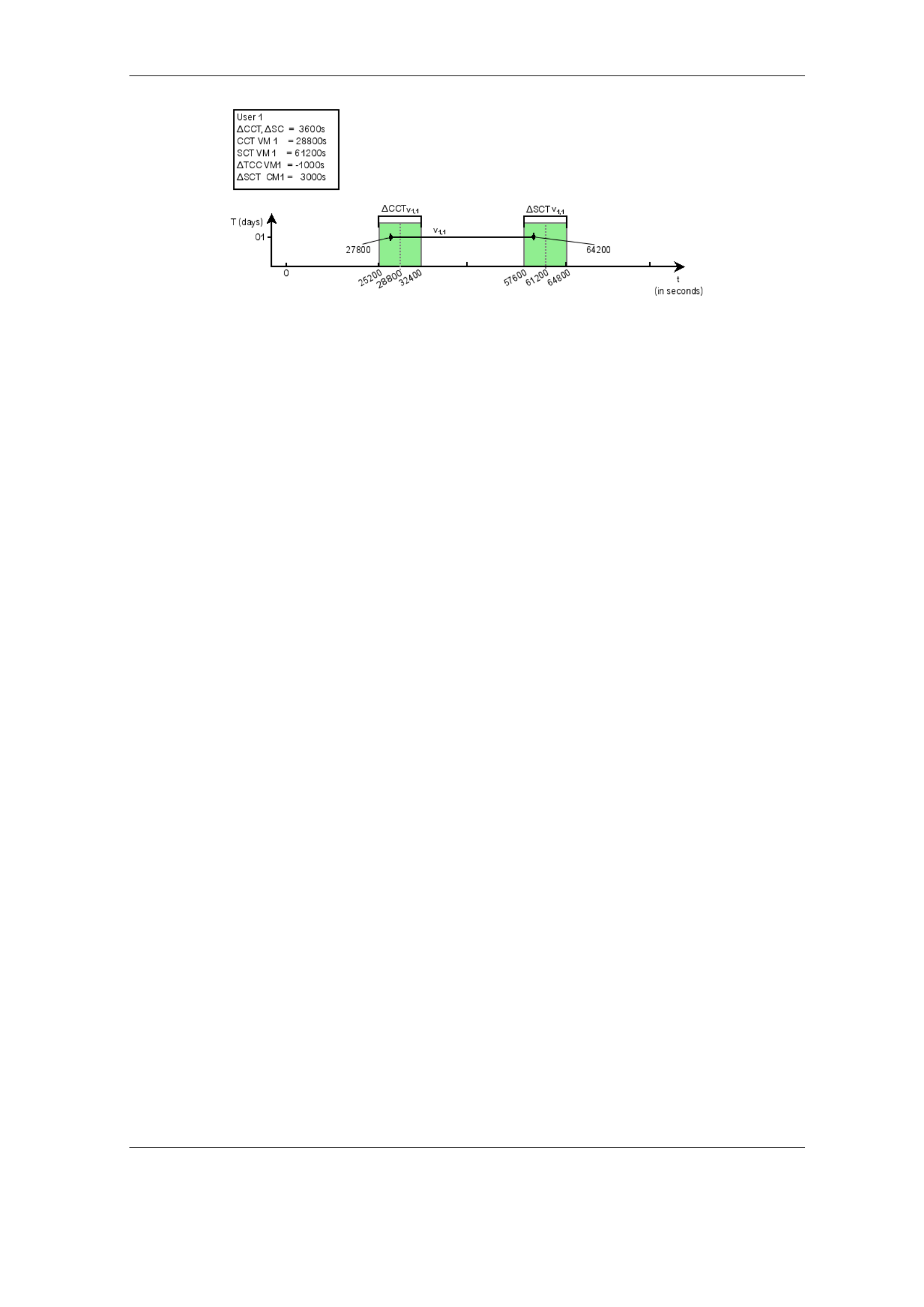
6.4. Behavioural Based Anomaly Detection
Figure 6.7: Calculation of a VM’s runtime
later in this chapter). The following merely models are utilised to show the detection
performance. They are created from experience with the university-wide cloud infras-
tructure CloudIA at Furtwangen University and multiple discussions with a German
cloud provider. For the use case of user-centric behavioural anomaly detection the
following normal behaviour is assumed.
Normal Behaviour
A cloud user is using one VM each day to work with. He starts up the VM at a certain
time, e.g., 8:00 AM and stops it at a certain time, e.g., 5:00 PM. The start of the VM
results at the cloud management system in a VM-CREATE event, a stop of a VM is
registered as a VM-DELETE event. In a perfect scenario, a user would create and
stop his VM always at the very same time every day. But this is not true for real
world scenarios. Thus, the real VM create time and VM stop time gets calculated by
a VM core create time (CCT) + a variation time value ∆CCT defined by random
and a VM core stop time (CST) + a random value ∆CST . The specification of
∆CCT and ∆CST is important, since it is a control parameter for the accuracy of
the detection of the neural network. If it is defined either very loosely, or too narrow,
detection rate of the anomaly detection system is affected, since differentiation between
normal and abnormal behaviour becomes less identifiable. Thus, this parameter has
been implemented as a configurable variable, see later Section 6.4.3. For this work, a
179

Chapter 6. Anomaly Detection
default of 60 minutes is always assumed, since it provides good results. However, for a
quantitative performance evaluation of the anomaly detection system, this parameter
and its impact on the overall detection rate needs to be considered. Due to time
constraints on finishing the PhD thesis, this has been left out for future work.
Figure 6.7 visualises these relations for one user for one VM by using the following
example data, which are reused in all scenarios:
•VM1-CREATE: CCT+ ∆CCT = 28.800s−1.000s= 27.800s (7:43am)
•VM1-STOP: CST+ ∆CST = 61.200s+ 3.000s= 64.200s (5:50pm)
All values are measured in seconds. Start and stop times are seconds of a day, starting
from 00:00 AM. This results in final VM create time of 27800s and a final VM stop
time of 64200. The normal behaviour of a user can be described by the following
mathematical model: A user Uhas one VM . The VM’s runtime is defined by a Core
Create Time (CCT) and a Core Stop Time (CST):
UVM = (CCT, CST )
CCT and CST are measured in seconds of a day between 00:00:00 and 23:59:59:
0≤CCT, CST ≤86400 with CCT, CST ∈N
where
CCT < CST
The user’s VM behaviour is monitored over multiple training days D:
Dt={D1, ..., Dn}with t∈N
180
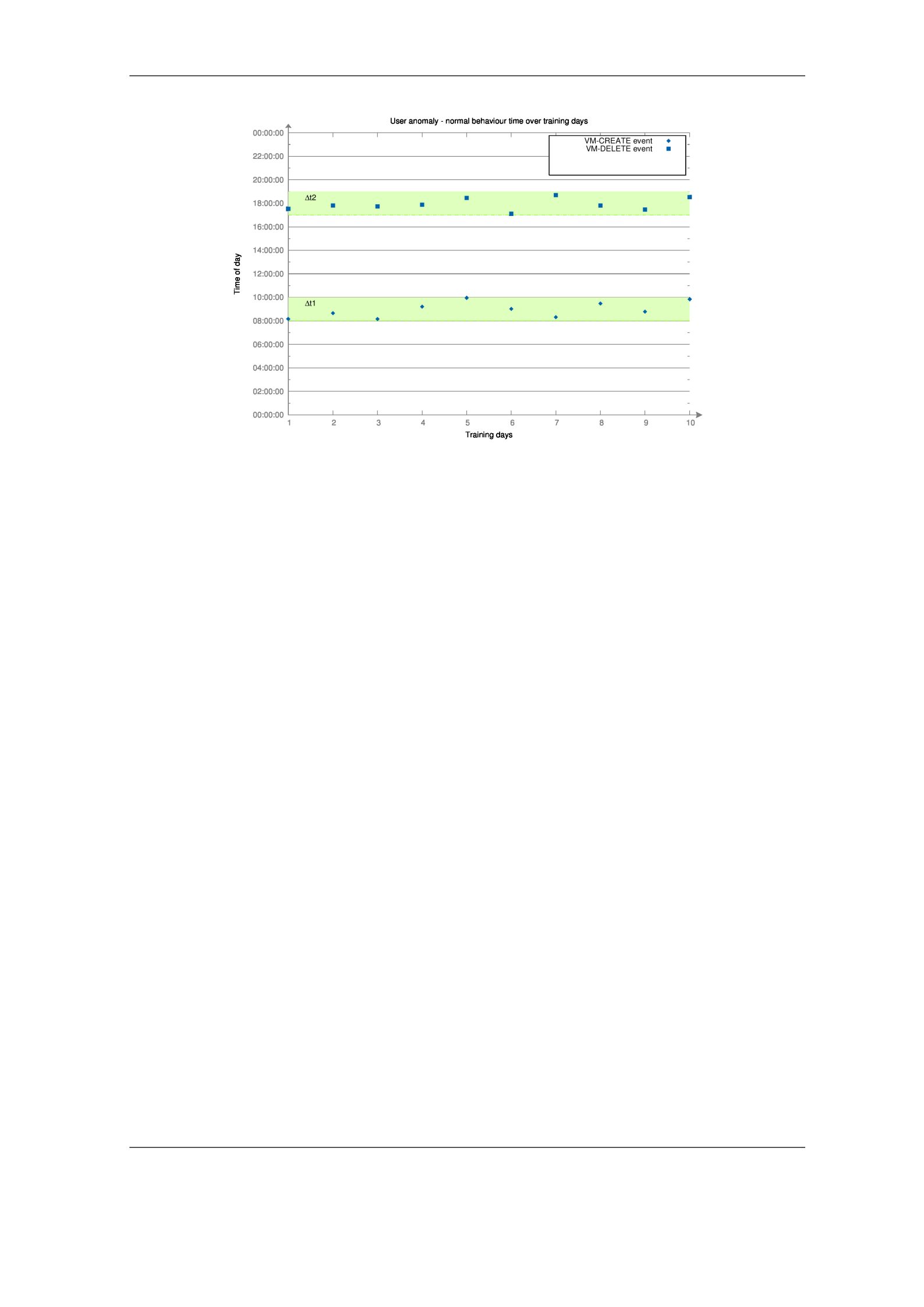
6.4. Behavioural Based Anomaly Detection
Figure 6.8: User Anomaly - Normal Behaviour time over training days
As introduced, real VM create time and VM stop time gets calculated by the VM core
create time (CCT) + a random time value ∆CCT and a VM core stop time (CST) +
a random value ∆CST where its range is defined by a positive or negative R:
−R≤∆CCT, ∆CST ≤+Rwith R∈N
R unequal CST - CCT
Thus, the user’s VM runtime is calculated by:
UVM Dt= (CST + ∆CSTt)−(CCT + ∆CCTt)
In this work, a linear distribution of CMS events for each user is considered. Table 6.4
shows an example data set of the normal behaviour of one user, creating and stopping
one VM over ten training days, with a normal deviation time ∆CCT and ∆CST of
120 minutes. The row ”Events“ indicate a VM-CREATE or VM-STOP event, row
”Time“ shows the corresponding time stamp in a human friendly format.
181
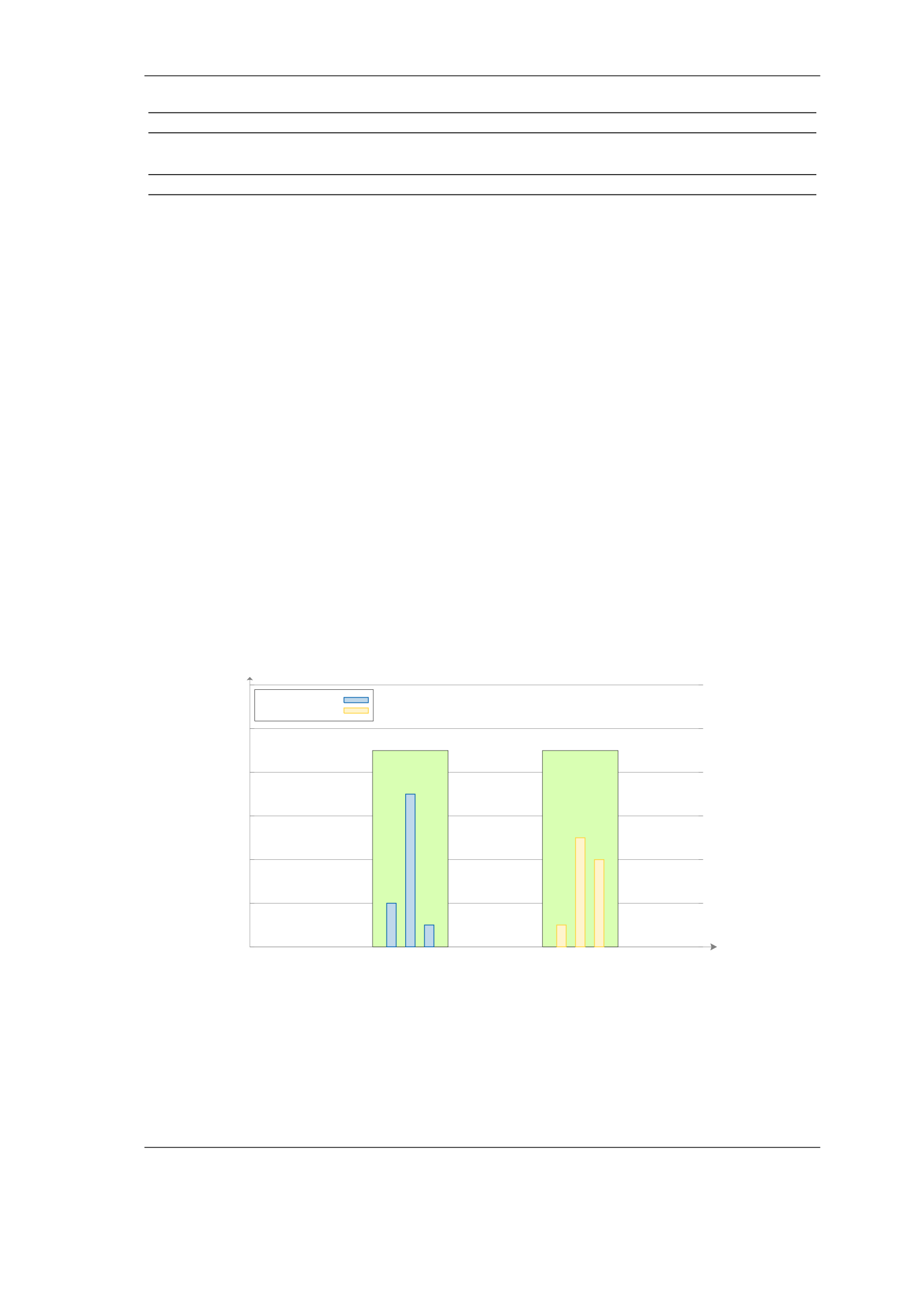
Chapter 6. Anomaly Detection
Day 1 Day 2 Day 3 Day 4 Day 5
VM Event C D C D C D C D C D
Time 08:17:33 18:39:01 07:56:49 18:48:36 08:49:48 17:10:20 08:05:54 17:35:11 08:58:51 17:23:33
Day 6 Day 7 Day 8 Day 9 Day 10
VM Event C D C D C D C D C D
Time 08:01:22 17:17:03 09:20:57 18:25:56 08:45:23 18:15:56 08:53:48 17:02:47 07:44:41 16:54:07
Legend:
C – VM-CREATE event
D – VM-STOP event
Table 6.4: Example data set, normal behaviour: one user, one VM over ten training
days
Based on these raw input data, Figure 6.8 shows a detailed graphical representation
of VM-CREATE and VM-STOP events for the introduced normal behaviour for each
day over the ten training days. However, for anomaly detection, a more useful repre-
sentation is depicted in Figure 6.9, which visualises the event count over ten training
days. Again, normal deviation times ∆CCT and ∆CST are indicated by the green
rectangles.
0
2
4
6
8
10
12
00:00:00-01:00:00
01:00:00-02:00:00
02:00:00-03:00:00
03:00:00-04:00:00
04:00:00-05:00:00
05:00:00-06:00:00
06:00:00-07:00:00
07:00:00-08:00:00
08:00:00-09:00:00
09:00:00-10:00:00
10:00:00-11:00:00
11:00:00-12:00:00
12:00:00-13:00:00
13:00:00-14:00:00
14:00:00-15:00:00
15:00:00-16:00:00
16:00:00-17:00:00
17:00:00-18:00:00
18:00:00-19:00:00
19:00:00-20:00:00
20:00:00-21:00:00
21:00:00-22:00:00
22:00:00-23:00:00
23:00:00-00:00:00
Unit
VM-CREATE event
VM-DELETE event
Figure 6.9: User-centric anomaly detection - Normal user behaviour
182

6.4. Behavioural Based Anomaly Detection
6.4.2 Cloud Wide Anomaly Detection
Whereas the prior scenario is focused upon the behaviour analysis of one single cloud
user, the cloud provider’s point of view is also very interesting. Its main target is
to detect cloud usage changes within a huge amount of completely differently acting
cloud users’ instances, which could indicate a security incident. This could happen in
case an attacker scans over a cloud IP range, infects loosely secured cloud instances
and misuses them for follow-on attacks, such as a Distributed Denial of Service attack.
This use case is already introduced in detail in Section 6.3.2. It also applies to the
cloud wide behavioural anomaly detection, since a change in communication behaviour
of the compromised VMs examined from a cloud wide point of view can detect such
a security incident.
Furthermore, the possibility to quickly aggregate massive loads of computing power
is very attractive as introduced earlier. This also results in a changed VM usage
behaviour, probably over multiple instances of the same or different cloud customers,
which can be detected by a cloud wide behaviour based anomaly detection system.
The following risk scenarios for a behaviour based anomaly detection system have
been identified:
•Account misusage
•Hosting of (malicious) data or software
•Malicious creation / deletion or misusage of VMs
This list is indicative and not definite. The risks have been chosen from the identified
cloud security issues, presented in Chapter 3.4 - Cloud Computing Security Issues to
demonstrate the feasibility of the system.
183

Chapter 6. Anomaly Detection
Cloud Wide Behaviour Model
The cloud wide behaviour detection is build upon the user specific model, but now
multiple users are considered. Furthermore, it is assumed, that each user uses a
different amount of virtual machines. Each single virtual machine has its own specific
run time. This adds two more dimensions of complexity (userid, normal VM count)
to the scenario, compared to the presented user-centric anomaly scenario.
Normal Behaviour
Normal behaviour is described as: a cloud provider runs an Infrastructure as a Service
cloud. The provider has multiple customers, with a minimum of 1. Every customer
uses a different amount of VMs with individual start and stop times of each VM. The
number of VMs a user is normally using each day does not underlie big fluctuations.
The scenario can be described by the following mathematical model: A provider has
multiple cloud users uwith a minimum of 1, described by the index set:
Uu={U1, ..., Un}with u∈N
Each user has multiple VMs, indexed by whole numbers i:
VMi={VM1, ..., VMn}with i∈N
Each single VM’s runtime is defined by a CCT and a CST:
UuVM i= (CCTui, CSTui)
CCTui and CSTui are measured in seconds of a day between 00:00:00 and 23:59:59:
0≤CCTui, CSTui ≤86400 with CCTui, CSTui ∈N
184

6.4. Behavioural Based Anomaly Detection
where
CCTui < CSTui
The users’ VMs behaviour is monitored over multiple training days D:
Dt={D1, ..., Dn}with t∈N
Again, the real VM create time and VM stop time gets calculated by the VM core
create time (CCT) + a random time value ∆CCT and a VM core stop time (CST) +
a random value ∆CST where its range is defined by a positive or negative R:
−R≤∆CCT, ∆CST ≤+Rwith R∈N
Thus, the final create and stop time of a virtual machine VMiof a user Uuat a specific
training day Dtis defined by:
UuVMiDt= (CSTui + ∆CSTuit)−(CCTui + ∆CCTuit)
An an example the following simulation parameters are assumed: 10 training days,
1000 user, User 3 uses 5 VMs every day, CCT of VM 2: 28800s, CST of VM 2: 61200,
at training day 7: ∆CCT: -1000, ∆CST : 3000. This result in the following:
Dt= 1, ..., 10
Uu= 1, ..., 1.000
VMi={VM31,VM32,VM33,VM34,VM35}
185
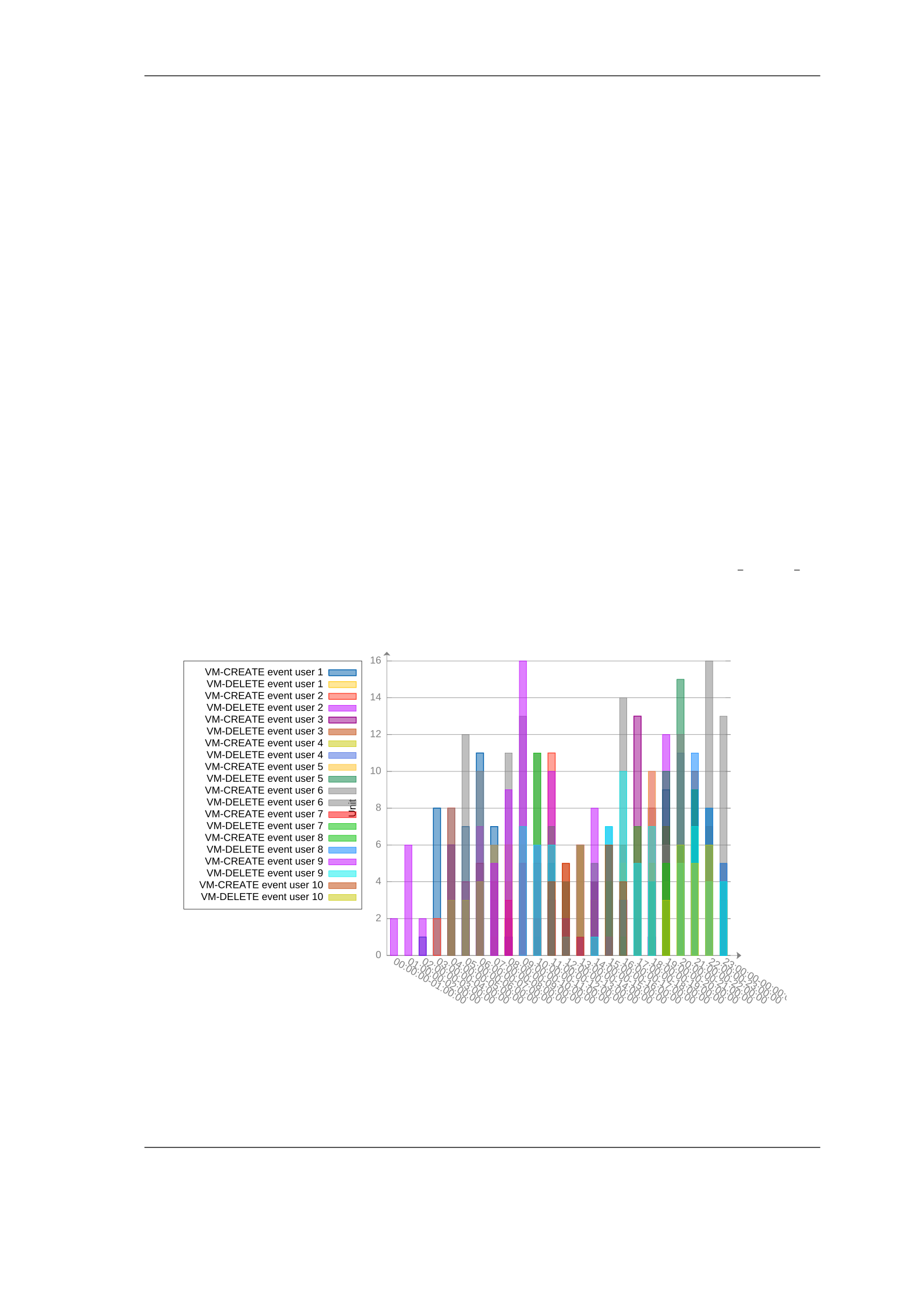
Chapter 6. Anomaly Detection
V M2−CREAT E =CCT3,2+ ∆CCT3,2= 28.800s−1.000s= 27.800s(7:43am)
V M2−ST OP =CST3,2+ ∆CST3,2= 61.200s+ 3.000s= 64.200s(5:50pm)
U3VM2D7= (27.800,64.200)
Thus, user 3 with 5 VMs is represented as:
U3={VM31,VM32,VM33,VM34,VM35}
Figure 6.10 tries to depict the resulting data set for ten users. It can be seen, that a
meaningful graphical representation of the CloudWideAnomaly scenario is not possible
anymore, as it consists of four variable dimensions. Details on the data set will be
presented in Section 6.4.3. The detailed data values are available on the attached DVD
in folder CloudUsageSimulator/DataSets/provider anomaly01-simutestuser Sorted
1000User.csv.
0
2
4
6
8
10
12
14
16
00:00:00-01:00:00
01:00:00-02:00:00
02:00:00-03:00:00
03:00:00-04:00:00
04:00:00-05:00:00
05:00:00-06:00:00
06:00:00-07:00:00
07:00:00-08:00:00
08:00:00-09:00:00
09:00:00-10:00:00
10:00:00-11:00:00
11:00:00-12:00:00
12:00:00-13:00:00
13:00:00-14:00:00
14:00:00-15:00:00
15:00:00-16:00:00
16:00:00-17:00:00
17:00:00-18:00:00
18:00:00-19:00:00
19:00:00-20:00:00
20:00:00-21:00:00
21:00:00-22:00:00
22:00:00-23:00:00
23:00:00-00:00:00
Unit
VM-CREATE event user 1
VM-DELETE event user 1
VM-CREATE event user 2
VM-DELETE event user 2
VM-CREATE event user 3
VM-DELETE event user 3
VM-CREATE event user 4
VM-DELETE event user 4
VM-CREATE event user 5
VM-DELETE event user 5
VM-CREATE event user 6
VM-DELETE event user 6
VM-CREATE event user 7
VM-DELETE event user 7
VM-CREATE event user 8
VM-DELETE event user 8
VM-CREATE event user 9
VM-DELETE event user 9
VM-CREATE event user 10
VM-DELETE event user 10
Figure 6.10: CloudWideAnomaly01 scenario data set
186

6.4. Behavioural Based Anomaly Detection
6.4.3 Anomaly Detection Architecture
The anomaly detection system presented in this work is a sub component of the
Security Audit as a Service architecture for IaaS cloud environments. The source for
the anomaly detection system presented in this work are SAaaS agents, monitoring
events, which build classifiers, as introduced in Table 6.2 - Direct input parameters
and Table 6.3 - Features earlier in this Chapter. The network is trained with historical
user data and evaluates the newly received event if it indicates an anomaly or not.
For the anomaly detection in IaaS clouds a supervised learning algorithm with a feed
forwarded net has been used. For creation of the neural network, training and testing
the neural network editor Membrain [213] was used. Data sets of cloud usage are
simulated, thus the simulation environment gets described first.
Cloud Usage Simulator
To test the presented anomaly detection scenarios, an IaaS cloud usage data set was
required. As mentioned earlier, real world data from IaaS cloud providers were not
accessible. Thus, a simulation environment was created to simulate the presented
normal cloud usage behaviour and anomaly scenarios.
Cloud usage data set
For each simultation run, first a normal behaviour data set is generated. Since the main
target of this research stage is to evaluate, that anomaly detection based on neural
networks provides an extra value to improve security in IaaS clouds, three user-centric
and one cloud wide anomaly scenario is developed and implemented. However for
simplicity, not all introduced direct parameters and features introduced in Table 6.2
and Table 6.3 were implemented. Only the following parameters were implemented.
187

Chapter 6. Anomaly Detection
•Direct input parameters
–VM affiliation (User id)
–Time stamp
–VM Action
–Running VM Count
•Features
–Last VM Count Create –Last VM Count Delete
With those input parameters, the following indicative list of anomaly scenarios are
developed. They are a selection of more possible scenarios and were chosen to demon-
strate the feasibility of the anomaly detection approach.
•User-centric anomaly scenarios
–UserAnomaly01 - Abnormal VMs outside of normal VM usage time
–UserAnomaly02 - Abnormal VMs within normal VM usage time
–UserAnomaly03 - Abnormal VMs within normal VM creation time frame
(∆CCT) and stopped within normal VM stop time frame (∆CST )
•Cloud wide anomaly scenarios
–CloudWideAnomaly01 - Within a huge number of differently behaving
cloud users, the behaviour of one user changes drastically.
Within those scenarios, an abnormal VM is considered a VM, which is not intention-
ally created by the original cloud customer.
UserAnomaly01
In scenario UserAnomaly01, an increasing number of VMs gets created outside the
working hours. Figure 6.11 shows a graphical representation of the corresponding
data file. Abnormal VMs are depicted in red, normal behaviour is distributed within
the green area. In this example data set a total of ten abnormal VMs were created.
188
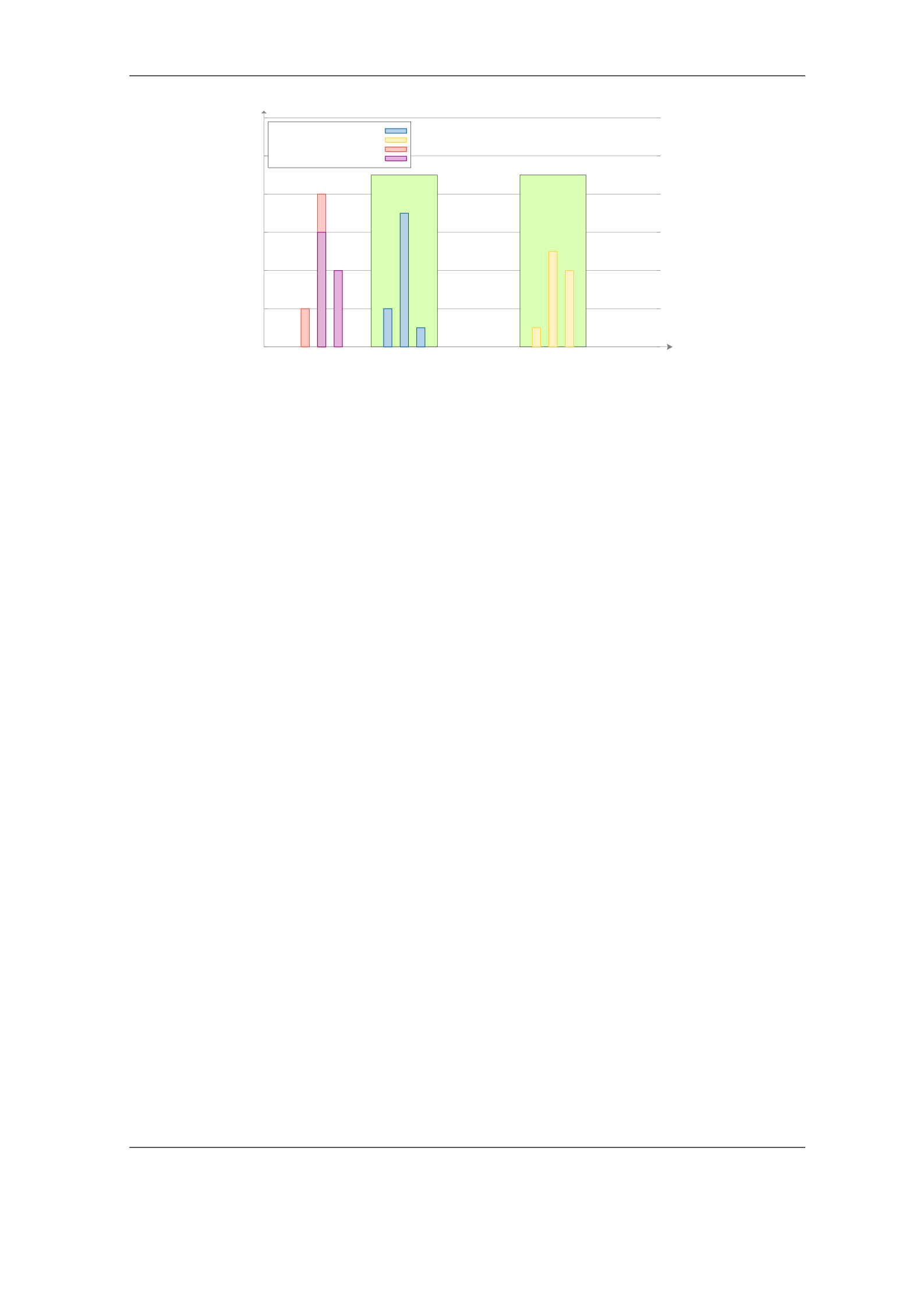
6.4. Behavioural Based Anomaly Detection
0
2
4
6
8
10
12
00:00:00-01:00:00
01:00:00-02:00:00
02:00:00-03:00:00
03:00:00-04:00:00
04:00:00-05:00:00
05:00:00-06:00:00
06:00:00-07:00:00
07:00:00-08:00:00
08:00:00-09:00:00
09:00:00-10:00:00
10:00:00-11:00:00
11:00:00-12:00:00
12:00:00-13:00:00
13:00:00-14:00:00
14:00:00-15:00:00
15:00:00-16:00:00
16:00:00-17:00:00
17:00:00-18:00:00
18:00:00-19:00:00
19:00:00-20:00:00
20:00:00-21:00:00
21:00:00-22:00:00
22:00:00-23:00:00
23:00:00-00:00:00
Unit
VM-CREATE event
VM-DELETE event
Abnormal VM-CREATE event
Abnormal VM-STOP event
Figure 6.11: UserAnomaly01 scenario data set
Two VMs were created between 02:00:00 - 03:00:00 and eight VMs between 02:00:00
- 03:00:00. The VMs were shutdown sequentially, six between 02:00:00 - 03:00:00 and
four between 03:00:00 - 04:00:00.
UserAnomaly02
As a next step, in scenario UserAnomaly02 the abnormal VM-CREATE and VM-
STOP events are created within the “normal” VM usage hours as depicted in Figure
6.12. Again, ten abnormal VMs were created, this time three between 11:00:00 -
12:00:00, four between 12:00:00 - 13:00:00 and four between 13:00:00 - 14:00:00. Two
were stopped between 12:00:00 - 13:00:00, two between 13:00:00 - 14:00:00 and six
between 13:00:00 - 14:00:00.
UserAnomaly03
In the final user-centric anomaly scenario, UserAnomaly03, the abnormal VM-CREATE
and VM-STOP events are generated during the normal time period the user would
start and stop his VMs, thus within ∆CCT and ∆CST . A resulting example data
set is pictured in Figure 6.13. This time the bars of the normal and abnormal event
189
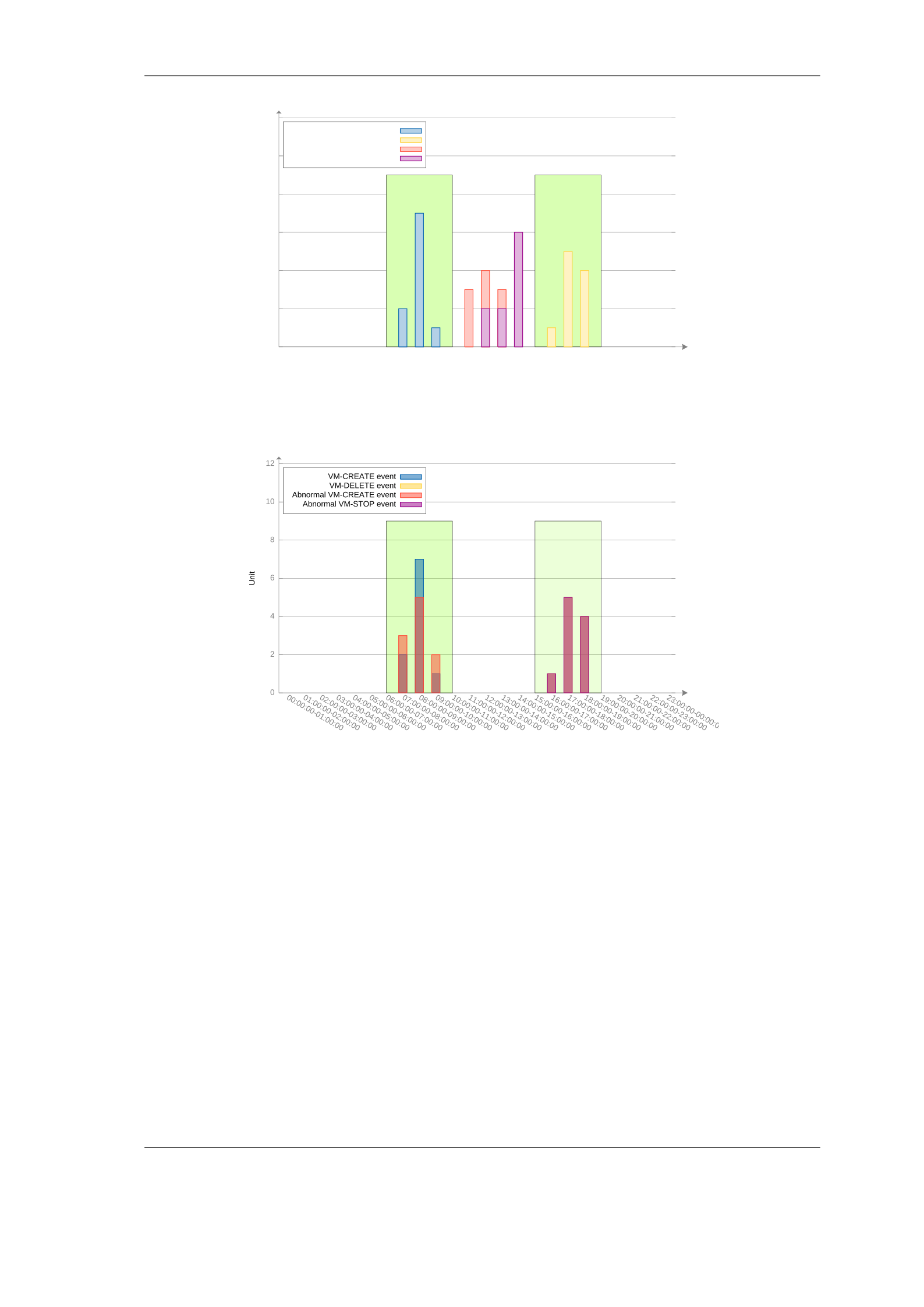
Chapter 6. Anomaly Detection
0
2
4
6
8
10
12
00:00:00-01:00:00
01:00:00-02:00:00
02:00:00-03:00:00
03:00:00-04:00:00
04:00:00-05:00:00
05:00:00-06:00:00
06:00:00-07:00:00
07:00:00-08:00:00
08:00:00-09:00:00
09:00:00-10:00:00
10:00:00-11:00:00
11:00:00-12:00:00
12:00:00-13:00:00
13:00:00-14:00:00
14:00:00-15:00:00
15:00:00-16:00:00
16:00:00-17:00:00
17:00:00-18:00:00
18:00:00-19:00:00
19:00:00-20:00:00
20:00:00-21:00:00
21:00:00-22:00:00
22:00:00-23:00:00
23:00:00-00:00:00
Unit
VM-CREATE event
VM-DELETE event
Abnormal VM-CREATE event
Abnormal VM-STOP event
Figure 6.12: UserAnomaly02 scenario data set
0
2
4
6
8
10
12
00:00:00-01:00:00
01:00:00-02:00:00
02:00:00-03:00:00
03:00:00-04:00:00
04:00:00-05:00:00
05:00:00-06:00:00
06:00:00-07:00:00
07:00:00-08:00:00
08:00:00-09:00:00
09:00:00-10:00:00
10:00:00-11:00:00
11:00:00-12:00:00
12:00:00-13:00:00
13:00:00-14:00:00
14:00:00-15:00:00
15:00:00-16:00:00
16:00:00-17:00:00
17:00:00-18:00:00
18:00:00-19:00:00
19:00:00-20:00:00
20:00:00-21:00:00
21:00:00-22:00:00
22:00:00-23:00:00
23:00:00-00:00:00
Unit
VM-CREATE event
VM-DELETE event
Abnormal VM-CREATE event
Abnormal VM-STOP event
Figure 6.13: UserAnomaly03 scenario data set
are lying congruent on each other. By just looking at a VM Action time behaviour, it
would be not possible to tell, which VMs are the normally created ones, and, which
one are the abnormally created ones. In this scenario three abnormal VMs were cre-
ated between 07:00:00 - 08:00:00, five between 08:00:00 - 09:00:00 and two between
09:00:00 - 10:00:00. The abnormal VMs were stopped with exactly the same behaviour
as the normal ones: one between 16:00:00 - 17:00:00, five between 17:00:00 - 18:00:00
and four between 18:00:00 - 19:00:00.
190
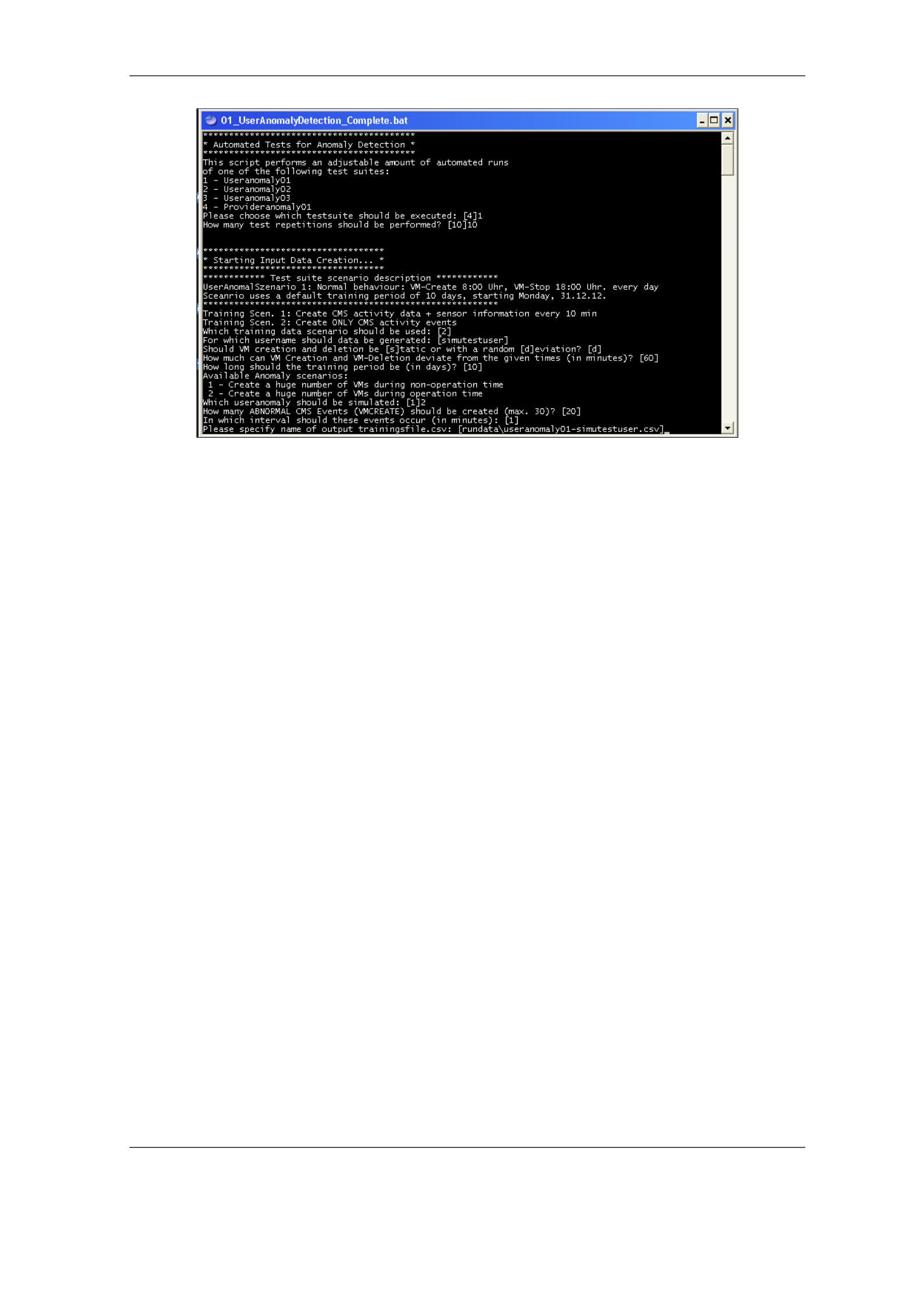
6.4. Behavioural Based Anomaly Detection
Figure 6.14: Cloud usage data simulator
CloudWideAnomaly01
This scenario simulates a cloud wide anomaly scenario. For normal behaviour data,
multiple users are simulated. Each user differs in his cloud usage behaviour. Each
user uses a variable amount of VMs, with different VM start and VM stop times.
Abnormal data are simulating a change in the behaviour of one, randomly chosen user.
As elaborated earlier in Section cloud Wide Anomaly Detection - Normal Behaviour,
a meaningful graphical representation of this use case is not feasible any more, since
a four dimensional variable space of input classifier exists: UserID, VM count of
normally used VMs each day, VM create time, VM stop time.
Simulation Process
The developed cloud simulator is based on multiple python scripts working together
with the neural network tool Membrain. Figure 6.14 shows a screen shot of the
simulator’s entry mask. To support the presented scenarios, the following simulation
parameters are collected before simulation by a textual wizard:
1. Simulation scenario (UserAnomaly01, 02, 03, CloudWideAnomaly)
191

Chapter 6. Anomaly Detection
2. Number of simulation runs (R)
3. Normal data attributes:
a) Random deviation range of daily VM-CREATE and VM-STOP commands
(∆CCT, ∆CST )
b) Number of training days
c) Max. number of VMs a user can normally have (CloudWideAnomaly)
4. Anomaly data attributes:
a) Number of abnormal CMS events (VM-CREATE or VM-STOP) to be gen-
erated
b) Number of additional VMs, which are still considered normal
Listing 6.1 shows a cut out of the data set of user U5for normal behaviour in scenario
B - CloudWideAnomaly01. It shows the userid (U), the time stamp (TStmp) of the
monitored event, the type of the event (VME ), where C = VM-CREATE, D = VM-
DELETE, the running VMCount (VMCount), the history of issued VM-CREATE
(LastVMCC ) and VM-DELETE (LastVMCS ) events on that training day and if this
event is considered to be an anomaly (Anomaly) or not. Before the data set is fed to
the the neural net, the data get normalised to a range between 0 and 1 (as is normal
practice for neural networks [211, p21]).
1U; TStmp ; VME; VMCount ; LastVMCC ; LastVMCS ; Anomaly
25 ; 1 5 2 8 9 ; C ; 1 ; 1 ; 0 ; 0
35 ; 2 4 3 5 5 ; D ; 0 ; 1 ; 1 ; 0
45 ; 1 4 3 3 5 ; C ; 1 ; 1 ; 0 ; 0
55 ; 3 0 5 0 7 ; D ; 0 ; 1 ; 1 ; 0
65 ; 1 4 0 6 0 ; C ; 1 ; 1 ; 0 ; 0
75 ; 2 6 0 9 5 ; D ; 0 ; 1 ; 1 ; 0
85 ; 1 4 2 3 7 ; C ; 1 ; 1 ; 0 ; 0
9...
Listing 6.1: Data set normal behaviour scenario CloudWideAnomaly01
192

6.4. Behavioural Based Anomaly Detection
After input selection is done, the following steps are automatically performed during
a simulation run:
1. Generation of a data set containing normal and abnormal behaviour events ac-
cording to the scenario chosen
2. Splitting of data set (randomly) into training data (80%) and a testing data
(20%)
3. Loading and training of neural network in Membrain
4. Running the testing data set through the trained network
5. Evaluation of the testing data set
6. Storing of results to test run specific result file
The steps listed above, are performed automatically and form one simulation run R.
To validate, that the results of one simulation run are reproducible and the network’s
detection performance is steady, a number of multiple simulation repetitions n, e.g.
ten can be defined. Multiple simulations are also required to account for any bias
in the simulation data set. Thus, nruns of the simulation sequence listed above are
sequentially performed. Each repetition goes through the whole simulation sequence,
including new training and testing data generation and randomisation. The overall
results of each single simulation run (R1, R2, ..., Rn) are combined into one comma sep-
arated value file (e.g. useranomaly03-result-evaluated-2013-10-04-20-35-53.csv). After
all simulation repetitions are done, the overall result file (e.g. (e.g. useranomaly03-
result-evaluated-overall-2013-04-15-16-49-43.csv) is automatically opened in a spread-
sheet program, depicted in Figure 6.15.
The sequence diagram in Appendix A.6 shows the different python and Membrain
scripts involved in the simulation of scenario UserAnomaly01. The data set for nor-
mal and abnormal behaviour gets created by the entry python script
193
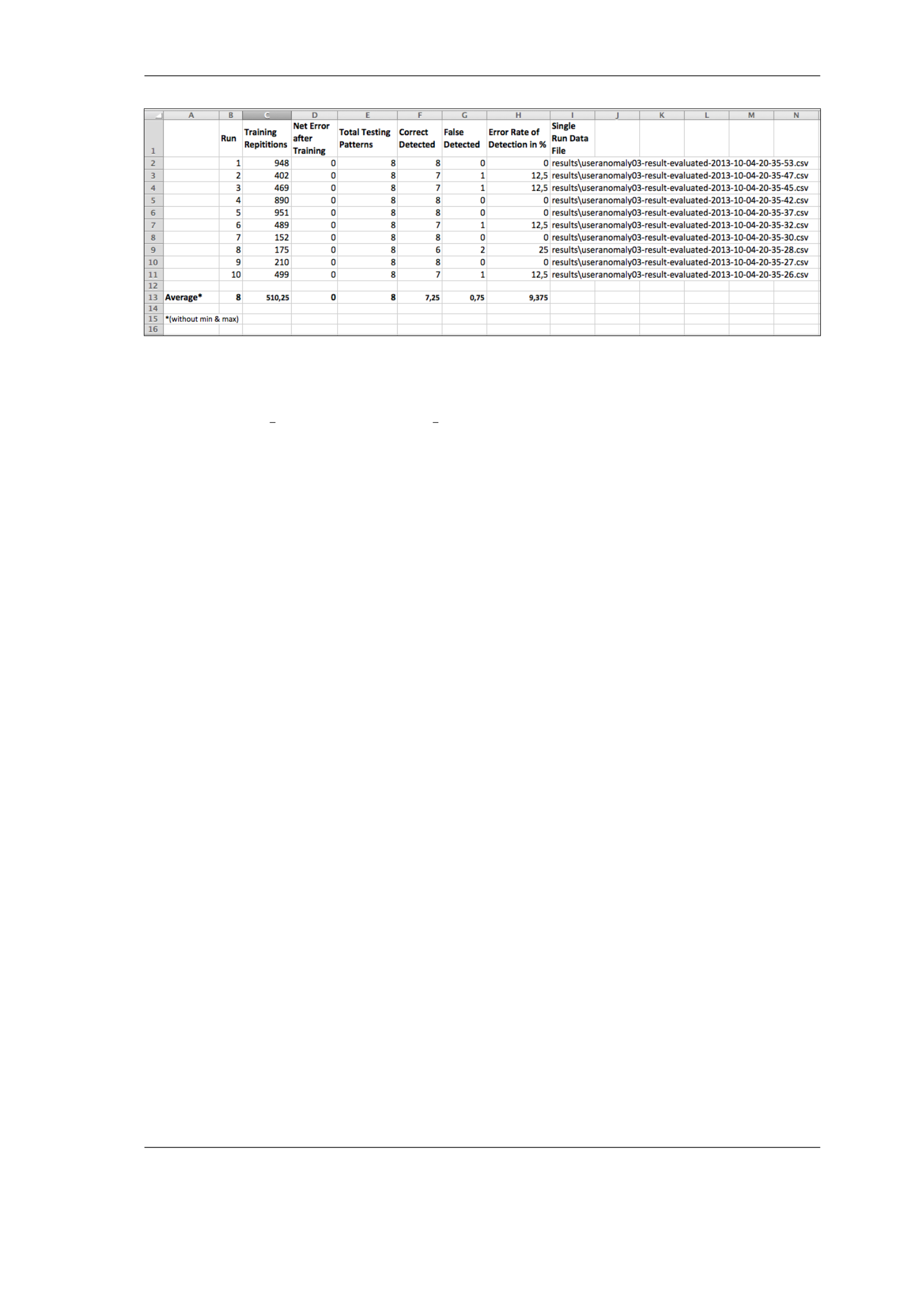
Chapter 6. Anomaly Detection
Figure 6.15: Anomaly detection evaluation
UserAnomaly01 Complete Workflow Automated. The main simulation is implemented
as multiple python scripts. Data splitting is done randomly by a Membrain script,
which then continues with training the neural network until the target net error is
reached. A video of an automated simulation of scenario UserAnomaly03 with ten
simulation runs is available at the attached DVD to this thesis in folder or online
available at: https://doeli.de/web/video/ SimulationUserAnomalyScenario3 Frank-
Doelitzscher.mov.
6.4.4 Neural Networks for Anomaly Detection
The data sets created by the cloud simulator are fed to a neural network, which trains
and learns the simulated behaviour. In the following, the neural networks developed
for the several presented anomaly detection scenarios are presented.
UserAnomaly01
The scenario UserAnomaly01 should detect if a VM was used at an abnormal time a
user normally uses his VM. Figure 6.16 shows a graphical representation of the neural
network used for scenario UserAnomaly01.
It consists of one input layer 2 hidden layers and 1 output layer. The hidden layers
contain ten neurons each. This number proved to be working best during multiple
194
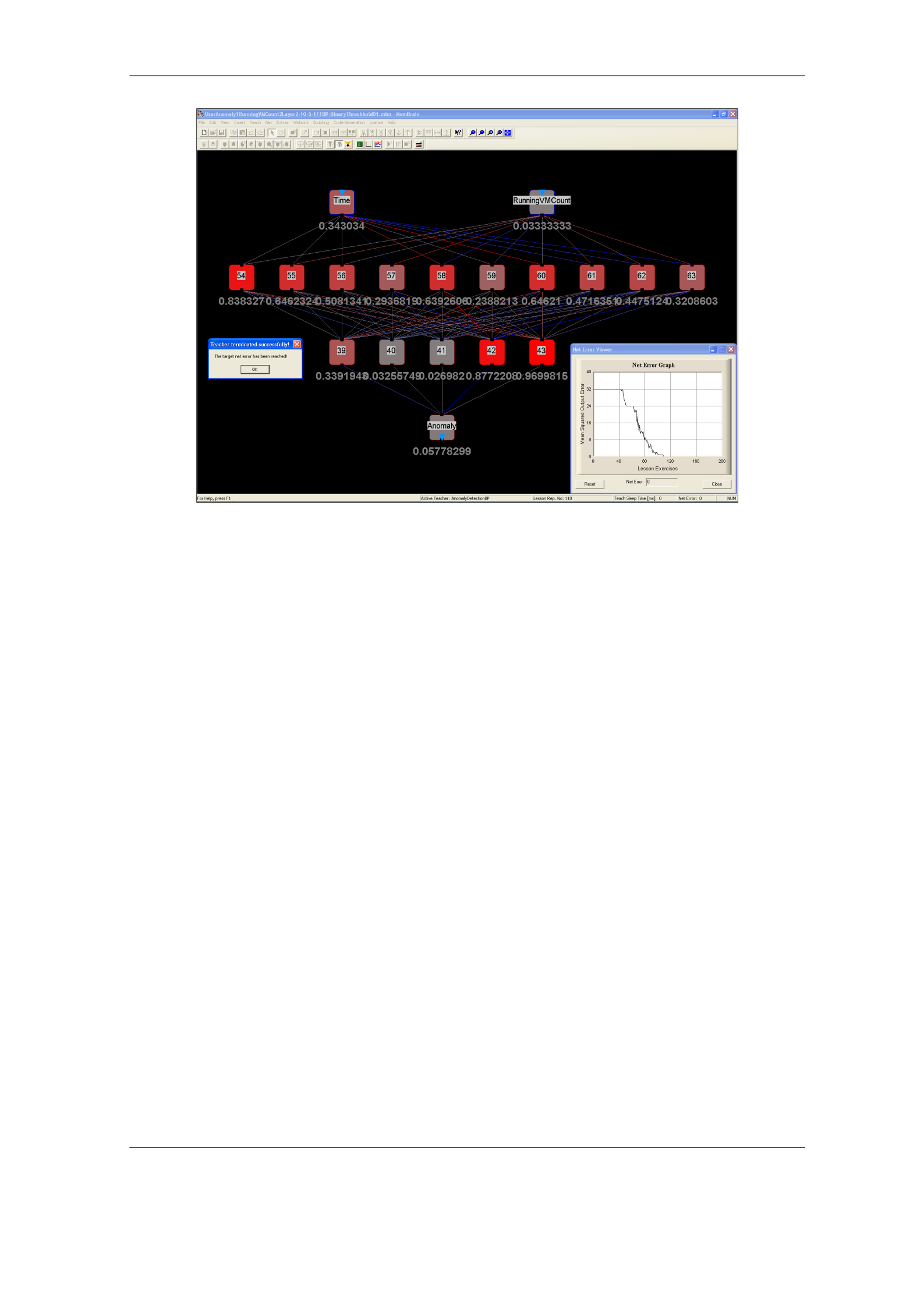
6.4. Behavioural Based Anomaly Detection
Figure 6.16: Feed forward net for scenario “UserAnomaly01”
simulation runs in terms of detection rate and learning speed. The following input
classifier were chosen:
•Time stamp
•Running VM count
Time stamp represents the time a CMS event is received, Running VM Count corre-
sponds to the amount of currently running VMs on a specific day. One output neuron
indicates if the processed input information (VM-CREATE or VM-STOP event) is
considered abnormal or not. For the learning algorithm a Backpropagation network
is used since it is typically used for pattern recognition [214]. “Binary by threshold”
error calculation with a threshold of 0.1 and no further calculation was used. A target
net error of 0.001 was defined, meaning that the net will stop training when the target
net error has been reached. Before training the net is always reset and weights are
randomised. Figure 6.16 shows a graphical representation of the net after a successful
training period with its weights and the net error graph. Again, the learning curve of
195

Chapter 6. Anomaly Detection
that simulation run is displayed as the net error graph and the target net error has
been reached after 110 learning repetitions (shown at bottom).
UserAnomaly02
Scenario UserAnomaly02 covers the case, where abnormal VM(s) are created during
the time a user normally uses his VM. Since this scenario will use anomaly data,
where an attacker misuses the user’s VM within his normal VM usage time (see Figure
6.12), two additional input classifiers LastVMCountCreate and LastVMCountDelete
are added, building the following input feature sets:
•Time stamp
•Running VM count
•LastVMCountCreate
•LastVMCountDelete
LastVMCountCreate describes the amount of VM-CREATE actions already executed
on this day. LastVMCountDelete describes the VM-DELETE actions executed at this
day. All other network characteristics are the same as described in Section 6.4.4 above.
UserAnomaly03
Scenario UserAnomaly03 finally covers the case where abnormal VMs are created
within the specific time frame a user normally creates and stops his VM Thus, the
run time of abnormal VMs is similar to the normal ones. The same network as for
UserAnomaly02 scenario was used. Figure 6.17 shows a graphical representation of
the net after a successful training period with its weights and the net error graph.
The approximation and balancing of the different neurons during training phase is
depicted in Figure 6.18. It shows the deviation between the net’s trained (blue curve)
and expected (red curve) result of the output neuron between training run 14 and
21. It can be seen, that during those runs, the neurons’ weights are getting adjusted,
so that the calculated results gets closer to the expected result. An over-evaluation
196
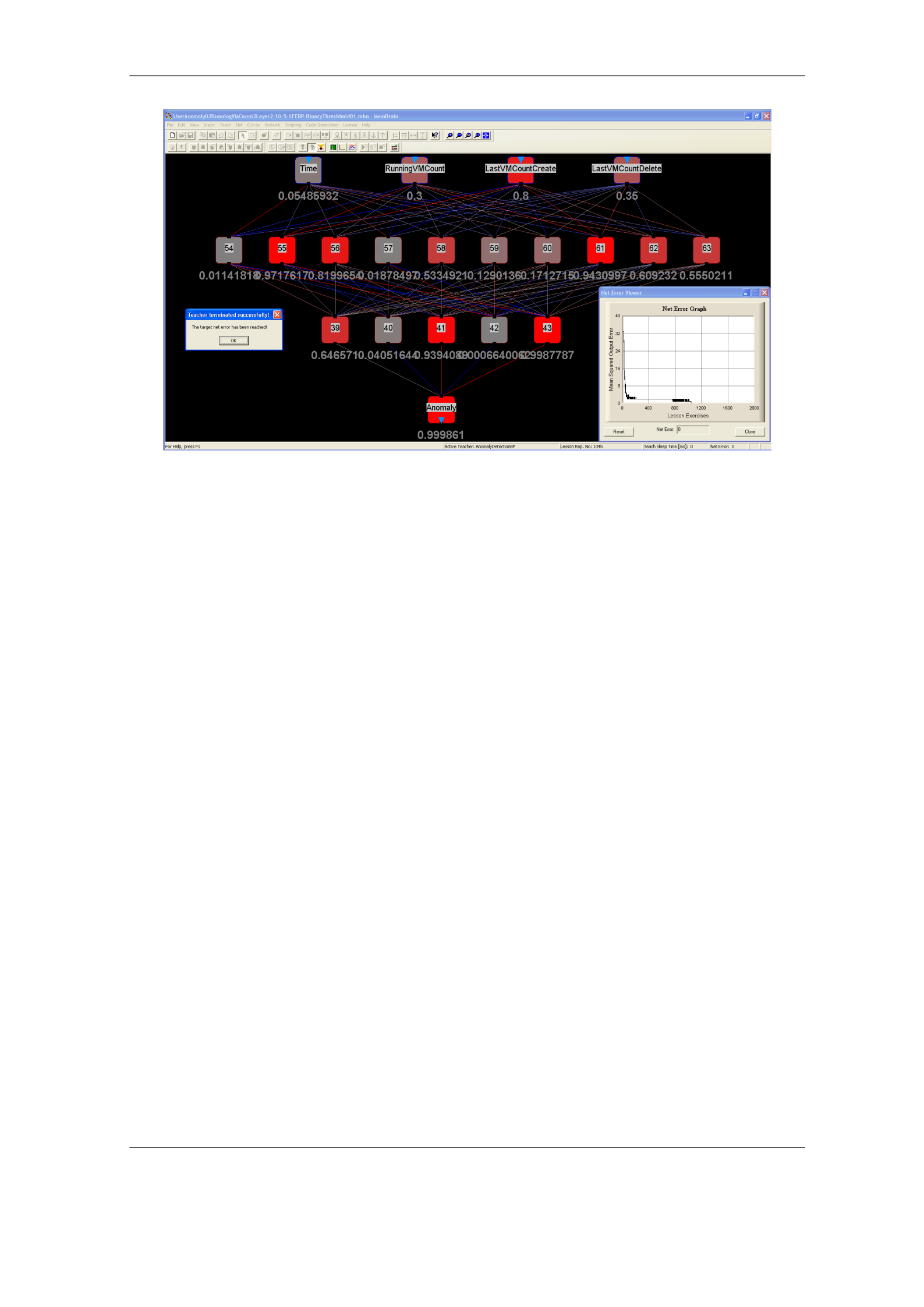
6.4. Behavioural Based Anomaly Detection
Figure 6.17: Feed forward net for scenario “UserAnomaly02” and “UserAnomaly03”
(around pattern 17) gets readjusted so that the target net error is reached (around
pattern 19).
Cloud Wide Anomaly Detection with Neural Networks
For the detection of cloud wide anomalies the target is to identify a changing user
behavior within a huge set of differently acting users. The neural net from scenario
UserAnomaly03 was extended by the input classifier userid, forming the following
input classifier set:
•Userid
•Time stamp
•Running VM count
•LastVMCountCreate
•LastVMCountDelete
Figure 6.19 depicts the neural network. All other network characteristics are the
same as in scenario UserAnomaly03. The source code of the simulator is available
on the thesis DVD in folder “CloudUsageSimulator”. Next, simulation results of the
presented anomaly detection system are presented.
197
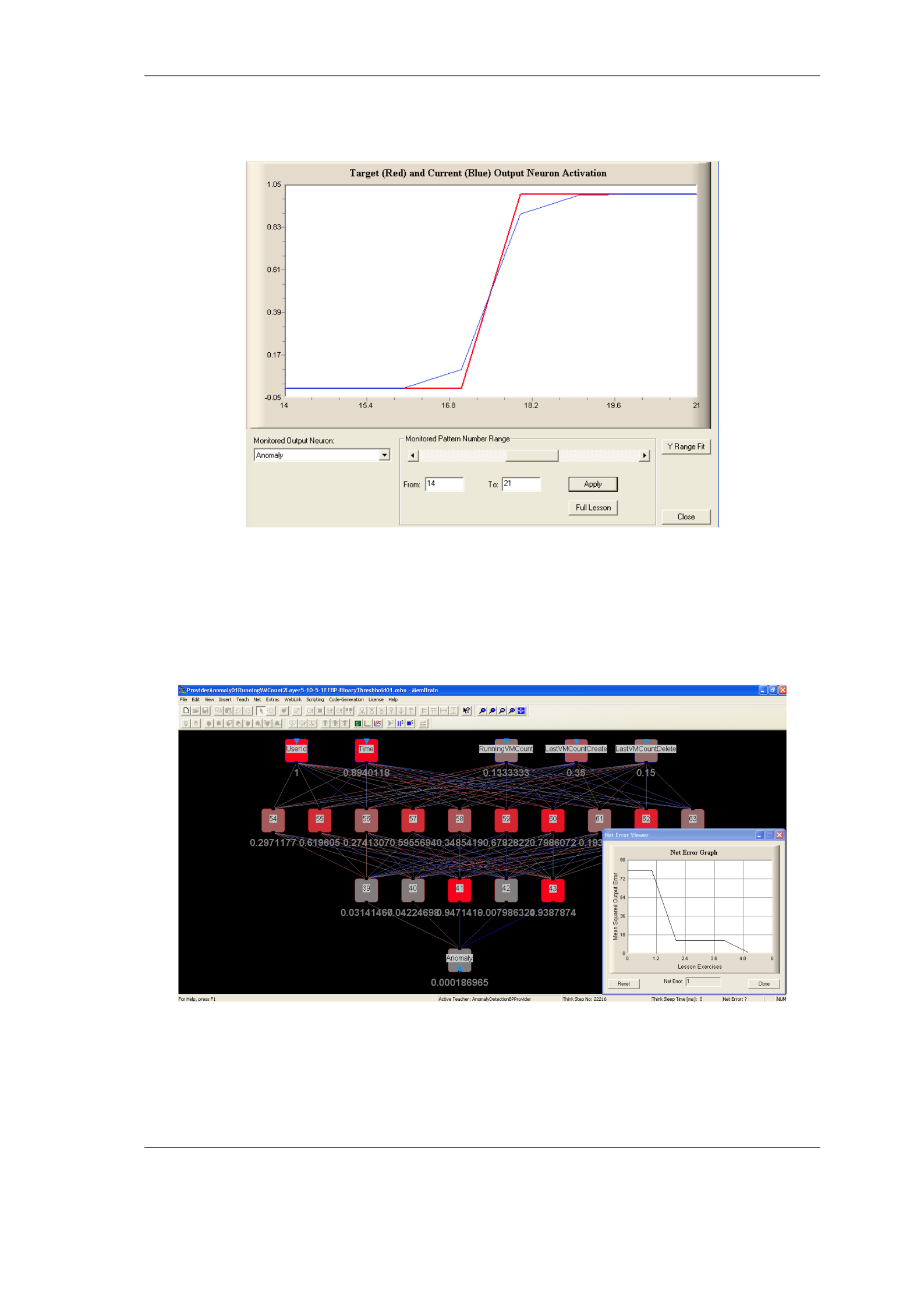
Chapter 6. Anomaly Detection
Figure 6.18: Neural networks learning curve in scenario UserAnomaly03
Figure 6.19: Feed forward net for scenario “CloudWideAnomaly”
198

6.5. Results
6.5 Results
All simulations were performed on the same hardware, listed in Table 6.5. Each pre-
sented scenario was simulated at least 100 times to evaluate the detection results. A
target net error of 1 was aspired during the learning phase of the network. As a target
result, an average error below 10% was aimed for all scenarios, since this appears to be
a widely accepted error rate in pattern recognition [211]. Fine tuning of the network
took place, to optimize the target results.
System Virtualbox VM
CPU 2x Intel Core i7-2675QM @ 2.20GHz
RAM 1562 MB
OS Windows XP
Membrain Version 5.00 01 00
Python Version 3.3.0, Sep. 2012
Table 6.5: Anomaly detection - simulation environment
Customer-centric anomaly detection
Figure 6.20 shows an overview over the performed simulation runs for scenario User-
anomaly03. Best performance regarding speed and learning rate are highlighted in
green. During all simulations the target result was easily reached, thus a tighter tar-
get net error rate of 0.001 was chosen. The column Simulation Time represents the
time of ten complete simulation runs of the corresponding network structure. It can
be seen, that the ANN design influences the overall performance of the anomaly de-
tection characteristics. Dependent on the requirements, the following can be derived
from the results:
•Speed - If minimum learning speed is a desired quality, an ANN structure of 4-
40-20-10-5-1 delivered the fastest learning speed. Ten complete simulation runs
199
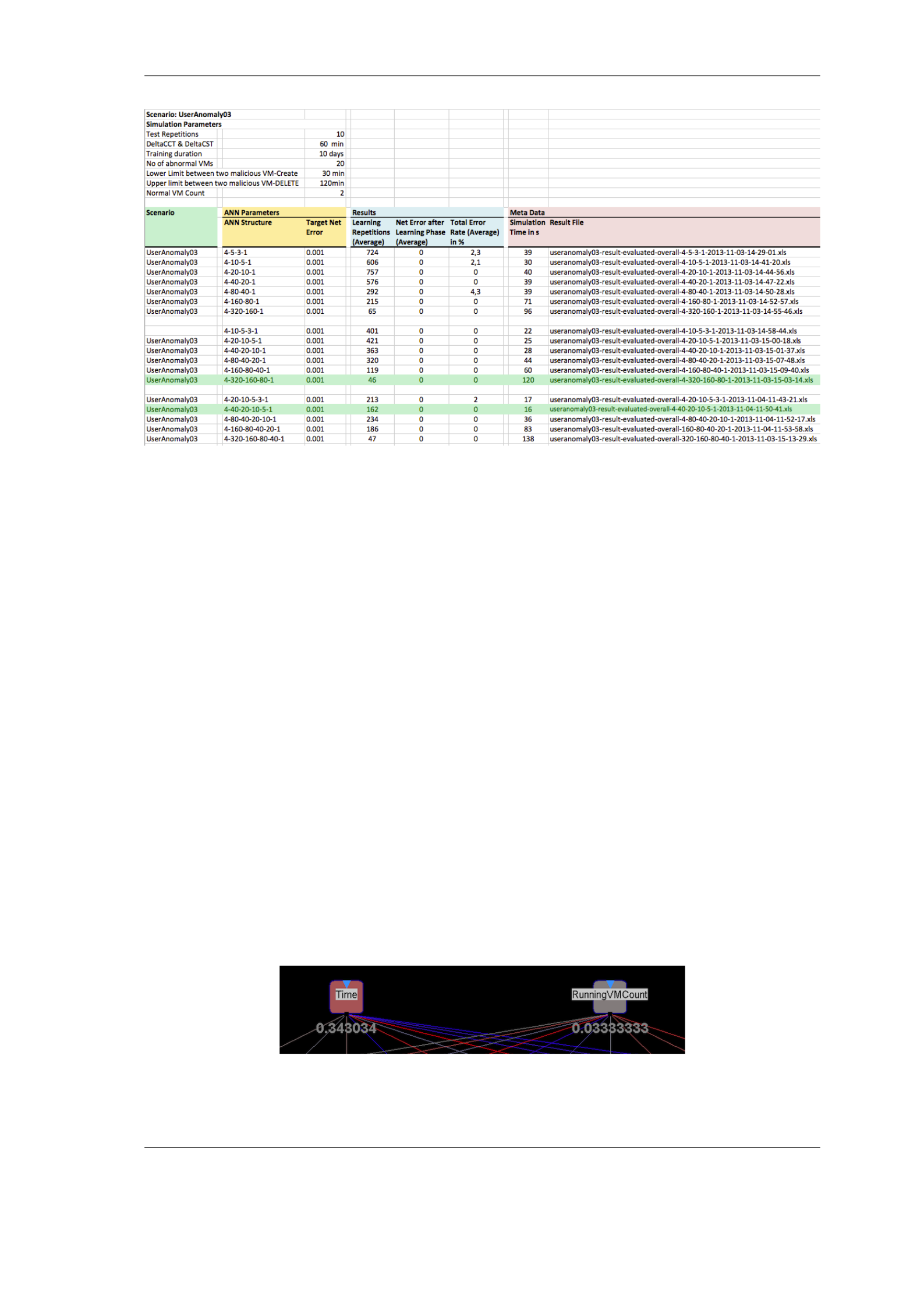
Chapter 6. Anomaly Detection
Figure 6.20: Anomaly Detection - simulation results (UserAnomaly03)
were performed within 16 seconds, with a resulting detection rate of 98%.
•Learning Repetitions - If a minimum of learning repetition is aspired, an ANN
structure of 4-320-160-80-1 performs best. The network only needed 46 epochs,
with a resulting detection rate of 100%
Table 6.6 shows detailed results of ten simulation runs of scenario UserAnomaly03
with the ANN structure 4-40-20-10-5-1. It can be seen, that over ten simulation runs,
the network was able to correctly identify normal and abnormal behaviour within the
test data set of 10 events with an average detection error rate of 1.25%. The neural
network needed in average 162 epochs to learn the behaviour of the simulated user
to reach a net error rate of 0. The arithmetic average of a data row was calculated
without the minimum and the maximum values.
Figure 6.21: Anomaly detection - weighted input classifier (UserAnomaly01)
200
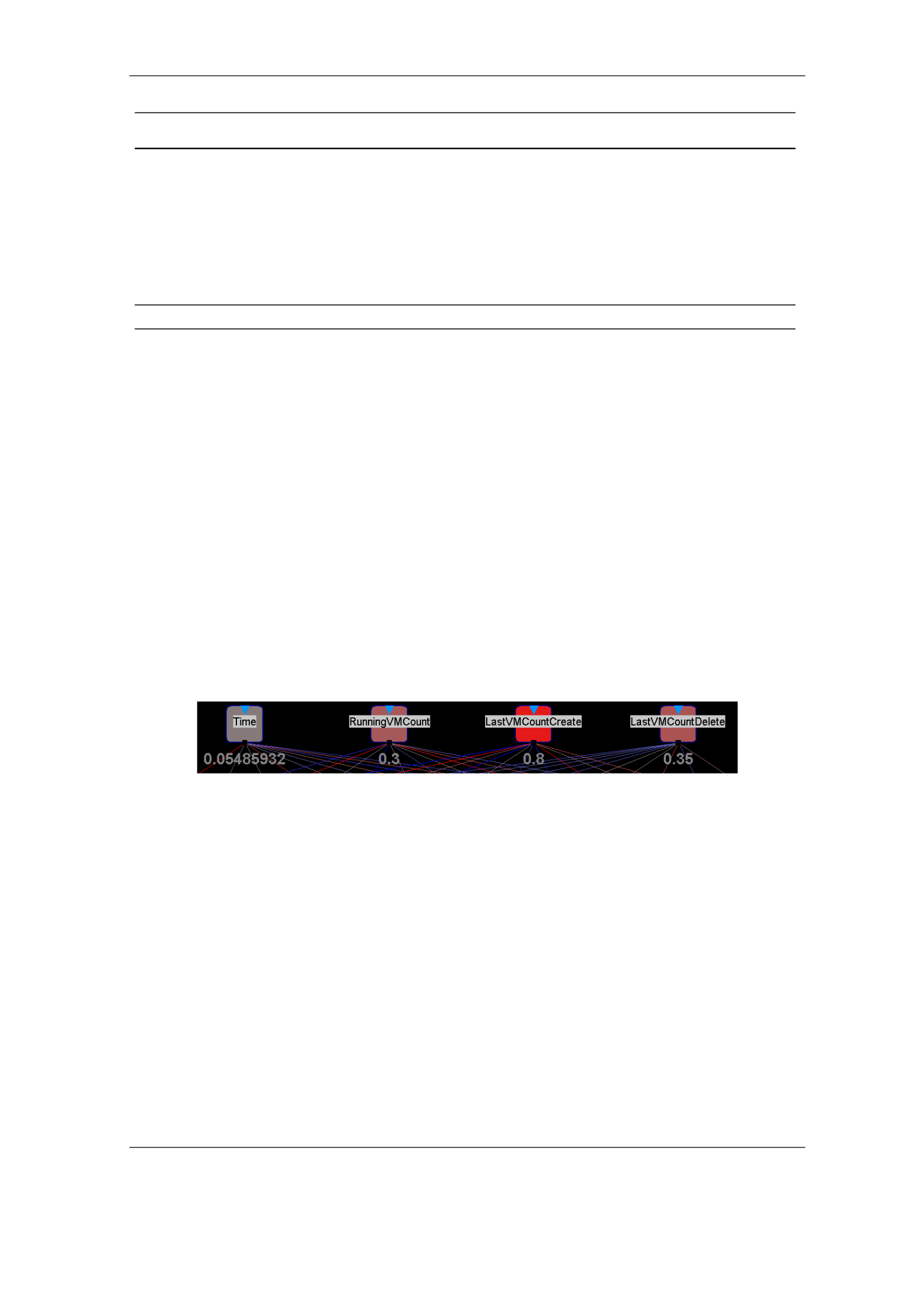
6.5. Results
Run Training
Epochs
Net-
Error
Total Test
Patterns
Number of
Anomalies
Correct
Detected
Rows Mis-
Detected
False
Positives
False
Negatives
Error
Rate
1 224 0 10 5 10 0 0 0.0%
2 92 0 10 9 9 9 0 0 10.0%
3 329 0 10 5 10 0 0 0.0%
4 94 0 10 6 10 0 0 0.0%
5 103 0 10 8 10 0 0 0.0%
6 99 0 10 4 10 0 0 0.0%
7 71 0 10 5 10 8 0 0 10.0%
8 149 0 10 8 10 0 0 0.0%
9 394 0 10 10 10 0 0 0.0%
10 203 0 10 6 10 0 0 0.0%
162 0 10 6.5 9.875 0 0.125 1,25%
Table 6.6: Results of scenario Useranomaly03
For scenario UserAnomaly01 it can be seen in Figure 6.21 that the classifier “time”
is used to determine if a CMS event is considered abnormal. This is also indicated
by the weights and “trigger” indicators of the net after a simulation run. A deeper
red background colour of a neuron indicates the influence of the neuron in the over-
all decision result. For scenario UserAnomaly02 and UserAnomaly03 the classifiers
LastVMCountCreate” and LastVMCountDelete are mainly used for decision making,
see Figure 6.22.
Figure 6.22: Anomaly detection - weighted input classifier (UserAnomaly03)
Cloud Wide Anomaly Detection
For the cloud wide anomaly detection, scenario ProviderAnomaly01 was simulated
with different artificial network structures. Overall results are depicted in Figure
6.23. This time the usage behaviour of 50 users was simulated. For every user a
“normal” VM-count between 0 and 5 was defined randomly, as well as corresponding
core create and core stop times. Afterwards, one user was chosen randomly, and
abnormal behaviour data for this user was added. Simulations were performed on the
201
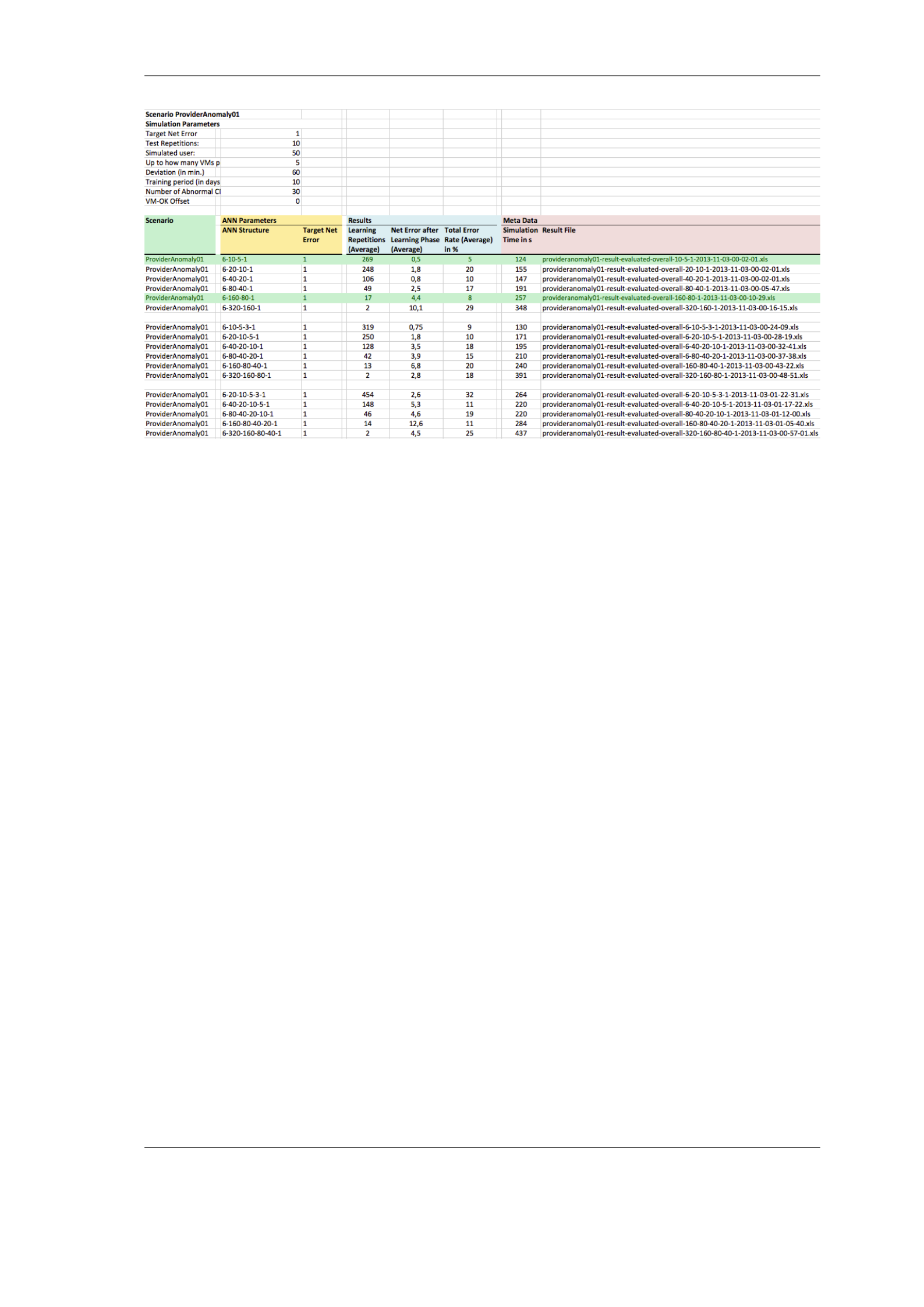
Chapter 6. Anomaly Detection
Figure 6.23: Anomaly Detection - simulation results (ProviderAnomaly01)
same different neural network structures as for the customer-centric scenario, with a
target net error of 1 during training phase. The following results can be stated from
simulations:
•Speed - If minimum learning speed is a requirements, an ANN structure of 6-
10-5-1 performs best. Ten complete simulation runs were performed within 124
seconds, with a resulting detection rate of 95%
•Learning Repetitions - If a minimum of learning repetition is aspired, an ANN
structure of 6-160-80-1 performs best. The network only needed 17 epochs, with
a resulting detection rate of 92%
Simulations show, that for this scenario, five out of 17 neural network structures meet
the requirement of a maximum total detection error rate of 10%. Learning speed of
the networks is overall slower than in the previous scenario. Both are due to a much
higher number of events to learn from, including much more “noise” because of the
highly differently acting users. Table 6.7 shows the results of ten simulation runs for
the ANN structure 6-10-5-1. It can be seen, that over ten simulation runs, the network
202

6.5. Results
Run Training
Epochs
Net-
Error
Total Test
Patterns
Number of
Anomalies
Correct
Detected
Rows Mis-
Detected
False
Positives
False
Negatives
Error
Rate
1 281 0 558 2 2 0 0 0.0%
2 177 1 626 6 5 333 1 0 25.0%
3 306 0 618 5 5 0 0 0.0%
4 112 6 550 6 5 0 0 0.0%
5 264 0 662 6 6 0 0 0.0%
6 255 0 634 4 4 0 0 0.0%
7 939 1 746 5 3 109, 165 2 0 40.0%
8 276 0 626 4 4 0 0 0.0%
9 276 1 618 4 3 516 1 0 16.7%
10 316 1 590 7 7 0 0 0.0%
267 0.5 616.5 5 616.25 0.25 0 5.2%
Table 6.7: Anomaly Detection - simulation results (ProviderAnomaly01)
was able to correctly identify normal and abnormal behaviour within the test data set
of 616 events (average) with an detection error rate of 5,2%. The neural network
needed in average 267 learning repetitions to learn the behaviour of the simulated
users to reach the target net error. Again, the arithmetic average of a data row was
calculated without the minimum and the maximum value. All simulation result files
are available on the attached DVD in folder CloudUsageSimulator/SimulationResults.
As seen by different simulation runs, the ANN’s network structure and chosen features
highly influence the performance of the system. An optimal result is dependent on
the quality of the chosen input qualifiers [211]. Further optimisation criteria could be:
•Minimisation of training patterns needed to learn
•Improvement of learning speed: faster time to reach target net error
•Minimisation of overall detection error
•Identification of more or less important input classifier for specific scenario
•Reduction of learning period with same detection rate
However, due to respect of the whole work already achieved by the Security Audit
Compliance For Cloud Computing research, and for time constraints on finishing the
PhD thesis, this investigations are part of future work.
203

Chapter 6. Anomaly Detection
Although the previous section proved the feasibility of using neural networks as an
anomaly detection system in cloud environments, discussion on some aspects of the
research is necessary. Thus, this section continues to discuss the following aspects of
the approach chosen:
•Neural network approach - Why neural networks are chosen?
•Usage of simulated data - Why real world data was not used?
•Training of impostor data - Is a practical deployment possible?
6.6 Discussions on the Neural Network Approach
A research area, closely related to anomaly detection in cloud environments are In-
trusion Detection Systems. They share certain characteristics, such as a frequently
changing infrastructure of networking components, huge networking data and a strong
focus on detecting anomalies in usage of networking systems. Well known approaches
for misusage detection or anomaly detection in IDS according to [215] are:
•Expert systems, containing a set of rules that describe attacks
•Signature verification, attacks are translated into sequences of audit events
•Petri nets, where known attacks are represented with graphical petri nets
•State transition diagrams, representing attacks with a set of goals and transitions
•Threshold detection detecting abnormal activity on a server or network, for
example abnormal saturation of the network
•Statistical measures, learned from historical values
•Non-linear algorithms, such as Neural Networks or Genetic algorithms
An often used approach for anomaly detection is statistical analysis [215]. They are
pervasively leveraged in industry monitoring products, such as HP Systems Insight
204

6.6. Discussions on the Neural Network Approach
Manger [216], IBM Tivoli [217], Nagios [167] and even in IaaS cloud health moni-
toring systems, e.g., Ganglia [218]. Statistical approaches are outperforming neural
networks in terms of speed by far, since the underlying calculation of anomalies are
much faster. However, important for a successful statistical system is the definition
of meaningful, well balanced thresholds. Determination of such is a difficult task,
especially if behaviour changes slowly over time [211], [215]. Additionally, [219] also
show, that threshold approaches do not work well in exascale, highly dynamic cloud
environments.
By using neural networks, a determination of a threshold is not necessary, since the
system learns the behaviour from the cloud usage as shown in Section 6.4.4. Further-
more, the use of neural networks also benefits from using actual event data rather
than using parameters that are derived from the actual data (e.g. mean and standard
deviation). While the examples presented above, only uses four input dimensions the
system is able to be extended by any additional cloud metrics, such as VM utilisation
(CPU usage, RAM usage, network traffic, process execution times, etc.).
Another advantage of using neural networks is, that they are well suited for anomaly
detection due to their flexibility. They are able to analyse data, even from incomplete
or distorted data sets [220]. Since their output is in form of a probability, it can be
used as a predictive capability, which can be added to results of other / additional
decision making parameters. In an SAaaS enable IaaS cloud, this could be, that the
neural network evaluates a certain VM behaviour to be abnormal by 60%. In addition,
the IP address gets added to the decision making process. Differs the IP range strongly
from all prior seen IP ranges of legitimate access, the probability that the monitored
behaviour is an anomaly is strongly increased. Furthermore, after validating if the
monitored event was an actual anomaly, this information can be applied back to the
learning process of the network.
205

Chapter 6. Anomaly Detection
This is also the most important advantage of neural networks. By combining multiple
detection systems, such as the presented Rule based and Behavioural based detection
method plus a possibility of manual feedback system by cloud provider’s personnel or
cloud user, the learning process of neural networks can be improved massively. Thus,
the neural network can learn more characteristics of misusage cases.
Usage of Simulated Data
The presented approach utilises a cloud usage data simulator to artificially simulate
cloud usage data sets. Compared to real world data it is limited, due to the fact,
that a certain, modelled usage behaviour gets assumed in the simulation environment.
Thus, no real-world validation of the proposed solution (e.g. by deploying it in a real
infrastructure) but just simulations exists.
Before creation of the cloud usage simulator, the author of this research contacted
multiple commercial cloud provider, to get some real cloud usage data. An email
correspondence proving this is available in Appendix A.5. However, all contacted
IaaS cloud provider refused to disclose parts of their cloud usage data. This is a
phenomenon, which is not limited to this research. Orna et al. [221], TaheriMonfayed
and Jaatun [222] or Phillips et al. [223] are just a three more examples of related
research on cloud Computing security, which encountered the same problem. Cloud
providers do not disclose any data. It is assumed that fear of industry espionage is
a reason: “Conventionally, cloud providers are not willing to disclose details of their
security mechanisms. They justify this behavior in different ways, but it seems that
the main motivation is fear of competitors stealing their ideas” [222]. Furthermore, to
the best knowledge of the author, no open source cloud usage data set was available
during time of the research. The author of this research decided to utilise simulated
cloud usage data to develop and test the presented anomaly detection system. The
206

6.6. Discussions on the Neural Network Approach
system uses several input classifier of cloud usage data in an normalised form. But,
now that the neural network based system exists, a possible way to test the system
with real data is to give the cloud providers the neural networks to let them process
their data with it. Thus, the performance of the developed system could be validated,
without the necessity for cloud providers to disclose any data. However, this approach
was not possible for this research, since the system needed to be developed first.
Secondly, due to time constraints on finishing this PhD work, this task is up to future
work.
Training of Impostor Data
Although Chapter 6.4 - Behavioural Based Anomaly Detection has proven the fea-
sibility of utilising cloud usage behaviour profiles to train neural networks, a failing
exist in the practical application of the system. Classification is performed by neural
networks, which are trained using both, normal and abnormal data (impostor data).
However, in a real world application, the availability and suitability of impostors will
be limited, since the system does not provide any value if it needs to be compromised
first to achieve full functionality. This is a well known problem, which also occurs in
the area of bio metric authentication, discussed by Lecomte et al. in [224].
The current classification process of the anomaly detection system presented, utilises
neural networks, where data of considered normal cloud usage is used alongside impos-
tor data to teach the network the difference in cloud usage characteristics. Supervised
learning is used to teach the network, which data belongs to the cloud user and which
data belongs to an attacker or impostor. However, for a real world system, this
approach is limited due the availability and performance of imposter data, for the
following reasons:
•Availability - misusage cases of cloud instances (imposter data) will always be
207

Chapter 6. Anomaly Detection
required for the system to teach the neural network. This practically results in
the requirement, that cloud instances needs to be compromised first, before the
system can be used to detect anomalies.
•Performance - the same cloud usage data simulator is used, to generate the
anomalies, the network is evaluated with. Although, the data samples are not
used in training and testing of the network, this fact rises the possibility to
skewed performance rates.
However, these limitations apply for the approach chosen by this work, research has
already proven, how these limitation can be mitigated. Instead of using impostor
data, Lecomte et al. has shown in [224] how impostor data can be artificially created
from normal behaviour data. By adding a slight set of deviations to normal usage
data, artificial imposter data is created. This eliminates the need of impostor data
completely. Furthermore, their research shows, that training neural networks with
artificially created impostor data outperforms usage of real impostor data by a 25%
increased performance, leading to optimal configured classification engines.
6.7 Summary
This Chapter elaborated two approaches on mitigating cloud specific security chal-
lenges by anomaly detection. A rule based and a behavioural based detection system
were presented by utilising several user-centric and cloud wide example scenarios. It
was shown, that the developed SAaaS architecture in combination with the Cloud
Audit Policy Language can be used for rule based anomaly detection. To prove the
feasibility of behavioural based anomaly detection a cloud usage simulator got devel-
oped. A fully automatic simulation environment was presented, using neural networks
to learn and evaluate cloud usage behaviour to detect anomalies.
208

7
Security Audit as a Service Prototype
“We don’t trust it until we can see it and feel it.”
(Unknown author)
This chapter presents a developed prototype of the Security Audit as a Service system,
including all research work presented so far. The concepts of concurrent audits utilising
agents gets presented, as well as a prototype of the Cloud Audit Policy Language and
the anomaly detection system.

Chapter 7. Security Audit as a Service Prototype
7.1 Introduction
To provide a prove of concept of the introduced Security Audit as a Service architec-
ture (Chapter 4), the Cloud Audit Policy Language (Chapter 5) and the research on
anomaly detection in IaaS Clouds (Chapter 6), a SAaaS prototype has been devel-
oped. It is build upon the Cloud Infrastructure and Applications (CloudIA), which
gets introduced at the beginning of this chapter. Then, a first prototype of the agent
based cloud audit system SAaaS gets presented. Details on the utilised agent archi-
tecture and technical details on an agent’s design are given. A demonstration (SAaaS
Demo 1) shows a use case how SAaaS agents are used to detect changes on a cloud
instance and perform an immediate cloud audit. The chapter then continues with
the presentation of the Cloud Audit Policy Language prototype implementation. The
CAPL server and its corresponding GUI frontend are elaborated in detail and it is
shown how the SAaaS prototype is extended by it. A second demonstration (SAaaS
Demo 2) presents how security audit policies can mitigates the cloud specific risk of
scalability attacks. In the last section of this Chapter, the integration of the intro-
duced anomaly detection system into the SAaaS prototype gets presented. Details on
the implementation of a cloud usage data simulator are given. As a last stage of ex-
pansion, SAaaS Demo 3 shows, how the SAaaS prototype is extended by an anomaly
detection system to detect user concentric and cloud wide anomalies in cloud usage
behaviour.
Parts of this research phase have been published throughout all released papers of this
research. Thus, they are not listed here in detail. A complete list of publication of
this research is available at the end of this thesis as Chapter ”List of Publications“.
210
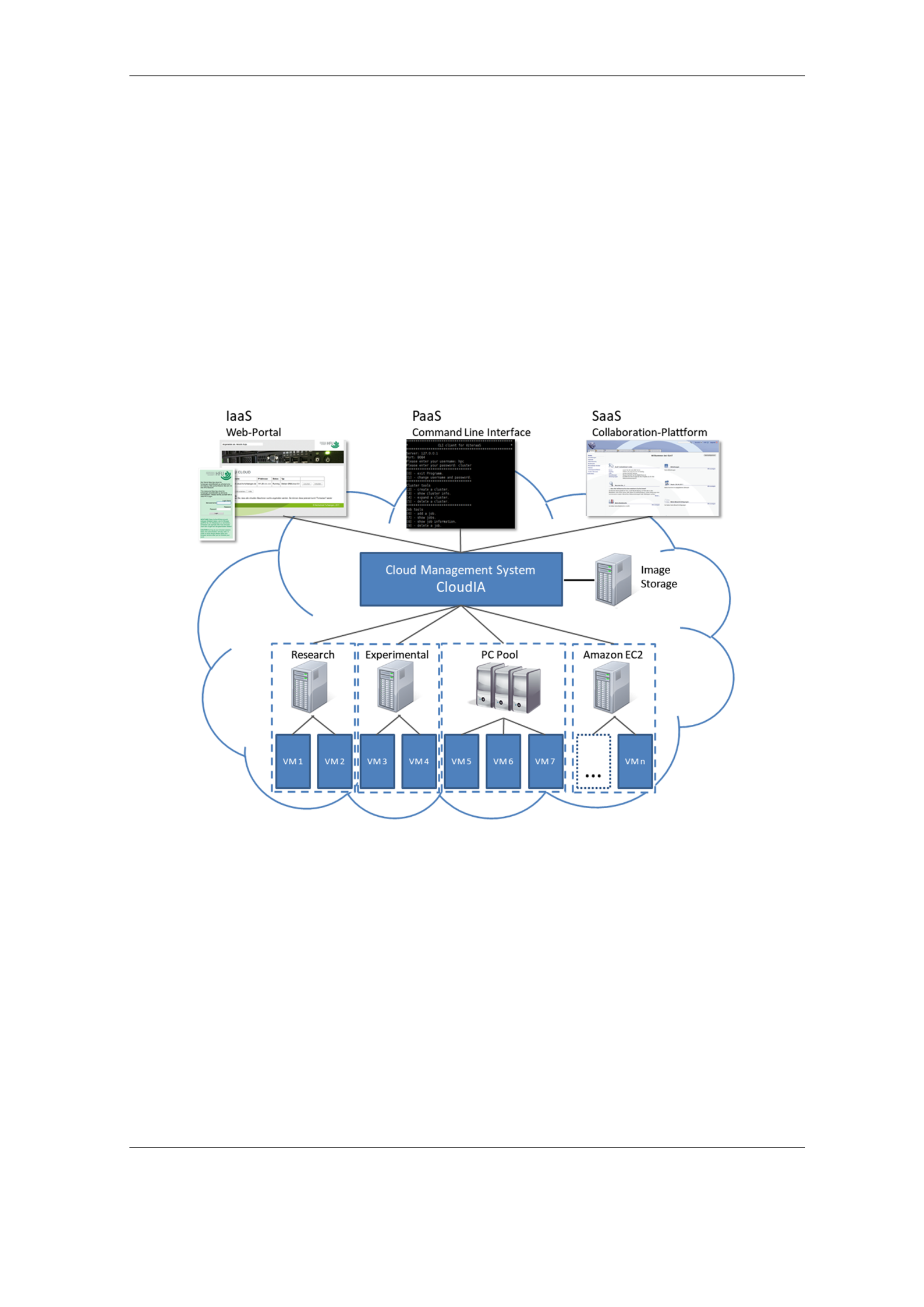
7.2. The CloudIA Project at Furtwangen University
7.2 The CloudIA Project at Furtwangen University
To harness the potentials of cloud computing for research at the Furtwangen Univer-
sity, and to SMEs, the Cloud Infrastructure and Applications project was established
in 2009. The main objective of this project is to build a private cloud for the pur-
pose of running e-Science and e-Learning applications at Furtwangen University. The
overview of the CloudIA architecture is shown in Figure 7.1.
Figure 7.1: Cloud Infrastructure and Applications architecture [13]
The cloud architecture is build on top of an existing hardware infrastructure at Furt-
wangen University. It consists of three computer pools (PC Pool, Research Pool
and Server Pool), that are located at different locations and use separate IP sub-
domains within the university. In addition, public cloud provider environments, such
as Amazon EC2 are utilised as well to develop interoperable cloud solutions. CloudIA
211
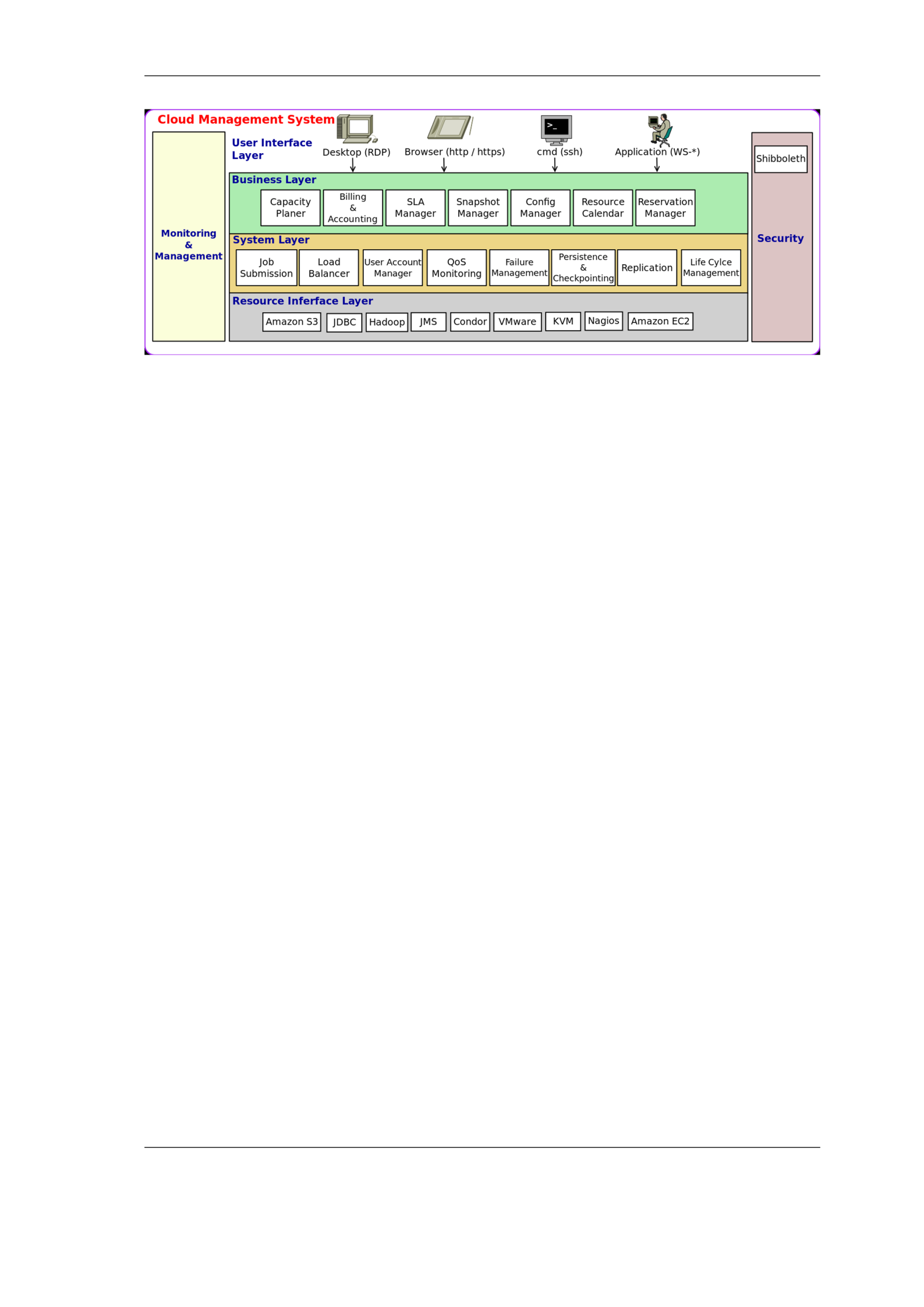
Chapter 7. Security Audit as a Service Prototype
Figure 7.2: Cloud Infrastructure and Applications architecture module overview
leverages various virtualization technologies, such as Xen and KVM, and supports
Service-Level Agreements (SLAs) for IaaS and SaaS models, as shown in Figure 7.2.
In this figure, the cloud management system of CloudIA is divided into several layers
for extensibility and maintainability. The following provides a brief introduction into
the architecture.
User Interface Layer - This layer provides various access points to users and / or
an administrator of the CMS in accessing our cloud system.
Business Layer - This layer aims to regulate resource supply and demand through
the use of economy and SLA. In addition, this layer enables users to reserve VMs in
advance and manage their personal VMs.
System Layer - This layer is responsible for daily operation of the CMS, such as
submitting jobs, managing user accounts and monitoring Quality of Services (QoS)
attributes.
Resource Interface Layer - This layer deals with the physical hardware and hosts
many interfaces and plugins to various virtualization, database, distributed system
and other technologies, such as Xen, Amazon EC2 and S3, and Nagios [167].
Monitoring & Management Component - To ensure reliability of each layer in
the system, monitoring and management facilities are provided, specifically designed
212

7.2. The CloudIA Project at Furtwangen University
for cloud administrators.
Security Component - To ensure privacy, recovery, integrity and security of user
data and transactions, a security feature on all layers is required. Besides the tech-
nical solutions, issues in areas such as regulatory compliance and data auditing are
important.
Designing the CloudIA architecture, was the first task of the research, presented in this
thesis. It builds the architectural and technological base of every developed system at
the Cloud Research Lab at Furtwangen University. Up to today, five granted research
projects funded by the European Union or the German Federal Ministry of Education
and Research (BMBF), listed in Table 7.1 are using it as a development base for
research on cloud technologies.
Project Name Funded by Duration Description
Security Audit as a
Service (SAaaS) [225]
German Federal Min-
istry of Education and
Research
2 years Enhancing cloud security by cloud audits
StudiCloud [226] Furtwangen University unlimited Provide university wide IaaS cloud infrastruc-
ture for Furtwangen University
Accountability for
cloud and Other Fu-
ture Internet Services
(A4Cloud) [227]
European Union,
7th Framework Pro-
gramme
4 years Increase trust in cloud computing by account-
ability measures
Autonomic SLA Man-
agement as a Service
for Cloud Services
(ASLAMaaS) [228]
German Federal Min-
istry of Education and
Research
3 years Independent and automated management of
Service Level Agreements in cloud environ-
ments
Ambient Assisted Liv-
ing: Person Centred
Environment for In-
formation, Communi-
cation and Learning
(AAL-PCEICL) [229]
Ministry of Sciences,
Research and Arts
Baden Wuerttemberg
3 years Ambient assisted technologies for supporting
elderly people
Table 7.1: Research projects build on CloudIA architecture
213

Chapter 7. Security Audit as a Service Prototype
CloudIA Hardware
To provide a secure development process for CloudIA, three different cloud infrastruc-
tures were setup, as depicted in Figure 7.3:
•Experimental Cloud
•Research Cloud
•Productive Cloud
All cloud environments are independent from each other, operated by an own Cloud
Management System. The Experimental Cloud consists of four AMD Athlon 64X2
Dual Core PCs with 2GB RAM each. It uses KVM as a hypervisor software for
virtualization and runs Ubuntu Linux 12.04 LTS. It is mainly used for development
of completely new cloud software, done by Bachelor or Master thesis students. It is
further used as a staging cloud for the University’s wide productive cloud and the
Research Cloud, trying new software components or OS or hypervisor updates.
The Research Cloud environment is used for the development of research software,
mostly by PhD students and research project personnel. It consists of five Intel Xeon
PCs, each containing two Intel Quad Core 2.80 GHz processors with 12GB of RAM
each. It uses KVM as hypervisor software and Debian 6.0 as Operating System. The
Research Cloud is the technical base of the Security Audit as a Service prototype.
The Productive Cloud runs the Universities wide IaaS cloud environment Studi-
Cloud [226]. It consists of six Intel Xeon machines, each containing 2 Intel Xeon
QuadCore CPUs operated at 3.06 GHz and 64GB RAM each. It uses KVM as hy-
pervisor software and Debian 6.0 as operating system. It is used by HFU’s personnel
and students and hosts in average 100 running VMs all the time. For cloud Bursting
scenarios a connection to Amazon EC2 cloud exists as well. It is mainly used by
the Research cloud to develop and demonstrate provider interoperable cloud software.
214
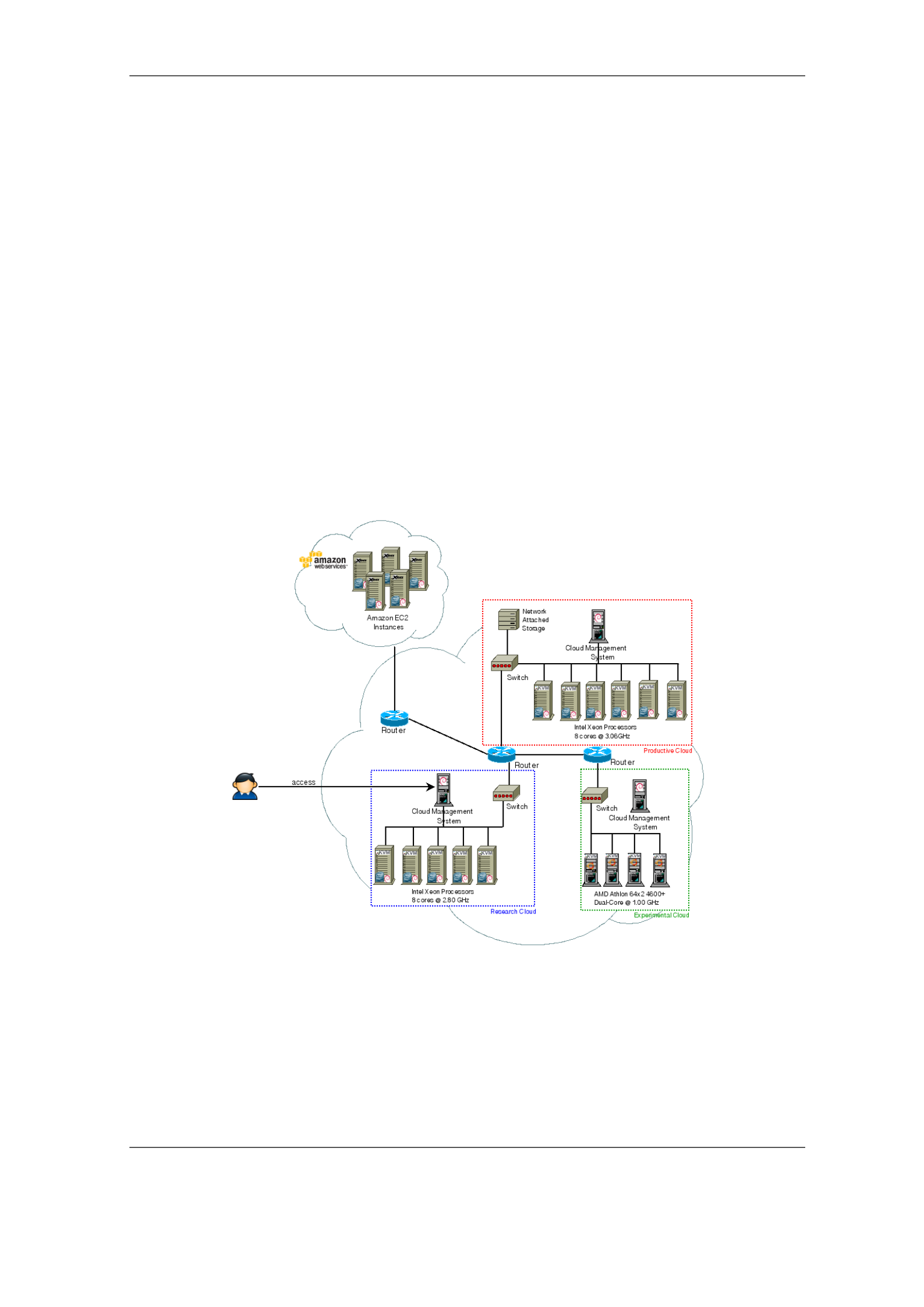
7.2. The CloudIA Project at Furtwangen University
Storage is realised as a network attached storage running an ext4 filesystem. It gets
accessed by the VMs via the Network File System (NFS) protocol, version 4. For VM
images, base images [230] are used in combination of copy on write functionality. For
every VM image available for deployment in one of the three Clouds a base images
exists, containing an installed operating system. This is called a VM template. In case
a User creates a new VM, it will always build on top if that VM template, called copy
on write image. It is based on the base image, thus the image size barely contains
any data when booted up for the first time. Thus, a fast deployment of new VMs
is provided. Furthermore storage space is saved, since multiple copies of operating
systems installed in different VM images are avoided.
Figure 7.3: CloudIA hardware infrastructure at Furtwangen University
215
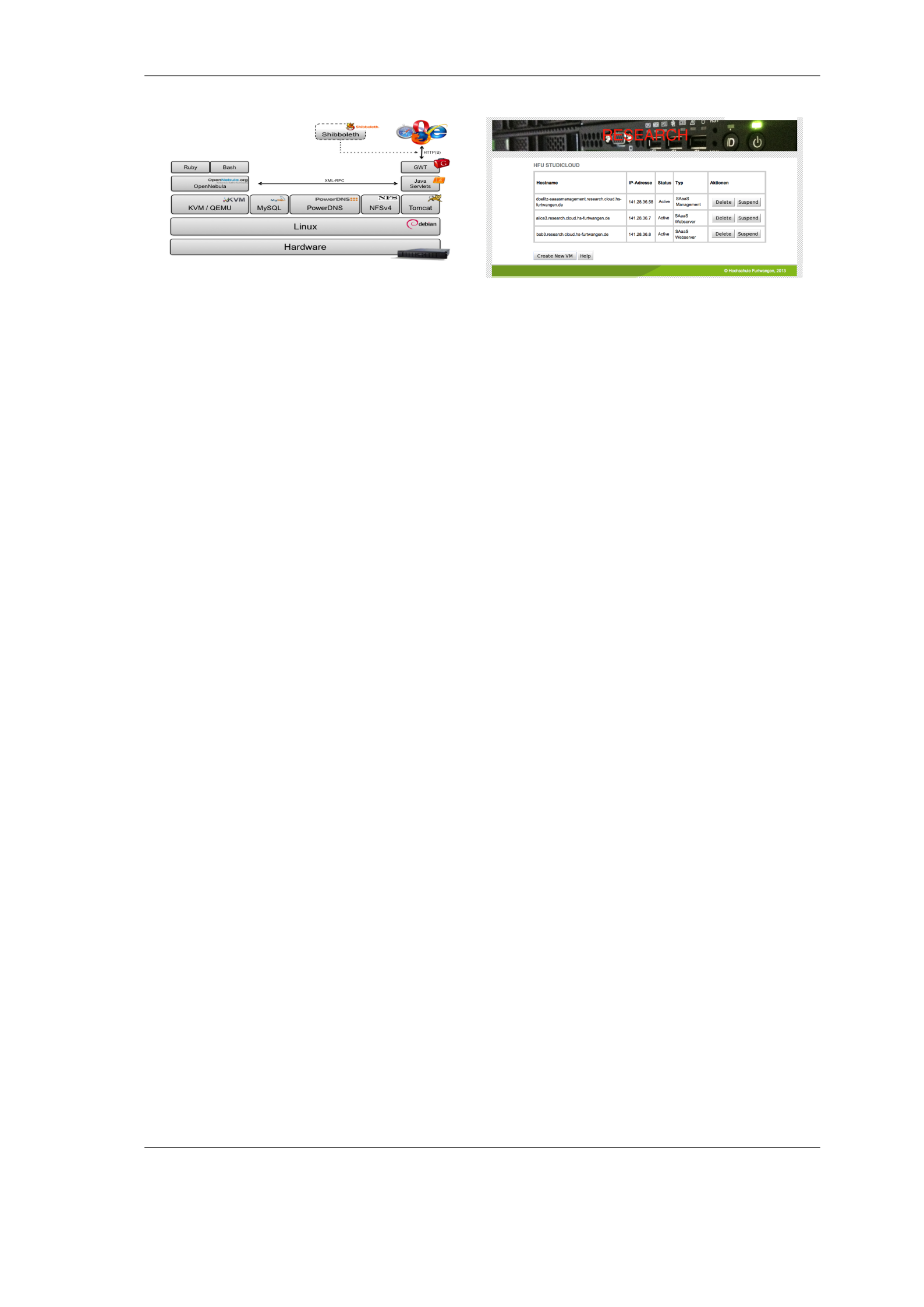
Chapter 7. Security Audit as a Service Prototype
(a) CloudIA software stack (b) CloudIA web frontend GecMiGUI
Figure 7.4: CloudIA software components
CloudIA Software
Figure 7.4(a) shows the software stack, deployed on each of the three CloudIA infras-
tructures cloud Management Systems. On top of the hardware, Debian [231] Linux
is used as an operating system (Ubuntu for Experimental Cloud). KVM is used as
a hypervisor software, partitioning the real existing hardware into logical, separable
parts. OpenNebula [159] is used as a cloud Management System, orchestrating the
physical and virtual resources. Information about cloud hosts, VMs and peripheral
components are stored in a MySQL database. On top of that, custom cloud software
projects are developed, such as StudiCloud software. It interacts with the CMS and
provides additional cloud management functionality, like the backend for the HFU’s
cloud Frontend (GecMiGUI). The front end is implemented as a web application, util-
ising the Google Web Toolkit (GWT) [232]. It is running in an exclusive VM on the
same host as the Cloud Management System. Apache Tomcat [233] is used as an
application server. The GUI provides basic VM management functionality such as a
wizard based VM Create dialog and the possibility to resume or delete a VM. Figure
7.4(b) shows a screen shot of the Research cloud web interface with three running
VMs. The cloud web interface is secured by a Single Sign-On system Shibboleth. The
whole CloudIA software stack is released as Open Source software and available on
Source Forge for download under the project name “StudiCloud” [234].
216

7.2. The CloudIA Project at Furtwangen University
SAaaS Prototype Development
The SAaaS prototype is running on the HFU’s Research Cloud. During the research,
the prototype development went through the following different stages, which are
described in the following in more detail.
1. Development of SAaaS agents and SAaaS Management Interface -
Section 7.3
•Research on available agent frameworks
•Implementation of agent framework
•Development of agents
•Development of SAaaS GUI
•Result: SAaaS Demo 1 - Detection of cloud infrastructure changes
2. Extension of SAaaS prototype by a cloud audit policy language -
Section 7.4
•Development of CAPL language definition
•Implementation & integration of CAPL server into SAaaS prototype
•Extension of SAaaS GUI by Policy Modeller
•Result: SAaaS Demo 2 - Mitigating scalability attacks in IaaS clouds
3. Extension of SAaaS prototype by an anomaly detection system -
Section 7.5
•Development of cloud usage simulator
•Development of neural networks for cloud behaviour analysis
•Extension of SAaaS prototype by anomaly detection
•Result: SAaaS Demo 3 - Anomaly detection in IaaS clouds
217

Chapter 7. Security Audit as a Service Prototype
Based on this development process, the developed SAaaS prototype gets presented
within the next sections.
7.3 SAaaS Prototype 1 - Integration of an Agent
framework
The first version of the SAaaS prototype includes the deployment of an agent frame-
work to an IaaS cloud, the development of SAaaS agents and a demonstration to
detect changes within a cloud infrastructure.
7.3.1 Agent Development
As introduced in Chapter 4.6 - Java Agent Development Framework, JADE is used
as an underlying agent framework for the SAaaS architecture. It offers the following
default agents for agent management tasks:
•Agent Management System (AMS) - Agent, responsible for any inter-agent
or container communication. Furthermore, the agent is responsible for creation
and deletion of other agents within the same JADE platform
•Directory Facility (DF) - Agent, which offers agent management services,
such as yellow page searches for agents. This service was not used within the
SAaaS architecture, due to performance problems.
In addition, to the JADE default agents, the following Management Agents get de-
ployed to every agent platform of SAaaS-enabled resources:
•Agent Mobility Manager (AMM) - Manages the mobility of an agent be-
tween the different agent platforms
•Socket Proxy Agent (SPA) - Enables any application to communicate with
a SAaaS agent through a socket connection
218
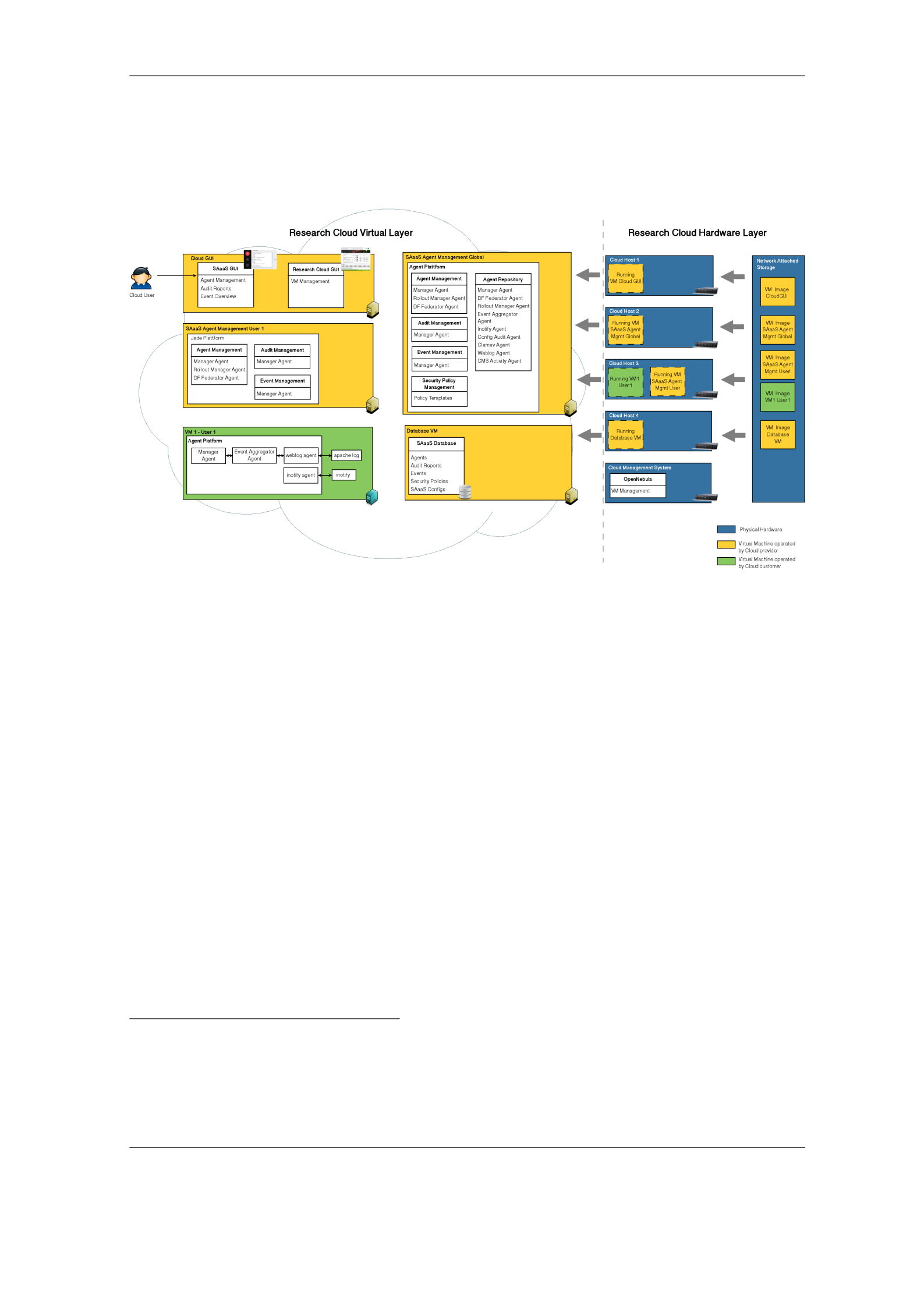
7.3. SAaaS Prototype 1 - Integration of an Agent framework
•Event Aggregator Agent - Collects and pre-analysis events of sensor agents,
before forwarding them to the Manager Agent
Figure 7.5: SAaaS prototype components - version 1
Figure 7.5 shows an overall view of all SAaaS prototype components. It shows the
cloud storage, which stores all VM images of all users as well as images of manage-
ment VMs1. Based on those images, the corresponding virtual machines are running,
distributed over several physical cloud hosts2. A global SAaaS Agent Management
system is running on an exclusive VM. The same applies for the SAaaS database VM
and the cloud GUI, hosting the Research cloud web GUI and the SAaaS GUI. The
components, depicted in Figure 7.5 assume, that a cloud user has already created one
VM (VM1-User1) and enabled the SAaaS prototype features. Hence, automatically
in addition to his VM, a user specific SAaaS Agent Management VM (SAaaS Agent
Management VM User1) was started as well. This is done to keep the system flexible
1In an enterprise environment, storage space is distributed and separated between user images and
provider images
2The distribution in this Figure is randomly chosen. Again, in a real enterprise scenario segmenta-
tion between user and provider VMs would be necessary
219
Chapter 7. Security Audit as a Service Prototype
and scalable in respect to huge cloud infrastructures. It is furthermore assumed, that
the user already configured a security policy. For the SAaaS prototype version 1 this
is provided through prepared agent templates, available in the SAaaS graphical web
interface. It was defined, that the configuration of the web server, running on the VM
is finished. For the prototype, this results in the following automated actions: An
inotify agent gets created from the SAaaS agent repository and configured to moni-
tor the configuration file of the web server. Secondly, a weblog agent gets deployed
monitoring the content of the web server’s document root and the web server’s logfile.
Both sensor agents were deployed automatically to the user’s VM. Figure 7.6 shows a
cutout of the agent platform’s logfile at the VM of user 1.
Figure 7.6: SAaaS prototype version 1 - Agents deployed
Table 7.2 shows a list of agents, which were developed during this stage of the SAaaS
prototype. A comprehensive list of all developed agents during this research including
technical details is provided in Appendix A.2.
7.3.2 SAaaS Graphical User Interface
For agent management tasks and to display events and corresponding audit reports, a
graphical user interface is developed. It is hosted on a separate VM, running its own
JADE platform for communication to SAaaS agents, see Figure 7.7. Agent configu-
ration and events are stored in a SAaaS database, which is managed by the SAaaS
Agent Management Platform. Agent communication is implemented utilising the ACL
language format, introduced in Chapter 4.6 - Java Agent Development Framework.
220

7.3. SAaaS Prototype 1 - Integration of an Agent framework
Agent name Agent Type Position Description
Manager Agent Management agent SAaaS-Agent Manage-
ment Platform (global
& user specific)
Management of agent events, delivers au-
dit report events to SAaaS GUI, starts
audit agent in case received event re-
quires audit
Rollout Manager
Agent
Management agent SAaaS-Agent Manage-
ment Platform (global
& user specific)
Creates an agent, which then deploys it-
self via doMove() to a target agent plat-
form at a target VM or cloud host
DF Federator
Agent
Management agent SAaaS-Agent Manage-
ment Platform (global
& user specific)
Enables federation of agents to agent yel-
low pages
Event Aggrega-
tor Agent
Management agent Target VM / cloud
host
Collects and pre-analysis events of sensor
agents, sends events to Manager Agent
Socket Proxy
Agent
Management agent Target VM / cloud
hosts
Enables message communication be-
tween non-agent applications (agent plu-
gins) and a SAaaS agent
CMS Activity
Agent
Sensor agent Cloud Management
System
Monitors cloud Management System
events, such as VM-CREATE or VM-
DELETE commands
Inotify Agent Sensor agent To monitored VM /
cloud host
Monitors filesystem changes, reports to
Aggregator Agent
Config Audit
Agent
Sensor agent Target VM / cloud
host
Gets deployed to a target VM or cloud
host. Contains file list, which it parses
for necessary or forbidden key words
ClamAv Agent Sensor agent Target VM / cloud
host
Gets deployed to a target VM or cloud
host. Contains file list, which gets
scanned for viruses or malware
Weblog Agent Sensor agent Target VM / cloud
host
Gets deployed to a target VM or cloud
host. Monitors web server log file for file
access
Table 7.2: SAaaS agents developed during 1st SAaaS prototype stage
Transportation of messages is done via the HTTP protocol, using a Trusted Layer
Security (TLS) encrypted connection. Figure 7.7 shows a typical setup of the SAaaS
prototype version 1, with the deployed default agents described above. Furthermore,
it shows a cloud customer VM with enabled SAaaS features. Thus an agent platform
is running on it, and one agent is already deployed on it. This agent is fed from two
agent plugin tools. One is able to communicate directly with the agent, the other is
not compatible to a JADE agent, thus it is communicating through the Socket Proxy
Agent to the SAaaS system. Figure 7.8 shows the Cloud Management GUI extended
by elements of the SAaaS prototype, highlighted in green. For version 1 of the SAaaS
prototype, the functions Enable SAaaS Features,SAaaS VM Agent GUI,SAaaS Secu-
221
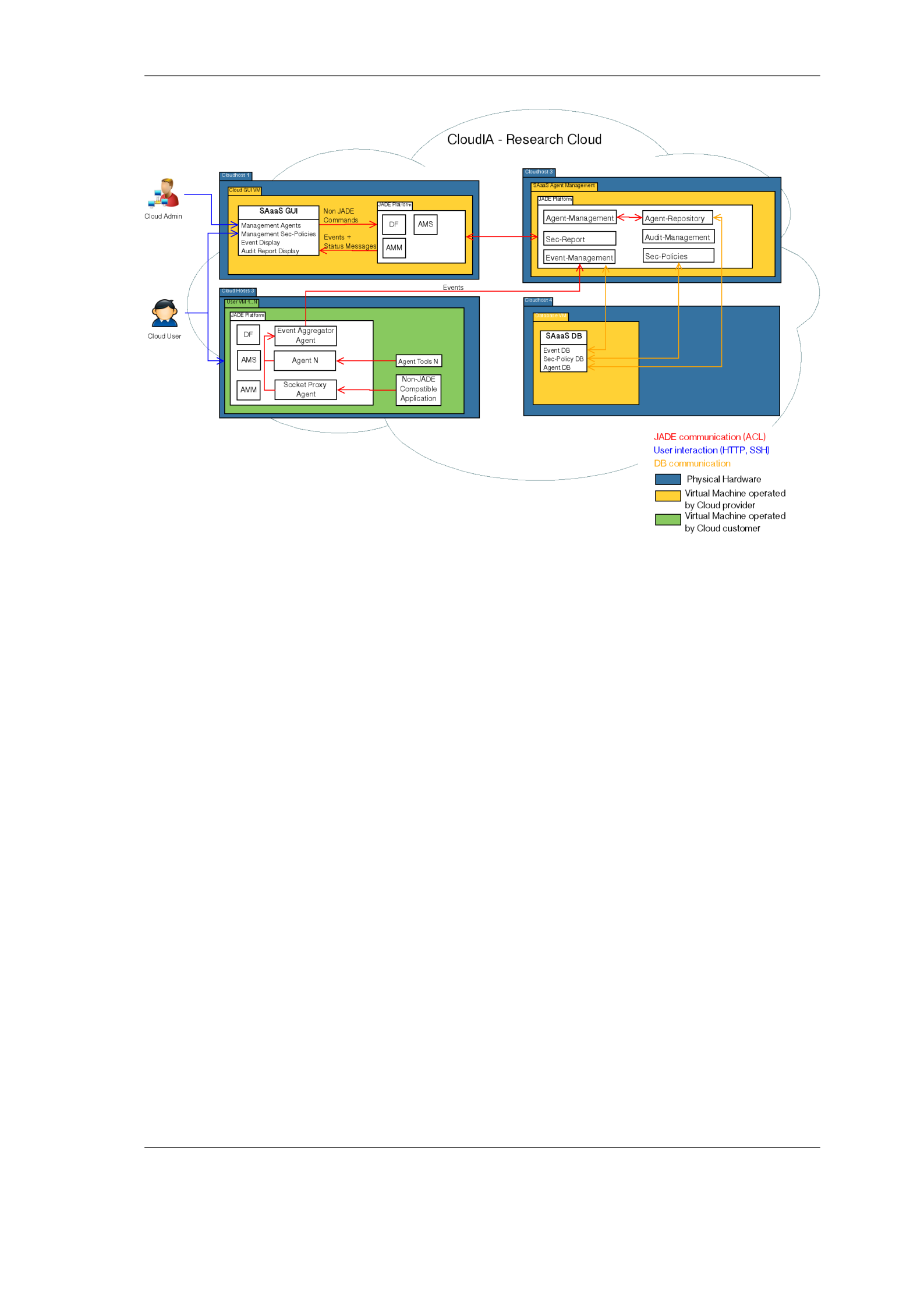
Chapter 7. Security Audit as a Service Prototype
Figure 7.7: SAaaS prototype - SAaaS agents
rity Dashboard,SAaaS Audit Report Dashboard and SAaaS Provider Dashboard were
implemented. The other functions are added in later versions of the prototype.
1. SAaaS Agent VM GUI - allows the management of agents, see Figure 7.9(a). It
shows a simple three colour signal indicator it the JADE platform on the corresponding
cloud resource is available and reachable. It allows the deployment of prepared security
policy templates or agent configurations. Agents running on a cloud resource can be
graphically displayed via the button Show running agents, its content is depicted
in Figure 7.9(b). In this case, the default SAaaS management agents (listed in grey)
as well as an inotify and the Event Aggregator agents are running on the target VM
“webserver1”.
2. SAaaS Security Dashboard - submitted agent events are visualised in the
SAaaS Security Dashboard, depicted in Figure 7.10(a). It shows cloud customer spe-
cific events, about detected events among his cloud instances. A simple security in-
222
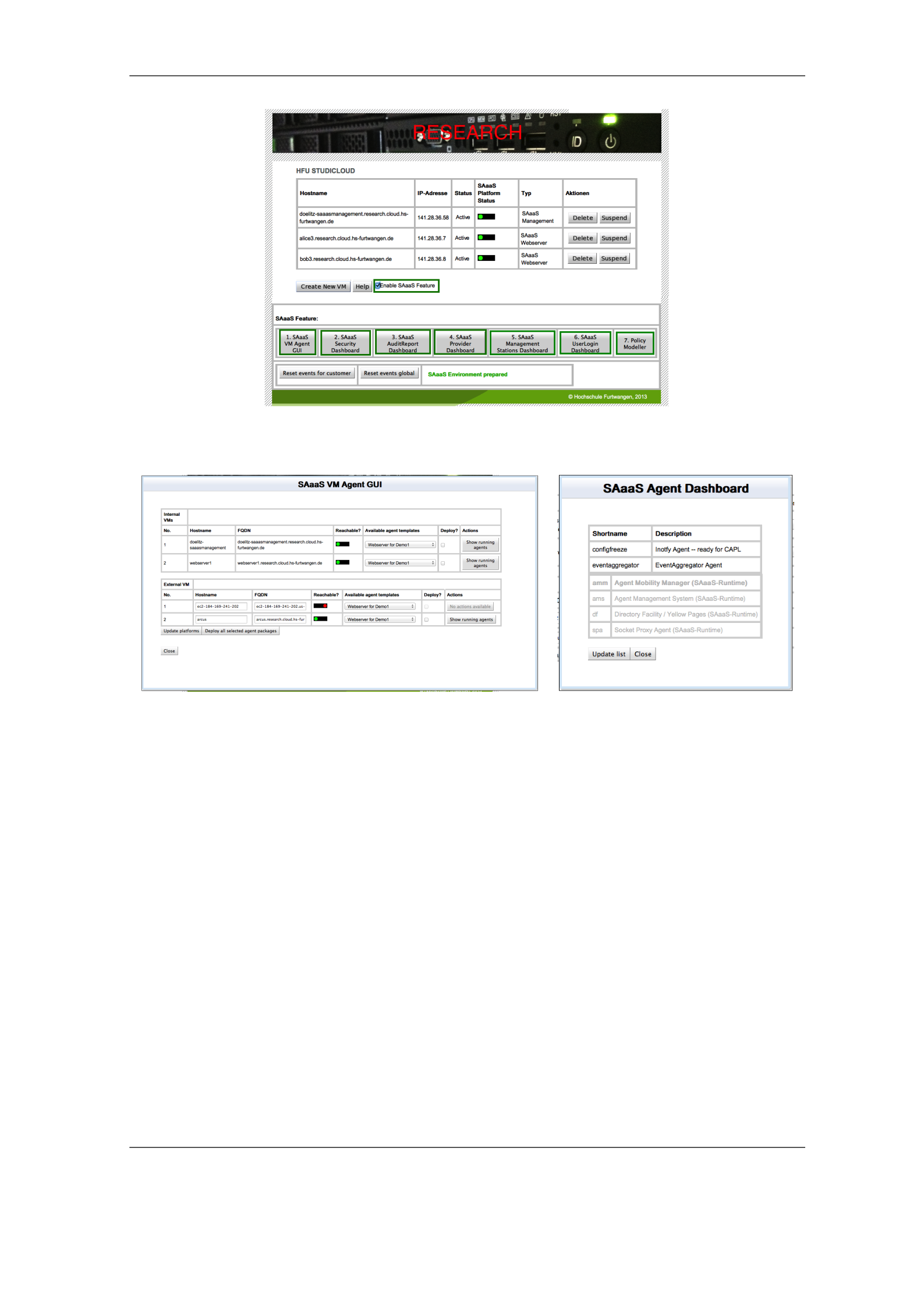
7.3. SAaaS Prototype 1 - Integration of an Agent framework
Figure 7.8: SAaaS prototype: SAaaS GUI elements
(a) SAaaS prototype: SAaaS Agent VM GUI (b) SAaaS prototype: Running
agents on SAaaS enabled VM
Figure 7.9: SAaaS prototype: graphical agent management
dicator signal gives a quick overview over the security status of the deployed cloud
instances.
3. SAaaS Audit Report Dashboard - audit reports are displayed in the SAaaS
Audit Report Dashboard, depicted in Figure 7.10(b). Again, a simple signal indicator
light informs about the overall status of audit reports.
4. SAaaS Provider Dashboard - Since the provider might be interested in cloud
customer overspanning events, the SAaaS Provider Dashboard shows events of all
223
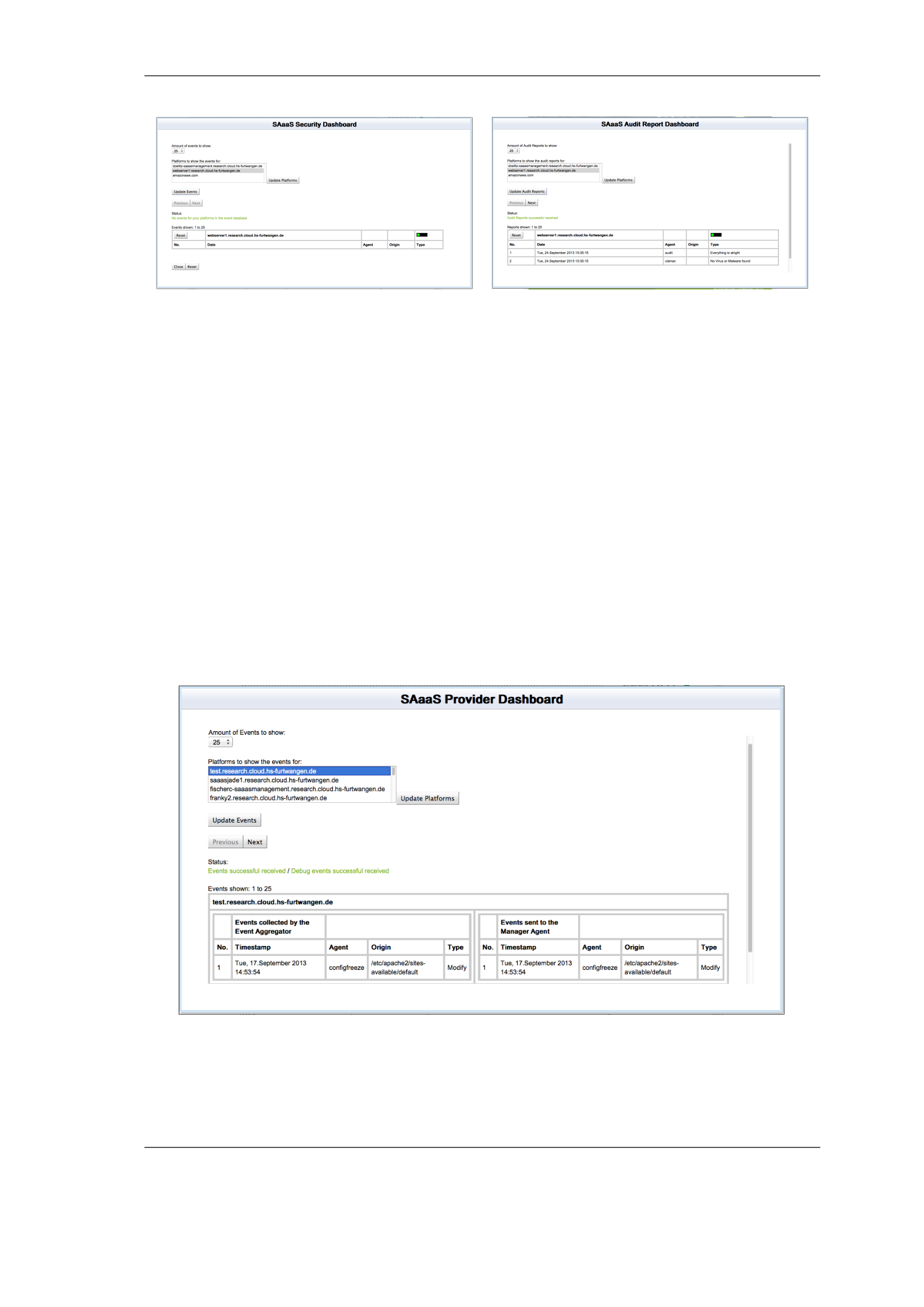
Chapter 7. Security Audit as a Service Prototype
(a) SAaaS prototype: Security Dashboard (b) SAaaS prototype: Audit Reports Dashboard
Figure 7.10: SAaaS prototype: Security & Audit Dashboard
SAaaS enabled resources, as depicted in Figure 7.11. The administrator can choose
for which cloud resource he wants to list events. For debugging, all raw events pro-
duced by Sensor or Metric Agents are displayed (Figure 7.11 column: “Events collected
by the Event Aggregator”), as well as the corresponding events send from the Event
Aggregator Agent to the corresponding Manager Agent (Figure 7.11, column “Events
send to the Manager Agent”).
Figure 7.11: SAaaS prototype: SAaaS Provider Dashboard
224
7.3. SAaaS Prototype 1 - Integration of an Agent framework
7.3.3 SAaaS Demo 1 - Detection of Cloud Infrastructure Changes
To demonstrate the developed SAaaS architecture, the following two demos are pre-
sented:
•Demo 1a - Detection of an attacked VM
•Demo 1b - Detection of a security misconfiguration
Demo 1a - Detection of an Attached VM
In the first SAaaS demo the functionality of the agent framework, and its successful
integration into the CloudIA cloud infrastructure is demonstrated. The following
attack scenario is addressed: Detection of a change in a cloud infrastructure. An
attacker is able to successfully login to a target VM via SSH. Then, multiple malicious
files (e.g. a trojan) get uploaded, one amongst others to the webserver’s directory. This
file then gets downloaded by a possible future victim. The chronological sequence of
the demo is shown in Figure 7.12. It contains three major phases:
1. VM preparation - Deploy of a webserver VM and assignment of a SAaaS
security policy template “web server protection”
2. Attack & detection - VM gets attacked, agents generate multiple simple events
3. Evaluation - Attack is reported to SAaaS dashboard
1. VM preparation. First a cloud user deploys a new VM and configures it as a
webserver (Figure 7.12, 1 ). After finishing the configuration of the VM, he enables
the SAaaS features within the SAaaS web GUI. As a result, automatically a SAaaS
agent management VM gets started, containing the default agents. The user then
assigns a predefined security policy template “webserver-apache2” to it 2 , as shown
in Figure 7.13. The template contains three security policies and corresponding agent
configurations:
225
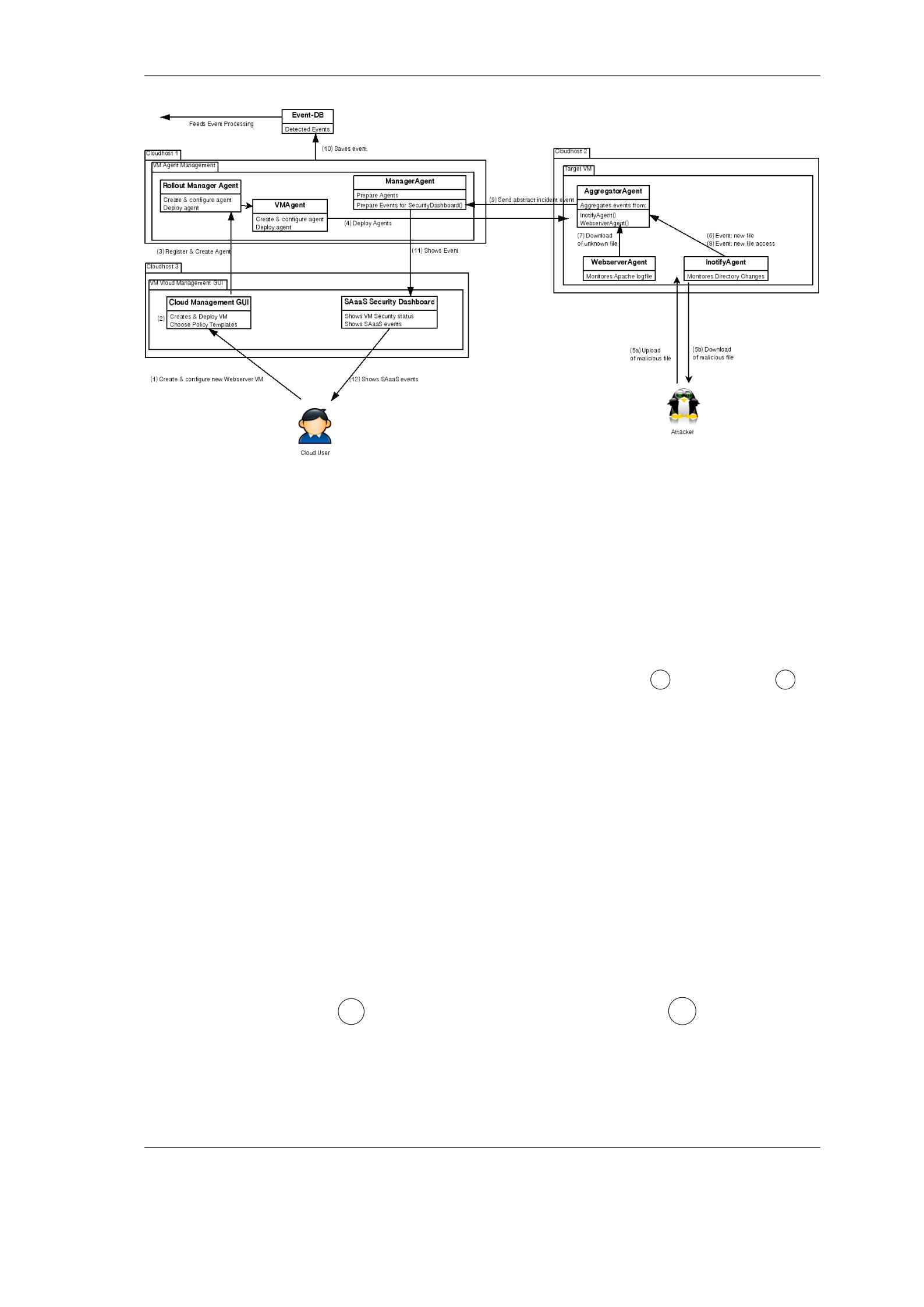
Chapter 7. Security Audit as a Service Prototype
Figure 7.12: SAaaS Demo 1 - Detection of cloud infrastructure changes
•Monitoring of Apache web server config directory
•Monitoring of web server document root directory
•Allowed authentication for Apache web sites: HTTP-DIGEST
By enabling those security policies, this automatically prepares 3 and deploys 4 an
inotify Agent and a Weblog Agent to the running VM. The inotify Agent is monitoring
changes to the webservers’ config and webroot directory, whereas the Weblog Agent
compares http-get requests with a list of allowed html files of the webroot directory.
Additionally, an Event Aggregator Agent gets deployed to the target VM. It includes a
simple message reduction method for the Aggregator Agent stating: “All simple events
occurring within one minute by these two agents get combined into one ”Webserver
attacked - unknown file detected“ message”.
2. Attack & detection. An attacker logs in to the VM, uploads a malicious file to
the VMs webserver root 5a directory. This then gets downloaded 5b by the attacker
to check the success of his attack. This automatically results in three simple events
generated by the corresponding agents:
226
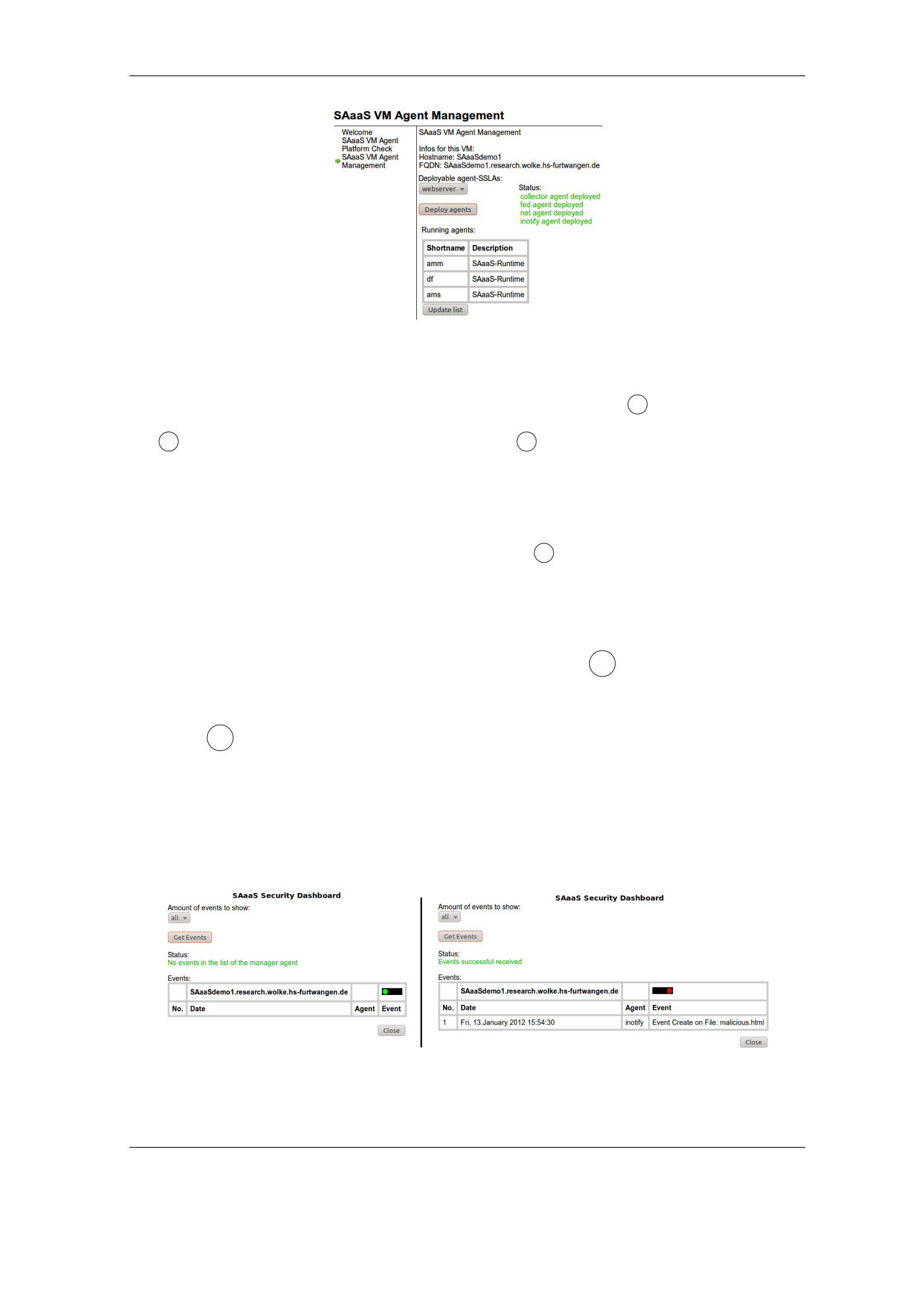
7.3. SAaaS Prototype 1 - Integration of an Agent framework
Figure 7.13: Assignment of security policy template for web server protection
Inotify Agent: creation of new file in webserver-root directory 6 , read access of new
file 8 Weblog Agent: download of unknown file 7 .
These three simple events get combined to one abstracted “Webserver attacked -
unknown file detected” event by the Aggregator agent due to the simple message
reduction method mentioned above, and sent out 9 to the Manager Agent module
at the user’s Agent Management Platform.
User notification. All events get saved into the user specific event database and
forwarded to SAaaS’ global event management module 10 . By doing this, cloud
wide incident detection can be achieved, described later in Section 7.5. The user gets
informed 11 via the SAaaS Security Dashboard, depicted in Figure 7.14. It shows
the VM’s security state before an attack. After launching an attack, the Security
Dashboard indicator light changes its colour as set defined in a simple severity matrix
and gives short information about the monitored event (Figure 7.14).
Figure 7.14: Cloud security dashboard prototype before and after detected attack
227
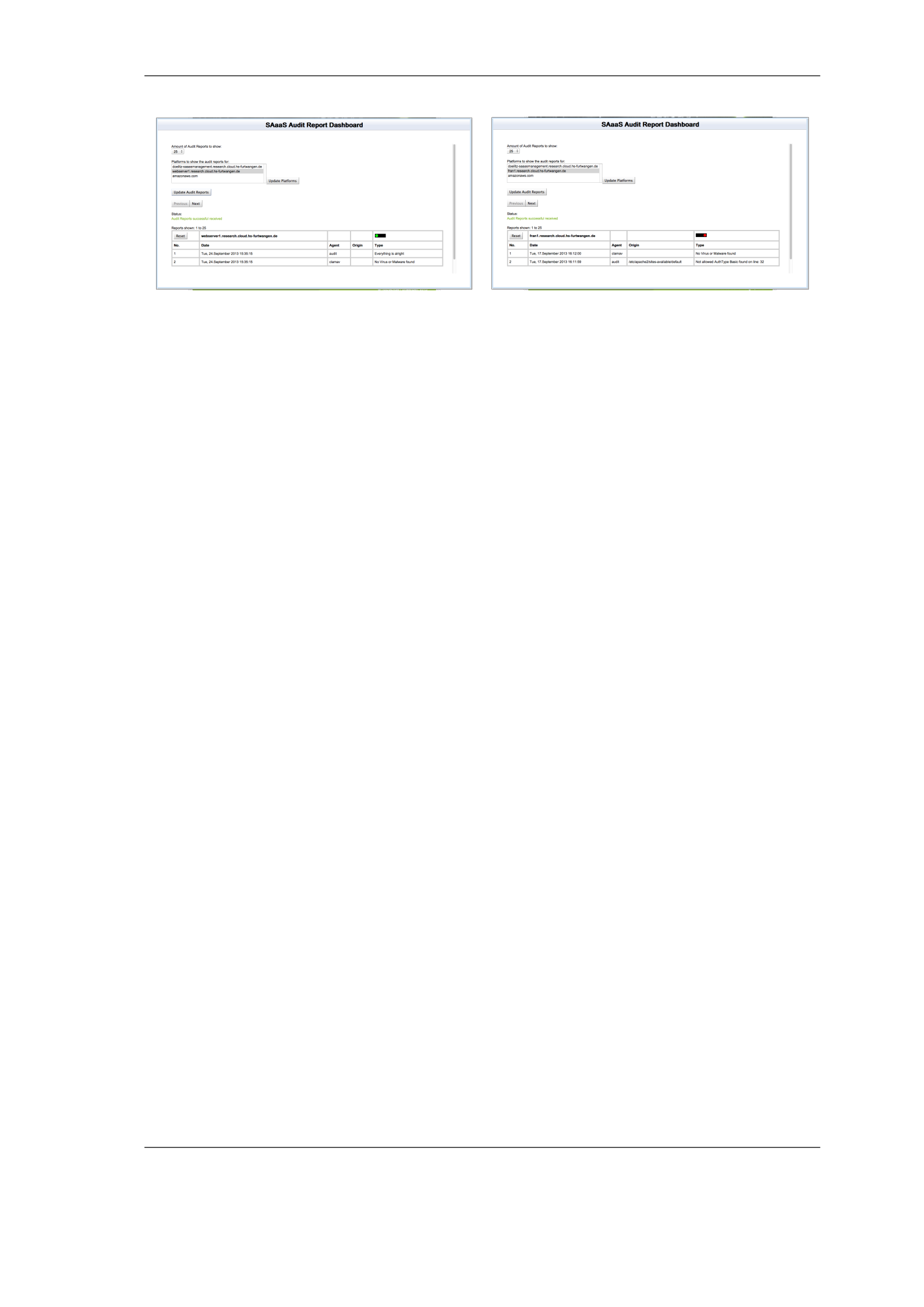
Chapter 7. Security Audit as a Service Prototype
(a) SAaaS prototype: Demo 1b Audit report be-
fore infrastructure change
(b) SAaaS prototype: Demo 1b - Audit report
after infrastructure change
Figure 7.15: SAaaS prototype: Demo 1b - concurrent audits
Demo 1b - Concurrent Audit Due to Cloud Infrastructure Change
In demo 1b, the concept of concurrent audits, as a reaction of a detected cloud infras-
tructure change is shown. Again, the demo is divided into three parts:
1. VM preparation - A new VM gets created
2. Detection - A change gets detected
3. Evaluation & reporting - The change gets analysed, evaluated and reported
1. VM preparation. This scenario assumes, that a cloud user is already running
some SAaaS-enabled web server VMs within an IaaS cloud. As a general security
policy it is defined, that only an encrypted HTTP-DIGEST authentication is allowed
for web server content. On a regular base, an Audit agent gets deployed to all VMs,
checking the security status of those VMs, including the configuration of the web
server. At the beginning of this demo, the SAaaS Audit Report Dashboard shows the
results of the last audit, depicted in Figure 7.15(a).
Now, the cloud user creates a new web server to the Cloud. He configures it, but
accidentally enables the unencrypted HTTP-BASIC authentication. He finishes the VM
configuration and closes the connection to the newly created VM.
228
7.3. SAaaS Prototype 1 - Integration of an Agent framework
Figure 7.16: SAaaS prototype: Demo 1b Audit agent arrived at target VM
2. Detection. The CMS Agent monitoring cloud Management actions, such as
the creation of new VMs, detects the newly created VM of the cloud user. This
is considered a cloud infrastructure change. The information gets forwarded to the
Manager Agent at the user’s SAaaS Management Platform, including the type of VM
(web server). Automatically, all existing security policies for VMs of the type “web
server” get loaded and an Audit agent gets configured. As soon as the user logs out
of the newly created VM, the Audit agent gets deployed to this VM, performing a
compliance check of all security policies. Figure 7.16 shows the logfile of the JADE
platform at the newly created VM. It states, that a new audit agent is arrived, starting
its audit checks. During this check, the misconfigured web server configuration (HTTP
BASIC AUTH) gets detected.
3. Evaluation & Reporting. Results of the audit are reported back to the Manager
Agent at the user’s Agent Management Platform. The audit gets saved into the
user’s audit report database, and the results get displayed within the SAaaS Audit
Report Dashboard. Figure 7.15(b) shows the SAaaS Audit Report Dashboard with
the detected VM misconfiguration.
To show, that the developed SAaaS architecture is compatible to other cloud providers,
the newly created web server VM was created within the Amazon EC2 Cloud, whereas
the SAaaS Agent Management Platform and the other (pre-existing) web server VMs
are running within the CloudIA infrastructure. This demo was presented at the 8th
IEEE World Congress on Services 2012 - IEEE Services CUP and was awarded with
the second prize [235]. The conference poster can be found in Appendix A.7, the corre-
229
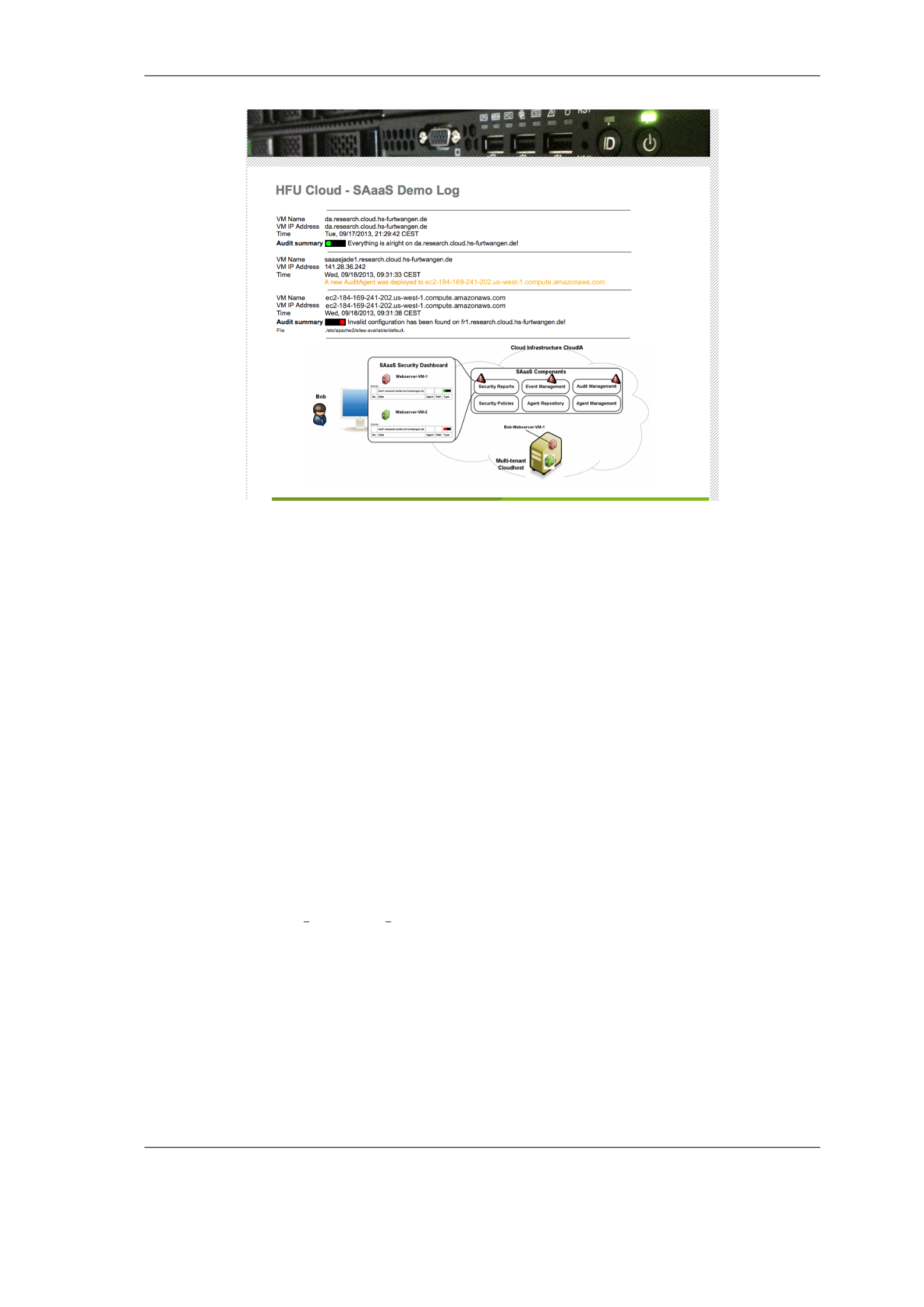
Chapter 7. Security Audit as a Service Prototype
Figure 7.17: SAaaS prototype: Demo 1b graphical log of demo sequence
sponding paper “Validating cloud Infrastructure Changes by Cloud Audits” [144] can
be found on the attached DVD. For a better understanding of the demo sequence, a
graphical log system was developed, showing the sequence of events recognised by the
SAaaS Manager Agent during the demo. It is depicted in Figure 7.17. It shows the
results of the first audit, at an existing VM “da.research.cloud.hs- furtwangen.de”.
Afterwards the event about an automatically deployed Audit Agent to an Amazon
EC2 VM is shown, followed by a detailed message on the found security misconfig-
uration. To visualise the dynamics of the system, an animated movie showing the
sequential agent creation was done. It is available on the DVD attached to this thesis
in the folder SAaaS Prototype Demos/SAaaSDemo1bConcurrentAudit.mov or online
at http:// doeli.de/web/video/SAaaSDemo1bConcurrentAudit.mov.
230
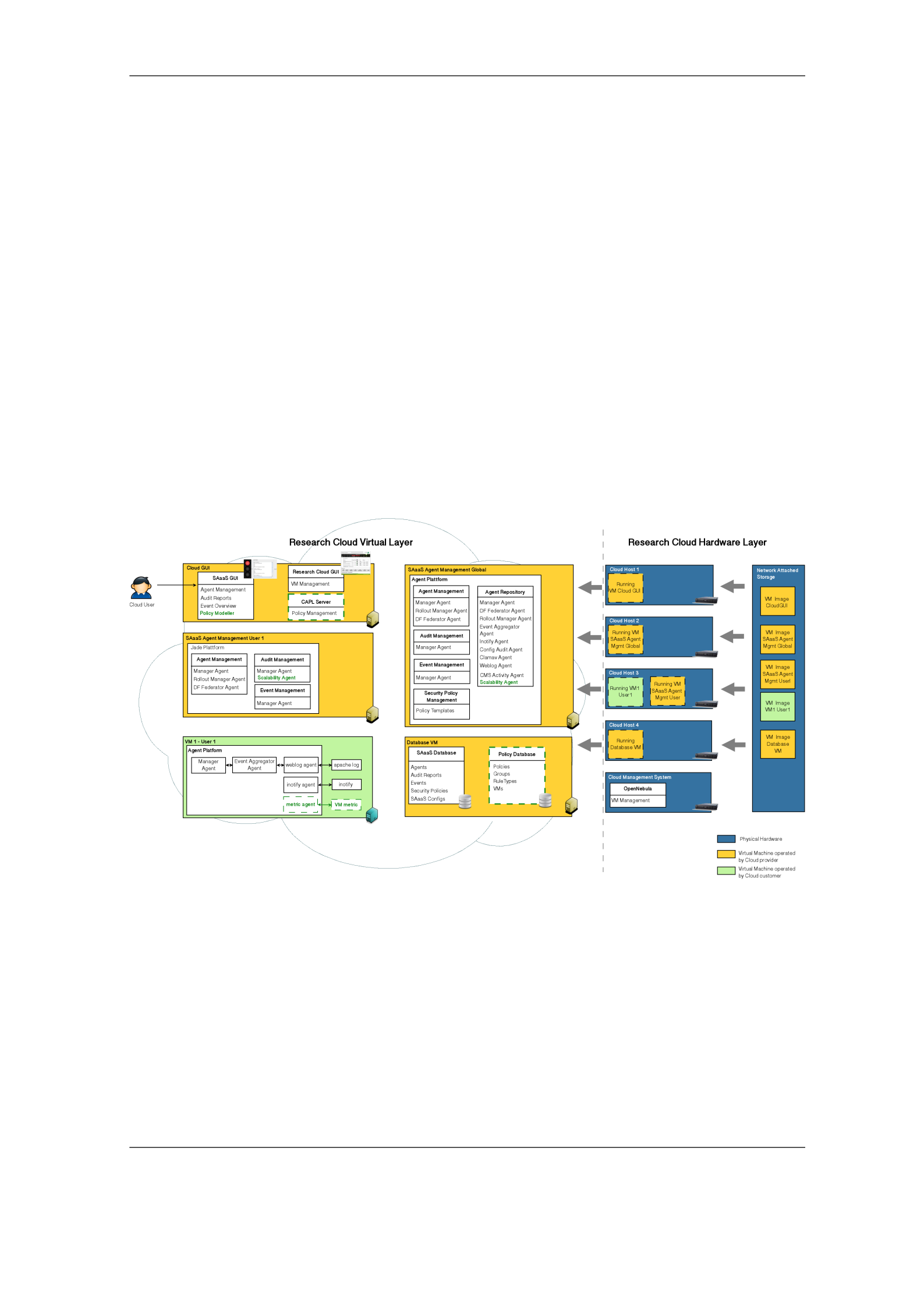
7.4. SAaaS Prototype 2 - Integration of the Cloud Audit Policy Language
7.4 SAaaS Prototype 2 - Integration of the Cloud
Audit Policy Language
As a second step, the Cloud Audit Policy Language, presented in Chapter 5 is seam-
lessly integrated into the SAaaS architecture. Whereas security policies were pre-
defined as templates in the SAaaS prototype version 1, they will be modelled through
a graphical policy modeller and managed by a policy server. Thus, the prototype was
extended by a CAPL server for policy management and a graphical policy modeller.
Figure 7.18 shows the SAaaS prototype version 2 architecture, extended by the CAPL
components (highlighted in green).
Figure 7.18: SAaaS prototype components - version 2
In the data storage backend, a CAPL database is added, storing policies, agent config-
urations and groups. The database got implemented, on the already existing database
VM. The CAPL server is implemented as a web service, run by an Apache Tomcat
application server. The cloud GUI VM was used, to host this server. The SAaaS GUI
231
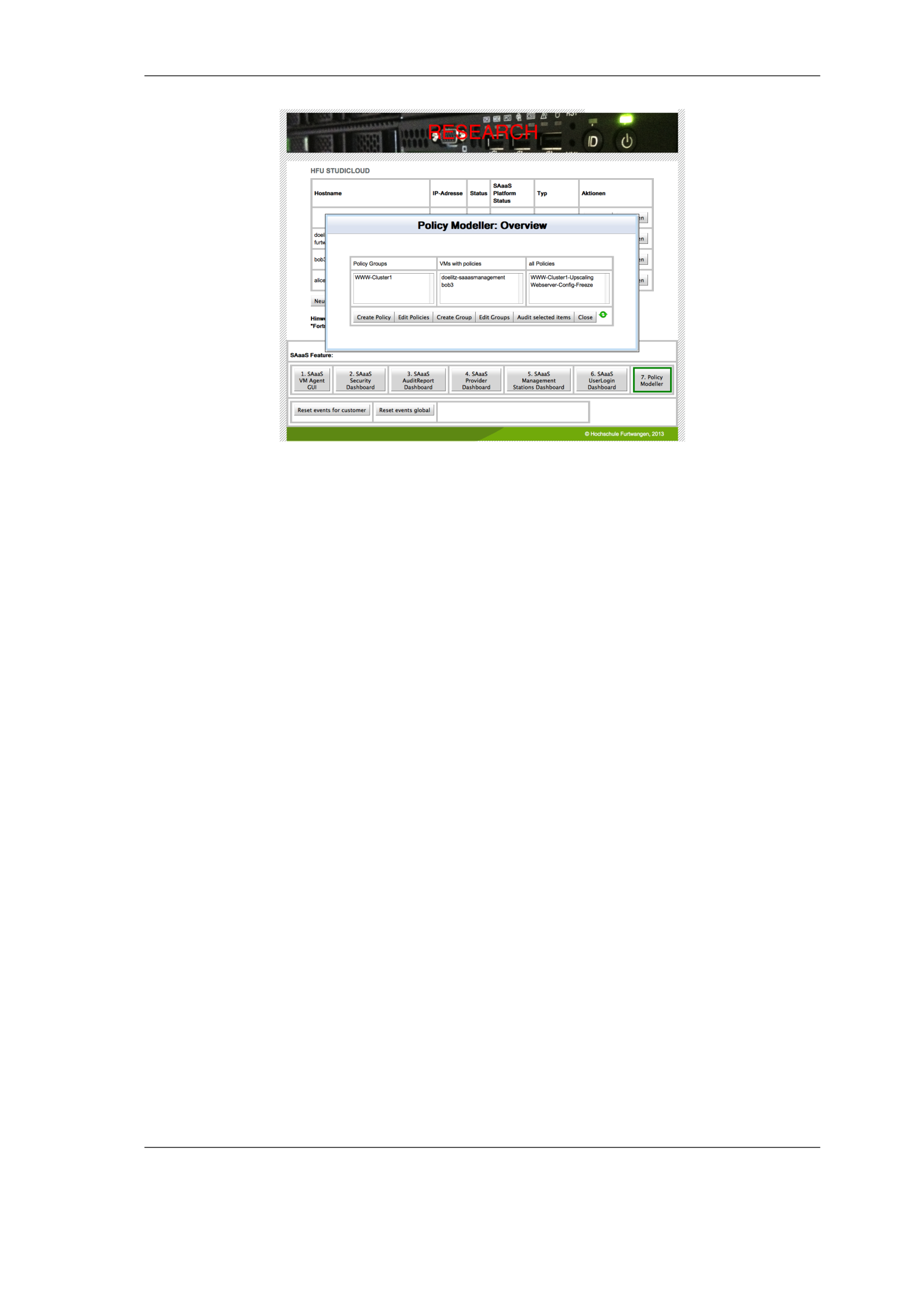
Chapter 7. Security Audit as a Service Prototype
Figure 7.19: SAaaS prototype 2 - graphical policy modeller
was extended by a graphical policy modeller depicted in Figure 7.19.
7.4.1 Server and Language Implementation
For the integration of the Cloud Audit Policy Language, existing modules of the SAaaS
prototype version 1 are extended. A CAPL Server, forming the CAPL backend was
developed in Java. It is based on REST [236], an architectural style used for web
services. In enables data transmission and management via HTTP methods [236].
URIs are used for a distinct addressing of resources [237]. The CAPL server is provided
through an Apache Tomcat [233] server. Communication is done via HTTP requests.
Each request creates, modifies or deletes objects (policies or groups). Message format
is implemented in XML, specified by the MIME type application/xml. Policies are
stored in a MySQL database. The CAPL server supports the following HTTP request
types:
GET - Resource Requests
Data from the server are requested. An URI defines which specific data are requested.
If no parameters are specified, all existing objects are returned. The server answer
232

7.4. SAaaS Prototype 2 - Integration of the Cloud Audit Policy Language
contains all objects, serialised in XML and the return value 200 - OK. A complete list
of possible return values is provided in Table A.16 in Appendix A.3, Section A.3.
POST - Resource creation / Execution of operations
In case a new resource gets created, the object data get send in the data field to the
server. Listing A.1 in Appendix A.3 shows a request to create an object “WWW-
Cluster1”. The server delivers the newly created object back and confirms the success
full object creation with return value 201. The new object can now be referenced by a
unique URI, such as https://research.cloud.hs-furtwangen.de /CAPLPrototyp/res/
groups/46.
In case an operation should be executed, such as adding a Machine to a Group, a
POST method with an Action object gets executed. The Action object contains as
target the URI of the Machine, which should be added to a Group. Listing A.2 in
Appendix A.3 shows the case where a machine with id 5 gets added to group 46.
CAPL Server
The CAPL server was implemented cloud wide as a single VM running an Apache
Tomcat. Its technical details are:
•URL -https://research.hs-furtwangen.de/CAPLPrototyp/rest/
•Management -https://research.cloud.hs-furtwangen.de/manager
•Libraries - libCAPL.jar
•Executable - Folder /tomcat/work/Catalina/localhost/CAPLPrototyp
•Database - onebackend
CAPL Database schema
CAPL stores all objects serialised in a MySQL database. Its schema is similar to
its class diagram and depicted in Figure 7.20. Machines are stored in table vms
233
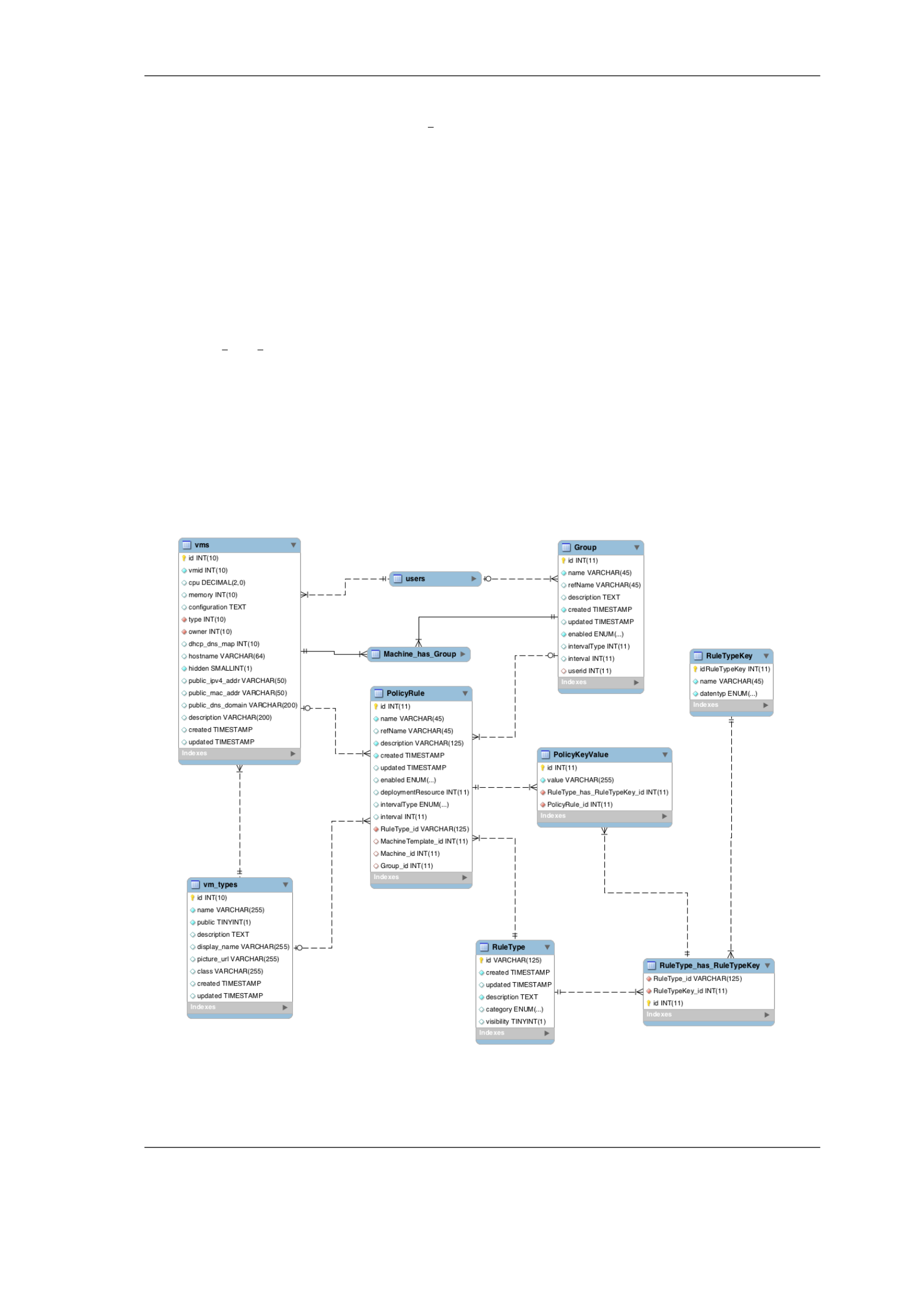
Chapter 7. Security Audit as a Service Prototype
and MachineTemplates in table vm types, due to a naming convention in the Stu-
diCloud environment. Policies are stored in table PolicyRule. The table contains
a column ID for either a Machine, a MachineTemplate or a Group. One of them
needs to be set to link the policy to an instance. Each RuleType can contain multi-
ple keys for context-based attributes. Keys are stored in table RuleTypeKey and can
be assigned to multiple RuleTypes. Concrete assignment is done via a helper table
RuleType has RuleTypeKey with an own unique ID for identification. This get used
in table PolicyKeyValue for storing the raw values of a policy. Thus, it is ensured,
that only attribute values, which are pre-defined by the RuleType are saved. Groups
and Machines are assigned to users via its ID from table User. Thus, every policy in-
herits their attributes. Cascade deletion is executed when a group or assigned policies
Figure 7.20: CAPL Database Design
234
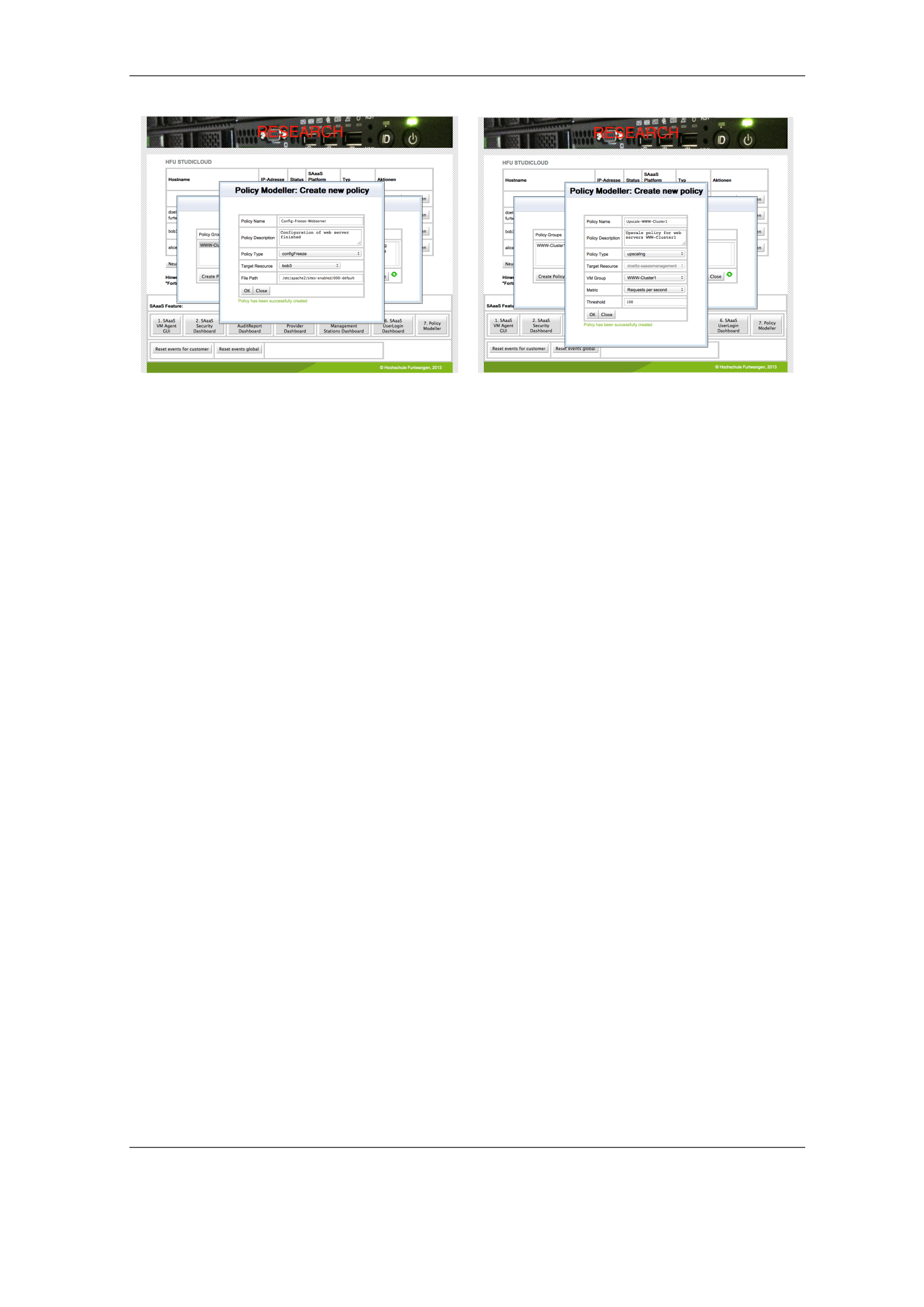
7.4. SAaaS Prototype 2 - Integration of the Cloud Audit Policy Language
(a) SAaaS Policy Modeller: Creation of Config
Freeze policy
(b) SAaaS Policy Modeller: Creation of Upscal-
ing policy
Figure 7.21: SAaaS Policy Modeller: Create Policy
are deleted. In case a group gets deleted, its policies get deleted as well. Machines are
not altered, and exist further on. If a policy gets deleted, its assigned context-based
values are deleted as well.
7.4.2 SAaaS Policy Modeller
The Policy Modeller is the graphical user frontend for cloud user (customer & provider.
It is implemented in Java/GWT and depicted in Figure 7.19 and provides the following
features: Create Policies, Manage Policies, Create Groups, Manage Groups and Audit
Items.
Create Policies: enables the user to add new policies, see Figure 7.21. First, a policy
name gets defined, and a short description of the policy can be entered. From the
list “Policy Type” a policy template can be chosen. For the SAaaS prototype the
following policy templates are implemented:
•ConfigFreeze: A file or directory is considered final, filesystem changes should
be monitored
•Malware: The VM should not contain any malware
235
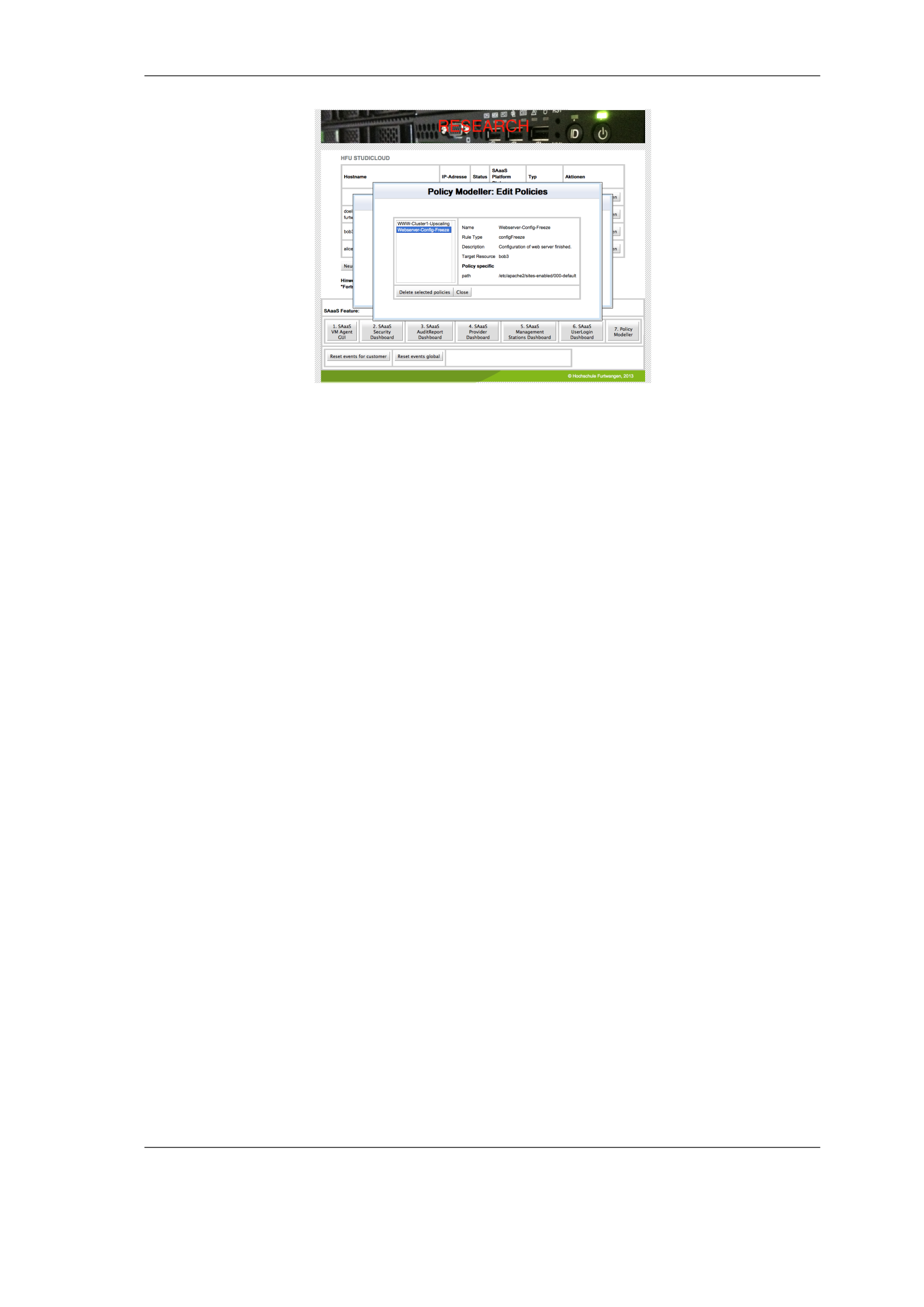
Chapter 7. Security Audit as a Service Prototype
Figure 7.22: SAaaS Policy Modeller: Manage existing policies
•Upscaling: Constraints for an allowed upscaling of the instance (VM or group)
•Downscaling: Constraints for an allowed downscaling (VM or group)
Depending on which policy template was selected, additional information need to
be entered. In case of a Config Freeze policy (Figure 7.21(a)), the target resource
(VM or group) needs to be entered. Same applies for an anti-malware policy. If an
up- or downscale policy is selected (Figure 7.21(b)), a VM group has to be selected.
Furthermore a metric needs to be defined, which should be checked by the SAaaS
sensor agents every time an up- or downscaling event gets detected for this VM group.
Manage Policies: Allows the detailed display of existing policies, depicted in Fig-
ure 7.22. For the SAaaS prototype a Delete policy feature was implemented. In a
productive system several modifications of existing policies will be available here.
Create Groups: Allows the creation of VM groups, depicted in Figure 7.23(a). Thus,
policies can be assigned to multiple VMs logically belonging together.
Manage Groups: Allows the detailed display of existing groups, depicted in Figure
7.23(b). For the SAaaS prototype a Delete policy feature was implemented. In a
productive system several modifications of existing groups, like adding and removing
of VMs will be available here.
236
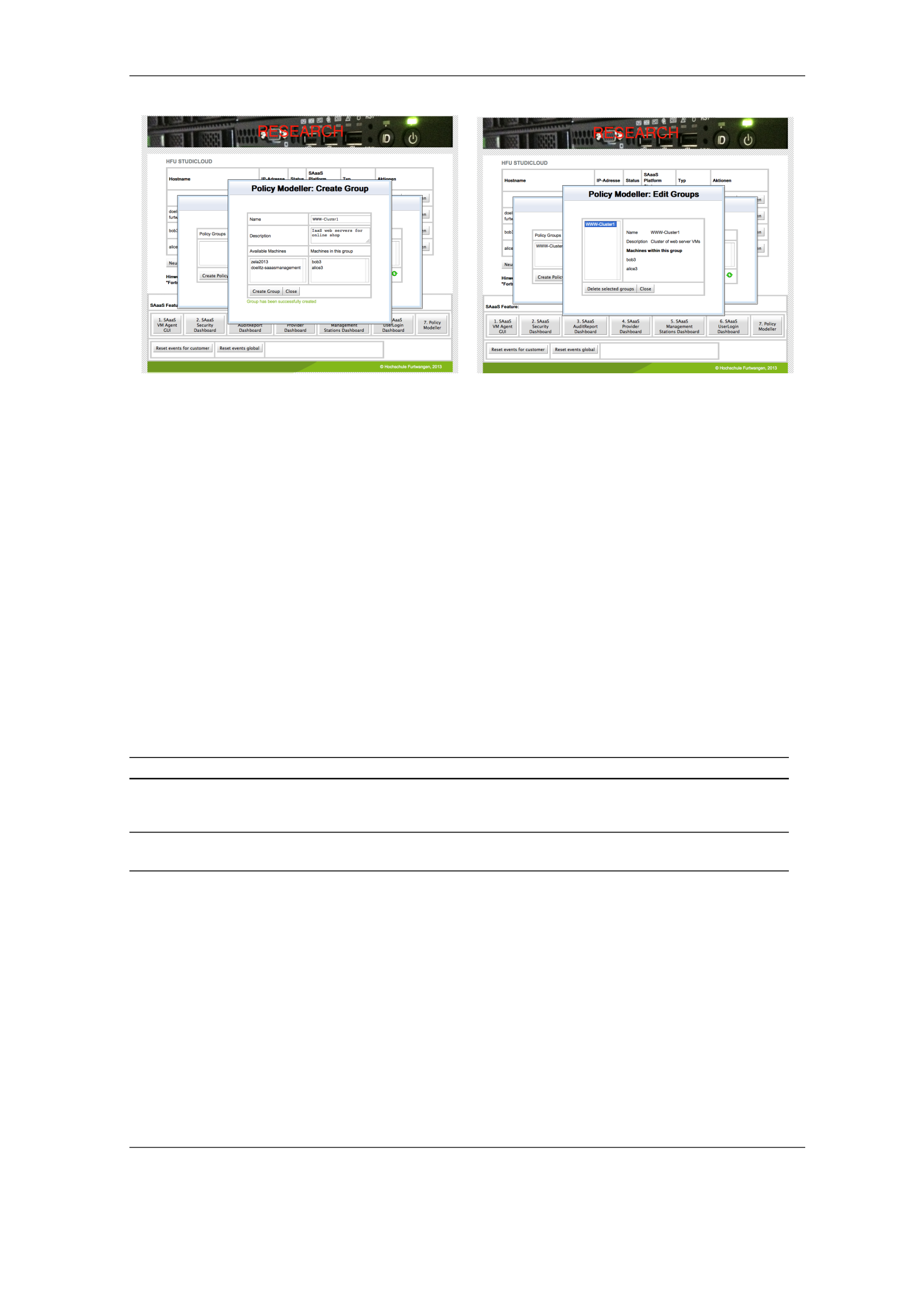
7.4. SAaaS Prototype 2 - Integration of the Cloud Audit Policy Language
(a) SAaaS Policy Modeller: Creation of VM
group WWW-Cluster1
(b) SAaaS Policy Modeller: Management of VM
group WWW-Cluster1
Figure 7.23: SAaaS Policy Modeller: Group creation and management
Audit Items: Allows the instant auditing of selected policies. This supports the
case, that a user manually wants to check the compliance of one or multiple policies
or wants to execute a defined audit immediately.
Table 7.3 shows a list of agents, which were developed during this stage of the SAaaS
prototype. A comprehensive list of all developed agents during this research including
technical details is provided in Appendix A.2.
Agent name Agent Type Position Description
Scalability Event
Agent
Management Agent SAaaS-Agent Manage-
ment Platform (global
& user specific)
Gets created in case a scalability request
gets detected by a CMS agent. Deploys
Metric Agents and collects result
Metric Agents Metric agent Target VM / cloud
host
Checks a certain metric, e.g. CPU load
or HTTP requests
Table 7.3: SAaaS agents developed during 2nd SAaaS prototype stage
7.4.3 SAaaS Demo 2 - Detection of Scalability Attacks
As for demonstration, the identified cloud specific security risk “B5. Missing moni-
toring of cloud scalability” (see Chapter 3.4.3 - Specific Cloud Security Problems) was
237
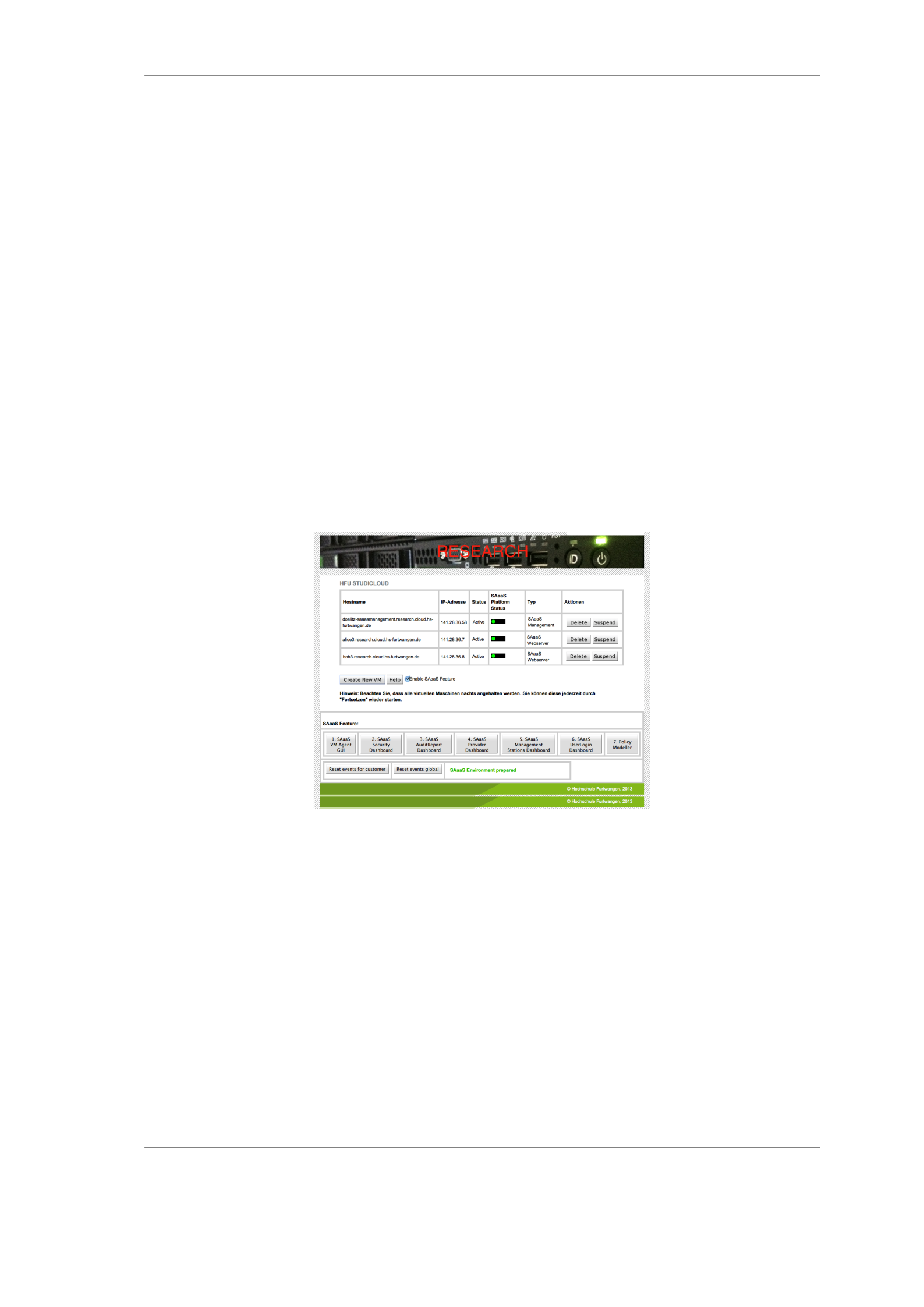
Chapter 7. Security Audit as a Service Prototype
chosen as a demonstration scenario. Figure A.2 in Appendix A.3 presents communi-
cation between all involved components and describes it. Similar to SAaaS Demo 1 it
is divided into three parts:
1. VM preparation - Deploy of web server VMs, and policy generation
2. Attack on cloud management - Malicious upscale event gets issued
3. Evaluation & Reporting Upscale event get evaluated and denied
Demo preparation A cloud user creates three new VMs on the web based cloud
management interface, depicted in Figure 7.24. The VMs get configured as a typical
Web application installation: two Web servers, one database server.
Figure 7.24: SAaaS cloud GUI: Web server VMs created
After VM configuration is finished the user enables the SAaaS features starts the se-
curity policy modeller and groups the VMs into group “WWW-Cluster1”. Then he
activates a scalability monitoring policy with a metric of HTTP requests per second
and a threshold of 100 for WWW-Cluster1. Furthermore, he creates a policy saying
that the “/etc/apache2” config directory should be considered frozen and therefore be
monitored for changes. As a result from enabling the SAaaS features and the policy
238
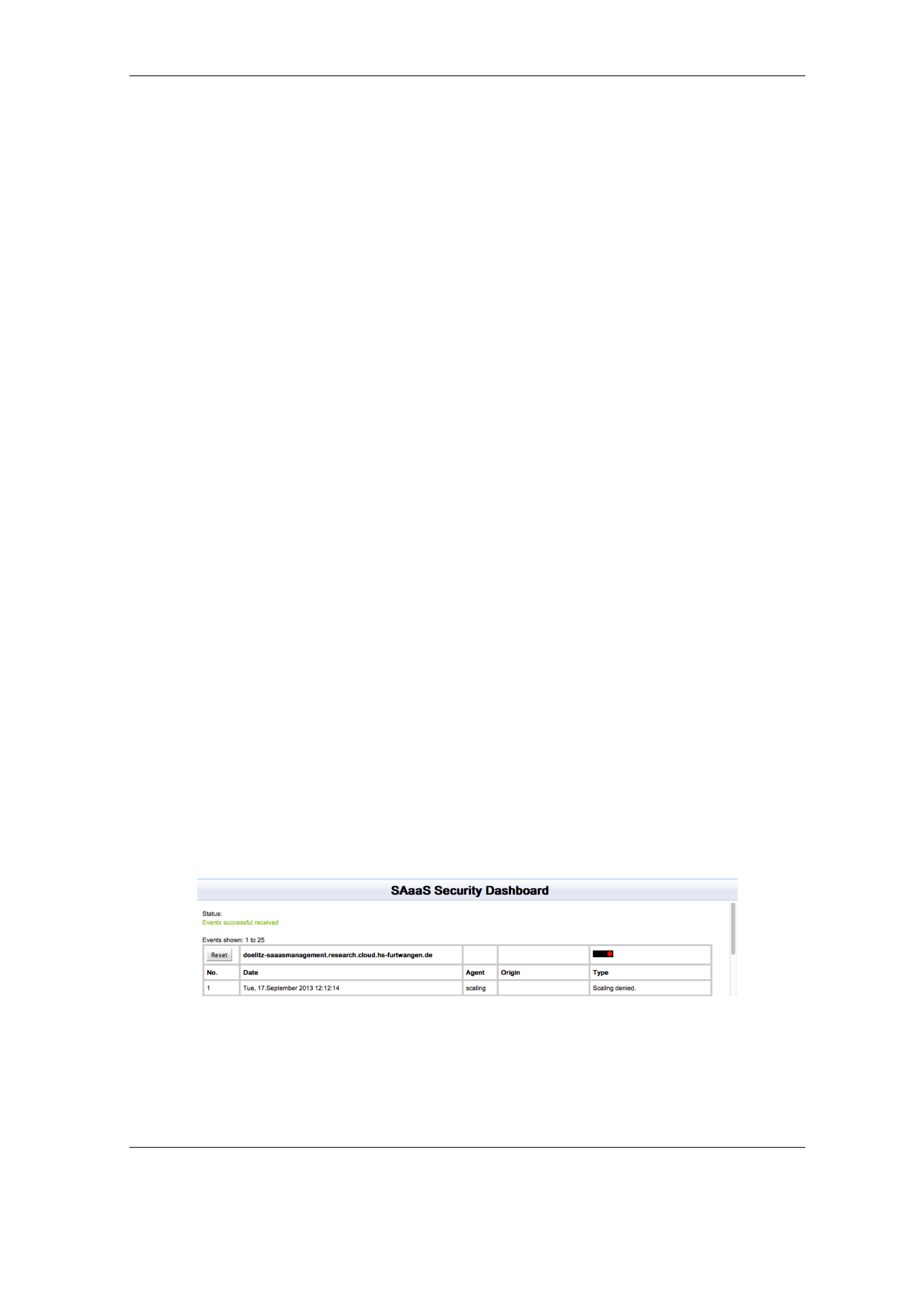
7.4. SAaaS Prototype 2 - Integration of the Cloud Audit Policy Language
creation a sensor agent for filesystem monitoring gets deployed to the VMs of “WWW-
Cluster1”. It utilizes the linux tool inotify [238] to watch the “/etc/apache2” directory.
Execution of Attack It is assumed, that an erroneous upscaling request gets issued
to the cloud management system for WWW-Cluster1. This can be caused due to a
malfunction of the CMS or by a malicious attacked. It gets intercepted by a SAaaS
agent monitoring the CMS.
Mitigation by the SAaaS System The event provokes the creation of a scalability
audit agent, which get deployed to the user’s SAaaS Agent Management Platform.
The agent creates new metric agents according to the underlying scaling policy, which
get deployed to the web server VMs of WWW-Cluster1 to check the current load of
HTTP requests. They report the result back to the audit agent. The Scalability Agent
evaluates the result and allows or denies dependent on the average load reported by
the metric agents the requested upscale event.
Figure 7.25 shows the SAaaS security dashboard after the scalability attack demon-
stration. The dashboard informs that an upscaling event was detected at the cloud
management system and the result of the corresponding concurrent audit. In this case
scaling was denied, since no load was recognised at the web server VMs of WWW-
Cluster1.
Figure 7.25: Cloud security dashboard: Mitigated scalability attack
239
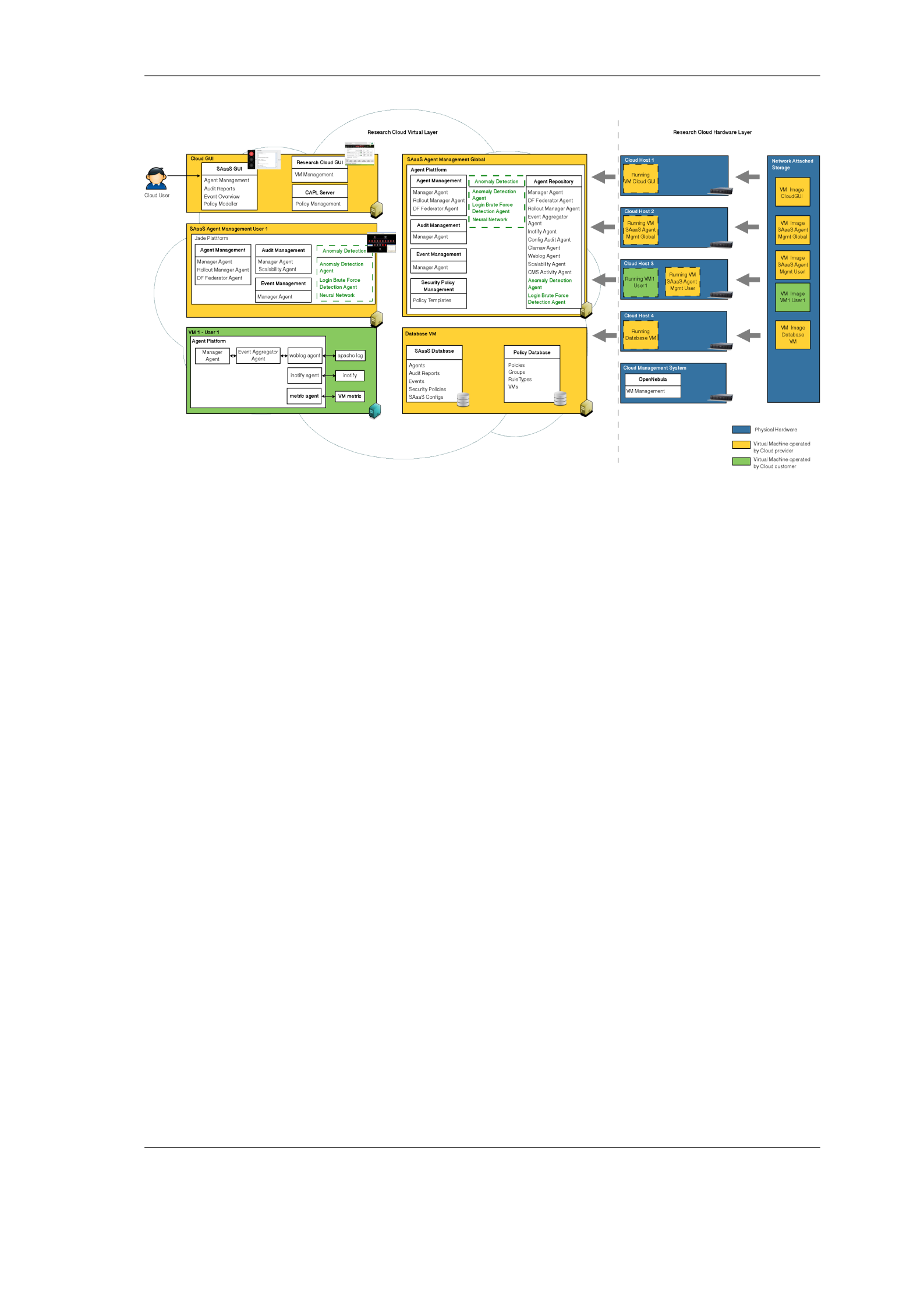
Chapter 7. Security Audit as a Service Prototype
Figure 7.26: SAaaS prototype components - version 3
7.5 SAaaS Prototype 3 - Integration of Anomaly
Detection
To show the feasibility of the developed anomaly detection system, presented in Chap-
ter 6 - Anomaly Detection, the SAaaS prototype version 2 got extended by components
of an anomaly detection system. Figure 7.26 shows the SAaaS prototype version 3
architecture, new components highlighted in green. The prototype is extended by
a cloud usage data simulator, rule based policies for anomaly detection as well as a
corresponding agent, and a anomaly detection system feeding a neural network to
evaluate certain user behaviour.
The system is fed by a SAaaS sensor agent, monitoring the cloud management system.
Whenever a VM-CREATE or VM-DELTE command is monitored for a certain user,
this is forwarded to the anomaly detection system. The user’s behaviour profile is
loaded and the monitored event is tested against its behaviour profile by the neural
240
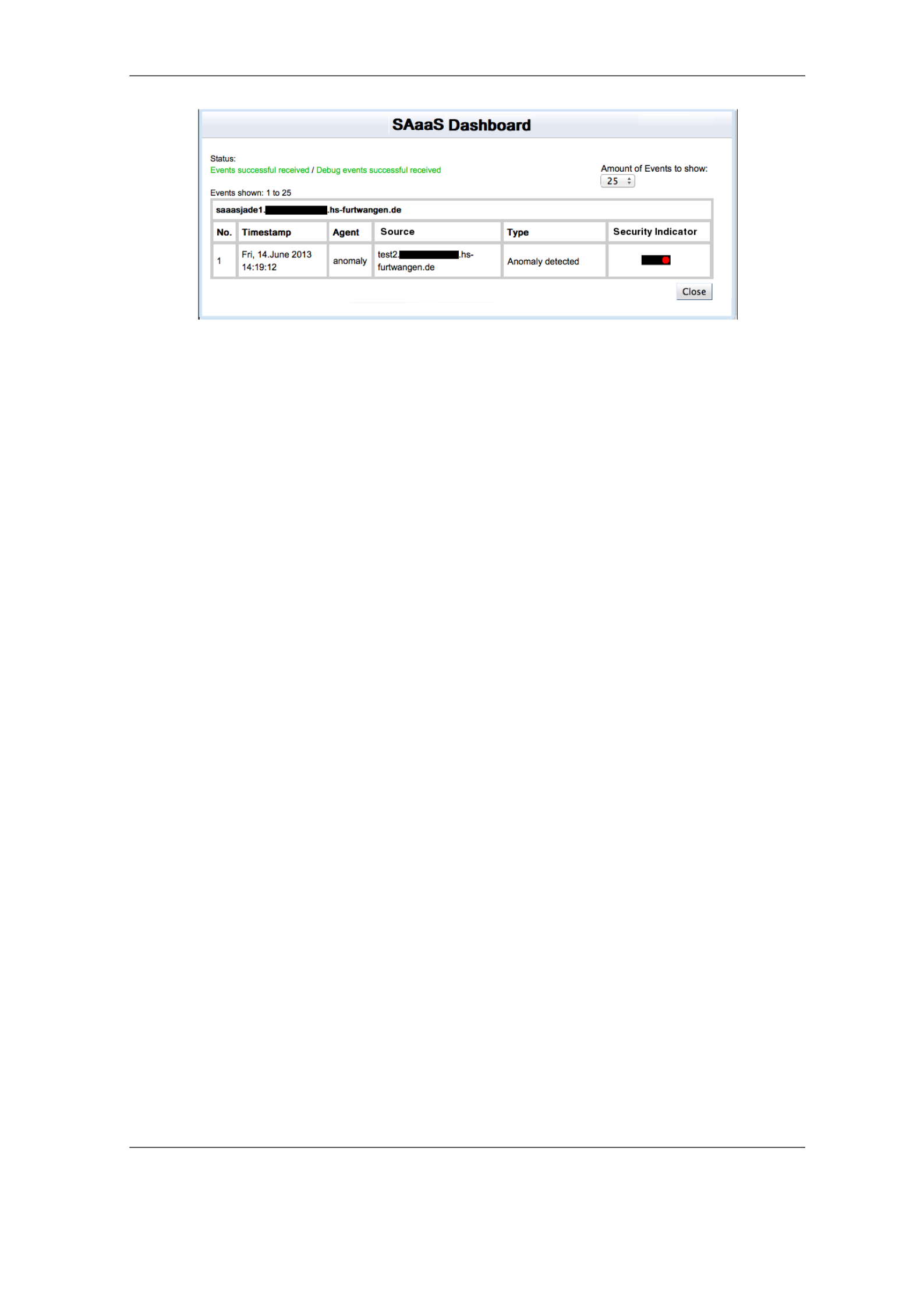
7.5. SAaaS Prototype 3 - Integration of Anomaly Detection
Figure 7.27: Anomaly warning in SAaaS Dashboard
net. In case an anomaly was detected, this gets reported back to the SAaaS agent,
and a warning is displayed in the SAaaS Security Dashboard in the web based cloud
management GUI of the user. Figure 7.27 shows a screen shot of such a warning.
7.5.1 Agent Development for Anomaly Detection
Similar to Chapter 6 - Anomaly Detection, integration of the anomaly detection func-
tionality into the SAaaS prototype is implemented as two different agents:
•Rule based detection - Login Bruteforce Detection Agent
•Behaviour based detection - Anomaly Detection Agent
Rule based detection - Login Bruteforce Detection Agent Technical function-
ality of defining rules of an expected, normal behaviour is already provided in the
SAaaS prototype through the cloud Audit policy language. To demonstrate a rule
based detection scenario, a Login Bruteforce Detection agent is implemented. It gets
deployed to each VM of a cloud users, monitoring SSH logins and login attempts. To
avoid double description, its functionality is described directly in Subsection 7.5.2 -
SAaaS Demo 3 - Login Bruteforce Detection.
Behaviour based detection - Anomaly Detection Agent To show the function-
ality of a behaviour based anomaly detection system an Anomaly Detection Agent is
241

Chapter 7. Security Audit as a Service Prototype
implemented. It gets deployed to the user specific SAaaS Agent Platform. It gets in-
formation about VM action from the CMS Activity Agent about newly created VMs,
starting and stopping of existing VMs, or deletion of a VM. This information gets
forwarded by the Anomaly Detection Agent to a neural network. For the SAaaS pro-
totype version 3, this is implemented on a separate Windows VM running the neural
network editor Membrain. For a productive system, this would be implemented di-
rectly at the SAaaS Agent Management Platform, thus it is placed there in Figure
7.26. User concentric anomaly detection is performed on the user specific SAaaS Agent
Management Platform, whereas cloud wide anomaly detection is done by the provider
on the “SAaaS Agent Management Platform Global”. Each network is trained with
historical user data and evaluates the newly received event if it indicates an anomaly
or not. This information gets passed back to the Anomaly Detection Agent.
Table 7.4 shows a list of agents, which were developed during this stage of the SAaaS
prototype. A comprehensive list of all developed agents during this research including
technical details is provided in Appendix A.2.
Agent name Agent Type Position Description
Login Bruteforce
Detection Agent
Sensor agent Target VM / cloud
host
Monitors Login Attempts
Anomaly Detec-
tion Agent
Sensor Agent SAaaS-Agent Manage-
ment Platform (global
& user specific)
Feeds behaviour based anomaly detec-
tion system
Table 7.4: SAaaS agents developed during 3rd SAaaS prototype stage
7.5.2 SAaaS Demo 3a - Login Bruteforce Detection
To demonstrate rule based detection of cloud wide anomalies, the attack scenario
of a distributed login attack, elaborated in Chapter 6.3.2 - Cloud Wide Anomaly
Detection was chosen. As a reminder, Figure 6.2 (Chapter 6.3.2) depicts the attack:
An IP range of cloud resources gets brute forced by an attacker with one specific
242
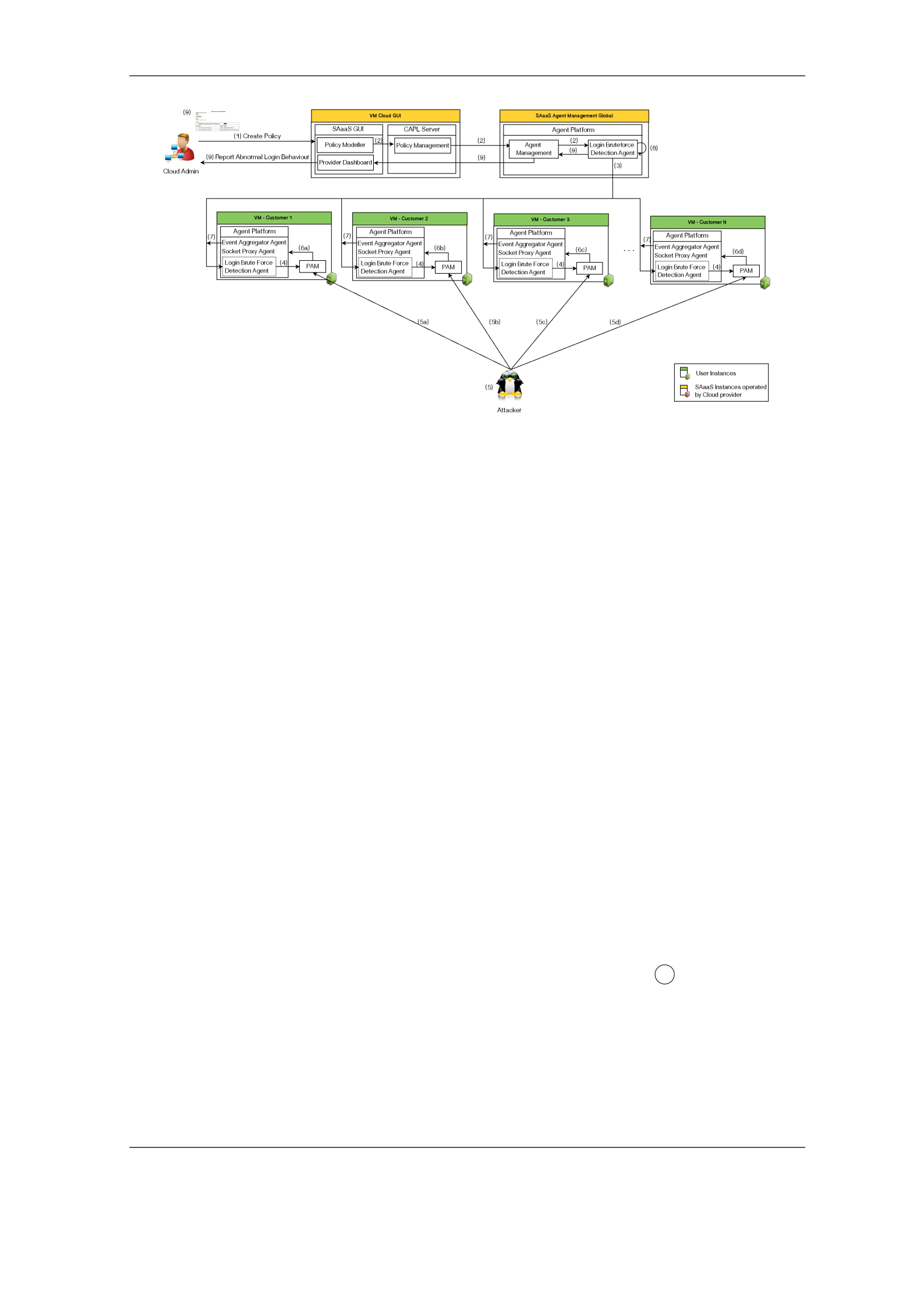
7.5. SAaaS Prototype 3 - Integration of Anomaly Detection
Figure 7.28: SAaaS prototype demo 3a: Detected abnormal login
username+password combination. Weakly secured VMs using default user credentials
such as username: demo, password: demo are vulnerable. The demonstration, is
divided into four parts:
•Preparation - cloud provider defines cloud wide security policy
•Attack - Attacker performs distributed bruteforce login attack
•Detection & Evaluation - SAaaS agents detect attack
•Reporting - Detected abnormal behaviour gets reported
Figure 7.28 visualises the sequential process of SAaaS Demo 3a.
Preparation - It is assumed, that a cloud provider is running an IaaS Cloud. Several
customers are running VMs in this Cloud. One of them is weakly configured with a
possible SSH account (username: root, password root). To secure the infrastructure,
the cloud provider defines the following cloud wide security policy 1 : “If a successful
SSH login of a specific SRC system is preceded by certain threshold of unsuccessful
login attempts at other VMs in the cloud infrastructure, this is considered an anomaly
and an alarm should be raised”. For this demo, a threshold of five login attempts was
243

Chapter 7. Security Audit as a Service Prototype
set. The threshold gets calculated as follows: If an unsuccessful login attempt, prior
to the successful login was at a VM from the same cloud customer, a value of one
gets added to the threshold counter. If the prior login attempt was recognised at a
VM of a different customer, the threshold gets increased by three. This calculation
respects the possibility of false positive login attempts, where a user might mistypes
a password, whereas it is considered very unlikely, that a user might try to login at
an instance of a different customer. The definition of the providers cloud wide policy
results in the following automated actions:
•The policy gets executed by the CAPL server. A Login Bruteforce Detection
Agent gets started at the Global SAaaS Management Platform 2a .
•It forks itself to all SAaaS-enabled VMs running in the cloud 3 . At each VM it
updates 4 the local Pluggable Authentication Modules (PAM) to send a notifi-
cation to the local Socket Proxy Agent about SSH login attempts. Afterwards,
it deletes itself from the VMs. Each login attempt at a VM gets now reported
through the local Socket Proxy Agent and the local Event Aggregator Agent to
the Login Bruteforce Detection Agent.
Attack Now, a distributed login bruteforce attack gets demonstrated 5 . There-
fore, a Linux bash script was developed, trying a SSH login with a fixed username
and password combination at a list of cloud instances 5a - 5d . Through the order
of VM names in the list it is made sure, that the weakly configured VM is accessed last.
Detection & Evaluation The login attempts (unsuccessful and successful) get recog-
nised by the local PAM modules ( 6a - 6d ) and forwarded 7a - 7d to the Login
Bruteforce Detection Agent. For each login src (attacker), a login counter gets cre-
ated, which increases at a failed login. If a successful login is recognised, the number of
unsuccessful logins at different VMs gets evaluated. If the counter exceeds the thresh-
244
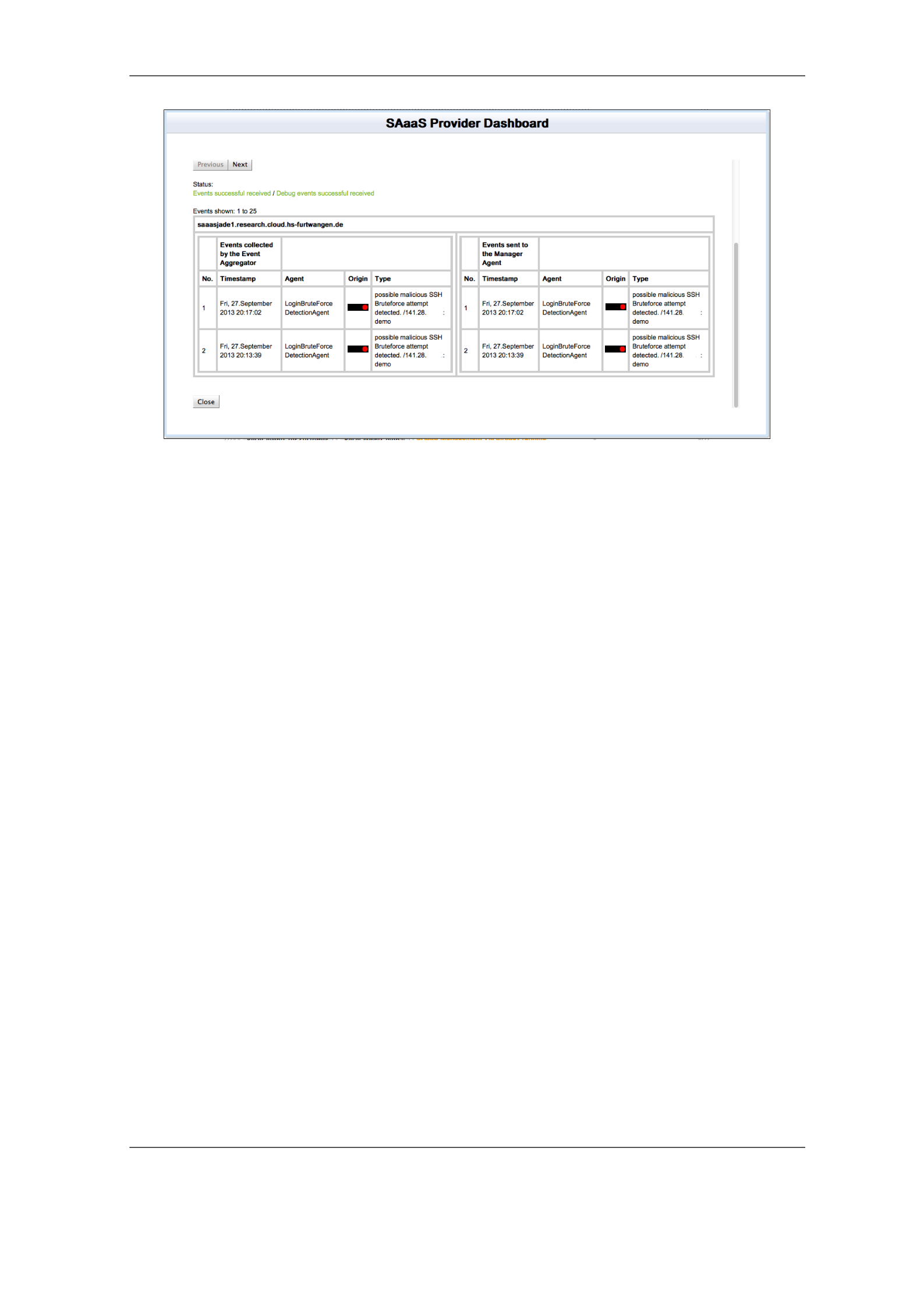
7.5. SAaaS Prototype 3 - Integration of Anomaly Detection
Figure 7.29: SAaaS prototype demo 3a: Detected abnormal login
old defined by the cloud provider’s policy, this gets reported to the SAaaS Security
Dashboard. Since three unsuccessful login attempts at three different customer VMs
exist for the same SRC in this demonstration, the login counter for this attacking host
is nine, exceeding the limit of five. Thus, an alarm gets issued by showing a message
in the SAaaS Provider Dashboard.
Reporting The cloud provider gets notified about the abnormal login behaviour
through the SAaaS Security Dashboard. Figure 7.29 shows the event in the SAaaS
Provider Dashboard. For the SAaaS demo, no further actions are defined, but in a
real system further incident prevention methods, such as blacklisting a SRC system
are imaginable.
7.5.3 SAaaS Demo 3b - Abnormal VM Creation
To demonstrate Behavioural based detection of cloud anomalies, the user concentric
behaviour analysis scenario, presented in Chapter 6.4.4 - User Concentric Anomaly
Detection With Neural Networks is implemented into the SAaaS prototype, forming
245
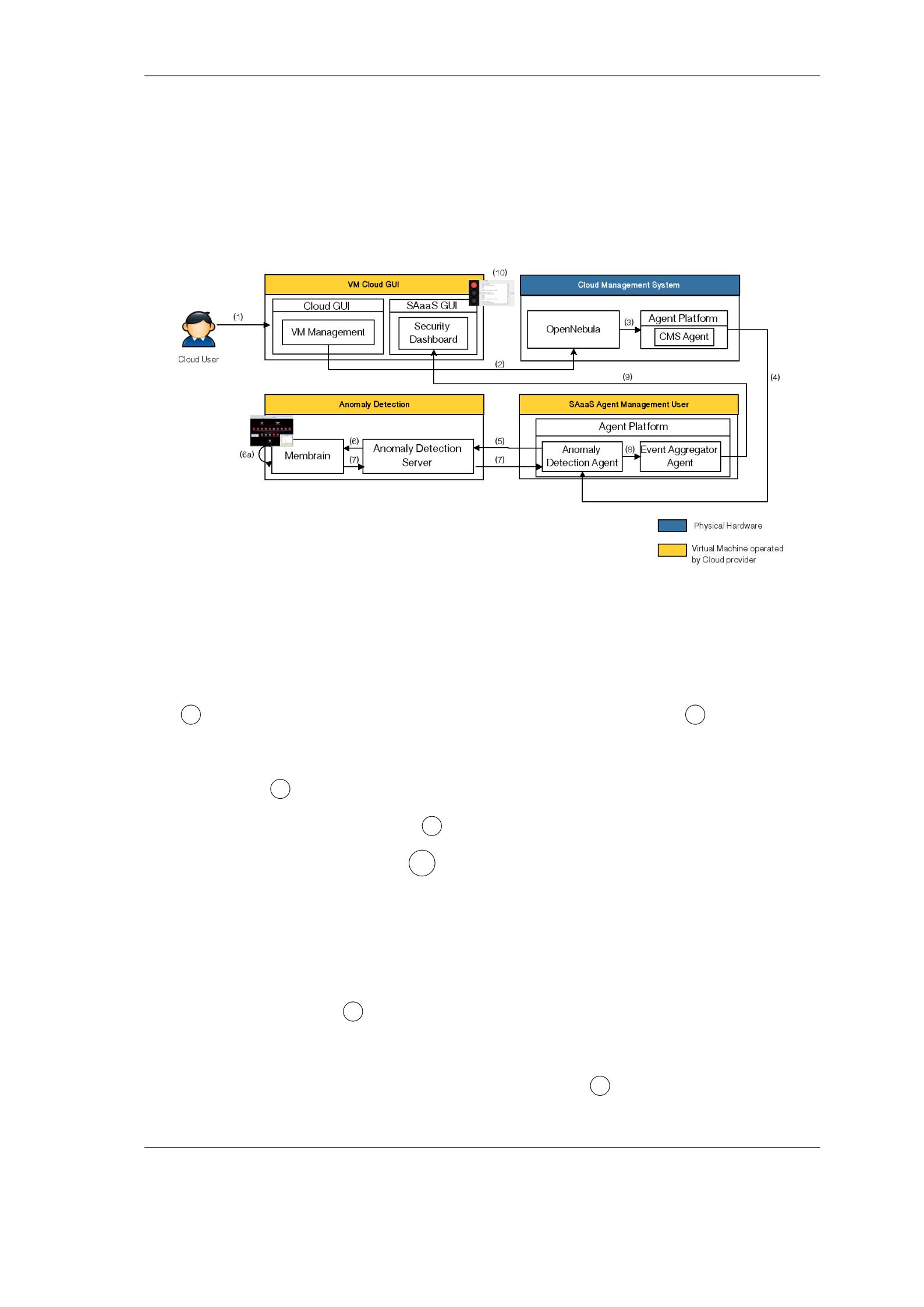
Chapter 7. Security Audit as a Service Prototype
prototype version 3. Therefore, for each user, a behaviour profile of VM CREATE and
VM STOP events is built up. Furthermore, an anomaly detection module, operating
a neural network is added to the user specific SAaaS Agent Management Platform
(see Figure 7.26). Figure 7.30 visualises the developed SAaaS demo 3b.
Figure 7.30: SAaaS prototype demo 3b: Anomaly detection for VM life cycle be-
haviour
No pre-assumption is taken for this demonstration. First, a cloud user creates a new
VM 1 . The request gets issued to the Cloud Management System 2 . An Anomaly
Detection agent, located at the user specific SAaaS Agent Platform gets informed by
the CMS agent 4 whenever a user creates or stops a VM. This event gets forwarded
to the Anomaly Detection Server 5 , the neural network gets started, learning the
user’s prior VM usage behaviour 6a from its prior recorded behaviour profile. When
the learning phase is completed, the new event gets assessed by the network to classify,
if this event fits to the user’s learned “normal” behaviour. In case it fits, no further
actions are taken. If it does not fit, this is considered an anomaly, and an appropriate
alert action is executed 7 . Therefore, the existing SAaaS communication path is
executed: The event gets forwarded from the sensor agent (Anomaly Detection Agent)
to the Event Aggregator Agent, which issues a warning 9 . For the demo, an alert is
246
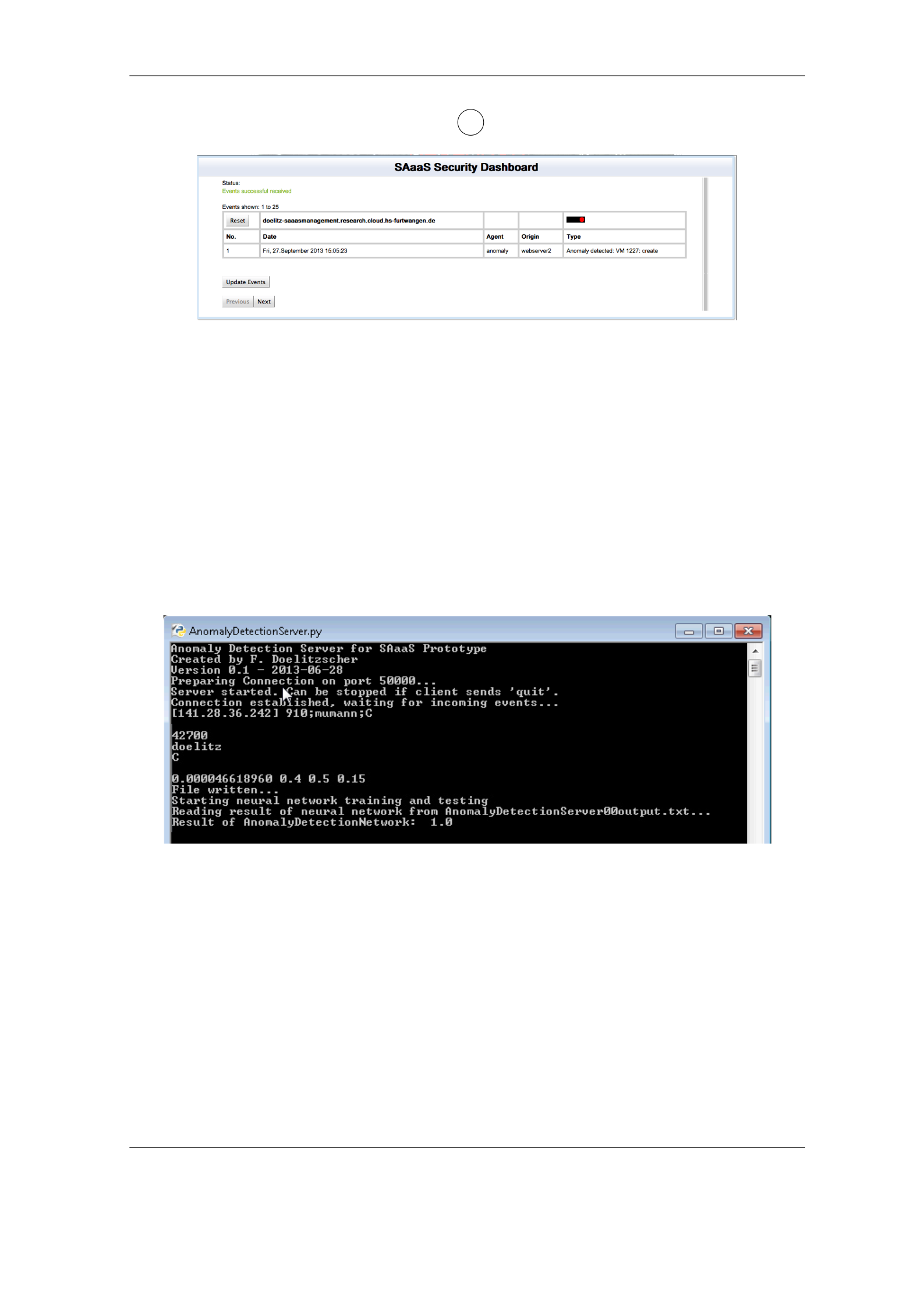
7.5. SAaaS Prototype 3 - Integration of Anomaly Detection
shown in the SAaaS Security Dashboard 10 , depicted in Figure 7.31.
Figure 7.31: SAaaS prototype demo 3b: Abnormal VM creation detected
For the SAaaS prototype version 3, the 4-40-20-10-5-1 neural network for scenario
UserAnomaly03 (see Chapter 6.4.4) was used, implemented using the neural network
editor Membrain, running on a separate Windows VM. Membrain was chosen due
to its scriptability. A python network server was developed, opening a TCP socket,
waiting for an event from the Anomaly Detection agent about a VM CREATE or VM
STOP message. Figure 7.32 shows some debug output of the python server.
Figure 7.32: SAaaS prototype demo 3b: Anomaly server output
A VM CREATE event (C) is sent from the Anomaly Detection Agent to the server,
together with the user id (doelitz) and a time stamp in form of seconds of that day
(42700), which corresponds to 11:51am. This information gets forwarded to a mem-
brain script, which:
1. normalises the data as test data
247
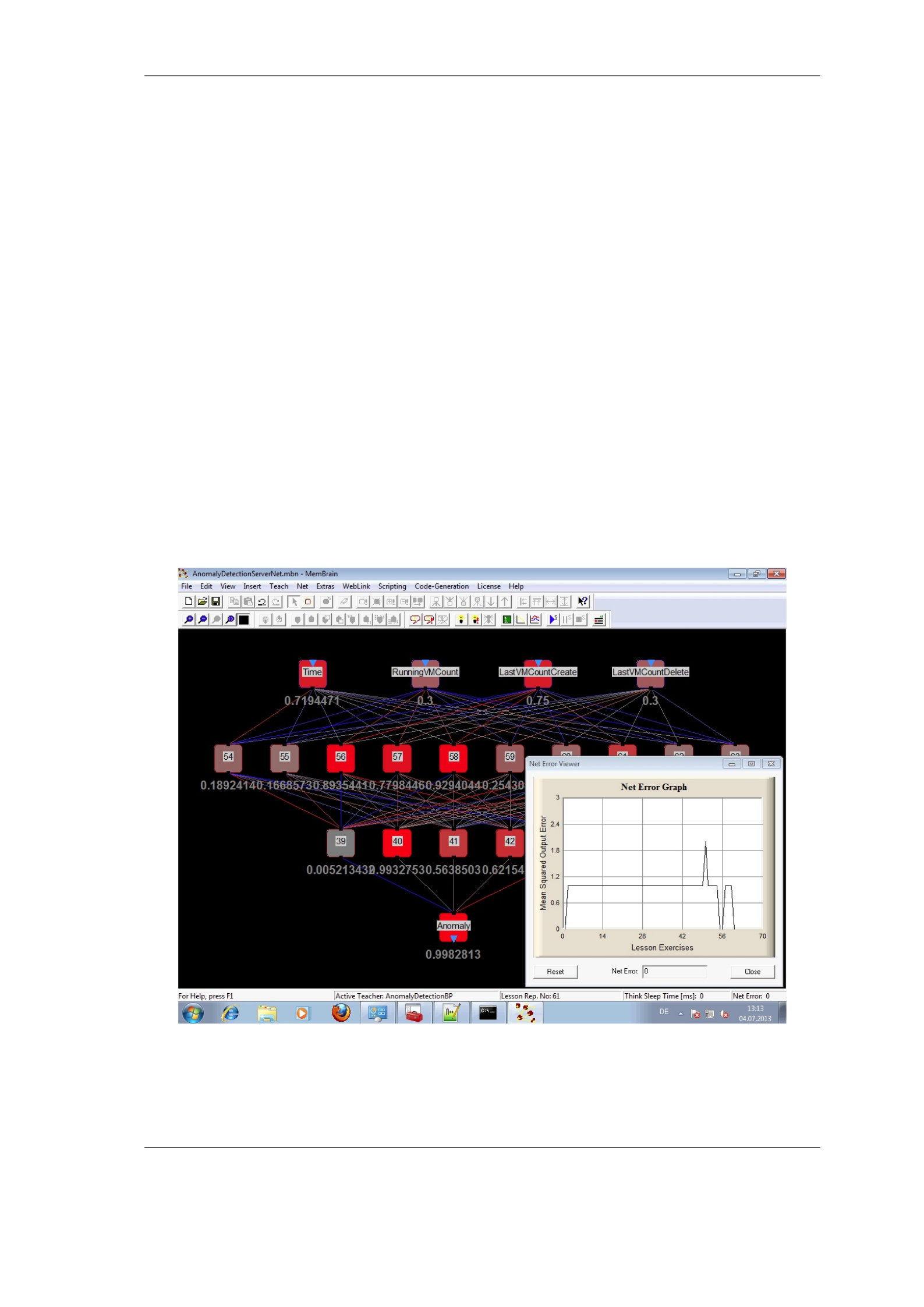
Chapter 7. Security Audit as a Service Prototype
2. loads and trains the network with historical usage data of user “doelitz”
3. evaluates the test data against the learned behaviour profile
4. reports back a anomaly result (0 or 1)
Figure 7.33 shows the neural network, during the training phase after the received
VM CREATE event of user doelitz. As depicted in the lower part of Figure 7.32,
this event is considered an anomaly (result evaluation 1.0). This is, because for the
demonstration, a cloud usage history for user doelitz was prepared, stating, that the
user normally only creates VMs during 2am - 4am in the morning. Thus, a VM cre-
ation at 11:51am does not fit to the learned behaviour.
Figure 7.33: SAaaS Prototype 3 - Training of user behaviour
248

7.6. Summary
7.6 Summary
This Chapter presented a three-stage prototype of the Security Audit as a Service
system. The technical environment CloudIA was introduced and the integration of the
JADE agent framework presented. SAaaS demo 1 showed how automatic concurrent
audits react on a change within a Cloud infrastructure. As a second development stage,
a prototype of the Cloud Audit Policy Language was presented, which got included
into the SAaaS prototype. SAaaS demo 2 presented the graphical policy modeller and
elaborated how the SAaaS system mitigates scalability attacks. As a third extension
stage, the presented anomaly detection system was implemented into the prototype.
SAaaS demo 3 showed how rule based and behavioural based anomaly detection is
performed. The prototype validates the feasibility of the presented research.
249


8
Evaluation of the SAaaS architecture
“A delusion is something that people believe in despite a total
lack of evidence.“
(Richard Dawkins, ethologist, evolutionary biologist)
This chapter evaluates the developed SAaaS architecture both theoretically and prac-
tically to prove, that the work on Security Audit Compliance For Cloud Computing
is a valid solution to mitigate the identified cloud security issues.

Chapter 8. Evaluation of the SAaaS architecture
8.1 Introduction
This chapter evaluates the presented research. First, it is elaborated how the developed
SAaaS architecture improves cloud audits and how it brings more transparency into
IaaS cloud infrastructures. Afterwards it is evaluated, which cloud specific security
issues are addressed and mitigated by the research.
8.2 How SAaaS improves Cloud Audits
Using an agent based audit system in cloud environments is of advantage because
of the adaptability to many different instances hosting many different services. Small
agents, programmed for one single task are using very few resources and when finished
with the task the agent can be deleted. Specific sensor agents can be utilised by
multiple other agents to become a clearer picture about the current security state
of their surroundings. Audit agents are moved to a VM to e.g. check configuration
compliance to security policies.These audits can be made dynamically on a specific VM
or a given range of VMs to check the security status. They are done by request from
a user or as an automatic reaction to an event triggered by an agent on a monitored
VM. If such a security problem is detected at one VM an audit on similar types of
VMs can be done. The following shows, how SAaaS improves security audits of cloud
infrastructures.
8.2.1 Cloud Monitoring and Audit
Cloud customers so far have just limited possibilities to monitor their cloud instances.
This leads to a problem of lack of trust in cloud computing technology and provider.
In a SAaaS-enabled cloud infrastructure, user VMs are equipped with agents. Users
define security policies, describing which VM components are to be monitored, which
252

8.2. How SAaaS improves Cloud Audits
behaviour of this VM is considered “normal” and how to alert in case of system secu-
rity suspicion. The status gets conditioned in a user-friendly format accessible easily
through a web portal – the SAaaS Security Dashboard. Continuous monitoring creates
transparency about the security status of a user’s cloud instances, hence increasing the
user’s trust into the cloud environment. Furthermore, with SAaaS agents monitoring
at key points in the infrastructure of a cloud, customers can be warned if a security
problem occurred in their cloud instances environment, for instance, in a VM which
is running on the same cloud host. The user can model with the Cloud Audit Policy
Language in a fine-grained manner, if they want to take a certain risk or if further
actions are required to protect their instance. This could result, for example, in the
migration of a VM to a different cloud host or a shutdown of the VM and the start of
a twin VM at a different cloud data centre.
8.2.2 Message Reduction and Aggregation of Raw Data at Side
to Audit Data by Business Process Awareness
A traditional IDS would produce many messages when monitoring a cloud environment
due to a lack of flexibility regarding frequent infrastructure changes. With SAaaS,
in case a monitoring event is produced, it first is processed by the agent, which is
initiating the event. Afterwards, this agent informs all other agents (mainly the Event
Aggregator Agent), which are also involved in the current business case. This is
important to reduce the overall messages sent to the cloud event processing system
especially in large cloud computing environments. Imagine an expected high load on
the load balancer can result in a high number of events produced by the load balancer’s
agent. Since the events are expected, they again result in a high load on the web server
and the database whose corresponding agents could produce again a high number of
events. By informing the business flow participating agents (Weblog Agent, Database
253

Chapter 8. Evaluation of the SAaaS architecture
agent) with an abstract message, false- positive event messages will be prevented. For
cloud audit, this can also be a possibility to prevent data storms by using special audit
aware agents.
8.2.3 Automated Auditing of VM Images
To evaluate the automatic audit system the following scenario is considered: A cloud
customer chooses an online shop virtual appliance (containing a web server and a
database) out of a cloud’s store. Before transferring actual data to the image the
following security policies need to be evaluated:
•P1: The image must not contain any malware
•P2: The image must not run any other software than the web server and the
database
•P3: The web server and database connection must be configured properly
To evaluate the SAaaS approach of concurrent audits it is compared to the alternative
of a manual audit approach.
Customer uses Automatic Audit System Approach
When using the automatic audit system, the appliance user or appliance creator first
describes his security policies. Since malware checks are usually a default policy,
provided by the cloud provider, there is no need to model those. Additionally, to
simplify black box scans of the proper interaction between web server and database
it is imaginable to deposit a predefined default start page, which could be browsed.
The automatic audit system will parse the security policies and identifies the neces-
sary audit cases, which are fetched from the database. The audit cases get sorted,
dependent on how the checks can be executed. There are two kinds of security audit
modes. Offline VM audits mount the VM’s image and perform audit tasks on it,
254

8.2. How SAaaS improves Cloud Audits
whereas online VM audits launch the VM in a quarantine environment of the cloud.
There, audit tasks, which can be only performed on the running VM are executed,
such as an analysis of open ports. Again, the results of the single audit cases will be
submitted to the parser and saved as mini reports in the audit system’s database.
At last, the report generator conditions the results of all mini reports. The cloud
management system is informed if the overall audit result is “passed” or “failed”. If
the status is passed, the image can be added to the store, otherwise the release will
be denied. Nevertheless of the result, the complete audit report will be sent to the
appliance creator, to inform about necessary problems to be fixed.
Manual Approach
In contrast to the automatic audit system an offline audit of the appliance’s image is
not immediately possible. This is due to the fact, that the appliance user does not
have direct access to images stored in the appliance store. The only two approaches
possible are downloading the appliance’s image, which enables offline auditing or to
limit the audit process to online auditing. This is done by an administrator, who must
have sufficient expertise in virtualization technologies, auditing methods and must be
an audit tool expert. Additionally, for the sake of reproducibility and documentation,
the appliance user has to follow a very well defined auditing process (assuming such
a process exists). Downloading VM images and evaluating them offline imposes a
significant network overhead on the appliance user as well as the cloud provider.
Manual online auditing can be performed, when a virtual appliance image is already
started. The appliance user has to log in to the appliance in order to execute auditing
tools and scripts. Additionally, the virtual appliance also has to be checked externally
to determine which services are activated, for example by port scanning. Performing
port scans on virtual machines executed in the cloud may trigger the cloud provider’s
intrusion detection systems or may even be prohibited entirely by the cloud provider’s
255

Chapter 8. Evaluation of the SAaaS architecture
terms of use. This demonstrates the overall complexity of a manual virtual appliance
auditing process. The automatic audit system delivers the following advantages for
appliance creator/user and cloud provider: Improved security when using 3rd party
virtual appliances (appliance user), well documented and formalised audit process
(all), customizable, machine-readable audit policies (all) and additional revenue by
offering audits as a service (Cloud provider).
8.2.4 The Cloud Audit Test Criteria Catalogue
One major result of the research on cloud security issues and cloud audits is the Cloud
Audit Test Criteria catalogue, presented in Chapter 3.5.4 - Cloud Audit Test Criteria
Catalogue. This catalogue presents over 140 test criteria for IaaS cloud environments.
It provides cloud user and cloud provider with a checklist to evaluate their cloud
infrastructure against cloud security issues. Despite existing cloud security guidelines,
it provides a specific question set on technical and organisational parameters how a
cloud infrastructure is operated. To the best knowledge of the author, such a list
does not exist yet. In 2013, the catalogue was downloaded over 32 times. It is used
by the commercial security service provider SCHUTZWERK GmbH [138] to support
IT security audits of cloud infrastructures. Furthermore, the IT Security manager
of the data centre of the federal state of Rhineland-Palatinate (Germany) officially
requested usage rights on the catalogue and the corresponding audit criteria checklist.
The data centre hosts an ISO 27001 [83] certified cloud infrastructure for the public
state administration and the state police. It plans to use the catalogue and develop
it further.
256

8.3. How SAaaS Addresses Cloud Security Issues
8.3 How SAaaS Addresses Cloud Security Issues
To show the feasibility of the developed agent based Security Audit as a Service
architecture, first a comparison to the identified cloud security risks (Cloud specific
and amplified), introduced earlier in Chapter 3.4 is presented.
8.3.1 Mitigation of Cloud Resources Abuse
Cloud computing advantages are also used by hackers, enabling them to have a big
amount of computing power for a relatively decent price, startable in no time. Cloud
infrastructure gets used to crack WPA, and PGP keys as well as to host malware,
trojans, software exploits used by phishing attacks or to build botnets like the Zeus
botnet [79]. The problem of malicious insiders also exists in classical IT-Outsourcing
but gets amplified in cloud computing through the lack of transparency into provider
process and procedure. This issue affects authorisation, integrity, non-repudiation and
privacy. Strong monitoring of user activities on all cloud infrastructure components
is necessary to increase transparency. Thus, the proposed behaviour analysis of cloud
usage, discussed in Chapter 6.4 - Behavioural Based Anomaly Detection addresses the
cloud security issue B2 - Abuse and nefarious use of cloud resources (Chapter 3.4.3).
One reason, of using a cloud infrastructure is to benefit from its scalability attributes.
In this context it is most often used to deal with usage peeks, for example if a new
version of a software gets released and huge download requests are expected. Char-
acteristic to peeks is that they are mostly foreseeable and limited to a certain time
frame. Therefore, cloud users design their cloud application to start new instances
if a certain threshold is reached to provide service availability. This results in two
challenges for cloud security:
IaaS upscaling - business driven: Since a user’s infrastructure can change rapidly
(grow, shrink) in case of a peek scenario the incident detection system needs to be
257

Chapter 8. Evaluation of the SAaaS architecture
aware of the peek situation and the defined scalability thresholds. Thus, false positive
incident alarms can be avoided if service requests due to newly created VM instances
get detected. The monitoring system is aware of the changing infrastructure.
IaaS upscaling - attacker driven Most of the time, scalability thresholds like
“maximum number new VMs to be created” get defined once. Mostly during the
virtual infrastructure setup time, taking experience of utilisation or expected peak
utilisation. If the peek was managed well by the thresholds they just stay, like defined,
although they might be not needed anymore (e.g., until the next software release).
This allows a new cloud specific attack: Financial damage due to nefarious abuse of
cloud resources. Attackers can cause the creation of new cloud instances up to the
scalability threshold by creating a huge number of allowed requests, which do not
result in any successful business case e.g., distribution of malicious software. Cloud
monitoring needs to be aware of business processes to detect an event of possible
misuse of cloud scalability. By enhancing agents with business based usage of cloud
resources, cloud security problems B2 - Abuse and nefarious use of cloud resources
and B5 - Missing security monitoring of cloud scalability are addressed by the Security
Audit as a Service architecture.
8.3.2 Mitigation of Shared Technology Issues
In cloud computing, isolation in depth is not easily achievable due to usage of rather
complex virtualization technology like VMware, Xen or KVM. Persistent storage is
shared between customers as well. Cloud provider advertise reliability measures to
pretend data loss like replicating data up to six times [239]. In contrast customers
have no possibility to prove if all these copies get securely erased in case they quit with
the provider and this storage gets newly assigned to a different customer. While the
presented SAaaS architecture does not directly increase isolation in depth it adds to
258

8.3. How SAaaS Addresses Cloud Security Issues
the detection of security breaches by helping to contain the damage by the presented
actions. Security breaches on cloud hosts or VMs can be detected by sensor agents.
Customer can define audits, which get automatically executed. Besides the presented
alerting, the SAaaS system also enables any kind of automatic execution of tasks, in
case of a detected security breach. An example could be a preliminary shutdown or
migration of virtual instances to a different Cloud provider to contain service integrity.
This addresses cloud security issue A4 - Shared technology issues.
8.3.3 Better Cloud Monitoring
In a SAaaS enabled IaaS cloud infrastructure, user VMs are equipped with SAaaS
agents. The user uses CAPL to describe, which VM components are to be moni-
tored, which behaviour of this VM is considered “normal” and how to alert in case
of system security suspicion e.g., open network connection without a preceding legit-
imate request. Concurrent audits are evaluating the infrastructure’s security state.
Results get conditioned in a user friendly format in a web portal - the SAaaS Security
Dashboard. Continuous monitoring creates transparency about the security status
of a user’s cloud instances hence increasing the user’s trust into the cloud environ-
ment. This addresses the cloud security problem A2 - Missing transparency of applied
security measures.
Security incidents in cloud environments occur and (normally) get fixed by the cloud
provider. But, to the best knowledge of the author no cloud provider so far provides a
system, which informs user promptly if the cloud infrastructure gets attacked, enabling
them to evaluate the risk of keeping their cloud services productive during the attack.
Thereby the customer must not necessarily be a victim of the attack, but still might
be informed to decide about the continuity of his running cloud service. Furthermore
no cloud provider so far shares information about possible security issues caused by
259

Chapter 8. Evaluation of the SAaaS architecture
software running directly on cloud host machines. In an event of a possible 0-day
exploit in software running on cloud hosts (e.g., hypervisor, OS kernel) cloud customer
blindly depend on a working patch management of the cloud provider. The presented
automatic auditing system of cloud instances addresses this problem, listed as A2 -
Missing transparency of applied security measures.
Fine-grained modelled CAPL policies combined with SAaaS host agents could warn
a user if a cloud provider neglects its duty of patch management to software running
on cloud hosts, for example, hypervisor software. This addresses the cloud security
problems A1 - Misuse of administrator rights,A2 - Missing transparency of applied
security measure, and B1 - Intransparent data location. It can also mitigate problem
A4 - Shared technology issues and A5 - Data life cycle in case of provider switch or
termination.
With the presented SAaaS system, the security state of the entire cloud environment,
especially the cloud management system can be monitored. Of interest are customer
data and data path, administrative actions concerning customer’s instances such as,
patch management, incident response time, backup restore time. Continuous mon-
itoring, combined with concurrent auditing as well as the standardized reporting of
the SAaaS agents help customers to ensure the compliance of IT security best prac-
tices and help them to fulfil their responsibility to data protection laws, such as ISO
27001 [83] or BSI IT Baseline Protection [101]. It also helps cloud provider to prove
compliance to IT security best practices and laws to customers and third-party IT
security service providers. This is necessary for IT forensics if a security incident need
to be tracked over time over multiple cloud instances or cloud hosts. This could lead
to a possible cloud security certification. Thus, cloud security problem B3 - Missing
monitoring in cloud infrastructure is addressed by the SAaaS architecture.
Table 8.1 summarizes the presented cloud security issues addressed by the presented
research. Column ”reference“ states cloud guidelines or best practices recommendation
260

8.3. How SAaaS Addresses Cloud Security Issues
Cloud Security
Issue
Cloud Security Threats Proposed Mitigation
Cloud Audit Test
Criteria
SAaaS Architecture
A1 - Misuse of ad-
ministrator rights
Malicious insider[87, p16], Secu-
rity Guidance for Critical Ar-
eas of Focus in Cloud Comput-
ing [86], Cloud provider mali-
cious insider - abuse of high priv-
ilege roles[74, p36]
Access of cloud
provider personnel -
A37
CAPL, inotify Agent, Au-
dit Agent, Cloud Host
Agent
A2 - Missing trans-
parency of applied
security measures
Information Management and
Data Security [86, p50], cloud
Computing Security Risk
Assessment[74, p28]
IaaS specific test cri-
teria A37 - A40
Sensor Agents, Audit
Agents, Security Dash-
board
A4 - Shared tech-
nology issues
Shared technology
vulnerabilities[87, p21], Se-
curity Guidance for Critical
Areas of Focus in Cloud Com-
puting [86], Isolation Failure[74,
p35]
Distributed over all
criteria categories
Sensor agents, Audit
Agents, CAPL, Anomaly
Detection System
B1 - Intransparent
data location
Legal Issues: Contracts and elec-
tronic discovery [86] Risk from
changes in jurisdiction[74, p45]
cloud backend stor-
age system A20 - A26
inotify Agent, Sensor
Agents (VMs, Host,
Network Devices), CAPL
B2 - Abuse and ne-
farious use of cloud
resource
Abuse of cloud services [87], Existence of a cus-
tomer overspanning
misuse detection
system - A36
Rule based & Behavioural
based anomaly detection
system
B3 - Missing mon-
itoring in cloud in-
frastructure
Information Management and
Data Security [86], Loss of
governance[28][74], Undertaking
malicious probes or scans [74,
42]
Distributed over all
criteria categories
Sensor Agents, cloud Se-
curity Dashboard, Audit
Agents, anomaly detection
system
B5 - Missing moni-
toring of cloud scal-
ability
Resource exhaustion[p33] [74] cloud Management
System A9 - A15
CMS Agent, Scalability
Agent, Metric Agents
Table 8.1: Cloud Security Issues addressed by SAaaS
documents about the identified risk. Column proposes mitigation shows first, how the
issue is addressed by the Cloud Audit Test Criteria catalogue and secondly which
component of the SAaaS architecture addresses this issue.
8.3.4 Detection of Account Misuse
Account misuse is a well known problem from the area of web application and thus
also affects the cloud’s management web interface. An attacker can gain access to a
victim’s account by different means like hacking weak user credentials or exploiting
261

Chapter 8. Evaluation of the SAaaS architecture
security flaws present in the application [206]. In cloud computing however access
to an account does not only grant access to the victim’s data but also to the data
hosted on services which runs under the victim’s account and thereby potentially to
data of many service users. Additionally the attacker could spawn multiple new cloud
instances, using them for his own malicious intents and thus financially damaging the
victim as he has to pay for the instances. By bringing down the victim’s services an
attacker could potentially cause even more damage. Monitoring the user’s behaviour
for anomalies can help detecting account misuse. For example heavy activity on
a rather silent account would cause suspicion, especially if the login sourced from
another country or continent. Additionally to the VM count and geographical login
source, the weekday, daytime as well as usage of available VM types gets monitored.
8.3.5 Detection of Distributed Login Bruteforce Attack
A cloud infrastructure can run a huge number of systems, maintained by different
cloud users resulting in a heterogeneous level of security configuration. This is very
attractive for misuse. A traditional SSH bruteforce attack tried numerous combina-
tions of username:password couples on one target IP. Detection is fairly simple since
this behaviour results in massive “login denied” messages in the SSH server’s logfile.
Therefore modern SSH bruteforce attacks are carried out by compromised computers
of a botnet (bots) which just try one or two username:password combinations at a
specific target and then move on to a next one, depicted in Figure 6.2. Especially
huge cloud infrastructures are very attractive targets to this attack, since all systems
normally are within one IP range. If one vulnerable system was found (malicious ssh
login was successful) this can compromise the whole cloud security state. This attack
attempt mostly stays undetected in traditional host based monitoring systems. By
monitoring the login attempts, cloud wide over multiple cloud customer instances, a
262

8.3. How SAaaS Addresses Cloud Security Issues
successful ssh login with preceding unsuccessful ssh login attempts at different cloud
instances can be defined as anomalous behaviour and thus detected.
8.3.6 Detection of VM Breakout
Several hypervisor vulnerabilities have been found in the past that allow an attacker
to gain access to a cloud host from inside a VM (e.g. [108],[109]) As cloud computing
and especially IaaS relies heavily upon virtualization technologies this poses a threat
to every cloud provider. By accessing the underlying host, an attacker not only gains
access to real hardware but also to all other VMs running on this machine. It is
therefore essential that VM escaping attacks get detected and appropriate counter
measures are taken. This includes monitoring process activity on all cloud hosts for
unusual activity, for example the commands that are being executed or syscalls as
described by Hofmeyr et al. in [208]. By applying SAaaS agents to the cloud hosts,
running processes, user access or even changing system behaviour can be profiled and
monitored. Thus, attacks can be detected by the SAaaS agents.
8.3.7 Detection of Cloud Resource Misuse
The possibility to quickly aggregate massive loads of computing power is very attrac-
tive, also for criminals. Technically, there is however no non-intrusive way to decide
for what exactly cloud computing power is used. Even if there was, data protection
laws and credibility concerns prevent such monitoring. One possibility to encounter
misuse, is to thoroughly check credit card or other payment data as most criminals
wouldn’t want to pay for themselves if other means such as stolen credit cards exist.
However, the cloud’s computing power can also be used to carry out attacks on other
targets. One possibility is to aggregate many VMs and use them to DDoS a single
target and thereby preventing others to use its services. To detect such attacks, the
263
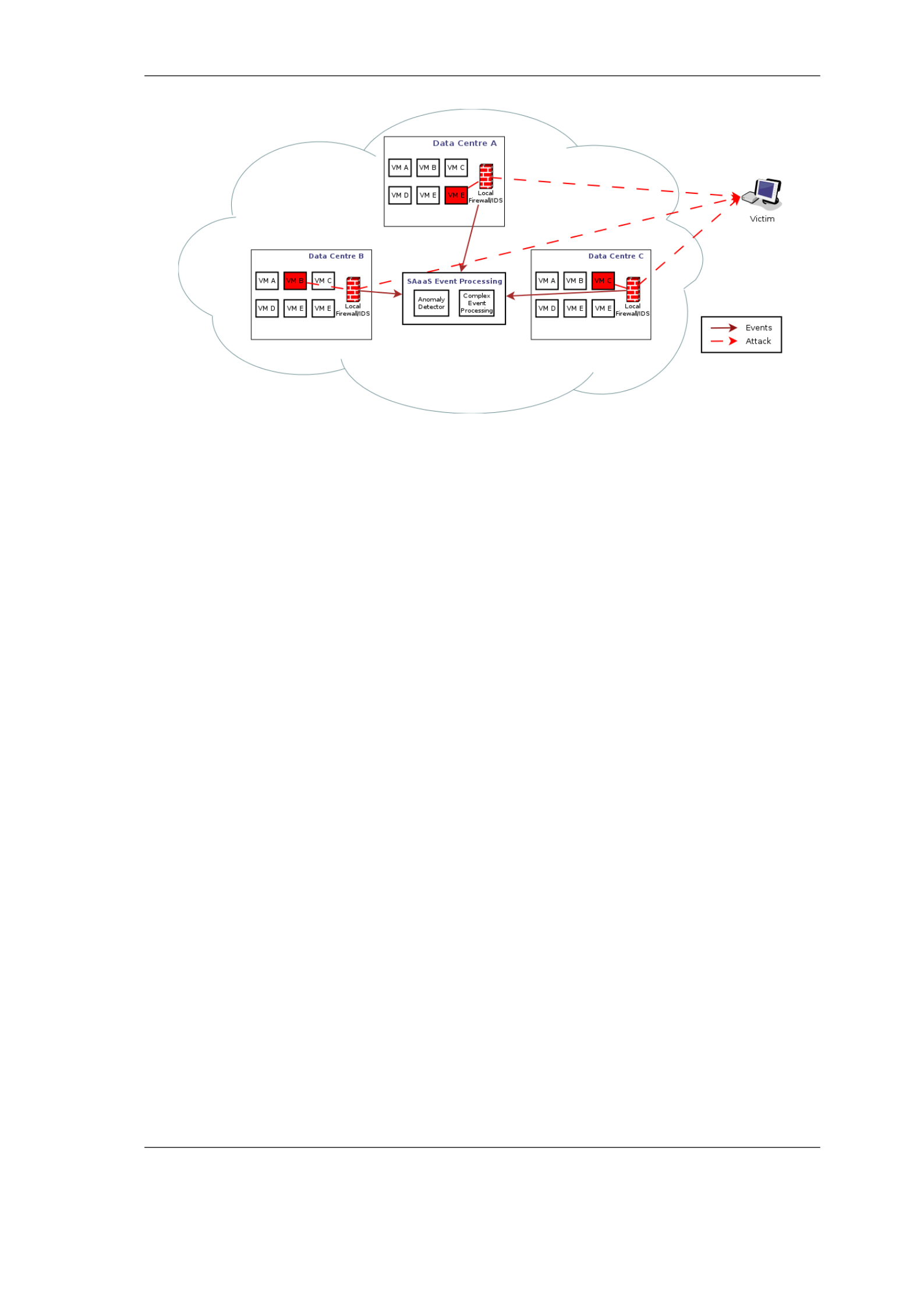
Chapter 8. Evaluation of the SAaaS architecture
Figure 8.1: Distributed Denial of Service attack from the Cloud
network has to be monitored for anomalous activity especially from the inside. Due
to the distributed nature of cloud computing information about network flow has to
be collected at many different physical locations. To get the whole picture however,
this data has to be analysed in the overall context.
An example scenario is depicted in figure 8.1. An attacker creates only a few number
of instances in each of the cloud’s data centers. Then he uses all of these world wide
distributed instances to DDoS a victim’s host. This host can be anywhere on the
internet. If only the data in each data center was analysed for its own, maybe no
attack would be detected as only a few number of hosts take part in it. If however,
send the data to a centralized/distributed detection system, we can detect the attack
at its whole extent.
8.4 Summary
In this chapter, it was elaborated how the developed concurrent audit system Security
Audit as a Service addresses cloud specific security challenges, and that cloud audits
can mitigate these problems. It was shown, how SAaaS improves cloud audits. The
264

8.4. Summary
interest of other companies on the developed Cloud Audit Test Criteria catalogue
proves the novelty and value of this research.
The results from the practical validation of the prototype have demonstrated SAaaS
is operating as defined by the architecture. SAaaS has successfully achieved the objec-
tives of improving security in cloud environments by increasing transparency for cloud
user and provider. Through utilising an agent framework, the weakness of traditional
systems with a frequently changing infrastructure are overcome by the strength of
performing specific targeted, concurrent security audits.
265

