


IT Security Managers' Strategies for Mitigating
Data Breaches in Texas School Districts
Section 1: Foundation of the Study
The focus of this study was exploring the strategies used by information
technology (IT) security managers to mitigate data breaches on their school's network
using a qualitative multiple case method. The findings from this study could benefit IT
security practice by increasing IT security practitioners' understanding and knowledge of
the multifaceted structure of cyber-attacks and data breaches that may lead to more secure
school networks an bring about changes that could protect institution information systems
from theft and damage attempts. The findings from this study may help IT security
professionals and district leaders who have the responsibility to manage a school network
to apply a more secure and nonthreatening online experience for students. The study also
includes insights that may help identify potential security threats and responses before an
incident escalates, may lead to the development of technology designed to keep students
safe online, and may provide families an increased assurance of online safety at school.
Background of the Problem
The importance of technology in delivering knowledge in schools is without
question. School district administrators apply technology in learning more than at any
time in the past (Machado & Chung, 2015). Technology has also made learning and
record-keeping easier in the education system (McKnight et al., 2016). However,
cybersecurity threats pose significant concerns for many school districts (Selwyn &
Bulfin, 2016). Information technology security managers face significant challenges in

providing security and protection of sensitive data and personally identifiable information
from cyber threat attempts (Soomro, Shah, & Ahmed, 2016). The incentive for attacks by
malicious agents is the fact that school networks and technology systems have become
repositories for sensitive records of students, staff, and institutions. Malicious agents
understand that the potential exists to expose confidential documents and weak
applications as technology users transmit data over the internet (Cheng, Liu, & Yao,
2017). Understanding the security threats to school networks and the strategies deployed
by IT security managers to mitigate these threats was the primary focus of this study.
Problem Statement
Cybersecurity threats pose significant concerns for many school districts whose
employees deploy technology for learning (Selwyn & Bulfin, 2016). In 2015, the
educational sector accounted for 7.4% of total cybersecurity breaches, while in 2016 over
360,000 records were potentially at risk of cybersecurity threats, outpacing the banking
sector and the government in terms of the total number of data breaches that occurred in
the first half of that year (Demers, Harrington, Cianci, & Green, 2017). The general IT
problem is that schools' network resources accessed by students for learning that do not
have appropriate security measures could be vulnerable to cyber threats. The specific IT
problem is that some IT security managers lack the strategies necessary to mitigate data
breaches on their school's network.
Purpose Statement
The purpose of this qualitative multiple case study was to explore the strategies
used by IT security managers to mitigate data breaches on their school's network. The

research population was IT security managers from three school districts in Texas, which
is in the south-central region of the United States, with experience executing IT security
strategies that protect school networks from a data breach. The findings from this study
may benefit information security practice by increasing IT security practitioners'
understanding and knowledge of the multifaceted structure of cyber-attacks that may lead
to more secure school networks. The implication for positive social change lies in the
potential to provide a more secure and nonthreatening online experience for students and
possibly offer their parents and families an increased assurance of their wards' online
safety while in school.
Nature of the Study
The research methods commonly used in research are qualitative, quantitative,
and mixed (McCusker & Gunaydin, 2015). Qualitative researchers use the qualitative
approach to gain a deeper understanding of a phenomenon through open dialogue with
participants (Hesse-Biber, 2016). I selected the qualitative method to discover the indepth
meaning of an event through interaction with data collected from participants
experiences. Researchers use the qualitative research method to address what, how, and
why questions to identify and understand the issues raised in studies (Onwuegbuzie &
Byers, 2014). Thus, the qualitative method was suitable for this study because the method
helps to discover more about the subject through a detailed contextual analysis of
numerous activities and their relationships to understanding best security strategies. A
quantitative scientist shapes theory through experiments and through the
operationalization and manipulation of observed variables, forecasts, correlation, and

testing of collated data (Ko, Latoza, & Burnett, 2015). As this study did not involve any
experimentation on participants, the quantitative method was not suitable. Mixedmethods
research consists of merging both qualitative and quantitative approaches, which involves
manipulating variables and testing hypotheses (Antwi & Hamza, 2015; Frels &
Onwuegbuzie, 2013; Mayoh & Onwuegbuzie, 2015). I did not conduct mixed-methods
research because I explored open-ended inquiries.
The qualitative multiple case study technique was suitable because of its strength
in examining existing phenomena without influencing appropriate behaviors. The
benefits of conducting a multiple case study are that researchers can analyze data within
each situation and across different locations (Gustafsson, 2017). A multiple case study
also allows a broader examination of several instrumental bounded cases to develop a
more in-depth understanding of the research than a single case can accommodate
(Gustafsson, 2017; Mohajan, 2018). Researchers study numerous cases to understand the
similarities and differences between facts that can provide that can provide a convincing
theory grounded in several empirical evidence (Gustafsson, 2017). Evidence generated
from a multiple case study is robust and reliable, and researchers can clarify if the results
from findings are invaluable (Mohajan, 2018). Researchers conducting a case study
explore, investigate, and describe a real-world event within a bounded, contextual setting
(Guetterman, 2015).
Other qualitative designs, such as phenomenology, only seek to gain the truth of
the lived experiences of participants in their natural outlook (Giorgi, Giorgi, & Morley,
2017; Murdock, 2018). I did not apply this design, as I did not concentrate on the lived

experiences of the participants and thus, they were not relevant to the intent and
objectives of this study. Ethnographers combine research design and fieldwork to develop
a greater understanding of specific subgroups that scientifically describes the individuals
(Bamkin, Maynard, & Goulding, 2016). Ethnography involves an attempt to understand
the customs and culture of a group by observing and describing a society from the
viewpoint of the subjects of the study (Hammersley, 2018).
I did not rely on or use the strengths of the ethnographic research design because
investigating the customs or culture of any social group was not the focus of this study.
The narrative approach subsumes a chain of events that can be written or spoken, words,
or a visual form, usually from just one or two individuals' lives, to form a cohesive story
(Joyce, 2015). The narrative approach generally involves a researcher conducting indepth
interviews, reading documents, and looking for themes to demonstrate how the individual
stories illustrate the lives of individuals as told through their own stories (Joyce, 2015). I
did not use a narrative design because the focus of this study was not the sequence of
events of the life story of an individual's internet use.
Research Question
What strategies do IT security managers use to mitigate data breaches on their
school's network?
Interview/Survey Questions
1. What techniques do you use to mitigate data breaches?
2. What strategies do you use to protect and control the flow of data on your
network from unauthorized access?

3. How do you manage the challenges faced in implementing these strategies?
4. What kind of technical expertise do IT security managers need to be able to
improve data breach prevention within an organization?
5. What kind of setbacks have you encountered when responding to data security
breaches?
6. What are some skill sets network security managers lack that are needed to
minimize data breaches?
7. How likely will security compliance violations within your organization result
in data breaches?
8. How frequently does your organization experience data breaches?
9. What data breach incidents, if any, have you tackled that mainly and
negatively impacted your organization?
10. What are some factors that can motivate attackers to target an organization's
data?
11. What data security policies and best practices will you suggest that can help
mitigate the incidence of data breaches within an organization?
12. How can you reduce the impact or the likelihood of a data breach?
13. What operational IT prevention programs do you have in place that could
offer parents and families an increased assurance of their wards' online safety
while in school?
14. What recommendations can you provide that may assist IT security managers
and leaders in security in implementing proactive data security measures?

Conceptual Framework
The technology threat avoidance theory (TTAT) was the conceptual framework
for the study. In 2009, the Liang and Xue developed TTAT using two cognitive methods
identified as an appraisal and coping mechanism to determine the individual perception
of an IT threat existence and their behavior to avoid the threat (Hewitt, Dolezel, &
McLeod, 2017; Liang & Xue, 2010). The theory, therefore, explains individual IT users'
behavior of avoiding the threat of malicious information technologies (Liang & Xue,
2009). In 2010, Liang and Xue improved on the theory by testing a technology threat
avoidance model to determine the motivation needed to avoid a cyber threat, which is
affected positively by the perceived threat (Liang & Xue, 2009; Zahedi, Abbasi, & Chen,
2017). The theory further describes the processes and factors of susceptibility response
and self-efficacy that are negatively affected by the cost of response and how IT users
engage in threat avoidance behaviors (Hewitt et al., 2017; Liang & Xue, 2010).
The TTAT also recognizes that IT threats occur and that individuals can apply
some security techniques with the primary objective of mitigating the threat and its
associated cost as much as possible (Zahedi et al., 2017). Das and Khan (2016) used the
theory to establish a coping and appraisal framework that enables users to consider the
three factors to evaluate when considering the presence of a threat (see Figure 1). The
three factors are the extent of redundancy of a security threat if a safeguard measure is
applied, the cost of administering the safeguard, and users' expertise in implementing the
defense. By leveraging the tenets of this theory, IT security managers may be able to
initiate a more efficient institutional IT mechanisms for school networks, provide an IT

threat-prevention system that may entail technology deployment and user training, and be
able to formulate more effective IT guidelines, practices, and policies.
I selected the TTAT as the conceptual framework for this study because it was
suitable for assisting the IT security managers in the Texas school districts under study to
determine the current mitigating strategies in place, to explore how to perceive existing
threats, and to cope with technology use when faced with a threat. The choice of the
TTAT may assist IT security experts to identify operational, technical, and nontechnical
procedures such as end-user training, IT security policy, and preventive frameworks to
adapt, formulate, and deploy to improve the protection of students and other online users
from malicious attacks on the schools' network.
Definition of Terms
Breach: An occurrence in which an individual's name, medical or financial
records, or debit card are potentially put at risk either in electronic or paper format
(Mozumder, Mahi, Whaiduzzaman, & Mahi, 2017).
Cyber risk: Cyber risk is the operational risks associated with information and
technology assets that may result in consequences affecting the confidentiality,
availability, or integrity of information or information systems (Biener, Eling, & Wirfs,
2015).
Cybersecurity: The collection of tools, security concepts, security safeguards,
policies and guidelines, best practices, risk management approaches, training, actions,
assurance, and technologies available to protect cyberspace and organizations' and users'
assets (Althonayan & Andronache, 2018).

Data breach: A data breach is an electronically mediated service failure that
occurs when sensitive financial, personal, or customer data are released to or accessed by
unauthorized parties internal or external to an organization (Goode, Hoehle, Venkatesh,
& Brown, 2017).
Data breach severity: The scope, reach, and impact of a firm's data security
breach (Martin, Borah, & Palmatier, 2017).
Information security: The process by which digital information assets are
protected to ensure confidentiality, integrity, and availability as the main security goals
are achieved (Elmrabit, Yang, & Yang, 2015).
Information technology (IT) managers: IT managers are IT personnel experienced
in managing IT assets, network infrastructures, technologies, top-level IT roles, and
people within an organization or body, including the chief information officers, chief
technology officers, chief information security officers, or information security managers
of an organization (Boynton, Zmud, & Jacobs, 1994).
Insider threat: An insider threat is a legitimate user within an organization who
misuses privileges to perform an attack against the goals of the organization
(Kaghazgaran & Takabi, 2015).
Perceived threat: The degree to which a person recognizes malicious IT as
dangerous or harmful (Liang & Xue, 2010).
Risk: The measure of the extent to which an exceptional situation such as data
security breach or failure affects business operations (Amundrud, Aven, & Flage, 2017).

Assumptions, Limitations, and Delimitations
This qualitative study included some assumptions, limitations, and delimitations.
Graneheim, Lindgren, and Lundman (2017) explained that individuals see the world from
their perspective. Researchers should appreciate and accept their underlying assumptions
to remain as impartial as possible to improve the reliability of their study (Graneheim et
al., 2017). A framework of the assumptions, limitations, and delimitations in this study
follows.
Assumptions
Roulston and Shelton (2015) noted that no research study is free from the
assumptions, biases, and personality of the researcher, and scholars cannot separate their
nature from those activities in which they are involved. Assumptions are, therefore,
certainties sighted as external factors that may reflect upon a researcher's inquiry
(Semenova & Hassel, 2015). Twining, Heller, Nussbaum, and Tsai (2017) explained that
assumptions surface when the general expectations of a researcher direct the investigative
conclusion of a study. Therefore, individual interpretations or viewpoints may have
shaped the path of this research. Thus, while conveying personal insights, researchers
should provide reliable and supportive theoretical frameworks (Mortari, 2015).
In this study, I made several assumptions. I assumed that my participants provided
accurate responses to my semistructured interview questions and that the data thus
collated were an adequate representation of the strategies deployed by IT security
managers in mitigating cybersecurity threats in their school districts. Ardagna, Asal,
Damiani, and Vu (2015) recommended that researchers consider participants in

qualitative research as experts in the areas relevant to the study. Therefore, I assumed that
IT security managers who participated in my study had experience mitigating
cybersecurity threats in their school networks. Another assumption was that the data
collated were adequate to answer the research question.
Limitations
Limitations are potential weaknesses in a study and could be out of a researcher's
control (Queirós, Faria, & Almeida, 2017). I anticipated some potential weaknesses
emanating from the study, including the influence of study participants, my personal bias,
sample size, and geographical constraints. Reliability, validity, and generalizability are
essential limitations inherent in research (Berger, 2015; Boddy, 2016; Malterud, Siersma,
& Guassora, 2016; Queirós et al., 2017). I selected a qualitative research method, which
might have led to biases from my viewpoint and the experiences of my participants and
therefore to biased and prejudiced opinions. Responses from study participants may have
reflected views that were in the best interest of their organization or undermined their job
inexperience, causing distorted results and wrong conclusions (Boddy, 2016). Malterud et
al. (2016) noted that sample size and data availability might limit the reliability of
research with a relatively large sample size that may yield a different result and
conclusion of the research.
Another limitation was that IT security managers use different or multiple
technologies, strategies, and procedures for monitoring online activities, which means
that making any generalizations to school network security can be challenging. Still
another limitation was that the study result may not be generalizable to the entire United

States, as the study was limited to the state of Texas. Finally, network, data breach, and
cybersecurity are broad topics and may serve as a source of fear to students and school
administrators in educational institutions. I limited this study to a focus on cybersecurity
and data breach issues facing three school districts in Texas, as data collated for
cybersecurity threats in one school district may differ from data assembled from
participants in another school district.
Delimitations
Research delimitations are thoughtful mechanisms of applied research and refer to
the exploration boundary or scope that researchers should establish before commencing a
study (Rosenberg & Koehler, 2015; Semenova & Hassel, 2015). Rosenberg and Koehler
(2015) reported that delimitations are factors that limit the scope of research and thus
create boundaries of the study. Ardagna et al. (2015) documented that the lived
experiences of participants are a significant delimiter. The interview questions were
open-ended and the study included an interview protocol. I also considered the
generalization effect of my research findings with a small sample size. Interviewing only
IT security managers represented a delimitation because I would have otherwise
interviewed other IT professionals who are not in the IT security position. A delimitation
was that other IT professionals may provide relevant information on the complexity of
data breaches in the school network within Texas. Another delimitation was the
restriction to conduct the research only in Texas for convenience.

Significance of the Study
This study may be significant and valuable to IT security managers because I
aimed to uncover strategies that organization leaders and IT security managers may
leverage to mitigate data breaches on their school's network. Furthermore, I researched
and initiated a more efficient and organized IT mechanism in institutions' networks that
provides an IT threat-prevention system that may entail technology deployment; training
to students; and more effective and appropriate IT guidelines, practices, and policies.
Because the TTAT demonstrates the value of IT security, education, and awareness
programs (Boss, Galletta, Lowry, Moody, & Polak, 2015), its use was of great worth to
this study. An understanding of data breach could give district leaders and security
administrators a higher sensitivity towards online security and provide a framework for
implementing active online monitoring in school networks to mitigate data breaches and
to obtain expert advice from internet safety partners. The theory thus serves as a model
for IT security administrators to evaluate online threats and hence design effective
cybersecurity solutions for both students and organizations.
Contribution to IT Practice
This study may contribute to IT security practice by providing information on
how to reduce the number of potential cyber threats, data breaches, and other security
incidents that students may encounter while surfing online. The research study may assist
IT security managers in identifying and monitoring the activities of students using
personal or assigned computing devices on their schools' networks. It may be especially
crucial for managing students who intend to misuse the network system and expose

themselves to cyber terrorism. This study may be valuable to IT security managers
because of the security strategies proposed for circumventing these threats when
perceived on a network. The research findings may also be important to IT security
managers by providing a streamlined model for monitoring network resources and
offering ways that may mitigate cyber threats on the internet.
The internet has become the ideal place for criminals and terrorists to carry out
their actions and misdeeds. Therefore, cyber threats and other IT security threats such as
data breaches have become two of the most significant risks to students using technology
in Western societies (Pawlowski & Jung, 2015). The study may contribute to more
efficient IT practice by providing solutions to the possible data breaches and cyber threats
associated with online device usage and by offering strategies that will support the
decision making and protection of students using technology for learning. A significant
contribution from this study will increased security awareness and an improved strategic
approach to threat mitigation, threat acceptance, and threat avoidance by understanding
the needs and resources that require consideration in securing schools' networks using
systematic implementation approaches.
Implications for Social Change
The research findings contribute to positive social change by creating awareness
of insider security threats that students using technology for learning and communication
may face from network security breaches and of appropriate security measures to inhibit
the cyber threat process. The study results may also enable end users to understand how
to handle cyber threats when they become victims by unknowingly opening a backdoor

that attackers can use to break into their school-assigned IT devices. Additionally, the
study findings may assist IT security managers, in identifying unique techniques and
strategies on how to communicate and provide information to all users about potential
and emerging threats to the business or organization information systems they monitor.
Furthermore, the findings could support IT security managers who enact safety
precautions while managing schools' networks and technology. The study may lead IT
security managers to develop online IT security training to improve IT threat awareness
that could help students understand the need to use IT devices appropriately and that can
subsequently prevent them from cyber threats. The research outcome provides
information on how to protect students from the effects of cyber-attacks, offer a secure
and nonthreatening online experience to students, and offer their guardians and families
peace of mind while their wards use the internet for learning.
A Review of the Professional and Academic Literature
To conduct an encompassing literature review, I performed a critical analysis of
various sources and content in the relevant literature, including reports, seminal books,
presentations, and journals, from Google Scholar, SAGE, Walden's University Library,
Elsevier, ProQuest, and some other scholarly databases. I extensively reviewed over 370
research sources for relevant material obtained via a search of key terms. The key words
included data breach, data security in education, network security and safety, risk
management, internet misuse, security awareness, security governance, cybersecurity,
threat, avoidance motivation, school network, online safety, coping, risk behavior,
technology threat avoidance theory, security laws and regulations, school internet

administration, data breach mitigation strategies, IT monitoring, and mitigation
strategies on school networks. I synthesized information from 175 resources for the
literature review. Out of these, 168 resources (96%) were published between 2015 and
2019, 158 publications (90.2%) were peer-reviewed, six were government publications
(3.4%), and 11 were non-peer-reviewed articles (6.2%). Numerous academic researchers
have investigated cybersecurity strategies. The broad review of literature helps to
establish a scholarly foundation for the study and was necessary to conduct a critical
analysis of the body of knowledge related to the central research question: What
strategies do IT security managers use to mitigate data breaches in their school's network?
The objective of the literature review was to develop the conceptual framework.
Conceptual Framework
I chose the TTAT as the primary theory for this study based on a broad review of
relevant literature relating to the fundamental research question on the strategies used by
IT security managers in mitigating data breaches on schools' networks. Liang and Xue
(2010) advanced the theory as a result of a synthesis of literature from vast areas of
research, including risk analysis, psychology, information systems, and health care. With
a basis in prior research on self-efficacy, psychology, risk analysis, and health-protective
behavior, the TTAT emphasizes that the effectiveness of a chosen measure of safety, the
cost associated with the applied action, and the degree of self-efficacy are the three
dominant factors conceived by users when evaluating the extent to which a threat is
avoidable (Liang & Xue, 2009). The TTAT is a theoretical framework that researchers
can rely on for highlighting how IT managers can apply strategies to improve user safety
on the internet and remain motivated to efficiently monitor student online activities in
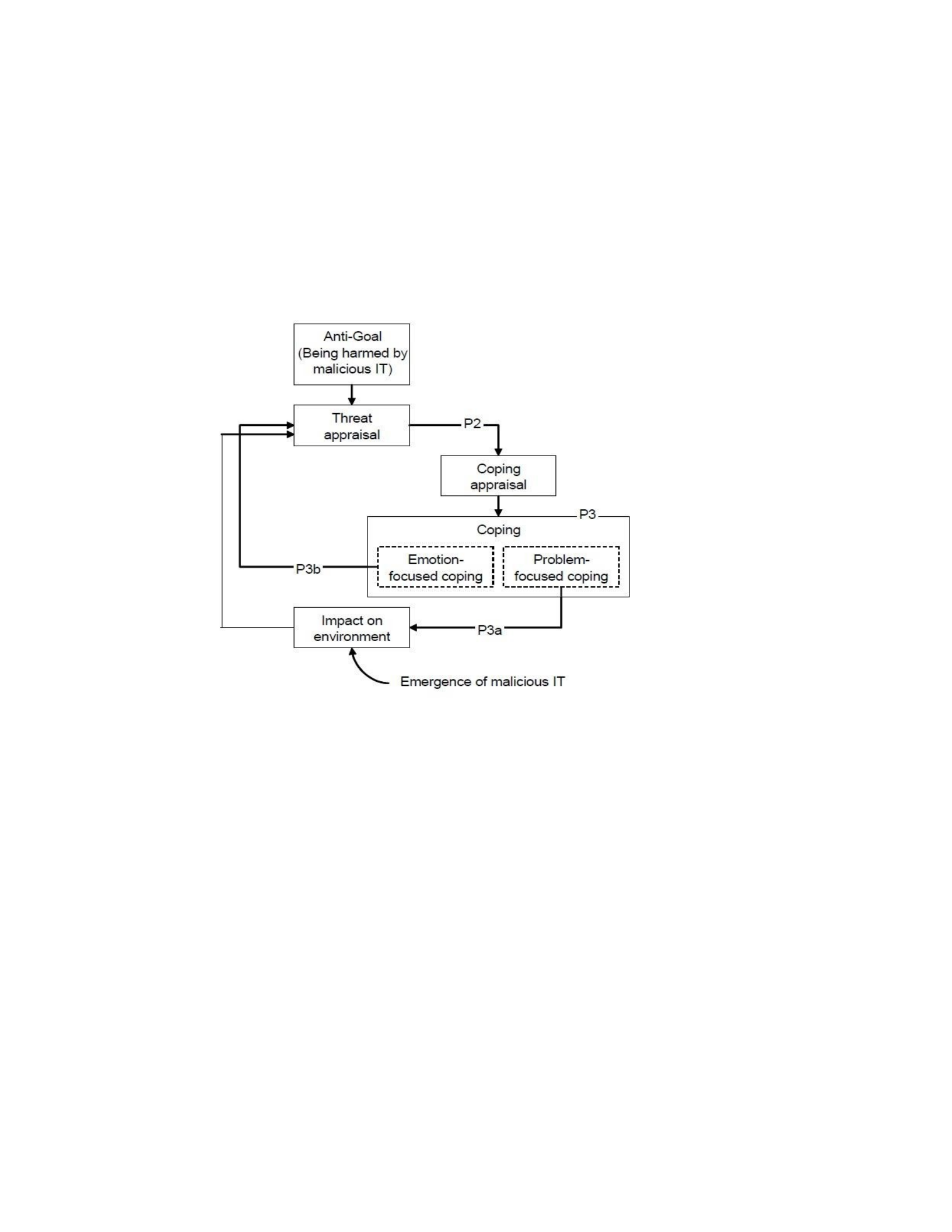
schools (Liang & Xue, 2009). Figure 1 illustrates the process of IT threat avoidance and
shows the behavior of individual IT users when faced with a technology threat against an
organizational level framework (Liang & Xue, 2009).
Figure 1. The process of IT threat avoidance. From "Avoidance of Information
Technology Threats: A Theoretical Perspective," by H. Liang and Y. Xue, 2009, MIS
Quarterly, 33, p. 77. Copyright 2009 by Liang and Xue. Adapted with permission (see
Appendix D).
The process of IT threat avoidance theory hinges on the principle that users can
avoid an IT threat when they perceive that a threat exists, by adhering to measures that
will ensure their safety. Figure 1 further shows the processes and motives that influence
individual users' IT threat avoidance behavior, which can be represented by a cybernetic
process (Liang & Xue, 2009). The route to safety is for users to cope emotionally with a
threat if they perceive that applying the available safety measures can avoid the risk

(Liang & Xue, 2009). The TTAT also indicates why and how IT users are influenced to
act in the event of a threat and adequately describes the factors and underlying processes
that inspire their threat avoidance behaviors, drawing from the cybernetic and coping
theories (Carpenter, Young, Barrett, & McLeod, 2019). Liang and Xue (2010) integrated
both the process theory view and a variance theory view into the TTAT to incorporate the
tests conducted by both process research and variance research methodologies. In process
theory, TTAT describes IT users' avoidance behavior as a dynamic, positive feedback
system that may begin with the advent of a threat state (Mitra, Guzman, Dhillon, & Tran,
2016). The threat state consequently extends to setting forth a state of being harmed once
the user becomes aware of the threat (Young, Carpenter, & McLeod, 2016). If the cycle
continues from the point where the user perceives that the current threat state is close to
the set state of being harmed, the user will engage in coping mechanisms intended to
expand the diminishing discrepancy between the threat state and the set state of being
hurt, as shown in Figure 2 (Liang & Xue, 2010). Liang and Xue (2010) advanced the
TTAT to describe individuals' cybersecurity behaviors regarding the motivation to avoid
threats. The TTAT makes significant contributions to the literature on IT security, as
users can achieve safety measures by avoiding the danger if they believe they can
overcome a threat by acting thereof (Liang & Xue, 2009; Young et al., 2016).
Thus, the threat avoidance behavior continues until the threat disappears as the
ensuing discrepancy becomes too large. The variance theory view provides essential
variables that contribute to understanding threat appraisal, coping appraisal, and coping
(Young et al., 2016). According to the TTAT, individual IT users undergo two distinct

cognitive processes: the threat appraisal and the coping appraisal. In threat appraisal, the
existence and degree of a threat are appraised by the user, who subsequently decides what
necessary measure to take to avoid it by using coping methods (Arachchilage, Love, &
Beznosov, 2016). In using the TTAT, users can affirm that avoiding a threat and adopting
technology are two qualitatively distinct phenomena. The position is exemplified given
that the avoidance of risk is not similar to the acceptance of a protective measure, which
indicates that the application of one theory, such as the preventive monitoring theory in a
particular context, may lead to unreliable findings (Liang & Xue, 2009).
Furthermore, Liang and Xue (2010) submitted that, in the TATT, users could
apply both problem-focused and emotion-focused coping approaches to reduce IT threats,
as shown in Figure 1. Tu, Turel, Yuan, and Archer (2015) used the TTAT to examine the
key factors that may affect end-user behaviors in avoiding and coping with cyber threats,
as shown in Figure 2. The TTAT is thus a technique that IT security managers can use to
practice evaluating system outcomes and subsequently be better at administering and
securing school networks. The theory also identifies essential factors that expound the
perception and motivation of users in the threat-handling process. Tu, Yuan, and Archer
(2014) used the TTAT to examine the key factors that may affect end-user behaviors in
avoiding and coping with security threats. School leadership should enact policies, design
a security framework that consistently classifies information, act to counter threats, and
ensure students' online safety (Boehmer, LaRose, Rifon, Alhabash, & Cotten, 2015).
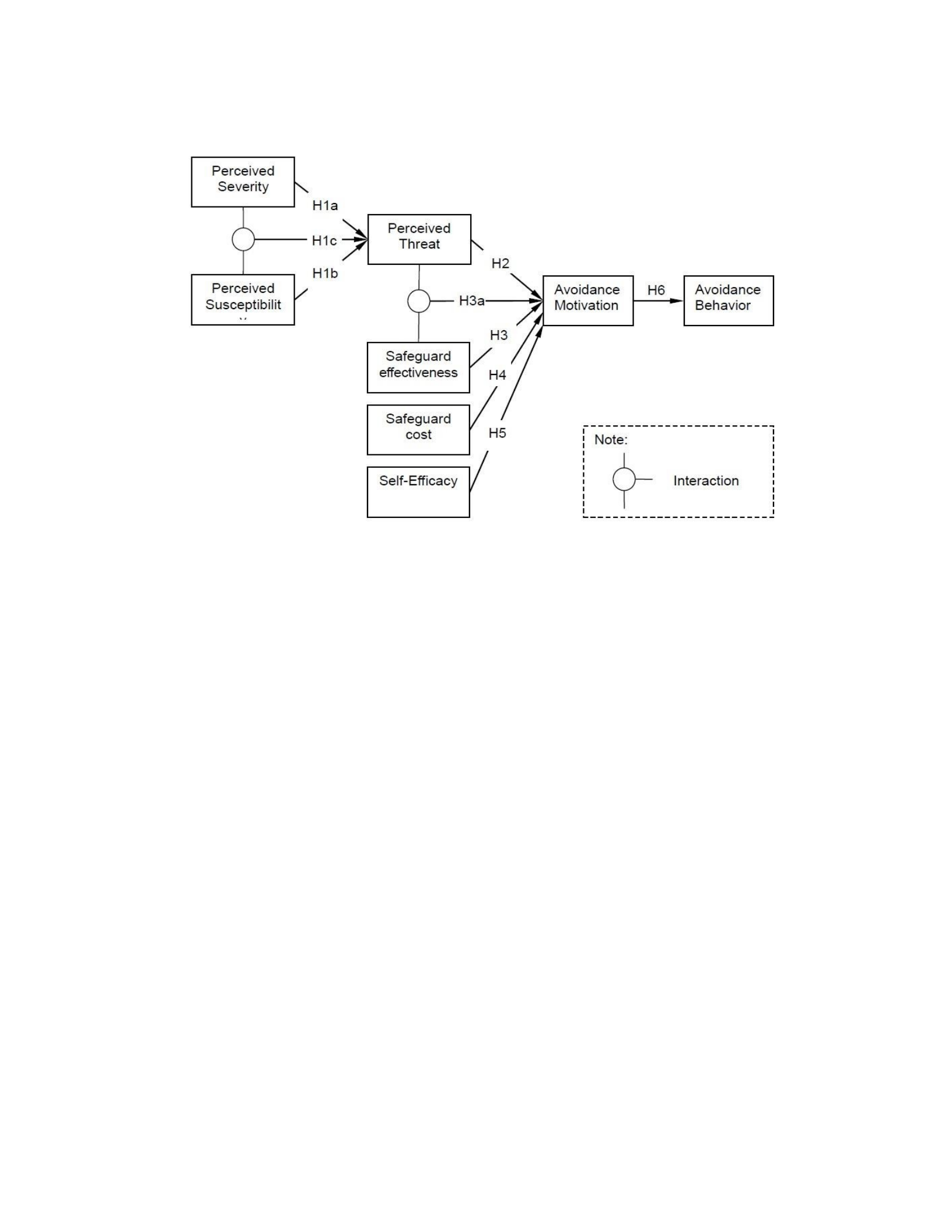
Figure 2. A research model signifying that motivation is influenced by an interaction
between perceived threat and safeguard effectiveness. From "Understanding Security
Behaviors in Personal Computer Usage: A Threat Avoidance Perspective," by H. Liang
and Y. Xue, 2010, Journal of the Association for Information Systems, 11, p. 397.
Copyright 2010 by Liang and Xue. Adapted with permission (see Appendix D).
In Figure 2, TTAT shows why and how individual IT users are influenced to act
when faced with a perceived threat and describes the factors and underlying processes
that stimulate their threat avoidance behaviors by drawing stimuli from the cybernetic
and coping theories (Fenner, 2017). In implementing the TATT, users can apply both
problem-focused and emotion-focused coping approaches to reduce IT threats (Kashefi,
Nuhu, Abbott, Ayoung, & Alwzinani, 2018). Figure 2 shows the research model that
signifies that an interaction between perceived threat and safeguard effectiveness
influences motivation (Liang & Xue, 2010).

Figure 2 shows the effectiveness of a chosen measure of safety, the cost
associated with the applied standard, and the degree of self-efficacy in implementing the
rule as the dominant factor is conceived by users when evaluating the extent to which the
threat can be avoided (Arachchilage et al., 2016; Tu et al., 2015; Xu, Meso, & Ding,
2016). Figure 2 also shows a research model that signifies that motivation is influenced
by an interaction between perceived threat and safeguard effectiveness (Liang & Xue,
2010). By leveraging this theory, IT security professionals can establish a more effective
threat mitigation mechanism in which security depends on people's behavior toward
avoiding the threat and on coping mechanisms more than on technical controls and
countermeasures. Dang-Pham and Pittayachawan (2015) noted that by unknowingly
opening a backdoor, attackers can break into assigned devices. With the diffusion of the
internet, it has become easy for malicious IT users to exploit system vulnerabilities using
viruses, trojan horses, botnets, worms, and spyware to amplify the negative impact.
Information technology leaders have tested the TTAT against the context of antispyware
software used to detect the presence of covert monitoring applications on a computer
system (Liang & Xue, 2010; Tweneboah-Koduah & Buchanan, 2018; Young et al.,
2016). According to the TTAT, users who are aware of the prescribed countermeasures
and believe they have useful values can cope with threats and possibly avoid risks.
Information technology security managers who secure district networks from data
breaches can raise the security awareness level and can design processes to educate
students about IT threats online while using the school's system inappropriately or
unethically.

Analysis of Supporting Theories
The aim of the study was to explore the strategies used by IT security managers to
mitigate data breaches on their network. The TATT is a theoretical framework frequently
used for studying human behavior in the context of IT security (Liang & Xue, 2009).
TTAT has made positive contributions to literature in IT security and to threat mitigation
that internet users want to avoid an IT threat when they perceive that a threat exists, by
adhering to measures that will ensure online safety (Arachchilage & Love, 2014). The
TTAT shows how IT users cope with IT threats and the mechanisms that result in
intentions and actual actions that mitigate the intended threats. The TTAT relates to other
technology theories, such as the protection motivation theory (PMT), the theory of
reasoned action (TRA), and the technology acceptance model (TAM).
Protection Motivation Theory
Researchers use the PMT to identify how individuals develop appropriate
responses to technology threats. The PMT serves to predict individuals' intentions to
protect themselves after receiving fear-arousing recommendations (Safa et al., 2015).
Researchers can use the PMT to support the TTAT by determining how IT users not only
perceive a threat and appraise its severity but also cope with it (Kostopoulos,
Rizomyliotis, & Konstantoulaki, 2015; Liang & Xue, 2010). Both the PMT and the
TTAT communicate countermeasures of how to avoid threats in information security
(Kostopoulos et al., 2015; Liang & Xue, 2010). Jansen and van Schaik (2017) used the
TTAT to explain individual online behavior and interactions when they perceive a threat.

Steinbart, Keith, and Babb (2016) used the approach to measure specific decisions to
maintain strong credentials for mobile internet devices when using the computer. The
primary concerns of the PMT are the self-efficacy, safeguard effectiveness, and safeguard
cost constructs. The PMT also serves as an approach or guide for computer users to
evaluate system outcomes and subsequently understand information systems security
issues (Kirichenko, Radivilova, & Carlsson, 2018).
Theory of Reasoned Action
The TRA includes a general framework for predicting behaviors related to
technology adoption (Abraham & Sheeran, 2017; Montano & Kasprzyk, 2015). The TRA
describes what causes individuals to develop intentions that predict users' behaviors
towards technology (Ajzen, 2015; Montano & Kasprzyk, 2015). As technologies move to
an online environment, it becomes increasingly important for researchers to factor in the
concept of threat when attempting to explain the acceptance of those technologies. Jansen
and van Schaik (2017) used the TTAT to explain precautionary online intentional
behavior by individuals.
Technology Acceptance Model
The TAM is an additional construct in the TTAT model and includes avoidance
motivation and avoidance behavior (Liang & Xue, 2010). Avoidance motivation refers to
the user's level of motivation to avoid technology threats by implementing coping actions
(Liang & Xue, 2010). TAM and TTAT support information systems theories that model
how users come to accept and use technology. The primary concerns of the TAM are
perceived usefulness and perceived ease of use, which are fundamentally relevant for

computer acceptance behaviors (Arpaci, 2016; Kristadi & Sucahyo, 2016). In TAM, the
user's primary intent is to have the liberty of choosing whether to avoid the difficulties
associated with using technology spontaneously or compulsorily (Eltayeb & Dawson,
2016; Tarhini, Arachchilage, Masa’deh, & Abbasi, 2015) TAM emphasized users'
behavioral plans to use or not use a specific technology by focusing on ease of use and
usefulness (Eltayeb & Dawson, 2016; Kristadi & Sucahyo, 2016). Also, users' positive
attitude toward specific technology leads to them developing an intention to use
technology. The same goes for TTAT when users perceive that a threat exist such that
they can either choose to cope with the threat or avoid it (Liang & Xue, 2010; Tu et al.,
2015). The TAM excludes the fact that individuals can use information systems outside
organizational settings and fails to address technology security (Arpaci, 2016).
Hence, TTAT is dependent upon avoidance behavior and emotion-focused coping
that guard against malicious threats while using devices online, which has become a
significant area for research. Liang and Xue (2010) contended that if a user's goal differs
from the goal assumed by acceptance theories, then the explanatory powers of these
theories are weakened. The TTAT appears to help IT security managers safeguard users
against online attacks and provide an appropriate concept for understanding user
avoidance habits and coping tendencies. Technology users can become victims of cyber
threats when they compromise on security.

Analysis of Contrasting Theories
Technology threats are widespread in the IT sector, and IT security managers can
mitigate these threats using different techniques. Liang and Xue (2009) developed the
TTAT as a result of the shortcomings of the cybernetic theory and process theory.
Researchers use the TTAT to explain the IT threat avoidance of online vulnerabilities by
technology users. Liang and Xue (2010) modified the TTAT to describe individuals'
cybersecurity behaviors concerning their motivation to avoid threats.
The cybernetic theory is preferred for its consistency and for its wide acceptance
as a theoretical framework for developing a better understanding of human behavior
(Bliese, Edwards, & Sonnentag, 2017). Carver and Scheier (1982) clarified that the
cybernetic theory is a general systems theory because it is identifiable with almost any
mechanical system. Organizations in social, health, psychology, and organizational
behavior theories have widely applied the principles of cybernetics in social, health,
psychology, and organizational behavior theories (Bliese et al., 2017; Carver & Scheier,
1982; Klein, 1989). Nevertheless, the cybernetic theory, as earlier posited, encompasses a
positive feedback loop. While the negative feedback loop concerns discrepancy
reduction, the positive feedback loop acts to enlarge the discrepancy (Gadinger & Peters,
2016). The feedback loops increase the distance between the present state and the
reference value specified by the goal.
The goal of the positive feedback loop is to identify an undesired end state that
individuals endeavor not to achieve, referred to as antigoal by Gadinger and Peters
(2016). In the positive feedback loop, a behavior is activated when the present state is too

close to the undesired end state, and the act discontinues when the discrepancy is
sufficiently large. The positive feedback loop describes the phenomenon that individuals
avoid malicious IT, as also suggested by the TTAT (Arachchilage & Love, 2014). Using
endpoint security solutions for IT mobile devices and encrypting e-mails are among many
possibilities to mitigate security threats (Fernández-Alemán, García, García-Mateos, &
Toval, 2015). According to Liang and Xue (2009), the central idea of cybernetics is that
human beings self-regulate their behaviors by feedback loops. Although the process
theory considers only the positive feedback loop in the TTAT framework, the cybernetic
process hinges on both a negative feedback loop and a positive feedback loop (Carver &
Scheier, 1982; Liang & Xue, 2009). Carver and Scheier (1982) posited that with TTAT,
IT threat avoidance behavior could be represented by a cybernetic process in which users
intend to increase the distance between their current security state and the unsafe end
state by drawing on the cybernetic theory.
Tarhini et al. (2015) added that the TAM and theory of planned behavior do not
work well in explaining mandatory IT usage because these theories generally refer to
voluntary IT acceptance and usage. Markus and Robey (1988) extended the process
theory for explaining user resistance to an information system. The process theory
explained that users are likely to resist information system usage for varied reasons.
Markus and Robey also explained the resistance to technology usage being due to several
possible reasons: users may like the variations embodied in the system, users may
become too apathetic to resist, or users may find ways to elude changes made to
technology. The TTAT relies on the predicate that individuals can accept technology and

moves beyond mere technology acceptance to establish how users behave in the face of
threat either by avoidance or an emotion-coping method expressed in a feedback
mechanism. In conclusion, the TTAT provides partial empirical support that accurately
characterizes its approach to include a process model, a variance model, and many
constructs that users can apply both problem- and emotion-focused coping to reduce IT
threats (Boss et al., 2015).
Criticism of the TTAT
The TTAT does not cover all types of cybercrime mitigations, but rather a given
section necessary to implement safeguards to avoid threats (Tarhini et al., 2015).
According to the TTAT, avoiding a malicious threat is not the same as accepting a
safeguarding measure based on two primary dependent constructs: the avoidance
behavior and emotion-focused coping (Liang & Xue, 2010). Based on the assumption
that avoidance and adoption behaviors are qualitatively dependent, applying one in a
certain context may lead to inconsistency in another or even to false findings
(Arachchilage & Love, 2014). The user's primary intent is to avoid the difficulty
associated with using technology involuntarily when faced with risk, while in mandatory
usage, the users do not have this liberty (Tarhini et al., 2015).
The outcome of using the TTAT presents itself in unpredictable user behavior and
poor IT goal performance that leads to inconsistency from among the various IT security
managers in improving network performance in this study. The TTAT thus suggests that
IT security mangers should consider the purpose or valued outcome of IT usage in future
IT acceptance research. However, until IT users accept and understand how technology

works, it may be challenging to predict how individuals will behave when faced with
technology threats.
Analysis of Potential Themes and Phenomena
In this section, I detail the techniques used to mitigate data breaches from which I
draw possible themes. Also, I discuss potential issues in the literature related to strategies
that IT security professionals may use to mitigate data breaches on their organization
network. All organizations or institutions with electronic records hosted or accessible on
the web, including education agencies, are vulnerable to security breaches (US
Department of Education, 2017). Nearly half of all data breaches reported affect school
districts. Mozumder et al. (2017) reported that a data breach can occur through a
malicious or criminal attack, system malfunction, and human error (Privacy Rights
Clearinghouse, 2016a). Workable strategies found to address these attacks on
organization networks comprise an information security policy, people management,
network security, an active password policy, antivirus protection and software update,
physical security, audit, network security monitoring, data backup, intrusion detection,
and security education training and awareness (Li, Tryfonas, & Li, 2016). Other potential
themes include IT governance, standard continuity plan, IT leadership and policymakers,
security laws and regulations, and security risk management.
Security controls can be technical, operational, and management instruments that
protect the availability, integrity, and confidentiality of all IT infrastructures and their
information (Hassanzadeh, Modi, & Mulchandani, 2015). IT security mangers use
security controls to draw and segregate themes for better understanding. IT security

managers who have the responsibility of administering and securing school networks
from data breaches need to understand the various ways a data breach can occur and how
to handle, avoid, or mitigate them as data grow in size and complexity within the system.
Applying technical security controls involves using technology to monitor and
reduce vulnerabilities (Fink, Edgar, Rice, MacDonald, & Crawford, 2017). Technology
security administrators install and configure technical controls to provide protection
automatically and degrade system attacks (Hassanzadeh et al., 2015). Some automated
tools include secure communication (virtual private network, secure sockets layer [SSL],
Internet Protocol security [IPSec]), BitLocker, monitoring and intrusion detection
systems (IDS), secure operations (antivirus software), firewalls, gateways, proxies,
authentication, and device Identity and Access Management (restricting privileged user
access). Using technical control implementation as a tool for systems hardening will
improve the process of protecting and safeguarding personal data, securing high-risk
organizational information, and condensing surface vulnerabilities (Fink et al., 2017).
Secure Data Communication (Encryption)
Encrypting data is one of the most effective ways to help keep data secured
(Goyal, 2016). According to Kuypers, Maillart, and Pate-Cornell (2016), incidents can
occur from lost or stolen devices, such as tablets, phones, or laptops, that contain
sensitive data. Such events require varying levels of investigation, depending on the
encryption level of the device and the type of equipment. Warding off or minimizing
conflict requires that devices accessing a network are encrypted in a secured format to
prevent IT threats (Subedi, Budhathoki, Chen, & Dasgupta, 2017). The BitLocker

encryption feature is an innovative security strategy issued by Microsoft for Windows
operating system drivers that protects data by encrypting complete volumes (Goyal,
2016; Meijer & Van Gastel, 2019). The adoption and implementation of cybersecurity
laws, as well as certificate-based protocols to integrate with access control systems,
layered encryption, and third-party security providers, can assist in providing a robust and
scalable network security management module for managing devices across organizations
(Mushtaq et al., 2017).
BitLocker. BitLocker protects machine data in the event a computer is stolen or
lost by securing it using a PIN code that requires generation every time the operating
system reboots (Goyal, 2016; Lewis & Palumbo, 2018) This method of encrypting a
system hard drive is advantageous in cases where an intruder or attacker succeeds in
stealing a computer system or gains access to a lost system (Goyal, 2016; Lewis &
Palumbo, 2018; Meijer & Van Gastel, 2019). The BitLocker encryption technique makes
the data unreadable, unrecognizable, and unrecoverable without PIN code authentication
(Goyal, 2016; Meijer & Van Gastel, 2019). The data encryption key of the BitLocker
stores a trusted platform module that performs cryptographic operations (Goyal, 2016;
Lewis & Palumbo, 2018).
Encryption software uses cryptography, the Advanced Encryption Standard
algorithm in cipher block chaining, or XEX-based tweaked-codebook with ciphertext
stealing (XTS) mode with a 128-bit or 256-bit key to prevent unapproved access to
digital information (Adamovic, Sarac, Stamenkovic, & Radovanovic, 2018; Braga &
Dahab, 2015; Lewis & Palumbo, 2018; Meijer & Van Gastel, 2019). Cryptography serves

to protect digital data on computer devices and other networks over the internet
(Adamovic et al., 2018; Braga & Dahab, 2015; Daman & Tripathi, 2015). A cipher
(asymmetric and symmetric keys) uses encryption as a tool to conceal the content of
message in a particular way only the sender and receiver can understand using secret keys
(Braga & Dahab, 2015). The main security goal of using encryption software is to secure
or preserve the integrity, authenticity, confidentiality, and nonrepudiation of information
(Braga & Dahab, 2015). The drawbacks associated with this technique are the
timeconsuming process, the risk of misremembering the recovery key, the lack of data
protection against network attacks, and the lack of security when the system is on and left
unattended (Goyal, 2016; Lewis & Palumbo, 2018). Internet Protocol security, Secure
Copy protocol (SCP), secure e-mail, secure shell (SSH), SSH File Transfer Protocol, and
other secure web communication protocols such as Hypertext Transfer Protocol Secure
rely on some encryption for users' data protection. Network security has become more
critical with the increase in internet use, connectivity, and communication among devices
(Khan & Goodridge, 2019).
Secure shell. A protocol outlines how cryptographic algorithms can secure
information (Adamovic et al., 2018; Braga & Dahab, 2015; Daman & Tripathi, 2015;
Harchol, Abraham, & Pinkas, 2018). SSH typically provides secure channels over an
unsecured network using cryptography (Adamovic et al., 2018; Braga & Dahab, 2015;
Daman & Tripathi, 2015).
Internet Protocol security. The IPSec policy consists of lists of rules that
designate how network traffic can be protected using virtual private networks (Al-khatib

& Hassan, 2018). The IPsec policy includes protocols for establishing mutual
authentication between clients and agent machines at the start of a session and by
negotiating which cryptographic keys to use during the session (Adamovic et al., 2018;
Al-khatib & Hassan, 2018; Braga & Dahab, 2015; Daman & Tripathi, 2015). The
cryptographic security service protects its users when they communicate over Internet
Protocol by supporting its network-level peer authentication, data origin authentication,
data integrity, data confidentiality, and replay protection (Adamovic et al., 2018; Alkhatib
& Hassan, 2018; Braga & Dahab, 2015; Daman & Tripathi, 2015). When users have
installed these services and use them correctly, IPsec can protect data flows between
network devices, security gateways, or host machines on the network. Thus, IPsec has
become the standard security protocol for securing internet communications and
providing traffic integrity, confidentiality, and authentication (Alam & Hamid, 2018;
Hassanzadeh et al., 2015). For IPsec to function effectively, its configuration policy must
be analyzed for consistency across the entire organization network (Alam & Hamid,
2018; Hassanzadeh et al., 2015).
Secure Copy protocol. A critical challenge in modern technology involves
securing end-to-end network communication and improving performance during data
transfers (Nguyen, Ghosh, & Krishnamachari, 2018; Nkenyereye & Jang, 2017). The
SCP assists client machines in the safe copying of files between a local and a remote
computer. IT security administrators are posed with the responsibility of ensuring data are
secured when transferring computer files between a client machine and a remote network
device or between two remote network devices (Nguyen et al., 2018;

Nkenyereye & Jang, 2017). Secure Copy protocol are two communication host entities
that do not want a third party to listen in using the same mechanisms for authenticating
client machines, thereby ensuring the integrity and confidentiality of the data in transit
(Jackman et al., 2019; Nguyen et al., 2018; Nkenyereye & Jang, 2017). The client
machines can also request files or directories from a server by downloading them in a
secure manner (Jackman et al., 2019; Nguyen et al., 2018; Nkenyereye & Jang, 2017).
Although technology experts may find secure host protocol outmoded, more modern
protocols like SSH File Transfer Protocol and Remote Sync are suitable for securing
networks during file transfers (Jackman et al., 2019; Nkenyereye & Jang, 2017).
E-mail encryption. Endpoint security solutions for mobile devices and encrypted
e-mails are among many other possibilities for mitigating security threats
(FernándezAlemán et al., 2015). One of the means of communication using technology in
most organizations is exchanging e-mails transmitted across networks, and such
communication is often unencrypted (Durumeric et al., 2015; Foster et al., 2015). As
emails sent across the networks are prone to the disclosure of information, there is a need
for e-mail encryption to include authentication. STARTTLS is a typical e-mail encryption
extension tool that uses Transport Layer Security (SSL) layer rather than plaintext
communication, which allows organization e-mail servers to upgrade their plaintext
communication to encrypted connections across devices (Durumeric et al., 2015; Foster
et al., 2015). E-mail encryption is an application security control that provides technology
users the assurance that information sent across network devices is safe and accessible
only by authorized persons (Daman & Tripathi, 2015; Fernández-Alemán et al., 2015;

Foster et al., 2015). Hence, the encryption of e-mail messages is meaningful and designed
to protect the content of information from being read by entities other than the intended
recipients (Daman & Tripathi, 2015; Fernández-Alemán et al., 2015).
SSH File Transfer Protocol. The SSH File Transfer Protocol provides secured
file access and file management over any reliable network stream (Adamovic et al., 2018;
Braga & Dahab, 2015; Daman & Tripathi, 2015; Harchol et al., 2018). The SSH File
Transfer Protocol includes an assumption that any data running on a client machine over
a secured channel has already been identified and screened, and so authentication can
easily follow (Adamovic et al., 2018; Braga & Dahab, 2015; Daman & Tripathi, 2015;
Harchol et al., 2018).
Hypertext Transfer Protocol Secure. IT professionals have come to understand
that the Hypertext Transfer Protocol could cause many risks to users if data transmitted
across networks are unsecured and unencrypted (Dimitrova & Mileva, 2017; Suharyanto,
2017). Persons with authorized access to a system can read and alter unencrypted data
sent over an unsecured network (Dimitrova & Mileva, 2017; Suharyanto, 2017). The
Hypertext Transfer Protocol Secure uses a secure communication protocol encrypted
using Transport Layer Security with standard port 443 over a computer network
(Dimitrova & Mileva, 2017; Suharyanto, 2017).
Monitoring and Intrusion Detection System
Cybersecurity control consists of all the methods IT security experts can use to
protect the reliability, integrity, usability, consistency, and safety of data, programs, and
entire computer networks from criminal access that are vulnerable and can be leveraged

for malicious activities (Czuprynski & Smith, 2017; Mishra, Goel, & Virbahu Jain,
2017). Information technology monitoring control tools can also include administrative
techniques and operational controls as strategies for mitigating data breaches and
cybersecurity controls (Czuprynski & Smith, 2017; Mishra et al., 2017). A monitoring
instrument for networks and computer systems such as the IDS can lead to an increase in
IT quality and network performance when used to identify vulnerabilities and protect the
information assets of an organization from malicious attacks (Venkatraman, 2017). The
activities of unauthorized or inappropriate system activities can go undetected when there
is a failure in the monitoring and detection system. (Frank & Wagner, 2018).
Using a cloud-based network management administration solution can help
streamline remote network attacks, can help control devices, and can help users across an
entire organization network (Makhdoom, Abolhasan, Lipman, Liu, & Ni, 2018). At a
minimum, IT professionals who are responsible for online safety should log and monitor
all significant events, including access to and modification of sensitive or critical system
resources. Spam e-mails sent in bulk may result in organization network congestion;
hence, a need exists for active system log analyzers and monitoring (Dev & Liu, 2017;
Tuor, Kaplan, Hutchinson, Nichols, & Robinson, 2017). To simplify network
management tasks via a centralized web console, pushing out software updates can help
present a case on how best to respond actively to IT threats and provide normative
guidelines to the practical use of deployed IT systems (Pereira, Barreto, & Amaral, 2017;
Shameli-Sendi, Aghababaei-Barzegar, & Cheriet, 2016). If a computer network has the
right IDS in place, an attacker who is skilled at accessing unauthorized networks may be

walled off by the most valuable technique in place such that the attacker's presence can be
automatically detected and can kick the attacker out of the system as quickly as possible
(Tracey, O'Sullivan, Lane, Guy, & Courtemanche, 2017). Scanning networks and systems
can help to minimize any exposure to known vulnerabilities (Kumar &
Kumar, 2016; Makhdoom et al., 2018; Young et al., 2016).
Secure Operation (Antivirus Software Tools)
Information technology security managers may use a spam monitoring tool to
analyze and monitor spam, and they may use logs to form a foundation to explain
patterns in user behavior (Dev & Liu, 2017). Zhang and Gupta (2018) and Arachchilage
et al. (2016) listed some common online attacks and threats, which included computer
viruses and malicious software (malware), social engineering and online identity theft
(phishing), unsolicited e-mail (spam attack) and eavesdropping software (spyware).
Others include impersonation, hijacking, image retrieval and analysis, and distributed
denial-of-service attacks (orchestrated campaigns aimed at making computer resources
unavailable to intended users). Information technology security managers need to
implement a robust IT spam monitoring tool in real time. Real-time monitoring can help
security professionals in decision making, enhance safety and productivity, help
determine the behavior of a network and the status of its components, and reduce
operational costs (Benjelloun & Lahcen, 2019).
Firewalls, Gateways, and Proxies
Firewalls, gateways, and proxies are network security monitoring devices that
help control traffic on networks based on some defined security rules (Chopra, 2016).

Firewalls mainly authenticate barriers between an internal trusted network and an
external untrusted network to identify behavioral intention patterns as strategies that can
help organizations build an in-depth knowledge about how to reduce potential security
and privacy incidents across an organization network (Bello Garba, Armarego, &
Murray, 2015). Computer gateways serve as access points to another system or an
internet service provider that connects end users to the internet (Chopra, 2016). A
gateway firewall help organizations route network traffic and secure networks by
protecting its network resources through filtering messages at the application layer from
one computer workstation to the outside system (Chopra, 2016). Without setting up these
systems properly, cyber attackers can turn organization devices into zombie devices and
use them to create botnets to attack other users' communication and personal devices,
including the organization network authentication protocols configured on these devices
(Shameli-Sendi et al., 2016).
Another way of securing network resource is by shutting down all applicable
services and ports attacked within the computing environment at any time (Kumar &
Kumar, 2016; Makhdoom et al., 2018; Young et al., 2016). Proxies also work as firewalls
in the sense that they block an organization's network devices from being open to the
internet by redirecting web traffic when necessary (Chopra, 2016; Kumar & Kumar,
2016; Makhdoom et al., 2018; Young et al., 2016). In a network computer environment, a
proxy server acts as a server intermediary for requesting information from clients and
seeking resources from other servers (Chopra, 2016; Kumar & Kumar, 2016; Makhdoom
et al., 2018; Young et al., 2016). Whereas firewalls can block ports and programs that try

to gain unauthorized access to organization computers, proxy servers will try to hide
internal organization networks from the internet (Chopra, 2016; Kumar & Kumar, 2016;
Makhdoom et al., 2018; Young et al., 2016). The proxy servers are similar to
applicationlayer gateways in that the servers implement security at the application layer
based on individual protocols such as HTTP and File Transfer Protocol (Chopra, 2016;
Dimitrova & Mileva, 2017; Suharyanto, 2017).
Authentication and Device Identity and Access Management (Restricting Privilege
User Access)
Without authenticating and limiting user access to different network devices from
multiple locations at the same time, a data breach can occur that may defile the
confidentiality, integrity, and availability of data and the system (DiMase, Collier,
Heffner, & Linkov, 2015). Managing user access is another control strategy that can help
maintain a network that deters both malicious and negligent threats (Lal, Taleb, & Dutta,
2017). An organization network security team may authenticate user access to resources
and other network applications by implementing adequate controls that restrict multiple
sign-ons from one location at any given time as a strategy for mitigating a breach (Lal et
al., 2017). IT security experts should also limit access to sensitive data to only those who
need such information to fulfill their job duties (Czuprynski & Smith, 2017; Mishra et al.,
2017). Users who have access to confidential personal data should be authenticated using
the right tools and forced to use secure passwords and other methods of authentication to
access the data (Czuprynski & Smith, 2017; Mishra et al., 2017).

In monitoring accounts and authorizing privilege access rights, IT security
managers should periodically identify, evaluate, and review user access to data and other
information resources to ensure the user access rights remain appropriate and are
commensurate with their assigned responsibilities. As users change positions and job
descriptions change within an organization, access rights to systems should be added,
modified, or removed (Thomas & Galligher, 2018). Without proper monitoring, users
may hold access rights that are no longer necessary, thereby increasing an organization's
risk of unauthorized access to data (Thomas & Galligher, 2018).
Server authentication. IT security experts should allow technology users to have
some level of confidence in the way they communicate with devices (Chaudhry, 2016;
Odelu, Das, & Goswami, 2015; Suharyanto, 2017). Users should be aware that
technology is not always safe and that a need exists to ensure they are in the right
environment and communicating with the right person and the right technology, which
creates more room for confidentiality or integrity (Chaudhry, 2016; Odelu et al., 2015;
Suharyanto, 2017).
Data confidentiality. Data confidentiality relates to the integrity of data running
between the end user's browser and the webserver if the data running through it are
encrypted and it becomes impossible for an eavesdropper to discern the content of the
communication (Darwazeh, Al-Qassas, & AlDosari, 2015; Yan, Wang, Li, & Vasilakos,
2016). Authentication is necessary for implementation on network devices such as e-mail
servers, where both the sender and the recipient support an encrypted communication

such that any eavesdropper who can access the interaction between the mail servers
cannot use a sniffer tool to see the e-mail contents (Darwazeh et al., 2015; Yan et al.,
2016).
Data integrity. The ability of a nefarious network user to modify, distort, or
destroy data transmitted between the user's browser and the webserver due to
implemented encryption and cryptography depends on the level of data integrity (Braga
& Dahab, 2015; Subedi et al., 2017). The primary motive for accessing and
authenticating a website is to ensure the protection of users' data for the sake of privacy
and integrity while data are exchanged and in transit (Braga & Dahab, 2015; Subedi et
al., 2017). Data integrity protects against man-in-the-middle attacks (Vanhoef, Bhandaru,
Derham, Ouzieli, & Piessens, 2018). The bidirectional encryption of communications
between a client and a server protects against eavesdropping and tampering of the
connection to ensure data integrity (Braga & Dahab, 2015; Subedi et al., 2017; Vanhoef
et al., 2018). In practice, data integrity provides a reasonable assurance that devices are
communicating to the right website without any fear of interference posed by imposters.
Operational security controls. Operational security controls serve to support
organizational infrastructure and its security managers in ensuring the daily operations of
an organization comply with the company’s overarching IT security plans, goals, and
objectives (Hassanzadeh et al., 2015). Some of the operational controls for consideration
in this study include IT security awareness and training, configuration and change
management, incident response and contingency planning, media protection, and physical
and environmental protection.

IT Security Awareness and Training
In implementing strategies that prevent a data breach, the human aspect is an
important aspect, as it is one of the causes of information security incidents (Ghazvini &
Shukur, 2016). Human errors are a critical factor in information security assurance, and a
formal security and awareness training program can help minimize their impact (Da
Veiga & Martins, 2015; Dhakal, 2018; Ghazvini & Shukur, 2016). Most IT security
experts agree that humans are the weakest link in defense of information integrity within
organizations (Czuprynski & Smith, 2017; Ramalingam, Khan, & Mohammed, 2016;
Soomro et al., 2016). Although a significant number of institutions never carry out
continuous security training to help employees spot cyber-attacks, many others do so only
when new employees join the company or when there is an incident or an IT threat
(Czuprynski & Smith, 2017; Ramalingam et al., 2016; Soomro et al., 2016). Users’
ignorant and negligence of information security practices and lack of awareness and
training are some of the fundamental causes of data breaches (Palinkas et al., 2015;
Ramalingam et al., 2016). Many IT security leaders provide security awareness training,
but there is a concern regarding why the training is not working (Czuprynski & Smith,
2017; Safa et al., 2015).
The lack of awareness training programs can influence the information security
practices of organizations (Bello Garba et al., 2015). IT leaders that have chosen to accept
bring-your-own-device programs on their network prefer mobile devices, because the
organization benefits from lower corporate costs, less technical training, and increased
productivity without considering the risks (Bello Garba et al., 2015). One way to address

the human aspect is to annex information security education programs to users’ periodic
work ethic requirements as a way to improve their knowledge of security threats, which
will contribute to the protection of IT organization assets (Da Veiga & Martins, 2015;
Halaseh & Alqatawna, 2016). Well-defined information security training is necessary to
enhance users’ knowledge, which will lead to a secure user behavior in the mitigation of
online security threat (Czuprynski & Smith, 2017; Furnell & Vasileiou, 2017; Safa et al.,
2015). Online security awareness training, workshops, security awareness posters,
newsletters on security, and meetings are some of the ways IT security managers and
leaders can improve users’ knowledge of information security (Dhakal, 2018; Safa et al.,
2015). Da Veiga and Martins (2015) noted that regulatory requirements are necessary to
improve the information security culture in organizations such that the behavior of the
workforce complies with information security and related information processing
policies.
To protect online users from data breaches, IT security leaders ought to educate
users on the need to avoid online dangers when they see them (Hall, Schmader, Aday, &
Croft, 2019). Training approaches can be nontechnical solutions that can help mitigate IT
security threats and phishing problems (Dhakal, 2018; Ghazvini & Shukur, 2016). Dey,
Ghoshal, and Lahiri (2018) recommended that security training be enforced and designed
in ways that attract users’ attention to enhance awareness and help them retain the
knowledge acquired.
Educating users and creating security program awareness is a strategy needed to
achieve the best security practice and can be an invaluable resource for tracking down the

source of an attack on a network (Al-Daeef, Basir, & Saudi, 2017; Wash, Rader, Berman,
& Wellmer, 2016). School district leaders and IT security managers given with the
responsibility of protecting a school network need to complete a comprehensive
information security training program in which they learn to give security threat
awareness training precedence over everything else. Security leaders used TTAT to
determine whether users are less likely to carry out additional precautionary
authentication procedures when accessing the web if they believe they have the
knowledge to cope with threats than those who think they are not capable (Fenner, 2017;
Liang & Xue, 2010). To understand users’ security training requirements, stakeholders
need to identify and research individual users’ positive and negative feelings toward
training and the factors required to understand effective security awareness programs
(Furnell & Vasileiou, 2017). There is, therefore, an increasing acceptance that online
users need to have some degree of knowledge of the roles they can play in accessing and
keeping an organization’s data secured. Awareness training programs should include
information for users on potential threats, emerging vulnerabilities, and their challenges
concerning the business model.
Configuration and Change Management
Configuration management often involves using a baseline to ensure systems start
in a secure, hardened state (Boutin, 2015; Josey, 2016; Khan, Azam, Anwar, & Kiran,
2019). Change management helps ensure that changes do not result in unintended
configuration errors (Boutin, 2015; Josey, 2016; Khan, Azam, et al., 2019). Configuration
and change management (CCM) is an operational control for maintaining and managing

the integrity of the hardware, software, firmware, and all documentation related to the
CCM process in the project development process (Boutin, 2015; Josey, 2016; Khan,
Azam, et al., 2019). The purpose of CCM is to establish a means to ensure the integrity of
assets using change control and change control audits (Boutin, 2015; Josey, 2016; Khan,
Azam, et al., 2019).
Changes occur within an organization’s IT environment for different reasons. It
could be to harden the network system, deploy software patch updates, back up data files,
configure a new system, roll out new versions of software, or decommission an old
system for a new (Boutin, 2015; Josey, 2016). Information technology managers should
reduce the frequency of rolling out changes so that it does not affect the totality of the
business process, which makes it hard to assess authorized changes on the impact of
operations and security within the IT environment (Boutin, 2015; Jayatilleke & Lai,
2018; Josey, 2016; Morozov, Kalnichenko, Timinsky, & Liubyma, 2017; Park, 2018).
Only qualified and licensed users should be allowed to change any network
configurations if their roles and responsibilities have changed and are defined in
accordance with business documentation (Boutin, 2015; Jayatilleke & Lai, 2018; Josey,
2016; Morozov et al., 2017; Park, 2018). IT security personnel can request an emergency
change within a configuration item for any information resources, such as routers,
operating systems, or firewall configurations, or to correct an existing error in a database
server to avoid data integrity before making such changes (Boutin, 2015; Jayatilleke &
Lai, 2018; Morozov et al., 2017).

Configuration and change management is a continuous process of testing and
supporting improvements to information assets or related infrastructure that support the
critical services of a business (Jayatilleke & Lai, 2018; Josey, 2016; Morozov et al.,
2017; Park, 2018). The method includes the addition of new assets, changes to assets, and
the exclusion of assets (Jayatilleke & Lai, 2018; Josey, 2016; Morozov et al., 2017; Park,
2018). A configuration management system maintains one or more configuration
databases, and each database stores attributes of configuration items and their
relationships with other configuration items (Jayatilleke & Lai, 2018; Josey, 2016;
Morozov et al., 2017; Park, 2018). A configuration management database contains details
such as servers, code modules, applications, and other items in a database about how they
are connected throughout their IT life cycle (Boutin, 2015; Josey, 2016; Khan, Azam, et
al., 2019). As the complexity of IT systems increases, the complexity of the methods used
to create these IT systems also grows, as does the likelihood of unexpected failures in
configuration (Boutin, 2015; Josey, 2016; Khan, Azam, et al., 2019). The impact of these
glitches puts data and systems that may be critical to business operations at a notable risk
of failure that could cause an organization to lose business, suffer damage to its
reputation, or close completely (Boutin, 2015; Josey, 2016; Khan, Azam, et al., 2019).
Information technology security managers should understand that having a CCM
process to protect against these errors is significant to the overall security posture of the
organization. To manage and improve organization IT systems effectively, IT
professionals need to know what assets are in their IT environment and which one has the
current and accurate configuration data (Jayatilleke & Lai, 2018; Josey, 2016; Morozov

et al., 2017; Park, 2018). With an accurate configuration management database, it is easy
to understand an organization’s IT environment, particularly in the areas of service
impact analysis, asset management, compliance, and configuration management
(Jayatilleke & Lai, 2018; Josey, 2016; Morozov et al., 2017; Park, 2018). A configuration
management database also provides users with a set of configuration data list a means of
examining all the data from any desired perspective. Executing a change management
process includes all the steps, from change identification to change request, request
review, prioritization by the change review board, evaluation through impact analysis,
change approval or rejection, change testing, implementation and postimplementation
review, and request closing (Jayatilleke & Lai, 2018; Josey, 2016; Morozov et al., 2017;
Park, 2018).
According to Jayatilleke and Lai (2018), and Park (2018), to execute a change
control configuration process, the following integrative steps are necessary for users to
justify the proposal: test, implement, review, update (whether upgrade or modification),
and audit the information system change. IT administrators can either modify or roll back
changes that do not occur as planned (Boutin, 2015; Jayatilleke & Lai, 2018; Josey, 2016;
Morozov et al., 2017; Park, 2018). For CCM, as with many activities, planning affects the
success or failure of a project (Boutin, 2015; Morozov et al., 2017; Park, 2018). Before
implementing any change control, tests should be performed, preferably in a
preproduction environment (Boutin, 2015; Jayatilleke & Lai, 2018; Josey, 2016;
Morozov et al., 2017; Park, 2018). A production environment that reflects reality must
also make sure that the tests are transferable to the operational environment (Boutin,

2015; Jayatilleke & Lai, 2018; Josey, 2016; Morozov et al., 2017; Park, 2018).
Incident Response and Business Contingency Planning
Every day, IT security experts cope with the flow of cybersecurity incident
resolution (Kuypers et al., 2016). Although most events trigger some routine feedback,
others require a large effort to probe further and resolve (Kuypers et al., 2016). However,
security operation teams in organizations need to continue to proffer responses to issues
requiring their expertise on security threat issues that could remain unclear to the enduser
(Kuypers et al., 2016). As IT security professionals collect cybersecurity incident data
files for IT audit, compliance, and management, they can leverage the information
available to derive risk metrics, which in turn may lead to more informed security
investments (Kuypers et al., 2016). According to Kuypers et al. (2016), different
incidents can occur, including the following:
•Organization information spilling out to unauthorized individuals, such as when
users send an e-mail containing sensitive information, such as employee social
security numbers, to unauthorized persons (data spillage).
•An intrusion or an attempted phishing attack on users and their machines, such as
when hackers gain access to valid users’ e-mail account credentials to spam other
users or attach a malicious file to infect other users’ machines with malware
(email incident).
•Lost or stolen devices, such as tablets, phones, or laptops, which will require a
different level of investigation depending on the encryption level and the type of
equipment.

•Intercepting IT tasks carried out online, which can include log pulling, patching,
or e-mail archive investigation, which is meant to aid auditing.
•A web attack where hackers gain access to an organization’s website via a
Structural Query Language (SQL) injection, a compromised server, or
defacement.
•Users browsing a compromised website, downloading malware while visiting a
site, and spreading it using a USB device. Malware that does not originate via
email or through a website is categorized as a web browsing/USB incident.
•Denial of service and false alarms, are other incidents can could occur.
Responding to these incidents involves allocating the right resources to tackle the
frequency of the occurrence and the severity of the event measured by person-
hours
(Kuypers et al., 2016).
Business continuity includes several different methods that help stakeholders plan
and prepare for potential system outages. The goal is to reduce the overall impact on the
organization if an outage occurs. Accepted conventional continuity planning or a suite of
detailed incident response plans should be developed for restoring critical business
functions and applications promptly (Tracey et al., 2017). Therefore, standard business
continuity planning is paramount in every organization to ensure emergency plans are in
place during a disaster that does not disrupt IT core business operations (Tracey et al.,
2017). Business continuity planning involves using the predict-and-prevent strategy to
promote organization resilience that will enhance persistent organization capacity and

maintain business operations during a disaster (Tracey et al., 2017). Organizations that
are resilient will be able to resist, absorb, recover, and adapt to the adjusted environment
following a crisis. Business continuity planning is essential not only for ensuring the
availability of IT systems and services but also for maintaining IT infrastructure,
maintaining efficiency in supply chains, and ensuring stability within the system (Tracey
et al., 2017). Business continuity planning leaders need to be able to adopt and promote
preparedness strategies by creating awareness; communicating information correctly; and
providing human resources, physical support, and social capital (Tracey et al., 2017).
Business continuity planning allows for the development of a comprehensive
continuity plan and formally assigns responsibilities for the event, implementation, and
maintenance of the program to appropriate personnel (Tracey et al., 2017). District
leaders may establish and document an incident response plan that centrally tackles all
security incidents with implementation. Without tested and functional business continuity
planning, management may have limited assurance that an organization’s business
functions correctly and that computer processes can be sustained during or after a
disruptive incident (Tracey et al., 2017). The strategy can assist the incident response
team in carrying out an extensive security audit on how to address IT threats and damage
done to the network (Tracey et al., 2017).
Media Protection
Media devices include such items such as compact discs, flash drives, magnetic
tapes, external or removable hard disk, and digital video disks (Hendre & Joshi, 2015;
Kalaiprasath, Elankavi, & Udayakumar, 2017). Media protection encompasses the

protection of content inside media devices, including music, movies, and software
(Kalaiprasath et al., 2017). A system backup is a systematic approach for conducting
system data recovery, risk assessment, and threat vulnerability evaluations (Sohail &
Venugopal, 2017; Thomas & Galligher, 2018). A media protection establishes a program
for an appropriate media backup and storage, which may entail performing a consistent
system backup, storing the backup media files properly in an offsite location, and
encrypting the media content in a secure format to reduce IT security threats (Subedi et
al., 2017). To avoid data loss and sustain business continuity, IT security managers need
to ensure proper backup policies are in place. Data breaches and cyber threats can be
mitigated or prevented from unauthorized access to backup volumes when privileges are
threatened, and corrupted data can be recovered from the backup disk (Subedi et al.,
2017).
The purpose of media protection is to control risks from media access, storage,
transport, and protection that lead expectedly to a valid media security program (Force,
2017; Khou, Mailloux, & Pecarina, 2017; Ren, Chen, & Zhang, 2018). Hence, a need
exists to consistently monitor and evaluate media (Force, 2017; Khou et al., 2017; Ren et
al., 2018). According to the U.S. Environmental Protection Agency (EPA), the media
protection program allows an organization to comply with the standard policy in addition
to the effective management of all media that contain sensitive and nonsensitive
information from commencement through to destruction (U.S. Environmental Protection
Agency, 2019).

Media protection policy and procedures. IT leaders can adopt or develop and
maintain a media protection program that includes the implementation of the media
protection policy and associated controls with an annual review of the plan (Force, 2017;
Khou et al., 2017; Ren et al., 2018).
Media access restrictions. Access to sensitive information may be restricted to
authorized individuals (Hendre & Joshi, 2015; Kalaiprasath et al., 2017). Limiting access
to digital media includes restricting access to organizational design specifications stored
on compact disks in the media library (Force, 2017; Khou et al., 2017; Ren et al., 2018).
Media storage. IT security administrator’s may store all sensitive media in a
secured, access-controlled area and protect the media until ready to be destroyed or
sanitized using organization-approved equipment, techniques, and procedures (Force,
2017; Khou et al., 2017; Ren et al., 2018).
Media transport. Secure encryption is necessary to protect the integrity and
confidentiality of sensitive media during transport outside of controlled areas (GSA-IT,
2020; Kumar, 2015; U.S. Environmental Protection Agency, 2019). Activities associated
with the transportation of such media must be restricted to authorized personnel.
Encryption provides data protection, while a critical management tool enables access to
protected data. It is justifiable to encrypt data in transit over networks, at rest, and on
backup media (GSA-IT, 2020; Kumar, 2015; U.S. Environmental Protection Agency,
2019).
Media sanitization. IT security administrators must sanitize sensitive media, both
digital and nondigital, before disposal, reuse, or release out of organizational control

(Force, 2017; Khou et al., 2017; Ren et al., 2018). Regenscheid, Feldman, and Witte
(2015) noted that clearing, purging, destroying, and cryptographic erasure are techniques
and actions used to sanitize electronic media.
Media use. Security leaders may restrict the use of portable storage devices for its
IT environment to implement security measures (Force, 2017; Khou et al., 2017; Ren et
al., 2018). The use of removable or portable media devices may be restricted to an
organization’s environment when necessary (GSA-IT, 2020; U.S. Environmental
Protection Agency, 2019). Methods of limiting access to media include, but are not
limited to, disabling, or physically blocking ports, approved devices, and device types
(GSA-IT, 2020; U.S. Environmental Protection Agency, 2019). Unknown removable
media or removable drives should never be connected to or inserted into any system
without following organization media policy (GSA-IT, 2020; U.S. Environmental
Protection Agency, 2019). All personal devices may be treated as malicious until verified
by the security administrators (GSA-IT, 2020; U.S. Environmental Protection Agency,
2019). Also, personally identifiable information should never be stored on removable
media (Schmidlin, Clough-Gorr, & Spoerri, 2015). If personally identifiable information
is stored on removable media for organization business, then IT leaders must use and
validate secure encryption (Schmidlin et al., 2015).
Physical and Environmental Protection
Physical protection controls consist of cameras, door locks, and environmental
controls such as heating and ventilation systems (Kumar, Vealey, & Srivastava, 2016).
Physical security controls for IT assets and operations should protect the physical layers

of IT infrastructures like local computers and servers, storage media, printers, scanners,
copiers, and multifunction devices, which are often overlooked in a rush (Kumar et al.,
2016). To prevent situations of data incidents where intruders can gain access to
environmental organizations’ data center and network infrastructure, then video
surveillance or alarm bells are necessary to prevent theft (Makhdoom et al., 2018).
Security entry access codes and locks for buildings or rooms containing sensitive
information need to be changed periodically (Fink et al., 2017). Proper disposal of
records and equipment containing confidential and protected data for record retention to
prevent the loss of documents is necessary and involves following standard operating
procedures for archiving, storing, and disposing of media (Oktarina & Pramusinto, 2016).
Information technology practitioners who have the responsibility of protecting
online users need to ensure strategies such as authorized users’ access to individual
systems, departments, and buildings are well-defined for protecting sensitive data from
any misuse of data or entry to address all critical aspects of the business (Hettiarachchi &
Wickramasinghe, 2016). Other management controls focus on physical security and the
environment. For example, a security guard can be present with an access list that
identifies individuals allowed into a secured area.
An information security management system is a procedural security control that
administratively consists of approved policies, procedures, standards, and guidelines for
planning and assessment that help reduce and manage risk daily in organizations
(Kalaiprasath et al., 2017; Wanyonyi, Rodrigues, Abeka, & Ogara, 2017). This security
control instruct IT security leaders about how the business will be run daily and provides

an ongoing review of the organization’s risk management capabilities (Kalaiprasath et al.,
2017; Wanyonyi et al., 2017). Reviewing existing security policies such as data backup
plans, password management policies, security updates, patch timelines, training, and
other related details is a strategy that can be leveraged to conduct practical risk
assessment in mitigating data breaches (Soomro et al., 2016). Some standard
management controls include information security risk assessment, vulnerability
assessment, penetration testing, security laws and regulations, leaders and policymakers,
governance, and security threat management.
Information Security Risk Assessment
The establishment of an information security risk assessment (ISRA) begins with
risk identification and assessment (Barton, Tejay, Lane, & Terrell, 2016). The ISRA is a
significant part of an information security management system and a vital steering tool
for IT security leaders in any organization who want to manage information security
threats and to identify vulnerabilities and dangers on their network, by providing a path to
decide which countermeasures can address the potential threats (Mayer et al., 2019;
Shameli-Sendi et al., 2016). Risk management is a business approach expected to develop
commercial environments for restricting events that may impact an organization’s assets
(Soomro et al., 2016). Business risk, like IT security risk, is difficult to detect and
manage. Users accessing online technology may not recognize that security threats exist
while accessing the network, which may be why IT security managers should continue to
apply behavioral patterns for mitigating, coping with, or avoiding such risks (Soomro et
al., 2016).

A common misconception in the risk management process within an organization
is separating the security system, including its risk management system, and treating it as
an isolated element (Hoffmann, Kiedrowicz, & Stanik, 2016). IT security leaders face not
only several types of security threats and vulnerabilities daily but also a security risk of
all its IT assets (Höst, Sönnerup, Hell, & Olsson, 2018). Another challenge with security
risk is that even with robust security controls in place, and following security best
practice, newly discovered software vulnerabilities can render a device weak and it may
quickly become exploitable (Höst et al., 2018). As a result, management in charge of
ISRA should perform a rather hard triage to ensure that scarce organization resources are
assigned to the risk areas with the highest priority and to protect themselves
costeffectively (Kalaiprasath et al., 2017; Mayer et al., 2019; Shameli-Sendi et al., 2016).
Leaders of organizations of varying sizes may face problems differently in
selecting suitable risk assessment methods that satisfy their needs (Shameli-Sendi et al.,
2016). One of the best strategies to solve information security risk problems is applying a
holistic risk-based approach (Shameli-Sendi et al., 2016). Such an approach helps qualify
and quantify risks within an organization so that the IT security administrators can focus
on allocating resources to severe risk areas (Kalaiprasath et al., 2017; Shameli-Sendi et
al., 2016).
Regular security risk assessments can help IT security leaders seal the loopholes
that could create vulnerability in the network (Kalaiprasath et al., 2017; Shameli-Sendi et
al., 2016). IT security leaders who do not conduct risk assessment regularly and
adequately may experience severe consequences, such as loss of reputation, legal issues,

or even a direct financial impact (Shameli-Sendi et al., 2016). To manage security risk
effectively, IT professionals must be aware of the place and role that risk management
plays in the security management process (Hoffmann et al., 2016). A security assessment
will also help IT professionals to identify risky employee behavior and take actions that
will better train them (Soomro et al., 2016). These techniques may provide relevant
information on the complexity of data breaches, and the ISRA can assist IT security
managers who have the responsibilities of finding out which organization assets are most
critical to ensure adequate data protection and what data exposure can cause a significant
impact to cause organizations to stop operations (Kalaiprasath et al., 2017; Mayer et al.,
2019; Shameli-Sendi et al., 2016).
Vulnerability Assessments and Penetration Testing
A vulnerability assessment involves an attempt to discover vulnerabilities or flaws
within a network (Ali & Awad, 2018). Vulnerability from the IT disaster management
perspective means assessing security threats from potential dangers between technology
users and organization infrastructure (Ali & Awad, 2018; Gangwar & Date, 2016;
Ibrahim & Kant, 2018). Vulnerability assessments point to identifying the vulnerabilities
or potential threats present in each organization system resource and helping to identify,
quantify, and prioritize the weaknesses within the system (Ali & Awad, 2018; Gangwar
& Date, 2016; Ibrahim & Kant, 2018). A process to mitigate or eliminate the most serious
vulnerabilities for the most valuable resources is to investigate the risks surrounding the
system using penetration testing (Alhassan et al., 2018; Ali & Awad, 2018; Goel &
Mehtre, 2015).

Penetration testing, also referred to as ethical hacking, is an authorized simulated
cyber-attack conducted on a network system to evaluate the security of systems
(Alhassan et al., 2018; Goel & Mehtre, 2015; Ibrahim & Kant, 2018). The method
involves scanning an entire network to identify all end units and vulnerabilities within the
organization system (Alhassan et al., 2018; Goel & Mehtre, 2015; Ibrahim & Kant,
2018). The primary reason for performing penetration testing on systems is to check out
the vulnerabilities before an attacker does and to fix them promptly (Ibrahim & Kant,
2018). Penetration testers must aim at finding the various ways attackers can gain access
into the organization network for possible vulnerabilities and try to fix them before a
hacker finds and uses the same loopholes (Alhassan et al., 2018; Ibrahim & Kant, 2018).
As more user-oriented applications are deployed to the web, organizational system
vulnerabilities continue to be a notable problem (Ibrahim & Kant, 2018). IT
administrators can identify and assess vulnerabilities using computerized vulnerability
scanning tools like an SQL injection to test the criticality of the IT assets to the
organization and the availability of resources (Goel & Mehtre, 2015; Ibrahim & Kant,
2018; Shameli-Sendi et al., 2016). The most noticeable challenge faced with penetration
testing is that even though IT security leaders are aware of the vulnerabilities on the
network, they need a penetration tester report to justify to senior management the need to
budget funds to fix the vulnerabilities (Alhassan et al., 2018; Goel & Mehtre, 2015;
Ibrahim & Kant, 2018). A penetration test may also attempt to compromise a system by
exploiting one or more of the unpatched vulnerabilities (Goel & Mehtre, 2015; Ibrahim &
Kant, 2018; Shameli-Sendi et al., 2016).

Penetration testing helps organizations to get the security design of their web
pages from an attacker’s position (Alhassan et al., 2018; Goel & Mehtre, 2015; Ibrahim
& Kant, 2018). It also helps organizations to meet the legal requirements for doing
business (Alhassan et al., 2018; Goel & Mehtre, 2015; Ibrahim & Kant, 2018).
Penetration testing is a suitable security control mechanism for testing new technology
and ensuring that the technology is configured securely on the network before production
(Alhassan et al., 2018; Ibrahim & Kant, 2018). IT security administrators can use these
methods to create possible attack scenarios by simulating an attack on the organization
network in the form of a real attacker to generate vulnerability reports (Goel & Mehtre,
2015; Ibrahim & Kant, 2018; Shameli-Sendi et al., 2016).
The report generated from penetration testing may assist security managers in
verifying whether the organization network is secured (Goel & Mehtre, 2015; Ibrahim &
Kant, 2018; Shameli-Sendi et al., 2016). Carrying out the test does not make an
organization network more secure, but it helps to find the gaps between initial and
specific implementation (Goel & Mehtre, 2015; Ibrahim & Kant, 2018; Shameli-Sendi et
al., 2016). These vulnerability assessment reports might be useful to organizations as they
may reveal that a system is not up-to-date with current software patches, which makes it
vulnerable to some attacks (Alhassan et al., 2018; Goel & Mehtre, 2015; Ibrahim & Kant,
2018; Shameli-Sendi et al., 2016). Penetration testing helps IT security managers
evaluate and test the security strength of its hardware, software, networks, and other IT
systems (Arachchilage & Love, 2014). Information technology professionals who
administer organization networks may need to perform confidentiality, integrity, and

availability triage penetration testing to ensure scarce resources earmarked for fighting
data breaches are assigned to the risk areas with the highest priority to protect users and
resources effectively.
IT Security Laws and Regulations
The number of security breaches in the United States continues to increase each
year, despite efforts to protect consumer data from being compromised (Lewis,
Campbell, & Baskin, 2015). Leaders of the U.S. government and of other bodies around
the world are focusing on safeguarding computer networks and data through laws,
regulations, and industry technology initiatives (Lewis et al., 2015). As a result,
government leaders have enacted information security laws and regulations to increase
accountability to protect consumers and proprietary data (Lewis et al., 2015). The
Sarbanes-Oxley Act, Gramm-Leach-Bliley Act, the Family Educational Rights and
Privacy Act (FERPA), the Payment Card Industry Data Security Standard, and the Health
Insurance Portability and Accountability Act are some of the regulatory bodies tasked
with maintaining compliance with U.S. government laws and regulations (Lewis et al.,
2015; Pereira et al., 2017).
Regulatory frameworks like the Health Insurance Portability and Accountability
Act, the Gramm-Leach-Bliley Act, and the Sarbanes-Oxley Act were enacted to enhance
the confidentiality, integrity, and availability of information (Lewis et al., 2015; Pereira et
al., 2017). Negligent behavior, carelessness on the part of professionals, and lack of
awareness of rules and regulations are some of the reasons data breaches still occur
(Pereira et al., 2017; Shameli-Sendi et al., 2016). Frank and Wagner (2018) noted that

personal data protection is an essential global discussion within the education industry as
the security of data becomes critical and requires all stakeholders to become aware of and
educated on the standard rules and best practices for securing data.
Vendors and third-party service providers monitoring organizational networks
should follow security laws and regulations. The FERPA grants certain benefits, rights,
and protections to learners concerning educational records managed by institutions (King,
2016). In developing a robust security service level agreement, vendors, contractors,
service providers, and partners can be held responsible for keeping online users safe
(Stahl & Karger, 2016). As a result, vendors, internet service providers, and third-party
service providers should be accountable for the products and services they provide,
including those affected by data breaches (Stahl & Karger, 2016). Stakeholders must
implement security policies in response to new and emerging security threats and comply
with U.S. laws and regulations (Kongnso, 2015). IT security leaders needs to establish a
process for ensuring IT infrastructure acquired or outsourced from any IT vendors or
third parties complies with reasonable security measures that complement the
organization’s and international best data security procedures and policy to protect user
data.
IT Security Leadership and Policymakers
Over the years, school leaders have mostly faced the challenge of promoting the
use of technology and of managing and enacting policies within their school districts
(Becker et al., 2017; Herold, 2017). Questions often arise concerning educational leaders’
and policymakers’ preparedness in the areas of technical proficiency and security

integration to ensure the safety of online users and school data protection (Demers et al.,
2017; Herold, 2017). Senior management and executives should involve and immerse
themselves in the entire IT security process so that online end users can have confidence
in the ability of IT practitioners to lead them successfully through critical times when
there is a cyber risk (Bakar, Yaacob, Udin, Hanaysha, & Loon, 2017).
Education leaders and policymakers should place a strong emphasis on security
education and awareness training programs and allocate necessary resources that will
provide quality technology leadership and professional development for current and
future IT professionals (Esplin, Stewart, & Thurston, 2018). IT security leaders need to
create policies that outline how IT security managers can protect the organization from
threats. Demers et al. (2017) highlighted the need for organizational leaders to support
strategies that can identify and secure all a company’s assets by demanding a
cyberliability policy from managers and vendors for likely threats involving security
incidents, loss of data, and costs incurred during a data breach.
As IT security leaders work on developing IT strategies to mitigate information
security risks, senior management must ensure the effective management of security
strategies (Demers et al., 2017). Business and government leaders realize that effective IT
security governance requires securing the confidentiality, integrity, and availability of
information assets (Esplin et al., 2018; Herold, 2017). Security leaders and policymakers
need to evaluate the positive and negative impacts of technology as a measure for normal
business organization activities (Mishra, 2015). Senior management and executives
should involve themselves fully in the entire IT service management process so that end

users can have confidence in the ability of IT security managers to lead them successfully
through critical times when there is a data breach (Bakar et al., 2017).
IT Governance and Security Threat Management
The emergence of IT governance and threat management has triggered the rapid
evolution of high-technology applications and the necessity of ensuring best practices
across organizations (Czuprynski & Smith, 2017; Shackelford, 2016; Venkatraman,
2017). Information technology governance is a framework that not only enables
organizations to manage their information resources efficiently and effectively but also
helps them in achieving their enterprise objectives (Venkatraman, 2017). Information
technology governance sets the tactical directions for IT security within an organization
by establishing a comprehensive data governance program that will ensure that data are
adequately protected and vigorously safeguarded from unauthorized access or misuse or
from voluntary disclosure (Czuprynski & Smith, 2017; Shackelford, 2016). Organization
IT governance allows organizations to meet IT expectations, align technology with
business, and mitigate their technology risks (Venkatraman, 2017).
Stakeholders need to support the implementation of IT governance as a structure
and process for achieving IT security goals that align with their business strategies
(Alreemy, Chang, Walters, & Wills, 2016). Information security has become a crucial
element of IT governance and an integral part of organizational management (Soomro et
al., 2016). Barton et al. (2016) noted that IT security governance is a challenge for
business leaders and senior management, as it involves adequate risk management,
reporting, and accountability. Barton et al. (2016) also noted that the IT governance team

can assist information senior management and security leaders with threat management
planning processes to ensure the inclusion of desired goals and objectives for
organizational security policies.
Vorakulpipat, Sirapaisan, Rattanalerdnusorn, and Savangsuk (2017) also noted
that institutional information collected at any point from users should be maintained and
disseminated in a manner that protects privacy and confidentiality and reduces security
risks. Appropriate IT governance has become essential to organizations’ online safety
success as the technical security team continues to implement initiatives for information
security governance (Barton et al., 2016). Information technology governance can help IT
security managers optimize the effective use of IT resources, provide the right solutions,
ensure best practices, and manage the risks associated with the business and maximize
value (Alreemy et al., 2016). According to Mishra (2015), security governance defines
the direction of information security privacy, policies, and practices within an
organization. In all, funding of the IT governance process can ensure the productive and
practical use of IT resources in enabling an organization to achieve its operational and
information security management system goals (Mishra, 2015). Several areas of concern
were researched as strategies to consider in securing a school network against data
breaches and uncovering potential themes for this study.
Relationship of This Study to Previous Research
Assessing threats is not enough, especially when individuals feel unprotected and
think that the potential severity of a threat is high. The present threat does not change
frontline users’ behavior immediately. A foundational framework for examining how

organization IT security professionals react to a data breach may be beneficial to this
study. Liang and Xue (2010) used the TTAT to identify the presence of covert monitoring
applications in the context of antispyware. Individuals must first observe a threat before
assessing coping strategies (Liang & Xue, 2009). Park, Chun, and Lee (2016) explained
that internet users can cope with IT threats and accomplish system outcomes using TTAT
as a coping mechanism for online safety. The TTAT framework is robust in examining
user behavior as related to malicious software attacks (Young et al., 2016).
Again, research has shown that technology alone is insufficient to address critical
IT security challenges (Arachchilage et al., 2016). Many discussions related to data
breaches have ended with the conclusion to eliminate end users from a system to ensure
network security (Arachchilage et al., 2016). When it is impossible to remove end users
from within a system, some scholars argue that the best possible approach for computer
security is to educate the end users on threat prevention (Dey et al., 2018; Dhakal, 2018).
Ghazvini and Shukur (2016) suggested that well-designed end-user security training and
education could improve organization network security (Ghazvini & Shukur, 2016).
Conversely, to date, there is little work published on the human aspect of performing
security checks and protecting internet users from various data breaches (Alsharnouby,
Alaca, & Chiasson, 2015; Arachchilage & Love, 2014; Liang & Xue, 2009, 2010). Also,
enacting online safety precautions for internet users will go a long way toward protecting
online users and may be useful in understanding existing and future security threats (Tsai
et al., 2016). In organizations, the protection of confidential and sensitive data alongside
network devices and computer systems is critical to organizational success (Huda et al.,

2017). The implementation of policies and best practices will help mitigate data breaches
in institutions (Hettiarachchi & Wickramasinghe, 2016).
Also, the need to understand the school environment, and weaknesses that have
plagued organization networks in previous studies, has increased. As learning becomes
data intensive, school district administrators routinely gather students’ data to improve
systematic processes but also increase the online exposure risk and harm to students (Ho,
2017). These collected data can be misplaced, stolen, or subjected to malicious analysis
that reveals identities (Ho, 2017). Security breaches in Texas constituted 6.6% of the
1,579 breaches reported in 2017, comprising 105 identity theft breaches and 2.5 million
records compromised, which is more than five times the 505,088 records stolen in 2016
(Identity Theft Resource Center, 2018). The Privacy Rights Clearinghouse (2016a) also
reported that at least 320 schools’ security-related IT incidents investigated and reported
in the media were accidental misuse by insiders and deliberate attacks by hackers. Many
school districts across the United States, for instance, have had students’ data or records
stolen or compromised (Czuprynski & Smith, 2017). The Honeoye Falls-Lima’s Central
School District in New York was the subject of computer trespass, where individuals or
groups of persons unlawfully accessed an administrative user account (Identity Theft
Resource Center, 2018). The Argyle School District in Texas also suffered a data breach
where district computer systems and sensitive personal information, including
employees’ W-2 information appearing to be from the district superintendent through a
phishing e-mail, were compromised in 2017 (Identity Theft Resource Center, 2018). In
the same year in Texas, Kountze Independent School District (ISD) was hacked and

locked down, and users lost access to the shared files of all 1,300 students and employees
(Teitz, 2017).
Similarly, in 2017, the Bay District Schools’ website was hacked, and hackers
replaced the district’s home page with an anime character construing an obscene gesture
and text stating “Hacked by Typical Idiot Security” (Dion, 2017). In 2016, the Midway
ISD in Texas reported an unauthorized disclosure and data breach about two Midway
school students charged with distributing a false report and alarm after posting a
screenshot of fake documents warning families about potential violence at the school
(Butts, 2016). In 2015, the Mobile County School System in Alabama experienced two
denial-of-service attacks that interrupted their standardized testing program (Goran,
2017). Computer systems and networks can be insecure without applying the right IT
security strategy. Incidents such as Facebook hacks, an Equifax hack, and the hacking of
government agencies are noteworthy with regard to how far-reaching these threats can be
(Schneier, 2018).
Protecting school or district networks from a data breach is a necessity. Although
hacks and privacy leaks continue to be successful, educational agencies partnering with
school districts increasingly collect and maintain large amounts of data about students to
provide useful and operational educational services (Huda et al., 2017). The TTAT is a
logical foundational framework for examining users’ behavior related to malicious
software threats (Young et al., 2016). A malicious data breach can occur when operations
such as metadata spoofing attacks embedded in a typical command line are bypassed to
the cloud and executed as valid instances (Elkabbany & Rasslan, 2018). A malware

injection attack is one type of web-based application attacks, where hackers exploit
vulnerabilities of a web-based application. Malicious codes inserted into a web-based
application by attackers can instantly change the course of its usual execution
(Coppolino, D’Antonio, Mazzeo, & Romano, 2017; Elkabbany & Rasslan, 2018).
Hacking is one of the most common forms of a data breach, totaling 482 data breaches
and exposing over 16.6 million consumer records each year (Identity Theft Resource
Center, 2018). Hackers also craft malicious applications, programs, and virtual machines
and inject them into targeted cloud services (Chouhan & Singh, 2016). In the cloud,
hackers can initiate denial-of-service attacks by overloading the targeted cloud system
with service requests so that it stops responding to any new applications, which makes the
network resources unavailable to users (Chouhan & Singh, 2016).
A data breach takes place when attackers deliberately gain access to a device, they
can use to hide their identity on the network to perform attacks on others (Krombholz,
Hobel, Huber, & Weippl, 2015). Social engineering is another way to conduct data
breaches to perform identity theft using human interactions such as social skills as an
attack mechanism to obtain or compromise information about institution computer
systems or networks (Gupta, Arachchilage, & Psannis, 2018). Hackers use social
engineering by pretending to be genuine or a member of the team to send links to people
to get them to visit a phishing page or to download malware to their system (Krombholz,
et al., 2015). The Crowley ISD superintendent, through the district website, reported
possible phishing scam attacks on employee W-2s and a ransomware attack where a
computer was compromised, which exposed sensitive and confidential information

belonging to educators, employees, students, and their families (Crowley ISD, 2018).
Victoria ISD learned of a potential data security incident during the second half of 2017
in which e-mail accounts belonging to applicants and former and current employees
containing personal information might have been accessed without authorization
(Victoria ISD, 2018).
The resilience of IT resources from internal and external threats is critical to the
success of any organization (Yalof & Chametzky, 2016). Top management and IT leaders
are always searching for best practices that will minimize their exposure to security
threats and reduce the cost of responding to a data breach (Blake, Francis, Johnson, Khan,
& McCray, 2017; Yalof & Chametzky, 2016). A Verizon (2019) explained that threats
exist where there is an incentive for malicious activity, and the education sector is one of
these areas. Critical analysis of an organization’ systems network activity is, therefore, a
fundamental component of the early detection and mitigation of threat emanating from
within. The same applies to external threats, even though the latter may come with other
untold complications. Sensitive records maintained for students and parents resulting
from the availability of high-speed internet connections from the one-on-one computing
era to the adoption of the Internet of Things make schools targets for building botnets by
hackers (Shameli-Sendi et al., 2016).
Knowledge of insider threats in information systems is essential to help address
the dangers lurking within organizations (Balozian & Leidner, 2017). Intentional data
leaks can occur from either external parties or malicious insiders and are typically caused
by hackers’ break-ins, malware, viruses, trojans, social engineering, or developers’ secure

coding errors (Cheng et al., 2017). Many organizational IT security professionals
reported insider threat as one of the most significant risks to their enterprise network, and
a malicious insider is one of the most significant security concerns that jeopardize
security through data leaks or similar errors (Mozumder et al., 2017).
Most devices and types of network infrastructure exploited daily by hackers are a
result of data breach insider attacks. An insider threat is a current or former staff member,
contractor, or other third-party individual with legal access to an organization’s system,
network, or data who abuses it for personal gains to the detriment of the organization
(Elmrabit et al., 2015; Kaghazgaran & Takabi, 2015). Researchers have consistently
indicated that internal users are responsible for over 50% of reported security breaches
(PricewaterhouseCoopers, 2015). Information technology security managers need to
continuously pay attention to protecting high-risk personal information on school laptops
and mobile storage devices such as tablets, smartphones, compact disks, or thumb drives.
The insider threat is considered the most challenging problem to cope with because an
insider has information and capabilities not known to external malicious agents (Elmrabit
et al., 2015). It has become more complex to shop for a complete insider threat solution,
let alone to solve the problem efficiently. Insider attacks are often difficult to unravel and
mitigate, as they are generally carried out by those supposedly trusted by the organization
(Elmrabit et al., 2015; Halaseh & Alqatawna, 2016).
An insider attack reported by Florida Virtual School was the result of a student
stealing personal data belonging to more than 350,000 students, parents, and teachers

(Harris, 2018). Analysts at the Privacy Rights Clearinghouse (2016b) keep a record of
reported and publicized data breaches of school districts. In May 2016, Chicago Public
Schools asserted that identified information belonging to 4,000 students was sent to five
potential vendors in violation of district policies (Privacy Rights Clearinghouse, 2016a).
Analysts at the Privacy Rights Clearinghouse (2016a) also reported that confidential
information related to 30,000 students from the same school district were wrongly
distributed to a charter school operator for marketing purposes. Carelessness and lack of
awareness account for nearly 40% of insider security incidents (Balozian & Leidner,
2017). The difficulty in handling the insider threat indicates that internal or insider threats
can no longer be handled or processed as a data-driven problem, but have developed into
a combination of both data and human behavior (Gamachchi & Boztas, 2017). Hence,
organizations need to push the requirements for going beyond technical capabilities to
understanding the unpredictable behavior of insiders.
The most common external threats to information systems are natural disasters
that can occur through a connected network or physical intrusion (Hettiarachchi &
Wickramasinghe, 2016). A setback with security is that even with robust security controls
in place, and advancing best practice, recently discovered software vulnerabilities could
make a device unstable and easily exploitable (Höst et al., 2018). Buckman, Bockstedt,
Hashim, and Woutersen (2017) elucidated that a data breach occurs when a person’s
financial records or information are potentially put at risk for reasons of exposure.
Human ignorance and carelessness are factors exploited by phishers who steal users’ data
by tricking or deceiving them to bypass antiphishing systems (Al-Daeef et al., 2017).

According to a threat awareness survey carried out in institutions, 70% acknowledged
that they do not adhere to security best practices, while 39% of respondents revealed that
they were not aware of any security policies that protect end users against viruses, spam
e-mails, or adware (Ramalingam et al., 2016).
Security threats affect data and data points, as well as an entire organization’s
reputation such that it inflicts lasting brand damage and results in the loss of business
opportunities (Mishra et al., 2017). Analysts at the Privacy Rights Clearinghouse (2016b)
reported 8,804 data breaches and over 11.5 million personal breaches recorded, analyzed,
classified, and categorized into internal, external, and nontraceable data breaches
(Holtfreter & Harrington, 2015). These flaws associated with school district network have
vividly been exposed in recent years with the number of attacks on school networks
increasing owing to external attacks from vulnerabilities taking an ever-changing form as
hackers continue to target school networks (Hess, 2017). Texas school district data
breaches have affected nearly 23,000 students within the last two years with attacks
ranging from phishing, ransomware, unauthorized disclosure and breaches, and other
security incidences (Privacy Rights Clearinghouse, 2016a). Data breach and unauthorized
disclosure to school computers have had hackers’ access personal information and files
for purposes of espionage, financial, fun, grudge, or Ideology (Verizon, 2019). Following
rules issued by the U.S. Department of Education, institutions under FERPA’s written
consent requirement can disclose education records to third parties (Cunha, 2018; Frank
& Wagner, 2018; U.S. Department of Education, 2018).

Among informed data breach alerts is a phishing attack known to be a common
cause of data breaches (Arachchilage et al., 2016). Phishing attacks are usually a form of
web-based or online identity theft where the perpetrator redirects users to a fake website
aimed at stealing sensitive information such as usernames, passwords, passphrases, online
bank details, or PINs from victims (Arachchilage et al., 2016). Since 2015, five public
institutions have disclosed a data breach event that potentially exposed a significant
amount of student data (Demers et al., 2017). Demers et al. (2017) also noted that a
hacker gained access to a database containing information on more than 80,000 students
and staff. Other forms of attacks are brute force attacks where an attacker applies all
possible combinations of passwords to break encrypted passwords (Khan &
Goodridge, 2019).
Although a data breach can take place in the form of a system malfunction, a
hidden threat may surface that results in a backdoor threat built into various programs
that allows an attacker special privileges into a system (Jain & Pal, 2017). Attackers
study system malfunctions and try to operate systems by going through a backdoor to
exploit the feature posing a security risk (Ahmadvand, Pretschner, Ball, & Eyring, 2018).
A hacker can use a technique called pharming to hijack an institution’s website domain
name by redirecting all legitimate users to a fake website where fraudulent requests are
initiated (Nashwan & Alshammari, 2017). The two most common threats used to steal
user information from web applications are SQL-injection and cross-site scripting (Iqbal
et al., 2016).

IT security leaders need to be sensitive and vigilant when vulnerabilities abound
in devices on a network that attackers can exploit. Chipp (2016) reported that six school
districts (Brookesmith ISD, Brownwood ISD, Coahoma ISD, Dublin ISD, and Panther
Creek ISD) websites in Texas suffered a data breach as attackers blocked access to all
ISDs’ computer systems. A ransomware attack on the district servers left data encrypted
and inaccessible (Chipp, 2016).
A data breach can also happen as a form of human error. Analysts at the National
School Boards Association (2017) reported that data breaches can also occur as a result
of honest mistakes and accidents. There have been various instances where students’
personal and sensitive information was e-mailed or made available online accidentally.
School records were left behind by a school administrator on a bus after a long ride home
from school. Confidential and personal documents were thrown away in a dumpster
instead of being shredded. The more focused IT security managers tasks with the
responsibility of keeping students safe online by identifying and preventing devices from
malicious attacks, prevent systems from malfunctioning, and limit human errors in a
computing system, the more their families have an increased assurance of online safety at
school.
Implementing strategies or approaches to secure an organization network will
increase a school district’s network protection against a data breach and may help
mitigate the damages that a potential security breach can inflict. Security implementation
can be costly and can includes fees for technical controls (monitoring tools) and
nontechnical controls such as awareness training programs (Pereira et al., 2017;

ShameliSendi et al., 2016). Online users may not recognize that cyber threats exist on the
web, which is why they need to apply behavioral patterns for mitigating, coping, or
avoiding such risks (Safa et al., 2015).
Threat mitigation, coping, and avoidance mechanisms may serve as one security
strategy adopted to tackle network threats (Liang & Xue, 2009). Approaches to
information security are generally most effective when drawn from technical, operational,
administrative, and physical controls (Gatzert & Schmit, 2016). For a security system to
defeat an attack, the adversary must be detected and engaged by responsive forces and
neutralized (Amundrud et al., 2017). Workable strategies for defeating external attacks
include information security policies, people management, network security, an active
password policy, antivirus protection and software updates, physical security, audits,
network security monitoring, data backup, intrusion detection, and security education
training and awareness (Li et al., 2016).
Information technology security managers who have the responsibility of securing
a school network need to understand how to use these strategies to mitigate risks and
ensure safety precautions when hackers dist the school network to steal personal
information or impersonate legitimate users (Das & Khan, 2016). One of the most
reliable concepts for improving cybersecurity protection is to design layers of defense,
where each layer provides the confidentiality, Integrity and Availability of data.
Rezaeibagha, Win, and Susilo (2015) reinforced the importance of technical and
nontechnical security techniques in IT threat and data breach mitigation.

Transition and Summary
Liang and Xue (2009) developed the TTAT on the basal premise of the cybernetic
theory and on synthesized research from studies on risk analysis, health care, psychology,
and information systems as a consequence of the inability of the cybernetic theory to
completely represent human behavior when faced with cyber threats. The TTAT serves as
a framework that helps to explain why and how individual IT users act in specific ways to
avoid IT risks. Liang and Xue suggested that IT threat avoidance behavior can be
represented by a cybernetic process as users attempt to widen the distance between their
current security state and the undesired (unsafe) end state. Young et al. (2016) supported
the validity of the TTAT. Contemporary researchers who support the cogency of the
TTAT include De Guinea and Webster (2017), Collins, Jackson, Walker, O’connor, and
Gardiner (2017), Shafiq, Ahmad, and Choi (2017), and Wachyudy (2018). The TTAT
hinges on the assumption that users’ avoidance and adoption behaviors are qualitatively
different and thus posit that human beings can avoid negative stimuli and approach
positive stimuli.
Also, the TTAT makes significant contributions to the literature of IT security as
it clarifies the approach-avoidance distinction. The TTAT hypothesizes that avoiding a
malicious threat is not equal to accepting a safeguarding measure. The TTAT includes the
assumption that the avoidance and adoption behaviors are qualitatively unrelated; hence,
the use of one theory in the other context may lead to inconsistent or even false findings
when applied to distinct scenarios. For instance, when a threat of spyware exists, studying
the adoption of antispyware may produce results inconsistent with study outcomes that

focused on spyware avoidance. Also, Liang and Xue (2009) integrated a process theory
view and a variance theory view of TTAT so that both process and variance research can
test the validity of the framework. The TTAT affirmed that once users become aware of a
threat, they set being harmed by the malicious agent as the antigoal, which is the
undesired end state. If users perceive their current state is near the antigoal, they will
engage in coping mechanisms to widen the discrepancy between the current state and the
undesired end state. The theory has been found useful in exploring how school
administrators handle cybersecurity challenges in their networks. Even though
technology continues to play an essential role in the security of an organization’s physical
and digital assets, humans are the weakest link in any cybersecurity defense (Al-Daeef et
al., 2017). Technical controls can, and will, fail if used alone, without the input of
administrative or human control. First, the mitigation of security breaches will be most
effective through awareness education, contrary to the common belief that information
security is the repository of the security team only. When it comes to information
security, people are as important as technology, policies, procedures, and guidelines.
With proper education and training, technology users can become an organization’s most
reliable line of defense and its most valuable security asset. It is, however, unrealistic to
expect technology users to handle the complexities and nuances of the security
environment without any preparation.
Therefore, IT education and awareness are vital to organizational security. Users
and information security professionals need to remember that no technical control, no
matter how well-engineered and tested, can provide a completely risk-free operation, as

the human component of security, with the challenges of insiders and external attacks,
can be complex. This review included a discussion on the inconsistency of the definitions
of cybersecurity, challenges of data breaches, risk management, IT security assessment,
internal and external attacks, security strategies, and some of the problems facing school
network security. Sections 2 and 3 will include discussions of the methodology and
design of this research, study participants, the impact of researcher bias, the sample and
population, data collection techniques, data analysis, and a presentation of the research
findings.
Section 2: The Project
In Section 2, I present a comprehensive discussion of the project. The subsections
include the purpose statement, role of the researcher, the participants, the research
method and design, the population and sampling, ethical research, the data collection
instrument and technique, the data organization technique, data analysis, reliability, and
validity. The section ends with a transition and summary.
The purpose statement relates to the strategies used by IT security managers to
mitigate data breaches on their school’s network. In the role of the researcher, I took into
account the fact that I was the data collection instrument. In the Participants subsection, I
discuss the participants as an investigator, research professional, writer, and analyst,
including what made a participant qualified and suitable to participate in the research
study. In the Research Method and Design subsection, I extend the nature of the study
presented in Section 1 by describing and justifying the methodology and design to
include at least three sources synthesized that supports the study. In the Population and

Sampling subsection, I review the procedures used to select the community suitable for
the sampling to ensure data saturation. The Ethical Research subsection contains research
information intended to help provide justice, beneficence, and respect for persons
involved in the research as participants. It was essential that each participant understand
their part in the survey before giving written consent to participate data collection phase
of this study and how they could withdraw from the study. In the Data Collection
subsection, I provide details on data collection for the study and describe the
semistructured interview process that involved using an interview guide to collect data.
Finally, I added a discussion on the study's internal and external validity, including
discovering the subject through detailed contextual analysis of numerous activities and
relationships.
Purpose Statement
The purpose of this qualitative multiple case study was to explore the strategies
used by IT security managers to mitigate data breaches on their school’s network. The
research population was IT security managers from three school districts in Texas, which
is in the south-central region of the United States, with experience executing IT security
strategies that protect the school network from a data beach. The findings from this study
may benefit information security practice by increasing IT security practitioners’
understanding and knowledge of the multifaceted structure of cyber-attacks that may lead
to more secure school networks. The implication for positive social change lies in the
potential to provide a more secure and nonthreatening online experience to students and

possibly offer their parents and families an increased assurance of their wards’ online
safety while in school.
Role of the Researcher
In this qualitative multiple case study, I was the researcher and primary
instrument. The role of a researcher in a qualitative case study is one of a role model and
mentor, teacher, interpreter, advocate, evaluator, and biographer through interviews,
documents, and observation (Colorafi & Evans, 2016; Katz, 2015; Ponelis, 2015).
Researchers use tools as a personal lens for data collection and exploration (Fusch &
Ness, 2015; Stewart, Gapp, & Harwood, 2017). In this study, I employed a qualitative
multiple case study using semistructured interviews as my first approach for collecting
data, in addition to reviewing available public documents on the subject. Several scholars
have recognized researchers as having prominent naturalistic characteristics for acting as
the human instrument of data collection (Gehman et al., 2018; Stewart et al., 2017). My
central role as the researcher was to construct open-ended interview questions that would
enable selected participants who met the inclusion criteria to give as much information as
possible about the topic under review.
Researcher bias has considerable potential to affect the outcome of a research
study and remains the most critical threat to research validity (Fusch & Ness, 2015; Glinz
& Fricker, 2015; Grover, Emmitt, & Copping, 2017). The researcher's relationship as the
instrument of data collection in this qualitative multiple case research, including my
preferences, may have affected the truthfulness of the study. I also had no personal,
academic, or institutional relationship with the participants of the study. Personal values,

beliefs, and exposure to participants are some elements that may contribute to biases
during data collection (Durrant, Moore, Correa, & Smith, 2016; Noble & Smith, 2015;
Stewart et al., 2017). None of the participants benefitted from or bore the burden of the
risks of participating in research. Fairness is about researchers treating participants with
equality (Obenchain & Ives, 2015; Roulston & Shelton, 2015). It is essential for
researchers to maintain a level of professionalism, trustworthiness, and credibility during
the interview process (Maxwell, Lau, & Howard, 2015; O’Boyle, Banks, &
GonzalezMulé, 2017). I used unique identifiers to mask participant responses to protect
the identities and privacy of the participants. As an IT professional with over 10 years of
technical experience and an experienced substitute teacher in one of the school districts
within the city limits of Houston, Texas, the potential existed for personal bias to
influence the research.
I reviewed the Belmont report, which is a summary of the ethical values and
guidelines for the protection of human subjects in research (U.S. Department of Health &
Human Services, 1979; WaldenU, 2015a, 2015b, 2015c). An understanding of the
Belmont report ensured that, as a researcher, I would respect participants, minimize the
risks, maximize the benefits of the research design, and select research participants
impartially. I also completed the protecting human research participants training offered
by the National Institutes of Health Office of Extramural Research with Certification
Number 2162597 (see Appendix A). The Belmont report is an essential document that
provides researchers with a proclamation of fundamental ethics and principles to follow
when conducting research associated with human subjects, as well as guidelines for

resolving ethical challenges that may emerge during the conduct of research (Miracle,
2016; Vitak, Shilton, & Ashktorab, 2016). Doing this helped to ensure that I would
adhere to the requirements and ethical rules of Belmont report protocols.
To encourage the receipt of accurate data from the respondents, I avoided bias by
not asking leading questions during the interview session. My objective was to conduct
interviews in a manner that would allow the participants to express insights on data
breaches within their organization and school district. Barnes (2017) noted that questions
developed should include the input of experts in the field to generate participants’
subjective responses. I administered a qualitative, in-depth, semistructured interview
using an interview question guide, and I endeavored to establish a professional
relationship with some of the participants. Interview sessions provide researchers with a
deeper understanding of the research topic and a proper relationship with participants
(Grenier & Dudzinska-Przesmitzki, 2015). Researchers use interview protocols to ensure
consistency and reduce unplanned problems during the interview process (Amankwaa,
2016; Birt, Scott, Cavers, Campbell, & Walter, 2016; Smith & McGannon, 2018). My
interview protocol (see Appendix B) served as my guide during the interview process. In
my role as the researcher, I followed the designed interview protocol to ensure I
administered the interview protocol equally to all participants to ensure fairness,
reliability, and dependability.
Participants
A researcher’s ability to make suitable participant selections and decisions, as
well as balance involvement, helps in determining the researcher’s level of credibility and

expertise on the knowledge demanded in research (Baillie, 2015; Lewis, 2015; Morse,
2015). The participants in this study included IT security managers from school districts
in Texas with experience executing IT security strategies that protect the school network
from a data breach. A participant requirement included at least 1 year of experience.
Walden University’s Institutional Research Board (IRB) requires that participants
engaged in a study be protected by the researcher and that the researcher adhere to the
requirements and ethical rules of the Belmont report (WaldenU, 2015a, 2015b, 2015c).
After gaining approval from Walden’s IRB, I sent a consent form that included an
introduction letter about the study to potential participants who met the inclusion criteria
via publicly available e-mail addresses. The message contained a brief description of the
study and its purpose, an invitation to participate, a description and confirmation of the
participants’ rights, the researcher’s contact details, and Walden’s IRB details. The
participants were explicitly informed about the information in the consent form after
agreeing to participate.
I developed a professional relationship with each participant and established open
communication with participants to build trust and confidence. An acknowledgment
email was received from each of the participants’ as willingness and consent to
participate in the study helped strengthen a binding agreement that represents the fact that
the research study posed no risk to them, their jobs, privacy, or anything that may affect
them negatively. Fink and Anderson (2015) noted that researchers might face challenges
with participants who may exhibit reluctance and a lack of readiness to participate in a
study. To overcome such problems, researchers need to stimulate confidence and build

trust in communicating with participants as an assurance of professionalism (Belanger et
al., 2013; Fink & Anderson, 2015; Graneheim et al., 2017). As the researcher, I
considered the values, norms, and general cultural practices of the participants to enable
them to participate willingly and efficiently in the study.
To align the participants with the overarching research question, I explained the
study's significance, including the IT body of knowledge available to gain from
participating in the research. I sent the interview questions to the participants before the
interview date, as well as the consent form and the interview letter, which provided
additional information about the study. The responses collected from the participants will
remain private and confidential. Building trust between the researcher and the
participants is essential for establishing credibility with participants and for providing
justice, beneficence, and respect for persons involved in research as participants (Friesen,
Kearns, Redman, & Caplan, 2017; Miracle, 2016; Vitak et al., 2016).
Research Method and Design
The research methods commonly used by researchers are qualitative, quantitative,
and mixed (McCusker & Gunaydin, 2015). The qualitative research designs commonly
used are phenomenological, narrative, ethnography, grounded theory, and case study
(Gergen, Josselson, & Freeman, 2015; Onwuegbuzie & Byers, 2014; Percy, Kostere, &
Kostere, 2015). This study involved exploring strategies used by experienced IT security
managers to mitigate a data breach. The research method and design selected were
suitable for conducting in-depth research with IT security managers working to reduce
data breaches within their organization.

Method
Pacho (2015) affirmed that qualitative research methods are sensitive to the social
construction of meaning and depend on the interpretation and analysis of what people do
and say, without making heavy use of measurement or numerical analysis. As the
researcher, I used the qualitative method to understand the viewpoints and perceptions of
the participants. The focus of the qualitative approach is developing an in-depth
understanding of a phenomenon and focusing its meanings on the how and why of a
specific issue, process, situation, scene, or set of social interactions (Boddy, 2016;
Gentles, Charles, Ploeg, & McKibbon, 2015; Guetterman, 2015). The qualitative
approach is frequently the preferred strategy of researchers, who employ it to make
knowledge-based claims primarily on the constructivist perspectives of participants
(Boddy, 2016; Gergen et al., 2015; Percy et al., 2015; Tetnowski, 2015; Wolgemuth et
al., 2015). The qualitative method was a valuable tool in this study for understanding
complex phenomena and answering real-world questions within the contexts of strategies
used by IT security managers to mitigate data breaches.
The quantitative method includes an emphasis on a positivist inquiry of scientific
methodology using experimental designs (Schwab & Syed, 2015). The quantitative
research approach primarily follows the confirmatory scientific method, with a focus on
hypothesis and theory testing (Antwi & Hamza, 2015; Hussein, 2015; Katz, 2015;
McCusker & Gunaydin, 2015). This study did not involve exploring the scientific method
but instead included a focus on understanding participants’ experiences and
communicating their perspectives. Even though quantitative research is reliable,

researchers find it challenging when manipulating empirical variables, which makes it
more complex to understand the context of a phenomenon (McCusker & Gunaydin,
2015; Noble & Smith, 2015; Percy et al., 2015; Wolgemuth et al., 2015; Yazan, 2015).
The qualitative approach provides a means for researchers to investigate complex
situations and explore contemporary issues within the context of examining existing
events without influencing participant behaviors (Gustafsson, 2017; Nebeker,
LinaresOrozco, & Crist, 2015; Yazan, 2015). Also, the aim of researchers who use the
quantitative approach is to describe, predict, and verify empirical relationships in
relatively controlled settings (Schwab & Syed, 2015).
The mixed-method approach represents the integration of both quantitative and
qualitative empirical research in the analysis of data within a single study (Boddy, 2016).
The mixed-method approach includes consequence-oriented, problem-centered, and
pluralistic form of collect data to derive knowledge about the problem (Mayoh &
Onwuegbuzie, 2015; McCusker & Gunaydin, 2015). How researchers collect data will
depend on the nature of the inquiry and the philosophical outlook of the person
conducting the research (Boddy, 2016). This study aimed to understand complex
phenomena and obtain answers to real-world questions, even though the mixed-method
approach includes subsequent investigations on pragmatic grounds by relying on
probabilities to generalize outcomes. Also, the mixed-method approach includes
investigations from both quantitative and qualitative experiments and methods within a
single study in an attempt to understand the research problem (Cooperrider & Srivastva,
2017; Cronin & Lowes, 2016; Mayoh & Onwuegbuzie, 2015). Combining qualitative and

survey data by quantifying the data may lead researchers to work under tight budgetary
and time constraints (McCusker & Gunaydin, 2015). As I did not require extensive
qualitative data analysis and multivariate analysis of quantitative data, the mixed-method
approach was not suitable for this study.
Both quantitative and mixed-methods approaches were unsuitable for this study.
The aim of the qualitative approach was to explore, discover, and understand the
meanings embedded in the participants’ experiences through the researchers’ perceptions
at understanding issues raised, provide an in-depth investigation and addresses the what,
how, and why questions raised in the study (Hesse-Biber, 2016; Onwuegbuzie & Byers,
2014; Percy et al., 2015; Wolgemuth et al., 2015). This study involved exploring the
strategies IT security managers used to mitigate data breaches without any intention of
generalizing or experimenting with the data collected across school districts.
Research Design
The case study was the design used in this study. Researchers select a case study
design to obtain in-depth information and explore contemporary issues within the context
of a realistic behavioral event (Fusch & Ness, 2015; George, 2019; Harrison, Birks,
Franklin, & Mills, 2017). The case study design is one of the most flexible models in
research, as it encompasses a variety of accepted methods and structures that best
answers the how or what of research questions (Gaya & Smith, 2016; Mayoh &
Onwuegbuzie, 2015; Percy et al., 2015). The strength of a case study lies in its ability to
assist researchers in exploring multiple sources of evidence, such as documents, artifacts,

and interviews, without influencing appropriate behaviors (Fusch & Ness, 2015;
Gustafsson, 2017; Wohlin & Aurum, 2015).
A multiple case study is a suitable research design when exploring new or
emerging complex phenomena (Nebeker et al., 2015). The advantage of using a multiple
case study is that a researcher can analyze data within each situation and across different
locations (Gustafsson, 2017). Researchers study numerous cases to understand the
similarities and differences between facts from various participants that can provide a
study with a robust information (Gustafsson, 2017). Evidence generated from a
qualitative multiple case study is robust and reliable, and researchers can clarify if the
results from the findings are invaluable (Mohajan, 2018). Consequently, a multiple case
study design was the most suitable choice for this study.
Hopkins, Regehr, and Pratt (2017) detailed that researchers conducting a study
with a phenomenological design bracket their own experiences in a prolonged
engagement to develop an understanding of the participants. Researchers want to
understand the nature of human experiences concerning a phenomenon to gain the truth
of the participants’ lived experiences in their natural outlook as described by participants
(Giorgi et al., 2017; Percy et al., 2015; Zeeck, 2012). Researchers choose the
phenomenological design to understand the lived experiences of the participants rather
than to develop patterns (Fusch & Ness, 2015; Giorgi et al., 2017; Malterud et al., 2016;
Wolgemuth et al., 2015). In contrast, I sought to examine individuals’ life events
holistically to understand the causes. Hence, I did not consider the phenomenological
design for this study.

This study did not include a narrative design. Researchers use the narrative design
to weave together a sequence of events, usually from one or two individuals, to form a
cohesive story generally by conducting in-depth interviews, reading documents, and
looking for themes to demonstrate how the individual stories illustrate the life stimuli that
created them (Harrison et al., 2017; Joyce, 2015; Wolgemuth et al., 2015). The narrative
approach incorporates many such as biographies, autobiographies, and life stories, to
individual accounts to make inquiries by combining views from participants’ lives with
those of the researchers’ experience in a collaborative narrative (Percy et al., 2015).
Ethnography was also unsuitable for this study. The ethnographic design has
lengthy timelines to observe and involves investigating individuals’ cultural subgroups
over a prolonged period (Bamkin et al., 2016; Fusch & Ness, 2015; Hammersley, 2018).
In contrast, the case study design includes a detailed exploration without needing to
observe participants who have experienced the phenomenon (Joslin & Müller, 2016; Park
et al., 2016). The focus of the ethnographic design is using informal methods to analyze
networks of social gatherings, customs, tribes, beliefs, behaviors, and practices that
define a culture (Bamkin et al., 2016; Percy et al., 2015; Yazan, 2015). The ethnographic
design was not as suitable as the case study design, for exploring the truth in the
participants' live experiences rather than understanding the culture of the participants.
Furthermore, I used member checking to ensure the saturation of data. Member
checking is a process by which participants agree to validate answers provided during an
interview and to ensure researchers capture the meaning of what participants say and that
no new data are necessary (Fusch & Ness, 2015). I used the member-checking protocol in

Appendix C as my guide to reestablish contact with participants. I also assumed the
attainment of data saturation when new themes, information, coding, or interpretations no
longer emerged from the data sources. Data saturation occurs in research when there is no
further need for more data collection and analysis (Boddy, 2016; Fusch & Ness, 2015;
Malterud et al., 2016; Saunders et al., 2018). According to Houghton, Casey, Shaw, and
Murphy (2013), data saturation helps researchers achieve the quality and quantity of
information needed as an indicator of the trustworthiness of a study. Data saturation was
essential in this study to attain universal acceptance as a procedural standard.
Using triangulation to triage multiple sources of evidence in a case study helps to
increase the validity of the constructs (Fusch & Ness, 2015; Wamba, Akter, Edwards,
Chopin, & Gnanzou, 2015; Yazan, 2015). The study included methodological
triangulation. Methodological triangulation improves the validity, credibility, and
verification of outcomes in qualitative research (Joslin & Müller, 2016; Park et al., 2016).
Population and Sampling
In this study, I identified three population inclusion criteria. First, participants
needed to be an IT security manager serving in one of three school districts within the
state of Texas. Second, the IT security managers needed at least 1 year of experience
managing security infrastructure at the organization network. Third, the IT security
managers needed to be 18 years or older to participate.
Defining the Population
The population of the qualitative multiple case study met the inclusion criteria.
Although some scholars avoid the number of the population sample size required as

sufficient in qualitative research, because of many variabilities ranging anywhere from 5
to 50 participants as adequate (Etikan, Musa, & Alkassim, 2016; Gentles et al., 2015;
Palinkas et al., 2015; Taherdoost, 2016; Valerio et al., 2016). Gentles et al. (2015)
recommended that, in a qualitative multiple case study, the minimum sample size can
vary between four and 10 to reach data saturation.
A minimum sample size of six participants was sufficient for this qualitative
multiple case analysis and for the scale of the study based on the fundamental issue for
determining population size for each school district. I reached saturation when
interviewing the second participant in each school district, as the information received
and collected from the first participant in each school district was not different from the
information obtained from the second participant in the same school district. Samples that
are too large may waste money, time, and resources, which leads to more inaccurate
results (Gentles et al., 2015).
I contacted each of the participants using publicly available contact information
and the inclusion criteria set for guidance and for recruiting participants of the study. The
data collection strategy involved collecting interview responses from participants,
transcribing the interviews, and reviewing publicly available documents to uncover
patterns, themes, and rival explanations concerning the participants’ strategies in
mitigating data breaches on the school network. To achieve data saturation, I interviewed
one participant from each school district before interviewing another participant within
the same school district to determine saturation and whether the sample size would be
sufficient to obtain the most reliable evidence possible. In qualitative research, a

researcher uses the sample size to ensure the richness of the information, and the number
of participants depends on the topic and availability of resources (Etikan et al., 2016;
Fusch & Ness, 2015; Malterud et al., 2016).
Sampling
There are different strategies for sampling. The probability sampling, which is
rarely appropriate when conducting qualitative research, and nonprobability sampling,
which researchers use mainly in qualitative studies, are techniques for performing
sampling in research (Etikan et al., 2016; Sharma, 2017). The nonprobability sampling
technique is useful for pilot studies, case studies, qualitative analysis, and hypothesis
construction (Etikan et al., 2016; Sharma, 2017). Nonprobability sampling techniques
include purposive sampling, convenience sampling, snowball sampling, quota sampling,
and self-section sampling (Etikan et al., 2016). The total population sampling which, is a
type of purposive sampling technique was suitable for this study in choosing participants.
The total population sampling type involves examining the entire population from a
specific case that has a particular set of characteristics (Nullah, 2018; Palinkas et al.,
2015). The purposive sampling technique is useful when the size of the population that
has a particular set of characteristics or knowledge base is small (Etikan et al., 2016;
Nullah, 2018; Palinkas et al., 2015).
The information gained from my sample represented the targeted population
drawn from IT security managers engaged by one of three school districts within the state
of Texas. Palinkas et al. (2015) noted that this sampling technique is suitable and widely
used for qualitative case study research where researchers examine the entire population

that has a particular set of attributes. Etikan et al. (2016) indicated that the sampling
method enables a researcher to identify participants who will provide the needed data to
answer the research questions.
I was able to select participants who understood the research subject area using
the purposive sampling technique to participate in the study. I did not select other
nonprobability sampling techniques, such as convenience sampling, quota sampling,
snowball sampling, and self-section sampling. I did not choose the convenience sampling
technique due to its limitations in allowing participants to volunteer only on the basis of
their availability or accessibility rather than being accessed and invited by the researcher
(Etikan et al., 2016; Malterud et al., 2016; Palinkas et al., 2015). I did not use the
snowball sampling technique because it involves solely reaching out to potential
participants in a chain-referral sort of system suitable for locating participants who are
ordinarily challenging to reach (Etikan et al., 2016; Palinkas et al., 2015; Taherdoost,
2016; Valerio et al., 2016). I did not choose quota sampling because it includes specific
criteria and several quotas set before carrying out samplings, without allowing any form
of generalizations (Etikan et al., 2016; Malterud et al., 2016; Taherdoost, 2016; Valerio et
al., 2016). I also did not use the self-section sampling, as the basis of the selection is the
judgment of the researcher (Etikan et al., 2016; Malterud et al., 2016; Taherdoost, 2016;
Valerio et al., 2016).
I did not consider the probability sampling technique for this study because it is
not suitable when conducting qualitative research and included simple-random, stratified,
systematic, and cluster that uses random sampling techniques to create samples (Etikan et

al., 2016; Palinkas et al., 2015; Taherdoost, 2016; Valerio et al., 2016). I used the
purposive sampling technique over other sampling techniques and strategies to select
participants with a solid understanding of the research subject area based on their
experience and knowledge. The justification for choosing the purposive sampling
technique was that it helps the researcher to identify qualified participants who are
willing to provide the needed data to answer the overarching research questions based on
their knowledge or experience (Nullah, 2018).
Data Saturation
Oltmann (2016) noted that there is a point in qualitative research known as data
saturation in which continuing to collect data only serves to confirm emerging themes. I
attained data saturation when new ideas, information, coding, or interpretations no longer
emerged from the data collection sources. Data saturation in qualitative research ensures
researchers collect correct and adequate data using acceptable procedural standards
(Fusch & Ness, 2015; Malterud et al., 2016; Saunders et al., 2018). Tran, Porcher,
Falissard, and Ravaud (2016) reported that researchers using open-ended questions can
conclude the analysis process at the attainment of the theoretical saturation point. For this
study, I conducted individual interviews, reviewed publicly archival documents, and used
a follow-up member-checking protocol to attain saturation. I reached saturation when
interviewing the second participant in the same school district, as the data provided by the
first participants were not different from the information obtained from the second
participant.

Using multiple data sources (triangulation) enhances the credibility of studies
(Neal, Neal, VanDyke, & Kornbluh, 2015). Individual interviews lessen the effect of bias
during the interview process (Fusch & Ness, 2015). I used the member-checking protocol
to verify the credibility of the data. Member checking further strengthens the research
process. After the interview was completed, I applied a follow-up member-checking
protocol to allow participants to validate my interpretations of their responses through a
scheduled phone call to ensure no new data had emerged. By providing reliable data
through semistructured interviews, a member-checking protocol, and a document review
process, I remedied any discrepancies discovered in the data collection process. Member
checking reinforced my interpretation and helped ensure accuracy.
Failing to reach data saturation may have an impact on the quality of the research
conducted and hampers content reliability and validity (Fusch & Ness, 2015; Gentles et
al., 2015; Saunders & Townsend, 2016). Several factors may affect a sample reaching
data saturation, such as the topic of interest and study aim, the study participants, the
existence of an established theory, the methods of data collection, and the methods of
data analysis (Fusch & Ness, 2015; Gentles et al., 2015; Tran et al., 2016). Other
challenges include researchers intruding in the participants’ social settings and eliciting
roles and responses that are not typical in interviews (Hussein, 2015; Oltmann, 2016;
Young et al., 2018). The demanding nature of meetings, lack of trust and time,
Hawthorne effects, and ambiguity of language may create obstacles (Johnsrud, 2016;
O.Nyumba, Wilson, Derrick, & Mukherjee, 2018). I anticipated potential difficulties
during the data collection process.

Ethical Research
According to Sugiura, Wiles, and Pope (2017), there is an increasing number of
ethical guidelines and professional moral codes that guide the ethical conduct of research.
However, the peculiarities of humans making the right ethical decision pose serious
challenges (Johnson, Kondo, Brems, Ironside, & Eldridge, 2016). After gaining approval
from Walden IRB, I e-mailed the consent form, including the interview questions and the
invitation letter, to the selected participants who met the inclusion criteria. The consent
form contained (a) inclusion criteria, (b) background information, (c) procedures, (d) the
voluntary nature of the study, (e) the benefit of being in the study, (f) risks of being in the
study, (g) privacy and confidentiality.
Informed Consent
Johnson et al. (2016) noted that research involving human subjects or participants
raises unique ethical, legal, and social issues and requires informed consent. I used the
consent form to inform participants about the study's aim and about their right of choice
to participate, withdraw, or discontinue their participation at any point by notifying me
via e-mail. Johnson et al. (2016) noted participants in research are at liberty to act
according to their wishes and impulses.
Respect of Persons
Chiong, Leonard, and Chang (2017) and Grady (2018) indicated that the informed
consent process should protect and respect participants' rights and dignity so that if they
decide to withdraw from participating, the researcher must respect that decision. I
respected the rights of the participants. Reports originating from this study will not

include the personal information of individual participants. I respected the confidentiality
and privacy of the participants throughout the data collection process.
Incentive
Robb, Gatting, and Wardle (2017) reported that including incentives or rewards as
benefits for participating in a study could be used by researchers to encourage
participants to join. I offered participants financial incentives for their involvement in the
form of a thank-you gift. Participants received a summary of the findings, which they can
use to learn more about some of the best strategies used by IT security managers to
minimize data breaches. I also notified participants that the research might benefit future
IT security managers, as written in the consent form.
Protection of Participants
I followed the Walden University IRB ethical and legal requirements guide to
ensure participants were adequately protected and by ensuring no harm or risks would
come to the participants as a result of being a part of this study. Fuller, Shareck, and
Stanley (2017) noted that participants who are subject to low-risk participation provide
more accurate research data than those exposed to high-risk study. I ensured participant
confidentiality. Gergen et al. (2015) described the significance of privacy and expressed
that it necessitates the protection of participants’ identity in any given study.
The participants understood that the consent form served to establish a binding
agreement and indicated that the research would pose no risk or harm to them. In
addition, I assigned numbers and letters to each participant to ensure the participants’

protection. For instance, A-P1 will represent participant 1 in school district A, and B-P3
will represent participant 3 in school district B, and C-P6 will represent participant 6 in
school district C. The master key that links the codes with the participants’ identities
remained in a password-protected detachable device only accessible to me. Doody and
Noonan (2016) encouraged researchers to use codes and encryption to protect
participants’ identity and ensure the protection of the data collected.
I also ensured all electronic devices, storage media, and paper documents
remained secure, with electronic data remaining stored on my password-protected
computer, and backed up on a password-protected hard drive. I will destroy all
documents collected from participants after five years by shredding all paper documents
and sanitizing the electronic media. Regenscheid et al. (2015) noted that clearing,
purging, destroying, and cryptographic erasing are techniques and actions taken to
sanitize electronic media.
Confidentiality
I ensured participant confidentiality and privacy by not including their names and
other private information in electronic form without encrypting the electronic device.
Graham, Powell, and Taylor (2015) noted that ethics in research is essential for providing
confidentiality and privacy, which are participants’ fundamental human rights. I masked
the identity of all volunteering participants. Lancaster (2017) recommended keeping
participants’ data and maintaining them in confidence, as this contributes to the ethical
trustworthiness of research and improves participants’ trust in a study. I completed the
National Institutes of Health (NIH) Web-based training course "Protecting Human

Research Participants" (Certification No. 2162597; see Appendix A) to enhance my
knowledge of ethics-based research. I maintained sole access to all data, which will
remain in a safe place for 5 years to preserve the confidentiality of the participants.
Data Collection
Data collection refers to the process of systematically gathering ideas and facts to
give meaning to the descriptions and concepts of phenomena (Gaya & Smith, 2016;
Hyland, 2016; Roulston & Shelton, 2015). Data have become a significant business asset
in all organizations and must be protected like any other asset (Fink et al., 2017).
Structured, semistructured, open, or in-depth interviews are different ways researchers
can collect data (Newcomer, Hatry, & Wholey, 2015). The primary sources of data in this
study were semistructured interviews and publicly available archival documents. I used
the information for triangulation purposes. In the following three subsections, I discuss
the data collection instruments, data collection techniques, and data organization
techniques used in the data collection process.
Instruments
The researcher is the main instrument in the process of data collection (Barnham,
2015; Roulston & Shelton, 2015). In this qualitative study, I recognized my role as the
primary instrument to ascertain any assumptions that may have kept me from
accomplishing as many objectives as possible. In addition, I used semistructured
interviews and analyzed publicly available documents on data breaches in school
districts. Kallio, Pietilä, Johnson, and Kangasniemi (2016) noted that semistructured

interviews allow for an in-depth exploration of the area of research by providing the
researcher an opportunity to probe and expand the participants’ responses.
The semistructured interview is a viable method of collecting data in qualitative
research and administered to obtain opinions of the subject and the exactness of data
collected (Amankwaa, 2016; Birt et al., 2016; Smith & McGannon, 2018).
Semistructured interviews are a standard instrument for data collection and a useful tool
for exploring participants’ experiences, views, opinions, or beliefs on specific matters
under investigation (Heale & Twycross, 2015; Lub, 2015; Palinkas et al., 2015). To
establish patterns and themes, a tool to construct, design, and validate data as criteria for
collecting data in a logical setting through the inductive and deductive approach will be
reflected (Fusch & Ness, 2015; Stewart et al., 2017). Therefore, I conducted interviews
following the interview protocol presented in Appendix B. The instrument selected using
the interview protocol assisted me in narrowing down any areas of concern regarding data
breach mitigation strategies.
This study included open-ended questions. Birt et al. (2016) and Kallio et al.
(2016) made it clear that, during data collection, researchers should ask all participants
the same questions. Adhering to the interview protocol (see Appendix B) helped me
ensure I asked participants the same questions and thereby improved the reliability of my
semistructured interviews. Amankwaa (2016) noted that open-ended questions should not
be limited to a simple answer of true or false. The interview protocol helped me guide
participants to give answers to my questions based on their previous knowledge,
education, and experience relative to the topic. Qualitative data collection involves

building participant trust and helping to provide insightful strategy, meanings, concepts
and explanations for developing and answering research questions and outcome
evaluations (Amankwaa, 2016; Kallio et al., 2016; Smith & McGannon, 2018). I also
used member-checking follow-up interviews to reach the same goal.
Researchers use member checking to revalidate findings and to reaffirm
participant responses (Harvey, 2015; Morse & Coulehan, 2015). Member checking
permits participants to revalidate the answers and their interpretations provided during the
interview (Birt et al., 2016; Harvey, 2015; Smith & McGannon, 2018). I used the
responses to the open-ended interview questions as the basis for conducting the
memberchecking phone interviews, which enhanced the reliability and validity of the
data collection instrument. Thomas (2017) noted that member checking is a research
practice during which researchers offer findings as feedback to the participants to
authenticate or corroborate the findings with the aim of improving reliability and building
trust. Within 2 weeks of the initial telephone interview, I contacted interview participants
via e-mail and followed up with a phone call to remind them of the member checking that
would take place in few days to ensure the accuracy of my interpretation and the
meanings of the participants’ interview responses. By checking responses with
participants, they are able to validate, authenticate, or refute their answers concerning
researcher interpretations to the interview response provided (Birt et al., 2016; Simpson
& Quigley, 2016; Thomas, 2017). Researchers use member checking as a quality control
process to confirm, clarify, and augment data collected during qualitative research
interviews (Simpson & Quigley, 2016).

I used available archival documents as the second instrument for triangulating
purposes, in the hope they would provide insight, clarification, or support to the
responses I collected in the semi-structured interviews. Fusch and Ness (2015) noted that
the document review process is an adequate method for collecting the data needed to
provide answers to research questions, as well as to demonstrate methodological
triangulation. I reviewed publicly available school district records on data breaches,
policy documents, and other documents regarding guidelines and strategies used for
mitigating data breaches. I searched a broad range of databases, such as papers and
newsletters, archival records, articles, and reports on the school district websites that
offered strategies and information on data breaches, which included previous and recent
incidents. Examining documents is an easy way to access information promptly
(Johnston, 2017). Through the review of research documents, I created a database of
participants' experiences with data breach mitigations techniques. I also ensured that both
semistructured interviews and document analysis improve the study's validity and
reliability. Using multiple data sources for methodological triangulation increases the
internal validity and credibility of the research (Neal et al., 2015). I used methodological
triangulation to improve the reliability and validity of my study by adding data sources
such as guidelines on the responsible use of technology from the school districts, security
policies, and archival documents on data breaches from other school districts. Using
multiple sources of evidence, such as archival document data and interviews, allows for
comparisons. Perkmann and Schildt (2015) noted that methodological triangulation with
archival documents enables researchers to control any potential self-reporting and

retroactive bias from the interview data. Using multiple data sources of evidence such as
archival data and interviews allows for a comparison in the research, which assists
researchers with data validation (Canales, 2015). Triangulation refers to using different
methods or data sources in qualitative research to develop a comprehensive
understanding of a phenomenon and to test for validity through the convergence of
information from the various data sources (Neal et al., 2015; Perkmann & Schildt, 2015).
I triangulated the responses obtained from the semi-structured interviews and reviewed
publicly available school district records such as incident reports associated with a data
breach, security guidelines, and policy statements that served as archival documents to
increase reliability and validity. I documented all documents reviewed for triangulation
purposes in a Microsoft Word document as interview data.
Data Collection Technique
The data collection technique involved using archival document review and
conducting semistructured interviews. The interview process started by using a
semistructured interview protocol that met the parameters set (see Appendix B). One
advantage of conducting semistructured interviews is that it helps the researcher explore
participants’ experiences and the meanings attributed to them (Hussein, 2015; Johnsrud,
2016; Oltmann, 2016; O.Nyumba et al., 2018). Another advantage of using
semistructured interviews is they allow researchers to carry out in-depth analysis from a
relatively small sample that focuses on the views of participants by way of its versatility
and flexibility (Kallio et al., 2016). Paine (2015) recommended that researchers ask
participants the same questions to improve the reliability of interviews. I employed

openended questions (see Appendix B) to capture the necessary data that would
potentially address the research question. Clear and concise interview questions help
researchers improve the reliability of responses (Ibrahim & Edgley, 2015).
After I received IRB approval, data collection commenced. Participants received
an invitation letter and a consent form containing the interview questions (see Appendix
B). The consent form detailed the purpose of the study, the withdrawal process, privacy,
and benefits. Individuals who agreed to participate replied via e-mail with the phrase “I
consent” as an acknowledgment that they understood the purpose of the study and their
role as a participant in the data collection process. After the participants provided consent
and shared their details, I scheduled phone interviews with them.
The qualitative interviews began with a concise introduction of myself and by
clarifying the purpose of the study to the participants. I explained the consent document
to the participants to ensure they understood. After the participants provided consent, I
obtained permission from each participant to audio record the interview session to limit
the need for me to take notes, and then I posed the open-ended questions. I recorded the
interviews using a digital handheld voice-to-text recorder, and a smartphone recorder was
available as a backup. Recording interviews helps researchers identify any unrecognized
thoughts, feelings, and impressions that might lead to bias in research if unchecked (Neal
et al., 2015; Rose, Brotherton, Owens, & Pryke, 2018). Audio-recorded interviews also
help researchers code, revisit, and analyze the data by checking for emerging themes and
remaining true to participants (Ibrahim & Edgley, 2015; Neal et al., 2015).

I asked probing questions to promote a more in-depth interpretation of the
participants’ responses. Taylor et al. (2016) noted that open-ended questions encourage
discussion on the research topic, and Franke et al. (2015) indicated that probing questions
illuminate a particular answer for clarification. I used rephrasing techniques to ensure I
accurately captured the participants’ meanings. After asking all the open-ended questions
in the interview protocol, I thanked the participants for their time and assistance. I
notified the participants that a follow-up member-checking process (see Appendix C)
would take place approximately 2 weeks after the interview to increase the credibility,
accuracy, transferability, and validity of the data collection instrument. I transcribed the
records using the software transcriber Dragon NaturallySpeaking, and I replayed the
audio recordings of the interviews to achieve accuracy in the data record process. Neal et
al. (2015) noted audio recordings preserve verbal and nonverbal information.
However, using interviews as a data collection technique has some drawbacks.
Some of the drawbacks researchers face when using interview techniques may include
reduced response rates, the possibility of collecting inaccurate data, and the difficulty
convincing respondents to participate in the study (Krosnick, 2018; Young et al., 2018).
Another disadvantage of the interview technique is that it can be time consuming due to
the need for extensive coding and can result in different interpretations because
researchers may not understand and transcribe interviews in the same way (Al-Sohbani,
2016; Hashemnezhad, 2015). Using open-ended questions also has disadvantages, even
though it gave me an opportunity to have in-depth discussions with participants, which
improved my communications and interpersonal skills. Taylor et al. (2016) noted that

researchers who ask open-ended questions can gather insights on the specific case under
study. Open-ended questions are useful for obtaining ideas on changes and improvements
from the respondents (Cochran, Baker, Benson, & Rhea, 2016; Taylor et al., 2016;
Walther et al., 2017). Disadvantages associated with open-ended questions is they can be
time consuming, and answers from different participants may be different in detail and
scope (Popping, 2015).
I used member checking to ensure the flexibility and validity of data. I replayed
the audio recordings to help me interpret the answers provided during the interviews and
asked the participants to verify the accuracy of their responses to validate the data
collected. The use of member checking helps to increase the reliability and dependability
of a study (Pathak & Intratat, 2016; Thomas, 2017). Member checking took place in the
form of a follow-up telephone interview (see Appendix C) within 2 weeks after the initial
interview session to confirm participants’ answers to all research questions. The
participants clarified or commented on my interpretations of their responses to the
interview questions to make sure I understood their viewpoints. After the participants
agreed with the findings, I summarized each interview response for thematic analysis and
developed a summary for the member checking to illustrate the themes emerging from
individual responses. Harvey (2015) explained that member checking is the practice of
bringing answers back to research participants for revalidation and confirmation of their
initial reactions to the interview questions.
The interview included the following step-by-step process to collect data, which
served as my guide in preparing for data analysis:

•I obtained approval from the Walden University IRB to proceed with the data
collection process.
•Before the interviews commenced, participants acknowledged receipt of the
consent form as confirmation of their understanding to participate in the
study. The consent form contained the open-ended questions (see Appendix
B) sent along with the invitation letter.
•I conducted interviews that each lasted approximately 60 minutes, and I used
the open-ended interview questions (see Appendix B) to capture the necessary
data that would be suitable for addressing the research question.
•I recorded participants’ interviews using a handheld voice-to-digital-text
recorder and a smartphone recorder available as a backup to limit note taking.
• I transcribed the interviews verbatim for coding purposes using Dragon
NaturallySpeaking and the NVivo software tool to reproduce the voice to text
to ensure accuracy and to summarize my interpretation of the responses for
validation and member checking (see Appendix C).
•After the interview, I thanked the participants for their time and assistance and
notified them of a follow-up member-checking process (see Appendix C) that
would take place approximately 2 weeks after the interview to increase the
credibility, accuracy, transferability, and validity of the data collection
instrument.
•I performed member checking with each participant via a second phone call
by reviewing the responses provided by each participant during the initial

interview to ensure the accuracy of my interpretation and to ensure meanings
drawn from the participants’ answers were accurate.
•I imported the audio files into a Microsoft Word document for the
commencement of data analysis.
Data Organization Techniques
The data collected from the interview session was recorded using a digital
handheld voice-to-text recorder, and a smartphone recorder was available as a backup.
According to Phillips and Lu (2018), researchers use software to assist them in
organizing and keeping track of research data. After I reviewed the transcribed data for
comprehensiveness, I consolidated the results into themes using QSR NVivo 12 Pro
software.
Data organization tools such as NVivo help researchers organize the data
collected from sampled participants (Zamawe, 2015). The QSR NVivo 12 Pro software
was the central system database used to keep track of, import, organize, manage, and
analyze all electronic data. After I gained permission from a participant through the
signed consent form to audio record the interview, I audio recorded the interviews to
reduce note taking. I used NVivo to input, organize, and store data for coding and
exploring themes while maintaining the confidentiality of each research participant.
NVivo supports qualitative inquiry by helping researchers organize, analyze, and find
insights in qualitative data from interviews, open-ended survey responses, journal
articles, documents, social media, and web content (QSR International, 2019).

I imported the transcribed textual audio-recorded interviews into a Microsoft
Word document, and I uploaded the data into QSR NVivo 12 Pro for Windows. Data
from the interview were organized into rows and columns using Microsoft Excel
documents. I used alphanumeric codes to mask the participants’ identity. I assigned each
participant an identifying number ranging from 1 to 6, preceded by the letter P (for
participant). The expected strategies used by IT security managers to safeguard school
district networks against data breaches appeared in the columns, and the responses
provided by each participant (P1–P6) filled the rows.
Data from this study do not contain the identities of individual participants. I
protected the confidentiality and privacy of the participants throughout the study by using
a unique identifier to code and protect their identities. The master key linking the number
and alphabet codes to participant names was stored separately from the data in a
password-protected detachable device only available to me. All paper documents and
electronic media related to the study were encrypted and will remain in a locked storage
cabinet for a period of 5 years to ensure participant protection. Researchers should
encrypt, and secure all electronic media containing information on participants’ identity
and take action to sanitize electronic media before destroying them (Doody & Noonan,
2016; Regenscheid et al., 2015; Schmidlin et al., 2015). After 5 years, I will shred all
paper documents related to the study, and I will sanitize and destroy all electronic media
to protect the confidentiality of the information.

Data Analysis Technique
Data analysis is one of the critical stages undertaken in research. Many data
analysis methodologies are available to qualitative researchers (Mohammad, Hassan, &
Yaman, 2017). Qualitative researchers ask open-ended interview questions to collect data
and explore meanings within a study (Perkmann & Schildt, 2015). I classified the data
collected into different themes. Some analytical methods are domain analysis, categorical
coding, keywords in context, word count, and classical content analysis (Mohammad et
al., 2017).
Taylor, Dowding, and Johnson (2017) reported that researchers classify data to
enhance their readability, to study the data characteristics, to strengthen data control, and
to accord meaning to the data collected. I assigned different codes to identify various
themes. I used a Microsoft Excel spreadsheet to maintain and store the codes, classify
data themes, and analyze the data electronically. I also used the NVivo software to code
and analyze the data. NVivo supports qualitative researchers by assisting them in
gathering, organizing, and exploring content from interviews, document reviews, and
logs to form themes (Maher, Hadfield, Hutchings, & de Eyto, 2018; Phillips & Lu, 2018;
Zamawe, 2015). All data collected from the audio-recorded interviews and
memberchecking process, as well as secondary data obtained in the research process,
were documented, characterized, and maintained based on the selected theme.
The purpose of data analysis is to uncover themes that answer the overarching
research question for a study. Data analysis is an unusual step in qualitative research
(Mohammad et al., 2017; Neale, 2016). Data analysis involves working through the data

to discover meanings to the ideas, patterns, and descriptions that describe the research
question (Zamawe, 2015). The data analysis process for this research study involved
inspecting the consistency of the different data sources while employing the same method
of analysis. After collecting and validating the data, I analyzed the data. Researchers use
triangulation methods to carry out data analysis (Neale, 2016). Leung (2015) noted that
qualitative researchers explore, describe, recognize, and make sense of patterns among
words and themes to build up a significant and meaningful picture without compromising
their truth, dimensionality, and richness.
According to Braganza, Akesson, and Rothwell (2017), researchers can use a
wide range of techniques and strategies to achieve different types of triangulation. Data
triangulation, investigators’ triangulation, theory triangulation, methodological
triangulation, and philosophical triangulation are the five ways researchers may
triangulate data (Braganza et al., 2017; Joslin & Müller, 2016). Philosophical
triangulation was outside the scope of this study. Fusch, Fusch, and Ness (2018) noted
that in data triangulation, researchers correlate data on the same event under different
circumstances regarding people, time, and space. In investigators’ triangulation,
researchers use more than one investigator in a study to engage in observations,
interviews, coding, or analysis of participants’ responses in exploring the phenomenon
(Fusch et al., 2018; Joslin & Müller, 2016). In theory triangulation, researchers provide
multiple theoretical perspectives to the data set either in conducting the research or in
interpreting the data (Fusch et al., 2018; Joslin & Müller, 2016).

Methodological triangulation entails two formats (within-method and between- or
across-method) that use more than one option to gather data from interviews,
observations, and questionnaires (Fusch et al., 2018). Researchers use the within-method
format in a qualitative case study to triangulate data from multiple data collection sources
(Fusch et al., 2018; Joslin & Müller, 2016; Turner, Cardinal, & Burton, 2017). In
between- or across-method formats, researchers can triangulate data from a combination
of quantitative and qualitative techniques in a mixed-methods study (Fusch et al., 2018;
Joslin & Müller, 2016; Turner et al., 2017). In this study, I used multiple sources of data
to enhance confidence and reliability in the results, and I employed within-method
triangulation to analyze the data. The analysis process categorized into five steps involves
compiling, disassembling, reassembling, interpreting the meaning of, and concluding the
data (Castleberry & Nolen, 2018; Velte, Wilfahrt, Müller, & Steinhilper, 2017). I
followed this systematic five-step process to analyze my research data.
Compile the Data
Compiling involves gathering and organizing the data that the researcher collects
(Castleberry & Nolen, 2018; Velte et al., 2017). I initially created nodes and organized
the data collected into these nodes relating to the coding process. I used the node
categories to review the data collected, the interview records, and the archived data. I
captured all reports in a Microsoft Word document removing participants’ personal and
identifiable data. Neal et al. (2015) emphasized the importance of using audio recordings
to preserve verbal and nonverbal information. I uploaded all files from Microsoft Word
into the NVivo 12 template to start the coding procedure. Braun, Clarke, Hayfield, and

Terry (2019) recommended that researchers conduct a careful review of the analysis a
second time to ensure data accuracy and presentation clarity.
Disassemble the Data
Disassembling entails coding the data by moving from a systematic level to a
higher conceptual level of assigning codes to like words and terms (Tuapawa, 2017;
Velte et al., 2017). Themes emerge from keywords and patterns when data collected are
disassembled (Tuapawa, 2017; Velte et al., 2017). After the transfer and compilation of
all the necessary files was complete, the next step was coding. I used the NVivo to code
and simplify the data analysis process by comparing and identifying patterns. Coding
involves putting together all related documents extracted from the study and study
participants into basins called nodes using NVivo (Zamawe, 2015). Researchers use
NVivo 12 to improve the accuracy of qualitative studies during data collation (Zamawe,
2015). Coding enables researchers to carry out data analysis and a comparison of data to
extract meaningful information (Mohammad et al., 2017; Vaughn & Turner, 2016;
Zamawe, 2015).
Reassemble the Data
In the reassembling stage, researchers interpret the relationships among codes,
combinations of codes, and conceptually higher patterns and identify themes and patterns
(Velte et al., 2017). After applying this coding process, I categorized the data set using
data from the interviews and archival documents to identify unique meanings from
emerging themes. I analyzed the data to extract the concepts that would directly or

indirectly help me answer the research question. I also ensured the ideas that emerged
from the data correlated to the conceptual framework, and the research question.
Interpret the Meaning of the Data
Vaughn and Turner (2016) noted that researchers can interpret data from
interviews by coding them to ensure confidentiality and privacy. As soon as I broke down
the themes, I explained the meaning of the data and made sense of it rather than repeating
it. Dillaway, Lysack, and Luborsky (2017) asserted that the qualitative approach in
interpreting and analyzing data involves interpreting words, not numbers. I defined and
related my findings to the research question, taking into consideration that all the themes
should help to answer the fundamental research question.
I examined all the data collected and classified them into codes, which later
became the nodes in NVivo 12 Pro for thematic analysis. I stored the audio files, research
log, and archival Word documents translated into a password-protected Excel document
kept in a labeled folder. A researcher can achieve the confidentiality and anonymity of
each participant by assigning generic codes to each participant (Neale, 2016; Vaughn &
Turner, 2016; Velte et al., 2017). Vaughn and Turner (2016) recommended that
researchers analyze data from interviews using categorical coding.
Conclude the Data Analysis
Concluding themes, ideas, and patterns derived from the overall research question
is fundamental to understanding the findings of a qualitative research study (Neale, 2016;
Velte et al., 2017; Zamawe, 2015). The conceptual framework is the relationship linking
the literature, methodology, and results of a study (Osanloo & Grant, 2016). I analyzed

the data using Liang and Xue’s TATT as the framework to help me interpret the meaning
of the data collected. By examining the node categories through the lens of TTAT, I
compared how IT security managers can actively avoid and mitigate IT threats relevant to
the phenomenon under review. I used the follow-up member-checking protocol to verify
the data. Information technology users can actively avoid an IT threat when they perceive
that a risk exists by adhering to security measures that will ensure their safety (Liang &
Xue, 2010). I confirmed the data collected by the number of recurring themes found in
the data and compared the recurring themes to previous studies to validate the results.
The TTAT recognizes that IT threats exist and that individuals can apply some security
measures to mitigate the threat and its associated cost as much as is feasible. Braun et al.
(2019) recommended that a careful review of the analysis a second time is necessary to
ensure data accuracy and presentation clarity.
Reliability and Validity
Trustworthiness is an essential feature of qualitative research, and a researcher
must establish protocols for its attainment (Amankwaa, 2016; Chase, 2017; Hadi &
Closs, 2016). Credibility, transferability, dependability, and confirmability are the criteria
needed to validate qualitative research (Amankwaa, 2016; Leung, 2015). I used reliability
and validity to indicate the degree of quality of research. I established the trustworthiness
of the data using the four criteria to address dependability and by conducting a member
check of my data interpretation.
I used methodological triangulation and member checking to ensure data
accuracy, reliability, and integrity of the study. Triangulation helps to decrease biases and

increase the validity and strength of a study (Joslin & Müller, 2016). Harvey (2015) and
Chase (2017) indicated that member checking is the practice of bringing responses back
to research participants for validation and confirmation of their initial answers to
interview questions. Using methodological triangulation to collect multiple data sources
increases the reliability, internal validity, credibility, and dependability of the research
(Harvey, 2015; Morse & Coulehan, 2015; Neal et al., 2015). Methodological
triangulation increases researcher confidence and allows for a comparison in the research,
which will assist the researcher in validating the data (Canales, 2015). I triangulated the
semistructured interviews with public school district records on data breaches, security
guidelines, and policy statements as an archival document to address reliability and
validity. Triangulation improves the validation and verification of outcomes of qualitative
research (Joslin & Müller, 2016; Park et al., 2016).
Dependability
In qualitative research, dependability closely corresponds to the notion of
reliability (Gunawan, 2015). I ensured my research interview process was transparent and
logical. Researchers ensure documentation consistency and traceability to achieve the
dependability of the research process (Nowell, Norris, White, & Moules, 2017; Perkmann
& Schildt, 2015). I gained reliability by ensuring consistency in my study and by
following the member-checking process and documenting processes during the study.
Credibility
To ensure the reliability of this study, I adhered to the research methodology,
design, data collection, and data analysis. One of the techniques used to address

credibility is triangulation, which researchers can operationalize through the process of
member checking in a qualitative study to test the findings and interpretations with the
participants (Kornbluh, 2015; Nowell et al., 2017). Participants responded to identical
interview questions. I carried out the member-checking process after the interview was
conducted to ensure trustworthiness. In this follow-up interview, the participants received
concisely summarized answers for them to validate, authenticate, or refute concerning my
interpretation of their responses to the interview questions. I examined the responses
provided to the same interview questions by different participants from multiple sites.
Revisiting interview responses is a way to cross-validate the answers that participants
provide to the same questions (Hussein, 2015; Neal et al., 2015). I employed member
checking by asking all participants to review my interpretation of their interview
responses for accuracy. Member checking permits participants to verify researchers’
interpretation of their responses (Birt et al., 2016; Harvey, 2015; Simpson & Quigley,
2016).
Transferability
Transferability refers to the degree of generalization or transference to which
others can subject the result of qualitative research when applied in a different setting or
context (Connelly, 2016). Transferability is a form of external validity in qualitative
research and is an essential criterion for quality (Crandall & Sherman, 2016; Gunawan,
2015; Nowell et al., 2017). I ensured transferability by providing detailed and quality
information for future researchers and readers concerning research location, participants’

settings, the framework, analytical procedures, and establishing research trustworthiness.
The purposive sampling technique allows a researcher to identify qualified participants
who will provide the needed data to answer the research questions based on their
knowledge and traits (Etikan et al., 2016; Fusch & Ness, 2015; Nullah, 2018).
A sample is a portion of a population and can also refer to the total quantity or
characteristics of the things, events, or cases that are the subject of research (Amankwaa,
2016; Etikan et al., 2016; Fusch & Ness, 2015). A qualitative researcher achieves
transferability when the research findings have meaning for a person not involved in the
study (Connelly, 2016). Amankwaa (2016) added that researchers support the
transferability of research if a study has a full description of the people studied, the
context, location, transparency of the analysis, and trustworthiness of the data collected. I
provide a vivid picture of the study findings and their meaning. This study may positively
affect other IT security practitioners tasked with the responsibility of mitigating data
breaches.
Confirmability
Confirmability is the extent to which findings are consistent, the degree of their
neutrality, and the potential to be repeatable (Connelly, 2016). Confirmability puts the
issue of researcher results consistent, without bias, and supported by others (Tong &
Dew, 2016). As the researcher, I documented the procedures for checking and rechecking
the data throughout the study. Keeping procedural memos of research logs and
maintaining an audit trail of research analysis are common methodological ways of
achieving research confirmability (Connelly, 2016). In this research study, I ensured

confirmability by minimizing researcher bias by keeping research logs and conducting a
data audit of the data collection process and analysis procedure. On researcher bias and
research logs, the study remained open to new concepts that may develop from the study.
I avoided the influence of cultural and personal experience while assuming the stance of a
protégé who could learn from the study participants. I maintained detailed documentation
and decisions as the study progressed, and I made the records available for review by a
colleague.
Connelly (2016) indicated that qualitative researchers might retain and preserve
detailed documentation of their study decisions and the research analysis as they move
from one stage to the other. A colleague can review documentation to reduce researcher
bias, broaden the research perspective, and thus improve the integrity of the research
(Connelly, 2016). Audit trails are an approach proposed by many scholars in qualitative
research to establish trustworthiness (Hadi & Closs, 2016). The audit trail represents an
in-depth approach that helps make findings in research reflective of participants’
narratives (Baillie, 2015). I provided an audit trail reflective of the research plan, strategy,
and implementation of the research methodology, including the interview protocol for the
data collection process, member-checking procedure, data analysis, and codes.
Data saturation is a crucial element in ensuring reliability and validity in
qualitative research (Fusch & Ness, 2015). Researchers reach data saturation when there
is no need for more data collection and analysis (Saunders et al., 2018). I assumed the
attainment of data saturation when new themes, information, coding, or interpretations
were no longer emerging from the data sources. Data saturation may have an impact on

the quality of the research conducted and improves content reliability and validity (Fusch
& Ness, 2015; Gentles et al., 2015). Smith and McGannon (2018) employed member
checking to check for fairness and reliability. I used follow-up member-checking
interview protocol (see Appendix C) guidelines and scheduled meetings with the
participants to reexamine the interpretations of the collected data and to provide
corroboration with or to oppose explanations and reassessments of the data analysis
process. According to Houghton et al. (2013) and Kornbluh (2015), member checking is
an element that contributes to the rigor of research and becomes an indicator of the
trustworthiness of a study.
Transition and Summary
The increased use of technology and the internet in institutions of learning for
educational purposes has made learning and record-keeping easier for institutions. The
ability of IT resources to hold off internal and external threats is critical to the success of
any organization (Elmrabit et al., 2015). However, like many organizations, Educational
institutions are a significant target of cyber attackers. I used the TTAT and a qualitative
research approach to explore the strategies that IT security managers use to mitigate data
breaches in their school networks. The research participants were IT security managers
from various school districts in the state of Texas who had experience executing IT
security strategies that protect school networks from cyber-attacks. I analyze the collected
data and present the results in Section 3. I also list the research question and discuss the
research findings relative to emerging themes. Furthermore, I show how the research
findings contribute to IT professional practice, make a case for the implication for social

change, provide reflections, and offer recommendations for future research and action.
This study contributes to IT security practice on how to reduce the number of potential
cyber threats and other security incidents that students may encounter while using their
school-assigned devices online.
Section 3: Application to Professional Practice and Implications for Change
The focus of this study was exploring the strategies used by IT security managers
to mitigate data breaches on their school’s network. In this section, I showcase findings
from the data collected and analyzed, and I describe how this study might contribute to
research, practice, and social change. I conclude with my reflection on the research and
include recommendations for future research related to strategies for mitigating IT threats
and data breaches in school district networks.
Overview of Study
This qualitative multiple case study aimed to explore strategies used by IT
security managers to mitigate data breaches in their school’s network. The TTAT served
as the conceptual framework to capture and model observations and findings. The study
population consisted of school district IT security managers in three school districts in
Texas, whose roles were to manage and implement data security strategies in their
institutions. Seven IT security managers agreed to participate in this study. However, I
interviewed only six, consisting of two from each case. The seventh consenting
participant was not available for the interview. All participants had more than one year of
experience in managing security infrastructure within their network. They were all 18

years old or older. Data collection included semi-structured individual interviews (n = 6)
and the analysis of organizational, technical, district, and public documents (n = 12).
Data saturation for each case occurred using the purposive sampling technique
after interviewing the second participant, as I did not identify any new themes or codes
when interviewing the second participants for each case. The district and public
documents reviewed included a District Security Review Template, District Cyber
Security Incident Response Plan, District Security Procedure, District Information
Security Awareness Training program, District Data Loss Prevention Program, National
Institute of Standards and Technology Cyber Security frameworks, Data Breach
Response Checklist—Protecting Student Privacy, U.S. Department of Education data
protection laws and regulations, and U.S. Department of Education security and privacy
controls for federal information systems and organizations. Other reports included
FERPA, Proofpoint, K-12 data breach report, and the Verizon Data Breach Investigation
Report. Additionally, I considered the NIST cybersecurity framework policies and
procedures, as referenced by participants. I used NVivo software to code interview
responses, organize the coded responses into categories, and measure the frequency of
words based on the number of times the words appeared in the word frequency result list.
I also leveraged intercase and intracase analysis using open and axial coding and constant
comparative methods to combine overlapping categories and remove redundant
categories. I merged similar themes to form initial categories, and I labeled variations

within categories as subcategories to identify relationships and any new emerging
themes.
I used data triangulation and interviewee member checking to increase the validity
of the study’s findings. The inference for triangulation was to present an assembly of
evidence to breed credibility (Friesen et al., 2017; O’Boyle et al., 2017; Vitak et al.,
2016). Member checking of interviews took place 2 or 3 days post-interview by
presenting summaries of the initial interview transcripts to each participant to review and
confirm accuracy. I read each participant’s responses to him or her to ensure accuracy,
credibility, and validity. Within the member-checking process, each participant was able
to make changes if the interview response transcripts were incorrect and to ensure data
saturation.
Presentation of the Findings
The overarching research question for this study was as follows: What strategies
do IT security managers use to mitigate data breaches on their school’s network? The
study involved exploring three cases. The data came from IT security manager interviews
and district and public documents at three school districts within the state of Texas,
whose roles were to manage, mitigate, and implement data security strategies within their
school districts. Four major themes emerged from the study: frequency and risk for a data
security breach, data breach safe practices and control attempts, data security
implementation challenges and response setbacks, and recommendations for
strengthening data breach prevention and response efforts. These four major themes, and
their subthemes, relate to the discoveries found during the literature review (e.g.,

Czuprynski & Smith, 2017; Furnell & Vasileiou, 2017; Gamachchi & Boztas, 2017; Li et
al., 2016; Pawlowski & Jung, 2015; Rezaeibagha et al., 2015; Safa et al., 2015; Selwyn &
Bulfin, 2016; Tracey et al., 2017), and the outcomes from the study supported my use of
the TTAT (Arachchilage et al., 2016; Boss et al., 2015; Mitra et al., 2016) as the
conceptual framework used to capture and model interpretations and findings.
Table 1 includes information regarding the naming convention used to ensure
appropriate isolation and suitable conveyance of information related to each theme, the
participants, and the study case, leveraging the chosen conceptual framework and earlier
studies to put the study findings in the context of existing literature. Three school districts
were the focus of this case study. In this section, to improve the readability of the
findings, the three cases have assigned identifiers (A, B, and C), representing each of the
three selected ISDs in Texas. The six participants were correspondingly assigned P1, P2,
P3, P4, P5, and P6. Thus, P1 represents Participant 1, P2 represents Participant 2, and so
on. Two participants represent each study case. Furthermore, the nomenclature for
Participants 1 and 6 in Case A has identifier A-P1 and A-P6, respectively; Participants 2
and 4 from Case B have B-P2 and B-P4, respectively, as indicators; and C-P3 and C-P5
are identifiers for Participants respectively, from Case C.
Table 1
Naming Convention for Independent School District Cases and Participants
Cases (independent school districts) Naming convention (cases) Participants
ISD 1 A P1, P6
ISD 2 B P2, P4
ISD 3 C P3, P5

Table 2 depicts a summary of the themes that emerged from the thematic analysis
of conducted semistructured interviews and reviews of organization and public
documents. It highlights the categories, subcategories, and category frequencies. The four
themes and their subthemes discussed in this section exemplify strategies that IT security
managers in schools could use to mitigate data breaches in their institutions. I introduce,
synthesize, and tie each theme to the conceptual framework and leverage earlier studies
to put study findings in the context of existing literature. The discussion includes each
contributing factor. The study also involved analyzing several documents. Tables 3–6
indicate the frequency of each theme in participants’ interview responses and the
organizational documents reviewed.
Table 2
Thematic Categories, Subthemes, and Category Frequencies
Major themes Subthemes
Major theme
frequency
Data breach—risk
and frequency
Frequency of data security breaches, data security,
breaches susceptibility and risk, data security
compliance violation
38
Data breach safe
practices and
control attempts
Technical control techniques, development, and
implementation of data security policies and
procedures, senior management and frontline, user
training, promoting online safety of students,
impact reduction preparedness
81
Data breach
prevention
challenges and
response setbacks
Lack of top management support, lack of a
dedicated IT security team, response process can
be time-consuming, security circumvention,
lacking a solution, insufficient technical expertise,
and skill set of IT security managers
44
Recommendations
for strengthening
data breach
prevention and
Implement ongoing senior management and user
training programs, formulate and update policies,
patch management, develop a culture of
continuing capacity development and skill
28

mitigation efforts building for IT managers
Theme 1: Data Security Breach Frequency and Risk
The responses from participants supported several reports in the literature that
indicated school districts are significant targets for data breach incidents, which shows
that educational institutions are always at high risk for data breaches. Table 3 shows the
frequency of the first major theme: data security breach—frequency and risk.
Table 3
Frequency of First Major Theme
Participants Document
Major theme Count References Count References
Data security breaches— 6 38 5 25 frequency and risk
A-P1 explained that schools were a prime target because they are treasure troves
of valuable information. Students’ information, and employees’ personally identifiable
information, including social security numbers and dates of birth, can be easily traded
over the dark web to commit identity theft. One data breach exposed the social security
numbers, home addresses, birthdates of hundreds of Texas students and their families
(Martin, 2017). School districts face high costs of doing business because of data
breaches. For example, the personal information from students in 39 Texas school
districts was likely exposed in a data breach involving a Texas Department of Agriculture
employee’s laptop (Levin, 2020; Martin, 2017). Regarding the risk associated with the
cost of successful data breaches, A-P1, B-P2, B-P4, and C-P5 noted that, besides
financial losses to record owners, data breaches can significantly disrupt services for
extended periods and incur costs associated with loss of productivity, especially if a

school lacks adequate security controls so it can recover within a short period. Josey
(2016) and Khan, Kim, Moore, and Mathiassen (2019) similarly asserted that the impact
of security glitches puts data and systems that may be critical to business operations at a
notable risk of failure and could cause an organization to lose business, suffer damage to
its reputation, or close completely.
The study participants attested to the risk and damaging effects of a successful
data breach based on historical evidence and training they have received. Poudyal,
Dasgupta, Akhtar, and Gupta (2019) explained that successful attacks in past years in
various sectors have been costly due to significant damages and business activity
obstructions. A recent study by researchers at the Ponemon Institute (2019) showed that
the average cost of a data breach is $141 per record in education, which may reach $200
or even higher. According to the Ponemon Institute report, the exact costs depend on the
extent of a data breach, how much time it takes to identify and contain the breach, and the
expenses incurred when notifying victims and resolving lawsuits. Unlike other industries,
the education sector rarely experiences the hidden costs that stem from the unexpected
loss of customers after a data breach (Ponemon Institute, 2019). Findings from a global
study of 350 companies revealed that the average total cost of all data breaches increased
from $3.5 to $3.8 million in 2016 alone (Weishäupl, Yasasin, & Schryen, 2018). The
Federal Bureau of Investigation internet crime complaint center also reported that even
though most of the computer attacks failed, successful breaches have cost the state of
Texas over $277 million from 2010 to 2015, and Texas is consistently among the top

three or four states in economic losses from cybercrime (Federal Bureau of Investigation,
2016).
All organizations or institutions with electronic records hosted or accessible on
the web are vulnerable to security breaches (U.S. Department of Education, 2017).
Educational institutions are the third most frequent target for cyber hackers after health
care and financial services (Bolkan, 2017; Doody & Noonan, 2016; Levin, 2020).
Atapour-Abarghouei, Bonner, and McGough (2019) reported that the education sector
faces the largest number of attacks per capita, with more than 10% of institutions having
been targeted. Bolkan (2017) corroborated the high frequency of attacks on educational
institutions and reported that the number of data breaches in the educational sector
doubled in the first half of 2014. According to Levin (2020), the severity and frequency
of incidents occurring in school districts are increasing. Such attacks result in billions of
dollars in losses annually (Jensen, Dinger, Wright, & Thatcher, 2017; Thomas, 2018). In
2019, the K-12 Cyber Incident Map cataloged 348 publicly disclosed school incidents
that included student and staff data breaches, ransomware outbreaks, phishing, and
denial-of-service attacks, other social engineering scams, and a wide variety of other
incidents, which was nearly three times as many incidents as publicly disclosed during
2018. The most since the K-12 Cyber Incident Map first started tracking these incidents
in 2016 (Kressin, 2019).
In Louisiana, the governor declared a state of emergency in 2019 after three
public school districts fell victim to ransomware, which affected 10% of Louisiana’s
5,000 network servers and more than 1,500 computers (Kressin, 2019). Ryuk ransomware

struck a New York school district, where the district’s insurance company negotiated the
ransom demand down to $88,000 from $176,000, which is covered (Levin, 2020; Wood,
2019). Wood (2019) noted that at Las Cruces public schools in New Mexico, a
ransomware attacks infected thousands of servers and devices. The district did not pay
the ransom and had to reformat nearly 30,000 devices (Wood, 2019). Levin (2020) added
that in 2019, between $600,000 and $2.9 million was lost to K-12 cybercrime in school
districts in North Carolina, Oregon, and two other states.
In the State of Texas, where this study was conducted, the trend is not different.
Public school systems in Texas have suffered breaches that have exposed the data of
thousands of students (Bogardus Cortez, 2017). According to the Identity Theft Resource
Center (2020), Texas had 105 data breaches in 2017 that resulted in the theft of 2.5
million records, which was more than five times the 505,088 records stolen in 2016. The
breaches in Texas constituted 6.6% of the record number of 1,579 breaches reported
nationwide (Identity Theft Resource Center, 2020). Similarly, Barden (2020) reported
that Manor ISD in Texas lost $2.3 million in an e-mail phishing scam.
When speaking of factors that can motivate attackers to target an organization’s
data, three participants (A-P1, C-P3, and A-P6) cited espionage and sabotage. The other
three participants (B-P2, B-P4, and C-P5) mentioned financial gains, students truncating
upcoming exams and tests. B-P4 explained that, for quick cash, attackers will block
access to information or threaten to leak sensitive information. Stakeholders and IT
security leaders and may have to pay large amounts of money to protect their data,
depending on the value and how rich the stolen data is. C-P3 noted that the most recent

attack was for $2.4 million for a social engineering scam where hackers stole people’s
identity by using organizational structure to manipulate people via social engineering.
The most common social engineering technique used by hackers is phishing attacks.
Corporate and public documents reviewed show that more than 80% of organizations
have experienced phishing attacks (Derouet, 2016). Four participants in this study
affirmed that phishing e-mails are a convenient means for compliance violations that
cause people to fall for phishing attacks and put the network servers at risk. Observations
from the U.S. Department of Education documents reviewed further showed that hackers
use phishing e-mail as a weapon to lure individuals into providing sensitive information
such as financials, passwords, and other personally identifiable information. Proofpoint
(2020) statistics from the document analysis showed that nearly 90% of organizations
experienced targeted phishing attacks in 2019. In addition to social engineering, attackers
relied on techniques such as password breaking, ransomware, and network attacks to take
control of users’ machine and resources that often cause further damage and disruptions
(Atapour-Abarghouei et al., 2019; Poudyal et al., 2019). A 2019 report by Verizon
showed that 80% of hacking-related data security breaches are due to weak, stolen,
reused, or cracked passwords. The next often used mode of attacks by cyberhackers is
through malware or ransomware (Kressin, 2019). These types of cybersecurity incidents
are the most expensive and disruptive, according to Kressin (2019). The relative
frequency of attacks mentioned by the participants aligned with the remarks of
AtapourAbarghouei et al. (2019), who reported that the number of ransomware attacks
successfully detected and prevented by most organizations increased 30% from 2015 to

2016.
According to the participants in this study, even though leaders in their
institutions have assembled tools and strategies to mitigate the various network assaults
from hackers, attacks have nonetheless subsided. For example, a recent report by analysts
at the Texas Department of Information Resources noted that billions of attempted
intrusions, which is described as malicious traffic, are blocked through its Network
Security Operations Center, which shields state agencies from computer assaults (Levin,
2020; Martin, 2017). This result placed the average number of monthly malicious
attempts in 2016 at 3billion (Levin, 2020; Martin, 2017). Participants in Case A and B
confirmed the findings. Participants from all three cases explained that their audit logs
showed a daily occurrence of continual attempts by hackers to break in. B-P2 emphasized
that thousands or sometimes hundreds of thousands of blocked attempts are occurring
almost daily. These affirmations are similar to comments by Kevin Gunn, director of
information technology for the city of Fort Worth, who said that while the city has never
sustained a major breach, a typical day in the office will see about 15,000 blocked
assaults attempting to compromise the computer system (Montgomery, 2018).
Despite a large number of threats, the participants stated that successful breaches
in their respective school districts were nevertheless few. All six participants had
experienced non-compliance on a very small scale. Their combined assessment of the
likelihood of security compliance violations occurring was less than average, ranging
from 3 to 4 on a scale of 1–10. Four of the six participants interviewed felt that the

likelihood of a resulting data breach was minimal. For example, on the likelihood of a
data breach occurring, B-P2 said it would be like a 1% chance, and C-P5, who was from
a different case study, agreed, saying, it is pretty unlikely. Both participants’ perspectives
aligned with a statement by A-P1, who said, so far, I have not seen anything. However,
C-P3 and B-P4 had a slightly different perspective. C-P3 and B-P4 considered that the
likelihood of a resulting threat depended on the characteristics of the user and the
compliance procedure violated. B-P4 said, “I think it depends on where the failure is.
What makes a big difference is where the failure happens.”
Like B-P4, C-P3 noted that it depends on where the threat happens. If it happens
to the end-user, the likelihood is very high. Their combined assessment based on their
perspective ranged from 4 to 7 on a scale of 1–10. The frequency of data security
compliance violations was low, and perception about the risk that a data security
compliance violation would result in an actual data breach situation varied, with most of
the participants perceiving it to be significant and others perceiving it to be not
significant. This theme also supports the conceptual framework to be a relevant model for
phishing avoidance behavior among frontline network users in Texas. As security threat
knowledge improves, individuals are more motivated to get away from the danger when
they perceive the presence of an IT threat (Boss et al., 2015).
Some of the study participants revealed that, whenever a data security compliance
violation and resulting data breach occurred, frontline users of the IT infrastructure were
common offenders. Front-end users or employees put the institution at risk for a data

security breach by (a) intentionally attempting an attack because they are disgruntled, (b)
violating data security policy, or (c) ignorantly engaging with outside threats that often
come in the form of phishing e-mails. One respondent from Case B recalled an incident
in which an employee shared a password with an unauthorized user. Participants’
observations regarding threats from disgruntled employees support Mozumder et al.
(2017), who claimed that many IT security professionals reported insider threat as one of
the most significant risks to their enterprise network, and malicious insiders are one of
the most significant security concerns as they jeopardize security through data leaks or
similar errors. However, some of the participants expressed less concern about a data
breach resulting from an internal security violation, which may be indicative of a data
breach prevention strategy that may prioritize preparedness to prevent a data security
breach originating from an external source over those originating internally.
These findings supported the key takeaways from the theme that, although the
frequency of an actual data breach incident in the IT network of study participants is low
or nonexistent, the frequency of data breach incidents in U.S. school districts, including
Texas school districts (based on observations in other studies and in institutional and
public records), is high and presents as an expensive problem for the data owner, the
school district, and the state. The findings from the document review aligned with
participants’ statements that the frequency of data breach attempts is high and appears to
have increased in recent years. This finding aligned with the information provided by Ho
(2017) and Demers et al. (2017), who indicated that there is a relatively frequent
occurrence of data security breaches in schools. Disgruntled front-end users of IT

networks are often loop-holing for data breaches, as outside phishing and malware
attackers are merely seeking to obtain and financially maximize the rich data and
information available in education IT networks. There was a significant and widespread
awareness among the participants that potential data breaches are possible and are
expensive. As learning becomes more data-intensive, school district administrators
routinely gather students’ educational data to improve systematic processes, but this
increases the online exposure risk and harm to students (Ho, 2017). Pawlowski and Jung
(2015) noted that cyber threats and other IT security threats such as data breaches had
become two of the most significant risks affecting students using technology in Western
societies.
Theme 2: Data Breach Safe Practices and Control Attempts
The second major theme that emerged from the analysis of the participants’
responses was safe practices and control attempts for data breach mitigation. The
responses from participants supported several reports in the literature, as shown in Table
4, where the frequency of this major theme was drawn. In discussing this emergent
theme, five core tactical approaches relating to safe practices and control attempts that IT
managers use to prevent and mitigate data security breaches in their institutions emerged
as subthemes, namely (a) technical controls, (b) operational controls, (c) impact reduction
preparedness, (d) senior management and user training, and (e) ensuring online safety for
students.
Table 4
Frequency of Second Major Theme

Participants Document
Major theme Count References Count References Data breach safe
practices and 6 81 5 117 control attempts
Approach 2.1: Technical control. Putting some technical control in place was a
common subtheme used by most participants to secure data on their school network. All
participants revealed that they had employed technical countermeasures such as twofactor
authentication, web filters, antivirus software, phishing detection software, packet
monitoring software, and access lists and policies to prevent unauthorized access that
would mitigate data breaches on their school network. By leveraging the TTAT as the
conceptual framework for this study, IT security professionals can establish a more
effective threat mitigation mechanism in which security depends on frontline users’
behavior toward avoiding the threat and on coping mechanisms. IT threats can cause
severe data breach and financial losses. So, TTAT models that, when frontline users
perceive that an IT threat exists, they are motivated to avoid it using coping mechanism
(Arachchilage et al.., 2016; Liang & Xue, 2010).
Fink et al. (2017) indicated in the literature that many institutions use technical
and non-technical security controls to monitor and reduce vulnerabilities on their
network. Rezaeibagha et al. (2015) reinforced the importance of security techniques in IT
security threat and data breach mitigation. By leveraging the TTAT as the conceptual
framework, IT security managers can establish a more effective threat mitigation
mechanism using selected technical controls and countermeasures. Information
technology leaders have tested the TTAT against the context of antispyware software

used to detect the presence of covert monitoring applications on a computer system
(Liang & Xue, 2010; Tweneboah-Koduah & Buchanan, 2018; Young et al., 2016).
B-P2 and B-P4 reported they had a layered approach that began with the
installation of a firewall and data encryption. They described it as a traditional step that
everybody has had for some time. The user-access control list was necessary to access
their district network resources and helped to prevent unauthorized access. B-P2 also
reported having single sign-on with multifactor authentication, Office 365 Advanced
Threat Protection, and data loss protection. B-P2 and B-P4 also stated they had an
intrusion protection system that alerted them to log events that need further attention.
BP2 and B-P4 both acknowledged that new and existing employees undertake annual
security awareness training in their institution. And that they phish test staff from time to
time and recommend remediation where needed based on actions they take with the
different campaigns. Mihalos, Nalmpantis, and Ovaliadis (2019) added that one of the
most well-known network security mechanisms for concealing a network is using
technical control. C-P3 and C-P5 added that the use of a firewall and user-access control
is the most important and commonly used technical control tool for the prevention and
mitigation of data breaches. C-P3 and C-P5 both agree that they also combine multifactor
authentication on their network and make use of some phishing detection software like
antivirus software, malware protection, encryption, monitoring, and intrusion detection
systems. Bello Garba et al. (2015) reported that such security controls help to improve
authentication mechanisms between an internal trusted network and an external untrusted

network. Hassanzadeh et al. (2015) added that configuring technical controls provides
improved protection to online users and reduces system attacks.
A-P1 and A-P6 re-emphasized the opinion of C-P3 and C-P5 by recounting that
firewall, user-access control, encryption, two-factor authentication, malware protection,
IDS, packet monitoring software all help to sniff out threats. They further explained that
all end-user devices are configured to run on antivirus software before they can access
school district networks. Mihalos et al. (2019) noted that security controls can be
software, instrument, or arrangement or equipment designed to filter a network’s traffic
and limit network access. Mungekar, Solanki, and Swarnalatha (2020) explained that
these controls can help analyze data passing through a network and to manage and
regulate traffic to and from an interface to secure appliances on a network.
All documents reviewed included recommendations for some form of technical
controls. The participants indicated that technical controls, such as firewalls, were the
most important and commonly used tools to prevent and mitigate data breaches. Other
technical control tools mentioned included multifactor authentication, web filters that
give parents the ability to monitor their children’s online activities, antivirus software for
all end-user devices, phishing detection software, packet monitoring software to find
threats, and access lists and policies to prevent unauthorized access. This information
supported the views of Kitchin and Dodge (2019), who emphasized that the purpose of
adopting technical security controls is reducing surface attacks to make the exterior that is
visible as robust and resilient as possible and quickly recoverable in case of failure.
Aldawood and Skinner (2019) also noted that technical controls provide computerized

protection from unauthorized access that supports security requirements for devices,
applications, and data. Participants from all cases shared that using technical controls is a
means of securing data within their network.
My analysis of organizational documents and my review of the participants’
responses indicated that technical control is a critical solution used to address data
breaches and can lead to a more secure online network, improved network performance,
and improved user experience. Technical documents highlighted the usage of audit trails,
the adoption and the use of access controls, the use of firewalls, antivirus and malware
checkers, secure end-to-end encryption software, and procedures to ensure routine
software patching and urgent updates to the software as they occur. Other processes
include adequate offsite backups and emergency recovery plans. Technical controls
contribute effectively to safeguarding data stored on network resources. IT security
experts who include technical controls in their overall strategy may be able to deploy
technology that will help improve the protection of staff and students online, adapt IT
security policy, and apply preventive frameworks. Using technical control
implementation as a tool for systems hardening will enhance the process of protecting
and safeguarding personal data, securing high-risk organizational information, and
condensing surface vulnerabilities (Fink et al., 2017). Participants in this study indicated
that using technical control implementation as a tool for systems hardening will improve
the process of protecting and safeguarding personal data, securing high-risk
organizational information, and condensing surface vulnerabilities. The TTAT was
valuable to this study because it demonstrates the value of IT security techniques,

education, and awareness programs assisting in the mitigation of data breaches. The four
most cited technical control techniques were (a) user-access control, (b) secure data
communication (or encryption and authentication), (c) malware protection, and (d) IDSs.
User-access control. Evidence from the observations made by multiple
researchers supports the use of user access control. This theme supports the literature
when discussing the application of this technique for mitigating data security breaches.
Lal et al. (2017) noted that managing user access is a technical control strategy that can
help maintain a network that deters both malicious and negligent threats. DiMase et al.
(2015) indicated that without authenticating and limiting user access to different network
devices from multiple locations at the same time, a data breach can occur that may defile
the confidentiality, integrity, and availability of data and the system. Czuprynski and
Smith (2017) and Mishra et al. (2017) recommended that IT managers in organizations
limit access to sensitive data only to those who need such information to fulfill their
duties. In line with these recommendations, all six participants implemented a user-access
control strategy to control and protect data flow and prevent data breaches in their
institutions. For example, one participant (A-P1) said, “I’m very particular on who has
what rights to whatever files.” Four participants (A-P6, C-P5, B-P4, and C-P3) explained
that efforts to control user access typically involve using a combination of tools and
techniques, including firewall, SSL decryption, two-factor authentication, access lists,
security policies, zero-day detections, and guest networks for unauthorized users.
Some IT managers were more aggressive than others in terms of the number and
combination of user-access techniques they implemented. For example, A-P6, B-P4, BP2,

and C-P5 separated guest networks from production networks in their districts. A-P1 and
C-P4 had no guest network at all, so only authenticated personnel could access the
network. A-P1 and C-P4 both agree that their network configuration is not configured to
have guess networks, implying that everyone is authenticated, or access denied
completely. Participants who had two separate networks had one for guests (unauthorized
users) and the other for staff and students (authorized users). Networks for unauthorized
users were limited to allow only necessary IT activities, such as e-mail and web
browsing. B-P2 stated,
Our guest network is for basic e-mail and web browsing, but they are physically
segmented from our internal network. So, parents that come to see our students then can
still have internet access without any east-west traffic within our system. Certain aspects
of the TTAT framework do not account for individual differences such as the propensity
for risk, distrust, and impulsivity shown to affect cybersecurity behavior (Carpenter et al.,
2019). This finding aligns and supports the conceptual framework in the aspect of the
framework that indicates that individuals’ perception regarding their level of
susceptibility to and the resulting severity of technology threats influences their threat
awareness level, which ultimately influences their motivation and behavior to avoid a
threat. The Avoidance motivation of an IT security threat is the reason the TTAT applies
to this study and reveals in the literature the degree to which IT frontline users are
motivated to avoid IT threats by taking some safeguarding control measures proposed by
IT security experts (Carpenter et al., 2019; Liang & Xue, 2010).

Lal et al. (2017) reported that an organization’s network security team might
authenticate user access to resources and other network applications by implementing
adequate controls that restrict multiple sign-ons from one location at any given time as a
strategy for mitigating a breach. In line with this observation, some of the participants
remarked they also lock down their Wi-Fi to non-authenticated users, encrypt their
servers, use SSL decryption to monitor packets, and install multiple layers of web filters
on their servers to ensure attacks are quickly identified and blocked. One participant (A-
P1) said,
We have a web filter on our firewall, as well as another web filter that runs from
the cloud with an ergonomics device. Our firewall will go out there and block all
the different attacks, suspect sites for malware. We have multiple layers of
filtering every data that comes in and out of our network. We are always
configuring our firewall. We do not want it to accept certain traffic from specific
sites and of certain quarters.
Secure data communication (encryption). Secure data communication is a
second technical control technique participants used to respond to perceived threats
discussed in Major Theme 1. This approach supports the literature and the conceptual
framework as an approach that can be leveraged to mitigate data breaches and the TTAT
to perceive the existence of a threat. Goyal (2016) indicated that encrypting data is one of
the most effective ways to help keep data secured. Encrypting data helped participants
control the flow of data and support the baseline configuration. The secure data
communication or encryption tools that participants often cited included the use of

passwords and multifactor authentication. The literature supports the main security goal
of using encryption software is to secure or preserve the integrity, authenticity,
confidentiality, and nonrepudiation of information (Braga & Dahab, 2015). A-P1, B-P2,
C-P3, and C-P6 noted that they ensured their users reset their passwords regularly to
prevent unauthorized users from intercepting the passwords or logging in to user accounts
to access sensitive information. B-P4 observed the same measures whenever a password
became compromised. All participants also mentioned single sign-on techniques.
Malware protection. Another technical control technique that supports the
literature that participants in the case study deployed for securing the school network
were malware protection. According to Elkabbany and Rasslan (2018), a malware
injection attack is a type of web-based application attack in which hackers exploit the
vulnerabilities of a web-based application that exist due to security loopholes. Analysis of
participants’ responses showed that they deploy mechanisms to protect their IT systems
from malicious content and to maintain data integrity. Firewalls and web filters were the
most common tools participants referenced. Four of the six participants interviewed had
firewalls configured to block malware attempting to enter their networks. They also
regularly monitored firewall logs for unusual activity. The capability of firewalls to
neutralize malicious content reduced the need for constant human monitoring.
Participants also used web filters in conjunction with the firewall to screen inbound and
outbound traffic.
The approach supports the conceptual framework by ensuring that front end-users
are motivated to actively avoid an IT threat by taking safeguarding measures when they

perceive that an IT threat exists. B-P4 and A-P6 used antivirus applications to scan
removable devices automatically. Before setting up these applications, participants would
test the tools for their capability to neutralize malicious content. B-P4 and A-P6
accomplished this through simulated attacks, while C-P3 and C-P5 enhanced the integrity
of the software by keeping them up to date. Participant B-P4 stated,
Penetration tests are run, kept up-to-date, while firmware and software updates
are carried out monthly. To ensure a more hack-proof system locked down, I
contract the local service and have them hit the system with plain and simple
cyber-attacks and make sure that nothing is getting through.
Monitoring and intrusion detection system. An intrusion detection system (IDS)
is a technical control that supports the literature, a technique supported by Thomas and
Galligher (2018), and one that participants in this multiple case study employed.
According to Thomas and Galligher, without proper monitoring, users may accumulate
access rights that are no longer necessary and thereby increase an organization’s risk of
unauthorized access to data. This study showed that IT security managers used
monitoring systems to detect attempted attacks and determine how frequently they
occurred. Records from monitoring logs could show that attempted attacks happened
daily. One participant (C-P5) said, “We do see our firewall log attack. We see daily
attacks of people trying to get into our system and the mitigation activity of the firewall.”
Kuypers et al. (2016) noted that IT security professionals can leverage available network
activity to derive risk metrics, which may lead to more informed security investments.
Likewise, the participants observed that, through constant monitoring, they could tell

what services were targeted. B-P2 and A-P6 noted that, in the past, monitoring systems
enabled them to discover that malicious content was likely embedded in an e-mail, so
there was substantial e-mail monitoring activity. A-P1, who was from the same school
district as A-P6, shared a similar experience. One of the tools the IT managers used to
ascertain if e-mails have had a breach was the “have you been pawned” tool. A-P1 said,
We keep an eye on sites that will alert users on e-mail accounts that have been breached.
If the tool alerts that the person’s e-mail was used on a site that has a data breach, I’ll
have that person change their password.
One other respondent (B-P2) also had an IDS that monitored for malicious content and
generated alerts that enabled the security team to initiate a response promptly. According
to Venkatraman (2017), IDSs can lead to an increase in IT quality and network
performance when used to identify vulnerabilities and protect the information assets of an
organization from malicious attacks. They can also prevent unauthorized or inappropriate
system activities from going undetected (Frank & Wagner, 2018). In explaining how the
IDS helps to mitigate security breaches, B-P2 stated,
Intrusion protection is based more on behavior. If something appears to be found
abnormal inactivity, we get an alert, and we check on it, and provide remediation
actions if necessary, through the advanced threat protection that has already been
put in place.
This approach supports the conceptual framework by ensuring that with the right security
in place, an attacker skilled at accessing a network unauthorized may be walled off by the

most valuable technique in place, such that the attacker’s presence can be automatically
detected and kicked out of the system as quickly as possible (Tracey et al., 2017).
Approach 2.2: Development and implementation of data security policies and
procedures. This approach relates to the literature by ensuring that with security best
practices and security policy, IT security experts can protect end-users and organizations
network against viruses, spam e-mails, and malicious online attacks. The development
and implementation of data security policies and procedures strategy support Czuprynski
and Smith’s (2017) and Mishra et al.’s (2017) position that IT managers can employ
administrative and operational controls as safe practices and control attempts for
mitigating data breaches. Three participants (C-P3, B-P4, and A-P6) spoke about the
presence of certain IT administrative and operational policies, and procedures inform the
decision-making process and implementation of user access and password controls, as
well as how they enforce IT compliance to prevent and mitigate data breaches.
Da Veiga and Martins (2015) noted that regulatory requirements are necessary to
improve the information security culture in organizations such that the behavior of the
workforce complies with information security and related information processing
policies. The user-access policies in the school districts stipulated and encouraged the
enforcement of data access rights granted to users of their IT infrastructure. Respondents
leveraged these policies to ensure users could not access administrative accounts, and
users were only granted access to data that was necessary to perform their duties. A
certain level of authentication was necessary before anyone could access student data.
BP4 stated,

We have an access policy . . . that nobody can access student data without
showing authentic identification and signing paperwork in our front office. This
process implies that no one, for example, will receive student information over
the phone, by fax or e-mail, and so forth.
Participants had password policies that governed the implementation of
identification and authentication controls. Their password policies stipulated that users
must frequently reset passwords to prevent unauthorized users from intercepting
passwords, logging into accounts, and accessing sensitive information. The same
measures were in place when passwords became compromised. A-P1 said, “We have
policies like changing admin credentials and things like that so that it helps prevent
someone from monitoring us, log in remotely, intercept or to steal data.”
Another aspect of developing and implementing the data security policies and
procedures discussed was the administrative approach employed to enforce IT security
compliance. Enforcing compliance was an essential aspect of the IT managers’ data
breach prevention efforts and hence included punitive measures to discourage users from
going against security policy within the institutions. A-P6, for example, said,
Any case of security compliance violation is handled promptly and accurately.
The teacher who shared her password with a student got terminated, and her IP
[Internet Protocol] was deactivated. The account password was changed
immediately. Such measures ensure that other people understand the gravity of
their actions.

The approach supports the conceptual framework by ensuring that when IT
security managers believe that a threat exists and that users are aware of a safeguarding
measure, the more likely to think that they can avoid the threat. The administrative and
operational control techniques highlighted by participants were similar to those in the
findings of Soomro et al.’s (2016) study, which suggested that IT leaders can leverage
reviewing existing security policies such as data backup plans, password management
policies, security updates, patch timelines, training, and other related details to conduct a
practical risk assessment to mitigate data breaches.
Approach 2.3: Senior management and frontline user training. This approach
2.3 relates to the literature by ensuring that senior management involvement in deploying
security strategy and a designed information security training program is necessary to
enhance users’ knowledge leading to improved online safety. Senior management and
frontline user training are another primary data breach prevention and mitigation strategy
that emerged. Well-defined information security training is necessary to enhance users’
knowledge, which may lead to improved user behavior in the training process
(Czuprynski & Smith, 2017; Furnell & Vasileiou, 2017; Safa et al., 2015). Most IT
security experts agree that humans are the weakest link in defense of information
integrity within an organization (Czuprynski & Smith, 2017; Ramalingam et al., 2016;
Soomro et al., 2016). Responses from participants in the case study also indicated that the
IT managers have views that are similar to those of Palinkas et al. (2015) and
Ramalingam et al. (2016), who found that users’ ignorance and negligence of information
security practices, lack of awareness programs, and lack of training are some of the

fundamental causes of data breaches. Users accessing online technology may not
recognize that security threats exist while accessing the network, and this may be why IT
security managers should continue to apply behavioral patterns for mitigating, coping
with, or avoiding such risks (Soomro et al., 2016). Online security awareness training,
workshops, security awareness posters, newsletters on security, and meetings are among
the different ways IT security managers and leaders can improve users’ knowledge of
information security (Dhakal, 2018; Safa et al., 2015). All six participants implemented
some sort of training and awareness program to generate intervention aimed at not only
preventing data breach occurrences but also reducing the impact of a breach if it
occurred. Participants also applied this strategy to garner top management support. To
fully engage and get the buy-in of senior management, security managers in this study
had to sensitize them to the need for data protection measures and remind them of their
roles and responsibilities. One respondent recalled how the management had been against
rolling out simulated attacks. It took the IT security team time to create awareness, after
which management understood the use and the need for the exercises and approved them.
As B-P2 noted,
The phish testing was not necessarily popular in the beginning . . . but as we
began to explain . . . you do a tornado drill or active shooter drill, and the reason
you do that is to be prepared for the real thing. Everyone began to realize the
proposed exercise was for a benefit.
Participants deployed training to prevent data security compliance violations. A-

P6 explained that users’ level of awareness on security requirements, roles and
responsibilities, and level of compliance determined their activities. As A-P6 said,
“automation systems design and architecture will always fail if the end-user or the human
element is not addressed, and education is provided because that is your biggest risk.”
The second participant from the same school district attributed the high level of
IT security compliance to the ongoing and frequent training they carry out. A-P1 noted,
We try and educate our users to keep that [system compromise] from happening. I have
been here for eight years, and we have not had it happen yet. I think that because we
educate our users on their e-mails and those sorts of things, I feel like that is why we have
not had that happen.
The approach 2.3 also supports the conceptual framework by ensuring that with
senior management buy-in and deploying a well-designed information security training
program as a safeguarding measure, front end users can perceive at a given time the
existence of a threat online and try to avoid the threat. Demers et al. (2017) indicated that
for IT experts to work on developing effective IT strategies that will mitigate information
security risk, senior management must ensure effective management of security strategies
is in place.
Approach 2.4: Promoting online safety for students. This approach relates to
the literature by ensuring that IT security managers continue to promote student online
safety. One of the most reliable concepts proposed by Conteh and Schmick (2016) on
cybersecurity protection is to design layers of defense. The method referred to by the
participants for promoting online safety for students was the content-filtering technique,

which participants used to protect students from potentially harmful content. A reason for
the popularity of content filters was that because the institutions are schools and students
are often targets for online bullying, which could potentially lead to suicide or murder,
the risk for potentially harmful content passing through into their network is high and that
the procedure for its implementation is relatively easy. Content-filtering techniques serve
to protect students from such potentially harmful content, including information on
suicide and murder. Multiple types of software are available for filtering contents going
through a network, but the three most frequently cited software programs were Go
Guardian, the beacon, and DyKnow. C-P3 and B-P4 employed the Go Guardian and
DyKnow, which can flag restricted content. C-P3 said,
We use Go Guardian . . . a web-based URL content-filtering software that we use
in conjunction with our firewall for the students. So, it monitors their web traffic.
Hence, by typing in the URL on the address or search bar, we capture the entered
data, and it gets flagged for whatever we add . . . terms like . . . suicide . . . guns,
gambling . . . adult content, etc.
Another tool referenced by C-P3 was the beacon, which flags potentially
damaging information and sends alerts to security managers, enabling them to take timely
actions. C-P3 explained,
I added a feature called a beacon. It’s a suicide detection and prevention tool. It
flags on self-harm, suicide planning, suicide research, and things like that, and it sends an
alert to the administrators. It can also be set to auto-notify the parents. Participants
protected student data by ensuring users provided a certain level of authentication, as

stipulated in the user-access policy. B-P4 noted that there is a useraccess policy that
specifies, for example, that no student data can be retrieved by phone, fax, or e-mail
without providing proper identification and signing some paperwork in the front office.
Approach 2.3 also supports the conceptual framework by guaranteeing that if
users believe that the perceived online threat cannot be entirely evaded by taking the
proposed safeguarding measures, they will engage in emotion-focused coping
mechanisms to circumvent the threat. Other techniques referenced by the participants
included parent sensitization and involvement. Three respondents, one from each of the
three cases (B-P2, C-P5, and A-P6), noted they held sensitization meetings with the
parents to make them aware of the security policy and their role in enhancing student
privacy and security. In addition to these meetings, parents could access IT security
information from social media and the school’s website. This measure aligns with
recommendations by Dey et al. (2018) that IT managers can enforce and design security
training and sensitization in ways that attract users’ attention to enhance awareness and
help them retain acquired knowledge for a longer time.
Approach 2.5: Impact reduction preparedness. Recovery planning, backup
systems, and senior management and frontline user training were three techniques that
participants employed to reduce the impact of a data breach incident. In terms of recovery
planning, one respondent believed it was essential to have well-documented recovery
plans detailing the procedure for data recovery in case of a data breach. This respondent,
C-P3, said,

Have a plan in place . . . even if you don’t have a complete plan, if you have a
plan, where you know what to do when X, Y, or Z happens and how to respond to
that, that is what’s important.
In support of the literature, data breaches and cyber threats can be reduced or prevented
by creating backup volumes when privileges come under threat and so that corrupted data
can be recovered from the backup disk (Subedi et al., 2017). To avoid data loss and
sustain business continuity, some of the IT security managers interviewed ensured proper
backup policies were in place and implemented precisely. According to C-P5, “One of
the most important things for us is to have an outside back up. That way, if it does happen
and our data is compromised, we have an outside backup that a hacker can’t get to.”
Another participant from a different school district shared something similar, saying,
“Last time before we got hit. It was ransomware. . . .”. It only affected one person and
one person’s network folders. So, we recovered and backed up and ran in less than two
hours.”
In addition to backup policies, participants also deployed specific backup
techniques. One backup procedure mentioned was encrypting data to control the flow of
data from unauthorized users and baseline configurations. For example, C-P3 said, “It’s
important to have a baseline and know what data you have towards your configurations
for your network equipment, knowing where your backups are going to, or coming from
and that those are secured.”
The backup policy strategies and techniques deployed to align with the aspects of
the conceptual framework posit that if the threat cycle continues from the point where the

user perceives that the current threat state is close to the set state of being harmed, the
user will engage in coping mechanisms intended to expand the diminishing discrepancy
between the threat state and the set state of being hurt. The backup response may indicate
that the implementation of backup systems is a coping mechanism aimed at diminishing
the damage that might arise from a breach.
Theme 3: Data Breach Prevention Challenges and Response Setbacks
The third major theme that emerged from the analysis of participants’ responses
was data breach prevention challenges and response setbacks. All respondents concluded
that there are three prevention challenges:
1. Lack of top management support
2. Lack of a dedicated IT security team
3. The need to keep informed continuously on new tools that could circumvent
security measures
The theme supports the literature by confirming that a lack of top management
support will likely stems from high-level managers not knowing what IT managers’
needs are, which could result in funding being allocated elsewhere. The lack of a
dedicated IT security team will also stem from members of IT security teams having
many responsibilities. However, according to the participants, technology changes so
rapidly that IT security managers struggle with knowing about all the emerging tools that
can bypass the security measures when implemented even though they apply automation
mechanisms whenever possible.

The respondents also indicated response setbacks are additional roadblocks to
their security measures. Three main response setbacks emerged as posing the most
difficulty:
1. The response process can be time-consuming
2. Solutions can be lacking
3. Insufficient technical expertise and skillsets among IT security managers
Although much about IT is automated and quick, responding to breaches can take a long
time. The response time is longer when IT professionals do not immediately have a
solution to the problem. The participants agree that they sometimes seek expert advice
from other IT professionals to help them solve issues thoroughly and expediently. While
seeking advice from other IT professionals is laudable, it is further evidence that some IT
security managers lack the expertise needed to solve problems on their own. What
follows is an exploration into each of the data breach prevention challenges and response
setbacks according to the participants in each case study, as well as potential remediation
recommendations and areas for further research. Table 5 shows the frequency of Major
Theme 3.
Table 5
Frequency of Third Major Theme
Participants Document
Major theme Count References Count References
Data breach prevention
challenges and response setbacks
6 44 5 18

The following discussion will include information on each of the data breach
prevention challenges and response setbacks described by the participants in each case
study, as well as provide potential remediation recommendations and areas for further
study. I achieved methodological triangulation by reviewing the organizational and public
documents that supported the subthemes. The referenced documents also addressed
standards for data breach preventive challenges and setbacks. Analysis of the documents
and participants’ responses showed that the data breach prevention challenges and
delayed response time from IT security managers is a complex and serious problem.
Identifying and closing all sensitive data is neither possible as a way out nor a wise goal
to pursue. Moreover, with a more focused goal applied in preventing the most damaging
data leaks and establishing better ways for online users to exchange information securely,
data breach prevention can become active, practical, and successful. While response time
can be critical, focusing first on the most significant and highest impact areas makes it
easier to respond to a data breach and easier to provide a logical solution to stop the data
leaks.
As some school district leaders search for ways to improve students’ data privacy
and K-12 cybersecurity resilience, others are using the NIST framework to guide new
regulations and guidelines. As a district IT leader, it is a good idea to be familiar with the
NIST cybersecurity framework to develop, audit, and strengthen the cybersecurity
infrastructure to support the fight against a data breach. The lack of a committed IT
security team, and the unavailability of critical security prevention tools could circumvent
data security measures. Internet content is often used to propagate malware and cyber

threats. Internet content filtering can help to prevent the infection and spread of malware
through internet content, even though the right tool to solutions for data loss prevention is
still evolving, with no single tool providing all capabilities. Most organizations require a
modular architecture that allows institutions to address their most critical requirements
cost-effectively and quickly while being able to add new security controls as their needs
change. Such architecture also ensures quick deployment, protects assets, and quickly
scales to accommodate expansion and growth.
Prevention Challenge 1: Lack of top management support. Most of the
respondents felt that they did not receive adequate support from their top management in
terms of funding and supporting training programs. C-P3 said,
The people above us don’t often realize what they need to help prevent it and do
not authorize the funding for us to get whatever software that is required to help
us prevent all these breaches . . . because we need to prevent it in the future in
case something really huge happens.”
According to all the participants, it is challenging to build the necessary infrastructure to
prevent data breaches without funds. In support of the literature, Noguerol and Branch
(2018) found that institution leadership do not fully understand IT security mechanisms
and are less likely to put in place measures to increase the reliability of data at risk.
Demers et al. (2017) highlighted the need for organizational leaders to support strategies
that can identify and secure all company’s assets by demanding a cyber-liability policy
from managers and vendors for likely threats involving security incidence, loss of data,
and costs incurred during a data breach.

According to B-P4, “The infrastructure is chronically inadequate, making the
institution highly vulnerable to data breaches.” This statement aligns with findings by
Tracey et al. (2017), noting that leaders need to be able to adopt and promote
preparedness strategies by creating awareness and communicating information correctly
and provide human resources, physical support, and social capital. Barton et al. (2016)
noted that an IT governance team can assist senior management and security leaders with
threat management planning processes to ensure the inclusion of desired goals and
objectives for organizational security policies. Thus, IT security leaders must have the
support of their community, institution, and management. The respondents in this study
felt that they did not receive adequate support from the top management in terms of
funding and support for training programs.
The approach supports the conceptual framework by ensuring that a safeguarding
measure is in place in case users perceive the existence of an online threat. Institutions
leadership should, therefore, place a strong emphasis on security education and awareness
training program and allocate the necessary resources to provide and promote quality
technology leadership and professional development for current and future IT
professionals (Esplin et al., 2018).
Prevention Challenge 2: Lack of a dedicated IT security team. According to
the participants’ responses, a lack of a dedicated IT security team was a critical challenge.
Cybersecurity talents are hard to raise and retain for every company, but it is more
difficult for some than for others (Barton, 2019). Like in many organizations, dedicated
security professionals are employed and equipped to implement safeguards to protect

sensitive data (Plachkinova & Maurer, 2019). B-P2 said, “Being a school district, we do
more than one thing. . . . For us, automation is key because we don’t have second or third
shift work; we have other needs that we are attending to.” Buchler et al. (2018)
demonstrated that a strong association existed between team functional role specialization
and successful performance in cyber-defense. The amount of knowledge needed about
security is relatively large.
B-P4 said, “Being a school district, we don’t have a type of security group. . . .
Despite this, some teams comprise of various IT security specialists having more than
one role.” P-A1 posited, “To cope with this challenge, we automate most of the security
functions. This enabled us to find time to dedicate attention to other roles.” The
fundamental problem facing the data security skills gap, however, is that there are not
enough people entering the field (De Zan, 2019). According to the results of a survey
taken by college IT and security staff to develop a better understanding of their security
position, a dedicated team was lacking, which indicated that senior leaders are not taking
the issue seriously (Chapman, 2019). Also, this theme supports the literature that because
of lack of a technical skillset and the lack of dedication, some IT security teams manage
and monitor security tools without a sound knowledge background (Barton, 2019; De
Zan, 2019; He, Kshirsagar, Nwala, & Li, 2019). Lacking a skilled cybersecurity team is
doing more than putting companies at risk, and it is affecting the job satisfaction of
existing staff (Barton, 2019; De Zan, 2019; He et al., 2019).
The approach supports the conceptual framework by ensuring that IT security
managers understand human behavior under IT threats. Cybersecurity starts and ends

with educating both users and IT security professionals. Enough interest does not exist at
the district level to support effective cybersecurity programs (De Zan, 2019; He et al.,
2019).
Prevention Challenge 3: Security circumvention. According to the participants
in different school districts, online users, especially students, often invent tools to
circumvent the filtering tools that are put in place to prevent data breaches. This approach
supports the literature that IT security managers had to find ways to keep up with these
security circumvention activities to restrict access to blocked content. A-P1, A-P6, B-P2,
and B-P4 stated that technology-savvy students attempt to hack into the school network
to access restricted sites. A-P6 added, “Our major setback was the predominant use, some
sort of tumbling protocol. It was a free VPN [virtual private network] client.” With
increasing numbers of covert channels and steganography tools available, malicious
insiders make data breaches challenging to detect (Cheng et al., 2017). Patel (2020)
showed that a single firewall no longer provides the reliability and efficiency to network
data needed to protect organizational networks.
Solutions for data breach prevention are still evolving, with no single option
providing all capabilities required in most organizations. As more covert channels and
steganography tools become available, malicious insiders make data breaches particularly
challenging to detect (Cheng et al., 2017). Gamachchi and Boztas (2017) noted that, in
academic settings, handling insider threat is difficult. Researchers have consistently
indicated that internal users are responsible for over 50% of reported security breaches
(Cheng et al., 2017).

The approach supports the conceptual framework by ensuring that users can
circumvent online threats when they perceive the existence of a threat by using the
effectiveness of the safeguarding measure, the costs of the measure, and the user's
selfefficacy of employing the measure. Company leadership needs to design a flexible
architecture that will ensure speedy deployment, that protects investments, and that
quickly scales to accommodate expansion and growth to cost-effectively address their
most urgent security requirements while being able to add new security controls as their
needs change (Aldawood & Skinner, 2019; Bernstrøm, Drange, & Mamelund, 2019;
Raja, 2019).
Response Setback 1: Response process can be time consuming. The conceptual
framework describes the processes and factors of susceptibility response and self-efficacy
that are negatively affected by the cost of response and how IT users engage in threat
avoidance behaviors (Hewitt et al., 2017; Liang & Xue, 2010). IT experts in
organizations should develop a conventional continuity plan or suite of detailed incident
response plans for restoring critical business functions and applications promptly (Tracey
et al., 2017). B-P2 explained that, although many aspects concerning IT are automated
and quick, responding to an IT threat can take a long time. B-P4 stated, “The biggest
setback we’ve encountered will be related to time. We’ve had alerts in certain areas that
take time to track down where they originated from, especially if it’s in the district.”
Response time is longer when IT professionals do not immediately have a solution to the
emerging problem. According to Kongnso (2015), leaders in industries and institutions

must implement security policies in response to new and emerging security threats and
comply with U.S. government laws and regulations.
One respondent, C-P5, stated. “The biggest setback to be encountered will be
related to time.” Accuracy and response time are the two essential quality concerns for an
organization’s systems to be free of security threats (Babar & Ullah, 2019). Tracey et al.
(2017) supported the literature that indicated an accepted conventional suite of detailed
incident response plans should be developed for restoring critical business functions and
applications promptly. C-P3 explained that responding to attempted data breaches can
take several hours, days, or months, which disrupts services and results in a loss of
productivity. Though the participants reported implementing automation mechanisms
whenever possible, technology changes so rapidly that they struggle with learning about
all the emerging tools that can bypass the security measures they apply. IT leaders in
institutions may establish and document an incident response plan that centrally tackles
all security incidents (Tracey et al., 2017). Babar and Ullah (2019) affirmed that response
process time helps measure how quickly a system collects and analyzes security event
data to generate alerts, which are then used to prevent an attack. Finally, IT leaders and
security managers must be able to communicate response guidelines when there is a data
breach (Kalaiprasath et al., 2017; Wanyonyi et al., 2017).
Response Setback 2: Lacking a solution. Participants shared that, as security
managers, they do not always have a solution to every security problem that arises.
During such instances, they seek expert advice, which supports the construction of the

TTAT that explains users’ technology threat motivations and behaviors. The conceptual
framework recommends that experts seek guidance and safeguarding measures to help
them solve issues thoroughly and expediently in understanding individual threat
avoidance motivation and behavior as a critical component in designing effective
cybersecurity solutions for both frontline users and organizations. While seeking advice
from other IT professionals is laudable, it is further evidence that some IT security
managers lack the expertise needed to solve problems on their own. As B-4 described, If
I don’t know the answer, then I have people that I contract to call upon to help me get the
knowledge I need and with proper reporting, get the drill down to the actual problem, and
then fix it.
In this regard, the respondent admitted the lack of a solution led to seeking expert
advice to cope with the threat. According to the conceptual framework, if the user
perceives that the current threat state is close to the set state of being harmed, the user
will then engage in coping mechanisms intended to expand the diminishing state of safety
between the threat state and the set state of being hurt (Liang & Xue, 2010).
Response Setback 3: Insufficient technical expertise and skill set among IT
security managers. Multiple studies conducted worldwide, such as the Advanced
Persistent Threat Awareness, have demonstrated an evident lack of skilled security
experts entering the market and a lack of investment in training (Barton, 2019; Carlton,
Levy, & Ramim, 2019; He et al., 2019). There is a significant and growing IT security
skills shortage (Barton, 2019; Carlton et al., 2019; He et al., 2019). Similarly, respondents
in this study felt that security managers lack the skills to identify a data breach and

respond promptly. They lack knowledge in compliance, hardware, security software, and
security appliances. B-P4 mainly felt that “security managers lacked data communication
and persuasion skills to sensitize all the stakeholders on their role in data protection and
gain their support.” Respondent A-P6 said, “Security managers lacked SQL database
training.”
According to Esplin et al. (2018) and Herold (2017), supported the literature by
adding that education leaders and policymakers should place a strong emphasis on
security education and awareness training programs and allocate necessary resources that
will provide quality technology leadership and professional development for current and
future IT professionals. The participants’ responses indicated that IT security managers
need technical expertise to improve data breach prevention within an organization,
including the development of security policies and coordination to ensure specific
outcomes. These outcomes include implementing the strategies, anticipating and
identifying the potential risk, accessing the business needs and integration of security
policies within the business model, providing training related to data security, and
knowing how different security protocols should work (Aldawood & Skinner, 2019). A-
P1 mentioned the training program called Telnet Training, saying, “They need to at least
have a switching protocol that used to be called Telnet Training to understand the simple
stuff from IP addresses down to core switch management.”
According to three participants (A-P1, A-P6, and B-P2), other necessary skill set
requirements that are often lacking among IT security managers are professional
certifications, such as a Certified Information Systems Security Professional, that teach

basic concepts like baseline configuration, switching protocols, and data security threats.
They also needed to be able to develop and implement policies that aligned with the
business model and to identify security threats. Two other participants (C-P3 and A-P5)
felt it was essential to obtain intelligence reports on data protection threats and mitigation
strategies. The first, most essential resource was the institution’s data protection policy
and documented best practices, as these were in line with the institution’s objectives.
According to C-P3, the “skill set that they may or may not have relates to what is the
baseline for your network.”
Participants reported attending monthly seminars and conferences to obtain
relevant IT skills. Such training is often organized at the school district level and may
include webinars such as those held by the Texas Education Agency. As B-P2 stated, We
have a lot of state resources among educational institutions in Texas. We also do a lot of
sharing. TEA [the Texas Education Agency] provides a lot of great information. They
normally have a monthly webinar that has pertinent information. I found my peer group
to be very beneficial, especially on a regional level.
Another resource was industry-based social groups. Regionally, data security threats
follow similar patterns, so networking with local peers, vendors, and data security forums
provided security managers with information on the threats they should expect and ideas
on how to mitigate them. B-P4 stated,
I found my peer group to be very beneficial, especially regional. I have worked
with friends at local universities and other local institutions in the area to have an
informal alert group to say, “Hey, here is what we see here. I am going to be on

the watch for this.” And without fail everybody kind of experiences the same
thing, in the same period, and then it appears to move on.
The conceptual framework supports this technique that data security and mitigation of
data breaches is a technical task that requires specialized technical expertise and skillsets
from network security professionals so they can decrease the number of data breaches
correctly and promptly (Barton, 2019; Carlton et al., 2019; He et al., 2019).
Theme 4: Recommendations for Strengthening Data Security Prevention and
Mitigation Efforts
Recommendations for strengthening data breach prevention and mitigation efforts
were the fourth major theme to emerge. Table 6 reveals the frequency of the fourth major
theme.
Table 6
Frequency of Fourth Major Theme
Participants Document
Major theme Count References Count References
Recommendations for strengthening
data breach mitigation efforts
6 28 5 12
In the literature, workable strategies found for external attack comprised
information security policy, people management, network security, active password
policy, antivirus protection and software update, physical security, audit, network
security monitoring, data backup, intrusion detection, security education training and
awareness (Li et al., 2016). The value of IT security training, education, and security
awareness programs were emphasized by Boss et al. (2015), Olusolade Aribake and Mat

Aji (2020), and Zwilling et al. (2020). The users of these technologies are just as
important as IT security professionals in a technical environment (Taylor-Jackson et al.,
2020). Training users and senior managers through structured programming would help
mitigate data breaches, as they are sometimes the leading players in these security
breaches (Carlton et al., 2019; Da Veiga & Martins, 2015; Dhakal, 2018; Ghazvini &
Shukur, 2016; He et al., 2019; Ogbonna, 2020).
Additionally, formulating IT security policies, updating them frequently, and
providing guidance to IT professionals on how to respond to data breaches is also crucial
to preventing and lessening the frequency of data breaches (Aldawood & Skinner, 2019;
Chouhan & Singh, 2016; Furnell, Alotaibi, & Esmael, 2019; Keys & Shapiro, 2019;
Kuypers et al., 2016; Pratt-Sensie, 2020). Another strategy is implementing patch
management. IT professionals use patches to help update, fix, or improve vulnerabilities
that might exist within an organization’s network security (Almukaynizi et al., 2019;
Jacobs, Romanosky, Adjerid, & Baker, 2019). According to participants, information
security without user awareness is the same as closing doors and leaving windows open.
Users’ ignorance and negligence of information security practices, lack of awareness
programs, and lack of or insufficient training are some of the causes of data breaches
(Palinkas et al., 2015; Ramalingam et al., 2016). Finally, developing a culture of ongoing
capacity development and skill building for IT managers will help in the consistent
expansion of IT security managers’ knowledge, which could result in more responseready
IT security professionals (Ani, He, & Tiwari, 2019; De Zan, 2019). All participants
indicated that IT security managers need to (a) implement ongoing training programs for

senior management and users, (b) formulate and update policies, (c) implement patch
management, and (d) develop a culture of ongoing capacity development and skill
building for IT managers.
Implement ongoing training programs for senior management and users. The
participants shared that users’ level of awareness on security requirements, roles and
responsibilities, and level of compliance determined their activities. Well-designed
enduser security training and education can be instrumental in improving organizational
internet safety (Ghazvini & Shukur, 2016). One of the respondents, B-P2, recounted that
“automation systems design and architecture will always fail if the end user or the human
element is not addressed, and education provided because that is your biggest risk.” This
statement aligned with the decisions by Ghazvini and Shukur (2016) in the literature. All
the respondents noted that educating users and management, in general, is one of the
essential approaches to implementing proactive data security measures. Trained users are
likely to change their online behaviors, comply with the set security policies, and reduce
the risk of data breaches. The importance of training emphasized by the participants align
with the assertions of Safa et al. (2015).
Respondents also shared that when implementing strategies that prevent a data
breach, educating users is the first line of defense. C-P3 said, “Educating the end-user is
one of the biggest keys.” The views of participants in Case C were supported by Khan,
Azam, et al. (2019), who indicated that awareness and training programs are a prevention
measure vital in reducing accidental data breaches. The respondents viewed users as the
most critical element in the fight against data breaches, as their activities could

compromise a high-quality automated system. Most respondents felt that educating users
is one of the approaches essential to implementing proactive data security measures.
These views of the participants were similar to those presented by Zwilling et al. (2020).
As indicated by Wachyudy (2018) and Safa et al. (2015), trained users are likely to
change their online behaviors, comply with the set security policies, and reduce the risk
of data breaches.
Similarly, participants felt that information security without user awareness is
similar to closing doors but leaving the windows open. User ignorance and negligence of
information security practices, lack of awareness programs, and lack of or insufficient
training are some of the causes of data breaches (Palinkas et al., 2015; Ramalingam et al.,
2016). Many computer users lack sufficient knowledge about information security
(Carlton et al., 2019; He et al., 2019). As a result, leaders in both academic institutions
and governments need to make extra efforts to provide security awareness to enhance
public understanding of cybersecurity risks and threats (Aldawood & Skinner, 2019). IT
leaders in a significant number of organizations never carry out continuous security
training to help employees spot cyber-attacks, many others do so only when new
employees join the company or when there is an incident or an IT threat (Czuprynski &
Smith, 2017; Ramalingam et al., 2016; Soomro et al., 2016). Dhakal (2018) indicated that
users’ level of awareness on security requirements, roles and responsibilities, and level of
compliance determined their activities. If the business of an organization involves the
storage of data or the conduction of operations online, students or employees in that
organization should regularly attend and complete security training initiatives.

Continuous employee and student education have a significant impact on protecting data
and securing information systems (Aldawood & Skinner, 2019; Raja, 2019).
In addition to educating end-users about how to reduce the chances of causing a
breach, IT experts in educational institutions can also rely on technology to keep hackers
out but keep access to data open (Bogardus Cortez, 2017). C-P5 stated,
With human errors, we have to educate our users because . . . we have all these
great firewall software, antivirus . . . but at the end of the day, we have to educate our
users. They are the ones, ultimately, that will cause the data breach. In agreement with
the conceptual framework when implementing security strategies that prevent a data
breach, the human aspect is not to be left out, as it is recognized as one of the root causes
of information insecurity. Human error is a critical factor in information security
assurance, and a formal security and awareness training program can help minimize its
impact (Da Veiga & Martins, 2015; Dhakal, 2018; Ghazvini & Shukur, 2016).
Czuprynski and Smith (2017), Furnell and Vasileiou (2017), and Safa et al. (2015), also
posited that a well-defined information security training would enhance users’
knowledge and lead to a better user behavior and attitude that is geared towards
improved online safety and network security. Additionally, Safa et al. suggested that
training targeted at senior management was likely to strengthen ownership and make the
managers more involved.
A-P6 recommended “forcing upper management to [take] some security training
to help them realize what they are trying to do to help prevent breaches so they can cough
out a few extra funds to help us out.” The views of A-P6 aligned with recommendations

by Esplin et al. (2018) and Herold (2017), who noted that education leaders should place
a strong emphasis on security education and awareness training program and allocate
necessary resources that will provide quality technology leadership and professional
development for current and future IT professionals. Education leaders and policymakers
should place a strong emphasis on security education and awareness training programs
and allocate the necessary resources that will provide quality technology leadership and
professional development for current and future IT professionals (Esplin et al., 2018).
These types of education need to span entire school districts from the top down; thus,
such training often involves a considerable investment in money, time, and resources,
though the advantages and the improvements in the level of security it provides are
priceless (Bernstrøm, et al., 2019; Raja, 2019). These training sessions should include
information about new and emerging security trends such as rootkits, ransomware,
phishing, spyware, denial-of-service attacks, and viruses (Aldawood & Skinner, 2019;
Raja, 2019). They could also include training on how to identify fake URLs and phishing
e-mail attachments with bogus macro-codes embedded within e-mails to harvest data
from a compromised system (Aldawood & Skinner, 2019; Raja, 2019).
Formulate and update policies. It will become more critical for leaders to
establish and formulate data security and governance policies that outline how users can
safely interact with data by putting policies and procedures in place to stop hackers
(Alhassan, Sammon, & Daly, 2019; Bogardus Cortez, 2017). Leaders of industries must
implement security policies as best practices in response to new and emerging security
threats and comply with U.S. government laws and regulations (Kongnso, 2015).

Participants from all three school districts suggested that institutions should always have
documented data policies and detail the procedures to follow while responding to data
breaches (A-P1, A-P6, B-P2, B-P4, C-P3). IT leaders in organizations should enact
policies, design a security framework that consistently classifies information, and act to
counter threats and ensure online safety (Boehmer et al., 2015). Soomro et al. (2016)
noted the need to review existing security policies and other related details as strategies to
leverage to conduct a practical risk assessment for mitigating data breaches.
C-P3 stated,
Your policies should never be a static document. It should always be changing
with the way your users consume data when you bring new products in and when
your network changes and how you store data changes. It should be changing all
the time.
Thus, in support of the literature, data security policies should be flexible enough to
accommodate changes in network and data consumption (Kongnso, 2015). Recent
literature supports the findings of this subtheme that security policies should be modified
at regular intervals, and employees provided routine and formal training on security
(Ramachandran & Chang, 2016). Attackers can maliciously modify security policies if IT
experts do not modify them frequently (Oh, Kim, Jeong, Ko, & Kim, 2017).
Implementing policies and best practices will help mitigate data breaches in
institutions (Hettiarachchi & Wickramasinghe, 2016). The participants also referred me
to the NIST cybersecurity framework policies and procedures because of restrictive

information policies. School leaders have mostly faced the challenge of promoting
technology, managing, and enacting policies within their school districts (Becker et al.,
2017; Herold, 2017). Security control that administratively consists of approved policies,
procedures, standards, and guidelines for planning and assessment help reduce and
manage risk daily in organizations (Kalaiprasath et al., 2017; Wanyonyi et al., 2017).
According to Mishra (2015), security governance defines the direction of information
security privacy, policies, and practices within an organization.
Finally, the theme supports the conceptual framework by ensuring that IT security
managers formulate and update security policies as safeguarding measures that will be
flexible enough to accommodate changes in network and data consumption to help front
end user circumvent a threat when they perceive the existence. In all, leaders who fund
the IT security process can ensure the productive and practical use of technology
resources in enabling an institution to achieve its operational goals (Mishra, 2015).
Patch management. Another recommendation that support the literature is to
implement patch management. Patches help update, fix, or improve vulnerabilities within
an organization’s network security (Almukaynizi et al., 2019; Jacobs et al., 2019). C-P5
stated that security managers should always work collaboratively with vendors in
updating and maintaining both software and hardware. C-P5 advised, “Make sure all your
service contracts are up-to-date with your software vendors and your hardware vendors
because whenever there is a catastrophic event like that, they are a good resource.” The
viewpoints of A-P1, C-P3, and C-P5 aligned with Avery and Wallrabenstein (2018), who
indicated that implementing patch management helps IT experts in organizations fix

software bugs found on the network. Adamski, Kurowski, Mika, Piątek, and Węglarz
(2017) noted that security patches denote an incident that can be handled as a defense
against vulnerability to minimize data breaches.
The approach supports the conceptual framework by ensuring that if users
perceive their current state is unsafe, they will engage in coping mechanism to enlarge the
discrepancy between the current safe state and the undesired end state. Installing software
patches as updates can help IT managers respond actively to IT threats and provide
normative guidelines to the practical use of deployed IT systems (Boutin, 2015; Josey,
2016; Pereira et al., 2017; Shameli-Sendi et al., 2016). According to Tiainen (2020) and
Hayhurst (2018), security breaches are preventable by keeping systems up to date with
appropriate patches. Microsoft and other vendors release monthly updates, which IT
experts responsible for updates should apply as soon as possible. These updates contain
patches that resolve the latest known exploits and vulnerabilities (Li, Rogers, Mathur,
Malkin, & Chetty, 2019; Raja, 2019).
Develop a culture of ongoing capacity development and skill building for IT
managers. To support the literature, given the fast-changing geography of the internet,
there is a growing demand to strengthen cyber capacity beyond national frameworks, and
policymakers need to support IT managers of institutions in developing their
cybersecurity capacity by enhancing education and technical skills (Calderaro & Craig,
2020). One participant (B-P2) recommended “reaching out to professional organizations .
. . because they raise all of our awareness and allow peer groups to share what has
worked well for them in their environment.” Nasir, Arshah, Ab Hamid, and Fahmy

(2019) found a significant positive relationship between security culture and security
knowledge sharing. In developing an ongoing capacity development and skill set
development, vendors, contractors, service providers, and partners should work together
and be held answerable for keeping online users safe (Stahl & Karger, 2016; Wiley,
McCormac, & Calic, 2020). Participants noted that because security managers will not
always have answers to all security challenges, it is vital for them to network with
industry experts and keep themselves abreast of trends in security threats and data
protection strategies.
In supporting the conceptual framework, users can also apply both problems- and
emotion-focused coping to reduce IT threats when they recognize the existence of an
online threat. Wen, Kianpour, and Kowalski (2019) found a significant positive
relationship between security culture and security knowledge sharing. Wen et al. added
that a deliberate act that makes knowledge reusable by other people through expertise is
about how people share and use what they know and subsequently requires the active
engagement of individuals in the process of interaction and learning. Wen et al.
emphasized cybersecurity policy and strategy; cyberculture and society; cybersecurity
education, training, and skills; and legal and regulatory frameworks, standards,
organizations, and technologies as skills for developing cybersecurity capacity (Bellasio
et al., 2018). Dutton, Creese, Shillair, Bada, and Roberts (2017) also noted that building
cybersecurity capacity is a worthwhile investment.

Applications to Professional Practice
The basis of this study was the perceived lack of strategies used by IT security
managers in mitigating data breaches on the network of most schools. According to
Loukaka and Rahman (2017), it is challenging for IT security managers to conduct
effective network security defense that can prevent or mitigate attacks on their networks
if they do not have a sound understanding of vulnerabilities in a system. The findings in
the study resulted in some key themes and various insights that IT leaders in other school
districts could use as a part of their data security strategies to enhance their system.
The success of any deployed strategy depends on the tools, training,
districtleadership buy-in, and security skillset of IT security managers engaged with the
responsibility of keeping school technology and students safe online. A sound approach
to data security generally exists when procedures and strategies include technical,
nontechnical, operational, administrative, and physical controls (Dhakal, 2018; Gatzert &
Schmit, 2016; Ghazvini & Shukur, 2016; Li et al., 2016). For a security system to defeat
an attack, the system must detect, engage, and neutralize an adversary by response forces
(Amundrud et al., 2017). A-P1 and A-P6 mentioned that they rely on training, firewalls,
phishing detection software, multifactor authentication, and other technical strategies
tailored into their systems as approaches to succeed in the mitigation, protection, and
monitoring of information assets. Another essential security technique for the success and
growth of the network security framework is awareness among human users (Yousuf,
Mahmoud, Aloul, & Zualkernan, 2015).

Two participants noted that they use multiple firewalls so that, in case one fails,
the other can do the job. As indicated by Patel (2020), this concept is akin to the
understanding that multiple layers of security make it more difficult for an intruder to
reach the internal network as the attacker must bypass all the layers to gain access to
sensitive data. C-P3 and C-P5 also mentioned the importance of using training and
awareness strategies as a way of keeping online users safe, as well as using antivirus
software to secure all end-user devices. To reduce the impact or the likelihood of a data
breach, IT security managers need to be correctly trained on their responsibilities and be
able to train online users, including students, employees, and stakeholders, on how to
identify threats and always ensure safety.
Furthermore, the two participants (B-P2 and B-P4), explained that part of their
overall mitigation strategies included awareness training and education for students and
staff. These explanations aligned with the findings of Rezaeibagha et al. (2015), who
reinforced the importance of technical and nontechnical techniques for enhanced IT
security and data breach mitigation. Yousuf et al. (2015) added that, for the success and
growth of any network security framework, safe online awareness education and training
for its users are essential. IT managers of institutions can use these findings to intensify
their organization’s security policies and strategies in mitigating and securing their data,
as they store a lot of identity data, which, when breached, expose valuable assets to
cybercriminals.
The findings, therefore, may increase IT security practitioners’ understanding and
knowledge of the multifaceted structure of cyber-attacks and cybersecurity and may lead

to more secure school networks. An effective data security mitigation strategy, when
correctly implemented, can benefit IT practice by reducing the number of potential cyber
threats, data breaches, and other security incidents on an organization network. When
successfully implemented, IT security managers can use such a strategy to break down
the complex elements surrounding known and unknown security threats and formulate
more effective and appropriate IT guidelines, practices, and policies that will help reduce
the negative impact on network performance and online safety. Finally, the strategy will
support and provide a more robust framework such that IT leaders responsible for
network security will be able to maintain the integrity, authenticity, confidentiality, and
nonrepudiation of information on their district network.
Implications for Social Change
Data are at the heart of virtually all institutions, and keeping data protected while
facilitating secure usage to drive business value is a crucial success factor. Information
technology security managers who use data security strategies enable their organizations
to protect their resources, promote digital transformation, comply with regulatory
mandates, and generate user trust and loyalty. The growing need to secure sensitive and
critical school district data has influenced the development of a variety of solutions, and
those to be procured are based on their success in preventing data breaches across various
industries. The data from the study affirmed the conclusions drawn in the emerged
themes are beneficial in the implementation of data security mitigation. School districts
have a lot of data on students, parents, and teachers that are valuable to cybercriminals,
and the online users and parents whose information may become compromised in a data

breach will experience the most negative effects from the breach. The study’s findings
may influence positive social change that may lead to the online safety of students while
accessing their school district network.
The study’s findings also show that the participants interviewed agreed on a
variety of strategies that will help improve online safety, which included paying attention
to students’ personal devices accessing the network, enabling multifactor authentication,
keeping all district systems updated, and backing up critical data offline. Other
suggestions included implementing an institutional security policy by enforcing industry
best practices through online user training and phishing campaign awareness, ensuring
leadership buy-in and intelligent investment in security, and taking threats seriously.
Another suggestion that emerged was that IT security managers should fully understand
organizational risk profiles, should ensure the focus of security frameworks is
organization needs and should ensure security resources are available to tackle data
breaches when they occur. The value this study brings to the community is that
community members understand that data fuel organizations, by showing how IT experts
can implement strategies to secure their data to ensure confidentiality, integrity, and
availability; can conclusively limit the damages that data breaches can cause. Information
technology security managers might be able to optimize these mitigation strategies by
applying effective data security management strategies that will benefit students,
employees, the government, school districts, contracting organizations, and
organizational partners. A more secure system serves to build trust and commitment
between organizations and their customers, as well as vendors and business partners.

Such a relationship could result in increased profitability for an institution. Further, this
study may provide societal value by raising IT leaders’ awareness about the need to
invest wisely in securing school district data because school districts hold a wealth of
information that could be valuable to cybercriminals. Finally, organizations with
adequate data security assurance strategies build trust, reliability, and confidence that
could lead to additional obligations being awarded and to a profitable outcome, resulting
in a successful scenario for institutions, IT security managers, students, and parents.
Recommendations for Action
Due to the many choices available for administering online security activities,
school district leadership and IT security managers should exercise caution when
determining the proper network management tools and the internet safety needs of their
users. School district leaders should stipulate security policies and consistently categorize
data and controls to ensure users appropriately handle their data categories. Information
technology security managers must take ownership of critical data, define the business
terms, and track all security control over data quality throughout the data creation
process.
Concerning policies, IT security managers should work with school district
leadership to coordinate the implementation of standard written IT security procedures
and policies and ensure that these policies circulate among peers and online users. School
districts should also have a written IT security recovery policy to recover quickly from an
incident. Organizational IT leaders should make sure such security policies align with
industry best practices. Such policies and procedures should, for instance, include how to

handle and authenticate information requests on the creation and enforcement of
password changes.
Concerning training, effectively communicating the methods to online users and
stakeholders is critical. Leadership must ensure members of the IT security team receive
appropriate training on their responsibilities, stay up to date on new and emerging
security threats, and obtain outside help when needed from vendors. Information
technology security managers need to understand how to identify critical data and
prioritize them for proper governances. Information technology security leaders, school
personnel, students, and other online users should receive training on how to identify an
online threat, mainly through phishing e-mails. They should also ensure that online users
learn the best ways to secure their devices, behave responsibly online, and understand
what it means to be a good digital citizen. Information technology security managers
should ensure stakeholders have the proper training and education on ways to invest
wisely in the security of district IT network systems.
Concerning being on the job, school district leaders should provide IT security
managers with the tools needed to mitigate data breaches, such as packet monitoring
software, to sniff out threats on their network. District leaders should educate students
about the robust monitoring tools they have in place that fight against attempted system
hacking. IT experts should ensure multifactor authentication are in place and enforced.
The physical security of critical network equipment should be visible, implemented, and
used. Responsible personnel for software implementation and updates in organizations
should also ensure the use of antivirus software on all end-user devices and ensure they

are regularly updated. Information technology security managers should restrict access to
sensitive data to only those who need access. IT security managers should provide an
additional layer of monitoring over traditional filtering and blocking modules that provide
safe internet programs. Information technology security managers should have the
necessary training and knowledge needed to carry out their job. They should also
understand Telnet switching protocol and SQL databases and be familiar with firewall
configurations, penetration testing, the security of hardware and software, incident
identification and response, and the command-line interface of their network equipment.
Concerning parent assurance, school district leaders should ensure parents are
aware of web filter software and tools available within the school district and use it to
give parents the ability to monitor their wards’ online activities and provide them peace
of mind. School district leaders should also implement a strict cross-platform remote
monitoring tool, incorporate a form of student training and education about responsible
online behavior, administer all devices on the school network in real-time, advance online
user knowledge skill on security protocols, use combined infrastructures to provide
context by integrating inflexible security measures as insight to help school districts
identify potential risks and responses before an incident escalates, minimize the number
of remote users to ensure high levels of data security, and embrace a state-of-the-art
internet safety technology designed to keep students safe online.
School leadership should enact policies, design a robust security framework that
consistently classifies information, and act on counterthreats that will ensure students’
online safety (Boehmer et al., 2015). Organization leadership should create internet safety

awareness programs among students and parents, as well as discuss online privacy and
ethical conduct. Awareness programs for IT security managers administering online
activities should involve a student internet safety program that supports compliance with
the Children’s internet Protection Act. To protect students from cyber threats, IT leaders
should educate users on the need to avoid risks, use more than the recommended
password length and format, never leave the Wi-Fi access point configuration unchanged,
adopt cybersecurity laws and certificate-based access, integrate with access control list
(ACLs), layered with encryption.
Moreso, school district leaders should engage third-party firms to provide robust
and scalable cloud-based network security management modules for managing devices
across school districts. Information technology security managers can safeguard and
administer online networks in real-time by monitoring and capturing incident logs of all
student activities and flag ups that could be potentially harmful to the network. Also, IT
leaders should provide cloud-based network management administration tools designed
to help streamline remote networks and improve efficiency and that are authorized to
track, remotely monitor, and control devices and users across the entire network on
multiple sites across the school district and to simplify network management tasks such
as pushing out software updates and endpoint security via a centralized web console.
These changes toward action could give organizational leaders a higher sensitivity toward
online security and provide institutions with the best practice framework for
implementing active online monitoring in schools and expert advice from internet safety
partners.

Regarding dissemination, I may distribute the findings of the study through
academic journals, industry publications, conferences, training, and workshop. I will
provide a strategic summary for data breach mitigation to participants through e-mails so
that they can share it various school district leaders and peers. The IT security managers,
as the data-breach mitigating expert team, can share the findings with peers within their
purview and sphere of influence, as well as others in a broader scope, to enhance the
chances of ensuring the implementation of data-breach mitigation strategies within their
institutions.
Both my immediate and my long-term goal will be to publish the results of this
study and make them available for public searches on data-breach mitigation strategies. I
also intend to share the results using appropriate and effective platforms, including my
place of work, research websites, IT conferences, college training seminars, the Walden
University National Society of Leadership & Success Chapter in the broader research
community, and my IT-related LinkedIn groups. Additionally, I plan to build and develop
a website, http://drmercynwankwo.com, to present the research findings and possibly
create a resource center for updates to new and emerging security threats and how IT
security managers can leverage on emerging strategies.
Recommendations for Further Study
The internet has become an ideal place for criminals and terrorists to carry out
their misdeeds. Recent assessments of the data security breach landscape show that no
industry segment is immune to cyber-attacks, and educational institutions top the list for
targeted security incidents due to the sensitive information that they house. These fears

are justified, especially as large and small organizations continue to suffer threats
regularly and because of the constant cycle of data breach news, even in large
corporations, despite their heavy controls. The implication of this perpetual cycle of data
breaches is that technical solutions alone do not constitute a complete solution to data
breach problems and that data breaches can be devastating. Leaders of school districts
and IT security managers are conscious of the gravity of the problem and the associated
implications, but so are cybercriminals. A significant contribution from this study is the
creation of security awareness and strategic approach to threat mitigation, threat
acceptance, threat avoidance, and understanding the needs and resources that require
consideration in securing schools’ networks. IT leaders in institutions must identify and
prioritize critical data for proper governance. A systematic implementation approach is
essential. Therefore, researchers should investigate the element of data security threats
that impair school networks further to determine IT security managers’ perceptions
concerning this subject and the best system approach moving forward as new hacking
techniques evolve.
The limitations of this study were primarily the study sample size and data
availability. The outcomes depended on participant experiences. To increase the chance
that IT research meets the level of experiences of research participants, I recommend that
researchers interview other IT security professionals such as network engineers, IT
security analysts, and school district leaders to gain their views and possibly evaluate
different findings. Another recommendation is to expand the population to include the

stakeholders, general district leaders in the institutions, and subject matter experts or data
owners in future research.
Another limitation is that IT security managers use different or multiple
technologies, strategies, and procedures for monitoring online activities, which render
making any generalizations to school network security challenges. I recommend that
institution leadership invest intelligently in safety and take IT threats seriously by
providing an organizational best practice framework for implementing active online
monitoring in schools and seek expert advice from internet safety partners. Information
technology security managers and leaders of school districts understand the structure of
the IT security infrastructure of their network and potentially scarce resources before
proposing monitoring tools to the leadership team.
Another limitation is that the study result may not be generalized to the entire
United States since the study participants were limited to the state of Texas. This study
was limited to cybersecurity and data breach issues facing three school districts in the
state of Texas, as data collected for cybersecurity threats in one school district may differ
from the data gathered from participants in another school district. I recommend
conducting future research by expanding the geographical area first to a region versus a
state to broaden the understanding of data breaches in a region. Scaling the study down to
include IT security managers or up to cover large school districts extends the context of
knowledge to the data breach mitigation strategies used in school districts in different
states.

Another limitation was that networks, data breaches, and cybersecurity are not
only broad and expanding topics but also serve as a source of fear to many leaders of
educational institutions. I recommend that educational institutions show greater
transparency through data-breach notification laws, be held accountable, and be given
more significant incentives to invest. I also recommend periodic IT risk assessment on
district networks. An IT risk assessment is a comprehensive review of an IT
infrastructure of an organization, intending to identify existing flaws to exploit to threaten
the security of the network and data. The risk assessment serves as a basis for deciding
what countermeasures, if any, to take to reduce risk to an acceptable level, based on the
value of the information resource to the organization. I also recommend that IT security
managers within school districts explore other cybersecurity data breach safe practices
and control attempts for mitigation data breaches in different sectors such as banking,
health, and other government agencies.
Reflections
No research is free from assumptions, biases, and the personality of the researcher
(Roulston & Shelton, 2015). According to Semenova and Hassel (2015), assumptions and
biases constitute external factors that may influence a researcher’s inquiry. According to
Twining et al. (2017), assumptions surface when the general expectations of a researcher
direct the investigative conclusion of the study. During this research, I had a set of
preconceived ideas, viewpoints, biases, and assumptions. I assumed that my participants
would provide error-free responses to my interview questions and that collated data
would be a suitable representation of the strategies deployed by IT security managers for

mitigating cybersecurity threats in schools. Individual viewpoints may potentially shape
the path of research, and thus researchers should provide reliable and supportive
theoretical frameworks while conveying personal insights (Mortari, 2015).
Ardagna et al. (2015) recommended that researchers consider participants in
qualitative research as experts in the areas relevant to the study. I preconceived the idea
that the IT security managers who would participate in my research would have adequate
experiences in mitigating cybersecurity threats on their networks. However, my thinking
changed as this study concludes. For instance, the responses from study participants may
have reflected views that were in the best interest of their school or may have undermined
their possible job inexperience in a self-reporting partisan way. Furthermore, IT security
managers may use different or multiple technologies, strategies, and procedures for
monitoring online activities, which renders making any generalizations regarding the best
approach to school network security challenging.
Summary and Study Conclusions
Data breaches are a constant threat to organizations, and school districts are a
prime target as they store a lot of valuable information. The absence of an actual data
breach experience across the three school districts does not mean the absence of a threat,
and it does not also make IT security managers feel that their institutions are less
susceptible to a data breach incident. Data security is dynamic, evolving, and continues to
advance in time. Cyber threats will continue to occur as long as technology continues to
be utilized. The increases in data security breaches create a sense of urgency for IT
security managers to take measures to safeguard district networks. In this study, I applied

the framework of the TATT to evaluate what, why, and how IT security managers try to
avoid or limit data security breaches in their networks and the behavior they exhibit when
they perceive a threat to their systems culminating in the strategies they use in threat
mitigation for their organization.
The successful implementation of these strategies involves not only the
technology but also people and processes. The people aspect of the strategy entails the
willingness of district leaders to buy into the strategic recommendations of the IT security
managers and the capability of the managers to communicate the importance of those
security needs adequately. Organization leadership must be engaged and brought in to
explore how best to invest intelligently in school district security and take threats
seriously by exercising caution when subscribing to network management tools and
internet safety needs of school networks. Such a subscription may include the continual
cyber training of users on the proper use of technology, ongoing education on the tactics
used by hackers, and the establishment of policies and procedures for password use,
change management, and ethical rules that guide the general IT infrastructure. IT
managers should also ensure that access policy to school district sensitive data is
established and followed, allowing access to only those who need it.
Information technology security managers must safeguard data, update IT security
procedures, destroy data before disposal, educate and train online users, control computer
use, and secure all computers. Although IT security managers may not have a solution to
every IT security problem that arises, they must understand vulnerabilities in a system, or
it will be challenging to conduct effective network security defense to prevent attacks. It

is essential to monitor and capture incidents logs of all student activities connected
remotely to the network and flag up in real-time activities that could be potentially
harmful to the network. District leaders and IT security managers must understand that
data security means knowing about their data and about threats to their data and
controlling the consequences associated with those risks through safeguarding,
monitoring, ownership, accountability, and investigating the movement of the data. The
focus of these strategies is on countering threats to data, mitigating risks, understanding
data breaches, providing monitoring and preventive processes, and establishing
notification procedures when breaches occur. The need to protect school district networks
is not a static event that occurs within a specific space of time. Information technology
managers must continue to monitor and safeguard data through the strategic use of
people, processes, procedures, partners, and technology.

