


1
Class Time: Mon, Wed, Fri. 11:50am ~ 12:40am
Classroom: Tempe Coor L1-74
Instructor
Dr. Xuerong (Sherry) Feng
Office: Brickyard 512 (5th floor)
Tel: (480)965-2855
Email: xuerong.feng@asu.edu
URL: http://www.public.asu.edu/~xfeng13
Office Hour
Mon. Wed. Fri.: 9:30am ~ 10:30am (at Coor 150 left most, Pod D or E)
Fri.: 1:30pm ~ 3:30pm (at Brickyard #512)
I will be very glad to schedule another time with you if above time slots are not convenient for
you, just talk with or email me to set up a time.
TA
(TBA)
Textbook
No need to purchase the textbook, a copy of above e-Textbook will be provided for all
students through Blackboard.
Extra lecture handouts, sample codes will also be provided through Blackboard.
In case you want to buy a copy of above book, below please find the relevant
information:
Java for Everyone (Late Objects), 2nd edition, by Cay Horstmann, John Wiley & Sons, Inc.,
ISBN: 978-1-118-06331-6
CSE205 Object Oriented Programming and Data Structures
Syllabus – Spring 2018 (B)
2
Catalog Description
Problem solving by programming with an object-oriented programming language. Introduction
to data structures. Overview of computer science topics.
Prerequisites
CSE 110 (Java I). If you are not sure if this course is the right level for you, contact me to take a
placement exam.
Also if you feel that you already know the materials of this course, you can test out the course by
taking a comprehensive exam. For more information, please contact the instructor.
Course Objectives and Outcomes
1. To introduce issues related to software development
1.1. A student can define the terms of software engineering (software life cycle, software
improvement models)
1.2. A student can use object-oriented design techniques to identify classes and objects and
define the relationships among objects.
1.3. A student can understand simple UML (Unified Modeling Language) diagrams to
represent OO designs and convert a design in UML to the equivalent code.
2. To introduce concepts of data structure organization
2.1. A student can write code using basic data structures such as ArrayLists/Vectors.
2.2. A student can implement basic data structures such as linked lists, queues, stacks and
binary trees.
2.3. A student can determine the appropriate basic data structures to use in a program.
2.4. A student can use encapsulation to provide abstract container classes
2.5. A student can write a program using sequential and text files as input and output for
programs
3. To introduce Object Oriented language constructs
3.1. A student can design and implement a simple GUI (graphical user interfaces)
3.2. A student can write a program using inheritance, interfaces, and polymorphism.
3.3. A student can use exception handling correctly in a program.
4. To introduce the issues of Algorithms
4.1. A student can describe the efficiency of simple algorithms (merge sort, quick sort, linear
search, binary search).
4.2. A student can apply standard algorithms for searching and sorting, searching when
designing programs.
4.3. A student can design recursive algorithms and use recursive structures when designing
programs.
3
5. To introduce social and ethical issues of computer science
5.1. A student can research and discuss ethical and social issues of the computing world
Major Topics Covered in this Java-based Course
1. Object-Oriented Software Development
Brief introduction to Java
Classes, Interfaces, Abstract classes
Polymorphism
Introduction to GUI
2. Introduction to Data Structures
Arraylist
Linked lists
Stacks
Queues
Introduction to binary trees
3. Algorithms
Recursion
Searching/sorting
Big O notation
4. Exceptions and Input/Output streams
Exception handling
File read/write
Serialization
Course Web Site
All course documents, i.e. lecture slides, in-class source codes, test solutions, etc., are available
on Blackboard at https://myasucourses.asu.edu/. All students who are registered in CSE205
course should be able to access the course material through this site. If you experience any
difficulty, please let me know as soon as possible. It is your responsibility to check the latest
announcement and print your assignments from the Blackboard as soon as it is posted. Try to get
started early on your assignments so you can get help if you need it.
Note: Announcements in the class take precedence over printed material.
Assignment Submission Web Site
You will need to submit all your assignments through the following website. You can also check
your grades and see TA’s comments from it. To get started, from the left side control panel, pick
“Register”.
Note: please bookmark the following submission website, in case Blackboard is down, you
should check this website for detailed project’s description.
https://courses.eas.asu.edu/cse205
4
Grading & Exam Dates
Your grade will be based on the following schema.
Item
# of Items
Point Value
Percentage towards
your Final Grade
Exams
4
100
60%
Assignments
12
20
38%
Quizzes/Attendance
14 ~ 16
10
7%
Total
105%
Grading breakdown (+/- System)
A+
A
B+
B
C+
C
D
E
98
90
88
80
78
70
60
Below 60
You can always calculate your own standing by using the following formula:
60 * (Exam_Total – Lowest_Exam)/300 + 38 * (Your_Assignment_Total –
Lowest_Assignment) / 220 + 7 * (Quiz_Total) / 160
Exam Dates (*Please mark your calendar)
Exam #1 – Friday, Feb. 9, 2018
Exam #2 – Monday, Mar. 19, 2018
Exam #3 – Friday, Apr. 20, 2018
Exam #4 (Final) – Monday, Apr. 30, 2018, 12:10pm ~ 2:00pm
Midterms, Final, Quizzes and Assignments Policies
Exams: There will be four exams. The lowest scored exam will be dropped. There will be
absolutely no make-up for these exams. If you happen to miss one exam, that will be the one
to be dropped. A missed exam without permission is a zero. Your picture ID needs to be
shown during the exams.
Quizzes/Attendance: Every week from time to time, just to enhance what you learned, I will
distribute in-class quizzes and these quizzes will be collected and graded. In total they are
worth 7% towards your final grade. Note: these quizzes will NOT be announced in advance
and will be used to check your attendance. Attendance is important in this course, it allows
you to be aware of what are going on in class, often during the class time, announcements
will be made or information will be discussed that is not available on the web site.
5
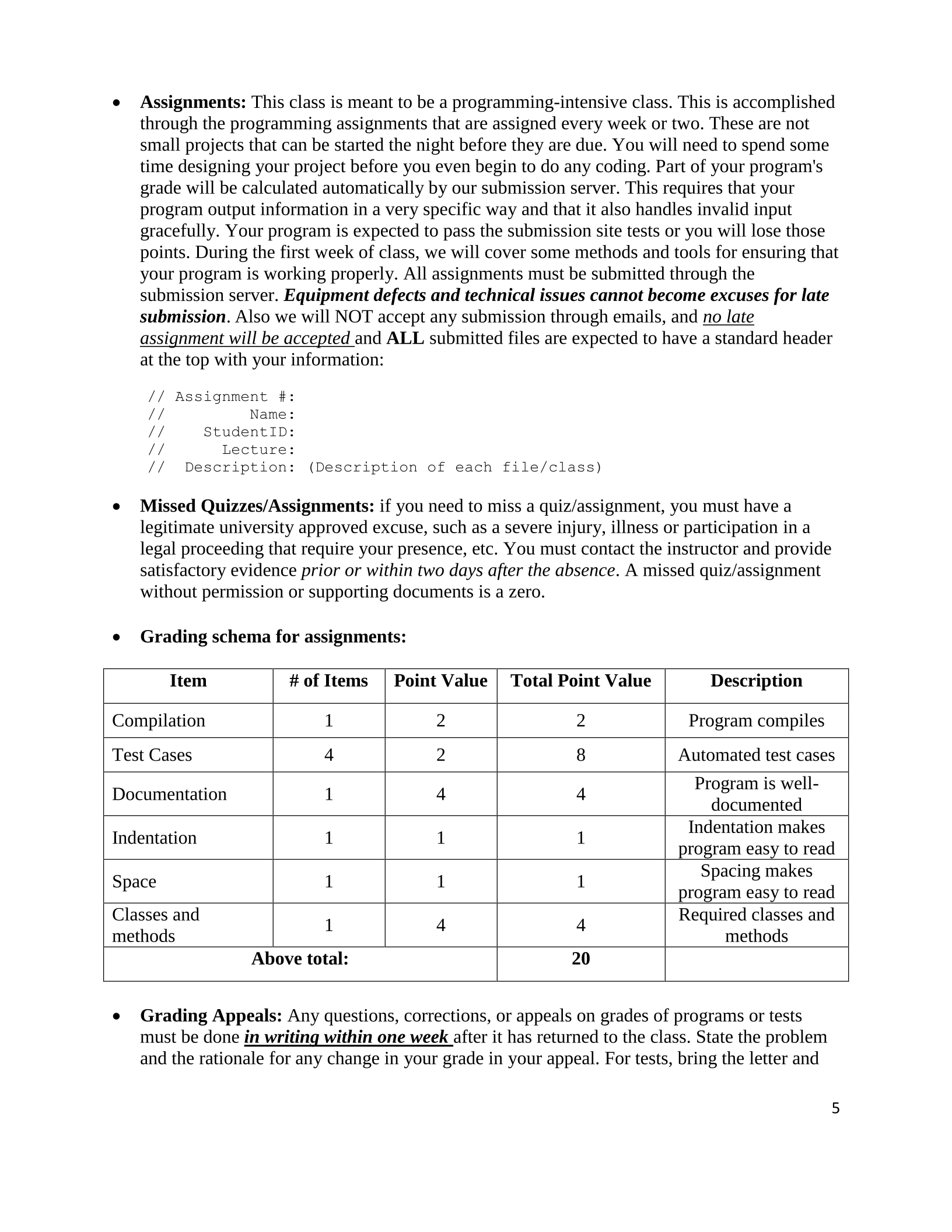
Assignments: This class is meant to be a programming-intensive class. This is accomplished
through the programming assignments that are assigned every week or two. These are not
small projects that can be started the night before they are due. You will need to spend some
time designing your project before you even begin to do any coding. Part of your program's
grade will be calculated automatically by our submission server. This requires that your
program output information in a very specific way and that it also handles invalid input
gracefully. Your program is expected to pass the submission site tests or you will lose those
points. During the first week of class, we will cover some methods and tools for ensuring that
your program is working properly. All assignments must be submitted through the
submission server. Equipment defects and technical issues cannot become excuses for late
submission. Also we will NOT accept any submission through emails, and no late
assignment will be accepted and ALL submitted files are expected to have a standard header
at the top with your information:
// Assignment #:
// Name:
// StudentID:
// Lecture:
// Description: (Description of each file/class)
Missed Quizzes/Assignments: if you need to miss a quiz/assignment, you must have a
legitimate university approved excuse, such as a severe injury, illness or participation in a
legal proceeding that require your presence, etc. You must contact the instructor and provide
satisfactory evidence prior or within two days after the absence. A missed quiz/assignment
without permission or supporting documents is a zero.
Grading schema for assignments:
Item
# of Items
Point Value
Total Point Value
Description
Compilation
1
2
2
Program compiles
Test Cases
4
2
8
Automated test cases
Documentation
1
4
4
Program is well-
documented
Indentation
1
1
1
Indentation makes
program easy to read
Space
1
1
1
Spacing makes
program easy to read
Classes and
methods
1
4
4
Required classes and
methods
Above total:
20
Grading Appeals: Any questions, corrections, or appeals on grades of programs or tests
must be done in writing within one week after it has returned to the class. State the problem
and the rationale for any change in your grade in your appeal. For tests, bring the letter and
6
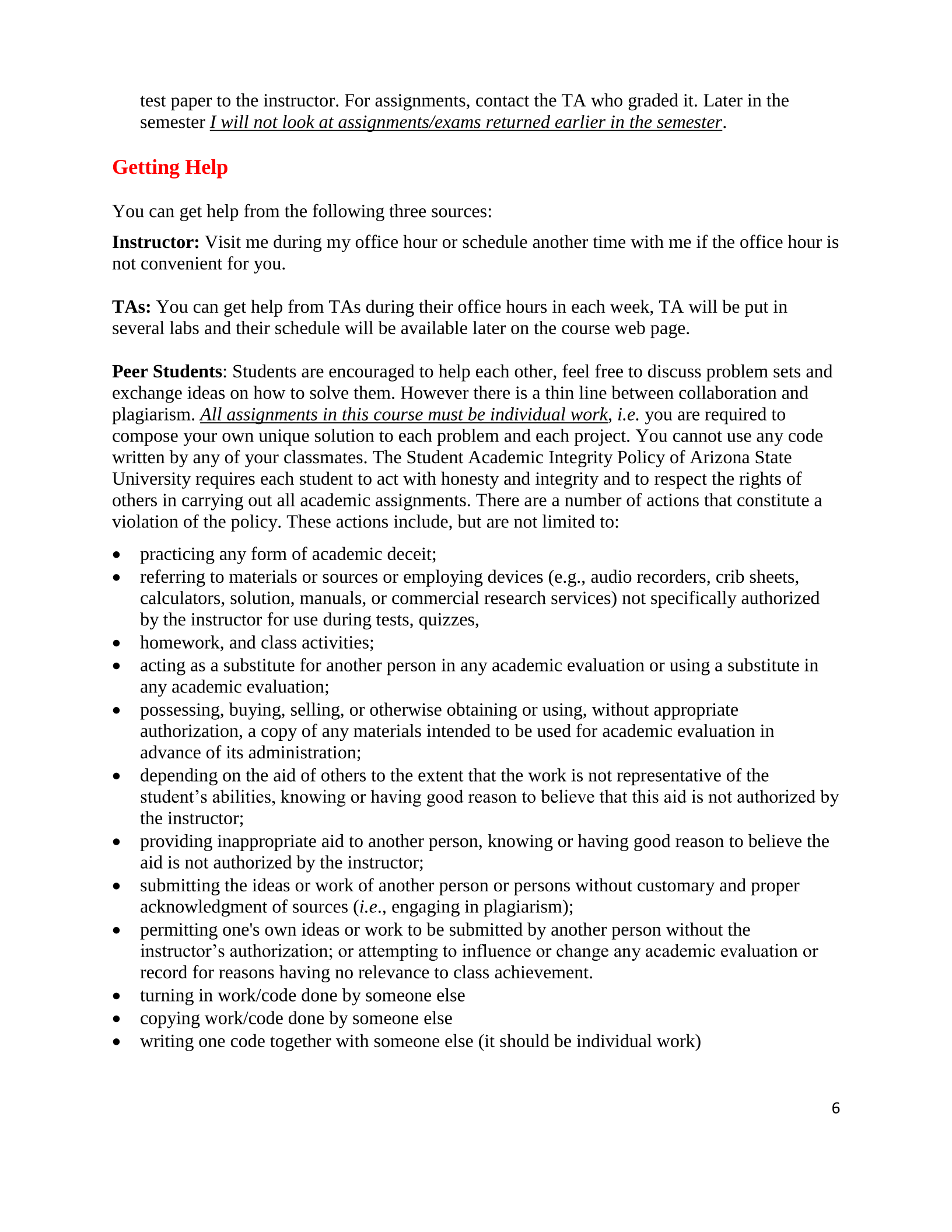
test paper to the instructor. For assignments, contact the TA who graded it. Later in the
semester I will not look at assignments/exams returned earlier in the semester.
Getting Help
You can get help from the following three sources:
Instructor: Visit me during my office hour or schedule another time with me if the office hour is
not convenient for you.
TAs: You can get help from TAs during their office hours in each week, TA will be put in
several labs and their schedule will be available later on the course web page.
Peer Students: Students are encouraged to help each other, feel free to discuss problem sets and
exchange ideas on how to solve them. However there is a thin line between collaboration and
plagiarism. All assignments in this course must be individual work, i.e. you are required to
compose your own unique solution to each problem and each project. You cannot use any code
written by any of your classmates. The Student Academic Integrity Policy of Arizona State
University requires each student to act with honesty and integrity and to respect the rights of
others in carrying out all academic assignments. There are a number of actions that constitute a
violation of the policy. These actions include, but are not limited to:
practicing any form of academic deceit;
referring to materials or sources or employing devices (e.g., audio recorders, crib sheets,
calculators, solution, manuals, or commercial research services) not specifically authorized
by the instructor for use during tests, quizzes,
homework, and class activities;
acting as a substitute for another person in any academic evaluation or using a substitute in
any academic evaluation;
possessing, buying, selling, or otherwise obtaining or using, without appropriate
authorization, a copy of any materials intended to be used for academic evaluation in
advance of its administration;
depending on the aid of others to the extent that the work is not representative of the
student’s abilities, knowing or having good reason to believe that this aid is not authorized by
the instructor;
providing inappropriate aid to another person, knowing or having good reason to believe the
aid is not authorized by the instructor;
submitting the ideas or work of another person or persons without customary and proper
acknowledgment of sources (i.e., engaging in plagiarism);
permitting one's own ideas or work to be submitted by another person without the
instructor’s authorization; or attempting to influence or change any academic evaluation or
record for reasons having no relevance to class achievement.
turning in work/code done by someone else
copying work/code done by someone else
writing one code together with someone else (it should be individual work)
7
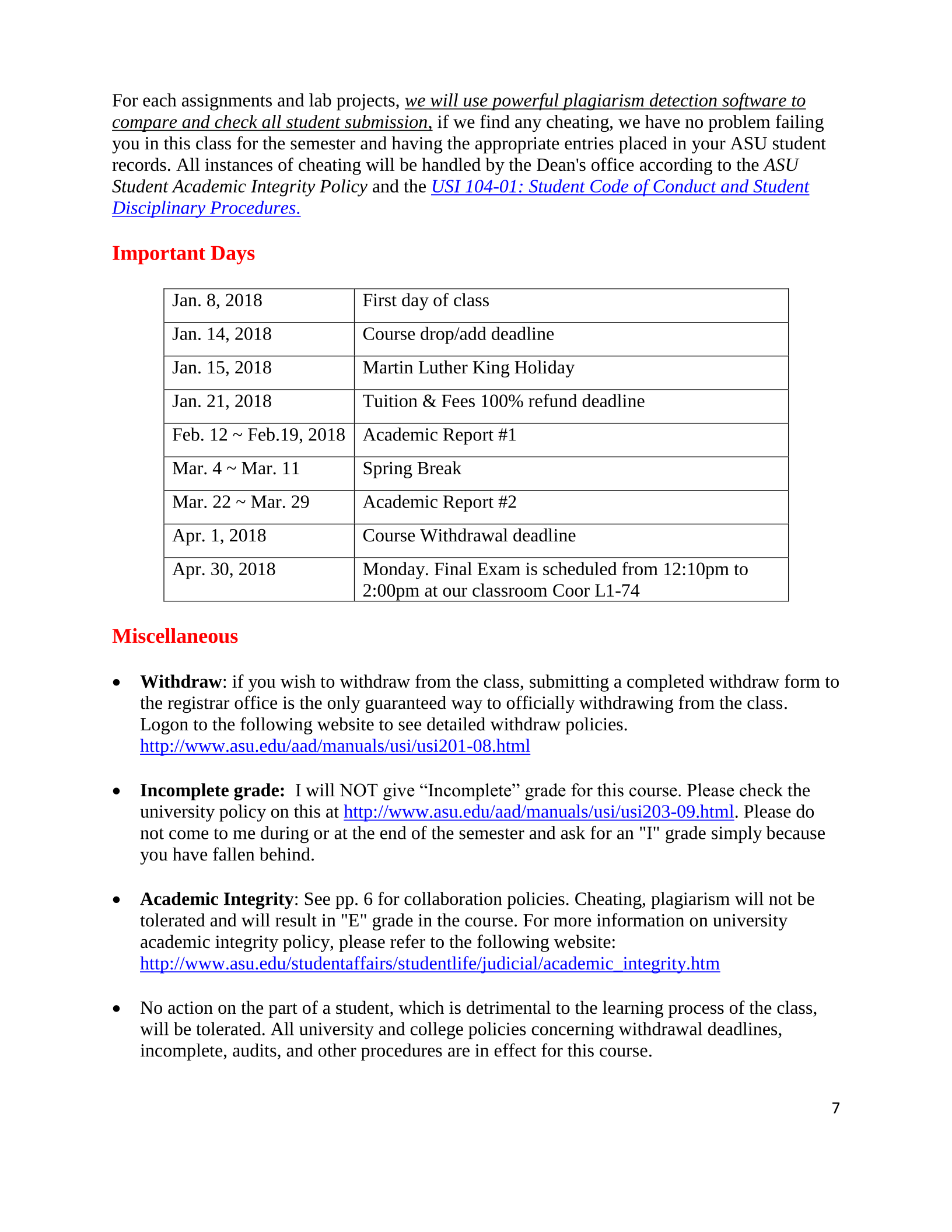
For each assignments and lab projects, we will use powerful plagiarism detection software to
compare and check all student submission, if we find any cheating, we have no problem failing
you in this class for the semester and having the appropriate entries placed in your ASU student
records. All instances of cheating will be handled by the Dean's office according to the ASU
Student Academic Integrity Policy and the USI 104-01: Student Code of Conduct and Student
Disciplinary Procedures.
Important Days
Jan. 8, 2018
First day of class
Jan. 14, 2018
Course drop/add deadline
Jan. 15, 2018
Martin Luther King Holiday
Jan. 21, 2018
Tuition & Fees 100% refund deadline
Feb. 12 ~ Feb.19, 2018
Academic Report #1
Mar. 4 ~ Mar. 11
Spring Break
Mar. 22 ~ Mar. 29
Academic Report #2
Apr. 1, 2018
Course Withdrawal deadline
Apr. 30, 2018
Monday. Final Exam is scheduled from 12:10pm to
2:00pm at our classroom Coor L1-74
Miscellaneous
Withdraw: if you wish to withdraw from the class, submitting a completed withdraw form to
the registrar office is the only guaranteed way to officially withdrawing from the class.
Logon to the following website to see detailed withdraw policies.
http://www.asu.edu/aad/manuals/usi/usi201-08.html
Incomplete grade: I will NOT give “Incomplete” grade for this course. Please check the
university policy on this at http://www.asu.edu/aad/manuals/usi/usi203-09.html. Please do
not come to me during or at the end of the semester and ask for an "I" grade simply because
you have fallen behind.
Academic Integrity: See pp. 6 for collaboration policies. Cheating, plagiarism will not be
tolerated and will result in "E" grade in the course. For more information on university
academic integrity policy, please refer to the following website:
http://www.asu.edu/studentaffairs/studentlife/judicial/academic_integrity.htm
No action on the part of a student, which is detrimental to the learning process of the class,
will be tolerated. All university and college policies concerning withdrawal deadlines,
incomplete, audits, and other procedures are in effect for this course.
a
“Jo
8
DRC Service: Students requesting classroom accommodations or modifications because of a
documented disability must contact the Disability Resource Center. The phone number is
(480)965-4732. For additional information concerning the services provided by the center,
please visit their web site at http://www.asu.edu/studentaffairs/ed/drc/
Powered by TCPDF (www.tcpdf.org)

