


1 Submission Instructions
Note that for each homework assignment, only some of the exercises will be graded. A list of the exercises that will be graded can be
found in the Module 2: HW1 submission page in Canvas. This does not mean that the ungraded exercise are unimportant or that you
will not be tested on the material in the exercise. They are, and you will. There are two primary reasons we grade only some of the
exercises: frst, this course has a large enrollment so there are many assignments to be graded; second, in the accelerated time frame
for online courses, we want to return graded homework exercises as quickly as we can. Despite not grading some exercises, if you
wish to perform as well as you can in this course, we strongly recommend that you complete all of the exercises.
Many of your solutions will be typed in a PDF document (the penalty for submitting a document in any format other than PDF will be
10% or -2.5 pts if the grader can open it; if the fle cannot be opened, scores of 0 will be assigned to the solutions that are to be
included in the PDF).
To start, create a document using your favorite word processor and type your exercise solutions—except for those exercises where
you are asked to submit your solution in a separate fle (more later). At the top of the document please include your name, your
ASURITE ID (the username you use to login to MyASU and Canvas), your email address, and the homework assignment number, e.g.
Homework 1.
For short-answer and description exercises (e.g., see Exs. 3.2, 4.1, 4.2, 5.1–5.8), please neatly type your solution in your document.
Some exercises may ask you to submit an image (e.g., see Exs. 7.1–7.2). Hand-drawn images are unacceptable and will result in zero
points being assigned for an exercise (the reason being that hand-drawn images are often illegible causing students to lose points).
For images, use a software drawing tool, export the image in a suitable image fle format, and then copy-and-paste the image fle into
your word processing document. Please ensure the image is sufciently sized so that the text is readable.
Please carefully read the following sections below regarding submission of Java source code fies (Exs. 3.1, 3.4, 3.5, 4.3). We will be
using an automated grading script to grade these exercises, so it is extremely important that you follow the assignment instructions
—especially in regard to naming—so your submission will not cause the script to fail resulting in point deductions.
If an exercises ask you to write Java code but does not request you submit your soiution in a separate Java source code fle (e.g., see
Exs. 3.3, 3.6, 3.7), copy-and-paste your code from your IDE or text editor into your word processing document. Make sure to neatly
format your code, i.e., indentation.
When you are done, convert the word processing document into Adobe PDF format and name the PDF fle asuriteidh01.pdf where
asuriteid is your ASURITE user id (for example, if your ASURITE user id is jsmith6 then your fle would be named jsmith6-h01.pdf).
Next, create an empty folder named asuriteid-h01 where asuriteid is your ASURITE user id and and copy asuriteidh01.pdf to that
folder. Copy the requested zip archives containing Java source code fles for Exs. 4.2–4.5 and 5.1–5.3 into this folder. (Note: Java
source code fles are the fles with a .java fle name extension; when you create the zip archives for these two groups of exercises, do
not include the .class fles in your zip archives as we do not need those.)
Next, compress the asuriteid-h01 folder creating a zip archive fle named asuriteid-h01.zip. Upload asuriteid-h01.zip to Canvas on the
Module 2: HW1 submission page by the assignment deadline. Please see the Course Schedule section on the Syllabus page in Canvas
for the deadline. Consult the Syllabus for the late and academic integrity policies.
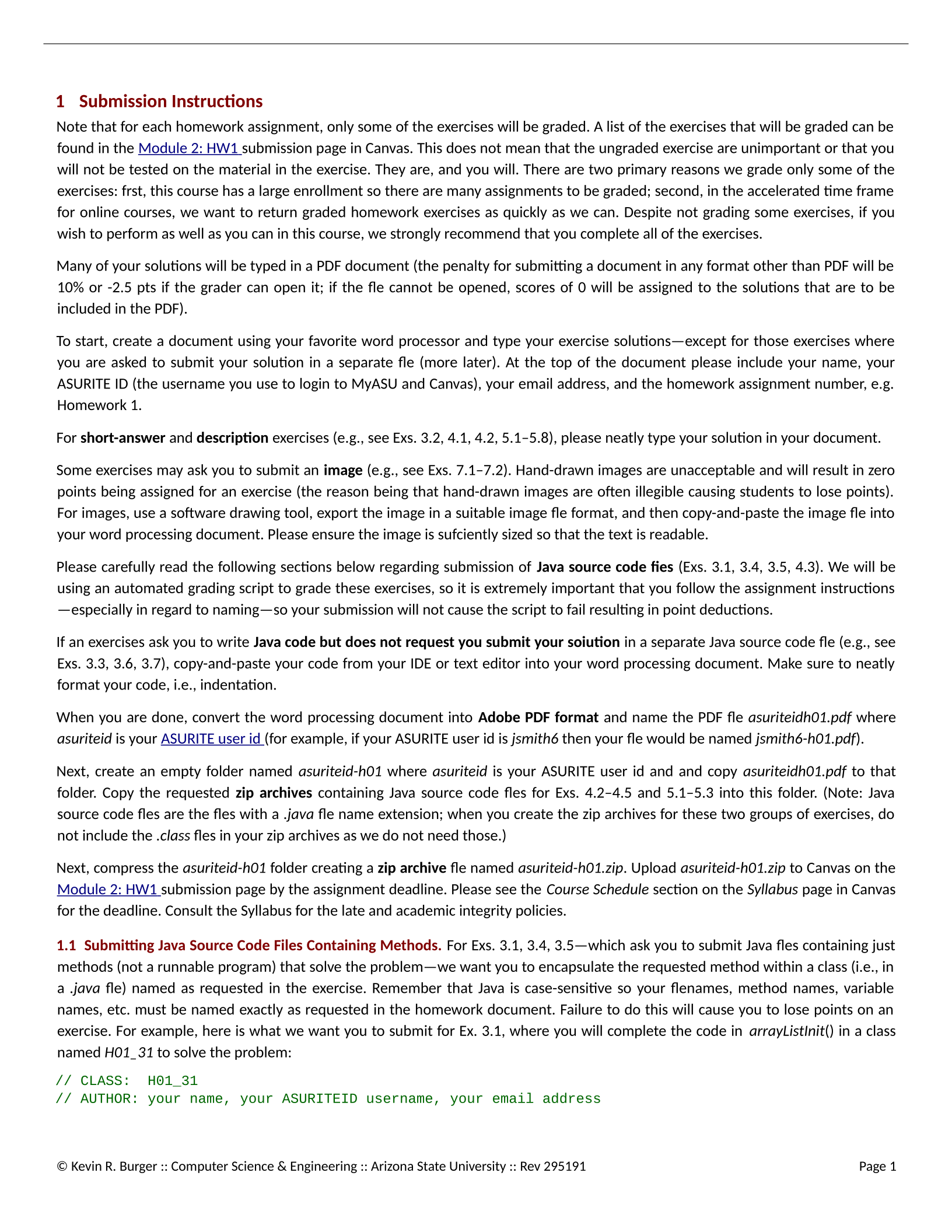
1.1 Submitting Java Source Code Files Containing Methods. For Exs. 3.1, 3.4, 3.5—which ask you to submit Java fles containing just
methods (not a runnable program) that solve the problem—we want you to encapsulate the requested method within a class (i.e., in
a .java fle) named as requested in the exercise. Remember that Java is case-sensitive so your flenames, method names, variable
names, etc. must be named exactly as requested in the homework document. Failure to do this will cause you to lose points on an
exercise. For example, here is what we want you to submit for Ex. 3.1, where you will complete the code in arrayListInit() in a class
named H01_31 to solve the problem:
// CLASS: H01_31
// AUTHOR: your name, your ASURITEID username, your email address
© Kevin R. Burger :: Computer Science & Engineering :: Arizona State University :: Rev 295191 Page 1
CSE205 Object Oriented Programming and Data Structures Homework 1 :: 25 pts
CSE205 Object Oriented Programming and Data Structures Homework 1 :: 25 pts
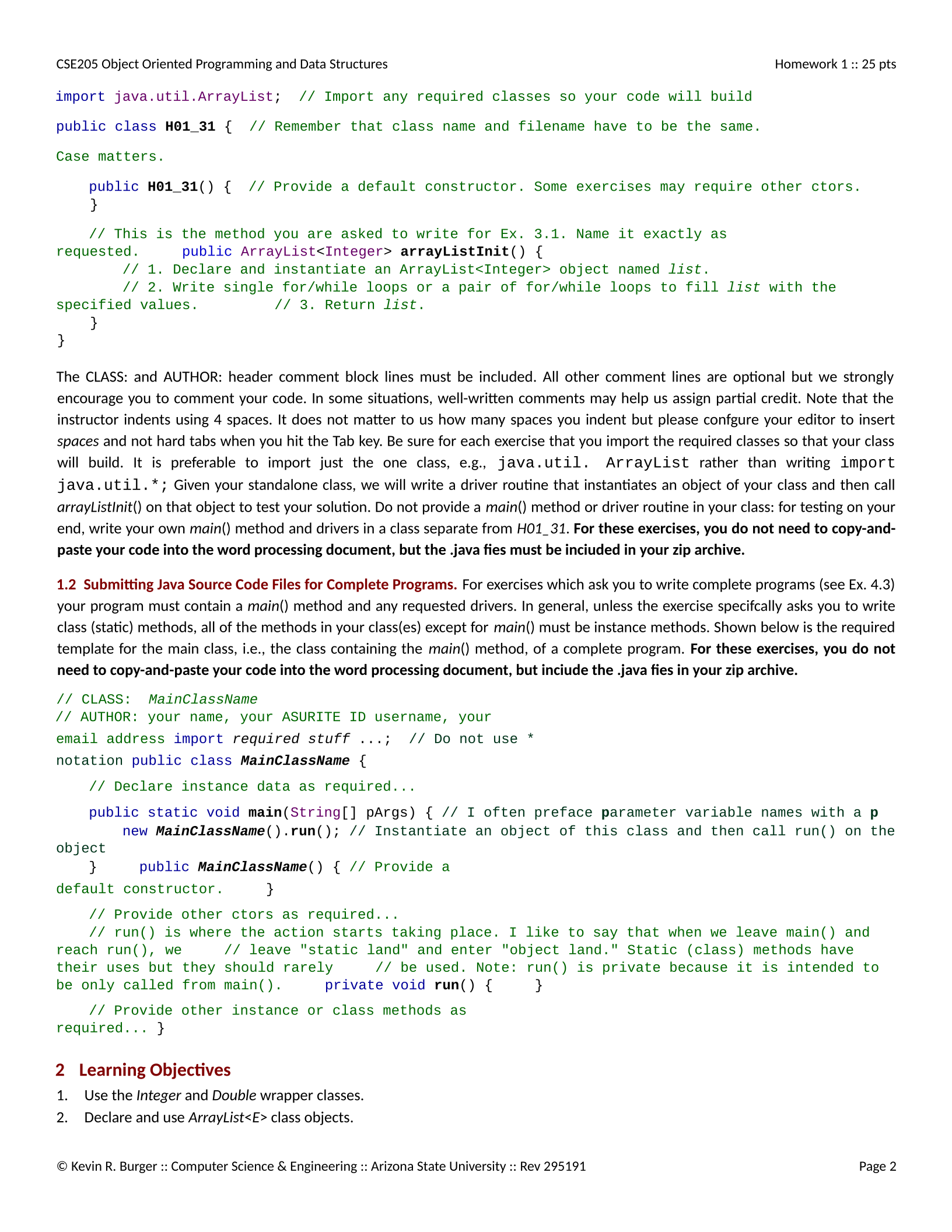
import java.util.ArrayList; // Import any required classes so your code will build
public class H01_31 { // Remember that class name and filename have to be the same.
Case matters.
public H01_31() { // Provide a default constructor. Some exercises may require other ctors.
}
// This is the method you are asked to write for Ex. 3.1. Name it exactly as
requested. public ArrayList<Integer> arrayListInit() {
// 1. Declare and instantiate an ArrayList<Integer> object named list.
// 2. Write single for/while loops or a pair of for/while loops to fill list with the
specified values. // 3. Return list.
}
}
The CLASS: and AUTHOR: header comment block lines must be included. All other comment lines are optional but we strongly
encourage you to comment your code. In some situations, well-written comments may help us assign partial credit. Note that the
instructor indents using 4 spaces. It does not matter to us how many spaces you indent but please confgure your editor to insert
spaces and not hard tabs when you hit the Tab key. Be sure for each exercise that you import the required classes so that your class
will build. It is preferable to import just the one class, e.g., java.util. ArrayList rather than writing import
java.util.*; Given your standalone class, we will write a driver routine that instantiates an object of your class and then call
arrayListInit() on that object to test your solution. Do not provide a main() method or driver routine in your class: for testing on your
end, write your own main() method and drivers in a class separate from H01_31. For these exercises, you do not need to copy-and-
paste your code into the word processing document, but the .java fies must be inciuded in your zip archive.
1.2 Submitting Java Source Code Files for Complete Programs. For exercises which ask you to write complete programs (see Ex. 4.3)
your program must contain a main() method and any requested drivers. In general, unless the exercise specifcally asks you to write
class (static) methods, all of the methods in your class(es) except for main() must be instance methods. Shown below is the required
template for the main class, i.e., the class containing the main() method, of a complete program. For these exercises, you do not
need to copy-and-paste your code into the word processing document, but inciude the .java fies in your zip archive.
// CLASS: MainClassName
// AUTHOR: your name, your ASURITE ID username, your
email address import required stuff ...; // Do not use *
notation public class MainClassName {
// Declare instance data as required...
public static void main(String[] pArgs) { // I often preface parameter variable names with a p
new MainClassName().run(); // Instantiate an object of this class and then call run() on the
object
} public MainClassName() { // Provide a
default constructor. }
// Provide other ctors as required...
// run() is where the action starts taking place. I like to say that when we leave main() and
reach run(), we // leave "static land" and enter "object land." Static (class) methods have
their uses but they should rarely // be used. Note: run() is private because it is intended to
be only called from main(). private void run() { }
// Provide other instance or class methods as
required... }
2 Learning Objectives
1. Use the Integer and Double wrapper classes.
2. Declare and use ArrayList<E> class objects.
© Kevin R. Burger :: Computer Science & Engineering :: Arizona State University :: Rev 295191 Page 2
CSE205 Object Oriented Programming and Data Structures Homework 1 :: 25 pts
3. Write code to read from, and write to, text fles.
4. Understand exception processing and write an exception handler for I/O exceptions.
5. Write Java classes and instantiate objects of those classes.
6. Read UML class diagrams and convert the diagram into Java classes.
7. Identify and implement dependency, aggregation, inheritance, and composition relationships.
3 ArrayLists
3.1 Learning Objective: To declare, create, and initialize an ArrayList<Integer> list.
Instructions: See the instructions in §1.1 for what to submit for grading. This is not a complete program. Name your class
H01_31 and save it in a fle named H01_31.java. When you are done, copy H01_31.java to your asuriteid-h01 folder, i.e., to the
same folder as the PDF.
Problem: Write a public instance method named ArrayList<Integer> arrayListInit() that creates an ArrayList<Integer> object
named list and flls list with the numbers shown below (using one or a pair of for or whiie loops, i.e., if you just call add() to add
the numbers to list, your solution will be marked as incorrect). list shall be returned from arrayListInit(). Note that your method
shall not output the contents of the list, just return it.
0 1 2 3 4 0 1 2 3 4
Testing: We will be testing your method using our driver routine. For testing on your end, write your own driver routine in a
class diferent than H01_31.
3.2 Learning Objective: To use the ArrayList<E> class get() and set() methods.
Problem: Consider the ArrayList<Integer> object named list containing these Integers:
list = { 1, 2, 3, 4, 5, 4, 3, 2, 1, 0 }
What are the contents of list after this loop completes?
for (int i = 1; i < 10; ++i) {
list.set(i, list.get(i) +
list.get(i-1)); }
3.3 Learning Objective: To use an enhanced for loop to iterate over the elements of an ArrayList<Integer> list.
Problem: Write an enhanced for loop that counts how many integers in an ArrayList<Integer> object named list are negative.
Print the count after the loop terminates. You may assume that the list reference variable is non-null but the list itself may be
empty.
3.4 Learning Objective: To compute a running sum of the elements of an ArrayList<Integer> list.
Instructions: See the instructions in §1.1 for what to submit for grading. This is not a complete program. Name your class
H01_34 and save it in a fle named H01_34.java. When you are done, copy H01_34.java to your asuriteid-h01 folder, i.e., to the
same folder as the PDF.
Problem: See the instructions in §1.1 for what to submit for grading. This is not a complete program. Name your Java source
code fle H01_34.java. Write a public instance method named Integer arrayListSum(ArrayList <Integer> pList). The method shall
return the sum of the elements of pList as an Integer. Note that the sum of an empty list is 0. If the pList reference variable is
null, then return 0 as well.
Testing: We will be testing your method using our driver routine. For testing on your end, write your own driver routine in a
class diferent than H01_34. Make sure to test the cases where list is empty and where the pList parameter is null.
© Kevin R. Burger :: Computer Science & Engineering :: Arizona State University :: Rev 295191 Page 3
CSE205 Object Oriented Programming and Data Structures Homework 1 :: 25 pts
3.5 Learning Objective: To declare, create, and initialize an ArrayList<Integer> list.
Instructions: See the instructions in §1.1 for what to submit for grading. This is not a complete program. Name your class
H01_35 and save it in a fle named H01_35.java. When you are done, copy H01_35.java to your asuriteid-h01 folder, i.e., to the
same folder as the PDF.
Problem: Write a public instance method named named ArrayList<Integer> arrayListCreate(int pLen, int pInit Value). The
method shall use a while or for loop to create a new ArrayList<Integer> object which has exactly pLen elements, pLen ≥ 0.
Each element shall be initialized to pInitValue. The method shall return the ArrayList.
Testing: We will be testing your method using our driver routine. For testing on your end, write your own driver routine in a
class diferent than H01_35. Make sure to test the case where pLen is 0.
3.6 Learning Objective: To insert a String into a ArrayList<String> list and maintain the sort order of the list.
Problem: Write a void method named insertName() that has two input parameters: (1) pList which is an object of ArrayList
<String> where each element of pList is a person's name; and (2) a String object named pName. Assume the names in pList are
sorted into ascending order. The method shall insert pName into pList such that the sort order is maintained. The pList
parameter variable will be non-null but the list itself may be empty.
Algorithm: There are at least two algorithms one could use to solve this problem. The frsttand the method you shall not usetis
to add pName to the end of pList and then sort pList. The secondtand this is the algorithm I want you to usetis to write a for or
while loop that iterates over the Strings in pList (starting at index 0) until the index is reached where pName must be inserted
so pList remains sorted. We will study algorithmic complexity and Big O notation later in the course, so what I say here may not
make sense, but the frst algorithm has time complexity (nϴ lg n) and the second is O(n). This means the frst algorithm is
slower than the second and this is the reason I want you to use the second method.
Testing: Make sure to test the cases where pList is empty, where the new element is added at the beginning of the list, in the
middle of the list, and at the end of the list.
3.7 Learning Objective: To remove elements from an ArrayList<Integer> list.
Problem: Write a void method named arrayListRemove() which has two parameters: pList is an object of the ArrayList
<Integer> class and pValue is an int. The method shall remove all elements from pList that are equal to pValue. The pList
parameter variable will be non-null but the list itself may be empty.
Testing: Make sure to test the cases where pList is empty, where no elements are removed, where all elements are removed,
where the only element that is removed is at the beginning of the list, in the middle of the list, and at the end of the list.
4 Text File Input/Output
4.1 Learning Objective: To understand how fles are opened.
Problem: Explain what happens if you try to open a fle that does not exist for reading.
4.2 Learning Objective: To understand how fles are opened.
Problem: Explain what happens if you try to open a fle that does not exist for writing.
4.3 Learning Objective: To read and write text fles.
Instructions: See the instructions in §1.2 for what to submit for grading. This is complete program with one Java source code fle
named H01_43.java (your main class is named H01_43). When you are done, copy H01_43.java to your asuriteid-h01 folder,
i.e., to the same folder as the PDF.
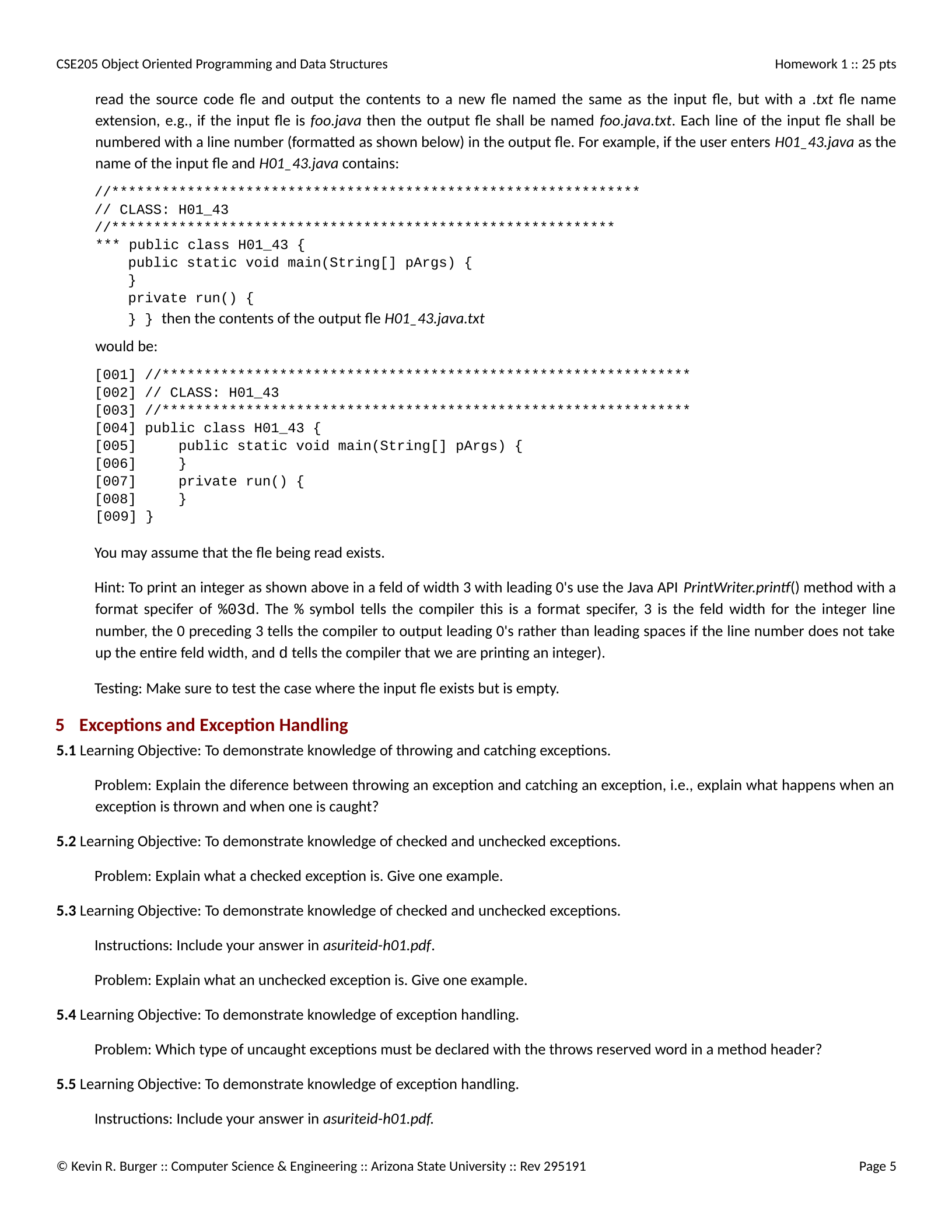
Problem: Write a program that prompts the user for the name of a Java source code fle (you may assume the fle contains Java
source code and has a .java flename extension; we will not test your program on non-Java source code fles). The program shall
© Kevin R. Burger :: Computer Science & Engineering :: Arizona State University :: Rev 295191 Page 4
CSE205 Object Oriented Programming and Data Structures Homework 1 :: 25 pts
read the source code fle and output the contents to a new fle named the same as the input fle, but with a .txt fle name
extension, e.g., if the input fle is foo.java then the output fle shall be named foo.java.txt. Each line of the input fle shall be
numbered with a line number (formatted as shown below) in the output fle. For example, if the user enters H01_43.java as the
name of the input fle and H01_43.java contains:
//***************************************************************
// CLASS: H01_43
//************************************************************
*** public class H01_43 {
public static void main(String[] pArgs) {
}
private run() {
} } then the contents of the output fle H01_43.java.txt
would be:
[001] //***************************************************************
[002] // CLASS: H01_43
[003] //***************************************************************
[004] public class H01_43 {
[005] public static void main(String[] pArgs) {
[006] }
[007] private run() {
[008] }
[009] }
You may assume that the fle being read exists.
Hint: To print an integer as shown above in a feld of width 3 with leading 0's use the Java API PrintWriter.print() method with a
format specifer of %03d. The % symbol tells the compiler this is a format specifer, 3 is the feld width for the integer line
number, the 0 preceding 3 tells the compiler to output leading 0's rather than leading spaces if the line number does not take
up the entire feld width, and d tells the compiler that we are printing an integer).
Testing: Make sure to test the case where the input fle exists but is empty.
5 Exceptions and Exception Handling
5.1 Learning Objective: To demonstrate knowledge of throwing and catching exceptions.
Problem: Explain the diference between throwing an exception and catching an exception, i.e., explain what happens when an
exception is thrown and when one is caught?
5.2 Learning Objective: To demonstrate knowledge of checked and unchecked exceptions.
Problem: Explain what a checked exception is. Give one example.
5.3 Learning Objective: To demonstrate knowledge of checked and unchecked exceptions.
Instructions: Include your answer in asuriteid-h01.pdf.
Problem: Explain what an unchecked exception is. Give one example.
5.4 Learning Objective: To demonstrate knowledge of exception handling.
Problem: Which type of uncaught exceptions must be declared with the throws reserved word in a method header?
5.5 Learning Objective: To demonstrate knowledge of exception handling.
Instructions: Include your answer in asuriteid-h01.pdf.
© Kevin R. Burger :: Computer Science & Engineering :: Arizona State University :: Rev 295191 Page 5
CSE205 Object Oriented Programming and Data Structures Homework 1 :: 25 pts
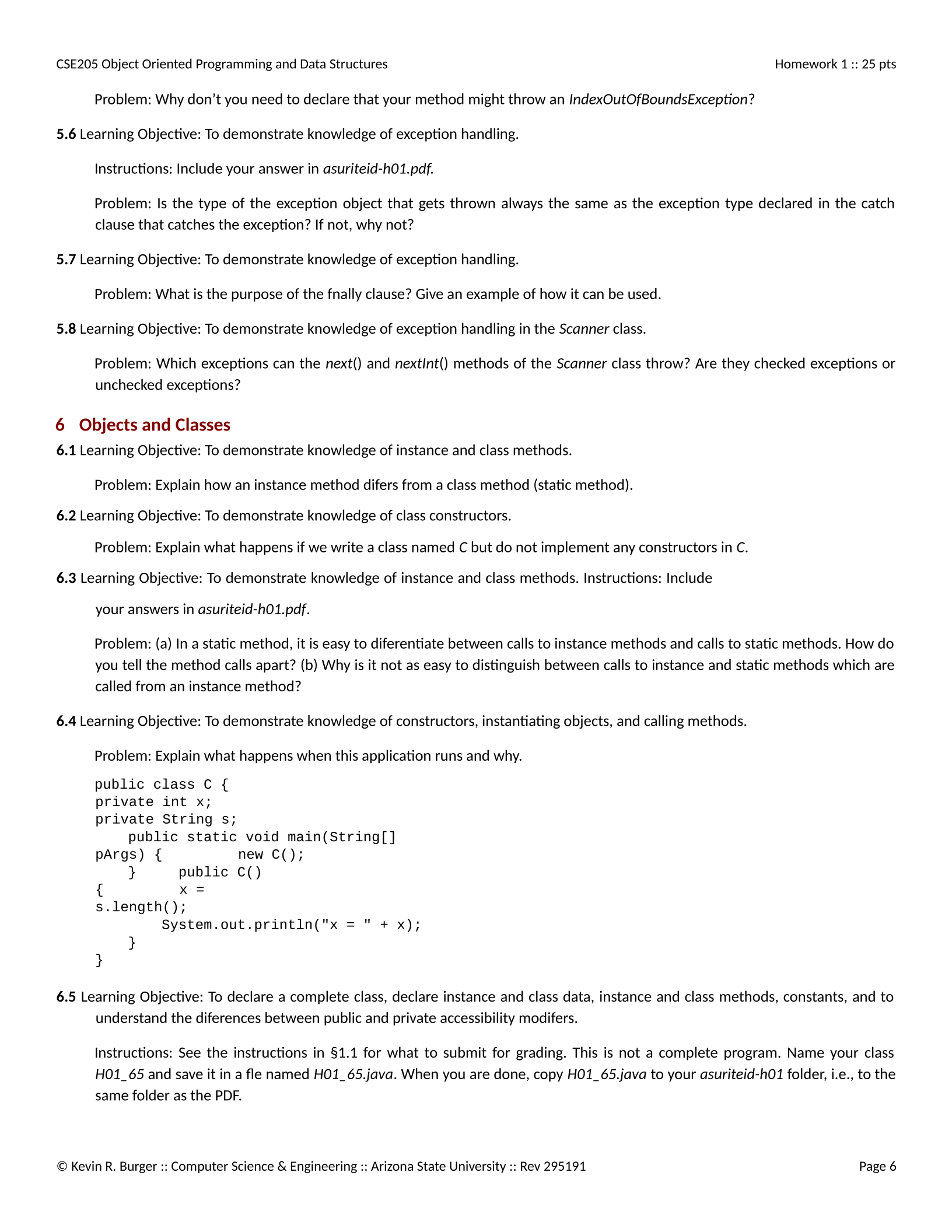
Problem: Why don’t you need to declare that your method might throw an IndexOutOfBoundsException?
5.6 Learning Objective: To demonstrate knowledge of exception handling.
Instructions: Include your answer in asuriteid-h01.pdf.
Problem: Is the type of the exception object that gets thrown always the same as the exception type declared in the catch
clause that catches the exception? If not, why not?
5.7 Learning Objective: To demonstrate knowledge of exception handling.
Problem: What is the purpose of the fnally clause? Give an example of how it can be used.
5.8 Learning Objective: To demonstrate knowledge of exception handling in the Scanner class.
Problem: Which exceptions can the next() and nextInt() methods of the Scanner class throw? Are they checked exceptions or
unchecked exceptions?
6 Objects and Classes
6.1 Learning Objective: To demonstrate knowledge of instance and class methods.
Problem: Explain how an instance method difers from a class method (static method).
6.2 Learning Objective: To demonstrate knowledge of class constructors.
Problem: Explain what happens if we write a class named C but do not implement any constructors in C.
6.3 Learning Objective: To demonstrate knowledge of instance and class methods. Instructions: Include
your answers in asuriteid-h01.pdf.
Problem: (a) In a static method, it is easy to diferentiate between calls to instance methods and calls to static methods. How do
you tell the method calls apart? (b) Why is it not as easy to distinguish between calls to instance and static methods which are
called from an instance method?
6.4 Learning Objective: To demonstrate knowledge of constructors, instantiating objects, and calling methods.
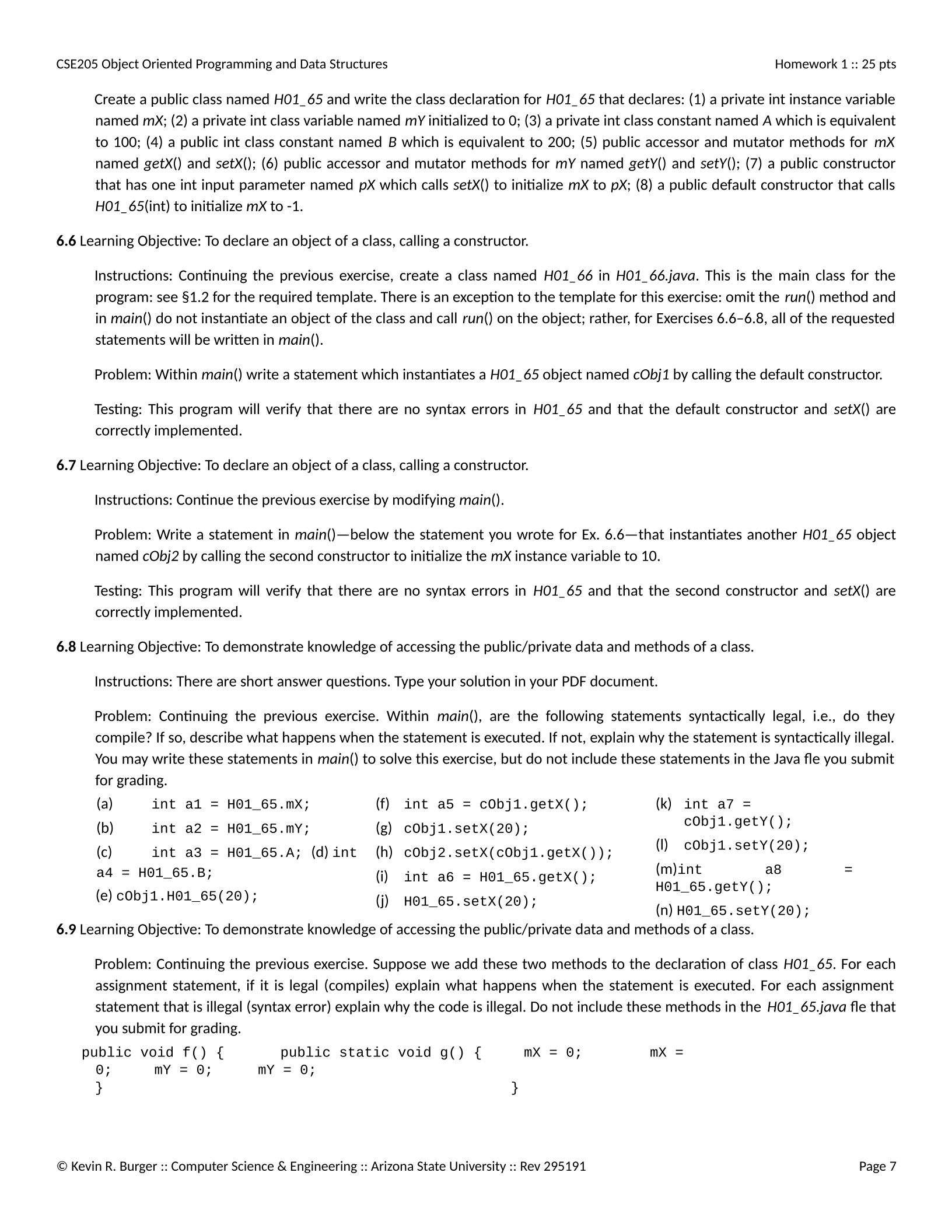
Problem: Explain what happens when this application runs and why.
public class C {
private int x;
private String s;
public static void main(String[]
pArgs) { new C();
} public C()
{ x =
s.length();
System.out.println("x = " + x);
}
}
6.5 Learning Objective: To declare a complete class, declare instance and class data, instance and class methods, constants, and to
understand the diferences between public and private accessibility modifers.
Instructions: See the instructions in §1.1 for what to submit for grading. This is not a complete program. Name your class
H01_65 and save it in a fle named H01_65.java. When you are done, copy H01_65.java to your asuriteid-h01 folder, i.e., to the
same folder as the PDF.
© Kevin R. Burger :: Computer Science & Engineering :: Arizona State University :: Rev 295191 Page 6
CSE205 Object Oriented Programming and Data Structures Homework 1 :: 25 pts
Create a public class named H01_65 and write the class declaration for H01_65 that declares: (1) a private int instance variable
named mX; (2) a private int class variable named mY initialized to 0; (3) a private int class constant named A which is equivalent
to 100; (4) a public int class constant named B which is equivalent to 200; (5) public accessor and mutator methods for mX
named getX() and setX(); (6) public accessor and mutator methods for mY named getY() and setY(); (7) a public constructor
that has one int input parameter named pX which calls setX() to initialize mX to pX; (8) a public default constructor that calls
H01_65(int) to initialize mX to -1.
6.6 Learning Objective: To declare an object of a class, calling a constructor.
Instructions: Continuing the previous exercise, create a class named H01_66 in H01_66.java. This is the main class for the
program: see §1.2 for the required template. There is an exception to the template for this exercise: omit the run() method and
in main() do not instantiate an object of the class and call run() on the object; rather, for Exercises 6.6–6.8, all of the requested
statements will be written in main().
Problem: Within main() write a statement which instantiates a H01_65 object named cObj1 by calling the default constructor.
Testing: This program will verify that there are no syntax errors in H01_65 and that the default constructor and setX() are
correctly implemented.
6.7 Learning Objective: To declare an object of a class, calling a constructor.
Instructions: Continue the previous exercise by modifying main().
Problem: Write a statement in main()—below the statement you wrote for Ex. 6.6—that instantiates another H01_65 object
named cObj2 by calling the second constructor to initialize the mX instance variable to 10.
Testing: This program will verify that there are no syntax errors in H01_65 and that the second constructor and setX() are
correctly implemented.
6.8 Learning Objective: To demonstrate knowledge of accessing the public/private data and methods of a class.
Instructions: There are short answer questions. Type your solution in your PDF document.
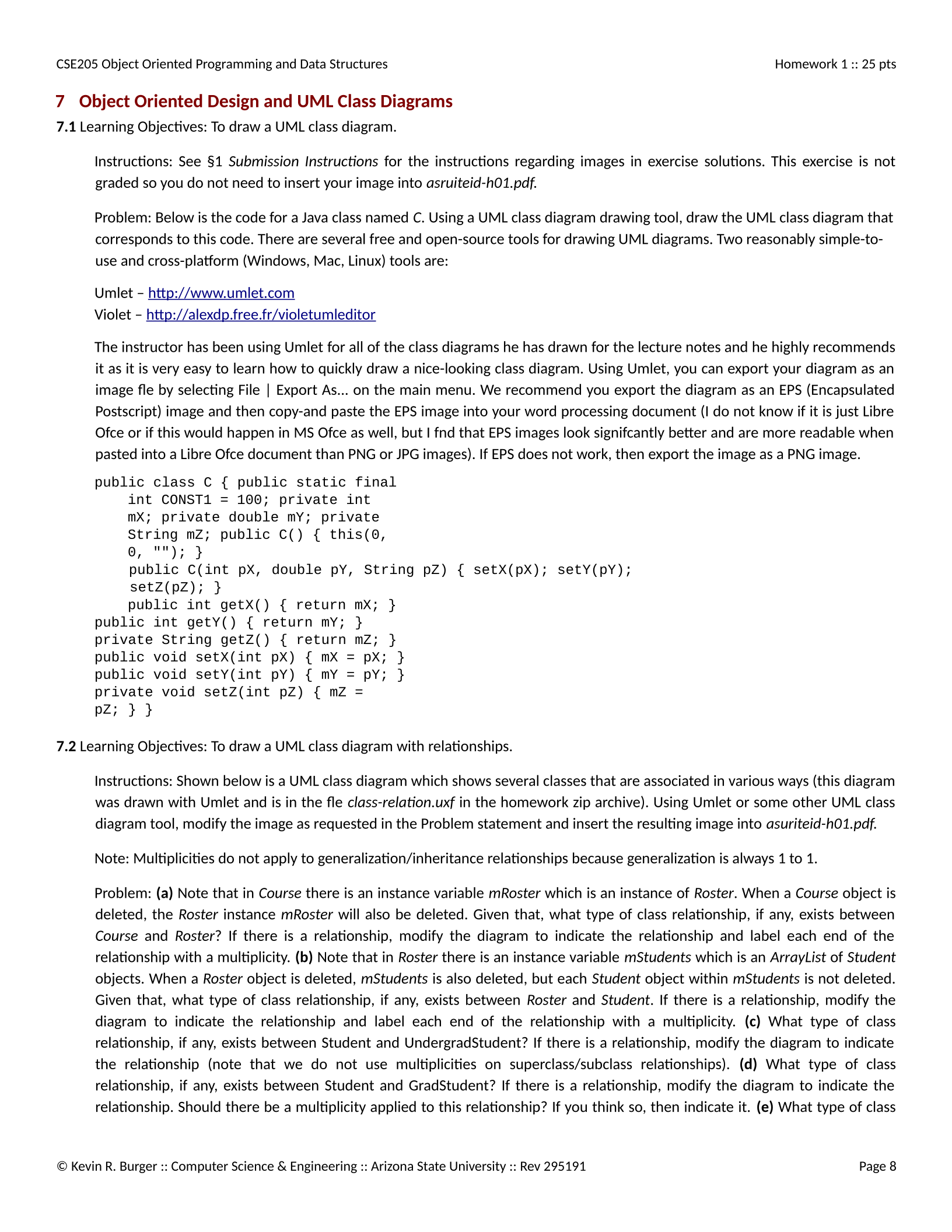
Problem: Continuing the previous exercise. Within main(), are the following statements syntactically legal, i.e., do they
compile? If so, describe what happens when the statement is executed. If not, explain why the statement is syntactically illegal.
You may write these statements in main() to solve this exercise, but do not include these statements in the Java fle you submit
for grading.
(a) int a1 = H01_65.mX;
(b) int a2 = H01_65.mY;
(c) int a3 = H01_65.A; (d) int
a4 = H01_65.B;
(e) cObj1.H01_65(20);
(f) int a5 = cObj1.getX();
(g) cObj1.setX(20);
(h) cObj2.setX(cObj1.getX());
(i) int a6 = H01_65.getX();
(j) H01_65.setX(20);
(k) int a7 =
cObj1.getY();
(l) cObj1.setY(20);
(m)int a8 =
H01_65.getY();
(n) H01_65.setY(20);
6.9 Learning Objective: To demonstrate knowledge of accessing the public/private data and methods of a class.
Problem: Continuing the previous exercise. Suppose we add these two methods to the declaration of class H01_65. For each
assignment statement, if it is legal (compiles) explain what happens when the statement is executed. For each assignment
statement that is illegal (syntax error) explain why the code is illegal. Do not include these methods in the H01_65.java fle that
you submit for grading.
public void f() { public static void g() { mX = 0; mX =
0; mY = 0; mY = 0;
} }
© Kevin R. Burger :: Computer Science & Engineering :: Arizona State University :: Rev 295191 Page 7
CSE205 Object Oriented Programming and Data Structures Homework 1 :: 25 pts
7 Object Oriented Design and UML Class Diagrams
7.1 Learning Objectives: To draw a UML class diagram.
Instructions: See §1 Submission Instructions for the instructions regarding images in exercise solutions. This exercise is not
graded so you do not need to insert your image into asruiteid-h01.pdf.
Problem: Below is the code for a Java class named C. Using a UML class diagram drawing tool, draw the UML class diagram that
corresponds to this code. There are several free and open-source tools for drawing UML diagrams. Two reasonably simple-to-
use and cross-platform (Windows, Mac, Linux) tools are:
Umlet – http://www.umlet.com
Violet – http://alexdp.free.fr/violetumleditor
The instructor has been using Umlet for all of the class diagrams he has drawn for the lecture notes and he highly recommends
it as it is very easy to learn how to quickly draw a nice-looking class diagram. Using Umlet, you can export your diagram as an
image fle by selecting File | Export As... on the main menu. We recommend you export the diagram as an EPS (Encapsulated
Postscript) image and then copy-and paste the EPS image into your word processing document (I do not know if it is just Libre
Ofce or if this would happen in MS Ofce as well, but I fnd that EPS images look signifcantly better and are more readable when
pasted into a Libre Ofce document than PNG or JPG images). If EPS does not work, then export the image as a PNG image.
public class C { public static final
int CONST1 = 100; private int
mX; private double mY; private
String mZ; public C() { this(0,
0, ""); }
public C(int pX, double pY, String pZ) { setX(pX); setY(pY);
setZ(pZ); }
public int getX() { return mX; }
public int getY() { return mY; }
private String getZ() { return mZ; }
public void setX(int pX) { mX = pX; }
public void setY(int pY) { mY = pY; }
private void setZ(int pZ) { mZ =
pZ; } }
7.2 Learning Objectives: To draw a UML class diagram with relationships.
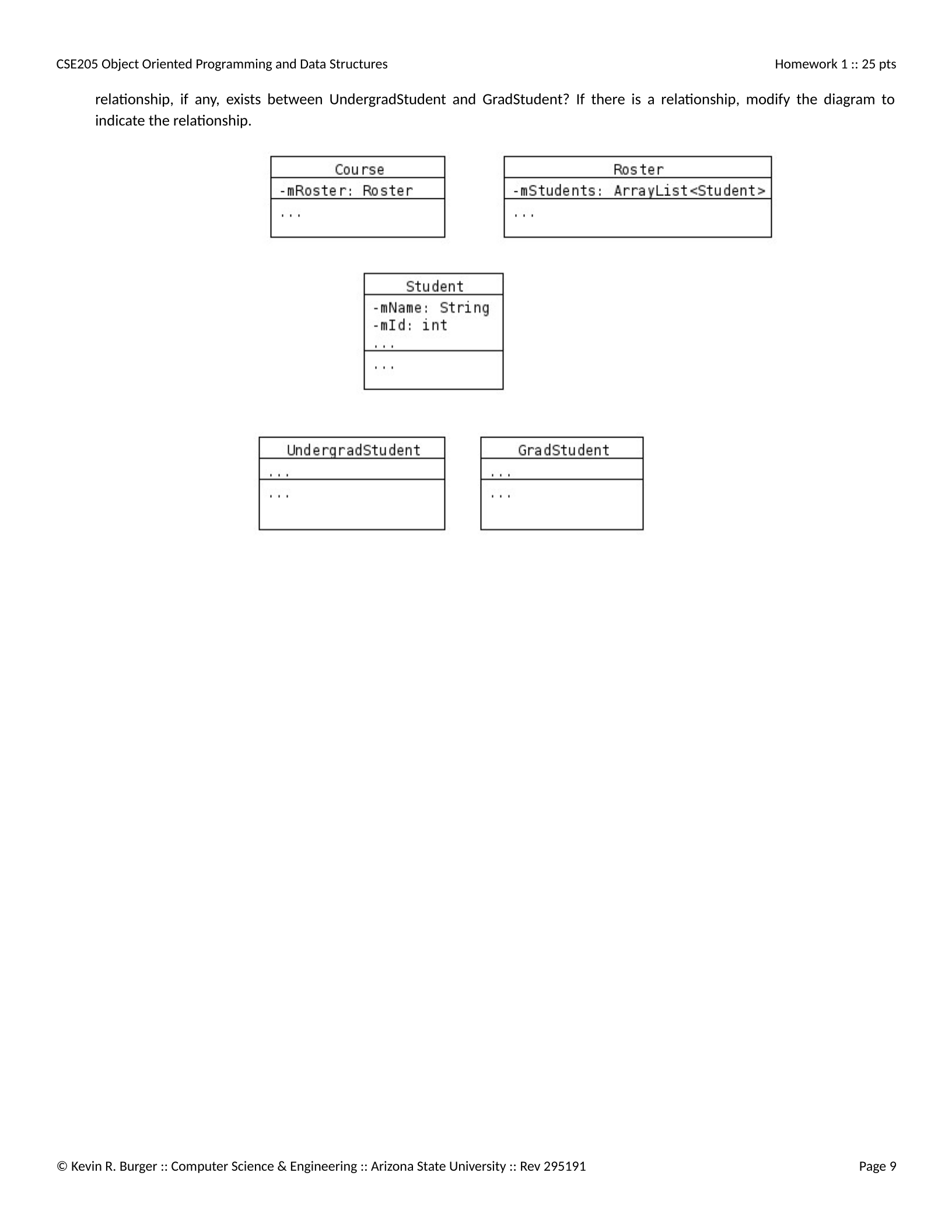
Instructions: Shown below is a UML class diagram which shows several classes that are associated in various ways (this diagram
was drawn with Umlet and is in the fle class-relation.uxf in the homework zip archive). Using Umlet or some other UML class
diagram tool, modify the image as requested in the Problem statement and insert the resulting image into asuriteid-h01.pdf.
Note: Multiplicities do not apply to generalization/inheritance relationships because generalization is always 1 to 1.
Problem: (a) Note that in Course there is an instance variable mRoster which is an instance of Roster. When a Course object is
deleted, the Roster instance mRoster will also be deleted. Given that, what type of class relationship, if any, exists between
Course and Roster? If there is a relationship, modify the diagram to indicate the relationship and label each end of the
relationship with a multiplicity. (b) Note that in Roster there is an instance variable mStudents which is an ArrayList of Student
objects. When a Roster object is deleted, mStudents is also deleted, but each Student object within mStudents is not deleted.
Given that, what type of class relationship, if any, exists between Roster and Student. If there is a relationship, modify the
diagram to indicate the relationship and label each end of the relationship with a multiplicity. (c) What type of class
relationship, if any, exists between Student and UndergradStudent? If there is a relationship, modify the diagram to indicate
the relationship (note that we do not use multiplicities on superclass/subclass relationships). (d) What type of class
relationship, if any, exists between Student and GradStudent? If there is a relationship, modify the diagram to indicate the
relationship. Should there be a multiplicity applied to this relationship? If you think so, then indicate it. (e) What type of class
© Kevin R. Burger :: Computer Science & Engineering :: Arizona State University :: Rev 295191 Page 8
Course
Roster
-nRoster:
Roster
=nStudents:
ArrayList<Student>
Student
“mame:
String
smd:
int
UndergradStudent
GradStudent
CSE205 Object Oriented Programming and Data Structures Homework 1 :: 25 pts
relationship, if any, exists between UndergradStudent and GradStudent? If there is a relationship, modify the diagram to
indicate the relationship.
© Kevin R. Burger :: Computer Science & Engineering :: Arizona State University :: Rev 295191 Page 9
Powered by TCPDF (www.tcpdf.org)

