Name: Zachary Mattson Score___________/50
Lab Day: Wed TA: Will Asma
I. Answer the following questions regarding the preparation of a calibration curve. Show all
calculations where applicable. Answers can be typed or handwritten. If writing in answers,
scan the document as a PDF and submit it to Canvas as a single PDF.
1)
a. A 10 mL calibration solution is made by mixing 5 mL of 0.200 M Fe(NO3)3, 1.50
mL of 2.00X10⁻³ M KNCS, 1 mL of 0.100 M nitric acid and 2.50 mL H2O. What is
the final concentration of only the NCS—ion?
2.00E-3 mol KNCS (1/1000mL) 1.5 mL
M1V1 = M2V2
(2E-3)(.0015) = M1(.01) M2 = 3E-4 M
b. If 1.00 mL of this solution is then diluted to a final volume of 25.00 mL with DI
water. What is the new concentration of NCS-?
M1V1 = M2V2
3E-4 M(1mL) = M2(25.00 mL)
M2 = .000012M
2) From your data, approximately which wavelength is most strongly absorbed by the
[FeSCN]2+ complex ion? What color of light does this correspond to?
The wavelength is 446.7 nm and the color is violet
3) What two factors are held constant when constructing a calibration curve?
The two factors are E and l
E is the molar extinction
L is the path length being traveled through the sample (the beam of light)
Post-Lab: Calibration Curve
4) Briefly explain the purpose of using a “blank” before measuring your calibration
solutions.
A blank ensures the absorbance happens strictly by the solute in the solution
5) For a solution that appears blue in color, which wavelength of light in nm is expected to
be absorbed most strongly? Give the approximate value or range of values.
Orange because orange is opposite of blue
Wavelengths are about 590nm-620nm
6) According to the Beer-Lambert Law, what would happen to the absorbance of a solution
if the concentration of analyte (substance being studied) is tripled?
The absorbance would be tripled because of the directly proportional relationships
7) At a wavelength of 447 nm, the absorbance of a solution that is 5X10⁻⁵ M in the FeSCN2+
complex is found to be 0.981. Assuming this is accurate, calculate the molar absorption
coefficient (absorptivity) for the complex if the optical path length is 1.0 cm.
A = ElC
.981 = E(1)(5E-4)
E = 19620M-1cm-1
8) A solution of [FeSCN]2+ of unknown concentration is found to have an absorbance of
0.504. Using the absorption coefficient found in the previous question, calculate the
concentration of [FeSCN]2+.
.504 = (19620)(1)(c)
C = 2.6E-5M
II. Data Analysis: All plots should have a descriptive title and properly labeled axes with units
where applicable.
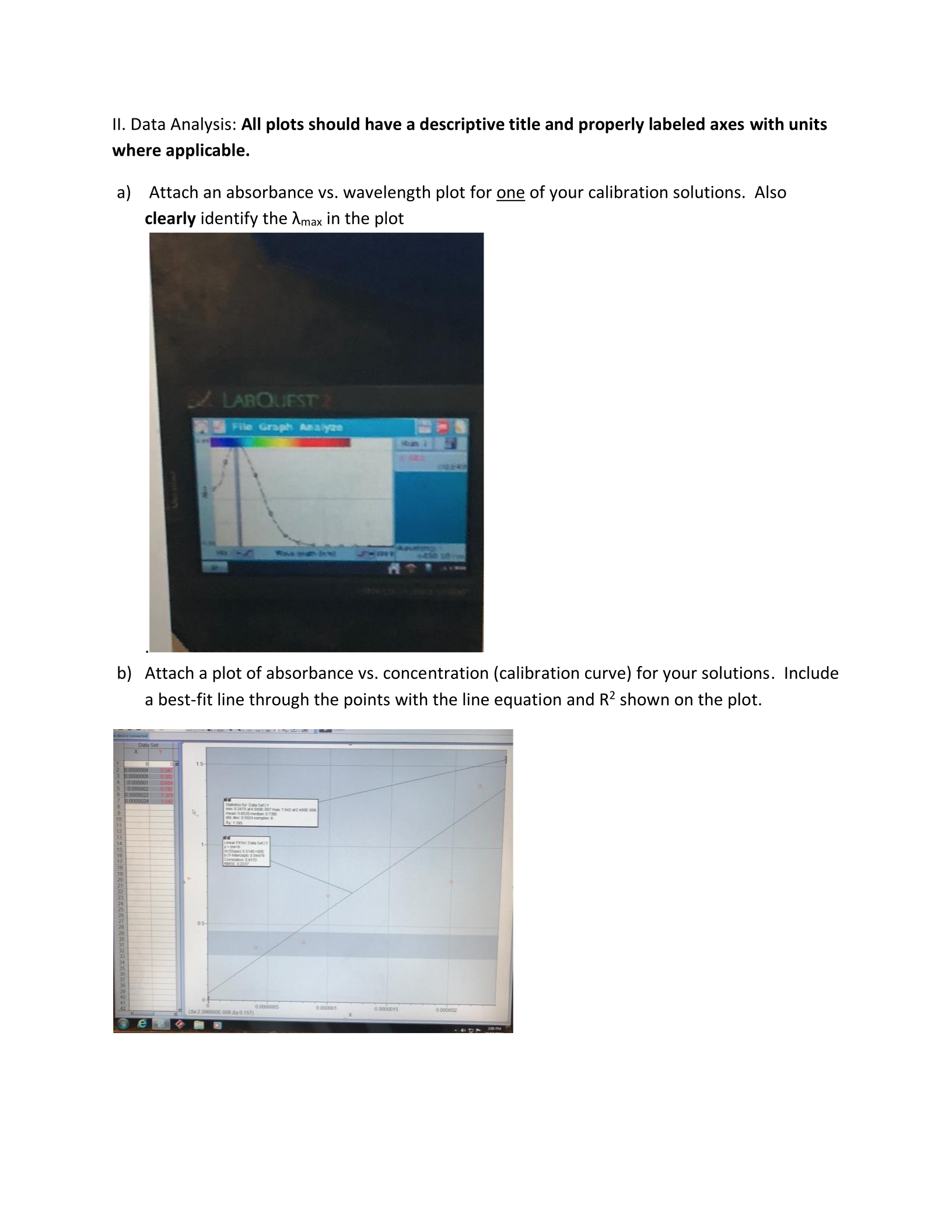
a) Attach an absorbance vs. wavelength plot for one of your calibration solutions. Also
clearly identify the λmax in the plot
.
b) Attach a plot of absorbance vs. concentration (calibration curve) for your solutions. Include
a best-fit line through the points with the line equation and R2 shown on the plot.