


CON 252: Methods, Materials, and Equipment Spring 2015
HO: Tuesday, February 10, 2015
Homework #4 DUE: Tuesday, February 17, 2015 at 4:30 PM
Name(s): Kyle Dick
Directions for Completion and Submission:
All homework assignments are to be typed on a word processor and submitted electronically via
Blackboard no later than 4:30 PM on Tuesday, February 17, 2015. Be sure to show all work and to
highlight your answers. You may complete this assignment individually, however you are also able to
work with a one or two group members. If so, nominate ONE person to turn this assignment in on
Blackboard. Be sure that all names are listed on the first page. This homework is based on lectures, class
discussions, course readings, and may require additional independent research.
Hints: Steel and Wood were discussed in the Structural Systems 2 lecture in class (Feb. 10). If you are
struggling, Chapters 3, 5, 11, and 12 of the textbook deal with Wood and Steel Construction and may be
a good resource. Of course, you can also visit office hours if you have questions.
Part I: Steel
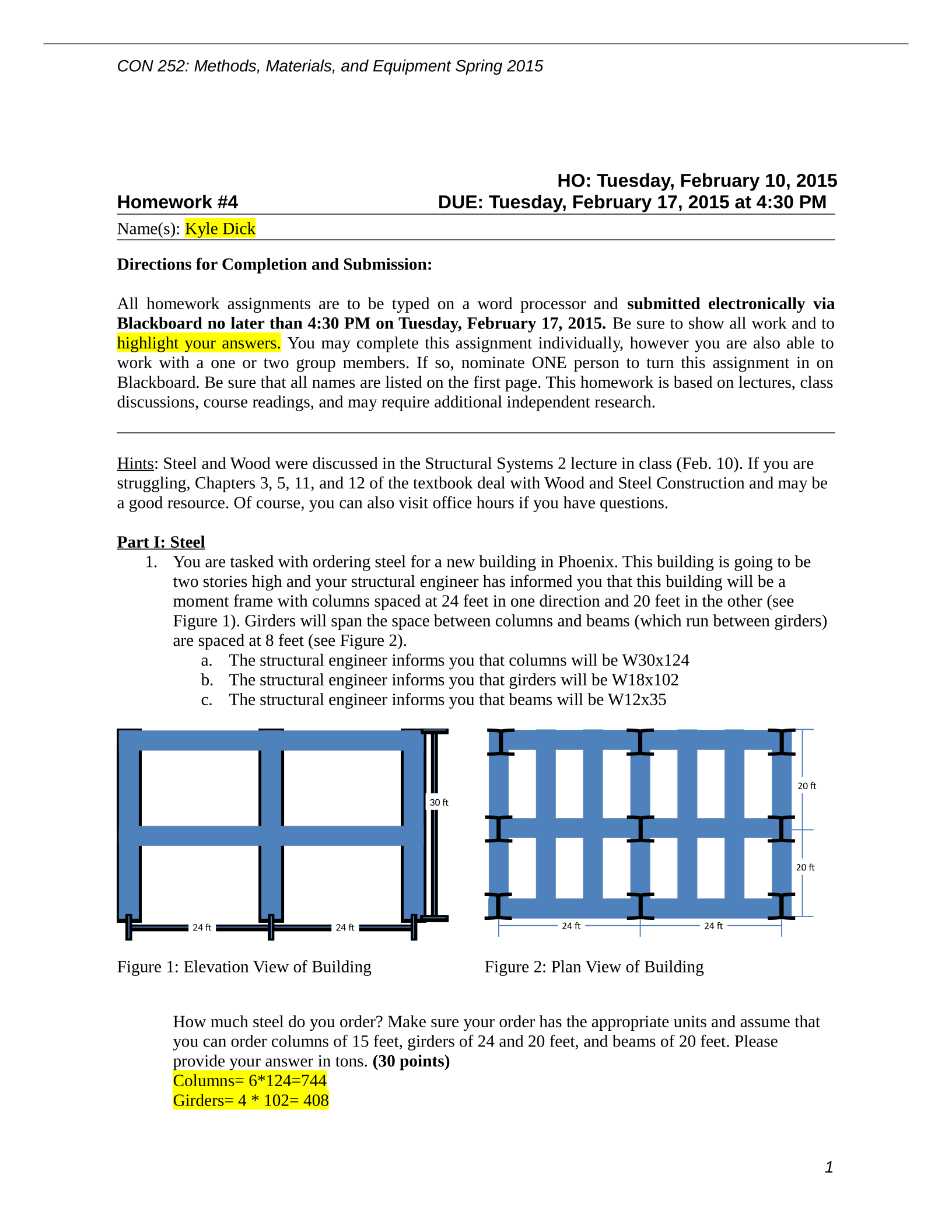
1. You are tasked with ordering steel for a new building in Phoenix. This building is going to be
two stories high and your structural engineer has informed you that this building will be a
moment frame with columns spaced at 24 feet in one direction and 20 feet in the other (see
Figure 1). Girders will span the space between columns and beams (which run between girders)
are spaced at 8 feet (see Figure 2).
a. The structural engineer informs you that columns will be W30x124
b. The structural engineer informs you that girders will be W18x102
c. The structural engineer informs you that beams will be W12x35
24 24
30
Figure 1: Elevation View of Building Figure 2: Plan View of Building
How much steel do you order? Make sure your order has the appropriate units and assume that
you can order columns of 15 feet, girders of 24 and 20 feet, and beams of 20 feet. Please
provide your answer in tons. (30 points)
Columns= 6*124=744
Girders= 4 * 102= 408
1
Structural Systems 2 – Steel and Wood
CON 252: Methods, Materials, and Equipment Spring 2015
Beams= 14 * 35 = 490
744+408+490= 1642 Therefore .821 tons of steel
2. Considering Figures 1 and 2, do the sizes the structural engineer specified make sense? Why or
why not? (5 points)
No, the beam dimensions do not make sense. The beam dimensions should be 15 feet each
instead of 20 feet. This would make for a complete structure. The one now does not connect.
3. Fireproofing- Steel Structures
a. What does SFRM stand for? What does this consist of, and how is it used? (5 points)
SFRM stands for sprayed fire resistant materials. “They are predominantly cementitious
or mineral-fiber-based, with the fire-resistive qualities and physical characteristics
varying widely between the respective types”
(http://www.constructionspecifier.com/sprayed-fire-resistive-materials-bond-strength-
and-the-ibc/). It is used to create a fire resistant barrier on objects that otherwise would
not have been fire resistant.
b. Though building fires are not hot enough to melt steel, why is fireproofing still needed?
(3 points)
Fireproofing is useful for a few reasons even though it will fail in hot enough fires. The
first reason it is used is to contain small fires. If a small microwave fire or office fire
takes place, it can easily be contained to one room. The next reason is that during a
building fire, fireproofed material will slow down the progression of the fire allowing
the fire department to have time to hopefully get to and put out the fire.
4. Explain, in your own words, how a space truss enables longer spans than traditional steel joists.
(5 points)
Space trusses utilize something many of us used long ago, trigonometry and physics. By using
repeating geometric shapes, these long space trusses have the ability to spread out a large weight
without the help from any outside reinforcing structure.
5. Welding and Bolting
a. Why do we weld or bolt steel members together? (1 point)
Too mold two separate steel structures together and create one load bearing piece of
metal.
b. What is the difference between a fillet and a penetration weld? (1 point)
Fillet welds connect two separate pieces together with an overlapping metal piece that
creates a triangle look at the weld. Penetration welds do the opposite of fillet welds,
they drive into, or penetrate the metal to join to two pieces together.
c. Why are load indicator washers beneficial? (1 point)
Without load indicator washers it is hard to tell when the bolts are properly fastened.
With these washers, you can be sure that each bolt is tightened to the recommended
torch.
d. Is bolting more expensive than welding? (1 point) Why or why not? (1 point)
Bolting is cheaper. You don’t need to pay as much for the labor, or extra materials
associated with welding.
Part II: Wood
6. What is the major difference between a balloon frame and a platform frame? (5 points)
2
CON 252: Methods, Materials, and Equipment Spring 2015
Balloon is one of the earlier methods of building framing. It involves a continuous wood frame
conducted around studs which run from the top to the bottom of a building. Platform framing
involves around the same process, except it is connected to the foundation instead of the studs.
7. Use the table below to list at least five types of fasteners, as well as a one-sentence description
of an application for each. (10 points)
Fastener Application
1. Nails Sharp metal pieces hammered into wood.
2. screw & bolts A bolt is drilled into the wood, and then is secured from the
other side by a bolt.
3. Adhesives Works as a glue bonding the wood to each other.
4. Tooth Plated sheet metal
framing devices
Metal piece with teeth that catch both pieces of wood and
holds them together.
5. I-Joints Joints in the shape on an I, that allows a separate piece of
wood to slide into it and secure it.
8. What are the two types of failures associated with wood fasteners? (2 points)
Wood failure, and device failure.
9. Assume you are residential contractor who has just been hired to build a neighborhood housing
development in the Valley.
a. Would you favor solid wood or structural composite lumber? (5 points)
Structural Composite Lumber
b. Why? (5 points)
Structural composite lumber can be inherently stronger and can be crafted to have more
versatile uses than plain solid wood alone. Solid wood may have imperfections in it, but
with composite lumber any imperfections will be compensated for by the other pieces of
wood.
c. Would you opt for a balloon frame or a platform frame? (5 points)
Platform Frame
d. Discuss why you made the selection you did for part (c) in terms of time, safety, and
cost. (15 points)
Platform framing is the best form of framing out there when the other choice is balloon
framing. Balloon framing is older and less safe than the newer platform framing.
Platform farming is the most economical, and safest form; however, it is more easily
susceptible to fire damage. This is a small risk when considering all that can be done to
mitigate fires.
3
Powered by TCPDF (www.tcpdf.org)

