


THEORETICAL FRAMEWORK
The Perceived Social Media Literacy Theory
Besides drawing on the previously-mentioned comparative papers regarding the
theoretical framework, this study is mainly based on the Perceived Social Media
Literacy (PSML) theoretical framework (Tandoc, et al., 2021). It addresses a number
of divergent concepts related to social media literacy. It identifies “four types of
competencies in which social media literacy can manifest: technical, social, privacy
related, and informational.”
To elaborate, the theory first addresses the basic technical competence measuring
users’ skills to maneuver on social media platforms such as creating an account,
posting content, and customizing what data an application can collect. Second, the
digital interactions aspect refers to social media users' knowledge of how to properly
handle a conflict on social media networking sites and apps as well as how to report
content that might violate the platform’s conditions and terms. Additionally, being
knowledgeable of what is acceptable and what is not acceptable regarding posting
others’ photos and information in addition to drawing a line between freedom of
expression and offensive language. Third, informational awareness which refers to
users’ degree of reliance on social media platforms as a source of information. It also
alludes to users’ consciousness of the required tools to look up for information and
identify the reliability of news posted on social media through various sources
(Tandoc, et al., 2021, p.9). Fourth, privacy and algorithmic awareness which
comprises users’ consciousness of social media platforms terms and conditions to
avoid committing violations and set forth clear guidelines for clients to grasp their
duties and rights. The privacy structure aspect also includes being conscious of how
to prevent hacking practices including different tools and software attacks and IP

tracking, as well as how to block/reduce the appearance of intrusive ads on users’
accounts (Tandoc, et al., 2021, p.8).
The thesis aimed to address the following research questions:
RQ1: Does gender difference affect the awareness level of social media literacy
among students enrolled at public universities located in urban and center-periphery
areas?
RQ2: Do students enrolled at public universities located in urban areas have higher
awareness levels of social media literacy compared to students enrolled at public
universities located in center-periphery areas?

METHODOLOGY
Design
The data collection method used in the current study is survey. Historically, large-
scale population-based data gathering has been a component of survey research. This
kind of survey research's main goal was to efficiently glean data on the features of a
wide sample of interesting people. Large census surveys that gather data on
demographic and personal factors is one of the most prominent examples; survey
research has been employed for many years to gather information from people and
groups. It can involve anything from casually approaching people on the street corner
and asking a few pointed questions about their opinions and behaviors to doing a
more thorough investigation using a number of trustworthy and credible tools (Ponto,
2015).
The current study was conducted by qualitative method. Besides the four screening
questions at the beginning of the questionnaire, it consisted of 24 closed-ended, Likert
scale statements.
The questionnaire employed in this study was inspired by the PSML theoretical
framework (Tandoc, et al., 2021).
Participant Sampling
This study relies on an exploratory survey using a purposive random sampling of
undergraduate students enrolled at four different public universities in Egypt. Two
universities are located in the capital city Cairo, namely Cairo University and Ain
Shams University, representing urban areas. The other two universities are located in
center-periphery areas. Mansoura University represents the Nile Delta and Minia
University represents Upper Egypt.

Public universities’ students were selected as a sample for this study because they
represent the majority of higher education students in Egypt. According to a report
released by the Central Agency for Public Mobilization and Statistics (CAPMAS), 2.5
million students were enrolled at public universities, representing 71.8 percent of total
students enrolled in higher education during the academic year 2020/2021. The
sample size was 520 of which 265 males and 255 females. Students targeted to take
the survey were of different class standing (freshman, sophomore, junior, and senior)
and different majors.
The purpose of the study was to gauge the impact of gender difference and geographic
location on social media literacy levels among undergraduate students enrolled at
public universities located in urban and center-periphery areas. The chosen
quantitative methodology is, hence, suitable for the study nature since its purpose is to
highlight the current situation on university-level media literacy in Egypt.
The study has one dependent variable which is the social media literacy level of
students at public universities. The two independent variables are
1) Gender difference: male students and female students.
2) Geographical location: urban and center-periphery areas.
Data Collection and Analysis
The questionnaire was administered in Arabic. The approvals of the Institutional
Review Board and CAMPAS were obtained to carry out the survey. The subjects are
not anonymous but confidential to protect their identity. Participation in this study
was voluntary and consent was given from the respondents. After obtaining the
approval of the Graduate Affairs Director, the data was collected by an assistant
researcher only at Mansoura and Minia Universities to facilitate access to students at

public universities in center-periphery areas. I accompanied the assistant researcher to
ensure that the consent forms were signed beforehand and clarify the survey
questions, if needed. The collected data were analyzed and presented by using cross
tabulation, MS Excel, and SPSS software.
Operational Definitions
Social media literacy: the development of critical thinking based on the
competence to evaluate the intention, meaning, and authenticity of the images and
content in general on social networking sites (Polanco-Levican & Salvo-Garrido,
2022).
Technical competence: the basis of knowledge, competences and capabilities in
technology (Kosimov et al., 2021).
Digital interactions: possibility to communicate with other Internet users of
remote digital networks (Patricia et al., 2021).
Digital information evaluation: verifying the quality of information comprises
students' capacity to determine accuracy, relevance, and credibility of sources
(Parsazadeh et al., 2015).
Privacy and security awareness: controlling whether and how personal
information can be gathered, stored, processed, and circulated (Zhang et al., 2021).
CHAPTER V
FINDINGS AND ANALYSIS

Survey Respondent Demographics
A total of 520 participants answered the first half of the questionnaire about gender
difference. They were divided into 265 males and 255 females studying at center-
periphery and urban universities. Concerning the second half of the questionnaire
about the comparison between students’ social media literacy level in urban and
center-periphery areas, the same number of students (520) were divided as follows:
130 students at Cairo university, and 130 students at Ain Shams University
representing the urban university students. Meanwhile, 128 students at Mansoura
University represented the delta and 132 students at Minia University represented
Upper Egypt. Respondents’ ages ranged between 18 and 24 years representing all
undergraduate students. The survey was split into four categories. The first set of
questions focused on ascertaining the technical competencies of males and females at
university level. They were asked questions about the basic skills required to navigate
social networks and managing the content they share with their network on various
platforms.
Table 1
Technical competency: How good are you at performing the following activities
Creating your account on
social media
Male
Female
n
%
%
Poor
71
15.5%
11.8%
Average
128
20.8%
28.6%
Good
146
22.3%
34.1%
Excellent
175
41.5%
25.5%
Total
520
100.0%
100.0%
Deactivating your account
on social media
Poor
80
15.1%
15.7%
Average
131
21.9%
28.6%
Good
149
24.5%
32.9%
Excellent
160
38.5%
22.7%
Total
520
100.0%
100.0%
Deleting your account on
social media
Poor
129
30.2%
19.2%
Average
133
21.1%
30.2%
Good
116
17.7%
27.1%
Excellent
142
30.9%
23.5%
Total
520
100.0%
100.0%
Posting content, such as
photos and videos on social
media
Poor
27
5.3%
5.1%
Average
113
20.0%
23.5%
Good
185
33.2%
38.0%
Excellent
195
41.5%
33.3%
Total
520
100.0%
100.0%
Removing content from
timeline on social media
Poor
100
21.9%
16.5%
Average
142
23.0%
31.8%
Good
141
24.2%
30.2%
Excellent
137
30.9%
21.6%
Total
520
100.0%
100.0%
As table 1 details, male students were more efficient than female students in technical
competencies. Regarding males, the highest percentage (41.5%) of answers to the five
questions falling under this area of skill was “excellent”. On the other hand, the
results suggested that the highest percentage of answers was “good” (34.1%),
followed by “average” (28.6%) when it comes to female students.
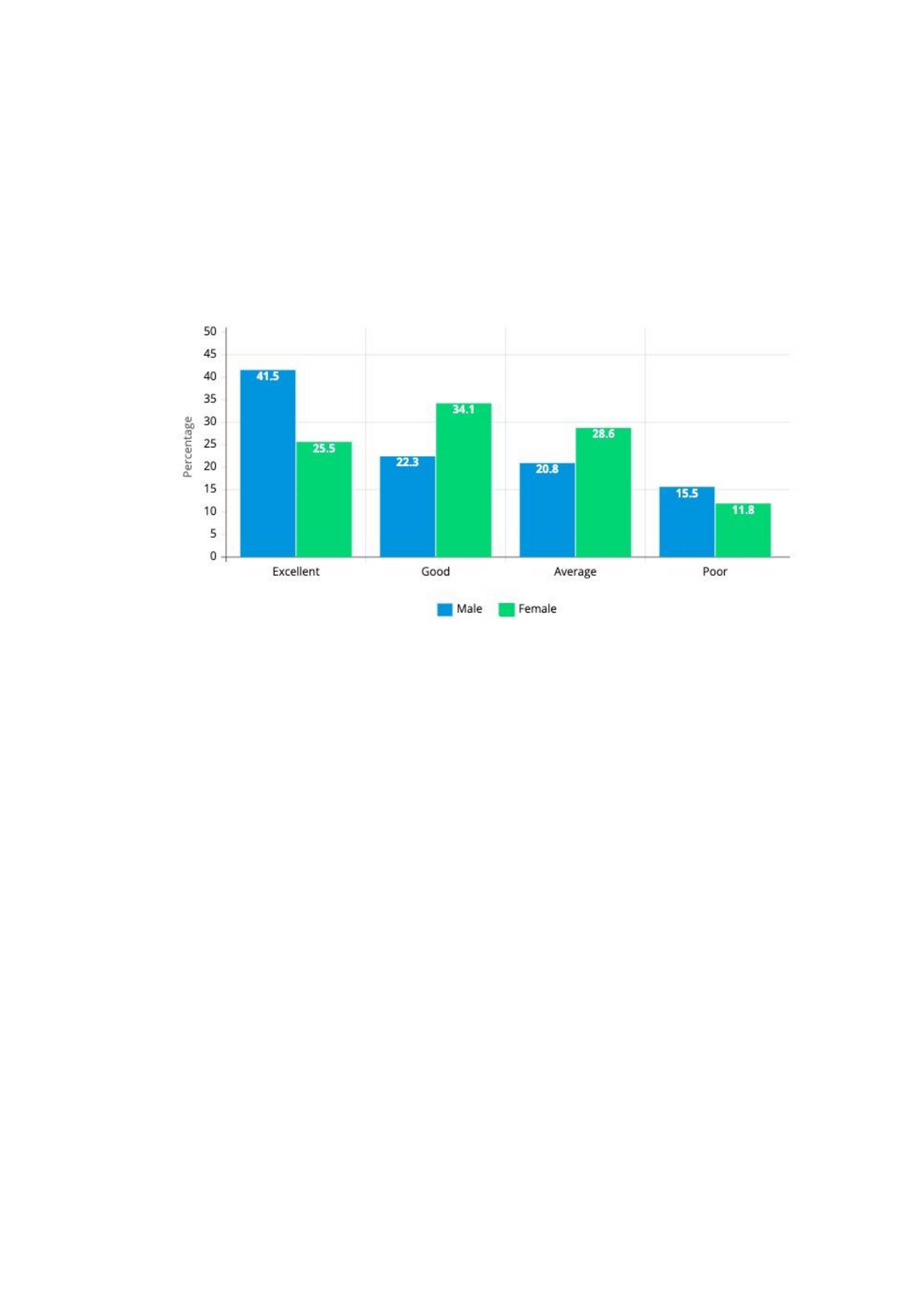
Figure 2
How good are you at creating an account on social media?
41.5% of males perceived themselves as “excellent” at creating an account on social
media compared to only 25.5 % of females who selected the same answer, as figure 1
shows. Additionally, the results demonstrated that there was a gender difference
regarding their capability in deactivating their social media accounts, with over a third
of male students (38.5%) and 22.7% answered reported being “excellent” in doing
this. The same goes for the statement measuring the student's capability of deleting
content on timeline. 30.9% of male respondents demonstrated “excellent” capability
which indicated a larger percentage than female respondents who represented 21.6%
in the same quality level. For the latter, the highest percentage was 31.8%, displaying
an “average” competence.
Table 2
Digital interactions: What is the level of your social awareness?

I am aware of the copyright
laws of social media.
Male
Female
n
%
%
No knowledge
44
7.9%
9.0%
Minimal Knowledge
67
9.1%
16.9%
Basic knowledge
72
14.3%
13.3%
Adequate knowledge
228
41.5%
46.3%
Superior knowledge
109
27.2%
14.5%
Total
520
100.0%
100.0%
I am aware of how to draw
a line between
objectionable content and
freedom of expression on
social media.
No knowledge
42
8.7%
7.5%
Minimal Knowledge
56
5.3%
16.5%
Basic knowledge
78
15.8%
14.1%
Adequate knowledge
238
42.3%
49.4%
Superior knowledge
106
27.9%
12.5%
Total
520
100.0%
100.0%
I am aware of how to
properly handle conflicts on
social media.
No knowledge
44
8.3%
8.6%
Minimal Knowledge
65
7.9%
17.3%
Basic knowledge
61
10.9%
12.5%
Adequate knowledge
224
40.4%
45.9%
Superior knowledge
126
32.5%
15.7%
Total
520
100.0%
100.0%
I am aware of how to filter
my social media network,
such as restrict, mute,
unfollow/unfriend or block
a contact.
No knowledge
32
6.0%
6.3%

Minimal Knowledge
58
6.8%
15.7%
Basic knowledge
41
6.4%
9.4%
Adequate knowledge
205
35.8%
43.1%
Superior knowledge
184
44.9%
25.5%
Total
520
100.0%
100.0%
I am aware of how to report
harmful content such as
harassment, abuse,
impersonation, etc.
No knowledge
35
6.4%
7.1%
Minimal Knowledge
47
4.9%
13.3%
Basic knowledge
57
8.7%
13.3%
Adequate knowledge
192
35.8%
38.0%
Superior knowledge
189
44.2%
28.2%
Total
520
100.0%
100.0%
Most users only post
positive information about
themselves.
Strongly disagree
34
5.3%
7.8%
Disagree
53
6.8%
13.7%
Neither agree nor disagree
76
11.7%
17.6%
Agree
198
37.4%
38.8%
Strongly agree
159
38.9%
22.0%
Total
520
100.0%
100.0%
I take into consideration
who I add to my social
media network.
Strongly disagree
55
13.2%
7.8%
Disagree
57
10.6%
11.4%
Neither agree nor disagree
155
26.8%
32.9%
Agree
142
26.0%
28.6%
Strongly agree
111
23.4%
19.2%
Total
520
100.0%
100.0%
The second set of questions looked into the students’ level of digital communication
skills, touching upon several areas social relationships-related. The results analysis

demonstrated a minor difference between both gender groups in favor of males in
establishing and maintaining connections with others on social networking websites.
In some questions, a significant number of both genders proved the same level of
knowledge regarding the copyright laws governing social media platforms. In other
words, the largest percentage of both females (46.3%) and males (41.5%) displayed
“adequate knowledge”. Similarly, females had almost the same awareness of males
when it came to handling disputes as well as distinguishing between objectionable
content and freedom of expression on social media.
When asked if they know how to take action against any distressing content and
unwanted online contacts, the results found that male students were slightly skillful
than their female counterparts. 44.9% of males believed that they had “superior
knowledge” of how to filter or limit their social media network whereas 43.1% of
females selected “adequate knowledge”.
A similar pattern of results was obtained in terms of reporting harmful content, such
as harassing messages and violating posts, showing that 38.9% of males chose
“superior knowledge” and 38.8% selected “adequate knowledge”. Furthermore,
around 38.9% of male participants “strongly agreed” that most users pursue only a
positive image about themselves on social media. 38.8% of female participants, on
the other hand, “agreed” to that statement. To sum it up, the analysis showed that
“adequate knowledge” and “superior knowledge” interchangeably had the higher
percentage of responses from both genders. As previously illustrated in detail, male
respondents were slightly more conversant than female respondents with handling
digital social relationships on social networking services.
Table 3
Digital Information verification
I get the news from social
media.
Male
Female
n
%
%
Always
112
24.2%
18.8%
Frequently
220
39.6%
45.1%
Sometimes
104
19.6%
20.4%
Seldom
71
12.8%
14.5%
Never
13
3.8%
1.2%
Total
520
100.0%
100.0%
I know how to do an
effective search for
information on social
media.
No knowledge
66
7.2%
18.4%
Minimal Knowledge
97
15.1%
22.4%
Basic knowledge
97
18.9%
18.4%
Adequate knowledge
151
30.6%
27.5%
Superior knowledge
109
28.3%
13.3%
Total
520
100.0%
100.0%
I can tell whether
information on social media
is true or false.
Strongly disagree
34
3.4%
9.8%
Disagree
24
4.5%
4.7%
Neither agree nor disagree
167
26.0%
38.4%
Agree
177
35.5%
32.5%
Strongly agree
118
30.6%
14.5%
Total
520
100.0%
100.0%
I get news from sources that
have different views than
mine.

Always
96
24.9%
11.8%
Frequently
241
41.5%
51.4%
Sometimes
85
14.0%
18.8%
Seldom
70
13.2%
13.7%
Never
28
6.4%
4.3%
Total
520
100.0%
100.0%
I verify whether what is
shared on social media is
correct.
Always
122
32.1%
14.5%
Frequently
234
35.8%
54.5%
Sometimes
83
15.8%
16.1%
Seldom
55
9.4%
11.8%
Never
26
6.8%
3.1%
Total
520
100.0%
100.0%
I know how to verify the
accuracy of information on
social media via different
tools.
No knowledge
76
7.9%
21.6%
Minimal Knowledge
93
15.8%
20.0%
Basic knowledge
90
16.2%
18.4%
Adequate knowledge
138
30.9%
22.0%
Superior knowledge
123
29.1%
18.0%
Total
520
100.0%
100.0%
The third set of questions measured students’ knowledge, attitudes and behavior
toward social media information consumption. It is noteworthy that there is a lack of
consistency among both genders’ answers with respect to the level of information
awareness. Therefore, the median of all questions falling under the information
awareness section was calculated to assure the reliability of the analysis. The results
revealed that females give more attention to verifying the accuracy of information on
social media more than males, with the median score of the former was “always” (48)
and the latter was “sometimes” (52).

Contradictorily, another question addressing the frequency of following up the news
from sources with different views, suggested that males had a higher awareness than
females; where the median score (37) of males was “sometimes” while females’
median score (35) was “seldom”. When asked about their capacity of doing an
effective search for information on social media, the median scores of both males (50)
and females (47) clearly indicated having a similar level of awareness which was
“adequate”.
Based on the above, no gender proved superiority over the other in most questions.
And though it seems that both genders displayed an acceptable level of critical
thinking, there is a necessity to be well up on learning essential tools to authenticate
information online as well as exploring different channels of media news to broaden
their perspectives.
Table 4
Digital privacy and security awareness
I am aware of how to control
who gets to see my personal
information on social media.
Male
Female
n
%
%
No knowledge
81
7.2%
24.3%
Minimal Knowledge
82
13.2%
18.4%
Basic knowledge
77
16.6%
12.9%
Adequate knowledge
122
24.2%
22.7%
Superior knowledge
158
38.9%
21.6%
Total
520
100.0%
100.0%
I am aware of how to control
who gets to see the content I
post on social media.
No knowledge
100
10.6%
28.2%

Minimal Knowledge
58
10.9%
11.4%
Basic knowledge
89
16.6%
17.6%
Adequate knowledge
117
24.9%
20.0%
Superior knowledge
156
37.0%
22.7%
Total
520
100.0%
100.0%
I am aware of how to protect
my account from hacking
tools.
No knowledge
252
42.6%
54.5%
Minimal Knowledge
86
18.5%
14.5%
Basic knowledge
69
13.6%
12.9%
Adequate knowledge
77
15.5%
14.1%
Superior knowledge
36
9.8%
3.9%
Total
520
100.0%
100.0%
I am aware of how social
media uses personal data to
generate revenues from ads.
No knowledge
270
47.5%
56.5%
Minimal Knowledge
90
19.2%
15.3%
Basic knowledge
57
9.4%
12.5%
Adequate knowledge
45
9.1%
8.2%
Superior knowledge
58
14.7%
7.5%
Total
520
100.0%
100.0%
I am aware of how to hide
my IP address (unique
address that identifies a
device on the Internet).
No knowledge
309
49.4%
69.8%
Minimal Knowledge
83
17.7%
14.1%
Basic knowledge
49
11.3%
7.5%
Adequate knowledge
52
14.0%
5.9%
Superior knowledge
27
7.5%
2.7%
Total
520
100.0%
100.0%

I am aware of how to
block/reduce unsolicited
content, such as intrusive
ads, violent and explicit
posts
No knowledge
300
53.6%
62.0%
Minimal Knowledge
82
17.4%
14.1%
Basic knowledge
40
7.2%
8.2%
Adequate knowledge
51
9.4%
10.2%
Superior knowledge
47
12.5%
5.5%
Total
520
100.0%
100.0%
The fourth set of questions scrutinized the undergraduate students’ knowledge of
social media terms and conditions which delineate guidelines for users to comprehend
their rights and responsibilities alike. The questions also examined students’
awareness of the substantial yet simple steps to keep their data safe and their
comprehension of social media algorithms.
As table 4 depicts, generally, both male and female students reported a significant low
awareness of how to tighten up data security. Nevertheless, males showed, to some
extent, that they are more knowledgeable than females. The results revealed that
56.5% of females and 47.5% of males responded “no knowledge” to a question
asking whether they are acquainted with the fact that social media generate much of
their revenues through selling targeted advertising based on algorithmical mining.
When asked if they are familiar with controlling who gets to see their personal
information on social media, 28.2% of females in comparison to only 10.6% males
admitted that they have no knowledge of doing so.
Figure 3
I am aware of how to hide IP address.
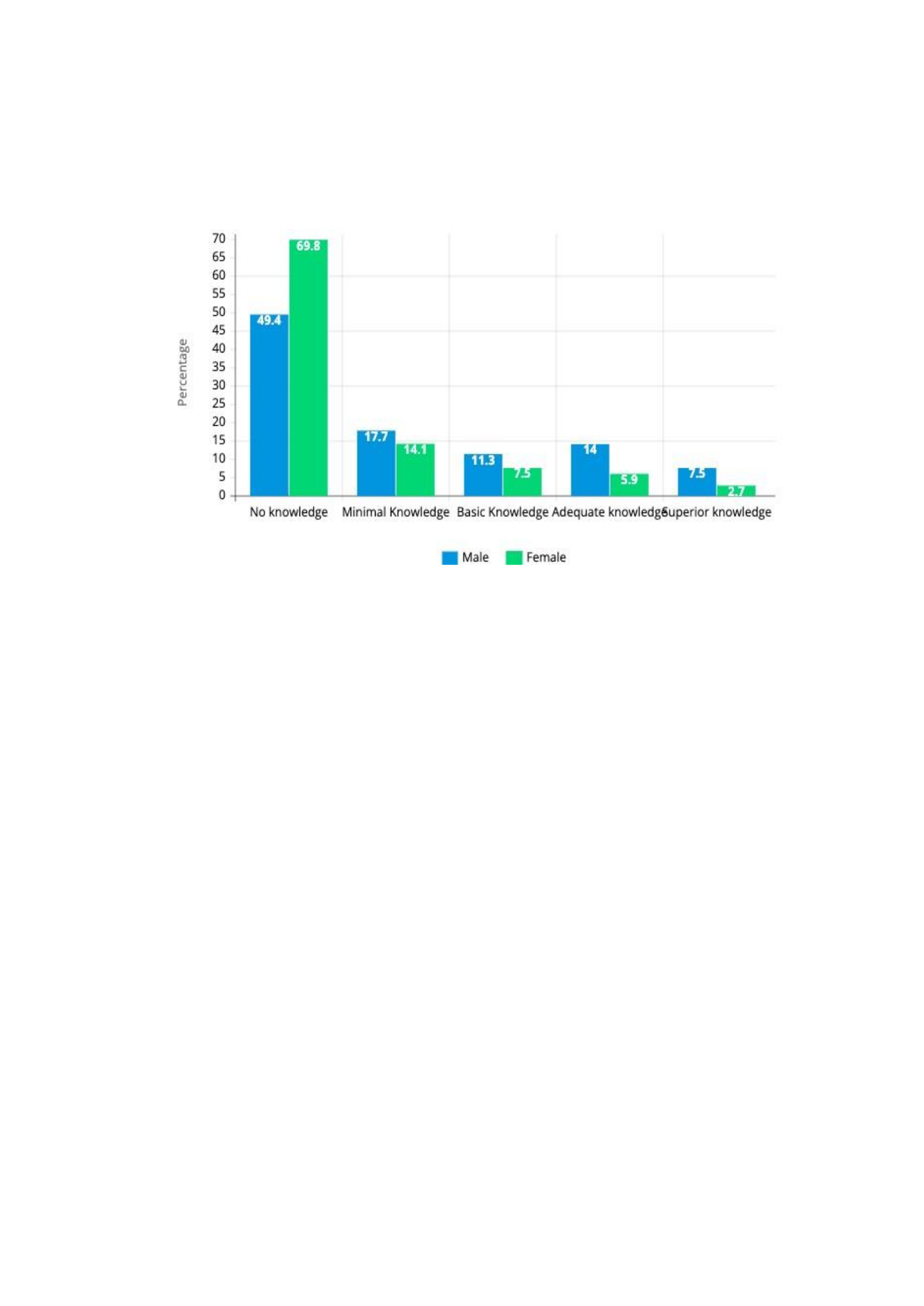
Percentage
&
ReRs
20
15
10
_
No
knowledge
Minimal
Knowledge
Basic
Knowledge
Adequate
knowledgSuperior
knowledge
Hi
Male
Mil
Female

