


INTRODUCTION Transparency is an emerging topic
Transparency is an emerging topic in academic and popular literature and our society in
general. It is often shared as a solution for leader and organizational problems, such as
corruption, ethical lapses, accountability, and improved compliance with legal requirements (de
Fine & Naurin, 2022; Essandoh et al., 2017; Estlund, 2011; Parris et al., 2016; Pozen, 2020). In
the organizational setting, the perception of transparency by stakeholders is associated with
positive organizational outcomes, such as increased trust, engagement, and performance
(Alessandro et al., 2021; Shamir & Yehezkel, 2023; Vogelgesang & Lester, 2009). Stakeholders
include those internal to the organization, such as leaders and followers, and those external to the
organization, such as society and the greater public (Essandoh et al., 2017).
Schnackenberg and Tomlinson (2016) define transparency as “the perceived value of
intentionally shared information from a sender” (p. 1788). Transparency is typically seen as a
critical element of knowledge sharing such that its increased presence can result in improved
awareness, coherence, and comprehensibility of information shared between two or more parties
(Pagano & Roell, 1996). It also is often cited as essential to the trust that stakeholders place in
organizations, although a clear understanding of the meaning and importance of transparency has
yet to emerge in the leadership literature (Schnackenberg & Tomlinson, 2016).
Interest in transparency has risen due to distrust of corporations, social media visibility,
and the increased availability of information (Alton, 2017; Garcia-Sanchez et al., 2020; Kavakli,
2021). It is important to consumers and employees alike. If a company shows that it has nothing
to hide and can help consumers make better purchasing decisions, it likely will be chosen over a
competitor that keeps its information secret. Most businesses have at least one social media
profile, with nearly 90% of companies now using social media marketing to engage with their

customers (Alton, 2017), a world that is always active and available to most consumers. In the
information age, consumers have grown accustomed to having information immediately
available to them, and those expectations put pressure on businesses to provide as much
information as possible, as openly as possible, to help avoid consumer suspicions.
Measuring transparency, which is a critical part of empirically revealing its instrumental
value as well as the construct’s multidimensionality, has proven to be extremely elusive
(Bernstein, 2017). As interest in transparency has risen, so have the number of empirical studies
that have adopted various measures in areas such as corporate ethics and government
transparency (Alessandro et al., 2021; Grimmelikhuijsen et al., 2021; Kim & Lee, 2012), and
they have advanced knowledge of the construct in many fundamental ways (Schnackenberg et
al., 2020). However, transparency measures have been developed in the absence of consideration
of the potentially multiple dimensions of the construct, typically because existing scales of
measurement were developed before studies that address theoretical dimensions and boundary
conditions of transparency. Integrity, respect for others, and openness (Rawlins, 2009), as well as
the frequency of information disclosure (Albu & Flyverbom, 2019) and organizational
communication (Kim, 2009), are examples of measures used for transparency.
The concept of transparent leadership is also not well understood, yet it is starting to gain
the attention of the popular press and scholars (Healy & Serafeim, 2019; Hong & Ji, 2022).
Research in leadership studies suggests that transparent leadership behavior includes the sharing
of relevant information with employees, being open to giving and receiving feedback, and being
forthright about motives and reasons behind decisions (Ji & Hong, 2022; Vogelgesang & Lester,
2009; Yi et al., 2017). Further, authentic leadership is a number of leader behaviors that advance
positive psychological capacities and a positive ethical climate to encourage the four dimensions

of greater self-awareness, an internalized moral perspective, balanced processing of information,
and relational transparency (Gardner et al., 2005; Jiang & Men, 2017; Walumbwa et al., 2008).
Authentic leadership’s dimension of relational transparency emphasizes that trust is achieved
through a leader’s self-disclosure, information sharing, and self-expression. For instance, leaders
can build the foundation of a trusting relationship with followers by sharing timely information
on the latest internal developments for an organizational restructure or how and why decisions
were made on selecting a recent marketing initiative. Leadership communication literature
suggests that leaders should be transparent when communicating their opinions in order to be
perceived as genuine (Yim, 2019). Leader transparency can also help build up a reservoir of
goodwill that can help them successfully navigate through more challenging times (Clark, 2012).
Yet, even with all the potential benefits of transparency, it is essential that all stakeholders
consider and understand the possible implications of greater transparency to mitigate any risks
and ensure that the benefits outweigh the costs (Granados & Gupta, 2013).
Especially in today’s business environment, it is time for transparency to take center
stage. In light of corporate scandals such as the collapse of Enron, Volkswagen’s manipulation of
emission tests, and Wells Fargo’s creation of fraudulent client accounts, as well as leaks and
whistleblowing incidents like the Snowden and WikiLeaks cases, increased transparency in
business is needed to meet the demands of critical stakeholders for increased openness in
corporate and governmental affairs (Albu & Flyverbom, 2019; Healy & Serafim, 2019).
Although some time has passed since Vogelgesang and Lester (2009) made the following
statement, their viewpoint still appears to be very relevant: “For all its topical interest,
transparency has yet to be operationalized by a specific set of behaviors that can easily be
applied to leader development” (p. 252).

Problem Addressed
Many of today’s business leaders lack transparency in their everyday dealings with
customers, employees, board members, and other stakeholders (Alton, 2017; Kaplan, 2018;
Lavoie, 2015; Prieto-Rodriguez & Vecco, 2021; Vogelgesang & Lester, 2009). A lack of
transparency can result in frequent absenteeism, higher turnover, and increased dissatisfaction
(Vogelgesang & Lester, 2009). For example, the improper disclosure by Boeing leadership to
regulators and other stakeholders that contributed to deadly commercial airline crashes in 2018
and 2019 and the deaths of over 300 people (Gelles, 2019) illustrates the potentially devastating
consequences when there is a lack of transparency. Trust in the leader, role engagement,
creativity and innovation, increased performance, and a reduction in deviant behavior are some
of the follower outcomes that can be anticipated with the presence of transparent leadership
(Albu & Flyverbom, 2019; Vogelgesang & Lester, 2009). If we know that transparency is
important, why does leading transparently appear to be so challenging? Admittedly, leaders face
many obstacles in being transparent, particularly regarding proprietary information, legal issues,
or keeping outside influences from interfering with work. The current workplace environment, as
well as evolving follower needs, demands that leaders place a stronger emphasis on transparency
in their daily interactions with followers, the disclosure of information with stakeholders, and
organizational decision-making (Schroth, 2019).
Current megatrends impacting organizations in the areas of human and technology
development further underscore the current and future need for transparency in leadership. The
continued improvement of communication technology and the emergence of remote work
arrangements for employees can reasonably be expected to significantly impact all organizations
and leader-follower relationships (Carsten et al., 2022; Norman et al., 2020). These changes

leave the question of how they will impact leader and employee relationships and what
leadership strategy will be the most effective moving forward (Galanti et al., 2021; Sull et al.,
2020). The rapid improvement of technology to provide robust and reliable meeting solutions for
remote team collaboration and communication (e.g., Zoom, Microsoft Teams) appears to have
impacted the frequency and the actual need for in-person meetings (Bernstein et al., 2020;
Morrison, 2021; Reed & Allen, 2021). Before the recent fundamental transitions to the nature of
work and organizations, the quality and frequency of information sharing at higher levels of the
organization have been facilitated by the shorter physical distances between leaders and
employees. The increased emergence of effective meeting solutions raises the question of
whether that frequency of communication will continue to be the case and how leader-follower
relationships must evolve to reflect shared values around transparency.
The COVID-19 pandemic quickly moved a large number of employees out of the office
to a remote working environment, creating what is believed to be a new dynamic between leader
and employee (Brynjolfsson et al., 2020; Dubey & Tripathi, 2020; Galanti et al., 2021). The swift
and sudden change in the work environment for employees moving from a traditional office
environment to working remotely has been unprecedented in our lifetime. As such, leaders and
their teams have had to behave differently to make the transition successfully. From social
distancing, restrictions in movement, and increased dependence on new technology to do our
work, our personal and working environments have rapidly changed (Berdejo-Espinola et al.,
2021; Galanti et al., 2021; Gibson, 2020). Accordingly, leaders must continue to adapt and
transform themselves to be effective leaders for the growing remote and hybrid workforce to
benefit from the increased employee productivity, reduced attrition, and access to a global talent
market that these arrangements have proven to deliver. This reality is despite the recent trend of

some organizations to return to traditional in-person work models due to their struggles in
fostering strong communication, collaboration, and team bonding (Tsipursky, 2023). This study
examines how leaders engaging in behaviors that cultivate transparency is associated with
leadership effectiveness and follower success.
Research Question(s)
Based on these organizational and leadership challenges, this study will address the
following research questions (a) What are the primary behaviors that comprise transparent
leadership?; (b) How does transparent leadership influence follower attitudes?; (c) How is the
relationship between transparent leadership and follower attitudes impacted by follower
role/status or place in organization?; and (d) How is the relationship between transparent
leadership and follower attitudes impacted by virtual or distributed contexts?
The primary behaviors that are believed to comprise transparent leadership have yet to be
identified in the literature, and it is expected that those behaviors may contribute to building a
foundation for a new leadership model. Determining how transparent leadership may influence
follower attitudes and associated outcomes is expected to further our understanding of the
relationship between transparent leaders and their followers. Discovering how the transparent
leader-follower relationship is impacted by the physical proximity of followers to their direct
leaders and the organizational headquarters may provide insight into how the leadership
approach for such followers might need to vary. Further, discovering how a virtual or distributed
context impacts the transparent leader-follower relationship may provide key insights into
potential change management strategies that could be used to effectively engage followers who
work remotely.

Significance of the Proposed Research
The importance of transparency has become a popular topic across many segments of our
society, including business, technology, and academic research (Albu & Flyverbom, 2019;
Leonardi & Treem, 2020; Shum et al., 2019). Transparency, or the intentional sharing of
information, is considered to be important across each of these segments for employees and
customers alike. Transparency in organizational settings can be critical for employees to help
ensure a higher level of effectiveness and for customers to more likely trust the organization
(Jain et al., 2020; Shafieizadeh & Tao, 2020). In an era in which many forms of collaboration are
facilitated by technology, the sharing or accessibility of information can be key to effective
communication and the ability to collaborate between multiple parties (Mitchell, 2021; Zhu et
al., 2023). For academic research, transparency can more readily lead to a better understanding
of organizational communication, as well as the impact of information sharing across the
organization (Jiang & Luo, 2018; Yue et al., 2019). The increased attention on transparency is a
welcome trend due to its expected benefits, but that momentum also raises a compelling question
about its connection with leadership and the dynamic relationship between leaders and followers.
Transparency may be effective when used properly to assist leaders in meeting future
challenges to their organizations, not only in non-profit healthcare but in a wide variety of
organizational contexts. When leaders more readily share information with employees, it can
communicate that they are trusted and valued by the leader and the organization (Mehta &
Mehta, 2013). In turn, when information is more readily shared, it can increase trust in the leader,
and followers are more likely to respond with higher levels of engagement, improved work
performance, and a greater willingness to remain with the organization (Jiang & Men, 2017;
Mehmood et al., 2023; Scott, 2016). Conversely, sharing information inappropriately may lead to

employee conflict, impede decision-making, breed work anxiety, and demotivate employees
(Bernstein, 2014; Morgan, 2021; Ramachandran & Flint, 2018). If managed well, transparency
can lead to a safe and smart organization built on trust and cooperation, so it is necessary to plan
for and execute transparency with the highest level of care (De Cremer, 2016).
This research intends to contribute to both leadership theory and practice by providing a
better understanding of the multidimensional nature of transparent leadership and its impact on
follower engagement and follower ratings of leadership effectiveness. Further, this study will
examine how the presence of transparent leadership can enhance leader-follower relationships,
influence follower attitudes and their perception of leaders and the organization, and how its
presence can potentially improve those relationships and follower performance. Transparency
and the existing leadership models of authentic leadership (Gardner et al., 2005; Luthans &
Avolio, 2003; Walumbwa et al., 2008; Jiang & Luo, 2018) and transformational leadership
(Groves, 2020; Gui et al., 2020; Northouse, 2021; Yue et al., 2019) are explored to better
understand how they could potentially influence leader and follower relationships. The authentic
leadership dimension of relational transparency addresses the transparency construct with its
description of the leader-follower relationship in the context of follower self-improvement but
falls short in describing the complexity and likely multidimensional nature of the construct. The
transformational leadership dimension of idealized influence somewhat addresses leader
transparency with its mention of leader communication but focuses more on the character traits
of the leader. This study is expected to contribute to leadership theories by advancing the
understanding of transparent leadership with the addition of a new model and definition.
CHAPTER 2: LITERATURE REVIEW
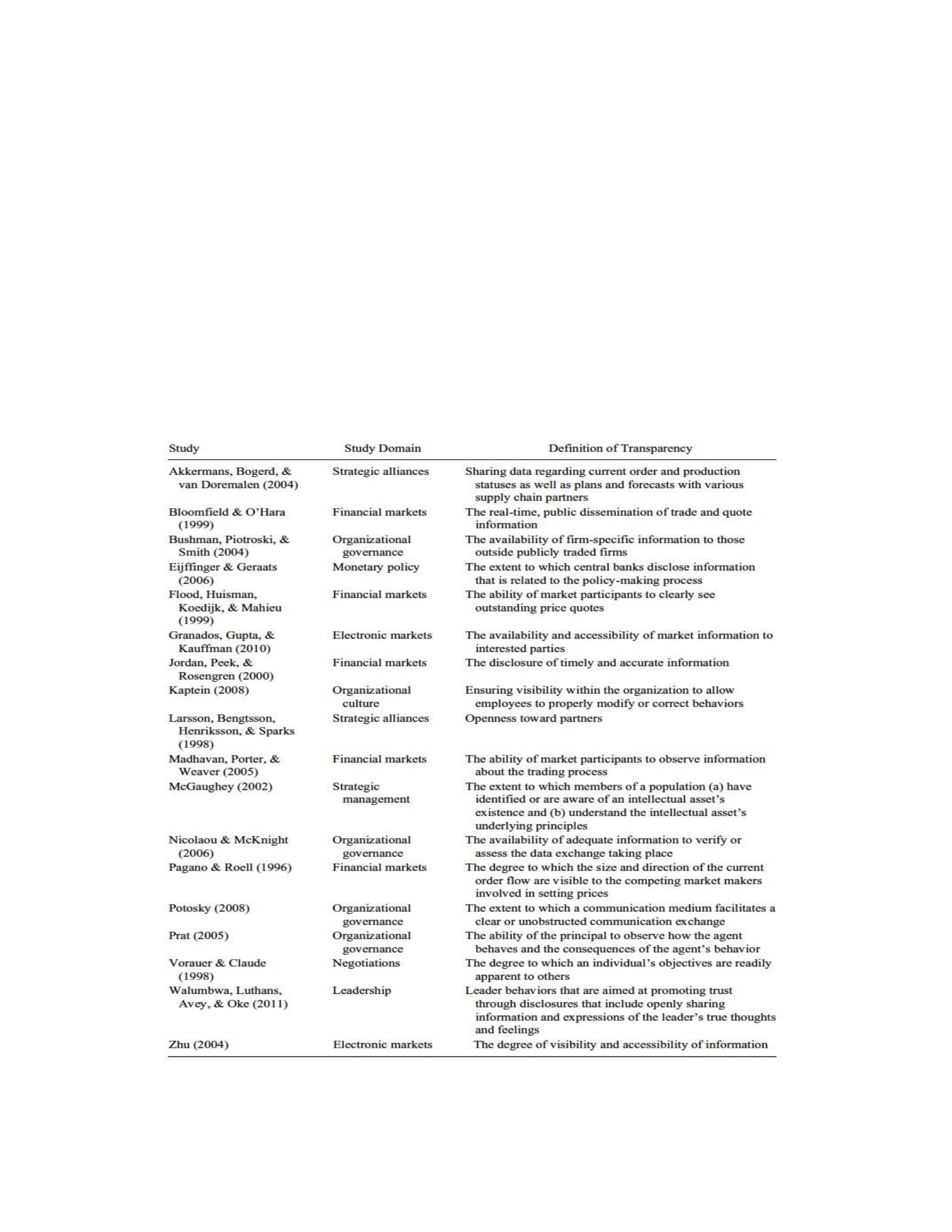
Transparency, Definition and Background
In the organizational sciences, an early reference to transparency can be traced back to
the lengthy accounts of organizational roles and social conformity in the mid-20th century (Coser,
1961). Over the years, organizational scientists have offered many definitions of the transparency
construct, depending on the study domain and or context, with varying degrees of specificity, as
listed in Table 1 (Schnackenberg & Tomlinson, 2016).
Table 1
Definitions of Transparency

These diverse applications of the concept propose that, at its core, transparency neither
exists with any single domain of research nor operates within any one context of study.
Accordingly, a useful definition of transparency must be broad enough to enable scholars from a
variety of domains to incorporate it into their study designs and be specific enough to
meaningfully inform management practice. Schnackenberg and Tomlinson’s (2016) definition of
transparency, “…the perceived value of intentionally shared information from a sender…” (p.
1788), combines a number of concepts from literature (a) the emerging consensus that
transparency is about information and, with rare exception, is seen as a critical element of
knowledge sharing; (b) most conceptualizations of transparency involve intentionally shared
information; and (c) transparency is a perception of received information, although organizations
may influence that perception through their information sharing behaviors. For the present study,
this definition of the transparency construct was selected from a vast number available across the
literature as it best matches my experiences as a practitioner and, as such, provides a solid
foundation for the planned research.
Developments in the transparency literature suggest that transparency consists of three
dimensions (a) perceived disclosure, the extent to which information is released rather than
hidden; (b) perceived clarity, the extent to which information is understandable rather than
complicated; and (c) perceived accuracy, the extent to which information is reflective of reality
rather than exaggerated or biased (Albu & Flyverbom, 2019; Ananny & Crawford, 2018;
Bernstein, 2017; Schnackenberg et al., 2020). These three dimensions are expected to help
provide insight into how the sharing of information by a leader could be valued by a follower by
better understanding the different elements of their perceptions of the communication.

Schnackenberg et al. (2020) argue that these three dimensions of transparency not only
included crucial aspects of information quality in the information quality literature (Kahn et al.,
2002; Lee et al., 2002; Miller, 1996) but also included the most important aspects of the
construct in the transparency literature. For instance, similar terms included within the dimension
of disclosure found in the transparency literature include perceived information availability,
observability, and visibility (Bernstein, 2012; Granados et al., 2010; Kaptein, 2008). Related
terms found within the dimension of clarity include perceived understandability, lucidity, and
simplicity (Bernstein, 2017; Nicolaou & McKnight, 2006). Similar terms included with the
dimension of accuracy include perceived correctness and reliability (Dubbink et al., 2008;
Fernandez-Feijoo et al., 2014). In the end, the three dimensions of transparency as described by
Schnackenberg et al. (2020) are believed to be the essential elements of transparency and were
selected for this research. With a reasonable foundation in place for the definition of
transparency, we now need to define transparent leadership.
Transparent Leadership
Vogelgesang and Lester (2009) state that leadership studies suggest that transparent
leadership includes the following behaviors (a) sharing relevant information during interactions
with followers; (b) being open to giving and receiving feedback; and (c) being forthright about
motives and reasons behind decisions. They suggest that these behaviors set the groundwork for
multiple positive follower outcomes, including follower trust in the leader, follower engagement,
and follower performance. The key factor is that the follower perceives that the leader is
transparent with such acts as just described, signifying the importance of enacting these
transparent behaviors during interactions on a consistent basis (Houser et al., 2014; Yim, 2019).

The leader-follower relationship is an ongoing process, where a strong relationship of
trust can be built over time (Day et al., 2021; Liu et al., 2021). Namely, leaders must be
intentional in their efforts to develop those key relationships long before those relationships are
tested, with every interaction, day after day. It is believed that the skills gained may be
transferable across all contexts of life, professional and personal. Transparency can be a solid
foundation upon which leaders can build trust in those relationships (Norman et al., 2010), and a
lack of it may cause relationships to crumble or not even develop at all. For instance,
organizational change can test even the strongest relationships, and if leader-follower
relationships are not developed ahead of time with the necessary trust gained, it could undermine
organizational efforts and potentially lead to failure.
There are three mechanisms that contribute to the impact transparency can have on
employees, including the understanding of motives, the reduction of vulnerability, and insight
into the leader (Vogelgesang & Lester, 2009). The idea of transparency as an indispensable
component of successful leadership stems from work on authenticity and authentic leadership
development, where transparency is regarded as one element of a broader concept (e.g.,
relational transparency). The remaining three dimensions of authentic leadership include greater
self-awareness, internalized moral perspective, and balanced processing of information (Gardner
et al., 2005; Jiang & Luo, 2018; Luthans & Avolio, 2003; Walumbwa et al., 2008). Both
practitioners and scholars have discussed the importance of leader transparency many times in
business literature (Bennis et al., 2008; Mamaril, 2021; Yi et al., 2017), yet few have actually
defined or operationalized transparent leadership behaviors or acts, or direct or indirect effects on
followers and organizations.

The terms transparent communication and transparent organizational communication are
used interchangeably in the literature (e.g., Jiang & Luo, 2018; Jiang & Men, 2017; Yue et al.,
2019), with the latter term used most often. Transparent organizational communication refers to
an overall organizational communication system or climate that emphasizes information sharing
and the role of organizational stakeholders in identifying organizational needs (Cotterrell, 2000).
Rawlins (2009) states that transparent organizational communication includes three elements,
participation, accountability, and substantial information. Participation refers to involving
stakeholders in identifying information needed to make accurate decisions. Accountability holds
organizations responsible for their behaviors and words. Substantial information involves
providing truthful, complete, and useful information. Although not explicitly addressed by
Rawlins (2009), there are presumed leadership roles across these three elements regarding
stakeholders, accountability, and relevant information. Current organizational environments may
place these elements of transparent organizational communication at a premium and, if taken into
consideration, could be key to leadership success.
New research shows how social media channels can be effective tools to hold business
and political leaders more accountable (Neu & Saxton, 2023), using a data set of nearly 28
million tweets sent between 2016 and early 2020 to examine the phenomena of social
accountability. The study showed how the publication of previously private financial information
touched off a Twitter-based social accountability conversation. Social media platforms such as
Twitter (now X), with more than 190 million daily active users, have changed how social
accountability is practiced (Gomez-Carrasco & Michelon, 2017; Saxton et al., 2021; She &

Michelon, 2019). The ability for users to respond to ongoing events via social media and then
channel individual voices into a collective conversation to demand social accountability can get
the attention of politicians, government, and business leaders (Butler, 2015).
One related construct regarding transparency in organizations and leader-follower
relationships is research on organizational justice, which is defined as an employee’s perception
of the extent to which management’s decisions and actions are considered fair (Fortin, 2008;
Yean & Yusof, 2016). One type of organizational justice that is relevant to the proposed study is
informational justice (Colquitt, 2001), described as the extent to which an organization and, by
extension, a follower’s direct leader, shares change-related information in a candid, thorough,
and timely manner. Different communication strategies may be required based on the
circumstances and employees’ perceptions of whether the organization communicates adequately
and in a timely fashion. The relationship between leaders and followers is likely influenced by
organizational factors such as how followers perceive informational justice. For instance, at a
time of significant organizational change, the relationship between job insecurity and job
performance is moderated by the employee perception that their organization has adequately and
honestly informed them about the change (Schumacher et al., 2021).
The level of the organization in which leaders and followers are located may impact how
or if leaders demonstrate transparency. For instance, leaders may treat followers who work
physically closer to them differently than those who work farther away, and their needs may also
differ depending on where they work. As a result, it may be expected that followers’ view of a
leader’s transparent behaviors as being very different depending on where they are located within
the organizational structure or geographic location (Galanti et al., 2021; Sull et al., 2020; Trope
& Liberman, 2010; Williams et al., 2014). For example, followers working at a healthcare

company’s corporate headquarters may receive more frequent and insightful information from
their direct leader compared to followers working in any number of outpatient clinics
geographically dispersed across the company. The expected implications of this potential
difference are that leaders may need to alter their communication strategies to proactively
address any gaps created as a result.
Overview of Research Evidence
There are multiple dimensions of the transparency construct identified in the literature to
be explored more closely in research, with some apparent similarities. Schnackenberg et al.
(2020) assert that it appears that the time is right to critically evaluate existing scales of
measurement for their ability to capture the three core theoretical dimensions of transparency,
disclosure, clarity, and accuracy, and systematically advance a measure that incorporates those
dimensions. Balkin (1999) states there are three types of transparency that “work together but are
analytically distinct” (p. 393), including informational, participatory, and accountability.
Furthermore, Rawlins (2009) advances that transparency is therefore defined as having three
elements (a) information that is truthful, substantial, and useful; (b) participation of stakeholders
in identifying the information they need; and (c) objective, balanced reporting of an
organization’s activities and policies that hold them accountable. Transparency efforts of
organizations need all three qualities to build, maintain, and restore trust with stakeholders.
Transparency and trust are believed to be positively related variables. Rawlins (2008)
claims there is strong evidence that transparency and trust are positively related; that is, as
employee perceptions of organizational transparency increase, so does trust in the organization.
He adds that to increase trust, organizations must be more open and transparent with their
communication. Schnackenberg and Tomlinson (2016) conclude that transparency influences

trust via its effect on trustworthiness perceptions and, as a result, transparency informs the extent
to which an organization is regarded as trustworthy.
Transparent leadership is a competitive business advantage since it has many positive
outcomes that can be linked to leaders, followers, and the organization (Vogelgesang & Lester,
2009). Business leaders can more likely steer clear of distractions that harm productivity by
proactively sharing information, aggressively seeking feedback from employees, and being
transparent with external stakeholders, potentially attracting greater investment. Whole Foods,
W.I. Gore & Associates, Inc., and Google are just a few examples of companies renowned for
their transparency. They have reaped the benefits of opening the books and being forthright about
financial status, programming codes, hiring processes, employee wages, and other issues most
companies consider private. Namely, Whole Foods successfully implemented a wage
transparency policy, but also emphasized collaboration among their employees (Long & Nasiry,
2020). In an organizational setting, the perception of transparency is expected to increase
positive organizational outcomes, including increased trust, engagement, and performance.
Schnackenberg et al. (2020) conducted an empirical study using existing scales of
measurement and recent theoretical advances in the transparency literature, respondent-driven
sampling, and a simulated workplace environment to ask working professionals to answer
surveys on their manager’s transparency. The study's goal was to determine the extent to which
transparency can be modeled as a single construct and to develop items that capture the focal
content area of the dimensions of disclosure, clarity, and accuracy. The results advanced the
research on transparency by developing and validating a measure based on theoretical insights
about its three dimensions. Evidence showed that items associated with the three dimensions
(disclosure, clarity, accuracy) could be aggregated into a single transparency construct.

Rawlins (2008) used a web-based survey to test the relationship between trust and
transparency with the employees of a large regional, non-profit healthcare organization. The
organization's stated mission included values that suggested it appreciated trust and intended to
practice transparency. The survey was sent to 1,200 employees, with 385 completed over a
fiveday period, for a 32% response rate, and sample demographics that approximately matched
that of the healthcare organization’s population. The results of the study provided strong
evidence that trust and transparency are positively related. As employee perceptions of
organizational transparency increased, so did trust in the organization. Additionally, the three
components of trust (i.e., competence, integrity, goodwill) and three components of transparency
(i.e., participation, substantial information, accountability) are positively related. In contrast, the
fourth transparency component, secrecy, has an inverse relationship with the other components.
Critical Assessment of Evidence
Schnackenberg and Tomlinson (2016) propose that the definition and dimensions of the
transparency construct offer managers a set of categories to increase transparency toward their
internal and external stakeholders. With recent trends toward interactions governed less by
faceto-face communication and more by technology-enabled exchanges of information that can
develop over great distances and intervals of time, having an awareness of the meaning and
dimensions of transparency should allow leaders to communicate more effectively and develop a
stronger relationship with their stakeholders.
As a matter of social and political importance, Schnackenberg et al. (2020) call into
question many conventional interpretations of transparency. Measuring transparency in terms of
its multiple dimensions advances knowledge about how to construct truly transparent messages.

Examples provided of the development of transparent and non-transparent messages (e.g., Enron
and WorldCom, plus more current examples of Wells Fargo and Boeing) illustrate the practical
importance of disclosure, clarity, and accuracy across organizational settings by emphasizing the
strategies organizations employ to manipulate message features and transparency perceptions.
They hope that practitioners will benefit from having access to what they feel is a well-validated
instrument to measure perceptions of disclosure, clarity, and accuracy, as these dimensions are at
the heart of evaluations that determine organizational transparency.
Vogelgesang and Lester (2009) provide an outline of a process for becoming a
transparent leader with an intact group of employees. They acknowledge that it is easier to set
the conditions of transparency when a new leader is introduced to a group of employees, but
believe that it is possible to change current perceptions of employees. The outline includes three
main steps, including processes to (a) determine current employee perceptions of leader,
potentially using 360-degree reviews to get employee feedback; (b) become transparent, sharing
and discussing feedback and developing a plan forward; and (c) maintain transparency,
consistently sharing relevant information and proactively seeking feedback and questions,
keeping communication lines open. Taking these steps tells employees that a leader is serious
about becoming a more transparent leader, that their feedback is valued, and that a leader can be
successful only with their help.
Although empirical studies on authentic leadership, transformational leadership, and
transparency were included as part of this literature review, no empirical studies on a potential
transparent leadership theory were identified. The goal of this research is to identify the primary
behaviors that encompass transparent leadership and determine how it influences the
leaderfollower relationship.

Leadership Theory
Two leadership models, along with transparency, are the primary focus of the literature
review: authentic leadership, of which relational transparency is regarded as an element, and
transformational leadership. Across existing leadership theories, many capture leadership
influence processes that partially, but not comprehensively, address transparent leadership
influence processes. The research on authentic and transformational leadership are two examples
of theories that can help inform some aspects of transparent leadership. A map of the literature
reviewed is separated into these three categories, as well as organizational justice, Leader-
Member Exchange (LMX), and other areas (Figure 1).
Figure 1
Literature Map

Many empirical and non-empirical studies were included in the literature reviewed, and
several are briefly highlighted. A comparison of the dimensions of transparency, authentic
leadership, and transformational leadership highlights the similarities and differences between
the three concepts/theories, as presented in Figure 2. More specifically, the transparency
dimension of perceived disclosure is similar to the authentic leadership dimension of relational
transparency, where leaders present their authentic selves to others and work with their followers
to encourage their self-improvement (Schnackenberg et al., 2020; Walumbwa et al., 2008), but
no direct evidence of any other similarities was identified in the literature. This conclusion
provides additional rationale for pursuing a measure for a potential transparent leadership theory
to fill the current gap in the literature.
Figure 2
Comparison of Dimensions
Authentic Leadership, Definition and Background
Luthans and Avolio (2003) defined authentic leadership in organizations as a process that
draws from both positive psychological capacities and a highly developed organizational context,

which results in both greater self-awareness and self-regulated positive behaviors on the part of
leaders and others, fostering positive self-development. The authentic leader is confident,
hopeful, optimistic, resilient, transparent, moral/ethical, and future-oriented, and gives priority to
developing others to be leaders. They are true to themselves, and their exhibited behavior helps
to positively transform or develop others into leaders. The authentic leader does not try to
pressure or even rationally persuade others, but their authentic values, beliefs, and behaviors
serve to model the development of others.
Walumbwa et al. (2008) modified Luthans and Avolio’s (2003) initial definition of
authentic leadership to advance a refined definition that more fully reflects the underlying five
dimensions of the construct proposed by Gardner et al. (2005) and Ilies et al. (2005). Walumbwa
et al. (2008) more specifically defined authentic leadership as a pattern of leader behaviors that
draws upon and promotes positive psychological capacities and a positive ethical climate to
foster the four dimensions of (a) greater self-awareness; (b) an internalized moral perspective; (c)
balanced processing of information in ethical decision making; and (d) relational transparency on
the part of leaders working with their followers, fostering positive self-development.
Relational transparency refers to presenting one’s authentic self (as opposed to fake or
misrepresented) to others through selective self-disclosure and a willingness to admit their
mistakes (Gardner et al., 2005; Walumbwa et al., 2008). Such behavior promotes trust through
disclosures that involve openly sharing information with others and expressing one’s true
thoughts and feelings while trying to minimize displays of inappropriate emotions (Avolio et al.,
2009; Kernis, 2003).
A related construct to authentic leadership is research on LMX theory (Barbuto &

Hayden, 2011; Dimotakis et al., 2023; Dulebohn et al., 2012; Yukl et al., 2009). This theory
states that the quality of the relationship developed between a leader and an employee is
predictive of outcomes at the individual, group, and organizational levels of analysis (Gerstner &
Day, 1997). It is generally found to be associated with several positive performance-related and
attitudinal variables, especially for members, including, in part, higher overall satisfaction,
greater satisfaction with their supervisor, and more positive role perceptions. This theory
provides additional insight into the leader-follower relationship and potential outcomes based on
the quality of that relationship, which could prove useful in this study.
LMX theory suggests that leaders do not use the same style in working with all followers
but instead develop a different type of relationship or exchange with each one (Dansereau et al.,
1975; Graen & Cashman, 1975; Graen et al., 1982; Liden & Graen, 1980). These relationships
range from those that are based strictly on the employment contract (i.e., low LMX, or outgroup)
to those that are characterized by mutual trust, respect, liking, and reciprocal influence (i.e., high
LMX, or in-group) (Dansereau et al., 1975).
Graen and Uhl-Bien (1995) state that LMX theory is comprised of the three interrelated
dimensions of mutual trust, respect, and obligation that can be adequately measured with a
unidimensional measure of LMX. The relationship between leaders and followers is likely
influenced by organizational factors that could impact how employees perceive the quality of
that relationship. Based on prior research (Gottfredson & Aguinis, 2017; Ng, 2017; Young et al.,
2021), it is believed that the relationship between the leader and the follower influences the
positive relationship between transparent leaders and follower performance.

Overview of Research Evidence
Authentic leadership, transparent organizational communication, and employee
engagement are often believed to be linked as independent, mediating, or dependent variables.
Other variables, such as employee trust and work-life enrichment, are also added to the different
models in the literature. Jiang and Luo (2018) state that the three influential organizational
factors of authentic leadership, transparent organizational communication, and employee
engagement are linked to employee trust, and creating a motivating, nurturing, and transparent
organizational environment contributes to employee engagement and trust. Jiang and Men (2017)
argue that authentic leadership, transparent organizational communication, and work-life
enrichment are three important contextual factors associated with employee engagement, which
academic and professional literature have stated is linked to business performance.
When employees are engaged, they demonstrate business awareness and a willingness to
commit extra time and effort to accomplish organizational goals. Considering the current state of
employee engagement scholarship, more empirical studies are needed that investigate specific
organizational features or social contextual variables associated with it (Matthews et al., 2014).
Prior business and communication studies have suggested a number of factors that could drive
engagement, including leadership behavior, organizational communication structure, and positive
work-life interface in relation to employees’ well-being (Robinson et al., 2004).
Jiang and Luo (2018) and Jiang and Men (2017) conducted empirical studies using online
surveys of a random sample of employees working in various industries across the US. Jiang and
Luo (2018) examined the way employee trust relates to several key organizational contextual
factors. Their study found that authentic leadership, transparent organizational communication,
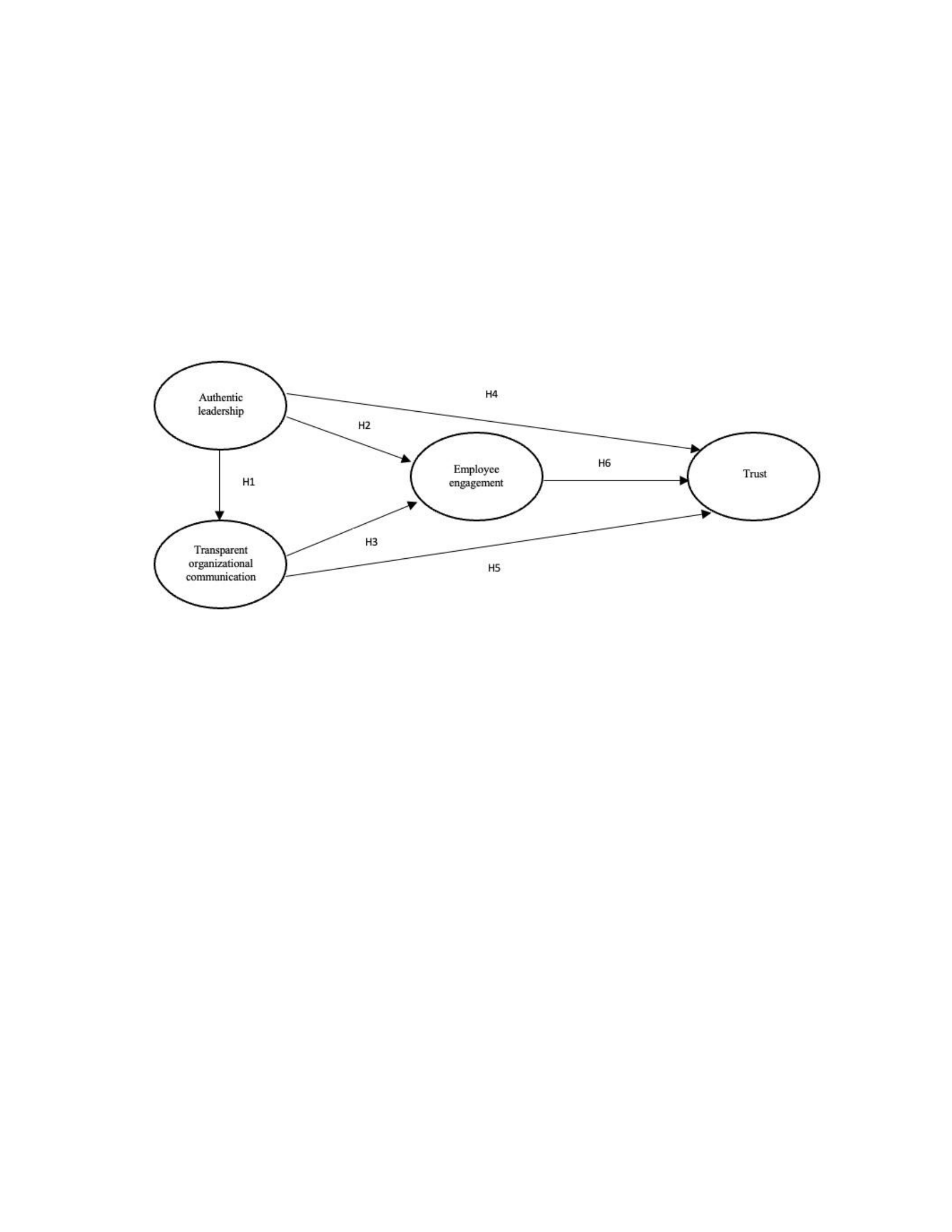
and employee engagement directly and significantly influenced the level of trust employees have
toward their organizations, as represented in Figure 3.
Figure 3
Structural Model with Nine Hypotheses
Note. (Jiang & Luo, 2018) (a) Direct link between authentic leadership and employee engagement was found to be
statistically non-significant: H2, (b) Mediation hypotheses: Transparent organizational communication mediates the effect
of authentic leadership on employee engagement & the effect of that on trust: H7, Employee engagement mediates the effect
of authentic leadership & that of transparent organizational communication on trust: H8, Transparent organizational
communication & employee engagement mediate the effect of authentic leadership on trust: H9
Jiang and Men (2017) tested a model that examined how authentic leadership, transparent
organizational communication, and work-life enrichment were related as organizational
contextual factors associated with employee engagement. They revealed that authentic leadership
had a strong positive effect on transparent organizational communication, but its direct effect on
employee engagement was not evident. Yet, they conclude that the mediation effects of authentic
leadership on employee engagement via transparent organizational communication and work-life
enrichment were strong and significant (Figure 4). Both studies concluded that authentic
leadership and transparent organizational communication are linked. Yet, the explanation of the
relationship between authentic leadership and employee engagement differed between the two

studies. Jiang and Luo (2018) described the two variables as linked as they influence the level of
trust, and Jiang and Men (2017) stated that authentic leadership and employee engagement are
strongly related only through the mediating variables of transparent organizational
communication and work-life enrichment.
Figure 4
Structural Model with Nine Hypotheses
Note: (Jiang & Men, 2017) (a) Direct effect of authentic leadership on employee engagement was not found: H4, (b)
Mediation hypotheses: Transparent communication mediates the effect of authentic leadership on work-life enrichment &
the effect of that on employee engagement: H7, Work-life enrichment mediates the effect of authentic leadership & that of
transparent communication on employee engagement: H8, Transparent communication & work-life enrichment mediate the
effect of authentic leadership on employee engagement: H9
Critical Assessment of Evidence
Jiang and Luo (2018) informed communication managers and organizational leaders of
the importance of integrating authentic leadership and communication skills, strategies, and
tactics in delivering training and mentoring workshops. The findings provided further support for
the four dimensions of authentic leadership, where organizations could use these indicators to
develop and promote authentic leaders to create desirable outcomes at both the individual (e.g.,
employee engagement) and the organizational level (e.g., trust). Creating a motivating, nurturing,
and transparent organizational environment contributes to employee engagement and trust.

Jiang and Men (2017) provide important guidelines and implications for communication
management scholars and professionals, as well as much-needed evidence that confirms the
critical roles of leadership, communication, and work-life enrichment in driving employee
engagement. They also enrich the theoretical understanding of employee engagement by
addressing the growing concerns of corporate transparency and authenticity, two overused yet
under-researched constructs in communication literature.
Further empirical studies are needed to explore the relationship between authentic
leadership and other variables, including employee trust, employee engagement, transparent
organizational communication, and leader-employee relationship. A review of the literature only
identified the similarity of the authentic leadership dimension of relational transparency with the
transparency dimension of disclosure, justifying the need to further explore the primary
behaviors of transparent leadership and how it influences follow attitudes.
Transformational Leadership, Definition and Background
Burns (1978) introduced the concept of transformational leadership when discussing the
structure of moral leadership. He stated that leadership in the shaping of private and public
opinion, leadership of reform, and revolutionary movements (social change events), namely
transformational leadership, seems to take on significant and collective proportions historically.
Still, at the time and point of action, leadership is intensely individual and personal.
Bass (1985) later expanded the scope of transformational leadership within organizational
settings. He stated that superior leadership performance, in this case, transformational leadership,
occurs when leaders broaden and elevate the interests of their employees when they generate
awareness and acceptance of the purposes and mission of the group, and when they stir their
employees to look beyond their own self-interest for the good of the group (Bass, 1990). Since

then, transformational leadership has been one of the most researched leadership styles (Groves,
2020; Gui et al., 2020; Northouse, 2021; Siangchokyoo et al., 2020), including well-developed
constructs that have been studied over time by many different scholars. Transformational leaders
serve as role models and exhibit a genuine interest in the well-being of their stakeholders,
showing consideration for each individual and fostering a climate of trust (Men & Bowen, 2017).
They integrate elements of empathy, compassion, sensitivity, and relationship-building to create
an emotional attachment between leader and follower (Jin, 2010). Transformational leaders are
viewed as charismatic and visionary leaders and can garner identification, trust, and confidence
from their employees (Yue et al., 2019).
Transformational leadership is characterized by four features (a) idealized influence,
communicating collective purposes and values, demonstrating confidence and determination, and
acting as charismatic role models; (b) inspirational motivation, sharing a desirable future,
motivating followers to perform at higher levels and achieve common objectives; (c)
individualized consideration, serving as a constant source of emotional support and
demonstrating personal care, empathy, sensitivity for the development needs of employees; and
(d) intellectual stimulation, helping employees think outside the box, challenge old assumptions,
and promote their intelligence, learning, and innovation (Garcia-Morales et al., 2012; Men &
Bowen, 2017; Wang et al., 2011). Although transparency is not clearly mentioned as an element
in any of the descriptions of the leadership model in the literature, with its communication of
collective purposes and values, it is believed that the dimension of idealized influence most
closely reflects transparency in its definitions.

Overview of Research Evidence
The roles of transformational leadership influencing positive employee attitudes (e.g.,
trust and satisfaction with leaders, organizational commitment) and behaviors (e.g., in-role
performance, organizational citizenship behavior, creative performance) have been widely
established in the literature (Braun et al., 2013, Gui et al., 2020; Yue et al., 2019). In addition,
transformational leadership and communication are critical factors in the ultimate success of
organizational change events. Yue et al. (2019) state that transformational leadership and
transparent communication are positively associated with employee organizational trust, which
positively influences employee openness to change, a perspective that has been linked to
organizational performance. Additionally, Gill (2002) concludes that an American Management
Association survey indicated that leadership was the top determinant of successful change,
followed by corporate values and communication. Successful leadership not only develops
vision, strategy, and culture for change but also empowers and motivates employees in change
management.
Yue et al. (2019) used an online survey with a random sample of employees across a
variety of industries in the US, examining the effect of transformational leadership and
transparent organizational communication on cultivating employee organizational trust during an
organizational change event. The findings suggested that transformational leadership and
transparent communication were positively associated with employee organizational trust, which
positively influenced employee openness to change, as represented in Figure 5.
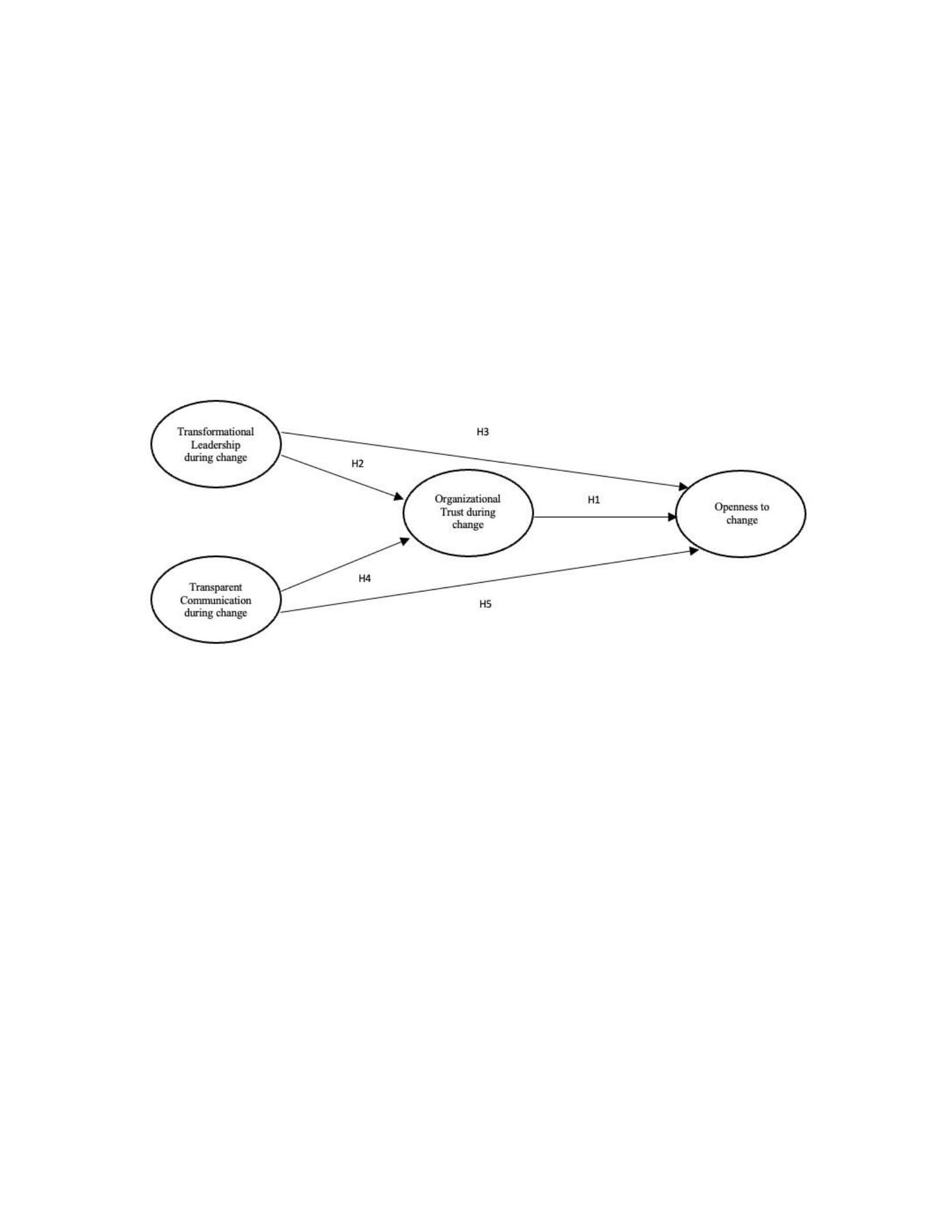
Figure 5
Structural Model with Six Hypotheses
Note. (Yue et al., 2019) (a) Direct positive association between transformational leadership and employee openness to
change was not found: H3, (b) Transparent communication was not found to be directly associated with employee openness
to change: H5, (c) Mediation hypothesis – Employee organizational trust mediates the positive relationships between
transformational leadership, transparent communication and employee’s openness to change: H6.
Critical Assessment of Evidence
By showcasing the influence of communication transparency featured by information
substantiality, participation, and accountability on employee change attitudes, namely trust,
during change and openness to change, the proposed study contributes to the change
communication literature from an internal public relations perspective (Yue et al., 2019). Their
findings provide theoretical insights into how transparent communication works in facilitating
change implementation and extends the application of the strategic transparent communication
strategy into the organizational change management context.

Further empirical studies are needed to further explore the relationship between
transformational leadership and other variables, including transparent organizational
communication, employee trust, and employee engagement. Transformational leadership
literature falls a bit short in addressing the issue of transparent leader behaviors, although the
dimension of idealized influence appears to invoke aspects of transparency without actually
mentioning it. A key focus of the literature is instead on the effectiveness of transformational
leadership on employee outcomes across situations involving organizational change, and
transparent communication is described as an essential part of that. A goal of this research is to
determine whether any dimensions of transformational leadership are associated with transparent
leadership.

CHAPTER 3: RESEARCH DESIGN AND METHODS
Overview
This research adopts a qualitative method of data collection and analysis of
semistructured interview responses to help address the research questions and establish the
multidimensionality of a potential transparent leadership theory. The limited attention devoted to
understanding transparent leadership behaviors in existing leadership theories represents an
opportunity to inductively define and examine the multiple ways that leaders demonstrate
transparency in their influence tactics with followers. Transparency has been explored across
numerous research domains and contexts of study, which identifies the state of prior theory and
research as mature. Further, this study will examine the nature of transparent leadership and its
impact on a range of follower outcomes. The research plan closely follows the recommendations
for the nascent archetype as outlined by Edmondson and McManus (2007), making it a good
methodological fit (Table 2).

Table 2
Methodological Fit of Research Plan
Elements
Give and You May Receive: Understanding Transparent
Leadership Through the Lens of Reciprocal Leader-Follower
Relationships
Type of study
Qualitative
Archetype
Nascent
Research questions
Four research questions are to be addressed in this study (a) What are
the primary behaviors that comprise transparent leadership; (b)
How does transparent leadership influence follower attitudes?; (c)
How is the relationship between transparent leadership and
follower attitudes impacted by follower role/status or place in
organization?; and (d) How is the relationship between transparent
leadership and follower attitudes impacted by virtual or distributed
contexts?
Type of data collected
Interview data
Method of collecting data
Conduct semi-structured interviews of leaders working across a
variety of non-profit healthcare organizations in the United States,
focusing on mid-level leaders.
Constructs & Measures
Interview questions will be used to help answer the four research
questions and inform the measurement of transparent leadership,
since a measure doesn’t currently exist.
Goal & Techniques
To better understand how transparent leadership influences the
perception and behavior of stakeholders, the research study aims to
draw from prior mature streams of research and explore proposed
relationships between a new construct in transparent leadership and
the established construct of follower attitudes.
Nature of Theoretical
Contribution
The study will be grounded in the construct of transparency, which
centers on the dimensions of disclosure, clarity, and accuracy of
shared information. This research intends to contribute to both
leadership theory and practice by providing a better understanding
of how transparent leadership can influence follower attitudes, their
perception of leaders and the organization, and how its presence
can potentially improve those relationships and follower
performance. The intent is that the findings would assist leaders in
better understanding the nature and value of transparent leadership
and communication in organizations, how they influence the
perception and behavior of internal and external stakeholders, and
how they can inform business strategy to improve employee trust
and engagement, as well as business performance.

Research Design and Approach
Study Design
The research study used a grounded theory approach to qualitative research, focusing on
a group of leaders and their subjective experiences involving interactions with transparent
leaders during their careers (Creswell & Creswell, 2018). Grounded theory is a design inquiry
from sociology that derives a general, abstract theory of a process, action, or interaction
grounded in the views of participants. This process involves using multiple stages of data
collection and the continued refinement and interconnection of categories of information
(Charmaz, 2006; Corbin & Strauss, 2007, 2015). The intent was to identify the common factors
of participant experiences, in this case, with transparent leaders, using a single phase of
semistructured interviews with the selected group of leaders. The unit level of analysis was the
leader.
Study Population and Sampling
The research focused on mid-level leaders of non-profit healthcare organizations across
the US. This population was selected due to the belief that because they work in mission-based
organizations, these leaders may place more value on non-economic factors, such as the quality
of the leader-follower relationship, compared to those working in for-profit healthcare
organizations. The plan was to interview a varied sample of outpatient, inpatient, and corporate
headquarters leaders. My professional network was leveraged to invite leaders who met the
stated criteria to be interviewed as part of the research project, a purposeful sampling. A snowball
sampling approach was also used at the end of each interview to identify other leaders that would
meet the stated criteria and could be interested in being interviewed.

Data Collection Methods and Instruments
Data was collected using semi-structured interviews and conducted virtually using Zoom
with 25 mid-level leaders, all currently working at non-profit healthcare organizations. Overall,
39 interview invitations were sent and 31 leaders initially accepted (79.5%), but two were
noshows, four never followed through to schedule an interview, and eight never responded,
resulting in a 64.1% interview rate (25/39). In addition, eight leaders were from my professional
network, and 17 were referred as part of the snowball sampling approach (68%). The number of
interviews were conducted depending on if and when a saturation point was reached. Ultimately,
the goal was to have a large enough sample size to identify a range of opinions and then cut it off
when data saturation started to occur, and the results became somewhat repetitive. That goal was
achieved with the completion of the 25 interviews.
Each interview was approximately 60 minutes long with 18 open-ended questions,
starting general and getting more specific as the interview progressed, with a few probing
questions used to dig deeper as needed. Leaders were asked to identify the characteristics,
qualities, or behaviors that constitute or comprise transparent leaders, as well as how they were
impacted or influenced by transparent leader behaviors. All interviews included both video and
audio recordings using Zoom, as well as written transcripts prepared by Otter.ai and then edited
afterward while viewing the video recordings to ensure their accuracy. In addition, a pilot test of
the interview questions was conducted with a leader who was not a part of the study to provide a
sense of how the questions worked before continuing with the remaining interviews. The pilot
test went well, as the interview questions functioned as designed.

Data Analysis Methods
NVivo was selected as the software to be used for the analysis of the results of the
semistructured interviews. The data were imported on Microsoft Word documents into NVivo,
and the interview responses were reviewed, labeled, and coded to place each of them into their
meaningful themes (categories). Content analysis was then conducted to identify any patterns in
the written transcripts, such as word or phrase frequency, coding stripes, word cloud, etc.
Measures or Operationalization
An interview protocol was developed to conduct the semi-structured interviews. The
protocol began with initial background questions on the leader’s current position and
organization and then moved to general questions regarding effective and ineffective leaders.
The questions transitioned to the main body of questions, asking for the leader’s insight on the
topics of transparency and transparent leadership, starting at a higher level and getting more
detailed as the interview progresses. The entire interview protocol can be found in Appendix B.
CHAPTER 4: DATA ANALYSIS AND FINDINGS
Data Analysis Overview
A thorough review of the semi-structured interview data results for 25 mid-level leaders
was completed over a four-month period, including the viewing of all video recordings to edit
transcripts and further understand the content of the interviews. Several iterative rounds of
coding were conducted to ensure the accuracy of the results, starting with the initial terms used
by the participants, followed by more rounds of coding using existing literature to continue the
refinement of the first-order coding. Further coding was conducted to consolidate codes into
compelling higher-level themes, followed by more selective coding to develop the codes into
aggregate dimensions.

Findings Overview
Analyses of the interview data revealed six primary characteristics that are present in
transparent leaders. These characteristics appear to be potential antecedents to transparent leader
behaviors, activating a number of transparent leader behaviors that influence the leader-follower
relationship. These characteristics include elements of (a) emotional intelligence (EI),
specifically emotional attentiveness; as well as (b) approachability; (c) communication skills; (d)
genuineness; (e) honesty; and (f) openness to self-expression. Participants described these
interpersonal skills and personality traits as emotional receptivity (Riggio et al., 2008), the ability
to decode or interpret the emotional or non-verbal communication of others, followers feel
comfortable going to them for information, and as a reflection of their stable personality
characteristics.
In total, 10 primary behaviors that transparent leaders demonstrate were described as
having a positive influence on the leader-follower relationship. These leader behaviors included
(a) shares information with others; (b) gives feedback; (c) seeks feedback; (d) connects with
followers; (e) cares for others; (f) speaks truthfully; (g) behaves with authenticity; (h) displays
vulnerability; (i) engages in conversation; and (j) actively listens to others. Participants described
these behaviors as information exchange, relationship building, and relational transparency.
Further, these leader behaviors demonstrate the continual sharing and seeking of relevant
information, building relationships and getting to know followers, showing that they personally
care for followers as individuals, and relational transparency in interacting with others.
The findings from the analyses suggest that the relationships between transparent leader
behaviors, follower trust, and follower outcomes may be contextually dependent. In specific
contexts at the individual level, these relationships are potentially influenced by (a)

remote/virtual context (working outside of the traditional office environment); (b) follower place
in organization (level of position/title or work location); or (c) length of leader-follower
relationship (amount of time follower has worked with leader). Across specific contexts at the
organizational level, these relationships could be influenced by (a) transparent organizational
communication (transparent communication coming from the organization vs. leader); (b)
organizational culture (beliefs, values, and attitudes); and or (c) organizational environment
(internal or external forces).
Follower trust emerged from the data as linking the relationships between transparent
leader behaviors and a range of follower outcomes. Participants described it as an interpersonal
influence on the relationship between the leader and follower. Trust can be cultivated by the
leader trusting the follower, or the follower trusting the leader, with the other responding by
trusting them in return. For example, one participant likened it to the “circle of trust,” where the
leader has the ability to create a circle of trust with their teams, sharing sensitive information
they need to know, and then the teams trust them in return. This is how follower trust is
associated with transparent leader behaviors and the specific follower outcomes identified below.
Five primary follower outcomes were described to be as a result of the influence of
transparent leader behaviors on the leader-follower relationship. These follower outcomes
included (a) felt personally valued; (b) felt work was meaningful; (c) increased work
performance; (d) extra work effort; and (e) more engaged in work. Participants described leader
behaviors as having an impact on the followers personally or professionally, or as an influence
on the level of follower work engagement. These outcomes illustrate how followers experienced
a higher sense of personally being valued, that their work really meant something and that it held

significant value, that they were able to perform their work at a higher level, were willing to
work harder than before, and felt more invested in their work.
Data Analysis Methods
Each leader interview resulted in an audio and video recording produced by Zoom, along
with a written transcript of the conversation. I then uploaded the audio recordings to Otter.ai, an
online software to produce additional written transcripts in Microsoft Word. I determined that
creating a second version of the transcript using Otter.ai would produce a copy that more
accurately reflected the details of the interviews when compared to Zoom. Each additional
transcript produced was then re-identified by a sequential four-digit alphanumeric code to ensure
the confidentiality of each participant (e.g., L001). I then viewed the entirety of each video
recording while reviewing the written transcripts produced by Otter.ai to ensure the transcripts
accurately reflected the conversations and to better understand the data, making revisions as
needed to produce a clean interview transcript. During the editing process, the personal
identification of myself and all participants, as well as other leaders and colleagues mentioned
during the interview, were removed from the transcripts and replaced by a generic description
(e.g., researcher, participant, current/former leader/colleague).
Once a transcript was edited, each one was uploaded to NVivo desktop software to start
the coding process, with each transcript saved using a four-digit alphanumeric code. Using the
approach recommended by Gioia et al. (2013) and Billups (2020), I completed the following
steps. First, a first-order analysis was initiated with In Vivo coding of the raw interview data,
following the voices of the participants, to explore the dimensions of transparent leadership and
the influence of a number of potential variables. Second, a code book was developed by
downloading the first-order coding data to a Microsoft Excel file, which allowed me to better

sort and further analyze the results. Third, initial patterns were identified, described from the
perspectives of the participants, followed by additional rounds of coding using existing literature
to further refine the initial coding and combine similar codes. An iterative process of leveraging
existing leadership theories, not limited to the literature review, was used to analyze the data.
The analysis process primarily focused on transparent leadership (Houser et al., 2014; Mamaril,
2021; Vogelgesang & Lester, 2009), transparency (Schnackenberg & Tomlinson, 2016;
Schnackenberg et al., 2020), authentic leadership (Gardner et al., 2005; Jiang & Luo, 2018;
Walumbwa et al., 2008), transformational leadership (Men & Bowen, 2017; Wang et al., 2011;
Yue et al., 2019), LMX (Dimotakis et al., 2023; Gerstner & Day, 1997; Graen et al., 1982; Graen
& Uhl-Bien, 1995), EI (Dulewicz & Higgs, 2000; Gardner, 1993; Gardner & Hatch, 1989;
Goleman, 1996, 1997; Salovey & Mayer, 1990; Wong & Law, 2002), meaningful work
(LipsWiersma & Wright, 2012; May et al., 2004; Yeoman, 2014) and the HEXACO model of
personality structure (Ashton & Lee, 2005; Ashton & Lee, 2007), as well as a variety of other
theories as included in the literature review. Fourth, second-order coding was conducted with a
detailed review of the first-order coding, examining the frequency and comparability of codes,
and identifying compelling codes to further consolidate into higher-level themes. Finally,
selective coding was then completed to further develop the themes into more robust third-order
aggregate dimensions relating to the three categories of leader characteristics, leadership
behaviors, and follower outcomes, as well as any potential mediators or moderators. An
overview of the results of this coding process is included below in Figure 6.

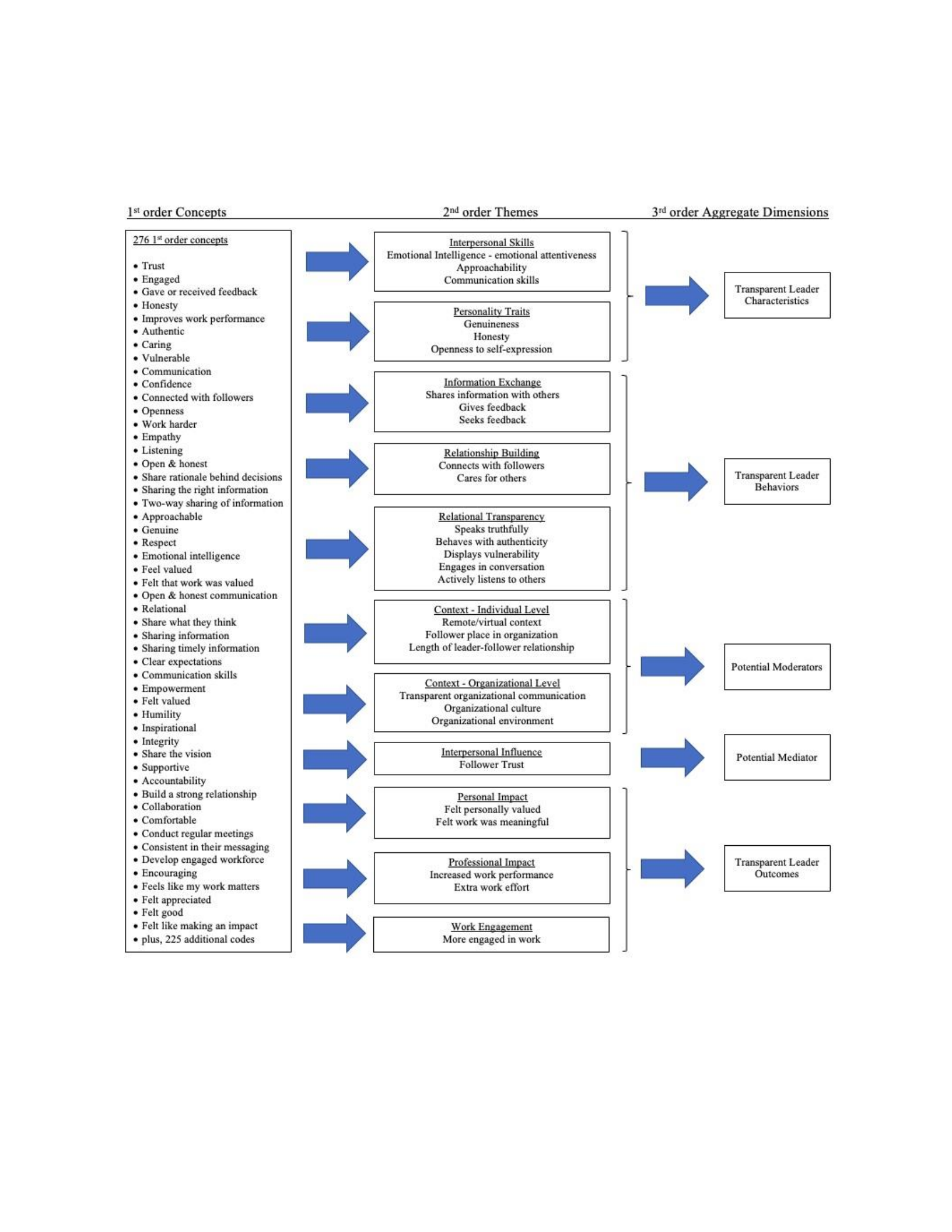
Figure 6
Transparent Leadership Data Structure

Preliminary Analysis
A reliability check was conducted using a peer debriefing with two former colleagues that
were familiar with the research project and the context. Both professionals were in leadership
roles and had deep experience in non-profit healthcare, and neither participated in the interviews.
The peer debriefing process recommended by Creswell and Creswell (2018) was followed to
involve an interpretation of the initial findings beyond the researcher and thereby add validity to
the data analysis. A spreadsheet including the 1st order codes, 2nd order themes, and 3rd order
aggregate dimensions, along with detailed explanations of each step in the process, was emailed
to each colleague. They were asked to verify the accuracy of the codes and the interpretation of
the analysis findings and to return their comments/questions to me. A diagram of the data
structure for the project was also attached to the emails to provide an additional perspective to
assist with their accomplishment of the peer debriefing.
Results
The results of the peer debriefings included feedback questions regarding revisions of the
1st order codes, as part of the process of developing the 2nd order themes. The revisions had
changed the number of references that moved forward to the 2nd order themes, due to recoding
some of the references. I easily explained the process used. Also, there was a question about the
logic used to identify the possible moderators. This question arose due to the number of possible
moderators that are not related to each other, which was clarified by me that the possible
moderators do not need to be related to each other. No changes were made to the data structure as
a result of the feedback received from the peer debriefings.

Findings
The results of the qualitative analysis of the interview data identified several transparent
leader characteristics (i.e., interpersonal skills, personality traits) and behaviors (i.e., information
exchange, relationship building, relational transparency) that are associated with multiple
follower outcomes (i.e., personal impact, professional impact, work engagement). A potential
mediator (i.e., interpersonal influence) was identified that relates to the reciprocal interpersonal
exchange between leader and follower, influencing the leader-follower relationship. In addition,
a number of contextual issues (i.e., at individual and organizational levels) were discovered that
potentially could moderate the influence of transparent leader behaviors on the leader-follower
relationship, either considered to be at the individual level since they were considered as
potentially impacting only leader and follower, or at the organizational level since they were
considered as potentially impacting the entire organization.
Transparent leadership was described by the participants as being a dynamic, reciprocal
relationship between the leader and follower characterized by sharing information, listening and
responding to each other, speaking truthfully, and demonstrating authenticity and vulnerability.
Over time, these continuous interactions between the leader and follower have the opportunity
to further develop and strengthen the leader-follower relationship as they respond in return and
learn to trust each other.
Participant responses in the interviews conveyed that leader characteristics serve as
antecedents to transparent leadership, activating leadership behaviors that influence the
leaderfollower relationship. For example, a leader who is considered approachable and speaks
truthfully while sharing information with the follower may expect that the follower will respond
in kind, such as sharing information of their own in return, or speaking honestly to the leader.

Yet, a key observation was that there were no comments in the interviews stating that leaders
behave transparently because they expect followers to respond in kind. It appears that leaders
behave transparently on their own, as part of who they are, without expectations from followers.
Participants described the influence of leader traits and how it impacted them, and if a
leader has the traits (characteristics) of a transparent leader, they know they can count on them to
lead them successfully through the challenges facing them (L005); how they were initially
influenced by the authoritarian approach of other leaders receiving praise, but by aligning
themselves with the positive traits of other leaders, found more confidence in their abilities (L014);
and how they were inspired to take on the positive traits of other leaders, which led to them sharing
what they learned, and being more transparent with their leaders and their staff (L016). Exemplar
quotes are provided:
And so in working with a leader who lives these traits, has these traits of a
transparent leader, it helps me to believe that they're in my corner. Because they're
not gonna let me step on a landmine. You know, they're gonna help guide me and,
help me navigate through different challenges or politics within the organization.
So that's why for me, it's so important, because it makes me feel like I'm an
important part of the team.
Participant L005 – Executive Director, Medical Specialties
But when I came to [current organization] I had already changed how I was, or
how I wanted to be, because I thought that's what was accepted. So when I came
to [current organization] and I was told, ooh, you're a little bit too harsh, maybe
lower it down. I was like, with pleasure. I actually want to be that person and I'm
more like that person. So then I did, but I had supervisors and peers that were
[held] at a high regard and they were more authoritarian. So then I felt like I
needed to be more like them. So it impacted me in a way that I was highly
influenced by all these leaders getting praise, they get praise for being this way
[being harsh]. Maybe I should be more like that, [but] it’s not how I want to be,
not how I want it to be. So it definitely impacted me. I'm also a little bit stubborn
and, I don't mean in a bad way, but so … I will challenge you a little bit, like the
status quo and be like, well, have you considered this other way, because this
works really well for me? It started to, little by little, also bring value to what I
thought was valuable. And, naturally gravitating towards leaders that I felt had
those traits, and I started to look at the benefits and looking for some validation
that I don't think this is the only way, I think this other way also works. And,

trying to defer to it a little bit more [new behavior] and to stay true to myself. But
it was definitely impactful … the more leaders that I found that had the same
values that I did, the more I felt confident and comfortable with my skills.
Participant L014 – Corporate Officer, Community Health
So I think that the people that have been the most transparent, and that have meant
so much to me, were people that I want to be like. I want to learn those traits and
take them on to share them with other people so it can continue to grow. And I
know that there's been many times where a staff person has to leave, or they're
going to move on to a different company, because they're going to make more
money, and I can appreciate that. But what matters to me is that they feel like I
was part of their life, and I enriched their life. And so by being transparent with
my leadership, with them, it has made a difference. And then they learn and grow
from that and are looking for those type of relationships.
Participant L016 – Clinic Administrator, Natural Health Center
LMX theory asserts that the quality of the leader-follower relationship, defined by that dyadic
(group of two) relationship, is predictive of outcomes at each level of analysis (e.g., individual,
group, organization) (Gerstner & Day, 1997) and is connected to many positive attitudinal and
performance variables. LMX proposes that leaders do not approach all follower relationships in
the same way and develop each one differently (Dansereau et al., 1975; Graen & Cashman,
1975; Graen et al., 1982; Liden & Graen, 1980). These relationships may range from those
treated as if simply on an employment contract (i.e., low LMX, or out-group) to those
relationships that are based on mutual trust and respect, and a reciprocal influence (i.e., high
LMX, or in-group) (Dansereau et al., 1975). These conclusions are consistent with the research
results, as participants primarily discussed the development of personal relationships between
leader and follower and that the needs and goals of each follower were treated individually.
In LMX, the domains of leadership include the leader, the follower, and the relationship
between the two (Graen & Uhl-Bien, 1995). The relationship-based approach focuses on the
leader-follower relationship and identifying characteristics of that relationship (e.g., mutual trust,
respect, obligation), evaluating the reciprocal influence, examining how that relationship is

correlated with outcome variables of interest and how effective leader-follower relationships can
be developed and maintained. The authors posited that LMX contains the three dimensions of
mutual trust, respect, and obligation and that the offer to build a partnership LMX is based on
these dimensions. It is the mutual trust, respect, and obligation toward each other which
empowers and motivates both leader and follower to expand beyond the formalized work
contract and work roles to grow out of their prescribed positions and develop a partnership based
on mutual reciprocal influence. Partners in these relationships experience reciprocal influence,
mutual trust, respect and obligation, and internalization of common goals.
The results of the interviews described follower trust as influencing the leader-follower
relationship, but of the two other LMX dimensions identified by Graen and Uhl-Bien (1995),
only respect was indicated and just by two of the participants. Yet, although all three dimensions
did not appear prominently in the data results, trust clearly had a dominant presence and
appeared to similarly influence the leader-follower relationship. Participants shared that trust was
their top priority and, without it, nothing else matters. As for the leader-follower relationship to
work, there must be mutual trust. Further, the predominant message from the participants is that
trust clearly influences the quality of the leader-follower relationship.
Transparent Leader Characteristics
Although scholars have discussed important elements of transparent leadership (e.g.,
Houser et al., 2014; Mamaril, 2021; Vogelgesang & Lester, 2009), a review of the relevant
literature did not reveal a clear list of characteristics that are key to transparent leadership.
Instead, the few identified are typically combined with a list of behaviors or outcomes (e.g.,
Bennis et al., 2008; Mamaril, 2021). The results of the analyses described transparent leaders as
having any of a number of key characteristics, including several elements of EI: emotional

attentiveness, approachability, communication skills, genuineness, honesty, and openness to
selfexpression. These characteristics were identified under the themes of leader interpersonal
skills and personality traits, enabling them to develop relationships with followers and help
predict future behavior. The most common transparent leader characteristics are described in
Figure 7:
Figure 7
Transparent Leader Characteristics
Leader Interpersonal Skills
Three transparent leader characteristics were identified under the theme of leader
interpersonal skills, including EI: emotional attentiveness, approachability, and communication
skills. These characteristics were considered interpersonal (social) skills that leaders possess that
lend themselves to connecting and building relationships with others: being able to sense the
emotions of others, followers feeling comfortable going to them for information, and having the
ability to effectively communicate with others.
Transparent leaders were most often characterized as having elements of EI (Gardner,

1993; Gardner & Hatch, 1989; Goleman 1996, 1997; Salovey & Mayer, 1990), specifically,
emotional attentiveness, the ability to read emotions in others, to observe how followers respond
to information received or others’ behavior, and intuitively adjust their behavior to help ensure a
more positive outcome to their interactions. Participants described these behaviors as the ability
to “read between the lines” or “read the room” and understand what followers really mean in
what they say, even if they are not explicit in the words they use.
EI has yet to be linked in literature to transparent leader characteristics, but EI has been
widely discussed in literature. It has been stated that EI may be an antecedent of transformational
leadership. Goleman (1997) provided a useful definition of the construct of EI, including (a)
knowing what you are feeling and being able to handle those feelings without having them
swamp you; (b) being able to motivate yourself to get jobs done, be creative and perform at your
peak; and (c) sensing what others are feeling, and handling relationships effectively. According
to Goleman (1997), the third element of EI appears to be closely related to how participants
described it during the interviews, with leaders sensing how followers are feeling and adjusting
their behavior to help ensure a positive outcome or handling those relationships effectively.
Others described elements of EI that also closely match those shared by the participants
(Dulewicz & Higgs, 2000), including (a) discern and respond appropriately to the moods,
temperaments, and motivations of others (Gardner, 1993); (b) recognizing emotions in others
(Salovey & Mayer, 1990); and (c) recognizing and responding to people’s feelings and concerns,
as well as insights into other’s feelings, emotions and concerns (Gardner & Hatch, 1989).
EI has been positively associated with transformational leadership behaviors (Barling et
al., 2000; Brown & Moshavi, 2005; Kim & Kim, 2017; Lindebaum & Cartwright, 2010).
Leaders higher in EI are more likely to engage in transformational leadership behaviors. Barling

et al. (2000) conducted an empirical study that showed that EI is associated with three
dimensions of transformational leadership: idealized influence, inspirational motivation, and
individualized consideration. Kim and Kim (2017) conducted a meta-analysis of 20 empirical
studies and found that studies provide empirical support for the relationship between EI and
transformational leadership, with similar conclusions about the connections to the three
dimensions of transformational leadership. Brown and Moshavi (2005) and Lindebaum and
Cartwright (2010) used applied research to identify the positive relationship between EI and
transformational leadership and that the former may be an antecedent to the latter.
Several participants described EI as the ability of the leader to sense the emotions of
others and “read the room.” This description of EI, emotional attentiveness, is unique and much
different than what was discussed in prior research studies (Barling et al., 2000; Brown &
Moshavi, 2005; Kim & Kim, 2017; Lindebaum & Cartwright, 2010), as it is centered on sensing
the emotions of others, not the leader, and then reacting appropriately to facilitate the
conversation and further develop relationships. The above definition of EI is focused more on the
ability of the leader to perceive, understand, and manage their emotions (and that of others) to
accomplish personal and collective goals (Brown & Moshavi, 2005).
Participants described their perspectives on EI and the potential impact of its use,
including the ability of EI to able to see what is going on in a room, or being able to “read the
room” (L003); being able to “read between the lines” (L023); and bringing to mind a transparent
leader who taught them the importance of EI (L024). Exemplar quotes are included:
I'm pretty passionate about the whole idea of emotional intelligence. It's an
intelligence that can grow and in leaders it needs to grow, and transparency has a
big piece in that, around kind of looking. So there's transparency that might be
happening all the time and people aren't paying attention to it. I can be in a
leadership room and I can watch how people are interacting with data and each
other and feeling. And someone else can sit right next to me and not notice or

look for any of that. And some of that is about a skill set you can develop, some
of it is about being a lot more intentional about here's what I see in the room, that
increases the transparency for everyone, even if they didn't see it themselves. So I
think building emotional intelligence skills in your leader, and helping them feel
comfortable with candor that leads with caring, and clarity, helps increase
everyone's visibility to what's going on.
Participant L003 – Executive, Community Health
I think also the sharing of information, but also really listening to what people
[say], how they respond to the information that you're sharing, that's another
behavior. Maybe in that vein, also being skilled at reading between the lines, you
know, what people aren't necessarily responding to or questioning, and kind of
drawing out the individuals who might be more introverted or less likely to ask
questions.
Participant L023 – Senior Systems Manager, Revenue Cycle
She definitely led with, like I said, emotional intelligence. And that was a big one,
especially for me coming in, because I really had the effectiveness, I was
definitely very effective. But I wasn't really impactful in that moment. And so I
don't think I had the impact because I didn't have the emotional intelligence. It
was, I'm given a directive, my team needs to lead in this way as well, this is what
you have got to do. And it kind of, it doesn't motivate people. And so I think she
was able to help me understand what emotional intelligence is. And that was able
to help me, in a way I feel like [I'm being] transparent with my team and the
leaders that I supervise now.
Participant L024 – Site Manager, Community Health
Transparent leaders were described as possessing approachability; followers feel comfortable
going to them for information without fear of negative consequences, such as being dismissed or
embarrassed. They are accessible, making themselves available with an open-door policy and
being willing to take a phone call to have a quick conversation. They have an ease about
themselves, sharing stories or experiences easily, and are able to naturally comfort followers
through difficult conversations.
Approachability has yet to be linked in the literature to transparent leader characteristics,
but may be considered analogous with agreeableness, one of the six personality trait factors of
the HEXACO model of personality structure and one of the factors of the widely researched Big
Five or Five-Factor models (Ashton & Lee, 2005; Ashton & Lee, 2007). In the HEXACO model,

agreeableness was portrayed as patient, tolerant, peaceful, mild, agreeable, lenient, and gentle,
with a theoretical interpretation of reciprocal altruism, which is very different than what the
participants shared about approachability (Ashton & Lee, 2007).
Participants shared their perspectives on transparent leaders who they describe as
approachable, who have an ease about themselves, that they are comfortable with who they are
and can make followers comfortable interacting with them (L002); someone who is easy to talk
to and can feel comfortable going to them for the truth (L004); and someone that is available and
that you can count on them to be there for you (L010). Exemplar quotes are provided:
I would describe them as, they have an ease about themselves. And I don't mean it's
casual, they're just comfortable [with] being able to share information. Even if they
don't know exactly what it is, because there are some things you don't know the
answer to, right? Or you don't know what the future is, there might be something
happening, but you don't know exactly all the details. But I think those leaders can
be, what I've seen, is that they're just comfortable. And can share a story easily or
comfort people, even in the next step of the decision that's being made, even if that
next step is something that we all know is going to be kind of painful. But they can
do that in a very professional way. It just seems to come natural to them versus a
robotic response.
Participant L002 – Executive Director, Specialty Services
They're easy to talk with and work with. You don't feel that kind of trepidation or
nervousness of speaking with them. It could be because it's just, it's easy. And
they're going to be truthful and honest with you, you know that you're getting
honesty. And if they can't tell you something, they truly can't tell you something. It's
not that they're trying to hide it from you, [it’s] that they truly don't know or can't
tell you when they're transparent. And people want to work for them, people want
to have a transparent leader. People will apply for every job that comes available,
they want to be with that leader.
Participant L004 – District Director, Primary & Specialty Care
He was also very available as well, like he always made sure we understood that
no matter what he was doing, if we had questions or concerns, we could always
bring it to him. And I think that helped really cement, especially in retrospect, that
trust that we had in him as a leader and that we knew that he was always [there]
with us. He was always transparent with that, because if we had questions or
concerns, he would go into it. I mean, he never communicated or acted in a
manner that we felt that he was unapproachable or that if we brought something to
him that we may be crossing the line, but maybe get in trouble, right?

Participant L010 – Business Director, Community Health
Transparent leaders were represented as having communication skills, described as the ability to
effectively communicate with others in multiple ways (e.g., one-on-one, in large groups, email).
It is the ability to share information with followers in a clear and meaningful way, having a sense
of knowing how to deliver it depending on the audience and the circumstances. Communication
skills have been linked to leadership in the literature (Hackman & Johnson, 2013; Jiang & Luo,
2017; Norman et al., 2020), but have yet to be linked to transparent leader characteristics.
Hackman and Johnson (2013) used applied research to suggest that the development of
leadership communication skills is an ongoing process, not a single event, as leadership
development unfolds step by step. As leaders, we increase our leadership competence as we
increase our communication skills.
Open communication or communication transparency has been linked to transparent
leadership characteristics and has historically been viewed as an important ingredient for
effective organizations; more open communication has been associated with higher levels of
honesty, effective listening, trust, supportiveness, and frankness (Rogers, 1987). Considering the
organizational context, communication openness has been defined as message sending and
receiving behaviors of leaders, followers, and peers about task, personal, and innovative topics.
As a result, communication openness revolves around each individual being receptive to and
then responsive to the information shared by others in the organization (Norman et al., 2010). In
the context of leadership research, open communication involves both leaders and followers in
how they exchange information with each other and the quality of their respective relationships.
The participants recalled transparent leaders with communication skills that they have
worked with as someone that is a clear communicator, ensuring followers know what is expected

and that they have the information they need (L014); someone with fantastic communication
skills, using multiple forms of communication to ensure followers had the information they
needed (L019); and someone with good communication skills that is able to determine the most
appropriate way to communicate with followers (L023). Exemplar quotes are provided:
I guess another characteristic I will say about transparent leaders is they are clear
communicators. They express what they want to see happen, or what the goal is.
They're coming [out] in the communication and it’s going to be among leadership,
and the staff is going to be very similar, maybe it’s tailored to the audience. But
it's not going to be like we have the secrets that we are discussing and the rest of
the world doesn’t need to know. [It’s] very open, very transparent. In what I know,
I'm going to tell you, as long as I'm able and is legal for me to share, but I'm going
to share as much as I know.
Participant L014 – Corporate Officer, Community Health
A fantastic communicator in multiple different forms. Even if the leader wasn't
100% sure that it was applicable to you [they] send it your way, just to make sure
he wasn't missing anything. And then ask, if this isn't something that is
meaningful to you, let me know and I won't send it to you every month anymore,
that type of thing. And I felt fully informed on what was happening with the
organization, where I needed to work, what my goals were, where I was falling
behind, possibly. And it was done without judgment, even with constructive
criticism. It was easy to take because the way it was presented was around growth
and improvement. Not just hiding it in the background until springing [it] on you
you're doing this wrong. And that's where the transparency piece comes in for me.
Participant L019 – Director, Rehabilitative Services
Good communication skills. So, how they're able to relay information and I think
a big one too, is the format that's chosen. Do you send out an email to folks? Do
you meet with them one-on-one as a group setting? Availability. So if people do
have questions later on, they feel like they can come back and ask you about the
information you're relating.
Participant L023 – Senior Systems Manager, Revenue Cycle
Leader Personality Traits
Three transparent leader characteristics were identified under the theme of leader
personality traits: genuineness, honesty, and openness to self-expression. These were determined
to be consistent and enduring characteristics that leaders possess that reflect their personality and

help enable their future behaviors by always being themselves, truthful in sharing information,
and willing to express their thoughts and feelings.
Transparent leaders were characterized as having genuineness, being consistently true to
themselves and allowing followers to know who they are and what to expect from them. These
leaders are real, not fake, and followers can take them at face value. They behave the same
regardless of whether it is a one-on-one conversation or they are in front of a large group of
people. Genuineness has yet to be linked in literature to transparent leader characteristics,
although it may be considered as analogous to authenticity, which can be defined as owning
one’s personal experiences and behaving in accordance with their true self (Harter, 2002).
Authenticity has also been widely researched as part of authentic leadership (Gardner et al.,
2005; Jiang & Luo, 2018; Walumbwa et al., 2008), which is expressed as a pattern of leader
behaviors that draws upon and promotes positive psychological capacities and an ethical climate
(Walumbwa et al., 2008).
Participants shared their thoughts about transparent leaders as genuine by describing
someone that is caring and empathetic (L002); sharing their observations of leaders interacting
with followers (L009); and portraying a transparent leader as genuine by using an analogy,
comparing it to them cooking at home (L024). Exemplar quotes are provided:
Genuine, [transparent leaders] they're genuine. They seem to be caring. There's
business that needs to be done, but there's also a level of compassion at the same
time. And I think … transparent leaders are those that can show both empathy at
the time, and then also share with them that we do it like this or [acknowledge]
that must be hard, and here's what we need to do.
Participant L002 – Executive Director, Specialty Services
So yeah, there was a genuineness to those folks. And walking the talk was
definitely something that, even in those large gatherings, how they interacted with
people, how they came to meet people where they were, at their level. Yeah, I think
that [quality] was a big piece.
Participant L009 – Assistant Administrator, Primary Care

I love to cook. So I'm thinking of, when you cook onions, you cook them until
they're transparent, which is almost see through, so I think that is kind of what is
its meaning. So I think it's a manager or supervisor or leader that you just know
what you're getting out of someone, that you can see and you know immediately
what type of leader that they are. Someone that you know, here's [Participant’s
name] and here's I know what I'm gonna get out of [Participant’s name]. I know
what kind of leader she is.
Participant L024 – Site Manager, Community Health
Transparent leaders were depicted as possessing honesty, or as truthful in the sharing of
information with followers. They do not just tell followers what they want to hear, they can be
counted on to tell the truth. These leaders do not leave followers second-guessing, so they can act
on the information they receive from them. Honesty has been defined as being open and honest
about all things, dealing fairly with others, and inviting greater investment in their companies
(Baum, 2005; Bennis et al., 2008; Vogelgesang & Lester, 2009). Honesty has been linked in the
literature to transparent leader characteristics (Bennis et al., 2008; Yukl, 2013). Still, even when
this characteristic is tied to transparent leadership, it has yet to be empirically tested.
Participants described transparent leaders as honest by sharing its importance and the
challenges followers face when they work for a leader who is not honest (L011); sharing the
challenges they have faced when they cannot trust what a leader has said to them (L023); and
that the most important trait to their leader is honesty (L025). Exemplar quotes are provided:
If I don't trust a leader, it's just hard to fulfill my duties. I'm always going to be
second guessing and sometimes I might hide something [from them]. I will work
my best and I will deliver a great outcome, [but] if I work with a leader who's
honest and trustworthy, they will tell me if I'm failing.
Participant L011 – Business Director, Community Health
I think the honesty is really important, because if people don't feel like the
information you're sharing is true and factual, then the whole thing just sort of
goes down the drain. I don't think there's much you can recover from after that.
Participant L023 – Senior Systems Manager, Revenue Cycle

It kind of goes back to my question in my interview with my boss, is what
character trait is the most important to you? And I know that she had to think
about it. But I resonated with it, and that was honesty. I think that one just stands
above the others. You know, obviously, this is about transparency. And so how
transparent can two leaders be with each other.
Participant L025 – Director, Pharmacy Operations
Openness to self-expression was utilized to define transparent leaders, the willingness to freely
express themselves, allow others to do the same and consider their thoughts, and engage in
honest conversation. Followers are allowed to speak their minds, so they can feel heard and
engage in meaningful dialogue with their leader. They take the time to explain topics or provide
answers to questions without using an organizational script (i.e., telling followers just what the
organization wants them to hear). Openness to self-expression has not been linked in the
literature to transparent leader characteristics, although openness to experience is described in
the HEXACO model as intellectual, creative, unconventional, innovative, and ironic, with a
theoretical interpretation of engagement in idea-related endeavors (Ashton & Lee, 2007). This is
much different than what was described by the participants for openness to self-expression.
Openness to experience is one of the six personality trait factors of the HEXACO model of
personality structure and one of the factors of the widely researched Five-Factor model, but it is
not part of the Big Five model (Ashton & Lee, 2005; Ashton & Lee, 2007).
Participants described the characteristic of openness for transparent leaders and how it
made them feel (L002); by sharing an example of a leader and follower freely expressing
themselves (L006); and using the rolling out of a new company policy as an example of
openness (L012). Exemplar quotes are provided:
Because the leader could express that I was on the right track … you meet with
them and they're transparent about it, so you can have a good dialogue back and
forth about what's happening and be open about it. And maybe even with your
struggles with doing something. And they can acknowledge [they hear you and]
maybe if you need help, you can ask them for that, or they can give you advice.

And then you just feel good about the project that you're doing or the
communication that needs to happen because you've had a good interaction from
your leader about it. And that interaction included being honest and open, and
being able to share ideas back and forth. And then I think that translates into
feeling good and valued about the work that you're doing.
Participant L002 – Executive Director, Specialty Services
I would say openness. And what I mean by that is someone who shares
information or someone who listens very well. And if you take questions to him,
they're going to have answers for you, or get back to you, or help you guide you
to who you need to talk with. So I think openness in a leader is one of those
qualities.
Participant L006 – Director, Revenue Cycle
I think it was openness, in terms of being open to questions about things and then
taking the time to explain things outside of the kind of corporate political
explanations I get. Like a new policy rolls out, I think part of transparency is
interpreting that for people on the ground versus it just sitting there in corporate
ease or legalese. So that's what stood out for me for this person.
Participant L012 – Business Director, Community Health
Transparent Leader Behaviors
Relevant literature discussing transparent leadership identified several key behaviors of
transparent leadership (Norman et al., 2010; Vogelgesang & Lester, 2009; Yi et al., 2017), such
as sharing relevant information with followers, giving and receiving feedback, and openly
communicating with followers. Leader behaviors are, at times, combined with characteristics or
outcomes. For example, when discussing transparent leaders, Bennis et al. (2008) state that
transparency encompasses “candor, integrity, honesty, ethics, clarity, full disclosure, legal
compliance and all that enables us to deal fairly with each other” (p. 19), which is a list that
could be considered as including characteristics, behaviors, and outcomes.
The transparent leader behaviors described by participants included shares information
with others, gives and seeks feedback, connects with followers, cares for others, speaks
truthfully, behaves with authenticity, displays vulnerability, engages in conversation, and actively
listens to others. The most common transparent leader behaviors are shown in Figure 8.
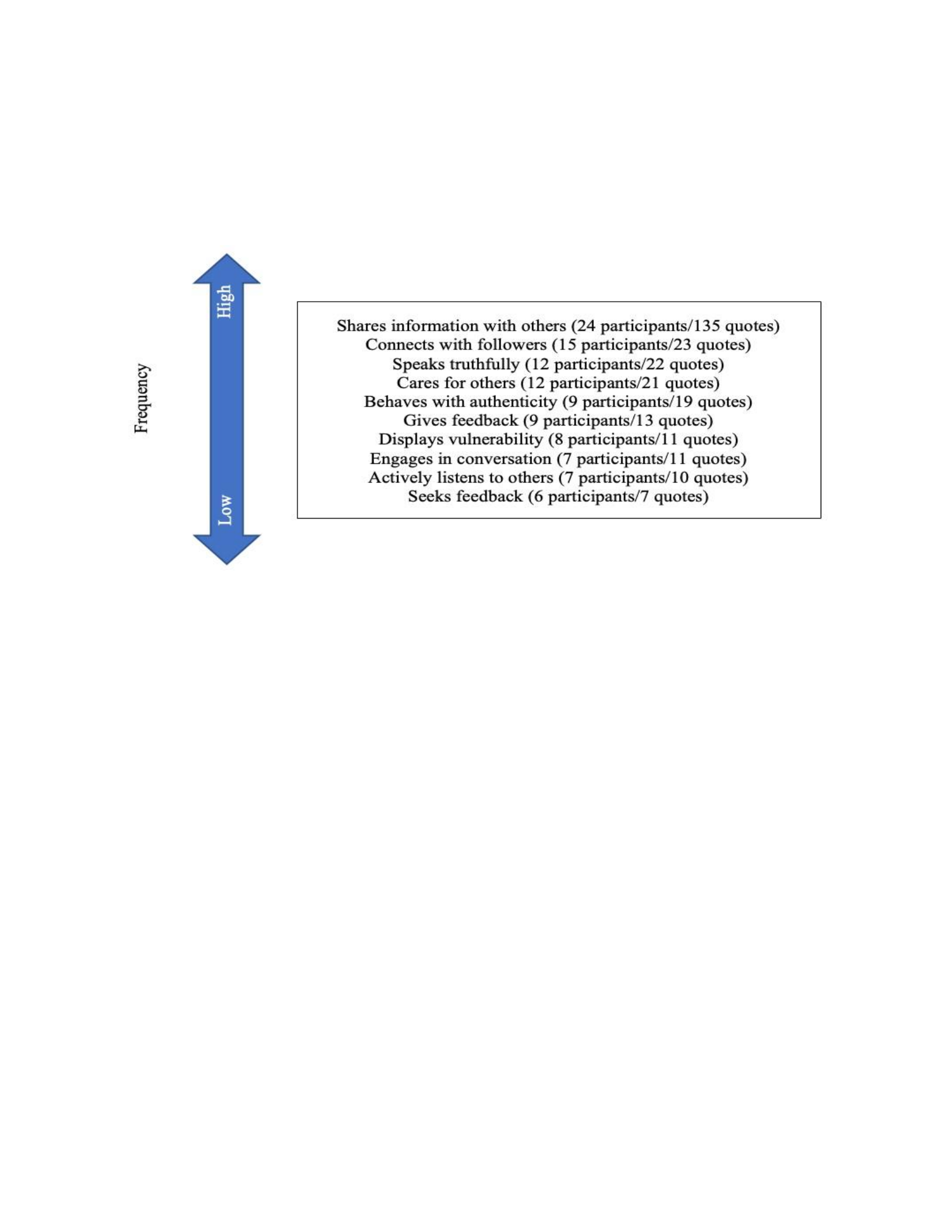
Figure 8
Transparent Leader Behaviors
Leader Information Exchange
Three transparent leader behaviors were identified under the theme of leader information
exchange: shares information with others, gives feedback, and seeks feedback. These behaviors
describe the leader’s exchange of information with others and the impact of these exchanges on
the leader-follower relationship.
Shares information with others was used to describe transparent leaders the most often,
including timely, accurate, and relevant information without oversharing (i.e., too much
information). They also share what they think, as well as the vision and the rationale behind
decisions. The preference is for information to be shared in person, during video calls, or by
phone, with one-on-one and regularly scheduled leadership forums lauded as very effective
means for leaders to use.

Theories advanced by leadership scholars as part of applied research suggest that sharing
relevant information with followers is one of the behaviors demonstrated by transparent leaders
(Vogelgesang & Lester, 2009; Yi et al., 2017). Thus far, even in instances where this behavior is
conceptually connected to transparent leadership, it has not been empirically tested.
Participants depicted their thoughts on transparent leaders sharing information and its
potential impact, including keeping each other informed so that they can minimize surprises or
proactively engage with them if needed (L003); describing the challenges they have when trying
to do their job without all the information they need to be successful (L004); and providing their
insight into the process of how decisions are made can help make followers feel more connected
to the broader organization and its goals (L005). Exemplar quotes are provided:
I'm thinking of my two regional leaders, and each one of them has something that
I appreciate. I feel like, it helps our relationship that helps me know how to help
them and helps me feel not surprised. One of them is really good, it’s just a heads
up to me. Something comes up and they're like, I think [participant name] should
know about this. And so they have thought about me and they tell me whether
they need me or don't need me, or when they want to talk about it, or what they're
doing about it, but just thought I should know. And that may seem like a CYA type
activity. But I think it's actually really respectful. And it also gives me an idea of
what they're dealing with in the moment that we didn't talk about it or at huddle
this week, it just happened. And it prevents me from being blindsided and it gives
me an opportunity to contribute if I think that there's something I have to
contribute.
Participant L003 – Executive, Community Health
If you don't have all the information, it's very difficult to be successful in any
organization. And for a transparent leader, they want you to be successful. I really
don't [know what] someone who is not transparent is looking for, but maybe they
want the organization to be successful. But I struggle with them thinking that
they're going to have their team be successful if they're hiding behind some of the
information. So it's knowing, a transparent leader, they will give you the
information that you need to do your job and be successful in it.
Participant L004 – District Director, Primary & Specialty Care
It’s when a leader understands the environment within and the micro cultures within
their team and the broader organization, or provide insight into how decisions are

made in a way that makes people feel connected to the broader organization and the
goals of the organization.
Participant L005 – Executive Director, Medical Specialties
Gives feedback was utilized to define transparent leaders as consistently offering constructive
feedback to followers, without judgment, as well as to other leaders. They proactively share
information in a supportive environment, with the intent to praise as well as help facilitate
learning and growth, celebrate or improve performance, and refine organizational processes.
They provide guidance and recommendations on how to make improvements or resolve
outstanding issues. Giving feedback has been theoretically linked to transparent leadership and
improved follower outcomes, such as increased follower trust in the leader, follower
engagement, follower performance, and enhanced attention at work (Huang et al., 2014;
Vogelgesang & Lester, 2009; Yi, 2017). Yet, even when this behavior is tied to transparent
leadership, it has not been empirically tested.
Participants recounted their experiences of getting feedback from transparent leaders and
what that meant to them, including how it helped them to contribute to the mission of the
organization (L001); how getting feedback from their leader made a significant difference in how
they worked together and how it developed a sense of trust in that leader (L003); and how they
considered this leader a role model by her willingness to provide helpful feedback and how much
they appreciated the leader for it (L004). Exemplar quotes are provided:
I would say that they were able to share the vision for the work and my role in it,
and give clear feedback that was helpful in helping me achieve that. So here's why
that didn't work. Here's why that did work. Here's [how] you are building that
kind of knowledge base of how to show up at work, how to actually help the
organization [or] Team X move forward.
Participant L001 – Director, Community Health Access
And they cared and that I was in a safe place to learn and grow. Thinking back to
one of the leaders I had at [previous organization], and it's probably the first time
I'd actually had a leader that had a lot of candor. What they saw in me, what they

saw that was working well, but they saw, I might want to think about doing
differently, there was a lot of feedback. And it was all clearly intended to help me
do well. And they spent a fair amount of time sharing their thinking. And that was
helpful in me understanding them, this is the way they work. This is how I can
complement or support their thinking and their work. And this is how we divide
and conquer. And so there, it created a sense of trust, and of having a pretty good
idea about where she was going and how I linked in with that. And that made me
feel more secure.
Participant L003 – Executive, Community Health
The other thing she was really good at is providing feedback. I always knew from
her when I mis-stepped, or when I could improve. And she would bring me into
her office. And it was not in a way that you felt it was punitive, it was in a way
that you felt you could grow. But she wouldn't hide, she wouldn't not talk about it
with you, she wants you to grow and learn. She would bring me in all the time,
just talk about, next time you do something like this, let's talk about how you can
do it better. Next time you present, let's talk about how you can present better. I
don't feel like she ever had trepidation about giving feedback like some leaders
do. Some leaders really have a hard time giving feedback. And then you step all
over yourself, and you don't find out until they let you go, I've never been let go,
but I've seen it before, you [don’t] know what you've been doing wrong this
whole time. And that was not her. And I felt like that was very transparent too,
and like I said, she was really one of the models, the leader model that I use, and I
do the same.
Participant L004 – District Director, Primary & Specialty Care
Seeks feedback was applied to represent transparent leaders, those looking for an opportunity to
learn from followers and to gain their insight. They want to know what followers think about the
organization, including initiatives that will impact them, to identify any concerns or issues that
need to be addressed. Applied research studies have linked receiving (seeking) feedback to
transparent leadership behaviors that can create conditions to allow for creativity, advancement
of implemented procedures, and could have a profound effect on a firm’s bottom line (Ji &
Hong, 2022; Norman et al., 2010; Vogelgesang & Lester, 2009; Zhang et al., 2011). However,
behaviors that have been connected to transparent leadership have not been empirically tested.
Participants shared their thoughts about transparent leaders seeking feedback from
followers, including the importance of seeking feedback from followers and taking the

opportunity to learn from them too (L004); describing an example of a transparent leader
reaching out to followers for their input on running operations (L009); and describing the
importance of seeking feedback from followers when implementing organizational initiatives
(L010). Exemplar quotes are provided:
I try to bring my team in and give them open and honest feedback. And I ask for it
back. I know that I can learn from my team just as much as they can learn from
me. So open and honest feedback, I think is very important in transparent
leadership.
Participant L004 – District Director, Primary & Specialty Care
Transparency is, here's where we're sitting right now, this is a challenge. It's a
really big challenge and here are some of the things we're already thinking about
and we want to hear from you. What are other things we can do? So who can
paint the picture and, in painting the picture, share their personal investment, their
personal story, in how they're engaging to help move us to the next phase, or how
they're engaging in celebration for what we've accomplished.
Participant L009 – Assistant Administrator, Primary Care
If we're making decisions on something that's going to impact [staff], like our
front office personnel, before it gets even implemented, I think that it's best to go
and get feedback from the personnel that's it’s going to impact. Also relate to them
the rationale behind it, especially if it's something that we have to do that may not
be a popular decision. I'll take my concerns up and if it's still something that needs
to be done, then I think transparent leadership is all about ensuring that people
understand the rationale behind the decisions, how it's going to impact them. And
being open to that feedback that they give.
Participant L010 – Business Director, Community Health
Leader Relationship Building
Two transparent leader behaviors were identified under the theme of leader relationship
building: connects with followers and cares for others. These behaviors were considered ones
that describe leaders in the development of their relationships with followers and other
stakeholders.
Connects with followers was used to illustrate transparent leaders, including connecting
on a personal level, sharing personal information about themselves, and opening the door to get

to know a follower better as a person. They intentionally strive to build strong relationships with
followers over time, with the mutual sharing of information, and strengthening the lines of
communication between leader and follower. Connects to followers has yet to be linked in the
literature to transparent leader behaviors, although the predominant approach to developing
leader-follower relationships is embodied in LMX theory (Dansereau et al., 1975; Dimotakis et
al., 2023; Gerstner & Day, 1997; Graen et al., 1982; Graen & Uhl-Bien, 1995), which has
extensively provided valuable contributions to the literature.
Participants expressed insights into transparent leaders connecting with followers,
including sharing their insight into the importance of making a connection with followers on
their teams (L005); describing why transparent leaders are more able to connect with
followers than leaders who are not transparent (L012); and describing a transparent leader
that they felt was very skilled at connecting with followers (L024). Exemplar quotes are
provided:
So there's also the ability to connect and not overshare, but at least build a
connection of what's happening in their lives, which then creates a connection and
understanding of what's happening within their employees’ lives. I think that's
really critical to then be able to step in and understand when someone might be
struggling at work. Because you have a human connection with them that isn't
just work related. And that again, also leads to trust because you have that shared
connection and understanding of what makes people tick and what are their
challenges outside of work and how can you as a leader, help them. Participant
L005 – Executive Director, Medical Specialties
I think there's, as a leader, there's always a professional distance you have to have
as a leader, but I also think that the most transparent leaders have as close a
connection as possible with the people that report to them in terms of being able
to understand what's going on with their team to understand who needs to ask
additional questions, and clarify things versus who doesn't ... but I think it's that
connection with the team that helps them be transparent versus folks who are less
connected.
Participant L012 – Business Director, Community Health

She's kind of in a way a chameleon, able to adapt her style to whoever she's talking
to, and find something that she's able to connect with. Whoever, no matter what
background they came from, there's always something she's able to kind of connect
with them on and have a little bit of a bond to build that relationship between a good
leader and direct report, or even just a peer coworker in the building.
Participant L024 – Site Manager, Community Health
Cares for others was utilized to describe transparent leaders as caring on a personal level, as well
as caring about the futures of all stakeholders, and wanting them to be successful. They show
empathy in their interactions with others, striving to understand their concerns and how to help
support them. They also want to ensure their followers and teams have what they need to do their
work, including the right information, tools, and resources.
Even though cares for others has yet to be linked in the literature to transparent leader
behaviors, it appears to be related to the transformational leadership dimension of individualized
consideration. This dimension relates to a leader that serves as a constant source of emotional
support and demonstration of personal care, empathy, and sensitivity to the development needs of
employees (Garcia-Morales et al., 2012; Men & Bowen, 2017; Wang et al., 2011).
Participants described the impact of working with a transparent leader that cares
about others, such as followers trusting the leader and doing their very best for them
(L013); explaining its importance in helping followers be successful (L021); and
expressing the personal impact of working with a transparent leader that cares about others
(L025). Exemplar quotes are provided:
I think the genuine interest in the person that works for you, I think is the most
important, because there is an inherent advantage in that when people know that
you really care about them beyond the business, then I think they do their best and
there is no measure of what my best can be once I trust you. I have a leader that I
want to work for, then you have it all. It's not to measure that output to say, how
productive can they be? No, once you establish that trust, the sky is the limit, that
person would do their absolute best for you.
Participant L013 – Director, Surgical Specialties

I think there's that sense of trust that's granted to individuals. And in order to
allow them to be successful, again, there's a, and you hate to say it, and I know
some people like are like, oh, you know, that actually caring for people as
individuals and wanting them to be successful? I think it’s really important from a
leadership standpoint, and I don't think we’ve talked enough about it, it's almost
taboo, that there would be any kind of personal connection or relationship with
the people that you lead. We're so, you know, the whole idea of that we separate our
home lives, from our work lives, and all that kind of stuff that never really existed,
either. But I do think in organizations where leadership is done well, the leaders
care about the success of the people that they're leading, and want to make sure that
they have the information, the tools, the resources, that they need to be successful.
Participant L021 – Executive, Information Systems Solutions
I remember, even with [previous leader], when my father died, that when I shared
it with her, she was very caring, and empathetic with me, and I felt safe to share a
little bit about, who my dad was, and what he meant to me. And I think the beauty
of that was, she got to know me better. But she also was able to support me during
the grief process. You know, hey, take as much time as you need. And so I felt
very safe with her. And so I was able to be even more transparent with her when
things weren't going as well as I had hoped. But also celebrating the wins with
that leader. He's a unique leader. There's not too many guys like him in leadership.
He just loves people, and being able to work under somebody who really can
understand teamwork, and family, and the importance of people. It's been huge.
It's been huge.
Participant L025 – Director, Pharmacy Operations
Leader Relational Transparency
Five transparent leader behaviors were identified under the theme of leader relational
transparency: speaks truthfully, behaves with authenticity, displays vulnerability, engages in
conversation, and actively listens to others. These behaviors describe leaders being transparent in
their relationships with others.
Speaks truthfully was a description used for transparent leaders, those who share
information truthfully with others and instill confidence in the message they are delivering. They
provide straightforward answers to questions, helping ensure quality interactions and opening
two-way lines of communication. Followers find them believable. Speaks truthfully has not
specifically been linked in the literature to transparent leader behaviors, but may be considered as

analogous with candor, which has been linked in applied research literature to transparent leader
behaviors (Bennis et al., 2008). Candor has been described in terms of telling the truth,
encouraging people to speak the truth to power and practicing having unpleasant conversations
(O’Toole & Bennis, 2009), or being direct, open, and straightforward, often associated with
sincerity and honesty (Baltzley & Lawrence, 2016). Still, even when this behavior is tied to
transparent leadership, it has yet to be empirically tested.
Participants shared examples of transparent leaders speaking honestly with
followers and how that communication can help them manage the business (L006); how it
can help followers work through challenges that may challenge personal values (L009);
and recalling a past leader that spoke honestly and how he helped them resolve issues
they may have had with senior leadership (L010). Exemplar quotes are provided:
Transparent leadership to me is someone who will be honest and thorough in the
communication about everything that we need to know, to manage our business.
What's coming in the future? What's happening in the current state? And I think I
always, something I always say is, it's not what you know, it's who you know,
because no one has all the answers, but you need to be able to help close the gaps,
communicate, learn, educate, by using all the resources you have at your
fingertips. So transparent leadership becomes being honest about I don't have all
the answers, but I'm really here to help in any way that I can. And then following
through on that.
Participant L006 – Director, Revenue Cycle
So at least within the framework of working with managers … it's that, what's
most effective is when I can say to them, look, I don't agree with this either.
Here's why we have to do it. And often, I will have, if it's something that I know
is really hard for somebody, because sometimes it borders on people's personal,
ethical issues. I will say, look, you may need to make a decision, is this still the
right place for me? You know, I get it, it is the right place for me, I'm going to live
with this. I don't fully agree with it. I voiced my concerns, I will, as we go
through it, if there are challenges, I will voice that. If it's really that, so that level
of that kind of transparency to be able to say to somebody, you need to think
what's important to you. And, can you live with this? And ultimately, with any
staff person, because you're being transparent about lots of different things. But
the hard things are the big key things to the organization, because all of this is
based on being in a healthcare organization, a non-profit that is serving lives. And

that so we really are mission-driven, we're not profit-driven, we're mission-driven.
And our mission is to improve the health of the community that we live in. So
that, if there's a bias, that's the underneath bias. And so being able to say, you
know, I hear what you're saying, this is a hard one, you may need to think about
whether this is still where you want to be or not. If you want to, I'm there with
you. If you're not, then I'll help you there too.
Participant L009 – Assistant Administrator, Primary Care
Sometimes you don't want to say something to your boss, but as long as we're
professional about it, I mean, he was always willing to be transparent with us.
And he also, I mean, if you felt that we had a good point, but that the job still
needs to be done in the manner in which it was presented. That was really
transparent too as a label, because even he would agree, like, you know what, I
hear what you're saying. And I do agree, however, this is the reason why we have
to do it this way. And maybe next time we can try a different route. But, you
know, this is the way things are. And this is where we’ve got to get it done. So
that was also that honesty in that communication was really appreciated, it really
kind of cemented in my mind, is a transparent leader.
Participant L010 – Business Director, Community Health
Behaves with authenticity was applied to transparent leaders who added a personalized approach
to interactions. Leaders’ non-verbal cues match verbal communication when relating to others,
signaling that the message is truthful and not fake. They share from the heart, at times letting true
emotion affect their voice as they speak to show that they are being genuine. Behaves with
authenticity has yet to be linked in the literature to transparent leader behaviors, although it
appears to be like the relational transparency dimension of authentic leadership. Expressing true
thoughts and feelings (Avolio et al., 2009) and presenting one’s genuine self through selective
self-disclosure (Gardner et al., 2005) are like the participant descriptions for behaves with
authenticity, such as non-verbal cues signaling that the message is true and not fake, and sharing
of the heart and letting true emotions show they are being genuine.
Participants related their views on transparent leaders behaving with authenticity by
matching their nonverbal cues with what they’re saying to their followers (L018); sharing the
importance of a leader behaving with authenticity and its impact on followers, as well as the risk

of not being genuine (L019); and expressing their thoughts on what they appreciate about a
leader behaving with authenticity and recounting a positive experience with their leaders as they
went through the recent pandemic together (L025). Exemplar quotes are provided:
It kind of comes back to that, they're not telling you that everything is honky dory
with a giant smile on their face. Right. It's like matching their nonverbal and
verbal communication. So if they're talking about something serious, or you
know, they're serious in the way that they're doing it, but not in a purposely
fearful way.
Participant L018 – Clinic Manager, Primary Care
Because if the people that you're leading are not engaged with you, you're not
going to get anywhere with your communication, it will, for the most part, be
ignored or discounted. And how do you get them to be engaged, you're genuine?
They know that what you say is your truth, and that you care about them. And you
can deliver not so easy things to people who know that you care, and they'll
accept it much easier than if you're just one that the leader in the white tower that
is putting down edicts. So you can be the most transparent as far as just
information in the world, but if it's not genuine, and you don't care about the
people that you're providing the information to, it's just not going to land
anywhere.
Participant L019 – Director, Rehabilitative Services
I think all leaders attempt to come across confident and polished. And that
sometimes can be discovered, like, you're a little too polished, you're a little too,
you sound like you kind of have a little agenda. I really appreciate leaders who
don't have a script. And can really dig into their own heart, be in touch with their
own heart on how it matters to them. That's what comes across a message that
it's from the heart. And I really appreciated them. A good example, when we
were going through the pandemic, both my boss and his boss did an amazing
job, just helping us through that process, because it was very fluid. As you know,
a lot of changes in health care, and they did everything you can to support it.
Participant 025 – Director, Pharmacy Operations
Displays vulnerability was used to describe transparent leaders who admit when they do not
know an answer or what to do, and that they may need assistance to develop a plan of action or
resolve an issue. They ask for input and guidance from others to arrive at the best possible
decision. They subject themselves to potential criticism as they place a higher priority on the

success of the team rather than themselves, to get to the right decision. Displays vulnerability has
been mentioned in literature as being linked to transparent leadership (Vogelgesang & Lester,
2009), such as a leader making themselves vulnerable by sharing relevant and possibly sensitive
information with followers, thereby revealing trust. However, even in situations when this
behavior is tied to transparent leadership, it has not been empirically tested.
Further, displays vulnerability appears to be related to the authentic leadership dimension
of relational transparency, in that a leader presents one’s authentic self to others and is willing to
admit mistakes when they are made (Walumbwa et al., 2008). This description of relational
transparency is like the description used for displays vulnerability, leaders subjecting themselves
to potential criticism by admitting when they do not know an answer or when they need input.
Participants described transparent leaders as displaying vulnerability by role-modeling
vulnerability with their followers. These behaviors included inviting them to also be vulnerable
(L003); stating that there is vulnerability in being transparent, particularly during hard
conversations with followers when letting personal feelings come out (L007); and expressing
thoughts about a transparent leader displaying vulnerability with followers when admitting they
may not have all the answers and that they need help (L022). Exemplar quotes are provided:
I think I've seen my leaders be vulnerable about how they're feeling. And, yet it
may not make it be about them, but as a way to show that it's okay to talk about
those things and to be vulnerable with each other, even as we try to figure out
how to lift up the rest of our staff and get them through some of that burnout and
hurt that they're experiencing coming out of the last couple of years. So those
are a couple of things that I think of that, that I look for and appreciate.
Participant L003 – Executive, Community Health
I think there's some vulnerability over being transparent too. Because if you're
transparent with the people that you work with … all parts [including feelings] are
going to come out. You can't be completely neutral in terms of your reaction. And
so I think, demonstrating vulnerability and being able to kind of show that some
of your personal feelings that you may not want other people to know, may come
out.

Participant L007 – Director of Operations, Primary Care
Transparency is someone that can be vulnerable, and says, hey, I don't know, I don't
know what to do, but we're here for one another. And if anyone has anything that
they can share about whatever the circumstance, as is, share it. But it's really, really
neat and key for a transparent leader is when someone is in that vulnerable state,
and doesn't mind sharing it and letting them know, hey, I'm a human too. And then I
need to be heard. And I may not know that all the answers, but we're here to
support one another.
Participant L022 – Business Manager, Pharmacy Services
Engages in conversation was applied to define transparent leaders who are present in the
moment, not distracted, and look to ensure others are also engaged. They show that they are
interested in and can relate to what is being said. Leaders explain the details behind their
thinking to help ensure understanding and are receptive to answering questions. Engages in
conversation has been linked in theoretical literature to transparent leader behaviors (Schwarz,
2010; Scott, 2016), defining transparent leadership as a productive sharing of essential and
valuable information with stakeholders by engaging in open and honest dialogue that helps build
trusting relationships. Thus far, behaviors that have been connected to transparent leader
behaviors have not been empirically tested.
Participants describe how transparent leaders show they are engaged in conversation,
conveying that they are present in the moment through non-verbal and verbal communication
(L010); with listening and using facial expressions that match their level of engagement (L016);
and not being distracted and ensuring that followers are engaged in the conversation (L019).
Exemplar quotes are provided:
They're very much present in the moment when they're interacting with other
people. Not to the exclusion of other things that are happening, but they're very
much there in the conversation. Like through nonverbal and verbal
communication, they help relate that what you're saying really does matter, and it
matters to them.
Participant L010 – Business Director, Community Health

I think that their actions are, they're engaged, they're listening and not distracted.
When you're engaged, you lean forward, you want to hear about what the other
person has to say. I would say that their facial expressions react to whatever
you're telling them. And what I mean by that is, that if there was some bad news,
[they] have those facial expressions that they've heard what you said, and they're
listening to you.
Participant L016 – Clinic Administrator, Natural Health Center
They're engaged in the conversation, they're not checking their phone or checking
their email, as conversations are going on, to listen to when it's important that
maybe they have more information to share, right in the topic. And they are
consistently looking to make sure that you're engaged when they're presenting
information. So it's not just again, throwing information out there with nothing
coming back. So if information is shared, they'll ask follow-up questions about it.
But engagement is a strong word for me that comes to mind when I think of a
transparent leader.
Participant L019 – Director, Rehabilitative Services
Actively listens to others was used to portray transparent leaders, those who do not interrupt and
truly pay attention to what is being said by the follower. A leader’s body language matches their
interest in the conversation and communicates that they are listening to understand, and asking
questions as needed. Actively listens to others has been linked in applied research literature to
transparent leader behaviors, emphasizing the point of listening to followers to learn from them,
and leaders respecting and listening to followers, enabling them to set a positive tone for an
organizational culture (Baum, 2005; Bennis et al., 2008). Yet, even in instances where this
behavior is tied to transparent leadership, it has not been empirically tested.
Participants relay their thoughts on the importance of listening to others and that it’s hard
to be a transparent leader if you’re not listening to your followers (L002); describing a
transparent leader as someone who listens more to followers and that you can tell from their
body language that they’re paying attention to what is being said (L011); and sharing their
perspective that a transparent leader is someone that really listens and doesn’t pretend to care
about what is being said (L013). Exemplar quotes are provided:
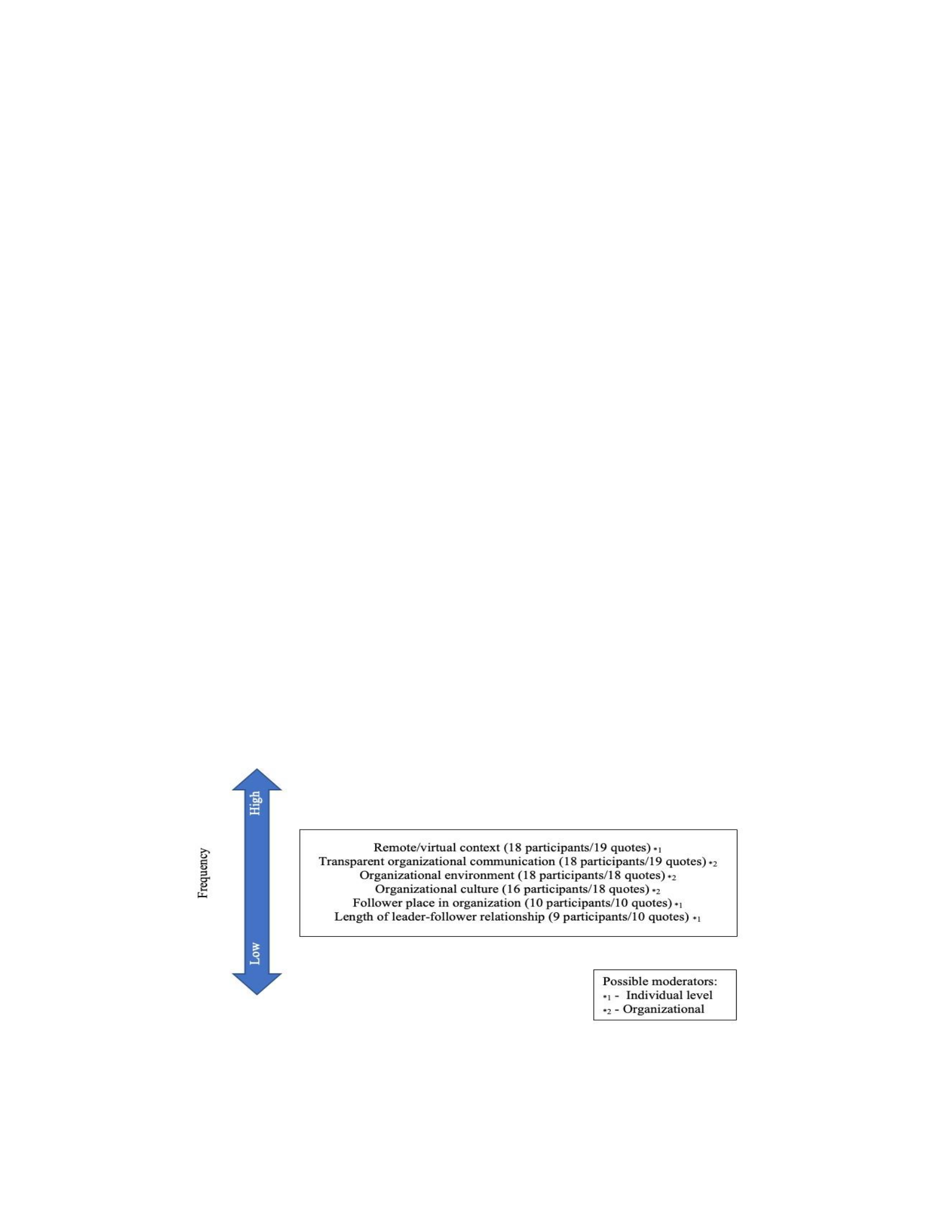
And then I think, I'm going to put listening in there. Because I think you can't, it's
hard to be transparent, if you are not listening to what people are telling you. Or
what they're really wanting to know and so you have to understand that.
Participant L002 – Executive Director, Specialty Services
They try to listen more. And you can see from their body language, they don't
interrupt people when they're talking to them. And I can also see that this leader,
that values transparency, it's not always talking, right?
Participant L011 – Business Director, Community Health
And when they listen, you know that they are not phony about that. They are not
listening just to ask you a question, they are really listening to understand. So
there is just something about these people that you can take them up [on] having
interacted with them for a while, you will know who they are. Because they're
really that, they're not going to be polishing anything for the sake of just making
you feel good about it. But it doesn't really mean anything. No, they really do
care.
Participant L013 – Director, Surgical Specialties
Potential Moderating Variables
The analyses revealed several specific contextual issues in which the relationships
between transparent leader characteristics and behaviors are unique, as well as have a potential
influence on the leader-follower relationship (Figure 9):
Figure 9
Potential Moderating Variables

Context – Individual Level
Three potential moderating influences were identified at the individual level, including
(a) remote/virtual context (working outside of the traditional office environment); (b) follower
place in organization (level of position/title or work location); and (c) length of leader-follower
relationship (amount of time follower has worked with leader). Since they were considered as
potentially impacting only the leader and the follower, these contexts were deemed as influencing
the leader-follower relationship at the individual level. They were described as having either a
positive or a negative influence on the leader-follower relationship.
One of these contextual influences was the remote/virtual context, for which the
participants described transparent leader behaviors as having a potential influence on the
leaderfollower relationship for followers working outside of the traditional office environment.
The analysis results show that this variable operates as a moderator at the individual level, where
transparent leader behaviors can have a positive impact on the leader-follower relationship. Yet,
the leader has to be more deliberate in reaching out to followers working remotely to make a
personal connection and keep them engaged, including face-to-face interactions, particularly
making an upfront investment with new followers. It can be more challenging for a follower
working remotely to feel connected or engaged, so it is important for a transparent leader to take
the time to engage differently with them, including consistently connecting with them and by
more than just email. Transparent leaders can schedule in-person events whenever possible so
teams can interact, build those key relationships, and get to know each other better. If meeting in
person is not possible, scheduling online meetings where the goal is simply to spend time
together (e.g., play online games, share stories) to build relationships might be an option. When
conducting online meetings using video software, it can be more difficult to pick up the emotions

or subtle nuances in follower behavior to notice if they are engaged or have any questions or
concerns, particularly if video cameras are not used consistently. By taking the time to get to
know followers better and really connecting with them, transparent leaders improve their
chances to be able to effectively develop the leader-follower relationship and help ensure the
follower’s success. This moderator has been described in the literature as impacting the
leaderfollower relationship, either positively or negatively (Carsten et al., 2022; Norman et al.,
2020), but not involving the transparent leader-follower relationship.
Carsten et al. (2020) conducted an empirical study to understand how follower role
beliefs affect follower effort, performance, and withdrawal under physical leader distance and
varying conditions of leader interaction frequency. 260 adults were surveyed working remotely,
and results found that follower level of effort, performance, and withdrawal were contingent on
leader interaction frequency. More specifically, followers who see their roles as more
collaborative reported higher levels of effort with high leader interaction. The results were the
opposite for followers with passive role orientations, who reported less effort when leader
interaction was high.
Norman et al. (2020) used a theory-building research approach taken from a follower’s
viewpoint of their experiences to examine the trust relationship between leaders and followers in
a virtual work setting. They found evidence that the leader-follower trust relationship may be
influenced by the leader’s personal characteristics, depth of leader-follower relationship, and
length of time working with the leader. Further, characteristics of the leader were indicated as the
most influential on the leader-follower trust relationship in a virtual environment and, after that,
honesty and follower characteristics. A quality leader-follower relationship can be influenced by
repeated interaction and, over time, quality interactions may reinforce the trust relationship.

Participants related their beliefs on the positive impact of transparent leaders on followers
working remotely, including how they ensure they reach out to followers to help them feel
connected (L010); emphasizing that you need to engage more upfront with new staff that are
working virtually in order to make a connection with them (L017); and describing the potential
results when followers don’t work for transparent leaders (L022). Exemplar quotes are provided:
I think it has a huge impact. I mean, they're working alone, it's easy for them to feel
isolated, and it's easy for them to feel disconnected and that their work isn't really
impacting the organization. So I mean, having to make it a point to touch base with
them at least twice a day and try not to do it in a manner that is resonating as
untrustable, like I'm micromanaging. It's just, any opportunity, I have a little bit of
feedback, or kudos, or good job, or hey, thanks for sending me that, [for example]
those reports on our quality measures. I just tried to maintain contact with them.
Because it'd be really easy for them to not have those interactions I would normally
do in person with the rest of the staff. And I'm kind of like, well, I guess for me, it's
kind of deliberate on my part. I want to make sure that they're still connected, and
that they realize that their work they’re doing is vital, and that it is appreciated. I
think if I wasn't as open, if I kind of left them to their own devices, I'm pretty sure
that doubt of the effectiveness of their work, or the value of that work would creep
in, and then it would begin to impact their commitment for it. And also, we make
sure that they're invited to all of our events, all of our staff meetings, so we have
every month, but like our little potlucks or whatnot, we always make sure like, hey,
if you can make it, if you’ve got time, come on in, don't worry about the drive time
or whatever. And that way, they still feel engaged and part of the team. Participant
L010 – Business Director, Community Health
I think you have to spend a lot more time engaging with that person, upfront. You
have to be very purposeful, in embracing them, bringing them in, including them,
making sure that you're meeting with that person enough, so that they get immersed.
Otherwise, there's not a connection, and you need that connection. Yeah, I think you
can do that virtually. But I think you can gain that trust and that transparency, that
trust that comes from in meeting with somebody repeatedly and often. But I think
it takes longer to achieve that [if meeting virtually].
Participant L017 – CFO, Home & Community Care Services
I think they are impacted. And we've had caregivers that started working remotely,
and came back. Because they were at a distance, and they didn't have that
transparent leadership. And where they're used to having that leadership present
here at always, and hearing from us, hearing that we're involved, and we're having
those discussions, and we're always around, always available. And then when they
go remote, they don't get that out as often. So I would say that a leader that wants
to be transparent with caregivers that are working from remotely, it's challenging to

do, I would have to say, it's challenging, it’s something that you would have to work
on. And I don't know how much we realize that, but it [transparent leadership]
certainly has impact. I would say it would have impact.
Participant L022 – Business Manager, Pharmacy Services
Follower place in organization was identified by participants as another contextual influence of
transparent leader behaviors on the leader-follower relationship. The results show that this
variable operates as a moderator at the individual level, with the amount of influence depending
on where the follower works in the organization (e.g., position or place in the organization).
Additionally, the positive influence of transparent leader behaviors appears to increase as the
level of position that the follower holds in the organization increases, or as the follower gains
additional experience in their career. For example, a follower that works as a leader in an
outpatient clinic is likely to experience less influence of transparent leader behaviors than a
leader working at the organizational headquarters. Follower place in organization has not been
identified in the literature as potentially moderating the transparent leader-follower relationship.
Participants shared their thoughts about the level of influence of transparent leaders
depending on their position or place in the organization by describing as they gained experience
and seniority in their career, they experienced different levels of transparency (L012); describing
how they experience different levels of transparency than followers that are reporting to them
(L017); and recounting that as they transitioned from a frontline provider to a leadership role,
how the influence of transparency changed for them (L019). Exemplar quotes are provided:
Absolutely. I think as you move up the chain, you see what doesn't make it through
to everybody, and also what you have the capacity and what you even care to learn
about. So when I was like a frontline worker, I cared about the policies that impacted
me. But did I care about all the nitty gritty for making the [corporate level] decision
back in that time? Probably not as a 20 something year old. But as someone who's
been on organizational committees that are impacting system changes in the
organization, then you can kind of see how the sausage is made. And, your position
of power gives you access to that sausage making where, if you're in other levels,
you might not be involved, [although] some organizations are good at involving

frontline people in those decisions. But it also depends. So I think, where you stand
and your power is often very impactful in terms of how much transparency you can
see.
Participant L012 – Business Director, Community Health
Absolutely. Each level I think has a different degree of transparency. And it's probably a
pretty good-sized leap to each level. I'm not necessarily in the day-to-day weeds of even
the services that I support, but my leadership team that reports to me, they are in that dayto-
day weeds, and they're very close to the operations, where I'm just kind of a step up above,
a kind of 30,000-foot view of that. I feel that there is a very big delta between each one of
those levels.
Participant L017 – CFO, Home & Community Care Services
Absolutely, absolutely influenced by my place in the organization. When I was a
frontline therapist, there is only so much that matters to me, right? If it changed my
day-to-day ability to see patients, it would have an influence on me, but otherwise,
I treated patients. So the transparency didn't have as big of an influence on me until
I moved up. And when I became more lead or middle management, that's when
transparency had a whole lot more impact on my role and how I felt in the
organization.
Participant L019 – Director, Rehabilitative Services
Another of these contextual influences was length of leader-follower relationship, which was
inferred in the participant interviews as being a potential influence of the transparent
leaderfollower relationship. The analysis results show that this variable operates as a moderator
at the individual level in that the longer a leader-follower relationship has to develop, the
stronger the influence of transparent leader behaviors on follower outcomes. Length of leader-
follower relationship has not been identified in the literature as potentially moderating the
transparent leader-follower relationship, yet it has been tied to the leader-follower relationship in
LMX literature (Dimotakis et al., 2023; Graen & Uhl-Bien, 1995).
Dimotakis et al. (2023) state that leader-follower relationships develop, mature, and then
stabilize. In LMX, high-quality leader-follower relationships are based on the reciprocation of
mutual trust, respect, and obligation (Graen & Uhl-Bien, 1995). The exchange-based nature of
this relationship implies that these links develop over time, with recurring cycles of reciprocal

exchanges as leaders and followers enact their roles while engaging in shared goal pursuit, such
as information sharing, collaborating on work, and other exchanges. With relationship-focused
behaviors being more closely related to LMX than tasked-focused behaviors (Dulebohn et al.,
2012; Yukl et al., 2009) and the more relevant to social exchange a behavior is, the stronger the
effects of its intensity should be on LMX (Barbuto & Hayden, 2011).
Participants recounted their experiences with transparent leaders and the development of
their relationships over time, including mentoring them over a decade so that they could take her
position when she retired (L006); how it took time for them to build a trusting transparent
leaderfollower relationship (L015); and describing the strength of the leader-follower
relationship built over a long period of time, nearly 20 years (L021). Exemplar quotes are
provided:
My recent leader who retired and I took her position … We connected from the
day I met her. I was doing some training, and I said something and she stood right
up and was like, hey, I said something about [hometown hockey team] was in one
of my stories. And she's like, hey, I just moved here from [home state], and we
connected and that's about 12 years ago. And so from that moment on, we just had
this amazing connection. But in the end, I became her manager. I was her
manager for 10 years, she was that mentor who was transparent. She entrusted me
with everything. But really, in all honesty, she and I had this daily dialogue, and
had just this connection, and saw each other every day unless we were on
vacation. But ultimately, she's 20 years my senior, but yet, the transparency she
had with me, the ability to coach me to give me extremely positive feedback, but
then also to give me constructive feedback to these are the things you could do
better. And these are the things I want you to know. And someday, if you're
interested, I want you to take my job. And these are the things I think you could
work on. So let me help you. If that's what you want, let's help building that path
forward. And so it was here's all the things you need to know about finance, here's
all the things you need to know about the company politics, here's all the people
you're going to want to connect with. And so that was the transparent leadership
at all levels, from the business level to the professional level to the development
me level that really helped me as a leader and someone I really started to model
some of my behaviors after.
Participant L006 – Director, Revenue Cycle

Yeah, and it's the leader I have right now. It’s my direct one up, supervisor. [First
name of current leader.] She's the Executive Vice President. And I think that's, and
again, that's that transparency has been built over time. I probably would not have
said that for the first two, maybe even three years that we worked together. And so
I think it's, transparency is something, there's got to be enough water under the
bridge, there have to be enough change events that occur where you start to build
that level of trust. And I know she's got the trust that I'm not going to put what she
said in an email and send it out to people that can forward it on and I think we've,
she's developed the kind of relationship with our team…I don't think she's as
transparent with the whole team. I think with some of the newer team members,
she needs to earn their trust first. So I think she's more transparent with the
leaders that she's developed trust with over time. So I think trust is something that
has to be, it's a two-way street. It has to be earned.
Participant L015 – Senior Director, Primary Care
I have a perfect person in my mind, who was not a warm, fuzzy person, he wasn't
like, bear hug, kind of person, and [had a] very, very dry sense of humor. But when
you really got to know him and understand his depth of caring, like personally
caring for the people that he led, and his willingness to share information so that
they could be successful. That just shined bright for me, and I've had that a couple
times in my career, and I actually feel blessed like, boy, wasn't I lucky to end up in
the right place at the right time. You know, what, three specific individuals over
my career, one of them was my boss for 19 years. Participant L021 – Executive,
Information Systems Solutions
Context – Organizational Level
Three potential moderating influences were considered at the organizational level,
including (a) transparent organizational communication (transparent communication coming
from the organization vs. leader); (b) organizational culture (beliefs, values, and attitudes); and
(c) organizational environment (internal or external forces). Since they were considered as
potentially impacting the entire organization, these contexts were deemed as influencing the
leader-follower relationship at the organizational level. They were described as having either a
positive or a negative influence on the leader-follower relationship.
A contextual influence of the leader-follower relationship described by the participants
was transparent organizational communication. The analysis results show that it operates as a
moderator at the organizational level, with transparent organizational communication potentially

having a positive or negative influence on the leader-follower relationship. Participants expressed
that transparent organizational communication is best delivered in a number of ways that allow
for interaction between leaders and followers. The consistent use of organizationallevel
gatherings (in-person, online, or phone), regularly scheduled team meetings (large or small), and
workplace rounding or huddles were all identified as having a positive influence on the leader-
follower relationship. Transparent organizational communication has been mentioned in the
literature as potentially impacting the leader-follower relationship, mediating the effect of
authentic leadership on follower trust and engagement (Jiang & Luo, 2018). With
transformational leadership, it influences follower openness to change through organizational
trust (Yue et al., 2019), but not involving the transparent leader-follower relationship.
Jiang and Luo (2018) tested a model examining how three influential organizational
factors (e.g., authentic leadership, transparent organizational communication, and follower
engagement) are linked to follower trust. The results suggest that authentic leadership impacts
follower trust via transparent organizational communication, as well as exerts a strong positive
effect on transparent organizational communication which significantly impacts follower
engagement. The study highlighted the significance of transparent organizational communication
in linking its antecedents and organizational outcomes.
Yue et al. (2019) examined the effect of transformational leadership and transparent
organizational communication on cultivating follower organizational trust during an
organizational change event. They found that transformational leadership and transparent
organizational communication were positively associated with follower organizational trust,
which in turn positively influenced follower openness to change. This provided additional
evidence on the importance of transparent organizational communication in successful change

implementation. More specifically, open, honest, and ethical communication can narrow the
information gaps between followers and the organization, diminish change-related
misinformation and rumors, and reduce follower anxiety and stress.
Participants expressed their views on the influence of transparent organizational
communication on the leader-follower relationship, including how much of a positive difference
it can make during a major organizational restructure (L002); what that could potentially look
like, and the positive impact that it could bring to the organization (L015); comparing their
experiences with communication coming from a transparent organization and that coming from
an organization that is not transparent (L020). Exemplar quotes are provided:
Then that [restructure] was turmoil, right? Totally awful, horrible, turmoil.
Everybody had to apply for their jobs again. But what was really good about this
is that the leaders were actually transparent. So you could have … two separate
things [occurring]. So the leaders were transparent, here's what's happening, here's
why we're doing it, here's the process we're going to do. And here's your next
step, like so you know, what that meant for you, either as a leader or as a person
impacted, it was super transparent. And at the same time, it was a ton of turmoil.
Like, it was horrible, awful. But I felt like I had enough information. And
everybody was in the exact same boat. And we all heard the exact same things,
right? Like, that [message] was a bad, but [the process and communication was]
good. So I think you can have good transparency and a horrible situation that still
makes you feel okay, about whatever it is, and you feel okay, about, I'm
communicating this as my next thing, because you have all this information and
things were super transparent.
Participant L002 – Executive Director, Specialty Services
I think open communication from the top and whether that looks like holding a
town hall or an open forum for a Q&A. I think it would be more senior leaders.
And I'm not necessarily talking about the CEO, or the president. But I think it
goes from all levels, more senior leaders, meeting with frontline staff to share the
status of a company successes, failures, where we need support, what's working,
what's not working. And just being open and transparent about what things we
can change and what things we cannot change. And I think that creates a level of
trust for frontline teams.
Participant L015 – Senior Director, Primary Care
I think the organization actually being transparent, in what they do and not
wavering from that. Even in hard times, being able to share, this is hard, and we're

gonna have to figure this out, and we don't have all the answers. But, we value
you, and they really do value you as an individual. And, that's where I think those
are the successful organizations. If you have an organization that's just talking, as
you said, you can see through it, usually, it's like, there's an ulterior motive here,
and this is not, you're just saying stuff to get me through the day. You can really
sense it and you feel that.
Participant L020 – District Director, Primary Care
Organizational culture was mentioned by participants as a contextual influence of the
leaderfollower relationship, with the level of influence determined by how safe followers felt to
fail and learn from their experiences, as well as how supportive they felt it was for everyone to
share their thoughts without any fear of consequences. The results show that this variable
operates as a moderator at the organizational level, with organizational culture typically having a
positive influence on the leader-follower relationship, but could have a negative impact
depending on the circumstances. The participants most often described a “safety culture” as
being a positive influence on the leader-follower relationship. This type of culture was described
as a safe place for followers where it is okay to fail (e.g., unfavorable interaction with a patient),
to share results when things did not go as well as planned (e.g., implementing a new project), and
to be able to learn from those experiences and improve future outcomes because of them. They
described an open culture as another positive influence that would be supportive of transparent
leader behaviors, sometimes termed a “speak up culture” where everyone feels safe to share their
thoughts without fear of negative consequences. Organizational culture has been identified in the
literature as potentially influencing the leader-follower relationship (Gardner et al., 2005:
Gardner et al., 2021), but not the transparent leader-follower relationship.
Gardner et al. (2005) provided contrasting examples of cultures. Positive cultures
characterized by a commitment to ethical conduct and human development are most conducive
to the development of authentic leadership and followership. In contrast, a culture that reflects a

preoccupation with short-term performance results at the expense of ethical considerations will
not encourage the development of authenticity, in part because honesty, integrity, and high moral
standards are not prototypical values.
Gardner et al. (2021) shared that organizational cultures tend to prescribe ways for
leaders and followers to act. Senior people may be more influential, but most authenticity is not
necessarily an outcome of leader or follower positioning, but rather a matter of general
orientation, interpersonal relations, and cultural norms.
Participants related their perspectives on the influence of organizational culture on the
leader-follower relationship, including the potential influences when the culture provides a safe
environment and when the culture is not a safe environment (L005); by describing the benefits of
having a “speak up culture” within an organization and how it promotes transparency (L006);
and the significant impact a mission-based culture can have on the followers of an organization
(L020). Exemplar quotes are provided:
I think the culture of an organization is really important. Because if from the top
of the organization to the bottom, there is a culture of leading from a fear-based
mentality, that's going to drive people to withhold information. Because that's
withholding successes and failures. Like, well, I can't tell my boss that I screwed
this up, because if I do, they're gonna fire me. So I'm going to hold on to this as
long as I can, and see if things get better. And then figure out a way to
communicate this in a sugar-coated way that isn't really the truth. I think having
an organizational culture where it's okay to fail, and learn from those failures, is
critical to having a transparent organization. Because you need to be able to feel
safe to say, this didn't go as well as it should have. And, here's why. And here's
what we're going to learn from it. But if it's an organization rooted in a fear-based
leadership, you don't have that feeling of safety to be able to have those
transparent conversations.
Participant L005 – Executive Director, Medical Specialties
So there's a big “speak up culture” movement within [their current organization].
And, when it's working correctly, knowing that there won't be negative
consequences to speaking up, it promotes transparency. So an organization with a
strong “speak up culture” promotes transparency everywhere, as far as I'm
concerned. But the unfortunate thing is, all it takes is a couple of instances of

negative ramifications for speaking up, that, it's fragile. No one will do it again,
once they've had negative consequences of it. So for speak up to really make a
transparent organization, it has to be not just words, [but] actions as well.
Participant L006 – Director, Revenue Cycle
I mean, I think their behaviors have a huge impact for sure. But I think that also
the organization, really walking the talk, as well behind the scenes to allow them
to be in that position to have that trust level that they know. They know the
organization is there working with them and for them too, and to be able to
exhibit that to the rest of the teams because they have that competence level, that's
an organizational culture that has an impact. Knowing that, we had a forum in,
and [Guest speaker’s name] spoke at it, and she's like, hey, you know, we are
going to care for patients and take it even if we can't afford to do it, we'll figure
out a way to do it, because that's at our core. And that's what we're trying to do.
So it was like, we knew that, and it resonates with the why of so many people.
Some people, it's just a job, but generally, it's not when you're there, and you're
like, this is exciting. And this was cool. And we know, we can do this, and we'll
get over these hurdles. But that's organizational culture that I think you find it a
little more with the non-profits. And I think that's why they have a mission behind
them. They have a why, whether it was way back here, and hopefully it hasn't
gotten distracted. But, that allows higher level leaders to be able to then be calm
and confident and instill trust in the other leaders to move the ball forward.
Participant L020 – District Director, Primary Care
A final contextual influence mentioned by participants on the leader-follower relationship was
organizational environment. The results show that this variable operates as a moderator at the
organizational level, with the internal or external organizational environment having a positive or
negative influence on the leader-follower relationship depending on the circumstances. The
influence of the organizational environment, including the types and numbers of internal or
external forces impacting followers, was described by participants as potentially having an
influence on the leader-follower relationship. This moderator can be considered as either simple
and less complex (e.g., new organizational logos), highly complex (e.g., changes to billing
reimbursement), fast and volatile (e.g., pandemic), or somewhere in between (e.g., updated
productivity software). The higher level of transparency followers experienced was reported as
having a positive influence on those experiences. Organizational environment has been identified

in the literature as potentially influencing the leader-follower relationship (Avolio et al., 2009;
Gerstner & Day, 1997; Luthans & Avolio, 2003; Uhl-Bien, 1997), but not the transparent
leaderfollower relationship.
Theory and research suggest that organizational climate (environment) or culture may
enhance or mitigate perceptions of authentic leadership behavior (Avolio et al., 2009; Luthans &
Avolio, 2003). Uhl-Bien et al. (1997) suggested that several situational moderators of
LMXoutcome relationships exist, such as task characteristics, time constraints, resources,
physical setting, organizational climate, and culture. For example, when objective measures are
used, such as sales performance or follower turnover behavior, leader-follower relationships are
much weaker because such outcomes may have many other antecedents and some
uncontrollable, environmental elements (Gerstner & Day, 1997).
Participants reported their experiences of how the organizational environment can have
an impact on the leader-follower relationship, such as the lack of transparency of other leaders in
the organization (L007); facing the impact of changes in the external environment and how it
affects the organization (L015); and sharing their experiences where a transparent leader helped
mitigate something negative happening internally to the organization, which made the
circumstances still manageable for them (L019). Exemplar quotes are provided:
I'm sure there's other influences as well ... You know, [with a complex]
organization there's not just one leader, right? In our complex healthcare [system],
I don't just have one boss, I have many different bosses and different levels as
well. So I think that sort of combination kind of influences that. And I feel like
for me, it's sort of like a culmination of what you see. So it's not enough just to
have my boss as a transparent, effective leader. When I see that person, when I
see her not being able to [answer] a question. I see decisions that are made that I
don't quite understand, that she doesn't have an answer to and I see other people
that are not as effective from a transparency perspective, make those decisions, I
think it influences how I view the organization and how I am as a leader.
Participant L007 –Director of Operations, Primary Care

Part of it was in different points in time of the industry and it was at a time that
we were growing. Things are happening quickly. As opposed to kind of where
we've been circling for the last decade around tightening budgets, asked for
higher productivity. Yeah, I think I'd say those are some outside impacting or
influencing factors, whether the job or the industry as a whole was going through
rapid change and growth, exciting time. Almost like a startup versus, oh boy,
we've got twice the budget gap next year that we had last year, and we have to
work. It really feels like it's been the same story on repeat for the last decade, of
the next year is going to be tougher than the current [one], we're gonna have to do
more with less. And I think that just frames that work for you.
Participant L015 – Senior Director, Primary Care
During times that I had an extremely transparent, effective leader, there were
things happening in the organization beyond that leader’s control that weren't
necessarily so positive. So it [leader’s behavior] mitigated some of that negative,
but it still influenced my role. I've been through a lot of reorganizations in my
time and they, every one, colored how I felt about my role at the time. But the
leader made it where it was either manageable or not.
Participant L019 –Director, Rehabilitative Services
Potential Mediating Variable
The results of the interviews identified follower trust as potentially mediating the influence of
transparent leader behaviors on the leader-follower relationship (Figure 10).
Figure 10
Potential Mediating Variable

Interpersonal Influence
Follower trust was identified as a significant variable under the category of interpersonal
influence, linking the relationships between transparent leader behaviors and follower outcomes.
It relates to the reciprocal interpersonal exchanges, verbally or non-verbally, between leader and
follower, influencing the leader-follower relationship. These continuous interactions over time
can further develop and strengthen the relationship between the leader and follower as they learn
to trust each other. Follower trust was described by virtually all participants as a primary effect of
transparent leader behaviors and as an influence on the leader-follower relationship. The
experience of follower trust appears to be associated with how transparent leader behaviors are
positively connected to a range of important follower outcomes. It is described in the literature as
a mediating influence on leadership behaviors or as an outcome of those leadership behaviors
(Hernandez et al., 2014; Vogelgesang & Lester, 2009; Walumbwa, 2008; Yue et al., 2019), but
not specifically as a mediating influence on the transparent leader-follower relationship.
In literature, trust is defined as “the willingness of a party to be vulnerable to the actions
of another party based on the expectation that the other will perform a particular action important
to the trustor, irrespective of the ability to monitor or control that other party” (Mayer et al.,
1995, p. 712). Further, theoretically established antecedents of trust include ability, integrity,
benevolence, positivity, competence, and transparency (Colquitt et al., 2007; Mayer et al., 1995;
McAllister, 1995; Norman et al., 2010).
Hernandez et al. (2014) examined the pathways to building trust through leader
behaviors. Consistent with past literature, the findings indicated that various leadership behaviors
appear to directly promote follower trust when analyzed independently. However, when the
leadership behaviors were analyzed jointly, relational leadership behaviors (e.g., displays concern

for those they lead) were found to mediate the effects of personal and contextual leadership
behaviors on follower trust.
Vogelgesang and Lester (2009) described potential outcomes of transparent leader
behaviors, including follower trust in the leader. These transparent behaviors help create a
foundation for a trusting leader-follower relationship by sharing relevant information during
exchanges with followers, being open to giving and receiving feedback, and being forthright
about motives thereby, opening the door to the leader’s rationale for decision-making.
Walumbwa (2008), developing a theory to test the corresponding measure of authentic
leadership, described relational transparency as presenting one’s authentic self to others, thereby
promoting trust through leader disclosures that involve openly sharing information and
expressing their own true thoughts and feelings.
Yue et al. (2019) examined the effect of transformational leadership and transparent
organizational communication on cultivating follower organizational trust during a change event.
The findings suggested that transformational leadership and transparent communication were
positively associated with employee organizational trust. In turn, trust mediated the influence of
transformational leadership and transparent communication on employee openness to change.
These relationships are important in how they can separately and jointly influence leaderfollower
relationships and their corresponding outcomes.
Participants shared their thoughts about the importance of trust in the leader-follower
relationship, such as emphasizing the ultimate importance of trust and that without it, a leader
will not be considered transparent by followers and simply cannot be effective (L007); that it is
really about the mutual trust between the leader and follower that makes a difference (L018); and

describing a previous transparent leader, how he was a great role model for transparency and
how he trusted his followers in a bold way (L020). Exemplar quotes are provided:
Because without trust, it doesn't matter. If you go through the motions or not, you're
not going to be able to be an effective transparent leader. People are not going to
believe you. And so I think that's first and foremost and without that, I can say that's
really hard to overcome. So if you don't have trust with that leader, it doesn't matter
if you've changed who you are as leader five years from now, you may still not have
built that back [trust] with your audience … and people are still not going to think
that you're [not] somebody that might be holding information [back] that people
might be suspicious about.
Participant L007 – Director of Operations, Primary Care
I always put trust at the top of the list. And the interesting thing is that I've learned
to better define that. I think maybe even 5, 10 years ago, I wouldn't have called it
that, I would have just, even though trust is a word that we all know. Yeah, it's that
I've got your back, you've got mine, we're gonna get through this, that locking arms
together and figuring out how to move forward with something. Because, there are
days that break your heart, across the board. But feeling like you have that support,
and at times you can be vulnerable with a leader to let them know how sad, or
disappointed, or heartbroken, or whatever you are throughout. I can trust my staff
all I want, but if they don't trust me, and if we don't have that mutual respect, and if
they don't feel like I have their best interests at heart, or the organizational
leadership has their best interests at heart …
Participant L018 – Clinic Manager, Primary Care
I would say I've had several [transparent leaders], but probably the CEO at [previous
organization] was the best example of it, I mean, you just knew exactly where you
stood and what was going on. And he involved the whole team, very early on, in
helping, he would set the goal and the vision, and here's where we're going. Now,
you guys have, we got to get there. And, I will pour resources and whatever you
need to make it happen and then we can just move forward. So that early on
transparency was just, almost at times, it's like, whoa, you're sharing all this, our
competitors are going to hear this too, because you just shared it with a bunch of
people before it ever happened. He didn't care, he just felt like, we know what the
right thing is to do. This is what we're doing and I don't care if the hospital across
the street knows it. So that was, that was an extreme level of transparency that really
exhibited trust. And I think, in my current situation, with my boss I have now, she
is extremely transparent, same way, but very, totally just, she trusts us, she lets the
reign out. And just, you got this, and she's there to help guide and lead. You know,
if there's things that that go south, but it's never in like a criticism or judgmental
fashion. But if she is able to share and she knows something, we know it too. And
that it's just great to be a part of that. Because then you can start envisioning, like,
how can we be a part of this? And how can we play a role in that, getting to our
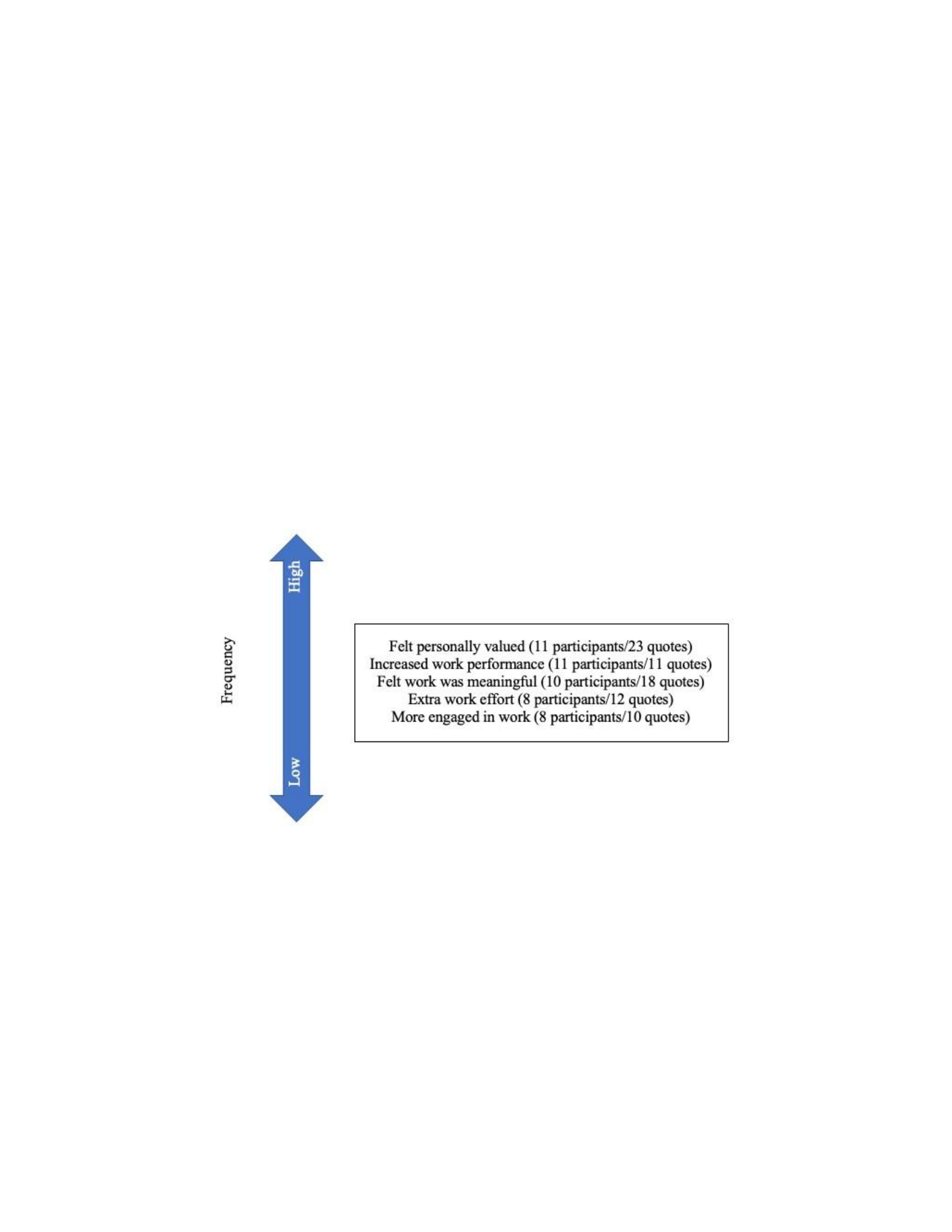
goal and what we need to do? And then you get all kinds of creative and bright ideas
that move you into that next phase.
Participant L020 – District Director, Primary Care
Follower Outcomes
The results of the interviews revealed a series of follower outcomes because of the
influences of transparent leader behaviors on the leader-follower relationship, including felt
personally valued, felt work was meaningful, increased work performance, extra work effort, and
more engaged in work. The most common outcomes because of transparent leader behaviors are
described in Figure 11.
Figure 11
Follower Outcomes
Follower Personal Impact
Two follower outcomes have been placed under the category of follower personal impact:
felt personally valued and felt work was meaningful. These outcomes impacted followers on a
personal level, answering “their why” regarding the work they do and where they do it.
The outcome most often mentioned by participants because of the influence of
transparent leader behaviors was described as felt personally valued, referring to the positive

impact they have had on them personally. The way followers are treated by leaders was described
as very impactful, as they want and need to be appreciated and valued. Helping followers feel
valued can be achieved by allowing them to be themselves, to communicate openly with them, to
really hear them, and to show that they are trusted. Although followers felt valued is addressed in
the literature (Hamstra et al., 2014), feeling personally valued has not been linked in the
literature to the transparent leader-follower relationship.
Followers who experience a sense of being valued as individuals has been identified in
prior research (Hamstra et al., 2014), but appears to be missing the follower’s personal impact of
being valued that the participants described. Hamstra et al. (2014) stated that the leader-follower
relationship is crucial in the social exchange process of leadership. The process only functions
well when followers are actively involved, as a leader attains goals through the joint efforts of
followers. This result implies that leaders who are able to help followers feel valued (accepted
and important) are more likely to be effective leaders. This research provides an explanation for
the feeling of being valued by a leader by taking into account both leader and follower
characteristics, as well as leader behavior.
Interpersonal justice refers to the perceived fairness of the interpersonal treatment shown
to others and can elicit strong emotional responses in recipients, which may be experienced
immediately, and can directly reward actors as they foster social acceptance and support (Bies,
2001; Masterson et al., 2000). More specifically, interpersonal justice describes the degree to
which people are treated properly with dignity, politeness, respect, and propriety (Colquitt, 2001)
and is important in shaping employee behavior (Greenberg & Alge, 1998; Judge et al., 2006).
This area of the literature may provide additional insight into how leader behaviors can result in
outcomes that have a personal impact on followers. For instance, as transparent leaders treat

followers fairly, and with dignity and respect, followers can respond by feeling valued.
Similarly, when a transparent leader listens intently and respectfully to a follower when they
share their concerns about work responsibilities, it can help them feel their work is meaningful.
Participants discussed their insights on the power of being personally valued, describing
their perspective on the power of followers feeling valued and the significant impact that can
have on them (L014); recounting some experiences in their career when they felt valued by their
leader and when they did not, and how they impacted their performance and their career choices
(L021); and expressing what they appreciate about transparency and how it makes them feel to
be valued by their leader (L025). Exemplar quotes are provided:
It's all I mean, when people feel valued, they're gonna give you that 100% that
you were looking for and more. All because they felt appreciated, valued,
comfortable coming to work here. They have meaning, they have a purpose, like
you said, and that was the whole secret, just allowing people to be themselves and
feel comfortable, and valued, and seen and heard.
Participant L014 – Corporate Officer, Community Health
I'm a people pleaser, right. And I want to do well for the people that lead me, like I
wanted to be a good student, want to be a good mom, want to be a good
employee. So if I feel valued from the relationship that I have with my leader, I
want to do good work for them. So I will say I perform better for individuals that
have that transparent, authentic, kind of, I want to help you be successful, then I
was in those situations when I didn't have that. And as a matter of fact, the two
major moves that I've made in my career were specifically because of not working
for people who had those, where I didn't feel like I was valued, that there wasn’t a
relationship that the person trusted me and it wasn't supportive.
Participant L021 – Executive, Information Systems Solutions
I think that's the beauty of the transparent conversations I have with my boss, he's
interested in not only my work life, but in my family life, and he's earned my
trust. And so that really helps me to know that I'm being valued as an employee,
as a caregiver. It helps me know that, I know he's going to be consistent with me.
He's not gonna pull any punches, and he's gonna try to help me learn and grow.
So I think that's what I enjoy about his transparency with me.
Participant L025 – Director, Pharmacy Operations

Felt work was meaningful was expressed by the participants as a result of the influence of
transparent leader behaviors. Followers want to feel good about their work and want and need it
to matter. They need a leader to let them know that their work is valued and that it makes a
difference to the organization. The meaningfulness of work is discussed extensively in the
literature (Elangovan et al., 2010; Gibson et al., 2023; Hackman & Oldham, 1980; Lips-Wiersma
& Wright, 2012; May et al., 2004; Pratt & Ashforth, 2003; Sparks & Schenk, 2001; Yeoman,
2014), however, this outcome has yet to be linked to the transparent leader-follower relationship.
A number of management theories have recognized the importance of meaningful work
and have been found to influence key work outcomes such as work engagement (May et al.,
2004), job satisfaction (Sparks & Schenk, 2001), motivation (Hackman & Oldham, 1980) and
stress reduction (Elangovan et al., 2010). Meaningful work is primarily important because it is a
fundamental human need, and society ought to be arranged to allow as many people as possible
to experience their work as meaningful through the development of the relevant capabilities
(Yeoman, 2014). Meaningfulness of work is defined as “the value of a work goal or purpose,
judged to the individual’s own ideals or standard” (May et al., 2004, p. 11). When something is
meaningful to an individual, it helps answer the question, “Why am I here?” (Pratt & Ashforth,
2003). Thus, when someone experiences their work as meaningful, it is an individual subjective
experience of the significance, or purpose of work (Lips-Wiersma & Wright, 2012).
Participants provided their reflections on the importance of feeling that their work was
meaningful, including why leaders need to share with followers that the work they do matters, in
words that the follower can understand (L001); relating their experience in working for a former
transparent leader and how they were impressed with the leader’s ability to express his
understanding of the positive impact that their team was making to the organization and the

community (L008); sharing why they felt that their work was meaningful and attributed that
feeling to working for a transparent leader (L021). Exemplar quotes are provided:
Because we're people and we come to work to not just do a job, but we bring who
we are to that work. And we all want to be seen. I mean, we just do so whether
that we’re seen because of your brain, or seen because of who you are, you still
spend a lot of time at work. So you want it to matter. And you want a boss that
gets that and understands how to communicate that your work and you are valued,
you are appreciated for that and uses your language around that, as opposed to
their language.
Participant L001 – Director, Community Health Access
You know, they can actually make you feel like your work is really important. So
providing validation, perhaps, and from a truthful perspective that you can
resonate with. So they may be able to echo things that you've said about your
own work, and its importance. But they may have recognized on their own, and
that's probably the more powerful one, it's they recognize the nature of the work
that you're doing, the importance that it is to the organization or the department
broader, not just in your own department, because often they're not there. Our
CEO hardly ever stepped foot in here, but he knew the impact that we had in the
community. And that was more rewarding, that he could recognize the impact of
that work in the community. And so that made me feel like it was also important,
and I felt rewarded, that he could recognize the importance of it. Participant L008
– Director, Pharmacy Operations
Well, for me, you feel like you're making a difference. Like the work that I do
impacts the communities that we serve, addresses things like health disparities,
and getting information in front of clinicians so that they can make good decisions
for their patients. Reduces waste, improves value. And so when you think about
why is it that we're in non-profit, what are the things that draw us to non-profit
healthcare in the first place? Which is to serve others, improve the health of our
communities. like all of the reasons why we're sitting where we're at. Those
leaders allow you to do more of that and better, and it just makes you feel like
you're not like this, some days, like, when you're not in that situation, you go
home, and you go, oh gosh, like all I did today was like, fill out a bunch of forms,
or that wasn't very productive. Or like, oh, I don't really feel like I created
anything that brought value to anyone today. And so for me, it's really about that
sense of creating value, self-fulfillment, that I'm making a difference, because it's
not about money, because if it was about money, we would go somewhere else
and do what we're doing for some for-profit entity, right?
Participant L021 – Executive, Information Systems Solutions

Follower Professional Impact
Two follower outcomes have been placed under the category of follower professional
impact: increased work performance and extra work effort. These outcomes were considered
ones that impacted followers on a professional level, how well they did their jobs, and how much
effort they gave in doing them.
Increased work performance was another outcome described by participants as a result of
the influence of transparent leadership behaviors on the leader-follower relationship. When
relevant information is shared with followers, they have a clearer understanding of the goals and
can focus their attention on their achievements. They are able to move past difficult situations
much quicker, reducing wasted time by avoiding the confusion or distraction of not knowing
what is really happening. Increased work performance has been linked in the literature as a result
of the influence of transparent leadership behaviors, and the relational transparency dimension of
authentic leadership has been linked to increased follower performance (Vogelgesang & Lester,
2009; Walumbwa et al., 2008), as well as being extensively tested with multiple leadership
theories (Brown et al., 2015; Wang et al., 2011). Thus far, in instances when this outcome is tied
to transparent leadership, it has not yet been empirically tested.
Vogelgesang and Lester (2009) suggested that leader transparent behaviors set the
groundwork for multiple positive outcomes, including follower performance. They go on to state
that when leaders allow for trust to arise and by laying a foundation in which followers become
more engaged in their roles, leader transparency allows for positive impacts upon performance.
Transparent leaders can help steer clear of any distractions that can harm productivity by
proactively sharing information, and they consistently seek feedback from followers to create
conditions that allow for creativity and improvement of established procedures.

When discussing the relational transparency dimension of authentic leadership,
Walumbwa et al. (2008) stated that by promoting and building transparent relationships, we can
expect a more rapid and accurate transfer of information that should facilitate more effective
follower performance. In addition, over time, followers come to internalize many of their
leader’s values and perspectives, which can facilitate the development of internal guiding points
for making effective decisions, leading to improved individual follower performance.
Participants described how their leader-follower relationship positively impacted their
work performance, by sharing their response when they experienced trust and honesty (L010);
explaining the impact when team members feel trusted and as a valuable team member (L013);
and describing how that relationship not only impacts their work performance, but that of their
teams (L020). Exemplar quotes are provided:
I know it improved it, because I felt that there was a reciprocation of trust and
honesty. And that I felt that I needed to honor that by ensuring I gave my best
performance, that way it was that trust was validated in me, but also validated in
them.
Participant L010 – Business Director, Community Health
Well, the way when they are not performing, certainly it cascades, because then
you're doing more of what you might otherwise expect to do. If they're doing
more because they feel good about themselves. And they feel trusted, they feel
like they're part of the team, they feel like they're a valued team member. And
[when] they are doing their best, their output is always more than what you
expect. Therefore, if it’s shared among [the team], if it's average, everybody else
then has less to do. But the goal of the business then gets achieved, because now
you have more people coming in at it, doing their best, than if having few that are
doing more to get this going. That team environment is what you want to create.
And you'll get it through this set of behaviors. Transparent leadership is one of
them.
Participant L013 – Director, Surgical Specialties
It has a huge impact. I mean, when you have a transparent leader, that you have a
clear understanding of what you're trying to accomplish, and what you're doing, it
allows you to focus your attention on that, and when that trust factor is built, and
they feel like you're a valuable component, you can feel more creative, more out
of the box thinking, you know, let's try this, let's do this. And it's not going to get

blasted or shot down. So it really, I think, it lets people rise to their highest level
of achievement, and accomplishments and, [it] really serves the organization
overall, much better. Because they've got high functioning teams, and individuals
that are all adding to that result. And it doesn't have to be any one person winning
or having that accolade, it's, hey, we all contributed, it's all moving in the
direction we want it to go.
Participant L020 – District Director, Primary Care
Followers’ extra work effort was an additional outcome shared by participants as a result of
transparent leadership behaviors. They trust transparent leaders, want to please them, and want
their leaders to be happy with their work performance. They feel valued and that their work
matters. As a result, followers want to work harder for transparent leaders and will give that extra
effort to ensure the organization is successful. Extra work effort has been linked in the literature
to the leader-follower relationship (Graen & Uhl-Bien, 1995; Young et al., 2021) and has been
tested with multiple leadership theories (DeGroot et al., 2000; Groves, 2020). That said, this
outcome has yet to be linked to the transparent leader-follower relationship.
Participants relayed how the transparent leader-follower relationship impacts extra work
effort, including their willingness to give extra effort to their work and how they might react
when they do not receive that same level of trust (L015); sharing how they are willing to give
extra effort to their work when their transparent leader and organization appreciates the work that
they do (L016); and recounted how the respect they had for a leader and how she made them
feel, resulted in making them want to work even harder (L018). Exemplar quotes are provided:
Working for a leader I trust, where I find my work has meaning and importance,
I'm willing to bend over backwards, put in that discretional effort. That's probably
how I define that. It's that willingness and energy to put in the discretional extra
effort on a task, whether it's a task or project, infer on the conversely, when I work
with leaders that I don't have that same degree of trust and respect for, I'd be more
inclined to just do the minimum necessary.
Participant L015 – Senior Director, Primary Care
Well, your work performance, I think you want to just do the best you possibly can.
And you know, and do more. I mean, I know that, I don't do just my job. I wear a

whole bunch of hats, and I want to do more, because I feel like my organization
appreciates what I bring to them. And I think that when you are feeling
appreciated, you don't mind giving more of yourself. So by having a transparent
leader, and having them listen and engage with me, I'm more than willing to give
more of myself to that.
Participant L016 – Clinic Administrator, Natural Health Center
Ah, so this would be [previous leader]. I already had a pretty high regard and was
pretty proud of the work I did and the organization I worked for. But when she was
leading it, I felt like it even ramped it up, right? It's like, when we would launch a
new trial, or have any service come on board or something like that, it was just, I
mean, even it was small things like instituting a new, like there was a cooling cap
that they we used in chemotherapy that was supposed to prevent hair loss while
the insurance wouldn't pay for it. So of course, everybody's like, not a possibility.
And a bunch of us fought and figured out a way to bring it in. And it's like, even
when things like that, the amount of pride shoots through the roof, because you're
proud of yourself and proud of the accomplishment. But you also know that this
amazing leader is proud of you, somebody that you have a high level of respect
for. And they're appreciative. Which just makes you want to work even harder.
Participant L018 – Clinic Manager, Primary Care
Follower Work Engagement
More engaged in work was an outcome depicted by participants as a result of the
influence of transparent leader behaviors. This outcome was considered as involving the level of
involvement and commitment a follower had in their work. By receiving more information from
transparent leaders, followers felt better about their work and had more emotional ties to it,
resulting in them having increased commitment to the work. They felt more supported because
they knew where they were going and trusted each other, making them feel more engaged. This
outcome has been linked in the literature as a result of the influence of transparent leadership
behaviors (Gardner et al., 2005; Vogelgesang & Lester, 2009; Yi, 2017) and has been tested with
multiple leadership theories (Chughtai & Buckley, 2011; Jiang & Luo, 2018). Still, even when
this outcome is tied to transparent leadership, it has not been empirically tested.
Vogelgesang and Lester (2009) suggested that if leaders are open about decision-making
and the issues they are facing, and they should do so, they will receive greater follower

engagement, as well as trust, satisfaction, and performance. Transparency allows followers to
understand what their role means to the organization, it dispels myths and gossip by sharing
relevant information and allows the follower to focus on their job and be more engaged.
Yi (2017) states that a leader’s highly transparent behavior teaches followers to recognize
their strengths and talents to make for a better fit between work demand and their abilities
(Gardner et al., 2005), which may enhance follower engagement and their ability to focus on
their work. Yi (2017) continues that highly transparent leaders treat followers frankly and are
forthright about the motives and reasons behind decisions, reducing the need for followers to
guess what the leader is thinking. In turn, followers focus more attention on their work and allow
them to be more engaged in the creative process and roles within the organization.
Participants expressed their thoughts on how transparent leaders influenced their level of
work engagement, describing their increase in emotional ties and commitment to their work
(L007); describing how it made them feel more engaged with their work (L008); and sharing
how the leader helped mitigate the negative impact of working with ineffective leaders to still get
their work done (L019). Exemplar quotes are provided:
I think that it becomes more mission critical. I think that there's more emotional ties
to my work and more commitment to the work that I do, versus like it’s just a job,
and I'm going to do my job well.
Participant L007 – Director of Operations, Primary Care
So if I'm working with other transparent leaders, if I know where they're going,
and where we're going, and we trust each other, I actually feel more engaged.
Participant L008 – Director, Pharmacy Operations
I am much more engaged with a transparent leader. And I will work harder for
them. In the periods of time that I worked with ineffective leaders, I had a strong
peer team. And we got a lot done because we cared about each other, not because
we cared about who were working for. But if I have a transparent leader above
me, it's going to make me work that much harder to be successful and to make the
organization successful.
Participant L019 – Director, Rehabilitative Services

Transparent Leadership
A Transparent Leadership Model (TLM) was developed to capture all the findings
reported in this study. A new definition of transparent leadership is also offered.
Transparent leadership has been described by Baum (2005) as “a leader who believes in
telling the whole truth” (p. 42) and by Goldsmith and Wheeler (2007) as being able to “show
their humanity and share information” (p. 20). Bennis et al. (2008) describe transparent
leadership as leaders with “candor, integrity, honesty, ethics, clarity, full disclosure, legal
compliance, and all that enables us to deal fairly with each other” (p. 19). Schwarz (2010) states
that transparent leaders share what they are thinking and ensure that followers understand their
thought process. Schwarz (2010) and Scott (2016) describe transparent leadership as the
productive sharing of essential and valuable information with followers through open and honest
conversations that helps build trusting relationships. Vogelgesang and Lester (2009) state that
transparent leader behaviors include sharing of relevant information with followers, being open
to giving and receiving feedback, and being honest about motives and reasons behind decisions.
Despite these descriptions of transparent leadership, Buell (2008) states that relevant
literature lacks a formal definition of a new construct. The results of the interviews with the
participants would suggest that transparent leaders possess the characteristics of EI: emotional
attentiveness, approachability, communication skills, genuineness, honesty, and openness to
selfexpression. The participants described transparent leader behaviors in the following way:
shares information with others, gives and seeks feedback, connects with followers, cares for
others, speaks truthfully, behaves with authenticity, displays vulnerability, engages in
conversation, and actively listens to others. The participants shared their perspectives on the
contextual influences on the transparent leader-follower relationship, such as remote/virtual

context, follower place in organization, length of leader-follower relationship, transparent
organizational communication, organizational culture, and organizational environment.
Considering the dynamics of the transparent leader-follower relationship, follower trust was
described by participants as emerging because of the quality of that reciprocal relationship,
essentially mediating the connection between the transparent leader-follower relationship and the
resulting follower outcomes. This reciprocal process may explain the positive influence of
transparent leader behaviors, with an increased presence of follower trust, resulting in the
following number of follower outcomes. The descriptions of those follower outcomes as shared
by the participants included felt personally valued, felt work was meaningful, increased work
performance, extra work effort, and more engaged in work. As such, I propose the following
definition of transparent leadership:
A leader’s intentional and reciprocal sharing of timely and relevant information with
followers, and genuine relationship-building that cultivates follower trust and results in
follower perceptions of strengthened personal value and meaningful work.
Transparent Leadership Model (TLM)
The TLM (Figure 12) emerged from the analysis of the interview data. It provides an
overview of the dynamic, reciprocal relationship between a transparent leader and follower, with
six leader characteristics and 10 leader behaviors. It includes six potential moderating influences
on the leader-follower relationship, including three contextual influences at the individual level
(solid arrows) and three at the organizational level (dashed arrows), with one mediating
influence, ultimately leading to five follower outcomes. Transparent leadership was described by
participants as being a dynamic, reciprocal leader-follower relationship that develops over time.
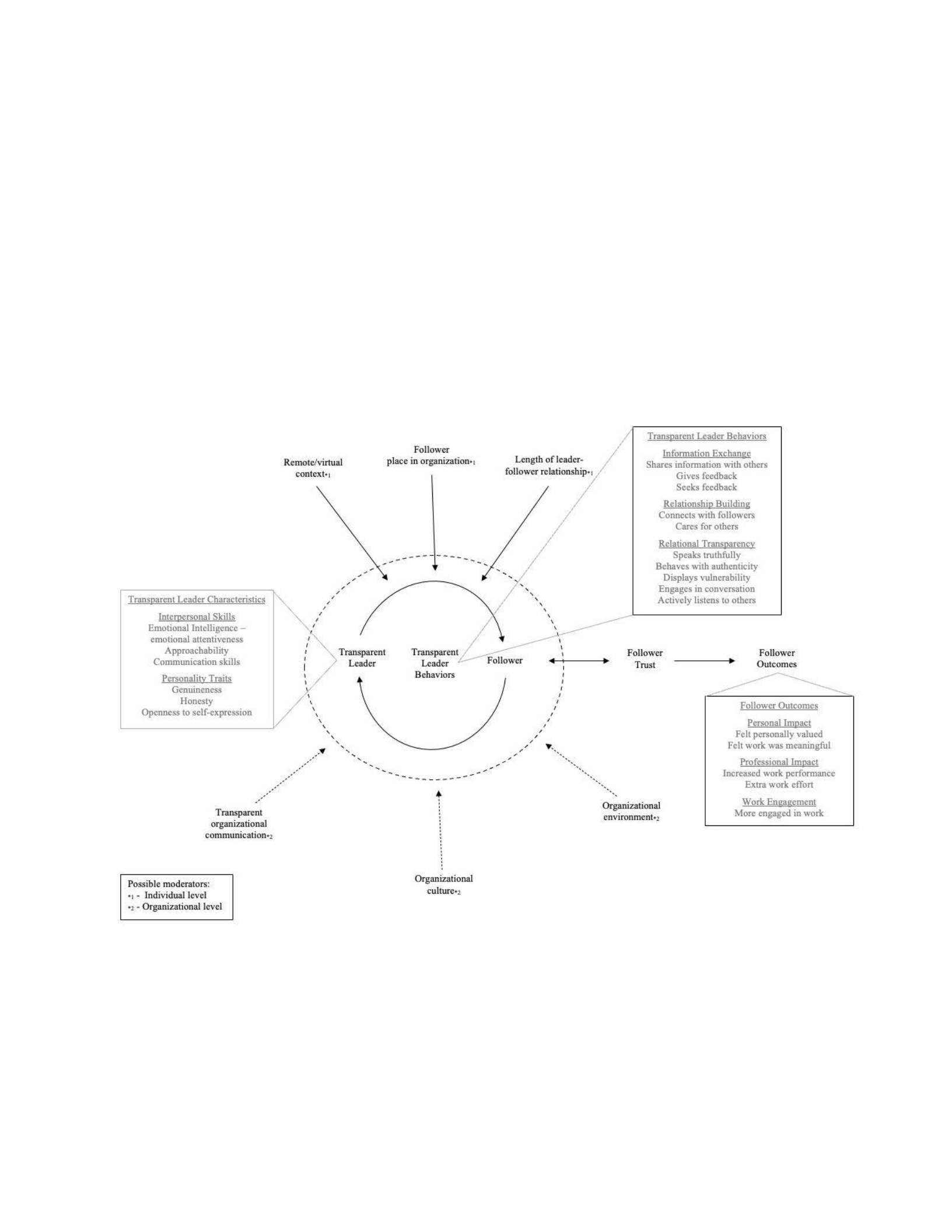
Kouzes and Posner (2003) state that “Leadership is a reciprocal process between leaders and
their constituents, any discussion of leadership must attend to the dynamics of this relationship”
(p. 46). Scholars have argued the interdependent relationship between leaders and followers, as a
leader's actions and behaviors not only influence follower conduct but influence the leader’s
conduct (Manning & Robertson, 2016; Riggio et al., 2008; Uhl-Bien et al., 2014).
Figure 12
Transparent Leadership Model (TLM)
The characteristics of a transparent leader were identified as key antecedents that activate
or enable transparent leader behaviors. Transparent leaders possess the characteristics of EI:
emotional attentiveness, approachability, communication skills, genuineness, honesty, and
openness to self-expression, which enable their ability to demonstrate transparent leader

behaviors. The transparent leader behaviors were described by participants as something they
valued in a leader and as positively influencing the leader-follower relationship. These
transparent leader behaviors include shares information with others, gives and seeks feedback,
connects with followers, cares for others, speaks truthfully, behaves with authenticity, displays
vulnerability, engages in conversation, and actively listens to others.
Prior research suggests that followers can attribute leadership to others, depending on
how well they correspond to or match their implicit theory, and this cognitive process can be
either conscious or unconscious (Lord, 1985; Lord & Maher, 2002; Schyns & Meindl, 2005).
DeRue and Ashford (2010) proposed that this reliance on implicit theories of leadership not only
creates a belief about whether a person is a leader but prompts the granting of the leader identity
to individuals who match their implicit theory. In other words, when an individual looks like,
seems like, and acts like a leader, people are more likely to grant that person a leader identity. For
example, if a leader is open to self-expression and displays vulnerability by being willing to
engage in open conversations with followers and seeking their feedback, followers are more
likely to recognize them as a leader, someone that they can trust and engage in open conversation
with.
I postulate that transparent leadership characteristics may fit the implicit theories of
followers (DeRue & Ashford, 2010; Lord, 1985; Lord & Maher, 2002; Schyns & Meindl, 2005),
namely their belief system, identifying those leaders as transparent and effective and activating
the transparent leader behaviors that they value and allowing followers to be receptive to and
influenced by transparent leader behaviors.
The participants described potential contextual features of the transparent leader-follower
relationship, at both the individual and organizational level. They shared how and why each

moderator can impact the leader-follower relationship, either positively or negatively, depending
on the specific circumstances. Moderators at the individual level were typically described by
participants as having a positive (e.g., relationships with leader improving over time) or negative
influence (e.g., lack of transparency when working remotely), and at the organizational level as
potentially having either positive (e.g., high levels of transparent organizational communication)
or negative influence (e.g., challenges of internal politics).
Follower trust emerged as a mediating influence on the leader-follower relationship. As
the leader trusts the follower to develop the leader-follower relationship (e.g., shares sensitive
information), the follower can respond by trusting the leader in return (e.g., shares insight into
organizational challenges) despite any perceived risk of doing so. Over time, as trust is validated
by the responses of the other, the leader-follower relationship can be further developed and
potentially strengthened. There is something unique here, describing follower trust in a different
way than what typically appears in the literature. Trust is often described as something that is
granted by the follower to the leader or the organization (Jiang & Luo, 2018; Norman et al.,
2010; Yue et al., 2019), but participants described a reciprocal trust that develops between leader
and follower that was expressed as strengthening the leader-follower relationship over time.
Based on previous research, Hernandez et al. (2014) posited that followers decide how
much to trust a leader based on the information about the leader, the leader’s stance regarding the
follower, and the situation in which the leader acts. They focused on three paths to follower trust
creation based on Hernandez et al.’s (2011) different loci (i.e., sources) of leadership and used
Sitkin and Lind’s (2007) nomenclature to identify each category of leadership. Hernandez et al.
(2014) continued by describing each of the three paths. Originating from the leader focus,
personal leadership behaviors are leader-focused leadership behaviors that convey to followers

that the leader has personal qualities that merit trust (e.g., genuineness, honesty, openness to
selfexpression). Originating from the leader-follower locus, relational leadership behaviors are
relationship-focused behaviors that facilitate connections between leaders and followers (e.g.,
speaks truthfully, behaves with authenticity, displays vulnerability) and demonstrate to followers
that leaders will not take advantage if trust is conferred. Lastly, originating from the collective
and context loci, contextual leadership behaviors are situation-focused leadership behaviors that
focus on interpreting the organizational dynamics and environment for followers (e.g.,
transparent organization communication, organizational culture, and organizational
environment). Past scholars have emphasized the crucial role that relationship-building
leadership behaviors can play in assisting leaders to establish and maintain trust (Levin et al.,
2006; Lewicki et al., 2006; Lind, 2001).
The participants described several positive outcomes as a result of the interrelationships
between all the variables included in the research model, including the presence of transparent
leader characteristics, influence of transparent leader behaviors on the leader-follower
relationship, the potential moderators at the individual and organizational level, and the
mediating influence of follower trust. A number of these variables have been linked in the
literature to transparent leadership, but most of them have not. Yet, the research results have
identified numerous compelling connections to help explain the leader-follower relationship and
the potential power of transparent leadership.
CHAPTER 5: DISCUSSION
Overview
Transparency has gained considerable interest in society as information is now more
available than ever before. Social media has seemingly captured nearly everyone’s attention, and

companies are constantly engaging with consumers in non-stop marketing (Alton, 2017;
GarciaSanchez et al., 2020; Kavakli, 2021). The measurement of transparency has continued to
be quite challenging (Bernstein, 2017) and, although measures do exist, they were developed
before studies addressed the theoretical dimensions and boundary conditions of transparency
(Schnackenberg et al., 2020). Transparency is often considered as a solution to many challenges
facing today’s organizations (de Fine & Naurin, 2022; Essandoh et al., 2017; Pozen, 2020), and
employees expect it from their leaders (Shum et al., 2019) although its definition and connection
to leadership are still uncertain (Mamaril, 2021). The answers to the research questions included
in this study describe several connections between transparency and leadership, as well as its
timely importance for today’s leaders and organizations to cultivate transparency for their
followers.
The need for transparent leadership in today’s organizations is highlighted by numerous
challenges around communication and transparency in a work-from-home context (Gibson,
2020), digitization (Norman et al., 2020), and demographic shifts (Perkins et al., 2022), with
followers demanding greater connections with their leaders, including mutual expectations, open
communication, and two-way feedback (Schroth, 2019). The absence of transparent leadership in
contemporary organizations may result in several negative outcomes, including a lack of
follower trust (Alm, 2022), absence of follower feedback (Lutskiy, 2022), loss of follower
motivation or focus, or tension between leaders and followers (Youshaei, 2021). Further, given
the emergence of Gen Z and the approaching exit of the Baby Boomers from the workforce,
today’s leaders and organizations are facing a rapidly shifting landscape that is demanding a
different set of leadership competencies to meet follower needs and effectively manage the
complexities and challenges of leading a multi-generational workforce (Groves, 2020). Further,

these followers value diversity, work/life balance, an enjoyable workplace, highly frequent
feedback, and strong psychological safety across their work teams. The current study’s findings
provide relevant and valuable insights into leader-follower relationships that are critical for
today’s context of the leader-follower relationship.
This research study began with a review of current leadership theories to better
understand the literature related to transparency (Albu & Flyverbom, 2019; Ananny & Crawford,
2018; Bernstein, 2017; Coser, 1961; Schnackenberg & Tomlinson, 2016; Schnackenberg et al.,
2020) and transparent leadership (Bennis et al., 2008; Mamaril, 2021; Vogelgesang & Lester,
2009; Yi et al., 2017). Although much has been written about transparency, its definition can vary
greatly, even within the same domains of research (Schnackenberg & Tomlinson, 2016). When
connecting transparency to leadership, there is no formal definition of transparent leadership
(Buell, 2008), and it has yet to be developed into a formal leadership theory. Upon conducting a
thorough review of other existing leadership theories (e.g., authentic leadership, transformational
leadership, LMX), the purpose of this research was to contribute to both leadership theory and
practice by exploring the multidimensional nature of transparent leadership. The goals of this
study included identifying the behaviors of transparent leadership, discovering how transparent
leadership influences followers, determining how the leaderfollower relationship is influenced by
where the follower works in the organization, and discerning how the leader-follower
relationship is influenced by followers working outside the traditional office environment.
Overall, the depth of conceptual and empirical research on transparent leadership remains very
limited.
The framework used for this research was designed to address four research questions to
provide several important contributions to leadership theory and research (a) What are the

primary behaviors that comprise transparent leadership?; (b) How does transparent leadership
influence follower attitudes?; (c) How is the relationship between transparent leadership and
follower attitudes impacted by follower role/status or place in organization?; and (d) How is the
relationship between transparent leadership and follower attitudes impacted by virtual or
distributed contexts?
A target population (i.e., mid-level leaders currently working in US non-profit healthcare
organizations) was selected for this study. The sample of mid-level leaders of mission-based
organizations, and their likely shared values (e.g., respect, care for others) and patient focus, was
determined to relate well to the values expressed in transparent leadership and would provide
valuable insight for the study. As a result of using my professional network to identify potential
participants in the research study (as well as snowball sampling), the study participants were
employed by six different non-profit healthcare organizations across the western US.
Primary Research Findings
The principal finding of this study is the multidimensional TLM that captures a dynamic,
reciprocal leader-follower relationship that is differentiated from existing leadership theories
(e.g., authentic leadership, transformational leadership) that center more on the leader behavior
(e.g., sharing reasons behind decisions) influencing follower behaviors (e.g., focus on work) and
driving several outcomes (e.g., follower engagement). Transparent leadership, as described by
the participants in this study, is distinct from existing theories as it relates a reciprocal
leaderfollower relationship, with leader and follower continually interacting, sharing and
responding, and developing a relationship over time. It is important to note that the data collected
was not longitudinal, so conclusions cannot be reached about how leader-follower relationships

develop over time. However, as stated in the TLM, participants discussed these relationships as
evolving and reciprocal, with followers influencing leaders just as leaders influence followers.
The study inspired a new definition of transparent leadership that captures the nature of
the transparent leader-follower relationship and reflects the multiple dimensions and levels of
analysis of the TLM, as well as a theory of leadership and influence that aligns with the
contemporary challenges faced by today’s organizations and followers:
A leader's intentional and reciprocal sharing of timely and relevant information with
followers, and genuine relationship-building that cultivates follower trust and results in
follower perceptions of strengthened personal value and meaningful work.
The results of this study identified six transparent leader characteristics that enable transparent
leader behaviors, represented by the leader themes of interpersonal skills and personality traits.
These characteristics appear to be potential antecedents as they activate the transparent leader
behaviors that influence the leader-follower relationship. These characteristics include a key
aspect of EI, emotional attentiveness, as well as approachability, communication skills,
genuineness, honesty, and openness to self-expression. These characteristics were not anticipated
prior to this study, and only honesty (Bennis, 2008; Yukl, 2013) has previously been linked to
transparent leader characteristics in prior literature, making this finding a new contribution to the
literature on transparent leaders. This is important for developing a theory of transparent
leadership as it identifies key characteristics of leaders that ideally are present to activate or
enable any number of transparent leader behaviors and for the development of the transparent
leader-follower relationship. It could also assist in identifying leaders that ideally possess the
characteristics needed to be transparent leaders, increasing their potential to become effective

transparent leaders, and leading to opportunities for leadership development and selection for
future leadership positions.
The first research question asked, “What are the primary behaviors that comprise
transparent leadership?” The study results revealed 10 transparent leader behaviors as having a
positive impact on the leader-follower relationship, comprised by the leader themes of
information exchange, relationship building, and relational transparency. The list of leader
behaviors includes: shares information with others, gives and seeks feedback, connects with
followers, cares for others, speaks truthfully, behaves with authenticity, displays vulnerability,
engages in conversation, and actively listens to others. These leader behaviors were determined
to have a positive influence on the leader-follower relationship and are central to followers
experiencing a heightened level of trust in their leader. Additionally, as followers trust the leader,
leaders are more likely to respond in kind (e.g., speak truthfully, display vulnerability), resulting
in mutual trust and strengthening the leader-follower relationship.
Five of these leader behaviors have previously been linked to transparent leader
behaviors, including shares information with others (Vogelgesang & Lester, 2009; Yi et al.,
2017), gives feedback (Huang et al., 2014; Vogelgesang & Lester, 2009; Yi, 2017), seeks
feedback (Ji & Hong, 2022; Norman et al., 2010; Vogelgesang & Lester, 2009; Zhang et al.,
2011), displays vulnerability (Vogelgesang & Lester, 2009) and actively listens to others (Baum,
2005; Bennis et al., 2008). The remaining five behaviors (i.e., connects with followers, cares for
others, speaks truthfully, behaves with authenticity, and engages in conversation) have not
previously been linked, making this finding a novel contribution to the literature on transparent
leadership. Further examination of these distinct transparent leader behaviors may help
understand the follower experience in today’s organizations.

The third research question asked, “How is the relationship between transparent
leadership and follower attitudes impacted by follower role/status or place in organization?” The
fourth research question asked, “How is the relationship between transparent leadership and
follower attitudes impacted by virtual or distributed contexts?” Potential contextual factors were
identified in the results that moderate the leader-follower relationship at the individual level (i.e.,
remote/virtual context, follower place in organization, length of leader-follower relationship) and
the organizational level (i.e., transparent organizational communication, organizational culture,
organizational environment). It is important to consider context, as variables acting as
moderators may influence the relationship of other variables either positively or negatively.
The results suggest that remote/virtual context (working outside of the traditional office
environment), follower place in organization (level of position/title or work location), and length
of leader-follower relationship (amount of time follower has worked with leader) may moderate
the leader-follower relationship at the individual level and were described as having either a
positive or a negative influence on the leader-follower relationship. In the remote/virtual context,
it was discovered that leaders need to be intentional about reaching out to followers working out
of the office, ensuring they have meaningful interactions with followers regularly. For example,
in a remote/virtual context, a high level or quality of interactions with a leader could be
considered a positive influence, and a low level or quality of interactions with a leader could be
considered a negative influence. Regarding follower place in organization, the positive influence
of transparent leader behaviors was different depending on the role they had, or where they
worked in the organization. For instance, a follower that works as a frontline leader in a hospital
may not be influenced by transparent leader behaviors as much as someone working at the
regional headquarters where leaders may share transparent information more readily. With

respect to length of leader-follower relationship, the length of time a follower worked with a
leader influenced the level of leader transparency that they experienced. Thus, the longer a
follower worked with a specific leader, the more likely these followers perceive their leader as
demonstrating transparent leader behaviors such as speaks truthfully, behaves with authenticity,
and displays vulnerability.
Transparent organizational communication (communication from organization vs.
leader), organizational culture (beliefs, values, and attitudes), and organizational environment
(internal or external forces) may moderate the leader-follower relationship at the organizational
level. In regard to transparent organizational communication, its level of influence was
determined by how the communication was delivered, as well as the timeliness and the
consistency. For example, consistent and timely transparent organizational communication (e.g.,
upcoming leadership changes, budget challenges) could be considered a positive influence, and
inconsistent or slow transparent organizational communication (e.g., sharing changes just before
or after they occur) could be considered a negative influence. For organizational culture, the
level of influence was indicated by how safe followers felt to fail and learn from their
experiences, as well as how supportive it was for everyone to share their thoughts without fear of
consequences (Edmondson, 1999; Edmondson & Bransby, 2023). In an organizational
environment, the level of influence depended on the types and numbers of internal or external
forces, either positive or negative, impacting the followers (e.g., organizational restructure,
pandemic) and on the level of transparency they experienced, which appeared to help mitigate
any negative impacts. None of these six potential moderators have previously been linked to
transparent leaders or existing leadership theory. As such, these findings represent a new
contribution to leadership studies and potential directions for future research, such as examining

the influence of more specific moderators (e.g., team psychological safety, organizational change
events) on the transparent leader-follower relationship.
Follower trust was described as mediating the relationship between transparent leader
behaviors and follower outcomes. The influence of follower trust helps to explain how
transparent leader behaviors are positively connected to several follower outcomes, such as
follower engagement (Rawlins, 2009) and follower openness to change (Yue et al., 2019).
Follower trust has previously been linked to transparent leaders (Schwarz, 2010; Scott, 2016;
Vogelgesang & Lester, 2009) and, in this study, it was found to potentially mediate the
leaderfollower relationship in a reciprocal manner that is considered distinct from other
descriptions of this construct in literature, which is a new contribution to leadership studies. The
literature review clearly identified trust as a key variable in the leader-follower relationship as a
result of transparent leader behaviors (e.g., sharing information with followers, speaks truthfully,
displays vulnerability) help demonstrate to followers that they are valued and trusted by their
leader, and that trust encourages similar behavior in return (e.g., sharing insights to operational
challenges, providing honest feedback, offering suggestions for process improvements).
The second research question asked, “How does transparent leadership influence follower
attitudes?” The study results disclosed the emergence of five follower outcomes resulting from
the influence of transparent leader behaviors on the leader-follower relationship, comprised of
follower personal impact, professional impact, and work engagement. Two of the follower
outcomes identified have previously been linked to transparent leadership, increased work
performance (Vogelgesang & Lester, 2009; Walumbwa et al., 2008) and more engaged in work
(Gardner et al., 2005; Vogelgesang & Lester, 2009; Yi, 2017). However, three follower outcomes
(felt personally valued, felt work was meaningful, extra work effort) have not previously been

connected and are a novel contribution to the research literature on transparent leadership. In
particular, the two outcomes that impact followers on a personal level (felt personally valued, felt
work was meaningful) should be considered for closer examination as part of future research
studies to better understand why transparent leader behaviors influence followers in such a way.
Implications for Advancing Theory
The relational transparency dimension of authentic leadership, involving presenting one’s
authentic self to others, promoting trust through disclosures, openly sharing information, and
expressing one’s true thoughts and feelings (Jiang & Men, 2017; Kernis, 2003; Walumbwa et al.,
2008) was anticipated as being associated with transparent leadership. The results supported this
initial expectation, as relational transparency appears to be very similar to the transparent leader
behaviors of sharing information with others and behaving with authenticity. The transparent
leader behaviors of speaks truthfully and displays vulnerability is somewhat like the relational
transparency descriptions of promoting trust through disclosures and expressing one’s true
thoughts and feelings, but that potential overlap is unclear. The remaining transparent leader
behaviors of gives and seeks feedback, connects with followers, cares for others, engages in
conversation, and actively listens to others, appear to be unique when compared to the authentic
leadership dimension of relational transparency. Leadership scholars may further develop
transparent leadership by closely examining the potential connections of these transparent leader
behaviors and the authentic leadership dimension of relational transparency.
Transformational leadership’s dimension of idealized influence, communicating
collective purposes and values, demonstrating confidence and determination, and acting as
charismatic role models (Garcia-Morales et al., 2012; Men & Bowen, 2017; Wang et al., 2011)
was initially thought to be closely related to transparent leadership. Yet, results recognized the

dimension of individualized consideration, defined as serving as a constant source of emotional
support and personal care, empathy, and sensitivity for the development needs of employees, as
closely related to TLM behaviors, which was reflected in the similar transparent leader behavior
of cares for others. Transparent leadership may be further developed by leadership scholars with
the continued exploration of transparent leader behaviors associated with relationship building
(e.g., connects with followers, cares for others) to identify any further similarities with
transformational leadership, in particular the dimension of individualized consideration.
The leader-follower relationship is addressed in LMX theory, which points to the quality
of the relationship as a predictor of outcomes at the individual, group, and organizational levels
of analysis (Gerstner & Day, 1997). Graen and Uhl-Bien (1995) discussed a relationship-based
approach to the leader-follower relationship, identifying three dimensions (i.e., mutual trust,
respect, and obligation) that the offer to build a partnership LMX is based on. Further, Graen and
Uhl-Bien (1995) theorize that the offer to another person to build a partnership LMX is based on
these three dimensions. After the initial assessment of LMX theory as part of the literature
review, it was initially considered to be related to transparent leadership. The results confirmed
that assessment, as follower trust was identified as a potential mediator of the reciprocal
leaderfollower relationship and a very prominent variable in the TLM, which appears to be very
similar to the description of the LMX dimension of mutual trust. In addition, LMX was identified
as potentially being related to the moderator of length of leader-follower relationship (with the
quality of the relationship potentially improving over time), a context that unexpectedly emerged
from the data. Yet, the LMX dimensions of respect and obligation did not appear in the results.
The further development of transparent leadership by leadership scholars may be considered with
a closer investigation of the above connections with LMX, as well as any other potential

correlation of LMX with the transparent leader-follower relationship, including potential
follower influence on transparent leaders.
Upon completion of the literature review, informational justice was initially identified as
being related to transparent leadership, as it relates to an organization sharing change-related
information with followers in a candid, thorough, and timely manner and, by extension, the
direct leader of a follower (Colquitt, 2001). However, although the research revealed some
evidence of followers receiving change-related information from the leader or organization, there
were not sufficient occurrences in the data to be considered significant. Still, leadership scholars
interested in the further development of transparent leadership may want to consider an
additional examination of its possible connection with informational justice. In addition,
interpersonal justice, as it relates to the perception of fair treatment by others (Bies, 2001), may
help explain the influence of transparent leader behaviors on follower outcomes. Leadership
scholars might consider exploring those connections in future research to determine if there is
any relationship between follower perception of fair treatment and feeling personally valued.
Leader values did not appear as explicit factors in the research data, but leader
characteristics identified in the study may reflect underlying leader values. There has been a lack
of consensus on the nature of values and, among other things, have been considered as needs,
personality types, motivations, goals, or interests (Meglino & Ravlin, 1998). In terms of work
behavior, Meglino (1996) describes values as a person’s internalized belief about how they
should or ought to behave at work, with Meglino and Ravlin (1998) considering values as
relatively permanent, or stable, although they may be capable of being changed under certain
conditions (e.g., social influence). Further, leader-follower values congruence describes their
shared values within an organization’s culture (Jung & Avolio, 2000) and measures the

follower’s perception of how well their values match those of their leaders (Groves & LaRocca,
2011). There appears to be a connection between leader values and the leader characteristics
posited in the TLM, which perhaps warrants closer examination of their similarities and
differences, if any, in future leadership research.
In previous research studies, values have been examined as IVs, moderators, or DVs
(Meglino & Revlin, 1998). As an IV (e.g., work or social values), studies have explored values
and their impact on perceptions, decisions, and behavior. The moderating role of values (e.g.,
cultural or work values) has dealt with the value of concern for others and its influence on
decisional and behavioral processes. Studying values as a DV investigated the influence of
national culture or race (e.g., cultural or social values) on decision-making and behavior. The
common approach to these studies has been to assess the influence of values on decision-making
and behavior. Considering the focus of previous research and the possible connection between
leader values and leader characteristics, future scholars should closely examine leader values as
antecedents to transparent leader behaviors and their impact on follower outcomes. This
research contributes to leadership theory by furthering our understanding of transparent
leadership and its influence on the leader-follower relationship and strongly advocates for a new
theory of transparent leadership, represented by the TLM. It extends authentic leadership’s
dimension of relational transparency by introducing five leadership behaviors that were
identified under the theme of leader relational transparency (i.e., speaks truthfully, behaves with
authenticity, displays vulnerability, engages in conversation, actively listens to others). The
research offers additional support for transformational leadership’s dimension of individualized
consideration by adding a new behavior of cares for others. It extends LMX theory by adding
six contextual influences that may influence the leader-follower relationship. Lastly, this

research extends our understanding of follower trust in a unique way, identifying it as an
interpersonal influence that mediates a reciprocal leader-follower relationship that leads to
multiple follower outcomes (e.g., felt personally valued, felt work was meaningful). Previous
literature often describes trust as a one-way granting of trust from the follower to the leader, or
the organization (Jiang & Luo, 2018; Norman et al., 2010; Yue et al., 2019), a much different
dynamic than what emerged from the study results. Future leadership scholars should consider
further examining and or empirically testing this finding by focusing more closely on this
unique understanding of follower trust.
Transparent Leadership
This research is the first known empirical study that examined the multidimensional
nature of transparent leadership. This contribution includes a new, multidimensional TLM that
illustrates the dynamic, reciprocal transparent leader-follower relationship that embodies
transparent leader behaviors. In particular, the reciprocal nature of the transparent leaderfollower
relationship is believed to be unique and describes the development of this critical relationship
over time. This conclusion reflects LMX theory in regard to the quality of the leader-follower
relationship predicting follower outcomes at the individual, group, and organizational levels of
analysis (Gerstner & Day, 1997), which is consistent with the results of this study. Leadership
scholars might consider a further exploration of the unique transparent leader behaviors
identified in this study (e.g., connects with followers, cares for others, speaks truthfully, behaves
with authenticity, and engages in conversation) that are mediated by follower trust and help lead
to multiple follower outcomes.
This research contributes a new definition of transparent leadership that reflects the
components of the TLM. The definition describes the positive influence it has on the

leaderfollower relationship, while highlighting the key influence of follower trust and the
personal impact it has on the follower, including the unique follower outcomes of felt personally
valued and felt work was meaningful.
The leader characteristics identified in the research appear to be potential antecedents to
transparent leader behaviors, possibly activating any number of the transparent leader behaviors
that influence the leader-follower relationship. In addition, honesty is related to the HEXACO
personality trait of honesty-humility, described with common defining adjectives of sincere,
honest, faithful/loyal, modest/unassuming, and fair-minded, with a theoretical interpretation of
reciprocal altruism (Ashton & Lee, 2007). This similarity may help provide additional insight
into the HEXACO model of personality structure and assist leader trait scholars in advancing
theory on transparent leader characteristics.
Leadership scholars should prioritize quantitative studies for further developing the TLM,
as well as address a clear need for the development of a transparent leadership measure by
conducting multiple validation studies to help advance leadership theory. Future scholars should
develop a psychometric measure that includes behavioral items assessing each of the transparent
leader behavioral dimensions. The predictive validity of this new measure should be assessed via
the follower outcomes illustrated in the TLM, including personal impact, professional impact,
and work engagement. Future validation studies should capture data from leaders and followers
in multiple industries, such as for-profit healthcare and non-profit outside of healthcare, as well
as other non-profit healthcare organizations to determine if those contexts produce similar
results. In addition, considering the reciprocal nature of the transparent leader-follower
relationship, an examination of how the transparent leader is influenced by these relationships
could be a strong consideration for future research studies. Further, how does the quality of the

leader-follower relationship make the leader feel with regard to personal impact, enduring
relationships, intrinsic rewards, or a sense of legacy? Investigation of the leader-follower
relationship from the perspective of the leader and its impact on the leader will support the
advancement of transparent leadership theory.
Authentic Leadership
This research contributes to authentic leadership theory, specifically the dimension of
relational transparency (Gardner et al., 2005; Kernis, 2003; Walumbwa, 2008). It is described in
literature as displaying high levels of openness, self-disclosure, and trust in close relationships
(Gardner et al., 2005), involves valuing and achieving openness and truthfulness in close
relationships (Kernis, 2003), and presenting one’s authentic self to others (Walumbwa, 2008).
The results extend our understanding of the dimension of relational transparency with the
additional behaviors identified in the results by the theme of relational transparency, speaks
truthfully, displays vulnerability, engages in conversation, and actively listens to others. These
findings may increase our perception of the potential value of relational transparency in the
development of the leader-follower relationship. Scholars may consider testing the influence of
these behaviors on the leader-follower relationship to advance authentic leadership theory.
Transformational Leadership
This research contributes to Transformational Leadership theory, particularly the
dimension of individualized consideration (Garcia-Morales et al., 2012; Men & Bowen, 2017;
Wang et al., 2011). This dimension is related as serving as a constant source of emotional support
and personal care, empathy, and sensitivity for the development needs of followers. The study
results extend our understanding of the dimension of individualized consideration with the
identification of the additional behavior of cares for others. This finding may help leaders

consider additional behavioral factors when crafting strategies to positively drive change in
organizations. Transformational leadership scholars may contemplate a further examination of
the transparent leadership behavior of cares for others, as well as other transparent leader
behaviors identified in this study (e.g., connects with followers), to further the understanding of
how to positively drive change with the development of the leader-follower relationship.
LMX
This research contributed to LMX theory with the addition of follower trust as a mediator
on the leader-follower relationship as one of three interrelated dimensions of mutual trust,
respect, and obligation (Gerstner & Day, 1997; Graen & Uhl-Bien, 1995). It introduces six
contextual influences (potential moderators) of the leader-follower relationship that extends our
understanding of the additional contextual influences that may moderate that relationship. LMX
scholars could potentially look more closely at how these moderators impact the leader-follower
relationship and the LMX exchange relationship, focusing on those at the individual level, such
as remote/virtual context or follower place in organization.
Follower Trust
Trust is defined by Mayer et al (1995) as the willingness of a party to be vulnerable to the
actions of another party, based on their expectation that the other party will perform an expressed
action that is important to them. In addition, antecedents to trust are described as ability,
integrity, benevolence, positivity, competence, and transparency (Colquitt et al., 2007; Mayer et
al., 1995; McAllister, 1995; Norman et al., 2010). Follower trust is frequently portrayed as a
mediating influence on leader behaviors or as an outcome of those behaviors (Hernandez et al.,
2014; Vogelgesang & Lester, 2009; Walumbwa, 2008; Yue et al., 2019). The results expressed
follower trust in a unique way, as a mediating influence on the leader-follower relationship,

linking leader behaviors and follower outcomes. This perspective describes the development of
trust as part of the leader-follower relationship over time, involving continuous interactions
between leader and follower, not as part of a linear path from leader behaviors to follower
outcomes. This phenomenon underlines the critical importance of follower trust in driving the
follower outcomes appearing in the results, particularly followers feeling personally valued and
perceiving that their work was meaningful. Determining how these variables are linked would be
a strong consideration for future research, closely examining how follower trust mediates
transparent leader behaviors and leading to the outcomes personally impacting followers.
In summary, there are many compelling variables identified in this research, the
relationships they have with each other, and how they all contribute to help explain the dynamics
of transparent leadership. Leadership scholars should consider further exploration of these
relationships in the TLM through an expanded number of interviews across non-profit healthcare
organizations in the US to increase the richness of the data. Another alternative could be to
expand the interviews to similar populations, such as non-profit service organizations or forprofit
healthcare organizations, to determine if the results extend to similar types of organizations.
Testing these relationships using surveys would be a strong consideration for future research,
including examining any potentially negative outcomes resulting from leaders demonstrating
transparency (e.g., disclosing sensitive or proprietary information), including organizational
cultures or environments that may not be supportive of transparent behaviors
(e.g., technology or financial sectors).
Implications for Business Practice
These study results provide insight to organizational senior leaders to help them to better
understand the value transparent leadership can bring to their organizations. The ideal leader

characteristics and behaviors needed to be transparent leaders are identified, as well as the key
importance of the leader-follower relationship. The critical role of follower trust to
leaderfollower relationships is emphasized, as well as the follower outcomes that could be
expected by the influence of follower trust. Lastly, the study results point out how other internal
or external contextual factors could positively or negatively affect the leader-follower
relationship, either supporting or undermining any transparent leadership efforts.
In the past, transparent leadership has been identified as leader transparency, or simply
transparency, in popular business magazines such as Entrepreneur or Forbes (Alton, 2017;
Llopis, 2012) while using various transparency behaviors to describe what it is (e.g., honesty,
information sharing, trust). Since it is unlikely that business leaders regularly read academic
journals, these popular magazines or books, often published by the same authors, may be the
only exposure that business leaders have to transparent leadership. As a starting point, this
research and any future research conducted on transparent leadership should be more widely
shared in popular business magazines, books, and internet sites to continue the educational
process of today’s decision makers, capture their interest, and spark conversations in executive
meetings, the hallways, and offices of their organizations.
Once an interest in pursuing transparent leadership has been established, an
organizational project plan could be developed to achieve the goals of senior organizational
leaders. That project plan could include the following (a) develop and implement a leader
training and educational program on the TLM, and the positive influence transparent leadership
can have on the leader-follower relationship; (b) advance a leader assessment tool to identify the
characteristics and behaviors each leader currently possesses; (c) use the results of the leader
assessment tool, at least in part, for identification of leaders to enroll in leadership and

development programs to advance the competencies needed for transparent leaders (including
first-time leaders), as well as selection for future positions or executive succession planning; (d)
develop tools to assist leaders that have been trained on TLM and in the use of transparent leader
behaviors, to be used on a regular basis to reinforce what they have learned; (e) initiate leader
training programs in additional competencies needed to further support transparent leader
behaviors, including follower engagement, work-from-home policies, 360- degree
assessment/feedback tools, etc.
As an example for consideration as a starting point, Vogelgesang and Lester (2009)
outlined a process for becoming a transparent leader with a current group of followers. In short,
it included three main steps/processes (a) assess current follower perceptions of leader (e.g.,
360degree feedback); (b) start becoming transparent, giving and receiving feedback, and
developing a plan to accomplish that; and (c) maintain the transparency that is achieved,
consistently sharing relevant information, proactively seeking feedback and keeping the lines of
communication open with followers. These actions will show followers that a leader is serious
about becoming a more transparent leader, that their feedback and participation are valued, and
that they can succeed only with their help. This plan could be used as a template and revised as
needed to meet the needs of each leader and organization. By using this template and the results
of this research as guidance, this approach could serve as a springboard to help take the next
steps toward developing transparent leaders. Further, these study results can readily be used to
build on the template recommended by Vogelgesang and Lester (2009). For example, the results
of this study could help determine the criteria to be used for assessing leaders, how to effectively
give and seek feedback, and the identification of considerations for effectively sharing relevant
and timely information with followers.

Limitations and Recommendations for Future Research
Since the population selected for this study was drawn from non-profit healthcare
organizations across the western US, the results may not necessarily be generalizable to all
nonprofit organizations, for-profit healthcare organizations, other industries, or other specific
regions of the country. Further, other specific contextual moderators may be relevant to consider
for the understanding of transparent leadership, such as the confidentiality of protected health
information (i.e., information that cannot readily be shared), national cultural dimensions, or
previous organizational changes (e.g., reorganization). However, the results may be generalizable
to other non-profit organizations, given that such organizations are also considered to be mission-
based (Brinckerhoff, 2009) and may share similar values and or cultures. Future scholars seeking
to advance transparent leadership theory could consider involving different populations in
determining if the results extend to those similar populations.
This study only focused on one stakeholder group, mid-level leaders currently working in
non-profit healthcare organizations. The perspectives of other leaders, followers, or even
boardlevel members may differ (e.g., focus of position, levels of experience). However, mid-
level leaders were chosen to align with the focus of this study’s research questions, and future
studies should include other stakeholder groups such as frontline and or executive level leaders
or

