


CIS 235 Introduction to Information Systems Summer 2018
Midterm Study Guide
Please review the HW assignments, and their related class materials, as you may have
ER Diagram, Excel, and SQL related exam questions on top of the concepts summarized
below
Knowledge Content Sources
•Class Presentations/Discussion (In-class slides, activities, and the dialogue surrounding them)
•Introduction to Information Systems Textbook
•Assignments: HW, EC, Team Project
Please keep in mind that while not all of the content in a given reading or assignment
was covered in class, it is still valid. Similarly, not all material discussed in class was
covered in a reading or assignment, but it is still valid as well.
For any concept or content covered, do not simply demonstrate an abstract
understanding of a concept or idea. It is necessary, but not sufficient, to simply know
“what” something is or “how” to do something. The important, integrative learning
occurs when you can contextualize and answer, in addition to how and what, the
“why” of a subject. Why do these things matter and why are they so important to
business and the world in general?
PLEASE NOTE: These are only examples of questions. This is by no means a
comprehensive list. There will be questions on the exam that examine different areas
of the subjects covered than what are listed here. These are only a guide for you to
use in preparing yourself for the exam.
Please read your Class Slides, Textbook Slides, and Textbook
Chapter 1 – Intro to IS, IS Jobs
1. What is an Information System?
An information system collects, processes, stores, analyzes, and disseminates information for a specific
purpose.
2. What are the five components of Information Systems? (five component framework)
Hardware, software, data, procedures, people
3. Which one of the 5 components of IS serves as a bridge between the human side and the computer
side?
Data
4. Why are Information Systems created?
For process improvement, automation, process control, information flow

CIS 235 Introduction to Information Systems Summer 2018
5. Give an example for each of the five component of IS. Which component do the following examples
belong to? Words and sentences? Microsoft Excel? Keyboard? Monitor?
Words/Sentences: Data
Excel: Software
Monitor: Hardware
People: IT
Procedures
6. What is the difference between IT and IS?
IT - Information Technology - refers to methods, inventions, standards and products. IT
refers to the raw technology and concerns only the hardware, software and data
components of an information system
IS - Information System - is a system of hardware, software, data, procedures, and
people that produce information.
7. Know the various sizes of data
8. What is Moore’s Law? What is the practical impact of Moore’s Law?
Moore's law is that every 18 months the number of transistors per square inch of a processor doubles.
This can be used to forecast technological advancement and implies that technology has exponential
growth.
9. Why does everyone in an organization need to know about their IT department?
IT can provide employees with flexibility that can significantly improve the quality of
leisure time, even if it doesn’t increase the total amount of leisure time.
10. What are some of the primary responsibilities of an IT Department?
To manage systems development and project management, to provide technical services, and to plan
infrastructure
11. What is data vs. information? How do you make decisions using data? What is knowledge?
Data is an elementary description of things, events, activities and transactions that are recorded or
stored.
Information is data that has been organized so it has meaning.
Knowledge is data or information that has been processed to convey understanding, experience, or
expertise.
12. What characteristics of data are necessary for “quality information”?
Accurate, Timely, Relevant, Barely Sufficient, Worth it’s cost
Technology Guide 1 and 2 – Hardware, Software
1. How do computers work?
a Computers consist of hardware, process data using programs, which when ran are called
software. Programs guide computers through orderly sets of calculations and other
actions made by programmers

CIS 235 Introduction to Information Systems Summer 2018
2. What is the difference between hardware and software?
a Hardware are various devices used by the computer like mouse, keyboard, etc. Software are programs
that run on the computer
3. What is a binary digit?
a Either 0 or 1
4. Explain, at a high level, some of the basic components of a “computer” 5. How, at a high level, does the
Operating System (OS) of a computer work?
a Computers receive information from input devices and places it at the disposal of other
units to be processed.
b Computer takes processed information on various outside devices that make it available
outside the computer.
c CPU coordinates and supervises operations
d ALU preforms calculations like addition, subtraction, etc
e Main Memory retains information that is immediately available for processing when
needed
f Secondary Memory is where programs and data are kept on a long-term basis
g organizes and controls the functions of software and the related hardware so that the device behaves in
a flexible but mostly predictable way
6. What is a kernel?
a the central component of most computer operating systems. Is a bridge between applications and actual
data processing. Tasked with managing the system's resources
7. What is a server? What does a server do?
a A server is a computer used in a network that provides a service to a client. They are dedicated to
engineer, manage, store, send, and process data 24 hours a day.
8. What is “virtualization”? Why do we care about this concept?
a Virtualization is the creating of a virtual version of something (like an operating system,
server, etc). Is important because it is capable of running multiple operating systems and
applications on a single computer or server, thus increasing productivity by using fewer
servers
Chapter 6 – The Internet, Networks
1. What is packet switching? How does it work?
a Packet switching is the communications methodology that makes computer
communication efficient.
b -Packet switching doesn't require that a dedicated communications circuit be
maintained. With packet switching, data is broken into smaller chunks (called packets or
a data packet) that are sent over various routes at the same time.
c -When the packets reach their destination, they are reassembled by the receiving
computer.

CIS 235 Introduction to Information Systems Summer 2018
d -At a minimum, all packets must contain (1) an address to which the packet is being sent, (2) the address
from which the packet originates, (3) reassembling instructions if the original data was split between
packets, and (4) the data that is being transmitted.
2. What is TCP?
a Transmission Control Protocol.
b -Prepares data for transmission
c -Provides error checking
d -Enables resending lost data
3. What is IP?
a Internet Protocol. Responsible for sending data from one computer to another
4. What is the difference between a public and a private IP address?
a he IP addresses available to the internet are called public IP addresses. A company conserves its public IP
address by using private IP addresses that are not allowed on the internet. A computer using a private IP
address on a private network can still access thhe Internet if a router or other device that stands
between the network and the Internet is using NAT Network Address Translation.
5. What is the difference between IPv4 and IPv6? Why do we need IPv6?
a Pv4 doesn't provide enough addresses, so IPv6 uses 128-bit addresses (which is very large,
approximately the number "34" followed by 37 zeros).
6. What is client/server computing? How does it work?
a Links two or more computers in an arrangement in which some machines, called servers, provide
computing services for user PCs called clients
7. What is a URL?
Uniform resource locator (URL) which points to the address of a specific resource on the
Web
8. How does the Domain Name System and DNS servers work?
The system administered by the Internet Corporation for Assigned Names that assigns
names to each site on the internet and DNS is any computer registered to join the
Domain Name System.
9. What are the different types of networks we discussed in both class and the textbook?
a LAN- Local Area Network
WAN- Wide Area Network
WLAN- Wireless Local Area Network
SAN- Storage Area Network, System Area Network, Server Area Network,
10. If given a network diagram, can you explain the different elements?
Technology Guide 3 – The Cloud
1. What are the two ways we defined and conceptualized “The Cloud” in class and in the textbook?
a lease access to an elastic pool of computing resources (official, owned by someone else
who gives us access) (scales with demand: elasticity)
b services located online and off-site (hosted elsewhere by someone else) (collection of services on the
internet)
2. What are the three main types of cloud services? How are each defined? What is an example of each?

CIS 235 Introduction to Information Systems Summer 2018
a 1. Software: vendor controls all things, lender access to application (use when needed)
b 2. Infrastructure: vendor controls the hardware, lender controls everything else
c 3. Platform: vendor controls hardware and software, used as development platform to
develop a software
d differences do with level of control from vendor and lender
3. What is a Private Cloud?
internal/corporate cloud only accessible by a single entity
4. What is a Virtual Private Network? How does it work?
a A virtual private network (VPN) is a network that uses a public telecommunication infrastructure, such as
the Internet, to provide remote offices or individual users with secure access to their organization's
network.
5. What is Service-Oriented Architecture? Why is it important?
a concerned with the independent construction of services that can be combined into meaningful, higher-
level business services within the context of the enterprise.
Chapter 8 – Wireless, Mobile, The Internet of Things
1. How do we define the concept of “Mobility” in terms of IS and IT?
a Refers to something that changes its location over time
2. What does the term “Internet of Things” mean?
a A system in which an object, natural or manmade, has a unique identity and is able to send and receive
information over a network without human interacts
3. How do the drivers of modern “Mobility” allow the IoT to exist?
a Mobility allows people to be connected at all times no matter their location around the globe.
4. What is RFID?
a Radio-Frequency Identification is the use of radio waves to read and capture information stored on a tag
attached to an object.
5. What are the different types of RFID? What is/are the key differentiator(s)?
a Active and Passive, Active tags use internal batteries for power, are more expensive than passive RFID
tags, and broadcast radio waves to a reader. Passive RFID tags rely entirely on readers for their power
and are less expensive than Active RFID
6. What are the organizational/operational benefits that can be realized by leveraging IoT?
a Simplifies the ordering process and makes a company run more efficiently
Chapter 2, pp. 44-65 - Strategy
1. According to Porter what five forces determine industry structure?
a The threats of new competition, the bargaining power of customers (buyers), the bargaining power of
suppliers, the threat of substitute products or services, and rivalry among existing firms in the industry
2. Give examples of strong and weak examples for each of the forces.
a
3. What is the model of strategies for competitive (aka “Generic Strategies”)? How do businesses use it as a
positioning technique?

CIS 235 Introduction to Information Systems Summer 2018
a Cost leadership strategy= lowest cost in industry
b differentiation strategy=offer different products, services, or product features than your competitors
c Innovation strategy= Introduce new products and services, add new features to existing products and
services, or develop new ways to produce them
d Operational effectiveness strategy= Improve the manner in which a firm executes its internal business
processes so that it performs these activities more effectively than its rivals.
e Customer Oriented
4. What is a value chain? What are the primary activities in value chain? Supporting activities?
5. What is margin? What is value chain?
a A value chain is a set of activities that a firm operating in industry performs to deliver a valuable product
or service.
6. Why and how do organizations create barriers to entry?
a A product or service feature that customers have learned to expect from organizations in a certain
industry. Must have barriers to entry in order to survive in the marketplace
7. What are different types of barriers to entry?
a Legal requirements to practice law and license to serve liquor.
8. What are the differences between horizontal and vertical in our context?
a Horizontal is more goods and services and Vertical is everything you create in a business.
9. What is the difference between a “Blue Ocean” and a “Red Ocean”? Why is the distinction important?
a Blue Ocean is an uncontested market space for an unknown industry and Red Ocean is a defined market.
Companies want to go to the Blue Ocean where there is no competition.
10. Explain the concept of “open source”
a Denoting software for which original source code is made feely available and may be redistributed and
modified
11. How do all of the strategic frameworks we discussed influence one another and, ultimately, a firm’s
choice of an information system?
a A firm will choose the information system that most closely matches its goals. Furthermore, firms may
try to use strategic frameworks that their competitors do not so as to gain the advantage of uniqueness.
Chapter 4 – Security
1. Who is the greatest threat to an organizations’ security?
a Its own users/employees.
2. What are the top security trends for 2017, according to CIO.com?
a Better passwords, no real change in dwell times
3. Can you explain the basics of Symmetric Key Encryption?
a The same key that is used to encrypt the data is the one that is used to decrypt the data.
4. Can you explain, basically, how a Diffie-Hellman-Merkle Key Exchange works?
a If we take something we both know, and combine it with a secret, then share that mix and combine it
(the mix we got from our partner) with our original secret, we will arrive at the same conclusion (a
shared secret).
5. Can you explain the basics of Asymmetric (aka “Public Key”) Encryption works?
a Anybody can encrypt the data, but only I can decrypt it because of my unique key

CIS 235 Introduction to Information Systems Summer 2018
6. What is “https”?
a a protocol for secure communication over a computer network which is widely used on
the Internet.
7. What is a firewall? How does it work?
a A firewall inspects incoming packets and rejects those that it finds fishy or unknown.
8. What are the different types of malware and attacks?
a Malware: viruses, worms, Trojan horses, bots
b Attacks: phishing, pharming, DoS/DDoS, Ransomware, IoT hacks, Hacktivism, Social engineering, Botnets
9. What does the acronym “CIA” mean for security?
a Confidentiality (privacy of data), integrity (accuracy and trustworthiness of data), and availability (service
and data is available as needed)
10. How should an organization handle security?
a Organizations should always improve their security and have a security program to plan how to minimize
risks and keep their employees informed about security practices.
11. How should you, as a user, handle security?
a You should use all security resources available to you (firewalls, passwords, VPNs, anti-malware, etc.) to
make your computer information more secure.
12. What are some alternatives to passwords?
a biometrics, facial recognition, the Fido Alliance (based on public key cryptography and multi-factor
authentication)
13. Is “security” an outcome or a process?
a Security is a process as it is a means of becoming more secure and reducing risk. Security
is a never-ending concern and should always be improved upon.
Chapter 3 – Ethics, Privacy
1. What are the four “widely used” standards for forming an ethical framework?
a Utilitarian approach, rights approach, fairness approach, common good approach.
2. What are the five steps in an ethical decision-making framework?
a Recognize an ethical issue, get the facts, evaluate alternative actions, make a decision and test it, and act
and reflect on the outcome of decisions.
3. What contextual considerations should be considered when evaluating a decision in terms of ethics?
a mistake vs. on purpose
4. Explain the reasons why employers may choose to monitor employees’ use of technology resources
a High Level Privacy Policy
5. What are the ethical dynamics in terms of Intellectual Property concerns?
a If I make something in the company who owns it?
6. What are the dimensions of “Privacy”?

CIS 235 Introduction to Information Systems Summer 2018
a Psychological (To have a sense of control) and Legal (to legally protect yourself)
7. What are some of the ways in which organizations may gather information?
a Digital dossiers, profilers, data aggregators
8. Explain the high-level privacy policies outlined in the textbook.
a opt-out = the company can collect information until the customer requests that they
stop
b opt-in = prohibits an organization from collecting any personal information unless the customer
specifically authorizes it.
Chapter 5, pp. 121-131, pp. 147-160 - Databases
1. What are the three components of Database? What is database vs. a DBMS?
a Tables or files + Relationships among tables + Metadata
2. What is a record? What is another name for a record?
a A logical grouping of related fields
3. What is a column? What is another name for a column?
a Attributes of an entity like student name, undergraduate major, GPA
4. What is a file? What is another name for a file?
a Data file is a collection of logically related records known as table
5. What is primary key and foreign key? Why do we use foreign keys?
a Uniquely identify records so that it can be retrieved, updated, and sorted. A field in one table that
uniquely identifies a row of another table. Used to establish and enforce a link between two tables
6. What is metadata? How do you describe it?
a A set of data that describes and gives information about other data.
7. What is a database application?
a A database application is a computer program whose primary purpose is entering and retrieving
information from a computerized database.
8. What are the components of a database application system?
a data, hardware, software, people, and procedures
9. What is a data model? Why is it important to build a data model? What is an E-R diagram?
Components of an E-R diagram?
a. A diagram that represents entities in the database and their relationships.
Entity-relationship (ER) diagrams consist of entities, attributes, and relationships.
To properly identify entities, attributes, and relationships, database designers
first identify the business rules for the particular data model.
10. What is an entity? Define and give an example.
a Entity is a person, place, thing, or event- such as a customer, an employee, or a product- about which
information is maintained.
11. What are attributes? Define and give an example.
a Characteristic or quality of a particular entity. Customers name, employee number, and product color
CIS 235 Introduction to Information Systems Summer 2018
12. What is normalization? How do you solve data integrity problems?
a normalization is a method for analyzing and reducing a relational database to its most
streamlined form to ensure minimum redundancy. Proceeding through the data
normalization 3 forms.
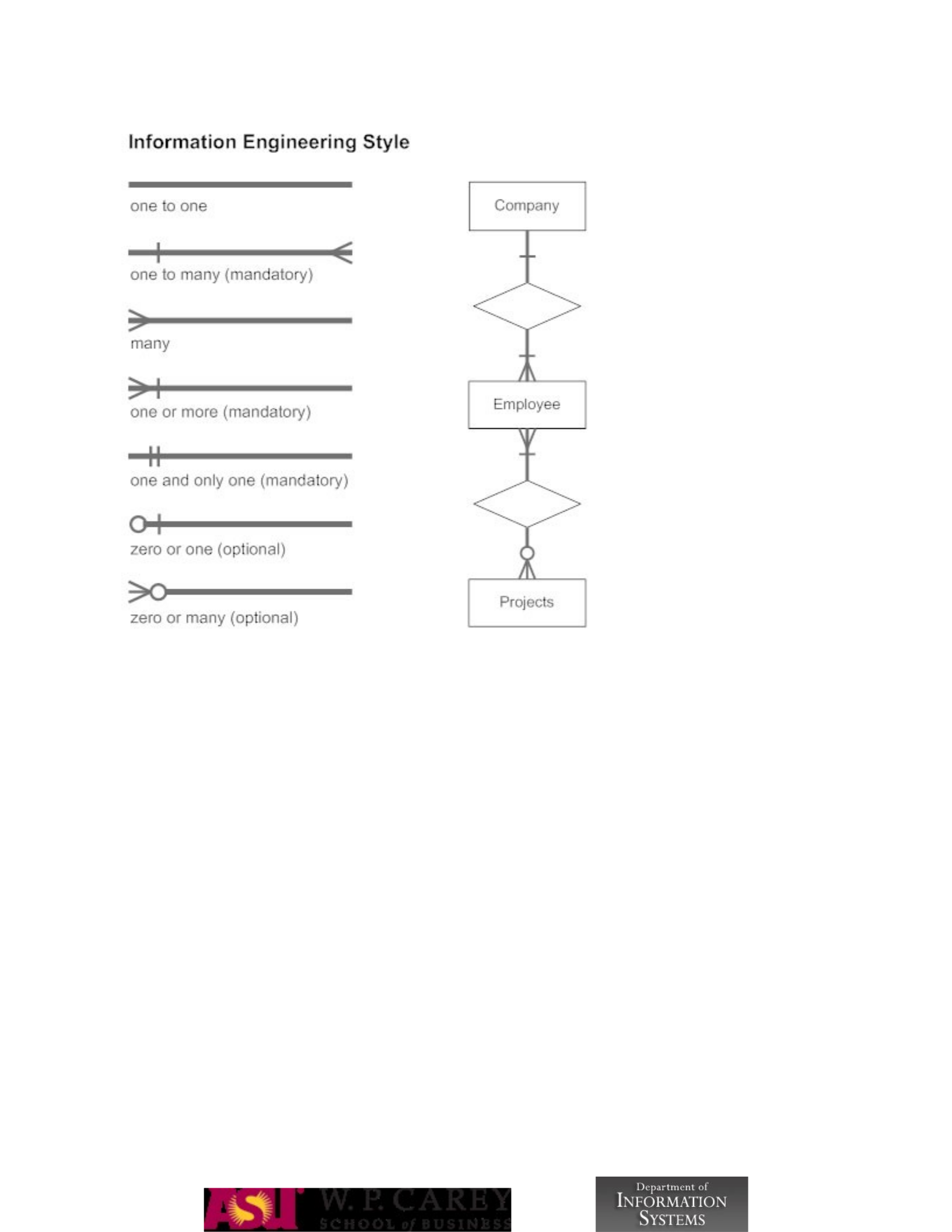
13. What is cardinality? Do you know the figures that depict different type of cardinality? In a oneto-many
relationship, in which table is the foreign key stored?
a Cardinality refers to the maximum number of times an instance of one entity can be associated with an
instance in the related entity. The one between the one and the many
14. Is “name” a good primary key? Explain why or why not?
a Name would probably not be a good primary key because names can change over time and are not
100% guaranteed to be unique to each person
Other:
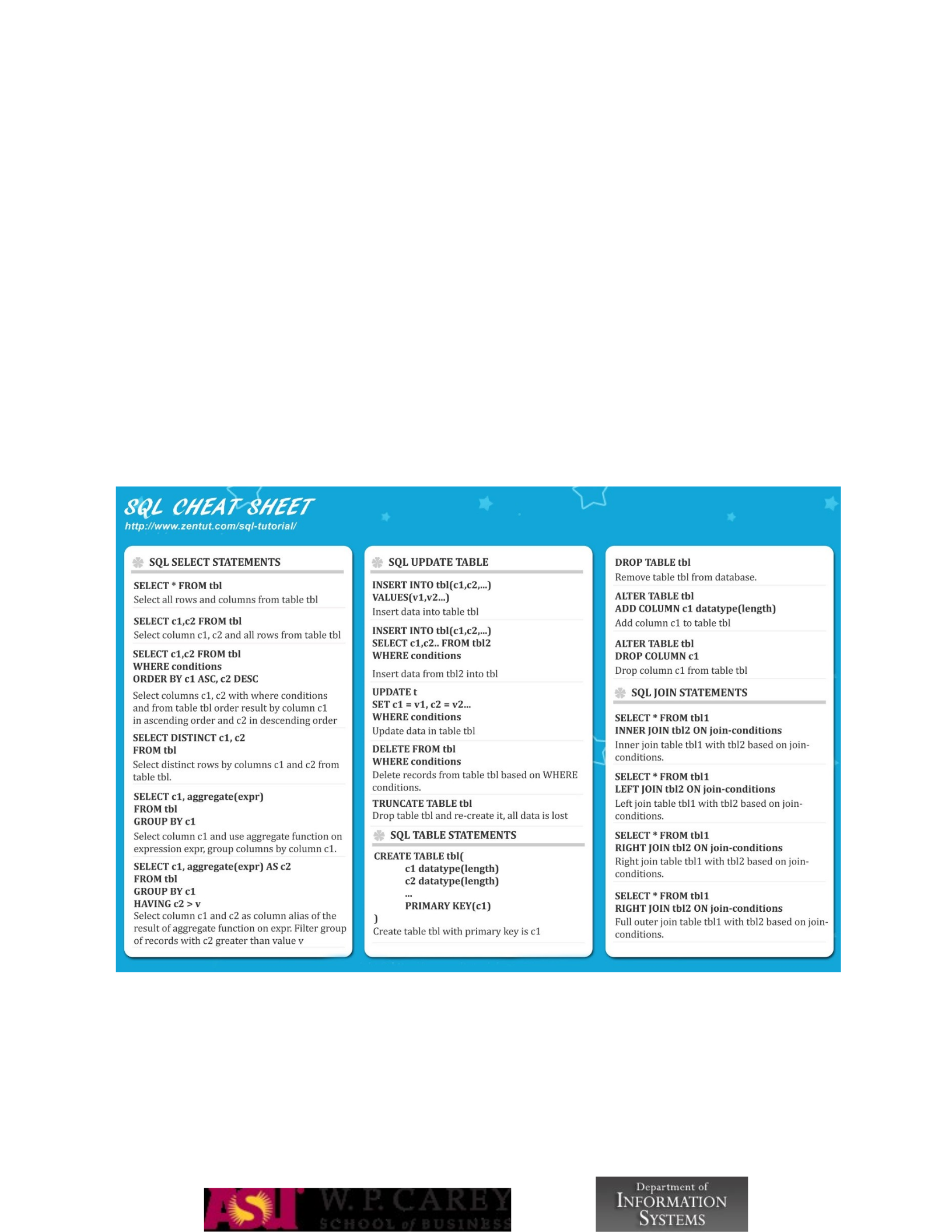
1. Given a table and a set of SQL commands, what is the expected output?
2. Given a table and the desired output, what SQL commands would you use?
3. Please practice SQL using the web sites we used in class and for your homework.
4. Be able to read and/or identify key elements in an existing ER Diagram
CIS 235 Introduction to Information Systems Summer 2018
5.
6. Excel: Be able to explain or execute basic functions and cell references

