


1
Effective Implementation of Digital transformation
Group Members
Class
Professor
University
Date

2
Executive Summary
This paper aims at producing a plan that will help facilitate the implementation of the digital
transformation strategy in PrüvIT Technologies and the Canadian Sheep Federation. It describes
steps required to create and apply efficient knowledge management system that meets the
company’s objectives as well as strategies that should be followed during the development of a
knowledge management framework.
The report starts with an outline of the organization’s business involving information on the
industry category, size, structural format, and main business functions that the organization
performs. Following this, it defines the key areas of KM requirements and issues in the
organization in order to introduce the KMS solution for the organization.
The proceeding section of the report is the heart of the document where the essential elements of
the KMS are discussed: knowledge capture, organization and storage, sharing and collaboration,
transfer, and maintenance and update. All of them are described in detail and provide the reader
with specific recommendations and operational tactics that may be applicable to the
organization’s specific context.
Moreover, it also examines the threats, risks, and obstacles that may likely occur in the course of
the implementation process. It outlines plans for overcoming challenges and recommendations
for managing change to implement the KMS effectively in the organization, given key factors
like culture, leadership, and employee participation, change management, and professional
development.
Such success also entails identifying potential benefits or outcomes the organization will achieve
if the KMS is implemented properly. The use of KPIs and metrics is brought forward to assess

3
the impact and performance of this system on organizations and knowledge sharing. Lastly, the
report reiterates the recommendations as well as the confines of the suggested solutions.

4
Table of Contents
Executive Summary...................................................................................................................................2
Objectives of this Report...........................................................................................................................5
Problem Statement.................................................................................................................................... 7
Company Overview................................................................................................................................... 9
Organizational Goals and Objectives.....................................................................................................10
Knowledge Capture and Integration.....................................................................................................11
Knowledge Organization........................................................................................................................ 13
Knowledge Storage and Access..............................................................................................................15
Knowledge Sharing and Collaboration..................................................................................................16
Knowledge Transfer................................................................................................................................17
Knowledge Maintenance and Updates...................................................................................................18
Implementation Considerations.............................................................................................................19
Possible difficulties, threats, and limitations.....................................................................................19
Mitigation Strategies and Measures...................................................................................................20
Benefits and Measurement......................................................................................................................22
Key Performance Indicators...................................................................................................................23
Recommendations...................................................................................................................................24
Conclusion................................................................................................................................................ 25
References................................................................................................................................................ 26
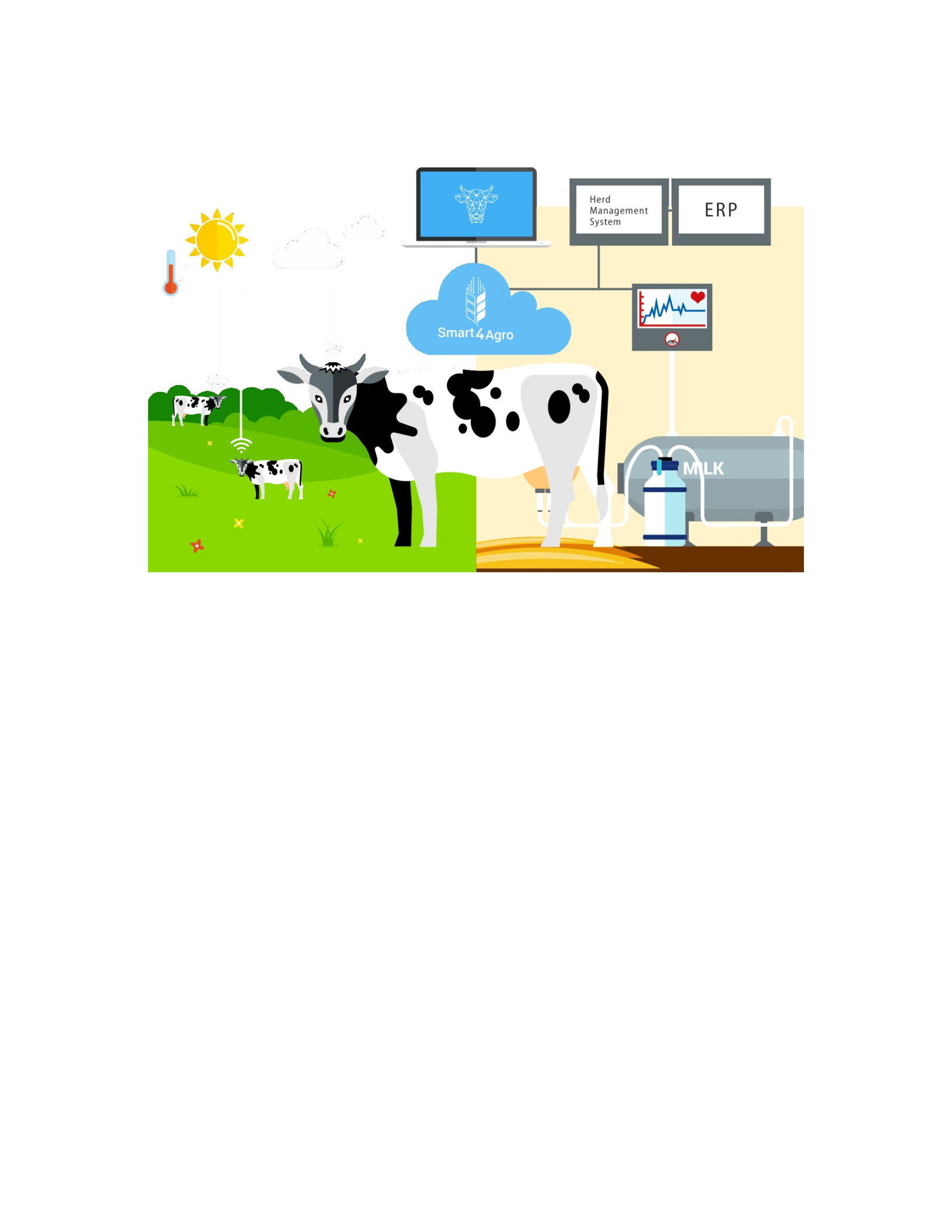
5
Effective Implementation of Digital transformation
Objectives of this Report
1. Enhance Traceability and Supply Chain Transparency
Assess the AgroLedger project that has integrated the concept of traceability using
blockchain technology and propose solutions for increasing the system’s extendibility
and compatibility with the continuously developing livestock sector.
Discover other technologies and other ways by which the issues of supply chain
transparency, real-time sharing of information and keeping of records of such information
through the life cycle of the product can be enhanced.
2. Improve Animal Health Monitoring and Disease Control:
Evaluate the effectiveness of the existing biometric identification system; Face IT and
recommend some improvements or recommend an even better method for identification
of health status of the animals using facial recognition or other forms of biometrics.

6
Examine the possibilities of using AI and ML for the detection of possible diseases like
the foot melt disease and the subsequent prevention.
3. Address Connectivity and Technology Adoption Challenges:
Suggest solutions to help close the gap between conventional approaches and today’s
technology platforms, as well as to overcome organizational culture issues as they apply
to livestock businesses.
4. Enhance Data Privacy and Security:
Assess the current state of data governance and privacy and make changes to enhance the
protection of the stakeholders’ data to encourage their confidence in digital
transformation strategies.
5. Ensure Regulatory Compliance and Integration:
Evaluate the current approaches to legal requirements as applied to food safety and
welfare or the environment in conjunction with the use of new technologies.
6. Promote Stakeholder Adoption and Training:
To learn the tactics that should be employed, develop a comprehensive training and
education plan that can make all stakeholders proficient at the adoption of the new
technologies, managing resistance to change, and the implementation of new practices.
7. Establish Performance Monitoring and Continuous Improvement:
Examine the leaders and stakeholders’ goals to determine appropriate key performance
indicators (KPIs) to assess the success and output of the digital transformation
approaches for organizational productivity, supply chain performance, and knowledge
exchange.

7
Problem Statement
This research identifies several challenges facing PrüvIT Technologies and the Canadian
Sheep Federation in the livestock industry in which they are unable to optimally implement their
digital change management strategies. Despite their pioneering efforts in integrating blockchain,
AI, biometrics, and analytics to enhance disease control, food safety, and supply chain
transparency, the following key problems persist:
1. Limitations in Traceability and Supply Chain Visibility
While AgroLedger, the trace technology that was piloted to track sheep through the supply
chain, can track animals within the four corners of the supply chain you can barely begin to
contemplate the metric tonnage of the other demands that accompany the expansive equation of
the livestock equation. Coordinating the flow of information and its availability in an end-to-end
manner, in real time, is a major issue across the members of a supply chain ecosystem.
2. Animal Health Monitoring and Disease Prevention
Symptoms like the foot melt disease are fatal to the livestock industry, and once out it causes
major harm to animal health, production, and farm output. Thus, despite the current
advancements made by the FaceIT system proposed by researchers, it is still possible that some
improvements or other solutions would be necessary in order to achieve the level of precision in
tracking animals’ health state and early signs of their illnesses.
3. Connectivity Limitations in Remote Farming Locations
Stable internet connection is essential in utilization of digital technologies especially in areas
of farming which may be in the rural regions. Insufficient connectivity reduces the integration
capacity, slows down the exchange of information and the adaptation of innovative solutions,

8
which the organization needs to exploit the real-time analysis functions and related decision-
making powers.
4. Technology Accessibility and Adoption Barriers
The livestock industry has always used conventional practices; there is resistance when it
comes to adopting new technologies because the stakeholders are used to these practices.
Extending from traditional practices to the modern IT solutions and taking an account of user-
friendliness and stakeholder’s persuasion remain a very crucial challenge to meet.
5. Data Privacy and Security Concerns
Since both, PrüvIT Technologies and the Canadian Sheep Federation work with sensitive
information regarding the health and functioning of the livestock, the privacy of the
stakeholders’ information is crucial. Proper data management and protection yet facilitating data
exchange and cooperation is a fairly major challenge to deal with.
6. Regulatory Compliance and System Integration
Some of the policies that commonly apply to the livestock industry include those ones
concerning to food safety, animals’ treatment, and environmental impact. Adhering the above
regulations when embracing new technological systems of functioning that interconnects with
the old and traditional systems presents a major challenge as it slows down the processes
involved in the embrace of the passed organizational transformation agenda.
7. Training and Education Needs
When it comes to training or educating the workforce towards the acceptance of new
technologies and digitization of workplace practices, extensive packages are needed. The issues

9
concerning knowledge gaps between the existing situation and the state-of-the-art technologies,
and the lack of controllable methods for the stakeholders to enhance their competencies in using
the digital solutions is still an important problem.
Company Overview
The companies, namely: PrüvIT Technologies and Canadian Sheep Federation are part of
the leading organizations aiming at the industry of livestock management with the use of digital
technologies. This partnership reflects a synergy between a non-profit industry association and a
for-profit technology company focused on the advancement of innovation and improvements in
the sustainability of the Canadian sheep industry.
Canadian Sheep Federation was established with the aim of protecting the Canadian
sheep’s farmers interests. It is a non-governmental body involved in encouraging producer,
processors, government and other players towards improvement of sheep industry (About CSF,
n.d). The implementation of this objective has helped foster better traces within the industry,
which introduced the program known as AgroLedger, a trace technology.
PrüvIT Technologies Limited is a for-profit company that is an subsidiary of the
Canadian Sheep Federation established to market the AgroLedger technology and expand its
usage beyond the sheep industry (About, n.d). The firm applies blockchain, artificial intelligence,
biometrics, and analytics to improve disease management, food security, and supply chain
management in livestock farming.
Altogether, they are transforming the system of tracing and monitoring sheep and other
livestock by making it more digital. Their primary business strategies concern the design and
10
implementation of advanced methods of data gathering, improved traceability, and solutions to
the problems encountered during the digitalization of all aspects related to raising livestock.
Their flagship trace technology, AgroLedger, is a blockchain-based innovation useful in
optimally tracking sheep from the supply chain to enhance transparency and accountability.
Moreover, PrüvIT Technologies provides solutions like FaceIT (facial recognition for stock),
ReadIT (Data capture using RFID and Biometric), and FreshOrigins (Transparency solution for
Supply chain) to help the company implement digital transformation in all the stages.
Still, both with Canadian Sheep Federation being a national association for producers of
approximately 10,000 sheep farmers, and PrüvIT Technologies being a new subsidiary, they are
quite influential. This they do with producers, processors, regulators, and other technology
partners with an aim at unlocking innovation and employing advanced technologies to the
livestock sector.
Organizational Goals and Objectives
Both the companies namely PrüvIT Technologies and the Canadian Sheep Federation
have defined clear goals and objectives in line with their mission of revamping the management
of livestock. Their mission is to improve the sustainability, transparency and efficiency of the

11
Sheep sector and the Livestock industry in Canadian context and that through the use of
technology.
As a major goal, the enhancement and development of the sheep and other livestock
series traceability system is also planned. In realizing this, they seek to use blockchain and
advanced analytical tools which shall enhance the supply chain accountability and transparency.
This goal is achieved by their leading product, AgroLedger through which one can track the
livestock from producer to consumer.
Another goal that has to be met is in the area of food safety and quality assurance, where
comprehensive monitoring and disease control systems have to be established. Applications such
as FaceIT (biometric facial recognition for identifying livestock) and ReadIT (sensory RFID and
biometric data collection tool) also help capture useful data which if analyzed, can help in early
identification of instances of possible breakout of diseases and thereby reducing on chances of
the diseases breaking out.
Knowledge Capture and Integration
An important concern is how to gather and use information that is often dispersed across
different sources such as farm operations, processing facilities, and governmental regulatory
agencies. This information must be accurate and complete so is important to reflect all aspect and
used for decision making and analysis.
As the numerous actors across the supply chain create huge volumes of data, getting the
knowledge generated structured in a manner that it is easily accessible and usable, is an emergent
necessity. It is critical to have a coherent and efficient knowledge management system for the
knowledge base and successful collaboration between employees.

12
Management often faces challenges when adopting new technologies and digital
solutions as most of the stakeholders stick to conventional approaches (Weerasinghe & Nirere,
2022). The other crucial factor that has been identified as a major issue and challenge that needs
to be dealt with is the ability to provide proper training and education to enable people to become
proficient in the use of the mentioned technologies.
Concerns to enhance stakeholder information privacy and security are critical given the
nature of data being sought in relation to livestock health and business. Implementing strong data
management and protection policies is one of the most important requirements of KM.
A number of rules and policies pertaining to food safety, animal rights and welfare, and
the management of the negative impact of the livestock industry on the environment apply to the
livestock industry. Addressing these regulations during the adoption of new technologies and the
management of the knowledge inherent to these processes present a considerable difficulty.
In recent years, many organizations have attempted to adopt new digital solutions into
established applications or workflows. Interconnectedness is a key necessity for efficient
knowledge management and the flow of work and business on the supply chain (Kassaneh et al.,
2021).
To ensure that information is gathered effectively from various sources, and information
sharing is done properly, PrüvIT Technologies and the Canadian Sheep Federation will
implement a holistic approach based on some of the key issues discussed under digital
transformation. The following strategies will be implemented:
1. Internet of Things (IoT) and Sensor Integration

13
The team will integrate IoT devices with the existing AgroLedger platform, enabling
automatic data capture and storage on the blockchain ledger, ensuring transparency and
immutability.
2. Mobile Applications and Field Data Capture
Create easy-to-use smartphone applications for farmers, veterinarians, and field officers for
entering observations and records of treatments and other data at the farm level.
3. Artificial Intelligence (AI) and Machine Learning (ML)
Incorporate the use of big data AI and ML to process data from different sources such as IoT
sensors applications data feeds from other sources such as the weather market and changes in
regulatory frameworks.
4. Stakeholder Collaboration and Knowledge Sharing
Design safe and accessible block chain environments for interaction between stakeholders
(such as producers, processors, retailers, researchers, regulators) and sharing information as well
as experience and know how related to the field.
Knowledge Organization
For the efficient indexing and usage of existing knowledge, it is prerequisite that PrüvIT
Technologies and the Canadian Sheep Federation apply a profound knowledge organization plan
based on digital transformation ideas and tools.
The first activity will involve creating a sound ontology and taxonomy, which organizes
knowledge into domain specific categories and sub-categories of concepts, relationships and
hierarchies applicable in the livestock industry. Semantic technologies and knowledge graphs

14
will be adopted to encode and connect cognate concepts, thus allowing future and flexible
navigation and other the discovery in knowledge sources.
In addition, the organization will also use a decentralized knowledge indexing model that
utilizes the AgroLedger blockchain technology, through which it will effectively be possible to
store, organize, and protect knowledge assets. Knowledge updates and modifications shall be
consistent with the following characteristics; distributed ledger technology, and substantially
improve on data integrity and transparency.
The metadata management shall occur systematically with the metadata being stored and
linked to assets in a consistent manner, an example being source, date, and location data,
keywords amongst others. Metadata enrichment of material such as music, video and text will be
made easier through the use of tagging and classification systems that are automated and based
on machine learning and natural language processing.
For easy understanding and knowledge management the organization will create and
implement the knowledge maps and charts which will help in identifying the dependencies,
connections and logical hierarchies between the various types of knowledge within the
organizational knowledge base. The obtained results of scientific research activities will motivate
data visualization tools and techniques for further representation of complex knowledge
structures in an easily understandable form.
Integrated search functions will be provided to search the integrated knowledge base,
knowledge databases and external sources within a single click to get a holistic view of the
available knowledge. Both Natural language processing and technologies of Semantic search will

15
help the database inquiries to become more accurate and oriented on the current tasks, thus
making the process of knowledge finding more effective.
The delivery of knowledge will also be made personal where the system will be designed
to deliver knowledge based on an individual choice of preference, roles and access rights.
Intelligent recommendation services and knowledge-based agents will match the right
knowledge resources based on a user’s learning context and previous interaction history.
Last but not least, a decentralized knowledge curation platform will be created where
some end-users including but not limited to subject matter experts, stakeholders, and key
community influencers will be able to participate in the review, validation, and organization of
knowledge assets. Incentive mechanisms and reputation systems will help to draw crowds and
guarantee the originality and verity of the curated knowledge.
Knowledge Storage and Access
To address the knowledge storage solution, one of the key components that will be
employed is the usage of a distributed ledger that is based on blockchain. The proposed solution
will build on the organization’s current digital platform known as AgroLedger; this will act as
the distributed and tamper-proof ledger to store and provide accountability for the recorded
knowledge assets. This will provide accurate, secure, and auditable information and knowledge
resources to end-users, along with improved knowledge management and control.
In addition to bitcoin-based storage, the organization is to use a distributed file system
and a distributed object storage. This will enable one to store petabytes of multimedia and
unstructured data which include images, videos, and documents to name but a few, more so
without compromising on the distribution of these data across the availability and durability of

16
the system as well as its scalability. A backup and data replication system will be implemented to
allow for easy replication and data redundancy to avoid loss of critical data.
Knowledge assets will be made more retrievable through a well secured and easily
navigated knowledge management system. With this platform, there will be an easy and unified
interface for linking the multiple types of storage elements, and show control for the roles and
permissions. Sophisticated searching and indexing technologies including Elasticsearch and
Apache Lucene among others shall also be incorporated with a view of enhancing the process of
acquisition of knowledge on particular topics of interest.
For the deployed strategies of remote and mobile access, a web application will be
created as well as mobile application, this will allow users to access and contribute to knowledge
resources regardless of their geographical location or device. All of these applications will be
built using newer Web 2. 0 technologies and will operate under strict security protocols to
protect any sensitive data that may be collected.
Also, it will develop cloud relationships with cloud service providers to strengthen the
organization’s knowledge management system as it would need to be scalable and secure. This
would help in accomplishing efficient management of resources in the network as well as
distributing the load suitably; it also includes the management of high availability and disaster
recovery and backup strategies.
Knowledge Sharing and Collaboration
To foster a culture of knowledge sharing and collaboration among employees and
stakeholders, PrüvIT Technologies and the Canadian Sheep Federation will implement a
comprehensive suite of mechanisms and tools:

17
1. Blockchain-based collaboration platform
Through employment of the blockchain technology, it will be possible to create a secure and
transparent platform that will be effective in creating an environment whereby producers,
processors, researchers, as well as regulators will be in a position to share handy information,
best practices, and codified domain-specific knowledge.
2. Virtual communities of practice
Through knowledge spaces, specialists in certain subjects, representatives of the company’s
staff, as well as partners and investors will be able to continue their discussions, share valuable
experiences, and work together on knowledge-related activities and projects. Such communities
will be moderated by moderators and backed up by sophisticated CT and collaboration tools.
Knowledge Transfer
PrüvIT Technologies and the Canadian Sheep Federation will implement the following
strategies to ensure the effective transfer of critical knowledge from experts to newcomers or
across different teams and departments:
1. Mentorship and Apprenticeship Programs
Skilled employees that possess vast knowledge in a particular area will be grouped with
employees that are new to that particular area or employees that want to learn about a specific
area of knowledge. There is an opportunity for organizational learning and skill acquisition since
tacit knowledge can be passed on by means of training, observation, and drills.
2. Knowledge Capture and Documentation

18
Domain knowledge gathered from specialists will be stored and indexed using various
methods that include one-on-one interviews, brainstorming sessions and screen captures. This
documented knowledge will be stored in a central knowledge bank so it will always be available
and can be retrieved easily in the future.
3. Expert Lectures and Webinars
Power point presentation or recorded versions of experts’ lectures, seminars, and webinars
will be conducted to increase the availability of specialized knowledge derived from the fields of
industry experts, researchers, and other thought leaders to a wider audience within the
organization and its stakeholders.
Knowledge Maintenance and Updates
1. Continuous Knowledge Auditing
Knowledge audits will be carried out from time to time so as to determine the reliability,
correctness, and applicability of the knowledge assets. This will entail domain specialists,
interested parties, as well as, automated modes on various aspects of data validation and quality
control.
2. Knowledge Expiration and Archiving
It is obligatory that all kinds of knowledge assets will either have some definite expiry or be
subjected to review after a certain period of time depending upon the importance and type of
KAM.
3. Knowledge Feedback Loops

19
There shall be feedback systems which enable the user, stakeholder and external sources to
give their feedback on any knowledge asset as regards to its quality, its completeness and its
relevance. This feedback will be part of the knowledge acquired and incorporated into the
knowledge update and management cycle.
Implementation Considerations
Possible difficulties, threats, and limitations
1. Organizational Culture and Resistance to Change
It has been evident that the livestock industry has used traditional methods in the course of its
activities, and implementing new ideas and innovations in this field may be met with mistrustful
reactions on behalf of the beneficiaries who are accustomed to such practices. Bearing this in
mind, eradicating culture, as well as promoting the spirit of change and adaptability, may be
regarded as rather difficult.
2. Data Privacy and Security Concerns
Since the information has to do with the health of the livestock and production the issue of
data privacy and security comes into question especially when it involves important persons.
Maintaining both the protection of data and adequate data sharing and collaboration is another
major concern.
3. Integration with Legacy Systems
Applying new innovations within pre-existing IT environments and frameworks can often
prove to be a rather difficult process. The processes of knowledge management and functional
organization must be integrated to make the interrelated supply chain activities as efficient as
possible.

20
4. Scalability and Future-Proofing
It is crucial to include provisions for the scalability of the knowledge management system as
well as to design it in a way that will allow it to be enhanced in future for compatibility with new
technologies and for expansion to meet the increasing demand. Failure to future-proof the above
system might result to ageing an become obsolete or require a new overhaul which may be so
expensive.
5. Stakeholder Engagement and Buy-In
Gaining commitment and engagement of multi-stakeholders including producers, processors,
researchers and regulators is always cumbersome. The long-term motivation of both parties and
their self-interest that will push them to share knowledge is very important in the system.
6. Connectivity and Infrastructure Limitations
The nature of digital solutions requires reliable internet connectivity, and better infrastructure
especially in farming regions, which may at times be quite remote. Overcoming these limitations
can be expensive and practically complicated.
7. Regulatory Compliance
Several significant issues can be identified when it comes to compliance with the different
laws and standards in this sphere as well as to the application of the new technologies and the
related knowledge management: the need to adhere to the different regulatory requirements on
food safety, animal treatment, and environmental aspects.
Mitigation Strategies and Measures
1. Change Management and Communication

21
We will outline measures that should be put in place to support change, such as task-related
and communication plans along with training activities.
2. Data Governance and Security Framework
We plan to implement a well-coordinated data management framework that will effectively
deal with such issues as privacy and security of data, method of accessing and managing data
besides adhering to local/international policies and standards.
3. Phased Implementation and Pilot Testing
The plan includes implementing the adaptation of the metrics in a step-by-step manner,
using pilot projects and then expansion. It means that there is a possibility to make the
corrections to the implementing solution, to hear from the stakeholders and to reveal the possible
problems before the large-scale implementing.
4. Legacy System Integration and Data Migration
Our team suggests coming up with a detailed integration and data migration plan that would
integrate and work in synergy with existing legacy systems and practices advanced in the
organization.
5. Scalability and Flexibility
The team should always ensure that the features of the knowledge management system are
made in such a way that it can be easily changed and adapted in the future.
6. Infrastructure Investments and Partnerships

22
To do this the management should seek partnership with ISPs, telecommunication firms and
technology companies to work on challenges of connectivity and infrastructure especially in the
farming regions. Consider other connection types, including satellite or a mesh network.
7. Continuous Training and Support
Provide training at different levels to incorporate all the fellow stakeholders into the
knowledge management system training the entire human resource for the utilization of the
knowledge management system.
Benefits and Measurement
1. Enhanced Supply Chain Transparency and Traceability
The knowledge management system will enable end-to-end visibility into the livestock
supply chain by leveraging blockchain technology, AI, and advanced analytics. This
transparency will foster trust among consumers, ensure regulatory compliance, and facilitate
rapid identification and resolution of issues.
2. Improved Disease Control and Animal Welfare
The integration of biometric data, IoT sensors, and predictive analytics will enable early
detection and prevention of diseases, such as the foot melt disease (Akhigbe et al., 2021). This
proactive approach will enhance animal welfare, reduce losses, and improve overall productivity.
3. Increased Operational Efficiency and Cost Savings
Streamlined knowledge sharing, collaboration, and access to best practices will optimize
operational processes, reduce redundancies, and minimize waste. This efficiency gain will

23
translate into cost savings and improved profitability for the organization and its stakeholders
(Ikpe & Shamsuddoha, 2024).
4. Accelerated Innovation and Competitive Advantage
PrüvIT Technologies will cultivate an environment conducive to innovation by fostering a
culture of continuous learning, knowledge sharing, and collaboration. This will enable the
development of new products, services, and solutions, providing a competitive edge in the
livestock industry.
5. Effective Knowledge Retention and Transfer
The KMS will ensure the preservation and transfer of critical knowledge from experts to
newcomers, mitigating the risk of knowledge loss due to employee turnover or retirement.
6. Improved Decision-Making and Risk Management
Access to accurate, up-to-date, and comprehensive knowledge assets will enable data-driven
decision-making, thereby reducing risks and increasing the likelihood of successful outcomes.
Key Performance Indicators
Metric KPI
Supply Chain Visibility and Traceability Track metrics such as end-to-end traceability
coverage, time-to-trace, and accuracy of
traceability data
Animal health and welfare Disease incidence rates
Mortality rates
Overall livestock productivity

24
Operational efficiency Inventory turnover rates
Process cycle times
Cost savings achieved through process
optimizations
Knowledge sharing and collaboration Number of active contributors
Knowledge assets shared
Level of engagement within virtual
communities and collaboration platforms
Employee productivity and retention Employee productivity
Knowledge retention rates
Employee satisfaction and engagement levels

25
Recommendations
1. An implementation strategy that will be needed to be adopted by PrüvIT Technologies is
the implementation through pilot projects in order to realize some of the problems which
affect the company so that they may be fixed before passing to the next level of
implementation.
2. It should encourage proactive knowledge sharing and collaboration and this should be
achieved by having motivation techniques, games and even awards that are given to
people who actively contribute.
3. Additionally, the organization must appoint a specific knowledge management group
assigned for system supervision, data quality check, and development.
4. Entering formalised collaborations with technology suppliers, academic establishments,
as well as industrial bodies will help PrüvIT Technologies get hold of innovative
solutions, know-how, and information from outside the company.
5. Last but not least, to maintain the efficiency of the knowledge management system as a
long-term solution, the company should update and adjust it periodically regarding the
shifts in the industry, changes in the legislation, and the ever-changing demands of the
key stakeholders.
Conclusion
Digital transformation is impacting livestock industry in Canada positively through this
beneficial partnership of PrüvIT Technologies and Canadian Sheep Federation. AgroLedger,
FaceIT, and ReadIT are some of the products being offered by the company, which uses

26
technologies – blockchain, AI, and IoT to improve traceability, disease detection, and foods
security. It targets increasing the chain value, ensuring the stakeholders’ accountability, and
enhancing the organizations’ operations through knowledge management. Some of the risks that
are inherent to this initiative include: resistance to change, data privacy issues, and infrastructural
bottlenecks. The suggested mitigations include the phased approach, skill development and
training and, cooperation with stakeholders. The expected advantages consist of enhanced supply
chain visibility, enhanced control of the diseases, the enhancement of the organization process,
and the enhancement of innovations These outcomes will be tracked by key performance
indicators to make sure the overall long-term success and relevancy. Finally, this partnership
establishes a new benchmark for the livestock industry and illustrated how digital technology can
revolutionize farming.

27
References
About CSF. (n.d.). Cansheep. https://www.cansheep.ca/about-csf
About. (n.d.). Www.pruvit.io. https://www.pruvit.io/about
Akhigbe, B. I., Munir, K., Akinade, O., Akanbi, L., & Oyedele, L. O. (2021). IoT Technologies
for Livestock Management: A Review of Present Status, Opportunities, and Future
Trends. Big Data and Cognitive Computing, 5(1), 10.
https://doi.org/10.3390/bdcc5010010
Ikpe, V., & Shamsuddoha, M. (2024). Functional Model of Supply Chain Waste Reduction and
Control Strategies for Retailers—The USA Retail Industry. Logistics, 8(1), 22.
https://doi.org/10.3390/logistics8010022
Kassaneh, T. C., Bolisani, E., & Cegarra-Navarro, J.-G. (2021). Knowledge Management
Practices for Sustainable Supply Chain Management: A Challenge for Business
Education. Sustainability, 13(5), 2956. https://doi.org/10.3390/su13052956
Weerasinghe, L., & Nirere, B. (2022). CHALLENGES OF DIGITAL TRANSFORMATION: A
case study of the restaurant industry.

