


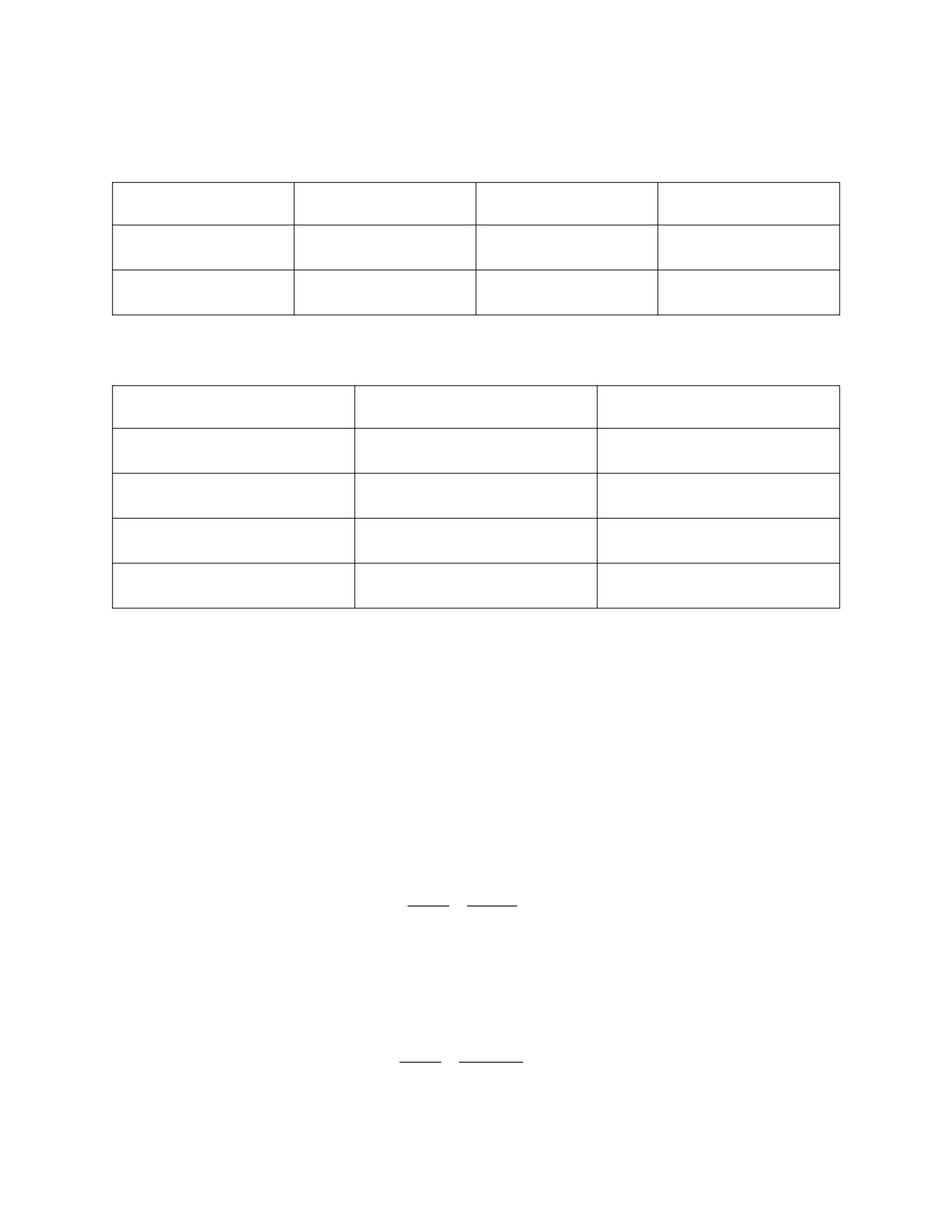
LAB: SNELL’S LAW
Table 1
Medium
Angle of
Incidence
Index of
Refraction
Angle of
Refraction
Water
30°
1.333
22. 0°
Glass
30°
1.500
19.5°
Table 2
Medium
Angle of
Incidence
Angle of
Refraction
Mystery A, Trial 1
30°
11.9°
Mystery A, Trial 2
4 0°
15.4°
Mystery B, Trial 1
30°
20.9°
Mystery B, Trial 2
4 0°
27.3°
QUESTIONS
1)Use Snell’s Law to verify that the angles of refraction that you recorded in Table 1 are indeed correct.
Show your work.
For water:
Snell’s Law is given by:
n1sin θ1=n2sin θ2
We are given that
n1=1.00
n2=
sin θ1
sin θ2
=sin 30°
sin 22°=1.335
The refractive index of water, as calculated above, is 1.364. This value is close to the given value of 1.333,
hence verifying the angle of refraction recorded.
For Glass:
n2=
sin θ1
sin θ2
=sin 30°
sin 19.5°=1. 498

The refractive index of glass, as calculated above, is 1.498. This value is close to the given value of 1.500,
hence verifying the angle of refraction recorded.
2) Use Snell’s Law to determine the indices of refraction for Mystery A and Mystery B. There should be
four calculations. Find the average of the two trials for each material.
We use the formula
n2=
sin θ1
sin θ2
Mystery A:
Trial 1:
θ1=30°,θ2=11.9°
n2=
sin θ1
sin θ2
=sin30°
sin 11.9°=2.425
Trial 2:
θ1=4 0°,θ2=15.4°
n2=
sin θ1
sin θ2
=sin 4 0 °
sin 15.4°=2.421
The average of the two values will be:
2.425+2.421
2
=2.4 2 3
Mystery B:
Trial 1:
θ1=30°,θ2=20 .9°
n2=
sin θ1
sin θ2
=sin 30°
sin 20 .9°=1.402
Trial 2:
θ1=40°, θ2=27.3°
n2=
sin θ1
sin θ2
=sin 40°
sin 27.3°=1.401
The average of the two values will be:

1.402+1.401
2
=1.4015
a) Mystery A=
2.423
b) Mystery B=
1.40 2
3)As the index of refraction for the second medium is increased, what effect does this have on the angle
of refraction?
The angle of refraction decreases with an increase in the index of refraction for the second medium
because light bends more in the direction of the normal in a medium with a greater index of refraction
since it is optically denser.

