


MOLECULAR GENETICS
PAPER
GENE EXPRESSION
BRADFORD H
.
DEPARTEMENT OF BIOLOGY
ARIZONTA STATE UNIVERSITY
DISCUSSION
2
.
1
U
n
de
rst
a
n
d
ing
Ge
n
e E
xpr
e
ssion
Ge
n
e e
xpr
e
ssion r
e
f
e
rs to th
e
pro
ce
ss
b
y whi
c
h g
e
n
e
ti
c
inform
a
tion is utiliz
ed
to pro
d
u
ce a
fun
c
tion
a
l pro
d
u
c
t
,
typi
ca
lly
a
prot
e
in
,
though in th
e ca
s
e
of non
-
c
o
d
ing g
e
n
e
s lik
e
thos
e
for r
RNA
or
t
RNA
,
th
e
r
e
sult is fun
c
tion
a
l
RNA
.
T
his pro
ce
ss is
e
ss
e
nti
a
l for
a
ll
forms of lif
e
,
in
c
lu
d
ing
e
uk
a
ryot
e
s
,
prok
a
ryot
e
s
,
a
n
d
virus
e
s
,
a
s it
g
e
n
e
r
a
t
e
s th
e
m
ac
romol
ec
ul
a
r m
ac
hin
e
ry n
ece
ss
a
ry for lif
e
.
I
n hum
a
ns
,
num
e
rous g
e
n
e
s
de
t
e
rmin
e
v
a
rious tr
a
its
,
su
c
h
a
s h
a
ir
c
olor
a
n
d
skin
ton
e
.
T
h
e ce
ntr
a
l
d
ogm
a
of mol
ec
ul
a
r
b
iology provi
de
s
a
fr
a
m
e
work for
un
de
rst
a
n
d
ing how g
e
n
e
ti
c
inform
a
tion is tr
a
nsf
e
rr
ed be
tw
ee
n
DNA
,
RNA
,
a
n
d
prot
e
ins
.
E
ss
e
nti
a
lly
,
DNA
inform
a
tion is tr
a
ns
c
ri
bed
into
RNA
,
a
n
d
th
e
n som
e
of this
RNA
inform
a
tion is tr
a
nsl
a
t
ed
into prot
e
ins
.
2
.
2
P
rot
e
in
S
ynth
e
sis
P
rot
e
in synth
e
sis is th
e
pro
ce
ss
b
y whi
c
h prot
e
ins
a
r
e c
r
ea
t
ed
a
n
d
involv
e
s two k
e
y st
a
g
e
s
:
tr
a
ns
c
ription
a
n
d
tr
a
nsl
a
tion
.
D
uring
tr
a
ns
c
ription
,
m
RNA
is pro
d
u
ced
in th
e
nu
c
l
e
us
ba
s
ed
on th
e DNA
t
e
mpl
a
t
e
with th
e
h
e
lp of th
e
polym
e
r
a
s
e e
nzym
e
.
I
n th
e
tr
a
nsl
a
tion
st
a
g
e
,
th
e
m
RNA e
xits th
e
nu
c
l
e
us
a
n
d e
n
c
ount
e
rs t
RNA
,
with
ri
b
osom
e
s
—
c
ompos
ed
of l
a
rg
e a
n
d
sm
a
ll su
b
units
—
f
ac
ilit
a
ting th
e
pro
ce
ss
.
1
)
T
r
a
ns
c
ription
T
r
a
ns
c
ription involv
e
s th
e c
r
ea
tion of
RNA d
ir
ec
t
ed b
y
DNA
,
with
b
oth nu
c
l
e
i
c ac
i
d
s
c
ommuni
ca
ting in th
e
s
a
m
e
l
a
ngu
a
g
e
.
E
ss
e
nti
a
lly
,
inform
a
tion is tr
a
ns
c
ri
bed
,
or
c
opi
ed
,
from on
e
mol
ec
ul
e
to
a
noth
e
r
.
Be
si
de
s s
e
rving
a
s
a
t
e
mpl
a
t
e
for g
e
n
e
r
a
ting n
e
w
c
ompl
e
m
e
nt
a
ry

str
a
n
d
s
d
uring
DNA
r
e
pli
ca
tion
,
DNA
str
a
n
d
s
ca
n
a
lso gui
de
th
e
form
a
tion of
c
ompl
e
m
e
nt
a
ry
RNA
nu
c
l
e
oti
de
s
e
qu
e
n
ce
s
.
F
or g
e
n
e
s
th
a
t
c
o
de
for prot
e
ins
,
th
e RNA
pro
d
u
ced
is
a
pr
ec
is
e
tr
a
ns
c
ript of th
e
prot
e
in
-
b
uil
d
ing instru
c
tions from th
e
g
e
n
e
.
T
h
e
s
e RNA
mol
ec
ul
e
s
ca
n
be
r
e
pli
ca
t
ed
multipl
e
tim
e
s
.
Me
ss
e
ng
e
r
RNA
(
m
RNA
)
is
a
typ
e
of
RNA
th
a
t
ca
rri
e
s g
e
n
e
ti
c
instru
c
tions from
DNA
to th
e ce
ll
'
s prot
e
in
-
synth
e
sizing m
ac
hin
e
ry
.
T
r
a
ns
c
ription r
e
sults in thr
ee
typ
e
s of
RNA
:
m
RNA
,
t
RNA
,
a
n
d
r
RNA
.
T
h
e
rol
e
of m
RNA
is to tr
a
nsf
e
r
DNA
inform
a
tion from th
e
nu
c
l
e
us to th
e
ri
b
osom
e
s in th
e
form of
c
o
d
ons
,
whi
c
h
a
r
e
tripl
e
ts of
ba
s
e
s
.
Eac
h
c
o
d
on in m
RNA c
ompl
e
m
e
nts
a c
o
d
on
in th
e DNA
s
e
qu
e
n
ce
us
ed a
s
a
t
e
mpl
a
t
e
.
T
h
e
pro
ce
ss of forming
m
RNA
from
DNA
in th
e ce
ll nu
c
l
e
us is known
a
s tr
a
ns
c
ription
.
T
r
a
nsf
e
r
RNA
(
t
RNA
)
is r
e
sponsi
b
l
e
for i
de
ntifying
c
o
d
ons
a
n
d
tr
a
nsl
a
ting th
e
m into
a
mino
ac
i
d
s within ri
b
osom
e
s
,
a
pro
ce
ss known
a
s tr
a
nsl
a
tion
.
T
h
e
t
RNA
s
e
qu
e
n
ce
of nitrog
e
n
ba
s
e
s
,
ca
ll
ed
th
e
a
nti
c
o
d
on
,
pl
a
ys
a
k
e
y rol
e
in this fun
c
tion
.
T
h
e
stru
c
tur
e
of t
RNA
r
e
s
e
m
b
l
e
s
a c
lov
e
rl
ea
f with four
c
riti
ca
l r
e
gions
:
1
)
T
h
e a
nti
c
o
d
on
e
n
d
,
a ba
s
e
tripl
e
t th
a
t i
de
ntifi
e
s
c
o
d
ons
.
2
)
T
h
e a
mino
ac
i
d b
in
d
ing sit
e
,
whi
c
h
a
tt
ac
h
e
s
a
mino
ac
i
d
s
.
3
)
T
h
e e
nzym
e
r
ec
ognition sit
e
,
whi
c
h
a
i
d
s
in
a
mino
ac
i
d a
tt
ac
hm
e
nt
.
4
)
T
h
e
ri
b
osom
e
r
ec
ognition sit
e
.
R
i
b
osom
a
l
RNA
(
r
RNA
)
s
e
rv
e
s
a
s th
e
sit
e
for prot
e
in synth
e
sis
a
n
d c
ompris
e
s two
su
b
units
:
1
)
T
h
e
sm
a
ll su
b
unit
,
whi
c
h
b
in
d
s to m
RNA
.
2
)
T
h
e
l
a
rg
e
su
b
unit
,
whi
c
h
a
tt
ac
h
e
s th
e c
orr
ec
t t
RNA
.
T
r
a
ns
c
ription
,
whi
c
h o
cc
urs
in th
e c
ytopl
a
sm
,
be
gins with
RNA
polym
e
r
a
s
e e
nzym
e
op
e
ning th
e
DNA d
ou
b
l
e
str
a
n
d
.
O
n
e DNA
str
a
n
d
s
e
rv
e
s
a
s th
e
t
e
mpl
a
t
e
or s
e
ns
e
str
a
n
d
,
whil
e
th
e
oth
e
r is th
e a
nti
-
s
e
ns
e
str
a
n
d
.
U
nlik
e
r
e
pli
ca
tion
,
whi
c
h involv
e
s th
e e
ntir
e DNA
,
tr
a
ns
c
ription t
a
rg
e
ts sp
ec
ifi
c
g
e
n
e
s
e
gm
e
nts
,
a
n
d
th
e
nu
c
l
e
oti
de
s in th
e
s
e
ns
e
str
a
n
d
tr
a
ns
c
ri
bed
into
RNA
mol
ec
ul
e
s
a
r
e
r
e
f
e
rr
ed
to
a
s tr
a
ns
c
ription units
.
T
o
be
gin this
pro
ce
ss
,
a
sp
ec
ifi
c
g
e
n
e
s
e
rv
e
s
a
s th
e
initi
a
l sign
a
l
,
with th
e AUG c
o
d
on
be
ing th
e de
sign
a
t
ed
m
a
rk
e
r
.
T
r
a
ns
c
ription initi
a
tion o
cc
urs
a
t th
e
upstr
ea
m lo
ca
tion
,
r
e
pr
e
s
e
nt
ed b
y th
e
5
'
form
.
Te
rmin
a
tion of
tr
a
ns
c
ription h
a
pp
e
ns
a
t th
e d
ownstr
ea
m r
e
gion
,
oft
e
n
de
not
ed b
y th
e
3
'
form
.
T
hus
,
tr
a
ns
c
ription
c
onsist
e
ntly pro
ceed
s from th
e
upstr
ea
m to
th
e d
ownstr
ea
m
,
moving in th
e
5
'
to
3
'
d
ir
ec
tion
.
T
h
e
r
e
pli
ca
tion pro
ce
ss
be
gins with th
e
initi
a
tion ph
a
s
e
,
wh
e
r
e
RNA
polym
e
r
a
s
e a
tt
ac
h
e
s to
a
sp
ec
ifi
c DNA
r
e
gion known
a
s th
e
promot
e
r
,
m
a
rking th
e
st
a
rt of tr
a
ns
c
ription
.
T
his pro
ce
ss involv
e
s th
e
form
a
tion of th
e
tr
a
ns
c
ription initi
a
tion
c
ompl
e
x
,
whi
c
h in
c
lu
de
s th
e
promot
e
r
,
RNA
polym
e
r
a
s
e
,
a
n
d a
group of prot
e
ins
ca
ll
ed
tr
a
ns
c
ription f
ac
tors
.
O
n
ce b
oun
d
,
RNA
polym
e
r
a
s
e
unwin
d
s th
e DNA
d
ou
b
l
e
str
a
n
d a
n
d
st
a
rts th
e e
long
a
tion ph
a
s
e
.
D
uring
e
long
a
tion
,
RNA
polym
e
r
a
s
e a
ss
e
m
b
l
e
s
RNA
nu
c
l
e
oti
de
s in th
e
5
´
to
3
´
d
ir
ec
tion
,
with
RNA
growth o
cc
urring
a
longsi
de
th
e
form
a
tion of
DNA ba
s
e
p
a
irs
.
U
nlik
e DNA
,
RNA
su
b
stitut
e
s ur
ac
il for thymin
e
,
so ur
ac
il p
a
irs with
ade
nin
e
in th
e RNA
str
a
n
d
.
T
h
e
r
e
m
a
ining
DNA ba
s
e
s
—
ade
nin
e
,
gu
a
nin
e
,
a
n
d c
ytosin
e
—
p
a
ir with th
e
ir
c
ompl
e
m
e
nt
a
ry
ba
s
e
s
acc
or
d
ingly
.
A
s
RNA
polym
e
r
a
s
e
progr
e
ss
e
s
a
long th
e DNA
,
it
s
e
qu
e
nti
a
lly op
e
ns th
e d
ou
b
l
e
str
a
n
d
s
,
add
ing nu
c
l
e
oti
de
s to th
e
growing
RNA
mol
ec
ul
e
.
A
ft
e
r
RNA
synth
e
sis is
c
ompl
e
t
e
,
th
e DNA
str
a
n
d
s r
e
-
form
,
a
n
d
th
e
n
e
wly form
ed RNA
mol
ec
ul
e de
t
ac
h
e
s from
th
e
t
e
mpl
a
t
e
.
T
h
e RNA
nu
c
l
e
oti
de
s
e
qu
e
n
ce be
gins
a
t th
e
promot
e
r
r
e
gion
a
n
d e
xt
e
n
d
s to th
e
t
e
rmin
a
tor r
e
gion
.
O
n
ce
tr
a
ns
c
ription is
finish
ed
,
th
e DNA
str
a
n
d
s r
ea
ss
e
m
b
l
e a
s th
e
y w
e
r
e be
for
e
,
a
n
d RNA
polym
e
r
a
s
e
is promptly
de
t
ac
h
ed
from th
e DNA
.
T
h
e RNA
is th
e
n
r
e
l
ea
s
ed
,
r
e
sulting in th
e
form
a
tion of n
e
w m
RNA
.
I
n prok
a
ryoti
c ce
lls
,
th
e RNA
tr
a
ns
c
ri
bed
from
DNA d
ir
ec
tly fun
c
tions
a
s m
RNA
.
C
onv
e
rs
e
ly
,
in
e
uk
a
ryoti
c ce
lls
,
RNA
tr
a
ns
c
ri
bed
from prot
e
in
-
c
o
d
ing g
e
n
e
s
bec
om
e
s fun
c
tion
a
l m
RNA
only
a
ft
e
r un
de
rgoing
add
ition
a
l pro
ce
ssing
.
T
hus
,
a
singl
e
m
RNA
str
a
n
d c
ont
a
ins v
a
rious s
e
qu
e
n
ce
s of nitrog
e
n
ba
s
e
s th
a
t
a
r
e c
ompl
e
m
e
nt
a
ry to th
e DNA
g
e
n
e
ti
c c
o
de
.
Eac
h
s
e
qu
e
n
ce
of thr
ee
nitrog
e
n
ba
s
e
s in th
e
m
RNA
nu
c
l
e
oti
de
s
,
known
a
s
a
tripl
e
t or
c
o
d
on
,
c
orr
e
spon
d
s to
a
sp
ec
ifi
c
p
a
rt of th
e
g
e
n
e
ti
c
m
e
ss
a
g
e
.
i
.
P
rok
a
ryot
e
s
T
r
a
ns
c
riptionin
T
r
a
ns
c
ription is th
e
pro
ce
ss of
RNA
synth
e
sis f
ac
ilit
a
t
ed b
y th
e
e
nzym
e RNA
polym
e
r
a
s
e
.
I
n prok
a
ryot
e
s
,
su
c
h
a
s
E
.
c
oli
bac
t
e
ri
a
,
RNA
polym
e
r
a
s
e
in
c
lu
de
s s
e
v
e
r
a
l
c
ompon
e
nts
,
sp
ec
ifi
ca
lly th
e
σ70
promot
e
r
,
a
n
d c
onsists of
a
t l
ea
st fiv
e
su
b
units
:
a
lph
a
(
α
),
be
t
a
(
β
),
be
t
a
prim
e
(
β
'),
om
e
g
a
(
ω
),
a
n
d
sigm
a
(
σ
).
T
h
e c
ompl
e
t
e e
nzym
e
,
known
a
s
a
holo
e
nzym
e
,
is
c
ompos
ed
of two
a
lph
a
su
b
units
a
n
d
on
e eac
h of th
e
oth
e
r su
b
units
.
T
his holo
e
nzym
e
is
e
ss
e
nti
a
l for initi
a
ting tr
a
ns
c
ription
.
I
n
E
.
c
oli
,
th
e RNA
polym
e
r
a
s
e ca
n synth
e
siz
e RNA a
t
a
r
a
t
e
of
a
pproxim
a
t
e
ly
40
nu
c
l
e
oti
de
s p
e
r s
ec
on
d a
t
37
°
C a
n
d
r
e
quir
e
s
M
g
²
⁺
a
s
a c
of
ac
tor for its
ac
tivity
.
Eac
h
b
in
d
ing
e
v
e
nt of th
e e
nzym
e
to
a DNA
mol
ec
ul
e c
ov
e
rs
ab
out
60
ba
s
e
p
a
irs
.
S
imil
a
r to g
e
n
e
r
a
l tr
a
ns
c
ription
pro
ce
ss
e
s
,
tr
a
ns
c
ription in prok
a
ryot
e
s o
cc
urs in four st
a
g
e
s
:
promot
e
r
b
in
d
ing
,
initi
a
tion
,
e
long
a
tion
,
a
n
d
t
e
rmin
a
tion
.
ii
.
T
r
a
ns
c
riptionin
E
uk
a
ryoti
c
I
n
e
uk
a
ryot
e
s
,
th
e
tr
a
ns
c
ription pro
ce
ss is fun
da
m
e
nt
a
lly simil
a
r to
th
a
t in prok
a
ryot
e
s
,
y
e
t it is signifi
ca
ntly mor
e
intri
ca
t
e d
u
e
to th
e
involv
e
m
e
nt of num
e
rous polyp
e
pti
de
s
.
E
uk
a
ryoti
c ce
lls
c
ont
a
in thr
ee
d
istin
c
t
RNA
polym
e
r
a
s
e c
ompl
e
x
e
s
,
eac
h r
e
sponsi
b
l
e
for tr
a
ns
c
ri
b
ing
d
iff
e
r
e
nt typ
e
s of g
e
n
e
s
.
T
h
e
s
e
polym
e
r
a
s
e
s
ca
n
be d
istinguish
ed
through purifi
ca
tion t
ec
hniqu
e
s su
c
h
a
s
c
hrom
a
togr
a
phy
a
n
d e
lution
a
t
v
a
rious s
a
lt
c
on
ce
ntr
a
tions
,
a
s w
e
ll
a
s th
e
ir v
a
rying s
e
nsitivity to th
e
fung
a
l toxin
α
-
a
m
a
nitin
.
RNA
polym
e
r
a
s
e I
(
RNA P
ol
I
)
is involv
ed
in
tr
a
ns
c
ri
b
ing most r
RNA
g
e
n
e
s
a
n
d
is foun
d
in th
e
nu
c
l
e
oli
,
showing no
s
e
nsitivity to
α
-
a
m
a
nitin
.
RNA
polym
e
r
a
s
e II
(
RNA P
ol
II
)
is r
e
sponsi
b
l
e
for tr
a
ns
c
ri
b
ing
a
ll prot
e
in
-
c
o
d
ing g
e
n
e
s
a
n
d
som
e
sm
a
ll nu
c
l
ea
r
RNA
(
sn
RNA
)
g
e
n
e
s
,
lo
ca
t
ed
in th
e
nu
c
l
e
opl
a
sm
,
a
n
d
is highly s
e
nsitiv
e
to
α
-
a
m
a
nitin
.
RNA
polym
e
r
a
s
e III
(
RNA P
ol
III
)
tr
a
ns
c
ri
be
s t
RNA
g
e
n
e
s
,
5
S
r
RNA
,
U
6
sn
RNA
,
a
n
d
s
e
v
e
r
a
l oth
e
r sm
a
ll
RNA
s
,
a
lso in th
e
nu
c
l
e
opl
a
sm
,
a
n
d
h
a
s mo
de
r
a
t
e
s
e
nsitivity to
α
-
a
m
a
nitin
.
Be
si
de
s
th
e
s
e
nu
c
l
ea
r
RNA
polym
e
r
a
s
e
s
,
e
uk
a
ryoti
c ce
lls h
a
v
e add
ition
a
l
RNA
polym
e
r
a
s
e
s in mito
c
hon
d
ri
a a
n
d c
hloropl
a
sts
.
Eac
h
e
uk
a
ryoti
c RNA
polym
e
r
a
s
e
,
lik
e bac
t
e
ri
a
l on
e
s
,
ca
t
a
lyz
e
s tr
a
ns
c
ription in th
e
5
'
to
3
'
d
ir
ec
tion
,
synth
e
sizing
RNA c
ompl
e
m
e
nt
a
ry to th
e DNA
t
e
mpl
a
t
e
using
ATP
,
GTP
,
CTP
,
a
n
d UTP a
s pr
ec
ursors without th
e
n
eed
for
a
prim
e
r
.
H
ow
e
v
e
r
,
unlik
e bac
t
e
ri
a
l syst
e
ms
,
purifi
ed e
uk
a
ryoti
c RNA
polym
e
r
a
s
e
s r
e
quir
e add
ition
a
l initi
a
tion prot
e
ins to
b
in
d
to th
e
promot
e
r
a
n
d
st
a
rt tr
a
ns
c
ription
.
2
)
T
r
a
nsl
a
tion
D
uring this pro
ce
ss
,
m
RNA e
xits th
e ce
ll nu
c
l
e
us
a
n
d e
nt
e
rs th
e
c
ytopl
a
sm
,
wh
e
r
e
it
a
sso
c
i
a
t
e
s with on
e
or mor
e
ri
b
osom
e
s
.
T
his
int
e
r
ac
tion
e
n
ab
l
e
s th
e a
mino
ac
i
d
s to
be
org
a
niz
ed
into
a
polyp
e
pti
de c
h
a
in
ba
s
ed
on th
e
g
e
n
e
ti
c
instru
c
tions provi
ded b
y th
e
m
RNA
.
E
ss
e
nti
a
lly
,
tr
a
nsl
a
tion involv
e
s
c
onv
e
rting g
e
n
e
ti
c
inform
a
tion
from
RNA
into
a
prot
e
in
.
T
h
e
pro
ce
ss is f
ac
ilit
a
t
ed b
y int
e
rm
ed
i
a
ry
mol
ec
ul
e
s in th
e c
ytopl
a
sm
,
sp
ec
ifi
ca
lly tr
a
nsf
e
r
RNA
(
t
RNA
).
t
RNA
b
in
d
s to
a
mino
ac
i
d
s
a
t on
e e
n
d a
n
d
r
ec
ogniz
e
s th
e
m
RNA c
o
d
ons
a
t
th
e
oth
e
r
e
n
d
,
e
nsuring
c
orr
ec
t
a
mino
ac
i
d
pl
ace
m
e
nt
.
A
mino
ac
i
d
s in
th
e c
ytopl
a
sm
a
r
e a
tt
ac
h
ed
to t
RNA
with th
e
h
e
lp of
ATP
(
ade
nosin
e
triphosph
a
t
e
),
whi
c
h
ac
tiv
a
t
e
s th
e a
mino
ac
i
d
s for tr
a
nsport to
ri
b
osom
a
l su
b
units
.
A
nti
-
c
o
d
on tripl
e
ts
a
r
e
pr
e
s
e
nt on t
RNA
mol
ec
ul
e
s
,
whi
c
h p
a
ir with
c
o
d
on tripl
e
ts whil
e ca
rrying sp
ec
ifi
c a
mino
ac
i
d
s
.
F
or inst
a
n
ce
,
GUU
ca
rri
e
s th
e a
mino
ac
i
d
v
a
lin
e
,
whil
e UAA ca
rri
e
s tyrosin
e
.
W
ith th
e
a
ssist
a
n
ce
of ri
b
osom
e
s
,
th
e
s
e a
mino
ac
i
d
s
a
r
e
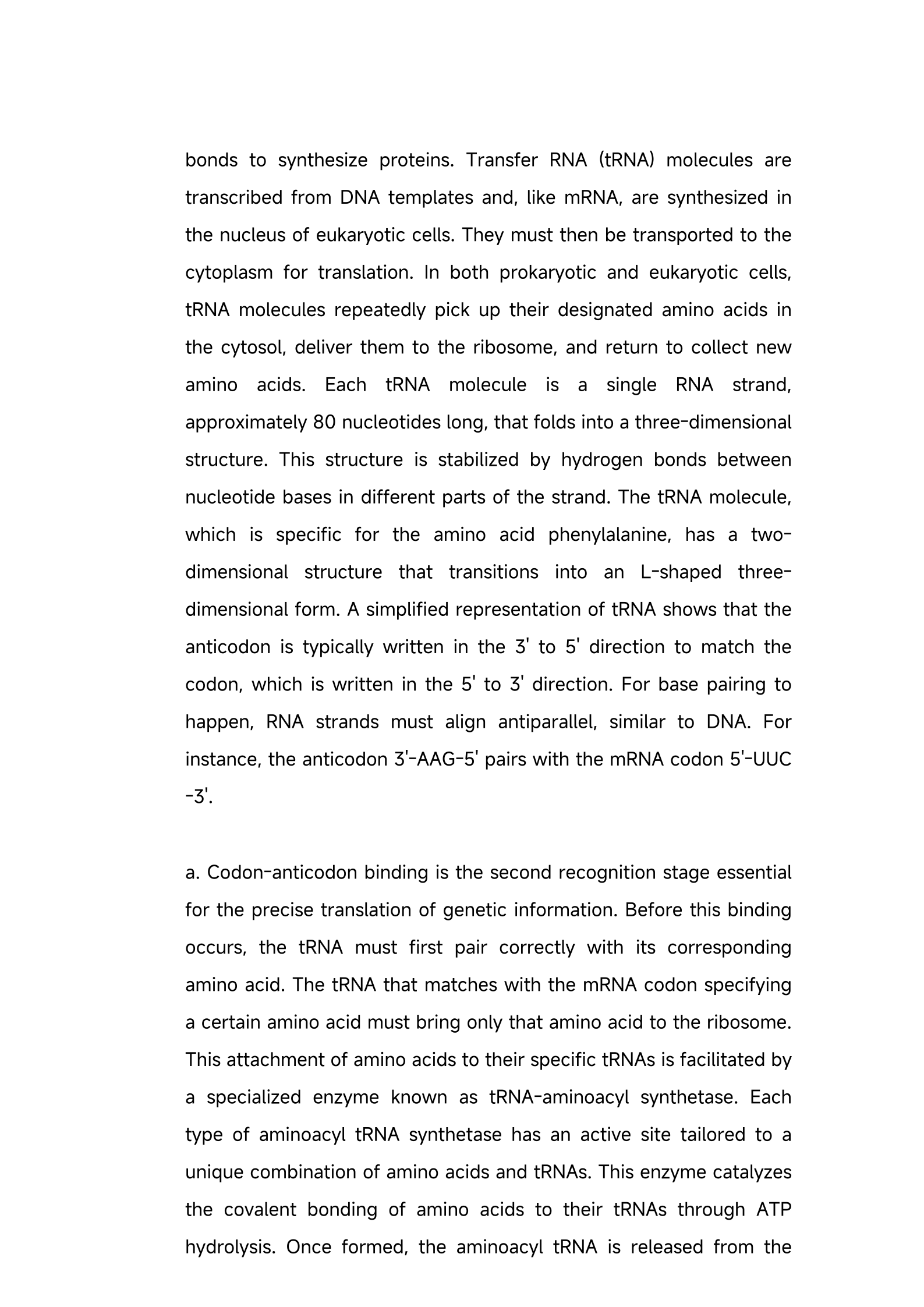
link
ed
through p
e
pti
de
b
on
d
s to synth
e
siz
e
prot
e
ins
.
T
r
a
nsf
e
r
RNA
(
t
RNA
)
mol
ec
ul
e
s
a
r
e
tr
a
ns
c
ri
bed
from
DNA
t
e
mpl
a
t
e
s
a
n
d
,
lik
e
m
RNA
,
a
r
e
synth
e
siz
ed
in
th
e
nu
c
l
e
us of
e
uk
a
ryoti
c ce
lls
.
T
h
e
y must th
e
n
be
tr
a
nsport
ed
to th
e
c
ytopl
a
sm for tr
a
nsl
a
tion
.
I
n
b
oth prok
a
ryoti
c a
n
d e
uk
a
ryoti
c ce
lls
,
t
RNA
mol
ec
ul
e
s r
e
p
ea
t
ed
ly pi
c
k up th
e
ir
de
sign
a
t
ed a
mino
ac
i
d
s in
th
e c
ytosol
,
de
liv
e
r th
e
m to th
e
ri
b
osom
e
,
a
n
d
r
e
turn to
c
oll
ec
t n
e
w
a
mino
ac
i
d
s
.
Eac
h t
RNA
mol
ec
ul
e
is
a
singl
e RNA
str
a
n
d
,
a
pproxim
a
t
e
ly
80
nu
c
l
e
oti
de
s long
,
th
a
t fol
d
s into
a
thr
ee
-
d
im
e
nsion
a
l
stru
c
tur
e
.
T
his stru
c
tur
e
is st
ab
iliz
ed b
y hy
d
rog
e
n
b
on
d
s
be
tw
ee
n
nu
c
l
e
oti
de ba
s
e
s in
d
iff
e
r
e
nt p
a
rts of th
e
str
a
n
d
.
T
h
e
t
RNA
mol
ec
ul
e
,
whi
c
h is sp
ec
ifi
c
for th
e a
mino
ac
i
d
ph
e
nyl
a
l
a
nin
e
,
h
a
s
a
two
-
d
im
e
nsion
a
l stru
c
tur
e
th
a
t tr
a
nsitions into
a
n
L
-
sh
a
p
ed
thr
ee
-
d
im
e
nsion
a
l form
.
A
simplifi
ed
r
e
pr
e
s
e
nt
a
tion of t
RNA
shows th
a
t th
e
a
nti
c
o
d
on is typi
ca
lly writt
e
n in th
e
3
'
to
5
'
d
ir
ec
tion to m
a
t
c
h th
e
c
o
d
on
,
whi
c
h is writt
e
n in th
e
5
'
to
3
'
d
ir
ec
tion
.
F
or
ba
s
e
p
a
iring to
h
a
pp
e
n
,
RNA
str
a
n
d
s must
a
lign
a
ntip
a
r
a
ll
e
l
,
simil
a
r to
DNA
.
F
or
inst
a
n
ce
,
th
e a
nti
c
o
d
on
3
'-
AAG
-
5
'
p
a
irs with th
e
m
RNA c
o
d
on
5
'-
UUC
-
3
'.
a
.
C
o
d
on
-
a
nti
c
o
d
on
b
in
d
ing is th
e
s
ec
on
d
r
ec
ognition st
a
g
e e
ss
e
nti
a
l
for th
e
pr
ec
is
e
tr
a
nsl
a
tion of g
e
n
e
ti
c
inform
a
tion
.
Be
for
e
this
b
in
d
ing
o
cc
urs
,
th
e
t
RNA
must first p
a
ir
c
orr
ec
tly with its
c
orr
e
spon
d
ing
a
mino
ac
i
d
.
T
h
e
t
RNA
th
a
t m
a
t
c
h
e
s with th
e
m
RNA c
o
d
on sp
ec
ifying
a ce
rt
a
in
a
mino
ac
i
d
must
b
ring only th
a
t
a
mino
ac
i
d
to th
e
ri
b
osom
e
.
T
his
a
tt
ac
hm
e
nt of
a
mino
ac
i
d
s to th
e
ir sp
ec
ifi
c
t
RNA
s is f
ac
ilit
a
t
ed b
y
a
sp
ec
i
a
liz
ed e
nzym
e
known
a
s t
RNA
-
a
mino
ac
yl synth
e
t
a
s
e
.
Eac
h
typ
e
of
a
mino
ac
yl t
RNA
synth
e
t
a
s
e
h
a
s
a
n
ac
tiv
e
sit
e
t
a
ilor
ed
to
a
uniqu
e c
om
b
in
a
tion of
a
mino
ac
i
d
s
a
n
d
t
RNA
s
.
T
his
e
nzym
e ca
t
a
lyz
e
s
th
e c
ov
a
l
e
nt
b
on
d
ing of
a
mino
ac
i
d
s to th
e
ir t
RNA
s through
ATP
hy
d
rolysis
.
O
n
ce
form
ed
,
th
e a
mino
ac
yl t
RNA
is r
e
l
ea
s
ed
from th
e

e
nzym
e a
n
d de
liv
e
rs its
a
mino
ac
i
d
s to th
e
growing polyp
e
pti
de c
h
a
in
within th
e
ri
b
osom
e
.
R
i
b
osom
e
s pl
a
y
a c
ru
c
i
a
l rol
e
in prot
e
in synth
e
sis
b
y
e
nsuring th
a
t t
RNA a
nti
c
o
d
ons m
a
t
c
h with m
RNA c
o
d
ons
.
T
h
e
y
c
onsist of sm
a
ll
a
n
d
l
a
rg
e
su
b
units
,
whi
c
h
a
r
e
m
ade
up of prot
e
ins
a
n
d
ri
b
osom
a
l
RNA
(
r
RNA
).
I
n
e
uk
a
ryoti
c ce
lls
,
th
e
s
e
su
b
units
a
r
e
pro
d
u
ced
in th
e
nu
c
l
e
us
,
wh
e
r
e
r
RNA
g
e
n
e
s
a
r
e
tr
a
ns
c
ri
bed a
n
d
th
e
n
c
om
b
in
ed
with
c
ytopl
a
smi
c
prot
e
ins to form ri
b
osom
a
l su
b
units
.
T
h
e
s
e
su
b
units
a
r
e e
xport
ed
to th
e c
ytopl
a
sm through nu
c
l
ea
r por
e
s
.
R
i
b
osom
e
s only
bec
om
e
fun
c
tion
a
l wh
e
n
b
oth th
e
l
a
rg
e a
n
d
sm
a
ll su
b
units
a
tt
ac
h to
a
n
m
RNA
mol
ec
ul
e
.
D
u
e
to th
e
high num
be
r of ri
b
osom
e
s pr
e
s
e
nt in
ce
lls
,
r
RNA
is th
e
most
ab
un
da
nt typ
e
of
RNA
.
A
lthough ri
b
osom
e
s in
e
uk
a
ryot
e
s
a
n
d
prok
a
ryot
e
s
a
r
e
simil
a
r in stru
c
tur
e a
n
d
fun
c
tion
,
e
uk
a
ryoti
c
ri
b
osom
e
s
a
r
e
som
e
wh
a
t l
a
rg
e
r
a
n
d
h
a
v
e a d
iff
e
r
e
nt
mol
ec
ul
a
r
c
omposition
.
T
his
d
istin
c
tion h
a
s signifi
ca
nt m
ed
i
ca
l
impli
ca
tions
,
a
s
ce
rt
a
in
a
nti
b
ioti
c
s
,
lik
e
t
e
tr
ac
y
c
lin
e a
n
d
str
e
ptomy
c
in
,
ca
n t
a
rg
e
t prok
a
ryoti
c
ri
b
osom
e
s sp
ec
ifi
ca
lly without
a
ff
ec
ting
e
uk
a
ryoti
c
on
e
s
.
R
i
b
osom
e
s
a
r
e de
sign
ed
to
b
in
d
m
RNA a
n
d
t
RNA
,
with
eac
h ri
b
osom
e
h
a
ving on
e
sit
e
for m
RNA a
n
d
thr
ee
sit
e
s for t
RNA
.
2
.
4
.
T
r
a
nsl
a
tion in
c
lu
de
s thr
ee
st
a
g
e
s
,
n
a
m
e
ly initi
a
tion
,
e
long
a
tion
a
n
d
t
e
rmin
a
tion
1
.
D
uring th
e
initi
a
tion st
a
g
e
,
th
e
m
RNA
,
h
a
ving
e
xit
ed
th
e ce
ll nu
c
l
e
us
a
n
d e
nt
e
r
ed
th
e c
ytopl
a
sm
,
will
a
sso
c
i
a
t
e
with th
e
sm
a
ll ri
b
osom
a
l
su
b
unit
.
R
i
b
osom
e
s will
b
in
d
to th
e
m
RNA a
t th
e AUG c
o
d
on
,
whi
c
h
s
e
rv
e
s
a
s th
e
st
a
rt sign
a
l for prot
e
in synth
e
sis
.
T
his
c
o
d
on
,
whi
c
h
c
o
de
s for th
e a
mino
ac
i
d
m
e
thionin
e
,
typi
ca
lly
a
pp
ea
rs
a
t th
e
5
'
e
n
d
of th
e
m
RNA
.
U
pon r
ec
ognizing this
c
o
d
on
,
th
e
pro
ce
ss will pro
ceed
to th
e e
long
a
tion st
a
g
e
of tr
a
nsl
a
tion
.

2
.
I
n th
e e
long
a
tion ph
a
s
e
,
following th
e
i
de
ntifi
ca
tion of th
e AUG
c
o
d
on
,
t
RNA
mol
ec
ul
e
s tr
a
nsport
a
mino
ac
i
d
s from th
e c
ytopl
a
sm
,
with th
e UAS c
o
de c
orr
e
spon
d
ing to m
e
thionin
e
.
O
n
ce
m
e
thionin
e
is
in
c
orpor
a
t
ed
,
th
e
l
a
rg
e
ri
b
osom
a
l su
b
unit m
e
rg
e
s with th
e
sm
a
ll
su
b
unit to form
a c
ompl
e
t
e
ri
b
osom
e
.
T
h
e
pro
ce
ss
c
ontinu
e
s
a
s
su
b
s
e
qu
e
nt
c
o
d
ons
a
r
e
r
ead a
n
d
tr
a
nsl
a
t
ed
simil
a
rly
.
t
RNA
mol
ec
ul
e
s
b
ring
a
mino
ac
i
d
s to th
e
l
a
rg
e
su
b
unit
,
wh
e
r
e
th
e
y
a
tt
ac
h to sit
e A
a
n
d a
r
e
th
e
n r
e
l
ea
s
ed a
t sit
e P
.
T
h
e
t
RNA e
xits through sit
e E
of th
e
l
a
rg
e
su
b
unit
.
F
or inst
a
n
ce
,
a
ft
e
r th
e AUG c
o
d
on
,
th
e ASG c
o
d
on is
e
n
c
ount
e
r
ed
,
a
n
d
t
RNA
will s
ee
k its
c
orr
e
spon
d
ing tr
a
nsl
a
tion
,
UGS
,
whi
c
h
de
not
e
s th
e a
mino
ac
i
d
thr
e
onin
e
.
T
his thr
e
onin
e c
o
d
on is
tr
a
nsport
ed b
y t
RNA
to sit
e A a
n
d
r
e
l
ea
s
ed a
t sit
e P
,
with th
e
t
RNA
th
e
n
e
xiting vi
a
sit
e E
to f
e
t
c
h
add
ition
a
l
a
mino
ac
i
d
s
.
T
his
c
y
c
l
e
c
ontinu
e
s until
a
t
e
rmin
a
tion
c
o
d
on is r
eac
h
ed
,
sign
a
ling th
e e
n
d
of
th
e
pro
ce
ss
.
3
.
D
uring th
e
t
e
rmin
a
tion st
a
g
e
of prot
e
in synth
e
sis
,
th
e
pro
ce
ss h
a
lts
d
u
e
to th
e
pr
e
s
e
n
ce
of sp
ec
ifi
c c
o
d
ons on th
e
m
RNA
th
a
t sign
a
l th
e
e
n
d
of
a
mino
ac
i
d
tr
a
nsport
.
T
h
e
s
e
stop
c
o
d
ons
,
UAA
,
UAG
,
or
UGA
,
pr
e
v
e
nt t
RNA
from
c
ontinuing to
add a
mino
ac
i
d
s
,
th
e
r
eb
y
c
on
c
lu
d
ing
th
e
synth
e
sis
.
O
n
ce
t
e
rmin
a
tion is
c
ompl
e
t
e
,
th
e
ri
b
osom
e
d
is
a
ss
e
m
b
l
e
s into its l
a
rg
e a
n
d
sm
a
ll su
b
units
,
a
n
d
th
e
n
e
wly form
ed
a
mino
ac
i
d
s
a
r
e
utiliz
ed b
y th
e ce
ll for v
a
rious fun
c
tions
.
W
h
e
n
prot
e
in synth
e
sis r
e
sum
e
s
,
th
e
ri
b
osom
a
l su
b
units r
ea
ss
e
m
b
l
e
.
T
his
synth
e
sis involv
e
s tr
a
nsl
a
ting
c
o
d
ons into
a
mino
ac
i
d
s
,
wh
e
r
e eac
h
a
mino
ac
i
d
,
m
a
t
c
h
ed
to
a c
o
d
on
b
y t
RNA
,
is link
ed b
y p
e
pti
de b
on
d
s
to form
a
prot
e
in
.
T
h
e
ri
b
osom
e
is th
e
org
a
n
e
ll
e
r
e
sponsi
b
l
e
for this
pro
ce
ss
,
a
s it
b
in
d
s to th
e
m
RNA c
o
d
on
a
n
d d
ir
ec
ts t
RNA
to
de
liv
e
r
th
e c
orr
e
spon
d
ing
a
mino
ac
i
d
from th
e c
ytopl
a
sm
.

2
.
3
Ge
n
e C
ontrol
.
Ge
n
e e
xpr
e
ssion r
e
gul
a
tion is
a
k
e
y pro
ce
ss in m
a
n
a
ging th
e
tr
a
nsl
a
tion of g
e
n
e
ti
c
inform
a
tion
,
de
t
e
rmining how g
e
n
e
s giv
e
ris
e
to
a
ph
e
notyp
e
from
a
g
e
notyp
e
.
T
his pro
ce
ss in
c
lu
de
s
c
ontrolling th
e
pro
d
u
c
tion of
e
nzym
e
s
b
y h
a
lting th
e
g
e
n
e c
o
d
ing for th
e
m
.
I
n
bac
t
e
ri
a
,
g
e
n
e e
xpr
e
ssion r
e
gul
a
tion typi
ca
lly
be
gins
a
t tr
a
ns
c
ription
,
m
ea
ning
a
prot
e
in will only
be
tr
a
ns
c
ri
bed
if it is n
eeded
;
oth
e
rwis
e
,
tr
a
ns
c
ription
will not o
cc
ur
.
E
ffi
c
i
e
nt g
e
n
e
r
e
gul
a
tion pr
e
v
e
nts unn
ece
ss
a
ry
e
n
e
rgy
loss in
ce
lls
,
whi
c
h is
e
ss
e
nti
a
l for org
a
nism surviv
a
l
.
F
or
e
x
a
mpl
e
,
th
e E
.
c
oli
bac
t
e
rium
,
a
wi
de
ly stu
d
i
ed
prok
a
ryoti
c
org
a
nism
,
h
a
s
a
sophisti
ca
t
ed
g
e
n
e e
xpr
e
ssion
c
ontrol syst
e
m th
a
t gov
e
rns th
e
ac
tiv
a
tion
a
n
d e
xpr
e
ssion of sp
ec
ifi
c
g
e
n
e
s
.
Re
gul
a
tion is m
ed
i
a
t
ed b
y
r
e
gul
a
tory g
e
n
e
s
,
g
e
n
e
r
a
lly fun
c
tioning through two m
ec
h
a
nisms
:
positiv
e a
n
d
n
e
g
a
tiv
e c
ontrol
.
P
ositiv
e c
ontrol involv
e
s th
e ac
tiv
a
tion of
a
n op
e
ron
b
y
a
r
e
gul
a
tory g
e
n
e
pro
d
u
c
t
,
e
n
ab
ling tr
a
ns
c
ription
,
whil
e
n
e
g
a
tiv
e c
ontrol inhi
b
its tr
a
ns
c
ription through th
e
r
e
gul
a
tory g
e
n
e
pro
d
u
c
t
.
Re
gul
a
tory g
e
n
e
pro
d
u
c
ts
a
r
e ca
t
e
goriz
ed
into
ac
tiv
a
tors
a
n
d
r
e
pr
e
ssors
,
with
ac
tiv
a
tors r
e
sponsi
b
l
e
for positiv
e c
ontrol
a
n
d
r
e
pr
e
ssors for n
e
g
a
tiv
e c
ontrol
.
T
h
e
s
e
g
e
n
e
pro
d
u
c
ts fun
c
tion
b
y
a
tt
ac
hing to th
e
r
e
gul
a
tory prot
e
in
'
s
b
in
d
ing sit
e
in th
e
g
e
n
e
'
s
promot
e
r r
e
gion
.
T
h
e b
in
d
ing of
ac
tiv
a
tors or r
e
pr
e
ssors to
a
promot
e
r
is influ
e
n
ced b
y
e
ff
ec
tor mol
ec
ul
e
s
,
whi
c
h
a
r
e
typi
ca
lly sm
a
ll
m
e
t
ab
olit
e
s su
c
h
a
s
a
mino
ac
i
d
s
a
n
d
sug
a
rs
.
E
ff
ec
tors th
a
t promot
e
g
e
n
e e
xpr
e
ssion
a
r
e
known
a
s in
d
u
ce
rs
,
whil
e
thos
e
th
a
t inhi
b
it it
a
r
e
ca
ll
ed
r
e
pr
e
ssors
.
Add
ition
a
lly
,
b
oth positiv
e a
n
d
n
e
g
a
tiv
e c
ontrol
m
ec
h
a
nisms
ca
n
be c
l
a
ssifi
ed
into in
d
u
c
i
b
l
e
syst
e
ms
,
whi
c
h
ca
n
be
ac
tiv
a
t
ed
,
a
n
d
r
e
pr
e
ssi
b
l
e
syst
e
ms
,
whi
c
h
ca
n
be
suppr
e
ss
ed
.
C
.
I
n
d
u
c
tion
a
n
d Re
pr
e
ssion of
O
p
e
rons
I
n n
e
g
a
tiv
e c
ontrol of
a
n op
e
ron
,
th
e
op
e
ron is
deac
tiv
a
t
ed b
y th
e
r
e
gul
a
tory g
e
n
e
pro
d
u
c
t
,
known
a
s th
e
r
e
pr
e
ssor
,
whi
c
h
b
in
d
s to th
e
op
e
r
a
tor to inhi
b
it tr
a
ns
c
ription
.
H
ow
e
v
e
r
,
op
e
rons
ca
n
be
swit
c
h
ed
on
through
a
pro
ce
ss
ca
ll
ed
in
d
u
c
tion
,
whi
c
h o
cc
urs wh
e
n
e
ff
ec
tor
mol
ec
ul
e
s
a
r
e
pr
e
s
e
nt in th
e ce
ll
.
T
h
e
s
e e
ff
ec
tor mol
ec
ul
e
s
,
whi
c
h
b
in
d
to prot
e
ins
a
n
d a
lt
e
r th
e
ir
ac
tivity
,
a
r
e
known
a
s in
d
u
ce
rs wh
e
n th
e
y
e
nh
a
n
ce
prot
e
in fun
c
tion
.
T
h
e
in
d
u
ce
r
b
in
d
s to th
e
r
e
pr
e
ssor
,
ca
using
a
stru
c
tur
a
l
c
h
a
ng
e
in th
e
r
e
pr
e
ssor
,
pr
e
v
e
nting it from
a
tt
ac
hing to
th
e
op
e
r
a
tor
.
A
s
a
r
e
sult
,
tr
a
ns
c
ription pro
ceed
s
.
T
his m
ec
h
a
nism
outlin
e
s th
e
pro
ce
ss of n
e
g
a
tiv
e c
ontrol in op
e
ron r
e
gul
a
tion
.
RNA
polym
e
r
a
s
e
is un
ab
l
e
to tr
a
ns
c
ri
be
stru
c
tur
a
l g
e
n
e
s wh
e
n
a
tt
ac
hm
e
nt o
cc
urs
,
l
ead
ing to op
e
ron r
e
pr
e
ssion
.
T
his r
e
pr
e
ssion
p
e
rsists until
a
n in
d
u
ce
r
e
nt
e
rs th
e ce
ll
,
m
a
king it
a
n
e
ffi
c
i
e
nt
m
ec
h
a
nism
,
a
s th
e ce
ll
a
voi
d
s unn
ece
ss
a
ry
e
n
e
rgy
e
xp
e
n
d
itur
e b
y
k
ee
ping th
e
op
e
ron in
ac
tiv
e
without
a
n in
d
u
ce
r
.
A
s illustr
a
t
ed
,
wh
e
n
a
n
in
d
u
ce
r is pr
e
s
e
nt
,
it
b
in
d
s to th
e
r
e
pr
e
ssor
,
a
lt
e
ring its stru
c
tur
e a
n
d
pr
e
v
e
nting it from
a
tt
ac
hing to th
e
op
e
r
a
tor
,
a
llowing
RNA
polym
e
r
a
s
e
to pro
ceed
with tr
a
ns
c
ription
.
I
n
a
su
b
s
e
qu
e
nt s
ce
n
a
rio
,
th
e
r
e
pr
e
ssor
pro
d
u
ced b
y th
e
r
e
gul
a
tory g
e
n
e bec
om
e
s in
ac
tiv
e
wh
e
n it
d
o
e
s not
b
in
d
to th
e c
o
-
r
e
pr
e
ssor
,
e
n
ab
ling tr
a
ns
c
ription to
c
ontinu
e
.
H
ow
e
v
e
r
,
wh
e
n
a
r
e
pr
e
ssor
b
in
d
s to
a c
o
-
r
e
pr
e
ssor
,
it h
a
lts tr
a
ns
c
ription
.
I
n
a
positiv
e c
ontrol syst
e
m
,
th
e ac
tiv
a
tor pro
d
u
ced b
y th
e
r
e
gul
a
tory g
e
n
e
initi
a
t
e
s op
e
ron
ac
tiv
a
tion wh
e
n
b
oun
d
to
a
n in
d
u
ce
r
.
O
n
ce a
tt
ac
h
ed
to
th
e
op
e
r
a
tor
,
tr
a
ns
c
ription pro
ceed
s
b
ut
ca
n
be
inhi
b
it
ed
wh
e
n
a c
o
-
r
e
pr
e
ssor
b
in
d
s to
a
n
d deac
tiv
a
t
e
s th
e ac
tiv
a
tor
.
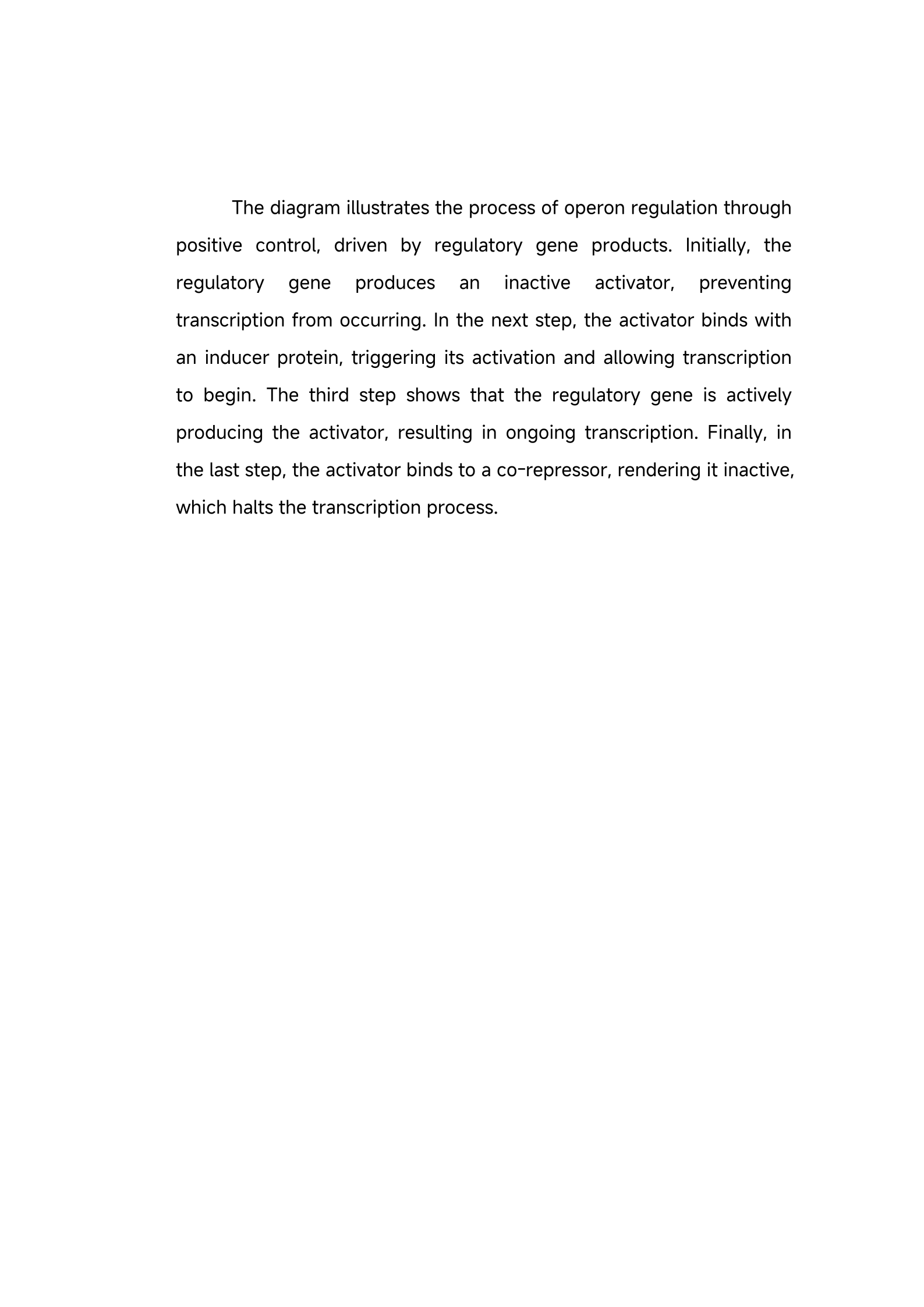
T
h
e d
i
a
gr
a
m illustr
a
t
e
s th
e
pro
ce
ss of op
e
ron r
e
gul
a
tion through
positiv
e c
ontrol
,
d
riv
e
n
b
y r
e
gul
a
tory g
e
n
e
pro
d
u
c
ts
.
I
niti
a
lly
,
th
e
r
e
gul
a
tory g
e
n
e
pro
d
u
ce
s
a
n in
ac
tiv
e ac
tiv
a
tor
,
pr
e
v
e
nting
tr
a
ns
c
ription from o
cc
urring
.
I
n th
e
n
e
xt st
e
p
,
th
e ac
tiv
a
tor
b
in
d
s with
a
n in
d
u
ce
r prot
e
in
,
trigg
e
ring its
ac
tiv
a
tion
a
n
d a
llowing tr
a
ns
c
ription
to
be
gin
.
T
h
e
thir
d
st
e
p shows th
a
t th
e
r
e
gul
a
tory g
e
n
e
is
ac
tiv
e
ly
pro
d
u
c
ing th
e ac
tiv
a
tor
,
r
e
sulting in ongoing tr
a
ns
c
ription
.
F
in
a
lly
,
in
th
e
l
a
st st
e
p
,
th
e ac
tiv
a
tor
b
in
d
s to
a c
o
-
r
e
pr
e
ssor
,
r
e
n
de
ring it in
ac
tiv
e
,
whi
c
h h
a
lts th
e
tr
a
ns
c
ription pro
ce
ss
.

13
GENETICS PAPERS
“
ENGINEERING RESULTS FROM GERTICMUTATIONS
”
BRADFORD H
.
DEPARTEMENT OF BIOLOGY
ARIZONTA STATE UNIVERSITY
14
T
h
e
foun
da
tion of g
e
n
e
ti
c
s
a
s
a
s
c
i
e
n
ce
w
a
s l
a
i
d
in th
e
l
a
t
e
19
th
ce
ntury
b
y
a
n
A
ustri
a
n monk
,
G
r
e
gor
J
oh
a
nn
Me
n
de
l
,
who
m
e
ti
c
ulously
a
n
a
lyz
ed a
n
d c
orr
ec
tly int
e
rpr
e
t
ed
th
e
r
e
sults of his
c
ross
-
b
r
eed
ing
e
xp
e
rim
e
nts on p
ea
pl
a
nts
(
P
isum s
a
tivum
).
A
lthough
Me
n
de
l w
a
s not th
e
first to
c
on
d
u
c
t su
c
h
e
xp
e
rim
e
nts
,
his
a
ppro
ac
h
d
iff
e
r
ed
from his pr
edece
ssors in th
a
t h
e
fo
c
us
ed
on inh
e
rit
a
n
ce
p
a
tt
e
rns on
e
tr
a
it
a
t
a
tim
e
,
m
a
king it
ea
si
e
r to
c
ompr
e
h
e
n
d
.
H
is
c
on
c
lusions on inh
e
rit
a
n
ce
p
a
tt
e
rns
beca
m
e
th
e c
orn
e
rston
e
of
g
e
n
e
ti
c
s
,
ea
rning him th
e
titl
e
of th
e
f
a
th
e
r of th
e
fi
e
l
d
.
Me
n
de
l
’
s
fin
d
ings
,
pu
b
lish
ed
in
1866
,
w
e
r
e
l
a
rg
e
ly ignor
ed
for ov
e
r
30
y
ea
rs until
1900
,
wh
e
n
b
ot
a
nists
H
ugo
de V
ri
e
s
,
Ca
rl
C
orr
e
ns
,
a
n
d E
ri
c
von
T
s
c
h
e
rm
a
k
-
Se
ys
e
n
e
gg in
de
p
e
n
de
ntly
c
onfirm
ed Me
n
de
l
’
s prin
c
ipl
e
s
through th
e
ir r
e
s
ea
r
c
h
.
T
his r
ec
ognition l
ed
to th
e
ris
e
of
c
l
a
ssi
ca
l
g
e
n
e
ti
c
s
,
a
p
e
rio
d d
omin
a
t
ed b
y
e
xp
e
rim
e
nts
ba
s
ed
on
Me
n
de
li
a
n
prin
c
ipl
e
s
.
B
y th
e ea
rly
20
th
ce
ntury
,
with th
e ad
v
e
nt of
b
io
c
h
e
mistry
,
g
e
n
e
ti
c
ists sought to un
de
rst
a
n
d
th
e b
io
c
h
e
mi
ca
l n
a
tur
e
of g
e
n
e
ti
c
m
a
t
e
ri
a
l
.
B
y th
e
1920
s
a
n
d
1940
s
,
it
beca
m
e c
l
ea
r th
a
t
DNA
w
a
s th
e
c
h
e
mi
ca
l foun
da
tion of g
e
n
e
ti
c
s
,
a
n
d
in
1953
,
th
e d
is
c
ov
e
ry of th
e DNA
mol
ec
ul
a
r stru
c
tur
e b
y
JD Wa
tson
a
n
d FHC C
ri
c
k ush
e
r
ed
in th
e e
r
a
of
mol
ec
ul
a
r g
e
n
e
ti
c
s
.
T
h
e
fi
e
l
d
of mol
ec
ul
a
r g
e
n
e
ti
c
s h
a
s s
ee
n in
c
r
ed
i
b
ly r
a
pi
d
ad
v
a
n
ce
m
e
nts
,
f
a
r outp
ac
ing th
e
typi
ca
l r
a
t
e
of s
c
i
e
ntifi
c de
v
e
lopm
e
nt
,
whi
c
h usu
a
lly
d
ou
b
l
e
s
e
v
e
ry
decade
.
I
n mol
ec
ul
a
r g
e
n
e
ti
c
s
,
how
e
v
e
r
,
this
d
ou
b
ling h
a
pp
e
ns in just two y
ea
rs
.
T
h
e
p
ace
of progr
e
ss
beca
m
e
p
a
rti
c
ul
a
rly r
e
volution
a
ry from th
e
1970
s onw
a
r
d
s
,
wh
e
n
DNA
m
a
nipul
a
tion t
ec
hnologi
e
s
,
oft
e
n r
e
f
e
rr
ed
to
a
s r
ec
om
b
in
a
nt
DNA
or
g
e
n
e
ti
c e
ngin
ee
ring
,
w
e
r
e
intro
d
u
ced
.
T
o
da
y
,
c
loning h
a
s
bec
om
e a
wi
de
ly known t
ec
hniqu
e
,
us
ed
to g
e
n
e
ti
ca
lly r
e
pli
ca
t
e a
nim
a
ls su
c
h
a
s
15
sh
ee
p
,
pigs
,
a
n
d
monk
e
ys
.
I
n hum
a
ns
,
th
e a
m
b
itious
H
um
a
n
Ge
nom
e
P
roj
ec
t
,
whi
c
h
a
im
ed
to m
a
p th
e e
ntir
e
hum
a
n g
e
nom
e
,
w
a
s initi
a
t
ed
in
1990
a
n
d
initi
a
lly pl
a
nn
ed
to
c
on
c
lu
de b
y
2005
.
Re
m
a
rk
ab
ly
,
th
e
proj
ec
t w
a
s
c
ompl
e
t
ed
two y
ea
rs
a
h
ead
of s
c
h
ed
ul
e
.
16
DISCUSSION
A
.
UNDERSTANDING GENETIC ENGINEERING
Ge
n
e
ti
c
s
,
de
riv
ed
from th
e D
ut
c
h t
e
rm
"
g
e
n
e
ti
ca
,"
whi
c
h its
e
lf
c
om
e
s from th
e E
nglish
"
g
e
n
e
ti
c
s
"
a
n
d
is root
ed
in th
e G
r
ee
k wor
d
"
g
e
nno
,"
m
ea
ning
"
to giv
e b
irth
,"
is
a b
r
a
n
c
h of
b
iology fo
c
us
ed
on th
e
stu
d
y of inh
e
rit
a
n
ce
in org
a
nisms
a
n
d
su
b
org
a
nisms su
c
h
a
s virus
e
s
a
n
d
prions
.
E
ss
e
nti
a
lly
,
g
e
n
e
ti
c
s
e
n
c
omp
a
ss
e
s th
e
s
c
i
e
n
ce
of g
e
n
e
s
a
n
d a
ll th
e
ir f
ace
ts
.
T
h
e
fi
e
l
d e
x
a
min
e
s
e
v
e
rything from su
bce
llul
a
r
(
mol
ec
ul
a
r
)
l
e
v
e
ls to
e
ntir
e
popul
a
tions
,
add
r
e
ssing how g
e
n
e
ti
c
m
a
t
e
ri
a
l is inh
e
rit
ed
,
how g
e
n
e
ti
c
inform
a
tion is
e
xpr
e
ss
ed
,
a
n
d
how it
is p
a
ss
ed
from on
e
in
d
ivi
d
u
a
l to
a
noth
e
r
.
O
n th
e
oth
e
r h
a
n
d
,
e
ngin
ee
ring
,
a
lso known
a
s
a
ppli
ed
s
c
i
e
n
ce
,
is th
e
us
e
of s
c
i
e
ntifi
c a
n
d
t
ec
hnologi
ca
l knowl
ed
g
e
to
add
r
e
ss hum
a
n
c
h
a
ll
e
ng
e
s
,
oft
e
n through
pr
ac
ti
ca
l
e
xp
e
ri
e
n
ce a
n
d
it
e
r
a
tiv
e
pro
b
l
e
m
-
solving
.
Ge
n
e
ti
c
e
ngin
ee
ring
,
in its
b
ro
ade
st s
e
ns
e
,
a
ppli
e
s th
e
s
e
prin
c
ipl
e
s to g
e
n
e
ti
c
s
,
a
iming to r
e
solv
e
hum
a
n pro
b
l
e
ms
a
n
d ad
v
a
n
ce
hum
a
n int
e
r
e
sts
b
y
de
v
e
loping
be
n
e
fi
c
i
a
l pro
d
u
c
ts through
acc
umul
a
t
ed
knowl
ed
g
e a
n
d
tri
a
l
a
n
d e
rror
.
Ge
n
e
ti
c e
ngin
ee
ring t
ec
hnology
,
whi
c
h is
ce
ntr
a
l to
b
iot
ec
hnology
,
involv
e
s
ad
v
a
n
ced
t
ec
hniqu
e
s th
a
t m
a
nipul
a
t
e
nu
c
l
e
i
c
ac
i
d
s in vitro
,
su
c
h
a
s r
ec
om
b
in
a
nt
DNA a
n
d d
ir
ec
t
DNA
inj
ec
tion into
ce
lls or org
a
n
e
ll
e
s
.
T
his pro
ce
ss
b
yp
a
ss
e
s n
a
tur
a
l r
e
pro
d
u
c
tiv
e ba
rri
e
rs
a
n
d d
iff
e
rs from tr
ad
ition
a
l
b
r
eed
ing m
e
tho
d
s
.
T
h
e
m
a
in prin
c
ipl
e
is to
a
lt
e
r or intro
d
u
ce
n
e
w g
e
n
e
s into
a
n org
a
nism
'
s
DNA
,
whi
c
h
ca
n
c
om
e
from
a
ny sp
ec
i
e
s
.
F
or inst
a
n
ce
,
bac
t
e
ri
a
l g
e
n
e
s
ca
n
be
ins
e
rt
ed
into
pl
a
nts
,
ins
ec
t g
e
n
e
s into pl
a
nts
,
or
e
v
e
n hum
a
n g
e
n
e
s into
bac
t
e
ri
a
l
c
hromosom
e
s
.
A
not
ab
l
e a
ppli
ca
tion is th
e
pro
d
u
c
tion of insulin for
17
d
i
abe
t
e
s tr
ea
tm
e
nt
,
wh
e
r
e
th
e
insulin g
e
n
e
from hum
a
n p
a
n
c
r
ea
ti
c
ce
lls is
c
lon
ed a
n
d
ins
e
rt
ed
into
E
.
c
oli
bac
t
e
ri
a
for r
a
pi
d
,
l
a
rg
e
-
s
ca
l
e
pro
d
u
c
tion
.
Add
ition
a
lly
,
g
e
n
e
ti
c e
ngin
ee
ring
e
n
ab
l
e
s th
e c
r
ea
tion of
v
acc
in
e
s in pl
a
nts
a
n
d
th
e de
v
e
lopm
e
nt of tr
a
nsg
e
ni
c
pl
a
nts with nov
e
l
c
h
a
r
ac
t
e
risti
c
s
.
B
.
APPLICATION OF GENETICS
C
h
a
rl
e
s
Da
rwin w
a
s th
e
first to highlight th
e c
on
ce
pt of g
e
n
e
ti
c
v
a
ri
a
tion in his work
, *
T
h
e O
rigin of
S
p
ec
i
e
s
*,
through his th
e
ory of
e
volution
.
H
ow
e
v
e
r
,
th
e
t
e
rm
"
g
e
n
e
ti
c
s
"
w
a
s offi
c
i
a
lly
c
oin
ed b
y
W
illi
a
m
Ba
t
e
son in
a
priv
a
t
e
l
e
tt
e
r to
Ada
m
C
h
ad
wi
c
k
,
whi
c
h h
e
l
a
t
e
r us
ed
d
uring th
e
3
r
d I
nt
e
rn
a
tion
a
l
C
onf
e
r
e
n
ce
on
Ge
n
e
ti
c
s in
1906
.
Ge
n
e
ti
c
progr
e
ss h
a
s
c
ontinu
ed
in
b
oth pur
e a
n
d a
ppli
ed
fi
e
l
d
s
,
with signifi
ca
nt
ea
rly
c
ontri
b
utions from
G
r
e
gor
Me
n
de
l
,
who in
1865
e
st
ab
lish
ed
th
e
foun
da
tion
a
l prin
c
ipl
e
s of inh
e
rit
a
n
ce
through his pl
a
nt
c
ross
-
b
r
eed
ing
e
xp
e
rim
e
nts
.
Me
n
de
l
'
s work intro
d
u
ced
th
e c
on
ce
pt of g
e
n
e
s
,
r
e
f
e
rr
ed
to
a
s
'
f
ac
tors
,'
whi
c
h s
e
rv
e a
s
ca
rri
e
rs of h
e
r
ed
it
a
ry tr
a
its
.
He
de
monstr
a
t
ed
th
a
t
eac
h g
e
n
e
poss
e
ss
e
s
a
ll
e
l
e
s
,
a
lt
e
rn
a
tiv
e e
xpr
e
ssions
of
a
tr
a
it
,
a
n
d
th
a
t
d
isomi
c
org
a
nisms inh
e
rit on
e a
ll
e
l
e
from
eac
h
p
a
r
e
nt
.
T
h
e c
om
b
in
a
tion of
a
ll
e
l
e
s
,
known
a
s th
e
g
e
notyp
e
,
de
t
e
rmin
e
s
wh
e
th
e
r
a
n org
a
nism is homozygous
(
with i
de
nti
ca
l
a
ll
e
l
e
s
)
or
h
e
t
e
rozygous
(
with
d
iff
e
r
e
nt
a
ll
e
l
e
s
).
T
h
e
s
e
g
e
notyp
e
s th
e
n m
a
nif
e
st
a
s
o
b
s
e
rv
ab
l
e
tr
a
its
,
ca
ll
ed
ph
e
notyp
e
s
.
F
ollowing
Me
n
de
l
'
s
d
is
c
ov
e
ry
,
th
e
fi
e
l
d
of g
e
n
e
ti
c
s
e
volv
ed
r
a
pi
d
ly
a
n
d beca
m
e a
mo
de
l for th
e
a
ppli
ca
tion of s
c
i
e
ntifi
c
m
e
tho
d
ology
ac
ross
d
is
c
iplin
e
s
,
l
ead
ing to
e
xt
e
nsiv
e de
v
e
lopm
e
nts in
b
oth pur
e a
n
d a
ppli
ed
g
e
n
e
ti
c
s
.
18
C
.
GOALS OF GENETIC ENGINEERING
Ge
n
e
ti
c e
ngin
ee
ring in pl
a
nts
a
ims to
e
nh
a
n
ce
pro
d
u
c
tion
,
improv
e
pro
d
u
c
t qu
a
lity for long
e
r post
-
h
a
rv
e
st stor
a
g
e
,
b
oost
nutrition
a
l v
a
lu
e
,
a
n
d
provi
de
r
e
sist
a
n
ce
to
ce
rt
a
in p
e
sts
,
d
is
ea
s
e
s
,
a
n
d
h
e
r
b
i
c
i
de
s
.
I
t
a
lso t
a
rg
e
ts st
e
rility
a
n
d
f
e
rtility
c
ontrol in m
a
l
e
ins
ec
ts
for hy
b
ri
d
s
eed
pro
d
u
c
tion
,
tol
e
r
a
n
ce
to
c
ol
d
,
de
l
a
y
ed
fruit rip
e
ning
,
a
n
d
mo
d
ifi
ca
tions in
a
rom
a
,
nutrition
,
a
n
d
pigm
e
nt
a
tion
.
I
n mi
c
ro
be
s
,
g
e
n
e
ti
c e
ngin
ee
ring s
ee
ks to in
c
r
ea
s
e
th
e
ir
e
ffi
c
i
e
n
c
y in t
a
sks lik
e
f
e
rm
e
nt
a
tion
,
nitrog
e
n fix
a
tion
,
soil f
e
rtility
e
nh
a
n
ce
m
e
nt
,
a
n
d
c
omposting
,
whil
e a
lso pro
d
u
c
ing m
ed
i
c
in
a
l
a
n
d c
osm
e
ti
c
ingr
ed
i
e
nts
.
I
n
c
ountri
e
s lik
e
th
e US
,
E
urop
e
,
A
ustr
a
li
a
,
a
n
d Ja
p
a
n
,
g
e
n
e
ti
ca
lly
e
ngin
ee
r
ed
org
a
nisms
,
in
c
lu
d
ing mi
c
ro
be
s
,
pl
a
nts
,
a
nim
a
ls
,
a
n
d
fish
,
a
r
e
wi
de
spr
ead a
n
d e
v
e
n
e
xport
ed
to n
a
tions lik
e I
n
d
on
e
si
a
.
I
n th
e US
,
th
e
s
e
pro
d
u
c
ts
a
r
e
fr
ee
ly sol
d
,
whil
e
in
E
urop
e a
n
d Ja
p
a
n
,
l
abe
ling is
m
a
n
da
tory
.
C
hin
a
h
a
s
a
lso m
ade
signifi
ca
nt
ad
v
a
n
ce
m
e
nts in g
e
n
e
ti
c
e
ngin
ee
ring
b
iot
ec
hnology
.
D
.
DEVELOPMENT OF GENETIC ENGINEERING FROM PERIOD TIME
B
iot
ec
hnology h
a
s
a
long history
,
da
ting
bac
k thous
a
n
d
s of
y
ea
rs
,
with signifi
ca
nt mil
e
ston
e
s in th
e de
v
e
lopm
e
nt of g
e
n
e
ti
c
e
ngin
ee
ring sp
a
rking
deba
t
e
.
E
vi
de
n
ce
shows th
a
t
a
n
c
i
e
nt
c
iviliz
a
tions
lik
e
th
e Bab
yloni
a
ns
,
E
gypti
a
ns
,
a
n
d R
om
a
ns pr
ac
ti
ced
s
e
l
ec
tiv
e
b
r
eed
ing to improv
e
liv
e
sto
c
k qu
a
lity
a
s
ea
rly
a
s
8000
BC
.
B
y
6000
BC
,
hum
a
ns w
e
r
e a
lr
ead
y
b
r
e
wing
bee
r
,
f
e
rm
e
nting win
e
,
a
n
d
m
a
king
b
r
ead a
n
d
t
e
mp
e
h with th
e
h
e
lp of y
ea
st
.
T
h
e C
hin
e
s
e c
r
ea
t
ed
yogurt
a
n
d c
h
ee
s
e
using l
ac
ti
c ac
i
d bac
t
e
ri
a b
y
4000
BC
.
Ke
y
d
is
c
ov
e
ri
e
s
,
su
c
h
a
s
R
o
be
rt
H
ook
e
’
s i
de
ntifi
ca
tion of
ce
lls in
1665
a
n
d G
r
e
gor
Me
n
de
l
’
s foun
da
tion
a
l work on pl
a
nt g
e
n
e
ti
c
s in th
e
mi
d
-
1800
s
,
p
a
v
ed
th
e
w
a
y for mo
de
rn
b
iot
ec
hnology
.
I
n
1919
,
th
e
t
e
rm
"
b
iot
ec
hnology
"
w
a
s first
c
oin
ed
,
a
n
d b
y th
e
1970
s
,
r
e
s
ea
r
c
h
e
rs
de
v
e
lop
ed c
riti
ca
l
19
t
ec
hniqu
e
s
,
in
c
lu
d
ing th
e
pro
d
u
c
tion of mono
c
lon
a
l
a
nti
b
o
d
i
e
s
a
n
d
insulin using
bac
t
e
ri
a
.
T
h
e ad
v
e
nt of r
ec
om
b
in
a
nt
DNA
t
ec
hnology in
th
e
1980
s m
a
rk
ed
th
e
mo
de
rn
e
r
a
of
b
iot
ec
hnology
,
l
ead
ing to
ad
v
a
n
ce
m
e
nts lik
e
g
e
n
e
ti
ca
lly mo
d
ifi
ed
foo
d
s
a
n
d
th
e d
is
c
ov
e
ry of
tools for g
e
n
e
m
a
nipul
a
tion
,
su
c
h
a
s r
e
stri
c
tion
e
nzym
e
s
a
n
d
lig
a
s
e
s
.
D
.
RESULTSOFGENETICENGINEERING
I
.
T
r
a
nsg
e
ni
c C
rops
T
r
a
nsg
e
ni
c
r
e
f
e
rs to th
e
pro
ce
ss of tr
a
nsf
e
rring g
e
n
e
s
,
wh
e
r
e
"
tr
a
ns
"
m
ea
ns tr
a
nsf
e
r
a
n
d
"
g
e
n
e
"
r
e
f
e
rs to th
e ca
rri
e
r of tr
a
its
.
T
his
pro
ce
ss involv
e
s moving g
e
n
e
s from on
e
org
a
nism to
a
noth
e
r
,
su
c
h
a
s
tr
a
nsf
e
rring g
e
n
e
s
be
tw
ee
n pl
a
nts or from
a
nim
a
ls to pl
a
nts
,
to
c
r
ea
t
e
g
e
n
e
ti
ca
lly mo
d
ifi
ed
org
a
nisms
(
GMO
s
).
B
y
de
finition
,
tr
a
nsg
e
ni
c
s
involv
e
s th
e
m
a
nipul
a
tion of g
e
n
e
s to in
d
u
ce
p
e
rm
a
n
e
nt
c
h
a
ng
e
s in th
e
ce
lls or g
e
rm
ce
lls of
a
n org
a
nism
.
T
h
e
first tr
a
nsg
e
ni
c
pl
a
nt w
a
s
c
r
ea
t
ed
in
1973
,
a
n
d b
y th
e
l
a
t
e
1980
s
,
th
e
num
be
r of tr
a
nsg
e
ni
c
pl
a
nts
h
ad
grown signifi
ca
ntly
.
E
ss
e
nti
a
lly
,
tr
a
nsg
e
ni
c
pl
a
nts
a
r
e
pro
d
u
ced b
y
intro
d
u
c
ing
be
n
e
fi
c
i
a
l g
e
n
e
s from oth
e
r org
a
nisms into pl
a
nts
,
typi
ca
lly
using v
ec
tors lik
e A
gro
bac
t
e
rium tum
e
f
ac
i
e
ns for
d
i
c
ots or g
e
n
e
p
a
rti
c
l
e
s for mono
c
ots
.
T
h
e
s
e
mo
d
ifi
ed
pl
a
nts
a
r
e de
sign
ed
to s
e
rv
e
v
a
rious purpos
e
s
,
su
c
h
a
s
de
l
a
ying fruit soft
e
ning in tom
a
to
e
s
,
e
nh
a
n
c
ing r
e
sist
a
n
ce
to ins
ec
ti
c
i
de
s
,
h
e
r
b
i
c
i
de
s
,
a
n
d
virus
e
s
,
improving
nutrition
a
l v
a
lu
e
,
a
n
d e
n
ab
ling pl
a
nts to thriv
e
in
e
xtr
e
m
e e
nvironm
e
nts
lik
e d
ry or highly
ac
i
d
i
c
soils
.
G
iv
e
n th
e
promising
ad
v
a
nt
a
g
e
s
,
b
iot
ec
hnology is vi
e
w
ed a
s
a
vi
ab
l
e
solution to glo
ba
l foo
d c
h
a
ll
e
ng
e
s
,
p
a
rti
c
ul
a
rly in
de
v
e
loping n
a
tions
.
F
rom
1996
to
2001
,
th
e
r
e
w
a
s
a
signifi
ca
nt ris
e
in th
e
glo
ba
l
ad
option
a
n
d
pl
a
nting of g
e
n
e
ti
ca
lly mo
d
ifi
ed
org
a
nism
(
GMO
)
c
rops
.
T
h
e
glo
ba
l
a
r
ea ded
i
ca
t
ed
to
GMO c
rops gr
e
w from
a
pproxim
a
t
e
ly
1
.
7

20
million h
ec
t
a
r
e
s in
1996
to
52
.
6
million h
ec
t
a
r
e
s in
2001
,
r
e
fl
ec
ting
a
growing num
be
r of f
a
rm
e
rs in
b
oth
de
v
e
lop
ed a
n
d de
v
e
loping n
a
tions
c
hoosing th
e
s
e c
rops
.
T
h
e
m
a
jority of tr
a
nsg
e
ni
c c
rops w
e
r
e c
ultiv
a
t
ed
in
de
v
e
lop
ed c
ountri
e
s
,
with th
e U
nit
ed S
t
a
t
e
s l
ead
ing
a
s th
e
top
pro
d
u
ce
r
,
acc
ounting for
68
%
of th
e
worl
d
'
s tr
a
nsg
e
ni
c c
rop
a
r
ea
,
or
35
.
7
million h
ec
t
a
r
e
s in
2001
.
S
oy
bea
ns w
e
r
e
th
e
most wi
de
ly grown
GMO
pro
d
u
c
t
,
c
ov
e
ring
33
.
3
million h
ec
t
a
r
e
s
,
or
63
%
of
a
ll
GMO c
rops
.
He
r
b
i
c
i
de
-
r
e
sist
a
nt soy
bea
ns w
e
r
e e
xt
e
nsiv
e
ly grown in th
e US
,
A
rg
e
ntin
a
,
Ca
n
ada
,
Me
xi
c
o
,
R
om
a
ni
a
,
a
n
d U
rugu
a
y
.
C
orn follow
ed a
s
th
e
s
ec
on
d
l
a
rg
e
st
GMO c
rop
,
c
ov
e
ring
9
.
8
million h
ec
t
a
r
e
s
,
with
GMO
c
otton o
cc
upying
a
roun
d
6
.
8
million h
ec
t
a
r
e
s
.
GMO c
rops
a
r
e
g
e
n
e
r
a
lly
de
sign
ed
to
be
r
e
sist
a
nt to h
e
r
b
i
c
i
de
s
,
p
e
sti
c
i
de
s
,
ins
ec
t
p
e
sts
,
a
n
d d
is
ea
s
e
s
,
a
s w
e
ll
a
s to
e
nh
a
n
ce
nutrition
a
l v
a
lu
e
.
a
.
D
rought
Re
sist
a
nt
T
r
a
nsg
e
ni
c P
l
a
nts
D
rought
-
r
e
sist
a
nt pl
a
nts h
a
v
e
roots th
a
t
ca
n p
e
n
e
tr
a
t
e d
ry soil
,
a
thi
c
k
c
uti
c
l
e
th
a
t r
ed
u
ce
s w
a
t
e
r loss
a
n
d
th
e ab
ility to
ada
pt to th
e
s
a
lt
in th
e ce
lls
.
T
ol
e
r
a
n
ce
to pl
a
nts is tr
a
nsf
e
rr
ed
from
a
mol
d
g
e
n
e
th
a
t
s
ec
r
e
t
e
s th
e
tr
e
h
a
los
e e
nzym
e
.
T
o
bacc
o is
a
pl
a
nt th
a
t
ca
n tol
e
r
a
t
e
d
rought
c
on
d
itions
.
b
.
Pe
st
Re
sist
a
nt
T
r
a
nsg
e
ni
c P
l
a
nts
Bac
illus thuringi
e
nsis pro
d
u
ce
s toxin prot
e
ins
d
uring th
e
pro
ce
ss of sporul
a
tion or wh
e
n forming spor
e
s
,
with th
e
toxin
c
omprising up to
20
%
of th
e
spor
e
'
s w
e
ight
.
W
h
e
n ins
ec
t l
a
rv
ae
c
onsum
e
th
e
s
e
spor
e
s
,
th
e
spor
e
s
d
isint
e
gr
a
t
e
in th
e
ir
d
ig
e
stiv
e
tr
ac
t
,
r
e
l
ea
sing toxins th
a
t
da
m
a
g
e
th
e ce
ll m
e
m
b
r
a
n
e
s of th
e
l
a
rv
ae
'
s
d
ig
e
stiv
e
org
a
ns
.
T
his
d
isruption imp
a
irs th
e
l
a
rv
ae
'
s
ab
ility to
d
ig
e
st
foo
d
,
ultim
a
t
e
ly
ca
using th
e
ir
dea
th
.
B
y
c
ultiv
a
ting
,
e
xtr
ac
ting
,
a
n
d
purifying
Bac
illus thuringi
e
nsis
,
a b
iologi
ca
l ins
ec
ti
c
i
de
in
c
ryst
a
l form
21
ca
n
be
o
b
t
a
in
ed
.
Ge
n
e
ti
c e
ngin
ee
ring of
Bac
illus thuringi
e
nsis
be
g
a
n in
1985
with th
e B
t toxin g
e
n
e
,
first intro
d
u
ced
in tr
a
nsg
e
ni
c
to
bacc
o
pl
a
nts
.
C
orn w
a
s
a
lso mo
d
ifi
ed
with th
e B
t toxin g
e
n
e
,
whi
c
h w
a
s
int
e
gr
a
t
ed
with
a
pl
a
smi
d
from
Sa
lmon
e
ll
a
p
a
r
a
typhi th
a
t in
ac
tiv
a
t
e
s
a
mpi
c
illin
.
I
n
c
orn
,
g
e
n
e
s
c
onf
e
rring h
e
r
b
i
c
i
de a
n
d
ins
ec
ti
c
i
de
r
e
sist
a
n
ce
h
a
v
e bee
n
e
ngin
ee
r
ed
,
provi
d
ing tr
a
nsg
e
ni
c
pl
a
nts with
v
a
rious
de
f
e
ns
e
s
a
g
a
inst p
e
sts
.
T
h
e B
t toxin g
e
n
e
h
a
s
a
lso
bee
n
in
c
orpor
a
t
ed
into
c
otton pl
a
nts
,
a
n
d
multipl
e
g
e
n
e
s
ca
n
be
intro
d
u
ced
into tr
a
nsg
e
ni
c
pl
a
nts
.
H
ow
e
v
e
r
,
th
e
toxins pro
d
u
ced b
y th
e
s
e
tr
a
nsg
e
ni
c
pl
a
nts
de
gr
ade
wh
e
n
e
xpos
ed
to sunlight
,
p
a
rti
c
ul
a
rly
ultr
a
viol
e
t light
.
c
.
D
is
ea
s
e Re
sist
a
nt
T
r
a
nsg
e
ni
c P
l
a
nts
S
ignifi
ca
nt progr
e
ss h
a
s
bee
n m
ade
in
c
r
ea
ting tr
a
nsg
e
ni
c
pl
a
nts
r
e
sist
a
nt to vir
a
l inf
ec
tions
.
B
y in
c
orpor
a
ting th
e
g
e
n
e
th
a
t
e
n
c
o
de
s th
e
c
o
a
t prot
e
in of th
e J
ohnson gr
a
ss mos
a
i
c
potyvirus
(
JGMV
)
into pl
a
nts
,
r
e
s
ea
r
c
h
e
rs
a
im to
de
v
e
lop v
a
ri
e
ti
e
s th
a
t
ca
n withst
a
n
d
this p
a
rti
c
ul
a
r
virus
.
DNA
s
e
gm
e
nts from
JGMV
,
in
c
lu
d
ing thos
e
from th
e e
nv
e
lop
ed
prot
e
in
a
n
d
th
e
nu
c
l
ea
r in
c
lusion
b
o
d
y
(
N
i
b
)
prot
e
in
,
a
r
e
intro
d
u
ced
into
c
orn pl
a
nts with th
e
go
a
l of pro
d
u
c
ing virus
-
r
e
sist
a
nt tr
a
nsg
e
ni
c
v
a
ri
e
ti
e
s
.
JGMV a
ff
ec
ts v
a
rious pl
a
nts in th
e G
r
a
min
ae
f
a
mily
,
su
c
h
a
s
c
orn
a
n
d
sorghum
,
l
ead
ing to su
b
st
a
nti
a
l
ec
onomi
c da
m
a
g
e
.
S
ymptoms of th
e
inf
ec
tion in
c
lu
de
mos
a
i
c
p
a
tt
e
rns
a
n
d
n
ec
rosis on th
e
l
ea
v
e
s
,
whi
c
h
ca
n r
e
sult in s
e
v
e
r
e
fin
a
n
c
i
a
l loss
e
s or
e
v
e
n tot
a
l
c
rop
f
a
ilur
e
for f
a
rm
e
rs
.

22
E
x
a
mpl
e
s of
P
l
a
nts th
a
t h
a
v
e U
s
ed Ge
n
e
ti
c E
ngin
ee
ring
Tec
hnology
a
.
T
r
a
nsg
e
ni
c S
oy
bea
ns
S
oy
bea
ns r
e
pr
e
s
e
nt th
e
l
a
rg
e
st g
e
n
e
ti
ca
lly mo
d
ifi
ed
org
a
nism
(
GMO
)
pro
d
u
c
t
,
acc
ounting for
a
pproxim
a
t
e
ly
33
.
3
million h
ec
t
a
r
e
s
,
or
63
%
of
a
ll
GMO
pro
d
u
c
ts worl
d
wi
de
.
T
hrough g
e
n
e
ti
c e
ngin
ee
ring
,
tr
a
nsg
e
ni
c
pl
a
nts h
a
v
e bee
n
de
v
e
lop
ed
to r
e
sist p
e
sts
,
tol
e
r
a
t
e
h
e
r
b
i
c
i
de
s
,
a
n
d
poss
e
ss sup
e
rior yi
e
l
d
qu
a
lity
.
P
r
e
s
e
ntly
,
two typ
e
s of
tr
a
nsg
e
ni
c
soy
bea
ns h
a
v
e bee
n intro
d
u
ced c
omm
e
r
c
i
a
lly on
a
glo
ba
l
s
ca
l
e
:
h
e
r
b
i
c
i
de
-
tol
e
r
a
nt soy
bea
ns
a
n
d
soy
bea
ns
e
nri
c
h
ed
with high
f
a
tty
ac
i
d c
ont
e
nt
.
b
.
T
r
a
nsg
e
ni
cC
orn
I
n th
e U
nit
ed S
t
a
t
e
s
,
g
e
n
e
ti
c
mo
d
ifi
ca
tions to
c
orn h
a
v
e bee
n
ac
hi
e
v
ed
using r
ec
om
b
in
a
nt
DNA
(
r
DNA
)
t
ec
hnology
,
sp
ec
ifi
ca
lly
b
y
in
c
orpor
a
ting g
e
n
e
s from th
e Bac
illus thuringi
e
nsis
(
B
t
)
bac
t
e
rium to
prot
ec
t
a
g
a
inst
c
orn
b
or
e
r p
e
sts
a
n
d b
oost yi
e
l
d
s
.
T
h
e
ins
e
rt
ed B
t g
e
n
e
e
n
ab
l
e
s th
e c
orn to pro
d
u
ce
p
e
sti
c
i
de
su
b
st
a
n
ce
s th
a
t t
a
rg
e
t
a
n
d
e
limin
a
t
e c
orn
b
or
e
r l
a
rv
ae
.
Re
s
ea
r
c
h
c
on
d
u
c
t
ed b
y
a
t
ea
m from
CARE
-
LPPM IPB
r
e
v
ea
ls th
a
t th
e
n
a
tion
a
l
ad
v
a
n
ce
m
e
nt of tr
a
nsg
e
ni
c c
orn
f
a
rming g
e
n
e
r
a
t
e
s
a
pproxim
a
t
e
ly
IDR
6
.
8
trillion in
ec
onomi
c be
n
e
fits
.
T
h
e
s
e
g
a
ins r
e
sult from in
c
r
ea
s
ed c
orn pro
d
u
c
tion
,
r
ed
u
ced
f
a
rming
l
ab
or
,
a
n
d dec
r
ea
s
ed
r
e
li
a
n
ce
on
c
orn imports
,
whi
c
h s
a
v
e
s for
e
ign
e
x
c
h
a
ng
e
.
I
n th
e
short t
e
rm
,
tr
a
nsg
e
ni
c c
orn
de
v
e
lopm
e
nt is proj
ec
t
ed
to
e
nh
a
n
ce
n
a
tion
a
l
c
orn output
b
y
145
,
170
tons for
a
nim
a
l f
eed a
n
d
225
,
550
tons for
d
ir
ec
t
c
onsumption
.
O
v
e
r th
e
long t
e
rm
,
f
a
lling
c
orn
pri
ce
s
a
r
e e
xp
ec
t
ed
to
b
oost
de
m
a
n
d
from
b
oth th
e
f
eed
in
d
ustry
a
n
d
d
ir
ec
t
c
onsum
e
rs
.
Add
ition
a
lly
,
b
y in
c
r
ea
sing
d
om
e
sti
c c
orn pro
d
u
c
tion
,
I
n
d
on
e
si
a a
ims to
c
ut
d
own on its signifi
ca
nt
c
orn imports
,
whi
c
h
23
r
eac
h
ed
1
.
76
million tons in
2006
.
T
his
ad
v
a
n
ce
m
e
nt in tr
a
nsg
e
ni
c
c
rops is
a
nti
c
ip
a
t
ed
to in
d
ir
ec
tly improv
e
th
e
w
e
lf
a
r
e
of th
e
popul
a
tion
.
c
.
T
r
a
nsg
e
ni
c C
otton
Ge
n
e
ti
ca
lly mo
d
ifi
ed c
otton w
a
s first intro
d
u
ced
in th
e U
nit
ed
S
t
a
t
e
s in
1996
.
T
his typ
e
of
c
otton
,
whi
c
h h
a
s
bee
n
a
lt
e
r
ed
through
g
e
n
e
ti
c e
ngin
ee
ring
,
h
e
lps to
dec
r
ea
s
e
th
e
n
eed
for ins
ec
ti
c
i
de
s
.
C
ommonly in
c
orpor
a
t
ed
g
e
n
e
s in
c
lu
de
th
e c
ry g
e
n
e
,
whi
c
h pro
d
u
ce
s
a
toxin from
Bac
illus thuringi
e
nsis
,
g
e
n
e
s from
bac
t
e
ri
a
th
a
t provi
de
h
e
r
b
i
c
i
de
tol
e
r
a
n
ce
,
a
n
d
g
e
n
e
s th
a
t slow
d
own fruit rip
e
ning
.
F
or
f
a
rm
e
rs
,
th
e be
n
e
fit of using g
e
n
e
ti
ca
lly mo
d
ifi
ed c
otton li
e
s in its
r
ed
u
ced
p
e
sti
c
i
de
r
e
quir
e
m
e
nts
a
n
d
its
ab
ility to
e
ff
ec
tiv
e
ly m
a
n
a
g
e
w
eed
s with h
e
r
b
i
c
i
de
s without h
a
rming th
e c
otton pl
a
nts
.
I
ns
ec
ts pos
e
a
signifi
ca
nt
c
h
a
ll
e
ng
e
to
c
otton pro
d
u
c
tion
,
imp
ac
ting
b
oth yi
e
l
d a
n
d
qu
a
lity
.
C
urr
e
ntly
,
ov
e
r
50
p
e
r
ce
nt of
c
otton
ac
r
ea
g
e
in th
e U
.
S
.
is
ded
i
ca
t
ed
to g
e
n
e
ti
ca
lly mo
d
ifi
ed
v
a
ri
e
ti
e
s
,
a
n
d
this proportion is
e
xp
ec
t
ed
to in
c
r
ea
s
e
.
S
imil
a
rly
,
C
hin
a a
n
d I
n
d
i
a
,
m
a
jor glo
ba
l
c
otton
pro
d
u
ce
rs
a
ft
e
r th
e U
.
S
.,
a
r
e a
lso h
ea
vily inv
e
sting in g
e
n
e
ti
ca
lly
mo
d
ifi
ed c
otton
.
d
.
T
r
a
nsg
e
ni
c T
om
a
to
e
s
I
n tr
ad
ition
a
l
a
gri
c
ultur
e
,
tom
a
to
e
s must
be
pi
c
k
ed
whil
e
still gr
ee
n
a
n
d
not fully rip
e
,
a
s th
e
y
bec
om
e
soft qui
c
kly on
ce
rip
e
,
l
ead
ing to
a
short
sh
e
lf lif
e
,
r
a
pi
d
spoil
a
g
e
,
a
n
d
h
a
n
d
ling
d
iffi
c
ulti
e
s
.
T
his is
d
u
e
to
a
g
e
n
e
th
a
t m
a
k
e
s tom
a
to
e
s soft
e
n
ea
sily through th
e ac
tion of th
e
polyg
a
l
ac
turon
a
s
e e
nzym
e
,
whi
c
h sp
eed
s up th
e b
r
ea
k
d
own of p
ec
tin
.
T
r
a
nsg
e
ni
c
tom
a
to
e
s
,
how
e
v
e
r
,
poss
e
ss
a
sp
ec
i
a
l g
e
n
e
known
a
s
a
ntis
e
n
e
s
ce
n
ce
th
a
t
dece
l
e
r
a
t
e
s th
e
rip
e
ning pro
ce
ss
b
y inhi
b
iting th
e
synth
e
sis of polyg
a
l
ac
turon
a
s
e
,
thus
de
l
a
ying th
e
soft
e
ning of th
e
fruit
.
B
y r
ed
u
c
ing polyg
a
l
ac
turon
a
s
e
pro
d
u
c
tion
,
th
e
s
e
g
e
n
e
ti
ca
lly mo
d
ifi
ed

24
tom
a
to
e
s off
e
r improv
ed
pro
ce
ssing prop
e
rti
e
s
.
T
h
e
y
ca
n m
a
tur
e
long
e
r on th
e
pl
a
nt
be
for
e
h
a
rv
e
st
,
a
n
d c
omp
a
r
ed
to
ea
rli
e
r v
a
ri
e
ti
e
s
,
th
e
s
e
n
e
w tom
a
to
e
s
a
r
e
g
e
n
e
ti
ca
lly mo
d
ifi
ed
to
be
tt
e
r withst
a
n
d
h
a
n
d
ling
a
n
d
tr
a
nsport
a
tion
,
r
ed
u
c
ing th
e
lik
e
lihoo
d
of
b
r
ea
k
a
g
e
or
da
m
a
g
e d
uring pro
ce
ssing
.
e
.
T
r
a
nsg
e
ni
c P
ot
a
to
e
s
O
n
Ma
y
15
,
1995
,
th
e A
m
e
ri
ca
n gov
e
rnm
e
nt
a
pprov
ed
th
e
c
omm
e
r
c
i
a
liz
a
tion of g
e
n
e
ti
ca
lly
e
ngin
ee
r
ed
pot
a
to
e
s known
a
s
Ne
w
Lea
f
,
de
v
e
lop
ed b
y
M
ons
a
nto
.
T
h
e
s
e
hy
b
ri
d
pot
a
to
e
s w
e
r
e
de
sign
ed
to
c
ont
a
in g
e
n
e
ti
c
m
a
t
e
ri
a
l th
a
t prot
ec
ts th
e
m from th
e
C
olor
ad
o pot
a
to
bee
tl
e
,
a
highly
de
stru
c
tiv
e
p
e
st
ca
p
ab
l
e
of r
ed
u
c
ing
up to
85
%
of
a
nnu
a
l pot
a
to pro
d
u
c
tion in th
e U
.
S
.
T
h
e Bac
illus
thuringi
e
nsis
bac
t
e
ri
a
,
in
c
orpor
a
t
ed
into th
e
s
e
tr
a
nsg
e
ni
c
pot
a
to
e
s
,
m
a
k
e
th
e
m r
e
sist
a
nt to p
e
sts
,
r
ed
u
c
ing th
e
n
eed
for
c
h
e
mi
ca
l
p
e
sti
c
i
de
s
a
n
d
improving th
e
ir nutrition
a
l v
a
lu
e
.
T
his innov
a
tion not
only promis
e
s
a
h
ea
lthi
e
r
,
mor
e
sust
a
in
ab
l
e
pot
a
to supply
b
ut
a
lso
off
e
rs
a
ffor
dab
ility
.
A
s th
e
glo
ba
l popul
a
tion is
e
xp
ec
t
ed
to surp
a
ss
10
b
illion
,
r
DNA
or
GMO
t
ec
hnology is s
ee
n
a
s
c
ru
c
i
a
l in in
c
r
ea
sing foo
d
pro
d
u
c
tion
.
T
his t
ec
hnology off
e
rs num
e
rous
be
n
e
fits
,
in
c
lu
d
ing
r
ed
u
ced
post
-
h
a
rv
e
st loss
e
s
,
dec
r
ea
s
ed c
rop f
a
ilur
e
risk
,
in
c
r
ea
s
ed
yi
e
l
d
s
,
be
tt
e
r l
a
n
d
us
e
,
low
e
r r
e
li
a
n
ce
on p
e
sti
c
i
de
s
a
n
d
f
e
rtiliz
e
rs
,
e
nh
a
n
ced
nutrition
a
l
c
ont
e
nt
,
a
n
d
r
e
sist
a
n
ce
to sp
ec
ifi
c
p
e
sts
a
n
d
d
is
ea
s
e
s
.
PAPER
GENETIC ENGINEERING AND GENE MUTATION
BRADFORD H
.
DEPARTEMENT OF BIOLOGY
ARIZONTA STATE UNIVERSITY
1
.
1
BACKGROUND
Rec
om
b
in
a
nt
DNA
t
ec
hnology
,
whi
c
h un
de
rpins
a
ll
b
iot
ec
hnology
-
ba
s
ed
pro
d
u
c
ts
,
h
a
s
ad
v
a
n
ced
r
a
pi
d
ly in r
ece
nt y
ea
rs
.
T
o fully gr
a
sp
a b
iot
ec
hnology pro
d
u
c
t
,
stu
de
nts must first un
de
rst
a
n
d
r
ec
om
b
in
a
nt
DNA
t
ec
hnology
.
T
his
b
ook st
a
rts with th
e
fun
da
m
e
nt
a
l
s
c
i
e
n
ce
of
b
iot
ec
hnology
,
fo
c
using on
DNA a
s th
e ca
rri
e
r of g
e
n
e
ti
c
inform
a
tion
,
th
e
n
c
ov
e
rs v
a
rious t
ec
hniqu
e
s
c
ommonly us
ed
in
r
ec
om
b
in
a
nt
DNA
t
ec
hnology
,
a
n
d c
on
c
lu
de
s with
a
ppli
ca
tions
a
n
d
pro
d
u
c
ts of
b
iot
ec
hnology
.
P
rogr
e
ss in
a
ny s
c
i
e
ntifi
c
fi
e
l
d
r
e
li
e
s on th
e
de
v
e
lopm
e
nt of t
ec
hniqu
e
s
a
n
d
m
e
tho
d
s th
a
t
e
nh
a
n
ce e
xp
e
rim
e
nt
a
l
r
eac
h
a
n
d acc
ur
ac
y
.
O
v
e
r th
e
p
a
st thr
ee decade
s
,
th
e
ris
e
of g
e
n
e
ti
c
e
ngin
ee
ring t
ec
hniqu
e
s h
a
s
bee
n r
e
m
a
rk
ab
l
e
.
T
h
e
s
e
t
ec
hniqu
e
s
a
r
e
now routin
e
ly us
ed
in l
ab
or
a
tori
e
s worl
d
wi
de
to isol
a
t
e
sp
ec
ifi
c DNA
fr
a
gm
e
nts from g
e
nom
e
s
,
de
t
e
rmin
e
th
e
ir s
e
qu
e
n
ce
s
,
a
n
d e
v
a
lu
a
t
e
th
e
ir fun
c
tions
.
T
his t
ec
hnology is
a
lso
a
ppli
ed
in for
e
nsi
c a
n
a
lysis
,
lin
ea
g
e d
isput
e
s
,
m
ed
i
ca
l
d
i
a
gnos
e
s
,
g
e
nom
e
m
a
pping
a
n
d
s
e
qu
e
n
c
ing
,
a
n
d
th
e b
iot
ec
hnology in
d
ustry
.
A
lthough oft
e
n s
ee
n
a
s
trivi
a
l
,
g
e
n
e
ti
c e
ngin
ee
ring
e
n
c
omp
a
ss
e
s v
a
rious forms su
c
h
a
s g
e
n
e
m
a
nipul
a
tion
,
g
e
n
e c
loning
,
DNA
r
ec
om
b
in
a
tion t
ec
hnology
,
a
n
d
g
e
n
e
ti
c
mo
d
ifi
ca
tion
,
a
ll of whi
c
h
a
r
e ba
s
ed
on r
e
l
a
tiv
e
ly simpl
e
prin
c
ipl
e
s of g
e
n
e
ti
c
m
a
nipul
a
tion
.
LITERATURE REVIEW
2
.
1
U
n
de
rst
a
n
d
ing
M
ol
ec
ul
a
r
B
iology
M
ol
ec
ul
a
r
b
iology is
a
n int
e
r
d
is
c
iplin
a
ry fi
e
l
d c
om
b
ining
a
sp
ec
ts
of
b
io
c
h
e
mistry
,
b
iology
,
a
n
d
g
e
n
e
ti
c
s to inv
e
stig
a
t
e b
iologi
ca
l
ac
tiviti
e
s
a
t th
e
mol
ec
ul
a
r l
e
v
e
l
,
in
c
lu
d
ing th
e
int
e
r
ac
tions
be
tw
ee
n
v
a
rious typ
e
s of
DNA
,
RNA
,
prot
e
ins
,
a
n
d
th
e
ir
b
iosynth
e
sis
.
I
t is
f
a
s
c
in
a
ting th
a
t
a
n org
a
nism
’
s
c
h
a
r
ac
t
e
risti
c
s
a
r
e
r
e
pr
e
s
e
nt
ed b
y
a
four
-
l
e
tt
e
r
c
o
de
,
forming
a
l
a
ngu
a
g
e
m
ade
up of thr
ee
-
l
e
tt
e
r
c
om
b
in
a
tions
.
T
h
e a
lph
abe
t
c
onsists of
Ade
nin
e
(
A
),
G
u
a
nin
e
(
G
),
C
ytosin
e
(
C
),
a
n
d
T
hymin
e
(
T
),
with tripl
e
t s
e
qu
e
n
ce
s of th
e
s
e ba
s
e
s
c
r
ea
ting wh
a
t is
known
a
s th
e
g
e
n
e
ti
c c
o
de
.
Ge
n
e
ti
c
inform
a
tion is first tr
a
ns
c
ri
bed
from
DNA
to
RNA
,
a
n
d
th
e
n tr
a
nsl
a
t
ed
from
RNA
into prot
e
ins
.
T
his
flow of inform
a
tion
,
known
a
s th
e Ce
ntr
a
l
D
ogm
a
of mol
ec
ul
a
r
b
iology
,
un
de
rpins g
e
n
e e
xpr
e
ssion
d
is
c
ussions
.
T
h
e
pro
ce
ss of
c
onv
e
rting
DNA
ba
s
e
s
e
qu
e
n
ce
s to
RNA
is
ca
ll
ed
tr
a
ns
c
ription
,
a
n
d
th
e
su
b
s
e
qu
e
nt
c
onv
e
rsion of
RNA
s
e
qu
e
n
ce
s to prot
e
in
a
mino
ac
i
d
s is t
e
rm
ed
tr
a
nsl
a
tion
.
T
h
e
s
e
pro
ce
ss
e
s r
e
pr
e
s
e
nt th
e
st
a
g
e
s of
e
xpr
e
ssing
DNA
s
e
qu
e
n
ce
s
,
a
lthough not
a
ll
DNA
s
e
qu
e
n
ce
s
a
r
e
tr
a
nsl
a
t
ed
into
prot
e
ins
.
T
h
e DNA
s
e
qu
e
n
ce
s th
a
t
e
n
c
o
de
sp
ec
ifi
c a
mino
ac
i
d
s
e
qu
e
n
ce
s
a
r
e
known
a
s g
e
n
e
s
,
a
n
d c
h
e
mi
ca
lly
,
a
g
e
n
e
is
a de
fin
ed
s
e
qu
e
n
ce
of nitrog
e
nous
ba
s
e
s in
DNA
th
a
t
ca
n
be e
xpr
e
ss
ed
into
a
p
a
rti
c
ul
a
r
a
mino
ac
i
d
s
e
qu
e
n
ce
through tr
a
ns
c
ription
a
n
d
tr
a
nsl
a
tion
.
2
.
2
E
nzym
e
s
Rec
om
b
in
a
nt
DNA
t
ec
hnology signifi
ca
ntly
ad
v
a
n
ced
th
e
un
de
rst
a
n
d
ing of g
e
n
e e
xpr
e
ssion
d
uring th
e
1970
s
a
n
d
1980
s
b
y
e
n
ab
ling th
e
m
a
nipul
a
tion of
DNA
mol
ec
ul
e
s in vitro
.
T
his t
ec
hnology
r
e
li
e
s on th
e
us
e
of pur
e
,
c
ontroll
ab
l
e e
nzym
e
s to sp
ec
ifi
ca
lly
a
lt
e
r
DNA
mol
ec
ul
e
s
.
M
ol
ec
ul
a
r
b
iology
e
mploys four m
a
in typ
e
s of
e
nzym
e
s
:
DNA
polym
e
r
a
s
e
,
whi
c
h synth
e
siz
e
s n
e
w polynu
c
l
e
oti
de
s
c
ompl
e
m
e
nt
a
ry to
e
xisting
DNA
or
RNA
t
e
mpl
a
t
e
s
a
n
d
is
c
ru
c
i
a
l for
t
ec
hniqu
e
s lik
e PCR a
n
d DNA
s
e
qu
e
n
c
ing
;
nu
c
l
ea
s
e
,
whi
c
h
de
gr
ade
s
DNA b
y
c
utting phospho
d
i
e
st
e
r
b
on
d
s
,
with r
e
stri
c
tion
e
n
d
onu
c
l
ea
s
e
s
be
ing vit
a
l for r
ec
om
b
in
a
nt
DNA
work
;
lig
a
s
e
,
whi
c
h joins
DNA
mol
ec
ul
e
s
b
y forming phospho
d
i
e
st
e
r
b
on
d
s
be
tw
ee
n nu
c
l
e
oti
de
s
a
t
th
e e
n
d
s of
d
iff
e
r
e
nt or singl
e DNA
mol
ec
ul
e
s
;
a
n
d e
n
d
-
mo
d
ifying
e
nzym
e
s
,
whi
c
h
a
lt
e
r th
e e
n
d
s of
DNA
mol
ec
ul
e
s
a
n
d a
r
e
k
e
y for
lig
a
tion
e
xp
e
rim
e
nts
a
n
d
l
abe
ling with m
a
rk
e
rs
,
su
c
h
a
s t
e
rmin
a
l
de
oxynu
c
l
e
oti
d
yl tr
a
nsf
e
r
a
s
e de
riv
ed
from
b
ovin
e
thymus tissu
e
.
3
.
1
Ge
n
e
ti
c e
ngin
ee
ring t
ec
hniqu
e
s
Be
for
e de
lving into th
e
sp
ec
ifi
c
t
ec
hniqu
e
s us
ed
in g
e
n
e
m
a
nipul
a
tion
,
it is import
a
nt to first un
de
rst
a
n
d
th
e
foun
da
tion
a
l
m
e
tho
d
s r
e
quir
ed
to p
e
rform
,
qu
a
ntify
,
a
n
d a
n
a
lyz
e
nu
c
l
e
i
c ac
i
d
mol
ec
ul
e
s
.
T
h
e d
istin
c
tion
be
tw
ee
n th
e
or
e
ti
ca
l
a
n
d
pr
ac
ti
ca
l
a
sp
ec
ts
of working with nu
c
l
e
i
c ac
i
d
s is oft
e
n
b
lurr
ed
,
m
a
king it
e
ss
e
nti
a
l to
de
s
c
ri
be
th
e
m
e
tho
d
s of
c
loning
a
n
d
g
e
n
e a
n
a
lysis in mor
e de
t
a
il
.
A
ll
living org
a
nisms
a
r
e
m
ade
up of
ce
lls
c
ont
a
ining th
e
s
a
m
e
g
e
n
e
ti
c
c
ompon
e
nts
,
prim
a
rily
DNA
hous
ed
in
c
hromosom
e
s
,
whi
c
h
a
r
e
lin
ea
r
in
e
uk
a
ryot
e
s
a
n
d c
ir
c
ul
a
r in prok
a
ryot
e
s
.
P
rok
a
ryot
e
s
a
lso poss
e
ss
on
e
or mor
e
pl
a
smi
d
s
,
sm
a
ll
c
ir
c
ul
a
r
DNA
mol
ec
ul
e
s
d
istin
c
t from
c
hromosom
e
s
.
I
n isol
a
ting
c
hromosom
a
l
DNA
,
th
e
m
a
in go
a
l is to
s
e
p
a
r
a
t
e
th
e
g
e
nomi
c DNA
from oth
e
r
ce
llul
a
r
c
ompon
e
nts
.
DNA ca
n
be
sour
ced
from pl
a
nts
,
mi
c
roorg
a
nisms
,
or hum
a
n
ce
lls
.
T
h
e ce
ll
m
e
m
b
r
a
n
e
is lys
ed
with
de
t
e
rg
e
nt to r
e
l
ea
s
e
its
c
ont
e
nts
,
follow
ed b
y
th
e add
ition of prot
ea
s
e
to
de
gr
ade
prot
e
ins
a
n
d RNa
s
e
to
b
r
ea
k
d
own
RNA
,
l
ea
ving only
DNA
.
T
h
e
mixtur
e
is h
ea
t
ed
to
90
°
C
to
deac
tiv
a
t
e DNa
s
e
,
th
e e
nzym
e
th
a
t
b
r
ea
ks
d
own
DNA
,
a
n
d
th
e DNA
is
th
e
n pr
ec
ipit
a
t
ed
using
e
th
a
nol
be
for
e be
ing
d
issolv
ed
in w
a
t
e
r
.
2
.
4
Ge
n
e
ti
c e
ngin
ee
ring
a
n
d b
iot
ec
hnology
Be
for
e de
lving into sp
ec
ifi
c
t
ec
hniqu
e
s for g
e
n
e
m
a
nipul
a
tion
,
it
'
s
import
a
nt to un
de
rst
a
n
d
th
e
fun
da
m
e
nt
a
l m
e
tho
d
s r
e
quir
ed
to h
a
n
d
l
e
,
m
ea
sur
e
,
a
n
d a
n
a
lyz
e
nu
c
l
e
i
c ac
i
d
mol
ec
ul
e
s
.
D
istinguishing
be
tw
ee
n
th
e
or
e
ti
ca
l
a
n
d
pr
ac
ti
ca
l
a
sp
ec
ts of routin
e
nu
c
l
e
i
c ac
i
d
work
ca
n
be
c
h
a
ll
e
nging
,
n
ece
ssit
a
ting
a de
t
a
il
ed de
s
c
ription of t
ec
hniqu
e
s for
c
loning
a
n
d
g
e
n
e a
n
a
lysis
.
F
or pl
a
smi
d DNA
isol
a
tion
,
whi
c
h is
e
ss
e
nti
a
l for g
e
n
e c
loning
,
pl
a
smi
d DNA
must
be
s
e
p
a
r
a
t
ed
from
c
hromosom
a
l
DNA d
u
e
to its sm
a
ll
e
r siz
e
.
T
his s
e
p
a
r
a
tion involv
e
s
lysing th
e ce
ll m
e
m
b
r
a
n
e
with
de
t
e
rg
e
nt to r
e
l
ea
s
e c
hromosom
a
l
DNA
,
pl
a
smi
d DNA
,
RNA
,
prot
e
ins
,
a
n
d
oth
e
r
c
ompon
e
nts
.
C
hromosom
a
l
DNA a
n
d
prot
e
ins
a
r
e
th
e
n pr
ec
ipit
a
t
ed
with pot
a
ssium
,
a
n
d
th
e
mixtur
e
is s
e
p
a
r
a
t
ed b
y
ce
ntrifug
a
tion
.
T
h
e
sup
e
rn
a
t
a
nt
,
whi
c
h
c
ont
a
ins pl
a
smi
d DNA
,
RNA
,
a
n
d
prot
e
ins
,
is tr
ea
t
ed
with
RNa
s
e a
n
d
prot
ea
s
e
to
de
gr
ade RNA a
n
d
prot
e
ins
,
follow
ed b
y
e
th
a
nol pr
ec
ipit
a
tion to isol
a
t
e
pl
a
smi
d DNA
.
F
or
RNA
isol
a
tion
,
p
a
rti
c
ul
a
rly m
RNA
whi
c
h
c
o
de
s for prot
e
ins
,
th
e
qu
a
ntity of m
RNA
is
g
e
n
e
r
a
lly high
e
r th
a
n
DNA
.
E
uk
a
ryoti
c
m
RNA ca
n
be
s
e
p
a
r
a
t
ed
from
DNA
using
dT
oligonu
c
l
e
oti
de
s
,
or tot
a
l
RNA ca
n
be
isol
a
t
ed
from
ce
lls with th
e
h
e
lp of
DNa
s
e
to
de
gr
ade DNA
.
2
.
5
Ge
n
e
th
e
r
a
py
O
n
e a
ppli
ca
tion of
c
loning in m
ed
i
c
in
e
is g
e
n
e
th
e
r
a
py
,
whi
c
h s
ee
ks
to tr
ea
t g
e
n
e
ti
c d
isor
de
rs
b
y supplying sp
ec
ifi
c
nu
c
l
e
i
c ac
i
d
fr
a
gm
e
nts
,
usu
a
lly
DNA
,
to in
d
ivi
d
u
a
ls with su
c
h
c
on
d
itions
.
W
hil
e
g
e
n
e
th
e
r
a
py h
a
s shown su
cce
ss in
a
nim
a
l stu
d
i
e
s
a
n
d
h
a
s r
ece
iv
ed
FDA a
pprov
a
l for hum
a
n tri
a
ls
,
th
e
r
e a
r
e ab
out
5
,
000
known
c
ong
e
nit
a
l
d
is
ea
s
e
s in hum
a
ns
,
b
ut only
a
sm
a
ll num
be
r of th
e
s
e ca
n
be
tr
ea
t
ed
.
Ma
ny g
e
n
e
ti
c d
isor
de
rs r
e
sult from
de
fi
c
i
e
n
c
i
e
s in
ce
rt
a
in
g
e
n
e
pro
d
u
c
ts
,
a
n
d
th
e
s
e de
fi
c
i
e
n
c
i
e
s
ca
nnot typi
ca
lly
be c
orr
ec
t
ed
with
e
xt
e
rn
a
l m
a
t
e
ri
a
ls
,
e
x
ce
pt in r
a
r
e ca
s
e
s lik
e ad
minist
e
ring insulin
for
d
i
abe
t
e
s
.
E
nzym
e de
fi
c
i
e
n
c
i
e
s
ca
us
ed b
y g
e
n
e
ti
c de
f
ec
ts
a
r
e
p
a
rti
c
ul
a
rly
c
h
a
ll
e
nging to
add
r
e
ss with
e
xt
e
rn
a
l
e
nzym
e
s
d
u
e
to
th
e
ir inst
ab
ility
,
th
e d
iffi
c
ulty in t
a
rg
e
ting th
e
m
acc
ur
a
t
e
ly within th
e
b
o
d
y
,
a
n
d
th
e
imp
e
rm
eab
ility of
ce
ll m
e
m
b
r
a
n
e
s to l
a
rg
e
mol
ec
ul
e
s
.
T
r
ea
tm
e
nt for h
e
r
ed
it
a
ry
d
is
ea
s
e
s is oft
e
n r
e
stri
c
t
ed
to thos
e
th
a
t
l
ead
to th
e
loss of sm
a
ll m
e
t
ab
olit
e
s th
a
t
ca
n
be
m
a
n
a
g
ed
through
b
loo
d c
ir
c
ul
a
tion or
d
i
e
t
a
ry
c
ontrol
.
Ge
n
e
r
e
p
a
ir or r
e
pl
ace
m
e
nt
ca
n
be ac
hi
e
v
ed
through v
a
rious m
e
tho
d
s
,
in
c
lu
d
ing ins
e
rting
a
norm
a
l
g
e
n
e
into
a
r
a
n
d
om lo
ca
tion in th
e
g
e
nom
e
,
r
e
moving
a
n
d
r
e
pl
ac
ing
ab
norm
a
l g
e
n
e
s with norm
a
l on
e
s using homologous r
ec
om
b
in
a
tion
,
s
e
l
ec
tiv
e
ly r
e
v
e
rsing mut
a
tions
,
or
a
lt
e
ring g
e
n
e
r
e
gul
a
tion
.
2
.
6
Ge
n
e
ti
c e
ngin
ee
ring in
a
nim
a
l hus
ba
n
d
ry
B
iot
ec
hnology is th
e
int
e
gr
a
tion of
b
io
c
h
e
mistry
,
mi
c
ro
b
iology
,
a
n
d
g
e
n
e
ti
c e
ngin
ee
ring to pro
d
u
ce
goo
d
s or oth
e
r
be
n
e
fi
c
i
a
l
out
c
om
e
s for hum
a
ns
.
B
io
c
h
e
mistry
e
x
a
min
e
s th
e c
h
e
mi
ca
l
c
omposition of org
a
nisms
,
whil
e
g
e
n
e
ti
c e
ngin
ee
ring involv
e
s
tr
a
nsf
e
rring g
e
n
e
s from on
e
org
a
nism to
a
noth
e
r
.
Ke
y f
ea
tur
e
s of
b
iot
ec
hnology in
c
lu
de
th
e
us
e
of
b
iologi
ca
l
e
ntiti
e
s lik
e
mi
c
roorg
a
nisms
,
pl
a
nts
,
or
a
nim
a
ls
,
t
ec
hnologi
ca
l
a
n
d
in
d
ustri
a
l
a
ppli
ca
tion
,
a
n
d
pro
d
u
c
ts
de
riv
ed
through
e
xtr
ac
tion
a
n
d
purifi
ca
tion pro
ce
ss
e
s
.
Ge
n
e
ti
c e
ngin
ee
ring sp
a
ns
a
lmost
a
ll lif
e
forms
,
from
bac
t
e
ri
a
to pl
a
nts
,
with signifi
ca
nt inv
e
stm
e
nts from th
e
m
ed
i
ca
l
a
n
d
ph
a
rm
ace
uti
ca
l
s
ec
tors
.
O
th
e
r fi
e
l
d
s su
c
h
a
s foo
d
s
c
i
e
n
ce
,
v
e
t
e
rin
a
ry m
ed
i
c
in
e
,
a
gri
c
ultur
e
,
a
n
d e
nvironm
e
nt
a
l
e
ngin
ee
ring
a
r
e a
lso in
c
orpor
a
ting
b
iot
ec
hnology to
ad
v
a
n
ce
th
e
ir
d
is
c
iplin
e
s
.
Ge
n
e
ti
c e
ngin
ee
ring is th
e
foun
da
tion of
b
iot
ec
hnology
,
involving in
-
vitro nu
c
l
e
i
c ac
i
d
t
ec
hniqu
e
s
,
r
ec
om
b
in
a
nt
DNA
,
d
ir
ec
t
DNA
inj
ec
tion into
ce
lls
,
a
n
d ce
ll fusion
be
yon
d
n
a
tur
a
l r
e
pro
d
u
c
tiv
e ba
rri
e
rs
,
d
iff
e
ring from tr
ad
ition
a
l
b
r
eed
ing
a
n
d
s
e
l
ec
tion m
e
tho
d
s
.
I
ts fun
da
m
e
nt
a
l prin
c
ipl
e
is to mo
d
ify
or intro
d
u
ce
n
e
w g
e
n
e
s into th
e DNA
of r
ec
ipi
e
nt org
a
nisms
,
r
e
g
a
r
d
l
e
ss of sp
ec
i
e
s origin
.
ANIMAL REPRODUCTIVE BIOTECHNOLOGY
1
.
A
rtifi
c
i
a
l
I
ns
e
min
a
tion
a
n
d S
p
e
rm
Se
x
T
h
e
progr
a
m
de
sign
ed
to
e
nh
a
n
ce
liv
e
sto
c
k pro
d
u
c
tion
a
n
d
qu
a
lity
progr
e
ss
e
s slowly wh
e
n r
e
pro
d
u
c
tion o
cc
urs n
a
tur
a
lly
.
H
ow
e
v
e
r
,
through r
e
pro
d
u
c
tiv
e b
iot
ec
hnology
e
ngin
ee
ring
,
th
e
r
e
pro
d
u
c
tiv
e
pro
ce
ss
ca
n
be
optimiz
ed
,
not
ab
ly with
a
rtifi
c
i
a
l ins
e
min
a
tion
(
AI
)
t
ec
hnology
.
T
h
e
prim
a
ry go
a
l of
AI
is to fully utiliz
e
th
e ca
p
ab
iliti
e
s of
high
-
qu
a
lity
b
ulls
.
S
p
e
rm from
a
singl
e e
x
ce
ption
a
l m
a
l
e ca
n
be
d
istri
b
ut
ed
to hun
d
r
ed
s or
e
v
e
n thous
a
n
d
s of f
e
m
a
l
e
s
,
de
spit
e
th
e
n
eed
for tr
a
nsporting th
e
sp
e
rm ov
e
r long
d
ist
a
n
ce
s
.
2
.
E
m
b
ryo
T
r
a
nsf
e
r
E
m
b
ryo tr
a
nsf
e
r
(
ET
)
is
a
t
ec
hnology th
a
t
e
n
ab
l
e
s high
-
qu
a
lity
f
e
m
a
l
e
s to pro
d
u
ce
num
e
rous offspring without n
eed
ing to
be
pr
e
gn
a
nt
a
n
d
giv
e b
irth th
e
ms
e
lv
e
s
.
T
his m
e
tho
d
not only m
a
ximiz
e
s
th
e
pot
e
nti
a
l of
e
x
ce
ption
a
l m
a
l
e
s
b
ut
a
lso optimiz
e
s th
e
r
e
pro
d
u
c
tiv
e
ca
p
ab
iliti
e
s of sup
e
rior f
e
m
a
l
e
s
.
I
n n
a
tur
a
l r
e
pro
d
u
c
tion
,
a
f
e
m
a
l
e ca
n
only
c
on
ce
iv
e
on
ce a
y
ea
r
d
u
e
to th
e
nin
e
months of pr
e
gn
a
n
c
y
a
n
d
th
e
pr
e
p
a
r
a
tion p
e
rio
d
for
a
noth
e
r
c
on
ce
ption
,
typi
ca
lly r
e
sulting in
only on
e
or two offspring if twins o
cc
ur
.
H
ow
e
v
e
r
,
with
ET
t
ec
hnology
,
high
-
qu
a
lity f
e
m
a
l
e
s simply pro
d
u
ce e
m
b
ryos
,
whi
c
h
ca
n th
e
n
be
tr
a
nsf
e
rr
ed
to
a
r
ec
ipi
e
nt f
e
m
a
l
e
of
a
v
e
r
a
g
e
g
e
n
e
ti
c
qu
a
lity who
ca
n
ca
rry th
e
pr
e
gn
a
n
c
y to t
e
rm
.
3
.
E
m
b
ryo
c
ryop r
e
s
e
rv
a
tion
C
ryopr
e
s
e
rv
a
tion pl
a
ys
a c
riti
ca
l rol
e
in
b
iot
ec
hnology
,
p
a
rti
c
ul
a
rly in
ad
v
a
n
c
ing
e
m
b
ryo tr
a
nsf
e
r t
ec
hnology
d
u
e
to its
ab
ility
to m
a
int
a
in th
e
vi
ab
ility of froz
e
n
e
m
b
ryos for
a
n in
de
finit
e
p
e
rio
d
.
T
his
a
llows
e
m
b
ryos to
be
tr
a
nsf
e
rr
ed
wh
e
n
e
v
e
r th
e
r
ec
ipi
e
nt f
e
m
a
l
e
is
r
ead
y
a
n
d
f
ac
ilit
a
t
e
s wi
de
spr
ead d
istri
b
ution to
d
iff
e
r
e
nt lo
ca
tions
.
E
ss
e
nti
a
lly
,
c
ryopr
e
s
e
rv
a
tion t
e
mpor
a
rily h
a
lts
ce
llul
a
r m
e
t
ab
oli
c
ac
tiviti
e
s without
ca
using
ce
ll
dea
th
,
e
n
ab
ling lif
e
pro
ce
ss
e
s to r
e
sum
e
a
ft
e
r th
e
pro
ced
ur
e
is r
e
v
e
rs
ed
.
T
h
e
r
e a
r
e
two prim
a
ry m
e
tho
d
s
:
gr
ad
u
a
l
c
ryopr
e
s
e
rv
a
tion
a
n
d
r
a
pi
d c
ryopr
e
s
e
rv
a
tion
,
or vitrifi
ca
tion
.
T
h
e
m
ec
h
a
nism involv
e
s r
ec
ipro
ca
l
c
h
a
ng
e
s
be
tw
ee
n liqui
d a
n
d
soli
d
ph
a
s
e
s
,
ac
hi
e
v
ed b
y low
e
ring th
e
t
e
mp
e
r
a
tur
e a
t norm
a
l pr
e
ssur
e
,
acc
omp
a
ni
ed b
y
de
hy
d
r
a
tion to
a
sp
ec
ifi
c
l
e
v
e
l
,
a
n
d
r
eac
hing
t
e
mp
e
r
a
tur
e
s
be
low fr
ee
zing
,
typi
ca
lly
-
196
°
C
.
T
his pro
ce
ss must
be
r
e
v
e
rsi
b
l
e
to r
e
stor
e
th
e b
iologi
ca
l m
a
t
e
ri
a
l to its origin
a
l physiologi
ca
l
st
a
t
e
,
with th
e
m
a
in go
a
l of pr
e
s
e
rving its vi
ab
ility
a
n
d
oth
e
r
e
ss
e
nti
a
l
c
h
a
r
ac
t
e
risti
c
s
a
s p
e
rf
ec
tly
a
s possi
b
l
e
.
2
.
7
Ge
n
e
ti
c e
ngin
ee
ring in
a
gri
c
ultur
e
T
r
a
nsg
e
ni
c
pl
a
nts involv
e
th
e
mo
d
ifi
ca
tion of
a
n org
a
nism
'
s g
e
n
e
ti
c
m
a
t
e
ri
a
l through th
e
tr
a
nsf
e
r of g
e
n
e
s from on
e
living
e
ntity to
a
noth
e
r
,
whi
c
h
ca
n o
cc
ur
be
tw
ee
n pl
a
nts or from
a
nim
a
l g
e
n
e
s to pl
a
nts
.
E
ss
e
nti
a
lly
,
tr
a
nsg
e
ni
c
s involv
e
s using g
e
n
e
m
a
nipul
a
tion t
ec
hniqu
e
s to
c
r
ea
t
e
l
a
sting
a
lt
e
r
a
tions in th
e ce
lls or g
e
rm
ce
lls of
a
n org
a
nism
.
T
his
pro
ce
ss is p
a
rt of g
e
n
e
ti
c e
ngin
ee
ring
,
whi
c
h
e
n
c
omp
a
ss
e
s
a
v
a
ri
e
ty of
m
e
tho
d
s us
ed
to
ac
hi
e
v
e
su
c
h mo
d
ifi
ca
tions in pl
a
nts
.
Ge
n
e
ti
c e
ngin
ee
ring h
a
s l
ed
to th
e c
r
ea
tion of v
a
rious tr
a
nsg
e
ni
c
pl
a
nts
,
e
nh
a
n
c
ing th
e
ir r
e
sist
a
n
ce a
n
d
yi
e
l
d
.
F
or inst
a
n
ce
,
tr
a
nsg
e
ni
c
soy
bea
ns
,
whi
c
h
a
r
e e
ith
e
r h
e
r
b
i
c
i
de
-
tol
e
r
a
nt or high in f
a
tty
ac
i
d c
ont
e
nt
,
h
a
v
e
bee
n
c
omm
e
r
c
i
a
liz
ed
glo
ba
lly
.
I
n th
e U
.
S
.,
c
orn h
a
s
bee
n g
e
n
e
ti
ca
lly
mo
d
ifi
ed
using r
DNA
t
ec
hnology to in
c
orpor
a
t
e
g
e
n
e
s from th
e
Bac
illus thuringi
e
nsis
bac
t
e
rium
,
whi
c
h pro
d
u
ce
s
a
p
e
sti
c
i
de e
ff
ec
tiv
e
a
g
a
inst
c
orn
b
or
e
rs
,
th
e
r
eb
y
b
oosting
c
rop yi
e
l
d
s
.
S
imil
a
rly
,
tr
a
nsg
e
ni
c
tom
a
to
e
s h
a
v
e bee
n
e
ngin
ee
r
ed
with
a
n
a
ntis
e
ns
e
g
e
n
e
th
a
t slows th
e
rip
e
ning pro
ce
ss
b
y inhi
b
iting th
e e
nzym
e
polyg
a
l
ac
turon
a
s
e
,
improving th
e
ir h
a
n
d
ling
a
n
d
pro
ce
ssing
c
h
a
r
ac
t
e
risti
c
s
.
T
h
e
tr
e
n
d
tow
a
r
d
s s
eed
l
e
ss fruit
,
in
c
lu
d
ing gr
a
p
e
s
,
or
a
ng
e
s
,
a
n
d d
uri
a
ns
,
ca
t
e
rs
to
c
onsum
e
r pr
e
f
e
r
e
n
ce a
n
d
in
c
r
ea
s
e
s th
e
pri
ce
,
de
spit
e
th
e
n
a
tur
a
l
rol
e
of s
eed
s in pl
a
nt r
e
pro
d
u
c
tion
.
La
stly
,
tr
a
nsg
e
ni
c c
otton
,
in
c
orpor
a
ting
c
ry g
e
n
e
s from
Bac
illus thuringi
e
nsis
a
n
d
g
e
n
e
s for
h
e
r
b
i
c
i
de
tol
e
r
a
n
ce
,
r
ed
u
ce
s p
e
sti
c
i
de
us
e a
n
d
improv
e
s w
eed c
ontrol
,
with ov
e
r
50
p
e
r
ce
nt of
c
otton fi
e
l
d
s in
A
m
e
ri
ca
now utilizing this
t
ec
hnology
.
Ge
n
e
ti
ca
lly mo
d
ifi
ed
org
a
nisms off
e
r s
e
v
e
r
a
l
be
n
e
fits
,
p
a
rti
c
ul
a
rly in pl
a
nts
.
T
hrough g
e
n
e
ti
c e
ngin
ee
ring
,
n
e
w pl
a
nt v
a
ri
e
ti
e
s
ca
n
be de
v
e
lop
ed
th
a
t
a
r
e
mor
e
r
e
sili
e
nt to h
a
rsh
c
on
d
itions
,
su
c
h
a
s
d
ry
c
lim
a
t
e
s
,
s
a
lin
e
soils
,
a
n
d e
xtr
e
m
e
t
e
mp
e
r
a
tur
e
s
.
T
h
e
s
e
pl
a
nts
ca
n
a
lso tol
e
r
a
t
e ec
o
-
fri
e
n
d
ly h
e
r
b
i
c
i
de
s th
a
t t
a
rg
e
t w
eed
s without h
a
rming
th
e c
rops th
e
ms
e
lv
e
s
.
F
or inst
a
n
ce
,
h
e
r
b
i
c
i
de
-
r
e
sist
a
nt soy
bea
ns
ca
n
thriv
e
with signifi
ca
ntly r
ed
u
ced
h
e
r
b
i
c
i
de
us
a
g
e
.
Add
ition
a
lly
,
g
e
n
e
ti
c
mo
d
ifi
ca
tions
ca
n
e
nh
a
n
ce
fun
c
tion
a
l tr
a
its in pl
a
nts
,
su
c
h
a
s r
ed
u
c
ing
a
ll
e
rg
e
ns
,
de
l
a
ying fruit rip
e
ning
,
in
c
r
ea
sing st
a
r
c
h l
e
v
e
ls
,
a
n
d
e
xt
e
n
d
ing sh
e
lf lif
e
.
F
or
e
x
a
mpl
e
,
g
e
n
e
ti
ca
lly
e
ngin
ee
r
ed
pot
a
to
e
s with
high
e
r st
a
r
c
h
c
ont
e
nt
ab
sor
b
l
e
ss oil
d
uring frying
,
r
e
sulting in low
e
r
-
f
a
t
F
r
e
n
c
h fri
e
s
.
O
th
e
r
de
sir
ab
l
e
tr
a
its
,
su
c
h
a
s improv
ed
prot
e
in or f
a
t
c
ont
e
nt
,
a
n
d
high
e
r l
e
v
e
ls of
be
n
e
fi
c
i
a
l phyto
c
h
e
mi
ca
ls
a
n
d
nutri
e
nts
,
ca
n
a
lso
be ac
hi
e
v
ed
through th
e
s
e
t
ec
hnologi
e
s
.
C
ount
e
r
F
rom
a
n
ec
onomi
c
st
a
n
d
point
,
GMO c
rops
a
r
e
oft
e
n p
e
r
ce
iv
ed a
s
risky
,
l
ead
ing som
e c
ountri
e
s to r
e
gul
a
t
e
or
ba
n
GMO
pro
d
u
c
ts
a
n
d
thus r
e
stri
c
t th
e GMO e
xport m
a
rk
e
t
.
N
on
-
GMO
pro
d
u
c
ts t
e
n
d
to
ac
hi
e
v
e
high
e
r pri
ce
s int
e
rn
a
tion
a
lly
,
whil
e GMO c
omp
a
ni
e
s
d
omin
a
t
e
th
e
foo
d
pro
d
u
c
tion in
d
ustry
,
a
ff
ec
ting th
e
glo
ba
l m
a
rk
e
t for p
a
lm oil
pro
d
u
c
ts
.
F
rom
a c
onsum
e
r p
e
rsp
ec
tiv
e
,
c
on
ce
rns in
c
lu
de
pot
e
nti
a
l
foo
d
poisoning from tr
a
nsg
e
ni
c
sour
ce
s
,
in
c
r
ea
s
ed ca
n
ce
r risk
,
foo
d
a
ll
e
rgi
e
s
,
da
m
a
g
e
to nutrition
a
l qu
a
lity
,
a
n
d
th
e de
v
e
lopm
e
nt of
a
nti
b
ioti
c
-
r
e
sist
a
nt p
a
thog
e
ns
.
F
rom
a
n
a
gri
c
ultur
a
l vi
e
wpoint
,
GMO
c
rops might r
e
sult in r
ed
u
ced
yi
e
l
d
s
,
high
e
r pro
d
u
c
tion
c
osts
,
th
e
promotion of unsust
a
in
ab
l
e
mono
c
ultur
e
f
a
rming
,
loss of lo
ca
l
c
rop
v
a
ri
e
ti
e
s
,
a
n
d
gr
ea
t
e
r us
e
of
a
gri
c
ultur
a
l
c
h
e
mi
ca
ls
.
E
nvironm
e
nt
a
lly
,
th
e
r
e a
r
e
worri
e
s
ab
out g
e
n
e
ti
c c
ont
a
min
a
tion
,
r
ed
u
ced b
io
d
iv
e
rsity
,
e
m
e
rg
e
n
ce
of mor
e da
ng
e
rous pl
a
nt virus
e
s
,
ad
v
e
rs
e e
ff
ec
ts on soil
h
ea
lth
,
a
n
d
th
e
ris
e
of r
e
sist
a
nt sup
e
r w
eed
s
a
n
d
p
e
sts
5
GENETIC ENGINEERING COURSE
REPORT STRATEGY FOR CLONING RECOMBINANT APOPTIN GENE
INTO
p
CU
19
VECTOR WITH
E
s
c
h
e
ri
c
hi
a HOST c
oli
str
a
in
DH
10β
BRADFORD H
.
DEPARTEMENT OF BIOLOGY
ARIZONTA STATE UNIVERSITY

6
INTRODUCTION
1
.
1
Bac
kgroun
d
C
loning is
a
g
e
n
e
ti
c e
ngin
ee
ring t
ec
hniqu
e
us
ed
to pro
d
u
ce DNA
fr
a
gm
e
nts for r
e
pli
ca
ting
a
g
e
n
e
or prot
e
in
b
y utilizing
a
host
ce
ll
,
whi
c
h th
e
n r
e
pli
ca
t
e
s to g
e
n
e
r
a
t
e
l
a
rg
e
qu
a
ntiti
e
s of g
e
n
e
s or
prot
e
ins
e
ffi
c
i
e
ntly
a
n
d
qui
c
kly
.
T
his m
e
tho
d
is
a
ppli
ed
in
de
v
e
loping m
ed
i
c
in
e
s for v
a
rious
d
is
ea
s
e
s in hum
a
ns
,
a
nim
a
ls
,
a
n
d
pl
a
nts
,
a
n
d
h
a
s
a
lr
ead
y l
ed
to th
e c
r
ea
tion of v
acc
in
e
s
a
n
d
hormon
e
s
.
C
loning
e
n
ab
l
e
s th
e c
om
b
in
a
tion of
d
iff
e
r
e
nt
ce
ll typ
e
s
,
su
c
h
a
s
a
nim
a
l
a
n
d
hum
a
n
ce
lls
,
to pro
d
u
ce a
nti
b
o
d
i
e
s th
a
t t
a
rg
e
t
a
n
d c
om
ba
t
d
is
ea
s
e
s
.
W
h
e
n th
e
s
e c
lon
ed a
nti
b
o
d
i
e
s
a
r
e
intro
d
u
ced
into th
e b
loo
d
str
ea
m
,
th
e
y
ca
n lo
ca
t
e a
n
d de
stroy
d
is
ea
s
e ce
lls
,
in
c
lu
d
ing hi
dde
n
ca
n
ce
r
ce
lls if
a
tr
ac
king
e
l
e
m
e
nt is
a
tt
ac
h
ed
.
T
h
e
a
poptin g
e
n
e
,
de
riv
ed
from th
e C
hi
c
k
e
n
A
n
e
mi
a V
irus
(
CAV
),
is
known for its
ab
ility to kill
ca
n
ce
r
ce
lls without h
a
rming h
ea
lthy
on
e
s
.
T
o pro
d
u
ce
suffi
c
i
e
nt
a
mounts of this g
e
n
e
for us
e a
s
a
ca
n
ce
r tr
ea
tm
e
nt
,
c
loning is
e
mploy
ed
to
e
xp
ed
it
e
its r
e
pro
d
u
c
tion
.
Add
ition
a
lly
,
this pro
ce
ss
a
llows for th
e
mo
d
ifi
ca
tion of th
e a
poptin
g
e
n
e
with histi
d
in
e a
n
d a
rginin
e
within
E
.
c
oli host
ce
lls
.
T
h
e c
loning
str
a
t
e
gy involv
e
s
e
ngin
ee
ring
a
poptin in
E
.
c
oli
,
wh
e
r
e
histi
d
in
e
is
added
to th
e C
-
t
e
rmin
a
l for purifi
ca
tion
a
n
d a
rginin
e
to th
e N
-
t
e
rmin
a
l to
a
i
d
p
e
n
e
tr
a
tion
.
T
his p
a
p
e
r will
d
is
c
uss th
e
str
a
t
e
gi
e
s for
c
loning
a
poptin in
E
.
c
oli
,
in
c
lu
d
ing th
e
st
a
g
e
s of isol
a
ting
a
poptin
for r
e
pli
ca
tion
,
a
long with its
be
n
e
fits
a
n
d
limit
a
tions
.
13
DISCUSSION
2
.
1
De
s
c
ription of
A
poptin
A
poptin is
a
prot
e
in known for its
ab
ility to sp
ec
ifi
ca
lly in
d
u
ce
ce
ll
dea
th in tumor
ce
lls
,
c
onsisting of
121
a
mino
ac
i
d
s with
a
pr
ed
omin
a
n
ce
of prolin
e
,
s
e
rin
e
,
thr
e
onin
e
,
a
n
d
oth
e
r
ba
si
c a
mino
ac
i
d
s
,
a
n
d
h
a
s
a
mol
ec
ul
a
r w
e
ight of
14
k
Da
.
I
ts s
e
l
ec
tiv
e
in
d
u
c
tion
of
a
poptosis in tumor
ce
lls
,
whil
e
sp
a
ring r
a
pi
d
ly
d
ivi
d
ing norm
a
l
ce
lls
,
h
a
s prompt
ed
signifi
ca
nt r
e
s
ea
r
c
h into its pot
e
nti
a
l
a
s
a
n
a
lt
e
rn
a
tiv
e ca
n
ce
r tr
ea
tm
e
nt
.
T
h
e a
poptin g
e
n
e
is
de
riv
ed
from th
e
C
hi
c
k
e
n
A
n
e
mi
a V
irus
(
CAV
),
a DNA
virus from th
e G
yrovirus f
a
mily
,
whi
c
h
ca
us
e
s
a
n
e
mi
a a
n
d
org
a
n
a
trophy in
c
hi
c
k
e
ns
.
CAV
,
whi
c
h
h
a
s singl
e
-
str
a
n
ded DNA
,
is isol
a
t
ed
from th
e
liv
e
r of inf
ec
t
ed
b
roil
e
r
c
hi
c
k
e
ns
a
n
d e
n
c
o
de
s thr
ee
vir
a
l prot
e
ins
:
VP
1
,
VP
2
,
a
n
d
VP
3
.
VP
1
,
with
a
m
a
ss of
51
k
Da
,
is involv
ed
in
ca
psi
d a
ss
e
m
b
ly
,
whil
e VP
2
,
with
a
m
a
ss of
30
k
Da
,
h
a
s phosph
a
t
a
s
e
sp
ec
ifi
c
ity
.
VP
3
,
th
e a
poptin prot
e
in with
a
m
a
ss of
13
k
Da
,
in
d
u
ce
s
a
poptosis in
lympho
c
yt
e ce
lls
a
n
d
v
a
rious tumor
ce
ll lin
e
s
b
ut
d
o
e
s not lys
e
norm
a
l
ce
lls
.
A
poptin f
ea
tur
e
s
a B
ip
a
rtit
e
-
typ
e N
u
c
l
ea
r
L
o
ca
liz
a
tion
S
ign
a
l
Se
qu
e
n
ce
(
NLS
1
a
n
d NLS
2
)
be
tw
ee
n
a
mino
ac
i
d
s
82
-
88
a
n
d
111
-
121
,
r
e
sp
ec
tiv
e
ly
,
a
n
d a N
u
c
l
ea
r
E
xport
S
ign
a
l
(
NES
)
be
tw
ee
n
a
mino
ac
i
d
s
97
-
105
,
whi
c
h f
ac
ilit
a
t
e
s its tr
a
nsport
be
tw
ee
n th
e
nu
c
l
e
us
a
n
d
th
e c
ytopl
a
sm
.
A
poptin h
a
s th
e ab
ility to in
d
u
ce
a
poptosis in hum
a
n
ca
n
ce
r
ce
lls
b
ut not in norm
a
l
ce
lls
.
Ce
lls
13
trigg
e
r
a
poptosis in
a
n intrinsi
c
mito
c
hon
d
ri
a
lm
a
nn
e
r th
a
t r
e
quir
e
s
ca
sp
a
s
e
-
3
a
n
d ca
sp
a
s
e
-
9
.
T
h
e
r
e
is no
c
l
ea
rm
ec
h
a
nism why
a
poptin
ca
n sp
ec
ifi
ca
lly kill
ce
ll lin
e
s of
ca
n
ce
r
ce
lls
.
B
ut on
e
r
ea
son is
beca
us
e
in
ca
n
ce
r
ce
lls
a
poptin is lo
ca
liz
ed
in th
e
nu
c
l
e
us whil
e
in
norm
a
l
ce
lls it is g
e
n
e
r
a
lly
e
xpr
e
ss
ed
in th
e c
ytopl
a
sm
.
T
h
e
highly
st
ab
l
e
,
b
iologi
ca
lly
ac
tiv
e
multim
e
ri
c
form of
a
poptin
c
onsists of
30
-
40
monom
e
rs
a
n
d a
highly
c
ompl
e
x nu
c
l
e
oprot
e
in with
a DNA
c
onform
a
tion foun
d d
omin
a
nt in tr
a
ns
c
ription
a
lly
ac
tiv
e
r
e
pli
ca
tiv
e
a
n
d da
m
a
g
ed DNA
.
2
.
2
S
tr
a
t
e
gy for
I
sol
a
ting th
e A
poptin
Ge
n
e T
hrough
CAV DNA P
urifi
ca
tion
T
h
e
g
e
n
e
isol
a
tion t
ec
hniqu
e e
mploy
ed
w
a
s th
e
ph
e
nol
-
c
hloroform
e
xtr
ac
tion m
e
tho
d
,
known for yi
e
l
d
ing pur
e
r
DNA
c
omp
a
r
ed
to oth
e
r t
ec
hniqu
e
s
d
u
e
to ph
e
nol
'
s sup
e
rior ph
a
s
e
-
s
e
p
a
r
a
tion
ca
p
ab
iliti
e
s ov
e
r
c
ov
a
l
e
nt
b
in
d
ing in
ad
sorption
pro
ce
ss
e
s
.
T
ypi
ca
lly
,
ph
e
nol
-
c
hloroform is pr
e
p
a
r
ed a
s
a
mixtur
e
with
a
volum
e
r
a
tio of
25
:
24
:
1
,
c
r
ea
ting
a
homog
e
n
e
ous solution
.
S
in
ce
ph
e
nol
-
c
hloroform
a
n
d
w
a
t
e
r
d
o not mix
,
two
d
istin
c
t ph
a
s
e
s
form
:
a
n
a
qu
e
ous ph
a
s
e a
n
d a
ph
e
nol
-
c
hloroform ph
a
s
e
.
T
h
e
g
e
n
e
isol
a
tion from
a
poptin involv
e
s s
e
p
a
r
a
ting
CAV DNA
,
whi
c
h is
a
pproxim
a
t
e
ly
2
.
3
k
b
,
from oth
e
r vir
a
l
c
ompon
e
nts
.
I
niti
a
lly
,
th
e CAV
virus is
c
ultur
ed b
y inj
ec
ting liv
e
r tissu
e
from
a b
roil
e
r
c
hi
c
k
e
n
inf
ec
t
ed
with th
e
virus
.
L
iv
e
r s
a
mpl
e
s
a
r
e
th
e
n h
ea
t
ed a
t
65
°
C
for
20
minut
e
s to
b
r
ea
k
d
own
c
ompl
e
x tissu
e
s
.
Sa
tur
a
t
ed
ph
e
nol
b
uff
e
r
is
added
in
e
qu
a
l volum
e
to th
e
s
a
mpl
e
,
mix
ed
,
a
n
d ce
ntrifug
ed a
t
14
,
000
RPM
for
5
minut
e
s
.
P
h
e
nol
a
i
d
s in ph
a
s
e
s
e
p
a
r
a
tion
,
b
in
d
ing
h
ea
vy prot
e
ins lik
e
th
e
vir
a
l
ca
psi
d
to th
e
org
a
ni
c
ph
a
s
e
,
whil
e DNA
13
c
ompon
e
nts r
e
m
a
in in th
e
light
e
r liqui
d
ph
a
s
e
.
P
h
e
nol
’
s poor
solu
b
ility h
e
lps s
e
p
a
r
a
t
e
prot
e
ins from th
e
liqui
d
ph
a
s
e a
s prot
e
ins
e
xpos
ed
to ph
e
nol un
de
rgo
c
h
a
ng
e
s in th
e
ir fol
d
ing p
a
tt
e
rn
,
ca
using l
e
ss pol
a
r r
e
si
d
u
e
s to int
e
r
ac
t with ph
e
nol
.
T
h
e
top l
a
y
e
r of
th
e
lys
a
t
e
is th
e
n mix
ed
with
c
hloroform
a
n
d ce
ntrifug
ed a
g
a
in
a
t
14
,
000
RPM
for
5
minut
e
s
.
F
in
a
lly
,
3
M NaAc
is
added
to th
e
s
a
mpl
e
.
T
h
e
n
e
xt st
e
p involv
e
s
add
ing
3
M
so
d
ium
ace
t
a
t
e
to th
e
s
a
mpl
e
,
up to on
e
-
t
e
nth of th
e
s
a
mpl
e
'
s volum
e
,
follow
ed b
y th
e
add
ition of
e
th
a
nol
,
twi
ce
th
e
s
a
mpl
e
'
s volum
e
.
A
ft
e
r
b
ri
e
fly sh
a
king
th
e
s
a
mpl
e
,
it is
c
ool
ed a
t
-
20
°
C
for
30
minut
e
s
.
O
n
ce c
ooling is
c
ompl
e
t
e
,
th
e
s
a
mpl
e
un
de
rgo
e
s
ce
ntrifug
a
tion
a
t
14
,
000
RPM
for
5
minut
e
s to form p
e
ll
e
ts
.
I
f p
e
ll
e
ts
a
r
e
not o
b
s
e
rv
ed
within this tim
e
,
ce
ntrifug
a
tion shoul
d be
r
e
p
ea
t
ed
for
a
noth
e
r
5
minut
e
s
.
T
h
e
p
e
ll
e
t
is th
e
n
ca
r
e
fully s
e
p
a
r
a
t
ed
from th
e
sup
e
rn
a
t
a
nt using
a
pip
e
tt
e
.
T
h
e e
th
a
nol
add
ition f
ac
ilit
a
t
e
s
DNA
pr
ec
ipit
a
tion
d
u
e
to its non
-
pol
a
r n
a
tur
e
,
whi
c
h int
e
r
ac
ts with th
e DNA
’
s pol
a
r phosph
a
t
e
groups
,
l
ead
ing to ioni
c b
on
d
ing
a
n
d DNA
pr
ec
ipit
a
tion
.
S
o
d
ium
ions from th
e
so
d
ium
ace
t
a
t
e a
i
d
in this pro
ce
ss
.
S
u
b
s
e
qu
e
ntly
,
th
e
p
e
ll
e
t is
a
llow
ed
to
d
ry
c
ompl
e
t
e
ly
be
for
e be
ing susp
e
n
ded
in w
a
t
e
r
.
T
his pro
ced
ur
e
r
e
sults in isol
a
t
ed DNA c
ont
a
ining
C
hi
c
k
e
n
A
n
e
mi
a
V
irus
,
whi
c
h is th
e
n us
ed
for furth
e
r
a
poptin
c
loning t
ec
hniqu
e
s
.
2
.
3
A
poptin
Ge
n
e M
o
d
ifi
ca
tion
S
tr
a
t
e
gy for
C
loning th
e A
poptin
Ge
n
e
2
.
3
.
1
Se
l
ec
tionof p
UC
19
Vec
tor for
C
loning th
e A
poptin
Ge
n
e
T
h
e
v
ec
tor utiliz
ed
in this pro
ce
ss is p
UC
19
,
de
riv
ed
from
E
.
c
oli
bac
t
e
ri
a
.
p
UC
19
is
a
pl
a
smi
d
with
c
ir
c
ul
a
r
d
ou
b
l
e
-
str
a
n
ded DNA c
omprising
2686
ba
s
e
p
a
irs
.
I
t is p
a
rti
c
ul
a
rly
ea
sy to intro
d
u
ce
into
E
.
c
oli using
a
str
a
ightforw
a
r
d a
n
d c
ost
13
-
e
ff
ec
tiv
e
m
e
tho
d
lik
e
h
ea
t sho
c
k
,
a
n
d
it r
e
pli
ca
t
e
s r
a
pi
d
ly
.
T
h
e
s
e
l
ec
tion of su
cce
ssful tr
a
nsform
a
tions is f
ac
ilit
a
t
ed b
y
th
e b
lu
e
/
whit
e c
olor s
c
r
ee
ning m
e
tho
d
.
p
UC
19
is wi
de
ly us
ed
in
ba
si
c c
loning t
ec
hniqu
e
s
d
u
e
to its
ea
s
e
of
d
istinguishing
r
ec
om
b
in
a
nt
c
oloni
e
s from non
-
r
ec
om
b
in
a
nts
b
y
c
olor
d
iff
e
r
e
n
ce
s on th
e
growth m
ed
ium
.
T
his v
ec
tor is
ad
v
a
nt
a
g
e
ous
beca
us
e
it in
c
lu
de
s
a
n origin of r
e
pli
ca
tion
,
known
a
s ori
V
,
whi
c
h is
e
ss
e
nti
a
l for r
e
pli
ca
tion
.
Add
ition
a
lly
,
it
c
ont
a
ins two m
a
rk
e
r g
e
n
e
s for i
de
ntifying pl
a
smi
d e
ntry
into host
ce
lls
,
utilizing
a
mpi
c
illin r
e
sist
a
n
ce a
n
d b
lu
e
-
whit
e
s
c
r
ee
ning
.
I
ts r
e
l
a
tiv
e
ly sm
a
ll siz
e a
llows it to p
a
ss through
host
ce
ll w
a
lls
ea
sily
,
a
n
d
it f
ea
tur
e
s multipl
e c
loning sit
e
s
(
MCS
)
lo
ca
t
ed
within th
e
l
acZ
g
e
n
e
,
a
llowing for v
a
rious
r
e
stri
c
tion sit
e
s for multipl
e
r
e
stri
c
tion
e
n
d
onu
c
l
ea
s
e
s
.
2
.
3
.
2
Se
l
ec
tion of
Re
stri
c
tion
S
it
e
sin
P
l
a
smi
d
s
T
o ins
e
rt
a DNA
fr
a
gm
e
nt into
a c
loning v
ec
tor
,
two
d
istin
c
t
r
e
stri
c
tion
e
nzym
e
s
a
r
e
r
e
quir
ed
to g
e
n
e
r
a
t
e c
omp
a
ti
b
l
e e
n
d
s
.
T
h
e
s
e e
nzym
e
s pro
d
u
ce c
oh
e
siv
e
or sti
c
ky
e
n
d
s
,
e
nsuring th
a
t
th
e
fr
a
gm
e
nt
a
tt
ac
h
e
s in th
e c
orr
ec
t ori
e
nt
a
tion
.
T
h
e
s
e
l
ec
t
ed
e
nzym
e
s shoul
d
not
c
r
ea
t
e c
ompl
e
m
e
nt
a
ry pi
ece
s th
a
t woul
d
a
llow for r
e
v
e
rs
ed
ins
e
rtion of th
e
fr
a
gm
e
nt
.
F
or this purpos
e
,
Ba
m
HI a
n
d H
in
dIII
w
e
r
e c
hos
e
n
.
T
h
e a
im is to ins
e
rt th
e a
poptin
g
e
n
e a
t th
e Ba
m
HI
r
e
stri
c
tion sit
e
on th
e
5
'
e
n
d a
n
d
th
e H
in
dIII
sit
e
on th
e
3
'
e
n
d
.
Ba
m
HI
(
GGATCC
)
a
n
d H
in
dIII
(
AAGCTT
)
w
e
r
e
s
e
l
ec
t
ed beca
us
e
th
e
y g
e
n
e
r
a
t
e
sti
c
ky
e
n
d
s
.
2
.
3
.
3
P
rim
e
r
De
sign for
PCR
T
h
e a
poptin g
e
n
e
in
CAV DNA
w
a
s th
e
n s
e
qu
e
n
ced
using
th
e Sa
ng
e
r m
e
tho
d
.
A
ft
e
r knowing th
e
s
e
qu
e
n
ce
of
a
poptin
,
w
e

13
ca
n m
a
k
e
suit
ab
l
e
prim
e
rs for su
b
s
e
qu
e
nt
PCR
m
e
tho
d
s
.
T
h
e
r
e
a
r
e
two typ
e
s of prim
e
rs th
a
t will
be de
sign
ed
,
n
a
m
e
ly forw
a
r
d
prim
e
r
(
5
'-
e
n
d
)
a
n
d
r
e
v
e
rs
e
prim
e
r
(
3
'-
e
n
d
).
2
.
3
.
3
.
1
P
rim
a
ry
F
orw
a
r
d
s
T
h
e
forw
a
r
d
prim
e
r
e
xt
e
n
d
s into th
e
5
'-
e
n
d
of th
e
g
e
n
e
of
int
e
r
e
st
a
n
d
must in
c
lu
de
r
e
stri
c
tion sit
e e
l
e
m
e
nts to provi
de a
c
onsist
e
nt sti
c
ky
e
n
d
for th
e
r
e
stri
c
tion
e
nzym
e a
t th
e M
ultipl
e
C
loning
S
it
e
of th
e c
hos
e
n v
ec
tor
.
I
t shoul
d a
lso h
a
v
e a
5
'
e
xt
e
nsion to th
e
r
e
stri
c
tion sit
e
,
whi
c
h
ca
n imp
ac
t th
e
r
e
stri
c
tion
e
nzym
e
’
s
c
l
ea
v
a
g
e e
ffi
c
i
e
n
c
y
,
a
n
d
in
c
lu
de
th
e ATG
st
a
rt
c
o
d
on if
th
e
g
e
n
e be
ing ins
e
rt
ed
l
ac
ks
a
n
N
-
t
e
rmin
a
l t
a
g or fusion prot
e
in
.
Add
ition
a
lly
,
th
e
prim
e
r must ov
e
rl
a
p with th
e
g
e
n
e
of int
e
r
e
st
,
with
a
num
be
r of
ba
s
e
s in th
e
prim
e
r th
a
t ov
e
rl
a
p to
ac
hi
e
v
e a
m
e
lting t
e
mp
e
r
a
tur
e
(
T
m
)
of
60
°
C
or high
e
r
.
T
h
e
forw
a
r
d
prim
e
r
de
sign pro
ce
ss for th
e a
poptin g
e
n
e
in
c
lu
de
s
a
5
'
e
xt
e
nsion with
8
A
rg
Ta
gs
,
a Ba
m
HI
r
e
stri
c
tion sit
e
(
GGATCC
),
a
n
d
th
e ATG
st
a
rt
c
o
d
on
,
l
ead
ing to
a
s
e
qu
e
n
ce
with th
e
following
de
sign
:
5
'–
CCCGGG
–
ATG
–
AGGAGAAGGAGAAGGAGAAGGAGA
–
AAC
GCT CTC CAA GAA GAA CT
–
3
'.
2
.
3
.
3
.
2
Re
v
e
rs
eP
rim
a
ry
T
h
e
r
e
v
e
rs
e
prim
e
r
(
3
'-
e
n
d
)
a
ligns with th
e c
ompl
e
m
e
nt
a
ry
DNA c
h
a
in
a
t
th
e
3
'-
e
n
d
of th
e
t
a
rg
e
t g
e
n
e
.
I
t shoul
d
in
c
lu
de a
r
e
stri
c
tion sit
e
,
whi
c
h
c
r
ea
t
e
s
a
sti
c
ky
e
n
d
m
a
t
c
hing th
e
r
e
stri
c
tion
e
nzym
e
us
ed
in th
e M
ultipl
e
C
loning
S
it
e
,
a
5
'
e
xt
e
nsion
be
yon
d
th
e
r
e
stri
c
tion sit
e
,
a
n
d
stop
c
o
d
ons
TAA
,
TAG
,
a
n
d TGA
if th
e
r
e
is no t
a
g on th
e C
-
Te
rmin
a
l
.
Add
ition
a
lly
,
th
e
prim
e
r must ov
e
rl
a
p with th
e c
ompl
e
m
e
nt
a
ry
DNA c
h
a
in to th
e
3
'
e
n
d
of
th
e
t
a
rg
e
t g
e
n
e
,
with th
e
ov
e
rl
a
pping
ba
s
e
s
ca
l
c
ul
a
t
ed
up to
a
m
e
lting
t
e
mp
e
r
a
tur
e
(
T
m
)
of
60
°
C
or high
e
r
.
F
or
de
signing th
e
r
e
v
e
rs
e
prim
e
r for
th
e a
poptin g
e
n
e
,
histi
d
in
e
t
a
gs
ca
n
be
ins
e
rt
ed e
ith
e
r
be
for
e
or
a
ft
e
r th
e
st
a
rt
c
o
d
on
.
I
n this
ca
s
e
,
a
12
H
is t
a
g is pl
aced be
for
e
th
e
st
a
rt
c
o
d
on
a
s
13
th
e
forw
a
r
d
prim
e
r
a
tt
ac
h
e
s
a
t th
e C
-
Te
rmin
a
l of th
e a
poptin g
e
n
e
.
T
h
e
prim
e
r in
c
lu
de
s
a H
in
dIII
r
e
stri
c
tion sit
e
(
AAGCTT
)
a
n
d a
stop
c
o
d
on
c
ompl
e
m
e
nt
a
tion
(
TTA
).
T
h
e de
sign
ed
r
e
v
e
rs
e
prim
e
r s
e
qu
e
n
ce
is
:
3
'-
TTCCAC ATATTCTGAC
–
GTGGTCGTGGTCGTGGTCGTGGTC GTG GTC
GTG GTC
–
ATT
–
CTTAAG
–
5
'.
Re
v
e
rs
ed
to m
a
t
c
h th
e
5
'
to
3
'
ori
e
nt
a
tion
,
th
e
fin
a
l s
e
qu
e
n
ce bec
om
e
s
:
5
'-
GAATCC
-
TTA
–
CTGGTGCTGGTGCTGGTGCGTGTGCTGGTG CTG GTG
–
CAG TCT
TATA CAC CTT
–
3
'.
T
h
e
fin
a
l prim
e
r
de
sign in
c
lu
de
s
8
a
rginin
e
s
a
t th
e N
-
Te
rmin
a
l
a
n
d
12
histi
d
in
e
s
a
t th
e C
-
Te
rmin
a
l
.
T
h
e PCR
pro
ce
ss shoul
d
be
p
e
rform
ed e
nsuring th
e T
m of
b
oth prim
e
rs is
e
ith
e
r th
e
s
a
m
e
or
within
2
-
4
°
C
of
eac
h oth
e
r
,
a
n
d ab
ov
e
60
°
C
,
with th
e GC c
ont
e
nt of th
e
prim
e
r r
a
nging
be
tw
ee
n
40
-
60
%
.
2
.
4
S
tr
a
t
e
gy for
I
ns
e
rting th
e A
poptin
Ge
n
e I
ns
e
rt into th
e
p
UC
19
P
l
a
mi
d
Vec
tor
2
.
4
.
1
A
poptin
Ge
n
e Re
stri
c
tion
M
o
d
ifi
ca
tion
a
n
d Re
stri
c
tion of p
UC
19
2
.
4
.
2
A
poptin
Ge
n
e Re
stri
c
tion
S
it
e
M
o
d
ifi
ca
tion
a
n
d
p
UC
19
Re
stri
c
tion
T
h
e
pro
ce
ss of mo
d
ifying th
e a
poptin g
e
n
e
vi
a PCR
involv
e
s
add
ing
a
rginin
e
to th
e N
-
t
e
rmin
a
l
a
n
d
histi
d
in
e
to th
e C
-
t
e
rmin
a
l
,
whi
c
h
a
lso r
e
sults in th
e
intro
d
u
c
tion of r
e
stri
c
tion
sit
e
s into th
e PCR a
mpli
c
on
.
T
h
e
s
e
l
ec
tion of r
e
stri
c
tion
e
nzym
e
s
must
a
lign with th
e
r
e
stri
c
tion sit
e
s pr
e
s
e
nt on
b
oth th
e c
loning
ins
e
rt
a
n
d
th
e
pl
a
smi
d
v
ec
tor
,
a
s w
e
ll
a
s th
e
ir
a
v
a
il
ab
ility on th
e
m
a
rk
e
t
.
T
his
PCR
mo
d
ifi
ca
tion
c
r
ea
t
e
s
a Ba
m
HI
r
e
stri
c
tion sit
e
(
GGATCC
)
a
t th
e
5
'
e
n
d a
n
d a H
in
dIII
r
e
stri
c
tion sit
e
(
AAGCTT
)
a
t
th
e
3
'
e
n
d
.
T
h
e
s
e
qu
e
n
ce
stru
c
tur
e
is
a
s follows
:
5
'-
GGATCC
–
ATG
–
8
A
rginin
e
r
e
si
d
u
e
s
–
A
poptin s
e
qu
e
n
ce
–
12
H
isti
d
in
e
r
e
si
d
u
e
s
–
S
top
C
o
d
on
–
AAGCTT
–
3
'.
2
.
4
.
2
.
1
Re
stri
c
tiv
eMea
sur
e
s
T
h
e
purpos
e
of th
e b
uff
e
r is to m
a
int
a
in
a
st
ab
l
e
p
H
to

13
pr
e
v
e
nt
DNA de
gr
ada
tion wh
e
n
add
ition
a
l su
b
st
a
n
ce
s
a
r
e added
.
C
hoosing th
e
right
b
uff
e
r is
c
ru
c
i
a
l
beca
us
e eac
h r
e
stri
c
tion
e
nzym
e
r
e
quir
e
s sp
ec
ifi
c c
on
d
itions to fun
c
tion optim
a
lly
.
F
or
inst
a
n
ce
,
wh
e
n using th
e
r
e
stri
c
tion
e
nzym
e
s
Ba
m
HI a
n
d H
in
dIII
,
b
uff
e
r
M
is s
e
l
ec
t
ed a
s it provi
de
s
100
%
e
nzym
e ac
tivity for
b
oth
e
nzym
e
s
.
O
n
ce
th
e
r
e
stri
c
tion
e
nzym
e a
n
d b
uff
e
r
a
r
e c
hos
e
n
,
th
e
y
a
r
e c
om
b
in
ed
with
DNA
,
BSA
,
a
n
d dH
₂
O
to m
a
k
e a
tot
a
l
volum
e
of
1
.
5
ml in th
e
mi
c
rotu
be
,
with th
e DNA
typi
ca
lly
be
ing
a
roun
d
500
ng
.
T
h
e
tot
a
l r
eac
tion volum
e
r
a
ng
e
s from
10
to
50
μ
L
,
de
p
e
n
d
ing on th
e DNA
volum
e ca
l
c
ul
a
t
ed
from th
e
c
on
ce
ntr
a
tion
.
BSA
is in
c
lu
ded
to pr
e
v
e
nt
e
nzym
e
loss
d
u
e
to
ad
h
e
sion to surf
ace
s
.
T
h
e
mixtur
e
is th
e
n g
e
ntly mix
ed
using
a
mi
c
ropip
e
tt
e
.
F
ollowing this
,
th
e
mixtur
e
is in
c
u
ba
t
ed a
t
37
°
C
for
1
hour
.
T
o stop th
e e
nzym
e ac
tivity
,
th
e
solution is h
ea
t
-
in
ac
tiv
a
t
ed
a
t
70
°
C
.
2
.
4
.
3
L
ig
a
tion
2
.
4
.
3
.
1
Add
ition of
A
lk
a
lin
e P
hosph
a
t
a
s
e
to th
e Vec
tor
S
olution
T
o minimiz
e
th
e
lik
e
lihoo
d
of th
e
v
ec
tor s
e
lf
-
lig
a
ting or
c
onn
ec
ting with
a
noth
e
r v
ec
tor
,
a
lk
a
lin
e
phosph
a
t
a
s
e
is
added
to th
e
v
ec
tor solution
be
for
e
it is
mix
ed
with th
e
ins
e
rt
.
T
his
e
nzym
e
r
e
mov
e
s th
e
phosph
a
t
e
group from th
e
5
'
e
n
d
of th
e
v
ec
tor
(
de
phosphoryl
a
tion
),
c
onv
e
rting it to
a
5
'
OH
group
.
T
his
mo
d
ifi
ca
tion
e
nsur
e
s th
a
t th
e
v
ec
tor will only
b
in
d
with
th
e
ins
e
rt
,
a
s th
e
3
'
OH
of th
e
v
ec
tor will
c
onn
ec
t to th
e
5
'
P
of th
e
ins
e
rt
.
H
ow
e
v
e
r
,
th
e
3
'
OH
of th
e
ins
e
rt
ca
nnot
13
b
on
d
to th
e
v
ec
tor
beca
us
e
th
e
5
'
P
of th
e
v
ec
tor h
a
s
bee
n
a
lt
e
r
ed
to
5
'
OH
,
c
r
ea
ting
a
g
a
p
.
De
spit
e
this g
a
p
,
th
e
v
ec
tor
a
n
d
ins
e
rt r
e
m
a
in
c
onn
ec
t
ed a
n
d ca
n
be
tr
a
nsform
ed
into
ce
lls
,
wh
e
r
e
th
e
g
a
p will
be
r
e
p
a
ir
ed
if
th
e
tr
a
nsform
a
tion is su
cce
ssful
.
2
.
4
.
3
.
2
Add
ing
B
uff
e
r to th
e M
ixtur
e
T
h
e
purpos
e
of th
e b
uff
e
r is to k
ee
p th
e
p
H
l
e
v
e
l
st
ab
l
e
to pr
e
v
e
nt
DNA de
gr
ada
tion wh
e
n oth
e
r
su
b
st
a
n
ce
s
a
r
e
intro
d
u
ced
.
T
his
b
uff
e
r in
c
lu
de
s
ATP
beca
us
e
r
e
stri
c
tion
e
nzym
e b
uff
e
rs typi
ca
lly r
e
quir
e ATP
to fun
c
tion
e
ff
ec
tiv
e
ly
.
I
t is g
e
n
e
r
a
lly provi
ded a
s
a
10
X
c
on
ce
ntr
a
t
e
,
a
n
d a
ft
e
r
d
ilution
,
th
e ATP c
on
ce
ntr
a
tion is
a
pproxim
a
t
e
ly
0
.
25
-
1
m
M
.
T
his
c
on
ce
ntr
a
tion is
a
lso
t
a
ilor
ed acc
or
d
ing to th
e
solv
e
nts
a
n
d e
nzym
e
s
added
,
c
r
ea
ting optim
a
l
c
on
d
itions for th
e
lig
a
tion of
DNA
fr
a
gm
e
nts with th
e
v
ec
tor
.
14
2
.
4
.
3
.
3
Add
ition of
dd H
2
O
to th
e M
ixtur
e
T
ypi
ca
lly
,
d
ou
b
l
e
-
d
istill
ed
w
a
t
e
r
(
ddH
₂
O
)
is us
ed a
s
a
solv
e
nt
beca
us
e
it r
ead
ily
d
issolv
e
s
DNA a
n
d RNA
.
ddH
₂
O
,
a
lso known
a
s ultr
a
pur
e
w
a
t
e
r
,
is pur
e
r th
a
n r
e
gul
a
r
d
istill
ed
or r
e
v
e
rs
e
osmosis w
a
t
e
r
.
I
t is pro
d
u
ced b
y
filt
e
ring
d
istill
ed
w
a
t
e
r through
a ca
rtri
d
g
e c
ont
a
ining ion
-
e
x
c
h
a
ng
e
r
e
sins to r
e
mov
e
ions until th
e
w
a
t
e
r r
eac
h
e
s
a
v
e
ry low
e
l
ec
tri
ca
l
c
on
d
u
c
tivity
(
ab
out
5
.
5
×
10
⁻⁶
S
·
m
⁻¹
or
18
M
Ω
c
m
).
T
h
e
w
a
t
e
r is th
e
n filt
e
r
ed
through
a
0
.
22
µ
m
m
e
m
b
r
a
n
e
filt
e
r
.
ddH
₂
O
g
e
n
e
r
a
lly
d
o
e
s not r
e
quir
e
furth
e
r
st
e
riliz
a
tion vi
a a
uto
c
l
a
ving
.
I
ts us
e
in purifi
ca
tion
a
n
d
v
ac
uum pro
ce
ssing is
ad
v
a
nt
a
g
e
ous
,
a
s it
d
o
e
s not
c
ont
a
in
EDTA
,
unlik
e TE B
uff
e
r whi
c
h in
c
lu
de
s this
c
h
e
l
a
ting
a
g
e
nt th
a
t
ca
n int
e
rf
e
r
e
with
e
nzym
a
ti
c
r
eac
tions
b
y
b
in
d
ing m
e
t
a
l ions su
c
h
a
s
M
g
²
⁺
.
H
ow
e
v
e
r
,
ddH
₂
O
m
a
y h
a
v
e a d
r
a
w
bac
k
:
it
ca
n
a
lt
e
r th
e
p
H
,
a
s
DNA
a
n
d RNA a
r
e
w
ea
kly
ac
i
d
i
c a
n
d
prolong
ed e
xposur
e
to
a
n
ac
i
d
i
c e
nvironm
e
nt
ca
n l
ead
to
de
gr
ada
tion
,
e
sp
ec
i
a
lly
sin
ce DNa
s
e
is
ac
tiv
e a
t slightly
ac
i
d
i
c
p
H
l
e
v
e
ls
.
T
h
e
r
e
for
e
,
b
uff
e
rs
a
r
e
oft
e
n
added
to
c
ount
e
r
ac
t this
e
ff
ec
t
.
2
.
4
.
3
.
4
Add
ing
DNA L
ig
a
s
e
to th
e M
ixtur
e
T
h
e add
ition of
DNA
lig
a
s
e
o
cc
urs
a
t th
e
fin
a
l st
a
g
e
beca
us
e
th
e c
on
d
itions of th
e
solution n
eed
to
be
optimiz
ed
for
e
ff
ec
tiv
e
lig
a
tion
.
DNA
lig
a
s
e
is
a
n
e
nzym
e
14
r
e
sponsi
b
l
e
for
ca
t
a
lyzing th
e c
r
ea
tion of phospho
d
i
e
st
e
r
b
on
d
s
be
tw
ee
n th
e
5
'-
phosph
a
t
e a
n
d
3
'-
hy
d
roxyl
e
n
d
s of
ni
c
k
ed DNA
,
whi
c
h
ca
n r
e
sult from
DNA
r
e
pli
ca
tion
,
r
ec
om
b
in
a
tion
,
or
da
m
a
g
e
.
I
n
c
loning
,
T
4
DNA L
ig
a
s
e
,
a
n
e
nzym
e de
riv
ed
from
E
.
c
oli
bac
t
e
ri
a
inf
ec
t
ed
with th
e T
4
virus
,
is typi
ca
lly us
ed
.
T
his
e
nzym
e ca
n lig
a
t
e DNA
fr
a
gm
e
nts with
e
ith
e
r sti
c
ky or
b
lunt
e
n
d
s
,
though
a
high
e
r
c
on
ce
ntr
a
tion of
e
nzym
e
is n
eeded
for
b
lunt
-
e
n
d
lig
a
tion
.
T
h
e
pro
ce
ss
a
lso r
e
li
e
s on
ATP a
s
a c
of
ac
tor
,
r
e
quiring
a b
uff
e
r solution with
ATP c
on
ce
ntr
a
tions
be
tw
ee
n
0
.
25
-
1
m
M
.
T
h
e
lig
a
tion m
ec
h
a
nism
be
gins with
ATP
hy
d
rolysis
,
forming
a
n
e
nzym
e
-
ade
nyl
a
t
e c
ompl
e
x
wh
e
r
e AMP b
on
d
s to th
e
lysin
e
r
e
si
d
u
e
in th
e ac
tiv
e
sit
e
,
r
e
l
ea
sing pyrophosph
a
t
e
(
PP
i
).
AMP
th
e
n tr
a
nsf
e
rs from
th
e
lysin
e
to th
e
5
'-
phosph
a
t
e e
n
d a
t th
e
ni
c
k
,
ultim
a
t
e
ly
forming
a
phospho
d
i
e
st
e
r
b
on
d be
tw
ee
n th
e
3
'-
OH a
n
d
5
'
-
phosph
a
t
e e
n
d
s
,
r
e
l
ea
sing
AMP a
n
d c
ompl
e
ting th
e
r
eac
tion
.

21
2
.
4
.
3
.
5
I
n
c
u
ba
tion
T
h
e
i
dea
l t
e
mp
e
r
a
tur
e
for
DNA
lig
a
s
e ac
tivity is
37
º
C
;
how
e
v
e
r
,
a
t this t
e
mp
e
r
a
tur
e
,
th
e
hy
d
rog
e
n
b
on
d
s
be
tw
ee
n th
e
sti
c
ky
e
n
d
s
ca
n
bec
om
e
unst
ab
l
e
,
l
ead
ing to
h
ea
t
da
m
a
g
e a
n
d de
n
a
tur
a
tion
.
T
o
a
voi
d
this
,
in
c
u
ba
ting
a
t
a
low
e
r t
e
mp
e
r
a
tur
e
with
a
n
e
xt
e
n
ded d
ur
a
tion is
a
be
tt
e
r option
.
F
or
T
4
DNA
lig
a
s
e
,
th
e
optim
a
l in
c
u
ba
tion
t
e
mp
e
r
a
tur
e
is
16
º
C
,
whi
c
h is pr
e
f
e
r
ab
l
e
wh
e
n high
e
ffi
c
i
e
n
c
y is r
e
quir
ed
,
su
c
h
a
s in th
e c
r
ea
tion of
a
g
e
nom
e
li
b
r
a
ry
.
C
onv
e
rs
e
ly
,
for
c
loning purpos
e
s
,
lig
a
tion is
typi
ca
lly p
e
rform
ed a
t
4
º
C
ov
e
rnight or
a
t room
t
e
mp
e
r
a
tur
e
for
30
minut
e
s to s
e
v
e
r
a
l hours
.
U
ltim
a
t
e
ly
,
this pro
ce
ss f
ac
ilit
a
t
e
s th
e
ins
e
rtion of th
e de
sir
ed DNA
fr
a
gm
e
nt into th
e
v
ec
tor
DNA
mol
ec
ul
e
.
2
.
5
A
poptin
Ge
n
e T
r
a
nsform
a
tion
S
tr
a
t
e
gy
2
.
5
.
1
Se
l
ec
tion of
E
s
c
h
e
ri
c
hi
a C
oli
Bac
t
e
ri
a a
s
H
ost
Ce
lls in th
e
A
poptin
Ge
n
e C
loning
P
ro
ce
ss
E
s
c
h
e
ri
c
hi
a c
oli is
a
ro
d
-
sh
a
p
ed bac
t
e
rium
a
pproxim
a
t
e
ly
2
mi
c
rom
e
t
e
rs long
a
n
d
0
.
5
mi
c
rom
e
t
e
rs wi
de
,
thriving in
t
e
mp
e
r
a
tur
e
s
be
tw
ee
n
20
-
40
°
C
with optim
a
l growth
a
t
37
°
C
.
D
is
c
ov
e
r
ed b
y
T
h
e
o
d
or
e E
s
c
h
e
ri
c
h in
1885
,
E
.
c
oli is
a
st
a
pl
e
in
g
e
n
e
ti
c e
ngin
ee
ring
a
n
d b
iot
ec
hnology
,
e
sp
ec
i
a
lly in
c
loning
pro
ce
ss
e
s
.
I
ts r
a
pi
d
growth r
a
t
e
,
ea
s
e
of
c
ultiv
a
tion in st
a
n
da
r
d
m
ed
i
a
,
a
n
d ab
ility to
acce
pt
a
n
d e
xpr
e
ss v
a
rious for
e
ign g
e
n
e
s
m
a
k
e
it
a
pr
e
f
e
rr
ed
host
ce
ll
.
H
ow
e
v
e
r
,
E
.
c
oli h
a
s limit
a
tions
,
su
c
h
a
s poor r
ec
ognition of tr
a
ns
c
ription
a
n
d
tr
a
nsl
a
tion sign
a
ls
21
from oth
e
r sp
ec
i
e
s
,
l
ead
ing to w
ea
k
e
xpr
e
ssion of h
e
t
e
rologous
g
e
n
e
s
.
Add
ition
a
lly
,
prot
e
ins
e
xpr
e
ss
ed
in
E
.
c
oli oft
e
n
de
gr
ade
qui
c
kly
,
acc
umul
a
t
e
in in
ac
tiv
e a
n
d
insolu
b
l
e
forms known
a
s
in
c
lusion
b
o
d
i
e
s
,
a
n
d
m
a
y
bec
om
e
in
ac
tiv
e d
u
e
to improp
e
r
fol
d
ing of thr
ee
-
d
im
e
nsion
a
l prot
e
in stru
c
tur
e
s
.
De
spit
e
th
e
s
e
c
h
a
ll
e
ng
e
s
,
v
a
rious str
a
ins of
E
.
c
oli
a
r
e
utiliz
ed
in g
e
n
e
ti
c
e
ngin
ee
ring
,
eac
h with
d
iff
e
r
e
nt
e
ffi
c
i
e
n
c
i
e
s in g
e
n
e
tr
a
nsform
a
tion
a
n
d e
xpr
e
ssion
.
2
.
5
.
2
T
r
a
nsform
a
tion of r
ec
om
b
in
a
nt
a
poptin g
e
n
e
into
E
.
c
oli
DH
10β
T
h
e
pro
ce
ss of intro
d
u
c
ing th
e
lig
a
tion r
eac
tion mixtur
e
into
a
host
ce
ll is known
a
s tr
a
nsform
a
tion
.
D
uring this st
a
g
e
,
th
e
host
ce
ll is
a
nti
c
ip
a
t
ed
to un
de
rgo
c
h
a
ng
e
s in its prop
e
rti
e
s
a
ft
e
r
r
ec
om
b
in
a
nt
DNA
mol
ec
ul
e
s h
a
v
e e
nt
e
r
ed
it
.
Ca
l
c
ium
c
hlori
de
(
CaC
l
2
)
ca
us
e
s
bac
t
e
ri
a
l
ce
lls to sw
e
ll
a
n
d
form sph
e
ropl
a
sts
,
whi
c
h los
e
th
e
ir p
e
ripl
a
smi
c
prot
e
ins
,
m
a
king th
e ce
ll w
a
lls mor
e
p
e
rm
eab
l
e
.
T
h
e DNA
in th
e
mixtur
e
forms
a c
ompl
e
x with
Ca
²
⁺
ions on th
e ce
ll surf
ace
th
a
t is r
e
sist
a
nt to
DNa
s
e
.
T
his
c
ompl
e
x
is
ab
sor
bed b
y th
e ce
lls
d
uring h
ea
t sho
c
k tr
ea
tm
e
nt
.
F
ollowing
h
ea
t sho
c
k
a
n
d
su
b
s
e
qu
e
nt
c
ooling
,
th
e ce
ll w
a
lls g
e
n
e
r
a
lly
r
e
v
e
rt to th
e
ir origin
a
l st
a
t
e
.
T
ypi
ca
lly
,
th
e
r
e a
r
e
two m
e
tho
d
s to
intro
d
u
ce
r
ec
om
b
in
a
nt
DNA
into host
ce
lls
:
c
h
e
mi
ca
l
tr
a
nsform
a
tion
,
whi
c
h involv
e
s h
ea
t sho
c
k or
e
l
ec
tropor
a
tion
.
I
n
this
ca
s
e
,
pl
a
smi
d
v
ec
tors
a
n
d E
.
c
oli
DH
10β
w
e
r
e
us
ed a
s host
ce
lls
,
with
c
h
e
mi
ca
l tr
a
nsform
a
tion
be
ing th
e e
mploy
ed
t
ec
hniqu
e
.
2
.
6
Sc
r
ee
ning
Te
st
S
tr
a
t
e
gy for
Se
l
ec
tion
F
in
d
ing
ce
lls with th
e de
sir
ed
ins
e
rtion
a
mong
a
ll
ce
lls in
a
g
e
nomi
c
li
b
r
a
ry is
a c
h
a
ll
e
nging t
a
sk
.
I
t involv
e
s s
ea
r
c
hing through
a
ll
21
r
ec
om
b
in
a
nt
ce
lls or ph
a
g
e
s from tr
a
nsform
a
tion or tr
a
ns
d
u
c
tion to
lo
ca
t
e
th
e de
sir
ed c
lon
e
.
T
h
e
lik
e
lihoo
d
of fin
d
ing th
e
sp
ec
ifi
c
g
e
n
e
fr
a
gm
e
nt in
a
giv
e
n g
e
n
e
li
b
r
a
ry
ca
n
be e
stim
a
t
ed
with th
e
formul
a
\(\
ln
(
1
-
P
) /
N
\),
wh
e
r
e
\(
N
\)
r
e
pr
e
s
e
nts th
e
num
be
r of r
ec
om
b
in
a
nts to
be
s
c
r
ee
n
ed
, \(
n
\)
is th
e
r
a
tio of th
e
org
a
nism
'
s g
e
nom
e
siz
e
to th
e
a
v
e
r
a
g
e
fr
a
gm
e
nt siz
e
in th
e
li
b
r
a
ry
,
a
n
d
\(
P
\)
is th
e
pro
bab
ility of fin
d
ing
th
e c
lon
e
(
e
.
g
.,
if
\(
P
=
0
.
95
\),
th
e
r
e
is
a
95
%
c
h
a
n
ce
).
T
his pro
ced
ur
e
is
known
a
s s
c
r
ee
ning
.
I
n th
e a
poptin
c
loning pro
ce
ss
,
b
lu
e
-
whit
e
s
c
r
ee
ning is
e
mploy
ed d
u
e
to th
e
us
e
of th
e
p
UC
19
pl
a
smi
d
,
whi
c
h is
a
n
e
xpr
e
ssion pl
a
smi
d
with
a
promot
e
r
d
ir
ec
ting tow
a
r
d
s th
e c
loning sit
e
.
T
his
2
,
686
ba
s
e
p
a
ir pl
a
smi
d
in
c
lu
de
s
a
n
a
mpi
c
illin r
e
sist
a
n
ce
g
e
n
e
,
a
l
ac
tos
e
op
e
ron promot
e
r
,
a
n
d
th
e
l
acZ
g
e
n
e
,
whi
c
h
e
n
c
o
de
s p
a
rt of th
e
β
-
g
a
l
ac
tosi
da
s
e e
nzym
e
.
W
h
e
n
bac
t
e
ri
a ca
rrying this v
ec
tor
a
r
e
grown
in th
e
pr
e
s
e
n
ce
of isopropylthiog
a
l
ac
tosi
de
(
IPTG
),
Lac Z
g
e
n
e
e
xpr
e
ssion is in
d
u
ced beca
us
e
th
e LacI
r
e
pr
e
ssor
ca
nnot
b
in
d
to th
e
l
ac
op
e
r
a
tor
.
T
o v
e
rify wh
e
th
e
r th
e
tr
a
nsform
a
tion of
E
.
c
oli
DH
10β
h
a
s
r
e
sult
ed
in r
ec
om
b
in
a
nt
ce
lls
,
it is
c
ru
c
i
a
l to
c
onfirm th
e
pr
e
s
e
n
ce
of th
e
pl
a
smi
d
,
a
s only thos
e
with th
e a
mpi
c
illin r
e
sist
a
n
ce
g
e
n
e
will surviv
e
on
a
nti
b
ioti
c
-
c
ont
a
ining m
ed
i
a
.
Bac
t
e
ri
a
without th
e
pl
a
smi
d
will p
e
rish
.
T
h
e c
h
a
ll
e
ng
e
th
e
n li
e
s in i
de
ntifying whi
c
h host
ce
lls
c
ont
a
in th
e
a
poptin g
e
n
e
ins
e
rt
.
T
h
e
lig
a
tion pro
ce
ss m
a
y not
a
lw
a
ys
be
p
e
rf
ec
t
,
l
ead
ing to pot
e
nti
a
l s
e
lf
-
lig
a
tion of th
e
v
ec
tor or ins
e
rt
.
I
n this
c
ont
e
xt
,
th
e a
poptin g
e
n
e
is ins
e
rt
ed
into th
e
mi
dd
l
e
of th
e
l
acZ
g
e
n
e
,
d
isrupting
its
ab
ility to
e
n
c
o
de
β
-
g
a
l
ac
tosi
da
s
e
,
a
n
e
nzym
e
th
a
t
ca
n
b
r
ea
k
d
own
su
b
str
a
t
e
s lik
e
in
d
igo
,
pro
d
u
c
ing
a b
lu
e c
olor
.
21
2
.
7
S
tr
a
t
e
gy
for
Ha
rv
e
sting
a
n
d P
urifying th
e C
lon
ed A
poptin
Ge
n
e
A
ft
e
r su
cce
ssfully s
e
l
ec
ting
E
.
c
oli
BL
21
(
DE
3
)
with th
e
r
ec
om
b
in
a
nt pl
a
smi
d
,
th
e ce
lls w
e
r
e
h
a
rv
e
st
ed a
n
d
th
e b
lu
e
-
whit
e
s
c
r
ee
ning r
e
sults w
e
r
e ce
ntrifug
ed
.
T
h
e
sup
e
rn
a
t
a
nt from this pro
ce
ss
w
a
s th
e
n su
b
j
ec
t
ed
to purifi
ca
tion using
I
mmo
b
iliz
ed Me
t
a
l
A
ffinity
C
hrom
a
togr
a
phy
(
IMAC
).
T
his t
ec
hniqu
e
is
a
lign
ed
with th
e c
loning
m
e
tho
d
s pr
e
viously
e
mploy
ed beca
us
e
it us
e
s
a c
h
e
l
a
ting
c
ompoun
d
b
oun
d
to
a
soli
d c
hrom
a
togr
a
phy support th
a
t
b
in
d
s m
e
t
a
l ions
.
IMAC
op
e
r
a
t
e
s on th
e
prin
c
ipl
e
of r
e
v
e
rsi
b
l
e
int
e
r
ac
tions
be
tw
ee
n
a
mino
ac
i
d
si
de c
h
a
ins
a
n
d
immo
b
iliz
ed
m
e
t
a
l ions
.
T
h
e a
poptin g
e
n
e e
ngin
ee
r
ed
ea
rli
e
r in
c
lu
de
s
a
histi
d
in
e a
t its
N
-
t
e
rmin
a
l
,
whi
c
h f
ac
ilit
a
t
e
s th
e
prot
e
in purifi
ca
tion
d
u
e
to th
e
s
e
l
ec
tiv
e a
ffinity of polyhisti
d
in
e
for
m
e
t
a
l
-
c
h
e
l
a
ting
ad
sor
be
nts lik
e N
i
²
⁺
or
C
o
²
⁺
.
T
h
e
int
e
r
ac
tion
be
tw
ee
n
histi
d
in
e
r
e
si
d
u
e
s
a
n
d
th
e
s
e
m
e
t
a
l ions is r
e
v
e
rsi
b
l
e
,
a
llowing th
e
prot
e
in to
be e
lut
ed
with imi
da
zol
e
or
b
y
ad
justing th
e
p
H
.
I
mi
da
zol
e
,
be
ing simil
a
r to histi
d
in
e
,
will
d
ispl
ace
histi
d
in
e
from th
e
r
e
sin
,
e
n
ab
ling
th
e e
xtr
ac
tion of pur
e a
poptin prot
e
in
.
A
lt
e
rn
a
tiv
e
ly
,
ion
-
e
x
c
h
a
ng
e
c
hrom
a
togr
a
phy
,
whi
c
h r
e
li
e
s on ioni
c b
on
d
s
be
tw
ee
n
a
mino
ac
i
d
s
a
n
d
ca
tion
/
a
nion
e
x
c
h
a
ng
e
,
or g
e
l filtr
a
tion
c
hrom
a
togr
a
phy
,
whi
c
h tr
a
ps
prot
e
in mol
ec
ul
e
s in th
e
g
e
l of th
e c
hrom
a
togr
a
phy
c
olumn
,
ca
n
a
lso
be
us
ed
for purifi
ca
tion
.
2
DISCUSSIONOFTHESTRATEGY
'
SADVANTAGESANDDISADVANTAGES
3
.
1
Se
l
ec
tion of p
U C
19
Vec
tor
T
h
e ad
v
a
nt
a
g
e
of using th
e
p
UC
19
v
ec
tor is th
a
t it is oft
e
n us
ed
in simpl
e c
loning t
ec
hniqu
e
s so th
a
t th
e
r
e
quir
ed da
t
a ca
n
be
o
b
t
a
in
ed
pr
ec
is
e
ly
.
T
his pl
a
smi
d
is v
e
ry
ea
sy to tr
a
nsf
ec
t into
E
.
c
oli
using
a
simpl
e a
n
d
r
e
l
a
tiv
e
ly
c
h
ea
p m
e
tho
d
su
c
h
a
s
h
ea
t sho
c
k
a
n
d ca
n qui
c
kly
r
e
pli
ca
t
e a
n
d
is v
e
ry
ea
sy to s
e
l
ec
t using th
e
whit
e
/
b
lu
e
m
e
tho
d
.
s
c
r
ee
ning
.
3
.
2
E
.
c
oli
H
ostor
H
ost
Ce
lls
O
ur
ba
sis for
c
hoosing
E
s
c
h
e
ri
c
hi
a c
oli
DH
10Β
bac
t
e
ri
a a
s th
e
host
ce
ll is th
a
t
E
.
c
oli h
a
s i
dea
l
c
h
a
r
ac
t
e
risti
c
s
a
s
a
host
ce
ll for th
e
g
e
n
e
to
be c
lon
ed
.
T
h
e
s
e c
h
a
r
ac
t
e
risti
c
s in
c
lu
de be
ing
ea
sy to
m
a
nipul
a
t
e
,
be
ing
ab
l
e
to growqui
c
kly
a
n
d
st
ab
ly in or
d
in
a
ry
c
ultur
e
m
ed
i
a
,
be
ing non
-
p
a
thog
e
ni
c
,
a
n
d be
ing
ab
l
e
to
be
tr
a
nsform
ed b
y
for
e
ign
DNA
(
B
ro
c
k
e
t
a
l
.
1994
:
295
).
T
his str
a
in h
a
sth
e
Λ
de
3
g
e
n
e
e
n
c
o
d
ing
T
7
RNA
polym
e
r
a
s
e
whi
c
h
ca
n
e
xpr
e
ss t
a
rg
e
t g
e
n
e
s in
e
xpr
e
ssion v
ec
tors with
IPTG
in
d
u
c
tion
.
T
his str
a
in
a
lso h
a
s ion
mut
a
tions
a
n
d
th
e O
mp
T
prot
ea
s
e
so th
a
t it
ca
n minimiz
e
th
e
de
gr
ada
tion of th
e e
xpr
e
ss
ed
r
ec
om
b
in
a
nt prot
e
in
.
T
h
e d
is
ad
v
a
nt
a
g
e
of this typ
e
of host
ce
ll is th
a
t in g
e
n
e
r
a
l
th
e
tr
a
ns
c
ription
a
n
d
tr
a
nsl
a
tion sign
a
ls of oth
e
r sp
ec
i
e
s
a
r
e
not w
e
ll
r
ec
ogniz
ed b
y th
e
E
.
c
oli host
,
so th
e e
xpr
e
ssion of h
e
t
e
rologous
g
e
n
e
s in
E
.
c
oli
is w
ea
k
.
I
n
add
ition
,
pro
d
u
c
t prot
e
in
de
gr
ada
tion is
2
r
a
pi
d a
n
d
oft
e
n th
e
r
ec
om
b
in
a
nt prot
e
in
ac
tu
a
lly
acc
umul
a
t
e
s
a
n
d
forms
c
omp
ac
t
a
ggr
e
g
a
t
e
s
,
whi
c
h
a
r
e
in
ac
tiv
e a
n
d
insolu
b
l
e
(
thus
h
a
mp
e
ring th
e
purifi
ca
tion pro
ce
ss
),
whi
c
h
a
r
e ca
ll
ed
in
c
lusion
b
o
d
i
e
s
.
b
o
d
i
e
s
).
T
h
e
wors
e e
ff
ec
t is th
a
t th
e
prot
e
in
ca
n
bec
om
e
in
ac
tiv
e
.
T
his
h
a
pp
e
ns
beca
us
e
limit
a
tions of
E
.
c
oli
in forming thr
ee
-
d
im
e
nsion
a
l
prot
e
in stru
c
tur
e
s
c
orr
ec
tly in th
e
post
-
tr
a
nsl
a
tion
a
l fol
d
ing pro
ce
ss
.
3
.
3
Se
l
ec
tion of
A
poptin
Ge
n
eI
sol
a
tion
Tec
hniqu
e
I
n this
ca
s
e
,
w
e
us
ed
th
e
ph
e
nol
-
c
hloroform m
e
tho
d
to purify
th
e a
poptin g
e
n
e
in
CAV DNA
.
T
his is
beca
us
e
this m
e
tho
d
h
a
s th
e
ad
v
a
nt
a
g
e
th
a
t th
e DNA
pro
d
u
ced
from th
e
purifi
ca
tion pro
ce
ss of this
m
e
tho
d
is v
e
ry pur
e
.
H
ow
e
v
e
r
,
th
e d
r
a
w
bac
k is th
a
t th
e
tim
e
r
e
quir
ed
for this pro
ce
ss is long
e
r
.
3
.
4
DNA Se
qu
e
n
c
ing
Me
tho
d
s
I
n
ca
rrying out
DNA
s
e
qu
e
n
c
ing or m
a
pping
,
th
e Sa
ng
e
r m
e
tho
d
or
d
i
de
oxys
e
qu
e
n
c
ing isus
ed
.
T
h
eSa
ng
e
r m
e
tho
dba
si
ca
lly
e
xploits two
prop
e
rti
e
s of on
e
of th
e DNA
polym
e
r
a
s
e e
nzym
e
su
b
units
ca
ll
ed
th
e
K
l
e
now fr
a
gm
e
nt
.
T
h
e
s
e
two prop
e
rti
e
s
a
r
e
its
ab
ility to synth
e
siz
e
DNA
in th
e
pr
e
s
e
n
ce
of
dNTP
s
a
n
d
its in
ab
ility to
d
iff
e
r
e
nti
a
t
e dNTP
s
from
ddNTP
s
.
I
f th
e dNTP
mol
ec
ul
e
only los
e
s th
e
hy
d
roxyl
(
OH
)
group
on
C a
tom num
be
r
2
of th
e
p
e
ntos
e
sug
a
r
,
th
e ddNTP
or
d
i
de
oxy
nu
c
l
e
oti
de
mol
ec
ul
e a
lso los
e
s th
e OH
group on
C a
tom num
be
r
3
so it
ca
nnot form
a
phospho
d
i
e
st
e
r
b
on
d
.
T
his m
ea
ns th
a
t if
ddNTP
is
c
onn
ec
t
ed b
y
a
kl
e
now fr
a
gm
e
nt to
a DNA
mol
ec
ul
e
,
furth
e
r
polym
e
riz
a
tion will not o
cc
ur or will stop
.
T
h
e ba
s
e
s foun
d a
t th
e e
n
d
s
of th
e DNA
mol
ec
ul
e a
r
e
th
e
ms
e
lv
e
s th
e ba
s
e
s
ca
rri
ed b
y th
e ddNTP
mol
ec
ul
e
.
2
3
.
5
Se
l
ec
tion of
A
poptin
Ge
n
e M
o
d
ifi
ca
tion
Tec
hniqu
e
s
We c
hos
e
to us
e PCR
to mo
d
ify th
e a
poptin g
e
n
e
to m
a
k
e
it
c
omp
a
ti
b
l
e
with th
e
v
ec
tor
beca
us
e PCR
h
a
s s
e
v
e
r
a
l
ad
v
a
nt
a
g
e
s ov
e
r
th
e
m
a
nu
a
l m
e
tho
d
(
c
ut
a
n
d
p
a
st
e
),
n
a
m
e
ly th
a
t it
ca
n
c
opy millions of
DNA
from
a
f
e
w
DNA
fr
a
gm
e
ntsin
a
r
e
l
a
tiv
e
ly short tim
e
,
h
a
s high
s
e
nsitivity
a
n
d
sp
ec
ifi
c
ity
,
ca
n
de
t
ec
t
a
n
d d
iff
e
r
e
nti
a
t
e
v
a
ri
a
nts of
mi
c
roorg
a
nisms
,
a
n
d
so on
.
C
omp
a
r
ed
with th
e
m
a
nu
a
l m
e
tho
d
,
on
e
unit of r
e
stri
c
tion
e
nzym
e
will
c
ut
1
ug of
DNA c
ompl
e
t
e
ly in
50
ul of
r
eac
tion for
1
hour
.
T
his tim
e
is not
e
ffi
c
i
e
nt
.
3
.
5
D
is
c
ussion of th
e T
r
a
nsform
a
tion
P
h
a
s
e a
n
d Sc
r
ee
ning
Te
st
T
r
a
nsform
a
tion of th
e a
poptin g
e
n
e
into host
ce
lls using
c
h
e
mi
ca
l tr
a
nsform
a
tion t
ec
hniqu
e
s
.
T
his m
e
tho
d
is us
ed beca
us
e
it is
mor
e e
ffi
c
i
e
nt
.
Re
l
a
t
ed
with
s
c
r
ee
ning t
ec
hniqu
e
s
,
e
sp
ec
i
a
lly
b
lu
e
-
whit
e
s
c
r
ee
ning
with
a
nti
b
ioti
c
s
,
w
a
s
c
hos
e
n
beca
us
e
it is simpl
e
r
a
n
d
ea
si
e
r to op
e
r
a
t
e
(
ca
rry out
)
a
n
d
is
c
omp
a
ti
b
l
e
with v
ec
tors
.
I
n
add
ition
,
th
e c
om
b
in
a
tion with
a
nti
b
ioti
c
sm
a
k
e
s th
e acc
ur
ac
y of s
e
l
ec
ting
r
ec
om
b
in
a
nt
ce
ll
c
oloni
e
s high
e
r
.

