


DNA and genetic material
DNA as a genetic material
To be categorized as genetic material, there are at least four characters that the
material must have:
1. Able to be replicated / duplicated
2. Able to store information in it
3. Able to express the information
4. Stable but able to experience variations through the process of mutation
Some experiments conducted by several genetic experts who contribute to DNA
proof as genetic material are as follows.
Griffith Transformation Experiment: Transforming Principle
Frederick Griffith shows the initial evidence of DNA as a genetic material.
The experiments carried out are by using streptococcus pneumonia
bacteria, bacteria that cause pneumonia both in humans and in mice.
Streptococcus pneumonia bacteria in nature can have virulent and
avirulent properties.
Virulence characters are caused by the presence of polysaccharide
capsules that protect the bacterial cells. Streptococcus pneumonia
bacteria that are avirulent without a polysaccharide, bacteria will be
easily swallowed and destroyed by phagocytosis cells. While avirulent
bacteria with a polysaccharide sheath is not easily swallowed and
destroyed phagocytosis cells so that it can cause disease.
Microbiology observations show virulent cells have a smooth or smooth
colony (s) structure while avirulent bacteria look more kasana / rough (R).
In his research Griffith can isolate various kinds of serotypes (strains) of
streptococcus bacteria pneumonia (serotypy I, II, III and so on).
In his observations, Griffith proved that the bacteria of Streptococcus
pneumonia avirulent were able to accept the virulent bacteria. The
experiments carried out by Griffith are as follows.
1. Injecting the bacteria of living Virulen Virulen IIIS to mice and the
results a few days later the mouse died and in the blood was found by
many IIIS bacteria.
2. Then Griffith continued with injection of the avirulent bacteria in a
twisting of Iir to other mice, the result of the mouse remained alive
and did not experience pneumonia.
3. Griffith continued by heating a bacterium of Virulent Serottle IIIS
which caused the bacteria to die, then inject the virulent bacteria that
the Sudha died in mice, and the results as expected, the mice remained
alive and healthy.
4. Until finally Griffith mixed the bacteria Avirulen Iir with virulent
bacteria that had been turned off (heated), and was injected into
healthy mice, the result was the mouse became ill and when the rat
blood was examined, a large number of Virulen IIIS bacteria were
found.
From this experiment, Griffith concluded that there was something that
was able to change the Iir bacteria into a virulent originating from the
dead virulent IIS bacteria. This transformation is permanent and changes
genetic conditions of IIR bacteria. Meskun Griffith was unable to explain
how the process could occur, Griffith theorize that there was something in
the material of polysaccharide which was able to change the Iir bacteria
into IIIs. This material is called by "Transforming Principle"
Experiment Transformas Avery, McCloud, and McCarty
Experiment Griffith the repeated by some researchers And
produce the same conclusion, but the explanation of "Transforming Principle"
has still not been anything that can describe clearly. A few years later Avery,
McCloud, and McCarty did advanced icekperiments to prove what the material
"Transforming Principle" was. From the experiments carried out by the three of
them were able to identify the substance that had similarities with the
composition of DNA but was different from proteins (enzymes). The
experiments carried out are to isolate the "Transforming Principle" of IIS
virulent bacteria and then continued by making a scenario of 3 treatment
experimental models:
1. mix protein (enzyme) with the "Transforming Principle" compound and
mix it with the IIR bacteria,
2. mixing ribonuclease with "Transforming Principle" compounds and
mixing with IIR bacteria,
3. mixing Dnase with compounds "Transforming Principle" and then mix the
results with the IIR bacteria,
Of the three experimental scenarios, I and II experiments were proven that the
Iir bacteria transformed into virulent IIIS bacteria, but the III's III experiment
was not transformed into IIIS bacteria. This study proves that "Transforming
Principle" is a material similar to DNA.
Hershey and Chase experiments
The next experiment that contributed to proof that DNA was a genetic material
was an experiment of Hershey-Chase. In these experiments, Bacteriophage T2
viruses are used to prove that the DNA is transferred in the infection process on
e.coli. When the results of the Hershey-Chase experiment were published,
biologists only knew that the T2 virus consisted of 50% protein and 50%
nucleotide. But experts at that time did not know how the T2 virus reproduced.
Hershey-Chase experiments are designed using radocable phosphate and sulfur
isotope (32P and 35s). Theoretically, protein containing sulfur is not phosphate,
so the protein material contains the sulfur isotope can be monitored by its
position (trace), while the DNA is one component is phosphate, so that the DNA
material containing phosphate isotope, will be able to Monitored its location on
Viruses and Cells of Escherichia col (E.coli) when the T2 virus reproduces in
Hershey-Chase experiments.
The experimental design made is by designing T2 viruses that only contain 35S
isotope or 32p isotope. This stage is done by:
Growing the T2 virus on media containing 32p or 35s as a source of
phosphate or sulfur.
E. coli is grown together with the T2 virus containing different isotopes.
The assumption is on the media containing 32s, the DNA T2 virus will
contain 35s isotope so it can be monitored its position when the T2 virus
infects E. coli. Likewise T2 viruses that are grown with Sam with e.coli on
the media containing 32p isotope, theoretically the t2 virus protein sheath
will be filled with proteins containing the 35s isotope in the compiler.
Hershey and Chasae then blended - and menstrugation of the infected
e.coli cells so separate between layers containing DNA and protein. In
e.coli which is grown on the media containing 35s isotope, radioactive
signals are detected in the centrifugation pellet, which is contained in
DNA. Whereas in the upper layer, which contains many cell components
and T2 virus protein, no radioactive signal is detected.
Instead of e.coli which is grown on the media containing 32p isotope, in
cell sentirfugation pellets are not detected by radioactive signals, while in
the upper layer rich in protein and cell material, detected radioactive
signals.
From this experiment Hershey and Chase concluded that DNA was
transformed to new T viruses in the reproductive process in e.coli cells,
not protein material.
After this experiment, research with the aim of prove that DNA as genetic
material is increasingly intensively carried out by many experts to Watson and
Crick which summarizes all the data and concludes the theory of Double Helix
DNA.
DNA Understanding
DNA and RNA are linear polymers (polynucleotides) composed of
subunits or nucleotide monomers. The components of the nucleotide
components consist of three types of molecules, namely pentose sugar
(deoxyribose in DNA or ribose in RNA), nitrogen base, and phosphate
groups.
The base found in nucleotides is a purine base (adenin = a, guanin = g)
and pyrimidine bases, namely cytosin = c, tymin = t, urasil = u. DNA or
deoxyribo nucleic acid is Nucleic acid that stores all information about
genetics.
This DNA determines the type of hair, skin color and special traits of
humans.
This DNA will be a Blue Print (Blue Print) a typical human character that
can be reduced to the next generation. So that in the body of a child the
composition of the DNA is the same as the DNA type that is derived from
his parents.
Deoxyribo Nucleic Acid (DNA) is composed of the words "deocyribose"
which means pentose sugar, 1 "nucleic" better known as nucleats comes
from the word "nucleus" which means the core and "acid" which means
Acid.
Terminologically DNA is the most important chemical compound, which
carries genetic information from cells in particular or from the overall
creature from one generation to the next.
DNA is the main chemical that functions as a constitution of genes that
become units of decreasing the properties (heredity) of the parent to
The smallest unit carrier every genetic information is called a gene, which
is greatly varied depending on the type of information brought to encode
a protein.
DNA is a molecular macro chemical arrangement consisting of three
kinds of molecules, namely: pentose sugar, pospatic acid, and nitrogen
base, which is mostly found in the nucleas life that will regulate the
program of the next descent.
The existence of DNA is very closely related to science in the field of
biology which until now its development is still carried out by experts. As
its development is now no longer limited to the need for the field of
biology, but it has been utilized by other scientificians such as industrial,
pharmaceutical, forensic science and other scientific fields.
The existence of DNA is mostly in the nucleus (cell core). But there are
also those found in mitochondria.
Frances Crick and James Watson found the DNA molecular model as a
double structure of a stranded helical, or better known as the Watson-
Crick double helix.
DNA is a polynucleotide macromolecule composed of repetitive
nucleotide polymers, composed of double, forming DNA double halixes
and focusing to the right. Every nucleotide consists of three molecular
groups, namely; (1) 5 carbon sugar (2- deoxyiros), (2) nitrogen base which

consists of purin groups namely adenin (adenin = a) and guanin (guanini
= g), and the pyrimidine group, namely cytosine (cytosine = c) and Timin
(thymine = t), and (3) phosphate groups.
Bases on DNA molecules carry genetic information, while sugar and
phosphate groups have a structural role. Sugar in deoxiribonucleotide is a
deoxyribose. Deoksi's prefix shows that this sugar lacks one oxygen atom
in ribose, its parent compound.
Nitrogen base is a purine derivat and pyrimidine. Purin in DNA is Adenin
(a) and Guanin (G), and the Pyrimidin is Timin (T) and cytosine (C). A
nucleoside consists of base and purine or pyrimidine that binds with
sugar.
The four nucletide units in DNA are called deoxyiadenosine,
deoxiguanosin, deersitimidine, and deoxitidine. In a
deoxyiribonucleoside, the N-9 in purin or N-1 in a pyrimidine is bound to
Deoksiric C-1.
The n-glycoside bond configuration is a bond (its sequence located on the
field of the sugar). A nucleotide is an ester phosphate of a phosphate ester
of a nucleoside.
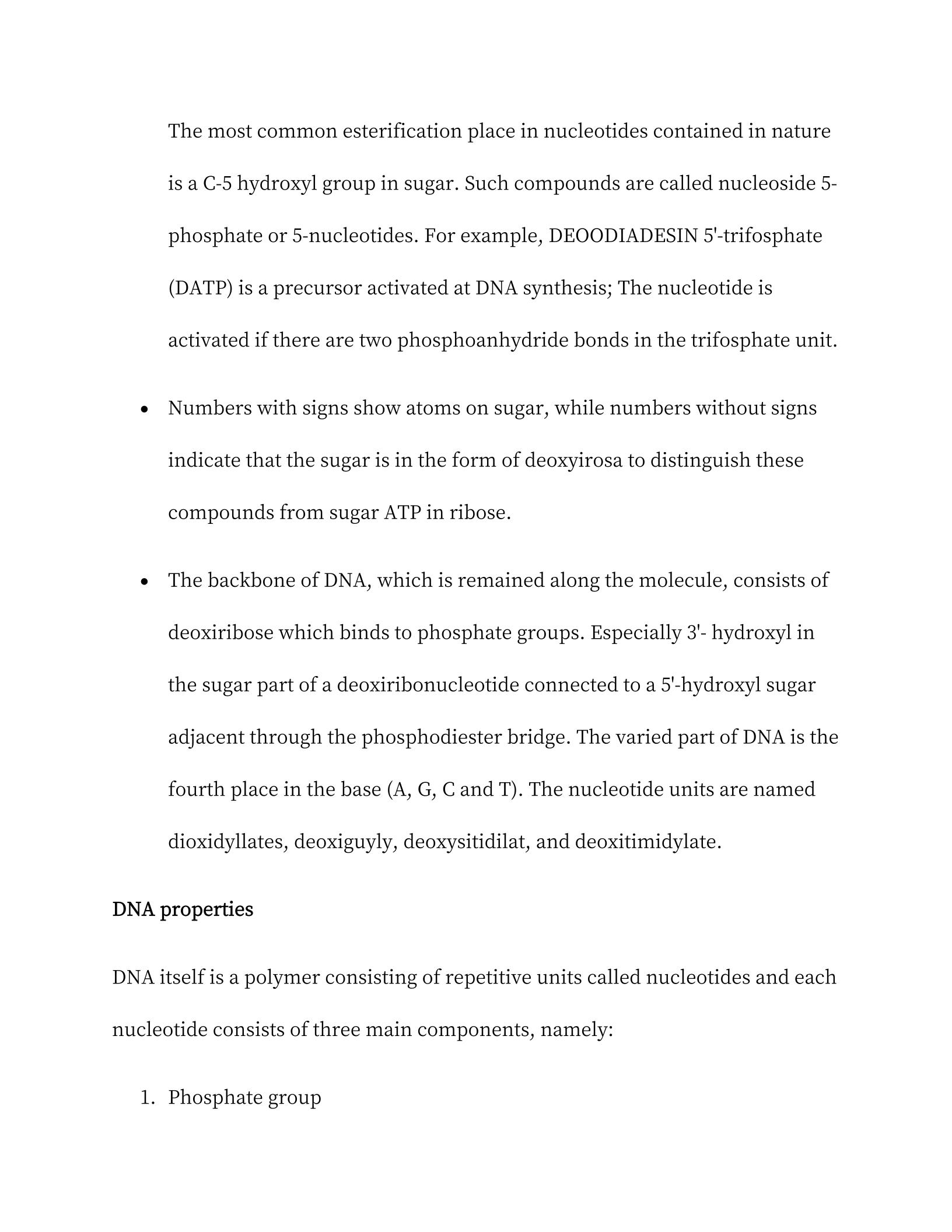
The most common esterification place in nucleotides contained in nature
is a C-5 hydroxyl group in sugar. Such compounds are called nucleoside 5-
phosphate or 5-nucleotides. For example, DEOODIADESIN 5'-trifosphate
(DATP) is a precursor activated at DNA synthesis; The nucleotide is
activated if there are two phosphoanhydride bonds in the trifosphate unit.
Numbers with signs show atoms on sugar, while numbers without signs
indicate that the sugar is in the form of deoxyirosa to distinguish these
compounds from sugar ATP in ribose.
The backbone of DNA, which is remained along the molecule, consists of
deoxiribose which binds to phosphate groups. Especially 3'- hydroxyl in
the sugar part of a deoxiribonucleotide connected to a 5'-hydroxyl sugar
adjacent through the phosphodiester bridge. The varied part of DNA is the
fourth place in the base (A, G, C and T). The nucleotide units are named
dioxidyllates, deoxiguyly, deoxysitidilat, and deoxitimidylate.
DNA properties
DNA itself is a polymer consisting of repetitive units called nucleotides and each
nucleotide consists of three main components, namely:
1. Phosphate group

2. Deoxyribosis
3. Nitrogen Basa (nucleobasa)
At the nucleobasa DNA found is:
1. Adenina (a)
2. Guanina (G)
3. Sitosina (C)
4. Timina (T)
The following are the properties of DNA, namely:
1. Is a chromosome material that carries genetic information
2. Through cell division activities
3. Constant number of DNA in each type of cell and species
4. The DNA content in the cell depends on the nature of the cell / cell /
number of chromosomes in the cell
5. Can replicate
6. In cell prokaryotic organisms (bacteria)
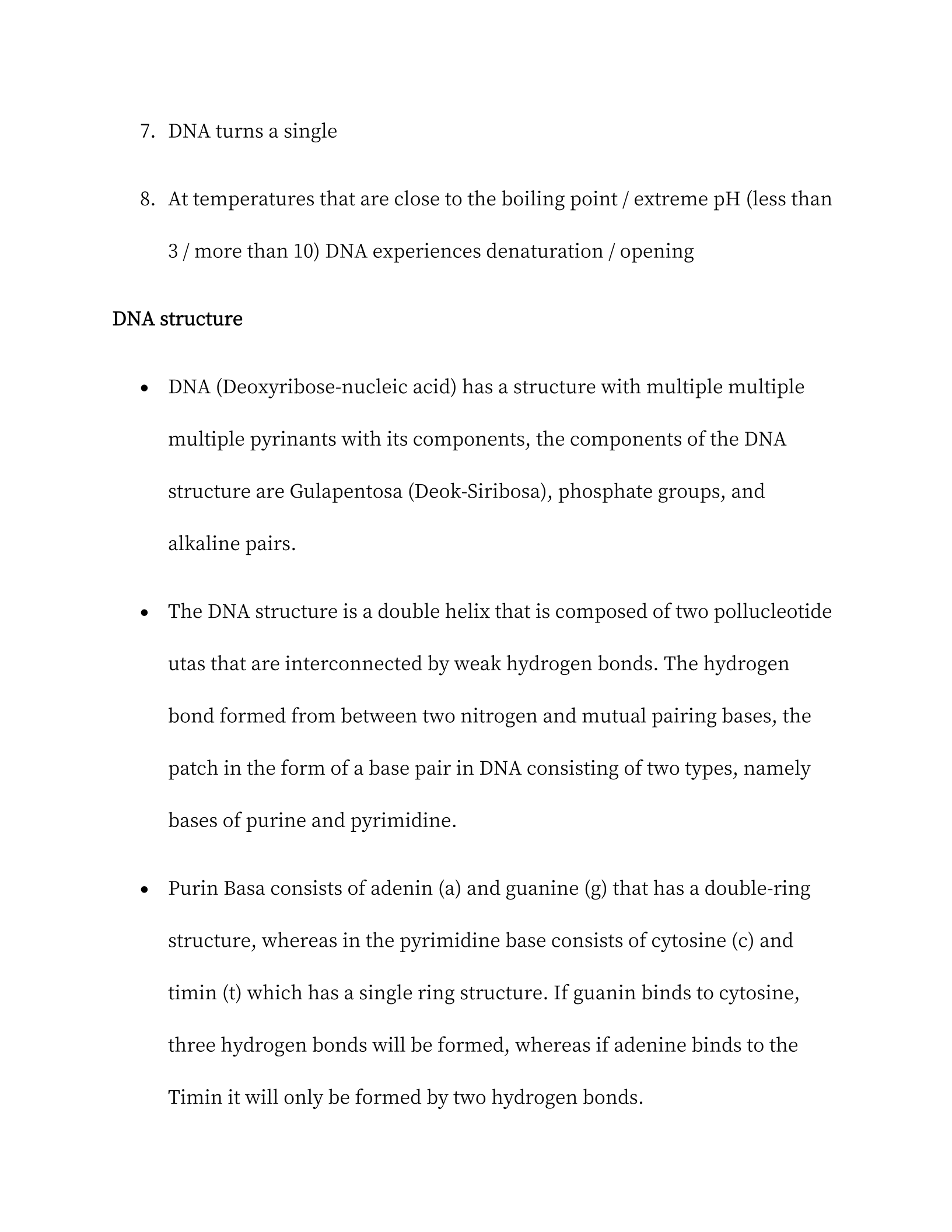
7. DNA turns a single
8. At temperatures that are close to the boiling point / extreme pH (less than
3 / more than 10) DNA experiences denaturation / opening
DNA structure
DNA (Deoxyribose-nucleic acid) has a structure with multiple multiple
multiple pyrinants with its components, the components of the DNA
structure are Gulapentosa (Deok-Siribosa), phosphate groups, and
alkaline pairs.
The DNA structure is a double helix that is composed of two pollucleotide
utas that are interconnected by weak hydrogen bonds. The hydrogen
bond formed from between two nitrogen and mutual pairing bases, the
patch in the form of a base pair in DNA consisting of two types, namely
bases of purine and pyrimidine.
Purin Basa consists of adenin (a) and guanine (g) that has a double-ring
structure, whereas in the pyrimidine base consists of cytosine (c) and
timin (t) which has a single ring structure. If guanin binds to cytosine,
three hydrogen bonds will be formed, whereas if adenine binds to the
Timin it will only be formed by two hydrogen bonds.
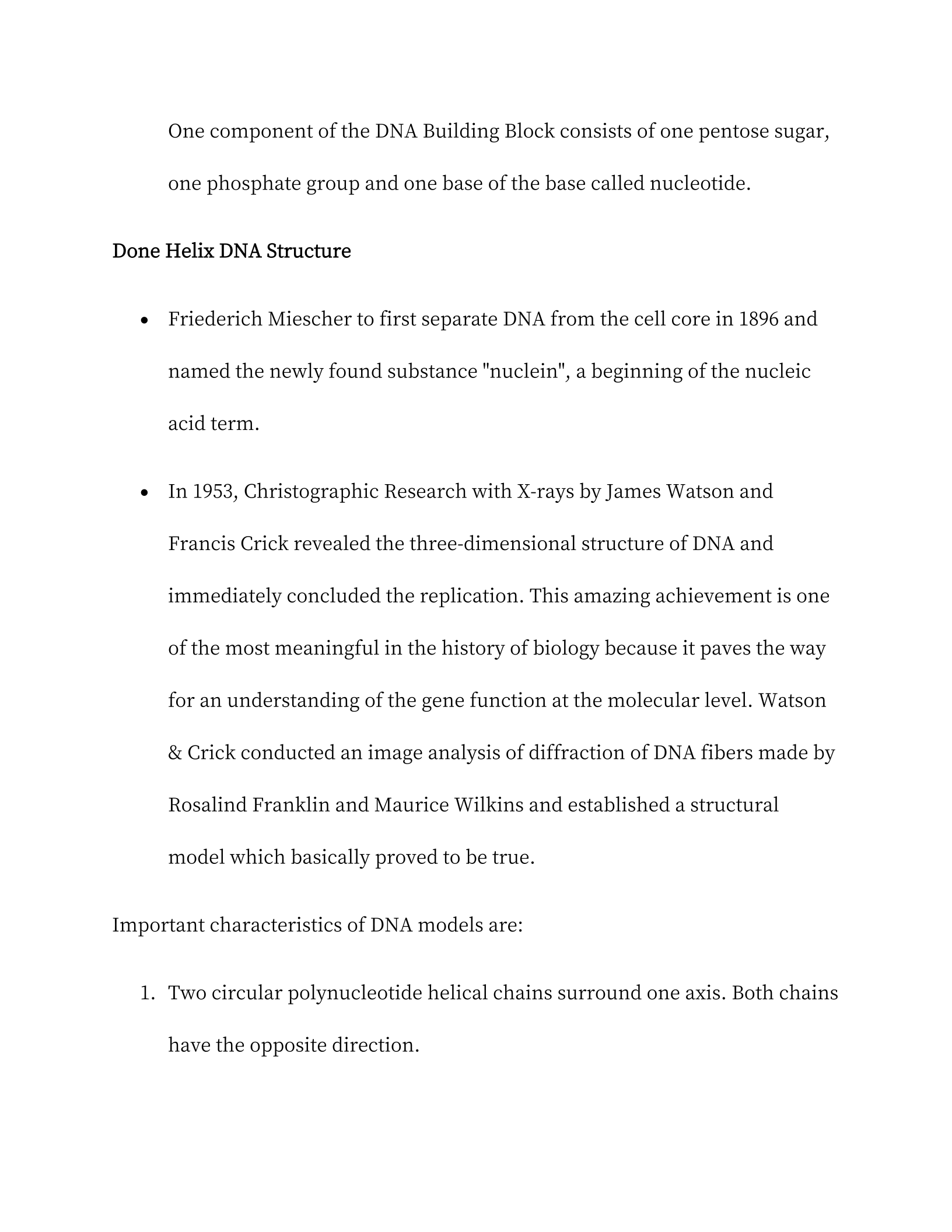
One component of the DNA Building Block consists of one pentose sugar,
one phosphate group and one base of the base called nucleotide.
Done Helix DNA Structure
Friederich Miescher to first separate DNA from the cell core in 1896 and
named the newly found substance "nuclein", a beginning of the nucleic
acid term.
In 1953, Christographic Research with X-rays by James Watson and
Francis Crick revealed the three-dimensional structure of DNA and
immediately concluded the replication. This amazing achievement is one
of the most meaningful in the history of biology because it paves the way
for an understanding of the gene function at the molecular level. Watson
& Crick conducted an image analysis of diffraction of DNA fibers made by
Rosalind Franklin and Maurice Wilkins and established a structural
model which basically proved to be true.
Important characteristics of DNA models are:
1. Two circular polynucleotide helical chains surround one axis. Both chains
have the opposite direction.
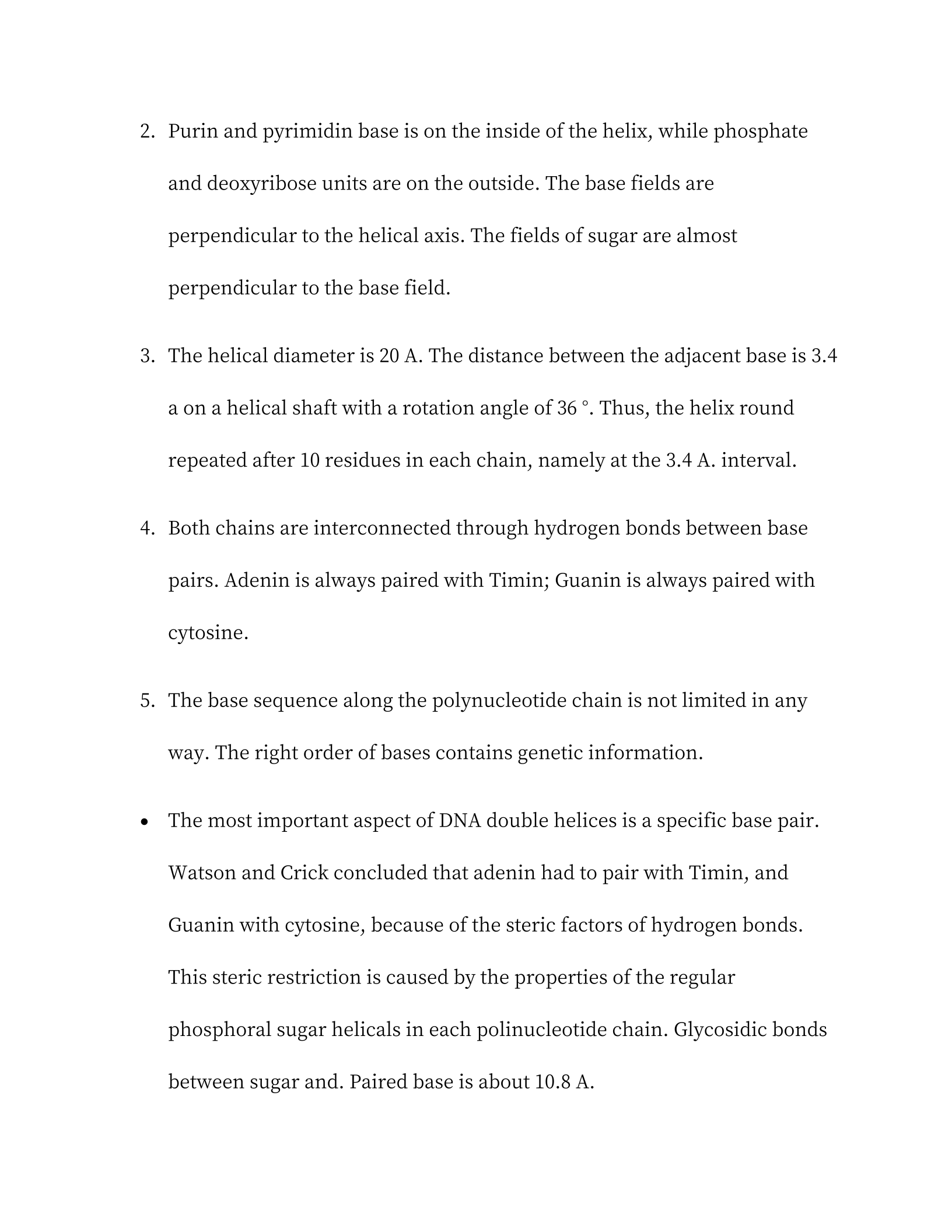
2. Purin and pyrimidin base is on the inside of the helix, while phosphate
and deoxyribose units are on the outside. The base fields are
perpendicular to the helical axis. The fields of sugar are almost
perpendicular to the base field.
3. The helical diameter is 20 A. The distance between the adjacent base is 3.4
a on a helical shaft with a rotation angle of 36 °. Thus, the helix round
repeated after 10 residues in each chain, namely at the 3.4 A. interval.
4. Both chains are interconnected through hydrogen bonds between base
pairs. Adenin is always paired with Timin; Guanin is always paired with
cytosine.
5. The base sequence along the polynucleotide chain is not limited in any
way. The right order of bases contains genetic information.
The most important aspect of DNA double helices is a specific base pair.
Watson and Crick concluded that adenin had to pair with Timin, and
Guanin with cytosine, because of the steric factors of hydrogen bonds.
This steric restriction is caused by the properties of the regular
phosphoral sugar helicals in each polinucleotide chain. Glycosidic bonds
between sugar and. Paired base is about 10.8 A.
Purin Purimidin's base pair corresponds to the room. Instead there is not
enough room for two purines. There is a room more than enough for two
pyrimidine, but both will be too far apart to give hydrogen bonds.
This base couple is further limited by the need for hydrogen binding.
Hydrogen atoms in Purin and Pyrimidin are certain positions.
Adenin cannot pair with cytosine because there will be two hydrogens
near one of the binding places and there is no hydrogen in the other place.
The scheme of the base pair is strongly supported by the results of
previous studies of DNA's basic composition at various species. In 1950,
Erwin Chargaff found that Adenin's ratio against Timin and Guanin
against the cytosine approached 1.0 on all observed species.
The meaning of this new invention became real at Watson-Crick's time
stated. New at that time it could be seen that the inventions above reflect
the essential aspects of the structure and function of the DNA species of
the base pair.
The double helical model immediately suggests the DNA replication
method. Watson & Crick suggested a hypothesis a month after they
present a structural DNA model in the minutes simple and easy to
understand as follows.
When the actual base arrangement on one of the chains is known, it can
be written properly the base arrangement on the chain of its partner
because the pair formation is specific. So, one chain is another chain
complement, and this is a picture that shows how deoxiribonucleatic acid
molecules can duplicate.
Previous discussions about duplication usually suggest the concept of
mold. Both one mold is considered copying himself directly or the mold
produces a "negative" mold that will be a mold to produce the original
"positive 'again. It is not detailed in detail how it might happen in terms of
atoms and molecules.
DNA Structure Components
Components that compose a DNA structure in the form of phosphate
groups and deoxyribose sugar that compose a double helical band as well
as a protein group as a chain, which consists of cytosin (c), guanin (g),
thiamin (t) and adenine (a). In DNA sugar complacing in the form of
deoxirobose sugar, which is a ribose sugar that loses 2 oxide groups (OH).
The helical band is bound to four types of proteins in the form of amino

acids. This arrangement of amino acids will determine the nature
possessed by a living beer. In the amino acid DNA which is the
constituent is cytosin, guanin, thiamin and adenine, which is commonly
abbreviated as CAGT.
DNA function
DNA is in the cell which is the smallest unit of life. Cells are considered a
micro factory that receives raw materials in the form of amino acids,
carbohydrates, fats and minerals to be processed. Cells were found about
300 years ago.
Terminologically DNA is the most important chemical compound because
it carries genetic information from cells, especially from all living things
from generation to generation.
The DNA function is between:
1. The identifier of genes determines the determination so that it can be
forwarded to the next generation
2. Body Metabolism Development Regulator and Process
3. As a zarah itself in chromosomes. DNA examination of all genetic
information and birth nature of an individual can be known.
The nature of each individual's DNA is different, DNA is inherited to his
descendants from the parent. DNA carrier sources are: sperm, bone tissue,
blood, hair or feathers that have roots. The existence of DNA serves as a
regulator of cell life in the body through two processes, namely
replication which means doubling and transcription which means
printing.
DNA information is stored in nucleus, especially in the chromosome.
Nucleic acid is a substance contained in the nucleus that serves to store
and transfer genetic information, then provide the right information to
synthesize typical proteins for each cell. In the cell core chromosome
there are DNA which forms a double strand or double helix.
DNA is not only in the chromosome but also in the mitochondria and the
cytoplasm is not as much as in the chromosome.
Use of DNA technology in forensic science
1. Identify individuals
Because everyone's DNA sequence is unique, it can be matched to it like a
fingerprint. According to Oak Ridge National Laboratory the US
government, forensic scientists use DNA evidence to identify people in
criminal cases and paternity. DNA proof does not always identify suspects
or men as the father of a child, sometimes the proof of the suspect's
exonerates forensic or determines that humans are not the father of a
child. DNA evidence can also be used to identify disaster victims, such as
natural disasters or terrorist attacks.
2. Identify animal species
There are laws that regulate conservation and hunt for endangered
species. If someone is suspected illegally capturing and transporting
endangered species, forensic scientists can use DNA analysis to confirm
or get rid of whether the animal specimen actually belongs to the
protected species. A little hair or even the skin cells from the animal will
be enough to produce accurate test results, so that the suspected animal
transporters or hunters do not need to be captured with actual animals.
3. Other Applications
DNA proof can be used to identify the type of bacteria or parasites that
may have caused a person's death. This information can be useful in cases
of medical negligence or parents. The origin of expensive consumables
such as liquor and caviars can be verified using DNA analysis. Finally,
DNA samples can help medical professionals find organ donors suitable
for people who need organ transplants to survive.
DNA and RNA differences
The difference between DNA and RNA includes 5 things, namely:
1. The sugar content that DNA has is ribose deoxy at RNA Ribose
2. primidin base of timin DNA on urasil RNA
3. DNA in the form of double helix is only one strand
4. Short and not broken
5. DNA is located in the nucleus chromosome
6. Chloroplasts
7. Mitochondrial
8. RNA is located in the nucleus
9. the cytoplasm
10.chloroplasts
11.mitochondria and the last DNA have a fixed level of arrangement while
RNA has an invalid level of form

