


Strategies for Application and Enterprise Architects
Section 1: Foundation of the Study
Background of the Problem
The first computing devices and related software started improving operations in the
1930s (Booch, 2015). Since that time, the methods, approaches, and tools used to design,
develop, and deliver ISs changed drastically with goals of improving the effectiveness and
efficiency of the individuals that create, maintain, and operate the ISs (Booch, 2015). Despite
their efforts, improvements in the process and tools software engineers used to develop software
did not result in repeatable, generalized higher quality (Ahmad, 2016; Atkinson & Benefield,
2013; Jones, 2015).
Development of contemporary ISs is a complex task that requires the involvement of a
broad range of stakeholders. Customers have needs and perceptions of quality that define their
efficiency and effectiveness (Liu, Chang, & Tsai, 2015). Analysts work with stakeholders to
document their needs and requirements and software engineers work to implement the
documented requirements as ISs (Buenen & Walgude, 2015). Architects work with all of the
stakeholders to ensure a holistic view and balanced needs across all stakeholders (Ahmad, 2016).
These roles must work in harmony with a process to achieve IS quality.
The perspective of quality in the software industry is shifting to that of customer
satisfaction, which is a highly complex concept (Buenen & Walgude, 2015; Göransson,
Gulliksen, & Boivie, 2003). The approaches to achieving satisfaction have evolved at nearly the
same rate as the means of developing ISs, yet have not resulted in repeatable satisfaction

(Ramasubbu, Bharadwaj, & Tayi, 2015; Singh & Jatain, 2013; Verner, Babar, Cerpa, Hall, &
Beecham, 2014). Two of the critical roles in developing ISs are software engineers and solution
architects, and—together—they should be able to maximize IS quality (Ahmad, 2016).
Problem Statement
Despite over 50 years of software engineering as a formal practice, contemporary
developers of bespoke software follow development practices that result in low-quality products
with high development and maintenance costs (Pass & Ronen, 2014). Global IT budget
allocation to the quality assurance function rose from 25% to 33% between 2015 and 2016
(Buenen & Walgude, 2015) and software maintenance costs represent 90% of the total cost of
bespoke software in 2012 (Dehaghani & Hajrahimi, 2013). The general IT problem is
maximizing customer satisfaction with bespoke software through quality improvements. The
specific IT problem is that software and enterprise architects often lack strategies for applying
architectural best practices to improve bespoke software quality.
Purpose Statement
The purpose of this qualitative exploratory case study was to explore strategies used by
software and enterprise architects for applying architectural best practices to improve bespoke
software quality, lowering the total cost of ownership. The population for this study comprised
application and enterprise architects associated with the delivery of bespoke software for the
enterprise architecture team at a large enterprise in the Nashville, Tennessee metropolitan area in
the United States. A wide variety of organizations can use the findings from this study to help
realize and understand the benefits of having strategies architects can apply to improve the
quality of bespoke software solutions. The potential social impact of this study is improved

work-life balance, morale, and productivity of software and enterprise architects through
streamlining development and maintenance activities.
Nature of the Study
The two primary methodologies used in scholarly research are quantitative and
qualitative. Researchers use quantitative methods to identify and explain relationships between
aspects of a topic using variables (Trochim & Donnelly, 2008). When a researcher can define the
variables that describe the attributes of a topic and they want to determine correlation, causation,
or trends between those variables, they use quantitative designs to provide the structure and
processes for collecting, analyzing, and evaluating data (Trochim & Donnelly, 2008).
Alternately, researchers use qualitative methods to explore and create detailed understandings of
a topic or phenomenon (Trochim & Donnelly, 2008; Yin, 2014). When a researcher either is not
aware of or cannot identify variables to evaluate or they simply seek to understand a concept
fully, qualitative designs provide frameworks for analysis (Yin, 2014). The quantitative
methodology was not appropriate for my research as I sought to create a detailed understanding
of strategies architects use for improving software quality as opposed to showing a correlation
between application and enterprise architect strategies and bespoke software quality.
Within the qualitative methodology, there are a few available designs: ethnography,
grounded theory, phenomenology, case study, and narrative (Trochim & Donnelly, 2008; Yin,
2014). Ethnography is used to research distinct cultures or cultural groups (Trochim & Donnelly,
2008). As such, ethnography was not appropriate for my research as I was not concerned with a
distinct culture or cultural group. Application and enterprise architect and engineering
communities comprise members from a wide variety of cultural backgrounds. Phenomenology is
used to study commonalities of participants that experienced an unusual phenomenon (Gentles,

Charles, Ploeg, & McKibbon, 2015). I believed that the phenomenon of differences in the focus
of architects and engineers commonly occurred, making phenomenology inappropriate for my
research. Case study research is used to study complex phenomena when the researcher seeks to
understand and describe the phenomena in detail (Hyett, Kenny, & Dickson-Swift, 2014; Yin,
1981, 2014). The case study design was the most appropriate qualitative design for my research
as I sought to understand and describe strategies architects used to apply architectural best
practices to improve bespoke software quality.
Qualitative Research Question
What strategies do application and enterprise architects use to apply architectural best
practices to improve bespoke software quality?
Interview Questions
•How would you describe the distinction between an application architect and a
software engineer? Please explain
•What is your understanding of architectural best practices? Please explain.
•What does quality mean to you? Please explain.
•What is your perception of the relationship between architects and software engineers
regarding the pursuit of product quality? Please explain.
•What, if any, challenges do you face regarding the application of architectural best
practices in delivered software products? Please elaborate.
•What strategies do you have for ensuring the highest possible quality of software
products? Please elaborate.

Conceptual Framework
I used total quality management (TQM) as the lens through which I conducted my
research and evaluated data. W. Edwards Deming and Joseph M. Juran started the TQM
movement in the United States in the mid-1980s following a downturn in the U.S. economy
during the 1970s and 1980s (Hill, 2008; Joyce, 2015). Their objective with the introduction of
TQM in the United States was improving the quality of products to levels achieved by Japanese
organizations (Hill, 2008; Joyce, 2015). The focal point of TQM is achieving high levels of
customer satisfaction through continuous improvement and involvement of everyone in the
organization (Deming, 1985; Suryanarayana, Sharma, & Samarthyam, 2015). Some
contemporary organizations chose to implement TQM in the form of frameworks such as ISO-
9000, Six Sigma, and CMMI (Barata & Cunha, 2015; A. Brown, 2014; Tunkelo, Hameri, &
Pigneur, 2013). I summarized TQM concepts as a collection of policies, procedures, and
components that directly influence customer satisfaction (see Figure 1).

Figure 1. TQM policies, procedures, and components.
The roles of application and enterprise architect focus on design-centric activity,
leadership, stakeholder focus, system-wide concerns, full lifecycle involvement, and balancing
stakeholder concerns (Woods, 2014). TQM, as a conceptual framework, is significant to this
research as the characteristics of application and enterprise architects overlap well with the
components, procedures, and policies of TQM. Architect leadership aligns well with continuous
improvement, process design, and involving everyone while design-centric activity aligns with
service/product design, process design, and problem-solving tools. Stakeholder focus is central to
TQM in the form of customer satisfaction, which architects achieve in part through cost controls
Meet
Specifications
Value:
Serve
Purpose
at Price
Service / Product
Design
Process
Design
Fitness
For
Use
Support
Psychological
Impressions
Quality:
Customer
Satisfaction
Purchasing
Problem-solving
Tools
Continuous
Improvement
Everyone is involved
Quality
Components of
Quality
Procedures for
Achieving Quality
Policies for
Achieving Quality
Benchmarking
Legend

(purpose at a price). Balancing concerns aligns with all of the components of quality defined by
TQM. I summarized the overlap of TQM and architect roles and responsibilities in Table 1.
Table 1. TQM P and Procedures Mapped to Architect Characteristics.
TQM policies and Procedures Mapped to Architect Characteristics.
Design-centric Leadership Stakeholder System- Life-cycle Balancing Activity
Focus wide involvement Concerns
concerns
Customer
X X X
Satisfaction
Continuous
X X X
Improvement
Involving
X X X X
Everyone
Product Design X X X X
Process Design X X X X X
Problem-
X X X X
solving Tools
Purchasing X X X X
Benchmarking X X X
Characteristics of an architect
Policies Procedures

Definition of Terms
Application architect: Application architects are architects with a technical role in
delivering IT solutions that focus on design-centric activities, leadership, stakeholder focus,
system-wide concerns, lifecycle involvement, and balancing concerns (Woods, 2014).
Architect: Architects are people with a role in delivering IT solutions that focus on
design-centric activities, leadership, stakeholder focus, system-wide concerns, lifecycle
involvement, and balancing concerns (Woods, 2014).
Bespoke software: Bespoke software is software information systems developed by an
organization for its internal use (Göransson et al., 2003; Spinellis, 2014b).
Enterprise architect: Enterprise architects are architects with a business domain
specialization as opposed to a technical specialization, focusing on aligning technology with
business need (Woods, 2014).
Software engineer: Software engineers are people who perform the socio-technical role of
developing software using complex algorithms based on experience with what works well (P. L.
Li, Ko, & Zhu, 2015).
Solution architect: Solution architects are architects with a balance of business domain
and technology knowledge, focusing on quality attributes (e.g. performance, security,
modifiability, maintainability, availability, flexibility, reliability, and reusability) of solutions
(Woods, 2014).
Assumptions, Limitations, and Delimitations
Any number of internal or external phenomena influence research and outcomes.
Recognizing and documenting these phenomena is part of establishing credibility. Three
categories of phenomena that occur in research are assumptions, limitations, and delimitations.

Assumptions
Assumptions are accepted truths that are unproven by measurable test (Joseph, 2013).
There were a few assumptions included in this study. First, the organization participating in this
case study was representative of the overall industry. Second, the number of interviews and other
sources of evidence used in my research adequately represented the case regarding quality and
strategies for achieving quality. Last, the interviewees adequately represented the case selected
for inclusion in this study.
Limitations
Limitations are aspects of a study that are—despite the researcher’s best effort—beyond
their control (Teichler, 2014). The primary limitations of this study derived from the qualitative
nature of the research. Interpreting dialogue and artifacts for themes is a subjective process that
results in potential issues for validity and reliability due to potential bias (Yin, 2014).
Additionally, due to the limited number of cases evaluated in a case study design, the
generalizability of the findings is theoretical at best (Yin, 2014).
Delimitations
Delimitations are boundaries that a researcher imposes on a study to control or narrow the
scope of the research (Felt, Igelsböck, Schikowitz, & Völker, 2013). There were a few primary
delimitations in my research. First, I considered only organizations that develop software for
internal use. Second, I considered only organizations that employed people in a role of architect
that meets the industry-standard definition of an architect. Third, I included only organizations
that met the first two criteria and were in the metropolitan Nashville, TN area. Fourth, I did not
consider the effects of the globalization of software development (including potential
multicultural impacts and the influence of offshored outsourcing). Fifth, architects employed at

the case organization must have been full-time employees of the organization at the time of the
study and must have had at least 5 years of experience as an architect at, either at the case
organization or any organization over their career.
Significance of the Study
While reviewing the academic literature for research regarding strategies used by
architects to influence bespoke software quality, I found no matching studies. Given the overlap
of aspects of quality defined in TQM with the responsibilities assigned to an architect, there is an
opportunity to enhance both academic knowledge and practice in this area. I expected that this
study would lead to further research on the topic.
Contribution to Information Technology Practice
Information technology (IT) departments, like most departments of contemporary
organizations, were charged with reducing costs and increasing the quality of outputs;
colloquially doing more with less. Efficiency and effectiveness of operations were central to their
operations. This research was significant to IT practice as it provided detailed descriptions of
strategies used by architects to successfully align bespoke software solutions with customer
satisfaction to improve agility and responsiveness, reduce overall costs of developing custom ISs,
and align IT assets with business strategies.
Implications for Social Change
The implications for positive social change included improving the work/life balance of
both IT and business workers alike. The literature I reviewed as part of this research suggested
that improving the quality of software developed for internal use improves the efficiency and
effectiveness of both those that develop the solutions and those that use the solutions. Increased
efficiency means that developers and users accomplish their work tasks in less time, affording

them more time for other tasks, either work or personal. This increased efficiency also decreases
the stress levels of both IT managers and end-users of bespoke software solutions. Lowering
stress levels at work helps to improve employee morale and productivity.
A Review of the Professional and Academic Literature
Three primary components of my research covered in this literature review were as
follows:
1. The problems organizations faced with bespoke software development and the
roles individuals filled in the development of bespoke software,
2. the use of TQM as a conceptual framework in research and as a means of
achieving quality in bespoke software, and
3. the use of case study research design in bespoke software development and TQM
implementations.
I searched several sources of academic and professional articles to ensure complete
coverage of the topics. I used Google Scholar, ProQuest Central, Science Direct, EBSCOHost
Academic Search Complete, IEEE Explore, IEEE Computer Society Digital Library, and ACM
Digital Library as the primary search locations. I also used the reference lists of articles I found
in these sources as alternate sources.
While searching, I reviewed and considered seminal and other appropriate articles from
all timeframes, focusing on recent (2013 and newer) articles to ensure a contemporary
perspective of the topics. The approach I took to searching evolved over time, beginning with
distinct primary search criteria for each of the themes in my literature review. For TQM, search
terms evolved to include the following: Total quality management, quality management system,
and quality management.

For bespoke software development, search terms evolved to include the following:
bespoke software issues, bespoke software problems, bespoke software quality, and tailor-made
software. The literature retrieved for both TQM and bespoke software development provided a
foundation for the use of case study as a research design.
I reviewed over 250 articles and discarded more than 150 as either irrelevant to the scope
or duplicative. In total, I included 103 articles in this review with 88 published within the last 5
years (2013 and newer; 85.44%). There are 86 articles from peer-reviewed sources (83.50%) and
four doctoral dissertations or theses. According to Walden’s policy, up to 10% of peer reviewed
sources could be dissertations, resulting in four of the dissertations counting toward
peerreviewed totals. The adjusted total count of peer-reviewed articles is 90, or 87.38%.
While the development of case studies and the use of a case survey design have been
around for a while longer, I identified Robert Yin’s (1981) article supporting case study as a
valid research methodology as the seminal article on single case studies (now referred to as a
design in the qualitative methodology). Similarly, while there was previous work on case study
design by Robert Stake, I identified the seminal work on multiple case studies as a report on case
studies in science education (Stake, 1978). I chose this as the seminal work on multiple case
studies as Stake (1978) noted that part of the intent of the report was to show the efficacy and
value of multiple case studies.
Similarly, while the topics that drove TQM started with Frederick Winslow Taylor in
1911 (Khalil, Stockton, Alkaabi, & Manyonge, 2015), the formal definition of TQM did not
occur until much later. In 1985, the U.S. Department of Defense (DoD) was formalizing their
quality initiatives with the guidance of Deming and Juran and associated the TQM moniker with
the initiative. I identified Houston and Dockstader’s (1997) report on the DoD’s implementation

in 1985 as the seminal work on TQM, though authors in the reviewed literature frequently cite
Deming and Juran as the leading experts on TQM (Hill, 2008).
I began this literature review with an analysis of literature regarding bespoke software
development. I presented how the literature defined bespoke software and the two prominent
themes found in the literature: the software development process and requirements engineering.
Usability was a requirement that had a significant amount of coverage in the literature as well.
As such, I included one section dedicated to usability as it relates to the perception of quality. I
concluded the section on bespoke software with a review of the literature on the failures of
bespoke software, methods to improve bespoke software, and a review of research designs used
in research of bespoke software in the literature.
Following the analysis of bespoke software development, I presented the evolution of
TQM followed by a review of contemporary implementations, supporting conceptual models,
and contrasting conceptual models. Because TQM was a practice implemented in the industry to
control product quality, its use in this research was more than just that of a conceptual
framework. In order to provide a foundation for the basis of this research (the distinction between
software engineers and solution architects in terms of quality focus and the strategies used by
architects to influence quality), it is important to understand the key concepts of TQM and the
aspects of products or services that comprise or affect satisfaction. For that reason, I continued
the literature review with analysis of how researchers define TQM, customer satisfaction, the
policies of TQM, and the procedures of TQM. I concluded this section with a summary of the
research designs used in research of TQM to substantiate my use of case study. I concluded the
literature review with a section on differences between two prominent roles involved in bespoke
software development and a critical evaluation of themes found in the

literature.
Bespoke Software Development
When considering software for use in business operations, organizations seek bespoke
solutions because commercial software is not always a good fit. Göransson, Gulliksen, and
Boivie (2003) defined bespoke software as software that is developed in-house for work-related
use. Spinellis (2014a, 2014b) mentioned that organizations choose to implement bespoke
solutions as they are tailored to fit unique organizational needs and support the organization’s
ability to enhance them on their timeline; aspects of aligning software to business needs that are
not always possible with commercial software. Atkinson and Benefield (2013) added that
businesses typically treat software development as a necessary evil; as a cost center instead of a
value creation center. While there may be justification, the choice to develop bespoke solutions
comes with its challenges.
The Process of Bespoke Software Development
One of the considerations when deciding to develop bespoke solutions is the process the
organization will use. Göransson et al. (2003) noted that the three primary phases in the course of
developing and delivering bespoke software are requirements analysis, iteratively developing the
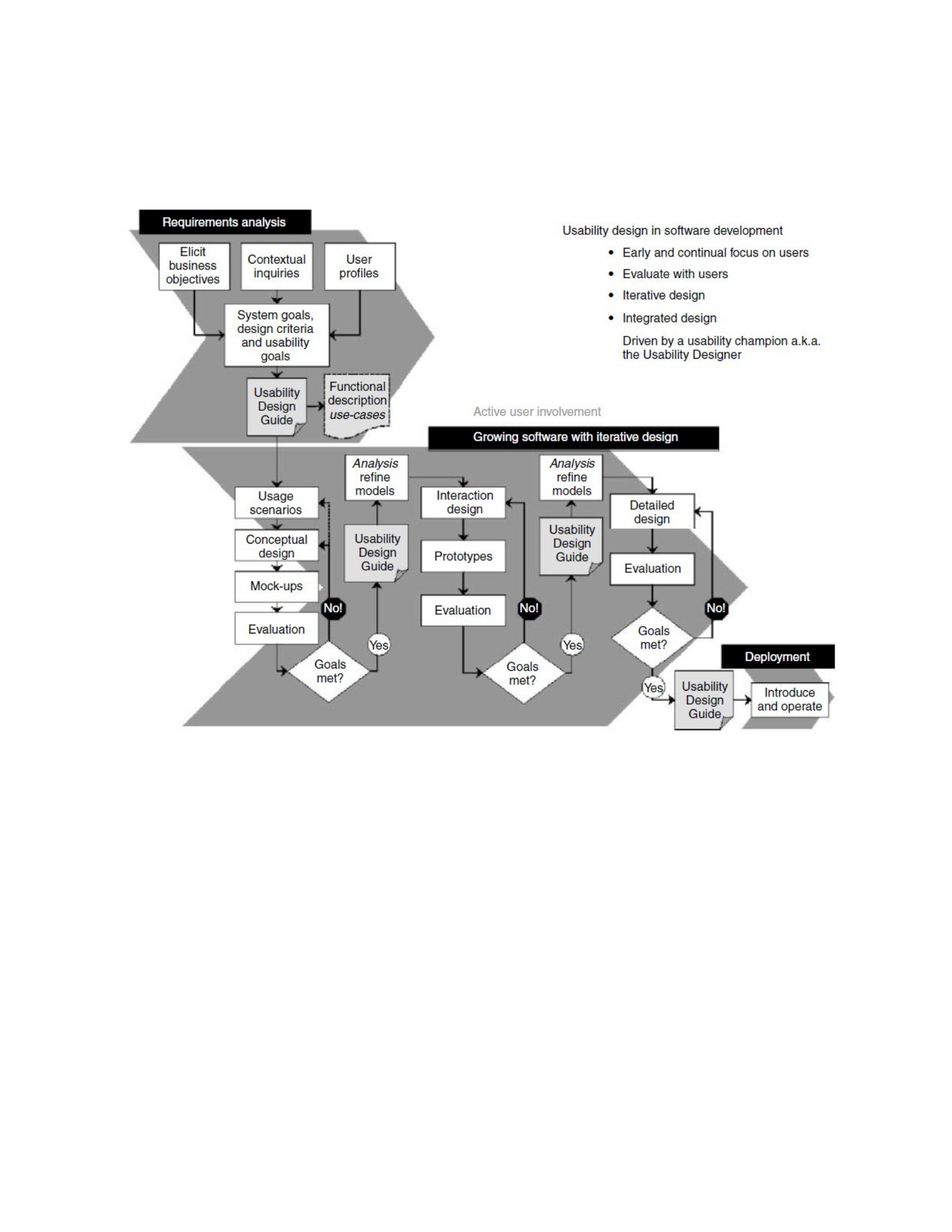
software, and deploying the software (see Figure 2). Alternately, Galster, Weyns, Tofan,
Michalik, and Avgeriou (2014) noted that effective development processes include requirements
gathering, requirements engineering, architecture, solution design, evaluation of solution design,
development, code reviews, system integration, and testing the complete system. No matter
which steps the organization includes, the collection of steps in a software development process
is known as the software development life cycle (SDLC) is. The process used to develop
products (e.g. the SDLC) is believed to have a profound impact on product quality (Deming,
1982; Ishikawa, 1984; Juran & Godfrey, 1999).
Figure 2. A process for including usability design in software development (Göransson et al., 2003).
There are two contemporary SDLCs in use, each with their issues. Misra, Fernández, and
Colomo-Palacios (2014) and Mitchell (2012) noted that common processes for software
development include Waterfall and Agile. Mitchell (2012) stated that Waterfall became a
formalized methodology in the 1970s, driven by W. Royce, and Shah (2014) criticized it as being
overly process-centric. Atkinson and Benefield (2013) added that it results in inefficiency and
waste through loss of knowledge at each handoff. Booch (2015) stated that waterfall was
appropriate for its time due to the nature of software at the time, though changes in the
programming industry that arose in the 1980s forced a change.

Agile SDLCs address some of the issues associated with Waterfall. Despa (2015)
indicated that Agile methodologies focus on adaptability and communication. Göransson et al.
(2003) and Huckabee (2015) reported that Agile lifecycles are geared toward delivering working
software over comprehensive documentation, yet Despa (2015) and Johann (2015) believed that
Agile methodologies do not scale well in larger organizations and do not support adequate
architectural planning. However, Poort (2014) believed that updated models such as Scaled Agile
Framework now include architecture in the process. Ramasubbu, Bharadwaj, and Tayi (2015)
believed that the volatility of requirements should be considered when selecting a development
process, adding that Agile processes tend to work better on projects with higher requirement
volatility while plan-based processes (e.g. waterfall) tend to work better when requirement
volatility is lower or non-existent. Continuous improvement of processes also positively affects
product quality (Deming, 1982; Feigenbaum, 1985).
The SDLC may need to vary throughout the project to maximize the quality of the
outputs. Ramasubbu et al. (2015) noted that, while the process used to produce bespoke software
is critical to quality, a single process may not be sufficient and the SDLC may need to vary by
development phase, team maturity, and customer involvement. However, Chen and Huang
(2009) stated that complications and unpredictability in the software development process
negatively affect the maintainability of software. Having a stable SDLC may be critical to
quality, yet Verner et al. (2014) stated that software development managers and software
developers do not always agree on which aspects of the software development process are
essential. These themes suggest that team members should work together to implement the best
process.

However, having high-quality products requires more than an effective process. Shah
(2014) noted that, across all of the phases of software engineering, people are just as significant
to quality and success as technical and process considerations. Involving everyone is believed to
have a positive effect on quality (Feigenbaum, 1985; Ishikawa, 1984).
There are a few architectural quality drivers that should be in every development process.
Cleland-Huang, Hanmer, Supakkul, and Mirakhorli (2013), Lyu and Liang (2014) and
Shanmugasundaram and Vikram (2015) stated that, regardless of software development
methodology, solution architecture drives quality by constraining development. These constraints
may be critical to product quality as Canessane and Srinivasan (2013) indicated that architectural
and design decisions made early on in the development cycle based on functional and
nonfunctional requirements have a significant impact on the quality attributes of the resulting
system. For example, Bosch, Capilla, and Hilliard (2015) and Galster et al. (2014) noted that
variability—or an architectural consideration that affects the ability of a software solution to be
adapted for application in different contexts via enhancements or configuration– has an impact
on all of the phases in a development process. These researchers suggested what TQM states,
that building quality in from the beginning improves product quality (Feigenbaum, 1985; Hill,
2008; Juran & Godfrey, 1999).
Requirements Engineering in the Process of Bespoke Software Development
There are differing schools of thought on the best time for requirement gathering.
Atkinson and Benefield (2013) noted that a customer’s perception of the ideal solution is at its
weakest at the beginning of a project, making defining requirements before the project begins a
precipice, though Huckabee (2015) argued that knowing what to build before development starts
reduces rework later. Similarly, Göransson et al. (2003) indicated that requirements are

developed continuously over the life of the design process, not determined all at once at the
beginning of the project. In either case, Atkinson and Benefield (2013) mentioned that managing
requirements throughout the development phase is critical as the user’s perception of what is
possible evolves during the development process. Chen and Huang (2009) added that selecting
appropriate requirement engineering approaches and timelines are critical as low-quality
requirements—defined by their completeness, accuracy, and clarity—are the source of most
reported software issues. Having clear requirements is crucial as building quality in from the
beginning is related to improved product quality (Feigenbaum, 1985; Hill, 2008; Juran &
Godfrey, 1999).
Addressing business needs through customer involvement is another driver of quality.
Singh and Jatain (2013) believed that requirements engineering and prioritization are critical to
software value and the elicitation and prioritization process should include users. Göransson et
al. (2003) added that different organizations have varying levels of process and business
objective maturity and business objectives must be clear before proceeding with requirements
engineering. Gathering poor quality requirements, which could be due to misunderstood or
unclear business objectives, can have a detrimental effect on quality (Ahmad, 2016) as the design
of both the process and the product influences product quality (Hill, 2008).
Nonfunctional requirements (NFRs) might be just as significant to quality as functional
requirements. Thakurta (2013) stated that the requirements phase must include quality-related
requirements as these NFRs define the quality attributes of bespoke software. Ameller, Ayala,
Cabot, and Franch (2013) and Cleland-Huang (2014) indicated that the primary attributes of
bespoke software solutions that are affected by NFRs and solution architecture are usability,
reliability, performance, efficiency, and maintainability. Canessane and Srinivasan (2013)

alternately stated that NFRs affect performance, interface, operational, resource, verification,
acceptance, documentation, security, portability, quality, reliability, maintainability, and safety
requirements. Göransson et al. (2003) added that usability must be included as a quality criterion
when defining requirements and acceptance criteria for bespoke software. NFRs are a means of
involving the customer in product quality discussions (Ameller, Ayala, et al., 2013; Cleland-
Huang, 2014).
With the variety of NFRs to consider, it is not always clear who is driving their definition.
Ameller, Ayala, et al. (2013) indicated that architects are the primary sources of NFRs and they
tend to specify NFRs iteratively over the life of the project. Cleland-Huang (2014) stated that
solution architects use NFRs to make decisions that influence bespoke software quality,
including choosing from myriad architectural patterns and styles that affect extensibility,
maintainability, availability, and security. Solution architects focus on maximizing the quality of
bespoke software solutions (Suryanarayana et al., 2015).
Usability and Bespoke Software Development
Usability is frequently studied and complex NFR that is variable enough to warrant
inclusion in the development process. Wallace, Reid, Clinciu, and Kang (2013) indicated that
usability is a component of user satisfaction that is made up of effectiveness and efficiency,
though also found that the importance of usability varies by culture. Singh and Jatain (2013)
stated that usability is directly related to the perception of product quality. Göransson et al.
(2003) concluded that the software development process must consider usability in requirements
and must integrate usability considerations in the process. While usability drives the perception of
quality, it is not clear who is responsible for including it in the design.

Despite the importance of usability, software engineers do not always address it in their
process. Kassab, Neill, and LaPlante (2014) indicated that the software industry, in general,
believes that achieving customer satisfaction is a greater indicator of quality bespoke solutions
than defining well-built, defect free solutions. Ebert, Hoefner, and V.S. (2015) supported that
idea, noting that critical failures correlate with low usability in software products. However,
Göransson et al. (2003) noted that software engineers typically regard usability as someone else’s
responsibility, including those considerations in the product only if there is available time, and
believe this occurs as usability requires creativity while software engineering follows a structured
processes. The lack of addressing usability in the engineering process is one of many
determinants of low quality (Kassab et al., 2014).
Bespoke Software Issues
Poor quality is prevalent in bespoke software development, resulting in higher than
necessary development costs. Atkinson and Benefield (2013) noted that approximately 66% of
all bespoke software projects are either delivered late or not at all and that 16.7% of software
development projects exceed costs by 200% and timeline by 70%. Additionally, Ahmad (2016)
cited a study indicating that 50% of software development projects between 2011 and 2015 were
challenged in their ability to deliver requirements on-time and under budget. These failure rates
are significant drivers of cost as Jones (2015) believed that the large number of software defects
in bespoke software represent up to 60% of the development effort on large projects through
extended test intervals (two to three times longer due to the high number of defects). The
organization’s sector is not a delimiter for this problem as Atkinson and Benefield (2013)
indicated that organizations in both public and private sectors experience these cost and project
overruns. The prevalence of bespoke software quality issues suggests a systematic cause.

Poor functional and nonfunctional requirements are one determining factor of low quality.
Ahmad (2016) stated that software requirements elicitation and specification issues are two root
causes of low bespoke software quality. This idea is supported by Kassab et al. (2014) who stated
that poor requirements gathering techniques are the most frequently cited source of bespoke
software failure. Gürses, Seguran, and Zannone (2013) believed that stakeholders’ inability to
distinguish requirements from design and functional requirements from nonfunctional
requirements drives low-quality requirements.
Quality can suffer as Cleland-Huang (2014) noted that focusing on functional
requirements and ignoring NFRs and other quality aspects lead to failed bespoke software
solutions. Gürses et al. (2013) supported this by stating that teams often consider NFRs such as
security after the architecture and design are complete, an approach that is likely to be
ineffective. Architects should be involved throughout the lifecycle to build quality in from the
start, though there are aspects of quality that architects do not influence.
Architecture requires more than just technical considerations to influence quality.
Spinellis (2014a) noted that, as an architect on one quality-challenged project, his position
afforded him the power to influence quality outcomes yet he was not authorized to direct efforts
toward quality. Gürses et al. (2013) indicated that architecting a solution independent of
requirements and having multiple people with independent perspectives architect the solution
results in inconsistencies in the architecture. Empowering a lead architect helps to maximize
quality (Bon & Mustafa, 2013).
Time, budget, and other process limitations do not always support achieving bespoke
software quality. Ameller, Ayala, et al. (2013) and Patwardhan (2016) reported that time and
budget limitations that constrain quality efforts are aspects of bespoke software project failure.

Similarly, Atkinson and Benefield (2013) believed that the following three aspects of traditional
development agreements are the basis of bespoke software failures: delivery of a system that
satisfies all requirements by a defined date, assumption of a waterfall-based development
process, and a change management process that affects the entire product development process.
Carver, Yamashita, Minku, Habayeb, and Kocak (2015) noted that organically grown processes,
budget protection, and undue pressure that causes teams to bypass policies and procedures are all
causes of quality issues. Quality does require involving everyone from the beginning of the
project (Kassab et al., 2014).
Inattention to implementation aspects of the solution can also cause quality issues.
Patwardhan (2016) believed that variances in architecture and lack of enforcement of coding
standards result in low overall product quality. Spinellis (2014b) added that bespoke solutions
create supportability and maintenance issues, usually with significant ramp-up times for new
developers, due to the use of lexicon and implementation details that are distinct to the
organization. Singh and Jatain (2013) extended the idea that developers are a bottleneck as, in
bespoke software development, the number of available developers is usually not sufficient to
fulfill the number of defined requirements. Building quality in from the start and having a good
process improves product quality.
Improving Bespoke Software
The primary means of improving quality mentioned in the literature revolve around
process improvement, requirements management, and good architecture. Researchers have
shown that process improvement that involves the customer has a positive influence on quality.
Mitchell (2012) noted that software process improvement (SPI) is implemented to improve
efficiency, effectiveness, and quality of the product. Chen and Huang (2009) added that

improvements in the development process have a direct, positive impact on the quality of the
product as well as the efficiency and effectiveness of the team, adding that teams can implement
them at any number of levels. Mitchell (2012) stated that transitioning from a sequential process
to an iterative process is a high-level change while improving a software inspection process is a
lower-level change. Misra et al. (2014) added that code reviews and design reviews, collectively
referred to as inspection, are shown to have a positive influence on bespoke software quality and
should be included in the development process. Process improvement does not have to be a
drastic change, however. Atkinson and Benefield (2013) noted that solving the issue of low
bespoke software quality and project failures does not require implementing Waterfall, rather it
does require implementing a methodology that includes end-users in the entire lifecycle of the
development project. Quality leaders believe that the development process has a significant
impact on product quality (Crosby, 1992; Deming, 1982; Juran & Godfrey, 1999). There are a
few contemporary means of improving organizational processes.
Not all process improvement frameworks are available to all organizations, and many
contemporary versions may not yield desired results. Yoon, Lee, Lee, and Yoon (2015) indicated
that one SPI model—the Capability Maturity Model (CMM)—was defined to aid in the
implementation of effective development processes. Lyu and Liang (2014) continued that teams
can use other models like ISO-9000, Six Sigma, and Capability Maturity Model Integration
(CMMI) to evaluate and improve processes, though they can be unachievable for small- to
midsize organizations. Kassab et al. (2014) found that only 32% of bespoke development
projects used contemporary software quality management methods (e.g. ISO 9001, Six Sigma,
CMM, or TQM). Yoon et al. (2015) added that, whether or not it is achievable, critics believe

CMMI does not address all phases of the development cycle. Contemporary organizations are not
implementing quality management frameworks as part of quality efforts.
Proper requirements engineering and architecture has a positive influence on bespoke
software quality and may be an alternative to a formal process. Patwardhan (2016) indicated that
consistent solution architecture in bespoke products results in lower development and
maintenance costs. Similarly, Kassab et al. (2014) cited a study that indicated investing
significant effort in requirements definition and architectural definition at the beginning of the
project had an average of 92% cost savings over those that invested minimal effort at the
beginning. To achieve these benefits, Singh and Jatain (2013) proposed a two-phase strategy for
prioritizing requirements with the developers performing the first round of prioritization and the
entire stakeholder team performing the second round. Requirements alone may not be sufficient.
Patwardhan (2016) noted that a consistent solution architecture is an architecture that has a single
inheritance strategy, solution organization, class design paradigm, library use paradigm, and
good separation of concerns in tiers. Perhaps smaller, more informal process improvements of
injecting architecture are better than formal process improvement frameworks.
Addressing NFRs through architecture early in the process improves software quality.
Ahmad (2016) noted that including solution architecture early in the development process is
required as it provides structure to the development team and drives product quality by meeting
NFRs. Cleland-Huang et al. (2013) agreed that quality concerns should be addressed from the
beginning and throughout the development of bespoke software to improve quality. Gürses et al.
(2013) countered that addressing NFRs such as security should occur not only early on, but
throughout the design and development cycle. A process that focuses on quality throughout the
cycle may be best and proper architecture may be one means.

Architecting for reuse in a component-based pattern is one architectural approach to
quality. Yi, Chanle, Lei, and Gang (2013) reported that component-based software development
(CBSD) is a method of software development that decomposes complex software into multiple
components to minimize complexity and maximize development efficiency. Jones (2015)
believed that, while developing software components for reuse adds approximately 20% to the
cost and 30% to the timeline, using reusable components reduces development costs by up to
80% and the timeline by 60%. Canessane and Srinivasan (2013) supported the idea, stating that
reusability and maintainability are critical to achieving cost effectiveness. Yi et al. (2013) stated
that solution architecture is essential to successful CBSD as it provides guidance and constraints
for component definition and communications. Similary, Martinez-Fernandez (2013) noted that
software reference architectures (SRAs) are blueprints that can be applied to multiple systems,
reducing costs and time to market by minimizing diversity and complexity. Component based
architecture is one way that architects help improve quality through re-use (Jones, 2015).
Research Design and Bespoke Software Development
Many studies in this literature review followed a case study design. Richardson, Casey,
McCaffery, Burton, and Beecham (2012) conducted case study research of three global software
engineering (GSE) cases over an 8-year span to explore factors of GSE that determine its
viability. Martinez-Fernandez (2013) performed two studies, using a case study design in one
study, to determine the efficacy of investing in the use of SRAs in software development and a
survey design in the second study to identify the parameters used to measure the return on
investment of using SRAs. Koch, Bener, Aytac, Misirli, ad Bernroider (2014) reviewed several
case studies to understand how emerging economies and cultural backgrounds influences culture
and management issues in software development. Patwardhan (2016) followed a multiple case

study design to explore architectural, development, and deployment issues associated with
bespoke software development. Ameller et al. (2013) followed a case study design when
exploring how solution architects use nonfunctional requirements in their decision making on
bespoke software projects. Gürses et al. (2013) presented a case report design in their study that
explores the requirements engineering process in a large-scale security project.
Ramasubba et al. (2015) followed a mixed methods design, employing case study for
their qualitative portion and correlation analysis for their quantitative portion, in their study on
the effect of variation of process on project performance. Wallace et al. (2013) used a survey
design in their study on the correlation between nationality and usability attributes of bespoke
solutions. Whether case study is the sole methodology, researchers used it in many studies on
bespoke software.
Critical Evaluation of Themes
The reviewed literature provided a consistent view of the need for bespoke software and
the causes of issues with its development. Poor quality bespoke software is prevalent, extending
project costs and timelines (Ahmad, 2016; Atkinson & Benefield, 2013; Jones, 2015). As a
result, the industry has switched to focusing on customer satisfaction as a measure of quality
(Göransson et al., 2003; Kassab et al., 2014; Wallace et al., 2013). The literature described the
following sources of bespoke software quality issues:
•Poor requirements engineering processes,
•not including nonfunctional requirements from the start,
•unqualified expectations of project costs and delivery timeline, and
•not having a strong architecture from the outset of the development cycle

(Ahmad, 2016; Ameller, Ayala, et al., 2013; Atkinson & Benefield, 2013;
ClelandHuang, 2014; Cleland-Huang et al., 2013; Gürses et al., 2013; Kassab et al.,
2014; Patwardhan, 2016).
Common software development life cycle (SDLC) processes have not solved the issues
with requirements or solution architecture in larger organizations as they could not always scale
to their needs (Atkinson & Benefield, 2013; Despa, 2015; Ramasubbu et al., 2015; Shah, 2014).
This lack of ability to address issues is troubling as SDLC processes are critical to product
quality and should involve everyone (Göransson et al., 2003; Ramasubbu et al., 2015; Shah,
2014; Singh & Jatain, 2013; Verner et al., 2014). Improving the SDLC process will have a
positive effect on product quality (Atkinson & Benefield, 2013; Chen & Huang, 2009; Misra et
al., 2014; Mitchell, 2012).
Requirements engineering should include everyone in both functional and nonfunctional
requirements (NFRs) definition (Ebert et al., 2015; Göransson et al., 2003; Ramasubbu et al.,
2015; Shah, 2014; Singh & Jatain, 2013; Verner et al., 2014). Requirements should be managed
throughout the development cycle as they are not fully known at the start of the project (Atkinson
& Benefield, 2013; Göransson et al., 2003). Teams must balance this with the need to address
quality early through NFR elicitation (Ameller, Ayala, et al., 2013; Canessane & Srinivasan,
2013; Cleland-Huang, 2014; Göransson et al., 2003; Thakurta, 2013). Architects use these NFRs
to build quality into the product from the beginning (Ameller, Ayala, et al., 2013; Cleland-
Huang, 2014) and architecting solutions for reuse has a positive impact on product quality
(Canessane & Srinivasan, 2013; Jones, 2015; Yi et al., 2013). In summary, customer satisfaction
(i.e. quality) can be positively influenced by improving the SDLC process (i.e. process
improvement), including quality from the start (i.e. product design), and including everyone in

quality conversations. Several of the studies in the reviewed literature relied on case study
design.
Total Quality Management
Coming from many years of work in the quality space, Deming was known as the father
of TQM (Hill, 2008). Working with others such as Joseph Juran, Deming defined TQM with
three primary focuses: customer satisfaction, continuous improvement, and involving everyone
(Houston & Dockstader, 1997). Deming (1982) found that, as depicted in Figure 1, customers
defined quality based on five aspects of a product and that there are five procedures grouped into
two policies for achieving the customer-defined aspects of quality (Despa, 2015; Hallissy et al.,
2016; Houston & Dockstader, 1997). No matter how it is defined, product quality—or customer
satisfaction, in TQM terms—is a significant source of competitive advantage which translates
into customer loyalty (Chou & Chiang, 2013; Guimaraes & Paranjape, 2014). The TQM focal
points of customer satisfaction, continuous improvement, and involving everyone were
congruent with the means of improving bespoke software quality.
Evolution of TQM
During the 1980s, the U.S. economy was facing significant competition from the
Japanese (Deming, 1985; Joyce, 2015). Japan had been increasing the quality of products since
the 1950s while the U.S. continued the status quo (Hill, 2008). To meet the competition and
reestablish market share, the U.S. began to focus on the quality of its products (Joyce, 2015).
U.S. leaders turned to W. Edwards Deming and his teachings of quality control, which came to
be known as total quality management (TQM) after the United States Department of the Navy
(DoN) branded their quality improvement efforts by that name in 1985 (Houston & Dockstader,
1997).
1939 1951 1956 1970 1992

1926 1950 - 1951 1967
Deming: 1993
Quality Lectures
1903 - 1911 Scientific
Management requires
(Taylor) Statistical Statistical vendors Control Control Control
QualityQuality use SQC (Feigenbaum) (Ishikawa)
ControlControl
((ShewhartShewhart))
Figure 3. Major milestones and timeframes in the evolution of TQM.
Craftsmanship. The first evolution of quality was a shift in responsibility for quality
from the individual worker to a supervisor. Joyce (2015) noted that, prior to the 1760s and the
Industrial Revolution, skilled craftsmen were responsible for all stages of production and product
quality. Mitchell (2012) added that individuals choosing a particular career worked with a
mentor, who transferred knowledge to the apprentice over time. Joyce (2015) continued, stating
that, during the Industrial Revolution, the division of labor shifted the quality focus from the
craftsman to a foreman, and each craftsman was only responsible for a small portion of the
finished product. The quality focus then became worker efficiency, as craftsmanship was not
suited for mass production.
Scientific management. The next step in the evolution focused on the efficiency of
individual work tasks. Khalil, Stockton, Alkaabi, and Manyonge (2015) noted that Henry Ford
1900 2016
1922
G.S. Radford:
The Control of Quality
in Manufacturing
Walter Shewhart:
authors Quality
Control Charts
Shewhart authors
Statistical Method
From the Viewpoint
Of Quality Control
1940 - 1945
U.S. Army
1950 - 1959
Total
Quality
1960 - 1969
Statistical
Process
1970 - 1982
Company-wide
Quality
in Japan
1983 - 1993
U.S. Companies
embrace Deming
Academic interest
in TQM peaks
1983 - 1986
TQM
Formalized
Juran authors
Quality Control
Handbook
1926 - 1939
1926 - 1939
Feigenbaum
authors Total
Quality Control
Crosby authors
Cutting the cost
of quality
Ishikawa authors
General Principles
of the QC Circle
Taguchi authors
Robust Technology
Development: Bringing
Quality Engineering
Upstream

and Frederick Winslow Taylor influenced quality by applying a scientific methodology to work
tasks. Khalil et al. (2015) stated that operations management started focusing on managing
human, technical, and system resources. deWinter, Kocurek, and Nichols (2014) added that
Taylor’s visions of maximizing worker efficiency by decomposing work into distinct activities
and optimizing the effectiveness of each activity became the foundation of scientific
management. deWinter et al. (2014) mentioned that opponents criticized scientific management
for different reasons such as being antihumanitarian; an idea supported by Taylor when he
indicated that the system must replace the man as the most important consideration. At this point,
the forefathers of TQM revolutionized the perception of quality as these overly mechanistic
approaches had their limits.
Evolving contemporary perspectives of quality. Following the scientific management
movement, the forefathers of quality began to transform the definition of quality, focusing on the
customer. Deming (1982), Feigenbaum (1985), Ishikawa (1984), Juran(1999), and Shewhart
(1939) redefined quality as achieving customer satisfaction. Deming (1982) and Ishikawa (1984)
focused on customers’ current and future needs while Juran (1999) focused on fitness for use and
Shewhart (1939) focused on value for price paid. Feigenbaum (1985) and Ishikawa (1984)
expanded the view of quality to include all stakeholders associated with the product (i.e.
involving everyone), not just the customer. This focus on customer satisfaction was the central
tenet of TQM (Houston & Dockstader, 1997).
Some of the forefathers believed that customers were tangential to the definition of
quality, not central. Crosby (1992) thought that quality was conformance to requirements with
zero defects. Taguchi defined quality as a measure of loss to the customer after the purchase
(Shanmugasundaram & Vikram, 2015). While Shewhart (1939) believed perceived value

determines quality, he also believed that quality was primarily a function of process
management. These differences of opinion led to the evolution of TQM.
Customer satisfaction. Customer satisfaction is complex and includes aspects of
Crosby’s, Taguchi’s, and Shewhart’s views. Deming (1982), Feigenbaum (1985), and Ishikawa
(1984) believed that product price was not enough to determine quality with Deming (1982)
adding that customers were more valuable than vendors as it is easier to replace a vendor than to
replace a customer. Similarly, Ishikawa (1984) argued that meeting specifications is not enough
to determine quality. Shewhart (1939) defined quality as perceived value for the price paid and
Juran (1999) defined quality as fitness for use (which is a complex concept itself) and customer
dissatisfaction (which comprises psychological impressions and supportability). The common
aspects shared by these experts agreed with Bon and Mustafa’s (2013) view that quality was a
combination of excellence, value, conformance to specifications, and exceeding customer
expectations. Liu, Chang, and Tsai (2015) believed that product designers will not achieve
customer satisfaction by addressing one or two considerations. All of the forefathers agreed that
customer satisfaction is the focus of TQM and that organizations cannot achieve it all at once.
Continuous improvement. While organizations must continuously improve to achieve
customer satisfaction, the forefathers expressed disagreement regarding who should be involved
in continually improving the organization. Juran (1999) believed that continuous improvement
(CI) should focus on managerial leadership of quality and little more. Ishikawa (1984) believed
CI should extend to employees through training programs and definition of standards. Similarly,
Deming (1985) felt that CI should not be limited to the internal organization, indicating it should
extend to vendors as well. Involving everyone in improvement is thought to have a positive
effect on quality (Feigenbaum, 1985; Ishikawa, 1984).

Improvement is a cycle that is essential to quality. Shewhart (1939) developed the plando-
study-act (PDSA) cycle that Deming (1985) later re-branded as the plan-do-check-act (PDCA)
cycle, which is the foundation of CI. Shewhart (1939) believed that constant evaluation and
testing ideas are essential to quality and Crosby (1992) believed in quality measurement
(baselining), quality awareness, corrective action, and removing sources of errors. Teams can
base the PDCA cycle on statistical analysis, and Deming (1985) believed that statistical
techniques maximize efficiency improvements in process and product design while also driving
toward an ever-changing definition of customer satisfaction. Baselining and statistical analysis
can help organizations achieve customer satisfaction through continuous improvement.
Not all of the forefathers agreed that statistics are critical, however. Deming (1982)
believed more in statistical approaches to quality with a long-term focus based on Shewhart’s
work than Juran (1999), who added more human-centric aspects to quality. Crosby (1992)
believed that organizations could transform through policies (zero defects), training (culture),
requirements (customer needs), and enforcement of integrity, though Feigenbaum (1985) focused
on cost control through total quality control. While Shewhart (1939) introduced Statistical
Process Control Charts (SPCC) to monitor and manage variability, Ishikawa (1984) introduced
the concepts of quality circles, the Ishikawa fishbone diagram for cause-and-effect, and the
quality chain to address variability. Pure statistical process control evolved into a more complex
combination of qualitative and quantitative approaches to quality.
The forefathers of quality did agree on CI as a means of addressing quality. To achieve
quality, Deming (1982) believed that continuously improving the organization was the best
approach while Juran (1999) and Feigenbaum (1985) believed that improving management and

leadership was best. Shewhart (1939) felt that focusing on the reduction of variability in testing
and experimentation was best. Continuous improvement is the first of two policies of TQM.
Everyone is involved. Continuous improvement relies on people of all levels of the
organization. Deming (1985), Juran (1999), Crosby (1992), Feigenbaum (1985), and Ishikawa
(1984) believed that successful quality management requires senior management commitment.
Juran (1999) believed quality committees should comprise only senior leaders and Crosby (1992)
felt that it is a failure to focus quality efforts on the lowest levels of organizational hierarchy as
defects will always exist. Feigenbaum (1985), conversely, introduced the idea that quality is
everyone’s responsibility, from management to workers and through marketing, research and
development, finance, purchasing, and all other departments. Ishikawa (1984) agreed with
Feigenbaum, stating that commitment to quality must exist throughout the organization and
quality is everyone’s job with management leadership. Deming (1985) believed that quality is a
culture composed of constant drive to quality, training, leadership, teamwork, and involving
everyone. Involving everyone is the second policy of TQM.
Process effect on quality. Along with CI and involving everyone, the development
process itself is a significant driver of quality. Deming (1982) believed that two drivers of quality
are innovation of process and process improvement. Crosby (1992) thought that treating quality
as a process, as opposed to a program, instills the idea that quality is a long-term consideration.
To help drive this process view of quality, Ishikawa (1984) introduced the ideas of quality
circles, continuous employee training, and the quality chain for aligning quality with processes.
The second phase of Juran’s (1999) trilogy focused on effectiveness and efficiency of processes,
minimizing waste. Designing effective processes is one of the procedures for achieving customer
satisfaction.

The forefathers had differences of opinion on how to maximize the effectiveness of
processes. In the 1920s, Shewhart’s (1939) work on SPCCs focused on the idea that process must
support delivery of products that satisfy human wants reliably, only varying due to chance.
While Crosby (1992) believed that quality is achieved by prevention and achieving zero defects,
Deming (1985) thought that achieving zero defects is unachievable due to a focus on the overall
system as opposed to individual work teams. Shewhart (1939), Deming (1982), and Taguchi all
based process improvement on statistical analysis (Richardson et al., 2012) with Deming (1982)
and Taguchi including the effects of variation in their analysis. Juran (1999) argued that
statistical analysis is not needed, instead focusing on being able to speak to both business leaders
and engineers. The variance between qualitative and quantitative views of quality extends
beyond customer satisfaction to process control.
Product design effect on quality. Effective processes support proactive quality instead
of reactive. Hill (2008) found that all of the forefathers agree that quality should be built-in to the
product from the start. Deming (1982) believed that the third driver (after two process-oriented
drivers) of quality is product innovation and design and Juran (1999) included infusing quality in
design in the planning (first) phase of his trilogy. Shewhart (1939) noted that satisfying human
wants through design is the first step toward quality while Feigenbaum (1985) added that quality
through product design must consider the needs of marketing, engineering, manufacturing, and
maintenance teams in addition to the customer. Building quality into the product from the start is
another procedure for achieving customer satisfaction.
Contemporary TQM
Many of the contemporary frameworks and processes for continuous improvement of
quality initiatives are based on TQM principles. Hallissy et al. (2016) noted that ISO 9000 and

CMMI are two commonly implemented quality management frameworks in contemporary
organizations and Joyce (2015) added that Six Sigma is also a common implementation method.
Chen and Huang (2009), Cronemyr and Danielsson (2013), Lyu and Liang (2014), Mitchell
(2012), S.-H. Li, Yen, Lu, and Chen (2014), and Yoon et al. (2015) all agreed that most
contemporary frameworks focus on one aspect of quality management like SPI (CMMI and Six
Sigma) or documentation (ISO 9000). These atomistic approaches do not have the holistic view
that TQM has.
Capability maturity model integration. Organizational leaders use CMMI to improve
processes for multiple project types. Cronemyr and Danielsson (2013) stated that, while the
Capability Maturity Model (CMM) focused on software development processes based on the
original works of Philip Crosby, Capability Maturity Model Integration (CMMI) was an
extension that supports any process. In either case, Marchewka (2013) specified that CMM and
CMMI (hereafter referred to as CMM/I) only take development and maintenance process
improvement into consideration, relying on an evolutionary model for organizations to improve
their processes. Lyu and Liang (2014) believed that these improvements can be applied to a
project, department, or enterprise to align activities with business strategy. Organizations should
evaluate this framework to verify that it aligns with their culture and desires.
Even when it does align with organizational culture and projects, CMM/I may not be a
cost-effective means of improving quality. Richardson et al. (2012) believed that CMM/I is not
suitable for all development teams. Tunkelo et al. (2013) stated that, while researchers report
higher product quality, researchers also associate it with higher development effort. Luftman et
al. (2013) believed that achieving CMM/I certification is only required for vendors seeking
projects to provide proof that they follow proper processes. These themes indicate that the global

industry may not accept CMM/I as a quality framework. Digalwar, Haridas, and Joseph (2014)
indicated the notion that ISO 9000 is the most popular approach in Indian companies supports
the idea that CMM/I is not globally accepted. Whether or not it is globally accepted, CMM/I has
qualities that align with the process improvement aspect of TQM.
Six sigma. Six Sigma may not be entirely new or effective as a quality improvement
framework. Hill (2008) summarized Six Sigma, sometimes referred to as a method of TQM, as a
business process for improving quality, reducing costs, and increasing customer satisfaction. Lyu
and Liang (2014) stated that it is essentially a blueprint for one possible implementation of TQM
that teams have adapted to software quality. Juran (1999) believed that implementing Six Sigma
was not the best means of maximizing quality, arguing that it is more hype and just a new label
placed on an old principle. Supporting Juran’s perspective, Cronemyr and Danielsson (2013),
Lyu and Liang (2014), and Pérez-Aróstegui, Bustinza-Sánchez, and Barrales-Molina (2015)
stated that Shewhart’s Statistical Process Control principles are the basis of Six Sigma.
Additionally, L. R. Brown (2014) stated that Six Sigma has many of the same factors of success
as TQM. Cronemyr and Danielsson (2013) added that it requires well-defined processes as a
prerequisite to being successful. Regardless of whether it is a new framework, Six Sigma does
have qualities that align with the statistical analysis of TQM.
ISO 9000. Successfully improving the quality of products may not be sufficient.
Organizations may need to document their efforts as part of their framework. Topalović (2015)
argued that achieving product quality in the eyes of the consumer is not enough, stating that
quality must be proven to be of international standards and ISO 9000 certification is one model
for establishing that proof. Barata and Cunha (2015) noted that ISO 9000 is a set of international
standards for quality management and assurance. Joyce (2015) mentioned that it is also a

blueprint for implementing a quality system across the entire product life cycle. Barata and
Cunha (2015) believed that ISO 9000 by itself may not result in consistent process improvement,
though also believe that TQM and ISO 9000 can be combined in implementation, creating an
effective quality management framework. Digalwar et al. (2014) stated that teams should
implement ISO 9000 before the implementation of a quality management solution. ISO 9000 is
an integral part of quality management frameworks, though researchers think it cannot
effectively stand alone.
Supporting Conceptual Models
Systems theory is one supporting model of TQM. Deming (1982, 1985) included an
appreciation for systems in his 14-point management method, relating systems theory as a
supporting model of TQM. Katina (2015) stated that systems theory seeks to explain behaviors
of systems through propositions and axioms. Whitney, Bradley, Baugh, and Chesterman (2015)
explained that some of the central axioms of systems theory include behaving in ways that drive
desired outcomes, the use and manipulation of information, and that the meaning of the system is
partly defined by the context in which it exists. Katina (2015) summarized systems theory as an
approach to understanding current situations, which is a dependency of the CI aspect of TQM.
Systems theory may simply be the qualitative variant of TQM.
With Shewhart’s PDSA cycle—later revamped into Deming’s PDCA cycle—being the
basis of continuous improvement, PDSA and PDCA are also supporting frameworks of TQM.
Yoon et al. (2015) stated that, based on the principles of the scientific method, planning is setting
up a test focused on improvement, doing is executing the test, checking is examining the results,
and acting is taking action based on the analysis. Houston and Dockstader (1997) stated that the
PDCA cycle is also known as the learning cycle, which can lead to Deming’s (1982) system of
profound knowledge. Poth (2014) developed a new framework for improving product quality
known as effective quality management (EQM), basing it on Deming’s PDCA cycle. Continuous
improvement alone may be an effective means of achieving customer satisfaction.
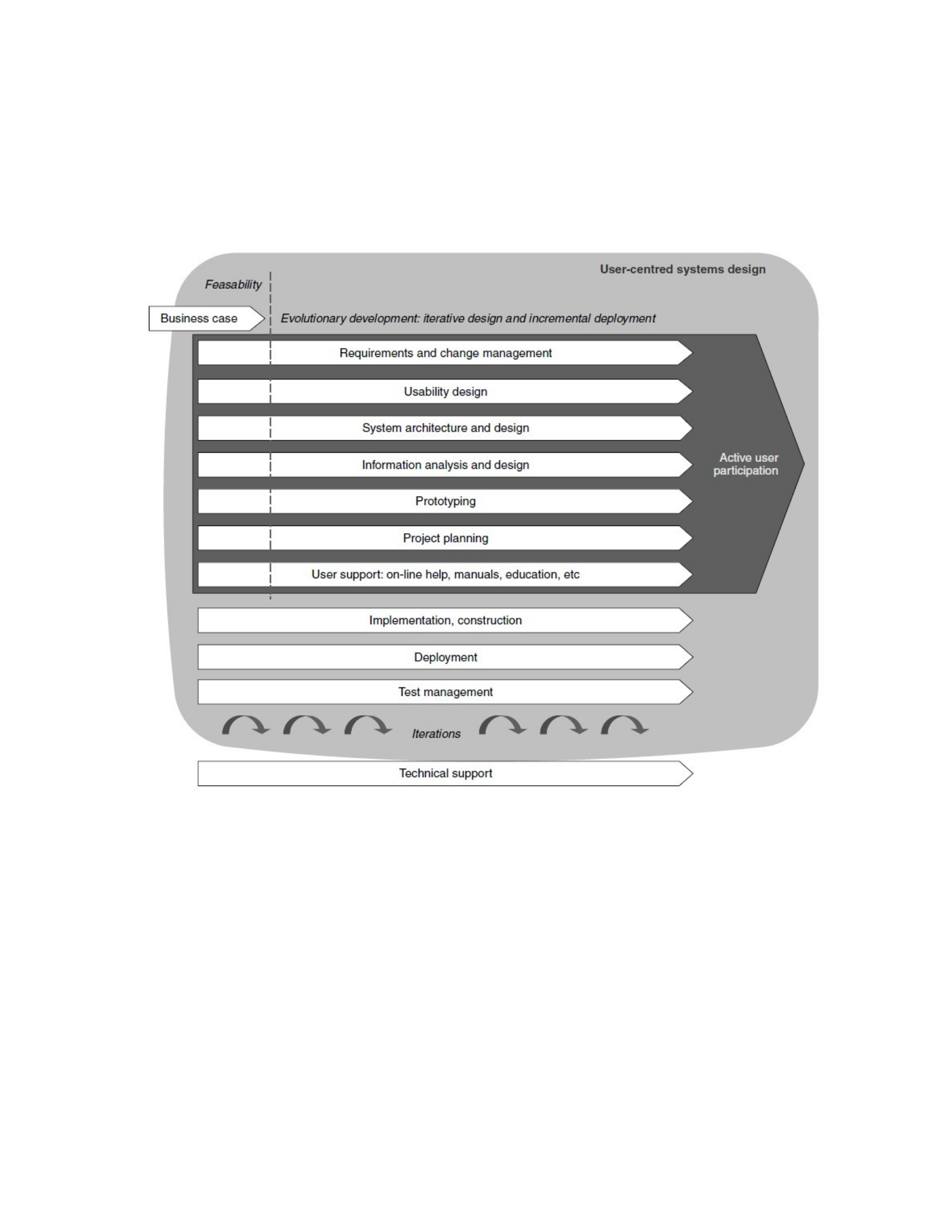
Figure 4. Draft framework for a user-centered system design (Göransson et al., 2003).
Any framework or initiative that focuses on customer involvement is a candidate
supporting framework. Göransson et al. (2003) indicated that user-centered system design
(UCSD) focuses on usability throughout the design and development activity (see Figure 4),
making it a supporting model of TQM. Shah (2014) noted that UCSD can be culturally driven,
working well in cultures that value individuals over organizations. Hill (2008) stated that TQM
focuses on customer satisfaction through the design of both processes and products and

Göransson et al. (2003) added that UCSD does as well. UCSD supports TQM as it focuses on
customer satisfaction, process design, and product design.
Contrasting Conceptual Models
Several of the contemporary models of quality management solutions are also contrasting
models due to variances from TQM. Lyu and Liang (2014) explained that Six Sigma focuses on
quality as a function of meeting specifications instead of customer satisfaction. Similarly, Misra
et al. (2014) indicated that CMM/I is based on the tenets of TQM but also focuses on process
improvement and control of quality through inspections as opposed to building quality into the
product. Liberatore and Pollack-Johnson (2013) explained that ISO 9000, like Six Sigma, defines
quality as conformance to specifications as opposed to customer satisfaction.
Another contrasting model is management by objectives (MBO). Deming (1985)
explained that MBO seeks to improve organizational performance by aligning subordinate goals
and objectives throughout the org, typically implemented as a supervisory rating system.
Houston and Dockstader (1997) noted that this management theory is so contrary to the epitome
of TQM that they recommend eliminating the practice altogether. Deming (1985) agreed, basing
his perspective on the notion that the effects of MBO are a focus on short-term performance,
reduction in teamwork, and lower individual morale. Spinellis (2014a) added that attempts to
implement MBO are not successful at achieving higher-level objectives. The differences are so
significant that MBO and TQM may be incompatible.
Critical Evaluation of Themes
The forefathers of TQM believe that quality is a complex idea and could not agree on a
single view (Crosby, 1992; Deming, 1982; Feigenbaum, 1985; Hill, 2008; Ishikawa, 1984;

Shanmugasundaram & Vikram, 2015; Shewhart, 1939). Many of them agreed that customers
should be involved in the definition of quality and in the process of achieving quality (Deming,
1982; Feigenbaum, 1985; Hill, 2008; Ishikawa, 1984; Shewhart, 1939). All of the forefathers
agreed that quality should be built-in from the start (Hill, 2008) and most also agreed that the
process of developing a product is as important to quality as the product definition itself (Crosby,
1992; Deming, 1985; Hill, 2008; Richardson et al., 2012; Shewhart, 1939). Most of the
forefathers believed that leadership commitment to quality is important and that quality efforts
should extend to all departments and vendors (Crosby, 1992; Deming, 1985; Feigenbaum, 1985;
Ishikawa, 1984; Juran & Godfrey, 1999), leading to the idea that quality should involve everyone
(Deming, 1985; Feigenbaum, 1985; Ishikawa, 1984; Shanmugasundaram & Vikram, 2015). Most
of the forefathers also agreed that continuous improvement is critical to quality and should be
extended throughout the product development value chain (Deming, 1985; Ishikawa, 1984; Juran
& Godfrey, 1999; Shewhart, 1939; Tunkelo et al., 2013).
TQM and Bespoke Software Development
As with many conceptual frameworks, Shanmugasundaram and Vikram (2015) and
Topalović (2015) found that there is no widely-accepted definition of TQM. Hill (2008) defined
TQM as an organization’s culture, attitude, and structure towards providing customers with
products that satisfy their needs. Barata and Cunha (2015) defined TQM as a philosophy that
imposes a systematic view of managing an organization for the purpose of continuous process
improvement. Gimenez-Espin, Jiménez-Jiménez, and Martínez-Costa (2013) defined TQM as a
management tool for competitive advantage and long-term success. Houston and Dockstader
(1997) and Sharma and Modgil (2015) defined TQM as a quantitative analysis to evaluate and
improve everyone’s ability to exceed the needs of consumers through improved purchasing,

supply chain management, and process improvement. The U.S. Department of the Navy adopted
Houston and Dockstader’s (1997) definition when they coined the term total quality management
to describe the process. With this much variation in the definition, there cannot possibly be
consistent contemporary implementation.
Even the primary components or tenets of TQM were in dispute. Liberatore and
PollackJohnson (2013) noted that customer focus, leadership, delivery, and employee
empowerment are the four components of TQM. Bon and Mustafa (2013) and Gimenez-Espin et
al. (2013) believed that continuous improvement, customer satisfaction, employee
empowerment, and leadership commitment are the four tenets. Talib, Rahman, and Akhtar
(2013) believed that four tenets are not sufficient to describe TQM and provide alternate views
that include strategic planning, information and analysis, process management, integrity, and
training. Customer satisfaction, continuous improvement, employee empowerment, and
leadership are the commonly perceived tenets of TQM.
Customer Satisfaction in Bespoke Software Quality
Defining a customer is critical to quality initiative leaders. Pérez-Aróstegui et al. (2015)
indicated that customer focus is part of the process design where customers are continually
involved in the process to attain customer satisfaction. Organizations must understand who their
customer is to achieve satisfaction. Houston and Dockstader (1997) indicated that, in the context
of TQM, a customer is a person who buys or uses the offered products or services. Cronemyr and
Danielsson (2013) indicated Houston and Dockstader’s definition refers to both the people that
buy products developed and sold by an enterprise as well as its employees that consume the
products and services delivered to them. Bespoke software quality initiatives focus on enterprise
employees as the customer (Göransson et al., 2003).

Researchers confirm what the forefathers of quality believed, that customer satisfaction
with bespoke software, or quality, is subjective. Goode, Lin, Tsai, and Jiang (2015) indicated that
customers have perceptions about the bespoke products they buy and the services with which
they interact. Liu et al. (2015) believed it is a combination of these perceptions that determine
their satisfaction with, or perceived quality of, the bespoke product or service. Hill (2008) noted
that the five identified considerations that affect perceptions of quality are psychological
impressions, fitness for use, supportability, meeting specifications, and value. I used the details
of the five components of customer satisfaction to highlight the differences in roles associated
with bespoke software quality.
Psychological impressions and customer satisfaction. How customers feel about using
bespoke products directly affects their perception of quality. Dai, Luo, Liao, and Cao (Dai, Luo,
Liao, & Cao, 2015) believed that one of the most poignant aspects of quality is psychological
impressions, which includes emotional and social factors. Zhou, Ji, and Jiao (2013) described
psychological impressions as indicators of how the customer feels about the product and using it.
Ding, Yang, Zhang, Liang, and Xia (2014) explained that ideas of reliability, credibility, security,
trust, intimacy, social responsibility, and environmental management all feed into this one
perception of quality. Dai et al. (Dai et al., 2015) and Liu et al. (2015) posited that satisfaction is
a combination of perceived value and trust while Singh and Jatain (2013) stated that usability is
directly related to the perception of bespoke product quality. Ameller, Galster, Avgeriou, and
Franch (2013) found that usability is one of the most important aspects related to the perception
of quality. No matter how well a product conforms to specifications or how mature the process
used to develop the product is, customers will perceive low quality if they become frustrated
while using the product or service.

Fitness for use and customer satisfaction. Fitness for use, like psychological
impressions, is itself a complex consideration. Atkinson and Benefield (2013) and Belk,
Papatheocharous, Germanakos, and Samaras (2013) found that customers tend to evaluate a
bespoke product’s or service’s fitness for use, or how well it enables them to achieve desired
outcomes. Ding et al. (2014), Lyu and Liang (2014), Shah (2014), and Shanmugasundaram and
Vikram (2015) found that fitness for use is comprised of availability, features that meet needs
(a.k.a. utility), safety, and overall design. Tunkelo et al. (2013) added aspects of integrity,
flexibility, and reusability to the concept of fitness for use. While overall fitness for use is a
component of quality, availability and reusability are two aspects of fitness for use that are
common considerations in architectural approaches to quality (Cleland-Huang, 2014).
Supportability and customer satisfaction. Customers may perceive low bespoke
software quality if it requires significant effort to correct issues when they occur. Mihalcin,
Mazzuchi, Sarkani, and Dever (2014) indicated that how well team members support a product
or service when something goes wrong is another aspect that affects a customer’s perception of
quality. Tunkelo et al. (2013) stated that customers have ideas of service-level agreements (SLA)
that define resolution times for support issues. Any variance from those SLA agreements affects
the customer’s perception of quality. Mihalcin et al. (2014) added that the net effect of resolution
time on quality also depends on the customer’s perceived level of significance of the issue.
Supportability and maintainability are two aspects of bespoke software that teams do not always
address in bespoke software development (Chen & Huang, 2009) yet architects cover them in
NFRs.
Meeting specifications and customer satisfaction. Bespoke software specifications
must reflect proper requirements to be valuable. Huckabee (2015) explained that technical and

functional specifications for a product or service define what the product or service should do
from the customer’s perspective. Bon and Mustafa (2013) and Shanmugasundaram and Vikram
(2015) found that some perspectives define quality purely as conformance to these specifications
and Shah (2014) added that teams must significantly consider maintaining the currency and
accuracy of specifications. Shanmugasundaram and Vikram (2015) concluded that, as a
neutralizing effect, customers view conformance to specifications as one of many aspects of a
product that drive their satisfaction. The quality of the requirements in the specifications is only
one aspect that influences the perception of quality (Ahmad, 2016).
Value and customer satisfaction. Cost and importance are central to perceived value of
bespoke software. Tyagi, Choudhary, Cai, and Yang (2015) believed that only customers can
define value and all of the previously mentioned aspects of customer satisfaction help customers
form that sense of value when attempting to perform a task. Thakurta (2013) added that the
perception of importance informs their idea of value. It appears that the greater importance a
product or service has when completing a task, the more valuable it is.
Hill (2008) and Liu et al. (2015) believed that product price, or cost to the customer, is an
integral part of the value proposition, as are overall quality and availability of the product when it
is needed or desired. Goode et al. (2015) believed that perceived security is also an important
aspect of value, though security is a relatively unstudied in the context of customer value. Price
paid influences perceived value in combined terms of fitness for use, psychological impressions,
supportability, and meeting specifications.
Quality is complex. Achieving bespoke software quality takes practice and cannot be
attained by addressing any single aspect of satisfaction. Lyu and Liang (2014) believed that all of
these elements of customer satisfaction interact with one another to form a perspective of quality

and achieving customer satisfaction requires good product design as well as good process design.
Chou and Chiang (2013) believed that customer satisfaction is reduced to a matter of trust in a
provider’s ability to meet needs. Deming (1985) stated that regularly measuring and improving
the perceived quality of the product is critical to long-term success. Implementing a set of
policies and procedures that constitute a culture of quality could help organizations maximize
customer satisfaction (Deming, 1982).
Policies of TQM
The policies of TQM help organizations achieve quality culture. Hill (2008) stated that
achieving customer satisfaction is realized through continuous improvement and involving
everyone. Alotaibi (2014) found that, of the practices associated with implementing TQM,
customer focus was one of a few that directly influenced the culture of quality. Deming (1982)
believed that the combination of continuous improvement and involving everyone drives a
culture of quality in an organization. Establishing a quality culture may be the best means of
achieving customer satisfaction.
Continuous improvement policy. Implementing a quality culture depends on a means of
improvement. Hill (2008) and Huang, Wu, and Chen (2013) defined CI as a policy used to
determine opportunities for improvement by evaluating existing processes. Bon and Mustafa
(2013) and Digalwar et al. (2014) stated that CI is central to quality management solutions and
Shanmugasundaram and Vikram (2015) believed that is true as perfection is an asymptote;
organizations will always be improving as customer satisfaction is always changing. Bon and
Mustafa (2013) and Talib et al. (2013) stated that properly implemented CI can create or improve
overall quality and customer satisfaction. According to TQM, customer satisfaction is the goal of
the bespoke software industry and CI should focus on achieving satisfaction.

Establishing a quality culture can be difficult. Hill (2008) found that impediments to
effectively implementing continuous improvement include poor training initiatives, poor
planning, poor leadership, changes in top management, and poor customer focus, potentially due
to the risk associated with a new leader implementing significant change programs.
Understanding the current state of an organization’s processes may help as Bon and Mustafa
(2013) mentioned that successful CI is dependent on benchmarking, which may include
collecting data from both customers and internal sources for use in statistical process control.
Organizations should work to overcome these barriers as Tunkelo et al. (2013) believed that
failure to implement CI may be part of the cause of low software quality. Quality should be
viewed as a culture (Deming, 1982) to improve the quality of bespoke software and should start
with benchmarking.
Everyone is involved in quality policy. Establishing a quality culture takes a team. A.
Brown (2014), Digalwar et al. (2014), Gimenez-Espin et al. (2013), and Hill (2008) found that CI
is a means of involving everyone and it must be instilled in organizational culture to be effective.
Joyce (2015) suggested that having one or more person(s) that champion CI and quality culture
can have a significant impact on the success of a TQM implementation. Involving everyone from
customers to product designers and process engineers helps to improve quality (Feigenbaum,
1985).
Empowering employees is part of implementing quality culture. Deming (1982) states
that quality should be everyone’s focus for a successful implementation. Bon and Mustafa (2013)
believed that empowering employees to drive quality by stopping processes when quality is low
is a trend in some industries and employee empowerment improves the effectiveness of TQM.
Bon and Mustafa (2013) also found that including employees in the implementation of TQM

affects commitment and inventiveness. Empowering leaders helps to instill a quality culture in
the organization (Bon & Mustafa, 2013).
Procedures of TQM
There are a few key procedures in TQM that can help improve the quality of bespoke
software. Despa (2015) and Hallisey et al. (2016) reported that designing effective processes,
providing problem-solving tools and services, designing a product or service that attends to the
components of quality, and benchmarking are procedures for implementing quality culture.
Effective processes and embedding quality in the product from the start will improve customer
satisfaction (Feigenbaum, 1985; Hill, 2008; Juran & Godfrey, 1999).
Process design procedure. There are a few means of improving existing processes. At
the project team level, Mitchell (2012) found that improving project-level shared knowledge
within the team has a positive influence on the process, specifically efficiency and product
quality. Additionally, Tunkelo (2013) found that implementing continuous improvement and
linking improvement to organizational quality culture results in improved processes. No matter
what the means of improving processes, Huang et al. (2013) stated that clear goals aligned with
business objectives should provide the basis for process improvement and A. Brown (2014)
noted that the Pareto principle should be used in process improvement to ensure teams focus on
the most critical processes. Improvements in the software development process directly improve
the quality of the product (Chen & Huang, 2009).
Process improvement can directly improve bespoke software quality. Chen and Huang
(2009) found that software projects that implement process improvement have higher levels of
maintainability in their products, potentially as a result of well-defined and clearly documented
processes. Marchewka (2013) agreed with Chen and Haung by concluding that performance,

product quality, and team productivity are directly proportional to process maturity levels. These
authors provide a contemporary validation of the forefathers’ thoughts on the effect of processes
on product quality.
Problem-solving procedures and tools. Having defined means for resolving problems
when they happen influences a customer’s perception of quality. Tunkelo et al. (2013) stated
that, when a user experiences a difficulty or problem while using a software solution, the means
of and total time to resolve those issues affects their perception of quality. Hallissy et al. (2016)
noted that one potential means of minimizing problem resolution times is to provide self-help
tools such as training, tutorials, and user guides. Tunkelo et al. (2013) added that when a user has
none of these means of solving problems on their own and have to call for support, tiered support
teams result in increased resolution time for each tier involved in the resolution. The nature of
problem-solving could be the basis for extended resolution times as Houston and Dockstader
(1997) found that resolution methods rely on the process of identifying and resolving problems
using a structured approach, such as Deming’s PDCA cycle. How quickly and easily problems
are solved influences the psychological impressions a user has of bespoke software solutions,
affecting their satisfaction.
Product or service design procedure. Including quality from the start influences
customers’ perceptions of the product as well. Deming (1982) believed that, instead of relying on
inspections to identify problems, teams should build quality into product design. Huckabee
(2015) and Joyce (2015) stated that customers should be involved in product or service design
from the beginning to maximize their satisfaction. One means of involving customers early in
product design is the use of prototypes. Despa (2015) and Göransson et al. (2003) stated that the
use of prototypes to validate design with stakeholders improves the overall quality of the

product. Prototypes can be a low-cost means of addressing quality as Cleland-Huang et al. (2013)
noted that teams build prototypes with specialized tools for rapid development to minimize
investment and maximize potential quality. Showing the customer that quality is builtin to
bespoke software from the start influences their perception of quality.
Benchmarking procedure. Continuous improvement as a basis for improvement must
have a means of comparison. Bon and Mustafa (2013) and Talib et al. (2013) stated that
continuous improvement depends on benchmarking. Digalwar et al. (2014) and Aleti, Buhnova,
Grunske, Koziolek, and Meedeniya (2013) noted that teams can implement CI by directly
measuring the attributes of a product related to its quality, by measuring improvements in
processes, or by measuring solution architecture optimizations. Gimenez-Espin et al. (2013) and
Tunkelo et al. (2013) added that benchmarking can also be implemented to gauge quality and
performance improvements in software solutions over time. Including customers in
benchmarking surveys to influence the quality of the bespoke software over time will affect their
satisfaction, and there are two critical roles responsible for involving the customer.
Architecture and Engineering Roles in Bespoke Software Development
Businesses are transforming the way they view IT and roles associated with bespoke
software development are adapting to this transformation differently. Andriole (2015) found that
contemporary businesses are transforming by replacing the business/IT divide with a
strategic/operational divide. Andriole (2015) also indicated this presents an issue as the majority
of IT workers have little to no expertise in what their business constituents do. Organizations
include enterprise architecture in their structure to address this concern as Keeling (2015) noted
that promoting business agility requires sound architecture. Simon, Fischbach, and Schoder

(2013, 2014) added that organizations depend on enterprise architecture teams to align people,
processes, and IT with business strategy. Enterprise architecture teams bring software engineers
and customers together to achieve quality.
Software engineers and engineering. Software engineers are relatively unstudied
aspects of bespoke software development. Mitchell (2012) stated that software implementation
(i.e. writing the code) is the phase of software development that has the greatest amount of
associated research. P. L. Li et al. (2015) agreed that most research has focused on aspects of
software engineering other than the software engineers themselves. The literature has a gap that
substantiates this research. Software engineers are one critical role involved in creating
highquality bespoke software (P. L. Li et al., 2015).
Software engineers. Opinions on components or aspects of a good software engineer—
regarding their effect on product quality—vary nearly as much as definitions of TQM. P. L. Li et
al. (2015) believed that software engineers must have design analysis skills, the ability to work in
culturally diverse teams, exposure to large-scale development, and ability to write quality code.
Alfaro and Chandrasekaran (2015) believe that software engineers must be able to communicate,
coordinate, and resolve conflict well within a team, noting that the critical elements are being
able to share and integrate information. Of 53 identified attributes, P. L. Li et al. (2015) noted
that passion for work, continuous improvement, sound decision-making skills, ability to deliver
elegant solutions that anticipate need, and evaluating the colloquial big picture are the most
critical aspects of a good software engineer. Mitchell (2012) added that the ability to share
knowledge through communication and adaptive mental models is important as well. A good
software engineer has attributes relating to the implementation (i.e. writing code) and delivery
aspects of bespoke software.

Despite some beliefs, there is a significant difference between software engineers and
solution architects. P. L. Li et al. (2015) indicated that software engineers with over 25 years of
experience could be considered architect-level software engineers. However, Spinellis (2015)
noted that software engineers do not always have time to consider changes or requirements from
an architectural perspective, adding that architecture can require significant investment in
education, training, and demands on time while on the job. Software engineers are not afforded
the time to address quality considerations of bespoke solutions.
Even when afforded the time, software engineers do not always focus on customer
satisfaction. Tunkelo et al. (2013) noted that software engineers do not always include all
elements of customer satisfaction or usability in their design as they focus on other aspects of the
solution. Göransson et al. (2003) indicated that solution usability is one consideration of
customer satisfaction usually viewed as secondary and someone else’s responsibility by software
engineers. Huckabee (2015), agreeing with the concepts of TQM, stated that software engineers
should embrace customer involvement to avoid reducing trust between customer and project or
program manager.
Additionally, organizations do not motivate software engineers towards customer
satisfaction. Verner et al. (2014) found that software engineer motivation is one of the leading
influencers of product quality and factors that influence the motivation of individual software
engineers vary by geographic region. Lyu and Liang (2014) indicated software engineer
motivation comprises some combination of effective project managers, effective scope and risk
management, customer focus, and software engineer rewards. Generally speaking, Göransson et
al. (2003) noted that customer focus is considered very low in importance for motivating

software engineers. Customer satisfaction is dependent on a role other than software engineer in
bespoke software development driving toward quality.
Software engineering. Following a well-defined software engineering process is critical
for software quality. Shah (2014) found that, while critics indicate that traditional processes are
overly mechanistic and the industry is moving toward more people-centric processes, the process
of developing bespoke software in practice frequently varies from recommendations.
Suryanarayana et al. (2015) stated that quality is adversely affected by this variance because the
effectiveness of a process is critical to the quality of the product. The variance in process affects
other aspects of product quality as well. Dehaghani and Hajrahimi (2013) reported that the
maintenance phase of software engineering represents around 90% of the total cost of developing
software, adding that the top five influencers of that cost are as follows:
•Project considerations (modern practices and tools),
•maintenance considerations (documentation quality, team capability, and
experience with the software),
•personnel considerations (experience and capability level),
•product considerations (required reliability and complexity), and
•hardware considerations (processing time and storage limitations).
Software engineers are not always responsible for quality issues. Chen and Huang (2009)
reported that poor documentation of requirements, poor design, and improper initial coding
negatively affect product quality. Aleti et al. (2013) found that, in some cases, software engineers
and the software engineering process rely on solution architects to deliver solution architecture
artifacts to start the development process and handle ambiguity. Software engineers and solution
architects working together toward customer satisfaction is an implementation of involving
everyone.

Enterprise and solution architects and architecture. Architects of all types are critical
to the quality of bespoke solutions. Woods (2014) stated that there are a wide variety of both
architects and definitions of architect responsibilities in the industry. Aleti et al. (2013) found
that architectural decisions have a significant impact on product quality by reducing complexity
and proving a blueprint for engineering tasks. Rozanski (2015) agreed that architects are
valuable, adding that it is important that they not demand perfection and be open to compromise.
Architects work with customers and software engineers to improve product quality (Ahmad,
2016).
Enterprise and solution architects. Enterprise and solution architects have the
perspective that software engineers cannot have. Woods (2014) stated that application and
enterprise architects focus their efforts on design-centric activity, leadership, stakeholder focus,
system-wide concerns, full life-cycle involvement, and balancing concerns. Suryanarayana et al.
(2015) found that an architect’s primary influence on quality is through product design and
process design. Product design and process design are two procedures for achieving quality in
TQM (Hill, 2008).
Balancing strategy with operations is one type of balancing concerns. Spinellis (2014a)
believed that balancing short and long-term goals has a positive effect on bespoke software
quality and Woods (2014) stated that the influence of architectural guidance and teams may not
immediately see the influence as architects tend to focus on long-term, strategic views over
short-term, tactical views. Klein (2016) noted that the means of architects adding value change
over the life of the product and proposes different types of architects for various phases: initial
designer, extender, and sustainer. Avgeriou, Kruchten, Nord, Ozkaya, and Seaman (2016)
mentioned that the idea of technical debt, or variations from the desired architecture to meet

timelines, is a means of balancing short- and long-term needs by tracking those variations so they
can be dealt with in the future, albeit at a higher cost. Extensibility, maintainability, availability,
and security are long-term considerations addressed by architecture (Canessane & Srinivasan,
2013; Cleland-Huang, 2014).
Requirements engineering including NFRs and knowledge of business processes are
critical to quality. Researchers van Vliet and Tang (2016) indicated that decisions are made
based on what people know at the time and the nature of the problem. Given that enterprise
architects align people, processes, and IT with business strategy, they are required to be
knowledgeable of business functions. Ameller, Ayala, et al. (2013) reminded us that architects
are the primary sources of NFRs and Cleland-Huang (2014) reminded us that architects use
NFRs to make decisions that influence bespoke software quality, including choosing from
myriad architectural patterns and styles that affect extensibility, maintainability, availability, and
security. Given this, empowering architects to make decisions may directly improve quality.
Bailey, Godbole, Knutson, and Krein (2013) stated that architect empowerment is so valuable
that they suggest that organizations should adapt to technical structural changes dictated by
architects. Aligning products and services with business needs and building quality in from the
beginning drive customer satisfaction.
Enterprise and solution architecture. Enterprise and solution architecture teams work
together tactically to drive customer satisfaction. Simon et al. (2013) stated that enterprise
architecture (EA) is a strategic concept implemented to help align people, processes, and IT with
business strategy, IT cost management, and platform portfolio management. Yi et al. (2013)
stated that solution architecture is one of four components of EA with the others being business
architecture, data architecture, and technical architecture. Spinellis (2015) believed that solution

architecture is most beneficial to bespoke software quality regarding maintainability, though it
can also support improvements in the development process and reusability. Yi et al. (2013)
indicated that the combination of component-based software development and enterprise
architecture improves maintainability of bespoke solutions through integration and sharing of
resources, resulting in a long-term improvement in the quality of the development process.
Enterprise and solution architects drive quality in ways that software engineers cannot.
Solution architects use NFRs to maximize quality attributes of bespoke software. Cleland-
Huang (2014) noted that, from the perspective of product design, clear requirements— both
functional and nonfunctional—are critical for establishing a valid solution architecture. Spinellis
(2015) believed this is true as solution architecture is about the principal components of a
solution and the interactions between them, continuing that inter-component communication is
directly related to quality attributes of performance, reliability, and scalability. Horcas, Pinto, and
Fuentes (2016) indicated that typical quality attributes of software systems include availability,
extensibility, interoperability, performance, reliability, scalability, security, and safety. Ameller,
Galster, et al. (2013) and Göransson et al. (2003) found that quality attributes— such as
performance, usability, security, safety, reliability, and scalability—play an important role while
creating solution architectures, actually driving architecture in some cases. NFR elicitation is one
of the challenges in bespoke software development that results in low customer satisfaction.
Solution architects work to improve reuse through variability. Galster et al. (2014) stated
that variability, or the ability to adapt a software system to varying contexts and requirements, is
also driven by solution architecture. Horcas et al. (2016) stated that, conceptually similar to
reusability in this context, teams can achieve variability by interweaving quality attributes with a

software product line framework. Reuse of systems or system components can improve the
perception of quality in bespoke solutions.
Research Design in TQM, Architecture, and Software Engineering
The qualitative case study design appears to be popular in the context of information
technology and quality management research. Martini, Bosch, and Chaudron (2015) performed
an exploratory multiple case study on the factors that result in architectural technical debt in
software engineering. Richardson et al. (2012) performed case study research to identify factors
for managing global software engineering teams. Mitchell (2012) followed an exploratory case
study design to understand impediments to the creation and maintenance of shared knowledge in
software development teams. Of the studies on quality management represented in the selected
literature, more than 15 used a case study design. Similarly, of the studies involving solution
architecture or software engineering, more than 13 used a case study design. Of the remainder of
studies represented in the literature review, some relied on data retrieved in other studies that
used a case study design.
Critical Evaluation of Themes
Organizations of all types that choose to develop software for internal use regularly
experience low bespoke software quality (BSQ). Software that is developed in-house for
professional users is considered bespoke software (Göransson et al., 2003). Low BSQ is
prevalent in the industry (Ahmad, 2016; Atkinson & Benefield, 2013; Jones, 2015) and the
literature describes the following sources of BSQ issues:
•inadequate processes (i.e. SDLCs) for addressing quality needs;
•poor requirements engineering processes;
•not including nonfunctional requirements from the start;
•unqualified expectations of project costs and delivery timeline;

•not having a strong architecture from the beginning of the development cycle;
•lack of enforcement of good programming standards; and
•not implementing process improvement frameworks such as CMMI, Six Sigma,
or ISO 9000 (Ahmad, 2016; Ameller, Ayala, et al., 2013; Atkinson & Benefield,
2013; Cleland-Huang, 2014; Cleland-Huang et al., 2013; Gürses et al., 2013;
Kassab et al., 2014; Patwardhan, 2016; Ramasubbu et al., 2015).
Neither of the commonly implemented contemporary software development life cycles (SDLCs)
—Waterfall or Agile—adequately address quality needs in all bespoke development contexts
(Ramasubbu et al., 2015) resulting in low quality (Chen & Huang, 2009). Involving architecture
early in the bespoke software design cycle to manage and address nonfunctional requirements
significantly improves quality (Canessane & Srinivasan, 2013; Galster et al., 2014). Inadequate
requirement engineering processes are a significant source of problems in bespoke software
development (Chen & Huang, 2009) and nonfunctional requirements are critical to BSQ
(Thakurta, 2013) as architects use them to drive usability, reliability, performance, efficiency,
security, and maintainability (Ameller, Ayala, et al., 2013; Canessane & Srinivasan, 2013;
Cleland-Huang, 2014). Project management constraints such as timeline, budget, and resource
allocation are also sources of low BSQ (Ameller, Ayala, et al., 2013). I summarized the issues
with bespoke software quality as follows:
•Not having an effective process (poor requirements engineering, not including
architecture from the start, and not implementing process improvement),
•poor product design (not having strong architecture and not enforcing good
programming standards), and

•not including everyone in quality culture (unqualified expectations of project
costs and timelines).
TQM as a Conceptual Framework
TQM aligns very well with both the study of BSQ issues and as a means of addressing
low BSQ. The forefathers of TQM define quality as customer satisfaction (Deming, 1982;
Feigenbaum, 1985; Ishikawa, 1984; Juran & Godfrey, 1999; Shewhart, 1939). They also defined
value at price paid, meeting specifications, fitness for use, and psychological impressions as
components of customer satisfaction (Deming, 1985; Feigenbaum, 1985; Ishikawa, 1984; Juran
& Godfrey, 1999; Shewhart, 1939). The following policies of TQM address these aspects of
customer satisfaction: continuous improvement (Deming, 1985; Feigenbaum, 1985; Juran &
Godfrey, 1999; Shewhart, 1939) and involving everyone in quality (Deming, 1985; Feigenbaum,
1985; Ishikawa, 1984). The procedures for implementing TQM include designing effective
processes (Crosby, 1992; Juran & Godfrey, 1999) and designing quality products (Deming,
1985; Feigenbaum, 1985; Juran & Godfrey, 1999; Shewhart, 1939). Achieving continuous
improvement depends on a process of benchmarking (Bon & Mustafa, 2013) and designing
highquality products is dependent on including problem-solving tools (Despa, 2015; Hallissy et
al., 2016) and planning effective purchasing (Houston & Dockstader, 1997; Sharma & Modgil,
2015).
TQM and Bespoke Software Quality
In bespoke software development, customers are employees that use the software developed by
the organization (Cronemyr & Danielsson, 2013). These customers have a complex view of
quality (Goode et al., 2015) that is made up of psychological impressions, fitness for use,
supportability (a.k.a. maintainability), value, and meeting specifications (Hill, 2008).

Psychological impressions are a measure of how customers feel about using a product (Zhou et
al., 2013) including ideas of reliability, security, and usability (Ding et al., 2014; Galster et al.,
2014; Singh & Jatain, 2013). Usability is a driver of satisfaction based on efficiency and
effectiveness of use by the user (Wallace et al., 2013).
Fitness for use is a perception of how well bespoke software enables users to achieve
their desired outcomes (Atkinson & Benefield, 2013; Belk et al., 2013) including the concepts of
availability, usability, and flexibility (Shah, 2014; Tunkelo et al., 2013). Supportability is a
perception of how easy it is to correct issues when they occur and total resolution time is an
aspect of supportability that influences perceptions (Mihalcin et al., 2014). Specifications include
the functional and nonfunctional requirements of a system (Huckabee, 2015) and conformance to
specifications is one component of customer satisfaction (Shanmugasundaram & Vikram, 2015).
Customers should be involved in writing and validating these specifications to ensure high levels
of quality (Singh & Jatain, 2013). Value is influenced by the price paid, psychological
impressions, fitness for use, supportability, and meeting specifications (Tyagi et al., 2015).
Quality is complex and teams cannot achieve it by addressing any one of these aspects alone
(Lyu & Liang, 2014).
Addressing Low Bespoke Software Quality with TQM
Implementing TQM is analogous to creating a culture of quality. CI is central to
implementing quality management systems (Bon & Mustafa, 2013; Digalwar et al., 2014) and
failure to implement CI is one means of lowering BSQ (Tunkelo et al., 2013). Benchmarking key
quality metrics provides the basis for implementing CI (Bon & Mustafa, 2013) and establishing a
culture of quality based on CI requires including everyone in quality (A. Brown, 2014; Digalwar
et al., 2014; Gimenez-Espin et al., 2013).

Linking CI to both organizational quality culture and business objectives results in
welldesigned SDLCs (Huang et al., 2013; Tunkelo et al., 2013) and well-designed SDLCs lead to
higher quality bespoke software (Chen & Huang, 2009). Designing good bespoke software
includes making self-help tools (e.g. training, tutorials and user guides) available to users and
building quality in from the start via proper requirements and good architecture. Prototypes are
used to involve customers early to achieve quality (Despa, 2015; Göransson et al., 2003). These
themes in TQM align very well with the contemporary view of identifying and addressing issues
with bespoke software. For example:
•The industry is focusing on customer satisfaction as a measure of quality
(Göransson et al., 2003; Kassab et al., 2014; Wallace et al., 2013).
•SDLC processes are critical to product quality and should involve everyone
(Göransson et al., 2003; Ramasubbu et al., 2015; Shah, 2014; Singh & Jatain,
2013; Verner et al., 2014).
•Quality must be addressed early through NFR elicitation (Ameller, Ayala, et al.,
2013; Canessane & Srinivasan, 2013; Cleland-Huang, 2014; Göransson et al.,
2003; Thakurta, 2013).
Software Engineer and Solution Architect Influence on Bespoke Software Quality
Software engineers are critical to BSQ (P. L. Li et al., 2015) though do not always include
all aspects of customer satisfaction or usability (Göransson et al., 2003; Tunkelo et al., 2013).
They consider customer satisfaction and usability as not important or someone else’s
responsibility (Göransson et al., 2003). For various reasons, software engineers frequently vary
from recommended SDLC processes (Shah, 2014), though poor documentation of requirements
does negatively influence their ability to achieve quality (Chen & Huang, 2009).

Enterprise architecture is helping organizations bridge the strategic/tactical gap in
contemporary businesses (Andriole, 2015; Simon et al., 2013). Architects of all types are equally
as important to BSQ as software engineers (Aleti et al., 2013) and typically add the most value
through the design of processes and products (Suryanarayana et al., 2015). Architects help to
improve the issue of low-quality requirements by driving and using nonfunctional requirements
to influence BSQ and align to business strategy (Simon et al., 2013). Architects also work to
balance short and long-term needs to improve BSQ (Spinellis, 2014a), though teams may not
immediately realize architectural value as architects tend to focus on long-term considerations
(Woods, 2014).
Summary
Despite the inclusion of both software engineers and solution architects in the
development of bespoke software solutions, low BSQ remains prevalent in the industry. When
viewed through the lenses of TQM and industry-standard expectations of the roles, the two have
sufficient differences of responsibility related to achieving high-quality bespoke solutions. In
both research and practice, BSQ remains low despite role alignment to achieve quality.
I focused this literature review on articles that detailed the aspects of quality that
accentuate the difference between software engineers and solution architects. Each of the five
components of quality as perceived by customers—psychological impressions, fitness for use,
meeting specifications, support, and perceived value—have aspects that highlight these
differences. The following examples as stated in the literature emphasize the rationale for
reviewing the selected literature:
•Psychological impressions include the concept of usability and software
engineers believe that usability is not their responsibility.

•Fitness for use includes the concepts of availability and usability. Software
engineers are not always able to consider these architectural perspectives.
•Customers consider meeting specifications as one aspect of quality and software
engineers tend to treat conformance to specifications as quality.
•Nonfunctional requirements (NFRs) partially control bespoke software quality.
Either architects are the source of NFRs or NFRs are not included in
specifications.
•Bespoke software development processes should include everyone though
software engineers do not always consider customer perspectives.
Transition and Summary
In this section, I introduced my research, including a brief background, problem and
purpose statements, research questions, an introduction to the selected conceptual framework,
and a literature review of the framework and topic of the study. Bespoke software has quality
issues that I summarized as having a poor requirements engineering processes, not including
nonfunctional requirements from the start, having unqualified expectations of project costs and
delivery timeline, and not having a robust architecture from the outset of the development cycle.
According to TQM as a conceptual framework, quality is a culture that involves everyone in the
continuous improvement of both processes and products to maximize customer satisfaction. In
this context, I summarized the issues associated with bespoke software quality as not having an
effective process (poor requirements engineering, not including nonfunctional requirements or
architecture from the start), poor product design (not having strong architecture from the start,
not having good requirements), and not including everyone in quality culture (unqualified
expectations of project costs and timelines). It is unclear, according to the literature, why two

traditional roles involved in bespoke software development (software engineers and solution
architects) are not able to achieve higher levels of customer satisfaction working together.
I defined the planned execution of the study in section two. I included the intended
population and sampling method to select participants; details of the research methodology and
design that I used; how I collected, organized, and analyzed data; and the ethical, reliability, and
validity considerations that I implemented in section two. I presented the results of executing the
research and analyzing the data, drawing conclusions, and reporting on impacts to society and the
target population in section three.

Section 2: The Project
Purpose Statement
The purpose of this qualitative exploratory case study was to explore strategies used by
software and enterprise architects for applying architectural best practices to improve bespoke
software quality, lowering the total cost of ownership. The population for this study comprised
application and enterprise architects associated with the delivery of bespoke software for the
enterprise architecture team at a large enterprise in the Nashville, TN metropolitan area. A wide
variety of organizations can use the findings from this study to help realize and understand the
benefits of having strategies architects can apply to improve the quality of bespoke software
solutions. The potential social impact of this study is improved work-life balance, morale, and
productivity of software and enterprise architects through streamlining development and
maintenance activities.
Role of the Researcher
The nature of qualitative research dictates that the researcher is a primary data collection
instrument (Yin, 1981). In my study, as the sole researcher, I was that primary data collection
instrument. I played the role of the interviewer and collector of all data from all sources that
informed the study, analyzed all the data, and authored the final report. I was familiar with the
topic of this research as I had served in various roles as a solution architect and developer since
1995. I had lived in the target geographic area (metropolitan Nashville, TN area) since 2011 and
had performed work at three major organizations in the area. Additionally, the case organization
that agreed to participate in my research was the enterprise architecture team (EAT) at my
employer’s organization. The EAT was a completely separate organizational structure from the

structure I reported to and I had no supervisory or subordinate roles with anyone in the EAT. I
did work with one member of the EAT on a regular basis.
Ethical research, as dictated by the Belmont Report and related protocols, requires a
balance between beneficence, justice, and respect for persons in all studies, which are partly
achieved through the use of informed consent (Faden et al., 2013; Lantos & Spertus, 2014; Ryan
et al., 2014). The epitome of ethical research is ensuring the researcher attends to all of the
following:
•The balance between risk and benefit,
•that the participants exposed to the risk are the ones who realize the benefit, and
•that potential participants control whether or not they participate (Faden et al.,
2013; Lantos & Spertus, 2014; Ryan et al., 2014).
I achieved this balance by treating all participants equally, fairly, with respect, and by following
the processes described in the ethical research section.
Bias is also a significant part of ethical research as it could influence the results of the
study (De Massis & Kotlar, 2014; Hyett et al., 2014; Yin, 1981). In qualitative research, bias is
mitigated through the use of multiple types of data sources, performing interviews with more
than one interviewee and from varying teams within the organization, following an interview
protocol, and implementing member checking (De Massis & Kotlar, 2014; Hyett et al., 2014;
Yin, 1981). Acceptable sources of data used to minimize bias include interviews, documentation,
historical records, and direct observation (De Massis & Kotlar, 2014; Hyett et al., 2014; Yin,
1981). I collected data from multiple sources, including interview data and organizational
documents such as policy and procedure manuals. I detailed of the data collection procedures I
used in the data collection section.

The case study research design requires documenting and following protocols to establish
and maintain rigor (Cronin, 2014). As an example, researchers must conduct all interviews with
the same introduction, the same general questions, and with the same tools (Cronin, 2014).
However, exploratory studies also require improvisation in interviews, emphasizing data
saturation and rich descriptions (Galster, Avgeriou, & Tofan, 2013). I followed a semistructured
interview approach using the protocol (see Appendix A) detailed in the data collection technique
section. I used the protocol in Appendix B to document field notes and observations during
interviews with participating architects.
Participants
In qualitative research, researchers frequently seek participants for their ability to provide
rich descriptions of the phenomenon (Draper, 2015; Petty, Thomson, & Stew, 2012; Wahyuni,
2012). The case for my exploratory case study was the EAT of my employer’s enterprise. The
criteria for participation included the following: (a) individuals that were fulltime employees of
the EAT in roles of application, solution, or enterprise architect as defined above, (b) individuals
that had been in architecture roles for a minimum of 5 years either in the EAT or at any
organization, (c) individuals that worked on projects focused on the delivery of bespoke
software, (d) individuals that worked or lived in the metropolitan area of Nashville, TN, and (e)
individuals with whom I did not have a recurring working relationship. I designed these criteria
to maximize the benefits of the research while minimizing risk to participants in the study.
Prior to any communication with potential participants in a study, researchers must gain
Institutional Review Board (IRB) approval to ensure proper protections are in place for human
participants, including the use of an informed consent process for potential participants (Faden et
al., 2013; Lantos & Spertus, 2014; Ryan et al., 2014). I obtained IRB approval from Walden

University’s Center for Research Quality (approval number 02-17-17-0539677) before
contacting or recruiting individual study participants. After receiving IRB approval, I followed
the desires of the vice president of technology – EAT at the case organization, which were to
forego the use of a gatekeeper and manage participants myself. I used organizational information
systems to identify potential participants, coordinated the informed consent process with
potential participants, and coordinated interview scheduling with each participant. I sent potential
participants a consent form and a copy of the signed letter of cooperation via email using the
invitation to participate email template in Appendix C to gain access to those participants.
Establishing rapport with participants is critical for effective and efficient data collection
in research based on a qualitative methodology (Shah, 2014). Developing the understanding that
the researcher is a member of the participant’s community, that is establishing a basis for
empathy with the participant, is part of establishing rapport (Chou & Chiang, 2013; Shah, 2014)
as is providing personal attention to the participant (Goode et al., 2015). I established rapport
with participants in multiple ways. First, I learned about the culture of the case organization,
adapting my attire and behavior to their standards. Second, I worked with each participant when
selecting a site for interviews to ensure I met their privacy and comfort needs. Third, I explained
to participants that I was familiar with the aspects of software development that we discussed
though may ask for an explanation of any unfamiliar terms. Fourth, I ensured that participants
knew that these sessions were about their experience and input, not mine.
Research Methodology and Design
While the terms method and methodology have been used interchangeably throughout the
literature, there is a distinction between the two (Wahyuni, 2012). A method is a means of
analyzing data, while a methodology provides a foundation on which researchers can choose an

appropriate design based on their beliefs (Wahyuni, 2012). True methodologies include
positivism, postpositivism, interpretivism, and pragmatism, and each has varying stances on
ontology (nature of reality), epistemology (what constitutes acceptable knowledge), and axiology
(the role of values; (Wahyuni, 2012).
Methodology
The actual nature of research methodologies influences their use in research. The more
common descriptions of methodologies—quantitative and qualitative (McCusker & Gunaydin,
2015; Wahyuni, 2012; Wells, Kolek, Williams, & Saunders, 2015)—are related to true
methodologies: positivism relates to quantitative, interpretivism relates to qualitative,
postpositivism could relate to either, and pragmatism relates to both (i.e. mixed methodologies)
(Wahyuni, 2012). Research designs tie the methodology to the methods, such that selecting one
methodology precludes the use of designs and methods associated with another methodology
(Wahyuni, 2012; Wells et al., 2015).
The more common understanding of methodologies also influences their use in research.
The quantitative research methodology is about measurement, identifying and explaining
relationships between aspects of a topic described in variables (De Massis & Kotlar, 2014;
McCusker & Gunaydin, 2015; Wahyuni, 2012). Conversely, the qualitative research
methodology is about exploration and creation of detailed understandings (De Massis & Kotlar,
2014; Wahyuni, 2012; Yin, 2014).
I explored the strategies used by architects in the pursuit of quality. The exploratory
nature of this study warranted the use of a qualitative methodology. After collecting qualitative
data using the techniques and procedures included in the data collection section, I interpreted the
data in the context of the selected conceptual framework (TQM in this study) and case

organization. Interpretive evaluation of data follows an interpretivist paradigm, which relates to
qualitative research. The combination of the explorative nature of this research and the
interpretivist nature of the data analysis dictated the use of a qualitative methodology.
Design
The common designs in qualitative applied research are phenomenology, ethnography,
and case study (Petty et al., 2012; Vaismoradi, Turunen, & Bondas, 2013; Yilmaz, 2013).
Phenomenological research has roots in psychology and philosophy with a goal of understanding
the essence of a phenomenon (Kruth, 2014; Petty et al., 2012; Sloan & Bowe, 2014).
Understanding the essence is achieved by exploring the experiences of individuals that have
firsthand experience with the phenomenon (Kruth, 2014; Petty et al., 2012; Sloan & Bowe,
2014). The significance of phenomenology is that the researcher describes what the phenomenon
under study is and how it is experienced (Sloan & Bowe, 2014).
Ethnographic research is focused on understanding behaviors, languages, and beliefs of
people in a cultural group (Draper, 2015; Kruth, 2014; Petty et al., 2012). With roots in
anthropology, ethnography requires a significant amount of time where the researcher is
immersed in the daily activities of the people under study (Draper, 2015; Kruth, 2014; Petty et
al., 2012). This firsthand exposure is the basis of the rich descriptions required of qualitative
research (Vaismoradi et al., 2013; Wahyuni, 2012; Yilmaz, 2013).
Case study research is focused on describing the complexity of the phenomenon of
interest (Hyett et al., 2014; Petty et al., 2012; Wahyuni, 2012; Yin, 1981). The phenomenon
under study is a real-world bounded system, or a case, and researchers study it in its natural
environment (Hyett et al., 2014; Petty et al., 2012; Wahyuni, 2012). A more comprehensive
description of the phenomenon can be established through the inclusion of multiple sites—

known as a collective case study—and multiple sources of data in the case study analysis (Hyett
et al., 2014; Wahyuni, 2012). The primary differentiator for case study research from other types
of research is that the bounded system, or a case that is easy to distinguish from other cases
(Kruth, 2014), becomes the focus of the research instead of the participants (Stake, 1978).
I explored strategies used by architects in the EAT team of my employer for applying
architectural best practices to maximize bespoke software quality. The focus was not the
architects themselves or the behaviors of all architects, making ethnography a poor fit. Similarly,
my research was not concerned with how architects experienced the strategies, just what
strategies they used, making phenomenology a poor fit. With the focus of my research being the
exploration of a phenomenon within a single case to develop an understanding of the case, I used
an exploratory single-case study design.
One critical aspect of rigorous case study research is data saturation. Data saturation is
achieved by spending sufficient time in the field collecting data to the point where the researcher
identifies no new data (Houghton, Casey, Shaw, & Murphy, 2013) or where any new data does
not continue to inform the research question (Gentles et al., 2015; Kruth, 2014). Effective
sampling methods are a means of achieving saturation (Petty et al., 2012). I achieved data
saturation in a few ways. First, I gathered data from semistructured interviews and organizational
documents. Second, I used member checking to ensure accurate and complete interpretation of
the data. Third, I employed census sampling with criteria that defined the population best suited
to inform my research. Fourth, I employed methodological triangulation (discussed in the Data
Analysis section).
Population and Sampling
The population for this research was application and enterprise architects that were
fulltime employees of the case organization, were involved with maximizing the quality of

bespoke software solutions, had worked in the industry as an architect for at least 5 years, lived
or worked in the Nashville TN metropolitan area, and did not have a recurring working
relationship with me. I applied these criteria as they provided the greatest ability to produce
detailed and valuable information on the phenomenon while minimizing potential risk and bias.
The case organization had 10 architects that met these criteria. Purposeful sampling depends on
selecting sources of information that can provide rich, in-depth details of the phenomenon under
study (Gentles et al., 2015; Petty et al., 2012; Wahyuni, 2012; Yilmaz, 2013). Based on the small
population size of the study and the criteria used to define the population, I included the entire
population as potential participants in my study.
Researchers achieve saturation by spending a significant amount of time in the field and
sampling enough data that no new information emerges from further sources of data (Gentles et
al., 2015; Houghton et al., 2013; Kruth, 2014). Methodological triangulation is the use of a
multistep process when analyzing data (Wahyuni, 2012) and helps to achieve saturation
(Houghton et al., 2013; Yilmaz, 2013). Member checking is also a means of achieving saturation,
giving participants the ability to read the researcher’s interpretations and provide any corrections
or additional information (De Massis & Kotlar, 2014; Petty et al., 2012; Yilmaz, 2013). I
gathered multiple sources of data including participant interviews and organizational documents
focused on strategies to maximize the quality of associated products to achieve saturation. I
employed methodological triangulation by using a research database, a transcription service to
transcribe audio data into text data, and thematic analysis for coding the data. I also implemented
member checking through followup sessions with interviewees to review my interpretations and
ensure saturation.

While performing face-to-face interviews, the location of the interview can have a
significant influence on the interview (Dempsey, Dowling, Larkin, & Murphy, 2016; Gagnon,
Jacob, & McCabe, 2015; Rimando et al., 2015). The interview location should be convenient,
comfortable, and provide a sense of safety/privacy for open conversations from the participant
(Dempsey et al., 2016; Gagnon et al., 2015; Rimando et al., 2015). I worked with participants to
identify sufficient meeting locations to suit their comfort, convenience, and privacy.
Ethical Research
There are three primary areas of ethical consideration in the Belmont Report: respect for
persons, beneficence, and justice (Ryan et al., 2014). Beneficence is concerned with ensuring the
benefits of the research are balanced with the risks (Faden et al., 2013; Ryan et al., 2014) and
justice is ensuring that one group doesn’t benefit from risks experienced by a different group
(Faden et al., 2013; Ryan et al., 2014). Respect for persons is concerned with allowing the
individual to control the parameters of their participation which researchers address through an
informed consent process (Lantos & Spertus, 2014; Ryan et al., 2014; Yilmaz, 2013). Every
research organization must have an IRB that validates all research meets or exceeds ethical
standards before executing the planned study (Faden et al., 2013; Lantos & Spertus, 2014; Ryan
et al., 2014). The risk associated with participation in this research was akin to the risk
encountered in everyday life and the participants in this study were part of the group that would
realize the benefits of this study, addressing beneficence and justice. I addressed respect for
persons with an informed consent process and allowed individual participants to end their
participation at any time without any consequences. I maximized respect for persons and
minimized the potential for coercion since I had no supervisory or subordinate relationship with
any of the potential participants. I also minimized the possibility of coercion by excluding those

potential participants that I had a regular working relationship with through the criteria for
participation.
Before any communication with potential participants in the study, I obtained IRB
approval (approval number 02-17-17-0539677) from Walden University. Once I received IRB
approval, I used information systems at the case organization to establish a list of potential
participants that met the defined criteria. Once I had a list of potential participants, I sent a
consent form and a copy of the signed letter of cooperation to those potential participants using
the invitation to participate email template in Appendix C and made myself available to answer
any questions any potential participants had.
The consent form included details of participant criteria, consent, withdrawal, incentives
for participation, data retention and protection policies, and individual identity protection.
Participants had the opportunity to withdraw at any time and for any reason during the study
without adverse effect or consequence. I asked that potential participants contact me either by
email address or mobile phone number to let me know of their decision. I ensured that potential
participants understood that they could withdraw by communicating with the researcher or by
contacting Walden University’s research participant advocate. The consent form included a
statement indicating that there was no compensation or any other incentive available for
participation aside from the altruistic benefits that they may realize.
I will retain all data obtained for this research in a locked safe, either in print form or
digital form based on the nature of the data, for five years from the date of final research
approval, where it will only be accessible to me. As noted below in the data collection section, I
recorded participant IDs on all collected data and the only place I associated individual names
with their respective participant IDs was in a spreadsheet that was stored electronically with the

study data. I password protected and encrypted this spreadsheet in addition to the encryption
applied to the remainder of the research data.
Data Collection
Collecting data for this study comprised the instruments that I used, the technique used to
collect the data, and the technique used to keep the data organized.
Instruments
The case study design and other qualitative research methods rely on the researcher as the
primary data collection instrument and the use of well-defined protocols to guide research
activities (De Massis & Kotlar, 2014; Petty et al., 2012; Wahyuni, 2012). In addition to actual
data collected from participants, it is valuable for researchers to document their observations.
Researchers use field notes to capture contextual information about the interview (De Massis &
Kotlar, 2014; Petty et al., 2012; Wahyuni, 2012) and reflexive journals to explain the rationale
for decisions, thoughts, and challenges the researcher experiences during the study (Houghton et
al., 2013; Sloan & Bowe, 2014; Vaismoradi et al., 2013). As noted in the Role of the Researcher
section, I was the primary data collection instrument.
I collected data via semistructured interviews using the protocol presented in Appendix A
to guide the interview. I asked participants to bring any available documents, multimedia
sources, or historical documents that supported the idea of maximizing quality with them to the
interview. I also worked with non-participant members of the case organization to collect policy
and procedure manuals and other organizational documents that explained quality procedures.
During interviews, I noted any observations I had about the participant, the environment, or the
general context as field notes using the protocol in Appendix B. I kept a reflexive journal

throughout my research, taking note of the basis of decisions and thoughts and perceptions of the
study in general.
Researchers use member checking, transcript review, and triangulation to maximize
research reliability and validity (De Massis & Kotlar, 2014; Houghton et al., 2013; Petty et al.,
2012; Yilmaz, 2013). Member checking is a means of achieving saturation by giving participants
the ability to read the researcher’s interpretations and provide corrections or additional
information (De Massis & Kotlar, 2014; Petty et al., 2012; Yilmaz, 2013). Triangulation is the
use of several sources of data to study a phenomenon (Houghton et al., 2013; Hyett et al., 2014;
Wahyuni, 2012). I iteratively used member checking (interviews and followup sessions with
interviewees to review my interpretations) until participant responses provided no new data, data
triangulation (use of interviews and organizational documents), and methodological triangulation
(study database, interview transcription, and coding) to maximize reliability and validity in my
study.
Data Collection Technique
After IRB approval and organizational agreement to participate, I used organizational
information systems to establish a list of potential participant names and contact information. I
met with each potential participant to determine interest in participation. When a potential
participant indicated an interest in participating, I confirmed consent, answered any questions,
and established times and locations for data collection. For document analysis, I collaborated
with senior leaders of the EAT organization to collect organizational documents that defined the
culture of the EAT organization related to quality.
For participant interviews, I sent a consent form and a copy of the signed letter of
cooperation to potential participants. Three individual potential participants decided not to

participate; I noted that in the Excel spreadsheet and moved on to the next potential participant.
When individual potential participants agreed to participate by signing the consent form, I
scheduled a time and a location with them and conducted the semistructured interviews. I
conducted on-site interviews at a location agreed to by the participant and followed the protocol
defined in Appendix A. I recorded the sessions using a portable audio recording device for
subsequent transcription and evaluation.
Member checking sessions provide participants with the ability to read the researcher’s
interpretations and comment with any corrections or additional information (De Massis & Kotlar,
2014; Petty et al., 2012; Yilmaz, 2013). At the conclusion of interviews, I scheduled a followup
session with each participant for member checking. I took copies of the transcription and
evaluation report to the followup interview and reviewed the evaluation report with the
participant. I gave each participant the opportunity to confirm, elaborate, or correct the
information they provided as they felt necessary. I recorded the audio of those followup sessions
and kept a copy of the updated transcriptions with the research data following the data retention
policy described in the consent form.
Data Organization Techniques
Using a research database improves the reliability of the research (Aleti et al., 2013; De
Massis & Kotlar, 2014; Petty et al., 2012) by providing a chain of evidence, logging where and
when I collected data (Cronin, 2014). I cataloged all data collected as part of the case study in a
computer-aided qualitative data analysis software tool (CAQDAS) named NVIVO 11 and—in
the case of physical artifacts—lockable file storage for review and retrieval; I will retain this data
in that lockable storage for five years. I indicated the date and participant ID that provided each
data source in the database and on physical instances of collected data, establishing a chain of

evidence. I cataloged all forms of data in this database including interview audio and
transcriptions, collected documents (all in digital form), field notes (digitized copies of physical
forms, which were destroyed after digitizing), and reflexive journals.
Data Analysis Techniques
Of the two primary modalities used in research, inductive and deductive, inductive
approaches rely on the collected data to provide themes and deductive approaches compare
categories in one study with those in a separate study (Kruth, 2014; Vaismoradi et al., 2013;
Yilmaz, 2013). Qualitative studies typically use inductive approaches (De Massis & Kotlar,
2014; Kruth, 2014; Yilmaz, 2013). Triangulation is the use of multiple sources of data, adding
credibility to inductive approaches and case study research (Cronin, 2014; De Massis & Kotlar,
2014; Houghton et al., 2013; Wahyuni, 2012).
There are four primary types of triangulation in qualitative research: data, investigator,
theory, and methodological (Fusch & Ness, 2015; Houghton et al., 2013; Wilson, 2014).
Investigator triangulation is applicable when more than one researcher participates in the study,
and theory triangulation applies when multiple theoretical strategies are employed (Fusch &
Ness, 2015; Wahyuni, 2012; Wilson, 2014). Researchers achieve data triangulation by gathering
multiple sources of data from more than one person or time (Houghton et al., 2013; Wahyuni,
2012; Wilson, 2014) and methodological triangulation is the use of multiple methods to analyze
and correlate data collected from multiple sources (Fusch & Ness, 2015; Houghton et al., 2013;
Wahyuni, 2012). The methods used in methodological triangulation include data storage
methods, transcribing audio sources and verifying the transcriptions, and removing personal or
organizational identifiers from the data (Wahyuni, 2012).

Content and thematic analysis are two common approaches for inductive analysis of
qualitative data (Petty et al., 2012; Vaismoradi et al., 2013; Wahyuni, 2012). Content analysis is
the identification of categories of information within the data and the categories are used to
quantify the phenomenon (McCusker & Gunaydin, 2015; Vaismoradi et al., 2013; Wahyuni,
2012). Thematic analysis is the inductive process of identifying codes within the qualitative data
which researchers group into larger themes that describe the phenomenon (Petty et al., 2012;
Vaismoradi et al., 2013; Wahyuni, 2012). The primary distinction between content analysis and
thematic analysis is quantitative frequency measuring of categories in content analysis is used as
a possible measure of significance (Vaismoradi et al., 2013).
I used both data and methodological triangulation in my study. Investigator triangulation
was not applicable as I was the only investigator in my research and theory triangulation did not
apply as I used one conceptual framework in my research. I achieved data triangulation by
collecting interview and organizational document data. Regarding methodological triangulation,
the method I used to analyze all gathered data began with collecting and organizing the data as
noted in the preceding sections.
I used a third-party transcription service (Rev.com) to transcribe the audio-based
recordings of interviews and member-checking sessions and validated the transcriptions using
transcription software (InqScribe). I had Rev.com complete the enclosed confidentiality
agreement (see Appendix D) to ensure privacy and confidentiality of participant information. I
loaded all data—transcriptions, documents, field notes, reflective journals—into NVivo for
coding and thematic analysis (I did not use content analysis). After reading through the collected
data a few times for familiarity, I began the coding process. I based coding on words and phrases
related to management of quality in software solutions (e.g. usability, satisfaction, requirements,

design, and performance) and recorded the words and phrases that I grouped into those codes for
future reference and verification. Once I defined the codes, I analyzed and evaluated those codes
and identified themes.
Throughout my study, I monitored the literature, results of member checking, and new
interviews for new information on my topic. No new academic research on the topic of strategies
used by enterprise and application architects in the pursuit of quality became available, and I
identified four new peer-reviewed articles on the topic. While no new information contradicted
data collected in interviews, I did request further member checking sessions to validate whether
the identified themes varied by organization or some other factor. All participants indicated that
the noted strategies were consistent across all organizations.
Reliability and Validity
Validity is a measure of how well the research studies what was intended (Kruth, 2014)
and reliability is a measure of how well the study could be repeated with relatively the same
outcome (Petty et al., 2012). Validity is classified as construct validity, external validity, internal
validity, and reliability for most research designs, though internal validity is not applicable to
exploratory studies (Galster et al., 2013; Holweg & Helo, 2014; Martini et al., 2015). Instead of
the four types of validity, qualitative research measures rigor based on credibility, dependability,
confirmability, and transferability (Houghton et al., 2013; Petty et al., 2012; Wahyuni, 2012).
Credibility is analogous to internal validity, dependability is analogous to reliability,
confirmability is analogous to objectivity, and transferability is analogous to external validity
(Yilmaz, 2013).
Credibility
Credibility is an indicator of how well the collected data represents the studied
phenomenon (Wahyuni, 2012) and how accurate or believable the participants in the study find

the results (Houghton et al., 2013; Yilmaz, 2013). Qualitative research that includes
triangulation, member checking, and prolonged engagement to achieve saturation establishes
credibility (Houghton et al., 2013; Petty et al., 2012; Yilmaz, 2013). As noted in the data
collection section, I used member checking as one means of establishing credibility. I also used
data triangulation through the collection of interview and organizational document data and
methodological triangulation with a multi-step process for organizing and analyzing the data. I
addressed credibility by requesting that participants not discuss any aspect of their participation
with others until I concluded the research.
Data saturation is achieved by spending sufficient time in the field collecting data to the
point where the researcher identifies no new information (Houghton et al., 2013) or where any
new data does not continue to inform the research question (Gentles et al., 2015; Kruth, 2014).
Effective sampling methods are a means of achieving saturation (Petty et al., 2012). I achieved
data saturation in a few ways. First, I gathered data from semistructured interviews and
organizational documents. Second, I used member checking to ensure accurate and complete
interpretation of the data. Third, I employed census sampling. Fourth, I employed
methodological triangulation (discussed in the Data Analysis section).
Dependability
Qualitative studies that employ audit trails, or chains of evidence, and reflexive journals
achieve dependability (Houghton et al., 2013; Wahyuni, 2012; Yilmaz, 2013). As noted in the
data collection and data organization sections above, I addressed dependability by including a
reflexive journal with the remainder of my study data. I also addressed dependability by
establishing the chain of evidence, recording when and from whom (using the Participant ID) I
collected data in my study database.

Confirmability
Confirmability is an indicator of the accuracy and neutrality of data collected for the
research (Houghton et al., 2013) and the objectivity of the researcher while working with it
(Petty et al., 2012). In simpler terms, it is an indicator of how effectively other researchers can
confirm the conclusions (Wahyuni, 2012). Studies that include audit trails, or chains of evidence,
and reflexive journals meet the needs of confirmability (Houghton et al., 2013; Petty et al., 2012;
Wahyuni, 2012; Yilmaz, 2013). As noted in the data collection and data organization sections
above, I recorded reflexive journals and stored them with the remainder of my study data. I also
recorded when and from whom I collected data, creating a chain of evidence.
Transferability
Transferability is an indicator of whether or not conclusions can be applied to other
contexts or situations (Houghton et al., 2013; Wahyuni, 2012; Yilmaz, 2013). Qualitative
research that establishes thick or rich descriptions of the setting, context, and participants
establish transferability (Houghton et al., 2013; Petty et al., 2012; Yilmaz, 2013). To determine
the transferability of results, I documented the details of the context and case in field notes as
well as the case report and final study report.
Transition and Summary
In section two, I provided details of the project, indicating that the purpose was to explore
how software and enterprise architects influence the quality of bespoke software solutions. I
performed all data collection, acting as the primary data collection instrument. I followed all
guidelines regarding the ethical treatment of participants outlined in the Belmont Report
including informed consent, though I targeted no protected groups as participants; architects
working on bespoke solutions were the intended participants. I used an exploratory qualitative

case study with the EAT of my employer as the case and used census sampling to select
participants to achieve data saturation. I collected data from interviews and organizational
documents and used NVivo as my research database to organize and analyze all collected data
and to keep a log of all decisions made during my research. I used both data and methodological
triangulation across multiple data sources to ensure saturation and completeness. I addressed
validity and reliability through member checking, using reflexive journals, keeping an audit trail,
and including details of my experiences with the topic and study participants. I recorded the
details of the study as executed in section three, including conclusions and recommendations for
future research.

Section 3: Application to Professional Practice and Implications for Change
Overview of Study
The purpose of this qualitative exploratory case study was to explore strategies used by
software and enterprise architects for applying architectural best practices to improve bespoke
software quality, lowering the total cost of ownership. I collected data from the enterprise
architecture team at a large enterprise in the Nashville Tennessee metropolitan area in the United
States, interviewing and performing member-checking sessions with seven enterprise or solution
architects and collecting 47 organizational documents. The architects I interviewed worked in
three distinct capacities (e.g. application, cloud, business, data, security, and governance) and
ranged in seniority (organizational chart, not tenure) from junior to senior on a 3-point scale. All
participants had between 5 and 15 years of architecture experience and most had between 6 and
15 years of software engineering experience. Two participants had less than 5 years of
experience as a software engineer.
The gender distribution of the participants was nonnormal, obviating the potential for
gender-based analysis and the seniority apportionment of the participants was roughly normal. I
categorized participants into two groups by years of experience as an architect, with five
participants having between 5 and 10 years of experience and two participants having between
11 and 15 years of experience. I also categorized participants into three groups based on the
number of years of experience as a software engineer. Two participants had between 1 and 5
years of experience, three participants had between 6 and 10 years of experience, and two
participants had 11 or more years of experience. My analysis of the data resulted in five
strategies for achieving the quality of bespoke solutions and indicated some variance in these
strategies by context.

Presentation of the Findings
The research question I sought to address was the following: What strategies do
application and enterprise architects use to apply architectural best practices to improve bespoke
software quality?
It is significant to note that the participants had widely varying thoughts on architectural
best practices. Three participants indicated that appropriate architectural best practices vary by
solution and team maturity while four participants indicated that these best practices serve only
as guidelines rather than blueprints for success. The perception of best practices as guidelines
influenced the results as the gathered data indicated the strategies application and enterprise
architects use to improve bespoke software quality, not the strategies they used to apply
architectural best practices.
Four of seven participants stated that the strategies they employ vary by context and the
defining context itself varied between participants. Four participants indicated that the strategies
vary based on the makeup of the development team (regarding team maturity and cultural
makeup), three of the participants stated that organizational culture influences the strategies they
employ, and two said that the newness of the technology or concept influences their strategies.
While participants indicated that strategies vary by context, all seven indicated that these
strategies apply to all organizations. I present the strategies in order from the most to the least
prevalent.
Focus on Customer Satisfaction
Focusing on customer satisfaction was one of the prominent themes. The concept was that
architects should focus their activities in the process of developing software on delivering
solutions to the customer’s needs. Activities range from participating in business requirements

definition and in buy-versus-build conversations to ensuring that solutions are available and
usable and that they foster positive user experiences. These activities are critical as delivering
bespoke software solutions is complex. Sometimes architects and software engineers create
architectures and designs with quality in mind, yet issues arise during development that require a
variance from the architecture or design. In those situations, decisions need to focus on
delivering solutions to meet customer needs and minimizing solution lifecycle costs.
There are a few ways that architects can minimize lifecycle costs. Delivering solutions
quickly, minimizing solution complexity, and simplifying issue resolution are a few cost-saving
measures. Assigning responsibilities to individual solution components and aligning overall
solution capabilities to those responsibilities is one means of maximizing maintainability. Doing
so helps minimize costs associated with testing, maintaining, and extending overall solution
capabilities. Deciding when to accept technical debt based on risk is one means of delivering
solutions quickly, though accepting technical debt does require tracking all assumed technical
debt so that teams can address it before it causes increased costs itself.
All seven participants indicated that focusing on achieving customer satisfaction is central
to improving quality and 32 of 47 organizational documents supported the theme (see Table 2 for
information source metrics). Six of the seven participants indicated that delivering solutions to
customer’s needs is part of focusing on customer satisfaction, mentioning that they participate in
and sometimes drive buy-versus-build conversations, business requirement definition, and
understanding the needs of all stakeholders. Twenty organizational documents supported those
ideas and showed that architects should drive positive user experiences, the availability of
solutions when users need them, and maximize the usability of solutions.
Table 2. M Themes of Focus on Customer Satisfaction with Supporting Metrics

Minor Themes of Focus on Customer Satisfaction with Supporting Metrics
Participant Document
Major/Minor Theme Count References Count References
Focus on customer satisfaction 7 41 32 95
Deliver solutions to their needs 6 12 20 55
Drive toward minimizing solution lifecycle costs 6 19 24 43
Perform trade-off analysis 5 8 20 65
Similarly, six of seven participants indicated that working to minimize lifecycle costs is
part of focusing on customer satisfaction. They stated that delivering and fixing issues quickly,
including support options that COTS solutions include, and determining when to delay the
implementation of specific architectural or design components based on risk analysis are all
means of minimizing costs. Twenty-four organizational documents supported these ideas by
recommending that architects follow best practices, drive data and solution component
efficiency, track technical debt with business impact in product backlogs, and discuss the
technical debt with product owners to prioritize its resolution.
Focusing on customer satisfaction aligns with the selected conceptual framework, as the
forefathers of TQM define quality as customer satisfaction and agreed that it is a complex topic
(Crosby, 1992; Deming, 1982; Feigenbaum, 1985; Ishikawa, 1984; Juran & Godfrey, 1999;
Shewhart, 1939). The forefathers found that customer satisfaction comprises psychological
impressions, fitness for use, meeting specifications, and the perception of value in the solution
(Deming, 1985; Feigenbaum, 1985; Ishikawa, 1984; Juran & Godfrey, 1999; Shewhart, 1939).
One of the participants summarized the feeling well, stating “And one other thing that we started
to focus…on is mostly about the user experience, customer experience and customer journeys.”
Authors in the literature agreed that having a customer focus improves product quality. Shah
(2014) showed that having a customer focus is critical to testing software solutions while

Cronemyr and Danielsson (2013) and Tunkelo, Hameri, and Pigneur (2013) indicated that
customer focus is essential to process management and improvement. The data and literature
both supported multiple aspects of focusing on customer satisfaction.
The collected data supported the TQM component of quality known as psychological
impressions, or how users feel about using bespoke solutions. One participant mentioned that
users consider reliability and consistent user experience when determining if they want to
continue using solutions, adding that architects should maximize those attributes. In the
literature, Goode, Lin, Tsai, and Jiang (2015) cited studies that linked customer focus to
perceptions of security, aligning with both the user’s psychological impressions and a
responsibility that architects typically address (security). Another participant supported the idea
of architects addressing psychological impressions by stating that architects focus, in part, on
improving user experience, though a third participant noted that architects take on this role only
in lieu of a dedicated person filling a user experience role on the team. Organizational documents
indicated that user interface (UI) or user experience (UX) architects in the organization have the
responsibility of ensuring solutions result in positive user experiences. Authors of these
organizational documents indicated that developers could address usability through aspects of
solutions including data validation, user feedback in the form of progress bars and other visual
indicators, being as intuitive as is possible, providing self-help tools, and ensuring a consistent
experience across solutions.
Additionally, the data supported the TQM concept of fitness for use, or the user’s ability
to achieve required outcomes with the solution. Two participants mentioned solutions must be
usable, indicating that usability includes the concepts of whether the system performs the
functions required by the user and that it is available when the user needs it. In the literature,

Zhou, Ji, and Jiao (2013) noted that user-centered design was one of the classic design paradigms
for maximizing the usability of solutions. A third participant supported alignment with fitness for
use, stating, “Quality to me is that you are delivering software that meets the…product market fit
may be the best way to say it. It is usable; it has value.” In the literature. Belk, Papatheocharous,
Germanakos, and Samaras (2013) and Göransson et al. (2003) suggested that following a
usercentric interface design improves solution usability. Organizational documents including
applied architectural principles and architectural toolkits supported the ideas of availability and
usability, denoting data availability standards, customer experience standards, and product
evaluation matrices.
The collected data also supported the TQM concept of meeting specifications through
product design. All seven of the participants indicated that they participate in solution
requirements engineering in some way. In the literature, Kassab et al. (2014) cite a study that
indicates teams that invested significant effort in requirements definition and architectural
definition at the beginning of the project realized an average of 92% cost savings over those that
invested minimal effort at the beginning. Two participants mentioned validating requirements,
including addressing requirements conveyed as solutions as opposed to actual business needs. A
third participant, who made the following statement, addressed the need for architects to validate
requirements that express solutions instead of needs:
Back in the 80s, technology was a black box and business people trust[ed] it as right and
they would give us legitimate business requirements. Now, they have got[sic] some
technology. Everybody has got[sic] a working understanding of technology, so they want
to be technologists. They do not give business requirements anymore. They give
technical requirements.

Another participant mentioned that architects are involved in ensuring everyone has a clear
understanding of the requirements and a fifth participant indicated that architects must validate
both functional and nonfunctional requirements. In the literature, Cleland-Huang (2014)
supported this, noting that focusing on functional requirements and ignoring NFRs and other
quality aspects lead to failed bespoke software solutions. The authors of organizational
documents collected as part of this research, such as architect role profiles, training documents,
and engagement documents, indicated that business and other architects are responsible for
capturing business requirements and monitoring business activities to identify needs that IT
solutions might support.
Participants and organizational documents also supported the TQM concepts of value and
supportability. One participant summarized the importance of architects, stating that enterprise
architects focus on how organizational information systems work together to deliver business
value. Authors of organizational documents focused on defining and measuring architectural
applied principles specifically noted how each principle aligns with related business value. Aside
from improving the quality of solutions, customer-centricity has other benefits as well. Three
participants noted that total cost of ownership, including operational and maintenance costs of
solutions, increases as the need for manual processing and additional development increases,
indicating that greater automation in solutions is one means of reducing operational costs and
increasing value. Authors of organizational training materials for architects emphasized the need
to maximize satisfaction by delivering solutions that add value beyond the immediate need. In
the literature, Avgeriou, Kruchten, Nord, Ozkaya, and Seaman (2016) discussed the concepts
that comprise total cost of ownership (TCO) while Aviles (2015) and Huckabee (2015) discussed
the idea that low TCO represents business value, aligning with the collected data.

One participant summarized the change in value proposition when organizational leaders
require that employees use bespoke solutions, indicating that the architect must work to ensure
the solution delivers value as there is no other incentive to deliver truly valuable solutions. In the
literature, Pass and Ronen (2014) agreed, mentioning that software solutions that are mandated
by regulation are immune from cost considerations as they are assigned infinite value. Similar to
other aspects of focusing on customer satisfaction, authors of organizational documents such as
architectural applied principles, operations guides, and presentations regarding the purpose of the
enterprise architecture team included several references to the financial performance of bespoke
solutions through attention to return on investment and return on equity. Aviles (2015), in the
literature, stated that customer focus is one of three enablers of collaborative relationships,
aligning well with other findings in my research.
Collaborate and Communicate with All Stakeholders
Collaborating and communicating effectively with all stakeholders was another
prominent theme. The essence of this theme was that architects participate in conversations with
both technical and nontechnical stakeholders and must be able to do so effectively. To be
effective at these communications, architects must exercise humility and actively listen to all
interested parties, yet act as a mentor when necessary or beneficial. Architects should continue
this communication throughout the life of the product and participate in defining a common
lexicon to reduce confusion and maximize the effectiveness of communications. Additionally,
architects should work with stakeholders to define KPIs and SLAs to facilitate conversations and
communications.
All seven participants indicated that collaborating and efficiently communicating with
stakeholders is central to improving quality (see Table 3 for information source metrics). Six of

the participants stated that architects should work to keep stakeholders happy by not considering
themselves experts, actively learning from both technical and nontechnical stakeholders at all
levels of the organization. Five of the participants indicated that architects should continuously
involve themselves in the solution, not only establishing credibility by interacting and mentoring
in real time but also by periodically monitoring the development team’s coding and progress to
ensure teams meet defined standards. Four of the participants discussed effective
communications, both verbal and written, by including appropriate diagrams and using a
common vocabulary based on the type of stakeholder with whom they are communicating. Two
participants indicated that defined KPIs or SLAs are a basis for establishing the importance or
significance of tasks in meetings.
Table 3. M Themes of Collaborate with All Stakeholders with Supporting Metrics
Minor Themes of Collaborate with All Stakeholders with Supporting Metrics
Participant Document
Major/Minor Theme Count References Count References
Collaborate and communicate with all stakeholders 7 37 24 79
Exercise humility 6 12 4 8
Be continuously involved in the solution 5 11 8 16
Effective communication with common vocabulary 4 6 21 43
Define and drive to KPIsa or SLAsb 2 2 3 3
Note: aKPIs are key performance indicators. bSLAs are service level agreements.
Additionally, authors of 24 organizational documents supported the theme (see Table 3
for information source metrics). Authors of training and policy manuals indicated that architects
should seek guidance from domain and application experts (i.e. other architects) for advice and
validation while also seeking the viewpoints of others and putting aside personal needs. In role
profiles and policy manuals, authors mentioned that architects should participate in design
reviews, create reference implementations, coach and mentor others when needed, and be one of
the first technical resources to be involved in projects. Authors of twenty-one organizational

documents of various types supported effective communication and common vocabulary either
by prescribing it as a tactic or by defining terms to facilitate communication. In three of the
organizational documents, authors provided a means of measuring KPIs or mentioned that
architects should focus on meeting KPIs.
Collaborating with all stakeholders aligns with TQM, but not completely as defined by
research participants at the case organization. Many of the forefathers of TQM believed that
involving everyone in quality is critical to achieving quality (Deming, 1982; Feigenbaum, 1985;
Ishikawa, 1984). One research participant explicitly linked this to architects, stating that they “…
think an architect wants to work with everyone on the team and understand where their strong
and their weak points are and encourage them to work together.” Support for this idea also exists
in the literature, as Simon, Fischbach, and Schoder (2013) found that enterprise architecture
teams must collaborate with all stakeholders to be effective. There are means of improving
collaboration and communication.
Having a clear vocabulary is one means of ensuring effective communications. In TQM
terms, Juran (1999) believed that ongoing communications were critical to quality as operational
needs constantly change, also believing that common vocabulary is crucial. From the literature,
Gürses, Seguran, and Zannone (2013) noted that using a controlled vocabulary is critical to
requirements engineering to limit ambiguity. One participant indicated the importance of having
a common vocabulary, stating, “…even in English, there are something like 2,000 different
English-speaking communities that speak it differently, so [having a shared understanding of
vocabulary] is extremely important.” Several other authors in the literature supported the idea.
Richardson et al. (2012) believed that team communications must use a clearly-defined, common
vocabulary. Another participant expressed the complexity involved in integrating systems, each

with their own lexicon, stating “It’s like speaking two different languages.” In some cases, teams
might address this on their own, naturally. Alfaro and Chandrasekaran (2015) noted that teams
tend to develop and communicate with a specific vocabulary. This natural creation of a common
language leads towards involving everyone in quality,
All stakeholders must be involved to achieve customer satisfaction. In TQM, Feigenbaum
(1985) introduced the idea that quality is everyone’s responsibility and Ishikawa (1984) added
that commitment to quality must exist throughout the organization. Spinellis (2014a), from the
literature, indicated that collaborating with all stakeholders was a significant part of one project’s
success. One participant stated that knowledge could come from anyone, pointing out that junior
people on the team may have new ideas that lead to innovation and senior people on the team
have detailed knowledge of the business and existing solutions, supporting the importance of
collaboration. Deming (1982) believed that collaboration and communication were so critical to
quality that organizations should build cultures that involve everyone in quality objectives.
TQM implementations rely on continuous improvement, which requires the use of
baselining, to drive decisions. Juran (1999) believed that establishing units of measure, much like
KPIs and SLAs, improves communication as they are the basis of continuous improvement,
adding that quality control councils are responsible for defining and monitoring the units of
measure. One participant indicated that they included the impact of KPIs on their architectures in
communication and collaboration. In the literature, Tunkelo, Hameri, and Pigneur (2013),
Huang, Wu, and Chen (2013), and Spinellis (2014a) all discussed the importance of KPIs in
facilitating communications. Deming (1982), conversely, believed that measuring through
metrics like KPIs is valuable for management and reporting but had no direct influence on
quality.

While there is alignment between the findings in this research and TQM, it may be
appropriate to use an alternate or multiple frameworks to evaluate portions of this data. I found
no mention of exercising humility from any of the forefathers of TQM, though it could be
inherent in the paradigm of involving everyone. This is significant as six of the participants
alluded to exercising humility in their interviews and, in the literature, Li, Ko, and Zhu (2015)
mentioned that—in addition to technical aptitude—effective development staff members have
personality traits that include being humble. French and Raven (1959) developed a theory titled
the bases of social power in 1959. This theory proposes five bases of power: reward power
(incentive-based power), coercive power (punishment-based power), legitimate power
(prescription-based power), referent power (personal-association-based power), and expert power
(expertise-based power). Appearances are that exercising humility would be akin to using
referent power to have stakeholders desire to conform as opposed to other types of power in this
theory, though a detailed understanding of bases of social power is required to reach that
conclusion.
Define Boundaries and Empower People within Them
The define boundaries and empower people within them theme has a dual meaning. The
first meaning is clearly defined team member roles and responsibilities support empowering
people within their roles. While defining the roles and responsibilities is a management function,
architects can empower other team members within those definitions and team members can
empower architects within their defined responsibilities. How stringently architects follow
management-defined boundaries depends on the technical maturity of the team, the newness of
the technology or concept, and the organizational culture.

This theme also means that architects should clearly define the boundaries of components
in a solution and empower software engineers within those boundaries. Architects define these
boundaries within the context of the holistic solution which they have bounded by aligning the
solution with corporate strategy. Within the defined boundaries, architects empower teammates
by only escalating variances from the defined boundaries when the variance creates moderate to
high risk of the solution not resulting in customer satisfaction.
All seven participants indicated that defining and working within boundaries is one means
of maximizing product quality (see Table 4 for information source metrics). The predominant
means of achieving quality, as mentioned by all seven participants, is to clearly define the
boundaries and empower people to take ownership within those boundaries, adding that holding
them accountable for their portion is part of empowerment. Three participants indicated that
architects should not confuse empowerment with autonomy, yet the importance of followups and
review sessions varies by the maturity of the team. One participant referred to clearly defined job
responsibilities and how that allowed them to work towards quality.
Table 4. M Themes of Define Boundaries and Empower People within Them
Minor Themes of Define Boundaries and Empower People within Them with Supporting Metrics
Participant Document
Major/Minor Theme Count References Count References
Define boundaries and empower people within them 7 28 15 36
Clearly define the boundaries 7 15 7 9
Escalate only when risk dictates 5 10 1 1
Align solutions with corporate strategy 4 11 13 36
Four of the participants (one senior and three intermediate in the organizational hierarchy)
indicated that aligning solutions to corporate strategy is a critical part of their role and significant
to the perception of quality. Regarding escalation, one participant mentioned that it should only

occur when there is a clear misunderstanding between business need and technical direction.
Four of the remaining participants agreed that escalation should only happen when associated
risks are high enough. The common preference amongst five of the participants was to use
persuasion over enforcement, supporting the idea of future research based on French and Raven’s
(1959) theory titled the bases of social power.
Additionally, authors of 15 organizational documents supported the theme (see Table 4
for information source metrics). Authors in seven documents supported defining clear boundaries
of which four describe different roles of architects along with the technical and expected
colloquial soft skills. The remaining three documents either were standards used in the tools for
evaluating architectures or were the tools for evaluating and presenting architectures. The author
of one organizational document discussed when escalation should occur, primarily focusing on
changes in architectural scope and the risk associated with that change.
In total, authors of 13 organizational documents discussed aligning solutions with
corporate strategy with some overlap of the seven documents that define technical boundaries.
Authors of these documents defined the standards and tools the architecture team uses to measure
the alignment of solutions with strategy. Some examples are disaster recovery and business
continuity standards, product roadmaps, and product evaluation matrices for measuring
alignment with corporate goals.
Defining boundaries and empowering people aligns with TQM, but not completely as
defined by research participants at the case organization. Juran (1999) noted that overall products
and their components must be defined with clear functional boundaries and alignment to the
organization's strategic goals, indicating that it is the team’s responsibility to set these limits.
Three research participants noted that architects should set technology, tool, middleware, and

library boundaries and the engineering team should stay within those boundaries while delivering
solutions. In the literature, Huckabee (2015) agreed, discussing how team members defined
boundaries for solution components with use cases and user stories. Defining boundaries and
aligning solutions to strategy are two parts of what make up an effective product or service
design in TQM as defining these boundaries is what allows teams to build quality in from the
beginning (Deming, 1982; Feigenbaum, 1985; Shewhart, 1939).
In the literature, Richardson et al. (2012) indicated that clearly defining and disseminating
roles and responsibilities of all team members to all team members is a best practice for teams.
Regarding team member roles and responsibilities in TQM, Juran (1999) noted that role
boundaries would fluctuate over time, similar to what one research participant mentioned as the
converging of application architect and software engineer. Another participant described the
current distinction between the role of architect and the role of engineer by stating that, “if [the
architect is doing it right], they are setting boundaries for [the developers], which they may or
may not like, but [the developers] still have a lot of freedom to design.” The sentiment supports
what Brown (2014) mentioned in the literature, empowering teammates within specified
boundaries. Hill (2008) and Bon and Mustafa (2013) noted that creating empowered employees
is one of the primary objectives of TQM.
Authors in the literature and research participants also discuss escalations. Tunkelo
(2013) mentioned that escalating issues to management was triggered based on an evaluation of
three critical aspects of the phenomenon being monitored exceeding expected thresholds. Four
research participants agreed with this concept, stating that escalations should only occur when
risks are high enough. Shah (2014) cited several incidents in her case study where elevated risk
based on specific KPIs resulted in the escalation of issues. The alignment between the findings in

this research and TQM are akin to those of the theme involving collaboration and communication
in that alternate or multiple frameworks may be appropriate. I found no mention of escalation
from any of the forefathers of TQM, though French and Raven’s (1959) theory titled the bases of
social power may address the idea of escalation. My initial thoughts are that escalation would
occur through a shift from legitimate power (where the influenced individual decides that they
want to change) to a coercive power (where the threat of punishment forces a change in the
person) or to an expert power (where one individual perceives the other as an expert). A detailed
understanding of this theory is required to support evaluation.
Deliver Prototypes and Work Products
While it is important to exhibit soft skills and have a focus on quality, it is equally as
important to deliver artifacts that help the development team meet those objectives. Artifacts
include prototypes or proofs of concept, models to describe solutions, and a defined set of tools
and technologies to implement the solution. Architects use models to support multiple views or
perspectives of a single solution and as a basis for many solutions. Similarly, architects use
prototypes to prove a set of technologies combine in a specific way to achieve a goal and to
mentor team members on implementation techniques. The level of detail that architects include
in prototypes varies. Detailed prototypes may not be necessary when the development team and
the architect have a good working relationship and understanding of the components of the
solution or when the team has a good knowledge of the included technology. Additionally,
architects may not need to spend as much effort fostering a relationship of trust through
delivering prototypes with the development team if the organization naturally empowers the
architect.

Six of seven participants indicated that delivering prototypes and work products are
critical to helping the team achieve quality (see Table 5 for information source metrics). Five of
those participants believed that prototypes should focus on high-level interactions between
components and prove that the technology concept works to support the solution. Three of the
participants believed that architects should not use prototypes to prescribe the use of specific
patterns unless they use the prototype to mentor the development team on implementation
strategies or new technologies.
Table 5. M Themes of Deliver Prototypes and Work Products with Supporting Metrics
Minor Themes of Deliver Prototypes and Work Products with Supporting Metrics
Participant Document
Major/Minor Theme Count References Count References
Deliver prototypes and work products 6 19 12 24
Prove the concept, don't prescribe patterns 3 6 1 2
Focus on high-level interactions 2 5 2 2
Mentor team members on technical implementations 2 3 11 15
Recommend technologies 2 2 3 3
Authors of twelve organizational documents supported delivering prototypes and work
products (see Table 5 for information source metrics). One document was a solution architecture
document in which authors (i.e. architects) included a background of the solution, a diagram of
current and proposed future states, data models, vocabularies, structural and deployment models,
and how the solution adheres to previously defined architectural principles and statements of
direction. Authors of other documents included the statements of direction and applied principles
that architects defined. The author of one policy manual mentioned that architects should create
reference implementations (i.e. prototypes) to aid the development team in the implementation.

Another organizational document is a technical quality assessment document, which architects
used to verify that development teams implemented solutions in accordance with the defined
architecture and that architects are tracking technical debt. Other document types included job
role descriptions in which authors define deliverables for each type of architect in the
organization, the work products and role of architectural governance teams, and competencies
defined by organizational leaders for each type of architect.
The delivery of prototypes and models directly aligns with TQM. Deming (1982) and
Juran (1999) noted that the use of prototypes is a common practice, with each component of the
prototype being as similar to the production counterpart as is reasonably possible. Six of the
seven research participants discussed using prototypes as blueprints for successful
implementations. In the literature, Simon, Fischbach, and Schoder (2013) discussed how
architecture-driven business models influenced their solution architectures and design processes.
Prototypes have specific uses in product lifecycles and Aleti et al. (2013) proposed the use of
architectural models when optimizing the quality of solution architectures.
When provided, architects used prototypes to indicate product direction, not fully
represent the final delivered product. Deming (1982) noted that these prototypes will not always
represent the outcome of the production runs due to required and unexpected variations during
production. One research participant stated “…part of what the prototype does is give the person
that I am handing this off to an assurance that it is gonna[sic] actually work when they put it
together.” Similarly, aligning with this from the literature, Göransson et al. (2003) noted the
importance of using less formal models and prototypes to facilitate communication with
stakeholders when following user-centric design.

Delivery of these prototypes must be timely to deliver the greatest value. In the literature,
Cleland-Huang, Hanmer, Supakkul, and Mirakhorli (2013) mentioned that prototypes should be
delivered early in the project to demonstrate the solution’s ability to meet quality goals. From a
TQM perspective, Juran (1999) pointed out that prototypes are used to test products in marketing
and that any results from those tests should be passed on to production teams. One research
participant indicated that they wrote prototypes before receiving full requirements specifications
and before they defined other solution documents.
Aside from prototypes, architects must deliver other work products as well. From a TQM
perspective, Juran (1999) promoted that the use of diagrams, schematics, and other specifications
including the 4+1 model of architecture. In the literature, Despa (2015) discussed projects where
teams improved quality by providing diagrams and quickly building prototypes to validate ideas
with stakeholders, refine specifications, and validate assumptions. Four research participants
discussed architect involvement in the definition and delivery of models (e.g. logical models and
physical models) and diagrams, with models providing a foundation for dynamically creating
different diagrams. On participant summarized the value of models over diagrams as models are
interactive and based on “a repository of data that has been blessed, that there is control over…,
that there is change management on.”
Use Process as a Guideline
The last identified theme was the use of process as a guideline rather than a prescriptive
model for daily tasks. One rationalization of this thought is that architecture tends to have no
formal time allocation in agile methodologies which can lead to inconsistent architectures and
lower product quality. The importance of process, however, varies by organizational culture.

When time-to-market is not the dominant driver in the culture, teams may use a more methodical
approach that includes detailed research before beginning development. Even in organizations
that do favor quick delivery, having a process that includes periodic reviews is essential to
quality, but those reviews are discouraged when they prevent quick delivery. For those reasons,
formal process definitions exist, though teams do not precisely follow them when they challenge
cultural drivers within the organization.
Four of seven participants indicated that process is more of a guideline than a prescriptive
notion (see Table 6 for information source metrics). Two of those participants mentioned that
benchmarking and measuring for continuous improvement is part of a prescribed process they
follow. Three of the participants indicated that they tend to vary from prescribed processes when
the processes are blocking progress or quality with one participant mentioning the challenges
architecture teams face with agile methodologies, given agile methods do not formally allot time
for architecture. Two participants noted that the importance of process varies by risk, stating that
a team developing medical devices requires more stringent processes than a team developing
games, as an example.
Table 6. M Themes of Use Process as a Guideline with Supporting Metrics
Minor Themes of Use Process as a Guideline with Supporting Metrics
Participant Document
Major/Minor Theme Count References Count References
Use process as a guideline 4 9 9 10
Benchmark, measure, and continuously improve 2 2 7 7
Process importance is driven by risk tolerance 3 5 1 1
Authors of nine organizational documents supported the theme of using processes as a
guideline (see Table 6 for information source metrics). The author of one document highlighted

the case organization’s use of architecture in their risk model, which prioritized delivery time
over comprehensive solutions. This document’s author addressed the role of architects in agile
development methodologies, noting that different types of architects have different deliverables
and responsibilities in various phases of the product’s lifecycle. For example, project architects
develop solution architecture documents in Sprint 0 to aid in project approvals. Also in Sprint 0,
project architects work with others to define business requirements, finalize solution architecture
documents, and prepare for technical quality assessment reviews. In sprints 1-n, project
architects prepare architectural scorecards to measure progress against approved architecture.
The author of another document defined architectural governance as a meta-model, explaining
how architectural governance interleaves with any development methodology teams prefer to
use. The authors of seven documents supported benchmarking and continuous improvement,
providing processes and tools to measure the solution’s quality alignment with organizational
objectives. Examples were the technical quality assessment and related architectural principles,
architectural scorecards, and role profiles that explained the role of architects in these activities.
Using process as a guideline does not align well with TQM. Deming (1982), Crosby
(1992), Ishikawa (1984), Juran (1999), and Shewhart (1939) all agreed that having a formal
process is the basis of continuous improvement, making it more than a simple guideline. One
research participant noted that delivering a product follows a process whether or not the team
follows a well-defined, formal process. That approach complicates continuous improvement.
Juran (1999) believed that determining continuous improvement relies on benchmarking of both
process and product. In the literature, Richardson et al. (2012) believed in process improvement
so much that they developed the global teaming model to extend the concepts introduced in

CMMI to geographically dispersed development teams due to process peculiarities in those
environments.The importance of formal process appears to vary by organizational culture.
Well-defined processes are not static and are not limited to specific activities. Crosby
(1982) noted that processes are important parts of all types of work, including creative work.
Deming (1982) and Juran (1999) agreed that customer satisfaction is not static; that it is
constantly changing. For that reason, processes and products must undergo continuous
improvement to maintain customer satisfaction (Shanmugasundaram & Vikram, 2015). One
participant summarized the overarching perceived perspective on process, stating the following:
Some people have…very regimented process[es], especially in terms of collaterals they deliver,
describing a solution. I do not…disagree with any of those, good or bad, I just don’t always use
them if I do not think they are necessary.
Applications to Professional Practice
The specific IT problem that formed the basis of this research was the perceived lack of
strategies used by enterprise and application architects in the industry for applying architectural
best practices to improve bespoke software quality. Participants in this research provided
strategies that other enterprise and application architects could apply to maximize bespoke
software quality. There were different thoughts on architectural best practices, indicating that the
myriad best practices in the industry applied to different types of projects in a variety of ways.
The majority of participants stated that they relied on industry best practices as a guideline as
opposed to prescriptive standards. After evaluating the collected data, I identified five primary
themes: focus on customer satisfaction, effectively collaborate and communicate with all
stakeholders, define boundaries and empower people within those boundaries, deliver prototypes
and work products, and use development processes as a guideline. There are a few ways that

organizations and individuals either in the role of architect or aspiring architects can use these
results.
Organizations that include bespoke software development in their capability model can
use these results to set or update organizational policies. The overarching policy is what W.
Edwards Deming referred to as a culture of quality, or making customer satisfaction the focus of
architectural activities. Organizational leaders can choose to implement this quality culture. In
the case of bespoke software development, the customer is the organizational employee that
consumes the solution. The policy should recommend that teams—and specifically architects—
collaborate and communicate with consumers to understand their needs and foster an overall
positive consumer experience.
Any organizational policy that establishes a culture of quality could follow the themes
found in this research, amongst others. Leaders should define the policy in a way that clearly
states roles and responsibilities such that individuals filling those roles know their
accountabilities and the accountabilities of others. To enable the intrinsic empowerment of
individuals filling the roles, organizational leaders should effectively communicate these roles
and responsibilities throughout the organization. As with any policy, implementation of these
roles and responsibilities should be governed and either incented or enforced. Organizations are
not the only entities that can use these results.
Individuals aspiring to be architects can use these findings as well. Senior developers and
people with no development background aspiring to become architects should learn to change
their definition of quality from technical quality to customer satisfaction. Changing their
definition of quality requires that they learn to understand their customer’s needs as fully as
possible and communicate effectively with both technical and nontechnical stakeholders.

Aspiring architects should also learn to deliver solution models and prototypes that prove the
concept without being production-ready solutions. They should also learn to use processes as a
guideline, knowing when to bypass the details of the process in the pursuit of customer
satisfaction. One more group can benefit from these findings.
Existing architects can use these results to evaluate the strategies they currently use. Most
of the participants in this research indicated that—while participating in the interviews—it was
interesting to consider the use of the strategies that they used in a way that they had not
considered before, influencing the way they now perceive their role. Focusing on customer
satisfaction does not simply mean talking with consumers about their needs. It means truly
understanding how they perceive quality, including minimized lifecycle costs, ensuring the
solution is available when they need it, ensuring the solution is usable by the customer’s
definition, and that the customer’s experience is positive throughout designing and implementing
the solution.
Implications for Social Change
My initial expectations for social change included improved work-life balance, morale,
and productivity of users and software and enterprise architects. I now believe those expectations
to be narrow and shortsighted as they focused on the architect. While I expected that architects
would benefit from the findings and recommendations of this research, customers, organizational
leaders, software engineers, and aspiring architects involved in delivering bespoke software will
also realize benefits.
Instilling the concept of quality culture has wide-ranging implications. Consumers of
bespoke solutions will realize better work-life balance through a reduction in required effort to
complete their work tasks. Organizations will realize a reduction in costs of both developing

bespoke solutions through lower defect rates and less time spend testing and remediating as well
as the cost savings associated with increased consumer efficiency. Software engineers will spend
less time remediating low-quality code and more time maximizing the efficiency of consumers.
All of these stakeholders will realize lower stress, improved work-life balance, and improved
morale.
The potential for social and cultural change exists outside of the case organization and IT
practitioners as well. When development teams improve the quality of bespoke solutions used to
deliver products and services, organizational costs are minimized and organizations could pass
those cost savings on to customers and other organizations. When organizations base the prices
of their products and services on the cost-plus-expenses model, a reduction in the cost of any
materials or aspects of delivering the product has the potential to affect the prices of all related
products and services. Reducing the cost of consumer goods and services benefits the overall
economy and society as consumers can choose how to manage the additional funds, either
through additional spending or through savings.
Additionally, organizational customer satisfaction would increase. Consumers, either
current or potential, become frustrated when communications with providers of products and
services have inefficient or ineffective communications. Increasing the efficiency and
effectiveness of organizational staff can result in better communications with customers. Better
communications and lower frustration levels result in less stress and better overall health of
consumers. I believe that many contemporary organizations have either forgotten about or
disregarded customer service, resulting in frustrated, unhappy, or lost customers. This lowered
sense of customer service can be, at least in part, addressed by improving the quality of bespoke
solutions employees use when interacting with customers. With enough implementation,

emphasis, and results, improved bespoke software quality could result in a societal shift away
from its current everything-is-disposable perspective when working to repair a product or service
becomes less costly—economically, emotionally, and otherwise—than replacing it.
Recommendations for Action
The architects from the case organization that participated in this research aligned with
the concepts of TQM. They focused on customer satisfaction by working to deliver available and
usable solutions at the lowest possible cost. I did not include a determination of whether or not
there was a perception of low-quality bespoke solutions at the case organization in this research,
making any recommendations for action within the case organization speculative at best.
Additionally, actions already taken by architecture team leaders to align the EAT with the
product development team were not included in this research, adding to the speculative nature of
recommendations within the case organization. The generalized recommendation with the
assumptions that the case organization does perceive the low quality of their bespoke solutions
and that work is already underway to align the architecture team with development teams is to
continue work activities to align the architecture team and product development teams. This
recommendation is appropriate for architecture team leaders and development team leaders alike.
Outside of the case organization, I recommend that organizational leaders consider
implementing or extending the implementation of a quality culture in their organization.
Potential actions include training not only architects but also development team leaders in the
concepts of TQM and the leadership skills found in French and Raven’s (1959) bases of social
power, focusing on the base that best aligns with their organizational culture. I also recommend
additional training in human-computer interactions and the psychology behind perceptions of
quality for appropriate leaders.

Recommendations for Further Study
I have several recommendations for further research, some deriving from the limitations
noted in this research and others arising from the findings of this study. The limitations of this
research included the potential influence of bias and preconceived notions on the results due to
the subjective nature of qualitative research. The first recommendation is to continue this
research as additional qualitative studies at other case organizations to compare and contrast the
results with those from one or more other case organizations. An additional limitation of this
research was the inability to generalize the results outside of the case organization due to the
nature of qualitative case study research. I recommend the continuation of this research as a
quantitative study to determine the generalizability of the findings.
Recommendations for further research based on the results of this research are varied.
Due to this research focusing on the architect’s involvement in quality, I recommend performing
the same research with software engineers instead of architects to compare and contrast the
results. The results would confirm or refute the perceived gap between architects and software
engineers.
One of the serendipitous comments from a few of the participants in this research was
that the roles of application architect and software engineer are converging. I recommend future
multiple case studies of application architects and enterprise architects as independent cases to
compare and contrast the results from each. This research would help identify the validity of the
perception of role convergence and possibly set a precedent for quantitative research, such as a
survey design, to determine the ubiquity of the perception.
While I considered including the concept of architect empowerment as a primary question in
this research, I decided to focus on overall strategies. Empowerment did arise briefly in the

reviewed literature and again in the collected data. I could not substantiate the concept of
empowerment by itself in the collected data, only in the context of empowerment within
boundaries. I recommend further qualitative research of the importance of architect
empowerment, perhaps using French and Raven’s (1959) Bases of Power as a framework.
Reflections
As a professional who has worked as both a software engineer and architect involved with
delivering bespoke software solutions, I have always held customer satisfaction in high regard. I
had academic exposure to the concepts of TQM and human-computer interactions several years
ago and worked throughout my career to implement the influences in bespoke software
development. In this research, I was as diligent as possible in my analysis to remain objective in
the results, though it is possible that I unknowingly and unintentionally biased this research
through the framing of interview questions and analysis of the collected data. While I remain
steadfast in my recommendation to focus on the complex concept of customer satisfaction, I have
realized that establishing a trust relationship with not only the consumers but the development
team is required. I understand that involves exercising both humility and diplomacy when the
organizational culture favors influential power over coercive, reward, or expert power.
Summary and Study Conclusion
The quality of bespoke software is both subjective and complex. It is a combination of
how the consumer feels about using the software, how well they can accomplish what they need
to accomplish with it, how well it meets their specifications, how easy it is to fix when something
goes wrong, and their perception of how valuable the software is. Only the consumer can
determine the quality of a software solution. In bespoke software development, there are many
opportunities to understand your consumer, to understand what quality means to them. The role

of the architect is more than technical mastery. It is more than the next colloquial rung in the
software engineering career ladder. It is personal. It is qualitative. It is customer-centricity. The
architect of bespoke solutions is responsible for bringing together two stakeholder groups with
diverse knowledge and understanding, leading them to quality: business consumers and
development teams. Accomplishing this requires deeply understanding and addressing both
group’s needs, doing so with diplomacy and humility.

