


CHAPTER I INTRODUCTION PROBLEM GROWING TENSION BETWEEN RUSSIA AND
THE WEST
Growing tension between Russia and the West created a security concern around the
political attitudes and loyalties of Russian-speakers living abroad. This issue is particularly
relevant for the Baltic states, post-Soviet nations, which are now members of the EU and NATO
and have a large Russian-speaking population. The question about the political attitudes of this
part of the population became relevant as a topic of research with the growing intensity of Russia’s
hybrid warfare aimed at neighboring countries. In hybrid operations, the Kremlin is aiming to
influence Russian ethnic minorities, Russian citizens, and quasi-citizens in an effort to undermine
cohesion among local populations of the targeted nations. These techniques were evident in the
operations against Georgia and Ukraine. However, as Brubaker argues, ethnic minorities are not
doomed to follow and obey the geopolitical agenda of their ethnocultural homeland. Their affinity
may vary as a function of socio-economic, political, and cultural factors.1
In times of geopolitical tensions, civil conflicts, and clashes of ethnocultural identities, it
is strategically important to understand what makes ethnic minorities choose one or the other side
in the triadic interrelation under pressure from the host-nation and the ethnocultural homeland.
When the ethnocultural homeland of an ethnic minority increases the scale of intervention into the
inner affairs of the neighboring countries using hybrid, cognitive and even military means, the
attitudes of ethnic minorities towards national security and defense policy become a strategic asset
for both sides.

This research examines the attitudes of ethnic minorities towards national defense and
security in a time of tension between the hosting nation and the ethnocultural homeland. Using
the Brubaker’s Triadic Nexus model as framework of analysis, I identify historical and
contemporary factors influencing the political moods and affinity of ethnic minorities generally,
and then apply them in a statistical analysis to the case of Estonia, where the orientation of
Russophones is targeted by both the nationalizing hosting nation and Russia as the ethnocultural
homeland. For this purpose, I analyze Public Opinion and National Defence Survey data collected
between 2001 and 2020, which allows an insight into residents’ attitudes and stances towards
national defense.
The survey distinguishes ethnic Estonian and non-Estonian (mainly Russian-speaking)
respondents and covers a great variety of factors. On the one hand, the survey provides information
about the socio-economic and ethnocultural background of the respondents. On the other hand, it
reflects their attitudes towards national security and defense policy. Using this data, I explore how
such factors as national pride, threat perception, personal welfare, socio-economic, and the
political situation in the country impact the attitudes of Russian-speakers toward the key aspects
of Estonian security and defense policy described in the National Security Concept. Using
regression models, I explore the direction and the magnitude of the effect of these factors and see
how much they can explain the formation of these attitudes.
While Estonian socio-cultural, geographic, and historical backgrounds create suitable
conditions for the research, the results of it may be applicable to other nations and cultures. The
hybrid warfare aimed to undermine social cohesion by affecting the attitudes of ethnic minorities
remains to be as relevant a problem today as it was in the past. In the age of proxy wars geopolitical
attitudes of ethnic minorities become a strategic asset.

BACKGROUND OF THE STUDY
After the collapse of the Soviet Union, several million Russian-speakers remained to live in
emerging or re-emerging post-Soviet states. In 1945 three percent of the Estonian population was
comprised of ethnically non-Estonians, but by 1989 this had increased to 38 percent.2 Most
newcomers during this period were of Slavic descent and were predominantly industrial workers.
Nowadays, almost one-third of the Estonian population are Russian-speakers.3 This is an ethnically
diverse population group, with Russian as a mother tongue. These are mostly the people who
moved to Estonia during the period of Soviet occupation from the other Soviet Republics and their
descendants. The Russian language as the lingua franca unites this community and distinguishes
them from ethnic Estonians, the majority of whom do not use the Russian language. Integration
of Russian-speakers into Estonian society is far from complete, partly due to the established
ethnocultural, social, and economic segregation between the two parts of the Estonian population.
One may assume that segregation is the legacy of the Soviet past, and it affects only older
generations who moved to Estonia during the Soviet occupation. However, some current socio-
political practices enhance the segregation affecting the younger generation, who were born in
independent Estonia. The current educational system is one of them. Segregation starts from the
kindergartens, which in most cases operate either in Estonian or Russian with some level of
Estonian language instruction. Russian-speaking children can attend Estonian kindergartens;
however, most of them study separately from Estonians. This segregation continues in primary
schools, and later leads to labor and habitational segregation. We still can find cities and regions
almost entirely populated by Russian-speakers. Narva, for example, the third largest city in

Estonia, is mostly populated by ethnically non-Estonians. 97 percent of the nearly 60,000 people
living there speak Russian as their mother tongue.4 While Narva can be considered a special case
due to its history and geographical proximity to Russia, the segregation may be found also in other
parts of the country, and in the largest cities like Tallinn and Tartu.
Nevertheless, socio-demographics is not the only thing that segregates Russian-speakers
and Estonians. These two parts of the population tend to have different views of history, political
attitudes, and international threat perception. The Estonian Ministry of Defense (MOD) conducts
a public-opinion survey twice a year, which demonstrates that the level of support to Estonian
security and defense policy, confidence in state institutions, attitudes towards membership in the
EU and NATO, and threat-perception varies between ethnic Estonians and the non-Estonian
population (mainly Russian-speakers).5 The lack of cohesion in the attitudes towards the main
aspect of national security and defense doctrine becomes a security concern when the dividing line
is formed based on ethnocultural identities, language, and socio-economic status, which go hand-
in-hand in a segregated environment.
The question of the political attitudes of this part of Russian-speakers living abroad became
relevant as a topic of research because of the growing tensions between Russia and the West. In
recent decades, the Kremlin has intensified efforts to restore the influence in the neighboring
countries and counter their liberal-democratic transition. Meanwhile, the threat of nuclear war has
almost entirely eliminated any desire of a direct armed conflict between nuclear powers or their
close allies. It increased the weight of hybrid warfare as a strategic instrument of power. With
dynamically developing information technologies, hybrid warfare has significantly shifted into the

direction of the cognitive domain targeting the population of the potential adversaries. Recent
conflicts have shown that in hybrid operations in the Near Abroad, the Kremlin is often aiming to
influence Russian ethnic minorities living abroad to undermine cohesion among local populations
of the targeted nations. These techniques we could see, for instance, in the operations against
Ukraine and Georgia. NATO and the EU member-states are also targeted and affected by Russia’s
hybrid warfare. The Baltic States, including Estonia, the members of the EU and NATO with a
significant proportion of segregated Russian-speaking population, and countries in close
geographical proximity to Russia remain to be the targets for Moscow’s geopolitical agenda.
Yet, it would be incorrect to see the Russian-speaking population in the Baltic States as
Russia’s “fifth column.” Brubaker argues that ethnic minorities are not doomed to follow and obey
the geopolitical agenda of their ethnocultural homeland.6 This agenda may in fact contradict the
interests of ethnic minorities as a community and social entity. However, it does not mean that
ethnic minorities would be loyal to the nationalizing host state. They may have their own
distinguished political stances of a dynamic nature that can vary in what Brubaker calls the Triadic
Nexus Model, the model of analysis of the triadic interrelation of the conflicting host nation and
ethnocultural homeland with ethnic minorities in between.7 Being an independent actor in this
triadic interrelation, ethnic minorities can stand on either side. The question is what makes them
choose one or another. Looking at the Triadic Nexus examples from recent history, I have come
up with a list of assumptions and hypotheses to apply to the case of Estonia.

RESEARCH DESIGN AND STRUCTURE
I test the hypotheses using statistical analysis of the Public Opinion and National Defense
Survey data gathered by the Estonian Ministry of Defense in the period between 2001 and 2020.
The data provides two types of information: first, the data illustrates the geopolitical attitudes of
the respondents and the extent of their support to Estonian security and defense posture. Second,
the data reveals the socio-economic and cultural background of the respondents. Building a linear
regression model based on theoretical framework and historical analysis, I examine how various
socio-economic factors and the level of national integration are influencing the attitudes of
Russian-speakers towards Estonian defense and security concept. This sheds light on the socio-
economic reasons for the vulnerability or robustness of national loyalty among ethnic minorities
in the condition of geopolitical tension between the host nation and the ethnocultural homeland.
This dissertation is structured as follows. First, I build a theoretical framework of how
socio-economic factors impact the robustness or fragility of national loyalty of ethnic minorities.
I present the Triadic Nexus as a model of analysis of interrelation between ethnic minorities,
ethnocultural homelands and the host nations. I explore the role of habit and cultural capital in the
formation of inter-ethnic social structures. In the third chapter I introduce Russia, Estonia, and
local Russian-speakers as the actors in the Triadic Nexus model. I describe the roots and
implications of Estonian nationalizing state-building and characterize Russian-speakers as ethnic
minority. Then I review how Russia’s foreign policy and the concept of the “Russian World”
evolved in time weaponizing the relations with Russian-speaking minorities living abroad. In the
fourth chapter of the dissertation, I give a historic overview of the Triadic Nexus conflicts from
the past and outline the factors that had an impact on the political affinity of ethnic minorities. The
next chapter is focused on Estonian security and defense policy, the attitudes to which become a

subject of the empirical analysis. Next, I present the methodology, and I conduct a quantitative
study exploring how the factors identified in the previous chapters affect Russian-speakers’
attitudes towards Estonian security and defense policy. Finally, I discuss how the results of the
statistical analysis resonate with the assumptions based on the historical observations. In the
conclusion I suggest options for further research.

CHAPTER II
TRANSNATIONALISM, DOXA AND THE TRIADIC NEXUS
This chapter evaluates the triadic interrelation between ethnic minorities, their
ethnocultural homeland, and the host state from the theoretical point of view. It introduces the
effects of transnationalism and established social structures in the Triadic Nexus as a model of
analysis.
TRANSNATIONALISM AND DIVIDED LOYALTY
The increasing globalization of the past century marked the beginning of this new concept
of migration.8 The constant flow of people, goods and information enhance transnationalism, the
social process in which migrants create social spaces that cross geographical, cultural, and political
borders.9 In these circumstances, the identity of the minority can be divided between host and kin
states. Transmigrants take part of their identity from the host state, which differentiates them from
their compatriots in their ethnocultural homeland, and part of their identity from the kin state,
differentiating them from natives of their state of residence. For them, the country of origin can
become a source of cultural and national identity and the country of residence, a source of legal
identity.10 The divided identity of transmigrants can become a serious problem in the case of
conflict between a host nation and the ethnocultural homeland. This section reviews theoretical
assumptions regarding transnationalism of ethnic minorities and the interrelation between host
nations, ethnic minorities, and their ethnocultural homelands. The main argument here is that
ethnic minorities are not doomed to follow the policy of their ethnocultural homeland, nor are they

always loyal to host nations. Their geopolitical attitudes depend on a variety of factors and have a
dynamic character.
Today we can hardly find an ethnically homogeneous country. In fact, nowadays there are
over 180 independent states in the world with 600 living language groups and over 5000
nationalities. As a result, we see that different ethnicities must share the territory of one country
and coexist with each other.12 There are a variety of forms of this coexistence, such as assimilation,
acculturation, cosmopolitanism, and multiculturalism.13 Assimilation is a radical form of
coexistence where ethnic minorities change their ethnic identity to integrate into the society of the
host nation. Cosmopolitanism is on the other side of the scale. It is based on refusal to recognize
the priority of national traditions and culture over the traditions and cultures of other countries and
peoples and declares that any manifestations of patriotism are primitive forms of human
consciousness.14
The way ethnic minorities are treated and their relationship with a hosting nation often
depend on whether they are part of the indigenous population or are migrants. However, this
dichotomy is not universal. For instance, in the case of Estonia, the Russian-speaking community
can hardly be called indigenous, except the Orthodox Old Believers who settled mainly on the
western coast of Lake Peipus, escaping from the persecution of the Russian Orthodox Church in
the late 17th century after its split.15 Nevertheless, it would be wrong to call the Russian-speakers
currently living in Estonia immigrants in the classic term. Most of the Estonian Russian-speakers

did not move to Estonia intentionally as to another country. Most of them moved or were relocated
in Soviet times, without crossing any international border. In 1991 they appeared to be living in a
“different” country - independent Estonia, which changed their civil status from major imperial
nation to a minority in an emerging nationalizing state.16 This situation is common for many cases
where ethnicities were separated by emerging borders on the ruins of the collapsed empires, be it
after WWI or after the Cold War.
Leaving the territory of the emerging nationalizing states, the regimes, such as the Austro-
Hungarian and the German Empire after WWI and the Soviet Union after the Cold War, left behind
many representatives of their ethnocultural kin. After the end of the Cold War and the collapse of
the USSR, over 25 million ethnic Russians found themselves living abroad.17 The collapse of the
Soviet Union changed not only geographical borders in Eastern Europe, but also the socio-political
status of ethnicities, particularly Russian-speakers in many post-Soviet countries. Notwithstanding
the geopolitical changes, many Russian-speakers remained socially and culturally affiliated with
their ethnocultural homeland. Cross-border communication with relatives in Russia, or other post-
Soviet states is still relevant for many Russian-speaking families in Estonia and other post-Soviet
republics.18 Meanwhile, the cultural space for Russian-speakers tends to differ from that of natives,
which creates considerable a difference in perceptions of geopolitical developments. Formally
living in one country, social and cultural Russian-speakers tend to live in transboundary spaces,
somewhere in the middle between their ethnocultural homeland and host states.

The phenomenon of transnationalism has led to a growing concern in international security
and geopolitical discussions.19 Leading commentators argued whether dual national identity,
especially when it is supported by dual citizenship, can produce competing loyalties, create a
security threat, impede immigrant integration, increase international instability, or violate
equality.20 Transmigrants with dual national identity can play different roles in international
relations, stability, and security, depending on geopolitical circumstances, position of kin, and the
hosting state and their interconnections. Depending on their political attitudes, transmigrants can
be the catalyst of either ethnic conflicts or peacebuilding. In the current fluid, globalized
geopolitical context, transmigrants tend to retain not only social and financial links to their
homeland, but also political ones. In some cases, this may lead to the situation where a national
minority can claim political membership in more than one state and become a political and
economic actor for both host and kin state. Problems can arise if the economic and political
interests of host and kin states conflict with each other, as it is in case of Western-oriented post-
Soviet states vis-à-vis Russia.
Strong transnational ties with an ethnocultural homeland may lead to divided loyalty of
ethnic minorities or straight-out aversion to host nation, which in the case of the conflict between
the host nation and ethnocultural homeland may become a significant security concern. On the one
hand, ethnic minorities may seek new identities that would either bring them practical benefits or
ease the acceptance and integration in the new socio-political environment. On the other hand,
even those willing to acquire a new national identity may find it hard to be accepted by the titular

ethnicity of a nationalizing state as an equal part of the community, because the core idea of the
nationalizing state is the society with a certain level of ethno-cultural hierarchy.21
The problem is not only caused by the unwillingness of the titular nation to accept ethnic
minorities as equal, but also by cultural and social differences. Russian-speakers in Estonia living
in a dense segregated community are culturally different, which makes it harder to integrate and
cooperate with ethnic Estonian counterparts. It is just naturally easier for representatives of the
same cultural space to find common ground for communication and ways of cooperation.22 The
Russophones’ transnational cultural ties (watching Russian movies, listening to Russian music,
following celebrations and cultural events) with Russia increase the cultural gap with the titular
ethnic group.23 Eventually it results in greater habitational, labor, and social segregation on both
an ethnic and linguistic basis. The studies conducted in Estonia showed that Russian-speakers
living in minority concentration neighborhoods are less likely to integrate into Estonian society.24
It can have a negative impact on the popular cohesion, especially when there is conflict between
the ethnocultural homeland and the host nation.
TRIADIC NEXUS AS THE MODEL OF RELATIONS BETWEEN ETHNIC MINORITIES,
ETHNOCULTURAL HOMELAND, AND HOST NATION
Conflict in the relations between ethnic minorities, their ethnocultural homeland, and host
nations may erupt for various reasons. Among them may be imperial ambitions and revanchism of
an ethnocultural homeland, ethno-centrism of the host nation, separatism of an ethnic minority, or

the combination (in most cases) of the three. This is the complex interrelation depicted by Brubaker
in the Triadic Nexus model, where nationalizing states, national minorities, and external national
homelands have their own interests and act according to their own aims, but all elements are bound
together in a single and highly interdependent relational nexus.25 Ethnocultural homeland in this
model, however, is not always a historical homeland of the ethnic minority. It can be a nation
claiming the ethnic minority as its own ethnocultural kin together with the rights to protect it
against unfair treatment by the nationalizing state. For instance, Russia is not an ethnocultural
homeland for South Ossetians, but arguably stands for their rights by protecting them against the
nationalizing state of Georgia. By giving Russian citizenship, Moscow gets not only the moral
right to protect, but in some sense also legitimizes the right for intervention.
In the Triadic Nexus model, a nationalizing state seeks to build a national-centric state with
a certain level of social cohesion and integration of minorities. Nationalizing policy can include
language and citizenship laws that establish ethnocultural hierarchy, where ethnic minorities must
either share or obey the political agenda of the titular nation. The external national homelands
claim responsibility to protect their ethnocultural kin, promote their welfare, and assert their
interests in other states. In the model the diaspora policy is aimed to engage ethnic minorities and
by doing it impact the nationalizing host nation. Depending on the context, the national minority
can take different positions in the triadic nexus interrelation between external national homeland
and host (nationalizing) state. Some members of the national minority may see the importance of
demonstrating their loyalty to the host state, while others may seek patronage or protection from
the external national homeland or international organizations.
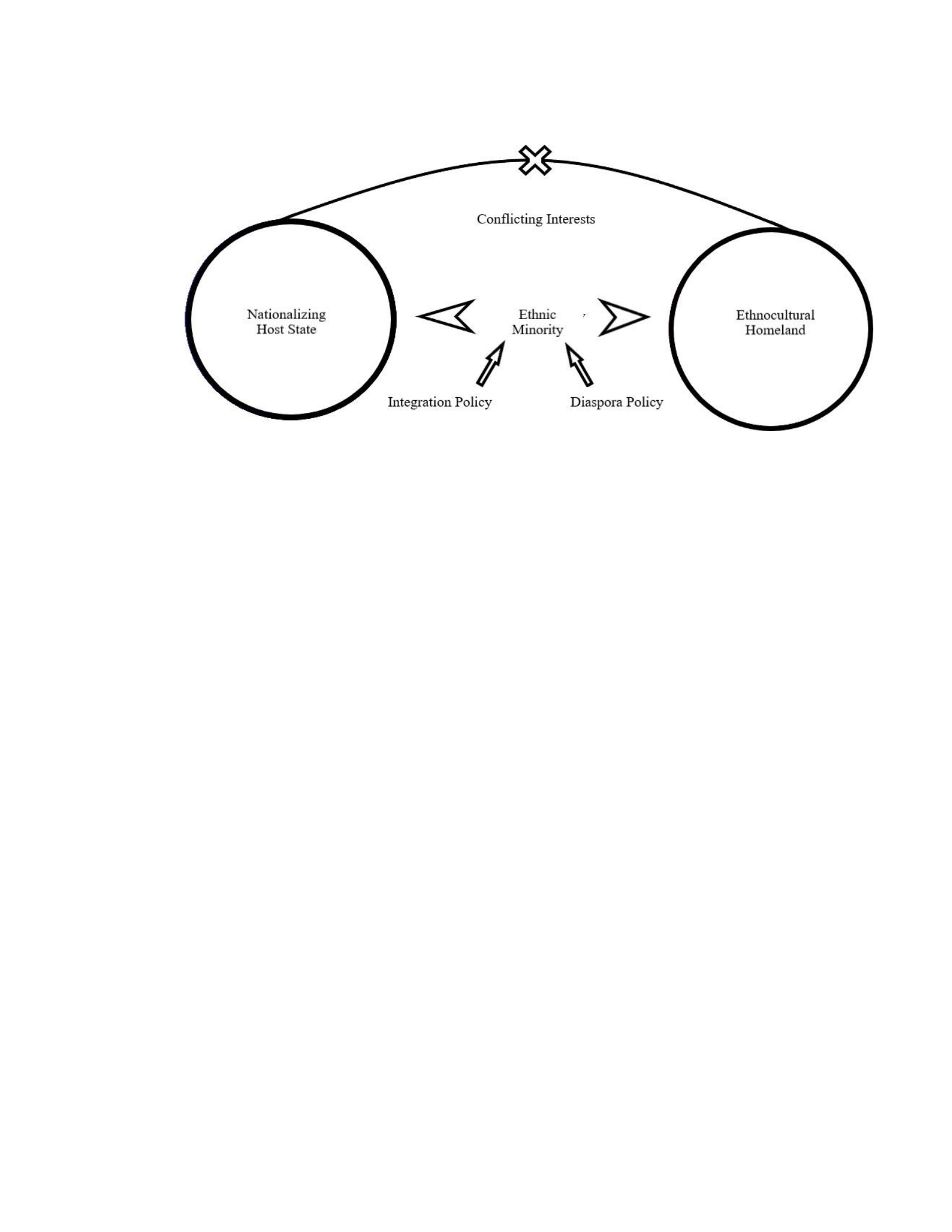
The Triadic Nexus model is applied by scholars to a great variety of cases, such as the
Abkhaz-Georgian ethnopolitical conflict,27 the complex ethnocultural situation in Kazakhstan,28
Status Law case in Hungary,29 and the escalation of separatism in Ukraine.30 The commonality in
these cases is the above-mentioned typology of actors and their shared “social field” where they
compete over resources, status, power, and other interests. Another thing that is common is the
general nature of intentions of the ethnocultural homeland and the nationalizing state as actors of
the Triadic Nexus. What varies is the disposition of the ethnic minority and circumstances affecting
it, such as the socio-economic, ethnocultural, and historical background of the interrelations.

Unlike many post-communist states including Moldova, Yugoslavia, Transcaucasian
Countries, and Ukraine, Estonia was able to control serious ethnic tensions and avoid violence and
separatism on ethnic grounds. Estonia could peacefully overcome circumstances favorable for the
eruption of ethnic violence in 1991-93, including an ethnically diverse population, the high social
cost of economic transition, the rapid drop in the status of local Russian-speakers (about 28% of
population at this time), the proximity of Russia, and the presence of Russian forces on the ground.
Most of the factors that contributed to the peaceful resolution of the Triadic Nexus in Estonia are
not obvious or tangible, argues Park.
DOXA AND CULTURAL CAPITAL IN THE INTER-ETHNIC SOCIAL HIERARCHY
Partly, we can explain the variety of the outcomes of the Triadic Nexus in the post-Soviet
space by the nature of the actors involved, their confidence, and ambitions. An American
anthropologist, Oscar Lewis, famous for his theory of poverty, considered that culture determines
a certain design for living with established patterns, which serves a major adaptive function.32 The
somewhat deterministic position of Lewis tells us that poor people tend to repeat the culturally
inherited behavioral patterns which prevents their economic and social growth.
Bourdieu explains these social configurations as habitus.33 According to Bourdieu, a
certain set of social norms and traditions, established as the result of socialization, allows social
agents to realize their strategies of actions even if the set is not acknowledged by the agents. The
habitus represents the
system of social
expectations and predispositions acquired through

experience. The actors reproduce it, unconsciously sustaining certain doxa of power
relations,34which are “taken-for-granted” rules of the game in the social field.
Habitus, however, depends on social structure. Social structure prepares agents for a
particular role, and therefore determines their ambitions. Bourdieu speaks about cultural capital,
which accumulates from generation to generation.35 For instance, within the same conditions the
students from higher social classes tend to be more successful in education than the student from
lower social classes. First, higher social classes accumulate cultural capital, which enhances their
ability to communicate in symbolic language used in educational institutions. Second, due to better
initial social status, students from higher social classes are more self-confident, and therefore eager
to achieve more than their classmates from lower social classes. Hence, social structure enhances
the reproduction of the patterns of social distribution of power and resources.
Cultural reproduction takes place in other areas besides education, such as power relations
in state building and between the states. Hume asked in his works why the rulers can control the
masses, if they are so inferior in numbers.36 The answer is symbolic power, the accepted doxa
which allows one group of agents to dominate in power relations over others. Bourdieu37 argues
that relations of force are relations of communication, inseparable from relations of meaning. This
can also help us to partly explain why some post-Soviet nations, such as the Baltic states, were
able to break ties with the former bloc leader in the early 90s, while some post-Soviet nations like
Ukraine could only make it decades later through the Orange Revolution. It may also help us to
better understand the stances of ethnic minorities in relation to their host nation and the

ethnocultural homeland, and partly answer the question why in Ukraine, with a 17 percent
ethnically Russian population, the pro-Russian separatism appeared to be much stronger than in
Estonia, with a 24 percent ethnically Russian population. Due to historical and cultural
circumstances Ukrainians were more “Russified” or “Sovietized” over centuries of Russian/Soviet
rule than the Baltic nations. The distinct cultural capital and social Doxa helped the Baltic states
and Estonia particularly to overcome the challenges of the transition period and build a stable
nationalizing state resilient to the Russia’s influence. Calling Baltic independence into question is
not uncommon today (in certain Russian discourse), and there was nothing self-evident about the
restoration of Estonia’s independence in the early 90-s. However, restoring the nation on the idea
of continuity of the pre-WWII statehood, Estonia was able to develop the society where the
national right for independence and primacy of Estonian language and culture is virtually
unquestionable.

CHAPTER III
TRIADIC NEXUS: RUSSIA, ESTONIA, AND LOCAL RUSSIAN-SPEAKERS
ESTONIA AS A NATIONALIZING STATE
The Baltic states partly share the experience of the Soviet occupation with other post-Soviet
republics; however, their history is different in some crucial points which provide a specific
cultural capital for the Baltic nations. Beside greater belongings to Western European civilization
(German, Swedish times), what distinguishes the Baltic states from other post-Soviet republics is
the period of independent statehood from 1918 to 1940, during which Estonia, Latvia and
Lithuania acquired “powerful national symbols to mobilize their peoples for independent
sovereignty.”38 The experience of independent statehood became a significant part of local cultural
capital and contributed to the character of national re-awakening, and relation to the period of
occupation. It enhanced the popular support to national self-determination challenging the
legitimacy of the Soviet Union.39
For the Baltic states the War of Liberation (1918–20), the anti-Soviet Guerrilla war (1945-
1956), and the Singing Revolution (1987-1991) became the symbols of nationhood and the basis
for a system of values. In this system of values, everything related to the Soviet occupation lost
legitimacy, including the power and the legacy of Russia as the former block leader. In these
circumstances the nationalizing state was seen as extensionally necessary and legitimate form of
government aimed to promote and protect national language, culture, and territory against foreign
aggression. It created a symbolic structure where state even though forbidding discrimination on

any ground establishes an ethno-cultural hierarchy. This is reflected in the preamble of the
Estonian constitution:
With unwavering faith and a steadfast will to strengthen and develop the state
which embodies the inextinguishable right of the people of Estonia to national self-determination
and which was proclaimed on 24 February 1918,
which is founded on liberty, justice and the rule of law,
which is created to protect the peace and defend the people against aggression from the outside,
and which forms a pledge to present and future generations for their social progress and
welfare,
which must guarantee the preservation of the Estonian people, the Estonian language and the
Estonian culture through the ages,
the people of Estonia, on the basis of § 1 of the Constitution which entered into force in 1938,
and in the referendum held on 28 June 1992, have adopted the following Constitution.40
The change in the symbolic structure came together with the rapid shift in geopolitical
orientation starting with the Singing Revolution. Estonia was the first Soviet republic to
promulgate the supremacy of its own laws over the all-Union ones.41 Just in three years after the
reestablishment of independence, all Russian troops were withdrawn from Estonia. Former KGB
and communist leaders lost their power. Most of the Soviet ideological monuments were
demolished, and the period of Soviet rule in the official discourse has never been considered
anything but occupation. This made Soviet-era migration illegal, which gave a moral and
legitimate reason for Estonia and Latvia not to give citizenship to the people who came to these
territories during the Soviet times as well as their descendants. It practically excluded Russian-
speakers from the politics in the beginning of the 90s and contributed to the building of an ethno-
centric state. Why then did local Russophones not react on that with violent separatist movements
as had happened in some other republics?
Among the reasons, we once again come back to the cultural capital. While in most of the
Soviet Republics Russophones were perceived as a superior titular ethno-cultural group, in the

Baltic States, even in the Soviet times, their superiority (excluding political) was questionable.
More than ten years of the anti-Soviet guerilla war is an example of the challenges that the Soviet
political establishment encountered in the Baltics. In addition to the questionable loyalty of the
Baltic nations, they were among the most developed regions of the Soviet Union. People moving
to Estonia from other Soviet Republics usually experienced improvement in their living conditions,
which created a certain level of respect to ethnic Estonians and the Estonian nation. Meanwhile,
the cultural and linguistic boundaries between ethnic Estonians and Russophones were
significantly higher than, for instance, between ethnic Ukrainians and Russophones. The high level
of ethno-cultural distinction, in addition to a certain level of respect, created a doxa among
Russophones that Estonians are indeed the owners of the nation. However, it would not be possible
without the efforts of ethnic Estonians, who as previously discussed had confidence in legal
continuity of Estonian state.
The swift shift towards westernization, the dramatic development of economy, and
maintenance of political stability would not be possible without the rapid consolidation of political
power in the hands of ethnic Estonians.42 For these purposes, the substantial Russian-speaking
community was neutralized as a political power. It would be hardly possible to elect such a pro-
Western government should all Estonian residents participate in the elections of 1992. Through
citizenship and other policies, post-Soviet Estonian administration basically excluded the Russian-
speaking community from the decision-making process. On one hand, it may seem illiberal, but
on the other hand there is an opinion that it helped the country to avoid the geopolitical pendulum

and consequent frozen conflicts, that we can see now for instance in Moldova, Georgia, and
Ukraine. 43
Estonian political scientists Vello Pettai and Klara Hallik analyze how the tools of ethnic
control, such as segmentation, dependency, and co–optation were implied in post–communist
Estonia.44 Segmentation, an isolation of an ethnic minority from the majority, took place in Estonia
in the form of legal restorationism, framing the Soviet rule as illegal occupation, and creating a
moral and legal justification to differentiate people who lived in Estonia before the occupation and
their descendants from those who migrated during the occupation and their descendants; the first
group had more rights than the second, primarily the right of citizenship. To see the rationale
behind this segmentation we should notice that before the Soviet occupation, there were less than
100,000 ethnic-Russians living in Estonia, and by 1989 their number grew up to 474,834 or up to
30.3 percent of the total population, not including Russian-speaking Soviet-era migrants of other
ethnicities.45 Even those Russian-speakers who received citizenship had to prove their Estonian
language proficiency to participate in the parliamentary elections as the candidates.
In some sense unintentionally, the segmentation also affected the creation of dependency,
a reliance of the minority on the majority in economic and social terms. Though not required for
work, expected public service, language proficiency, and citizenship enhanced the ethnic-based
social hierarchy. In addition to this, the overindustrialized east of Estonia, where most of the
Russian-speaking population was occupied, lost income sources after breaking ties with Moscow,
the main client of production in that area.

Finally, Estonia used integration policy as institutional co-optation. As part of the
citizenship policy, the Estonian government reserved the right to grant Estonian citizenship
without the naturalization process to people who made a significant national contribution. By
giving “carrots” to prominent non-Estonians, the establishment obtained loyalty among Russian-
speaking opinion leaders, businessmen, artists, sportsmen, and other influential people. In addition
to this, by the end of the 90s, Estonia launched an integration program, which included state-
funded Estonian language courses and constitution courses, which prepared people for the
naturalization examinations.46
The established doxa of ethnic hierarchy allowed Estonia to stabilize the situation in the
90s and decisively switch to a market economy and Western geopolitical orientation. However,
the segmentation used for these purposes also had side effects. Even though there are certain
developments in social integration, for instance such as increasing the number of ethnic non-
Estonians holding Estonian citizenship, Russian-speakers and ethnic Estonians remain highly
segregated.47 As the result, these two groups reside in separate information spaces having different
perceptions and perspectives about the Estonian state, history, current threat environment, and
national security policies.
RUSSIAN-SPEAKERS AS ETHNIC MINORITY AND THEIR ATTITUDES TOWARDS
NATIONAL DEFENSE AND SECURITY
The events in Ukraine in 2014 turned the attention of the international community to
Eastern Europe, and particularly to post-Soviet space, seen by Russia as a sphere of vital national
interest. In this area, Russia confronts the desire of the nations that used to be under Moscow’s

control to westernize. There is an opinion promoted by Moscow that on the eve of the upcoming
collapse of the Soviet Union, Gorbachev agreed to peacefully let Germany go, under the condition
that NATO would never expand to the East. However, after the victory in the Cold War,
Washington realized it could not just win big but win bigger, argues a prize-winning historian,
Mary Elise Sarotte.48 Not one inch of territory needed to be off limits to NATO, as long as nations
pursue the path of democratization. Less than ten years after the collapse of the regime, three
former Soviet satellites, Poland, Hungary, and the Czech Republic, joined NATO. In 2004, three
former Soviet Republics, Estonia, Latvia, and Lithuania, joined the alliance. For Russia, it meant
that NATO military installations were now located less than 100 miles from Saint-Petersburg.
Estonia, Latvia, and Lithuania were the last post-Soviet countries that were able to use the gap of
opportunity, until Russia took a more assertive position in relation to NATO enlargement and the
near abroad.
The assertive actions of Russia against the aspiring membership in NATO and the EU by
post-Color Revolution Ukraine and Georgia indicated that the Kremlin has no intention to let the
Western liberal-democratic order expand without obstacles in the post-Soviet space. While the
current Russian policy towards the nations in transition is clear, Moscow's intentions regarding
NATO’s Eastern periphery became a topic of international public concern after the events in
Georgia and Ukraine. A particularly worrying factor was the large proportion of Russian-speaking
population in the Baltic States, who’s national integration is often seen as problematic, making
loyalty and political orientations questionable. The biggest question is whether or not they support
the Kremlin’s current agenda. In the light of the 2022 Russian invasion of Ukraine, the Estonian

Internal Security Service’s annual review claimed that this kind of support is a direct threat to
Estonian constitutional order.49
The Estonian Ministry of Defense, since 2001, twice a year conducts public opinion
surveys among residents aged fifteen and older in order to determine their attitudes towards
credibility of institutions, national security threats, Estonia’s defense capability, organization of
Estonian national defense, NATO, the EU, international military operations, and other aspects
related to national security and defense policy. Through all the years, the biggest differences in the
national defense attitudes of the residents continue to be based on their ethnicity.50 The survey
distinguishes the respondents by ethnic identity, dividing them in two groups: ethnic Estonians
(further referred to as Estonians), and those with any other ethnic self-identity (further referred to
as non-Estonians). Non-Estonians comprise about 32 percent of the total Estonian population,
ethnic Russians about 25 percent of the total population of Estonia, and more than a half of the
remaining seven percent of non-Estonians speak Russian as a mother tongue.51 Hence, when we
speak about ethnically non-Estonians, we mean mainly Russian-speakers. This is quite a
heterogeneous group; however, taken as a group, their attitudes towards national security and
defense policy are quite different from those of ethnic Estonians.
Ethnic Estonians show greater support to national security and defense policy and the
institutions involved than non-Estonians. The biggest difference between Estonians and non-
Estonians is their threat perception, especially in relation to Russia. While Estonians see Russia as
a threat, non-Estonians see it as a partner. While Estonians see the increase of defense expenditure
49 Klemm, Jurgen. 2021-2022 Kaitsepolitsei Aastaraamat. Kaitsepolitsei. (2022)
50 Kivirähk, Juhan. "Public Opinion and National Defence." Estonian Ministry of Defence, April (2020).
51 Küün, Elvira. "Impact Of Change Of The Language Environment On The Extent Of Language Shift In The
Context Of Linguistics”; (2015). pp. 73–91.

and membership in NATO as a national security guarantee, non-Estonians find cooperation and
good relations with Russia more important for national security.52
There are many assumptions that make Russian-speakers of Estonia see national security
and defense policy in a darker light than ethnic Estonians. One of the popular arguments is that the
difference comes from the media sources that they are using. Russian-speakers prefer Russian
television channels over Estonian television (before the Russian TV channels were banned in
2022), while the number of Estonians who would watch Russian television is marginal. However,
the difference is less evident in relation to internet media portals, which nowadays are becoming
more popular than the television. Russian-speakers in Estonia prefer national internet-based
information sources over foreign ones. 53 Taking into consideration that the narrative about national
and international security and defense topics varies between Russian and Estonian media,
especially when we speak about NATO and Russian foreign affairs, one can assume that attitudes
toward national security and defense may vary as a factor of media preferences.
Nevertheless, the patterns of media consumption may be considered not only the cause of
the difference in opinions, but a result of certain preconditions. To get to the root cause of the
problem, we must understand why Russian-speakers prefer to follow Russian media, and why they
find it more attractive than Estonians. Among these reasons may be language proficiency, legal
status, and historical and cultural background. Before we move forward into the discussion about
these factors, we must understand who the Russians-speakers of Estonia are.
To begin with, Russian-speakers in Estonia, as in many other post-Soviet countries, are not
exclusively ethnic Russians. Mostly these are the people of all ethnicities who voluntarily or not
moved to Estonian territory occupied by the Soviet Union from 1940 until 1991 (the Soviet
52 Kivirähk, Juhan. "Public Opinion and National Defence." Estonian Ministry of Defence, April (2020).
53 Ibid.

occupation was interrupted by German occupation during WWII). Among these people are
Russians, Ukrainians, Belarusians, Georgians, Armenians, and others. The Russian language as
lingua franca became a homogenizing factor, which also distinguishes the majority of non-
Estonians from Estonians, who do not use Russian in daily life, or at least not as a mother tongue.
One of the main factors that characterize a person’s national identity is their mother tongue.
According to the Estonian 2000 Census, 98 percent of Russophones considered the Russian
language their mother tongue, and these are not only ethnic Russians.54 57 percent of Ukrainians
and seventy percent of Belarusians living in Estonia considered Russian their mother tongue.
However, in turbulent times of geopolitical conflict, the ethnic self-identities and mother tongue
become optional. The decline of the Russian reputation can lead to the decline of the number of
people claiming Russian ethnic self-identity and the Russian language as a mother tongue.
Nevertheless, during the Soviet times, the Russian language became a tool of
communication for labor migrants of different ethnicities. For Estonians, however, the Russian
language acquired a reputation as the language of occupation. Intensive Russification at the end of
the Soviet period enhanced the averseness of Estonians towards the Russian language. While the
prestige of the Russian language was undermined among ethnic Estonians, for the majority of other
migrated ethnic groups, it remained to be the main tool of communication. This division still
affects segregation of the Estonian population on an ethnic basis, not only because people cannot
understand each other, but also because the language of communication often determines social
and professional networks, media preferences, and education.
The problem, which emerged in the Soviet times, is still relevant and creates obstacles in
communication and integration between the two population groups. The education system, which
54 Kuddo. Arvo., Laas.Kaljo. Eesti rahvastik. Eesti Entsüklopeedia. (2002)

is still formed on the basis of the Soviet legacy, where the language of instruction was either
Estonian for ethnic Estonians or Russian for everybody else, is one of the key factors which
undermine the integration process. Students are still getting segregated starting from kindergarten,
which has groups for those who know the Estonian language (mostly for ethnic Estonians) and
groups for those who do not have sufficient proficiency in Estonian or prefer to study in Russian.
Students also have the option to go to school with either Russian or Estonian language instruction,
at least they had this option until 2022. Generally, going to Russian kindergarten implies that you
will continue to study in Russian schools. Nine or twelve years of school education in a specific
ethnic and linguistic environment impacts the composition of social networks, friends, and future
colleagues. In 2022, the government decided to make all education in Estonian language; however,
Russian-speakers, according to the new system, will still be studying separately from their ethnic
Estonian counterparts.
Even though Estonia tries to improve the situation by incrementation of deep learning of
the Estonian language in Russian schools and kindergartens, Russian-speaking youth are lacking
real-life communication with Estonian counterparts and vice-versa. This consolidates the Russian-
speaking community and alienates them from ethnic Estonians. Later this segregation also affects
business relations and social life. Russian-speakers, often lacking the proficiency or practical
experience in the Estonian language, must search for workplaces where they can communicate in
Russian and the social network where they will be understood.
Business and social relations impact the habitational patterns, making people live around
the areas where they can work and study in their language. There are traditionally established
Russian-speaking districts in the biggest cities such as Tallinn (Lasnamae) and Tartu (partly
Annelinn). The Russian-speaking region Ida-Virumaa has the third biggest city in Estonia, Narva,

where Russian-speakers make up more than 90 percent of the local population. In Russian-
speaking districts and regions, it is easy to access education, healthcare, and businesses operated
in the Russian language. This creates a certain comfort zone, where without nationalizing pressure
from the government, the Estonian language and culture would be in the minority.
It may be problematic to get services in the Estonian language in the Russian-speaking
regions. It makes these places hardly attractive for ethnic Estonians, who do not speak or do not
want to speak and work in the Russian language, which enhances the habitational segregation. The
Estonian government, however, tries to improve the situation by funding Estonian language
courses for adults or imposing sanctions on workers of public institutions or the customer service
sector who do not speak Estonian. Language Inspection, a governmental agency, conducts checks
of language proficiency among non-Estonians who work in public institutions or customer
services. To prove language proficiency, Russophones must pass language examinations on a
certain level, which some people find hard, especially older generations lacking communication
practice in Estonian. If they do not prove their language proficiency, they can get fined, or in the
worst-case scenario, lose their jobs. For instance, in 2018, twelve Rescue Department employees
in Ida-Virumaa lost their jobs due to insufficient Estonian language proficiency. The workers did
not have a B1 language proficiency level required by law. Most of these rescuers had been working
in the department for more than 20 years; less than half of them, however, were Estonian citizens.
The head of the Rescue Center explained the decision by the fact that these workers could not learn
the Estonian language, while the center for eight years provided free language courses. During this
period of time, 27 employees passed the examination.55
55 Kulikov, Dmitri. 12 спасателей в Ида-Вирумаа уволены из-за незнания эстонского языка. ERR: 03.28.2018.

All things considered, the Russian-speaking community is heterogeneous, but still quite
distinct from ethnic Estonians. The main difference is in the language of work, communication,
and education. The Estonian government makes efforts to enhance the integration of Russophones,
however 30 years after regaining independence, socio-cultural cleavage remains a problem in
Estonia. One of the important aspects of this problem is that it also affects the national attitudinal
cohesion in general, particularly in the field of security and defense. Using the Russian language
primarily in daily life, the Russian-speaking community often prefers information sources
communicating in their mother tongue, among which are the sources sponsored by the Russian
government promoting Moscow’s geopolitical agenda. Nevertheless, it would be a mistake to say
that only language determines the attitudes towards national security and defense policy. There is
a plethora of factors which can affect the divided loyalty of ethnic minorities between the host
nation and the ethnocultural homeland.
Following different worldviews, ethnic Estonians and Russophones drift to opposing poles
especially if the factor of Russia being the ethnocultural homeland is involved.56 Public opinion
surveys show that the attitudes of Russian-speakers towards key aspects of national security and
defense policy are more negative than those of ethnic Estonians. The divergence increases with
the growth of geopolitical tensions between Russia and the West, caused, for instance, by the
events such as the 2014 crisis in Ukraine.57 When modern hybrid warfare becomes more
population-centric, and the boundaries between war and peace evanesce, the social cohesion
becomes a serious security concern.
In the current Triadic Nexus, Estonia, a small nationalizing state, stands against imperialist
Russia as the ethnocultural homeland. The military capacity of Estonia and Russia are not
56 Ibid.
57 Ibid.

comparable. Therefore, collective security plays a crucial role in Estonian defense strategy.
However, the Baltic States is the hardest region for NATO to defend. The area has only minimal
land connection with Poland and is surrounded by the sea and non-NATO nations. Therefore, in
case of rapid escalation of a conflict, Estonia must rely on own forces, at least to resist an invasion
until the arrival of NATO support. Therefore, the Estonian National Defense Strategy58 is based
on the implementation of total defense, an all-inclusive approach that implies the involvement and
cooperation of all Estonian state institutions, international allies, and all sectors of society. In the
event of an armed conflict, the entire Estonian population should be involved in immediate defense
and counterattack, which is supposed to be ensured by the population’s high willingness to defend
their country, widespread military training, and large membership of the Estonian Defense League,
a voluntary national defense organization.59 However, the public opinion survey shows a drastic
difference in the attitudes of ethnic Estonians and local Russian-speakers towards the main aspects
of National Defense Strategy and Concept.
The existing studies (World Values Survey, European Values Study) demonstrate that the
attitudes of the population toward national defense in the Baltic States can depend on the level of
national pride, trust in security and defense institutions, and threat perception.60 They also show
that the attitudes of local Russophones tend to be much more negative than those of the titular
nation. Estonia displays an especially drastic difference, where the general public’s will to defend
the nation is high. In addition to the above-mentioned factors, Estonian defense experts consider
that context plays an important role in the formation of popular attitudes towards national security
58 “National Defence Strategy 2011 - Kaitseministeerium,” National Defence Strategy (Estonian Ministry of
Defence), accessed January 29, 2023, https://kaitseministeerium.ee/sites/default/files/elfinder/article_files/
national_defence_strategy.pdf
59 Ibid.
60 Andžāns, Māris, and Andris Sprūds. "Willingness to defend one's own country and to resist in the Baltic
states." Security and defence quarterly 30, no. 3 (2020): 15-30.

and defense, which includes the socio-economic situation, the perception of social justice, the
political situation in the country, and external political dynamics,61 and this context may have a
different impact on the titular nations and ethnic minorities.
One of the greatest differences what we can see between the attitudes of ethnic Estonians
and those of Russian-speakers is in their threat perception. While ethnic Estonians see Russian
geopolitical ambitions as one of the main threats, Russophones rather consider the US foreign
affairs as a threat for security.62 When ethnic Estonians see the membership in NATO and the
presence of allies as the key security guarantee, Russophones often considered it as provocation
against Russia. Russia, on the other hand, which condemns Estonia’s nationalizing policies is not
always perceived by them as a threat. Even though, the attitudes of Russian-speakers towards
Russia have been changed after the invasion of Ukraine in 2022, Russian citizens living in Estonia
(about 100,000 people) demonstrate a certain level of approval of Moscow’s current geopolitical
agenda. For example, according to official sources, ninenty percent of votes of Russian citizens
living in Estonia were in favor of President Vladimir Putin during the 2018 Russian presidential
election. 83,000 Russian citizens eligible to vote in Estonia, 28,077 participated in the 2018
election.63
One of the key factors impacting the divergence in popular opinions is the difference in
identity, which was partly formed by the Soviet legacy, partly by Estonian segmentation policy,
and also partly by Russian compatriots’ policy. The national self-identity influences human
behavior in daily life, the political preferences and motivation, and the sense of security and
61 Riisik, Mark. Will to defend – what is it? ERR. 01.11.2022.
62 Andžāns, Māris, and Andris Sprūds. "Willingness to defend one's own country and to resist in the Baltic
states." Security and defence quarterly 30, no. 3 (2020): 15-30.
63 Cavegn, Dario. Putin garners 94 percent of votes cast at polling stations in Estonia. ERR.
19.03.2018

belonging.64 Under the Soviet rule, Estonian national identity was threatened, national tricolor
forbidden, and any national political movements obviously banned. Therefore, the potential
Russian threat seems to be largely a threat to national identity. Integration of local Russophones
into Estonian society is also often perceived as a threat to genuine Estonian national identity.65 For
local Russophones, however, Russia’s geopolitical agenda does not threaten ethnic and cultural
identity. Conversely, the compatriot’s policy and condemnation of local nationalism by Moscow
may be perceived as a protection of ethnic identity and a helping hand against assimilation.
However, it would be still unfair to say that a hypothetical Russian invasion would be
welcomed by Russophones in Estonia. The identity question is more complex and should be
analyzed in a wider context. Smith66 for instance, argues that Triadic Nexus does not represent the
full picture of framing the national question in Central and Eastern Europe. He argues that
Brubaker neglects the crucial role of international organizations such as the EU, NATO, the OSCE,
and the Council of Europe in shaping the identity politics in Central and Eastern Europe. Estonia,
which was not ready to share ethnic identity with local Russophones, had a perspective to acquire
something larger, the European identity linked to a variety of practical benefits. Therefore, national
self-identity especially for the younger generation of Russian-speakers in Estonia, becomes a
matter of choice. There is a plethora of types and sub-types of identities, such as Russians,
Estonians, Estonian-speaking Russians, Russian-speaking Estonians, Europeans and many more.
While in Estonia a Russophone would be perceived by ethnic Estonians as Russian, traveling
64 Ulasevich, Semen. "Between Homeland And Fatherland: Russian Identity In Estonia And Latvia." University of
Tartu. 2017.
65 Pettai, Vello, and Klara Hallik. "Understanding processes of ethnic control: segmentation, dependency and co–
optation in post–communist Estonia." Nations and nationalism 8, no. 4 (2002): 505-529.
66 Smith, David J. "Framing the national question in Central and Eastern Europe: a quadratic nexus?." The Global
Review of Ethnopolitics 2, no. 1 (2002): 3-16.

abroad the same person can be perceived as an Estonian to foreigners.67 Given the impact that
national self-identity may have on political attitudes, it is particularly important to understand the
identity formation of the minority in the Triadic Nexus context.
As we can see, the outcomes of the Triadic Nexus could vary as a factor of context, identities,
power relations, and other factors. Based on the theoretical framework and content of this section
we can outline that to analyze the political stances of ethnic minorities; we must consider 1) socio-
economic condition of ethnic minorities, 2) level of integration, and 3) national pride.
Contextualizing the political loyalty of ethnic minorities in relation to national defense and security
in the Triadic Nexus case of Estonia, I suggest three hypotheses related to the factors discussed
above:
1) Socio-economic condition of ethnic minorities
Hypothesis: The better the personal socio-economic condition of a Russian-speakers is, the
more one approves of Estonian defense and security policy.
2) Level of integration
Hypothesis: The greater level of integration a Russian-speaker is within Estonian society, the
more one approves of Estonian defense and security policy.
3) National pride
Hypothesis: The greater level of national pride a Russian-speaker has, the more he approves
of Estonian defense and security policy.
The next two sections will give an overview of Russia as the ethnocultural homeland in the context
of the Triadic Nexus.
67 Lumijõe, Nikita. Transnationalism and Attitudinal Integration. Russian-Speaking Youth and Estonian Security
and Defence Policy. 5, University of Tartu. (2018).

RUSSIA’S FOREIGN POLICY AS ETHNOCULTURAL HOMELAND: WEAPONIZING
THE TRIADIC NEXUS
After the collapse of the Soviet Union Russia has incrementally instrumentalized the
relations with ethnocultural kin left abroad for achievement of geopolitical goals. The
consolidation of domestic power, and declining influence in the post-Soviet space were associated
with radicalization of Russia’s diaspora policy towards so called compatriots. The scale of the
Russian invasion in Ukraine in 2022 shocked both international political and academic
communities. At first glance, the “special military operation” to “denazify and demilitarize”
Ukraine may seem to be totally irrational. The decision to attack the second biggest country in
Europe cost Russia thousands of casualties, great economic sanctions, global international
isolation, and a long, devastating military conflict with one of its neighbors. However, looking at
Russia’s domestic political development and foreign affairs we can better understand the roots and
patterns of this international behavior. This section describes Russia as an actor in the Triadic
Nexus based on the nature of Russia’s cultural capital and the character of international affairs in
general and particularly in relation to claimed ethno-cultural kin.
The end on the Cold War was a great success for the Western world in terms of dramatic
improvement of the security environment. The main opponent and destabilizing factor, the Soviet
Union, collapsed and did not pose a threat anymore. As it was claimed in the NATO Strategic
Concept 1991:
The threat of a simultaneous, full-scale attack on all of NATO’s European fronts has
effectively been removed and thus no longer provides the focus for Allied strategy
After the end of the Cold War, Russia attempted to build an alliance with the West.
Yeltsin’s
administration
was
looking
for
Western
economic,
material,
and
moral
support

associated with upcoming democratization and westernization. Even in the Balkan Conflict,
Russia, traditionally a Serbian ally, did not stand up against the West.68
However, this success appeared to be temporary. Russia expected to get together with
Western support for restoration of its economy, which played a role in the decision-making
process. Yet, the enlargement of NATO in the former Warsaw Pact region showed that Russian
objections are powerless in Westernizing Central and Eastern Europe. The nations of post-Socialist
Central and Eastern Europe saw in the alliance with the West a guarantee of their re-established
sovereignty and greater socio-economic perspectives. In the eyes of Russian administration and
popular opinion, the West was still perceived to be a rival, and the enlargement of NATO only
enforced this perception. The exclusion from the decision-making process and growing
geopolitical tensions with the West led to development of the new foreign policy doctrine in
Russia.69
The new doctrine, named after Russian Foreign Minister Primakov, set a Russian foreign
policy goal of the re-establishment of great power status and balancing the US influence in the
multipolar world. One of the key aspects of this doctrine was the control over post-Soviet territory,
which became a complicated task considering the aspirations of the post-Soviet nations to integrate
with the West. However, Primakov’s vision of the Russian sphere of influence was not limited to
the post-Soviet space. He saw Russia as an active player in the global affairs both in Europe and
Asia. The idea was to challenge the unipolar world and create more flexible alliances, where Russia
would have been an important decision maker.70
68 HQ SACT. Strategic Plans and Policy Regional Perspectives on Russia Report. Strategic Foresight Branch. (2021)
69 HQ SACT. Strategic Plans and Policy Regional Perspectives on Russia Report. Strategic Foresight Branch. (2021)
14.
70 Ibid.

For the nations in-between, such as the transitioning nations in the post-Soviet space, the
balance was hardly an option. The alignment with one side meant alienation from the other. The
more decisive the transition was, the less instability and unrest it caused. Take for instance the
difference between the Baltic States and Ukraine. While for the Baltic States, the withdrawal of
Russian military forces was the primary issue immediately after regaining independence, Ukraine
allowed Russian forces to stay in Crimea. Both Ukraine and Georgia associated themselves with
the Commonwealth of Independent States after the collapse of the Soviet Union, but eventually
they were involved in armed conflicts with Russia when they decided to switch their geopolitical
orientation to the West.
The socio-political system of the West has no space for Russian autocracy. The stability of
the current Russian regime, which is based on the monopolization of power and oligarchy,
contradicts the principles of Western liberal democracy. The normative clash also leads to practical
confrontation. The Association Agreement with the EU and the free trade agreement with the
Eurasian Economic Union (EAEU) were mutually exclusive options for Ukraine, as well as liberal-
democracy and corruptive oligarchy.
This confrontation is part of the bigger power game, which Huntington called the “Clash
of Civilizations.”71 After the end of the Cold War, it seemed that the liberal-democratic West had
finally reached undisputed hegemony in the world. Fukuyama claimed that the world came to the
“End of History,” the final stage of socio-cultural development.72 In this final stage, the victory of
the liberal-democratic world order becomes unquestionable, and all nations and peoples which are
not yet liberal should voluntarily integrate to Western-led universal, liberal-democratic world
order. Indeed, we have seen how alliances aimed to promote liberal-democracy regionally and
71 Huntington, Samuel P. The clash of civilizations?. Palgrave Macmillan US, 2000.
72 Fukuyama, Francis. The end of history and the last man. Simon and Schuster, 2006.

globally, such as the EU and NATO, rapidly enlarged their own membership and by the end of the
20th Century, included many nations which used to exist on the other side of the Iron Curtain.
However, the stronger the Western alliance became, the stronger the resistance of the opposing
forces grew, largely because of the above-mentioned exclusive extensional characteristics.
Huntington claimed that the world awaits this Clash of Civilizations, a major conflict
between the liberal-democratic Western world and all others who feel threatened by Western
hegemony. Russia’s autocratic regime is among the threatened ones. As Europe tries to surround
itself with stable, democratic neighbors (European Neighborhood Policy), Russia supports like-
minded regimes (Lukashenko in Belarus, Yanukovych in Ukraine). The friendly like-minded
buffer zone gives a significant strategic and economic advantage. Therefore, the competition over
control of the buffer zone becomes existentially important for all parties.
In this Clash of Civilizations, the West supported the Color Revolutions promoting liberal-
democratic norms and values, meanwhile also getting strategic advantage for Western collective
security structures. However, with the greater consolidation of power in Russia, Putin’s regime
tried to close the window of opportunity for the post-Soviet nations to join the Western alliance.
In the example of Georgia, Moscow has demonstrated to the region that it will resist further
expansion of NATO and the EU in the post-Soviet space. When Yanukovych declined the
agreement with the EU and decided to join the EAEU in 2014, the people of Ukraine marched in
the streets of Kyiv with the flags of the EU, claiming the intension of joining Western security and
economic community. As a result of the Euromaidan, Yanukovych had to flee, and the new
administration took the direction of alignment with the West. To prevent it and create a leverage
of influence on Ukraine, Russia annexed Crimea and supported the confrontation in Donbas.

The tactics that Russia used in Ukraine and Georgia demonstrated the change in the nature
of modern warfare, where the accent is on destabilizing cohesion among the population and
provoking an ethnic-based conflict. As we can see on the example of the current war in Ukraine,
Western attempts at abating the Russian threat does not help the stability and territorial integrity
of the country. The West did not know how to prevent it, as it could not answer the aggression of
another nuclear power with conventional or nuclear weapons. It significantly undermined the
credibility of Western assurances and extended deterrence aimed at abating threats to regional
security. Neither NATO nor the EU could efficiently protect Ukraine from Russian aggression. In
The Budapest Memorandum, the USA, Russia, and the UK gave security assurances against threats
of the use of force against the territorial integrity or political independence of Ukraine. Even
though the West is currently supporting Ukraine with weapons, money, and humanitarian aid, it
does not take the risk to “close the sky” over Ukraine, as it may lead to a direct armed confrontation
with Russia. Nowadays, the credibility of the West depends on the continued support of Ukraine.
If Ukraine was a member of the EU and NATO, the stakes of invasion would be much
higher for Russia. That is also one of the reasons why Moscow so eagerly tries to prevent the
enlargement of NATO in the post-Soviet space. However, even the principle of Article 5 cannot
fully protect the members of the alliance against all aspects of hybrid warfare, which in the nuclear
age becomes an effective tool of influence.
Nowadays, an aggressor does not necessarily need to send tanks or troops to cause damage.
It is much safer to act semi-anonymously in cyber and media space, making any armed
counterattack irrational and unacceptable. The last decades have shown that the Kremlin is using
hybrid warfare in situations where conventional attack is not an option. This strategy allows Russia
to wield influence without leaving any obvious fingerprints, giving Moscow some semblance of

plausible deniability, helping to shape and soften the battlefield should Russia decide to engage in
more overt conventional warfare, and stirring up discontent among local populations. The Kremlin
could use non-kinetic means that would not necessarily implicate NATO’s Article 5 security
guarantee. By using non-kinetic means, Russia can undermine the confidence and cohesion in
NATO and other Western alliances, making the extended deterrence, including nuclear, less
credible and less relevant.73
The problem of dealing with hybrid warfare is that it breaks down the traditional binary
delineation between war and peace. It is persistent and with ever-changing intensity, making it
harder to address. Hybrid war strategies are always underway, but in decisive moments they gain
intensity74 as it was for instance during Maidan Revolution in Ukraine, or Bronze Night in Tallinn.
Disinformation campaigns in combination with cyber operations are becoming especially efficient
in turbulent times. In some cases, hybrid war strategies can cross over into conventional combat
operations75 as eventually happened in Ukraine and Georgia.
Hybrid warfare economizes the use of force. Even having little chance of winning a
conventional conflict with an entire alliance, an aggressor can use hybrid warfare techniques
against particular member-states. Doing so, an aggressor causes damage to the target, and at the
same time avoids a direct confrontation with the alliance that may undermine cohesion between
the allies. The use of cyber tools is an example of one way in which Russia economizes on the use
of force in hybrid warfare.76 A notable case of Russian cyber-attack against a member of NATO
happened during the unrest of the Russian-speaking population in Tallinn, Estonia in April 2007.
Flooding the most often utilized webpages in Estonia with cyber access requests, Russia made it
73 Umland, Andreas. "The Ukraine example: nuclear disarmament doesn't pay." World Affairs (2016): 45-49.
74 Chivvis, Christopher S. "Understanding Russian “Hybrid Warfare”." Rand Corporation (2017).
75 Ibid.2.
76 Ibid.

impossible for Estonians to use their online banking, newspaper websites, and government
electronic services for a period of time.77 Obviously, the Kremlin denied that it was engaged in the
cyber-attack and refused Estonia’s formal diplomatic request for assistance in tracking the
attackers.78
Finally, hybrid warfare is population-centric, while the classical extended deterrence is
largely territory-centric. Acting within existing political and social frameworks, an aggressor can
conduct information and influence operations without the risk of an unacceptable counterattack.
Russia’s high volume and multichannel operations include targeting television programming,
funding European think tanks to promote its own views, and employing large numbers of Internet
trolls, bots, and fake news farms.79 Often this strategy is targeted to mobilize proxies, such as
Russian-speaking communities and radical groups which would push through the pro-Kremlin
agenda abroad. This “soft” influence may have a serious impact also on extended nuclear
deterrence. Following the annexation of Crimea, Russia has found supporters among far-right
European politicians. As a result, France, which promised to protect Ukrainian territorial integrity
in the 1990s, was represented in the occupied peninsula by members of the European Parliament,
which symbolically supported the legitimization of annexation.80 Even now, after the full-scale
invasion of Ukraine, French far-right politicians such as Zemmour and Le Pen are very careful in
criticizing Russian aggression and prefer putting a part of the responsibility on the West.81
Financing the politicians and political parties abroad, impacting the Western audience
through information campaigns, and promoting a multi-polar world order are the important parts
77 Clarke, Richard Alan, and Robert K. Knake. Cyber war. Old Saybrook: Tantor Media, Incorporated, 2014.
78 Clarke, Richard Alan, and Robert K. Knake. Cyber war. Old Saybrook: Tantor Media, Incorporated, 2014.
79 Chivvis, Christopher S. "Understanding Russian “Hybrid Warfare”." Rand Corporation (2017).
80 Braghiroli, Stefano, and Andrey Makarychev. "Russia and its supporters in Europe: trans-ideology à la
carte?." Southeast European and Black Sea Studies 16, no. 2 (2016): 213-233.
81 Willsher, K. French far-right leader Marine Le Pen forced to defend Putin links. The Guardian. 2 Mar 2022.

of Russia’s soft power and foreign policy.82 However, the main target of Russian foreign policy
remains to be Russky Mir, Russian-speakers, compatriots, Russian citizens, and quasi citizens
living abroad. It is a recurring scenario, when Russia actively distributes Russian citizenship
(through a simplified procedure of naturalization) in the contested regions (South Ossetia, Donbas,
Crimea) and then eventually claims the responsibility to protect that region as a justification of
conventional aggression. The primary area of Russia’s interest is what they call “near abroad,” the
nations bordering Russia, that previously used to be under Soviet control.
A professor of Russian Studies at the University of Oslo, Pål Kolstø, suggests
understanding this concept not only through the prism of Russia’s imperial ambitions, but also
against the background of the long, often centuries-old, common statehood between Russia and
these countries.83 These long centuries of interaction generated international links, such as an
integrated economy, defense systems, and the presence of substantial diasporas on each other's
territories.84 In concert with symbolic reasoning, this explains the desire of Russia to regain control
in the region.
The history of Russia’s relation with the near abroad in some sense has certain patterns. The
more stable Russia’s regime is, the more power it consolidates and the worse and more restrictive
relations it has with the nations in the “sphere of influence.” (Stalin – Holodomor, occupation of
the Baltics; Putin – war with Ukraine). In a time of fragile political situation in Russia, the new
leaders try to find consensus with the “near abroad” to ease the fight with the old establishment.
After the revolution of 1917 and the Independence War in the Baltics, Bolsheviks were forced to
sign a peace agreement with the Baltic States. Just before the collapse of the Soviet Union and
82 Van Herpen, Marcel H. Putin's propaganda machine: Soft power and Russian foreign policy. Rowman &
Littlefield, 2015.
83 Kolstø, Pål, and Andrei Edemsky. Russians in the former Soviet republics. Indiana University Press, 1995.
84 Ibid. 245.

several years after, Yeltsin was eager to establish a friendly relationship with national liberation
movements in the Baltic States.85 It should have given Yeltsin not only allies against the putschists,
but also credit in the eyes of the West. Kozyrev, Russia’s minister of foreign affairs thought that
the countries of the “near abroad” would eventually voluntarily come back to the Russian sphere
of influence, that the West would not accept them into the economic and military alliances as they
were.86 Therefore, any forceful intervention into the home affairs of the neighbors, even based on
the responsibility to protect Russia’s kin, seemed to be risky and unnecessary. Millions of Russian-
speakers living abroad during that time was an argument in international dialogue rather than
leverage on the internal affairs of neighboring countries.87
Nevertheless, this pacifistic and somewhat passive approach had many opponents. Soon it
started to change. The polls in Russia showed that the majority of the population considered it
important to actively protect and support Russian-speakers abroad. In 1993, presidential advisor
Stankevich openly attacked Kozyrev's policy towards Estonia and Latvia, which imposed strict
citizenship and language laws affecting local Russophones. According to him, Russia should have
been more proactive in the protection of its own ethnonational kin and should have given Russian
citizenships to the compatriots abroad. It would have given Russia a better legal base to intervene
if it became necessity, as it was in Transnistria.88 In addition to this, Stankevich was eager to
recognize autonomy of the pro-Russian separatist regions in the “near abroad” such as Transnistria
and Crimea. This discourse was also supported by Russian military leadership, which lost a
85 Ibid. 250.
86 Kolstø, Pål, and Andrei Edemsky. Russians in the former Soviet republics. Indiana University Press, 1995..
87 Ibid.
88 Ibid.

significant amount of funding and privilege as the result of the collapse of the Soviet Union and
were skeptical about integration with the West.89
Kozyrev probably underestimated the desire for independence of the “near abroad” and
that it would take the form of anti-Russian nationalism. The war in Transnistria, the Crimean
dispute, and the citizenship policy of Estonia and Latvia were among the factors which eventually
led to the change of Russia’s agenda towards the “near abroad” and compatriots. Kozyrev’s pro-
Western realpolitik based on pacifism and diplomacy was soon substituted by a realist approach
where Russia had to use all levers, be they economic pressure, military pressure, or the presence
of local communities of Russians, in order to advance Russia's interests in the “near abroad.”90
An assistant professor of Russian history and politics at the University of Copenhagen,
Mikhail Suslov, divides the evolution of Russia’s approach to the diaspora question into four
periods.91 First, 1991-1997 was an indecisive period which can be characterized by the struggle
between a moderate Russian President and revanchist Parliament. The Duma issued the
Declaration on the support of compatriots abroad, highlighting the civic and downplaying the
ethno-national aspect of the Russian people. Soviet revanchists, including regional and state level
politicians, military leadership, and public figures, constructed the category of “compatriots
abroad” in the inclusive imperial way, which made greater paternalism more applicable.
According to Suslov, the period between 1998 and 2003 was decisive in the formation of
the skeletal structure of Russia’s compatriot policies.92 This period can be characterized by the
creation
and
promotion
of
the
“Russian
World”
concept,
which
became
a
basis
for
the
89 Ibid.259.
90 Kolstø, Pål, and Andrei Edemsky. Russians in the former Soviet republics. Indiana University Press, 1995.
91 Suslov, Mikhail. "Russian world”: Russia’s policy towards its diaspora." Russie. Nei. Visions 103, no. 7 (2017): 5-
30.
92 Ibid.

establishment of a broadly inclusive compatriot agenda. The ideological constructors of the
concept, such as Pyotr Shchedrovitsky saw Russians as a multiethnic community united by
common language and divided by international borders. He writes: “Русский мир - сетевая
структура больших и малых со-обществ, думающих и говорящих на русском языке”
(Russian world – the system of big and small communities thinking and speaking in Russian
language).93 According to this concept, hardly half of the Russian World population lives in the
Russian Federation, what requires Russia to claim the economic, political, and administrative
influence on the global level.94 Nevertheless, Russian World was also a volatile concept back in
that time. In Shchedrovitsky’s interpretation, which was also shared by Putin in his first
presidential term, Russian World was rather a businesslike project of constructing diaspora as a
network of equal partners around the globe, who share the same economic interests and the same
culture of communication.95
2004 brought significant changes in the interpretation and instrumentalization of Russian
World by Moscow. The “Orange Revolution” in Ukraine showed that Russia was losing control
over the territories in the post-Soviet space.96 That same year, three former post-Soviet states
Estonia, Latvia and Lithuania secured full membership in NATO and the EU. In this period, the
idea of the “Russian World” became instrumentalized as a soft-power weapon in confrontation
with the West. In 2007, Moscow established the Russkiy Mir Foundation, a government-sponsored
organization aimed at promoting the Russian language and Russian culture worldwide. In an effort
to promote the Russian language in post-Soviet space, the foundation opened Russian language
93 Щедровицкий, Пётр Георгиевич. "Русский мир и транснациональное русское." In АНТОЛОГИЯ
РУССКОЙ ФИЛОСОФИИ, pp. 374-388. 2000.
94 Ibid.
95 Kolstø, Pål, and Andrei Edemsky. Russians in the former Soviet republics. Indiana University Press, 1995.21.
96 Ibid. 22.

and culture centers in the “near abroad.” In 2008, one of these centers was opened in Estonia and
two in Latvia.97 The same year, Medvedev opened Rossotrudnichestvo, a government agency
responsible for administering civilian foreign aid and cultural exchange. In the period between
2004-2011, the role of compatriots for Russia shifted from valuable partners to strategic assets in
confrontations with the West.98
Finally, since 2012, the concept of Russian World started to take civilizational
characteristics antagonistic to the Western liberal-democratic world order. One of the most
important features which was attached to the concept in this period was the “the gathering of the
Russian lands.”99 In his speech on March 18, 2014, Putin claimed: “В сознании людей Крым
всегда был и остаётся неотъемлемой частью России. (In the people’s mind, Crimea was and
remains an indivisible part of Russia).” He based his argument on historical and linguistic
rationality, claiming illegal the transition of Crimea to the Soviet Ukraine by Khrushchev. One of
the keystones of his argumentation was the fact that the Russian language was the main language
of communication of all ethnicities on the peninsula, as well as the wars, where Russians spilled
blood for Crimea.100 This, however, was only the precedent, which later was escalated to the level
of a full-scale invasion in 2022.
The development and change in the diaspora policy of Russia is closely linked to the
development and change in Russia’s domestic politics (consolidation of power) and relations with
the West. The more Russia realizes the inability to control the former spheres of influence, the
more it tried to instrumentalize the concept of Russian World. The consolidation of power in the
97 Grigas, A. Legacies, Coercion and Soft Power: Russian Influence in the Baltic States. (2012): London: Chatham
House.
98 Kolstø, Pål, and Andrei Edemsky. Russians in the former Soviet republics. Indiana University Press, 1995.24.
99 Ibid. 25.
100 Putin, Vladimir. Address to Russian Federation. 18 March 2014. http://kremlin.ru/events/president/news/20603

hands of one political force gave the establishment the capacity to utilize the policy without
significant domestic resistance. However, the influence of the “Russian World” and its acceptance
by foreign Russian-speaking communities varied in different countries and regions. The next
chapter shows that Russia’s policy towards ethnocultural kin in not new in the context of the
Triadic Nexus. Both Nazi Germany and the Soviet Union weaponized the Triadic Nexus to achieve
their geopolitical goals. The following historical analysis aims at exploring the factors that affected
the political attitudes of ethnic minorities in the interwar and post-Cold War Triadic Nexus
conflicts.

CHAPTER IV
HISTORICAL ANALYSIS
INTERWAR TRIADIC NEXUS
The period from the late 19th through the mid-20th centuries in Central Europe can be
described by great geopolitical transformations, vast national awakening, and ethnic strife. The
highly diverse macro region of Central and Eastern Europe became a battlefield for ethno-
territorial struggles, while multinational empires gave way to ethnic nation-states. Emerging and
transformed nations fought for the territories and the people within them for their national projects.
Czech, Polish, and German nationalists (among others) were eager to awaken their populations to
their respective national loyalties to establish ethno-centric states. The ambitions of the
nationalizing states conflicted with each other, and often threatened the interests of ethnic
minorities, whose socio-economic status was also a subject of change as a result of geopolitical
transformations. The radical visions of national homogeneity in Central Europe accelerated into
the singular bloodshed and terror of the mid-twentieth century.101
In this chapter, I analyze the identity of German diasporas in the inter-war period, the
policies of Germany as the ethnocultural homeland, and the policies of emerging nationalizing
states, namely Poland and Czechoslovakia. I explore the role of ethnocultural affinity and socio-
economic status of the German diaspora in formation of their attitudes towards the host nations in
Poland and Czechoslovakia, as well as a special case of the disposition of Upper Silesians in the
triadic interrelation with Poland and Germany. Later in this chapter, I also discuss Soviet “Nation-
Making” and how the USSR justified interventions in Poland and other nations in the interwar
101 Karch, Brendan. Nation and loyalty in a German-Polish borderland: Upper Silesia, 1848–1960. Cambridge
University Press, 2018.

period with the “responsibility to protect” argument, which gives a pre-text for understanding the
current compatriots (diaspora) policy of Russia that is rooted in the Soviet legacy.
The aim of the analysis is to enhance understanding of the formation of loyalty of ethnic
minorities, in situations where a large and proactive ethnocultural homeland is in geopolitical
conflict with an emerging nationalizing host nation. It also elaborates on the concept of the
ethnocultural homeland, for which ethnonational kin is larger than just an ethnic diaspora. As a
result, I identify the factors affecting loyalty to be applied as variables to the statistical model of
the current research. Chapter 2 identifies the following factors: 1) economic situation; 2) access
by ethnic minorities to policymaking; 3) territorial proximity of ethnic minorities to ethnocultural
homeland; 4) nationalizing (integration/assimilation) policy of the host nation including language
policy; 5) level of national pride, and affinity of ethnic minorities with the host nation; 6)
compatriots policy of the ethnocultural homeland and ability to impact their ethnocultural kin; 7)
ethnic-based political unity, and mobilization of ethnic minorities. Many of these factors are
similarly evident in contemporary Estonia.
Triadic Nexus In The Interwar Czechoslovakia
In the post-Westphalian era, conflicts with the involvement of modern states cannot be
initiated without a convincing justification, and there is perhaps no better way to justify the
aggression than by the moral responsibility to protect oppressed ethno-cultural kin. Honestly or
not, this justification was utilized for centuries by nations to legitimize the application of force.
The role of oppressed people is often played by ethnic minorities, which becomes the
capstone of the beginning of international conflicts. Diaspora populations seen as oppressed ethnic
minorities in other states have often become the reason for international conflicts. The pre-WWII
aggression of Nazi Germany was justified by the rhetoric of necessity and moral obligation to

protect its own ethno-national kin that was discriminated and suppressed abroad. Annexing the
Sudetenland or attacking Poland, Hitler to a large extent rationalized his actions by the necessity
to help the German diaspora. Invading Poland, Stalin as well as Hitler, partly justified aggression
by Poland’s illegal treatment of local Ukrainians and Byelorussians, considered to be Russian
quasi-compatriots.
There is no doubt that behind official justifications of the aggressors, there was a strategic
rationality. However, focusing on the realist nature of the aggressors, the role and living
circumstances of ethnic minorities, which became an occasion for ignition of war, may be left in
the shadows. In this section, I review the historical background of the interwar period in Europe,
in an effort to determine the role of ethnic minorities in the conflict. I do not exculpate German
and Soviet actions. However, I argue that the socio-economic status of ethnic minorities in Poland
and Czechoslovakia created the preconditions, which were used by the aggressors to justify the
invasion.
In 1938, the pro-Nazi Sudeten German Party initiated mass riots in the Czechoslovak
border-regions.102 They turned to the Nazi-German government with a request for help. The same
year Germany, Italy, the UK, and France signed a Munich Agreement which implied that
Czechoslovakia would give up Sudetenland for Germany in ten days. After Anschluss Österreichs
for Hitler, it was another significant strategic victory. Czechoslovakia massively produced
machinery and weaponry, more than, for instance, the UK at that time. Their army was well
equipped, and their defensive strategy was based on the system of defensive establishments in
Sudetenland. However, these factors became insignificant in face of the German hybrid threat
supported by German diaspora.
102 Brügel, Johann Wolfgang. "German diplomacy and the Sudeten question before 1938." International Affairs
(Royal Institute of International Affairs 1944-) (1961): 330.

Before the crisis almost a third of the population of Czechoslovakia was composed of
ethnic Germans. While the political preferences of Czech, Slovak, and other ethnicities in the
country could vary significantly between Social-Democrats, Communists, and Farmer’s League,
the political orientation of local Germans was much more homogenic.103 In the elections of 1935,
the Sudeten German Party was supported by a majority of local Germans, making it the second
biggest political force in Czechoslovakia.
Homogenized, and politically mobilized groups of ethnic minorities may become a
significant security concern for a nation, especially if popular separatist ideas are supported by
their ethnocultural homeland. In the case of Czechoslovakia, political mobilization of local
Germans was enforced by their unfavorable economic and social situation. After WWI,
independence from Austria allowed Czechoslovakia to avoid most of the reparation losses. Until
the Great Depression, its economy flourished in comparison with Germany. However, the
economic crisis hit the industrial sector oriented on export, which gave local Germans jobs and
income.104 As a result, by the mid-1930s, 60 percent of the unemployed population of
Czechoslovakia were Germans. Meanwhile they composed only 30 percent of the total population
of the country. The undermined economic situation enhanced the dynamically growing
disenchantment of German diaspora in Czechoslovakia.105
In addition to this, habitational distribution played an important role in the escalation of
the ethnic conflict.106 Most of the local Germans lived in the bordering regions with Germany and
Austria. The idea that local Germans were oppressed by Slavic hegemony rapidly gained popular
103 Bahm, Karl F. "The inconveniences of nationality: German bohemians, the disintegration of the Habsburg
monarchy, and the attempt to create a “Sudeten German” identity." Nationalities Papers 27, no. 3 (1999): 375-405.
104 Smelser, Ronald M. "At the Limits of a Mass Movement: The Case of the Sudeten German Party 1933–1938."
Bohemia 17, no. 1 (1976): 254.
105 Ibid.
106 Smelser, Ronald M. "At the Limits of a Mass Movement: The Case of the Sudeten German Party 1933–1938."
Bohemia 17, no. 1 (1976): 254.

support by the overwhelming majority of ethnic Germans in the Sudeten region. The density of
the German population in the bordering region simplified the political agitation and enhanced the
influence from the ethnocultural homeland. Czechoslovakia tried to appease local Germans by
increasing their representation in national and regional administrations and providing education in
the German language. However, it did not diminish the tensions, which in the end led to the loss
of the territory.
Czechoslovakia, however, was not unique in this situation. A common faith shared with
other nations emerged on the ruins of the collapsed empires. New borders and the new order in
nationalizing states changed the status of the ethnic groups and separated them from ethnocultural
homelands. As well, as in Czechoslovakia, ethnic minorities in interwar Poland comprised about
one-third of the population. The Second Polish republic is often criticized for mistreatment of
ethnic minorities.107 Both German and Soviet invasions were backed by claims of Polish repression
of ethnic minorities.108
Germany, Poland, And Upper Silesia
While it is clear today that the invasion of Poland was pre-determined by the Molotov-
Ribbentrop Pact, at the time, Germany needed a casus belli to start the war. In addition to territorial
claims, Hitler weaponized the rhetoric about the oppression of the German diaspora in
Poland. Polish interwar nationalism enhanced international sympathies for locally oppressed
national minorities, which in a way gave a certain visibility of legitimacy of German aggression.
Joining the League of Nations and becoming a member of the Council in 1926, Germany obtained
107 Stachura, Peter D. "National identity and the ethnic minorities in early inter-war Poland." In Poland between the
Wars, 1918–1939, pp. 60-86. Palgrave Macmillan, London, 1998.
108 Chu, Winson. "The Geography of Germanness: Recentering German History in Interwar Poland." Bulletin of the
German Historical Institute 42, no. 95 (2008): 1918-39.

the right to intervene on behalf of her minority in Poland, which it actively exploited in the years
that followed.109
Growing post-WWI Polish nationalism enhanced by economic problems and growth of
social radicalism significantly undermined national ability and willingness of Poland to protect the
rights of ethnic minorities. Meanwhile the German diaspora was treated especially hostilely. Due
to historical tensions and German territorial claims, local Germans were looked upon as enemies
of the state and an instrument of foreign propaganda. In fact, this perception could by justified by
constant attempts to affect the German diaspora exercised by both Weimar and Nazi regimes.110
In addition to this, Polish ethnocentrism and negative attitudes towards the German
diaspora may be seen as a counterreaction to the pre-WWI German hegemony and colonization
program which enforced Polish nationalism and the opposition to German rule. Historians argue
that a dominant ethnocentrism, a pursuit of self-interest, whether aggressive or defensive, is an
element of grave importance in the understanding of the political and social problems of Polish
history. 111
After WWI, it was hardly possible to create frontiers that did not cut some people off from
their ethnocultural homelands. The same happened with the German diaspora in Poland. The
Allied powers were anxious to protect national minorities and insisted upon special guarantees
which became part of the peace treaties. Although, post-WWI Poland, on the wave of Eastern-
European national awakening, was eager to reestablish historical justice. It pledged to respect the
legitimate aspirations of minority groups and grant them full political and civil equality, permitting
109 McKinley, Jane. "A Survey of the Status of the Jews and the Germans in Poland Up to 1939." (1948).
110 McKinley, Jane. "A Survey of the Status of the Jews and the Germans in Poland Up to 1939." (1948).
111 Ibid.

them to maintain their cultural identity through their own schools and the development of their
own language.112
The Paris Peace Conference tried to protect minorities in emerging and nationalizing states
by the Minorities Treaties. However, creating special rights and privileges for the parts of the
population based on nationality may have an ambiguous effect. On the one hand, it protects
minorities from oppression, and on the other hand it undermines the social integration process.
The treaties protecting ethnic minorities lacking the enforcement mechanisms created more
problems that solutions. The League of Nations was not able to force the implementation of the
liberal ethnic policy in the nationalizing states. In the cases where the ethnocultural homeland
claimed a moral obligation to support its own diaspora in neighboring countries, as it was in the
case of Poland, the failure of the international institutions to solve ethnic problems became a
justification for intervention. Inter-war Germany promoted the idea that the separation of Danzig
(Free City) from Prussia was against the will of the local population and produced an intolerable
situation for ethnic Germans. The growing political power of the German diaspora, supported by
Germany and international forces, enhanced Polish nationalism.113
Nazi power in Germany significantly affected the situation in Poland. Victory of national
socialism gave a new impetus to German ethno-nationalist movement Völkisch, increasing its
attractiveness for German diaspora in neighboring countries, who were separated from the
Fatherland as a result of WWI. Hitler’s policy was obviously directed against the Treaty of
Versailles procurements and for the creation of greater Germany. These ambitions, enforced by
ethnic conflict on the Polish-German border, and mobilization of nationalist movements, led to
total collapse of German-Polish relations. Hitler’s claims on the Polish Corridor and the
112 Ibid.
113 McKinley, Jane. "A Survey of the Status of the Jews and the Germans in Poland Up to 1939." (1948).

unwillingness of the Polish Government to submit, enhanced ethnic tensions in 1939. Six months
before the German invasion in Poland, Nazi media and politicians launched a massive
propagandistic campaign on local, national, and international levels, blaming the Polish
administration for ethnic cleansing and oppression of the German diaspora. The consequences of
this situation we can see in the tragic events like Bloody Sunday, where the brutal execution of
Selbstschutz and civilian local Germans in Bydgoszcz, was followed by the retaliatory slaying of
Polish hostages by the Wehrmacht.114
However, in these circumstances, Upper Silesia as a frontier region offers a great case to
study the ethnic ambiguity and resistance to national categorization. Both Germany and Poland
failed, despite all efforts, to effectively compel Upper Silesians into becoming durably loyal
Germans or Poles.115 Even though Upper Silesians often had to comply with the regimes under the
threat of violence, the popular attitudes were resistant to both German and Polish nationalist
projects. Both Polish and German nationalist movements frustrated by popular skepticism used
violence and repressions to achieve their goals. However, national radicalism only enforced the
reluctance among Upper Silesians.116
Upper Silesians prioritized family, homeland, village, class, or other social ties above
national belonging, notwithstanding the efforts of both Polish and German nationalists. Most
Upper Silesians adopted what Max Weber called an instrumental rationality117 towards nationalism
114 Matthäus, Jürgen, Jochen Böhler, and Klaus-Michael Mallmann. War, Pacification, and Mass Murder, 1939: The
Einsatzgruppen in Poland. Rowman & Littlefield, 2014.
115 Karch, Brendan. Nation and loyalty in a German-Polish borderland: Upper Silesia, 1848–1960. Cambridge
University Press, 2018.
116 Ibid.
117 Oakes, Guy. "Max Weber on value rationality and value spheres: Critical remarks." Journal of Classical
Sociology 3, no. 1 (2003): 27-45.

in contrast with a value driven approach. Tired of national politics, they often favored social
integration and economic advancement over their own supposedly innate national loyalties.118
As a result of the Upper Silesian plebiscite held in 1921, Upper Silesia was partitioned
between Germany and Poland, with Opole, the historical capital largely populated by bi-lingual
Catholic Silesians, landing on the German side. While the Weimar Republic promised protection
of bilingual rights, most locals shunned the institutions of Polish nationalism, such as Polish
schools, and did not support Polish nationalist movements that promoted national awakening. Bi-
lingual Silesians in Opole mostly did not share value-based nationalist ideas. For them, the aspects
such as the need for their children to learn German in a German-speaking economy, the social
isolation of students in the Polish schools, the quality of instruction, and desire to promote bilingual
education were much more important than Polish national loyalty.119 However, they also did not
manifest loyalty to Germany as a nation. If Upper Silesians claimed partial or even full German
loyalty, they did it quietly by taking clerical jobs, marrying German speakers, or migrating to
economically healthier German regions.
In 1932 Polish-speakers in Germany supported Hitler more than the Polish party. However,
the process of Gleichschaltung “coordination” that suppressed Catholic and workers’ associations,
local Polish youth groups, sport leagues, theater troupes, and other ethno-cultural institutions only
enhanced their popularity in the German part of Upper Silesia. Upper Silesians used Polish
nationalism instrumentally to reestablish social and religious networks shattered by the Nazis.
After the war, the situation repeated. Opole became a part of Poland, and the German
language and culture was criminalized. Upper Salesians answered to it with alienation from Polish
118 Karch, Brendan. Nation and loyalty in a German-Polish borderland: Upper Silesia, 1848–1960. Cambridge
University Press, 2018.
119 Ibid.

national movements and when the Polish – West German border opened for family reunifications
in late 1950s, thousands of Upper Silesians fled west, reclaiming their German citizenship. In the
case of Upper Silesia, we have seen how value-driven national radicalism triggered a feedback
loop effect increasing instrumentally driven national skepticism.120 The more pressure applied on
the minority with dual ethnic and linguistic identity, the more reluctant they become to nationalist
projects.
Ukrainians In The Second Republic Of Poland
Just like Nazi Germany, the Soviet Union justified interventions by the “responsibility to
protect.” However, the nature of the relations with the protected minorities had another basis. One
of the main differences was that for the Soviet Union, ethno-national kin was not limited to ethnic
Russians. The core idea of the Soviet nation-building was internationalism, the union of ethnicities
and cultures with common socialist norms and values. This made a pre-text for a variety of Soviet
interventions, including the invasion of Poland in 1939.
In his note, to Wacław Grzybowski, the Polish Ambassador in Moscow, Molotov
underlined two main reasons for invasion. First, the inability of the Polish government to control
the situation in the country, which could create a threat to the national security of the USSR:
“Poland has become a suitable field for all kinds of hazards and surprises, which may constitute a
threat to the USSR.” Second, he claimed the Soviet responsibility to protect the people of Western
Ukraine and Belarus. “Under these circumstances, the Soviet Government has directed the High
Command of the Red Army to order troops to cross the frontier and to take under their protection
the life and property of the population of Western Ukraine and Western Belarus.”121
120 Karch, Brendan. Nation and loyalty in a German-Polish borderland: Upper Silesia, 1848–1960. Cambridge
University Press, 2018.
121 Molotov, Vyacheslav. Нота правительства СССР, врученная польскому послу в Москве утром 17
сентября 1939 года. Text of the Soviet communique in English translation. Electronic Museum, (1939)

Here we see another example of the Triadic Nexus, with Poland as a nationalizing state,
the USSR as an ethnocultural homeland, and Ukrainians and Belarusians living in Poland as ethnic
minorities. Similar to the case of Germany in Czechoslovakia and Poland, the USSR justified the
invasion as the responsibility to protect its own ethnoculturally.
The Triadic Nexus in Poland emerged as a result of geopolitical transformations after
WWI. On the ruins of the collapsed German and Russian empires, Poland restored independence
and inherited the territories together with a variety of ethnicities living in them. The restoration of
independence came together with the raising nationalism as a reaction to national suppression
during previous political establishments. Poland was actively building an ethno-centric state where
ethnic Poles as a state-bearing nation monopolized state power. In the interwar Poland ethnic
minorities played no part in the running of government although they constituted one third of the
population.122 Among the largest minorities were Ukrainians and Belarusians (17 percent), Jews
(9 percent) and Germans (2.3 percent).123
In attempts to be recognized in the Paris Peace Conference of 1919, Poland signed the
treaty taking the responsibility in relation to ethnic minorities. All Polish citizens of any race,
language, and religion had to be equally treated by law and bear all civil and political rights.124
According to the treaty, residents were free to use any language in public communication, business,
and religion. In the areas, where ethnic or linguistic minorities dominated, Poland was obligated
to provide public administration and education in their language.125 In the light of the Wilsonian
122 Millard, Frances. Nationalism in Poland. In Contemporary Nationalism in East Central Europe (pp. 105-126).
Palgrave Macmillan, London. (1995).
123 Karch, Brendan. Nation and loyalty in a German-Polish borderland: Upper Silesia, 1848–1960. Cambridge
University Press, 2018..
124 Knox, Philander. C. Treaty of Versailles. [Washington, Govt. print. off] [Web.] Retrieved from the Library of
Congress, (1919) https://lccn.loc.gov/43036001.
125 Борисёнок, Елена. Несоветская украинизация: власти Польши, Чехословакии и Румынии и «украинский
вопрос» в межвоенный период. Litres, 2022.

national self-determination principle, Allied powers tried to protect the interest of ethnic minorities
in emerging nations. In response to recognition of territorial demands, Poland was ready to promise
autonomy to regions like Galicia, populated mainly by ethnic Ukrainians, hardly loyal to the
emerging nationalizing government. However, these promises were in fact never kept in interwar
Poland.
The agenda of the Polish administration in the 1920s aimed to incorporate local Ukrainians
by various means from integration to assimilation. First of all, Poland tried to limit the Soviet
influence on local Ukrainians. After 1923, part of the Ukrainian population of Poland saw in the
Ukrainian Soviet Socialist Republic the power to accomplish the national idea, to unite Ukrainian
people and territories under one flag. The unsolved ethnic question in Poland created a favorable
soil for the communist influence from Moscow and Kiev. However, far-right Ukrainian
nationalists, such as the Organization of Ukrainian Nationalists (OUN), were active in Poland
promoting the ideas of independent and united Ukraine, especially in Eastern Galicia. OUN
actively conducted sabotage and terroristic attacks against Polish administration. The government
answered with “pacification” operations, arresting Ukrainian nationalists and politicians, and
closing cultural and educational institutions.126
One of the biggest issues in the relations between Poles and Ukrainians in the interwar
period was education. Most of the schools with Ukrainian as a language of instructions in the
beginning of the 1920s became bi-lingual. Some of them switched to Polish language instruction.
The Polish government was reluctant to open the Ukrainian University. The Polish Ministry of
Interior in the 1920s considered that the dissatisfaction with the status of the Ukrainian language
126 Ibid.

and education is the reason for the hostile attitudes towards Poland and Poles in the Eastern regions
of the country.127
In this situation, a special approach was taken by Henryk Jozewski as voivode (governor)
of Volhynian Voivodeship (1928–38). The cultural and political program, also called the
“Volhynia Experiment” was aimed at improving the attitudes of local Ukrainians towards Poland
and Poles. Volhynian Voivodeship was an administrative region in the East of interwar Poland,
mostly populated by Ukrainian-speakers (68 percent). Only 16.6 percent of the population in the
region spoke Polish as a mother tongue.128 The idea of the experiment had three main pillars. First,
the relatively rural and agricultural Volhynian territory had to be isolated from more urbanized
and radicalized Eastern Galicia. Second, the ethno-cultural clubs and unions had to be substituted
by labor and farmers institutions uniting Ukrainians and Poles. Third, the Ukrainian language had
to be promoted, but only in particular fields, such as religion.
As the result of the reforms, many Ukrainian ethno-cultural and para-military organizations
were closed. Instead, the priority was given to the cultural, professional, and youth organizations
with ethnically neutral goals such as agricultural issues; these organizations were expected to unite
Poles and Ukrainians by common interests. Jozewski wanted to incorporate Ukrainians in Polish
socio-political life as a part of the nation, not as an ethnic minority. In education, he gave priority
to the schools with Polish language of instruction, but with obligatory classes in Ukrainian.
Teachers in these schools were mostly Poles. Nevertheless, Jozewski promoted Ukrainization of
the Volhynian orthodox churches. The goal was to give local Ukrainians a sense of recognition by
Polish administration and undermine the ongoing Russification of the orthodoxy in the region.129
127 Ibid.
128 Census of Poland: Wołyń Voivodeship (1931)
129 Ibid.

The efforts of Jozewski were unpopular among radical groups. Both far-right Ukrainian
nationalists, and radical left activists supported by the USSR tried to assassinate him. The
experiment did not bring the expected results and was canceled in April 1938. Instead, the
government decided to forcefully increase Polish presence in the Volhynian region, limiting
cultural and religious freedoms. Jozewski, who was assigned to another position, argued that the
full Polinization of Ukrainian schools and dismissing Ukrainian intelligentsia would increase
popular aversion to everything Polish.130
American historian Timothy Snyder131 claims that the later notorious ethnic cleansing of
Poles by Ukrainian nationalists in Volhynia 1943 was caused by interwar Ukrainian nationalism.
Ukrainian nationalists blamed Poles, as a political collective, in hindering the building of a
Ukrainian state. However, there is no evidence of the connection between the Volhynian
experiment and Volhynian ethnic cleansing. This kind of event could be rather anticipated in more
radicalized Galicia. Snyder explains that by the fact that in 1943, Volhynia was in economic and
social chaos.132 Ukrainian nationalists used the gap of opportunity when neither Germany nor the
USSR had effective control over the territory.
Even though in the long-term, the Volhynian experiment appeared to drive down the
overall pro-Russian effect of identity-building policies;133 in the short run, it failed to significantly
control the pro-Soviet sentiments. As part of the nativization (коренизация) policy, the Soviet
Union promoted the culture and language of the titular nations in the Soviet Republics including
Ukraine. In the Soviet Ukraine, Ukrainian was the official language, schools and universities
130 Ibid.
131 Snyder, T. “The Causes of Ukrainian-Polish Ethnic Cleansing, 1943.” Past & Present, (179), (2003): 204
132 Ibid.
133 Peisakhin, Leonid. "Cultural legacies: Persistence and transmission." The Political Economy of Governance:
Institutions, Political Performance and Elections (2015): 21-39.

operated in the national language, and ethnic Ukrainians were in the government. Even though
nativization had a highly controlled pro-Russian and pro-Soviet character, the Ukrainian
communists in Eastern Poland were attracted by the idea that the Ukrainian state existed, even
though it was in the Soviet Union.134 The Soviet Union successfully promoted this idea. Even
during the terror-famine and political purges in Soviet Ukraine in 1938, Jozewski complained that
Volhynian Ukrainians followed Soviet news broadcasted by radio in Ukrainian. Before the
invasion, the West Ukrainian Communist Party stood against Poland as a country and for the
absorption of its south-eastern territories by Soviet Ukraine. It created a favorable pre-text for the
Soviet invasion in 1939.135
Interwar Triadic Nexus, Conclusion
The historical examples listed in this section have several things in common. First, they all
happened after serious geopolitical transformations. These transformations also affected the
distribution of power and status between ethnic groups. The collapse of the empires in concert
with dynamically growing national awakening of nations in Central and Eastern Europe created a
new social environment dominated by nationalizing states. This transformation was enforced by
the Wilsonian national self-determination principle, which had quite contradictory signals. On the
one hand, it gave the green light for emerging nations on the ruins of the empires to build ethno-
centric governments as a step to national liberation and self-determination. On the other hand, it
gave hope of protection to ethnic minorities who remained behind the border from their
ethnocultural homelands, as a result of geopolitical transformations. The transnationalism of ethnic
minorities, ethno-centrism of emerging nationalizing host nations, and imperial ambitions of the
134 Борисёнок, Елена. Несоветская украинизация: власти Польши, Чехословакии и Румынии и «украинский
вопрос» в межвоенный период. Litres, 2022.
135 Snyder, T. “The Causes of Ukrainian-Polish Ethnic Cleansing, 1943.” Past & Present, (179), (2003): 204

ethnocultural homelands created the triadic nexus context, where the stances of ethnic minorities
impacted the development of conflict.
The German invasion of Czechoslovakia had a favorable precondition in the form of
popular support of ethnic Germans. Among other factors, we can outline that this support was
conditioned by 4) a habitational density of a German-speaking population in the regions in
proximity to Nazi Germany, 5) significant political unity and mobilization of German-speakers,
and 6) an economic crisis that hit the industry mostly occupied by German-speakers. These factors
enabled Nazi Germany to efficiently mobilize popular support in Czechoslovakia.
In the case of Upper Silesia, 7) the affinity of the ethnic minority with Poland and Germany
was marginal, which made it difficult for both states to accumulate loyalty among them. The
political pressure from both Germany and Poland caused the feedback loop, where ethnic
minorities answered with apathy and aversion. Supporting one or another side Upper Silesians did
it guided by instrumental reasoning rather than by normative values.
Even though the Ukrainians lost the Polish-Ukrainian War in 1919, the experience of a
proclamation of independence and fighting for it caused a strong national awakening is Galicia, a
center of Ukrainian nationalism in the inter-war Poland. The effect of this nationalism spilled over
also on other regions such as Volhynia, which also were affected by the Soviet political agitation.
In this situation Poland tried to build an ethno-centric state with assimilation of ethnic minorities
to avoid any potential separatism. However, the limitation of 8) the pollical rights and 9)
polonization of education and local governments only increased the resistance among Ukrainians.
The communist-oriented Ukrainians, especially in the Northern Part of Eastern Ukraine, were also
significantly affected by the 10) information campaigns of the Soviet Union. The claimed
korenization (nativization) of the Soviet Ukraine, opportunity to study and work in the Ukrainian

language, and the access to local policy making seemed to be attractive as the background of
Poland’s nationalizing policy. The weak national cohesion with ethnic minorities made Poland
even more vulnerable to German and Soviet influence and the consequent invasion.
Based on these historical examples, I outline seven factors that theoretically can affect the
disposition of ethnic minorities in the triadic nexus. Obviously, this is not the exclusive list of the
factors that affected the situation. They must be also understood in the context of historical culture
and regional and international socio-political environments. However, these factors can also be
reflected on the modern triadic nexus cases.
4) Habitational density and territorial proximity of ethnic minorities to the ethnocultural
homeland
5) Political unity and mobilization of ethnic minorities
6) National economy
7) Ethno-cultural and civic identity
8) Political status and rights of ethnic minorities
9) Nationalizing language policy
10) The information campaigns of the ethnocultural homeland
All things considered, ethnic minorities may play a significant role in international
conflicts. The historical examples explored in this chapter give us an idea for how the interpretation
of the status of a diaspora and the claimed duty of the ethnocultural homeland to protect one's own
ethnocultural kin can be exploited to support aggressive intentions and geopolitical ambitions. In
the following section, I analyze modern conflicts and the role of ethnic minorities in them.
Particularly, I discuss two instances of armed conflicts which happened in Eastern Europe during

the last decade based on claimed oppression of ethnic minorities by nationalizing states, namely
Georgia in 2008 and Ukraine in 2014.
POST-SOVIET TRIADIC NEXUS CONFLICTS
Along with the collapse of empires after WWI, the end of the Cold War was associated
with the emergence of new borders, not only between nations but also between political systems
and orientations. After WWI, it was hardly possible to create frontiers that did not cut people off
from their ethnocultural homelands. In addition to this, in giving the right of self-determination
and independence for one nation, it was impossible not to discriminate against other nations which
were not satisfied with the new regional order. This chapter describes two such cases where
emerging nationalizing states encountered resistance from ethnic minorities eventually associated
with the armed conflicts. Based on the existing literature on the ethnic conflicts in Georgia (South
Ossetia, 2008) and Ukraine (Donbass, 2014) I identify the drivers of the divided loyalty of ethnic
minorities. One of the key factors is the identity crisis, where the nationalizing agenda of the new
government, such as the post-Rose Revolution in Georgia and the post-Maidan Revolution in
Ukraine, conflicts with the ethnocultural and civic identity of ethnic minorities. Nevertheless, the
identity crisis could not lead to these conflicts alone, without the impetus from economic, political,
and external factors.
Claiming Ethno-Cultural Kin: The Conflict Between Georgia, Russia, And South Ossetia
The frozen conflicts in Abkhazia and South Ossetia, two regions of Georgia, are instances
of ethnocultural conflict where separatist ambitions supported by a former block leader have
changed the disposition of power and the geopolitical environment in the region for decades. By
supporting separatism in Abkhazia and South Ossetia, Russia effectively turned them into a

Russian protectorate, creating an additional instrument of power and control in the region in the
form of frozen conflicts.136
With the rise of Putin’s regime, Russia established a decisive foreign policy in relation to
neighboring former members of the Socialist bloc (in Russian these are often referred to as Near
Abroad), aimed at reinforcing its hegemonic position based on extensive political, economic, and
security ties without denying their formal sovereignty. With Abkhazia and South Ossetia, Russia
established extraordinary political, military, and economic linkages. In 2008, Moscow unilaterally
recognized the independence of Abkhazia and South Ossetia; since that time, Russia remains the
only significant power recognizing it. Russia provides direct financial aid to the regions and
appears to be the biggest trade partner, in fact for South Ossetia, it is the only trade partner. To
protect national interests in the region, Moscow established military facilities in both regions,
including a new naval base in Abkhazia, and the 4th Military Base in South Ossetia.137
Russia started to build patronage of the two regions in the early 1990s. The official reason
was the same which we observed in the historical examples discussed in the previous chapter.
Namely, the responsibility to protect the interests of oppressed ethnic minorities in emerging
nationalizing states. However, behind the official political statement, we can observe a rational
realist strategy aimed at undermining the dynamic growth of Western influence and increasing
power in the North Caucasus region. As long as Georgia has these “frozen conflicts”, the chances
for accession in the EU and NATO are negligible. After President Saakashvili came to power as a
result of the Rose Revolution in 2003 and was supported by the West, Moscow’s influence in the
region was undermined. Trusting the support from the West, Saakashvili saw an opportunity to
136 Gerrits, Andre WM, and Max Bader. "Russian patronage over Abkhazia and South Ossetia: implications for
conflict resolution." East European Politics 32, no. 3 (2016): 297-313.
137 Ibid.

resolve the conflicts by force and regain control over the separatist regions. However, the above-
mentioned linkages between Russia and the two regions doomed the reintegration attempts of
Georgia to failure.138
The conflicts in the region had a long history; however, the Soviet regime managed to keep
it under control until late 1980s.139 Georgians and Ossetians lived for centuries in the region,
however having distinct languages, culture, and political affinities. Living closely to each other,
both peoples claim their rights for South Ossetia. Ossetians gained their autonomous status as the
result of the Russian Civil War in 1922. Back at that time the Bolsheviks, in an attempt to establish
and consolidate power, provided autonomy to many small nations, former parts of the Russian
Empire. By doing so, they gained allies in the fight against counter-revolution.140 Georgians,
claiming their territorial rights, now consider South Ossetian autonomy a part of the illegal Soviet
occupation of Georgia.
In the Soviet times, this discourse was latent. Georgians started to publicly express their
opinion in the end of Perestroika. The establishment of Ademon Nykhas, the South Ossetian
National Front (National Fronts were common in emerging post-Soviet republics) in 1988 was an
attempt to mobilize Ossetian resistance. Georgian politician and Soviet dissident Zviad
Gamsakhurdia organized the march on Tskhinvali on November 23, 1989, when some 12,000–
14,000 Georgians attempted to enter the Ossetian capital. Following clashes with Ossetians, this
became the beginning of armed conflict, which steadily escalated until the summer of 1992, when
a
ceasefire
agreement
was
signed
beginning
the
joint
Ossetian,
Georgian,
and
Russian
138 Gerrits, Andre WM, and Max Bader. "Russian patronage over Abkhazia and South Ossetia: implications for
conflict resolution." East European Politics 32, no. 3 (2016): 297-313.
139 Saparov, Arsène, and Arsène Saparov. From Conflict to Autonomy in the Caucasus : The Soviet Union and the
Making of Abkhazia, South Ossetia and Nagorno Karabakh, Taylor & Francis Group, 2014.
140 Suny, Ronald Grigor, and Terry Martin, eds. A State of Nations: Empire and Nation-making in the Age of Lenin
and Stalin. Oxford University Press, 2001.

peacekeeping mission. 100,000 Ossetians and about 23,000 Georgians were displaced at the result
of the conflict.141 South Ossetia, as well as Abkhazia became de facto republics, and President
Shevardnadze’s administration promised a peaceful, negotiated solution to the conflicts.142
Saakashvili, who came into power as the result of the Rose Revolution in 2003, initiated a
significant shift of the Georgian foreign policy towards alliance with the West. In addition to this,
one of his main political promises was the integration of separatist regions lost by previous
Georgian administrations. Meanwhile, in an effort to meet NATO standards, the Georgian defense
budget skyrocketed from US$50 million in 2003 to US$1 billion in 2008. Collaborating with the
US, Georgia trained its own forces and received valuable military equipment from Washington
and other allies. Having this support, Saakashvili made several attempts to take Abkhazia and
South Ossetia by force. Resolution of the frozen conflicts would increase Georgian chances for
integration with the Euro-Atlantic alliance and decrease Russian influence in the region.
However, South Ossetian paramilitaries were eager to resist, which led to full scale
escalation in August 2008. Georgia launched an artillery attack on Tskhinvali, followed by a
ground attack with tanks and armored vehicles, which soon reached the center of the capital of
South Ossetia. Saakashvili blamed South Ossetia and Russia in provocation, justifying the military
operation against the separatist region. Russia answered with a massive counterattack within hours
after Georgians attacked South Ossetia. Russia pushed Georgian troops out from South Ossetia
and moved forward towards Tbilisi. The US did not take any significant efforts to stop the
141 Saparov, Arsène, and Arsène Saparov. From Conflict to Autonomy in the Caucasus : The Soviet Union and the
Making of Abkhazia, South Ossetia and Nagorno Karabakh, Taylor & Francis Group, 2014. 150.
142 Cheterian, Vicken. "The August 2008 war in Georgia: from ethnic conflict to border wars." Central Asian Survey
28, no. 2 (2009): 155-170.

Russians. However, French negotiation support led by Nicholas Sarkozy helped to reach a
ceasefire agreement five days after the start of the armed confrontation.143
The Kremlin has its own perception of international law and pays little heed to Western
criticism. Since the very beginning of the 1990s Russia has claimed the right to protect its own
citizens and quasi-citizens abroad with all possible means. In 1992, a Russian foreign ministry
spokesman asserted that “with documents or without, our compatriots outside Russia, are under
Russia's protection.”144 This was enforced with time and a growing westernization of the post-
Soviet space. During the summit of Russian diplomats in July 2014, Putin directly stated that
Russia “will continue to defend the rights of Russians, of our compatriots abroad, using everything
we have in our arsenal.”145 This rhetoric also became a basis for intervention in the conflict in
South Ossetia.
As with other post-Soviet states, since the Sochi Agreement in 1992, Russia has been
extending Russian citizenship to the local populations of Abkhazia and South Ossetia.146 By giving
Russian citizenship to the residents of South Ossetia, Moscow created an additional argument to
justify the intervention by the right and responsibility to protect its own citizens whose lives were
arguably threatened by Georgian aggression.
Russia blamed Georgia in the genocide of South Ossetians. In making these justification
statements, the Kremlin referred to the case of Kosovo, where Western intervention had a similar
basis. In both cases the autonomous regions populated mainly by ethnic minorities were attacked
by the central government, seemingly violating their rights, and initiating ethnic cleansing.
143 Cheterian, Vicken. "The August 2008 war in Georgia: from ethnic conflict to border wars." Central Asian Survey
28, no. 2 (2009): 155-170.
144 Karagiannis, Emmanuel. "The Russian interventions in South Ossetia and Crimea compared: Military
performance, legitimacy and goals." Contemporary Security Policy 35, no. 3 (2014): 401.
145 Shuster, Simon, and Charlotte McDonald-Gibson. "Russia’s Fifth Column." Time 184 (2014): 23-46.
146 Karagiannis, Emmanuel. "The Russian interventions in South Ossetia and Crimea compared: Military
performance, legitimacy and goals." Contemporary Security Policy 35, no. 3 (2014): 401.

Supporting Kosovo, the West did not recognize South Ossetia. Russia considered it a double
standard, claiming that international laws must equally treat all subjects.147
South Ossetia could not find much international recognition. Russia’s military and political
presence in the region created an image of the occupied territory, where ethnic conflict was
instrumentalized to control the westernization of Georgia. However, this viewpoint does not fully
reflect the reality, without considering the political attitudes and moods of the local population. A
public opinion survey conducted in South Ossetia in 2010 showed that most of the respondents
highly welcomed a Russian military presence and cooperation, while have strong negative attitudes
toward ethnic Georgians and Georgian leadership. 148
The South Ossetians who were displaced and lost their property in Georgia had more
negative stances towards Georgia than others. For them, Russia was rather a stabilizing force,
which helped to stop the conflict or reach the frozen stage of it. Most of them saw Saakashvili’s
government, however, as non-reliable and nationalistic. It is important to note that the supporters
of the current order in South Ossetia that blame Saakashvili for nationalism, often find that political
decisions in the region must be taken primarily by ethnic South Ossetians.149
The Triadic Nexus conflict in South Ossetia has several special characteristics. First, the
ethnic conflict has a long history. Soviet power could keep it under relative control, but with the
collapse of the system, the conflict escalated. Even though South Ossetians ethnically do not
belong to Russia’s ethnocultural kin, Moscow as the successor of the USSR was ready to claim
the role of the patronizing state. However, Georgia also could not be fairly considered an
147 Ibid.
148 Toal, Gerard, and John O'Loughlin. "Inside South Ossetia: a survey of attitudes in a de facto state." Post-Soviet
Affairs 29, no. 2 (2013): 136-172.
149 Toal, Gerard, and John O'Loughlin. "Inside South Ossetia: a survey of attitudes in a de facto state." Post-Soviet
Affairs 29, no. 2 (2013): 136-172.

ethnocultural homeland for South Ossetians. The wave of Georgian national awakening after the
collapse of the Soviet Union, and especially after the Rose Revolution in 2003, was not welcomed
with enthusiasm in South Ossetia, which has a distinguished ethnocultural identity. Both South
Ossetians and Georgians claimed the territory without claiming the people, which led to
displacement and property loss that remained to be an important obstacle in improvement of inter
ethnical relations. For South Ossetians, the minor power in the conflict, Russia was in some sense
an empire by invitation, especially for the supporters of separatist South Ossetian leadership. For
Russia, it was another opportunity to halt the alignment process of Georgia with the West. The
next section continues the discussion regarding the post-Soviet Triadic Nexus. It is devoted to the
clash of identities and the factors that escalated this clash to the armed conflict in Ukraine in 2014.
Identity War In Ukraine And Conflict Catalysts
Regarding the Triadic Nexus conflicts on the post-Soviet space, we cannot leave without
attention to the war in Ukraine. This conflict had a long history with escalation to a full-scale
invasion in 2022. There is a plethora of pre-conditions which made this war possible. These include
the following: the decline of American involvement in world affairs (Trump Presidency),
Moscow’s success in recent operations (South Ossetia, Syria, Crimea), quite marginal effect of
international sanctions on Putin’s regime, lack of progress in the Minsk Accords on Donbas, and
advancement of armaments of Ukraine Armed Forces. However, the core reason of the conflict
takes root in the Ukrainian struggle for new identity, identity as a sovereign state, and identity as
an independent Western-oriented nation. In this section, I discuss not the War in Ukraine of 2022,
which was initiated and executed by Russia, but the conflict in Donbass in 2014 and the attitudes
of the local population to separatism. Based on the existing literature, I find that the core driver for

the conflict was the clash of identities in Ukraine, which was catalyzed by economic, political, and
foreign factors.
From the perspective of Russia’s regime, the Ukrainian desire to join the Western
international community could cause an existential threat, not only because Ukraine could
eventually become a member of NATO and the EU, but also because the democratization and
westernization of Ukraine could spill over to other not yet westernized post-Soviet nations, such
as Belarus and Russia itself. However, this westernization of Ukraine has always been associated
not only with the change of political orientation, but also with the change of cultural background.
In this process, cultural orientation, or identity, is closely interrelated with the political one.
The westernization of Ukraine historically has always been associated with alienation from
Russia in both cultural and geopolitical meanings. The heroes and events nowadays glorified in
independent Ukraine have a villainous reputation in Russia’s official discourse, the discourse it
tries to promote in the “Russian world,” and which is often shared by Russian-speakers abroad.
The national heroes proclaimed in Ukraine after the collapse of the USSR, such as Ivan Mazepa
or Stepan Bandera, in the Soviet times were considered traitors of Russia and the presumed
Russian-Ukrainian brotherhood. Meanwhile, the legacy of Bohdan Khmelnytsky, a Ukrainian
military commander and Hetman, who was glorified in Soviet and Russian culture for pledging to
the Russian Tsar, is nowadays contested in Ukrainian nationalist circles. Ukraine’s national
anthem is based on lines from a 19th-century poem by Chubynsky, Shche ne vmerla Ukraina,
omitting the following line: Oh Bohdan, Bohdan/Our great Hetman!/For what purpose did you
give Ukraine/to the evil Moskals (a derogatory term for Russians).150
150 Mamo, Christian. The contested legacy of Bohdan Khmelnitsky. Emerging Europe. April 3, 2021.

In addition to the historical perspective, language also plays an important role in building
and defining new cultural identity. Linguistic identity is closely related to political stances, even
if a person may not always communicate in that language. Native language remains to be a
powerful predictor of people's attitudes and policy preferences in Ukraine with regard to both
language use and other socially divisive issues, such as foreign policy and historical memory.151
However, the military intervention resulted in the decline of popularity of Russian ethnic self-
identity in Ukraine.152
Russian aggression in 2022 intensified the Ukrainization of the entire nation. However,
Ukraine always had significant differences in identity between the East and West of the country.
After the Russian annexation of Crimea and the aggression in Donbas in 2014, in his interview to
Ukrayinska Pravda, ex-president Viktor Yushchenko explained that even though the blame for the
conflict is on Russia, the pre-condition for it was rooted in the lack of Ukrainian socio-cultural
identity in the region.
Я розумію, що можна гнівити, звичайно, окупанта, Путіна, що збожеволів, але, з
іншого боку, є відчуття, що він прийшов туди, де найменше українського, де нема
нашої мови практично, де нема нашої пам'яті, де нема нашої церкви, де нема нашої
культури…там стоять пам’ятники Леніну, де чужина чужиною, де багато з того,
що властиво було для цільної і неподільної нації, втрачено… (I understand that it is
possible to blame, of course, the occupier, Putin, who went crazy, but on the other hand,
there is a feeling that he came to the place where is the least Ukrainian, where [there] is no
“our language,” where [there] is no “memory,” where [there] is no “our church,” where
[there] is no “our culture”… there are monuments to Lenin, there is everything so strange,
much of what was characteristic of a whole and indivisible nation has been lost there.)153
151 Kulyk, Volodymyr. "Language identity, linguistic diversity and political cleavages: evidence from
Ukraine." Nations and nationalism 17, no. 3 (2011): 627-648.
152 Haran, Olexiy, Maksym Yakovlyev, and Maria Zolkina. "Identity, war, and peace: public attitudes in the
Ukraine-controlled Donbas." Eurasian Geography and Economics 60, no. 6 (2019): 684-708.
153 Ukrainska Pravda. “Yushchenko pro Krym i Donbas: tam chuzhina chizhinoyu,” 26 December 2014.
http://www.pravda.com.ua/news/2014/12/26/7053324/ (Accessed: 29 March 2022).

This socio-cultural dichotomy is also reflected in the political preferences. The east,
especially Donbass and Crimea, for decades showed the voting patterns opposite to the West, such
as Galicia.154 Here we can see the clash of Eastern cosmopolitanism (partly as a legacy of the
Soviet times), and Western nationalism. In the presidential elections of 1994, the Eastern regions
supported more Russian-friendly Kuchma, while the Western regions supported Kravchuk, who
had a more moderate position in foreign affairs with Russia. However, when the option was
between Kuchma and Symonenko, the presidential candidate from the Communist Party of
Ukraine, the Western regions stood on the side of Kuchma, selecting the “lesser of two evils.”
Quite similar voting behavior could be observed on the elections of 2004, where Western regions
supported the pro-Western Yushchenko, and the East supported Yanukovych, who eventually
became president in 2010. The overthrow of Yanukovych, in the Maidan Revolution, mostly
symbolized the overthrow of the political choice of the East, where he had the biggest support.155
The problem in the political dichotomy of Ukraine is that supporting a political power,
willingly or not, also supports a certain socio-cultural orientation. The pro-Western president
Yushchenko in 2010, awarded Stepan Bandera (Ukrainian nationalist hero) the posthumous title
of Hero of Ukraine, which was condemned not only by Russia, but also by Poland and the
European Parliament. Yanukovych as the carrier of a contrasting ethno-cultural agenda annulled
the award.156 It partly explains why the Eastern Russian-speaking regions demonstrated less
support to Westernization of Ukraine, and more support to partnership with Russia, at least until
154 Petro, Nicolai N. "Understanding the other Ukraine: identity and allegiance in russophone Ukraine." Ukraine and
Russia: People, Politics, Propaganda and Perspectives, Bristol, United Kingdom: E-International Relations Edited
Collections (2015): 19-35.
155 Ibid.
156 Zhurzhenko, Tatiana. "Memory wars and reconciliation in the Ukrainian–Polish borderlands: Geopolitics of
memory from a local perspective." History, memory and politics in central and eastern Europe: Memory
games (2013): 173-192.

the war.157 For Western Ukraine, Russia is a threat for ethno-cultural identity, as it tries to
downplay its singularity. In his essay On the Historical Unity of Russians and Ukrainians
published in 2021, Putin claims: Современная Украина — целиком и полностью детище
советской эпохи (Modern Ukraine is utterly and completely the brainchild of the Soviet era),158
referring to the Soviet policy of korenizatsiya. According to Russian leadership, Ukrainian and
Belorussian are parts of Russian World. While for ethnic Ukrainians and Belarusians this claim is
a direct attack on the singularity of their ethno-cultural identity, it does not affect the ethno-cultural
identity of those who identify themselves as Russians.
Identity, therefore, may play an important role in the determination of political stances.
Studies show that in Ukraine, people who identify themselves as Ukrainians, Ukrainian-speakers,
and Western Ukrainians are usually pro-democratic and pro-market oriented, while those who
consider themselves Russian, Russian-speakers, or Eastern/Southern Ukrainians often have
antidemocratic and antimarket orientations.159 The ties between identities and political cleavages
give the ethno-cultural orientations of population a strategic importance in the times of geopolitical
conflict.
In this conflict, Russia tries to engage the population of the neighboring countries based on
their ethno-cultural and linguistic identity. However, the identity is not exclusively based on
ethnicity and language. The surveys in Ukraine demonstrate that Russian-speakers often prefer to
identify themselves based on civic belongingness, such as citizenship or residency in Ukraine.160
157 Petro, Nicolai N. "Understanding the other Ukraine: identity and allegiance in russophone Ukraine." Ukraine and
Russia: People, Politics, Propaganda and Perspectives, Bristol, United Kingdom: E-International Relations Edited
Collections (2015): 19-35.
158 Putin, Vladimir. Essay On the Historical Unity of Russians and Ukrainians. Kremlin. (2021)
159 Shulman, Stephen. "National identity and public support for political and economic reform in Ukraine." Slavic
Review 64, no. 1 (2005): 59-87.
160 Kulyk, Volodymyr. "Identity in transformation: Russian-speakers in post-Soviet Ukraine." Europe-Asia
Studies 71, no. 1 (2019): 156-178.

According to a Kyiv International Institute of Sociology survey in 2012, 53 percent of Russian-
speaking respondents identified themselves as Ukrainians, and 36 percent as Russians.161 These
self-identification patterns changed slightly with rising tensions between Russia and Ukraine in
2014. That year the survey showed that the popularity of Russian identity among Russophones
declined, while the selection of hybrid identity (Ukrainian and Russian combined) increased.162
Even though national identity, be it civic or ethno-cultural, can significantly determine the
political cleavages in Ukraine, it cannot alone explain the separatism and support of Russian
aggression in Donbas. Studies found historical and economic circumstances, alienation from the
new government after Maidan, Russian sponsorship, the role of local elites,163 the Yanukovych
government, far-right organizations, the role of the US, and the EU among the factors explaining
the separatism in Donbas.164
While the majority of researchers in the field stress the ethno-cultural identity and Russian
involvement as the main drivers of the separatism in Donbas, an Associate Professor of Political
Science at the University of Michigan, Yuri Zhukov, claims that the local economy is an equally
important factor in the explanation of the conflict.165 He claims that separatists may have pro-
Russian political cleavages for reasons other than ethnicity or language. One of the significant
drivers of civil conflict, according to Zhukov, is the high regional economic dependency on foreign
markets. When the central government, as happened with the Maidan Revolution, decides to cut
ties with a trade partner of high importance of a particular region, the risk of civil conflict
161 Ibid. 172.
162 Ibid.
163 Wilson, Andrew. "The Donbas in 2014: Explaining civil conflict perhaps, but not civil war." Europe-Asia
Studies 68, no. 4 (2016): 631-652.
164 Katchanovski, Ivan. "The separatist war in Donbas: a violent break-up of Ukraine?." European Politics and
Society 17, no. 4 (2016): 473-489.
165 Zhukov, Yuri M. "Trading hard hats for combat helmets: The economics of rebellion in eastern
Ukraine." Journal of comparative economics 44, no. 1 (2016): 1-15.

significantly increases, especially if the region has doubts about the legitimacy of the central
government. The statistical analysis shows that in the Donbas, where numerous enterprises are
almost entirely dependent on exports to Russia, the more dependent areas and municipalities, such
as those involved in machine-building, fell under rebel control earlier than those where the labor
force was less dependent on export to Russia.166 The economic factor in Donbas appeared to be a
stronger predictor of greater separatism than the ethno-cultural composition of the area.167
A Professor in Ukrainian Studies at University College London, Andrew Wilson, however,
claims that economy cannot explain the separatism in Donbas alone. He finds that what is more
important is the combination of historical identity in Donbas and the efforts of local political elites
supported by Russia.168 The current pro-Russian and pro-Soviet historical identity of the Donbas
nation/community is a relatively new project. It takes root from the Donetsk–Krivoy Rog Soviet
Republic (DKR) established in 1918, the largest communist formation of Eastern Ukraine which
was later incorporated by Soviet Ukraine. Nowadays, Donetsk Peoples Republic proclaims itself
the successor of DKR, which can be seen as an antagonist to Ukrainian National Republic (UNR)
of 1917, the predecessor of modern Ukraine. DKR was never a part of UNR, neither was it included
in Ukraine declared by supporters of Bandera in L’viv in June 1941. This pro-Soviet and pro-
Russian identity in Eastern Ukraine significantly contradicted modern Ukrainian pro-Western,
pro-democratic, and ethnic-based national ideas. The ethnic nationalism of modern Ukraine, based
largely on anti-Soviet (often anti-Russian) ideas and symbols, contributed to the Donbass
166 Zhukov, Yuri M. "Trading hard hats for combat helmets: The economics of rebellion in eastern
Ukraine." Journal of comparative economics 44, no. 1 (2016): 1-15.
167 Ibid.
168 Wilson, Andrew. "The Donbas in 2014: Explaining civil conflict perhaps, but not civil war." Europe-Asia
Studies 68, no. 4 (2016): 631-652.

attachment to the Soviet identity in the form of resistance.169 This contradiction created an
opportunity for mobilization of the most radicalized groups.
Nevertheless, Soviet nostalgia and anti-fascist discourse in Donbass before 2014 could
hardly indicate dominance of separatism in the regional public opinion. The polls in April 2014
showed that most locals supported territorial integrity of Ukraine, even with greater
decentralization and advancement of the status of the Russian language. It was a period of great
ambivalence; people preferred neutrality over support of either Ukraine or Russia. According to
Wilson, in this ambivalent time, Russia was much more active in the region, backing separatism
and working with community leaders and media, than Ukraine. It gave Moscow and separatists
the momentum to take leadership over the relatively neutral and indecisive local majority.
Yanukovych’s family and companies, local oligarchy, and corrupted law enforcement with the
support from Russia, were actively involved in organizing and funding of separatist
demonstrations, which eventually escalated to violence. The identity confrontation could hardly
lead to the conflict without the stimulus from interested parties.170
Finally, the abrupt political change in Ukraine played an important role in the development
of the conflict. After the Maidan Revolution, the new government delegitimized public support of
separatism. As a result of this policy, the far-left Communist party of Ukraine and public opinion
leaders of the Party of the Regions were prosecuted. Indeed, the post-Maidan polls show that the
supporters of the Communist party more often supported separatism than others. On the other side
of the conflict, the far-right formations, such as the Azov battalion/regiment, the Volunteer
Ukrainian Corps, the Right Sector, the Social-National Assembly, and Svoboda were
disproportionally largely involved in the violent conflict, specifically violence against civilians
169 Ibid.
170 Ibid.

and prisoners of war.171 The antagonistic character of the opposing forces enhanced the escalation
of violence and decreased chances for a peaceful resolution. It was also easier for Russia to
promote the myth about “Nazi Ukraine” with the examples of symbols and rhetoric of far-right
groups.
All things considered, the scholars agree that the conflict in Eastern Ukraine in 2014 was
a clash of identities, where one side combined pro-Western political orientation and cultural
nationalism, and the other stand for post-Soviet cosmopolitanism and closer cooperation with
Russia. Nevertheless, this clash of identities could hardly lead to active separatism without
facilitating factors. Among them are a dramatic change in national politics, (Maidan that generated
Anti-Maidan), economic problems, high regional dependency on the ethnocultural homeland,
intervention by ethnocultural homeland, insufficient efforts of the host nation in the region, and
activization of extremist groups on both sides. All of this enhanced the escalation of the conflict.
Post-Soviet Triadic Nexus Conflicts, Conclusion
If history does not repeat itself, then it often rhymes. The complexity of inter-ethnic
relations in Eastern Europe in the interwar period has many parallels with the post-Cold War
situation. Similar to post-WWI, after the Cold War, Eastern Europe encountered on massive
geopolitical transformations, which led also to redistribution of power among different ethnic
groups. The collapse of the empires after WWI happened in concert with a great wave of national
awakening among the ethnic groups that desired to become independent. The same thing happened
to many nations of the former Soviet Union and the communist bloc. As a result, new international
and interideological borders appeared on the map of Europe, creating new social structures in the
former “imperial” territories. After the collapse of the Soviet Union, the formerly occupied nations
171 Katchanovski, Ivan. "The separatist war in Donbas: a violent break-up of Ukraine?." European Politics and
Society 17, no. 4 (2016): 473-489.

such as Georgia and Ukraine regained independence and took the form of their own kind of empire.
Both nations succeeded regions largely and compactly populated by non-titular ethnicities and had
to spread state power on the people with different ethno-cultural identities. The clash of conflicting
identities in both cases became a basis for conflict, where Russia claimed patronage over ethnic
minorities which eventually served as justification for intervention.
In conclusion, ethnic minorities and their status is as relevant today as it was in the pre-
Cold War period, especially when there is an interest of a regional or global power. Factual or
fictional suppression of ethnic minorities may still serve as a casus belli for escalation of an armed
conflict. The examples of South Ossetia and Eastern Ukraine demonstrate how Russia used the
discourse of the undermined rights of its own ethno-national kin and local ethnic minorities to
justify assertive actions.
Previously, I identified seven factors that influenced the affinity of ethnic minorities in the
Triadic Nexus conflicts from the past. Among them are: 4) Habitational density and territorial
proximity of ethnic minorities to the ethnocultural homeland; 5) Political unity and mobilization
of ethnic minorities; 6) National economy; 7) Ethno-cultural and civic identity; 8) Political status
of ethnic minorities in the host nation; 9) The nationalizing language policy of the host nations;
and 10) engagement of the ethnocultural homeland through communication with ethnic minorities.
All these factors are also relevant for the political stances of ethnic minorities in Donbass and
South Ossetia. As additional factor, that we could see these cases was the 11) abrupt change of
political power (Rose Revolution, Orange/Maidan Revolution) in the nation that significantly
affected the relations between the central government and ethnic minorities. This change of power
was closely related to alienation from the former block leader and the claimed patronizing state
(ethnocultural homeland) for ethnic minorities. Both Donbass and South Ossetia have significant

economic ties with Russia. The studies found that another important factor contributing to
separatism was a high regional economic dependency on the ethnocultural homeland. Finally, in
both cases, the change of international geopolitical orientation played an important role. The Rose
Revolution and Orange/Maidan Revolution had highly pro-NATO/the EU character. These events
of the transition to a Western type of liberal democracy were welcomed by the West and confronted
by Russia. The alignment with the West, for many reasons, excludes the close cooperation with
the current Russian regime. As it was discussed earlier in both South Ossetia and Donbass, the
partnership with Russia was seen as important by many respondents. Therefore, we can consider
12) the geopolitical stances of ethnic minorities important in building their attitudes toward the
host nation in transition. Based on the literature discussed in this chapter, I suggest two additional
factors that can influence the attitudes of ethnic minorities towards the policy of the host nation:
11) Abrupt change of political power
12) Geopolitical stances of ethnic minorities
HYPOTHESES BASED ON THE FACTORS FROM HISTORICAL ANALYSIS
The historical analysis conducted in this chapter helps to show the development of ethnic
conflicts in the triadic nexus interrelations and the factors that can influence the disposition of
ethnic minorities between the ethnocultural homeland and host nation. Both the interwar and post-
Cold War triadic nexus examples have two common conditions. First, all these cases happened
after significant geopolitical changes and were associated with emerging national borders and
changes in social (ethnic) structures. Second, these cases are the instances of a clash of two nations’
geopolitical interests, where political moods of ethnic minorities are of a strategic value for both
sides. Based on the analyzed cases and literature review, I outlined twelve factors that potentially
may impact the political attitudes of ethnic minorities towards ethnocultural homeland:

1) Socio-economic condition of ethnic minorities
2) Level of integration
3) National pride
4) Habitational density and territorial proximity of ethnic minorities to the ethnocultural
homeland
5) Political unity and mobilization of ethnic minorities
6) National economy
7) Ethno-cultural and civic identity
8) Political status and rights of ethnic minorities
9) Nationalizing language policy
10) The information campaigns of the ethnocultural homeland
11) Abrupt change of political power
12) Geopolitical stances of ethnic minorities
In much the same way as in the examined historical cases, the triadic nexus in Estonia
corresponds to the above-mentioned conditions. First, the social status of Russophones in Estonia
has been significantly changed by the collapse of the Soviet Union and reestablishment of national
independence. Second, Estonia’s pro-Western geopolitical agenda contradicts the interests of the
current Russian regime. Estonia was one of few nations that the Russian government included in
the list of unfriendly countries even before the invasion in Ukraine in 2022.172 The relations
between Estonia and Russia, for many reasons, can be considered to be in conflict. Strong national
security and defense of a bordering, unfriendly nation is a strategic disadvantage for Russia. In this
situation, the popular support of national security and defense policy becomes an important asset
172 TASS. Russian government approves list of unfriendly countries and territories. Russian news agency. URL:
https://tass.com/politics/1418197. (2022) Accessed: 04/08/2022.

for Estonia, as it also reflects the attitudes towards nationhood and national sovereignty. The public
opinion surveys regularly conducted by the Estonian MOD shows the lack of cohesion between
the attitudes of ethnic Estonian and Russian-speakers. In the next chapter I outline and analyze
factors that affect the attitudes of Russian-speakers in Estonia towards national security and
defense policy. Based on these factors outlined earlier, I suggest twelve hypotheses to be tested:
1) Socio-economic condition of ethnic minorities
Hypothesis: The better the personal socio-economic condition of a Russian-speakers is, the
more one approves of Estonian defense and security policy.
2) Level of integration
Hypothesis: The greater level of integration a Russian-speaker is within Estonian society, the
more one approves of Estonian defense and security policy.
3) National pride
Hypothesis: The greater level of national pride a Russian-speaker has, the more one approves
of Estonian defense and security policy.
4) Habitational density and territorial proximity of ethnic minorities to the ethnocultural
homeland
Hypothesis: The approval level of Estonian defense and security policy by the Russian-
speakers is lower within the regions bordering Russia that are densely populated by them.
5) Political unity and mobilization of ethnic minorities
Hypothesis: The approval level of Estonian defense and security policy is lower among
Russian-speakers supporting parties with a high ethnic (Russian) political profile.
6) National economy

Hypothesis: The better national economy is, the more a Russian-speaker approves Estonian
defense and security policy.
7) Ethno-cultural and civic identity
Hypothesis: The approval level of Estonian defense and security policy is higher among
Russian-speakers with Estonian national self-identity.
8) Political status
Hypothesis: The approval level of Estonian defense and security policy is higher among
Russian-speakers with full political rights (citizenship).
9) Nationalizing language policy
Hypothesis: New language restrictions decrease the approval level of Estonian defense and
security policy among Russian-speakers.
10) Information campaigns of the ethnocultural homeland
Hypothesis: The approval level of Estonian defense and security policy is lower among
Russian-speakers regularly following Russian media.
11) Change of political power
Hypothesis: Representation of the interest of Russian-speakers regarding the government
increases the approval level of Estonian defense and security policy among them.
12) Geopolitical stance of ethnic minorities
Hypothesis: The approval level of Estonian defense and security policy is higher among
Russian-speakers who support greater cooperation with Russia.
Before we can apply this list of hypotheses to the case of Estonia, we must first understand
Estonian security and defense policy, as well as the general attitudes of local Russian-speakers
towards it.

CHAPTER V
ESTONIAN SECURITY AND DEFENSE POLICY
The historical background of the country has played a crucial role in how the current
Estonian defense and security doctrine has been developed. Occupations of the 20th century and
struggles to restore independence stimulated the national will to develop and maintain strong
defense capabilities and search for allies in the West. The framework document that regulates
Estonian security and defense policy is the National Security Concept of the Republic of Estonia
(NSC). A subject to approval by the Estonian Parliament, the NSC establishes the objective,
principles, and directions of security policy. The NSC offers three main pillars to Estonian defense
strategy. First, society must have a strong national willingness to defend its own country,
notwithstanding the character and the scope of international threat. “Estonia will defend itself in
any case, no matter how overwhelming the opponent might be.”173 Second, the nation must have
own defense capabilities to counter any threat and allow time for international allies to react. Third,
due to the relatively small size of the population, territory, economic and military capacity, and
taking into consideration the historical experience, Estonia strongly relies on collective security
structures in the national defense strategy. “Estonia’s defense is based on initial individual defense
system and NATO’s collective defense.” 174 In this chapter, I review these three pillars of Estonian
security and defense policy and public opinion towards it, which is the main subject of the
following quantitative analysis.
WILLINGNESS TO FIGHT
According to the NSC, protection of Estonia’s independence and sovereignty, territorial
integrity, constitutional order, and public safety are the main objectives of Estonian security policy.

It makes no difference how powerful or how big the potential opponent is, Estonia will defend its
integrity and sovereignty against any aggression regardless of the threat scenario. If some part of
the Estonian territory is temporarily occupied, Estonian citizens would be supported and
encouraged to participate in organized resistance. Taking into consideration the relatively small
size of the country, the population’s willingness to defend the nation against any foreign threat
becomes increasingly important.
Estonian defense strategy is based on the Integrated National Defense Concept, which
implies the involvement and cooperation of all Estonian state institutions, international allies, and
all sectors of society. Networks of civilian volunteers and public- private partnerships also play a
vital role in this cooperation. In the event of an armed conflict, the entire Estonian population
should be involved in defense actions. The NSC calls for participation of the entire society in
national defense, which is supposed to be ensured by the population’s high willingness to defend
their country, widespread military training, and the large membership of the Estonian Defense
League, the voluntary military organization.
The resistance of Ukraine to Russian aggression in 2022 has demonstrated the prominence
of national willingness to fight and defend its own country. On the first stages of the armed
confrontation, US intelligence was concerned that Kyiv could fall under Russian control within
days. However, the Ukrainian willingness to fight was significantly underestimated.175 Rand
Corporation defines national will to fight as:

Ukrainian leadership has shown dedication; however, without national support, any
defense plan would be doomed to failure. Among the Baltic States, Estonia shows the highest
willingness to fight and defend its own nation. However, Estonia has the biggest opinion gap
among the Baltic States between Russian-speakers and the titular nation towards national
defense.177 According to the survey conducted in 2019, among Estonian-speaking respondents, the
willingness to defend the country was more than twice higher than among Russophones.
The difference in the willingness to defend the nation between the titular ethnicities and
Russophones can be associated with the difference in threat perception. While the Russian current
geopolitical agenda is considered to be the biggest security threat in the Baltic region, local
Russian-speakers show significantly less concern about it. For instance, a survey conducted in
Latvia in 2017 showed that Russian-speakers find the United States the most unfriendly country
and trust the president of Russia more should any geopolitical crisis occur.178 According to the
Public Opinion and National Defense 2020 survey, 49 percent of Estonian-speaking respondents
considered Russia’s geopolitical ambitions threatening, while only 9.9 percent of Russian-speakers
thought the same.
The studies find that threat perception can significantly determine the national willingness
to fight. In general, peace and prosperity are associated with the declining willingness to fight for
176 McNerney, M. J., Connable, B., Zimmerman, S. R., Posard, M. N., Lander, N., Castillo, J. J., ... & Parasiliti, A.
(2019). National will to fight: Why some states keep fighting and others don't. Rand Corporation.
177 Andžāns, Māris, and Andris Sprūds. "Willingness to defend one's own country and to resist in the Baltic
states." Security and defence quarterly 30, no. 3 (2020): 15-30.
178 Andžāns, Māris, Ilvija Bruģe, and Andris Sprūds. "Psiholoģiskā aizsardzība Latvijā: ievainojamības un iespējas."
(2017).

one’s country.179 In Estonia, among the male population liable to the national defense obligation,
the respondents with the highest willingness to fight for their country are those who believe that
the nation is under threat. There is an especially high willingness to fight among the respondents
who plan to stay in the country in case of an armed conflict. Their counterparts, who do not see
any threat to Estonian security, are less willing to actively participate in national defense. There
are more ethnic Estonians in the first group, and Russian-speakers in the last group. What is
interesting to note is that the attitudes are reproducing in social networks. For instance, people who
are related to defense forces, were conscribed, are related to the Defense League, or those who are
personally close to these people show greater willingness to fight for the nation.180 Taking into
consideration the divergence of opinions between Russophones and Estonian-speakers, we can
assume that the greater the ethnic segregation is, the bigger this gap would be.
NATIONAL DEFENSE CAPABILITY
Defense Forces: Great Participation, Questionable Motivation
Beside the reliance on the Total Defense concept, Estonia remains committed to maintain
and develop national defense capabilities. Estonia’s defense budget is one of the highest among
NATO members in percentage of GDP. Estonian independent military defense capability is
composed of two main parts: Defense Forces and the Estonian Defense League, both of which act
under the authority of the Ministry of Defense.
The Defense Forces plan and conduct military operations to defend the territory, territorial
waters, and airspace of Estonia, and consists of professionals and reservists. While professional
members of Defense Forces are intensively involved in international missions, the conscripts and
179 Inglehart, Ronald F., Bi Puranen, and Christian Welzel. "Declining willingness to fight for one’s country: The
individual-level basis of the long peace." Journal of Peace Research 52, no. 4 (2015): 418-434.
180 Uulimaa, Ulvi. Defence Willingness Of Estonian Male Population Liable To National Defence Obligation In
2000-2017. University of Tartu. (2019).

reservists provide national security locally. While most European countries have only contract-
based military service, Estonia has compulsory conscription for men between 18 and 27 years old.
It does not matter if one pursues higher education or not, he still is liable to his national defense
obligation if there are no health or other eligible obstacles for it. Conscription remains the main
source for reserve units and recruitment of professionals of the Defense Forces and the Defense
League. Therefore, the motivation of conscripts has become an important foundation of national
defense.
Roughly 3.3 thousand people enter the conscription service annually, after which they
become reservists and can be called for military exercises. The average number of personnel in the
Estonian regular defense forces during peacetime is about 6.5 thousand, with about 50 percent of
them being conscripts.181 The conscription duty is equal for all male citizens, be they ethnic
Estonians or Russian-speakers. Many of the conscripts, especially from the East of the country,
have grown up in a Russian-speaking environment and have low levels of proficiency in the
Estonian language by the time of conscription. However, all military service is performed
exclusively in the Estonian language. It may create certain difficulties for Russian-speaking
conscripts, who are often used by Russia-funded information sources to blame the Estonian
government for unequal and unfair treatment of soldiers from a Russian background.182
In addition to this, conscription usually puts together males from different ethnic
backgrounds. Often young ethnic Estonian and Russian-speaking conscripts have their first
opportunity to have in-depth communication experiences and cooperation with each other during
their service. Therefore, conscription is seen as another tool of integration of Russian-speakers.
181 Andžāns, Māris, and Viljar Veebel. "Deterrence dilemma in Latvia and Estonia: finding the balance between
external military solidarity and territorial defence." Available at SSRN 3141799 (2017).
182 Petrovsky, Petr. Как эстонский боец-срочник уложил на лопатки "кремлевскую пропаганду". Sputnik.
03.16.2018

For those who lack the proficiency of the Estonian language, the Defense Forces provide courses
and study materials.
Russian-speakers in general demonstrate quite high eagerness to serve in the Estonian
military. First, they inherit a culture of respecting the men who served. “Russians, in principle,
have a long-lasting tradition of military service. It a part of mentality, the guys are aware of it from
family, because almost all men served,” claimed the Commander of Defense Forces General Ants
Laaneots.183 Second, they often see conscription as an opportunity to improve their proficiency in
the Estonian language, that significantly broadens their career opportunities in Estonia. Third, the
Russian-speaking population in general occupies lower levels in the job market hierarchy and earns
lower salaries in comparison with ethnic Estonians. Military service, therefore, looks like a good
opportunity to earn a stable income, and conscription is the first step to it. It creates a certain
disproportion of ethnic representation in the Estonian Defense forces, where Russian-speakers are
proportionally overrepresented in relation to ethnic Estonians.184
The fact, that Russian-speakers in general are less willing to fight for Estonia than their
Estonian counterparts, but more willing to serve in the Defense Forces, creates certain concerns
regarding their motivation, especially at times when Russia actively tries to involve military
personnel with Russian backgrounds in espionage against Estonia. For example, in 2019, Denis
Metsavas, a Russian-speaking officer of the Estonian Defense Forces was sentenced to 15 years in
prison for handing Estonian and NATO secret information to Russia’s intelligence. He was a
veteran of the NATO mission in Afghanistan with 15-years of experience in the Estonian military.
He gained a reputation as the Estonian military’s de facto spokesman for the country’s Russophone
183 Karabeshkin, Leonid A. "Civil-military Relations in Estonia: Legal Background and Contemporary Discourse."
(2007).
184 Ibid.

community, appearing on Russian-language media, and giving lectures at high schools on
patriotism and democracy.185 Even though the great representation of Russian-speakers in the
Estonian Defense created certain concerns, there was no evidence of an increasing threat.
Conversely, the studies show that in general, people who served in the Defense Forces have higher
willingness to fight for Estonia in the case of a foreign aggression.186 Therefore, we may assume
that the attitudes of the Russian-speaking active military and reservists follow similar trends.
However, the question is still to be examined statistically.
Defense League: History Still Plays Role
The Estonian Defense League is a voluntary, militarily organized, armed, national defense
organization. The organization is funded by the government and has a long history in fighting for
Estonian independence. Nowadays, the main task of the Defense League is to enhance the
population’s will to defend its country and ensure readiness for national defense by planning
military defense activities, including guerrilla activities and resistance movements, and
participating in such activities. In addition to this, the institution conducts various social,
educational, and cultural practices. During wartime, the Estonian Defense League members shall
be deployed as part of the Defense Forces’ structure.
The organization was established since the very beginning of Estonia’s independent
statehood. It started as a voluntary national defense organization of the members of the armed
services, the border guard, the Prison Board during WWI, and the beginning of the Estonian War
of Independence. The main aim of the defense league was to maintain public order. However, it
185 Weiss, Michael. The Hero Who Betrayed His Country. The Atlantic. June 26, 2019.
186 Uulimaa, Ulvi. Defence Willingness Of Estonian Male Population Liable To National Defence Obligation In
2000-2017. University of Tartu. (2019).

played a significant role in terms of military training, national defense education, social life, and
sand sporting events. It was and remains a carrier of Estonian patriotic symbolism.
Representing a popular para-military organization aimed at protecting ethno-cultural
values, identity, and national sovereignty, the Estonian Defense League was historically seen as a
force resisting any occupation and foreign invasion. For these reasons, since the beginning of the
Soviet occupation, the members of the Defense League and their families were the first victims of
repression and deportation. Many of them initiated a guerilla war against the Soviet Union. Those
involved are known as the “Forest Brothers.” Nowadays, the Estonian Defense League bears the
legacy of the glorified guerilla movement.187
The legacy of the “Forest Brothers” and the history of the Estonian Defense League is
closely associated with the resistance to Soviet occupation. This resistance, however, is also linked
to cooperation with Nazi Germany. Many of the current Estonian national heroes were awarded
Estonian Defense League White Cross decorations, such as Alfons Rebane, Harald Nugiseks, and
Friedrich Kurg. They were all who were the officers of the Waffen-SS and other Nazi military
formations during WWII. Some of them were actively involved in the Holocaust and the
organization of concentration camps. After the German retreat from Estonian territory, many of
the collaborators decided to stay and escaped from Soviet prosecution in the dense Baltic forests.
The last Forest Brothers in Estonia were found by the KGB in the late 1970s. In this complex
historical period, it is hard to draw a line between patriotism and nationalism. On the one hand,
Estonian sovereignty was under the threat of Soviet occupation and Nazi Germany was the main
ally fighting against the Soviet Union. On the other hand, this kind of collaboration leaves the stain
187 Kaitseliit. Hot summer of 1940. URL: https://www.kaitseliit.ee/en/hot-summer-of-1940. (2022) Accessed:
05/03/2022

of war crimes on the fighters for Estonian independence of that time, at least in the eyes of local
Russian-speakers, whose ancestors mostly fought on another side of the frontlines.
The Defense League, as an organization, was several times accused of nationalism. For
instance, in 2015, there was a scandal when a Defense League public relations specialist, Urmas
Reitelmann, posted unflattering statements about migrants and the Russian-speaking population
of Estonia on social media.188 Criticizing European migration policy, he referred to Estonia's
Russian-speaking residents as “parasitical tiblas” (a derogatory term for a Russian person) and
called refugees “cockroaches of convenience.” After this event, Reitelmann continued working for
the Defense League. Later, parliament assigned him to be a representative of Estonia's delegation
to the Parliamentary Assembly of the Council of Europe.189
The controversial historical legacy and certain public statements can have a negative
impact on the attitudes of Russophones towards the Estonian Defense League. In 2020, the
Estonian Public Opinion survey showed that 81 percent of ethnic Estonian respondents trust the
Estonian Defense League. Among Russian-speaking respondents, only 42 percent demonstrates
trust in the institution. Nowadays, however, there is no evidence that the Defense League ideology
and history hinder trust among Russian-speakers. Nevertheless, the riots caused by reallocation of
the Soviet WWII monument in Tallinn in 2007, and the annual commemoration of Victory in the
Great Patriotic War, show the Russian-speaking community remains politically sensitive towards
this historical period. The same survey in 2020 showed that while for ethnic Estonians the term
veteran is associated first with the military personal who participated in Estonian missions, only
188 Põld, Anna. Kaitseliidu spetsialist peab Euroopasse tungivaid põgenikke saastaks, inimrämpsuks ja
mugavusprussakateks. Delfi. 29.08.2015
189 ERR. MP who made remarks on Russians, refugees elected to PACE delegation. ERR News. 12.11.2019

10 percent of Russian-speaking respondents think the same. 72 percent of the Russian-speaking
respondents still find that a veteran is first of all a participant of WWII.
INTERNATIONAL ALIGNMENT, NEVER ALONE AGAIN
The historical experience of wars and occupations gives two important lessons to Estonia
as a nation. First, the eastern neighbor is a threat to security and sovereignty. Second, even with
strong defense forces, and society eager to defend the nation, sovereignty is at risk without foreign
security guarantees. Therefore, membership in the EU and NATO became the apex goals of
Estonian foreign policy since the regaining of independence in 1991, when the speaker of the
Estonian Parliament, Ülo Nugis, claimed that only NATO could guarantee the security of
Estonia.190
Even though the Baltic States collectively expressed their willingness to join the Western
collective security organization, the attitude of NATO members-states towards Eastern
enlargement was ambiguous. On one hand, it went in line with the support of the expansion of
Western liberal-democratic order. On the other hand, it could lead to growing tensions with Russia.
This made the Baltic States compete with other regions for the accession. The leaders of Estonia,
Latvia, and Lithuania were afraid that the earlier NATO enlargement to East-Central Europe, the
formal admission of the Czech Republic, Hungary, and Poland would leave Estonia, Latvia, and
Lithuania in a kind of a gray zone, exposed (as in the past) to Russian pressure and possible neo-
imperial ambitions.191
190 Riim, Toomas. "Estonia and NATO: A Constructivist View on a National Interest and Alliance Behaviour By
Toomas Riim Introduction After regaining its independence in 1991, Estonia has sought NATO." Baltic Security &
Defence Review 8 (2006).
191 Asmus, Ronald D., and Robert C. Nurick. "NATO enlargement and the Baltic states." Survival 38, no. 2 (1996):
121-142.

This aspiration stimulated the reforms and initiatives in the Baltic States, making their
economic growth rates among the highest in Europe by the early 2000s. Estonia, Latvia, and
Lithuania made considerable progress in meeting the economic, political, and military
requirements for NATO membership. They had a functioning democratic system and viable
market economies that made them ready for accession. Unlike some other NATO candidates from
Central and Eastern Europe, which inherited legacy military from their membership in the Warsaw
Pact, the Baltic States created their own militaries from scratch after the collapse of the Soviet
Union.192 In addition to this, unlike Ukraine, the Baltic States were consistent in their aspiration to
join the collective security organization. In 2002, 68.5 percent of Latvians, 70 percent of Estonians,
and 75 percent of Lithuanians supported their countries membership in NATO.193 We must note
here that in Estonia, the attitudes of ethnic Estonians and Russian-speakers towards NATO
membership differ.
In addition to this, all three Baltic States prior to the accession raised their defense spending
to the level of 2 percent, and since that time, they have not significantly decreased it. Even though,
the military capacities of the Baltic States, due to the size of population and economies. were not
comparable with bigger NATO members, they focused on development of specializations to
enhance their value for the alliance. Latvia and Estonia, for instance, developed specialized
minesweeping units, while Lithuania created a medical unit. All three Baltic States demonstrated
willingness to contribute to the war on terrorism. They supported the US-led effort to disarm Iraq.
Since 1993, they enforced regional defense cooperation. The Baltic states created a joint Baltic
Peacekeeping Battalion (BALTBAT) composed of a combined Lithuanian-Latvian-Estonian staff
and national ships from the navies of the three Baltic countries. They established the Baltic Air
192 Larrabee, F. Stephen. The Baltic states and NATO membership. Vol. 1. Rand, 2003.
193 Ibid.

Surveillance Network (BALTNET), based in Lithuania, designed to improve international
cooperation between civilian and military authorities in aviation matters and to increase
operational effectiveness. The joint Baltic Defense College (BALTDEFCOL) has been set up in
Tartu, Estonia to train senior staff officers and civilians from the Baltic states in NATO-based staff
procedures, strategic planning, and management. Taking into consideration these and other
developments, RAND on April 3, 2003 presented a testimony to the United States Senate
Committee on Foreign Relations, where it strongly supported the accession of the Baltics to
NATO.194
Although small in absolute terms, the three Baltic states contribute greatly to NATO in
relative terms.195 Nowadays Estonia hosts the NATO Cooperative Cyber Defense Centre of
Excellence, and Latvia hosts the NATO Strategic Communications Centre of Excellence. All three
Baltic states are among few members which fulfill their commitment to spend at least 2 percent of
GDP on defense. The Baltic States contributed to the NATO mission in Afghanistan, Iraq, Kosovo,
and other countries. Estonian troops have served in Helmand province in southern Afghanistan,
one of the deadliest areas in the country.196 Since 2014, Estonia has hosted the NATO Baltic Air-
Policing aircrafts on the Ämari Air Base. Due to their geographic proximity, these three countries
became an important strategic point for the collective deterrence of Russia. In 2016 at the Warsaw
Summit, answering the annexation of Crimea, NATO members made a unanimous decision to
establish the Enhanced Forward Presence (eFP) in the Eastern Flank of the Alliance – in Estonia,
Latvia, Lithuania and Poland.197
194 Larrabee, F. Stephen. The Baltic states and NATO membership. Vol. 1. Rand, 2003.
195 Coffey, Luke, and Daniel Kochis. The Baltic states: The United States must be prepared to fulfill its NATO treaty
obligations. Vol. 29. Washington, DC: Heritage Foundation, 2015.
196 Ibid.2.
197 NATO. Shape. Nations. (2021) URL:
https://shape.nato.int/estonia#:~:text=Currently%20Estonia%20is%20contributing%20to,(CCD%20COE)%20in%2
0Tallinn. Accessed: 04.25.2021

Nevertheless, the membership of the Baltic States in the alliance has certain complexities.
Coffey and Kochis find five challenges for sharing the security umbrella with the Baltic States. 198
First, Estonia, Latvia, and Lithuania are geographically isolated from the Alliance. The only land
border which connects the Baltics with other NATO members is a tiny 65-mile long border with
Poland. Second, the Baltic states are geographically small. Coffey and Kochis compare the
combined size of the Baltic’s territory with the population of Missouri. The Baltic region is the
only region inside NATO which depends on its defense on rapid reaction forces based elsewhere.
It requires the Baltic states to have a strong, robust ground defense, which will in the case of an
invasion, give time to allies to react, otherwise NATO would have to liberate occupied states.
Third, the Baltic States critically depend on their non-NATO neighbors in logistical terms. History
has shown that the sea, air, and land space of Finland and Sweden are essential for the operations
in the region. This means, that for NATO, it would be extremely difficult to react to a crisis in the
region without the involvement of Sweden and Finland, that currently seeks membership in
NATO. Fourth, Americans as the leading NATO nation are largely unaware of the importance of
the transatlantic partnership. A recent Pew poll showed that only half of Americans think that the
United States should deliver a military response if Russia attacks a NATO ally. That makes it very
hard for any American President to find popular support for this kind of operation. Finally, all
three Baltic States share a border with Russia. Estonia is the only NATO member which does not
have an official border agreement with Russia. It is a significant obstacle for defense of these
territories, as it gives a potential adversary space for provocations and disruptive operations. In
2014, Russian agents kidnapped an Estonian Internal Security Service officer from Estonian
territory bordering Russia. According to the Kremlin statement, he was caught in Russian territory,
198 Coffey, Luke, and Daniel Kochis. The Baltic states: The United States must be prepared to fulfill its NATO treaty
obligations. Vol. 29. Washington, DC: Heritage Foundation, 2015.

but according to Estonian sources, Russian agents crossed the border using communication-
jamming equipment, smoke bombs, and stun grenades.199
However, the most specific challenge to the Baltic States as NATO members is the large
proportion of the Russian-speaking population. This issue is particularly relevant to Estonia and
Latvia where about a third of the population speaks Russian as their mother tongue. In Lithuania,
the number is twice as small, but still considerable. Even though, Moscow’s influence on
compatriots is gradually declining since the end of the Cold War, this factor was seriously taken
into consideration in the accession period.200
The manipulation of Russian ethnic minorities, Russian citizens, or quasi-citizens (i.e. in
Transnistria or Abkhazia) abroad as legitimization for coercive actions became a roadmap for
Russia’s strategy in the “near abroad.” In addition to this, the Kremlin actively uses levers such as
visa regimes, media campaigns, and subversion to achieve its own strategic goals without active
military involvement.201 These tools were also practiced in the Baltic States.
To destabilize pro-Western oriented neighbors, Russia uses soft power, which is impossible
to address with military means. It creates a totally new challenge for NATO. Propaganda and
diplomacy enhance Moscow’s influence on Russian-speakers living abroad for political purposes,
without provoking a direct armed confrontation with the West. However, it builds a basis also for
the justification of aggression in cases like Transnistria, Georgia, and Ukraine.
Moscow’s compatriot policy aims to mobilize ethnic feelings and stimulate affinity of
Russian-speakers. In addition to this, Russian media sources tend to depict the national policies of
199 Coffey, Luke, and Daniel Kochis. The Baltic states: The United States must be prepared to fulfill its NATO treaty
obligations. Vol. 29. Washington, DC: Heritage Foundation, 2015.
200 Larrabee, F. Stephen. The Baltic states and NATO membership. Vol. 1. Rand, 2003.
201 Hedenskog, Jakob, and Robert L. Larsson. Russian Leverage on the CIS and the Baltic States. Stockholm:
Defence Analysis, Swedish Defence Research Agency (FOI), 2007.

the Baltic states critically, speaking about the “neo-Nazi threat” and the limitation of human rights,
for example, within national language and citizenship policies.202 All these means may be qualified
as parts of Russia’s hybrid warfare against the West, which as we discussed earlier, creates a
formidable threat to Russia’s security in the vision of the Kremlin.
The public support of Russian-speakers to the national governments and NATO in the
Baltic States becomes a strategic asset.203 However, the increase of public sympathy and support
for Russian geopolitics can hardly create a pretext for Russian military intervention in the Baltic
States, as it was in Georgia and Ukraine. The Kremlin is likely to prefer hybrid warfare over a
direct conventional confrontation with NATO. This strategy allows Russia to wield influence
without leaving any obvious fingerprints, giving Moscow some semblance of plausible deniability.
It helps to shape and soften the battlefield should the Kremlin decide to engage in more overt
conventional warfare. The discontent among Russians living in the Baltic States with a
nationalizing policy can create a casus belli for the Kremlin to justify low-end responses that would
not necessarily trigger NATO’s Article 5 security guarantee. Using non-kinetic means, Russia
aims to undermine the confidence of the allies in NATO’s security guarantee.204
The main target of the above-mentioned strategy is the local population, especially one
with potential sympathy towards Russia. The results of the Public Opinion Surveys consistently
show the differences in attitudes towards Estonian security and defense policy, state institutions,
Estonian membership in NATO and the EU and threat perception between Estonians and Russian-
speakers. As discussed earlier, there is extensive evidence that Russia is projecting the idea of
202 Grigas, Agnia. Legacies, coercion and soft power: Russian influence in the Baltic States. Vol. 1. London:
Chatham House, 2012.
203 Sokolsky, Richard D. The new NATO-Russia military balance: implications for European Security. Vol. 13.
Carnegie Endowment for International Peace, 2017.
204 Ibid.

“Western expansionism and threat” internationally, trying to influence NATO’s support among
the populations of the member-states. In Estonia, this rhetoric finds a certain level of support
among local Russian-speakers. The Public Opinion and National Defence shows that the support
of the membership in NATO among Russian-speakers is significantly lower than among ethnic
Estonians. The international events with Russia’s involvement can have significant impact on the
attitudes on the attitudes of Russian-speakers. After the events in Ukraine in 2014, the proportion
of Russian-speakers supporting Estonian membership in NATO has dropped from 52 percent to
31 percent. This can be partly explained by the differences in threat perception among Estonians
and Russian-speakers, which is another large topic for further discussion.
ESTONIAN SECURITY AND DEFENSE POLICY: CONCLUSION
Estonian security and defense policy stands on three pillars: popular willingness to defend
the country, national defense capability, and international alignment. While the general willingness
to fight is relatively high in Estonia, we can still observe certain differences between ethnic
Estonians and Russian-speakers. Ethnic Estonians tend to have a slightly higher willingness to
defend the country than Russian-speakers. However, existing studies show that the people who are
not going to leave the country in case of an armed conflict have a higher willingness to defend it.
Therefore, we can assume that the 10) willingness to stay in the country in case of a military
conflict can be associated with a higher level of support of Estonian security and defense policy
among Russian-speakers.
Estonian national defense capability consists of two main parts: the Defense Forces and
the Defense League. Studies show that Russian-speakers have quite supportive attitudes towards
conscription, which is the main source of the Estonian active military and reserves. There is even
a slight overrepresentation of Russian-speakers in the professional defense forces. However, the

level of trust towards the Defense League is lower among Russian-speakers than among the ethnic
Estonians. Russian-speakers are also significantly underrepresented in the organization. According
to the estimation of the head of the Narva Defense League district, in the city with about a 94%
Russian-speaking population, only 30-40% of the district’s Defense League members are
Russophones.205 As was discussed earlier, studies show that the general level of trust of the
Defense Forces and the Defense League is higher among the people with 11) personal connections
to the institutions. Therefore, we can assume that the Russian-speakers who either served, and/or
have friends and relatives involved in the Defense Forces and the Defense League should have
better attitudes towards Estonian security and defense policy.
Finally, the third pillar of Estonian security and defense policy is international alignment.
The international support, however, depends on the position that Estonia holds in the international
arena, as well as its reputation. The decisive transition to a market economy and liberal-democratic
political system was stipulated by the desire to join the Western international community. Unlike
many other post-Soviet Republics, in Estonia, this transition was swift and linked to a drastic
limitation of the economic and political dependence on Russia. Sharing common values and
visions with NATO and the EU partners, Estonia started activly contributing to the promotion of
a liberal-democratic world order based on international law by participation in international
humanitarian and peace-keeping missions. The Public Opinion survey shows that Russian-
speakers did not support Estonian membership in NATO as much as ethnic Estonians. Their
current support of membership in the alliance and participation in NATO missions abroad is also
lower. One of the potential factors that can affect this attitude is the concern about the impact that
205 Tubalkain, Marge. Narvalastele on Kaitseliit ka võimalus eesti keele harjutamiseks. Delfi. 06.24.2015.(2015).
URL: https://www.postimees.ee/3233111/narvalastele-on-kaitseliit-ka-voimalus-eesti-keele-harjutamiseks.
Accessed 05.05.2022.

the alignment has on Estonian-Russian relations. As it was discussed earlier, ethnic Estonians and
Russian-speakers have significantly different threat perceptions. While ethnic Estonians see
Russia as the main international threat, Russian-speakers often find the source of provocation in
the West. Therefore, the 12) threat perception can be also considered an important factor in the
formation of attitudes towards national security and defense policy.
All things considered, this section reviews the Estonian security and defense policy and
outlines three factors that potentially may have a significant impact on the attitudes of Russian-
speakers. The factors are 13) willingness to stay in the country even in the case of a military
conflict, 14) personal connections to the defense institutions, and 15) threat perception. Based on
these factors, I suggest the following hypotheses:
13) Willingness to stay in the country even in the case of a military conflict
Hypothesis: The approval level of Estonian defense and security policy is higher among
Russian-speakers who are going to stay in Estonia in the case of military conflict.
14) Personal connections to defense institutions
Hypothesis: The approval level of Estonian defense and security policy is higher among
Russian-speakers who served or have relatives/friends who served either in the Defense
Forces or the Defense League.
15) The threat perception
Hypothesis: The more threatening a Russian-speaker finds Russian foreign policy, the
more one approves of Estonian defense and security policy.
The next chapter reviews the data and the method used in an effort to test the hypotheses
outlined in this and previous chapters.

CHAPTER VI
DATA AND METHOD
DATA
Since 2001, the Estonian MOD has conducted a semiannual public opinion survey asking
questions about ethnocultural affinity, socio-economic status, and attitudes toward the key aspects
of the Estonian security and defense policy. The survey provides data about education, language,
media preferences, social networks, occupation, and family on one hand, and the attitudes towards
NATO presence in Estonia, Estonian membership in the EU, mandatory conscription, geopolitical
threats, Estonian Defense Forces, and governmental institutions on the other hand. Every answer
is coded and given a numeric value for further analysis.
The Public Opinion and National Defense survey offers consistent and reliable data about
the popular attitudes towards national security and defense policy. It fits very well for the purposes
of the current research as it distinguished respondents by their nationality and language, which
offers an opportunity to analyze the attitudes of ethnic minorities independently and in comparison
with ethnic Estonians. Even though the Estonian MOD publishes a review of the latest survey
twice a year, deep statistical analysis focusing on the attitudes of ethnic minorities has never been
conducted yet. During times of growing geopolitical tensions between Russia and the West and
increasing pressure on Russian-speaking ethnic minorities in the “near abroad,” the topic and the
aim of the current research becomes especially relevant.
METHOD OF ANALYSIS
Looking on the triadic nexus cases from late modern history, I identify the potential factors
impacting the affinity and loyalty of ethnic minorities in times of geopolitical tensions between
the ethnocultural homeland and a hosting nation. Using OLS and ordered logit models, I explore

whether all these factors together or some of them could have a statistically significant relationship
with the attitudes of Russophones in Estonia towards national security and defense policy.
Based on the historical analysis and theoretical framework, I build a model where the
attitudes toward national security and defense policy are the dependent variable (DV), and the
socio-economic, geopolitical, and ethnocultural factors are the independent variables (IV). I divide
the coded answers from the public opinion survey into the clusters corresponding to the factors
identified in historical and theoretical analysis. The main division is between the background
information (respondents’ age, ethnicity, language, media preferences, economic situation,
education, occupation etc.) and attitudinal information (respondents’ attitudes towards NATO,
national defense, the Defense Forces, and the Defense League). I divide background information
into the smaller clusters such as ethnocultural affinity, integration, and economic status. Each
cluster or the factor is operationalized with the different scales described in the following section.
As the result of the research, using OLS, I determine if each of the IVs have a statistically
significant relationship with the DV, or only some of them. I compare the magnitudes of the effects
of IVs on DV, figuring out which of the factors has the biggest effect. The last question may help
to determine the focus for national integration policy, which should bring the best possible
outcome. I transform the variables as needed from continuous to dichotomous. It helps to answer
a variety of questions, like how large is the probability that people with a poor economic situation
would have negative attitudes towards national defense and the security policy.
Following is the list of factors and hypotheses:

Table 1. The List of Factors and Hypotheses
Factor
Hypothesis
1) Socio-economic condition of
ethnic minorities (personal
wealth)
The better the personal socio-economic
condition of a Russian-speakers is, the more
one approves of Estonian defense and
security policy.
2) Level of integration (language
proficiency)
The greater level of integration a Russian-
speaker is within Estonian society, the more
one approves of Estonian defense and
security policy.
3)
National pride
The greater level of national pride a Russian-
speaker has, the more one approves of
Estonian defense and security policy.
4) Habitational density and
territorial proximity of ethnic
minorities to ethnocultural
homeland
The approval level of Estonian defense and
security policy by the Russian-speakers is
lower within the regions bordering Russia
that are densely populated by them.
5) Political unity and
mobilization of ethnic
minorities
The approval level of Estonian defense and
security policy is lower among Russian-
speakers supporting parties with a high ethnic
(Russian) political profile.
6)
National economy
The better national economy is, the more a
Russian-speaker approves Estonian defense
and security policy.
7)
Ethno-cultural identity
The approval level of Estonian defense and
security policy is higher among Russian-
speakers with Estonian national self-identity.

Table 1 Continued
Factor
Hypothesis
8) Political status and rights of
ethnic minorities (citizenship)
The approval level of Estonian defense and
security policy is higher among Russian-
speakers with full political rights
(citizenship).
9)
Nationalizing language policy
New language restrictions decrease the
approval level of Estonian defense and
security policy among Russian-speakers.
10) The information campaigns of
the ethnocultural homeland
The approval level of Estonian defense and
security policy is lower among Russian-
speakers regularly following Russian media.
11) Abrupt change of political
power
Representation of the interest of Russian-
speakers regarding the government increases
the approval level of Estonian defense and
security policy among them.
12) Geopolitical stances of ethnic
minorities
The approval level of Estonian defense and
security policy is higher among Russian-
speakers who support greater cooperation
with Russia.
13) Willingness to stay in the
country in case of a military
conflict
The approval level of Estonian defense and
security policy is higher among Russian-
speakers who are going to stay in Estonia in
the case of military conflict.
14) Personal connections to the
defense institutions
The approval level of Estonian defense and
security policy is higher among Russian-
speakers who served or have relatives/friends
who served either in the Defense Forces or
the Defense League.

Table 1 Continued
Factor
Hypothesis
15) The threat perception
The more threatening a Russian-speaker finds
Russian foreign policy, the more one
approves of Estonian defense and security
policy.
The statistical analysis is structured as following. First, I present the descriptive statistics of
aggregated attitudes towards the key aspect of Estonian security and defense policy. Second, I
create a series of regression models including all the factors as independent variables and the
attitudes towards national defense, the Defense Forces, the Defense League, and NATO as
dependent variables. Finally, I discuss how each of the factors identified in the first chapter is
related to these attitudes.
Operationalization
DV – Attitudes towards national policy of defense and security
The DV of the current research is operationalized as the popular attitudes towards the core
pillars of national security and defense policy listed in the NSC. The research had four dependent
variables, the attitudes towards NATO, trust of the national Defense Forces and Defense League,
and the willingness to the defend the country in case of a foreign military aggression. All of them
are operationalized based on the MOD survey scale from 1 to 4, where 1 is the most positive
answer and 4 is the most negative.
IV – Socio-economic condition of ethnic minorities (personal wealth)
The MOD survey asks the respondents about their average monthly family income per
capita. The income brackets vary across the surveys. Therefore, the variable is operationalized as

the income percentile to which the respondent belongs among others participating in the same
survey period.
IV - Level of integration (language proficiency)
There is a variety of ways for interpretation of the integration. However, in the case of
Estonia, language remains to be the main factor segregating the community on two parts: ethnic
Estonians and Russian-speakers. Therefore, the level of integration in the framework of current
research is measured by the level of Estonian language proficiency that is measured in the MOD
Survey on the scale from 1 to 4, where 1 is the highest proficiency and 4 is the lowest.
IV - National pride
The MOD Survey measures national pride by the question how frequently one feels
proud about living in Estonia. It is measured on the scale from 1 to 4, where 1 is the highest
frequency and 4 is the lowest.
IV - Habitational density and territorial proximity of ethnic minorities to the ethnocultural
homeland
Ida-Virumaa is the region in Eastern Estonia bordering Russia. The region has the highest
density of a Russian-speaking population and has two of the biggest cities, mainly populated by
Russian-speakers, Kohtla-Järve and Narva. The IV is operationalized as binary variable of whether
the respondent lives in Ida-Virumaa (value 1) or not (value 0).
IV - Political unity and mobilization of ethnic minorities
The MOD Survey asks which party a respondent would support if the parliamentary
elections took place tomorrow. The IV is operationalized as a binary variable of whether the
respondent supports parties with high Russian profiles such as the Russian Party in Estonia, the
Center Party or Estonian United Left Party (value 1) or not (value 0).

IV – National economy
The variable is operationalized by the quarterly change of Estonian GDP.
IV - Ethno-cultural identity
A Russian-speaking person may self-identified in a variety of ways. Among the three
options given by the MOD Survey, (Estonian, Russian, Other) most of the respondents identify as
either Estonians or Russians. The variable is operationalized by whether a person self-identifies as
Estonian (value 1) or not (value 0).
IV - Political status and rights of ethnic minorities
One of the biggest unsolved questions in Estonian integration policy is the citizenship
issue. Many Russian-speakers have either a Russian or indefinite citizenship. With a population of
1,328,439, there are almost 200,000 residents without Estonian citizenship, most of whom have
either a Russian or indefinite citizenship. These people have no right to vote in parliamentary
elections. The variable is operationalized by the fact of presence of Estonian citizenship; if true it
has value 1, if not, 0.
IV - Nationalizing language policy
Since regaining independence in 1991, Estonia has taken a decisive direction on
Estonization of society, public services, and education. Among these steps were education and
public services reforms, which were taken ambiguously by the Russian-speaking community. The
variable is based on the timeline of nationalizing language policy reform in education, so it looks
at how attitudes have changed with the introduction of language reform in education in 2011.
IV - The information campaigns of the ethnocultural homeland
This variable measures the effect of Russia’s media on the attitudes of Russian-speakers
towards Estonian security and defense policy. The MOD Survey asks respondents how often they

watch Russia’s TV channels or check Russia’s newspapers and internet media portals. The variable
is measured on the scale from 1 to 4, where 1 is the highest frequency and 4 is the lowest.
IV - Abrupt change of political power
This variable measures the reaction on a change in governmental orientation. It checks how
the attitudes of Russian-speakers change when the Center Party (the party that traditionally has the
biggest support of Russian-speakers) is present in the government (value 1) and not (value 2).
IV - Geopolitical stances of ethnic minorities
The MOD Survey asks respondents what they think is the most important guarantee for
Estonian security. Among the options is good relations and cooperation with Russia. The binary
variable shows if a person finds good relations and cooperation with Russia important for Estonian
security (value 1) or not (value 0).
IV - Willingness to stay in the country in case of a military conflict
The MOD Survey asks the respondents if they are ready to stay in the county in case of
any foreign military aggression or if they prefer to escape abroad. Taking into consideration the
reliance of Estonia on the total defense doctrine, the question has strategic importance and shows
the relation to national security and defense policy. The variable is operationalized on the scale
from 1 to 4, where 1 is the highest probably to escape and 4 is the highest probability to stay.
IV – Personal connections to the defense institutions
Prior studies show that in general, people in Estonia trust the security and defense
institutions more when they have personal connections to them (for instance they have served in
the Defense Forces, the Defense League, or have relatives and friends who have served). This
variable is binary and measures if a person has any personal connections to the defense institutions
(value 1) or not (value 2).

IV - Threat perception
The MOD Survey asks respondents their opinion on what creates a security threat for
Estonia. Among the options is the Russian ambition to restore the status of regional power in the
post-Soviet space. The variable is operationalized on a scale from 1 to 3, where 1 is the highest
threat perception and 3 is the lowest.

CHAPTER VII
EMPIRICAL RESULTS
In this chapter, I analyze how the factors identified in the historical and theoretical analysis
can explain the formation of the attitudes of Russian-speakers in Estonia towards national security
and defense policy. In an effort to do so, I merged the data of 41 Estonian MOD surveys conducted
between 2001 to 2020 into one comprehensive dataset. I enhanced the dataset by including
additional variables, such as national, regional, and international economic and security dynamics.
Using this data, first, I present the descriptive and comparative statistics of the attitudes of Russian-
speaking and Estonian respondents towards national security and defense policy. Then I conduct
the regression analysis to identify the relation between each of the factors and aggregated attitudes
towards the key aspect of Estonian security and defense policy. I create a series of linear
regressions and ordered logit models, including all identified factors, to see if and which statistical
effect they have on the attitudes of ethnic minorities.
ATTITUDES TOWARDS NATIONAL SECURITY AND DEFENSE POLICY OF
ESTONIANS AND RUSSIAN-SPEAKERS
From 2001 to 2020, the Estonian MOD survey collected more than 43,831 observations.
13,858 (32 percent) of the surveys and interviews were conducted in Russian and 29,973 (68
percent) in Estonian. This proportion quite closely represents the distribution of the languages
people speak as a mother tongue in Estonia. Table 2 shows the distribution of the answers to the
questions about the attitudes towards four key aspects of Estonian security and defense policy
between Estonian and Russian-speaking respondents.

Table 2. Attitudes of Ethnic Estonians and Russian-Speakers
Answers to the questions
Most positive
Rather
positive
Rather
negative
Most
negative
Total
1
2
3
4
Should we resist
foreign military
aggression
E
S
T
Count
12624
10181
3810
1426
28041
%
within
45.00%
36.30%
13.60%
5.10%
100.00%
R
U
S
Count
4728
4783
1546
967
12024
%
within
39.30%
39.80%
12.90%
8.00%
100.00%
Total
Count
17352
14964
5356
2393
40065
%
within
43.30%
37.30%
13.40%
6.00%
100.00%
Do you trust the
DL
E
S
T
Count
7714
15093
2954
956
26717
%
within
28.90%
56.50%
11.10%
3.60%
100.00%
R
U
S
Count
1094
4152
2567
1924
9737
%
within
11.20%
42.60%
26.40%
19.80%
100.00%
Total
Count
8808
19245
5521
2880
36454
%
within
24.20%
52.80%
15.10%
7.90%
100.00%
Do you trust the
DF
E
S
T
Count
10132
15629
1892
655
28308
%
within
35.80%
55.20%
6.70%
2.30%
100.00%
R
U
S
Count
1676
5915
2592
1628
11811
%
within
14.20%
50.10%
21.90%
13.80%
100.00%
Total
Count
11808
21544
4484
2283
40119
%
within
29.40%
53.70%
11.20%
5.70%
100.00%
Should Estonia be
in NATO
E
S
T
Count
13927
11672
1701
794
28094
%
within
49.60%
41.50%
6.10%
2.80%
100.00%
R
U
S
Count
1299
3826
3435
2835
11395
%
within
11.40%
33.60%
30.10%
24.90%
100.00%
Total
Count
15226
15498
5136
3629
39489
%
within
38.60%
39.20%
13.00%
9.20%
100.00%
Mean attitude
E
S
T
Count
7040
19441
3123
248
29852
%
within
23.60%
65.10%
10.50%
0.80%
100.00%
R
U
S
Count
972
6603
4978
1091
13644
%
within
7.10%
48.40%
36.50%
8.00%
100.00%
Total
Count
8012
26044
8101
1339
43496
%
within
18.40%
59.90%
18.60%
3.10%
100.00%

Should we defend in the case of any military aggression against Estonia?
The first question represents the attitudes of the respondents towards the necessity to
defend the nation in case of any foreign military aggression. Russian-speakers show slightly less
supportive attitudes towards this question with their mean answer being 1.90 (see Table 3)
compared to Estonian-speaking respondents whose average answer is 1.79. It shows that generally,
Russian-speakers, as well as Estonians find national defense important.
Table 3. The Attitudes Towards Necessity to Resist
Answers to the question
N
Mean
Std. Deviation
Std. Error Mean
Should we resist
foreign military
aggression
EST
28041
1.79
.863
.005
RUS
12024
1.90
.913
.008
Nevertheless, we can still see the statistically significant difference in these attitudes
especially when we look at the distribution of the options that respondents choose. While the
majority of Estonian-speaking respondents are completely confident in the necessity of armed
resistance in the case of any military aggression, the most popular answer among Russian-speakers
is “maybe.” The slope of the line that demonstrates the answers of Estonian-speaking respondents
is sharply negative between the answer 1 and 2. It is the opposite for Russian-speakers where the
correspondent slope is slightly positive. In addition to this, we can see that among Russian-
speakers, there are more respondents who find that Estonia should not militarily defend in case of
aggression. In other words, these people prefer the “Konstantin Päts” scenario over
“Mannerheim:” - surrender over resistance with potential losses. The difference in the attitudes
can be associated with the difference in threat perception.
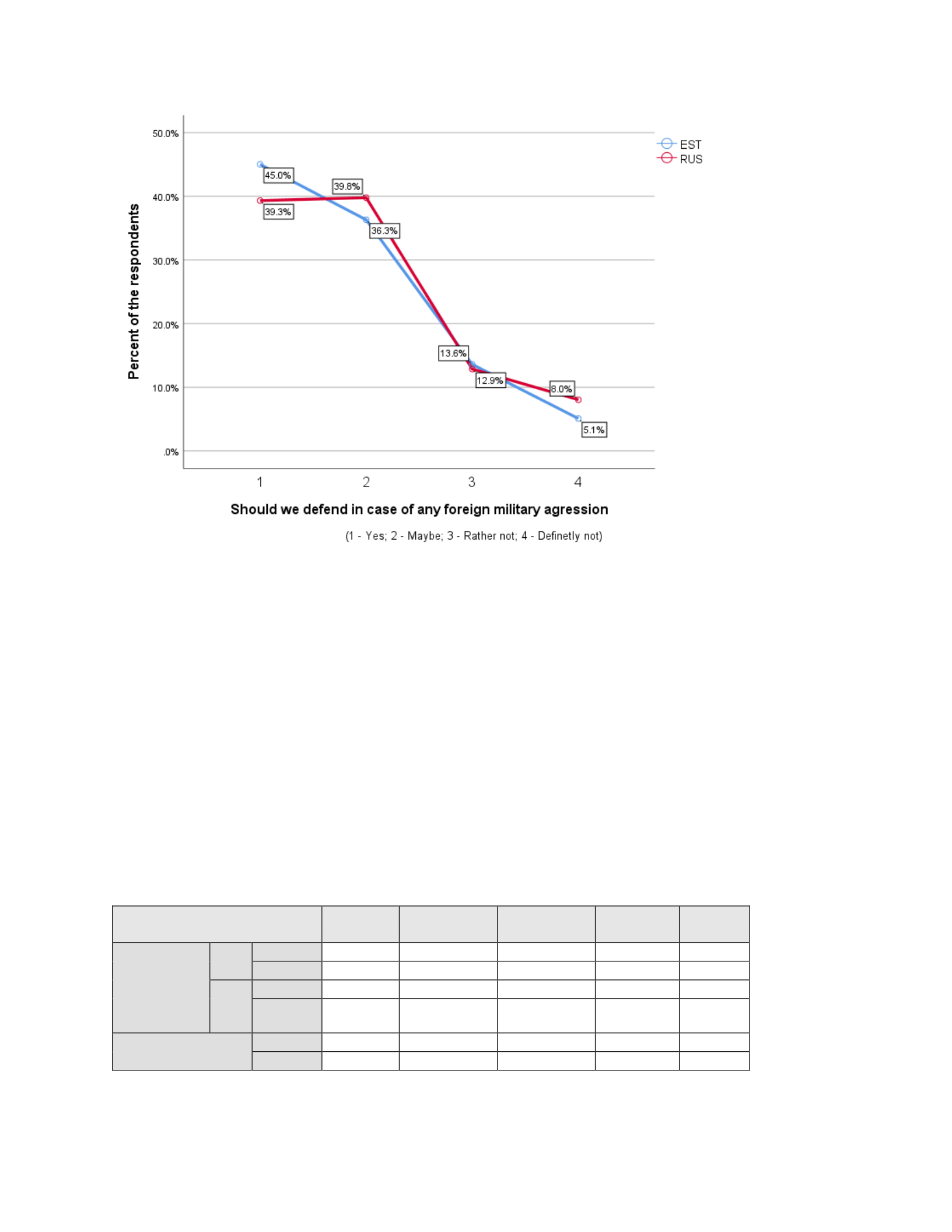
Figure 2. Distribution of the Attitudes Towards the Necessity to Resist
Since 2014, MOD regularly included the question in the survey regarding threat perception.
The respondents were asked to what extent the listed factors threaten peace and stability in the
world. Among potential sources of threat, they listed Russia’s attempt to restore its own power of
influence in neighboring countries and American financial and military domination in the world.
Table 4. Are the Russian Attempts to Restore Regional Power Threatening?
Answers to the question
Definitely
To some
extent
Definitely not
Hard to tell
Total
Russian
attempts to
restore own
power of
influence
EST
Count
4448
3211
742
423
8824
% within
50.4%
36.4%
8.4%
4.8%
100.0%
RUS
Count
354
998
3213
547
5112
% within
6.9%
19.5%
62.9%
10.7%
100.0%
Total
Count
4802
4209
3955
970
13936
% within
34.5%
30.2%
28.4%
7.0%
100.0%

Almost all Estonian-speaking respondents answered absolutely or to some extent when
asked if the Russian attempt to restore power in neighboring countries threatened peace and
stability in the world (see Table 4). However, the majority of Russian-speaking respondents were
convinced that this was not the case. Nevertheless, we must take into consideration that the current
research is based on the data collected before Russia’s full-scale aggression in Ukraine, which
affected popular attitudes.
Table 5. Is the U.S. Dominance Threatening?
Answers to the question
Definitely
To some
extent
Definitely not
Hard to tell
Total
American
financial and
military
domination in
the world
EST
Count
2200
3950
1755
919
8824
% within
24.9%
44.8%
19.9%
10.4%
100.0%
RUS
Count
1889
1969
695
559
5112
% within
37.0%
38.5%
13.6%
10.9%
100.0%
Total
Count
4089
5919
2450
1478
13936
% within
29.3%
42.5%
17.6%
10.6%
100.0%
On the other hand, the attitudes towards US financial and military domination were quite
different. Here most Russian-speaking respondents were absolutely or relatively confident in the
threatening nature of the current financial and military dominance of the United States. Taking
into consideration that the current Estonian Security Concept sees Russia as a threat and the
Western allies led by the United States as a stabilizing factor, the contradiction with the threat
perception of the Russian-speakers becomes obvious. I include the threat perception as a factor in
the regression analysis presented below to show how it affects the attitudes towards the necessity
to defend the nation in case of a military conflict and the attitudes towards national security and
defense policy in general.

Trust to the Defense League and the Defense Forces
While the attitudes towards the necessity to defend the nation were slightly different
between Estonian and Russian-speaking respondents, the attitudes towards key national defense
institutions are more different. In general, ethnic Estonians show greater trust in the Defense
League and the Defense forces. The standard deviation of their answers is also smaller, showing
more consistency in their answers (see Table 6).
Table 6. The Attitudes Towards the Defense League and the Defense Forces
Answers to the question
N
Mean
Std. Deviation
Std. Error Mean
Do you trust the DL?
EST
26717
1.89
.729
.004
RUS
9737
2.55
.932
.009
Do you trust the DF?
EST
28308
1.76
.676
.004
RUS
11811
2.35
.888
.008
Among positive answers, a higher percentage show Estonian-speaking respondents and
among negative answers, Russian-speaking respondents. While for both groups the most popular
answer was somewhat trust in both institutions, Russian-speakers frequently demonstrate absolute
distrust, especially to the Defense League. Almost 20 percent of the Russian-speaking respondents
do not trust the Defense League at all. For comparison, less than four percent of Estonian-speaking
respondents distrust the Defense League. (see Figure 3).
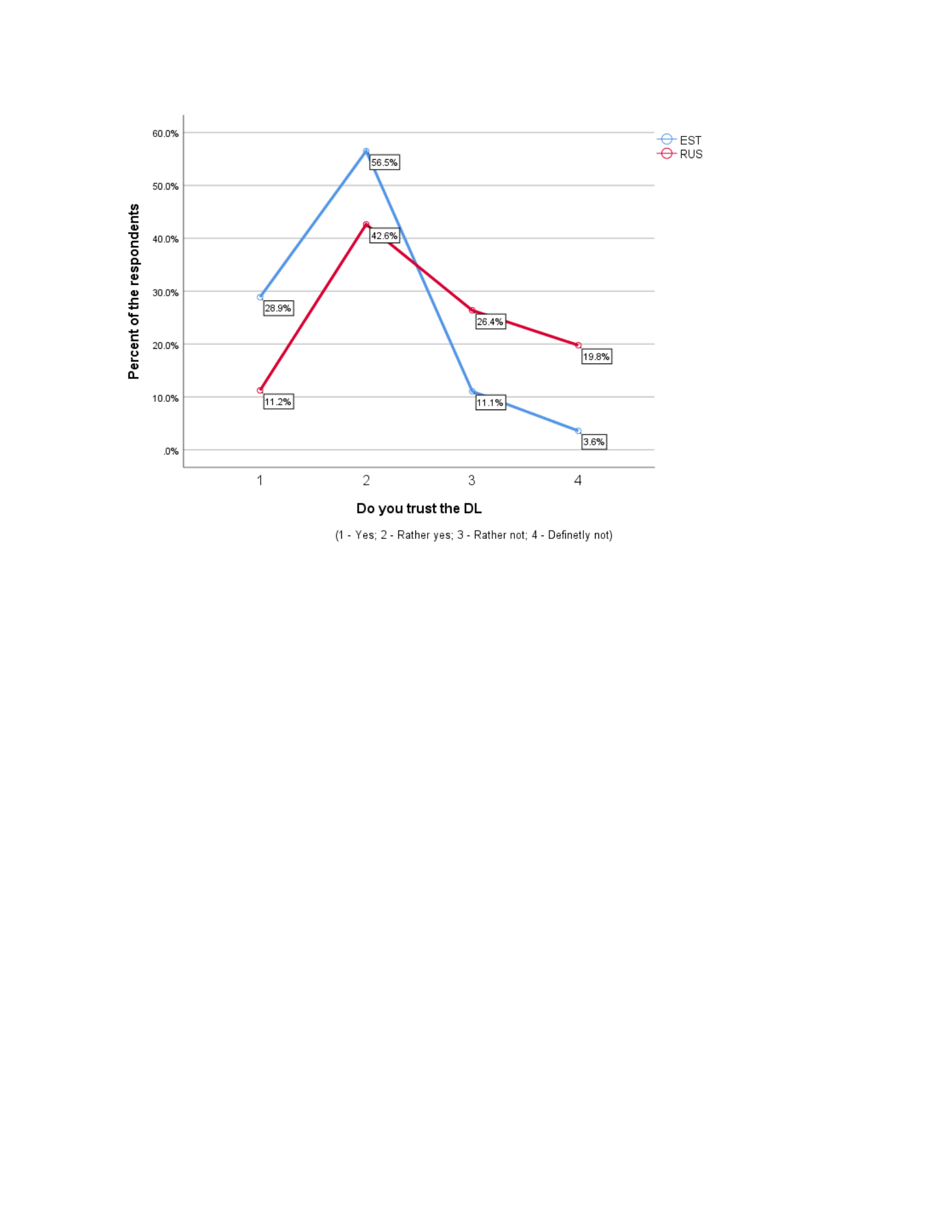
Figure 3. Distribution of the Attitudes Towards the Defense League
Russian-speakers trust the Defense Forces more than the Defense League (see Figure 4).
They may find this institution more official and understandable than the Defense League,
membership in which is much more popular among ethnic Estonians than among Russian-
speakers.
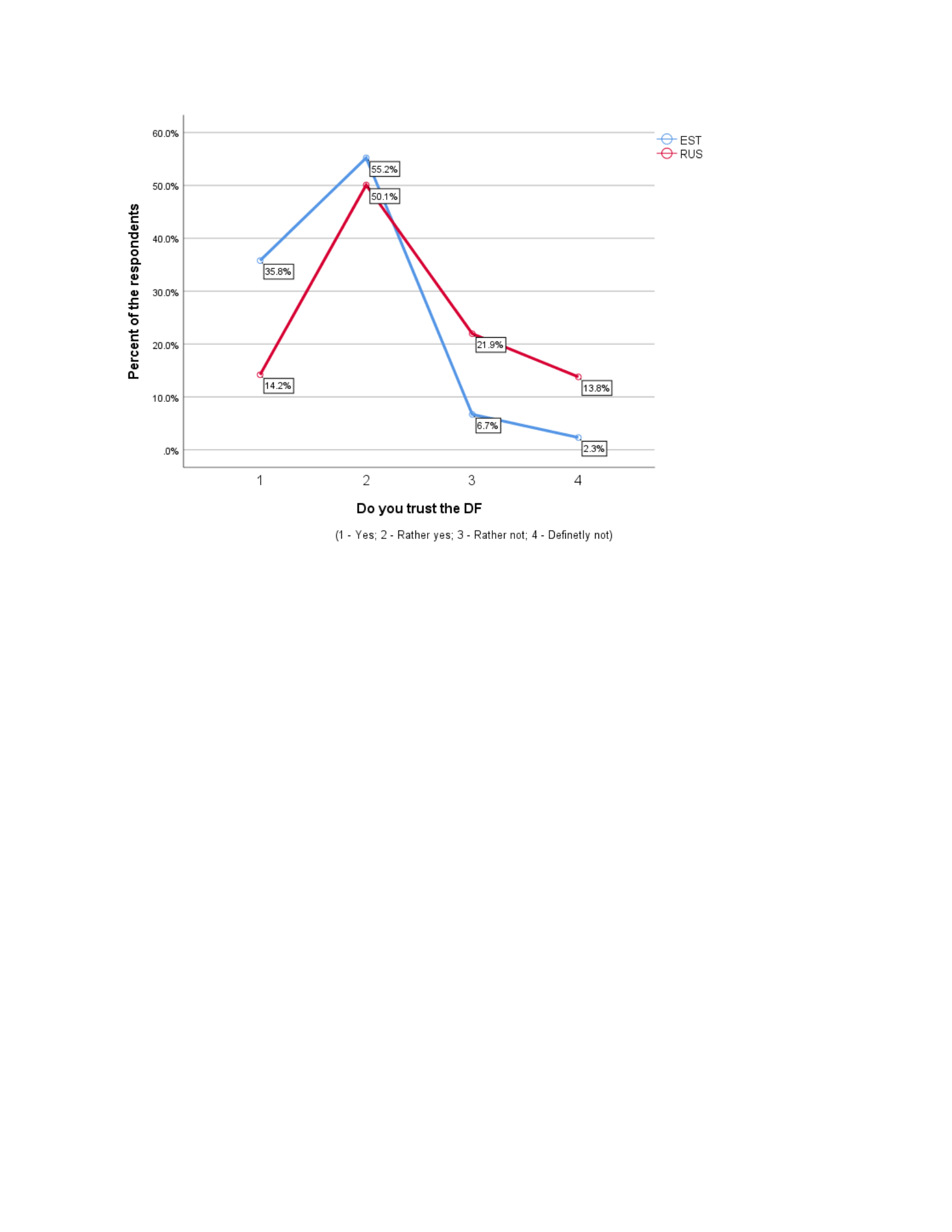
Figure 4. Distribution of the Attitudes Towards the Defense Forces
Almost a quarter of the Estonian-speaking respondents claimed a certain level of relation
to the Defense League. This means that they have either personally served in the Defense League
or have relatives and friends who served. Among Russian-speaking respondents, only six percent
have some form of personal relation to the Defense League (see Table 7).

Table 7. Personal Relation to the DL
Combined answers to the questions
No
Yes
Total
Are you personally or are any
of your friends or relatives
current or former members of
the DL
E
S
T
Count
22870
7103
29973
% within
76.3%
23.7%
100.0%
R
U
S
Count
13071
787
13858
% within
94.3%
5.7%
100.0%
Total
Count
35941
7890
43831
% within
82.0%
18.0%
100.0%
The personal relation to the Defense League may be an important predictor of trust in the
institution. The respondents who served in the Defense League or who have relatives or friends in
the organization show more trust to it than those who have no personal connection (see Table 8).
Taking into consideration the fact that the membership in the Defense League is more popular
among ethnic Estonians than among Russian-speakers, it partly explains the lower level of trust
among the last group.

Table 8. Trust to DL and Personal Relation
Languag
e
Relation to the DL
Trust to the DL (1-max, 4-min)
Total
1
2
3
4
EST
Not
related
Count
5306
11528
2384
817
20035
%
within
26.5%
57.5%
11.9%
4.1%
100.0%
Related
Count
2408
3565
570
139
6682
%
within
36.0%
53.4%
8.5%
2.1%
100.0%
Total
Count
7714
15093
2954
956
26717
%
within
28.9%
56.5%
11.1%
3.6%
100.0%
RUS
Not
related
Count
959
3860
2440
1841
9100
%
within
10.5%
42.4%
26.8%
20.2%
100.0%
Related
Count
135
292
127
83
637
%
within
21.2%
45.8%
19.9%
13.0%
100.0%
Total
Count
1094
4152
2567
1924
9737
%
within
11.2%
42.6%
26.4%
19.8%
100.0%
Unlike the case with the Defense League, more than one third of Russian-speaking
respondents have personal connections to the Defense Forces (see Table 9). That means that either
they have served or have relatives and friends who have served. One of the reasons, obviously, is
the compulsory conscription. If there are no legitimate obstacles, every male must serve in the
defense forces for at least eight months, and after that, participate in the reserve exercises.
However, as was mentioned earlier, Russian-speakers have a generally high willingness to join
military service. Among the reasons is the general cultural background of the Russian-speaking
community, which promotes the idea that every man must complete military service. On top of
that, the professional military service may be seen as a great opportunity for stable income, a
governmental job, and public prestige, especially for Russian-speakers.

Table 9. Personal Relation to the DF
Combined answers to the questions
No
Yes
Total
Are you personally or any of
your friends or relatives are
current of former members of
the DF
E
S
T
Count
12924
17049
29973
% within
43.1%
56.9%
100.0%
R
U
S
Count
8578
5280
13858
% within
61.9%
38.1%
100.0%
Total
Count
21502
22329
43831
% within
49.1%
50.9%
100.0%
When it comes to trust and personal relation to the Defense Forces, the difference is not
as obvious as in case of the Defense League. The personal relation to the defense institutions will
be included as a factor in the following regression analysis.
Table 10. Trust to DF and Personal Relation
Languag
e
Relation to the DL
Trust to the DF
Total
1
2
3
4
EST
Not
related
Count
3969
6786
885
320
11960
%
within
33.2%
56.7%
7.4%
2.7%
100.0%
Related
Count
6163
8843
1007
335
16348
%
within
37.7%
54.1%
6.2%
2.0%
100.0%
Total
Count
10132
15629
1892
655
28308
%
within
35.8%
55.2%
6.7%
2.3%
100.0%
RUS
Not
related
Count
948
3574
1593
988
7103
%
within
13.3%
50.3%
22.4%
13.9%
100.0%
Related
Count
728
2341
999
640
4708
%
within
15.5%
49.7%
21.2%
13.6%
100.0%
Total
Count
1676
5915
2592
1628
11811
%
within
14.2%
50.1%
21.9%
13.8%
100.0%
Attitudes Towards NATO
The greatest difference in the attitudes between Estonian and Russian-speaking
respondents is towards Estonian membership in NATO. Estonia’s National Security Concept
amplifies the importance of the Alliance for Estonian defense and security. Nevertheless, among
Russian-speakers, there are still many people who do not share this point of view (see Table 11).
Table 11. The Attitudes Towards NATO
Answers to the question
N
Mean
Std. Deviation
Std. Error Mean
Should Estonia be in
NATO
EST
28094
1.62
.725
.004
RUS
11395
2.69
.970
.009
The majority of Russian-speaking respondents have either slightly positive or slightly
negative attitudes towards Estonian membership in NATO. Estonian-speaking respondents, on the
other hand, almost exclusively support the alignment. Only 11 percent of the Russian-speaking
respondents are confident in the necessity of Estonian membership in NATO, while 25 percent of
the Russian speaking respondents have an opposite opinion. This is almost ten times higher than
the frequency of the correspondent answer among ethnic Estonians (see Figure 5).
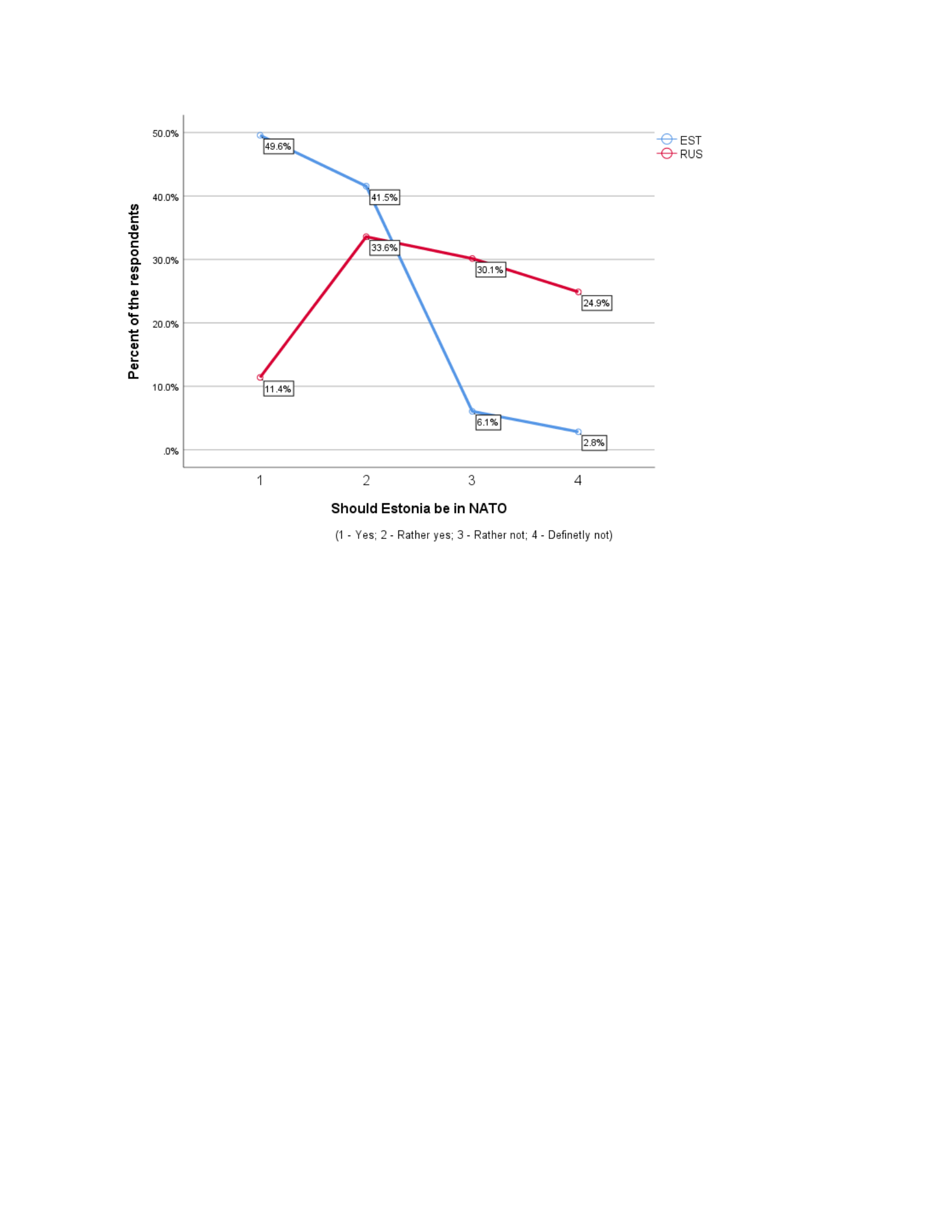
Figure 5. Distribution of the Attitudes Towards NATO
Average Attitudes Towards National Defense And Security
The descriptive statistics in this section provide an overview of the attitudes of Estonian
and Russian-speaking respondents towards the four key elements of the National Security Concept.
Among them are the trust in their own defensive capabilities (the Defense Forces and the Defense
League), the attitude towards Estonian membership in NATO, and the attitudes towards the
necessity to defend the country in case of any military aggression. While the aggregated attitudes
of Estonian-speaking respondents can be described as mostly positive, the Russophones are more
neutral in their positions (see Table 12.)
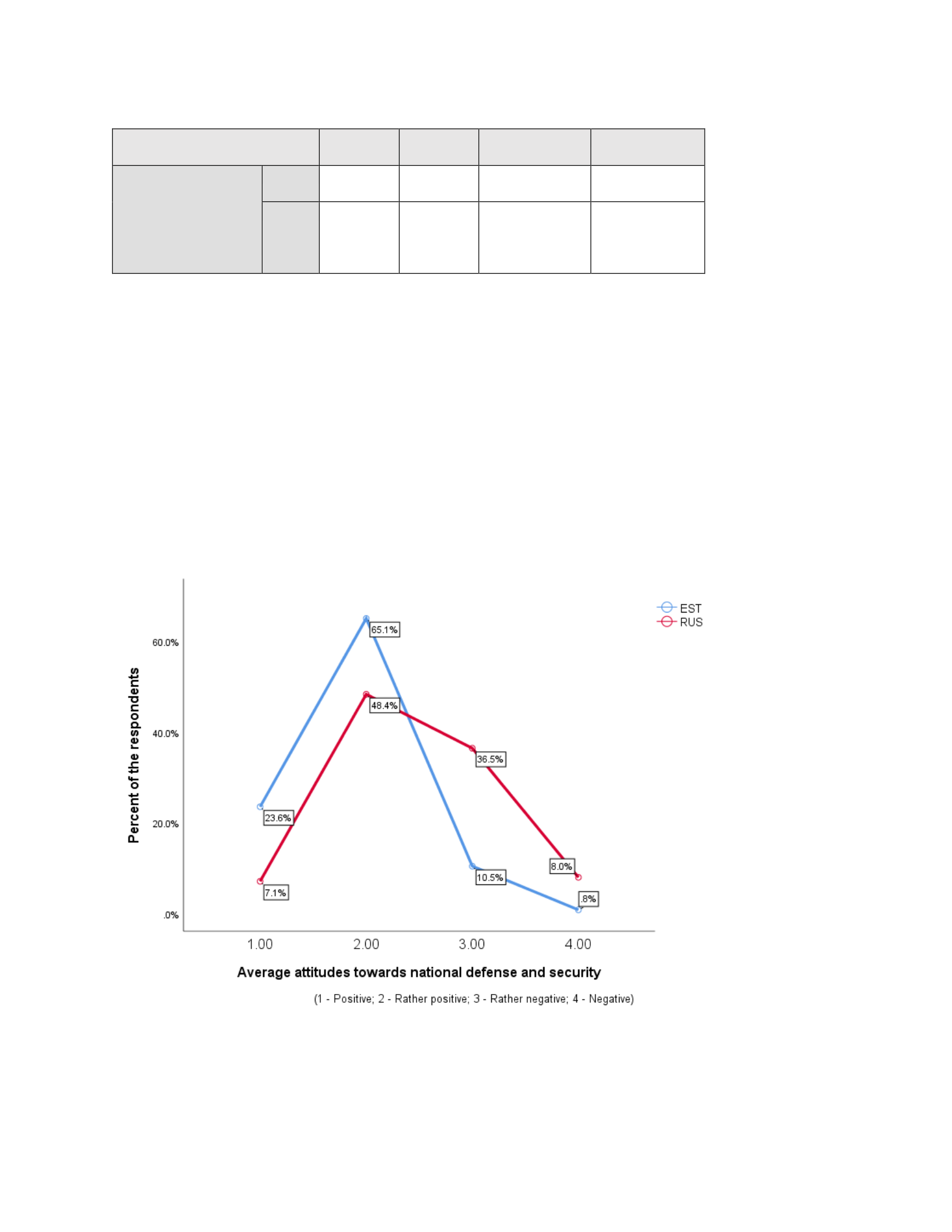
Table 12. Average Attitudes Towards National Defense and Security
Combined measure
N
Mean
Std. Deviation
Std. Error Mean
Average attitudes
towards national
defense and security
EST
29852
1.8854
.60046
.00348
RUS
13644
2.4535
.74181
.00635
For both groups, the most frequent position in relation toward national defense and security
is Rather positive. However, while for ethnic Estonians, the second most frequent position is
Positive, but for Russian-speakers it is Rather negative (see Figure 6). Among Russian-speaking
respondents. there are ten times more people with totally Negative attitudes than among Estonians,
and three times less people with totally Positive attitudes.
Figure 6. Distribution of the Average Attitudes Towards National Defense and Security.
(The means are rounded to the nearest integer.)

In the next session, I examine how the factors identified in the previous chapters are related
to the difference in attitudes towards national defense and security using linear regression.
TESTING HYPOTHESES WITH LINEAR REGRESSION
Based on the historical analysis and theoretical framework, I outlined 15 factors and related
hypotheses (see section Method of Analysis) which I test on the case of Estonia. I build a series of
four linear regression models, each related to one of four key elements of Estonian national
defense: popular willingness to defend the nation, national defense capabilities (Defense Forces
and Defense League), and international alignment (NATO).
In the regression models, I use mainly the Public Opinion and National Defense Survey
data in combination with other databases such as Statistics Estonia. The data, however, does not
allow for conducting the regression in one step, putting all the variables together. The questions
varied over the 20 years of the survey, and just few of them cover most of the survey timeline.
Among the questions that appeared in every survey were the ones used for the operationalization
of the dependent variables, namely the attitudes towards NATO, necessity to defend the country
in case of a foreign military aggression, and attitudes towards the Defense Forces (DF) and Defense
League (DL). Some questions used for the operationalization of independent variables appear only
in certain survey periods. For instance, the questions about threat perception were systematically
included in the MOD survey starting in November 2014. The questions about the political
orientation of the respondents, though, were included in the survey until November 2011.
Therefore, we cannot use these questions for the operationalization of the variables in a single
model. Instead, I conduct the analysis in three steps, running the models with a different
composition of the variables and different timeframes. To determine the effect of the temporal
factor, I conduct three additional regressions with the same variables and different timeframes.

Model 1
As the first step (Model 1), I analyze how the dependent variables are impacted by personal
wealth of the respondents, region of residency, legal status (citizenship), Russian media, whether
a respondent is willing to leave the country in case of a military conflict, personal relation to the
Defense Forces and the Defense League, political situation in the country, nationalizing policy
change (language reform), and national economic situation. Based on these factors, I suggest the
following hypotheses in relation to each of the dependent variables (see the full list of the factors
and hypotheses in Table 1.):
H0: There is no relationship between the attitudes and the variables mentioned below.
Alternative hypotheses:
1. Higher personal income is associated with better attitudes
2. Higher willingness to leave the country in case of a military conflict is associated with
more negative attitudes
3. National economic decline has a negative impact on the attitudes of the respondents
4. Respondents in Ida-Virumaa have less supportive attitudes
5. Respondents with Estonian citizenship have more supportive attitudes
6. Respondents following Russian media have less supportive attitudes
7. In the periods with Central Party (KE) in the government, Russian-speakers have more
supportive attitudes
8. Respondents with a personal relation to DL have more supportive attitudes
9. Respondents with a personal relation to DF have more supportive attitudes
10. Language reform as an instance of nationalizing policy has negative impact on the attitudes
of Russian-speakers

Model 1 covers the timeline from October 2001 to September 2020. Together with the
following models, it has four alterations, each with a different dependent variable: national defense
necessity, Defense League, Defense Forces, and NATO. All four alterations of Model 1 appeared
to be statistically significant with the confidence interval of 95 percent. Therefore, we can reject
the null hypothesis. However, the statistical significance and the effect of the factors showed
noteworthy variation between the models, which sheds light on the formation of the attitudes
towards the key aspects of the national security concept. Even though the models allow a
comparison of the effect and statistical significance of the predictors, they cannot explain the
variation of the attitudes alone. The low R-square confirms that there are more factors affecting
the attitudes which will be included in the following analysis.
All the dependent variables are operationalized on the scale from 1-4 where 1 is the most
positive answer and 4 is the most negative. The attitudes towards national defense are
operationalized using the MOD survey question if Estonia should apply armed resistance in case
of any foreign aggression, even if the result is unknown. The attitudes towards the Defense Forces
and the Defense League are operationalized using the question how much the respondents trust
these institutions. The attitudes towards NATO are operationalized using the question if Estonia
should join NATO (before 2004), and if the respondents support the membership in the alliance
(since 2004).

Table 13. Attitudes of Russian-Speaking Respondents Towards National Defense, Model 1
Attitudes of Russian-speaking respondents towards national defense
Model 1
Unstandardized Coefficients
Standardized
Coefficients
t
Sig.
B
Std. Error
Beta
Dependent Variable: Should
we defend
(Constant)
2.335
0.045
51.430
0.000
Personal wealth
0.000
0.000
0.006
0.580
0.562
Leave the country
-0.167
0.011
-0.172
-15.694
0.000
Economy
0.042
0.008
0.067
5.463
0.000
Region Ida-Virumaa
0.173
0.022
0.088
7.823
0.000
Citizenship
-0.007
0.021
-0.004
-0.317
0.752
RUS media
0.020
0.022
0.010
0.889
0.374
KE government
-0.148
0.023
-0.077
-6.373
0.000
Relation to DL
-0.063
0.043
-0.016
-1.457
0.145
Relation to DF
-0.071
0.021
-0.037
-3.328
0.001
Language reform
0.146
0.059
0.027
2.466
0.014
N = 8139
R Square = 0.05
Table 14. Attitudes of Russian-Speaking Respondents Towards DL, Model 1
Attitudes of Russian-speaking respondents towards DL
Model 1
Unstandardized Coefficients
Standardized
Coefficients
t
Sig.
B
Std. Error
Beta
Dependent Variable: Trust DL
(Constant)
2.831
0.050
56.075
0.000
Personal wealth
0.000
0.000
0.011
0.901
0.368
Leave the country
-0.102
0.012
-0.104
-8.459
0.000
Economy
-0.004
0.009
-0.006
-0.442
0.659
Region Ida-Virumaa
0.083
0.025
0.042
3.335
0.001
Citizenship
-0.060
0.024
-0.032
-2.542
0.011
RUS media
0.102
0.025
0.053
4.164
0.000
KE government
-0.115
0.027
-0.059
-4.280
0.000
Relation to DL
-0.298
0.046
-0.080
-6.429
0.000
Relation to DF
-0.006
0.024
-0.003
-0.257
0.797
Language reform
0.106
0.064
0.020
1.648
0.099
N = 6554
R Square = 0.032

Table 15. Attitudes of Russian-Speaking Respondents Towards DF, Model 1
Attitudes of Russian-speaking respondents towards DF
Model 1
Unstandardized Coefficients
Standardized
Coefficients
t
Sig.
B
Std. Error
Beta
Dependent Variable: Trust DF
(Constant)
2.841
0.044
63.847
0.000
Personal wealth
0.000
0.000
-0.014
-1.228
0.220
Leave the country
-0.150
0.011
-0.160
-14.276
0.000
Economy
-0.030
0.008
-0.050
-3.948
0.000
Region Ida-Virumaa
0.031
0.022
0.016
1.397
0.163
Citizenship
-0.046
0.021
-0.026
-2.228
0.026
RUS media
0.079
0.022
0.042
3.658
0.000
KE government
-0.037
0.023
-0.020
-1.578
0.115
Relation to DL
-0.081
0.042
-0.022
-1.923
0.055
Relation to DF
-0.028
0.021
-0.015
-1.334
0.182
Language reform
0.225
0.057
0.045
3.941
0.000
N = 7818
R Square = 0.039
Table 16. Attitudes of Russian-Speaking Respondents Towards NATO. Model 1
Attitudes of Russian-speaking respondents towards NATO
Model 1
Unstandardized Coefficients
Standardized
Coefficients
t
Sig.
B
Std. Error
Beta
Dependent Variable: NATO
membership
(Constant)
2.901
0.050
58.459
0.000
Personal wealth
-0.001
0.000
-0.039
-3.345
0.001
Leave the country
-0.029
0.012
-0.028
-2.495
0.013
Economy
-0.056
0.009
-0.084
-6.599
0.000
Region Ida-Virumaa
0.030
0.024
0.014
1.240
0.215
Citizenship
-0.141
0.023
-0.072
-6.182
0.000
RUS media
0.125
0.024
0.061
5.197
0.000
KE government
0.086
0.026
0.043
3.373
0.001
Relation to DL
-0.204
0.046
-0.051
-4.425
0.000
Relation to DF
-0.107
0.023
-0.053
-4.559
0.000
Language reform
0.073
0.066
0.013
1.101
0.271
N = 7664
R Square = 0.039
Personal Wealth
The first independent variable in the model measures the personal wealth of the
respondents. The variable is based on the question what is an average monthly family income per
capita. The respondents were asked to select their family income within brackets. The brackets

vary from year to year. Therefore, the variable is operationalized by the percentile (from 1 to 100)
among the respondents of the same survey period. The higher the family income is, the higher the
percentile.
The income did not show a statistically significant impact on the attitudes of Russian-
speaking respondents towards the necessity of defending the country in case of military aggression
and national defense institutions (See Tables 13-15). The only statistically significant effect
income has is on the attitudes towards NATO (See Table 16). This can be explained by the general
perception of the Western liberal-democratic international community, which generally is
associated with greater incomes of the population. Therefore, we can assume that the respondents
with higher income may appreciate the Estonian membership of and protection by the Western
international community, more linking the growth of personal wealth with it.
Willingness To Leave The Country
The MOD Survey asks respondents if they are ready to stay in the county in case of any
foreign military aggression or prefer to escape abroad. Taking into consideration Estonia’s reliance
on the total defense doctrine, the question has a strategic importance and shows the relation to
national security and defense policy. The variable is operationalized on the scale from 1 to 4, where
1 is the highest probably to flee and 4 is the highest probability to stay.
The analysis shows that the willingness to leave the country in case of an armed conflict
has a statistically significant relation with the attitudes in all four alternations. The biggest
standardized coefficients of the effect the variable had on national defense (-0.172). The effect on
the attitudes towards NATO is significantly smaller (-0.028).

Economy
Hypothetically, a positive change in the national economy should be associated with the
greater popular support to national security and defense policy, especially among ethnic minorities
in the context of Triadic Nexus (see chapter Triadic Nexus from the past). In the context of the
current research, the economic variable is operationalized by the quarterly change in Estonian
gross domestic product (GDP) published by Statistics Estonia.206
As a variable, the economy appeared to be a statistically significant predictor in all models
except one. Economy does not have any impact on the attitudes of Russian-speakers towards the
Defense League. The increase in GDP is associated with better attitudes among Russian-speakers
towards NATO and the Defense Forces. In relation to national defense, however, an increase in
GDP is associated with a certain decrease of the attitudes among Russian-speakers.
The Ida-Virumaa Region
The variable checks if a respondent lives in Ida-Virumaa. This region is in Eastern Estonia
bordering Russia. The region has the highest density of Russian-speaking population and has two
of the five biggest cities in Estonia, mainly populated by Russian-speakers, Kohtla-Järve and
Narva. The IV is operationalized as a binary variable of whether the respondent lives in Ida-
Virumaa (value 1) or not (value 0).
The region as the variable has statistically a significant negative impact on the attitudes of
Russian speakers towards national defense and the Defense League, with the standardized
coefficients 0.088 and 0.042 respectively. First, respondents living in the region bordering Russia
may see national defense as less rational and less necessary. Second, the Russian-speakers from
206 Statistics Estonia, RAA0012: Sisemajanduse Koguprodukt Ja Kogurahvatulu. SKP aheldatud väärtuse muutus
võrreldes eelmise perioodiga. (n.d.).

Ida-Virumaa could be less familiar with the Defense League, which is mostly popular among
ethnic Estonians.
Citizenship
This variable represents the civil status and political rights of respondents. One of the
biggest unsolved questions in Estonian integration policy is the citizenship issue. Many Russian-
speakers have either Russian or indefinite citizenship. With the population of 1,328,439, there are
almost 200,000 residents without Estonian citizenship.207 These people have no right to vote in
parliamentary elections. In addition to this, only citizens can serve in the Defense Forces and the
Defense League. This variable is operationalized by Estonian citizenship status. If the respondent
is a citizen of Estonia the value is 1, if not 0. Based on historical analysis described in the previous
chapter, we could assume that greater political rights would increase the support of national
defense.
Citizenship as a variable has a statistically significant positive impact on the attitudes of
Russian-speakers towards the Defense Forces, the Defense League, and NATO. However, it does
not have a statistically significant impact on the attitudes towards national defense. While among
Russian-speaking respondents almost half are not Estonian citizens, among Estonian-speaking
respondents there is only 2 percent of non-citizens. These people are regularly not ethic Estonians
(most ethnic Estonians received citizenship by birth), but they are proficient in the Estonian
language.
207 Statistikaamet. “Rahvastiku Demograafilised Ja Etno-Kultuurilised Näitajad,” Rahvastiku demograafilised ja
etno-kultuurilised näitajad | Statistikaamet, accessed January 29, 2023,
https://rahvaloendus.ee/et/tulemused/rahvastiku -demograafilised-ja-etno-kultuurilised-naitajad.

Russian Media
The model also explores the effect of Russian media on the attitudes of the respondents.
The MOD Survey asks respondents how often they watch Russia’s TV channels or check Russia’s
newspapers and internet media portals. I combined the answers to these questions in a binary
variable which has the value 1 if a respondent claims that he regularly follows at least one of the
information channels originally from the Russian Federation, and 0 if not. The assumption is that
the respondents who regularly follow Russian media, will have less supportive attitudes towards
national security and defense policy.
The regression shows that the variable has no statistically significant impact on the attitudes
of the respondents towards the necessity to defend the nation in case of a military conflict.
However, it has a statistically significant negative impact on the attitudes towards the Defense
League, the Defense Forces, and NATO. It is worth mentioning that among Russian-speakers, 64
percent of the respondents regularly follow at least one of the sources originating from Russia.
KE Government
The next variable measures the reaction in the change of governmental orientation. The
biggest political power that occupies the niche of protecting Russian-speakers’ rights and interests
is the Centre Party (Keskerakond or KE). The binary variable is based on the timeline when Centre
Party was present in the government. It has the value 1 in the period when the party was in the
government and 0 when the party was not.
The presence the Centre Party in the government is associated with more positive attitudes
of Russian-speaking respondents towards the national defense and the Defense League. The
attitudes towards the Defense Forces are not affected by the presence of the Centre Party in the
government. The presence of the Centre Party in the government is associated with more negative

attitudes towards NATO. Even though the Centre Party does not advocate any anti-NATO policy,
some of its members questioned the rationality of Estonian membership.208
Personal Relation to the Defense Forces and the Defense League
The next two variables can be discussed together. Prior studies show that in general, people
in Estonia trust the security and defense institutions more when they have personal connections to
them (for instance if they had served in the Defense Forces, the Defense League, or have relatives
and friends who served).209 These variables are binary and measure if person has any personal
connections to the Defense Forces and the Defense League (value 1) or not (value 0).
The regression shows that the Russian-speaking respondents with a personal relation to the
Defense Forces have more positive attitudes towards the national defense, and the personal relation
to the Defense League has no effect. On the other hand, the personal relation to the Defense League
increases the chances of positive attitudes of Russian-speakers towards the institution. Personal
relation to the Defense Forces does not have any statistically significant effect on the attitudes of
Russian-speakers towards the Defense Forces. Russian-speaking members with personal relation
to either Defense Forces or the Defense League tend to support Estonian membership in NATO
more than others.
Nationalizing Policy (Language Reform)
The next independent variable is language reform. Since the regaining of independence in
1991, Estonia has taken a decisive direction on Estonization of the society, public services, and
education. Among these steps were education and public services reforms, which were taken
ambiguously by the Russian-speaking community. One of the greatest reforms that was initiated
208 Vahtla, Aili. “Minister Korb: I Am Not in Favor of NATO Membership,” ERR, May 24, 2017,
https://news.err.ee/597853/ minister-korb-i-am-not-in-favor-of-nato-membership
209Uulimaa, Ulvi. Defence Willingness Of Estonian Male Population Liable To National Defence Obligation In
2000-2017. University of Tartu. (2019).

since the 1990s was the transition of school and university education to Estonian as the language
of instruction. At that time, many public and private institutions were teaching students in Russian.
After years of political debate, the big shift happened in 2011, when all Russian high schools (10th-
12th grade) were obliged to teach at least 60 percent of their programs in the Estonian language.
The binary variable has the value 1 for all observations in the first survey after the implementation
of the reform conducted in October 2011. It was the second month after the first cohort of high
school students in Russian schools in Estonia were obliged to study in the Estonian language for
60 percent of the program. The variable is used to measure the first reaction on the implementation
of language reform.
Using the variable based on the timeline, we must acknowledge certain limitations. We
cannot exclude the effect of other temporal factors. The variable has a statistically significant
negative impact on the attitudes of Russian-speakers towards the national defense and the Defense
Forces. However, it does not have an impact on the attitudes of Russian-speakers towards the
Defense League and NATO.
Model One Summary
The first regression model showed that the attitudes of Russian-speakers towards the
necessity to defend the nation in case of a military aggression were affected by factors such as:
willingness to leave the country (-0.172), the economy (0.067), the Ida-Virumaa region (0.088),
Central Party in the government (-0.077), personal relation to the Defense Forces (-0.037), and
language reform (0.027). The direction of the effect of change in the national economy is opposite
of what was assumed (the economic growth is associated with decline in the attitudes).
The attitudes of Russian-speakers towards the Defense League are affected by the
willingness to leave the country (-0.104), the region of Ida-Virumaa (0.042), citizenship (-0.032),

Russian media (0.053), Centre Party in the government (-0.059), and personal relation to the
Defense League (-0.080). The Centre Party in the government had exclusive effect on the attitudes
of Russian-speakers. Running the same model for ethnic Estonian respondents, we see no
statistically significant impact.
The attitudes of Russian-speakers towards the Defense Forces were affected by the
willingness to leave the country in case of a military conflict (-0.160), change in national economy
(0.050), citizenship (-0.26), Russian media (0.042), and language reform (0.045).
Finally, the statistically significant effect on the attitudes of Russian-speaking respondents
towards NATO had personal wealth (-0.039), willingness to leave the country in case of a military
conflict (-0.028), change in national economy (-0.084), citizenship (-0.072), Russian media
(0.061), Central Party in the government (0.043), personal relation to the Defense Forces (-0.053),
the Defense League (-0.051), and Language reform (0.013).
Model 2
Model 2 covers the timeline from October 2001 to January 2010. In addition to the factors
used in Model 1 (personal wealth of the respondents, region of residency, legal status, Russian
media, whether a respondent is willing to leave the country in case of a military conflict, personal
relation to the Defense Forces and the Defense League, composition of the government, and
national economic situation). Model 2 includes the following factors: cooperation with Russia and
political orientation. Model 2 excludes the nationalizing policy as a factor because the timeline
does not cover the period when the language reform was adopted. Based on these factors, I suggest
the following hypotheses in relation to each of the dependent variables (for a full list of factors and
hypotheses, see in Table 1):
H0: There is no relationship between the attitudes and above-mentioned variables

1. Higher personal income is associated with better attitudes
2. Higher willingness to leave the country in case of a military conflict is associated with
more negative attitudes
3. National economic decline has a negative impact on the attitudes of the respondents
4. Respondents in Ida-Virumaa have less supportive attitudes
5. Respondents with Estonian citizenship have more supportive attitudes
6. Respondents following Russian media have less supportive attitudes
7. In the periods when Centre Party (KE) is in the government, Russian-speakers have more
supportive attitudes
8. Respondents with personal relation to DL have more supportive attitudes
9. Respondents with personal relation to DF have more supportive attitudes
10. The more a respondent speaks Estonian, the better the attitude will be
11. The respondents who find cooperation with Russia important have less supportive attitudes
12. The respondents who have a higher level of national pride have more supportive attitudes
Similar to the first model, all four alterations, each with a different dependent variable
(national defense necessity, Defense League, Defense Forces, NATO), appeared to be statistically
significant with a confidence interval of 95 percent. Therefore, we can reject the null hypothesis.
However, including more variables and changing the timeframe also affected the statistical impact
and the magnitude of the effect of the variables used in the first model.

Table 17. Attitudes of Russian-Speaking Respondents Towards National Defense, Model 2
Attitudes of Russian-speaking respondents towards national defense
Model 2
Unstandardized Coefficients
Standardized
Coefficients
t
Sig.
B
Std. Error
Beta
Dependent Variable: Should we
defend
(Constant)
2.432
.097
25.174
.000
Personal wealth
.000
.001
-.013
-.679
.497
Leave the country
-.237
.020
-.218
-11.616
.000
Economy
.057
.012
.102
4.811
.000
Region Ida-Virumaa
.141
.039
.070
3.565
.000
Citizenship
.053
.038
.027
1.410
.159
RUS media
.016
.042
.008
.370
.711
KE government
-.147
.038
-.076
-3.839
.000
Relation to DL
-.068
.071
-.018
-.950
.342
Relation to DF
.007
.040
.004
.184
.854
Cooperation with RUS
.154
.038
.075
4.025
.000
Political orientation
.022
.037
.011
.589
.556
a. N = 2700
b. R Square = 0.075
Table 18. Attitudes of Russian-Speaking Respondents Towards the DL, Model 2
Attitudes of Russian-speaking respondents towards the DL
Model 2
Unstandardized Coefficients
Standardized
Coefficients
t
Sig.
B
Std. Error
Beta
Dependent Variable: Trust DL
(Constant)
2.522
.101
24.947
.000
Personal wealth
.003
.001
.086
3.919
.000
Leave the country
-.068
.022
-.068
-3.156
.002
Economy
.001
.012
.002
.092
.927
Region Ida-Virumaa
.067
.042
.035
1.586
.113
Citizenship
-.041
.041
-.023
-1.015
.310
RUS media
.061
.045
.032
1.363
.173
KE government
-.107
.042
-.059
-2.557
.011
Relation to DL
-.430
.072
-.131
-5.975
.000
Relation to DF
.000
.042
.000
.010
.992
Cooperation with RUS
.173
.041
.090
4.199
.000
Political orientation
.013
.040
.007
.325
.746
a. N = 2122
b. R Square = 0.042

Table 19. Attitudes of Russian-Speaking Respondents Towards the DF, Model 2
Attitudes of Russian-speaking respondents towards the DF
Model 2
Unstandardized Coefficients
Standardized
Coefficients
t
Sig.
B
Std. Error
Beta
Dependent Variable: Trust DF
(Constant)
2.539
.089
28.542
.000
Personal wealth
.001
.001
.033
1.640
.101
Leave the country
-.140
.019
-.147
-7.496
.000
Economy
-.021
.011
-.044
-1.977
.048
Region Ida-Virumaa
.001
.037
.000
.023
.982
Citizenship
-.037
.036
-.021
-1.043
.297
RUS media
.065
.039
.036
1.673
.094
KE government
-.061
.036
-.035
-1.679
.093
Relation to DL
-.085
.066
-.026
-1.294
.196
Relation to DF
.003
.037
.002
.078
.938
Cooperation with RUS
.164
.036
.090
4.589
.000
Political orientation
.024
.035
.014
.669
.503
a. N = 2557
b. R Square = 0.037
Table 20. Attitudes of Russian-Speaking Respondents Towards NATO, Model 2
Attitudes of Russian-speaking respondents towards NATO
Model 2
Unstandardized Coefficients
Standardized
Coefficients
t
Sig.
B
Std. Error
Beta
Dependent Variable: Membership
in NATO
(Constant)
2.611
.103
25.230
.000
Personal wealth
.000
.001
.007
.352
.725
Leave the country
-.046
.022
-.041
-2.096
.036
Economy
-.036
.013
-.063
-2.831
.005
Region Ida-Virumaa
.034
.043
.016
.781
.435
Citizenship
-.193
.041
-.095
-4.721
.000
RUS media
.071
.046
.033
1.548
.122
KE government
.014
.042
.007
.344
.731
Relation to DL
-.305
.075
-.080
-4.047
.000
Relation to DF
-.005
.043
-.002
-.108
.914
Cooperation with RUS
.408
.042
.192
9.818
.000
Political orientation
-.060
.040
-.030
-1.473
.141
a. N = 2505
b. R Square = 0.066

To begin with, I first review the new variables that were not introduced in Model 1:
Cooperation with Russia and Political orientation. After that, I review how the effect of the core
variables changed with the inclusion of an additional two to the model.
Cooperation with RUS
The first new variable in Model 2 measures the attitudes of the respondents towards
national cooperation with Russia. The MOD Survey asks respondents what they think is the most
important for Estonian security. Good relations and cooperation with Russia is one of the options.
The variable, based on the answers to this question, is binary and shows if person finds good
relations and cooperation with Russia important for Estonian security (value 1) or not (value 0).
The assumption is that the respondents who find cooperation with Russia important for Estonian
security will have less supportive attitudes towards national security and defense. Indeed, the
analysis shows that the respondents supporting good relations with Russia see national defense
less necessary than others.
Indeed, the current model shows a positive statistically significant impact of the attitudes
of Russian-speakers towards all four aspects of Estonian security and defense policy. The highest
impact the variable has on the attitudes is towards Estonian membership in NATO (0.192). This
means that the more Russian-speaking respondents find cooperation with Russia important for
Estonian security, the less they find reasonable Estonian membership in NATO.
Political Orientation
The MOD Survey asks which party a respondent would support if the parliamentary, local,
or EU elections took place tomorrow. The IV is operationalized as a binary variable of whether

the respondent supports parties with high Russian profiles such as the Russian Party in Estonia,
the Centre Party, or the Estonian United Left Party210 (value 1) or not (value 0).
The political orientation of the Russian-speaking respondents has no statistically
significant effect on any of the dependent variables. Generally, Russian-speakers in Estonia are
relatively passive voters. The lowest voting activity is consistently reported in the most Russian-
speaking region, Ida-Virumaa.211 However, studies show that Russian-speakers in Estonia are
usually loyal to a single party, while ethnic Estonians change their political views more often.212
The Estonian Central Party (Keskerakond) remains to be the most popular party among Russian-
speakers in Estonia, having by October 2022 over 50 percent support among non-Estonians.213
The analysis shows that when the Central Party is in the government, Russian-speakers generally
have more supportive attitudes towards national security and defense policy.
Personal Wealth
Personal wealth remains to be statistically insignificant in relation to all dependent
variables, except the trust of the Defense League. This, however, is likely to be related to the
temporal factor, as the second model only covers the period from October 2001 to January 2010.
The effect of the temporal change will be analyzed in the following section.
210 The full list: Eestimaa Ühendatud Rahvapartei, Eesti Keskerakond, Vene Ühtsuspartei, Vene Balti Erakond, Vene
Erakond Eestis, Eestimaa Ühtsus. Eesti Vasakpartei
211“Eelmiste Valimistega Võrreldes Kasvas Valimisaktiivsus Ligi Kümme Protsenti,” Delfi (Delfi, October 17,
2021), https://www.delfi.ee/artikkel/94876903/eelmiste-valimistega-vorreldes-kasvas-valimisaktiivsus-ligi-kumme-
protsenti.
212 Okia, “Rahvuslik Tööjaotus Valimiskäitumises,” Sirp, accessed January 29, 2023, https://sirp.ee/s1-artiklid/ c9-
sotsiaalia/rahvuslik-toeoejaotus-valimiskaeitumises/.
213 “Reitingud,” Erakondade reitingud, accessed January 29, 2023, https://reitingud.ee/reitingud/.

Willingness To Leave The Country
Willingness to leave the country in case of a military conflict remains to be a significant
predictor of the less supportive attitudes towards all four dependent variables. The trend did not
change in the second model.
Economy
The effect of the economy as a predictor also did not change much in the new model.
The Ida-Virumaa Region
The Ida-Virumaa region as an independent variable and remains statistically significant on
attitudes towards national defense. However, in the second model including the new variable, it
has no statistically significant impact on the attitudes towards the Defense League, Defense Forces,
and like the first model, towards NATO.
Citizenship
In the new model, citizenship remains to be a statistically significant predictor of change
in the attitudes, only in relation to NATO. It has no impact on the other three dependent variables.
RUS Media
The second model showed that Russian Media has no effect on the analyzed attitudes. In
the first model, respondents that regularly follow Russian Media had less supportive attitudes
towards the Defense League, Defense Forces, and NATO.
KE Government
In the second model, the Central Party Government remains a significant predictor of
positive attitudes toward the national defense and the Defense League; however, it lost impact as
a variable on the attitudes towards NATO.

Relation to DL and DF
The impact of personal relation to the Defense League did not have a significant difference
between the two models. However, personal relation to the Defense Forces in the new model has
no effect on the attitudes towards national defense and NATO.
Model two summary
The second model included two new variables: cooperation with Russia and political
orientation. The second model showed that the Russian-speaking respondents, who believe that
good relations with Russia creates a security guarantee for Estonians, have less supportive attitudes
towards national security and defense policy. Political orientation, however, did not appear to be
a statistically significant predictor of the attitudes. Among the variables used in the first model,
the willingness to leave the country remains to be one of the most significant predictors of negative
attitudes towards national defense, the Defense Forces, the Defense League, and NATO. The
inclusion of the new variables did not change this pattern. Also, the impact of the national economy
did not change the pattern of this effect. The impact pattern of other variables is changing, which
may have two potential causes. First, the difference may be caused by a temporal factor. Second,
the difference could be caused by change in the composition of the model. This change is examined
in the following sections.
Model 3
Model 3 covers the timeline from November 2014 to September 2020. In addition to the
factors used in Model 1 and Model 2 (personal wealth of the respondents, whether a respondent is
willing to leave the country in case of a military conflict, national economic situation, region of
residency, citizenship, Russian media, national government, personal relation to the Defense
Forces and the Defense League, and cooperation with Russia), Model 3 includes the following

factors: language of communication, national pride, ethnic identity, and threat perception. Model
3 excludes the nationalizing policy as a factor because the covered timeline does not include the
period when the language reform was adopted. I also do not include political orientation, as during
the observed time period, this information was not collected. Based on these factors, I suggest the
following hypotheses in relation to each of the dependent variables (for the full list of the factors
and hypotheses see in Table 1):
H0: There is no relationship between the attitudes and above-mentioned variables
Alternative hypotheses:
1. Higher personal income is associated with better attitudes
2. Higher willingness to leave the country in case of a military conflict is associated with
more negative attitudes
3. National economic decline has a negative impact on the attitudes of respondents
4. Respondents in Ida-Virumaa have less supportive attitudes
5. Respondents with Estonian citizenship have more supportive attitudes
6. Respondents following Russian media have less supportive attitudes
7. In the periods when the Central Party (KE) is in the government, Russian-speakers have
more supportive attitudes
8. Respondents with a personal relation to DL have more supportive attitudes
9. Respondents with a personal relation to DF have more supportive attitudes
10. The more proficient a respondent is in Estonian, the better the respondent’s attitude will be
11. Higher national pride is associated with better attitudes
12. Personal ethnic self-identity as Estonian is associated with better attitudes
13. The respondents who find cooperation with Russia important have less supportive attitudes

14. The respondents who perceive Russia as a threat have more supportive attitudes
All four alterations of Model 3 appeared to be statistically significant with a confidence
interval of 95 percent. Therefore, we can reject the null hypothesis. However, the new variables
and temporal factor brought some changes in the effect of the variables used in the previous
models.
Table 21. Attitudes of Russian-Speaking Respondents Towards National Defense, Model 3
Attitudes of Russian-speaking respondents towards national defense
Model 3
Unstandardized Coefficients
Standardized
Coefficients
t
Sig.
B
Std. Error
Beta
Dependent Variable: National Defense
(Constant)
2.190
.136
16.108
.000
Personal wealth
.001
.001
.026
1.149
.251
Leave the country
-.135
.020
-.153
-6.867
.000
Economy
-.019
.020
-.022
-.928
.354
Region Ida-Virumaa
.072
.045
.037
1.596
.111
Citizenship
.023
.042
.013
.546
.585
RUS media
-.047
.042
-.025
-1.114
.265
KE government
-.061
.042
-.035
-1.442
.149
Relation to DL
-.160
.073
-.049
-2.188
.029
Relation to DF
-.022
.040
-.012
-.541
.589
EST language
.026
.023
.029
1.162
.245
National pride
-.182
.024
-.174
-7.721
.000
Ethnic ID
.057
.115
.011
.492
.623
Cooperation with RUS
.055
.041
.030
1.336
.182
RUS threat
.139
.031
.101
4.515
.000
a. N = 2007
b. R Square = 0.099
Table 22. Attitudes of Russian-Speaking Respondents Towards the DL, Model 3
Attitudes of Russian-speaking respondents towards the DL

Model 3
Unstandardized Coefficients
Standardized
Coefficients
t
Sig.
B
Std. Error
Beta
Dependent Variable: Trust to DL
(Constant)
2.254
.165
13.653
.000
Personal wealth
.000
.001
-.009
-.357
.721
Leave the country
-.072
.024
-.075
-3.061
.002
Economy
-.025
.024
-.027
-1.022
.307
Region Ida-Virumaa
.018
.054
.009
.336
.737
Citizenship
.042
.052
.022
.806
.420
RUS media
.038
.051
.019
.750
.453
KE government
-.082
.051
-.043
-1.596
.111
Relation to DL
-.163
.082
-.049
-1.986
.047
Relation to DF
.039
.048
.020
.810
.418
EST language
.075
.028
.074
2.646
.008
National pride
-.237
.029
-.206
-8.297
.000
Ethnic ID
.119
.140
.020
.847
.397
Cooperation with RUS
.228
.049
.113
4.671
.000
RUS threat
.265
.037
.176
7.136
.000
a. N = 1554
b. R Square = 0.149
Table 23. Attitudes of Russian-Speaking Respondents Towards the DF, Model 3
Attitudes of Russian-speaking respondents towards the DF
Model 3
Unstandardized Coefficients
Standardized
Coefficients
t
Sig.
B
Std. Error
Beta
Dependent Variable: Trust to DF
(Constant)
2.445
.143
17.052
.000
Personal wealth
-.001
.001
-.036
-1.604
.109
Leave the country
-.104
.020
-.114
-5.067
.000
Economy
-.022
.021
-.025
-1.037
.300
Region Ida-Virumaa
.034
.047
.017
.730
.465
Citizenship
.064
.045
.035
1.425
.154
RUS media
-.016
.044
-.008
-.358
.720
KE government
.009
.044
.005
.202
.840
Relation to DL
-.059
.074
-.018
-.798
.425
Relation to DF
-.004
.042
-.002
-.092
.927
EST language
.029
.024
.031
1.214
.225
National pride
-.182
.025
-.167
-7.352
.000
Ethnic ID
.045
.121
.008
.377
.707
Cooperation with RUS
.329
.043
.170
7.598
.000
RUS threat
.196
.033
.134
5.918
.000
a. N = 1913
b. R Square = 0.127

Table 24. Attitudes of Russian-Speaking Respondents Towards NATO, Model 3
Attitudes of Russian-speaking respondents towards NATO
Model 3
Unstandardized Coefficients
Standardized
Coefficients
t
Sig.
B
Std. Error
Beta
Dependent Variable: NATO membership
(Constant)
1.876
.144
13.043
.000
Personal wealth
-.002
.001
-.064
-3.046
.002
Leave the country
.006
.020
.006
.304
.761
Economy
-.025
.021
-.026
-1.195
.232
Region Ida-Virumaa
.074
.047
.035
1.595
.111
Citizenship
-.021
.044
-.011
-.487
.627
RUS media
.032
.044
.016
.734
.463
KE government
-.011
.043
-.006
-.254
.800
Relation to DL
-.107
.074
-.030
-1.447
.148
Relation to DF
-.147
.042
-.074
-3.530
.000
EST language
.073
.024
.071
3.021
.003
National pride
-.153
.025
-.129
-6.136
.000
Ethnic ID
.140
.124
.023
1.128
.259
Cooperation with RUS
.420
.043
.202
9.765
.000
RUS threat
.400
.033
.257
12.232
.000
a. N = 1977
b. R Square = 0.224
The new composition of the model considerably changed the statistical impact of most of
the factors used in the previous models. The new variables, such as national pride and threat
perception (RUS threat), appeared to be statistically significant predictors of the change in attitudes
towards each of the four aspects.
Estonian Language
The first new variable included in Model 3 measures Estonian language proficiency of the
respondents. This is an important social factor, as language remains to be the most segregating
element in Estonian society, dividing it by Russian-speakers and ethnic Estonians. The discussion
about this division may be found in the previous chapters. In the MOD Survey, all respondents,
whose mother tongue is not Estonian were asked what their level of Estonian language proficiency
is. The respondents had to self-evaluate their own language proficiency on a scale from 1 to 4,
where 1 is the most fluent, and 4 is the least.

Language proficiency appears to have a statistically significant positive impact on the
attitudes towards the Defense League (0.074) and NATO (0.071). However, the model showed no
relation between language proficiency and the attitudes of the respondents towards national
defense and the Defense Forces.
National Pride
The MOD Survey measures national pride by the question of how frequently you feel proud
about living in Estonia. It is measured on a scale from 1 to 4, where 1 is the lowest frequency and
4 is the highest.
The model shows that the level of national pride has a statistically significant impact on
the attitudes towards all four elements. The prouder a person is of being Estonian residents, the
better his attitude is towards national defense (-0.174), Defense Forces (-0.167), Defense League
(-0.206), and Estonian membership in NATO (-0.129)
Ethnic ID
Ethnic self-identity is another factor that hypothetically can be a predictor of the change in
the political attitudes of ethnic minorities in the Triadic Nexus. In Estonia, as well as in other
ethnically diverse nations, mother tongue or citizenship does not always determine ethnic self-
identity. A resident of Estonia with Russian citizenship and limited Estonian language proficiency
can still identify as Estonian, as well as an Estonian citizen can chose a Russian ethnic self-identity.
The dummy variable has two values: 1 is given if a respondent self-identifies as Estonian and 0 if
not.
The model, however, shows that ethnic self-identity does not have a statistically significant
impact in all four alternations. Therefore, we can reject the 12th hypothesis and conclude that ethnic

self-identity as Estonian cannot be a statistically significant predictor of supportive attitudes
towards national security and defense policy.
RUS Threat
The MOD Survey asks respondents according to their opinion, what creates a threat for
Estonian national security. Russian ambition to restore regional power is one of the options that
the respondents evaluate on a scale from 1 to 3, where 1 is the highest level of threat and 3 is the
lowest.
The model shows that people who consider Russia as a threat to national security have
more supportive attitudes towards all four analyzed elements: national defense (0.101), the
Defense Forces (0.134), the Defense League (0.176), and NATO (0.257). The attitudes of the
respondents towards the Estonian membership in NATO are affected by the threat perception the
most.
Personal Wealth
In Model 3, personal wealth as a predictor has positive statistically significant impact on
the attitudes towards NATO (-0.054), but does not have any impact in other three alterations. The
pattern of the effect is similar to Model 1, however, it differs from Model 2 which observes another
period of time.
Leave the Country
The willingness of the respondents to leave the country in case of a military conflict
remains to be a significant predictor of the change in the attitudes towards national defense (0.153),
the Defense Forces (-0.114) and the Defense League (-0.075). However, this is the first model
where the variable does not have an impact on the attitudes towards NATO.

Economy; Region Ida-Virumaa; Citizenship; RUS media; KE government
In this model the change in national economy the Ida-Virumaa region, Citizenship, Russian
media, and the presence of the Centre Party in the government do not have statistically significant
impacts on attitudes in all four alternations.
Relation to DL and DF
Personal relation to the Defense League increases the chance of having supportive attitudes
towards national defense (-0.049) and the Defense League (-0.049). Personal relation to the
Defense Forces shows a statistically significant impact only on the attitudes towards NATO
(0.074)
Cooperation with RUS
In Model 3, the position of the respondent in relation to national cooperation with Russia
remains to be a statistically significant predictor of a change in the attitudes towards the Defense
Forces (0.170), the Defense League (0.113) and NATO (0.202). It does not affect the attitudes
towards national defense.
Model 3 summary
Model 3 included four new variables: language proficiency, national pride, ethnic identity,
and the position regarding a national threat from Russia. National pride and the position towards
the threat from Russia appeared to be statistically significant predictors in all four alternations.
Ethnic identity did not show any statistically significant impact, and language proficiency has an
impact on the attitudes towards NATO and the Defense League.
In general, we can see that including additional variables significantly decrease the
statistical impact of the variables used in Model 1. The willingness to leave the country in case of
a military conflict, though, remains to be a statistically significant predictor in three cases out of

four, as well as the position about the national cooperation with Russia, the variable included in
Model 2. As was mentioned earlier, the reason for this change may be either the effect of the
included variables, or the change of the timeframe. The next section will examine this question.
Comparison Of The Models And Statistically Significant Predictors
To analyze if the change in the statistical significance of the variables is caused by the
change in the model composition or the temporal factor, I run three additional regression models,
only with the factors that are covered in the entire observed period and see how their effect is
changing across time. I conduct this procedure in relation to all four dependent variables to see
how predictors impact them in different models and different timeframes.
Attitudes Towards National Defense
To begin with, we can exclude the factors that showed no impact on the attitudes in all
variations of the model. Among these factors are personal wealth, citizenship, and Russian media.
Estonian language proficiency and ethnic identity also did not show a statistically significant
impact, but these two variables could be observed only in the period from November 2014 to
September 2020. Political orientation observed in the period from October 2001 to January 2010
also did not show impact on the dependent variables. Willingness to leave the country is the only
variable that remains to be a statistically significant predictor of the change in attitudes towards
national defense in all models and the entire timeframe. National pride and threat perception also
showed a statistically significant impact on the attitudes towards national defense, but the variables
could be observed only in the period from November 2014 to September 2020.
The effect of other variables changes across the models and over time. The national
economy was a statistically significant predictor in Model 1 and Model 2. However, it lost
significance in Model 3, which observes the period from January 2014 to September 2020. If we

run the regression model in the same period of observation without additional variables, the change
in national economy remains a statistically insignificant predictor. This means that the impact of
the variable is probably affected more by the temporal factor than by additional variables included
in Model 3. In the case of the region of Ida-Virumaa and the composition of government, we see
another picture. The significance of the variables is still sufficient in Model 4. This indicates that
they became insignificant in Model 3 as the result of inclusion of additional variables with higher
explanatory power.
Table 25. Comparison of the Models. Attitudes Towards National Defense
Model #
1
2
3
4
5
6
Attitudes towards
national defense
2001OCT
2020SEP
2001OCT
2010JAN
2014NOV
2020SEP
2014NOV
2020SEP
2001OCT
2010JAN
2001OCT
2020SEP
Personal wealth
0.006
-0.013
0.026
0.024
0.003
0.006
Leave the country
-0.172*
-0.218*
-0.153*
-0.172*
-0.178*
-0.173*
Economy
0.067*
0.102*
-0.022
0.017
0.084*
0.064*
Region Ida-Virumaa
0.088*
0.070*
0.037
0.078*
0.075*
0.087*
Citizenship
-0.004
0.027
0.013
-0.016
0.022
-0.004
RUS media
0.01
0.008
-0.025
-0.030
0.017
0.012
KE government
-0.077*
-0.076*
-0.035
-0.065*
-0.064*
-0.080*
Relation to DL
-0.016
-0.018
-0.049*
-0.045*
-0.010
-0.017
Relation to DF
-0.037*
0.004
-0.012
-0.033
-0.016
-0.036*
Language reform
0.027*
EST language
0.029
National pride
-0.174*
Ethnic ID
0.011
Cooperation with
RUS
0.075*
0.03
RUS threat
0.101*
Political orientation
0.011
* p < 0.05
Attitudes Towards the Defense Forces
Among the variables that had no effect on the attitudes towards the defense forces are
personal wealth, the Central Party government, personal relation to Defense Forces, Estonian

language proficiency, ethnic identity, and political orientation. Here we can underline an
interesting phenomenon that personal relation to the Defense Forces does not impact trust of
Russian-speaking respondents towards the institution. In general, it may be explained by the
cultural factor discussed in the previous section. For Russian-speakers, military service is
considered prestigious, in accordance with saying “a man must serve.”
The willingness of the respondents to leave the country in case of a military conflict in all
alterations predicts less trust of the Defense Forces. Change in national economy is another
important predictor. A decreasing economy is associated with a decline in trust of the Defense
Forces. It can be explained by two reasons. First, in the declining economy, it is harder for a nation
to provide sufficient funding for the Defense Forces. Second, during an economic decline, public
spending on the defense policy is generally less welcomed by taxpayers. Model 3 is the only one
where a national economy lost a statistically significant impact. It indicates that in comparison
with national pride and threat perception, national economy is a less reliable predictor of change
in the attitudes towards the Defense Forces.

Table 26. Comparison of the Models. Attitudes Towards DF
Model #
1
2
3
4
5
6
Attitudes towards
DF
2001OCT
2020SEP
2001OCT
2010JAN
2014NOV
2020SEP
2014NOV
2020SEP
2001OCT
2010JAN
2001OCT
2020SEP
Personal wealth
-0.012
0.033
-0.036
-0.042*
0.027
-0.015
Leave the country
-0.150*
-0.147*
-0.114*
-0.145*
-0.133*
-0.162*
Economy
-0.045*
-0.044*
-0.025
-0.054*
-0.038*
-0.055*
Region Ida-Virumaa
0.023*
0.000
0.017
0.078*
-0.005
0.016
Citizenship
-0.034*
-0.021
0.035
0.013
-0.034*
-0.026*
RUS media
0.045*
0.036
-0.008
0.035
0.022
0.045*
KE government
-0.018
-0.035
0.005
-0.013
-0.026
-0.024
Relation to DL
-0.020
-0.026
-0.018
-0.015
-0.020
-0.023*
Relation to DF
-0.022
0.002
-0.002
-0.029
-0.014
-0.013
Language reform
0.094*
EST language
0.031
National pride
-0.167*
Ethnic ID
0.008
Cooperation with
RUS
0.090*
0.170*
RUS threat
0.134*
Political orientation
0.014
* p < 0.05
Attitudes Towards the Defense League
National economy, personal relation to the Defense Forces, language reform, ethnic
identity, and political orientation did not show any effect on the attitudes of Russian-speaking
respondents towards the Defense League. The willingness to leave the country in case of a military
conflict, as well as personal relation to the Defense League, are the most consistent predictors of
change in the level of trust of the Defense League. Estonian language proficiency, national pride,
the position in relation to cooperation with Russia and threat perception showed an impact on the
attitudes in the periods from October 2001 to January 2010 and from November 2014 to September
2020.

Among the variables, with changing effect over time is the Ida-Virumaa region. Russian-
speakers from this region showed less supportive attitudes towards the Defense League in the
overall observed period from October 2001 to September 2020, as well as particularly in the period
from November 2014 to September 2020 (if we do not include the additional variable from Model
3). In the period from October 2001 to January 2010, the variable did not show an impact on
attitudes. This means, that in recent years, the negative impact of the region on the attitudes
towards the Defense League is growing.
Table 27.Comparison of the Models. Attitudes Towards DL
Model #
1
2
3
4
5
6
Attitudes towards
DL
2001OCT
2020SEP
2001OCT
2010JAN
2014NOV
2020SEP
2014NOV
2020SEP
2001OCT
2010JAN
2001OCT
2020SEP
Personal wealth
0.011
0.086*
-0.009
-0.016
0.071*
0.011
Leave the country
-0.104*
-0.068*
-0.075*
-0.113*
-0.076*
-0.105*
Economy
-0.006
0.002
-0.027
-0.031
0.000
-0.008
Region Ida-
Virumaa
0.042*
0.035
0.009
0.075*
0.033
0.042*
Citizenship
-0.032*
-0.023
0.022
-0.004
-0.034
-0.032*
RUS media
0.053*
0.032
0.019
0.061*
0.037
0.054*
KE government
-0.059*
-0.059*
-0.043
-0.046
-0.041*
-0.061*
Relation to DL
-0.080*
-0.131*
-0.049*
-0.060*
-0.113*
-0.081*
Relation to DF
-0.003
0.000
0.020
0.011
-0.012
-0.002
Language reform
0.020
EST language
0.074*
National pride
-0.206*
Ethnic ID
0.020
Cooperation with
RUS
0.090*
0.113*
RUS threat
0.176*
Political orientation
0.007
* p < 0.05

Attitudes Towards NATO
In relation to NATO, we see that all the variables except language reform, political
orientation, and ethnic identity had an impact on the attitudes in one or more models. At the same
time, there is no variable which showed a statistically significant impact across all models.
National economy is one of the variables that had a statistically significant impact on the
attitudes towards NATO across most of the models. At the same time, personal wealth became a
statistically significant predictor in more recent periods of observation (November 2014 –
September 2020). It should be noted that Estonia joined NATO in 2004, the same year it joined
the European Union. Joining the Western European and North Atlantic international community
was associated with the growth of its national economy, foreign investments, and new security
guarantees. Therefore, the respondents may link NATO membership with Western international
community and associated benefits including national economic growth and stability. People may
feel that their personal wealth is better protected under the security umbrella of the alliance. Here,
however, we can see, that citizenship appears to an important predictor of the change in attitudes
towards NATO. Estonian citizenship also means the citizenship of a NATO nation, so people with
Estonian citizenship have more opportunities to travel to NATO nations, which creates a certain
level of personification and familiarity with international allies. Estonian citizens also have an
opportunity to serve in the Defense League and Defense Forces which often participate in common
exercises with NATO allies. It creates personal connections, which as a result appear to be another
important factor contributing to better attitudes towards NATO.
However, the above-mentioned factors, except personal wealth and relation to the Defense
Forces, are not statistically significant in the model that includes Estonian language proficiency,
national pride, and position towards cooperation with Russia and threat perception. People who

find that the cooperation with Russia is an important security guarantee for Estonia understand that
NATO membership is a serious obstacle for this cooperation under the current political
establishment in Moscow. At the same time, the respondents who find that Russian geopolitical
ambitions are threatening Estonian security have more supportive attitudes towards NATO.
Table 28. Comparison of the Models. Attitudes Towards NATO
Model #
1
2
3
4
5
6
Attitudes towards
NATO
2001OCT
2020SEP
2001OCT
2010JAN
2014NOV
2020SEP
2014NOV
2020SEP
2001OCT
2010JAN
2001OCT
2020SEP
Personal wealth
-0.039*
0.007
-0.064*
-0.083*
0.009
-0.039*
Leave the country
-0.028*
-0.041*
0.006
-0.033
-0.029
-0.029*
Economy
-0.084*
-0.063*
-0.026
-0.063*
-0.072*
-0.086*
Region Ida-
Virumaa
0.014
0.016
0.035
0.117*
0.014
0.014
Citizenship
-0.072*
-0.095*
-0.011
-0.043*
-0.091*
-0.073*
RUS media
0.061*
0.033
0.016
0.080*
0.041*
0.061*
KE government
0.043*
0.007
-0.006
-0.012
0.031
0.042*
Relation to DL
-0.051*
-0.080*
-0.030
-0.030
-0.081*
-0.051*
Relation to DF
-0.053*
-0.002
-0.074*
-0.089*
-0.026
-0.053*
Language reform
0.013
EST language
0.071*
National pride
-0.129*
Ethnic ID
0.023
Cooperation with
RUS
0.192*
0.202*
RUS threat
0.257*
Political orientation
-0.030
* p < 0.05

Summary of the Comparison
To begin with, we can outline the factors that showed no statistically significant impact on
the attitudes. Ethnic identity and political orientation of the respondents are the only variable that
showed no effect on any of the attitudes. Therefore, we can potentially reject the hypotheses that
Russian-speakers in Estonia, who ethnically self-identify as Estonians and do not support the
political forces with a strong ethnic (Russian) agenda, have better attitudes towards national
security and defense policy. However, we must admit some limitations of this conclusion, as the
observation of these variables does not cover the entire timeframe.
One of the most significant and constant predictors of the change in attitudes was the
willingness to leave the country in case of a military conflict. The respondents who are willing to
leave the country show less trust of Defense Forces and the Defense League, find it less important
to defend the country in case of any military aggression, and often have rather negative stances in
relation to NATO.
The level of national pride and threat perception showed strong impact on the dependent
variables in all models. The respondents, who often feel proud to live in Estonia and those who
consider Russian geopolitical activities a threat to national security showed greater support to all
four analyzed elements of Estonian security and defense policy. The position regarding the
cooperation with Russia also had one of the strongest impacts in most of the models. The
respondents who find cooperation with Russia important for national security tend to have less
supportive attitudes than others.
Finally, there are variables, which have changing impact across the models and timeframes.
There are two potential reasons of this change, first the temporal factor, and second the
composition of the models. Threat perception and national pride included in Model 3 have a

significantly stronger impact, making other factors less significant. It is mostly because newly
included variables appeared to have stronger explanatory power. Running the regression in the
timeframe of Model 3 without additional variables brought back statistical significance to most of
the predictors.
INTERPRETATION OF THE RESULTS
In this section, I compare the results of the statistical analysis with the assumptions based
on a historical and theoretical framework. In the first chapter of the current dissertation, I
introduced Brubaker’s Triadic Nexus Model of analysis of the complex interrelation between
ethnocultural homeland, nationalizing state, and ethnic minorities. The interrelation between
Russia, Estonia and local Russian-speakers is an instance of the Triadic Nexus. However, in
relation to Russia I use the term “claimed ethnocultural homeland” because Russian-speakers in
Estonia are not exclusively of Russian ethnicity. Among this group there are people who have
never been to Russia but use the Russian-language as either their mother tongue or the language
they use the majority of the time. Moscow, however, tends to claim all Russian-speakers as own
ethno-cultural kin, which makes Russia the claimed ethno-cultural homeland in the context of the
Triadic Nexus in Estonia.
It must be noted that the Triadic Nexus model in reference to the current dissertation does
not serve as a theory itself. It rather offers a structure through which I select relevant cases from
the past. Based on the analysis of the historical Triadic Nexus cases, I identified a list of factors
and associated assumptions which could affect the political attitudes of ethnic minorities. I
expanded this list with the factors identified in related studies and specific factors related
particularly to Estonian security and defense policy. The full list of these factors and associated
hypotheses can be found in Table 1. Applying these factors to the statistical model, I learned how

they affect the attitudes of Russian-speakers towards four main pillars of Estonian security and
defense policy: national willingness to defend, the Defense Forces, the Defense League, and
NATO. As the attitudes towards each of the four aspects may be different, it is important to analyze
them separately and in comparison with each other, as these related aspects may have different
meanings for Russian-speakers. In the following section, I offer my interpretation of the results.
Socio-Economic Conditions (Personal Wealth)
As it was discussed in chapter 1, socio-economic conditions of ethnic minorities can play
a significant role in the development of political attitudes of ethnic minorities in critical moments
of history. For instance, the Great Depression that hit the industrial sector in Czechoslovakia had
an especially dramatic effect on the socio-economic conditions of ethnic Germans. By the mid-
1930s, 60 percent of the unemployed population of Czechoslovakia were Germans. Meanwhile
Germans made up only one third of the total population of the country. This increased
radicalization and popular support of the Sudeten German Party that eventually orchestrated the
mass riots followed by annexation.214
On the other hand, the dynamic economic growth and increase in the standard of living in
the Baltic States after the collapse of the Soviet Union could have a positive effect on the attitudes
of ethnic minorities toward the new nationalizing political establishment. The Legatum Prosperity
Index 2021 puts Estonia in 17th place in the world by human prosperity, while Russia holds 70th
place.215 In addition to this, Estonia, as well as Latvia and Lithuania, aimed at membership in
NATO and the EU, the Western liberal-democratic international community that is associated with
high standards of living, economic prosperity, and stability. According to previous studies, these
214 Smelser, Ronald M. "At the Limits of a Mass Movement: The Case of the Sudeten German Party 1933–1938."
Bohemia 17, no. 1 (1976): 254.
215 Legatum Institute “The Legatum Prosperity Index 2021” https://www.prosperity.com/about/resources, (2022).

advantages may significantly improve loyalty of ethnic minorities to their host nation in the context
of the Triadic Nexus.216
Taking into consideration the potential impact of socio-economic conditions on the
attitudes of ethnic minorities, I included this in the statistical model as an independent variable
operationalized by personal wealth and with the hypothesis that the greater personal wealth, the
more supportive the attitudes would be of Russian-speakers in Estonia toward national security
and defense policy.
The analysis showed that personal wealth did not have a statistically significant impact on
the attitudes of Russian-speaking respondents towards national defense, and had only marginal
impact in some variation of the models on the attitudes towards the Defense League and the
Defense Forces. However, the supportive attitudes towards NATO more frequently were
demonstrated by the Russian-speakers with a higher level of personal wealth, especially in the
models observing the later periods of the survey. Estonian membership in NATO may be
associated with the prosperous and stable liberal-democratic world order, and therefore, the people
with higher personal wealth who benefited more from the associated economic and social growth
demonstrate greater support to NATO. This assumption may require further qualitative
examination.
Willingness To Stay In The Country In Case Of A Military Conflict
Estonia has a population of just over a million people. Therefore, the popular willingness
to stay in the country and protect it in case of a military aggression becomes an essential part of
the defense strategy. This strategy is based on the Integrated National Defense Concept, which
216 Kemp, Walter. "The triadic nexus: lessons learned from the status law." Beyond sovereignty: From status law to
transnational citizenship 9 (2006): 109-127.

implies the involvement and cooperation of all Estonian state institutions, international allies, and
all sectors of society.
The will to stay and defend one’s own country in case of an armed conflict may mean more
in legal, practical, and cognitive ways in Estonia than it does elsewhere.217 From the legal point of
view, the Estonian constitution (article 54) obliges all citizens to defend the independence of
Estonia.218 Obviously, it would be impossible for the state to enforce this duty on a fleeing
population. Second, Estonian defense capabilities are based on compulsory military service for all
male citizens who form the reserve for mobilization in case of military aggression against the
nation. The reserve must be present in the country to conduct national defense activities.
However, not everyone can and must protect the country with weapons. The Estonian
National Defense Strategy219 is based on the implementation of total defense, an all-inclusive
approach that entails the involvement of civil society. According to the National Defense Concept,
the entire Estonian population should be involved in national defense, which is supposed to be
ensured by the population’s high willingness to stay and defend their country in the event of an
armed conflict. Following Russia’s invasion of Ukraine in 2022, Estonia decided to grant the
Defense Forces additional power to prepare for a scenario of occupation. It includes the
employment of undercover agents to engage people in collaboration. Undercover agents may
217 Juurvee, I. “Willingness to Defend Estonia: Fostered by Civil-Military Integration and
Communication.” Willingness to Defend Own Country in the Baltic States: Implications for National Security and
NATO’s Collective Defence. (2021).
218AS Andmevara, “The Constitution of the Republic of Estonia,” The Constitution of the Republic of Estonia–Riigi
Teataja, accessed January 29, 2023, https://www.riigiteataja.ee/en/eli/521052015001/consolide.
219 “National Defence Strategy 2011 - Kaitseministeerium,” National Defence Strategy (Estonian Ministry of
Defence), accessed January 29, 2023, https://kaitseministeerium.ee/sites/default/files/elfinder/article_files/
national_defence_strategy.pdf

handle communications in occupied territory, gather intelligence on the foreign power, or store
equipment and arms for resistance in hidden places.220
All in all, the Estonian government puts high expectations on the population in terms on
national defense. A strong emphasis of the Estonian defense strategy on the total defense concept
makes popular willingness to stay in the country an important factor to be included as a predictor
of the attitudes towards national security and defense policy. People who want to stay in the
country should have more supportive attitudes than those who prefer to flee in case of an armed
conflict.
Statistical analysis showed that the willingness of the respondents to stay in the country in
case of an armed conflict is one of the strongest and most consistent predictors of supportive
attitudes. Most Russian-speakers who are not going to flee consider national defense important.
Their trust of the Defense Forces and the Defense League is higher than among the respondents
who plan to leave the country. However, it is not unreasonable to think that this relation may have
the opposite causality; the respondents who trust the defense institutions are more willing to stay
in the country in case of foreign aggression. One way or another, we can conclude that the popular
willingness to stay in the country is an important element of national defense that is strongly linked
to general attitudes towards national security and defense policy. However, we must note that even
having a certain positive correlation to the willingness to leave or stay in the country is not the
strongest predictor of a change in attitudes towards NATO. It may be caused by the fact that many
of the Russian-speaking respondents do not see NATO as a national security guarantee.
220Johannes Voltri, “EDF to Get Additional Powers to Organize Armed Resistance in Occupation,” ERR, September
5, 2022, https://news.err.ee/1608705340/edf-to-get-additional-powers-to-organize-armed-resistance-in-occupation.

Level Of Integration (Language Proficiency)
The greatest division in Estonian society is based on language. By 2022, Estonian children
are still largely segregated by the education system on the basis of being Estonian-speaking or
Russian-speaking. Even though many Russian-speaking parents are sending their children to
Estonian language schools, it is still rather an exemption than the rule. It creates a segregated
community of Russian-speakers from early ages. Even having classes of Estonian language and
some parts of the program instructed in Estonian, the students in “Russian” schools often lack
communication experience with ethnic Estonian counterparts.
The Soviet legacy of ethnic segregation in education still impacts Estonian society, creating
a spiral effect. Graduating from “Russian” school, a student often stays in Russian-speaking social
circles, preferring to work and live in the regions densely populated by his or her own ethno-
cultural kin. The effect of this spiral is intensified by the fact that during Soviet times, whole
regions, cities, and districts of the biggest cities were intentionally populated by non-Estonian labor
migrants from other Soviet Republics, whose main language of communication in Estonia was
Russian.
After the Russian invasion of Ukraine in 2022, Estonia, along with Latvia, stopped
broadcasting Russia’s main media channels. However, for decades, the Russian speaking
community lived in segregated cultural and information spaces. The efforts of the Estonian
government to broadcast national agenda in the Russian language had marginal effects. Moscow-
sponsored Russian media remained to be much more popular among Russian-speakers than
Estonia’s national broadcasting in the Russian language (ETV+).
The MOD Public Opinion Survey shows a constant difference between the attitudes of
ethnic Estonians and Russian-speakers towards the key elements of national security and defense

policy. Therefore, we can assume that a segment of the Russian-speaking population, that has
limited Estonian language proficiency and consequently lack of communication with ethnic
Estonians, should have less supportive attitudes than their counterparts who can speak and
understand the language.
The analysis partly confirmed the assumption. Russian-speaking respondents who speak
the Estonian language showed greater trust in the Defense League and NATO. The Defense
League, as was discussed earlier, has a strong ethno-cultural agenda that takes roots from the
legacy of the Forest Brothers. Russian-speakers with greater language proficiency have more of a
chance to understand and appreciate this culture. Their support of NATO, however, could be linked
to a variety of factors. First of all, the Russian-speaking respondents who are lacking Estonian
language proficiency have more chances to become the target audience of the anti-NATO and anti-
Western discourse. The lack of language proficiency may lead to the limited access to the Estonian
national media, which offers alternative information. Second, lacking the language proficiency,
Russian-speakers limit their social circles. Taking into consideration that the general attitudes
towards NATO among Russian-speakers are significantly less supportive than among ethnic
Estonians, the people who communicate predominantly in Russian-speaking social circles are
more impacted by these negative popular attitudes. The same factor also has an impact on the
attitudes towards the Defense League, which has a predominantly ethnic-Estonian composition.
Nevertheless, language proficiency did not show any impact on the attitudes towards
national defense and the Defense Forces. The attitudes towards national defense were mostly
impacted by factors like national pride and willingness to leave the country in case of a military
conflict. In the model with these significant predictors, language proficiency appeared to be
insignificant. The relation towards the Defense Forces among Russian-speakers in general is less

related to the Estonian ethno-cultural agenda. As was discussed in the previous chapter, Russian-
speakers’ service in the Defense Forces is associated with a certain level of prestige. “A man must
serve,” is a phrase familiar to most Russian-speakers. Therefore, the Defense Forces do not solely
have an association with the protection of Estonian culture and language. Instead, the association
is often based on the stereotype regarding the prestige of military service in general. In addition to
this, unlike the Defense League, the Defense Forces are largely composed of Russian-speakers.
All men in Estonia are subjects of conscription regardless of the level of language proficiency.
National Pride
In the first chapter of this dissertation, I discussed the importance of Doxa and the social
habits on ethnic hierarchy. In the case of Estonia, as well as other post-Soviet states, we can see
the change of Doxa. 1991 has changed the distribution of power between ethnic groups and
switched the roles of titular nation and ethnic minority. In some cases, this shift was smoother than
in others. In the worst case scenarios, the social transformation has led to ethnic conflicts and
separatism. In the best case scenarios, ethnic minorities accepted the new Doxa and surrendered
their political emancipation to the new regime.
One of the important factors that makes the difference between these scenarios is the level
of appreciation of the host nation by ethnic minorities, in other words, their national pride. In the
analyzed Triadic Nexus from the past, we have seen how the lack of national pride affected the
averseness of ethnic minorities towards host nations. The formerly titular Russian-speakers in
Transnistria were not ready to accept the ethno-centric agenda of Moldova. South Ossetians, who
for centuries were in conflict with Georgians, were not ready to accept them as the ruling elite. In
Estonia, however, as well as in other Baltic States, Russian-speakers marginally protested against

the new order. This was partly possible due to a certain level of national pride among ethnic
minorities in the Baltic States.
Even during the Soviet era, the Baltic States were considered the most developed part of
the Union. Russian-speaking labor migrants were mostly proud to move from other republics to
Soviet Estonia, where the quality of life and the level of personal freedom were higher, partly due
to the proximity to “free” Europe. Therefore, even after the collapse of the Soviet Union, there
were no significant protests among Russian-speakers against the new power.221 A growing
economy and living standards related to joining the EU only increased the level of national pride
among ethnic minorities in the Baltic States. The same perspectives also can partly explain why
Russian-speakers in Ukraine showed significant resistance to Russia’s invasion in 2022.
The significance of national pride in the formation of the general attitudes of ethnic
minorities towards the nationalizing state becomes the basis of the assumption that Russian-
speakers in Estonia with a greater level of national pride will show more supportive attitudes
towards all four analyzed aspects of national security and defense policy.
The statistical analysis confirmed that the level of national pride can be a significant
predictor of change in the attitudes towards all four analyzed aspects of national security and
defense. It appeared to have the strongest effect, among the factors included in the model, on the
attitudes towards national defense and the Defense League. The respondents who frequently feel
proud of living in Estonia have a stronger will to defend the country in the case of military
aggression. They trust the Defense League and the Defense Forces more than others, as well as
support Estonian membership in NATO.
221 With certain exceptions like Intermovement and referendums in Narva and Sillamae.

Habitational Density And Territorial Proximity Of Ethnic Minorities To Ethnocultural Homeland
Looking on the Triadic Nexus conflicts from the past, we can see that many of them
happened in the regions which are mostly populated by ethnic minorities and located close to the
ethnocultural homeland. This factor enforces the political mobilization and enables the ethno-
cultural homeland to project influence on particular regions. The ethnic-based habitational
segregation creates additional opportunities to undermine cohesion in the society.
This is a classic scenario; when the ethno-cultural homeland promotes the separatists’
perspective among ethnic minorities in the host nation with the argument that the national
government takes advantage of the regions populated by ethnic minorities, it treats them unfairly.
Sudetenland, mostly populated by ethnic Germans before WWII, was the center of Austrian heavy
industry. The narrative that the region producing the most gets the least from the government
enforced the political mobilization of ethnic Germans and their support of the following invasion.
In Ukraine, quite a similar narrative was used in the case of Donbass, the center of coal production.
In addition to this, habitational segregation undermines national integration. Living in the
segregated regions, ethnic minorities have limited opportunities to contact and communicate with
the titular nation. It expands the gap between the groups creating mistrust and envy from both
sides. For the party willing to undermine national cohesion, it is easier to affect the group which
densely populates one region.
In Estonia, as well as in other post-Soviet states, the ethnic-based habitational segregation
is quite common. Partly, it is caused by the Soviet labor-migration policy aimed to create
distinctive communities that would represent Soviet power in those republics. Often, it was closely
related to industrial development. Shale oil mining in Eastern Estonia was dynamically developed
by Soviet power. New towns and cities were created around the mines where the regime was

directing labor from other parts of the Union. This Soviet legacy still impacts the current
habitational patterns. The cities mostly populated by Russian-speakers, such as Narva, Sillamae
and Kohtla-Jarve, are all located in the Ida-Virumaa region, which is bordering Russia.
Looking at the examples of the Triadic Nexus cases from the past, we can outline that most
of the conflicts between ethnic minorities and their host nation took place in the regions densely
populated by minorities (South Ossetia, Donbass, Transnistria). Therefore, we can assume that the
attitudes of ethnic minorities towards the host nation would be worse in such regions. In my current
work, I have observed how Ida-Virumaa as a region of residency impacts the attitudes of Russian-
speakers towards Estonian security and defense policy.
After the events in Ukraine, and annexation of Crimea, there was a certain concern about
Narva as the next target of Russia’s hybrid warfare. However, years after these events, Narva and
Ida-Virumaa in general have not experienced any emergence of separatism or ethnic-based
conflicts. Even governmental order to take down the Red Army monument in Narva did not cause
any unrest, as with the Bronze Night in Tallinn in 2007. 222 The statistical analysis shows that in
most of the analyzed models, living in the region of Ida-Virumaa cannot be a reliable statistically
significant predictor of change in the attitudes of Russian-speakers towards the Defense Forces,
the Defense League, and NATO. However, the region has a certain negative impact on the attitudes
of the respondents towards the necessity to defend the nation in case of a military conflict. Russian-
speakers living in Ida-Virumaa find it less reasonable than those living in other regions. Among
other reasons, it may be caused by the lack of popular confidence in the ability of Estonia to protect
the region bordering Russia from a hypothetical attack.
222 “Estonia Removes Soviet-Era Tank Monument amid Russia Tensions,” The Guardian (Guardian News and
Media, August 16, 2022), https://www.theguardian.com/world/2022/aug/16/estonia-removes-soviet-era-tank-
monument-amid-russia-tensions-narva.

Political Unity And Mobilization Of Ethnic Minorities
Ethnic-based separatism often grows in concert with political mobilization of ethnic
minorities against the policy of the host nation. The annexation of the Sudetenland was preceded
by the growing power and popularity of the pro-Nazi Sudeten German Party in Czechoslovakia.
Homogenized on ethnic basis, by 1935 it was the second biggest political force in the country.
Promoting the idea that ethnic Germans were oppressed by Slavic hegemony, Nazi Germany was
able to use the Sudeten German Party as leverage in Czechoslovakia to initiate riots and justify the
annexation.
In Ukraine, the Party of Regions was the major political force representing the interests of
ethnic Russians and pro-Russia oriented Ukrainians. The Orange Revolution and Euromaidan were
instances of the clash of the nationalizing state and politically mobilized ethnic minorities. Taking
down Yanukovych, Ukraine took away political power from pro-Russia oriented, mainly Russian-
speaking, minorities. Doing it by force, Ukraine gave the symbolic justification for recusancy of
politically mobilized Russian-speakers in the East, who mostly supported the ex-President and the
Party of Regions.
In Estonia, as well as in other Baltic States in the early 90s, Russian-speakers lost the power
and status that they used to have during the Soviet occupation. The most politically mobilized
Russian-speaking groups tried to oppose the emerging Jus sanguinis uniting in the movements,
such as Intermovement (Estonia), Interfront (Latvia), and Yedinstvo (Lithuania). However, their
efforts against strong nationalizing governments were doomed to failure without the decisive
support from Moscow, which was unavailable by that time. In 1991, the Estonian government
banned the political activity of Intermovement. In 1993, Intermovement activists organized an
unconstitutional separatist referendum in Narva and Sillamae, demanding autonomy for the

Russian-speaking areas in the East of Estonia. However, the results of the referendum were never
accepted by the government and could not be enforced.
Since that time several political parties tried to unite and mobilize Russian-speakers in
Estonia, among these are Eestimaa Ühendatud Rahvapartei, Eesti Keskerakond, Vene
Ühtsuspartei, Vene Balti Erakond, Vene Erakond Eestis, Eestimaa Ühtsus, and Eesti Vasakpartei.
Even though all these parties had certain levels of a pro-Russia international agenda, their main
promise for Russian-speakers in Estonia was the preservation of their status and language rights.
To some extent, these parties positioned themselves as a protection of Russian-speakers against
the nationalizing Estonian state. Therefore, in the statistical analysis, I assumed that the
respondents supporting some of these political parties in elections may have less supportive
attitudes towards Estonian security and defense policy.
However, the statistical analysis showed no statistically significant impact of the political
orientation of the respondents on their attitudes toward the Defense League, Defense Forces,
national defense, and NATO. This can be explained by the fact that the Russian-speaking
respondents willing to protect their status and language right are not necessarily willing to do it
against Estonian security and defense interests. Disagreement with nationalizing policy cannot be
directly translated as disloyalty to national security and defense policy.
National Economy
The historical analysis has shown that the attitudes of ethnic minorities to the hosting nation
and ethnocultural homeland often have a rational basis. A national economic downfall may
negatively impact the attitudes of ethnic minorities to the nation in general, especially when it is
correlated with the pressure from the ethnocultural homeland. On the other hand, a strong national
economy can be a reason of greater support and loyalty among ethnic minorities to the host nation.

In 2001, Viktor Orbán’s FIDESZ government adopted a legislative initiative to support
Hungarians living abroad. The law was aimed to protect ethnocultural kin and maintain close links
with diaspora in neighboring countries. The initiative was based on the assumption that the
minorities in the neighboring countries, such as Slovakia and Romania, needed help from their
ethnocultural homeland. However, both neighboring countries had good relations with their
Hungarian ethnic minorities. Both Slovakia’s and Romania’s GDPs were skyrocketing from 2000
to 2007. Both nations were EU member-candidates. The GDP change in Hungary during the same
time was much less promising. Hungarian minority communities in Slovakia and Romania became
the most outspoken critics of Orbán’s status law. In some sense, support of this law meant the
accusation of the Slovak and Romanian governments in not doing a good job of protecting and
promoting the rights and interests of Hungarian minorities under their jurisdiction. Local
Hungarian political elites in Slovakia and Romania did not want to break good relations with
Slovak and Romanian governments.223
Largely thanks to economic advantage, Estonia could avoid the scenarios of South Ossetia,
Abkhazia, and Transnistria. When Narva and Sillamäe voted in the 1993 referendums for
autonomy, Prime Minister Laar went to Narva, not to meet local political activists, but only
entrepreneurs and heads of leading regional industries. The key signal that the Estonian
government gave was that, in the worst-case scenario, Narva could become a part of Russia, switch
to Russian rubles, and be cut off from trade with Europe through Estonia. Regional leaders made
a rational choice to stay loyal to the Estonian nation. The Estonian government has never
considered violence as a potential means to address the Eastern separatism. A growing economy
223 Kemp, W. The Triadic Nexus: Lessons Learned from the Status Law. Beyond Sovereignty: From Status Law to
Transnational Citizenship, 9, (2006): 109-127.

and European perspectives were the strongest tools in Estonia’s political arsenal addressing
separatism.
National economy may also have a significant impact on the attitudes towards national
security and defense policy. From the point of view of capitalist peace theory and liberal pacifism,
people are less willing to support the investment for armed forces, and even less willing to use
them in economically developed societies.224 However, this assumption is mostly related to the
willingness of people to support the force-based expansionism, rather than national defense.
Capitalist democracies can hardly tolerate the high costs of violent imperialism. According to
Cooper, economically and morally developed post-modern societies are not willing to fight and
conquer.225 Though it does not mean that these societies are less willing to invest in their national
defense. Hypothetically, the larger a national economy is and the higher the national prosperity is,
the more people should be ready to devote a share of national income to defense, instead of
increasing budgets of, for instance, social security.
Estonian security and defense policy agenda requires significant investments. As NATO-
member Estonia must spend at least 2 percent of GDP for defense purposes. In addition to this, the
concept of total defense based on conscription is also financially demanding. The conscripts
instead of working and bringing taxes for almost a year rely on the national defense budget.
Therefore, we can assume that people should support the expensive national security and defense
policy more when the nation can afford it.
Statistical analysis has demonstrated that the attitudes of Russian-speaking respondents
towards the Defense Forces and NATO are generally better in a period of national economic
224 Doyle, M. W. (1986). Liberalism and world politics. American political science review, 80(4), (1986): 1151-
1169.
225 Cooper, Robert. The post-modern state and the world order. Demos, 2000.

growth. This means that the Russian-speaking respondents are more willing to tolerate NATO’s
defense spending requirements and a financially demanding national security and defense agenda
if the nation does economically well. Most of the models showed that people find it more necessary
to defend the country in the period of economic growth. However, attitudes towards the Defense
League, the voluntary organization, do not change much with a change in the national economy.
It can be related to the popular perception of the Defense League as a voluntary organization,
which does not require significant national investment.
Ethno-Cultural And Civic Identity
When ethno-cultural identity of ethnic minorities is in conflict with the nationalizing
agenda of the host nation, it can increase the level of mistrust and undermine social cohesion. In
many post-Soviet nations, Russian as the ethno-cultural identity is associated with the Soviet
occupation. In 2011, Estonian President Toomas Hendrik Ilves gave an interview to the Swiss
newspaper Der Bund. Explaining why Russian is not given status as an official national language
in Estonia, the President called it the language of an occupying power (referring to the Soviet
occupation of Estonia).226 The problem is that ethno-cultural identity is often linked to certain
political stances and beliefs, including the perception of historical events. In the context of the age
of hybrid warfare, these beliefs, stances, and perceptions can be weaponized and used to undermine
political cohesion between ethnic groups in nationalizing states.
In the historical analysis, I have discussed how the difference between Eastern and Western
Ukrainian identity became a trigger of ethnic conflict that was manipulated by Russia to justify
the invasion. The Orange Revolution and in part the Maidan Revolution were the instances of the
clash of identities in Ukraine. In this clash, post-Soviet Eastern pro-Russian identity forces (led by
226 Turovski, Marcus. “Latvian Expert: PBK Very Careful about Airing Propaganda,” ERR, February 17, 2020,
https://news.err.ee/1036259/latvian-expert-pbk-very-careful-about-airing-propaganda.

the Yanukovych administration) were fighting for power against the nationalizing, liberal Western
identity force.
This, however, may seem symbolic. This struggle for power between the identities has
significant practical impact on the entire state structure. In Ukraine, this fight of identities was not
only for language rights or historical memory. It was also a fight for geopolitical orientation of the
nation. It was a competition between the pro-Western liberal democratic identity (with
nationalizing character) and pro-Russian conservative identity (with a Soviet-nostalgic character).
The practical impact of this clash of identities was the option between the Eurasian Economic
Union and association with the EU, mutually exclusive single markets. The clash of identities
supported by the outer patrons became the precondition for ethnic conflict and the following
invasion.
Based on the Triadic Conflict in Ukraine and other similar cases, we can conclude that
ethnocultural identity may be an important factor predicting change in the political attitudes of
ethnic minorities. However, the statistical analysis of the case of Estonia did not confirm this
assumption. As a factor, ethnocultural identity did not have a statistically significant impact on the
attitudes of Russian-speaking respondents towards national security and defense policy. Partly it
shows that a respondent who does not self-identify as Estonian can be equally loyal to national
security and defense policy as others. Secondly, it may in the Estonian social context be harder for
a Russian-speaker to claim national self-identity due to greater linguistic and cultural difference
than for instance between Russians and Ukrainians.
My conclusions regarding ethnic self-identity have several limitations. First, it is one thing
to ask a person to name his ethnic self-identity, and another thing to give a respondent a choice
between options: Estonian or Russian. The current analysis has only checked the impact of

Estonian identity on these attitudes. The research conducted earlier has shown that there is plethora
of ethno-cultural identity variations among Russian-speaking residents of Estonia. The qualitative
research may offer a deeper analysis of the effect of the identity on these attitudes.227 Second, the
regression model covering ethnic identity included a limited amount of observation as the question
about identity was not addressed systematically across the entire survey period.
Nationalizing Language Policy
The historical analysis has shown that a nationalistic agenda such as a restrictive language
policy may have short-term negative impacts on integration of ethnic minorities in the host nation.
Even though in the long-term perspective the nationalizing language policy may have a positive
impact on cohesion, in the short-term, it often creates a counterreaction among ethnic minorities
in the Triadic Nexus Model. This counteraction could be weaponized by the ethnocultural
homeland with the aim to undermine social cohesion in an adversarial host nation. This rhetoric
was used by both Nazi Germany and Russia to justify the invasions (protecting the rights of
ethnocultural kin).
In the interwar period, the contested region of Upper Silesia was targeted by both Polish
as well as German nationalisms. Both mechanisms often resulted in unwanted effects. Popular
attitudes in the region were resistant to both German and Polish nationalist projects. The more
pressure that was applied to the bi-lingual population, the more the reluctance grew as a response
among the Upper Silesians.228
In Estonia, a restrictive language policy can be seen as an effort to homogenize the
population, which is still largely divided in two groups: Russian-speakers and ethnic Estonians.
227 Lumijõe, Nikita. Transnationalism and Attitudinal Integration. Russian-Speaking Youth and Estonian Security
and Defence Policy. 5, University of Tartu. (2018).
228 Karch, Brendan. Nation and loyalty in a German-Polish borderland: Upper Silesia, 1848–1960. Cambridge
University Press, 2018.

However, some political observers consider it to be an ethnic revanchism for the years of
occupation and Russification.229 The nationalizing language policy has always been highlighted
during parliamentary elections by both nationalist political parties and the parties which stand for
securitization of language rights of Russian-speakers.
One of the key issues in Estonian language policy was the language of education. Since the
regaining of independence in 1991, Estonia tried to conduct language reform in education. By
2023, many public and private schools are still teaching in the Russian language. On the one hand,
it allowed Russian-speakers to get an education in their mother tongue. On the other hand, it
created obstacles for integration, segregating Russian-speaking students from their Estonian-
speaking counterparts. After years of political debate, the big shift happened in 2011, when all
Russian high schools (10-12 grade) were obliged to teach at least 60 percent of their program in
the Estonian language.
The attitudes of Russian-speaking respondents toward the National Defense and the
Defense Forces were slightly more negative in the post-reform period. The attitudes towards the
Defense League and NATO did not change. Certain limitations, however, must be taken into
consideration evaluating these results. First of all, the effect of language reform was taken as a
temporary factor. We cannot exclude that the period was affected by other temporary factors.
Second, after Russia invaded Ukraine in 2022, the Estonian government decided to switch all
public schools completely to the Estonian language. For future research purposes, including this
period into the study could help make more reliable conclusions.
229 Kalakauskas, Igor. Жажда мести оказалась сильнее: это моя последняя статья о переходе школ на
эстонский язык. Postimees, December 29, 2022. https://rus.postimees.ee/7680157/igor-kalakauskas-zhazhda-mesti-
okazalas-silnee-eto-moya-poslednyaya-statya-o-perehode-shkol-na-estonskiy-yazyk

The Information Campaigns Of Ethnocultural Homeland
From the Triadic Nexus conflicts in the past, we learned that the pro-active communication
of the ethnocultural homeland with own claimed kin in the host nation may have a significant
impact on the political stances of ethnic minorities. In times of geopolitical conflict, in the Triadic
Nexus format ethnocultural homeland plays a role of the opposition by weaponizing all
weaknesses of the host nation government in relation to ethnic minorities. Successful
communication campaigns can undermine social cohesion and increase the alienation of ethnic
minorities from the host nation.
In inter-war Poland, the mostly Ukrainian-speaking population of the Eastern regions
demonstrated hostile attitudes towards Poland and Poles, caused by the dissatisfaction with the
status of the Ukrainian language in public administration and education.230 The efforts to create a
Ukrainian identity loyal to the Polish state, such as the Volhynia Experiment, were significantly
undermined by Soviet propaganda projecting the privilege of the Ukrainian language and culture
in Soviet Ukraine. The Volhynia Governor, and the author of the Volhynia Experiment, Henryk
Jozewski, noted that even in times of the worse Soviet atrocities in Ukraine, locals were still
following Soviet propaganda. The pro-Soviet orientation of leftist Volhynian Ukrainians created
a favorable pre-text for the Soviet invasion in 1939.231
In the Baltic States, after the collapse of the Soviet Union, Russia’s government-sponsored
media has also been trying to constantly project its own geopolitical agenda on local Russian-
speakers. Even though the most popular Russian TV channels, such as Perviy Baltiyskiy Kanal
(PBK), were carefully airing propaganda, trying to affect people's mentality mostly through
230 Борисёнок, Елена. Несоветская украинизация: власти Польши, Чехословакии и Румынии и «украинский
вопрос» в межвоенный период. Litres, 2022.
231 Snyder, Timothy. "The causes of Ukrainian-Polish ethnic cleansing 1943." Past & Present 179 (2003): 204.

entertainment with the political shows and messages in between, they still tried in a subtle manner
to impact local politics.232 In 2011, approximately 70 percent of Russian-speakers in Estonia
watched PBK; in the capital, the popularity of the channel among Russian-speakers was about 80
percent. During Estonia’s parliamentary election campaign in early 2011, PBK almost exclusively
promoted top pro-Moscow politician, Edgar Savisaar, head of the Centre party, and the Mayor of
Tallinn.233 After Russia’s invasion of Ukraine in 2022, Estonia banned all Russian government-
sponsored TV channels as a threat to national security.
Taking into consideration the potential impact of the communication campaigns of
ethnocultural homelands on the attitudes of ethnic minorities, it was included as a factor in the
statistical analysis. The aim was to check if Russian-speaking respondents, who regularly follow
any information sources from Russia, have more negative attitudes towards Estonian security and
defense policy. The results, however, show that Russian media has no impact on the attitudes of
Russian-speakers towards national defense. It has a marginal impact on the attitudes towards the
Defense Forces and the Defense League. However, the biggest and the most constant impact it has
is on the attitude towards NATO. This is partly explained by the fact that NATO is considered by
Moscow to be the major threat to Russia’s security. It makes NATO the main target of
misinformation in the field of security and defense. The goal of Russia’s state-controlled media
channels is to show that NATO is an example of the danger of Western expansionism, that NATO
is not a trustworthy partner for the member-states, and that the true decision-making is made
without consideration of the interests of the Eastern and smaller member-states such as Estonia.

Furthermore, it is easier to create a publicly acceptable negative narrative about foreign forces and
allies than about its own defense forces.
Change Of Political Power
A change in the composition of government or parliament unfavorable to ethnic minorities
may trigger their alienation from the host nation or even an ethnic conflict. The representation of
ethnic minorities and their interests in the legislative organs of the host nation gives it additional
legitimacy. In the moment when they lose the power of influence on the government, any decision
of the host nation can be seen as oppression by ethnic minorities in this situation.
As discussed earlier in this dissertation, Ukraine has always been divided on two ethnic-
based groups of identities: the Eastern and the Western. This division was obvious in language,
culture, and threat perception. In his interview to Ukrayinska Pravda, ex-president Viktor
Yushchenko, after the events in 2014, described Eastern Ukraine as the place least Ukrainian,
where there was no Ukrainian language, Ukrainian memory, church, and culture.234 The period
between the collapse of the Soviet Union and Euromaidan in 2014 can be described as a struggle
for power between Eastern and Western Ukraine. During Euromaidan, the Yanukovych
administration and the Party of Regions that represented the interests of the Russian-speaking and
Russian-minded East was taken down by force. It triggered frustration among the Russian-
speakers, who supported the Party of Regions and considered the revolution illegitimate. Russia
took advantage of the situation, supported Eastern separatism, and annexed Crimea.
The ethnic conflict in Ukraine has been present for centuries. Before the revolution of 1917
and during Soviet times, the armed confrontation was prevented by force of the hegemon. In
democratic Ukraine after 1991, the active confrontation was prevented by the rule of law and

political balance. Corruption and electoral fraud undermined the rule of law. The revolution of
2014 destabilized the political balance. In a situation where the political change was made by force,
supporters of the Yanukovych administration (mostly Russian-speakers) and the most
Soviet/Russian-minded layers of the population, rose up against the post-Maidan political
establishment.
In Spring 2014, Ukraine as a nation was standing between liberal-democratic Western and
conservative pro-Russian tracks of development. It was a decisive moment, where the Euromaidan
revolution played a key role. However, the following escalation of the conflict between the new
power in Kyiv and Eastern Ukraine, which was under control for more than 20 years of
independence, created the ground for the assumption that the abrupt change of power that limits
the representation of the interests of ethnic minorities in a Triadic Nexus context, can lead to the
confrontation between the host nation and ethnic minorities, especially when the conflict is fueled
by the support from the ethnocultural homeland.
In Estonia, as well as in Latvia, the political situation after 1991 was different, as well as
ethnic doxa, which was described in chapter one. Unlike Ukraine, Estonia excluded most of the
Russian-speaking population from politics by the citizenship policy. Therefore, in the beginning
of the 90s, Russian-speakers had very limited political rights and almost no representation in
parliament. However, over the following years, a large part of the Russian-speaking population
gained citizenship through the naturalization process and therefore were given rights to vote on
parliamentary elections. There was a plethora of parties that claimed the political niche of
protection of ethnic rights of the Russian-speakers (mostly language rights). However, the most
successful and popular among Russian-speakers in Estonia was the Centre Party. One of the most
outspoken politicians of this party, a member of the European Parliament, Yana Toom, stands for

liberalization of the citizenship and language laws.235 We can draw many parallels between the
Centre Party of Estonia and the Party of Regions in Ukraine. The Centre Party used to have a
cooperation protocol with United Russia, Russian President Vladimir Putin's political party. The
representatives of the Centre Party made public claims questioning the logic of Estonian
membership in NATO, supporting the legitimacy of the 2014 referendum in Crimea, and standing
for protection of the Soviet monuments.236
Even though the Centre Party has significantly limited any pro-Russian sentiments since
the invasion of Ukraine, within the framework of current research, I analyzed how the presence of
the Centre Party in the government impacted the attitudes of Russian-speakers towards national
security and defense policy until 2020. The results show that the presence of the Centre Party in
government has no effect on the attitudes towards the Defense Forces. Trust in the Defense Forces
among Russian-speakers is not linked to the composition of the government. Some models have
shown that the factor had a positive impact on the attitudes towards the Defense League. The most
constant positive impact the Centre Party has is on the attitudes towards national defense. When
the interests of Russian-speakers are represented in the government by their favorite party, they
are more willing to defend the country in case of an armed conflict. However, some models have
shown that the presence of the Centre Party in the government may have a negative impact on the
attitudes towards NATO. It can be associated with the anti-NATO and pro-Russia discourse
promoted by some representatives of the party.

Geopolitical Stances Of Ethnic Minorities
In the first chapter of this dissertation, I discussed how geopolitical orientation was related
to the attitudes of ethnic minorities towards the host nation. Historical analysis has shown that in
both pre-WWII and post-Cold War Triadic Nexus situations the relation between ethnic minorities
and the claimed ethnocultural homeland play a significant role in contextualization of the conflict.
Historical observation demonstrates that the more ethnic minorities rely on the ethnocultural
homeland as their security guarantee, the greater is their alienation from the host nation.
In 2010, a public opinion survey was conducted in South Ossetia to understand, among
other topics, the attitudes of the local population (a Georgian ethnic minority) towards Russia (the
claimed ethnocultural homeland). 237 The survey showed that South Ossetians consider Russia the
main security guarantee. They demonstrate hostile relations to Georgia and see Russia’s military
presence as a protection from the nationalizing host nation. We cannot exclude that the attitudes
of South Ossetians are manipulated by propaganda. One way or another, their belief in Russia’s
ability to protect them gives South Ossetians an additional argument against Georgia as a host
nation.
In Estonia, the Triadic Nexus makes Russian-speakers especially vulnerable in case of the
escalation of geopolitical conflict. The transnational ties with Russian culture and language do not
make Russian speakers loyal to Russian foreign policy; however, it can be associated with certain
mistrust towards them. Even though the concept of Russian World includes Russophones in
Estonia as Russia’s own ethnocultural kin, many local Russian-speakers do not share this affinity,
especially among the younger generation.238 However, any conflict between Estonia and Russia

will shadow local Russian-speakers. They are afraid to be considered the “Fifth Column” by
Estonia as a host nation.239 This conflict-averseness partly explains the desire to stay in friendly
relations with Russia. It also explains the relative lack of support to the military presence of NATO
allies in Estonia, as that is a perceived threat of provocation. Many Russian-speakers still see the
cooperation with Russia as the main security guarantee for Estonia. According to the Public
Opinion and National Defense Survey, until 2021 cooperation and good relations with Russia was
considered to be the primary security guarantee by most non-Estonian respondents. In 2022,
however, the attitudes of non-Estonians to Russia have changed. The latest survey has shown that
non-Estonians now see membership in NATO and the EU more important for national security
than good relations with Russia.240
The Estonian security and defense policy largely contradicts the geopolitical ambitions of
Moscow. It is a Zero-Sum Game, where Estonian security and defense enforcement and good
relations with the current Russian regime are mutually exclusive political goals. Therefore, in the
framework of this research, I checked how the respondents’ opinion about cooperation with Russia
impacts their attitudes towards Estonian security and defense policy. The assumption was that
Russian-speakers who consider good relations with Russia to be the main national security
guarantee, have less supportive attitudes towards Estonian security and defense policy. The
statistical analysis has shown that the assumption was correct. Russian-speaking respondents who
consider good relations with Russia to be the main national security guarantee demonstrate less
trust in the Defense Forces and the Defense League. An especially significant negative impact
these factors have is on the attitude towards NATO. Good relations with the current Russian regime
could not be achieved by increasing the presence of international military allies in Estonia.

However, it is worth noting that in 2022, the support of NATO membership among Russian-
speakers had increased, but the support of a NATO miliary presence remains low.241 It may lead
to the conclusion that nowadays mostly Russian-speakers in Estonia understand the significance
of international alignment with the West; however, they still would try to avoid provoking Russia’s
regime.
Personal Connections To The Defense Institutions
Most post-Soviet states still run their armed forces with conscripts. Besides military
purposes, the conscription may also serve certain socio-cultural goals. As was discussed earlier,
the collapse of empires, such as the Soviet Union, often leave the emerging nationalizing states
with ethnically diverse populations, where transnational ties of ethnic minorities with their
ethnocultural homeland may be stronger than loyalty to the nationalizing host nation. The
conscription of ethnically diverse societies and military service in general is often seen as a
“melting pot” or the “school for the nation.” 242 Under certain conditions, the conscription,
commonly linked to civic, political, and historical education, may promote social cohesion and
enforce integration of ethnic minorities.243
Estonia’s armed forces is composed of two main parts: the Defense Forces and the Defense
League. While the Defense League is a voluntary organization, the Defense Forces are mainly
based on conscription. All eligible male citizens, including Russian-speakers, are the subjects of
conscription. In Estonia, conscription serves the purposes of integration in multiple ways. First,
military service provides the platform for cooperation and socializing between ethnic groups.

Second, conscription includes some forms of socio-cultural and historical education. For instance,
all conscripts have an obligation to watch governmental-sponsored evening news on the national
broadcasting channel. Finally, military service in Estonia is conducted exclusively in the Estonian
language. The conscripts, whose Estonian language proficiency is not sufficient, are forced to
complete language courses.244
As was discussed in the first part of this work, culturally, military service in Russian culture
is commonly considered to be not only respectful, but almost required from a man. Also, in a
ethnically hierarchical society, professional military service, which becomes available after
conscription, is an opportunity for Russian-speakers to build a stable and perspective career in the
public sector. Russian-speakers are disproportionately represented in Estonian Defense Forces.
However, they are significantly underrepresented in the Defense League, the voluntary military
formation.
Studies show that in Estonia, people who were personally involved in national military
service or those who are personally close to these people, demonstrate a greater willingness to
fight for the nation in case of a military conflict; they also show greater level of trust in the Defense
Forces and the Defense League.245 Hence, we can assume that the Russian-speakers who either
served, and/or have friends and relatives involved in the Defense Forces and the Defense League
should have better attitudes towards Estonian security and defense policy.
Statistical analysis has shown that the personal relation to the Defense Forces and the
Defense League is not a reliable predictor of the change in attitudes towards the national defense.

It also cannot explain any change in the level of trust of the Defense Forces. However, Russian-
speaking respondents who either served, and/or have friends and relatives involved in the defense
institutions, show greater support to Estonian membership in NATO. The personal relation to the
Defense League appears to be a statistically significant predictor of the positive change in trust of
the Defense League in all models.
Based on these results, we can conclude that the attitudes towards national defense and the
Defense Forces are not determined by the personal relations to the defense institutions. As was
discussed earlier, attitudes towards the Defense Forces among Russian-speakers have rather
cultural patterns. However, the personal relation to the Defense League, the organization where
Russian-speakers are underrepresented, significantly improves attitudes towards the organization.
Greater participation of Russian-speakers in the Defense League may improve their understanding
and support of the organization. If the service in the Defense Forces has rationality and culture
reference for Russian-speakers, the reputation of the Defense League may only be improved
through personal experience and/or involvement of social circles. We can draw certain parallels
also with the reputation of NATO. Common exercises of the Defense Forces and the Defense
League with the allies improve the personification of their image. Russian-speakers involved in
the Defense Forces and the Defense League get the chance, if not to meet NATO allies in person,
then definitely to learn more about them, which improves the level of trust.
Threat Perception
If we look at defense spending as a share of GDP among the NATO member-states, we
can see that the Baltic States and Poland are among the leaders. The governments can invest such
a big share of national budget to defense mostly because of popular support. This support can be
possible only if people believe in the rationality of this spending. The threat perception stimulates

this belief. Hence, the support of national security and defense enforcement largely depend on the
threat perception.
In Ukraine, as was discussed earlier, the attitude towards Russia in the East and in the West
were completely different. While for the Eastern Regions that supported Yanukovych, cooperation
with Russia was perceived as a security guarantee, but in Western Ukraine, Russia was seen as a
threat for national independence. This explains why during the Euromaidan revolution, which was
largely the reaction of people to Yanukovych’ refusal to sign an EU association agreement, most
of the protestors were from the West.246 The association agreement with the EU is the first
significant step in the direction of potential membership. Even though there is no guarantee that
EU membership will lead to membership in NATO, the pure fact that all post-Soviet Eastern
European EU member-states are now also members of NATO may lead to certain conclusions and
expectations. NATO’s security umbrella serves as the main security guarantee for the post-Soviet
states that took a Western liberal-democratic trajectory of development, which narrows down
Russia’s sphere of influence.
In Estonia, as well as in Ukraine, the threat perception is different between ethnic groups.
While 85 percent of ethnic Estonians in 2022 considered Russia’s attempts to restore its influence
in neighboring states as the most likely security threat to the world, only 15 percent of Russian-
speakers believed the same. However, while 54 percent of Russian-speakers think that US global
dominance in economic and military affairs is threatening the world, only 20 percent of Estonians
shared this opinion.

As was discussed earlier, the difference in threat perception may affect the attitudes
towards the security and defense policy. Given that the Estonian security concept sees Russia as a
threat and NATO as a security guarantee, the contrasting position of Russian-speakers can be
potentially corelated with a lower level of support to national security and defense policy.
Therefore, in the current research, I checked if Russian-speakers, who consider Russia as a threat,
would have more supportive attitudes to Estonian security and defense policy.
Statistical analysis has confirmed the assumption. The level of trust in the Defense Force
and the Defense league is higher among Russian-speaking respondents who see Russia as a threat.
They also see the national defense more necessary in case of a military conflict. Yet the highest
impact the threat perception of Russian-speakers has is on the attitudes towards NATO. The
perception of Russia as a threat is a strong and reliable predictor of the supportive attitudes of the
Russian-speakers towards Estonian membership in NATO. Along with the level of national pride,
the threat perception appears to be the strongest and the most reliable predictor of change in the
attitudes of Russian-speakers towards national security and defense policy.

CHAPTER VIII
CONCLUSION AND IMPLICATIONS
History shows that hybrid warfare, where ethnic minorities play a central role, is not a new
phenomenon. Both Germany and the Soviet Union used the responsibility to protect their
ethnocultural kin abroad to justify international aggression. Negative attitudes of ethnic minorities
toward their host nation were weaponized by bigger and stronger ethnocultural homelands to
destabilize their neighbors, creating beneficial circumstances for invasion. We observe the
implementation of similar tactics in the post-Cold War conflicts in Europe. Ethnic minorities and
their status became a basis of the conflicts between an ethnocultural homeland (or patronizing
state) and host nations in such cases as the wars in Georgia and Ukraine.
Today, dynamically developing communication technologies open new avenues for
strategic communication and information operations. It makes modern conflicts population-
centric, where an aggressor can destabilize a nation without escalation to an armed stage of a
conflict. While NATO’s Article Five protects member-states from armed or cyber aggression, it is
not applicable in civil conflicts, which makes NATO nations vulnerable for hybrid aggression.
Nations like Estonia, being members of the EU and NATO and having a large proportion of its
population made up of non-ethnic Estonians, become a focus of research as potential targets of
hybrid aggression. Russia’s aggression in Europe, with an active involvement with its
ethnocultural kin, creates concerns about the divided loyalty of the large Russian-speaking
community living in Estonia and other post-Soviet states.
The theory tells us that the loyalty of ethnic minorities can vary as a factor of different
circumstances. To understand why the attitudes of Russian-speakers in Estonia towards national
security and defense policy remain significantly different from the attitudes of ethnic Estonians,

30 years after regaining of independence, we must analyze how these attitudes are formed and
what factors have an impact on them. In this research, I identified the factors impacting national
loyalty of ethnic minorities in the Triadic Nexus cases from the past to apply them in the statistical
model in the case of Estonia, focusing on the level of support of ethnic minorities to national
security and defense policy.
Using a series of linear regression models, I analyzed how such factors as ethno-cultural
identity, national pride, personal wealth, and language proficiency are correlated with the attitudes
of Russian-speakers towards Estonian security and defense policy. The analysis was based on
historical review of modern conflicts with involvement of ethnic minorities, the ethnocultural
homeland, and the host nation. In addition to this, this dissertation examines the role of Estonia in
international security organizations, Estonian national security and defense policy, and how it
contradicts with the current Russian foreign policy agenda. Even though the current research is
focused mostly on Eastern Europe and particularly on Estonia, it develops a new approach to
analysis of the formation of political attitudes of ethnic minorities, which may be applicable to a
variety of circumstances. The results of this study create a better understanding of popular attitudes
of Russophones in Estonia, which may be used in development of national integration, citizenship,
and language policies.
CONTRIBUTION TO THE LITERATURE
Currently, the War in Ukraine became the most discussed topic in the fields of international
relations and security studies. After the collapse of the Soviet Union, it was hardly foreseeable that
a full-scale war could erupt in Europe. The war in Ukraine challenges the neo-liberal post-Cold
War global order and brings significant change in our understanding of modern conflict. This
current dissertation is an effort to contribute to the existing literature regarding the roots of the

ethnic conflicts like the one in Ukraine, and particularly explains the formation of political attitudes
of ethnic minorities in times of geopolitical tensions between their host nation and their
ethnocultural homeland.
The conflict in Ukraine that erupted in 2014 was an instance of the Triadic Nexus, the
triadic interrelation between host nation, ethnocultural homeland and ethnic minority. The Triadic
Nexus is the model developed by Rogers Brubaker that applies to many Eastern European nations.
Scholars apply this model to a great variety of cases, such as the Abkhaz-Georgian ethnopolitical
conflict,248 the complex ethnocultural situation in Kazakhstan,249 Status Law case in Hungary,250
and the escalation of separatism in Ukraine.251 The common aspect of these cases is the above-
mentioned typology of actors and a certain level of the conflicting interests of ethnocultural
homeland and host nation. What varies is the political orientation of ethnic minorities and
circumstances affecting it, such as socio-economic, ethnocultural, historical, and the international
context of interrelations.
In this dissertation, I analyzed the Triadic Nexus conflicts from the past followed by
military intervention of ethnocultural homelands. In these cases, I looked on the political
orientation of ethnic minorities and their attitudes towards intervention. I analyzed both the
interwar cases such as in Czechoslovakia and Poland, and post-Cold War cases such as in Georgia
and Ukraine. I identified a series of factors that could play a role in the formation of attitudes of

ethnic minorities in the analyzed cases. This collection, systematization, and comparison
contributes to the literature that explores the Triadic Nexus as a model explaining the formation of
ethnic conflict.
Unlike many post-communist states including Moldova, Yugoslavia, Transcaucasian
Countries, and Ukraine, Estonia was able to control serious ethnic tensions and avoid violence and
separatism on ethnic grounds. Meanwhile, Estonia has the biggest non-ethnic Russian-speaking
share of the population in the post-Soviet space. Applying the factors identified in the historical
analysis in the case of Estonia, I examined how they affect the attitudes of Russian-speakers under
pressure from the nationalizing host nation and the claimed ethnocultural homeland. This
contributes to the existing literature, not only regarding the formation of attitudes of ethnic
minorities in general, but also specifically about Russian-speakers in the Baltic states.
Finally, there is a plethora of studies about attitudes of the population of the Baltic states
towards national security and defense policy. Most of it has a descriptive nature focusing on the
comparison of attitudes of the titular nations and Russian-speakers. The studies often find that the
attitudes of Russian-speakers towards national security and defense policy are significantly less
supportive than those of ethnic Estonians or Latvians.252 However, the formation of these attitudes,
the reasons why Russian-speakers think one way or another, is not well researched yet. The
statistical model developed in this dissertation may help to open new avenues of research and
improve our knowledge of the topic which becomes increasingly important in the context of the
growing geopolitical tensions with Russia.

LIMITATIONS OF THE STUDY
The current research sheds light the formation of the political attitudes of ethnic minorities
in the Triadic Nexus context. However, it does not reveal the whole picture. First, the work
examines how the identified factors impact attitudes, but it does not tell that the list of the
impacting factors is complete and final. Second, the statistical analysis is based on survey data,
which varied from year to year. It makes the dataset merging process arbitrary and complicates the
comparison of the effects of the predictors. Finally, there is certain statistical limitations. Having
statistically significant factors, the explanatory power of the model remains to be low, which
means that there are significant factors that could be included in further research.
First of all, this work is an attempt to identify the factors that impact attitudes of ethnic
minorities in the Triadic Nexus conflict. It contributes to the knowledge about the formation of the
attitudes; however, the explanation of the entire process goes beyond the scope of this work. For
instance, this work mainly does not take into account the major geopolitical changes and some
significant political events, which definitely have impacted the attitudes of Russian-speakers in
Estonia. However, based on the observations from the MOD Survey reports, we already know that
the attitudes of Russian-speakers towards NATO declined after the events in Ukraine in 2014.253
Building a more comprehensive model could add the explanatory power, though leave in the
shadows more nuanced factors which were of interest in the framework of this current research.
Second, while the MOD Survey data is great material for research, it is not completely
consistent. Throughout the last 20 years, the survey has been significantly modified. Some
questions were included, some were omitted. For instance, the threat perception of respondents
was not systematically measured until 2014, while questions about political orientation were

included in the survey only up until 2011. Therefore, we do not have the ability to measure political
orientation and threat perception at the same time. We can only compare how these factors
interacted with the attitudes in different models.
While the regression models used in the statistical analysis where robust in terms of most
OLS assumptions, we cannot exclude a certain level of omitted variable bias. Even though the
linear regression effects were checked for robustness with ordinal regression models, we still can
be missing statistically significant predictors.
RECOMMENDATIONS FOR FUTURE WORK
All things considered, the formation of attitudes of ethnic minorities in the Triadic Nexus
context is a growing topic of research. There is a plethora of ways to expand our knowledge about
it. In the current research framework, I want to suggest two general directions for possible future
research: the contextual and methodological.
First, even though the models presented in this work can be applied in the context of other
cultures and nations, they are still rather specific for the case of Estonia. The application of the
method used in the current research to another nation and culture would require adjustments in
terms of the composition of the variables, especially the dependent variables. It may be very useful
to compare how the composition of the factors that have impacted the attitudes of Russian-speakers
in Estonia would impact, for instance, the attitudes of Russian-speakers in Latvia. It may allow us
to see a similar pattern of the effects and consolidate the conclusions.
Second, the research can be developed methodologically in several ways. First, statistical
analysis can be more comprehensive, including more variables. For instance, we can include
temporal variables that reflect the change in a geopolitical situation. We can also measure the chain
effect of the variables. For instance, we can see how language proficiency impacts media

preferences of the respondents. Finally, the quantitative analysis results may be tested in a
qualitative way. In future research efforts, we can conduct a series of interviews where we ask
respondents their opinion about the effect of the identified factors. For instance, why they might
consider good relations with Russia important for Estonian security versus membership in NATO;
why they do not trust the Defense League but trust the Defense Forces; or what makes them prefer
Russian information sources versus Estonian. The continuing dilemmas of newly independent
states shaped by the Triadic Nexus will attract the attention of scholars into the foreseeable future.

