



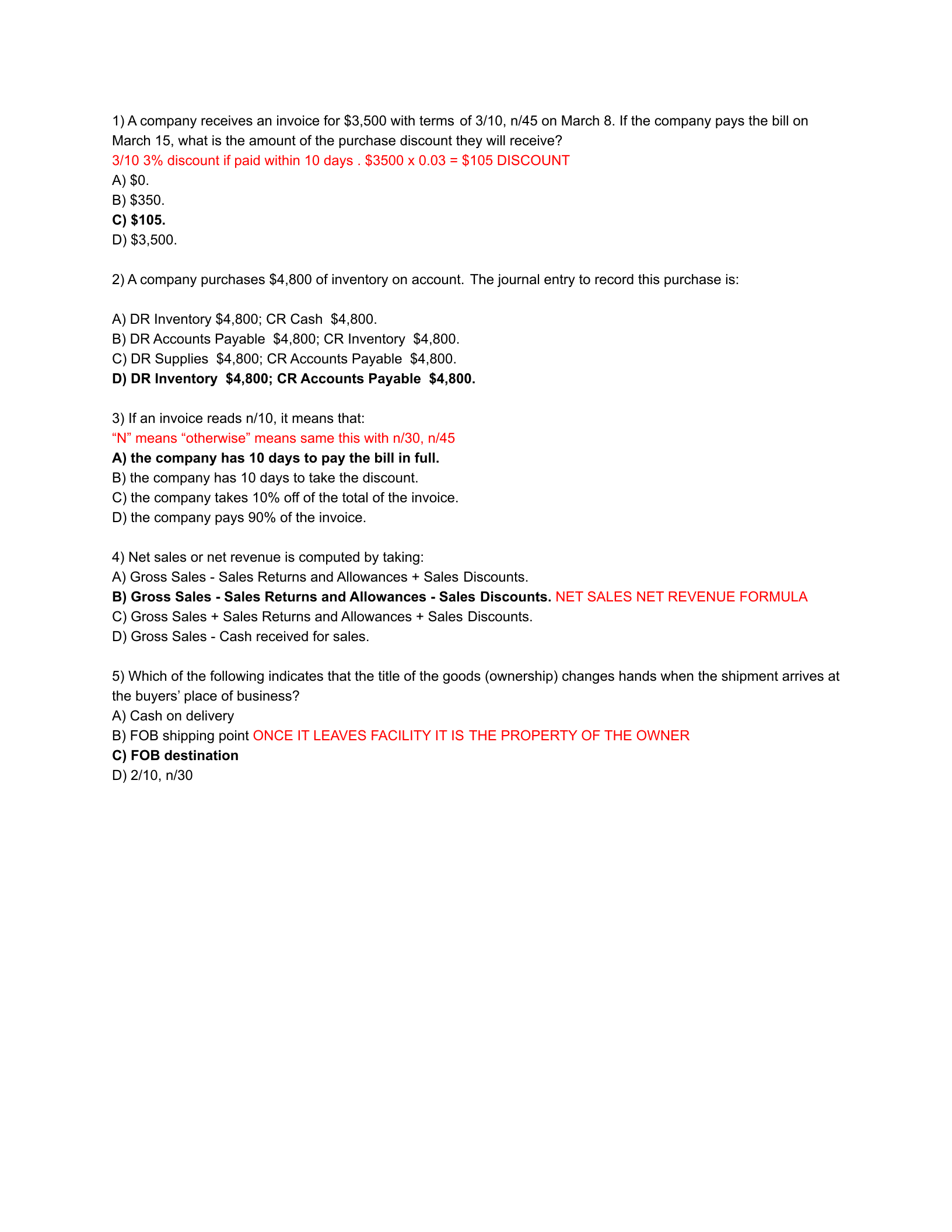
1) A company receives an invoice for $3,500 with terms of 3/10, n/45 on March 8. If the company pays the bill on
March 15, what is the amount of the purchase discount they will receive?
3/10 3% discount if paid within 10 days . $3500 x 0.03 = $105 DISCOUNT
A) $0.
B) $350.
C) $105.
D) $3,500.
2) A company purchases $4,800 of inventory on account. The journal entry to record this purchase is:
A) DR Inventory $4,800; CR Cash $4,800.
B) DR Accounts Payable $4,800; CR Inventory $4,800.
C) DR Supplies $4,800; CR Accounts Payable $4,800.
D) DR Inventory $4,800; CR Accounts Payable $4,800.
3) If an invoice reads n/10, it means that:
“N” means “otherwise” means same this with n/30, n/45
A) the company has 10 days to pay the bill in full.
B) the company has 10 days to take the discount.
C) the company takes 10% off of the total of the invoice.
D) the company pays 90% of the invoice.
4) Net sales or net revenue is computed by taking:
A) Gross Sales - Sales Returns and Allowances + Sales Discounts.
B) Gross Sales - Sales Returns and Allowances - Sales Discounts. NET SALES NET REVENUE FORMULA
C) Gross Sales + Sales Returns and Allowances + Sales Discounts.
D) Gross Sales - Cash received for sales.
5) Which of the following indicates that the title of the goods (ownership) changes hands when the shipment arrives at
the buyers’ place of business?
A) Cash on delivery
B) FOB shipping point ONCE IT LEAVES FACILITY IT IS THE PROPERTY OF THE OWNER
C) FOB destination
D) 2/10, n/30

6) An outdoor clothing store, reports the following information for June:
Sales revenue
$104,00
0
Income tax expense
$11,00
0
Operating
expenses
22,000
Cost of goods sold
65,000
Deferred
revenues
$15,000
Nonoperating
revenues
12,000
104,000 - 22,000 - 65,000
Sales Revenue - Operating Expenses - Cost of Goods Sold
What is their operating income for June?
A) $18,000.
B) $39,000.
C) $104,000.
D) $17,000.
7) Equipment is an example of a:
A) current asset.
B) long-term asset.
C) current liability.
D) long-term liability.
8) The Cost of Goods Sold account appears on the:
A) Balance Sheet.
B) Statement of Retained Earnings.
C) Income Statement. Cost of Goods Sold Considered an EXPENSE
D) post-closing trial balance.
9) The Inventory account appears on the:
A) Balance Sheet. Inventory is an ASSET account
B) Statement of Retained Earnings.
C) Income Statement.
D) list of liabilities.
10) A company purchases inventory for $500 then sells the inventory for $1,200 in cash. The journal entry to record
revenue is:
A) DR Cash $1,200 CR Revenue $1,200
B) DR Cash $500 CR Revenue $500
C) DR Cost of Goods Sold $1,200 CR Revenue $1,200
D) DR Revenue $500 CR Inventory $500
11) A company purchases inventory for $500 then sells the inventory for $1,200 in cash. The journal entry to record
the expense is:
A) DR Cost of Goods Sold $1,200 CR Inventory $1,200
B) DR Inventory $500 CR Cost of Goods Sold $500

C) DR Cost of Goods Sold $500 CR Inventory $500 Credit inventory account to get rid of the inventory that
was sold.
D) DR Cot of Goods Sold $500 CR Revenue $500
12) The account used to record a customer's return is:
Sales Return is going back to a place of business with a product that doesnt work and getting a refund. Sales return
decreases a company’s revenue.
CONTRA ASSET/ CONTRA REVENUE - SUBTRATION FROM THAT ACCOUNT
A) Sales Returns and is a contra revenue account
B) A decrease in Revenue
C) Sales Discounts
D) Purchase Discounts
13) The following information relates to inventory for a company
Date
Quantit
y
Pric
e
March 1
Beginning
Inventory
20
$2
March 7
Purchase
15
3
March
11
Sale @ $7/unit
2
20 - 2 = 18 (REMAINING INVENTORY ON MARCH 11) 18 x 2 = $36
15 x 3 = 45 (MARCH 7)
45+ 36 = 81
What is the value of ending inventory if the company uses FIFO?
A) $4.
B) $76.
C) $81.
D) $85.
14) The following information relates to inventory for a company
Date
Quantit
y
Pric
e
March 1
Beginning
Inventory
20
$2
March 7
Purchase
15
3
March
11
Sale @ $7/unit
2
What is the value of Cost of Goods Sold if the company uses LIFO?
LAST IN FIRST OUT, use the NEWEST inventory ( in this case inventory purchased on March 7)
A) $6.
B) $14.

C) $85
D) $4.
15) The following information relates to inventory for a company
Date
Quantit
y
Pric
e
March 1
Beginning
Inventory
20
$2
March 7
Purchase
60
4
March
11
Sale @ $7/unit
20
What is the value of Cost of Goods Sold if the company uses Average Cost (or Weighted Average)?
ADD 20 @ $2(40) by 60 @ $4 (240); 240 +40 = 280/ 80
(All quantities added together) = 3.5 x 20 (Final quantity)
= $70.
A) $40.
B) $60.
C) $70.
D) $140.
16) Under the principle of lower of cost and market, when a company has inventory with a market value of $50 and a
cost of $60, what is the adjustment?
Company is going to use the lower of those two costs. Cost of inventory is higher than the market value of the
inventory.
A) No adjustment needed.
B) Write down inventory by $60
C) Write down inventory by $10 writing down inventory to match it to the market value, OR vice versa if
market value is higher.
D) Increase inventory by $10
17) If shrinkage is found for $400, an adjusting entry would be made as follows:
When you give up inventory you DR cost and CD inventory for whatever you lost
A) debit Inventory for $400; credit Cost of Goods Sold for $400.
B) debit Inventory for $400; credit Sales Returns and Allowances for $400.
C) debit Cost of Goods Sold for $400; credit Inventory for $400.
D) debit Sales Returns and Allowances for $400; credit Inventory for $400.
18) If prices are falling which inventory valuation method will result in the lowest net income?
A) FIFO
if prices are falling, deflation, prices of the goods we hold are going down, earlier inventory will be more
expensive by comparison. When prices are rising, LIFO will result in lower net income
B) LIFO
C) Weighted Average
D) They're all the same

Part 2
1) Assets that CANNOT be seen, touched, or held are called:
A) intangible assets.
B) tangible assets.
C) plant assets.
D) natural resources.
2) The entry to record bad debt expense under the allowance method is:
Allowance Method- % of Credit sales
A) not required.
B) Bad Debt Expense, debit; Accounts Receivable/customer name, credit.
C) Cash, debit; Accounts Receivable/customer name, credit.
D) Bad Debt Expense, debit; Allowance for Uncollectible Accounts, credit.
3) What type of account is Allowance for Uncollectable Accounts and does it typically have a debit or credit balance?
Accounting for anyone who doesn’t pay you back, if you overestimate you will have a credit balance. Debit balance;
underestimated number of people who didn’t pay you back.
A) An expense account, debit balance
B) A contra-asset account, debit balance
C) A contra-asset account, credit balance
D) A contra-liability account debit balance
4) Betta Group purchased Danio, Inc. for $960,000. The market value of Danio's assets and liabilities at the time of
purchase were $1,300,000 and $360,000 respectively. The amount of goodwill Betta Group will record from this
purchase is:
960,000 - (1,300,000 - 360,000)
Purchase price - (assets - liabilities)
960,000- 940,000 = 20,000
A) $20,000
B) $360,000
C) $340,000
D) $960,000
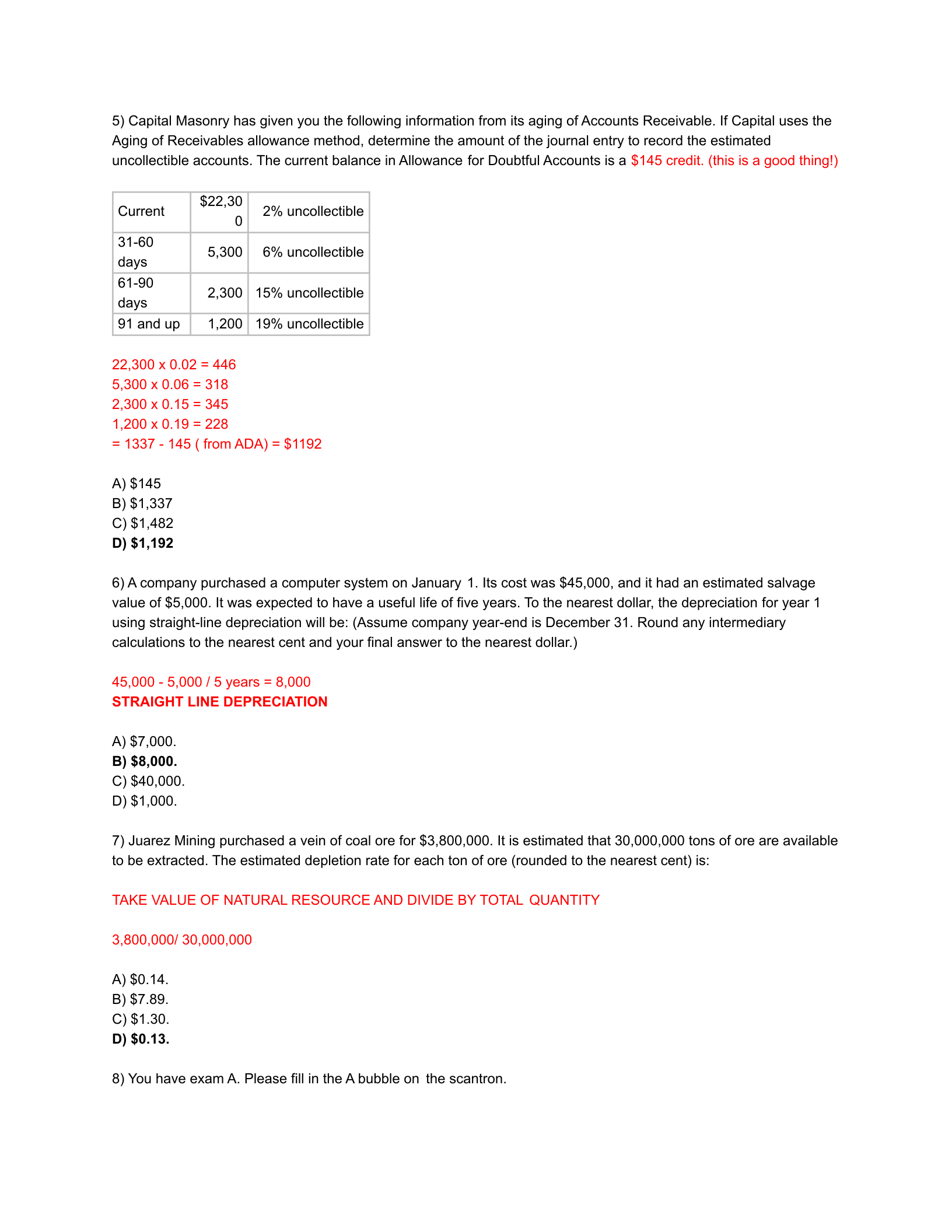
5) Capital Masonry has given you the following information from its aging of Accounts Receivable. If Capital uses the
Aging of Receivables allowance method, determine the amount of the journal entry to record the estimated
uncollectible accounts. The current balance in Allowance for Doubtful Accounts is a $145 credit. (this is a good thing!)
Current
$22,30
0
2% uncollectible
31-60
days
5,300
6% uncollectible
61-90
days
2,300
15% uncollectible
91 and up
1,200
19% uncollectible
22,300 x 0.02 = 446
5,300 x 0.06 = 318
2,300 x 0.15 = 345
1,200 x 0.19 = 228
= 1337 - 145 ( from ADA) = $1192
A) $145
B) $1,337
C) $1,482
D) $1,192
6) A company purchased a computer system on January 1. Its cost was $45,000, and it had an estimated salvage
value of $5,000. It was expected to have a useful life of five years. To the nearest dollar, the depreciation for year 1
using straight-line depreciation will be: (Assume company year-end is December 31. Round any intermediary
calculations to the nearest cent and your final answer to the nearest dollar.)
45,000 - 5,000 / 5 years = 8,000
STRAIGHT LINE DEPRECIATION
A) $7,000.
B) $8,000.
C) $40,000.
D) $1,000.
7) Juarez Mining purchased a vein of coal ore for $3,800,000. It is estimated that 30,000,000 tons of ore are available
to be extracted. The estimated depletion rate for each ton of ore (rounded to the nearest cent) is:
TAKE VALUE OF NATURAL RESOURCE AND DIVIDE BY TOTAL QUANTITY
3,800,000/ 30,000,000
A) $0.14.
B) $7.89.
C) $1.30.
D) $0.13.
8) You have exam A. Please fill in the A bubble on the scantron.

A)
B)
C)
D)
9) McDonald's "golden arches" are an example of a(n) _______, which would be classified as a(n) _______.
ANY TYPE OF LOGO IS A TRADEMARK
A) patent; intangible asset
B) trademark; intangible asset
C) trademark; plant asset
D) patent; plant asset
10) Rose Corp. purchased land for $77,000 Additionally, Rose paid title insurance of $700, a commission of $7,000,
and back taxes due in the amount of $1,000. In addition, Rose Corp put in a driveway for $12,000 (Considered a
LAND IMPROVEMENT) . The cost of the company's land is _______, and land improvements are _______.
A) $85,700; $12,000
B) $77,000; $20,700
C) $97,700; $0
D) $84,700; $12,000
11) When purchasing a long term asset, the expenditure(s) that can be capitalized are:
A) no expenditures should be capitalized. All expenditures should be expensed.
B) the cost of the long term asset and any one time expenditures that get the asset ready for use.
C) just the cost of the long term asset.
D) the cost of the long term asset and all expenditures that get the asset ready for use.
12) A company purchases an asset for $90,000 and records depreciation expense of $5,000 each year. After 3 years
the balance in the accumulated depreciatoin account is $15,000. What is the book value of the asset after 3 years?
Take cost of asset (book value) and subtract accumulated depreciation
A) $5,000
B) $75,000
C) $90,000
D) $15,000
13) On September 1, 2018, Daylight Donuts lends $100,000, at 9%, with the amount plus accrued interest due six
months later on March 1, 2019. Daylight Donuts should report interest on December 31, 2018 (their fiscal year end),
in the amount of:
Calculating interest: i = prt
100,000 x (.09) (4/12) = 3,000
A) $0.
B) $1,500.
C) $4,500.

D) $3,000.
14) The journal entry to write off a customer's account receivable under the allowance method is:
A) Allowance for Uncollectible Accounts, debit; Accounts Receivable/customer name, credit.
B) not required.
C) Bad Debt Expense, debit; Accounts Receivable/customer name, credit.
D) Bad Debt Expense, debit; Allowance for Uncollectible Accounts, credit.
15) Some Company purchases a machine for $125,000. It has an estimated salvage value of $10,000 and is
expected to produce 50,000 units in its lifetime. During the first year of operation, it produced 15,000 units. To the
nearest dollar, the depreciation expense for the first year under the units of production method will be:
125,000 - 10,000/ 50,000 = $2.3/ per unit
15,000 units x 2.3 = 34,500
HOW TO SOLVE ANY DEPRECIATION EXPENSE EQUATION
A) $28,750.
B) $37,500.
C) $34,500.
D) $31,250.
16) It is determined that a computer's depreciation expense for the year is $3,500. The journal entry to record the
depreciation is:
A) debit Cash $3,500; credit Depreciation Expense - computer $3,500.
B) debit Depreciation Expense - computer $3,500; credit Accumulated Depreciation, $3,500.
C) debit Depreciation Expense - computer $3,500; credit Cash $3,500.
D) debit Accumulated Depreciation - computer $3,500; credit Cash $3,500.
17) A company purchased furniture on January 1. Its cost was $20,000, and it had a residual value of $4000. Its
useful life is determined to be 5 years. Using double-declining balance depreciation, the depreciation for year 1 to the
nearest dollar will be:
20,000 x 2 x ⅕ = $8,000
A) $4000.
B) $6400.
C) $8000.
D) $3200.
18) Marla is a customer of Smiths, Inc. Her current balance due is $2,430. It has been determined that she defaulted
on her account. If Smiths, Inc. uses the direct method to record bad debt expense, what entry is necessary to write off
the $2,430?
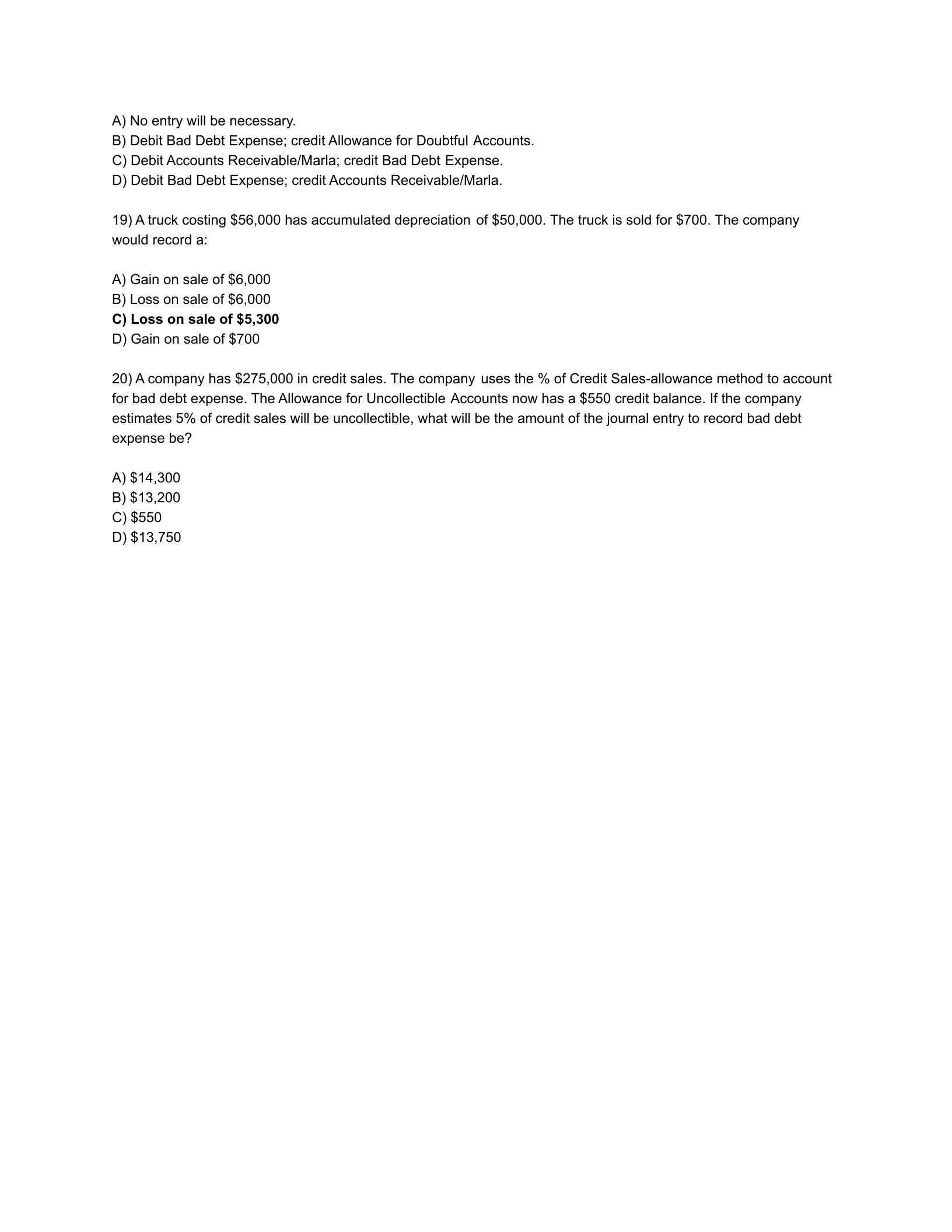
A) No entry will be necessary.
B) Debit Bad Debt Expense; credit Allowance for Doubtful Accounts.
C) Debit Accounts Receivable/Marla; credit Bad Debt Expense.
D) Debit Bad Debt Expense; credit Accounts Receivable/Marla.
19) A truck costing $56,000 has accumulated depreciation of $50,000. The truck is sold for $700. The company
would record a:
A) Gain on sale of $6,000
B) Loss on sale of $6,000
C) Loss on sale of $5,300
D) Gain on sale of $700
20) A company has $275,000 in credit sales. The company uses the % of Credit Sales-allowance method to account
for bad debt expense. The Allowance for Uncollectible Accounts now has a $550 credit balance. If the company
estimates 5% of credit sales will be uncollectible, what will be the amount of the journal entry to record bad debt
expense be?
A) $14,300
B) $13,200
C) $550
D) $13,750
Powered by TCPDF (www.tcpdf.org)

