


Study Guide
"Tis the desire of bending things to our own purpose which turns them into confusion..."
by Sarah Fielding (1710-1768, British Novelist)
In this topic, you will learn more about one of the most common landscape maintenance tasks;
pruning. Pruning plants has both a technical and artistic side allowing us to direct the growth of
plants. After you read the articles and watch the videos for this topic you should be able to
answer the following questions:
1. Define the following terms:
● terminal bud
● lateral bud
● excurrent tree
● decurrent tree
● central leader
● scaffold branch
● Espalier
● Topiary
● Pollarding
● Topping
2. What is the difference between these different types of pruning: thinning, heading and
shearing?
● Pruning: Pruning is the intentional removal of parts of a plant.
● Thinning: Selective thinning refers to removing branches back to the point of attachment
to another branch, or to the ground.
○ This type of pruning opens the plant canopy, increasing light and air movement
● Heading: Heading cuts remove parts of a stem or branch resulting in multiple new
shoots just below the cut
○ This can create a bushy plant and is sometimes done when plants are very
young to stimulate more branches.
○ However, repeated heading is similar to shearing and eventually results in a
dense canopy with branches having leaves at the tip and no leaves further back
3. What are the different reasons for pruning at trees? Know the different ways to prune the
columnar (palm), excurrant (pine) and decurrent trees (elm). What should you do if a tree
develops a co-dominant leader?
4. How should you prune a deciduous fruit tree like a peach or apple tree? Be familiar with the
term open center (vase) pruning.
5. What are the different ways to prune shrubs to get a formal or informal look?
6. What is wrong with topping a tree? What should be the angle of a pruning cut?
● Topping as a horticultural practice is something that is really bad for the tree. The tree
never recovers architecturally when you look at the branching patterns after it's been
topped.
●
7. Know how to make the following types of pruning cuts: heading cut, thinning cut. What
technique should be used to prevent ripping of bark when pruning a large branch off a tree?
What is the importance of the branch collar in locating a pruning cut of a large branch.
8. What time of year should pruning be done? What is the difference between pruning flowering
trees and shrubs that flower on old wood and those that flower on new wood?
9. Be familiar with the following pruning tools and what size branches they should be used on:
pruning shears (also called bypass pruners), loppers, pruning saws, pole pruner, hedgers (also
called hedge shears)
10. What are some of the safety concerns you should be aware of when pruning? When should
you hire a professional arborist to prune trees?
Video: Pruning Terms
Terminal bud and Lateral Bud
● Bud: a bud is an unexpanded shoot or flower. Buds occur at nodes either alone singly or
in pairs, and they may be terminal that is at the end or tip of a shoot (we call that the
terminal bud) or they may be subjacent to that underneath beneath on the stem (lateral
Buds.
●Lateral buds: lateral buds are at nodes that are botanically called axillary in their
position
● The terminal bud is at the end of the stem (the top), and the lateral buds are all of the
buds along a stem beneath that terminal bud.
Trunk, crown, and canopy.
●Trunk: The main lower stem of a tree, usually covered with bark
○ The trunk is the main lobe of a tree usually covered with bark.
○ The trunk supports the crown.
■ Now the crown is the system of living branches and stems of a tree.
●Crown: System of living branches and stems of a tree that are supported by the trunk
●Canopy: Foliage; the sum of all leaves and small twigs of a tree that are supported by
the crown (and of course the crown then is supported by the trunk.)
● And these are all parts of the shoot of the tree, the above-ground portion of the tree.
Central Leader.
● Central leader is a single stem of a tree that runs vertically from the ground (the base) to
the very tallest portion of the tree.
Scaffold or support branches
● Scaffold or support branches are attached to the central leader and structurally provide
the major point of support for all of the foliage of a tree.
Excurrent growth form.
● Applicable to only trees, not shrubs
● Definition: The excurrent growth form of a tree means that the tree has a single
dominant central leader.
● Ex: Canary Island pines.
○ They are famous for having a very arrow-like upright excurrent growth form
● Not all plants have an excurrent growth form.
○ In fact, many are rounded in their shape and form.
○ Those plants that grow like that, and a lot of shrubs do, have a what we call
decurrent growth form.
Decurrent growth form
● Trees or shrubs with a decurrent growth form means that the plant has many, many
leaders, not just one single central leader, no dominant leader
Columnar growth form.
● Columnar growth form is a plant that is varied dramatically upright in its growth habit with
a single leader and one growing point.
● Ex: Palms- Phoenix dactylifera or date palm tree.
Pollarding
● Pollarding is a special type of pruning system in which the upper branches of a tree are
removed to promote the regrowth of a dense head of branches.
● Pollarding has been common in Great Britain and Europe since really medieval times.
● Trees were traditionally pollarded to either provide leafy digestible fodder for livestock or
to provide kindling wood for fires.
● Today pollarding really has no useful value, and it is surprising that some still practice it.
Topping
● This term applies specifically to trees.
● Definition: It is a type of pruning in which the tree is severely headed back basically to
lower the height of it.
○ Ex: You oftentimes see power companies like SRP and APS topping trees so that
the tree will not grow up into a powerline
● Topping as a horticultural practice is something that is really bad for the tree. The tree
never recovers architecturally when you look at the branching patterns after it's been
topped.
Shearing
● Another pruning practice that's commonly seen here in the Phoenix area
● Definition: Frequent removal of small amounts of foliar tissue or leaves
○ Shearing is done I think mostly out of convenience. It's an expedient way to
prune.
● The resulting shape of a shrub is very geometrical.
● When it's done frequently it will continually remove the most photosynthetically active
leaves.
● A chronically sheared shrub will have a much reduced growth rate.
● Sometimes plants that have been chronically sheared for longer periods of time will
actually die because of starvation.
● Shearing is a practice that is commonly done by inexperienced and unprofessional
horticultures!
● Sadly horticultural laypersons, in other words homeowners, think that because the
"quote-unquote" professionals are doing it that somehow it's what we all should do.
Topiary
● Topiary refers to a special pruning practice that is very intensive; the purpose of which is
to create a specific shape for a shrub or tree.
○ Shapes like the ficus pavilion, or the olive balloon, or the ficus Cabo chicken.
○ Very difficult to shape and maintain
Espalier
● Espalier: is the practice of controlling woody plant growth by pruning and possibly
grafting branches so that they grow on relatively flat planes, frequently in formal
patterns, against structures such as a wall, a fence, or a trellis.
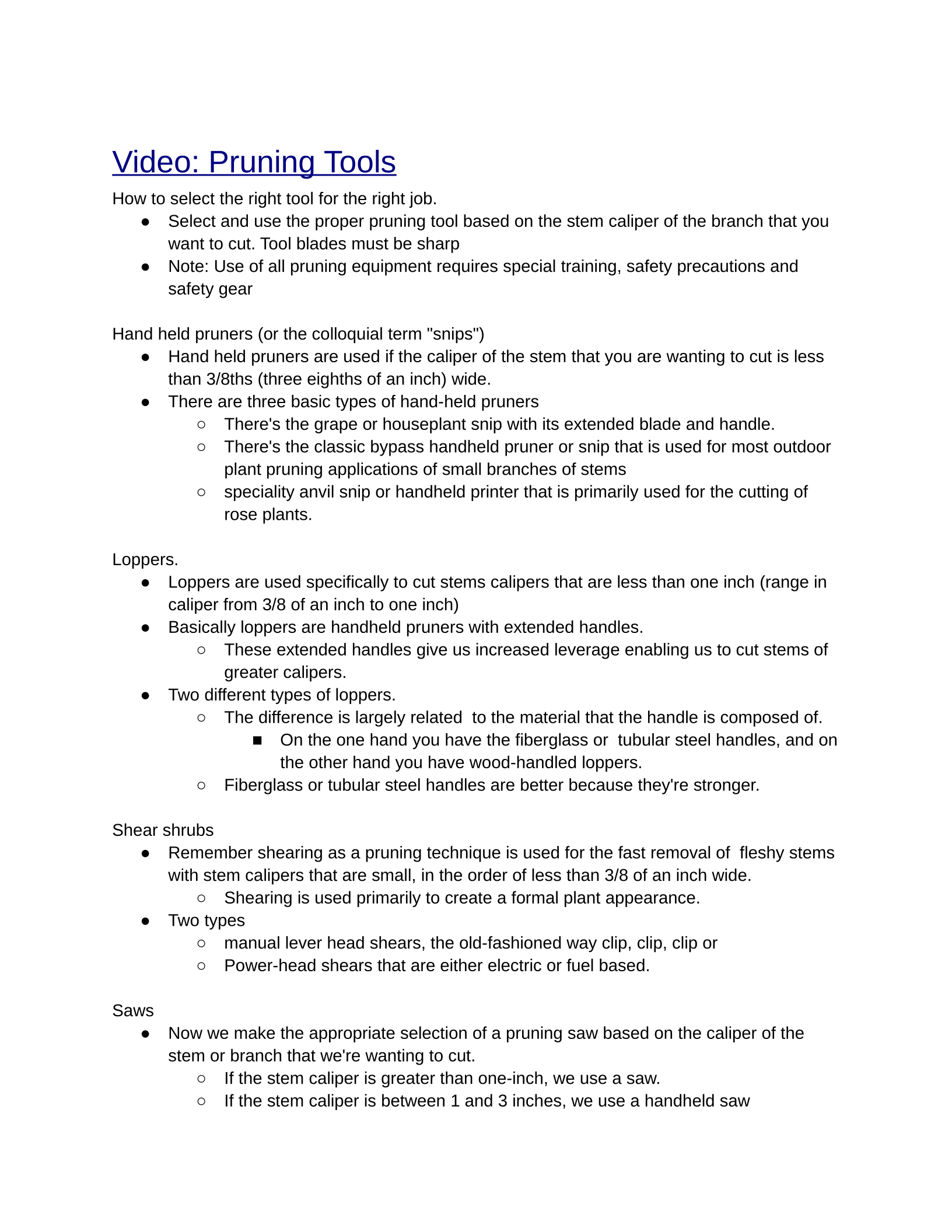
Video: Pruning Tools
How to select the right tool for the right job.
● Select and use the proper pruning tool based on the stem caliper of the branch that you
want to cut. Tool blades must be sharp
● Note: Use of all pruning equipment requires special training, safety precautions and
safety gear
Hand held pruners (or the colloquial term "snips")
● Hand held pruners are used if the caliper of the stem that you are wanting to cut is less
than 3/8ths (three eighths of an inch) wide.
● There are three basic types of hand-held pruners
○ There's the grape or houseplant snip with its extended blade and handle.
○ There's the classic bypass handheld pruner or snip that is used for most outdoor
plant pruning applications of small branches of stems
○ speciality anvil snip or handheld printer that is primarily used for the cutting of
rose plants.
Loppers.
● Loppers are used specifically to cut stems calipers that are less than one inch (range in
caliper from 3/8 of an inch to one inch)
● Basically loppers are handheld pruners with extended handles.
○ These extended handles give us increased leverage enabling us to cut stems of
greater calipers.
● Two different types of loppers.
○ The difference is largely related to the material that the handle is composed of.
■ On the one hand you have the fiberglass or tubular steel handles, and on
the other hand you have wood-handled loppers.
○ Fiberglass or tubular steel handles are better because they're stronger.
Shear shrubs
● Remember shearing as a pruning technique is used for the fast removal of fleshy stems
with stem calipers that are small, in the order of less than 3/8 of an inch wide.
○ Shearing is used primarily to create a formal plant appearance.
● Two types
○ manual lever head shears, the old-fashioned way clip, clip, clip or
○ Power-head shears that are either electric or fuel based.
Saws
● Now we make the appropriate selection of a pruning saw based on the caliper of the
stem or branch that we're wanting to cut.
○ If the stem caliper is greater than one-inch, we use a saw.
○ If the stem caliper is between 1 and 3 inches, we use a handheld saw

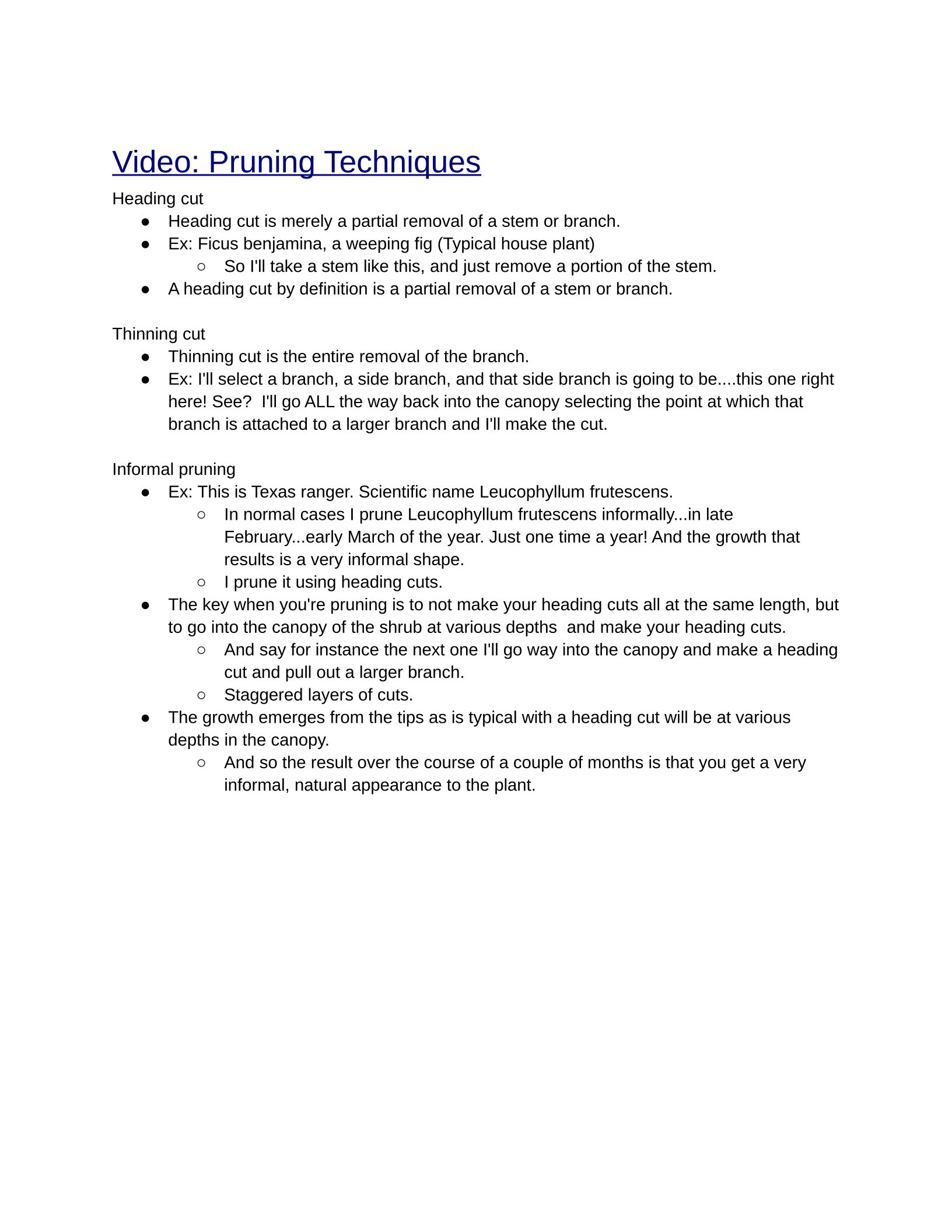
Video: Pruning Techniques
Heading cut
● Heading cut is merely a partial removal of a stem or branch.
● Ex: Ficus benjamina, a weeping fig (Typical house plant)
○ So I'll take a stem like this, and just remove a portion of the stem.
● A heading cut by definition is a partial removal of a stem or branch.
Thinning cut
● Thinning cut is the entire removal of the branch.
● Ex: I'll select a branch, a side branch, and that side branch is going to be....this one right
here! See? I'll go ALL the way back into the canopy selecting the point at which that
branch is attached to a larger branch and I'll make the cut.
Informal pruning
● Ex: This is Texas ranger. Scientific name Leucophyllum frutescens.
○ In normal cases I prune Leucophyllum frutescens informally...in late
February...early March of the year. Just one time a year! And the growth that
results is a very informal shape.
○ I prune it using heading cuts.
● The key when you're pruning is to not make your heading cuts all at the same length, but
to go into the canopy of the shrub at various depths and make your heading cuts.
○ And say for instance the next one I'll go way into the canopy and make a heading
cut and pull out a larger branch.
○ Staggered layers of cuts.
● The growth emerges from the tips as is typical with a heading cut will be at various
depths in the canopy.
○ And so the result over the course of a couple of months is that you get a very
informal, natural appearance to the plant.
Powered by TCPDF (www.tcpdf.org)

